Article

Target-Following Control of a Biomimetic Autonomous System Based on Predictive Reinforcement Learning


1
Department of Automation, Tsinghua University, Beijing 100084, China
2
The Laboratory of Cognitive and Decision Intelligence for Complex System, Institute of Automation, Chinese Academy of Sciences, Beijing 100190, China
3
The School of Artificial Intelligence, University of Chinese Academy of Sciences, Beijing 100049, China
4
The State Key Laboratory for Turbulence and Complex Systems, Department of Advanced Manufacturing and Robotics, College of Engineering, Peking University, Beijing 100871, China
*
Author to whom correspondence should be addressed.
Biomimetics 2024, 9(1), 33; https://doi.org/10.3390/biomimetics9010033

Submission received: 13 November 2023 / Revised: 16 December 2023 / Accepted: 2 January 2024 / Published: 4 January 2024
(This article belongs to the Special Issue Advances in Biomimetics: The Power of Diversity)

Abstract

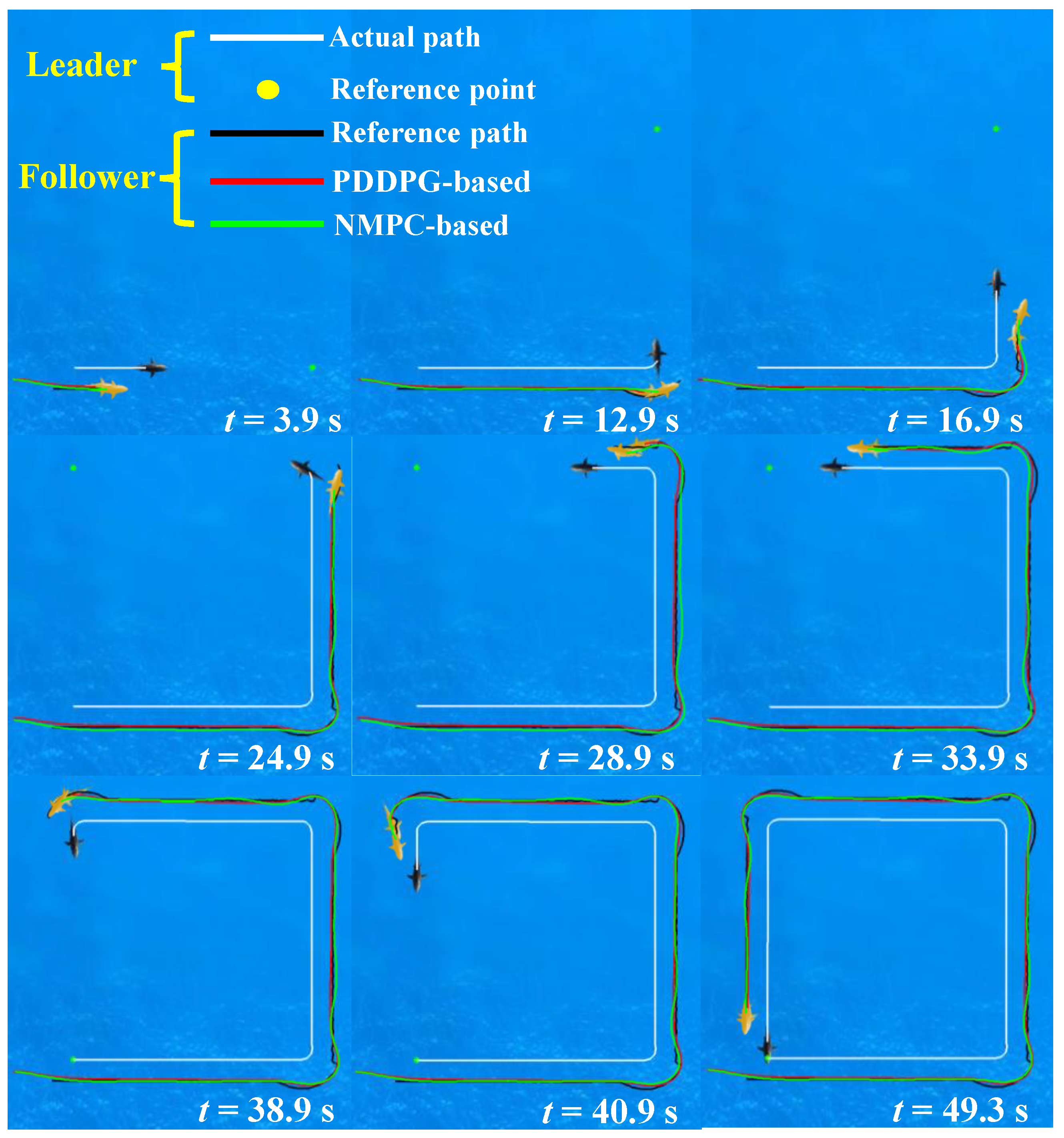
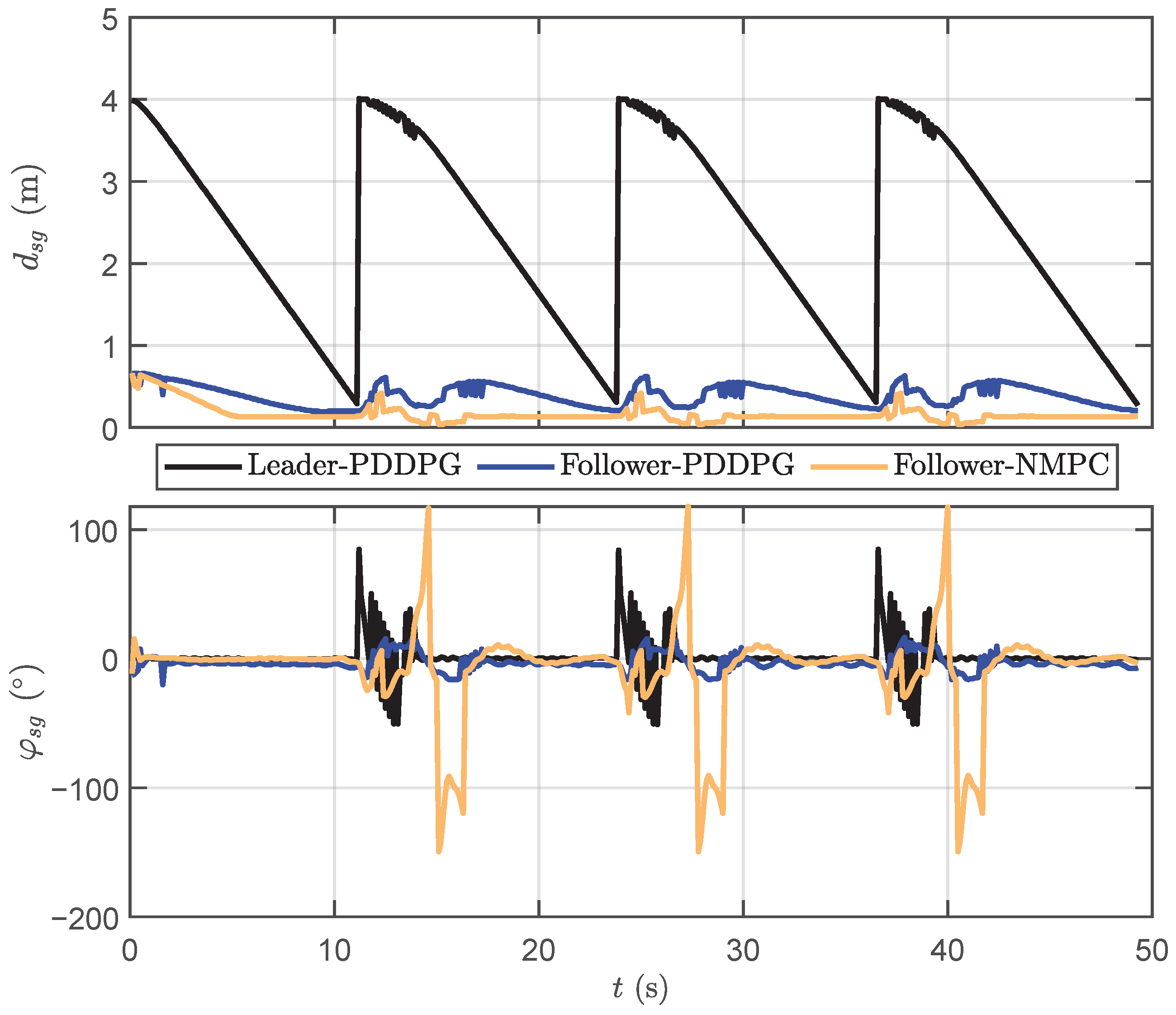
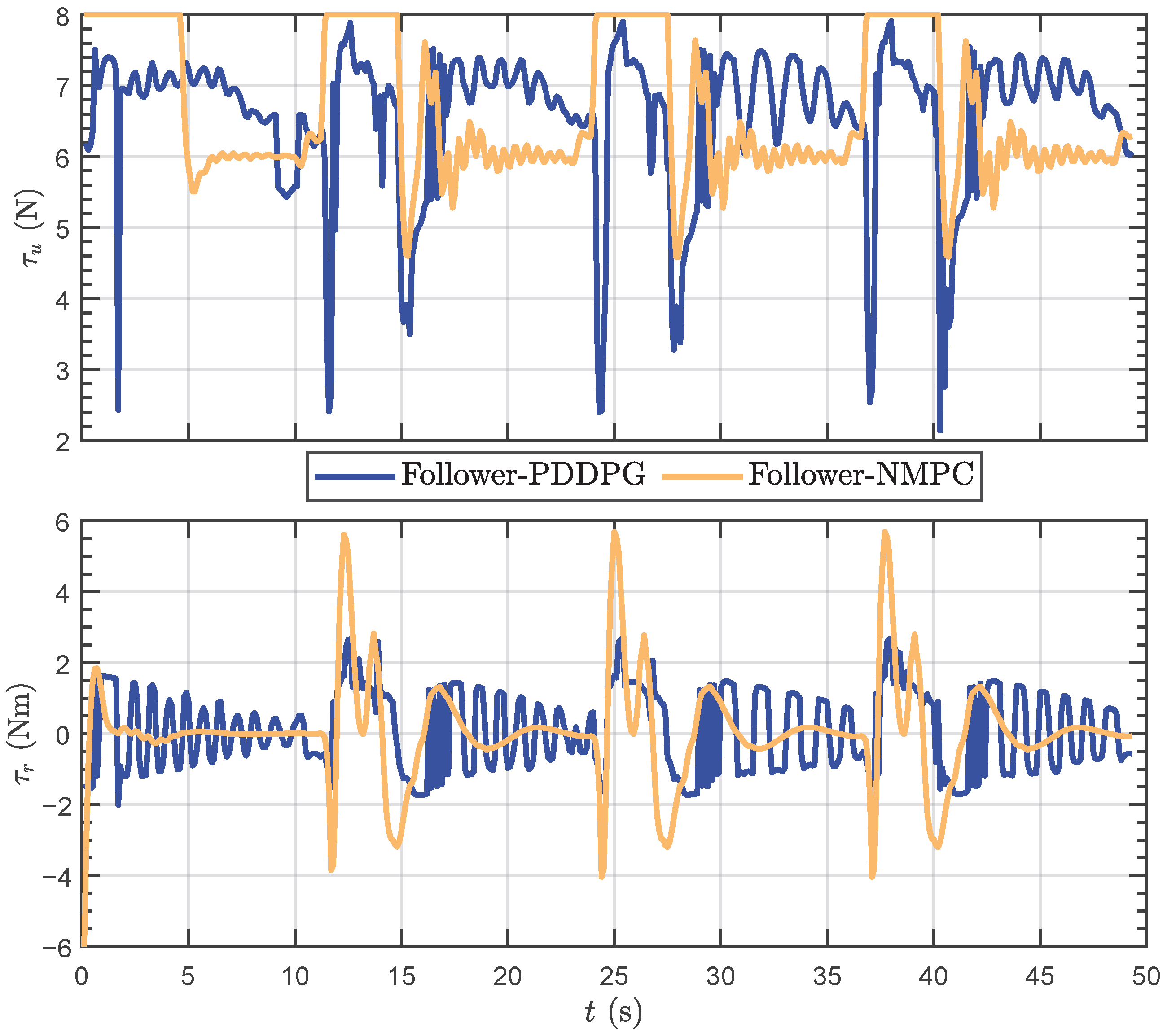
Biological fish often swim in a schooling manner, the mechanism of which comes from the fact that these schooling movements can improve the fishes’ hydrodynamic efficiency. Inspired by this phenomenon, a target-following control framework for a biomimetic autonomous system is proposed in this paper. Firstly, a following motion model is established based on the mechanism of fish schooling swimming, in which the follower robotic fish keeps a certain distance and orientation from the leader robotic fish. Second, by incorporating a predictive concept into reinforcement learning, a predictive deep deterministic policy gradient-following controller is provided with the normalized state space, action space, reward, and prediction design. It can avoid overshoot to a certain extent. A nonlinear model predictive controller is designed and can be selected for the follower robotic fish, together with the predictive reinforcement learning. Finally, extensive simulations are conducted, including the fix point and dynamic target following for single robotic fish, as well as cooperative following with the leader robotic fish. The obtained results indicate the effectiveness of the proposed methods, providing a valuable sight for the cooperative control of underwater robots to explore the ocean.
Keywords: biomimetic motion; biomimetic autonomous system; target following; deep reinforcement learning; predictive control biomimetic motion; biomimetic autonomous system; target following; deep reinforcement learning; predictive control