1. Introduction
Calcium silicate-based cements are now routinely used in vital pulp therapy (VPT) and root canal management applications. The widespread adoption of these materials in clinical practice stems from their bioactivity, superior sealing ability, and reliable clinical performance. First exemplified by mineral trioxide aggregate (MTA), these cements exhibit well-documented interactions with hard tissues, promoting odontoblastic differentiation, hydroxyapatite formation, and reparative dentin deposition [
1,
2].
Studies conducted over the past twenty years have focused on overcoming the various limitations of traditional MTA formulations. These include long setting time, difficult handling characteristics, discoloration potential, and impurity issues related to the presence of bismuth oxide and heavy metals [
3]. These limitations have led to the development of new-generation calcium silicate-based cements, including ready-to-use putty-type calcium silicate-based cements.
VPT is a well-established approach in modern dentistry that aims to preserve pulp vitality following mechanical or carious exposures through the formation of a mineralized barrier in the exposure area. Calcium silicate-based cements are widely used in VPT procedures because they stimulate hard tissue formation, create an alkaline environment that promotes healing, and exhibit effective sealing properties [
4,
5,
6]. The success of VPT largely depends on the biocompatibility and bioactivity properties of the materials used. This has created a demand for advanced formulations that offer low cytotoxicity alongside adequate physicochemical performance.
Changes in the selection of radiopacifying agents have been particularly effective in optimizing material performance. Bismuth oxide, traditionally used to provide adequate radiopacity, has been associated with tooth discoloration, altered hydration kinetics, and potential cytotoxicity [
7,
8]. These concerns have led researchers to explore alternative radiopacifiers. Zirconium oxide, tantalum oxide, and calcium tungstate are prominent alternatives in this context. Comparative analyses have shown that zirconium oxide can provide radiopacity levels similar to bismuth oxide, while accomplishing this without affecting cement hydration or causing discoloration [
9]. Calcium tungstate, on the other hand, meets international radiopacity standards while improving optical stability and handling properties [
10,
11]. Radiopacifier selection therefore involves a trade-off between physicochemical and biological properties that must be carefully considered for each formulation.
The biological behavior of calcium silicate-based cements may be influenced by differences in material composition in addition to radiopacity-related characteristics. For example, calcium ion release activates signaling pathways that contribute to mineralized tissue formation and pulp healing processes [
12]. However, differences in additives such as plasticizers, resin components, and radiopacifiers can alter pH, solubility, and bioactivity, sometimes leading to inflammatory or cytotoxic responses in vitro [
13,
14]. Cytocompatibility testing is accordingly an essential step in the preclinical evaluation of any new formulation. Furthermore, research on the genotoxic and oxidative effects of new formulations further reinforces the case for thorough biocompatibility screening [
15,
16]. Studies on human dental pulp stem cells have shown that premixed calcium silicate-based cements generally support cell viability, migration, and odontogenic differentiation, although the extent of these responses varies depending on material composition and the presence of resin components [
6,
17,
18]. However, concerns have been raised regarding the biocompatibility of resin-modified formulations, as these materials have been associated with increased cytotoxicity, incomplete hydration, and a shift toward pro-inflammatory responses compared to conventional calcium silicate-based cements [
17,
19].
Advances in pre-mixed calcium silicate-based cements, including putty materials, aim to provide more consistent handling properties and controlled hydration reactions. The ready-to-use nature of these materials eliminates operator-dependent variability and provides clinical advantages in pediatric and adult endodontics by limiting moisture exposure during manipulation [
20]. Current studies show that these materials generally exhibit excellent sealing ability and favorable cell viability; however, performance differences may be observed depending on factors such as the type and concentration of radiopacifier used, fillers, and thickening agents [
20,
21]. A combined evaluation of physicochemical and biological properties is therefore necessary to establish the clinical suitability of new putty-type calcium silicate-based cement formulations. Recent clinical evidence has further supported the use of premixed calcium silicate-based cements in vital pulp therapy and related applications. Favorable clinical outcomes, including high success rates and predictable hard tissue barrier formation, have been reported with contemporary premixed formulations in both pulpotomy and direct pulp capping procedures [
22,
23]. Prospective evaluations have also demonstrated favorable healing rates and tooth survival with premixed calcium silicate-based cement formulations in broader clinical settings [
24]. These findings reinforce the clinical relevance of evaluating the physicochemical and biological properties of current premixed calcium silicate-based cements intended for pulp therapy applications.
Recent classification frameworks have categorized calcium silicate-based cements into distinct generations based on their compositional evolution and setting mechanisms [
19,
25]. Among these, resin-modified calcium silicate cements (RMCSCs), such as TheraCal LC and TheraCal PT (Bisco, Schaumburg, IL, USA), constitute a separate category (Generation VI) characterized by the incorporation of a polymerizable resin matrix. Unlike conventional calcium silicate-based cements that set exclusively through hydraulic reactions, RMCSCs rely on light-cure or dual-cure polymerization, with limited subsequent hydration dependent on environmental moisture uptake. This fundamental difference in setting chemistry has been associated with altered biological responses, including reduced calcium ion release and lower biocompatibility compared to earlier-generation calcium silicate-based cements. The present study therefore includes both calcium silicate-based cements and an RMCSC to capture the influence of these compositional and mechanistic differences on radiopacity, elemental composition, and biological behavior.
Despite all advances in the field of pre-mixed calcium silicate-based cements and radiopacifier selection, comprehensive data evaluating radiopacity, elemental composition, and biological behavior together for calcium silicate-based cements in putty form recently introduced to the market are limited. Although individual properties such as cytocompatibility or radiopacity have been studied separately, the interrelationship between chemical composition, inflammatory response, and radiographic performance has not been systematically investigated. This knowledge gap makes evidence-based cement selection difficult in VPT applications. Therefore, the present study aims to comparatively evaluate selected current putty-form calcium silicate-based cements containing different radiopacifiers and formulations in terms of radiopacity, elemental composition, cytotoxicity, and anti-inflammatory effects. The null hypothesis was that there would be no significant difference between the tested putty-form calcium silicate-based cements in terms of radiopacity (according to ISO 6876 [
26]requirements) and biological responses (including cytotoxicity and cytokine expression) evaluated on human dental pulp cells.
2. Materials and Methods
2.1. Study Design
Four different cements, including three calcium silicate-based cements, namely NeoMTA2 (Avalon Biomed, Houston, TX, USA), NeoPUTTY (Avalon Biomed, Houston, TX, USA), and One-Fil PT (Mediclus, Cheongju, Republic of Korea), and one RMCSC, namely TheraCal PT, were included in the study. The compositions and manufacturer information of the materials are presented in
Table 1.
The sample size for radiopacity assessment was determined using G*Power software (version 3.1.9.7, Heinrich-Heine-Universität Düsseldorf, Düsseldorf, Germany). The power analysis was performed based on previous radiopacity studies of calcium silicate-based cements, with α = 0.05, power = 0.80, and effect size f = 0.50 for one-way ANOVA. The analysis indicated that a minimum of 12 samples were required for each material. To ensure sufficient statistical power, fifteen samples (n = 15) were prepared from each material for the radiopacity test.
The study included radiopacity evaluation according to ISO 6876 (ISO 6876:2012, subsequently revised as ISO 6876:2025; the minimum radiopacity requirement of ≥3 mm Al remains unchanged in the current edition), scanning electron microscopy with energy-dispersive X-ray spectroscopy (SEM/EDX) analysis, cytotoxicity assessment using the MTT assay at four different dilutions (1:1, 1:2, 1:4, 1:8), and inflammatory cytokine expression analysis (IL-6 and IL-10) using enzyme-linked immunosorbent assay (ELISA). Material extracts were prepared according to ISO 10993-5 [
27] guidelines. The study design is presented in
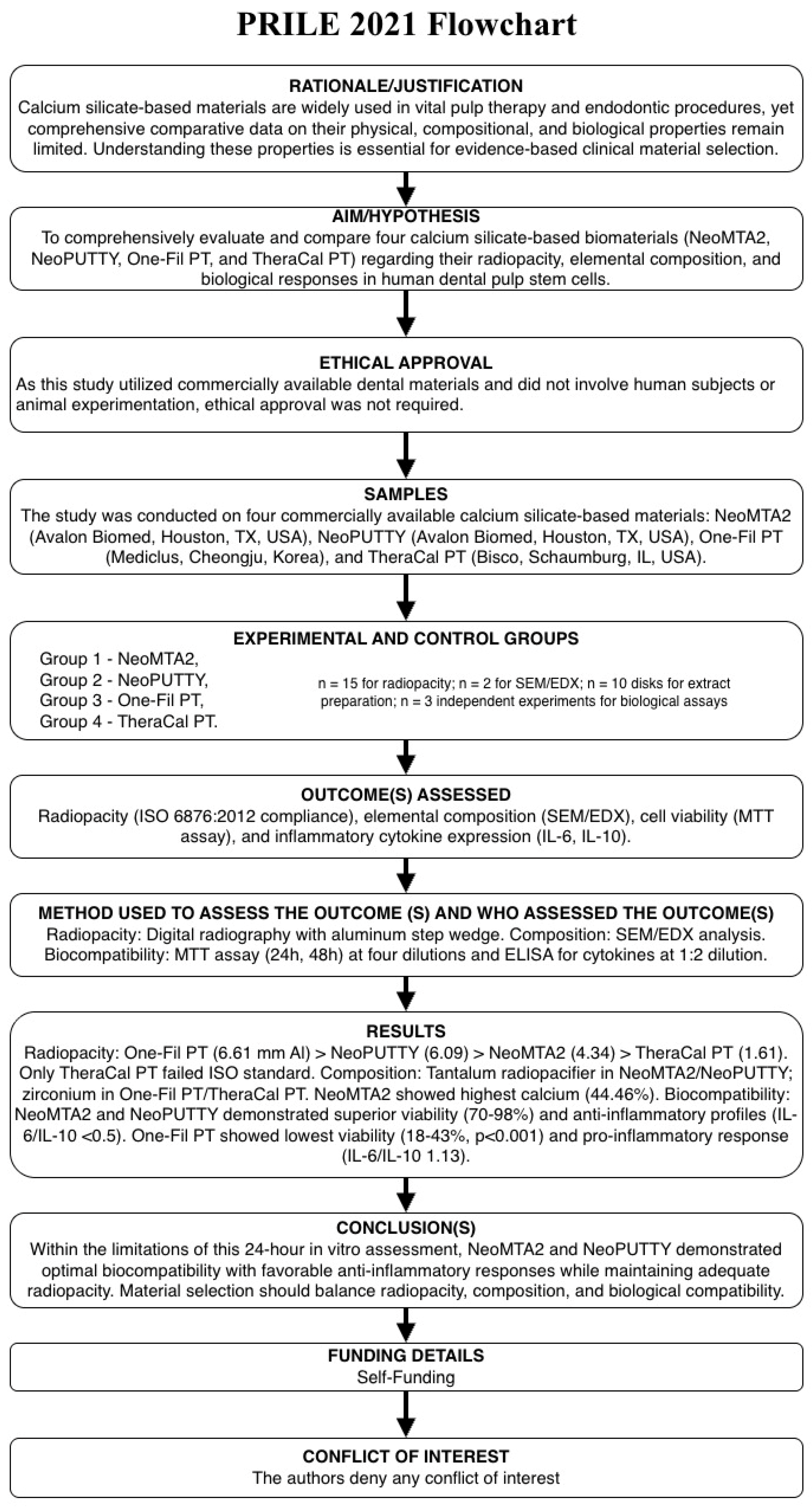
Figure 1 as a Preferred Reporting Items for Laboratory Endodontology (PRILE) 2021 flowchart. Each material was prepared according to the manufacturer’s instructions. NeoPUTTY, One-Fil PT, and TheraCal PT were used as supplied (premixed, ready-to-use formulations). NeoMTA2 powder was mixed with the accompanying liquid in a 1:1 powder-to-liquid ratio by weight.
2.2. Radiopacity Analysis
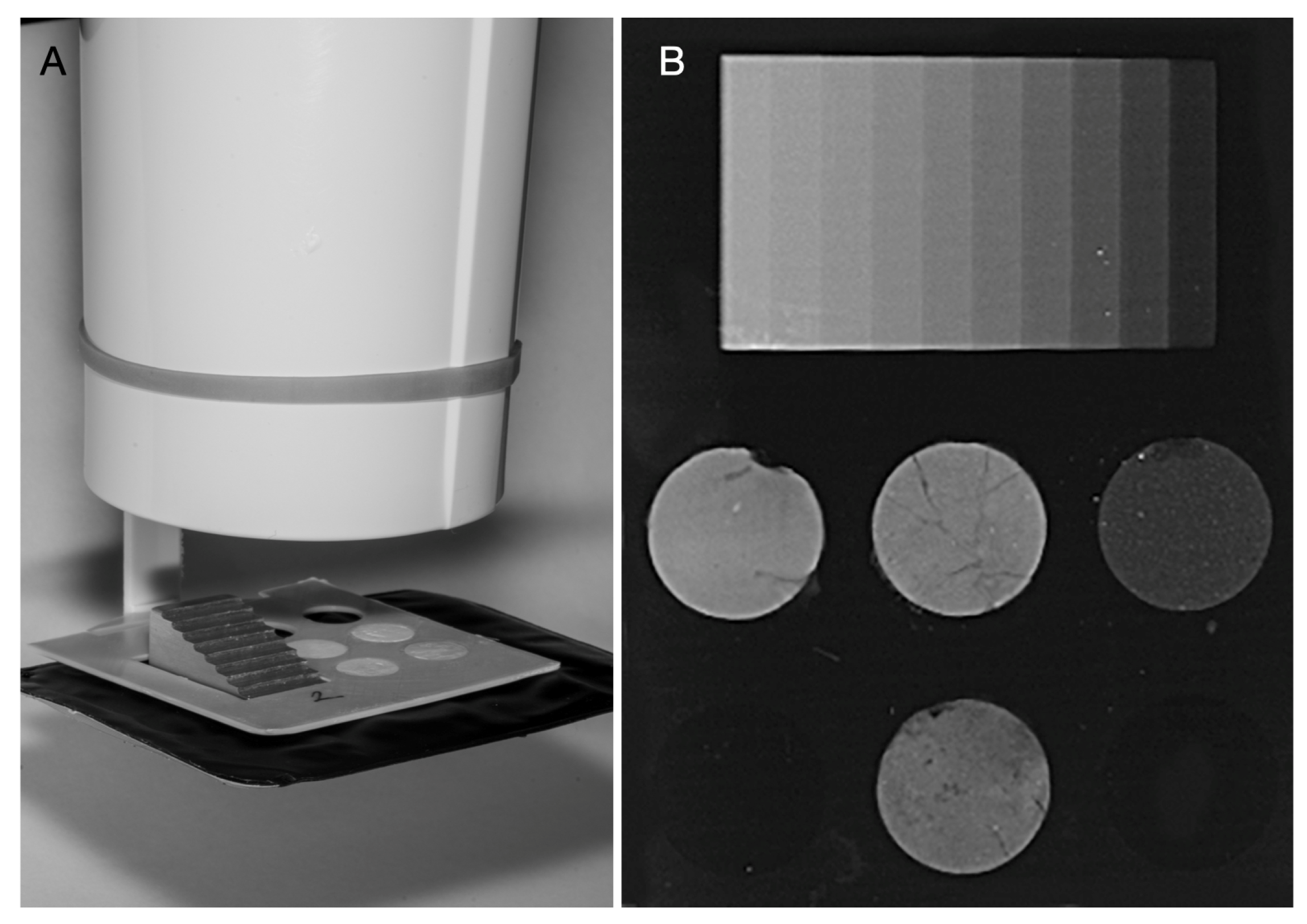
For radiopacity assessment, a positioning apparatus was specifically designed using TinkerCAD (Autodesk Inc., San Rafael, CA, USA) and 3D-printed using a Bambu Lab A1 FDM printer (Bambu Lab, Shenzhen, China) with polylactic acid (PLA) filament. The apparatus consisted of two components: (1) a specimen holder containing standardized cylindrical cavities (10 mm diameter, 1 mm depth) for material samples and a special slot for the aluminum step wedge, and (2) a mounting adapter that allows the holder to be attached to the X-ray cone in a repeatable manner, creating a standardized geometry between the X-ray source, specimens, and detector (
Figure 2A).
Cylindrical specimens (10 mm diameter, 1 mm thickness,
n = 15 for each material) were prepared and placed in the specimen holder together with a 10-step aluminum step wedge (99% purity, 1-mm increments, 1–10 mm thickness range, each step measuring 2.5 mm in width and 15 mm in length) compliant with ISO 6876 standards (
Figure 2B). The positioning apparatus maintained a fixed focus-to-detector distance of 30 cm and ensured perpendicular beam alignment.
Digital radiographs were obtained using an intraoral X-ray unit (RXDC Extend; MyRay, Bicocca, Italy) under standardized exposure conditions (70 kVp, 8 mA, 0.32 s). The images were captured using an image plate scanner (VistaScan; Dürr Dental, Bietigheim-Bissingen, Germany) and saved in TIFF format to preserve image quality for quantitative analysis.
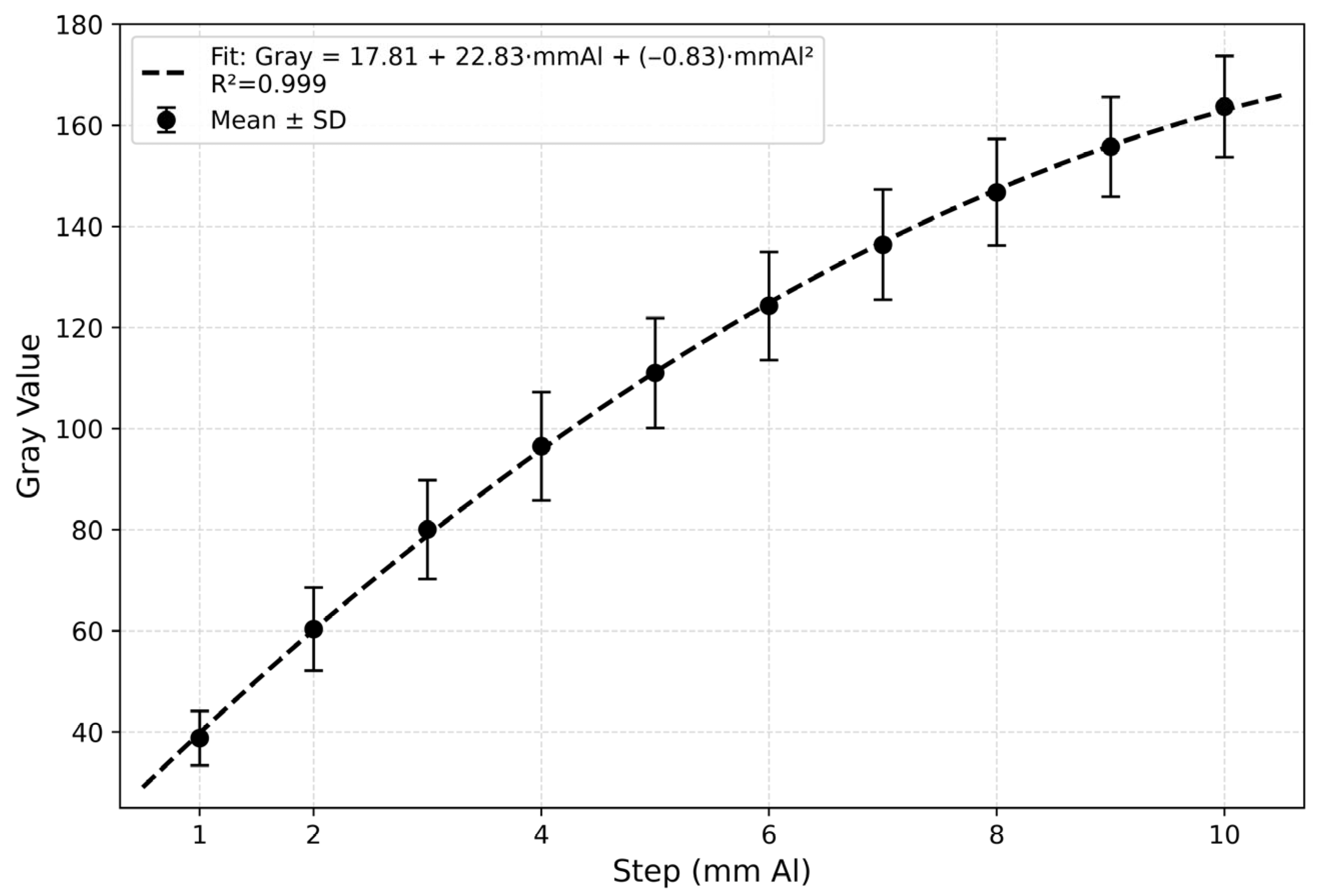
Radiographic density was quantified using ImageJ(Mac OS X; version 1.54) software (Fiji distribution, National Institutes of Health, Bethesda, MD, USA). For each specimen and aluminum step, a standardized circular region of interest (ROI, approximately 2 mm in diameter) was defined at the center of each specimen and aluminum step, ensuring that the ROI remained within the step boundaries to minimize potential edge effects and X-ray scattering artifacts, and the average gray value was recorded. The average gray values of the aluminum steps were plotted against their corresponding thicknesses. Three regression models (linear, quadratic, and logarithmic) were compared to determine the most appropriate calibration curve. The quadratic model yielded the highest coefficient of determination (R2 = 0.999) compared with the linear (R2 = 0.976) and logarithmic (R2 = 0.970) models and was therefore selected for converting gray values to aluminum thickness equivalents.
The radiopacity of each material was determined by converting the specimen gray values to aluminum thickness equivalents (mm Al) using the quadratic regression equation obtained from the calibration curve. Results are expressed as mean ± standard deviation. According to ISO 6876, materials used near dental tissues must exhibit a minimum radiopacity of 3 mm Al to provide sufficient radiographic distinction from surrounding anatomical structures. The radiopacity assessment methodology was consistent with protocols previously applied to premixed calcium silicate-based cements [
28,
29].
2.3. Elemental Analysis
For surface characterization, disk-shaped specimens of the same dimensions (10 mm diameter, 1 mm thickness, n = 2 for each material) were prepared. After complete setting, the specimens were sputter-coated with gold to provide electrical conductivity and examined using scanning electron microscopy (SEM; Thermo Scientific Apreo S, Waltham, MA, USA). Representative micrographs at 5000× magnification were obtained to document surface morphology, particle distribution, and microstructural characteristics.
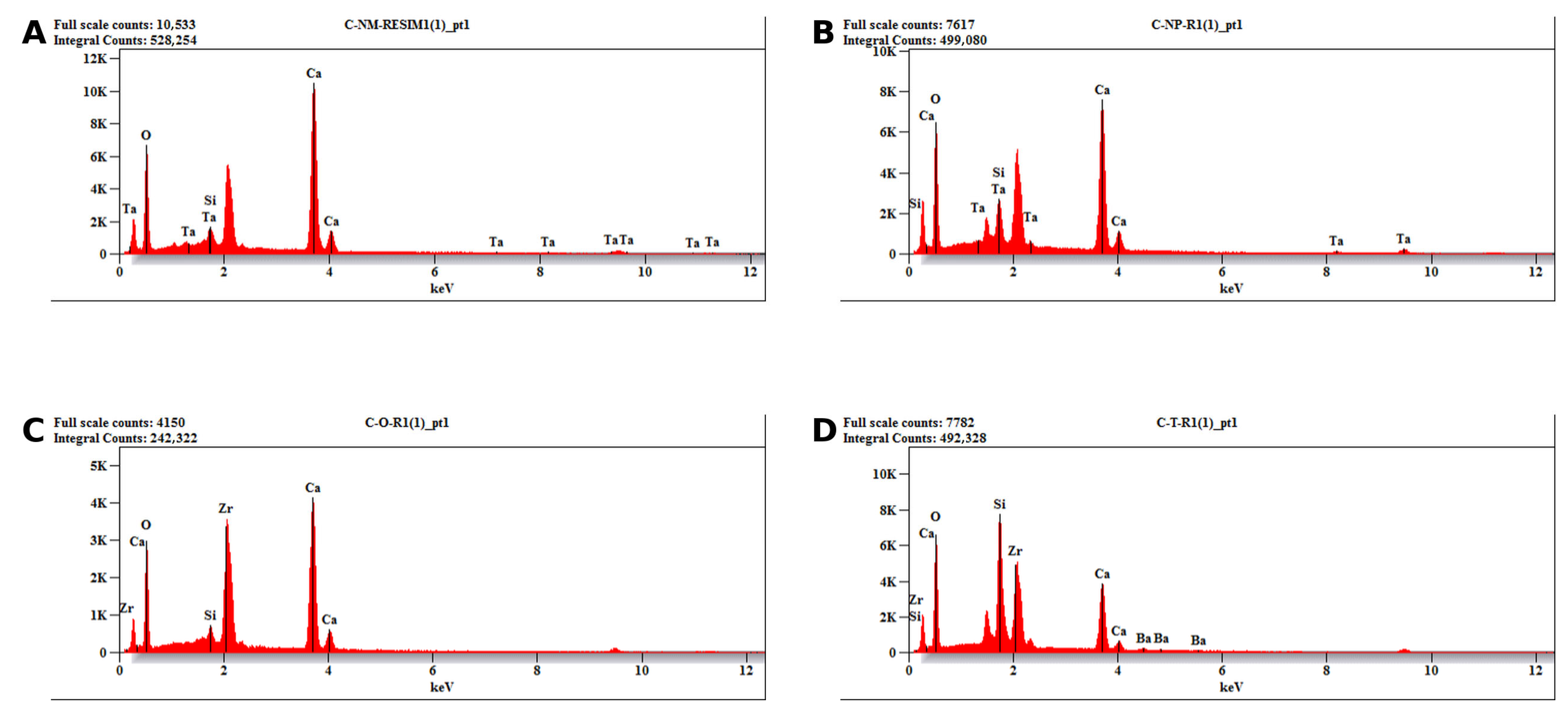
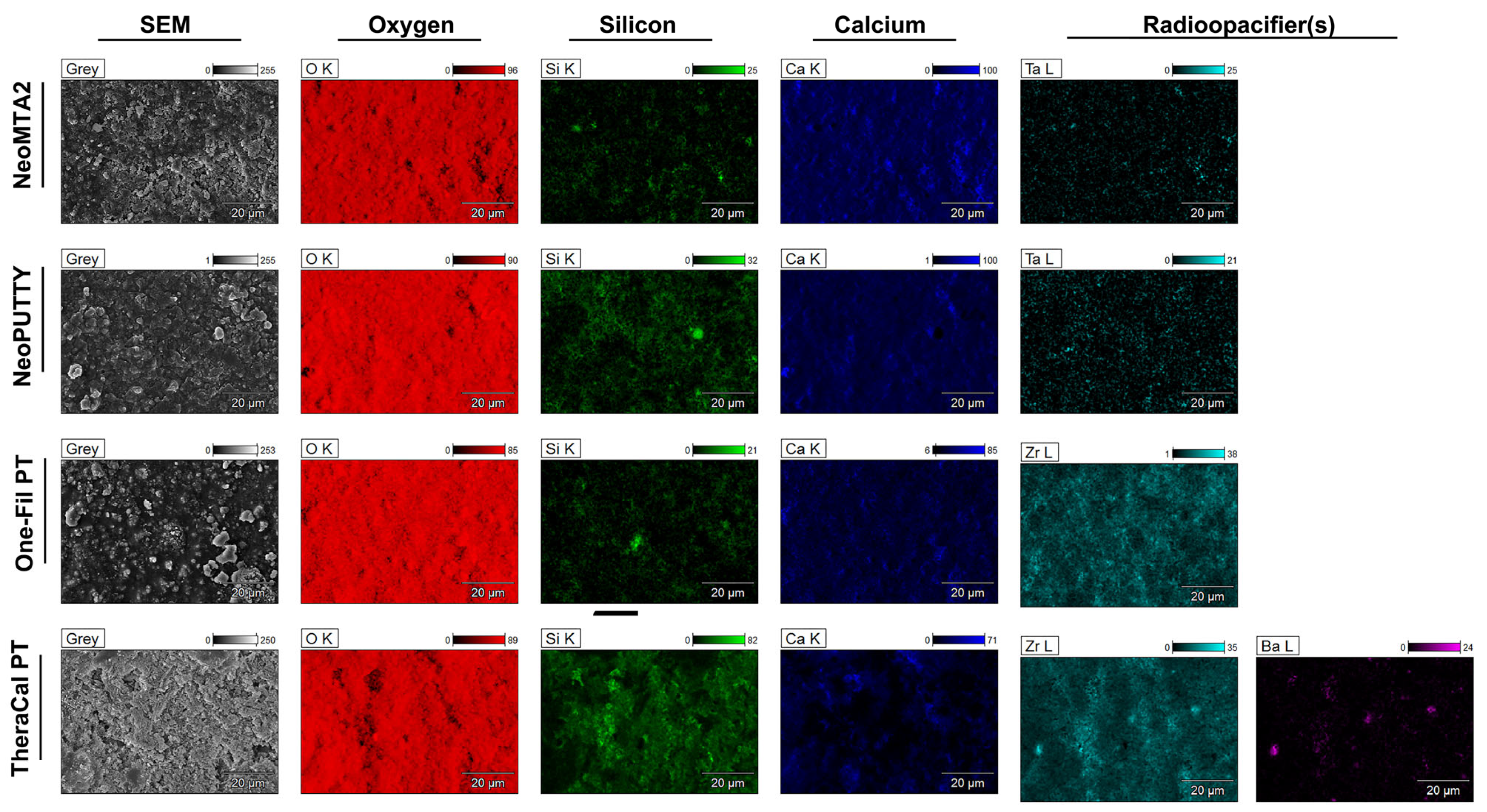
Elemental composition was determined using energy-dispersive X-ray spectroscopy (EDX; Thermoscientific Apreo S, Waltham, MA, USA) integrated with the SEM system. Quantitative elemental analysis was performed on the total area of each specimen using EDAX Team software (EDAX Inc., Mahwah, NJ, USA). The weight percentages (wt%) of major elements, including calcium (Ca), silicon (Si), oxygen (O), and radiopacifying agents, were determined, and EDX mapping was performed to evaluate the elemental distribution on the material surface. In the present study, EDX analysis was used as a targeted compositional assessment to identify the principal inorganic and radiopacifying elements relevant to the study aim, rather than to provide a full surface chemical characterization. The analysis was repeated twice for each sample.
2.4. Preparation of Material Extracts and Cells for Cell Culture
All materials were prepared under aseptic conditions and placed into sterile cylindrical molds. Following preparation, the samples were sterilized with ultraviolet (UV) irradiation for 1 h and then incubated at 37 °C for 24 h to ensure complete setting.
Stock extracts were prepared in accordance with ISO 10993-5 guidelines. For preparation of the stock extract, 10 disk specimens from each material were immersed in 5 mL of Dulbecco’s modified Eagle’s medium (DMEM; Sigma-Aldrich, St. Louis, MO, USA) and incubated at 37 °C for 24 h in a humidified atmosphere containing 5% CO2, maintaining a surface area-to-medium volume ratio of approximately 1.1 cm2/mL in accordance with the relevant ISO standard. Following incubation, the extraction media were filtered through sterile 0.22 μm syringe filters. Serial dilutions of 1:1 (100%), 1:2 (50%), 1:4 (25%), and 1:8 (12.5%) were prepared from the stock extracts using fresh DMEM for subsequent biological assays.
Human dental pulp stem cells (hDPSCs; CELPROGEN, 36086-01, Torrance, CA, USA) were cultured in DMEM supplemented with 10% fetal bovine serum (FBS), 100 U/mL penicillin-streptomycin, and L-glutamine. Cells were maintained at 37 °C in a humidified atmosphere containing 5% CO2.
2.5. Determination of Cell Viability and Inflammation Markers
The cytotoxic effects of the four test materials on cell viability were evaluated using the 3-(4,5-dimethylthiazol-2-yl)-2,5-diphenyltetrazolium bromide (MTT) assay kit (Abcam, Cambridge, UK). The MTT assay was selected in the present study due to its widespread use, reproducibility, and reliability in evaluating cell viability and cytotoxicity in dental material research, and despite its known limitations, such as dependence on cellular metabolic activity and potential chemical interference, it remains one of the most commonly used methods for comparative cytotoxicity assessment, particularly in studies involving pulp-related cells [
30]. Cells from the third passage were seeded at a density of 2 × 10
4 cells/well into wells containing complete DMEM (Dulbecco’s Modified Eagle Medium supplemented with 10% fetal bovine serum and 100 U/mL penicillin–streptomycin) in 96-well plates. To allow cell adhesion, after 24 h of incubation at 37 °C in a humidified atmosphere with 5% CO
2, the culture medium was replaced with material extracts at 1:1, 1:2, 1:4, and 1:8 dilutions or fresh DMEM as a negative control. Different well groups were evaluated after a 24-h exposure period. Following exposure, the culture medium was carefully removed, and MTT reagent was added (0.5 mg/mL) to each well, and the plates were incubated for 4 h to allow formazan crystal formation. After incubation, the supernatant was discarded, and the resulting formazan crystals were solubilized using dimethyl sulfoxide (DMSO). Absorbance was measured at 590 nm at 24 h by using a microplate reader. Cell viability was expressed as a percentage relative to the untreated control group. Each experiment was repeated three times.
IL-6 and IL-10 levels were quantified using commercially available human ELISA kits (BT LAB, Shanghai, China). Cells from the third passage were seeded at a density of 5 × 10⁴ cells/well into wells containing complete DMEM in 24-well plates. After 24 h of incubation to allow cell adhesion, the culture medium was replaced with material extracts diluted 1:2, representing a moderate exposure condition. Different well groups were evaluated after a 24-h exposure period. Following exposure, culture supernatants were collected, and IL-6 and IL-10 concentrations were measured according to ELISA kit protocols. Each experiment was repeated three times.
2.6. Statistical Analysis
All statistical analyses were performed using SPSS software (version 31.0; IBM Corp., Armonk, NY, USA). Data are presented as mean ± standard deviation. For radiopacity measurements (n = 15 per group), normality was verified using the Shapiro–Wilk test and homogeneity using Levene’s test. One-way analysis of variance (ANOVA) was applied to compare groups, followed by Tukey’s post-hoc test for pairwise comparisons. For cell viability (MTT assay) and cytokine expression (ELISA) experiments (n = 3 per group), the Kruskal–Wallis test was used to compare materials, followed by Mann–Whitney U tests with Bonferroni correction for pairwise comparisons. For energy-dispersive X-ray spectroscopy (EDX) analysis, elemental composition data are presented as descriptive statistics (mean ± standard deviation). Statistical significance was set at p < 0.05 for all analyses.
4. Discussion
The dental materials market continues to expand with new calcium silicate-based formulations, each claiming improved performance for pulp therapy applications. Since these materials come into direct contact with the pulp, they must be biocompatible, non-toxic, have a positive effect on inflammatory mediators, and possess sufficient radiopacity to be distinguishable from surrounding tissues. In recent years, calcium-silicate-based cements have been widely used in VPT applications. Their popularity largely rests on their capacity to promote reparative dentin formation while sustaining a biological environment conducive to pulp healing [
19,
31]. The findings of this study revealed material-dependent differences in both physical and biological properties. TheraCal PT exhibited insufficient radiopacity and moderate cytocompatibility, while One-Fil PT showed decreased cell viability and increased IL-6 expression. These results suggest that, as previously reported, differences in chemical composition, radiopacifier type, and resin content may directly influence cellular behavior and inflammatory responses [
6,
17,
32].
Adequate radiopacity is essential for any VPT cement, as it enables the clinician to verify material placement and monitor treatment outcomes radiographically. In this study, One-Fil PT exhibited the highest radiopacity, followed by NeoPUTTY, NeoMTA2, and TheraCal PT. This ranking is consistent with previous reports showing that zirconium- and tantalum-based radiopacifiers create more X-ray contrast compared to formulations containing barium [
6,
33]. The relatively low radiopacity of TheraCal PT is likely a consequence of the radiolucent resin matrix diluting the contribution of its radiopacifying agents. The findings of this study are consistent with previous studies reporting that NeoPUTTY exhibited the highest radiopacity among the similar materials evaluated, whereas NeoMTA2 showed lower radiopacity despite containing the same radiopacifier [tantalum oxide] [
28]. Although the manufacturer did not provide information on the tantalum oxide content in the materials, the findings of this study indicate that NeoPUTTY contains a higher amount of tantalum than NeoMTA2 (5.71% vs. 0.32%). This difference may contribute to the radiopacity difference observed between the two materials. Furthermore, the difference may be attributed to NeoPUTTY being a premixed and ready-to-use material, while NeoMTA2 is supplied in powder-liquid form. Since powder-liquid materials can be mixed in varying ratios, differences in radiopacity may occur.
According to the ISO 6876 standard, the minimum radiopacity requirement for root canal sealing materials is ≥3 mm Al [
28,
29]. According to the results of this study, while all materials except TheraCal PT showed sufficient radiopacity, TheraCal PT fell well below this threshold. This result can be attributed to the material’s different radiopacifier ratio and type, as well as its light-cured nature. This is consistent with previous findings [
28,
29]. Based on these results, the null hypothesis regarding radiopacity was rejected. Significant differences were observed among the tested calcium silicate-based cements in terms of compliance with the ISO 6876 radiopacity requirements. It is also worth noting that calcium silicate-based cements with compositions similar to those tested in the present study are increasingly being used in flowable sealer formulations for root canal obturation, including warm compaction techniques, with favorable clinical outcomes reported in recent prospective evaluations [
24]. However, the potential for apical extrusion of these materials and the resulting radiographic modifications in the periapical region should be considered as a clinical limitation, as extruded material may undergo structural and radiopacity changes over time that could complicate radiographic follow-up.
EDX analysis revealed significant differences in elemental composition and radiopacifier distribution among the tested materials. The presence of calcium, silicon, oxygen, and radiopacifying elements identified by EDX analysis was consistent with the registered formulations of the materials and previous studies on these materials [
34]. EDX mapping confirmed the presence of zirconium oxide in One-Fil PT, tantalum oxide in NeoPUTTY and NeoMTA2, and barium zirconate in TheraCal PT. The type of radiopacifier directly affects both radiographic performance and hydration kinetics. In line with this, the present findings support earlier reports suggesting that zirconium and tantalum offer more stable radiographic behavior and more favorable biocompatibility than barium-based compounds [
33]. High surface calcium levels are generally associated with enhanced biomineralization properties, as calcium ion release facilitates apatite nucleation and increases the odontogenic differentiation of hDPSCs [
6]. According to EDX analysis, although all materials exhibited high calcium content, the highest calcium peak was observed in NeoMTA2, while the lowest was in TheraCal PT. These results are supported by previous studies indicating that MTA releases higher levels of Ca
2+ than TheraCal PT [
17,
34]. A further limitation of the present study is that EDX analysis was used as a targeted compositional tool focused on the principal inorganic and radiopacifying elements relevant to the study aim, rather than as a full surface chemical characterization method. Therefore, surface reaction mechanisms and carbonate-related interpretations were beyond the scope of the present investigation.
Since VPT cements are placed in direct contact with pulp tissue, biocompatibility is a fundamental prerequisite; cytotoxic effects may compromise pulp vitality and reparative capacity [
11,
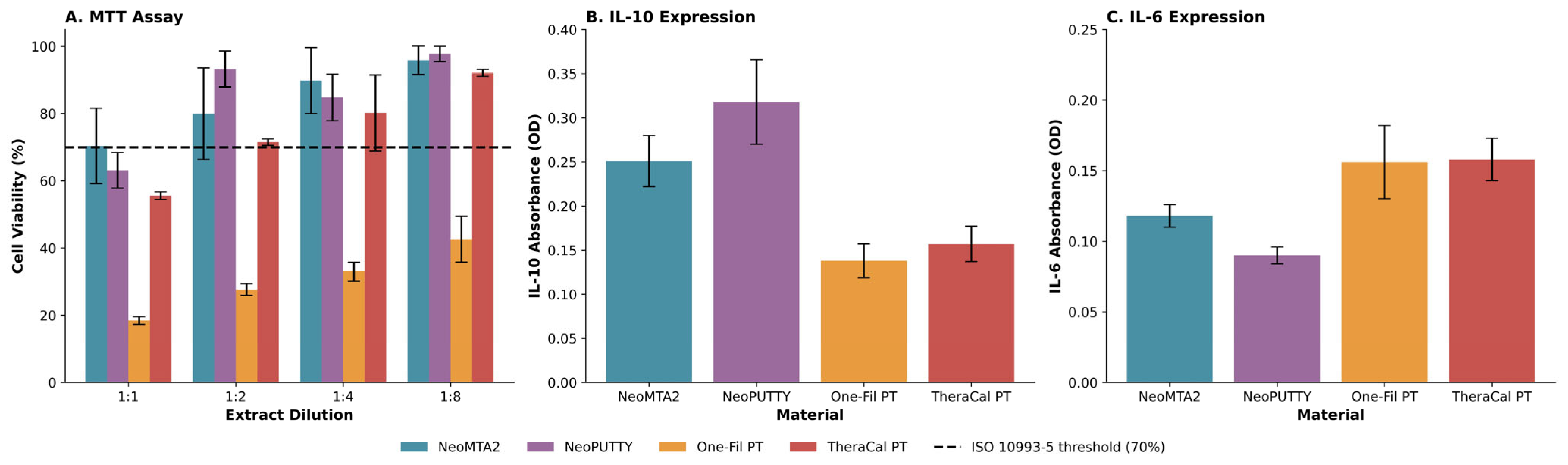
17]. In this study, NeoPUTTY and NeoMTA2 showed significantly higher short-term cell viability, indicating comparatively better cytocompatibility under the present experimental conditions. Consistent with our findings, previous studies have reported that NeoPUTTY exhibits the highest cell viability [
11,
35]. The comparatively favorable biological performance of NeoPUTTY may be associated with compositional differences among the tested materials; however, the specific contribution of individual components was not directly investigated in the present study. A recent comparative study reported that NeoPUTTY and TheraCal PT showed varying degrees of cell viability on hDPSCs depending on extract concentration, yet both maintained levels consistent with potential clinical use [
6]. Previous studies have shown that TheraCal PT exhibits positive cytocompatibility at various dilutions [
17,
18]. Consistent with these findings, this study showed that increasing dilution ratios resulted in improved cell viability for all materials tested, reflecting a concentration-dependent cytotoxic effect. TheraCal PT demonstrated moderate short-term cytocompatibility across the tested dilutions under the present in vitro conditions.
According to the International Standard ISO 10993-5:2010, a decrease of more than 30% in cell viability is considered an indicator of potential cytotoxic effects [
28]. In this study, One-Fil PT exhibited the lowest cell viability values at all concentrations (ranging from 18.44% to 42.63%) and therefore showed potential cytotoxic effects. This outcome may be associated with compositional differences among the tested materials; however, the underlying mechanisms were not directly investigated in the present study. The presence of certain radiopacifiers, resin components, or polymeric additives may potentially contribute to changes in cellular behavior, reactive oxygen species production, or inflammatory mediator release; however, further studies are needed to clarify these mechanisms. Based on these results, the second part of the null hypothesis, which suggested that there would be no significant difference in cytotoxicity among the tested putty-form calcium silicate-based cements, was rejected.
Recent studies emphasize the importance of maintaining a balance between pro- and anti-inflammatory responses in VPT cements, as this balance plays a critical role in pulp survival and regeneration [
36,
37]. In this study, both IL-6 and IL-10 were analyzed to assess the inflammatory response. IL-6 was selected due to its central role in regulating the acute-phase response and its strong correlation with clinical outcomes in vital pulp therapy, while IL-10 was included to evaluate the anti-inflammatory and regulatory response, allowing a more comprehensive understanding of the balance between pro- and anti-inflammatory activity [
38]. The inclusion of early-phase mediators such as IL-1β is suggested for future studies. One-Fil PT and TheraCal PT exhibited relatively higher IL-6 levels, while NeoPUTTY and NeoMTA2 showed increased IL-10 expression. This indicates that the inflammatory profile of calcium silicate-based cements is material-dependent and influenced by their composition, as reflected in the distinct inflammatory patterns observed between calcium silicate-based cements and the RMCSC tested in this study.
Higher IL-6 expression may represent an early inflammatory response that supports immune cell recruitment and tissue repair; however, excessive or prolonged IL-6 levels may disrupt dentin bridge formation and tissue organization [
38,
39]. The increased IL-6 levels observed in One-Fil PT and TheraCal PT may reflect material-related differences in early cellular response; however, the underlying mechanisms, including possible effects of pH, ion release, or particle dissolution, were not directly investigated in the present study. Previous studies have associated increased IL-10 expression with anti-inflammatory activity [
40,
41]. In the present study, the higher IL-10 levels observed in NeoPUTTY and NeoMTA2 may indicate a comparatively more favorable early anti-inflammatory profile; however, no direct conclusions can be drawn regarding pulp healing, dentin bridge formation, or regenerative potential based on the present data alone. Taken together, these findings suggest that early inflammatory response patterns may be relevant when interpreting the short-term biological behavior of VPT cements alongside cell viability [
42].
Although the present study demonstrated increased inflammatory response and reduced cell viability at certain concentrations, these findings should be interpreted within the limitations of in vitro models. In this context, in vivo evidence provides important complementary insights into the biological behavior of calcium silicate-based cements. A recent in vivo study demonstrated that calcium silicate-based cements, such as NeoPUTTY, may initially induce an inflammatory response on rats, which gradually subsides and is followed by tissue repair and mineralization [
43]. This discrepancy may be attributed to the dynamic biological environment in vivo, where factors such as buffering capacity, vascularization, and complex cellular interactions modulate material-induced effects. Furthermore, latest in vivo investigations evaluating calcium silicate–based cements, including NeoMTA2 and NeoPUTTY, have shown that biological performance may vary depending on the implantation environment, with more pronounced alterations observed in subcutaneous tissues compared to bone. Notably, these studies emphasized that the type and distribution of radiopacifying elements may influence both tissue response and material stability, with evidence of particle release and potential systemic distribution [
44]. These observations are in line with the present findings, in which differences in radiopacity and elemental composition—particularly the presence of zirconium oxide in One-Fil PT and tantalum oxide in NeoPUTTY and NeoMTA2—were associated with distinct biological and inflammatory response patterns. When considered together, these findings suggest that radiopacifier characteristics may contribute to variations in early biological responses, although the exact mechanisms underlying these effects remain to be elucidated.
The findings obtained for TheraCal PT require particularly careful interpretation. In the present study, TheraCal PT exhibited moderate short-term cell viability, yet it also induced a relatively elevated IL-6 response compared with NeoMTA2 and NeoPUTTY. This discrepancy suggests that short-term cell viability and early inflammatory response may reflect different aspects of the biological behavior of a material and do not necessarily follow the same pattern. As an RMCSC, TheraCal PT contains resin monomers including Bis-GMA and PEGDMA. Although the dual-cure polymerization mechanism of TheraCal PT has been shown to result in significantly lower residual monomer release compared with its light-cured predecessor TheraCal LC [
45], leachable monomers and photoinitiators from resin-modified calcium silicate formulations may still disrupt cellular metabolism and provoke pro-inflammatory responses [
34,
46]. This is further supported by a recent in vivo study demonstrating that TheraCal PT induced higher inflammatory cell infiltration and inferior hard tissue formation compared with Biodentine in a rat pulpotomy model [
47]. Similarly, a study comparing endodontic materials used in vital pulp therapy reported that TheraCal PT demonstrated improved in vitro cytocompatibility in hDPSCs compared with its predecessor, TheraCal LC, and exhibited biological properties comparable to Biodentine [
18]. Accordingly, the coexistence of moderate short-term viability and elevated IL-6 expression observed in the present study may reflect a material that is not immediately cytotoxic at the tested dilution, yet still capable of eliciting an early inflammatory response through residual resin-related components. In contrast, One-Fil PT showed both the lowest cell viability and a pronounced pro-inflammatory response across all tested conditions, indicating a less favorable early biological profile. Although direct mechanistic evidence for this specific material remains limited, the present EDX analysis revealed a notably high zirconium oxide content (30.59 wt%) alongside minimal silicon (0.75 wt%), and the manufacturer reports a setting pH of 12.7. The combination of a high radiopacifier concentration and elevated alkalinity during setting may contribute to disruption of cellular metabolism, although the specific mechanisms underlying this response could not be determined within the scope of the present study. These findings may also be considered in a broader clinical context. Premixed calcium silicate-based cements with flowable formulations similar in composition to those tested in the present study are increasingly used in clinical applications where material contact with periapical tissues may occur. Clinical and histological evidence suggests that extruded calcium silicate-based cements can provoke short-term inflammatory reactions, and that the biological response to such contact is strongly influenced by the chemical composition of the material [
48,
49]. Although the present study was not designed to evaluate tissue-level reactions, the observed differences in cytokine expression and cell viability among the tested materials underscore the importance of considering the biological profile of calcium silicate-based cements alongside their physicochemical and handling properties. Favorable radiopacity or handling characteristics should not be interpreted as indicators of an equally favorable biological response, and the observed differences likely reflect broader formulation-related factors that warrant further mechanistic and long-term clinical investigation.
The present findings indicate that VPT cement selection requires an integrated assessment of radiographic properties, chemical composition, cytotoxicity, and inflammatory responses. However, the in vitro design of the present study does not fully replicate the complex biological environment of pulp tissue, and therefore the findings should be interpreted as early indicators rather than direct predictors of clinical performance. Within the limitations of this in vitro study, NeoPUTTY and NeoMTA2 exhibited comparatively more favorable early cytokine response profiles, whereas One-Fil PT and TheraCal PT induced a more pronounced early inflammatory response. One-Fil PT and NeoPUTTY demonstrated superior radiographic performance, which may be advantageous for radiographic follow-up, particularly in pediatric patients where early assessment is important. Future studies integrating longer observation periods, additional biological markers, pulp regeneration models, and controlled clinical evaluations are needed to determine the broader biological significance of these findings. In addition, the biological findings of the present study were limited to a 24-h exposure period and therefore reflect only early cellular and cytokine responses. Longer-term studies are needed to determine whether these initial findings persist over time or are associated with regenerative outcomes.




 ,
,