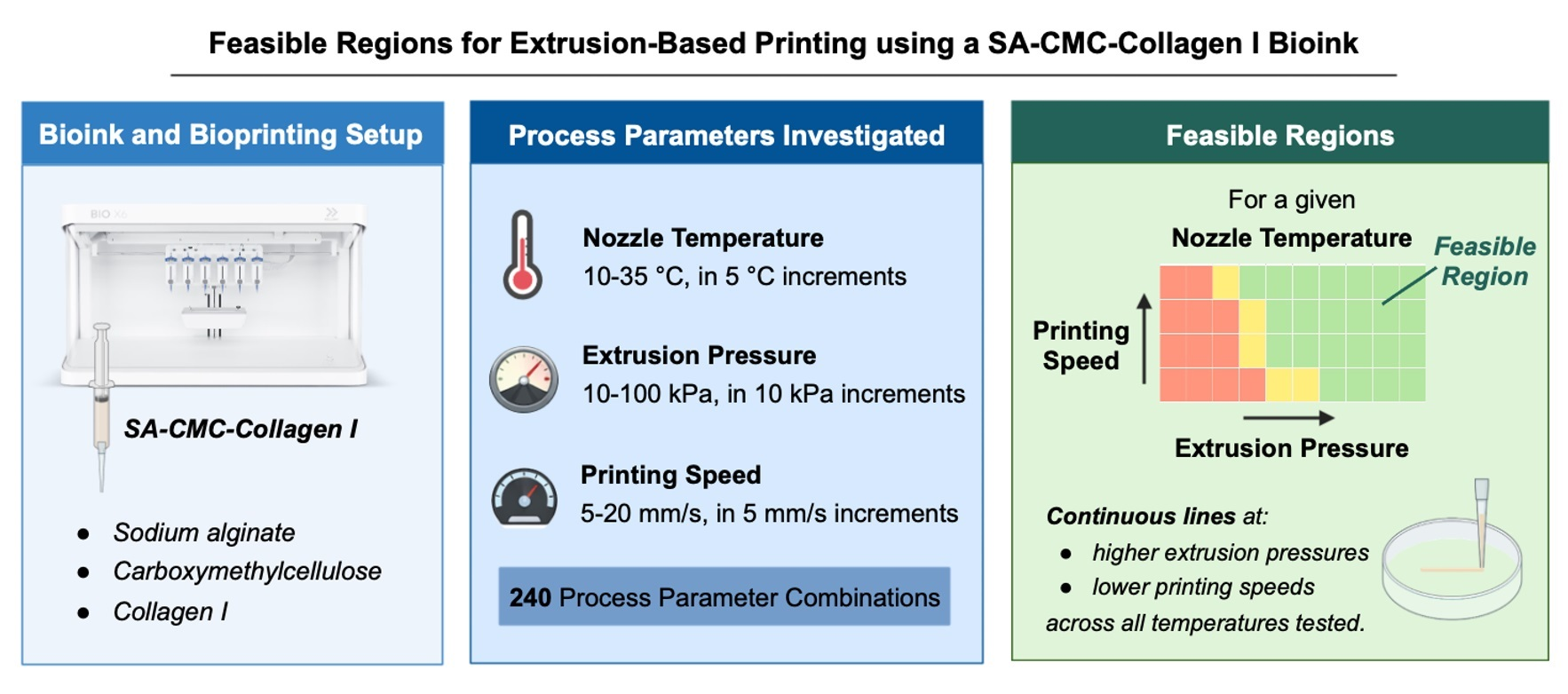

Feasible Regions of Nozzle Temperature, Extrusion Pressure, and Printing Speed in Extrusion-Based Printing Using a Sodium Alginate–Carboxymethylcellulose–Collagen I Bioink




Abstract
1. Introduction
2. Materials and Methods
2.1. Materials
2.2. Characterization
2.3. Procedure and Conditions of Printing
2.4. Design of Digital Model
3. Definition of Feasible Regions
4. Results
5. Discussion and Future Research Directions
Author Contributions
Funding
Institutional Review Board Statement
Informed Consent Statement
Data Availability Statement
Acknowledgments
Conflicts of Interest
References
- Bhatia, S.N.; Ingber, D.E. Microfluidic organs-on-chips. Nat. Biotechnol. 2014, 32, 760–772. [Google Scholar] [CrossRef] [Scilit]
- Low, L.A.; Tagle, D.A. Organs-on-chips: Progress, challenges, and future directions. Exp. Biol. Med. 2017, 242, 1573–1578. [Google Scholar] [CrossRef] [Scilit]
- Murphy, S.V.; Atala, A. 3D bioprinting of tissues and organs. Nat. Biotechnol. 2014, 32, 773–785. [Google Scholar] [CrossRef] [Scilit]
- Mandrycky, C.; Wang, Z.; Kim, K.; Kim, D.-H. 3D bioprinting for engineering complex tissues. Biotechnol. Adv. 2016, 34, 422–434. [Google Scholar] [CrossRef] [Scilit]
- Soni, R.; Ponappa, K.; Tandon, P. A review on customized food fabrication process using Food Layered Manufacturing. LWT 2022, 161, 113411. [Google Scholar] [CrossRef] [Scilit]
- Budharaju, H.; Singh, R.K.; Kim, H.-W. Bioprinting for drug screening: A path toward reducing animal testing or redefining preclinical research? Bioact. Mater. 2025, 51, 993–1017. [Google Scholar] [CrossRef] [Scilit]
- Ding, Z.; Tang, N.; Huang, J.; Cao, X.; Wu, S. Global hotspots and emerging trends in 3D bioprinting research. Front. Bioeng. Biotechnol. 2023, 11, 1169893. [Google Scholar] [CrossRef] [Scilit] [PubMed]
- Hagenbuchner, J.; Nothdurfter, D.; Ausserlechner, M.J. 3D bioprinting: Novel approaches for engineering complex human tissue equivalents and drug testing. Essays Biochem. 2021, 65, 417–427. [Google Scholar] [CrossRef] [Scilit] [PubMed]
- Ingber, D.E. Human organs-on-chips for disease modelling, drug development and personalized medicine. Nat. Rev. Genet. 2022, 23, 467–491. [Google Scholar] [CrossRef] [Scilit]
- van Berlo, D.; van de Steeg, E.; Amirabadi, H.E.; Masereeuw, R. The potential of multi-organ-on-chip models for assessment of drug disposition as alternative to animal testing. Curr. Opin. Toxicol. 2021, 27, 8–17. [Google Scholar] [CrossRef] [Scilit]
- Hiemenz, J. 3D Printing with FDM: How It Works; Stratasys Inc: Minnetonka, MN, USA, 2011. [Google Scholar]
- Solomon, I.J.; Sevvel, P.; Gunasekaran, J. A review on the various processing parameters in FDM. Mater. Today Proc. 2021, 37, 509–514. [Google Scholar] [CrossRef] [Scilit]
- Jones, N. Science in three dimensions: The print revolution. Nature 2012, 487, 22–23. [Google Scholar] [CrossRef] [Scilit]
- Chen, Y.; Xiong, X.; Liu, X.; Cui, R.; Wang, C.; Zhao, G.; Zhi, W.; Lu, M.; Duan, K.; Weng, J.; et al. 3D Bioprinting of shear-thinning hybrid bioinks with excellent bioactivity derived from gellan/alginate and thixotropic magnesium phosphate-based gels. J. Mater. Chem. B 2020, 8, 5500–5514. [Google Scholar] [CrossRef] [Scilit]
- Loebel, C.; Rodell, C.B.; Chen, M.H.; Burdick, J.A. Shear-thinning and self-healing hydrogels as injectable therapeutics and for 3D-printing. Nat. Protoc. 2017, 12, 1521–1541. [Google Scholar] [CrossRef] [Scilit]
- Ozbolat, I.T.; Hospodiuk, M. Current advances and future perspectives in extrusion-based bioprinting. Biomaterials 2016, 76, 321–343. [Google Scholar] [CrossRef] [Scilit]
- Agarwal, K.; Srinivasan, V.; Lather, V.; Pandita, D.; Vasanthan, K.S. Insights of 3D bioprinting and focusing the paradigm shift towards 4D printing for biomedical applications. J. Mater. Res. 2023, 38, 112–141. [Google Scholar] [CrossRef] [Scilit]
- Wu, J.; Sang, L.; Kang, R.; Li, M.; Cheng, C.; Liu, A.; Ji, J.; Jian, A. A Novel 3D Bioprinting Crosslinking Method Based on Solenoid Valve Control. Macromol. Biosci. 2025, 25, 2500039. [Google Scholar] [CrossRef] [Scilit] [PubMed]
- Antony Jose, S.; Evtimow, A.; Menezes, P.L. Advances in 3D Bioprinting: Materials, Processes, and Emerging Applications. Micromachines 2026, 17, 282. [Google Scholar] [CrossRef] [Scilit]
- Betancourt, N.; Chen, X. Review of extrusion-based multi-material bioprinting processes. Bioprinting 2022, 25, e00189. [Google Scholar] [CrossRef] [Scilit]
- Chancharoen, R.; Sithiwichankit, C.; Chaiprabha, K.; Suthithanakom, S.; Phanomchoeng, G. Observer-Based Volumetric Flow Control in Nonlinear Electro-Pneumatic Extrusion Actuator with Rheological Dynamics. Actuators 2025, 14, 496. [Google Scholar] [CrossRef] [Scilit]
- Thakare, K.; Wei, X.; Jerpseth, L.; Bhardwaj, A.; Qin, H.; Pei, Z. Feasible Regions of Bioink Composition, Extrusion Pressure, and Needle Size for Continuous Extrusion-Based Bioprinting. J. Manuf. Sci. Eng. 2020, 142, 124501. [Google Scholar] [CrossRef] [Scilit]
- Zimmerling, A.; Zhou, Y.; Chen, X. Synthesis of Alginate/Collagen Bioink for Bioprinting Respiratory Tissue Models. J. Funct. Biomater. 2024, 15, 90. [Google Scholar] [CrossRef] [Scilit]
- Yang, X.; Lu, Z.; Wu, H.; Li, W.; Zheng, L.; Zhao, J. Collagen-alginate as bioink for three-dimensional (3D) cell printing based cartilage tissue engineering. Mater. Sci. Eng. C 2018, 83, 195–201. [Google Scholar] [CrossRef] [Scilit] [PubMed]
- Mohabatpour, F.; Duan, X.; Yazdanpanah, Z.; Tabil, X.L.; Lobanova, L.; Zhu, N.; Papagerakis, S.; Chen, X.; Papagerakis, P. Bioprinting of alginate-carboxymethyl chitosan scaffolds for enamel tissue engineering in vitro. Biofabrication 2023, 15, 015022. [Google Scholar] [CrossRef] [Scilit]
- Hu, G.; Cebrero, K.G.; Venkataraman, N.; Ravichandran, D.; Lin, Y.; Jin, Z.; Gartner, Z.J.; Gu, G.X. Tuning collagen and collagen-alginate mechanics through extrusion bioprinting process parameters. RSC Adv. 2025, 15, 46591–46601. [Google Scholar] [CrossRef] [Scilit] [PubMed]
- Sarah, R.; Rohauer, R.; Schimmelpfennig, K.; Limon, S.M.; Lewis, C.L.; Habib, A. Data-Driven Optimization of Bioink Formulations for Extrusion-Based Bioprinting: A Predictive Modeling Approach. J. Manuf. Sci. Eng. 2025, 147, 101001. [Google Scholar] [CrossRef] [Scilit] [PubMed]
- Lee, J.; Oh, S.J.; An, S.H.; Kim, W.-D.; Kim, S.-H. Machine learning-based design strategy for 3D printable bioink: Elastic modulus and yield stress determine printability. Biofabrication 2020, 12, 035018. [Google Scholar] [CrossRef] [Scilit]
- Kundu, J.; Shim, J.-H.; Jang, J.; Kim, S.-W.; Cho, D.-W. An additive manufacturing-based PCL-alginate-chondrocyte bioprinted scaffold for cartilage tissue engineering. J. Tissue Eng. Regen. Med. 2015, 9, 1286–1297. [Google Scholar] [CrossRef] [Scilit]
- Liu, W.; Heinrich, M.A.; Zhou, Y.; Akpek, A.; Hu, N.; Liu, X.; Guan, X.; Zhong, Z.; Jin, X.; Khademhosseini, A.; et al. Extrusion Bioprinting of Shear-Thinning Gelatin Methacryloyl Bioinks. Adv. Healthc. Mater. 2017, 6, 1601451. [Google Scholar] [CrossRef] [Scilit]
- Nair, K.; Gandhi, M.; Khalil, S.; Yan, K.C.; Marcolongo, M.; Barbee, K.; Sun, W. Characterization of cell viability during bioprinting processes. Biotechnol. J. 2009, 4, 1168–1177. [Google Scholar] [CrossRef] [Scilit]
- Nguyen, D.; Hägg, D.A.; Forsman, A.; Ekholm, J.; Nimkingratana, P.; Brantsing, C.; Kalogeropoulos, T.; Zaunz, S.; Concaro, S.; Brittberg, M.; et al. Cartilage Tissue Engineering by the 3D Bioprinting of iPS Cells in a Nanocellulose/Alginate Bioink. Sci. Rep. 2017, 7, 658. [Google Scholar] [CrossRef] [Scilit]
- Song, S.; Choi, J.; Park, Y.; Lee, J.; Hong, S.Y.; Sun, K. A Three-Dimensional Bioprinting System for Use with a Hydrogel-Based Biomaterial and Printing Parameter Characterization. Artif. Organs 2010, 34, 1044–1048. [Google Scholar] [CrossRef] [Scilit]
- Fu, Z.; Angeline, V.; Sun, W. Evaluation of Printing Parameters on 3D Extrusion Printing of Pluronic Hydrogels and Machine Learning Guided Parameter Recommendation. Int. J. Bioprint 2024, 7, 434. [Google Scholar] [CrossRef] [Scilit]
- Paxton, N.; Smolan, W.; Böck, T.; Melchels, F.; Groll, J.; Jungst, T. Proposal to assess printability of bioinks for extrusion-based bioprinting and evaluation of rheological properties governing bioprintability. Biofabrication 2017, 9, 044107. [Google Scholar] [CrossRef] [Scilit] [PubMed]
- Billiet, T.; Gevaert, E.; De Schryver, T.; Cornelissen, M.; Dubruel, P. The 3D printing of gelatin methacrylamide cell-laden tissue-engineered constructs with high cell viability. Biomaterials 2014, 35, 49–62. [Google Scholar] [CrossRef] [Scilit] [PubMed]
- Suntornnond, R.; Tan, E.; An, J.; Chua, C. A Mathematical Model on the Resolution of Extrusion Bioprinting for the Development of New Bioinks. Materials 2016, 9, 756. [Google Scholar] [CrossRef] [Scilit]
- Habib, A.; Sathish, V.; Mallik, S.; Khoda, B. 3D Printability of Alginate-Carboxymethyl Cellulose Hydrogel. Materials 2018, 11, 454. [Google Scholar] [CrossRef] [Scilit]
- Liu, S.; Kilian, D.; Ahlfeld, T.; Hu, Q.; Gelinsky, M. Egg white improves the biological properties of an alginate-methylcellulose bioink for 3D bioprinting of volumetric bone constructs. Biofabrication 2023, 15, 025013. [Google Scholar] [CrossRef] [Scilit] [PubMed]
- Soufivand, A.A.; Faber, J.; Hinrichsen, J.; Budday, S. Multilayer 3D bioprinting and complex mechanical properties of alginate-gelatin mesostructures. Sci. Rep. 2023, 13, 11253. [Google Scholar] [CrossRef] [Scilit]
- Phosphate-buffered saline (PBS). bioRxiv 2006. [CrossRef]
- Hodder, E.; Duin, S.; Kilian, D.; Ahlfeld, T.; Seidel, J.; Nachtigall, C.; Bush, P.; Covill, D.; Gelinsky, M.; Lode, A. Investigating the effect of sterilisation methods on the physical properties and cytocompatibility of methyl cellulose used in combination with alginate for 3D-bioplotting of chondrocytes. J. Mater. Sci. Mater. Med. 2019, 30, 10. [Google Scholar] [CrossRef] [Scilit]
- Usala, E.; Gonzalez, Z.; Campillo, N.; Baena, J.; Ferrari, B.; Rodríguez, A.; Espinosa, E. Impact of steam sterilization on the rheological characteristics, printability, and bioactivity of nanocellulose/alginate hydrogels for 3D bioprinting. Carbohydr. Polym. Technol. Appl. 2025, 11, 100970. [Google Scholar] [CrossRef] [Scilit]
- Rahman, T.T.; Wood, N.; Pei, Z.; Qin, H.; Mohan, P. Effects of Extrusion Pressure During 3D Printing on Viability of Human Bronchial Epithelial Cells in 3D Printed Samples. Biomimetics 2025, 10, 297. [Google Scholar] [CrossRef] [Scilit] [PubMed]
- Rahman, T.T.; Wood, N.; Pei, Z.; Qin, H. Effects of Extreme Temperature on Human Bronchial Epithelial Cells in 3D Printed Samples. Bioengineering 2024, 11, 1201. [Google Scholar] [CrossRef] [Scilit]
- Rahman, T.T.; Rahman, A.M.; Pei, Z.; Wood, N.; Qin, H. Effects of Coaxial Nozzle’s Inner Nozzle Diameter on Filament Strength and Gelation in Extrusion-Based 3D Printing with In Situ Ionic Crosslinking. Biomimetics 2024, 9, 589. [Google Scholar] [CrossRef] [Scilit] [PubMed]
- Rahman, T.T.; Wood, N.; Akib, Y.M.; Qin, H.; Pei, Z. Experimental Study on Compatibility of Human Bronchial Epithelial Cells in Collagen–Alginate Bioink for 3D Printing. Bioengineering 2024, 11, 862. [Google Scholar] [CrossRef] [Scilit]
- Carreau, P.J. Rheological Equations from Molecular Network Theories. Trans. Soc. Rheol. 1972, 16, 99–127. [Google Scholar] [CrossRef] [Scilit]
- Priyadharshini, S.; Ponalagusamy, R. Biorheological Model on Flow of Herschel-Bulkley Fluid through a Tapered Arterial Stenosis with Dilatation. Appl. Bionics Biomech. 2015, 2015, 1–12. [Google Scholar] [CrossRef] [Scilit] [PubMed]
- Rahman, T.T.; Rahman, A.M.; Pei, Z.; Thakare, K.; Qin, H.; Khan, A. 3D printing of microalgae-enriched cookie dough: Determining feasible regions of process parameters for continuous extrusion. Green Manuf. Open 2023, 1, 11. [Google Scholar] [CrossRef] [Scilit]
- Cong, W.L.; Pei, Z.J.; Deines, T.W.; Treadwell, C. Rotary ultrasonic machining of CFRP using cold air as coolant: Feasible regions. J. Reinf. Plast. Compos. 2011, 30, 899–906. [Google Scholar] [CrossRef] [Scilit]
- Bhardwaj, A.; Kalantar, N.; Molina, E.; Zou, N.; Pei, Z. Extrusion-Based 3D Printing of Porcelain: Feasible Regions. In Additive Manufacturing; Manufacturing Equipment and Systems; Bio and Sustainable Manufacturing; American Society of Mechanical Engineers: New York, NY, USA, 2019; Volume 1. [Google Scholar] [CrossRef] [Scilit]
- Yang, Y.; Kaufman, L.J. Rheology and Confocal Reflectance Microscopy as Probes of Mechanical Properties and Structure during Collagen and Collagen/Hyaluronan Self-Assembly. Biophys. J. 2009, 96, 1566–1585. [Google Scholar] [CrossRef] [Scilit] [PubMed]
- Shoulders, M.D.; Raines, R.T. Collagen Structure and Stability. Annu. Rev. Biochem. 2009, 78, 929–958. [Google Scholar] [CrossRef] [Scilit] [PubMed]
- Ferry, J.D.; Myers, H.S. Viscoelastic Properties of Polymers. J. Electrochem. Soc. 1961, 108, 142C. [Google Scholar] [CrossRef] [Scilit]
- Mezger, T. The Rheology Handbook; Vincentz Network: Hannover, Germany, 2020. [Google Scholar] [CrossRef] [Scilit]
- Chhabra, R.P.; Richardson, J.F. Non-Newtonian Flow and Applied Rheology, 2nd ed.; Elsevier: Amsterdam, The Netherlands, 2008. [Google Scholar] [CrossRef] [Scilit]


| Process Parameter | Reported Range | Reference |
|---|---|---|
| Nozzle temperature | 15–35 °C | [29,30,31,32,33,34,35] |
| Extrusion pressure | 70–500 kPa | [22,29,30,31,32,33,35] |
| Printing speed | 1.67–25 mm/s | [36,37] |
| Process Parameter | Value |
|---|---|
| Nozzle temperature (°C) | 10, 15, 20, 25, 30, 35 |
| Extrusion pressure (kPa) | 10, 20, 30, 40, 50, 60, 70, 80, 90, 100 |
| Printing speed (mm/s) | 5, 10, 15, 20 |
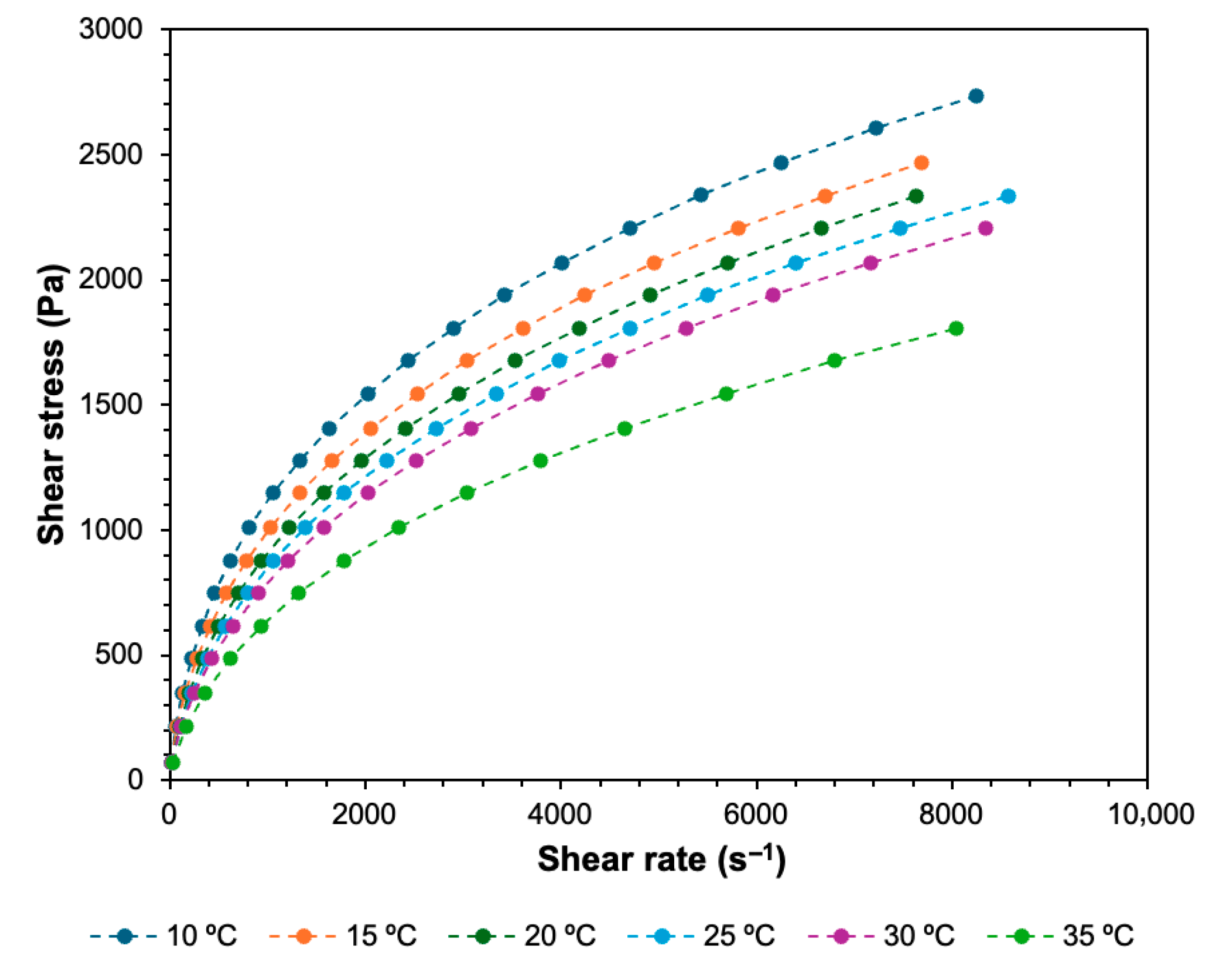
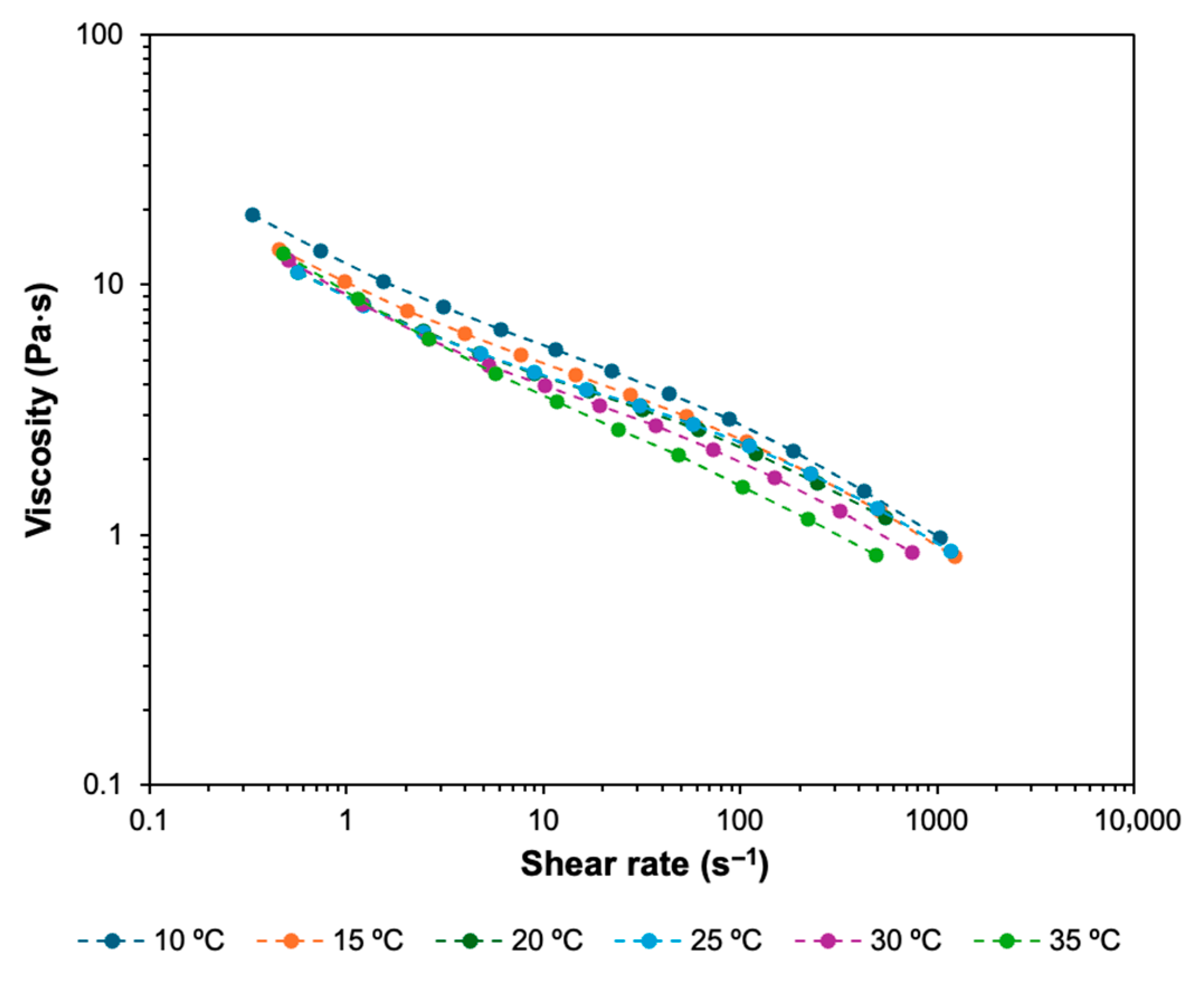
| Temperature (°C) | Viscosity (Pa·s) | Coefficient of Determination, R2 |
|---|---|---|
| 10 | 70.2546 | 0.997678 |
| 15 | 50.1153 | 0.997946 |
| 20 | 39.3789 | 0.996898 |
| 25 | 33.0885 | 0.996062 |
| 30 | 29.9029 | 0.997890 |
| 35 | 32.7314 | 0.999639 |
| Temperature (°C) | Yield Stress (Pa) | Coefficient of Determination, R2 |
|---|---|---|
| 10 | 2.6218·102 | 0.999277 |
| 15 | 2.1966·102 | 0.999385 |
| 20 | 1.9177·102 | 0.999444 |
| 25 | 1.9187·102 | 0.999432 |
| 30 | 1.5339·102 | 0.999505 |
| 35 | 1.1844·102 | 0.999558 |
| (a) Nozzle Temperature: 10 °C | |||||||||||
| Extrusion Pressure (kPa) | |||||||||||
| 10 | 20 | 30 | 40 | 50 | 60 | 70 | 80 | 90 | 100 | ||
| Printing speed (mm/s) | 5 | DDD | DDD | CCC | CCC | DCC | CCC | CCC | CCC | CCC | CCC |
| 10 | DDD | DDD | DDD | DDD | DDD | DDD | CCC | CCC | CCC | CCC | |
| 15 | DDD | DDD | DDD | DDD | DDD | DDD | CCC | CCC | CCC | CCC | |
| 20 | DDD | DDD | DDD | DDD | DDD | DDD | CCC | CCC | CCC | CCC | |
| (b) Nozzle Temperature: 15 °C | |||||||||||
| Extrusion Pressure (kPa) | |||||||||||
| 10 | 20 | 30 | 40 | 50 | 60 | 70 | 80 | 90 | 100 | ||
| Printing speed (mm/s) | 5 | DDD | DDD | CCC | CCC | CCC | CCC | CCC | CCC | CCC | CCC |
| 10 | DDD | DDD | DDC | DCC | CCC | CCC | CCC | CCC | CCC | CCC | |
| 15 | DDD | DDD | DDD | DDD | CCC | CCC | CCC | CCC | CCC | CCC | |
| 20 | DDD | DDD | DDD | DDD | DDD | DDD | CCC | CCC | CCC | CCC | |
| (c) Nozzle Temperature: 20 °C | |||||||||||
| Extrusion Pressure (kPa) | |||||||||||
| 10 | 20 | 30 | 40 | 50 | 60 | 70 | 80 | 90 | 100 | ||
| Printing speed (mm/s) | 5 | DDD | DDD | DCC | CCC | CCC | CCC | CCC | CCC | CCC | CCC |
| 10 | DDD | DDD | DDD | DCC | CCC | CCC | CCC | CCC | CCC | CCC | |
| 15 | DDD | DDD | DDD | DDC | CCC | CCC | CCC | CCC | CCC | CCC | |
| 20 | DDD | DDD | DDD | DDD | DDC | DDC | CCC | CCC | CCC | CCC | |
| (d) Nozzle Temperature: 25 °C | |||||||||||
| Extrusion Pressure (kPa) | |||||||||||
| 10 | 20 | 30 | 40 | 50 | 60 | 70 | 80 | 90 | 100 | ||
| Printing speed (mm/s) | 5 | DDD | DDD | DDC | CCC | CCC | CCC | CCC | CCC | CCC | CCC |
| 10 | DDD | DDD | DDC | CCC | CCC | CCC | CCC | CCC | CCC | CCC | |
| 15 | DDD | DDD | DDD | CCC | CCC | CCC | CCC | CCC | CCC | CCC | |
| 20 | DDD | DDD | DDD | DDC | CCC | CCC | CCC | CCC | CCC | CCC | |
| (e) Nozzle Temperature: 30 °C | |||||||||||
| Extrusion Pressure (kPa) | |||||||||||
| 10 | 20 | 30 | 40 | 50 | 60 | 70 | 80 | 90 | 100 | ||
| Printing speed (mm/s) | 5 | DDD | DDD | DDC | DDC | DCC | CCC | CCC | CCC | CCC | CCC |
| 10 | DDD | DDD | DDD | DDD | DDC | DCC | CCC | CCC | CCC | DDD | |
| 15 | DDD | DDD | DDD | DDD | DDD | CCC | CCC | CCC | CCC | DDD | |
| 20 | DDD | DDD | DDD | DDD | DDD | DCC | CCC | CCC | CCC | DDD | |
| (f) Nozzle Temperature: 35 °C | |||||||||||
| Extrusion Pressure (kPa) | |||||||||||
| 10 | 20 | 30 | 40 | 50 | 60 | 70 | 80 | 90 | 100 | ||
| Printing speed (mm/s) | 5 | DDD | CCC | CCC | CCC | CCC | CCC | CCC | CCC | CCC | CCC |
| 10 | DDD | CCC | CCC | CCC | CCC | CCC | CCC | CCC | CCC | CCC | |
| 15 | DDD | CCC | CCC | CCC | CCC | CCC | CCC | CCC | CCC | CCC | |
| 20 | DDD | CCC | CCC | CCC | CCC | CCC | CCC | CCC | CCC | CCC | |
| Combinations of discontinuous extrusion | Combinations of transient extrusion | Combinations of continuous extrusion (within feasible regions) | |||||||||
Disclaimer/Publisher’s Note: The statements, opinions and data contained in all publications are solely those of the individual author(s) and contributor(s) and not of MDPI and/or the editor(s). MDPI and/or the editor(s) disclaim responsibility for any injury to people or property resulting from any ideas, methods, instructions or products referred to in the content. |
© 2026 by the authors. Licensee MDPI, Basel, Switzerland. This article is an open access article distributed under the terms and conditions of the Creative Commons Attribution (CC BY) license.
Share and Cite
Dimitriou, E.; Wood, N.; Qin, H.; Pei, Z. Feasible Regions of Nozzle Temperature, Extrusion Pressure, and Printing Speed in Extrusion-Based Printing Using a Sodium Alginate–Carboxymethylcellulose–Collagen I Bioink. Biomimetics 2026, 11, 281. https://doi.org/10.3390/biomimetics11040281
Dimitriou E, Wood N, Qin H, Pei Z. Feasible Regions of Nozzle Temperature, Extrusion Pressure, and Printing Speed in Extrusion-Based Printing Using a Sodium Alginate–Carboxymethylcellulose–Collagen I Bioink. Biomimetics. 2026; 11(4):281. https://doi.org/10.3390/biomimetics11040281
Chicago/Turabian StyleDimitriou, Evgenia, Nathan Wood, Hongmin Qin, and Zhijian Pei. 2026. "Feasible Regions of Nozzle Temperature, Extrusion Pressure, and Printing Speed in Extrusion-Based Printing Using a Sodium Alginate–Carboxymethylcellulose–Collagen I Bioink" Biomimetics 11, no. 4: 281. https://doi.org/10.3390/biomimetics11040281
APA StyleDimitriou, E., Wood, N., Qin, H., & Pei, Z. (2026). Feasible Regions of Nozzle Temperature, Extrusion Pressure, and Printing Speed in Extrusion-Based Printing Using a Sodium Alginate–Carboxymethylcellulose–Collagen I Bioink. Biomimetics, 11(4), 281. https://doi.org/10.3390/biomimetics11040281