
Patient-Specific Lattice Implants for Segmental Femoral and Tibial Reconstruction (Part 2): CT-Based Personalization, Design Workflows and Validation—A Review

 ,
,  , and
, and 
Abstract
1. Introduction
2. Historical Evolution of CT-Planned Lattice Implants
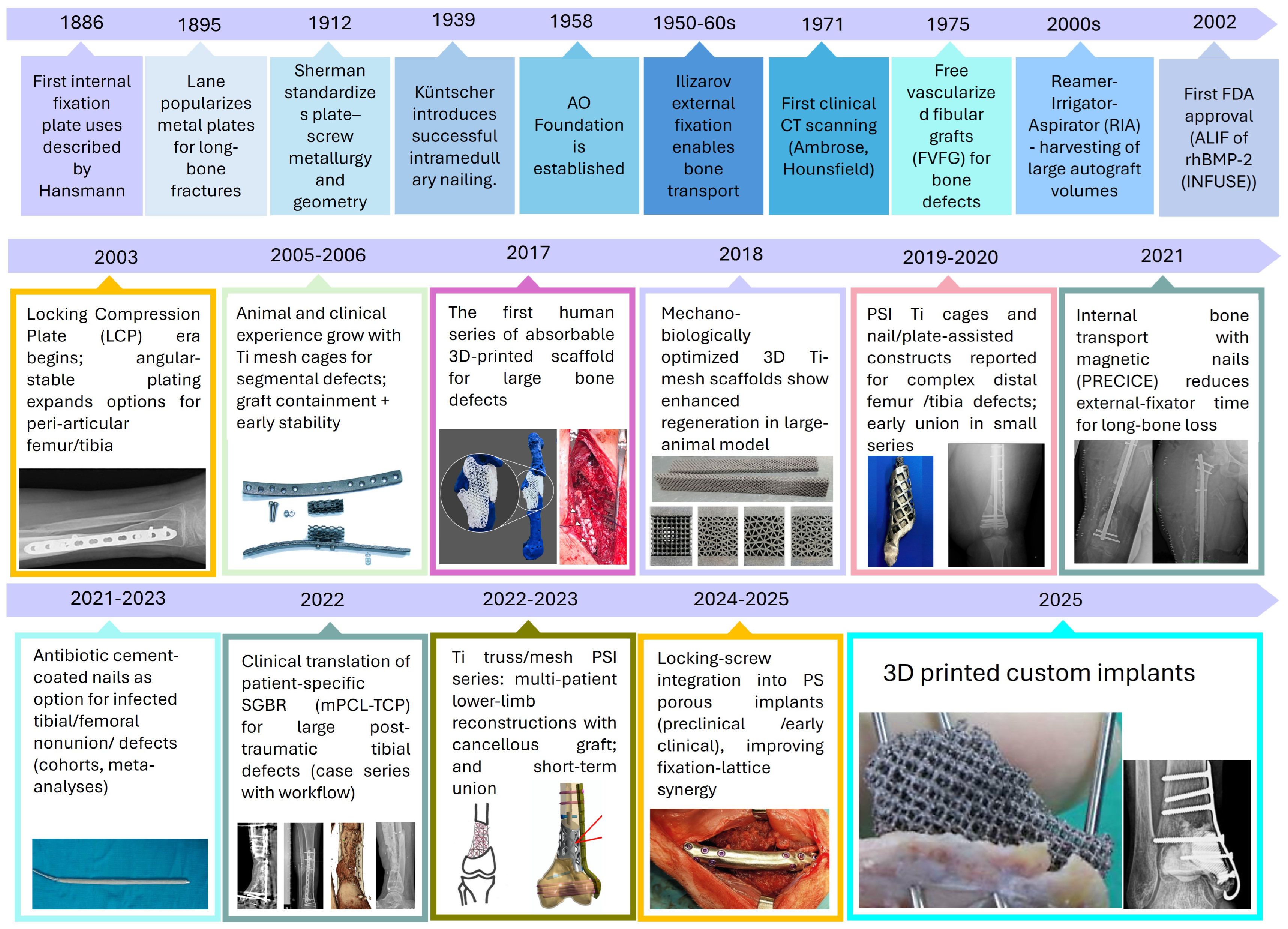
From Ilizarov to AM: The Evolving History of Femoral/Tibial Defect Repair
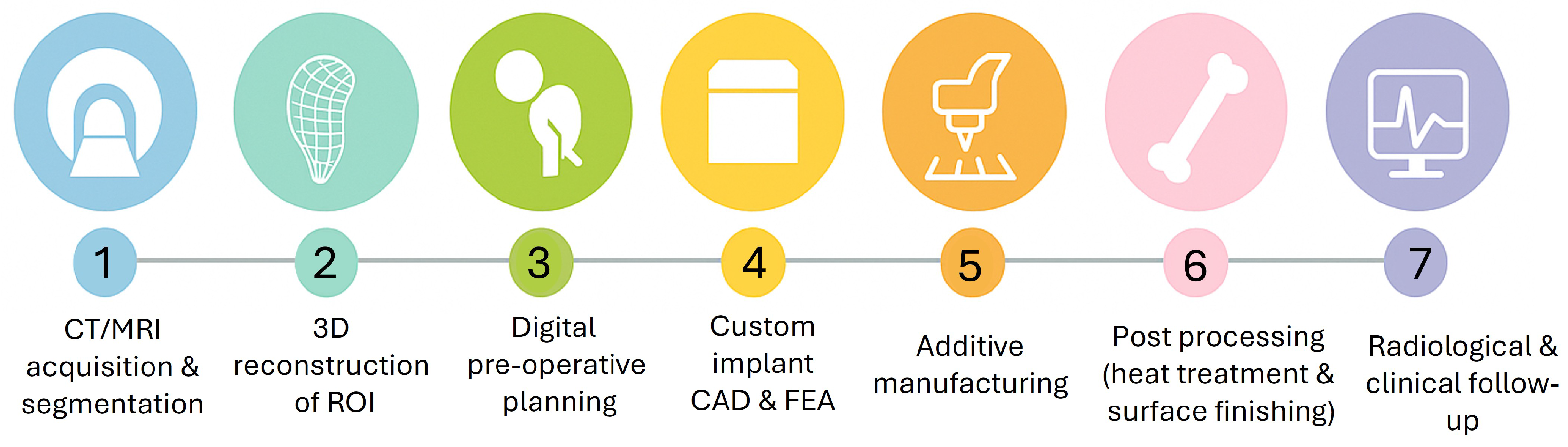
3. Personalization and Imaging Workflow
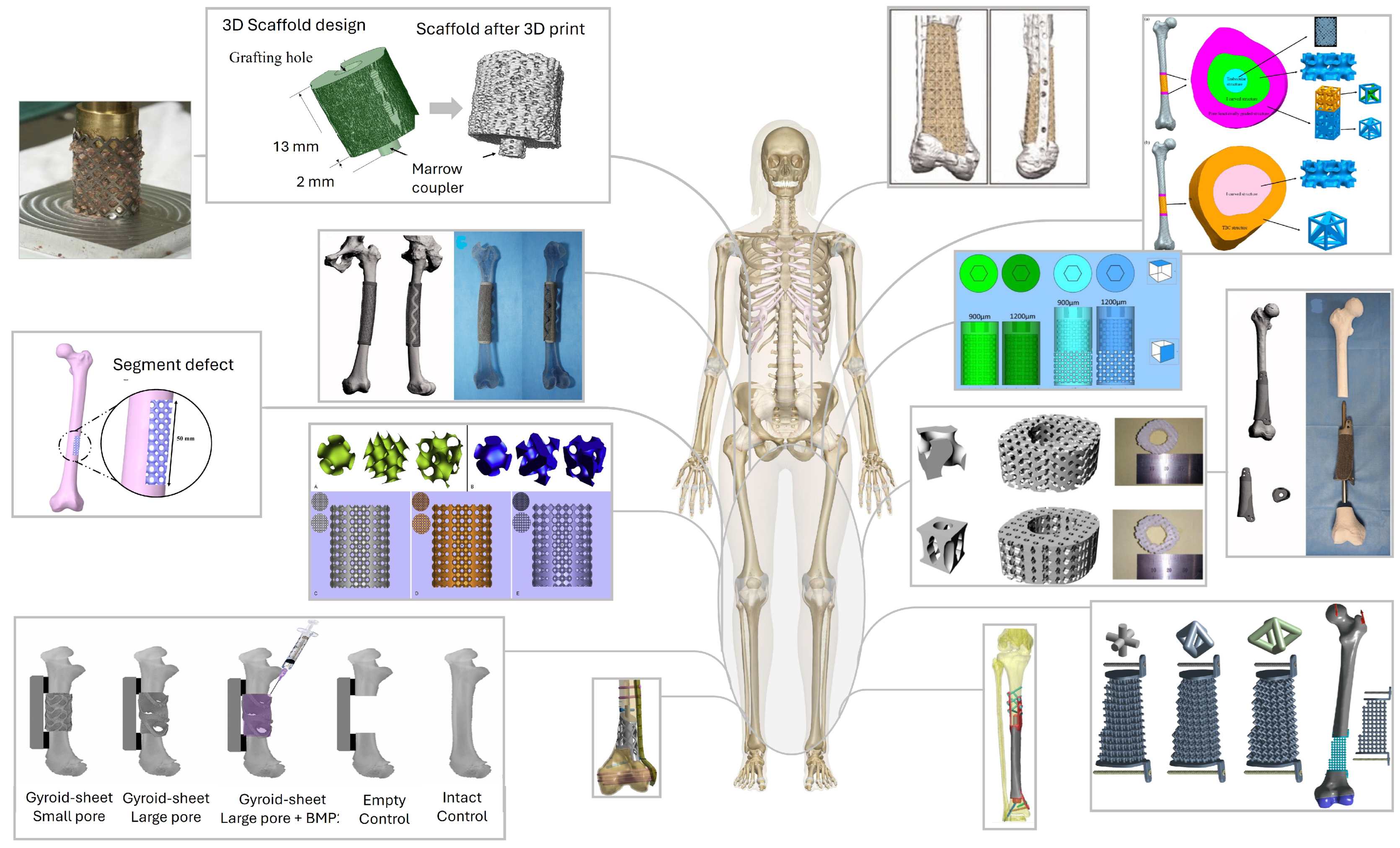
4. Lattice Modeling and Architecture
Materials and Manufacturing
5. Methodological Overviews: Simulation, Experimental, and Clinical Studies
5.1. Numerical Simulation Frameworks for Lattice-Based Segmental Reconstructions
5.2. Experimental Overview: Mechanical Tests, Biology, and In Vivo Validation (E_mech, E_bio, V)
5.3. Translational and Clinical Overviews (C)
6. Critical Limitations and Current Gaps
6.1. CT and Personalization Limits
6.2. FE Modeling and Validation Limits
6.3. Additive Manufacturing and As-Built Deviations
6.4. Clinical Translation Constraints
7. Challenges and Future Directions
Clinical Workflow and Translational Barriers
8. Conclusions and Outlook
Supplementary Materials
Author Contributions
Funding
Institutional Review Board Statement
Informed Consent Statement
Data Availability Statement
Conflicts of Interest
Abbreviations
| ABS | Acrylonitrile butadiene styrene |
| ALP | Alkaline phosphatase |
| AM | Additive manufacturing |
| AO | Arbeitsgemeinschaft für Osteosynthesefragen |
| ARS | Alizarin Red S |
| ATS | Assemblable titanium scaffold |
| BC | Boundary conditions |
| BIC | Bone–implant contact |
| BII | Bone–implant interface (distance) |
| BMD | Bone mineral density |
| BMP-2 | Bone morphogenetic protein 2 |
| BSE-SEM | Backscattered-electron scanning electron microscopy |
| BV/TV | Bone volume/total volume |
| C | Clinical evidence (clinical study) |
| CAD | Computer-aided design |
| CAE | Computer-aided engineering |
| CF-PEEK | Carbon-fiber-reinforced poly(ether ether ketone) |
| COL1 | Type I collagen |
| CPP | Calcium phosphate phase/powder |
| CT | Computed tomography |
| DEXA | Dual-energy X-ray absorptiometry |
| DIC | Digital image correlation |
| DICOM | Digital Imaging and Communications in Medicine |
| DIW | Direct ink writing |
| DMLS | Direct metal laser sintering |
| DoD | Drop-on-Demand |
| DOE | Design of Experiments |
| E_bio | In vitro biological experiments |
| E_mech | In vitro mechanical experiments |
| EBM | Electron beam melting |
| EDM | Electrical discharge machining |
| ET | Exposure time |
| FDM | Fused deposition modeling |
| FE | Finite element |
| FEM | Finite element method/model |
| FGM | Functionally graded material |
| FGL | Functionally graded lattice |
| FP | Feature parameter |
| FTIR | Fourier-transform infrared spectroscopy |
| GPRC | G protein-coupled receptor |
| GRF | Ground reaction force |
| HA | Hydroxyapatite |
| HD | Hatch distance |
| HIP | Hot isostatic pressing |
| HU | Hounsfield unit |
| IHC | Immunohistochemistry |
| IL-6 | Interleukin-6 |
| IM | Intramedullary |
| LPBF | Laser powder bed fusion |
| LT | Layer thickness |
| ML | Machine learning |
| mPCL–TCP | Medical-grade poly(-caprolactone)–tricalcium phosphate |
| MRI | Magnetic resonance imaging |
| NIH | National Institutes of Health |
| NLS | Non-lattice structure |
| NP | Nonporous (ATS unit) |
| OCN | Osteocalcin |
| OLS | Optimal lattice structure |
| PACS | Picture archiving and communication system |
| PCA | Porous-coated anatomic (knee system) |
| PCL | Poly(-caprolactone) |
| PEEK | Poly(ether ether ketone) |
| PLA | Polylactic acid |
| PMMA | Poly(methyl methacrylate) |
| PolyJet | Photopolymer material jetting process (PolyJet) |
| PSLIs | Patient-specific lattice implants |
| RANKL | Receptor activator of NF- B ligand |
| RIA | Reamer–Irrigator–Aspirator |
| ROI | Region of interest |
| RT | Room temperature |
| RT-qPCR | Reverse-transcription quantitative polymerase chain reaction |
| RUNX2 | Runt-related transcription factor 2 |
| RVE | Representative Volume Element |
| S | Simulation (numerical/FEM) |
| SA/VR | Surface area-to-volume ratio |
| SGBR | Scaffold-guided bone regeneration |
| SLA | Stereolithography |
| SLM | Selective laser melting |
| SP | Semiporous (ATS unit) |
| SEBM | Selective electron beam melting |
| TCP | Tricalcium phosphate |
| TGF-1 | Transforming growth factor beta 1 |
| THA | Total hip arthroplasty |
| Ti6Al4V | Titanium alloy with 6% Al and 4% V |
| Ti6Al4V ELI | Extra-low interstitial Ti6Al4V |
| TPMS | Triply periodic minimal surface |
| TKA | Total knee arthroplasty |
| TV | Total volume |
| QA | Quality Assurance |
| UTM | Universal testing machine |
| V | In vivo animal experiments |
| VEGFA | Vascular endothelial growth factor A |
| XCT | X-ray computed tomography |
| XRD | X-ray diffraction |
| YAG | Yttrium aluminum garnet |
| ZTM14N | Ti–19Nb–14Zr titanium alloy |
| CT | Micro-computed tomography |
References
- Wieding, J.; Souffrant, R.; Mittelmeier, W.; Bader, R. Finite element analysis on the biomechanical stability of open porous titanium scaffolds for large segmental bone defects under physiological load conditions. Med. Eng. Phys. 2013, 35, 422–432. [Google Scholar] [CrossRef] [Scilit]
- Tetsworth, K.; Woloszyk, A.; Glatt, V. 3D printed titanium cages combined with the Masquelet technique for the reconstruction of segmental femoral defects: Preliminary clinical results and molecular analysis of the biological activity of human-induced membranes. OTA Int. 2019, 2, e016. [Google Scholar] [CrossRef] [Scilit] [PubMed]
- Wong, K.W.; Wu, C.D.; Chien, C.S.; Lee, C.W.; Yang, T.H.; Lin, C.L. Patient-specific 3-dimensional printing titanium implant biomechanical evaluation for complex distal femoral open fracture reconstruction with segmental large bone defect: A nonlinear finite element analysis. Appl. Sci. 2020, 10, 4098. [Google Scholar] [CrossRef] [Scilit]
- Zhang, T.; Wei, Q.; Zhou, H.; Jing, Z.; Liu, X.; Zheng, Y.; Cai, H.; Wei, F.; Jiang, L.; Yu, M.; et al. Three-dimensional-printed individualized porous implants: A new “implant-bone” interface fusion concept for large bone defect treatment. Bioact. Mater. 2021, 6, 3659–3670. [Google Scholar] [CrossRef] [Scilit]
- Jin, H.; Zhuo, Y.; Sun, Y.; Fu, H.; Han, Z. Microstructure design and degradation performance in vitro of three-dimensional printed bioscaffold for bone tissue engineering. Adv. Mech. Eng. 2019, 11, 1687814019883784. [Google Scholar] [CrossRef] [Scilit]
- Kelly, C.N.; Lin, A.S.; Leguineche, K.E.; Shekhar, S.; Walsh, W.R.; Guldberg, R.E.; Gall, K. Functional repair of critically sized femoral defects treated with bioinspired titanium gyroid-sheet scaffolds. J. Mech. Behav. Biomed. Mater. 2021, 116, 104380. [Google Scholar] [CrossRef] [Scilit]
- Verma, R.; Kumar, J.; Singh, N.K.; Rai, S.K.; Saxena, K.K.; Xu, J. Design and analysis of biomedical scaffolds using TPMS-based porous structures inspired from additive manufacturing. Coatings 2022, 12, 839. [Google Scholar] [CrossRef] [Scilit]
- Lee, S.S.; Du, X.; Smit, T.; Bissacco, E.G.; Seiler, D.; de Wild, M.; Ferguson, S.J. 3D-printed LEGO®-inspired titanium scaffolds for patient-specific regenerative medicine. Biomater. Adv. 2023, 154, 213617. [Google Scholar] [CrossRef] [Scilit]
- Charbonnier, B.; Manassero, M.; Bourguignon, M.; Decambron, A.; El-Hafci, H.; Morin, C.; Leon, D.; Bensidoum, M.; Corsia, S.; Petite, H.; et al. Custom-made macroporous bioceramic implants based on triply-periodic minimal surfaces for bone defects in load-bearing sites. Acta Biomater. 2020, 109, 254–266. [Google Scholar] [CrossRef] [Scilit] [PubMed]
- Blázquez-Carmona, P.; Mora-Macías, J.; Martínez-Vázquez, F.J.; Morgaz, J.; Domínguez, J.; Reina-Romo, E. Mechanics predicts effective critical-size bone regeneration using 3d-printed bioceramic scaffolds. Tissue Eng. Regen. Med. 2023, 20, 893–904. [Google Scholar] [CrossRef] [Scilit]
- Wu, P.K.; Lee, C.W.; Sun, W.H.; Lin, C.L. Biomechanical analysis and design method for patient-specific reconstructive implants for large bone defects of the distal lateral femur. Biosensors 2021, 12, 4. [Google Scholar] [CrossRef] [Scilit]
- Chang, C.M.; Wong, P.C.; Ou, S.L.; Ko, C.E.; Wang, Y.T. Optimizing implant lattice design for large distal femur defects: Stimulating interface bone growth to enhance osseointegration. Int. J. Bioprint. 2024, 10, 2590. [Google Scholar] [CrossRef] [Scilit]
- Obaton, A.F.; Fain, J.; Meinel, D.; Tsamos, A.; Léonard, F.; Lécuelle, B.; Djemaï, M. In vivo bone progression in and around lattice implants additively manufactured with a new titanium alloy. Appl. Sci. 2023, 13, 7282. [Google Scholar] [CrossRef] [Scilit]
- Rana, M.; Chaudhuri, A.; Biswas, J.K.; Karim, S.I.; Datta, P.; Karmakar, S.K.; Roychowdhury, A. Design of patient specific bone stiffness mimicking scaffold. Proc. Inst. Mech. Eng. Part H J. Eng. Med. 2021, 235, 1453–1462. [Google Scholar] [CrossRef] [Scilit] [PubMed]
- Entezari, A.; Zhang, Z.; Sue, A.; Sun, G.; Huo, X.; Chang, C.C.; Zhou, S.; Swain, M.V.; Li, Q. Nondestructive characterization of bone tissue scaffolds for clinical scenarios. J. Mech. Behav. Biomed. Mater. 2019, 89, 150–161. [Google Scholar] [CrossRef] [Scilit]
- Lee, M.C.; Pan, C.T.; Chen, W.F.; Lin, M.C.; Shiue, Y.L. Design, manufacture, and characterization of a critical-sized gradient porosity dual-material tibial defect scaffold. Bioengineering 2024, 11, 308. [Google Scholar] [CrossRef] [Scilit] [PubMed]
- Vasanthanathan, A.; Kennedy, S.M. Bio-printing of femur model: A bone substitute for biomedical research. Mater. Technol. 2023, 57, 283–289. [Google Scholar] [CrossRef] [Scilit]
- Rezapourian, M.; Sadat Mirhakimi, A.; Nematollahi, M.; Minasyan, T.; Hussainova, I. Patient-Specific Lattice Implants for Segmental Femoral and Tibial Reconstruction (Part 1): Defect Patterns, Fixation Strategies and Reconstruction Options—A Review. Biomimetics 2026, 2, 2313–7673. [Google Scholar] [CrossRef] [Scilit]
- Uhthoff, H.K.; Poitras, P.; Backman, D.S. Internal plate fixation of fractures: Short history and recent developments. J. Orthop. Sci. 2006, 11, 118–126. [Google Scholar] [CrossRef] [Scilit] [PubMed]
- Hernigou, P.; Pariat, J. History of internal fixation (part 1): Early developments with wires and plates before World War II. Int. Orthop. 2017, 41, 1273–1283. [Google Scholar] [CrossRef] [Scilit]
- Matter, P. History of the AO and its global effect on operative fracture treatment. Clin. Orthop. Relat. Res. 1998, 347, 11–18. [Google Scholar] [CrossRef] [Scilit]
- Vécsei, V.; Hajdu, S.; Negrin, L.L. Intramedullary nailing in fracture treatment: History, science and Küntscher’s revolutionary influence in Vienna, Austria. Injury 2011, 42, S1–S5. [Google Scholar] [CrossRef] [Scilit]
- Buhl, C. 80 years of intramedullary nailing: New facts and information about a milestone in osteosynthesis. Der Unfallchirurg 2019, 122, 127–133. [Google Scholar] [CrossRef] [Scilit]
- Aktuglu, K.; Erol, K.; Vahabi, A. Ilizarov bone transport and treatment of critical-sized tibial bone defects: A narrative review. J. Orthop. Traumatol. 2019, 20, 22. [Google Scholar] [CrossRef] [Scilit]
- Chaddha, M.; Gulati, D.; Singh, A.P.; Singh, A.P.; Maini, L. Management of massive posttraumatic bone defects in the lower limb with the Ilizarov technique. Acta Orthop. Belg. 2010, 76, 811. [Google Scholar]
- Schulz, R.A.; Stein, J.A.; Pelc, N.J. How CT happened: The early development of medical computed tomography. J. Med. Imaging 2021, 8, 052110. [Google Scholar] [CrossRef] [Scilit]
- GNHounsfield.org. Firsts. 2021. Available online: https://gnhounsfield.org/Firsts.html (accessed on 3 November 2025).
- Alford, A.I.; Nicolaou, D.; Hake, M.; McBride-Gagyi, S. Masquelet’s induced membrane technique: Review of current concepts and future directions. J. Orthop. Res. 2021, 39, 707–718. [Google Scholar] [CrossRef] [Scilit]
- Masquelet, A.C. The induced membrane technique. Orthop. Traumatol. Surg. Res. 2020, 106, 785–787. [Google Scholar] [CrossRef] [Scilit] [PubMed]
- Han, W.; Shen, J.; Wu, H.; Yu, S.; Fu, J.; Xie, Z. Induced membrane technique: Advances in the management of bone defects. Int. J. Surg. 2017, 42, 110–116. [Google Scholar] [CrossRef] [Scilit] [PubMed]
- Kubiak, E.N.; Fulkerson, E.; Strauss, E.; Egol, K.A. The evolution of locked plates. J. Bone Jt. Surg. 2006, 88, 189–200. [Google Scholar]
- Cronier, P.; Pietu, G.; Dujardin, C.; Bigorre, N.; Ducellier, F.; Gerard, R. The concept of locking plates. Orthop. Traumatol. Surg. Res. 2010, 96, S17–S36. [Google Scholar] [CrossRef] [Scilit]
- Haidukewych, G.J. Innovations in locking plate technology. JAAOS-J. Am. Acad. Orthop. Surg. 2004, 12, 205–212. [Google Scholar] [CrossRef] [Scilit]
- Garabano, G.; Del Sel, H.; Rodriguez, J.A.; Perez Alamino, L.; Pesciallo, C.A. The effectiveness of antibiotic cement-coated nails in post-traumatic femoral and tibial osteomyelitis–comparative analysis of custom-made versus commercially available nails. J. Bone Jt. Infect. 2021, 6, 457–466. [Google Scholar] [CrossRef] [Scilit]
- Ghaseminejad-Raeini, A.; Azarboo, A.; Pirahesh, K.; Sharafi, A.; Hoveidaei, A.H.; Nwankwo, B.O.; Annasamudram, A.; Conway, J.D. Antibiotic-coated intramedullary nailing managing long bone infected non-unions: A meta-analysis of comparative studies. Antibiotics 2024, 13, 69. [Google Scholar] [CrossRef] [Scilit] [PubMed]
- Summers, S.; Krkovic, M. Bone transport with magnetic intramedullary nails in long bone defects. Eur. J. Orthop. Surg. Traumatol. 2021, 31, 1243–1252. [Google Scholar] [CrossRef] [Scilit] [PubMed]
- Smolle, M.A.; Zötsch, S.; Andreou, D.; Valentini, M.; Leithner, A.; Lanz, P. Bone transport nails for reconstruction of lower limb diaphyseal defects in patients with bone sarcomas: A case series. Wien. Klin. Wochenschr. 2025, 137, 654–660. [Google Scholar] [CrossRef] [Scilit]
- Cobos, J.A.; Lindsey, R.W.; Gugala, Z. The cylindrical titanium mesh cage for treatment of a long bone segmental defect: Description of a new technique and report of two cases. J. Orthop. Trauma 2000, 14, 54–59. [Google Scholar] [CrossRef] [Scilit]
- Dvorak, M.F.; Kwon, B.K.; Fisher, C.G.; Eiserloh, H.L., III; Boyd, M.; Wing, P.C. Effectiveness of titanium mesh cylindrical cages in anterior column reconstruction after thoracic and lumbar vertebral body resection. Spine 2003, 28, 902–908. [Google Scholar] [CrossRef] [Scilit]
- Toosi, S.; Javid-Naderi, M.J.; Tamayol, A.; Ebrahimzadeh, M.H.; Yaghoubian, S.; Mousavi Shaegh, S.A. Additively manufactured porous scaffolds by design for treatment of bone defects. Front. Bioeng. Biotechnol. 2024, 11, 1252636. [Google Scholar] [CrossRef] [Scilit]
- Deering, J.; Dowling, K.I.; DiCecco, L.A.; McLean, G.D.; Yu, B.; Grandfield, K. Selective Voronoi tessellation as a method to design anisotropic and biomimetic implants. J. Mech. Behav. Biomed. Mater. 2021, 116, 104361. [Google Scholar] [CrossRef] [Scilit] [PubMed]
- sadat Mirhakimi, A.; Dubey, D.; Elbestawi, M.A. Laser powder bed fusion of bio-inspired metamaterials for energy absorption applications: A review. J. Mater. Res. Technol. 2024, 31, 2126–2155. [Google Scholar] [CrossRef] [Scilit]
- Müller, P.; Synek, A.; Stauß, T.; Steinnagel, C.; Ehlers, T.; Gembarski, P.C.; Pahr, D.; Lachmayer, R. Development of a density-based topology optimization of homogenized lattice structures for individualized hip endoprostheses and validation using micro-FE. Sci. Rep. 2024, 14, 5719. [Google Scholar] [CrossRef] [Scilit] [PubMed]
- Davoodi, E.; Montazerian, H.; Mirhakimi, A.S.; Zhianmanesh, M.; Ibhadode, O.; Shahabad, S.I.; Esmaeilizadeh, R.; Sarikhani, E.; Toorandaz, S.; Sarabi, S.A.; et al. Additively manufactured metallic biomaterials. Bioact. Mater. 2022, 15, 214–249. [Google Scholar] [CrossRef] [Scilit]
- Kadkhodapour, J.; Mirhakimi, A.S.; Montazerian, H. Structural defects and mechanical properties of additively manufactured parts. In Quality Analysis of Additively Manufactured Metals; Elsevier: Amsterdam, The Netherlands, 2023; pp. 119–172. [Google Scholar]
- Schick, V.D.; Zampogna, B.; Marrara, G.; Siracusano, L.; Larizza, L.; Calaciura, S.; Sanzarello, I.; Marinozzi, A.; Leonetti, D. Custom-Made 3D-Printed Titanium Implants for Managing Segmental Distal Tibial Bone Defects: A Systematic Literature Review. J. Clin. Med. 2025, 14, 1796. [Google Scholar] [CrossRef] [Scilit]
- Castrisos, G.; Matheus, I.G.; Sparks, D.; Lowe, M.; Ward, N.; Sehu, M.; Wille, M.L.; Phua, Y.; Savi, F.M.; Hutmacher, D.; et al. Regenerative matching axial vascularisation of absorbable 3D-printed scaffold for large bone defects: A first in human series. J. Plast. Reconstr. Aesthetic Surg. 2022, 75, 2108–2118. [Google Scholar] [CrossRef] [Scilit]
- Sparks, D.S.; Savi, F.M.; Dlaska, C.E.; Saifzadeh, S.; Brierly, G.; Ren, E.; Cipitria, A.; Reichert, J.C.; Wille, M.L.; Schuetz, M.A.; et al. Convergence of scaffold-guided bone regeneration principles and microvascular tissue transfer surgery. Sci. Adv. 2023, 9, eadd6071. [Google Scholar] [CrossRef] [Scilit]
- Sparks, D.S.; Wiper, J.; Lloyd, T.; Wille, M.L.; Sehu, M.; Savi, F.M.; Ward, N.; Hutmacher, D.W.; Wagels, M. Protocol for the BONE-RECON trial: A single-arm feasibility trial for critical sized lower limb BONE defect RECONstruction using the mPCL-TCP scaffold system with autologous vascularised corticoperiosteal tissue transfer. BMJ Open 2023, 13, e056440. [Google Scholar] [CrossRef] [Scilit]
- McAnena, A.P.; McClennen, T.; Zheng, H. Patient-specific 3-dimensional-printed orthopedic implants and surgical devices are potential alternatives to conventional technology but require additional characterization. Clin. Orthop. Surg. 2024, 17, 1. [Google Scholar] [CrossRef] [Scilit]
- Yon, C.J.; Choi, B.C.; Lee, J.M.; Lee, S.W. Personalized 3D-Printed Prostheses for Bone Defect Reconstruction After Tumor Resection in the Foot and Ankle. J. Funct. Biomater. 2025, 16, 62. [Google Scholar] [CrossRef] [Scilit]
- Campanacci, L.; Cevolani, L.; Focaccia, M.; Di Gennaro, G.L.; Dozza, B.; Staals, E.; Zuccheri, F.; Bianchi, G.; Donati, D.M.; Manfrini, M. Lengthening patients previously treated for massive lower limb reconstruction for bone tumors with the PRECICE 2 Nail. Children 2023, 10, 1772. [Google Scholar] [CrossRef] [Scilit] [PubMed]
- Rosslenbroich, S.B.; Oh, C.W.; Kern, T.; Mukhopadhaya, J.; Raschke, M.J.; Kneser, U.; Krettek, C. Current management of diaphyseal long bone defects—a multidisciplinary and international perspective. J. Clin. Med. 2023, 12, 6283. [Google Scholar] [CrossRef] [Scilit]
- Solanki, T.; Maurya, M.K.; Singh, P.K. Results of antibiotic-impregnated cement/polymer-coated intramedullary nails in the management of infected nonunion and open fractures of long bones. Cureus 2023, 15. [Google Scholar] [CrossRef] [Scilit]
- Anaspure, O.S.; Patel, S.; Baumann, A.N.; Anastasio, A.T.; Pean, C.; DeBaun, M.R. Nail–Plate Constructs for Treating Distal Femur Fractures: A Systematic Review of Biomechanical Studies. Surgeries 2024, 5, 799–816. [Google Scholar] [CrossRef] [Scilit]
- Alkentar, R.; Máté, F.; Mankovits, T. Investigation of the performance of Ti6Al4V lattice structures designed for biomedical implants using the finite element method. Materials 2022, 15, 6335. [Google Scholar] [CrossRef] [Scilit] [PubMed]
- Di Caprio, F.; Franchitti, S.; Borrelli, R.; Bellini, C.; Di Cocco, V.; Sorrentino, L. Ti-6Al-4V octet-truss lattice structures under bending load conditions: Numerical and experimental results. Metals 2022, 12, 410. [Google Scholar] [CrossRef] [Scilit]
- Crovace, A.M.; Lacitignola, L.; Forleo, D.M.; Staffieri, F.; Francioso, E.; Di Meo, A.; Becerra, J.; Crovace, A.; Santos-Ruiz, L. 3D biomimetic porous titanium (Ti6Al4V ELI) scaffolds for large bone critical defect reconstruction: An experimental study in sheep. Animals 2020, 10, 1389. [Google Scholar] [CrossRef] [Scilit]
- Laubach, M.; Suresh, S.; Herath, B.; Wille, M.L.; Delbrück, H.; Alabdulrahman, H.; Hutmacher, D.W.; Hildebrand, F. Clinical translation of a patient-specific scaffold-guided bone regeneration concept in four cases with large long bone defects. J. Orthop. Transl. 2022, 34, 73–84. [Google Scholar] [CrossRef] [Scilit] [PubMed]
- Kang, K.W.; Yang, S.; Kim, S.Y.; Choi, J.; Kang, B.J. Integration of locking screw fixation into 3D-printed patient-specific porous titanium implants enhances osseointegration: An in vivo study in a rabbit bone defect model. J. Vet. Sci. 2025, 26, e62. [Google Scholar] [CrossRef] [Scilit] [PubMed]
- Christodoulou, M.; Hadjipolydorou, N.; Christofi, E.; Orfanos, I. Bone transport using an intramedullary magnetic nail in a femur with chronic osteomyelitis after a car bomb attack in Somalia: A case report. J. Orthop. Rep. 2025, 4, 100376. [Google Scholar] [CrossRef] [Scilit]
- Liu, L.; Liu, C.; Deng, C.; Wang, X.; Liu, X.; Luo, M.; Wang, S.; Liu, J. Design and performance analysis of 3D-printed stiffness gradient femoral scaffold. J. Orthop. Surg. Res. 2023, 18, 120. [Google Scholar] [CrossRef] [Scilit]
- Lu, H.T.; Hsu, C.C.; Jian, Q.Q.; Chen, W.T. Biomechanical Study of Different Scaffold Designs for Reconstructing a Traumatic Distal Femur Defect Using Patient-Specific Computational Modeling. Comput. Model. Eng. Sci. 2025, 142, 1883–1898. [Google Scholar] [CrossRef] [Scilit]
- Shams, M.; Mansurov, Z.; Daulbayev, C.; Bakbolat, B. Effect of Lattice Structure and Composite Precursor on Mechanical Properties of 3D-Printed Bone Scaffolds. Eurasian Chem.-Technol. J. 2021, 23, 257–266. [Google Scholar] [CrossRef] [Scilit]
- Bayoglu, R.; Okyar, A.F. Implementation of boundary conditions in modeling the femur is critical for the evaluation of distal intramedullary nailing. Med. Eng. Phys. 2015, 37, 1053–1060. [Google Scholar] [CrossRef] [Scilit]
- Acar, A.A.; Daskalakis, E.; Bartolo, P.; Weightman, A.; Cooper, G.; Blunn, G.; Koc, B. Customized scaffolds for large bone defects using 3D-printed modular blocks from 2D-medical images. Bio-Des. Manuf. 2024, 7, 74–87. [Google Scholar] [CrossRef] [Scilit]
- Karuppudaiyan, S.; Singh, D.K.J.; Santosh, V.M. Finite element analysis of scaffold for large defect in femur bone. In Proceedings of the IOP Conference Series: Materials Science and Engineering; IOP Publishing: Bristol, UK, 2018; Volume 402, p. 012096. [Google Scholar]
- Pobloth, A.M.; Checa, S.; Razi, H.; Petersen, A.; Weaver, J.C.; Schmidt-Bleek, K.; Windolf, M.; Tatai, A.Á.; Roth, C.P.; Schaser, K.D.; et al. Mechanobiologically optimized 3D titanium-mesh scaffolds enhance bone regeneration in critical segmental defects in sheep. Sci. Transl. Med. 2018, 10, eaam8828. [Google Scholar] [CrossRef] [Scilit] [PubMed]
- Karuppudaiyan, S.; Singh, D.K.J. Design of scaffold with controlled internal architecture using fused deposition modeling (FDM). Int. J. Eng. Adv. Technol. 2019, 9, 2764–2768. [Google Scholar] [CrossRef] [Scilit]
- Yavari, S.A.; van der Stok, J.; Ahmadi, S.; Wauthlé, R.; Schrooten, J.; Weinans, H.; Zadpoor, A.A. Mechanical analysis of a rodent segmental bone defect model: The effects of internal fixation and implant stiffness on load transfer. J. Biomech. 2014, 47, 2700–2708. [Google Scholar] [CrossRef] [Scilit]
- Lindsey, R.W.; Gugala, Z.; Milne, E.; Sun, M.; Gannon, F.H.; Latta, L.L. The efficacy of cylindrical titanium mesh cage for the reconstruction of a critical-size canine segmental femoral diaphyseal defect. J. Orthop. Res. 2006, 24, 1438–1453. [Google Scholar] [CrossRef] [Scilit]
- Park, J.W.; Kang, H.G.; Kim, J.H.; Kim, H.S. New 3-dimensional implant application as an alternative to allograft in limb salvage surgery: A technical note on 10 cases. Acta Orthop. 2020, 91, 489–496. [Google Scholar] [CrossRef] [Scilit]
- Guder, W.K.; Hardes, J.; Nottrott, M.; Podleska, L.E.; Streitbürger, A. Highly cancellous titanium alloy (TiAl6V4) surfaces on three-dimensionally printed, custom-made intercalary tibia prostheses: Promising short-to intermediate-term results. J. Pers. Med. 2021, 11, 351. [Google Scholar] [CrossRef] [Scilit]
- Li, J.; Wang, L.; He, X.; Liang, J.; Dong, C. Additively manufactured metallic TPMS lattice structures: Design strategies, fabrication, multifunctional properties, and applications. NPJ Adv. Manuf. 2025, 2, 45. [Google Scholar] [CrossRef] [Scilit]
- Wei, J.; Gross, D.; Lane, N.E.; Lu, N.; Wang, M.; Zeng, C.; Yang, T.; Lei, G.; Choi, H.K.; Zhang, Y. Risk factor heterogeneity for medial and lateral compartment knee osteoarthritis: Analysis of two prospective cohorts. Osteoarthr. Cartil. 2019, 27, 603–610. [Google Scholar] [CrossRef] [Scilit]
- Li, L.; Shi, J.; Zhang, K.; Yang, L.; Yu, F.; Zhu, L.; Liang, H.; Wang, X.; Jiang, Q. Early osteointegration evaluation of porous Ti6Al4V scaffolds designed based on triply periodic minimal surface models. J. Orthop. Transl. 2019, 19, 94–105. [Google Scholar] [CrossRef] [Scilit]
- Benady, A.; Meyer, S.J.; Golden, E.; Dadia, S.; Levy, G.K. Patient-specific Ti-6Al-4V lattice implants for critical-sized load-bearing bone defects reconstruction. Mater. Des. 2023, 226, 111605. [Google Scholar] [CrossRef] [Scilit]
- Wong, K.W.; Wu, C.D.; Chien, C.S.; Lee, C.W.; Yang, T.H. Patient-Specific 3D-Printed Titanium Implant for Complex Distal Femoral Open Fracture Reconstruction with Segmental Large Defect. Appl. Sci. 2020, 10, 4098. [Google Scholar] [CrossRef] [Scilit]
- Tetsworth, K.; Block, S.; Glatt, V. Putting 3D modelling and 3D printing into practice: Virtual surgery and preoperative planning to reconstruct complex post-traumatic skeletal deformities and defects. Sicot-J 2017, 3, 16. [Google Scholar] [CrossRef] [Scilit] [PubMed]


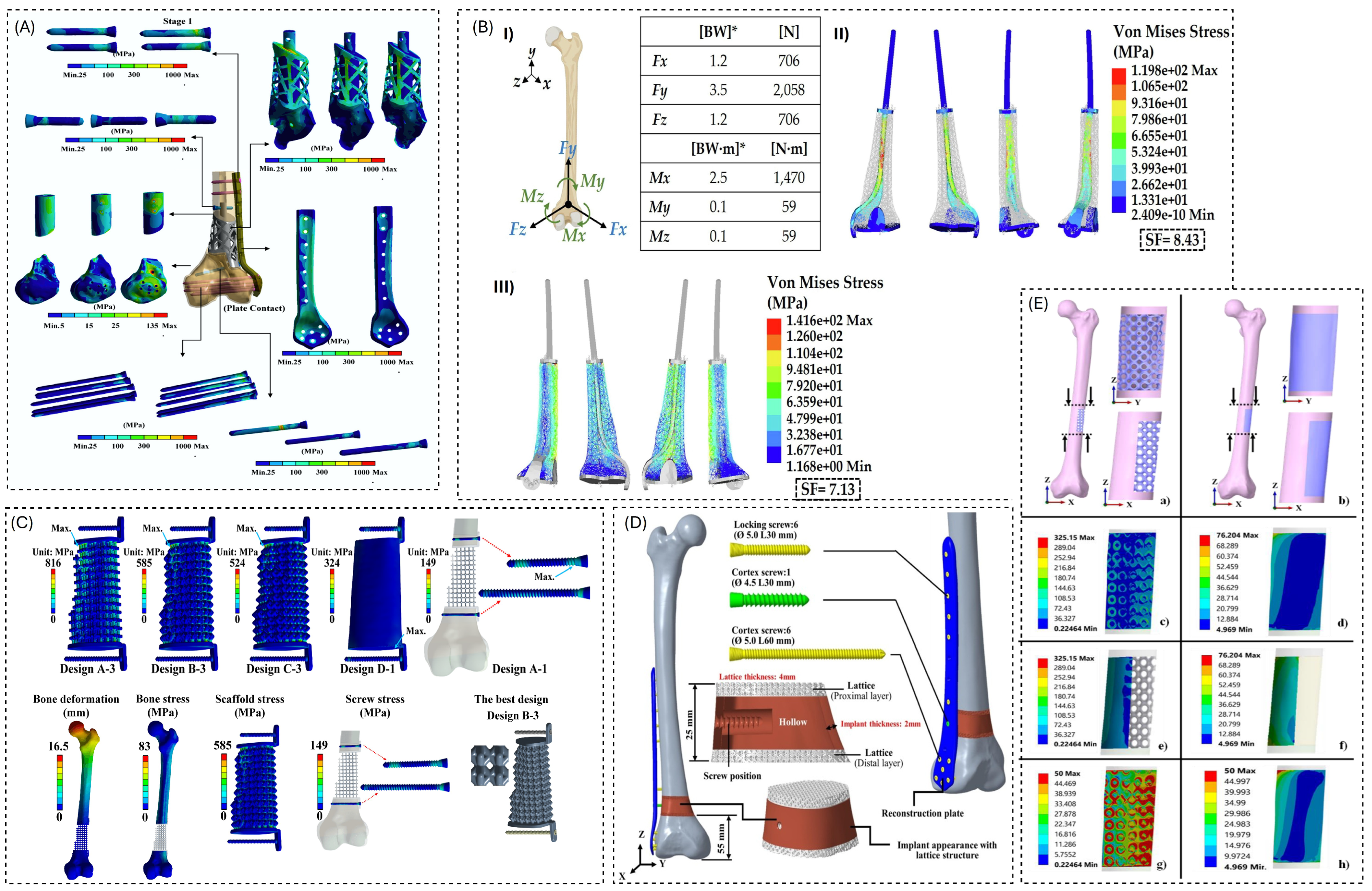
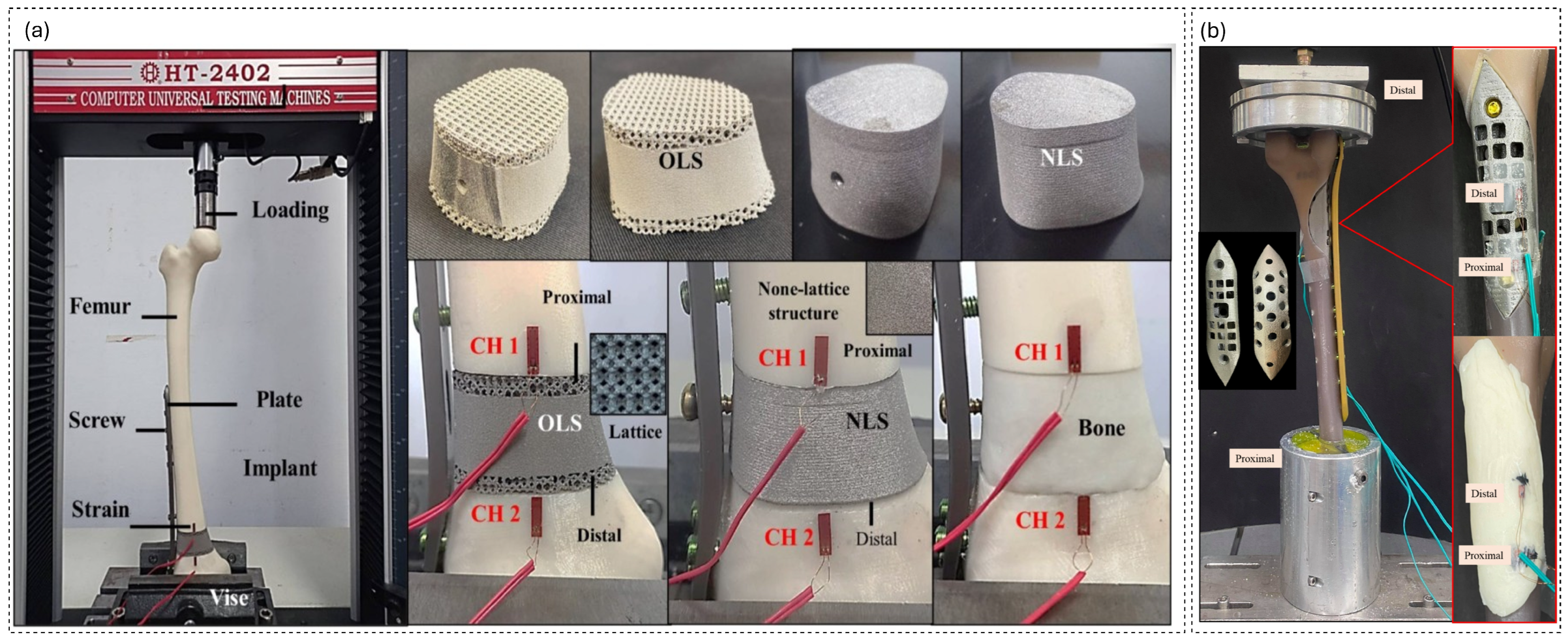


| Year, Ref [n] | Imaging-to-Model Workflow (CT/CT; Key Steps) |
|---|---|
| 2013, [1] | CT of standardized composite femur (4th-gen large left Sawbones); matrix/pixel/slice not reported; segmentation not specified; CT-based HU mapping from composite bone. |
| 2014, [70] | No patient CT model pipeline; bench CT of SLM Ti implants (thresholds 77–255/85–255/96–255); compute porosity, pore and strut sizes; no DICOM segmentation/mirroring; no CT-based CAD. |
| 2015, [65] | No CT (standardized 3rd-generation composite femur from Biomedical Research Community), segmentation N/A; geometry used directly (no mirroring); canal prepared by drilling/reaming via Boolean ops; CT-based HU mapping not used. |
| 2018, [68] | CT-based design, matrix/pixel NR, slice thickness NR; CAD generated from 3D-CT by manufacturer (DePuy Synthes); no mirroring stated; radiographs throughout and CT for clinical follow-up; segmentation/stacking/export/software NR. |
| 2018, [67] | CT (healthy adult femur, DICOM), matrix/pixel/slice not reported, segmentation in Mimics (ROI thresholding; healing of crumbled parts; noise reduction), export point cloud from Mimics to SolidWorks and convert surface to solid (target point cloud size set to “random”), HU measured in Mimics with mapping used for porosity and modulus. |
| 2019, [15] | No CT/DICOM (composite femur CAD from manufacturer), optical white-light scan of cortex and core (3D3 Solutions HDI Advance R3) with FlexScan 3D, surfaces generated in Rapidform XOR3 and assembled in SolidWorks 2016 (Sawbones part 3908), segmentation N/A, registration/mirroring N/A, DIC system (GOM ARAMIS) used for full-field strain validation. |
| 2019, [5] | CT (average adult human femur), matrix/pixel/slice not reported, 3D reconstruction in Mimics (Materialise) → Geomagic Studio to create femur CAD, Boolean of arrayed unit cells with selected femur region to build reconstructed scaffold model, no mirroring reported, export as CAD for printing/analysis; CT-based HU mapping not reported. |
| 2019, [69] | CT (human femur mid-diaphysis; matrix/pixel NR; slice thickness NR), DICOM export, Mimics (segmentation and 3D reconstruction; version NR), STL export. |
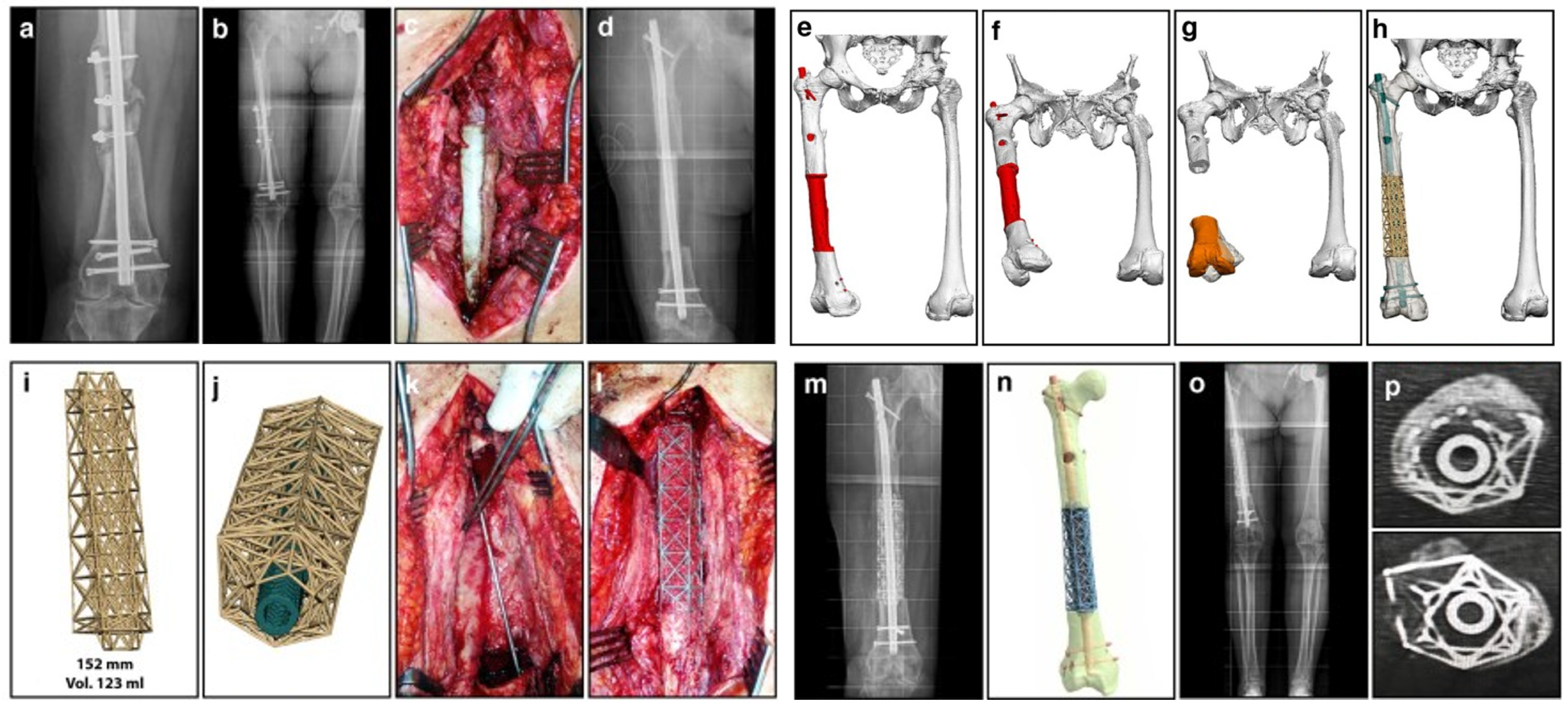
| 2019, [2] | High-resolution CT of temporary PMMA-spacer construct (stage-1 Masquelet) for virtual surgical planning; matrix/pixel NR; slice thickness NR; surgeon-led VSP to define approach, screw trajectories, and plate/IM devices; contralateral limb mirrored to restore native contours; CT data sent to manufacturer (4Web Medical) to CAD/3D-print; follow-up with routine radiographs (measured in AGFA IMPAX) and CT at 9–12 months; export/stacking formats NR (planning CT targets spacer construct rather than direct bone segmentation). |
| 2020, [9] | In vivo X-ray CT (Skyscan 1176, Bruker): pixel 35.4 m, 65 kV, 373 A, 1 mm Al filter, 0.7° rotation, 58 ms; reconstruction (CTAn) → 3D femur model in Simpleware ScanIP; in vitro/ex vivo CT (Skyscan 1176): pixel 17.7 m, 80 kV, 300 A, Cu+Al filter, 0.5° rotation, 100 ms; reconstruction (NRecon v1.6.8.0); quantitative analysis in CTAn with grayscale thresholds (bone = 63, HA = 120); outputs reported as total bone volume and intraporous bone volume. |
| 2020, [3] | CT (bilateral femurs), matrix/pixel/slice not reported, cortical/cancellous contours extracted from CT slices and converted to 3D solid models in Creo Parametric v5.0, intact left femur mirrored (1 cm proximal/distal to fracture) to restore right femur via Boolean; PSI geometry derived from restored anatomy; exported to FE model with nonlinear contact (solver not specified). |
| 2021, [14] | CT (single healthy adult femur), 512 × 512 matrix, pixel 0.6445 mm, slice 1 mm, Mimics v17 threshold/region-grow, no mirroring (section-based analysis), direct to ANSYS for meshing/FE and STL for AM, CT-based HU–density-E mapping applied. |
| 2021, [6] | In vivo radiography (serial X-rays) and CT over 12 weeks for rat femoral CSBD; scanner/model not reported; CT used to assess scaffold porosity/morphology and to generate CT reconstructions of implanted gyroid-sheet scaffolds; specific voxel size and segmentation thresholds not reported; image exports/software for CT analysis not specified. |
| 2021, [64] | CT, matrix/pixel/slice not reported, 3D Slicer 4.11 to convert DICOM to 3D model, STL repair/prep in Autodesk Meshmixer, no mirroring, HU-E mapping not reported; SLA prints (Anycubic Photon S) used for validation. |
| 2021, [4] | CT, CT (Inveon MM, Siemens) 20 m voxel for ex vivo analysis, segmentation for FE in Mimics Research 20.0, CT 3D recon in Inveon Research Workplace, HU threshold 1000-3885 to separate new bone from implant, ROIs defined as peri-implant (2 mm peripheral ring) and intraporous (within pores), clinical follow-up included CT/histology at implant–bone interface; matrix/pixel/slice for clinical CT not reported; mirroring not reported; HU-E mapping not stated. |
| 2021, [4] | Clinical CT-based design, implants designed from 3D-CT data (matrix/pixel NR, slice thickness NR), variable CT/X-ray follow-up (e.g., immediate to 36 months); Sheep: axial spiral CT (Siemens SOMATOM Definition Flash 64), 120 kV, 200 mA, FOV 21 cm, slice thickness 3 mm; CT for endpoint morphometry (Siemens Inveon MM), nominal resolution 20 m, segmentation/3D reconstruction in Inveon Research Workplace, HU threshold 1000–3885 for new bone, ROIs: peri-implant 2 mm belt and intraporous; CT to CAD/FEA by Mimics Research 20.0; stacking/export formats NR; mirroring NR. |
| 2022, [7] | CT/DICOM (adult femur; standard clinical scan), matrix/pixel/slice not reported, MIMICS 18.0 region-grow 230–1883 HU, STL-FreeCAD-IGES-SpaceClaim 2021 R1 section cut to create segmental defect, HU-E mapping not stated. |
| 2022, [11] | Patient CT (distal lateral femur, osteosarcoma), matrix/pixel/slice not reported, segmentation tool not reported, defect defined anatomically with rule H = Y/3 above the epiphyseal plate (no mirroring), CAD from CT images. |
| 2023, [62] | CT, DICOM 3.0; matrix/pixel/slice not reported, segmentation in Mimics 21.0 (threshold by gray values), surface repair in Magics 22.0, contralateral mirroring used to reconstruct the defect site, osteotomy length set to 90 mm by prior clinical reference, export of repaired femur/PSI geometry for FE analysis (solver not specified), HU-E mapping not reported. |
| 2023, [8] | CT (Scanco CT 100) of printed Ti scaffold to verify geometric features, 90 kVp, 200 A, 18 W, integration 140 ms, nominal resolution 4.9 m, images reconstructed/visualized in Scanco workstation (no patient DICOM modeling); no mirroring; CAD did not originate from CT (parametric design). |
| 2023, [17] | CT, matrix/pixel not reported, slice distance 2 mm, 1816 cuts, DICOM export; Mimics 10.01 density-based segmentation to primary 3D model; no mirroring stated; slicing in Cura (LulzBot Edition v3) for AM. |
| 2023, [10] | CT (ovine metatarsus, pre-op planning), DICOM, voxel 0.115 × 0.115 × 0.600 mm, InVesalius interactive thresholding + 3D reconstruction (stacking); defect templating by cropping 13 mm bone segment, medullary cavity fill, addition of coupler (Ø4 × 2 mm) and graft hole (Ø4 × 10 mm); no mirroring; export format NR; microstructure optimized numerically in prior work (not CT-derived). Follow-up CT for analysis: 300 m/voxel, manual segmentation in InVesalius, contralateral limb co-scanned as control; HU-BMD calibration using QRM-BDC/6–200 phantoms (0–0.8 g HA/); outputs: callus TV, CSA, BMD over time. |
| 2023, [13] | Ex vivo X-ray CT (XCT) on explanted sheep implants with surrounding bone; voxel 6.8 m, 120 kV, 120 A, 3142 projections, 1000 ms/projection, , 2 h scan; 3D stacks reconstructed in XCT workstation; segmentation via a 3-stage ML workflow: Ilastik pixel classification to generate labels to two custom 2D U-Nets; classes separated: metal, bone, pores, osteoid, metallic grains; purpose: quantify BII (<10 mm) and BIC (95%); no patient CT→CAD or mirroring (QC/analysis only); export/software for CAD NR. |
| 2024, [16] | CT (adult New Zealand White rabbit tibia), matrix/pixel not reported, slice thickness not reported, Meshmixer 3.3 for extraction/smoothing/repair of left tibia, Geomagic Studio for SolidWorks 2017 for parametric surface patches, no mirroring, material mapping not stated, models prepared for SLM prototype and bench tests. |
| 2024, [66] | 2D medical X-rays (no CT), matrix/pixel/slice not reported, external femur surface via reverse engineering from 2D images, segmentation N/A, no mirroring, algorithmic 3D reconstruction from 2D, export to CAD assembly of modular “BoneBricks” blocks, material mapping not applicable, bench/prototyping only. |
| 2024, [12] | CT-based femur model (ENOVO-186 dataset), matrix/pixel NR, slice thickness NR; segmentation/stacking NR; geometry modeled from CT image; CAD in Creo Parametric 5.0; validation CT used to quantify model/bone volumes (animal), export formats NR, mirroring NR. |
| 2025, [63] | CT (NIH Visible Human, male right femur), 512 × 512 matrix, 1 mm slices; segmentation in Amira–Avizo (Python script used to record HU), surfaces exported as STL; smoothing/solid conversion in Geomagic Freeform and Geomagic Wrap; no mirroring; HU–density-E material mapping applied per element with manual mapping in ANSYS Workbench (triangulation, volumetric transfer). |
| Year, Ref [n] | Lattice | UC (mm; X × Y × Z) | T (mm) | PS (m) | RD/ Porosity (%) | SA/VR () | Gradient (Type) | Gradient Driver | Design Objective(s) | CAD Software |
|---|---|---|---|---|---|---|---|---|---|---|
| 2013, [1] | Strut (regular open-cell; cylindrical scaffold) | - | 0.3–0.8 | 800/1100 /1500/1800 | 61–81 (eff.); 64–93 (scaf.) | — | None (constant RD) | Rule-based parametric sweep | E-match; SS-reduce; minimize gap d; MPa | NR. |
| 2014, [70] | Strut-based lattice (dodecahedron unit cell) | 0.5 × 0.5 × 0.5 | 0.12/0.17/0.23 (strut diameter) | 500 (nominal); ≈560–610 (CT) | 84/78/68 (porosity) | NR | None (uniform lattice; three stiffness groups) | - (Stiffness tuned by global porosity, no spatial gradient) | Vary implant stiffness to study load transfer | NR |
| 2018, [68] | Strut-based honeycomb Ti-mesh | cylindrical scaffold: (diameter × length); central canal 10 (diameter); strut length 7 | 1.2/1.6 (for soft/stiff scaffold) | NR (macrochannels in mm range; exact values not reported) | NR | NR | None (uniform honeycomb architecture N/A (global stiffness tuned via FE, not spatially graded) | Mechanobiologically optimize Ti-mesh stiffness to minimize stress shielding, avoid mechanical failure, and create a favorable strain environment for bone regeneration | Proprietary manufacturer CAD (DePuy Synthes; exact software NR) | NR |
| 2018, [67] | Strut (polyhedral unit-block: cuboctahedron; hexahedron; truncated hexahedron; truncated octahedron) | NR (unit-cube basis) | NR (beam thickness via PS:BT) | NR | 5–60 | NR | RD gradient (functionally graded scaffold) | Rule-based (vary PS:BT to set porosity profile) | E-match; SS-reduce; open structure for ingrowth | Mimics; SolidWorks; Pro/Engineer (Creo) |
| 2019, [15] | Strut (orthogonal grid; square/ hexagon) | NR | NR | NR | 60, 70 (small cubes); 60 (cyl.) | NR | None | N/A | Match Eeff, strain-energy; orthotropy (validate simplified homogenization) | SolidWorks 2016 |
| 2019, [5] | Spherical pore; TPMS gyroid; Topology-optimized | 2.4 × 2.4 × 2.4 | NR | SP: 1110; G/TO: NR | 70 | NR | None | N/A | Maximize initial mechanical performance at fixed porosity (70%); degradation-resilient retention | Mimics (Materialise Inc., Leuven, Belgium) and Geomagic Studio (Geomagic Inc., Cary, NC, USA). |
| 2019, [69] | Honeycomb scaffold (square/triangular pores) | Scaffold block: | 0.2032 | 1250 (square/tri- angular pores) | ≈68–83 (designed layer blocks); ≈82 (femur mid- diaphysis scaffold) | NR | None (uniform pore architecture per pattern) | N/A | Design ABS FDM scaffolds with controlled pore size and porosity to achieve cortical bone-like stiffness and strength in a femur mid-diaphysis segment; study influence of FDM process parameters on structural modulus and compressive strength | CATIA and Insight (Stratasys Fortus 360mc) |
| 2019, [2] | Patient-specific truss-type titanium cage (additively manufactured) | Anatomical cage spanning femoral segmental defect; truss microarchitecture not specified | NR | NR | NR (highly porous cage intended for large-volume bone graft packing) | NR | None (no explicit porosity or stiffness gradient; geometry matched to defect) | N/A | Custom 3D-printed titanium cage used with the Masquelet technique to reconstruct massive segmental femoral defects, restore alignment/length, provide immediate mechanical stability, and create a contained space for large volumes of bone graft within an induced membrane | Manufacturer-specific tools (exact CAD software NR) |
| 2020, [9] | TPMS gyroid (GP); hybrid: gyroid + cortical-like outer shell (GPRC) | 0.81 (equivalent unit cell) | 0.18–0.23 (outer shell); internal NR | 430 (free- moving sphere) | GP: 60; GPRC: 43 | NR | None (GP); morphology hybrid (shell and lattice) (GPRC) | Rule-based (fixed shell; not CT-guided gradient) | Fit 3 mm rat femoral defect; target pore for ingrowth (430 m); add shell to boost handling/strength (HA) | ScanIP (Simpleware, UK) |
| 2020, [3] | Grid mesh + solid-shell lattice (patient-specific) | 10 × 10 with 1.5 mm thickness: surface mesh | 1.5 | NR | NR | NR | None | Rule-based (rounded angle mesh; patient-specific shell fit) | Lightweight, reduce stress shielding, promote osseointegration, protect graft, minimize stress concentrations | Creo Parametric v5.0 (PTC, Needham, MA, USA) |
| 2021, [14] | Strut (simple cubic infill; hollow REVs) | NR (REV-based) | ≥0.5 (variable) | NR | Variable (derived; NR exact) | NR | RD/wall-thickness gradient | CT-guided HU-E | E-match; SS-reduce; osseointegration-friendly | Mimics version 17 |
| 2021, [6] | TPMS-gyroid (sheet) | 3 × 3 × 3; 6 × 6 × 6 | 0.30; 0.60 | 739; 1076 | CAD 70; CT 62.8–70.8 | NR | None | - | Bone ingrowth; interface stability; pore-size effect; BMP2 carrier | NR |
| 2021, [64] | TPMS (gyroid; primitive; diamond; lidinoid) + strut (Kelvin) + honeycomb | NR (scaffold cubes 20 × 20 × 20) | NR | NR | NR | NR | None (single lattice per specimen) | 100–500 | Compare mechanical performance across lattice types; assess effect of HA/CPP additive on E, UTS, | Rhino 7 |
| 2021, [4] | Porous Ti6Al4V implant (microarchitecture NR) | NR | NR | NR | NR | NR | NR | NR | Immediate stability and implant–bone interface fusion; 3-point bending FEA validation. | Mimics Research 20.0. |
| 2021, [4] | Open-cell, strut-based | NR | 0.24–0.32 | 400–600 | 60–80 | NR | None (uniform porosity; patient-specific outer shape only) | N/A | One-stage, bone-graft-free reconstruction of large segmental bone defects using individualized porous Ti implants designed for immediate mechanical stability and long-term implant–bone interface fusion in limb, spinal, and pelvic defects | Mimics Research 20.0 software (Materialise, Belgium); EBM S12 system (Acram AB, Sweden) |
| 2022, [11] | Surface lattice (windowed grid) + inner circular holes | 5 × 5 —(outer grid); 10 × 10 for larger bone | 2 (shell); 2 (stent width) | 5000; 5000 | N/A | NR | None | Rule-based patient-size scaling (window distances; Y/3) | Minimize stress/shielding; enable graft fill | Bone ingrowth; lightweight via topology optimization (retain 15% vol), Geomagic Studio and PTC Creo |
| 2023, [62] | Hybrid: strut (TBC, BCC) + trabecular mimic (stochastic) | NR | NR | NR | 55 (TBC, bearing); 65 (I-structure, transition/cancellous); 86 (trabecular-mimic, interface) | NR | Morphology + porosity (stiffness) gradient (module-based) | Rule-based by region (bearing vs. interface) | Increase interface bone strain; reduce stress shielding; keep relative displacement less than 150 m; more uniform stress under daily loads | Mimics 21.0; Magics 22.0 |
| 2023, [8] | Strut-based open-porous ATS blocks (NP/SP/UP) | 0.2–0.5 | 400–800 (square channels) | 50% (SP), 62% (UP) | NR | None (discrete NP/SP/UP designs) | N/A | Modular LEGO-like Ti scaffold blocks for intraoperative, patient-specific assembly; comparison of NP/SP/UP porosity and surface texturing for mechanical performance and osteogenesis | Fusion 360 (Autodesk); Magics (Materialise) | |
| 2023, [17] | No lattice (solid anatomical femur model) | - | - | N/A (solid; no pores) | 100 (solid infill) | NR | None (no gradient) | N/A | Develop a 3D-printed CF-PEEK femur model with mechanical behavior close to human femur for FE validation and bone-plate biomechanical testing | Mimics 10.01; SOLIDWORKS 2020 |
| 2023, [10] | Robocast rod-based bioceramic lattice (layer-wise orthogonal rods) | Subject-specific defect-filling scaffold for 15 mm ovine metatarsal gap | - | 360.8 | 59.3/≈40.7 | ≈5.77 | None (uniform microarchitecture) | N/A | Numerically optimized inner architecture to maximize porosity, specific surface area, and pore size for cell diffusion, adhesion, and proliferation while maintaining mechanical integrity under physiological loads in the ovine metatarsus | InVesalius (Renato Archer Information Technology Center, Amarais, Brazil) |
| 2023, [13] | Strut-based cubic octahedron lattice (Ti–19Nb–14Zr cylindrical implants for sheep tibia/ metatarsus) | / | NR | 350/450 (octahedron diagonal within 900/1200 m cells) | NR | NR | None (uniform lattice; three designs differ only by lattice height and side closure) | N/A (no spatial gradient; access limited by side walls and top/bottom closure) | Investigate in vivo bone progression and bone–implant contact in and around Ti–19Nb–14Zr lattice implants as a function of cell size (900/1200 m), lattice accessibility (open/side-closed/half-side-closed cylinders), and implantation site (tibia vs. metatarsus) using 3D XCT and ML-based segmentation | CAD software: NR (lattice cylinders designed as 6 mm diameter implants) |
| 2024, [16] | Hybrid (solid-shell and lattice; Ti cage (higth = 5 mm) and HAp core) | NR | NR | NR | 50%, 70% (single); radial 50→70% | NR | RD gradient (radial); material gradient | Rule-based (higher porosity near bone plate; decreasing per layer) | SS-reduce; uniform stress; protect HA; stable fixation | SolidWorks 2017; Geomagic for SolidWork; Meshmixer |
| 2024, [66] | Strut (extrusion path zigzag/spiral); modular “bone bricks” | NR | NR | NR | NR (module-dependent) | NR | Porosity gradient (module palette assembly) | Rule-based, anatomy-driven from 2D images; module parameters (division numbers) yield consistent pore layout | Fit-PSI; fast, low-cost modular fabrication; adequate porous morphology for ingrowth | NR (custom algorithm) |
| 2024, [12] | Strut-based cuboctahedron lattice | 0.6–1.0 (pillar diameter) | NR (cuboctahedron voids on mm scale; not explicitly quantified) | NR (lattice stiffness varied via pillar diameter/alignment; porosity not tabulated) | NR (only relative surface area vs. alignment reported) | None (uniform lattice; different global variants by angle and pillar diameter) | N/A (no explicit spatial gradient driver; parameters chosen via FE strain response) | Parametrically optimize cuboctahedron lattice alignment angle and pillar diameter to generate target interfacial bone strain (∼4000 ) and stimulate osseointegration in large distal femur defect reconstruction (OLS implant) | ANSYS Workbench 2022R2 (Material Designer module) | |
| 2025, [63] | Strut (pillar lattice; designs A/B/C) | 6 × 6 × 6 | 1.5; 2.0; 2.5 (pillar ); fillet r = 1 | NR | NR | NR | None | Rule-based (pillar- sweep; edge fillets to reduce stress concentration) | SS-reduce; E-match (deformation = intact); limit ; 880 MPa; Fit-PSI | ANSYS DesignModeler |
| Year, Ref [n] | Initial Material | Manufacturing Method | Manufacturing Device/Company | Primary Process Parameters | Post-Processing | Final Part/Section in Bone | Characterization Techniques |
|---|---|---|---|---|---|---|---|
| 2013, [1] | Ti6Al4V | SEBM | – | – | – | Nonporous tensile samples and custom-made open-porous compression test samples | – |
| 2014, [70] | Ti6Al4V ELI grade 23, 25–45 m | SLM | Layerwise NV (Leuven, Belgium) | Yb:YAG fiber laser; Ti base plate; LP = 42 W; LT = 30 m; = 260 mm/s | EDM | Highly porous Ti implants for segmental bone defect; unit cell type: dodecahedron; strut sizes = 120, 170, 230 m; pore size = 500 m | – |
| 2018, [68] | Ti alloy | Laser sintering | Manufactured by DePuy Synthes company (Warsaw, IN, USA) | – | – | Ti-mesh scaffolds | BSE-SEM for bone generation study within the scaffold |
| 2019, [15] | VeroWhitePlus (RGD835) photopolymer (liquid resin) | Material jetting (PolyJet) | PolyJet 3D printer, Objet Eden260VS (Stratasys, Minnetonka, MN, USA) | 16 m layer resolution | – | Rectangular and cylindrical scaffolds with square and hexagonal patterns and 60–70% porosity | DIC |
| 2019, [5] | PLA–-TCP-HA composite slurry (ratio 2:1:1) | Extrusion bioprinting | Bio-printer (Regenovo Biotechnology Corp., Hangzhou, China) | Printing speed 0.20 mm/min; MPa; C; ⌀ printing needle = 610 m | – | Biocomposite scaffolds with spherical pore, gyroid, and topological architecture | SEM analysis to observe the appearance of samples before and after degradation |
| 2019, [69] | ABS polymer | FDM | Fortus360mc 3D printer (Stratasys, Minnetonka, MN, USA) | Nozzle tip T10; mm; four raster laydown patterns; minimum slice thickness = 0.127 mm; raster width = 0.2032 mm; maximum air gap between roads = 1.27 mm | Support structure of water-soluble SR30 material removed | Scaffold for femur bone segment | Porosity assessment by unit cube and relative density methods |
| 2019, [2] | Ti6Al4V | Most likely EBM (manufactured by 4Web Medical; Frisco, TX, USA) | EBM machine (Arcam AB, Mölndal, Sweden) | – | – | Patient-specific 3D-printed titanium cages | – |
| 2020, [9] | HA powder made into a slurry suitable for 3D printing | Indirect AM: material jetting (Inkjet DoD) for wax molds and further impregnation with slurry | 3Z Studio (Solidscape, Multistation, Saint-Malo, France); adjustable m) | m; printing orientation vertical (implant length along printer’s Z axis); uniform 14% expansion of initial CAD to accommodate sintering shrinkage | Overnight drying at RT; debinding at 500 °C; sintering in air at 1200 °C with heating rate of 4 °C/min for 2 h | HA implants with gyroid porosity reinforced by a cortical-like outer shell | ImageJ freeware (National Institutes of Health, Bethesda, MD, USA) freeware for porosity analysis (micropore shape and size); SEM for surface macro-topography; FTIR and XRD to analyze phase stability of the initial HA |
| 2020, [3] | Ti alloy (∼30 m particle size) | LPBF | AM400 (Renishaw, Wotton-under-Edge, Gloucestershire, UK) | – | Printed implant surface sandblasted, followed by a specific cleaning protocol | Patient-specific 3D-printed titanium implant | – |
| 2021, [14] | Ti6Al4V; (4–40 m particle size) | DMLS | EOSINT M280 (EOS GmbH, Krailling, Germany) | Yb-fiber laser; spot size = 80 m; = 1200 mm/s; HD = 0.14 mm | Stress relief heat treatment at 800 °C for 1.5 h in Ar gas chamber | Porous Ti6Al4V implant for greater trochanter, diaphysis, and epicondyle sections in bone | – |
| 2021, [6] | Ti6Al4V (medical grade) | LPBF | 3D Systems DMP ProX 320 (Rock Hill, SC, USA) | – | HIP to reduce residual stresses and improve ductility; EDM; microblasting | Gyroid-sheet topology lattice with 70% porosity and 740 or 1100 m average pore sizes | ImageJ (NIH) and BoneJ plugin for pore size and wall thickness measurement |
| 2021, [64] | (1) Biodegradable resin from soybean oil; (2) biodegradable UV-cured resin with 5% HA and 5% CPP | SLA | SLA 3D printer (Anycubic Photon, Shenzhen, China) | – | Specimens heated for 40 h at 230 °C before tensile testing | TPMS and FGLS scaffolds with 100–500 m pore size | Displacement method (submersion) for porosity and density analysis |
| 2021, [4] | Ti6Al4V | EBM | EBM S12 system (Arcam AB, Mölndal, Sweden) | – | Air-blasted and ultrasonically cleaned | Ti6Al4V porous implants with pore size 40–600 m, strut diameter 240–320 m, porosity 60–80% | – |
| 2022, [11] | Ti6Al4V | LPBF | AM400 (Renishaw, Wotton-under-Edge, Gloucestershire, UK), | – | – | Bone scaffold implant | – |
| 2023, [8] | Pure titanium (Ti grade II, m | SLM | SLM 250HL (SLM Solutions GmbH, Lübeck, Germany) | LT = 30 m; outer contour: LP = 100 W, = 550 mm/s; inner contour: LP = 175 W, = 833 mm/s | One ATS set surface textured by double-acid treatment at elevated temperature for 15 min | LEGO®-interlocking design-inspired ATS with surfaces: native SLM and textured (double-acid-etched) | Imbibition analysis (absorption of liquid by solid scaffold); surface roughness by laser profilometer |
| 2023, [17] | 3DXTECH CF-PEEKfilament spool | FDM | Pratham∼5.0 3D printer (Make3D.in, Surat, India) | Single extruder; ⌀ support extruder = 400 m; extruder nozzle temperature = 300 °C; build plate temperature = 120 °C; –500 m; print time = 12 h | – | Femur model | – |
| 2023, [10] | Clinically proven 45 vol.% HA ink | Material extrusion (DIW) | 3-D Inks robotic deposition device (Still-water, Tulsa, OK, USA) | – | Dried at 400 °C for 1 h; sintered at 1300 °C for 2 h; sterilized under high formaldehyde concentration at 60 °C and 75–100% relative humidity | Scaffold for 15 mm bone segment with 59.30% porosity, 5768.91 specific surface area and 60.80 m pore size | – |
| 2023, [13] | Ti-19Nb-14Zr (at%), ZTM14N | LPBF | SLM 125HL (SLM Solutions GmbH, Lübeck, Germany) | Yb-fiber laser; LP = 200 W; LT = 30 m; build plate temperature = 200 °C | Cleaning and sterilization | Lattice implants for tibia and metatarsal bones with three cylindrical designs and two main unit cell sizes (900 and 1200 m) and diagonal cell sizes (350 and 450 m) | He-pycnometry for bulk density and relative density |
| 2024, [16] | Ti6Al4V | SLM | EOSINT M280 (EOS GmbH, Krailling, Germany) | Yb-fiber laser; W | Tested annealing conditions: 723–923 K and 40–240 min; optimal condition: 842.8 K, 77.6 min | Ti6Al4V scaffold with radial gradient porosity (50–70%) filled with HA for the critical-sized tibial defect | Nanoindentation to determine mechanical property variations of the annealed scaffold, including elastic modulus and hardness |
| 2024, [66] | PCL filament | FDM | Commercially available 3D printer | Syringe temperature = 65 °C; ⌀ extrusion nozzle = 250 m; zigzag scan strategy | Assembly of modular scaffold blocks by the surgeon | Scaffold structure for 67.60 mm distal bone defect and femur models | – |
| 2024, [12] | Ti6Al4V | LPBF | AM250 (Renishaw plc, Wotton-under-Edge, Gloucestershire, UK) | Spot diameter = 75 m; LT = 30 m; LP = 100 W; ET = 60 s; PD = 75 m; HD = 20 m | Complementary femur model fabricated using FDM polymer 3D printing | OLS with 69.8% porosity and non-lattice-structured solid implant; lattice unit cell: cuboctahedron | – |
| Year, Ref [n] | Material Law | Boundary Conditions/Loads | Software/Mesh | Outputs/Metrics | Validation | Key Mechanical Outcomes |
|---|---|---|---|---|---|---|
| 2013, [1] | - Linear elastic - Isotropic bone - Homogeneous scaffold (E from tests) | - Distal femur fixed - Single-leg stance loading | Abaqus 6.10/C3D8 | - Von Mises stress - Axial stiffness - Interfragmentary motion | - Uniaxial tests on porous Ti | - Higher stiffness: lower motion - Compliant designs: excessive deformation - Porosity–stability trade-off |
| 2015, [65] | - Linear elastic - Isotropic bone and hardware | - Alternative distal fixation - Axial, bending, torsion | ADINA 8.9/NR | - Construct stiffness - Stress in nails and screws | - Comparison to literature data | - BC choice strongly affects stiffness - Simplified BCs distort load transfer |
| 2018, [68] | - Linear elastic - Isotropic Ti, bone, callus | - Axial compression (1372 N) - Bending load (86 N) | NR | - Von Mises stress - Principal strain - Pore strain distribution | - FE-guided scaffold selection | - Soft scaffold: higher callus strain - Stiff scaffold: stress shielding |
| 2018, [67] | - Linear elastic - Isotropic bone and scaffold | - Distal femur fixed - Axial compression | ANSYS/Hypermesh 2 mm tetra | - Stress distribution - Global displacement | - None (numerical only) | - Higher porosity: lower stiffness - Increased scaffold stress |
| 2019, [15] | - Linear elastic polymer - Orthotropic homogenization | - Compression to 500 N | Abaqus 6.13/NR | - Effective modulus - Full-field strain | - Compression tests - 3D DIC | - Homogenized model matches detailed lattice - Reduced computational cost |
| 2019, [5] | - Linear elastic composite - Isotropic behavior | - Uniaxial compression - Displacement-controlled | ANSYS/NR | - Von Mises stress - Effective stiffness | - Compression tests | - Gyroid and TO stiffer than spherical pores |
| 2020, [3] | - Linear elastic bone - Ti implant - Healing-stage-dependent | - Distal femur fixed - Single-leg stance | ANSYS/NR | - Stress and strain - Articular displacement | - None | - Acceptable stresses across healing stages - Peak stress early post-op |
| 2021, [14] | - HU-based heterogeneous bone - Linear elastic | - Distal constraint - Physiological loading | ANSYS/NR | - Construct stiffness - Bone strain | - Compression tests | - Stiffness-matched designs reduce mismatch |
| 2021, [4] | - Linear elastic - Isotropic bone | - Three-point bending | Abaqus 6.4/NR | - Bending stiffness - Interface stress | - Ex vivo bending tests | - Adequate stiffness - Safe interface stresses |
| 2022, [7] | - Linear elastic - Isotropic scaffold and bone | - Axial compression - Single-leg stance | ANSYS/Hex mesh | - Stress–porosity relation - Deformation | - None | - TPMS restores load transfer - Reduced stress concentration |
| 2022, [11] | - Linear elastic - Isotropic bone and Ti | - Physiological joint loading | ANSYS 19.0/NR | - Stress and strain - Construct stiffness | - In vitro strain gauges | - Reduced stress shielding - Maintained stiffness |
| 2023, [62] | - Linear elastic - Stiffness-gradient scaffold | - Distal fixation - Daily activity loads | NR/NR | - Stress - Interface micromotion | - None | - Gradients reduce stress peaks - Lower micromotion |
| 2023, [8] | - Linear elastic Ti - Isotropic | - Distributed pressure - Fixed opposite face | NX 12.0/Tetra | - Stress - Deformation | - Compression tests | - Large safety margin below yield |
| 2023, [17] | - Linear elastic - Bone, PEEK, CF-PEEK | - Femur fixed - load applied on the femoral head | ANSYS/5 mm mesh | - Stress - Deformation | - Compression tests | - CF-PEEK closest to femur response |
| 2024, [16] | - Linear elastic - Rule-of-mixtures properties | - Tibial plateau loading | ANSYS/NR | - Stress distribution - Scaffold stress | - Nanoindentation - Compression tests | - Gradient porosity reduces stress peaks |
| 2024, [12] | - Linear elastic bone - Orthotropic lattice | - Distal fixation - 2800 N load | ANSYS/Tetra | - Bone strain - Lattice stress | - Strain-gauge comparison | - 0.8 mm/45° optimal balance |
| 2025, [63] | - Linear elastic - Isotropic materials | - Distal femur fixed - Single-leg stance | ANSYS/NR | - Stress - Displacement | - None | - Pillar lattice lowers stress - Reduced articular displacement |
| Year, Ref [n] | Pathway | Experimental Approach | Test/Assessment | Outputs/Metrics | Duration | Key Outcomes |
|---|---|---|---|---|---|---|
| 2013, [1] | E_mech | -Open-porous Ti6Al4V specimens - SLM or machined | - Uniaxial compression (coupon level) | - Effective modulus - Strength - Stress–strain (FE input) | - Single campaign | - Effective properties obtained for FE calibration - Only some designs balanced porosity and stability |
| 2014, [70] | E_mech | - Cadaver femur segmental defect - Empty vs. porous Ti implants (3 stiffness levels) | - Ex vivo axial compression to failure - Plate + implant strain gauges | - Plate strain (3 sites) - Implant strain - Load-sharing metric () - Group statistics | - Single ex vivo test (n = 20; 5/group) | - High variability in load sharing - No significant stiffness-group differences - Fixation setup not sensitive to small stiffness changes |
| 2019, [15] | E_mech | - 3D-printed polymer cubes - Cylindrical scaffold in synthetic femur + plate | - Compression to 500 N - 3D DIC strain mapping | - Effective modulus - Full-field displacement/strain - Strain energy | - Single campaign | - Homogenized model matched global stiffness and strain fields - Practical nondestructive construct-level characterization |
| 2019, [5] | E_mech | - PLA/-TCP/HA scaffolds - Spherical pores vs. gyroid vs. TO - Multiple porosities | - Compression pre-/post-degradation | - Modulus - Strength - Stress–strain change vs. time - Microstructure observations | - Multi-timepoint (weeks) | - Gyroid and TO retained higher stiffness/strength - Microstructure mitigated degradation-related strength loss |
| 2019, [69] | E_mech | - FDM ABS scaffolds - Layer blocks + CT-based femur segment - Honeycomb interior - 4 raster patterns | - Quasi-static compression - Up to 10% height reduction | - Porosity (2 methods) - Strength (1.76–9.34 MPa) - Modulus (52–212 MPa) - Process–property links | - Single monotonic test | - High porosity achievable (∼83%) - Raster/air gap tune modulus and strength |
| 2019, [2] | E_bio + C | - Human induced membranes - Masquelet stage-2 - Patient-specific Ti cages | - Histology (Masson trichrome) - IHC (vascular/osteogenic markers) - qRT-PCR vs. fascia | - Membrane morphology - IHC staining - Angiogenic/osteogenic gene expression | - Mean 100 d interval (83–119 d) n = 5 | - Induced membranes highly vascular - Upregulated angiogenic/osteogenic signals - Supports biological role around Ti cages |
| 2020, [9] | E_mech + V | - TPMS bioceramic implants - Rat femur defect (3 mm) - GP vs. GPRC | - Compression to collapse - In vivo + X-ray/CT + histology | - Collapse strength/stiffness - Fracture incidence - Bone volume/area inside implant - Bone spatial distribution | - Up to 8 weeks (4–6 wk interim) | - GP: higher porosity, frequent fracture - GPRC: improved integrity - Similar bone amount, different distribution |
| 2021, [14] | E_mech | - 3D-printed porous Ti/Ti-Mg - Region-specific designs | - Quasi-static compression | - Modulus - Stress–strain - FE comparison | - Single campaign | - Experimental modulus close to FE (∼10–15%) - Supports stiffness-matching approach |
| 2021, [6] | E_mech + V | - Ti6Al4V ELI gyroid-sheet scaffold - Rat critical femur defect | - Ex vivo torsion - In vivo CT + histology | - Torsional stiffness - Torque to failure - BV/TV - Interface histology | - 12 weeks | - Restored substantial torsional stiffness - Strong bone ingrowth - BMP-2 group highest recovery |
| 2021, [4] | E_mech + V | - Patient-specific porous Ti implant - Sheep femur critical defect | - Ex vivo three-point bending - In vivo CT + histology | - Bending stiffness - Failure load - BV/TV - Interface fusion | - Up to 6 months | - Stable fixation - Extensive bone ingrowth - No implant fracture; stiffness near intact limb |
| 2022, [11] | E_mech | - Composite femur analogues - Patient-specific distal femur implants | - Quasi-static + cyclic loading - Strain gauges - Design comparisons | - Cortical strain - Construct stiffness - Cyclic performance - FE agreement | - Single campaign | - Strain patterns matched FE - Optimized lattice improved physiological strain vs. solid designs |
| 2023, [8] | E_mech + E_bio | - Ti ATS blocks (NP/SP/UP) - With/without acid etching (ST) - Single + assembled stacks - Cells: pre-osteoblasts/hMSCs | - Compression (vertical/lateral) - Cyclic assembled test (150 N, 0.05 Hz) - CT/SEM/roughness/ protein - Live/dead, migration - ARS + RT-qPCR | - Stiffness/strength - Cyclic durability - Imbibition - Surface metrics - Viability/migration - Osteogenic markers (ALP, COL1, RUNX2, OCN) | - In vitro up to 14 d | - Adequate strength and durability - ST-UP best bio-response - Assembled ATS enabled continuous migration |
| 2023, [17] | E_mech | - CF-PEEK femur surrogate (FDM) - CT-derived geometry | - ISO 7206-4 compression - Quasi-static test | - Load–displacement - Total deformation - Apparent stiffness - FE comparison | - Single campaign | - Test results aligned with FE - CF-PEEK suitable femur surrogate for plate testing |
| 2023, [10] | V | - HA bioceramic scaffold - 15 mm ovine metatarsal - Instrumented circular fixator | - In vivo force monitoring - Gait analysis - CT-based stiffness estimation | - GRF - Fixator/internal forces - Callus stiffness (Kc) - Stiffness terms (Kb,p/Kb,d) - TV, CSA, BMD | - 70–90 d (8 limbs) | - Rapid load-sharing recovery - Stiffness increased with healing - Mechanical monitoring predicts regeneration trajectory |
| 2023, [13] | V | - Ti–19Nb–14Zr lattices - 900/1200 m unit cells - 3 side-wall designs - Sheep tibia + metatarsal | - 12 weeks in vivo - Ex vivo XCT + ML segmentation | - BII distance - BIC fraction - Bone ingrowth depth/volume - Site comparison | - 12 weeks | - Side-closed designs: strong integration - BII < 10 m; BIC up to ∼95% - Smaller cells + closure improved ingrowth |
| 2024, [16] | E_mech | - Ti6Al4V ELI porous scaffolds - Radial gradient designs | - Nanoindentation - Compression - Pre-/post-stress relief | - Modulus - Hardness - Strain energy - Compression response | - Single campaign | - Stress relief tuned stiffness and energy absorption - Lower modulus with sufficient strength |
| 2024, [12] | E_mech + E_bio + V | - OLS vs. NLS Ti distal femur implants - Biomech on 3D-printed femur + plate - In vitro MG-63 on discs - In vivo pig implants (solid vs. OLS) | - Biomech: 2800 N + strain gauges - In vitro: MTT at 24/48/72 h - In vivo: CT (2/4/8/ 12 wk) + CT (9 m) | - Bone strain vs. design - FE vs. measured strain (14–17%) - Cell viability (OD) - Peri-implant density/area | - In vitro 72 h - In vivo 12 wk | - OLS produced favorable strain range - Good MG-63 compatibility - Higher peri-implant bone formation vs. solid |
| Year, Ref [n] | Indication and Defect Site | Defect Size/Type | Implant/Reconstructive Strategy | N | Follow-Up | Outcomes and Complications (Key Points) |
|---|---|---|---|---|---|---|
| 2019, [2] | Post-traumatic femoral segmental bone loss; distal diaphyseal/meta-diaphyseal femur | Critical-sized segmental defects after Grade 3B open fractures or debridement of infected nonunions; multi-centimeter bone loss (up to ≈15 cm) | Two-stage Masquelet protocol: initial PMMA spacer and induced membrane, then patient-specific 3D-printed Ti cage filled with bone graft, fixed with intramedullary nail or lateral locked plate | 5 | 12–33 months (mean 22 months) | - Union achieved in all cases - No deep infection or implant failure - Good limb salvage and function |
| 2021, [4] | Large segmental defects of the spine, pelvis, and femur after tumor resection or trauma | Multi-centimeter load-bearing defects | Individualized porous Ti implants based on implant–bone interface fusion | 3 | ∼12–24 months | - Stable radiographic fusion - No loosening or fracture - No major complications reported |
Disclaimer/Publisher’s Note: The statements, opinions and data contained in all publications are solely those of the individual author(s) and contributor(s) and not of MDPI and/or the editor(s). MDPI and/or the editor(s) disclaim responsibility for any injury to people or property resulting from any ideas, methods, instructions or products referred to in the content. |
© 2026 by the authors. Licensee MDPI, Basel, Switzerland. This article is an open access article distributed under the terms and conditions of the Creative Commons Attribution (CC BY) license.
Share and Cite
Rezapourian, M.; Sadat Mirhakimi, A.; Minasyan, T.; Nematollahi, M.; Hussainova, I. Patient-Specific Lattice Implants for Segmental Femoral and Tibial Reconstruction (Part 2): CT-Based Personalization, Design Workflows and Validation—A Review. Biomimetics 2026, 11, 145. https://doi.org/10.3390/biomimetics11020145
Rezapourian M, Sadat Mirhakimi A, Minasyan T, Nematollahi M, Hussainova I. Patient-Specific Lattice Implants for Segmental Femoral and Tibial Reconstruction (Part 2): CT-Based Personalization, Design Workflows and Validation—A Review. Biomimetics. 2026; 11(2):145. https://doi.org/10.3390/biomimetics11020145
Chicago/Turabian StyleRezapourian, Mansoureh, Anooshe Sadat Mirhakimi, Tatevik Minasyan, Mahan Nematollahi, and Irina Hussainova. 2026. "Patient-Specific Lattice Implants for Segmental Femoral and Tibial Reconstruction (Part 2): CT-Based Personalization, Design Workflows and Validation—A Review" Biomimetics 11, no. 2: 145. https://doi.org/10.3390/biomimetics11020145
APA StyleRezapourian, M., Sadat Mirhakimi, A., Minasyan, T., Nematollahi, M., & Hussainova, I. (2026). Patient-Specific Lattice Implants for Segmental Femoral and Tibial Reconstruction (Part 2): CT-Based Personalization, Design Workflows and Validation—A Review. Biomimetics, 11(2), 145. https://doi.org/10.3390/biomimetics11020145