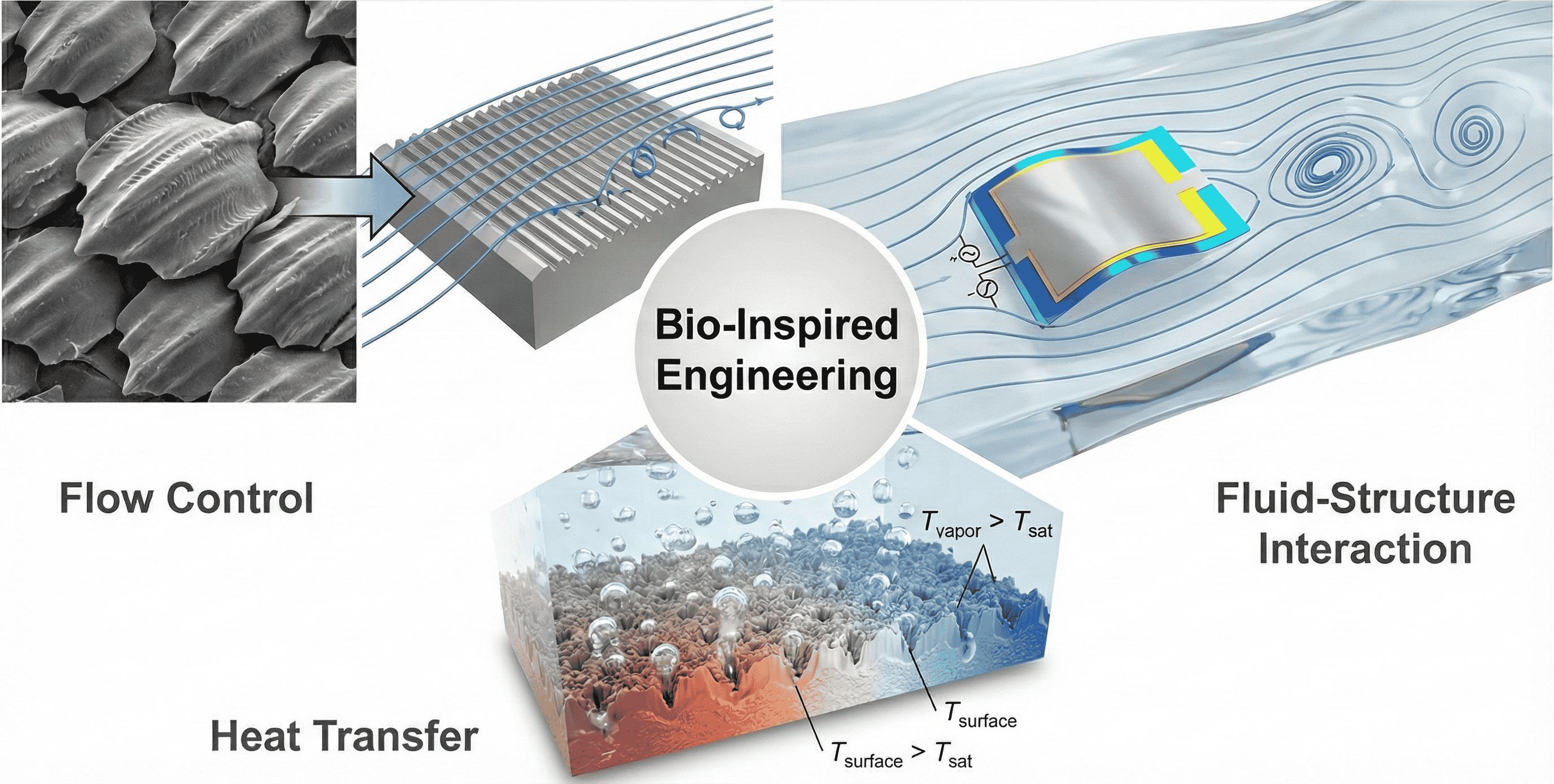

On Bio-Inspired Strategies for Flow Control, Fluid–Structure Interaction, and Thermal Transport



Abstract
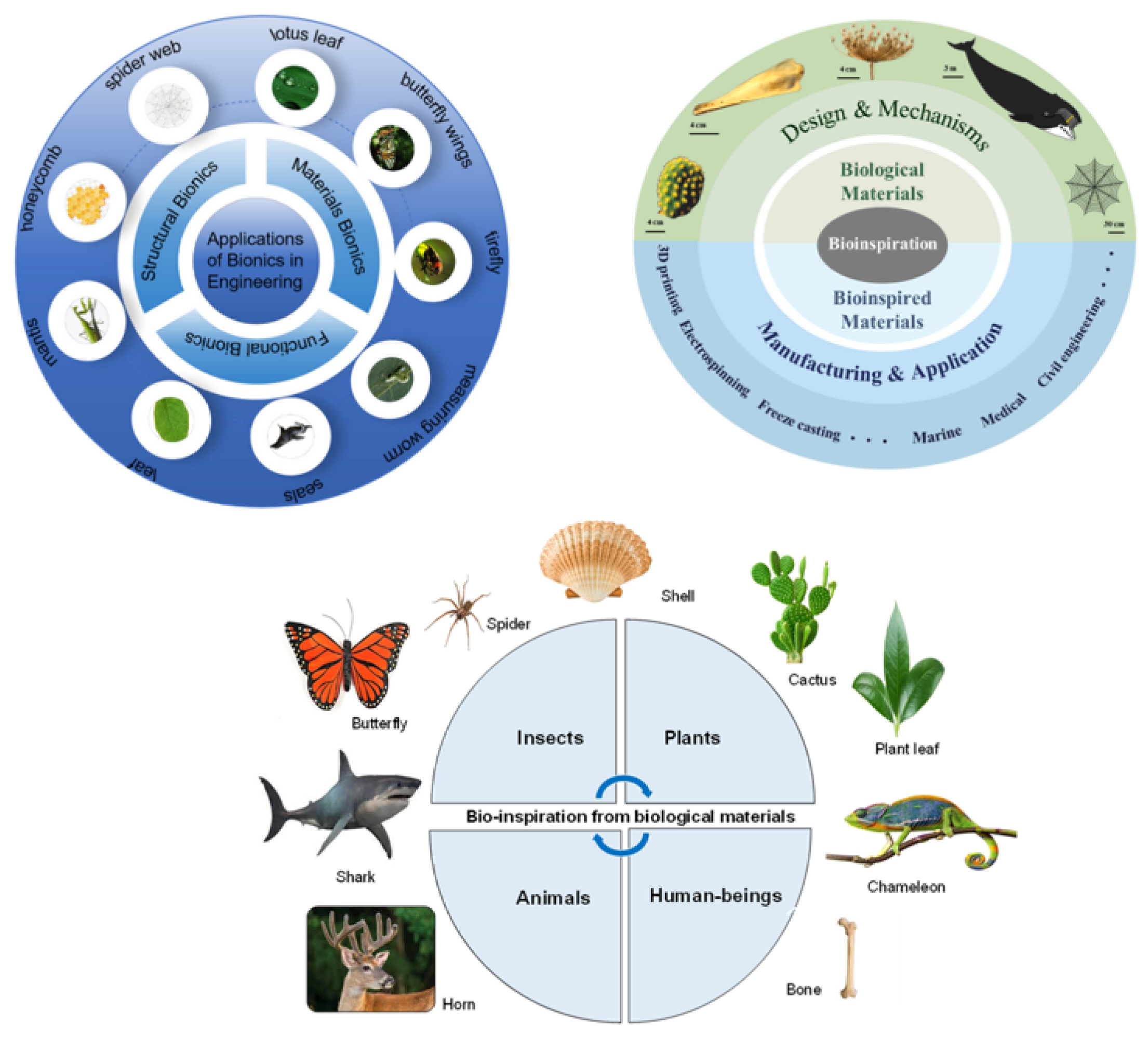
1. Introduction
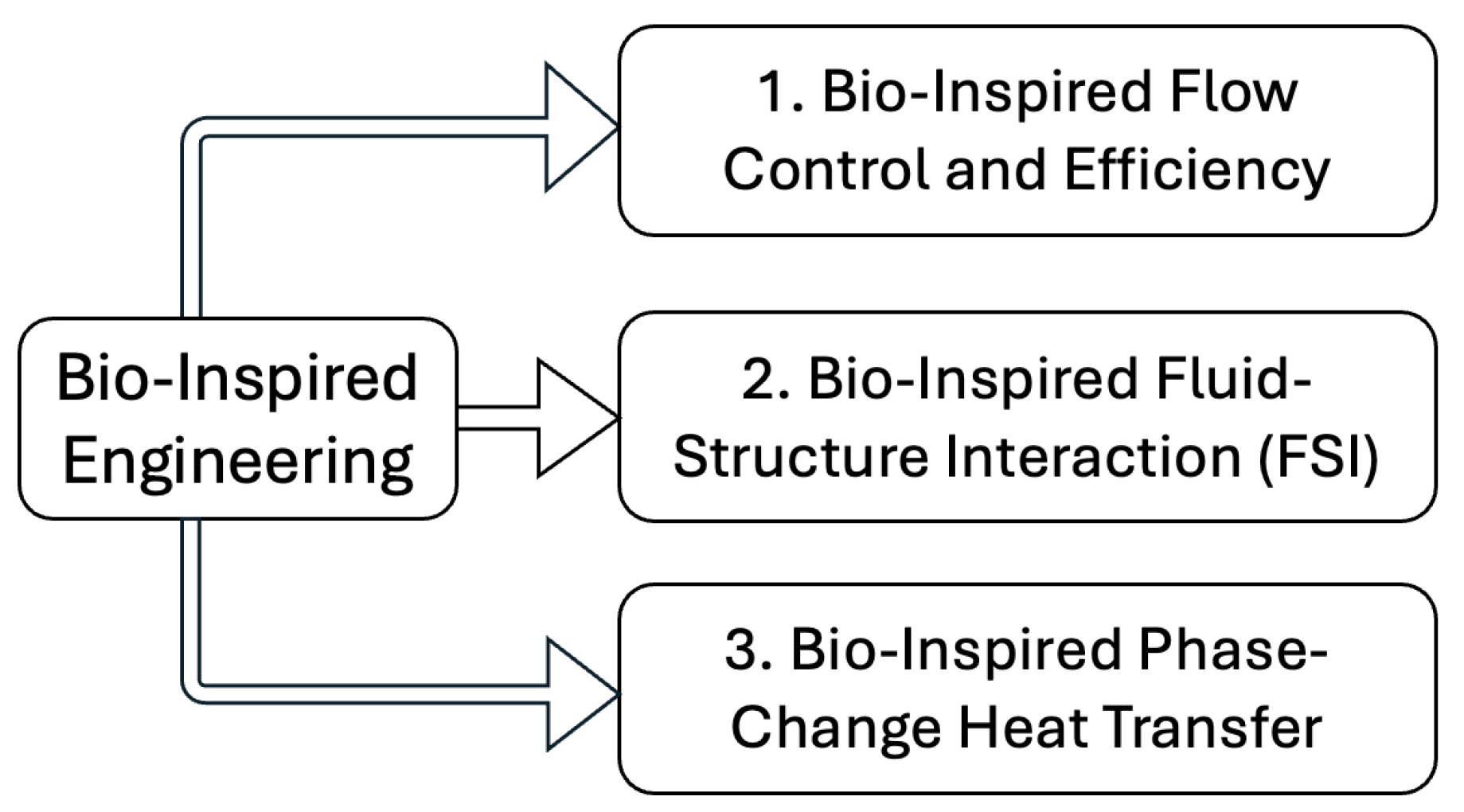
2. Roadmap and Scope of the Review
3. On Bio-Inspired Advances in Fluid Mechanics
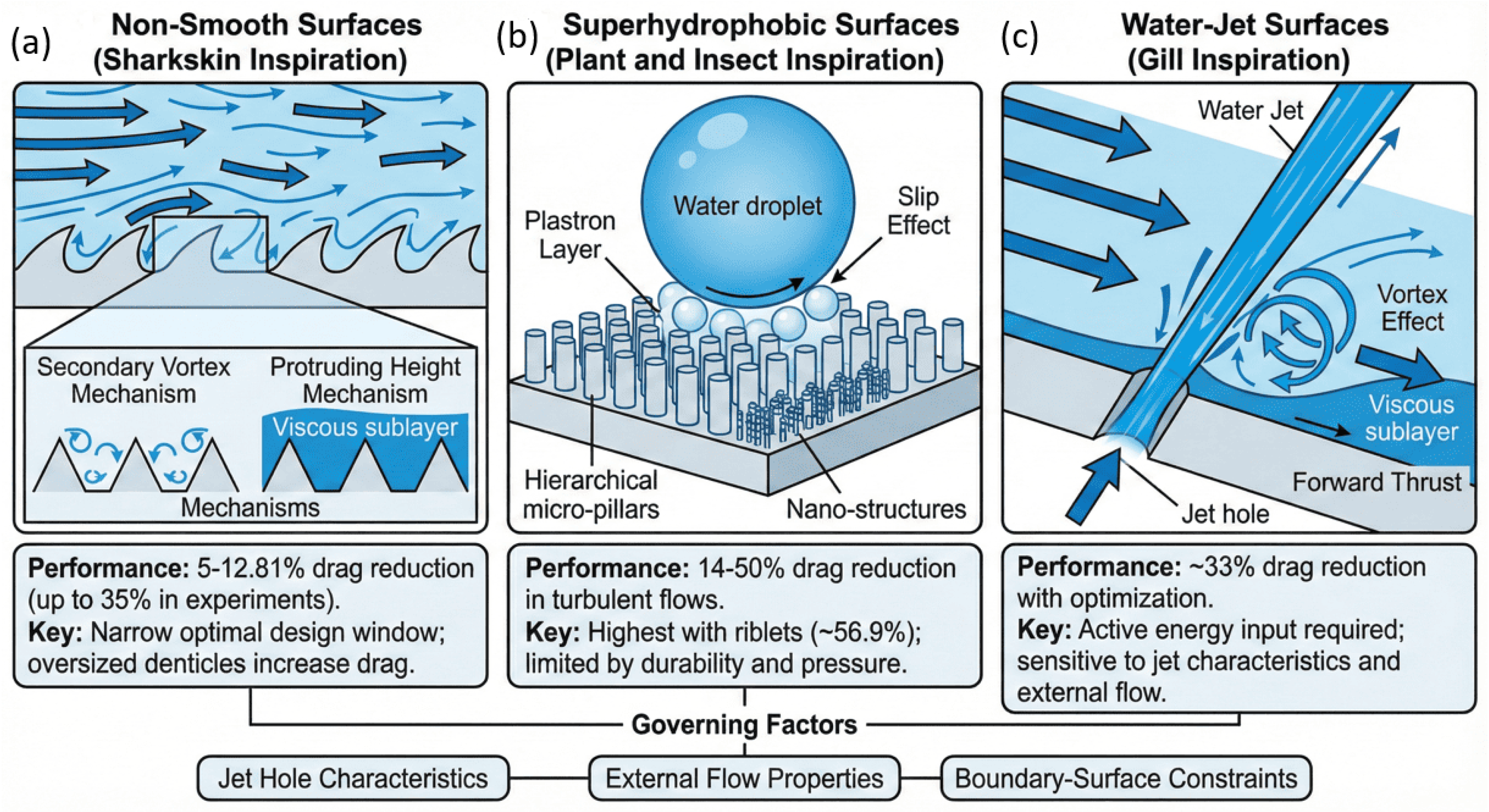
3.1. Drag-Reduction Mechanisms from Marine Surfaces

| Strategy | Primary Governing Mechanism | Key Dimensionless Parameters | Typical Drag Reduction and Main Limitation |
|---|---|---|---|
| Riblet surfaces | Near-wall coherent structure regulation and viscous sublayer thickening | , friction Reynolds number , riblet spacing in wall units | 5–15% typical, peak ∼35%; sensitive to and manufacturing scale [17,20,22,24,39] |
| Superhydrophobic surfaces | Slip-induced shear reduction with capillary-stabilized air plastron | , slip-length-to-viscous-length ratio, , | 10–50% reported; plastron collapse under pressure and turbulent shear [28,29,39,41] |
| Water-jet surfaces | Momentum injection and vortex-pad formation in boundary layer | Jet Reynolds number , velocity ratio, momentum coefficient | 20–35%; requires continuous energy input and system integration [33,34,35,39] |
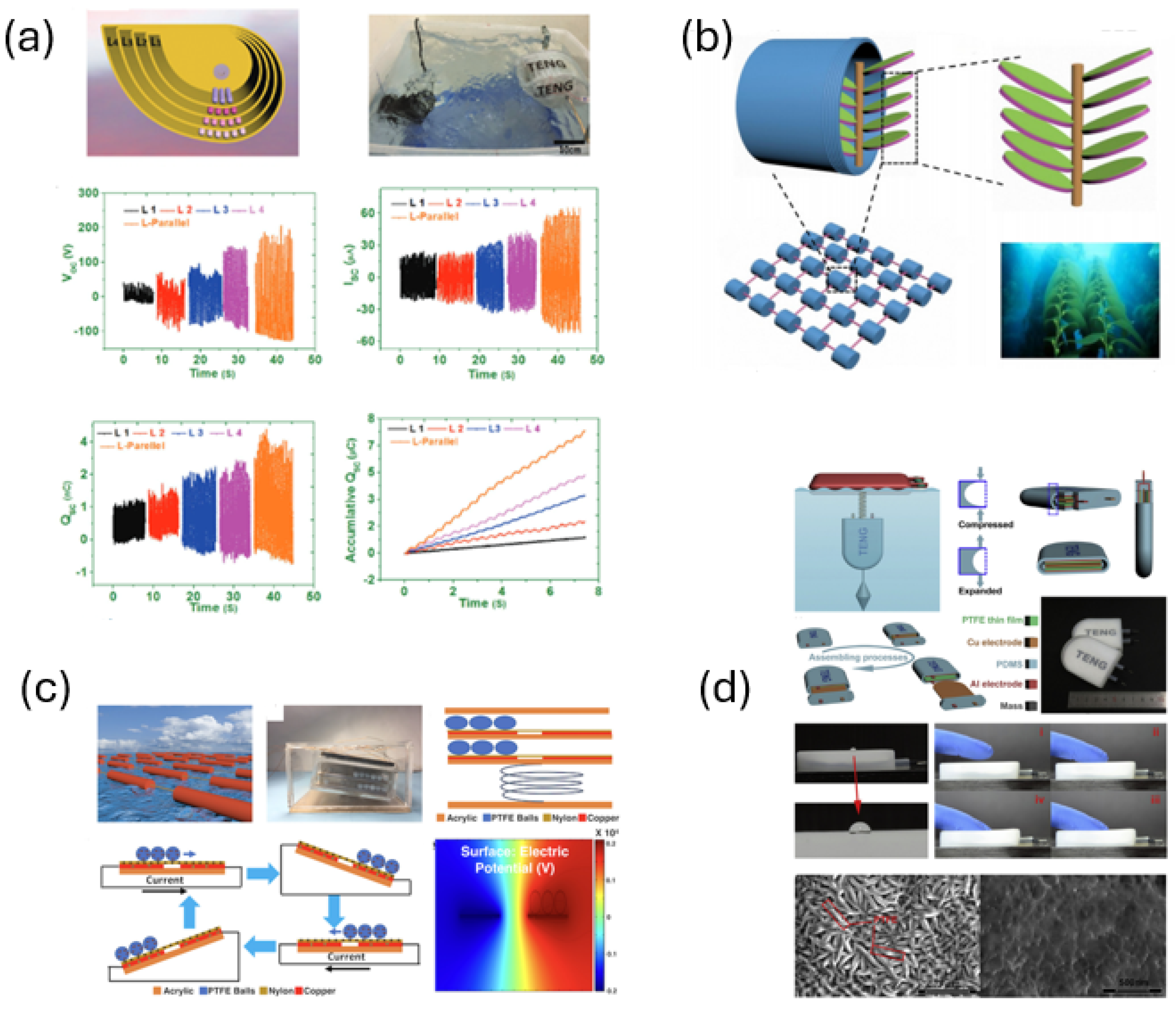
3.2. Bio-Inspired Wave Energy Systems
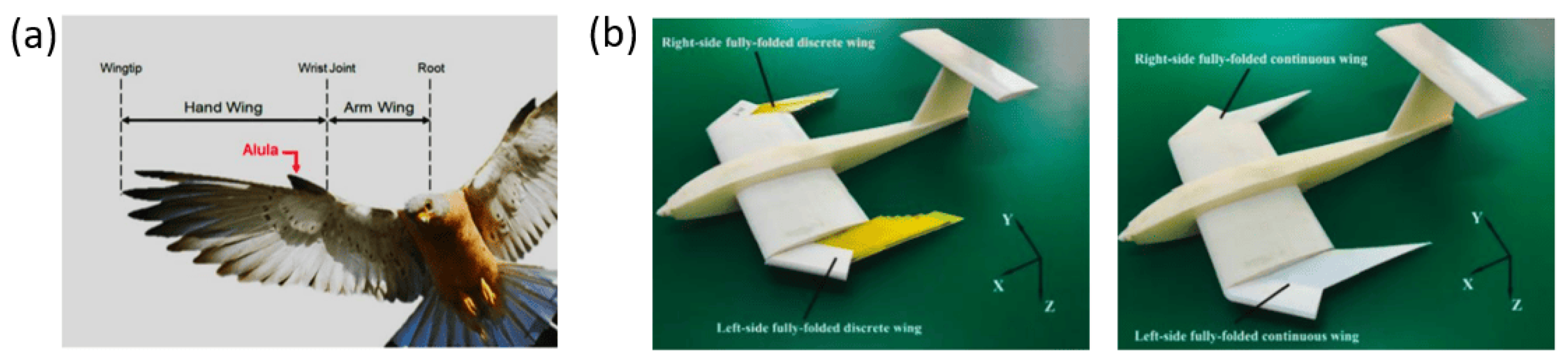
3.3. Bio-Inspired Aerospace Design
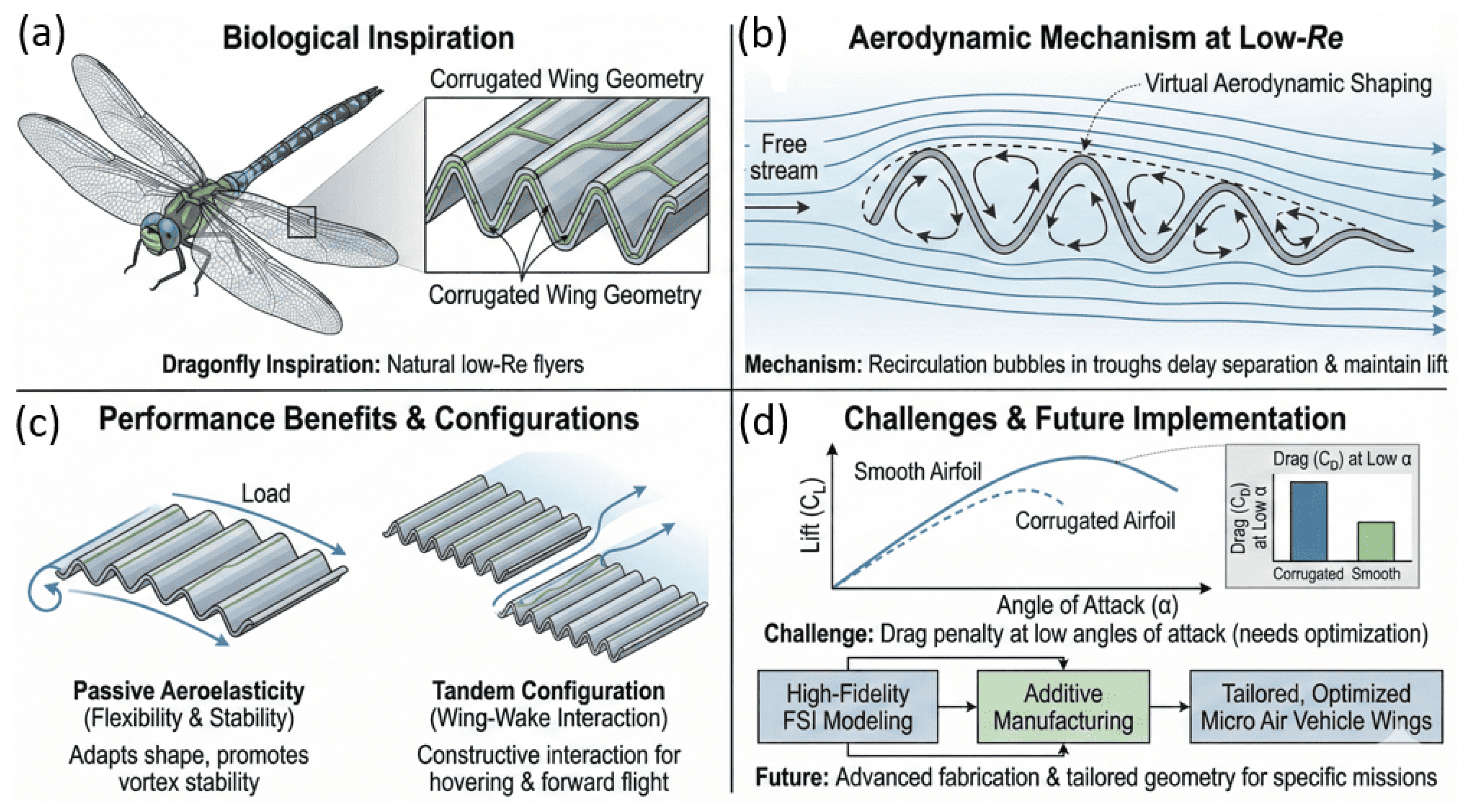
3.4. Corrugated Wing Aerodynamics
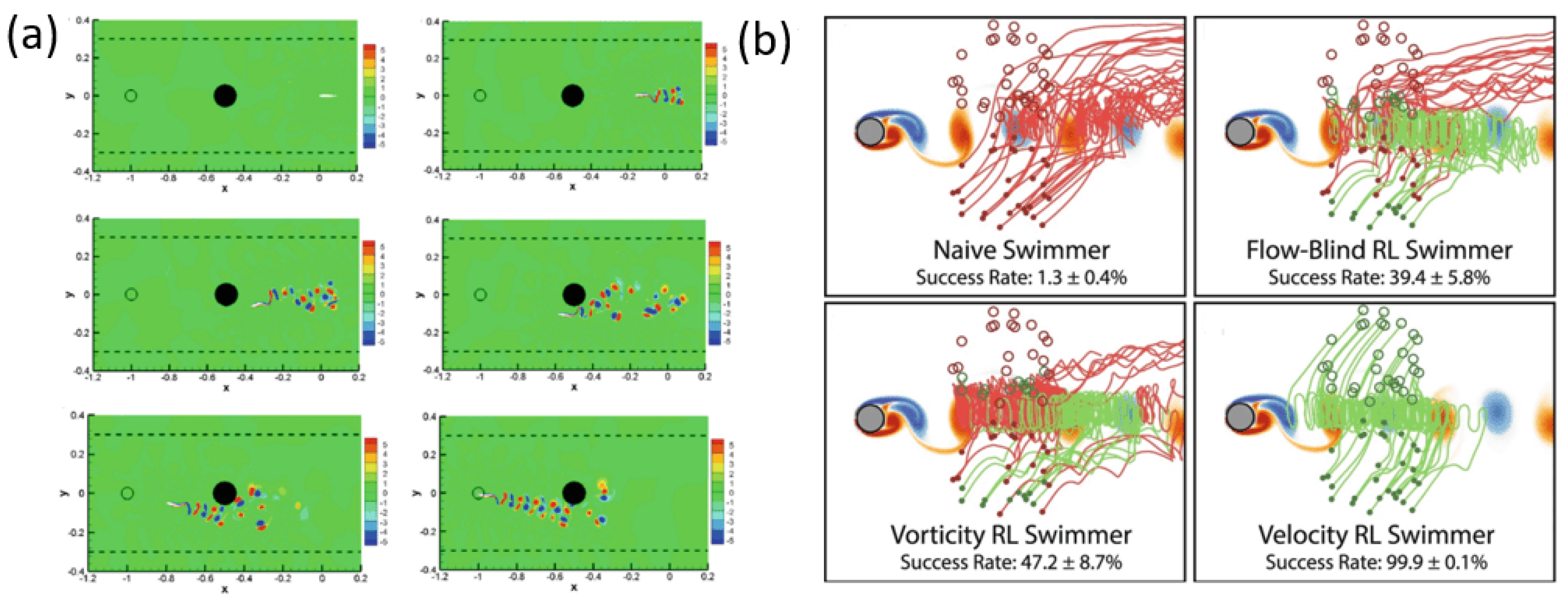
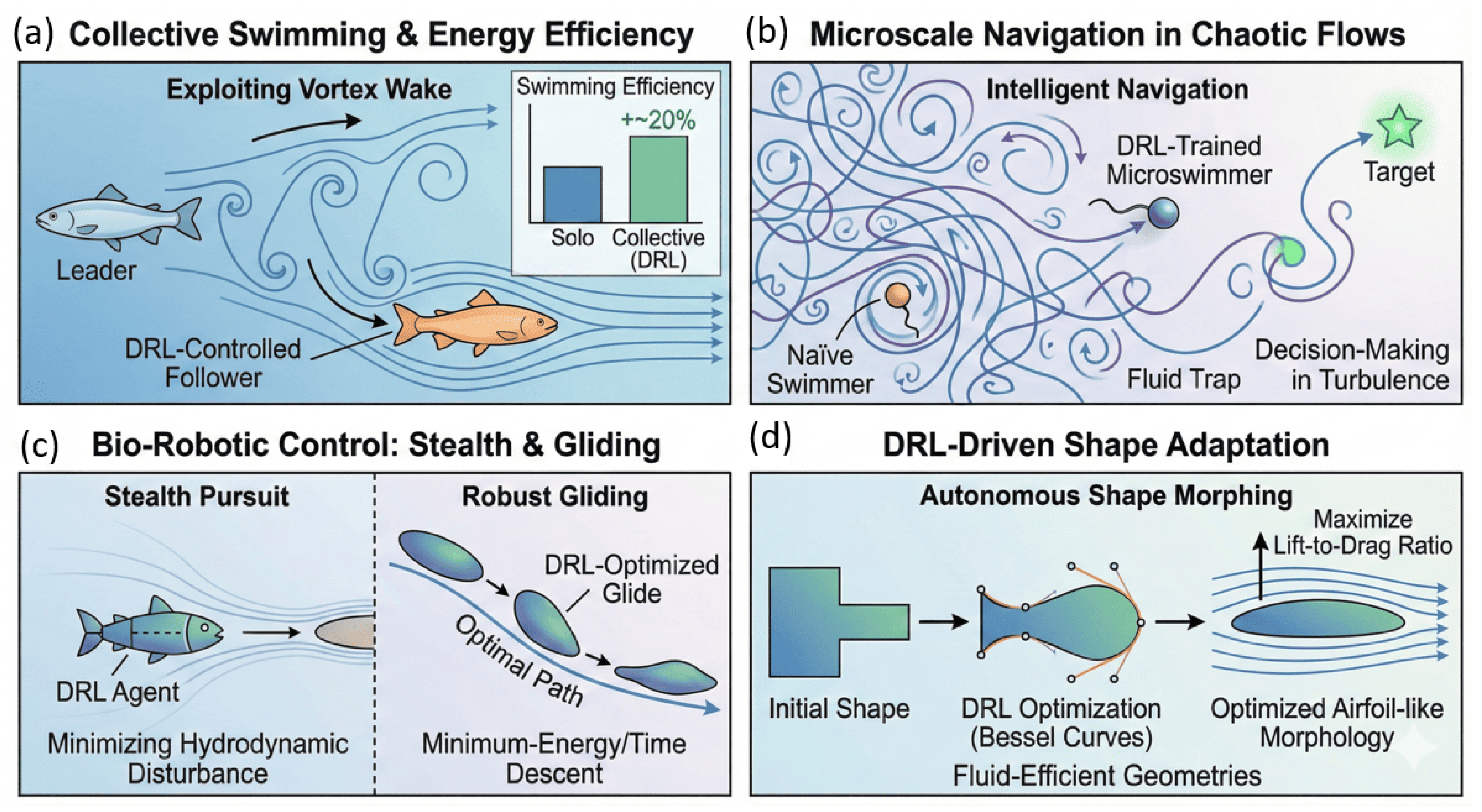
3.5. DRL-Enabled Bio-Inspired Fluid Control
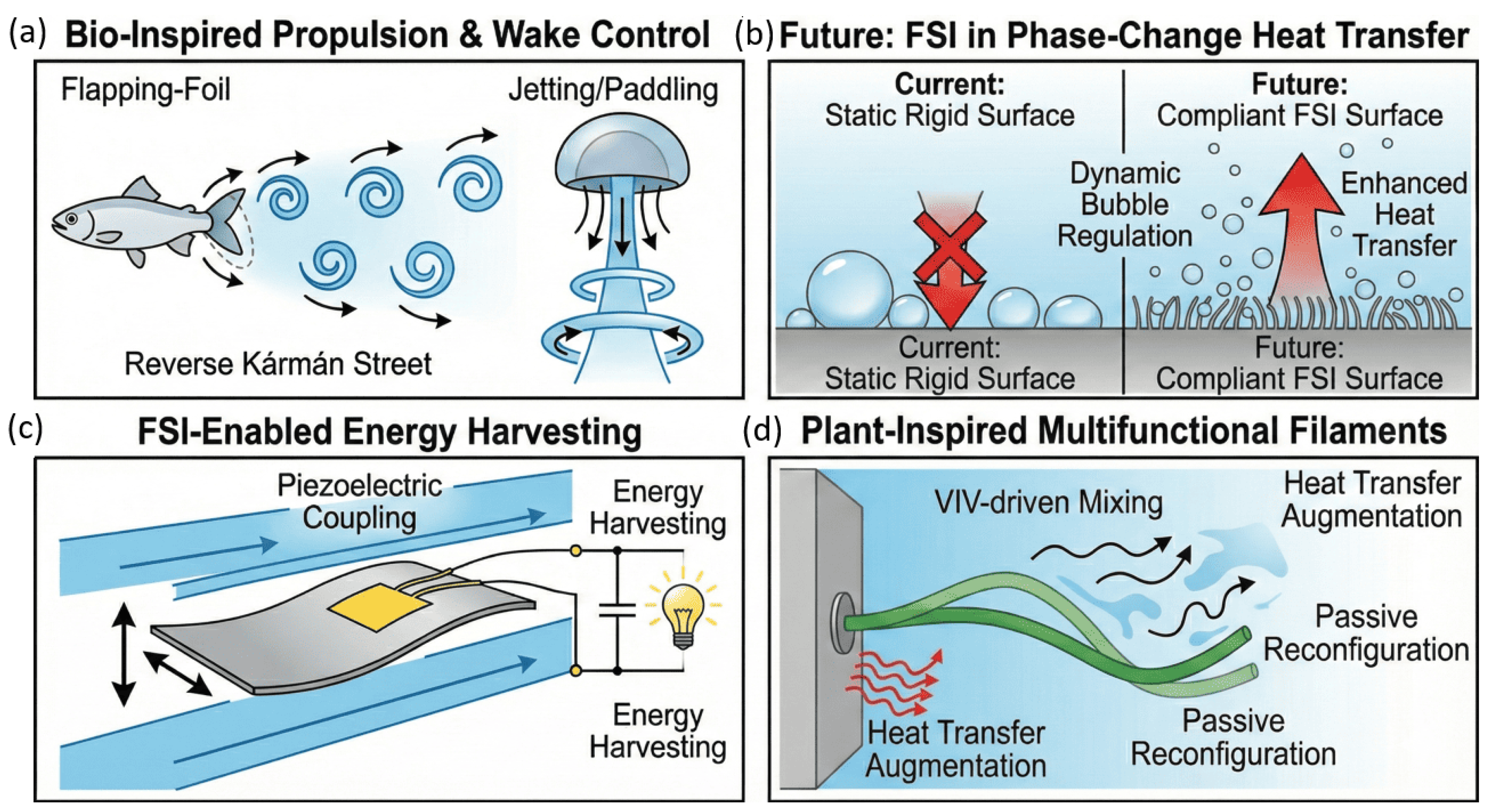
4. On Bio-Inspired Fluid–Structure Interaction
5. On Rheological Effects in Bio-Inspired Fluid–Structure Interaction
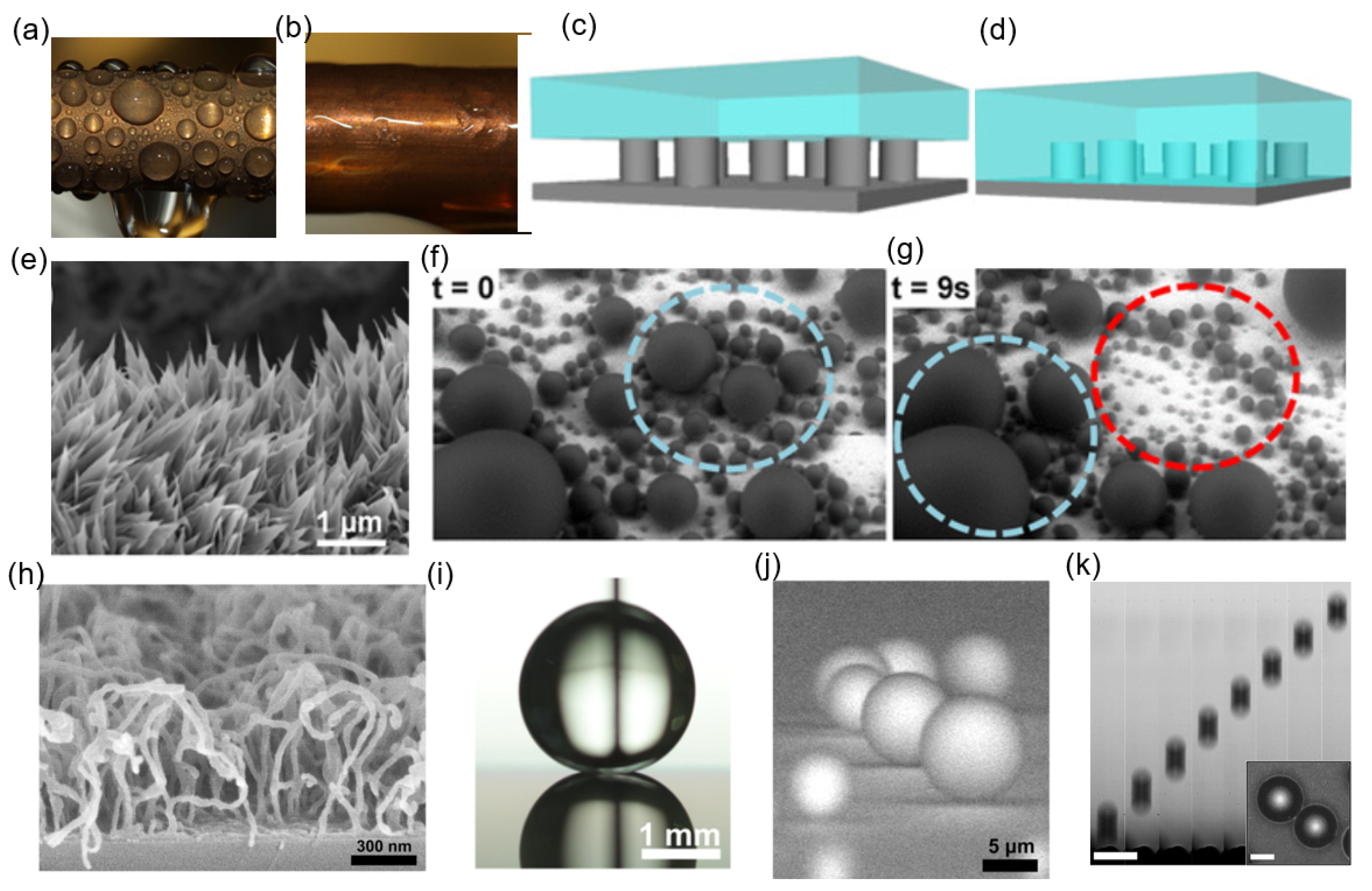
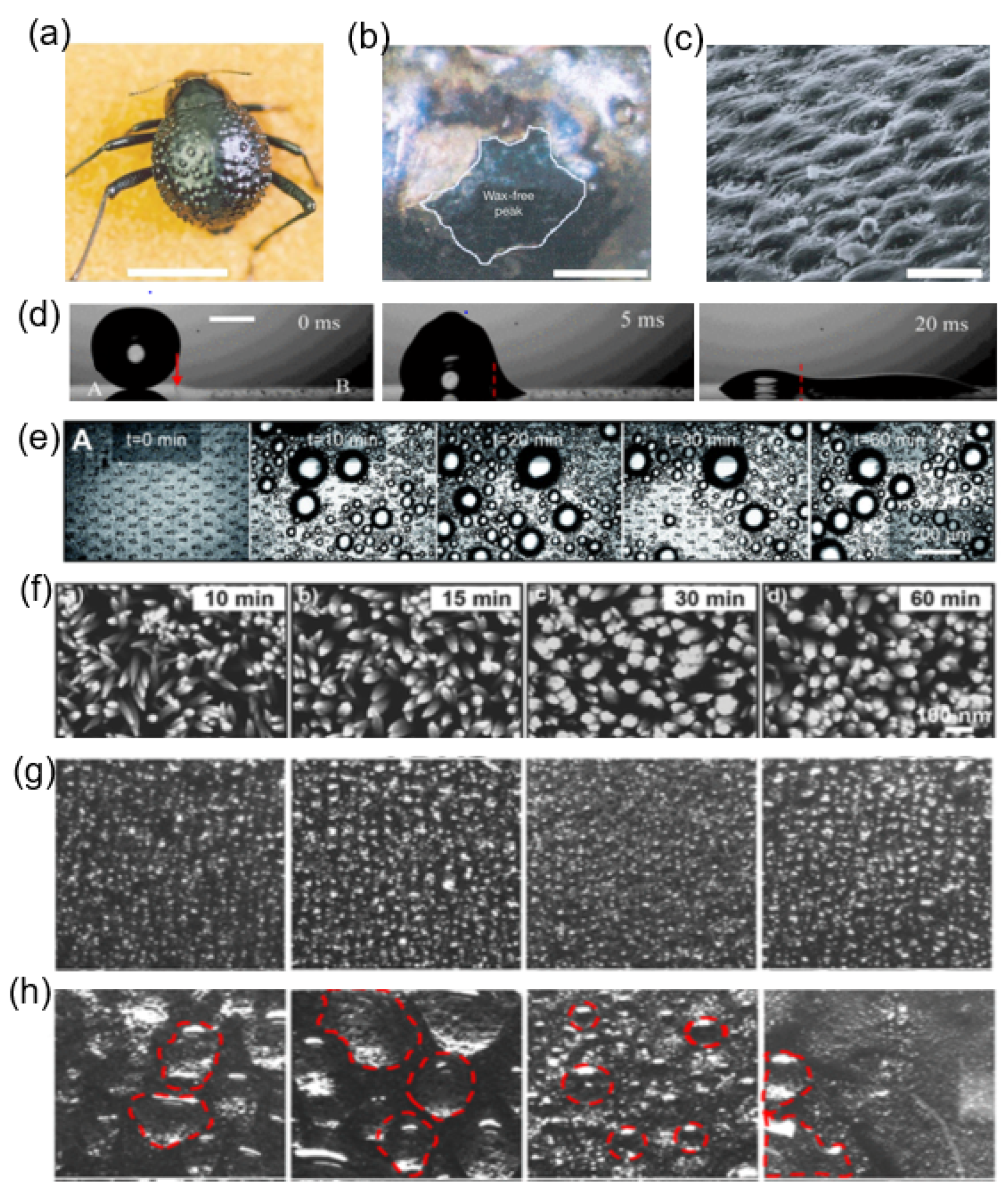
6. On Bio-Inspired Droplet Condensation
6.1. Bioinspired Surfaces and Their Geometrical Translation
6.2. Demonstrated Heat Transfer Enhancement
7. On Bio-Inspired Boiling Heat Transfer
7.1. Classical Mechanistic Framework for Nucleate Boiling
7.2. From Micro/Nanostructures to Multiscale Architectures
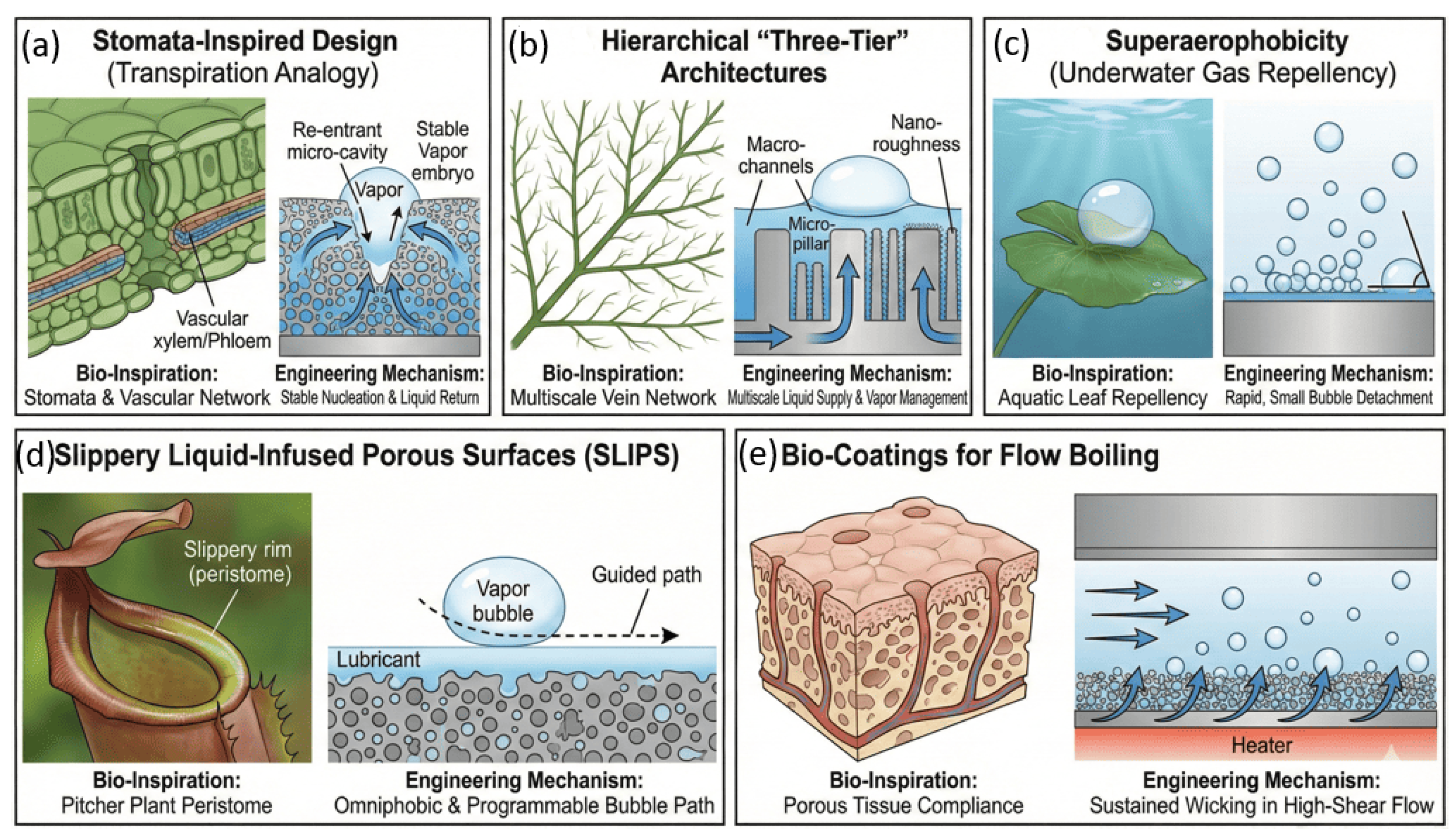
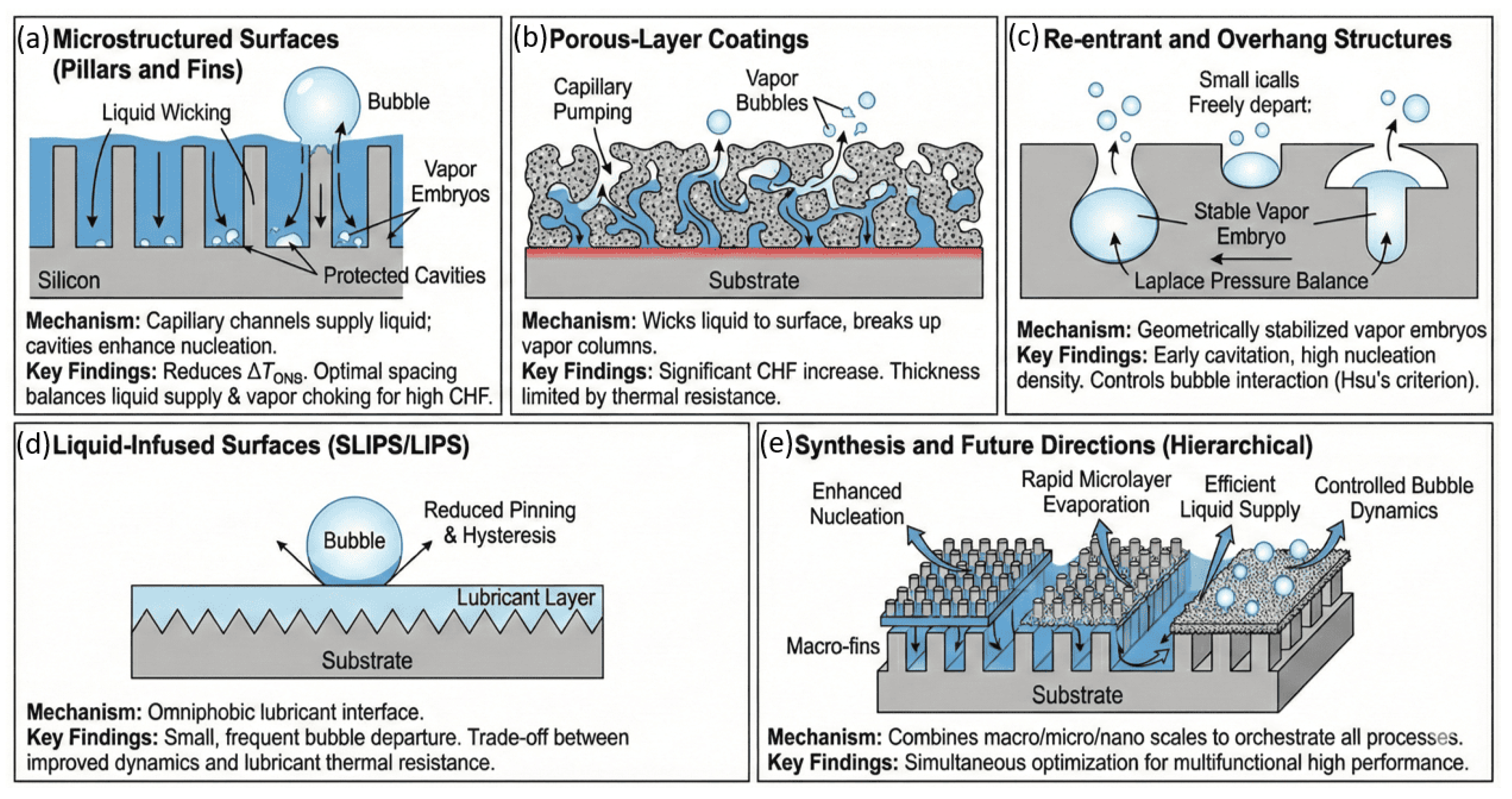
7.3. Bioinspired Boiling Surfaces: Translating Natural Motifs into Design Rules
8. Conclusions and Future Work
Author Contributions
Funding
Institutional Review Board Statement
Informed Consent Statement
Data Availability Statement
Acknowledgments
Conflicts of Interest
References
- Choi, H.; Park, H.; Sagong, W.; Lee, S.i. Biomimetic flow control based on morphological features of living creatures. Phys. Fluids 2012, 24, 121302. [Google Scholar] [CrossRef]
- Fattepur, G.; Patil, A.Y.; Kumar, P.; Kumar, A.; Hegde, C.; Siddhalingeshwar, I.; Kumar, R.; Khan, T.Y. Bio-inspired designs: Leveraging biological brilliance in mechanical engineering—An overview. 3 Biotech 2024, 14, 312. [Google Scholar] [CrossRef]
- Martinez, A.; Dejong, J.; Akin, I.; Aleali, A.; Arson, C.; Atkinson, J.; Bandini, P.; Baser, T.; Borela, R.; Boulanger, R.; et al. Bio-inspired geotechnical engineering: Principles, current work, opportunities and challenges. Géotechnique 2022, 72, 687–705. [Google Scholar] [CrossRef]
- Thanigaiarasu, P. Biomimetics in the design of medical devices. In Trends in Development of Medical Devices; Elsevier: Amsterdam, The Netherlands, 2020; pp. 35–41. [Google Scholar]
- Triantafyllou, M.S.; Weymouth, G.D.; Miao, J. Biomimetic survival hydrodynamics and flow sensing. Annu. Rev. Fluid Mech. 2016, 48, 1–24. [Google Scholar] [CrossRef]
- Richardson, P.L. Leonardo da Vinci’s discovery of the dynamic soaring by birds in wind shear. Notes Rec. R. Soc. J. Hist. Sci. 2019, 73, 285–301. [Google Scholar] [CrossRef]
- Shams Taleghani, A.; Yektaei, S.; Esfahanian, V.; Abdolahipour, S. Experimental Study on the Effects of Sideslip and Rudder Deflection Angles on the Aerodynamics of an Aircraft Vertical Tail at Low Speeds. Fluids 2025, 10, 277. [Google Scholar] [CrossRef]
- Abdolahipour, S. Review on flow separation control: Effects of excitation frequency and momentum coefficient. Front. Mech. Eng. 2024, 10, 1380675. [Google Scholar] [CrossRef]
- Bhushan, B.; Jung, Y.C.; Koch, K. Micro-, nano-and hierarchical structures for superhydrophobicity, self-cleaning and low adhesion. Philos. Trans. R. Soc. A Math. Phys. Eng. Sci. 2009, 367, 1631–1672. [Google Scholar] [CrossRef]
- Saha, S.K.; Celata, G.P. Advances in modelling of biomimetic fluid flow at different scales. Nanoscale Res. Lett. 2011, 6, 344. [Google Scholar] [CrossRef]
- Haward, S.J.; Shen, A.Q. Fluid–structure interactions: From engineering to biomimetic systems. Phys. Fluids 2020, 32. [Google Scholar] [CrossRef]
- Wang, J.; Jiang, Z.; Yang, Y.; Hu, W. A Review on Bio-inspired Fluid Mechanics via Deep Reinforcement Learning. In Proceedings of the International Conference on Bio-Inspired Computing: Theories and Applications, Wuhan, China, 16–18 December 2022; Springer: Berlin/Heidelberg, Germany, 2022; pp. 290–304. [Google Scholar]
- Lin, Z.; Sun, S. Revealing the Challenges of Sim-to-Real Transfer in Model-Based Reinforcement Learning via Latent Space Modeling. arXiv 2025, arXiv:2506.12735. [Google Scholar]
- Rai, R.; Das, A.; Dhal, K.G. Nature-inspired optimization algorithms and their significance in multi-thresholding image segmentation: An inclusive review. Evol. Syst. 2022, 13, 889–945. [Google Scholar] [CrossRef] [PubMed]
- Darwish, A. Bio-inspired computing: Algorithms review, deep analysis, and the scope of applications. Future Comput. Inform. J. 2018, 3, 231–246. [Google Scholar] [CrossRef]
- Shams Taleghani, A.; Torabi, F. Recent Developments in Aerodynamics; Frontiers Media SA: Lausanne, Switzerland, 2025. [Google Scholar]
- Bushnell, D. Viscous Drag Reduction in Boundary Layers; AIAA: Reston VA, USA, 1990; Volume 123. [Google Scholar]
- Walsh, M.J. Riblets as a viscous drag reduction technique. AIAA J. 1983, 21, 485–486. [Google Scholar] [CrossRef]
- Zhang, D.-y.; Luo, Y.-h.; Li, X.; Chen, H.-w. Numerical simulation and experimental study of drag-reducing surface of a real shark skin. J. Hydrodyn. Ser. B 2011, 23, 204–211. [Google Scholar] [CrossRef]
- Domel, A.G.; Domel, G.; Weaver, J.C.; Saadat, M.; Bertoldi, K.; Lauder, G.V. Hydrodynamic properties of biomimetic shark skin: Effect of denticle size and swimming speed. Bioinspir. Biomim. 2018, 13, 056014. [Google Scholar] [CrossRef]
- Fu, Y.; Yuan, C.; Bai, X. Marine drag reduction of shark skin inspired riblet surfaces. Biosurface Biotribology 2017, 3, 11–24. [Google Scholar] [CrossRef]
- Bechert, D.; Bartenwerfer, M. The viscous flow on surfaces with longitudinal ribs. J. Fluid Mech. 1989, 206, 105–129. [Google Scholar] [CrossRef]
- Dean, B.; Bhushan, B. Shark-skin surfaces for fluid-drag reduction in turbulent flow: A review. Philos. Trans. R. Soc. A Math. Phys. Eng. Sci. 2010, 368, 4775–4806. [Google Scholar] [CrossRef]
- Bechert, D.W.; Bruse, M.; Hage, W.v.; Van der Hoeven, J.T.; Hoppe, G. Experiments on drag-reducing surfaces and their optimization with an adjustable geometry. J. Fluid Mech. 1997, 338, 59–87. [Google Scholar] [CrossRef]
- Pulletikurthi, V.; Cheng, S.; Wilker, J.; Chamorro, L.; Castillo, L. The potential of bio-inspired structures on anti-biofouling. Bull. Am. Phys. Soc. 2022, 67, 19. [Google Scholar]
- Guo, Z.; Liu, W.; Su, B.L. Superhydrophobic surfaces: From natural to biomimetic to functional. J. Colloid Interface Sci. 2011, 353, 335–355. [Google Scholar] [CrossRef]
- Wang, B.; Zhang, Y.; Shi, L.; Li, J.; Guo, Z. Advances in the theory of superhydrophobic surfaces. J. Mater. Chem. 2012, 22, 20112–20127. [Google Scholar] [CrossRef]
- Watanabe, K.; Udagawa, Y.; Udagawa, H. Drag reduction of Newtonian fluid in a circular pipe with a highly water-repellent wall. J. Fluid Mech. 1999, 381, 225–238. [Google Scholar] [CrossRef]
- Daniello, R.J.; Waterhouse, N.E.; Rothstein, J.P. Drag reduction in turbulent flows over superhydrophobic surfaces. Phys. Fluids 2009, 21, 085103. [Google Scholar] [CrossRef]
- Qiao, S.; Li, S.; Li, Q.; Li, B.; Liu, K.; Feng, X.Q. Friction of droplets sliding on microstructured superhydrophobic surfaces. Langmuir 2017, 33, 13480–13489. [Google Scholar] [CrossRef] [PubMed]
- Rastegari, A.; Akhavan, R. On drag reduction scaling and sustainability bounds of superhydrophobic surfaces in high Reynolds number turbulent flows. J. Fluid Mech. 2019, 864, 327–347. [Google Scholar] [CrossRef]
- Monfared, M.; Alidoostan, M.; Saranjam, B. Experimental study on the friction drag reduction of superhydrophobic surfaces in closed channel flow. J. Appl. Fluid Mech. 2019, 12, 69–76. [Google Scholar] [CrossRef]
- Gu, Y.; Zhao, G.; Zheng, J.; Li, Z.; Liu, W.; Muhammad, F. Experimental and numerical investigation on drag reduction of non-smooth bionic jet surface. Ocean. Eng. 2014, 81, 50–57. [Google Scholar] [CrossRef]
- Li, F.; Zhao, G.; Liu, W. Research on drag reduction performance of turbulent boundary layer on bionic jet surface. Proc. Inst. Mech. Eng. Part M J. Eng. Marit. Environ. 2017, 231, 258–270. [Google Scholar] [CrossRef]
- Zhao, G.; Zhao, H.; Shu, H.; Zhao, D.; Gu, Y.; Xia, D. Simulation study of bionic jetting direction influence on drag reduction effect. Adv. Nat. Sci. 2010, 3, 17–26. [Google Scholar]
- Gu, Y.Q.; Ru, J.; Gang, Z.; Li, Z.Y.; Liu, W.B.; Farid Khattak, M. Influence of jet hole configuration on drag reduction of bionic jet surface. Appl. Mech. Mater. 2014, 461, 725–730. [Google Scholar] [CrossRef]
- Purwar, T.; Van Zante, Z.F.; Cheng, S.; Chamorro, L.P.; Aksak, B.; Castano, V.; Castillo, L. Resilient and Scalable Bio-Inspired Metamaterial for Passive Noise Control. In Proceedings of the 76th Annual Meeting of the Division of Fluid Dynamics, Washington, DC, USA, 19–21 November 2023. [Google Scholar]
- Liu, G.; Yuan, Z.; Qiu, Z.; Feng, S.; Xie, Y.; Leng, D.; Tian, X. A brief review of bio-inspired surface technology and application toward underwater drag reduction. Ocean. Eng. 2020, 199, 106962. [Google Scholar] [CrossRef]
- Perlin, M.; Dowling, D.R.; Ceccio, S.L. Freeman scholar review: Passive and active skin-friction drag reduction in turbulent boundary layers. J. Fluids Eng. 2016, 138, 091104. [Google Scholar] [CrossRef]
- Rowin, W.A.; Hou, J.; Ghaemi, S. Turbulent channel flow over riblets with superhydrophobic coating. Exp. Therm. Fluid Sci. 2018, 94, 192–204. [Google Scholar] [CrossRef]
- Golovin, K.B.; Gose, J.W.; Perlin, M.; Ceccio, S.L.; Tuteja, A. Bioinspired surfaces for turbulent drag reduction. Philos. Trans. R. Soc. A Math. Phys. Eng. Sci. 2016, 374, 20160189. [Google Scholar] [CrossRef]
- Zhang, F.; Zhou, P.; Liu, X.; Wu, Y.; Yao, Z.; Miao, Z. Bio-inspired technologies for enhanced wave energy converter: A review. Phys. Fluids 2025, 37. [Google Scholar] [CrossRef]
- Kapoor, R.T.; Rafatullah, M.; Qamar, M.; Qutob, M.; Alosaimi, A.M.; Alorfi, H.S.; Hussein, M.A. Review on recent developments in bioinspired-materials for sustainable energy and environmental applications. Sustainability 2022, 14, 16931. [Google Scholar] [CrossRef]
- Wang, Y.; Naleway, S.E.; Wang, B. Biological and bioinspired materials: Structure leading to functional and mechanical performance. Bioact. Mater. 2020, 5, 745–757. [Google Scholar] [CrossRef] [PubMed]
- Chen, W.; Lu, Y.; Li, S.; Gao, F. A bio-inspired foldable-wing wave energy converter for ocean robots. Appl. Energy 2023, 334, 120696. [Google Scholar] [CrossRef]
- Wang, Y.; Liu, Z. A bionic design of oscillating wave surge energy converter based on scallops. Energy 2024, 304, 132236. [Google Scholar] [CrossRef]
- Zhou, Y.; Liu, H.; Kong, F.; Wang, X.; Jin, Y.; Sun, C.; Chen, H. Research on the design and optimal control of the power take-off (PTO) system for underwater eel-type power generators. Appl. Energy 2024, 372, 123845. [Google Scholar] [CrossRef]
- Patil, B.I.; Chandrasekaran, S.; Meher Prasad, A.; Saengsupavanich, C. Energy harvest on TSUSUCA DOLPHIN under irregular waves: Experimental studies. Energy 2024, 299, 131379. [Google Scholar] [CrossRef]
- Chen, B.D.; Tang, W.; He, C.; Deng, C.R.; Yang, L.J.; Zhu, L.P.; Chen, J.; Shao, J.J.; Liu, L.; Wang, Z.L. Water wave energy harvesting and self-powered liquid-surface fluctuation sensing based on bionic-jellyfish triboelectric nanogenerator. Mater. Today 2018, 21, 88–97. [Google Scholar] [CrossRef]
- Zhang, S.L.; Xu, M.; Zhang, C.; Wang, Y.C.; Zou, H.; He, X.; Wang, Z.; Wang, Z.L. Rationally designed sea snake structure based triboelectric nanogenerators for effectively and efficiently harvesting ocean wave energy with minimized water screening effect. Nano Energy 2018, 48, 421–429. [Google Scholar] [CrossRef]
- Wang, N.; Zou, J.; Yang, Y.; Li, X.; Guo, Y.; Jiang, C.; Jia, X.; Cao, X. Kelp-inspired biomimetic triboelectric nanogenerator boosts wave energy harvesting. Nano Energy 2019, 55, 541–547. [Google Scholar] [CrossRef]
- Zhang, S.; Jing, Z.; Wang, X.; Fan, K.; Zhao, H.; Wang, Z.L.; Cheng, T. Enhancing low-velocity water flow energy harvesting of triboelectric–electromagnetic generator via biomimetic-fin strategy and swing-rotation mechanism. ACS Energy Lett. 2022, 7, 4282–4289. [Google Scholar] [CrossRef]
- Qian, F.; Liu, M.; Huang, J.; Zhang, J.; Jung, H.; Deng, Z.D.; Hajj, M.R.; Zuo, L. Bio-inspired bistable piezoelectric energy harvester for powering animal telemetry tags: Conceptual design and preliminary experimental validation. Renew. Energy 2022, 187, 34–43. [Google Scholar] [CrossRef]
- Gao, Q.; Jing, Z.; Sun, Y.; Zhang, S.; Gu, C.; Ma, L.; Li, H.; Wen, J.; Cheng, X.; Cheng, T. Bionic Fish-Shaped Triboelectric-Electromagnetic Hybrid Generator via a Two-Stage Swing Mechanism for Water Flow Energy Harvesting and Condition Monitoring. ACS Appl. Mater. Interfaces 2023, 16, 569–575. [Google Scholar] [CrossRef] [PubMed]
- Feng, L.; Liu, G.; Guo, H.; Tang, Q.; Pu, X.; Chen, J.; Wang, X.; Xi, Y.; Hu, C. Hybridized nanogenerator based on honeycomb-like three electrodes for efficient ocean wave energy harvesting. Nano Energy 2018, 47, 217–223. [Google Scholar] [CrossRef]
- Dong, L.; Zhu, J.; Li, H.; Zhang, J.; Zhao, D.; Wang, Z.L.; Gu, L.; Cheng, T. Bionic dragonfly staggered flapping hydrofoils triboelectric-electromagnetic hybrid generator for low-speed water flow energy harvesting. Nano Energy 2024, 127, 109783. [Google Scholar] [CrossRef]
- Li, B.; Zhang, X.; Liu, T.; Adan, H.S. Bionic Raft Design and Performance Investigation of a Two-Raft Wave Energy Converter. J. Mar. Sci. Eng. 2024, 12, 2114. [Google Scholar] [CrossRef]
- Rohr, J.J.; Fish, F.E. Strouhal numbers and optimization of swimming by odontocete cetaceans. J. Exp. Biol. 2004, 207, 1633–1642. [Google Scholar] [CrossRef]
- Kohannim, S.; Iwasaki, T. Analytical insights into optimality and resonance in fish swimming. J. R. Soc. Interface 2014, 11, 20131073. [Google Scholar] [CrossRef]
- Abdulrahim, M.; Lind, R. Flight testing and response characteristics of a variable gull-wing morphing aircraft. In Proceedings of the AIAA Guidance, Navigation, and Control Conference and Exhibit, Providence, RI, USA, 16–19 August 2004; p. 5113. [Google Scholar]
- Jones, K.; Bradshaw, C.; Papadopoulos, J.; Platzer, M. Bio-inspired design of flapping-wing micro air vehicles. Aeronaut. J. 2005, 109, 385–393. [Google Scholar] [CrossRef]
- Van Truong, T.; Nguyen, Q.V.; Lee, H.P. Bio-inspired flexible flapping wings with elastic deformation. Aerospace 2017, 4, 37. [Google Scholar] [CrossRef]
- Fish, F.E.; Weber, P.W.; Murray, M.M.; Howle, L.E. The Tubercles on Humpback Whales’ Flippers: Application of Bio-Inspired Technology. Integr. Comp. Biol. 2011, 51, 203–213. [Google Scholar] [CrossRef]
- Hui, Z.; Zhang, Y.; Chen, G. Aerodynamic performance investigation on a morphing unmanned aerial vehicle with bio-inspired discrete wing structures. Aerosp. Sci. Technol. 2019, 95, 105419. [Google Scholar] [CrossRef]
- Dwivedi, Y.; Bhargava, V. Aerodynamic characterization of bio inspired corrugated wings. MOJ App. Bionics Biomech. 2019, 3, 1–10. [Google Scholar]
- Budholiya, S.; Bhat, A.; Raj, S.A.; Hameed Sultan, M.T.; Md Shah, A.U.; Basri, A.A. State of the art review about bio-inspired design and applications: An aerospace perspective. Appl. Sci. 2021, 11, 5054. [Google Scholar] [CrossRef]
- Kim, J.T.; Yoon, H.J.; Cheng, S.; Liu, F.; Kang, S.; Paudel, S.; Cho, D.; Luan, H.; Lee, M.; Jeong, G.; et al. Functional bio-inspired hybrid fliers with separated ring and leading edge vortices. PNAS Nexus 2024, 3, 10. [Google Scholar] [CrossRef]
- Kesel, A.B. Aerodynamic characteristics of dragonfly wing sections compared with technical aerofoils. J. Exp. Biol. 2000, 203, 3125–3135. [Google Scholar] [CrossRef]
- Murphy, J.; Hu, H. An experimental investigation on a bio-inspired corrugated airfoil. In Proceedings of the 47th AIAA Aerospace Sciences Meeting Including the New Horizons Forum and Aerospace Exposition, Orlando, FL, USA, 5–8 January 2009; p. 1087. [Google Scholar]
- Liu, G.; Ren, Y.; Zhu, J.; Bart-Smith, H.; Dong, H. Thrust producing mechanisms in ray-inspired underwater vehicle propulsion. Theor. Appl. Mech. Lett. 2015, 5, 54–57. [Google Scholar] [CrossRef]
- Tamai, M.; Wang, Z.; Rajagopalan, G.; Hu, H.; He, G. Aerodynamic performance of a corrugated dragonfly airfoil compared with smooth airfoils at low Reynolds numbers. In Proceedings of the 45th AIAA Aerospace Sciences Meeting and Exhibit, Reno NV, USA, 8–11 January 2007; p. 483. [Google Scholar]
- Shi, S.x.; Liu, Y.z.; Chen, J.m. An experimental study of flow around a bio-inspired airfoil at Reynolds number 2.0 × 10³. J. Hydrodyn. 2012, 24, 410–419. [Google Scholar] [CrossRef]
- Zheng, Y.; Wu, Y.; Tang, H. Force measurements of flexible tandem wings in hovering and forward flights. Bioinspir. Biomim. 2015, 10, 016021. [Google Scholar] [CrossRef] [PubMed]
- Zheng, Y.; Wu, Y.; Tang, H. An experimental study on the forewing–hindwing interactions in hovering and forward flights. Int. J. Heat Fluid Flow 2016, 59, 62–73. [Google Scholar] [CrossRef]
- Xiao, T.; Li, Z.; Deng, S.; Ang, H.; Zhou, X. Numerical study on the flow characteristics of micro air vehicle wings at low Reynolds numbers. Int. J. Micro Air Veh. 2016, 8, 29–40. [Google Scholar] [CrossRef]
- Masud, M.H.; Faisal, A.K.M.; Alam, M.M.; Rafi, A.I.; Islam, R.; Ankhi, I.J.; Bai, H.; Wang, H. Corrugated airfoils for enhanced low-speed aerodynamics: A bio-inspired review. Phys. Fluids 2025, 37, 085120. [Google Scholar] [CrossRef]
- Gazzola, M.; Hejazialhosseini, B.; Koumoutsakos, P. Reinforcement learning and wavelet adapted vortex methods for simulations of self-propelled swimmers. SIAM J. Sci. Comput. 2014, 36, B622–B639. [Google Scholar] [CrossRef]
- Novati, G.; Verma, S.; Alexeev, D.; Rossinelli, D.; Van Rees, W.M.; Koumoutsakos, P. Synchronisation through learning for two self-propelled swimmers. Bioinspir. Biomim. 2017, 12, 036001. [Google Scholar] [CrossRef] [PubMed]
- Verma, S.; Novati, G.; Koumoutsakos, P. Efficient collective swimming by harnessing vortices through deep reinforcement learning. Proc. Natl. Acad. Sci. USA 2018, 115, 5849–5854. [Google Scholar] [CrossRef]
- Amoudruz, L.; Koumoutsakos, P. Independent control and path planning of microswimmers with a uniform magnetic field. Adv. Intell. Syst. 2022, 4, 2100183. [Google Scholar] [CrossRef]
- Gustavsson, K.; Biferale, L.; Celani, A.; Colabrese, S. Finding efficient swimming strategies in a three-dimensional chaotic flow by reinforcement learning. Eur. Phys. J. E 2017, 40, 110. [Google Scholar] [CrossRef]
- Yan, L.; Chang, X.; Wang, N.; Tian, R.; Zhang, L.; Liu, W. Learning how to avoid obstacles: A numerical investigation for maneuvering of self-propelled fish based on deep reinforcement learning. Int. J. Numer. Methods Fluids 2021, 93, 3073–3091. [Google Scholar] [CrossRef]
- Mirzakhanloo, M.; Esmaeilzadeh, S.; Alam, M.R. Active cloaking in Stokes flows via reinforcement learning. J. Fluid Mech. 2020, 903, A34. [Google Scholar] [CrossRef]
- Viquerat, J.; Rabault, J.; Kuhnle, A.; Ghraieb, H.; Larcher, A.; Hachem, E. Direct shape optimization through deep reinforcement learning. J. Comput. Phys. 2021, 428, 110080. [Google Scholar] [CrossRef]
- Li, B.l.; Wang, Y.w.; Yin, B.; Zhang, X.; Zhang, X. Self-propelled swimming of a flexible filament driven by coupled plunging and pitching motions. J. Hydrodyn. 2021, 33, 157–169. [Google Scholar] [CrossRef]
- Wang, C.; Tang, H.; Zhang, X. Fluid-structure interaction of bio-inspired flexible slender structures: A review of selected topics. Bioinspir. Biomim. 2022, 17, 041002. [Google Scholar] [CrossRef] [PubMed]
- Marais, C.; Thiria, B.; Wesfreid, J.E.; Godoy-Diana, R. Stabilizing effect of flexibility in the wake of a flapping foil. J. Fluid Mech. 2012, 710, 659–669. [Google Scholar] [CrossRef]
- Zhu, X.; He, G.; Zhang, X. How flexibility affects the wake symmetry properties of a self-propelled plunging foil. J. Fluid Mech. 2014, 751, 164–183. [Google Scholar] [CrossRef]
- Shinde, S.Y.; Arakeri, J.H. Flexibility in flapping foil suppresses meandering of induced jet in absence of free stream. J. Fluid Mech. 2014, 757, 231–250. [Google Scholar] [CrossRef]
- Kim, M.J.; Lee, J.H. Wake transitions of flexible foils in a viscous uniform flow. Phys. Fluids 2019, 31, 111906. [Google Scholar] [CrossRef]
- Nové-Josserand, C.; Hebrero, F.C.; Petit, L.; Megill, W.; Godoy-Diana, R.; Thiria, B. Surface wave energy absorption by a partially submerged bio-inspired canopy. Bioinspir. Biomim. 2018, 13, 036006. [Google Scholar] [CrossRef]
- Park, S.G. Heat transfer enhancement by a wall-mounted flexible vortex generator with an inclination angle. Int. J. Heat Mass Transf. 2020, 148, 119053. [Google Scholar] [CrossRef]
- Chen, Y.; Yang, J.; Liu, Y.; Sung, H.J. Heat transfer enhancement in a poiseuille channel flow by using multiple wall-mounted flexible flags. Int. J. Heat Mass Transf. 2020, 163, 120447. [Google Scholar] [CrossRef]
- Nové-Josserand, C.; Godoy-Diana, R.; Thiria, B. Interference model for an array of wave-energy-absorbing flexible structures. Phys. Rev. Appl. 2019, 11, 034054. [Google Scholar] [CrossRef]
- Zhang, J.; Childress, S.; Libchaber, A.; Shelley, M. Flexible filaments in a flowing soap film as a model for one-dimensional flags in a two-dimensional wind. Nature 2000, 408, 835–839. [Google Scholar] [CrossRef]
- Michelin, S.; Doaré, O. Energy harvesting efficiency of piezoelectric flags in axial flows. J. Fluid Mech. 2013, 714, 489–504. [Google Scholar] [CrossRef]
- Doaré, O.; Michelin, S. Piezoelectric coupling in energy-harvesting fluttering flexible plates: Linear stability analysis and conversion efficiency. J. Fluids Struct. 2011, 27, 1357–1375. [Google Scholar] [CrossRef]
- Piñeirua, M.; Doaré, O.; Michelin, S. Influence and optimization of the electrodes position in a piezoelectric energy harvesting flag. J. Sound Vib. 2015, 346, 200–215. [Google Scholar] [CrossRef]
- Xia, A.; Zhang, C.; Zhu, T.; Lin, K.; Zhang, D.; Huang, Y.; Zhu, X.; Zhu, X.; Liao, Q. Nature-Inspired Bioreactor for Enzymatic Hydrolysis of Non-Newtonian Biomass Slurry: A Numerical Study. Ind. Eng. Chem. Res. 2025, 64, 3004–3013. [Google Scholar] [CrossRef]
- Rajagopal, M.C.; Das, S.K. Analyses of drag on viscoelastic liquid infused bio-inspired patterned surfaces. J.-Non-Newton. Fluid Mech. 2016, 228, 17–30. [Google Scholar] [CrossRef]
- Godon, S.; Kruusmaa, M.; Ristolainen, A. Maneuvering on non-Newtonian fluidic terrain: A survey of animal and bio-inspired robot locomotion techniques on soft yielding grounds. Front. Robot. AI 2023, 10, 1113881. [Google Scholar] [CrossRef] [PubMed]
- Enright, R.; Miljkovic, N.; Alvarado, J.L.; Kim, K.; Rose, J.W. Dropwise condensation on micro-and nanostructured surfaces. Nanoscale Microscale Thermophys. Eng. 2014, 18, 223–250. [Google Scholar] [CrossRef]
- Kumar, V.; Fu, Q.; Szeto, H.; Zhu, Y. Heat transfer during droplet impact on a cold superhydrophobic surface via interfacial thermal mapping. Droplet 2024, 3, e124. [Google Scholar] [CrossRef]
- Yue, C.; Dai, Q.; Yang, X.; Gachot, C.; Huang, W.; Wang, X. Controllable self-transport of bouncing droplets on ultraslippery surfaces with wedge-shaped grooves. Droplet 2024, 3, e118. [Google Scholar] [CrossRef]
- Miljkovic, N.; Enright, R.; Nam, Y.; Lopez, K.; Dou, N.; Sack, J.; Wang, E.N. Jumping-droplet-enhanced condensation on scalable superhydrophobic nanostructured surfaces. Nano Lett. 2013, 13, 179–187. [Google Scholar] [CrossRef]
- Enright, R.; Miljkovic, N.; Sprittles, J.; Nolan, K.; Mitchell, R.; Wang, E.N. How coalescing droplets jump. ACS Nano 2014, 8, 10352–10362. [Google Scholar] [CrossRef]
- Zheng, S.F.; Gross, U.; Wang, X.D. Dropwise condensation: From fundamentals of wetting, nucleation, and droplet mobility to performance improvement by advanced functional surfaces. Adv. Colloid Interface Sci. 2021, 295, 102503. [Google Scholar] [CrossRef]
- Liu, L.; Wang, S.; Zeng, X.; Pi, P.; Wen, X. Dropwise condensation by nanoengineered surfaces: Design, mechanism, and enhancing strategies. Adv. Mater. Interfaces 2021, 8, 2101603. [Google Scholar] [CrossRef]
- Wen, F.; Lee, C. Water droplets play a role in Internet of Things applications. Droplet 2024, 3, e133. [Google Scholar] [CrossRef]
- Gong, X.; Gao, X.; Jiang, L. Recent progress in bionic condensate microdrop self-propelling surfaces. Adv. Mater. 2017, 29, 1703002. [Google Scholar] [CrossRef]
- Feng, S.; Hou, Y.; Zheng, Y. Programmable curvilinear self-propelling of droplets without preset channels. Droplet 2024, 3, e138. [Google Scholar] [CrossRef]
- Wang, R.; Zhu, J.; Meng, K.; Wang, H.; Deng, T.; Gao, X.; Jiang, L. Bio-inspired superhydrophobic closely packed aligned nanoneedle architectures for enhancing condensation heat transfer. Adv. Funct. Mater. 2018, 28, 1800634. [Google Scholar] [CrossRef]
- Orejon, D.; Askounis, A.; Takata, Y.; Attinger, D. Dropwise condensation on multiscale bioinspired metallic surfaces with nanofeatures. ACS Appl. Mater. Interfaces 2019, 11, 24735–24750. [Google Scholar] [CrossRef] [PubMed]
- Kim, M.K.; Cha, H.; Birbarah, P.; Chavan, S.; Zhong, C.; Xu, Y.; Miljkovic, N. Enhanced jumping-droplet departure. Langmuir 2015, 31, 13452–13466. [Google Scholar] [CrossRef] [PubMed]
- Murakami, D.; Jinnai, H.; Takahara, A. Wetting transition from the Cassie–Baxter state to the Wenzel state on textured polymer surfaces. Langmuir 2014, 30, 2061–2067. [Google Scholar] [CrossRef]
- Wang, R.; Wu, F.; Xing, D.; Yu, F.; Gao, X. Density maximization of one-step electrodeposited copper nanocones and dropwise condensation heat-transfer performance evaluation. ACS Appl. Mater. Interfaces 2020, 12, 24512–24520. [Google Scholar] [CrossRef]
- Ghosh, A.; Beaini, S.; Zhang, B.J.; Ganguly, R.; Megaridis, C.M. Enhancing dropwise condensation through bioinspired wettability patterning. Langmuir 2014, 30, 13103–13115. [Google Scholar] [CrossRef]
- Wang, X.; Zeng, J.; Li, J.; Yu, X.; Wang, Z.; Zhang, Y. Beetle and cactus-inspired surface endows continuous and directional droplet jumping for efficient water harvesting. J. Mater. Chem. A 2021, 9, 1507–1516. [Google Scholar] [CrossRef]
- Wisdom, K.M.; Watson, J.A.; Qu, X.; Liu, F.; Watson, G.S.; Chen, C.H. Self-cleaning of superhydrophobic surfaces by self-propelled jumping condensate. Proc. Natl. Acad. Sci. USA 2013, 110, 7992–7997. [Google Scholar] [CrossRef] [PubMed]
- Hao, C.; Liu, Y.; Chen, X.; Li, J.; Zhang, M.; Zhao, Y.; Wang, Z. Bioinspired interfacial materials with enhanced drop mobility: From fundamentals to multifunctional applications. Small 2016, 12, 1825–1839. [Google Scholar] [CrossRef]
- Wang, R.; Tian, Y.; Shen, B.; Gao, X. Bioinspired Superwettability Surface Strategies for Condensation Heat Transfer. ACS Nano 2025, 19, 4156–4169. [Google Scholar] [CrossRef]
- Liu, M.; Guo, S.; Fang, L.; Chen, Z.; Xu, B.; Wang, X. Dynamic characteristics of droplet coalescence-induced jumping on bioinspired symmetric rhombic microstructured surfaces. Phys. Fluids 2025, 37, 082072. [Google Scholar] [CrossRef]
- Cho, H.J.; Preston, D.J.; Zhu, Y.; Wang, E.N. Nanoengineered materials for liquid–vapour phase-change heat transfer. Nat. Rev. Mater. 2016, 2, 16092. [Google Scholar] [CrossRef]
- Dhir, V.K. Boiling heat transfer. Annu. Rev. Fluid Mech. 1998, 30, 365–401. [Google Scholar] [CrossRef]
- Mudawar, I. Assessment of high-heat-flux thermal management schemes. IEEE Trans. Compon. Packag. Technol. 2001, 24, 122–141. [Google Scholar] [CrossRef]
- Meena, C.S.; Kumar, A.; Roy, S.; Cannavale, A.; Ghosh, A. Review on boiling heat transfer enhancement techniques. Energies 2022, 15, 5759. [Google Scholar] [CrossRef]
- Rohsenow, W.M. A method of correlating heat-transfer data for surface boiling of liquids. Trans. Am. Soc. Mech. Eng. 1952, 74, 969–975. [Google Scholar] [CrossRef]
- Upot, N.V.; Rabbi, K.F.; Khodakarami, S.; Ho, J.Y.; Mendizabal, J.K.; Miljkovic, N. Advances in micro and nanoengineered surfaces for enhancing boiling and condensation heat transfer: A review. Nanoscale Adv. 2023, 5, 1232–1270. [Google Scholar] [CrossRef] [PubMed]
- Hsu, Y. On the size range of active nucleation cavities on a heating surface. J. Heat Transf. 1962, 84, 207–213. [Google Scholar] [CrossRef]
- Callenaere, M.; Franc, J.P.; Michel, J.M.; Riondet, M. The cavitation instability induced by the development of a re-entrant jet. J. Fluid Mech. 2001, 444, 223–256. [Google Scholar] [CrossRef]
- Bandyopadhyay, S.; Chen, Q.J.; Lu, M.C. Single Re-entrant micropillar arrays for enhanced pool boiling performance. Int. J. Heat Mass Transf. 2025, 252, 127473. [Google Scholar] [CrossRef]
- Friz, W. Maximum volume of vapor bubbles. Physic. Zeitschz. 1935, 36, 354–379. [Google Scholar]
- Zuber, N. Hydrodynamic Aspects of Boiling Heat Transfer. Ph.D. Thesis, University of California, Los Angeles, CA, USA, 1959. [Google Scholar]
- Liter, S.G.; Kaviany, M. Pool-boiling CHF enhancement by modulated porous-layer coating: Theory and experiment. Int. J. Heat Mass Transf. 2001, 44, 4287–4311. [Google Scholar] [CrossRef]
- Chu, K.H.; Enright, R.; Wang, E.N. Structured surfaces for enhanced pool boiling heat transfer. Appl. Phys. Lett. 2012, 100, 241603. [Google Scholar] [CrossRef]
- Wong, T.S.; Kang, S.H.; Tang, S.K.; Smythe, E.J.; Hatton, B.D.; Grinthal, A.; Aizenberg, J. Bioinspired self-repairing slippery surfaces with pressure-stable omniphobicity. Nature 2011, 477, 443–447. [Google Scholar] [CrossRef]
- Yandapalli, A.P.; Resendiz, E.M.; Kuravi, S.; Alangar, S.; Kota, K. Enhanced boiling heat transfer of water on a liquid-infused surface. Appl. Therm. Eng. 2023, 226, 120219. [Google Scholar] [CrossRef]
- Lou, X.; Huang, Y.; Yang, X.; Zhu, H.; Heng, L.; Xia, F. External stimuli responsive liquid-infused surfaces switching between slippery and nonslippery states: Fabrications and applications. Adv. Funct. Mater. 2020, 30, 1901130. [Google Scholar] [CrossRef]
- Sun, Y.; Tang, Y.; Zhang, S.; Yuan, W.; Tang, H. A review on fabrication and pool boiling enhancement of three-dimensional complex structures. Renew. Sustain. Energy Rev. 2022, 162, 112437. [Google Scholar] [CrossRef]
- Wang, Q.; Su, D.; Li, J.; Li, M.; Dang, C.; Yang, C.; Wang, C. Nucleate boiling heat transfer characteristics of non-azeotropic refrigerant on micro-nano composite structured surfaces. Appl. Therm. Eng. 2025, 267, 125823. [Google Scholar] [CrossRef]
- Chen, G.; Chukwunenye, N.; Jones, G.F.; Li, C.H. Biomimetic structures by leaf vein growth mechanism for pool boiling heat transfer enhancements. Int. J. Heat Mass Transf. 2020, 155, 119699. [Google Scholar] [CrossRef]
- Zhang, W.; Jin, Y.; Yang, S.; Zhang, H.; Wang, Z. Bioinspired topological surfaces for mitigating water, thermal and energy crises. Accounts Mater. Res. 2022, 3, 199–212. [Google Scholar] [CrossRef]
- Wang, T.; Hou, J.; Wang, M.; Gao, S.; Wang, Z. Fluid Control on Bionics-Energized Surfaces. ACS Nano 2025, 19, 7601–7616. [Google Scholar] [CrossRef]
- Xu, K.; Long, L.; Chen, C.; Ye, H. Bionic Boiling Surface Inspired by Leaf Stomata. ACS Appl. Mater. Interfaces 2025, 17, 21940–21950. [Google Scholar] [CrossRef]
- Song, Y.; Díaz-Marín, C.D.; Zhang, L.; Cha, H.; Zhao, Y.; Wang, E.N. Three-tier hierarchical structures for extreme pool boiling heat transfer performance. Adv. Mater. 2022, 34, 2200899. [Google Scholar] [CrossRef]
- Li, J.; Fu, W.; Zhang, B.; Zhu, G.; Miljkovic, N. Ultrascalable three-tier hierarchical nanoengineered surfaces for optimized boiling. ACS Nano 2019, 13, 14080–14093. [Google Scholar] [CrossRef]
- Wang, J.X.; Wang, H.; Salmean, C.; Cui, B.; Zhong, M.L.; Mao, Y.; Li, J.X.; Yao, S. Sustained and Enhanced Nucleate Boiling Using Hierarchical Architectures at Large Superheats. In Exploration; Wiley: Hoboken, NJ, USA, 2025; Volume 5, p. 20240137. [Google Scholar]
- Yu, C.; Xu, Z.; He, S.; Feng, C.; Tian, Y.; Jiang, L. Manipulating Boiling Bubble Dynamics on Under-Liquid Superaerophobic Silicon Surfaces for High-Performance Phase-Change Cooling. Adv. Funct. Mater. 2025, 35, 2420677. [Google Scholar] [CrossRef]
- Shi, D.; Guo, P.; Liu, Y.; Zhou, X.; Jiang, S.; Wang, Z.; Xu, Q. Bioinspired smart slippery surfaces for bubble manipulation: From fundamental principles to emerging applications. RSC Appl. Interfaces 2026, 3, 9–15. [Google Scholar] [CrossRef]
- Mohammadilooey, M.; Muganlı, Z.; Niazi, S.; Kozalak, G.; Toyran, E.; Park, H.S.; Sadaghiani, A.; Koşar, A. Porosity effect of bio-coated surfaces on flow boiling heat transfer of HFE-7000. Appl. Therm. Eng. 2025, 279, 127656. [Google Scholar] [CrossRef]
- Wang, G.; Ma, F.; Zhu, L.; Zhu, P.; Tang, L.; Hu, H.; Liu, L.; Li, S.; Zeng, Z.; Wang, L.; et al. Bioinspired slippery surfaces for liquid manipulation from tiny droplet to bulk fluid. Adv. Mater. 2024, 36, 2311489. [Google Scholar] [CrossRef] [PubMed]
- Yang, K.; W, T.; Zhai, L.; Liu, Y.; Yang, K.; Liu, C. Leidenfrost inhibition and interfacial heat transfer of bio-inspired high-adhesive superhydrophobic surface. Preprint 2025. [Google Scholar] [CrossRef]

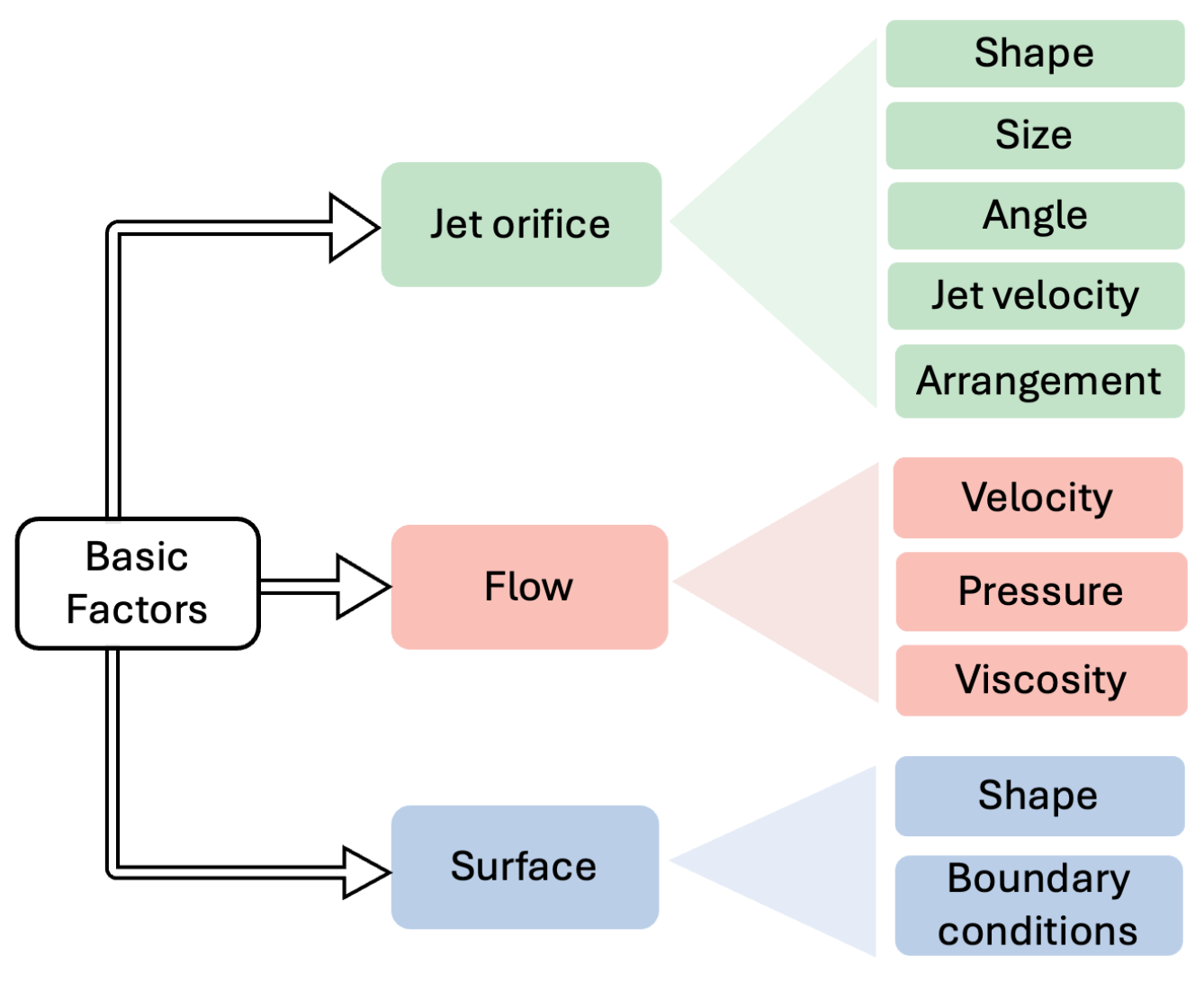


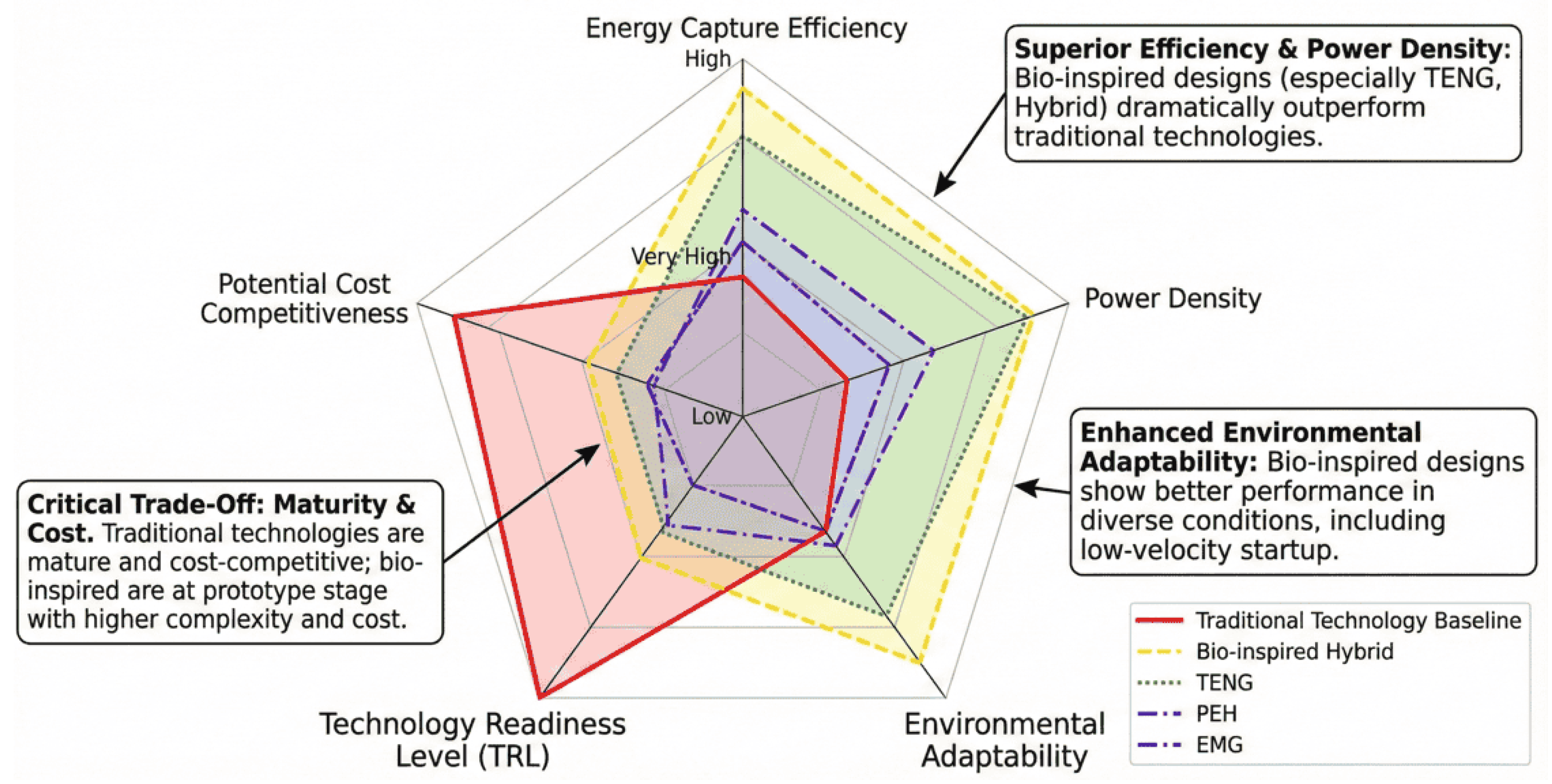
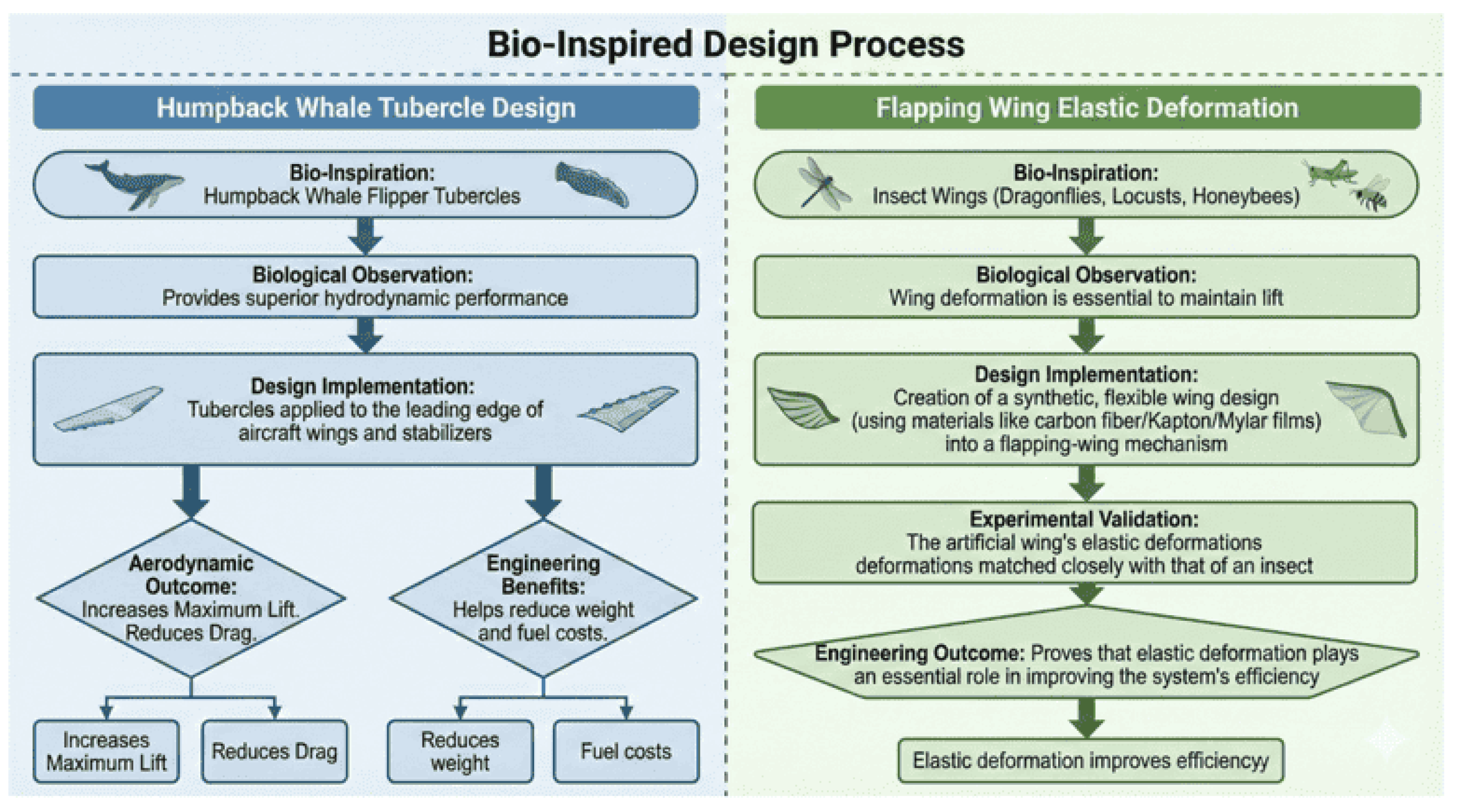

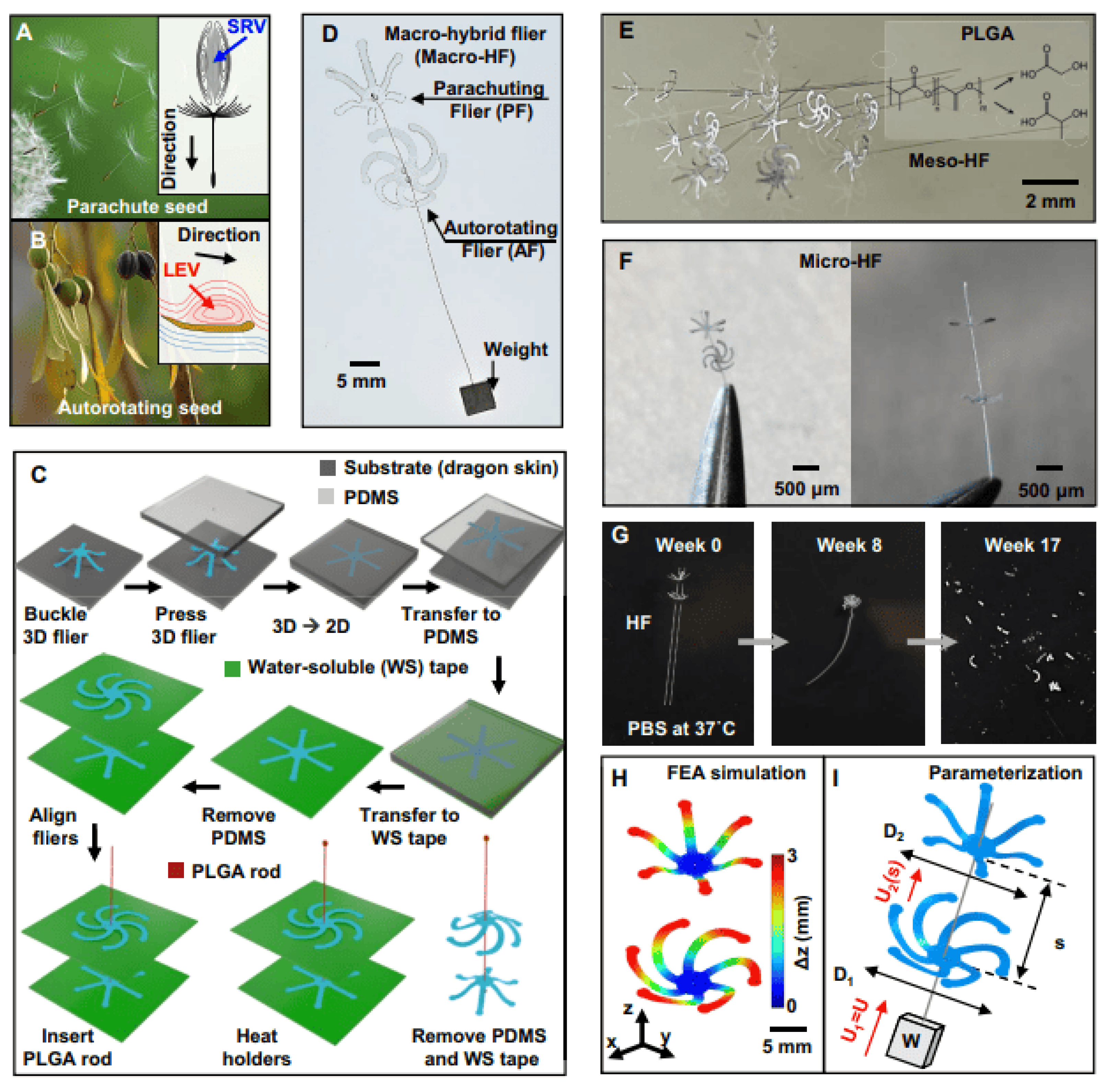





| Concept | Bio Source | Fluid-Mechanical Mechanism | Outcomes | Ref. |
|---|---|---|---|---|
| Folding-wing WEC | Flying fish fins | Resonant flapping enhances periodic lift–drag exchange and strengthens wave–structure coupling. | ∼30% increase in capture-width ratio at a 1.4 s wave period. | Chen et al. [45] |
| Scallop-shell flap | Scallop valves | Outward curvature increases pressure differential and reduces reverse-flow losses. | ∼30% higher capture factor relative to a rectangular flap. | Wang and Liu [46] |
| Electric-eel generator | Electric eel | Vortex-induced vibration (VIV) amplifies transverse oscillations in weak currents. | Stable operation at ∼0.4 m/s, whereas conventional WECs require >1 m/s. | Zhou et al. [47] |
| Dolphin-like converter | Dolphin body | Streamlined geometry suppresses adverse vortex shedding and reduces hydrodynamic damping. | Hydraulic efficiency +8–10%; electromagnetic efficiency +5–10%. | Patil et al. [48] |
| Jellyfish bj-TENG | Jellyfish bell | Compliant bell structure mitigates VIV and stabilizes surface-pressure fluctuations. | 143 V and 11.8 mA/ at 0.75 Hz. | Chen et al. [49] |
| Segmented sea-snake TENG | Sea snake | Spring-linked, multi-segment body conforms to wave curvature and lowers hydrodynamic resistance. | 3.5 W/; output voltage increased by 350% via tapered springs. | Zhang et al. [50] |
| Kelp-like TENG | Kelp blades | Slender, flexible blades reduce separation while supporting large-amplitude oscillations. | ∼260 V and 0.7 A/ at 1 Hz. | Wang et al. [51] |
| Smooth-shark dual-raft WEC | Shark body contour | Semi-elliptical body form modulates vortex distribution and promotes asymmetric excitation. | Maximum capture factor of 1.93 at a 3 s wave period. | Li et al. [57] |
| Venus-flytrap PEH | Venus flytrap trap | Bistability combined with VIV induces snap-through motion for high-power output bursts. | 181 V and 1.18 mW vs. 0.143 mW for conventional designs. | Qian et al. [53] |
| Fish-shaped BF-TEHG | Fish swimming motion | Two-stage swinging motion converts fluctuating lift and drag into electrical energy. | Efficient operation at 0.24 m/s. | Gao et al. [54] |
| Honeycomb hybrid How-NG | Honeycomb cells | Resonance tuning combined with dual-mode energy conversion enhances uptake. | Improved performance under irregular wave conditions. | Feng et al. [55] |
| Dragonfly BDFH-TEHG | Dragonfly wings | Phase-lagged tandem hydrofoils exploit constructive oscillations for improved harvesting. | Start-up at 0.21 m/s; stable operation up to 0.61 m/s. | Dong et al. [56] |
| Soft-fin SF-TEG | Fish fin | Large, compliant deformation amplifies hydrodynamic loading and harvested power. | High efficiency at low flow velocities. | Zhang et al. [52] |
| Bioinspired Concept | Mechanistic Strategy | Boiling Performance Benefits | Representative Studies |
|---|---|---|---|
| Transpiration-analogue vascular networks | Capillary-driven liquid supply via porous channels and micro/nanocavities. | Sustained rewetting; stabilized vapor embryos; delayed CHF. | Chen et al. [141], Zhang et al. [142] |
| Stomata-inspired re-entrant cavities | Protected nucleation sites with wettability gradients for pore re-seeding. | Low ONB superheat; ordered nucleation; reduced vapor-patch coalescence. | Callenaere et al. [130], Xu et al. [144] |
| Three-tier hierarchical architectures | Macrochannels for transport; micropillars for capillarity; nanostructures for activation density. | Higher HTC and CHF; dense active sites; microlayer thinning. | Song et al. [145], Li et al. [146] |
| High-superheat stability surfaces | Distributed nucleation with capillary reservoirs preventing vapor blanket formation. | Boiling sustained at high ; higher hydrodynamic limit. | Wang et al. [147] |
| Under-liquid superaerophobic surfaces | Low gas–solid adhesion enabling rapid, low-footprint bubble detachment. | Fast surface renewal; reduced dry area; improved heat transfer. | Yu et al. [148] |
| SLIPS / smart SLIPS | Lubricant-infused textures mimicking pitcher-plant peristomes. | Low hysteresis; guided bubble motion; self-cleaning behavior. | Wong et al. [136], Yandapalli et al. [137], Lou et al. [138], Shi et al. [149] |
| Bioinspired porous coatings | Compliant porous layers distributing liquid and anchoring vapor embryos. | Enhanced CHF even in shear flows; improved nucleation density. | Liter and Kaviany [134], Mohammadilooey et al. [150] |
| Topological transport surfaces | Directional microtextures emulating cactus spines, leaf venation, and shark skin. | Strong pumping; controlled bubble pathways; minimized flooding. | Zhang et al. [142], Wang et al. [143,151] |
Disclaimer/Publisher’s Note: The statements, opinions and data contained in all publications are solely those of the individual author(s) and contributor(s) and not of MDPI and/or the editor(s). MDPI and/or the editor(s) disclaim responsibility for any injury to people or property resulting from any ideas, methods, instructions or products referred to in the content. |
© 2026 by the authors. Licensee MDPI, Basel, Switzerland. This article is an open access article distributed under the terms and conditions of the Creative Commons Attribution (CC BY) license.
Share and Cite
Ahmed, F.; Chamorro, L.P. On Bio-Inspired Strategies for Flow Control, Fluid–Structure Interaction, and Thermal Transport. Biomimetics 2026, 11, 143. https://doi.org/10.3390/biomimetics11020143
Ahmed F, Chamorro LP. On Bio-Inspired Strategies for Flow Control, Fluid–Structure Interaction, and Thermal Transport. Biomimetics. 2026; 11(2):143. https://doi.org/10.3390/biomimetics11020143
Chicago/Turabian StyleAhmed, Farid, and Leonardo P. Chamorro. 2026. "On Bio-Inspired Strategies for Flow Control, Fluid–Structure Interaction, and Thermal Transport" Biomimetics 11, no. 2: 143. https://doi.org/10.3390/biomimetics11020143
APA StyleAhmed, F., & Chamorro, L. P. (2026). On Bio-Inspired Strategies for Flow Control, Fluid–Structure Interaction, and Thermal Transport. Biomimetics, 11(2), 143. https://doi.org/10.3390/biomimetics11020143