
HLA Polymorphism and Allergenicity


Abstract
1. Introduction
2. HLA Polymorphism
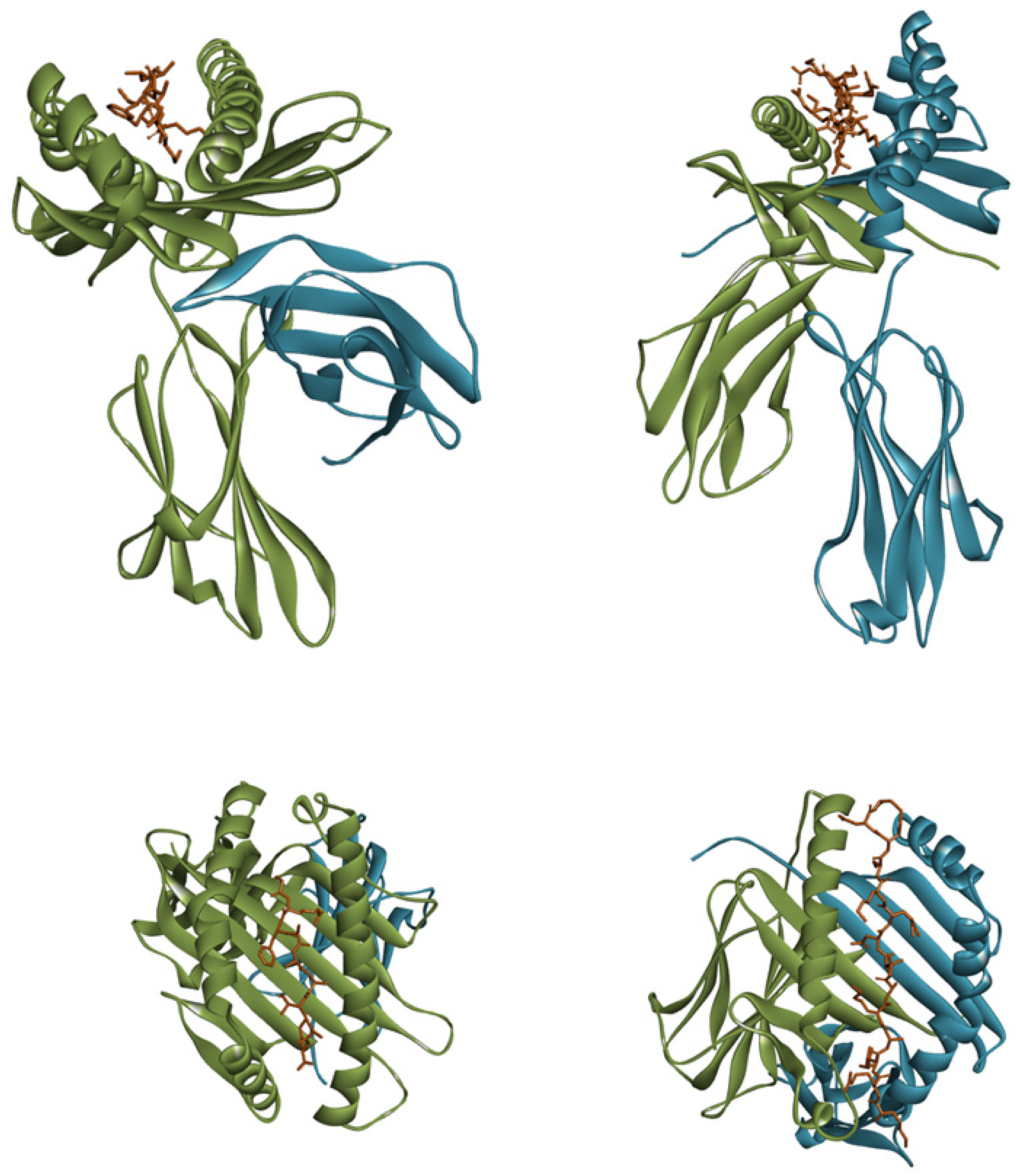
- Class I (HLA-A, -B, -C) proteins are found in almost all body cells and present peptides to CD8+ T cells (Figure 1).
- Class II (HLA-DR, -DQ, -DP) proteins are found mainly in immune cells such as macrophages and dendritic cells and present peptides to CD4+ T cells (Figure 1).
- Class III proteins include complement proteins, cytokines, and other immune-related molecules.

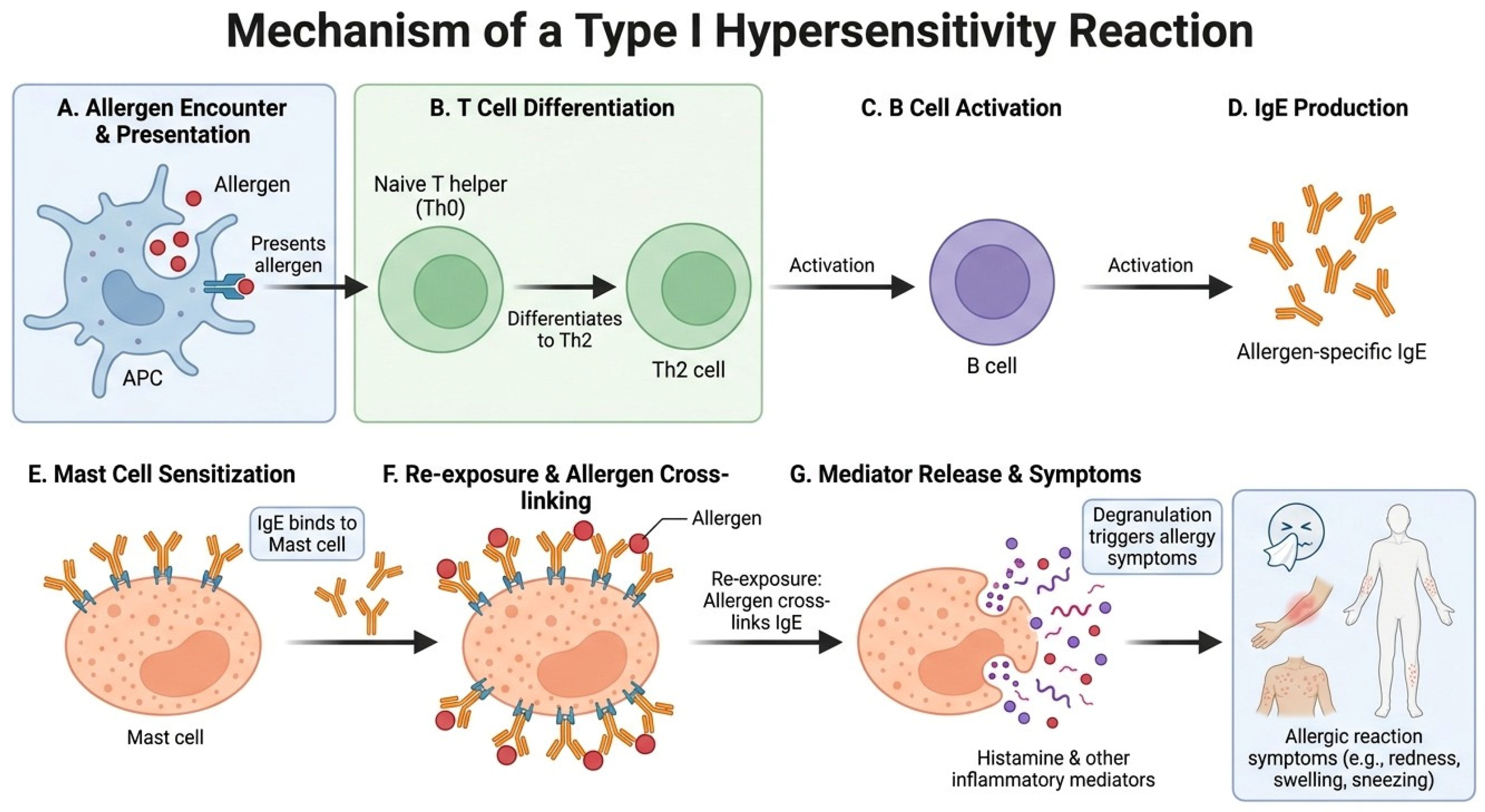
3. Mechanisms of Allergenicity and the Role of HLA
4. HLA Associations with Specific Allergies
4.1. Respiratory Allergies
4.1.1. Pollen
4.1.2. House Dust Mites
4.1.3. Mold Spores
4.1.4. Pet Dander
4.2. Food Allergies
4.2.1. Milk
4.2.2. Eggs
4.2.3. Peanut
4.2.4. Tree Nuts
4.2.5. Wheat
4.2.6. Soy
4.2.7. Fish
4.2.8. Shellfish
4.2.9. Sesame
4.2.10. Peach
4.3. Skin Allergies
4.3.1. Atopic Dermatitis
4.3.2. Allergic Contact Dermatitis
4.3.3. Latex Allergy
4.4. Injectable Allergies
4.4.1. Hymenoptera Venom Allergy
4.4.2. Fire Ant Allergy
4.4.3. Tick Saliva Allergy
4.4.4. Mosquito and Marine Venom Allergy
4.4.5. Implant-Associated Metal Hypersensitivity
5. Environmental and Epigenetic Modifiers of HLA-Mediated Allergy
5.1. Environmental Modifiers
5.2. Epigenetic Regulation of HLA-Mediated Allergy
5.3. Gene–Environment Interactions
6. Computational Prediction of Allergenicity and HLA–Peptide Interactions
6.1. Computational Tools for Allergenicity Prediction
- Sequence similarity-based methods: AlgPred, AllergenOnline (FAO/WHO 35% identity rule), AllerScreener;
- Alignment-free machine learning methods: AllerTOP, AllergenFP.
- Artificial intelligence and structure-based methods: AllerCatPro 2.0, ALLERDET.
6.2. Computational Tools for HLA–Peptide Binding Prediction
7. Challenges
8. Future Directions
9. Conclusions
Funding
Institutional Review Board Statement
Informed Consent Statement
Data Availability Statement
Acknowledgments
Conflicts of Interest
Abbreviations
| ABPA | allergic bronchopulmonary aspergillosis |
| ACD | allergic contact dermatitis |
| AD | atopic dermatitis |
| AIT | allergen-specific immunotherapy |
| APC | antigen-presenting cell |
| Breg | regulatory B cell |
| CMA | cow’s milk allergy |
| DDBL | Drug Design and Bioinformatics Lab at the Medical University of Sofia |
| EFSA | European Food Safety Authority |
| EGEA | Epidemiological study on Genetics and Environment of Asthma |
| GWAS | genome-wide association study |
| HDM | house dust mite |
| HIV | human immunodeficiency virus |
| HLA | Human Leukocyte Antigen |
| IgE | immunoglobulin E |
| IL-4 | interleukin-4 |
| MHC | Major Histocompatibility Complex |
| NGS | next-generation sequencing |
| PFS | pollen-food syndrome |
| Th0 cell | naive T helper cell |
| Th2 cell | T helper 2 cells |
| Treg | regulatory T cell |
| VIT | venom immunotherapy |
| WDEIA | wheat-dependent exercise-induced anaphylaxis |
References
- Robinson, J.; Barker, D.J.; Marsh, S.G.E. 25 years of the IPD-IMGT/HLA Database. HLA 2024, 103, e15549. [Google Scholar] [CrossRef] [Scilit] [PubMed]
- Shin, Y.H.; Hwang, J.; Kwon, R.; Lee, S.W.; Kim, M.S.; GBD 2019 Allergic Disorders Collaborators; Shin, J.I.; Yon, D.K. Global, regional, and national burden of allergic disorders and their risk factors in 204 countries and territories, from 1990 to 2019: A systematic analysis for the Global Burden of Disease Study 2019. Allergy 2023, 78, 2232–2254. [Google Scholar] [CrossRef] [Scilit] [PubMed]
- Pawankar, R. The unmet global health need of severe and complex allergies: Meeting the challenge. World Allergy Organ. J. 2012, 5, 20–21. [Google Scholar] [CrossRef] [Scilit] [PubMed]
- Roche, P.A.; Furuta, K. The ins and outs of MHC class II-mediated antigen processing and presentation. Nat. Rev. Immunol. 2015, 15, 203–216. [Google Scholar] [CrossRef] [Scilit] [PubMed]
- Lambrecht, B.N.; Hammad, H. The immunology of asthma. Nat. Immunol. 2015, 16, 45–56. [Google Scholar] [CrossRef] [Scilit] [PubMed]
- Stern, L.J.; Santambrogio, L. The melting pot of the MHC II peptidome. Curr. Opin. Immunol. 2016, 40, 70–77. [Google Scholar] [CrossRef] [Scilit] [PubMed]
- de Weck, A.L. HLA and allergy. Monogr. Allergy 1977, 11, 3–18. [Google Scholar] [PubMed]
- Neefjes, J.; Jongsma, M.L.; Paul, P.; Bakke, O. Towards a systems understanding of MHC class I and MHC class II antigen presentation. Nat. Rev. Immunol. 2011, 11, 823–836. [Google Scholar] [CrossRef] [Scilit] [PubMed]
- Trowsdale, J.; Knight, J.C. Major histocompatibility complex genomics and human disease. Annu. Rev. Genom. Hum. Genet. 2013, 14, 301–323. [Google Scholar] [CrossRef] [Scilit] [PubMed]
- Rock, K.L.; Reits, E.; Neefjes, J. Present yourself! By MHC class I and MHC class II molecules. Trends Immunol. 2016, 37, 724–737. [Google Scholar] [CrossRef] [Scilit] [PubMed]
- Parham, P.; Ohta, T. Population biology of antigen presentation by MHC class I molecules. Science 1996, 272, 67–74. [Google Scholar] [CrossRef] [Scilit] [PubMed]
- Těšický, M.; Vinkler, M. Trans-species polymorphism in immune genes: General pattern or MHC-restricted phenomenon? J. Immunol. Res. 2015, 2015, 838035. [Google Scholar] [CrossRef] [Scilit] [PubMed]
- Hülsmeyer, M.; Hillig, R.C.; Volz, A.; Rühl, M.; Schröder, W.; Saenger, W.; Ziegler, A.; Uchanska-Ziegler, B. HLA-B27 subtypes differentially associated with disease exhibit subtle structural alterations. J. Biol. Chem. 2002, 277, 47844–47853. [Google Scholar] [CrossRef] [Scilit] [PubMed]
- Pieper, J.; Dubnovitsky, A.; Gerstner, C.; James, E.A.; Rieck, M.; Kozhukh, G.; Tandre, K.; Pellegrino, S.; Gebe, J.A.; Rönnblom, L.; et al. Memory T cells specific to citrullinated alpha-enolase are enriched in the rheumatic joint. J. Autoimmun. 2018, 92, 47–56. [Google Scholar] [CrossRef] [Scilit] [PubMed]
- Bjorkman, P.J.; Parham, P. Structure, function, and diversity of class I major histocompatibility complex molecules. Annu. Rev. Biochem. 1990, 59, 253–288. [Google Scholar] [CrossRef] [PubMed]
- Prugnolle, F.; Manica, A.; Charpentier, M.; Guégan, J.F.; Guernier, V.; Balloux, F. Pathogen-driven selection and worldwide HLA class I diversity. Curr. Biol. 2005, 15, 1022–1027. [Google Scholar] [CrossRef] [Scilit] [PubMed]
- Dendrou, C.A.; Petersen, J.; Rossjohn, J.; Fugger, L. HLA variation and disease. Nat. Rev. Immunol. 2018, 18, 325–339. [Google Scholar] [CrossRef] [Scilit] [PubMed]
- Hedrick, P.W. Pathogen resistance and genetic variation at MHC loci. Evolution 2002, 56, 1902–1908. [Google Scholar] [CrossRef] [Scilit] [PubMed]
- Spurgin, L.G.; Richardson, D.S. How pathogens drive genetic diversity: MHC, mechanisms and misunderstandings. Proc. R. Soc. B Biol. Sci. 2010, 277, 979–988. [Google Scholar] [CrossRef] [Scilit] [PubMed]
- Cao, K.; Moormann, A.M.; Lyke, K.E.; Masaberg, C.; Sumba, O.P.; Doumbo, O.K.; Koech, D.; Lancaster, A.; Nelson, M.; Meyer, D.; et al. Differentiation between African populations is evidenced by the diversity of alleles and haplotypes of HLA class I loci. Tissue Antigens 2004, 63, 293–325. [Google Scholar] [CrossRef] [Scilit] [PubMed]
- Norman, P.J.; Norberg, S.J.; Guethlein, L.A.; Nemat-Gorgani, N.; Royce, T.; Wroblewski, E.E.; Dunn, T.; Mann, T.; Alicata, C.; Hollenbach, J.A.; et al. Sequences of 95 human MHC haplotypes reveal extreme coding variation in genes other than highly polymorphic HLA class I and II. Genome Res. 2017, 27, 813–823. [Google Scholar] [CrossRef] [Scilit] [PubMed]
- Petersdorf, E.W. In celebration of Ruggero Ceppellini: HLA in transplantation. HLA 2017, 89, 71–76. [Google Scholar] [CrossRef] [Scilit] [PubMed]
- Mallal, S.; Phillips, E.; Carosi, G.; Molina, J.-M.; Workman, C.; Tomazic, J.; Jägel-Guedes, E.; Rugina, S.; Kozyrev, O.; Cid, J.F.; et al. HLA-B*5701 screening for hypersensitivity to abacavir. N. Engl. J. Med. 2008, 358, 568–579. [Google Scholar] [CrossRef] [Scilit] [PubMed]
- Santos, A.F.; Brough, H.A. Making the most of in vitro tests to diagnose food allergy. J. Allergy Clin. Immunol. Pract. 2017, 5, 237–248. [Google Scholar] [CrossRef] [Scilit] [PubMed]
- Kauffman, H.F.; Tamm, M.; Timmerman, J.A.; Borger, P. House dust mite major allergens Der p 1 and Der p 5 activate human airway-derived epithelial cells by protease-dependent and protease-independent mechanisms. Clin. Mol. Allergy 2006, 4, 5. [Google Scholar] [CrossRef] [Scilit] [PubMed]
- Iezzi, G.; Karjalainen, K.; Lanzavecchia, A. The duration of antigenic stimulation determines the fate of naive and effector T cells. Immunity 1998, 8, 89–95. [Google Scholar] [CrossRef] [Scilit] [PubMed]
- Jacquet, A. Interactions of airway epithelium with protease allergens in the allergic response. Clin. Exp. Allergy 2011, 41, 305–311. [Google Scholar] [CrossRef] [Scilit] [PubMed]
- Galli, S.J.; Tsai, M.; Piliponsky, A.M. The development of allergic inflammation. Nature 2008, 454, 445–454. [Google Scholar] [CrossRef] [Scilit] [PubMed]
- Palm, N.W.; Rosenstein, R.K.; Medzhitov, R. Allergic host defences. Nature 2012, 484, 465–472. [Google Scholar] [CrossRef] [Scilit] [PubMed]
- Akdis, C.A.; Akdis, M. Mechanisms of allergen-specific immunotherapy and immune tolerance to allergens. World Allergy Organ. J. 2015, 8, 17. [Google Scholar] [CrossRef] [Scilit] [PubMed]
- Palomares, O.; Akdis, M.; Martín-Fontecha, M.; Akdis, C.A. Mechanisms of immune regulation in allergic diseases: The role of regulatory T and B cells. Immunol. Rev. 2017, 278, 219–236. [Google Scholar] [CrossRef] [Scilit] [PubMed]
- Jutel, M.; Agache, I.; Zemelka-Wiacek, M.; Akdis, M.; Chivato, T.; Del Giacco, S.; Gajdanowicz, P.; Gracia, I.E.; Klimek, L.; Lauerma, A.; et al. Nomenclature of allergic diseases and hypersensitivity reactions: Adapted to modern needs: An EAACI position paper. Allergy 2023, 78, 2851–2874. [Google Scholar] [CrossRef] [Scilit] [PubMed]
- Trombetta, E.S.; Mellman, I. Cell biology of antigen processing in vitro and in vivo. Annu. Rev. Immunol. 2005, 23, 975–1028. [Google Scholar] [CrossRef] [Scilit] [PubMed]
- Hammad, H.; Lambrecht, B.N. The basic immunology of asthma. Cell 2021, 184, 1469–1485. [Google Scholar] [CrossRef] [Scilit] [PubMed]
- Stern, L.J.; Calvo-Calle, J.M. HLA-DR: Molecular insights and vaccine design. Curr. Pharm. Des. 2009, 15, 3249–3261. [Google Scholar] [CrossRef] [Scilit] [PubMed]
- Unanue, E.R.; Turk, V.; Neefjes, J. Variations in MHC class II antigen processing and presentation in health and disease. Annu. Rev. Immunol. 2016, 34, 265–297. [Google Scholar] [CrossRef] [Scilit] [PubMed]
- Bacher, P.; Scheffold, A. The effect of regulatory T cells on tolerance to airborne allergens and allergen immunotherapy. J. Allergy Clin. Immunol. 2018, 142, 1697–1709. [Google Scholar] [CrossRef] [Scilit] [PubMed]
- Jahn-Schmid, B.; Fischer, G.F.; Bohle, B.; Faé, I.; Gadermaier, G.; Ferreira, F.; Ebner, C. Antigen presentation of the immunodominant T-cell epitope of the major mugwort pollen allergen Art v 1 is associated with the expression of HLA-DRB1*01. J. Allergy Clin. Immunol. 2005, 115, 399–404. [Google Scholar] [CrossRef] [Scilit] [PubMed]
- Ansari, A.A.; Freidhoff, L.R.; Meyers, D.A.; Bias, W.B.; Marsh, D.G. Human immune responsiveness to Lolium perenne pollen allergen Lol p III (Rye III) is associated with HLA-DR3 and DR5. Hum. Immunol. 1989, 25, 59–71. [Google Scholar] [CrossRef] [Scilit] [PubMed]
- Ansari, A.A.; Shinomiya, N.; Zwollo, P.; Marsh, D.G. HLA-D gene studies in relation to immune responsiveness to a grass allergen Lol p III. Immunogenetics 1991, 33, 24–32. [Google Scholar] [CrossRef] [Scilit] [PubMed]
- Gheerbrant, H.; Guillien, A.; Vernet, R.; Lupinek, C.; Pison, C.; Pin, I.; Demenais, F.; Nadif, R.; Bousquet, J.; Pickl, W.F.; et al. Associations between specific IgE sensitization to 26 respiratory allergen molecules and HLA class II alleles in the EGEA cohort. Allergy 2021, 76, 2575–2586. [Google Scholar] [CrossRef] [Scilit] [PubMed]
- Kauffmann, F.; Dizier, M.H.; Annesi-Maesano, I.; Bousquet, J.; Charpin, D.; Demenais, F.; Ecochard, D.; Feingold, J.; Gormand, F.; Grimfeld, A.; et al. EGEA (Epidemiological Study on the Genetics and Environment of Asthma, bronchial hyperresponsiveness and atopy): Descriptive characteristics. Clin. Exp. Allergy 1999, 29, 17–21. [Google Scholar] [PubMed]
- Wang, M.; Xing, Z.M.; Yu, D.L.; Yan, Z.; Yu, L.S. Association between HLA class II locus and the susceptibility to Artemisia pollen-induced allergic rhinitis in the Chinese population. Otolaryngol. Head Neck Surg. 2004, 130, 192–196. [Google Scholar] [CrossRef] [Scilit] [PubMed]
- Howell, W.M.; Standring, P.; Warner, J.A.; Warner, J.O. HLA class II genotype, HLA-DR B-cell surface expression and allergen-specific IgE production in atopic and non-atopic members of asthmatic family pedigrees. Clin. Exp. Allergy 1999, 29, 35–38. [Google Scholar] [PubMed]
- Sénéchal, H.; Geny, S.; Desvaux, F.X.; Busson, M.; Mayer, C.; Aron, Y.; Oster, J.P.; Bessot, J.C.; Peltre, G.; Pauli, G.; et al. Genetics and specific immune response in allergy to birch pollen and food: Evidence of a strong, positive association between atopy and the HLA class II allele HLA-DR7. J. Allergy Clin. Immunol. 1999, 104, 395–401. [Google Scholar] [CrossRef] [Scilit] [PubMed]
- Ebner, C.; Birkner, T.; Valenta, R.; Rumpold, H.; Breitenbach, M.; Scheiner, O.; Kraft, D. Common epitopes of birch pollen and apples: Studies by Western and Northern blot. J. Allergy Clin. Immunol. 1991, 88, 588–594. [Google Scholar] [CrossRef] [Scilit] [PubMed]
- Boehncke, W.H.; Loeliger, C.; Kuehnl, P.; Kalbacher, H.; Böhm, B.O.; Gall, H. Identification of HLA-DR and -DQ alleles conferring susceptibility to pollen allergy and pollen-associated food allergy. Clin. Exp. Allergy 1998, 28, 434–441. [Google Scholar] [CrossRef] [Scilit] [PubMed]
- Cardaba, B.; Cortegano, I.; Florido, F.; Arrieta, I.; Aceituno, E.; del Pozo, V.; Gallardo, S.; Rojo, M.; Palomino, P.; Lahoz, C. Genetic restrictions in olive pollen allergy. J. Allergy Clin. Immunol. 2000, 105, 292–298. [Google Scholar] [CrossRef] [Scilit] [PubMed]
- Cárdaba, B.; del Pozo, V.; Jurado, A.; Gallardo, S.; Cortegano, I.; Arrieta, I.; del Amo, A.; Tramón, P.; Florido, F.; Sastre, J.; et al. Olive pollen allergy: Searching for immunodominant T-cell epitopes on the Ole e 1 molecule. Clin. Exp. Allergy 1998, 28, 413–422. [Google Scholar] [CrossRef] [Scilit] [PubMed]
- Thomas, W.R. Hierarchy and molecular properties of house dust mite allergens. Allergol. Int. 2015, 64, 304–311. [Google Scholar] [CrossRef] [Scilit] [PubMed]
- Gregory, L.G.; Lloyd, C.M. Orchestrating house dust mite-associated allergy in the lung. Trends Immunol. 2011, 32, 402–411. [Google Scholar] [CrossRef] [Scilit] [PubMed]
- Verhoef, A.; Higgins, J.A.; Thorpe, C.J.; Marsh, S.G.E.; Hayball, J.D.; Lamb, J.R.; O’Hehir, R.E. Clonal analysis of the atopic immune response to the group 2 allergen of Dermatophagoides spp. Identification of HLA-DR- and HLA-DQ-restricted T-cell epitopes. Int. Immunol. 1993, 5, 1589–1597. [Google Scholar] [CrossRef] [Scilit] [PubMed]
- Higgins, J.A.; Thorpe, C.J.; Hayball, J.D.; O’Hehir, R.E.; Lamb, J.R. Overlapping T-cell epitopes in the group I allergen of Dermatophagoides species restricted by HLA-DP and HLA-DR class II molecules. J. Allergy Clin. Immunol. 1994, 93, 891–899. [Google Scholar] [CrossRef] [Scilit] [PubMed]
- O’Brien, R.M.; Thomas, W.R.; Tait, B.D. An immunogenetic analysis of T-cell reactive regions on the major allergen from the house dust mite, Der p I, with recombinant truncated fragments. J. Allergy Clin. Immunol. 1994, 93, 628–634. [Google Scholar] [CrossRef] [Scilit] [PubMed]
- Prickett, S.R.; Rolland, J.M.; O’Hehir, R.E. Immunoregulatory T-cell epitope peptides: The new frontier in allergy therapy. Clin. Exp. Allergy 2015, 45, 1015–1026. [Google Scholar] [CrossRef] [Scilit] [PubMed]
- Zhao, Y.; Zhao, Y.; Li, J.; Zhang, Y.; Zhang, L. HLA-DRB1*08:03:02 and HLA-DQB1*06:01:01 are associated with house dust mite-sensitive allergic rhinitis in Chinese subjects. Int. Forum Allergy Rhinol. 2016, 6, 854–861. [Google Scholar] [CrossRef] [Scilit] [PubMed]
- Zhao, Y.; Zhao, Y.; Zhang, Y.; Zhang, L. HLA-II genes are associated with outcomes of specific immunotherapy for allergic rhinitis. Int. Forum Allergy Rhinol. 2019, 9, 1311–1317. [Google Scholar] [CrossRef] [Scilit] [PubMed]
- Movahedi, M.; Moin, M.; Gharagozlou, M.; Aghamohammadi, A.; Dianat, S.; Moradi, B.; Nicknam, M.H.; Nikbin, B.; Amirzargar, A. Association of HLA class II alleles with childhood asthma and total IgE levels. Iran. J. Allergy Asthma Immunol. 2008, 7, 215–220. [Google Scholar] [PubMed]
- Wan, H.; Winton, H.L.; Soeller, C.; Tovey, E.R.; Gruenert, D.C.; Thompson, P.J.; Stewart, G.A.; Taylor, G.W.; Garrod, D.R.; Cannell, M.B.; et al. Der p 1 facilitates transepithelial allergen delivery by disruption of tight junctions. J. Clin. Investig. 1999, 104, 123–133. [Google Scholar] [CrossRef] [Scilit] [PubMed]
- Reithofer, M.; Jahn-Schmid, B. Allergens with protease activity from house dust mites. Int. J. Mol. Sci. 2017, 18, 1368. [Google Scholar] [CrossRef] [Scilit] [PubMed]
- Trompette, A.; Divanovic, S.; Visintin, A.; Blanchard, C.; Hegde, R.S.; Madan, R.; Thorne, P.S.; Wills-Karp, M.; Gioannini, T.L.; Weiss, J.P.; et al. Allergenicity resulting from functional mimicry of a Toll-like receptor complex protein. Nature 2009, 457, 585–588. [Google Scholar] [CrossRef] [Scilit] [PubMed]
- Lamb, J.R.; Eckels, D.D.; Lake, P.; Woody, J.N.; Green, N. Human T-cell clones recognize chemically synthesized peptides of influenza haemagglutinin. Nature 1982, 300, 66–69. [Google Scholar] [CrossRef] [Scilit] [PubMed]
- O’Brien, R.M.; Thomas, W.R.; Nicholson, I.; Lamb, J.R.; Tait, B.D. An immunogenetic analysis of the T-cell recognition of the major house dust mite allergen Der p 2: Identification of high- and low-responder HLA-DQ alleles and localization of T-cell epitopes. Immunology 1995, 86, 176–182. [Google Scholar] [PubMed]
- Stevens, D.A.; Moss, R.B.; Kurup, V.P.; Knutsen, A.P.; Greenberger, P.; Judson, M.A.; Denning, D.W.; Crameri, R.; Brody, A.S.; Light, M.; et al. Participants in the Cystic Fibrosis Foundation Consensus Conference. Allergic bronchopulmonary aspergillosis in cystic fibrosis—State of the art. Clin. Infect. Dis. 2003, 37, S225–S264. [Google Scholar] [CrossRef] [Scilit] [PubMed]
- Agarwal, R.; Chakrabarti, A.; Shah, A.; Gupta, D.; Meis, J.F.; Guleria, R.; Moss, R.; Denning, D.W.; ABPA Complicating Asthma ISHAM Working Group. Allergic bronchopulmonary aspergillosis: Review of literature and proposal of new diagnostic and classification criteria. Clin. Exp. Allergy 2013, 43, 850–873. [Google Scholar] [CrossRef] [Scilit] [PubMed]
- Chauhan, B.; Santiago, L.; Hutcheson, P.S.; Schwartz, H.J.; Spitznagel, E.; Castro, M.; Slavin, R.G.; Bellone, C.J.; Knutsen, A.P. Association of HLA-DR alleles and T-cell activation with allergic bronchopulmonary aspergillosis. J. Immunol. 1997, 159, 4072–4076. [Google Scholar] [CrossRef] [Scilit]
- Chauhan, B.; Santiago, L.; Kirschmann, D.A.; Hauptfeld, V.; Knutsen, A.P.; Hutcheson, P.S.; Slavin, R.G.; Bellone, C.J. Evidence for the involvement of two different MHC class II regions in susceptibility or protection in allergic bronchopulmonary aspergillosis. J. Allergy Clin. Immunol. 2000, 106, 723–729. [Google Scholar] [CrossRef] [Scilit] [PubMed]
- Aron, Y.; Bienvenu, T.; Hubert, D.; Dusser, D.; Dall’Ava, J.; Polla, B.S. HLA-DR polymorphism in allergic bronchopulmonary aspergillosis. J. Allergy Clin. Immunol. 1999, 104, 891–892. [Google Scholar] [CrossRef] [Scilit] [PubMed]
- Chauhan, B.; Hutcheson, P.S.; Slavin, R.G.; Bellone, C.J. MHC restriction in allergic bronchopulmonary aspergillosis. Front. Biosci. 2003, 8, S140–S148. [Google Scholar] [CrossRef] [Scilit] [PubMed]
- Knutsen, A.P.; Vijay, H.M.; Kumar, V.; Kariuki, B.; Santiago, L.A.; Graff, R.; Wofford, J.D.; Shah, M.R. Mold sensitivity in children with moderate-to-severe asthma is associated with HLA-DR and HLA-DQ. Allergy 2010, 65, 1367–1375. [Google Scholar] [CrossRef] [Scilit] [PubMed]
- Custovic, A.; Green, R.; Taggart, S.C.O.; Smith, A.; Pickering, C.A.C.; Chapman, M.D.; Woodcock, A. Domestic allergens in public places. II: Dog (Can f1) and cockroach (Bla g 2) allergens in dust and mite, cat, dog and cockroach allergens in the air in public buildings. Clin. Exp. Allergy 1996, 26, 1246–1252. [Google Scholar] [CrossRef] [Scilit]
- Ling, M.; Long, A.A. Pet dander and difficult-to-control asthma: Therapeutic options. Allergy Asthma Proc. 2010, 31, 385–391. [Google Scholar] [CrossRef] [Scilit] [PubMed]
- Konradsen, J.R.; Fujisawa, T.; van Hage, M.; Hedlin, G.; Hilger, C.; Kleine-Tebbe, J.; Matsui, E.C.; Roberts, G.; Rönmark, E.; Platts-Mills, T.A.E. Allergy to furry animals: New insights, diagnostic approaches, and challenges. J. Allergy Clin. Immunol. 2015, 135, 616–625. [Google Scholar] [CrossRef] [Scilit] [PubMed]
- Grönlund, H.; Saarne, T.; Gafvelin, G.; van Hage, M. The major cat allergen, Fel d 1, in diagnosis and therapy. Int. Arch. Allergy Immunol. 2010, 151, 265–274. [Google Scholar] [CrossRef] [Scilit] [PubMed]
- Nilsson, O.B.; van Hage, M.; Grönlund, H. Mammalian-derived respiratory allergens: Implications for diagnosis and therapy of individuals allergic to furry animals. Methods 2014, 66, 86–95. [Google Scholar] [CrossRef] [Scilit] [PubMed]
- van Neerven, R.J.; van de Pol, M.M.; van Milligen, F.J.; Jansen, H.M.; Aalberse, R.C.; Kapsenberg, M.L. Characterization of cat dander-specific T lymphocytes from atopic patients. J. Immunol. 1994, 152, 4203–4210. [Google Scholar] [CrossRef] [Scilit] [PubMed]
- Reefer, A.J.; Carneiro, R.M.; Custis, N.J.; Platts-Mills, T.A.; Sung, S.S.; Hammer, J.; Woodfolk, J.A. A role for IL-10-mediated HLA-DR7-restricted T-cell-dependent events in development of the modified Th2 response to cat allergen. J. Immunol. 2004, 172, 2763–2772. [Google Scholar] [CrossRef] [Scilit] [PubMed]
- Kwok, W.W.; Roti, M.; DeLong, J.H.; Tan, V.; Wambre, E.; James, E.A.; Robinson, D. Direct ex vivo analysis of allergen-specific CD4+ T cells. J. Allergy Clin. Immunol. 2010, 125, 1407–1409.e1. [Google Scholar] [CrossRef] [Scilit] [PubMed]
- Liukko, A.L.K.; Kinnunen, T.T.; Rytkönen-Nissinen, M.A.; Kailaanmäki, A.H.; Randell, J.T.; Maillère, B.; Virtanen, T.I. Human CD4+ T-cell responses to the dog major allergen Can f 1 and its human homologue tear lipocalin resemble each other. PLoS ONE 2014, 9, e98461. [Google Scholar] [CrossRef] [Scilit] [PubMed]
- Immonen, A.; Farci, S.; Taivainen, A.; Partanen, J.; Poulsen, L.K.; Rytkönen-Nissinen, M.; Virtanen, T.; Kinnunen, T. T-cell epitope-containing peptides of the major dog allergen Can f 1 as candidates for allergen immunotherapy. J. Immunol. 2005, 175, 3614–3620. [Google Scholar] [CrossRef] [Scilit] [PubMed]
- Juntunen, R.; Liukko, A.; Taivainen, A.; Närvänen, A.; Durand, G.; Kauppinen, A.; Nieminen, A.; Rytkönen-Nissinen, M.; Saarelainen, S.; Maillère, B.; et al. Suboptimal recognition of a T-cell epitope of the major dog allergen Can f 1 by human T cells. Mol. Immunol. 2009, 46, 3320–3327. [Google Scholar] [CrossRef] [Scilit] [PubMed]
- Sicherer, S.H.; Sampson, H.A. Food allergy: A review and update on epidemiology, pathogenesis, diagnosis, prevention, and management. J. Allergy Clin. Immunol. 2018, 141, 41–58. [Google Scholar] [CrossRef] [Scilit] [PubMed]
- Loh, W.; Tang, M.L.K. The epidemiology of food allergy in the global context. Int. J. Environ. Res. Public Health 2018, 15, 2043. [Google Scholar] [CrossRef] [Scilit] [PubMed]
- Boyce, J.A.; Assa’ad, A.; Burks, A.W.; Jones, S.M.; Sampson, H.A.; Wood, R.A.; Plaut, M.; Cooper, S.F.; Fenton, M.J.; Arshad, S.H.; et al. Guidelines for the diagnosis and management of food allergy in the United States: Report of the NIAID-sponsored Expert Panel. J. Allergy Clin. Immunol. 2010, 126, S1–S58. [Google Scholar] [CrossRef] [Scilit] [PubMed]
- Food Allergy Safety, Treatment, Education, and Research (FASTER) Act of 2021; Public Law No. 117-11; U.S. Food and Drug Administration: Silver Spring, MD, USA, 2023.
- Warren, C.M.; Jiang, J.; Gupta, R.S. Epidemiology and burden of sesame allergy in the United States. JAMA Netw. Open 2019, 2, e199144. [Google Scholar] [CrossRef] [Scilit] [PubMed]
- Gargano, D.; Appanna, R.; Santonicola, A.; De Bartolomeis, F.; Stellato, C.; Cianferoni, A.; Casolaro, V.; Iovino, P. Food allergy and intolerance: A narrative review on nutritional concerns. Nutrients 2021, 13, 1638. [Google Scholar] [CrossRef] [Scilit] [PubMed]
- Bartha, I.; Almulhem, N.; Santos, A.F. Feast for thought: A comprehensive review of food allergy 2021–2023. J. Allergy Clin. Immunol. 2024, 153, 576–594. [Google Scholar] [CrossRef] [Scilit] [PubMed]
- Tordesillas, L.; Berin, M.C.; Sampson, H.A. Immunology of Food Allergy. Immunity 2017, 47, 32–50. [Google Scholar] [CrossRef] [Scilit] [PubMed]
- Ramanan, D.; Pratama, A.; Zhu, Y.; Venezia, O.; Sassone-Corsi, M.; Chowdhary, K.; Galván-Peña, S.; Sefik, E.; Brown, C.; Gélineau, A.; et al. Regulatory T cells in the face of the intestinal microbiota. Nat. Rev. Immunol. 2023, 23, 749–762. [Google Scholar] [CrossRef] [Scilit] [PubMed]
- Tordesillas, L.; Mondoulet, L.; Blazquez, A.B.; Benhamou, P.H.; Sampson, H.A.; Berin, M.C. Epicutaneous immunotherapy induces gastrointestinal LAP+ regulatory T cells and prevents food-induced anaphylaxis. J. Allergy Clin. Immunol. 2017, 139, 189–201.e4. [Google Scholar] [CrossRef] [Scilit] [PubMed]
- Kanchan, K.; Clay, S.; Irizar, H.; Bunyavanich, S.; Mathias, R.A. Current insights into the genetics of food allergy. J. Allergy Clin. Immunol. 2021, 147, 15–28. [Google Scholar] [CrossRef] [Scilit] [PubMed]
- Arnau-Soler, A.; Tremblay, B.L.; Sun, Y.; Madore, A.M.; Simard, M.; Kersten, E.T.G.; Ghauri, A.; Marenholz, I.; Eiwegger, T.; Simons, E.; et al. Food allergy genetics and epigenetics: A review of genome-wide association studies. Allergy 2025, 80, 106–131. [Google Scholar] [CrossRef] [Scilit] [PubMed]
- Host, A. Frequency of cow’s milk allergy in childhood. Ann. Allergy Asthma Immunol. 2002, 89, 33–37. [Google Scholar] [CrossRef] [Scilit] [PubMed]
- Fiocchi, A.; Brozek, J.; Schünemann, H.; Bahna, S.L.; von Berg, A.; Beyer, K.; Bozzola, M.; Bradsher, J.; Compalati, E.; Ebisawa, M.; et al. World Allergy Organization (WAO) diagnosis and rationale for action against cow’s milk allergy (DRACMA) guidelines. World Allergy Organ. J. 2010, 3, 57–161. [Google Scholar] [CrossRef] [Scilit] [PubMed]
- Wal, J.-M. Bovine milk allergenicity. Ann. Allergy Asthma Immunol. 2004, 93, S2–S11. [Google Scholar] [CrossRef] [Scilit] [PubMed]
- Matricardi, P.M.; Kleine-Tebbe, J.; Hoffmann, H.J.; Valenta, R.; Hilger, C.; Hofmaier, S.; Aalberse, R.C.; Agache, I.; Asero, R.; Ballmer-Weber, B.; et al. EAACI Molecular Allergology User’s Guide. Pediatr. Allergy Immunol. 2016, 27, 1–250. [Google Scholar] [CrossRef] [Scilit] [PubMed]
- Fiocchi, A.; Bognanni, A.; Brożek, J.; Ebisawa, M.; Schünemann, H.; WAO DRACMA Guideline Group. World Allergy Organization (WAO) diagnosis and rationale for action against cow’s milk allergy (DRACMA) guidelines update—I—Plan and definitions. World Allergy Organ. J. 2022, 15, 100609. [Google Scholar] [CrossRef] [Scilit] [PubMed]
- Dimitrov, I.; Doytchinova, I. Associations between milk and egg allergens and the HLA-DRB1/DQ polymorphism: A bioinformatics approach. Int. Arch. Allergy Immunol. 2016, 169, 33–39. [Google Scholar] [CrossRef] [Scilit] [PubMed]
- Schade, R.P.; van Ieperen-Van Dijk, A.G.; van Reijsen, F.C.; Versluis, C.; Kimpen, J.L.L.; Bruijnzeel-Koomen, C.A.F.M.; Knol, E.F. Differences in antigen-specific T-cell responses between infants with atopic dermatitis with and without cow’s milk allergy: The role of TH2 cytokines. J. Allergy Clin. Immunol. 2000, 106, 1155–1162. [Google Scholar] [CrossRef] [Scilit] [PubMed]
- Järvinen, K.M.; Beyer, K.; Vila, L.; Chatchatee, P.; Busse, P.J.; Sampson, H.A. B-cell epitopes as a screening instrument for persistent cow’s milk allergy. J. Allergy Clin. Immunol. 2010, 125, 131–136.e1. [Google Scholar] [CrossRef] [Scilit] [PubMed]
- Nowak-Węgrzyn, A.; Fiocchi, A. Is oral immunotherapy the cure for food allergies? Curr. Opin. Allergy Clin. Immunol. 2010, 10, 214–219. [Google Scholar] [CrossRef] [Scilit] [PubMed]
- Peters, R.L.; Koplin, J.J.; Gurrin, L.C.; Dharmage, S.C.; Wake, M.; Ponsonby, A.-L.; Tang, M.L.K.; Lowe, A.J.; Matheson, M.; Dwyer, T.; et al. The prevalence of food allergy and other allergic diseases in early childhood in a population-based study: HealthNuts age 4-year follow-up. J. Allergy Clin. Immunol. 2017, 140, 145–153.e8. [Google Scholar] [CrossRef] [Scilit] [PubMed]
- Savage, J.; Johns, C.B. Food allergy: Epidemiology and natural history. Immunol. Allergy Clin. N. Am. 2015, 35, 45–59. [Google Scholar] [CrossRef] [Scilit] [PubMed]
- Kovacs-Nolan, J.; Zhang, J.W.; Hayakawa, S.; Mine, Y. Immunochemical and structural analysis of pepsin-digested egg white ovomucoid. J. Agric. Food Chem. 2000, 48, 6261–6266. [Google Scholar] [CrossRef] [Scilit] [PubMed]
- Caubet, J.C.; Wang, J. Current understanding of egg allergy. Pediatr. Clin. N. Am. 2011, 58, 427–443. [Google Scholar] [CrossRef] [Scilit] [PubMed]
- Järvinen, K.M.; Beyer, K.; Vila, L.; Bardina, L.; Mishoe, M.; Sampson, H.A. Specificity of IgE antibodies to sequential epitopes of hen’s egg ovomucoid as a marker for persistence of egg allergy. Allergy 2007, 62, 758–765. [Google Scholar] [CrossRef] [Scilit] [PubMed]
- Benhamou, A.H.; Caubet, J.C.; Eigenmann, P.A.; Nowak-Wegrzyn, A.; Marcos, C.P.; Reche, M.; Urisu, A. State of the art and new horizons in the diagnosis and management of egg allergy. Allergy 2010, 65, 283–289. [Google Scholar] [CrossRef] [Scilit] [PubMed]
- Elsayed, S.; Apold, J. Immunochemical analysis of hen egg allergens with identification of immunologically active regions of ovomucoid. Int. Arch. Allergy Appl. Immunol. 1987, 83, 355–362. [Google Scholar] [CrossRef] [Scilit] [PubMed]
- Eigenmann, P.A.; Huang, S.K.; Sampson, H.A. Characterization of ovomucoid-specific T-cell lines and clones from egg-allergic subjects. Pediatr. Allergy Immunol. 1996, 7, 12–21. [Google Scholar] [CrossRef] [Scilit] [PubMed]
- Suzuki, K.; Inoue, R.; Sakaguchi, H.; Aoki, M.; Kato, Z.; Kaneko, H.; Matsushita, S.; Kondo, N. Correlation between ovomucoid-derived peptides, HLA class II molecules and TCR-CDR3 compositions in patients with egg-white allergy. Clin. Exp. Allergy 2002, 32, 1223–1230. [Google Scholar] [CrossRef] [Scilit] [PubMed]
- Park, H.; Ahn, K.; Park, M.H.; Lee, S.I. The HLA-DRB1 polymorphism is associated with atopic dermatitis, but not egg allergy in Korean children. Allergy Asthma Immunol. Res. 2012, 4, 143–149. [Google Scholar] [CrossRef] [Scilit] [PubMed]
- Turner, P.J.; Baumert, J.L.; Beyer, K.; Boyle, R.J.; Chan, C.-H.; Clark, A.T.; Crevel, R.W.R.; DunnGalvin, A.; Fernández-Rivas, M.; Gowland, M.H.; et al. Can we identify patients at risk of life-threatening allergic reactions to food? Allergy 2016, 71, 1241–1255. [Google Scholar] [CrossRef] [Scilit] [PubMed]
- Koppelman, S.J.; Wensing, M.; Ertmann, M.; Knulst, A.C.; Knol, E.F. Relevance of Ara h 1, Ara h 2 and Ara h 3 in peanut-allergic patients, as determined by immunoglobulin E Western blotting, basophil-histamine release and intracutaneous testing: Ara h 2 is the most important peanut allergen. Clin. Exp. Allergy 2004, 34, 583–590. [Google Scholar] [CrossRef] [Scilit] [PubMed]
- Klemans, R.J.B.; Broekman, H.C.H.P.; Knol, E.F.; Bruijnzeel-Koomen, C.A.F.M.; Otten, H.G.; Pasmans, S.G.M.A.; Knulst, A.C. Ara h 2 is the best predictor for peanut allergy in adults. J. Allergy Clin. Immunol. Pract. 2015, 3, 632–638.e1. [Google Scholar] [CrossRef] [Scilit] [PubMed]
- Hemmings, O.; du Toit, G.; Radulovic, S.; Lack, G.; Santos, A.F. Ara h 2 is the dominant peanut allergen despite similarities with Ara h 6. J. Allergy Clin. Immunol. 2020, 146, 621–630.e5. [Google Scholar] [CrossRef] [Scilit] [PubMed]
- Hong, X.; Hao, K.; Ladd-Acosta, C.; Hansen, K.D.; Tsai, H.J.; Liu, X.; Xu, X.; Thornton, T.A.; Caruso, D.; Keet, C.A.; et al. Genome-wide association study identifies peanut allergy-specific loci and evidence of epigenetic mediation in US children. Nat. Commun. 2015, 6, 6304. [Google Scholar] [CrossRef] [Scilit] [PubMed]
- Martino, D.J.; Ashley, S.; Koplin, J.; Ellis, J.; Saffery, R.; Dharmage, S.C.; Gurrin, L.; Matheson, M.C.; Kalb, B.; Marenholz, I.; et al. Genome-wide association study of peanut allergy reproduces association with amino acid polymorphisms in HLA-DRB1. Clin. Exp. Allergy 2017, 47, 217–223. [Google Scholar] [CrossRef] [Scilit] [PubMed]
- Marenholz, I.; Grosche, S.; Kalb, B.; Rüschendorf, F.; Blümchen, K.; Schlags, R.; Harandi, N.; Price, M.; Hansen, G.; Seidenberg, J.; et al. Genome-wide association study identifies the SERPINB gene cluster as a susceptibility locus for food allergy. Nat. Commun. 2017, 8, 1056. [Google Scholar] [CrossRef] [Scilit] [PubMed]
- Asai, Y.; Eslami, A.; van Ginkel, C.D.; Akhabir, L.; Wan, M.; Yin, D.; Ellis, G.; Ben-Shoshan, M.; Marenholz, I.; Martino, D.; et al. A Canadian genome-wide association study and meta-analysis confirm HLA as a risk factor for peanut allergy independent of asthma. J. Allergy Clin. Immunol. 2018, 141, 1513–1516. [Google Scholar] [CrossRef] [Scilit] [PubMed]
- Madore, A.M.; Vaillancourt, V.T.; Asai, Y.; Alizadehfar, R.; Ben-Shoshan, M.; Michel, D.L.; Kozyrskyj, A.L.; Becker, A.; Chan-Yeung, M.; Clarke, A.E.; et al. HLA-DQB1*02 and DQB1*06:03P are associated with peanut allergy. Eur. J. Hum. Genet. 2013, 21, 1181–1184. [Google Scholar] [CrossRef] [Scilit] [PubMed]
- Wu, B.; Yang, M.; Hu, D.; Zhang, R.; Liu, B.; Hochstadt, S.; Lanfear, D.E.; Witonsky, J.; Kumar, R.; Hollenbach, J.A.; et al. HLA variation associated with peanut allergy and anaphylaxis among non-Hispanic Black individuals. J. Allergy Clin. Immunol. Glob. 2025, 4, 100485. [Google Scholar] [CrossRef] [Scilit] [PubMed]
- Kanchan, K.; Grinek, S.; Bahnson, H.T.; Ruczinski, I.; Shankar, G.; Larson, D.; du Toit, G.; Barnes, K.C.; Sampson, H.A.; Suarez-Farinas, M.; et al. HLA alleles and sustained peanut consumption promote IgG4 responses in subjects protected from peanut allergy. J. Clin. Investig. 2022, 132, e152070. [Google Scholar] [CrossRef] [Scilit] [PubMed]
- Prickett, S.R.; Voskamp, A.L.; Phan, T.; Dacumos-Hill, A.; Mannering, S.I.; Rolland, J.M.; O’Hehir, R.E. Ara h 1 CD4+ T cell epitope-based peptides: Candidates for a peanut allergy therapeutic. Clin. Exp. Allergy 2013, 43, 684–697. [Google Scholar] [CrossRef] [Scilit] [PubMed]
- DeLong, J.H.; Simpson, K.H.; Wambre, E.; James, E.A.; Robinson, D.; Kwok, W.W. Ara h 1-reactive T cells in individuals with peanut allergy. J. Allergy Clin. Immunol. 2011, 127, 1211–1218.e3. [Google Scholar] [CrossRef] [Scilit] [PubMed]
- Wambre, E.; DeLong, J.H.; James, E.A.; LaFond, R.E.; Robinson, D.; Kwok, W.W. Differentiation stage determines pathologic and protective allergen-specific CD4+ T-cell outcomes during specific immunotherapy. J. Allergy Clin. Immunol. 2012, 129, 544–551.e5517. [Google Scholar] [CrossRef] [Scilit] [PubMed]
- Satitsuksanoa, P.; Jansen, K.; Głobińska, A.; van de Veen, W.; Akdis, M. Regulatory immune mechanisms in tolerance to food allergy. Front. Immunol. 2018, 9, 2939. [Google Scholar] [CrossRef] [Scilit] [PubMed]
- McWilliam, V.; Koplin, J.; Lodge, C.; Tang, M.; Dharmage, S.; Allen, K. The prevalence of tree nut allergy: A systematic review. Curr. Allergy Asthma Rep. 2015, 15, 54. [Google Scholar] [CrossRef] [Scilit] [PubMed]
- Costa, J.; Bavaro, S.L.; Benedé, S.; Diaz-Perales, A.; Bueno-Diaz, C.; Gelencser, E.; Klueber, J.; Larré, C.; Lozano-Ojalvo, D.; Lupi, R.; et al. Are physicochemical properties shaping the allergenic potency of tree nuts? Clin. Rev. Allergy Immunol. 2022, 62, 37–63. [Google Scholar] [CrossRef] [Scilit]
- Hofmann, C.; Scheurer, S.; Rost, K.; Graulich, E.; Jamin, A.; Foetisch, K.; Saloga, J.; Vieths, S.; Steinbrink, K.; Adler, H.S. Cor a 1-reactive T cells and IgE are predominantly cross-reactive to Bet v 1 in patients with birch pollen-associated food allergy to hazelnut. J. Allergy Clin. Immunol. 2013, 131, 1384–1392.e6. [Google Scholar] [CrossRef] [Scilit] [PubMed]
- Pajno, G.B.; Fernandez-Rivas, M.; Arasi, S.; Roberts, G.; Akdis, C.A.; Alvaro-Lozano, M.; Beyer, K.; Bindslev-Jensen, C.; Burks, W.; Ebisawa, M.; et al. EAACI guidelines on allergen immunotherapy: IgE-mediated food allergy. Allergy 2018, 73, 799–815. [Google Scholar] [CrossRef] [Scilit] [PubMed]
- Ebner, C.; Ferreira, F.; Hoffmann, K.; Hirschwehr, R.; Schenk, S.; Szépfalusi, Z.; Breiteneder, H.; Parronchi, P.; Romagnani, S.; Scheiner, O. T-cell clones specific for Bet v I, the major birch pollen allergen, cross-react with the major allergens of hazel, Cor a I, and alder, Aln g I. Mol. Immunol. 1993, 30, 1323–1329. [Google Scholar] [CrossRef] [Scilit] [PubMed]
- Weinberger, T.; Sicherer, S. Current perspectives on tree nut allergy: A review. J. Asthma Allergy 2018, 11, 41–51. [Google Scholar] [CrossRef] [Scilit] [PubMed]
- Robotham, J.M.; Wang, F.; Seamon, V.; Teuber, S.S.; Sathe, S.K.; Sampson, H.A.; Beyer, K.; Seavy, M.; Roux, K.H. Ana o 3, an important cashew nut (Anacardium occidentale L.) allergen of the 2S albumin family. J. Allergy Clin. Immunol. 2005, 115, 1284–1290. [Google Scholar] [CrossRef] [Scilit] [PubMed]
- Lange, L.; Lasota, L.; Finger, A.; Vlajnic, D.; Büsing, S.; Meister, J.; Broekaert, I.; Pfannenstiel, C.; Friedrichs, F.; Price, M.; et al. Ana o 3-specific IgE is a good predictor of clinically relevant cashew allergy in children. Allergy 2017, 72, 598–603. [Google Scholar] [CrossRef] [Scilit] [PubMed]
- Tatham, A.S.; Shewry, P.R. Allergens to wheat and related cereals. Clin. Exp. Allergy 2008, 38, 1712–1726. [Google Scholar] [CrossRef] [Scilit] [PubMed]
- Dramburg, S.; Hilger, C.; Santos, A.F.; de Las Vecillas, L.; Aalberse, R.C.; Acevedo, N.; Aglas, L.; Altmann, F.; Arruda, L.K.; Asero, R.; et al. EAACI Molecular Allergology User’s Guide 2.0. Pediatr. Allergy Immunol. 2023, 34, e13854. [Google Scholar] [CrossRef] [Scilit] [PubMed]
- Palosuo, K.; Alenius, H.; Varjonen, E.; Koivuluhta, M.; Mikkola, J.; Keskinen, H.; Kalkkinen, N.; Reunala, T. A novel wheat gliadin as a cause of exercise-induced anaphylaxis. J. Allergy Clin. Immunol. 1999, 103, 912–917. [Google Scholar] [CrossRef] [Scilit] [PubMed]
- Matsuo, H.; Morita, E.; Tatham, A.S.; Morimoto, K.; Horikawa, T.; Osuna, H.; Ikezawa, Z.; Kaneko, S.; Kohno, K.; Dekio, S. Identification of the IgE-binding epitope in omega-5 gliadin, a major allergen in wheat-dependent exercise-induced anaphylaxis. J. Biol. Chem. 2004, 279, 12135–12140. [Google Scholar] [CrossRef] [Scilit] [PubMed]
- Fukunaga, K.; Chinuki, Y.; Hamada, Y.; Fukutomi, Y.; Sugiyama, A.; Kishikawa, R.; Fukunaga, A.; Oda, Y.; Ugajin, T.; Yokozeki, H.; et al. Genome-wide association study reveals an association between the HLA-DPB1*02:01:02 allele and wheat-dependent exercise-induced anaphylaxis. Am. J. Hum. Genet. 2021, 108, 1540–1548. [Google Scholar] [CrossRef] [Scilit] [PubMed]
- Sollid, L.M.; Jabri, B. Triggers and drivers of autoimmunity: Lessons from coeliac disease. Nat. Rev. Immunol. 2013, 13, 294–302. [Google Scholar] [CrossRef] [Scilit] [PubMed]
- Savage, J.H.; Kaeding, A.J.; Matsui, E.C.; Wood, R.A. The natural history of soy allergy. J. Allergy Clin. Immunol. 2010, 125, 683–686. [Google Scholar] [CrossRef] [Scilit] [PubMed]
- Holzhauser, T.; Wackermann, O.; Ballmer-Weber, B.K.; Bindslev-Jensen, C.; Scibilia, J.; Perono-Garoffo, L.; Utsumi, S.; Poulsen, L.K.; Vieths, S. Soybean (Glycine max) allergy in Europe: Gly m 5 (β-conglycinin) and Gly m 6 (glycinin) are potential diagnostic markers for severe allergic reactions to soy. J. Allergy Clin. Immunol. 2009, 123, 452–458. [Google Scholar] [CrossRef] [Scilit] [PubMed]
- Klemans, R.J.B.; Knol, E.F.; Michelsen-Huisman, A.; Pasmans, S.G.; de Kruijf-Broekman, W.; Bruijnzeel-Koomen, C.A.; van Hoffen, E.; Knulst, A.C. Components in soy allergy diagnostics: Gly m 2S albumin has the best diagnostic value in adults. Allergy 2013, 68, 1396–1402. [Google Scholar] [CrossRef] [Scilit] [PubMed]
- Ito, K.; Sjölander, S.; Sato, S.; Movérare, R.; Tanaka, A.; Söderström, L.; Borres, M.; Poorafshar, M.; Ebisawa, M. IgE to Gly m 5 and Gly m 6 is associated with severe allergic reactions to soybean in Japanese children. J. Allergy Clin. Immunol. 2011, 128, 673–675. [Google Scholar] [CrossRef] [Scilit] [PubMed]
- Ruethers, T.; Taki, A.C.; Johnston, E.B.; Nugraha, R.; Le, T.T.K.; Kalic, T.; McLean, T.R.; Kamath, S.D.; Lopata, A.L. Seafood allergy: A comprehensive review of fish and shellfish allergens. Mol. Immunol. 2018, 100, 28–57. [Google Scholar] [CrossRef] [Scilit] [PubMed]
- Sampson, H.A. Update on food allergy. J. Allergy Clin. Immunol. 2004, 113, 805–819. [Google Scholar] [CrossRef] [PubMed]
- Kuehn, A.; Swoboda, I.; Arumugam, K.; Hilger, C.; Hentges, F. Fish allergens at a glance: Variable allergenicity of parvalbumins, the major fish allergens. Front. Immunol. 2014, 5, 179. [Google Scholar] [CrossRef] [Scilit] [PubMed]
- Lopata, A.L.; O’Hehir, R.E.; Lehrer, S.B. Shellfish allergy. Clin. Exp. Allergy 2010, 40, 850–858. [Google Scholar] [CrossRef] [Scilit] [PubMed]
- Swoboda, I.; Bugajska-Schretter, A.; Linhart, B.; Verdino, P.; Keller, W.; Schulmeister, U.; Sperr, W.R.; Valent, P.; Peltre, G.; Quirce, S.; et al. A recombinant hypoallergenic parvalbumin mutant for immunotherapy of IgE-mediated fish allergy. J. Immunol. 2007, 178, 6290–6296. [Google Scholar] [CrossRef] [Scilit] [PubMed]
- Leung, P.S.; Chu, K.H.; Chow, W.K.; Ansari, A.; Bandea, C.I.; Kwan, H.S.; Nagy, S.M.; Gershwin, M.E. Cloning, expression, and primary structure of Metapenaeus ensis tropomyosin, the major heat-stable shrimp allergen. J. Allergy Clin. Immunol. 1994, 94, 882–890. [Google Scholar] [CrossRef] [Scilit] [PubMed]
- Ayuso, R.; Lehrer, S.B.; Reese, G. Identification of continuous allergenic regions of the major shrimp allergen Pen a 1 (tropomyosin). Int. Arch. Allergy Immunol. 2002, 127, 27–37. [Google Scholar] [CrossRef] [Scilit] [PubMed]
- Khor, S.S.; Morino, R.; Nakazono, K.; Kamitsuji, S.; Akita, M.; Kawajiri, M.; Yamasaki, T.; Kami, A.; Hoshi, Y.; Tada, A.; et al. Genome-wide association study of self-reported food reactions in Japanese identifies shrimp- and peach-specific loci in the HLA-DR/DQ gene region. Sci. Rep. 2018, 8, 1069. [Google Scholar] [CrossRef] [Scilit] [PubMed]
- Gangur, V.; Kelly, C. The global rise and the complexity of sesame allergy. Allergies 2021, 1, 1–21. [Google Scholar] [CrossRef] [Scilit]
- Kaman, K.; Factor, J.M. A practical focus on sesame allergy and a brief review of other seed allergies. J. Food Allergy 2022, 4, 151–157. [Google Scholar] [CrossRef] [Scilit] [PubMed]
- Vieths, S.; Scheurer, S.; Ballmer-Weber, B. Current understanding of cross-reactivity of food allergens and pollen. Ann. N. Y. Acad. Sci. 2002, 964, 47–68. [Google Scholar] [CrossRef] [Scilit] [PubMed]
- Fernández-Rivas, M.; Bolhaar, S.; González-Mancebo, E.; Asero, R.; van Leeuwen, A.; Bohle, B.; Ma, Y.; Ebner, C.; Rigby, N.; Sancho, A.I.; et al. Apple allergy across Europe: How allergen sensitization profiles determine the clinical expression of allergies to plant foods. J. Allergy Clin. Immunol. 2006, 118, 481–488. [Google Scholar] [CrossRef] [Scilit] [PubMed]
- Pastorello, E.A.; Robino, A.M. Clinical role of lipid transfer proteins in food allergy. Mol. Nutr. Food Res. 2004, 48, 356–362. [Google Scholar] [CrossRef] [Scilit] [PubMed]
- Schulten, V.; Radakovics, A.; Hartz, C.; Mari, A.; Vazquez-Cortes, S.; Fernandez-Rivas, M.; Lauer, I.; Jahn-Schmid, B.; Eiwegger, T.; Scheurer, S.; et al. Characterization of the allergic T-cell response to Pru p 3, the nonspecific lipid transfer protein in peach. J. Allergy Clin. Immunol. 2009, 124, 100–107. [Google Scholar] [CrossRef] [Scilit] [PubMed]
- Langan, S.M.; Irvine, A.D.; Weidinger, S. Atopic dermatitis. Lancet 2020, 396, 345–360. [Google Scholar] [CrossRef] [Scilit] [PubMed]
- Kaplan, D.H.; Igyártó, B.Z.; Gaspari, A.A. Early immune events in the induction of allergic contact dermatitis. Nat. Rev. Immunol. 2012, 12, 114–124. [Google Scholar] [CrossRef] [Scilit] [PubMed]
- Eigenmann, P.A.; Sicherer, S.H.; Borkowski, T.A.; Cohen, B.A.; Sampson, H.A. Prevalence of IgE-mediated food allergy among children with atopic dermatitis. Pediatrics 1998, 101, E8. [Google Scholar] [CrossRef] [Scilit] [PubMed]
- Eggesbø, M.; Botten, G.; Halvorsen, R.; Magnus, P. The prevalence of allergy to egg: A population-based study in young children. Allergy 2001, 56, 403–411. [Google Scholar] [CrossRef] [Scilit] [PubMed]
- Paternoster, L.; Standl, M.; Waage, J.; Baurecht, H.; Hotze, M.; Strachan, D.P.; Curtin, J.A.; Bønnelykke, K.; Tian, C.; Takahashi, A.; et al. Multi-ancestry genome-wide association study of 21,000 cases and 95,000 controls identifies new risk loci for atopic dermatitis. Nat. Genet. 2015, 47, 1449–1456. [Google Scholar] [CrossRef] [Scilit] [PubMed]
- Weidinger, S.; Novak, N. Atopic dermatitis. Lancet 2016, 387, 1109–1122. [Google Scholar] [CrossRef] [Scilit] [PubMed]
- Schram, S.E.; Warshaw, E.M.; Laumann, A.E. Nickel hypersensitivity: A clinical review and call for research. Int. J. Dermatol. 2010, 49, 115–125. [Google Scholar] [CrossRef] [Scilit]
- Emtestam, L.; Zetterquist, H.; Olerup, O. HLA-DR, -DQ and -DP alleles in nickel-, chromium-, and/or cobalt-sensitive individuals: Genomic analysis based on restriction fragment length polymorphisms. J. Investig. Dermatol. 1993, 100, 271–274. [Google Scholar] [CrossRef] [Scilit] [PubMed]
- Nucera, E.; Aruanno, A.; Rizzi, A.; Centrone, M. Latex allergy: Current status and future perspectives. J. Asthma Allergy 2020, 13, 385–398. [Google Scholar] [CrossRef] [Scilit] [PubMed]
- Rihs, H.P.; Chen, Z.; Ruëff, F.; Cremer, R.; Raulf-Heimsoth, M.; Baur, X.; Moneret-Vautrin, D.A.; Brüning, T. HLA-DQ8 and the HLA-DQ8-DR4 haplotype are positively associated with the hevein-specific IgE immune response in health care workers with latex allergy. J. Allergy Clin. Immunol. 2002, 110, 507–514. [Google Scholar] [CrossRef] [Scilit] [PubMed]
- Blanco, C.; Sánchez-García, F.; Torres-Galván, M.J.; Dumpierrez, A.G.; Almeida, L.; Figueroa, J.; Ortega, N.; Castillo, R.; Gallego, M.D.; Carrillo, T. Genetic basis of the latex-fruit syndrome: Association with HLA class II alleles in a Spanish population. J. Allergy Clin. Immunol. 2004, 114, 1070–1076. [Google Scholar] [CrossRef] [Scilit] [PubMed]
- Ou, D.; Mitchell, L.A.; Tingle, A.J. A new categorization of HLA-DR alleles on a functional basis. Hum. Immunol. 1998, 59, 665–676. [Google Scholar] [CrossRef] [Scilit] [PubMed]
- Doytchinova, I.A.; Flower, D.R. In silico identification of supertypes for class II major histocompatibility complexes. J. Immunol. 2005, 174, 7085–7095. [Google Scholar] [CrossRef] [Scilit] [PubMed]
- Stern, L.J.; Brown, J.H.; Jardetzky, T.S.; Gorga, J.C.; Urban, R.G.; Strominger, J.L.; Wiley, D.C. Crystal structure of the human class II MHC protein HLA-DR1 complexed with an influenza virus peptide. Nature 1994, 368, 215–221. [Google Scholar] [CrossRef] [Scilit] [PubMed]
- Ghosh, P.; Amaya, M.; Mellins, E.; Wiley, D.C. The structure of an intermediate in class II MHC maturation: CLIP bound to HLA-DR3. Nature 1995, 378, 457–462. [Google Scholar] [CrossRef] [Scilit] [PubMed]
- Bilò, M.B.; Bonifazi, F. The natural history and epidemiology of insect venom allergy: Clinical implications. Clin. Exp. Allergy 2009, 39, 1467–1476. [Google Scholar] [CrossRef] [Scilit] [PubMed]
- Golden, D.B.K.; Demain, J.; Freeman, T.; Graft, D.; Tankersley, M.; Tracy, J.; Blessing-Moore, J.; Bernstein, D.; Dinakar, C.; Greenhawt, M.; et al. Stinging insect hypersensitivity: A practice parameter update 2016. Ann. Allergy Asthma Immunol. 2017, 118, 28–54. [Google Scholar] [CrossRef] [Scilit] [PubMed]
- Blank, S.; Grosch, J.; Ollert, M.; Bilò, M.B. Precision medicine in Hymenoptera venom allergy: Diagnostics, biomarkers, and therapy of different endotypes and phenotypes. Front. Immunol. 2020, 11, 579409. [Google Scholar] [CrossRef] [Scilit] [PubMed]
- Reber, L.L.; Hernandez, J.D.; Galli, S.J. The pathophysiology of anaphylaxis. J. Allergy Clin. Immunol. 2017, 140, 335–348. [Google Scholar] [CrossRef] [Scilit] [PubMed]
- Lympany, P.; Kemeny, D.M.; Welsh, K.I.; Lee, T.H. An HLA-associated nonresponsiveness to melittin: A component of bee venom. J. Allergy Clin. Immunol. 1990, 86, 160–170. [Google Scholar] [CrossRef] [Scilit] [PubMed]
- Carballido, J.M.; Carballido-Perrig, N.; Kägi, M.K.; Meloen, R.H.; Wüthrich, B.; Heusser, C.H.; Blaser, K. T-cell epitope specificity in human allergic and nonallergic subjects to bee venom phospholipase A2. J. Immunol. 1993, 150, 3582–3591. [Google Scholar] [CrossRef] [Scilit] [PubMed]
- Texier, C.; Pouvelle, S.; Busson, M.; Hervé, M.; Charron, D.; Ménez, A.; Maillère, B. HLA-DR-restricted peptide candidates for bee venom immunotherapy. J. Immunol. 2000, 164, 3177–3184. [Google Scholar] [CrossRef] [Scilit] [PubMed]
- Dhillon, M.; Roberts, C.; Nunn, T.; Kuo, M. Mapping human T-cell epitopes on phospholipase A2: The major bee venom allergen. J. Allergy Clin. Immunol. 1992, 90, 42–51. [Google Scholar] [CrossRef] [Scilit] [PubMed]
- Sturm, G.J.; Varga, E.-M.; Roberts, G.; Mosbech, H.; Bilò, M.B.; Akdis, C.A.; Antolín-Amérigo, D.; Cichocka-Jarosz, E.; Gawlik, R.; Jakob, T.; et al. EAACI guidelines on allergen immunotherapy: Hymenoptera venom allergy. Allergy 2018, 73, 744–764. [Google Scholar] [CrossRef] [Scilit] [PubMed]
- Blank, S.; Bilò, M.B.; Ollert, M. Component-resolved diagnostics to direct venom immunotherapy: Important steps towards precision medicine. Clin. Exp. Allergy 2018, 48, 354–364. [Google Scholar] [CrossRef] [Scilit] [PubMed]
- Hoffman, D.R. Hymenoptera venom allergens. Clin. Rev. Allergy Immunol. 2006, 30, 109–128. [Google Scholar] [CrossRef] [Scilit] [PubMed]
- deShazo, R.D.; Williams, D.F.; Moak, E.S. Fire ant attacks on residents in health care facilities: A report of two cases. Ann. Intern. Med. 1999, 131, 424–429. [Google Scholar] [CrossRef] [Scilit] [PubMed]
- Kazimírová, M.; Štibrániová, I. Tick salivary compounds: Their role in modulation of host defences and pathogen transmission. Front. Cell. Infect. Microbiol. 2013, 3, 43. [Google Scholar] [CrossRef] [Scilit] [PubMed]
- Chmelar, J.; Kotal, J.; Karim, S.; Kopacek, P.; Francischetti, I.M.B.; Pedra, J.H.F.; Kotsyfakis, M. Sialomes and mialomes: A systems biology view of tick tissues and tick-host interactions. Trends Parasitol. 2016, 32, 242–254. [Google Scholar] [CrossRef] [Scilit] [PubMed]
- Commins, S.P. Diagnosis and management of alpha-gal syndrome: Lessons from 2500 patients. Expert Rev. Clin. Immunol. 2020, 16, 667–677. [Google Scholar] [CrossRef] [Scilit] [PubMed]
- Platts-Mills, T.A.E.; Li, R.C.; Keshavarz, B.; Smith, A.R.; Wilson, J.M. Diagnosis and management of patients with the α-Gal syndrome. J. Allergy Clin. Immunol. Pract. 2020, 8, 15–23.e1. [Google Scholar] [CrossRef] [Scilit] [PubMed]
- Peng, Z.; Simons, F.E.R. Mosquito allergy: Immune mechanisms and recombinant salivary allergens. Int. Arch. Allergy Immunol. 2004, 133, 198–209. [Google Scholar] [CrossRef] [Scilit] [PubMed]
- Langton, D.J.; Bhalekar, R.M.; Joyce, T.J.; Rushton, S.P.; Wainwright, B.J.; Nargol, M.E.; Shyam, N.; Lie, B.A.; Pabbruwe, M.B.; Stewart, A.J.; et al. The influence of HLA genotype on the development of metal hypersensitivity following joint replacement. Commun. Med. 2022, 2, 73. [Google Scholar] [CrossRef] [Scilit] [PubMed]
- Zhang, Y.; Anderson, K.M.; Freed, B.M.; Dai, S.; Pacheco, K.A. HLA-DR53 (DRB4∗01) associates with nickel sensitization. Ann. Allergy Asthma Immunol. 2020, 125, 614–616. [Google Scholar] [CrossRef] [Scilit] [PubMed]
- Ober, C.; Yao, T.-C. The genetics of asthma and allergic disease: A 21st century perspective. Immunol. Rev. 2011, 242, 10–30. [Google Scholar] [CrossRef] [Scilit] [PubMed]
- Thomsen, S.F. Genetics of asthma: An introduction for the clinician. Eur. Clin. Respir. J. 2015, 2, 24643. [Google Scholar] [CrossRef] [Scilit] [PubMed]
- Lima, D.D.S.; de Morais, R.V.; Rechenmacher, C.; Michalowski, M.B.; Goldani, M.Z. Epigenetics, hypersensibility and asthma: What do we know so far? Clinics 2023, 78, 100296. [Google Scholar] [CrossRef] [Scilit] [PubMed]
- Strachan, D.P. Hay fever, hygiene, and household size. Br. Med. J. 1989, 299, 1259–1260. [Google Scholar] [CrossRef] [Scilit] [PubMed]
- Prescott, S.L. The influence of early environmental exposures on immune development and subsequent risk of allergic disease. Allergy 2011, 66, 4–6. [Google Scholar] [CrossRef] [Scilit] [PubMed]
- Guarnieri, M.; Balmes, J.R. Outdoor air pollution and asthma. Lancet 2014, 383, 1581–1592. [Google Scholar] [CrossRef] [Scilit] [PubMed]
- Diaz-Sanchez, D.; Tsien, A.; Fleming, J.; Saxon, A. Combined diesel exhaust particulate and ragweed allergen challenge markedly enhances human in vivo IgE production. J. Immunol. 1997, 158, 2406–2413. [Google Scholar] [CrossRef] [Scilit] [PubMed]
- Nel, A. Air pollution-related illness: Effects of particles. Science 2005, 308, 804–806. [Google Scholar] [CrossRef] [Scilit] [PubMed]
- Ziska, L.H.; Caulfield, F.A. Rising carbon dioxide and pollen production of common ragweed (Ambrosia artemisiifolia), a known allergy-inducing species: Implications for public health. Aust. J. Plant Physiol. 2000, 27, 893–898. [Google Scholar] [CrossRef] [Scilit]
- Beggs, P.J. Adaptation to impacts of climate change on aeroallergens and allergic respiratory diseases. Int. J. Environ. Res. Public Health 2010, 7, 3006–3021. [Google Scholar] [CrossRef] [Scilit] [PubMed]
- Lake, I.R.; Jones, N.R.; Agnew, M.; Goodess, C.M.; Giorgi, F.; Hamaoui-Laguel, L.; Semenov, M.A.; Solomon, F.; Storkey, J.; Vautard, R.; et al. Climate change and future pollen allergy in Europe. Environ. Health Perspect. 2017, 125, 385–391. [Google Scholar] [CrossRef] [Scilit] [PubMed]
- D’Amato, G.; Cecchi, L.; Bonini, S.; Nunes, C.; Annesi-Maesano, I.; Behrendt, H.; Liccardi, G.; Popov, T.; van Cauwenberge, P. Allergenic pollen and pollen allergy in Europe. Allergy 2007, 62, 976–990. [Google Scholar] [CrossRef] [Scilit] [PubMed]
- D’Amato, G.; Vitale, C.; De Martino, A.; Viegi, G.; Lanza, M.; Molino, A.; Sanduzzi, A.; Vatrella, A.; Annesi-Maesano, I. Effects on asthma and respiratory allergy of climate change and air pollution. Multidiscip. Respir. Med. 2015, 10, 39. [Google Scholar] [CrossRef] [Scilit] [PubMed]
- Thien, F.; Beggs, P.J.; Csutoros, D.; Darvall, J.; Hew, M.; Davies, J.M.; Bardin, P.G.; Bannister, T.; Barnes, S.; Bellomo, R.; et al. The Melbourne epidemic thunderstorm asthma event 2016: An investigation of environmental triggers, effect on health services, and patient risk factors. Lancet Planet. Health 2018, 2, e255–e263. [Google Scholar] [CrossRef] [Scilit] [PubMed]
- Rook, G.A.W. Hygiene hypothesis and autoimmune diseases. Clin. Rev. Allergy Immunol. 2012, 42, 5–15. [Google Scholar] [CrossRef] [Scilit] [PubMed]
- Haahtela, T.; Holgate, S.; Pawankar, R.; Akdis, C.A.; Benjaponpitak, S.; Caraballo, L.; Demain, J.G.; Portnoy, J.; von Hertzen, L.; WAO Special Committee on Climate Change and Biodiversity. The biodiversity hypothesis and allergic disease: World Allergy Organization position statement. World Allergy Organ. J. 2013, 6, 3. [Google Scholar] [CrossRef] [Scilit] [PubMed]
- Braun-Fahrländer, C.; Gassner, M.; Grize, L.; Neu, U.; Sennhauser, F.H.; Varonier, H.S.; Vuille, J.C.; Wüthrich, B.; SCARPOL Team. Prevalence of hay fever and allergic sensitization in farmers’ children and their peers living in the same rural community. Clin. Exp. Allergy 1999, 29, 28–34. [Google Scholar] [CrossRef] [Scilit]
- Ege, M.J.; Mayer, M.; Normand, A.C.; Genuneit, J.; Cookson, W.O.C.M.; Braun-Fahrländer, C.; Heederik, D.; Piarroux, R.; von Mutius, E.; GABRIELA Transregio 22 Study Group. Exposure to environmental microorganisms and childhood asthma. N. Engl. J. Med. 2011, 364, 701–709. [Google Scholar] [CrossRef] [Scilit] [PubMed]
- von Mutius, E.; Vercelli, D. Farm living: Effects on childhood asthma and allergy. Nat. Rev. Immunol. 2010, 10, 861–868. [Google Scholar] [CrossRef] [Scilit] [PubMed]
- Furusawa, Y.; Obata, Y.; Fukuda, S.; Endo, T.A.; Nakato, G.; Takahashi, D.; Nakanishi, Y.; Uetake, C.; Kato, K.; Kato, T.; et al. Commensal microbe-derived butyrate induces the differentiation of colonic regulatory T cells. Nature 2013, 504, 446–450. [Google Scholar] [CrossRef] [Scilit] [PubMed]
- Arpaia, N.; Campbell, C.; Fan, X.; Dikiy, S.; van der Veeken, J.; de Roos, P.; Liu, H.; Cross, J.R.; Pfeffer, K.; Coffer, P.J.; et al. Metabolites produced by commensal bacteria promote peripheral regulatory T-cell generation. Nature 2013, 504, 451–455. [Google Scholar] [CrossRef] [Scilit] [PubMed]
- Trompette, A.; Gollwitzer, E.S.; Yadava, K.; Sichelstiel, A.K.; Sprenger, N.; Ngom-Bru, C.; Blanchard, C.; Junt, T.; Nicod, L.P.; Harris, N.L.; et al. Gut microbiota metabolism of dietary fiber influences allergic airway disease and hematopoiesis. Nat. Med. 2014, 20, 159–166. [Google Scholar] [CrossRef] [Scilit] [PubMed]
- Jackson, D.J.; Gangnon, R.E.; Evans, M.D.; Roberg, K.A.; Anderson, E.L.; Pappas, T.E.; Printz, M.C.; Lee, W.-M.; Shult, P.A.; Reisdorf, E.; et al. Wheezing rhinovirus illnesses in early life predict asthma development in high-risk children. Am. J. Respir. Crit. Care Med. 2008, 178, 667–672. [Google Scholar] [CrossRef] [Scilit] [PubMed]
- Jartti, T.; Gern, J.E. Role of viral infections in the development and exacerbation of asthma in children. J. Allergy Clin. Immunol. 2017, 140, 895–906. [Google Scholar] [CrossRef] [Scilit] [PubMed]
- Yang, I.V.; Schwartz, D.A. Epigenetic mechanisms and the development of asthma. J. Allergy Clin. Immunol. 2012, 130, 1243–1255. [Google Scholar] [CrossRef] [Scilit] [PubMed]
- Kabesch, M.; Tost, J. Recent findings in the genetics and epigenetics of asthma and allergy. Semin. Immunopathol. 2020, 42, 43–60. [Google Scholar] [CrossRef] [Scilit] [PubMed]
- Kwon, N.H.; Kim, J.S.; Lee, J.Y.; Oh, M.J.; Choi, D.C. DNA methylation and the expression of IL-4 and IFN-γ promoter genes in patients with bronchial asthma. J. Clin. Immunol. 2008, 28, 139–146. [Google Scholar] [CrossRef] [Scilit] [PubMed]
- Lovinsky-Desir, S.; Miller, R.L. Epigenetics, asthma, and allergic diseases: A review of the latest advancements. Curr. Allergy Asthma Rep. 2012, 12, 211–220. [Google Scholar] [CrossRef] [Scilit] [PubMed]
- Lal, G.; Bromberg, J.S. Epigenetic mechanisms of regulation of Foxp3 expression. Blood 2009, 114, 3727–3735. [Google Scholar] [CrossRef] [Scilit] [PubMed]
- Wilson, C.B.; Rowell, E.; Sekimata, M. Epigenetic control of T-helper-cell differentiation. Nat. Rev. Immunol. 2009, 9, 91–105. [Google Scholar] [CrossRef] [Scilit] [PubMed]
- Seumois, G.; Ramírez-Suástegui, C.; Schmiedel, B.J.; Liang, S.; Peters, B.; Sette, A.; Vijayanand, P. Single-cell transcriptomic analysis of allergen-specific T cells in allergy and asthma. Sci. Immunol. 2020, 5, eaba6087. [Google Scholar] [CrossRef] [Scilit] [PubMed]
- Lu, T.X.; Munitz, A.; Rothenberg, M.E. MicroRNA-21 is up-regulated in allergic airway inflammation and regulates IL-12p35 expression. J. Immunol. 2009, 182, 4994–5002. [Google Scholar] [CrossRef] [Scilit] [PubMed]
- Panganiban, R.P.; Pinkerton, M.H.; Maru, S.Y.; Jefferson, S.J.; Roff, A.N.; Ishmael, F.T. Differential microRNA expression in asthma and the role of microRNAs in regulating immune responses. Am. J. Clin. Exp. Immunol. 2012, 1, 154–165. [Google Scholar] [PubMed]
- Lu, T.X.; Rothenberg, M.E. MicroRNA. J. Allergy Clin. Immunol. 2018, 141, 1202–1207. [Google Scholar] [CrossRef] [Scilit] [PubMed]
- Ting, J.P.-Y.; Trowsdale, J. Genetic control of MHC class II expression. Cell 2002, 109, S21–S33. [Google Scholar] [CrossRef] [Scilit] [PubMed]
- Boss, J.M.; Jensen, P.E. Transcriptional regulation of the MHC class II antigen presentation pathway. Curr. Opin. Immunol. 2003, 15, 105–111. [Google Scholar] [CrossRef] [Scilit] [PubMed]
- van den Elsen, P.J. Expression regulation of major histocompatibility complex class I and class II encoding genes. Front. Immunol. 2011, 2, 48. [Google Scholar] [CrossRef] [Scilit] [PubMed]
- Goodman, R.E.; Ebisawa, M.; Ferreira, F.; Sampson, H.A.; van Ree, R.; Vieths, S.; Baumert, J.L.; Bohle, B.; Lalithambika, S.; Wise, J.; et al. AllergenOnline: A peer-reviewed, curated allergen database to assess novel food proteins for potential cross-reactivity. Mol. Nutr. Food Res. 2016, 60, 1183–1198. [Google Scholar] [CrossRef] [Scilit] [PubMed]
- Nguyen, M.N.; Krutz, N.L.; Limviphuvadh, V.; Lopata, A.L.; Gerberick, G.F.; Maurer-Stroh, S. AllerCatPro 2.0: A web server for predicting protein allergenicity potential. Nucleic Acids Res. 2022, 50, W36–W43. [Google Scholar] [CrossRef] [Scilit] [PubMed]
- Garcia-Moreno, F.M.; Gutiérrez-Naranjo, M.A. ALLERDET: A novel web app for prediction of protein allergenicity. J. Biomed. Inform. 2022, 135, 104217. [Google Scholar] [CrossRef] [Scilit] [PubMed]
- Saha, S.; Raghava, G.P.S. AlgPred: Prediction of allergenic proteins and mapping of IgE epitopes. Nucleic Acids Res. 2006, 34, W202–W209. [Google Scholar] [CrossRef] [Scilit] [PubMed]
- Sharma, N.; Patiyal, S.; Dhall, A.; Pande, A.; Arora, C.; Raghava, G.P.S. AlgPred 2.0: An improved method for predicting allergenic proteins and mapping of IgE epitopes. Brief. Bioinform. 2021, 22, bbaa294. [Google Scholar] [CrossRef] [Scilit] [PubMed]
- Dimitrov, I.; Naneva, L.; Doytchinova, I.; Bangov, I. AllergenFP: Allergenicity prediction by descriptor fingerprints. Bioinformatics 2014, 30, 846–851. [Google Scholar] [CrossRef] [Scilit] [PubMed]
- Dimitrov, I.; Atanasova, M. AllerScreener—A server for allergenicity and cross-reactivity prediction. Cybern. Inf. Technol. 2020, 20, 175–184. [Google Scholar] [CrossRef] [Scilit]
- Dimitrov, I.; Flower, D.R.; Doytchinova, I. AllerTOP—A server for in silico prediction of allergens. BMC Bioinform. 2013, 14, S4. [Google Scholar] [CrossRef] [Scilit] [PubMed]
- Dimitrov, I.; Bangov, I.; Flower, D.R.; Doytchinova, I. AllerTOP v.2—A server for in silico prediction of allergens. J. Mol. Model. 2014, 20, 2278. [Google Scholar] [CrossRef] [Scilit] [PubMed]
- Hellberg, S.; Sjöström, M.; Skagerberg, B.; Wold, S. Peptide quantitative structure–activity relationships: A multivariate approach. J. Med. Chem. 1987, 30, 1126–1135. [Google Scholar] [CrossRef] [Scilit] [PubMed]
- Venkatarajan, M.; Braun, W. New quantitative descriptors of amino acids based on multidimensional scaling of a large number of physicochemical properties. J. Mol. Model. 2001, 7, 445–453. [Google Scholar] [CrossRef] [Scilit]
- Reynisson, B.; Alvarez, B.; Paul, S.; Peters, B.; Nielsen, M. NetMHCpan-4.1 and NetMHCIIpan-4.0: Improved predictions of MHC antigen presentation by concurrent motif deconvolution and integration of MS MHC-eluted ligand data. Nucleic Acids Res. 2020, 48, W449–W454. [Google Scholar] [CrossRef] [Scilit] [PubMed]
- Vita, R.; Mahajan, S.; Overton, J.A.; Dhanda, S.K.; Martini, S.; Cantrell, J.R.; Wheeler, D.K.; Sette, A.; Peters, B. The Immune Epitope Database (IEDB): 2018 update. Nucleic Acids Res. 2019, 47, D339–D343. [Google Scholar] [CrossRef] [Scilit] [PubMed]
- O’Donnell, T.J.; Rubinsteyn, A.; Laserson, U. MHCflurry 2.0: Improved pan-allele prediction of MHC class I-presented peptides by incorporating antigen processing. Cell Syst. 2020, 11, 42–48.e7. [Google Scholar] [CrossRef] [Scilit] [PubMed]
- Gfeller, D.; Guillaume, P.; Michaux, J.; Pak, H.S.; Daniel, R.T.; Racle, J.; Coukos, G.; Bassani-Sternberg, M. The length distribution and multiple specificity of naturally presented HLA-I ligands. J. Immunol. 2018, 201, 3705–3716. [Google Scholar] [CrossRef] [Scilit] [PubMed]
- Chen, B.; Khodadoust, M.S.; Olsson, N.; Wagar, L.E.; Fast, E.; Liu, C.L.; Muftuoglu, Y.; Sworder, B.J.; Diehn, M.; Levy, R.; et al. Predicting HLA class II antigen presentation through integrated deep learning. Nat. Biotechnol. 2019, 37, 1332–1343. [Google Scholar] [CrossRef] [Scilit] [PubMed]
- Rammensee, H.G.; Bachmann, J.; Emmerich, N.P.N.; Bachor, O.A.; Stevanović, S. SYFPEITHI: Database for MHC ligands and peptide motifs. Immunogenetics 1999, 50, 213–219. [Google Scholar] [CrossRef] [Scilit] [PubMed]
- Singh, H.; Raghava, G.P.S. ProPred: Prediction of HLA-DR binding sites. Bioinformatics 2001, 17, 1236–1237. [Google Scholar] [CrossRef] [Scilit] [PubMed]
- Singh, H.; Raghava, G.P.S. ProPred1: Prediction of promiscuous MHC class I binding sites. Bioinformatics 2003, 19, 1009–1014. [Google Scholar] [CrossRef] [Scilit] [PubMed]
- Doytchinova, I.A.; Guan, P.; Flower, D.R. EpiJen: A server for multistep T-cell epitope prediction. BMC Bioinform. 2006, 7, 131. [Google Scholar] [CrossRef] [Scilit] [PubMed]
- Dimitrov, I.; Garnev, P.; Flower, D.R.; Doytchinova, I. EpiTOP—A proteochemometric tool for MHC class II binding prediction. Bioinformatics 2010, 26, 2066–2068. [Google Scholar] [CrossRef] [Scilit] [PubMed]
- Atanasova, M.; Patronov, A.; Dimitrov, I.; Flower, D.R.; Doytchinova, I. EpiDOCK: A molecular docking-based tool for MHC class II binding prediction. Protein Eng. Des. Sel. 2013, 26, 631–634. [Google Scholar] [CrossRef] [Scilit] [PubMed]
- Doytchinova, I.; Dimitrov, I.; Atanasova, M. preDQ—A software tool for peptide binding prediction to HLA-DQ2 and HLA-DQ8. EFSA Support. Publ. 2023, 20, e8108E. [Google Scholar] [CrossRef] [Scilit]
- Petersdorf, E.W. The major histocompatibility complex: A model for understanding graft-versus-host disease. Blood 2013, 122, 1863–1872. [Google Scholar] [CrossRef] [Scilit] [PubMed]
- Shiina, T.; Hosomichi, K.; Inoko, H.; Kulski, J.K. The HLA genomic loci map: Expression, interaction, diversity and disease. J. Hum. Genet. 2009, 54, 15–39. [Google Scholar] [CrossRef] [Scilit] [PubMed]
- Lind, C.; Ferriola, D.; Mackiewicz, K.; Heron, S.; Rogers, M.; Slavich, L.; Walker, R.; Hsiao, T.; McLaughlin, L.; D’Arcy, M.; et al. Next-generation sequencing: The solution for high-resolution, unambiguous human leukocyte antigen typing. Hum. Immunol. 2010, 71, 1033–1042. [Google Scholar] [CrossRef] [Scilit] [PubMed]
- Erlich, H. HLA DNA typing: Past, present, and future. Tissue Antigens 2012, 80, 1–11. [Google Scholar] [CrossRef] [Scilit] [PubMed]
- Martino, D.; Prescott, S. Epigenetics and prenatal influences on asthma and allergic airways disease. Chest 2011, 139, 640–647. [Google Scholar] [CrossRef] [Scilit] [PubMed]
- Solberg, O.D.; Mack, S.J.; Lancaster, A.K.; Single, R.M.; Tsai, Y.; Sanchez-Mazas, A.; Thomson, G. Balancing selection and heterogeneity across the classical human leukocyte antigen loci: A meta-analytic review of 497 population studies. Hum. Immunol. 2008, 69, 443–464. [Google Scholar] [CrossRef] [Scilit] [PubMed]
- Ferreira, M.A.; Vonk, J.M.; Baurecht, H.; Marenholz, I.; Tian, C.; Hoffman, J.D.; Helmer, Q.; Tillander, A.; Ullemar, V.; van Dongen, J.; et al. Shared genetic origin of asthma, hay fever and eczema elucidates allergic disease biology. Nat. Genet. 2017, 49, 1752–1757. [Google Scholar] [CrossRef] [Scilit] [PubMed]
- Martin, M.A.; Hoffman, J.M.; Freimuth, R.R.; Klein, T.E.; Dong, B.J.; Pirmohamed, M.; Hicks, J.K.; Wilkinson, M.R.; Haas, D.W.; Kroetz, D.L.; et al. Clinical Pharmacogenetics Implementation Consortium guidelines for HLA-B genotype and abacavir dosing: 2014 update. Clin. Pharmacol. Ther. 2014, 95, 499–500. [Google Scholar] [CrossRef] [Scilit] [PubMed]
- Phillips, E.J.; Sukasem, C.; Whirl-Carrillo, M.; Müller, D.J.; Dunnenberger, H.M.; Chantratita, W.; Goldspiel, B.; Chen, Y.T.; Carleton, B.C.; George, A.L., Jr.; et al. Clinical Pharmacogenetics Implementation Consortium guideline for HLA genotype and use of carbamazepine and oxcarbazepine: 2017 update. Clin. Pharmacol. Ther. 2018, 103, 574–581. [Google Scholar] [CrossRef] [Scilit] [PubMed]
- Hasin, Y.; Seldin, M.; Lusis, A. Multi-omics approaches to disease. Genome Biol. 2017, 18, 83. [Google Scholar] [CrossRef] [Scilit] [PubMed]
- Haas, R.; Zelezniak, A.; Iacovacci, J.; Kamrad, S.; Townsend, S.; Ralser, M. Designing and interpreting multi-omic experiments that may change our understanding of biology. Curr. Opin. Syst. Biol. 2017, 6, 37–45. [Google Scholar] [CrossRef] [Scilit] [PubMed]
- Agache, I.; Akdis, C.A.; Akdis, M.; Canonica, G.W.; Casale, T.; Chivato, T.; Corren, J.; Chu, D.K.; Del Giacco, S.; Eiwegger, T.; et al. EAACI Biologicals Guidelines—Recommendations for severe asthma. Allergy 2021, 76, 14–44. [Google Scholar] [CrossRef] [Scilit] [PubMed]
- Valenta, R.; Campana, R.; Marth, K.; van Hage, M. Allergen-specific immunotherapy: From therapeutic vaccines to prophylactic approaches. J. Intern. Med. 2012, 272, 144–157. [Google Scholar] [CrossRef] [Scilit] [PubMed]
- Valenta, R.; Karaulov, A.; Niederberger, V.; Gattinger, P.; van Hage, M.; Flicker, S.; Linhart, B.; Campana, R.; Focke-Tejkl, M.; Curin, M.; et al. Molecular aspects of allergens and allergy. Adv. Immunol. 2018, 138, 195–256. [Google Scholar] [CrossRef] [Scilit] [PubMed]
- Valenta, R.; Karaulov, A.; Niederberger, V.; Zhernov, Y.; Elisyutina, O.; Campana, R.; Focke-Tejkl, M.; Curin, M.; Namazova-Baranova, L.; Wang, J.Y.; et al. Allergen extracts for in vivo diagnosis and treatment of allergy: Is there a future? J. Allergy Clin. Immunol. Pract. 2018, 6, 1845–1855.e2. [Google Scholar] [CrossRef] [Scilit] [PubMed]
- Curin, M.; Khaitov, M.; Karaulov, A.; Namazova-Baranova, L.; Campana, R.; Garib, V.; Valenta, R. Next-generation of allergen-specific immunotherapies: Molecular approaches. Curr. Allergy Asthma Rep. 2018, 18, 39. [Google Scholar] [CrossRef] [Scilit] [PubMed]
- Larché, M. Peptide therapy for allergic diseases: Basic mechanisms and new clinical approaches. Pharmacol. Ther. 2005, 108, 353–361. [Google Scholar] [CrossRef] [Scilit] [PubMed]
- Larché, M. Update on the current status of peptide immunotherapy. J. Allergy Clin. Immunol. 2007, 119, 906–909. [Google Scholar] [CrossRef] [Scilit] [PubMed]
- Wraith, D.C.; Krishna, M.T. Peptide allergen-specific immunotherapy for allergic airway diseases: State of the art. Clin. Exp. Allergy 2021, 51, 751–769. [Google Scholar] [CrossRef] [Scilit] [PubMed]
- Oldfield, W.L.; Larché, M.; Kay, A.B. Effect of T-cell peptides derived from Fel d 1 on allergic reactions and cytokine production in patients sensitive to cats: A randomized controlled trial. Lancet 2002, 360, 47–53. [Google Scholar] [CrossRef] [Scilit] [PubMed]
- O’Hehir, R.E.; Prickett, S.R.; Rolland, J.M. T-cell epitope peptide therapy for allergic diseases. Curr. Allergy Asthma Rep. 2016, 16, 14. [Google Scholar] [CrossRef] [Scilit] [PubMed]
- Ramchandani, R.; Hossenbaccus, L.; Ellis, A.K. Immunoregulatory T-cell epitope peptides for the treatment of allergic disease. Immunotherapy 2021, 13, 1283–1291. [Google Scholar] [CrossRef] [Scilit] [PubMed]

| Web Tool | Prediction Method | Input | Output | Reference |
|---|---|---|---|---|
| AllergenOnline https://www.allergenonline.org/ (accessed on 7 September 2026) | Sequence similarity search against a peer-reviewed, curated allergen database | Protein FASTA sequence | Sequence similarity to known allergens; potential allergenicity/cross-reactivity assessment | [231] |
| AllerCatPro 2.0 https://allercatpro.bii.a-star.edu.sg/ (accessed on 7 September 2026) | Sequence similarity + predicted 3D structure + curated allergen database | Protein or nucleotide sequence | Allergenicity potential, closest allergen, structural similarity, cross-reactivity | [232] |
| ALLERDET http://allerdet.frangam.com (accessed on 7 September 2026) | Deep learning + sequence alignment | Protein FASTA | Probability of allergenicity | [233] |
| AlgPred 2.0 https://webs.iiitd.edu.in/raghava/algpred2/ (accessed on 7 September 2026) | Hybrid approach (BLAST, motifs, IgE epitopes, ML) | Protein FASTA | Allergen prediction and IgE epitope mapping | [234,235] |
| AllergenFP https://www.ddg-pharmfac.net/AllergenFP/ (accessed on 7 September 2026) | Descriptor fingerprints (alignment-free) | Protein FASTA | Allergen/non-allergen | [236] |
| AllerScreener http//www.ddg-pharmfac.net/AllerScreener (accessed on 7 September 2026) | Sequence alignment of HLA class II binders | Protein sequence | Allergen cross-reactivity | [237] |
| AllerTOP v.1 https://www.ddg-pharmfac.net/allertop/ (accessed on 7 September 2026) | Alignment-free ML using z-descriptors + ACC + kNN | Protein FASTA | Probable allergen/non-allergen + exposure route | [238] |
| AllerTOP v.2 https://www.ddg-pharmfac.net/allertop_v2/ (accessed on 7 September 2026) | Alignment-free ML using E-descriptors + ACC + kNN | Protein FASTA | Probable allergen/non-allergen + exposure route | [239] |
| Web Tool | HLA Molecules | Prediction Method | Main Applications | Reference |
|---|---|---|---|---|
| NetMHCpan 4.1 https://services.healthtech.dtu.dk/services/NetMHCpan-4.1/ (accessed on 7 September 2026) | HLA class I (A, B, C) | Artificial neural networks trained on binding affinity and MS-eluted ligands | CD8+ T-cell epitopes, vaccines, cancer neoantigens | [242] |
| NetMHCIIpan 4.0 https://services.healthtech.dtu.dk/services/NetMHCIIpan-4.0/ (accessed on 7 September 2026) | HLA-DR, HLA-DQ, HLA-DP | Artificial neural networks; pan-specific prediction | CD4+ T-cell epitopes, allergy, autoimmunity | [242] |
| IEDB Analysis Resource https://tools.iedb.org/ (accessed on 7 September 2026) | Class I & II | Consensus methods (NetMHCpan, NetMHCIIpan, ANN, SMM, SMM-align, etc.) | Epitope prediction, antigen processing, population coverage | [243] |
| MHCflurry 2.0 https://openvax.github.io/mhcflurry/ (accessed on 7 September 2026) | HLA class I | Deep neural networks | Neoantigen discovery, immunotherapy | [244] |
| MixMHCpred 2.2 https://github.com/GfellerLab/MixMHCpred (accessed on 7 September 2026) | HLA class I | Machine learning using immunopeptidomics data | Naturally presented ligands | [245] |
| MARIA https://maria.stanford.edu/ (accessed on 7 September 2026) | HLA class II | Deep learning integrating antigen processing and gene expression | CD4+ T-cell epitope prediction | [246] |
| SYFPEITHI https://www.syfpeithi.de/ (accessed on 7 September 2026) | Class I & II | Motif-based scoring matrices | Manual motif analysis | [247] |
| ProPred https://webs.iiitd.edu.in/raghava/propred/ (accessed on 7 September 2026) | HLA-DR (51 alleles) | Quantitative matrix method | HLA-II epitope prediction | [248] |
| ProPred-I https://webs.iiitd.edu.in/raghava/propred1/ (accessed on 7 September 2026) | HLA class I | Matrix-based prediction | CTL epitope prediction | [249] |
| EpiJen https://www.ddg-pharmfac.net/epijen/ (accessed on 7 September 2026) | proteasome cleavage, TAP transport, HLA class I binding | Quantitative matrices | CTL epitope prediction | [250] |
| EpiTOP https://www.ddg-pharmfac.net/EpiTOP3 (accessed on 7 September 2026) | HLA-DR | Quantitative matrices and machine learning | Vaccine design, allergy, autoimmunity | [251] |
| EpiDOCK https://www.ddg-pharmfac.net/epidock/ (accessed on 7 September 2026) | HLA-DR | Molecular docking and scoring | Structure-based HLA-II prediction | [252] |
| preDQ https://r4eu.efsa.europa.eu/app/predq/ (accessed on 7 September 2026) | HLA-DQ2.5, HLA-DQ8.1 | Ensemble approach (quantitative matrices, docking, machine learning, consensus voting) | Celiac disease risk assessment, food safety, novel proteins | [253] |
Disclaimer/Publisher’s Note: The statements, opinions and data contained in all publications are solely those of the individual author(s) and contributor(s) and not of MDPI and/or the editor(s). MDPI and/or the editor(s) disclaim responsibility for any injury to people or property resulting from any ideas, methods, instructions or products referred to in the content. |
© 2026 by the author. Licensee MDPI, Basel, Switzerland. This article is an open access article distributed under the terms and conditions of the Creative Commons Attribution (CC BY) license.
Share and Cite
Doytchinova, I. HLA Polymorphism and Allergenicity. Allergies 2026, 6, 35. https://doi.org/10.3390/allergies6030035
Doytchinova I. HLA Polymorphism and Allergenicity. Allergies. 2026; 6(3):35. https://doi.org/10.3390/allergies6030035
Chicago/Turabian StyleDoytchinova, Irini. 2026. "HLA Polymorphism and Allergenicity" Allergies 6, no. 3: 35. https://doi.org/10.3390/allergies6030035
APA StyleDoytchinova, I. (2026). HLA Polymorphism and Allergenicity. Allergies, 6(3), 35. https://doi.org/10.3390/allergies6030035