
Peripheral Eosinophilia: A Practical Clinical Approach to Evaluation and Management
Abstract
1. Introduction
2. Methods
3. Definitions and Conceptual Framework
4. Epidemiology
5. Pathophysiology and Tissue Injury
6. Mechanisms and Causes of Eosinophilia
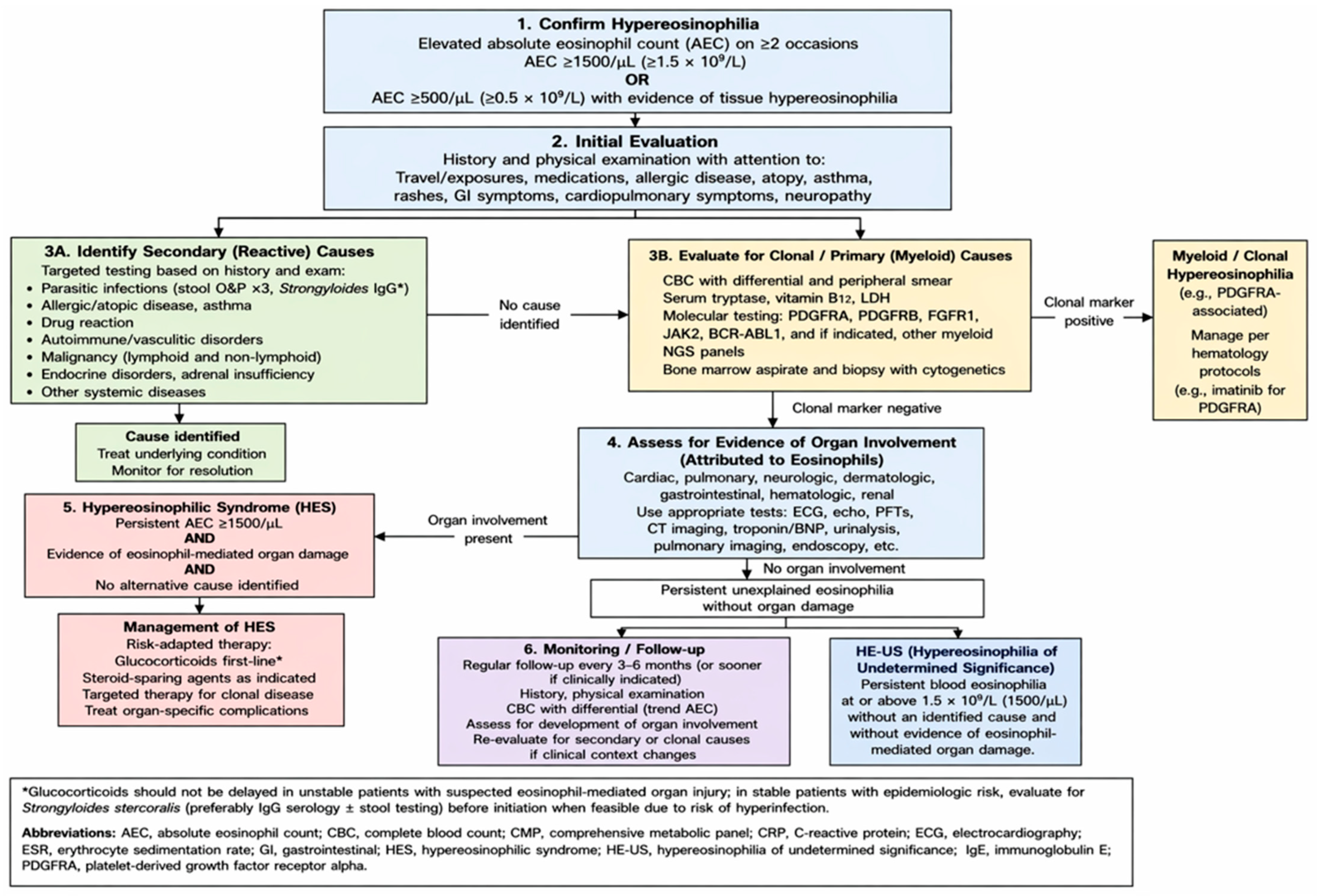
7. Evaluation of Peripheral Eosinophilia (Figure 1)
7.1. Overview and Diagnostic Rationale

7.2. Confirmation of Persistent Eosinophilia
7.3. Clinical History and Secondary Causes
7.4. Baseline Laboratory Evaluation
7.5. Organ-Directed Assessment
7.6. Evaluation for Primary or Clonal Eosinophilic Disorders
7.7. Bone Marrow, Cytogenetic, and Lymphocytic-Variant Evaluation
7.8. Diagnostic Pitfalls and Uncertainties
7.9. Urgent Evaluation and Diagnostic Pathway Integration
8. Treatment and Management of Peripheral Eosinophilia
8.1. Initial Approach
- Stop nonessential or suspect medications.
- Treat reversible secondary causes such as infection, allergy, or autoimmune disease.
- Perform baseline organ assessment as indicated (e.g., troponin, echocardiography, pulmonary function testing).
8.2. Corticosteroids
8.3. Management of Secondary Causes
- Drug reactions;
- Parasitic infections;
- Allergic and atopic disease;
- Autoimmune or vasculitic conditions.
8.4. Targeted and Steroid-Sparing Therapies
- Clonal eosinophilia: Imatinib is the first-line treatment for FIP1L1::PDGFRA-associated disease and is highly effective, often at low doses. Other molecular abnormalities may require alternative targeted therapies [6].
9. Follow-Up and Monitoring
10. Limitations
11. Conclusions
Funding
Institutional Review Board Statement
Informed Consent Statement
Data Availability Statement
Acknowledgments
Conflicts of Interest
Abbreviations
| AEC | Absolute eosinophil count |
| HES | Hypereosinophilic syndrome |
References
- Valent, P.; Klion, A.D.; Roufosse, F.; Simon, D.; Metzgeroth, G.; Leiferman, K.M.; Schwaab, J.; Butterfield, J.H.; Sperr, W.R.; Sotlar, K.; et al. Proposed refined diagnostic criteria and classification of eosinophil disorders and related syndromes. Allergy 2023, 78, 47–59. [Google Scholar] [CrossRef] [Scilit]
- Davoine, F.; Lacy, P. Eosinophil cytokines, chemokines, and growth factors: Emerging roles in immunity. Front. Immunol. 2014, 5, 570. [Google Scholar] [CrossRef] [Scilit] [PubMed]
- Gurtner, A.; Crepaz, D.; Arnold, I.C. Emerging functions of tissue-resident eosinophils. J. Exp. Med. 2023, 220, e20221435. [Google Scholar] [CrossRef] [Scilit] [PubMed]
- Klion, A.D. How I treat hypereosinophilic syndromes. Blood 2015, 126, 1069–1077. [Google Scholar] [CrossRef] [Scilit] [PubMed]
- Simon, H.U.; Rothenberg, M.E.; Bochner, B.S.; Weller, P.F.; Wardlaw, A.J.; Wechsler, M.E.; Rosenwasser, L.J.; Roufosse, F.; Gleich, G.J.; Klion, A.D. Refining the definition of hypereosinophilic syndrome. J. Allergy Clin. Immunol. 2010, 126, 45–49. [Google Scholar] [CrossRef] [Scilit] [PubMed]
- Shomali, W.; Gotlib, J. World Health Organization and International Consensus Classification of eosinophilic disorders: 2024 update on diagnosis, risk stratification, and management. Am. J. Hematol. 2024, 99, 946–968. [Google Scholar] [CrossRef] [Scilit] [PubMed]
- Crane, M.M.; Chang, C.M.; Kobayashi, M.G.; Weller, P.F. Incidence of myeloproliferative hypereosinophilic syndrome in the United States and an estimate of all hypereosinophilic syndrome incidence. J. Allergy Clin. Immunol. 2010, 126, 179–181. [Google Scholar] [CrossRef] [Scilit] [PubMed]
- Roufosse, F.; Weller, P.F. Practical approach to the patient with hypereosinophilia. J. Allergy Clin. Immunol. 2010, 126, 39–44. [Google Scholar] [CrossRef] [Scilit] [PubMed]
- Pozdnyakova, O.; Orazi, A.; Kelemen, K.; King, R.; Reichard, K.K.; Craig, F.E.; Quintanilla-Martinez, L.; Rimsza, L.; George, T.I.; Horny, H.P.; et al. Myeloid/lymphoid neoplasms associated with eosinophilia and rearrangements of PDGFRA, PDGFRB, or FGFR1 or with PCM1-JAK2. Am. J. Clin. Pathol. 2021, 155, 160–178. [Google Scholar] [CrossRef] [Scilit] [PubMed]
- Cools, J.; DeAngelo, D.J.; Gotlib, J.; Stover, E.H.; Legare, R.D.; Cortes, J.; Kutok, J.; Clark, J.; Galinsky, I.; Griffin, J.D.; et al. A tyrosine kinase created by fusion of the PDGFRA and FIP1L1 genes as a therapeutic target of imatinib in idiopathic hypereosinophilic syndrome. N. Engl. J. Med. 2003, 348, 1201–1214. [Google Scholar] [CrossRef] [Scilit] [PubMed]
- Rohmer, J.; Couteau-Chardon, A.; Trichereau, J.; Panel, K.; Gesquière, C.; Ben Abdelali, R.; Bidet, A.; Bladé, J.S.; Cayuela, J.M.; Cony-Makhoul, P.; et al. Epidemiology, clinical picture and long-term outcomes of FIP1L1-PDGFRA-positive myeloid neoplasm with eosinophilia: Data from 151 patients. Am. J. Hematol. 2020, 95, 1314–1323. [Google Scholar] [CrossRef] [Scilit] [PubMed]
- Rosenberg, H.F.; Dyer, K.D.; Foster, P.S. Eosinophils: Changing perspectives in health and disease. Nat. Rev. Immunol. 2013, 13, 9–22. [Google Scholar] [CrossRef] [Scilit] [PubMed]
- Acharya, K.R.; Ackerman, S.J. Eosinophil granule proteins: Form and function. J. Biol. Chem. 2014, 289, 17406–17415. [Google Scholar] [CrossRef] [Scilit] [PubMed]
- Kuang, F.L. Approach to patients with eosinophilia. Med. Clin. N. Am. 2020, 104, 1–14. [Google Scholar] [CrossRef] [Scilit] [PubMed]
- Butt, N.M.; Lambert, J.; Ali, S.; Beer, P.A.; Cross, N.C.; Duncombe, A.; Ewing, J.; Harrison, C.N.; Knapper, S.; McLornan, D.; et al. Guideline for the investigation and management of eosinophilia. Br. J. Haematol. 2017, 176, 553–572. [Google Scholar] [CrossRef] [Scilit] [PubMed]
- Ezekwe, E.A.D., Jr.; Weskamp, A.L.; Rahim, R.; Makiya, M.A.; Wetzler, L.; Ware, J.M.; Nelson, C.; Castillo, P.A.; Riley, C.A.; Brown, T.; et al. Dupilumab use in patients with hypereosinophilic syndromes: A multicenter case series and review of the literature. J. Allergy Clin. Immunol. Pract. 2025, 13, 167–175.e6. [Google Scholar] [CrossRef] [Scilit] [PubMed]
- Portacci, A.; Poto, R.; Varricchi, G.; Carpagnano, G.E. Dupilumab and blood eosinophilia: A disease-specific phenomenon? Allergy 2025, 80, 1811–1814. [Google Scholar] [CrossRef] [Scilit] [PubMed]
- Mormile, I.; Petraroli, A.; Loffredo, S.; Rossi, F.W.; Mormile, M.; Del Mastro, A.; Spadaro, G.; de Paulis, A.; Bova, M. Episodic angioedema with hypereosinophilia (Gleich’s syndrome): A case report and extensive review of the literature. J. Clin. Med. 2021, 10, 1442. [Google Scholar] [CrossRef] [Scilit] [PubMed]
- Williams, K.W.; Milner, J.D.; Freeman, A.F. Eosinophilia associated with disorders of immune deficiency or immune dysregulation. Immunol. Allergy Clin. N. Am. 2015, 35, 523–544. [Google Scholar] [CrossRef] [Scilit] [PubMed]
- Ozkok, A. Cholesterol-embolization syndrome: Current perspectives. Vasc. Health Risk Manag. 2019, 15, 209–220. [Google Scholar] [CrossRef] [Scilit] [PubMed]
- Nutman, T.B. Evaluation and differential diagnosis of marked, persistent eosinophilia. Immunol. Allergy Clin. N. Am. 2007, 27, 529–549. [Google Scholar] [CrossRef] [Scilit] [PubMed]
- Rothenberg, M.E.; Klion, A.D.; Roufosse, F.E.; Kahn, J.E.; Weller, P.F.; Simon, H.U.; Schwartz, L.B.; Rosenwasser, L.J.; Ring, J.; Griffin, E.F.; et al. Treatment of patients with the hypereosinophilic syndrome with mepolizumab. N. Engl. J. Med. 2008, 358, 1215–1228. [Google Scholar] [CrossRef] [Scilit] [PubMed]
Disclaimer/Publisher’s Note: The statements, opinions and data contained in all publications are solely those of the individual author(s) and contributor(s) and not of MDPI and/or the editor(s). MDPI and/or the editor(s) disclaim responsibility for any injury to people or property resulting from any ideas, methods, instructions or products referred to in the content. |
© 2026 by the author. Licensee MDPI, Basel, Switzerland. This article is an open access article distributed under the terms and conditions of the Creative Commons Attribution (CC BY) license.
Share and Cite
Yousef, E. Peripheral Eosinophilia: A Practical Clinical Approach to Evaluation and Management. Allergies 2026, 6, 28. https://doi.org/10.3390/allergies6030028
Yousef E. Peripheral Eosinophilia: A Practical Clinical Approach to Evaluation and Management. Allergies. 2026; 6(3):28. https://doi.org/10.3390/allergies6030028
Chicago/Turabian StyleYousef, Ejaz. 2026. "Peripheral Eosinophilia: A Practical Clinical Approach to Evaluation and Management" Allergies 6, no. 3: 28. https://doi.org/10.3390/allergies6030028
APA StyleYousef, E. (2026). Peripheral Eosinophilia: A Practical Clinical Approach to Evaluation and Management. Allergies, 6(3), 28. https://doi.org/10.3390/allergies6030028