


Allergic Chronic Rhinosinusitis: Myth, Misnomer, or Missing Endotype?

Abstract
1. Introduction
2. Materials and Methods
3. What Would Make “Allergic CRS” a Valid Endotype?

| Domain | Operational Criteria/Evidence Threshold |
|---|---|
| A1. Objective CRS (required) | Symptoms for ≥12 weeks plus objective evidence of sinonasal inflammation on endoscopy and/or CT [1,2]. |
| A2. Clinically relevant allergy (required) | Sensitization confirmed by SPT or serum allergen-specific IgE with concordant history (seasonality/exposure). Consider LAR when systemic tests are negative but clinical suspicion is high [8,9,11,12]. |
| A3. Type 2/IgE signal in CRS compartment (required) | Evidence of type 2 inflammation in sinonasal disease (e.g., tissue eosinophilia, elevated IL-5/IL-13 signatures, local IgE). Note: supports type 2 endotyping but is not specific for allergen causality [3,4,5,6,7,26,27,28,29,30]. |
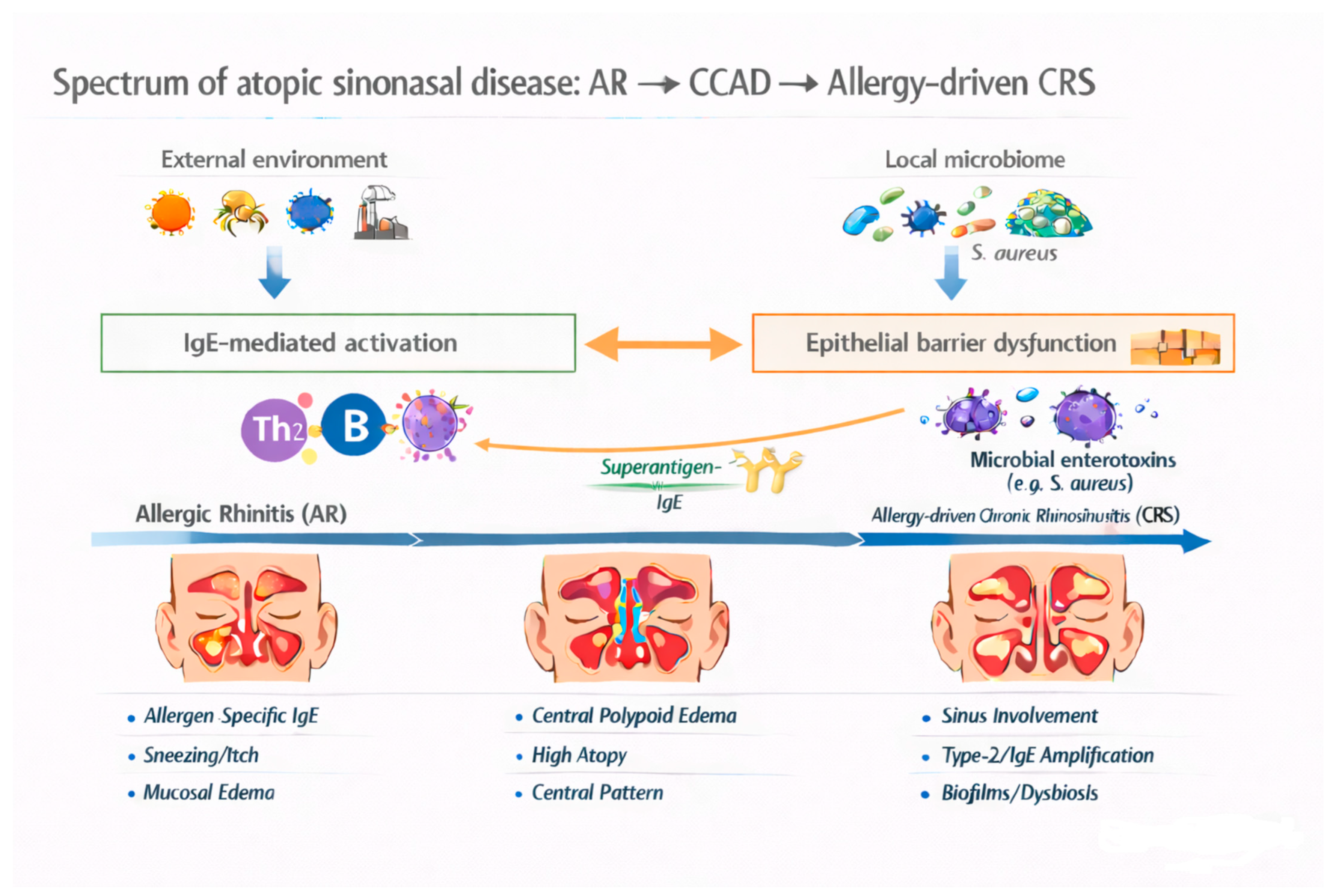
| B1. Anatomic pattern consistent with allergen contact (supportive) | Central compartment–predominant polypoid edema (middle/superior turbinates, posterosuperior septum) and/or central pattern of sinus disease, compatible with CCAD [21,22,23,24,25,31]. |
| B2. AFRS features (supportive) | Clinicopathologic features compatible with AFRS (eosinophilic mucin, fungal elements, characteristic imaging) [17,18,19,20]. |
| B3. Evidence of allergen relevance in target tissue (supportive) | Allergen-specific IgE detected in sinonasal secretions or tissue and/or markers consistent with local IgE generation (e.g., class-switch/receptor revision signatures). Distinguish from superantigen-amplified, non-allergen IgE (see Section 5) [32,33,34]. |
| B4. Exposure–response coupling (supportive) | Objective CRS worsening aligned with allergen exposure (seasonal/occupational) and improvement with validated avoidance strategies. |
| B5. Differential response to allergy-directed intervention (supportive) | Improvement in CRS-specific outcomes with allergy-directed therapy (e.g., AIT in selected phenotypes) beyond expected benefit from standard CRS care; current evidence base is limited and phenotype-specific [15,16]. |
| C. Competing explanations/confounders | Features suggesting alternate primary drivers (secondary CRS causes, AERD/N-ERD, superantigen-related IgE amplification, medication effects) that reduce specificity of an allergic endotype hypothesis [1,2,29,30,32,33,35,36]. |
4. Epidemiology: Signals, Confounders, and Why “Association” Is Not Enough
5. Mechanistic Substrate: Type 2 Immunity and IgE in CRS
6. Barrier Dysfunction and Remodeling: A Gateway to Persistent Inflammation
7. Host–Microbe Ecology: Dysbiosis, Biofilms, and Viral Modulation
8. Prototypes and Constraints: Where an Allergic Mechanism Is Most (and Least) Plausible
8.1. Allergic Fungal Rhinosinusitis (AFRS): A Strong Prototype
8.2. Central Compartment Atopic Disease (CCAD): Allergen Contact Pattern as Phenotype
8.3. Anatomic and Physical Constraints: Do Inhaled Allergens Reach the Sinuses?
8.4. Non-IgE Type 2 Entities: Preventing Diagnostic Oversimplification
9. Clinical Implications: A Mechanism-Informed Approach Without Overdiagnosis
9.1. A Pragmatic Diagnostic Workflow: From Syndrome to Mechanism
9.2. Therapeutic Implications: What Changes if Allergy Is Mechanistically Relevant?
9.3. Monitoring and Outcomes: What to Track in “Possible Allergic CRS”
10. Research Agenda: Converting a Heuristic Label into a Testable Endotype
11. Conclusions
Author Contributions
Funding
Institutional Review Board Statement
Informed Consent Statement
Data Availability Statement
Conflicts of Interest
Abbreviations
| AERD | aspirin-exacerbated respiratory disease |
| AFRS | allergic fungal rhinosinusitis |
| AR | allergic rhinitis |
| CCAD | central compartment atopic disease |
| CRS | chronic rhinosinusitis |
| CRSwNP | chronic rhinosinusitis with nasal polyps |
| CRSsNP | chronic rhinosinusitis without nasal polyps |
| CT | computed tomography |
| LAR | local allergic rhinitis |
| N-ERD | NSAID-exacerbated respiratory disease |
| SE | Staphylococcus aureus enterotoxin |
| SEB | Staphylococcus aureus enterotoxin B |
| SPT | skin prick test |
| TSLP | thymic stromal lymphopoietin |
References
- Fokkens, W.J.; Lund, V.J.; Hopkins, C.; Hellings, P.W.; Kern, R.; Reitsma, S.; Toppila-Salmi, S.; Bernal-Sprekelsen, M.; Mullol, J.; Alobid, I.; et al. European Position Paper on Rhinosinusitis and Nasal Polyps 2020. Rhinology 2020, 58, 1–464. [Google Scholar] [CrossRef] [PubMed]
- Orlandi, R.R.; Kingdom, T.T.; Smith, T.L.; Bleier, B.; DeConde, A.; Luong, A.U.; Poetker, D.M.; Soler, Z.M.; Welch, K.C.; Wise, S.K.; et al. International consensus statement on allergy and rhinology: Rhinosinusitis 2021. Int. Forum Allergy Rhinol. 2021, 11, 213–739. [Google Scholar] [CrossRef] [PubMed]
- Akdis, C.A.; Bachert, C.; Cingi, C.; Dykewicz, M.S.; Hellings, P.W.; Naclerio, R.M.; Schleimer, R.P.; Ledford, D. Endotypes and phenotypes of chronic rhinosinusitis: A PRACTALL document of the EAACI and the AAAAI. J. Allergy Clin. Immunol. 2013, 131, 1479–1490. [Google Scholar] [CrossRef] [PubMed]
- Tomassen, P.; Vandeplas, G.; Van Zele, T.; Cardell, L.-O.; Arebro, J.; Olze, H.; Förster-Ruhrmann, U.; Kowalski, M.L.; Olszewska-Ziąber, A.; Holtappels, G.; et al. Inflammatory endotypes of chronic rhinosinusitis based on cluster analysis of biomarkers. J. Allergy Clin. Immunol. 2016, 137, 1449–1456.e4. [Google Scholar] [CrossRef] [PubMed]
- Schleimer, R.P. Immunopathogenesis of Chronic Rhinosinusitis and Nasal Polyposis. Annu. Rev. Pathol. 2017, 12, 331–357. [Google Scholar] [CrossRef] [PubMed]
- Kato, A. Immunopathology of chronic rhinosinusitis. Allergol. Int. 2015, 64, 121–130. [Google Scholar] [CrossRef] [PubMed]
- Wilson, K.F.; McMains, K.C.; Orlandi, R.R. The association between allergy and chronic rhinosinusitis with and without nasal polyps: An evidence-based review with recommendations. Int. Forum Allergy Rhinol. 2014, 4, 93–103. [Google Scholar] [CrossRef] [PubMed]
- Dykewicz, M.S.; Wallace, D.V.; Amrol, D.J.; Baroody, F.M.; Bernstein, J.A.; Craig, T.J.; Dinakar, C.; Ellis, A.K.; Finegold, I.; Golden, D.B.; et al. Rhinitis 2020: A practice parameter update. J. Allergy Clin. Immunol. 2020, 146, 721–767. [Google Scholar] [CrossRef] [PubMed]
- Rondón, C.; Campo, P.; Eguiluz-Gracia, I.; Plaza, C.; Bogas, G.; Galindo, P.; Mayorga, C.; Torres, M.J. Local allergic rhinitis is an independent rhinitis phenotype: The results of a 10-year follow-up study. Allergy 2018, 73, 470–478. [Google Scholar] [CrossRef] [PubMed]
- Arbes, S.J., Jr.; Gergen, P.J.; Elliott, L.; Zeldin, D.C. Prevalences of positive skin test responses to 10 common allergens in the US population: Results from NHANES III. J. Allergy Clin. Immunol. 2005, 116, 377–383. [Google Scholar] [CrossRef] [PubMed]
- Vardouniotis, A.; Doulaptsi, M.; Aoi, N.; Karatzanis, A.; Kawauchi, H.; Prokopakis, E. Local Allergic Rhinitis Revisited. Curr. Allergy Asthma Rep. 2020, 20, 22. [Google Scholar] [CrossRef] [PubMed]
- Augé, J.; Vent, J.; Agache, I.; Airaksinen, L.; Campo Mozo, P.; Chaker, A.; Cingi, C.; Durham, S.; Fokkens, W.; Gevaert, P.; et al. EAACI Position Paper on the Standardization of Nasal Allergen Challenges. Allergy 2018, 73, 1597–1608. [Google Scholar] [CrossRef] [PubMed]
- Baethge, C.; Goldbeck-Wood, S.; Mertens, S. SANRA-a scale for the quality assessment of narrative review articles. Res. Integr. Peer Rev. 2019, 4, 5. [Google Scholar] [CrossRef] [PubMed]
- Sukhera, J. Narrative Reviews: Flexible, Rigorous, and Practical. J. Grad. Med. Educ. 2022, 14, 414–417. [Google Scholar] [CrossRef] [PubMed]
- Young, K.; Wentzel, J.L.; Schlosser, R.J.; Nguyen, S.A.; Soler, Z.M. Systematic review of immunotherapy for chronic rhinosinusitis. Am. J. Rhinol. Allergy 2014, 28, 145–150. [Google Scholar] [CrossRef] [PubMed]
- Meerwein, C.M.; Sacks, P.-L.; Ho, J.; Choy, C.; Kalish, L.; Campbell, R.G.; Sacks, R.R.; Harvey, R.J. The effect of allergen immunotherapy in patients with central compartment atopic disease post-surgery. Int. Forum Allergy Rhinol. 2025, 15, 128–134. [Google Scholar] [CrossRef] [PubMed]
- Chakrabarti, A.; Denning, D.W.; Ferguson, B.J.; Ponikau, J.; Buzina, W.; Kita, H.; Marple, B.; Panda, N.; Vlaminck, S.; Kauffmann-Lacroix, C.; et al. Fungal rhinosinusitis: A categorization and definitional schema addressing current controversies. Laryngoscope 2009, 119, 1809–1818. [Google Scholar] [CrossRef] [PubMed]
- Bent, J.P., 3rd; Kuhn, F.A. Diagnosis of allergic fungal sinusitis. Otolaryngol. Head Neck Surg. 1994, 111, 580–588. [Google Scholar] [CrossRef] [PubMed]
- Dykewicz, M.S.; Rodrigues, J.M.; Slavin, R.G. Allergic fungal rhinosinusitis. J. Allergy Clin. Immunol. 2018, 142, 341–351. [Google Scholar] [CrossRef] [PubMed]
- Collins, M.; Nair, S.; Smith, W.; Kette, F.; Gillis, D.; Wormald, P.J. Role of local immunoglobulin E production in the pathophysiology of noninvasive fungal sinusitis. Laryngoscope 2004, 114, 1242–1246. [Google Scholar] [CrossRef] [PubMed]
- DelGaudio, J.M.; Loftus, P.A.; Hamizan, A.W.; Harvey, R.J.; Wise, S.K. Central compartment atopic disease. Am. J. Rhinol. Allergy 2017, 31, 228–234. [Google Scholar] [CrossRef] [PubMed]
- Hamizan, A.W.; Loftus, P.A.; Alvarado, R.; Ho, J.; Kalish, L.; Sacks, R.; DelGaudio, J.M.; Harvey, R.J. Allergic phenotype of chronic rhinosinusitis based on radiologic pattern of disease. Laryngoscope 2018, 128, 2015–2021. [Google Scholar] [CrossRef] [PubMed]
- Marcus, S.; Schertzer, J.; Roland, L.T.; Wise, S.K.; Levy, J.M.; DelGaudio, J.M. Central compartment atopic disease: Prevalence of allergy and asthma compared with other subtypes of chronic rhinosinusitis with nasal polyps. Int. Forum Allergy Rhinol. 2020, 10, 183–189. [Google Scholar] [CrossRef] [PubMed]
- Steehler, A.J.; Vuncannon, J.R.; Wise, S.K.; DelGaudio, J.M. Central compartment atopic disease: Outcomes compared with other subtypes of chronic rhinosinusitis with nasal polyps. Int. Forum Allergy Rhinol. 2021, 11, 1549–1556. [Google Scholar] [CrossRef] [PubMed]
- Hamizan, A.W.; Christensen, J.M.; Ebenzer, J.; Oakley, G.; Tattersall, J.; Sacks, R.; Harvey, R.J. Middle turbinate edema as a diagnostic marker of inhalant allergy. Int. Forum Allergy Rhinol. 2017, 7, 37–42. [Google Scholar] [CrossRef] [PubMed]
- Dietz de Loos, D.; Lourijsen, E.S.; Wildeman, M.A.M.; Freling, N.J.M.; Wolvers, M.D.J.; Reitsma, S.; Fokkens, W.J. Prevalence of chronic rhinosinusitis in the general population based on sinus radiology and symptomatology. J. Allergy Clin. Immunol. 2019, 143, 1207–1214. [Google Scholar] [CrossRef] [PubMed]
- Hirsch, A.G.; Nordberg, C.; Bandeen-Roche, K.; Tan, B.K.; Schleimer, R.P.; Kern, R.C.; Sundaresan, A.; Pinto, J.M.; Kennedy, T.L.; Greene, J.S.; et al. Radiologic sinus inflammation and symptoms of chronic rhinosinusitis in a population-based sample. Allergy 2020, 75, 911–920. [Google Scholar] [PubMed]
- Shi, J.-B.; Fu, Q.-L.; Zhang, H.; Cheng, L.; Wang, Y.-J.; Zhu, D.-D.; Lv, W.; Liu, S.-X.; Li, P.-Z.; Ou, C.-Q.; et al. Epidemiology of chronic rhinosinusitis: Results from a cross-sectional survey in seven Chinese cities. Allergy 2015, 70, 533–539. [Google Scholar] [CrossRef] [PubMed]
- Philpott, C.M.; Erskine, S.; Hopkins, C.; Kumar, N.; Anari, S.; Kara, N.; Sunkaraneni, S.; Ray, J.; Clark, A.; Wilson, A.; et al. Prevalence of asthma, aspirin sensitivity and allergy in chronic rhinosinusitis: Data from the UK National Chronic Rhinosinusitis Epidemiology Study. Respir. Res. 2018, 19, 129. [Google Scholar] [CrossRef] [PubMed]
- Li, Q.-C.; Cheng, K.-J.; Wang, F.; Zhou, S.-H. Role of atopy in chronic rhinosinusitis with nasal polyps: Does an atopic condition affect the severity and recurrence of disease? J. Laryngol. Otol. 2016, 130, 640–644. [Google Scholar] [CrossRef] [PubMed]
- Benjamin, M.R.; Stevens, W.W.; Li, N.; Bose, S.; Grammer, L.C.; Kern, R.C.; Tan, B.K.; Conley, D.B.; Smith, S.S.; Welch, K.C.; et al. Clinical Characteristics of Patients with Chronic Rhinosinusitis without Nasal Polyps in an Academic Setting. J. Allergy Clin. Immunol. Pract. 2019, 7, 1010–1016. [Google Scholar] [CrossRef] [PubMed]
- Gevaert, P.; Nouri-Aria, K.T.; Wu, H.; Harper, C.E.; Takhar, P.; Fear, D.J.; Acke, F.; De Ruyck, N.; Banfield, G.; Kariyawasam, H.H.; et al. Local receptor revision and class switching to IgE in chronic rhinosinusitis with nasal polyps. Allergy 2013, 68, 55–63. [Google Scholar] [CrossRef] [PubMed]
- Bachert, C.; Zhang, N.; Holtappels, G.; De Lobel, L.; van Cauwenberge, P.; Liu, S.; Lin, P.; Bousquet, J.; Van Steen, K. Presence of IL-5 protein and IgE antibodies to staphylococcal enterotoxins in nasal polyps is associated with comorbid asthma. J. Allergy Clin. Immunol. 2010, 126, 962–968.e6. [Google Scholar] [CrossRef] [PubMed]
- Chegini, Z.; Didehdar, M.; Khoshbayan, A.; Karami, J.; Yousefimashouf, M.; Shariati, A. The role of Staphylococcus aureus enterotoxin B in chronic rhinosinusitis with nasal polyposis. Cell Commun. Signal. 2022, 20, 29. [Google Scholar] [CrossRef] [PubMed]
- Wang, X.; Zhang, N.; Bo, M.; Holtappels, G.; Zheng, M.; Lou, H.; Wang, H.; Zhang, L.; Bachert, C. Diversity of TH cytokine profiles in patients with chronic rhinosinusitis: A multicenter study in Europe, Asia, and Oceania. J. Allergy Clin. Immunol. 2016, 138, 1344–1353. [Google Scholar] [CrossRef] [PubMed]
- Hulse, K.E.; Stevens, W.W.; Tan, B.K.; Schleimer, R.P. Pathogenesis of nasal polyposis. Clin. Exp. Allergy 2015, 45, 328–346. [Google Scholar] [CrossRef] [PubMed]
- Schleimer, R.P.; Berdnikovs, S. Etiology of epithelial barrier dysfunction in patients with type 2 inflammatory diseases. J. Allergy Clin. Immunol. 2017, 139, 1752–1761. [Google Scholar] [CrossRef] [PubMed]
- Pothoven, K.L.; Norton, J.E.; Hulse, K.E.; Suh, L.A.; Carter, R.G.; Rocci, E.; Harris, K.E.; Shintani-Smith, S.; Conley, D.B.; Chandra, R.K.; et al. Oncostatin M promotes mucosal epithelial barrier dysfunction, and its expression is increased in patients with eosinophilic mucosal disease. J. Allergy Clin. Immunol. 2015, 136, 737–746.e4. [Google Scholar] [CrossRef] [PubMed]
- Ordovas-Montanes, J.; Dwyer, D.F.; Nyquist, S.K.; Buchheit, K.M.; Vukovic, M.; Deb, C.; Wadsworth, M.H., 2nd; Hughes, T.K.; Kazer, S.W.; Yoshimoto, E.; et al. Allergic inflammatory memory in human respiratory epithelial progenitor cells. Nature 2018, 560, 649–654. [Google Scholar] [CrossRef] [PubMed]
- Takabayashi, T.; Kato, A.; Peters, A.T.; Hulse, K.E.; Suh, L.A.; Carter, R.; Norton, J.; Grammer, L.C.; Cho, S.H.; Tan, B.K.; et al. Excessive fibrin deposition in nasal polyps caused by fibrinolytic impairment through reduction of tissue plasminogen activator expression. Am. J. Respir. Crit. Care Med. 2013, 187, 49–57. [Google Scholar] [CrossRef] [PubMed]
- Chen, C.-L.; Yao, Y.; Pan, L.; Hu, S.-T.; Ma, J.; Wang, Z.-C.; Kern, R.C.; Schleimer, R.P.; Liu, Z. Common fibrin deposition and tissue plasminogen activator downregulation in nasal polyps with distinct inflammatory endotypes. J. Allergy Clin. Immunol. 2020, 146, 677–681. [Google Scholar] [CrossRef] [PubMed]
- Psaltis, A.J.; Mackenzie, B.W.; Cope, E.K.; Ramakrishnan, V.R. Unraveling the role of the microbiome in chronic rhinosinusitis. J. Allergy Clin. Immunol. 2022, 149, 1513–1521. [Google Scholar] [CrossRef] [PubMed]
- Campo, P.; Canonica, G.W. Local Allergic Rhinitis. J. Allergy Clin. Immunol. Pract. 2024, 12, 1430–1433. [Google Scholar] [CrossRef] [PubMed]
- Abreu, N.A.; Nagalingam, N.A.; Song, Y.; Roediger, F.C.; Pletcher, S.D.; Goldberg, A.N.; Lynch, S.V. Sinus microbiome diversity depletion and Corynebacterium tuberculostearicum enrichment mediates rhinosinusitis. Sci. Transl. Med. 2012, 4, 151ra124. [Google Scholar] [CrossRef] [PubMed]
- Ramakrishnan, V.R.; Hauser, L.J.; Feazel, L.M.; Ir, D.; Robertson, C.E.; Frank, D.N. Sinus microbiota varies among chronic rhinosinusitis phenotypes and predicts surgical outcome. J. Allergy Clin. Immunol. 2015, 136, 334–342.e1. [Google Scholar] [CrossRef] [PubMed]
- Cope, E.K.; Goldberg, A.N.; Pletcher, S.D.; Lynch, S.V. Compositionally and functionally distinct sinus microbiota in chronic rhinosinusitis patients have immunological and clinically divergent consequences. Microbiome 2017, 5, 53. [Google Scholar] [CrossRef] [PubMed]
- Anderson, M.; Stokken, J.; Sanford, T.; Aurora, R.; Sindwani, R. A systematic review of the sinonasal microbiome in chronic rhinosinusitis. Am. J. Rhinol. Allergy 2016, 30, 161–166. [Google Scholar] [CrossRef] [PubMed]
- Wagner Mackenzie, B.; Waite, D.W.; Hoggard, M.; Douglas, R.G.; Taylor, M.W.; Biswas, K. Bacterial community collapse: A meta-analysis of the sinonasal microbiota in chronic rhinosinusitis. Environ. Microbiol. 2017, 19, 381–392. [Google Scholar] [CrossRef] [PubMed]
- Chalermwatanachai, T.; Vilchez-Vargas, R.; Holtappels, G.; Lacoere, T.; Jauregui, R.; Kerckhof, F.-M.; Pieper, D.H.; Van de Wiele, T.; Vaneechoutte, M.; Van Zele, T.; et al. Chronic rhinosinusitis with nasal polyps is characterized by dysbacteriosis of the nasal microbiota. Sci. Rep. 2018, 8, 7926. [Google Scholar] [CrossRef] [PubMed]
- Mahdavinia, M.; Engen, P.A.; LoSavio, P.S.; Naqib, A.; Khan, R.J.; Tobin, M.C.; Mehta, A.; Kota, R.; Preite, N.Z.; Codispoti, C.D.; et al. The nasal microbiome in patients with chronic rhinosinusitis: Analyzing the effects of atopy and bacterial functional pathways in 111 patients. J. Allergy Clin. Immunol. 2018, 142, 287–290.e4. [Google Scholar] [CrossRef] [PubMed]
- Liang, Y.; Xie, R.; Xiong, X.; Hu, Z.; Mao, X.; Wang, X.; Zhang, J.; Sun, P.; Yue, Z.; Wang, W.; et al. Alterations of nasal microbiome in eosinophilic chronic rhinosinusitis. J. Allergy Clin. Immunol. 2023, 151, 1286–1295.e2. [Google Scholar] [CrossRef] [PubMed]
- Bartosik, T.J.; Campion, N.J.; Freisl, K.; Liu, D.T.; Gangl, K.; Stanek, V.; Tu, A.; Pjevac, P.; Hausmann, B.; Eckl-Dorna, J.; et al. The nasal microbiome in patients suffering from non-steroidal anti-inflammatory drugs-exacerbated respiratory disease in absence of corticosteroids. Front. Immunol. 2023, 14, 1112345. [Google Scholar] [CrossRef] [PubMed]
- Kumar, N.; Brar, T.; Kita, H.; Marks, L.A.; Miglani, A.; Marino, M.J.; Lal, D. Viruses in chronic rhinosinusitis: A systematic review. Front. Allergy 2023, 4, 1237068. [Google Scholar] [CrossRef] [PubMed]
- Barrow, E.M.; Wise, S.K.; Botros, A.; Harvey, R.J.; Edwards, T.S.; DelGaudio, J.M. Central Compartment Atopic Disease: Analysis of Current Literature and Proposal of Diagnostic Criteria. Int. Forum Allergy Rhinol. 2025, 15, 1113–1135. [Google Scholar] [CrossRef] [PubMed]
- Adkins, T.N.; Goodgold, H.M.; Hendershott, L.; Slavin, R.G. Does inhaled pollen enter the sinus cavities? Ann. Allergy Asthma Immunol. 1998, 81, 181–184. [Google Scholar] [CrossRef] [PubMed]
- Connell, J.T.; Bouras, G.; Yeo, K.; Fenix, K.; Cooksley, C.; Bassiouni, A.; Vreugde, S.; Wormald, P.J.; Psaltis, A.J. Characterising the allergic fungal rhinosinusitis microenvironment using full-length 16S rRNA gene amplicon sequencing and fungal ITS sequencing. Allergy 2024, 79, 3082–3094. [Google Scholar] [CrossRef] [PubMed]
- White, A.A.; Stevenson, D.D. Aspirin-exacerbated respiratory disease. N. Engl. J. Med. 2018, 379, 1060–1070. [Google Scholar] [CrossRef] [PubMed]
- Kowalski, M.L.; Agache, I.; Bavbek, S.; Bakirtas, A.; Blanca, M.; Bochenek, G.; Bonini, M.; Heffler, E.; Klimek, L.; Laidlaw, T.M.; et al. Diagnosis and management of NSAID-exacerbated respiratory disease (N-ERD)—A EAACI position paper. Allergy 2019, 74, 28–39. [Google Scholar] [CrossRef] [PubMed]
- Rajan, J.P.; Wineinger, N.E.; Stevenson, D.D.; White, A.A. Prevalence of aspirin-exacerbated respiratory disease among asthmatic patients: A meta-analysis of the literature. J. Allergy Clin. Immunol. 2015, 135, 676–681.e1. [Google Scholar] [CrossRef] [PubMed]
- Stevens, W.W.; Peters, A.T.; Hirsch, A.G.; Nordberg, C.M.; Schwartz, B.S.; Mercer, D.G.; Mahdavinia, M.; Grammer, L.C.; Hulse, K.E.; Kern, R.C.; et al. Clinical Characteristics of Patients with Chronic Rhinosinusitis with Nasal Polyps, Asthma, and Aspirin-Exacerbated Respiratory Disease. J. Allergy Clin. Immunol. Pract. 2017, 5, 1061–1070.e3. [Google Scholar] [CrossRef] [PubMed]
- Fokkens, W.J.; Viskens, A.-S.; Backer, V.; Conti, D.; De Corso, E.; Gevaert, P.; Scadding, G.K.; Wagemann, M.; Bernal-Sprekelsen, M.; Chaker, A.; et al. EPOS/EUFOREA update on indication and evaluation of Biologics in Chronic Rhinosinusitis with Nasal Polyps 2023. Rhinology 2023, 61, 194–202. [Google Scholar] [CrossRef] [PubMed]
- Nakayama, T.; Haruna, S.-I. A review of current biomarkers in chronic rhinosinusitis with or without nasal polyps. Expert Rev. Clin. Immunol. 2023, 19, 883–892. [Google Scholar] [CrossRef] [PubMed]
- Bachert, C.; Han, J.K.; Desrosiers, M.; Hellings, P.W.; Amin, N.; Lee, S.E.; Mullol, J.; Greos, L.S.; Bosso, J.V.; Laidlaw, T.M.; et al. Efficacy and safety of dupilumab in patients with severe chronic rhinosinusitis with nasal polyps (LIBERTY NP SINUS-24 and LIBERTY NP SINUS-52): Results from two multicentre, randomised, double-blind, placebo-controlled, phase 3 trials. Lancet 2019, 394, 1638–1650. [Google Scholar] [CrossRef] [PubMed]
- Gevaert, P.; Omachi, T.A.; Corren, J.; Mullol, J.; Han, J.; Lee, S.E.; Kaufman, D.; Ligueros-Saylan, M.; Howard, M.; Zhu, R.; et al. Efficacy and safety of omalizumab in nasal polyposis: Two randomized phase 3 trials. J. Allergy Clin. Immunol. 2020, 146, 595–605. [Google Scholar] [CrossRef] [PubMed]
- Han, J.K.; Bachert, C.; Fokkens, W.; Desrosiers, M.; Wagenmann, M.; Lee, S.E.; Smith, S.G.; Martin, N.; Aboubakri, A.; Amin, N.; et al. Mepolizumab for chronic rhinosinusitis with nasal polyps (SYNAPSE): A randomised, double-blind, placebo-controlled, phase 3 trial. Lancet Respir. Med. 2021, 9, 1141–1153. [Google Scholar] [CrossRef] [PubMed]
- Lipworth, B.J.; Han, J.K.; Desrosiers, M.; Hopkins, C.; Lee, S.E.; Mullol, J.; Pfaar, O.; Li, T.; Chen, C.; Almqvist, G.; et al. Tezepelumab in Adults with Severe Chronic Rhinosinusitis with Nasal Polyps. N. Engl. J. Med. 2025, 392, 1178–1188. [Google Scholar] [CrossRef] [PubMed]
- Endam, L.M.; Alromaih, S.; Gonzalez, E.; Madrenas, J.; Cousineau, B.; Renteria, A.E.; Desrosiers, M. Intranasal Application of Lactococcus lactis W136 Is Safe in Chronic Rhinosinusitis Patients with Previous Sinus Surgery. Front. Cell. Infect. Microbiol. 2020, 10, 440. [Google Scholar] [CrossRef] [PubMed]
- Ooi, M.L.; Drilling, A.J.; Morales, S.; Fong, S.; Moraitis, S.; Macias-Valle, L.; Vreugde, S.; Psaltis, A.J.; Wormald, P.J. Safety and Tolerability of Bacteriophage Therapy for Chronic Rhinosinusitis Due to Staphylococcus aureus. JAMA Otolaryngol. Head Neck Surg. 2019, 145, 723–729. [Google Scholar] [CrossRef] [PubMed]
- Shekhar, S.; Schwarzer, M.; Dhariwal, A.; Petersen, F.C. Nasal microbiota transplantation: A gateway to novel treatments. Trends Microbiol. 2025, 33, 264–267. [Google Scholar] [CrossRef] [PubMed]
| Prototype | Core Clinical/ Anatomic Features | Putative Exposure Pattern | Mechanistic Plausibility | Strength of Evidence for Allergen Causality |
|---|---|---|---|---|
| Allergic rhinitis (AR) | Sneezing/itching, rhinorrhea, nasal obstruction; endoscopy without persistent sinus mucosal disease. | Direct nasal allergen exposure; often seasonal or exposure-triggered. | Allergen-specific IgE with mast cell activation and downstream type 2 inflammation [8,9]. | High (well-established IgE-mediated disease). |
| Central compartment atopic disease (CCAD) | Polypoid edema centered on middle/superior turbinates and posterosuperior septum; central pattern of sinus disease; often coexists with asthma/AR [21,22,23,24,25,54]. | Inhalant allergens plausibly deposit in central compartment regions with high airflow turbulence. | Anatomic contact pattern plus strong association with inhalant allergy suggest allergen relevance, but direct target-tissue allergen-specific IgE and exposure–response data are limited. | Moderate (consistent association; emerging criteria; limited mechanistic validation). |
| “Allergic CRS” (hypothesized diffuse endotype) | Diffuse objective CRS (often CRSwNP) with prominent rhinitis symptoms and strong exposure–response pattern. | Systemic and/or local allergen-specific IgE; sinus-compartment exposure often unmeasured and may be limited [55]. | Would require evidence that allergen-specific IgE is present and functional in sinonasal target tissue and is not better explained by local polyclonal/superantigen-amplified IgE [32,33,34]. | Low (conceptual; requires prospective validation). |
| Allergic fungal rhinosinusitis (AFRS) | CRSwNP with allergic mucin, eosinophilic inflammation, fungal elements, and characteristic imaging [17,18,19,20]. | Fungal antigens within sinonasal mucus/mucin; exposure may be chronic and compartmentalized. | Strong type 2 inflammation with local IgE responses; recent AFRS profiling supports biological complexity beyond simple fungal colonization [17,18,19,20,56]. | High (strongest current prototype, although mechanistic details remain debated). |
| Therapy Class | Axis Targeted/Rationale | Evidence Strength in CRS/CRSwNP | Key Notes for an “Allergic CRS” Hypothesis |
|---|---|---|---|
| Standard CRS care (saline, intranasal corticosteroids, short systemic steroids, endoscopic sinus surgery) | Reduces mucosal inflammation and improves drainage/ventilation; cornerstone of CRS care. | High (guideline-based standard of care) [1,2]. | Necessary regardless of endotype; endotyping should not delay evidence-based escalation. |
| Allergy-directed therapy (environmental control, antihistamines, AIT) | Targets allergen–IgE pathway and AR comorbidity; AIT tests allergen causality over time. | Low–moderate (limited and heterogeneous CRS-specific evidence; strongest signal in selected phenotypes and postoperative settings) [15,16]. | Most defensible when treating clear AR/asthma; potentially informative as a mechanistic modifier in AFRS/CCAD or exposure-linked disease. |
| Type 2 biologics (anti–IL-4Rα, anti–IgE, anti–IL-5, anti–TSLP) | Downstream (IL-4/IL-13, IL-5, IgE) and upstream (TSLP) type 2 pathways in CRSwNP. | High for dupilumab, omalizumab, mepolizumab; high for tezepelumab based on phase 3 evidence [63,64,65,66]. | Clinical response supports type 2 relevance but does not prove allergen causality; anti–IgE response may be more suggestive but can also reflect non-allergen IgE drivers. |
| Bacteriotherapy (e.g., Lactococcus lactis W136) | Modulates local microbiome and host responses; aims to restore colonization resistance. | Low (early-phase safety/feasibility data) [67]. | Mechanistically relevant if dysbiosis and biofilms sustain inflammation or amplify IgE via microbial pathways. |
| Bacteriophage therapy | Targets pathogenic bacteria and biofilms. | Low (early-phase safety/tolerability data) [68]. | May complement endotype-directed therapy if bacterial pathobionts contribute to disease persistence. |
| Nasal microbiota transplantation (concept) | Whole-community microbiome restoration. | Very low (conceptual/early translational discussion) [69]. | Hypothesis-generating; would require careful safety frameworks and mechanistic endpoints. |
Disclaimer/Publisher’s Note: The statements, opinions and data contained in all publications are solely those of the individual author(s) and contributor(s) and not of MDPI and/or the editor(s). MDPI and/or the editor(s) disclaim responsibility for any injury to people or property resulting from any ideas, methods, instructions or products referred to in the content. |
© 2026 by the authors. Licensee MDPI, Basel, Switzerland. This article is an open access article distributed under the terms and conditions of the Creative Commons Attribution (CC BY) license.
Share and Cite
Konstantinou, G.N.; Petalas, K. Allergic Chronic Rhinosinusitis: Myth, Misnomer, or Missing Endotype? Allergies 2026, 6, 14. https://doi.org/10.3390/allergies6020014
Konstantinou GN, Petalas K. Allergic Chronic Rhinosinusitis: Myth, Misnomer, or Missing Endotype? Allergies. 2026; 6(2):14. https://doi.org/10.3390/allergies6020014
Chicago/Turabian StyleKonstantinou, George N., and Konstantinos Petalas. 2026. "Allergic Chronic Rhinosinusitis: Myth, Misnomer, or Missing Endotype?" Allergies 6, no. 2: 14. https://doi.org/10.3390/allergies6020014
APA StyleKonstantinou, G. N., & Petalas, K. (2026). Allergic Chronic Rhinosinusitis: Myth, Misnomer, or Missing Endotype? Allergies, 6(2), 14. https://doi.org/10.3390/allergies6020014

