Genealogy-As-Pedagogy for Afro-Descendant Communities in Costa Rica, Panama, and Belize


Abstract
1. Introduction
- RQ1. How do Afro-descendant families and communities in Costa Rica, Panama, and Belize use genealogical memory, migration narratives, and kinship ties as pedagogical resources for sustaining English-based Creole languages across generations?
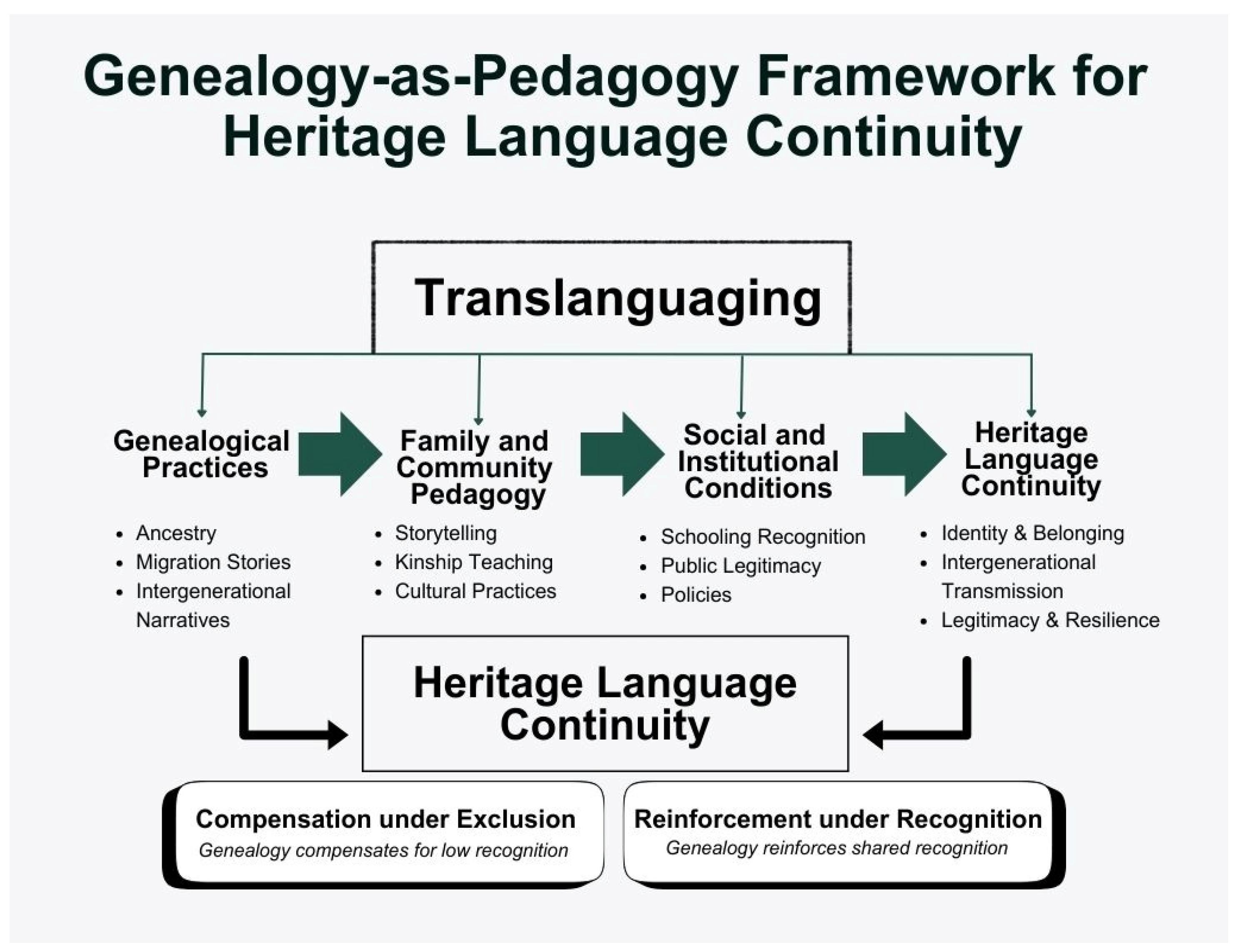
- RQ2. How do schooling systems, policy environments, and dominant language ideologies shape whether genealogy-as-pedagogy functions as compensation for exclusion or reinforcement of heritage-language continuity?
- RQ3. What do these cases reveal about the role of genealogical knowledge in designing historically and culturally sustaining and decolonial approaches to language and heritage-affirming education?
2. Background and Related Work
3. Theoretical Framework
4. Materials and Methods
- Published Oral Histories and Documented Narratives, documenting intergenerational memory and Creole use (Duncan 2024; Putnam 2013).
- Peer-reviewed Scholarship, describing features, identity meanings, and maintenance dynamics (Fuller Medina 2025; Vásquez Carranza and Schlemer Alcântara 2023).
- Policy Documents and Curriculum Guidance, including Belize’s National Education Sector Plan (Ministry of Education, Culture, Science and Technology 2021).
- Community Reports and Cultural Archives, used as contextual evidence and triangulated with other sources (Smith 2021).
- Educational Materials and Pedagogical Resources, analyzed comparatively to assess inclusion or omission of heritage language and lineage (De Oliveira et al. 2023; Paris and Alim 2017).
5. Case 1: Costa Rica
6. Case 2: Panama
7. Case 3: Belize
8. Cross-Case Comparative Analysis
9. From Genealogy to Infrastructure: AI-Supported Paths to English–Creole Education
10. The Impact of Genealogy-As Pedagogy Across Families, Communities, and Schools
- Implications for Families and Communities Engaging in Heritage Language Maintenance
- Implications for Schools and Educational Stakeholders
- Policy-Relevant Insights for Governments
11. Conclusions and Future Directions
Funding
Institutional Review Board Statement
Informed Consent Statement
Data Availability Statement
Conflicts of Interest
Appendix A

| Country | Document Type | Example Sources | Analytic Contributions |
|---|---|---|---|
| Costa Rica | 1. Published Oral Histories and Documented Narratives | Duncan (2013, 2024); Joseph Montout (2013); Putnam (2002, 2013); Ravasio (2020) | Capture intergenerational family memory, migration genealogies, and Afro-Caribbean settlement histories central to Limón’s English-based Creole-speaking heritage. |
| 2. Peer-reviewed Scholarship on Mekatelyu and Identity | Aguilar-Sánchez (2005); Herzfeld (2015); LaBoda (2021); Pizarro Chacón and Cordero Badilla (2015); Vásquez Carranza (2025) | Provide sociolinguistic analyses of Mekatelyu structure, use, and vitality, situating Limonese Creole within Costa Rica’s multilingual ecology. | |
| 3. Policy and Institutional Texts | Bell Jiménez (2020); Solano-Campos (2022); Universidad de Costa Rica [UCR], Facultad de Ciencias Sociales (2025) | Examine bilingual education policy, institutional frameworks, and Afro-descendant representation in educational planning. | |
| 4. Community and Cultural Archives | Ravasio (2021); Organization of American States (OAS) (n.d.); UNESCO (2022); United Nations (2025) | Contextualize community activism, Afro-descendant recognition, and public discourses on heritage language and identity. | |
| 5. Educational and Pedagogical Resources | D. M. Bernard (2023a, 2023b); De Oliveira et al. (2023); Paris and Alim (2017) | Trace how identity and heritage are represented within educational discourse and curriculum development. | |
| Panama | 1. Historical–Genealogical Accounts | Aceto (1995, 2001); Lipski (2017); Muhammad et al. (1996); UNESCO (n.d.) | Document Afro-Caribbean migration, labor histories, and the evolution of English-based Creoles linked to the Canal Zone. |
| 2. Sociolinguistic and Structural Research | Baird (2023); Nesbitt (2021) | Analyze multilingual practices, variation, and code-switching in Panamanian Creole communities. | |
| 3. Policy and Educational Texts | Ministerio de Educación de Panamá (MEDUCA) (2026); UNESCO (2017, 2022) | Provide insight into bilingual initiatives and institutional treatment of English and Creole languages. | |
| 4. Community and Cultural Sources | Ray (2025); United Nations (2025) | Highlight regional advocacy, Afro-descendant rights frameworks, and cultural representations of linguistic identity. | |
| 5. Comparative Frameworks and Theoretical Anchors | Bowen (2009); Mignolo and Walsh (2018); Yin (2017); | Anchor Panama’s data in a comparative case study design and decolonial theoretical frameworks. | |
| Belize | 1. Historical–Genealogical Narratives | Fuller Medina (2021); Salmon and Gómez Menjívar (2019); Schneider (2021) | Explore colonial genealogies, family histories, and multilingual inheritance shaping Kriol’s development. |
| 2. Sociolinguistic and Heritage-Language Research | Decker (2014); Herrera et al. (2009); Pisani and Pisani (2023); Vásquez Carranza and Schlemer Alcântara (2023); Yakpo (2021) | Provide linguistic description, orthographic documentation, and sociolinguistic accounts of Kriol as heritage and national vernacular. | |
| 3. Educational and Policy Texts | De Oliveira et al. (2023); Ministry of Education, Culture, Science and Technology (2021); Paris and Alim (2017) | Address institutional responses to multilingualism and historically and culturally sustaining pedagogy. | |
| 4. Community and Media Sources | Brown (2025); Velasquez (2009); UNESCO (2022); United Nations (2025) | Illustrate public narratives, digital engagement, and policy support for heritage language visibility. | |
| 5. Theoretical and Comparative Works | Adams et al. (2022); Braun and Clarke (2006, 2021); Fishman (1991) | Guide the analytic framework for coding, pattern identification, and cross-case synthesis. |
Appendix B
| Analytic Dimension | Costa Rica (Mekatelyu/Limonese Creole) | Panama (English-Based Creoles) | Belize (Belizean Kriol) |
|---|---|---|---|
| Public language of the state | Spanish | Spanish | English |
| Status of Creole in education policy | Excluded from formal recognition as a heritage language | Excluded from formal curricular recognition | Partial recognition through cultural, media, and educational initiatives |
| Institutional visibility of Creole | Low | Very low | Moderate to high |
| Function of genealogy as pedagogy | Compensatory | Compensatory, most intensive | Reinforcing and coordinating |
| Morphological system | Analytic morphology; internally coherent | Analytic morphology with signs of erosion under shift pressure | Analytic morphology; highly stable |
| Syntactic structure | Consistent Subject–Verb–Object order | Subject–Verb–Object with contact-induced variation | Consistent Subject–Verb–Object order |
| Tense–aspect system | Aspect-based tense system; productive | Aspect-based system; reduced in some domains | Aspect-based system; fully productive |
| Pragmatic range of use | Constrained to informal, familial, and community domains | Highly restricted and stigmatized in public and educational domains | Broad use across informal and semi-formal domains |
| Degree of structural stability | Moderate to high | Low to moderate | High |
| Intensity of genealogical pedagogy | High | Very high | Moderate |
| Relationship to institutions | Operates in opposition to institutional exclusion | Operates despite institutional exclusion | Operates in coordination with institutions |
| Risk of language shift | Moderate | High | Low to moderate |
Appendix C
| Technology Category | Design Focus | Data Sources | Educational Uses | Relevance to Creole-Based Bridge Instruction |
|---|---|---|---|---|
| Large Language Models (LLMs) | Instruction-tuned models focused on education rather than general fluency | Transcribed oral narratives, community-authored texts, parallel Creole–English–Spanish corpora, business communication samples | Contrastive grammar explanations, vocabulary development, and guided writing aligned with commerce and services | Makes structural correspondences between Creole and English explicit, supporting metalinguistic awareness and accelerating English acquisition |
| Machine Translation (MT) | Domain-specific educational translation rather than unrestricted translation | Curated sentence-level parallel datasets, sector-specific vocabulary lists | Side-by-side sentence comparison, functional translation for emails, customer service, invoices, and trade communication | Positions Creole as a cognitive scaffold rather than a replacement for English, supporting additive bilingualism |
| Speech Technologies (ASR and TTS) | Recognition and synthesis that respect Creole phonology and accent legitimacy | Community-recorded speech, classroom audio, oral histories | Oral-to-written literacy development, pronunciation awareness, and listening comprehension | Aligns with the oral foundations of Creole transmission and supports inclusive literacy development |
| Adaptive Learning Systems | Personalized learning pathways responsive to linguistic background and target economic sectors | Learner interaction data, proficiency diagnostics, sector-specific content | Differentiated instruction, flexible pacing, workforce-aligned English pathways | Reduces stigma by meeting learners at their linguistic starting point rather than imposing monolithic proficiency standards |
| Multimodal AI Platforms | Integrated text, audio, visual, and scenario-based learning environments | Images, audio recordings, contextualized task simulations | Role-play scenarios in tourism, logistics, trade, and services; visual glossaries | Supports applied language learning and prepares learners for real-world commercial interaction |
| Community-Controlled Language Corpora | Locally governed linguistic data infrastructure with ethical safeguards | Community-consented recordings, locally curated texts | Sustainable AI training, historically and culturally grounded materials development | Addresses historical concerns about extractive documentation and ensures linguistic sovereignty |
References
- Aceto, Michael. 1995. Variation in a secret Creole language of Panama. Language in Society 24: 537–60. [Google Scholar] [CrossRef]
- Aceto, Michael. 2001. The linguistic matrix of Panama, with special focus on Anglophone Creoles. World Englishes 20: 379–99. [Google Scholar] [CrossRef]
- Adams, Charmayne R., Casey A. Barrio Minton, Jennifer Hightower, and Ashley J. Blount. 2022. A systematic approach to multiple case study design in professional counseling and counselor education. Journal of Counselor Preparation and Supervision 15: 24. [Google Scholar]
- Aguilar-Sánchez, Jorge. 2005. English in Costa Rica. World Englishes 24: 161–72. [Google Scholar] [CrossRef]
- Arias-Gutiérrez, Ruth Irene, and Paola Minoia. 2023. Decoloniality and critical interculturality in higher education: Experiences and challenges in Ecuadorian Amazonia. Forum for Development Studies 50: 11–34. [Google Scholar] [CrossRef]
- Armstrong, Ruth-Ann, John Hewitt, and Christopher D. Manning. 2022. JamPatoisNLI: A Jamaican Patois natural language inference dataset. In Findings of the Association for Computational Linguistics: EMNLP 2022. Stroudsburg: Association for Computational Linguistics, pp. 5231–40. Available online: https://aclanthology.org/2022.findings-emnlp.389 (accessed on 24 March 2026).
- Baird, Brandon. 2023. Sociolinguistics in Central America. In The Routledge Handbook of Sociolinguistics. London: Routledge, pp. 1–18. [Google Scholar] [CrossRef]
- Bell Jiménez, Ana Gabriela. 2020. Facts and challenges facing bilingual intercultural education and interculturalism: A case study of Afro-Costa Ricans. Revista Educación 44: 631–48. [Google Scholar] [CrossRef]
- Bellón, Paula, and Silvia Nieva. 2024. Perspectives about home-language maintenance in multilingual families with and without language and communication disorders: A scoping review. Revista de Logopedia, Foniatría y Audiología 44: 100496. [Google Scholar] [CrossRef]
- Bernard, Dianala M. 2023a. Beyond assessments: Exploring strategies for Afro descendant students’ success in Costa Rica. Journal of Social, Humanity, and Education 3: 253–69. [Google Scholar] [CrossRef]
- Bernard, Dianala M. 2023b. Rethinking “Educación Diversificada” for Afro descendants in Costa Rica. Journal of Education and Practice 14: 49–58. [Google Scholar] [CrossRef]
- Bernard, Dianala M. 2024. Reimagining Indigenous education in Costa Rica through Paulo Freire’s pedagogical lens: A critical analysis. LATAM Revista Latinoamericana de Ciencias Sociales y Humanidades 5: 3415–37. [Google Scholar] [CrossRef]
- Bernard, Eulalia. 1991. My Black King: A Collection of Poetry. Bilingual Poetry Collection. San José: World Peace University. [Google Scholar]
- Bilgory-Fazakas, Orsolya, and Sharon Armon-Lotem. 2025. Resilient heritage language maintenance: The interplay of family, culture, and pragmatic choices. Frontiers in Psychology 16: 1550704. [Google Scholar] [CrossRef]
- Bonacina-Pugh, Florence. 2025. Language policy. In International Encyclopedia of Language and Linguistics, 3rd ed. Edited by Sin-Wang Chong. Amsterdam: Elsevier Science. [Google Scholar] [CrossRef]
- Bowen, Glenn A. 2009. Document analysis as a qualitative research method. Qualitative Research Journal 9: 27–40. [Google Scholar] [CrossRef]
- Braun, Virginia, and Victoria Clarke. 2006. Using thematic analysis in psychology. Qualitative Research in Psychology 3: 77–101. [Google Scholar] [CrossRef]
- Braun, Virginia, and Victoria Clarke. 2021. Thematic Analysis: A Practical Guide. Thousand Oaks: SAGE. [Google Scholar]
- Brown, Alvin J. 2025. Belizean Creole: More Than a Language—It’s How We Live. Belize with Alvin. Available online: https://belizewithalvin.com/belizean-creole/ (accessed on 10 December 2025).
- Byrnes, Giselle, and Catharine Coleborne. 2023. Critical family history and migration: Introductory essay. Genealogy 7: 56. [Google Scholar] [CrossRef]
- Campbell Barr, Shirley. 2021. Rotundamente Negra y Otros Poemas. San José: Encino Ediciones. [Google Scholar]
- Cardoso, Henrique L., Rui Sousa-Silva, Maarit Koponen, and Antonio Pareja-Lora, eds. 2025. Language understanding in the human machine era 2025. In Proceedings of the 2nd LUHME Workshop. Stroudsburg: Association for Computational Linguistics. Available online: https://aclanthology.org/2025.luhme-1.pdf (accessed on 10 December 2025).
- Clarke, Christopher, Roland Daynauth, Charlene Wilkinson, Hubert Devonish, and Jason Mars. 2024. Guylingo: The Republic of Guyana Creole Corpora. arXiv arXiv:2405.03832. [Google Scholar] [CrossRef]
- Creswell, John W., and Cheryl N. Poth. 2018. Qualitative Inquiry and Research Design: Choosing Among Five Approaches, 4th ed. Thousand Oaks: SAGE. [Google Scholar]
- Danilović, Nedjo. 2022. Application of the document analysis method in the social sciences. Social Communications: Theory and Practice 13: 12–25. [Google Scholar] [CrossRef]
- Decker, Ken D. 2014. Orthography Development for Creole Languages. National Kriol Council of Belize. Available online: https://scispace.com/pdf/orthography-development-for-creole-languages-2wjenngaz1.pdf (accessed on 11 December 2025).
- De Oliveira, Thais C., Rodrigo Secolin, and Iscia Lopes-Cendes. 2023. A review of ancestrality and admixture in Latin America and the Caribbean focusing on native American and African descendant populations. Frontiers in Genetics 14: 1091269. [Google Scholar] [CrossRef]
- Duncan, Quince. 2013. Dos Novelas. Los Cuatro Espejos. La paz del Pueblo. Bloomington: Edición Palibrio. [Google Scholar]
- Duncan, Quince. 2024. Dem Tell Mi se… They Told Me That… Me Contaron Que…. San José: H&H Editores. [Google Scholar]
- Fishman, Joshua A. 1991. Reversing Language Shift: Theoretical and Empirical Foundations of Assistance to Threatened Languages. Clevedon: Multilingual Matters & Channel View Publications. [Google Scholar]
- Fuller Medina, Nicté. 2021. “Lo que hacen mix es el Kriol y el English”: How Spanish speakers reconcile linguistic encounters with English and Kriol in Belize. In When Creole and Spanish Collide: Language and Cultural Contact in the Caribbean. Edited by Glenda-Alicia Leung and Miki Loschky. Paderborn: Brill, pp. 126–54. [Google Scholar]
- Fuller Medina, Nicté. 2025. Central America, English and Creoles in. In The Wiley Blackwell Encyclopedia of World Englishes, 2nd ed. Edited by Kingsley Bolton, Braj B. Kachru and Yamuna Kachru. Hoboken: Wiley-Blackwell. [Google Scholar] [CrossRef]
- Herrera, Yvette, Myrna Manzanares, Silvana Woods, Cynthia Crosbie, and Ken Decker. 2009. Kriol–Inglish Dikshineri = English–Kriol Dictionary (P. Crosbie, Ed.-in-Chief). Belize Kriol Project. Available online: https://www.sil.org/system/files/reapdata/91/95/49/91954925699176285931841170600318709537/BelizeKriol_EngDic_49337_2009.pdf (accessed on 10 December 2025).
- Herzfeld, Anita. 2015. Language and identity: The black minority of Costa Rica. Revista de Filología y Lingüística de la Universidad de Costa Rica 20: 113–42. [Google Scholar] [CrossRef]
- Hollebeke, Ily, Graziela N. M. Dekeyser, Thomas Caira, Orhan Agirdag, and Esli Struys. 2022. Cherishing the heritage language: Predictors of parental heritage language maintenance efforts. International Journal of Bilingualism 27: 925–41. [Google Scholar] [CrossRef]
- Inan, Seda, and Yvette R. Harris. 2025. Beyond the home: Rethinking heritage language maintenance. Frontiers in Psychology 16: 1616510. [Google Scholar] [CrossRef]
- Instituto de Investigaciones Lingüísticas. 2024. Criollo Limonense. Universidad de Costa Rica. Available online: https://inil.ucr.ac.cr/linguistica/criollo-limonense/ (accessed on 11 December 2025).
- Jamieson, Martín. 1993. The English Creole spoken in Panama: A bibliography. Revista Alicantina de Estudios Ingleses 6: 219–21. Available online: https://rua.ua.es/server/api/core/bitstreams/0fab7fc9-483c-40e5-8981-b9f03f1740df/content (accessed on 10 December 2025). [CrossRef]
- Jocelyn, Jessica, and Sulare Telford Rose. 2025. Using translanguaging as an intervention for Caribbean Creole children. Seminars in Speech and Language 46: 117–44. [Google Scholar] [CrossRef]
- Joseph-Haynes, Marisol, Camille A. Wagner Rodríguez, and Yolanda Rivera Castillo. 2021. Limonese syllable structure: Language innovation in Creoles. In When Creole and Spanish Collide: Language and Cultural Contact in the Caribbean. Edited by Glenda-Alicia Leung and Miki Loschky. Paderborn: Brill, pp. 100–25. [Google Scholar]
- Joseph Montout, Darlene. 2013. Tres Relatos del Caribe Costarricense; San José: Ministerio de Cultura y Juventud, Imprenta Nacional. Available online: https://www.patrimonio.go.cr/biblioteca_digital/publicaciones/2013/tres_relatos_caribe.pdf (accessed on 10 December 2025).
- Kolb, David A. 1984. Experiential Learning: Experience as the Source of Learning and Development. Englewood Cliffs: Prentice-Hall. [Google Scholar]
- Krämer, Phillip, Eric N. Mijts, and Angela Bartens. 2022. Language making of Creoles in multilingual postcolonial societies. International Journal of the Sociology of Language 2022: 51–82. [Google Scholar] [CrossRef]
- LaBoda, Ashley. 2021. Generalmente el Criol es empezamos en inglés y terminamos en español: Language attitudes and ideologies in Puerto Limón, Costa Rica. In When Creole and Spanish Collide: Language and Cultural Contact in the Caribbean. Edited by Glenda-Alicia Leung and Miki Loschky. Paderborn: Brill, pp. 300–20. [Google Scholar]
- Lent, Heather, Kelechi Ogueji, Miryam de Lhoneux, Orevaoghene Ahia, and Anders Søgaard. 2022. What a Creole wants, what a Creole needs. Paper presented at 13th Conference on Language Resources and Evaluation (LREC 2022), Marseille, France, June 20–25; Paris: European Language Resources Association (ELRA), pp. 6439–49. Available online: https://aclanthology.org/2022.lrec-1.691.pdf (accessed on 21 December 2025).
- Lipski, John M. 2017. The Congo language of Panama: Born of resistance, surviving through activism. Afro-Hispanic Review 36: 97–118. Available online: https://www.jstor.org/stable/26572066 (accessed on 12 December 2025).
- Lipski, John M. 2022. When Creole and Spanish collide: Language and cultural contact in the Caribbean Basin. New West Indian Guide 96: 435–53. Available online: https://brill.com/view/journals/nwig/96/3-4/article-p435_53.xml (accessed on 12 December 2025). [CrossRef]
- Luthérová, Soňa G. 2023. Review of the book Family memory: Practices, transmissions and uses in a global perspective, edited by Lutherová, Soňa G. “Radmila Švaříčková Slabáková. Slovenský národopis/Slovak Ethnology 71: 246–49. [Google Scholar] [CrossRef]
- McLeod, Saul. 2025. Kolb’s Learning Styles and Experiential Learning Cycle. Simply Psychology, March 19. Available online: https://www.simplypsychology.org/learning-kolb.html (accessed on 21 December 2025).
- Mendoza, Anna, Laura Hamman-Ortiz, Zhongfeng Tian, Shakina Rajendram, Kevin W. H. Tai, Wing Yee Jenifer Ho, and Pramod K. Sah. 2023. Sustaining critical approaches to translanguaging in education: A contextual framework. TESOL Quarterly 58: 664–92. [Google Scholar] [CrossRef]
- Mignolo, Walter D., and Catherine E. Walsh. 2018. On Decoloniality: Concepts, Analytics, Praxis. Durham: Duke University Press. [Google Scholar]
- Ministerio de Educación de Panamá (MEDUCA). 2026. Dirección Nacional de Enseñanza de Lengua Extranjera. Available online: https://www.meduca.gob.pa/organizacion/despacho-superior/direccion-nacional-de-ensenanza-de-lengua-extranjera/ (accessed on 21 December 2025).
- Ministry of Education, Culture, Science and Technology. 2021. The Belize Education Sector13plan 2021 to 2025. Government of Belize. Available online: https://www.moecst.gov.bz/wp-content/uploads/2022/02/The-Belize-Education-Sector-Plan-2021-2025_MoECST.pdf (accessed on 11 December 2025).
- Minority Rights Group. 2023. Afro-Panamanians in Panama. Available online: https://minorityrights.org/communities/afro-panamanians/ (accessed on 11 December 2025).
- Montrul, Silvina. 2023. Heritage languages: Language acquired, language lost, language regained. Annual Review of Linguistics 9: 399–418. [Google Scholar] [CrossRef]
- Mora-Reyes, Brigitte A., Jennifer A. Drewyor, and Abel A. Reyes-Angulo. 2025. Advancing equitable AI: Evaluating cultural expressiveness in LLMs for Latin American contexts. arXiv arXiv:2511.04090. [Google Scholar] [CrossRef]
- Morgan, Hani. 2022. Conducting a qualitative document analysis. The Qualitative Report 27: 415–31. [Google Scholar] [CrossRef]
- Muhammad, Jameelah S., Jane Freeland, Darien J. Davis, Kathleen Sawyers Royal, Franklin Perry, Debbie Ewens, and Rachel Sieder. 1996. Afro-Central Americans: Rediscovering the African Heritage. London: Minority Rights Group International. Available online: https://minorityrights.org/app/uploads/2023/12/download-417-afro-central-americans-rediscovering-the-african-heritage.pdf (accessed on 11 December 2025).
- Nay, Eric. 2025. Canadian contexts: Place as pedagogy. Folk, Knowledge, Place. Concepts, Theories, and Introductions 2: 108–26. [Google Scholar] [CrossRef]
- Nesbitt, Francis N. 2021. Afro Panamanian creolization. In When Creole and Spanish Collide: Language and Cultural Contact in the Caribbean. Edited by Glenda-Alicia Leung and Miki Loschky. Paderborn: Brill, pp. 234–49. [Google Scholar]
- Nowell, Lorelli S., Jill M. Norris, Deborah E. White, and Nancy J. Moules. 2017. Thematic analysis: Striving to meet the trustworthiness criteria. International Journal of Qualitative Methods 16: 1609406917733847. [Google Scholar] [CrossRef]
- Organization of American States (OAS). n.d. The Decade for People of African Descent. Available online: https://www.oas.org/en/media_center/the-decade-for-people-of-african-descent.asp (accessed on 11 December 2025).
- Padilla, Lillie, Frederica Jackson, and Sydney Odoi. 2025. Representation matters: An exploration of the impact of Afro-Latinx representation in an L2 class. Languages 10: 114. [Google Scholar] [CrossRef]
- Paris, Django, and H. Samy Alim. 2017. Culturally Sustaining Pedagogies: Teaching and Learning for Justice in a Changing World. New York: Teachers College Press. [Google Scholar]
- Perez, Gilberto. 2023. Ley que Crea la Secretaría Nacional de Políticas y Desarrollo Para los Afropanameños. Available online: https://www.mides.gob.pa/2023/05/26/presidente-laurentino-cortizo-cohen-sanciona-ley-que-crea-la-secretaria-nacional-de-politicas-y-desarrollo-para-los-afropanamenos/?csrt=11227406073416573649 (accessed on 12 December 2025).
- Pisani, Michael J., and Jana S. Pisani. 2023. The economic returns to language in Belize: Evidence from the 2000 census. Economía y Administración 15: 29–54. [Google Scholar] [CrossRef]
- Pizarro Chacón, Ginneth, and Damaris Cordero Badilla. 2015. Limon Creole phrases: A vehicle for linguistic and cultural preservation (Frases de criollo limonense: Vehículo para la conservación lingüística y cultural). LETRAS 58: 91–117. [Google Scholar] [CrossRef]
- Putnam, Lara. 2002. The Company They Kept: Migrants and the Politics of Gender in Caribbean Costa Rica, 1870–1960. Chapel Hill: University of North Carolina Press. [Google Scholar]
- Putnam, Lara. 2013. Radical Moves: Caribbean Migrants and the Politics of Race in the Jazz Age. Chapel Hill: University of North Carolina Press. [Google Scholar]
- Ramaila, Sam. 2025. The affordances of code-switching: A systematic review of its roles and impacts in multilingual contexts. African Journal of Teacher Education 14: 142–75. [Google Scholar] [CrossRef]
- Rantanen, Venla. 2024. Multilingual pedagogies―Towards more equitable education? Apples: Journal of Applied Language Studies 18: 116–35. [Google Scholar] [CrossRef]
- Ravasio, Paola. 2020. Black Costa Rica: Pluricentrical Belonging in Afro-Costa Rican Poetry. Bavaria: Würzburg University Press. [Google Scholar]
- Ravasio, Paola. 2021. Home is where the womb is: Towards a new consideration of home in diaspora. Forum for Inter-American Research 14: 51–66. Available online: https://interamerica.de/wp-content/uploads/2021/11/ravasio11-21.pdf (accessed on 22 December 2025).
- Ray, Clifton. 2025. The English and Creole influence on panama’s linguistic landscape. Languageboat, April 15. Available online: https://languageboat.com/the-english-and-creole-influence-on-panamas-linguistic-landscape/ (accessed on 12 December 2025).
- Robinson, Nathaniel R., Raj Dabre, Ammon Shurtz, Rasul Dent, Onenamiyi Onesi, Claire Bizon Monroc, Loïc Grobol, Hasan Muhammad, Ashi Garg, Naome A. Etori, and et al. 2024. Kreyòl-MT: Building MT for Latin American, Caribbean and Colonial African Creole languages. In Proceedings of the 2024 Conference of the North American Chapter of the Association for Computational Linguistics: Human Language Technologies (Volume 1: Long Papers). Stroudsburg: Association for Computational Linguistics, pp. 3083–110. Available online: https://aclanthology.org/2024.naacl-long.170 (accessed on 11 December 2025).
- Rose, Pamela. 2025. Teaching English to Creole-speaking children. In The Wiley Blackwell Encyclopedia of World Englishes. Hoboken: Wiley. [Google Scholar] [CrossRef]
- Rothe, Thomas. 2024. Notes on voice and tempo in Anglophone Caribbean literatures. English Studies in Latin America: A Journal of Cultural and Literary Criticism 27: 27. [Google Scholar] [CrossRef]
- Rybińska, Krystyna. 2016. The genealogy of pedagogy as a scientific discourse in light of Discipline and punish—Towards a paradox of pedagogical philosophy. Studia Humanistyczne AGH 15: 53–63. [Google Scholar] [CrossRef][Green Version]
- Salmon, William, and Jennifer Gómez Menjívar. 2019. Whose Kriol is moa beta? Prestige and dialects of Kriol in Belize. Proceedings of the Berkeley Linguistics Society 45: 456–79. Available online: https://journals.linguisticsociety.org/proceedings/index.php/BLS/article/download/3153/2872/3682 (accessed on 11 December 2025). [CrossRef][Green Version]
- Schmalz, Mirjam, and Philipp Meer. 2023. Englishes of the Caribbean: A research bibliography. World Englishes 42: 169–83. [Google Scholar] [CrossRef]
- Schneider, Britta. 2021. The multiplex symbolic functions of Spanish in multilingual Belize. In When Creole and Spanish Collide: Language and Cultural Contact in the Caribbean. Edited by Glenda-Alicia Leung and Miki Loschky. Paderborn: Brill, pp. 253–76. [Google Scholar]
- Schneider, Britta. 2025. Language ideologies and the Creole context. In Liquid Languages: Constructing Languages in Late Modern Cultures of Diffusion. Hoboken: Wiley, pp. 38–53. [Google Scholar] [CrossRef]
- Schoch Angel, Miriam. 2021. When a Paña speaks Creole: Crossing ethnolinguistic boundaries. In When Creole and Spanish Collide: Language and Cultural Contact in the Caribbean. Edited by Glenda-Alicia Leung and Miki Loschky. Paderborn: Brill, pp. 213–33. [Google Scholar]
- Sleeter, Christine. 2020. Critical family history: An introduction. Genealogy 4: 64. [Google Scholar] [CrossRef]
- Smith, Linda Tuhiwai. 2021. Decolonizing Methodologies: Research and Indigenous Peoples, 3rd ed. London: Zed Books. [Google Scholar]
- Snow, Peter. 2000. Language variation in Caribbean Creole/Non-Lexifier contact situations: Continua or Diglossia? Texas Linguistic Forum 44: 148–62. Available online: https://asol.ling.utexas.edu/salsa/proceedings/2000/snow.pdf (accessed on 11 December 2025).
- Solano-Campos, Ana. 2022. English as a foreign language policy in Latin America: The neoliberal “multilingual” nationalism of Costa Rica. Comparative Education Review 66: 643–63. [Google Scholar] [CrossRef]
- Spence Sharpe, Melissa. 2021. Lexical transfer from Spanish into Limonese Creole. In When Creole and Spanish Collide: Language and Cultural Contact in the Caribbean. Edited by Glenda-Alicia Leung and Miki Loschky. Paderborn: Brill, pp. 82–99. [Google Scholar]
- Stake, Robert E. 2006. Multiple Case Study Analysis. New York: Guildford Press. [Google Scholar]
- Telles, Edward E., Stanley R. Bailey, Shadi Davoudpour, and Neil C. Freeman. 2020. Racial and Ethnic Inequality in Latin America. Washington, DC: Inter-American Development Bank. Available online: https://publications.iadb.org/publications/english/document/Racial-and-Ethnic-Inequality-in-Latin-America.pdf (accessed on 12 December 2025).
- Tito-Sanches, Miquelly Pastana, and Albert Alan De Sousa Cordeiro. 2025. Histórias do meu povo [Stories of My People]. Reflections on Decolonial Pedagogies in Esmeraldina dos Santos’ Escrevivência—AP [Amapá State]. Bakhtiniana: Revista de Estudos do Discurso 20: 3. [Google Scholar] [CrossRef]
- UNESCO. 2008. Language, Dance and Music of the Garifuna. Available online: https://ich.unesco.org/en/RL/language-dance-and-music-of-the-garifuna-00001 (accessed on 24 March 2026).
- UNESCO. 2017. Poder Legislativo de Panamá. Programa Panamá Bilingüe (Ley 18 de 2017). Available online: https://siteal.iiep.unesco.org/bdnp/3447/programa-panama-bilingue-ley-182017 (accessed on 12 December 2025).
- UNESCO. 2022. The Role of Culture in Education Policy in Latin America and the Caribbean. Available online: https://unesdoc.unesco.org/ark:/48223/pf0000374614 (accessed on 12 December 2025).
- UNESCO. n.d. Silver Men: West Indian Labourers at the Panama Canal, 1880–1914. UNESCO Memory of the World. Available online: https://www.unesco.org/en/memory-world/lac/silver-men-west-indian-labourers-panama-canal-1880-1914 (accessed on 11 December 2025).
- United Nations. 2025. People of African Descent in Latin America and the Caribbean. Available online: https://caribbean.un.org/sites/default/files/2025-04/People%20of%20African%20descent%20in%20Latin%20America%20and%20the%20Caribbean.pdf (accessed on 21 December 2025).
- Universidad de Costa Rica [UCR], Facultad de Ciencias Sociales. 2025. EAT-265-2025: Criterios y Lineamientos [Informe]. San José: Facultad de Ciencias Sociales, Universidad de Costa Rica. Available online: https://www.fcs.ucr.ac.cr/images/DOCUMENTOS/CRITERIOS/2025/EAT-265-2025.pdf (accessed on 21 December 2025).
- Vásquez Carranza, Luz Marina. 2025. El criollo limonense: Evidencia de su vitalidad dentro y fuera de la provincia de Limón. Revista Rupturas 15: 19–37. [Google Scholar] [CrossRef]
- Vásquez Carranza, Luz Marina, and Liliane Cristine Schlemer Alcântara. 2023. Lenguas de herencia ancestral como mecanismos de resistencia: El caso del criollo limonense en Costa Rica. Rupturas 13: 1–20. [Google Scholar] [CrossRef]
- Velasquez, Maria-Elena. 2009. Belizean Kriols. BlackPast. Available online: https://blackpast.org/global-african-history/belizean-kriols/ (accessed on 12 December 2025).
- Vygotsky, Lev Semyonovich. 1978. Mind in Society: The Development of Higher Psychological Processes. Cambridge, MA: Harvard University Press. [Google Scholar]
- Wang, Hui, and Anikó Hatoss. 2024. Language policy and planning for heritage language maintenance: A scoping review. Current Issues in Language Planning 25: 612–32. [Google Scholar] [CrossRef]
- Yakpo, Kofi. 2021. Creole prosodic systems are areal, not simple. Frontiers in Psychology 12: 690593. [Google Scholar] [CrossRef]
- Yin, Robert K. 1994. Case Study Research: Design and Methods, 2nd ed. Thousand Oaks: Sage. [Google Scholar]
- Yin, Robert K. 2017. Case Study Research and Applications: Design and Methods, 6th ed. Thousand Oaks: Sage. [Google Scholar]
- Yong, Zheng-Xin, Ruochen Zhang, Jessica Zosa Forde, Skyler Wang, Arjun Subramonian, Holy Lovenia, Samuel Cahyawijaya, Genta Indra Winata, Lintang Sutawika, Jan Christian Blaise Cruz, and et al. 2023. Prompting multilingual large language models to generate code-mixed texts: The case of South East Asian languages. In Proceedings of the 1st Workshop on Computational Approaches to Linguistic Code-Switching (CALCS 2023). Stroudsburg: Association for Computational Linguistics. Available online: https://aclanthology.org/2023.calcs-1.5 (accessed on 12 December 2025).

Disclaimer/Publisher’s Note: The statements, opinions and data contained in all publications are solely those of the individual author(s) and contributor(s) and not of MDPI and/or the editor(s). MDPI and/or the editor(s) disclaim responsibility for any injury to people or property resulting from any ideas, methods, instructions or products referred to in the content. |
© 2026 by the author. Licensee MDPI, Basel, Switzerland. This article is an open access article distributed under the terms and conditions of the Creative Commons Attribution (CC BY) license.
Share and Cite
Bernard, D.M. Genealogy-As-Pedagogy for Afro-Descendant Communities in Costa Rica, Panama, and Belize. Genealogy 2026, 10, 40. https://doi.org/10.3390/genealogy10020040
Bernard DM. Genealogy-As-Pedagogy for Afro-Descendant Communities in Costa Rica, Panama, and Belize. Genealogy. 2026; 10(2):40. https://doi.org/10.3390/genealogy10020040
Chicago/Turabian StyleBernard, Dianala M. 2026. "Genealogy-As-Pedagogy for Afro-Descendant Communities in Costa Rica, Panama, and Belize" Genealogy 10, no. 2: 40. https://doi.org/10.3390/genealogy10020040
APA StyleBernard, D. M. (2026). Genealogy-As-Pedagogy for Afro-Descendant Communities in Costa Rica, Panama, and Belize. Genealogy, 10(2), 40. https://doi.org/10.3390/genealogy10020040