Article

Tearing the Seams: A Collaborative Autoethnographic Study of Korean-American Adoption Stories

1
Department of Curriculum and Instruction, Texas State University, San Marcos, TX 78666, USA
2
IvyOnline, Ivy Tech Community College, Indianapolis, IN 46208, USA
*
Author to whom correspondence should be addressed.
Genealogy 2026, 10(1), 30; https://doi.org/10.3390/genealogy10010030
Submission received: 15 January 2026 / Revised: 19 February 2026 / Accepted: 20 February 2026 / Published: 28 February 2026
(This article belongs to the Special Issue Adoption Is Stranger than Fiction)

Abstract

Language and discourse are central forces shaping representations of self and family creation in adoption narratives. Informed by theorizations of agency, as well as language and legitimacy, two transnational adopted persons engage in a collaborative autoethnography through electronically exchanged letters about the authors’ experiences as international and interracial Korean-American adopted persons. The resulting analysis uncovered how language and identity can intersect in adoption narratives, complicating adopted persons’ stories and their telling of them. The authors also explored the agentive potential of mushfake as hybrid and emerging discourse/Discourse. In narrating their experiences, the authors illuminated how adopted persons and other members of marginalized groups can exercise their agentive authority to take up and demand recognition of self-proclaimed identities which are situated in spaces of in-betweenness and becoming.

1. Introduction

Whether grounded in fact or fiction, storytelling is a powerful communication tool—a language practice through which individuals engage in discourse practices to narrate themselves and others into being (Withaeckx 2025). Such storytelling is particularly complex when it comes to the inherently personal and vulnerable nature of adoption narratives because each subject—whether adoptive parent, biological parent, or adopted person—has their own unique perspective (Sawin 2014, p. 178). Storytellers of adoption narratives may opt to engage in self-censorship depending upon their intended audiences and given the power imbalance between adopted children, biological family, and adopting parents. Utilizing this lens of language and power, critical adoption scholarship seeks to address the pressing need to examine whose stories get told, including which subject positions are legitimized and how these positions reify or resist hegemonic norms. In particular, critical adoption scholars have challenged historically dominant adoption stories of well-resourced, primarily white, adoptive families “rescuing” abandoned or orphaned impoverished children (Hipchen 2023; Homans et al. 2018; Oparah et al. 2021).
In this piece, we apply a theorization of discursive power (Bourdieu 1991; Butler 1990; Gee 1989) to explore how adopted persons’ self-narratives can bestow performative and symbolic power to legitimize various identity positions. Through letter writing as a means of collecting our autoethnographic storytelling, we illuminate how we, as international and interracial adopted persons, have been shaped by others’ perceptions of our racialized and gendered identities; how we have challenged traditional stories of adoption as family creation by loving adoptive parents; and the ways we have reframed ourselves as adopted children and now adults. We explore how adoption has shaped our family dynamics across multiple generations, and how our adopted person identity is inextricably linked to our abilities to perform both our Asian-ness and American-ness within our families and in public spaces. We further explore how adopted persons are most agentive and their legitimacy most powerful when derived from embracing the power of the adopted person’s acceptance of their in-betweenness.
Like Anderson et al.’s (2020) description of their collaborative ethnography of women in academia, we found our autoethnographic work to be “self-luminous”: similar to a portraitist whose closeness to the subject matter adds clarity to their responsibilities for accurately portraying their experiences and for the authenticity of the work (p. 395). We find that collaborative autoethnography can be a powerful tool for Critical Adoption Studies as a form of data collection that draws from storytelling traditions to create spaces for previously marginalized voices to be centralized in the research process.
Our experience thus also highlights letter exchange as a powerful tool for marginalized individuals to communicate and build bridges with each other as they critically reexamine their experiences with subjectivation, identity, and belonging. By exploring our own stories of adoption and ourselves as adopted persons, we illustrate the ways that adopted persons can engage in a powerful literate activity to identify and become themselves.

1.1. Literature Review

We begin by articulating a theorization of language and discourse to guide our exploration of the adoption narratives that emerged through our letter writing as a collective practice for becoming and claiming our right to narrate our stories. In particular, we situate this theoretical framework within ongoing conversations within the field of critical adoption scholarship, particularly related to adoption discourse and storytelling.

1.1.1. The Powers of Language: Performative and Legitimizing

Discourses are shared forms of understanding or making sense of the world. Discourses are powered by ideologies—frames or value systems—communicated to others through common language and language practices. Historically, adoption Discourses have been shaped by ideologies of child rescue and racio-cultural superiority (Docan-Morgan 2019; Park Sorensen 2014). Critical adoption scholars have sought to establish alternative discourses that recenter around the adopted person. Through their storytelling, people draw upon shared discourses to narrate and therefore create or recreate their own identities, claiming belonging to various cultural groups through their discourse, or ways of using language. The literary scholar James Gee (1989) distinguishes between “little d” and “big D” discourses. While “little d” discourse refers to language-in-use and various linguistic practices, “big D” discourse references ways of using language to take up identities or engage in social practices. In particular, Gee describes Discourse as an identity tool kit: language use that signals belonging and membership in a group. While Primary Discourses are those learned in the home and which come naturally to an individual, secondary Discourses are shared within specific social groups or institutions—usually in formal or structured contexts. Secondary Discourses must be acquired, often through explicit teaching.
Once acquired, secondary Discourses give individuals access to expanded identity positions, such as scholar or proficient language speaker, with additional forms of symbolic capital. Oftentimes, individuals can draw upon their knowledge of one Discourse to inform their understanding of another; Gee refers to this practice of extrapolating between Discourses as mushfaking. For individuals with limited resources to acquire a secondary Discourse, mushfaking can increase their likelihood of gaining acceptance within the Discourse community. An individual’s ability to capitalize upon an identity position as articulated within a particular Discourse is a function of the individual’s agency, or their capacity to act and make choices. Central to the individual’s ability to exercise their agency is their legitimacy, in other words, their authority or right to act within a particular context or to be seen in a particular way. Pierre Bourdieu (Gee 1989, p. 20), a French sociologist, and Judith Butler, an American feminist philosopher, both explored the concept of legitimacy in their work; however, they differed in their perceptions of the means through which legitimacy is established. Bourdieu argued that legitimacy is established and maintained through individuals’ deployment of their varying material and symbolic resources (i.e., capital), such as level of education and social connections, or in the case of the Korean adopted persons in this project, Korean language fluency and understanding of Korean cultural norms. The habitus, according to Bourdieu, guides individuals’ decisions about when and how to act within various institutional or social structures, which is shaped by and, in turn, shapes individuals’ knowledge of their primary and secondary Discourses (Gee 1989).
In contrast, Butler focuses on how individuals use speech acts—ways of using language to communicate beyond simply the meaning of the words spoken—in order to perform desired identities and thus to be seen as legitimately holding these identities. Butler’s focus on language and identity thus aligns with Gee’s (1989) theorization of Discourse. In particular, Butler explores how “performances develop the speaker’s power to disturb and deconstruct the hegemonic norms—and how legitimacy is produced through these very same performances… Butler’s conception allows for a space where people can disrupt routines and habitus through everyday acts of subjectivation” (Nentwich et al. 2015, p. 247). For Butler, subjectivation is the process of becoming a grammatical and thinking subject as well as a subject of larger cultural and social structures. In one aspect, subjectivation represents one’s position as the actor/agent in sentences: an individual with agency and capacity for self-creation—a position which is complicated by limitations, such as language skill or existing social discourses. Simultaneously, subjectivation also involves being subjected to external forces, what Bourdieu (1991) describes as fields of relations. For Korean adopted persons, this type of subjectivation is complicated by our positioning as other in both Korean and American society.
Establishing a theorization of agency, legitimacy, and language that draws from both Bourdieu (1991) and Butler (1990), Nentwich et al. (2015) conclude that Bourdieu’s focus on “symbolic value and the field of relations in which symbolic capital is produced and reproduced” combined with Butler’s emphasis on “practices of subjectivation and the performative construction of legitimacy as well as their potential to subvert norms” generates “the value of treating these two theorists together” (p. 246). This dual perspective examines both the ways that adopted persons seek to apply their symbolic resources to gain legitimacy as members of their cultural groups in their birth countries and the ways that adopted persons simultaneously seek to develop their legitimacy through practices of subjectivation.
Stories, as language in use (which Gee (1989) refers to as “little d” Discourse), illuminate our ability to deploy varying forms of symbolic capital as well as function as performative speech acts through which individuals seek legitimacy of their claimed identities (Butler 1990). As such, telling stories can facilitate the storyteller’s engagement in “big D” Discourses, or ways of using language, acting, and behaving based on particular social identities—such as adopted person or Korean-American (Gee 1989). Through language and storytelling, storytellers who have experienced marginalization can re/claim their agency and identities.

1.1.2. Critical Adoption Studies

As a field, Critical Adoption Studies challenges dominant adoption Discourses and their underlying ideologies centering around the experiences of adoptive parents. Like the act of adoption itself, the Discourses of adoption are layered, gendered, racialized, and the site of complex power dynamics. A deeply interdisciplinary field, Critical Adoption Studies engages in cultural critique to probe the meaning of family formation and the complex systems influencing who is allowed to define the meaning of family and claim various roles and identities within the family. Drawing from critical theory, Critical Adoption Studies explores the ways that adoption is affected by the power dynamics of race, gender, privilege, and identity. Adopted persons participate in multiple cultures yet are not always recognized as members of the communities where they were born and/or raised: the legitimacy of their symbolic capital is questioned due to others’ perceptions of their foreignness. Against these challenges to their legitimate belonging, adopted persons’ identity formation can be understood as a type of performance in terms of their discourse: “the adoptee self (both socially and individually) has migrated across boundaries and comes to perform a kind of discursive masking, or cross-dressing of the self that goes right across political, social, biological, and ethical categories” (Rinhaug 2010, p. 18).
An important example of critical adoption scholarship is the edited collection, Outsiders Within (2021). The collection’s name is influenced by the critical race and feminist scholar, Patricia Hill Collins (2022) who argued that as outsiders within, Black women have a unique, intersectional perspective that positions them well for the work of critically questioning the role of social, cultural, political and economic forces and the collection’s editors explore how these forces shape adoption as a complex family-making system. The collection is inherently activist and informed by critical theory as critical adoption scholars seek to use language—to engage in literate practices—to disrupt oppressive systems of power in nonbiological family formation. In their preface to Outsiders Within, editors Julia Oparah, Sun Yung Shin, and Jane Jeong Trenka (Oparah et al. 2021) explain the impetus behind the collection of writings and artwork of transracial adopted people and allies, “We wanted to rewrite dominant narratives about transracial adoption and, above all, we were driven to disrupt the debate that presented us as either multicultural ambassadors for colorblind love or damaged victims” (xi). Through narrative, Critical Adoption Studies scholars complicate dominant narratives surrounding the process of adoption, exploring the complex way being presented as an object might affect an adopted person’s identity as an adult.
As Outsiders Within illustrates, Critical Adoption Studies Discourse is scholarly and also deeply personal. In “Points of Origin: Finding Self in Critical Adoption Studies Research,” Donnell (2021) combines personal perspectives and background with academic training and knowledge. This double-pronged approach mirrors other writing in the field, blending the scholarly and the personal and creative. In an interview conversation among adopted persons, Jo Rankin (Bishoff and Rankin 1997) similarly describes creative writing and creative expression as “‘an international language’ that brings the Korean adoptee community together” (as cited in Donnell 2021, p. 327). In the introduction to a Special Issue of Adoption and Culture, guest editor Margaret Homans invited fifteen scholar-activists to define Critical Adoption Studies. Some of the respondents, such as Peggy Phelan’s (Homans et al. 2018), took the form of a personal letter. The letter as a genre allowed contributors to interweave academic references and stories. Phelan, for example, blended references to theorists like Foucault to question the defining characteristics of “scholarly fields” and to offer a “manifesto” (7) of ten essential points for Critical Adoption Studies as a field. The letter simultaneously positioned the author as a scholar and a human—as signified in the closing, “Best wishes, dear Margaret, Peggy” (9). The signature reestablished the piece within the genre of a letter, and one penned by an agentive and loving friend. Letters like Phelan’s draw from autoethnographic practices to establish the literature in this field.
In response to their experiences with objectification and infantilization through the adoption process, adopted persons have developed and claimed their own stories—harnessing the power of the performative to legitimize their right to recenter themselves within the narratives of their family and identity development. In particular, Korean adopted persons have produced media, including television shows, movies and documentaries, and online blogs exploring their identity (Park Sorensen 2014). Through Instagram posts, members of the activist group Adoptees SPEAK engaged in multimodal literate practice to reclaim their identities and linguistic agency (Suh 2020). These adopted person-created texts illuminate their creators’ “desire to speak, to be heard, and in some cases, to claim a sense of identity as an adopted Korean” (Park Sorensen 2014, pp. 155–56). In particular, the memoir, with its first-person perspective, has become a particularly significant tool for Korean adopted persons “to capture an elusive and complex subject-position and to reach a broad audience, even outside that of the community of adoptees and their families (cf. Hübinette 2006, p. 138)” (Park Sorensen 2014, p. 155). This focus on adopted person identity-shaping is not limited to the Korean diaspora: Van Steen (2025) illuminated similar efforts among Greek adopted persons.
Both Critical Adoption Studies and our theorization of how discourse and language can illuminate our present interest in how adopted persons can claim legitimacy through the stories they tell about themselves and their adoptions. In particular, we seek to illuminate how adopted persons can reclaim the active role they have in their adoption and identity creation by unpacking their own stories and their identity as an adult—not a forever child who is subject to the act of adoption by others. Two common themes have emerged in this type of critical adoption scholarship: rewriting narratives of adoption, and centering the adopted persons themselves (Laybourn 2024). Many adoption stories often contain an element of fictive storytelling because of the way origins are obscured by the process of adoption. In one study, Homans (2006) examined fictional narratives and nonfiction accounts of adoption alongside each other to identify the ways that adoption texts embrace fiction. Homans concluded, “adoptive origins and origin stories are not discovered in the past so much as they are created in the present and for the present” (p. 5). For adopted persons, and other marginalized individuals, creating texts and engaging with their own narratives and the stories of others can be a necessary and humanizing act.
The examples of critical adoption scholarship above illustrate how adopted persons can leverage literate practices to claim and perform their desired subject positions in their adoption narratives. As adopted persons and critical scholars, we have noted the struggle of adopted persons to legitimize their stories–and performative power–in isolation (Trenka 2003). Transnational adoption is diasporic in nature; in this project we sought to overcome this isolation by narrating our individual stories through letter writing as an intentionally interactional and collaborative literate activity. We embraced the potential of such collaboration to amplify our engagement with our language and, more importantly, with each other.

2. Materials and Methods

Through our theoretical framework of language and discourse, this study combines practice theory and postmodernist approaches to examine how we, as Korean-American adopted persons, claim legitimacy and empower ourselves by narrating our stories of adoption, identity, and belonging. Inspired by critical adoption scholars (Donnell 2021; Homans 2006; Park Sorensen 2014; Trenka 2003), we focused in particular on human agency, seeking to illuminate our ability as adopted persons to act in alignment with our available resources within the complex contexts in which we seek to act (Bourdieu 1991; Butler 1990). We found ourselves returning to the theme of agency as we wrote letters for this project.
Methodologically, we sought to engage in letter writing as an autoethnographic project. As a storytelling approach for naming and examining power through an intersectionality lens, autoethnography is an important research methodology for identifying the researcher’s own subjectivity and positionality (Boylorn and Orbe 2020, p. 20; Lozano Neira 2026). Our project intentionally blended a variety of autoethnographic approaches to be evocative, (self)critical and impressionistic. First, our letter writing purposes aligned closely with Bochner and Ellis’ (2022) description of the purpose of evocative autoethnography as “encourag[ing] others–reders and/or audiences–to enter, dwell in, encounter, and allow themselves to converse with what they hear” (12). Additionally, we sought a critical and self-critical approach to autoethnography. Goodall (2000) notes the primary purpose of self-critical autoethnography as convincing the reader of the researchers’ human qualities through displays of the researcher’s character, habits, or biases. In our letter exchange–and our selection of letter excerpts–we intentionally included segments of text that emphasized our presence in the writing. Simultaneously, the work was critical in its focus on challenging dominant adoption Discourses. In fact, this criticality was a common thread tying together our theoretical framework, our methodology, and our research phenomenon.
Finally, our letter exchange included aspects of impressionist autoethnography in its emphasis between author, reader, and text as well as its inclusion of transformational stories that emphasize creative interpretation (Ellis 2004). These aspects of impressionist autoethnography were particularly relevant to our project’s theoretical framing which emphasizes the significance of language as a symbolic resource for promoting or resisting Discourses. Given the above influences, our collaborative autoethnographic approach aligned closely with our theorization of the performative and legitimizing role of language in discourse. As such, we leaned into using stories to claim power in order to emphasize how our letters served as a practice for discursive empowerment.
When performed in the collective, collaborative autoethnography can yield “seemingly limitless possibilities of combining our various self-stories to see what they could teach us, and perhaps others, about the complexities of social phenomena” (Hernandez et al. 2017, p. 241). Whereas autoethnography has been metaphorically described as a soloist performance, collaborative autoethnography is “an ensemble” in which different instruments sometimes leading or following but always contribute to a rich, harmonized understanding (Hernandez and Ngunjiri 2013, p. 24). In particular, the multiple autoethnographers engage as critical peers to probe, complement and contradict each other’s contributions throughout data collection and analysis. The collaborative and collective nature of gathering and analyzing stories of this methodology are uniquely suited for our exploration of how adopted persons narrate their complex identities and communities.

2.1. Positionality

The first author was adopted in the mid1980s and raised in a Midwestern suburb in a home which she shared with a younger brother—also a Korean adopted child, but not a biological relation. At age 19 she met (and later married) a non-adopted second generation Korean-American. Her frequent and extended interactions with his family, as well as her experience returning to Korea to live and teach, afford her a connection to her Korean heritage unique among many Korean adopted persons. Now as the biological parent to five Korean-American children, she endeavors with her husband to create a family environment that incorporates Korean culture and language.
The second author was also adopted from Korea in the 1980s. As part of a military family, she moved often as a child, attending seven different schools by eighth grade. Though she grew up primarily in the American South, she lived in multicultural environments on military bases and saw many different families with different backgrounds. She is married to a “Hoosier” and currently lives and works in Indiana.

2.2. Data Collection and Analysis

Procedural transparency is essential to collaborative autoethnographic research, so we detail our process here (Chang et al. 2016). Further, though we acknowledge that some descriptions of autoethnography have been criticized for lacking theory or concepts (Denzin 2013), in this study, we have intentionally built our analysis around a theoretical framework of agency, legitimacy, and language use as Discourse and performativity.
This project is based upon a series of emails we wrote to each other over the course of summer 2025. We started this project by setting aside time to review literature at the beginning of summer and then structured our response process by agreeing to guidelines for response timeframe (no more than 10 days between responses). The timeline for response was the primary requirement we set for our emails. There were no other limitations such as length or content expectations for the email responses—both researchers agreed to be open to explore what might emerge through the process of their writing work. There were no additional ethical clearances needed given author-research consent at the beginning of the project. Materials used include various software applications and platforms including Outlook e-mail, institutional library database systems, Zoom conferencing for meetings, and Google documents for coding and collaborative drafting.
Email responses would arrive unannounced in each researcher’s primary institutional email account, and the recipient would then be responsible for writing to respond within ten days. During the email writing period, the researchers also met to discuss the progress of our email correspondence, and elements of these conversations worked their way into the emails. For example, mention of Judith Butler in a meeting led to our inclusion of this scholar in our letter responses to each other.
At the end of the agreed-upon drafting period, the researchers compiled the letters into a Google document to begin our analysis. The data set included a total of eight emails with an average response time of 6.14 days between responses. The mean length of the emails was 1106.25 words (including references but excluding signature blocks).
After our letter-writing, we met multiple times to discuss emerging themes in our similar and diverging experiences and independently reread our email exchanges to draw connections between our stories and others’ stories about adoption in the scholarly literature and popular press. We then met to code our letters, using the comment feature to apply descriptive codes on our collaborative document. This coding process was conducted synchronously over a Zoom call for consistency and resulted in 32 comments added to the compiled document. From these codes, we identified dominant themes–including agency, legitimacy, and language use as Discourse and performativity–and began the process of examining our own stories through this emerging theoretical framework. For each identified theme, we selected at least one representative letter segment from each author to illuminate the theme’s essence and connect its meaning to the stories we told of our experience as transracial, transnational Korean-American adopted persons. These coded themes and our intentionally balanced selection of letters featuring both authors formed the structure and organization for our collaborative autoethnography.

3. Results

Our collective rereading of our letters illuminated four themes about how we use language in and through our stories of being adopted persons: The Power of Language, Mushfaking, Claiming Agency, and Desire for Passing/(Becoming) Mestiza.

3.1. The Power of Language

As articulated in our literature review, language and D/discourse are powerful means through which identities are asserted, affirmed, and contested. Our letters and conversations were filled with stories of The Power of Language. The Korean language in particular emerged as a form of symbolic capital, frequently foreclosing our access to Discourse communities, or signifying an uncontested Korean identity.
Author 2:
I once participated in an international faculty exchange due to a “sister” relationship between my campus (a branch of a Midwest community college system) and a professional and technical college in Wuxi, China. Throughout that experience, I was confronted by the limitations of my language skills. For example, when introduced by the translator to a large lecture hall, I was greeted by the students’ bright ann-yeong-ha-se-yo, a phrase which at the time held no meaning for me–unlike the Mandarin nǐ hǎo which I had come to expect. I smiled and then started my lecture because ann-yeong-ha-se-yo was just one word of many that I didn’t comprehend that trip. I had no idea that the phrase had something to do with me or my identity.
Throughout the exchange program, several of the female Wuxi faculty members questioned whether I really was Korean. In addition to my lack of language skills, they told me that my face was too round, my skin was too dry, and my hair wasn’t right. It clearly wasn’t cut by someone who understands our hair, they explained.
Asian and Asian-American women are often disappointed when they find that I’m Korean but don’t speak the Korean language. You’re Korean, they’ll say with fondness and recognition. Then they’ll throw out a few—what I assume to be—Korean phrases. When I don’t pick these up but smile politely without recognition, the conversation is over. There’s nothing left to say.
Throughout Author 2’s faculty exchange experience, her lack of knowledge about the Korean language signaled to her Chinese sponsors that she was neither a “real” Korean nor fully part of the larger community of Asian women. In fact, her Chinese colleagues and students often had a larger Korean vocabulary than Author 2, which often ended conversations about identity and place before they could begin.
Author 1:
My family spent this spring break with my in-laws in southern California. I’ve always loved visiting them, not just for the opportunity to spend time together, but because in that space, I can pass as a non-adopted person. I can walk into businesses with my mother-in-law and be treated like any other Korean-American patron–at least until I open my mouth. When my halting, heavily accented Korean comes out, the proprietress switches to English and, perhaps just in my imagination, a door is closed with me on the wrong side, looking in. I’ve had similar experiences with my in-laws as well–when we reach the limits of my fumbling Korean and my mother-in-law’s eyes flash a unique combination of sympathy and exasperation as she switches to English to ensure that I’m still able to follow along with the conversation.
On one particular outing of this last trip, we went to the meat counter of a popular Korean grocery chain. I asked the butcher if he had any smaller yellow croaker in the back. He returned with a ten-pound box of the fish, asking how much fish I wanted. He was Latino with a strongly accented and laborious English, so I responded in halting Spanish that I wanted them all, “Todos, por favor, Señor. Los diez libres.” Without batting an eye, he attached a price tag. When my mother-in-law saw the sale price on the box, she promptly wheeled the cart back to the counter for another. I think the sticker reflected a bulk purchase price rather than a language-based friends and family discount—but she wanted me to ask for it, assuming that my Spanish language skills (though I didn’t know the word for yellow croaker) had garnered us a discount. With laughter in her eyes, she instructed me to wait until the Korean butcher went into the back and for the Spanish-speaking worker to become available.
As I struggled to wheel our twenty pounds of frozen fish to the check out, it dawned on me that I wouldn’t have been able to place the same order in Korean. But I had, at least in my mother-in-law’s eyes, successfully procured us a great deal on this favorite Korean food because of my ability to communicate in Spanish.
Through our stories, we saw how our language use—and its limitations—marks us as different, ensuring the speaker entrance to, or exclusion from, a Discourse community. Author 2’s inability to recognize Korean and speak the language has created moments of disorientation and disappointment for her and those around her. It also leads to situations where she is seen as illegitimate. Author 1’s ability to apply Spanish language as a “little D” discourse afforded her entry into the “big D” Discourse community of Korean-American grocery store customer.

3.2. Mushfaking

Understanding the vocabulary and grammar of a language—what Gee (1989) refers to as discourse—can convey the privileges of being accepted by others who use that language in similar ways to express shared cultural values and norms, or a Discourse. Discourses which are learned are referred to as secondary Discourses. Our letters included multiple examples of our efforts to be accepted into the broader community of non-adopted Korean-Americans—for us a secondary Discourse community. Through our letters, we shared several stories of “faking it ‘til we make it” as we sought to apply, sometimes incorrectly, rules from our more familiar primary Discourses to engage with other non-adopted Asian-Americans.
Author 1:
Unlike the paucity of cultural representations available to us when you and I were growing up, my kids can read books with protagonists who share their racial identity. For example, Mindy Kim, the protagonist of the Mindy Kim children’s book series, is an 8-year-old Korean-American girl who struggles to express pride in her cultural heritage and to seek out representations of the Korean culture she yearns to feel connected to. You and I have talked about our own childhood desires for that connection as well.
I remember being the same age as my younger daughter—just a few years older than the fictional Mindy Kim—when someone gave me The Joy Luck Club. I remember “looking for myself” in Tan’s narratives of Chinese-American daughters, and I think I remember you sharing a similar experience. Nearly three decades later, I realize that I was not looking for myself: I was looking for clues on how to enter the Discourse community of Asian-Americans, particularly as an adopted person with so few in-person examples of what “Asian-American” meant.
Now, as an adult, my fully developed mushfake Discourse allows me to successfully interact with my husband’s parents, and other non-adopted members of the Korean-American community. For example, drawing from my experience with American funeral practices and previous stilted interactions with my husbands’ elders, I mushfaked my way through his grandmother’s burial service and subsequent ritualistic cleanings of her grave. And through reading books, watching movies and scouring online blogs, I learned how to prepare for my eldest child’s dol, the highly significant first birthday celebration. It was the first such party I had ever attended since I had been separated from my own birthmother shortly after my birth and adopted out of Korea long before my own first birthday. By the dol party for our fifth child, I was comfortable explaining to our guests why we had laid out a table of symbolic items for our son to reveal his future.
Author 2:
I pilfer details from Asian-Americans, and particularly the Asian-American women I encounter. I’ve always been curious about and open to Asian-American women because they’ve always seemed to be curious about me—often going out of their way to ask about my background with the hope of connection and shared experiences. Observing details about them comes naturally. I’m like a crow, watching and gathering intel for future needs.
There is labor involved in watching others but also a sense of control and security. I’m reminded of the figure of the Parisian flaneur who takes a turtle on a walk just because s/he can, leisurely observing and watching others. The flaneur moves with “invisibility and anonymity” through their environment, gazing upon and taking in others (Conor 2004, p. 16). This figure is also considered a “collector” by some (Conor 2004, p. 81).
I wonder if you and I are collectors because of our transnational and transracial adopted person identities. I don’t recall consuming any media about transnational and transracial adopted children or adults when I was growing up; perhaps this is why it was so important for me to “mushfake” as an Asian-American non-adoptee. Rather than accepting the void (lack of examples and models), I chiseled and crafted my identity from found and gathered materials. Perhaps we “mushfaked” our way to agency—if that’s possible. To me, this constructedness seems to be an essential part of my identity.
For transracial and transnational adopted persons, our primary Discourses do not match others’ assumptions about our identities: our primary Discourses do not grant us entry into the Discourse community of others who look like us. Our acceptance into the community of Korean-Americans, or even Asian-Americans more broadly, requires that we learn and take on additional Discourses that, as secondary Discourses, were not taught in our homes. Korean food, language, celebrations: these basic means for conveying culture and thus belonging are foreign to us. They are not symbolic capital upon which we can draw.
According to Gee (1989), individuals can learn to adopt secondary Discourse practices through observation, participation or apprenticeship. As children lacking access to other Korean—or even other Asian-American—families, we were limited in our opportunities for observation. And without inspiration from the plucky Mindy Kim, these opportunities can be painfully incomplete. Our efforts to engage despite this limited access to necessary symbolic capital illustrate what Gee refers to as “mushfake Discourse,” or “partial acquisition coupled with meta-knowledge and strategies to ‘make-do’” (p. 13). In enacting a mushfake Discourse, an individual draws from their mastery of other Discourses’ rules, norms, and practices to apply this knowledge to participating in the desired Discourse community. In other words, through the enactment of a mushfake Discourse, individuals can “fake it ‘til they make it” to gain community access. Scholars have described mushfake Discourse as a lens for illuminating subjects’ linguistic agency, particularly when the subject’s identity positions afford them limited means of other symbolic capital (Hoff 2020). As children, we drew upon literary representations of Asian-American females. As adults, we find our mushfaking has expanded to incorporating mannerisms and expressions from the Asian-Americans with whom we interact.

3.3. Claiming Agency

The ability to deploy language, or other symbolic resources, as well as to engage in a mushfake discourse is dependent upon an individual’s agentive capacity for self-creation. A third theme that emerged in our letters encompassed our experiences exercising our agentive authority to take up and recognize our self-proclaimed identities.
Author 1:
So often I have viewed my adoptee self as passive, acted upon or impacted by my adoption. Your letter challenged that view. I’m coming to see how we are active in our adoption stories and rethinking my perception of the story of reconnecting with my birthmother.
Several years ago, I received a letter from the adoption agency claiming that my adopted son’s birthmother was looking for him. Having no adopted son, I nearly trashed the letter but I ultimately refrained from doing so on the advice of my adopted mom who urged me to call the adoption agency: “Someone is looking for her son. You wouldn’t want to prevent her from finding him.” Left unsaid was the heavy thought that I would not want to prevent my own birthmother from finding me. So I made the call. The agency had made a terrible mistake. A mother was looking for her daughter. My birthmother was looking for me. That’s the story as I would recall it for myself and others. At least until your email.
Now I think about my role in this story: my decision to call the agency and to connect with my birthmother, my pilfering of my adopted parents’ family photos to find images of my younger self to mail to Korea, my painstaking efforts to write letters in Korean to my birthmother, my efforts to convey to her my love, support, and forgiveness. Since your last letter, my remembrance of this time is no longer of myself as an object but rather of myself as an agent, and my complicated, conflicted efforts to protect my adopted mom while establishing a relationship with my biological mother. In this new telling, I am not a passive recipient of the adoption experience. I am no longer a child. I no longer give away my power. And my telling of my story is a particular agency.
Author 2:
I admire and cheer that you’ve connected with your birth mother. That is incredible, and I thank you for sharing your story with me. I have not taken this journey myself—yet? I don’t know if I will. Just the other night, a friend asked me out of the blue whether I had found my birth mother yet. When I said no, she pushed on. What about my background? Don’t I want to know? Do I have any siblings in Korea? Do I have any siblings in the United States? I don’t know, I said. Internally, for transnational and transracial adopted persons, there is this constant pushing against external expectations and assumptions, while trying to locate and sort our own desires. I assert that other people cannot decide for me whether or not my life has a “hole” in it. At the same time, I examine the not-knowingness and objectification that is part of my adopted person identity myself, and on my own timeline.
In our letters, we exercised the power of the performative (Butler 1990), constituting an identity—and claiming its authority—through our stories of self. Yet, this agency was often constrained by our desire to perform an identity for the benefit or protection of others. Our letters also illustrated how our agency enactment was restrained by our desire to play a particular role for other family members, part of a deeply ingrained disposition that Bourdieu (1991) would describe as our habitus.
Author 2:
You asked if I caregive for others. Yes, I absolutely do. It is a unique burden for adopted persons to painstakingly spare the feelings of our adoptive parents. A few years ago, a friend offered to complete my astrological birth chart. To do this, she needed my date, time, and location of birth. This brought up several questions for me: do we need the time in a U.S. or Korean time zone; will the computer program be able to figure out my chart from Korea; and most critically, how do I ask my parents for my birth time because I don’t know what it is. As a grown woman, I sat on this final question and its awkwardness for days because I didn’t really know how to bring it up to my mom. I worried that bringing up this reminder of my adoption might hurt her.
As an adopted person, I’ve always been mindful of the deep pain I could inflict by rejecting or even turning away from my adoptive parents. We could deny our parents a significant and life-changing component of their identity. It is a terrible power we have. And yet, this protection and caregiving comes at a great cost to adopted persons because we sacrifice our own curiosity and knowingness for the comfort of others.
There is something essential in the tender, fragile constructedness of adopted family relationships. There’s the vulnerability of putting yourself out there in the most intimate way as parent and child; there is the great, expansive familial love that you hope to offer each other; there’s the selfless caregiving; then there is the deep fear and not-knowing that threatens everything. What if the biological parent comes back into the picture—couldn’t that person just by being themselves revoke our identities and relationships and this thing, this not-quite-real thing that we’ve created among ourselves? It’s creation, but also fear and not-knowing, while also deeply protecting and committing to each other.
Author 1:
I think about the ways you chose to exercise your agency when, in anticipating the emotional load on your adopted mother, you nearly opted out of asking about your time of birth: an essential part of your story which your adopted mother could withhold from you and which you almost did not request in fear that the asking might hurt her. I think about the labor adopted people do—our agency in trying to protect our adopted parents or to navigate these complex emotional spaces as caregivers rather than care receivers.
These excerpts illustrate how even our efforts to exercise our agency in claiming the right to (tell) our adoption stories are often colored by our desires to protect adoptive parents or to create a self-identity to support the needs of others. Even as we claimed a legitimate right to tell our stories, to take up our identities, we often exercised this agency for others.

3.4. From Passing to Embracing Mestiza

Whether taking up a Discourse of dutiful adopted daughter or agentive adopted person, we frequently exercised our agency in bids to increase the legitimacy of our identity projections. We observe how this Desire to Pass represents a starting in our journey towards Embracing Mestiza, a process which is encapsulated in our final major theme and is centered on embracing in-betweenness. Latent within our stories of misadventures with the Korean language or our experiences around non-adopted Koreans and other Asians was our shared and deep-seeded desire for passing, or being accepted by others, as non-adopted Asians.
Author 2:
I choose to “pass” as a non-adoptee when it’s convenient for me. For example, at a dim sum restaurant, the hostess might say nǐ hǎo as I walk in, and I will respond in kind and quietly though my limited Mandarin vocabulary is in danger of running out past simple greetings. My legitimacy is suspended in a tenuous balance.
This is not because I’m ashamed of my experience or background, but it’s tiresome and laborious to answer invasive questions from strangers when I’m unprepared for them, when I’m walking down the hall to get to a meeting, or trying to buy a loaf of bread at the grocery store (actual places I’ve been cornered by strangers asking me personal questions about my birth country). Passing as a non-adopted person is the path I choose with strangers because it’s more convenient in my day-to-day life.
Being an only child often allowed me to pass as an Asian-American non-adoptee when I was younger. People would ask about my family for things like icebreaker games in school, and I’d say, “I’m an only child.” The adults would nod and accept this as part of my Asian-American identity. I imagine they were thinking about—what—China’s “one-child” policy? This policy actually had nothing to do with me, but it explained a lot from their perspective. It was a lens I could watch them apply in real-time. This watchfulness and awareness of the lenses that others apply to me is a well-developed muscle I have used my entire life: observing others before they observe you.
Author 1:
Your earlier question about which cultural expectations I have chosen to meet or leave behind has me acknowledging some hard truths. When I was younger, my desire to be accepted—particularly by non-adopted Koreans—motivated me to take on what I viewed as a “Korean” Discourse—the ways of speaking and acting that would mark me as “Korean” and thus allow me to be accepted by an imaginary Korean-American discourse community. But this has evolved as certain practices have become part of who I am, having lived in Korea and been married into a Korean-American family for over two decades. Certain aspects of this Discourse support my children’s sense of their Korean ancestry and acceptance into the Korean-American community. For example, my use of Korean in our home, my celebration of Chuseok (harvest festival) or Sul Nal (lunar new year) are due to my desire that my children will feel accepted and that they will identify these traditions as a part of their culture. While these practices were initially part of a mushfake Discourse, they increasingly feel like part of who I am–and, more importantly, who I should be for my children. My desire to perform a Korean-American identity remains but the beneficiary of the legitimization of this identity has shifted to my children, and my relationship to the community has evolved as it feels less foreign and secondary if not yet a primary Discourse.
We draw upon the concept of passing to further nuance our experiences seeking others’ legitimization of our participation in the Discourse community of Korean- or Asian-Americans. Nella Larsen’s (1986) novella Passing centers on a light-skinned, mixed-race woman passing for white in 1920’s Harlem. Larsen explores the privilege and freedom, as well as the internal anxiety and paranoia that one feels when she is passing: “Was she never to be free of it, that fear which crouched, always, deep down within her” (Larsen 1986, p. 187). Appearing as something that one is not–perhaps even inviting others to see her in that way–can be liberating. But alongside that liberation exists the unique concern of illegitimacy. If your true self is seen and outed, then what could happen? As transnational and transracial adopted persons, we examine the ways in which we intentionally and unintentionally pass as non-adopted Asians and Asian-Americans, and more specifically as Korean-Americans.
In particular, we note the multiple instances in which we foreclosed our efforts to claim the right to narrate our own stories or to articulate identities beyond dutiful adopted daughters or as non-adopted persons. We see our anxiety over failing to pass as non-adopted persons capable of accessing the cultural dispositions associated with our race but not our ethnicity. Within our stories of being called out by Chinese faculty or Korean business proprietors for not being Korean enough is our always present, “crouching” concern that we cannot pass, that we have not mastered this elusive secondary Discourse. Through our e-mail exchanges, we found ourselves affirming the authenticity of each other’s—and, more slowly, our own—identity as one that is both profoundly rooted in our adoptedness and our Asian-American-ness. This love of our both/and emerged in our letters through Author 2’s reflections on Gloria Anzaldua’s la mestiza.
Author 2:
Over time, I’ve found comfort in picking up bits of culture and experiences, and experience a certain freedom from being able to move comfortably and unnoticed in different places and locations. It reminds me of Gloria Anzaldua’s concept of the “mestiza,” which she describes as “developing a tolerance for contradictions, a tolerance for ambiguity. She learns to be an Indian in Mexican culture, to be Mexican from an Anglo point of view. She learns to juggle cultures” (p. 101). Anzaldua’s scholarship is centered on the Chicana experience living on the border of Texas and Mexico, but I’ve often felt drawn to the way she describes how it feels to have an identity that is always mixed and in-between.
We see strong parallels to Anzaldúa’s (2004) la mestiza. Centered on the Chicana experience on the border of Texas and Mexico, la frontera gives name to this sense of in-betweenness, and indeed the physicality of being located between two geopolitical spaces is a metaphor as well as a backdrop for la mestiza who lives out her cultural and linguistic in-betweenness. As adopted persons, we are drawn to the way Anzaldua describes how it feels to have a multi-faceted identity. While we echo other scholars who emphasize the significant absence of a shared physical locality for the Korean adopted-person diaspora (Docan-Morgan 2019; McKee 2016), we are inspired to build our tolerance for contradictions and ambiguity within our identities and to extend grace to other Korean adopted persons as we recognize that our struggle to create community is in many ways unique from other marginalized groups.
Author 1:
I really resonated with your reference to Anzaldua. It had me thinking not only of the borders that separate us from other Americans–even other Americans of color–but also the geographic borders that separate us from other Korean-American adoptees. One thing that makes transnational, transracial adoptees like us so unique is the vastness of our diaspora, created in large part by the length of time that Korea participated in transnational adoption and the number of countries that received Korean children. (Over 200,000 Korean children have been transnationally adopted to more than fourteen different nations.) Despite our numbers, we are often raised in isolation from each other.
But you asked about times that I’ve felt this in-betweenness. Like you, I think I’ve been made most aware of the frontera when I have been with other Asians, or Asian Americans. I, too, went to Asia in my twenties. After graduating, I decided to spend a year teaching English in Korea. With my newly minted degree in English as a Second Language, I thought I would be a shoe-in for a cushy job teaching English in a Seoul elementary school. The headhunter I worked with enthusiastically concurred. After a brief phone conversation, she encouraged me to send her a resumé, complete with photograph, per Korean custom. I can’t put into words the shame, frustration—and sadness—I felt when I received her email response: The school she had recruited me for rescinded their offer upon receiving my materials. It was, she explained, “because of [my] yellow face.” It was the first time I experienced outright rejection by Koreans, ironically because I looked too Korean. The story could end there, but I knew my own identity was more complex. And like your story about traveling in China, my experience in Asia was marked by this complex ambiguity. Countless instances of being neither Korean, nor fully Korean-American in terms of being able to tap into Korean culture like many of the non-adoptees I met while living in Korea. I have learned to confront my insecurities as well as my in-betweenness.
Although we see distinctions between ourselves and others with both/and identities, we believe that there is much we can learn by embracing in-betweenness in terms of accepting ourselves and the divergent aspects of our identity. In particular, we see in our letters our potential for learning to be Korean, American, Korean-American and adopted: juggling different aspects of these identities and their corresponding Discourses.
Author 1:
A few weeks ago we went back to California to help my in-laws clear out their garage. Tucked away behind four decades’ clutter was the suitcase my in-laws brought when they moved from Korea. Inside were six women’s hanboks (traditional dresses) and the not-nearly-thick-enough woolen coat my mother-in-law wore when she stepped off the plane in Minneapolis, Minnesota. I, too, arrived from Korea as a four-month-old in the dead of a Minnesota winter. For the first time, I focused on the parallels between our arrivals–not knowing the language, the culture–rather than the differences. I saw myself as a Korean-American, attired in cheap, thin clothing insufficient for protecting me from the elements of my new home while still representing the home I had left behind.
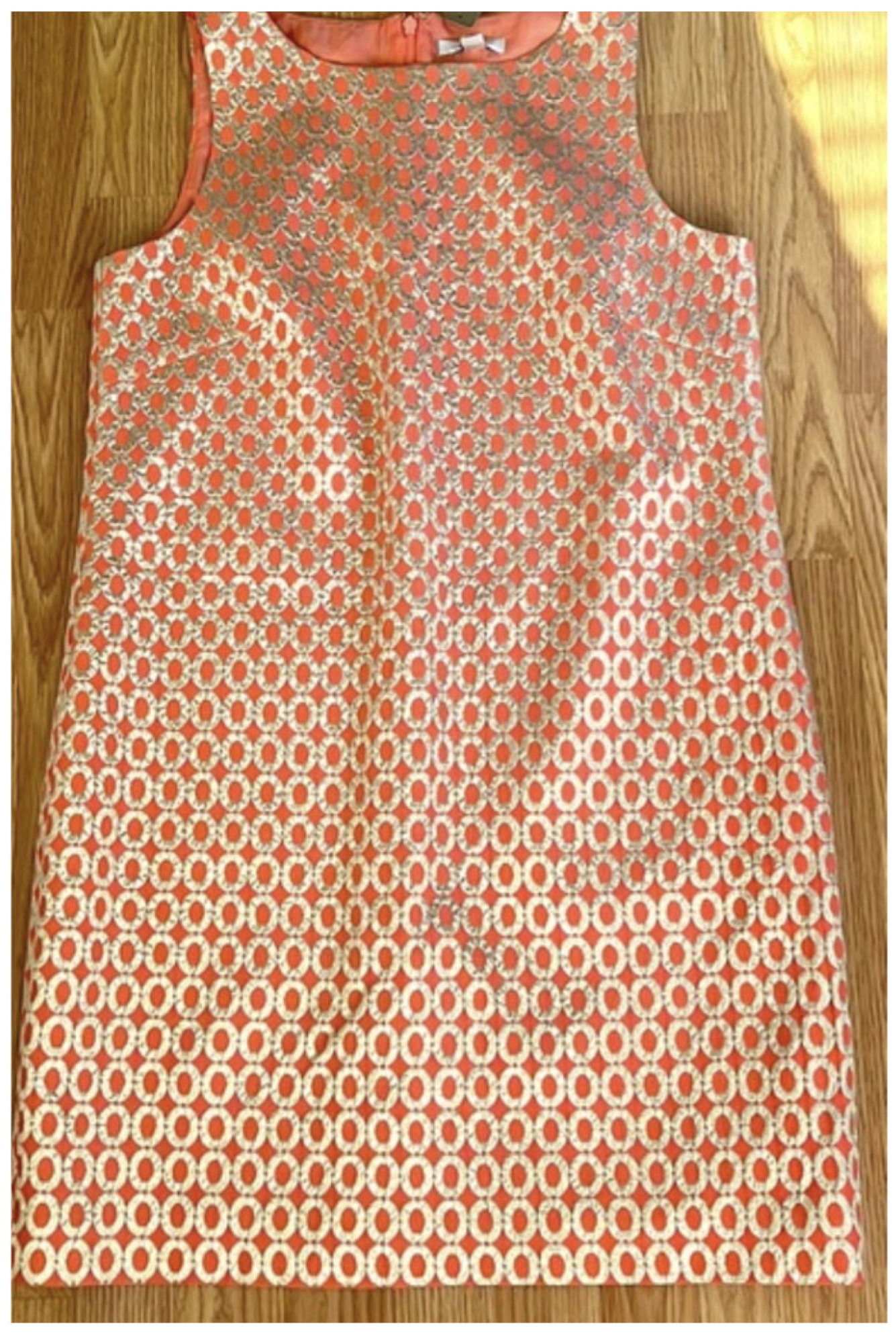
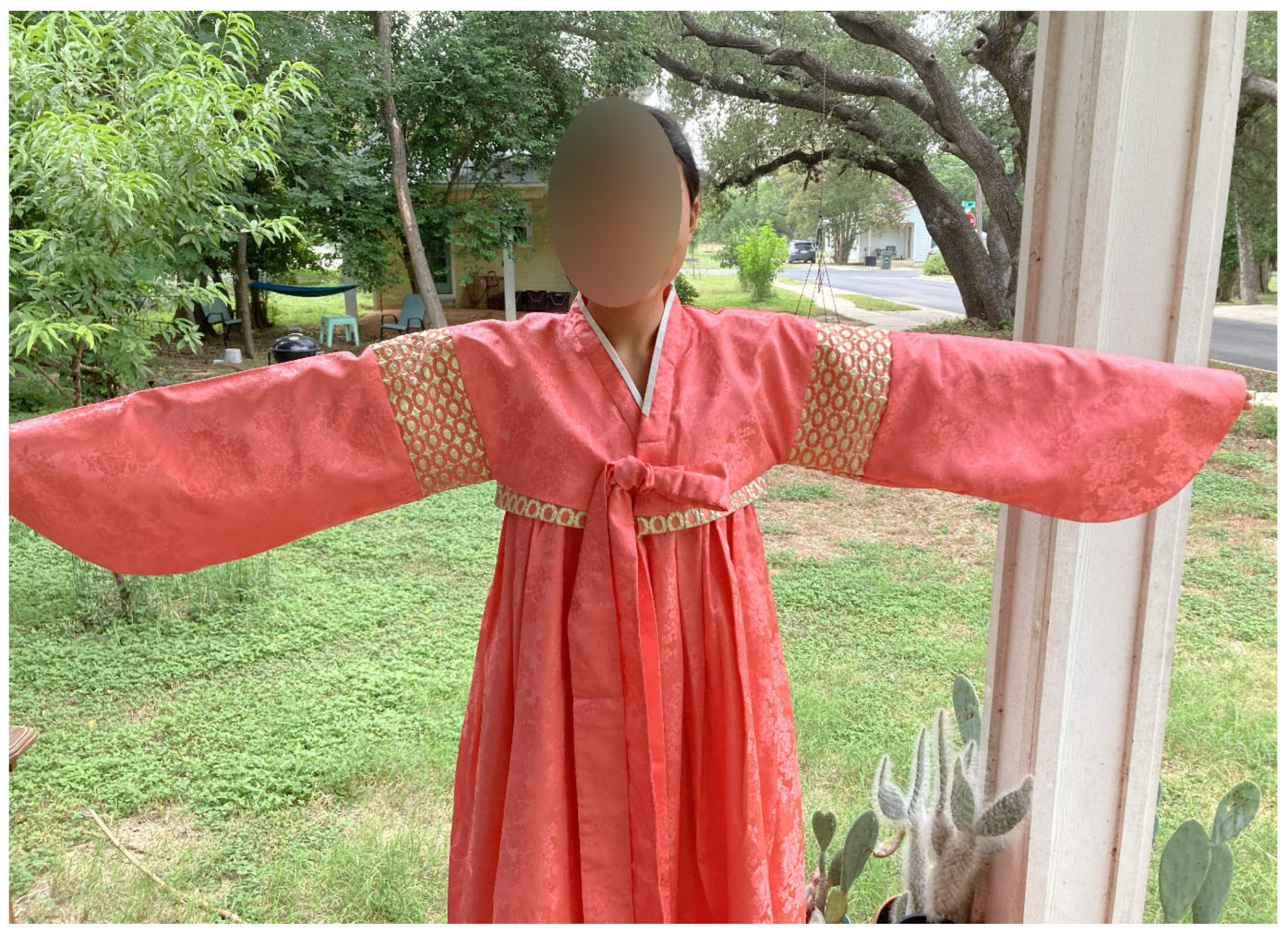
I had my daughters try on the hanboks, my husband laughingly commenting that they smelled like Korea–a particular blend of moth balls and industrialism. The dresses barely fit my 11-year-old, but we brought them back home where I began the painstaking work of altering the first gown. After removing the lining, I took apart the entire jacket, letting it out to the dart lines, but it was no use. There simply wasn’t enough of the original material to expand the chest or lengthen the sleeves sufficiently. We needed something more. I found that something in a J. Crew shift dress (Figure 1). With fabric from this slice of Americana, I added inches to the sleeves and length to the bodice and skirt. The dress is still Korean, but remade into one that will fit me and my oldest daughter through the incorporation of something distinctly American (Figure 2). I can’t help feeling like its alteration is similar to our own.
Like la Mestiza and the hanbok, our both/and in-betweenness is inescapably visible. It is sewn into the fabric of our beings. We see Author 1’s alteration of the hanbok as a physical manifestation of her subjectivation as an agentive subject capable of tearing the seams and then remaking them but also a subject constrained by the larger cultural systems dictating the length of a hanbok sleeve or skirt. The story also illustrates her performative power to deconstruct hegemonic norms about who is legitimated in wearing wear or sewing a hanbok and the materials, their own form of symbolic resources, that can be incorporated into its refinement.

4. Discussion

This project was unique because of the joint and collaborative perspective of its authors. Transnational and transracial adopted persons are moved beyond the borders of their home community, detached so that they can reattach to new homes with new adoptive parents (Withaeckx 2025). Because of this (dis)placement, transnational and transracial adopted persons do not have contact with people who have similar origin experiences. Adopted persons are often raised in isolation from each other due to the diasporic nature of transnational and transracial adoption processes. In order to discuss shared experiences, adopted persons must seek out other adopted persons and build new communities with each other. Through our letter-writing autoethnographic process, we built that community with each other. Like many other transnationally adopted persons of color, we rarely engage in in-person interactions with others who share our adoption experiences. Instead, it’s through literate activity like texts and letter writing, or emailing, that we’re able to connect over shared experiences that are specific to transnational and transracial adopted persons.
Our results exemplify the ways that we as Korean American adopted persons engage in literate activity and find this to be a fruitful and fulfilling experience both professionally and personally. Connecting with others who have similar backgrounds is uplifting; listening to each other’s experiences is affirming. And engaging in literate activities such as narrating our stories makes these connections possible. As Van Steen (2025) explains, through their engagement with each other on social media, “They [adopted persons from Greece] cultivate a connectivity that is rife with kinship metaphors, joining a quest not only for personal origins but also for one another’s origins and experiences” (p. 12). We, too, recognized this sense of connectivity: at times our correspondence felt like an improv class where there is a shared agreement between participants to build together, saying, “yes, and…” There was a shorthand present that doesn’t exist in other relationships. The experience of being able to connect through origin stories is an uncommon and therefore treasured experience for transnational and transracial adoptees like us.
Our approach of relying upon autoethnographic practices like letter-writing to reclaim and rewrite adoption narratives aligns with Critical Adoption Studies, which often blends scholarly and deeply personal research. The adoptee centers their own story and experiences in this storytelling process as a response to the, at times, objectifying narrative that tends to surround international and interracial adoptions in particular. Our findings align with and build upon the existing literature. Similar to other adopted persons engaging in critical adoption scholarship (Docan-Morgan 2019; McKee 2016; Trenka 2003; Van Steen 2025), we drew upon our personal experiences and professional training to illuminate how storytelling—particularly the telling of our own stories around adoption—creates space for marginalized individuals to exercise their linguistic agency, tapping into the power of the performative to claim legitimacy for the identities individuals create through narratives of self.
We told stories through our letters. Stories about the victorious and proud moments but also the embarrassing moments when we, as international and interracial adopted persons, bumped up against limitations in our own language skills. We experienced firsthand the power of language, including the power to include and exclude. To navigate unfamiliar Discourse communities, we mushfaked, which often felt like a natural bridge and accompaniment to our experiences. We observed others, and expressed our desire to acquire details and knowledge, which would then be used to enhance our mushfaking efforts. There were moments when we knowingly or unknowingly claimed agency in our letters, expressing agentive authority by verbalizing forgiveness and protection—both agentive acts. We shrugged off easy answers but instead recognized and found rest in our capacity for contradictions and ambiguity similar to la mestiza.
In our correspondence, we described our efforts to apply various forms of symbolic capital (learned Korean language, cultural traditions and celebrations) within various fields of relationships in which our efforts held different values (Bourdieu 1991). Put another way, how we sought to engage as members of varying discourse communities (Gee 1989). Through our letters and by telling our own stories, we harnessed the power of the performative (Butler 1990), recentering the adoption narrative around ourselves as thinking subjects and (re)claiming the power of adoptees to narrate their own stories. Because our stories centered on ourselves as the grammatical subjects of our sentences, we also claimed power for our storied selves–the selves who performed the actions of the verbs in our narratives, rather than receiving the actions as the grammatical objects in the numerous other sentences written about adopted persons.
We observed the ways literate activity like our letter writing enhances our agency as Korean American adopted persons. We both bore witness to and marveled at each others’ unique methods of exploring and crafting our complex identities and how we explained this through our writing of “agentive responses” to each other (Cawayu and Clemente-Martínez 2025, p. 10). For example, Author 2 wrote about the way she resists the narrative to find herself by identifying her biological family and how this process would be her decision, not someone else’s. In a parallel, physical example, Author 1 described the way she reconstructed a found hanbok; she used material from an American-style dress to remake the traditional garment so that it could be worn. In these and other stories, we see how the in-betweenness of our adoptions instilled within us a both/and habitus that continues to influence how we engage others and the process of family-making today.
Through our reflection upon these stories, we came to see how we present ourselves as subjects: grammatical subjects of our sentences about adoption as well as thinking subjects, or (main) characters, who are subjected to but also resist social and cultural structures. As we tell stories about our own innocent arrivals, we have compassion for our past selves and our past moments of not-knowing. As thinking subjects, we make necessary alterations seeing that our in-betweenness is inescapably present, visible, and necessary to fit our future selves. As (main) characters, we are capable of tearing the seams and boundaries previously ascribed to us and remaking them. At the grammatical level, as the subjects, we—not our adoptive parents, the adoption agency, or even our birth families—are the ones performing the actions of the verbs, acting upon others. And at the discourse level, by telling our stories, we are pushing boundaries and claiming empowered identities for ourselves, including our right to write our own narratives.

5. Conclusions

By telling and analyzing our own stories, we began to see the role of language and discourse in promoting the agency and legitimacy of our in-betweenness as adopted persons. Tearing at the seams of preexisting adoption narratives, our alterations made these stories truly our own. Through this work, we view with loving compassion the subject us who cannot deploy the Korean language as a symbolic resource and yet who longs to pass. We acknowledge and accept the complex in-betweenness of our identities. We embrace the performative nature of this work—telling stories to create ourselves and in so doing, both taking up our legitimacy to tell these stories, and telling stories in/by which we claim legitimacy as full persons with complex identities. We echo Hernandez et al. (2017) reflections on their autoethnography:
Perhaps the most unexpected realization is the myriad ways that [collaborative autoethnography] continues to shape not merely our scholarship, but us. [Our collaborative autoethnography] has gifted us cherished opportunities to know our various selves more intimately. At the same time, it has created a collective “we” in the midst of celebrating “I.”
(p. 271)

5.1. Limitations

We recognize that this gathering of the materials (writing of the letters) for this study took place over a limited time period of approximately three months. If the letter-writing had been conducted over a longer period, the content of the letters might have evolved as the researchers (who have known each other for about three years) continued to grow and deepen our relationship with each other.

5.2. Recommendations

In the future, we recommend a longer period of letter-writing for this research. It would be fascinating to see what comes up after six months or a year of letter-writing. We also see that including additional voices and adopted persons could be a site of additional study. The researchers in this project have similar backgrounds; however, we pulled from stories about different intercountry adoptions for research in this project. A site of further study would be including a variety of adopted persons from different countries of origin writing and sharing their experiences.
Finally, we find the connection between women’s stories and community important for this research project. Women are empowered and emboldened when they find community with each other. In a chapter about the benefits of a feminist computer network, Smith and Balka, write about their experience connecting online and finding community. Though they “often don’t feel a part of much of the culture around us,” they find support through a feminist network and note that “literacy is an empowerment tool for the disenfranchised” (Smith and Balka 1988, p. 88). Because we so rarely encounter people who have similar origin experiences as us, it is particularly validating to be able to write to each other in this way. Engaging in this act of writing together allowed us to think through and reframe our own stories, giving us agency over them. Through connection with each other, we can see our stories in a new light, reconsider the actors, roles, and actions, and reinterpret the agency in them. In the future, we recommend that women researchers continue to intentionally harness the power of community as they engage in adoption studies research.

Author Contributions

Conceptualization, E.K.S. and E.L.; methodology, E.K.S.; validation, E.K.S. and E.L.; formal analysis, E.K.S. and E.L.; investigation, E.K.S.; data curation, E.K.S. and E.L.; writing—original draft preparation, E.K.S. and E.L.; writing—review and editing, E.K.S. and E.L.; project administration, E.L. All authors have read and agreed to the published version of the manuscript.

Funding

This research received no external funding.

Institutional Review Board Statement

Not applicable.

Informed Consent Statement

Not applicable.

Data Availability Statement

The original contributions presented in this study are included in the article. Further inquiries can be directed to the corresponding author.

Conflicts of Interest

The authors declare no conflicts of interest.

References

  1. Anderson, Julie, Helen Goodall, and Sheila Trahar. 2020. Women in powerful conversation: Collaborative autoethnography and academia. International Journal of Qualitative Studies in Education 33: 393–403. [Google Scholar] [CrossRef]
  2. Anzaldúa, Gloria. 2004. Borderlands/La Frontera: The New Mestiza. In Feminist Studies. London: Routledge, pp. 653–62. [Google Scholar]
  3. Bishoff, Tonya, and Jo Rankin, eds. 1997. Seeds from a Silent Tree: An Anthology. Pandal Press. [Google Scholar]
  4. Bochner, Arthur P., and Carolyn Ellis. 2022. Why autoethnography? Social Work and Social Sciences Review 23: 8–18. [Google Scholar] [CrossRef]
  5. Bourdieu, Pierre. 1991. Language and Symbolic Power. Cambridge: Harvard University Press. [Google Scholar]
  6. Boylorn, Robin M., and Mark P. Orbe, eds. 2020. Critical Autoethnography: Intersecting Cultural Identities in Everyday Life. London: Routledge. [Google Scholar]
  7. Butler, Judith. 1990. Feminism and the Subversion of Identity. Gender Trouble 3: 3–17. [Google Scholar]
  8. Cawayu, Atamhi, and Chandra Kala Clemente-Martínez. 2025. Complicating the search imperative in transnational adoption: An anthropological analysis of non-searching transnational adoptees in Belgium and Spain. Genealogy 9: 124. [Google Scholar] [CrossRef]
  9. Chang, Heewon, Faith Ngunjiri, and Kathy-Ann C. Hernandez. 2016. Collaborative Autoethnography. London: Routledge. [Google Scholar]
  10. Collins, Patricia Hill. 2022. Black Feminist Thought: Knowledge, Consciousness, and the Politics of Empowerment. London: Routledge. [Google Scholar]
  11. Conor, Liz. 2004. The Spectacular Modern Woman: Feminine Visibility in the 1920s. Bloomington: Indiana University Press. [Google Scholar]
  12. Denzin, Norman K. 2013. Interpretive Autoethnography. Thousand Oaks: Sage Publications. [Google Scholar]
  13. Docan-Morgan, S. 2019. Transnational Korean adoptees and the discursive burden of establishing individual and family identity. In Korean Diaspora Across the World: Homeland in History, Memory, Imagination, Media, and Reality. Lanham: Lexington Books, pp. 95–111. [Google Scholar]
  14. Donnell, Kira. 2021. Points of Origin: Finding Self in Critical Adoption Studies Research. Adoption & Culture 9: 325–40. Available online: https://libproxy.txstate.edu/login?url=https://www.proquest.com/scholarly-journals/points-origin-finding-self-critical-adoption/docview/2755906680/se-2 (accessed on 22 April 2025). [CrossRef]
  15. Ellis, Carolyn. 2004. The Ethnographic I: A Methodological Novel About Autoethnography. Lanham: Rowman Altamira, vol. 13. [Google Scholar]
  16. Gee, James P. 1989. Literacy, discourse, and linguistics: Introduction. Journal of Education 171: 5–17. [Google Scholar] [CrossRef]
  17. Goodall, H. Lloyd. 2000. Writing the New Ethnography. London: Bloomsbury Publishing PLC, vol. 7. [Google Scholar]
  18. Hernandez, Kathy-Ann C., and Faith W. Ngunjiri. 2013. Relationships and communities in autoethnography. In Handbook of Autoethnography. London: Routledge, pp. 262–80. [Google Scholar]
  19. Hernandez, Kathy-Ann C., Heewon Chang, and Faith W. Ngunjiri. 2017. Collaborative autoethnography as multivocal, relational, and democratic research: Opportunities, challenges, and aspirations. a/b: Auto/Biography Studies 32: 251–54. [Google Scholar] [CrossRef]
  20. Hipchen, Emily. 2023. The Routledge Critical Adoption Studies Reader. London: Routledge. [Google Scholar]
  21. Hoff, Meagan A. 2020. Mushfaking it: Postsecondary academic literacy practices of students from refugee backgrounds. Literacy Research: Theory, Method, and Practice 69: 174–91. [Google Scholar] [CrossRef]
  22. Homans, Margaret. 2006. Adoption narratives, trauma, and origins. Narrative 14: 4–26. [Google Scholar] [CrossRef]
  23. Homans, Margaret, Peggy Phelan, Janet M. Ellerby, Eric Walker, Karen Balcom, Kit Myers, Kim P. Nelson, Laura Briggs, Cynthia Callahan, Rosemarie Peñta, and et al. 2018. Critical adoption studies: Conversation in progress. Adoption & Culture 6: 1–49. [Google Scholar] [CrossRef]
  24. Hübinette, Tobias. 2006. Comforting an Orphaned Nation. Representations of International Adoption and Adopted Koreans in Korean Popular Culture. Seoul: Jimoongdang. [Google Scholar]
  25. Larsen, Nella. 1986. Quicksand and Passing. New Brunswick: Rutgers University Press. [Google Scholar]
  26. Laybourn, SunAh M. 2024. Critical Adoptee Standpoint: Transnational, Transracial Adoptees as Knowledge Producers. Genealogy 8: 71. [Google Scholar] [CrossRef]
  27. Lozano Neira, Nathalie. 2026. Body-land: Embodied memory, coloniality, and resurgence across Abya Yala and Turtle Island. Genealogy 10: 9. [Google Scholar] [CrossRef]
  28. McKee, Kimberly. 2016. Claiming ourselves as ‘Korean’: Accounting for adoptees within the Korean diaspora in the United States. In Click and kin: Transnational Identity and Quick Media. Toronto: University of Toronto Press, pp. 159–79. [Google Scholar]
  29. Nentwich, Julia C., Mustafa F. Ozbilgin, and Ahu Tatli. 2015. Change agency as performance and embeddedness: Exploring the possibilities and limits of Butler and Bourdieu. Culture and Organization 21: 235–50. [Google Scholar] [CrossRef]
  30. Oparah, Julia C., Sun Young Shin, and Jane J. Trenka. 2021. Introduction. In Outsiders Within: Writing on Transracial Adoption. Edited by Jane J. Trenka, Julia C. Oparah and Sun Y. Shin. Minneapolis: University of Minnesota Press. [Google Scholar]
  31. Park Sorensen, Eli. 2014. Korean adoption literature and the politics of representation. Partial Answers: Journal of Literature and the History of Ideas 12: 155–79. [Google Scholar] [CrossRef]
  32. Rinhaug, Aino. 2010. Adoptee Aesthetics: A Gendered Discourse. Race/Ethnicity: Multidisciplinary Global Contexts 4: 9–27. [Google Scholar] [CrossRef]
  33. Sawin, Patricia. 2014. Listening to stories, negotiating responsibility: Exploring the ethics of international adoption through narrative analysis. In Unsettling Assumptions: Tradition, Gender, Drag. Logan: Utah State University Press, pp. 172–90. [Google Scholar][Green Version]
  34. Smith, Judy, and Ellen Balka. 1988. Chatting on a feminist computer network. In Technology and Women’s Voices: Keeping in Touch. London: Routledge, pp. 82–97. [Google Scholar]
  35. Suh, Emily K. 2020. Adoptees SPEAK: A multimodal critical discourse analysis of adult Korean adopted persons’ adoption narratives on Instagram. Critical Inquiry in Language Studies 18: 65–84. [Google Scholar] [CrossRef]
  36. Trenka, Jane J. 2003. The Language of Blood: A Memoir. St. Paul: Minnesota Historical Society Press. [Google Scholar]
  37. Van Steen, Gonda A. H. 2025. Adoption agrafa: Parts ‘unwritten’ about Cold War adoptions from Greece: Adoption is a life in a sentence, adoption is a life sentence. Genealogy 9: 81. [Google Scholar] [CrossRef]
  38. Withaeckx, Sophie. 2025. Adoptees traveling worlds: Love and multiplicitous being in adoptees’ autofictional writing. Genealogy 9: 114. [Google Scholar] [CrossRef]
Figure 1. Gold-ringed patterned salmon-colored, knee-length sleeveless dress.
Genealogy 10 00030 g001
Figure 2. Girl stands wearing modified hanbok with arms outstretched to display fabric inserts from above dress.
Genealogy 10 00030 g002
Disclaimer/Publisher’s Note: The statements, opinions and data contained in all publications are solely those of the individual author(s) and contributor(s) and not of MDPI and/or the editor(s). MDPI and/or the editor(s) disclaim responsibility for any injury to people or property resulting from any ideas, methods, instructions or products referred to in the content.