Article

An Empirical Bayes Assessment of Safety for Low-Volume Roadside Clearing Operations

1
HNTB Corporation, 111 Monument Circle, Indianapolis, IN 46204, USA
2
Department of Civil, Construction & Environmental Engineering, Iowa State University, Ames, IA 50011, USA
3
CDM Smith, 445 Hutchinson Avenue Suite 820, Columbus, OH 43235, USA
4
CHA Solutions Inc., 1360 Peachtree Street, NE Suite 700, Atlanta, GA 30309, USA
5
Department of Civil & Environmental Engineering, University of Dayton, Dayton, OH 45469, USA
6
Kimley-Horn & Associates Inc., 1700 SE 17th Street Suite 200, Ocala, FL 34471, USA
*
Author to whom correspondence should be addressed.
Safety 2026, 12(3), 67; https://doi.org/10.3390/safety12030067 (registering DOI)
Submission received: 19 January 2026 / Revised: 3 April 2026 / Accepted: 4 May 2026 / Published: 9 May 2026

Abstract

Roadways classified as state routes in both rural and urban settings are tree-lined, creating a canopy over the pavement surface. Although trees are beneficial to the environment, they pose a hazard to road safety in a variety of ways. For example, they offer reduced skid resistance due to fallen leaves; restrict direct sunlight on pavement surface, causing the formation of black ice and fog; and increase the risk of entire trees/branches/fruits falling on passing vehicles or blocking traffic lanes. State agencies have undertaken the task of eliminating tree canopies, inviting widespread criticism. Currently, there is a gap in the literature about the impact of tree canopy on traffic safety in the form of scientific research. This paper addresses this gap by presenting insight into the benefits of tree-trimming and/or removal operations along state routes in Ohio. Adopting the Empirical Bayesian approach, this study evaluates crashes to quantify the safety benefits. Additionally, a surrogate safety assessment was conducted to evaluate driver behaviors in the presence/absence of tree canopy. The results indicated that roadside tree trimming and pruning showed site-specific safety benefits at most locations, though no consistent project-level crash reduction or conclusive effects on surrogate safety measures, such as reduced speeds and hard braking, were observed.

1. Introduction

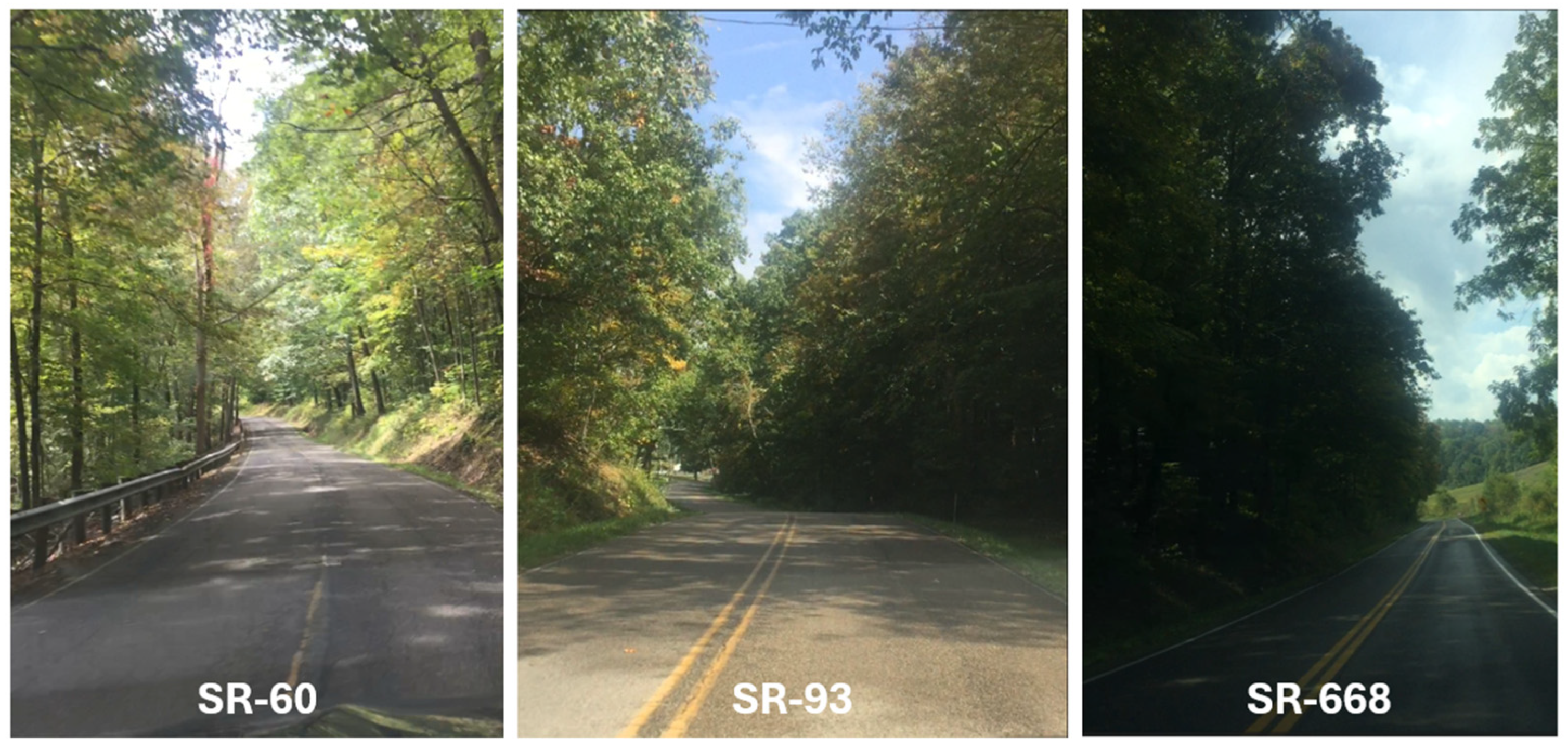
In many of the northeastern states in the US, trees form an integral part of the roadscape; they are abundant along significant mileage of state routes in both urban and rural settings. These roadside trees create canopies over the pavement surface and are thus valued with mixed feelings among various stakeholders. Within the general populace (incl. arborists, forest ecologists, and environmentalists), tree canopy overtop pavement is widely valued, and support for their presence along roadsides is often expressed in public forums [1,2]. However, within the engineering community, trees alongside roadways and their canopy are concerning in that they undermine road safety through reduced skid resistance due to fallen leaves; limit direct sunlight on pavement, thus promoting the formation of black ice and fog; and increase the risk of entire trees/branches/fruits falling on passing vehicles or blocking traffic lanes [3]. Figure 1 depicts examples from roadways with partial or full tree canopy over the pavement surface. Note the pavement surface beneath is either damaged or damp/wet.
Many of the observations on tree canopy and road safety are anecdotal and have been largely indirect, so there is not enough information directly addressing the effects of tree canopy on road safety. Moreover, the current practice by many state agencies is to remove the tree canopy from the roadway, a practice that has been widely criticized by the public, but the possible effects of the tree canopy on safety have not been demonstrated in a rigorous scientific study. Therefore, the question of whether tree trimming/pruning operations reduce crash frequency on Ohio state routes is ripe for scientific exploration. In addition, the other questions that have not yet been explored are whether tree canopies affect driver behavior as measured by surrogate safety measures (speed, braking) and whether safety effects are consistent at both the individual and project level.
The remainder of this paper is organized as follows: Section 2 provides a literature review on roadside tree canopy effects on road safety and pavement conditions. Section 3 describes the study locations, data collection, and methodology, including the Empirical Bayes approach and surrogate safety measures. Section 4 presents the results and discussion of the Empirical Bayes and surrogate safety analyses. Section 5 presents conclusions, limitations, and future research directions. Section 6 provides practical recommendations for transportation agencies.

2. Literature Review

In the US, trees alongside the Interstate and other high-volume roadways are not commonplace, particularly given that, at a minimum, design guidelines require a 30-foot clear zone [4]. However, along low-volume facilities (state routes, county roads, and local streets), roadside trees can become a common feature, and these trees create a canopy effect when their branches grow long/large enough to reach over the pavement’s surface. Opinions toward roadside trees (and in particular, canopy overhanging the pavement’s surface) are contradictory, with forest ecologists speaking highly of their aesthetic appeal and environmental benefits, whereas transportation engineers/professionals argue for the detrimental effects to pavement conditions and driver safety. Research work by Naik et al. (2017) reinforces these contradictory viewpoints regarding tree canopies overhanging the pavement on rural state routes [3].
Tree canopies existing alongside and overhanging the pavement surface cause diurnal fluctuations in pavement temperature [5] and affect surface conditions, including surface wetness, snow, and ice [6]. The altered microclimate is believed to have mixed effects on the pavement, including extending pavement service life by limiting fatigue cracking and evaporation of the asphalt binder [7], and any moisture penetration causes rapid decay of the aggregate-binder matrix [8,9,10].
From the road user perspective, tree canopies alongside and over roadways can affect pavement surface conditions beneath and subsequently road safety. Some potential highway safety concerns related to tree canopies include long-term pavement degradation (i.e., aging, stripping, and rutting) and fallen leaves causing a reduction in the pavement skid resistance; hydroplaning caused by trapped water in ruts; and also, overgrown and aging branches potentially falling on passing vehicles or blocking the roadway. Research studies present mixed results regarding the presence of trees and their impacts on driver behavior and subsequently crash frequency.
At the simplest level, trees are considered to be obstacles that can potentially block cars that run off the road [4]. So, while valued as a community asset, trees are the “single most commonly struck objects in serious roadside crashes” [11]. Vehicle–tree collisions account for more than 4000 fatalities and 100,000 injuries in the US each year [11]. In 2009, collisions with roadside objects accounted for more than 20 percent of highway fatalities [12]. Moreover, according to the National Highway Traffic Safety Administration the leading category of road-departure fatalities (27 percent) involved collisions with trees on high-speed (>55 mph) roadways—that is, 37 percent urban and 63 percent rural roads [12]. Predictably, driver condition was a major contributing factor (DUI in 48% of cases). The contribution of trees as roadside hazards appears to be specific to road type, location, and driver condition. In urban settings, trees help define the pedestrian and vehicle sections of the street and protect pedestrians from hazardous vehicles [13].
Studies using driving simulators suggest roadside trees do not cause drivers to adjust their driving speed; possibly due to trees not being perceived as a threat to safety by the drivers [14,15,16]. On the contrary, other studies [17,18,19,20] suggest that the presence of trees influences driver behavior and subsequently reduces crash frequency. These studies mention influences on driver behaviors, including a reduction in speeds and lateral movement toward the roadway centreline. The results demonstrated that drivers balanced the useful guidance information that roadside trees provided with the risk associated with the presence of trees—essentially, when trees were far away, the sense of guidance was predominant, and drivers adopted higher speeds; whereas when trees were closer, drivers saw the trees as a risk, slowed down, and moved further away from them. One of the studies also examined the impact of urban street trees on pedestrian safety using a multivariate random parameters model to find that pedestrian safety is enhanced with tree density and tree canopy cover [21]. This study also showed that road width, bus stops, on-street parking, and speed have an adverse impact on pedestrian injury. A Polish study investigated how street trees impact road safety to reveal mixed results. While on one hand, the study showed that street trees held a positive impact on traffic safety, on the other hand, they also emerged as a leading cause of road crashes caused by environmental conditions. In addition, the study also showed that the overall number of road crashes in Poland due to environmental factors is on the decline despite a rise in the number of vehicles [22]. The study proposed the use of woodlot shaping standards to continue reaping the advantages of roadside vegetation. There is another study focused on improving road safety that pointed out the hazards that roadside vegetation brings [23]. They not only block the view of the drivers who are unable to see the lane signs, but falling branches can also injure pedestrians and cyclists. Interestingly, there are regulatory restrictions about vertical clearance above the roads depending on the jurisdictions, such as the 16-foot specification in the USA [23]. The study proposed the use of LiDAR technology to identify non-compliant urban street trees, in a move to enhance road safety. An increase in crash risk due to overgrowth is corroborated by another study, which used a digital twin-based approach to detect and control roadside vegetation [23]. The proposed methodology defined a vegetation management approach based on maintaining a vegetation-free envelope over the roadway to ensure safe traffic movement, accounting for overgrown roadside trees that extend into the pavement space. This envelope is determined by the permissible vehicle height and the effective road width measured from the outer edges of pavement markings, ensuring adequate clearance within the traveled way [23].
In summary, the practicality of providing adequate, clear zones alongside roadways is questionable in locations where there are right-of-way limitations, such as along low-volume rural routes and scenic byways. In these right-of-way-limited places, trees commonly grow alongside the roadway. The presence (or absence) of these trees can have advantages/disadvantages and have led to unanswered questions such as: can tree canopies (full and/or partial) affect driver safety; what are the safety-related benefits of any tree removal operations; and do tree-trimming/clearing operations require management from trained professional arborists? This study systematically explores the effectiveness of tree-trimming and/or removal operations along a select number of state routes in Ohio. An Empirical Bayes evaluation of crashes is adopted to quantify safety benefits. Additionally, a surrogate safety assessment was performed to evaluate driver behaviors in the presence/absence of tree canopy.

3. Methodology

3.1. Study Locations and Data

For this study, a total of 50 roadway segments (≤5 miles long) within the Ohio Department of Transportation (ODOT) districts 4, 5, 9, and 11 were initially selected. These select segments had tree-related maintenance operations (i.e., pruning, trimming and/or removal) completed prior to 2018 and were all designated as state routes. However, four segments were excluded due to insufficient crash data or an inadequate pre-intervention period (<3 years), yielding 46 segments with complete data for the Empirical Bayes analysis. For brevity, only data pertaining to segments analyzed in ODOT districts 5 and 11 are presented herein, with data from all sections/districts available in research by Horn [24]. Table 1 presents a listing of the segments evaluated (study sites) and includes characteristics pertinent to the analysis, such as location of route within Ohio (by Ohio DOT District and County), classification of route (by Route Prefix), length of segment (by Length), and the date when the segment was officially noted as trimmed and/or pruned.
The calibration factor Cr = 1.0 was adopted for the following reasons: (1) The Safety Performance Functions (SPFs) used in this analysis are from the Highway Safety Manual (HSM) [25], which were developed using national-level data. Ohio-specific calibration factors have been developed for some facility types, but calibrated SPFs specific to rural two-lane roads in Ohio were not available at the time of analysis. (2) The use of Cr = 1.0 is therefore a conservative assumption, implying that Ohio crash rates align with the national average for this facility type. (3) We acknowledge this as a limitation and have noted it in the Limitations subsection. Future work should develop Ohio-specific calibration factors for rural routes to improve the precision of EB estimates.
Observed crash data (between the years 2017 and 2023) for the 46 segments identified were obtained from the Ohio DOT’s GIS Crash Analysis Tool (GCAT) [26]. GCAT is a crash database that is maintained by ODOT and stores every crash record that is police-reported in the state of Ohio. Specifically, crash data were collected for five years, with a minimum of three years before tree trimming/pruning/removal occurred. For the post-intervention period, crash data were collected for three years (excluding the year in which tree maintenance was performed), with a minimum of one year after being collected. It should be noted that the crash data for one month after tree maintenance was completed were excluded due to the possibility of higher or lower than average crashes caused by motorists acclimatizing to the tree maintenance operations (i.e., new safety measure or treatment). The observed crash data for the segments in Districts 5 and 11 are presented in Table 2. As well, estimates of the Annual Average Daily Traffic (AADT) for the analysis periods before and after tree maintenance operations at the different sites are presented in Table 3. These estimated AADT values were obtained from the Traffic Monitoring Management System, which is a traffic count database maintained by ODOT [27]. In addition, any geometric design-related data, such as lane widths, shoulder widths, and horizontal/vertical alignment parameters, were obtained using Google Earth and PathWeb. PathWeb is an application maintained by the ODOT that provides a “digital photo log” of road network data. Features such as grade, driveway density, presence of passing lanes, etc., were determined by “skimming” the study segments within PathWeb.
Several clarifications regarding the crash data and study period are warranted. First, regarding the crash database structure (all vehicle types and crash types): the GCAT database includes all police-reported crashes in Ohio, encompassing all crash types (e.g., run-off-road, fixed-object, rear-end, and angle) and all vehicle classifications, including both light vehicles and heavy trucks. No filtering by vehicle type or crash cause was applied, consistent with standard EB before-and-after practice [28,29] and HSM guidance [25]. Total crash frequency across all severities was used as the primary outcome variable.
The crash data before and after tree maintenance operations were analyzed using the Empirical Bayes (EB) predictive method that is established in AASHTO’s Highway Safety Manual (HSM) [25].

3.2. The Empirical Bayes Predictive Method

The Empirical Bayes (EB) method has been widely used in transportation safety studies to evaluate the effects of safety treatments in a before-and-after fashion [30,31,32,33,34]. The preference of the EB method over a simple comparison of a before-and-after treatment is due to its robustness against the regression-to-mean (RTM) bias. The RTM bias stems from the selection of sites with a high number of short-term crashes for the implementation of intervention and results in the number of crashes at a site generally reverting to the expected long-term average, even if no safety treatment was applied [29]. Past safety studies over more than two decades conclude that evaluating safety effectiveness using the EB methodology provides “substantially different, and more valid” results than those provided by the conventional methods [29]. The EB method has become AASHTO (and the engineering community’s) standard practice for evaluating the effects of implementing safety treatments in a before-and-after manner.
The EB method includes the use of statistically derived equations known as safety performance functions (SPFs) and crash modification factors (CMFs); with the SPF predicting crash frequency based on a set of specific base conditions corresponding to each facility type, while the CMFs adjust these base condition estimates to account for variations in non-base conditions. A calibration factor (CF) is also used to further adapt the base estimate, considering local conditions. The following steps, presented in Persaud et al. [29,30] and also outlined in the HSM, were taken to apply the EB method:
  • Step 1: Estimate predicted crashes in the period prior to tree trimming/pruning/removal for each site:
  • Apply SPF and CMF’s—sum of SPF estimates of predicted number of crashes in entire period prior to trimming/pruning (Po).
N p r e d , B = N s p f , r s × C r × C M F 1 r × C M F 2 r × × C 12 r
where
N p r e d , B = predicted crashes per year for a segment before tree maintenance operations,
C r = calibration factor developed for specific geographical area (assumed = 1 for this study),
C M F 1 r C M F 12 r = crash modification factors for specific characteristics of a study segment. Specific CMFs considered and their calculated value range for the study segments are presented in Table 4. For cases where a CMF value could not be calculated due to a lack of segment-related data, a base value as suggested in the HSM was used.
N s p f , r s = predicted total crashes per year for a roadway segment under base conditions. Since the segments evaluated were all 2-lane 2-way and in rural locales, the specific SPF adopted is as given in the HSM and shown in Equation (2).
N s p f , r s = e ( 0.312 ) × A A D T × L × 365 × 10 6
where
A A D T = average annual daily traffic volume (vehicles per day), and
L = length of roadway segment (miles).
  • Apply EB Method—EB corrected estimate of expected number of crashes in the “before” period (m).
m = w × P o + 1 w × x
where
m = corrected estimate of expected number of crashes for the entire “before” period,
w = weighted adjustment placed on predictive model estimate (using Equation (4)),
Po = sum of annual SPF estimates of expected number of crashes in the entire “before” period, and
x = sum of all observed crashes at a site for the entire “before” period.
w = 1 1 + k P o
where k = overdispersion parameter for the SPF used (using Equation (5)).
k = 0.236 L
where L = length of the roadway segment (in miles).
v a r m = 1 w × m
where var(m) is the variance of the corrected estimate of the expected number of crashes for the entire “before” period.
  • Step 2: Estimate of crashes in the after period for each site.
First, an adjustment factor r was calculated using Equation (7),
r = P P o
where r is an adjustment factor (accounts for differences in time, AADT, etc. between before-after periods), and P is the sum of the annual SPF estimate of expected crashes in the “after” period.
Thereafter, the expected number of crashes that could have occurred in the “after” period in the absence of the tree maintenance operations ( π ) is
π = r × m
  • Step 3: Estimate the site-specific index of safety.
The change in safety was calculated as
δ = π λ
where δ is the difference between the expected crashes and observed crashes in the “after” period and λ is the sum of crashes occurring at a site during the entire “after” period.
As well, the index of safety or CMF related to the tree maintenance operations was calculated as
θ = λ π × f o
where θ is the index of safety, and f o is the bias factor such that
f o = 1 1 + v a r π / π 2
where v a r π is the variance of the corrected estimate of the expected number of crashes for a site
v a r π = r 2 × 1 w × m
The percentage change is calculated thereafter.
% C h a n g e = 100 × 1 θ
where % change is the percentage of increase or decrease in the index of safety based on expected and observed crashes in the “after” period. Thereafter, the standard deviation of the index of safety is calculated.
  • Step 4: Estimate the project-specific index of safety.
In this step, the composite safety (or total effect) of tree maintenance operations as a project was calculated. This is followed by the standard deviation of composite safety. Then, the Z-score is calculated, which was used as a measure of statistical significance in this study. The output of this calculation will determine the treatment of tree trimming. If Z 1.70, the treatment effect is significant at a 90% confidence interval. If Z 2, the treatment effect is significant at a 95% confidence interval.

3.3. Surrogate Measures of Safety

In addition to analysis using the EB method, an analysis using surrogate measures of safety (SMoS) was also performed, primarily as a cross-sectional study to gain insight into driver behaviors as they navigate along road segments under canopy versus non-canopy conditions. SMoS are generally “…an observed non-crash event that is physically related in a predictable and reliable way to crashes…” [35]. SMoS are indirect safety measures that allow safety performance assessments to be made when crash frequencies are very low or altogether not available. A variety of SMoS have been used in past research, such as traffic conflicts [36,37], running on red [38,39], acceleration noise [40], post-encroachment time [41], speed profile variation, and near crashes. SMoS were used because: (1) crash data are rare events, making statistical power limited for individual short segments; (2) SMoS, such as speed and hard-braking events, provide a more immediate behavioral response to the road environment, independent of the stochastic nature of crash occurrence; and (3) telematics data (ATSPM/probe data) were available for the study period.
In this study, driver speeds and braking behaviors were compared between canopy and no canopy segments at a number of test locations, including SR 356 (Vinton County), SR 56 (Hocking County), and SR 374 (Hocking County). These locations were selected for their proximity to the research team and the ease of monitoring data and equipment. Speed data were collected using tube counters, while braking operations were monitored using trail cameras that were set up to capture the rear end of each passing vehicle. For specific details on methods and means by which the speeding and braking data were collected, refer to research work by Horn [24]. The hard-braking event rate was computed as the number of hard-braking events (deceleration exceeding a defined threshold, typically ≥0.3 g based on prior literature [35]) per vehicle-mile traveled. Speed was summarized as the 85th percentile operating speed for each site-season combination.
A minimum threshold of 50 vehicle observations per site-season-direction combination was applied; sites with fewer observations were excluded from the SMO analysis. Outliers in speed data were screened using an IQR-based method; observations beyond Q3 + 3 × IQR were excluded as sensor artifacts. Hard-braking events with fewer than 10 events per site and direction were reported but not used for inferential comparisons, given the high variance at low counts. The extremely low braking percentages (often below 10%) reflect the infrequent nature of active braking on low-speed rural roads and are noted as requiring cautious interpretation. Known limitations include potential false detections due to engine braking or camera lighting conditions; inability to control for vehicle type or driver characteristics; and the absence of confidence intervals on the odds ratios, which prevents formal significance testing of braking rate differences between conditions.

4. Results and Discussion

4.1. Findings from EB Predictive Method

The study was conducted to assess the potential safety benefits of tree maintenance (pruning, trimming, and/or removal) operations on 46 roadway segments in Ohio. The analysis involved comparing crash data before and after the tree maintenance operations. The findings from a naïve analysis (i.e., basic comparison of observed crashes in before- and after periods) revealed an overall reduction of approximately 23% in average crashes for all types of crashes, which was attributed to the tree trimming/pruning activities [24].
Furthermore, a more comprehensive safety analysis was conducted, employing the methods outlined in the HSM [25]. More specifically, the EB method was applied to individual sites and to the project as a whole. The results obtained through the EB-based method on individual segments yielded mixed outcomes with improved safety at most locations. That is, of the 46 segments that were evaluated, 39 segments demonstrated safety improvements, while seven segments showed no changes in safety. Detailed results from the analyses of the individual segments can be found in Table 5. In this table, results for District 4 are highlighted in brown, those for District 5 are in green; the results for District 9 are in blue, whereas those for District 11 are in orange. Further, counties with a negative percentage change are not color-coded. In spite of the mixed results at the individual segments, when examining the composite results at the project level (see Table 6), it was observed that there was an overall decline of 11% in safety at locations where tree maintenance operations (trimming/pruning) were performed. However, based on a 95% confidence level, this decline in safety was not statistically significant (Z-score = −1.43). Consequently, it is advisable to interpret these safety-related findings with caution.

4.2. Surrogate Safety Analysis

As stated previously, driver speeds and braking behaviors were observed between canopy and no canopy segments along SR 356 (Vinton County), SR 56 (Hocking County), and SR 374 (Hocking County). More importantly, SMoS was used to answer questions such as whether drivers tend to slow down in tree-canopied roadway sections as opposed to when they drive in no-canopy sections, and whether drivers’ travel speeds in canopies or open sections are influenced by day-/night-time conditions.

4.2.1. Speed Data

Overall, no discernible differences were observed in the average and 85th percentile speeds between canopy levels and/or day/night conditions. Additionally, a comparison of observed vehicle speeds between canopy and no canopy sections (Table 7) indicated mixed findings, with the data from Hocking County exhibiting statistically significant differences in speeds between canopy levels, while the data from Vinton County did not exhibit statistically significant differences. Nonetheless, where speed differences between canopy levels were statistically significant, average speeds were higher in canopied sections. Table 7 also presents the results from Kruskal–Wallis H tests on the speed data by time of day (day/night).
Overall, there were statistically significant differences under specific canopy levels for day and night conditions. Despite the statistically significant differences, no conclusive interpretations can be made due to the mixed results. That is, the average speed for drivers in canopied segments is higher during the night at two site locations and lower during the night for one site location. Likewise, in the no canopy sections, the average speed for drivers is higher during the night at one site location and lower during the night at another site location.

4.2.2. Braking Data

Braking data (lights on or lights off) were collected in both directions of travel from three test locations as drivers traveled through a section of tree-lined roadway during the fall (no leaves on trees) and during the spring (leaves on trees). At each test location, video cameras (placed at 200 feet and 400 feet) were used to observe the taillights for vehicles and subsequently assessed if a driver was braking (or not) as he/she traversed the sections of roadway where a canopy was present.
Table 8 presents odds ratios calculated for the observed data. The results indicated mixed findings: half (four) of the data sets indicated drivers are more likely not to brake when there is no canopy (no leaves on trees), and four other datasets indicated drivers are less likely not to brake when there is no canopy (no leaves on trees).

5. Conclusions

Based on the EB safety analysis conducted in this study, it can be concluded that roadside maintenance activities, specifically trimming and pruning of trees, yielded safety benefits on a site-by-site basis. However, the analysis of surrogate measures of safety, such as speed and braking operations, did not yield definitive findings. The examination of observed speed data revealed that drivers tended to travel at high speeds in road sections with tree canopies. Similarly, the analysis of observed braking data suggested that the presence of tree canopies did not significantly impact driver behavior. In terms of the composite (project) level view of roadside maintenance activities, the safety analysis based on available crash data did not demonstrate overall safety benefits. However, when considering individual sites, the results were mixed. Out of the 46 locations analyzed, 39 locations exhibited safety improvements, while seven locations showed no improvement in safety. Furthermore, the analysis of surrogate measures of safety, namely vehicle speed and braking operations, did not provide conclusive findings in relation to the impact of tree canopies on safety.
The mixed findings between individual-segment and project-level EB results warrant explicit explanation. At the individual segment level, 39 of 46 sites (85%) showed a theta value less than 1, indicating local crash reductions. However, at the aggregate project level, the expected-vs-observed comparison did not yield a statistically significant overall reduction (Z-score = −1.43, not significant at 95% confidence). This discrepancy can be attributable to: (1) the seven sites with no improvement include the highest-volume segments, which disproportionately weight the aggregate; (2) short after-periods at some sites (as few as one year) limit statistical power; and (3) non-random site selection, since sites were chosen because maintenance had already occurred, may introduce selection bias.

5.1. Limitations

Several limitations of this study should be acknowledged. First, the study is geographically constrained to Ohio DOT Districts 5 and 11, which may limit transferability to regions with different climates, tree species, or road geometry. Replication is feasible wherever police-reported crash databases, AADT records, and documented treatment dates are available. Second, the HSM Safety Performance Functions were applied with a calibration factor Cr = 1.0 due to the absence of Ohio-specific SPFs; future work should develop localized calibration factors. Third, the treatment year was excluded from analysis, reducing the after-period window for some sites. Fourth, canopy classification was observational rather than LiDAR-based. Fifth, the SMoS monitoring sites differ from the EB analysis segments, limiting the ability to draw causal conclusions about the behavioral effects of tree trimming specifically. Sixth, the braking OR table lacks confidence intervals, preventing formal significance testing of braking rate differences.

5.2. Future Research Directions

Future research should: disaggregate crash data by type (run-off-road, fixed-object) to isolate tree-related mechanisms; develop naturalistic driving or simulator studies to better characterize driver behavioral responses to canopy; use Ohio-specific SPF calibration factors for state routes; extend the after-period data as more post-treatment years become available; add confidence intervals and significance tests to the braking OR analysis; and explore integrated cost–benefit valuation of tree management decisions combining safety, pavement, and environmental outcomes.

6. Recommendations

The following practical recommendations are offered for transportation agencies managing roadside tree canopy on state routes. These are based on the site-specific findings of this study and should be interpreted in light of the limitations and uncertainties described in Section 5.1. Future research directions have been moved to Section 5.2.
Overall, the results from this study support the view that, in general, tree canopies overtop rural highways should not be removed as a means of extending the life of pavement. Canopy pruning or removal should only be applied to individual trees in specific cases justified by actual tree cover and pavement data. Additionally, trees should be maintained to ensure safety in specific locations, i.e., in spots where trimming provides unobstructed sight distance, sign visibility, and enhanced margin of safety for errant vehicles. In locations where the right-of-way or lines of sight are limited (e.g., embankments, hills, curves and dips, and residential areas), branches should be trimmed to provide vertical top-bottom clearance at a minimum 14.5 ft (4.4 m) and a desirable clearance of 16.5 ft (5.0 m) and at least 4.5 ft (1.4 m) horizontal clearance from the edge of the roadway (white line). It should be noted that any trimming/pruning work should be limited to the specific areas where a safety problem can be demonstrated.

Author Contributions

Conceptualization, A.D. and B.N.; Methodology, A.D. and B.N.; Validation, S.R.B.; Formal analysis, B.N.; Investigation, A.D.; Resources, B.N.I. and D.A.O.; Data collection/curation, A.D. and S.R.B.; Writing—original draft, A.D., S.R.B., B.N.I., B.N. and D.E.; Writing—review and editing, S.R.B., B.N.I., B.N., D.E. and D.A.O.; Visualization, D.A.O.; Supervision, B.N.; Project administration, B.N.; Funding acquisition, B.N. All authors have read and agreed to the published version of the manuscript.

Funding

This research was supported by a grant from the Ohio Department of Transportation (SJN 135566).

Data Availability Statement

Crash and traffic volume data presented in this study are available from the Ohio DOT’s GIS Crash Analysis Tool (GCAT) at https://www.transportation.ohio.gov/traveling/safety/data/crash-analysis-tools (accessed on 5 January 2026). and the Transportation Information Mapping System at https://www.transportation.ohio.gov/programs/data-governance/tims/tims (accessed on 5 January 2026), respectively. All other data supporting the conclusions of this article will be made available by the authors on request.

Acknowledgments

The authors would like to thank the Ohio Department of Transportation (ODOT) for supporting the research study from which a portion of this paper was drawn. The contents of this paper reflect the views of the authors, who are responsible for the facts and the accuracy of the information presented herein.

Conflicts of Interest

Author Andrea Daly is employed by the company HNTB Corporation. Author Bernard Ndeogo Issifu is employed by the company CDM Smith. Author Bhaven Naik is employed by the company CHA Solutions Inc. Author David Asare Odei is employed by the company Kimley-Horn and Associates Inc. The remaining authors declare that the research was conducted in the absence of any commercial or financial relationships that could be construed as a potential conflict of interest.

References

  1. Lohr, V.; Pearson-Mims, C.; Tarnai, J.; Dillman, D. How Urban Residents Rate and Rank the Benefits and Problems Associated with Trees in Cities. Arboric. Urban For. 2004, 30, 28–35. [Google Scholar] [CrossRef]
  2. Wolf, K. Business District Streetscapes, Trees, and Consumer Response. J. For. 2005, 103, 396–400. [Google Scholar] [CrossRef]
  3. Naik, B.; Matlack, G.; Khoury, I.; Sinha, G.; McAvoy, D.S. Effects of Tree Canopy on Rural Highway Pavement Condition, Safety, and Maintenance. 2017. Available online: https://rosap.ntl.bts.gov/view/dot/32271 (accessed on 5 January 2026).
  4. Transportation Officials. Task Force for Roadside Safety. In Roadside Design Guide; AASHTO: Washington, DC, USA, 2011. [Google Scholar]
  5. Matlack, G.R.; Khoury, I.; Naik, B. Tree Canopy Macrostructure Controls Heating of Asphalt Pavement in a Moist-Temperate Urban Forest. Urban Ecosyst. 2022, 25, 967–976. [Google Scholar] [CrossRef]
  6. Matlack, G.R.; Khoury, I.; Naik, B. Street-Side Trees Control Pavement Wetness in a Moist-Temperate Region with Cold Winters. Ecohydrology 2024, 17, e2704. [Google Scholar] [CrossRef]
  7. McPherson, E.G.; Muchnik, J. Effects of Street Tree Shade on Asphalt Concrete Pavement Performance. J. Arboric. 2005, 31, 303–310. [Google Scholar] [CrossRef]
  8. Kim, Y.R.; Lutif, J.S. Material Selection and Design Considerations for Moisture Damage of Asphalt Pavement; University of Nebraska-Lincoln: Lincoln, NE, USA, 2006. [Google Scholar]
  9. Little, D.N.; Jones, D.R. Chemical and Mechanical Processes of Moisture Damage in Hot-Mix Asphalt Pavements; Transport Research Board of the National Academies: San Diego, CA, USA, 2003. [Google Scholar]
  10. Willway, T.; Reeves, S.; Baldachin, L. Maintaining Pavements in a Changing Climate; The Stationery Office: London, UK, 2008. [Google Scholar]
  11. Federal Highway Administration. Highway Safety and Trees: The Delicate Balance; Federal Highway Administration: Washington, DC, USA, 2006.
  12. Liu, C.; Subramanian, R. Factors Related to Fatal Single-Vehicle Run-off-Road Crashes. 2009. Available online: https://trid.trb.org/View/913013 (accessed on 7 January 2026).
  13. Duany, A. Suburban Nation: The Rise of Sprawl and the Decline of the American Dream, 10th Anniversary ed.; North Point Press: New York, NY, USA, 2010; Available online: https://books.google.com/books?hl=en&lr=&id=UZ0-0X4aiwQC&oi=fnd&pg=PR9&dq=Suburban+Nation:+The+Rise+of+Sprawl+and+the+Decline+of+the+American+Dream&ots=ran3Mv9eQc&sig=iO8Il-uSnJdaivqGCXITiHeB_gM#v=onepage&q=Suburban%20Nation%3A%20The%20Rise%20of%20Sprawl (accessed on 5 January 2026).
  14. Bella, F. Driver Perception of Roadside Configurations on Two-Lane Rural Roads: Effects on Speed and Lateral Placement. Accid. Anal. Prev. 2013, 50, 251–262. [Google Scholar] [CrossRef] [PubMed]
  15. Abele, L.; Møller, M. The Relationship Between Road Design and Driving Behavior: A Simulator Study. 2011. Available online: https://orbit.dtu.dk/en/publications/the-relationship-between-road-design-and-driving-behavior/ (accessed on 7 January 2026).
  16. Jamson, S.; Lai, F.; Jamson, H. Driving Simulators for Robust Comparisons: A Case Study Evaluating Road Safety Engineering Treatments. Accid. Anal. Prev. 2010, 42, 961–971. [Google Scholar] [CrossRef]
  17. Mok, J.-H.; Landphair, H.C.; Naderi, J.R. Landscape Improvement Impacts on Roadside Safety in Texas. Landsc. Urban Plan. 2006, 78, 263–274. [Google Scholar] [CrossRef]
  18. Fitzpatrick, C.D.; Samuel, S.; Knodler, M.A. Evaluating the Effect of Vegetation and Clear Zone Width on Driver Behavior Using a Driving Simulator. Transp. Res. Part F Traffic Psychol. Behav. 2016, 42, 80–89. [Google Scholar] [CrossRef]
  19. Calvi, A. Does Roadside Vegetation Affect Driving Performance? Driving Simulator Study on the Effects of Trees on Drivers’ Speed and Lateral Position. Transp. Res. Rec. 2015, 2518, 1–8. [Google Scholar] [CrossRef]
  20. Antonson, H.; Mårdh, S.; Wiklund, M.; Blomqvist, G. Effect of Surrounding Landscape on Driving Behaviour: A Driving Simulator Study. J. Environ. Psychol. 2009, 29, 493–502. [Google Scholar] [CrossRef]
  21. Kocur-Bera, K.; Dudzinska, M. Roadside vegetation—The impact on safety. Proc. Intl. Sci. Con. 2015, 13, 594–600. [Google Scholar]
  22. Carnot, M.L.; Peukert, E.; Franczyk, B. Enhancing roadway safety: Lidar-based tree clearance analysis. arXiv 2024, arXiv:2402.18309. [Google Scholar] [CrossRef]
  23. Reja, V.K.; Davletshina, D.; Yin, M.; Wei, R.; Adam, Q.F.; Brilakis, I.; Perrotta, F. A Digital Twin Based Approach to Control Overgrowth of Roadside Vegetation; International Association for Automation and Robotics in Construction (IAARC): Singapore, 2024. [Google Scholar]
  24. Horn, A.L. Assessment of Tree Canopy Effects Overtop Low Volume Roadways. Available online: http://rave.ohiolink.edu/etdc/view?acc_num=ohiou1564052715480026 (accessed on 29 October 2025).
  25. National Research Council (US). Transportation Research Board. Task Force on Development of the Highway Safety Manual and Transportation Officials. Joint Task Force on the Highway Safety Manual. Highway Safety Manual; National Research Council (US): Washington, DC, USA, 2010. [Google Scholar]
  26. Ohio Department of Transportation. GIS Crash Analysis Tool (GCAT). Available online: https://www.transportation.ohio.gov/traveling/safety/data/crash-analysis-tools (accessed on 20 December 2025).
  27. Ohio Department of Transportation. Transportation Information Mapping System (TIMS). Available online: https://tims.dot.state.oh.us/tims (accessed on 16 December 2025).
  28. Hauer, E.; Harwood, D.W.; Council, F.M.; Griffith, M.S. Estimating Safety by the Empirical Bayes Method: A Tutorial. Transp. Res. Rec. 2002, 1784, 126–131. [Google Scholar] [CrossRef]
  29. Persaud, B.; Lyon, C. Empirical Bayes before–after Safety Studies: Lessons Learned from Two Decades of Experience and Future Directions. Accid. Anal. Prev. 2007, 39, 546–555. [Google Scholar] [CrossRef]
  30. Persaud, B.N.; Retting, R.A.; Garder, P.E.; Lord, D. Safety Effect of Roundabout Conversions in the United States: Empirical Bayes Observational before–after Study. Transp. Res. Rec. 2001, 1751, 1–8. [Google Scholar] [CrossRef]
  31. Montella, A. Safety Evaluation of Curve Delineation Improvements: Empirical Bayes Observational before-and-after Study. Transp. Res. Rec. 2009, 2103, 69–79. [Google Scholar] [CrossRef]
  32. Elvik, R.; Ulstein, H.; Wifstad, K.; Syrstad, R.S.; Seeberg, A.R.; Gulbrandsen, M.U.; Welde, M. An Empirical Bayes Before-after Evaluation of Road Safety Effects of a New Motorway in Norway. Accid. Anal. Prev. 2017, 108, 285–296. [Google Scholar] [CrossRef] [PubMed]
  33. Naik, B.; Appiah, J.; Khattak, A.; Rilett, L. Safety Effectiveness of Offsetting Opposing Left-Turn Lanes: A Case Study. J. Transp. Res. Forum 2012, 48, 71–82. [Google Scholar] [CrossRef]
  34. Appiah, J.; Naik, B.; Wojtal, R.; Rilett, L.R. Safety Effectiveness of Actuated Advance Warning Systems. Transp. Res. Rec. 2011, 2250, 19–24. [Google Scholar] [CrossRef]
  35. Tarko, A.; Davis, G.; Saunier, N.; Sayed, T. Surrogate Measures of Safety. 2009. Available online: https://www.researchgate.net/publication/245584894_Surrogate_Measures_of_Safety (accessed on 12 January 2026).
  36. Chin, H.C.; Quek, S.T.; Cheu, R.L. Quantitative Examination of Traffic Conflicts. Transportation Research Record, No. 1376. 1992. Available online: https://trid.trb.org/View/371663 (accessed on 18 December 2025).
  37. Chin, H.-C.; Quek, S.-T. Measurement of Traffic Conflicts. Saf. Sci. 1997, 26, 169–185. [Google Scholar] [CrossRef]
  38. Kloeden, C.; McLean, A.J. Night-Time Drink Driving in Adelaide, 1987–1997; South Australian Department of Transport, Office of Road Safety: Adelaide, Australia, 1997; Available online: https://casr.adelaide.edu.au/casrpubfile/770/CASRnighttimedrinkdriving313.pdf (accessed on 12 January 2026).
  39. Porter, B.E.; Berry, T.D.; Harlow, J.; Vandecar, T. A Nationwide Survey of Red Light Running: Measuring Driver Behaviors for the ‘Stop Red Light Running Program’. 1999. Available online: https://trid.trb.org/View/636152 (accessed on 10 January 2026).
  40. Shoarian-Sattari, K.; Powell, D. Measured Vehicle Flow Parameters as Predictors in Road Traffic Accident Studies. Traffic Eng. Control 1987, 28, 328–329. [Google Scholar]
  41. Minderhoud, M.M.; Bovy, P.H. Extended Time-to-Collision Measures for Road Traffic Safety Assessment. Accid. Anal. Prev. 2001, 33, 89–97. [Google Scholar] [CrossRef] [PubMed]
Figure 1. Tree canopy overhanging the pavement along State Roads (SR).
Safety 12 00067 g001
Table 1. Listing of selected study segments within Ohio DOT districts and their characteristics.
Study SegmentOhio DOT DistrictOhio CountyRoute
Prefix
Length (Miles)Date Tree Trimming/
Pruning Operations Were Performed on the Segment
15CoshoctonSR16 (1)204 July 2020
25CoshoctonSR16 (2)74 July 2020
35CoshoctonSR60127 August 2021
45CoshoctonSR5411711 October 2021
511ColumbianaSR39 (1)1424 April 2020
611ColumbianaSR39 (2)221 June 2018
711ColumbianaSR16455 August 2018
811ColumbianaSR517118 April 2021
911ColumbianaSR558201 May 2020
1011HarrisonSR646 (1)87 July 2020
Note: Sites with a route prefix and a number in parentheses—e.g., SR39 (2), correspond to multiple. Locations on the same segment (in this case, two segments). SR is defined as State Route.
Table 2. Observed crash data at selected study locations before and after treatment was implemented.
SiteObserved Crashes BeforeObserved Crashes After
20172018201920202021SUM201820192020202120222023SUM
127025827991-898--63189248215715
251635725-196--17454774183
37062636835298---166257135
411095958766453---198174174
5519522514129-1684--2854954404661686
6230108---3381523002002472612721432
710035---135167058568864352
88296878406742423272---67689410672637
910913616250-457--101132171193597
101141069662-378--42142117136437
Table 3. AADT data for the studied segments during the analysis period.
Study SiteAnnual Average Daily Traffic (AADT)
Years
2017201820192020202120222023
119,85518,95723,79014,26316,20316,21919,513
241,08838,92333,38227,34035,44633,97234,957
336,63136,45537,33031,65638,73536,42037,331
414,60913,94914,08811,98915,00415,24415,534
5103,843104,881105,19686,15697,87377,19979,230
664,31465,29565,29551,13762,29062,53968,150
723,01323,12825,86522,70925,38920,34421,015
8109,478110,718107,75989,398101,556102,753105,733
930,24030,46529,92924,51229,01530,01631,898
1054,00454,76056,07448,96254,74054,74060,930
Table 4. CMF description with its minimum and maximum values.
CMFDescriptionMinimum ValueMaximum Value
1Lane width11.31
2Shoulder width/type11.01
3Roadside hazard rating11
4Driveway density0.862.38
5Horizontal curve127.55
6Vertical curve11.24
7Centreline rumble strips11
8Passing lanes11
9Two-way left-turn lanes11
10Lighting11
11Automated speed enforcement11
12Grade level11.1
Table 5. EB predictive method results.
CountyRoutexbxaPoπaVar (m)Var (πa)θa% ChangeStd. Dev. θ
Ashtabula19314153.694.792.590.741.33−33.330.41
53419106.299.236.662.880.8019.610.28
Mahoning6301433.423.109.140.390.2772.760.16
Portage28220122.474.842.620.751.06−5.970.35
Stark211021.252.015.340.310.2476.180.17
1731312.002.588.120.390.1189.170.11
Summit303 (1)1358.345.7111.791.810.5643.640.27
303 (2)955.465.136.481.990.7822.170.36
Trumbull46131210.548.2710.673.531.13−13.100.40
822398.349.5513.232.650.6831.580.25
Coshocton16 (1)885.935.927.052.190.937.340.38
16 (2)924.384.386.231.810.2970.590.21
60732.732.780.340.390.3069.600.18
541331.361.360.380.160.3169.390.18
Adams770320.070.120.020.000.0396.790.02
Brown2211020.420.700.110.020.0693.990.04
505 (1)1231.733.424.000.730.3763.040.22
505 (2)620.200.193.000.000.0396.880.02
7561127.392.9712.160.560.2475.820.17
763610.110.240.110.010.0297.820.02
774261230.0012.2629.023.880.7822.180.25
Highland1249213.404.1114.610.780.2178.700.15
138 (1)1072.852.387.080.310.7030.280.29
138 (2)1531.292.592.050.290.2673.910.15
7852221.723.633.510.410.1684.000.11
Jackson77613114.766.314.891.851.13−13.270.40
Lawrence93 (1)1492.664.649.571.341.11−10.920.43
93 (2)610.921.023.040.100.0990.970.09
243351123.8121.5731.9311.860.4752.980.16
522677.326.153.291.640.7129.170.29
6501635.854.3813.410.790.3069.900.18
Pike1041311.182.086.630.260.1089.960.10
124422.722.522.250.770.3565.450.24
335 (1)1220.941.472.560.110.1386.980.09
335 (2)551.102.281.040.730.937.430.47
7721121.541.852.970.140.1486.350.10
Scioto104332415.3119.0523.478.841.13−13.190.28
Columbiana39 (1)1184.145.746.962.360.982.090.41
39 (2)18102.295.097.251.161.06−5.540.38
164610.240.570.740.040.0693.540.06
517310.520.861.550.190.1981.200.17
558840.401.050.540.100.3466.340.18
Harrison646 (1)4215.351.697.330.350.3069.500.21
646 (2)532.662.073.810.470.4654.050.28
Tuscarawas7511810.561.221.700.050.0495.760.04
Total 239 198.7 60.7921.922407.029.85
Note: Routes with numbers in parentheses correspond to multiple locations on the same route; District 4; District 5; District 9; District 11; xb = before crashes; xa = after crashes.
Table 6. Composite safety results.
Change in safety ( δ a )−30.13
Composite safety ( θ a ) 1.11
% change−11.25
Z-score−1.43
Table 7. Kruskal–Wallis H test results (speed by canopy level and time of day).
CountyRouteCanopyTime of DayNMean RankKruskal–Wallis HAsymp. Sig. (p-Value)
VintonSR 356OpenNight1088.052.500.114
Day12767.05
FullNight38330.170.960.327
Day686364.29
HockingSR 56OpenNight1741707.517.170.000 *
Day27301436.25
FullNight1731795.1231.810.000 *
Day27221425.94
HockingSR 374OpenNight2453681.231.730.188
Day74853871.53
FullNight10604495.73181.370.000 *
Day63053546.36
* statistically significant (α = 0.05).
Table 8. Results from braking analysis.
Leaves Present?Number of Days MonitoredBrakingNo BrakingOdds RatioPercentage BrakingPercentage Not Braking
400 feet South of Full Canopy on SR 356 in Vinton County
Yes (spring)6233581.636%94%
No (autumn)52321910%90%
200 feet South of Full Canopy on SR 356 in Vinton County
Yes (spring)583072.593%97%
No (autumn)7182676%94%
200 feet North of Full Canopy on SR 356 in Vinton County
Yes (spring)431630.862%98%
No (autumn)642532%98%
400 feet North of Full Canopy on SR 356 in Vinton County
Yes (spring)434087.681%99%
No (autumn)6142485%95%
200 feet East of Full Canopy on SR 56 in Hocking County
Yes (spring)53312290.33%97%
No (autumn)444891%99%
400 feet West of Full Canopy on SR 56 in Hocking County
Yes (spring)51998670.1919%81%
No (autumn)4265894%96%
475 feet South of Full Canopy on SR 374(3) in Hocking County
Yes (spring)2433870.1710%90%
No (autumn)42010372%98%
400 feet North of Full Canopy on SR 374(3) in Hocking County
Yes (spring)2405861.436%94%
No (autumn)3343499%91%
Disclaimer/Publisher’s Note: The statements, opinions and data contained in all publications are solely those of the individual author(s) and contributor(s) and not of MDPI and/or the editor(s). MDPI and/or the editor(s) disclaim responsibility for any injury to people or property resulting from any ideas, methods, instructions or products referred to in the content.