1. Introduction and Background
This paper examines the safety of vulnerable road users, with a focus on cyclist–vehicle interactions at urban intersections. The background outlines the main issues related to visibility, human behavioural responses, and current cyclist modelling, in order to provide a clearer and more coherent connection between these aspects and existing simulation frameworks, which ultimately motivates the development of the simulation framework proposed in this study.
Vulnerable road-users are still a safety concern as this is the only mode of transport showing an increasing long-term perspective in the number of fatalities [
1]. This is especially accurate at urban intersections, which are known to be high-risk places where the complexity of trajectories and conflict points between users increases the likelihood of collisions, especially when visual constraints limit the ability to perform timely evasive manoeuvres [
2]. Intersections, in fact, are not only geometrically but also behaviourally critical. In these areas, cyclists often need to perform abrupt braking or swerving to avoid collisions with other vehicles [
3], and lateral obstructions can further reduce available sight distance and detection time [
4], creating a significant challenge even for vehicles equipped with automatic braking assistance systems [
5]. Analyses of German In-Depth Accident Study (GIDAS) accident scenarios reveal that in 33% of cases, cyclist–vehicle crashes involve lateral crossing manoeuvres, and that more than 50% occur at intersections. In over 70% of these cases, the impact point is at the front of the vehicle, and conflicts are particularly frequent when the bicycle approaches from the right or left, highlighting the role of visibility and reaction time in these scenarios [
6].
Several studies have highlighted the need for modelling approaches capable of reproducing cyclist–vehicle interactions under controlled and realistic conditions, particularly when visibility constraints influence user behaviour.
The lack of data still limits the assessment of the safety improvements in different traffic and road scenarios. In such a framework, Digital Models (DMs) are the environment where digital and physical agents can interact, and are capable of accurately duplicating the road environment, road users, automated vehicle behaviours, and interactions [
7]. When appropriately calibrated and linked to the real world, DMs generate highly reliable data and simulation opportunities [
8,
9]. Despite the constraints associated with the rarity and variability of field-gathered accident data, simulations in the digital environment enable the safe and controlled predictive assessment of physical and operational treatments in potentially hazardous traffic situations [
8,
10], as well as proactive approaches based on safety inspections and surrogate safety measures for rural roads [
11]. The primary limitation of standard micro-simulation software (e.g., VISSIM, SUMO) is in the modelling of vehicles based only on spatial proximity parameters, rather than human- or vehicle perception and reaction capabilities, including hard-braking manoeuvres [
12,
13]. This limitation is compounded by the absence of dedicated behavioural models for cyclists in most widely used simulators, which typically represent bicycles as simplified entities rather than capturing their unique dynamics, interaction and behaviour patterns [
14,
15,
16,
17] (
Table 1).
Based on these considerations, this study aims to address these gaps in both the literature and practice:
We propose a Digital Model and simulation framework of the user behaviour based on side distance factors, focusing on urban intersections with limited visibility and short detection times.
We tested the simulation’s reliability in replicating the road users’ behaviour with field data collected in safe traffic conditions.
We demonstrate with different case studies the use of synthetic data generated in the DMs and their ability to replicate human reactions to hazard detection in critical scenarios that are difficult to capture in the real world.
The research and paper presentation are organised as in the following main steps:
- (1)
Modelling: The DM comprises two main layers, the road network and the vehicles, creating a dynamic, virtual replica of an urban road intersection to enable advanced simulation models of traffic conflicts.
- (2)
Sample Simulation and Model Validation: Synthetic data from simulations are generated in the DM environments that mimic users’ behaviour with their statistical variability. The models were validated with real data using similarity metrics to ensure consistency and reliability.
- (3)
Surrogate Safety Measures: Metrics quantify the likelihood and severity of conflicts between the car and the bicycle approaching the intersection.
- (4)
Conclusions and opportunities for further research applications.
2. Materials and Methods
2.1. Modelling
The Digital Models (DMs) of the study area and the vehicles were modelled in this first phase. The simulation environment was selected based on its ability to accurately and faithfully portray the complexity of the examined urban setting [
18].
2.1.1. Digital Model of Road Network
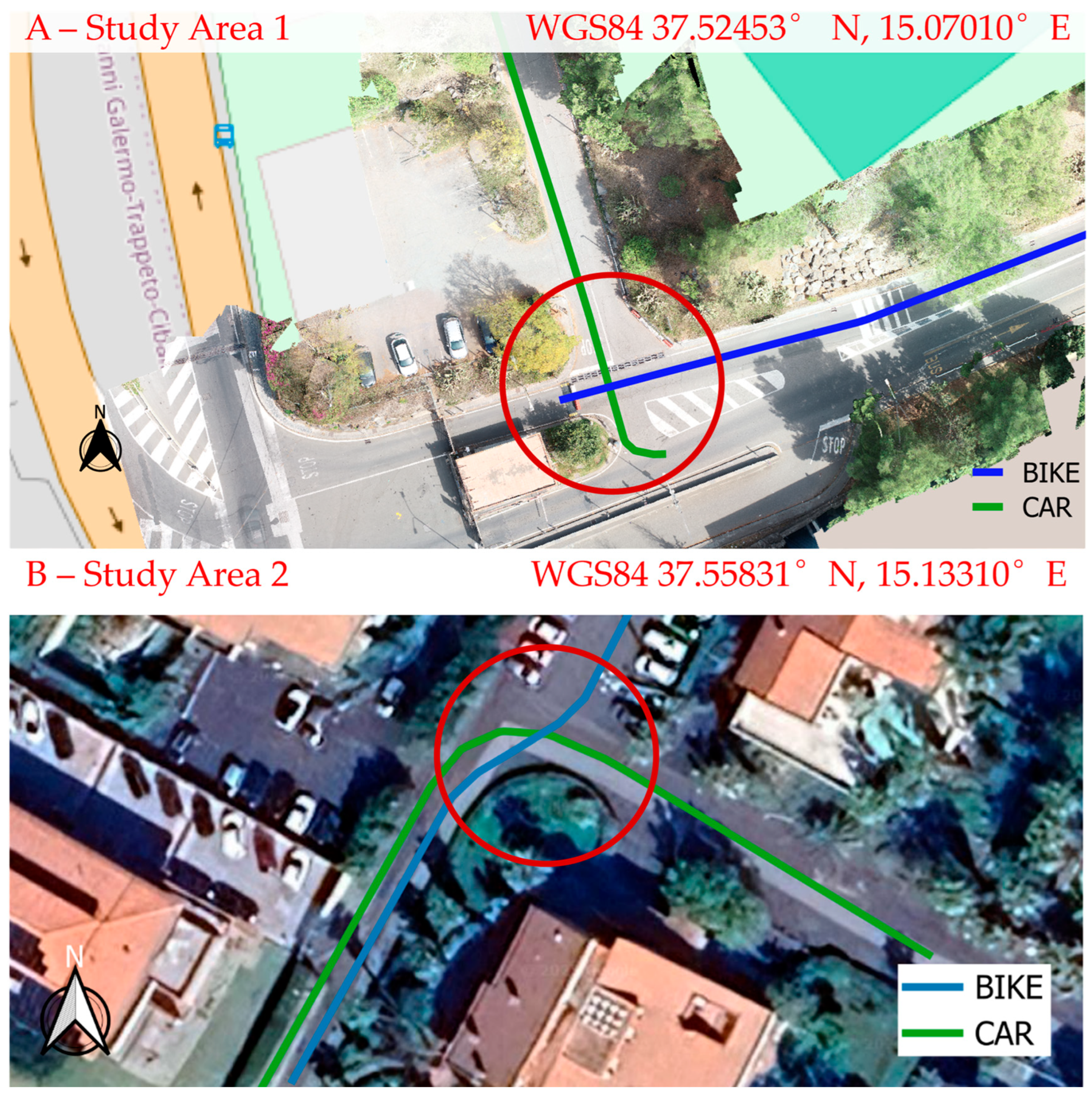
Figure 1A and
Figure 1B, respectively, show Study Area 1 (SA1), located in Catania (Geospatial reference WGS84 37.52453° N, 15.07010° E), characterised by a left-turn radius ranging between 5 and 15 metres and Study Area 2 (SA2), located in Aci Castello (Geospatial reference WGS84 37.55831° N, 15.13310° E), where the corresponding turning radius ranges from 9 to 14 m. Both correspond to two real urban T-intersections characterised by severely limited visibility due to road geometry and the presence of physical obstacles such as retaining walls. These scenarios represent typical critical urban conditions, in which mutual visibility between vehicles is compromised until just a few metres from the intersection area [
2,
19].
The modelled configuration includes a left-turn manoeuvre for the car approaching the intersections, and a straight-crossing manoeuvre for the bicycle. This scenario is among the most critical due to the car’s turning manoeuvre and the limited visibility [
20].
To construct the Digital Model, the road network was imported from OpenStreetMap (OSM, © OpenStreetMap contributors;
https://www.openstreetmap.org, accessed on 30 September 2025) [
21,
22,
23] and subsequently enriched with physical characteristics such as lane widths and road links (
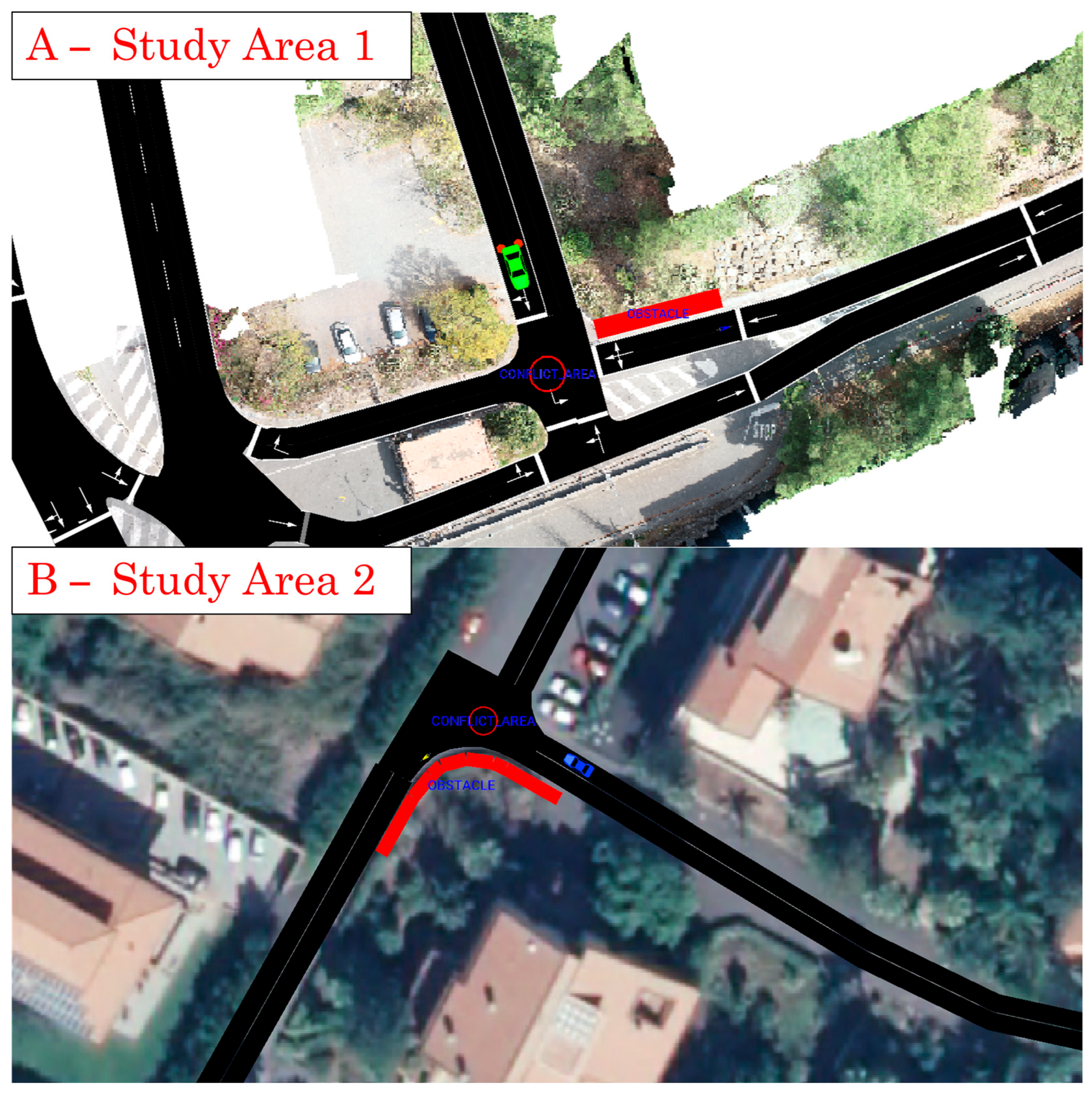
Figure 1A,B). Within the intersection, the conflict zone was represented as a circular area with a radius of 1.75 m, centred at the intersection [
24,
25]. The radius of 1.75 m was selected to account for the actual lengths of the passenger cars (3.5 ÷ 5 m) and bicycles (1.7 ÷ 2.0 m), modelled as points in the simulation. It was a reasonable assumption, considering that a 0.5 m variation corresponds to about only 0.1 s change in TTA computation. This approach guarantees that once the vehicle’s centre point enters the region, a substantial portion of its envelope is already engaged, providing a robust, uniform reference for interaction timing across bicycle and vehicle agents. An additional element modelled in the DM is the visual obstruction. Following Euro NCAP [
26] specification, the model was represented as a polygon positioned adjacent to the travel lane (
Figure 2A,B).
2.1.2. Digital Model of the Vehicles
In this study, both vehicles were modelled using the Extended Intelligent Driver Model (EIDM) available in SUMO [
27] and calibrated using real-world trajectory data collected under controlled conditions.
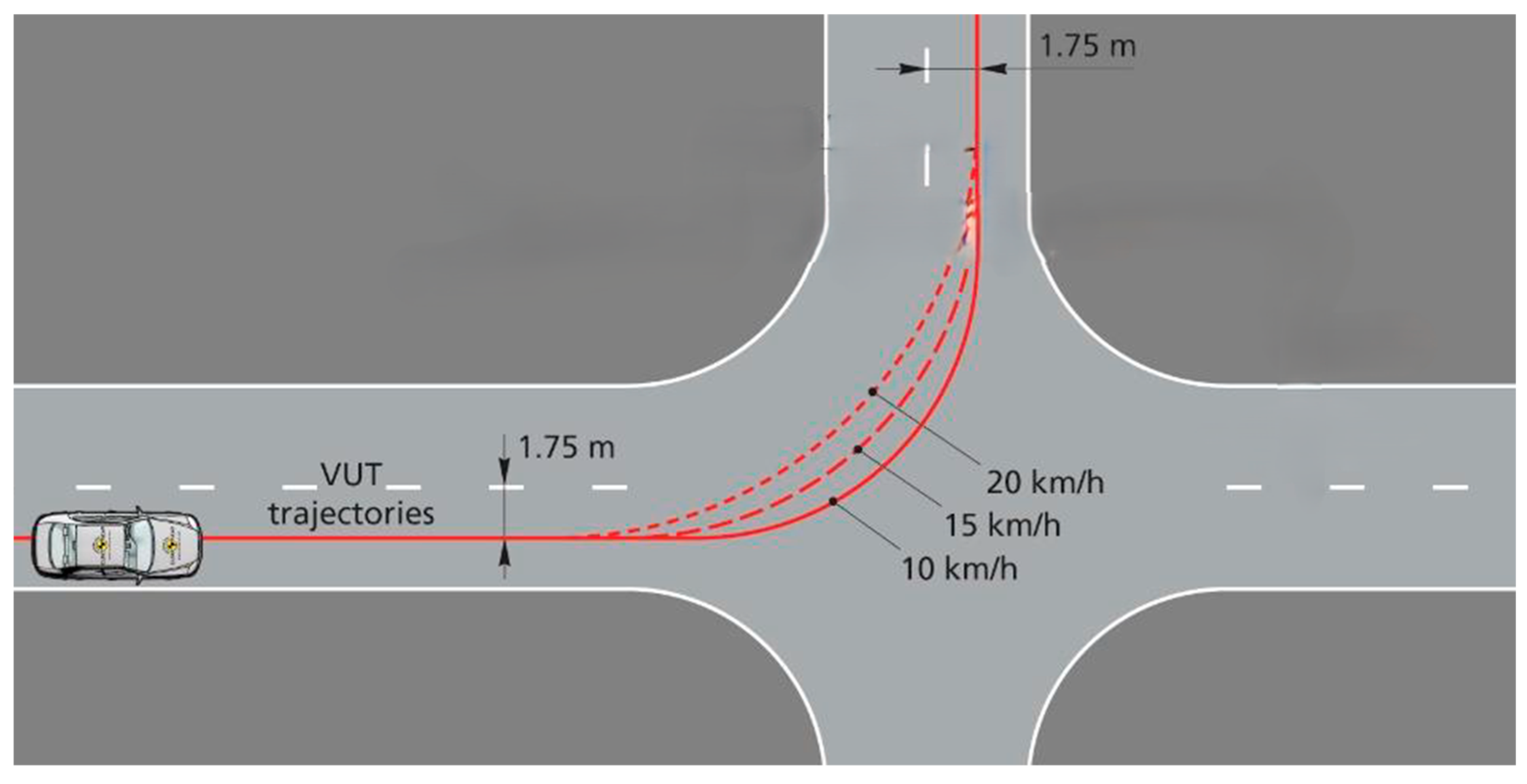
The DMs for vehicles are based on actual trajectory data acquired by on-board GNSS (Video VBOX Pro 20 Hz, Racelogic Ltd., Buckingham, UK) in controlled in-field experiments that replicate a wide range of user behaviour within the physical constraints of the real-world intersection in the two pilot scenarios. For both the bicycle and the car, data were collected under free-flow and safe conditions, involving different approaching speeds for each vehicle type. A larger dataset was obtained for cyclists, as the crossing manoeuvre exhibits inherently greater variability in speed and approach trajectories. In contrast, the vehicle dataset was smaller because the turning manoeuvre involves a narrower range of kinematic conditions and was intentionally aligned with the standardised speeds defined in the Euro NCAP protocol. The observed turning speeds for cars were compared with the reference values defined by the Euro NCAP protocol (
Figure 3 [
28]), showing good consistency.
Table 2 present summary statistics for the key parameters of recorded speed profiles for bicycles and cars. Ranges and standard deviations show the high variability of the parameters chosen to reflect a large set of users, limited only by the vehicles and physical constraints.
Simulation of Urban Mobility (SUMO, Eclipse SUMO-Simulation of Urban MObility,
https://www.eclipse.org/sumo, accessed on 15 March 2025) [
14] was selected due to its versatility, flexibility, and open-source licence [
29]. SUMO also offers the opportunity to interact with external Python scripts and customise agent behaviour [
18,
30]. The dynamic behaviour models of the car and bicycle are created by adjusting selected parameters in the micro-simulation models. Moreover, reference was made to the guidelines specified by Euro NCAP test protocols [
26].
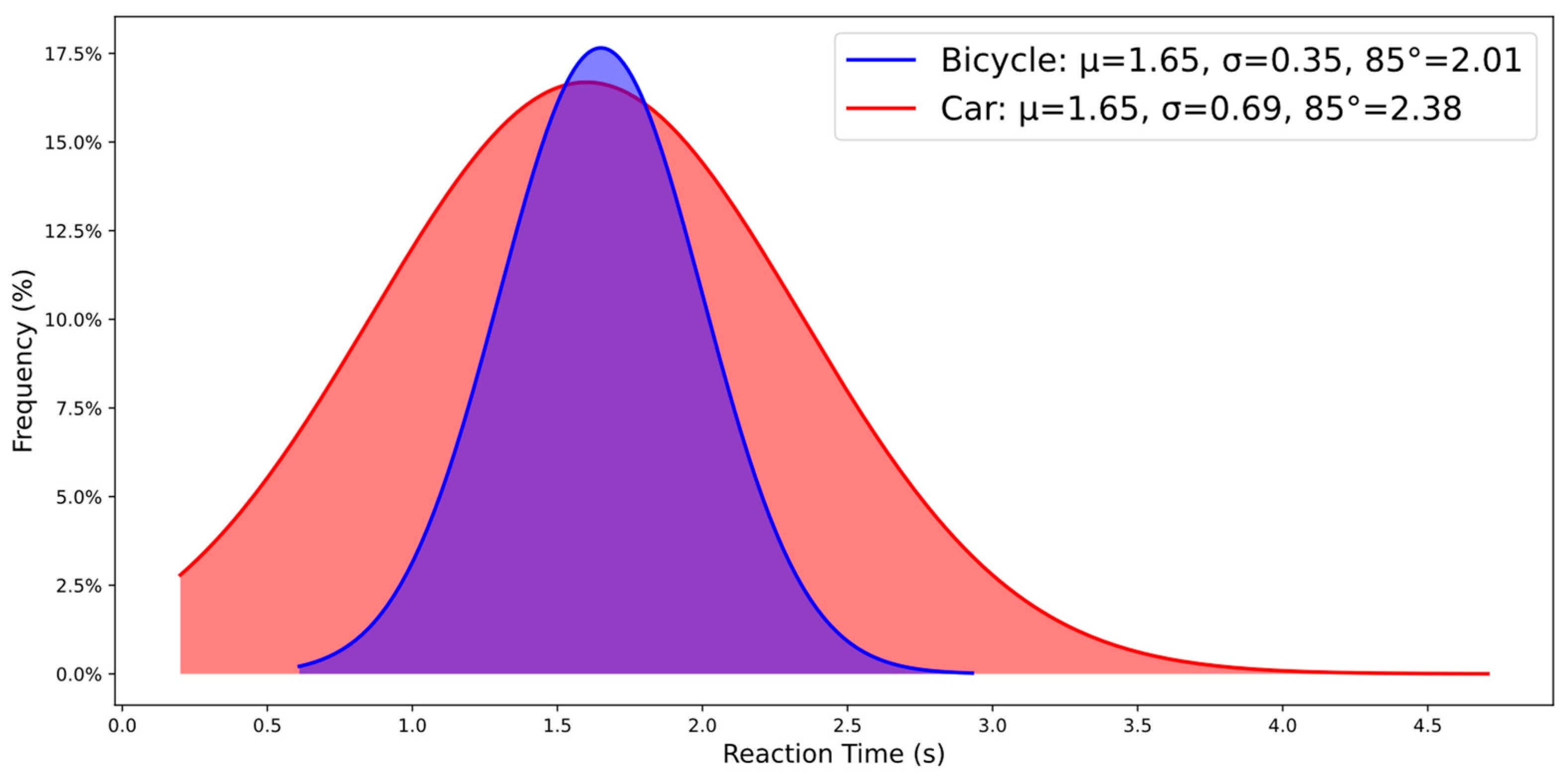
Given the limited sample of in-field data available only in safe traffic conditions, statistical variability will be introduced in the model parameters by using Python API (Python 3.13). Moreover, to enhance behavioural realism in critical traffic conflicts, reaction times (RT) for cyclists [
31] and manually driven vehicles [
32] were modelled as normally distributed and implemented as lower-bounded truncated distributions to avoid unrealistic short or negative values (
Figure 4). As reported in the referenced literature,
Figure 4 shows a slight difference in the means, but the standard deviations of the two distributions are substantially different, indicating distinct levels of variability and uncertainty in the perception–response behaviour of the two user groups. The key parameters for the distributions are reported in
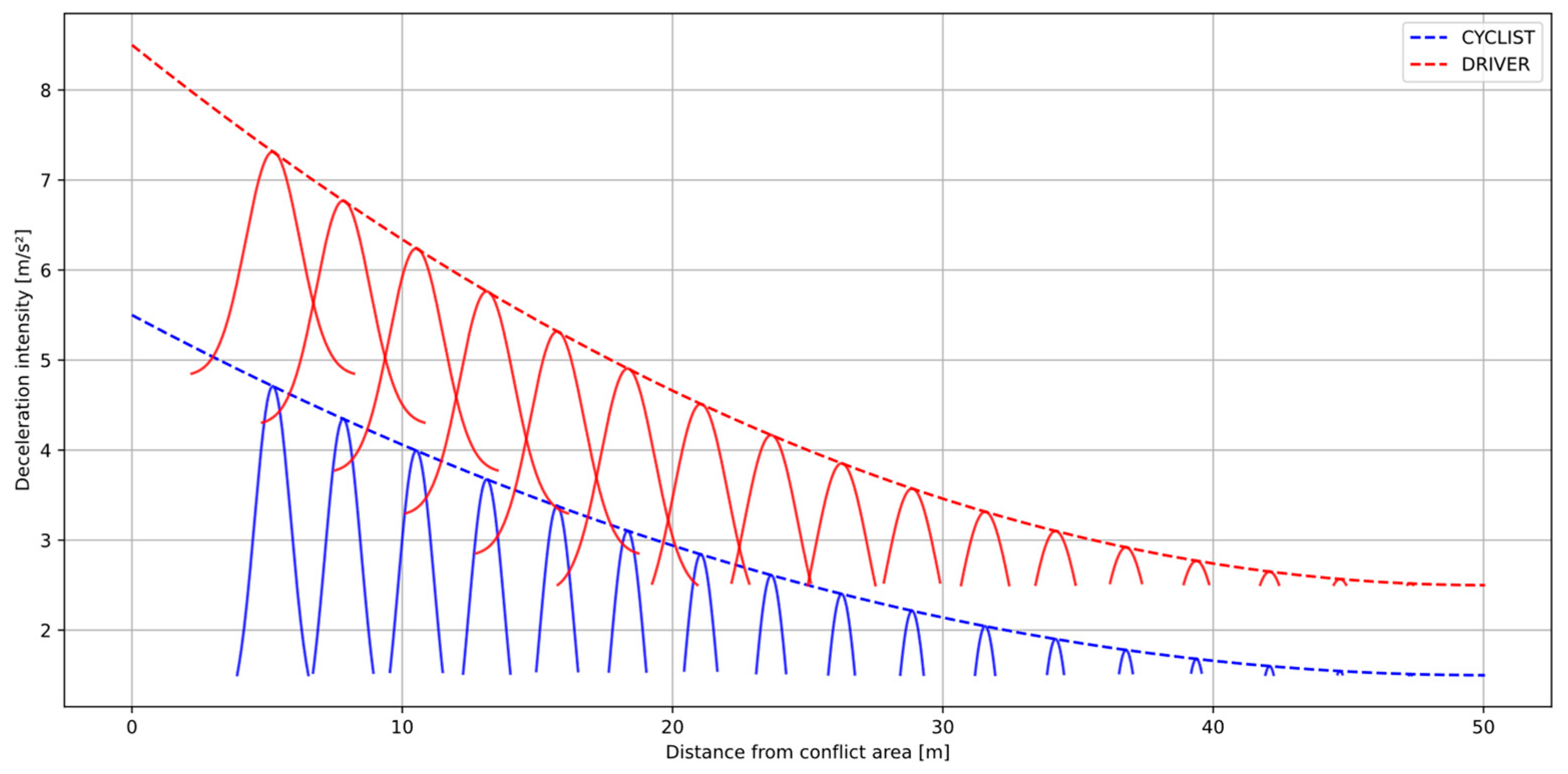
Table 3. Additionally, deceleration capabilities were modelled as continuous variables, sampled from normal distributions with means ranging within [1.5–5.5 m/s
2] for bicycles and [2.5–8.5 m/s
2] for cars [
33], linked also to the distance between the agent and the conflict area [
34].
The probabilistic distributions of the braking parameters for the car driver and the bicyclist are shown in
Figure 5.
The bicycle crossing speed, in the absence of a braking reaction, was modelled using a truncated normal distribution with a mean and standard deviation directly derived from real data acquired during the calibration phase (
Table 4). As for the car, the turning speed, in the absence of a braking reaction, was defined according to both Euro NCAP guidelines [
28] and calibration data, using a truncated normal distribution with the mean and standard deviation listed in
Table 4.
The departure speed ranges were also defined to reflect realistic urban conditions and user variability. For the bicycles, it was decided to extend the range of observed values, considering that the average speed for non-professional cyclists ranges between 3.0 and 5.5 m/s, with peaks up to 8–10 m/s for pedal-assisted bicycles [
31]; For cars, the considered range was 5 m/s to 13 m/s, in line with typical urban speeds [
32] (
Table 4).
All these parameters were integrated into a unified framework to replicate realistic variability in the user- and vehicle behaviours. The resulting behavioural models, designed to reflect human perception and reaction to hazards, are named HUMAN (Human User Model for Agent Navigation).
2.2. Sample Generation and Model Validation
A large dataset from simulations can be generated within the DM to replicate rare and hazardous traffic conflicts that are difficult to observe in real-world conditions. This is possible by combining the HUMAN behavioural model with the braking reaction activated by the users’ visual perception, which was developed to reproduce real user behaviour.
Before generating the full dataset, the HUMAN model was tested and validated in a controlled scenario reproducing the isolated vehicle crossing condition, in which no interaction or reaction occurs between road users. In this scenario, named HIC (Human in Isolate Crossing), which represents a baseline scenario derived from field observations, the vehicle trajectories are simulated autonomously, without interaction or reaction. The model assumptions are limited to the departure and crossing speeds, which are based on in-field tests. Model validation in the HIC scenario ensures it can reproduce real-world dynamics.
To this aim, as recommended [
35,
36], a sample of 1000 simulations was generated to compare real- and simulated-speed profiles, ensuring parameter space convergence. The simulation employed a Monte Carlo approach, with random variability in the model parameters assigned using the Latin Hypercube Sampling (LHS) technique. This technique enables an efficient, stratified exploration of the multidimensional parameter space, ensuring that the generated samples are evenly distributed and free from clustering effects [
37].
Three complementary similarity metrics were selected to capture different aspects of the speed-distance profile, including shape, scale, and overall deviation. Cosine Similarity was used to evaluate the alignment between the trends of the speed profiles, independently of their magnitude [
38], while the other two scale-sensitive metrics were applied to assess the magnitude and distance travelled. The Sum of Squared Errors on travelled Space (SSE Space) [
39] compares cumulative trajectories and penalises persistent deviations, making it particularly suitable for dynamic models. The Area-Based Similarity, which measures the difference in magnitude by calculating the normalised area between the curves, is used to evaluate the consistency of kinematic signals in terms of energy or movement intensity. To compare the results, the metrics were normalised to a scale from 0 (poor similarity) to 1 (perfect similarity). The results in
Table 5 confirm the overall robustness of the calibration for both vehicle models.
2.3. Surrogate of Safety Metrics
To quantify the temporal spacing between the vehicles approaching the conflict area, the Time-To-Arrival Differential (TTA
2) was introduced. This, as shown in Equation (1), represents the time interval between the arrival of the two vehicles at the conflict area [
40]. A reduced TTA
2 limits the availability and effectiveness of evasive manoeuvres for both road users, thereby increasing the collision likelihood. It is worth mentioning that TTA
2 is a metric similar to PET, but it is calculated based on the observation or prediction of the time to arrival when the first vehicle enters the conflict area before the encroachment, thus enabling predictive risk analysis.
where
represents the time at which the bicycle enters the conflict area;
represents the time at which the car enters the conflict area.
As a complementary safety metric, we evaluated the relative speed (DV) of the vehicles at the conflict area, as this parameter is strongly associated with conflict severity.
2.4. Test Scenarios
A dataset comprising 4000 trajectories was generated using the Monte Carlo approach, as previously described [
35,
36].
After preliminary trials, post-estimation checks validated the desired accuracy of the outputs for the sample sizes of 1000 and 4000 used in the study [
41]. To balance the computational cost, which was higher in the similarity analysis, accuracy was fixed at 0.1/0.05 s for TTA and 0.1/0.05 m/s for speed at the 1000/4000 samples, respectively, with a 95% confidence level. For each scenario and simulation, a set of key variables was computed and stored in
Table 6. These include a unique simulation identifier (ID) and the Arrival Order (AO), which indicates which vehicle reached the conflict area first. Additionally, the Time To Arrival (TTA) for each simulated agent and the entry speed at the conflict area (SPEED) were recorded. These surrogate measures of safety can be related to the severity (SPEED, AO) and likelihood of a collision (TTA) [
42,
43].
The case studies analyse critical interactions between a bicycle and a crossing at an urban intersection with different side visibility. The aim is to investigate how the geometry of the intersection and the presence and position of visual obstacles can influence user behaviours and safety. Once the HUMAN behavioural model was validated in the HIC scenario, it was applied to simulate more complex interactions between the bicycle and vehicle, including the braking reaction models.
In the simulations, visibility serves as the trigger for the agents’ perception and reaction behaviour. When both agents are outside reciprocal visibility, they do not perceive each other and behave independently. When both are within the visibility area, the braking-model logic is activated, and both agents react based on their perception and reaction models and statistical distributions.
Based on this framework, two different test scenarios were defined for each Study Area to evaluate the model’s sensitivity to change based on visibility conditions:
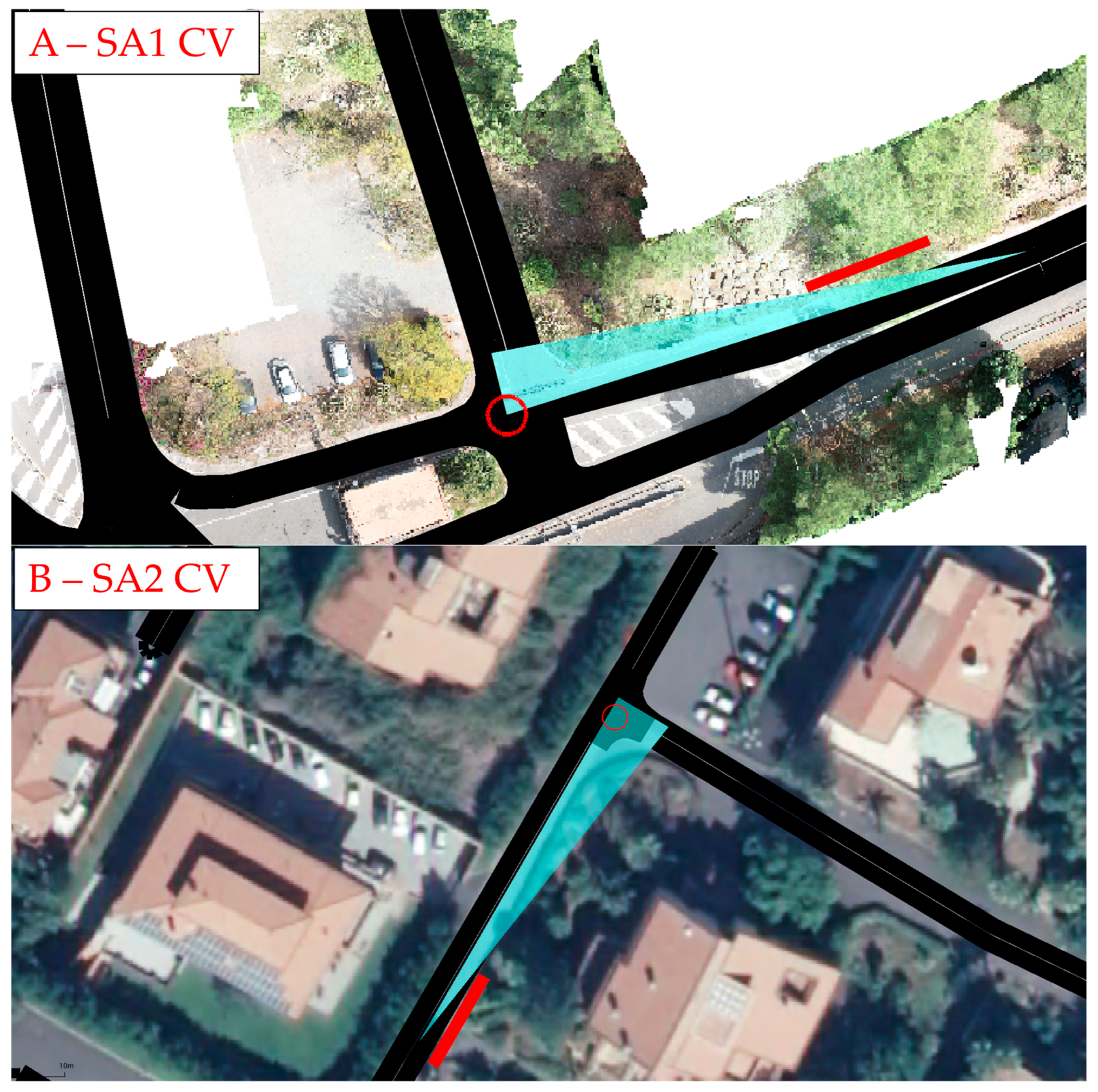
Clear Visibility (SA1 CV, SA2 CV): This represents the benchmark scenario where an intersection has no visual obstructions. The bicycle and vehicle can perceive each other from a distance consistent with the visibility triangle defined by the design guidelines [
44]. This allows for anticipatory behaviour, smoother negotiation of right-of-way, and reduced risk of conflict (
Figure 6A,B).
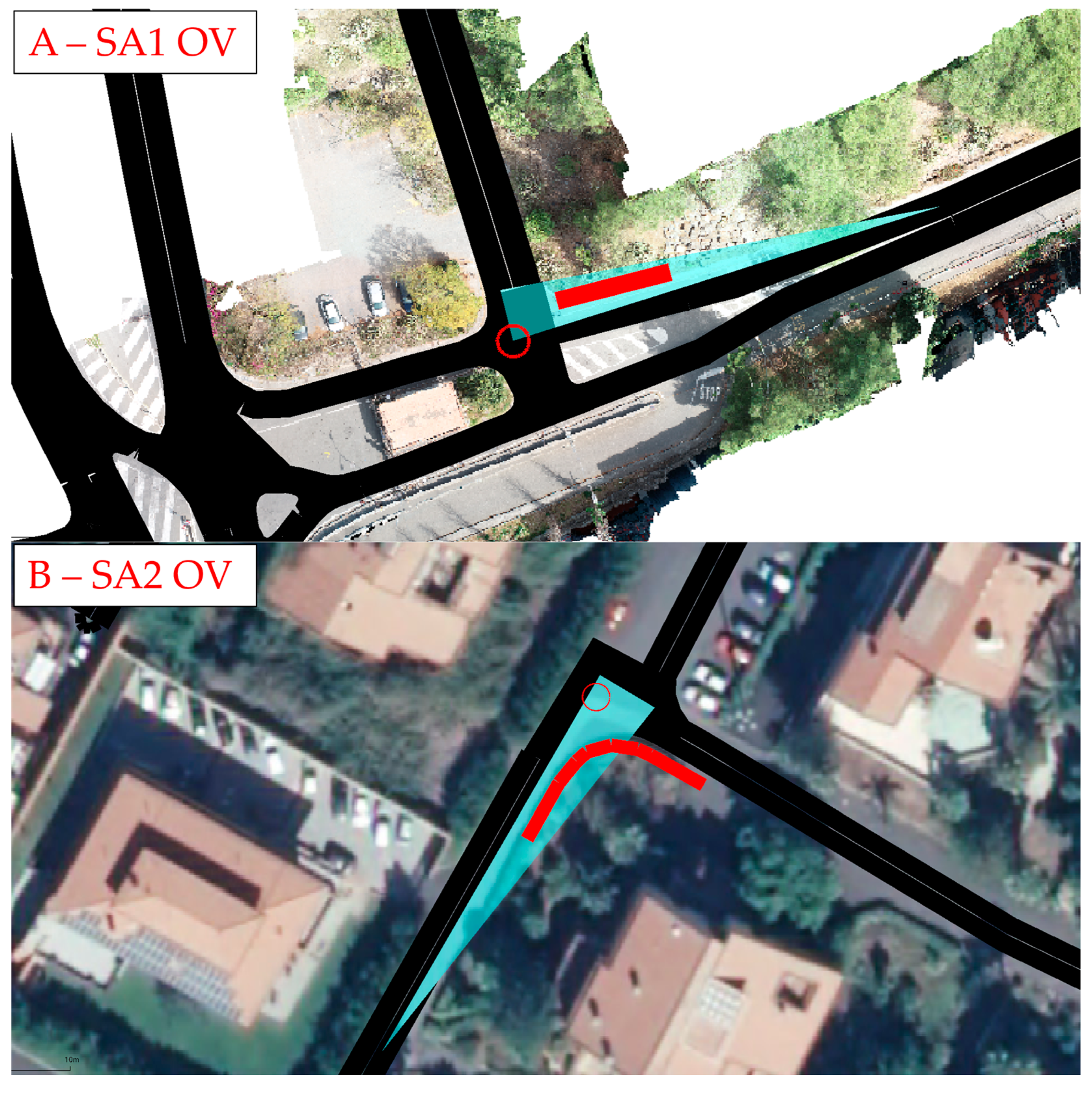
Obstructed Visibility (SA1 OV, SA2 OV): In this case, the presence of an obstacle limits the mutual visibility until the agents are very close to the conflict point. The model simulates more abrupt reactions, emergency braking, and increased decision-making uncertainty, reflecting the perceptual challenges caused by the road geometry (
Figure 7A,B).
3. Results and Discussion
In the simulations, the HUMAN behavioural model governs agent decisions without relying on predefined trajectories or deterministic rules. Instead, it simulates adaptive and stochastic behaviour, where each agent evaluates its motion based on the perceived TTA and distance to the conflict area. In both scenarios A and B, the visibility triangle acts as a trigger for perception. When an agent enters the triangle and is not obstructed by visual barriers, it becomes aware of the other vehicle. This perception triggers a reaction time (RT), which is sampled by the distribution shown in
Figure 4. The decision-making process is activated after the RT delay. It is dynamic and based on the estimated TTA and the distance to the conflict point. Agents do not follow fixed rules; their choices are influenced by the perceived urgency of the situation: when the temporal gap between agents is small, and the distance to the intersection is short, the likelihood of a behavioural adjustment increases. In the Clear Visibility scenario A, agents perceive each other early, enabling smoother and more coordinated decisions. The reaction times are triggered well before reaching the conflict point, and the TTA
2 is often large enough to avoid abrupt manoeuvres. Agents tend to decelerate gradually or adjust their speed to cross safely. In contrast, the Obstructed Visibility scenario B forces agents to react much closer to the conflict area; the delayed perception leads to shorter TTA
2 values, resulting in more rigid and impulsive behaviour, with a reduced capacity for dynamic adaptation and more frequent emergency braking.
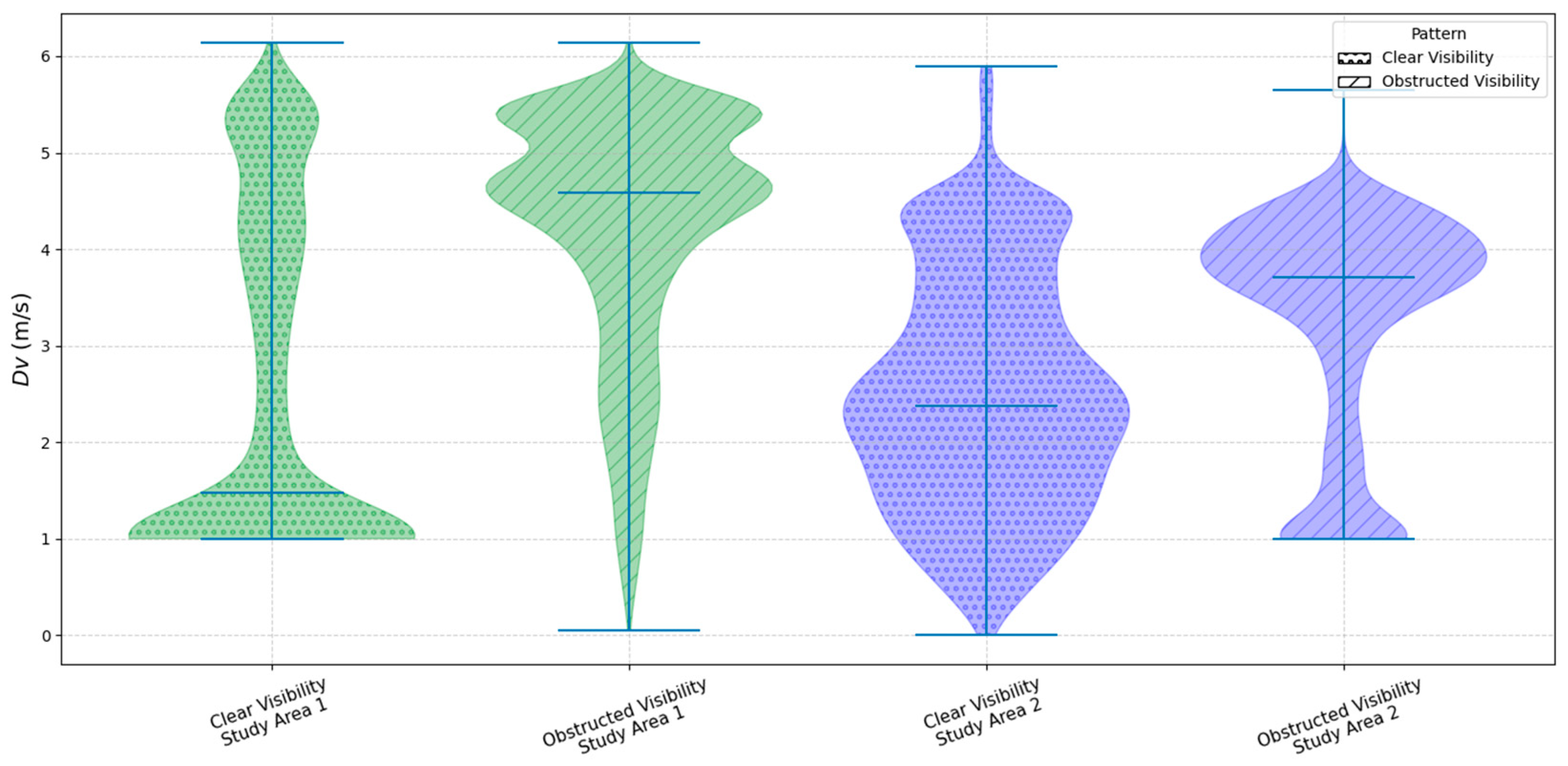
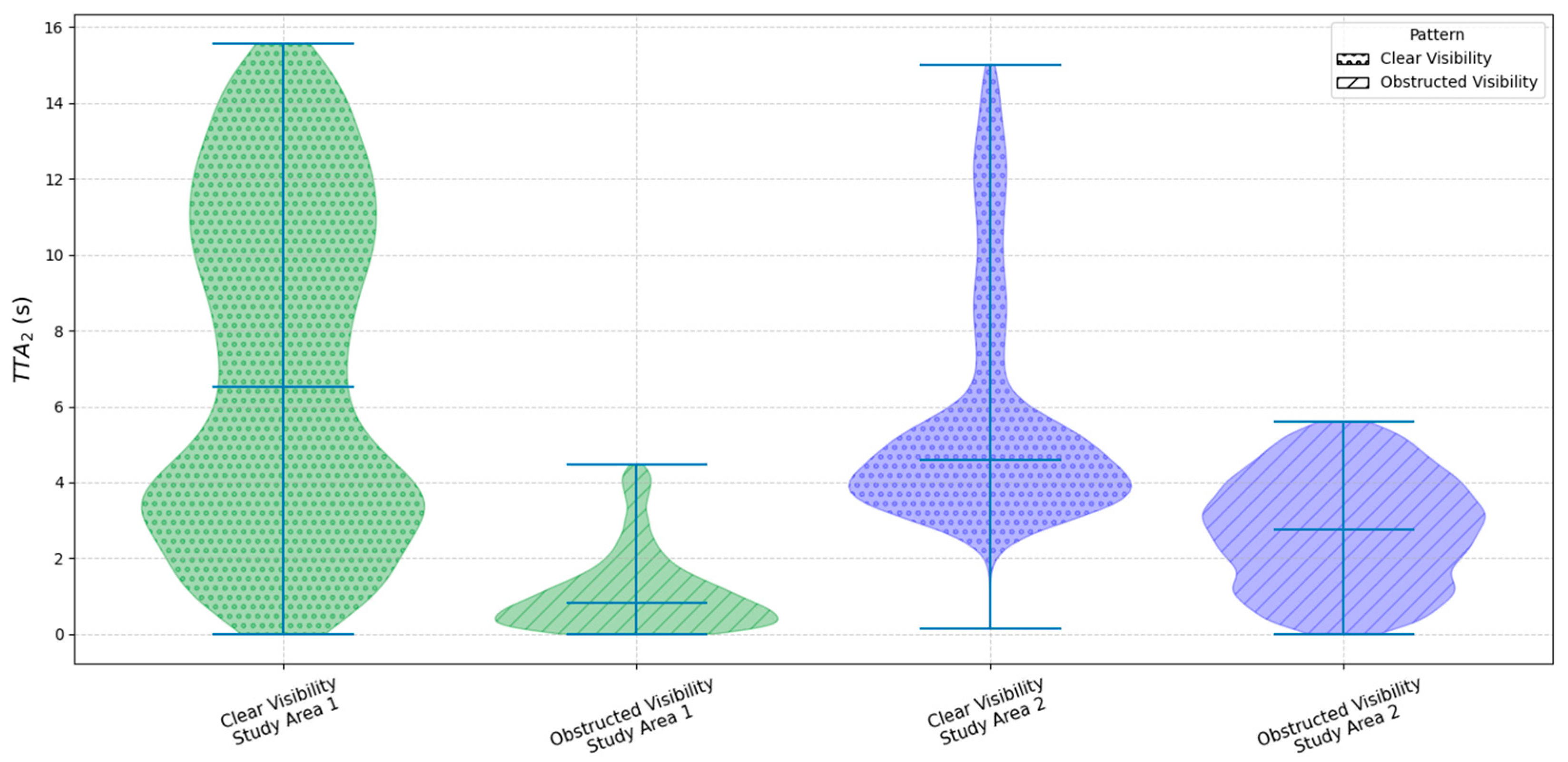
These differences in behavioural dynamics are further reflected in the traffic conflict metrics, including crossing speed (Dv) and time to arrival (TTA
2), upon entering the conflict area, which were extracted from each simulation and graphically reported in the violin plots of
Figure 8 and
Figure 9.
Different conflict patterns emerge when analysing the distribution of relative crossing speeds (Dv) across two scenarios (A and B) and the two intersections (1 and 2) (
Figure 8). In both intersections, in the Clear Visibility scenario A, agents’ crossing speeds are clearly distributed toward lower values. The limited perception window in scenario (B) prevents agents from adjusting their movements in time, leading to more impulsive behaviour and reduced risk-management capacity. This pattern reflects the safer condition (A), indicating that the agents can perceive each other and gradually adjust their motion to avoid severe conflicts. The presence of lower speeds in scenarios (A) compared to (B) suggests increased risk awareness and safer interaction management. Additionally, different distributions appear in the two intersections in scenario (A) with higher crossing speeds and variability in case (2), given the less constricted turning manoeuvre of the car with a larger radius and lane width. In contrast, in case (1), the simulations yielded a higher crossing speed in the limited-visibility scenario (B) due to the shorter side distance and intersection configuration, but showed similar variability in cases 1 and 2, driven solely by human reaction rather than by the different physical configurations.
Figure 9 further highlights these differences by showing the distribution of TTA
2 (Time-To-Arrival Differential) across the three scenarios.
In the Clear Visibility scenario (A), the distributions in both cases 1 and 2 show wide variability, with values mainly over 2 s in both cases, and only values less than 2 s in case 2, related to the higher bicycle crossing speed. This reflects a more adaptive behaviour, where agents can anticipate the interaction, gradually adjust their speed, and manage the crossing in a more coordinated and safer manner. Longer temporal gaps indicate greater risk awareness and smoother negotiation of the intersection.
Conversely, in the Obstructed Visibility scenario (B), the temporal gap between agents at the entry to the conflict area is extremely reduced, with more than 50% of cases where TTA2 is below 1 s in case (1) and below 3 s in case (2), reflecting the different side distances and behaviours before the bracing reaction. This indicates that both agents reach the conflict point almost simultaneously, especially in case (1), leaving minimal safety margins and increasing the likelihood of collisions. The lack of early perception prevents effective planning and forces abrupt, last-moment reactions.
Simulation results confirm not only the HUMAN model’s sensitivity to different geometric conditions of the intersection, but also its ability to mimic human behaviour before and after visual perception. The agents’ perceptions and reactions, modulated by visibility, yield realistic crossing dynamics consistent with empirical judgments. This validates the adopted approach and demonstrates its potential applicability in complex urban contexts, where risk management and visibility design are central elements for road safety.
4. Conclusions
This study represents a pilot investigation based on a controlled experimental dataset collected under safe operating conditions and on a limited number of intersections. It introduces a comprehensive methodological framework for modelling and simulating interactions between vehicles and vulnerable road users (VRUs) at urban intersections under varying road layouts and visibility conditions. Due to the exploratory nature of this work, the restricted sample size and the small number of analysed intersections represent inherent limitations that should be acknowledged. However, the primary objective was to define and validate a modelling framework that can serve as a robust basis for future extensions. The proposed approach leverages a Digital Model (DM) environment to replicate real-world geometries and behavioural dynamics, enabling the synthetic generation of large databases for rare and hazardous interaction scenarios that are difficult to capture through field observations.
The HUMAN behavioural model, calibrated with real trajectory data, demonstrated strong sensitivity to geometric and perceptual constraints, confirming the suitability of DM-based simulations for analysing different user behaviour in complex urban contexts. The inclusion of braking reaction models enabled the simulation of critical traffic conflicts that are not supported in standard micro-simulation tools. Analysis of relative crossing speeds and temporal spacing (TTA
2) confirmed that visibility plays a crucial role in shaping user behaviour: clear visibility conditions enable anticipatory and adaptive responses, whereas obstructed visibility leads to impulsive and less-coordinated manoeuvres, thereby, increasing the likelihood of critical situations. It is worth noting that the distributions of DV and TTA
2 showed distinct patterns in the two case studies [
1,
2], highlighting the simulation framework’s sensitivity to different road geometric configurations.
Beyond the specific results, this research demonstrates the potential of DM-based frameworks to generate structured and reliable synthetic data for safety assessment, especially in contexts where real-world observations are limited, hazardous, or impractical. The proposed methodology provides a scalable, controlled environment for the preventive assessment of new treatments and advanced safety systems, supporting the development of intelligent mobility solutions and inclusive strategies that address the needs of all road users, particularly the most vulnerable.
Future research should expand the empirical dataset by incorporating additional geometric configurations with more heterogeneous traffic and visibility conditions to strengthen external validity and further improve the robustness of the proposed framework. Furthermore, integrating vehicles equipped with Automated Emergency Braking (AEB) systems and cooperative technologies based on IoT and V2X (such as C-ITS, On-Board Units, Roadside Units, and V2I communications) represents a promising application of the proposed DM framework for the preventive assessment of emerging safety technologies by using synthetic data.
Author Contributions
Conceptualization, G.A.D., S.C., A.D.G., F.Z. and G.P.; Methodology, G.A.D., S.C., A.D.G., F.Z. and G.P.; Validation, G.A.D., S.C., A.D.G., F.Z. and G.P.; Formal analysis, G.A.D., S.C., A.D.G., F.Z. and G.P.; Investigation, G.A.D., S.C., A.D.G., F.Z. and G.P.; Data curation, G.A.D., S.C., A.D.G., F.Z. and G.P.; Writing—original draft, G.A.D., S.C., A.D.G., F.Z. and G.P.; Writing—review & editing, G.A.D., S.C., A.D.G., F.Z. and G.P.; Visualization, G.A.D., S.C., A.D.G., F.Z. and G.P.; Supervision, G.A.D., S.C., A.D.G., F.Z. and G.P.; Project administration, G.A.D., S.C., A.D.G., F.Z. and G.P.; Funding acquisition, G.A.D., S.C., A.D.G., F.Z. and G.P. All authors have read and agreed to the published version of the manuscript.
Funding
This paper was partially supported by the European Union (Next Generation EU through the MUR-PNRR project RESTART) (CUP E63C22002070006) as well as by PNRR, the National Centre for HPC, Big Data and Quantum Computing, Mission 4 Component 2, Investment 1.4, CUP E63C22001000006 and by PIAno di inCEntivi per la Ricerca di Ateneo 24-26 Linea di Intervento 1 progetto “SICURI”.
Institutional Review Board Statement
Not Applicable.
Informed Consent Statement
Informed consent was obtained from all subjects involved in the study.
Data Availability Statement
The datasets referenced in this article are not publicly accessible, as the research is still in progress and confidentiality agreements between the university and collaborating partners restrict data sharing at this stage. Data may be made available upon reasonable request after the study is completed and subject to institutional approval.
Conflicts of Interest
The authors declare no conflicts of interest.
Abbreviations
| AEB | Autonomous Emergency Braking |
| AO | Arrival Order |
| C—ITS | Cooperative Intelligent Transport System |
| CV | Clear Visibility |
| DM | Digital Model |
| DV | Relative Crossing Speed |
| EIDM | Extended Intelligent Driver Model |
| Euro NCAP | European New Car Assessment Programme |
| HIC | Human Isolated Crossing |
| HUMAN | Human User Model for Agent Navigation |
| IoT | Internet of Things |
| LHS | Latin Hypercube Sampling |
| OSM | OpenStreetMap |
| OV | Obstructed Visibility |
| PET | Post-Encroachment Time |
| RT | Reaction Time |
| SA | Study Area |
| SSE Space | Sum of Squared Errors on Travelled Space |
| SSM | Surrogate Safety Measure |
| SUMO | Simulation of Urban Mobility |
| TTA | Time-To-Arrival |
| TTA2 | Time-To-Arrival Differential |
| VRU | Vulnerable Road User |
| V2X | Vehicle to Everything |
| V2I | Vehicle to Infrastructure |
References
- European Commission. Annual Statistical Report on Road Safety in the EU, 2025; European Commission, Directorate-General for Transport, European Road Safety Observatory (ERSO): Brussels, Belgium, 2025. [Google Scholar]
- Zhang, M.; Quante, L.; Gröne, K.; Schießl, C. Interaction Patterns of Motorists and Cyclists at Intersections: Insight from a Vehicle–Bicycle Simulator Study. Sustainability 2023, 15, 11692. [Google Scholar] [CrossRef]
- Yaqoob, S.; Cafiso, S.; Morabito, G.; Pappalardo, G. Detection of anomalies in cycling behavior with convolutional neural network and deep learning. Eur. Transp. Res. Rev. 2023, 15, 9. [Google Scholar] [CrossRef]
- Owens, J.M.; Greene-Roesel, R.; Habibovic, A.; Head, L.; Apricio, A. Reducing Conflict Between Vulnerable Road Users and Automated Vehicles. In Road Vehicle Automation 4; Lecture Notes in Mobility; Meyer, G., Beiker, S., Eds.; Springer International Publishing: Cham, Switzerland, 2018; pp. 69–75. [Google Scholar] [CrossRef]
- Wang, X.; Qin, D.; Cafiso, S.; Liang, K.K.; Zhu, X. Operational design domain of autonomous vehicles at skewed intersection. Accid. Anal. Prev. 2021, 159, 106241. [Google Scholar] [CrossRef]
- Puller, N.; Lucas, G.; Leschke, A.; Maier, O.; Monnich, J.; Rocco, V. The “Typical” Car-Cyclist Collision Under the Microscope: A Gidas-Based Analysis of the Prevalent Crash Scenario. In Proceedings of the 27th ESV Conference, Yokohama, Japan, 3–6 April 2023. [Google Scholar]
- Tang, S.; Lu, Y.; Liao, Y.; Cheng, K.; Zou, Y. A New Surrogate Safety Measure Considering Temporal–Spatial Proximity and Severity of Potential Collisions. Appl. Sci. 2024, 14, 2711. [Google Scholar] [CrossRef]
- Nikolaou, D.; Dragomanovits, A.; Ziakopoulos, A.; Deliali, A.; Handanos, I.; Karadimas, C.; Kostoulas, G.; Frantzola, E.K.; Yannis, G. Exploiting Surrogate Safety Measures and Road Design Characteristics towards Crash Investigations in Motorway Segments. Infrastructures 2023, 8, 40. [Google Scholar] [CrossRef]
- Datta, S.; Rokade, S.; Rajput, S.P.S. Microscopic simulation based uncontrolled intersection performance assessment. SN Appl. Sci. 2020, 2, 1732. [Google Scholar] [CrossRef]
- Astarita, V.; Caliendo, C.; Giofrè, V.P.; Russo, I. Surrogate Safety Measures from Traffic Simulation: Validation of Safety Indicators with Intersection Traffic Crash Data. Sustainability 2020, 12, 6974. [Google Scholar] [CrossRef]
- Cafiso, S.; Di Graziano, A.; Pappalardo, G. Safety Inspection and Management Tools for Low-Volume Road Network. Transp. Res. Rec. J. Transp. Res. Board 2015, 2472, 134–141. [Google Scholar] [CrossRef]
- Li, Y.; Yuan, W.; Zhang, S.; Yan, W.; Shen, Q.; Wang, C.; Yang, M. Choose Your Simulator Wisely: A Review on Open-Source Simulators for Autonomous Driving. IEEE Trans. Intell. Veh. 2024, 9, 4861–4876. [Google Scholar] [CrossRef]
- Ullah, I.; Farid, A.; Muknahallipatna, S.; Ksaibati, K. Intersection sight distance evaluation through a comprehensive review and novel measurement framework. Discov. Civ. Eng. 2025, 2, 199. [Google Scholar] [CrossRef]
- Eclipse SUMO Team (DLR). Official Documentation. Bicycles—SUMO Documentation. Available online: https://sumo.dlr.de/docs/Simulation/Bicycles.html (accessed on 13 November 2025).
- CARLA Team CARLA Simulator—Official Documentation. Available online: https://carla.org/ (accessed on 13 November 2025).
- PTV Group PTV Vissim—Multimodal Traffic Simulation Software. Available online: https://www.ptvgroup.com/en/products/ptv-vissim (accessed on 13 November 2025).
- AVSimulation SCANeR—AVSimulation. Available online: https://www.avsimulation.com/en/scaner/ (accessed on 13 November 2025).
- Kusari, A.; Li, P.; Yang, H.; Punshi, N.; Rasulis, M.; Bogard, S.; LeBlanc, D.J. Enhancing SUMO simulator for simulation based testing and validation of autonomous vehicles. In Proceedings of the 2022 IEEE Intelligent Vehicles Symposium (IV); IEEE: Aachen, Germany, 2022; pp. 829–835. Available online: https://ieeexplore.ieee.org/document/9827241/ (accessed on 9 July 2025).
- Bashir, T.; Bergantino, A.S.; Troiani, G.; Falcone, G.; d’Onofrio, A.; Pagliara, F. Impact of Traffic Disruptions on Road Network Accessibility and Vulnerability in Inner Campania Areas. Appl. Spat. Anal. 2025, 18, 71. [Google Scholar] [CrossRef]
- United Nations Economic Commission for Europe (UNECE) EUNECE. Available online: https://unece.org/ (accessed on 30 September 2025).
- Barron, C.; Neis, P.; Zipf, A. A Comprehensive Framework for Intrinsic OpenStreetMap Quality Analysis. Trans. GIS 2014, 18, 877–895. [Google Scholar] [CrossRef]
- Foody, G.; See, L.; Fritz, S.; Mooney, P.; Olteanu-Raimond, A.-M.; Fonte, C.C.; Antoniou, V. (Eds.) Mapping and the Citizen Sensor; Ubiquity Press: London, UK, 2017. [Google Scholar] [CrossRef]
- Wang, M.; Li, Q.; Hu, Q.; Zhou, M. Quality analysis of Open Street Map Data. Int. Arch. Photogramm. Remote Sens. Spatial Inf. Sci. 2013, XL-2/W1, 155–158. [Google Scholar] [CrossRef]
- Minderhoud, M.M.; Bovy, P.H.L. Extended time-to-collision measures for road traffic safety assessment. Accid. Anal. Prev. 2001, 33, 89–97. [Google Scholar] [CrossRef]
- Peesapati, L.N.; Hunter, M.P.; Rodgers, M.O. Evaluation of Postencroachment Time as Surrogate for Opposing Left-Turn Crashes. Transp. Res. Rec. J. Transp. Res. Board 2013, 2386, 42–51. [Google Scholar] [CrossRef]
- European New Car Assessment Programme (Euro NCAP). Version 4.5.1. Available online: https://www.euroncap.com/media/80156/euro-ncap-aeb-lss-vru-test-protocol-v451.pdf (accessed on 25 June 2025).
- Salles, D.; Kaufmann, S.; Reuss, H.-C. Extending the Intelligent Driver Model in SUMO and Verifying the Drive Off Trajectories with Aerial Measurements. SUMO Conf. Proc. 2022, 1, 1–25. [Google Scholar] [CrossRef]
- Crash Avoidance Low Speed Collisions. Available online: https://www.euroncap.com/media/85411/euro-ncap-protocol-crash-avoidance-low-speed-collisions-v09.pdf (accessed on 9 July 2025).
- Liu, W.; Wang, X.; Zhang, W.; Yang, L.; Peng, C. Coordinative simulation with SUMO and NS3 for Vehicular Ad Hoc Networks. In Proceedings of the 2016 22nd Asia-Pacific Conference on Communications (APCC); IEEE: Yogyakarta, Indonesia, 2016; pp. 337–341. Available online: http://ieeexplore.ieee.org/document/7581471/ (accessed on 9 July 2025).
- Griggs, W.M.; Shorten, R.N. Embedding real vehicles in SUMO for large-scale ITS scenario emulation. In Proceedings of the 2013 International Conference on Connected Vehicles and Expo (ICCVE); IEEE: Las Vegas, NV, USA, 2013; pp. 962–963. Available online: http://ieeexplore.ieee.org/document/6799942/ (accessed on 9 July 2025).
- Strohaeker, E.H.; Moia, A.; Steinmann, J.; Hagemeister, C. How do warnings influence cyclists’ reaction to conflicts? Comparing acoustic and vibro-tactile warnings in different conflicts on a test track. Transp. Res. Part F Traffic Psychol. Behav. 2022, 90, 151–166. [Google Scholar] [CrossRef]
- American Association of State Highway and Transportation Officials (Ed.) A Policy on Geometric Design of Highways and Streets, 2001, 4th ed.; American Association of State Highway and Transportation Officials: Washington, DC, USA, 2001; 905p, ISBN 978-1-56051-156-4. [Google Scholar]
- Zhao, Y.; Li, H.; Huang, Y.; Hang, J. Numerical Analysis of an Autonomous Emergency Braking System for Rear-End Collisions of Electric Bicycles. Sensors 2023, 24, 137. [Google Scholar] [CrossRef]
- Maurya, A.K.; Bokare, P.S. Study of Deceleration Behaviour of Different Vehicle Types. Int. J. Traffic Transp. Eng. 2012, 2, 253–270. [Google Scholar] [CrossRef] [PubMed]
- Constantin, M.A.; Schuurman, N.K.; Vermunt, J.K. A general Monte Carlo method for sample size analysis in the context of network models. Psychol. Methods 2023. Epub ahead of printing. [Google Scholar] [CrossRef]
- Shapiro, A. Monte Carlo sampling approach to stochasticprogramming. ESAIM Proc. 2003, 13, 65–73. [Google Scholar] [CrossRef]
- Coppola, A.; D’Aniello, C.; Pariota, L.; Bifulco, G.N. Assessing safety functionalities in the design and validation of driving automation. Transp. Res. Part C Emerg. Technol. 2023, 154, 104243. [Google Scholar] [CrossRef]
- Sousa, R.S.D.; Boukerche, A.; Loureiro, A.A.F. Vehicle Trajectory Similarity: Models, Methods, and Applications. ACM Comput. Surv. 2021, 53, 1–32. [Google Scholar] [CrossRef]
- Punzo, V.; Montanino, M. Speed or spacing? Cumulative variables, and convolution of model errors and time in traffic flow models validation and calibration. Transp. Res. Part B Methodol. 2016, 91, 21–33. [Google Scholar] [CrossRef]
- Laureshyn, A.; De Ceunynck, T.; Karlsson, C.; Svensson, Å.; Daniels, S. In search of the severity dimension of traffic events: Extended Delta-V as a traffic conflict indicator. Accid. Anal. Prev. 2017, 98, 46–56. [Google Scholar] [CrossRef]
- Owen, A. Montecarlo Approach. 2013. Available online: https://artowen.su.domains/mc/ (accessed on 16 January 2026).
- Jeppsson, H.; Lubbe, N. Simulating Automated Emergency Braking with and without Torricelli Vacuum Emergency Braking for cyclists: Effect of brake deceleration and sensor field-of-view on accidents, injuries and fatalities. Accid. Anal. Prev. 2020, 142, 105538. [Google Scholar] [CrossRef] [PubMed]
- Lubbe, N.; Wu, Y.; Jeppsson, H. Safe speeds: Fatality and injury risks of pedestrians, cyclists, motorcyclists, and car drivers impacting the front of another passenger car as a function of closing speed and age. Traffic Saf. Res. 2022, 2, 000006. [Google Scholar] [CrossRef]
- Ministero delle Infrastrutture e dei Trasporti Norme Funzionali e Geometriche per la Costruzione delle Intersezioni Stradali 2006. Available online: https://www.mit.gov.it/normativa/decreto-ministeriale-19042006 (accessed on 25 September 2025).
| Disclaimer/Publisher’s Note: The statements, opinions and data contained in all publications are solely those of the individual author(s) and contributor(s) and not of MDPI and/or the editor(s). MDPI and/or the editor(s) disclaim responsibility for any injury to people or property resulting from any ideas, methods, instructions or products referred to in the content. |




 ,
,