
Occupational Exposure to Solar Ultraviolet Radiation: A Systematic Review of Protective Measures


 ,
,  ,
,  and
and 
Abstract
1. Introduction
2. Materials and Methods
2.1. Selection and Identification Process
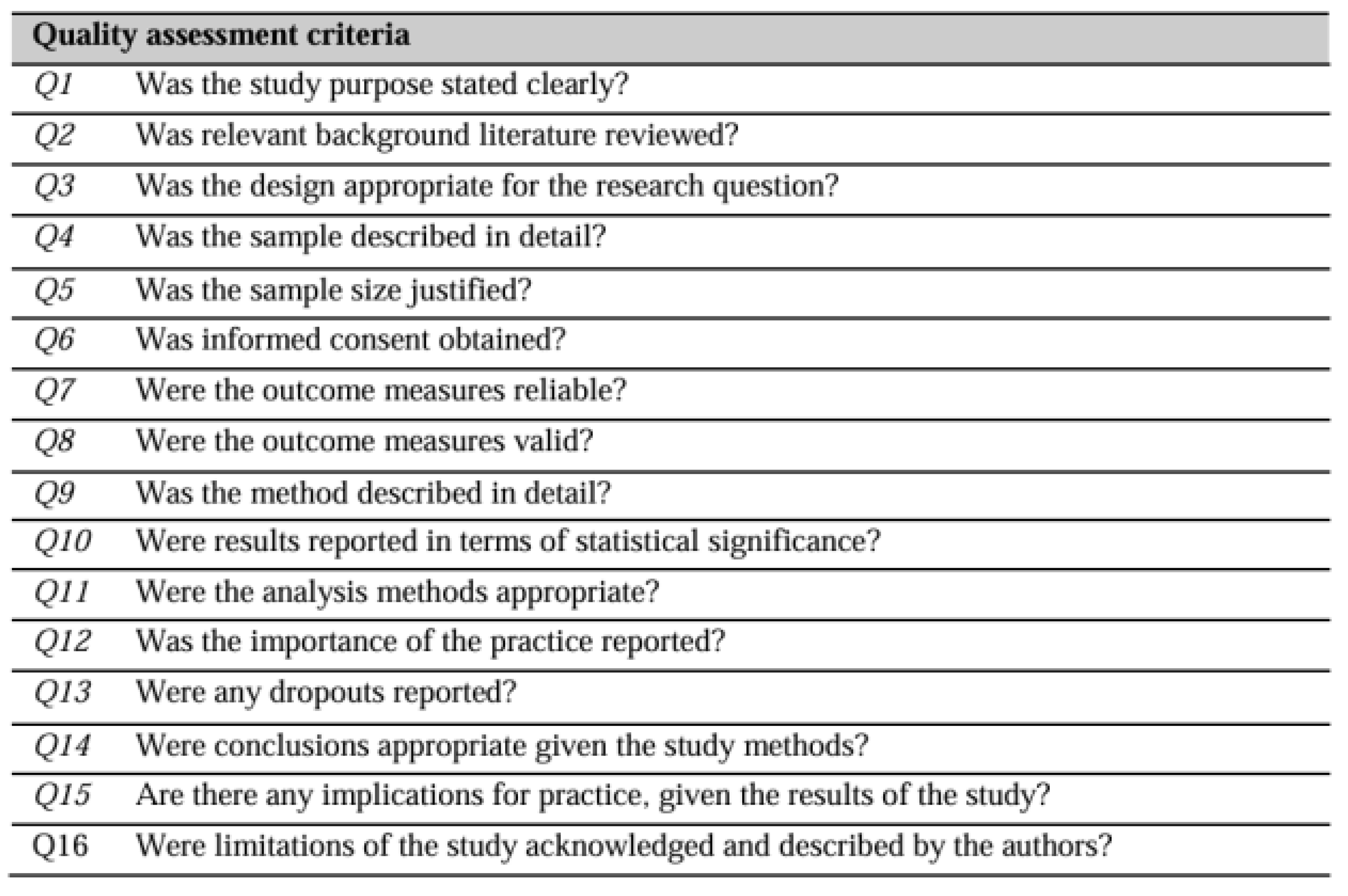
2.2. Risk of Bias Assessment
3. Results
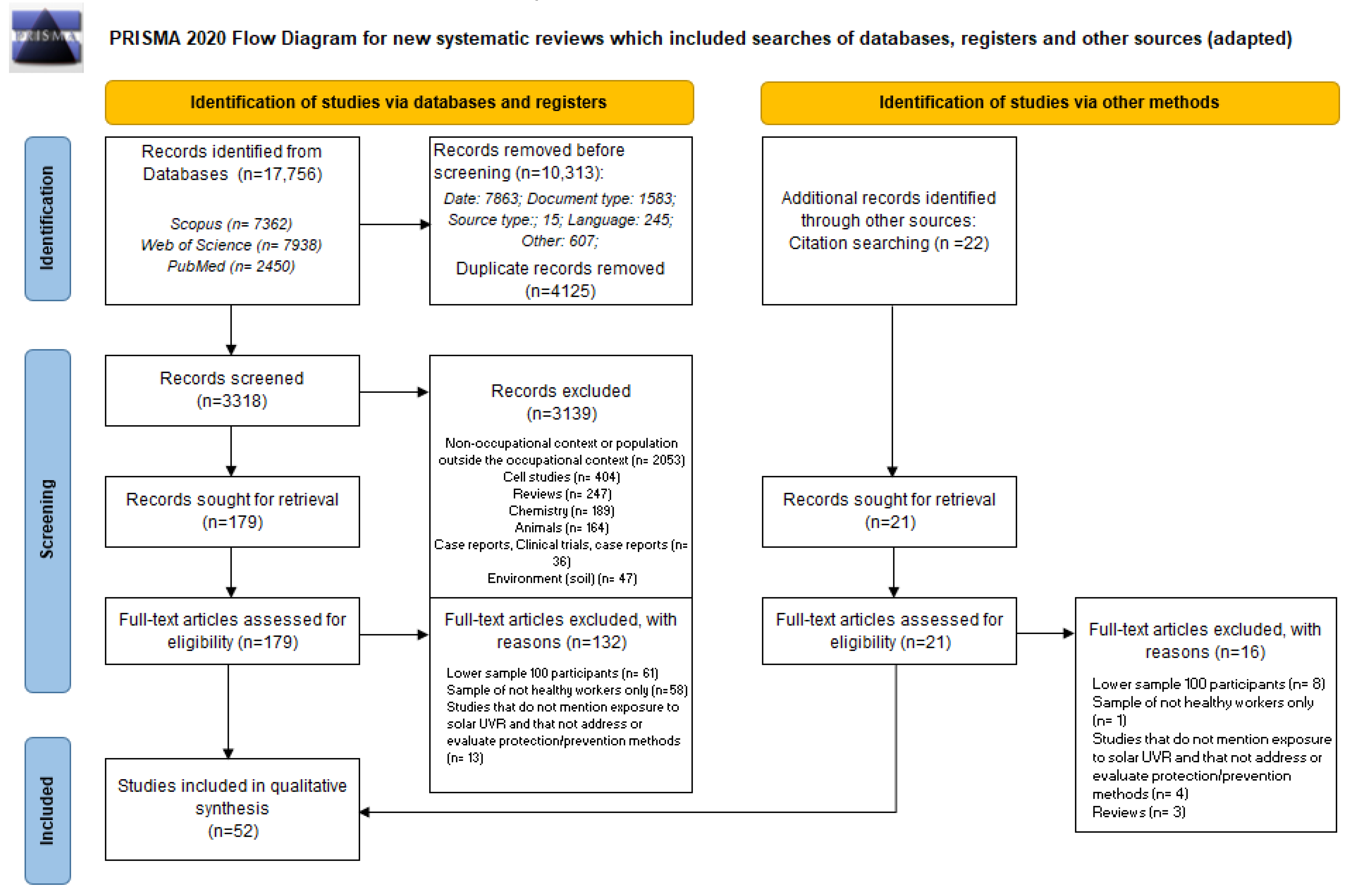
3.1. Study Selection
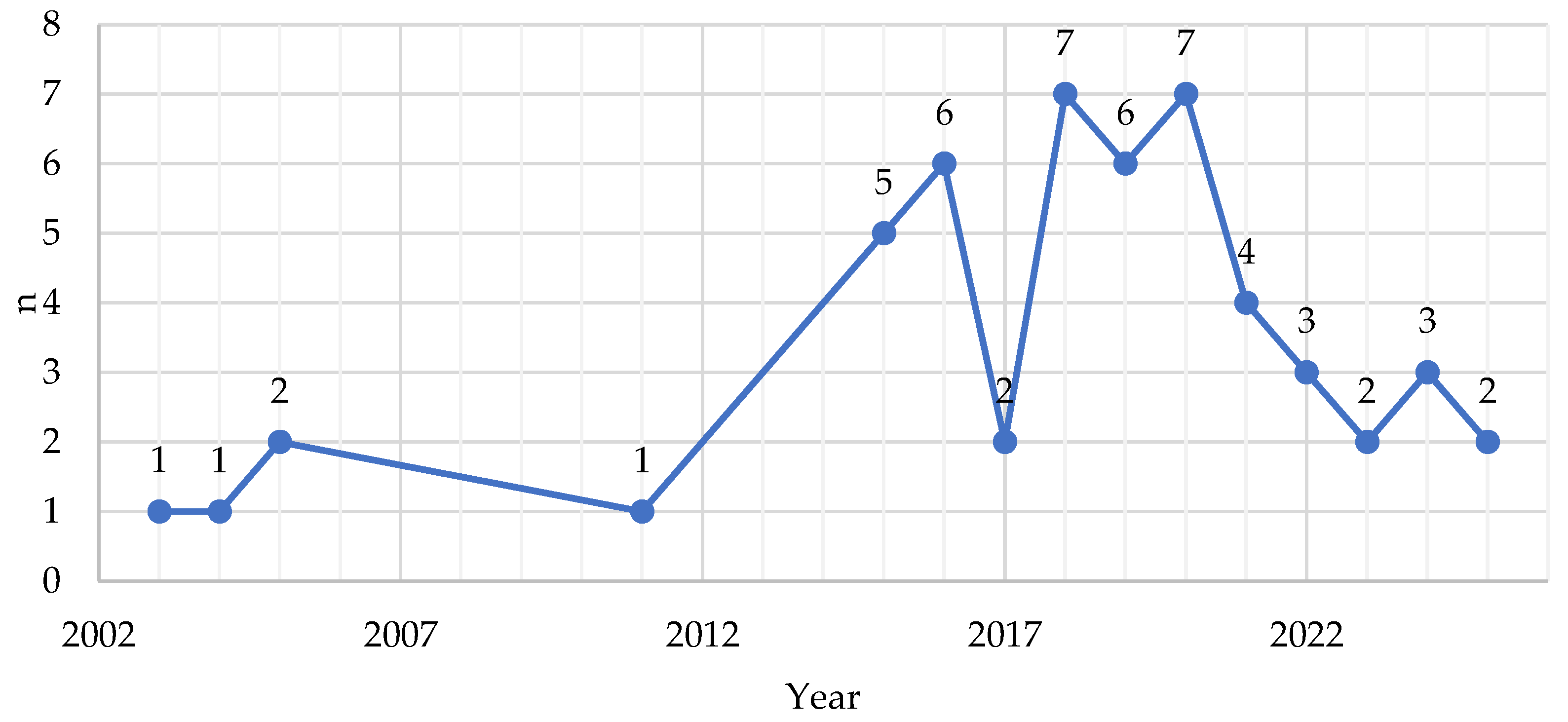
3.2. Study Characteristics
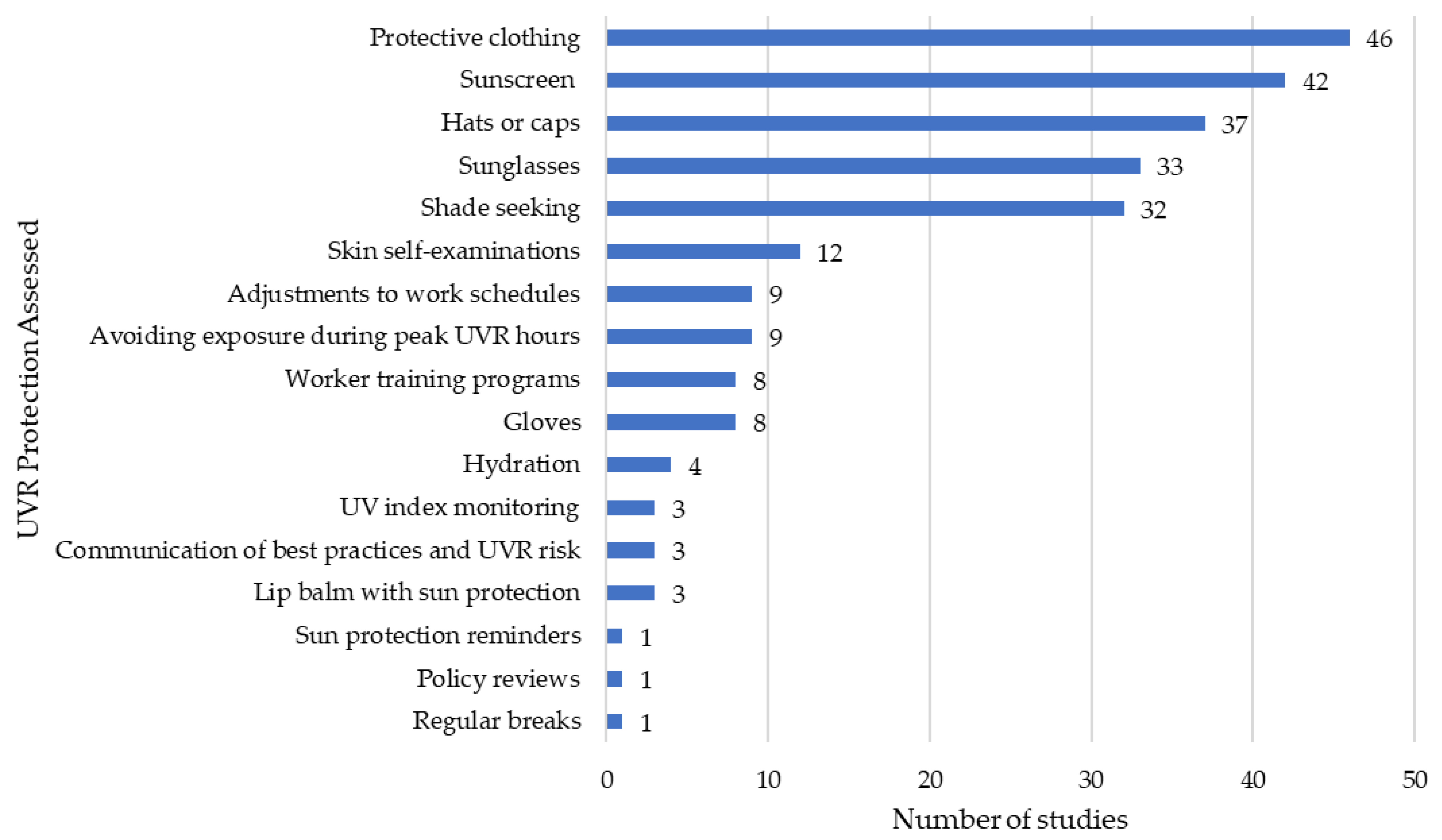
- Physical measures: including the use of hats or caps [10,22,23,24,25,26,27,28,30,32,34,36,37,38,39,42,43,44,46,47,48,52,53,55,56,57,58,59,60,62,64,66,67,68,69,72,73], protective clothing [22,23,25,26,27,31,32,33,34,35,37,38,39,40,41,42,43,44,45,46,47,48,49,51,52,53,55,56,57,58,59,60,62,64,66,67,68,69,71,72,73], gloves [23,38,42,44,52,58,62,69], sunglasses [22,23,24,25,26,27,28,30,31,32,34,35,37,38,39,40,42,44,47,48,50,52,53,55,56,58,59,62,66,67,68,71,73], and seeking shade [22,23,24,25,27,28,30,32,33,34,35,37,38,39,40,41,42,44,45,48,49,51,52,53,55,56,59,66,67,68,72,73];
- Behavioural measures: including sunscreen application [22,23,24,25,27,28,29,30,31,32,33,34,35,36,37,38,39,40,41,42,43,45,46,47,48,50,51,52,53,54,55,56,57,58,59,60,61,62,63,64,65,66,67,68,69,70,71,72,73], lip balm with sun protection [24,27,37], avoiding exposure during peak UVR hours [22,27,30,32,35,36,52,66,71], taking regular breaks [53], maintaining adequate hydration [22,31,34,35], and performing skin self-examinations [22,27,35,45,51,52,60,61,65,67,69,70];
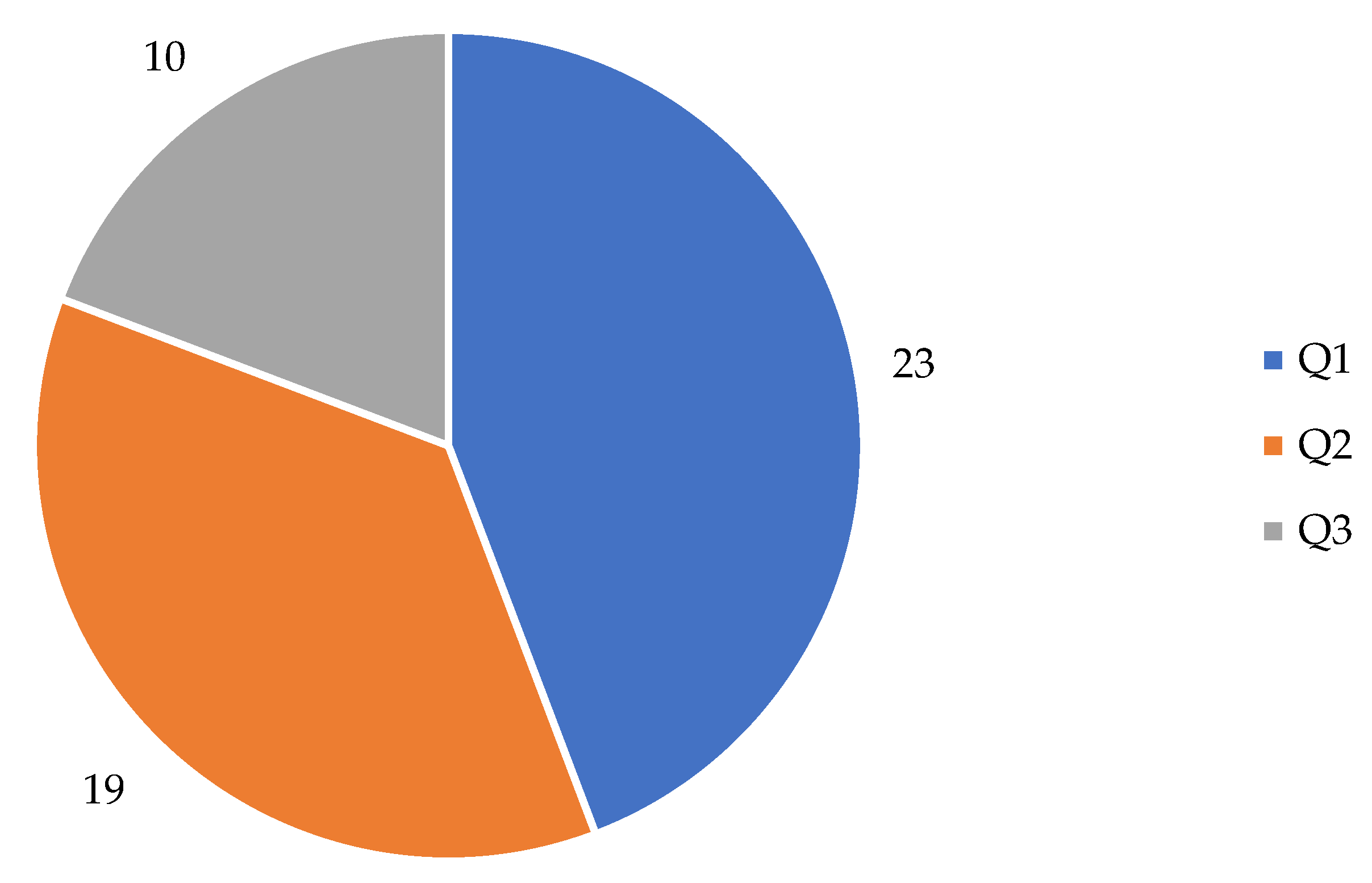
3.3. Risk of Bias in Studies
4. Discussion
4.1. Health Effects and the Importance of Protection
4.2. Measures of Protection: Adherence and Effectiveness
4.3. Synthesis of Occupational Groups and Impact
4.4. Measurement Instruments and Emerging Monitoring Technologies
4.5. Limitations and Future Research
5. Conclusions
Supplementary Materials
Author Contributions
Funding
Institutional Review Board Statement
Informed Consent Statement
Data Availability Statement
Acknowledgments
Conflicts of Interest
Appendix A

| Databases | Adapted Query and Database Filters |
|---|---|
| Scopus | (TITLE-ABS-KEY (“outdoor”) OR TITLE-ABS-KEY (“work*”) OR TITLE-ABS-KEY (“occupational”) OR TITLE-ABS-KEY (“workplace”) AND TITLE-ABS-KEY (“ultraviolet radiation”) OR TITLE-ABS-KEY (“uv radiation”) OR TITLE-ABS-KEY (“uvr”) AND TITLE-ABS-KEY (“protection”) OR TITLE-ABS-KEY (“preventive”) OR TITLE-ABS-KEY (“ppe”)) AND PUBYEAR > 2014 AND PUBYEAR < 2026 AND (LIMIT-TO (SRCTYPE, “j”)) AND (LIMIT-TO (DOCTYPE, “ar”)) AND (LIMIT-TO (LANGUAGE, “English”)) |
| (TITLE-ABS-KEY (“outdoor”) OR TITLE-ABS-KEY (“work*”) OR TITLE-ABS-KEY (“occupational”) OR TITLE-ABS-KEY (“workplace”) AND TITLE-ABS-KEY (“ultraviolet radiation”) OR TITLE-ABS-KEY (“solar radiation”) OR TITLE-ABS-KEY (“sun exposure”) AND TITLE-ABS-KEY (“protect*”) OR TITLE-ABS-KEY (“PPE”) OR TITLE-ABS-KEY (“sunscreen”) OR TITLE-ABS-KEY (“protective”) OR TITLE-ABS-KEY (“control measures”)) AND PUBYEAR > 2014 AND PUBYEAR < 2026 AND (LIMIT-TO (DOCTYPE, “ar”)) AND (LIMIT-TO (SRCTYPE, “j”)) AND (LIMIT-TO (LANGUAGE, “English”)) | |
| (TITLE-ABS-KEY (“outdoor”) OR TITLE-ABS-KEY (“work*”) OR TITLE-ABS-KEY (“occupational”) AND TITLE-ABS-KEY (“solar ultraviolet radiation”) OR TITLE-ABS-KEY (“solar UV”) OR TITLE-ABS-KEY (“ultraviolet radiation”) AND TITLE-ABS-KEY (“skin cancer”) OR TITLE-ABS-KEY (“cancer prevention”) OR TITLE-ABS-KEY (“primary prevention”)) AND PUBYEAR > 2014 AND PUBYEAR < 2026 AND (LIMIT-TO (DOCTYPE, “ar”)) AND (LIMIT-TO (SRCTYPE, “j”)) AND (LIMIT-TO (LANGUAGE, “English”)) | |
| Web of Science | (TS = (“outdoor”) OR TS = (“work*”) OR TS = (“Occupational”) OR TS = (“Workplace” )) AND (TS = (“ultraviolet radiation”) OR TS = (“uv radiation”) OR TS = (“uvr”)) AND (TS = (“protection”) OR TS = (“preventive“) OR TS = (ppe)) and 2025 or 2024 or 2023 or 2022 or 2021 or 2020 or 2019 or 2018 or 2017 or 2016 or 2015 (Publication Years) and Article (Document Types) and English (Languages) |
| (TS = (“outdoor”) OR TS = (“work*”) OR TS = (“occupational”) OR TS = (“workplace”)) AND (TS = (“ultraviolet radiation”) OR TS = (“solar radiation”) OR TS = (“sun exposure”)) AND (TS = (“protect*”) OR TS = (PPE) OR TS = (“sunscreen”) OR TS = (“protective”) OR TS = (“control measures”)) and 2025 or 2024 or 2023 or 2022 or 2021 or 2020 or 2019 or 2018 or 2016 or 2017 or 2015 (Publication Years) and Article (Document Types) and English (Languages) | |
| (TS = (“outdoor”) OR TS = (“ work*”) OR TS = (“occupational”)) AND (TS = (“solar ultraviolet radiation”) OR TS = (“solar UV”) OR TS = (“ultraviolet radiation”)) AND (TS = (“skin cancer”) OR TS = (“cancer prevention”) OR TS = (“primary prevention”)) and 2025 or 2024 or 2023 or 2022 or 2021 or 2020 or 2019 or 2018 or 2017 or 2016 or 2015 (Publication Years) and Article (Document Types) and English (Languages) | |
| PubMed | ((“outdoor” [All Fields] OR “work*” [All Fields] OR “Occupational” [All Fields] OR “Workplace” [All Fields]) AND (“ultraviolet radiation” [All Fields] OR “uv radiation” [All Fields] OR “uvr” [All Fields]) AND (“protection” [All Fields] OR “preventive” [All Fields] OR (“polit philos econ” [Journal] OR “ppe” [All Fields]))) AND ((y_10 [Filter]) AND (humans [Filter]) AND (English [Filter])) |
| ((“outdoor” [All Fields] OR “work*” [All Fields] OR “occupational” [All Fields] OR “workplace” [All Fields]) AND (“ultraviolet radiation” [All Fields] OR “solar radiation” [All Fields] OR “sun exposure” [All Fields]) AND (“protect*” [All Fields] OR “PPE” [All Fields] OR “sunscreen” [All Fields] OR “protective” [All Fields] OR “control measures” [All Fields])) AND ((y_10 [Filter]) AND (humans [Filter]) AND (English [Filter])) | |
| ((“outdoor” [All Fields] OR “work*” [All Fields] OR “occupational” [All Fields]) AND (“solar ultraviolet radiation” [All Fields] OR “solar UV” [All Fields] OR “ultraviolet radiation” [All Fields]) AND (“skin cancer” [All Fields] OR “cancer prevention” [All Fields] OR “primary prevention” [All Fields])) AND ((y_10 [Filter]) AND (humans [Filter]) AND (English [Filter])) |
| Profession/Professional Groups | UVR Measurement Methods | UVR Protection Assessed | Adherence to UVR Protection Measures | Study Reference | Main Results |
|---|---|---|---|---|---|
| Farmers | Questionnaire | Cap | Low | [58] | - Limited access to shade [47]; - Low adherence to photoprotection measures [58]; - Perception of present risk, but not always translated into preventive behaviour [30,32,58]; - Inadequate protection in general [36]; - Sun protection behaviours associated with socio-demographic factors (age, gender, education and type of work) [30,36]; - Need for training actions [36,68]; - Use of sunscreen associated with a higher risk of burning [68]; - Protection motivated by occupational factors rather than by knowledge about solar risks [23]; |
| Hat | High | [32,46,68] | |||
| Low | [58] | ||||
| Moderate | [30,39] | ||||
| Not reported | [36,47] | ||||
| Avoid sun exposure | Not reported | [36] | |||
| Avoid sun exposure at peak hours | Low | [32] | |||
| Moderate | [30] | ||||
| Gloves | Low | [58] | |||
| Sunglasses | High | [39] | |||
| Low | [47,58,68] | ||||
| Moderate | [30,32] | ||||
| Sunscreen | Low | [32,39,46,47,58,68] | |||
| Moderate | [30] | ||||
| Not reported | [36] | ||||
| Shadow | Low | [32,39,46,47,68] | |||
| Moderate | [30] | ||||
| Protective clothing | High | [46,47] | |||
| Low | [39,58,68] | ||||
| Moderate | [32] | ||||
| Questionnaire Direct observation Solar Protection Score (SPS) Calculation | Hat | Low | [23] | ||
| Gloves | Not reported | ||||
| Sunglasses | Low | ||||
| Sunscreen | Low | ||||
| Shadow | Not reported | ||||
| Protective clothing | High | ||||
| Questionnaire Direct observation Clinical interview Photo tracking | Wide-brimmed hat | Low | [69] | ||
| Exposure risk communication | Low | ||||
| Gloves | Low | ||||
| Sunscreen | Moderate | ||||
| Skin self-surveillance | Low | ||||
| Protective clothing | Low | ||||
| Farmers Construction Gardeners Other occupational groups | Questionnaire | Sunscreen | Moderate | [73] | - One third of outdoor workers reported using five key sun protection measures “frequently” or “always” [73]; - Women used sunscreen and sunglasses more often than men [73]. |
| Sunglasses | Moderate | ||||
| Shadow | Moderate | ||||
| Hat | Moderate | ||||
| Protective clothing | High | ||||
| Farmers Construction | Questionnaire | Hat | Not reported | [57] | - Low practical application of training actions [33]; - Barriers to the use of PPE and sunscreen more frequent in construction workers [33]; - Superior knowledge and attitudes in civil construction, but with greater barriers [33]; - Farmers showed less knowledge, but better perception of the usefulness of the training received [33]. |
| Worker training | Low | [33] | |||
| UV index monitoring | Low | [33] | |||
| Sunscreen | Low | [57] | |||
| Moderate | [33] | ||||
| Shadow | Low | [57] | |||
| Protective clothing | High | [57] | |||
| Moderate | [33] | ||||
| Farmers Gardeners Mountain guides | Questionnaire Dermatological examination | Hat | Low | [60] | - High risk of NMSC in outdoor professions [60]; - Marked differences between professions [60]. |
| Sunscreen | High | ||||
| Skin cancer screening | Low | ||||
| Protective clothing | Low | ||||
| Farmers Roofers Gardeners | Questionnaire | Avoid sun exposure at peak hours | Not reported | [71] | - Risk perception positively influences protective behaviors [71]. |
| Sunglasses | Not reported | ||||
| Sunscreen | Low | ||||
| Protective clothing | Not reported | ||||
| Postmen | Questionnaire | Hydration | Low | [31] | - Sun protection behaviors associated with sociodemographic factors (sex, age, skin type, and function) [31]; - Training not correlated with best sun protection practice [31]; - Necessary organizational policies [31]. |
| UV index monitoring | High | ||||
| Sunglasses | Low | ||||
| Sunscreen | High | ||||
| Shadow | High | ||||
| Protective clothing | High | ||||
| Questionnaire Direct observation | Hat | Moderate | [25] | ||
| Sunglasses | Moderate | ||||
| Protective clothing | Not reported | ||||
| Construction | Dosimetry Questionnaire Skin type assessment | Hat | Low | [25] | - Use of scarce and disorganized PPE [25]; - Shadow little available and poorly used [25]; - Positive behavior changes in 9 out of 10 measures [35]; - Little change in knowledge [35]; - Organizational policies defined as effective strategy [22]. |
| Sunglasses | Low | ||||
| Sunscreen | Low | ||||
| Shadow | Low | ||||
| Protective clothing | Low | ||||
| Questionnaire | Skin self-surveillance | High | [35] | ||
| Moderate | [22] | ||||
| Protective helmet | Low | [35] | |||
| Hat | Low | [22] | |||
| Avoid sun exposure at peak hours | Moderate | [35] | |||
| Low | [22] | ||||
| Hydration | High | [22,35] | |||
| UV index monitoring | Low | [22,35] | |||
| Sunglasses | High | [35] | |||
| Moderate | [22] | ||||
| Sunscreen | High | [35] | |||
| Moderate | [22] | ||||
| Task rotation | Moderate | [35] | |||
| Low | [22] | ||||
| Shadow | Moderate | [35] | |||
| Low | [22] | ||||
| Protective clothing | Moderate | [22,35] | |||
| Mountain guides | Questionnaire | Skin self-surveillance | Moderate | [61] | - High exposure to UVR [61]. |
| Sunscreen | High | ||||
| Skin cancer screening | Moderate | ||||
| Sailors | Questionnaire | Skin self-surveillance | Moderate | [52] | - Intervention via SMS was effective: significant increase in preventive behaviors and motivation for protection [52]. |
| Hat | Moderate | ||||
| Avoid sun exposure at peak hours | Moderate | ||||
| Gloves | Low | ||||
| Sunglasses | Moderate | ||||
| Sunscreen | High | ||||
| Skin cancer screening | Low | ||||
| Shadow | Moderate | ||||
| Protective clothing | Moderate | ||||
| Military aviation | Questionnaire | Reminders for using sun protection | Low | [41] | - Protection more frequently outside work than in the workplace [41]. |
| Sunscreen | Moderate | ||||
| Shadow | Low | ||||
| Protective clothing | Moderate | ||||
| Navy Military | Questionnaire Complete dermatological examination performed by experts | Sunscreen | Low | [70] | - Advanced age, outdoor occupation, and fair skin increase the risk of actinic keratosis [70]. |
| Skin cancer screening | Low | ||||
| Lifeguards | Questionnaire Personal dosimetry | Hat | Low | [66] | - High knowledge of sun protection; 96.3% recognized UV light as a cause of skin cancer [66]; - Need for effective sun protection measures [66]. |
| Avoid sun exposure at peak hours | Low | ||||
| Sunglasses | High | ||||
| Sunscreen | High | ||||
| Shadow | Moderate | ||||
| Protective clothing | Low | ||||
| Fishermen | Questionnaire | Sunscreen | Low | [29] | - 82.5% of fishermen have never used any sun protection measures [29]; - Lack of knowledge of appropriate measures [29]; - Urgent need for training [29]. |
| Sanitation maintenance technicians | Questionnaire Dermatological examination | Skin self-surveillance | Low | [65] | - Need for more preventive measures [65]. |
| Sunscreen | Low | ||||
| Skin cancer screening | Moderate | ||||
| Outdoor workers | Dosimetry | Hat | Low | [48] | - Protections were not used consistently [40,48,62]; - Intervention increased protection measures [59,67]; - Average cost/action was acceptable compared to other occupational health programs [67]; - Personalized messages (occupational or individual) increased intentions for sun protection [55]; - Face-to-face intervention significantly increased training and communication [51]; - Shade in place associated with lower risk of sunburn [53]; - 69% reported never or rarely using sunscreen [38,54,63]; - Women and individuals with higher education used it more [63]; - Low availability and knowledge on the subject limit the use of protection [63,72]; - Need for more training and protection policies [40,54,62]; - Sun protection at work is used less often than for leisure or holidays in the sun [64]; - Lower prevalence of sunburn after intervention [37]; - Risk awareness increased after the intervention [72]. |
| Sunglasses | [48] | ||||
| Sunscreen | [48] | ||||
| Reduction of sun exposure time | Moderate | [49] | |||
| Shadow | Low | [48] | |||
| Shadow | Moderate | [49] | |||
| Protective clothing | Low | [48] | |||
| Protective clothing | Moderate | [49] | |||
| Questionnaire | Adjustment of working hours | Low | [51,62,64,67,72] | ||
| Moderate | [37] | ||||
| Exposure risk assessment | Moderate | [67] | |||
| Low | [51] | ||||
| Hat | Low | [38,53,64] | |||
| Moderate | [37,40,55,62,67,72] | ||||
| Availability of PPE | Low | [51] | |||
| Worker training | Moderate | [51] | |||
| Low | [53,72] | ||||
| Low | |||||
| Gloves | Low | [38,62] | |||
| UV index monitoring | Low | [38,67] | |||
| Sunglasses | High | [37] | |||
| Low | [38,40,53,62] | ||||
| Moderate | [47,67] | ||||
| Breaks at work | High | [53] | |||
| Face shield | Low | [62] | |||
| Lip balm | Moderate | [37] | |||
| Sunscreen | Moderate | [51,55,67] | |||
| Low | [40,53,54,62,63,64,72] | ||||
| Moderate | [37,38] | ||||
| Skin cancer screening | Moderate | [67] | |||
| Low | [51] | ||||
| Reduction of working time (overtime) | High | [72] | |||
| Review and monitoring of sun protection policies | Moderate | [67] | |||
| Shadow | High | [38] | |||
| Low | [40,51,53,55,72] | ||||
| Moderate | [37,67,72] | ||||
| Protective clothing | High | [38] | |||
| Low | [40,53,62] | ||||
| Moderate | [37,51,55,64,67,72] | ||||
| Questionnaire Direct observation | Hat | Low | [59] | ||
| Communicating Protective Practices | High | ||||
| Worker training | High | ||||
| Reminders for using sun protection | Moderate | ||||
| Organizational protection measures | High | ||||
| Sunglasses | Low | ||||
| Sunscreen | High | ||||
| Shadow | Moderate | ||||
| Protective clothing | Moderate | ||||
| Questionnaire Dosimetry Skin examination | Adjustment of working hours | Low | [43] | ||
| Hat | Moderate | ||||
| Sunscreen | Moderate | ||||
| Protective clothing | Moderate | ||||
| Maintenance workers (golf course) | Questionnaire | Hat | High | [34] | - Use of sun protection was more common in younger workers and in senior positions [34]; - Knowledge correlated with the use of protection [34]; - Scarce training [34]; - Need for organizational strategies and provision of PPE [34]. |
| Worker training | Low | ||||
| Hydration | High | ||||
| Sunglasses | Moderate | ||||
| Sunscreen | High | ||||
| Shadow | Low | ||||
| Protective clothing | Moderate | ||||
| Maintenance workers (ski resort) | Questionnaire | Self-surveillance | Moderate | [27] | - Reduction in the prevalence of sunburn, after interventions [24]; - Workers with access to communication strategies showed better protective behaviors [27]; - Need to maintain the intervention strategy to maintain positive effects [27]. |
| Hat | Moderate | [24,27] | |||
| Avoid sun exposure at peak hours | Low | [27] | |||
| Sunglasses | High | [27] | |||
| Moderate | [24] | ||||
| Lip balm | Moderate | [24,27] | |||
| Sunscreen | Moderate | [24,27] | |||
| Shadow | Low | [24,27] | |||
| Protective clothing | Moderate | [27] | |||
| Direct observation | Hat | Moderate | [28] | ||
| Exposure risk communication | Moderate | ||||
| Worker training | Low | ||||
| Sunglasses | Low | ||||
| Sunscreen | Moderation | ||||
| Shadow | Moderate | ||||
| Park workers | Questionnaire | Hat | Low | [42] | - Need for training [42]. |
| Gloves | Low | ||||
| Sunglasses | Moderate | ||||
| Sunscreen | Low | ||||
| Shadow | Moderate | ||||
| Protective clothing | Moderate | ||||
| Municipal service workers Electrical technicians | Dosimetry | Hat | Low | [44] | - Need for urgent protection measures [44]. |
| Gloves | |||||
| Sunglasses | |||||
| Shadow | |||||
| Protective clothing | |||||
| Forestry workers Outdoor workers | Questionnaire Skin examination | Adjustment of working hours | Low | [56] | - Natural shade (trees) considered insufficient [56]; - Need for additional protective measures [56]. |
| Hat | Moderate | ||||
| Sunglasses | Low | ||||
| Sunscreen | Low | ||||
| Shadow | Low | ||||
| Protective clothing | Moderate | ||||
| Carriers | Questionnaire | Skin self-surveillance | Low | [45] | - Only a minority have protection and training policies [45]. |
| Exposure risk assessment | Low | ||||
| Exposure risk communication | High | ||||
| Availability of PPE | Moderate | ||||
| Worker training | Moderate | ||||
| UV index monitoring | Low | ||||
| Sunscreen | Low | ||||
| Shadow | Low | ||||
| Protective clothing | Moderate | ||||
| Street sweepers | Questionnaire Skin examination | Sunglasses | Moderate | [50] | - Young people used more protection than older people [50]; - Low prevalence of sun protection use [50]. |
| Sunscreen | Moderate |
| Study Reference | Q1 | Q2 | Q3 | Q4 | Q5 | Q6 | Q7 | Q8 | Q9 | Q10 | Q11 | Q12 | Q13 | Q14 | Q15 | Q16 |
|---|---|---|---|---|---|---|---|---|---|---|---|---|---|---|---|---|
| [22] | Y | Y | Y | Y | Y | Y | N | Y | Y | Y | Y | NA | Y | Y | Y | N |
| [23] | Y | Y | Y | Y | Y | Y | N | Y | Y | Y | Y | NA | Y | Y | Y | Y |
| [24] | Y | Y | Y | Y | Y | Y | Y | Y | Y | Y | Y | Y | Y | Y | Y | Y |
| [25] | Y | Y | Y | Y | Y | Y | Y | N | Y | Y | Y | Y | N | Y | Y | NA |
| [26] | Y | Y | Y | Y | Y | Y | N | Y | Y | Y | Y | Y | Y | Y | Y | Y |
| [27] | Y | Y | Y | Y | Y | Y | Y | Y | Y | Y | Y | Y | Y | Y | Y | Y |
| [28] | Y | Y | Y | Y | Y | Y | Y | Y | Y | Y | Y | Y | Y | Y | Y | Y |
| [29] | Y | Y | Y | Y | Y | Y | N | Y | Y | Y | NA | NA | Y | Y | Y | Y |
| [30] | Y | Y | Y | Y | Y | Y | Y | Y | Y | Y | NA | NA | Y | Y | Y | Y |
| [31] | Y | Y | Y | Y | Y | Y | N | Y | Y | Y | NA | NA | Y | Y | Y | Y |
| [32] | Y | Y | Y | Y | Y | Y | N | Y | Y | Y | NA | NA | Y | Y | Y | Y |
| [33] | Y | Y | Y | Y | Y | Y | N | Y | Y | Y | NA | NA | Y | Y | Y | Y |
| [34] | Y | Y | Y | Y | Y | Y | N | Y | Y | Y | NA | NA | Y | Y | Y | Y |
| [35] | Y | Y | Y | Y | Y | Y | N | Y | Y | Y | Y | Y | Y | Y | Y | Y |
| [36] | Y | Y | Y | Y | Y | Y | Y | Y | Y | Y | NA | NA | Y | Y | Y | Y |
| [37] | Y | Y | Y | Y | Y | Y | Y | Y | Y | Y | Y | Y | Y | Y | Y | Y |
| [38] | Y | Y | Y | Y | Y | Y | N | Y | Y | Y | NA | NA | Y | Y | Y | Y |
| [39] | Y | Y | Y | Y | Y | Y | N | Y | Y | Y | NA | NA | Y | Y | Y | Y |
| [40] | Y | Y | Y | Y | Y | Y | N | Y | Y | Y | Y | NA | Y | Y | Y | Y |
| [41] | Y | Y | Y | Y | Y | Y | N | Y | Y | Y | NA | NA | Y | Y | Y | Y |
| [42] | Y | Y | Y | Y | Y | Y | N | Y | Y | Y | NA | NA | Y | Y | Y | Y |
| [43] | Y | Y | Y | Y | Y | Y | N | Y | Y | Y | Y | Y | Y | Y | Y | Y |
| [44] | Y | Y | Y | Y | Y | Y | N | Y | Y | Y | NA | NA | Y | Y | Y | Y |
| [45] | Y | Y | Y | Y | Y | Y | Y | Y | Y | Y | Y | Y | Y | Y | Y | NA |
| [46] | Y | Y | Y | Y | Y | Y | N | Y | Y | Y | NA | NA | Y | Y | Y | Y |
| [47] | Y | Y | Y | Y | Y | Y | N | Y | Y | Y | Y | NA | Y | Y | Y | Y |
| [48] | Y | Y | Y | Y | Y | Y | N | Y | Y | Y | NA | NA | Y | Y | Y | Y |
| [49] | Y | Y | Y | Y | Y | Y | Y | Y | Y | Y | Y | Y | N | Y | Y | NA |
| [50] | Y | Y | Y | Y | Y | Y | N | Y | Y | Y | NA | NA | Y | Y | Y | Y |
| [51] | Y | Y | Y | Y | Y | Y | Y | Y | Y | Y | Y | Y | Y | Y | Y | Y |
| [52] | Y | Y | Y | Y | Y | Y | Y | Y | Y | Y | Y | Y | Y | Y | Y | Y |
| [53] | Y | Y | Y | Y | Y | Y | N | Y | Y | Y | NA | NA | Y | Y | Y | NA |
| [54] | Y | Y | Y | Y | Y | Y | Y | Y | Y | Y | NA | NA | Y | Y | Y | Y |
| [55] | Y | Y | Y | Y | Y | Y | N | Y | Y | Y | Y | Y | Y | Y | Y | Y |
| [56] | Y | Y | Y | Y | Y | Y | N | Y | Y | Y | NA | NA | Y | Y | Y | Y |
| [57] | Y | Y | Y | Y | Y | Y | N | Y | Y | Y | NA | NA | Y | Y | Y | Y |
| [58] | Y | Y | Y | Y | Y | Y | Y | Y | Y | Y | Y | NA | Y | Y | Y | NA |
| [59] | Y | Y | Y | Y | Y | Y | Y | Y | Y | Y | Y | Y | Y | Y | Y | Y |
| [60] | Y | Y | Y | Y | Y | Y | N | Y | Y | Y | Y | Y | Y | Y | Y | Y |
| [61] | Y | Y | Y | Y | Y | Y | N | Y | Y | Y | NA | NA | Y | Y | Y | NA |
| [62] | Y | Y | Y | Y | Y | Y | N | Y | Y | Y | NA | NA | Y | Y | Y | Y |
| [63] | Y | Y | Y | Y | Y | Y | N | Y | Y | Y | NA | NA | Y | Y | Y | NA |
| [64] | Y | Y | Y | Y | Y | Y | N | Y | Y | Y | NA | NA | Y | Y | Y | Y |
| [65] | Y | Y | Y | Y | Y | Y | N | Y | Y | Y | Y | Y | Y | Y | Y | NA |
| [66] | Y | Y | Y | Y | Y | Y | N | Y | Y | Y | Y | NA | Y | Y | Y | Y |
| [67] | Y | Y | Y | Y | Y | Y | N | Y | Y | Y | Y | Y | Y | Y | Y | Y |
| [68] | Y | Y | Y | Y | Y | Y | N | N | Y | Y | Y | NA | Y | Y | Y | Y |
| [69] | Y | Y | Y | Y | Y | Y | Y | Y | Y | Y | Y | Y | N | Y | Y | Y |
| [70] | Y | Y | Y | Y | Y | Y | N | Y | Y | Y | Y | Y | Y | Y | Y | NA |
| [71] | Y | Y | Y | Y | Y | Y | N | Y | Y | Y | Y | NA | Y | Y | Y | NA |
| [72] | Y | Y | Y | Y | Y | Y | N | Y | Y | Y | NA | NA | Y | Y | Y | NA |
| [73] | Y | Y | Y | Y | Y | Y | N | Y | Y | Y | Y | Y | NA | Y | Y | Y |

References
- International Agency for Research on Cancer. IARC Monographs on the Evaluation of Carcinogenic Risks to Humans Volume 100D; International Agency for Research on Cancer: Lyon, France, 2012. [Google Scholar]
- Pacholczyk, M.; Czernicki, J.; Ferenc, T. The Effect of Solar Ultraviolet Radiation (UVR) on Induction of Skin Cancers. Med. Pr. Work. Health Saf. 2016, 67, 255–266. [Google Scholar] [CrossRef]
- Teng, Y.; Yu, Y.; Li, S.; Huang, Y.; Xu, D.; Tao, X.; Fan, Y. Ultraviolet Radiation and Basal Cell Carcinoma: An Environmental Perspective. Front. Public Health 2021, 9, 666528. [Google Scholar] [CrossRef] [PubMed]
- Slavinsky, V.; Helmy, J.; Vroman, J.; Valdebran, M. Solar Ultraviolet Radiation Exposure in Workers with Outdoor Occupations: A Systematic Review and Call to Action. Int. J. Dermatol. 2024, 63, 288–297. [Google Scholar] [CrossRef] [PubMed]
- Parikh, A.K.; Tan, I.J.; Cohen, B.A. Occupational Exposures and Skin Cancer: A Brief Report. Skin Res. Technol. 2024, 30, e70107. [Google Scholar] [CrossRef] [PubMed]
- Symanzik, C.; John, S.M. Prevention of Occupational Skin Cancer Caused by Solar Ultraviolet Radiation Exposure: Recent Achievements and Perspectives. Dermato 2024, 4, 46–59. [Google Scholar] [CrossRef]
- Johnston, C.A. Promotion of Sun-Protective Behaviors. Am. J. Lifestyle Med. 2013, 7, 186–188. [Google Scholar] [CrossRef]
- Grifoni, D.; Betti, G.; Bogi, A.; Bramanti, L.; Chiarugi, A.; Gozzini, B.; Morabito, M.; Picciolo, F.; Sabatini, F.; Miligi, L. Protective Measures From Solar Ultraviolet Radiation for Beach Lifeguards in Tuscany (Italy): Shade and Clothing Strategies. Saf. Health Work 2022, 13, 421–428. [Google Scholar] [CrossRef]
- Gil, V.; Gaertner, M.A.; Gutierrez, C.; Losada, T. Impact of Climate Change on Solar Irradiation and Variability over the Iberian Peninsula Using Regional Climate Models. Int. J. Climatol. 2019, 39, 1733–1747. [Google Scholar] [CrossRef]
- Modenese, A. Prevention of Health Risks Related to Occupational Solar Ultraviolet Radiation Exposure in Times of Climate Change and COVID-19 Pandemic. Atmosphere 2022, 13, 1147. [Google Scholar] [CrossRef]
- Cherrie, J.W.; Cherrie, M.P.C. Workplace Exposure to UV Radiation and Strategies to Minimize Cancer Risk. Br. Med. Bull. 2022, 144, 45–56. [Google Scholar] [CrossRef]
- Gugliermetti, L.; Burattini, C.; Militello, A.; Borra, M.; Asdrubali, F.; Salvadori, G.; Leccese, F.; Bisegna, F. Real Time UV Erythemal Personal Exposure Monitoring in Outdoor Workplaces. In Proceedings of the 2019 IEEE International Conference on Environment and Electrical Engineering and 2019 IEEE Industrial and Commercial Power Systems Europe (EEEIC/I and CPS Europe), Genova, Italy, 11–14 June 2019. [Google Scholar] [CrossRef]
- Militello, A.; Borra, M.; Bisegna, F.; Burattini, C.; Grandi, C. Smart Technologies: Useful Tools to Assess the Exposure to Solar Ultraviolet Radiation for General Population and Outdoor Workers. In Proceedings of the 18th Italian National Conference on Photonic Technologies (Fotonica 2016), Rome, Italy, 6–8 June 2016; IET: London, UK, 2016. [Google Scholar] [CrossRef]
- Rossi, M.F.; Rossi, M.F.; Pulvirenti, A.; Leone, R.; Gualano, M.R.; Borrelli, I.; Santoro, P.E.; Moscato, U. Heat-Related Risk in Outdoor Workers in the Context of Climate Change: A Systematic Review. Eur. J. Public Health 2024, 34, ckae144.906. [Google Scholar] [CrossRef]
- Passeron, T.; Dreno, B.; Puig, S.; Goh, C.L.; Kang, H.Y.; Ly, F.; Morita, A.; Ocampo Candiani, J.; Schalka, S.; Wei, L.; et al. Outdoor Workers and Sun Exposure: Results of an International Survey on Sun Exposure Behaviours and Knowledge among 17 Countries, the HELIOS Project. J. Eur. Acad. Dermatol. Venereol. 2024, 38, e939–e942. [Google Scholar] [CrossRef] [PubMed]
- Lei n.º 25/2010, de 30 de Agosto. Diário da República n.º 168/2010 2010, Série I, 3770–3782. Available online: https://data.dre.pt/eli/lei/25/2010/08/30/p/dre/pt/html (accessed on 28 April 2025).
- Conte, S.; Aldien, A.S.; Jetté, S.; LeBeau, J.; Alli, S.; Netchiporouk, E.; Lagacé, F.; Lefrançois, P.; Iannattone, L.; Litvinov, I.V. Skin Cancer Prevention across the G7, Australia and New Zealand: A Review of Legislation and Guidelines. Curr. Oncol. 2023, 30, 6019–6040. [Google Scholar] [CrossRef] [PubMed]
- Page, M.J.; McKenzie, J.E.; Bossuyt, P.M.; Boutron, I.; Hoffmann, T.C.; Mulrow, C.D.; Shamseer, L.; Tetzlaff, J.M.; Akl, E.A.; Brennan, S.E.; et al. The PRISMA 2020 Statement: An Updated Guideline for Reporting Systematic Reviews. BMJ 2021, 372, n71. [Google Scholar] [CrossRef]
- Wohlin, C. Guidelines for Snowballing in Systematic Literature Studies and a Replication in Software Engineering. In Proceedings of the 18th International Conference on Evaluation and Assessment in Software Engineering, London, UK, 13–14 May 2014. ACM International Conference Proceeding Series. [Google Scholar] [CrossRef]
- Scimago Journal & Country Rank. Available online: https://www.scimagojr.com/ (accessed on 15 April 2025).
- Law, M.; Stewart, D.; Pollock, N.; Letts, L.; Bosch, J.; Westmorland, M. Guidelines for Critical Review Form—Quantitative Studies; McMaster University Occupational Therapy Evidence-Based Practice Research Group: Hamilton, ON, Canada, 1998. [Google Scholar]
- Madgwick, P.; Houdmont, J.; Randall, R. Sun Safety Measures among Construction Workers in Britain. Occup. Med. 2011, 61, 430–433. [Google Scholar] [CrossRef] [PubMed]
- Salas, R.; Mayer, J.A.; Hoerster, K.D. Sun-Protective Behaviors of California Farmworkers. J. Occup. Environ. Med. 2005, 47, 1244–1249. [Google Scholar] [CrossRef]
- Buller, D.B.; Andersen, P.A.; Walkosz, B.J.; Scott, M.D.; Cutter, G.R.; Dignan, M.B.; Zarlengo, E.M.; Voeks, J.H.; Giese, A.J. Randomized Trial Testing a Worksite Sun Protection Program in an Outdoor Recreation Industry. Health Educ. Behav. 2005, 32, 514–535. [Google Scholar] [CrossRef]
- Gies, P.; Wright, J. Measured Solar Ultraviolet Radiation Exposures of Outdoor Workers in Queensland in the Building and Construction Industry. Photochem. Photobiol. 2003, 78, 342. [Google Scholar] [CrossRef]
- Oh, S.S.; Mayer, J.A.; Lewis, E.C.; Slymen, D.J.; Sallis, J.F.; Elder, J.P.; Eckhardt, L.; Achter, A.; Weinstock, M.; Eichenfield, L.; et al. Validating Outdoor Workers’ Self-Report of Sun Protection. Prev. Med. 2004, 39, 798–803. [Google Scholar] [CrossRef]
- Walkosz, B.J.; Buller, D.B.; Andersen, P.A.; Scott, M.D.; Cutter, G.R. The Sustainability of an Occupational Skin Cancer Prevention Program. J. Occup. Environ. Med. 2015, 57, 1207–1213. [Google Scholar] [CrossRef]
- Buller, D.B.; Walkosz, B.J.; Andersen, P.A.; Scott, M.D.; Cutter, G.R. Sustained Use of an Occupational Sun Safety Program in a Recreation Industry: Follow-up to a Randomized Trial on Dissemination Strategies. Transl. Behav. Med. 2015, 5, 361–371. [Google Scholar] [CrossRef]
- Bernardes Filho, F.; Alves, A.d.O.; Towersey, L.; Hay, R.; Montag, A.; Coutinho, A.L.F.; Lupi, O.; Barreto, J.G.; Frade, M.A.C. The Skin Health of Fishermen in Guanabara Bay, Rio de Janeiro, Brazil. Int. J. Dermatol. 2019, 58, 483–490. [Google Scholar] [CrossRef]
- Moradhaseli, S.; Ataei, P.; Van den Broucke, S.; Karimi, H. The Process Of Farmers’ Occupational Health Behavior by Health Belief Model: Evidence from Iran. J. Agromed. 2020, 26, 231–244. [Google Scholar] [CrossRef] [PubMed]
- Houdmont, J.; Davis, S.; Griffiths, A. Sun Safety Knowledge and Practice in UK Postal Delivery Workers. Occup. Med. 2016, 66, 279–284. [Google Scholar] [CrossRef] [PubMed]
- D’Souza, C.; Kramadhari, N.; Skalkos, E.; Dutton, T.; Bailey, J. Sun Safety Knowledge, Practices and Attitudes in Rural Australian Farmers: A Cross-Sectional Study in Western New South Wales. BMC Public Health 2021, 21, 731. [Google Scholar] [CrossRef] [PubMed]
- Hogan, V.; Hogan, M.; Kirwan, O.; Walsh, C.L.; McLaughlin, C.; Moynihan Connolly, A.; Walsh, J.; Coggins, M. Sun-Related Knowledge and Practices in Irish Construction and Agricultural Workers. Occup. Med. 2024, 74, 378–385. [Google Scholar] [CrossRef]
- Cetintepe, S.P.; McElroy, B.; Drummond, A. Sun-Related Risks and Risk Reduction Practices in Irish Outdoor Workers. Occup. Med. 2018, 68, 635–637. [Google Scholar] [CrossRef]
- Houdmont, J.; Madgwick, P.; Randall, R. Sun Safety in Construction: A UK Intervention Study. Occup. Med. 2016, 66, 20–26. [Google Scholar] [CrossRef]
- Asil, E.U.; Dagli, A.; Aygun, O. Sun Protection Knowledge and Behaviors of Agricultural Workers in Turkey: A Cross-Sectional Study. BMC Public Health 2024, 24, 2571. [Google Scholar] [CrossRef]
- Walkosz, B.J.; Buller, D.; Buller, M.; Wallis, A.; Meenan, R.; Cutter, G.; Andersen, P.; Scott, M. Sun Safe Workplaces: Effect of an Occupational Skin Cancer Prevention Program on Employee Sun Safety Practices. J. Occup. Environ. Med. 2018, 60, 990–997. [Google Scholar] [CrossRef]
- Diehl, K.; Brokmeier, L.; Konkel, T.; Breitbart, E.W.; Drexler, H.; Görig, T. Sun Protection in German Outdoor Workers: Differences by Sex and Job-Related Characteristics. Ann. Work Expo. Health 2023, 67, 622–636. [Google Scholar] [CrossRef]
- Moeckel, C.; Bower, R.; Long, C.; Flamini, H.; Longenecker, A.; Billingsley, E.M.; Lengerich, E.J.; Lam, C. Sun Protection Knowledge and Behaviors Among Agricultural Industry Workers in Pennsylvania. J. Agromed. 2025, 30, 529–545. [Google Scholar] [CrossRef]
- Modenese, A.; Loney, T.; Ruggieri, F.P.; Tornese, L.; Gobba, F. Sun Protection Habits and Behaviors of a Group of Outdoor Workers and Students from the Agricultural and Construction Sectors in North-Italy. Med. Lav. 2020, 111, 116–125. [Google Scholar] [CrossRef]
- Lyford, W.H.; Crotty, A.; Logemann, N.F. Sun Exposure Prevention Practices within U.S. Naval Aviation. Mil. Med. 2021, 186, 1169–1175. [Google Scholar] [CrossRef] [PubMed]
- Nahar, V.K.; Wilkerson, A.H.; Martin, B.; Boyas, J.F.; Ford, M.A.; Bentley, J.P.; Johnson, P.; Beason, K.R.; Black, W.H.; Brodell, R.T. Sun Protection Behaviors of State Park Workers in the Southeastern USA. Ann. Work Expo. Health 2019, 63, 521–532. [Google Scholar] [CrossRef] [PubMed]
- Jakobsen, M.M.; Mortensen, O.S.; Grandahl, K. Sun Protection Behavior in Danish Outdoor Workers Following a Multicomponent Intervention. Front. Public Health 2022, 10, 885950. [Google Scholar] [CrossRef] [PubMed]
- Peters, C.E.; Pasko, E.; Strahlendorf, P.; Holness, D.L.; Tenkate, T. Solar Ultraviolet Radiation Exposure among Outdoor Workers in Three Canadian Provinces. Ann. Work Expo. Health 2019, 63, 679–688. [Google Scholar] [CrossRef]
- Buller, D.B.; Buller, M.K.; Meenan, R.; Cutter, G.R.; Berteletti, J.; Eye, R.; Walkosz, B.J.; Pagoto, S. Design and Baseline Data of a Randomized Trial Comparing Two Methods for Scaling-up an Occupational Sun Protection Intervention. Contemp. Clin. Trials 2020, 97, 106147. [Google Scholar] [CrossRef]
- Darcey, E.; Carey, R.N.; Reid, A.; Driscoll, T.; Glass, D.C.; Benke, G.P.; Peters, S.; Fritschi, L. Prevalence of Exposure to Occupational Carcinogens among Farmers. Rural Remote Health 2018, 18, 1–8. [Google Scholar] [CrossRef]
- Kearney, G.D.; Hu, H.; Xu, X.; Hall, M.B.; Balanay, J.A.G. Estimating the Prevalence of Heat-Related Symptoms and Sun Safety–Related Behavior among Latino Farmworkers in Eastern North Carolina. J. Agromed. 2016, 21, 15–23. [Google Scholar] [CrossRef]
- Rydz, E.; Harper, A.; Leong, B.; Arrandale, V.H.; Kalia, S.; Forsman-Phillips, L.; Holness, D.L.; Tenkate, T.; Peters, C.E. Solar Ultraviolet Radiation Exposure among Outdoor Workers in Alberta, Canada. Environ. Res. 2020, 189, 109902. [Google Scholar] [CrossRef] [PubMed]
- Wittlich, M. Criteria for Occupational Health Prevention for Solar UVR Exposed Outdoor Workers-Prevalence, Affected Parties, and Occupational Disease. Front. Public Health 2022, 9, 772290. [Google Scholar] [CrossRef] [PubMed]
- Yan, Y.; Wang, X.; Wu, J.; Xu, L. Occupational Skin Diseases and Prevention among Sanitation Workers in China. Afr. Health Sci. 2015, 15, 768–775. [Google Scholar] [CrossRef]
- Buller, D.B.; Buller, M.K.; Meenan, R.; Berteletti, J.; Cutter, G.R.; Henry, K.L.; Kinsey, A.; Adjei, I.; Chirico, N. Implementation of an Occupational Sun Safety Intervention: Comparison of Two Scalability Strategies. J. Occup. Environ. Med. 2025, 67, e22–e33. [Google Scholar] [CrossRef]
- Heydari, E.; Dehdari, T.; Solhi, M. Can Adopting Skin Cancer Preventive Behaviors among Seafarers Be Increased via a Theory-Based Mobile Phone-Based Text Message Intervention? A Randomized Clinical Trial. BMC Public Health 2021, 21, 134. [Google Scholar] [CrossRef] [PubMed]
- Ruppert, L.; Ofenloch, R.; Surber, C.; Diepgen, T. Occupational Risk Factors for Skin Cancer and the Availability of Sun Protection Measures at German Outdoor Workplaces. Int. Arch. Occup. Environ. Health 2016, 89, 1009–1015. [Google Scholar] [CrossRef]
- Trakatelli, M.; Barkitzi, K.; Apap, C.; Majewski, S.; De Vries, E.; Coebergh, J.W.; Apalla, Z.; Ioannides, D.; Kalabalikis, D.; Kalokasidis, K.; et al. Skin Cancer Risk in Outdoor Workers: A European Multicenter Case-Control Study. J. Eur. Acad. Dermatol. Venereol. 2016, 30, 5–11. [Google Scholar] [CrossRef]
- Entringer, A.C.; Brannon, L.A.; Whitaker, W.K. Educating Outdoor Workers Using Tailored and Financial Messages to Encourage Safe-Sun Behaviors. Health Educ. Res. 2021, 36, 374–383. [Google Scholar] [CrossRef]
- Tizek, L.; Schielein, M.C.; Berger, U.; Ege, M.J.; Schneider, S.; Zink, A. Skin Cancer Risk and Shade: Comparing the Risk of Foresters with Other Outdoor Workers. J. Eur. Acad. Dermatol. Venereol. 2020, 34, 2526–2533. [Google Scholar] [CrossRef]
- Ragan, K.R.; Lunsford, N.B.; Thomas, C.C.; Tai, E.W.; Sussell, A.; Holman, D.M. Skin Cancer Prevention Behaviors among Agricultural and Construction Workers in the United States, 2015. Prev. Chronic Dis. 2019, 16, E15. [Google Scholar] [CrossRef]
- Woods, C.E.; O’shea, E.; Barrett, F.; Bookallil, L.; East, L.; Usher, K. Occupational Exposure: Rural Australian Farmers’ Sun-Protective Behaviours. J. Public Health 2020, 28, 675–684. [Google Scholar] [CrossRef]
- Buller, D.B.; Walkosz, B.J.; Buller, M.K.; Wallis, A.; Andersen, P.A.; Scott, M.D.; Meenan, R.T.; Cutter, G.R. Implementation of Occupational Sun Safety at a 2-Year Follow-Up in a Randomized Trial: Comparison of Sun Safe Workplaces Policy Intervention to Attention Control. Am. J. Health Promot. 2019, 33, 683–697. [Google Scholar] [CrossRef]
- Zink, A.; Tizek, L.; Schielein, M.; Böhner, A.; Biedermann, T.; Wildner, M. Different Outdoor Professions Have Different Risks—A Cross-Sectional Study Comparing Non-Melanoma Skin Cancer Risk among Farmers, Gardeners and Mountain Guides. J. Eur. Acad. Dermatol. Venereol. 2018, 32, 1695–1701. [Google Scholar] [CrossRef]
- Zink, A.; Thomé, F.; Schielein, M.; Spinner, C.D.; Biedermann, T.; Tizek, L. Primary and Secondary Prevention of Skin Cancer in Mountain Guides: Attitude and Motivation for or against Participation. J. Eur. Acad. Dermatol. Venereol. 2018, 32, 2153–2161. [Google Scholar] [CrossRef]
- Boyas, J.F.; Nahar, V.K.; Brodell, R.T. Skin Protection Behaviors among Young Male Latino Day Laborers: An Exploratory Study Using a Social Cognitive Approach. Dermatol. Res. Pract. 2016, 2016, 1479637. [Google Scholar] [CrossRef] [PubMed]
- Day, A.K.; Stapleton, J.L.; Natale-Pereira, A.M.; Goydos, J.S.; Coups, E.J. Occupational Sunscreen Use among US Hispanic Outdoor Workers Cancer. BMC Res. Notes 2015, 8, 578. [Google Scholar] [CrossRef] [PubMed]
- Grandahl, K.; Ibler, K.S.; Laier, G.H.; Mortensen, O.S. Skin Cancer Risk Perception and Sun Protection Behavior at Work, at Leisure, and on Sun Holidays: A Survey for Danish Outdoor and Indoor Workers. Environ. Health Prev. Med. 2018, 23, 47. [Google Scholar] [CrossRef]
- Mayer, K.E.; Schreier, M.; Gross, C.; Wasserer, S.; Kranen, K.; Wustrow, P.; Biedermann, T.; Zink, A.; Persa, O.D. Occupational Skin Cancer Screening: Results of a Cross-Sectional Study at the City Drainage Company Munich. JEADV Clin. Pract. 2024, 3, 1157–1163. [Google Scholar] [CrossRef]
- De Troya Martín, M.; Blázquez Sánchez, N.; García Harana, C.; Alarcón Leiva, M.C.; Aguilera Arjona, J.; Rivas Ruiz, F.; De Gálvez Aranda, M.V. Beach Lifeguards′ Sun Exposure and Sun Protection in Spain. Saf. Health Work 2021, 12, 244–248. [Google Scholar] [CrossRef]
- Meenan, R.T.; Walkosz, B.J.; Buller, D.B.; Eye, R.; Buller, M.K.; Wallis, A.D.; Olivas, S. Economic Evaluation of an Intervention Promoting Adoption of Occupational Sun Protection Policies. J. Occup. Environ. Med. 2019, 61, 978–983. [Google Scholar] [CrossRef]
- Backes, C.; Milon, A.; Koechlin, A.; Vernez, D.; Bulliard, J.L. Determinants of Sunburn and Sun Protection of Agricultural Workers during Occupational and Recreational Activities. J. Occup. Environ. Med. 2017, 59, 1089–1094. [Google Scholar] [CrossRef]
- Cezar-Vaz, M.R.; Bonow, C.A.; Piexak, D.R.; Kowalczyk, S.; Vaz, J.C.; Borges, A.M. Skin Cancer in Rural Workers: Nursing Knowledge and Intervention. Rev. Esc. Enferm. 2015, 49, 563–570. [Google Scholar] [CrossRef]
- Vimercati, L.; De Maria, L.; Caputi, A.; Cannone, E.S.S.; Mansi, F.; Cavone, D.; Romita, P.; Argenziano, G.; Di Stefani, A.; Parodi, A.; et al. Non-Melanoma Skin Cancer in Outdoor Workers: A Study on Actinic Keratosis in Italian Navy Personnel. Int. J. Environ. Res. Public Health 2020, 17, 2321. [Google Scholar] [CrossRef]
- Zink, A.; Wurstbauer, D.; Rotter, M.; Wildner, M.; Biedermann, T. Do Outdoor Workers Know Their Risk of NMSC? Perceptions, Beliefs and Preventive Behaviour among Farmers, Roofers and Gardeners. J. Eur. Acad. Dermatol. Venereol. 2017, 31, 1649–1654. [Google Scholar] [CrossRef] [PubMed]
- Görig, T.; Breitbart, E.W.; Drexler, H.; Diehl, K. Setting-Based Skin Cancer Prevention at the Workplace: A Survey among German Outdoor Workers. Am. J. Ind. Med. 2023, 66, 601–609. [Google Scholar] [CrossRef] [PubMed]
- Schneider, S.; Diehl, K.; Schilling, L.; Spengler, M.; Greinert, R.; Görig, T. Occupational UV Exposure and Sun-Protective Behaviour in German Outdoor Workers: Results of a Nationwide Study. J. Occup. Environ. Med. 2018, 60, 961–967. [Google Scholar] [CrossRef]
- Symanzik, C.; John, S.M. Sun Protection and Occupation: Current Developments and Perspectives for Prevention of Occupational Skin Cancer. Front. Public Health 2022, 10, 1110158. [Google Scholar] [CrossRef]
- Amari, B.; Merle, B.M.J.; Korobelnik, J.F.; Delyfer, M.N.; Boniol, M.; Dore, J.F.; Helmer, C.; Delcourt, C.; Cougnard-Gregoire, A. Lifetime Ambient Ultraviolet Radiation Exposure and Incidence of Age-Related Macular Degeneration. Retina 2024, 44, 28–36. [Google Scholar] [CrossRef]
- Modenese, A.; Chou, B.R.; Ádám, B.; Loney, T.; Silva Paulo, M.; Tenkate, T.; Gobba, F. Occupational Exposure to Solar Radiation and the Eye: A Call to Implement Health Surveillance of Outdoor Workers. Med. Lav. 2023, 114, e2023032. [Google Scholar] [CrossRef]
- Lee, J.; Kim, U.J.; Lee, Y.; Han, E.; Ham, S.; Lee, W.; Choi, W.J.; Kang, S.K. Sunlight Exposure and Eye Disorders in an Economically Active Population: Data from the KNHANES 2008–2012. Ann. Occup. Environ. Med. 2021, 33, e24. [Google Scholar] [CrossRef] [PubMed]
- Backes, C.; Religi, A.; Moccozet, L.; Behar-Cohen, F.; Vuilleumier, L.; Bulliard, J.L.; Vernez, D. Sun Exposure to the Eyes: Predicted UV Protection Effectiveness of Various Sunglasses. J. Expo. Sci. Environ. Epidemiol. 2019, 29, 753–764. [Google Scholar] [CrossRef]
- Schneider, S.; Görig, T.; Schilling, L.; Schuster, A.; Diehl, K. The Use of Sunglasses during Leisure Time and Work: Lack of Prevention of Sun-Induced Eye Damage. Ophthalmologe 2019, 116, 865–871. [Google Scholar] [CrossRef]
- Symanzik, C.; Ludewig, M.; Rocholl, M.; John, S.M. Photoprotection in Occupational Dermatology. Photochem. Photobiol. Sci. 2023, 22, 1213–1222. [Google Scholar] [CrossRef]
- Krutmann, J.; Schalka, S.; Watson, R.E.B.; Wei, L.; Morita, A. Daily Photoprotection to Prevent Photoaging. Photodermatol. Photoimmunol. Photomed. 2021, 37, 482–489. [Google Scholar] [CrossRef] [PubMed]
- Grandahl, K.; Eriksen, P.; Ibler, K.S.; Bonde, J.P.; Mortensen, O.S. Measurements of Solar Ultraviolet Radiation Exposure at Work and at Leisure in Danish Workers. Photochem. Photobiol. 2018, 94, 807–814. [Google Scholar] [CrossRef] [PubMed]
- Rocholl, M.; Ludewig, M.; John, S.M.; Bitzer, E.M.; Wilke, A. Outdoor Workers’ Perceptions of Skin Cancer Risk and Attitudes to Sun-Protective Measures: A Qualitative Study. J. Occup. Health 2020, 62, 12083. [Google Scholar] [CrossRef]
- Peters, C.E.; Koehoorn, M.W.; Demers, P.A.; Nicol, A.M.; Kalia, S. Outdoor Workers’ Use of Sun Protection at Work and Leisure. Saf. Health Work 2016, 7, 208–212. [Google Scholar] [CrossRef]
- Zink, A.; Schielein, M.; Wildner, M.; Rehfuess, E.A. ‘Try to Make Good Hay in the Shade—It Won’t Work!’ A Qualitative Interview Study on the Perspectives of Bavarian Farmers Regarding Primary Prevention of Skin Cancer. Br. J. Dermatol. 2019, 180, 1412–1419. [Google Scholar] [CrossRef]
- Bauer, A.; Rönsch, H.; Hault, K.; Püschel, A.; Knuschke, P.; Beissert, S. Sun Exposure: Perceptions and Behaviours in Outdoor Workers. Br. J. Dermatol. 2014, 171, 1570–1572. [Google Scholar] [CrossRef] [PubMed]
- Norman, K.G.; Loretz, L.; Kowcz, A.; Kaufman, L.E.; Ruvolo, E.; Traudt, M.; Santos, I.; RoseMansfield, R.; Nash, J.F. Application Habits and Practices of Regular Sunscreen Users in the United States: Results of an Online Survey. Food Chem. Toxicol. 2023, 181, 114093. [Google Scholar] [CrossRef]
- Lergenmuller, S.; Ghiasvand, R.; Robsahm, T.E.; Green, A.C.; Lund, E.; Rueegg, C.S.; Veierød, M.B. Sunscreens With High Versus Low Sun Protection Factor and Cutaneous Squamous Cell Carcinoma Risk: A Population-Based Cohort Study. Am. J. Epidemiol. 2022, 191, 75–84. [Google Scholar] [CrossRef]
- Peters, C.E.; Tenkate, T.; Heer, E.; O’Reilly, R.; Kalia, S.; Koehoorn, M.W. Strategic Task and Break Timing to Reduce Ultraviolet Radiation Exposure in Outdoor Workers. Front. Public Health 2020, 8, 354. [Google Scholar] [CrossRef] [PubMed]
- Huang, X.; Chalmers, A.N. Review of Wearable and Portable Sensors for Monitoring Personal Solar UV Exposure. Ann. Biomed. Eng. 2021, 49, 964–978. [Google Scholar] [CrossRef]
- Paulo, M.S.; Symanzik, C.; Maia, M.R.; Lapão, L.V.; Carvalho, F.; Conneman, S.; Dias, J.B.; Gobba, F.; John, S.M.; Loney, T.; et al. Digitally Measuring Solar Ultraviolet Radiation in Outdoor Workers: A Study Protocol for Establishing the Use of Electronic Personal Dosimeters in Portugal. Front. Public Health 2023, 11, 1140903. [Google Scholar] [CrossRef] [PubMed]
- Bisegna, F.; Borra, M.; Leccese, F.; Asdrubali, F. Prevention of UV Radiation Hazard. In Proceedings of the 2018 IEEE International Conference on Environment and Electrical Engineering and 2018 IEEE Industrial and Commercial Power Systems Europe (EEEIC/I and CPS Europe), Palermo, Italy, 12–15 June 2018. [Google Scholar] [CrossRef]
- Burattini, C.; Pompei, L.; Salvadori, G.; Leccese, F.; Grignaffini, S.; Bisegna, F. Criticalities in Monitoring the UV Solar Radiation for Workers’ Safety. In Proceedings of the 2021 IEEE International Conference on Environment and Electrical Engineering and 2021 IEEE Industrial and Commercial Power Systems Europe (EEEIC/I and CPS Europe), Bari, Italy, 7–10 September 2021. [Google Scholar] [CrossRef]
- Wittlich, M.; Westerhausen, S.; Strehl, B.; Versteeg, H.; Stöppelmann, W. The GENESIS-UV Study on Ultraviolet Radiation Exposure Levels in 250 Occupations to Foster Epidemiological and Legislative Efforts to Combat Nonmelanoma Skin Cancer. Br. J. Dermatol. 2023, 188, 350–360. [Google Scholar] [CrossRef] [PubMed]
- Keurentjes, A.J.; Kezic, S.; Rustemeyer, T.; Hulshof, C.T.J.; van der Molen, H.F. Protection Against Solar Ultraviolet Radiation in Outdoor Construction Workers: Study Protocol for a Non-Randomized Controlled Intervention Study. Front. Public Health 2021, 9, 602933. [Google Scholar] [CrossRef]
- Rönsch, H.; Rocholl, M.; Ludewig, M.; Staudt, A.; Langner, M.; Steeb, T.; Wilke, A.; John, S.M.; Berking, C.; Beissert, S.; et al. Sun Protection in Outdoor Workers—Development and Validation of Standardized Questionnaires for Behavior and Knowledge. JDDG J. Dtsch. Dermatol. Ges. 2024, 22, 665–673. [Google Scholar] [CrossRef]


Disclaimer/Publisher’s Note: The statements, opinions and data contained in all publications are solely those of the individual author(s) and contributor(s) and not of MDPI and/or the editor(s). MDPI and/or the editor(s) disclaim responsibility for any injury to people or property resulting from any ideas, methods, instructions or products referred to in the content. |
© 2026 by the authors. Licensee MDPI, Basel, Switzerland. This article is an open access article distributed under the terms and conditions of the Creative Commons Attribution (CC BY) license.
Share and Cite
Rocha, R.; Santos, J.; Baptista, J.S.; Guedes, J.; Carvalhais, C. Occupational Exposure to Solar Ultraviolet Radiation: A Systematic Review of Protective Measures. Safety 2026, 12, 10. https://doi.org/10.3390/safety12010010
Rocha R, Santos J, Baptista JS, Guedes J, Carvalhais C. Occupational Exposure to Solar Ultraviolet Radiation: A Systematic Review of Protective Measures. Safety. 2026; 12(1):10. https://doi.org/10.3390/safety12010010
Chicago/Turabian StyleRocha, Ricardo, Joana Santos, João Santos Baptista, Joana Guedes, and Carlos Carvalhais. 2026. "Occupational Exposure to Solar Ultraviolet Radiation: A Systematic Review of Protective Measures" Safety 12, no. 1: 10. https://doi.org/10.3390/safety12010010
APA StyleRocha, R., Santos, J., Baptista, J. S., Guedes, J., & Carvalhais, C. (2026). Occupational Exposure to Solar Ultraviolet Radiation: A Systematic Review of Protective Measures. Safety, 12(1), 10. https://doi.org/10.3390/safety12010010