

Machine Learning as a Tool for the Development of Sign Recognition Systems: A Review


Abstract
1. Introduction
2. Sign Recognition Systems
2.1. Feature Extraction
2.1.1. RGB Images
2.1.2. Anatomical Landmarks
2.1.3. Other Extraction Techniques
2.1.4. Comparative Analysis of Feature Extraction Techniques
2.2. Classification Techniques
2.2.1. Neural Networks
2.2.2. Other Classification Techniques
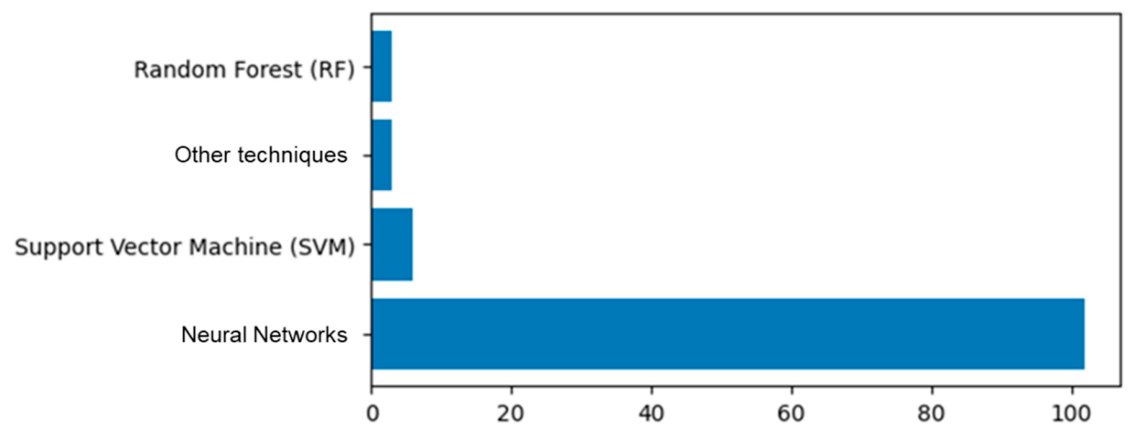
2.2.3. Comparative Analysis of Classification Techniques
3. Sign Language Datasets
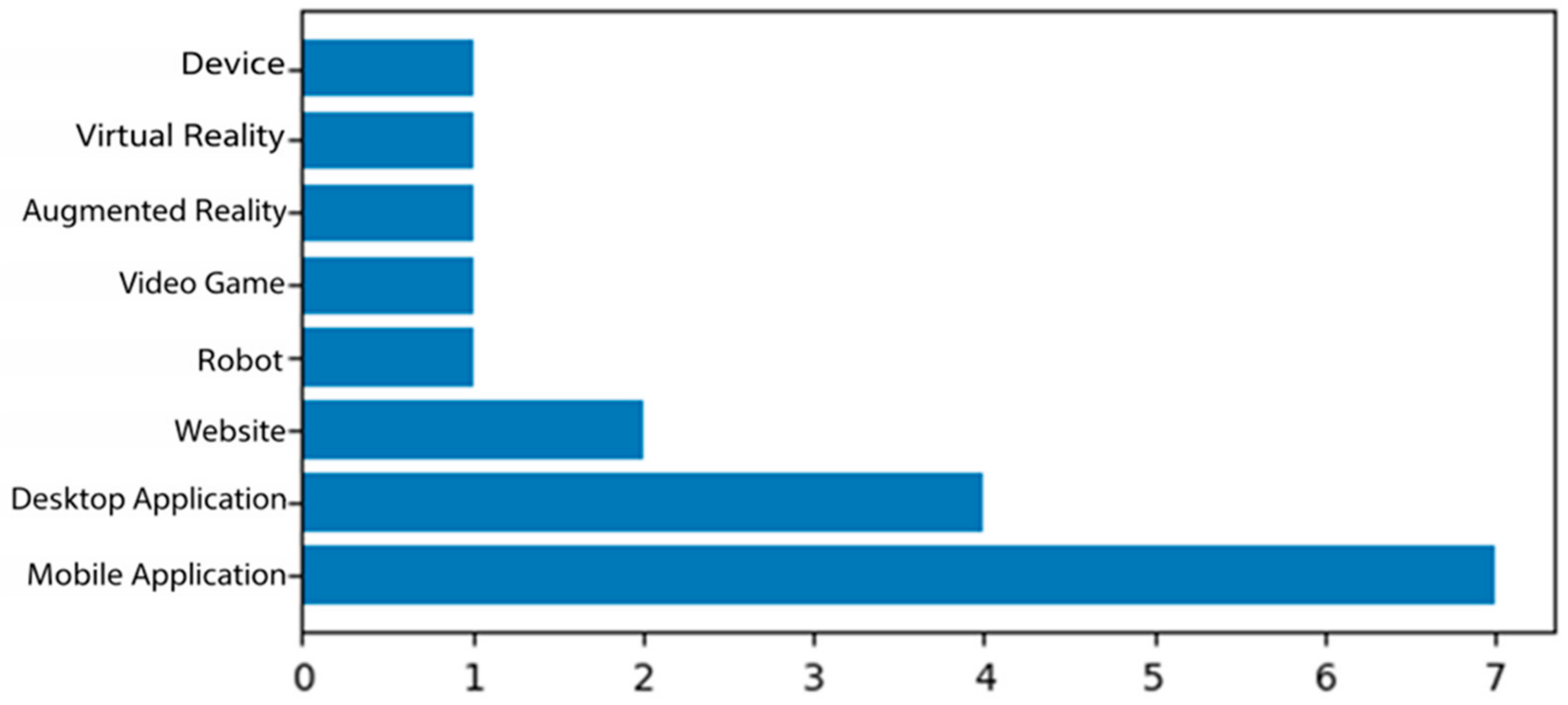
4. Use of Sign Recognition Systems
5. Performance of Predictive Models
5.1. Performance in Dynamic Sign Recognition
5.2. Performance in Static Sign Recognition
6. Future Research Directions
7. Conclusions
Author Contributions
Funding
Institutional Review Board Statement
Informed Consent Statement
Data Availability Statement
Acknowledgments
Conflicts of Interest
References
- Organización Mundial de la Salud. La OMS Advierte Que, Según las Previsiones, una de Cada Cuatro Personas Presentará Problemas Auditivos en 2050. Available online: https://www.who.int/es/news/item/02-03-2021-who-1-in-4-people-projected-to-have-hearing-problems-by-2050 (accessed on 17 February 2025).
- Organización Mundial de la Salud. Sordera y Pérdida de la Audición. Available online: https://www.who.int/es/news-room/fact-sheets/detail/deafness-and-hearing-loss#:~:text=Descripci%C3%B3n%20general,y%2034%20millones%20de%20ni%C3%B1os (accessed on 26 August 2023).
- Keskin, F.; Işık, G. Deep Insights into Turkish Sign Language Recognition, Generation, and Translation: A Comprehensive Systematic Review. Univers. Access Inf. Soc. 2026, 25, 79. [Google Scholar] [CrossRef] [Scilit]
- Sami, M.; Tehseen, R.; Omer, U.; Khan, M.F.; Siddiqui, S.Y.; Khan, N.S.; Khan, D.A. Systematic Literature Review on Computational Models Used for Sign Language Recognition. J. Comput. Biomed. Inform. 2026, 10. [Google Scholar] [CrossRef] [Scilit]
- Toshpulatov, M.; Lee, W.; Jun, J.; Lee, S. Deep Learning Pathways for Automatic Sign Language Processing. Pattern Recognit. 2025, 164, 111475. [Google Scholar] [CrossRef] [Scilit]
- Najib, F.M. Sign Language Interpretation Using Machine Learning and Artificial Intelligence. Neural Comput. Appl. 2025, 37, 841–857. [Google Scholar] [CrossRef] [Scilit]
- Berrezueta-Guzman, S.; Daya, R.; Wagner, S. Virtual Reality in Sign Language Education: Opportunities, Challenges, and the Road Ahead. Front. Virtual Real. 2025, 6, 1625910. [Google Scholar] [CrossRef] [Scilit]
- Kumari, D.; Anand, R.S. Fusion of Attention-Based Convolution Neural Network and HOG Features for Static Sign Language Recognition. Appl. Sci. 2023, 13, 11993. [Google Scholar] [CrossRef] [Scilit]
- Hdioud, B.; Tirari, M.E.H. A Deep Learning based Approach for Recognition of Arabic Sign Language Letters. Int. J. Adv. Comput. Sci. Appl. 2023, 14, 424–429. [Google Scholar] [CrossRef] [Scilit]
- Borges-Galindo, E.A.; Morales-Ramírez, N.; González-Lee, M.; García-Martínez, J.R.; Nakano-Miyatake, M.; Perez-Meana, H. Sign Language Interpreting System Using Recursive Neural Networks. Appl. Sci. 2024, 14, 8560. [Google Scholar] [CrossRef] [Scilit]
- Al Khuzayem, L.; Shafi, S.; Aljahdali, S.; Alkhamesie, R.; Alzamzami, O. Efhamni: A Deep Learning-Based Saudi Sign Language Recognition Application. Sensors 2024, 24, 3112. [Google Scholar] [CrossRef] [Scilit]
- Mosleh, M.A.A.; Assiri, A.; Gumaei, A.H.; Alkhamees, B.F.; Al-Qahtani, M. A Bidirectional Arabic Sign Language Framework Using Deep Learning and Fuzzy Matching Score. Mathematics 2024, 12, 1155. [Google Scholar] [CrossRef] [Scilit]
- Ameer, R.S.A.; Ahmed, M.A.; Al-Qaysi, Z.T.; Salih, M.M.; Shuwandy, M.L. Empowering Communication: A Deep Learning Framework for Arabic Sign Language Recognition with an Attention Mechanism. Computers 2024, 13, 153. [Google Scholar] [CrossRef] [Scilit]
- Raihan, J.; Labib, M.I.; Jim, A.A.J.; Tiang, J.J.; Biswas, U.; Nahid, A.-A. Bengali-Sign: A Machine Learning-Based Bengali Sign Language Interpretation for Deaf and Non-Verbal People. Sensors 2024, 24, 5351. [Google Scholar] [CrossRef] [Scilit]
- Siddique, S.; Islam, S.; Neon, E.E.; Sabbir, T.; Naheen, I.T.; Khan, R. Deep Learning-based Bangla Sign Language Detection with an Edge Device. Intell. Syst. Appl. 2023, 18, 200224. [Google Scholar] [CrossRef] [Scilit]
- Saputra, M.A.; Rakun, E. Recognizing Indonesian sign language (Bisindo) gesture in complex backgrounds. Indones. J. Electr. Eng. Comput. Sci. 2024, 36, 1583–1593. [Google Scholar] [CrossRef] [Scilit]
- Kakizaki, M.; Miah, A.S.M.; Hirooka, K.; Shin, J. Dynamic Japanese Sign Language Recognition Throw Hand Pose Estimation Using Effective Feature Extraction and Classification Approach. Sensors 2024, 24, 826. [Google Scholar] [CrossRef] [Scilit]
- Liang, Y.; Jettanasen, C.; Chiradeja, P. Progression Learning Convolution Neural Model-Based Sign Language Recognition Using Wearable Glove Devices. Computation 2024, 12, 72. [Google Scholar] [CrossRef] [Scilit]
- Hassan, M.A.; Ali, A.H.; Sabri, A.A. Enhancing communication: Deep learning for Arabic sign language translation. Open Eng. 2024, 14, 20240025. [Google Scholar] [CrossRef] [Scilit]
- Amrutha, K.; Prabu, P.; Poonia, R.C. LiST: A Lightweight Framework for Continuous Indian Sign Language Translation. Information 2023, 14, 79. [Google Scholar] [CrossRef] [Scilit]
- Balaha, M.M.; El-Kady, S.; Balaha, H.M.; Salama, M.; Emad, E.; Hassan, M. A vision-based deep learning approach for independent-users Arabic sign language interpretation. Multimed. Tools Appl. 2023, 82, 6807–6826. [Google Scholar] [CrossRef] [Scilit]
- Bilal, Z.S.; Gargouri, A.; Mahmood, H.F.; Mnif, H. Advancements in Arabic Sign Language Recognition: A Method based on Deep Learning to Improve Communication Access. J. Internet Serv. Inf. Secur. 2024, 14, 278–291. [Google Scholar] [CrossRef] [Scilit]
- Pathrikar, V.; Podutwar, T.; Siddannavar, A.; Mandana, A.; Rajeswari, K.; Vispute, S.; Vivekanandan, N. Word Level Sign Language Translation using Deep Learning. J. Eng. Sci. Technol. Rev. 2023, 16, 180–187. [Google Scholar] [CrossRef] [Scilit]
- Alsharif, B.; Alalwany, E.; Ilyas, M. Transfer learning with YOLOV8 for real-time recognition system of American Sign Language Alphabet. Frankl. Open 2024, 8, 100165. [Google Scholar] [CrossRef] [Scilit]
- Mara, U.T.; Malik, M.D.H.D.; Mansor, W.; Rashid, N.E.A.; Rahman, M.Z.U.; Foundation, K.L.E. Recognition of Radar-Based Deaf Sign Language Using Convolution Neural Network. Int. J. Integr. Eng. 2023, 15, 124–130. [Google Scholar] [CrossRef] [Scilit]
- Amirgaliyev, Y.; Ataniyazova, A.; Buribayev, Z.; Zhassuzak, M.; Urmashev, B.; Cherikbayeva, L. Application of neural networks ensemble method for the Kazakh sign language recognition. Bull. Electr. Eng. Inform. 2024, 13, 3275–3287. [Google Scholar] [CrossRef] [Scilit]
- Strobel, G.; Schoormann, T.; Banh, L.; Möller, F.; Isst, G.T.B. Artificial Intelligence for Sign Language Translation—A Design Science Research Study. Commun. Assoc. Inf. Syst. 2023, 53, 42–64. [Google Scholar] [CrossRef] [Scilit]
- Abdulhamied, R.M.; Nasr, M.M.; Kader, S.N.A. Real-time recognition of American sign language using long-short term memory neural network and hand detection. Indones. J. Electr. Eng. Comput. Sci. 2023, 30, 545–556. [Google Scholar] [CrossRef] [Scilit]
- Aurangzeb, K.; Javeed, K.; Alhussein, M.; Rida, I.; Haider, S.I.; Parashar, A. Deep Learning Approach for Hand Gesture Recognition: Applications in Deaf Communication and Healthcare. Comput. Mater. Contin. 2024, 78, 127–144. [Google Scholar] [CrossRef] [Scilit]
- Nareshkumar, M.D.; Jaison, B. A Light-Weight Deep Learning-Based Architecture for Sign Language Classification. Intell. Autom. Soft Comput. 2022, 35, 3501–3515. [Google Scholar] [CrossRef] [Scilit]
- Paul, S.K.; Walid, A.A.; Paul, R.R.; Uddin, J.; Rana, S.; Devnath, M.K.; Dipu, I.R.; Haque, M. An Adam based CNN and LSTM approach for sign language recognition in real time for deaf people. Bull. Electr. Eng. Inform. 2024, 13, 499–509. [Google Scholar] [CrossRef] [Scilit]
- Vashisth, H.K.; Tarafder, T.; Aziz, R.; Arora, M.; Alpana. Hand Gesture Recognition in Indian Sign Language Using Deep Learning. Eng. Proc. 2023, 59, 96. [Google Scholar] [CrossRef] [Scilit]
- As’Ari, M.A.; Sufri, N.A.J.; Qi, G.S. Emergency sign language recognition from variant of convolutional neural network (CNN) and long short term memory (LSTM) models. Int. J. Adv. Intell. Inform. 2024, 10, 64–78. [Google Scholar] [CrossRef] [Scilit]
- Adão, T.; Oliveira, J.; Shahrabadi, S.; Jesus, H.; Fernandes, M.; Costa, Â.; Ferreira, V.; Gonçalves, M.F.; Lopéz, M.A.G.; Peres, E.; et al. Empowering Deaf-Hearing Communication: Exploring Synergies between Predictive and Generative AI-Based Strategies towards (Portuguese) Sign Language Interpretation. J. Imaging 2023, 9, 235. [Google Scholar] [CrossRef] [Scilit]
- Beisov, N.; Madyarova, G.; Kerimbayev, N. Gesture recognition technology: A new dimension in human-computer interaction interface. Indones. J. Electr. Eng. Comput. Sci. 2024, 35, 1311–1324. [Google Scholar] [CrossRef] [Scilit]
- Khetavath, S.; Sendhilkumar, N.C.; Mukunthan, P.; Jana, S.; Gopalakrishnan, S.; Malliga, L.; Chand, S.R.; Farhaoui, Y. An Intelligent Heuristic Manta-Ray Foraging Optimization and Adaptive Extreme Learning Machine for Hand Gesture Image Recognition. Big Data Min. Anal. 2023, 6, 321–335. [Google Scholar] [CrossRef] [Scilit]
- Islam, M.; Aloraini, M.; Aladhadh, S.; Habib, S.; Khan, A.; Alabdulatif, A.; Alanazi, T.M. Toward a Vision-Based Intelligent System: A Stacked Encoded Deep Learning Framework for Sign Language Recognition. Sensors 2023, 23, 9068. [Google Scholar] [CrossRef] [Scilit]
- Ewe, E.L.R.; Lee, C.P.; Kwek, L.C.; Lim, K.M. Hand Gesture Recognition via Lightweight VGG16 and Ensemble Classifier. Appl. Sci. 2022, 12, 7643. [Google Scholar] [CrossRef] [Scilit]
- Avina, V.D.; Amiruzzaman, M.; Amiruzzaman, S.; Ngo, L.B.; Dewan, M.A.A. An AI-Based Framework for Translating American Sign Language to English and Vice Versa. Information 2023, 14, 569. [Google Scholar] [CrossRef] [Scilit]
- Mora-Zarate, J.E.; Garzón-Castro, C.L.; Rivillas, J.A.C. Learning signs with NAO: Humanoid robot as a tool for helping to learn Colombian Sign Language. Front. Robot. AI 2024, 11, 1475069. [Google Scholar] [CrossRef] [Scilit]
- Akdag, A.; Baykan, O.K. Enhancing Signer-Independent Recognition of Isolated Sign Language through Advanced Deep Learning Techniques and Feature Fusion. Electronics 2024, 13, 1188. [Google Scholar] [CrossRef] [Scilit]
- García-Gil, G.; López-Armas, G.d.C.; Sánchez-Escobar, J.J.; Salazar-Torres, B.A.; Rodríguez-Vázquez, A.N. Real-Time Machine Learning for Accurate Mexican Sign Language Identification: A Distal Phalanges Approach. Technologies 2024, 12, 152. [Google Scholar] [CrossRef] [Scilit]
- Elwahsh, H.; Elkhouly, A.; Nasr, E.A.; Kamrani, A.K.; El-Shafeiy, E. A New Intelligent Approach for Deaf/Dumb People based on Deep Learning. Comput. Mater. Contin. 2022, 72, 6045–6060. [Google Scholar] [CrossRef] [Scilit]
- Ji, A.; Wang, Y.; Miao, X.; Fan, T.; Ru, B.; Liu, L.; Nie, R.; Qiu, S. Dataglove for Sign Language Recognition of People with Hearing and Speech Impairment via Wearable Inertial Sensors. Sensors 2023, 23, 6693. [Google Scholar] [CrossRef] [Scilit]
- Gurbuz, S.Z.; Rahman, M.M.; Kurtoglu, E.; Malaia, E.; Gurbuz, A.C.; Griffin, D.J.; Crawford, C. Multi-Frequency RF Sensor Fusion for Word-Level Fluent ASL Recognition. IEEE Sens. J. 2022, 22, 11373–11381. [Google Scholar] [CrossRef] [Scilit]
- Gu, Y.; Sherrine; Wei, W.; Li, X.; Yuan, J.; Todoh, M. American Sign Language Alphabet Recognition Using Inertial Motion Capture System with Deep Learning. Inventions 2022, 7, 112. [Google Scholar] [CrossRef] [Scilit]
- Gu, Y.; Oku, H.; Todoh, M. American Sign Language Recognition and Translation Using Perception Neuron Wearable Inertial Motion Capture System. Sensors 2024, 24, 453. [Google Scholar] [CrossRef] [Scilit]
- Saleem, M.I.; Siddiqui, A.; Noor, S.; Luque-Nieto, M.-A.; Nava-Baro, E. A Machine Learning Based Full Duplex System Supporting Multiple Sign Languages for the Deaf and Mute. Appl. Sci. 2023, 13, 3114. [Google Scholar] [CrossRef] [Scilit]
- Junior, J.J.A.M.; Freitas, M.L.B.; Campos, D.P.; Farinelli, F.A.; Stevan, S.L.; Pichorim, S.F. Analysis of Influence of Segmentation, Features, and Classification in sEMG Processing: A Case Study of Recognition of Brazilian Sign Language Alphabet. Sensors 2020, 20, 4359. [Google Scholar] [CrossRef] [Scilit]
- Yang, S.-H.; Cheng, Y.-M.; Huang, J.-W.; Chen, Y.-P. RFaNet: Receptive Field-Aware Network with Finger Attention for Fingerspelling Recognition Using a Depth Sensor. Mathematics 2021, 9, 2815. [Google Scholar] [CrossRef] [Scilit]
- Sadeghzadeh, A.; Shah, A.S.; Islam, B. MLMSign: Multi-lingual multi-modal illumination-invariant sign language recognition. Intell. Syst. Appl. 2024, 22, 200384. [Google Scholar] [CrossRef] [Scilit]
- Xia, K.; Lu, W.; Fan, H.; Zhao, Q. A Sign Language Recognition System Applied to Deaf-Mute Medical Consultation. Sensors 2022, 22, 9107. [Google Scholar] [CrossRef] [Scilit]
- Attia, N.F.; Ahmed, M.T.F.S.; Alshewimy, M.A. Efficient deep learning models based on tension techniques for sign language recognition. Intell. Syst. Appl. 2023, 20, 200284. [Google Scholar] [CrossRef] [Scilit]
- Buttar, A.M.; Ahmad, U.; Gumaei, A.H.; Assiri, A.; Akbar, M.A.; Alkhamees, B.F. Deep Learning in Sign Language Recognition: A Hybrid Approach for the Recognition of Static and Dynamic Signs. Mathematics 2023, 11, 3729. [Google Scholar] [CrossRef] [Scilit]
- Ulrich, L.; Carmassi, G.; Garelli, P.; Presti, G.L.; Ramondetti, G.; Marullo, G.; Innocente, C.; Vezzetti, E. SIGNIFY: Leveraging Machine Learning and Gesture Recognition for Sign Language Teaching Through a Serious Game. Future Internet 2024, 16, 447. [Google Scholar] [CrossRef] [Scilit]
- Babisha, A.; Srikanth, G.U. Supercell Thunderstorm Paper Publishing-based Optimization Enabled Deep Learning for Sign Language Recognition Using Videos. Discov. Comput. 2026, 29, 522. [Google Scholar] [CrossRef] [Scilit]
- Theresa, W.G.; Prabha, S.S.; Thilagavathy, D.; Pournima, S. Analysis of the Efficacy of Real-Time Hand Gesture Detection with Hog and Haar-Like Features Using SVM Classification. Int. J. Recent Innov. Trends Comput. Commun. 2022, 10, 199–207. [Google Scholar] [CrossRef] [Scilit]
- A Esclamado, M. Transformer-Based Deep Learning Model With Fusion-Based Reranking for Word-Level Sign Language Recognition. Int. J. Artif. Intell. Mach. Learn. 2026, 6, 21–27. [Google Scholar] [CrossRef] [Scilit]
- Novaliendry, D.; Pratama, M.F.P.; Budayawan, K.; Huda, Y.; Rahiman, W.M.Y. Design and Development of Sign Language Learning Application for Special Needs Students Based on Android Using Flutter. Int. J. Online Biomed. Eng. (iJOE) 2023, 19, 76–92. [Google Scholar] [CrossRef] [Scilit]
- Nugraha, D.; Faizah, S.; Zaenudin, M. Enhancing interaction and learning experience for deaf students through sign language translator. Indones. J. Electr. Eng. Comput. Sci. 2024, 34, 1730–1738. [Google Scholar] [CrossRef] [Scilit]
- Morillas-Espejo, F.; Martinez-Martin, E. Sign4all: A Low-Cost Application for Deaf People Communication. IEEE Access 2023, 11, 98776–98786. [Google Scholar] [CrossRef] [Scilit]
- Ahmed, M.E.; Hasegawa, S. Development of New Distance Learning Platform to Create and Deliver Learning Content for Deaf Students. Educ. Sci. 2022, 12, 826. [Google Scholar] [CrossRef] [Scilit]
- Das, K.; Abid, F.; Rasheed, J.; Kamlish; Asuroglu, T.; Alsubai, S.; Soomro, S. Enhancing Communication Accessibility: UrSL-CNN Approach to Urdu Sign Language Translation for Hearing-Impaired Individuals. Comput. Model. Eng. Sci. 2024, 141, 689–711. [Google Scholar] [CrossRef] [Scilit]
- Sabharwal, S.; Singla, P. Optimised Machine Learning-based Translation of Indian Sign Language to Text. Int. J. Intell. Eng. Syst. 2023, 16, 398–408. [Google Scholar] [CrossRef] [Scilit]
- Ourdighi, A.; Belbachir, K.; Maroc, S. Enhancing Real-time Arabic Sign Language Recognition Using CNN-BiLSTM with a Two-stage Training Strategy based on Feature Extraction Refinement. Int. J. Intell. Eng. Syst. 2026, 19, 396–411. [Google Scholar] [CrossRef] [Scilit]
- Ben Sujitha, B. A Dual-branch CNN–LSTM–Transformer Framework for Spatiotemporal Feature Fusion in Robust Dynamic Gesture Recognition. Int. J. Intell. Eng. Syst. 2026, 19, 709–735. [Google Scholar] [CrossRef] [Scilit]
- Renjith, S.; Varghese, A.; Poorna, S.S. An Efficient Real-time Spatio-temporal Adaptive Motion Pattern Framework for Isolated Sign Language Recognition (RT-STAMP-SLR). Discov. Artif. Intell. 2026, 6, 713. [Google Scholar] [CrossRef] [Scilit]
- Amangeldy, N.; Yerimbetova, A.; Milosz, M.; Gazizova, N.; Tursynova, N.; Kassymova, A. Evaluating Early Fusion and Transformer-based Models for Sign Language Recognition Using Manual and Non-manual Features. Syst. Soft Comput. 2026, 9, 200527. [Google Scholar] [CrossRef] [Scilit]
- Liu, Z.; Feng, W.; Shang, F.; Hu, L.; Feng, J.; Gao, L. SSL-SSAW: Self-supervised Learning with Sigmoid Self-attention Weighting for Question-based Sign Language Translation. Pattern Recognit. 2026, 180, 114189. [Google Scholar] [CrossRef] [Scilit]





| Dimension | Inclusion Criteria | Exclusion Criteria |
|---|---|---|
| Database | Scopus | Any source outside Scopus |
| Publication period | 2020–2025 | Published before 2020 or after 2025 |
| Language | English, Spanish | Any other language |
| Access type | Open Access only | Articles behind paywalls |
| Thematic field | Engineering, Computer Science | Medicine, social sciences, humanities, and other fields |
| Document type | Journal articles | Conference papers, book chapters, theses |
| Sensor | Predictive Model | Result | Sign Language | Reference |
|---|---|---|---|---|
| Camera | DenseNet121, ResNet152, MobileNetV2, Xception, InceptionV3, NASNetLarge, VGG19, VGG16 | A bidirectional automatic translation framework for Arabic Sign Language (ArSL) was designed and implemented using deep learning models and a fuzzy string-matching scoring method. The prototype successfully translated sign images into text and vice versa, achieving up to 98.65% accuracy with VGG16. | Arabic SL | [12] |
| Camera | LSTM | LSTM models together with MediaPipe were used to recognize ArSL gestures. The model achieved accuracies above 85% for individual volunteers and 83% with combined data. | Arabic SL | [13] |
| Camera | CNN | A CNN with squeeze-and-excitation blocks and a mobile app were developed. The model reached 99.86% accuracy on the KU-BdSL dataset; SHAP analysis confirmed reliance on hand-related visual cues. | Bangladeshi SL | [14] |
| Camera | Detectron2, EfficientDet-D0, YOLOv7 | An automatic Bangla SL detection system using deep learning and a Jetson Nano was developed. Detectron2 achieved mAP@ of 94.915; YOLOv7 Tiny enabled real-time deployment. | Bangladeshi SL | [15] |
| Camera | Faster RCNN, YOLOv5, MobileNetV2 (features), LSTM (classification) | An automated BISINDO recognition system robust to backgrounds and computationally efficient. Sentence accuracy: 49.29%; SacreBLEU: 67.77%, outperforming baselines. | Indonesian SL | [16] |
| Camera | SVM | Dynamic Japanese SL alphabet recognition using feature extraction/selection plus SVM. Achieved 97.20% and 98.40% on two datasets. | Japanese SL | [17] |
| Data glove | PLD-CNNs | Wearable gloves + deep CNNs for sentence-level Thai SL. Excellent precision, recall, accuracy, and F1 reported. | Thai SL | [18] |
| Camera | CNN | New CNN architecture achieved 99.7%, setting a new benchmark. | Arabic SL | [19] |
| Camera | InceptionV3 + LSTM | Lightweight translation framework (LiST) integrating hand gestures, facial expressions, and orientation from Indian SL videos. Translation accuracy 91.2%, prediction 95.9%. | Indian SL | [20] |
| Camera | CNN + RNN | Dataset of 20 Arabic words; combined CNN-RNN achieved 98% on proposed data and 93.4%/98.8% top-1/top-5 on UCF-101. | Arabic SL | [21] |
| Camera | SSD + VGG16 | Object detection model adapted for AASL. Recognition accuracy 98%; 25% efficiency improvement in real time. | Arabic SL | [22] |
| Camera | GRU, LSTM, Transformers | Comparative study; LSTM outperformed others with 85.4% average accuracy using augmentation. | American SL | [23] |
| Camera | YOLOv8 | ASL alphabet recognition with MediaPipe + YOLOv8; accuracy 98%, recall 98%, F1 99%. | American SL | [24] |
| Radar | CNN | Radar-based recognition; 92.31% with unsegmented spectrograms. | – | [25] |
| Camera | ResNet-50 + VGG-19 | Ensemble CNN for 42 Kazakh signs; 95.7% accuracy. | Kazakh SL | [26] |
| Camera | Transformers | AI-based translator; proof of concept for emergency calls with >200 phrases. | American SL | [27] |
| Camera | LSTM | Webcam + LSTM for real-time action detection; 99.35% accuracy. | American SL | [28] |
| Camera | CNN | HVCNNM achieved 99.23% and 99.00% on MUD and ASLAD. | American SL | [29] |
| Camera | MobileNetV2 | New architecture for ASL and ISL alphabets; 98.77%. | American and Indian SL | [30] |
| Depth camera | CNN | ArSL alphabet recognition; 97.07%. | Arabic SL | [9] |
| Camera | CNN, LSTM, GRU | Two DL methods; 89.07% (CNN) and 94.3% (LSTM). | American SL | [31] |
| Camera | CNN | Custom ISL dataset; loss 0.0178, accuracy 99%. | Indian SL | [32] |
| Camera | RNN | Mexican SL with hand/facial tracking; 0.93 offline, superior online. | Mexican SL | [10] |
| Camera | LRCN, ConvLSTM | ISL words, only hand gestures, 96.4% accuracy on LSTM model | Indian SL | [33] |
| Camera | LSTM | Portuguese SL as a service; 80–95.6% accuracy; good usability and semantic correlation with LLM. | Portuguese SL | [34] |
| Camera | CNN | AI-based system; 97.3% for Kazakh alphabet. | Kazakh SL | [35] |
| Dataset | Sign Language | Modality | Sign Type | # Classes | # Samples | References |
|---|---|---|---|---|---|---|
| WLASL | American SL | RGB video | Dynamic | 2000 | 21,083 | [58] |
| AUTSL | Turkish SL | RGB-D video | Dynamic | 226 | 38,336 | [3] |
| LSA64 | Argentinian SL | RGB video | Static/Dynamic | 64 | 3200 | [41] |
| KU-BdSL | Bangladeshi SL | RGB image | Static | 36 | — | [14] |
| ArSL | Arabic SL | RGB image | Static | 32 | — | [9,19] |
Disclaimer/Publisher’s Note: The statements, opinions and data contained in all publications are solely those of the individual author(s) and contributor(s) and not of MDPI and/or the editor(s). MDPI and/or the editor(s) disclaim responsibility for any injury to people or property resulting from any ideas, methods, instructions or products referred to in the content. |
© 2026 by the authors. Licensee MDPI, Basel, Switzerland. This article is an open access article distributed under the terms and conditions of the Creative Commons Attribution (CC BY) license.
Share and Cite
Mora-Zarate, J.E.; Garzón-Castro, C.L. Machine Learning as a Tool for the Development of Sign Recognition Systems: A Review. J. Imaging 2026, 12, 445. https://doi.org/10.3390/jimaging12090445
Mora-Zarate JE, Garzón-Castro CL. Machine Learning as a Tool for the Development of Sign Recognition Systems: A Review. Journal of Imaging. 2026; 12(9):445. https://doi.org/10.3390/jimaging12090445
Chicago/Turabian StyleMora-Zarate, Juan E., and Claudia L. Garzón-Castro. 2026. "Machine Learning as a Tool for the Development of Sign Recognition Systems: A Review" Journal of Imaging 12, no. 9: 445. https://doi.org/10.3390/jimaging12090445
APA StyleMora-Zarate, J. E., & Garzón-Castro, C. L. (2026). Machine Learning as a Tool for the Development of Sign Recognition Systems: A Review. Journal of Imaging, 12(9), 445. https://doi.org/10.3390/jimaging12090445