
Multi-Task and Federated Learning for Breast and Lung Cancer Screening and Diagnosis: A Survey and Future Research Directions




Abstract
1. Introduction
- A comprehensive overview of recent centralized MTL and FL as emerging methods highlights their roles in enhancing tumor detection efficiency and medical data privacy for BrC and LuC screening and diagnosis.
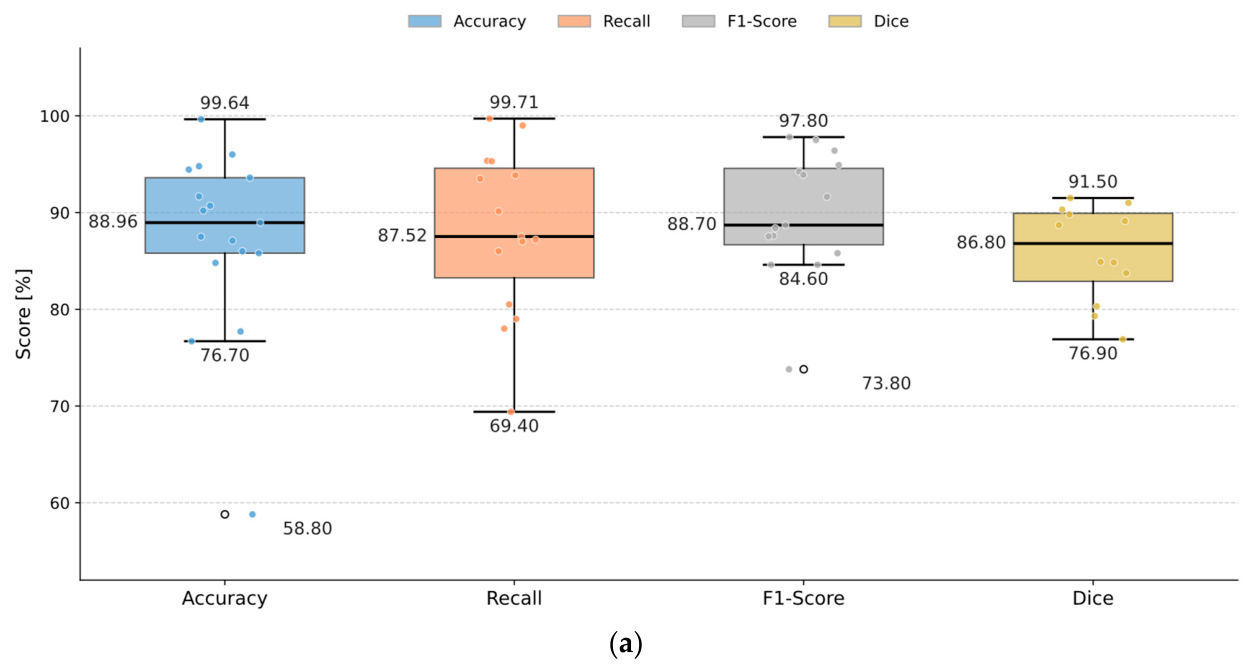
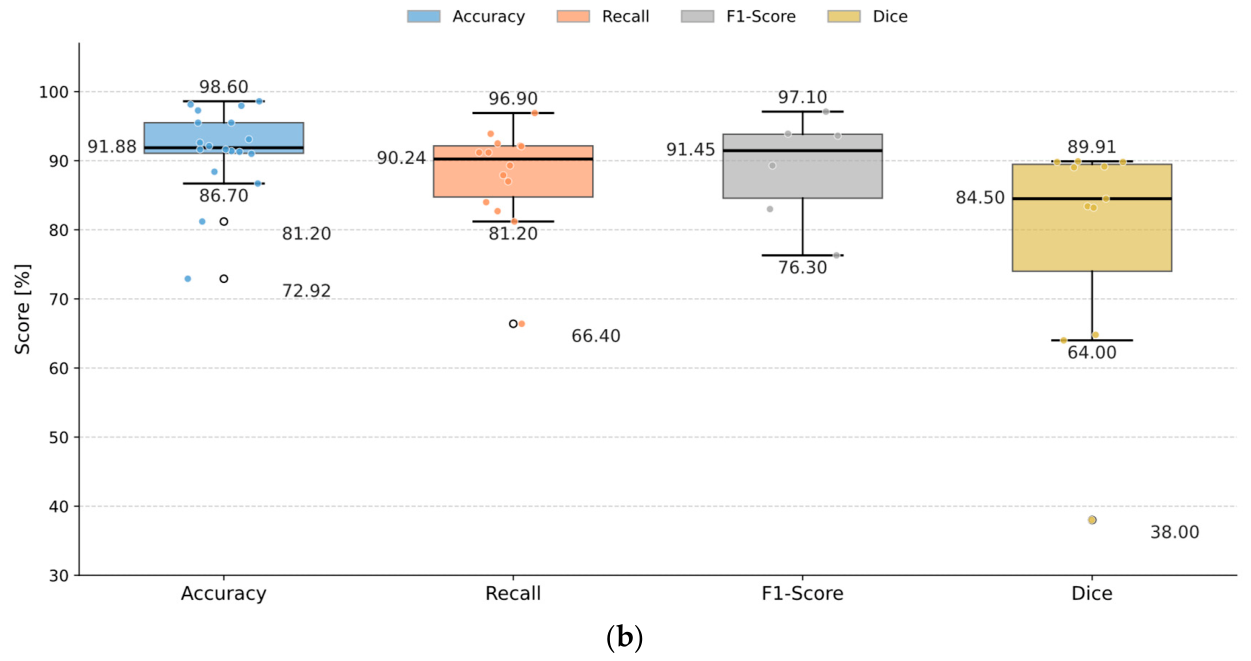
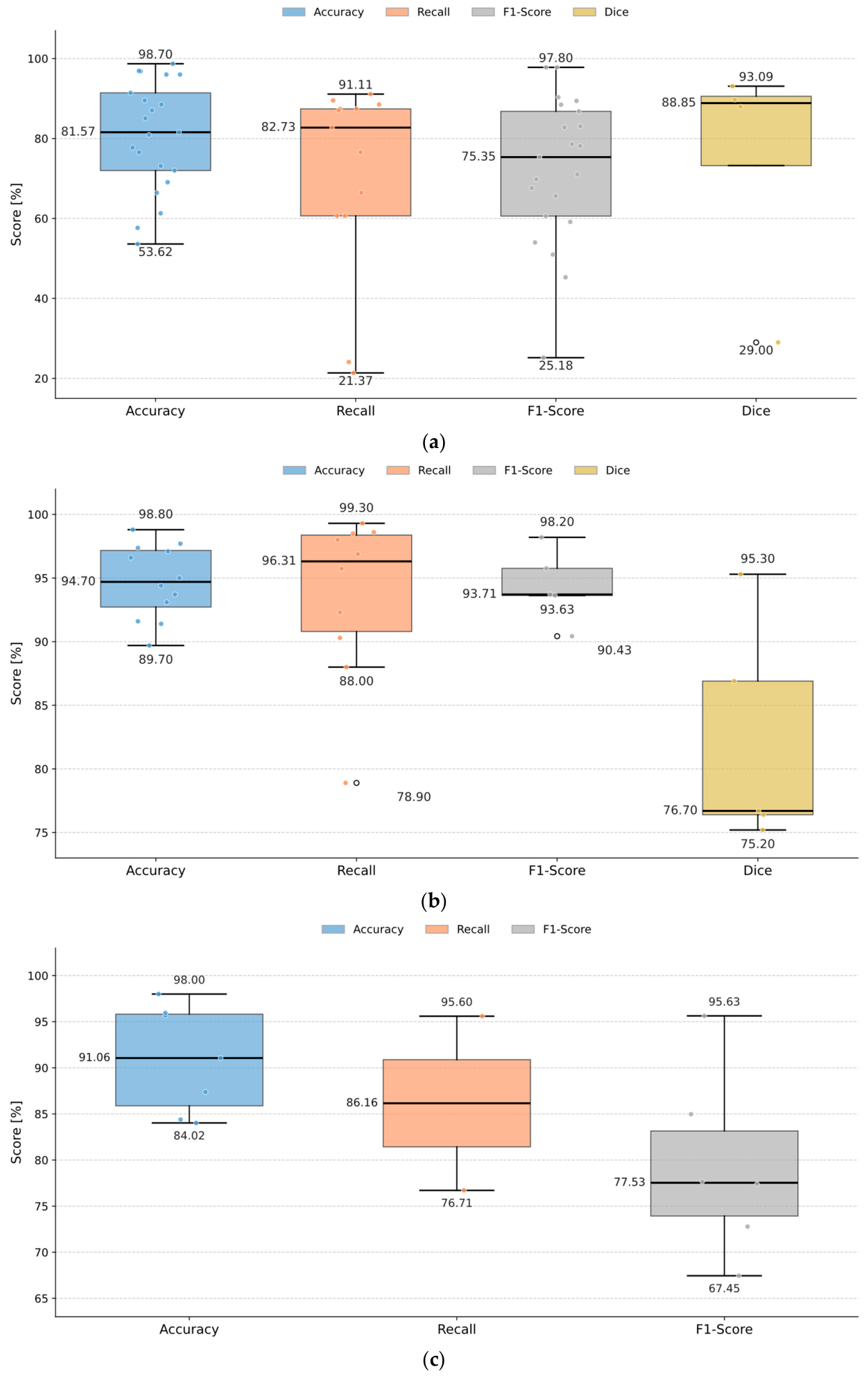
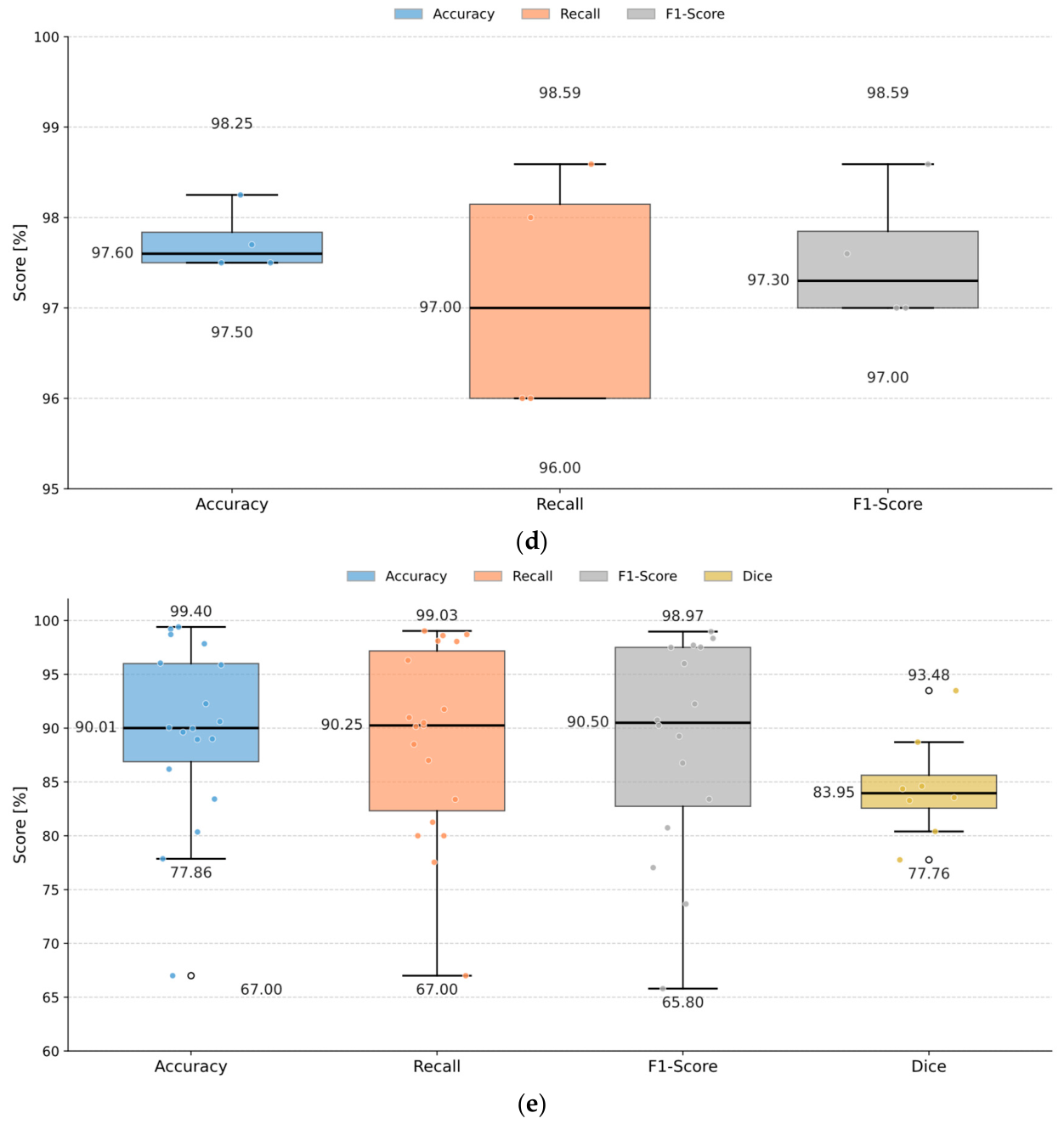
- A comparative performance analysis of the MTL models and FL environments in terms of accuracy, recall, and F1-score was visualized through box plots.
- An outline of current challenges and future directions in the context of MTL and FL methods for BrC and LuC screening and diagnosis.
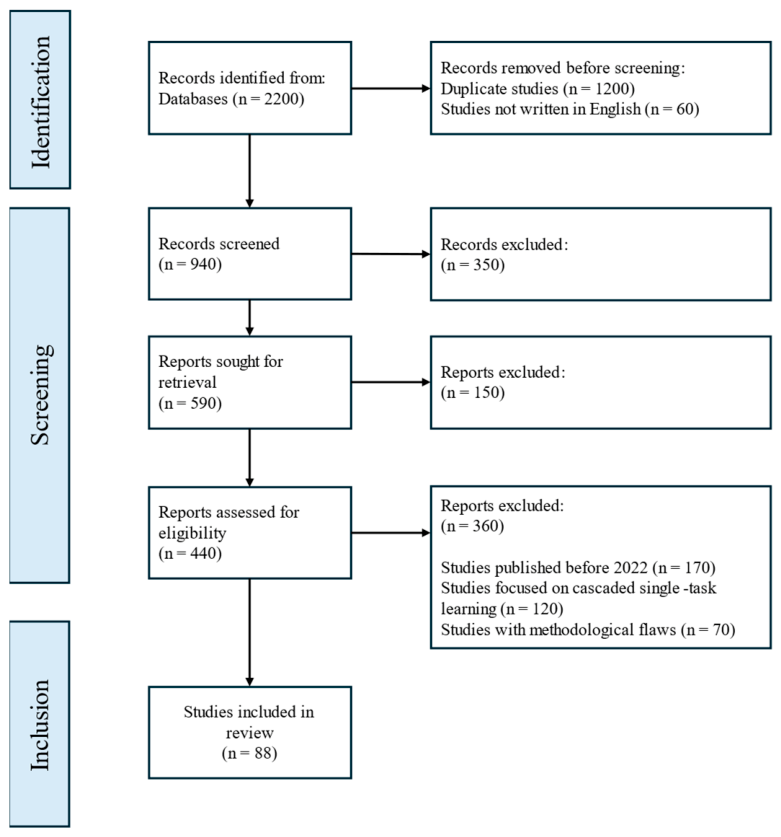
2. Review Methodology
- [Breast Cancer OR Lung Cancer] AND Multi-Task Learning AND [Ultrasound Images OR Mammography OR Histopathological Images OR Fine Needle Aspirate OR Computed Tomography].
- [Breast Cancer OR Lung Cancer] AND Multi-Task Learning AND Convolutional Neural Network AND CNN AND [Ultrasound Images OR Mammography OR Histopathological Images OR Fine Needle Aspirate OR Computed Tomography].
- [Breast Cancer OR Lung Cancer] AND Multi-Task Learning AND Vision Transformer AND ViT AND [Ultrasound Images OR Mammography OR Histopathological Images OR Fine Needle Aspirate OR Computed Tomography].
- [Breast Cancer OR Lung Cancer] AND Federated Learning AND FL AND [Ultrasound Images OR Mammography OR Histopathological Images OR Fine Needle Aspirate OR Computed Tomography].

| No. | Inclusion Criteria | Exclusion Criteria |
|---|---|---|
| 1. | Articles published in English | Articles published in other languages than English |
| 2. | Articles that utilize in the context of centralized MTL both traditional CNN models as well as hybrid attention-enhanced CNN architectures and ViT models for BrC and LuC screening and diagnosis | Articles covering centralized unimodal methods for BrC and LuC screening and diagnosis |
| 3. | Articles that propose decentralized FL environments for BrC and LuC screening and diagnosis | Articles with methodological flaws or with incomplete results presentation. |
| 4. | Articles from the 2022–2026 time frame | Articles published before 2022 |
3. Formulation of Multi-Task and Federated Learning
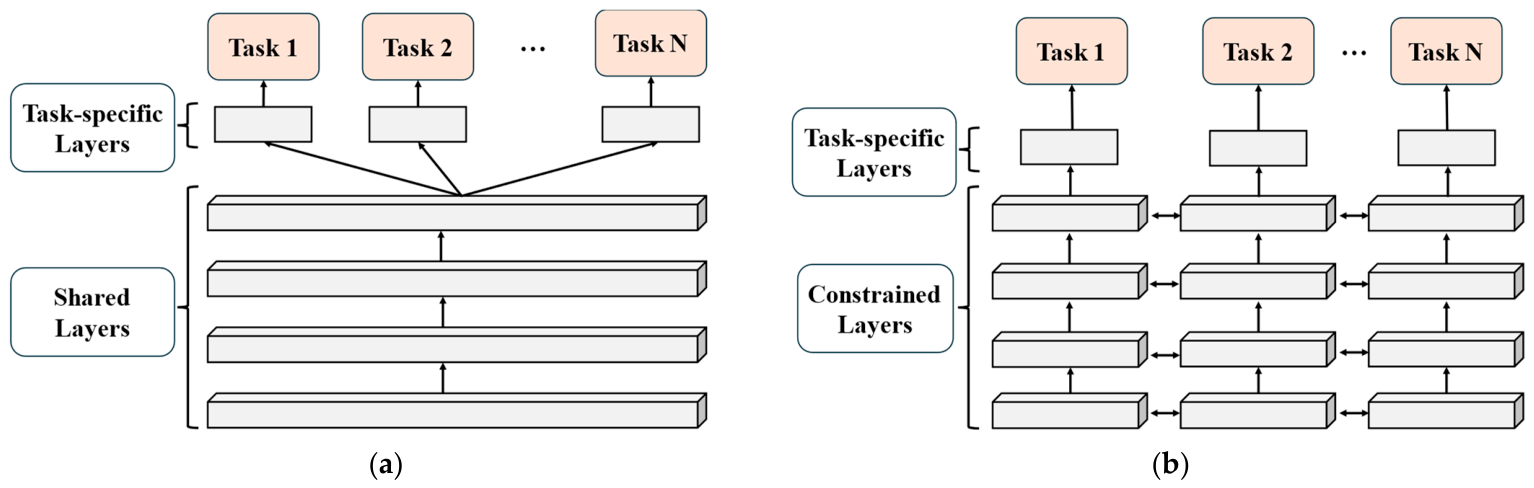
3.1. Multi-Task Learning
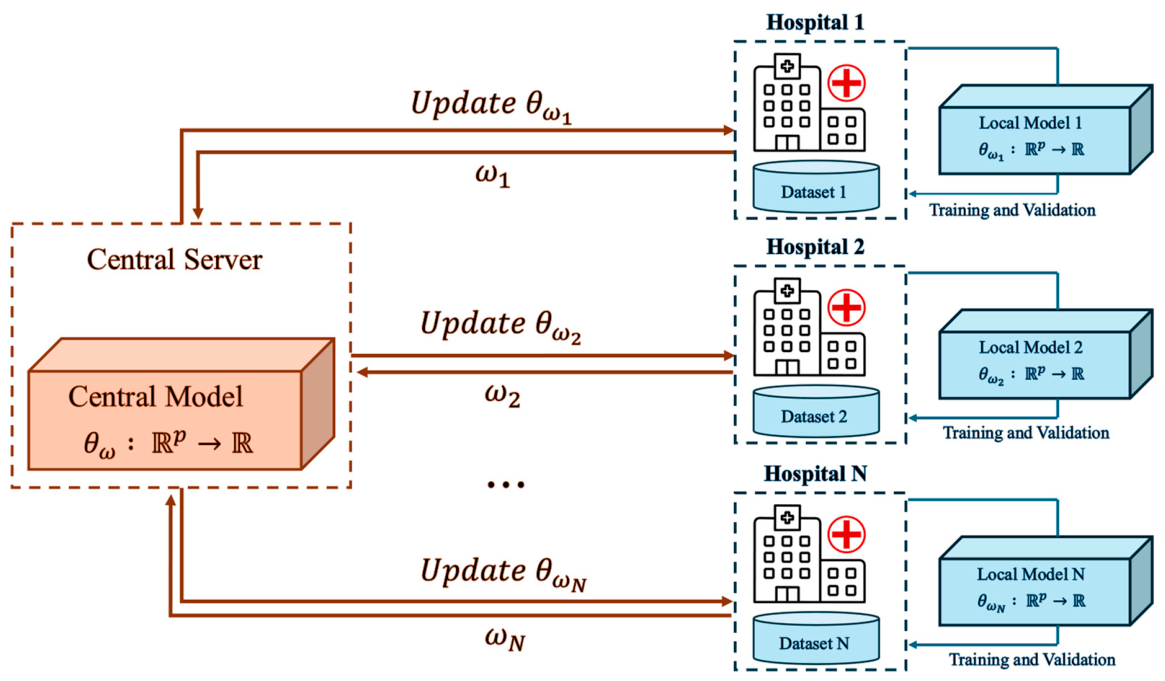
3.2. Federated Learning
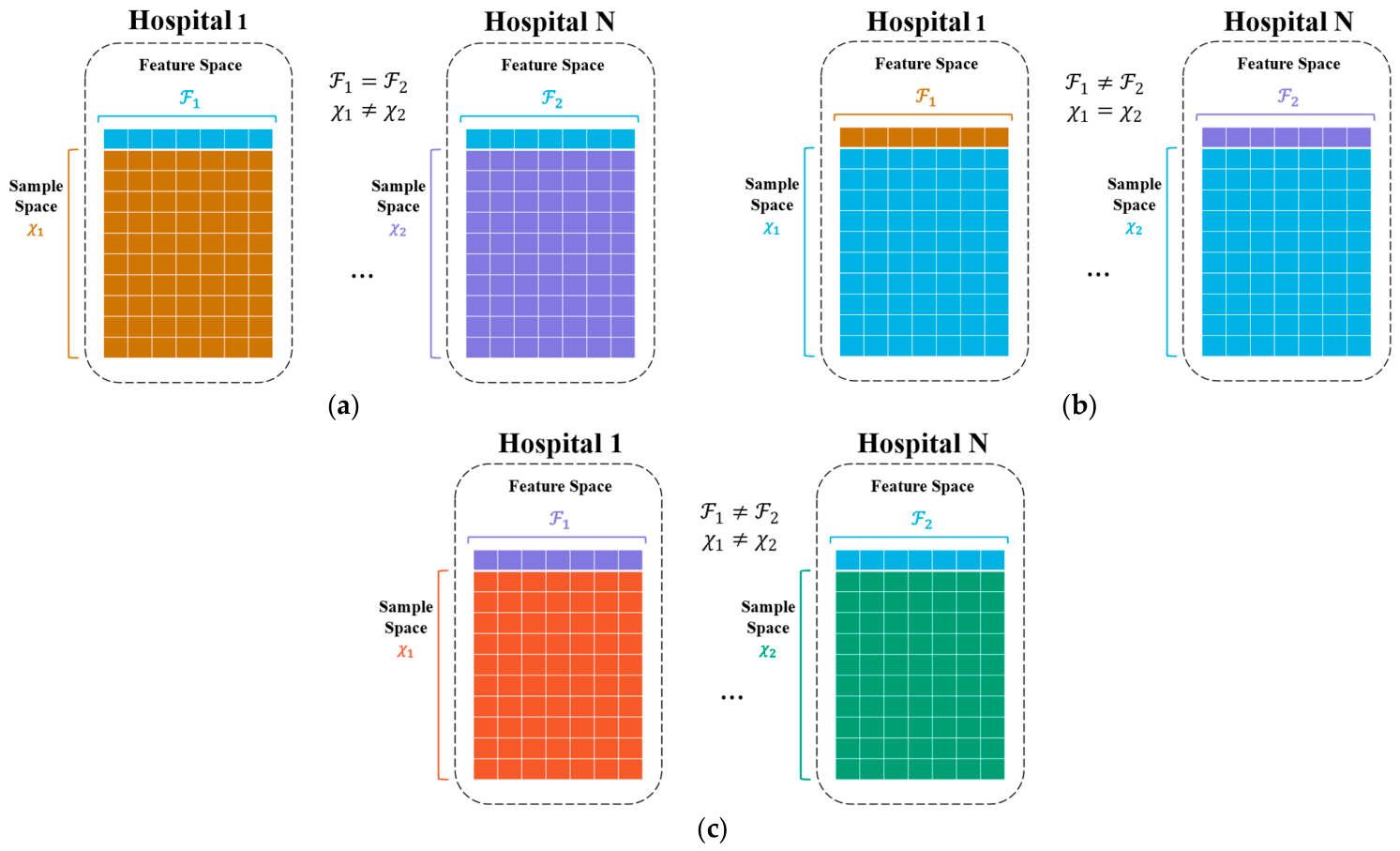
- Horizontal FL Environments: The feature space is the same across the client side but the sample space is different. In this case, all hospitals within the FL environment contained the same medical images for all patients (i.e., CT scans, mammograms, ultrasound images, etc.). However, each hospital had different patients and implicit types of medical images (i.e., samples).
- Vertical FL Environments: The feature space is different for each client, but the sample space is the same. In this case, the same group is considered for every medical institution; however, each institution has different medical information (e.g., CT scans, ultrasound images, genomic markers, and biopsy reports).
- Transfer Learning FL Environments: The feature and sample spaces are different for each client. Therefore, this scenario best models the real-life situation of a federated environment, in which different hospitals have different patients, each with various types of medical information related to BrCs and LuCs.
| Type | Identical Feature Space | Identical Sample Space | Advantages | Challenges |
|---|---|---|---|---|
| Horizontal | ✓ | ✗ | Simple and clear aggregation methods. | Non-identically distributed configurations. |
| Suitable for multi-task learning methods. | May become unrealistic in real-life federated scenarios. | |||
| Easily scalable. | Easy to implement and maintain. | |||
| Vertical | ✗ | ✓ | Suitable for multi-modal learning methods. | Domain-shift in terms of sample space between clients. |
| Suitable for modeling departments within the same hospital. | Only overlapping samples can participate in the environment. | |||
| Harder to implement and increase maintenance costs. | ||||
| Federated Transfer Learning | ✗ | ✗ | Most realistic federated configuration. | Domain-shift in terms of both features and sample space between clients. |
| Increased per-client confidentiality. | Harder to implement and increase maintenance costs. | |||
| Flexible in terms of client data type. |
- Pure FL Environments: Environments in which data confidentiality is maintained based solely on the decentralized configuration ensured by the federated paradigm.
- Encryption-enhanced FL Environments: Environments in which data confidentiality is increased by utilizing encryption methods (e.g., homomorphic encryption) on either the client or server sides. In addition, environments that utilize DL-based methods to combat adversarial attacks are considered in this category.
4. Multi-Task and Federated Learning for Breast Cancer
4.1. Multi-Task Learning Methods for Breast Cancer Screening and Diagnosis
| Ref. | Tasks | Parameter Sharing | Imaging Technique | Dataset | DL Architecture | Performance [%] |
|---|---|---|---|---|---|---|
| [26] | Classification + Segmentation | Hard Sharing | Ultrasound | BUSI | nnU-Net | Acc: 84.8 Recall: 79.0 F1-Score: 84.6 Dice: 79.3 |
| UNet ++ | Acc: 85.8 Recall: 80.5 F1-Score: 85.8 Dice: 80.3 | |||||
| [19] | Density Classification + Mass Segmentation | Hard Sharing | Mammograms | CBIS-DDSM | Res2Net101 + ViT Encoder–Decoder | Acc: 86.0 Recall: 86.0 F1-Score: 87.98 Dice: 89.8 |
| INBreast | Acc: 96 Recall: 99 F1-Score: 97.5 Dice: 91 | |||||
| [20] | Joint Classification + Segmentation | Hard Sharing | Ultrasound | UDIAT | Res-U-Net + OCA module | Acc: 94.79 Recall: 95.35 F1-Score: 94.9 Dice: 84.85 |
| OASBUD | Acc: 91.67 Recall: 90.13 F1-Score: 91.63 Dice: 83.75 | |||||
| [23] | Segmentation + pCR prediction | Hard Sharing | Magnetic Resonance Imaging | TCIA Duke Dataset | 3D Attention UNet model + MLP | Acc: 76.7 Recall: 78.0 F1-Score: N/A Dice: 76.9 |
| [25] | Segmentation + Biomarker Prediction | Hard Sharing | Ultrasound | 3D Whole Ultrasound Images | 3D ResNet encoder–decoder + fully connected network | Acc: 58.8 Recall: 69.4 F1-Score: 73.8 |
| [24] | Histological Grade Prediction | Hybrid Sharing | Magnetic Resonance Imaging | Private Dataset collected from 301 patients | DenseNet + task common and task specific network | Acc: 87.1 Recall: 87.2 F1-Score: 87.6 |
| Ki-67 status Forecasting | Acc: 77.7 Recall: 95.3 F1-Score: 84.6 | |||||
| [21] | Classification + Segmentation | Hard Sharing | Ultrasound | BUSI | UNet + Gated Unit Modules | Acc: 94.44 Recall: 93.86 F1-Score: 94.23 Dice: 84.9 |
| UDIAT | Acc: 88.96 Recall: 87.52 F1-Score: 88.39 Dice: 89.12 | |||||
| [27] | Pathology Prediction | Hard Sharing | Mammograms | INbreast | EfficientNet-B3 + Attention Mechanisms | Acc: 93.6 Recall: 93.5 F1-Score: 93.9 |
| Density Estimation | Acc: 90.2 Recall: N/A F1-Score: N/A | |||||
| [22] | Classification + Segmentation | Hard Sharing | Ultrasound | BUD (BUSI + BUSBRA + BUS UC + BUET_BUS) | ResNet18 Encoder, UNet decoder + Multi-Scale Fusion Module + Channel Attention Module | Acc: 87.5 Recall: 87.01 F1-Score: 87.54 Dice: 90.3 |
| Magnetic Resonance Imaging | BMD (BreaDM + Private Dataset) | Acc: 99.64 Recall: 99.71 F1-Score: 96.4 Dice: 91.5 | ||||
| [28] | Classification + Segmentation | Hard Sharing | Ultrasound | PRECISE BUS (BUSI + BrEaST + BUS-BRA) | ViT-B/16 backbone encoder + MGA Mechanisms | Acc: 90.7 Recall: N/A F1-Score: 88.7 Dice: 88.7 |
4.2. Federated Learning Methods for Breast Cancer Screening and Diagnosis
| Ref. | Task Type | Aggregation Technique | Privacy Mechanism | Dataset | DL Architecture | Performance [%] |
|---|---|---|---|---|---|---|
| [29] | Multi-Class Classification | FedProx | Implicitly via federated architecture | BUSI | MobileNet | Acc: 80.92 Recall: N/A F1-Score: 78.13 |
| ResNet50 | Acc: 81.57 Recall: N/A F1-Score: 78.58 | |||||
| InceptionNetV3 | Acc: 69.07 Recall: N/A F1-Score: 60.60 | |||||
| BCMID | MobileNet | Acc: 61.29 Recall: N/A F1-Score: 54.00 | ||||
| ResNet50 | Acc: 53.62 Recall: N/A F1-Score: 45.29 | |||||
| InceptionNetV3 | Acc: 57.66 Recall: N/A F1-Score: 50.97 | |||||
| BUS-UCLM | MobileNet | Acc: 77.71 Recall: N/A F1-Score: 69.81 | ||||
| ResNet50 | Acc: 72.00 Recall: N/A F1-Score: 65.62 | |||||
| InceptionNetV3 | Acc: 73.14 Recall: N/A F1-Score: 67.60 | |||||
| [31] | Segmentation | FedProx | Implicitly via federated architecture | BUSI + Dataset B | Attention-enhanced U-NET model | Acc: 96.07 Recall: 60.66 F1-Score: 70.76 Dice: 29.24 |
| [32] | Segmentation | FedAvg | Implicitly via federated architecture | BUSI | Three-level encoder–decoder U-Net Model | Acc: 91.42 Recall: 24.09 F1-Score: 25.18 |
| Dataset B | Acc: 96 Recall: 21.37 F1-Score: 82.8 | |||||
| [33] | Classification and Segmentation | FedAvg | Differential Privacy with Gaussian Noise Injection | BUSI | Multi-Attention U-NET (Segmentation) ResNet50V2 + NASNetLarge + MAU-Net + meta-classifier (Classification) | Acc: 98.7 Recall: 91.11 F1-Score: 97.8 Dice: 89.72 |
| UDIAT | Acc: 96.82 Recall: 87.41 F1-Score: 97.8 Dice: 87.98 | |||||
| BUSC | Acc: 96.92 Recall: 87.41 F1-Score: 90.32 Dice: 93.09 | |||||
| [50] | Classification | FedOpt | Client-side Differential Privacy | BUSI | ResNet50 | Acc: 76.56 Recall: 76.56 F1-Score: 75.35 |
| VGG19 | Acc: 85.05 Recall: 82.73 F1-Score: 83.05 | |||||
| MobileNetV2 | Acc: 66.44 Recall: 66.44 F1-Score: 59.15 | |||||
| DenseNet121 | Acc: 87.03 Recall: 87.03 F1-Score: 86.80 | |||||
| ViT-small | Acc: 89.53 Recall: 89.53 F1-Score: 89.41 | |||||
| CoAtNet | Acc: 88.51 Recall: 88.51 F1-Score: 88.46 |
| Ref. | Task Type | Aggregation Technique | Privacy Mechanism | Dataset | DL Architecture | Performance [%] |
|---|---|---|---|---|---|---|
| [34] | Classification | FedAvg | Implicitly via federated architecture | DDSM | 5–20-layer DNN | Acc: 89.7 Recall: 98.6 F1-Score: N/A |
| [35] | Classification | FedAvg | Implicitly via federated architecture | DDSM | DenseNet and Recurrent Neural Network | Acc: 95 Recall: 95.74 F1-Score: 95.76 |
| [36] | Classification | FedAvg | Homomorphic Encryption | VINDR-MAMMO | 3-layer Deep CNN | Acc: 97.1 Recall: 90.3 F1-Score: 93.71 |
| CMMD | Acc: 94.4 Recall: 92.3 F1-Score: 93.63 | |||||
| INBreast | Acc: 91.6 Recall: 88.0 F1-Score: 90.43 | |||||
| [37] | Classification | FedAvg | Implicitly via federated architecture | 3D Digital Breast Tomosynthesis | 3-layer custom CNN architecture | Acc: 97.37 Recall: 96.88 F1-Score: N/A |
| [38] | Classification | FedAvg | Domain adversarial Training | Mammogram Dataset (KAUMDS) | ResNet | Acc: 98.8 Recall: 98.5 F1-Score: 98.2 |
| [39] | Classification | FedAvg | Differential Privacy + Homomorphic Encryption | CBIS– DDSM | ResNet + EfficientNet with attention mechanisms | Acc: 93.7 Recall: N/A F1-Score: N/A |
| [40] | Segmentation | FedAvg | Implicitly via federated architecture | DDSM | VGG backbone feature extractor + UNet2 and Unet3 | Acc: 91.4 Recall: 81.7 F1-Score: N/A Dice: 76.7 |
| CBIS-DDSM | Acc: 93.1 Recall: 78.9 F1-Score: N/A Dice: 75.2 | |||||
| MIAS | Acc: 96.6 Recall: 99.3 F1-Score: N/A Dice: 86.9 | |||||
| INBreast | Acc: 97.7 Recall: 98.0 F1-Score: N/A Dice: 76.4 | |||||
| [41] | Classification + Segmentation + Detection | FedAvg | Differential Privacy (in an ablation study) | INBreast | Pyramidal ViT + task-specific decoders | Acc: N/A Recall: N/A F1-Score: N/A Dice: 95.3 |
| Ref. | Task Type | Aggregation Technique | Privacy Mechanism | Dataset | DL Architecture | Performance [%] |
|---|---|---|---|---|---|---|
| [42] | Classification | FedAvg | Homomorphic Encryption + Secure Multi-Party Computation + Differential Privacy | BreakHis | ResNet152 | Acc: 84.39 Recall: N/A F1-Score: 67.45 |
| DenseNet201 | Acc: 91.06 Recall: N/A F1-Score: 84.97 | |||||
| MobileNetv2 | Acc: 87.38 Recall: N/A F1-Score: 77.38 | |||||
| EfficientNetB7 | Acc: 84.02 Recall: N/A F1-Score: 72.78 | |||||
| [43] | Classification | FedAvg | Extended ElGamal Image Encryption | BreakHis | Custom CNN + twin attention modules | Acc: 95.68 Recall: 95.6 F1-Score: 95.63 |
| [44] | Classification | FedAvg | Implicitly via federated architecture | BreakHis | Pretrained ResNet18 + self-attention modules | Acc: 95.95 Recall: 76.71 F1-Score: 77.68 |
| [45] | Classification | FedAvg | Homomorphic Encryption | BreakHis | YOLOv6 | Acc: 98 Recall: N/A F1-Score: N/A |
| Ref. | Task Type | Aggregation Technique | Privacy Mechanism | Dataset | DL Architecture | Performance [%] |
|---|---|---|---|---|---|---|
| [52] | Classification | FedAvg | Implicitly via federated architecture | WBCD | 3-layer DNN | Acc: 97.5 Recall: 98.0 F1-Score: 97 |
| [51] | Classification | Custom GAN-based aggregation | Differential Privacy | WBCD | Cramer GAN + custom 4-layer CNN architecture | Acc: 97.5 Recall: 96 F1-Score: 97 |
| [53] | Classification | FedAvg | Differential Privacy | WBCD | 2-layer Deep Neural Network | Acc: 96.1 Recall: 96.0 F1-Score: 97.0 |
| [54] | Classification | FedAvg | Implicitly via federated architecture | WBCD | 3-layer DNN with dropout layers | Acc: 98.25 Recall: 98.59 F1-Score: 98.59 |
4.3. Datasets Employed for Breast Cancer Analysis
| Dataset | Imaging Modality | Acquisition Center | Dataset Size | Class | Task |
|---|---|---|---|---|---|
| BUS [14] | Ultrasonography | Baheya Hospital, Cairo | 600 | Benign: 437 | Classification, Segmentation |
| Malignant: 210 | |||||
| Healthy: 133 | |||||
| UDIAT [15] | Ultrasonography | UDIAT Diagnostic Centre, Parc Taulí University Hospital, Spain | 163 | Benign: 110 | Classification, Segmentation |
| Malignant: 53 | |||||
| OASBUD [16] | Ultrasonography | Department of Ultrasound, Institute of Fundamental Technological Research, Poland | 78 | Benign: 52 | Classification, Segmentation |
| Malignant: 48 | |||||
| BUS-UCML [46] | Ultrasonography | Ciudad Real General University Hospital | 38 | Benign: 174 | Classification, Segmentation |
| Malignant: 90 | |||||
| Healthy: 419 | |||||
| CBIS-DDSM [17] | Mammography | Massachusetts General Hospital, Wake Forest University School of Medicine, Sacred Heart Hospital, and Washington University of St Louis School of Medicine | 753 calcification cases 891 mass cases | Benign: 886 | Classification, Detection |
| Malignant: 758 | |||||
| INBreast [18] | Mammography | Centro Hospitalar de São João, Portugal | 115 | Benign: 70 | Classification, Detection |
| Malignant: 45 | |||||
| BreakHis [30] | Histopathology | P&D Laboratory, Brazil | 82 | Benign: 2480 | Classification, Segmentation, Detection |
| Malignant: 5429 | |||||
| WDBC [55] | FNA Features | University of Wisconsin, USA | Not recorded | Benign: 357 | Classification |
| Malignant: 212 |
5. Multi-Task and Federated Learning for Lung Cancer
5.1. Multi-Task Learning Methods for Lung Cancer Screening and Diagnosis
| Ref. | Tasks | Parameter Sharing | Imaging Technique | Dataset | DL Architecture | Performance [%] |
|---|---|---|---|---|---|---|
| [60] | Classification + Segmentation | Hybrid Sharing | CT | Lung PET CT Dx | StarNet-based encoder–decoder with edge uncertainty estimation | Acc: 88.4 Recall: 87.0 F1-Score: 84.6 Dice: 84.5 |
| STS | Acc: 86.7 Recall: 82.7 F1-Score: 83.0 Dice: 83.4 | |||||
| [68] | Detection | Hard Sharing | CT | LIDC-IDRI | YOLOv11 backbone with Feature Pyramid Network and Path Aggregation Network and anchor-based detection head | Acc: N/A Recall: 66.4 F1-Score: 76.3 |
| Multi-attribute regression | MAE: 51.6 RMSE: 71.9 | |||||
| [64] | Segmentation + PET | Soft Sharing | CT + PET Knowledge | NSCLC + Rad | Semi-supervised Student-Teacher Connected U-Net | Dice: 64.0 Recall: N/A |
| NSCLC-Rad-Int | Dice: 38.0 Recall: N/A | |||||
| MSD Task06 | Dice: 66.0 Recall: N/A | |||||
| [69] | Classification + Image Reconstruction | Hard Sharing | CT | LUNA-16 | Custom architecture of a 4-layer CNN | Acc: N/A Recall: 84.00 F1-Score: N/A |
| LIDC-IDRI | Acc: N/A Recall: 87.74 F1-Score: N/A | |||||
| [61] | Classification + Segmentation | Hard Sharing | CT | MedSeg | U-Net Convolutional Block Attention Module with MLP | Acc: 97.95 Recall: N/A F1-Score: N/A Dice: 89.81 |
| COVID-19 CT Lung and Infection Segmentation | Acc: 95.50 Recall: N/A F1-Score: N/A Dice: 89.03 | |||||
| MosMedData: Chest CT Scans with COVID-19′ | Acc: 97.27 Recall: N/A F1-Score: N/A Dice: 89.15 | |||||
| COVID-19 CT segmentation | Acc: 98.14 Recall: N/A F1-Score: N/A Dice: 89.91 | |||||
| [62] | Classification + Segmentation | Hybrid Sharing | CT | LIDC-IDRI | Coarse and Segmentation Network | Acc: 91.9 Recall: 92.5 F1-Score: N/A Dice: 83.2 |
| [70] | Histologic Subtype Classification | Hard Sharing | CT | Six combined datasets from The Cancer Imaging Archive (TCIA) | MobileNet MTL model with attention mechanisms | Acc: 91.4 Recall: 87.9 F1-Score: 93.61 |
| Clinical Staging Classification | Acc: 91.1 Recall: 89.3 F1-Score: 91.66 | |||||
| [63] | Classification + Segmentation | Hard Sharing | CT | LIDC-IDRI | U-Net + Classification Head | Acc: 72.92 Recall: N/A F1-Score: N/A Dice: 64.8 |
| [66] | Adenocarcinoma Invasiveness Classification | Hard Sharing | CT | Private Dataset | Dense-Attention-based Knowledge Distilation Model | Acc: 98.6 Recall: 96.9 F1-Score: 97.1 |
| Tumor Growth Pattern Subtyping | Acc: 93.1 Recall: 93.9 F1-Score: 93.9 | |||||
| [65] | Adenocarcinoma and squamous cell carcinoma Classification | Hard Sharing | CT | TCIA: LUNG1 + Radiogenomics | ResNet block and Squeeze and Excitation Modules | Acc: 77.0 Recall: 81.2 F1-Score: N/A |
| [71] | Malignancy Classification | Hard Sharing | CT | Luna16 | ResNet branch and 3D Swin ViT module | Acc: 92.61 Recall: 92.17 F1-Score: N/A |
| Sphericity Classification | Acc: 91.63 Recall: 91.18 F1-Score: N/A | |||||
| Margin Classification | Acc: 92.12 Recall: 92.08 F1-Score: N/A | |||||
| Subtlety Classification | Acc: 91.63 Recall: 91.18 F1-Score: N/A |
| Ref. | Task Type | Aggregation Technique | Privacy Mechanism | Dataset | DL Model Architecture | Performance [%] |
|---|---|---|---|---|---|---|
| [72] | Classification | Ensemble-based Aggregation | Implicitly via federated architecture | S0819 Lung Cancer | Deep Neural Network | Acc: 89.63 Recall: 81.26 F1-Score: N/A |
| [73] | Classification | FedAvg | Implicitly via federated architecture | Chest CT-Scan Dataset (Kaggle) | MobileNet | Acc: 90.61 Recall: 90.25 F1-Score: 90.75 |
| MobileNetv2 | Acc: 92.27 Recall: 91.75 F1-Score: 92.25 | |||||
| ResNet50v2 | Acc: 88.95 Recall: 88.50 F1-Score: 89.25 | |||||
| VGG16 | Acc: 90.06 Recall: 90.50 F1-Score: 90.25 | |||||
| Inceptionv3 | Acc: 86.19 Recall: 87.00 F1-Score: 86.75 | |||||
| [74] | Detection | FedAvg | Implicitly via federated architecture | Luna16 | 3D VGG16 + Dual-path Faster R-CNN | Acc: 77.86 Recall: 77.54 F1-Score: 77.04 |
| 3D ResNet18 + Dual-path Faster R-CNN | Acc: 83.41 Recall: 83.38 F1-Score: 83.40 | |||||
| SumNet | Acc: 80.35 Recall: 80.0 F1-Score: 80.74 | |||||
| [75] | Classification | FedAvg | Implicitly via federated architecture | Chest CT-Scan Dataset (Kaggle) | KNN | Acc: 97.84 Recall: 98.1 F1-Score: 97.7 |
| Decision Tree | Acc: 96.04 Recall: 98.6 F1-Score: 97.5 | |||||
| SVM | Acc: 95.87 Recall: 96.3 F1-Score: 96 | |||||
| [76] | Classification | FedAvg | Implicitly via federated architecture | IQ-OTH/NCCD LuC dataset | InceptionV3 | Acc: 89.0 Recall: 80.0 F1-Score: 73.66 |
| [77] | Segmentation | FedProx + Adaptive Weighted Aggregation | Implicitly via federated architecture | NSCLC-Radiogenomics | ViT encoder + Atrous spatial pyramid Pooling | Dice: 83.55 Recall: 90.15 |
| Medical Segmentation Decathlon (MSD) | Dice: 80.4 Recall: 90.98 | |||||
| [67] | Classification | FedAvg | Implicitly via federated architecture | Chest CT-Scan Dataset (Kaggle) | Custom CNN + Spatial and Channel Wise Attention Modules | Acc: 67 Recall: 67 F1-Score 65.8 |
| [78] | Classification | FedAvg | Blockchain | Lungs Disease Dataset 4 Types (Kaggle) | DenseNet201 | Acc: 90.0 Recall: 90.2 F1-Score: 89.8 |
| [79] | Classification | FedAvg | Differential Privacy | IQ-OTH/NCCD Lung Cancer Dataset | ResNet101 | Acc: 99.2 Recall: 98.7 F1-Score: 98.34 |
| Chest CT-Scan Lung Cancer Dataset | Acc: 98.7 Recall: 98.05 F1-Score: 97.52 | |||||
| [80] | Classification | FedAvg | Implicitly via federated architecture | IQ-OTH/NCCD Lung Cancer Dataset | ResNet50 | Acc: 99.4 Recall: 99.03 F1-Score: 98.97 |
| [81] | Classification | FedAvg | Implicitly via federated architecture | Lungs Disease Dataset 4 Types (Kaggle) | Custom 7-layer CNN | Acc: 89.96 Recall: N/A F1-Score: N/A |
| [82] | Segmentation | FedDus: Semi-supervised Aggregation | Implicitly via federated architecture | GDPH | U-Net | Dice: 93.48 |
| TJCH | Dice: 84.36 | |||||
| CHSUMC | Dice: 83.28 | |||||
| RIDER | Dice: 77.76 | |||||
| INTEROBS | Dice: 88.70 | |||||
| LUNG1 | Dice: 84.60 |
5.2. Federated Learning Methods for Lung Cancer Screening and Diagnosis
5.3. Datasets Employed for Lung Cancer Analysis
| Dataset | Imaging Modality | Acquisition Center | Dataset Size | Class | Task |
|---|---|---|---|---|---|
| LIDC-IDRI [56] | CT | Seven academic centers and eight medical imaging companies | 1010 | Nodule Non-nodule | Nodule detection |
| Benign Malignant | Malignancy Classification | ||||
| Chest CT-Scan [57] | CT | Not Explicitly Mentioned | Not Explicitly Mentioned | Adenocarcinoma: 338 | Classification, Detection |
| Large Cell Carcinoma: 187 | |||||
| Squamous Cell Carcinoma: 260 | |||||
| Healthy: 215 | |||||
| Lungs Disease Dataset 4 Types [58] | CT | Not Explicitly Mentioned | Not Explicitly Mentioned | Bacterial Pneumonia: 2009 | Classification, Detection |
| Corona Virus: 2031 | |||||
| Tuberculosis: 2034 | |||||
| Viral Pneumonia: 2008 | |||||
| Healthy: 2013 | |||||
| IQ-OTH/NCCD [59] | CT | Iraq-Oncology Teaching Hospital, National Center for Cancer Diseases | 110 | Benign: 120 | Classification, Detection |
| Malignant: 561 | |||||
| Healthy: 416 |
6. Results and Discussions
6.1. Performance Comparison Achieved by Deep Learning and Federated Learning Models for Breast Cancer and Lung Cancer Screening and Diagnosis
6.2. Hardware and Software Used for Breast and Lung Cancer Screening and Diagnosis
6.3. Integration of Multi-Task Learning Models Within Federated Learning Environments
6.4. Challenges and Future Directions
- Development of hybrid MTL models using a mixed approach composed of both hard and soft parameter sharing.
- Development of standardized benchmark systems that incorporate recall and F1-Score to better reflect the performance of DL-based models.
- Development of Vertical and Transfer learning FL systems in the context of BrC and LuC screening and diagnosis.
- Development of FL systems with clients containing data from different distributions.
- Development of FL systems trained and validated on edge devices (i.e., Raspberry Pi or Nvidia Jetson Nano).
- Utilization of blockchain technology as additional security method for FL environments.
- The development of multi-modal Vision Language Models (VLM) in both centralized and federated configurations can fuse visual information extracted from medical images with language knowledge to improve the understanding of medical data and clinical decision-making processes [87].
- Development of knowledge distillation-based systems for BrC and LuC screening and diagnosis [88].
- Future reviews could include an analysis of unimodal-based methods for BrC and LuC screening and diagnosis to compare their performance with that obtained by the MTL- and FL-based techniques to determine which method is more feasible from a clinical viewpoint.
- To monitor the consistency of clients with the global server, we recommend using the relative deviation metric as shown in Equation (11).
7. Conclusions
Author Contributions
Funding
Institutional Review Board Statement
Informed Consent Statement
Data Availability Statement
Conflicts of Interest
Abbreviations
| BrC | Breast Cancer |
| CAD | Computer-Aided Diagnosis |
| CNN | Convolutional Neural Networks |
| CT | Computed Tomography |
| DL | Deep Learning |
| DNN | Deep Neural Network |
| FL | Federated Learning |
| FNA | Fine Needle Aspirate |
| FP | False Positive |
| FN | False Negative |
| GAN | Generative Adversarial Network |
| GPU | Graphics Processing Unit |
| KNN | k-nearest Neighbors |
| LuC | Lung Cancer |
| MTL | Multi-Task Learning |
| PET | Positron Emission Tomography |
| PRISMA | Preferred Reporting Items for Systematic Reviews and Meta-Analyses |
| SVM | Support Vector Machines |
| TN | True Negative |
| TP | True Positive |
| ViT | Vision Transformer |
References
- Siegel, R.L.; Kratzer, T.B.; Wagle, N.S.; Sung, H.; Jemal, A. Cancer statistics, 2026. CA Cancer J. Clin. 2026, 76, 70043–70077. [Google Scholar] [CrossRef]
- Siegel, R.L.; Kratzer, T.B.; Giaquinto, A.N.; Sung, H.; Jemal, A. Cancer statistics, 2025. CA Cancer J. Clin. 2025, 75, 10–45. [Google Scholar] [CrossRef]
- Siegel, R.L.; Giaquinto, A.N.; Jemal, A. Cancer statistics, 2024. CA Cancer J. Clin. 2024, 74, 12–49. [Google Scholar] [CrossRef]
- Siegel, R.L.; Miller, K.D.; Wagle, N.S.; Jemal, A. Cancer statistics, 2023. CA Cancer J. Clin. 2023, 73, 17–48. [Google Scholar] [CrossRef]
- Mendes, J.; Domingues, J.; Aidos, H.; Garcia, N.; Matela, N. AI in Breast Cancer Imaging: A Survey of Different Applications. J. Imaging 2022, 8, 228. [Google Scholar] [CrossRef]
- Javed, R.; Abbas, T.; Khan, A.H.; Daud, A.; Bukhari, A.; Alharbey, R. Deep Learning for Lung Cancer Detection: A Review. Artif. Intell. Rev. 2024, 57, 197. [Google Scholar] [CrossRef]
- Luo, L.; Wang, X.; Lin, Y.; Ma, X.; Tan, A.; Chan, R.; Chen, H. Deep Learning in Breast Cancer Imaging: A Decade of Progress and Future Directions. IEEE Rev. Biomed. Eng. 2024, 18, 130–151. [Google Scholar] [CrossRef]
- Zhao, Y.; Wang, X.; Che, T.; Bao, G.; Li, S. Multi-task Deep Learning for Medical Image Computing and Analysis: A Review. Comput. Biol. Med. 2023, 153, 106496. [Google Scholar] [CrossRef]
- Yang, Q.; Liu, Y.; Chen, T.; Tong, Y. Federated Machine Learning: Concept and Applications. ACM Trans. Intell. Syst. Technol. 2019, 10, 1–19. [Google Scholar] [CrossRef]
- Li, T.; Sahu, A.K.; Zaheer, M.; Sanjabi, M.; Talwalkar, A.; Smith, V. Federated Optimization in Heterogeneous Networks. Proc. Mach. Learn. Syst. 2020, 2, 429–450. [Google Scholar]
- Sun, Y.; Li, X.; Li, L.; Feng, T.; Zhao, Y.; Yin, S. PHH-FL: Perceptual Hashing Hypernetwork Personalized Federated Learning for Heterogeneous Medical Image Analysis Tasks. IEEE Internet Things J. 2025, 13, 8712–8724. [Google Scholar] [CrossRef]
- Chen, C.; Pan, H.; Zhang, K.; Li, Z.; Yu, F. Prototype-based Personalized Federated Learning for medical image classification. Knowl. Based Syst. 2025, 326, 114021. [Google Scholar] [CrossRef]
- Niu, K.; Tai, W.; Cai, J.; Zhou, Y.; Li, H. FedCGP: Cluster-Based Gradual Personalization for Federated Medical Image Segmentation. IEEE Trans. Emerg. Top. Comput. Intell. 2025, 9, 3910–3921. [Google Scholar] [CrossRef]
- Al-Dhabyani, W.; Gomaa, M.; Khaled, H.; Fahmy, A. Dataset of Breast Ultrasound Images. Data Brief 2020, 28, 104863. [Google Scholar] [CrossRef]
- Yap, M.H.; Pons, G.; Marti, J.; Ganau, S.; Sentis, M.; Zwiggelaar, R.; Davison, A.K.; Marti, R. Automated Breast Ultrasound Lesions Detection Using Convolutional Neural Networks. IEEE J. Biomed. Health Inform. 2018, 22, 1218–1226. [Google Scholar] [CrossRef]
- Piotrzkowska-Wróblewska, H.; Dobruch-Sobczak, K.; Byra, M.; Nowicki, A. Open Access Database of Raw Ultrasonic Signals Acquired from Malignant and Benign Breast Lesions. Med. Phys. 2017, 44, 6105–6109. [Google Scholar] [CrossRef]
- Lee, R.S.; Gimenez, F.; Hoogi, A.; Miyake, K.K.; Gorovoy, M.; Rubin, D.L. A Curated Mammography Data Set for Use in Computer-Aided Detection and Diagnosis Research. Sci. Data 2017, 4, 170177. [Google Scholar] [CrossRef]
- Moreira, I.C.; Amaral, I.; Domingues, I.; Cardoso, A.; Cardoso, M.J.; Cardoso, J.S. INbreast: Toward a Full-Field Digital Mammographic Database. Acad. Radiol. 2012, 19, 236–248. [Google Scholar] [CrossRef]
- Zhong, Y.; Piao, Y.; Tan, B.; Liu, J. A Multi-task Fusion Model Based on a Residual–Multi-Layer Perceptron Network for Mammographic Breast Cancer Screening. Comput. Methods Programs Biomed. 2024, 247, 108101. [Google Scholar] [CrossRef]
- Lu, Y.; Sun, F.; Wang, J.; Yu, K. Automatic Joint Segmentation and Classification of Breast Ultrasound Images via Multi-task Learning with Object Contextual Attention. Front. Oncol. 2025, 15, 1567577. [Google Scholar] [CrossRef]
- He, Q.; Yang, Q.; Su, H.; Wang, Y. Multi-task Learning for Segmentation and Classification of Breast Tumors from Ultrasound Images. Comput. Biol. Med. 2024, 173, 108319. [Google Scholar] [CrossRef] [PubMed]
- Yang, X.; Wang, Y.; Sui, L. NMTNet: A Multi-task Deep Learning Network for Joint Segmentation and Classification of Breast Tumors. J. Imaging Inform. Med. 2025, 38, 3548–3567. [Google Scholar] [CrossRef]
- Song, W.; Pan, X.; Fan, M.; Li, L. Clinical Knowledge Integrated Multi-task Learning Network for Breast Tumor Segmentation and Pathological Complete Response Prediction. Biomed. Signal Process. Control 2025, 106, 107772. [Google Scholar] [CrossRef]
- Sun, R.; Li, X.; Han, B.; Xie, Y.; Nie, S. Multi-task Learning for Joint Prediction of Breast Cancer Histological Indicators in Dynamic Contrast-Enhanced Magnetic Resonance Imaging. Comput. Methods Programs Biomed. 2025, 267, 108830. [Google Scholar] [CrossRef]
- Huang, Z.; Zhang, X.; Ju, Y.; Zhang, G.; Chang, W.; Song, H.; Gao, Y. Explainable Breast Cancer Molecular Expression Prediction Using Multi-task Deep-Learning Based on 3D Whole Breast Ultrasound. Insights Into Imaging 2024, 15, 227. [Google Scholar] [CrossRef] [PubMed]
- Aumente-Maestro, C.; Díez, J.; Remeseiro, B. A Multi-task Framework for Breast Cancer Segmentation and Classification in Ultrasound Imaging. Comput. Methods Programs Biomed. 2025, 260, 108540. [Google Scholar] [CrossRef] [PubMed]
- Esen, G.; Nurtas, M.; La Paglia, L.; Amankulov, J.; Matkerim, B.; Altaibek, A. Multi-Task Attention-Guided Deep Learning for Simultaneous Breast Cancer Detection and Density Estimation in Mammography. IEEE Access 2025, 13, 198938–198951. [Google Scholar] [CrossRef]
- Johnny, S.E.; Atabonfack, B.L.; Alagbe, I.; Gueye, A. Prompt-Free SAM-Based Multi-Task Framework for Breast Ultrasound Lesion Segmentation and Classification. arXiv 2026, arXiv:2601.05498. [Google Scholar]
- Elshenawy, M.A.; Tawfik, N.S.; Hamada, N.; Kadry, R.; Fayed, S.; Ghatwary, N. A Comparative Analysis of Federated Learning for Multi-Class Breast Cancer Classification in Ultrasound Imaging. AI 2025, 6, 316. [Google Scholar] [CrossRef]
- Spanhol, F.A.; Oliveira, L.S.; Petitjean, C.; Heutte, L. A Dataset for Breast Cancer Histopathological Image Classification. IEEE Trans. Biomed. Eng. 2016, 63, 1455–1462. [Google Scholar] [CrossRef]
- Gad, E.; Abou Khatwa, M.; Elattar, M.A.; Selim, S. A Novel Approach to Breast Cancer Segmentation Using U-Net Model with Attention Mechanisms and FedProx. In Medical Image Understanding and Analysis; Springer Nature: Cham, Switzerland, 2023; pp. 310–324. [Google Scholar]
- Waly, S.M.; Taha, R.; Abd ElGhany, M.A.; Salem, M.A.M. Deep/Federated Learning Algorithms for Ultrasound Breast Cancer Image Enhancement. In Proceedings of the 2023 International Conference on Microelectronics (ICM); IEEE: New York, NY, USA, 2023; pp. 52–57. [Google Scholar]
- Raheem, A.; Yang, Z.; Alluhaidan, A.S.; Manan, M.A.; Ahmed, S.; Sabah, F.; Ahmad, S. FAME: A Privacy-Preserving Dual-Stage Deep Learning Framework for Breast Ultrasound Imaging Using Federated Transfer and Synthetic Learning. Digit. Health 2025, 11, 20552076251390564. [Google Scholar] [CrossRef]
- Khan, S.; Nosheen, F.; Naqvi, S.S.A.; Jamil, H.; Faseeh, M.; Khan, M.A.; Kim, D.H. Bilevel Hyperparameter Optimization and Neural Architecture Search for Enhanced Breast Cancer Detection in Smart Hospitals Interconnected with Decentralized Federated Learning Environment. IEEE Access 2024, 12, 63618–63628. [Google Scholar] [CrossRef]
- Kumbhare, S.; Kathole, A.B.; Shinde, S. Federated Learning Aided Breast Cancer Detection with Intelligent Heuristic-Based Deep Learning Framework. Biomed. Signal Process. Control 2023, 86, 105080. [Google Scholar] [CrossRef]
- AlSalman, H.; Al-Rakhami, M.S.; Alfakih, T.; Hassan, M.M. Federated Learning Approach for Breast Cancer Detection Based on DCNN. IEEE Access 2024, 12, 40114–40138. [Google Scholar] [CrossRef]
- Alhussan, A.A.; Nhidi, W.; Filali, I.; Benhmida, F.; Ejbali, R. Federated Learning Architecture for 3D Breast Cancer Image Classification. Cancers 2025, 17, 3450. [Google Scholar] [CrossRef]
- Dharani Devi, G.; Jeyalakshmi, J. Privacy-Preserving Breast Cancer Classification: A Federated Transfer Learning Approach. J. Imaging Inform. Med. 2024, 37, 1488–1504. [Google Scholar]
- Gowda, S.B.; Usha, K. Secure Federated Deep Learning for Breast Cancer Detection: Enhancing Privacy with Obfuscation and Multi-Modal Intelligence. In Proceedings of the 2026 International Conference on Intelligent and Innovative Technologies in Computing, Electrical and Electronics (IITCEE); IEEE: New York, NY, USA, 2026; pp. 1–6. [Google Scholar]
- Lam, P.D.; Tinh, V.P.; Le, D.D.; Nam, N.H.; Khoa, T.A. Joint Federated Learning Using Deep Segmentation and the Gaussian Mixture Model for Breast Cancer Tumors. IEEE Access 2024, 12, 94231–94249. [Google Scholar] [CrossRef]
- Nath, A.; Shukla, S.; Gupta, P. MTMedFormer: Multi-task Vision Transformer for Medical Imaging with Federated Learning. Med. Biol. Eng. Comput. 2025, 63, 3421–3434. [Google Scholar] [CrossRef]
- Li, L.; Xie, N.; Yuan, S. A Federated Learning Framework for Breast Cancer Histopathological Image Classification. Electronics 2022, 11, 3767. [Google Scholar] [CrossRef]
- Peta, J.; Koppu, S. Enhancing Breast Cancer Classification in Histopathological Images through Federated Learning Framework. IEEE Access 2023, 11, 61866–61880. [Google Scholar] [CrossRef]
- Agbley, B.L.Y.; Li, J.P.; Haq, A.U.; Bankas, E.K.; Mawuli, C.B.; Ahmad, S.; Khan, A.R. Federated Fusion of Magnified Histopathological Images for Breast Tumor Classification in the Internet of Medical Things. IEEE J. Biomed. Health Inform. 2023, 28, 3389–3400. [Google Scholar] [CrossRef]
- Gupta, C.; Gill, N.S.; Gulia, P.; Alduaiji, N.; Shreyas, J.; Shukla, P.K. Applying YOLOv6 as an Ensemble Federated Learning Framework to Classify Breast Cancer Pathology Images. Sci. Rep. 2025, 15, 3769. [Google Scholar] [CrossRef]
- Vallez, N.; Bueno, G.; Deniz, O.; Rienda, M.A.; Pastor, C. BUS-UCLM: Breast Ultrasound Lesion Segmentation Dataset. Sci. Data 2025, 12, 242. [Google Scholar] [CrossRef]
- Tawfik, N.S.; Ghatwary, N.; Elgendy, A.; Nasr, O.; Ye, X.; Elshenawy, M. BCMID: Breast Cancer Multimodal Imaging Dataset (Updated). 2025. Available online: https://zenodo.org/records/15546909 (accessed on 24 March 2026).
- Nguyen, H.T.; Nguyen, H.Q.; Pham, H.H.; Lam, K.; Le, L.T.; Dao, M.; Vu, V. VinDr-Mammo: A Large-Scale Benchmark Dataset for Computer-Aided Diagnosis in Full-Field Digital Mammography. Sci. Data 2023, 10, 277. [Google Scholar] [CrossRef]
- Cai, H.; Wang, J.; Dan, T.; Li, J.; Fan, Z.; Yi, W.; Cui, C.; Jiang, X.; Li, L. An Online Mammography Database with Biopsy Confirmed Types. Sci. Data 2023, 10, 123. [Google Scholar] [CrossRef]
- Makhanov, N.; Abdikenov, B.; Zhaksylyk, T.; Karibekov, T. Federated Learning with Differential Privacy for Ultrasound Breast Cancer Classification: An Empirical Study. J. Imaging 2026, 12, 205. [Google Scholar] [CrossRef]
- Rehman, A.; Xing, H.; Feng, L.; Hussain, M.; Gulzar, N.; Khan, M.A.; Saeed, D. FedCSCD-GAN: A Secure and Collaborative Framework for Clinical Cancer Diagnosis via Optimized Federated Learning and GAN. Biomed. Signal Process. Control 2024, 89, 105893. [Google Scholar] [CrossRef]
- Almufareh, M.F.; Tariq, N.; Humayun, M.; Almas, B. A Federated Learning Approach to Breast Cancer Prediction in a Collaborative Learning Framework. Healthcare 2023, 11, 3185. [Google Scholar] [CrossRef]
- Shukla, S.; Rajkumar, S.; Sinha, A.; Esha, M.; Elango, K.; Sampath, V. Federated Learning with Differential Privacy for Breast Cancer Diagnosis Enabling Secure Data Sharing and Model Integrity. Sci. Rep. 2025, 15, 13061. [Google Scholar] [CrossRef]
- Karnati, H.; Baiju, B.V. Federated and Split Learning for Enhanced Breast Cancer Diagnosis. In Proceedings of the 2023 IEEE Engineering Informatics; IEEE: New York, NY, USA, 2023; pp. 1–7. [Google Scholar]
- Breast Cancer Wisconsin (Diagnostic) Data Set. Available online: https://www.kaggle.com/datasets/uciml/breast-cancer-wisconsin-data (accessed on 26 April 2026).
- LIDC-IDRI Dataset. Available online: https://www.cancerimagingarchive.net/collection/lidc-idri/ (accessed on 26 April 2026).
- Chest CT-Scan Dataset. Available online: https://www.kaggle.com/datasets/mohamedhanyyy/chest-ctscan-images (accessed on 26 April 2026).
- Lungs Disease Dataset (4 Types). Available online: https://www.kaggle.com/datasets/omkarmanohardalvi/lungs-disease-dataset-4-types (accessed on 26 April 2026).
- IQ-OTH/NCCD Dataset. Available online: https://www.kaggle.com/datasets/hamdallak/the-iqothnccd-lung-cancer-dataset (accessed on 26 April 2026).
- Diao, Z.; Cui, M.; Xu, T.; Yuan, Y.; Tong, G.; Gao, Y. An Experience-Driven Interpretable Multi-task Model for Segmentation and Classification of Small Cell Lung Cancer and Non-Small Cell Lung Cancer from CT Images. IEEE J. Biomed. Health Inform. 2026. online ahead of print. [Google Scholar] [CrossRef]
- Kordnoori, S.; Sabeti, M.; Mostafaei, H.; Banihashemi, S.S.A. Simultaneous Segmentation and Classification of Lung CT Scans for COVID-19 Diagnosis: A Deep Multi-task Learning Perspective. Neural Comput. Appl. 2025, 37, 4185–4205. [Google Scholar] [CrossRef]
- Tang, T.; Zhang, R. A Multi-task Model for Pulmonary Nodule Segmentation and Classification. J. Imaging 2024, 10, 234. [Google Scholar] [CrossRef]
- Fernandes, L.; Oliveira, H.P. Multitask Learning Approach for Lung Nodule Segmentation and Classification in CT Images. In Proceedings of the 2023 IEEE International Conference on Bioinformatics and Biomedicine (BIBM); IEEE: New York, NY, USA, 2023; pp. 3874–3880. [Google Scholar]
- Zhou, L.; Wu, C.; Chen, Y.; Zhang, Z. Multitask Connected U-Net: Automatic Lung Cancer Segmentation from CT Images Using PET Knowledge Guidance. Front. Artif. Intell. 2024, 7, 1423535. [Google Scholar] [CrossRef]
- Chen, K.; Wang, M.; Song, Z. Multi-task Learning-Based Histologic Subtype Classification of Non-Small Cell Lung Cancer. La Radiol. Medica 2023, 128, 537–543. [Google Scholar] [CrossRef]
- Chen, L.; Zhang, Z. The Self-Distillation Trained Multitask Dense-Attention Network for Diagnosing Lung Cancers Based on CT Scans. Med. Phys. 2024, 51, 1738–1753. [Google Scholar] [CrossRef]
- Saha, C.; Saha, S.; Rahman, M.A.; Milu, M.M.H.; Higa, H.; Rashid, M.A.; Ahmed, N. Lung-AttNet: An Attention Mechanism-Based CNN Architecture for Lung Cancer Detection with Federated Learning. IEEE Access 2025, 13, 57369–57386. [Google Scholar] [CrossRef]
- Wang, C.; Yi, Q.; Ye, J.; Xu, X.; Ashraf, F.; Ashraf, S.; Hajiyavand, A.M. LungDetectNet: A Multi-task Deep Learning Framework with Enhanced Detection and Descriptive Capabilities. Biomed. Signal Process. Control 2026, 113, 109158. [Google Scholar] [CrossRef]
- Zhai, P.; Tao, Y.; Chen, H.; Cai, T.; Li, J. Multi-task Learning for Lung Nodule Classification on Chest CT. IEEE Access 2020, 8, 180317–180327. [Google Scholar] [CrossRef]
- Yang, R.; Li, W.; Yu, S.; Wu, Z.; Zhang, H.; Liu, X.; Guo, X. Enhanced NSCLC Subtyping and Staging through Attention-Augmented Multi-task Deep Learning: A Novel Diagnostic Tool. Int. J. Med. Inform. 2025, 193, 105694. [Google Scholar] [CrossRef]
- Jiang, H.; Wang, J.; Yao, H.; Wang, J. Multi-Task 3D Model for Lung Nodule Feature Extraction and Classification Using CNN and Transformer. In Proceedings of the 2025 2nd International Conference on Electronic Engineering and Information Systems (EEISS); IEEE: New York, NY, USA, 2025; pp. 1–6. [Google Scholar]
- Subashchandrabose, U.; John, R.; Anbazhagu, U.V.; Venkatesan, V.K.; Thyluru Ramakrishna, M. Ensemble Federated Learning Approach for Diagnostics of Multi-Order Lung Cancer. Diagnostics 2023, 13, 3053. [Google Scholar] [CrossRef]
- Palash, M.I.A.; Yousuf, M.A. A Federated Learning-Based Model for the Detection of Lung Cancer from CT Scan Images. In Proceedings of the 2024 6th International Conference on Electrical Engineering and Information & Communication Technology (ICEEICT); IEEE: New York, NY, USA, 2024; pp. 741–745. [Google Scholar]
- Liu, L.; Fan, K.; Yang, M. Federated Learning: A Deep Learning Model Based on ResNet18 Dual Path for Lung Nodule Detection. Multimed. Tools Appl. 2023, 82, 17437–17450. [Google Scholar] [CrossRef]
- Keshk, A.; Sakr, M.; Elhady, G.F. Detecting Lung Cancer Diseases by Using Federated and Machine Learning Model. Int. J. Comput. Inf. 2025, 13, 1–17. [Google Scholar]
- Behuria, S.; Swain, S.; Bandyopadhyay, A.; Turjya, S.M.; Gourisaria, M.K. Federated Learning Approach in Healthcare Ecosystems for Efficient Lung Cancer Classification: Insights from Model Generic Training to Fine-Tuning and Transfer Learning. Procedia Comput. Sci. 2025, 259, 279–290. [Google Scholar] [CrossRef]
- Abdelhamed, M.A.; Nassef, H.M.; Abdelnasser, S.; Selim, S.; Said, L.A. AuraViT-FL: A Resource-Efficient 2D Hybrid Transformer Framework for Federated Lung Tumor Segmentation. Mach. Learn. Knowl. Extr. 2026, 8, 34. [Google Scholar] [CrossRef]
- Gupta, M.; Kumar, M.; Gupta, Y. A Blockchain-Empowered Federated Learning-Based Framework for Data Privacy in Lung Disease Detection System. Comput. Hum. Behav. 2024, 158, 108302. [Google Scholar] [CrossRef]
- Babar, F.F.; Jamil, F.; Alsboui, T.; Ahmad, S.; Alkanhel, R.I. Federated Active Learning with Transfer Learning: Empowering Edge Intelligence for Enhanced Lung Cancer Diagnosis. In Proceedings of the 2024 International Wireless Communications and Mobile Computing (IWCMC); IEEE: New York, NY, USA, 2024; pp. 1333–1338. [Google Scholar]
- Usharani, C.; Selvapandian, A. FedLRes: Enhancing Lung Cancer Detection Using Federated Learning with Convolution Neural Network (ResNet50). Neural Comput. Appl. 2025, 37, 8273–8284. [Google Scholar] [CrossRef]
- Sumariya, S.; Rami, S.; Revadekar, S.; Bhadane, C. Federated Transfer Learning for Lung Disease Detection. Int. J. Imaging Syst. Technol. 2025, 35, e70080. [Google Scholar] [CrossRef]
- Wang, D.; Han, C.; Zhang, Z.; Zhai, T.; Lin, H.; Yang, B.; Cui, Y.; Lin, Y.; Zhao, Z.; Zhao, L.; et al. FedDUS: Lung tumor segmentation on CT images through federated semi-supervised with dynamic update strategy. Comput. Methods Programs Biomed. 2024, 249, 108141. [Google Scholar] [CrossRef]
- Auccahuasi, W.; Romani-Allende, F.; Olaya-Cotera, S.; Cosme, M.; Castro-Mejia, P.; Meza, S. Image Processing and Optimization Based on Nvidia RTX Family Graphics Processors. In 2025 6th International Conference on Data Intelligence and Cognitive Informatics (ICDICI); IEEE: New York, NY, USA, 2025; pp. 647–652. [Google Scholar]
- PyTorch Framework Documentation. Available online: https://docs.pytorch.org/docs/2.12/index.html (accessed on 24 May 2026).
- Tensorflow Framework Documentation. Available online: https://www.tensorflow.org/versions (accessed on 24 May 2026).
- Singh, K.P.; Verma, M.; Tyagi, D.K.; Vipparthi, S.K.; Murala, S.; Abdel-Mottaleb, M.S. FedHMed: Adaptive progressive loss and KL-divergence regularization for federated heterogeneous medical image classification tasks. Knowl. Based Syst. 2026, 345, 116112. [Google Scholar] [CrossRef]
- Li, X.; Li, L.; Jiang, Y.; Wang, H.; Qiao, X.; Feng, T.; Zhao, Y. Vision-Language Models in medical image analysis: From simple fusion to general large models. Inf. Fusion 2025, 118, 102995. [Google Scholar] [CrossRef]
- Li, X.; Li, L.; Li, M.; Yan, P.; Feng, T.; Luo, H.; Yin, S. Knowledge distillation and teacher-student learning in medical imaging: Comprehensive overview, pivotal role, and future directions. Med. Image Anal. 2025, 107, 103819. [Google Scholar] [CrossRef]



Disclaimer/Publisher’s Note: The statements, opinions and data contained in all publications are solely those of the individual author(s) and contributor(s) and not of MDPI and/or the editor(s). MDPI and/or the editor(s) disclaim responsibility for any injury to people or property resulting from any ideas, methods, instructions or products referred to in the content. |
© 2026 by the authors. Licensee MDPI, Basel, Switzerland. This article is an open access article distributed under the terms and conditions of the Creative Commons Attribution (CC BY) license.
Share and Cite
Ciobotaru, A.; Corches, C.; Gota, D.; Miclea, L. Multi-Task and Federated Learning for Breast and Lung Cancer Screening and Diagnosis: A Survey and Future Research Directions. J. Imaging 2026, 12, 258. https://doi.org/10.3390/jimaging12060258
Ciobotaru A, Corches C, Gota D, Miclea L. Multi-Task and Federated Learning for Breast and Lung Cancer Screening and Diagnosis: A Survey and Future Research Directions. Journal of Imaging. 2026; 12(6):258. https://doi.org/10.3390/jimaging12060258
Chicago/Turabian StyleCiobotaru, Alexandru, Cosmina Corches, Dan Gota, and Liviu Miclea. 2026. "Multi-Task and Federated Learning for Breast and Lung Cancer Screening and Diagnosis: A Survey and Future Research Directions" Journal of Imaging 12, no. 6: 258. https://doi.org/10.3390/jimaging12060258
APA StyleCiobotaru, A., Corches, C., Gota, D., & Miclea, L. (2026). Multi-Task and Federated Learning for Breast and Lung Cancer Screening and Diagnosis: A Survey and Future Research Directions. Journal of Imaging, 12(6), 258. https://doi.org/10.3390/jimaging12060258