
Exposure-Aware Training for Low-Light Object Detection Without Target-Domain Data


Abstract
1. Introduction
- 1.
- A lightweight degradation-based training strategy, termed Exposure-Aware Training (EAT), is introduced to improve low-light robustness without modifying detector architectures.
- 2.
- The influence of degradation intensity on detection performance is systematically analyzed, showing that moderate degradation improves robustness, while overly strong degradation damages semantic information.
- 3.
- We validate the method under cross-domain, mixed-training, and multi-detector settings and further compare it with conventional photometric augmentation strategies.
2. Related Work
2.1. Low-Light Object Detection
2.2. Low-Light Image Enhancement and Its Application in Detection
2.3. Domain Generalization and Synthetic Data
2.4. Method Positioning and Distinctions
3. Method
3.1. Motivation: The Illumination Gap Problem
3.2. Conditional Degradation Model
3.2.1. Degradation Model
3.2.2. Parameter Estimation
3.2.3. Sensitivity Analysis
3.3. Task-Oriented Degradation Strategy
- 1.
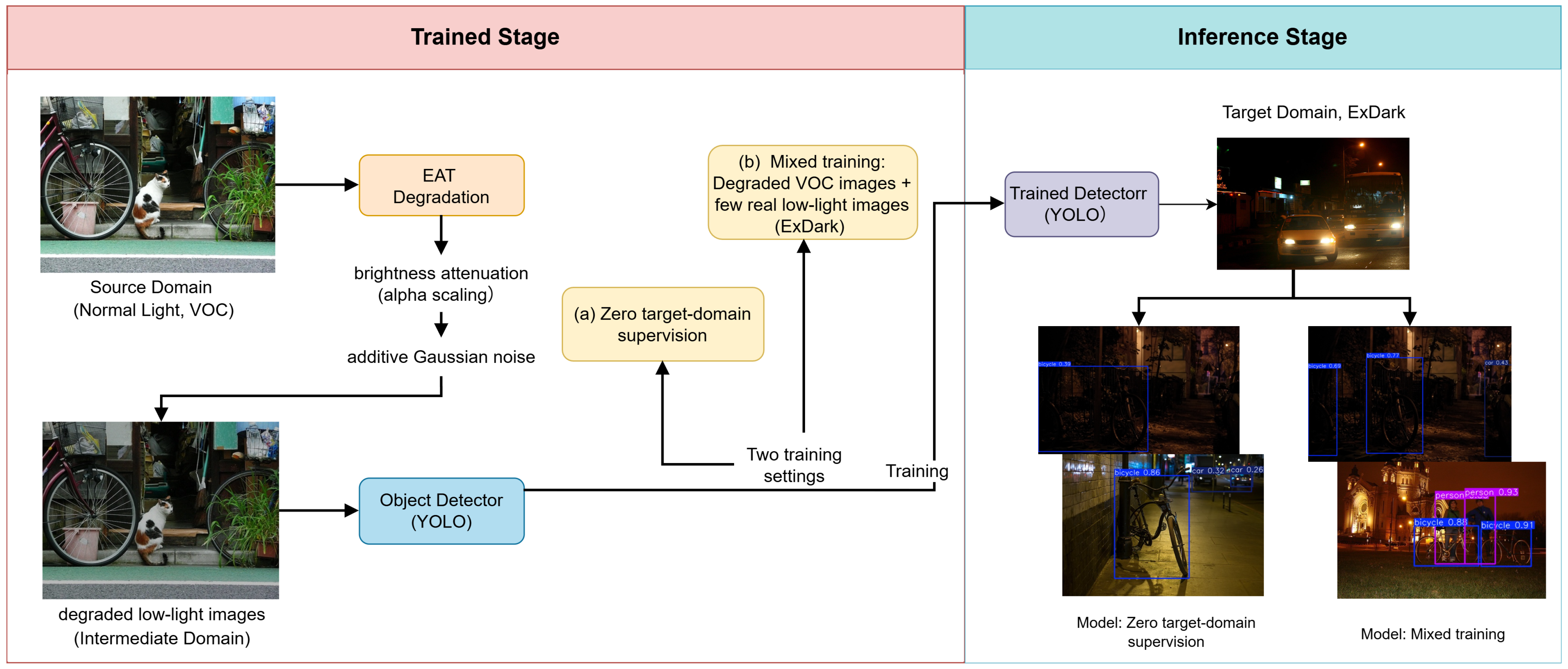
- Do not pursue complete distribution fitting. In contrast to methods designed to approximate the real low-light distribution, we argue that detection performance is primarily influenced by key degradation factors rather than the full distribution. As a result, we construct a simplified intermediate degradation domain to reduce modeling complexity.
- 2.
- Focus on task-relevant degradation factors. Only brightness attenuation and additive noise—factors that significantly affect feature visibility—are retained, while secondary effects such as color shift and vignetting are not explicitly modeled, thereby reducing task-irrelevant interference.
- 3.
- Apply degradation only during training. The degradation process is introduced only in the training phase, with no additional processing during inference, thus incurring no computational overhead.
3.4. Training Pipeline
- 1.
- Data preparation: Normal-light images and their annotations are used as input.
- 2.
- Degradation generation: The degradation transform is applied to training images.
- 3.
- Model training: The model is trained using degraded images and original annotations, optimizing the standard detection loss.
- 4.
- Inference: The original images are directly fed into the model for prediction, without any degradation or enhancement operations.
Computational Overhead
4. Experiments
4.1. Experimental Setup
4.2. Comparison with Existing Low-Light Detection and Augmentation Strategies
4.2.1. Comparison with Existing Low-Light Detection Methods
4.2.2. Difference from Modern Augmentation Methods
4.3. Ablation Study on Degradation Modeling
4.3.1. Effect of Single and Combined Degradation
4.3.2. Effect of Mixing Degraded Data in Training
4.4. Cross-Dataset Evaluation
4.5. Supplementary Validation and Robustness Analysis
5. Discussion
5.1. Rationality and Limitations of Degradation Modeling
5.2. Parameter Estimation and Method Robustness
5.3. Computational Efficiency
5.4. Positioning of the Method and Relation to Existing Approaches
5.5. Limitations and Future Work
6. Conclusions
Author Contributions
Funding
Institutional Review Board Statement
Informed Consent Statement
Data Availability Statement
Acknowledgments
Conflicts of Interest
Abbreviations
| EAT | Exposure-Aware Training |
| mAP | Mean Average Precision |
| MLE | Maximum-Likelihood Estimation |
| TLD | Traffic-Light Dataset (a proprietary paired normal/low-light traffic dataset) |
| LSD | Low-Light Smartphone Dataset |
| VOC | Visual Object Classes |
| SOTA | State of the Art |
Appendix A. Sensitivity to Random Seeds

| Random Seed | Baseline | EAT |
|---|---|---|
| 0 | 0.607 | 0.610 |
| 42 | 0.590 | 0.601 |
| 123 | 0.595 | 0.603 |
| 234 | 0.601 | 0.606 |
| 345 | 0.602 | 0.606 |
| 456 | 0.595 | 0.603 |
| 567 | 0.602 | 0.608 |
Appendix B. Generalization to Nonlinear Illumination Changes
| Baseline | EAT | |
|---|---|---|
| 0.8 | 0.617 | 0.521 |
| 1.0 | 0.607 | 0.510 |
| 1.5 | 0.531 | 0.542 |
| 2.0 | 0.448 | 0.459 |
| 2.5 | 0.405 | 0.414 |
Appendix C. Sensitivity to Degradation Intensity α
| Baseline | EAT | |
|---|---|---|
| 0.5 | 0.590 | 0.592 |
| 0.6 | 0.586 | 0.591 |
| 0.7 | 0.583 | 0.590 |
| 0.8 | 0.580 | 0.590 |
References
- Jiang, Y.; Gong, X.; Liu, D.; Cheng, Y.; Fang, C.; Shen, X.; Yang, J.; Zhou, P.; Wang, Z. EnlightenGAN: Deep light enhancement without paired supervision. IEEE Trans. Image Process. 2021, 30, 5316–5331. [Google Scholar] [CrossRef] [PubMed]
- Guo, C.; Li, C.; Guo, J.; Loy, C.C.; Hou, J.; Kwong, S.; Cong, R. Zero-reference deep curve estimation for low-light image enhancement. In Proceedings of the IEEE/CVF Conference on Computer Vision and Pattern Recognition (CVPR); IEEE: Piscataway, NJ, USA, 2020; pp. 1780–1789. [Google Scholar]
- Wang, Y.; Cao, Y.; Zha, Z.; Zhang, J.; Xiong, Z.; Zhang, W. Exclusively Dark (ExDark) dataset for low-light object detection. arXiv 2018, arXiv:1805.08855. [Google Scholar]
- Yang, W.; Wang, Y.; Ren, J.; Yu, F.; Zhang, X.; Wang, G. DARK FACE: A face detection dataset in low-light conditions. In Proceedings of the European Conference on Computer Vision (ECCV); Springer: Berlin/Heidelberg, Germany, 2020; pp. 379–395. [Google Scholar]
- Hashmi, K.A.; Kallempudi, G.; Stricker, D.; Afzal, M.Z. FeatEnHancer: Enhancing hierarchical features for object detection and beyond under low-light vision. In Proceedings of the IEEE/CVF International Conference on Computer Vision (ICCV); IEEE: Piscataway, NJ, USA, 2023; pp. 6702–6712. [Google Scholar]
- Peng, D.; He, X.; Ju, Q.; Wang, C.; Sun, J. A novel low light object detection method based on the YOLOv5 fusion feature enhancement. Sci. Rep. 2024, 14, 4486. [Google Scholar] [CrossRef] [PubMed]
- Hong, M.; Cheng, S.; Huang, H.; Fan, H.; Liu, S. You only look around: Learning illumination invariant feature for low-light object detection. In Advances in Neural Information Processing Systems (NeurIPS); Curran Associates, Inc.: Red Hook, NY, USA, 2024; p. 15621. [Google Scholar]
- Ci, W. Multi-module enhanced low-light object detection: From image enhancement to adaptive feature fusion. Adv. Eng. Inform. 2026, 69, 102990. [Google Scholar] [CrossRef]
- Han, Z.; Yue, Z.; Liu, L. 3L-YOLO: A lightweight low-light object detection algorithm. Appl. Sci. 2024, 15, 90. [Google Scholar] [CrossRef]
- Land, E.H.; McCann, J.J. Lightness and retinex theory. J. Opt. Soc. Am. 1971, 61, 1–11. [Google Scholar] [CrossRef] [PubMed]
- Guo, X.; Li, Y.; Ling, H. LIME: Low-light image enhancement via illumination map estimation. IEEE Trans. Image Process. 2017, 26, 982–993. [Google Scholar] [CrossRef] [PubMed]
- Li, C.; Guo, C.; Han, L.; Jiang, J.; Cheng, M.M.; Gu, J.; Loy, C.C. Low-light image and video enhancement using deep learning: A survey. IEEE Trans. Pattern Anal. Mach. Intell. 2022, 44, 9396–9416. [Google Scholar] [CrossRef] [PubMed]
- Li, R.; Li, M.; Chen, S.; Chen, Y.; Xu, Z. Dark2Light: Multi-stage progressive learning model for low-light image enhancement. Opt. Express 2023, 31, 42887–42900. [Google Scholar] [CrossRef] [PubMed]
- Muandet, K.; Balduzzi, D.; Schölkopf, B. Domain generalization via invariant feature representation. In Proceedings of the International Conference on Machine Learning (ICML); JMLR: New York, NY, USA, 2013; pp. 10–18. [Google Scholar]
- Zhou, K.; Yang, Y.; Hospedales, T.; Xiang, T. Domain generalization: A survey. IEEE Trans. Pattern Anal. Mach. Intell. 2023, 45, 4396–4415. [Google Scholar] [CrossRef] [PubMed]
- Hendrycks, D.; Mu, N.; Cubuk, E.D.; Zoph, B.; Gilmer, J.; Lakshminarayanan, B. AugMix: A simple data processing method to improve robustness and uncertainty. In Proceedings of the International Conference on Learning Representations (ICLR); Curran Associates, Inc.: Red Hook, NY, USA, 2020. [Google Scholar]
- Xiong, M.; Zhang, Q.; Li, D.; Wang, W.; Zhang, Z.; Zhang, K.; Liu, C.; Chen, D.; Zhang, J. Fine-tuning feature interaction for unsupervised domain adaptive low-light object detection. Neurocomputing 2025, 658, 131717. [Google Scholar] [CrossRef]
- Peng, K.-C.; Wu, Z.; Ernst, J. Zero-shot deep domain adaptation. In Proceedings of the European Conference on Computer Vision (ECCV); IEEE: Piscataway, NJ, USA, 2018; pp. 764–781. [Google Scholar]
- Sharif, S.M.A.; Rehman, A.; Abidin, Z.U.; Dharejo, F.A.; Timofte, R.; Naqvi, R.A. Illuminating Darkness: Learning to Enhance Low-light Images In-the-Wild. In Proceedings of the IEEE/CVF Winter Conference on Applications of Computer Vision (WACV); IEEE: Piscataway, NJ, USA, 2026; pp. 2263–2272. [Google Scholar]
- Brooks, T.; Mildenhall, B.; Xue, T.; Chen, J.; Sharlet, D.; Barron, J.T. Unprocessing images for learned raw denoising. In Proceedings of the IEEE/CVF Conference on Computer Vision and Pattern Recognition (CVPR); IEEE: Piscataway, NJ, USA, 2019; pp. 1013–1022. [Google Scholar]
- Jocher, G.; Chaurasia, A.; Qiu, J. YOLOv8 by Ultralytics. GitHub Repository. 2023. Available online: https://github.com/ultralytics/ultralytics (accessed on 5 April 2026).
- Li, Y.; Li, X.; Lin, M. FE-YOLO: Fourier Enhancement YOLO for End-to-End Object Detection in Low-Light Conditions. Digit. Signal Process. 2025, 166, 105355. [Google Scholar] [CrossRef]
- Wang, X.; Wei, B.; Su, Y.; Li, X.; Li, L. Low-Light Detector Based on Feature Filtering and Enhancement. In ICASSP 2025-2025 IEEE International Conference on Acoustics, Speech and Signal Processing (ICASSP); IEEE: Piscataway, NJ, USA, 2025; pp. 1–5. [Google Scholar]
- Lin, S.; Liu, M.; Lin, J.; Lin, Z.; Guo, T.; Sun, L. Low-Light Object Detection with Multi-Scale Feature Fusion and Local Detail Enhancement. Opto-Electron. Eng. 2025, 53, 250241. [Google Scholar]
- Zhang, W.; Xu, H.; Zhu, X.; Si, Y.; Dong, Y.; Huang, X.; Li, H. RFSC-net: Re-parameterization Forward Semantic Compensation Network in Low-Light Environments. Image Vis. Comput. 2024, 151, 105271. [Google Scholar] [CrossRef]
- Lan, S.; Bai, H.; Jiang, L.; Zhou, X.; Duan, X.; Ma, Y.; Zhou, Z. SCL-YOLOv11: A Lightweight Object Detection Network for Low-Illumination Environments. IEEE Access 2025, 13, 47653–47662. [Google Scholar]
- Xiao, Y.; Liao, H. LIDA-YOLO: An unsupervised low-illumination object detection based on domain adaptation. IET Image Process. 2024, 18, 1178–1188. [Google Scholar] [CrossRef]
- Cubuk, E.D.; Zoph, B.; Shlens, J.; Le, Q.V. RandAugment: Practical Automated Data Augmentation with a Reduced Search Space. In Proceedings of the IEEE/CVF Conference on Computer Vision and Pattern Recognition Workshops (CVPRW); IEEE: Piscataway, NJ, USA, 2020; pp. 702–703. [Google Scholar]
- Everingham, M.; Van Gool, L.; Williams, C.K.I.; Winn, J.; Zisserman, A. The PASCAL Visual Object Classes (VOC) Challenge. Int. J. Comput. Vis. 2010, 88, 303–338. [Google Scholar] [CrossRef]


| Method Category | Test-Time Overhead | Requires Target-Domain Annotations | Design Basis |
|---|---|---|---|
| Image Enhancement | Yes | No | Visual quality |
| Architecture Modification | Yes | No | Architecture design |
| General Augmentation | No | No | Data diversity |
| Domain Adaptation | No | Yes | Distribution alignment |
| EAT (Ours) | No | No | Task-oriented degradation |
| Method | Arch. Change | Inf. Overhead | |
|---|---|---|---|
| FE-YOLOX [23] | 69.1% | Yes | Yes |
| LMD-YOLO [24] | 69.1% | Yes | Yes |
| FE-YOLO [22] | 68.9% | No | Yes |
| 3L-YOLO [9] | 68.8% | Yes | Yes |
| EAT (Ours) | 68.6% | No | No |
| RFSC-Net [25] | ∼67.9% | Yes | No |
| SCL-YOLOv11 [26] | 67.6% | Yes | Yes |
| Domain adaptation [27] | 56.65% | Yes | Yes |
| Aspect | AugMix/RandAugment | EAT (Ours) |
|---|---|---|
| Primary objective | General robustness | Low-light generalization |
| Core mechanism | Random augmentation combinations | Illumination degradation modeling |
| Parameter source | Random/heuristic | Data-driven estimation |
| Domain-specific design | No | Yes |
| Method | Degradation Formula | TLD Dataset | VOC Dataset | |||||||
|---|---|---|---|---|---|---|---|---|---|---|
| P | R | P | R | |||||||
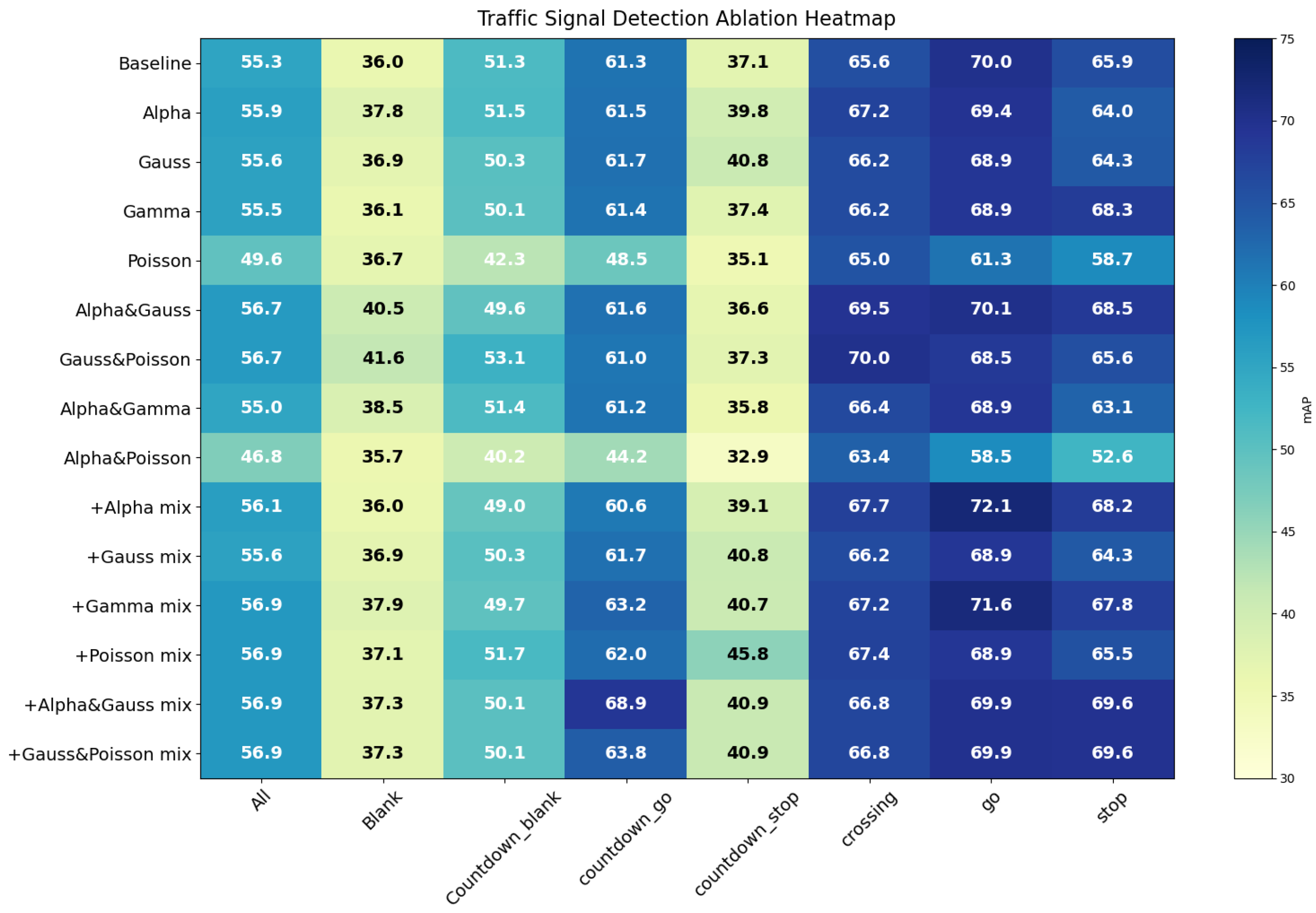
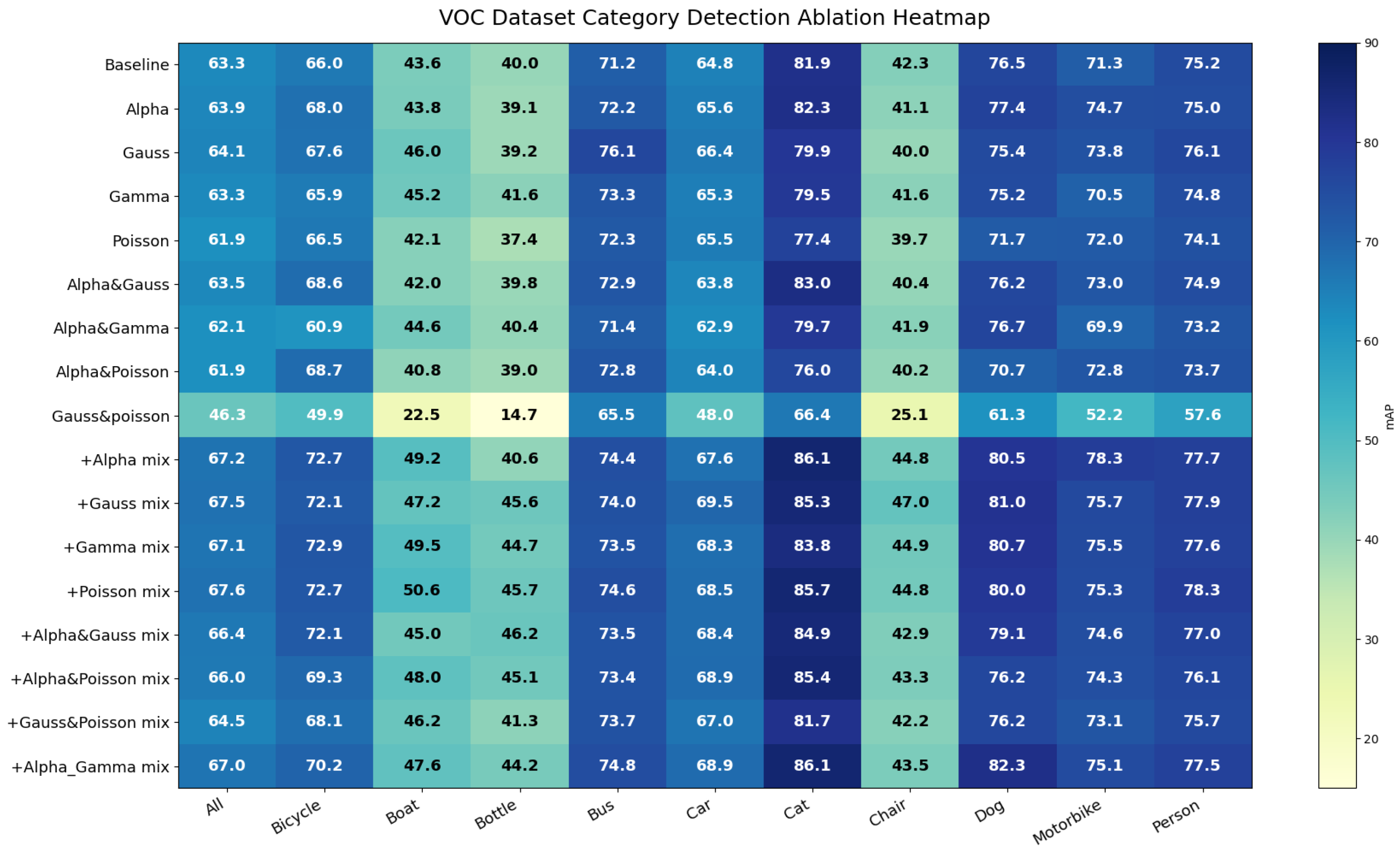
| Baseline | 55.3 | 40.4 | 46.6 | 87.3 | 63.3 | 44.7 | 71.3 | 55.8 | ||
| Alpha | 55.9 | 41.5 | 48.2 | 80.9 | 63.9 | 44.8 | 70.1 | 57.7 | ||
| Gauss | 55.6 | 40.8 | 47.3 | 83.3 | 64.1 | 45.1 | 69.6 | 57.6 | ||
| Gamma | 55.5 | 40.7 | 46.5 | 86.8 | 63.3 | 44.0 | 73.9 | 54.8 | ||
| Poisson | 49.6 | 33.1 | 37.2 | 74.4 | 61.9 | 42.9 | 72.8 | 53.9 | ||
| Alpha + Gauss | 56.7 | 41.5 | 48.2 | 82.7 | 63.5 | 44.1 | 72.4 | 56.1 | ||
| Gauss + Poisson | 56.7 | 41.0 | 47.6 | 83.0 | 46.3 | 29.3 | 57.8 | 40.9 | ||
| Alpha + Gamma | 55.0 | 39.9 | 45.7 | 83.4 | 62.1 | 43.3 | 71.2 | 55.0 | ||
| Alpha + Poisson | 46.8 | 30.9 | 32.7 | 63.8 | 61.9 | 43.4 | 69.8 | 55.4 | ||
| Method | TLD Dataset | VOC Dataset | |||||||
|---|---|---|---|---|---|---|---|---|---|
| P | R | P | R | ||||||
| Baseline | 55.3 | 40.4 | 46.6 | 87.3 | 63.3 | 44.7 | 71.3 | 55.8 | |
| +Alpha | 56.1 | 42.9 | 48.0 | 81.0 | 67.2 | 48.3 | 75.5 | 59.2 | |
| +Gauss | 55.6 | 40.8 | 47.3 | 83.3 | 67.5 | 47.7 | 75.1 | 60.6 | |
| +Gamma | 56.9 | 43.4 | 48.0 | 82.4 | 67.2 | 47.7 | 77.3 | 58.3 | |
| +Poisson | 56.9 | 41.9 | 47.0 | 78.9 | 67.6 | 48.4 | 74.4 | 60.5 | |
| +Alpha&Gauss | 56.9 | 43.5 | 49.3 | 81.9 | 66.4 | 47.4 | 75.4 | 58.9 | |
| +Gauss&Poisson | 56.9 | 43.5 | 49.3 | 81.9 | 64.5 | 45.5 | 70.4 | 58.1 | |
| +Alpha&Gamma | 55.0 | 39.9 | 45.7 | 83.4 | 67.0 | 47.7 | 76.4 | 59.3 | |
| +Alpha&Poisson | 46.8 | 30.9 | 32.7 | 63.8 | 66.0 | 47.0 | 74.5 | 59.3 | |
| Method | All | Bicycle | Boat | Bottle | Bus | Car | Cat | Chair | Dog | Motorbike | Person |
|---|---|---|---|---|---|---|---|---|---|---|---|
| Baseline | 47.1 | 52.5 | 57.3 | 46.5 | 51.5 | 51.6 | 49.4 | 36.6 | 46.9 | 37.3 | 41.4 |
| +VOC_Alpha | 54.6 | 63.5 | 66.6 | 52.2 | 59.1 | 54.0 | 57.7 | 44.8 | 57.6 | 49.6 | 40.3 |
| +VOC_Gauss | 54.4 | 61.3 | 63.2 | 52.0 | 60.0 | 55.8 | 59.1 | 43.9 | 58.2 | 49.8 | 40.5 |
| +VOC_Gamma | 49.6 | 57.0 | 58.7 | 45.4 | 56.1 | 58.1 | 49.7 | 38.4 | 48.0 | 45.4 | 38.7 |
| +VOC_Poisson | 54.3 | 59.6 | 65.6 | 49.8 | 60.3 | 55.7 | 57.6 | 45.0 | 59.8 | 49.1 | 40.4 |
| +VOC_Alpha&Gauss | 55.0 | 67.9 | 64.4 | 47.2 | 57.9 | 58.8 | 59.9 | 47.1 | 57.8 | 49.6 | 39.4 |
| +VOC_Alpha&Gamma | 54.5 | 61.0 | 64.4 | 52.1 | 59.6 | 58.1 | 61.9 | 41.8 | 59.1 | 50.1 | 37.1 |
| +VOC_Alpha&Poisson | 55.6 | 63.2 | 64.5 | 52.7 | 61.8 | 55.2 | 60.4 | 46.4 | 57.6 | 48.0 | 46.6 |
| +VOC_Gauss&Poisson | 59.1 | 67.7 | 68.6 | 57.3 | 62.4 | 55.2 | 58.6 | 53.4 | 64.3 | 55.8 | 47.7 |
| +TLD_Alpha&Gauss | 59.5 | 69.4 | 71.0 | 55.5 | 65.5 | 57.2 | 61.7 | 49.4 | 65.4 | 54.0 | 45.4 |
| +TLD+TLD_Alpha&Gauss | 60.3 | 67.3 | 67.1 | 57.7 | 67.0 | 64.2 | 59.9 | 52.5 | 59.1 | 58.9 | 49.2 |
| Detector | Model | Normal Test | Low-Light Test |
|---|---|---|---|
| YOLOv8 | Baseline | 0.410 | 0.594 |
| EAT-Augmented | 0.707 | 0.614 | |
| Faster R-CNN | Baseline | 0.417 | 0.490 |
| EAT-Augmented | 0.727 | 0.507 |
Disclaimer/Publisher’s Note: The statements, opinions and data contained in all publications are solely those of the individual author(s) and contributor(s) and not of MDPI and/or the editor(s). MDPI and/or the editor(s) disclaim responsibility for any injury to people or property resulting from any ideas, methods, instructions or products referred to in the content. |
© 2026 by the authors. Licensee MDPI, Basel, Switzerland. This article is an open access article distributed under the terms and conditions of the Creative Commons Attribution (CC BY) license.
Share and Cite
Su, Y.; Lu, M. Exposure-Aware Training for Low-Light Object Detection Without Target-Domain Data. J. Imaging 2026, 12, 245. https://doi.org/10.3390/jimaging12060245
Su Y, Lu M. Exposure-Aware Training for Low-Light Object Detection Without Target-Domain Data. Journal of Imaging. 2026; 12(6):245. https://doi.org/10.3390/jimaging12060245
Chicago/Turabian StyleSu, Yawen, and Min Lu. 2026. "Exposure-Aware Training for Low-Light Object Detection Without Target-Domain Data" Journal of Imaging 12, no. 6: 245. https://doi.org/10.3390/jimaging12060245
APA StyleSu, Y., & Lu, M. (2026). Exposure-Aware Training for Low-Light Object Detection Without Target-Domain Data. Journal of Imaging, 12(6), 245. https://doi.org/10.3390/jimaging12060245