
Unsupervised Wildfire Detection Using Multispectral MTG-FCI Data: A Feasibility Study

Abstract
1. Introduction
2. Materials and Methods
2.1. MTG FCI Data
2.2. Validation Data: FRP and EFFIS
2.3. Fire Detection Methodologies
2.4. Threshold Methodology
2.5. Bottleneck Constrained Light U-Net Autoencoder
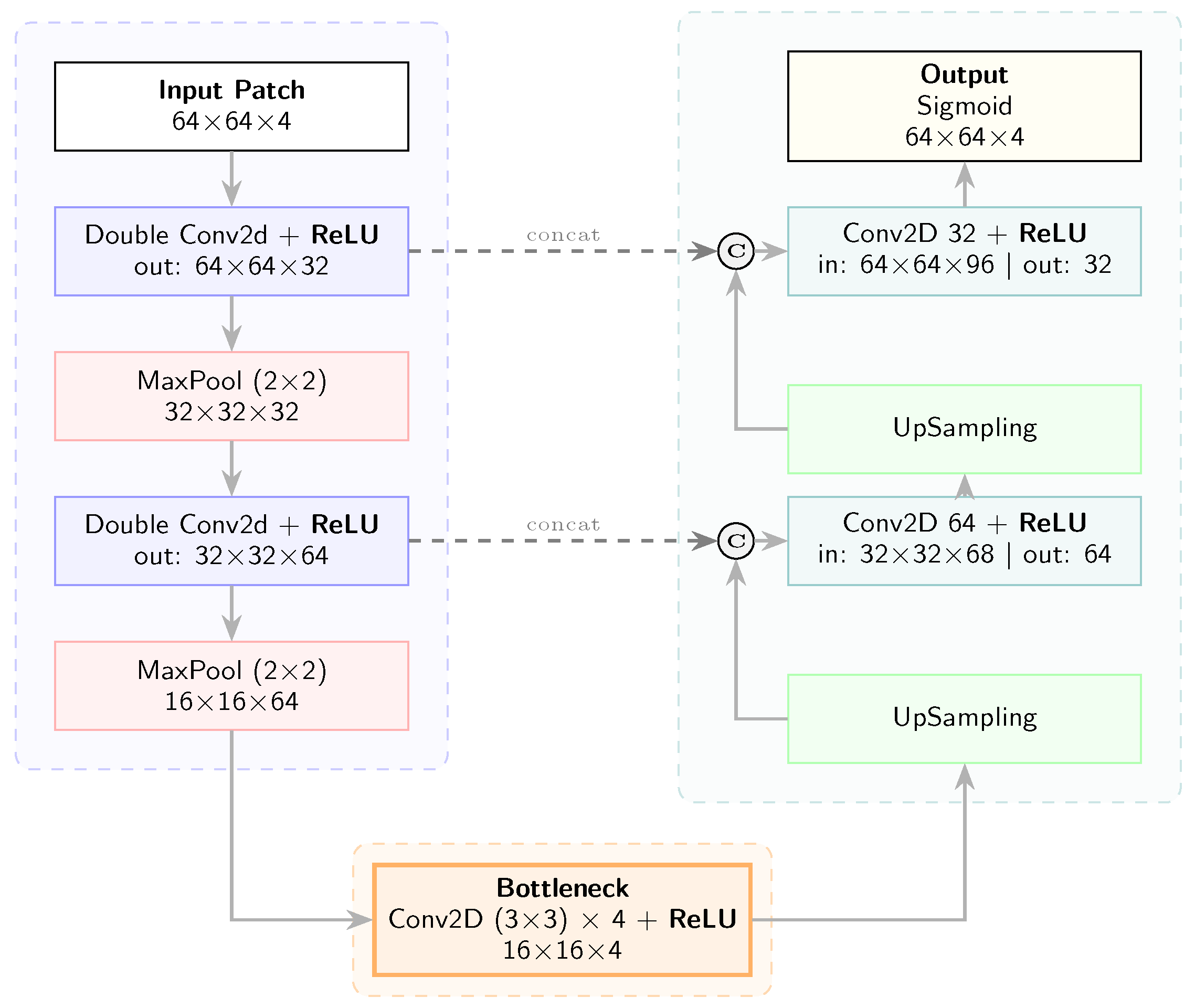
2.5.1. Architecture
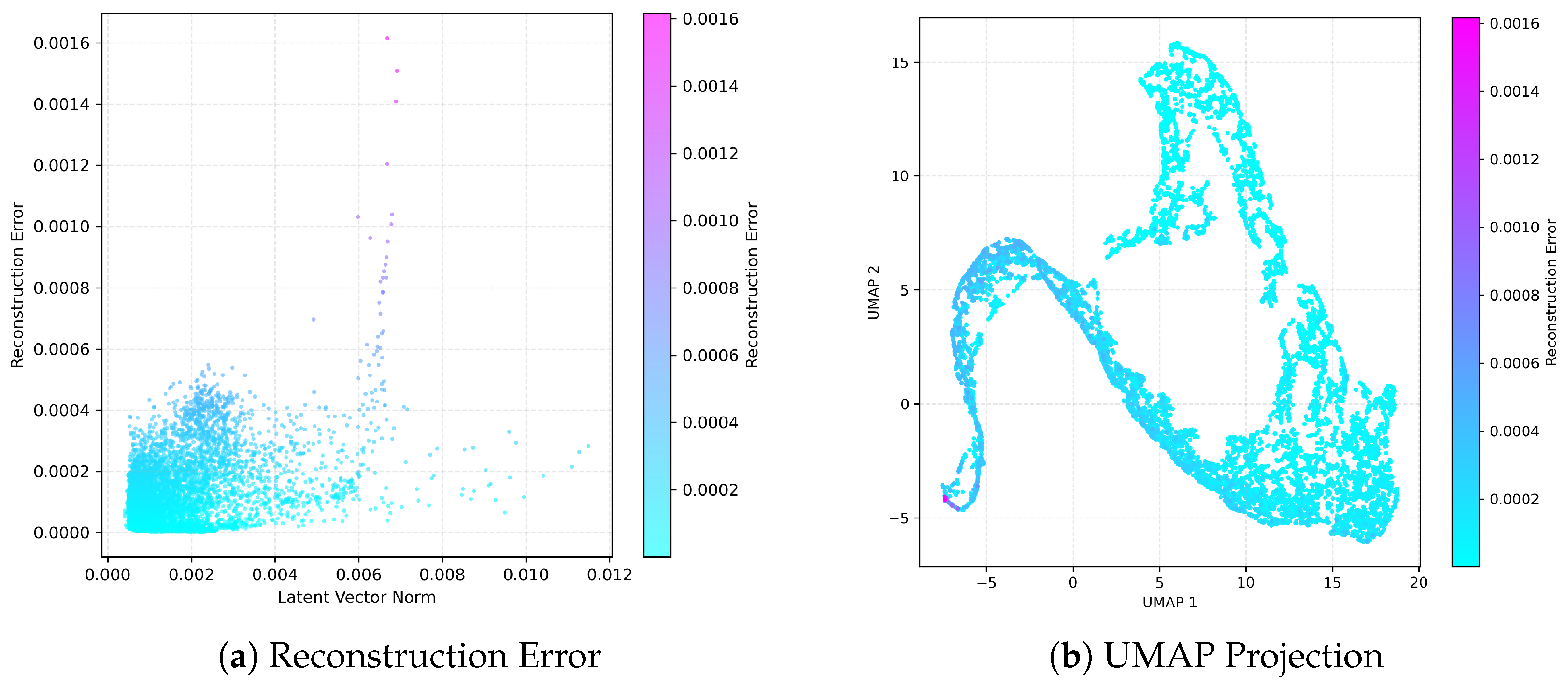
2.5.2. Detection Strategy
3. Results and Discussion
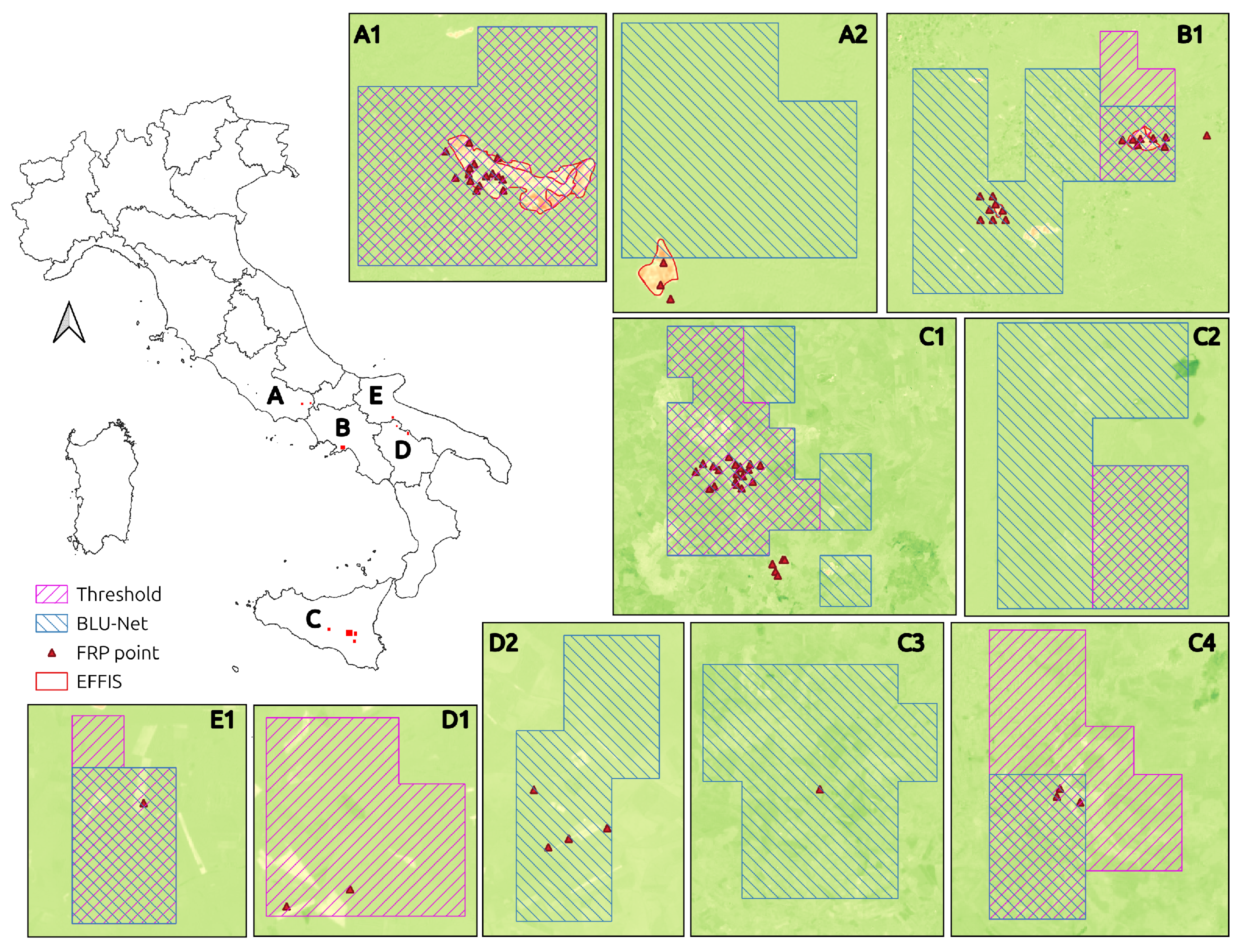
3.1. Validation Framework and Ground-Truth Limitations
- Active Fire products (MODIS, VIIRS, SLSTR): These sensors carry several false positives (errors of commission). As demonstrated by Filipponi and Mercatini [38], many of these alerts are not real fires, but thermal anomaly hot spots misclassified as fire pixels caused by industrial sites or by solar reflections on roofs like solar plants.
- The EFFIS minimum threshold: Although it is a manually validated database, EFFIS focuses almost exclusively on large fires (usually over 30 hectares). This means that small outbreaks, which are the most difficult and important to monitor immediately, often remain invisible in the reference maps [39].
- The time factor (LEO vs. GEO): Polar satellites pass overhead only a few times a day. This creates a "time gap" compared to the continuous monitoring of GEO satellites: if the fire ignites or dies out between passes, the polar satellite risks missing the peak intensity or not recording the event at all [40].
3.2. Spatial Consistency and Qualitative Case Studies
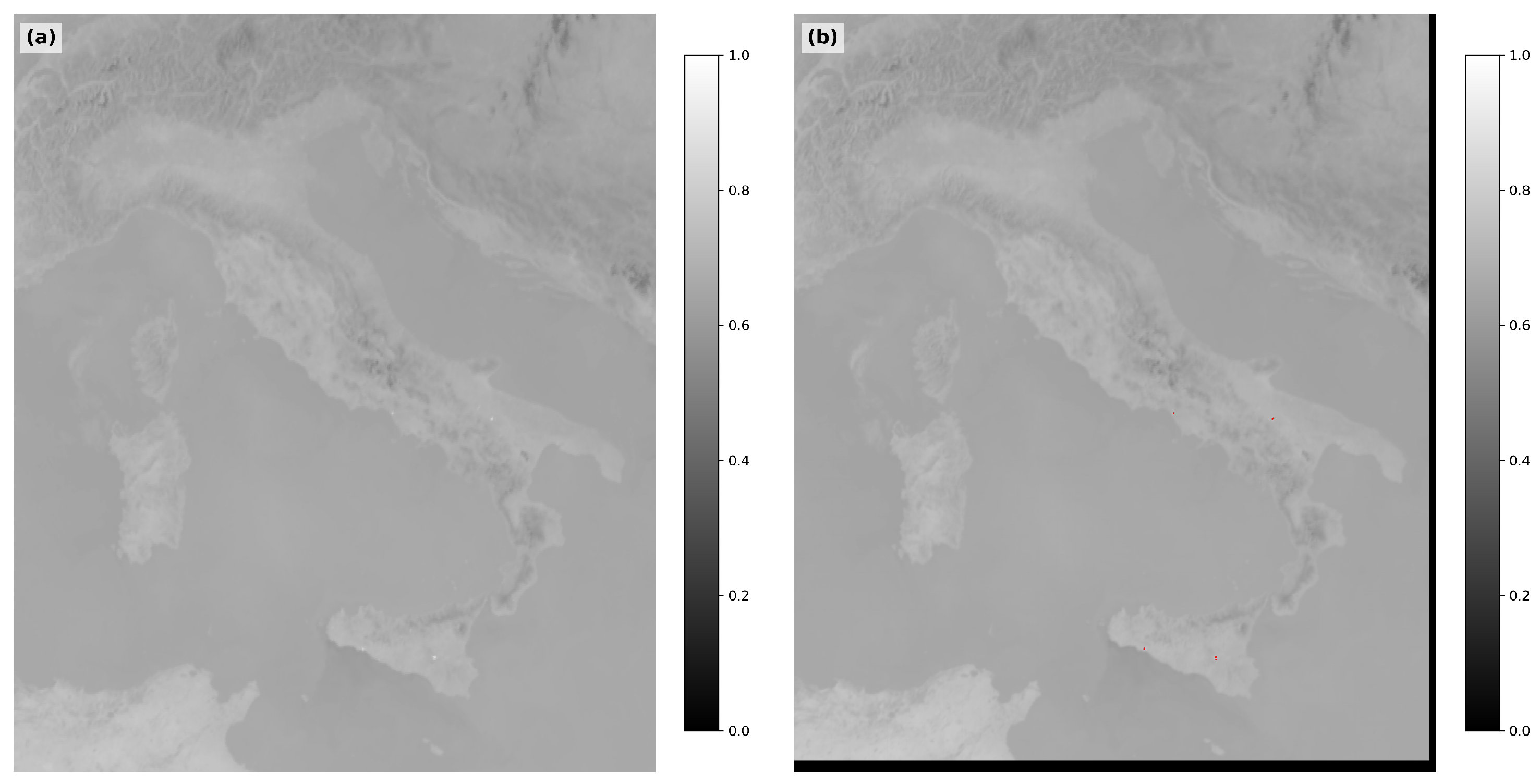
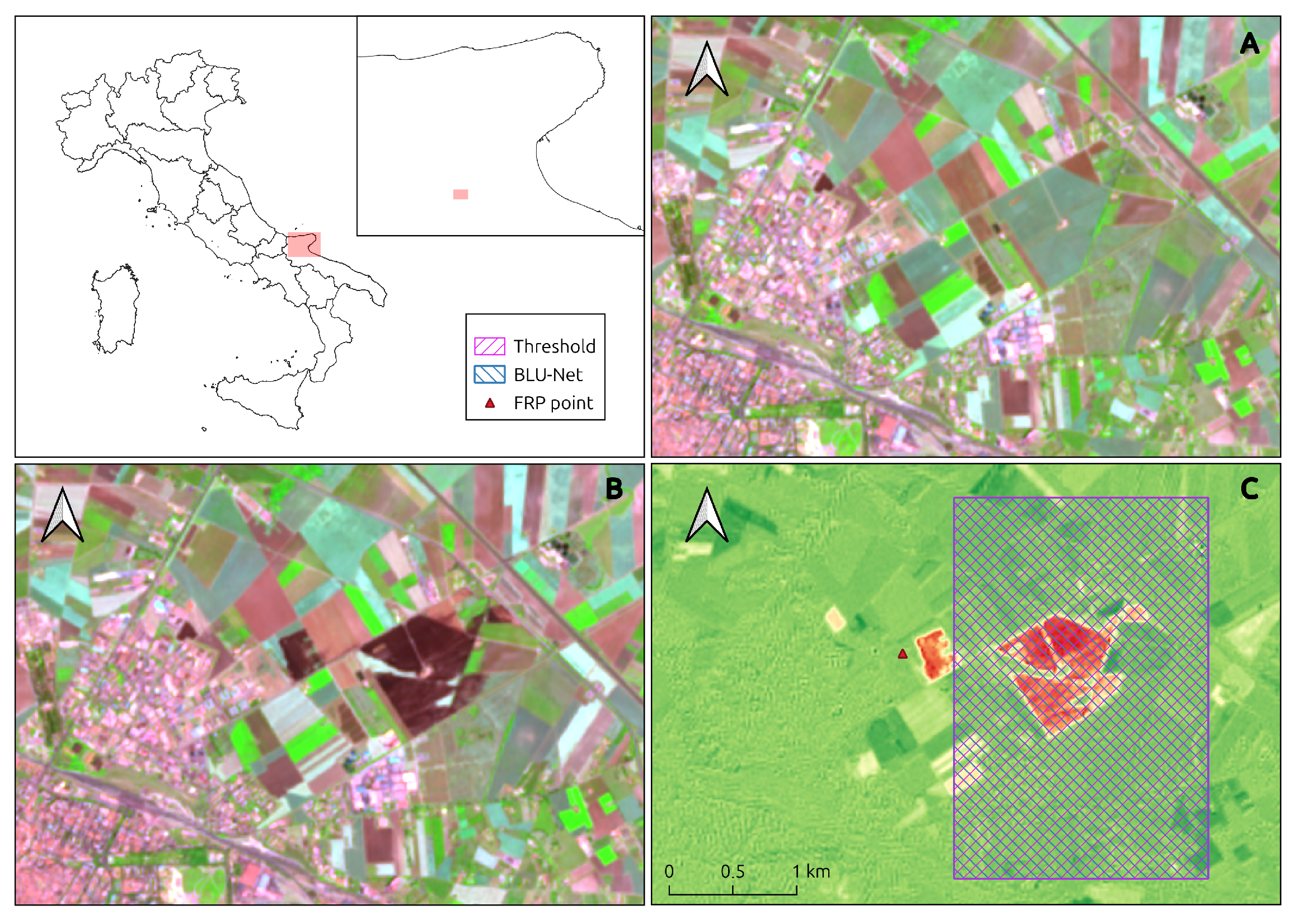
3.2.1. Validation of MTG-FCI Detections Using Sentinel-2: The Foggia Fire Event
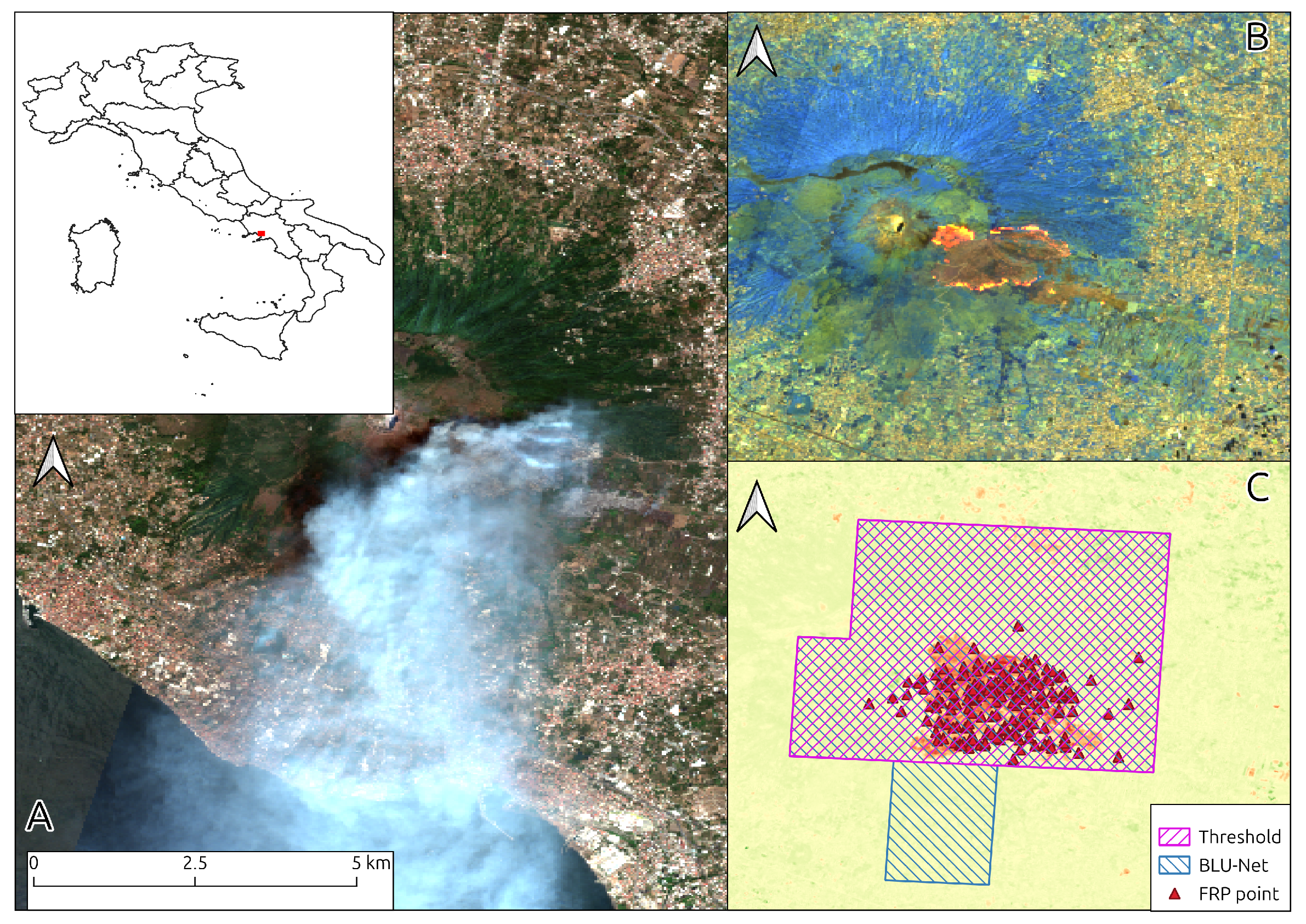
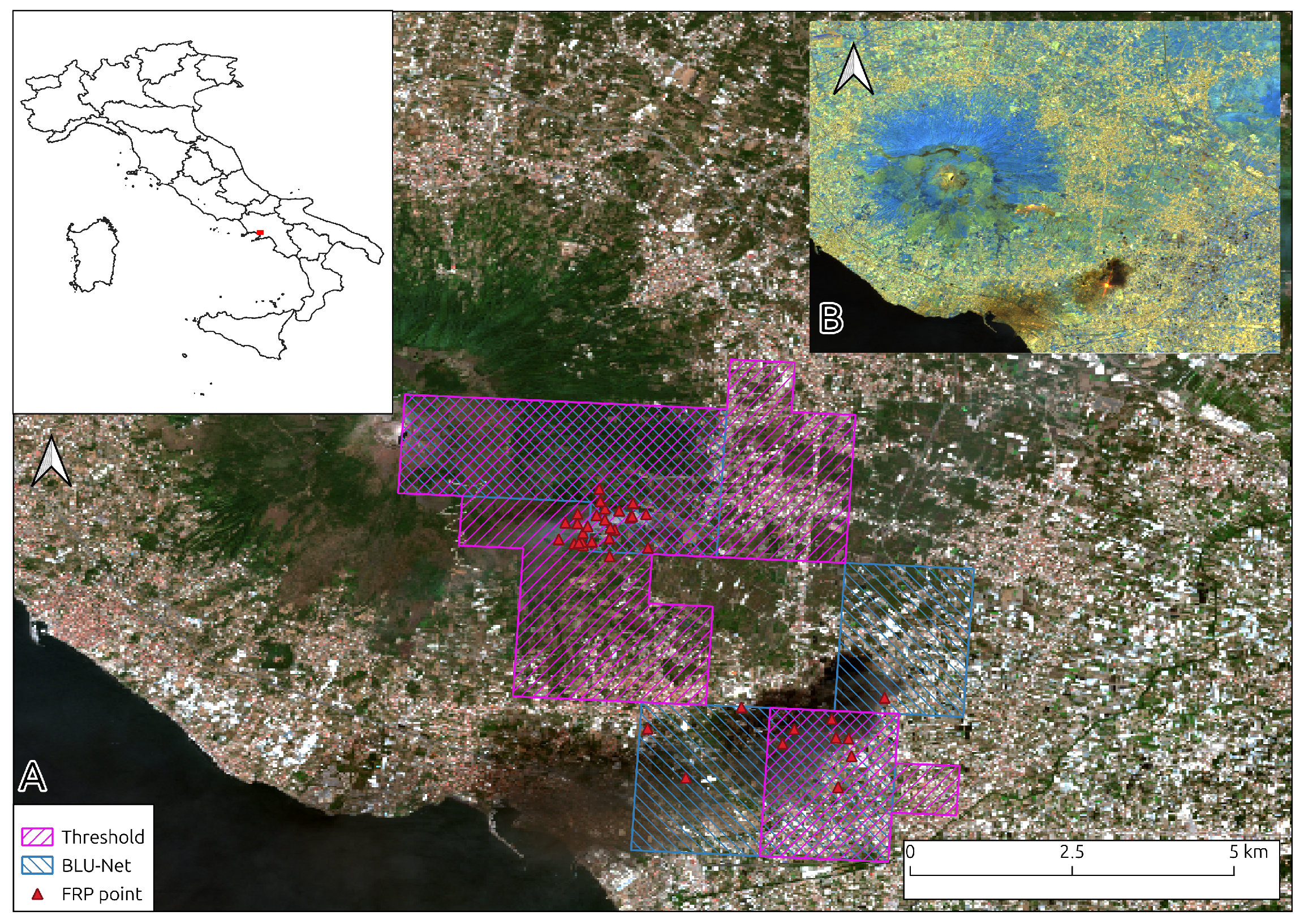
3.2.2. 5–11 August 2025: The Vesuvius Fire Event
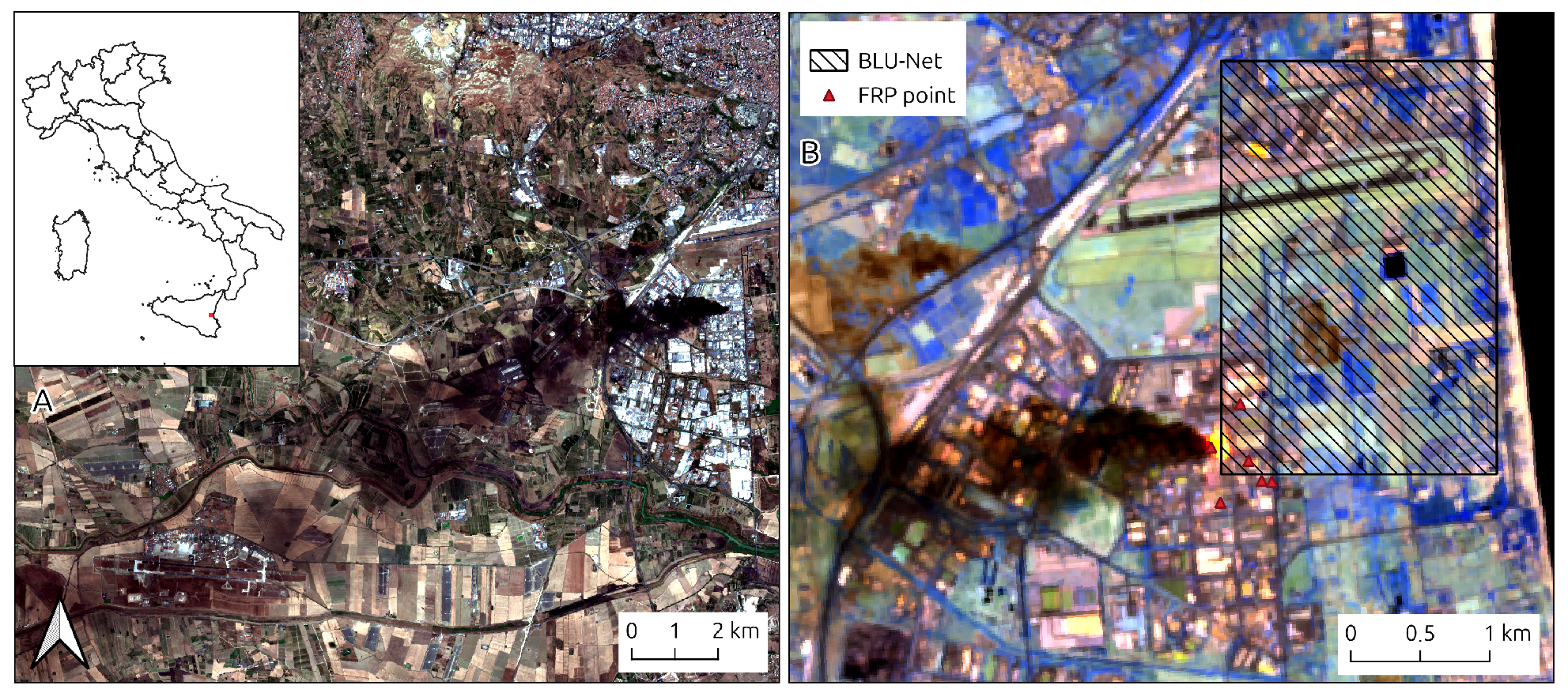
3.2.3. Detection of Industrial Fire: Catania Fire Event
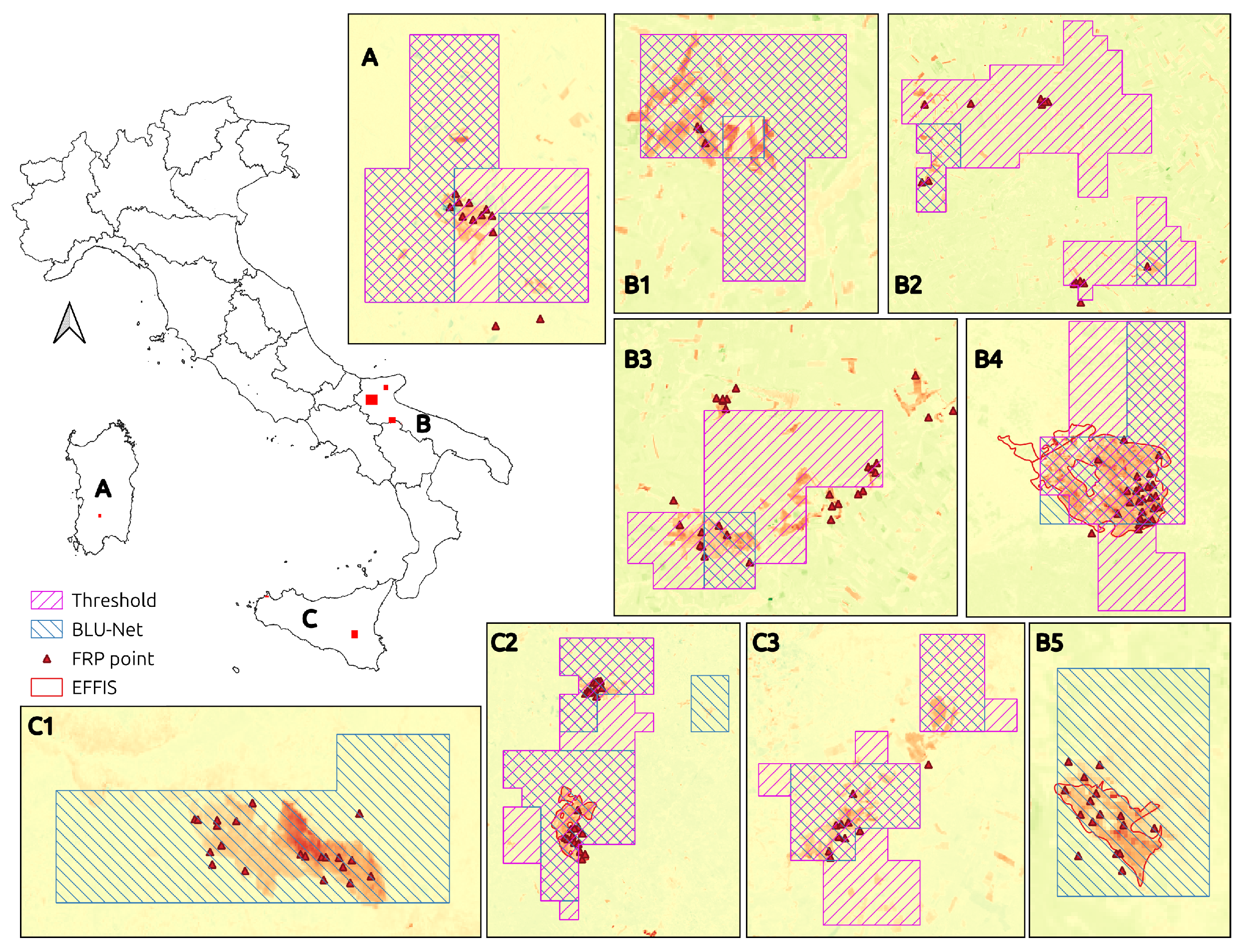
3.3. Quantitative Performance Assessment
- True Positives (TP): Algorithm detection polygons intersecting a buffered FRP cluster.
- False Positives (FP): Algorithm detection polygons failing to intersect any buffered FRP cluster.
- False Negatives (FN): Buffered FRP clusters not intersected by any algorithm detection polygon.
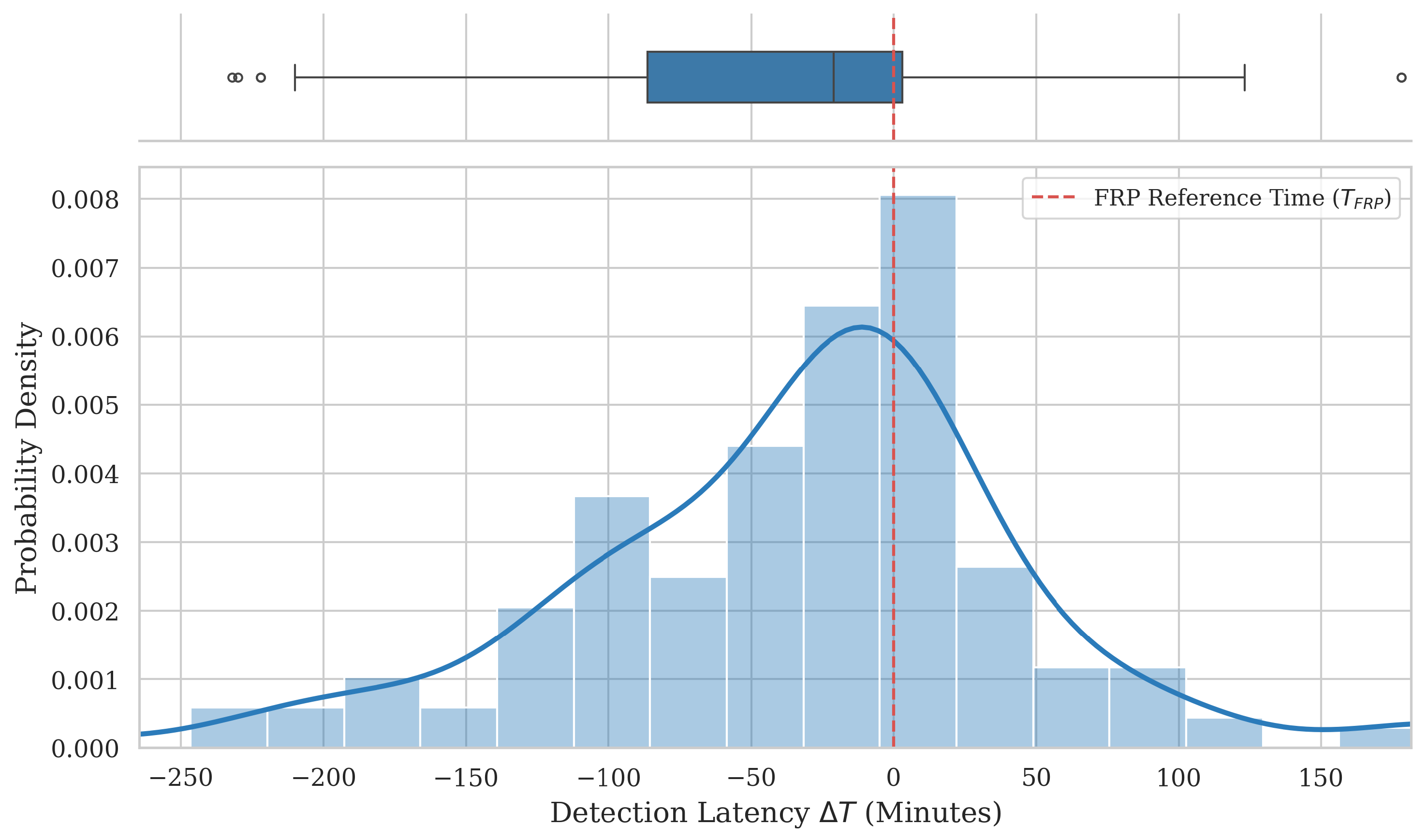
3.4. Temporal Advantage and Early Warning Potential
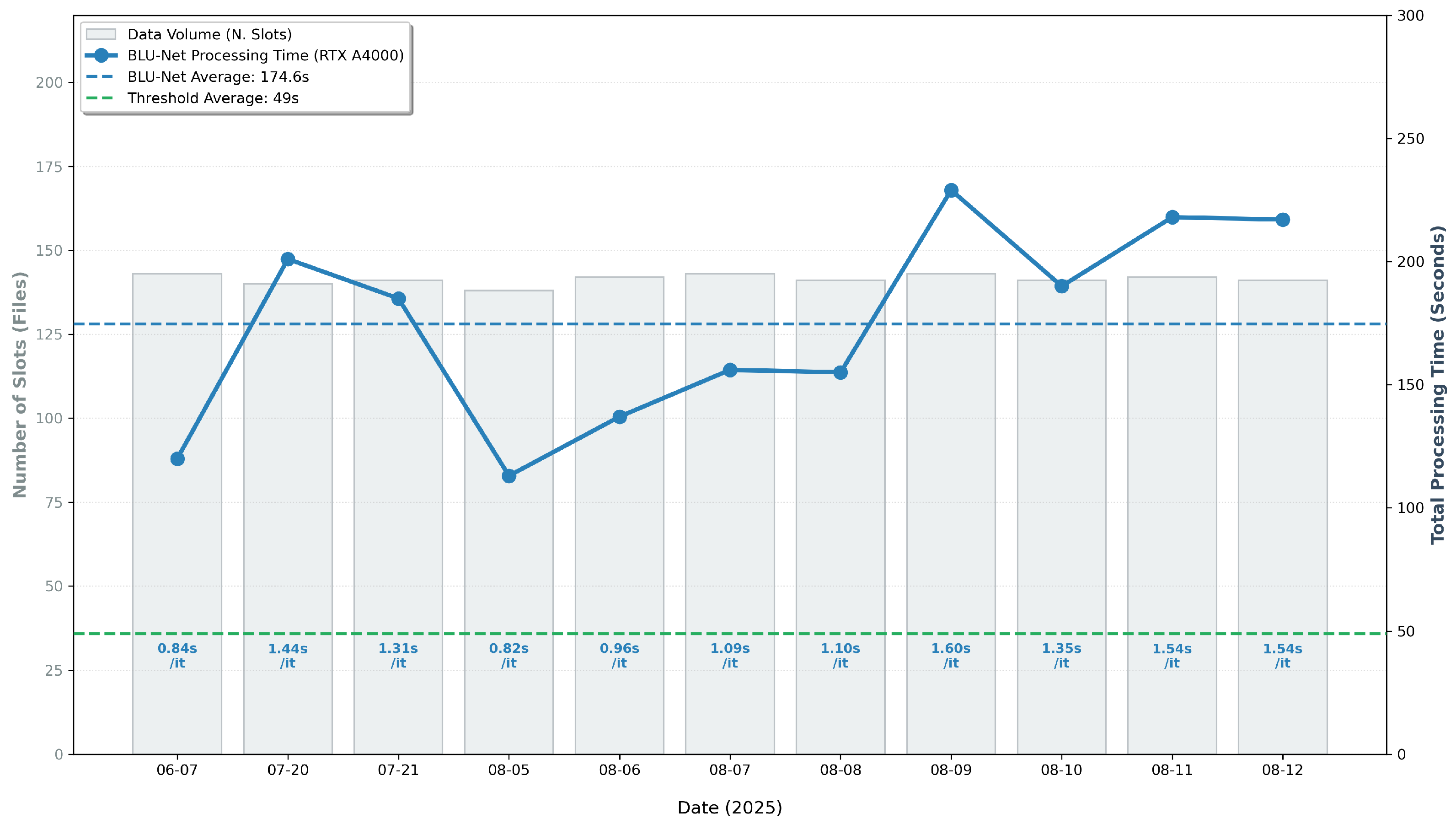
3.5. Throughput Analysis and Operational Feasibility
3.6. Limitations
4. Conclusions
Author Contributions
Funding
Institutional Review Board Statement
Informed Consent Statement
Data Availability Statement
Conflicts of Interest
Abbreviations
| BT | Brightness Temperature |
| CAE | Convolutional Autoencoder |
| CNN | Convolutional Neural Network |
| dNBR | differenced Normalized Burn Ratio |
| EFFIS | European Forest Fire Information System |
| FAR | False Alarm Rate |
| FCI | Flexible Combined Imager |
| FDHSI | Full Disc High Spectral Resolution Imagery |
| FP | False Positive |
| FRP | Fire Radiative Power |
| GEO | Geostationary |
| HVS-3 | High-Volume Service 3 |
| IR | Infrared |
| ISPRA | Italian Institute for Environmental Protection and Research |
| JRC | Joint Research Centre |
| LEO | Low Earth Orbit |
| MODIS | Moderate-Resolution Imaging Spectroradiometer |
| MSG | Meteosat Second Generation |
| MSI | MultiSpectral Instrument |
| MTG | Meteosat Third Generation |
| MWIR | Medium-Wave Infrared |
| NIR | Near-Infrared |
| NRT | near-real-time |
| ReLU | Rectified Linear Unit |
| RSS | Rapid Scanning Service |
| SEVIRI | Spinning Enhanced Visible and Infrared Imager |
| SLSTR | Sea and Land Surface Temperature Radiometer |
| TIR | Thermal Infrared |
| TOA | Top of Atmosphere |
| U-Net | U-shaped Convolutional Neural Network |
| UMAP | Uniform Manifold Approximation and Projection |
| VIIRS | Visible Infrared Imaging Radiometer Suite |
| VIS | Visible |
References
- Bowman, D.M.; Balch, J.K.; Artaxo, P.; Bond, W.J.; Carlson, J.M.; Cochrane, M.A.; d’Antonio, C.M.; DeFries, R.S.; Doyle, J.C.; Harrison, S.P.; et al. Fire in the Earth system. Science 2009, 324, 481–484. [Google Scholar] [CrossRef]
- San-Miguel-Ayanz, J.; Durrant, T.; Boca, R.; Libertà, G.; Boccacci, F.; Di Leo, M.; López Pérez, J.; Schulte, E. Forest Fires in Europe, Middle East and North Africa 2015; European Commission, Joint Research Centre: Brussels, Belgium, 2016. [Google Scholar] [CrossRef]
- San-Miguel-Ayanz, J.; Moreno, J.M.; Camia, A. Analysis of large fires in European Mediterranean landscapes: Lessons learned and perspectives. For. Ecol. Manag. 2013, 294, 11–22. [Google Scholar] [CrossRef]
- Moritz, M.A.; Batllori, E.; Bradstock, R.A.; Gill, A.M.; Handmer, J.; Hessburg, P.F.; Leonard, J.; McCaffrey, S.; Odion, D.C.; Schoennagel, T.; et al. Learning to coexist with wildfire. Nature 2014, 515, 58–66. [Google Scholar] [CrossRef] [PubMed]
- Lavorel, S.; Flannigan, M.D.; Lambin, E.F.; Scholes, M.C. Vulnerability of land systems to fire: Interactions among humans, climate, the atmosphere, and ecosystems. Mitig. Adapt. Strateg. Glob. Change 2007, 12, 33–53. [Google Scholar] [CrossRef]
- Williams, A.P.; Abatzoglou, J.T. Recent Advances and Remaining Uncertainties in Resolving Past and Future Climate Effects on Global Fire Activity. Curr. Clim. Change Rep. 2016, 2, 1–14. [Google Scholar] [CrossRef]
- Wooster, M.J.; Roberts, G.; Perry, G.L.; Kaufman, Y.J. Retrieval of biomass combustion rates and totals from fire radiative power observations: Derivation and application of relationships between biomass consumption and fire radiative energy release. J. Geophys. Res. Atmos. 2015, 110, D24. [Google Scholar] [CrossRef]
- Giglio, L.; Schroeder, W.; Justice, C.O. The collection 6 MODIS active fire detection algorithm and fire products. Remote Sens. Environ. 2016, 178, 31–41. [Google Scholar] [CrossRef] [PubMed]
- Justice, C.O.; Giglio, L.; Korontzi, S.; Owens, J.; Morisette, J.; Roy, D.; Descloitres, J.; Alleaume, S.; Petitcolin, F.; Kaufman, Y. The MODIS fire products. Remote Sens. Environ. 2002, 83, 244–262. [Google Scholar] [CrossRef]
- Koltunov, A.; Ustin, S.L.; Prins, E.M. On timeliness and accuracy of wildfire detection by the GOES WF-ABBA algorithm over California during the 2006 fire season. Remote Sens. Environ. 2012, 127, 194–209. [Google Scholar] [CrossRef]
- Amraoui, M.; Liberato, M.L.R.; Calado, T.J.; DaCamara, C.C.; Coelho, L.P.; Trigo, R.M.; Gouveia, C.M. Fire activity over Mediterranean Europe based on information from Meteosat-8. For. Ecol. Manag. 2012, 294, 62–75. [Google Scholar] [CrossRef]
- Sung, T.; Lee, G.; Kim, D.; Kim, W.; Yang, S.; Im, J. Real-Time Wildfire Monitoring via Geostationary Satellite and Artificial Intelligence: Insights from the March 2025 South Korea Wildfires. Korean J. Remote Sens. 2025, 41, 565–580. [Google Scholar] [CrossRef]
- Xu, W.; Wooster, M.J.; He, J.; Meraner, A.; Gomez-Dans, J.; Liu, Z.; Trigo, I.F.; Dutra, E. Major improvements in spaceborne early fire detection and small-fire FRP retrieval with the meteosat third generation flexible combined imager. Sci. Remote Sens. 2026, 13, 100366. [Google Scholar] [CrossRef]
- Liu, T.; Randerson, J.T.; Chen, Y.; Morton, D.C.; Wiggins, E.B.; Smyth, P.; Foufoula-Georgiou, E.; Nadler, R.; Nevo, O. Systematically tracking the hourly progression of large wildfires using GOES satellite observations. Earth Syst. Sci. Data 2024, 16, 1395–1424. [Google Scholar] [CrossRef]
- Zhao, Y.; Ban, Y. GOES-R Time Series for Early Detection of Wildfires with Deep GRU-Network. Remote Sens. 2022, 14, 4347. [Google Scholar] [CrossRef]
- Di Biase, V.; Laneve, G. Geostationary sensor based forest fire detection and monitoring: An improved version of the SFIDE algorithm. Remote Sens. 2018, 10, 741. [Google Scholar] [CrossRef]
- Torrisi, F.; Di Bella, G.S.; Corradino, C.; Cariello, S.; Malaguti, A.B.; Del Negro, C. From MSG-SEVIRI to MTG-FCI: Advancing volcanic thermal monitoring from geostationary satellites. Remote Sens. 2025, 18, 6. [Google Scholar] [CrossRef]
- Holmlund, K.; Grandell, J.; Schmetz, J.; Stuhlmann, R.; Bojkov, B.; Munro, R.; Lekouara, M.; Coppens, D.; Viticchie, B.; August, T.; et al. Meteosat Third Generation (MTG) continuation and innovation of observations from geostationary orbit. BAMS Am. Meteorol. Soc. 2021, 102, E990–E1015. [Google Scholar] [CrossRef]
- Weaver, J.F.; Purdom, J.F. Observing forest fires with the GOES-8, 3.9 μm imaging channel. Weather Forecast. 1995, 10, 803–808. [Google Scholar]
- Pampanoni, V.; Laneve, G.; Saquella, S.; Ferrari, A. The Fire Detection Capabilities of Meteosat Third Generation: A Comparison with Meteosat Second Generation Using Early Operational Data. In Proceedings of the IGARSS 2025—2025 IEEE International Geoscience and Remote Sensing Symposium, Brisbane, Australia, 3–8 August 2025; pp. 3121–3125. [Google Scholar] [CrossRef]
- Schroeder, W.; Oliva, P.; Giglio, L.; Csiszar, I.A. The new VIIRS 375 m active fire detection data product: Algorithm description and initial assessment. Remote Sens. Environ. 2014, 143, 85–96. [Google Scholar] [CrossRef]
- Sifakis, N.I.; Iossifidis, C.; Kontoes, C.; Keramitsoglou, I. Wildfire detection and tracking over Greece using MSG-SEVIRI satellite data. Remote Sens. 2011, 3, 524–538. [Google Scholar] [CrossRef]
- EUMETSAT. MTG FCI Level 1c Data Guide. 2025. Available online: https://user.eumetsat.int/resources/user-guides/mtg-fci-level-1c-data-guide (accessed on 29 December 2025).
- Filizzola, C.; Mazzeo, G.; Marchese, F.; Pietrapertosa, C.; Pergola, N. The contribution of Meteosat Third Generation–Flexible Combined Imager (MTG-FCI) observations to the monitoring of thermal activity. Remote Sens. 2025, 17, 2102. [Google Scholar] [CrossRef]
- Giglio, L.; Descloitres, J.; Justice, C.O.; Kaufman, Y.J. An Enhanced Contextual Fire Detection Algorithm for MODIS. Remote Sens. Environ. 2003, 87, 273–282. [Google Scholar] [CrossRef]
- Dozier, J. A method for satellite identification of surface temperature fields of subpixel resolution. Remote Sens. Environ. 1981, 11, 221–229. [Google Scholar] [CrossRef]
- Ronneberger, O.; Fischer, P.; Brox, T. U-Net: Convolutional Networks for Biomedical Image Segmentation. In Medical Image Computing and Computer-Assisted Intervention—MICCAI 2015; Lecture Notes in Computer Science; Navab, N., Hornegger, J., Wells, W., Frangi, A., Eds.; Springer: Cham, Switzerland, 2015; Volume 9351, pp. 234–241. [Google Scholar] [CrossRef]
- Üstek, İ.; Arana-Catania, M.; Farr, A.; Petrunin, I. Deep autoencoders for unsupervised anomaly detection in wildfire prediction. Earth Space Sci. 2024, 11, e2024EA003997. [Google Scholar] [CrossRef]
- Baur, C.; Denner, S.; Wiestler, B.; Navab, N.; Albarqouni, S. Autoencoders for unsupervised anomaly segmentation in brain MR images: A comparative study. Med. Image Anal. 2020, 69, 101952. [Google Scholar] [CrossRef]
- Fefferman, C.; Mitter, S.; Narayanan, H. Testing the manifold hypothesis. J. Amer. Math. Soc. 2016, 29, 983–1049. [Google Scholar] [CrossRef]
- Sakurada, M.; Yairi, T. Anomaly Detection Using Autoencoders with Nonlinear Dimensionality Reduction. In Proceedings of the MLSDA 2014 2nd Workshop on Machine Learning for Sensory Data Analysis; Association for Computing Machinery: New York, NY, USA, 2014. [Google Scholar] [CrossRef]
- Huber, P.J. Robust Estimation of a Location Parameter. Ann. Math. Stat. 1964, 35, 73–101. [Google Scholar] [CrossRef]
- Girshick, R. Fast R-CNN. In Proceedings of the IEEE International Conference on Computer Vision (ICCV), Santiago, Chile, 7–13 December 2015; pp. 1440–1448. [Google Scholar] [CrossRef]
- Huang, S.Y. Robust learning of Huber loss under weak conditional moment. Neurocomputing 2022, 507, 191–198. [Google Scholar] [CrossRef]
- An, J.; Cho, S. Variational Autoencoder based Anomaly Detection using Reconstruction Probability. Spec. Lect. IE 2015, 2, 1–18. [Google Scholar]
- Thomas, T.; Le Saux, B.; Guinvarc’h, R.; Thirion-Lefevre, L. Detection of Forest Fires through Deep Unsupervised Learning Modeling of Sentinel-1 Time Series. ISPRS Int. J. Geo-Inf. 2023, 12, 332. [Google Scholar] [CrossRef]
- Buades, A.; Coll, B.; Morel, J.-M. A non-local algorithm for image denoising. Proc. IEEE Comput. Soc. Conf. Comput. Vis. Pattern Recognit. (CVPR) 2005, 2, 60–65. [Google Scholar] [CrossRef]
- Filipponi, F.; Mercatini, A. A Methodological Approach to Identify Thermal Anomaly Hotspots Misclassified as Fire Pixels in Fire Radiative Power (FRP) Products. Eng. Proc. 2023, 29, 47. [Google Scholar] [CrossRef]
- San-Miguel-Ayanz, J.; Schulte, E.; Whitmore, G.; Camia, A.; Caudullo, G.; Liberta, G.; Giovando, C.; Boca, R.; Sedano, F.; Kempeneers, P.; et al. Comprehensive Monitoring of Wildfire Events in Europe: The European Forest Fire Information System (EFFIS). In Approaches to Managing Disaster-Assessing Hazards, Emergencies and Disaster Impacts; Tiefenbacher, J., Ed.; IntechOpen: Rijeka, Croatia, 2012; pp. 87–108. [Google Scholar] [CrossRef]
- Wooster, M.J.; Roberts, G.J.; Giglio, L.; Prata, A.J.; Freeborn, P.H.; Boschetti, L.; Justice, C.; Ichoku, C.; Schroeder, W.; Davies, D.; et al. Satellite remote sensing of active fires: History and current status, applications and future perspectives. Remote Sens. Environ. 2021, 267, 112694. [Google Scholar] [CrossRef]
- Wu, M.; Niu, Z.; Wang, C.; Wu, C.; Wang, L. Use of MODIS and Landsat time series data to generate high-resolution temporal synthetic Landsat data using a spatial and temporal reflectance fusion model. J. Appl. Remote Sens. 2012, 6, 063507. [Google Scholar] [CrossRef]





| FCI Channel | Central (μm) | Spectral Width (μm) | Resolution (km) | Quantity |
|---|---|---|---|---|
| NIR1.6 | 1.61 | 0.05 | 1.0 | Reflectance (%) |
| NIR2.2 | 2.25 | 0.05 | 1.0 | Reflectance (%) |
| MWIR | 3.80 | 0.4 | 2.0 | BT (K) |
| TIR | 10.50 | 0.7 | 2.0 | BT (K) |
| Bottleneck Size (d) | Best Training Loss | Mean Training Residual | Sensitivity (TPR%) | FPR (%) | F1-Score (%) |
|---|---|---|---|---|---|
| 1 | 13.0–27.0% | 14.82% | 11.2–21.4% | ||
| 2 | 34.0–69.0% | 5.16% | 36.8–62.5% | ||
| 4 | 82.0–87.0% | 0.94% | 78.5–83.2% | ||
| 6 | 55.0–68.0% | 0.52% | 61.2–71.8% | ||
| 8 | 41.0–53.0% | 0.31% | 49.3–58.1% | ||
| 16 | 9.0–27.0% | 0.05% | 14.1–34.6% |
| Algorithm | TP | FP | FN | Precision (%) | Recall (%) | -Score | False Alarm Rate (FAR) (%) |
|---|---|---|---|---|---|---|---|
| Thresholding method | 169 | 36 | 181 | 82.44 | 48.29 | 0.6090 | 17.56 |
| BLU-Net | 254 | 65 | 91 | 79.62 | 73.62 | 0.7650 | 20.38 |
Disclaimer/Publisher’s Note: The statements, opinions and data contained in all publications are solely those of the individual author(s) and contributor(s) and not of MDPI and/or the editor(s). MDPI and/or the editor(s) disclaim responsibility for any injury to people or property resulting from any ideas, methods, instructions or products referred to in the content. |
© 2026 by the authors. Licensee MDPI, Basel, Switzerland. This article is an open access article distributed under the terms and conditions of the Creative Commons Attribution (CC BY) license.
Share and Cite
Mercatini, A.; Tartaglione, N. Unsupervised Wildfire Detection Using Multispectral MTG-FCI Data: A Feasibility Study. J. Imaging 2026, 12, 229. https://doi.org/10.3390/jimaging12060229
Mercatini A, Tartaglione N. Unsupervised Wildfire Detection Using Multispectral MTG-FCI Data: A Feasibility Study. Journal of Imaging. 2026; 12(6):229. https://doi.org/10.3390/jimaging12060229
Chicago/Turabian StyleMercatini, Alessandro, and Nazario Tartaglione. 2026. "Unsupervised Wildfire Detection Using Multispectral MTG-FCI Data: A Feasibility Study" Journal of Imaging 12, no. 6: 229. https://doi.org/10.3390/jimaging12060229
APA StyleMercatini, A., & Tartaglione, N. (2026). Unsupervised Wildfire Detection Using Multispectral MTG-FCI Data: A Feasibility Study. Journal of Imaging, 12(6), 229. https://doi.org/10.3390/jimaging12060229