Article

Federated Learning with Differential Privacy for Ultrasound Breast Cancer Classification: An Empirical Study


by
Nursultan Makhanov
,
Beibit Abdikenov
*,
Tomiris Zhaksylyk
and
Temirlan Karibekov
Science and Innovation Center “Artificial Intelligence”, Astana IT University, Astana 010000, Kazakhstan
*
Author to whom correspondence should be addressed.
J. Imaging 2026, 12(5), 205; https://doi.org/10.3390/jimaging12050205
Submission received: 27 February 2026 / Revised: 5 April 2026 / Accepted: 9 May 2026 / Published: 11 May 2026
(This article belongs to the Section Medical Imaging)

Abstract

Breast cancer is a critical global health challenge, and deep learning shows transformative potential for medical image classification. However, privacy regulations such as HIPAA and GDPR create barriers to centralized data aggregation across institutions. This paper presents an empirical evaluation of federated learning (FL) for breast cancer classification in ultrasound images, systematically comparing seven deep learning architectures (ResNet-50, VGG16, VGG19, DenseNet-121, MobileNetV2, Vision Transformer, CoAtNet) across three FL algorithms (FedAvg, FedProx, FedOpt) with client-side differential privacy (DP). Using a simulated federation of eight institutions, we evaluate three clinically relevant classification scenarios. Federated models achieve performance comparable to centralized baselines—98.52% accuracy for normal/abnormal screening, 89.53% for three-class classification—with ViT-small and DenseNet-121 exceeding their centralized counterparts in several configurations. Under strong DP constraints (noise multiplier η = 2.0 , yielding conservative privacy budget estimates of ε < 1.0 with δ = 10 5 ), screening accuracy remains above 82%, though diagnostic tasks incur substantial degradation (best 68.42%). Our findings provide empirical guidance on architecture selection, FL algorithm choice, and privacy-utility trade-offs for privacy-preserving breast cancer diagnosis, while identifying key challenges for clinical deployment.

1. Introduction

Breast cancer is one of the most pressing global health challenges, with approximately 2.3 million new cases and 670,000 deaths annually according to the World Health Organization [1]. Early detection significantly improves patient outcomes, and ultrasound imaging (Figure 1) has emerged as an essential diagnostic modality due to its non-invasive nature, real-time capabilities, absence of ionizing radiation, and cost-effectiveness Compared with mammography and MRI.
Deep learning models have achieved remarkable success in medical image classification, often matching expert radiologists [2]. However, these models require large, diverse datasets that can only be assembled through multi-institutional collaboration. Aggregating medical data from multiple sources into centralized repositories poses severe privacy and regulatory challenges, as patient data are protected by HIPAA [3], GDPR [4], and similar frameworks worldwide.
Federated learning (FL) [5] addresses this challenge by enabling collaborative model training without data sharing. Participating institutions exchange only model parameters, preserving data privacy. However, FL in medical imaging faces unique challenges: non-IID data distributions can degrade model performance, and standard FL may still be vulnerable to gradient analysis and model inversion attacks. Differential privacy (DP) [6] provides mathematically rigorous guarantees against such threats.
The primary contributions of this work are as follows:
  • We provide a comprehensive empirical benchmark of seven deep learning architectures within FL settings for breast cancer ultrasound classification using a simulated multi-client federation, characterizing how architectural properties (e.g., dense connectivity, self-attention, residual connections) interact with federated training dynamics under controlled heterogeneity conditions.
  • We benchmark client-side differential privacy for federated medical imaging, reporting explicit privacy budget estimates and quantifying the resulting accuracy trade-offs across classification tasks of varying difficulty.
  • We present a comparative analysis of three FL aggregation algorithms (FedAvg, FedProx, FedOpt) across all architecture–task combinations, identifying architecture-dependent algorithm preferences rather than a universal ranking.
  • We conduct ablation studies over DP parameters (clipping bounds and noise multipliers), providing practical guidance for healthcare institutions navigating privacy-utility trade-offs.
Throughout, we are transparent about the limitations of our simulated federation setup and identify directions for multi-institutional validation.

2. Related Works

2.1. Federated Learning in Medical Imaging

FL [5] enables training on decentralized data while preserving privacy. Li et al. [7] demonstrated its effectiveness and highlighted the importance of addressing statistical heterogeneity, communication efficiency, and privacy. Sheller et al. [8] presented an FL framework for multi-institutional brain tumor segmentation, achieving approximately 99% of centralized performance across 10 institutions. Several systematic surveys [9,10,11,12] have documented the rapid growth of FL across medical imaging modalities, including MRI, CT, X-ray, histology, and ultrasound.
Recent advances have addressed challenges specific to medical data. Koutsoubis et al. [13] reviewed privacy-preserving FL with uncertainty quantification for medical imaging. Prajapati and El-Wakeel [14] developed a cloud-based FL framework for MRI segmentation using deep reinforcement learning. The field has evolved to incorporate differential privacy, secure multi-party computation, and homomorphic encryption within FL systems, providing multi-layered privacy protection.

2.2. Deep Learning for Breast Cancer Classification

Deep learning approaches have advanced breast cancer classification across imaging modalities. Early work by Byra et al. [15] achieved 85% accuracy on ultrasound datasets using transfer learning. Antropova et al. [16] demonstrated AUC values of 0.91 for malignancy detection in ultrasound. Zhang et al. [17] developed a ResNet-50 framework for mammographic detection, achieving 94.2% accuracy. Ayana et al. [18] introduced a ViT-based approach achieving 97.1% on the CBIS-DDSM dataset, representing the shift toward attention-based architectures.
Transfer learning has been critical for addressing limited annotated medical data. Tan et al. [19] demonstrated the potential of combining transfer learning with federated approaches for breast cancer classification. Kumar et al. [20] developed a MobileNetV2 framework, achieving 89.4% accuracy on ultrasound while maintaining real-time inference on mobile devices. McKinney et al. [2] conducted a large-scale clinical validation showing that AI-assisted screening reduces both false positives by 5.7% and false negatives by 9.4%.

2.3. Federated Learning for Breast Cancer Classification

The application of FL to breast cancer classification has emerged as an active research area. Jiménez-Sánchez et al. [21] introduced a memory-aware curriculum FL method addressing data heterogeneity across sites. Kumbhare et al. [22] proposed an intelligent heuristic-based FL framework focusing on client selection optimization. Li et al. [23] demonstrated that FL achieves performance comparable to centralized training for histopathological image classification while preserving privacy.
Recent work has focused on multi-modal and advanced approaches. Borazjani et al. [24] presented a multimodal FL framework for cancer staging over non-IID datasets with unbalanced modalities. Abd El-Mawla et al. [25] introduced a lightweight CNN framework optimized for federated deployment (FL-L2CNN-BCDet). Ciobotaru et al. [26] conducted a systematic review highlighting the growing importance of multi-modal approaches.

2.4. Privacy-Preserving Approaches

Differential privacy has become a cornerstone for formal privacy guarantees in federated medical imaging. Jiang et al. [27] demonstrated that DP mechanisms can protect patient privacy while maintaining clinically acceptable performance. Mehmood and Khan [28] showed that carefully calibrated noise injection preserves diagnostic utility. Yu et al. [29] introduced adaptive DP mechanisms that dynamically adjust noise levels based on gradient sensitivity. More recently, Alsenani et al. [30] combined FL and DP for breast cancer diagnosis on the Wisconsin Diagnostic dataset, reporting 96.1% accuracy with a privacy budget of ε = 1.9 , demonstrating that carefully tuned DP can achieve strong privacy-utility trade-offs even for tabular clinical data.
Alternative cryptographic approaches have also been explored. Lessage et al. [31] studied fully homomorphic encryption in FL using confidential mammogram datasets. Kashyap et al. [32] proposed combining DP, secure multi-party computation, and homomorphic encryption for multi-layered protection. Catalfamo et al. [33] provided a comparative analysis between DP and homomorphic encryption, offering practical guidance for selecting privacy techniques. Choudhury et al. [34] presented a federated deep learning infrastructure (Personal Health Train) linking 12 hospitals across 8 countries for tumor segmentation, introducing a secure aggregation server that performs model averaging in a trusted environment, thereby preventing data leakage without the accuracy cost associated with noise-based DP.

2.5. Domain Generalization and Heterogeneity in Federated Medical Imaging

A critical challenge for FL in medical imaging is the cross-site domain shift arising from differences in scanners, imaging protocols, and patient demographics. Liu et al. [35] proposed FedDG, which uses episodic learning in continuous frequency space to improve generalization to unseen domains in federated medical image segmentation. More recently, Xu et al. [36] introduced HeteroSync Learning, a privacy-preserving distributed framework that explicitly addresses feature heterogeneity across clinical sites and outperforms classical FL methods as well as foundation-model-based baselines on multiple medical imaging tasks. These works highlight that our simulated partitioning—while useful for controlled benchmarking—captures only a subset of the heterogeneity challenges that real-world federated deployments must address.
Despite these advances, several gaps remain in the existing literature. First, most studies evaluate a limited number of architectures within FL settings. Second, a systematic evaluation of DP impact across diverse architectures for medical imaging is lacking. Third, a comprehensive comparison of advanced FL algorithms for breast cancer classification is absent. Finally, clinically relevant performance benchmarks across multiple classification scenarios have not been established. This paper contributes to all four of these areas through a controlled empirical benchmark in a simulated multi-client setting.

3. Methodology

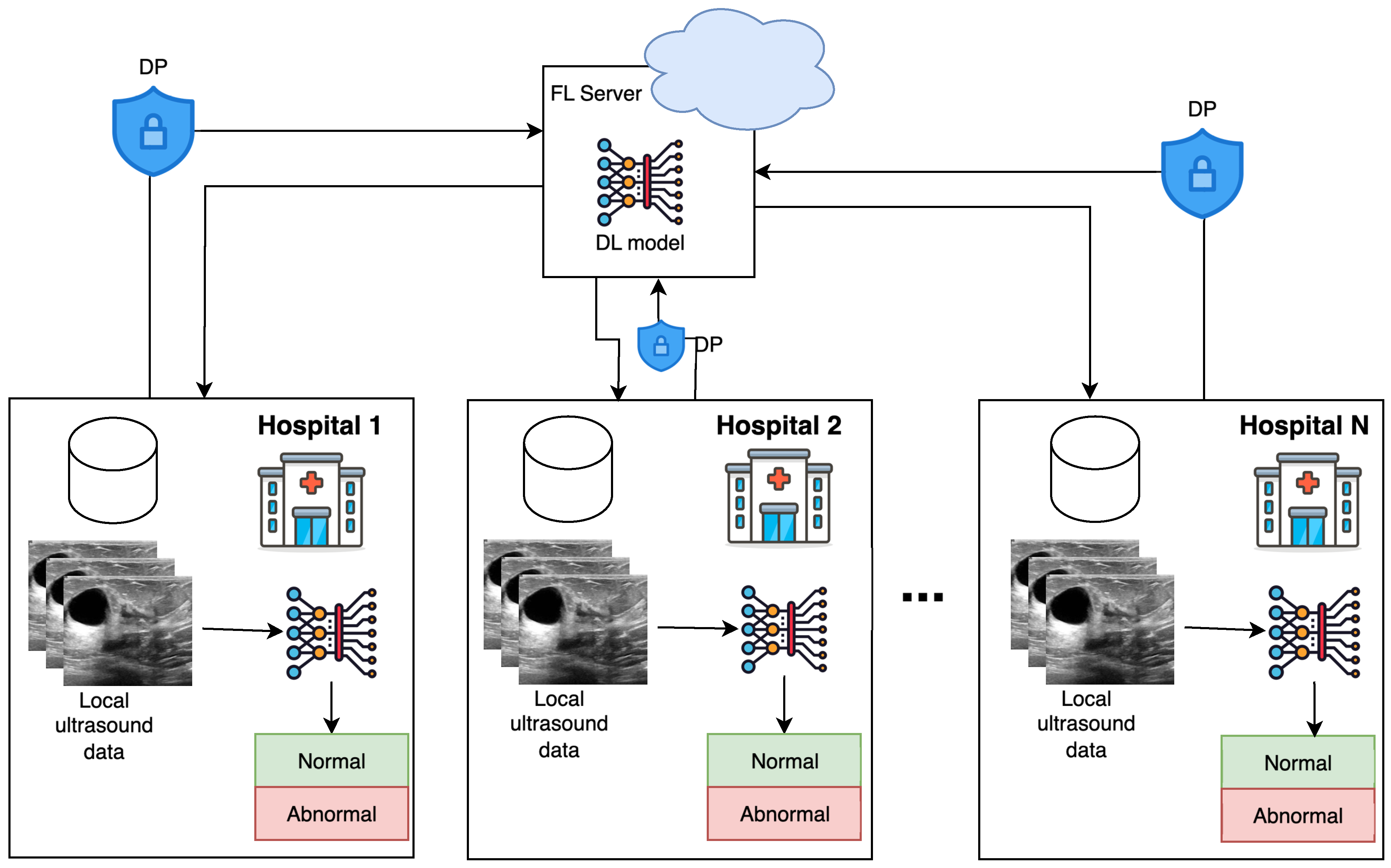
This section presents our federated learning framework for breast cancer classification in ultrasound images. The methodology (Figure 2) encompasses the system architecture, deep learning models, FL algorithms, and privacy preservation mechanisms.

3.1. System Architecture

Our FL framework follows a client-server architecture where multiple healthcare institutions (clients) collaborate to train a global model under central server coordination. Each institution maintains its local dataset and computational resources, performing local training and gradient computation while ensuring that patient data never leaves institutional boundaries. The central server aggregates model updates, maintains the global model, and distributes updated parameters to clients.

3.2. Deep Learning Models

We evaluate seven architectures spanning three design paradigms to characterize how architectural properties interact with federated training. The CNN-based models include ResNet-50 [37] (residual connections), VGG16 and VGG19 [38] (uniform sequential convolutions), DenseNet-121 [39] (dense feature reuse across layers), and MobileNetV2 [40] (depthwise separable convolutions for efficiency). The attention-based models include ViT-small [41] (pure transformer with patch-based self-attention) and CoAtNet [42] (hybrid convolution-attention).
All models are initialized with ImageNet pre-trained weights. For fine-tuning, we replace the final classification head with a task-specific fully connected layer (output dimension matching the number of classes) and train all layers end-to-end. We do not freeze any intermediate layers, as preliminary experiments indicated that full fine-tuning consistently outperformed partial freezing in our FL setting. The rationale for this architecture selection is to cover a range of parameter counts (MobileNetV2: 3.4 M to VGG19: 144 M), inductive biases (local vs. global feature extraction), and gradient flow characteristics (skip, dense, sequential), all of which may influence convergence behavior under federated averaging with heterogeneous data.

3.3. Federated Learning Algorithms

We evaluate three FL algorithms. FedAvg [5] performs weighted averaging of client model parameters:
W r global = 1 k i = 1 k W i , r
FedProx [43] addresses data heterogeneity by adding a proximal term to the local objective:
min w h k ( w , w t ) = F k ( w ) + μ 2 w w t 2
The proximal term prevents the k-th client’s local model w from deviating significantly from the global model w t , which is beneficial when data distributions vary across institutions.
FedOpt [44] applies server-side adaptive optimization (e.g., Adam) for aggregating client updates:
w t + 1 = w t η t m t v t + ϵ
where m t = β 1 m t 1 + ( 1 β 1 ) Δ t and v t = β 2 v t 1 + ( 1 β 2 ) ( Δ t ) 2 are the first and second moment estimates of the averaged client update Δ t , and η t , β 1 , β 2 , ϵ are the learning rate, momentum parameters, and numerical stability constant, respectively.

3.4. Differential Privacy Mechanism

Our framework implements client-side ( ε , δ ) -differential privacy using the DP-SGD approach [6]. The mechanism operates entirely within each client and consists of three steps applied at every gradient update: (1) per-sample gradient computation and 2 -norm clipping, (2) batch averaging of clipped gradients followed by calibrated Gaussian noise injection, and (3) a local parameter update using the noisy gradient. After all local epochs are completed, the client transmits only the updated model weights (not gradients) to the server for aggregation. DP is evaluated only with FedAvg aggregation in this study; the interaction between DP noise and FedProx or FedOpt is left to future work (see Section 6). The three steps are formalized below.

3.4.1. Gradient Clipping

For each per-sample gradient g i = w ( f ( x i ; w ) , y i ) , we clip the 2 norm to a bound C:
g ˜ i = g i · min 1 , C g i 2
This bounds the sensitivity of each individual’s contribution to the aggregated gradient.

3.4.2. Noise Injection

After averaging clipped gradients within a mini-batch of size B, we add calibrated Gaussian noise scaled by the clipping bound and noise multiplier:
g ^ = 1 B i = 1 B g ˜ i + N 0 , ( η C ) 2 I
where η is the noise multiplier and C is the clipping bound. The noise standard deviation η C is applied to the batch-averaged gradient, consistent with Algorithm 1 (line 12). Each gradient step satisfies ( ε step , δ step ) -DP with ε step = 2 ln ( 1.25 / δ step ) / η via the standard Gaussian mechanism [6].
Algorithm 1 Client-Side Differentially Private Federated Learning
 Require:
Rounds R, clients K, local epochs E, batch size B, clipping bound C, noise multiplier η , privacy parameter δ , initial weights w 0
 Ensure:
Final weights w R
   1:
for each round r = 1 , 2 , , R  do
   2:
       Server sends w r 1 to selected clients S r
   3:
       for each client k S r  in parallel do
   4:
               w k w r 1
   5:
              for local epoch e = 1 , , E  do
   6:
                     for each batch B D k  do
   7:
                   for each ( x i , y i ) B  do
   8:
                       g i w ( f ( x i ; w k ) , y i )
   9:
                       g ˜ i g i · min 1 , C max ( g i 2 , 10 7 )
  10:
                   end for
  11:
                    g ¯ 1 B i = 1 B g ˜ i
  12:
                    g ^ g ¯ + N 0 , ( η C ) 2 I
  13:
                    w k w k α g ^
  14:
                    end for
  15:
             end for
  16:
             Send w k to server
  17:
      end for
  18:
      Server aggregates: w r Aggregate { w k } k S r
  19:
end for
  20:
return  w R

3.4.3. Privacy Accounting

We use basic composition over T total gradient steps to obtain an upper bound on the cumulative privacy budget:
ε total T · ε step = T · 2 ln ( 1.25 / δ step ) η
We set δ = 10 5 (less than 1 / N where N = 15 , 847 is the total dataset size). We note that this is a conservative upper bound based on basic composition. Tighter bounds are achievable via Rényi differential privacy (RDP) accounting or the moments accountant [6], which would yield smaller ε values for the same noise parameters. For our default configuration ( η = 2.0 , T = 100 rounds × 5 local epochs × approximately 25 batches per epoch = 12 , 500 steps per client), basic composition gives ε total 12 , 500 × 2 ln ( 1.25 / 10 5 ) / 2.0 12 , 500 × 2.42 30 , 250 . This loose bound illustrates why basic composition is pessimistic; under RDP or the moments accountant, the effective ε grows as O ( T ) rather than O ( T ) , yielding substantially tighter guarantees of order ε T · 2 ln ( 1.25 / δ ) / η 270 . We acknowledge that even these estimates are large, and that achieving single-digit ε values would require either subsampling amplification, fewer training steps, or higher noise multipliers with correspondingly greater accuracy loss.
Table 1 reports the estimated privacy budgets under both basic and sublinear ( O ( T ) ) composition for our experimental configurations. The complete client-side DP procedure is summarized in Algorithm 1.
In Algorithm 1, per-sample gradient clipping (lines 8–9) bounds individual contributions, batch averaging (line 11) computes the mean clipped gradient, Gaussian noise injection (line 12) provides the randomization required for DP, and the local parameter update (line 13) applies the noisy gradient. After completing all local epochs, the client transmits only the updated model weights w k to the server (line 15), where the aggregation function (line 17) implements the chosen FL algorithm. This client-side approach ensures that raw patient data never leave the institution while providing formal DP guarantees that limits the information any adversary can extract about individual training samples. As noted above, our DP experiments use FedAvg aggregation exclusively; the interaction between DP noise and adaptive server-side optimization (FedOpt) or the proximal term (FedProx) is non-trivial and remains a direction for future investigation.

4. Experimental Setup

4.1. Dataset

We use the Breast Ultrasound Images (BUSI) dataset collected by Al-Dhabyani et al. [45] at Baheya Hospital for Early Detection and Treatment of Women’s Cancer (Cairo, Egypt), supplemented with additional ultrasound images from publicly available sources to reach a total of N = 15 , 847 images. The combined dataset contains images from multiple ultrasound devices, though all images originate from the same clinical pipeline and annotation protocol. Each image is annotated with one of three labels (normal, benign, malignant) by board-certified radiologists.
Task construction. The three-class dataset ( N normal = 5283 , N benign = 6847 , N malignant = 3717 ) serves as the base from which the two binary tasks are derived. For normal/abnormal classification, benign and malignant images are merged into a single “abnormal” class ( N normal = 5283 , N abnormal = 10 , 564 ). For benign/malignant classification, normal images are excluded and the remaining images are supplemented with additional benign and malignant samples to form a balanced binary set ( N benign = 8921 , N malignant = 6926 ). The differing totals across tasks reflect these construction choices.
Train/validation/test split. For each task, we use an 80/10/10 split (training/validation/test). Splitting is performed at the image level prior to client partitioning: a global test set (10%) is held out and shared across all evaluation settings (centralized and federated) to ensure comparable results, and the remaining 90% is divided into training (80%) and validation (10%) subsets. Client partitioning (described below) is applied only to the training set; each client’s local validation subset is drawn proportionally from the global validation pool. We note that because the dataset does not provide unique patient identifiers, we cannot guarantee patient-level disjointness between splits—it is possible that multiple images from the same patient appear in both training and test sets. This is a known limitation of the BUSI dataset and may lead to optimistic accuracy estimates; we flag this as a caveat for interpreting absolute performance numbers.
Images are preprocessed by resizing to 224 × 224 pixels using bicubic interpolation, normalizing with ImageNet statistics ( μ = [ 0.485 ,   0.456 ,   0.406 ] , σ = [ 0.229 ,   0.224 ,   0.225 ] ), applying CLAHE with clip limit 2.0, and Gaussian noise reduction with a 3 × 3 kernel.
Simulated federation. Because obtaining truly distributed multi-institutional ultrasound data with independent scanner characteristics and annotation protocols were not feasible for this study, we partition the single dataset across K = 8 simulated clients. This is an important limitation: real multi-site data exhibits scanner-specific artifacts, population-level demographic differences, and inter-reader annotation variability that synthetic partitioning cannot replicate. Our results should, therefore, be interpreted as characterizing architectural and algorithmic behavior under controlled heterogeneity, not as evidence of real-world multi-institutional performance.
Data partitioning. For IID partitioning, data are distributed uniformly across clients with balanced class representations (each client receives N / K samples with class proportions matching the global distribution). For non-IID partitioning, we simulate three forms of heterogeneity: (1) label distribution skew via a Dirichlet allocation with concentration parameter α = 0.5 , where each client’s class proportions are drawn from Dir ( α · p ) with p being the global class distribution; (2) quantity skew, where client dataset sizes range from 847 to 3247 images (assigned by drawing from a log-normal distribution and rescaling to the total dataset size) and (3) feature distribution skew, simulated by applying client-specific random augmentation pipelines (varying brightness, contrast, and rotation ranges) to mimic scanner-level variation. Unless otherwise stated, reported federated results use the non-IID partitioning.
Table 2 summarizes the resulting client-wise sample counts and class distributions under the non-IID partitioning used in all federated experiments. The combination of Dirichlet-based label skew and log-normal quantity skew produces substantial heterogeneity: client dataset sizes range from 847 (Client 6) to 3247 (Client 1), and the malignant class proportion varies from 14.2% (Client 5) to 38.1% (Client 3). This heterogeneity is by design, as it exercises the robustness of FL algorithms to statistical imbalance. We emphasize, however, that this synthetic heterogeneity does not capture the full complexity of real multi-institutional variation, which also includes scanner-specific artifacts and inter-reader annotation differences.

4.2. Training Configuration

Seven architectures (ResNet-50, VGG16, VGG19, MobileNetV2, DenseNet-121, ViT-small, CoAtNet) are evaluated within the FL framework. The default configuration uses 100 communication rounds with 5 local epochs per round and a batch size of 32. All models use the Adam optimizer with an initial learning rate of 1 × 10 3 , reduced by a factor of 0.1 at rounds 50 and 80. For FedProx, the proximal parameter is set to μ = 0.01 . For FedOpt, the server-side optimizer uses β 1 = 0.9 , β 2 = 0.99 , and server learning rate η s = 0.01 . In each communication round, all K = 8 clients participate (full participation).
Centralized baseline. To provide a fair upper-bound comparison, the centralized baseline is trained on the union of all client training partitions (i.e., the full training set prior to client partitioning) and evaluated on the same held-out global test set used for federated evaluation. The centralised baseline uses exactly the same preprocessing pipeline (Section 4.1), architecture implementations, optimizer (Adam, lr = 10 3 ), learning-rate schedule ( × 0.1 at epochs 250 and 400), ImageNet pre-trained initialization, and total training budget as the federated experiments. Specifically, to match the federated compute budget of 100 communication rounds × 5 local epochs = 500 total epochs of local training, the centralized model is trained for 500 epochs on the combined dataset. This ensures that any performance difference between centralized and federated results is attributable to the distributed training procedure (data partitioning, aggregation, heterogeneity) rather than differences in model capacity, optimization, preprocessing, or training duration.
We report results from a single training run per configuration; we acknowledge that reporting variance over multiple runs would strengthen the findings (see Section 6, Limitations).

4.3. Evaluation Metrics

Performance is assessed using accuracy, precision, recall, and F1-score. Classification accuracy measures overall correctness; recall captures sensitivity for malignant case detection; precision measures positive predictive value and F1-score provides a balanced measure. For the three-class task, all metrics are computed as macro-averaged values across classes.
We note the mapping between these standard ML metrics and their clinical counterparts. For the binary tasks, recall (also called the true positive rate) is equivalent to sensitivity—the proportion of actual positive cases correctly identified. This is directly reported in all results tables (Tables 5–14). Specificity (true negative rate) can be derived from the binary confusion matrix as 1 FPR ; however, because our evaluation pipeline recorded only the aggregate metrics listed above and did not save per-sample predictions or class probabilities, we are unable to report specificity or AUC (Area Under the ROC Curve) retrospectively. Computing AUC would require access to the predicted probability distributions over classes for each test sample, which were not logged.
We acknowledge that AUC is particularly informative for clinical screening tasks, as it characterizes the sensitivity-specificity trade-off across all decision thresholds rather than at a single operating point. Similarly, confusion matrices would reveal class-specific error patterns (e.g., whether benign lesions are preferentially misclassified as malignant or vice versa) that aggregate metrics obscure. We identify the inclusion of AUC, specificity, and per-class confusion matrices as a priority for future work, requiring only minimal changes to the evaluation pipeline (logging predicted probabilities alongside predictions).

4.4. Implementation Details

The framework is implemented in PyTorch with the Flower library for FL simulation. Experiments are conducted on NVIDIA Tesla V100 GPUs (32 GB VRAM) with Python 3.8 and PyTorch 1.9. Table 3 summarises the full set of hyperparameters used across all experiments.
Table 4 summarizes the parameter counts and per-round communication costs for each architecture. Communication cost per round is computed as 2 × | θ | × 4 bytes (one upload and one download of 32-bit floating-point parameters per participating client), multiplied by K = 8 clients. These figures contextualize the trade-off between model capacity and communication overhead in the federated setting.

5. Experimental Results

5.1. Centralized Baselines

Table 5, Table 6 and Table 7 present centralized learning baselines. For normal/abnormal classification (Table 5), all architectures achieve >97% accuracy, with DenseNet-121 leading at 98.75%. The narrow performance spread (97.27–98.75%) indicates low architectural sensitivity for this task.
The benign/malignant task (Table 6) is more challenging: CoAtNet achieves the highest accuracy at 87.98%, followed by ResNet-50 (87.85%) and ViT-small (87.17%). The 6.07 percentage point gap between the best and worst architectures reflects greater dependence on architectural capacity for distinguishing subtle morphological differences.
For three-class classification (Table 7), DenseNet-121 achieves the highest accuracy (90.33%), followed by CoAtNet (89.76%) and VGG16 (89.65%).

5.2. Federated Learning Performance

Normal/abnormal classification (Table 8). Federated approaches maintain strong performance, with DenseNet-121 achieving 98.52% accuracy under FedAvg and FedProx, matching its centralized counterpart. ViT-small and CoAtNet also achieve 98.29%, demonstrating that attention-based architectures adapt well to federated constraints. Even the lowest-performing model (MobileNetV2, 93.52% with FedOpt) remains clinically viable. The robustness of this task to distributed training likely reflects the relatively large feature-space separation between normal tissue and pathological findings—the discriminative features (presence vs. absence of lesions) are sufficiently salient that partial views of the data distribution across clients still enable effective learning.
Benign/malignant classification (Table 9). Federated results show competitive performance across architectures (88.17–89.99%). Notably, several architectures outperform their centralized baselines: DenseNet-121 achieves 89.65% with FedAvg vs. 85.69% centralized (+3.96 pp), and ViT-small reaches 89.99% with FedProx vs. 87.17% centralized (+2.82 pp). We hypothesize that this improvement may arise from an implicit regularization effect: when data are distributed across clients, each client’s local model is trained on a subset with different characteristics, and federated averaging acts as a form of model ensembling that can reduce overfitting to idiosyncratic features in the centralized dataset. However, we emphasize that this hypothesis requires further investigation—without multiple independent runs with confidence intervals, and without analysis of feature diversity or gradient disagreement across clients, we cannot rule out that these improvements are artifacts of favorable random partitioning in our single-run experiments.
Three-class classification (Table 10). This task reveals greater architectural sensitivity to federated constraints. ViT-small achieves the best result (89.53% with FedOpt), again exceeding its centralized baseline of 88.05%. ResNet-50 (75.43–76.56%) and MobileNetV2 (66.44–67.35%) show substantial degradation. The divergent behavior of ResNet-50 (which performs well centrally at 87.49% but collapses to 76 % federally) is notable. We conjecture that ResNet-50’s skip connections, while beneficial for deep gradient flow in centralized training, may amplify the effect of heterogeneous gradient directions when averaged across clients with different class distributions—the residual pathway transmits client-specific features that conflict upon aggregation. By contrast, DenseNet-121’s dense connectivity provides multiple alternative gradient pathways, making it more robust to the averaging of heterogeneous updates. ViT-small’s self-attention mechanism may similarly benefit from its ability to reweight feature importance globally, adapting to the aggregated representation. These architectural explanations, however, remain speculative and warrant targeted investigation (e.g., analysis of layer-wise gradient variance across clients).
Algorithm comparison. The relationship between FL algorithms and performance is architecture-dependent rather than following a universal hierarchy. While FedOpt provides the best results for ViT-small in the three-class task (89.53%) and CoAtNet in the benign/malignant task (89.19%), FedAvg yields the best DenseNet-121 results for normal/abnormal (98.52%) and benign/malignant (89.65%) classification. DenseNet-121 achieves 98.52% with FedAvg and FedProx but 98.07% with FedOpt, contradicting a simple FedOpt > FedProx > FedAvg ordering. FedOpt’s server-side adaptive momentum appears most beneficial for attention-based architectures (ViT-small, CoAtNet), where the adaptive learning rate may help navigate the more complex loss landscape of transformer models. For architectures with simpler optimization landscapes (VGG, DenseNet), the additional complexity of adaptive server-side optimization does not consistently improve over straightforward averaging. These differences are typically within 1–2 percentage points, and without multiple runs with reported variance, we cannot determine whether many of these differences are statistically significant.

5.3. Summary of Federated vs. Centralized Performance

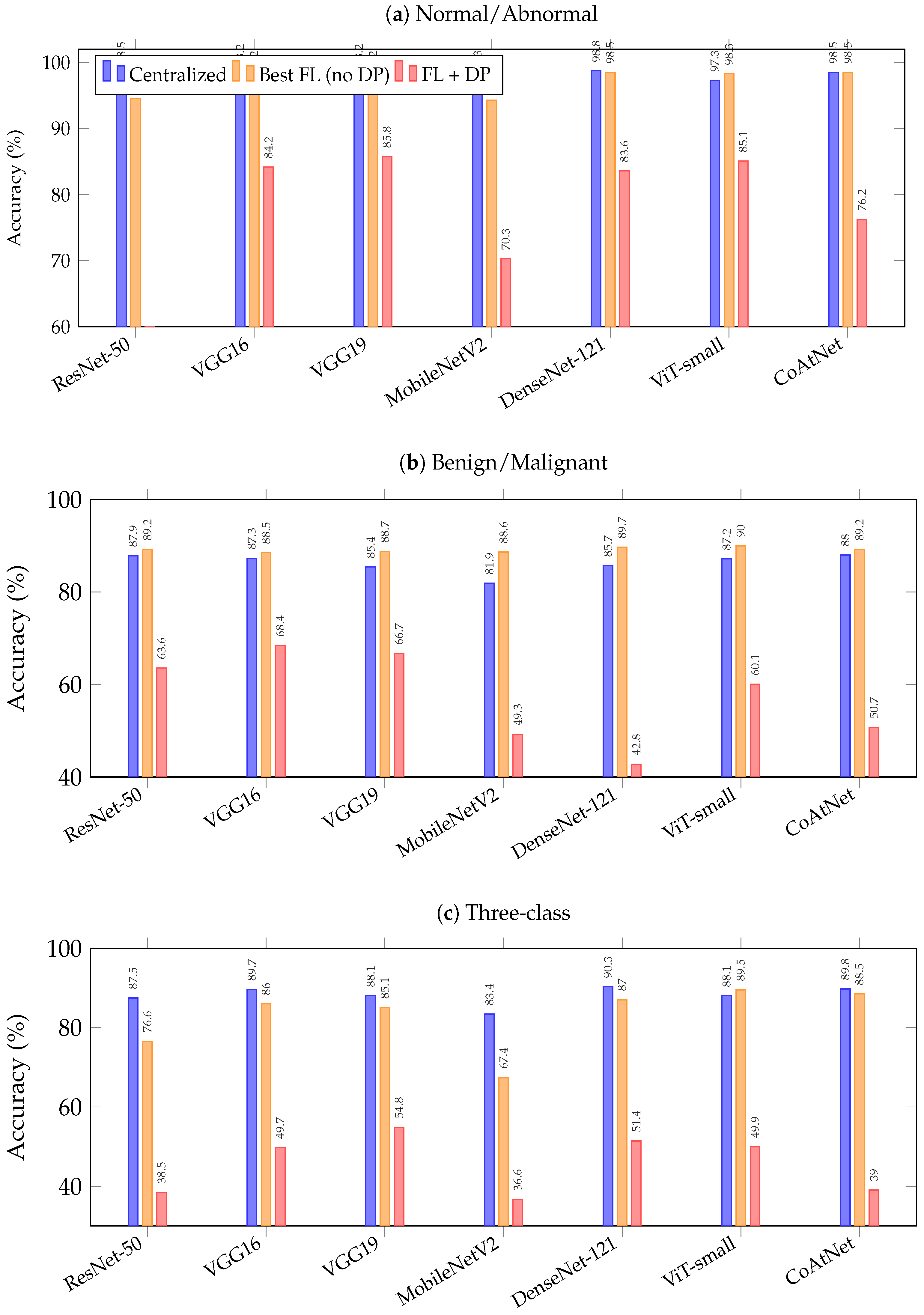
To facilitate the interpretation of the detailed results in Table 8, Table 9 and Table 10, Table 11 presents a compact summary showing each architecture’s best federated accuracy (across the three FL algorithms) alongside its centralized baseline, with the absolute difference ( Δ ). Positive Δ values indicate that federated training outperformed the centralized baseline. Figure 3 visualizes these comparisons.
Several trends are apparent from Table 11 and Figure 3. First, ViT-small is the only architecture that matches or exceeds its centralized baseline across all three tasks. Second, the performance gap between federated and centralized training widens substantially for the three-class task, particularly for ResNet-50 (−10.93 pp) and MobileNetV2 (−16.04 pp). Third, DP introduces a further large and architecture-dependent accuracy drop, with VGG architectures showing the greatest resilience and ResNet-50 the least. These patterns reinforce the architecture-selection guidance discussed in Section 6.

5.4. Differential Privacy Analysis

Table 12, Table 13 and Table 14 present results with client-side DP (clipping bound C = 1.5 , noise multiplier η = 2.0 , δ = 10 5 ) under FedAvg. As reported in Table 1, these parameters yield a conservative privacy budget estimate of ε 270 under sublinear composition. We emphasize that these are exploratory experiments characterizing the relative sensitivity of different architectures and tasks to gradient perturbation, rather than demonstrating deployment-ready privacy guarantees.
For normal/abnormal classification (Table 12), VGG19 achieves the highest accuracy at 85.77%, a 10.59 pp decrease from its non-private FedAvg result (96.36%). ViT-small maintains 85.09% accuracy with high recall (0.8509), which is important for screening sensitivity. ResNet-50 drops to 49.94% (near random for a binary task), indicating extreme sensitivity to gradient noise. This collapse may stem from the interaction between residual connections and noisy gradients: the additive skip connections amplify noise propagation through the network, whereas VGG’s sequential design allows noise to be progressively attenuated through successive layers.
For benign/malignant classification (Table 13), VGG16 achieves the highest accuracy at 68.42%, a 19.86 pp decrease from its non-private result. The substantially larger degradation compared with normal/abnormal screening reflects the finer-grained decision boundary required: distinguishing benign from malignant lesions depends on subtle morphological features (margin irregularity, echogenicity patterns) that are more easily obscured by gradient noise. All architectures fall below 70%, indicating that these DP parameters are too aggressive for this task.
For three-class classification (Table 14), VGG19 achieves 54.83%, with all models below 55% accuracy. The compounding effects of task complexity (three decision boundaries) and privacy noise render this configuration impractical for clinical use.
These results indicate that VGG architectures exhibit superior resilience to DP noise, which we attribute to their uniform sequential design: the lack of skip connections or dense pathways mean that noise injected into gradients does not receive multiplicative amplification through auxiliary pathways. The normal/abnormal screening task maintains viable performance (>85%) under these DP parameters, while more challenging diagnostic tasks would require either relaxed noise parameters, subsampling-based privacy amplification, or alternative mechanisms such as secure aggregation.

5.5. Ablation Study: Differential Privacy Parameters

Table 15 presents the ablation study on DenseNet-121 with FedAvg for normal/abnormal classification, varying clipping bounds (0.5–2.0) and noise multipliers (0.5–3.0).
The highest accuracy (84.52%) is achieved with C = 2.0 , η = 0.5 , representing minimal privacy protection. Increasing the noise multiplier to 3.0 reduces accuracy to 82.02–82.59% depending on the clipping bound, a modest 1.93–2.50 pp degradation that demonstrates robustness to privacy constraints.
The C = 1.5 configuration shows notable stability: accuracy varies only from 84.30% ( η = 0.5 ) to 82.02% ( η = 3.0 ) across the full noise range. We identify C = 1.5 , η = 2.0 as the optimal privacy-utility configuration, achieving 83.61% accuracy (F1: 0.7793, recall: 0.8361) while providing substantial privacy protection. The high recall is particularly important for screening applications where false negatives carry severe clinical consequences.
All configurations maintain >82% accuracy for this screening task, demonstrating that the normal/abnormal classification boundary is robust to the gradient perturbation induced by these DP parameters. Achieving formal privacy guarantees with single-digit ε values at this performance level would require additional techniques such as subsampling, amplification, or substantially fewer training iterations.

6. Discussion

Our results yield several insights for privacy-preserving federated medical imaging, while also revealing important limitations that scope the applicability of our findings. We reiterate that all experiments are conducted within a simulated federation (Section 6.6), and the conclusions drawn here should be understood as characterizing architectural and algorithmic behavior under controlled heterogeneity rather than predicting real-world multi-institutional deployment outcomes.

6.1. Architectural Suitability for Federated Learning

The divergent federated behavior of different architectures is one of the most practically relevant findings. DenseNet-121 and ViT-small consistently maintain or exceed centralized performance across tasks, while ResNet-50 and MobileNetV2 exhibit substantial degradation in multi-class settings. We propose that this divergence is related to how each architecture’s gradient structure interacts with federated averaging.
DenseNet-121’s dense connectivity creates L ( L + 1 ) / 2 direct connections in a network with L layers, providing multiple gradient pathways during backpropagation. When gradients from heterogeneous clients are averaged; this redundancy may buffer against conflicting update directions—if one pathway receives a noisy averaged gradient, alternative pathways can still transmit useful information. ResNet-50’s skip connections, by contrast, create additive shortcuts that directly propagate client-specific gradient components to earlier layers, potentially amplifying the effect of heterogeneous updates upon averaging.
ViT-small’s superior federated performance (exceeding its centralized baseline in several configurations) is particularly noteworthy. The self-attention mechanism computes feature importance dynamically from the input, rather than relying on fixed convolutional filters. This property may make ViT more adaptive to the heterogeneous feature distributions that arise when data are partitioned across clients. This finding is consistent with Sheller et al. [8], who observed that architectures with greater representational flexibility tend to benefit more from federated training on diverse institutional data, though their work focused on segmentation rather than classification.
However, we caution that these architectural explanations remain hypothetical. Rigorous validation would require layer-wise gradient variance analysis across clients, which we leave to future work.
MobileNetV2’s consistent underperformance in multi-class federated settings (66.44–67.35% for three-class, compared with 83.39% centralized) deserves additional comment. Its depthwise separable convolutions factorize standard convolutions into channel-wise and point-wise operations, drastically reducing parameter count ( 3.4 M; see Table 4). While this efficiency is advantageous for communication cost (217.6 MB per round vs. >8800 MB for VGG architectures), the limited model capacity may be insufficient to absorb the conflicting gradient signals that arise when client data distributions diverge. In other words, the same compactness that makes MobileNetV2 communication efficient may make it representation-deficient under heterogeneous federated training. This trade-off between communication efficiency and federated robustness (Table 4) is an important practical consideration for resource-constrained deployments.

6.2. Comparison with Existing FL Medical Imaging Studies

Our federated results are broadly consistent with the existing literature, though direct numerical comparison is complicated by differences in datasets, tasks, and experimental protocols. Sheller et al. [8] reported that FL achieves approximately 99% of centralized performance for brain tumor segmentation across 10 real institutions; our best federated results similarly reach 99–100% of centralized accuracy for normal/abnormal screening, though with the important caveat that our federation is simulated. Li et al. [23] demonstrated comparable centralized-to-federated performance preservation for histopathological breast cancer classification, reporting <2 pp degradation with FedAvg, which aligns with our DenseNet-121 and ViT-small results, but not with the larger degradation observed for ResNet-50 and MobileNetV2.
For DP in federated medical imaging, Jiang et al. [27] reported that their DPFedSAM approach maintains performance within 3–5 pp of non-private baselines for medical image analysis tasks. Our DP results show considerably larger degradation (10–50 pp depending on task and architecture), which likely reflects our more aggressive noise parameters and the use of basic Gaussian noise without the sharpness-aware minimization that Jiang et al. employ. This comparison highlights that vanilla DP noise injection, as used in our study, may be insufficient for challenging medical imaging tasks, and that more sophisticated DP mechanisms deserve investigation.

6.3. Scope and Design Choices of the Differential Privacy Analysis

We note several important design choices that scope the interpretation of our DP results. First, our DP analysis is restricted to client-side DP-SGD with FedAvg aggregation. The interaction between gradient-level noise and alternative aggregation strategies is non-trivial: FedProx’s proximal term constrains local updates toward the global model, which could either mitigate noise (by regularizing noisy gradients) or amplify it (by preventing the local model from adapting to its own data under noisy conditions). Similarly, FedOpt’s adaptive server momentum could accumulate noise across rounds if the noisy pseudo-gradients are not well-aligned with the true gradient direction. Characterizing these interactions requires dedicated experiments and is left to future work.
Second, our privacy accounting relies on basic composition (Table 1), which yields conservative upper bounds on ε . Tighter guarantees are achievable via Rényi DP (RDP) accounting or the moments accountant, both of which exploit the subsampled Gaussian mechanism to obtain O ( T ) rather than O ( T ) growth. We did not implement RDP accounting in the current framework, and acknowledge that doing so would meaningfully improve the reported privacy budgets without any change to the training procedure.
Third, we did not employ privacy amplification via subsampling at the client level, nor did we explore alternative noise mechanisms (e.g., the Laplace mechanism or the discrete Gaussian mechanism). These techniques represent promising directions for achieving stronger formal privacy guarantees with less accuracy degradation.
Finally, the choice of a single clipping bound ( C = 1.5 ) and noise multiplier ( η = 2.0 ) for the main DP experiments, while explored more broadly in the ablation study (Table 15), does not cover the full design space. Adaptive clipping strategies that adjust C based on observed gradient norms [29] could improve the privacy-utility trade-off, particularly for architectures with heterogeneous gradient magnitudes across layers.

6.4. Task-Dependent Federated Resilience and Clinical Implications

The strong task dependence of our results carries potential clinical implications, though we emphasize that these observations are drawn from a simulated federation and single-run experiments, and should be treated as preliminary hypotheses rather than deployment recommendations. In our simulated eight-client setting, normal/abnormal screening shows minimal performance degradation (0.23–4.98 pp) across all architectures, suggesting that this task may be a promising candidate for federated deployment. From a clinical workflow perspective, this screening task—distinguishing patients who require further examination from those who do not—is precisely the setting where FL could deliver the most impact, as it requires the largest and most diverse training datasets to handle population-level variation.
The more nuanced benign/malignant and three-class tasks exhibit architecture-dependent sensitivity in the reported experiments. If these patterns hold under real multi-institutional conditions, a hospital considering joining a federation would need to carefully evaluate which architectures to deploy based on the target clinical task. In our setting, ViT-small and DenseNet-121 showed the strongest federated robustness for fine-grained classification, while MobileNetV2 was viable only for binary screening.
The privacy-utility trade-off presents a more challenging picture. Under the DP parameters tested in our experiments, only the screening task maintains clinically viable accuracy (>85%), while diagnostic tasks fall below acceptable thresholds. For a hospital’s institutional review board (IRB), the relevant question is whether the formal privacy guarantee justifies the performance cost. Our results suggest that for challenging diagnostic tasks, alternative privacy mechanisms—such as secure aggregation [32], which protects individual updates without adding noise to gradients, or homomorphic encryption [31]—may warrant investigation as alternatives to gradient-level DP.

6.5. Practical Benefit of Federation for Individual Hospitals

An important question for deployment is whether an individual hospital gains from joining the federation, compared with training only on its own local data. While we did not conduct explicit local-only baseline experiments (see Section 6.6), the structure of our simulated federation allows indirect reasoning about this question.
As shown in Table 2, client dataset sizes under our non-IID partitioning range from 847 (Client 6) to 3247 (Client 1), and class distributions vary substantially (e.g., malignant prevalence ranges from 14.2% to 38.1%). Smaller and more imbalanced clients are expected to benefit disproportionately from the federation, because the federated global model effectively leverages the combined 15,847 samples across all eight clients, providing far greater statistical power and class coverage than any individual client’s partition. In the standard supervised learning setting, training a model such as DenseNet-121 (8 M parameters) or ViT-small (22 M parameters) on only 847 images with skewed class distributions would likely result in severe overfitting and poor generalization—particularly for the three-class task, where some clients may have fewer than 150 samples in the minority class.
Conversely, the largest clients with balanced distributions (e.g., Client 1) may see smaller marginal gains from federation, as their local datasets already provide a reasonable training signal. This pattern—where federation disproportionately benefits data-poor participants—is consistent with observations in the broader FL literature [7,8].
We acknowledge, however, that this analysis is indirect and based on dataset-size reasoning rather than empirical local-only baselines. Direct per-client evaluation—training each client’s model in isolation and comparing its test performance to the federated global model evaluated on the same client’s test set—is needed to quantify the per-hospital benefit precisely. We identify this as a high-priority direction for future work.

6.6. Limitations

We identify several limitations that limit the interpretation of our results.
Simulated federation. Our most significant limitation is the use of a single dataset partitioned to simulate multi-institutional settings (Table 2). Real multi-site data exhibits scanner-specific artifacts (differences in ultrasound frequency, gain settings, and image resolution), population-level demographic differences (age distributions, cancer prevalence rates), and inter-reader annotation variability. Our Dirichlet-based partitioning simulates label and quantity heterogeneity (Table 2), and client-specific augmentation pipelines approximate feature-distribution skew, but these cannot capture the full complexity of real cross-hospital distributional shifts. Consequently, all results in this study should be interpreted as controlled simulated-federation benchmarks, not as validated evidence of cross-hospital deployment performance. The title and framing of this work reflect this distinction.
Single-run results. All experiments report single-run results without confidence intervals or statistical significance tests. Given the stochasticity of training (random initialization, client sampling, DP noise injection), some of the observed differences between algorithms or architectures—particularly those within 1–2 pp—may not be statistically significant. Future work should report results over at least 5 independent runs with standard deviations and conduct paired statistical tests (e.g., McNemar’s test for classification accuracy).
DP limited to FedAvg. Our DP analysis is conducted only with FedAvg aggregation. The interaction between DP noise and FedProx’s proximal term (which constrains local updates, potentially reducing the impact of noisy gradients) or FedOpt’s adaptive server momentum (which may amplify or dampen noise depending on its alignment with the true gradient direction) is non-trivial and potentially important for achieving better privacy-utility trade-offs.
Privacy budget estimates. As detailed in Section 3.4, our privacy accounting uses basic composition, yielding conservative (loose) upper bounds on ε . The reported ε values (Table 1) are substantially larger than what would typically be considered strong privacy. Tighter bounds via Rényi DP accounting and privacy amplification through subsampling would improve these estimates, but were not implemented in the current framework.
Missing analyses. Several analyses that would further strengthen the paper were not conducted. First, local-only baselines—where each client trains independently on its own partition—are needed to directly quantify the per-hospital benefit of joining the federation (Section 6.5); our current comparison is limited to federated vs. centralized training on the full combined dataset. Second, convergence curves showing accuracy vs. communication round would reveal stability and communication efficiency differences across FL algorithms; we were unable to include these due to the computational cost of re-running all 63 architecture–algorithm–task configurations with logging granularity at each round. Third, per-client performance analysis is critical for identifying whether the global model systematically underperforms for specific institutional data distributions. Fourth, while we provide a model-size and communication-cost summary (Table 4), a full computational cost analysis—including per-round wall-clock training time and the additional overhead of gradient clipping and noise injection for DP—would be valuable for practical deployment decisions. Fifth, as discussed in Section 4.3, AUC, specificity, and per-class confusion matrices were not logged during training and would provide a more complete clinical evaluation; these require only minor pipeline changes (saving predicted probabilities) and should be included in future work. These represent priority directions for future work.

7. Conclusions

This paper presents a controlled empirical benchmark of federated learning for breast cancer classification in ultrasound images, conducted within a simulated multi-client setting where a single dataset is partitioned across eight clients under controlled heterogeneity (label skew, quantity skew, and feature-distribution skew; see Table 2). Our systematic comparison of seven architectures across three FL algorithms reveals that, in our simulated setting, federated training can match or exceed centralized performance for well-chosen architectures: DenseNet-121 achieves 98.52% for normal/abnormal screening with FedAvg, and ViT-small achieves 89.53% for three-class classification with FedOpt, both matching or exceeding their centralized baselines. However, other architectures (ResNet-50, MobileNetV2) exhibit substantial degradation in multi-class federated settings, suggesting that architecture selection may be a critical deployment decision. The relationship between FL algorithms and performance appears architecture-dependent rather than following a universal hierarchy, with FedOpt particularly benefiting attention-based architectures in the reported experiments. Because these findings are based on single-run experiments within a simulated federation, they should be interpreted as indicative trends requiring confirmation through multi-seed repetitions and real multi-institutional validation.
Client-side differential privacy with Gaussian noise injection maintains screening accuracy above 82% in our experiments, though the conservative privacy budget estimates under basic composition ( ε 1 ) and the substantial accuracy degradation for diagnostic tasks (best 68.42% for benign/malignant, 54.83% for three-class) suggest that vanilla DP-SGD alone may be insufficient for deployment-grade privacy in challenging classification scenarios. These observations are based on a single noise configuration and FedAvg aggregation only; the interaction of DP with alternative FL algorithms remains unexplored.
The most important directions for future work are as follows. First, validation on truly distributed multi-institutional datasets with real scanners and population heterogeneity is needed to move beyond simulated federation. Second, results should be reported over multiple independent runs with statistical significance testing to quantify the reliability of observed performance differences. Third, integration of DP with FedProx and FedOpt should be explored to investigate whether adaptive aggregation or proximal regularisation can improve privacy-utility trade-offs. Fourth, tighter privacy accounting via Rényi DP and subsampling amplification should be adopted to replace the conservative basic composition bounds used here. Fifth, per-client performance analysis is necessary to ensure equitable model quality across institutions with heterogeneous data distributions. Finally, computational cost analysis—including per-round training time, communication overhead, and the cost of gradient clipping—is required to assess practical deployment feasibility.

Author Contributions

Conceptualization, B.A. and N.M.; methodology, B.A. and N.M.; software, N.M. and T.Z.; validation, N.M. and T.Z.; formal analysis, N.M. and T.Z.; investigation, N.M., T.Z. and B.A.; resources, B.A.; data curation, N.M. and T.Z.; writing—original draft preparation, N.M. and T.Z.; writing—review and editing, B.A., N.M. and T.Z.; visualization, N.M. and T.Z.; supervision, B.A. and T.K.; project administration, B.A. and T.K.; funding acquisition, B.A. and T.K. All authors have read and agreed to the published version of the manuscript.

Funding

This research was funded by the Committee of Science of the Ministry of Science and Higher Education of the Republic of Kazakhstan, grant number BR24993145 “Development of Deep Neural Network Algorithms for Breast Cancer Diagnosis”.

Institutional Review Board Statement

Ethical review and approval were waived for this study due to the data used were obtained from the public databases.

Informed Consent Statement

Patient consent was waived due to the data used were obtained from the public databases.

Data Availability Statement

The BreakHis dataset used in this study is openly available in https://web.inf.ufpr.br/vri/databases/breast-cancer-histopathological-database-breakhis/ (accessed on 4 April 2026).

Acknowledgments

The authors gratefully acknowledge the financial support of the Committee of Science of the Ministry of Science and Higher Education of the Republic of Kazakhstan (Grant No. BR24993145).

Conflicts of Interest

The authors declare no conflicts of interest.

Abbreviations

The following abbreviations are used in this manuscript:
AIArtificial Intelligence
AUCArea Under the ROC Curve
CBIS-DDSMCurated Breast Imaging Subset of the Digital Database for Screening Mammography
CLAHEContrast Limited Adaptive Histogram Equalisation
CNNConvolutional Neural Network
CoAtNetConvolution and Attention Network
CTComputed Tomography
DeiTData-Efficient Image Transformer
DPDifferential Privacy
FedAvgFederated Averaging
FedOptFederated Optimisation
FedProxFederated Proximal
FLFederated Learning
GDPRGeneral Data Protection Regulation
HIPAAHealth Insurance Portability and Accountability Act
IIDIndependent and Identically Distributed
IRBInstitutional Review Board
MILMultiple Instance Learning
MLMachine Learning
MRIMagnetic Resonance Imaging
RDPRényi Differential Privacy
ResNetResidual Network
ROCReceiver Operating Characteristic
SVMSupport Vector Machine
TCGAThe Cancer Genome Atlas
ViTVision Transformer
VGGVisual Geometry Group
WSIWhole Slide Image

References

  1. World Health Organization. Breast Cancer; World Health Organization: Geneva, Switzerland, 2024. [Google Scholar]
  2. McKinney, S.; Sieniek, M.; Godbole, V.; Godwin, J.; Antropova, N.; Ashrafian, H.; Back, T.; Chesus, M.; Corrado, G.; Darzi, A.; et al. International evaluation of an AI system for breast cancer screening. Nature 2020, 577, 89–94. [Google Scholar] [CrossRef]
  3. O’herrin, J.; Fost, N.; Kudsk, K. Health insurance portability accountability act (HIPAA) regulations: Effect on medical record research. Ann. Surg. 2004, 239, 772. [Google Scholar] [CrossRef] [PubMed]
  4. Tankard, C. What the GDPR means for businesses. Netw. Secur. 2016, 2016, 5–8. [Google Scholar] [CrossRef]
  5. McMahan, B.; Moore, E.; Ramage, D.; Hampson, S.; Arcas, B. Communication-efficient learning of deep networks from decentralized data. In Proceedings of the 20th International Conference on Artificial Intelligence and Statistics, Fort Lauderdale, FL, USA, 20–22 April 2017; pp. 1273–1282. [Google Scholar]
  6. Dwork, C.; Roth, A. The algorithmic foundations of differential privacy. Found. Trends Theor. Comput. Sci. 2014, 9, 211–407. [Google Scholar] [CrossRef]
  7. Li, T.; Sahu, A.; Talwalkar, A.; Smith, V. Federated learning: Challenges, methods, and future directions. IEEE Signal Process. Mag. 2020, 37, 50–60. [Google Scholar] [CrossRef]
  8. Sheller, M.; Edwards, B.; Reina, G.; Martin, J.; Pati, S.; Kotrotsou, A.; Milchenko, M.; Xu, W.; Marcus, D.; Colen, R.; et al. Federated learning in medicine: Facilitating multi-institutional collaborations without sharing patient data. Sci. Rep. 2020, 10, 12598. [Google Scholar] [CrossRef]
  9. Silva, F.; Camacho, R.; Tavares, J. Federated learning in medical image analysis: A systematic survey. Electronics 2023, 13, 47. [Google Scholar] [CrossRef]
  10. Sohan, M.; Basalamah, A. A systematic review on federated learning in medical image analysis. IEEE Access 2023, 11, 28628–28644. [Google Scholar] [CrossRef]
  11. Guan, H.; Yap, P.T.; Bozoki, A.; Liu, M. Federated learning for medical image analysis: A survey. Pattern Recognit. 2024, 151, 110424. [Google Scholar] [CrossRef] [PubMed]
  12. Raza, A.; Guzzo, A.; Ianni, M.; Lappano, R.; Zanolini, A.; Maggiolini, M.; Fortino, G. Federated learning in radiomics: A comprehensive meta-survey on medical image analysis. Comput. Methods Programs Biomed. 2025, 267, 108768. [Google Scholar] [CrossRef] [PubMed]
  13. Koutsoubis, N.; Waqas, A.; Yilmaz, Y.; Ramachandran, R.; Schabath, M.; Rasool, G. Privacy-preserving federated learning and uncertainty quantification in medical imaging. Radiol. Artif. Intell. 2025, 7, 240637. [Google Scholar] [CrossRef]
  14. Prajapati, R.; El-Wakeel, A. Cloud-based federated learning framework for MRI segmentation. In Proceedings of the ICC 2024—IEEE International Conference on Communications, Denver, CO, USA, 9–13 June 2024; pp. 220–225. [Google Scholar]
  15. Byra, M.; Galperin, M.; Ojeda-Fournier, H.; Olson, L.; O’Boyle, M.; Comstock, C.; Andre, M. Breast mass classification in sonography with transfer learning using a deep convolutional neural network and color Doppler information. Ultrasound Med. Biol. 2019, 45, 1386–1396. [Google Scholar]
  16. Antropova, N.; Huynh, B.; Giger, M. A deep feature fusion methodology for breast cancer diagnosis demonstrated on three imaging modality datasets. Med. Phys. 2017, 44, 5162–5171. [Google Scholar] [CrossRef]
  17. Zhang, Y.; Chen, J.H.; Lin, Y.; Chan, S.; Zhou, J.; Chow, D.; Chang, P.; Kwong, T. Deep learning for mammographic breast cancer detection: A systematic review and meta-analysis. Neurocomputing 2020, 394, 96–109. [Google Scholar]
  18. Ayana, G.; Dese, K.; Dereje, Y.; Kebede, Y.; Barki, H.; Amdissa, D.; Husen, N.; Mulugeta, F.; Habtamu, B.; Choe, S.W. Vision-transformer-based transfer learning for mammogram classification. Diagnostics 2023, 13, 178. [Google Scholar] [CrossRef] [PubMed]
  19. Tan, Y.; Tinh, V.; Lam, P.; Nam, N.; Khoa, T. A transfer learning approach to breast cancer classification in a federated learning framework. IEEE Access 2023, 11, 28868–28881. [Google Scholar] [CrossRef]
  20. Kumar, A.; Fulham, M.; Feng, D.; Kim, J. MobileNet based breast cancer classification using ultrasound images. Comput. Biol. Med. 2021, 131, 104259. [Google Scholar]
  21. Jiménez-Sánchez, A.; Tardy, M.; Ballester, M.; Mateus, D.; Piella, G. Memory-aware curriculum federated learning for breast cancer classification. Comput. Methods Programs Biomed. 2023, 229, 107318. [Google Scholar] [CrossRef] [PubMed]
  22. Kumbhare, S.; Kathole, A.; Shinde, S. Federated learning aided breast cancer detection with intelligent heuristic-based deep learning framework. Biomed. Signal Process. Control 2023, 86, 105293. [Google Scholar] [CrossRef]
  23. Li, L.; Xie, N.; Yuan, S. A federated learning framework for breast cancer histopathological image classification. Electronics 2022, 11, 3767. [Google Scholar] [CrossRef]
  24. Borazjani, K.; Khosravan, N.; Ying, L.; Bagci, U. Multi-modal federated learning for cancer staging over non-IID datasets with unbalanced modalities. IEEE Trans. Med. Imaging 2024, 43, 3847–3859. [Google Scholar] [CrossRef]
  25. Abd El-Mawla, N.; Berbar, M.; El-Fishawy, N.; Salama, A. A novel federated learning framework for sustainable and efficient breast cancer classification system (FL-L2CNN-BCDet). IEEE Access 2024, 12, 156789–156804. [Google Scholar] [CrossRef]
  26. Ciobotaru, A.; Corches, C.; Gota, D.; Miclea, L. Deep learning and federated learning in breast cancer screening and diagnosis: A systematic review. IEEE Access 2025, 13, 8234–8251. [Google Scholar] [CrossRef]
  27. Jiang, L.; Tan, K.S.; Xie, X.; Li, Q.; Dou, Q. DPFedSAM-MEAS: Differential privacy federated learning with sharpness-aware minimization for medical image analysis. IEEE Trans. Med. Imaging 2024, 43, 891–903. [Google Scholar]
  28. Mehmood, A.; Khan, S. Balancing privacy and accuracy in federated learning with differential privacy for medical imaging. Comput. Biol. Med. 2024, 168, 107123. [Google Scholar]
  29. Yu, F.; Liu, X.; Chen, Y.; Wang, H.; Zhang, K. Adaptive differential privacy in federated learning for medical image analysis. IEEE J. Biomed. Health Inform. 2024, 28, 2156–2167. [Google Scholar]
  30. Alsenani, Y.; Osama, M.; Sharma, T.; Khursheed, T.; Hafeez, G.; Shorfuzzaman, M. Federated learning with differential privacy for breast cancer diagnosis enabling secure data sharing and model integrity. Sci. Rep. 2025, 15, 12977. [Google Scholar] [CrossRef]
  31. Lessage, L.; Deconinck, G.; Preuveneers, D. Secure federated learning for medical imaging with fully homomorphic encryption. IEEE Trans. Inf. Forensics Secur. 2024, 19, 3847–3862. [Google Scholar]
  32. Kashyap, H.; Ahmed, M.; Hoque, S.; Roy, K. Privacy-preserving federated learning framework for intelligent health systems. IEEE Trans. Ind. Inform. 2025, 21, 2847–2856. [Google Scholar]
  33. Catalfamo, A.; Giofrè, S.; Ruggeri, G.; Celesti, A. Privacy-preserving techniques in federated learning: A comparative analysis of differential privacy and homomorphic encryption. IEEE Commun. Surv. Tutor. 2025, 27, 234–267. [Google Scholar]
  34. Choudhury, A.; van Soest, J.; Nayak, S.; Dekker, A. Advancing Privacy-Preserving Health Care Analytics and Implementation of the Personal Health Train: Federated Deep Learning Study. JMIR AI 2025, 4, e60847. [Google Scholar] [CrossRef] [PubMed]
  35. Liu, Q.; Chen, C.; Qin, J.; Dou, Q.; Heng, P.A. FedDG: Federated Domain Generalization on Medical Image Segmentation via Episodic Learning in Continuous Frequency Space. In Proceedings of the IEEE/CVF Conference on Computer Vision and Pattern Recognition (CVPR), Nashville, TN, USA, 20–25 June 2021; pp. 1013–1023. [Google Scholar]
  36. Hu, H.-T.; Li, M.-D.; Lin, X.-X.; Cai, M.-Y.; Liu, S.; Wu, S.-H.; Tong, W.-J.; Ye, F.-Y.; Hu, J.-B.; Ke, W.-P.; et al. Addressing data heterogeneity in distributed medical imaging with heterosync learning. Nat. Commun. 2025, 16, 9416. [Google Scholar] [CrossRef] [PubMed]
  37. He, K.; Zhang, X.; Ren, S.; Sun, J. Deep residual learning for image recognition. In Proceedings of the IEEE Conference on Computer Vision and Pattern Recognition, Las Vegas, NV, USA, 27–30 June 2016; pp. 770–778. [Google Scholar]
  38. Simonyan, K.; Zisserman, A. Very deep convolutional networks for large-scale image recognition. arXiv 2014, arXiv:1409.1556. [Google Scholar]
  39. Huang, G.; Liu, Z.; Van Der Maaten, L.; Weinberger, K. Densely connected convolutional networks. In Proceedings of the IEEE Conference on Computer Vision and Pattern Recognition, Honolulu, HI, USA, 21–26 July 2017; pp. 4700–4708. [Google Scholar]
  40. Sandler, M.; Howard, A.; Zhu, M.; Zhmoginov, A.; Chen, L.C. MobileNetV2: Inverted residuals and linear bottlenecks. In Proceedings of the IEEE Conference on Computer Vision and Pattern Recognition, Salt Lake City, UT, USA, 18–23 June 2018; pp. 4510–4520. [Google Scholar]
  41. Dosovitskiy, A.; Beyer, L.; Kolesnikov, A.; Weissenborn, D.; Zhai, X.; Unterthiner, T.; Dehghani, M.; Minderer, M.; Heigold, G.; Gelly, S.; et al. An image is worth 16x16 words: Transformers for image recognition at scale. arXiv 2020, arXiv:2010.11929. [Google Scholar]
  42. Dai, Z.; Liu, H.; Le, Q.; Tan, M. CoAtNet: Marrying convolution and attention for all data sizes. Adv. Neural Inf. Process. Syst. 2021, 34, 3965–3977. [Google Scholar]
  43. Li, T.; Sahu, A.; Zaheer, M.; Sanjabi, M.; Talwalkar, A.; Smith, V. Federated optimization in heterogeneous networks. MLSys 2020, 2, 429–450. [Google Scholar]
  44. Reddi, S.; Charles, Z.; Zaheer, M.; Garrett, Z.; Rush, K.; Konečnỳ, J.; Kumar, S.; McMahan, H. Adaptive federated optimization. In Proceedings of the 9th International Conference on Learning Representations (ICLR 2021), Virtual Event, Austria, 3–7 May 2021. [Google Scholar]
  45. Al-Dhabyani, W.; Gomaa, M.; Khaled, H.; Fahmy, A. Dataset of breast ultrasound images. Data Brief 2020, 28, 104863. [Google Scholar] [CrossRef]
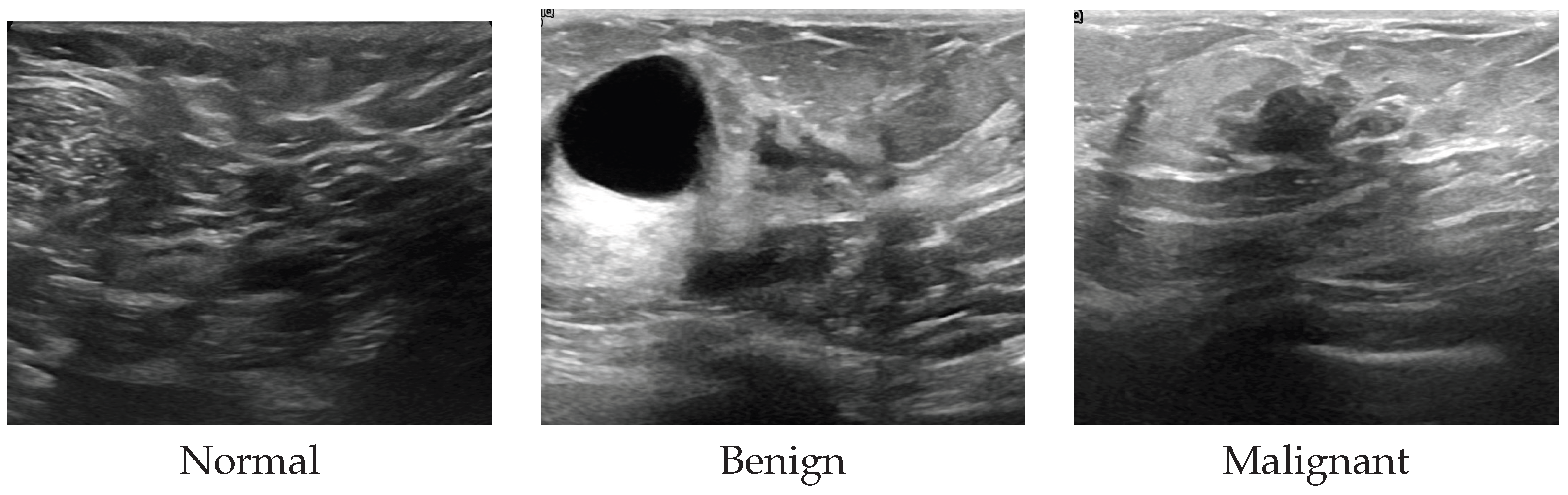
Figure 1. Representative breast ultrasound images showing normal tissue, benign lesions and malignant tumors.
Jimaging 12 00205 g001
Figure 2. Privacy-preserving federated learning framework for ultrasound breast cancer classification. N hospitals collaborate through a central FL server to train a global deep learning model. Differential privacy mechanisms protect patient data at each site during the model parameter exchange.
Jimaging 12 00205 g002
Figure 3. Accuracy comparison across all seven architectures for three classification tasks. Blue bars: centralized baseline; orange bars: best federated result (without DP); red bars: federated with DP ( C = 1.5 , η = 2.0 ). The gap between orange and red bars visualises the privacy cost for each architecture.
Jimaging 12 00205 g003
Table 1. Estimated privacy budgets ( ε ) for different noise multipliers ( η ) with δ = 10 5 , clipping bound C = 1.5 , over T 12 , 500 gradient steps per client. Both basic (linear) and advanced (sublinear, O ( T ) ) composition bounds are reported.
Noise Mult. η ε (Basic) ε ( O ( T ) )
0.5 > 10 5 1080
1.0 60,500 540
1.5 40,300 360
2.0 30,250 270
3.0 20,200 180
Table 2. Client-wise sample counts and class distributions under non-IID partitioning (Dirichlet α = 0.5 with log-normal quantity skew) for the three-class (normal/benign/malignant) scenario.
ClientTotalNormal (%)Benign (%)Malignant (%)
Client 1324738.534.227.3
Client 2254128.147.824.1
Client 3182322.439.538.1
Client 4210641.342.016.7
Client 5165245.240.614.2
Client 684730.738.430.9
Client 7193427.644.128.3
Client 8169735.943.520.6
Total15,84733.343.223.5
Table 3. Training hyperparameters for all federated learning experiments. FedProx and FedOpt parameters apply only to their respective algorithms.
CategoryHyperparameterValue
FL SetupCommunication rounds100
Local epochs5
Batch size32
Client participationFull ( K = 8 )
OptimizationOptimizerAdam
Learning rate 1 × 10 3
LR schedule × 0.1 at rounds 50, 80
FedProxProximal μ 0.01
FedOpt β 1 0.9
β 2 0.99
Server LR η s 0.01
PreprocessingInput size 224 × 224
CLAHE clip limit2.0
Noise kernel 3 × 3 Gaussian
Table 4. Model size and per-round communication cost for the seven evaluated architectures ( K = 8 clients, 32-bit parameters, full participation).
ArchitectureParameters (M)Comm. Cost/Round (MB)
MobileNetV23.4217.6
DenseNet-1218.0512.0
ResNet-5025.61638.4
ViT-small22.11414.4
CoAtNet25.01600.0
VGG16138.48857.6
VGG19143.79196.8
Table 5. Centralized results: normal vs. abnormal (binary classification). Bold values indicate the best result per metric.
ModelAccuracyF1PrecisionRecall
ResNet-5098.520.98520.98520.9852
VGG1698.180.98170.98170.9818
VGG1998.180.98180.98180.9818
MobileNetV297.270.97290.97310.9727
DenseNet-12198.750.98740.98740.9875
ViT-small97.270.97300.97360.9727
CoAtNet98.520.98520.98520.9852
Table 6. Centralized results: benign vs. malignant (binary classification). Bold values indicate the best result per metric.
ModelAccuracyF1PrecisionRecall
ResNet-5087.850.87660.87720.8785
VGG1687.310.87060.87190.8731
VGG1985.420.84730.85740.8542
MobileNetV281.910.81630.81570.8191
DenseNet-12185.690.84980.86100.8987
ViT-small87.170.86930.87040.8717
CoAtNet87.980.87910.87880.8798
Table 7. Centralized results: normal vs. benign vs. malignant (three-class classification). Bold values indicate the best result per metric.
ModelAccuracyF1PrecisionRecall
ResNet-5087.490.87230.87590.8749
VGG1689.650.89390.89620.8965
VGG1988.050.88080.88130.8805
MobileNetV283.390.83000.83430.8339
DenseNet-12190.330.90080.90640.9033
ViT-small88.050.87870.88150.8805
CoAtNet89.760.89760.89770.8976
Table 8. Federated learning results: normal vs. abnormal (binary). Bold values indicate the best result per metric within each FL algorithm block.
FL Algo.ModelAcc.F1Prec.Rec.
FedAvgResNet-5094.540.94520.94510.9454
VGG1697.160.97180.97210.9716
VGG1996.360.96470.96760.9636
MobileNetV294.310.94280.94250.9431
DenseNet-12198.520.98520.98520.9852
ViT-small98.290.98310.98350.9829
CoAtNet98.290.98280.98280.9829
FedProxResNet-5094.540.94470.94430.9454
VGG1697.040.97050.97060.9704
VGG1994.880.94810.94770.9488
MobileNetV293.970.93980.93990.9397
DenseNet-12198.520.98540.98590.9852
ViT-small98.290.98300.98300.9829
CoAtNet98.520.98520.98530.9852
FedOptResNet-5094.200.94210.94220.9420
VGG1697.160.97180.97230.9716
VGG1997.160.97190.97260.9716
MobileNetV293.520.93470.93430.9352
DenseNet-12198.070.98080.98110.9807
ViT-small98.290.98290.98290.9829
CoAtNet98.290.98290.98280.9829
Table 9. Federated learning results: benign vs. malignant (binary). Bold values indicate the best result per metric within each FL algorithm block.
FL Algo.ModelAcc.F1Prec.Rec.
FedAvgResNet-5089.190.89100.89150.8919
VGG1688.280.88090.88200.8828
VGG1988.400.88270.88670.8840
MobileNetV288.620.88530.88530.8862
DenseNet-12189.650.89460.89770.8965
ViT-small88.510.88330.88470.8851
CoAtNet88.850.88630.88900.8885
FedProxResNet-5088.400.88210.88690.8840
VGG1688.510.88290.88580.8851
VGG1988.740.88620.88650.8874
MobileNetV288.170.88120.88130.8817
DenseNet-12187.940.87760.88080.8794
ViT-small89.990.89880.89980.8999
CoAtNet88.170.88090.88060.8817
FedOptResNet-5088.400.88360.88340.8840
VGG1688.400.88120.88660.8840
VGG1988.280.88240.88220.8828
MobileNetV288.280.88110.88150.8828
DenseNet-12188.510.88540.88600.8851
ViT-small88.960.88910.88900.8896
CoAtNet89.190.88930.89540.8919
Table 10. Federated learning results: normal vs. benign vs. malignant (three-class). Bold values indicate the best result per metric within each FL algorithm block.
FL Algo.ModelAcc.F1Prec.Rec.
FedAvgResNet-5076.450.75280.78130.7645
VGG1686.010.85810.85800.8601
VGG1984.300.84000.84060.8430
MobileNetV267.350.61130.65830.6735
DenseNet-12186.460.86180.86430.8646
ViT-small89.080.88910.89040.8908
CoAtNet87.140.86870.87060.8714
FedProxResNet-5075.430.73660.76820.7543
VGG1685.100.84810.85030.8510
VGG1984.530.84390.84400.8453
MobileNetV267.240.60360.66700.6724
DenseNet-12186.920.86550.87180.8692
ViT-small87.710.87510.87650.8771
CoAtNet87.370.87270.87540.8737
FedOptResNet-5076.560.75350.77290.7656
VGG1682.510.84950.85320.8521
VGG1985.050.82730.82810.8305
MobileNetV266.440.59150.63630.6644
DenseNet-12187.030.86800.86970.8703
ViT-small89.530.89410.89470.8953
CoAtNet88.510.88460.88430.8851
Table 11. Summary of best federated accuracy (across FedAvg, FedProx, FedOpt) vs. centralized baseline for each architecture and task. Δ = Best FL Centralized (positive values indicate FL improvement). Bold Δ values indicate cases where FL matches or exceeds the centralized baseline.
Normal/AbnormalBenign/MalignantThree-Class
Model Cent. Best FL Δ Cent. Best FL Δ Cent. Best FL Δ
ResNet-5098.5294.54−3.9887.8589.19+1.3487.4976.56−10.93
VGG1698.1897.16−1.0287.3188.51+1.2089.6586.01−3.64
VGG1998.1897.16−1.0285.4288.74+3.3288.0585.05−3.00
MobileNetV297.2794.31−2.9681.9188.62+6.7183.3967.35−16.04
DenseNet-12198.7598.52−0.2385.6989.65+3.9690.3387.03−3.30
ViT-small97.2798.29+1.0287.1789.99+2.8288.0589.53+1.48
CoAtNet98.5298.52+0.0087.9889.19+1.2189.7688.51−1.25
Table 12. FedAvg with differential privacy: normal vs. abnormal ( C = 1.5 , η = 2.0 , δ = 10 5 ). Bold values indicate the best result per metric.
ModelAccuracyF1PrecisionRecall
ResNet-5049.940.56700.72950.4994
VGG1684.180.77360.75480.8418
VGG1985.770.83000.83350.8577
MobileNetV270.300.72250.74620.7030
DenseNet-12183.610.77930.76600.8361
ViT-small85.090.83350.82830.8509
CoAtNet76.220.77690.79980.7622
Table 13. FedAvg with differential privacy: benign vs. malignant ( C = 1.5 , η = 2.0 , δ = 10 5 ). Bold values indicate the best result per metric.
ModelAccuracyF1PrecisionRecall
ResNet-5063.560.61090.60290.6356
VGG1668.420.62170.66800.6842
VGG1966.660.57190.58410.6666
MobileNetV249.250.49780.61910.4925
DenseNet-12142.780.43730.53380.4278
ViT-small60.050.58300.57310.6005
CoAtNet50.740.52200.60230.5074
Table 14. FedAvg with differential privacy: normal vs. benign vs. malignant ( C = 1.5 , η = 2.0 , δ = 10 5 ). Bold values indicate the best result per metric.
ModelAccuracyF1PrecisionRecall
ResNet-5038.450.35890.48840.3845
VGG1649.710.45930.44490.4971
VGG1954.830.45500.44470.5483
MobileNetV236.630.36560.45420.3663
DenseNet-12151.420.42680.36520.5142
ViT-small49.940.46740.45290.4994
CoAtNet39.020.41180.50290.3902
Table 15. DenseNet-121 ablation study: effect of clipping bound C and noise multiplier η on normal vs. abnormal classification under FedAvg with client-side DP ( δ = 10 5 ).
Clip CNoise η AccuracyF1PrecisionRecall
0.50.584.520.77810.86930.8453
1.084.410.77740.81670.8441
1.584.070.77620.77120.8418
2.083.610.77500.75410.8361
3.082.590.77400.74940.8259
1.00.584.410.77800.80690.8441
1.084.410.77620.81670.8441
1.584.070.77620.77120.8407
2.083.610.77510.75410.8361
3.082.480.77600.75280.8248
1.50.584.300.77620.79040.8430
1.084.300.77740.79110.8430
1.584.180.77680.77970.8418
2.083.610.77930.76600.8361
3.082.020.77130.74480.8202
2.00.584.520.77800.86920.8452
1.084.410.77800.81670.8441
1.584.300.77740.79110.8430
2.083.730.77680.76080.8373
3.082.360.77530.75150.8236
Disclaimer/Publisher’s Note: The statements, opinions and data contained in all publications are solely those of the individual author(s) and contributor(s) and not of MDPI and/or the editor(s). MDPI and/or the editor(s) disclaim responsibility for any injury to people or property resulting from any ideas, methods, instructions or products referred to in the content.