


Current Trends and Future Prospects of Radiomics and Machine Learning (ML) Models in Spinal Tumors—A Narrative Review
 ,
,  , , and
Abstract
1. Introduction
2. Materials and Methods
3. Artificial Intelligence, Machine Learning, and Radiomics: Introduction and Theory
3.1. Machine Learning Model Types
3.2. Types of Algorithms
3.3. Radiomics
3.4. Segmentation (Utilizing Radiomics and Machine Learning)
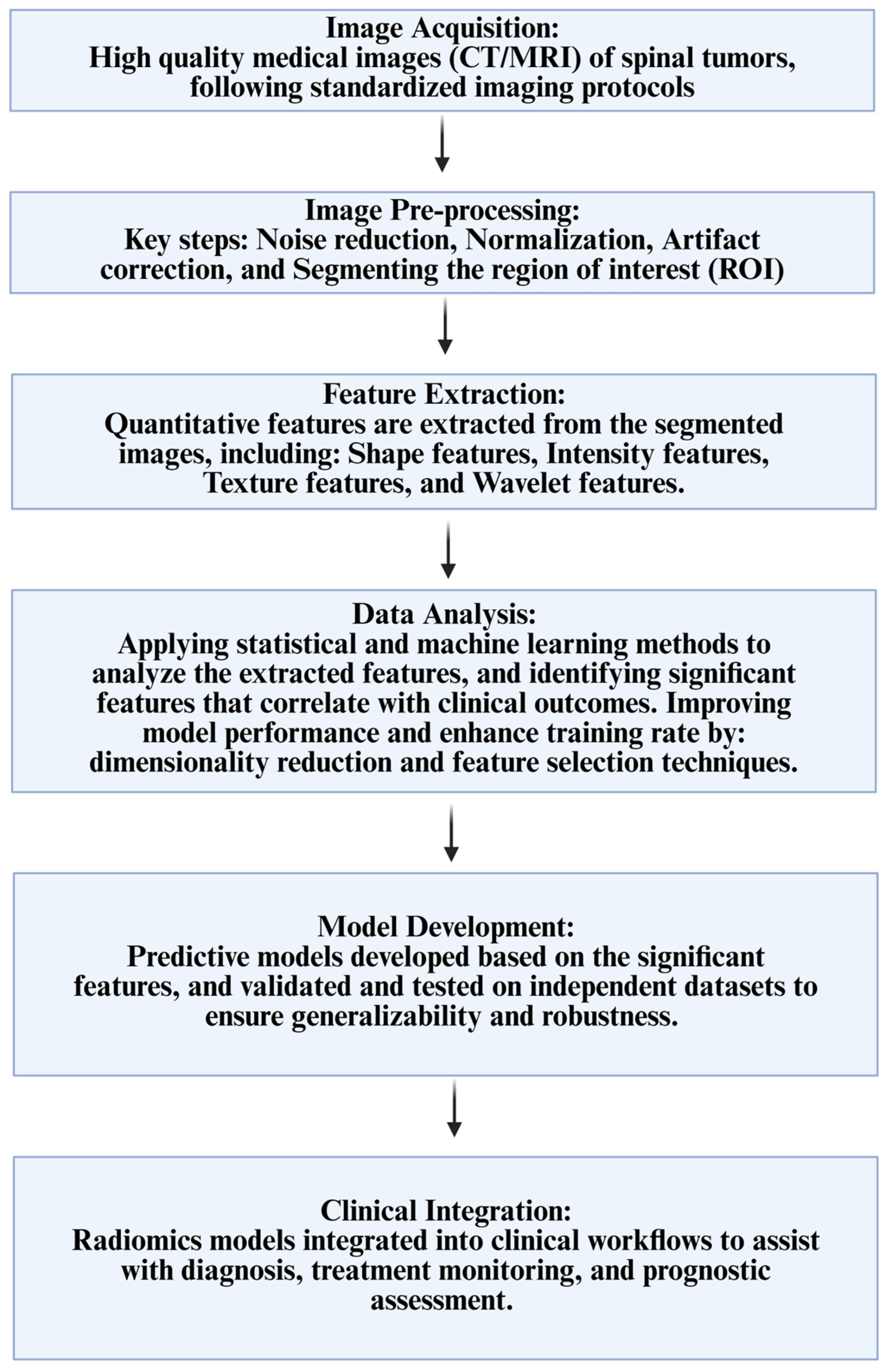
4. Workflow Proposed for Radiomics and ML Applications to Spinal Cord Tumors
4.1. Proposed Features for Radiomics Analysis
4.1.1. Shape Features
- -
- Volume: Represents the total size of the tumor in three-dimensional space, calculated by summing the volumes of all voxels within the ROI. This would provide clinicians with an understanding of the size of a tumor.
- -
- Surface Area: Measures the total area of the outer surface of the tumor, providing insights into its boundary complexity and surgical planning.
- -
- Compactness: A dimensionless measure indicating how closely packed the tumor cells are, defined as the ratio of the tumor volume to the volume of a sphere with the same surface area.
- -
- Sphericity: A dimensionless feature describing the roundness of the tumor. This measure, alongside compactness, may provide more information about tumor growth.
4.1.2. Texture Features
- -
- GLCM (Gray-Level Co-Occurrence Matrix): This includes metrics like contrast, correlation, energy, and homogeneity, potentially providing more insight into tumor types or stages.
- -
- GLRLM (Gray-Level Run Length Matrix): Measures the length of consecutive pixels with the same gray-level value, reflecting texture roughness and smoothness, potentially providing some clues into distinguishing benign versus malignant tumors.
- -
- NGTDM (Neighborhood Gray-Tone Difference Matrix): Assesses the difference between a pixel and its neighbors, capturing texture variations by evaluating parameters like coarseness, contrast, and busyness, providing more information about tumor aggressiveness.
4.1.3. Intensity Features
- -
- Mean Intensity: The average intensity value of the pixels within the ROI, providing more information about the tissue of interest.
- -
- Median Intensity: The middle value of the intensity distribution, providing a robust measure less affected by outliers, also providing information about tissue.
- -
- Standard Deviation: Reflects the variation in pixel intensity, indicating the heterogeneity within the ROI. Heterogeneity may provide information about tumor malignancy.
- -
- Skewness: Measures the asymmetry of the intensity distribution, indicating whether the pixel values are more concentrated on one side of the mean.
4.1.4. Wavelet Features
- -
- High and Low-Frequency Components: Represent the detailed and approximate information within the image, respectively, providing more information about tumor characteristics.
- -
- Wavelet Decomposition Coefficients: Provide multi-scale information about the image, essential for identifying patterns and structures at different levels of resolution.
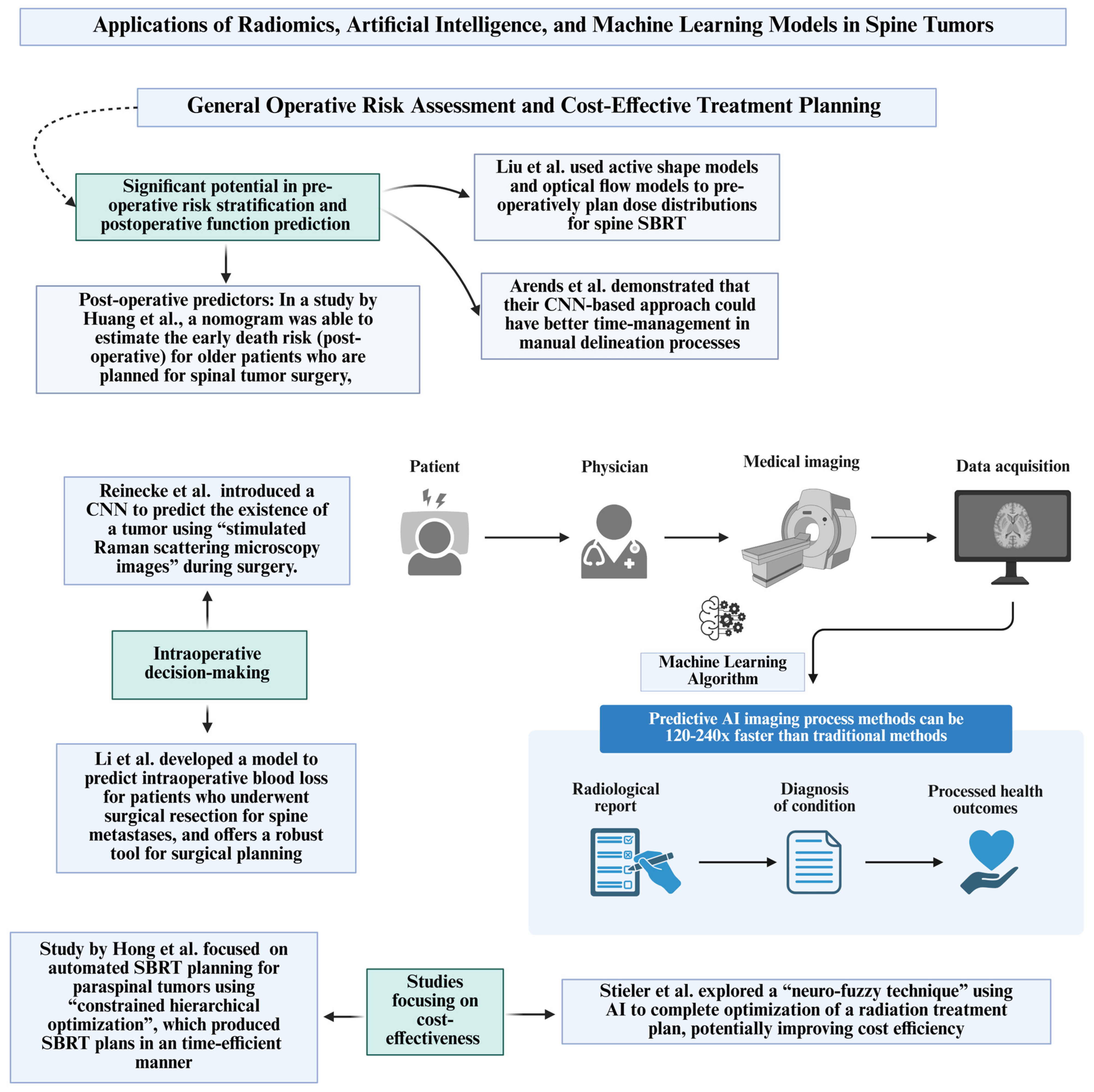
5. Applications of Radiomics, Artificial Intelligence, and Machine Learning Models in Spine Tumors
5.1. General Operative Risk Assessment and Cost-Effective Treatment Planning
5.2. General Spinal Tumor Predictive Modeling for Treatment, Outcomes, and Prognosis
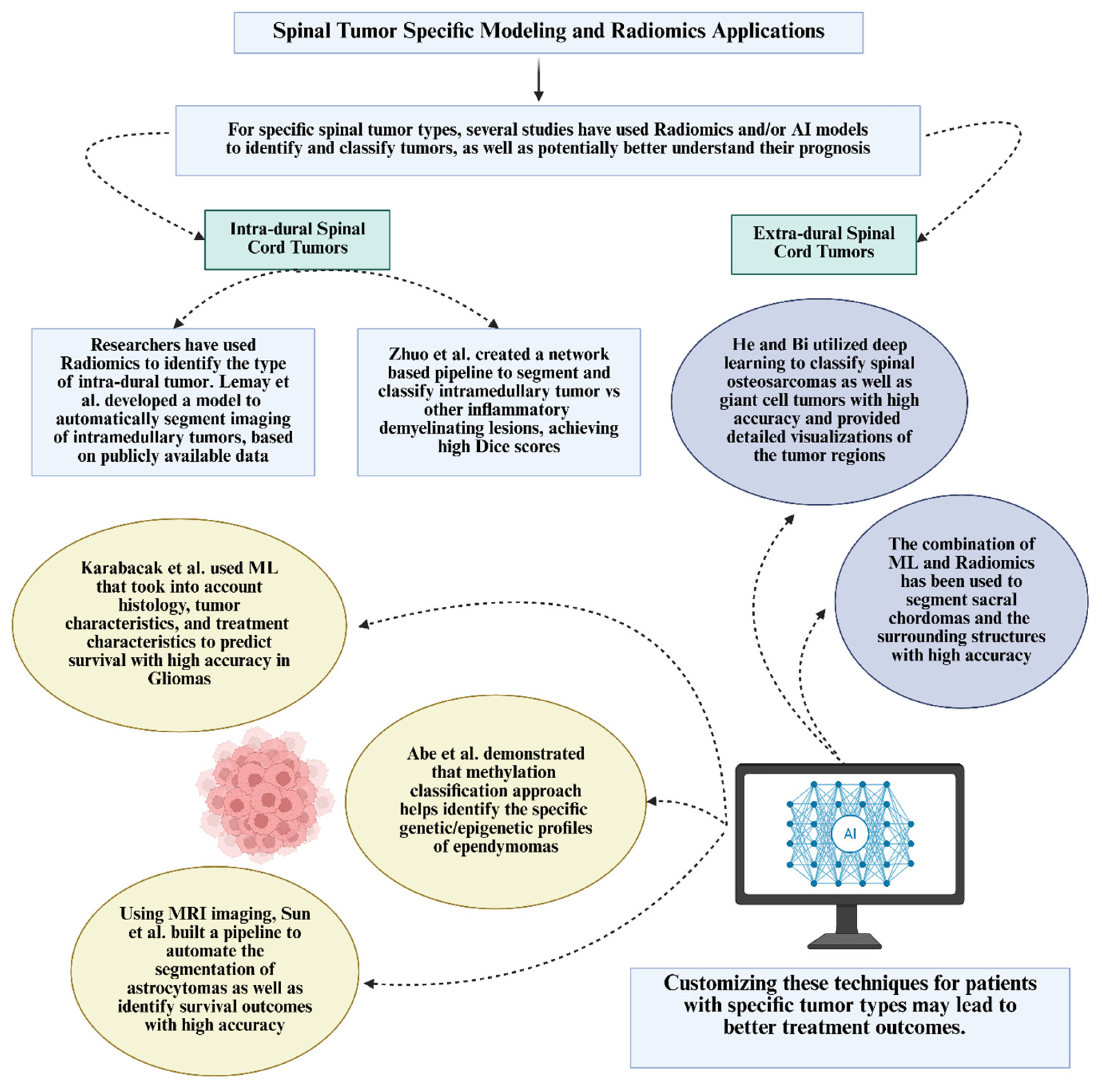
5.3. Spinal Tumor Specific Modeling and Radiomics Applications
5.3.1. Intradural Spinal Cord Tumors
5.3.2. Extradural Spinal Tumors
5.3.3. Spinal Metastases
6. Future Directions
- -
- Diagnostics: Utilizing radiomics in medical imaging can provide a more robust number of quantitative features that may help in tumor detection and diagnostics [65]. For example, implementing radiomics in standard radiologist clinical workflows can help understand what quantitative features correlate to particular tumor diagnoses and prognoses.
- -
- Personalized Treatment: Incorporation of radiomics with other clinical characteristics, such as genomic information, can lead to more specific and patient-specific treatment plans, potentially improving treatment outcomes [66]. Creating public repositories of genetic, imaging, and clinical information can lead to more robust machine learning algorithms. The diversity of data used to train these algorithms may lead to more accurate predictions and reveal insights into tumor biology.
- -
- Real-Time Monitoring and Treatment: Incorporation of radiomics in real-time, with the power of vast computational analysis, may allow physicians to adjust patient management in real-time. In this way, patient treatment plans can be updated based on the most recent available clinical results, potentially improving patient outcomes.
- -
- Automation and Accessibility: Automation incorporating radiomics has been shown to be useful within the diagnostics of brain tumors [67]. Further research in this field could improve healthcare accessibility and efficiency [67]. This may be most needed out of all the future directions, as better automation and computational processing power in medical centers are integral to clinical implementation of artificial intelligence applications.
7. Conclusions
Author Contributions
Funding
Institutional Review Board Statement
Informed Consent Statement
Data Availability Statement
Conflicts of Interest
References
- Kumar, N.; Tan, W.L.B.; Wei, W.; Vellayappan, B.A. An overview of the tumors affecting the spine—Inside to out. Neuro-Oncol. Pract. 2020, 7, i10–i17. [Google Scholar] [CrossRef]
- Lemay, A.; Gros, C.; Zhuo, Z.; Zhang, J.; Duan, Y.; Cohen-Adad, J.; Liu, Y. Automatic multiclass intramedullary spinal cord tumor segmentation on MRI with deep learning. NeuroImage Clin. 2021, 31, 102766. [Google Scholar] [CrossRef]
- Koeller, K.K.; Shih, R.Y. Intradural Extramedullary Spinal Neoplasms: Radiologic-Pathologic Correlation. Radiogr. Rev. Publ. Radiol. Soc. N. Am. Inc. 2019, 39, 468–490. [Google Scholar] [CrossRef] [PubMed]
- Hallinan, J.T.P.D.; Zhu, L.; Zhang, W.; Lim, D.S.W.; Baskar, S.; Low, X.Z.; Yeong, K.Y.; Teo, E.C.; Kumarakulasinghe, N.B.; Yap, Q.V.; et al. Deep Learning Model for Classifying Metastatic Epidural Spinal Cord Compression on MRI. Front. Oncol. 2022, 12, 849447. [Google Scholar] [CrossRef] [PubMed]
- Yao, J.; Burns, J.E.; Sanoria, V.; Summers, R.M. Mixed spine metastasis detection through positron emission tomography/computed tomography synthesis and multiclassifier. J. Med. Imaging 2017, 4, 024504. [Google Scholar] [CrossRef] [PubMed]
- Zhuo, Z.; Zhang, J.; Duan, Y.; Qu, L.; Feng, C.; Huang, X.; Cheng, D.; Xu, X.; Sun, T.; Li, Z.; et al. Automated Classification of Intramedullary Spinal Cord Tumors and Inflammatory Demyelinating Lesions Using Deep Learning. Radiol. Artif. Intell. 2022, 4, e210292. [Google Scholar] [CrossRef]
- Chen, K.; Cao, J.; Zhang, X.; Wang, X.; Zhao, X.; Li, Q.; Chen, S.; Wang, P.; Liu, T.; Du, J.; et al. Differentiation between spinal multiple myeloma and metastases originated from lung using multi-view attention-guided network. Front. Oncol. 2022, 12, 981769. [Google Scholar] [CrossRef]
- Cheng, Y.; Wang, H.; Yuan, W.; Wang, H.; Zhu, Y.; Chen, H.; Jiang, W. Combined radiomics of primary tumour and bone metastasis improve the prediction of EGFR mutation status and response to EGFR-TKI therapy for NSCLC. Phys. Med. 2023, 116, 103177. [Google Scholar] [CrossRef]
- Zhao, S.; Chen, B.; Chang, H.; Chen, B.; Li, S. Reasoning discriminative dictionary-embedded network for fully automatic vertebrae tumor diagnosis. Med. Image Anal. 2022, 79, 102456. [Google Scholar] [CrossRef]
- Sarker, I.H. Machine Learning: Algorithms, Real-World Applications and Research Directions. SN Comput. Sci. 2021, 2, 160. [Google Scholar] [CrossRef]
- Galbusera, F.; Casaroli, G.; Bassani, T. Artificial intelligence and machine learning in spine research. JOR Spine 2019, 2, e1044. [Google Scholar] [CrossRef] [PubMed]
- Li, J.; Zhang, J.; Zhang, X.; Lun, D.; Li, R.; Ma, R.; Hu, Y. Quantile regression-based prediction of intraoperative blood loss in patients with spinal metastases: Model development and validation. Eur. Spine J. 2023, 32, 2479–2492. [Google Scholar] [CrossRef] [PubMed]
- Alloghani, M.; Al-Jumeily, D.; Mustafina, J.; Hussain, A.; Aljaaf, A.J. A Systematic Review on Supervised and Unsupervised Machine Learning Algorithms for Data Science. In Supervised and Unsupervised Learning for Data Science; Berry, M.W., Mohamed, A., Yap, B.W., Eds.; Springer International Publishing: Berlin/Heidelberg, Germany, 2020; pp. 3–21. [Google Scholar] [CrossRef]
- van Engelen, J.E.; Hoos, H.H. A survey on semi-supervised learning. Mach. Learn. 2020, 109, 373–440. [Google Scholar] [CrossRef]
- Arulkumaran, K.; Deisenroth, M.P.; Brundage, M.; Bharath, A.A. Deep Reinforcement Learning: A Brief Survey. IEEE Signal Process. Mag. 2017, 34, 26–38. [Google Scholar] [CrossRef]
- Agatonovic-Kustrin, S.; Beresford, R. Basic concepts of artificial neural network (ANN) modeling and its application in pharmaceutical research. J. Pharm. Biomed. Anal. 2000, 22, 717–727. [Google Scholar] [CrossRef]
- Alzubaidi, L.; Zhang, J.; Humaidi, A.J.; Al-Dujaili, A.; Duan, Y.; Al-Shamma, O.; Santamaría, J.; Fadhel, M.A.; Al-Amidie, M.; Farhan, L. Review of deep learning: Concepts, CNN architectures, challenges, applications, future directions. J. Big Data 2021, 8, 53. [Google Scholar] [CrossRef]
- Arends, S.R.S.; Savenije, M.H.F.; Eppinga, W.S.C.; van der Velden, J.M.; van den Berg, C.A.T.; Verhoeff, J.J.C. Clinical utility of convolutional neural networks for treatment planning in radiotherapy for spinal metastases. Phys. Imaging Radiat. Oncol. 2022, 21, 42–47. [Google Scholar] [CrossRef]
- Mountrakis, G.; Im, J.; Ogole, C. Support vector machines in remote sensing: A review. ISPRS J. Photogramm. Remote Sens. 2011, 66, 247–259. [Google Scholar] [CrossRef]
- Kotsiantis, S.B. Decision trees: A recent overview. Artif. Intell. Rev. 2013, 39, 261–283. [Google Scholar] [CrossRef]
- Massaad, E.; Williams, N.; Hadzipasic, M.; Patel, S.S.; Fourman, M.S.; Kiapour, A.; Schoenfeld, A.J.; Shankar, G.M.; Shin, J.H. Performance assessment of the metastatic spinal tumor frailty index using machine learning algorithms: Limitations and future directions. Neurosurg. Focus 2021, 50, E5. [Google Scholar] [CrossRef]
- Lambin, P.; Leijenaar, R.T.H.; Deist, T.M.; Peerlings, J.; de Jong, E.E.C.; van Timmeren, J.; Sanduleanu, S.; Larue, R.T.H.M.; Even, A.J.G.; Jochems, A.; et al. Radiomics: The bridge between medical imaging and personalized medicine. Nat. Rev. Clin. Oncol. 2017, 14, 749–762. [Google Scholar] [CrossRef]
- Liu, Z.; Wang, S.; Dong, D.; Wei, J.; Fang, C.; Zhou, X.; Sun, K.; Li, L.; Li, B.; Wang, M.; et al. The Applications of Radiomics in Precision Diagnosis and Treatment of Oncology: Opportunities and Challenges. Theranostics 2019, 9, 1303–1322. [Google Scholar] [CrossRef] [PubMed]
- Qu, B.; Cao, J.; Qian, C.; Wu, J.; Lin, J.; Wang, L.; Ou-Yang, L.; Chen, Y.; Yan, L.; Hong, Q.; et al. Current development and prospects of deep learning in spine image analysis: A literature review. Quant. Imaging Med. Surg. 2022, 12, 3454–3479. [Google Scholar] [CrossRef] [PubMed]
- Lohmann, P.; Galldiks, N.; Kocher, M.; Heinzel, A.; Filss, C.P.; Stegmayr, C.; Mottaghy, F.M.; Fink, G.R.; Shah, N.J.; Langen, K.-J. Radiomics in neuro-oncology: Basics, workflow, and applications. Methods 2021, 188, 112–121. [Google Scholar] [CrossRef] [PubMed]
- Beig, N.; Bera, K.; Tiwari, P. Introduction to radiomics and radiogenomics in neuro-oncology: Implications and challenges. Neuro-Oncol. Adv. 2020, 2, iv3–iv14. [Google Scholar]
- Ibrahim, A.; Primakov, S.; Beuque, M.; Woodruff, H.; Halilaj, I.; Wu, G.; Refaee, T.; Granzier, R.; Widaatalla, Y.; Hustinx, R.; et al. Radiomics for precision medicine: Current challenges, future prospects, and the proposal of a new framework. Methods 2021, 188, 20–29. [Google Scholar] [CrossRef]
- Scapicchio, C.; Gabelloni, M.; Barucci, A.; Cioni, D.; Saba, L.; Neri, E. A deep look into radiomics. Radiol. Med. 2021, 126, 1296–1311. [Google Scholar] [CrossRef]
- Zwanenburg, A.; Vallières, M.; Abdalah, M.A.; Aerts, H.J.W.L.; Andrearczyk, V.; Apte, A.; Ashrafinia, S.; Bakas, S.; Beukinga, R.J.; Boellaard, R.; et al. The Image Biomarker Standardization Initiative: Standardized Quantitative Radiomics for High-Throughput Image-based Phenotyping. Radiology 2020, 295, 328–338. [Google Scholar] [CrossRef]
- Huang, Z.; Zhao, Z.; Liu, Y.; Zhou, Z.; Zhang, W.; Kong, Q.; He, Y. A Simple-to-Use Nomogram for Predicting Postoperative Early Death Risk in Elderly Patients with Spinal Tumors: A Population-Based Study. J. Oncol. 2023, 2023, 2805786. [Google Scholar] [CrossRef]
- Liu, J.; Wu, Q.J.; Kirkpatrick, J.P.; Yin, F.F.; Yuan, L.; Ge, Y. From active shape model to active optical flow model: A shape-based approach to predicting voxel-level dose distributions in spine SBRT. Phys. Med. Biol. 2015, 60, N83. [Google Scholar] [CrossRef]
- Roggen, T.; Bobic, M.; Givehchi, N.; Scheib, S.G. Deep Learning model for markerless tracking in spinal SBRT. Phys. Med. 2020, 74, 66–73. [Google Scholar] [CrossRef] [PubMed]
- Kowalchuk, R.O.; Mullikin, T.C.; Florez, M.; De, B.S.; Spears, G.M.; Rose, P.S.; Siontis, B.L.; Kim, D.K.; Costello, B.A.; Morris, J.M.; et al. Development and validation of a recursive partitioning analysis–based pretreatment decision-making tool identifying ideal candidates for spine stereotactic body radiation therapy. Cancer 2023, 129, 956–965. [Google Scholar] [CrossRef] [PubMed]
- Netherton, T.J.; Nguyen, C.; Cardenas, C.E.; Chung, C.; Klopp, A.H.; Colbert, L.E.; Rhee, D.J.; Peterson, C.B.; Howell, R.; Balter, P.; et al. An Automated Treatment Planning Framework for Spinal Radiation Therapy and Vertebral-Level Second Check. Int. J. Radiat. Oncol. 2022, 114, 516–528. [Google Scholar] [CrossRef] [PubMed]
- Hong, L.; Zhou, Y.; Yang, J.; Mechalakos, J.G.; Hunt, M.A.; Mageras, G.S.; Yang, J.; Yamada, J.; Deasy, J.O.; Zarepisheh, M. Clinical Experience of Automated SBRT Paraspinal and Other Metastatic Tumor Planning With Constrained Hierarchical Optimization. Adv. Radiat. Oncol. 2020, 5, 1042–1050. [Google Scholar] [CrossRef]
- Stieler, F.; Yan, H.; Lohr, F.; Wenz, F.; Yin, F.F. Development of a neuro-fuzzy technique for automated parameter optimization of inverse treatment planning. Radiat. Oncol. 2009, 4, 39. [Google Scholar] [CrossRef]
- Reinecke, D.; von Spreckelsen, N.; Mawrin, C.; Ion-Margineanu, A.; Fürtjes, G.; Jünger, S.T.; Khalid, F.; Freudiger, C.W.; Timmer, M.; Ruge, M.I.; et al. Novel rapid intraoperative qualitative tumor detection by a residual convolutional neural network using label-free stimulated Raman scattering microscopy. Acta Neuropathol. Commun. 2022, 10, 109. [Google Scholar] [CrossRef]
- Schoenfeld, A.J.; Ferrone, M.L.; Schwab, J.H.; Blucher, J.A.; Barton, L.B.; Harris, M.B.; Kang, J.D. Prognosticating outcomes and survival for patients with lumbar spinal metastases: Results of a bayesian regression analysis. Clin. Neurol. Neurosurg. 2019, 181, 98–103. [Google Scholar] [CrossRef]
- DiSilvestro, K.J.; Veeramani, A.; McDonald, C.L.; Zhang, A.S.; Kuris, E.O.; Durand, W.M.; Cohen, E.M.; Daniels, A.H. Predicting Postoperative Mortality After Metastatic Intraspinal Neoplasm Excision: Development of a Machine-Learning Approach. World Neurosurg. 2021, 146, e917–e924. [Google Scholar] [CrossRef]
- Balagamwala, E.H.; Miller, J.A.; Reddy, C.A.; Angelov, L.; Suh, J.H.; Tariq, M.B.; Murphy, E.S.; Yang, K.; Djemil, T.; Magnelli, A.; et al. Recursive partitioning analysis is predictive of overall survival for patients undergoing spine stereotactic radiosurgery. J. Neurooncol. 2018, 137, 289–293. [Google Scholar] [CrossRef]
- Gasbarrini, A.; Li, H.; Cappuccio, M.; Mirabile, L.; Paderni, S.; Terzi, S.; Boriani, S. Efficacy Evaluation of a New Treatment Algorithm for Spinal Metastases. Spine 2010, 35, 1466. [Google Scholar] [CrossRef]
- Shahrestani, S.; Bakhsheshian, J.; Solaru, S.; Ton, A.; Ballatori, A.M.; Chen, X.T.; Ariani, R.; Hsieh, P.; Buser, Z.; Wang, J.C. Inclusion of Frailty Improves Predictive Modeling for Postoperative Outcomes in Surgical Management of Primary and Secondary Lumbar Spine Tumors. World Neurosurg. 2021, 153, e454–e463. [Google Scholar] [CrossRef]
- Kassicieh, C.S.; Kassicieh, A.J.; Rumalla, K.; Courville, E.N.; Cole, K.L.; Kazim, S.F.; Bowers, C.A.; Schmidt, M.H. Hospital-acquired infection following spinal tumor surgery: A frailty-driven pre-operative risk model. Clin. Neurol. Neurosurg. 2023, 225, 107591. [Google Scholar] [CrossRef]
- Gao, L.; Cao, Y.; Cao, X.; Shi, X.; Lei, M.; Su, X.; Liu, Y. Machine learning-based algorithms to predict severe psychological distress among cancer patients with spinal metastatic disease. Spine J. 2023, 23, 1255–1269. [Google Scholar] [CrossRef]
- Gui, C.; Chen, X.; Sheikh, K.; Mathews, L.; Lo, S.-F.L.; Le, J.; Khan, M.A.; Sciubba, D.M.; Redmond, K.J. Radiomic modeling to predict risk of vertebral compression fracture after stereotactic body radiation therapy for spinal metastases. J. Neurosurg. Spine 2021, 36, 294–302. [Google Scholar] [CrossRef] [PubMed]
- Sanli, I.; Osong, B.; Dekker, A.; TerHaag, K.; van Kuijk, S.; van Soest, J.; Wee, L.; Willems, P. Radiomics biopsy signature for predicting survival in patients with spinal bone metastases (SBMs). Clin. Transl. Radiat. Oncol. 2022, 33, 57–65. [Google Scholar] [CrossRef] [PubMed]
- Karabacak, M.; Schupper, A.J.; Carr, M.T.; Bhimani, A.D.; Steinberger, J.; Margetis, K. Development and internal validation of machine learning models for personalized survival predictions in spinal cord glioma patients. Spine J. 2024, 24, 1065–1076. [Google Scholar] [CrossRef] [PubMed]
- Sun, T.; Wang, Y.; Liu, X.; Li, Z.; Zhang, J.; Lu, J.; Qu, L.; Haller, S.; Duan, Y.; Zhuo, Z.; et al. Deep learning based on preoperative magnetic resonance (MR) images improves the predictive power of survival models in primary spinal cord astrocytomas. Neuro-Oncol. 2023, 25, 1157–1165. [Google Scholar] [CrossRef]
- Abe, E.; Suzuki, M.; Ichimura, K.; Arakawa, A.; Satomi, K.; Ogino, I.; Hara, T.; Iwamuro, H.; Ohara, Y.; Kondo, A. Implications of DNA Methylation Classification in Diagnosing Ependymoma. World Neurosurg. 2024, 185, e1019–e1029. [Google Scholar] [CrossRef]
- He, J.; Bi, X. Automatic classification of spinal osteosarcoma and giant cell tumor of bone using optimized DenseNet. J. Bone Oncol. 2024, 46, 100606. [Google Scholar] [CrossRef]
- Yamazawa, E.; Takahashi, S.; Shin, M.; Tanaka, S.; Takahashi, W.; Nakamoto, T.; Suzuki, Y.; Takami, H.; Saito, N. MRI-Based Radiomics Differentiates Skull Base Chordoma and Chondrosarcoma: A Preliminary Study. Cancers 2022, 14, 3264. [Google Scholar] [CrossRef]
- Boussioux, L.; Ma, Y.; Thomas, N.K.; Bertsimas, D.; Shusharina, N.; Pursley, J.; Chen, Y.-L.; DeLaney, T.F.; Qian, J.; Bortfeld, T. Automated Segmentation of Sacral Chordoma and Surrounding Muscles Using Deep Learning Ensemble. Int. J. Radiat. Oncol. 2023, 117, 738–749. [Google Scholar] [CrossRef] [PubMed]
- Anderson, E.; Havener, T.M.; Zorn, K.M.; Foil, D.H.; Lane, T.R.; Capuzzi, S.J.; Morris, D.; Hickey, A.J.; Drewry, D.H.; Ekins, S. Synergistic drug combinations and machine learning for drug repurposing in chordoma. Sci. Rep. 2020, 10, 12982. [Google Scholar] [CrossRef] [PubMed]
- Chmelik, J.; Jakubicek, R.; Walek, P.; Jan, J.; Ourednicek, P.; Lambert, L.; Amadori, E.; Gavelli, G. Deep convolutional neural network-based segmentation and classification of difficult to define metastatic spinal lesions in 3D CT data. Med. Image Anal. 2018, 49, 76–88. [Google Scholar] [CrossRef] [PubMed]
- Karabay, N.; Odaman, H.; Vahaplar, A.; Kizmazoglu, C.; Kalemci, O. MRI-based Texture Analysis in Differentiation of Benign and Malignant Vertebral Compression Fractures. Curr. Med. Imaging 2024, 20, e15734056290762. [Google Scholar] [CrossRef]
- Li, S.; Yu, X.; Shi, R.; Zhu, B.; Zhang, R.; Kang, B.; Liu, F.; Zhang, S.; Wang, X. MRI-based radiomics nomogram for differentiation of solitary metastasis and solitary primary tumor in the spine. BMC Med. Imaging 2023, 23, 29. [Google Scholar] [CrossRef]
- Cao, J.; Li, Q.; Zhang, H.; Wu, Y.; Wang, X.; Ding, S.; Chen, S.; Xu, S.; Duan, G.; Qiu, D.; et al. Radiomics model based on MRI to differentiate spinal multiple myeloma from metastases: A two-center study. J. Bone Oncol. 2024, 45, 100599. [Google Scholar] [CrossRef]
- Karhade, A.V.; Thio, Q.C.B.S.; Ogink, P.T.; Bono, C.M.; Ferrone, M.L.; Oh, K.S.; Saylor, P.J.; Schoenfeld, A.J.; Shin, J.H.; Harris, M.B.; et al. Predicting 90-Day and 1-Year Mortality in Spinal Metastatic Disease: Development and Internal Validation. Neurosurgery 2019, 85, E671. [Google Scholar] [CrossRef]
- Zhong, G.; Cheng, S.; Zhou, M.; Xie, J.; Xu, Z.; Lai, H.; Yan, Y.; Xie, Z.; Zhou, J.; Xie, X.; et al. External validation of the SORG machine learning algorithms for predicting 90-day and 1-year survival of patients with lung cancer-derived spine metastases: A recent bi-center cohort from China. Spine J. 2023, 23, 731–738. [Google Scholar] [CrossRef]
- Shi, X.; Cui, Y.; Wang, S.; Pan, Y.; Wang, B.; Lei, M. Development and validation of a web-based artificial intelligence prediction model to assess massive intraoperative blood loss for metastatic spinal disease using machine learning techniques. Spine J. 2024, 24, 146–160. [Google Scholar] [CrossRef]
- Jiang, T.; Sun, X.; Dong, Y.; Guo, W.; Wang, H.; Yue, Z.; Luo, Y.; Jiang, X. Deep learning for preoperative prediction of the EGFR mutation and subtypes based on the MRI image of spinal metastasis from primary NSCLC. Biomed. Signal Process. Control 2023, 79, 104084. [Google Scholar] [CrossRef]
- Ren, M.; Yang, H.; Lai, Q.; Shi, D.; Liu, G.; Shuang, X.; Su, J.; Xie, L.; Dong, Y.; Jiang, X. MRI-based radiomics analysis for predicting the EGFR mutation based on thoracic spinal metastases in lung adenocarcinoma patients. Med. Phys. 2021, 48, 5142–5151. [Google Scholar] [CrossRef]
- Cao, R.; Chen, H.; Wang, H.; Wang, Y.; Cui, E.-N.; Jiang, W. Comprehensive analysis of prediction of the EGFR mutation and subtypes based on the spinal metastasis from primary lung adenocarcinoma. Front. Oncol. 2023, 13, 1154327. [Google Scholar] [CrossRef]
- Maleki Varnosfaderani, S.; Forouzanfar, M. The Role of AI in Hospitals and Clinics: Transforming Healthcare in the 21st Century. Bioengineering 2024, 11, 337. [Google Scholar] [CrossRef]
- Wei, P. Radiomics, deep learning and early diagnosis in oncology. Emerg. Top. Life Sci. 2021, 5, 829–835. [Google Scholar] [CrossRef]
- Zanfardino, M.; Franzese, M.; Pane, K.; Cavaliere, C.; Monti, S.; Esposito, G.; Salvatore, M.; Aiello, M. Bringing radiomics into a multi-omics framework for a comprehensive genotype–phenotype characterization of oncological diseases. J. Transl. Med. 2019, 17, 337. [Google Scholar] [CrossRef]
- Joo, B.; Ahn, S.S.; An, C.; Han, K.; Choi, D.; Kim, H.; Park, J.E.; Kim, H.S.; Lee, S.-K. Fully automated radiomics-based machine learning models for multiclass classification of single brain tumors: Glioblastoma, lymphoma, and metastasis. J. Neuroradiol. 2023, 50, 388–395. [Google Scholar] [CrossRef]
- Behzad, S.; Tabatabaei, S.M.H.; Lu, M.Y.; Eibschutz, L.S.; Gholamrezanezhad, A. Pitfalls in Interpretive Applications of Artificial Intelligence in Radiology. AJR Am. J. Roentgenol. 2024, 223, e2431493. [Google Scholar] [CrossRef] [PubMed]
- Kapur, J.; Kelly, B.S.; Vega, R. A modern radiologist’s guide to artificial intelligence. Pediatr. Radiol. 2026, 1–13. [Google Scholar] [CrossRef] [PubMed]



| Methodology Steps | Description |
|---|---|
| Literature Search | PubMed, EMBASE, and Scopus |
| Inclusion Criteria | Full-text articles published in English were included, with no specific timeframe. Original articles, clinical studies, case reports and series involving humans were included |
| Exclusion Criteria | Abstracts and unpublished studies were excluded |
| Search Terms | (“radiomics” OR “radiomic features” OR “imaging biomarkers”) OR (“machine learning” OR “artificial intelligence” OR “deep learning” OR “predictive modeling” OR “neural networks” OR “support vector machines” OR “random forests”) AND (“management” OR “treatment” OR “therapy” OR “intervention” OR “surgical management” OR “radiotherapy” OR “chemotherapy”) AND (“spinal cord tumors” OR “spinal cord neoplasms” OR “intramedullary tumors” OR “extramedullary tumors” OR “spinal tumors” OR “spinal neoplasms” OR “spinal cord glioma” OR “spinal cord astrocytoma”) |
| Additional Search | A manual search was performed to identify references from recently published series and reports |
| Sample Size Requirement | No strict sample size requirement |
| Application | Current Status | Future Possibilities |
|---|---|---|
| Risk Assessment and Treatment Planning | Researchers have created radiomics/AI models for treatment planning and risk assessment [18,30,31,32,33,34]. Other studies offer automated treatment planning [35] and AI-optimized treatment plans [36]. | Integrations of these methods into clinical workflow can allow for better selection of patients and efficient treatment planning [33]. |
| Predictive Models for Outcomes and Prognosis | Multiple studies have utilized predictive modeling and radiomics to predict outcomes [21,30,38,39,40,41,42,43,44,45,46]. | Incorporation of outcome prediction into clinical workflow may help in informing the physician–patient shared decision-making process as well as potentially minimize adverse outcomes [39]. |
| Radiomics | Incorporation of radiomics may offer new insights into spinal disease [23,24]. | Improvement of interpretability by creation of large, high-quality datasets available to the public and the adoption of universal standard workflows [24]. |
| Role in Individual Tumor Types | Researchers have utilized radiomics and/or AI/ML to study specific details about individual tumor types [2,5,6,47,48,49,50,51,52,53,54,55,56,57,58,59,60,61,62,63]. | Models specific to tumor type may allow for deeper insights into disease pathology and individualized outcomes for patients. |
Disclaimer/Publisher’s Note: The statements, opinions and data contained in all publications are solely those of the individual author(s) and contributor(s) and not of MDPI and/or the editor(s). MDPI and/or the editor(s) disclaim responsibility for any injury to people or property resulting from any ideas, methods, instructions or products referred to in the content. |
© 2026 by the authors. Licensee MDPI, Basel, Switzerland. This article is an open access article distributed under the terms and conditions of the Creative Commons Attribution (CC BY) license.
Share and Cite
Sanker, V.; Panchawgh, S.; Kaur, A.; Suresh, V.; Mahesh, D.; Ahmad, E.; Hariharan, S.; Pangal, D.; Cavgnaro, M.J.; Rusu, M.; et al. Current Trends and Future Prospects of Radiomics and Machine Learning (ML) Models in Spinal Tumors—A Narrative Review. J. Imaging 2026, 12, 138. https://doi.org/10.3390/jimaging12030138
Sanker V, Panchawgh S, Kaur A, Suresh V, Mahesh D, Ahmad E, Hariharan S, Pangal D, Cavgnaro MJ, Rusu M, et al. Current Trends and Future Prospects of Radiomics and Machine Learning (ML) Models in Spinal Tumors—A Narrative Review. Journal of Imaging. 2026; 12(3):138. https://doi.org/10.3390/jimaging12030138
Chicago/Turabian StyleSanker, Vivek, Suhrud Panchawgh, Anmol Kaur, Vinay Suresh, Dhanya Mahesh, Eeman Ahmad, Srinath Hariharan, Dhiraj Pangal, Maria Jose Cavgnaro, Mirabela Rusu, and et al. 2026. "Current Trends and Future Prospects of Radiomics and Machine Learning (ML) Models in Spinal Tumors—A Narrative Review" Journal of Imaging 12, no. 3: 138. https://doi.org/10.3390/jimaging12030138
APA StyleSanker, V., Panchawgh, S., Kaur, A., Suresh, V., Mahesh, D., Ahmad, E., Hariharan, S., Pangal, D., Cavgnaro, M. J., Rusu, M., Ratliff, J., & Desai, A. (2026). Current Trends and Future Prospects of Radiomics and Machine Learning (ML) Models in Spinal Tumors—A Narrative Review. Journal of Imaging, 12(3), 138. https://doi.org/10.3390/jimaging12030138