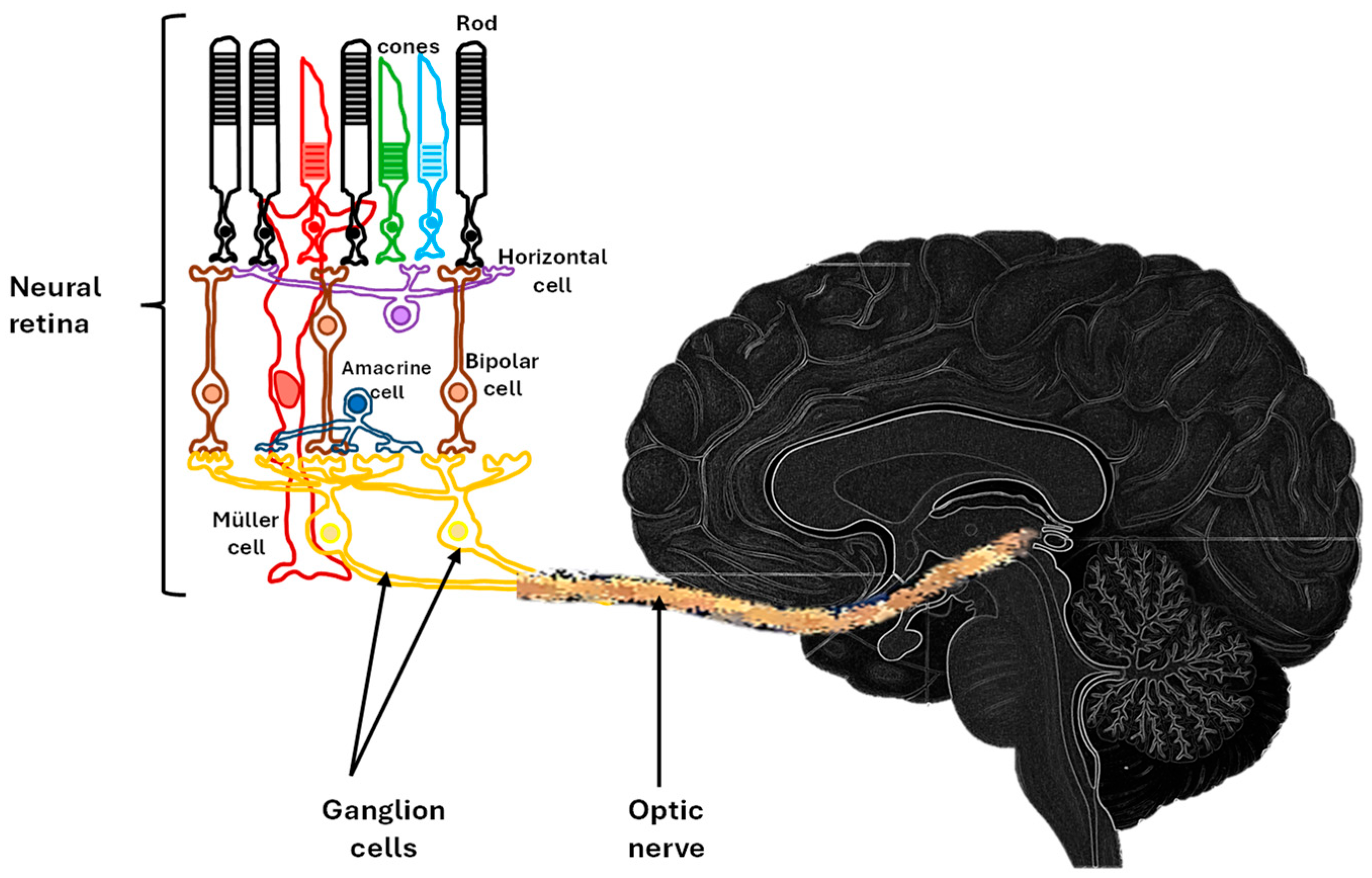

The Retina as a Proxy for Brain Neurodegeneration: A Narrative Review on OCT-Based Retinal Imaging in the Early Detection of Alzheimer’s and Parkinson’s Disease


Abstract
1. Introduction
2. Methods
2.1. Search Strategy
2.2. Inclusion and Exclusion Criteria
- Original research article.
- Written in English.
- Used OCT or OCTA (including SD-OCT) to assess retinal structure or microvascular changes.
- Included patients diagnosed with AD and PD according to well-established clinical criteria.
- Case reports or conference abstracts.
- Studies involving animal models.
- Studies not reporting sample size, imaging methodology, or any relevant retinal parameters.
- Studies that used retinal imaging methods other than SD-OCT or OCTA, such as fundus photography, laser Doppler, or other non-OCT-based techniques.
2.3. Data Extraction
- First author and year of publication.
- Study aims and objectives.
- Study design and population (number of AD, PD, and control subjects).
- Type of OCT used (e.g., SD-OCT, OCTA).
- Retinal parameters assessed (e.g., circumpapillary retinal nerve fiber layer (cpRNFL), ganglion cell-inner plexiform layer (GC-IPL), macular thickness, vascular density, foveal avascular zone (FAZ)).
- Method of analysis (manual or automated segmentation (AI)).
- Reported diagnostic performance metrics, such as area under the receiver operating characteristic curve (AUC), sensitivity, specificity, and accuracy, where available.
3. The Relationship Between the Retina and the CNS
3.1. The Retina as a Component of the CNS
3.2. Causes and Effects of Neurodegenerative Diseases on the Retina
4. Retinal Imaging Techniques for Diagnosing Neurodegenerative Diseases
4.1. Optical Coherence Tomography
OCT Findings in PD and AD: Comparative Discussion
- No significant differences were found in the thickness of most of the outer retinal layers compared to healthy controls, suggesting a general preservation of the outer retina in PD [45,46]; however, consistent thinning of the outer nuclear layer (ONL) has been reported across various OCT studies, indicating selective photoreceptor somatic degeneration rather than widespread outer retinal involvement [34,38].
- A comprehensive review by Min et al. [53] synthesizes OCT findings across the AD continuum, from subjective cognitive decline (SCD) and mild cognitive impairment (MCI) to AD dementia, highlighting the consistent vulnerability of inner retinal layers.
- At preclinical stages such as SCD, significant pRNFL thinning has been observed compared with cognitively normal controls, and macular GCC thickness has been shown to correlate positively with cerebral blood flow, suggesting that early retinal neuronal changes may parallel initial cerebral alterations along the AD continuum [47].
- During the MCI stage, diffuse thinning of inner retinal layers is commonly observed, including reductions in macular GCIPL, macular GCC, macular GCL, and macular RNFL [49].
4.2. Optical Coherence Tomography Angiography
OCTA Findings in PD and AD: Comparative Discussion
- Early microvascular alterations primarily affect the superficial capillary plexus (SCP) of the macula. Several studies have consistently reported reductions in macular vessel density (VD), perfusion, fractal dimension (FD), and capillary complexity in parafoveal, perifoveal, and total SCP regions, reflecting microvascular remodeling associated with neurodegeneration [44,60,61,62].
- In contrast, OCTA studies in AD and MCI demonstrate a consistent pattern of macular microvascular involvement. Most studies report significant reductions in VD in both superficial and deep macular plexuses, particularly in parafoveal and perifoveal regions, while foveal vascular changes, including enlargement of the FAZ, are evident in early or preclinical stages [48,65,66,67,68].
4.3. Spectral-Domain Optical Coherence Tomography
SD-OCT Findings in PD and AD: Comparative Discussion
5. Conclusions
Funding
Institutional Review Board Statement
Informed Consent Statement
Data Availability Statement
Conflicts of Interest
Abbreviations
| AD | Alzheimer’s disease |
| PD | Parkinson’s disease |
| CNS | Central nervous system |
| OCT | Optical Coherence Tomography |
| OCTA | Optical Coherence Tomography Angiography |
| SD-OCT | Spectral-Domain Optical Coherence Tomography |
| RNFL | Retinal nerve fiber layer |
| pRNFL | Peripapillary retinal nerve fiber layer |
| GCL | Ganglion cell layer |
| IPL | Inner plexiform layer |
| GCIPL | Ganglion cell–inner plexiform layer |
| GCC | Ganglion cell complex |
| INL | Inner nuclear layer |
| RPE | Retinal pigment epithelium |
| SCP | Superficial capillary plexus |
| VD | Vessel density |
| FAZ | Foveal avascular zone |
| MCI | Mild cognitive impairment |
| SCD | Subjective cognitive decline |
References
- Wilson, D.M.; Cookson, M.R.; Van Den Bosch, L.; Zetterberg, H.; Holtzman, D.M.; Dewachter, I. Hallmarks of neurodegenerative diseases. Cell 2023, 186, 693–714. [Google Scholar] [CrossRef] [PubMed]
- 2024 Alzheimer’s disease facts and figures. Alzheimer’s Dement. 2024, 20, 3708–3821. [CrossRef]
- Marsden, C.D. Parkinson’s disease. J. Neurol. Neurosurg. Psychiatry 1994, 57, 672. [Google Scholar] [CrossRef]
- Deb, A.; Thornton, J.D.; Sambamoorthi, U.; Innes, K. Direct and indirect cost of managing Alzheimer’s disease and related dementias in the United States. Expert. Rev. Pharmacoecon. Outcomes Res. 2017, 17, 189–202. [Google Scholar] [CrossRef] [PubMed]
- Martinez-Martin, P.; Macaulay, D.; Jalundhwala, Y.J.; Mu, F.; Ohashi, E.; Marshall, T.; Sail, K. The long-term direct and indirect economic burden among Parkinson’s disease caregivers in the United States. Mov. Disord. 2019, 34, 236–245. [Google Scholar] [CrossRef] [PubMed]
- Ghosh, N.; Sinha, K.; Sil, P.C. A review on the new age methodologies for early detection of Alzheimer’s and Parkinson’s disease. Basic. Clin. Pharmacol. Toxicol. 2024, 134, 602–613. [Google Scholar] [CrossRef] [PubMed]
- Wong, S.L.; Gilmour, H.L.; Ramage-Morin, P.L. Parkinson’s disease: Prevalence, diagnosis and impact. Health Rep. 2014, 25, 10–14. [Google Scholar]
- Erskine, L.; Herrera, E. Connecting the retina to the brain. ASN Neuro 2014, 6, 1759091414562107. [Google Scholar] [CrossRef] [PubMed]
- Ptito, M.; Bleau, M.; Bouskila, J. The retina: A window into the brain. Cells 2021, 10, 3269. [Google Scholar] [CrossRef]
- Christinaki, E.; Kulenovic, H.; Hadoux, X.; Baldassini, N.; Van Eijgen, J.; De Groef, L.; Stalmans, I.; van Wijngaarden, P. Retinal imaging biomarkers of neurodegenerative diseases. Clin. Exp. Optom. 2022, 105, 194–204. [Google Scholar] [CrossRef]
- Vujosevic, S.; Parra, M.M.; Hartnett, M.E.; O’Toole, L.; Nuzzi, A.; Limoli, C.; Villani, E.; Nucci, P. Optical coherence tomography as retinal imaging biomarker of neuroinflammation/neurodegeneration in systemic disorders in adults and children. Eye 2023, 37, 203–219. [Google Scholar] [CrossRef]
- Sadler, T. Embryology of neural tube development. Am. J. Med. Genet. Part C Semin. Med. Genet. 2005, 135, 2–8. [Google Scholar] [CrossRef] [PubMed]
- Trost, A.; Lange, S.; Schroedl, F.; Bruckner, D.; Motloch, K.A.; Bogner, B.; Kaser-Eichberger, A.; Strohmaier, C.; Runge, C.; Aigner, L.; et al. Brain and retinal pericytes: Origin, function and role. Front. Cell. Neurosci. 2016, 10, 20. [Google Scholar] [CrossRef]
- Bales, T.R.; Lopez, M.J.; Clark, J. Embryology, eye. In StatPearls [Internet]; StatPearls Publishing: Treasure Island, FL, USA, 2023. [Google Scholar]
- Li, Y.; Faiz, A.; Moshage, H.; Schubert, R.; Schilling, L.; Kamps, J. Comparative transcriptome analysis of inner blood-retinal barrier and blood–brain barrier in rats. Sci. Rep. 2021, 11, 12151. [Google Scholar] [CrossRef] [PubMed]
- Patton, N.; Aslam, T.; MacGillivray, T.; Pattie, A.; Deary, I.J.; Dhillon, B. Retinal vascular image analysis as a potential screening tool for cerebrovascular disease: A rationale based on homology between cerebral and retinal microvasculatures. J. Anat. 2005, 206, 319–348. [Google Scholar] [CrossRef]
- London, A.; Benhar, I.; Schwartz, M. The retina as a window to the brain—From eye research to CNS disorders. Nat. Rev. Neurol. 2013, 9, 44–53. [Google Scholar] [CrossRef]
- Dowling, J.E. The Retina: An Approachable Part of the Brain; Harvard University Press: Cambridge, MA, USA, 1987. [Google Scholar]
- Belenky, M.A.; Smeraski, C.A.; Provencio, I.; Sollars, P.J.; Pickard, G.E. Melanopsin retinal ganglion cells receive bipolar and amacrine cell synapses. J. Comp. Neurol. 2003, 460, 380–393. [Google Scholar] [CrossRef]
- Tempone, M.H.; Borges-Martins, V.P.; César, F.; Alexandrino-Mattos, D.P.; de Figueiredo, C.S.; Raony, Í.; Dos Santos, A.A.; Duarte-Silva, A.T.; Dias, M.S.; Freitas, H.R. The healthy and diseased retina seen through neuron–glia interactions. Int. J. Mol. Sci. 2024, 25, 1120. [Google Scholar] [CrossRef]
- Liutkevičienė, R.; Čebatorienė, D.; Žaliūnienė, D.; Lukauskienė, R.; Jašinskas, V. A new maximum color contrast sensitivity test for detecting early changes of visual function in age-related macular degeneration. Medicina 2014, 50, 281–286. [Google Scholar] [CrossRef]
- Alves, J.N.; Westner, B.U.; Højlund, A.; Weil, R.S.; Dalal, S.S. Structural and functional changes in the retina in Parkinson’s disease. J. Neurol. Neurosurg. Psychiatry 2023, 94, 448–456. [Google Scholar] [CrossRef] [PubMed]
- Arnold, S.E.; Hyman, B.T.; Flory, J.; Damasio, A.R.; Van Hoesen, G.W. The topographical and neuroanatomical distribution of neurofibrillary tangles and neuritic plaques in the cerebral cortex of patients with Alzheimer’s disease. Cereb. Cortex 1991, 1, 103–116. [Google Scholar] [CrossRef]
- Tiraboschi, P.; Hansen, L.; Thal, L.; Corey-Bloom, J. The importance of neuritic plaques and tangles to the development and evolution of AD. Neurology 2004, 62, 1984–1989. [Google Scholar] [CrossRef] [PubMed]
- Mutlu, U.; Ikram, M.K.; Roshchupkin, G.V.; Bonnemaijer, P.W.; Colijn, J.M.; Vingerling, J.R.; Niessen, W.J.; Ikram, M.A.; Klaver, C.C.; Vernooij, M.W. Thinner retinal layers are associated with changes in the visual pathway: A population-based study. Hum. Brain Mapp. 2018, 39, 4290–4301. [Google Scholar] [CrossRef] [PubMed]
- Parisi, V.; Restuccia, R.; Fattapposta, F.; Mina, C.; Bucci, M.G.; Pierelli, F. Morphological and functional retinal impairment in Alzheimer’s disease patients. Clin. Neurophysiol. 2001, 112, 1860–1867. [Google Scholar] [CrossRef]
- Blanks, J.C.; Torigoe, Y.; Hinton, D.R.; Blanks, R.H. Retinal pathology in Alzheimer’s disease. I. Ganglion cell loss in foveal/parafoveal retina. Neurobiol. Aging 1996, 17, 377–384. [Google Scholar] [CrossRef] [PubMed]
- Salobrar-García, E.; de Hoz, R.; Ramírez, A.I.; López-Cuenca, I.; Rojas, P.; Vazirani, R.; Amarante, C.; Yubero, R.; Gil, P.; Pinazo-Durán, M.D. Changes in visual function and retinal structure in the progression of Alzheimer’s disease. PLoS ONE 2019, 14, e0220535. [Google Scholar] [CrossRef]
- Frost, S.; Kanagasingam, Y.; Sohrabi, H.; Vignarajan, J.; Bourgeat, P.; Salvado, O.; Villemagne, V.; Rowe, C.C.; Lance MacAulay, S.; Szoeke, C. Retinal vascular biomarkers for early detection and monitoring of Alzheimer’s disease. Transl. Psychiatry 2013, 3, e233. [Google Scholar] [CrossRef]
- Berisha, F.; Feke, G.T.; Trempe, C.L.; McMeel, J.W.; Schepens, C.L. Retinal abnormalities in early Alzheimer’s disease. Investig. Ophthalmol. Vis. Sci. 2007, 48, 2285–2289. [Google Scholar] [CrossRef]
- Lemmens, S.; Van Craenendonck, T.; Van Eijgen, J.; De Groef, L.; Bruffaerts, R.; de Jesus, D.A.; Charle, W.; Jayapala, M.; Sunaric-Mégevand, G.; Standaert, A. Combination of snapshot hyperspectral retinal imaging and optical coherence tomography to identify Alzheimer’s disease patients. Alzheimer’s Res. Ther. 2020, 12, 144. [Google Scholar] [CrossRef]
- Bouma, B.E.; de Boer, J.F.; Huang, D.; Jang, I.-K.; Yonetsu, T.; Leggett, C.L.; Leitgeb, R.; Sampson, D.D.; Suter, M.; Vakoc, B.J. Optical coherence tomography. Nat. Rev. Methods Primers 2022, 2, 79. [Google Scholar] [CrossRef]
- Minakaran, N.; de Carvalho, E.R.; Petzold, A.; Wong, S.H. Optical coherence tomography (OCT) in neuro-ophthalmology. Eye 2021, 35, 17–32. [Google Scholar] [CrossRef]
- Terravecchia, C.; Mostile, G.; Chisari, C.G.; Rascunà, C.; Terranova, R.; Cicero, C.E.; Giuliano, L.; Donzuso, G.; Sciacca, G.; Luca, A. Retinal thickness in essential tremor and early Parkinson disease: Exploring diagnostic insights. J. Neuroophthalmol. 2024, 44, 35–40. [Google Scholar] [CrossRef]
- Zhao, Y.; Dai, W.; Liu, D. Quantitative analysis of related parameters of retinal nerve fiber layer and ganglion cell complex thickness in patients with different degrees of Parkinson’s disease. Aging Clin. Exp. Res. 2022, 34, 2355–2361. [Google Scholar] [CrossRef] [PubMed]
- Zhang, J.-R.; Cao, Y.-L.; Li, K.; Wang, F.; Wang, Y.-L.; Wu, J.-J.; Pei, S.-F.; Chen, J.; Mao, C.-J.; Liu, C.-F. Correlations between retinal nerve fiber layer thickness and cognitive progression in Parkinson’s disease: A longitudinal study. Park. Relat. Disord. 2021, 82, 92–97. [Google Scholar] [CrossRef] [PubMed]
- Kamata, Y.; Hara, N.; Satou, T.; Niida, T.; Mukuno, K. Investigation of the pathophysiology of the retina and choroid in Parkinson’s disease by optical coherence tomography. Int. Ophthalmol. 2022, 42, 1437–1445. [Google Scholar] [CrossRef]
- Tran, K.K.; Lee, P.Y.; Finkelstein, D.I.; McKendrick, A.M.; Nguyen, B.N.; Bui, B.V.; Nguyen, C.T. Altered outer retinal structure, electrophysiology and visual perception in Parkinson’s disease. J. Park. Dis. 2024, 14, 167–180. [Google Scholar] [CrossRef]
- Tu, M.; Yang, S.; Zeng, L.; Tan, Y.; Wang, X. Retinal Vessel Density and Retinal Nerve Fiber Layer Thickness: A Prospective Study of One-Year Follow-Up of Patients with Parkinson’s Disease. Int. J. Gen. Med. 2023, 16, 3701–3712. [Google Scholar] [CrossRef]
- Murueta-Goyena, A.; Teijeira-Portas, S.; Blanco Martín, E.; Vázquez-Picón, R.; Ruiz Bajo, B.; Bocos, J.; Sánchez-Molina, J.; Alves Dias, P.; Croitoru, I.; Rodríguez Agirretxe, I. Dynamics of retinal changes in early-stage Parkinson’s disease. Acta Neuropathol. Commun. 2025, 13, 20. [Google Scholar] [CrossRef] [PubMed]
- Elanwar, R.; Al Masry, H.; Ibrahim, A.; Hussein, M.; Ibrahim, S.; Masoud, M.M. Retinal functional and structural changes in patients with Parkinson’s disease. BMC Neurol. 2023, 23, 330. [Google Scholar] [CrossRef]
- Garcia-Martin, E.; Larrosa, J.M.; Polo, V.; Satue, M.; Marques, M.L.; Alarcia, R.; Seral, M.; Fuertes, I.; Otin, S.; Pablo, L.E. Distribution of retinal layer atrophy in patients with Parkinson disease and association with disease severity and duration. Am. J. Ophthalmol. 2014, 157, 470–478.e472. [Google Scholar] [CrossRef]
- Atum, M.; Demiryurek, B.E. Retinal morphological changes during the two years of follow-up in parkinson’s disease. Ideggyogy. Szle. 2021, 74, 57–63. [Google Scholar] [CrossRef] [PubMed]
- Christou, E.E.; Konitsiotis, S.; Pamporis, K.; Giannakis, A.; Asproudis, C.; Stefaniotou, M.; Asproudis, I. Inner retinal layers’ alterations of the microvasculature in early stages of Parkinson’s disease: A cross sectional study. Int. Ophthalmol. 2023, 43, 2533–2543. [Google Scholar] [CrossRef] [PubMed]
- Uchida, A.; Pillai, J.A.; Bermel, R.; Bonner-Jackson, A.; Rae-Grant, A.; Fernandez, H.; Bena, J.; Jones, S.E.; Leverenz, J.B.; Srivastava, S.K. Outer retinal assessment using spectral-domain optical coherence tomography in patients with Alzheimer’s and Parkinson’s disease. Investig. Ophthalmol. Vis. Sci. 2018, 59, 2768–2777. [Google Scholar] [CrossRef]
- Zhao, Y.; Zhao, J.; Gu, Y.; Chen, B.; Guo, J.; Xie, J.; Yan, Q.; Ma, Y.; Wu, Y.; Zhang, J. Outer retinal layer thickness changes in white matter hyperintensity and parkinson’s disease. Front. Neurosci. 2021, 15, 741651. [Google Scholar] [CrossRef]
- Gao, R.; Luo, H.; Yan, S.; Ba, L.; Peng, S.; Bu, B.; Sun, X.; Zhang, M. Retina as a potential biomarker for the early stage of Alzheimer’s disease spectrum. Ann. Clin. Transl. Neurol. 2024, 11, 2583–2596. [Google Scholar] [CrossRef]
- O’Bryhim, B.E.; Apte, R.S.; Kung, N.; Coble, D.; Van Stavern, G.P. Association of preclinical Alzheimer disease with optical coherence tomographic angiography findings. JAMA Ophthalmol. 2018, 136, 1242–1248. [Google Scholar] [CrossRef]
- Chua, J.; Li, C.; Ho, L.K.H.; Wong, D.; Tan, B.; Yao, X.; Gan, A.; Schwarzhans, F.; Garhöfer, G.; Sng, C.C. A multi-regression framework to improve diagnostic ability of optical coherence tomography retinal biomarkers to discriminate mild cognitive impairment and Alzheimer’s disease. Alzheimer’s Res. Ther. 2022, 14, 41. [Google Scholar] [CrossRef] [PubMed]
- Mathew, S.; WuDunn, D.; Mackay, D.D.; Vosmeier, A.; Tallman, E.F.; Deardorff, R.; Harris, A.; Farlow, M.R.; Brosch, J.R.; Gao, S. Association of brain volume and retinal thickness in the early stages of Alzheimer’s disease. J. Alzheimer’s Dis. 2023, 91, 743–752. [Google Scholar] [CrossRef]
- Kim, H.M.; Han, J.W.; Park, Y.J.; Bae, J.B.; Woo, S.J.; Kim, K.W. Association between retinal layer thickness and cognitive decline in older adults. JAMA Ophthalmol. 2022, 140, 683–690. [Google Scholar] [CrossRef]
- Girbardt, J.; Luck, T.; Kynast, J.; Rodriguez, F.S.; Wicklein, B.; Wirkner, K.; Engel, C.; Girbardt, C.; Wang, M.; Polyakova, M. Reading cognition from the eyes: Association of retinal nerve fibre layer thickness with cognitive performance in a population-based study. Brain Commun. 2021, 3, fcab258. [Google Scholar] [CrossRef]
- Min, Y.; Zhou, H.; Li, Z.; Wang, Y. Retinal biomarkers in cognitive impairment and dementia: Structural, functional, and molecular insights. Alzheimer’s Dement. 2025, 21, e70672. [Google Scholar] [CrossRef]
- Zhang, A.; Zhang, Q.; Chen, C.-L.; Wang, R.K. Methods and algorithms for optical coherence tomography-based angiography: A review and comparison. J. Biomed. Opt. 2015, 20, 100901. [Google Scholar] [CrossRef]
- De Carlo, T.E.; Romano, A.; Waheed, N.K.; Duker, J.S. A review of optical coherence tomography angiography (OCTA). Int. J. Retin. Vitr. 2015, 1, 5. [Google Scholar] [CrossRef]
- Spaide, R.F.; Fujimoto, J.G.; Waheed, N.K.; Sadda, S.R.; Staurenghi, G. Optical coherence tomography angiography. Prog. Retin. Eye Res. 2018, 64, 1–55. [Google Scholar] [CrossRef] [PubMed]
- Dugiełło, B.; Wylęgała, A.; Kijonka, M.; Prus-Ludwig, A.; Górska, G.; Wylęgała, E.; Orzechowska-Wylęgała, B. Vascular changes in optical coherence tomography angiography unveiling the depths of dry age-related macular degeneration: A review. Expert. Rev. Med. Devices 2024, 21, 1015–1029. [Google Scholar] [CrossRef]
- Moghimi, S.; Hou, H.; Rao, H.L.; Weinreb, R.N. Optical coherence tomography angiography and glaucoma: A brief review. Asia-Pac. J. Ophthalmol. 2019, 8, 115–125. [Google Scholar]
- Tey, K.Y.; Teo, K.; Tan, A.C.; Devarajan, K.; Tan, B.; Tan, J.; Schmetterer, L.; Ang, M. Optical coherence tomography angiography in diabetic retinopathy: A review of current applications. Eye Vision. 2019, 6, 37. [Google Scholar] [CrossRef] [PubMed]
- Kwapong, W.R.; Ye, H.; Peng, C.; Zhuang, X.; Wang, J.; Shen, M.; Lu, F. Retinal microvascular impairment in the early stages of Parkinson’s disease. Investig. Ophthalmol. Vis. Sci. 2018, 59, 4115–4122. [Google Scholar] [CrossRef]
- Shi, C.; Chen, Y.; Kwapong, W.R.; Tong, Q.; Wu, S.; Zhou, Y.; Miao, H.; Shen, M.; Ye, H. Characterization by fractal dimension analysis of the retinal capillary network in Parkinson disease. Retina 2020, 40, 1483–1491. [Google Scholar] [CrossRef]
- Murueta-Goyena, A.; Barrenechea, M.; Erramuzpe, A.; Teijeira-Portas, S.; Pengo, M.; Ayala, U.; Romero-Bascones, D.; Acera, M.; Del Pino, R.; Gómez-Esteban, J.C. Foveal remodeling of retinal microvasculature in Parkinson’s disease. Front. Neurosci. 2021, 15, 708700. [Google Scholar] [CrossRef]
- Eker, S.; Karakucuk, Y.; Gumus, H.; Tekneci, S.; Acar, U. Assessment of retinal blood flow changes in early Parkinson’s disease: An optical coherence tomography angiography study. J. Res. Med. Sci. 2025, 30, 35. [Google Scholar] [CrossRef]
- Xu, B.; Wang, X.; Guo, J.; Xu, H.; Tang, B.; Jiao, B.; Shen, L. Retinal microvascular density was associated with the clinical progression of Parkinson’s disease. Front. Aging Neurosci. 2022, 14, 818597. [Google Scholar] [CrossRef]
- Lahme, L.; Esser, E.L.; Mihailovic, N.; Schubert, F.; Lauermann, J.; Johnen, A.; Eter, N.; Duning, T.; Alnawaiseh, M. Evaluation of ocular perfusion in Alzheimer’s disease using optical coherence tomography angiography. J. Alzheimer’s Dis. 2018, 66, 1745–1752. [Google Scholar] [CrossRef]
- Yoon, S.P.; Grewal, D.S.; Thompson, A.C.; Polascik, B.W.; Dunn, C.; Burke, J.R.; Fekrat, S. Retinal microvascular and neurodegenerative changes in Alzheimer’s disease and mild cognitive impairment compared with control participants. Ophthalmol. Retin. 2019, 3, 489–499. [Google Scholar] [CrossRef]
- Zabel, P.; Kaluzny, J.J.; Wilkosc-Debczynska, M.; Gebska-Toloczko, M.; Suwala, K.; Zabel, K.; Zaron, A.; Kucharski, R.; Araszkiewicz, A. Comparison of retinal microvasculature in patients with Alzheimer’s disease and primary open-angle glaucoma by optical coherence tomography angiography. Investig. Ophthalmol. Vis. Sci. 2019, 60, 3447–3455. [Google Scholar]
- Chua, J.; Hu, Q.; Ke, M.; Tan, B.; Hong, J.; Yao, X.; Hilal, S.; Venketasubramanian, N.; Garhöfer, G.; Cheung, C.Y. Retinal microvasculature dysfunction is associated with Alzheimer’s disease and mild cognitive impairment. Alzheimer’s Res. Ther. 2020, 12, 161. [Google Scholar] [CrossRef]
- Wu, J.; Zhang, X.; Azhati, G.; Li, T.; Xu, G.; Liu, F. Retinal microvascular attenuation in mental cognitive impairment and Alzheimer’s disease by optical coherence tomography angiography. Acta Ophthalmol. 2020, 98, e781–e787. [Google Scholar] [CrossRef] [PubMed]
- Xie, J.; Yi, Q.; Wu, Y.; Zheng, Y.; Liu, Y.; Macerollo, A.; Fu, H.; Xu, Y.; Zhang, J.; Behera, A. Deep segmentation of OCTA for evaluation and association of changes of retinal microvasculature with Alzheimer’s disease and mild cognitive impairment. Br. J. Ophthalmol. 2024, 108, 432–439. [Google Scholar] [CrossRef] [PubMed]
- Saxena, S.; Srivastav, K.; Cheung, C.M.; Ng, J.Y.; Lai, T.Y. Photoreceptor inner segment ellipsoid band integrity on spectral domain optical coherence tomography. Clin. Ophthalmol. 2014, 8, 2507–2522. [Google Scholar] [CrossRef] [PubMed][Green Version]
- Salehi, M.A.; Mohammadi, S.; Gouravani, M.; Rezagholi, F.; Arevalo, J.F. Retinal and choroidal changes in AMD: A systematic review and meta-analysis of spectral-domain optical coherence tomography studies. Surv. Ophthalmol. 2023, 68, 54–66. [Google Scholar] [CrossRef]
- Yehoshua, Z.; Rosenfeld, P.J.; Gregori, G.; Penha, F. Spectral domain optical coherence tomography imaging of dry age-related macular degeneration. Ophthalmic Surg. Lasers Imaging Retin. 2010, 41, S6–S14. [Google Scholar] [CrossRef]
- El-Kattan, M.M.; Esmat, S.M.; Esmail, E.H.; Deraz, H.A.; Ismail, R.S. Optical coherence tomography in patients with Parkinson’s disease. Egypt. J. Neurol. Psychiatry Neurosurg. 2022, 58, 21. [Google Scholar] [CrossRef]
- Verghese, S.; Berkowitz, S.T.; Shah, V.M.; Shah, P.; Priya, S.; Saravanan, V.R.; Narendran, V.; Selvan, V. Assessment of retinal manifestations of Parkinson’s disease using spectral domain optical coherence tomography: A study in Indian eyes. Indian. J. Ophthalmol. 2022, 70, 448–452. [Google Scholar] [CrossRef]
- Hannaway, N.; Zarkali, A.; Leyland, L.-A.; Bremner, F.; Nicholas, J.M.; Wagner, S.K.; Roig, M.; Keane, P.A.; Toosy, A.; Chataway, J. Visual dysfunction is a better predictor than retinal thickness for dementia in Parkinson’s disease. J. Neurol. Neurosurg. Psychiatry 2023, 94, 742–750. [Google Scholar] [CrossRef] [PubMed]
- Cennamo, G.; Di Maio, L.G.; Riccio, G.; Coppola, R.; Baratto, L.; Giglio, A.; Manganelli, F.; De Michele, G.; Costagliola, C.; De Rosa, A. Spectral domain and angiography optical coherence tomography in atypical parkinsonisms and Parkinson disease: An explorative study. Park. Relat. Disord. 2025, 137, 107932. [Google Scholar] [CrossRef] [PubMed]
- Svetel, M.; Marić, G.; Božić, M.; Lazić, U.; Milovanović, A.; Jakšić, J.; Petrović, I.; Dimitrijević, A.; Knežević, M.; Pekmezović, T. Retinal Thickness in Patients with Parkinson’s Disease and Dopa Responsive Dystonia—Is There Any Difference? Biomedicines 2025, 13, 1227. [Google Scholar] [CrossRef]
- Ibrahim, Y.; Macerollo, A.; Sardone, R.; Shen, Y.; Romano, V.; Zheng, Y. Retinal microvascular density and inner thickness in Alzheimer’s disease and mild cognitive impairment. Front. Aging Neurosci. 2025, 17, 1477008. [Google Scholar] [CrossRef]
- Zhang, Z.; Kwapong, W.R.; Cao, L.; Feng, Z.; Liu, P.; Wang, R.; Wu, B.; Zhang, S. Correlation between serum biomarkers, brain volume, and retinal neuronal loss in early-onset Alzheimer’s disease. Neurol. Sci. 2024, 45, 2615–2623. [Google Scholar] [CrossRef]
- Wang, R.; Cai, J.; Gao, Y.; Tang, Y.; Gao, H.; Qin, L.; Cai, H.; Yang, F.; Ren, Y.; Luo, C. Retinal biomarkers for the risk of Alzheimer’s disease and frontotemporal dementia. Front. Aging Neurosci. 2025, 16, 1513302. [Google Scholar] [CrossRef]
- Abboud, I.; Xu, E.; Xu, S.; Alhasany, A.; Wang, Z.; Wu, X.; Astraea, N.; Jiang, F.; Hu, Z.J.; Chan, J.W. Emerging Oculomic Signatures: Linking Thickness of Entire Retinal Layers with Plasma Biomarkers in Preclinical Alzheimer’s Disease. J. Clin. Med. 2025, 15, 275. [Google Scholar] [CrossRef] [PubMed]
- Chan, J.W.; Corradetti, G.; Soylu, C.; Almidani, L.; Wang, Z.; Hu, J.; Sadda, S.R. Outer Retina Layer Thicknesses as Predictors of Choriocapillaris Impairment in Normal Aging Subjects at Risk for Alzheimer’s Disease. Investig. Ophthalmol. Vis. Sci. 2025, 66, 2773. [Google Scholar]
- Ravichandran, S.; Snyder, P.J.; Alber, J.; Murchison, C.F.; Chaby, L.E.; Jeromin, A.; Arthur, E. Association and multimodal model of retinal and blood-based biomarkers for detection of preclinical Alzheimer’s disease. Alzheimer’s Res. Ther. 2025, 17, 19. [Google Scholar] [CrossRef] [PubMed]


| Imaging Modality | Retinal Alterations | Alzheimer’s Disease | Parkinson’s Disease | Clinical Relevance |
|---|---|---|---|---|
| OCT | Inner retinal layers | Thinning of RNFL, GCIPL, and GCC; preferential temporal and inferior pRNFL involvement; heterogeneous across disease stages [47,48,49,50,51,52,53] | Predominant thinning of pRNFL, GCL, GCIPL, and GCC; relatively uniform pattern [34,35,36,37,38,39,41,42,43,44,45,46] | Reflects retinal neurodegeneration; correlates with cognitive decline in AD and motor severity in PD |
| OCT | Outer retinal layers | Alterations in outer retinal layers and RPE, particularly in preclinical and early AD [47,82,83,84] | Limited or inconsistent involvement of outer retinal layers; ONL may show thinning [34,38,45,46] | Highlights disease-specific retinal signatures; outer retinal changes more pronounced in AD than PD |
| OCTA | Macular microvasculature | Reduced VD and capillary complexity in both superficial and deep plexuses; early FAZ enlargement [48,65,66,67,68,69,70] | Reduced VD, perfusion, and fractal dimension mainly in parafoveal and perifoveal regions; foveal sparing or compensatory perfusion [44,60,61,62,63,64] | Microvascular biomarkers for early detection and disease monitoring |
| OCTA | FAZ metrics | Enlarged FAZ area, altered circularity and tortuosity, especially in MCI and preclinical AD [48,70] | Smaller FAZ area with increased complexity or lacunarity [44,62,63,64] | May help distinguish disease-specific microvascular remodeling |
| SD-OCT | Layer-specific thinning | Early and progressive GCIPL and RNFL thinning; strong association with cortical atrophy and cognitive decline [79,80,81] | RNFL and GCC thinning correlated with disease duration and motor severity [74,75,76,77,78] | Non-invasive biomarker for disease staging |
| SD-OCT | Temporal dynamics | Retinal changes detectable in preclinical and prodromal stages [47,49,50,82,83,84] | Retinal changes parallel established disease progression [74,75,76] | Supports early diagnosis in AD and monitoring in PD |
| SD-OCT | Pathophysiology | Amyloid- and tau-related neurodegeneration, glial activation, and neurovascular dysfunction [82,83,84] | Dopaminergic dysfunction and neuroaxonal loss [74,75,76,77,78] | Provides mechanistic insight into disease-specific pathology |
| Study | Sample Size | Method (Manual/AI) | Diagnostic Performance/Metrics |
|---|---|---|---|
| Salobrar-García et al., 2019, [28] | 39 mild AD, 21 moderate AD, 40 controls | OCT/OCTA, Manual | Not reported |
| Lemmens et al., 2020, [31] | 17 AD patients, 22 controls | OCT + Hyperspectral imaging; AI (linear discriminant classification) | AUC overall 0.74; RNFL features AUC 0.70–0.79 |
| Murueta-Goyena et al., 2025, [40] | 53 PD patients, 52 controls | SD-OCT, manual | Not reported |
| Zhang et al., 2021, [36] | 78 PD patients (non-dementia) | OCT, manual | Not reported |
| Zhao et al., 2022, [35] | 30 PD patients, 20 controls | OCT, manual | Not reported |
| Kamata et al., 2022, [37] | 14 PD patients, 22 controls | OCT, manual | Not reported |
| Tran et al., 2024, [38] | 16 PD patients, 21 controls | OCT, manual + electroretinography | Not reported |
| Tu et al., 2023, [39] | 56 PD patients, 45 controls | OCT/OCTA, manual | Not reported |
| Elanwar et al., 2023, [41] | 50 PD patients, 50 controls | OCT, manual + full-field electroretinogram | Not reported |
| Christou et al., 2023, [44] | 32 PD patients, 46 controls | OCT, manual | Not reported |
| Zhao et al., 2021, [46] | 6 PD patients, 32 controls | SD-OCT with deep learning segmentation | Not reported |
| Gao et al., 2024, [47] | 35 SCD, 36 cognitive impairment, 29 normal cognition | OCT/OCTA, manual | Not reported |
| O’Bryhim et al., 2018, [48] | 14 preclinical AD, 16 controls | OCTA automated software measurements | FAZ AUC = 0.8007 (95% CI 0.6647–0.9367) |
| Chua et al., 2022, [49] | 62 AD patients, 108 MCI patients, 55 controls | Automated OCT analysis | cpRNFL measured: AUC 0.69; macular layers (mRNFL + mGCL + mIPL): AUC 0.73; cpRNFL compensated: AUC 0.74; Combined macular + cpRNFL compensated: AUC 0.80 |
| Mathew et al., 2023, [50] | 75 participants (28 cognitively normal, 26 SCD, 17 MCI, 4 AD) | Manual OCT measurement | Not reported |
| Shi et al., 2020, [61] | 25 PD patients, 25 healthy controls | OCTA, automatic segmentation | Not reported |
| Murueta-Goyena et al., 2021, [62] | 55 PD patients, 48 controls | OCTA, manual | Not reported |
| Eker et al., 2025, [63] | 41 PD patients, 41 healthy controls | OCTA, automatic segmentation | Not reported |
| Xu et al., 2022, [64] | 115 PD patients, 67 healthy controls | OCTA, manual | Not reported |
| Lahme et al., 2018, [65] | 36 AD patients, 38 healthy controls | OCTA, automatic segmentation | Not reported |
| Yoon et al., 2019, [66] | 39 AD patients, 37 MCI patients, 133 controls | OCTA, automatic segmentation | Not reported |
| Zabel et al., 2019, [67] | 27 patients with AD, 27 healthy controls | OCTA, manual | Not reported |
| Chua et al., 2020, [68] | 24 AD patients, 37 MCI patients, 29 controls | OCTA, automatic segmentation | Superficial fractal dimension (AUC = 0.77), superficial vessel density (AUC = 0.72), deep vessel density (AUC = 0.64); MRI medial temporal atrophy score AUC = 0.56 |
| Wu et al., 2020, [69] | 18 AD patients, 21 MCI patients, 21 healthy controls | OCTA | Not reported |
| Xie et al., 2024, [70] | 55 AD, 41 MCI, 62 healthy controls | OCTA with deep learning–based segmentation | Not reported |
Disclaimer/Publisher’s Note: The statements, opinions and data contained in all publications are solely those of the individual author(s) and contributor(s) and not of MDPI and/or the editor(s). MDPI and/or the editor(s) disclaim responsibility for any injury to people or property resulting from any ideas, methods, instructions or products referred to in the content. |
© 2026 by the author. Licensee MDPI, Basel, Switzerland. This article is an open access article distributed under the terms and conditions of the Creative Commons Attribution (CC BY) license.
Share and Cite
Sijilmassi, O. The Retina as a Proxy for Brain Neurodegeneration: A Narrative Review on OCT-Based Retinal Imaging in the Early Detection of Alzheimer’s and Parkinson’s Disease. J. Imaging 2026, 12, 104. https://doi.org/10.3390/jimaging12030104
Sijilmassi O. The Retina as a Proxy for Brain Neurodegeneration: A Narrative Review on OCT-Based Retinal Imaging in the Early Detection of Alzheimer’s and Parkinson’s Disease. Journal of Imaging. 2026; 12(3):104. https://doi.org/10.3390/jimaging12030104
Chicago/Turabian StyleSijilmassi, Ouafa. 2026. "The Retina as a Proxy for Brain Neurodegeneration: A Narrative Review on OCT-Based Retinal Imaging in the Early Detection of Alzheimer’s and Parkinson’s Disease" Journal of Imaging 12, no. 3: 104. https://doi.org/10.3390/jimaging12030104
APA StyleSijilmassi, O. (2026). The Retina as a Proxy for Brain Neurodegeneration: A Narrative Review on OCT-Based Retinal Imaging in the Early Detection of Alzheimer’s and Parkinson’s Disease. Journal of Imaging, 12(3), 104. https://doi.org/10.3390/jimaging12030104