
Article

Environmental Profile of Wood Waste Recycling and the Use of Recycled Wood in Furniture Manufacturing

Department of Industrial Engineering, University of Padova, 35131 Padua, Italy
*
Author to whom correspondence should be addressed.
Recycling 2026, 11(7), 121; https://doi.org/10.3390/recycling11070121
Submission received: 10 June 2026 / Revised: 3 July 2026 / Accepted: 7 July 2026 / Published: 10 July 2026

Abstract

The wood furniture sector, heavily reliant on wood panels, faces supply risks and generates significant waste, which can be managed through recycling or energy recovery. This study investigates the environmental impacts of wood waste end-of-life management and the use of virgin versus recycled raw materials in the wood furniture sector, aiming to identify the most sustainable scenario in wood manufacturing between wood waste recycling as output and recycled wood as input. Environmental impacts of four scenarios were analyzed and compared through the life cycle assessment with the “grave-to-cradle” approach. Inventory was supported by information and data from an Italian furniture company, while the impact assessment was performed using the ReCiPe method and the SimaPro software. The results from the impact assessment and gravity analysis show the main contribution of different scenarios due to the incineration of wood waste and the manufacturing of wood panels; the sensitivity analysis highlights how increasing recycling allows for greater performance improvement than increasing recycled inputs. Although limited by the assumptions related to the case study, this research enriches the discussion on the environmental convenience of recycling manufacturing waste and using recycled materials and confirms the importance of life cycle assessment for implementing circular economy strategies in companies.

1. Introduction

The global furniture market value stands at over USD 440 billion, expected to expand at a compound annual growth rate of 4.9% to surpass USD 668 billion by mid-2035 [1]. International furniture trade represents roughly 1% of the world’s manufactured goods trade; the top global exporting nations are China, Vietnam, Poland, Italy, and Germany. The overall European furniture sector is broad—valued at between USD 229 billion and USD 263 billion, depending on whether specialized B2B contract furniture is bundled in [2]. Wood remains the dominant material, capturing approximately 48% to 51.8% of the entire European furniture market share [3].
In Italy, the wood furniture supply chain currently accounts for 4.3% of the national manufacturing sector, generating a total turnover of €51.7 billion [4]. As the industry’s primary raw material, wood is a versatile bio-based resource that is renewable, reusable, and recyclable; however, its diverse applications often lead to competition and increased pressure on land occupation [5]. Due to a domestic shortage of forest resources, Italy relies heavily on foreign imports, particularly for panels sourced from Austria, Romania, and Germany [6]. Although wood is not officially classified as a Critical Raw Material (CRM) by the European Union, its supply is becoming increasingly constrained and unsustainable. Consequently, it is imperative for companies to assess wood supply risks with the same rigor applied to EU-listed critical materials [7]. Furthermore, as with all processed goods, wood generates waste both during manufacturing and at the end of its life cycle, which is primarily managed through energy recovery or recycling [8,9].
Europe promotes the transition from a linear to a circular economy through sustainable consumption and production, in alignment with the 12th Sustainable Development Goal (SDG). The circular economy model addresses resource constraints by repurposing waste into secondary raw materials, reducing land-use pressure for virgin resources and minimizing waste accumulation [10]. This model is integrated into production processes through strategies such as eco-design, increased product repairability and reusability, and waste management aimed at preserving material value within the economic loop through life cycle monitoring and careful sourcing [11]. The Waste Framework Directive [12] establishes a waste hierarchy stating that recycling is preferable to incineration. Wood recycling facilitates the recovery of secondary materials, such as particleboard, for reintegration into wood furniture production, ensuring long-term material valorization [13]. Incineration terminates a material’s life cycle, necessitating the extraction of virgin resources for new panel manufacturing. Furniture producers contribute to environmental sustainability by sourcing recycled wood panels and diverting waste toward recycling streams [14], even if for the furniture sector there remain technical and technological difficulties in the recycling of composite materials [15].
With a special focus on the wood furniture sector, market dynamics are heavily influenced by the EU’s environmental plan to tackle deforestation, which includes the EU Deforestation Regulation [16]: in its objectives, the EUDR intends to guarantee that the products EU citizens consume do not contribute to deforestation or forest degradation worldwide, toward traceable, certified, and premium hardwood. More recently, the inclusion of the furniture sector as a priority industry in the European Regulation for Sustainable Products (ESPR) marks a historic, structural shift for the market [17]. Specific delegated acts for furniture are set to be formalized by 2028, forcing the industry to pivot from linear to circular manufacturing; products must be explicitly designed for easy disassembly, component replacement, and maintenance. European leaders, particularly in Italy and Germany, are already highly advanced in circular wood usage, such as 100% recycled particleboard [18].
Life cycle assessment (LCA) is a robust approach for this type of analysis, designed to evaluate the environmental impacts of a product or process across its entire life cycle, from cradle to grave. This methodology offers a holistic perspective on the environmental burdens associated with the system under study [19]. When applied to business processes, LCA facilitates resource and cost optimization while promoting raw material conservation and supporting the transition toward a more sustainable economy [20,21]. The methodology also enables the comparison of multiple scenarios, providing a comprehensive overview of potential alternatives. In the context of waste management, LCA supports resource efficiency, minimizes waste generation, and enables evidence-based decision-making [22]. This method is recognized as a reliable tool within the sustainability strategies endorsed by the European Union [23]. Consequently, it is frequently applied in the wood sector to identify environmental impacts associated with processing activities, including recycling, and to support strategic decision-making [24].
The European furniture sector is facing multiple challenges at the same time. Climate change is disrupting and making raw material supplies, like wood, unpredictable. On top of that, there are new regulations aimed at minimizing resource use and waste production, promoting sustainable design, material recyclability, and the use of secondary raw materials [25,26]. LCA could also strongly support an increase in sustainability in the wood furniture sector, aligning eco-design principles and guiding companies toward circular economy strategies [27,28].
The wooden furniture sector is increasingly evaluated through LCA to identify effective strategies for reducing environmental hotspots. A comprehensive understanding of the entire supply chain and a multidimensional evaluation are needed, ranging from structural product engineering and alternative material substitution to corporate management and international logistics. Recent studies share empirical evidence on environmental performance, hotspots, and eco-design interventions specific to wood-based furniture, establishing a hierarchy of environmental sustainability and climate change mitigation strategies:
  • Sustainable upstream sourcing and land restoration: Mandating certified forest management and supporting timber production derived from the restoration of degraded lands can mitigate land-use and biodiversity trade-offs [20,29,30].
  • Eco-design in materials: Utilizing more sustainable virgin materials (like bamboo or agricultural by-products) and more sustainable composites (e.g., bio-based resins and water-soluble finishes) can minimize environmental hotspots upstream [31,32,33,34].
  • Factory-level resource efficiency: Implementing mechanical process optimizations to reduce wood scrap and utilizing clean manufacturing by-products for internal thermal drying energy can reduce operational impacts [35,36].
  • Eco-design in use and end-of-life: Designing for durability, repairability, and disassembly to prolong the lifespan of wood components represents a resilient, long-term mitigation mechanism [34,37,38].
  • Circularity in manufacturing: Using recycled materials and recycling manufacturing scraps ensures effective sustainability strategies in manufacturing [39].
Despite its potential, circularity in manufacturing remains underexplored in the LCA literature. Nevertheless, it represents a concrete opportunity for companies to improve their environmental performance. Therefore, this research aims to address this knowledge gap by deeply quantifying the environmental benefits of utilizing recycled wood panels and recycling manufacturing scraps.
Based on primary data provided by a furniture company specializing in wood-based panels for kitchen production, this study evaluates the environmental impacts associated with end-of-life (EoL) management of wood waste and compares the use of virgin versus recycled materials to identify the most sustainable scenario for a company operating in the wood furniture sector. The research goal is to determine whether recycling and the use of recycled inputs represent the most advantageous options for companies in this sector. The analysis seeks to identify the underlying causes of environmental impacts and avoided impacts through a gravity analysis. Furthermore, it aims to define the most promising management and utilization strategies through a sensitivity analysis.
This paper is structured as follows: Section 2 presents the results of the case study, including the environmental impact assessment, the identification of the most influential contributions via gravity analysis, and the results of the sensitivity analysis. Section 3 is dedicated to discussing the LCA results linked to emerging evidence from the literature. Section 4 describes the life cycle model, the methodology, and the case study. Finally, Section 5 addresses the limitations of the research and identifies future opportunities.

2. Results

2.1. Life Cycle Impact Assessment Results

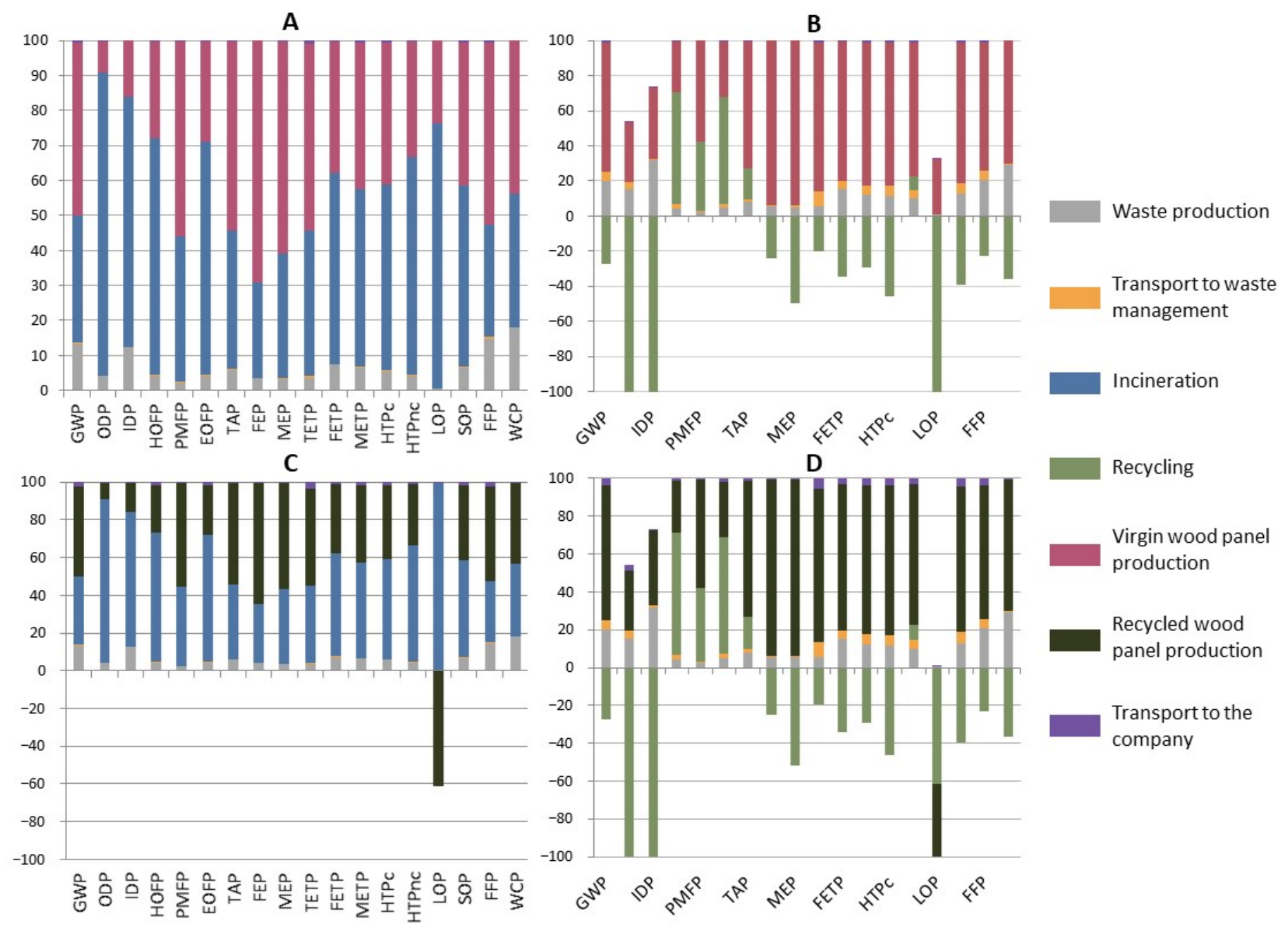
The results derived from the comprehensive environmental impact assessment for each scenario are presented in absolute terms in Figure 1. These results refer to the defined functional unit.
The environmental impact assessment highlights specific categories that are particularly significant within the overall profile. These dominant impact categories are closely linked to the core variables defining the analyzed scenarios: incineration versus recycling and the use of virgin materials versus recycled raw materials. Incineration emerged as the process stage with the highest contribution to ODP, LOP, and IDP in scenarios A and C. Conversely, recycling significantly influences HOFP, EOFP, and PMFP in scenarios B and D; notably, recycling achieves avoided impacts across most categories included in the methodology, particularly for ODP, IDP, and LOP. The production of panels from virgin materials exerts a substantial environmental burden across all impact categories, with the most pronounced contributions observed in FEP, MEP, and TETP. While scenarios utilizing recycled materials exhibit a similar impact profile, they achieve an avoided impact in the LOP category. Consistent with the findings of similar studies [40,41], the environmental impacts of panel production are primarily attributable to the use of formaldehyde and fossil-based resins. Nevertheless, TETP represents the most significant impact category across all four scenarios, reaching approximately 16,000 kg 1.4-DCB in incineration-based scenarios and decreasing by half (roughly 8000 kg 1.4-DCB) in recycling scenarios. Finally, the LOP and IDP categories derive the greatest benefit from the use of recycled raw materials, showing substantial avoided impacts compared to virgin material use. Transportation does not contribute significantly to any category, owing to the proximity of suppliers and customers to the production facilities. Additional results for the TETP, IDP, and LOP impact categories, including total impacts and the contributions of each step considered within the system boundaries, are reported in the Appendix A.

2.2. Gravity Analysis Results

A gravity analysis was performed to identify the primary contributors influencing the selected impact categories. The focus was specifically dedicated to GWP, due to its prominence in the scientific literature, and LOP, as its characterization results exhibit a distinct trend compared to other categories. The detailed results of the gravity analysis are reported in Table 1.
The production of wood panels represents the process with the highest GWP impact across all four scenarios, regardless of whether virgin or recycled materials are utilized. This dominance stems from the fact that the manufacturing stage remains consistent, while variations occur exclusively in the upstream processes. In scenarios A and C, incineration constitutes the second most significant source of GWP. Conversely, in scenarios B and D, the second-largest impact is attributed to the thermal energy required for drying recycled wood prior to processing. The latter scenarios also exhibit avoided impacts due to the absence of wood incineration; similarly, in scenarios C and D, negative CO2-equivalent emissions are recorded as a result of substituting virgin raw materials.
Regarding the LOP impact category, the highest impacts are associated with incineration in scenarios A and C, where this treatment is included. Conversely, in scenarios B and D, panel production represents the primary contributor. For this category as well, scenarios B and D exhibit avoided impacts due to the absence of wood incineration. Furthermore, scenarios C and D benefit significantly from negative CO2-equivalent emissions resulting from the substitution of virgin raw materials.

2.3. Sensitivity Analysis Results

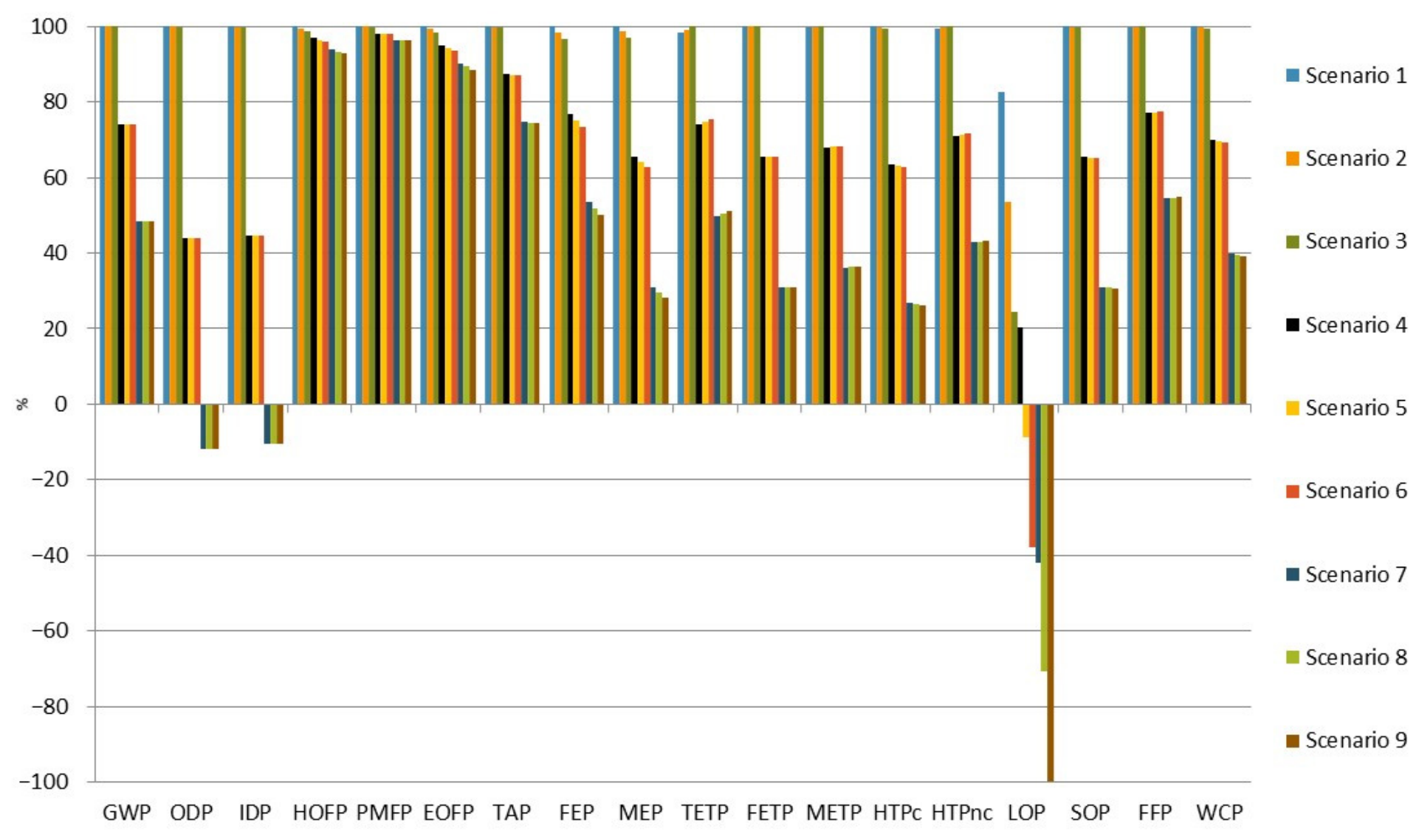
The purpose of the sensitivity analysis is to examine the influence of variations in input assumptions regarding waste management and raw material selection on the overall results. To this end, all scenarios were recalculated assuming that these strategies are fully implemented (100%), partially implemented (50%), or not adopted (0%). In all cases, the waste is fully managed, and the total quantity of raw material remains constant; the variables are the specific management method and the proportion of virgin versus recycled materials. Detailed specifications of key parameters in modeling the four scenarios are provided in Table 2, and the sensitivity analysis results are shown in Figure 2.
The sensitivity analysis reveals that the most prominent outcome is a significant reduction in environmental impacts across the last three scenarios, where waste is diverted to recycling rather than incineration. Furthermore, the impact categories HOFP, EOFP, FEP, and MEP exhibit variations depending on the specific material modeled for panel production. Specifically, the adoption of 50% or 100% recycled material leads to a decrease in impacts within these categories; conversely, an opposite trend is observed for TETP. A substantial reduction in environmental burden is also confirmed for the LOP category when both the incineration rate and the consumption of virgin raw materials are minimized.

3. Discussion

3.1. Recycled Input vs. Recycling Output

The life cycle impact assessment and sensitivity analysis from this study offer crucial insights into the hierarchy of circular economy strategies within the wooden furniture sector. A core finding is that maximizing wood waste recycling (Scenarios B and D) yields significantly higher environmental credits and performance improvements than merely increasing the share of recycled inputs in panel production (Scenarios C and D). This observation aligns with the waste hierarchy of the Waste Framework Directive and supports the previous literature, indicating that EoL diversion is paramount to retaining material value. In a similar vein, Tessitore and colleagues [26] demonstrated, through an Italian furniture case study, that integrating LCA into corporate management allows companies to effectively navigate institutional and regulatory pressures by prioritizing waste valorization pathways over linear disposal.
Furthermore, our results show that wood waste incineration (Scenarios A and C) acts as a primary hotspot for specific impact categories such as ODP and IDP. Shifting to recycling routes allows the system to achieve net-negative (avoided) impacts across most ReCiPe categories. This dynamic is consistent with the global literature on harvested wood products. Xue and colleagues [29] emphasized that the climate mitigation potential of HWPs is maximized when long-term material cascading and recycling are favored over immediate energy recovery, which prematurely terminates the biogenic carbon storage loop. However, the climate benefits derived from material substitution are not infinite and depend heavily on the continuous availability of efficient recycling cascading loops [37].

3.2. Terrestrial Ecotoxicity Trade-Off

A remarkable outcome of the gravity analysis is that terrestrial ecotoxicity (TETP) represents the most substantial environmental burden across all four scenarios, reaching up to 16,000 kg 1.4-DCB in incineration-based configurations and approximately 8000 kg 1.4-DCB in recycling scenarios. The high ecotoxicity impact is heavily driven by panel manufacturing operations, which rely extensively on formaldehyde and fossil-based resins. This trade-off between circular mass flow and chemical toxicity is a recurring challenge in the wood manufacturing LCA literature. For instance, Bianco and colleagues [20] highlighted that wooden furniture eco-design often suffers from trade-offs where the use of conventional resins and intensive manufacturing stages frequently offset the raw material preservation benefits.
The persistence of high toxicity profiles due to binder inputs is further confirmed by Gavioli and colleagues [42], whose LCA on particleboards showed that urea–formaldehyde (UF) resins represent a severe environmental hotspot, suggesting that a true transition to sustainability requires replacing fossil binders with bio-based alternatives. Similarly, Duran and colleagues [43] explored the partial substitution of conventional adhesives with secondary materials (like waste HDPE) to alleviate the environmental profile of particleboards, confirming that binder modification is the primary lever for toxicological footprint reductions. Additionally, the mechanical processing and thermal energy required during the drying phase of recycled chips contribute significantly to ozone formation and particulate matter categories (HOFP, EOFP, and PMFP). Sahoo and colleagues [36] highlighted that, across the entire supply chain, the manufacturing stage—predominantly driven by thermal drying and electricity requirements—consistently represents the highest environmental impact phase.

3.3. Raw Material Sourcing, Land Occupation, and Supply Chain Localization

Our study underscores that utilizing recycled wood panels provides an extraordinary benefit in terms of LOP and IDP, achieving significant avoided impacts compared to virgin timber extraction. This relief from territorial pressure is critically meaningful for Italy, a country characterized by a domestic shortage of forest resources and a strong structural reliance on international timber imports. Geng and colleagues [38] quantified national-scale substitution benefits of wood products and concluded that optimizing material substitution directly addresses resource scarcity and decreases global land-use pressure. Similarly, Zhang and colleagues [33] noted that transitioning to alternative or secondary renewable streams (such as bamboo or recycled fibers) significantly reduces territorial resource competition and land degradation.
Interestingly, our primary data indicated that transportation did not contribute significantly to any environmental impact category, mainly due to the geographic proximity of the Italian furniture company to its suppliers and waste management facilities. This empirical finding offers an interesting contrast to other studies [31,35], in which internationalized distribution markets and long-distance supply chains often completely overshadow the benefits of localized eco-design interventions due to massive fossil fuel consumption during transit.

3.4. Methodological Value of the “Grave-to-Cradle” Boundary

From a methodological perspective, applying a “grave-to-cradle” boundary instead of a standard cradle-to-gate approach expands the transparency of open-loop recycling allocations. By capturing both the corporate waste generation pathways and the downstream reintegration of secondary materials, this model successfully addresses the allocation ambiguities often criticized in traditional LCAs. It quantifies the dual environmental role of the manufacturing facility as both a waste generator and a secondary resource consumer, providing scalable sustainable strategies for wood furniture enterprises aiming to scientifically validate their circular economy claims.

4. Materials and Methods

4.1. Life Cycle Analysis Modeling

This study applies the LCA methodology in accordance with the ISO 14040 and ISO 14044 standards [44,45]. The analysis is framed within the principles of the circular economy, with specific focus on two critical stages: the EoL phase and the sourcing of input materials for the production cycle. In the EoL stage, wood is allocated either to incineration for energy recovery or to recycling for the manufacture of new panels. Correspondingly, input materials for production may consist of either virgin or recycled wood. This assessment begins with the waste material generated by furniture manufacturing and extends to the production of new panels intended for integration into subsequent manufacturing cycles.
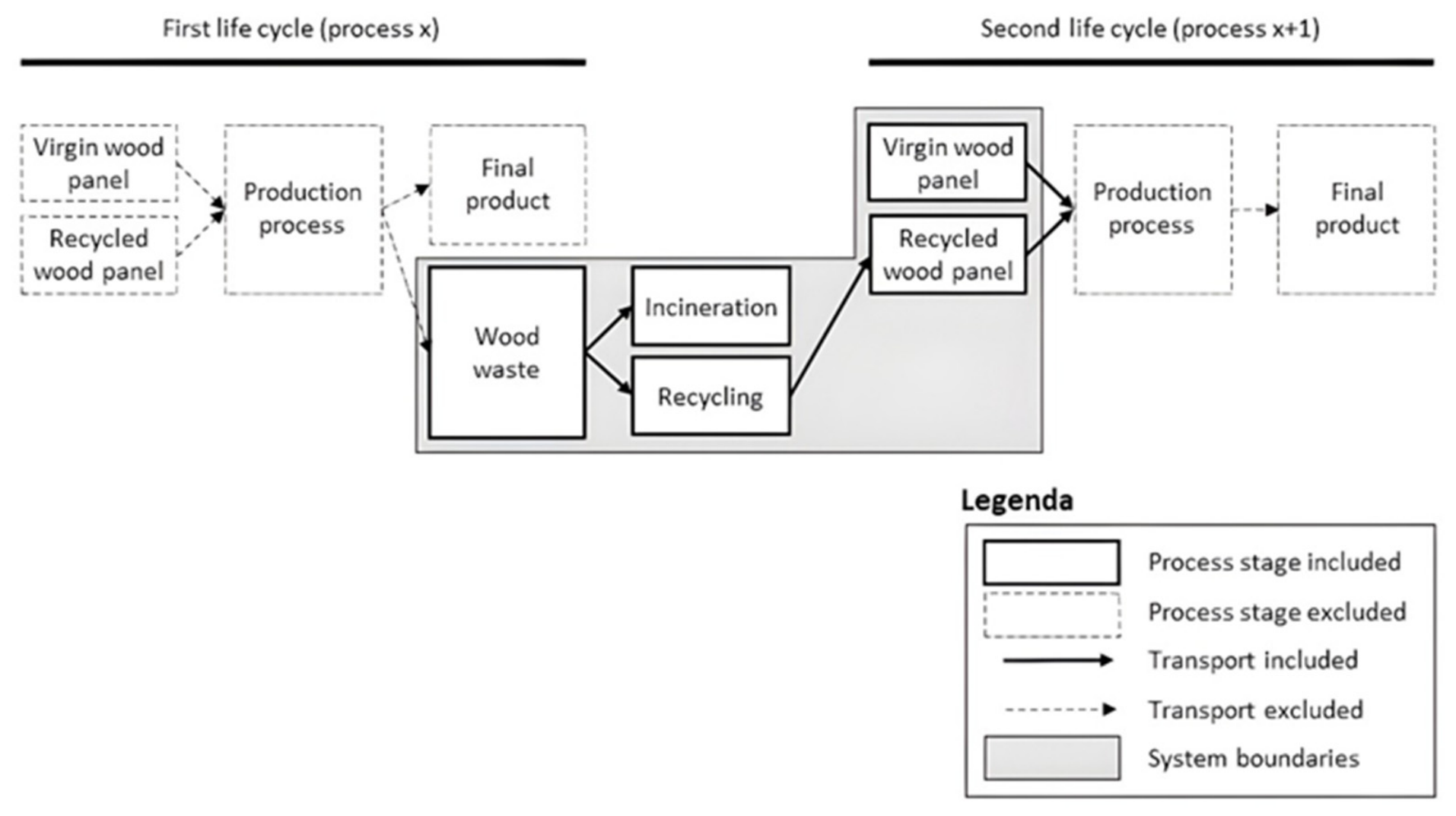
The adopted framework follows a grave-to-cradle approach, where “grave” refers to the end-of-life stage of wood in its first life cycle (process x), and “cradle” represents the potential incorporation of the recycled wood panel into a second life cycle (process x + 1). This concept is illustrated in Figure 3. This approach builds upon established principles of LCA application in open-loop and closed-loop systems [46], emphasizing strategies for achieving material circularity and targeted waste management within the circular economy paradigm.
This study refers exclusively to the management of waste generated by the wooden furniture manufacturing company. It should be noted that wood waste from the furniture sector is not a homogeneous stream, as it may include different materials, such as solid wood, particleboard, medium-density fiberboard (MDF), plywood, and laminated or varnished panels, which differ in composition and environmental profiles. However, within the scope of this study, these fractions are considered collectively, as they typically undergo similar incineration and recycling pathways in industrial practice. The evaluated scenarios result from the combination of two independent decision variables: (i) the end-of-life management of the company’s wood waste and (ii) the procurement of particleboard for furniture production. The recycled particleboard considered in the analysis is assumed to be sourced from the market. Nevertheless, this modeling approach also allows for a preliminary assessment of the potential benefits of a future closed-loop configuration, in which the company’s wood waste could be reintegrated into its own production system:
  • Scenario A: All wood waste is sent for incineration, and virgin particleboard is procured for furniture production.
  • Scenario B: All wood waste is sent for recycling, and virgin particleboard is procured for furniture production.
  • Scenario C: All wood waste is sent for incineration, and recycled particleboard is procured for furniture production.
  • Scenario D: All wood waste is sent for recycling, and recycled particleboard is procured for furniture production.
The evaluation encompasses the upstream waste management processes occurring within the company, as well as the transportation of both wood waste and particleboard.

4.2. Case Study Definition

A case study was selected to validate the identified waste management scenarios. Primary data concerning waste generation and management were obtained from a furniture manufacturing company located in Northern Italy. The company’s core business involves the production of high-end kitchens for European and global markets. These products are primarily composed of wood-based panels, complemented by metal, plastic, or glass components serving both aesthetic and functional purposes.
During the manufacturing process, waste is generated in the form of sawdust and wood offcuts, which may be either clean (wood only) or contain traces of accessory materials. Removable components classified as accessories are dismantled directly at the facility to ensure accurate allocation under the relevant European Waste Catalogue (EWC) codes. The company aims to evaluate the environmental impacts associated with waste management and raw material procurement, as these factors are critical for guiding strategic and sustainable decision-making. For the scope of this study, the analysis is limited exclusively to wood waste.

4.3. LCA of Waste Management Scenarios

4.3.1. Goal and Scope

The purpose of this LCA is to evaluate and compare the environmental profiles of the four wood waste management scenarios, assessing the environmental benefits of specific circularity choices. The functional unit (FU) is defined as the management of 1 ton of wood waste, where the function is specified as wood waste material destined for either recycling or incineration. In this case study, only wood waste generated by the company is considered; the total volume of panels purchased or sold is excluded from the scope.
Consequently, the function and functional unit encompass exclusively waste management activities. The amount of material entering the production process for new panels is modeled as equivalent to the quantity of waste managed. The functional framework follows a grave-to-cradle approach, where the “grave” represents the generation of wood waste, and the “cradle” represents its potential secondary life as secondary raw material, specifically through the production of recycled particleboard. Within this perspective, the focus of the analysis is not on the total quantity of panels produced but on the environmental implications associated with the treatment and valorization of wood waste and its potential to substitute for virgin raw materials. This approach establishes the link between waste management and material procurement by considering the potential reintroduction of treated waste into the production cycle.
The system boundaries include the wood waste generation phase within the furniture company, the transportation of waste to collection and management centers, the recycling or incineration processes, the production of new particleboard (from either virgin or secondary raw materials), and the transportation of finished panels back to the furniture company for processing. The following phases were included in the LCA study:
  • Waste production: Includes all operations performed by the company once the waste is generated, such as initial milling and dust collection.
  • Transport to waste management: Involves the transportation of 1 ton of wood waste from the production site to the designated management facility.
  • Waste management: Varies according to the specific scenario and includes:
    -
    Incineration: The waste is milled and dried, followed by incineration for energy recovery.
    -
    Recycling: The waste undergoes cleaning, milling, and drying to be processed as a secondary raw material for the production of new particleboard.
  • Panel production: Depends on the scenario, involving the manufacturing of particleboard from either virgin or recycled wood fibers.
  • Transport to furniture company: Consists of the transportation of the finished virgin or recycled panels back to the furniture manufacturing facility.
Excluded from the analysis are the furniture manufacturing processes and the production of new kitchens (process x + 1 following the arrival of the panel at the facility), as these stages are outside the scope of this study.
The assessment of avoided impacts is based on a substitution approach, whereby environmental credits are assigned to account for the substitution of equivalent products. In this context, recycled wood is assumed to replace virgin raw materials in particleboard production, and the corresponding avoided burdens are included in the analysis. Particular attention is paid to ensuring consistency in the attribution of credits and to avoiding double counting of benefits across the different scenarios. These modeling assumptions are applied uniformly across all scenarios.
The primary objective is to evaluate how environmental results vary based on wood waste management strategies and the utilization of recycled versus virgin materials. Additionally, processes related to the handling and treatment of other materials generated during scrap cleaning and sorting are excluded from the assessment.

4.3.2. Life Cycle Inventory Analysis

For the waste production and transportation phases, primary data measured directly at the company were utilized. For all other phases included in the study, secondary data were sourced from the Ecoinvent 3 database and the relevant literature. The inventory data are summarized in Table 3. Consumptions and emissions were allocated on a mass basis and normalized to the functional unit of 1 ton of managed wood waste. The following assumptions were applied:
  • Transportation: Conducted via Euro 5 heavy-duty vehicles;
  • Energy Profile: The electricity consumed is based on the specific national energy mix.

4.3.3. Life Cycle Impact Assessment and Interpretation

Environmental impacts were calculated using the SimaPro 9 software and the ReCiPe 2016 Midpoint (H) assessment method. This methodology, widely adopted in the scientific literature, converts inventory results into environmental impacts through characterization factors specific to each of the 18 impact categories evaluated. To maintain methodological consistency, all impacts were assessed at the midpoint level. The assessment considers all categories proposed by the method: global warming (GWP, kg CO2 eq), stratospheric ozone depletion (ODP, kg CFC11 eq), ionizing radiation (IDP, kBq Co-60 eq), ozone Formation, human health (HOFP, kg NOx eq), fine particulate Matter formation (PMFP, kg PM2.5 eq), ozone formation, terrestrial ecosystems (EOFP, kg NOx eq), terrestrial acidification (TAP, kg SO2 eq), freshwater eutrophication (FEP, kg P eq), marine eutrophication (MEP, kg N eq), terrestrial ecotoxicity (TETP, kg 1.4-DCB), freshwater ecotoxicity (FETP, kg 1.,4-DCB), marine ecotoxicity (METP, kg 1.4-DCB), human carcinogenic toxicity (HTPc, kg 1.4-DCB), human non-carcinogenic toxicity (HTPnc, kg 1.4-DCB), land Use (LOP, m2a crop eq), mineral resource scarcity (SOP, kg Cu eq), fossil resource scarcity (FFP, kg oil eq), and water consumption (WCP, m3). A gravity analysis was performed to identify the process stages with the highest contribution to the overall environmental burden. Additionally, a sensitivity analysis was conducted to evaluate the robustness of the results against changes in initial assumptions, specifically regarding waste management (incineration vs. recycling) and the type of raw material procured (virgin vs. recycled).

5. Conclusions

Based on primary data from a furniture manufacturing company located in Italy, this study assessed the environmental impacts associated with wood waste management. Upon exiting the production facility, waste is either directed toward incineration with energy recovery or recycled for the production of new panels. Consequently, the panels utilized for furniture manufacturing may consist of either virgin or recycled material. To capture these flows, a grave-to-cradle approach was adopted. The environmental profiles of the four scenarios demonstrate that incineration represents the process with the greatest impact across the entire system. This is followed by panel production; notably, the impacts of manufacturing remain consistent regardless of the raw material source, as they are primarily linked to chemical inputs and energy demand [40]. These findings are corroborated by the sensitivity analysis. Furthermore, the gravity analysis indicates that the overall results are driven by the high environmental burdens associated with both wood incineration and panel manufacturing. This industrial energy load aligns with the sectoral literature, confirming that thermal drying cycles and electricity demands consistently stabilize baseline impacts across wood processing lines [34,36]. Additionally, a notable toxicological trade-off emerged from the broader context: TETP represents a massive burden across all scenarios due to the continuous use of conventional, fossil-based urea–formaldehyde binders, highlighting that high-volume material circularity must be coupled with binder eco-design to minimize environmental friction [20,42]. Finally, the LOP category exhibits significant benefits from the use of recycled raw materials, as this substitution avoids the land occupation required for virgin material production.
This study demonstrates that LCA serves as a strategic tool for informing alternative business decisions. By embedding life cycle thinking into corporate management, companies can effectively navigate mounting institutional and regulatory pressures while shifting away from linear disposal loops [26]. The results indicate that, within the specific assumptions and system boundaries of the analyzed case study, the internal use of secondary raw materials is less advantageous for the company than diverting its wood waste toward external recycling processes. However, this finding is strongly dependent on the specific context and supply chain configurations considered in this study, and further research would be required to assess its applicability and generalization to other industrial settings. Indeed, land use represents the only impact category that derives a direct benefit from the integration of recycled materials. However, a primary limitation of this study lies in the inherent difficulty of assigning a representative value to recycled raw materials [47]. It is important to note that the current approach does not account for discrepancies in material flows; specifically, when comparing the volume of panels entering the facility with the volume of waste generated, the environmental benefits associated with recycled inputs may vary substantially.
Future research should focus on strategies to enhance the valuation of recycled inputs, such as the implementation of product-oriented material indicators [48]. Such methodological advancements are vital for expanding accounting transparency when secondary raw materials undergo open-loop cascades [39]. Furthermore, exploring alternative bio-based resources—including sugarcane bagasse [49] or other lignocellulosic fibers [50,51]—could reduce the reliance on fossil-based or formaldehyde resins. The recent literature shows that modifying or partially substituting chemical adhesives with secondary matrix inputs constitutes a key lever for toxicological footprint reduction [43]. Nevertheless, in such cases, it remains essential to rigorously assess supply chain distances, as transportation may become a critical factor in the overall environmental profile.

Author Contributions

Conceptualization, A.M.; methodology, A.M. and C.B.; software, C.B.; validation, A.M.; formal analysis, C.B.; data curation, C.B.; writing—original draft preparation, C.B.; writing—review and editing, A.M.; supervision, A.M. All authors have read and agreed to the published version of the manuscript.

Funding

This research was supported by the MICS (Made in Italy—Circular and Sustainable) Extended Partnership and funded by the European Union—NextGenerationEU under the National Recovery and Resilience Plan (PNRR), Mission 4, Component 2, Investment 1.3, grant number D.D. 1551.11-10-2022, PE00000004.

Data Availability Statement

The data presented in this study are available upon request from the corresponding author due to confidentiality requirements).

Acknowledgments

The authors are grateful to the Italian furniture company WeDo Home, especially Silvia Quaglia and her sustainability team, for providing the operational data and enabling the application of the scientific methodology to this case study.

Conflicts of Interest

The authors declare no conflicts of interest.

Abbreviations

The following abbreviations are used in this manuscript:
EOFPOzone formation, terrestrial ecosystems
EoLEnd-of-life
EUEuropean Union
EWCEuropean Waste Catalogue
FEPFreshwater eutrophication
FETPFreshwater ecotoxicity
FFPFossil resource scarcity
GWPGlobal warming
HOFPOzone formation, human health
HTPcHuman carcinogenic toxicity
HTPncHuman non-carcinogenic toxicity
IDPIonizing radiation potential
LCALife cycle assessment
LOPLand occupation
MDFMedium-density fiberboard
MEPMarine eutrophication
METPMarine ecotoxicity
ODPStratospheric ozone depletion
PMFPFine particulate matter formation
SOPMineral resource scarcity
TAPTerrestrial acidification
TETPTerrestrial ecotoxicity
WCPWater consumption

Appendix A

Table A1. Life cycle impact assessment results for the TETP, IDP and LOP impact categories—total impacts and impacts for each step included in the system boundaries.
Life Cycle PhasesScenarioTETP
(kg 1.4-DCB)
IDP
(kBq Co-60 eq)
LOP
(m2a crop eq)
TotalA16,236.22107.41686.79
B8187.81−11.14−347.62
C16,485.65107.25203.35
D8437.24−11.31−831.06
Waste productionA588.7113.383.15
B588.7113.383.15
C588.7113.383.15
D588.7113.383.15
Transport to waste managementA94.470.050.24
B831.290.442.13
C94.470.050.24
D831.290.442.13
IncinerationA6736.2676.59521.73
B6736.2676.59521.73
RecyclingC−2048.98−42.35−514.57
D−2048.98−42.35−514.57
Virgin wood panel productionA8666.9017.31161.28
B8666.9017.31161.28
Recycled wood panel productionC8500.9416.92−323.22
D8500.9416.92−323.22
Transport to the companyA149.880.080.38
B149.880.080.38
C565.280.301.45
D565.280.301.45

References

  1. CSIL. Centre for Industrial Studies, World Furniture Outlook Report. Available online: https://www.worldfurnitureonline.com/report/world-furniture-outlook/ (accessed on 30 June 2026).
  2. Global Market Insights/Mordor Intelligence: Europe Wooden Furniture Market Size & Share Analysis. Available online: https://www.gminsights.com/industry-analysis/europe-wooden-furniture-market (accessed on 30 June 2026).
  3. Eurostat: Official Statistical Data—Living Conditions in Europe—Energy Efficiency in Household. Available online: https://ec.europa.eu/eurostat/statistics-explained/index.php?title=Living_conditions_in_Europe_-_energy_efficiency_in_households (accessed on 30 June 2026).
  4. Filiera Legno-Arredo. Consuntivi 2024 Filiera Legno-Arredo. 2024. Available online: https://old.federlegnoarredo.it/it/servizi/centro-studi-dati-e-ricerche/rapporti-e-numeri-di-settore/filiera-legno-arredo-consuntivi-2024 (accessed on 30 June 2026).
  5. Costa, I.; Machado, B.; Silva, B.; Dias, C.; Silva, L.; Carvalho, I.; Sá, V.; Pereira, A.; Basto-Silva, C. From Waste to Resource: An Evaluation of Circular Economy Practices in Furniture Production. Recycling 2026, 11, 81. [Google Scholar] [CrossRef]
  6. Federlegno. 2025. Available online: https://www.federlegnoarredo.it/ (accessed on 30 June 2026).
  7. Otterbach, N.; Fröhling, M. Raw material criticality assessments as decision-making support for corporate circular economy strategies—A systematic review. Resour. Conserv. Recycl. 2025, 219, 108299. [Google Scholar] [CrossRef]
  8. Mehr, J.; Vadenbo, C.; Steubing, B.; Hellweg, S. Environmentally optimal wood use in Switzerland—Investigating the relevance of material cascades. Resour. Conserv. Recycl. 2018, 131, 181–191. [Google Scholar] [CrossRef]
  9. Cangussu, N.; Vieira, M.L.C.; Maia, L. Environmental Analysis of the Incorporation of Sugarcane Bagasse in Medium Density Particleboard Panels through Life Cycle Assessment. Recycling 2023, 8, 44. [Google Scholar] [CrossRef]
  10. European Commission. Communication from the Commission to the European Parliament, the European Council, the Council, the European Economic and Social Committee and the Committee of the Regions: A New Circular Economy Action Plan for a Cleaner and More Competitive Europe COM2020/98 Final; European Commission: Brussels, Belgium, 2020. [Google Scholar]
  11. Mallik, A.K. The future of the technology-based manufacturing in the European Union. Results Eng. 2023, 19, 101356. [Google Scholar] [CrossRef]
  12. European Parliament and Council. Directive 2008/98/EC of the European Parliament and of the Council of 19 November 2008 on waste and repealing certain Directives. Off. J. Eur. Union 2008, 312, 3–30. [Google Scholar]
  13. Leone, R.; La Scalia, G.; Saeli, M. A critical review on reuse potentials of wood waste for innovative products and applications: Trends and future challenges. Sustain. Futur. 2025, 10, 100869. [Google Scholar] [CrossRef]
  14. Ranjan, M.; Murali, G.; Mamatha, B.S.; Prakash, V.; Ramkumar, V.R.; Uthappa, A.R.; Dixit, S. Sustainable alternatives in particleboard production: The role of leveraging recycled and renewable materials. Results Eng. 2025, 27, 106020. [Google Scholar] [CrossRef]
  15. Zimmer, A.; Bachmann, S.A.L. Challenges for recycling medium-density fiberboard (MDF). Results Eng. 2023, 19, 101277. [Google Scholar] [CrossRef]
  16. European Parliament and of the Council. Regulation (EU) 2023/1115 of the European Parliament and of the Council of 31 May 2023 on the Making Available on the Union Market and the Export from the Union of Certain Commodities and Products Associated with Deforestation and Forest Degradation and Repealing Regulation (EU) No 995/2010; European Parliament and of the Council: Brussels, Belgium, 2023. [Google Scholar]
  17. European Parliament and of the Council. Regulation (EU) 2024/1781 of the European Parliament and of the Council of 13 June 2024 Establishing a Framework for the Setting of Ecodesign Requirements for Sustainable Products, Amending Directive (EU) 2020/1828 and Regulation (EU) 2023/1542 and Repealing Directive 2009/125/EC; European Parliament and of the Council: Brussels, Belgium, 2024. [Google Scholar]
  18. Eurostat. Circular Material Use Rate. 2025. Available online: https://ec.europa.eu/eurostat/databrowser/view/env_ac_cur/default/table?lang=en (accessed on 30 June 2026).
  19. Mazzi, A. Introduction. Life cycle thinking. In Life Cycle Sustainability Assessment for Decision-Making; Elsevier: Amsterdam, The Netherlands, 2020; pp. 1–19. [Google Scholar] [CrossRef]
  20. Bianco, I.; Thiébat, F.; Carbonaro, C.; Pagliolico, S.; Blengini, G.A.; Comino, E. Life Cycle Assessment (LCA)-based tools for the eco-design of wooden furniture. J. Clean. Prod. 2021, 324, 129249. [Google Scholar] [CrossRef]
  21. Korhonen, J.; Honkasalo, A.; Seppälä, J. Circular Economy: The Concept and its Limitations. Ecol. Econ. 2018, 143, 37–46. [Google Scholar] [CrossRef]
  22. Varsha, S.S.V.; Baig, Z.T.; Sikarwar, V.S.; Sarmah, A.; Leu, S.-Y.; Vuppaladadiyam, A.K.; Duan, H. Towards circular economy via sustainable waste management practices. Resour. Conserv. Recycl. 2025, 219, 108298. [Google Scholar] [CrossRef]
  23. European Commission. Communication from the Commission to the European Parliament, the European Council, the Council, the European Economic and Social Committee and the Committee of the Regions: The European Green Deal COM 2019/640 Final; European Commission: Brussels, Belgium, 2019. [Google Scholar]
  24. Van Den Auwelant, E.; Nimmegeers, P.; Van Passel, S. Life cycle assessment and circular practices in the woodworking sector: A systematic review. Clean Technol. Environ. Policy 2025, 27, 1673–1692. [Google Scholar] [CrossRef]
  25. Faraca, G.; Ranea Palma, A.; Spiliotopoulos, C.; Rodriguez Manotas, J.; Sanye Mengual, E.; Amadei, A.M.; Maury, T.; Pasqualino, R.; Wierzgala, P.; Perez Camacho, M.N.; et al. Ecodesign for Sustainable Products Regulation: Study on New Product Priorities; Publications Office of the European Union: Luxembourg, 2024. [Google Scholar] [CrossRef] [PubMed]
  26. Tessitore, S.; Testa, F.; Di Iorio, V.; Iraldo, F. Life cycle assessment as an enabler of an environmental sustainability strategy evolution amid institutional pressures: A best practice from the furniture industry. Clean. Environ. Syst. 2025, 16, 100255. [Google Scholar] [CrossRef]
  27. Salvi, A.; Arosio, V.; Monzio Compagnoni, L.; Cubiña, I.; Scaccabarozzi, G.; Dotelli, G. Considering the environmental impact of circular strategies: A dynamic combination of material efficiency and LCA. J. Clean. Prod. 2023, 387, 135850. [Google Scholar] [CrossRef]
  28. Palomero, J.C.; Freboeuf, L.; Ciroth, A.; Sonnemann, G. Integrating circularity into Life Cycle Assessment: Circularity with a life cycle perspective. Clean. Environ. Syst. 2024, 12, 100175. [Google Scholar] [CrossRef]
  29. Xue, M.; Dai, M.; Li, H.; Deng, H.; Wang, S.; Sun, M.; Wang, Y. Understanding the benefits and challenges of harvested wood products in response to climate change. Resour. Conserv. Recycl. 2024, 209, 107739. [Google Scholar] [CrossRef]
  30. Aryapratama, R.; Schulte, S.; Pauliuk, S. Climate change mitigation potential of producing wood-based materials and energy from restoring degraded land in Indonesia—A nation-wide scenario analysis. Biomass Bioenergy 2026, 211, 109191. [Google Scholar] [CrossRef]
  31. Coloma-Jiménez, M.; Akizu-Gardoki, O.; Lizundia, E. Beyond ecodesign, internationalized markets enhance the global warming potential in the wood furniture sector. J. Clean. Prod. 2022, 379, 134795. [Google Scholar] [CrossRef]
  32. Jorbandian, A.; Sepahvand, S.; Jonoobi, M.; Ghavidel, A. Wood-based composites for additive manufacturing of sustainable furniture: A review of materials, processing techniques, and performance. Mater. Today Commun. 2026, 52, 115240. [Google Scholar] [CrossRef]
  33. Zhang, M.; Zhou, G.; Gu, L. Carbon footprint and climate mitigation potential of bamboo products in China. Environ. Impact Assess. Rev. 2025, 114, 107958. [Google Scholar] [CrossRef]
  34. Liu, Z.; Lu, H.; Li, Y.; Li, J.; Ma, N.L.; Zhang, J.; Peng, W.; Chu, J. Life cycle assessment of wood floorings in China: An analysis of environmental impacts and mitigation strategies. Energy Build. 2026, 352, 116821. [Google Scholar] [CrossRef]
  35. Sakib, N.; Kabir, G.; Alì, S.M. A life cycle analysis approach to evaluate sustainable strategies in the furniture manufacturing industry. Sci. Total Environ. 2024, 907, 167611. [Google Scholar] [CrossRef] [PubMed]
  36. Sahoo, K.; Bergman, R.; Alanya-Rosenbaum, S.; Gu, H.; Liang, S. Life Cycle Assessment of Forest-Based Products: A Review. Sustainability 2019, 11, 4722. [Google Scholar] [CrossRef]
  37. Brunet-Navarro, P.; Jochheim, H.; Cardellini, G.; Richter, K.; Muys, B. Climate mitigation by energy and material substitution of wood products has an expiry date. J. Clean. Prod. 2021, 303, 127026. [Google Scholar] [CrossRef]
  38. Geng, A.; Ning, Z.; Zhang, H.; Yang, H. Quantifying the climate change mitigation potential of China’s furniture sector: Wood substitution benefits on emission reduction. Ecol. Indic. 2019, 103, 363–372. [Google Scholar] [CrossRef]
  39. Lima, A.T.; Kirkelund, G.M.; Lu, Z.; Mao, R.; Kunther, W.; Rode, C.; Slabik, S.; Hafner, A.; Sameer, H.; Dürr, H.H.; et al. Mapping circular economy practices for steel, cement, glass, brick, insulation, and wood—A review for climate mitigation modeling. Renew. Sustain. Energy Rev. 2024, 202, 114697. [Google Scholar] [CrossRef]
  40. González-García, S.; Ferro, F.S.; Lopes Silva, D.A.; Feijoo, G.; Lahr, F.A.R.; Moreira, M.T. Cross-country comparison on environmental impacts of particleboard production in Brazil and Spain. Resour. Conserv. Recycl. 2019, 150, 104434. [Google Scholar] [CrossRef]
  41. Iritani, D.R.; Silva, D.A.L.; Saavedra, Y.M.B.; Grael, P.F.F.; Ometto, A.R. Sustainable strategies analysis through Life Cycle Assessment: A case study in a furniture industry. J. Clean. Prod. 2015, 96, 308–318. [Google Scholar] [CrossRef]
  42. Gavioli, L.M.; Silva, D.A.L.; Bueno, C.; Rossignolo, J.A. Life cycle assessment as a circular economy strategy to select eco-efficient raw materials for particleboard production. Resour. Conserv. Recycl. 2025, 212, 107921. [Google Scholar] [CrossRef]
  43. Duran, A.J.F.P.; Lyra, G.P.; Held, G.A.C.; Filho, L.E.C.; Rossignolo, J.A.; Fiorelli, J. Potential Use of Waste Plastic (HDPE) as a Partial Substitute for Adhesive to Produce Sugarcane Bagasse Medium-Density Particleboards: Technical Feasibility and Environmental Impact Mitigation. Sustainability 2025, 18, 193. [Google Scholar] [CrossRef]
  44. ISO 14040; ISO 14040:2021—Environmental Management: Life Cycle Assessment—Principles and Framework. International Organization for Standardization: Geneva, Switzerland, 2021.
  45. ISO 14044; ISO 14044:2021—Environmental Management: Life Cycle Assessment—Requirements and Guidelines. International Organization for Standardization: Geneva, Switzerland, 2021.
  46. Huysman, S.; Debaveye, S.; Schaubroeck, T.; Meester, S.D.; Ardente, F.; Mathieux, F.; Dewulf, J. The recyclability benefit rate of closed-loop and open-loop systems: A case study on plastic recycling in Flanders. Resour. Conserv. Recycl. 2015, 101, 53–60. [Google Scholar] [CrossRef]
  47. Mazzi, A.; Barbiero, C.; Miserocchi, F.; Nisato, F.; Tassinato, G.; Cerchier, P. Life cycle assessment of Al-Cu-Ag-Si recycling process from photovoltaic waste. Resour. Conserv. Recycl. 2024, 211, 107885. [Google Scholar] [CrossRef]
  48. Reichert, D.; Maeder, M.; Fröhling, M. Assessing and calculating closed-loop recycled content: The Product-oriented Closed-loop Material Indicator (PCMI). Resour. Conserv. Recycl. 2025, 219, 108266. [Google Scholar] [CrossRef]
  49. Salatein, N.M.; Ibrahim, R.A.; Fahim, I.S. Sustainable utilization of sugarcane bagasse for wood-based panels: A promising approach for waste management in Egypt. J. Eng. Res. 2025, 13, 2549–2558. [Google Scholar] [CrossRef]
  50. Pędzik, M.; Janiszewska, D.; Rogoziński, T. Alternative lignocellulosic raw materials in particleboard production: A review. Ind. Crops Prod. 2021, 174, 114162. [Google Scholar] [CrossRef]
  51. Martikka, O.; Kärki, T. Promoting Recycling of Mixed Waste Polymers in Wood-Polymer Composites Using Compatibilizers. Recycling 2019, 4, 6. [Google Scholar] [CrossRef]
Figure 1. Impact assessment results for (AD) scenarios.
Recycling 11 00121 g001
Figure 2. Sensitivity analysis results to compare environmental impacts of different key parameter combinations.
Recycling 11 00121 g002
Figure 3. Life cycle analysis modeling in recycling and recycled wood panel.
Recycling 11 00121 g003
Table 1. Results from the gravity analysis for the impact categories GWP and LOP.
Environmental
Impact
Scenario AScenario BScenario CScenario D
GWP
(CO2 eq)
Panel production427.4Panel production427.4Panel production427.4Panel production427.4
Incineration276.1Drying of recycled wood117.5Incineration276.1Drying of recycled wood117.5
Electricity, medium voltage116Electricity, medium voltage116Electricity, medium voltage116Electricity, medium voltage116
Electricity, high voltage37.2Transport34.2Electricity, high voltage37.2Transport48.7
Transport8.5Incineration (avoided)−276.1Transport23.Virgin wood (avoided)−14.5
Other processes0.1Other processes−0.3Virgin wood (avoided)−14.5Incineration (avoided)−276.1
Other processes0.1Other processes−0.3
LOP
(m2a crop eq)
Incineration520.7Panel production161.28Incineration520.7Panel production161.3
Panel production161.3Drying of recycled wood6.15Panel production161.3Drying of recycled wood6.1
Electricity, medium voltage3.1Electricity, medium voltage3.15Electricity, medium voltage3.1Transport3.6
Electricity, high voltage1Transport2.52Transport1.7Electricity, medium voltage3.1
Other processes0.6Incineration (avoided)−520.72Electricity, high voltage1Virgin wood (avoided)−484.5
Other processes0Virgin wood (avoided)−484.5Incineration (avoided)−520.7
Other processes0Other processes0
Table 2. Sensitivity analysis alternatives with different combinations of key parameters for wood waste treatment (incineration or recycling) and wood panel production (virgin or recycled) in LCA scenario modeling.
Sensitivity Analysis AlternativesWood Waste to
Incineration
Wood Waste to
Recycling
Panel Production
from Virgin Wood
Panel Production from Recycled Wood
Case 1
(Scenario A)
100%0%100%0%
Case 2100%0%50%50%
Case 3
(Scenario C)
100%0%0%100%
Case 450%50%100%0%
Case 550%50%50%50%
Case 650%50%0%100%
Case 7
(Scenario B)
0%100%100%0%
Case 80%100%50%50%
Case 9
(Scenario D)
0%100%0%100%
Table 3. Inventory of 1 ton of wood waste management.
Life Cycle PhaseInput/OutputMaterials/EnergyUnitAmountData Source
Wood waste productionInputElectrical energykWh302Primary
InputWood wasteTon1Primary
OutputWood wasteTon1Primary
IncinerationInputElectrical energykWh95Primary
InputThermal energyMJ21Primary
InputIncineration process Ecoinvent
OutputEmissions from incineration process Ecoinvent
RecyclingInputElectrical energykWh95Primary
InputThermal energyMJ21Primary
OutputSawdust Kg680Primary
OutputPlastic Kg7Primary
OutputGlass Kg7Primary
OutputMetalsKg6Primary
OutputVaporKg300Primary
Virgin wood panel productionInputParticleboard production Ecoinvent
OutputParticleboardKg680Primary
Recycled wood panel productionInputParticleboard production Ecoinvent
OutputParticleboardkg680Primary
Disclaimer/Publisher’s Note: The statements, opinions and data contained in all publications are solely those of the individual author(s) and contributor(s) and not of MDPI and/or the editor(s). MDPI and/or the editor(s) disclaim responsibility for any injury to people or property resulting from any ideas, methods, instructions or products referred to in the content.