Article

Effect of Multiple Extrusion Cycles on Particle and Chemical Emissions and Mechanical and Thermal Properties of High-Density Polyethylene 3D Printing Filaments Made from Virgin and Post-Consumer Waste Plastics


1
Respiratory Health Division, National Institute for Occupational Safety and Health, Morgantown, WV 26505, USA
2
Occupational Hygiene and Health Research Initiative, North-West University, Potchefstroom 2520, NWP, South Africa
3
Health Effects Laboratory Division, National Institute for Occupational Safety and Health, Morgantown, WV 26505, USA
*
Author to whom correspondence should be addressed.
Recycling 2026, 11(4), 66; https://doi.org/10.3390/recycling11040066
Submission received: 17 February 2026 / Revised: 16 March 2026 / Accepted: 19 March 2026 / Published: 1 April 2026

Abstract

Distributed recycling of high-density polyethylene (HDPE) into filament for use in material extrusion 3D printing has been proposed as part of a circular economy. There is a gap in the understanding of the potential for HDPE to release contaminants that are potentially hazardous to human health during reuse. Herein, HDPE from post-consumer packaging waste was sorted into food and non-food (NF) streams and virgin HDPE was taken as a benchmark material. All materials were extruded into filaments and recycled multiple times while monitoring emissions. In general, particle and organic chemical emissions decreased by 93 to 99% and 73 to 99%, respectively, with increased reprocessing cycle without appreciable decline in mechanical (Young’s modulus decreased by 5 to 16%), processability (melt flow index stable from 0.2 to 0.7 g/10 min for waste plastics), and thermal properties (crystallinity ranged from a 6% decrease to a 9% increase) of plastics. An exception was a sub-stream of NF plastic that had increased particle emissions (up to 3100%) with reprocessing cycle. Reductions in emissions during filament extrusion appeared to be more influenced by reprocessing cycle than by any specific process step (grinding, etc.). The progressive decline in emissions without appreciable loss of polymer integrity could be exploited to pre-condition HDPE to reduce potential hazardous emissions prior to extruding into filament. This work helps fill the knowledge gap on approaches to recycling plastics in distributed settings such as home-based businesses, which is critical for developing effective recommendations for controls to enable safe work practices such as the use of ventilation to minimize exposures.

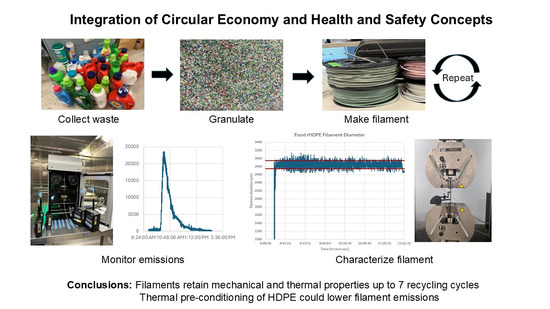
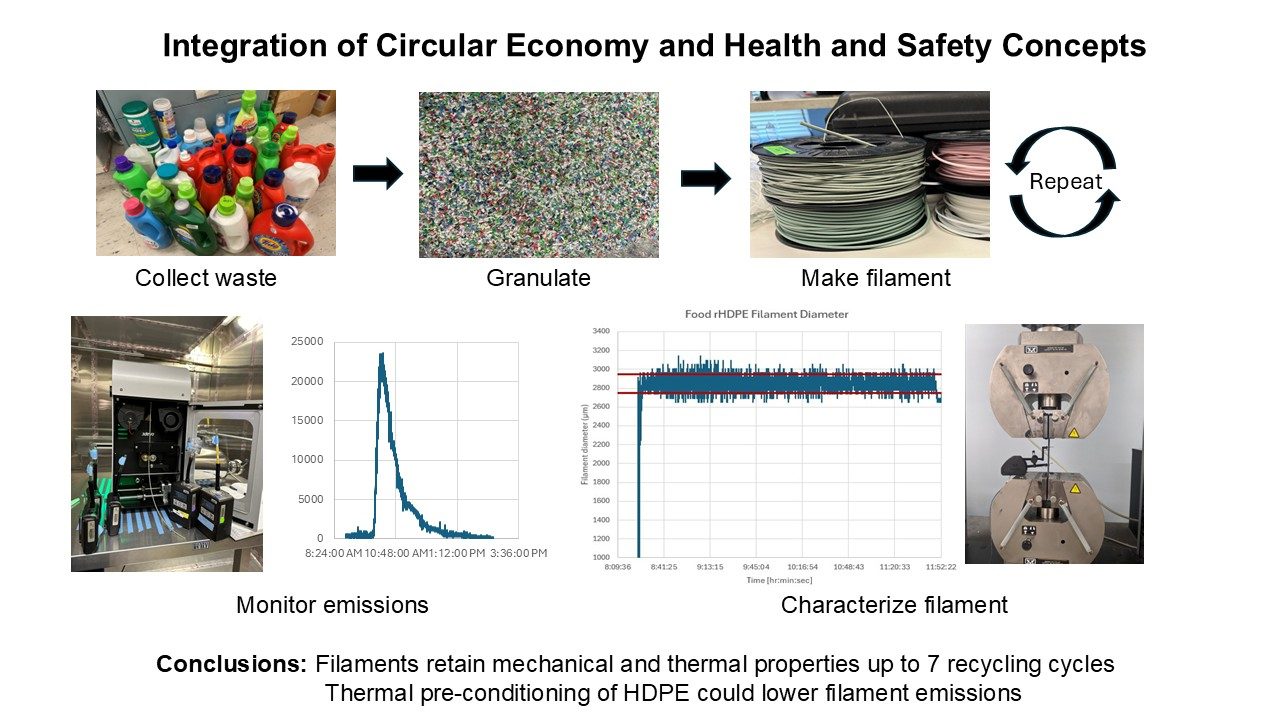
Graphical Abstract

1. Introduction

The global production of plastics is estimated to have been 8300 million tons since the 1950s [1]. Production is anticipated to increase from 236 to 417 million tons per year by 2030 and further increase to 850 million tons per year by 2050 [2,3]. The global plastics economy is largely linear; i.e., they are produced, often used only once, and disposed of, usually to landfill [3]. Increasing annual production in a linear economy coupled with low recycling rates has resulted in a net accumulation of plastics in the environment [1]. Polyethylene, polypropylene, and polyethylene terephthalate are versatile plastics that are commonly used for packaging, but because of their short application lifespan, they subsequently account for a combined 84% of post-consumer plastic waste [1,4,5,6,7].
The current work is focused specifically on high-density polyethylene (HDPE). It is estimated that HDPE alone accounted for 22% of global plastic waste in 2019, and its production will increase at an annual rate of approximately 2.5% [7,8]. As a potential solution to the growing problem of HDPE waste, Baechler et al. suggested a distributed recycling paradigm based on the increasing availability of low-cost filament extruders that can be used to make feedstock for fused filament fabrication (FFF) 3D printing, a type of material extrusion additive manufacturing process [9]. They estimated that a distributed recycling scenario would use 80% less energy than a centralized recycling approach, and the cost of in-house filament production was substantially less than that to produce filament from virgin HDPE resin. In a follow-on study, Kreiger et al. reported that a distributed recycling approach for HDPE would also result in lower carbon dioxide emissions compared with centralized recycling [10]. HDPE is among several types of polymers used for 3D printing [11]. It has excellent mechanical properties, flexibility, chemical stability, a high degree of crystallinity, and a high strength-to-weight ratio [3,12,13].
There are several challenges with using waste plastics for 3D printing [14]. One major consideration for producers is that products made from recycled plastics are of a quality that is comparable with virgin plastic [6,15,16,17]. A prior study reported that the mechanical properties of recycled HDPE polymer generally improved for up to five reprocessing cycles [7], which indicated that this material holds promise to fulfill the demand for a low-cost and sustainable 3D printer feedstock material made from waste plastic, though much remains unknown about the influence of the source of material and processing conditions on its properties. Additionally, residual odors, fragrances, etc., in HDPE used for detergent and personal care product packaging might limit or preclude its use for some product applications [18]. HDPE is also subject to shrinkage, warping, and poor adhesion to the build platform during 3D printing [12,19]. Nonetheless, the properties of HDPE make it a desirable polymer for 3D printing.
Secondary (mechanical) recycling of polymers for 3D printing applications involves sorting to obtain a waste stream that consists only of the polymer of interest, shredding the polymer into granulate with homogeneous size, and extrusion into filament [3]. During this process, the properties of the plastic can change due to exposure to heat, mechanical stress, and oxidation in the extruder, which can affect the molecular structure and, in turn, the mechanical properties of the filament [3,20]. Efforts to recycle most polymers into filaments for 3D printing, including HDPE, have largely focused on these technical problems to produce a feedstock that performs akin to virgin filament. Unfortunately, a critical, but often overlooked, component of the distributed recycling paradigm is the potential for exposure to particles and gases that can be released from plastics during recycling to make filaments [21,22,23]. This issue is further exacerbated by the fact that household waste plastics from packaging, etc., were likely prepared with additives to facilitate injection or blow molding, not additives to ensure 3D printability [23]. As such, prior studies in the literature on emissions during 3D printing with virgin thermoplastic filaments might not fully inform emissions from recycled household waste plastics. To safely recycle post-consumer waste plastic into filament for 3D printing in distributed settings such as homes, academic environments, and small businesses that might lack health and safety expertise, there needs to be an understanding of exposure potential so that sufficient controls can be implemented to minimize risk of adverse health effects. This novel study focuses on recycling HDPE waste plastics into filament while monitoring emissions and characterizing their mechanical and chemical properties. Unique aspects of this work include a first understanding of how repeated recycling impacts particle- and gas-phase emissions from HDPE and bridging the gap between engineering and health and safety professionals to develop safe approaches to filament making in distributed settings as part of a circular economy. The research herein is an important prerequisite for understanding risk, and these data will be informative for follow-on research to design and validate exposure reduction strategies such as proper ventilation.

2. Results and Discussion

Our intent was to subject each plastic stream to five reprocessing cycles; however, because of material limitations, this was not possible. There were sufficient masses of plastics to extrude the non-food (NF)-A and -B streams four times each and the virgin stream five times. The food stream maintained its integrity through five reprocessing cycles, so it was processed twice more, for a total of seven times, before running out of material.

2.1. Plastic Properties

2.1.1. Moisture

Water in plastic used to make filaments can evaporate during extrusion and form air bubbles, which, in turn, can impact printability (e.g., yield an irregular diameter that leads to clogging) and/or decrease the mechanical strength of the filament and printed object. From Figure S1, the moisture content of all plastic streams ranged from approximately 0.02 to 0.10%, akin to 0.05 to 0.18% reported for HDPE plastic bags [24,25], and consistent with the non-hygroscopic nature of HDPE. In general, moisture levels were stable across reprocessing cycles, except for cycle 2 which saw an increase (see Table S1 for statistical comparisons within each stream by reprocessing cycle).

2.1.2. Density

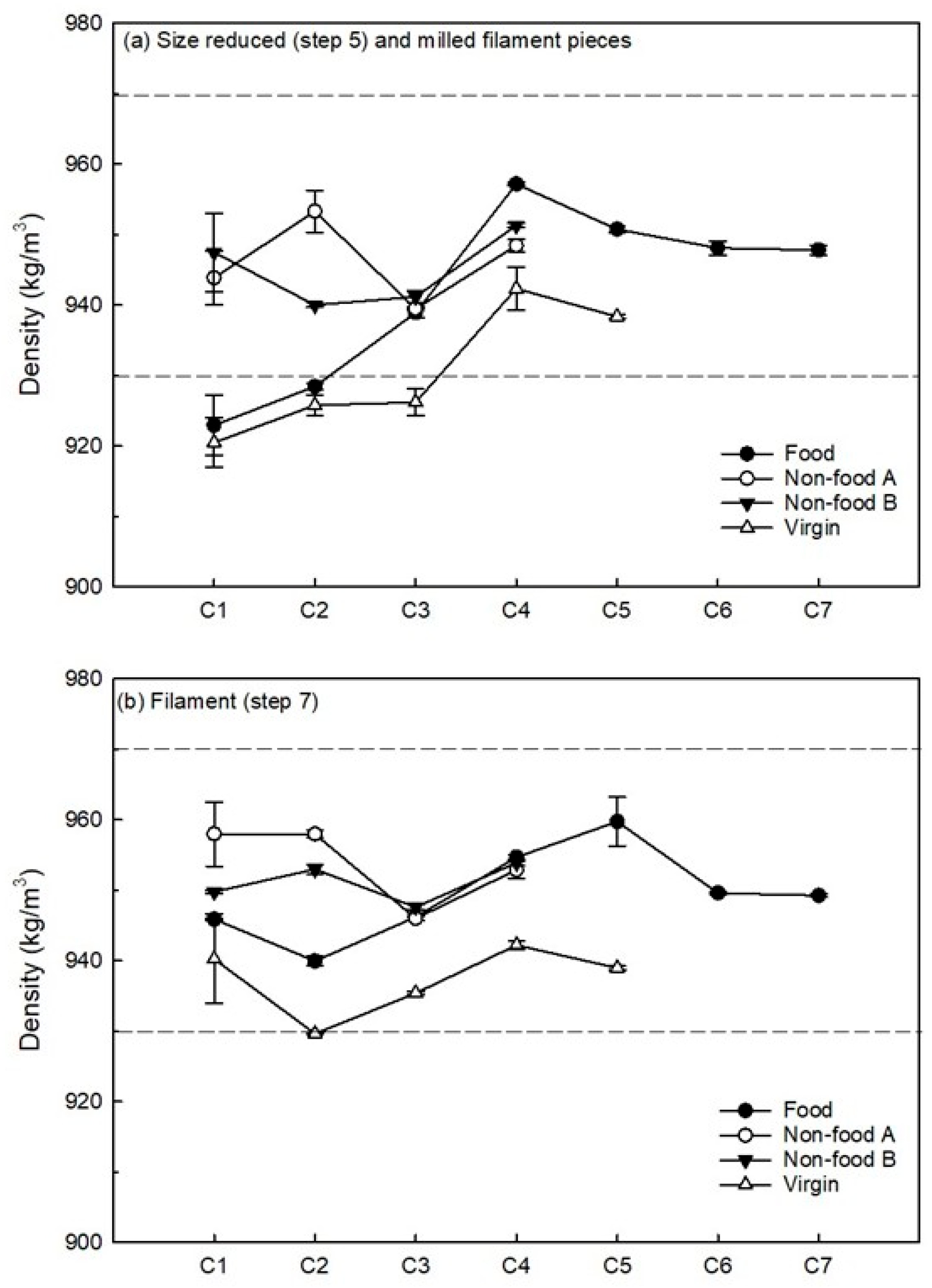
Figure 1 shows the average densities of waste plastic granulates or virgin pellets (step 5, cycle 1—see Section 3) or milled filament pieces before redrying (all cycles) and filament (step 7, all cycles) for each plastic stream (tabulated results are given in Table S2). HDPE does not have a single density value, though a common range in the literature is 930 to 970 kg/m3 [5]. The density values of the granulate and milled filament pieces before redrying for the NF streams were akin to that reported for recycled HDPE granulate from fuel tanks [26] and fell within the range reported in the literature. The density values of the granulates and milled filament pieces for the food and virgin streams were less than 930 kg/m3 for the first few reprocessing cycles but increased thereafter. The density of the filament made from virgin HDPE ranged from 930 to 940 kg/m3, which is in good agreement with the resin manufacturer’s reported value of 955 kg/m3 on its technical data sheet. For all streams, the densities of filaments were between 930 and 970 kg/m3, which indicated no appreciable thermal degradation from changes in crystallinity, loss of plasticizers, or other alterations to the polymer during repeated extrusions [23]. For each plastic stream, when averaged across reprocessing cycles, the density of the size-reduced material (granulates and milled filament pieces before redrying) was significantly lower compared with filament (p < 0.05).

2.1.3. Differential Scanning Calorimetry Analysis

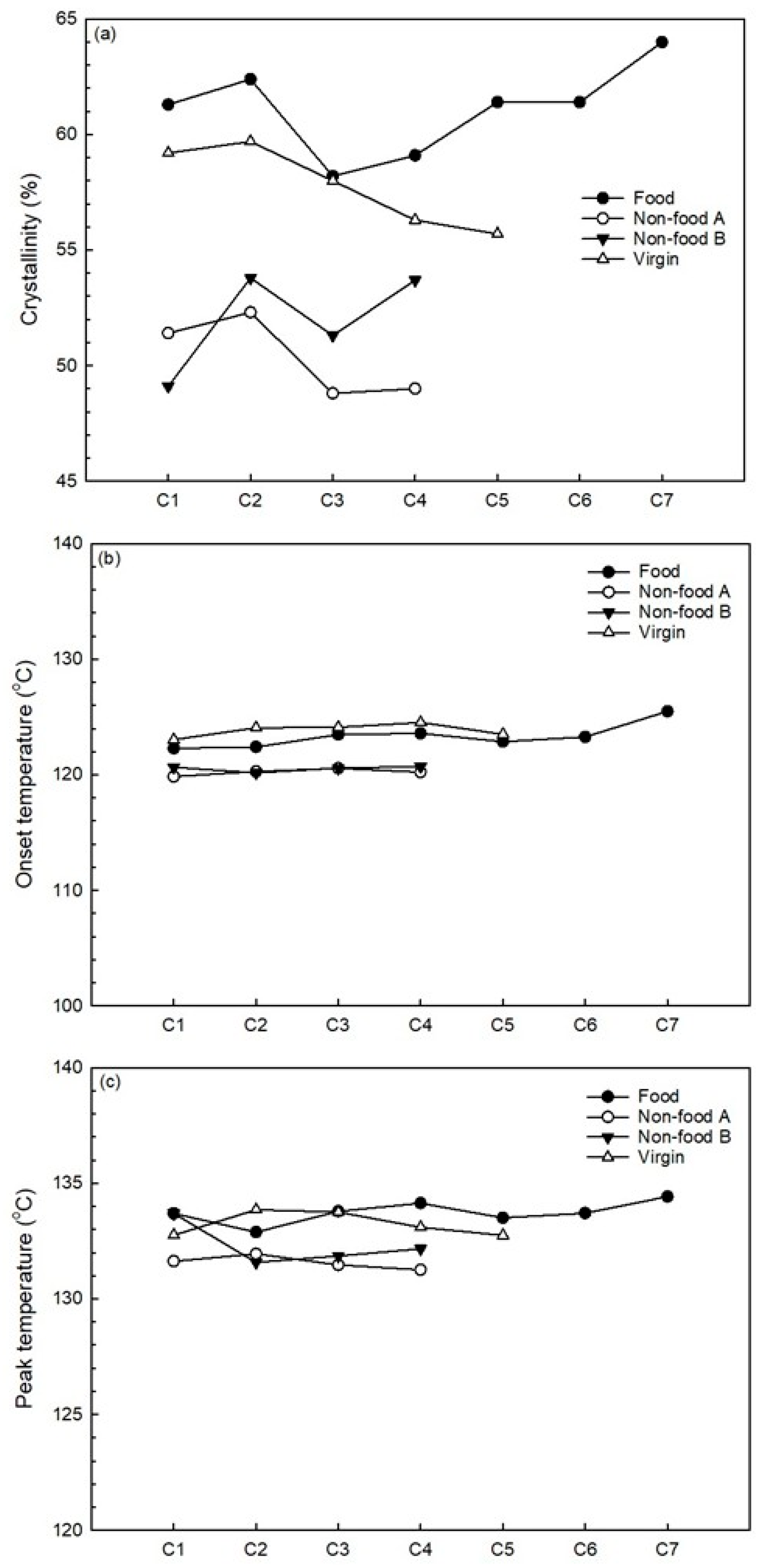
Figure 2a plots the crystallinity of filament for each stream across reprocessing cycles (see Table S3 for tabulated data). As noted in Section 3.3, the thermal, flow, and mechanical properties were only measured once because filament extrusion (step 7) was performed a single time per plastic stream and cycle. This limitation of the experimental design precluded estimation of measurement uncertainty for these parameters. As such, values were aggregated across all reprocessing cycles, and from the linear regression models, crystallinity followed the rank order food > virgin > NF-A = NF-B (p < 0.05). For the food (range: 58.2 to 64.0%), NF-A (range: 48.8 to 52.3%), and NF-B (range: 49.1 to 53.7%) streams, the crystallinity of the filaments was similar to that reported for filament made from recycled bottle caps (56.7%), higher than that reported for filament made from a recycled HDPE material (12.1%) and for extrudate made from a recycled HDPE material (42.4%), but lower than that reported for filament made using waste plastic recovered from the ocean (68.8%) [19,27,28,29]. Values in the literature for virgin HDPE pellets (48%) and virgin pellets extruded into rods (49.7%) [15,27] are lower than that observed for the virgin material used in the current study (range: 55.7 to 59.0%). Though there were some fluctuations, overall crystallinity increased by 4 and 9% with reprocessing cycle for the food and NF-B streams, respectively, whereas values decreased by 5 and 6% for the virgin and NF-A streams, respectively, from their first to last cycle. There is limited data on the effect of multiple reprocessing cycles on the crystallinity of HDPE. Mylläri et al. reported that a recycled HDPE granulate that was extruded and pelletized had a crystallinity of 66%, which decreased slightly to 62 to 63% when the process was repeated for a total of eight reprocessing cycles [30]. Oblak et al. determined that the crystallinity of a virgin HDPE material used to extrude rods was approximately 73%; the rods were granulated and extruded for 99 more reprocessing cycles, but crystallinity only slightly decreased to approximately 71% over the first 10 cycles [20]. Vidakis et al. extruded virgin HDPE pellets into filament and 3D-printed test specimens; then, they recycled the material for a total of six cycles. They observed that crystallinity of the material decreased from 33.7 (cycle 1) to 26.4% (cycle 3) [7]. Caution is warranted in the inter-comparison of study data as a portion of the variability could be attributed to different thermal processing histories of polymers (e.g., extruded only or extruded and injection-molded).
The onset temperature of the food and virgin plastics appeared higher compared with the NF streams (Figure 2b). For all streams, onset temperature was generally unchanged, which indicated that the plastics were thermally stable over multiple reprocessing cycles. Temperatures at peak exotherm (Figure 2c) were generally similar between virgin and food plastics though the values of NF plastics tended to be lower compared with those of virgin plastic.

2.1.4. Melt Flow Index

Melt flow index (MFI) is a useful indicator of the ease of flow of melted plastic as it reflects changes in material structure (e.g., degradation from heat, mechanical stress, and oxidation during recycling) [20]. MFI is inversely proportional to viscosity, so degraded materials generally flow more because of reduced molecular weight [15]. Therefore, a high MFI value would indicate that a material is less ideal for 3D printing because the polymer might flow out of the extruder nozzle rather than deposit and harden in the intended shape. Figure S2 shows plots of MFI for samples of each filament by plastic stream over multiple reprocessing cycles (tabulated data are in Table S4). In general, within a given plastic stream, MFI values were relatively stable, though they decreased for NF-B (cycle 4) and increased for food plastic (cycle 7). The relative stability of MFI indicated little to no change in polymer chain mobility and the absence of branching over multiple reprocessing cycles. These data, particularly for the virgin stream, contrast the findings of the previously mentioned study by Oblak et al., who reported that the MFI of HDPE decreased from 7.5 g/10 min (cycle 1) to 1.45 g/10 min after 10 reprocessing cycles and further declined to 0.27 g/10 min after 20 cycles and remained stable thereafter [20]. The MFI values for filaments made from the waste HDPE plastic streams in the current study (0.2 to 0.7 g/10 min) were consistent with the values of 0.4 to 3.6 g/10 min reported for recycled HDPE filaments [17,26]. The MFI of filament made from virgin plastic in this study ranged from 3.8 to 4.0 g/10 min and aligned with the values of 0.2 to 6.3 g/10 min for virgin HDPE filaments in the literature [31,32] and the resin manufacturer’s reported value of 4 g/10 min given on its technical data sheet. According to Mager et al., the MFI of injection-molding-grade HDPE can be up to 15 g/10 min whereas the range for blow molding grades is 0.25 to 0.4 g/10 min [16]. Using these guidelines, the virgin polymer was likely a low-melt-flow injection-molding-grade material, and the food and NF streams likely represent blow-molding-grade HDPE.

2.1.5. Tensile Properties

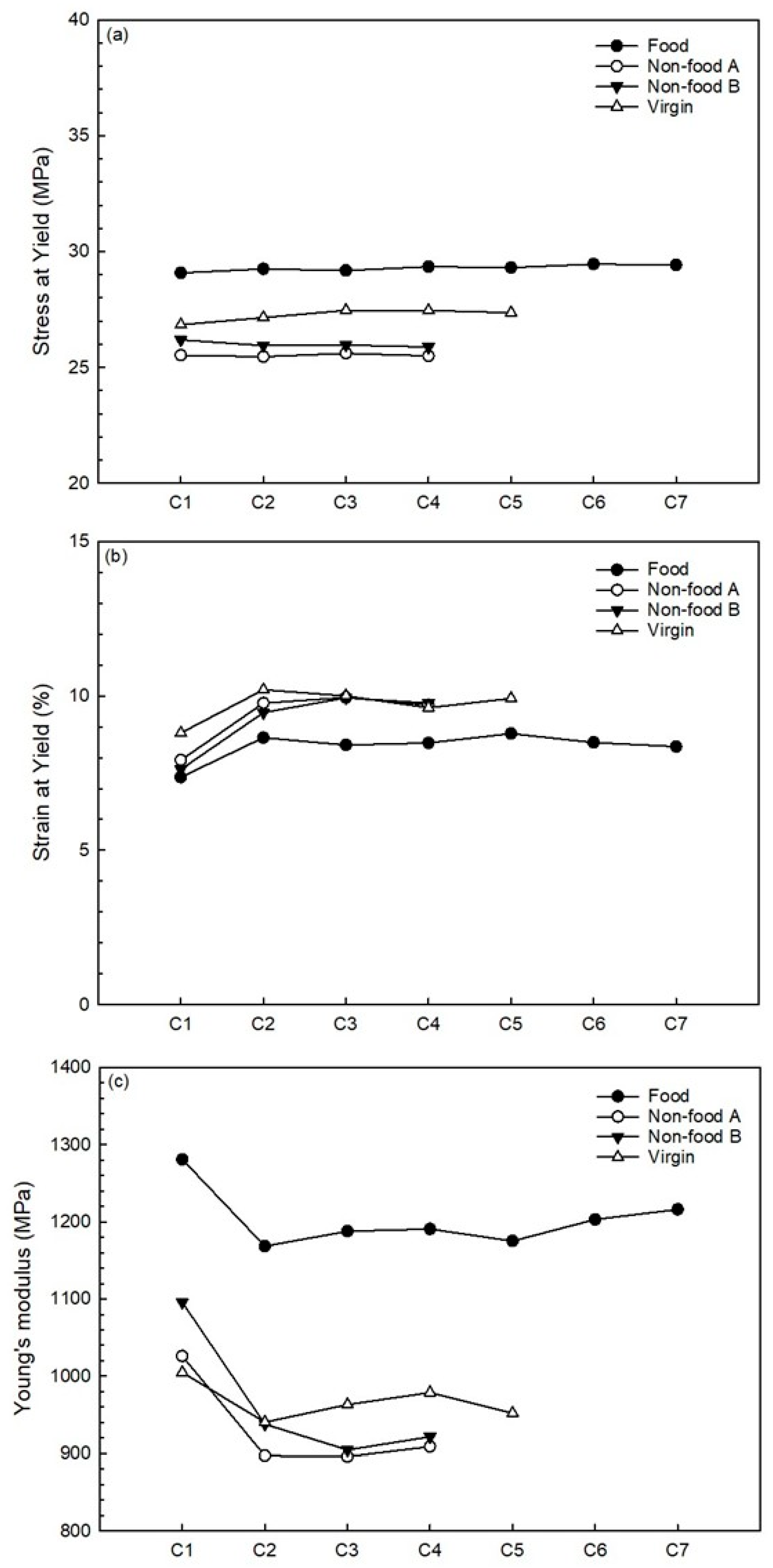
Figure 3 plots the tensile properties of filaments (step 7) for each plastic stream across reprocessing cycles (tabulated data are given in Table S5). In general, for each plastic stream, stress at yield was stable across reprocessing cycles (Figure 3a). When data for each stream were aggregated across all reprocessing cycles, regression models showed that mean values of stress at yield had the rank order food > virgin > NF-B > NF-A (p < 0.05). Values of stress at yield for the food (~29 MPa), NF-A (~25 MPa), and NF-B (~26 MPa) streams were higher than those reported by Singh et al. (5.19 to 17.22 MPa) and Tolcha and Woldmichael (6.92 MPa) but lower than those reported by Ghabezi et al. (27.94 MPa) and Andanje et al. (30.75 MPa) for recycled HDPE filaments [5,12,29,33]. The values reported in the current study were also higher than those given by Arcos et al. for filament compressed into test specimens (21.51 ± 0.9 MPa) and by Mylläri et al. for recycled HDPE subjected to eight repeated injection molding cycles (22.5 ± 0.7 to 23.1 ± 0.3 MPa) [27,30]. Stress at yield for the virgin stream was ~27 MPa over five reprocessing cycles compared with a value of 25 MPa given on the resin manufacturer’s technical data sheet. This value was similar to those reported by Vidakis et al. (24.8 ± 1.8 MPa) and Petousis et al. (25.4 ± 1.2 MPa) for virgin HDPE filaments as well as the values reported by Schirmeister et al. (25.2–26.2 MPa) and Arcos et al. (26.97 ± 0.5 MPa) for tensile specimens made by compression-molding virgin HDPE pellets and extrudate, respectively [27,32,34,35]. In a study that investigated the effects of repeated extrusion on the properties of HDPE plastic, Vidakis et al. extruded virgin HDPE into filament and then used it to 3D-print a tensile test specimen. The remaining filament was pelletized, re-extruded into filament, and used to 3D-print another tensile test specimen, and so on for a total of six cycles [7]. In that study, stress at yield was 23.4 to 28.8 MPa, which is the same as in our study (26.83 to 27.46 MPa). Several factors such as differences in extrusion parameters (e.g., screw speed and nozzle temperature), thermal processing history, and the sources of plastics could explain this variability between the current study and the available literature.
For all plastic streams, the values of strain at yield increased from cycle 1 to cycle 2, then remained stable thereafter (Figure 3b). When data for each stream were aggregated across all reprocessing cycles, the regression models indicated that the mean values of strain at yield followed the order food > virgin > NF-B > NF-A (p < 0.05). Monti et al. reported strain at yield values of 20 to 27% for injection-molded specimens made from a recycled HDPE granulate [26], which is approximately a factor of two higher than that observed in the current study. Pandey and Gupta reported that strain at yield for a virgin HDPE filament was approximately 14%, which is slightly higher than that observed in this study for the virgin stream (9 to 10%) [31].
The values of Young’s modulus decreased from cycle 1 to cycle 2 but remained relatively stable thereafter (Figure 3c). Across all cycles, Young’s modulus decreased by just 5%, 11%, 16%, and 5% for the food, NF-A, NF-B, and virgin streams, respectively. When data for each stream were aggregated across all reprocessing cycles, the regression models indicated that mean values of Young’s modulus had the rank order food > virgin = NF-A = NF-B (p < 0.05). The values of Young’s modulus for the waste plastic streams tended to be higher than those reported in the literature for recycled HDPE granulate that was compression-molded into plates (467 ± 19 MPa) and recycled HDPE extruded into filament (from 630 ± 155 to 972 ± 176 MPa) [15,19,29]. For virgin HDPE, values were similar to those reported by Schirmeister et al. for virgin pellets that were compression-molded into test specimens (960 to 1020 MPa) but higher than the average reported by Daniele et al. for pellets compression-molded into plates (458 ± 33 MPa) and virgin HDPE extruded into filament (246 to 278 MPa) [15,34,35,36]. Few studies have evaluated the effects of repeated reprocessing on Young’s modulus for HDPE plastic. Vidakis et al. reported Young’s modulus values of 240, 280, 290, 290, 310, and 290 MPa, for virgin and five subsequent reprocessing cycles, respectively, which suggested an increase in strength with reprocessing [7]. In the current study, Young’s modulus for the virgin stream was little changed from cycle 1 to cycle 5 (1005 to 952 MPa). Mylläri et al. reported an increase in Young’s modulus for a recycled HDPE from the first injection molding (377 MPa) to the second (450 MPa), with values declining to 432 MPa by the eighth injection molding [30]. Väisänen et al. obtained virgin polylactic acid (vPLA), recycled PLA (rPLA), and virgin polypropylene (vPP) filaments from commercial sources and made a recycled polypropylene (rPP) filament from water bottle caps, and reported that Young’s modulus fluctuated and did not display a consistent pattern over multiple reprocessing cycles [23].
Thermal and viscous effects inside an extruder can induce chain scissions, chain branching, or crosslinking that reduces the polymer chain length, which in turn can lower mechanical properties [3,37]. The mechanical testing data presented in Figure 3 indicated that, overall, multiple reprocessing cycles did not negatively impact the mechanical properties of the virgin or waste HDPE plastic filaments.

2.2. Emissions

2.2.1. µChamber TVOC Emission Yields

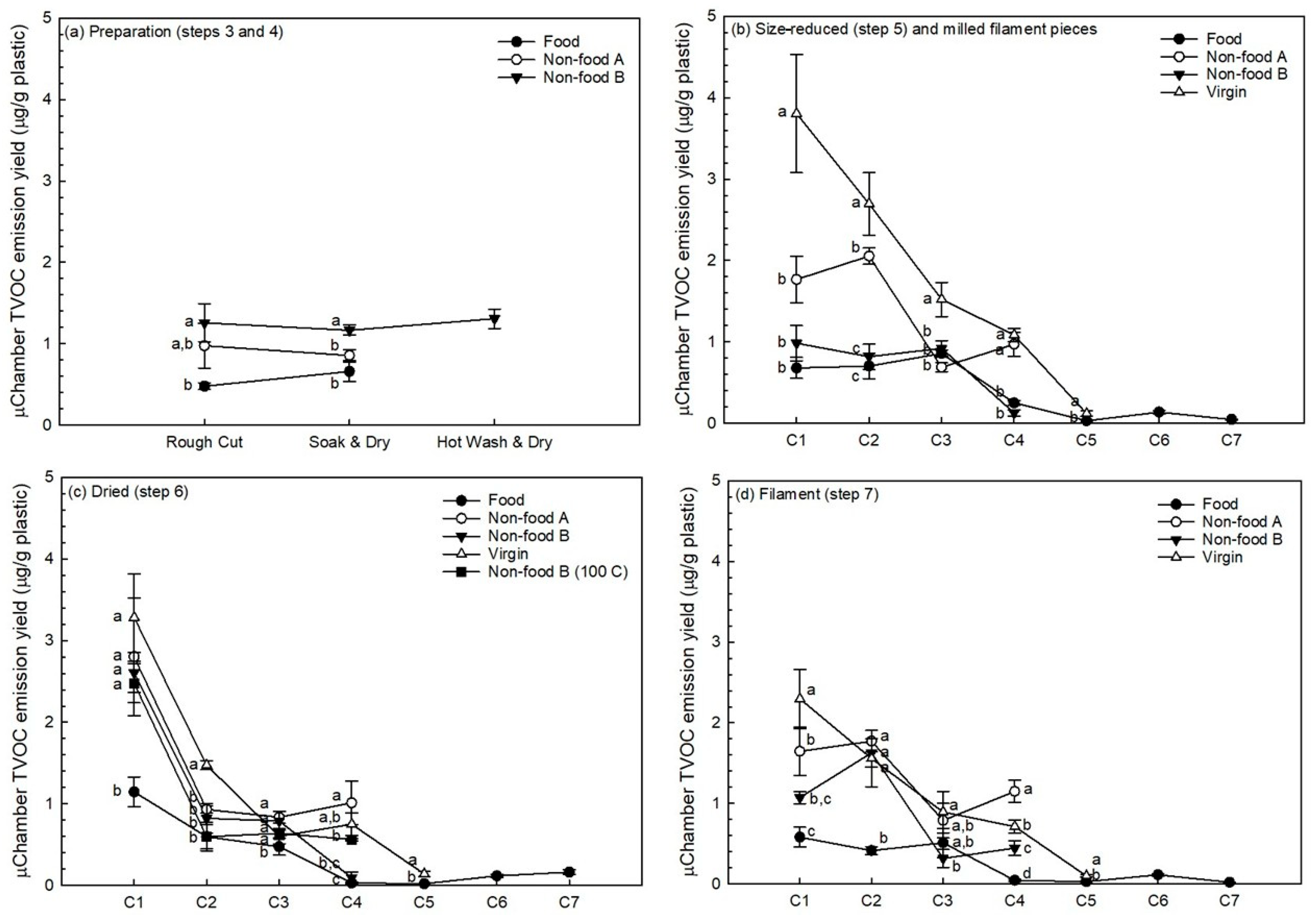
The results of the µChamber system total volatile organic compound (TVOC) emission testing and statistical comparisons are provided in Table S6. Throughout the process, food plastic tended to have lower TVOC yields than the virgin and NF streams, albeit differences were not always statistically significant. From Figure 4a, for the NF-B stream, the TVOC yields were similar for the soak and dry (steps 4a,b) and additional hot wash and dry (steps 4c,d). It was reported that this hot wash protocol was qualitatively effective in lowering VOC odors from HDPE laundry detergent and shampoo bottles [18]; however, in the current study, no such reduction was measured.
All plastic streams were reprocessed for at least four cycles. Figure 4b shows that while there were some fluctuations, during the first four reprocessing cycles, TVOC emission yields decreased by 63, 45, 87, and 72% for the food, NF-A, NF-B, and virgin streams, respectively. From their first to last cycle, TVOC emission rates decreased by 93 and 97% for the food and virgin streams, respectively. The average TVOC yield for the virgin stream was significantly higher than for the waste plastics streams during reprocessing cycles 1 to 5 (p < 0.05).
From Figure 4c, over the first four reprocessing cycles, drying plastic at 50 °C reduced TVOC yields by 97, 66, 85, and 77% for the food, NF-A, NF-B, and virgin streams, respectively. From their first to last cycle, TVOC emission rates decreased by 85% and 96% for the food and virgin streams, respectively. A study reported that passing pressurized air at 100 °C across HDPE granulate for two hours reduced VOC levels [1]. To avoid the risk of thermal injury from working with hot air under pressure, a variation of this air stripping protocol was applied to the NF-B stream which decreased TVOC yield by 77%, but that was approximately the same as the 50 °C drying (85%).
As shown in Figure 4d, over the first four reprocessing cycles, TVOC emission yields from filament decreased by 91, 30, 59, and 69% for the food, NF-A, NF-B, and virgin streams, respectively. Further reprocessing reduced TVOC emission yields by 97% and 96% from their first to last cycle for the food and virgin streams, respectively. TVOC yields for the NF-A and NF-B streams tended to be similar, further supporting the observation that the additional hot washing and drying steps did not effectively reduce TVOC levels from packaging that contained liquid products with fragrances.

2.2.2. Real-Time Monitoring Data

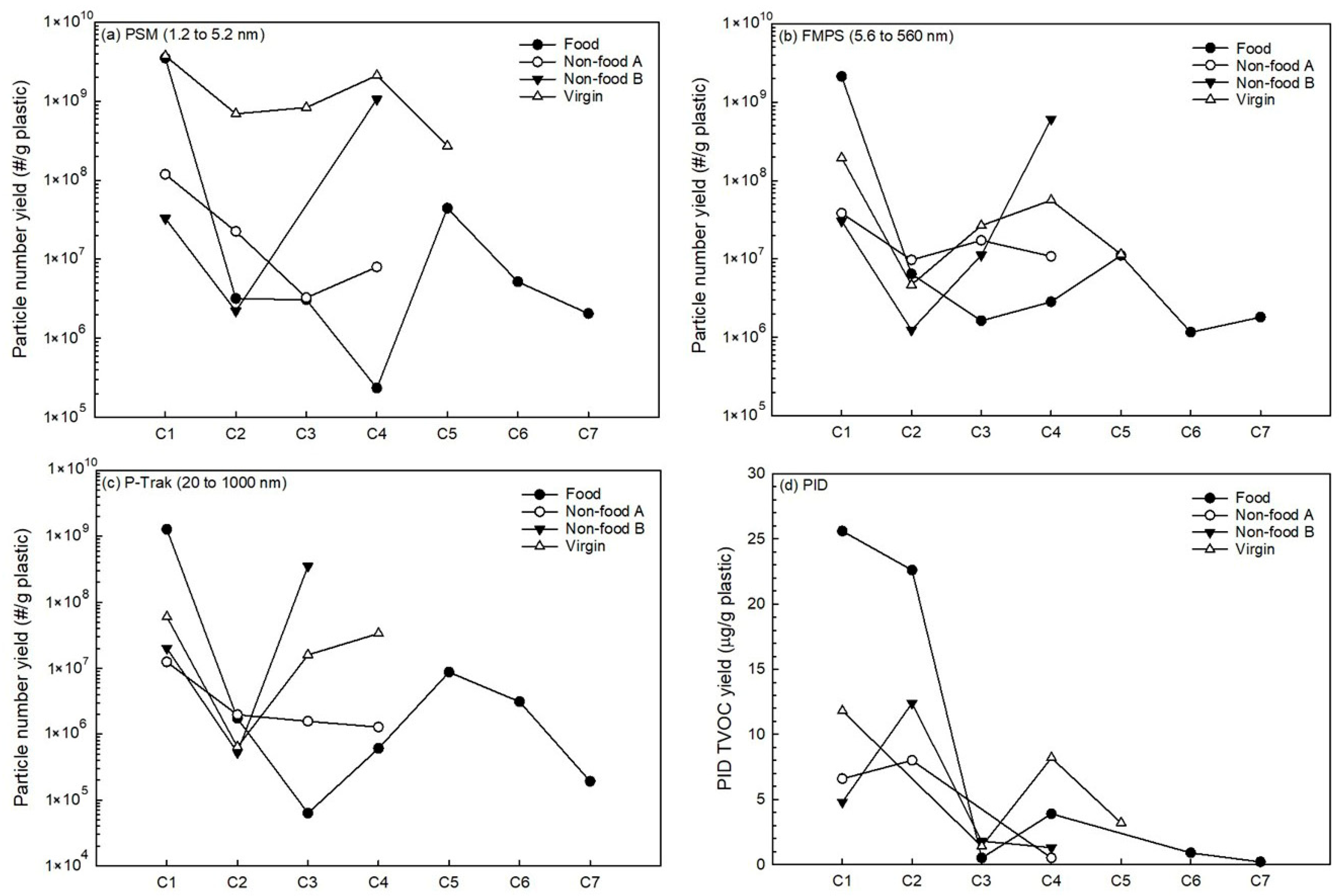
Figure 5 shows the emission yield values calculated from the real-time particle counter and photoionization detector (PID) instrument data during filament extrusion (tabulated data are given in Table S7). From the particle size magnifier (PSM) instrument data, particle yield values decreased by 99.9, 93, and 93% for the food, NF-A, and virgin streams, respectively, but increased by 3100% for the NF-B stream (Figure 5a). For the fast mobility particle sizer (FMPS) instrument data, particle yield values were reduced by 99.9, 72, and 94% for the food, NF-A, and virgin streams, respectively, though they increased by approximately 1900% for the NF-B stream (Figure 5b). Finally, for the P-Trak data, yield values decreased by 99.9, 90, and 44% for the food, NF-A, and virgin streams, respectively, whereas they increased by 1650% for the NF-B stream (Figure 5c). Väisänen et al., in their study on multiple reprocessing of PLA and PP filaments, reported that particle number concentrations (measured using the same model of P-Trak instrument as in the current study) decreased by 86 to 88% for their PLA filaments and by 45% for the vPP filament but increased by 62% for their rPP filament [23]. They attributed the increase in particle emissions from the rPP material to the fact that it was a molding-grade polymer, not a 3D-printing-grade polymer, so it lacked additives to promote printing, which, in turn, somehow resulted in greater particle emissions. In the current study, as noted in Section 3, the NF plastic was randomly subdivided into the NF-A and NF-B streams. Further, the MFI was similar for both NF-A and NF-B streams and consistent with blow-molding-grade HDPE (Section 2.1.4). As such, polymer grade cannot explain the increase in particle emissions from the NF-B stream only. While filament extrusion parameters were similar between the NF streams (Table 1), the NF-B material was subjected to an additional drying step at 100 °C prior to extrusion (see Section 3). This additional thermal exposure of the NF-B stream could have promoted instability in the particle structure that contributed to greater release of organic chemicals or additives, which, upon contact with the cooler chamber air, condensed to form particles. Cycle after cycle, the effects of this additional heating compounded to result in higher particle emissions. For the virgin plastic stream, particle number yields calculated from the PSM data were one to two orders of magnitude higher compared with the FMPS data, which indicated a strong contribution of particles with size 1.2 to 5.2 nm to emissions, whereas for the waste plastic streams, yields determined from these instruments were more similar. Previous studies have noted the potential underestimation of particle emissions from 3D printers based on comparisons of PSM and mobility sizing instruments [38,39]. Our data further supports the need to consider sub-5 nm aerosols in emission testing during filament making and 3D printing with plastics. When values for each stream were averaged across all reprocessing cycles, it was shown that there were no differences in particle emission yields among plastic streams for all particle monitoring instruments.
TVOC yield values determined from the PID data decreased by 99, 92, 73, and 73% for the food, NF-A, NF-B, and virgin streams, respectively, with increasing reprocessing cycle (Figure 5d). In the previously mentioned study of PLA and PP, reductions in TVOC levels over multiple reprocessing cycles were 62 to 68% for PLA filaments and 28 to 48% for PP filaments [23]. Mylläri et al. reported that TVOC levels decreased 65% over eight extrusion cycles for a recycled HDPE material that was injection-molded into test specimens [30]. When values for each stream were averaged across all reprocessing cycles, linear regression models revealed there were no statistical differences in TVOC yields among plastic streams.

2.2.3. Time-Integrated Sampling Techniques

Filter sampling revealed that arsenic (As), chromium (Cr), copper (Cu), manganese (Mn), and tin (Sn) were present at detectable levels in some particle emissions during filament extrusion (see Table S8). Arsenic is a respiratory irritant and carcinogen, and can cause ulceration of the nasal septum; Cr is an eye and skin irritant; Cu is an eye and nose irritant and can cause perforation of the nasal septum; Mn causes manganism and metal fume fever, and Sn is an eye, skin, and respiratory system irritant [40]. Exposure concentration values for metals were calculated for a scenario of a person operating a filament extruder in a residential garage. As summarized in Table S9, average concentrations of all metals were several orders of magnitude below U.S. National Institute for Occupational Safety and Health (NIOSH) recommended occupational exposure limits (RELs) and legally enforceable U.S. Occupational Safety and Health Administration (OSHA) Permissible Exposure Limits (PELs), where applicable [40]. Arsenic, Cr, Cu, and Mn are used as additives to improve the physical and chemical properties of HDPE plastic bags [24,25], though the source of these metals in the rigid waste HDPE containers that were recycled or the virgin pellets in this study is not fully known. They could be residual catalyst, plasticizers, or other processing aids from making the polymers, an additive to impart specific properties to the plastic (e.g., flexibility), and/or pigment used for coloring the plastics or inks [41,42]. Contamination from the equipment used to shred, granulate, and extrude the filament might also be a source.
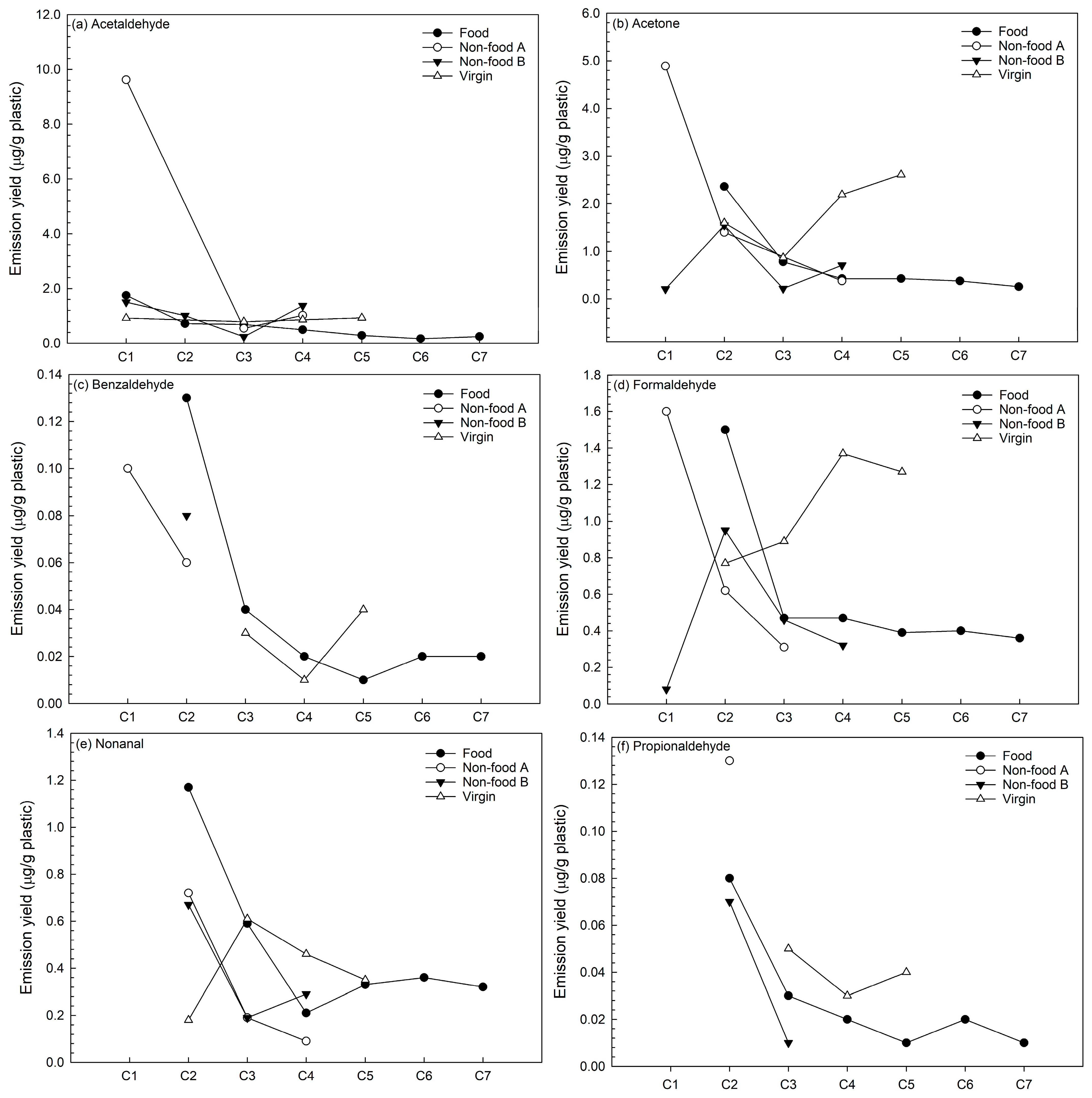
The levels of phthalates and straight-chain and aromatic hydrocarbons were all below their respective method analytical limit of detection. Tabulated yield values for aldehydes and acetone are given in Table S10. From Figure 6a, though some fluctuations were observed, overall, acetaldehyde yields decreased by 86, 89, and 9% for food, NF-A, and NF-B streams, respectively, from the first to last reprocessing cycle (there was no change in levels for the virgin stream). For the remaining substances, yield values decreased with increasing reprocessing cycle for the food and NF-A streams only (Figure 6b–f). For the NF-B stream, yield values for acetone and formaldehyde increased by 238 and 300%, respectively, whereas yields for nonanal and propionaldehyde decreased by 57 and 86%, respectively. For the virgin stream, yields for acetone, benzaldehyde, formaldehyde, and nonanal increased by 63, 33, 65, and 94% with increasing reprocessing cycles whereas propionaldehyde decreased by 20%. In the study of PLA and PP filaments, it was reported that the concentrations of some chemicals increased, whereas for a few, levels increased [23]. The authors of that study suggested that reductions in individual VOC levels over multiple reprocessing cycles were likely attributable to the evaporation of the most volatile substances. In the current study, the lowest-boiling-point aldehyde was formaldehyde (−19.5 °C). Interestingly, formaldehyde (and all aldehydes and acetone, regardless of boiling point up to 195 °C) sometimes decreased in concentration, but were not depleted, from their plastic streams by their last reprocessing cycle. One possible explanation was that these substances were encased in the volume of the plastics, and each time a material was granulated, it exposed fresh plastic surfaces that facilitated volatilization when heated in the extruder. The presence of acetaldehyde and formaldehyde was consistent with Tikusis et al., who reported these emissions during commercial-scale extrusion of HDPE to make pipes [43]. Both these substances are categorized as potential occupational carcinogens [40]. Modeled exposure concentration values for aldehydes and acetone are summarized in Table S9; except for formaldehyde, average concentrations of all organic gases were orders of magnitude below NIOSH RELs and legally enforceable OSHA PELs [40]. For all streams, the modeled average formaldehyde concentrations were one order of magnitude below the REL, and the upper 95% of the mean concentration was within a factor of two of the REL.
Table S11 summarizes the results from canister sampling during filament extrusion. In general, for all HDPE plastic streams, extrusion cycle 1 had the highest number of significant peaks with respect to background. As extrusion cycles progressed, fewer compounds were observed being emitted from the HDPE. Further, concentrations (based on normalized peak area) of identified compounds decreased from cycle 1 to cycle 2 and most declined thereafter with each additional reprocessing cycle. The exceptions to this pattern were acetic anhydride during the extrusion of the food plastic stream and styrene during the extrusion of the NF-A plastic stream. Eight compounds were identified during the extrusion of the food plastic stream and included flavoring/fragrance related chemicals (2-methyl-1-propanol, acetic anhydride, isopropyl alcohol, and 3-carene), residual milk (lactic acid), chemicals used in polymer production (dicyclohexyl oxalate and 3-methylenecyclopentane carbonitrile), and a compound used in cosmetics and personal care products (7H-perfluoroheptanoic acid). The presence of all but 7H-perfluoroheptanoic acid was consistent with plastics used for food packaging. The SI factor for this compound (623) was slightly below our threshold (650), but its identity was included for completeness. During the extrusion of the NF-A stream, four flavoring-/fragrance-related chemicals (2-methyl-1-propanol, acetic anhydride, isopropyl alcohol, and 3-carene) identified in emissions were common to the food plastic stream. Five additional chemicals consistent with NF plastics were identified that were unique to this stream: 1,2,3-triemethyl benzene (synthesis of dyes/perfumes), 2,4-dimethylhexane (cosmetics), o-cymene (flavoring/fragrance), styrene (cleaning products), and p-isopropylbenzaldehyde (plastics manufacturing). For the NF-B stream, there were five compounds identified in canister samples. 3-Carene (lemon flavoring/fragrance) was common to the food and NF-A streams, though camphene and camphor (cleaning products), methacrolein dimer (polymer manufacturing), and o-tertbutyl cyclohexyl acetate (fragrance) were unique to the NF-B stream. The presence of 3-carene, camphene, o-cymene, 1,2,3-trimethylbenzene and p-isopropylbenzaldehyde in the waste plastic streams was consistent with prior reports that detected these compounds in emissions from recycled HDPE [26,44,45]. Five unique compounds were identified in canister samples collected during the extrusion of virgin HDPE into filament. Two of the five compounds, 1,3-dimethylcyclohexane and cis-1,3-dimethylcyclohexane, are associated with chemical and polymer production, though the reason for the presence of the other three compounds (methylcyclohexane, 1,3,5-trimethylcyclohexane, and allyl hexyl ester oxalic acid) in emissions from virgin plastic is unknown at this time.

3. Materials and Methods

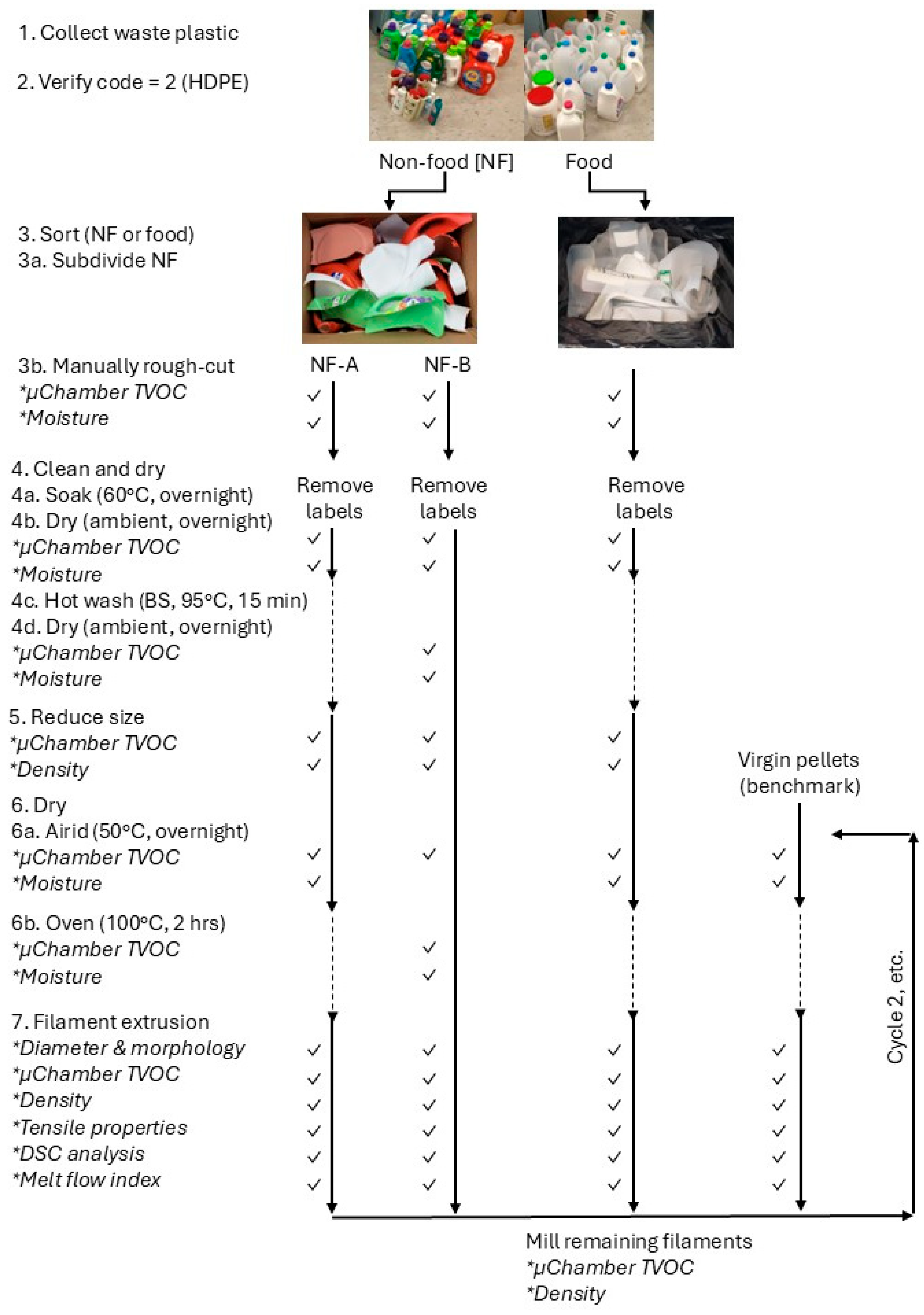
Figure 7 provides an overview of the process flow. Step 1 was to collect waste HDPE plastic (sourced from local households in Morgantown, WV). Step 2 was to verify the plastics were HDPE (i.e., recycling code 2). Food packaging commands a premium price compared with non-food (NF) packaging [3], which might provide an economic incentive to recycle food-grade plastics. Additionally, non-food plastic packaging for detergent and personal care products can adsorb volatile organic compounds (VOCs) such as fragrances [44], which might contribute to emissions during extrusion. As such, HDPE waste plastics were sorted into food and NF streams (step 3). The food stream was mostly milk and water jugs but included a few containers of protein powder supplements. The NF stream was mostly laundry detergent jugs and personal care product containers (e.g., shampoo and body wash). The NF plastic was randomly subdivided into two streams, designated NF-A and NF-B (step 3a). All containers were cut into pieces using ceramic scissors (step 3b). Next, these rough-cut NF and food plastic pieces were soaked in water (60 °C) overnight to remove product residues and loosen any paper labels, which were removed by scraping using a ceramic razor blade; pieces were rinsed in deionized water and air-dried overnight (steps 4a,b). If any residual glue remained on plastic pieces after removing labels, it was wiped away using acetone and thoroughly rinsed in running deionized water. The rough-cut pieces of NF-B stream plastic were subjected to an additional treatment that consisted of washing in hot water (95 °C) with baking soda (Product No. BP328-1, Fisher Bioreagents, Fair Lawn, NJ, USA) at a ratio of 20 g per 500 mL and stirring occasionally for 15 min (steps 4c,d) to reduce odors from fragrances [18]. Next, the rough-cut plastic pieces from each stream were reduced in size using a shredder (ASC-EI-01, TechTongda, Salt Lake City, UT, USA) and the resulting granulate passed through a No. 6 sieve (3.35 mm opening) to achieve a homogenous size for extrusion (step 5). The shredder was carefully cleaned between plastic streams using a soft bristle brush, compressed air, and vacuum to minimize cross-contamination. It should be noted that the as-received virgin material (HDPE Flush, 3devo B.V., Utrecht, The Netherlands) used as a benchmark was in the form of pellets, so it did not need to be reduced in size or sieved prior to drying. The waste plastic granulates and virgin HDPE pellets were dried (50 °C) overnight (Airid, 3devo B.V., Utrecht, The Netherlands) to remove moisture (step 6a). The NF-B stream was additionally treated by drying at 100 °C for two hours in an oven (Carbolite PF60, Hope Valley, England) to further reduce VOC content (step 6b) [1].
Prior to making filament, preliminary extrusion testing was performed to ensure that the waste plastics would flow through the extruder, verify that moisture levels were sufficiently low to prevent bubbles from forming in filament, and identify starting parameters (temperature, screw speed, and fan speed). Portions of food and NF-B granulates were used for preliminary testing (both NF-A and NF-B materials came from the same source material, so the NF-B material was chosen randomly and was expected to be representative of the NF-A material). The remaining food and NF-B stream granulates were subsequently processed through the extruder so that all plastic within these streams had the same thermal treatment history. All food and NF-B extrudates were milled into approximately 2 to 3 mm pieces (Product No. FB00823, Filabot, Barre, VT, USA) and redried (step 6a or 6b, as appropriate). As such, the starting forms of materials for cycle 1 filament extrusion were milled pieces (food, NF-B), granulate (NF-A), or pellets (virgin). Each plastic stream was extruded into filament using a commercially available single-screw extruder with four heating zones, a 4 mm nozzle, and air cooling (Composer 450, 3devo B.V., Utrecht, The Netherlands) (step 7).
Table 1 summarizes the filament extrusion parameters. Heating zone 4, which was nearest to the material feed hopper, along with zone 3, was set to a relatively lower temperature to help push the polymer through the screw feed without fully melting before it reached zone 1, the extruder nozzle. In general, for the heterogeneous waste plastic streams, a wider range of temperatures were used to extrude filaments compared with the homogeneous virgin polymer. Between streams, the extruder was purged using DevoClean (Mid Temp Purge, 3devo B.V., Utrecht, The Netherlands), followed by HDPE Flush to minimize cross-contamination.
Sections of filament (5 to 10 cm) were taken from each stream at approximately 1 m intervals by clipping with ceramic scissors and used for characterization testing (see Figure 7, step 7, and Section 3.1 Polymer Characterization). As indicated in Figure 7, the remaining filament from each stream was milled into approximately 2 to 3 mm pieces (Product No. FB00823, Filabot, Barre, VT, USA). A small sample (3 to 5 g) of the milled filament was used to characterize the density and emissions of these pieces. For cycle 2, the remainder of the milled filament from each stream was redried (step 6a or 6b, as appropriate) and extruded into filament (step 7). This process of milling, characterizing, drying (step 6a or 6b), and extruding filament (step 7) was repeated (cycle 3, and so on) until masses of plastic in each stream were consumed.

3.1. Polymer Characterization

Important quality parameters for recycled polymers include, but are not limited to, mechanical properties, processing parameters, and odor considerations [6]. Excess moisture in plastic can negatively impact filament, so, as indicated in Figure 7, moisture content was measured for 5 to 10 g samples of rough-cut (step 3b), cleaned and dried rough-cut (steps 4a–d), and dried material (steps 6a,b) using Karl Fischer analysis in accordance with ASTM D6980 [46]. The density values of waste plastic granulate or virgin pellets (step 5, cycle 1), filament (step 7, all cycles), and milled filament pieces before redrying (all cycles) were determined in-house using a microbalance and density adapter kit (Metler-Toledo, Columbus, OH, USA) per ASTM D792 [47]. Tensile properties (stress at yield, strain at yield, and Young’s modulus) were determined for filament by ASTM D638 [48]. For tensile testing, 200 g of filament clippings was compression-molded into plaques, from which Type I test bars were die-cut. The processability of the filament was determined by measuring MFI of 3 to 5 g samples as per ASTM D1238 [49]. The thermal properties of the filament (normalized enthalpy, onset of crystalline melting, and temperature at peak exotherm) were determined from the second heating curve using differential scanning calorimetry (DSC) by ASTM D3418 [50]; sample masses were 3 to 5 g. The crystallinity of filaments was calculated from the normalized enthalpy values (ΔHf) according to the equation:
C r y s t a l l i n i t y   % =   H f H f 100 · 100
where ΔHf100 = enthalpy of fusion of fully crystalline HDPE (293 J/g).
Moisture content, tensile testing, MFI, and DSC analyses were performed by a commercial laboratory (Smithers, Akron, OH, USA).
TVOC emissions from plastic samples collected throughout the process (denoted in Figure 7) were assessed using a microchamber (µChamber) emission testing system (Model M-CTE250, Markes International Ltd., Bridgend, UK) [51]. TVOC levels were quantified using a calibrated PID with 10.6 eV lamp (Tiger, Ion Sciences, Stafford, TX, USA). Key parameters for testing (sample equilibration time, chamber temperature, and inlet gas flow rate) were optimized in accordance with ASTM D7706 [52]. For cycle 1, tests were performed on rough-cut (step 3b), cleaned rough-cut (step 4a–d), granulated waste plastics and as-received virgin pellets (step 5), dried granulated waste plastics and as-received virgin pellets (step 6a,b), and filament (step 7). For cycle 2 and subsequent cycles, tests were performed on milled filament pieces before redrying, dried milled filament pieces (step 6a–d), and extruded filament (step 7). Results were normalized to mass of sample (approx. 5 g) and expressed as mass emission yield (µg TVOC/g plastic).

3.2. Emission Characterization During Filament Extrusion

All filament extrusions (Figure 7, step 7) were conducted inside a 12.85 m3 stainless steel environmental chamber designed for emission testing [53]. Inlet air was passed through a carbon filter and high-efficiency particulate air (HEPA) filter to remove organic vapors and particles, respectively. For each plastic stream and cycle, particle number in the size range 20 to 1000 nm was monitored using a P-Trak (model 8525, TSI Inc., Shoreview, MN, USA), number and size distribution in the range 5.6 to 560 nm was monitored using a FMPS (model 3091, TSI Inc., Shoreview, MN, USA), and number and size distribution in the range 1.2 to 5.2 nm was monitored using a PSM (model A11 nCNC, Airmodus Ltd., Helsinki, Finland). The PSM was operated in scanning mode with a minimum flow rate of 0.1 L/min and a maximum flow rate of 1.3 L/min, and the total time to complete a scan was 240 sec (1 sec per step). PSM data were corrected for particle losses in the sampling tubing using the freely available online Particle Loss Calculator from the Max Planck Institute for Chemistry. Finally, TVOC concentration was measured using a PID. All real-time instruments were located outside the chamber, and stainless-steel tubing was used to sample chamber air from a point approximately 10 cm above the front of the extruder.
Metals in particulate released during filament extrusion (step 7) were quantified by drawing air across mixed cellulose ester filters housed in close-faced cassettes using a calibrated (Q = 3.0 L/min) personal sampling pump (AirChek XR5000, Eighty Four, PA, USA), followed by inductively coupled plasma–optical emission spectrometry (ICP-OES) analysis [54]. Thirteen metals were targeted based on their potential to cause adverse respiratory effects and presence in HDPE plastics: aluminum (Al), As, cadmium (Cd), Cr, cobalt (Co), copper (Cu), iron (Fe), lead (Pb), molybdenum (Mo), Mn, nickel (Ni), Sn, and vanadium (V) [24,25,40].
Given the potential for the release of hazardous gases during the processing of HDPE plastics [1,43,45,55,56], chamber air was drawn through substance-specific media using calibrated pumps to sample for gases during filament extrusion (step 7). Phthalates (bis-2-ethylhexyl phthalate, dibutyl phthalate, and diethyl phthalate) were sampled in accordance with U.S. OSHA Method 104 [57]. Aromatic hydrocarbons (BTEX: benzene, toluene, ethylbenzene, xylene isomers, plus styrene) and straight-chain hydrocarbons (decane, dodecane, hexane, octane, and tridecane) were sampled in accordance with U.S. NIOSH standard methods 1500 and 1501 [58,59]. Finally, aldehydes (acetaldehyde, benzaldehyde, formaldehyde, nonanal, and propionaldehyde [propanal]) and acetone were sampled as per U.S. Environmental Protection Agency method TO-11A [60].
In addition to the target analytes described above, 450 mL Silonite-coated evacuated canisters (Model 29-MC450SQT, Entech Instruments Inc., Simi Valley, CA, USA) were used to sample chamber air during filament extrusion (step 7), followed by analysis using gas chromatography–mass spectrometry (GC-MS) as previously described to qualitatively identify VOCs [61]. Briefly, sample canisters were connected to a 7200 CTS cryogen-free gas pre-concentrator (Entech, Simi Valley, CA, USA) coupled to an Orbitrap GC-MS (Thermo Fisher Scientific, Waltham, MA, USA), and 100 mL of the atmosphere within was collected; see Walsh et al. for further details [61]. GC-MS data were collected from canisters containing chamber air sampled during background, during filament extrusion (n = 1 for each cycle), and from ambient lab air. All samples were run in technical triplicates. The comparison of VOC emissions from each extrusion cycle was accomplished using Compound Discover v.3.3.200 (Thermo Fisher Scientific, Waltham, MA, USA) and an untargeted mass spectrometric workflow. Within Compound Discoverer, the “GC EI with Statistics” workflow was chosen with the following parameters: 5 parts per million mass tolerance, a total ion chromatogram (TIC) threshold of e6, a retention time tolerance of 5 sec, and National Institute of Standards and Technology (NIST) library search (NIST 2020 MS Library). GC-MS data collected from ambient lab air as described above were entered into the software to remove consistent noise peaks from the final data set. For VOC emission trends between cycles, each emission profile was compared to the normalized background collected from all canisters; comparisons were not made among HDPE plastic streams. To determine significant peaks between extrusion cycle emissions versus chamber background, a one-way ANOVA with a Tukey post hoc test was performed. The p-values were adjusted using the Benjamini–Hochberg correction to account for the false discovery rate.
For peak identification, significant VOCs were selected from cycle 1 based on multiple factors including: peak ratio (peak area/background), adjusted p-value, and Log2 fold changes. High-Resolution Filtering (HRF) and Search Index (SI) scores were then used for further confirmation. Previous studies have established the correct identification of unknown targets when further differentiated using an HRF score > 80% and an SI score > 650 [62,63]. Additionally, the peak identifications would be considered level 2, probable structures [64], based on the requirements set forth in the Metabolic Standards Initiative (MSI) [65].

3.3. Data Analysis

Separate samples were collected during background (extruder on but not operating) and extrusion. Emission yields were calculated from real-time particle and PID TVOC data and masses of metals in particles as per RAL-UZ-205 [66]. Emission yields for gases (aldehydes, etc.) were calculated in accordance with the American National Standards Institute/Underwriters Laboratories (ANSI/UL) standard 2904 [67]. All calculations accounted for background levels, so reported yields are attributable to the extrusion process.
Emission values were used to model average exposure concentrations for individual gas phase and metal emissions (Ci; µg/m3) for a person performing filament extrusion in a garage. Calculations were performed in accordance with ANSI/UL 2904 using standard values for room volume and air exchange rate from the standard and the following equation [67]:
C i = E R i ·   A V m   ·   1 N m
where ERi = individual gas emission rate (µg/h), A = number of filament extruders operating (1), Vm = room volume (114.2 m3), and Nm = air exchange rate (0.23/h). Estimated concentrations were compared to NIOSH RELs and legally enforceable OSHA PELs when available [40]. There is no particle number-based exposure limit, so particles were not included in this modeling scenario.
Density, moisture, and µChamber TVOC emissions were measured in triplicate. The mechanical properties, MFI, thermal properties, and all emissions (particles, TVOC, metals, and specific VOCs) were only measured once because filament extrusion (step 7) was performed a single time per plastic stream and cycle. Linear regression models were used to evaluate relationships between moisture content or µChamber TVOC emission rate (dependent variables) and reprocessing cycle (fixed effect), with the repeated measures as the random effect. Additionally, linear regression models were used to evaluate relationships between density, thermal properties (crystallinity), mechanical properties (stress at yield, strain at yield, and Young’s modulus), particle emission yield values (PSM, FMPS, and P-Trak), and PID TVOC emission yield values (dependent variables) and plastic stream (fixed effect) over all reprocessing cycles combined (n = 4 to 7, depending on the plastic stream). Statistical analyses were performed using JMP (version 16.1.0, SAS Institute Inc., Cary, NC, USA) at a significance level of 0.05 for all comparisons.

4. Conclusions

Understanding risk requires knowledge of exposure and hazard. Once risk is established, controls can be implemented to reduce risk to a desired level. Herein, we took the necessary first step in the risk assessment process by evaluating exposure potential to a range of emissions, many of which have known hazardous properties.
  • Post-consumer waste HDPE plastic from rigid food and non-food packaging and a virgin HDPE resin (benchmark material) were granulated and extruded into filament and the process repeated 4 to 7 times.
  • Particle and organic chemical emissions generally decreased by 93 to 99% (PSM data) and 73 to 99%, respectively, with increased reprocessing cycle.
  • Modeled concentrations of organic gases and metals were below occupational exposure limits for a scenario of operating a filament extruder in a residential garage.
  • The mechanical, processability, and thermal properties of the plastic streams were largely unaffected; i.e., Young’s modulus decreased by 5 to 16%, MFI was relatively stable at 0.2 to 0.7 g/10 min for waste plastics, and crystallinity ranged from a 6% decrease to a 9% increase.
  • Reductions in emissions during filament extrusion appeared to be more influenced by reprocessing cycle than any specific process step (grinding, drying, etc.).
  • Food stream plastic tended to have lower particle emissions compared with the NF and virgin streams during filament extrusion.
  • TVOC emissions from the food stream were initially higher, but after a few reprocessing cycles, they decreased to levels that were lower than all other streams.
  • Emission yields for some, but not all, aldehydes tended to be lower for the food stream plastic compared with the other streams.
While emissions generally decreased with increased reprocessing cycle, an exception to the observed pattern was that particle emissions from the NF-B stream increased from the first to final cycle. These observations align with Väisänen et al., who reported that particle emissions from a recycled PLA filament decreased over multiple reprocessing cycles but increased for a recycled PP filament [23]. Hence, at this time, no universal conclusion can be made as to whether recycled filament will always have progressively lower emissions when subjected to multiple reprocessing cycles.
The observed propensity of the food stream plastic to have generally lower particle and gas emissions, coupled with the premium valuation for food grade plastics and lack of polymer degradation, could make food plastics an attractive option for recycling HDPE as part of a circular economy. Additionally, the progressive decrease in emissions without appreciable loss of polymer integrity could be leveraged to produce lower-emitting recycled filaments for 3D printing. Specifically, waste HDPE plastic (food or NF) could be subjected to multiple thermal cycles to lower its emission profile prior to extrusion into filament (see example illustration in Figure S3). Such systems exist; e.g., Monti et al. developed an extrusion process for HDPE that used a co-rotating twin-screw extruder with degassing ports to drive off organic compounds during the recycling of fuel tanks [26]. As a note of caution, given the release of substances with a capacity to cause adverse health effects such as acetaldehyde and formaldehyde, ventilation, as appropriate, could be an effective means to reduce contaminant levels in indoor air when extruding plastics into filament.

Supplementary Materials

The following supporting information can be downloaded at: https://www.mdpi.com/article/10.3390/recycling11040066/s1, Figure S1: Average (±1 standard deviation [StDev]) moisture content of plastics: (a) rough-cut (step 3) and cleaned and dried rough-cut pieces (step 4a–d) from cycle 1, and (b) dried material (step 6) in the form of waste plastic granulate and virgin pellets (cycle 1) or milled filament pieces (cycle 2 and thereafter); Table S1: Average (±1 standard deviation [StDev]) moisture content by process step for each plastic stream across cycles. For step 6a and 6b, material was in the form of dried waste plastic granulate and virgin pellets (cycle 1) or dried milled filament pieces (cycle 2 and thereafter); Figure S2: Melt flow index values of filament by plastic stream across cycles (C1, C2, etc.); Table S2: Average (±1 standard deviation [StDev]) density of plastics; Table S3: Differential scanning calorimetry measures of filament (step 7) for each plastic stream across cycles; Table S4: Melt flow index (MFI) values (at 190 °C) of filament (step 7) for each plastic stream across cycles; Table S5: Mechanical properties of filament (step 7) for each plastic stream across cycles; Table S6: Average (±1 standard deviation [StDev]) TVOC emission yields (µg/g plastic) by process step for each plastic stream across cycles as determined using a microchamber emissions testing system; Table S7: Emission yields calculated from real-time instrument monitoring data during filament extrusion (step 7) for each plastic stream across cycles; Table S8: Elemental emission yields (ng/g extruded) during filament extrusion (step 7) for each plastic stream across cycles; Table S9: Modeled exposure concentrations of metals and organic gases for the scenario of operating a filament extruder in a residential garage and comparison to occupational exposure limits; Table S10: Aldehyde and acetone emission yields (µg/g extruded) during filament extrusion (step 7) for each plastic stream across cycles; Table S11: Qualitatively identified compounds in airborne emissions during filament extrusion (step 7); Figure S3: Example of decrease in particle number and total volatile organic compound (TVOC) emissions over seven recycling cycles for food stream plastic without appreciable change in crystallinity.

Author Contributions

A.B.S.: Conceptualization, Methodology, Formal Analysis, Project Administration, Supervision, Writing—Original Draft, and Writing—Review and Editing; L.N.B.: Formal Analysis, Investigation, and Writing—Review and Editing; C.M.W.: Investigation, Methodology, and Writing—Review and Editing; S.D.P.: Conceptualization, Methodology, and Writing—Review and Editing; E.D.B.: Investigation and Writing—Review and Editing; J.E.H.: Investigation, Methodology, and Writing—Review and Editing; R.F.L.: Methodology and Writing—Review and Editing; M.A.V.: Formal Analysis, Supervision, and Writing—Review and Editing; J.L.D.P.: Conceptualization, Methodology, and Writing—Review and Editing. All authors have read and agreed to the published version of the manuscript.

Funding

This research received no external funding.

Data Availability Statement

The original contributions presented in this study are included in the article/Supplementary Materials. Further inquiries can be directed to the corresponding author.

Acknowledgments

The authors wish to thank R. Wells and A. Fortner at the National Institute for Occupational Safety and Health (NIOSH) for their critical review of this manuscript before submission to the journal. The findings and conclusions in this report are those of the authors and do not necessarily represent the official position of the National Institute for Occupational Safety and Health (NIOSH), Centers for Disease Control and Prevention (CDC). Mention of any company or product does not constitute endorsement by NIOSH, CDC.

Conflicts of Interest

The authors declare no conflicts of interest.

Abbreviations

The following abbreviations are used in this manuscript:
FFFFused filament fabrication
GC-MSGas chromatography–mass spectrometry
HDPEHigh-density polyethylene
HRFHigh-resolution filtering
MFIMelt flow index
NIOSHNational Institute for Occupational Safety and Health
NFNon-food
OSHAOccupational Safety and Health Administration
PIDPhotoionization detector
PLAPolylactic acid
PPPolypropylene
PSMParticle size magnifier
SISearch Index
TICTotal ion chromatogram
TVOCTotal volatile organic compound

References

  1. Cabanes, A.; Fullana, A. New methods to remove volatile organic compounds from post-consumer plastic waste. Sci. Total Environ. 2021, 758, 144066. [Google Scholar] [CrossRef]
  2. Mohammed, M.; Mohan, M.; Das, A.; Johnson, M.; Badwal, P.; McLean, D.; Gibson, I. A Low Carbon Footprint Approach to the Reconstitution of Plastics into 3D-Printer Filament for Enhanced Waste Eeduction. In Proceedings of the International Conference on Design and Technology, Geelong, Australia, 5–8 December 2016; pp. 234–241. [Google Scholar] [CrossRef]
  3. Schyns, Z.O.G.; Shaver, M.P. Mechanical recycling of packaging plastics: A review. Macromol. Rapid Commun. 2021, 42, 2000415. [Google Scholar] [CrossRef]
  4. Beghetto, V.; Sole, R.; Buranello, C.; Al-Abkal, M.; Facchin, M. Recent advancements in plastic packaging recycling: A mini-review. Materials 2021, 14, 4782. [Google Scholar] [CrossRef]
  5. Singh, R.; Kumar, R.; Tiwari, S.; Vishwakarma, S.; Kakkar, S.; Rajora, V.; Bhatoa, S. On secondary recycling of ZrO2-reinforced HDPE filament prepared from domestic waste for possible 3-D printing of bearings. J. Thermoplast. Compos. Mater. 2021, 34, 1254–1272. [Google Scholar] [CrossRef]
  6. Thoden van Velzen, E.U.; Chu, S.; Alvarado Chacon, F.; Brouwer, M.T.; Molenveld, K. The impact of impurities on the mechanical properties of recycled polyethylene. Packag. Technol. Sci. 2021, 34, 219–228. [Google Scholar] [CrossRef]
  7. Vidakis, N.; Petousis, M.; Maniadi, A. Sustainable additive manufacturing: Mechanical response of high-density polyethylene over multiple recycling processes. Recycling 2021, 6, 4. [Google Scholar] [CrossRef]
  8. Hamidi, N. Upcycling postconsumer high-density polyethylene (PC-HDPE): Thermal stability and kinetics study of the filaments extruded from PC-HDPE. J. Macromol. Sci. Part B 2022, 61, 37–60. [Google Scholar] [CrossRef]
  9. Baechler, C.; Devuono, M.; Pearce, J.M. Distributed recycling of waste polymer into RepRap feedstock. Rapid Prototyp. J. 2013, 19, 118–125. [Google Scholar] [CrossRef]
  10. Kreiger, M.A.; Mulder, M.L.; Glover, A.G.; Pearce, J.M. Life cycle analysis of distributed recycling of post-consumer high density polyethylene for 3-D printing filament. J. Clean. Prod. 2014, 70, 90–96. [Google Scholar] [CrossRef]
  11. Ibrahim, I.; Ashour, A.G.; Zeiada, W.; Salem, N.; Abdallah, M. A systematic review on the technical performance and sustainability of 3D printing filaments using recycled plastic. Sustainability 2024, 16, 8247. [Google Scholar] [CrossRef]
  12. Andanje, M.N.; Wamai Mwangi, J.; Mose, B.R.; Carrara, S. A Comparative Analysis of Additive Manufacturing Filaments Developed from Recycled High-Density Polyethylene and Recycled Polypropylene: Extrusion Process Optimization. In Proceedings of the 2022 Sustainable Research and Innovation Conference, Juja, Kenya, 5–6 October 2022; pp. 59–66. [Google Scholar]
  13. Chong, S.; Pan, G.-T.; Khalid, M.; Yang, T.C.K.; Hung, S.-T.; Huang, C.-M. Physical characterization and pre-assessment of recycled high-density polyethylene as 3D printing material. J. Polym. Environ. 2017, 25, 136–145. [Google Scholar] [CrossRef]
  14. Mishra, V.; Negi, S.; Kar, S. FDM-based additive manufacturing of recycled thermoplastics and associated composites. J. Mater. Cycles Waste Manag. 2023, 25, 758–784. [Google Scholar] [CrossRef] [PubMed]
  15. Daniele, R.; Armoni, D.; Dul, S.; Alessandro, P. From nautical waste to additive manufacturing: Sustainable recycling of high-density polyethylene for 3D printing applications. J. Compos. Sci. 2023, 7, 320. [Google Scholar] [CrossRef]
  16. Mager, M.; Berghofer, M.; Fischer, J. Polyolefin recyclates for rigid packaging applications: The influence of input stream composition on recyclate quality. Polymers 2023, 15, 2776. [Google Scholar] [CrossRef]
  17. Martínez, J.L.; Rodríguez Rego, J.M.; Cerezo, L.M.; Madrigal, M.D.S.; Macías-García, A. Odour characterisation of recycled HDPE in different washing and processing processes. Environ. Sci. Pollut. Res. 2024, 31, 58136–58151. [Google Scholar] [CrossRef]
  18. Dany, H.; Dhong, W.W.; Jiata, K.W.; Leong, T.K.; Yuhana, N.Y.; Tan, G. Deodorizing methods for recycled high-density polyethylene plastic wastes. Mater. Plast. 2021, 58, 129–136. [Google Scholar] [CrossRef]
  19. Atsani, S.I.; Sing, S.L. Optimization of glass-powder-reinforced recycled high-density polyethylene (rHDPE) filament for additive manufacturing: Transforming bottle caps into sound-absorbing material. Polymers 2024, 16, 2324. [Google Scholar] [CrossRef] [PubMed]
  20. Oblak, P.; Gonzalez-Gutierrez, J.; Zupančič, B.; Aulova, A.; Emri, I. Processability and mechanical properties of extensively recycled high density polyethylene. Polym. Degrad. Stab. 2015, 114, 133–145. [Google Scholar] [CrossRef]
  21. Saliakas, S.; Damilos, S.; Karamitrou, M.; Trompeta, A.-F.; Milickovic, T.K.; Charitidis, C.; Koumoulos, E.P. Integrating exposure assessment and process hazard analysis: The nano-enabled 3D printing filament extrusion case. Polymers 2023, 15, 2836. [Google Scholar] [CrossRef]
  22. Stefaniak, A.B.; Bowers, L.N.; Cottrell, G.; Erdem, E.; Knepp, A.K.; Martin, S.B., Jr.; Pretty, J.; Duling, M.G.; Arnold, E.D.; Wilson, Z.; et al. Towards sustainable additive manufacturing: The need for awareness of particle and vapor releases during polymer recycling, making filament, and fused filament fabrication 3-D printing. Resour. Conserv. Recycl. 2022, 176, 105911. [Google Scholar] [CrossRef]
  23. Väisänen, A.J.K.; Alonen, L.; Ylönen, S.; Lyijynen, I.; Hyttinen, M. The impact of thermal reprocessing of 3D printable polymers on their mechanical performance and airborne pollutant profiles. J. Polym. Res. 2021, 28, 436. [Google Scholar] [CrossRef]
  24. Alam, O.; Billah, M.; Yajie, D. Characteristics of plastic bags and their potential environmental hazards. Resour. Conserv. Recycl. 2018, 132, 121–129. [Google Scholar] [CrossRef]
  25. Alam, O.; Wang, S.; Lu, W. Heavy metals dispersion during thermal treatment of plastic bags and its recovery. J. Environ. Manag. 2018, 212, 367–374. [Google Scholar] [CrossRef] [PubMed]
  26. Monti, M.; Perin, E.; Conterosito, E.; Romagnolli, U.; Muscato, B.; Girotto, M.; Scrivani, M.T.; Gianotti, V. Development of an advanced extrusion process for the reduction of volatile and semi-volatile organic compounds of recycled HDPE from fuel tanks. Resour. Conserv. Recycl. 2023, 188, 106691. [Google Scholar] [CrossRef]
  27. Arcos, C.; Muñoz, L.; Cordova, D.; Muñoz, H.; Walter, M.; Azócar, M.I.; Leiva, Á.; Sancy, M.; Rodríguez-Grau, G. The effect of the addition of copper particles in high-density recycled polyethylene matrices by extrusion. Polymers 2022, 14, 5220. [Google Scholar] [CrossRef]
  28. Martey, S.; Hendren, K.; Farfaras, N.; Kelly, J.C.; Newsome, M.; Ciesielska-Wrobel, I.; Sobkowicz, M.J.; Chen, W.-T. Recycling of pretreated polyolefin-based ocean-bound plastic waste by incorporating clay and rubber. Recycling 2022, 7, 25. [Google Scholar] [CrossRef]
  29. Tolcha, D.A.; Woldemichael, D.E. Development and characterization of short glass fiber reinforced-waste plastic composite filaments for 3D printing applications. Heliyon 2023, 9, e22333. [Google Scholar] [CrossRef]
  30. Mylläri, V.; Hartikainen, S.; Poliakova, V.; Anderson, R.; Jönkkäri, I.; Pasanen, P.; Andersson, M.; Vuorinen, J. Detergent impurity effect on recycled HDPE: Properties after repetitive processing. J. Appl. Polym. Sci. 2016, 133, 43766. [Google Scholar] [CrossRef]
  31. Pandey, S.K.; Gupta, R.N. Investigation on effects of waste glass powder reinforced HDPE composites for sustainability. J. Polym. Res. 2024, 31, 296. [Google Scholar] [CrossRef]
  32. Petousis, M.; Kalderis, D.; Michailidis, N.; Papadakis, V.; Mountakis, N.; Argyros, A.; Spiridaki, M.; David, C.; Sagris, D.; Vidakis, N. Sustainable high-density polyethylene/ferronickel slag composites for material extrusion additive manufacturing: Engineering, morphological, rheological, thermal, and chemical aspects. Sustain. Mater. Technol. 2025, 43, 01227. [Google Scholar] [CrossRef]
  33. Ghabezi, P.; Sam-Daliri, O.; Flanagan, T.; Walls, M.; Harrison, N.M. Mechanical and microstructural analysis of glass fibre-reinforced high density polyethylene thermoplastic waste composites manufactured by material extrusion 3D printing technology. Compos. Part A Appl. Sci. Manuf. 2025, 194, 108930. [Google Scholar] [CrossRef]
  34. Schirmeister, C.G.; Hees, T.; Licht, E.H.; Mülhaupt, R. 3D printing of high density polyethylene by fused filament fabrication. Addit. Manuf. 2019, 28, 152–159. [Google Scholar] [CrossRef]
  35. Vidakis, N.; Petousis, M.; Kalderis, D.; Michailidis, N.; Maravelakis, E.; Saltas, V.; Bolanakis, N.; Papadakis, V.; Spiridaki, M.; Argyros, A. Reinforced HDPE with optimized biochar content for material extrusion additive manufacturing: Morphological, rheological, electrical, and thermomechanical insights. Biochar 2024, 6, 37. [Google Scholar] [CrossRef]
  36. Michailidis, N.; Petousis, M.; Maniadi, A.; Papadakis, V.; Mountakis, N.; Argyros, A.; Nasikas, N.K.; Stratakis, E.; Vidakis, N. Printability and thermomechanical metrics of high-density polyethylene doped with nano antimony tin oxide. Eur. J. Mater. 2025, 5, 2463330. [Google Scholar] [CrossRef]
  37. Schweighuber, A.; Felgel-Farnholz, A.; Bögl, T.; Fischer, J.; Buchberger, W. Investigations on the influence of multiple extrusion on the degradation of polyolefins. Polym. Degrad. Stab. 2021, 192, 109689. [Google Scholar] [CrossRef]
  38. Poikkimäki, M.; Koljonen, V.; Leskinen, N.; Närhi, M.; Kangasniemi, O.; Kausiala, O.; Dal Maso, M. Nanocluster aerosol emissions of a 3D Printer. Environ. Sci. Technol. 2019, 53, 13618–13628. [Google Scholar] [CrossRef]
  39. Tang, C.L.; Seeger, S. Measurement of sub-4 nm particle emission from FFF-3D printing with the TSI Nano Enhancer and the Airmodus Particle Size Magnifier. Aerosol Sci. Technol. 2024, 58, 644–656. [Google Scholar] [CrossRef]
  40. NIOSH. Pocket Guide to Chemical Hazards, 3rd ed.; Publication No. 2005-149; U.S. Department of Health and Human Services, Public Health Service, Centers for Disease Control and Prevention, National Institute for Occupational Safety and Health: Cincinnati, OH, USA, 2007; pp. 1–454.
  41. Allen, N.S.; Edge, M. Perspectives on additives for polymers. Part 2. Aspects of photostabilization and role of fillers and pigments. J. Vinyl Addit. Technol. 2021, 27, 211–239. [Google Scholar] [CrossRef]
  42. Allen, N.S.; Edge, M. Perspectives on additives for polymers. 1. Aspects of stabilization. J. Vinyl Addit. Technol. 2021, 27, 5–27. [Google Scholar] [CrossRef]
  43. Tikuisis, T.; Phibbs, M.R.; Sonnenberg, K.L. Quantitation of employee exposure to emission products generated by commercial-scale processing of polyethylene. Am. Ind. Hyg. Assoc. J. 1995, 56, 809–814. [Google Scholar] [CrossRef] [PubMed]
  44. Cabanes, A.; Valdés, F.J.; Fullana, A. A review on VOCs from recycled plastics. Sustain. Mater. Technol. 2020, 25, e00179. [Google Scholar] [CrossRef]
  45. Dutra, C.; Pezo, D.; Freire, M.T.D.A.; Nerín, C.; Reyes, F.G.R. Determination of volatile organic compounds in recycled polyethylene terephthalate and high-density polyethylene by headspace solid phase microextraction gas chromatography mass spectrometry to evaluate the efficiency of recycling processes. J. Chromatogr. A 2011, 1218, 1319–1330. [Google Scholar] [CrossRef]
  46. D6980; Standard Test Method for Determination of Moisture in Plastics by Loss in Weight. ASTM International: West Conshohocken, PA, USA, 2017.
  47. D792; Standard Test Methods for Density and Specific Gravity (Relative Density) of Plastics by Displacement. ASTM International: West Conshohocken, PA, USA, 2020.
  48. D638; Standard Test Method for Tensile Properties of Plastics. ASTM International: West Conshohocken, PA, USA, 2022.
  49. D1238; Standard Test Method for Melt Flow Rates of Thermoplastics by Extrusion Plastometer. ASTM International: West Conshohocken, PA, USA, 2013.
  50. D3418; Standard Test Method for Transition Temperatures and Enthalpies of Fusion and Crystallization of Polymers by Differential Scanning Calorimetry. ASTM International: West Conshohocken, PA, USA, 2021.
  51. Pham, Y.L.; Wojnowski, W.; Beauchamp, J. Online volatile compound emissions analysis using a microchamber/thermal extractor coupled to proton transfer reaction-mass spectrometry. Anal. Chem. 2022, 94, 17354–17359. [Google Scholar] [CrossRef] [PubMed]
  52. D7706; Standard Practice for Rapid Screening of VOC Emissions from Products using Micro-scale Chambers. ASTM International: West Conshohocken, PA, USA, 2017.
  53. Stefaniak, A.B.; Bowers, L.N.; Knepp, A.K.; Virji, M.A.; Birch, E.M.; Ham, J.E.; Wells, J.R.; Qi, C.; Schwegler-Berry, D.; Friend, S.; et al. Three-dimensional printing with nano-enabled filaments releases polymer particles containing carbon nanotubes into air. Indoor Air 2018, 28, 840–851. [Google Scholar] [CrossRef]
  54. NIOSH. Method 7303: Elements by ICP (hot block/HCl/HNO3 digestion). In NIOSH Manual of Analytical Methods, 4th ed.; Eller, P.M., Cassinelli, M.E., Eds.; Publication No. 2003-145; U.S. Department of Health and Human Services, Public Health Service, Centers for Disease Control and Prevention, National Institute for Occupational Safety and Health: Cincinnati, OH, USA, 2003; pp. 1–6. [Google Scholar]
  55. Andersson, T.; Stålbom, B.; Wesslén, B. Degradation of polyethylene during extrusion. II. Degradation of low-density polyethylene, linear low-density polyethylene, and high-density polyethylene in film extrusion. J. Appl. Polym. Sci. 2004, 91, 1525–1537. [Google Scholar] [CrossRef]
  56. Su, Q.-Z.; Vera, P.; Salafranca, J.; Nerín, C. Decontamination efficiencies of post-consumer high-density polyethylene milk bottles and prioritization of high concern volatile migrants. Resour. Conserv. Recycl. 2021, 171, 105640. [Google Scholar] [CrossRef]
  57. OSHA. Dimethyl phthalate (DMP), diethyl phthalate (DEP), dibutyl phathalate (DBP), di-2-ethylhexyl phthalate (DEHP), and di-n-octyl phthalate (DNOP). In Sampling and Analytical Methods; U.S. Department of Labor, Occupational Safety and Health Administration, OSHA Salt Lake Technical Center: Salt Lake City, UT, USA, 1994; pp. 1–31. [Google Scholar]
  58. NIOSH. Method 1501: Hydrocarbons, aromatic. In NIOSH Manual of Analytical Methods, 4th ed.; Eller, P.M., Cassinelli, M.E., Eds.; Publication No. 2003-145; U.S. Department of Health and Human Services, Public Health Service, Centers for Disease Control and Prevention, National Institute for Occupational Safety and Health: Cincinnati, OH, USA, 2003; pp. 1–7. [Google Scholar]
  59. NIOSH. Method 1500: Hydrocarbons, BP 36 °C–216 °C. In NIOSH Manual of Analytical Methods, 4th ed.; Eller, P.M., Cassinelli, M.E., Eds.; Publication No. 2003-145; U.S. Department of Health and Human Services, Public Health Service, Centers for Disease Control and Prevention, National Institute for Occupational Safety and Health: Cincinnati, OH, USA, 2003; pp. 1–8. [Google Scholar]
  60. U.S. EPA. Method TO-11A: Determination of formaldehyde in ambient air using adsorbent cartridge followed by high performance liquid chromatography (HPLC) [active sampling methodology]. In Compendium of Methods for the Determination of Toxic Organic Compounds in Ambient Air, 2nd ed.; Publication No. EPA/625/R-96/010b; Center for Environmental Research Information, Office of Research and Development, U.S. Environmental Protection Agency: Cincinnati, OH, USA, 1999; pp. 1–56. [Google Scholar]
  61. Walsh, C.M.; Baughman, N.N.; Ham, J.E.; Wells, J.R. Factors affecting chlorinated product formation from sodium hypochlorite bleach and limonene reactions in the gas phase. ACS EST Air 2024, 1, 1317–1328. [Google Scholar] [CrossRef] [PubMed]
  62. Sapozhnikova, Y. Non-targeted screening of chemicals migrating from paper-based food packaging by GC-Orbitrap mass spectrometry. Talanta 2021, 226, 122120. [Google Scholar] [CrossRef]
  63. Travis, S.C.; Kordas, K.; Aga, D.S. Optimized workflow for unknown screening using gas chromatography high-resolution mass spectrometry expands identification of contaminants in silicone personal passive samplers. Rapid Commun. Mass Spectrom. 2021, 35, e9048. [Google Scholar] [CrossRef]
  64. Schymanski, E.L.; Jeon, J.; Gulde, R.; Fenner, K.; Ruff, M.; Singer, H.P.; Hollender, J. Identifying small molecules via high resolution mass spectrometry: Communicating confidence. Environ. Sci. Technol. 2014, 48, 2097–2098. [Google Scholar] [CrossRef]
  65. Wilson, I.D.; Theodoridis, G.; Virgiliou, C. A perspective on the standards describing mass spectrometry-based metabolic phenotyping (metabolomics/metabonomics) studies in publications. J. Chromatogr. B Analyt Technol. Biomed. Life Sci. 2021, 1164, 122515. [Google Scholar] [CrossRef] [PubMed]
  66. BAM. DE-UZ-205: Office Equipment with Printing Function (Printers and Multifunction Devices) (2017) Test Method for the Determination of Emissions from Hardcopy Devices, 4th ed.; BAM: St. Augustin, Germany, 2017; pp. 1–43. [Google Scholar]
  67. UL 2904; Standard Method for Testing and Assessing Particle and Chemical Emissions from 3D Printers. 2nd ed. UL: Northbrook, IL, USA, 2023; pp. 1–80.
Figure 1. Average (±1 standard deviation [StDev]) densities of (a) size-reduced waste plastic granulate or virgin pellets (step 5, cycle 1) and milled filament pieces (cycles 2, 3, etc.), and (b) filament (step 7, all cycles). Lower and upper dashed horizontal lines represent 930 and 970 kg/m3, respectively. Measured values are compared with [5,23,26] in Section 2.1.2.
Recycling 11 00066 g001
Figure 2. Plots of filament (a) crystallinity, (b) onset temperature, and (c) temperature at peak exotherm by plastic stream and cycle (C1, C2, etc.). Measured values are compared with [7,15,19,20,27,28,29,30] in Section 2.1.3.
Recycling 11 00066 g002
Figure 3. Plots of filament (a) stress at yield, (b) strain at yield, and (c) Young’s modulus for each plastic stream by cycle (C1, C2, etc.). Measured values are compared with [3,5,7,12,15,19,23,26,27,29,30,32,33,34,35,36] in Section 2.1.5.
Recycling 11 00066 g003
Figure 4. Average (±1 standard deviation [StDev]) TVOC emission yields measured using a microchamber system: (a) rough-cut (step 3) and cleaned and dried rough-cut pieces (step 4a–d) from cycle 1, (b) size-reduced waste plastic granulate or virgin pellets (step 5, cycle 1) and milled filament pieces (cycles 2, 3, etc.), (c) dried material (step 6) in the form of waste plastic granulate and virgin pellets (cycle 1) or milled filament pieces (cycle 2 and thereafter), and (d) filament (step 7) for each plastic stream by cycle (C1, C2, etc.). In each panel, values for a given stream not sharing the same letter indicate statistical difference (p < 0.05); e.g., in panel (a) for the rough-cut step, the emission yield for NF-B does not differ from NF-A but it is significantly higher compared with food plastic. Measured values are compared with [1] in Section 2.2.1.
Recycling 11 00066 g004
Figure 5. Emission yields measured using (a) particle size magnifier (1.2 to 5 nm), (b) fast mobility particle sizer (5.6 to 560 nm), (c) P-Trak (20 to 1000 nm) particle monitors, and (d) photoionization detector for total volatile organic compounds (TVOCs) during filament extrusion for each plastic stream by cycle (C1, C2, etc.).
Recycling 11 00066 g005
Figure 6. Yield values for (a) acetaldehyde, (b) acetone, (c) benzaldehyde, (d) formaldehyde, (e) nonanal, and (f) propionaldehyde during filament extrusion (step 7) for each plastic stream by cycle (C1, C2, etc.).
Recycling 11 00066 g006
Figure 7. Plastic processing overview. NF = non-food; TVOC = total volatile organic compound; BS = baking soda; ✓ = sample collected; Dotted lines represent step skipped.
Recycling 11 00066 g007
Table 1. Filament extrusion parameters by plastic stream (all values are ranges).
Temperature (°C)
StreamZone 4 Zone 3Zone 2Zone 1Screw
Speed (rpm)
Fan
Speed (%)
Food 1160–235165–235170–255175–2605.5–7.030–50
NF-A 2160–200165–200170–210170–2105.2–7.025–40
NF-B160–200165–205170–210175–2106.0–7.025–40
Virgin160–170165–170170–175170–1805.2–7.045–80
1 Cycles 1 and 2 were extruded at the high end of the temperature ranges given; thereafter, settings were 160, 165, 170, and 175 °C for zones 1 to 4, respectively. 2 NF = non-food.
Disclaimer/Publisher’s Note: The statements, opinions and data contained in all publications are solely those of the individual author(s) and contributor(s) and not of MDPI and/or the editor(s). MDPI and/or the editor(s) disclaim responsibility for any injury to people or property resulting from any ideas, methods, instructions or products referred to in the content.