
Mapping Polyester Waste Stream and Recyclability: A Material Flow Analysis of Indonesia’s Textile and Clothing Industry


Abstract
1. Introduction
2. Results
2.1. Polyester Flow and Waste Generation in Indonesia’s T&C Production Chain
2.2. Polyester Post-Industrial Waste Typology
2.2.1. Waste Type and Characteristics
2.2.2. Recyclability Scoring
2.2.3. Polyester Waste Typology
2.3. Potential Circularity Map (Scenario A)
2.4. Potential Redirection of Post-Industrial Polyester Waste to Chemical Recycling (Scenario B)
3. Discussion
3.1. Pseudo-Circularity as a Structural Condition in Indonesia’s Polyester Textile System
3.2. The Garment Manufacturing Sector Is the Primary Contributor to PIPW
3.3. Limitations of Mechanical Recycling and the Reproduction of Low-Value Pathways
3.4. Feasibility of Chemical Recycling as a Valorisation Pathway
3.5. Comparison with Other Studies
3.6. Implications and Recommendations
3.7. Limitations and Future Research
4. Materials and Methods
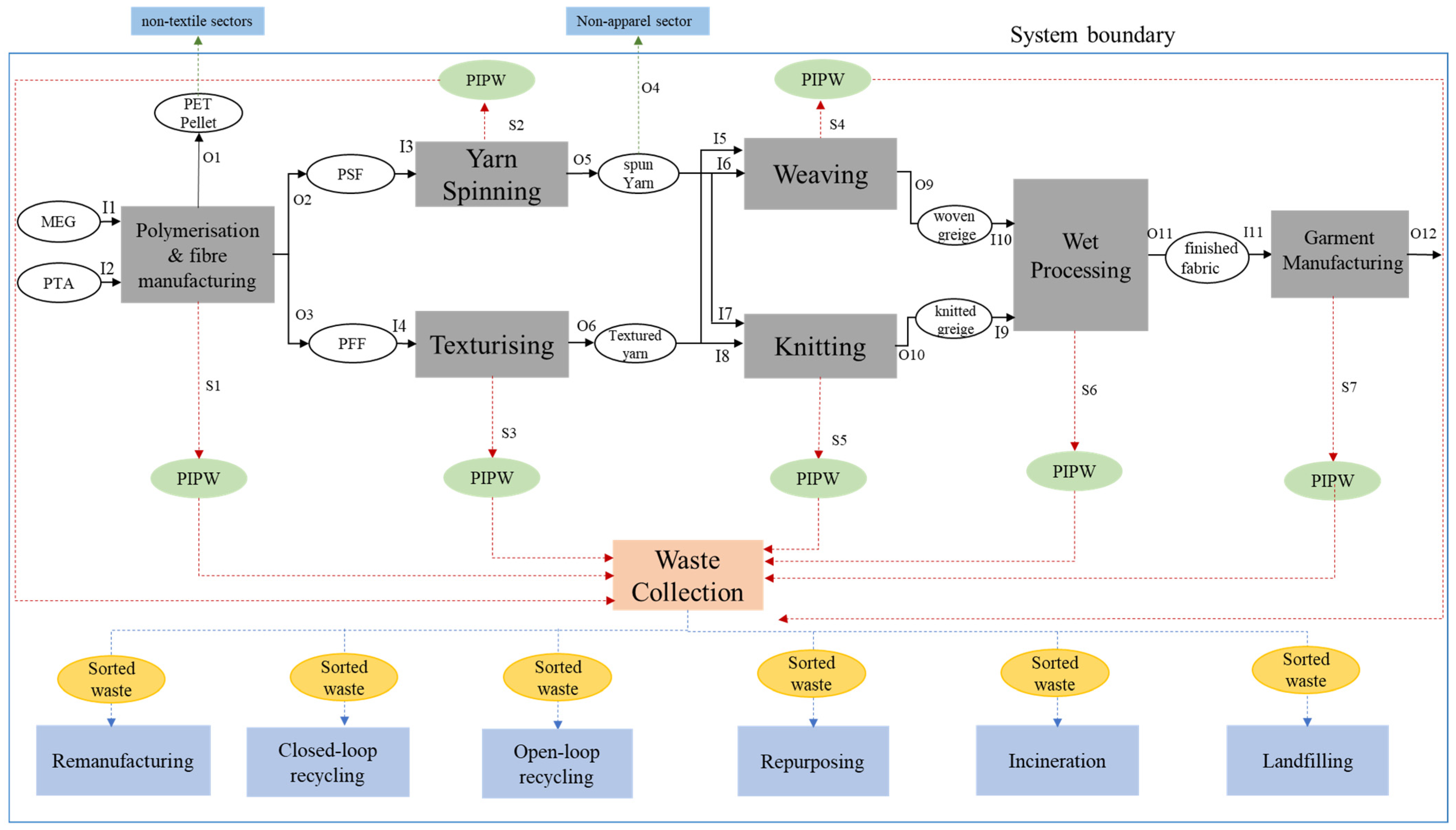
4.1. Research Design and System Boundaries
4.2. Data Collection
4.2.1. Quantitative Data
- Domestically produced PET pellets are assumed to be diverted from the textile manufacturing chain and are therefore treated as outflows to non-textile sectors in the MFA. This assumption reflects the operational structure of Indonesia’s polyester industry, in which the eight major polyester fibre producers are vertically integrated with petrochemical operations and directly process MEG and PTA into PSF, partially oriented yarn (POY), or fully drawn yarn (FDY) through continuous polymerisation. Although PET pellets may be generated during polymerisation, expert informants confirmed that they are predominantly consumed internally within integrated facilities, with the remainder allocated to non-textile applications. Accordingly, in this study, PET pellets are tracked at the polymerisation stage as non-textile outflows and excluded from downstream textile MFA calculations. This treatment preserves a textile-specific system boundary, ensures mass balance consistency, and avoids double-counting of material flows.
- It is assumed that the stream of the PSF entering the yarn spinning stage is blended with other fibres, such as cotton, rayon, etc. This assumption reflects standard manufacturing practice adopted to balance material properties, cost efficiency, and fabric performance. Site visits and expert interviews confirmed that the production of pure PSF yarn is exceedingly rare in Indonesia and is generally limited to niche applications with relatively small production volumes.
- Garment output is estimated using a standard conversion factor to satisfy the mass-balance requirements of the MFA. One garment unit, represented by a medium-sized T-shirt, is assumed to require approximately 1.5 m or 0.4 kg of fabric. This proxy is widely recognised in industry benchmarking and was corroborated by expert interviews and relevant technical literature [48].
- The study assumes no stock accumulation (i.e., net stock change = 0), meaning that all inputs are processed within the same observation period. This assumption aligns with the steady-state approach used in annual MFA studies [29].
4.2.2. Qualitative Data
4.3. Procedure Analysis
4.3.1. Estimating Waste Mass, Waste Ratio, and Material Efficiency
- Waste generation
- 2.
- Waste ratio and material efficiency
4.3.2. Waste Typology
- Waste Characteristics
- 2.
- Recyclability Assessment
4.3.3. Pathways Mapping (Scenario A)
4.3.4. Redirection Potential to Chemical Recycling (Scenario B)
5. Conclusions
Supplementary Materials
Author Contributions
Funding
Data Availability Statement
Acknowledgments
Conflicts of Interest
Abbreviations
| BHET | Bis(2-hydroxyethyl) terephthalate |
| B2T | Bottle-to-textile |
| FDY | Fully drawn yarn |
| PFF | Polyester filament fibre |
| MEG | Monoethylene glycol |
| PTA | Purified terephthalic acid |
| MFA | Material flow analysis |
| POY | Partially oriented yarn |
| EPR | Extended producer responsibility |
| T2T | Textile-to-textile |
| PIPW | Post-industrial polyester waste |
| MoI | Ministry of Industry |
| FGD | Focus group discussion |
| T&C | Textile and clothing |
| LCA | Life cycle assessment |
| TEA | Techno-economic analysis |
| Bio-PLA | Bio-based polylactic acid |
| Bio-PTT | Bio-based polytrimethylene terephthalate |
| Bio-PTA | Bio-based purified terephthalic acid |
| CAD | Computer-aided design |
| PET | Polyethylene Terephthalate |
| SMEs | Small and Medium-sized Enterprises |
| EU27 | European Union (27 Member States) |
| NPV | Net Present Value |
| R&D | Research and Development |
References
- Napolano, L.; Foschi, J.; Caldeira, C.; Huygens, D.; Sala, S. Understanding Textile Value Chains: Dynamic Probabilistic Material Flow Analysis of Textile in the European Union. Resour. Conserv. Recycl. 2025, 212, 107888. [Google Scholar] [CrossRef]
- Schmutz, M.; Som, C. Identifying the Potential for Circularity of Industrial Textile Waste Generated within Swiss Companies. Resour. Conserv. Recycl. 2022, 182, 106132. [Google Scholar] [CrossRef]
- Ministry of Industry of the Republic of Indonesia. Data Perkembangan Industri dan Produk Tekstil 2025; Ministry of Industry of the Republic of Indonesia: Jakarta, Indonesia, 2025.
- Ministry of National Development Planning (Bappenas) of the Republic of Indonesia. The Economic, Social, and Environmental Benefits of a Circular Economy in Indonesia; Ministry of National Development Planning (Bappenas) of the Republic of Indonesia: Jakarta, Indonesia, 2021.
- Ministry of National Development Planning (Bappenas) of the Republic of Indonesia. Peta Jalan Dan Rencana Aksi Nasional Ekonomi Sirkular 2025–2045; Ministry of National Development Planning (Bappenas) of the Republic of Indonesia: Jakarta, Indonesia, 2024.
- Akter, M.M.; Khairul, U.N.; Islam, M.M.; Uddin, M.A. Textile-Apparel Manufacturing and Material Waste Management in the Circular Economy: A Conceptual Model to Achieve Sustainable Development Goal (SDG) 12 for Bangladesh. Clean. Environ. Syst. 2022, 4, 100070. [Google Scholar] [CrossRef]
- Textile Exchange. 2025 Recycled Polyester Challenge First Annual Report; Textile Exchange: Burbank, CA, USA, 2022. [Google Scholar]
- Textile Exchange. The Future of Synthetics; Textile Exchange: Burbank, CA, USA, 2024. [Google Scholar] [CrossRef]
- Enking, J.; Becker, A.; Schu, G.; Gausmann, M.; Cucurachi, S.; Tukker, A.; Gries, T. Recycling Processes of Polyester-Containing Textile Waste–A Review. Resour. Conserv. Recycl. 2025, 219, 108256. [Google Scholar] [CrossRef]
- Textile Exchange. Materials Market Report; Textile Exchange: Burbank, CA, USA, 2023. [Google Scholar]
- Ellen Macarthur Foundation. A New Textiles Economy: Redesigning Fashion’s Future; Inggris: Cowes, UK, 2017; Available online: https://ellenmacarthurfoundation.org/a-new-textiles-economy (accessed on 13 March 2025).
- Henry, B.; Laitala, K.; Klepp, I.G. Microfibres from Apparel and Home Textiles: Prospects for Including Microplastics in Environmental Sustainability Assessment. Sci. Total Environ. 2019, 652, 483–494. [Google Scholar] [CrossRef]
- Amicarelli, V.; Bux, C. Quantifying Textile Streams and Recycling Prospects in Europe by Material Flow Analysis. Environ. Impact Assess. Rev. 2022, 97, 106878. [Google Scholar] [CrossRef]
- Kazancoglu, I.; Kazancoglu, Y.; Yarimoglu, E.; Kahraman, A. A Conceptual Framework for Barriers of Circular Supply Chains for Sustainability in the Textile Industry. Sustain. Dev. 2020, 28, 1477–1492. [Google Scholar] [CrossRef]
- Christensen, T.B. Towards a Circular Economy in Cities: Exploring Local Modes of Governance in the Transition towards a Circular Economy in Construction and Textile Recycling. J. Clean. Prod. 2021, 305, 127058. [Google Scholar] [CrossRef]
- Elander, M.; Ljungkvist, H. Critical Aspects in Design for Fibre-to-Fibre Recycling of Textiles; IVL Swedish Environmental Research Institute: Stockholm, Sweden, 2016. [Google Scholar]
- Riemens, J.; Lemieux, A.A.; Lamouri, S.; Garnier, L. A Delphi-Régnier Study Addressing the Challenges of Textile Recycling in Europe for the Fashion and Apparel Industry. Sustainability 2021, 13, 11700. [Google Scholar] [CrossRef]
- Majumdar, A.; Ali, S.M.; Agrawal, R.; Srivastava, S. A Triple Helix Framework for Strategy Development in Circular Textile and Clothing Supply Chain: An Indian Perspective. J. Clean. Prod. 2022, 367, 132954. [Google Scholar] [CrossRef]
- Harmsen, P.; Scheffer, M.; Bos, H. Textiles for Circular Fashion: The Logic behind Recycling Options. Sustainability 2021, 13, 9714. [Google Scholar] [CrossRef]
- Ribul, M.; Lanot, A.; Tommencioni Pisapia, C.; Purnell, P.; McQueen-Mason, S.J.; Baurley, S. Mechanical, Chemical, Biological: Moving towards Closed-Loop Bio-Based Recycling in a Circular Economy of Sustainable Textiles. J. Clean. Prod. 2021, 326, 129325. [Google Scholar] [CrossRef]
- El Darai, T.; Ter-Halle, A.; Blanzat, M.; Despras, G.; Sartor, V.; Bordeau, G.; Lattes, A.; Franceschi, S.; Cassel, S.; Chouini-Lalanne, N.; et al. Chemical Recycling of Polyester Textile Wastes: Shifting towards Sustainability. Green Chem. 2024, 26, 6857–6885. [Google Scholar] [CrossRef]
- Pensupa, N.; Leu, S.Y.; Hu, Y.; Du, C.; Liu, H.; Jing, H.; Wang, H.; Lin, C.S.K. Recent Trends in Sustainable Textile Waste Recycling Methods: Current Situation and Future Prospects. In Chemistry and Chemical Technologies in Waste Valorization; Springer: Cham, Switzerland, 2017; Volume 375, pp. 189–228. [Google Scholar] [CrossRef]
- Phan, C.; Dang, D.; Duong, T.; Pham, H.; Trieu, L.; Pham, T.; Nguyen, M.; Nguyen, V. Pre-Consumer Textile Waste Recycling in Viet Nam; Deutsche Gesellschaft für Internationale Zusammenarbeit (GIZ) GmbH: Bonn, Germany, 2025. [Google Scholar]
- Sousa, S.; Costa, H.; Fonseca, R.; Ribeiro, A.; Teixeira, S. Automated System for Transportation and Separation of Textile-Cutting Surpluses: A Case Study in a Portuguese Clothing Company. Sustainability 2025, 17, 4673. [Google Scholar] [CrossRef]
- Sandberg, E. Supply Chain Capabilities in the Circular Textile-to-Textile Recycling Supply Chain. In Proceedings of the 34th Annual Nordic Logistics Research Network (NOFOMA) Conference, Reykjavik, Iceland, 8–10 June 2023; Volume 387. [Google Scholar]
- Chen, G.; Geng, D.; Zhu, Q. Implementation Barriers to the Circular Supply Chain Mode for Pre-Consumer Textile Waste Reprocessing in China. Resour. Conserv. Recycl. 2024, 206, 107621. [Google Scholar] [CrossRef]
- Li, X.; Wang, L.; Ding, X. Textile Supply Chain Waste Management in China. J. Clean. Prod. 2021, 289, 125147. [Google Scholar] [CrossRef]
- Fashion Takes Action. A Feasibility Study of Textile Recycling in Canada; Publisher: Toronto, ON, Canada, 2021; Available online: https://static1.squarespace.com/static/6759d7c670eb2945639cdfda/t/67dc4b5abd79e96d29f4ee09/1742490463430/FTA-A-Feasibility-Study-of-Textile-Recycling-in-Canada-EN-June-17-2021.pdf (accessed on 20 April 2025).
- Brunner, P.H.; Rechberger, H. Practical Handbook of Material Flow Analysis; CRC Press Company: Boca Raton, FL, USA, 2016. [Google Scholar] [CrossRef]
- Chin, H.H.; Varbanov, P.S.; Fózer, D.; Mizsey, P.; Klemeš, J.J.; Jia, X. Data-Driven Recyclability Classification of Plastic Waste. Chem. Eng. Trans. 2021, 88, 679–684. [Google Scholar] [CrossRef]
- Duhoux, T.; Maes, E.; Hirschnitz-Garbers, M.; Peeters, K.; Asscherickx, L.; Christis, M.; Stubbe, B.; Colignon, P.; Hinzmann, M.; Sachdeva, A. Study on the Technical, Regulatory, Economic and Environmental Effectiveness of Textile Fibres Recycling. European Commission, 2021. Available online: https://www.researchgate.net/publication/357713184_Study_on_the_technical_regulatory_economic_and_environmental_effectiveness_of_textile_fibres_recycling_Final_Report (accessed on 20 April 2025).
- Seifali Abbas-Abadi, M.; Tomme, B.; Goshayeshi, B.; Mynko, O.; Wang, Y.; Roy, S.; Kumar, R.; Baruah, B.; De Clerck, K.; De Meester, S.; et al. Advancing Textile Waste Recycling: Challenges and Opportunities Across Polymer and Non-Polymer Fiber Types. Polymers 2025, 17, 628. [Google Scholar] [CrossRef]
- Sandin, G.; Peters, G.M. Environmental Impact of Textile Reuse and Recycling—A Review. J. Clean. Prod. 2018, 184, 353–365. [Google Scholar] [CrossRef]
- Park, S.H.; Kim, S.H. Poly (Ethylene Terephthalate) Recycling for High Value Added Textiles. Fash. Text. 2014, 1, 1. [Google Scholar] [CrossRef]
- Juanga-Labayen, J.P.; Labayen, I.V.; Yuan, Q. A Review on Textile Recycling Practices and Challenges. Textiles 2022, 2, 174–188. [Google Scholar] [CrossRef]
- Millward-Hopkins, J.; Purnell, P.; Baurley, S. A Material Flow Analysis of the UK Clothing Economy. J. Clean. Prod. 2023, 407, 137158. [Google Scholar] [CrossRef]
- Malinverno, N.; Schmutz, M.; Nowack, B.; Som, C. Identifying the Needs for a Circular Workwear Textile Management—A Material Flow Analysis of Workwear Textile Waste within Swiss Companies. Resour. Conserv. Recycl. 2023, 189, 106728. [Google Scholar] [CrossRef]
- SNI 08-0034-2004; Benang Ring Tunggal Campuran Poliester 65%kapas 35%. National Standardization Agency of Indonesia (BSN): Jakarta, Indonesia, 2004.
- SNI 1790-2010-2017; Textile-Benang Stapel Poliester 100%. National Standardization Agency of Indonesia (BSN): Jakarta, Indonesia, 2017.
- Velenturf, A.P.M.; Purnell, P. Principles for a Sustainable Circular Economy. Sustain. Prod. Consum. 2021, 27, 1437–1457. [Google Scholar] [CrossRef]
- Corvellec, H.; Stowell, A.F.; Johansson, N. Critiques of the Circular Economy. J. Ind. Ecol. 2022, 26, 421–432. [Google Scholar] [CrossRef]
- Pluskal, J.; Šomplák, R.; Nevrlý, V.; Smejkalová, V.; Pavlas, M. Strategic Decisions Leading to Sustainable Waste Management: Separation, Sorting and Recycling Possibilities. J. Clean. Prod. 2021, 278, 123359. [Google Scholar] [CrossRef]
- Riemens, J.; Lemieux, A.-A.; Lassagne, M.; Lamouri, S. Apprehending Traceability Implementation in Support of Sustainable Value Chains: A Novel Analysis Framework for the Fashion Industry. J. Clean. Prod. 2023, 414, 137501. [Google Scholar] [CrossRef]
- China National Textile and Apparel Council. Outlook for a New Textile Economy in China; World Trade Organization: Beijing, China, 2020. [Google Scholar] [CrossRef]
- Charnley, F.; Cherrington, R.; Mueller, F.; Jain, A.; Nelson, C.; Wendland, S.; Ventosa, S. Retaining Product Value in Post-Consumer Textiles: How to Scale a Closed-Loop System. Resour. Conserv. Recycl. 2024, 205, 107542. [Google Scholar] [CrossRef]
- Dukovska-Popovska, I.; Kjellsdotter Ivert, L.; Jónsdóttir, H.; Carin Dreyer, H.; Kaipia, R. The Supply and Demand Balance of Recyclable Textiles in the Nordic Countries. Waste Manag. 2023, 159, 154–162. [Google Scholar] [CrossRef]
- Filho, W.L.; Ellams, D.; Han, S.; Tyler, D.; Boiten, V.J.; Paço, A.; Moora, H.; Balogun, A.-L. A Review of the Socio-Economic Advantages of Textile Recycling. J. Clean. Prod. 2019, 218, 10–20. [Google Scholar] [CrossRef]
- Dahlbo, H.; Aalto, K.; Eskelinen, H.; Salmenperä, H. Increasing Textile Circulation—Consequences and Requirements. Sustain. Prod. Consum. 2017, 9, 44–57. [Google Scholar] [CrossRef]
- Dobilaite, V.; Jucienė, M.; Sacevičienė, V. Study of Textile Waste Generation and Treatment in Lithuania. Fibres Text. East. Eur. 2017, 25, 8–13. [Google Scholar] [CrossRef]
- Abou-Chakra, K.; Archipov, K.; Berkovitz, S.; Perry, E.; Spellenberg, R.; Potoski, M.; Tilman, D. Examining Cut-and-Sew Textile Waste within the Apparel Supply Chain. 2024. Available online: https://bren.ucsb.edu/ (accessed on 20 April 2025).
- Srivastava, P.; Chanana, B. Review of Zero Waste Pattern Making Techniques in Building Sustainable Fashion. J. Text. Assoc. 2024, 85, 327–332. [Google Scholar] [CrossRef]
- Pan Brothers. Sustainability Report; PT. Pan Brothers Tbk: Tangerang, Indonesia, 2022. [Google Scholar]
- Alves, P. Textile Mechanical Recycling: Design, Improvement, and Analysis of a Carding Wire Drum System. Master’s Thesis, University of Minnesota, Minneapolis, MN, USA, 2023. [Google Scholar]
- Johansson, L. On the Mechanical Recycling of Woven Fabrics: Improving the Reusable Fibre Yield of Mechanical Methods. Master’s Thesis, Uppsala University, Uppsala, Sweden, 2020. [Google Scholar]
- Chevalier, M. The Potential of Mechanical Recycling for Post-Consumer Textiles. Master’s Thesis, Saxion University of Applied Sciences, Enschede, The Netherlands, 2021. Available online: https://www.dotheretex.eu/assets/uploads/site/The-potential-of-mechanical-recycling-for-post-consumer-textiles.pdf (accessed on 20 April 2025).
- Yurtaslan, Ö.; Kurtoğlu, Ş.A.; Yılmaz, D. Closed-Loop Mechanical Recycling Opportunities in Industrial Cotton Wastes. J. Nat. Fibers 2022, 19, 11802–11817. [Google Scholar] [CrossRef]
- Turnbull, J.; Stevens, K.; Mzikian, P.; Bertele, M.; Cavadini, F.; Crippa, M.; Bodin, M. Achieving a Circular Textiles Economy Facilitated by Innovative Technology: An Analysis of Present and Future End-of-Life Solutions in Textile Recycling. In Sustainable Textile and Fashion Value Chains: Drivers, Concepts, Theories and Solutions; Springer International Publishing: Cham, Switzerland, 2020. [Google Scholar] [CrossRef]
- Andini, E.; Bhalode, P.; Gantert, E.; Sadula, S.; Vlachos, D.G. Chemical Recycling of Mixed Textile Waste. Sci. Adv. 2024, 10, eado6827. [Google Scholar] [CrossRef] [PubMed]
- Xu, W.; Chen, L.; Xu, S.; Wang, X.; Wang, Y.-Z. Transformation rule of polyester glycolysis products in methanol transesterification. J. Text. Res. 2025, 46, 1–7. [Google Scholar] [CrossRef]
- Leenders, N.; Moerbeek, R.M.; Puijk, M.J.; Bronkhorst, R.J.A.; Bueno-Morón, J.; van Klink, G.P.M.; Gruter, G.-J.M. Polycotton Waste Textile Recycling by Sequential Hydrolysis and Glycolysis. Nat. Commun. 2025, 16, 738. [Google Scholar] [CrossRef]
- Tanaka, S.; Koga, M.; Kuragano, T.; Ogawa, A.; Ogiwara, H.; Sato, K.; Nakajima, Y. Depolymerization of Polyester Fibers with Dimethyl Carbonate-Aided Methanolysis. ACS Mater. Au 2024, 4, 335–345. [Google Scholar] [CrossRef] [PubMed]
- Tanaka, S.; Kuragano, T.; Choi, J.-C. Low-Temperature Catalytic Methanolysis of Polyesters Promoted by Abundant Methyl Esters. J. Jpn. Pet. Inst. 2025, 68, 195–201. [Google Scholar] [CrossRef]
- Muangmeesri, S.; Baddigam, K.R.; Navare, K.; Apostolopoulou-Kalkavoura, V.; Witthayolankowit, K.; Håkansson, H.; Mathew, A.P.; Acker, K.V.; Samec, J.S.M. Recycling of Polyesters by Organocatalyzed Methanolysis Depolymerization: Environmental Sustainability Evaluated by Life Cycle Assessment. ACS Sustain. Chem. Eng. 2024, 12, 4114–4120. [Google Scholar] [CrossRef]
- Choudhury, K.; Tsianou, M.; Alexandridis, P. Recycling of Blended Fabrics for a Circular Economy of Textiles: Separation of Cotton, Polyester, and Elastane Fibers. Sustainability 2024, 16, 6206. [Google Scholar] [CrossRef]
- Alpert, C.; Turkowski, M.; Tasneem, T. Scalability Solutions for Automated Textile Sorting: A Case Study on How Dynamic Capabilities Can Overcome Scalability Challenges. Master’s Thesis, University of Borås, Borås, Sweden, 2021. [Google Scholar]
- Elander, M.; Palm, D. A Nordic Strategy for Collection, Sorting, Reuse and Recycling of Textiles: Policy Brief; Nordisk Ministerråd: Copenhagen, Denmark, 2015. [Google Scholar]
- Ndagano, U.N.; Cahill, L.; Smullen, C.; Gaughran, J.; Kelleher, S.M. The Current State-of-the-Art of the Processes Involved in the Chemical Recycling of Textile Waste. Molecules 2025, 30, 299. [Google Scholar] [CrossRef]
- Huang, Y.-F.; Azevedo, S.G.; Lin, T.-J.; Cheng, C.-S.; Lin, C.-T. Exploring the Decisive Barriers to Achieve Circular Economy: Strategies for the Textile Innovation in Taiwan. Sustain. Prod. Consum. 2021, 27, 1406–1423. [Google Scholar] [CrossRef]
- Ponnambalam, S.G.; Sankaranarayanan, B.; Karuppiah, K.; Thinakaran, S.; Chandravelu, P.; Lam, H.L. Analysing the Barriers Involved in Recycling the Textile Waste in India Using Fuzzy DEMATEL. Sustainability 2023, 15, 8864. [Google Scholar] [CrossRef]
- Zamani, B.; Svanström, M.; Peters, G.; Rydberg, T. A Carbon Footprint of Textile Recycling: A Case Study in Sweden. J. Ind. Ecol. 2015, 19, 676–687. [Google Scholar] [CrossRef]
- Barnard, E.; Arias, J.J.R.; Thielemans, W. Chemolytic Depolymerisation of PET: A Review. Green Chem. 2021, 23, 3765–3789. [Google Scholar] [CrossRef]
- Ivanović, T.; Hischier, R.; Som, C. Bio-Based Polyester Fiber Substitutes: From GWP to a More Comprehensive Environmental Analysis. Appl. Sci. 2021, 11, 2993. [Google Scholar] [CrossRef]
- Shekhar, N.; Mondal, A. Synthesis, Properties, Environmental Degradation, Processing, and Applications of Polylactic Acid (PLA): An Overview. Polym. Bull. 2024, 81, 11421–11457. [Google Scholar] [CrossRef]
- Berger, N.J.; Pfeifer, C. Comparing the Financial Costs and Carbon Neutrality of Polyester Fibres Produced from 100% Bio-Based PET, 100% Recycled PET, or in Combination. Biomass Convers. Biorefin. 2025, 15, 6251–6268. [Google Scholar] [CrossRef]
- Plakantonaki, S.; Kiskira, K.; Zacharopoulos, N.; Belessi, V.; Sfyroera, E.; Priniotakis, G.; Athanasekou, C. Investigating the Routes to Produce Cellulose Fibers from Agro-Waste: An Upcycling Process. Chemengineering 2024, 8, 112. [Google Scholar] [CrossRef]
- WTO. Global Value Chains Sectoral Profiles Textiles and Clothing Industry; World Trade Organization: Geneva, Switzerland, 2023; pp. 1–10. [Google Scholar]
- Al Alam, A.; Biswas, M.K.; Mahiat, T.; Chowdhury, R.B.; Biswas, K.F.; Hossain, M.M.; Sujauddin, M. Taking Stock of the Share of Global Environmental Burden of Knitwear Production in Bangladesh: Constructing the Life Cycle Inventory. J. Clean. Prod. 2023, 412, 137376. [Google Scholar] [CrossRef]
- Akter, M.K.; Haq, U.N.; Azad, A.K. Material Circularity of Pre-Consumer Textile Solid Waste: Learning from Bangladesh. PLoS Sustain. Transform. 2025, 4, e0000168. [Google Scholar] [CrossRef]
- Bashar, A.; Hasin, A.A.; Adnan, Z.H. Impact of Lean Manufacturing: Evidence from Apparel Industry in Bangladesh. Int. J. Lean Six Sigma 2021, 12, 923–943. [Google Scholar] [CrossRef]
- Gerbendahl, A.; Johansson, M. EU Waste Framework Directive, What’s Next? A Cost-Benefit Analysis of an Extended Producer Responsibility for Textiles in the European Union. Master’s Thesis, Linköping University, Linköping, Sweden, 2020. [Google Scholar]
- Chertow, M.R. Industrial Symbiosis: Literature and Taxonomy. Annu. Rev. Energy Environ. 2000, 25, 313–337. [Google Scholar] [CrossRef]
- Palm, D.; Elander, M.; Watson, D.; Kiørboe, N.; Salmenperä, H.; Dahlbo, H.; Rubach, S.; Hanssen, O.J.; Gíslason, S.; Ingulfsvann, A.S.; et al. A Nordic Textile Strategy: Part II: A Proposal for Increased Collection, Sorting, Reuse and Recycling of Textiles; Nordic Council of Ministers: Copenhagen, Denmark, 2015. [Google Scholar]
- Campbell, S.; Greenwood, M.; Prior, S.; Shearer, T.; Walkem, K.; Young, S.; Bywaters, D.; Walker, K. Purposive Sampling: Complex or Simple? Research Case Examples. J. Res. Nurs. 2020, 25, 652–661. [Google Scholar] [CrossRef]
- Hsu, C.-C. The Delphi Technique: Making Sense of Consensus. Pract. Assess. Res. Eval. 2007, 12, 10. [Google Scholar]
- Keeney, R.L.; Von Winterfeldt, D. Appraising the Precautionary Principle—A Decision Analysis Perspective. J. Risk Res. 2001, 4, 191–202. [Google Scholar] [CrossRef]
- Zandberga, A.; Kalnins, S.N.; Gusca, J. Decision-Making Algorithm for Waste Recovery Options. Review on Textile Waste Derived Products. Environ. Clim. Technol. 2023, 27, 137–149. [Google Scholar] [CrossRef]
- Wagaw, T.; Babu, K.M. Textile Waste Recycling: A Need for a Stringent Paradigm Shift. AATCC J. Res. 2023, 10, 376–385. [Google Scholar] [CrossRef]
- Ministry of National Development Planning (Bappenas) of the Republic of Indonesia. The Future Is Circular: Langkah Nyata Inisiatif Ekonomi Sirkular di Indonesia; Ministry of National Development Planning (Bappenas) of the Republic of Indonesia: Jakarta, Indonesia, 2022.
- Stahel, W.R. The Performance Economy, 2nd ed.; Palgrave Macmillan: New York, NY, USA, 2010. [Google Scholar]



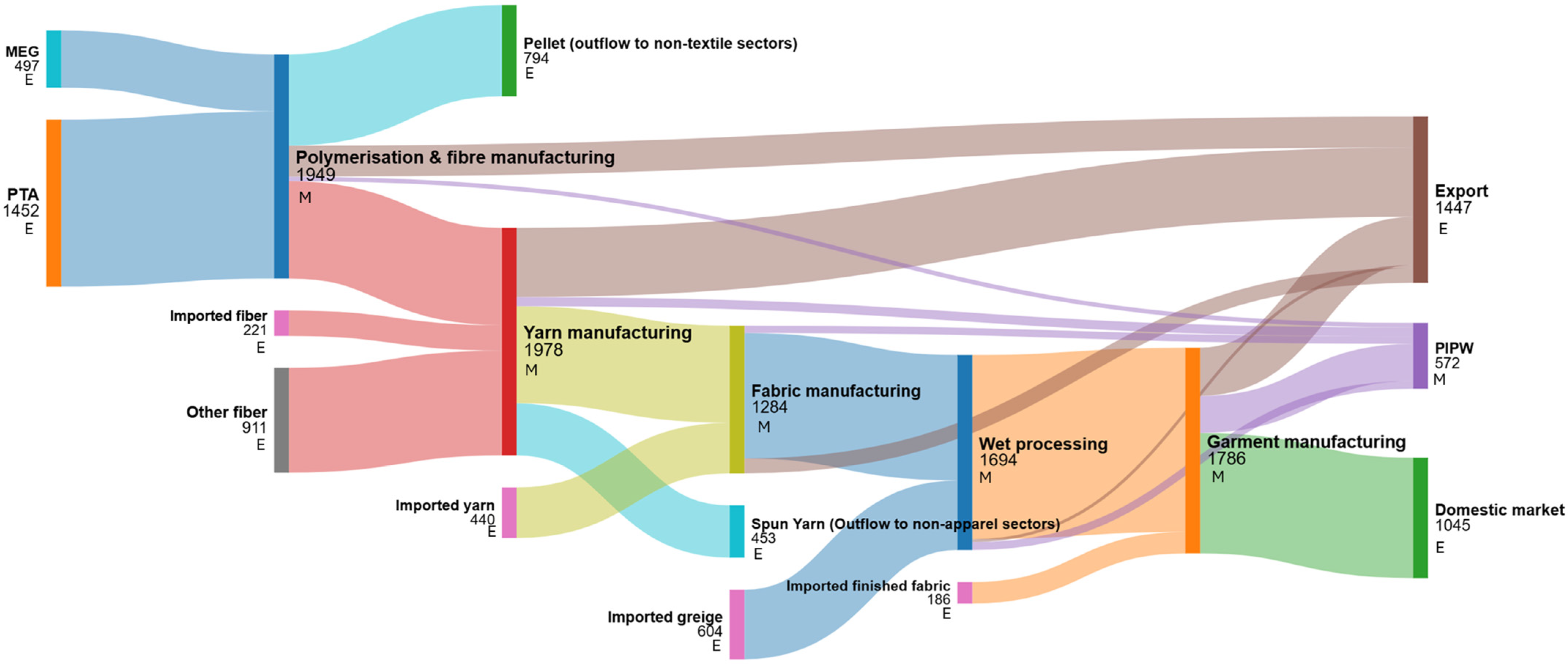
| Production Chain | Total Inflow (kt) | Total Outflow (kt) | Waste (kt) | Closure Error (%) |
|---|---|---|---|---|
| Polymerisation & fibre manufacturing | 1949 | 1910 | 39 | 0.0 |
| Yarn manufacturing | 1978 | 1898 | 80 | 0.0 |
| Fabric manufacturing | 1284 | 1220 | 64 | 0.0 |
| Wet processing | 1694 | 1626 | 68 | 0.0 |
| Garment manufacturing | 1786 | 1464 | 322 | 0.0 |
| System total | - * | - * | 572 | - * |
| Production Chain | Sub Process | Waste Mass (kt) | Waste Ratio (%) | Material Efficiency (%) |
|---|---|---|---|---|
| Polymerisation & fibre manufacturing | Polymerisation & fibre manufacturing | 39 | 2 | 98 |
| Yarn manufacturing | Yarn spinning | 66 | 5 | 95 |
| Texturising | 13 | 2 | 98 | |
| Fabric manufacturing | Weaving | 45 | 7 | 93 |
| Knitting | 19 | 3 | 97 | |
| Wet processing | Wet processing | 68 | 4 | 96 |
| Garment manufacturing | Garment manufacturing | 322 | 18 | 82 |
| Total | 572 | |||
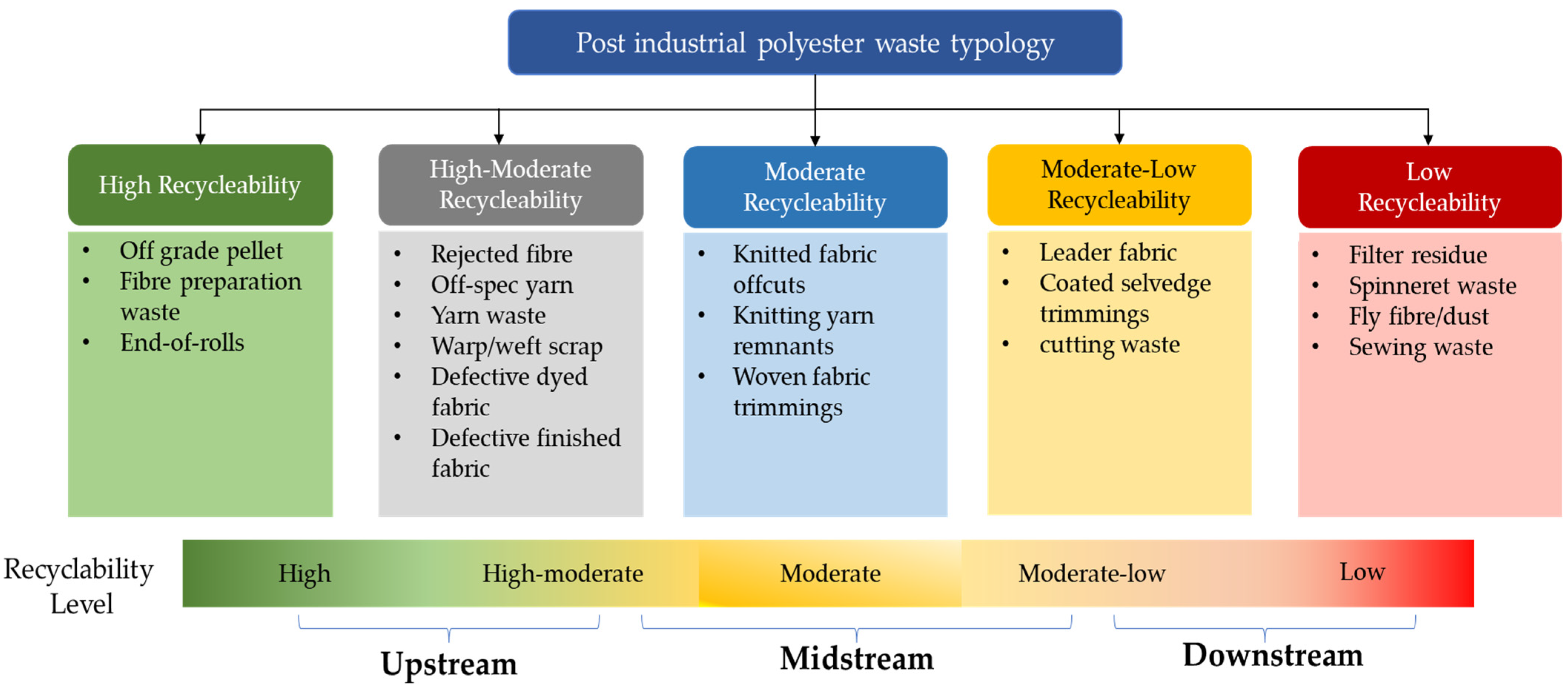
| No. | Production Chain | Sub Process | Waste Type | Key Characteristics |
|---|---|---|---|---|
| 1 | Polymerisation and fibre manufacturing | Polymerisation and fibre manufacturing | Off-grade pellets | Thermoplastic polyester pellets; high purity; rejected due to melt-flow or colour deviations. |
| Filter residue | Burnt and degraded polymer sludge from filtration; contaminated, brittle, non-thermoplastic. | |||
| Spinneret waste | Carbonised polyester residues from spinneret cleaning; thermally degraded; non-recyclable | |||
| Rejected fibre | Continuous filaments rejected for strength or diameter defects; high polyester purity. | |||
| 2 | Yarn Manufacturing | Yarn spinning | Fibre preparation waste | Clean staple fibre fragments (laps, slivers); uniform structure; no chemical contamination. |
| Yarn waste | Mixed-length polyester yarns from winding, moderate purity, low contamination. | |||
| Texturising | Off-spec yarn | Short polyester yarns rejected for poor crimping or broken filaments; chemically clean. | ||
| 3 | Fabric Manufacturing | Knitting | Knitted fabric offcuts | Irregular knit fabric scraps; untreated; variable size and geometry. |
| Knitting yarn remnants | Short, tangled yarns from spool changes; clean but physically complex. | |||
| Weaving | Woven fabric trimmings | Selvedge and edge trimmings; physically clean; moderate weave complexity. | ||
| Warp/weft scrap | Cut yarns removed post-weaving; clean, homogeneous, simple structure. | |||
| 4 | Wet Processing | Dyeing & Printing | Leader fabric | Initial dyed fabric; high dye load; structurally intact but chemically contaminated. |
| Defective dyed fabric | Dyed fabric with colour or print inconsistencies; moderate chemical load. | |||
| Finishing | Defective finished fabric | Fabric rejected due to finishing or coating flaws; resins present; fibre matrix intact. | ||
| Coated selvedge trimmings | Heavily coated fabric edges; reduced recyclability due to compound layers. | |||
| 5 | Garment Manufacturing | Garment Manufacturing | Cutting waste | Mixed fabric offcuts; heterogeneous in colour, fibre blend, and geometry. |
| Sewing waste | Entangled short threads from stitching; mixed colour; physically inseparable. | |||
| End-of-rolls | Unused homogeneous fabric rolls; untreated; physically intact. |
| No. | Waste Type | MP | EF | TA | Total | Recyclability Category |
|---|---|---|---|---|---|---|
| 1 | Off-grade pellets | 1 | 1 | 1 | 3 | High |
| 2 | Fibre preparation waste | 1 | 1 | 1 | 3 | High |
| 3 | End-of-roll fabric | 2 | 1 | 1 | 4 | High |
| 4 | Rejected fibre/filament | 1 | 2 | 2 | 5 | High–moderate |
| 5 | Off-spec yarn | 1 | 2 | 2 | 5 | High–moderate |
| 6 | Yarn waste | 2 | 2 | 2 | 6 | High–moderate |
| 7 | Warp/weft scrap | 2 | 2 | 2 | 6 | High–moderate |
| 8 | Defective dyed fabric | 3 | 2 | 2 | 7 | High–moderate |
| 9 | Defective finished fabric | 3 | 2 | 2 | 7 | High–moderate |
| 10 | Knitting yarn remnants | 2 | 3 | 3 | 8 | Moderate |
| 11 | Knitted fabric offcuts | 2 | 3 | 3 | 8 | Moderate |
| 12 | Woven fabric trimmings | 2 | 3 | 3 | 8 | Moderate |
| 13 | Leader fabric | 3 | 4 | 4 | 11 | Moderate–low |
| 14 | Coated selvedge trimmings | 4 | 4 | 4 | 12 | Moderate–low |
| 15 | Cutting waste | 4 | 4 | 3 | 11 | Moderate–low |
| 16 | Spinneret waste | 5 | 5 | 5 | 15 | Low |
| 17 | Fly fibre/dust | 5 | 5 | 5 | 15 | Low |
| 18 | Filter residue | 5 | 5 | 5 | 15 | Low |
| 19 | Sewing waste | 5 | 5 | 4 | 15 | Low |
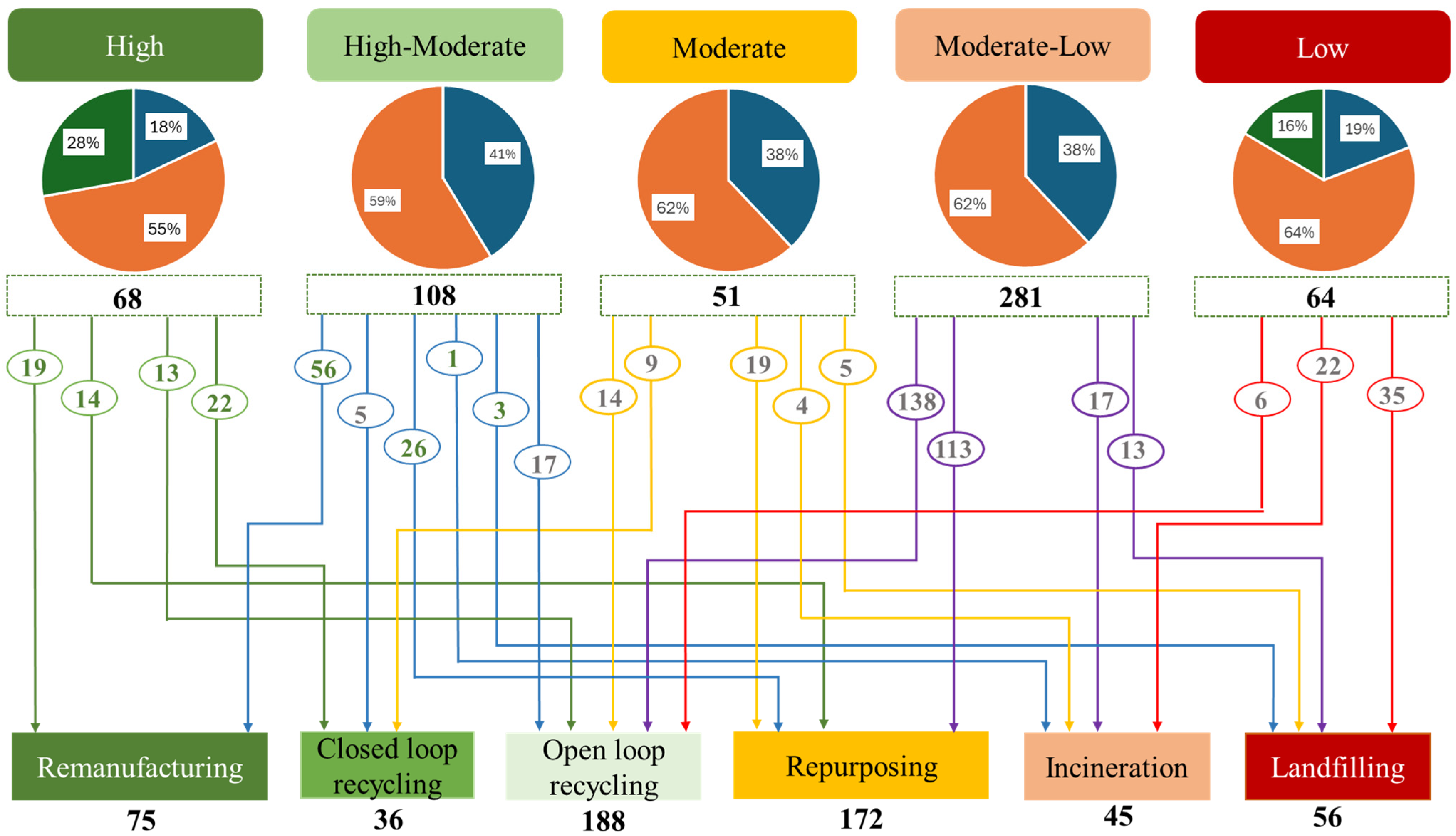
| End-of-Life Pathways | Scenario A (kt) | Scenario B (kt) | Reallocation (kt) |
|---|---|---|---|
| Remanufacturing | 75 | 75 | 0 |
| Closed-loop recycling | 36 | 36 | 0 |
| Open-loop recycling | 188 | 103 | 85 |
| Repurposing | 172 | 106 | 66 |
| Incineration | 45 | 30 | 15 |
| Landfilling | 56 | 38 | 18 |
| Chemical recycling | 0 | 184 | 184 |
| Country | Production Chain | Source | |||
|---|---|---|---|---|---|
| Yarn Manufacturing (%) | Fabric Manufacturing (%) | Wet Processing (%) | Garment Manufacturing (%) | ||
| Indonesia | 5 | 7 | 4 | 18 | Author |
| Bangladesh | 11 | 2 | N/A | 7 | [6] |
| Vietnam | N/A | N/A | N/A | 18 | [48] |
| China | N/A | N/A | N/A | 14 | [27] |
| Dimension | Score | ||||
|---|---|---|---|---|---|
| 1 | 2 | 3 | 4 | 5 | |
| MP | Single fibre, clean & untreated, intact & stable | Minor coating or additive, slight, removable traces, slightly oxidised | Partial blends, moderate contamination, minor degradation | Multi-fibre, heavy finishing, poor meltability | Complex & unrecoverable, crosslinked/hazardous, burnt or degraded |
| EF | High resale demand, low cost, established network | Moderate, steady demand, basic cleaning or shredding, some regular buyers | Limited market, moderate pre-treatment, and few regional buyers | Niche/inconsistent, multi-step & costly, rare/irregular buyers | No value, high cost; unfeasible. No available buyer |
| TA | Widely used, fully compatible, broadly adopted | Available but limited, minor adjustments, and some adoption | Pilot/demo stage, needs setup/support, a few adopters | Experimental/import only, low yield, uneconomical | Not available, incompatible, not adopted |
Disclaimer/Publisher’s Note: The statements, opinions and data contained in all publications are solely those of the individual author(s) and contributor(s) and not of MDPI and/or the editor(s). MDPI and/or the editor(s) disclaim responsibility for any injury to people or property resulting from any ideas, methods, instructions or products referred to in the content. |
© 2026 by the authors. Licensee MDPI, Basel, Switzerland. This article is an open access article distributed under the terms and conditions of the Creative Commons Attribution (CC BY) license.
Share and Cite
Nurkomariyah, S.; Nurrochmat, D.R.; Indrawan, D.; Harianto. Mapping Polyester Waste Stream and Recyclability: A Material Flow Analysis of Indonesia’s Textile and Clothing Industry. Recycling 2026, 11, 62. https://doi.org/10.3390/recycling11030062
Nurkomariyah S, Nurrochmat DR, Indrawan D, Harianto. Mapping Polyester Waste Stream and Recyclability: A Material Flow Analysis of Indonesia’s Textile and Clothing Industry. Recycling. 2026; 11(3):62. https://doi.org/10.3390/recycling11030062
Chicago/Turabian StyleNurkomariyah, Siti, Dodik Ridho Nurrochmat, Dikky Indrawan, and Harianto. 2026. "Mapping Polyester Waste Stream and Recyclability: A Material Flow Analysis of Indonesia’s Textile and Clothing Industry" Recycling 11, no. 3: 62. https://doi.org/10.3390/recycling11030062
APA StyleNurkomariyah, S., Nurrochmat, D. R., Indrawan, D., & Harianto. (2026). Mapping Polyester Waste Stream and Recyclability: A Material Flow Analysis of Indonesia’s Textile and Clothing Industry. Recycling, 11(3), 62. https://doi.org/10.3390/recycling11030062