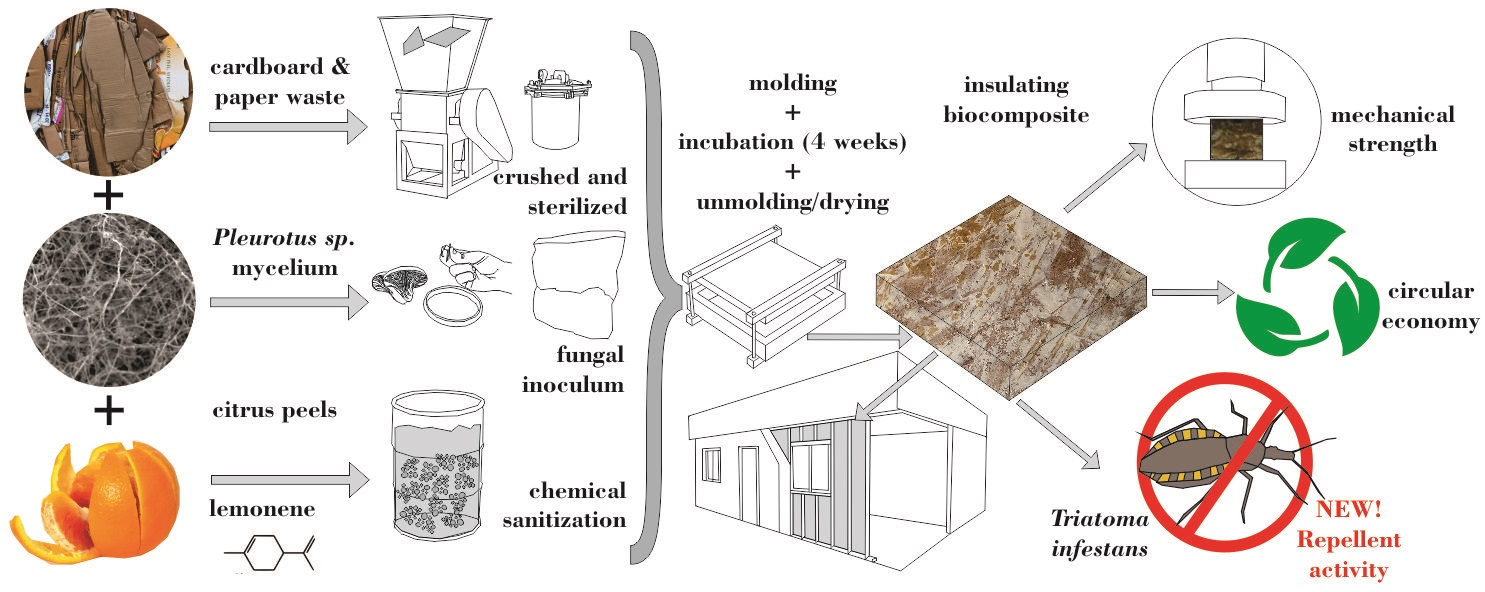

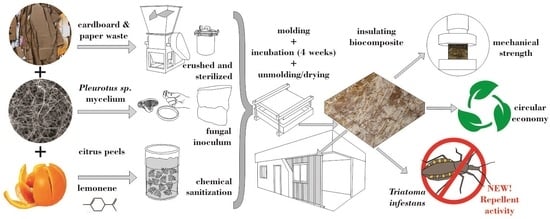
A Novel Biocomposite Made of Citrus Peel Waste and Mushroom Mycelium: Mechanical, Thermal, and Bio-Repellency Studies
 , , ,
, , ,  , and
, and
Abstract
1. Introduction
2. Results and Discussion
2.1. Physical and Mechanical Properties
2.1.1. Thermal Conductivity
2.1.2. Water Absorption
2.1.3. Compression Behaviour
2.2. Chemical Properties
2.2.1. Chemical Composition and Morphology
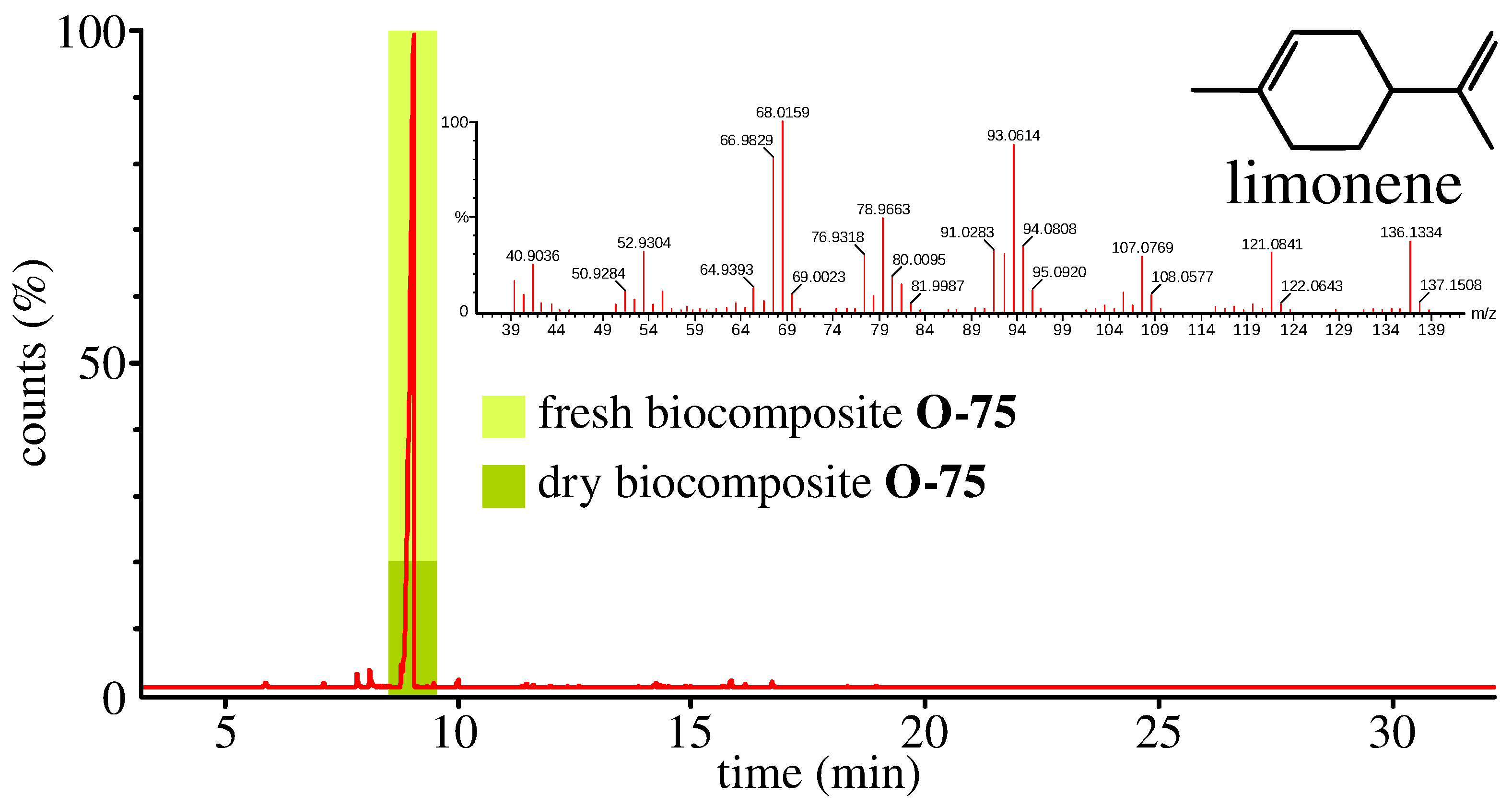
2.2.2. Essential Oils
2.3. Biorepellent Activity
2.3.1. Sitophilus Zeamais
2.3.2. Triatoma Infestans
3. Materials and Methods
3.1. Materials
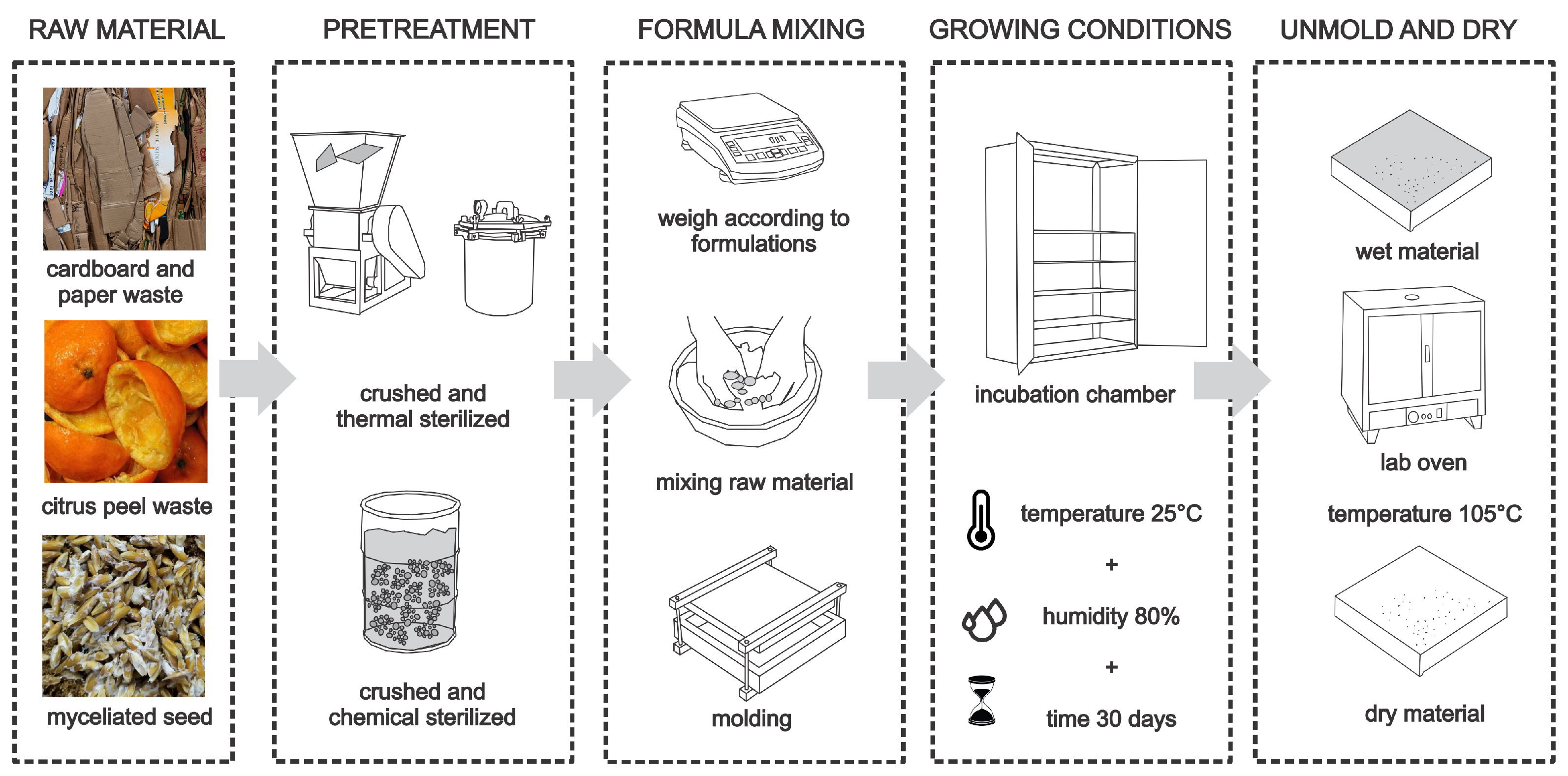
3.2. Fungal Biocomposite Production
3.2.1. Pretreatment
3.2.2. Sample Formulation
3.2.3. Growing Conditions
3.2.4. Unmold and Dry
3.3. Physical and Mechanical Characterization
3.3.1. Density
3.3.2. Drying Shrinkage
3.3.3. Thermal Conductivity
3.3.4. Water Absorption
3.3.5. Compressive Behaviour
3.4. Chemical Characterization
3.4.1. Composition of the Essential Oils
3.4.2. Chemical Composition
3.4.3. Morphology
3.5. Biological Characterization
3.5.1. Repellent Activity Against Sitophilus Zeamais
3.5.2. Repellent Activity Against Triatoma Infestans
4. Conclusions
Author Contributions
Funding
Data Availability Statement
Acknowledgments
Conflicts of Interest
References
- Massuga, F.; Larson, M.A.; Kuasoski, M.; Dias Doliveira, S.L. Plastic Waste and Sustainability: Reflections and Impacts of the Covid-19 Pandemic in the Socio-Cultural and Environmental Context. Rev. De Gestão Soc. E Ambient. 2022, 16, e02860. [Google Scholar] [CrossRef]
- Forero-López, A.; Rimondino, G.; Truchet, D.; Colombo, C.; Buzzi, N.; Malanca, F.; Spetter, C.; Fernández-Severini, M. Occurrence, distribution, and characterization of suspended microplastics in a highly impacted estuarine wetland in Argentina. Sci. Total Environ. 2021, 785, 147141. [Google Scholar] [CrossRef]
- Javadian, A.; Le Ferrand, H.; Hebel, D.E.; Saeidi, N. Application of mycelium-bound composite materials in construction industry: A short review. SOJ Mater. Sci. Eng. 2020, 7, 1–9. [Google Scholar] [CrossRef]
- Hadini, M.H.; Susanto, D.; Chalid, M.; Alkadri, M.F. Investigating the mechanical performance of mycelium biocomposite using Oil Palm Empty Fruit Bunch (OPEFB) fiber and pine sap bioresin as sandwich insulation panels. Constr. Build. Mater. 2024, 448, 138173. [Google Scholar] [CrossRef]
- Grenon, V.; Maref, W.; Ouellet-Plamondon, C.M. Multi-property characterization of an experimental material composed of Pleurotus ostreatus mycelium and ash wood chips compared with glass wool and hemp wool. Constr. Build. Mater. 2023, 409, 133941. [Google Scholar] [CrossRef]
- Lingam, D.; Narayan, S.; Mamun, K.; Charan, D. Engineered mycelium-based composite materials: Comprehensive study of various properties and applications. Constr. Build. Mater. 2023, 391, 131841. [Google Scholar] [CrossRef]
- Koh, C.; Gauvin, F.; Schollbach, K.; Brouwers, H. Investigation of material characteristics and hygrothermal performances of different bio-based insulation composites. Constr. Build. Mater. 2022, 346, 128440. [Google Scholar] [CrossRef]
- Valentin, N.; García, R. El biodeterioro de materiales orgánicos. Jornadas MonogrÁFicas PrevenciÓN Del Biodeterioro En Arch. Y Bibliotecas. Inst. Del Patrim. Histórico Espa Nol. 2004, 14, 15–84. [Google Scholar]
- Hoang, C.P.; Kinney, K.A.; Corsi, R.L.; Szaniszlo, P.J. Resistance of green building materials to fungal growth. Int. Biodeterior. Biodegrad. 2010, 64, 104–113. [Google Scholar] [CrossRef]
- Botache Tobón, A.J. Búsqueda de Bio-repelentes para Control de Sitophilus zeamais Basados en Compuestos Mayoritarios de Aceites Esenciales. Ph.D. Thesis, Facultad de ciencias, Pontificia Universidad Javeriana, Bogotá, Colombia, 2019. [Google Scholar]
- Ahmed, T.; Usman, M.; Scholz, M. Biodeterioration of buildings and public health implications caused by indoor air pollution. Indoor Built Environ. 2018, 27, 752–765. [Google Scholar] [CrossRef]
- Yadav, S.; Purchase, D. Biodeterioration of cultural heritage monuments: A review of their deterioration mechanisms and conservation. Int. Biodeterior. Biodegrad. 2025, 201, 106066. [Google Scholar] [CrossRef]
- Rolón, G.; Cilla, G. Adobe wall biodeterioration by the Centris muralis Burmeister bee (Insecta: Hymenoptera: Apidae) in a valuable colonial site, the Capayán ruins (La Rioja, Argentina). Int. Biodeterior. Biodegrad. 2012, 66, 33–38. [Google Scholar] [CrossRef]
- Zerba, E.N. Susceptibility and resistance to insecticides of Chagas disease vectors. Medicina 1999, 59, 41–46. [Google Scholar]
- World Healt Organization. Chagas Disease. 2025. Available online: https://www.who.int/news-room/fact-sheets/detail/chagas-disease-(american-trypanosomiasis) (accessed on 4 June 2025).
- Moncayo, A.; Silveira, A. 4-Current epidemiological trends of Chagas disease in Latin America and future challenges: Epidemiology, surveillance, and health policies. In American Trypanosomiasis Chagas Disease, 2nd ed.; Telleria, J., Tibayrenc, M., Eds.; Elsevier: London, UK, 2017; pp. 59–88. [Google Scholar] [CrossRef]
- Gorla, D.; Noireau, F. 9-Geographic distribution of Triatominae vectors in America. In American Trypanosomiasis Chagas Disease, 2nd ed.; Telleria, J., Tibayrenc, M., Eds.; Elsevier: London, UK, 2017; pp. 197–221. [Google Scholar] [CrossRef]
- Cavallo, M.J.; Amelotti, I. Rethinking the old hypothesis that new housing construction has an impact on the vector control of Triatoma infestans: A metapopulation analysis. Acta Trop. 2020, 212, 105717. [Google Scholar] [CrossRef]
- Rojas de Arias, A.; Lehane, M.; Schofield, C.; Maldonado, M. Pyrethroid insecticide evaluation on different house structures in a Chagas disease endemic area of the Paraguayan Chaco. Memórias Do Inst. Oswaldo Cruz 2004, 99, 657–662. [Google Scholar] [CrossRef] [PubMed]
- Santo Orihuela, P.L.; Vassena, C.V.; Zerba, E.N.; Picollo, M.I. Relative Contribution of Monooxygenase and Esterase to Pyrethroid Resistance in Triatoma Infestans (Hemiptera: Reduviidae) Argent. Boliv. J. Med Entomol. 2014, 45, 298–306. [Google Scholar] [CrossRef]
- Cycoń, M.; Piotrowska-Seget, Z. Pyrethroid-Degrading Microorganisms and Their Potential for the Bioremediation of Contaminated Soils: A Review. Front. Microbiol. 2016, 7, 1463. [Google Scholar] [CrossRef] [PubMed]
- Chiriac, A.P.; Rusu, A.G.; Nita, L.E.; Chiriac, V.M.; Neamtu, I.; Sandu, A. Polymeric carriers designed for encapsulation of essential oils with biological activity. Pharmaceutics 2021, 13, 631. [Google Scholar] [CrossRef]
- López, S.; Tapia, A.; Zygadlo, J.; Stariolo, R.; Abraham, G.A.; Cortez Tornello, P.R. Zuccagnia punctata Cav. Essential Oil into Poly(ε-caprolactone) Matrices as a Sustainable and Environmentally Friendly Strategy Biorepellent against Triatoma infestans (Klug) (Hemiptera, Reduviidae). Molecules 2021, 26, 4056. [Google Scholar] [CrossRef]
- Chattopadhyay, P.; Dhiman, S.; Borah, S.; Rabha, B.; Chaurasia, A.K.; Veer, V. Essential oil based polymeric patch development and evaluating its repellent activity against mosquitoes. Acta Trop. 2015, 147, 45–53. [Google Scholar] [CrossRef]
- Lima, B.; López, S.; Luna, L.; Agüero, M.B.; Aragón, L.; Tapia, A.; Zacchino, S.; López, M.L.; Zygadlo, J.; Feresin, G.E. Essential Oils of Medicinal Plants from the Central Andes of Argentina: Chemical Composition, and Antifungal, Antibacterial, and Insect-Repellent Activities. Chem. Biodivers. 2011, 8, 924–936. [Google Scholar] [CrossRef]
- López, S.; Lima, B.; Aragón, L.; Espinar, L.A.; Tapia, A.; Zacchino, S.; Zygadlo, J.; Feresin, G.E.; López, M.L. Essential Oil of Azorella cryptantha Collected in Two Different Locations from San Juan Province, Argentina: Chemical Variability and Anti-Insect and Antimicrobial Activities. Chem. Biodivers. 2012, 9, 1452–1464. [Google Scholar] [CrossRef]
- Lopez, S.; Lima, B.; Agüero, M.B.; Lopez, M.L.; Hadad, M.; Zygadlo, J.; Caballero, D.; Stariolo, R.; Suero, E.; Feresin, G.E.; et al. Chemical composition, antibacterial and repellent activities of Azorella trifurcata, Senecio pogonias, and Senecio oreophyton essential oils. Arab. J. Chem. 2018, 11, 181–187. [Google Scholar] [CrossRef]
- Kurdelas, R.R.; López, S.; Lima, B.; Feresin, G.E.; Zygadlo, J.; Zacchino, S.; López, M.L.; Tapia, A.; Freile, M.L. Chemical composition, anti-insect and antimicrobial activity of Baccharis darwinii essential oil from Argentina, Patagonia. Ind. Crop. Prod. 2012, 40, 261–267. [Google Scholar] [CrossRef]
- Yoon, C.; Kang, S.H.; Yang, J.O.; Noh, D.J.; Indiragandhi, P.; Kim, G.H. Repellent activity of citrus oils against the cockroaches Blattella germanica, Periplaneta americana and P. fuliginosa. J. Pestic. Sci. 2009, 34, 77–88. [Google Scholar] [CrossRef]
- Bhandari, G.; Achhami, B.B.; Karki, T.B.; Bhandari, B.; Bhandari, G. Survey on maize post-harvest losses and its management practices in the western hills of Nepal. J. Maize Res. Dev. 2015, 1, 98–105. [Google Scholar] [CrossRef]
- Vitale, M.; Barbero-Barrera, M.d.M.; Cascone, S.M. Thermal, physical and mechanical performance of orange peel boards: A new recycled material for building application. Sustainability 2021, 13, 7945. [Google Scholar] [CrossRef]
- Tosaka, E. Environmental-Countermeasure Construction Method for Building. Japanese Patent JP2004076402A, 11 March 2004. [Google Scholar]
- Boh, B.; Šumiga, B. Microencapsulation technology and its applications in building construction materials. RMZ-Mater. Geoenviron. 2008, 55, 329–344. [Google Scholar]
- Olivero Verbel, J.; Caballero Gallardo, K.; Jaramillo Colorado, B.; Stashenko, E.E. Actividad repelente de los aceites esenciales de Lippia origanoides, Citrus sinensis y Cymbopogon narduscultivadas en Colombia frente a Tribolium castaneum, Herbst. Rev. Salud UIS 2009, 41, 244–250. [Google Scholar]
- Kidane, D. The Potential of Orange (Citrus Sin. L.) Peel Oil A Fumigant Repel. Control Maize Weevil (Sitophillus Zeamais Motsch). J. Biol. Act. Prod. Nat. 2011, 1, 193–199. [Google Scholar] [CrossRef]
- Fouad, H.A.; da Camara, C.A. Chemical composition and bioactivity of peel oils from Citrus Aurantiifolia Citrus Reticul. Enantiomers Their Major Const. Sitophilus Zeamais (Coleoptera: Curculionidae). J. Stored Prod. Res. 2017, 73, 30–36. [Google Scholar] [CrossRef]
- López, S.B.; López, M.L.; Aragón, L.M.; Tereschuk, M.L.; Slanis, A.C.; Feresin, G.E.; Zygadlo, J.A.; Tapia, A.A. Composition and Anti-insect Activity of Essential Oils from Tagetes L. Species (Asteraceae, Helenieae) Ceratitis Capitata Wiedemann Triatoma Infestans Klug. J. Agric. Food Chem. 2011, 59, 5286–5292. [Google Scholar] [CrossRef] [PubMed]
- IRAM 11601; Thermal Insulation of Buildings, Calculation Methods. Argentine Institute of Standardization: Buenos Aires, Argentina, 2002. (In Spanish)
- Jones, M.; Mautner, A.; Luenco, S.; Bismarck, A.; John, S. Engineered mycelium composite construction materials from fungal biorefineries: A critical review. Mater. Des. 2020, 187, 108397. [Google Scholar] [CrossRef]
- Appels, F.V.; Camere, S.; Montalti, M.; Karana, E.; Jansen, K.M.; Dijksterhuis, J.; Krijgsheld, P.; Wösten, H.A. Fabrication factors influencing mechanical, moisture- and water-related properties of mycelium-based composites. Mater. Des. 2019, 161, 64–71. [Google Scholar] [CrossRef]
- BS EN 826:2013; Thermal Insulating Products for Building Applications-Determination of Compression Behaviour. British Standards Institution (BSI): London, UK, 2013.
- Vilau, C.; Dudescu, M.C. Investigation of Mechanical Behaviour of Expanded Polystyrene Under Compressive and Bending Loadings. Mater. Plast. 2020, 57, 199–207. [Google Scholar] [CrossRef]
- Jones, M.; Bhat, T.; Kandare, E.; Thomas, A.; Joseph, P.; Dekiwadia, C.; Yuen, R.; John, S.; Ma, J.; Wang, C.H. Thermal degradation and fire properties of fungal mycelium and mycelium-biomass composite materials. Sci. Rep. 2018, 8, 17583. [Google Scholar] [CrossRef]
- Bartnicki-Garcia, S. Cell Wall Chemistry, Morphogenesis, and Taxonomy of Fungi. Annu. Rev. Microbiol. 1968, 22, 87–108. [Google Scholar] [CrossRef]
- Ravi Kumar, M.N.V. Chitin and chitosan fibres: A review. Bull. Mater. Sci. 1999, 22, 905–915. [Google Scholar] [CrossRef]
- Moussout, H.; Ahlafi, H.; Aazza, M.; Bourakhouadar, M. Kinetics and mechanism of the thermal degradation of biopolymers chitin and chitosan using thermogravimetric analysis. Polym. Degrad. Stab. 2016, 130, 1–9. [Google Scholar] [CrossRef]
- Smith, D.C.; Forland, S.; Bachanos, E.; Matejka, M.; Barrett, V. Qualitative Analysis of Citrus Fruit Extracts by GC/MS: An Undergraduate Experiment. Chem. Educ. 2001, 6, 28–31. [Google Scholar] [CrossRef]
- Moufida, S.; Marzouk, B. Biochemical characterization of blood orange, sweet orange, lemon, bergamot and bitter orange. Phytochemistry 2003, 62, 1283–1289. [Google Scholar] [CrossRef] [PubMed]
- Talukder, F.A.; Howse, P.E. Laboratory evaluation of toxic and repellent properties of the pithraj tree, Aphanamixis polystachya Wall Park. Sitophilus Oryzae (L.). Int. J. Pest Manag. 1994, 40, 274–279. [Google Scholar] [CrossRef]
- Raspo, M.A.; Vignola, M.B.; Andreatta, A.E.; Juliani, H.R. Antioxidant and antimicrobial activities of citrus essential oils from Argentina and the United States. Food Biosci. 2020, 36, 100651. [Google Scholar] [CrossRef]
- IRAM 11559; Thermal Conditioning. Determination of Thermal Resistance and Related Properties Under Steady-State Conditions. The Guarded Hot Plate Method. Argentine Institute of Standardization: Buenos Aires, Argentina, 1995. (In Spanish)
- ASTM D570-22; Standard Test Method for Water Absorption of Plastics. American Society for Testing and Materials (ASTM): Philadelphia, PA, USA, 2022.
- Herrera, J.M.; Pizzolitto, R.P.; Zunino, M.P.; Dambolena, J.S.; Zygadlo, J.A. Effect of fungal volatile organic compounds on a fungus and an insect that damage stored maize. J. Stored Prod. Res. 2015, 62, 74–80. [Google Scholar] [CrossRef]
- Nerio, L.S.; Olivero-Verbel, J.; Stashenko, E.E. Repellent activity of essential oils from seven aromatic plants grown in Colombia against Sitophilus Zeamais Motschulsky (Coleoptera). J. Stored Prod. Res. 2009, 45, 212–214. [Google Scholar] [CrossRef]



| Entry | Sample | Vi (dm3) | Vf (dm3) | V (dm3) | DS (%) | Mass Loss (%) |
|---|---|---|---|---|---|---|
| 1 | REF | |||||
| 2 | O-25 | |||||
| 3 | O-50 | |||||
| 4 | O-75 | |||||
| 5 | O-90 |
| Entry | Sample | (kg/m3) | d (cm) | (W/mK) | R (m2K/W) | (kPa) |
|---|---|---|---|---|---|---|
| 1 | EPS | 2.5 | (0.028 ± 0.002) | 89.3 | (31 ± 3) | |
| 2 | REF | 3.7 | (0.035 ± 0.001) | 105.7 | (50 ± 6) | |
| 3 | O-25 | 4.3 | (0.035 ± 0.002) | 122.9 | (33 ± 3) | |
| 4 | O-50 | 4.0 | (0.036 ± 0.001) | 111.1 | (20 ± 1) | |
| 5 | O-75 | 3.3 | (0.029 ± 0.001) | 113.8 | (7 ± 1) | |
| 6 | L-25 | — | 4.4 | (0.043 ± 0.003) | 102.3 | (18 ± 2) |
| 7 | L-50 | — | 4.3 | (0.054 ± 0.004) | 79.6 | (7 ± 1) |
| Entry | Sample | % (%) | Mean a | Class b | ||
|---|---|---|---|---|---|---|
| 1 h | 24 h | 72 h | ||||
| 1 | DEET | (68 ± 33) | (100 ± 0) | (92 ± 18) | 87 | V |
| 2 | REF | (−60 ± 28) | (−28 ± 44) | (−36 ± 45) | −41 | 0 |
| 4 | O-50 | (−68 ± 44) | (−44 ± 46) | (−20 ± 80) | −44 | 0 |
| 5 | O-75 | (−20 ± 49) | (68 ± 18) | (92 ± 18) | 47 | III |
| 6 | L-50 | (−60 ± 18) | (28 ± 44) | (68 ± 33) | 12 | I |
| 7 | L-75 | (−20 ± 33) | (56 ± 30) | (72 ± 33) | 36 | II |
| Entry | ID | Citrus Peel (%) | Paper/Cardboard (%) | Fungi (%) |
|---|---|---|---|---|
| 1 | REF | 0 | 90 | 10 |
| 2 | O-25 | 25 | 65 | 10 |
| 3 | O-50 | 50 | 40 | 10 |
| 4 | O-75 | 75 | 15 | 10 |
| 5 | O-90 | 90 | 0 | 10 |
| 6 | L-25 | 25 | 65 | 10 |
| 7 | L-50 | 50 | 40 | 10 |
| 8 | L-75 | 75 | 15 | 10 |
| 9 | L-90 | 90 | 0 | 10 |
Disclaimer/Publisher’s Note: The statements, opinions and data contained in all publications are solely those of the individual author(s) and contributor(s) and not of MDPI and/or the editor(s). MDPI and/or the editor(s) disclaim responsibility for any injury to people or property resulting from any ideas, methods, instructions or products referred to in the content. |
© 2025 by the authors. Licensee MDPI, Basel, Switzerland. This article is an open access article distributed under the terms and conditions of the Creative Commons Attribution (CC BY) license (https://creativecommons.org/licenses/by/4.0/).
Share and Cite
Fernández, N.; Basso, A.V.; Peisino, L.E.; López, S.; Tapia, A.; Kreiker, J. A Novel Biocomposite Made of Citrus Peel Waste and Mushroom Mycelium: Mechanical, Thermal, and Bio-Repellency Studies. Recycling 2025, 10, 216. https://doi.org/10.3390/recycling10060216
Fernández N, Basso AV, Peisino LE, López S, Tapia A, Kreiker J. A Novel Biocomposite Made of Citrus Peel Waste and Mushroom Mycelium: Mechanical, Thermal, and Bio-Repellency Studies. Recycling. 2025; 10(6):216. https://doi.org/10.3390/recycling10060216
Chicago/Turabian StyleFernández, Natalia, Ana Valentina Basso, Lucas Ernesto Peisino, Sandra López, Alejandro Tapia, and Jerónimo Kreiker. 2025. "A Novel Biocomposite Made of Citrus Peel Waste and Mushroom Mycelium: Mechanical, Thermal, and Bio-Repellency Studies" Recycling 10, no. 6: 216. https://doi.org/10.3390/recycling10060216
APA StyleFernández, N., Basso, A. V., Peisino, L. E., López, S., Tapia, A., & Kreiker, J. (2025). A Novel Biocomposite Made of Citrus Peel Waste and Mushroom Mycelium: Mechanical, Thermal, and Bio-Repellency Studies. Recycling, 10(6), 216. https://doi.org/10.3390/recycling10060216