
Article

High-Rate Capability Limitations, Plating Phenomena and Ablate Recycling in Laser-Structured Electrodes

by
Sacris Tambio
1,
Vincent Sarou-Kanian
2,3,
Michael Deschamps
2,3 and
Wilhelm Pfleging
1,*
1
Institute for Applied Materials-Applied Materials Physics, Karlsruhe Institute of Technology (KIT), Kaiserstraße 12, 76131 Karlsruhe, Germany
2
Laboratoire CEMHTI, CNRS, Université d’Orléans, 1D, Avenue de la Recherche Scientifique, 45071 Orléans, France
3
Réseau sur le Stockage Électrochimique de l’Energie (RS2E), Centre National de la Recherche Scientifique CNRS FR3459, 80039 Amiens, France
*
Author to whom correspondence should be addressed.
Batteries 2026, 12(9), 377; https://doi.org/10.3390/batteries12090377 (registering DOI)

Submission received: 7 August 2026 / Revised: 7 September 2026 / Accepted: 9 September 2026 / Published: 20 September 2026
(This article belongs to the Section Electrode Materials and Advanced Characterization)

Abstract

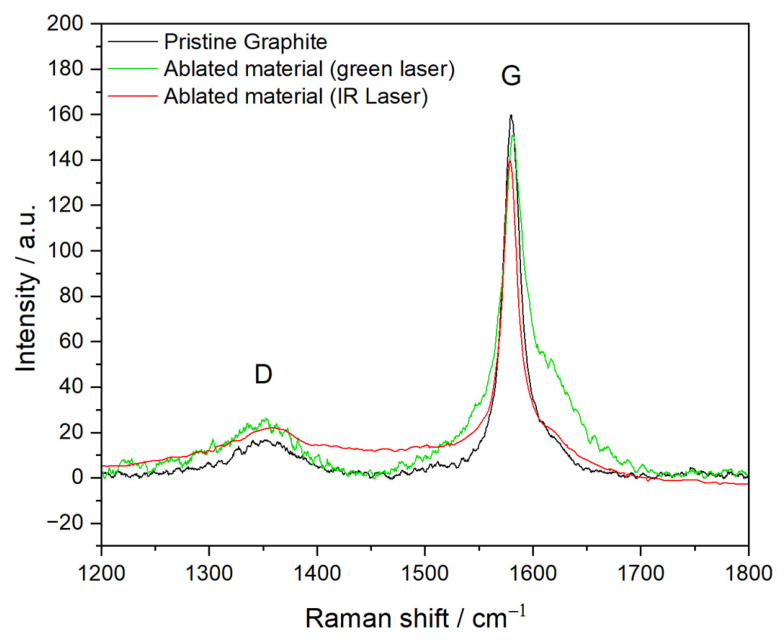
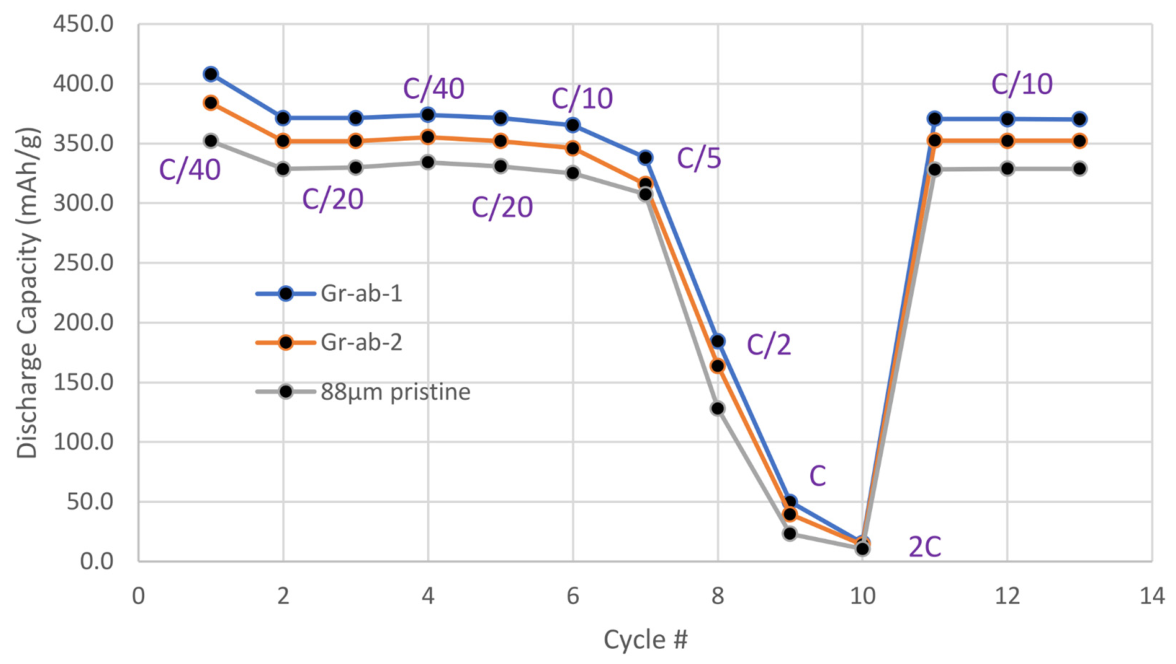
The power performance (high-rate capability) of laser-structured electrodes for graphite and NMC 811 were evaluated at different electrolyte concentrations and electrode thicknesses. Line patterning was used to create microstructures via femtosecond laser ablation. The electrochemical power performance of structured electrodes at both increasing electrolyte salt concentration and increasing electrode thickness shows that the best power performances were attained at 1.0 M electrolyte salt concentration. Lithium plating observations and long-term cycling capacities show that cycle life is greatly determined by electrolyte salt concentrations across all electrodes. Results suggest that salt mobility in the electrolyte and concentrations are significant factors in improving the power performance in both unstructured and structured electrodes. Ablated material recycling attempts also reveal that graphite is able to retain its chemistry and can be directly recycled for electrochemical use.
Keywords: laser structuring; lithium-ion battery; graphite anodes; NMC 811; lithium plating; diffusion NMR; electrochemical power performance; recycling laser structuring; lithium-ion battery; graphite anodes; NMC 811; lithium plating; diffusion NMR; electrochemical power performance; recycling