
Article

Frequency-Aware Optimal Power Allocation for Battery-Supercapacitor Hybrid Energy Storage System

1
China Aero Polytechnical Establishment, Beijing 100028, China
2
School of Computer Science and Engineering, Central South University, Changsha 410083, China
*
Author to whom correspondence should be addressed.
Batteries 2026, 12(7), 260; https://doi.org/10.3390/batteries12070260

Submission received: 26 May 2026 / Revised: 6 July 2026 / Accepted: 11 July 2026 / Published: 17 July 2026
(This article belongs to the Section Hybrid Energy Storage and Integrated Systems)

Abstract

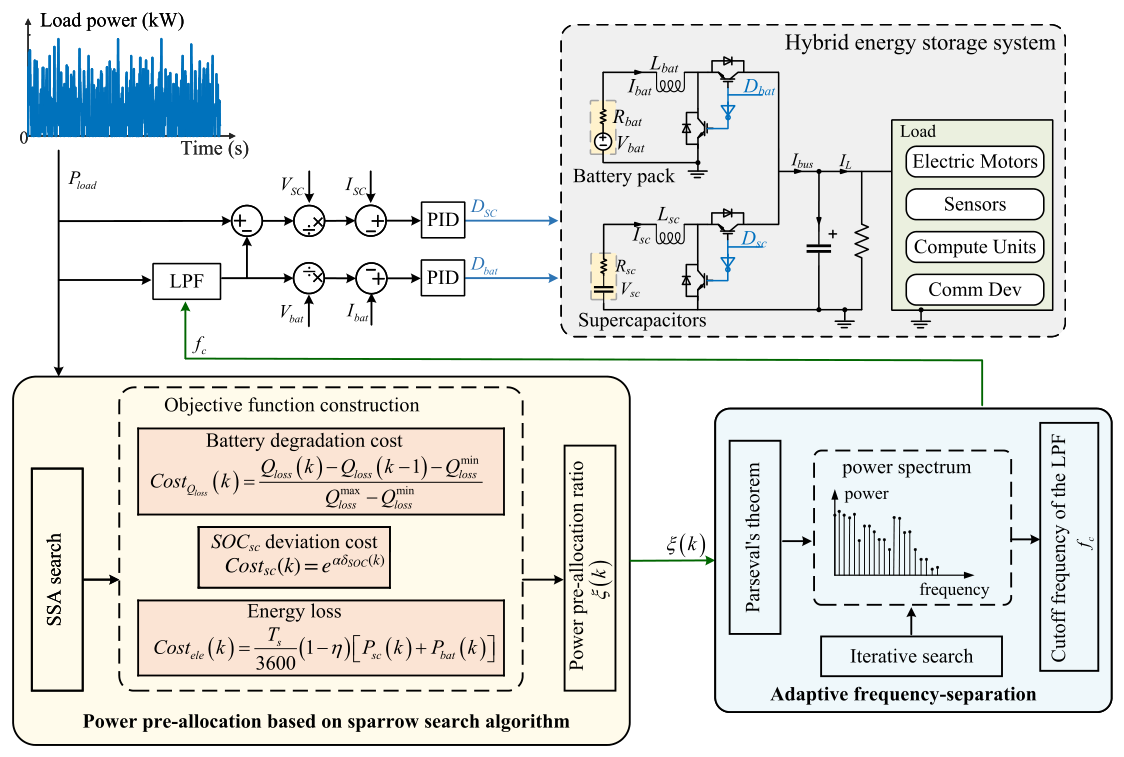
Power allocation remains a critical challenge in battery-supercapacitor hybrid energy storage systems (HESS), where effective energy management is essential for improving system performance and extending lithium-ion battery lifespan. Most optimal power allocation methods overlook the crucial role of frequency information, while many frequency-based approaches still lack a multi-objective quantitative optimization mechanism that jointly considers battery degradation, supercapacitor SoC regulation, and energy loss. To address this gap, this paper proposes a frequency-aware optimal power allocation method for battery-supercapacitor hybrid storage systems. First, an optimal power pre-allocation strategy is developed by constructing an objective function that simultaneously considers battery degradation, supercapacitor SoC regulation, and energy consumption. A Sparrow Search Algorithm-based heuristic optimization is then employed to determine the quantitative power allocation ratios between the battery and supercapacitor. Next, the power demand is transformed from the time domain into the frequency domain to extract spectral characteristics. According to the optimized pre-allocation ratios, low-frequency components are assigned to the battery and high-frequency components to the supercapacitor in a quantitative manner. Extensive simulation results demonstrate that the proposed method effectively smooths battery current profiles, reducing battery degradation by up to 11.41% and current fluctuation by up to 12.56% compared with conventional power allocation approaches.
Keywords: hybrid energy storage system; frequency-aware; power allocation; sparrow search algorithm; adaptive frequency separation hybrid energy storage system; frequency-aware; power allocation; sparrow search algorithm; adaptive frequency separation