1. Introduction
With the global transition of energy structures towards cleaner and low-carbon alternatives, lithium-ion batteries have become the core power unit for electric vehicles and large-scale energy storage systems due to their advantages such as high energy density and long cycle life [
1,
2]. However, their inherent thermal instability can easily trigger chain exothermic reactions, known as thermal runaway, under extreme conditions such as overcharging, mechanical damage, or thermal abuse. This is often accompanied by the release of large amounts of flammable, toxic gases and violent energy ejection, posing a serious threat to personal and property safety [
3,
4]. Statistics indicate that for every 100,000 pure electric vehicles sold, there are approximately 25 fire incidents caused by battery thermal runaway [
5]. Therefore, deeply unraveling the mechanisms of thermal runaway and developing early, reliable warning technology based on multi-parameter fusion is of paramount importance for ensuring the safety of batteries throughout their entire lifecycle.
Thermal runaway involves coupled exothermic reactions, including SEI decomposition, anode–electrolyte reactions, cathode oxygen release, and electrolyte decomposition [
6]. These reactions generate characteristic gases such as CO, H
2, CO
2, CH
4, C
2H
4, and C
2H
6 [
7], which provide useful indicators for early warning. Existing approaches include temperature/voltage monitoring, single-gas sensing, multi-gas or electronic-nose methods, and laboratory gas analysis such as GC, FTIR, Raman, or mass spectrometry [
8,
9,
10,
11,
12]. Temperature and voltage signals are easy to acquire but may respond relatively late, whereas gas signals can reflect electrolyte decomposition and side reactions earlier. However, many gas-based strategies still use fixed or empirical thresholds, and multi-gas approaches require more complex sensing, calibration, and cross-sensitivity compensation. Moreover, SOC is often not explicitly included in threshold design, although it strongly affects stored electrochemical energy, gas generation intensity, and thermal-runaway-triggering behavior.
It is noteworthy that the State of Charge (SOC) is a core intrinsic variable affecting the thermal stability of batteries. SOC directly determines the degree of lithium intercalation (reducibility) in the anode and the state of lithium deintercalation (oxidizability) in the cathode. This profoundly influences the stability of the SEI film, the activity of the electrolyte reduction reaction, and the oxygen-release temperature of the cathode—key stages in the thermal runaway chain reaction [
13,
14]. This implies that, under the same external thermal abuse conditions, the thermal runaway trigger threshold, the severity of the reaction, and even the gas generation characteristics systematically differ for batteries with different SOC levels. Ignoring the influence of SOC and using a fixed threshold for warning may lead to delayed warnings for high-SOC batteries (due to their more intense reactions and earlier gas generation) or false alarms for low-SOC batteries (because the fixed threshold is overly sensitive for them) [
15,
16,
17].
Apart from SOC, other factors including battery chemistry, aging state, electrolyte composition, and ambient conditions also affect thermal stability. However, SOC is particularly critical as it dynamically varies during operation and directly determines electrode thermodynamic activity, fundamentally altering thermal runaway pathways [
18,
19,
20,
21,
22].
Currently, research on how the SOC systematically influences the entire thermal runaway process—particularly the types, sequence, and concentration evolution of characteristic gas products—remains insufficient. The construction of a dynamic warning threshold model that adapts to SOC based on such patterns is an even greater research gap. This constitutes a key bottleneck constraining the precision and practicality of gas-based warning technologies. To address the aforementioned issues, this study employs widely used LiNi1/3Co1/3Mn1/3O2/graphite (NCM) ternary lithium-ion batteries as the research subject. Through strict control of sample consistency, systematic thermal-abuse-triggering experiments were conducted in a sealed, pressure-resistant experimental chamber at three typical SOC levels: 50%, 75%, and 100%. The study reveals the quantitative impact of SOC on temperature evolution and the gas generation characteristics of multiple characteristic gases (CO2, CO, CH4, C2H4, C2H6, C2H2) during thermal runaway. Furthermore, it elucidates the underlying electrochemical and thermochemical mechanisms responsible for the differences in gas generation patterns from a reaction kinetics perspective. Finally, based on the experimental findings, this study proposes and constructs a novel SOC-adaptive “dynamic threshold” warning strategy that integrates real-time SOC information with synergistic consideration of temperature and gas concentration. The significant advantages of this strategy over traditional fixed-threshold methods in terms of warning timeliness and reliability are validated using experimental data. By uncovering the quantitative influence of SOC on gas generation patterns and pioneering the associated dynamic threshold model, this research provides direct theoretical and experimental support for the development of intelligent and adaptive battery safety warning technologies.
2. Experimental Design for Thermal-Abuse-Induced Runaway Responses in Lithium-Ion Batteries
2.1. Experimental Materials and Sample Preparation
This study selected 50 commercially available 18650 cylindrical lithium-ion batteries(Tianjin Lishen Battery Joint-Stock Co., Ltd., Tianjin, China) as experimental subjects. The cathode material is LiNi1/3Co1/3Mn1/3O2 (NCM111), and the anode material is graphite, with a nominal capacity of 2600 mAh and a nominal voltage of 3.6 V. The top of the battery is equipped with three mechanical, one-way pressure relief valves. When the internal battery pressure exceeds 30 kPa, the valve core structure pops open instantaneously to rapidly release pressure and prevent violent explosion.
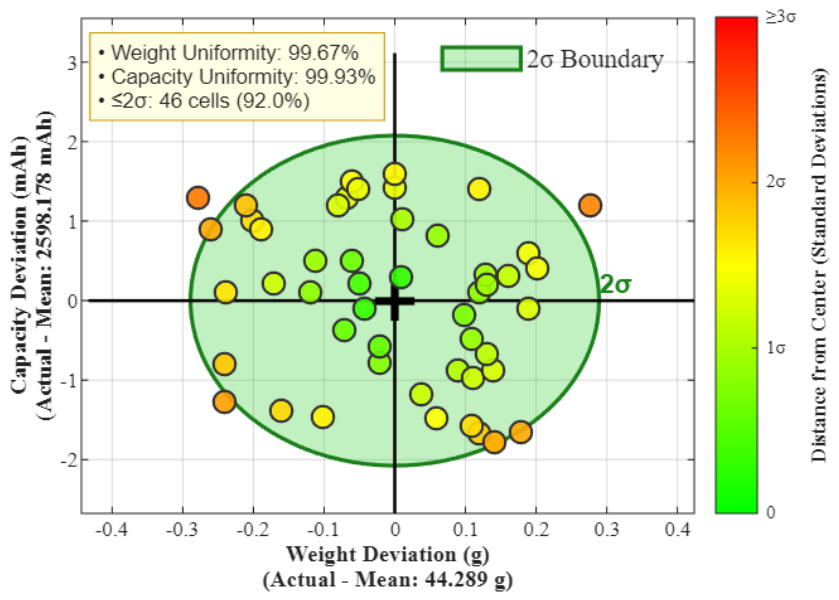
To eliminate the influence of individual battery differences on the experimental results and ensure the generality and reliability of the conclusions, strict consistency screening was performed on all test batteries. First, the mass of all batteries was measured using a precision electronic balance (JJ200, G&G Measurement Plant, Changshu, China). Subsequently, a battery capacity tester (EB Tester, ZKETECH Corporation, Shenzhen, China) was used to perform standard charge–discharge tests to calibrate their actual capacities. As shown in
Figure 1, the screening results showed that the 50 batteries had an average mass of (44.29 ± 0.28) g and an average actual capacity of (2598.2 ± 1.8) mAh, all demonstrating good consistency and meeting the experimental requirements.
Based on the experimental requirements, batteries meeting the consistency criteria were randomly selected from the screened pool. Following the charging specifications provided by the battery supplier, these batteries were charged to three target States of Charge (SOCs): 50%, 75%, and 100%, using the Constant Current–Constant Voltage (CC-CV) mode. The specific parameters were as follows: a charging current of 0.3 C (approximately 0.78 A) and a constant voltage termination current of 0.1 C (approximately 0.26 A). For this study, a minimum of three parallel experiments were set up for each of these three SOC conditions to ensure reproducibility. After charging, the batteries were allowed to rest at ambient temperature for at least one hour to ensure stabilization of their electrochemical state.
2.2. Experimental Setup and Testing Platform
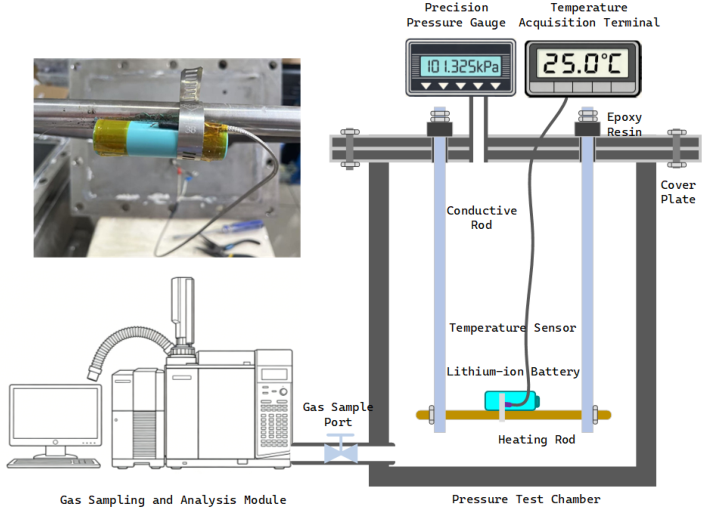
To safely and controllably study the temperature and gas generation characteristics during the thermal runaway process of lithium-ion batteries, a self-designed and -constructed pressure-resistant sealed experimental system was utilized. The core components and layout of this system are shown in
Figure 2. The system primarily consists of a pressure-resistant experimental chamber, a thermal triggering and temperature acquisition module, a gas sampling and analysis module, and a safety protection module.
The main body is a stainless steel cylindrical sealed chamber with a volume of 24 L and a designed pressure resistance of 1.0 MPa. The chamber top is equipped with a thick, heavy cover plate. Reliable sealing between the cover plate and the chamber body is achieved by a fluororubber O-ring and 12 sets of high-strength bolts. The cover plate integrates penetrating conductive rods, temperature sensor lead interfaces, and a pressure sensor. An explosion-proof glass observation window is installed on the sidewall of the chamber for real-time monitoring of macroscopic phenomena during experiments, such as battery deformation, pressure relief, and ejection.
- 2.
Thermal Triggering and Temperature Acquisition Module
Thermal runaway is triggered by external thermal abuse. The battery is tightly wrapped around the middle section of a heating rod with a rated power using a hose clamp, and its heating power is precisely controlled by a voltage regulator. The battery surface temperature is measured by a K-type thermocouple attached to the middle of the battery casing. The thermocouple signal is acquired and stored in real time by a high-speed data logger with a sampling frequency of 2 Hz.
- 3.
Gas Sampling and Analysis Module
A gas sampling port at the bottom of the experimental chamber is connected via high-temperature-resistant gas lines to the six-port injection valve of a Gas Chromatograph–Mass Spectrometer (GCMS-QP2010 SE, SHIMADZU Corporation, Kyoto, Japan). The GC-MS enables efficient separation and quantitative analysis of complex gas mixtures.
- 4.
Safety Protection Module
The entire experimental system is housed in a laboratory equipped with a forced ventilation system to mitigate the risk of extreme overpressure events in the experimental chamber. All electrical devices are equipped with overload protection functions.
2.3. Experimental Procedure
The experimental procedure was strictly executed according to the following steps to ensure operational safety and data accuracy:
The interior walls of the experimental chamber and all installed components were thoroughly cleaned with anhydrous ethanol and air-dried to eliminate contaminants. The SOC-calibrated battery, heating rod, and temperature sensor were fixed onto the internal support frame according to the positions shown in
Figure 2 to ensure good contact. The chamber lid was tightened to complete the sealing.
- 2.
Environment Initialization
Using a vacuum pump and an inlet valve, the air inside the experimental chamber was replaced with dry synthetic air (O2:N2 = 21:79, v/v) and adjusted to atmospheric pressure (0.1 MPa, 0 MPa gauge pressure) to simulate the real failure environment of the battery in air.
- 3.
Thermal Runaway Triggering and Data Acquisition
The data logger was started to continuously monitor temperature. The heating power supply was switched on, and the heating element was programmatically controlled to heat at a constant rate of 5 °C/min up to 215 °C, maintaining this temperature for 30 min to ensure the battery was sufficiently heated to trigger the complete chain of thermal-runaway reactions. During the experiment, key macroscopic phenomena such as battery deformation, pressure relief valve activation, ejection, and combustion were recorded via the observation window.
- 4.
Gas Sampling and Analysis
During heating, the six-port valve was manually operated every 400 s to inject a quantified volume of chamber gas into the Gas Chromatography–Mass Spectrometry (GC-MS) system. The main gases, including CO2, CO, H2, CH4, C2H4, C2H6, and C2H2, were identified and quantified by comparing retention times and characteristic ion peak areas with standard gas samples. The reported values represent apparent gas concentrations in the sealed chamber at each sampling time, rather than the direct total gas generation amount of the cell. The final sampling point at 3000 s was used as the residual chamber gas composition because the temperature response had largely stabilized and the main gas-release process had been completed.
- 5.
Data Processing
The temperature–time curves were aligned with the gas composition–concentration data. Combined with the records of experimental phenomena, a comprehensive analysis of the behavioral characteristics of batteries at different SOCs throughout the entire thermal runaway process was conducted.
3. Analysis of Gas Generation Patterns During Lithium-Ion Battery Thermal Runaway
3.1. Temperature and Gas Evolution Patterns Under Different SOCs
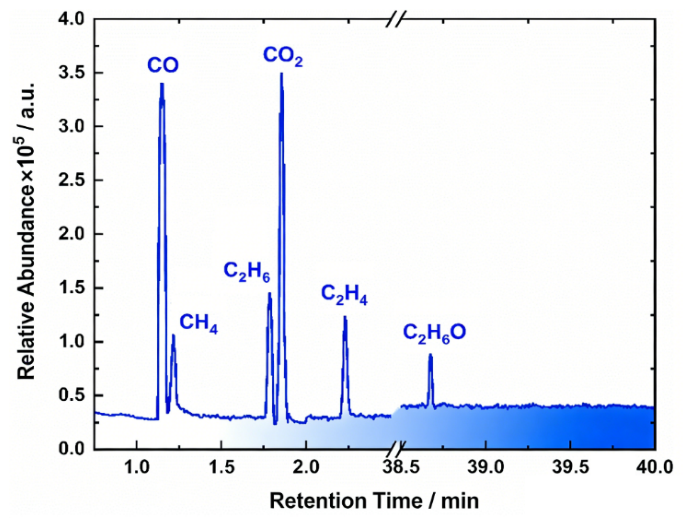
Figure 3 shows a typical Gas Chromatography–Mass Spectrometry (GC-MS) Total Ion Current (TIC) chromatogram of the gas mixture inside the experimental chamber after the thermal-abuse test of a battery at 50% SOC. Multiple characteristic gas peaks are clearly identifiable from the figure. By comparing with the standard spectral library (NIST) and confirming with the retention times of standard samples, the main products were identified as: CO (Rt ≈ 70 s), CH
4 (Rt ≈ 73 s), C
2H
6 (Rt ≈ 107 s), CO
2 (Rt ≈ 109 s), C
2H
4 (Rt ≈ 134 s), and C
2H
2 (Rt ≈ 225 s).
To further verify the reproducibility of the measurements,
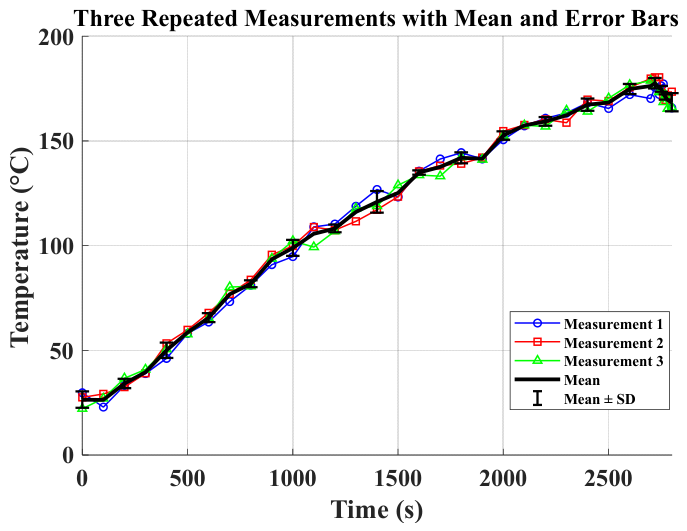
Figure 4 shows the three repeated temperature curves at 50% SOC, together with the mean values and standard deviation error bars. The three measurements exhibit similar temperature evolution behavior throughout the heating process, and the deviations remain limited, indicating good repeatability of the experiment. Similar repeatability was also observed at 75% and 100% SOC.
Figure 5,
Figure 6 and
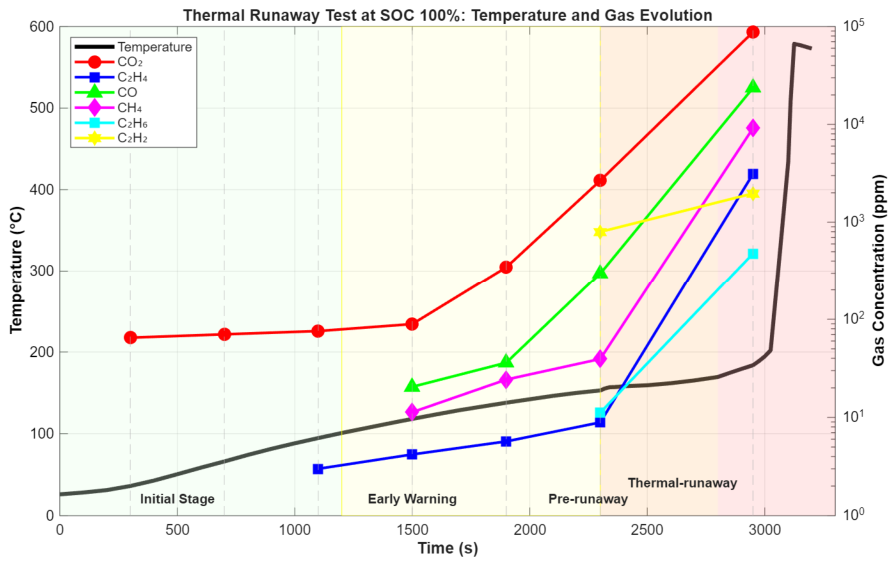
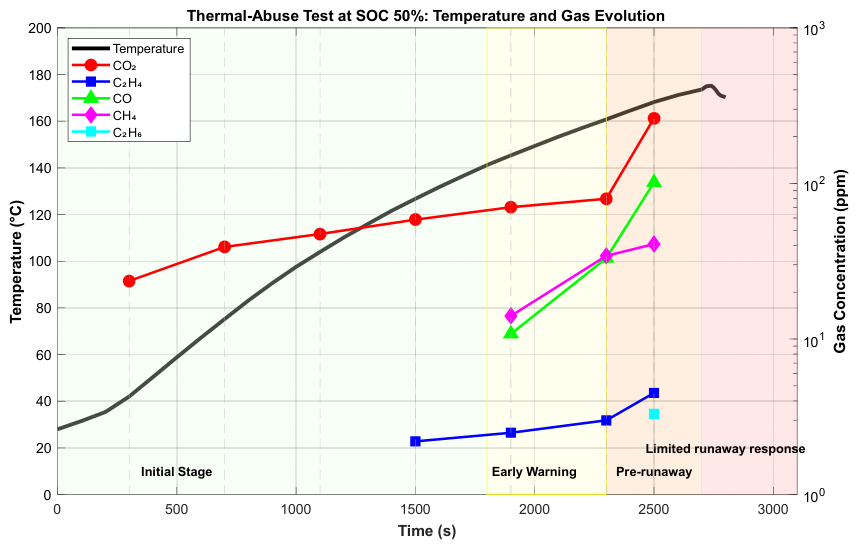
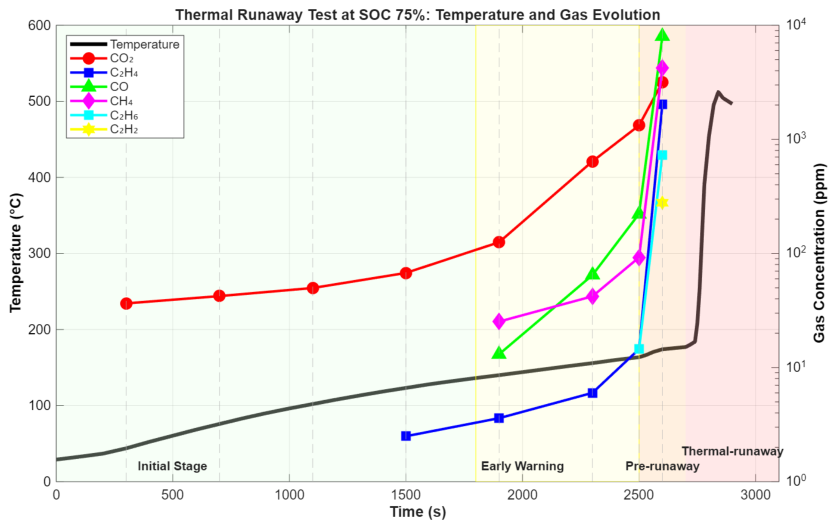
Figure 7 compare the temporal evolution of the six detected gases under 50%, 75%, and 100% SOC conditions. The data points are discrete GC-MS measurements of chamber gas concentrations, and the connecting lines are used only to show evolution trends. The 50% SOC cell did not show violent ejection or combustion, but a clear temperature peak followed by a temperature reversal and the detection of CO
2, CO, CH
4, and C
2H
4 indicate that internal side reactions and gas release had occurred. Therefore, this case is treated as a relatively mild or limited thermal-runaway response and is used as a lower-severity reference for analyzing SOC-dependent temperature and gas behavior. For terminological consistency throughout this manuscript, the 50% SOC case is referred to as a limited thermal-runaway response, whereas the 75% and 100% SOC cases are referred to as complete thermal runaway, with the 100% SOC case representing the most violent event.
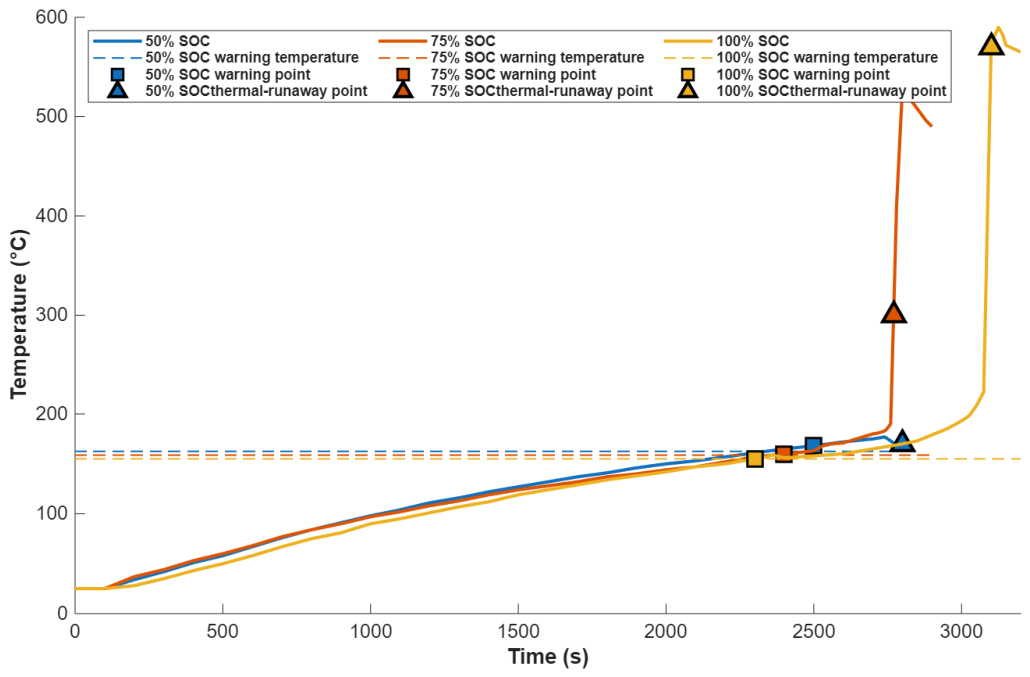
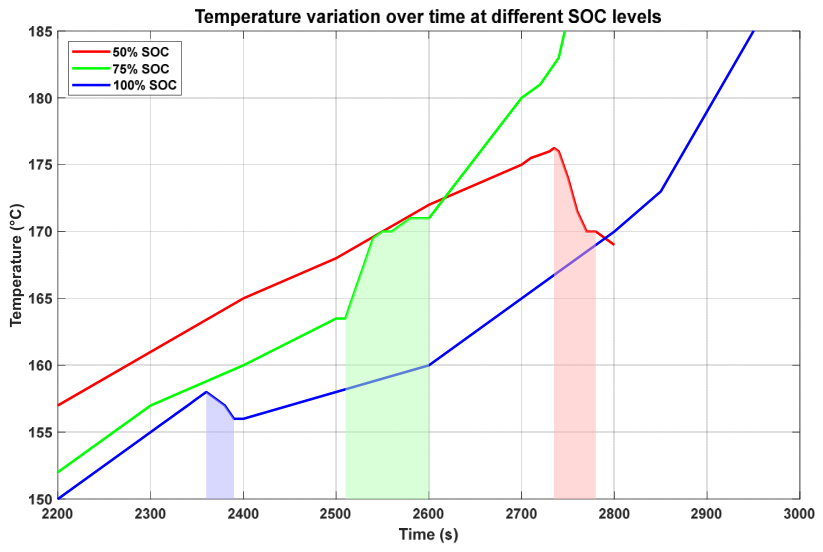
Prior to the onset of accelerated self-heating/runaway response, the temperature rise curves of the batteries under the three SOC conditions exhibited similar trends, all showing an approximately linear and gradual increase, as shown in
Figure 8. However, clear differences emerged when the cells approached the final self-heating stage. Across the three SOC conditions, the onset temperatures of accelerated self-heating/runaway response were approximately 177 °C, 164 °C, and 158 °C for 50%, 75%, and 100% SOC, respectively. It should be noted that the 177 °C point at 50% SOC corresponds to the onset of a limited thermal-runaway response rather than complete thermal runaway. These results indicate that increasing SOC lowers the onset temperature of the critical self-heating stage and increases the eventual severity of the response.
The temperature rise rate (dT/dt) during the final self-heating stage and the peak temperature both increased sharply with rising SOC. The 100% SOC battery exhibited complete and violent thermal runaway, with its temperature surging from approximately 222 °C to nearly 600 °C within seconds, accompanied by violent ejection. The 75% SOC battery also underwent complete thermal runaway but with slightly lower severity. In contrast, the 50% SOC battery reached a peak temperature of only about 177 °C and did not show significant ejection; it is therefore classified as a limited thermal-runaway response under the present protocol. These observations demonstrate that SOC strongly affects not only the onset temperature of rapid self-heating but also the severity and energy-release scale of the subsequent response.
- 2.
Gas Evolution Patterns
Combined with the gas concentration curves in
Figure 5,
Figure 6 and
Figure 7, it can be observed that the appearance of gas products follows a specific sequence, which is also related to SOC. CO
2 is the first gas to be detected, generated stably in the early stages of thermal runaway, originating from the initial decomposition of the SEI film (whose main component is Li
2CO
3). C
2H
4 begins to appear in the medium temperature range, marking the onset of the vigorous reduction reaction between the lithiated graphite anode and the electrolyte. The significant generation of CO and CH
4 typically occurs slightly later than that of C
2H
4, but their concentrations increase dramatically during the thermal-runaway outburst phase. C
2H
6 and C
2H
2 are high-temperature products, primarily detected during the thermal-runaway outburst phase, and are especially pronounced under high-SOC conditions. The generation of C
2H
2 is usually associated with more intense combustion or arcing processes.
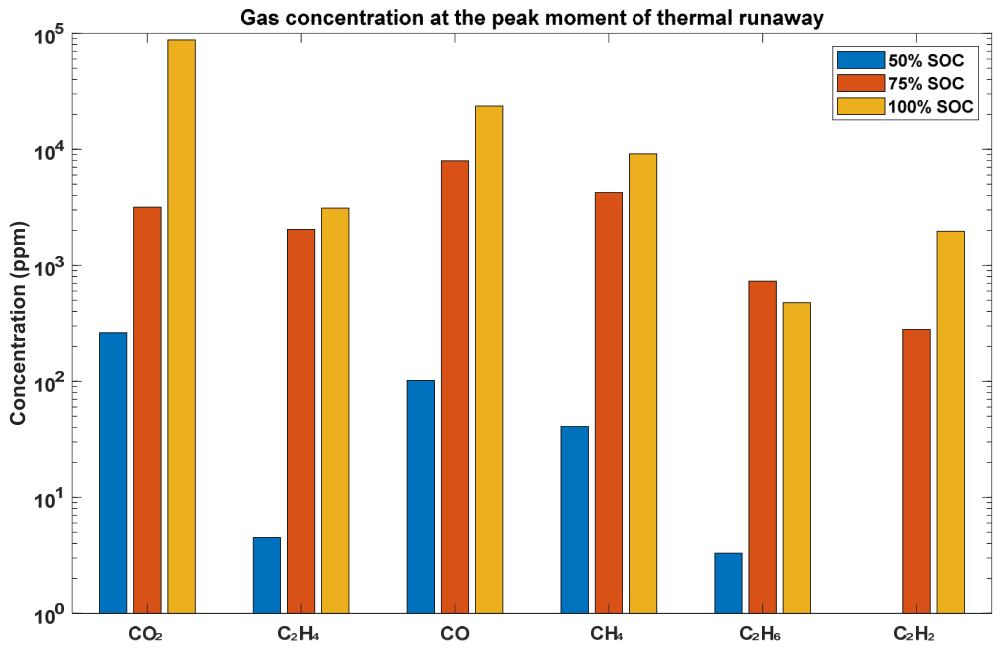
The measured chamber concentrations of the detected gas components show a strong positive correlation with SOC. After thermal runaway completion, the concentrations of CO
2, CO, and total hydrocarbons at 100% SOC are approximately 2.1–2.8 orders of magnitude higher than those at 50% SOC (
Figure 9). This intuitively reflects that more thorough and intense decomposition of electrochemical materials occurs in high-SOC batteries during the runaway process.
3.2. Analysis of Gas Generation Mechanism Based on Electrolyte Decomposition
The aforementioned gas generation patterns primarily stem from differences in the thermal decomposition pathways and rates of the lithium-ion battery electrolyte (typically composed of EC/DMC-based solvents and LiPF
6 salt) under different SOC conditions [
23,
24,
25,
26].
CO2 mainly originates from the decomposition of the SEI film. The primary inorganic component of the SEI film, Li
2CO
3, decomposes at approximately 90–120 °C:
This reaction is exothermic and paves the way for subsequent reactions between the anode and electrolyte. The early generation of CO2 occurs at all SOC levels. However, the SEI film on the anode surface in high-SOC batteries may be thicker or have a slightly different composition, leading to a slightly higher initial CO2 yield.
Hydrocarbon gases and CO originate from the reduction reaction between the anode and the electrolyte. When the temperature exceeds the stability threshold of the SEI film, the highly active lithiated graphite (
LixC6) undergoes nucleophilic substitution and reductive decomposition with the electrolyte solvents. This is the core stage of gas generation, where the SOC (i.e., the value of x) is the decisive factor. The attack of the lithiated anode on ethylene carbonate (
EC) is the primary pathway for generating
C2H4:
Simultaneously, EC can also generate CH4, H2, and CO via free radical pathways.
Attack on Dimethyl Carbonate (
DMC) solvent: the reductive decomposition of
DMC is a significant pathway for generating
CH4 and
CO:
In other words, a higher SOC corresponds to a greater degree of lithium intercalation (x) in the anode, resulting in stronger reducibility and a greater nucleophilic attack capability on the EC/DMC solvents. This causes the reduction reaction rate to reach a critical point at lower temperatures (manifested as a lowered temperature threshold for gas appearance). Concurrently, more reactants (lithium and solvents) participate in the reaction, leading to a marked increase in the gas-release intensity and the measured chamber concentrations. This is consistent with the Arrhenius equation and the dependence on reactant concentration.
The sharp increase in
C2H2 and
CO2/
CO concentrations in the later stages mainly stems from high-temperature combustion and secondary reactions. In the late stage of thermal runaway, the cathode releases oxygen, which reacts with the already generated flammable gases (such as H
2, CO, hydrocarbons) and ejected electrolyte vapor in combustion reactions:
Incomplete combustion and high-temperature cracking can generate substances like C2H2. High-SOC batteries exhibit higher temperatures and a richer supply of combustibles, making such secondary reactions more intense. This results in steeper concentration curves for CO2 and CO during the outburst phase and the detection of significant amounts of C2H2.
By determining the reducibility of the anode, SOC fundamentally regulates the kinetic and thermodynamic processes of electrolyte thermal decomposition. Consequently, batteries with different SOCs exhibit systematic and predictable differences in the trigger conditions, severity, and gas product characteristics of thermal runaway. This provides the key theoretical foundation for constructing an intelligent warning strategy based on SOC perception.
4. Warning Criteria for Lithium-Ion Battery Thermal Runaway
Traditional gas-based early warning systems for battery thermal runaway typically set a fixed gas concentration threshold (e.g., CO > 100 ppm) or a fixed temperature rise rate threshold. However, this “one-size-fits-all” strategy has a fundamental flaw. Since the State of Charge (SOC) decisively influences the gas generation kinetics and trigger temperature of thermal runaway, a single fixed threshold leads to a significant mismatch with the actual safety boundary. For instance, for a low-SOC battery, its thermal runaway process is milder and generates lower gas concentrations. The system might be very close to the critical point of thermal-runaway outburst before the fixed threshold is reached, resulting in an excessively short warning time (Twarning) and a loss of the valuable window for emergency response. Conversely, during the temperature rise process, background interference or minor side reactions might incidentally cause readings to reach the fixed threshold, triggering a false alarm and reducing the reliability of the warning system.
Therefore, a fixed threshold that does not adapt to the battery’s state cannot simultaneously meet the requirements for timeliness and reliability of warnings across a wide SOC range.
To address the issues above, this study proposes a dynamic threshold-adjustment warning mechanism that integrates real-time SOC information, based on the principle that “the warning threshold should match the battery’s real-time thermal runaway risk level.” Its core is the construction of a dual-parameter synergistic threshold function incorporating both temperature and gas concentration.
4.1. Theoretical Basis of the Dynamic Threshold Warning Model
The experimental data above clearly demonstrates that the SOC systematically alters the trigger temperature and gas generation kinetics of thermal runaway by affecting the quantity of reactants within the battery (i.e., the lithium intercalation concentration in the anode). To quantify this relationship and establish a predictable, computable warning model, it is necessary to describe the aforementioned phenomena from the perspective of reaction kinetics.
The essence of thermal runaway is a critical process where the rate of internal exothermic side reactions enters a self-accelerating stage. This process follows the fundamental laws of chemical reaction kinetics, where the reaction rate is generally described by the Arrhenius equation and depends simultaneously on the activation energy and the concentration of reactants. In the context of this study, the key reactant is the lithiated graphite in the anode (
LixC6), whose concentration is directly and positively correlated with the battery’s
SOC. Therefore, the rate of the key chain reactions leading to the uncontrolled growth of thermal runaway (such as the reductive decomposition of the electrolyte at the anode) can be expressed as:
where (
n) denotes the apparent reaction order, which characterizes the dependence of the reaction rate on the reactant concentration or
SOC-related active material availability;
R is the gas constant;
T is the absolute temperature; and
C is the proportionality constant. This expression indicates that at the same temperature, a higher
SOC (i.e., a higher reactant concentration) leads to a higher reaction rate. Conversely, to achieve the same critical reaction rate r
crit (i.e., the warning point), a battery with a higher
SOC requires a lower external heating temperature (
T). This provides a theoretical explanation for the experimentally observed phenomenon of “increased SOC leads to a decreased thermal runaway trigger temperature.”
4.2. Derivation of the Dynamic Threshold Function
The warning trigger point corresponds to the moment when the reaction rate
r reaches the critical value
rcrit. Setting
r =
rcrit, taking the natural logarithm of the aforementioned relationship, and rearranging, yields the relationship between the early warning critical temperature
Tth and
SOC:
As indicated by Equation (6), the early warning critical temperature (
Tth) is negatively correlated with
SOC. For practical engineering application and convenient BMS implementation, this SOC-dependent relationship was further approximated within the investigated SOC range of 50–100%. Since the experimental fitting results showed a good linear decreasing trend between (
Tth) and SOC in this limited
SOC interval, the relationship in Equation (6) was approximately expressed by the following linear function:
CO
2 was selected as the main gas indicator because it was detected at all investigated SOCs, exhibited a monotonic increase with SOC, and provided a relatively large signal margin compared with several hydrocarbon gases. In addition, CO
2 can be measured by mature online gas-sensing techniques, which is beneficial for BMS-oriented application. Although CO, H
2, C
2H
4, and multi-gas combinations are also valuable indicators, they introduce additional complexity related to concentration stability, diffusion, cross-sensitivity, and calibration. Therefore, CO
2 was used to establish the present SOC-adaptive threshold, while the framework can be extended to multi-gas fusion in future work. The CO
2 threshold was likewise fitted as a
SOC-dependent linear function:
where
α,
β,
γ, and
δ are empirical coefficients obtained by least-squares fitting of the experimental data. The coefficients
α and
β correspond to the temperature threshold, whereas
γ and
δ correspond to the
CO2 concentration threshold.
SOC is expressed as a dimensionless fraction rather than a percentage; thus,
SOC = 0.5, 0.75, and 1.0 correspond to 50%, 75%, and 100% SOC, respectively. The fitted equations are applicable only within the investigated
SOC range of 0.5–1.0.
4.3. Determination of Model Parameters and Warning Rules
Based on the inflection points where thermal runaway acceleration became evident in the experimental data for the 50%, 75%, and 100% SOC groups (specifically, the starting points of the sharp increase in the temperature and CO
2 curves as shown in
Figure 5,
Figure 6 and
Figure 7), the specific parameters
α,
β,
γ and
δ in Equations (7) and (8) for the dynamic threshold functions were determined through linear fitting.
Temperature Dynamic Threshold:
CO
2 Concentration Dynamic Threshold:
Accordingly, the integrated warning rule is constructed as:
This rule requires simultaneous satisfaction of the temperature and CO2 criteria, reducing false alarms caused by a single parameter. For higher safety requirements, additional gases such as CO or C2H4 may be incorporated into a multi-gas criterion. The units of Tth and Cth,CO2 are °C and ppm, respectively. The fitting results showed acceptable linearity within the tested SOC range. Because the same SOC datasets were used for fitting and retrospective validation, the present results demonstrate the feasibility of the SOC-adaptive threshold concept rather than independent predictive capability; further validation with additional SOC levels and independent tests is still needed.
4.4. Validation of the Warning Mechanism and Performance Analysis
The aforementioned dynamic threshold model was applied to the experimental data from this study for retrospective validation. The results are shown in
Figure 10.
For all three SOC conditions, the dynamic warning model successfully triggered warnings before the onset of the final rapid self-heating stage, with no missed alarms. For the 75% and 100% SOC cases, this corresponded to warnings before complete thermal runaway; for the 50% SOC case, it corresponded to a warning before the limited thermal-runaway response intensified. The warning trigger points (marked by boxes in
Figure 10) were located at the stage where both temperature and CO
2 concentration began to increase rapidly.
The warning lead time is defined as the time interval from the warning trigger to the onset of the final abrupt temperature rise stage. As shown in
Figure 10, the dynamic threshold model provided substantial and relatively balanced warning lead times for batteries with different SOCs: approximately 300 s for 100% SOC, approximately 370 s for 75% SOC, and approximately 800 s for 50% SOC. For the 50% SOC case, this lead time refers to the interval before the onset of the fastest self-heating segment under the limited thermal-runaway response.
Because gas concentrations were obtained by manual GC-MS sampling every 400 s, the reported warning lead times should be regarded as approximate retrospective estimates rather than exact real-time trigger times. No interpolation was used; the trigger time was determined by the first sampling point at which the measured gas concentration satisfied the corresponding threshold together with the temperature criterion. Practical real-time application would require online gas sensors with shorter response times and sampling intervals.
For comparison, if a conservative fixed threshold suitable for 50% SOC (e.g., T ≥ 168 °C and CO2 ≥ 200 ppm) were applied, the warning lead time for a 100% SOC battery would be shortened to less than 50 s. Conversely, if a sensitive fixed threshold suitable for 100% SOC were used, a 50% SOC battery would be highly susceptible to false alarms. The dynamic threshold model significantly optimizes the warning timeliness across different SOC levels.
Overall, the proposed SOC-adaptive threshold mechanism adjusts the temperature and CO2 criteria according to BMS-provided SOC and improves the balance between warning timeliness and reliability compared with fixed thresholds. However, SOC estimation uncertainty should be considered in practical implementation. In addition, the present model was established using fresh and well-screened cells; aging, lithium plating, defects, manufacturing inconsistency, and harsh cycling may alter gas release, heat generation, venting behavior, and SOC estimation accuracy. Therefore, the fitted coefficients should be recalibrated or extended with state-of-health-related correction factors when applied to degraded or abused cells.
5. Conclusions
This study, through the design of sealed pressure-resistant experiments, systematically investigated the patterns of temperature response and gas generation behavior during the thermal runaway process of ternary lithium-ion batteries under different SOCs. Building on these findings, an innovative dynamic threshold warning mechanism was proposed. The experimental results indicate that the State of Charge is the core intrinsic factor determining the thermal runaway characteristics of batteries. As the SOC increased from 50% to 100%, the trigger temperature for thermal runaway significantly decreased, while the temperature rise rate and the peak temperature increased dramatically, reflecting the intensified instability of the internal chemical system. Regarding gas generation behavior, characteristic gases such as C2H4, CO, and CH4 in high-SOC batteries began to generate significantly at lower temperature thresholds, and the absolute concentrations of various gas products exhibited an approximately 2.1–2.8-order-of-magnitude increase. Among the tested conditions, the 50% SOC case showed only a limited thermal-runaway response under the present protocol, whereas the 75% and 100% SOC cases developed complete thermal runaway. This pattern is rationally explained from the perspective of reaction kinetics: a higher SOC implies a higher lithium intercalation concentration and reducibility in the anode, which significantly intensifies the rate of nucleophilic attack and reductive decomposition reactions on the electrolyte solvents. This causes the chain of exothermic reactions to occur earlier and more violently.
Based on these SOC-dependent characteristics, a dual-parameter dynamic threshold model combining temperature and CO2 concentration was established. The model uses SOC as a dimensionless input and was retrospectively validated with the experimental data, providing estimated warning lead times of 300–800 s under the discrete GC-MS sampling condition. Compared with fixed thresholds, the SOC-adaptive strategy improves warning adaptability across different SOC levels. The present work demonstrates the feasibility of incorporating SOC into gas-based warning thresholds, while further validation with online gas sensors, additional SOC levels, and aged or abused cells is needed before practical BMS deployment.