Communication

A Rechargeable Zinc–Copper Voltaic Battery Built from Cost-Effective Electrodes and Electrolytes

1
Department of Physics, University of Puerto Rico-Rio Piedras Campus, San Juan, PR 00925, USA
2
Department of Chemistry, University of Puerto Rico-Rio Piedras Campus, San Juan, PR 00925, USA
*
Authors to whom correspondence should be addressed.
Batteries 2026, 12(6), 215; https://doi.org/10.3390/batteries12060215 (registering DOI)
Submission received: 26 April 2026 / Revised: 5 June 2026 / Accepted: 11 June 2026 / Published: 13 June 2026

Abstract

The zinc–copper (Zn-Cu) voltaic battery is the first battery made in human history, but the Cu2+ dissolution issue leads to the reaction’s irreversibility. To tackle this challenge, solid-state electrolytes, ion exchange membranes, and functional electrolytes have been proposed to mitigate the Cu2+ dissolution; however, these approaches incur limitations like cell complexity, high cost, and anode corrosion. Herein, we develop a simple yet effective strategy to mitigate Cu2+ dissolution and build a rechargeable voltaic battery from cost-effective materials, including commercially available micro-copper powders and non-corrosive zinc acetate electrolyte. Importantly, the near-neutral Zn(Ac)2 electrolyte provides some amounts of hydroxide and facilitates the Cu2O/Cu solid–solid conversion reaction, thereby inhibiting the generation of soluble Cu2+ ions. As a result, the Zn-Cu battery exhibits a reversible capacity of ~130 mAh g−1, a feasible voltage of 0.87 V, and a stable cycling life over 100 cycles. Our work provides a feasible strategy for developing rechargeable and cost-effective Zn-Cu batteries.

1. Introduction

Aqueous zinc metal batteries have gained worldwide attention for electrochemical energy storage due to the high capacity (820 mAh g−1), low potential (−0.76 V vs. standard hydrogen electrode, SHE), and low cost of the Zn anode [1,2,3]. Besides these merits, aqueous Zn batteries have also played a foundational role in the battery development history. Historical systems, including the voltaic pile (1800), Daniell cell (1836), and Leclanché cell (1866), all employed Zn metal as the anode [4]. Among them, the voltaic battery is the very first battery that was made by humanity, which marks the starting point of battery research and is of crucial historic significance [5]. Moreover, the utilization of two common, inexpensive, and high-capacity metal electrodes is attractive for practical applications. Unfortunately, the rudimentary design makes voltaic batteries not rechargeable. Turning this primary battery chemistry into a rechargeable one, therefore, represents a significant advancement toward energy storage [6].
In the original voltaic battery setup, Zn metal works as the anode, Cu metal serves as the cathode, and concentrated sodium chloride (NaCl) is the electrolyte [7]. During the discharge, Zn metal loses electrons and yields Zn2+ ions (Zn − 2e = Zn2+), whereas Cu metal receives electrons and reduces water, thereby generating hydrogen gas on the cathode (2H2O + 2e = H2 + 2OH). In the NaCl electrolyte, the Zn-Cu battery system is not rechargeable, because during charging, the Cu metal will be oxidized to soluble Cu2+ ions, which can easily migrate to the Zn anode and cause spontaneous electrode corrosion (Cu2+ + Zn = Cu + Zn2+) [8]. Note that the standard Cu2+/Cu potential (+0.34 V vs. SHE) is much higher than that of Zn2+/Zn (−0.76 V vs. SHE), which thermodynamically favors the corrosion side reaction.
To make a rechargeable voltaic battery, it is imperative to tackle the Cu2+ ion dissolution and cross-over challenge. To date, two major approaches have been proposed. The first method relies on the utilization of an advanced and selective separator, which physically prevents the cross-over and migration of Cu2+ ions. For instance, solid-state electrolytes (SSEs) [9] and ion exchange membranes [10,11] (IEMs) have been developed for this purpose, and additional charge carriers like Li+ ions communicate between the catholyte and anolyte. However, it is worth noting that SSEs and IEMs are much more expensive than regular separators [12], and they will increase the battery complexity for manufacturing and operation [13]. The second strategy is to develop a novel and functional electrolyte that can adjust the chemical solubility of Cu2+ ions [14,15]. For instance, strong alkaline electrolytes have been used for rechargeable Zn-Cu batteries, where the presence of excessive OH anions triggers the solid–solid conversion reaction of Cu(OH)2/Cu and Zn(OH)2/Zn [16]. Due to the insolubility of Cu(OH)2, there is minimal generation of soluble Cu2+ ions, therefore circumventing the Cu2+ dissolution issue. Nevertheless, strong alkaline electrolytes are highly corrosive to the Zn metal anode, leading to low plating efficiency and short cycling life [17,18]. Collectively, the prior studies encounter challenges in battery complexity, high cost, and electrode corrosion.
Herein, we reported a rechargeable voltaic battery using simple and cost-effective materials. Specifically, commercially available and micro-sized copper powders are used as the cathode, a pristine Zn foil works as the anode, and a non-corrosive zinc acetate solution is employed as the electrolyte. Importantly, the near-neutral Zn(Ac)2 electrolyte provides a modest concentration of OH, which facilitates the solid–solid Cu2O/Cu conversion reaction and enables stable cycling. This mild electrolyte also avoids the common Zn anode corrosion and enables promising Zn2+/Zn reversibility. As a result, the Zn-Cu battery delivers a reversible capacity of ~130 mAh g−1, a feasible voltage of ~0.87 V, and stable cycling over 100 cycles. This work provides an effective approach to building rechargeable Zn-Cu batteries for energy storage.

2. Experimental Section

Material Characterization: X-ray diffraction (XRD) patterns of the Cu powders and Cu self-standing electrodes were collected on a Rigaku Supernova (Rigaku Corporation, Tokyo, Japan) equipped with a HyPix3000 X-ray detector (Rigaku Corporation, Tokyo, Japan) and Cu Kα radiation source (λ = 1.5406 A). Scanning electron microscopy (SEM) images and energy-dispersive X-ray spectra (EDS) mapping of the Cu materials/electrodes were recorded with a field-emission scanning electron microscope (JEOL, JSM-6480LV; JEOL, Akishima, Japan).
Electrode Preparation: Micro-sized Cu powders (Sigma-Aldrich, St. Louis, MO, US), were ground with Ketjen black carbon in a 7:2 mass ratio for 20 min, and then we added PVDF/NMP (PVDF: polyvinylidene fluoride; NMP: N-methyl-pyrrolidone) binder solution to make a homogeneous electrode slurry. The slurry was coated on carbon fiber current collectors (Fuel Cell Store, AvCarb MGL370, 0.37 mm thickness and 1 cm in diameter; Fuel Cell Store, Bryan, TX, US). Then, the electrodes were vacuum-dried with the vacuum pump running overnight. The final mass ratio between the micro-sized Cu, carbon, and binder is 7:2:1. The active mass loading is 1.5–2.5 mg cm−2. For comparison, we also used pristine Cu foil (MTI Corporation, Richmond, CA, US) and nano-sized Cu powders (Sigma-Aldrich). The low-purity and low-quality micro-sized Cu was purchased from Amazon (99.5% purity; 0.1% > 63 µm, 96.1% < 45 µm). For ex situ XRD and SEM tests, the Cu powders were ground with Ketjen carbon and then mixed with polytetrafluoroethylene (PTFE) binder, which was rolled into a thin self-standing film.
Battery assembly and testing: The Zn-Cu batteries were made using the 2032-type coin cells, where the anode, cathode, and electrolyte are the Zn metal foil, micro-Cu electrodes, and 1 M Zn-ion electrolytes, respectively. The electrolytes include 1 M Zn(NO3)2, 1 M ZnSO4, and 1 M Zn(Ac)2. These zinc salts were purchased from Sigma-Aldrich. The separators are glass fiber papers. The battery performance was tested on the Landt Battery System (CT3002AU, Landt Instruments, Vestal, NY, US). The cyclic voltammetry and electrochemical impedance were conducted on the Biologic Potentiostat (BioLogic, Seyssinet-Pariset, France).

3. Results and Discussion

In the original voltaic battery configuration, a pristine Cu foil was used as the substrate for hydrogen evolution. However, the Cu foil is not feasible for conversion reactions due to its bulk structure and large size [19]. Therefore, we select micro-sized Cu powders as the cathode, which are commercially available and cost-effective when purchased from most chemical vendors. In addition, micro-sized powders bring additional advantages for battery manufacturing, such as high storage stability, low surface area, and high tap density [20,21]. In this work, the micro-Cu was purchased from Sigma-Aldrich and exhibits a high tap density of ~6.25 g cm−3 (Figure S1), which is much higher than common Zn-ion cathodes such as MnO2 (~2.17 g cm−3) and V2O5 (~1.32 g cm−3). The high tap density can compensate for the modest gravimetric capacity, leading to increased volumetric capacity [22,23].
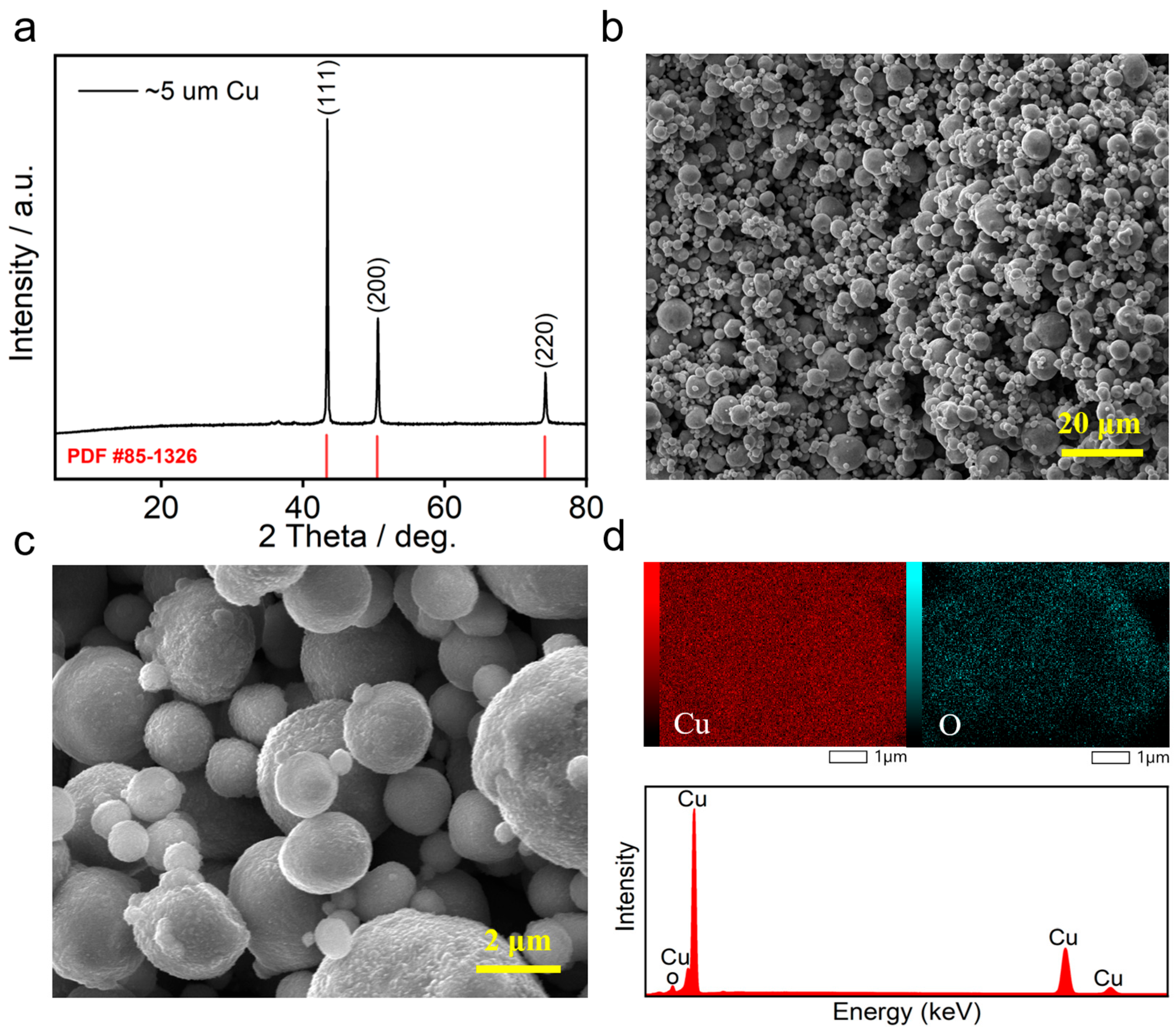
The structural integrity and chemical purity of the micro-Cu were confirmed by X-ray diffraction (XRD). As illustrated in Figure 1a, the diffraction patterns exhibit high crystallinity and are well indexed to the face-centered cubic (FCC) phase of Cu (PDF: 85–1326, space group: Fm-3m, a = 3.615 Å, α = 90°). Scanning electron microscopy (SEM) analysis reveals that the micro-Cu sample exhibits a spherical morphology with a primary size distribution ranging between 1 and 5 μm (Figure 1b,c). In addition, energy-dispersive spectroscopy (EDS) and elemental mapping analysis detect a predominant Cu signal with negligible oxygen content, which corroborates the phase purity of micro-Cu powders (Figure 1d). Based on the particle size (1–5 μm), the spherical morphology, and the metal density (8.96 g cm−3), we can estimate that the micro-Cu sample exhibits a low surface area of 0.13–0.67 m2 g−1 (Figure S2).
To evaluate the electrochemical performance of the micro-Cu electrode, we used regular glass fiber separators and conventional 2032-type coin cells to make Zn-Cu batteries, which are much more cost-effective than the reported Zn-Cu batteries with SSEs or IEMs.
The selection of a suitable electrolyte is of crucial importance for the electrode working mechanisms. As revealed by the Cu/H2O Pourbaix diagram [24], a moderately alkaline or near-neutral electrolyte (pH is between 5.5 and 11) can trigger a Cu/Cu2O solid–solid conversion reaction, whereas an acidic electrolyte (pH is below five) will promote the Cu/Cu2+ solid–liquid dissolution reaction. This diagram is further plotted and provided in Figure S3, which provides strong guidance for us to employ the 1 M Zn(Ac)2 electrolyte. Note that due to the weak base hydrolysis of Ac anions [25,26], this electrolyte shows a near-neutral pH value of ~5.75 (Figure S4), which falls in the Cu/Cu2O conversion range and leads to a stable performance for the micro-Cu electrode. We also included 1 m Zn(NO3)2 and 1 M ZnSO4 electrolytes for comparison, which exhibit lower pH values of 3.3 and 3.9, respectively and lead to much faster capacity fading (Figure S4). EDS analysis reveals that Cu elements are deposited on the Zn foil anode in the 1 m Zn(NO3)2 and 1 M ZnSO4 electrolytes, suggesting the Cu2+ ion dissolution and cross-over (Figure S5). However, the Cu signal is minimal in the Zn(Ac)2 case, indicating the inhibited Cu2+ dissolution (Figure S5). Note that HAc is a weak acid; therefore, Ac is a weak base, which can counteract the weak acid dissociation of Zn2+ ions and make the electrolyte less acidic.
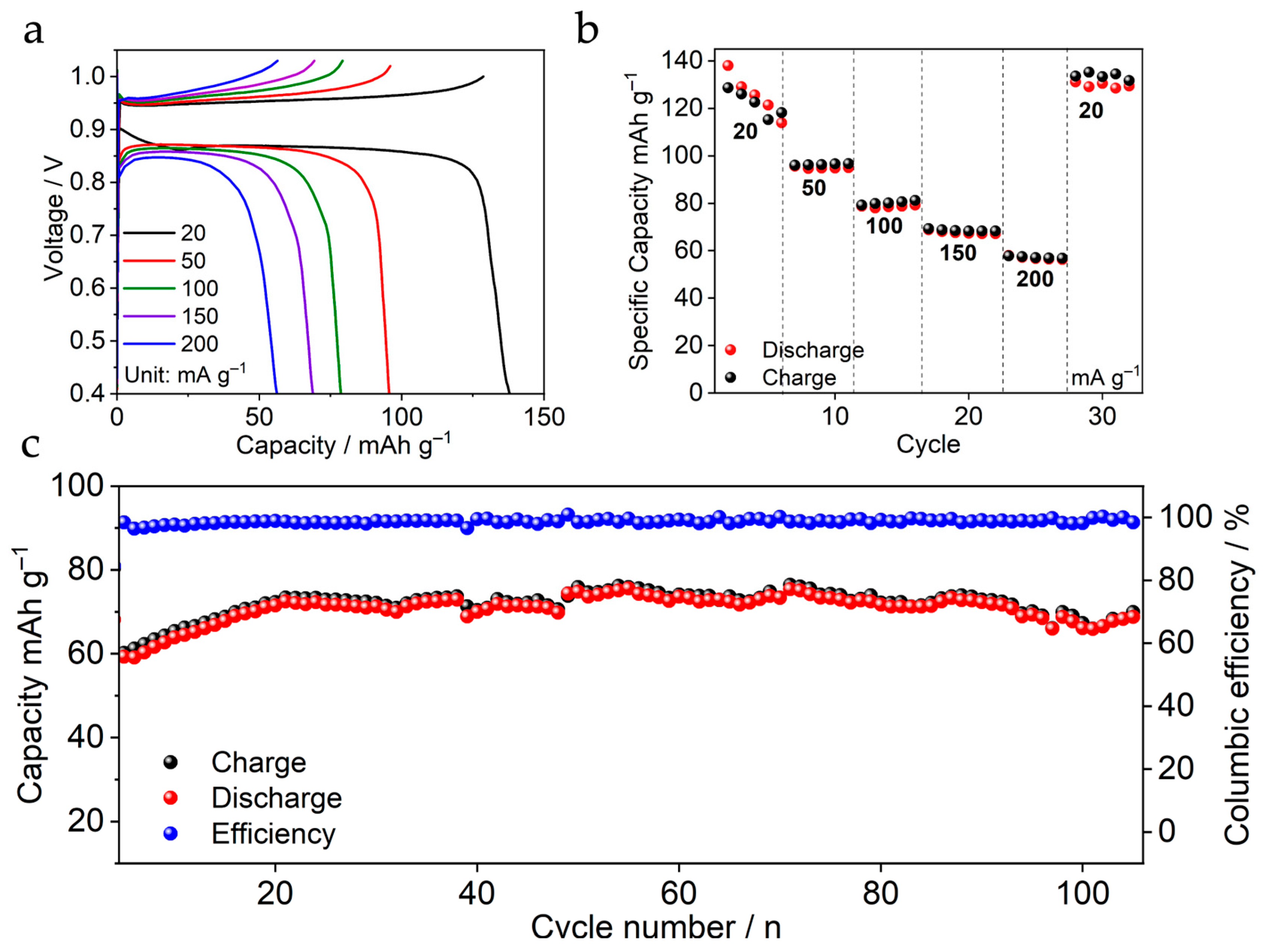
Figure 2a shows the galvanostatic charge/discharge (GCD) curves of the Zn-Cu batteries in the 1 M Zn(Ac)2 electrolyte at various current densities. At 20 mA g−1, there is an evident charge/discharge plateau at ~0.95/0.85 V, suggesting a two-phase conversion reaction. The reversible discharge capacity is ~130 mAh g−1, corresponding to a specific energy of ~113 Wh kg−1 based on the cathode mass. The potential hysteresis between charge/discharge is approximately 0.1 V, resulting in a round-trip energy efficiency of ~89.5%. With the increment of current densities, the discharge capacity drops to 95, 79, 68, and 57 mAh g−1 at 50, 100, 150, and 200 mA g−1, respectively (Figure 2b). When the current shifts back to 20 mA g−1, the discharge capacity can be restored to ~130 mAh g−1, indicating good reaction reversibility.
The Zn-Cu battery also demonstrates a promising cycling performance (Figure 2c). At 100 mA g−1, the electrode experiences a slight activation process and exhibits a capacity increment in the first 20 cycles. After that, the micro-Cu electrode maintains a relatively stable cycling performance for 80 cycles without significant capacity fading. These results indicate that a reversible Zn-Cu battery is attainable using cost-effective and commercially available materials without the need for complex separators or specialized electrolytes.
Besides the improved reversibility of the Cu cathode, the 1 M Zn(Ac)2 electrolyte also enables the optimal cycling performance of the Zn anode, due to its near-neutral pH value and the lowest corrosion. In the 1 M Zn(NO3)2 and 1 M ZnSO4 electrolytes, the symmetrical Zn‖Zn batteries encountered short circuits after less than 250 h, but the symmetrical batteries demonstrated stable cycling performance in the 1 M Zn(Ac)2 electrolyte for 500 h (Figure S6). The asymmetrical Zn‖Cu batteries showed a similar trend (Figure S7). The acidic and corrosive nature of 1 M Zn(NO3)2 electrolyte leads to low plating efficiency, whereas the 1 M ZnSO4 electrolyte incurs a significant polarization increment in the 50th cycle. By contrast, the 1 M Zn(Ac)2 electrolyte leads to a stable Zn plating behavior with a high efficiency close to 98% [27,28]. The plated Zn metal also exhibits a uniform, dense, and dendrite-free morphology (Figure S8).
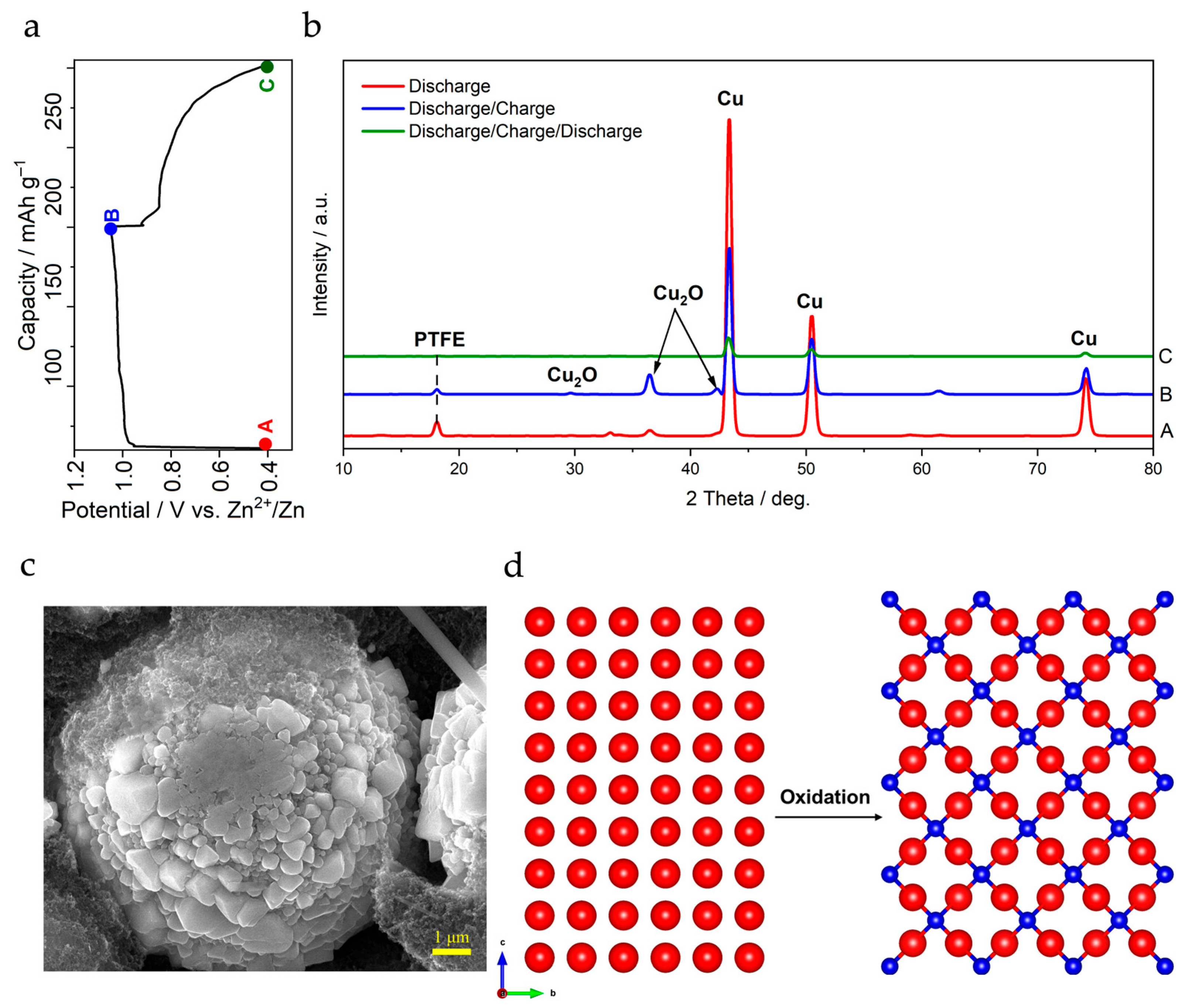
To elucidate the reaction mechanism of the micro-Cu electrode, we carried out ex situ XRD analysis on the representative charge/discharge states: fully discharged (point A), fully charged (point B), and fully discharged again (point C), as shown in Figure 3a. As displayed in Figure 3b, after the charging, the two peaks at 36.4° and 42.2° have significantly increased their intensities, which can be attributed to the Cu2O phase (PDF 05-0667, cubic, Pn-3m, a = b = c = 4.2696 Å, α = 90°). Meanwhile, the Cu peaks remain dominant in the sample, suggesting a partial Cu/Cu2O conversion process. This partial conversion reaction can also explain the modest capacity of ~130 mAh g−1. It is noted that if Cu is fully converted to Cu2O, a high theoretical capacity of 421 mAh g−1 will be obtained. During the discharge, the Cu2O peaks have been markedly weakened, suggesting the reduction in Cu2O and the generation of Cu.
To provide further insights into the Cu/Cu2O conversion and the modest capacity utilization, we conducted cyclic voltammetry (CV) and electrochemical impedance spectroscopy (EIS) analysis of the micro-Cu electrode. As shown in Figure S9, there is an evident oxidization/reduction peak at ~1.0/~0.8 V when the micro-Cu is coated on the carbon fiber paper (CFP), but there is little redox current when the pure CFP is used. The comparison suggests that CFP provides little contribution to the reaction capacity, and it is the micro-Cu that serves as the major redox center. EIS analysis finds that the micro-Cu exhibits a charge-transfer resistance of ~70 ohm in the 1 M Zn(Ac)2 electrolyte (Figure S10), which is relatively high due to its large particle size. This may explain the modest capacity utilization. We conducted comparative studies on the pristine Cu foil and a nano-sized Cu to understand the size effect. The Cu foil exhibited little capacity, due to its bulk foil morphology (Figure S11), whereas the nano-Cu delivered a similar capacity of ~130 mAh g−1 but suffered from faster capacity fading, due to its higher surface area and more side reactions (Figure S11). Therefore, the selection of micro-Cu can be justified.
SEM analysis also reveals a considerable morphological transition (Figure 3c), where flake-like polyhedral particles begin to appear on top of the micro-Cu spheres, and they closely attach to the Cu surface. These particles are attributed to the formed Cu2O phase. Based on the XRD and SEM results, we propose that the near-neutral electrolyte provides certain amounts of OH due to the auto-ionization process of water, which reacts with Cu and yields Cu2O as the product (Figure 3d). The underlying reactions can therefore be proposed as follows:
Water auto-ionization: H2O ⇌ H+ + OH
Redox reaction: 2Cu − 2e + 2OH = Cu2O + H2O
It is worth mentioning that both Cu and Cu2O materials adopt a similar cubic structure, which can alleviate the significant structural change during the conversion reaction. Based on the lattice parameters of Cu and Cu2O (3.615 and 4.2696 Å, respectively), we can calculate the volume expansion rate as 64.8%, which is a relatively modest value in the context of conversion reactions. This can further mitigate the structural degradation. Collectively, these two effects should account for the stable cycling performance of the micro-Cu electrode.
Compared with the literature studies (Table S1), our work provides a simple yet effective method to fabricate cycle-stable Zn-Cu batteries using common materials, separators, and battery setups. To further demonstrate the feasibility of our approach, we made thick self-standing film micro-Cu electrodes and increased the active mass loading to 5.25 mg cm−2. Despite this, the electrode still exhibits reasonable battery performance (Figure S12). On the other hand, we also used a lower-purity and lower-quality micro-Cu sample, which, again, demonstrated relatively stable performance (Figure S13). These results validated the effectiveness of our approach in building cost-effective Zn-Cu batteries.

4. Conclusions

We have successfully developed a reversible and cost-effective Zn-Cu voltaic battery by pairing the micro-sized Cu particles with Zn foil in the Zn(Ac)2 electrolyte. The near-neutral acetate electrolyte provides certain amounts of OH and triggers the solid–solid Cu/Cu2O conversion reaction based on the Cu/H2O diagram, therefore effectively mitigating Cu2+ dissolution and cross-over issues. The suppressed Cu dissolution is further corroborated by the comparative studies in different Zn-ion electrolytes (nitrate, sulfate, and acetate) and the EDS analysis. In addition, the acetate electrolyte also offers a facile environment for Zn metal plating without serious electrode corrosion, which is an advantage over zinc nitrate and zinc sulfate. Consequently, the Zn-Cu battery demonstrates a reasonable capacity of ~130 mAh g−1, a feasible voltage of 0.85 V, and a stable cycling performance of 100 cycles. Our approach can further extend to lower-purity Cu materials or higher-mass-loading Cu electrodes. Overall, the simplified battery architecture and cost-effectiveness of raw materials will facilitate the Zn-Cu battery chemistry for energy storage.

Supplementary Materials

The following supporting information can be downloaded at: https://www.mdpi.com/article/10.3390/batteries12060215/s1.

Author Contributions

Conceptualization, X.W. and G.M.; investigation, J.F.F.G. and S.C.; data curation, J.F.F.G., S.C., I.U., J.C.V.R. and L.C.; writing—original draft preparation, J.F.F.G. and X.W.; writing—review and editing, X.W. and G.M.; supervision, X.W. and G.M.; funding acquisition, G.M. and X.W. All authors have read and agreed to the published version of the manuscript.

Funding

This research was funded by the National Science Foundation (grant no. 2434152), NASA EPSCoR (grant no. 80NSSC23M0189, and grant no. 80NSSC24M0107), and the Center for Resilience to Climate Change at the University of Puerto Rico-Río Piedras, funded by the U.S. Department of Education (PR/Award number P116H240025).

Data Availability Statement

The raw data supporting the conclusions of this article will be made available by the authors on request.

Conflicts of Interest

The authors declare no conflicts of interest.

Abbreviations

The following abbreviations are used in this manuscript:
EDSEnergy-dispersive X-ray spectra
FCCFace-centered cubic
IEMsIon exchange membranes
SSEsSolid-state electrolytes
NMPN-methyl-pyrrolidone
GCDGalvanostatic charge/discharge
PTFEPolytetrafluoroethylene
PVDFPolyvinylidene fluoride
SEMScanning electron microscopy
SHEStandard hydrogen electrode
XRDX-ray diffraction

References

  1. Zhang, N.; Chen, X.; Yu, M.; Niu, Z.; Cheng, F.; Chen, J. Materials chemistry for rechargeable zinc-ion batteries. Chem. Soc. Rev. 2020, 49, 4203–4219. [Google Scholar] [CrossRef]
  2. Konarov, A.; Voronina, N.; Jo, J.H.; Bakenov, Z.; Sun, Y.-K.; Myung, S.-T. Present and future perspective on electrode materials for rechargeable zinc-ion batteries. ACS Energy Lett. 2018, 3, 2620–2640. [Google Scholar] [CrossRef]
  3. Sabnavis, M.; Jagasheth, U.H.; Avachat, H.; Mishra, M. Zinc Industry: The Unsung Metal of the Economy. CARE Ratings Professional Risk Opinion. 2018. Available online: https://www.careratings.com/upload/NewsFiles/Studies/Zinc%20Industry.pdf (accessed on 10 June 2026).
  4. Mertens, J. From the lecture room to the workshop: John Frederic Daniell, the constant battery and electrometallurgy around 1840. Ann. Sci. 1998, 55, 241–261. [Google Scholar] [CrossRef]
  5. Sudduth, W.M. The voltaic pile and electro-chemical theory in 1800. Ambix 1980, 27, 26–35. [Google Scholar] [CrossRef]
  6. Afreh, P.; Gao, L.; Passi, B.J.; Onwuagbu, C.C. Future energy storage: Technologies, management systems, and pathways for sustainable integration. Acad. Green Energy 2025, 2. [Google Scholar] [CrossRef]
  7. Mertens, J. Shocks and sparks: The voltaic pile as a demonstration device. Isis 1998, 89, 300–311. [Google Scholar] [CrossRef]
  8. Jensen, W.B. Classic Voltaic Cells; Oesper Collections; University of Cincinnati: Cincinnati, OH, USA, 2015; Volume 8. [Google Scholar]
  9. Dong, X.; Wang, Y.; Xia, Y. Re-building Daniell cell with a Li-ion exchange film. Sci. Rep. 2014, 4, 6916. [Google Scholar] [CrossRef]
  10. Jameson, A.; Khazaeli, A.; Barz, D.P. A rechargeable zinc copper battery using a selective cation exchange membrane. J. Power Sources 2020, 453, 227873. [Google Scholar] [CrossRef]
  11. Mypati, S.; Khazaeli, A.; Barz, D.P. A novel rechargeable zinc–copper battery without a separator. J. Energy Storage 2021, 42, 103109. [Google Scholar] [CrossRef]
  12. Schnell, J.; Tietz, F.; Singer, C.; Hofer, A.; Billot, N.; Reinhart, G. Prospects of production technologies and manufacturing costs of oxide-based all-solid-state lithium batteries. Energy Environ. Sci. 2019, 12, 1818–1833. [Google Scholar] [CrossRef]
  13. Jiang, S.; Sun, H.; Wang, H.; Ladewig, B.P.; Yao, Z. A comprehensive review on the synthesis and applications of ion exchange membranes. Chemosphere 2021, 282, 130817. [Google Scholar] [CrossRef]
  14. Xu, C.; Lei, C.; Li, J.; He, X.; Jiang, P.; Wang, H.; Liu, T.; Liang, X. Unravelling rechargeable zinc-copper batteries by a chloride shuttle in a biphasic electrolyte. Nat. Commun. 2023, 14, 2349. [Google Scholar] [CrossRef] [PubMed]
  15. Arnot, D.J.; Schorr, N.B.; Kolesnichenko, I.V.; Lambert, T.N. Rechargeable alkaline Zn–Cu batteries enabled by carbon coated Cu/Bi particles. J. Power Sources 2022, 529, 231168. [Google Scholar] [CrossRef]
  16. Zhu, Q.; Cheng, M.; Zhang, B.; Jin, K.; Chen, S.; Ren, Z.; Yu, Y. Realizing a rechargeable high-performance Cu–Zn battery by adjusting the solubility of Cu2+. Adv. Funct. Mater. 2019, 29, 1905979. [Google Scholar] [CrossRef]
  17. Yuan, Y.; Li, Z.; Deng, R.; Pu, S.D.; Walker, M.; Cai, M.; Wu, F.; Bruce, P.G.; Robertson, A.W. Identifying the role of Zn self-dissolution in the anode corrosion process in Zn-ion batteries. Energy Environ. Sci. 2025, 18, 5610–5621. [Google Scholar] [CrossRef]
  18. Li, X.; Liu, P.; Han, C.; Cai, T.; Cui, Y.; Xing, W.; Zhi, C. Corrosion of metallic anodes in aqueous batteries. Energy Environ. Sci. 2025, 18, 2050–2094. [Google Scholar] [CrossRef]
  19. Gomez, J.F.F.; Oli, N.; Chang, S.; Qiu, S.; Katiyar, S.; Katiyar, R.; Morell, G.; Wu, X. Building a rechargeable voltaic battery via reversible oxide anion insertion in copper electrodes. ACS Appl. Energy Mater. 2024, 7, 2048–2056. [Google Scholar] [CrossRef]
  20. Leitner, J.; Sedmidubský, D.; Lojka, M.; Jankovský, O. The effect of nanosizing on the oxidation of partially oxidized copper nanoparticles. Materials 2020, 13, 2878. [Google Scholar] [CrossRef]
  21. Lin, D.; Lu, Z.; Hsu, P.-C.; Lee, H.R.; Liu, N.; Zhao, J.; Wang, H.; Liu, C.; Cui, Y. High Tap Density Secondary Silicon Particle Anodes by Scalable Mechanical Pressing for Lithium-Ion Batteries. Available online: https://www.researchgate.net/profile/Jie-Zhao-17/publication/279312325_High_Tap_Density_Secondary_Silicon_Particle_Anodes_by_Scalable_Mechanical_Pressing_for_Lithium-ion_Batteries/links/56427dff08aeacfd8938366f/High-Tap-Density-Secondary-Silicon-Particle-Anodes-by-Scalable-Mechanical-Pressing-for-Lithium-ion-Batteries.pdf (accessed on 10 June 2026).
  22. Minart, G.; Croguennec, L.; Weill, F.; Labrugère-Sarroste, C.; Olchowka, J. Increasing tap density of carbon-coated Na3V2(PO4)2F3 via mechanical grinding: Good or bad idea? ACS Appl. Energy Mater. 2024, 7, 11334–11342. [Google Scholar] [CrossRef]
  23. Zhang, Y.; Wang, Z.-B.; Nie, M.; Yu, F.-D.; Xia, Y.-F.; Liu, B.-S.; Xue, Y.; Zheng, L.-L.; Wu, J. A simple method for industrialization to enhance the tap density of LiNi0.5Co0.2Mn0.3O2 cathode material for high-specific volumetric energy lithium-ion batteries. RSC Adv. 2016, 6, 65941–65949. [Google Scholar] [CrossRef]
  24. Beverskog, B.; Puigdomenech, I. Revised Pourbaix diagrams for copper at 25 to 300 C. J. Electrochem. Soc. 1997, 144, 3476–3483. [Google Scholar] [CrossRef]
  25. Li, G.; Yang, Z.; Jiang, Y.; Jin, C.; Huang, W.; Ding, X.; Huang, Y. Towards polyvalent ion batteries: A zinc-ion battery based on NASICON structured Na3V2(PO4)3. Nano Energy 2016, 25, 211–217. [Google Scholar] [CrossRef]
  26. Sun, S.; Yang, X.; Billings, A.; Huang, K. Understanding the critical bulk properties of Zn-salt solution electrolytes for aqueous Zn-ion batteries. Chem. Mater. 2024, 36, 6805–6815. [Google Scholar]
  27. Cui, T.; Wang, X.; Fang, R.; Yao, X.; Wang, Y.; Wang, C. Empowering High-Performance Aqueous Zinc-Ion Batteries with Low-Cost Zinc Acetate Electrolytes. J. Phys. Chem. C 2025, 129, 21591–21599. [Google Scholar]
  28. Li, Z.; Gao, L.; Zhang, C.; Li, F. Copper incorporation induced oxygen vacancy MoO3 anode and Zn dendrite inhibitor for high performance aqueous zinc ion batteries. J. Energy Storage 2025, 119, 116336. [Google Scholar] [CrossRef]
Figure 1. Physical characterizations of the micro-sized Cu. (a) The XRD pattern of the micro-Cu; (bd) SEM images and elemental mapping results of the micro-Cu.
Batteries 12 00215 g001
Figure 2. Electrochemical characterization of the micro-Cu electrode. (a) Selected GCD curves at different current densities; (b) the rate performance; (c) the cycling performance at 100 mA g−1.
Batteries 12 00215 g002
Figure 3. Mechanistic studies on the micro-Cu electrode. (a,b) GCD curves and the relevant ex situ XRD patterns; (c) the SEM images of the micro-Cu at the fully charged state; (d) the scheme of the solid–solid Cu/Cu2O conversion reaction (red: Cu atoms; blue: O atoms).
Batteries 12 00215 g003
Disclaimer/Publisher’s Note: The statements, opinions and data contained in all publications are solely those of the individual author(s) and contributor(s) and not of MDPI and/or the editor(s). MDPI and/or the editor(s) disclaim responsibility for any injury to people or property resulting from any ideas, methods, instructions or products referred to in the content.