This is an early access version, the complete PDF, HTML, and XML versions will be available soon.
Open AccessArticle
Rescaling Capacity and Power Rating of Spent LIB for Second-Life Application
by
Ote Amuta
 Ote Amuta
 and
and
Julia Kowal
 Julia Kowal
Electrical Energy Storage Technology (EET), Institute of Energy and Automation, Technische Universität Berlin, Einsteinufer 11, 10587 Berlin, Germany
*
Authors to whom correspondence should be addressed.
Batteries 2026, 12(6), 214; https://doi.org/10.3390/batteries12060214 (registering DOI)
Submission received: 30 April 2026
/
Revised: 25 May 2026
/
Accepted: 4 June 2026
/
Published: 12 June 2026
Abstract
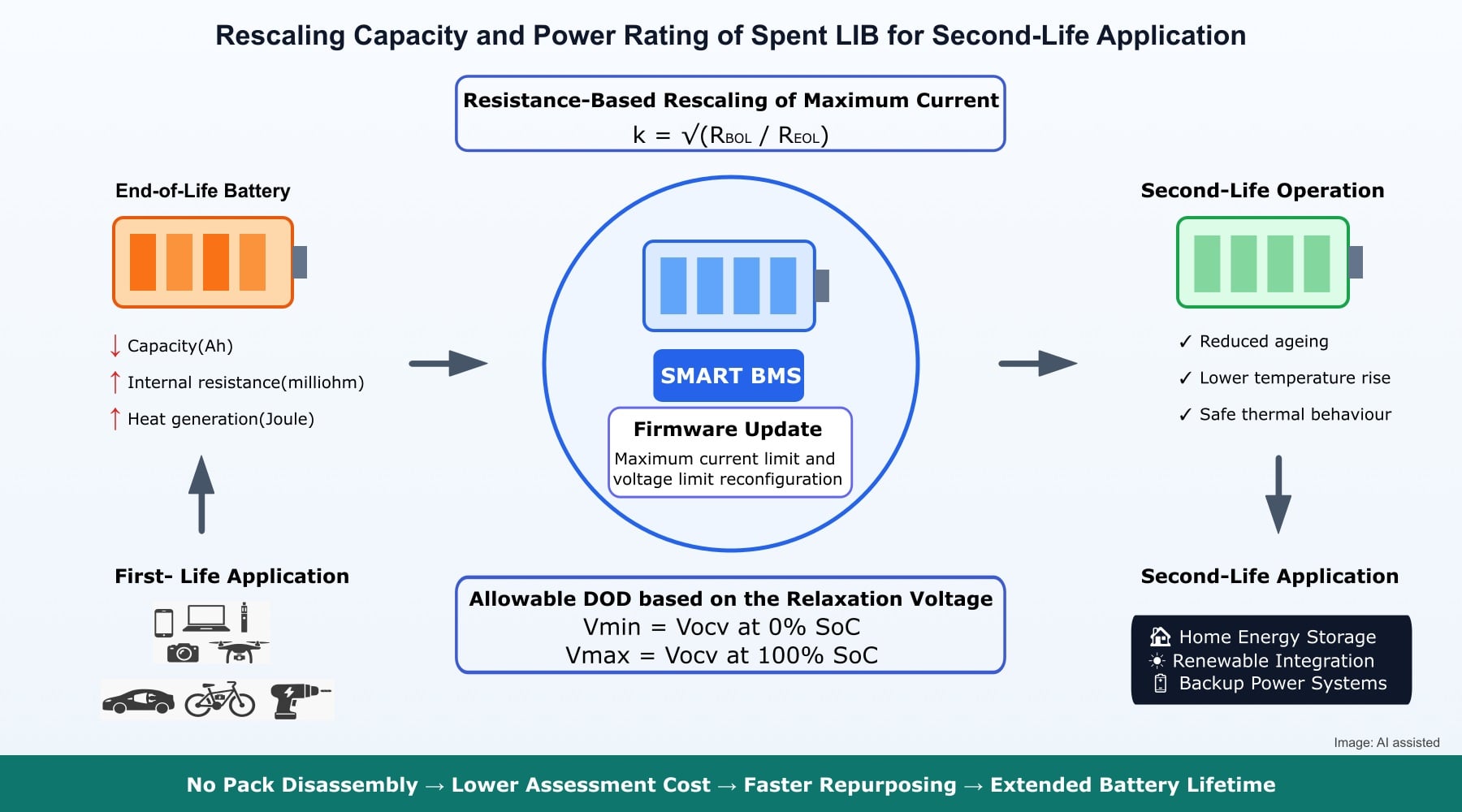
The adoption of lithium-ion batteries (LIBs) as secondary rechargeable batteries across many industries, including consumer electronics, electromobility, industrial tools, and electrical energy storage, is on the rise. As lithium-ion batteries approach the end of their life, there is a need to assess them for the possibility of a secondary application or reuse for a less demanding application. The extra connections of individual cells, BMS, temperature sensors, and other components to form a compact battery pack pose a challenge for second-life assessment, which usually prefers to separate individual cells for testing before discarding very bad cells for recycling and grading cells with substantive capacity based on their remaining capacity. This is a high cost for the second-life assessment. This work seeks to investigate an approach that avoids dismantling the battery pack into individual modules, cells, and BMS by including a BMS feature that allows the capacity and power ratings to be rescaled onboard after its first use. A set of cells with different chemistries was used in this work: a nickel–cobalt–aluminium oxide cathode with a silicon-doped graphite anode (NCA-GS), a nickel–cobalt–aluminium oxide cathode and graphite, and a lithium–nickel–manganese–cobalt oxide (NMC) cathode with a graphite anode (NMC-G) with various ageing states and behaviours. Their internal resistance and capacity at the beginning and end of life were compared. The scaling factor was obtained by finding the square root of the ratio of the internal resistance at EOL to that at BOL. With the current obtained by multiplying the cycling current rate by the rescaling factor, the surface temperature profile of the aged cells during cycling became the same as the temperature at the beginning of life. The relaxation voltage after discharge to 0% SOC and charge to 100% SOC was used to set the low and high cut-off voltages, respectively. This contributed significantly to reduced ageing and to a lower temperature rise in the spent cells. This set the stage for rescaling or derating battery systems without separating the individual cells, which is a huge cost for second-life use of lithium-ion batteries. BMS can be designed with configurable voltage and current limits, so that when repurposed for a second life, only a simple configuration or firmware update may be necessary.
Share and Cite
MDPI and ACS Style
Amuta, O.; Kowal, J.
Rescaling Capacity and Power Rating of Spent LIB for Second-Life Application. Batteries 2026, 12, 214.
https://doi.org/10.3390/batteries12060214
AMA Style
Amuta O, Kowal J.
Rescaling Capacity and Power Rating of Spent LIB for Second-Life Application. Batteries. 2026; 12(6):214.
https://doi.org/10.3390/batteries12060214
Chicago/Turabian Style
Amuta, Ote, and Julia Kowal.
2026. "Rescaling Capacity and Power Rating of Spent LIB for Second-Life Application" Batteries 12, no. 6: 214.
https://doi.org/10.3390/batteries12060214
APA Style
Amuta, O., & Kowal, J.
(2026). Rescaling Capacity and Power Rating of Spent LIB for Second-Life Application. Batteries, 12(6), 214.
https://doi.org/10.3390/batteries12060214
Note that from the first issue of 2016, this journal uses article numbers instead of page numbers. See further details
here.
Article Metrics
Article Access Statistics
For more information on the journal statistics, click
here.
Multiple requests from the same IP address are counted as one view.