
Article

From Operation to SOH Estimation: Analysis of Lithium-Ion Capacitors Based on Passive EIS for E-Bus Application


1
AAU Energy, Aalborg University, 9220 Aalborg, Denmark
2
AVESTA Holding, 9400 Ninove, Belgium
3
Department of Electrotechnology, Czech Technical University in Prague, 16627 Prague, Czech Republic
*
Author to whom correspondence should be addressed.
Batteries 2026, 12(6), 212; https://doi.org/10.3390/batteries12060212 (registering DOI)
Submission received: 23 April 2026 / Revised: 3 June 2026 / Accepted: 4 June 2026 / Published: 10 June 2026

Abstract

Real-time monitoring of lithium-ion capacitors (LICs) is crucial for ensuring reliability and predictive maintenance in dynamic applications such as electric transportation. However, traditional electrochemical impedance spectroscopy (EIS) techniques are complex and costly for onboard diagnostics due to their reliance on external excitation signals and dedicated hardware. Therefore, this paper presents an innovative framework for online state of health (SOH) estimation that bypasses these limitations by utilizing fast Fourier transform (FFT)-based passive impedance extraction directly from operational current and voltage signals. From experimental data, the equivalent circuit model (ECM) is developed, as well as its parameters, such as ohmic resistance, charge-transfer resistance, and Warburg diffusion. These parameters are identified through the extraction of impedance points in the low frequency region through FFT and the series resistance point using ohmic measurement, then performing a periodic curve fitting to these points. These curve fittings provide extracted ECM parameters. These parameters are used with a trained model to estimate the SOH of the monitored cell and are updated online. The proposed method was experimentally validated on five LIC cells aged under various C-rates (1C, 4C, 7C) and temperatures (35 °C, 40 °C, 50 °C), showing consistent impedance evolution with capacity fade. Validation of the utilized machine learning models, such as Polynomial Regression (PR), principal components analysis (PCA), and random forest (RF) regression, achieved SOH prediction errors as low as 2.23% compared to experimental results. The developed framework is particularly suitable for applications such as flash-charged electric buses but is broadly applicable across other energy storage systems as well. This advanced method enables real-time diagnostics without hardware modification, offering significant potential for integration into existing battery management systems (BMSs).

1. Introduction

Lithium-ion capacitors (LICs) are emerging electrochemical energy storage systems that merge the characteristics of electric double-layer capacitors (EDLCs) and lithium-ion batteries (LIBs). LICs use activated carbon material as the positive electrode and pre-lithiated carbon materials as the negative electrode [1,2]. LICs allow fast and reversible lithium-ion intercalation that results in energy densities three to five times higher than EDLCs and power densities up to 30 kW/kg [3]. The distinctive design of LICs makes them highly suitable for different applications such as wind and photovoltaic (PV) power generation, uninterruptible power supply (UPS) systems, pulse power applications, and hybrid energy storage systems (HESSs) for electric transportation [4,5,6,7,8].
Hybrid supercapacitors, such as LICs, are employed for ultra-fast public transportation charging, allowing electric vehicles (EVs) to be flash charged at every station along their routes [9,10]. Ultracapacitor buses have been operational in Shanghai since 2006. In the 2010 Shanghai Expo, these buses covered 1.2 million miles in six months, transporting 40 million tourists with an average distance of 4800 km per day [11]. In May 2018, an electric city bus with an Aowei (Shanghai, China) ultracapacitor system was introduced in La Spezia, Italy, initiating a pilot route for this technology [11]. Unlike LIB-based electric buses, supercapacitor-based electric city buses carry only the energy needed for one trip and do not require dedicated charging stations. These buses can be fully charged in a few minutes at the departure station and can also be charged at stops while passengers are boarding, enabling 24 h uninterrupted operation.
Characterizing the parameters of LICs for HESSs is essential for evaluating their storage performance and is crucial for energy management systems (EMSs). One method involves modeling capacity fading under various conditions to predict the expected degradation in real operating environments [12]. However, this approach is limited as it only forecasts the LIC condition. Another approach is impedance characterization in real-time through electrochemical impedance spectroscopy (EIS) combined with the equivalent circuit models (ECMs) that are essential for the practical impedance analysis of LICs to evaluate the aging mechanism [13]. LIC aging characterization falls into two main categories: (i) calendar aging and (ii) cyclic aging through different charge/discharge cycles at different C-rates and operating temperatures [14]. The authors of [3] investigated the effect of cut-off voltage on LIC capacity and cycle life, showing that higher cut-off voltages yielded increased capacity at the expense of shorter lifecycles. In [15], the authors proposed the fractional order models’ structure based on the reaction process in the frequency domain that incorporates fractional differential equations into porous electrode theory to address surface inhomogeneity for LICs. In [16], the authors combine impedance modeling and post-mortem analysis to investigate the aging impact due to cut-off voltages. Significant aging was observed in the negative electrode at 3.8 V, indicated by lowered lithium ion and solvent levels, thickening of the solid electrolyte interphase (SEI) layer, diminished wetting surface area, and impaired ion transport. In [14], the cyclic aging was conducted under various conditions, including different temperatures (40 °C, 50 °C), charge–discharge rates (4C, 53C), and depth of discharge (DoD) levels (100%, 60%). The results indicate that the C-rate is inversely proportional to capacity degradation, with both cyclic and calendar aging contributing to cell degradation at lower C-rates. However, while online EIS and diagnostics are implemented for LIBs [17], the application of ECMs for LICs is gaining more attention. Therefore, it is necessary to investigate the degradation behavior of LICs under various operating conditions and estimate the SOH using EIS tools.
Recent advancements in online EIS have enabled real-time diagnostics of battery systems. A current-sensorless method for on-board impedance measurement in multi-cell lithium-ion stacks has been proposed, where impedance is estimated using only voltage measurements and circuit parameters [18]. This approach reduces system complexity and eliminates the need for direct current sensors. On the other hand, Kalman filter-based methods provide state estimation benefits but often demand significant computational resources and highly accurate dynamic models, posing practical limitations for embedded implementations [19]. Therefore, many ECMs incorporate fractional order components such as the Warburg element to capture diffusion-related behavior. These elements significantly complicate real-time implementation due to their non-integer dynamics, often requiring numerical approximation techniques or high-order transfer function representations, which increase computational demands [20]. Similarly, the distribution of relaxation times (DRT) method, while offering detailed impedance spectra analysis, involves solving complex inverse problems requiring dense measurement data and regularization, thus restricting its applicability for real-time embedded systems [21,22]. Moreover, comprehensive reviews have confirmed that traditional impedance spectroscopy techniques relying on dedicated frequency injections or complex signal processing often face challenges in practical deployment, particularly concerning hardware complexity, measurement accuracy, and computational burdens [23]. Furthermore, recent studies on fast EIS methods have focused on reducing impedance measurement time through broadband or pulse-based excitation strategies. However, many of these approaches still rely on externally injected excitation signals, dedicated impedance measurement procedures, or controlled laboratory conditions [24,25,26]. These limitations continue to restrict the practical implementation of online impedance-based diagnostics in real operating applications.
In the context of LIC degradation analysis, [27] investigates the degradation behavior using EIS results of LIC cells during cyclic aging across different temperatures (35 °C, 40 °C, 50 °C) and C-rate conditions (1C, 4C, 7C), where different temperatures create significant differences in the degradation process. However, the work did not provide the online EIS measurement method and relied on lab testing equipment, nor did it provide any realistic scenario of e-bus application. To overcome the limitations of [27], this paper proposes an in situ and online impedance extraction approach leveraging operational voltage and current profiles without the need for dedicated excitation signals. The detailed development, validation, and implications of this approach are introduced and thoroughly explored in subsequent sections. In addition, this paper exploits the native current and voltage signals for online SOH estimation and provides real-time impedance characterization under e-bus load variations. It is essential to analyze the impedance performance, establish an ECM, and examine influencing factors that support the establishment of an online SOH diagnostic system through EIS tests. This paper is the extended version of our presented work in [27]. The present study provides an in-depth analysis of online EIS parameter identification, the ECM parameter extraction framework, and SOH estimation through machine learning algorithms such as principal component analysis (PCA), least squares minimization (LSM), and random forest (RF) [28,29,30]. Recent studies have also highlighted the effectiveness of advanced machine learning techniques for SOH estimation under limited training data and real-world operating conditions, with emphasis on feature extraction, dimensionality reduction, and improved model adaptability [31,32,33].
The rest of the paper is organized as follows: Section 2 presents a detailed discussion of the EIS test and the development of the ECM for LICs. Section 3 presents experimental results correlating impedance evolution with cell aging, while Section 4 discusses the EIS testing and degradation behavior of LICs. Section 5 introduces the real-time online monitoring framework tailored specifically for LIC-powered electric buses and describes the proposed FFT-based impedance extraction approach. Finally, Section 6 provides the results and validation of the online SOH model through the experiments and discusses the implications and significance of these findings. Section 7 discusses the results, and Section 8 concludes with a summary and recommendations for future work.

2. Electrochemical Impedance Spectroscopy

EIS provides crucial kinetic and mechanistic data for various electrochemical systems and is extensively used in fields such as energy storage systems, corrosion, and beyond. This non-destructive technique involves perturbing an electrochemical system with a sinusoidal signal (AC current or voltage) across a range of frequencies and analyzing the system’s response [34]. EIS distinguishes itself among the different electrical, electrochemical, and physical processes within a system by capturing their unique properties/features that offer a detailed understanding of the multifaceted processes in electrochemical systems [35]. Therefore, for LICs and LIBs, EIS is a valuable diagnostic tool for analyzing electrode kinetic processes, including interfacial changes, charge-transfer reactions, and mass diffusion across different time domains [36,37,38]. The different relaxation times of internal electrochemical processes in LICs allow EIS to detect and separate different components using suitable modeling techniques. One of the many EIS models documented, illustrated in Figure 1, is particularly well-suited to the LIC cell that is considered in this paper.
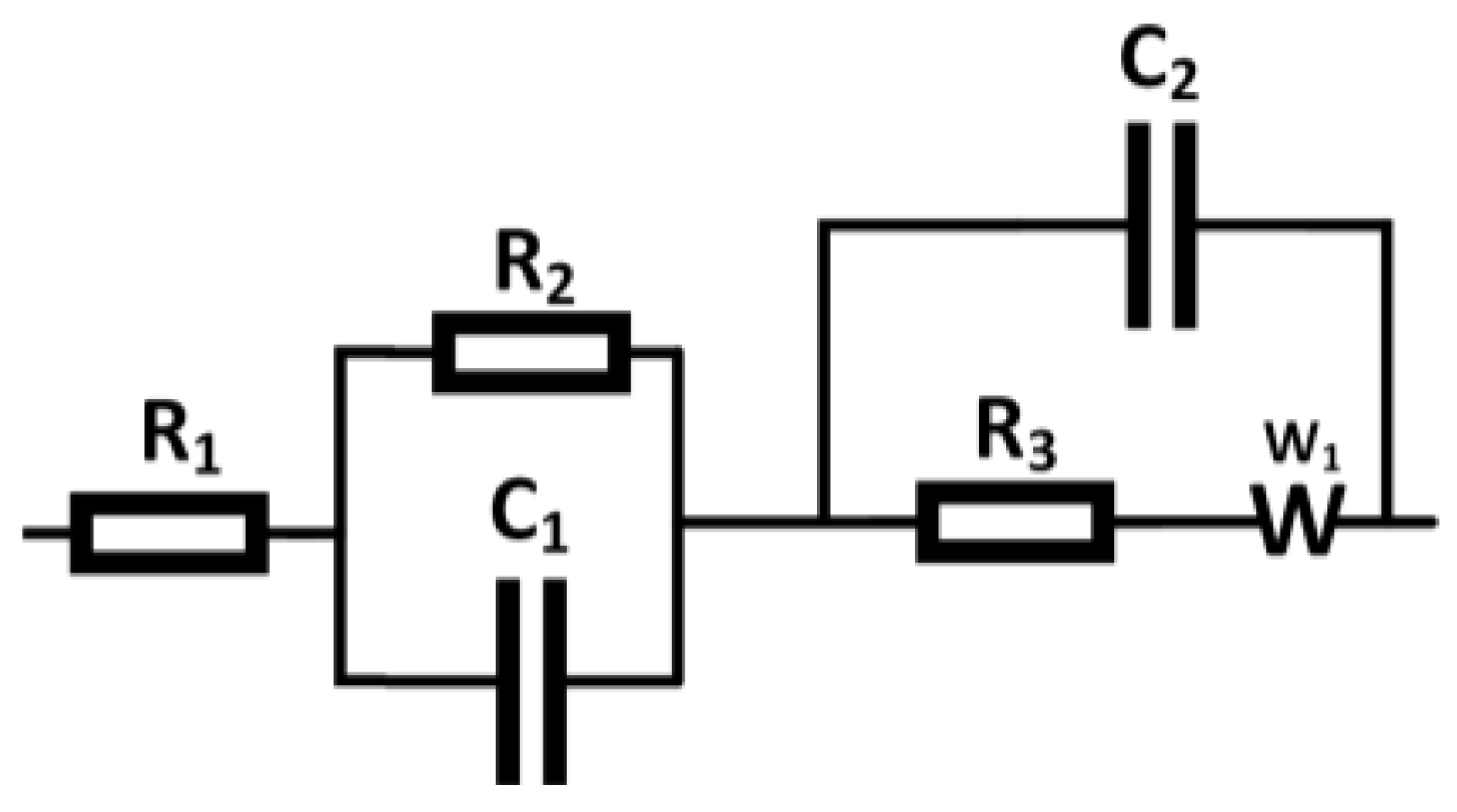
As shown in Figure 1, the LIC is represented by two distinct parts: the supercapacitor component and the battery component. The supercapacitor part is characterized by the resistance R2 and the electrostatic capacitance C1, while the diffusion resistance R3, capacitance C2, and Warburg impedance W1 represent the battery part. Additionally, the model includes the ohmic resistance R1, which accounts for the electrolyte resistance within the LIC cell.

3. Experimental Setup

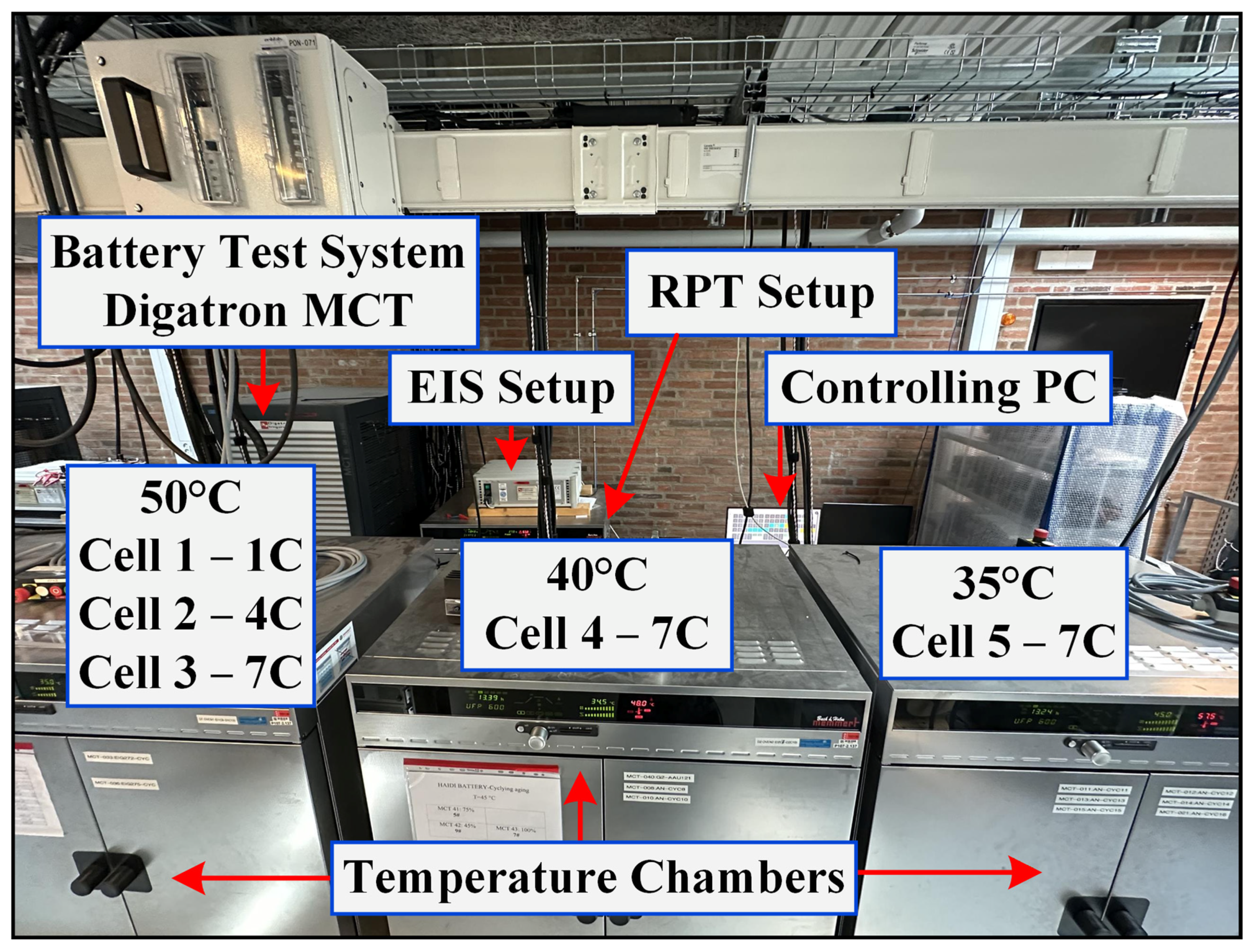
The experiments were conducted on commercially available LIC cells, with parameters outlined in Table 1. To characterize the cycle life of these cells, accelerated aging tests were performed using a Digatron BTS 600 battery tester (Digatron Power Electronics GmbH, Aachen, Germany), a Digatron EIS meter, and a Memmert climatic chamber (Memmert GmbH + Co. KG, Schwabach, Germany) to control ambient temperatures and thermocouple temperature sensors to monitor cell temperature, as shown in Figure 2.
The accelerated aging tests were conducted at three different C-rates (1, 4, and 7) and three distinct temperatures (35 °C, 40 °C, and 50 °C), as illustrated in Table 2. This test matrix was designed to analyze the effect of varying C-rates and temperatures on the SOH of LICs. Although the primary focus was on these variables, interactions between different C-rates and temperatures were also considered to comprehensively understand their effect on the LICs. Each round consisted of a specified number of charge–discharge cycles, ranging from 500 to 2000 cycles, after which a reference performance test (RPT) was conducted. During the RPT, key parameters such as capacity and equivalent series resistance (ESR) were measured [39]. In this paper, the ESR obtained from the time-domain ohmic measurement is used as the high-frequency ohmic resistance in the ECM. Afterwards, the term R1 is used consistently to denote the ohmic resistance parameter of the ECM. Additionally, EIS tests were conducted on the cells at different state of charge (SOC) levels to collect comprehensive electrochemical data.
All EIS measurements were conducted over a frequency range of 10 mHz to 6.5 kHz at a constant room temperature of 25 °C. The EIS measurements were taken at 20% SOC intervals that ranged from 30% to 90% SOC. Therefore, this approach allows for the detailed characterization of the LICs’ electrochemical behavior under various operational conditions, providing valuable insights into their degradation trends over time. The combination of accelerated aging tests and detailed EIS measurements simplified a thorough analysis of the factors affecting the SOH of LICs, which is necessary for optimizing their performance and SOH estimation in practical applications like electric city bus transportation.
The ECM parameters were extracted through nonlinear fitting of the measured EIS spectra at different SOC and aging conditions. The fitting minimized the error between the measured and ECM-generated Nyquist responses, while all parameters were constrained to physically meaningful positive values. The selected ECM achieved fitting accuracies close to the coefficient of determination ( R 2 ) 0.99 for the real impedance-magnitude components, showing good fit with the measured EIS data.

4. EIS Testing and Degradation Analysis

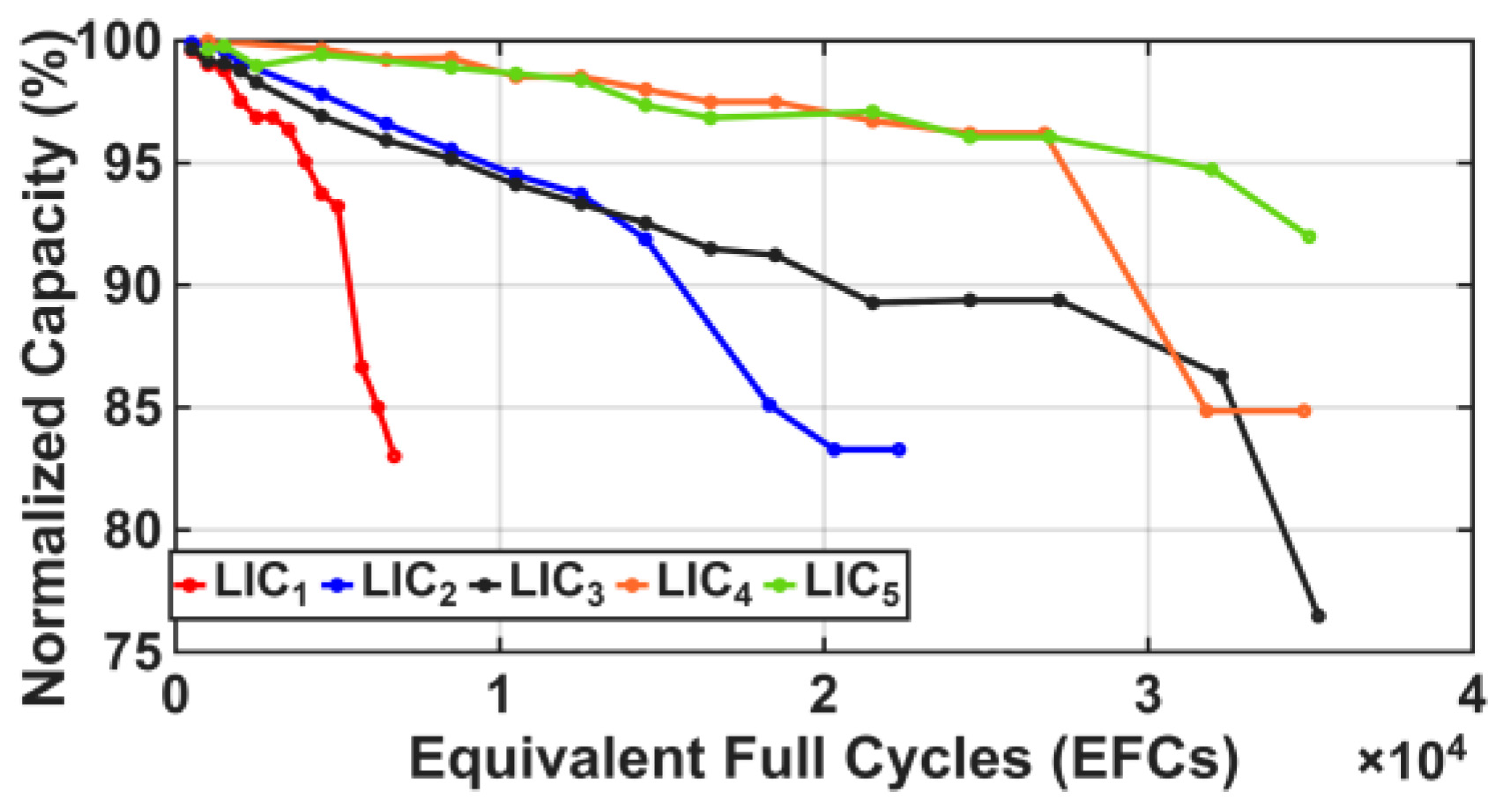
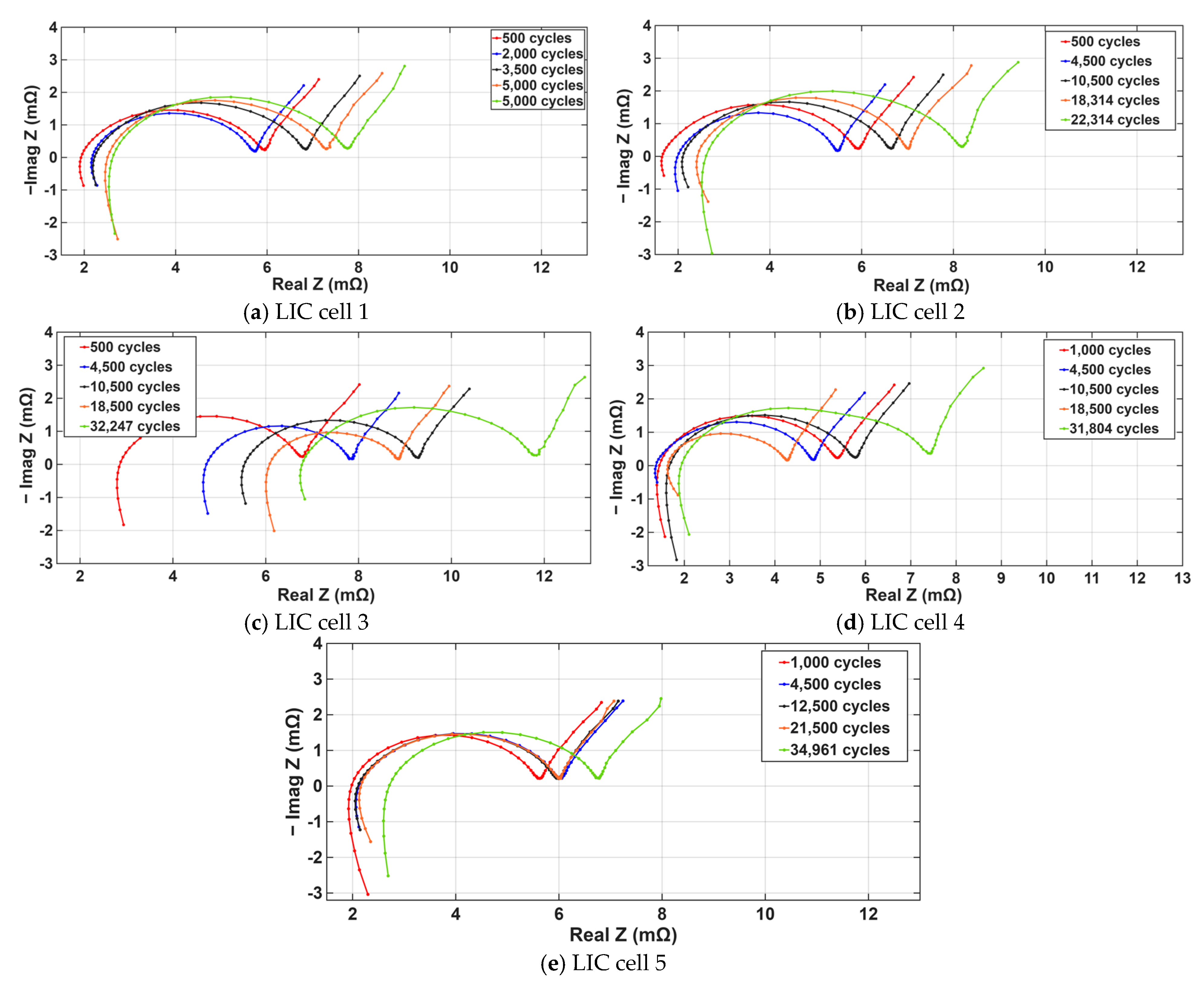
The results of the EIS obtained from the utilized LICs are illustrated in Figure 3, Figure 4 and Figure 5. Figure 3 depicts the observed capacity fade during accelerated cyclic aging of LICs under specified conditions outlined earlier in Table 2. For instance, LIC1 represents a LIC cell tested at 1C and 50 °C, while LIC5 represents another cell tested at 7C and 35 °C. This comparative analysis provides insights into how different C-rates and temperatures impact the capacity fade of LICs over time. Figure 4 presents EIS impedance measurements taken at 50% SOC, focusing on the dependence of LIC impedance spectra on the SOH. The experimental results show a consistent trend of impedance spectra shifting towards the right side of the Nyquist plot as aging progresses. This shift indicates increased internal resistance and degradation within the LIC cells, correlating with the capacity fade observed in Figure 3. In addition, Figure 4 further explores the relationship between impedance changes and SOH by comparing Nyquist plots at various stages of aging. The analysis provides insights into the electrochemical processes and degradation mechanisms within the LICs. The results determined the usefulness of EIS in monitoring and diagnosing the SOH of LICs. In addition, the findings demonstrate the potential for real-time SOH estimation and optimization of LIC performance in practical applications, particularly in electric city buses.

4.1. Effect of C-Rate and Temperature

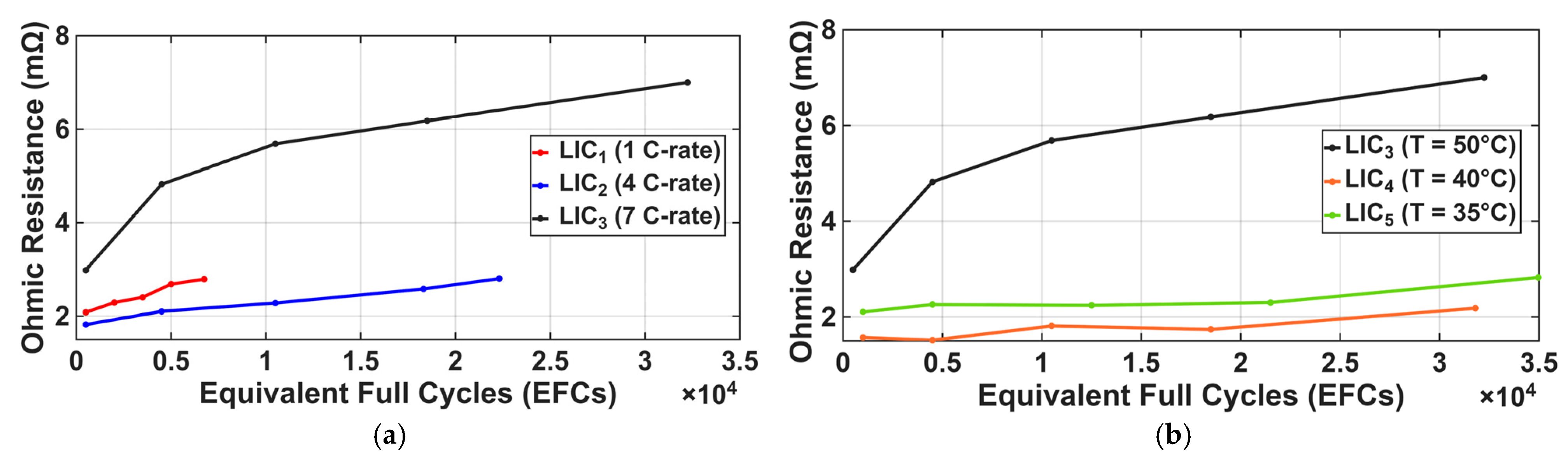
The impact of the C-rate on LICs is more pronounced at lower rates (1C) compared to higher rates (7C) at 50 °C, as observed in Figure 3 and Figure 5. LIC Cell 3 exhibited a longer lifetime than LIC Cell 1 under similar operating conditions. Similar behavior was also observed in the corresponding experimental results [14]. On the other hand, temperature also significantly influences LIC performance, with only an 8% capacity fade observed at 35 °C, compared to a 26% fade at 50 °C, despite both scenarios of LIC3 and LIC5 achieving a similar number of cycles (35,000 cycles). The ohmic resistance (R1) increases with the C-rate, indicating a direct relationship between the rate of discharge/charge and the resistance. The temperature has a notable effect on ohmic resistance (R1), with higher temperatures usually leading to an increase in resistance due to an increased thermal effect on the conductivity of the components involved.

4.2. Impedance-Based SOH Estimation

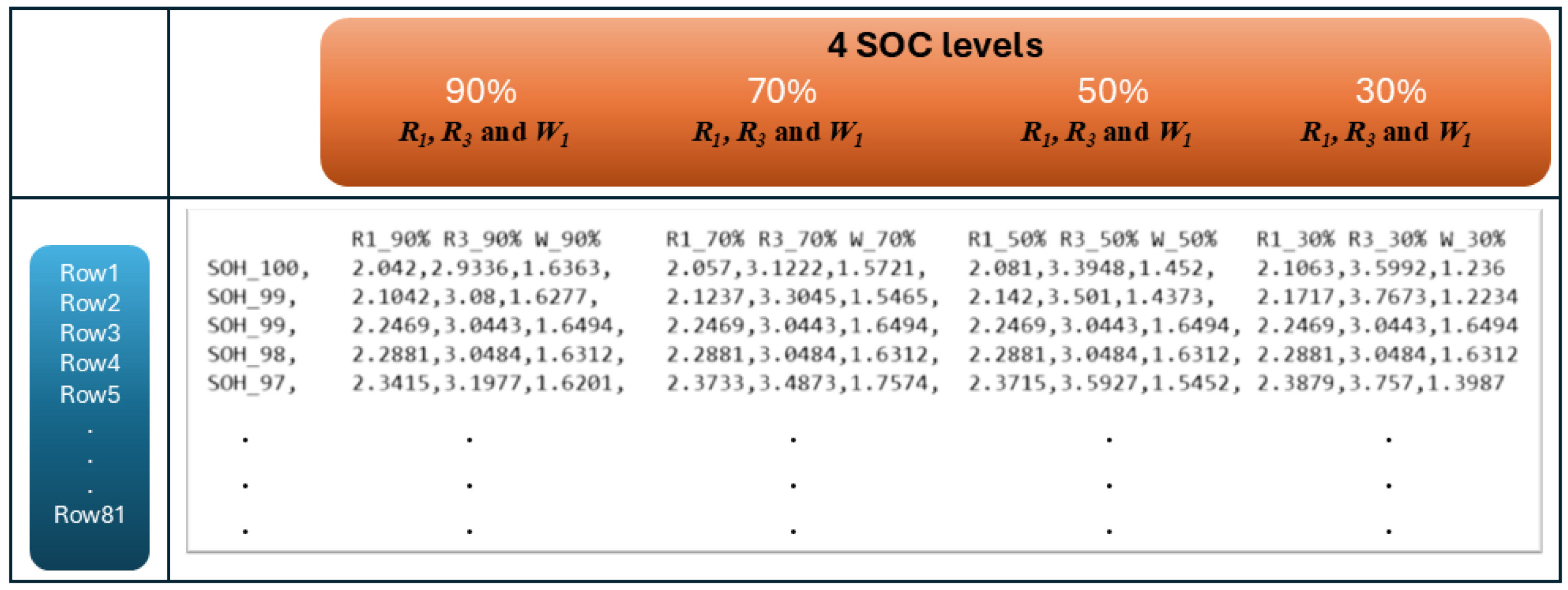
The SOH of a LIC can be estimated through different estimation models, such as polynomial regression (PR), RF, and PCA, which will be discussed in Section 6. The estimation models use the ECM parameters as features, such as R1, R3, W1 (Warburg coefficient), and C2, respectively, and these parameter values are used at different SOCs in the SOH estimation function. A curve fitting of the EIS measurements performed on the LIC cells during the aging process resulted in a database of 81 rows of ECM parameters at four SOC levels. This database is used to train or fit the estimation function. The different estimation models are compared and evaluated in Section 6.

4.3. Online SOH Monitoring for LIC Storage

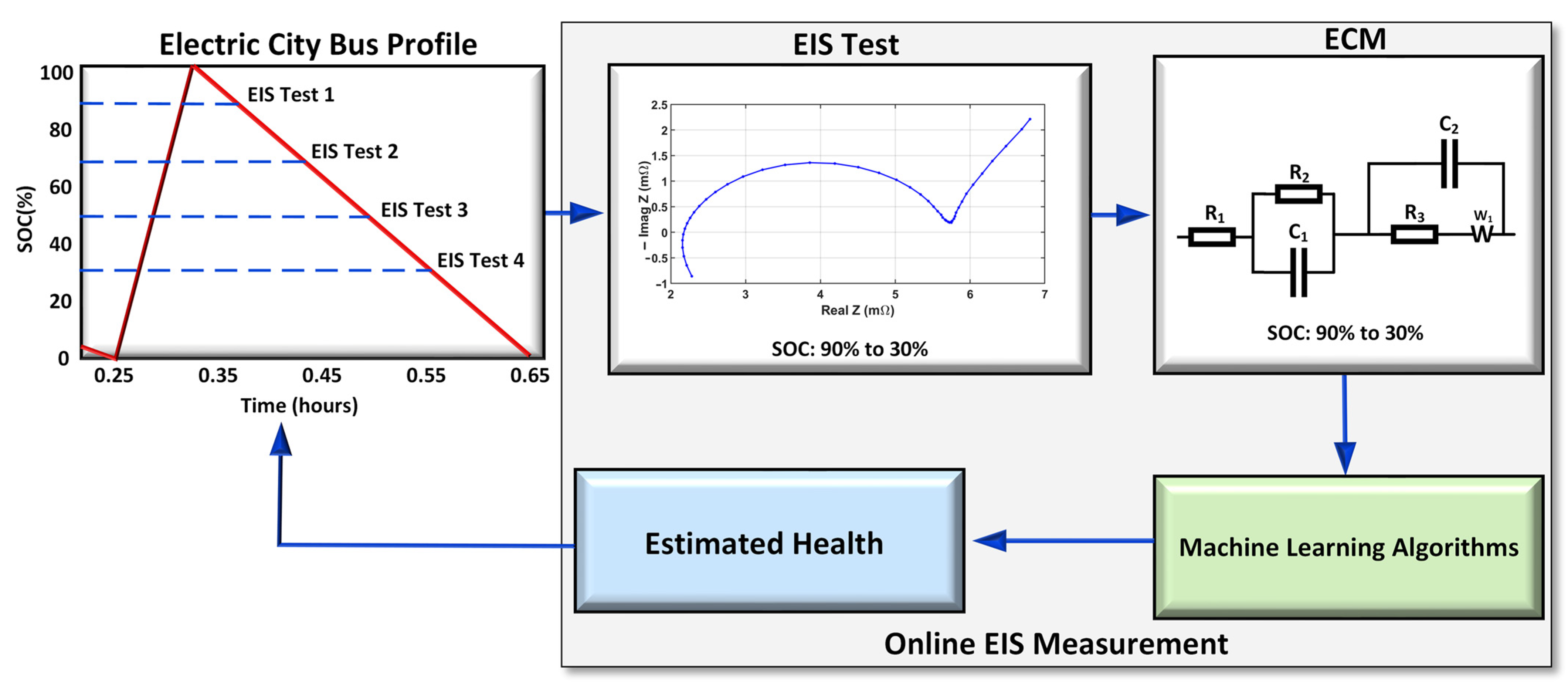
While the SOH diagnosis system is demonstrated on flash-charged electric buses due to their frequent charge–discharge cycles and dynamic profiles, the underlying method is broadly applicable to other types of EVs using real-time voltage and current measurements. These buses are rapidly charged at every bus stop and almost fully discharged during the trip to the next destination. Figure 6 illustrates the system’s flowchart that outlines the SOH diagnostic within a full equivalent cycle (FEC), with the inspection process taking place during the discharge cycle. To capture essential ECM parameters, EIS measurements are conducted at key SOC levels: 90%, 70%, 50%, and 30%. By leveraging the ECM values obtained across these different SOC stages, the system applies a formulated equation to estimate the SOH during each cycle. This strategy not only allows continuous SOH monitoring but also paves the way for a better EMS that improves the LIC’s charging and discharging plans.
The proposed online SOH monitoring framework enhances operational efficiency in e-buses by enabling real-time diagnostics of LIC health, supporting proactive maintenance, and improving charging strategies. This is particularly valuable in high-demand public transport systems.

5. Real-Time Online Monitoring

The real-time monitoring methodology proposed in this paper employs the FFT and ECM to enable in situ EIS analysis directly from native voltage and current signals in e-bus applications. This framework eliminates the need for externally applied perturbation signals traditionally required in EIS (ranging from 6.5 kHz to 0.01 Hz), which are often complex and costly or need retrofitting of the BMS in vehicular platforms, as discussed in the previous sections.
To address this challenge, the proposed framework performs spectral analysis using FFT on the real-time current (I) and voltage (V) profiles acquired from LICs during operation. This process enables the extraction of several impedance points in the low-frequency region of the EIS measurement, and with the ohmic resistance measurement that lies in the high-frequency region and which is not visible in FFT analysis, a periodic curve fitting is performed, resulting in the ECM parameters. This facilitates the reconstruction of the EIS outputs, such as Nyquist plots, using only low-frequency impedance characteristics. Details are provided below.

5.1. Real-Imaginary Part from FFT

The voltage and current signals are broken into their frequency components, allowing the derivation of impedance values at certain frequencies by comparing their magnitudes and phase differences. The complex impedance at a given frequency f is calculated as:
Z ( f ) = V f I f = V f I f e j θ V θ I ,
where |   V f | and |   I f | are the magnitudes of voltage and current at frequency f, respectively. θ V and θ I are the phase angles of the voltage and current, and φ = θ V θ I is the phase shift between voltage and current.
From this, the real and imaginary components of the impedance are calculated as:
Z r e a l f = V f I f cos φ ;   Z i m a g i n a r y f = V f I f sin φ .
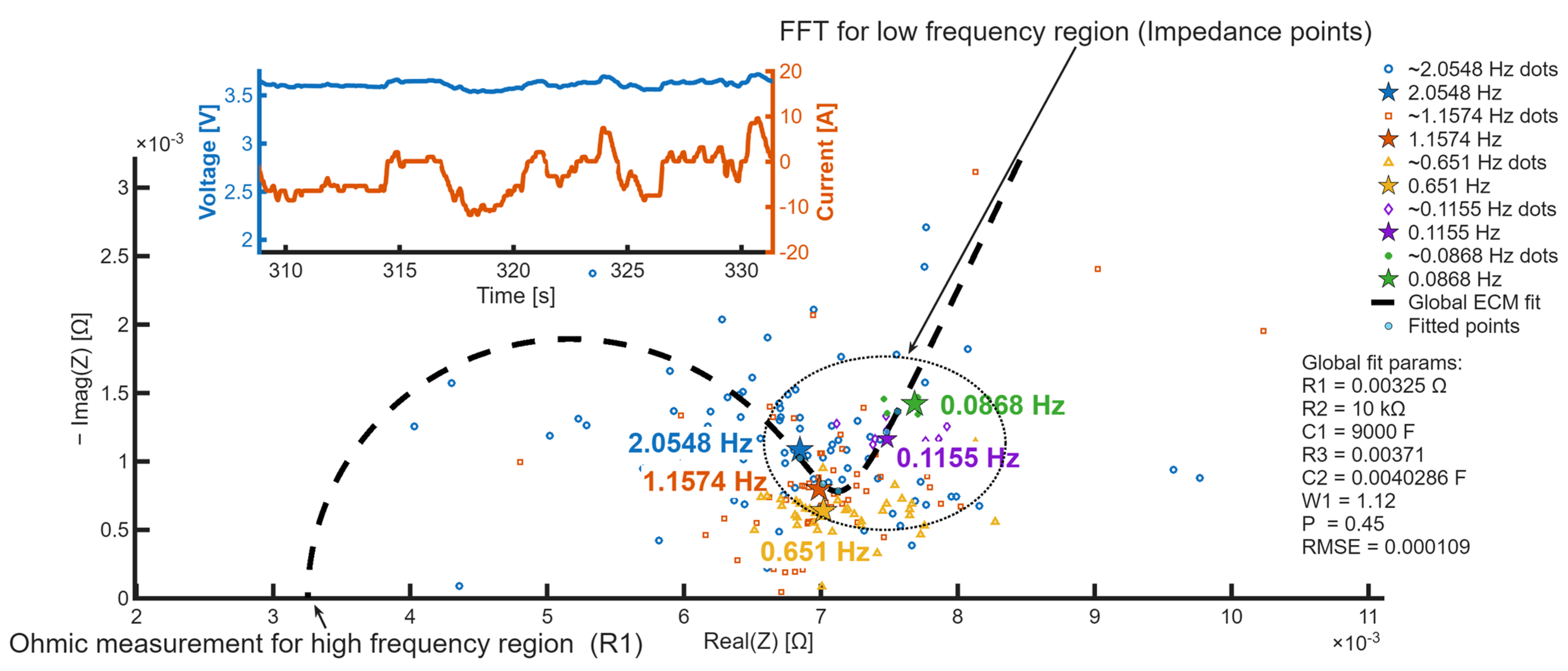
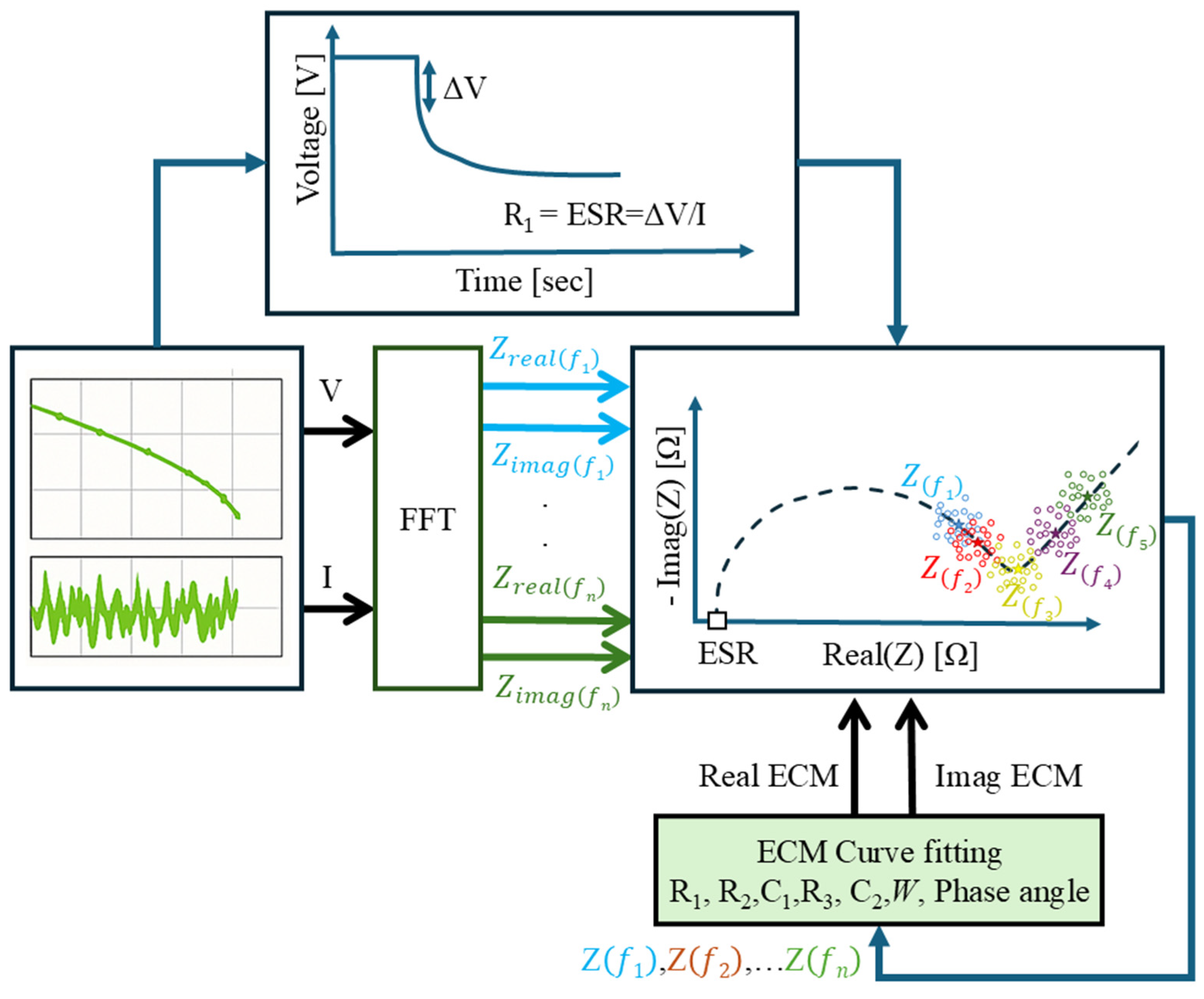
For each target frequency, valid FFT-derived impedance samples are grouped over a sliding time window. Samples are retained only if they satisfy coherence, sign, and Nyquist-domain acceptance criteria. The representative impedance point is then defined as the median centroid of the retained cluster. Different clusters of impedance dots are derived from FFT of the input signals and represent five frequencies, which are 2.05 Hz, 1.157 Hz, 0.651 Hz, 0.115 Hz and 0.0868 Hz, as observed in Figure 7, which depicts the results from plotting these FFT-derived real and imaginary impedance values directly in the Nyquist domain (extracted data are for LIC cell at 25 °C and the dynamic current from the e-bus profile). Each cluster of dots at a specific frequency is batched in a time window, and the center point represents the impedance point at that frequency. It is important to note that the five impedance points occur in the low-frequency region of the Nyquist plot. While the frequency content of the FFT depends on the bus driving pattern, it is also influenced by the sampling interval of the voltage and current measurements. In the presented results, readings are sampled every 0.1 s (the smallest time resolution available from the Digatron tester). This configuration provides sufficient resolution to capture the dominant low-frequency components, represented by R1, which is the ohmic (electrolyte) resistance, equivalent to ESR, and R3, which is the charge-transfer resistance. R1 + R3 primarily manifests the real part of the Nyquist plot, supporting their consistent identification across varying operational profiles. Because of the low sampling frequency of the measurements (10 Hz), the full Nyquist plot cannot be reconstructed unless the ohmic resistance R1 is measured separately from the FFT analysis, as R1 exists in the high frequency range of the plot [40]. The ohmic and FFT-based estimations are directly tied to the cell’s degradation behavior and are essential inputs for the SOH estimation model detailed in Section 6.

5.2. EIS Nyquist Plot Reconstruction

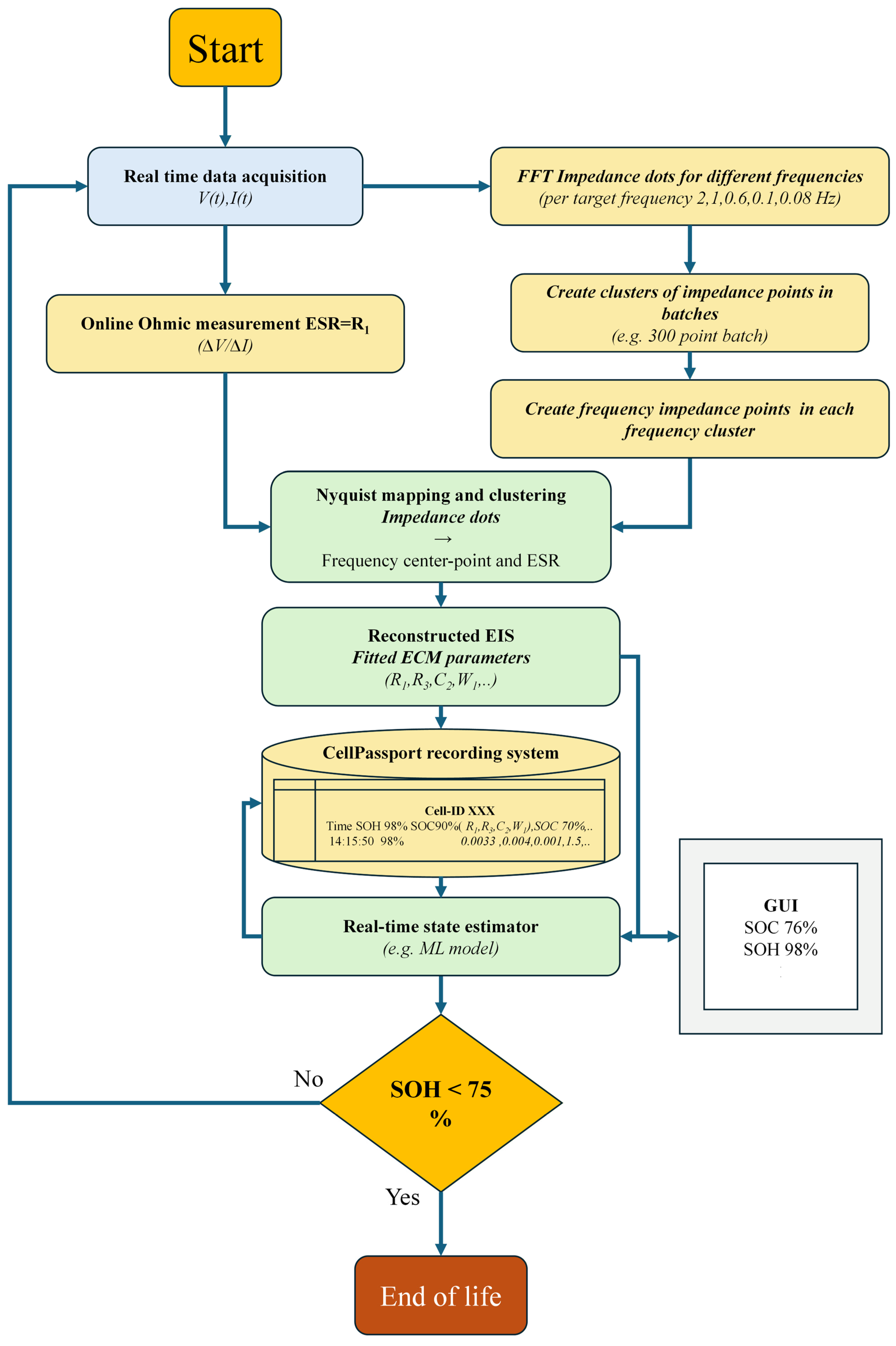
After the ohmic and charge transfer resistive components are extracted, these parameters (R1, R3, C2 and W1) are then used to reconstruct the Nyquist curve using the ECM, accurately aligning with the FFT-extracted clusters (Figure 7), as illustrated in Figure 8, where the I and V are used in direct ohmic measurement for the ESR and the FFT block, by which the FFT-extracted clusters show the Z(f1), Z(f2), Z(f3), Z(f4) and Z(f5), and through curve fitting the ECM parameters are extracted. This method circumvents the need for higher time resolution for measurement. Additionally, no signal perturbation to the measured cell is required in this method. The flowchart for extracting the EIS impedance curve is explained in Figure 9. Figure 9 illustrates how the proposed method converts real-time current and voltage data into clustered impedance points, reconstructs the EIS/ECM parameters, and feeds them into the CellPassport 1.0 platform for online state estimation [34]. The estimated SOH is then monitored against a threshold of 75% of its initial capacity, allowing the system to identify when the cell reaches its end-of-life condition. In electric transportation, the end of life (EOL) of LIBs is typically defined when the battery capacity degrades to approximately 70–80% of its initial capacity, as this level of degradation significantly reduces the driving range and performance required for EV operation [41].

6. Online SOH Model Validation and Discussions

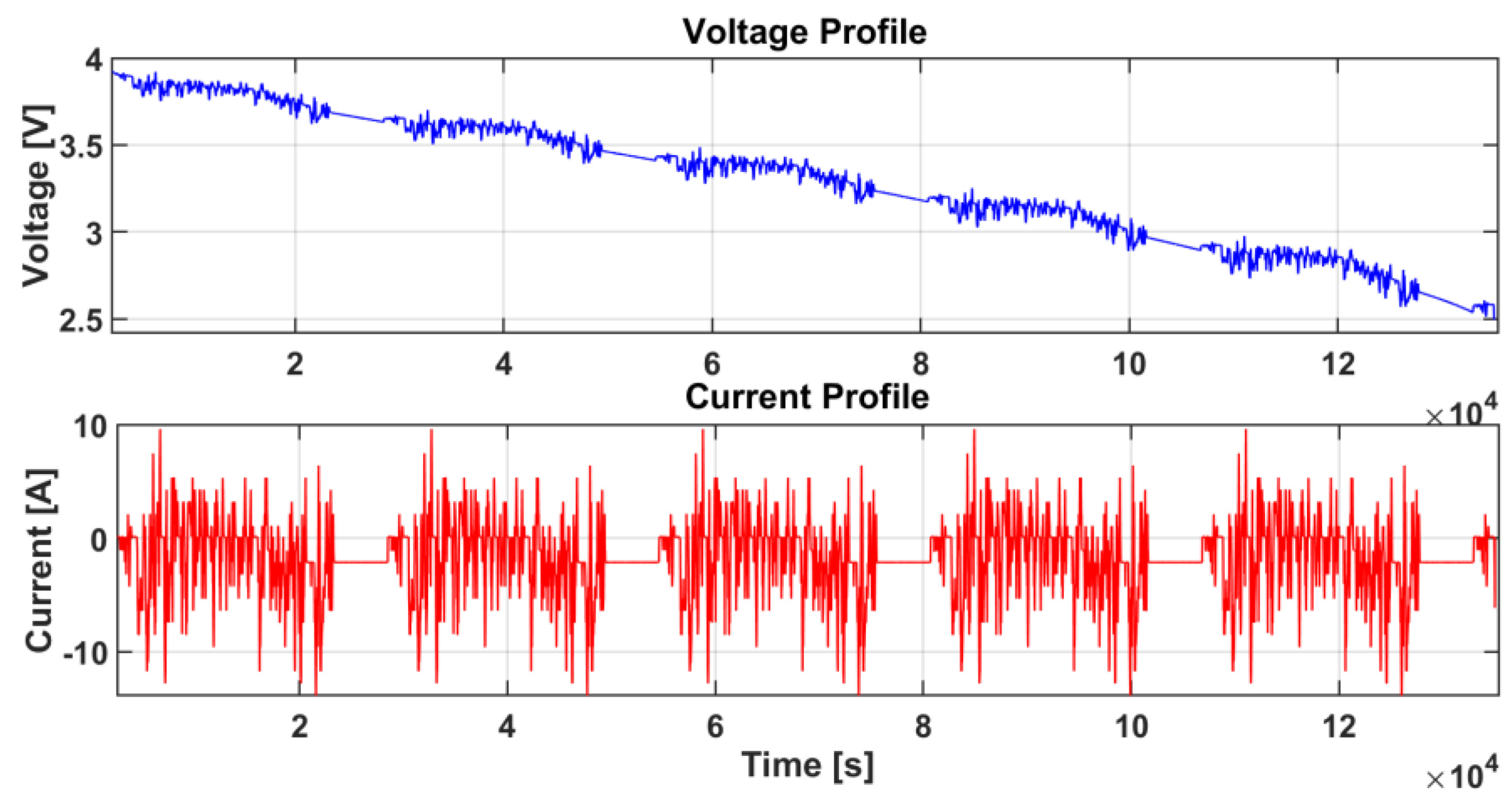
To validate the proposed impedance extraction and ECM parameter extraction framework, a dynamic test was performed on five LIC cells using a real e-bus driving profile. Figure 10 presents the corresponding voltage and current signals, reflecting actual operating conditions encountered during trips between Aalborg train station and the airport. The e-bus, a 12 m vehicle equipped with a 40 kWh supercapacitor module, operates on a 13.6 km route and is recharged every hour using a 375 kW pantograph charger. Each LIC cell was subjected to this dynamic profile to extract EIS parameters in real-time using the proposed method, followed by standard lab-based EIS measurements for comparison. This setup enables a direct evaluation of the framework’s capability to capture degradation behavior under practical operating conditions. It is important to note that in Figure 10, a single discharge cycle from the e-bus profile was repeated five times to achieve a full discharge of each LIC cell using the Digatron battery cell tester.
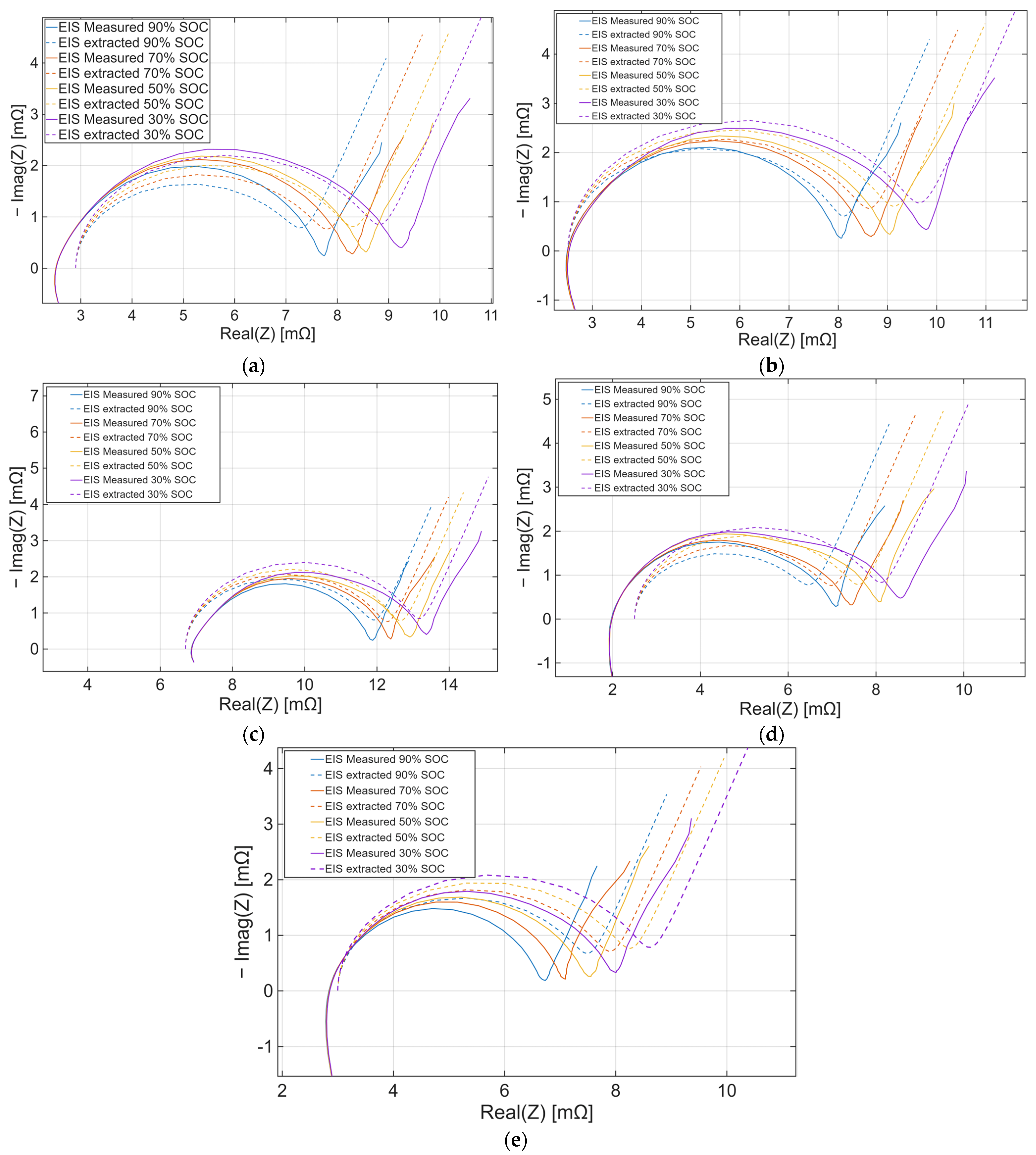
The Nyquist plots in Figure 11 illustrate a direct comparison between the impedance spectrum measured in the laboratory experimental setup (solid lines) and those extracted from the real-time e-bus operational data using the proposed FFT-based method (dashed lines). The close alignment of these two sets of impedance curves across the four SOC values (90% 3.8 V, 70% 3.55 V, 50% 3.3 V, and 30% 3 V) highlights the robustness and accuracy of the developed ECM parameter extraction framework.
For SOH estimation, the parameters R 1 , R 3 , and W 1 were selected due to their strong correlation with the degradation behavior of LICs. Therefore, these parameters were considered as physically meaningful indicators for SOH estimation. SOH estimation was performed using three supervised machine learning models, namely PR, RF, and PCA, based on the dataset shown in Figure 12. All models were trained using the same dataset and evaluated using two feature sets: (1) eight impedance features consisting of R 1 and R 3 at four SOC levels (90%, 70%, 50%, and 30%), and (2) twelve features consisting of R 1 , R 3 , and W 1 at the same SOC levels. This comparison was performed to determine whether the inclusion of W 1 improves the prediction capability of the SOH estimation models. The above-mentioned three machine learning models are discussed as follows.

6.1. Polynomial Regression (PR)

Polynomial regression is used to capture the nonlinear relationship between the ECM parameters (impedance features) and SOH by augmenting the model with quadratic (squared) terms. The resulting fitted model applies to a single global formula that maps the impedance parameters measured at multiple SOC points to a predicted SOH value, as in [21]. This makes PR easy to implement and produces an explicit relationship that can be interpreted physically. However, the same global formula must fit all degradation differences from the tested cells in the dataset, which becomes a limitation when the impedance–SOH relationship changes across operating conditions. As a result, PR can be sensitive to model mismatch (i.e., when a quadratic surface is not an acceptable approximation) and to outlier cells in real measured degradation data. These limitations typically appear as large errors for samples that lie outside the region well represented by the fitted data, even if the average fit quality on the training set is high [42].

6.2. Random Forest (RF)

Random forest regression is a machine learning method; however, it does not assume a single analytical equation. Instead, it learns SOH from data by combining many decision trees [43], where each tree makes a prediction based on a sequence of rules on the impedance features, and the final output is the average across all trees [44]. This approach is more robust than PR because it can capture nonlinear behavior and interactions between features at different SOC points without requiring a predefined formula. RF also tends to generalize better in the presence of nonlinearity and moderate noise, being less affected by feature correlation compared to the PR method. A key limitation of the RF model is that when a LIC cell exhibits an aging pattern that has limited representation in the training dataset, the prediction tends to be biased toward the most similar patterns it has previously learned. This can lead to significant estimation errors.

6.3. Principal Components Analysis (PCA)

PCA was implemented as a similarity-based method that predicts SOH by comparing the target impedance signature to a library of reference signatures with known SOH, rather than learning one global model. First, PCA is used to transform the feature set into a reduced features correlation representation (especially different SOC points), and can reduce noise [45]. PCA is used to construct a coordinate representation of the data, in which similarity between samples is quantified using Euclidean distance. Afterwards, a regression strategy predicts SOH by finding the most similar reference samples to the target and averaging their SOH values, with higher weight given to closer matches.
In this paper, the similarity-matching step provides normalized weights that quantify how strongly each reference SOH case contributes to the final estimate. The predicted SOH is obtained as a weighted sum of the contributing reference SOH labels. For example, for a dataset, as in Figure 12, if the target case is represented by SOH_74 with a weight of 85% and SOH_77 with a weight of 15%, the estimate becomes:
S O H p r e d = 0.85 × 74 + 0.15 × 77 = 74.45 % .
The estimated SOH is calculated using (3):
S O H p r e d i c t e d = i ω i S O H i ,
where ω i are the normalized similarity weights. In practice, PCA is an attractive option in small-data settings and in situations where the dataset/database is continuously updated because it avoids learning the single global parametric mapping method, as is the case in linear regression methods, and instead performs local interpolation based on similarity to experimentally observed patterns. It is also highly explainable, since each prediction can be traced back to a small set of reference cases and their weights. Its main limitation is dependence on reference library coverage: if a target cell exhibits an impedance signature that is not represented in the library, the nearest-neighbor interpolation can become biased, because it is distance driven.

7. Discussion

Table 3 compares the measured SOH against the estimated SOH obtained from PR, RF, and PCA, using two feature sets: (i) R1 and R3 at four SOC points, and (ii) R1, R3, and W1 at the same SOC points. Overall, the best performance is achieved by PCA using R1 and R3 only, yielding the lowest mean absolute error (MAE) of 2.236%, followed by RF with R1, R3, and W1 (MAE 2.531%). PR shows higher errors, particularly when restricted to R1 and R3 (MAE 6.509%), indicating that a single global quadratic mapping is not sufficient to capture all observed SOH patterns across cells.
For PR, the large MAE is mainly driven by substantial prediction errors on low-SOH cells, especially Cell 3 (57.865% vs. 74% measured) and Cell 4 (87.701% vs. 77% measured). This behavior is consistent with the limitations of a global polynomial model: if the true relationship deviates from the assumed quadratic surface for certain aging signatures, errors can grow rapidly. Adding W1 improves PR (MAE drops from 6.509% to 3.868%) and notably reduces the error in Cell 2 (76.761% vs. 77%). However, PR still produces high errors for Cell 3 and Cell 4, confirming that the added feature helps but does not fully resolve the model-form limitation for outlier behavior.
For RF, performance is consistently stronger than PR across both feature sets, showing that a non-parametric ensemble can better accommodate nonlinear behavior and feature interactions. RF improves from 3.0% MAE (R1, R3) to 2.53% MAE (R1, R3, W1), which indicates that W1 provides additional information that RF can exploit. Nevertheless, Cell 4 remains the dominant error contributor for RF (≈83–84% predicted vs. 77% measured), which suggests that the training/reference dataset does not sufficiently represent this cell’s degradation signature. In other words, even a flexible model tends to regress toward patterns it has already seen, leading to systematic bias when the test sample is weakly represented in the training distribution.
For PCA, using R1 and R3 alone gives improved accuracy for most LIC cells except Cell 4, confirming that the resistive features form a stable similar space for reference matching in this dataset. The main limitation appears in Cell 4, which shows the largest error among the five cells, indicating poor representation in the reference library. Furthermore, the inclusion of the W1 parameter in the estimation procedure slightly improved the SOH estimation accuracy for LIC Cell 4. However, a slight increase in the overall MAE was observed across the five cells as well. This pattern is typical for distance-based estimators: if an added feature is less repeatable or not scaled consistently with the other features, it can distort the similarity geometry, change neighbor selection/weights, and degrade prediction even if it helps one difficult case.
Finally, the fact that Cell 4 has a high error across all three estimators strongly indicates that the limitation is not only algorithmic; it is primarily due to data coverage/representativeness. Cell 4 likely reflects an aging pathway, operating condition effect, or impedance-feature extraction variation that is not sufficiently captured by the current reference/training set. Therefore, improving Cell 4 SOH estimation performance will likely require expanding and diversifying the reference dataset, rather than changing the regression algorithm.
The PCA-based method achieved the best overall performance because the extracted ECM parameters are strongly correlated during the aging process. PCA preserves the dominant degradation information, which improves robustness against parameter fluctuations, particularly for the relatively limited experimental dataset.

8. Conclusions

This paper presented a comprehensive methodology for estimating the SOH of LICs using a passive FFT-based EIS framework tailored for real-time application in e-buses. The proposed method leverages operational current and voltage profiles without requiring external excitation signals. This approach enabled the extraction of ECM parameters, specifically R1 (ohmic resistance), R3 (charge-transfer resistance), W1 and C2, directly from operational data.
The accelerated aging experiments were performed on a 3 × 3 test matrix of five LIC cells under a range of temperature and C-rate conditions (35 °C to 50 °C and 1C to 7C). The results consistently show that the impedance components increase over time and exhibit a strong correlation with capacity fade. To estimate SOH, three machine learning algorithms were evaluated using two feature sets: the first comprising R1 and R3, and the second extending these with W1. For polynomial regression, the SOH estimation error using the reduced feature set reached an MAE of 6.5%. Incorporating W1 improved performance substantially, reducing the MAE to 3.86%. However, this approach demonstrated limited generalization capability, particularly under practical operating conditions, as observed for Cell 4. To address these limitations, PCA-based distance matching and random forest models were introduced. Using R1 and R3 features measured across multiple SOC levels, both models significantly outperformed polynomial regression, achieving MAE values below 3% for most cells. The PCA-based method in particular produced estimates that closely (with an MAE of 2.23%) followed the experimental SOH trends.
Furthermore, the proposed framework reconstructs Nyquist plots through FFT-based impedance extraction, enabling real-time diagnostic insight without requiring high-frequency excitation or additional hardware modifications. This capability facilitates seamless integration into existing BMS architectures for electrical transportation applications. Therefore, the FFT-driven EIS approach provides a practical and computationally efficient solution for online SOH monitoring. Future work will focus on enhancing robustness under dynamic temperature and load conditions, expanding the experimental dataset to include broader operational profiles.

Author Contributions

Conceptualization, T.I., E.S., V.K. and D.I.S.; Methodology, T.I., M.U.T. and D.I.S.; Software, T.I.; Validation, T.I. and D.I.S.; Investigation, M.U.T., M.A.-M., E.S., V.K. and T.K.; Data curation, M.A.-M.; Writing—original draft, T.I.; Writing—review & editing, M.U.T., M.A.-M., E.S., V.K., D.I.S. and T.K.; Supervision, E.S., D.I.S. and T.K. All authors have read and agreed to the published version of the manuscript.

Funding

This work is part of the Aalborg University internally funded project “Cloud-Based Per-Cell Diagnostics Engine (Passive EIS)” (CellPassport). The authors would like to thank the Technology Transfer Office at Aalborg University for its support in securing the Proof-of-Concept (PoC) grant.

Data Availability Statement

The data presented in this study are available on request from the corresponding author. The data are not publicly available due to privacy.

Acknowledgments

The collection of data from the electric bus was part of a collaborative project funded by Nordic Ultra Capacitor Engineering Research Center A/S in Denmark.

Conflicts of Interest

Author Mohamed Abdel-Monem was employed by the company AVESTA Holding. The remaining authors declare that the research was conducted in the absence of any commercial or financial relationships that could be construed as a potential conflict of interest.

References

  1. Soltani, M.; Beheshti, S.H. A comprehensive review of lithium ion capacitor: Development, modelling, thermal management and applications. J. Energy Storage 2021, 34, 102019. [Google Scholar] [CrossRef]
  2. Catelani, M.; Ciani, L.; Corti, F.; Laschi, M.; Patrizi, G.; Reatti, A.; Vangi, D. Experimental characterization of Hybrid Supercapacitor under different operating conditions using EIS Measurements. IEEE Trans. Instrum. Meas. 2023, 73, 3503210. [Google Scholar] [CrossRef]
  3. Zhang, X.; Zhang, X.; Sun, X.; An, Y.; Song, S.; Li, C.; Wang, K.; Su, F.; Chen, C.; Liu, F. Electrochemical impedance spectroscopy study of lithium-ion capacitors: Modeling and capacity fading mechanism. J. Power Sources 2021, 488, 229454. [Google Scholar] [CrossRef]
  4. Beatrice, C.; Capasso, C.; Doulgeris, S.; Samaras, Z.; Veneri, O. Hybrid storage system management for hybrid electric vehicles under real operating conditions. Appl. Energy 2024, 354, 122170. [Google Scholar] [CrossRef]
  5. Karimi, D.; Behi, H.; Van Mierlo, J.; Berecibar, M. A comprehensive review of lithium-ion capacitor technology: Theory, development, modeling, thermal management systems, and applications. Molecules 2022, 27, 3119. [Google Scholar] [CrossRef]
  6. Guo, L.; Hu, P.; Wei, H. Development of supercapacitor hybrid electric vehicle. J. Energy Storage 2023, 65, 107269. [Google Scholar] [CrossRef]
  7. Ibrahim, T.; Kerekes, T.; Sera, D.; Mohammadshahi, S.S.; Stroe, D. Sizing of hybrid supercapacitors and lithium-ion batteries for green hydrogen production from PV in the Australian climate. Energies 2023, 16, 2122. [Google Scholar] [CrossRef]
  8. Ibrahim, T.; Kerekes, T.; Sera, D.; Spataru, S.; Stroe, D. Sizing of Hybrid Supercapacitors for Off-Grid PV Applications. In 2021 IEEE Energy Conversion Congress and Exposition (ECCE); IEEE: Piscataway, NJ, USA, 2021; pp. 232–237. [Google Scholar]
  9. Ortenzi, F.; Pasquali, M.; Prosini, P.P.; Lidozzi, A.; Di Benedetto, M. Design and validation of ultra-fast charging infrastructures based on supercapacitors for urban public transportation applications. Energies 2019, 12, 2348. [Google Scholar] [CrossRef]
  10. Tahir, M.U.; Chakraborty, S.; Akboy, E.; Sangwongwanich, A.; Stroe, D.I.; Hegazy, O.; Blaabjerg, F. Charging Strategies Influence on DC-DC Converter and Li-Ion Battery Performance. In 2024 IEEE Energy Conversion Congress and Exposition (ECCE); IEEE: Piscataway, NJ, USA, 2024; pp. 2248–2253. [Google Scholar]
  11. AOWEI Technology, City Bus. Available online: http://www.aowei.com/en/program/applicationinfo-16.html (accessed on 7 February 2024).
  12. Ibrahim, T.; Kerekes, T.; Sera, D.; Stroe, D. Degradation behavior analysis of High Energy Hybrid Lithium-ion capacitors in stand-alone PV applications. In IECON 2022–48th Annual Conference of the IEEE Industrial Electronics Society; IEEE: Piscataway, NJ, USA, 2022; pp. 1–6. [Google Scholar]
  13. Firouz, Y.; Omar, N.; Timmermans, J.; Van Den Bossche, P.; Van Mierlo, J. Lithium-ion capacitor–Characterization and development of new electrical model. Energy 2015, 83, 597–613. [Google Scholar] [CrossRef]
  14. Saha, P.; Soltani, M.; Munk-Nielsen, S.; Stroe, D. Cycle-life of Lithium-ion Capacitors: Factors Influencing Aging. In 2023 IEEE Energy Conversion Congress and Exposition (ECCE); IEEE: Piscataway, NJ, USA, 2023; pp. 128–133. [Google Scholar]
  15. Song, S.; Zhang, X.; An, Y.; Ma, Y. Advanced fractional-order lithium-ion capacitor model with time-domain parameter identification method. IEEE Trans. Ind. Electron. 2021, 69, 13808–13817. [Google Scholar] [CrossRef]
  16. Song, S.; Zhang, X.; An, Y.; Hu, T.; Sun, C.; Wang, L.; Li, C.; Zhang, X.; Wang, K.; Xu, Z.J. Floating aging mechanism of lithium-ion capacitors: Impedance model and post-mortem analysis. J. Power Sources 2023, 557, 232597. [Google Scholar] [CrossRef]
  17. Crescentini, M.; De Angelis, A.; Ramilli, R.; De Angelis, G.; Tartagni, M.; Moschitta, A.; Traverso, P.A.; Carbone, P. Online EIS and diagnostics on lithium-ion batteries by means of low-power integrated sensing and parametric modeling. IEEE Trans. Instrum. Meas. 2020, 70, 2001711. [Google Scholar] [CrossRef]
  18. Sihvo, J.; Roinila, T.; Stroe, D. Cell-Level Implementation of Current-Sensorless On-Board Impedance Measurements in Multi-Cell Lithium-Ion Battery Stacks. IEEE Trans. Ind. Appl. 2025, 61, 4226–4233. [Google Scholar] [CrossRef]
  19. Xu, W.; Wang, S.; Fernandez, C.; Yu, C.; Fan, Y.; Cao, W. Novel reduced-order modeling method combined with three-particle nonlinear transform unscented Kalman filtering for the battery state-of-charge estimation. J. Power Electron. 2020, 20, 1541–1549. [Google Scholar] [CrossRef]
  20. Wang, B.; Li, S.E.; Peng, H.; Liu, Z. Fractional-order modeling and parameter identification for lithium-ion batteries. J. Power Sources 2015, 293, 151–161. [Google Scholar] [CrossRef]
  21. Plank, C.; Rüther, T.; Jahn, L.; Schamel, M.; Schmidt, J.P.; Ciucci, F.; Danzer, M.A. A review on the distribution of relaxation times analysis: A powerful tool for process identification of electrochemical systems. J. Power Sources 2024, 594, 233845. [Google Scholar] [CrossRef]
  22. Iurilli, P.; Brivio, C.; Carrillo, R.E.; Wood, V. EIS2MOD: A DRT-based modeling framework for li-ion cells. IEEE Trans. Ind. Appl. 2021, 58, 1429–1439. [Google Scholar] [CrossRef]
  23. Mc Carthy, K.; Gullapalli, H.; Ryan, K.M.; Kennedy, T. Use of impedance spectroscopy for the estimation of Li-ion battery state of charge, state of health and internal temperature. J. Electrochem. Soc. 2021, 168, 080517. [Google Scholar] [CrossRef]
  24. Wu, Y.; Balasingam, B. A Comparison of Battery Equivalent Circuit Model Parameter Extraction Approaches Based on Electrochemical Impedance Spectroscopy. Batteries 2024, 10, 400. [Google Scholar] [CrossRef]
  25. Wu, Y.; Sundaresan, S.; Balasingam, B. Battery parameter analysis through electrochemical impedance spectroscopy at different state of charge levels. J. Low. Power Electron. Appl. 2023, 13, 29. [Google Scholar] [CrossRef]
  26. Sundaresan, S.; Pattipati, K.; Balasingam, B. Fast Electrochemical Impedance Spectroscopy for Battery Testing. In 2025 IEEE 34th International Symposium on Industrial Electronics (ISIE); IEEE: Piscataway, NJ, USA, 2025; pp. 1–6. [Google Scholar]
  27. Ibrahim, T.; Tahir, M.U.; Knap, V.; Stroe, D.I. Degradation Analysis of Lithium-ion Capacitors based on Electrochemical Impedance Spectroscopy. In 2024 IEEE Energy Conversion Congress and Exposition (ECCE); IEEE: Piscataway, NJ, USA, 2024; pp. 559–564. [Google Scholar]
  28. Wang, G.; Yang, J.; Jiao, J. Voltage correlation-based principal component analysis method for short circuit fault diagnosis of series battery pack. IEEE Trans. Ind. Electron. 2022, 70, 9025–9034. [Google Scholar] [CrossRef]
  29. Lu, D.; Cui, N.; Li, C. A Novel Transfer Learning Framework Combining Attention Mechanisms and Random Forest Regression for State of Health Estimation of Lithium-Ion Battery With Different Formulations. IEEE Trans. Ind. Appl. 2024, 60, 5726–5736. [Google Scholar] [CrossRef]
  30. Xuan, L.; Qian, L.; Chen, J.; Bai, X.; Wu, B. State-of-charge prediction of battery management system based on principal component analysis and improved support vector machine for regression. IEEE Access 2020, 8, 164693–164704. [Google Scholar] [CrossRef]
  31. Shu, X.; Yang, H.; Chen, Z.; Liu, Y.; Tang, A.; Shen, J. Meta learning based state of health estimation of lithium-ion batteries with small sampling retraining. IEEE Trans. Ind. Electron. 2025, 73, 2462–2474. [Google Scholar] [CrossRef]
  32. Shu, X.; Shen, J.; Guo, F.; Liu, Y.; Zhang, Y.; Chen, Z.; Zhao, H. Towards real-world battery health intelligence: A review of machine learning advances and challenges in SOH estimation. eTransportation 2025, 26, 100509. [Google Scholar] [CrossRef]
  33. Feng, R.; Xu, J.; Zhao, Z.; Dan, Y.; He, J.; Gu, C.; Shu, X.; Xia, X.; Yang, L.; Shen, L. Comparative analysis of energy flow characteristics in a battery-electric heavy-duty tractor-trailer between standard and user driving test cycles. Energy 2026, 355, 141217. [Google Scholar] [CrossRef]
  34. Tahir, M.U.; Ibrahim, T.; Kerekes, T. Battery Passport and Online Diagnostics for Lithium-Ion Batteries: A Technical Review of Materials–Diagnostics Interactions and Online EIS. Batteries 2025, 11, 442. [Google Scholar] [CrossRef]
  35. Lazanas, A.C.; Prodromidis, M.I. Electrochemical impedance spectroscopy—A tutorial. ACS Meas. Sci. Au 2023, 3, 162–193. [Google Scholar] [CrossRef]
  36. Hu, W.; Peng, Y.; Wei, Y.; Yang, Y. Application of electrochemical impedance spectroscopy to degradation and aging research of lithium-ion batteries. J. Phys. Chem. C 2023, 127, 4465–4495. [Google Scholar] [CrossRef]
  37. Nunes, H.; Martinho, J.; Fermeiro, J.; Pombo, J.; Mariano, S.; do Rosário Calado, M. Impedance analysis and parameter estimation of lithium-ion batteries using the eis technique. IEEE Trans. Ind. Appl. 2024, 60, 5048–5060. [Google Scholar] [CrossRef]
  38. Meng, J.; Peng, J.; Cai, L.; Song, Z. Rapid impedance extraction for lithium-ion battery by integrating power spectrum and frequency property. IEEE Trans. Ind. Electron. 2023, 71, 7220–7229. [Google Scholar] [CrossRef]
  39. Ibrahim, T.; Kerekes, T.; Sera, D.; Lashab, A.; Stroe, D. Lithium-Ion Supercapacitors and Batteries for Off-Grid PV Applications: Lifetime and Sizing. Batteries 2024, 10, 42. [Google Scholar] [CrossRef]
  40. Li, T.; Wang, D.; Wang, H. New method for acquisition of impedance spectra from charge/discharge curves of lithium-ion batteries. J. Power Sources 2022, 535, 231483. [Google Scholar] [CrossRef]
  41. Etxandi-Santolaya, M.; Canals Casals, L.; Corchero, C. Estimation of electric vehicle battery capacity requirements based on synthetic cycles. Transp. Res. Part. D Transp. Environ. 2023, 114, 103545. [Google Scholar] [CrossRef]
  42. Tsai, M.; Chen, K. One single polynomial function-based charge voltage curve and its application to estimate the states of lithium-ion batteries in series. J. Energy Storage 2023, 59, 106502. [Google Scholar] [CrossRef]
  43. Wang, G.; Lyu, Z.; Li, X. An optimized random forest regression model for li-ion battery prognostics and health management. Batteries 2023, 9, 332. [Google Scholar] [CrossRef]
  44. Wang, X.; Hu, B.; Su, X.; Xu, L.; Zhu, D. State of health estimation for lithium-ion batteries using random forest and gated recurrent unit. J. Energy Storage 2024, 76, 109796. [Google Scholar] [CrossRef]
  45. Routh, B.; Kumawat, V.; Guha, A.; Mukhopadhyay, S.; Patra, A. State-of-Health Estimation of Li-ion Batteries using Multiple Linear Regression and Optimized Feature Extraction based on Principal Component Analysis. In Proceedings of the 2024 IEEE International Conference on Prognostics and Health Management (ICPHM), Spokane, WA, USA, 17–19 June 2024; pp. 348–355. [Google Scholar]
Figure 1. ECM for LIC EIS parameter characterization.
Batteries 12 00212 g001
Figure 2. Experimental test setup for degradation behavior evaluation and EIS analysis.
Batteries 12 00212 g002
Figure 3. LIC capacity fade during aging.
Batteries 12 00212 g003
Figure 4. LIC impedance analysis.(ae) Measured impedance characteristics for LIC cells (1–5) under accelerated aging conditions mentioned in Section 3.
Batteries 12 00212 g004
Figure 5. Increase in ohmic/series resistance (R1). (a) Influence of the C-rate on ohmic resistance over time; (b) influence of the temperature on ohmic resistance over time.
Batteries 12 00212 g005
Figure 6. Block diagram for proposed online LIC SOH estimation and monitoring algorithm for e-bus application.
Batteries 12 00212 g006
Figure 7. FFT real-imaginary loops indicating non-ohmic resistance.
Batteries 12 00212 g007
Figure 8. ECM framework for EIS parameter extraction.
Batteries 12 00212 g008
Figure 9. EIS extraction flowchart.
Batteries 12 00212 g009
Figure 10. Measured voltage and current waveforms extracted from the e-bus operational profile and applied as dynamic loading conditions for LIC cell characterization.
Batteries 12 00212 g010
Figure 11. Five cells’ EIS lab testing by solid lines, and online extracted EIS by dashed lines, for four SOC levels. (a) LIC cell 1; (b) LIC cell 2; (c) LIC cell 3; (d) LIC cell 4; (e) LIC cell 5.
Batteries 12 00212 g011
Figure 12. Dataset sample of the twelve features of R1, R3, and W1 at four SOC levels.
Batteries 12 00212 g012
Table 1. LIC Parameters.
ParameterValue
Nominal capacity4 Ah
Capacitance9000 F
Nominal voltage3.2 V
Maximum voltage4 V
Minimum voltage2.5 V
Max. C-rate7.5C
Operation temperature−25 °C to 65 °C
Table 2. Accelerated aging conditions test matrix for LIC testing.
Effect of C-Rate
Effect of TemperatureLIC Cell 3
7C and 50 °C
LIC Cell 2
4C and 50 °C
LIC Cell 1
1C and 50 °C
LIC Cell 4
7C and 40 °C
 
LIC Cell 5
7C and 35  °C
 
Table 3. Comparison of SOH measured and predicted values by PR, RF, and PCA methods.
LIC Cell No.Measured SOH (%)PR Estimation
SOH (%)
R1, R3
PR Estimation
SOH (%)
R1, R3 and W1
RF Estimation
SOH (%)
R1, R3
RF Estimation
SOH (%)
R1, R3 and W1
PCA
Estimation
SOH (%)
R1, R3
PCA
Estimation
SOH (%)
R1, R3 and W1
182.884.80284.06583.53683.65581.1778.66
277.073.53176.76180.45079.07175.6876.04
374.057.86563.88277.63676.93974.4574.45
477.087.70184.30183.89583.38584.1181.56
584.084.24084.41983.73783.59783.3379.29
 MAE%6.50943.86842.99602.53062.23602.9640
Disclaimer/Publisher’s Note: The statements, opinions and data contained in all publications are solely those of the individual author(s) and contributor(s) and not of MDPI and/or the editor(s). MDPI and/or the editor(s) disclaim responsibility for any injury to people or property resulting from any ideas, methods, instructions or products referred to in the content.