1. Introduction
In 2024, global battery demand across the energy sector, including both energy storage systems and electric vehicles (EVs) applications, surpassed 1 terawatt-hour (TWh), representing a historical milestone in the large-scale deployment of advanced battery technologies [
1]. This rapid expansion of electric vehicles (EVs) and stationary energy systems has intensified the need for battery architectures that combine performance, maintainability, and sustainability. As production volumes grow, end-of-life challenges are becoming more pressing, the design of scalable and serviceable battery packs is emerging as a critical priority. To address these challenges, modern manufacturers generally pursue two approaches: sealed, monolithic packs, such as those used by Tesla [
2] or serviceable, modular designs. Monolithic battery pack designs offer higher power density due to a more densely packed structure, but significantly hinder disassembly, repair and material recovery at the end-of-life [
3]. Conversely, modular battery packs aim to improve serviceability and component reuse, supporting circularity and system longevity, especially in applications such as fleet vehicles or stationary energy storage systems [
4,
5]. However modular designs typically sacrifice some structural compactness and mechanical robustness because conventional detachable connections, such as bolts, clips or plug-in interfaces, cannot match the strength or electrical performance of welded joints [
6]. This trade-off highlights the need to investigate connection technologies that may combine favorable mechanical and electrical characteristics with non-destructive separability, thereby enabling modular battery systems with improved serviceability and recyclability while preserving high system performance.
This paper builds upon the patented Modular Battery System concept [
7], as well as previous work demonstrating adhesive-based battery interconnections [
8], that proposes a modular battery design based on electrically conductive adhesive bonding.
In this architecture, lithium-ion cells are joined to copper busbars using an electrically conductive epoxy, forming electrically conductive, mechanically functional, and potentially reversible interfaces. Unlike conventional high-heat joining, adhesive bonding enables low-temperature joining, minimizes stress on cells, and supports automated disassembly using peel-based separation forces. This structural optimization directly supports modularity, serviceability, and material recovery—key pillars of a sustainable battery lifecycle.
1.1. Importance of Research
The growing demand for sustainable and scalable battery systems—especially in automotive, grid, and industrial applications—necessitate innovation in battery pack architecture. Traditional welded or soldered connections impose challenges in terms of repairability, automation, and environmental impact.
Ultrasonic welding, for example, is a solid-state process that works well for joining dissimilar metals like aluminum and copper, commonly used for connecting batteries tabs to busbars. It avoids many of the issues found in melting-based methods, like brittle intermetallic layers. It is still considered a delicate process, slight changes in vibration and amplitude, pressure or welding time can result in weak joints or even damage the material. When stacking multiple layers, as is often required in battery modules, the process becomes harder to control, with variations in hardness and grain structure affecting consistency and quality [
9].
Fusion-based methods, such as laser and resistance welding, are fast and precise but introduce metallurgical side effects like unwanted heat-affected zones, residual stress and rigid joints that are hard to detach. This creates a problem for disassembly and recycling: disassembling welded parts without damage is challenging, representing a major obstacle for reusing or recovering valuable materials efficiently [
10,
11]. Furthermore, welded joints can develop electrical and thermal issues over time. Minor flaws in the weld can lead to increased resistance, heat buildup, and mechanical fatigue, especially under the harsh conditions EV batteries endure. These effects not only shorten battery life but also add risks related to safety and performance [
11].
Adhesives are increasingly being used in EV manufacturing, especially for battery modules and pack assembly, due to their ability to provide structural bonding while insuring minimal thermal and mechanical stresses. Studies as [
12,
13], have highlighted the critical role of adhesives in traction battery systems, particularly in bonding battery housing, module frames, and covers. High-strength epoxy and silane-terminated polymer adhesives are employed to enhance structural integrity and crash resistance as well as leak-tightness against moisture and environmental exposure. In contrast to traditional mechanical fasteners or welds, adhesives can distribute loads more evenly, reduce weight, and allow for joining dissimilar materials. More recently, the development of debondable adhesives has gained attention for their potential to enable non-destructive disassembly, a critical factor for improving battery pack recyclability and facilitating second life applications [
8,
14].
As electric vehicles proliferate and global battery demand surges, the ability to maintain, repurpose, and recycle battery packs without complex disassembly becomes increasingly vital [
15,
16].
A major advantage of the proposed battery design [
7], is represented by its potential clean and non-destructive disassembly. As demonstrated in [
17], pressure-sensitive adhesives can be strategically applied to enable robotic dismantling via peel forces, reducing in this way the environmental impact and eliminating the need for high temperatures or solvents.
The design supports the direct recycling, which [
15] identify as essential in terms of material recovery and minimizing emissions with respect to the pyrometallurgical and hydrometallurgical methods. Furthermore, economic advantages of automated disassembly to the cell level are also demonstrated in [
18] when compared to shredding.
Overall, the concept design analyzed in this paper can actively support the implementation of direct recycling as a preferred end-of-life strategy for lithium-ion batteries. The use of electrically conductive adhesive bonding aligns with circular-economy principles, offering a pathway to automated disassembly and material reuse. From a manufacturing standpoint, this approach eliminates the need for high-heat processes, enabling integration with robotics and reducing production energy consumption.
Furthermore, the ability to replace individual faulty cells without dismantling entire modules greatly enhances operational uptime and reduces maintenance costs—features that are especially important for fleet operators, industrial systems, and remote energy installations. By contributing an initial proof-of-concept for an alternative interconnect methods, this research supports the advancement of modular battery technologies and helps bridge the gap between high-performance energy storage and sustainable lifecycle management.
1.2. Related Prior Work
Recent research has examined several key aspects of electric vehicle battery systems, including modular architecture, adhesive-based interconnects, and approaches to end-of-life battery disassembly. Modularity, since early stages has gained significant attention as a way to make battery packs more scalable, easier to manufacture and simpler to maintain. Modular design can reduce overall system costs while improving thermal management and structural reliability [
4], both essential for large-scale EV adoption. A practical focus on the battery pack assembly shown in [
19] shows that enhancing modularity in battery pack design supports greater flexibility, simplifies integration across different vehicle platforms, and supports more efficient manufacturing and possible maintenance processes. In more recent studies, the concept of modular reconfigurable system that supports batteries with different chemistries is introduced [
20,
21]. This approach allows a more dynamic energy sharing between modules, making the system more efficient and adaptable to real-world conditions. Electrically conductive adhesives have been applied in power electronics for a long time and recently are playing an important role in battery systems as well. These adhesives have traditionally provided a reliable method for joining components. For example, in [
22] a soft, stretchable liquid metal adhesive that combines high conductivity with reversible bonding has been studied. A wider range of debondable adhesives was reviewed in [
14], and several responsive to stimuli such as electric fields was analyzed, highlighting the growing interest in materials that enable controlled disassembly and recycling in electronics and energy applications. From the recycling and disassembly perspective, automation is the preferable solution to the complex and hazardous task of breaking down EV battery packs. A thorough overview of how robotics can help automate disassembly tasks is extensively analyzed in [
23], especially for systems that lacks standardization. On the same path the research presented in [
24] falls, but with a more emphasis on the importance of designing battery systems with disassembly in mind. Building with automation in mind from the start could dramatically improve the sustainability and safety of battery recycling efforts [
10]. Patent application Modular battery system [
7] focuses on the adhesive connection between the cells and busbars and the measurements in this paper have been the foundation for the patent application and validation. This opens exciting possibilities for flexible and repairable systems, especially in the EV battery systems. Adhesive connections are strong in normal and shearing stress but weaker when peeled, this can be utilized to guarantee a strong bond while at the same time enable a controlled disassemble through peeling [
25]. The invention stated in [
7] utilize this concept for facilitation of disassembly for reparability and recyclability. With the possibility of disassembling single cells, without the risk of damaging the cells, together with the low-temperature assembly facilitates the possibility of in field repairs. This could specifically be important for larger equipment in remote areas, such as underground mining equipment, foresters in remote areas or marine vessels. This study builds on recent progress in battery disassembly robotics [
26,
27] smart modular packs [
28], and reconfigurable BMS architectures [
29]. This paper demonstrate the feasibility of integrating conductive adhesives into cylindrical-cell modules while exploring the feasibility of achieving acceptable electrical and mechanical performance.
2. Materials and Methods
Adhesives Epo-Tek 430 conductive epoxy [
30] and an A123 Systems 26650 lithium iron phosphate (LiFePO
4) cells (ANR26650M1B) [
31] were used. These cells are known for thermal stability and high-rate capability. Copper busbars 0.5 mm thick were bonded to both terminals of each cell using Epo-Tek 430 conductive epoxy, chosen for its low volume resistivity (<0.005 Ω·cm), high thermal conductivity (1.3 W/m·K) and high lap shear strength of over 2000 psi [
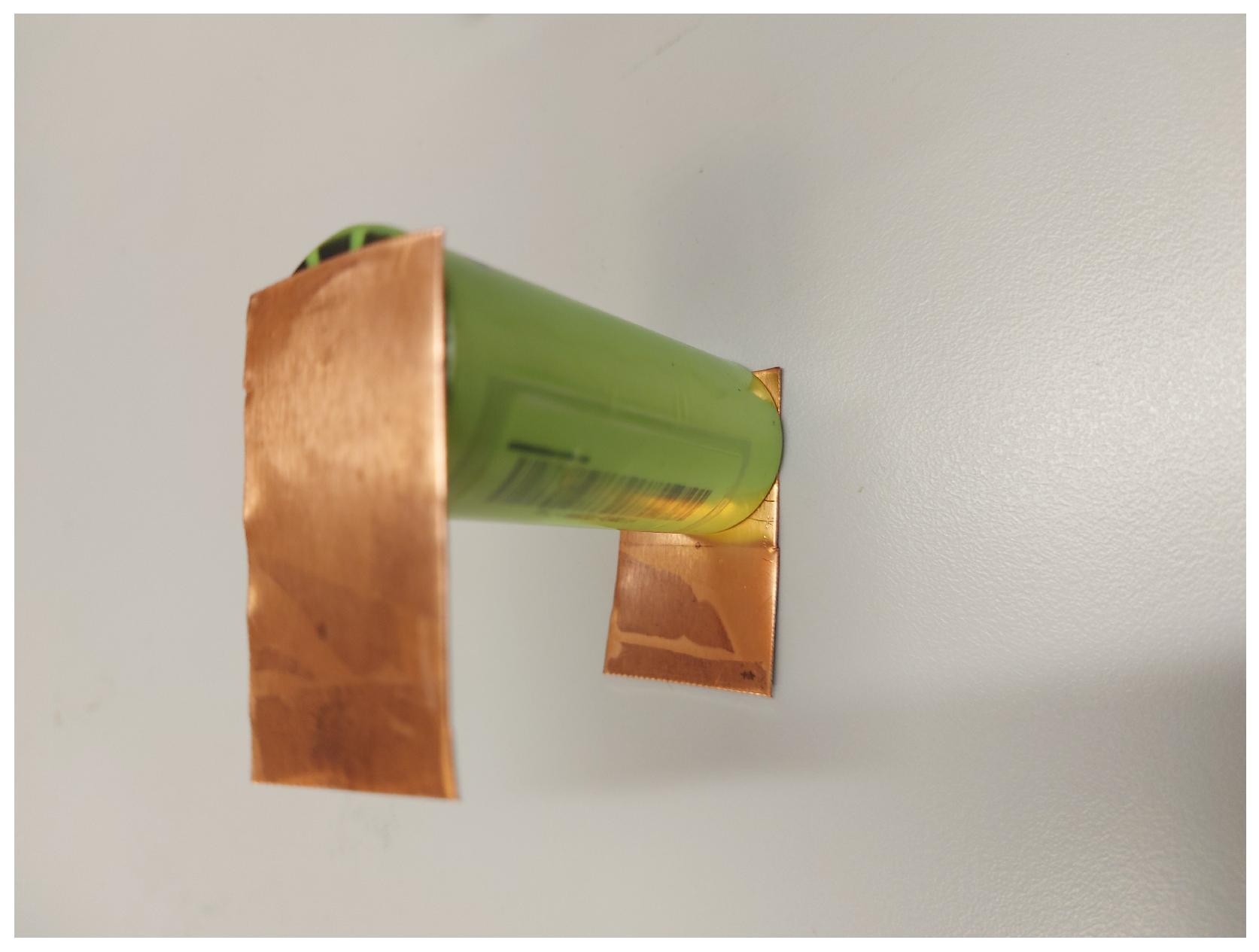
30]. The adhesive was applied manually with controlled process parameters; however, The bondline thickness was not quantitatively measured. Given its strong influence on both electrical resistance and mechanical strength, variations in bondline thickness may significantly affect the measured results. This represents a limitation of the study and reduces the reproducibility of the reported measurements. The assembly is shown in
Figure 1.
2.1. Mechanical Testing
Lithium-ion cells and modules are subjected to standard mechanical safety tests to verify their resilience under transport, handling and crashing events. The tests, based on standards such as UN38.3, IEC62133, and GB31241, simulate the inertial and impact loads that may occur during manufacturing, assembly, or vehicle operation. In the present study, the objective was to evaluate whether the adhesively bonded busbar maintains its integrity under simplified transient mechanical loading conditions.
It should be emphasized that the tests conducted in this study do not constitute full compliance testing according to the aforementioned standards; instead, the specified peak acceleration value is adopted solely as a comparative reference level.
To evaluate the mechanical integrity of the adhesively bonded busbar assemblies under transient acceleration, drop tests were conducted along three orthogonal axes (X, Y, and Z) of the test specimen. The coordinate system was defined relative to the cylindrical cell geometry, where the Z-axis corresponded to the longitudinal axis of the cell and the X- and Y-axes represented the two perpendicular radial directions.
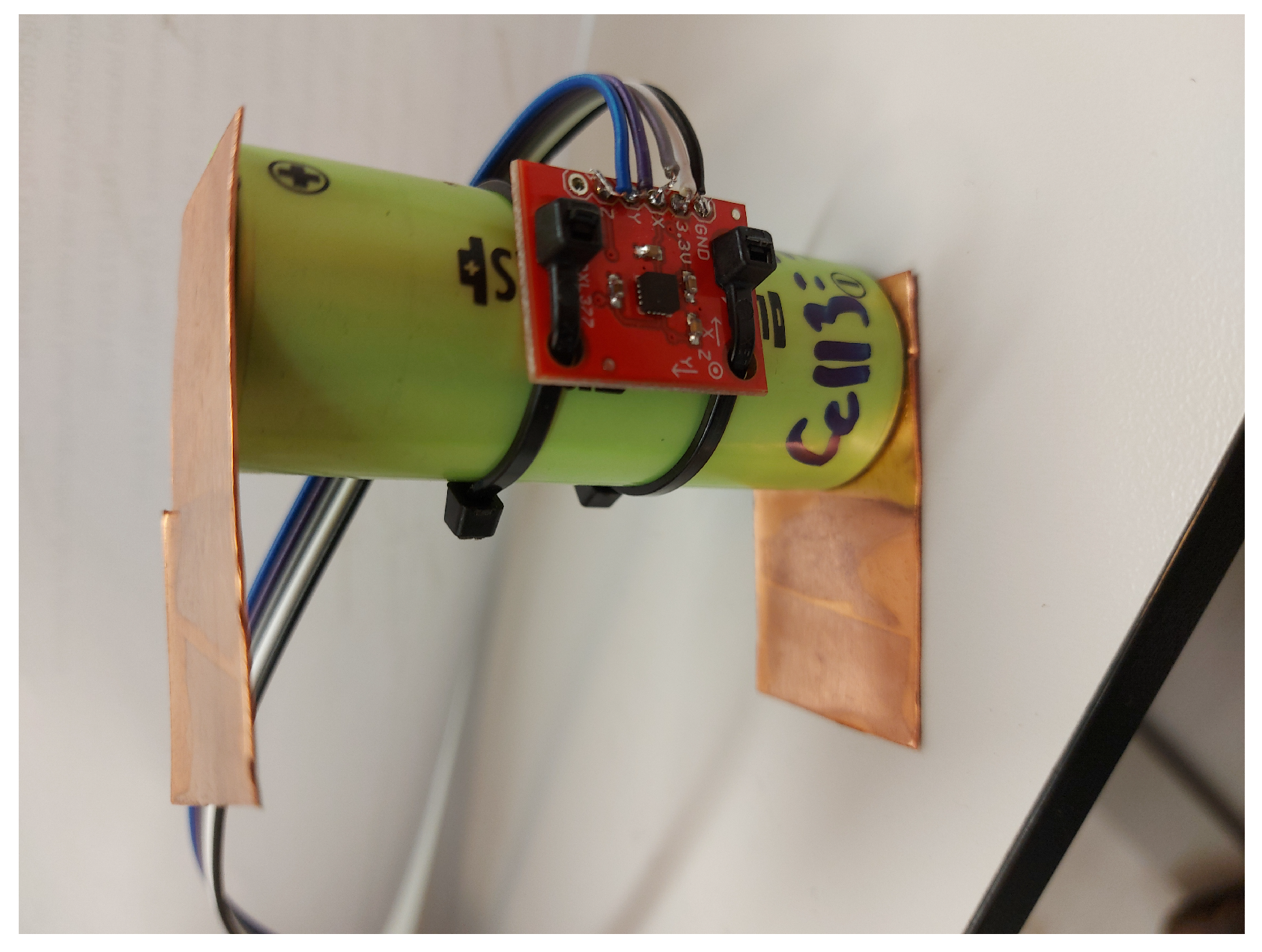
Each bonded assembly was instrumented with an ADXL377 accelerometer from Analog Devices (±200 g measurement range) [
32]. The accelerometer was mounted directly on the surface of the cell and connected to a 12-bit analog-to-digital converter, sampled at 1 kHz, resulting in an effective resolution of approximately 0.12 g (see
Figure 2).
The impulse test was implemented by releasing the bonded cell assembly from a fixed height of 30 cm onto a rigid steel surface, generating a short-duration deceleration pulse representative of an impact event that could occur during severe handling or crash-like conditions. For each axis configuration, the specimen was oriented such that the selected axis aligned with the impact direction.
In the Z-axis configuration, the specimen was dropped with the cylindrical axis oriented vertically, resulting in impact on the cell end surface and inducing primarily axial loading. In the X- and Y-axis configurations, the cell axis was oriented horizontally, and impact occurred along the respective radial directions, producing transverse loading. In all cases, the adhesive joint was subjected predominantly to shear forces arising from the relative inertia of the bonded busbar mass with respect to the cell body.
The recorded acceleration responses exhibited short-duration pulses, typically within 2–4 ms, with peak decelerations approaching the upper measurement limit of the sensor. These values represent instantaneous impact peaks rather than sustained acceleration levels.
Similar mechanical shock and drop-impact characterizations of cylindrical lithium-ion cells have been reported in previous studies [
33], and comprehensive reviews have summarized the application of standardized mechanical testing within battery safety frameworks [
34]. In the present work, the peak acceleration level is used as a comparative reference, rather than as a full replication of any specific standardized shock profile.
2.2. Electrical Characterization
Electrical resistance before and after bonding was measured using a Neware battery tester BTS4000 series [
35], with an accuracy of ±4 mΩ. The measurements were performed using a four-wire configuration to minimize the influence of lead and contact resistances. The BTS4000 provides high accuracy in voltage and current measurements (±0.05% of full scale), but when used for resistance estimation, this corresponds to a resolution in the milliohm range. ESR exhibits small variations at different state-of-charge (SOC) and during charging/discharging. Therefore, the measurement system may be insufficient to resolve small changes in contact resistance at the interface level. ESR was therefore measured at three SOC levels (30%, 50%, 70%) during both charge and discharge cycles. Each test used 1C current (2.5 A). Relaxation time was introduced between charge/discharge phases to allow for chemical and thermal stabilization. The electrical characterization was performed before any mechanical stress was applied to the cells.
3. Results
In this section, the results from the tests are presented. The material and equipment used in the tests are specified in the Material and Method section together with the accuracy of each setup.
3.1. Impulse G-Force Resistance
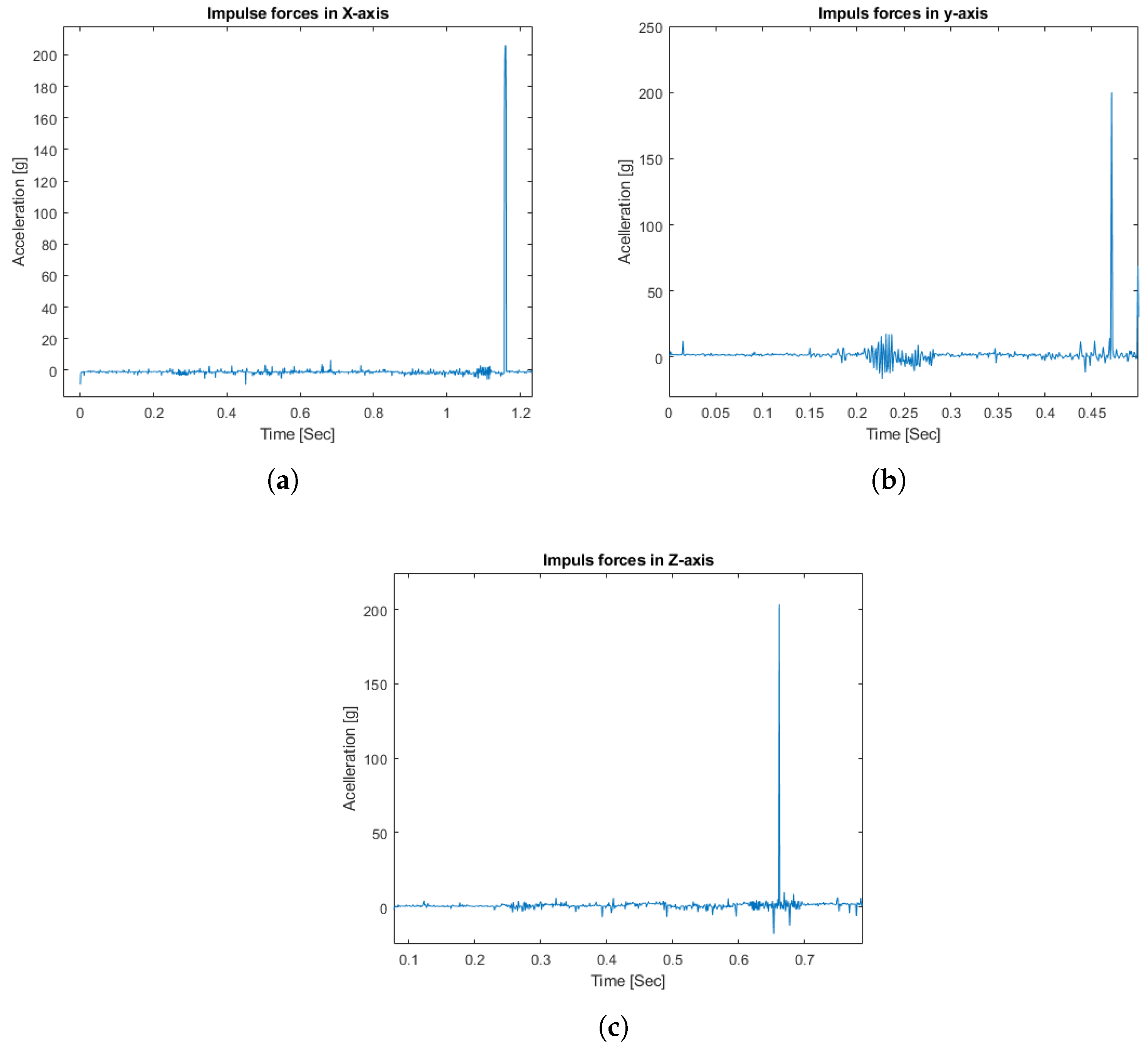
The adhesive joints withstood mechanical loading up to the maximum measurable range of the ADXL377 sensor (±200 g), which can be seen in
Figure 3. In all directions, signal saturation occurred at impact, indicating that the actual peak acceleration exceeded the sensor’s measurement limit. Despite this severe loading, no signs of adhesive degradation, fatigue, or functional impairment were observed, indicating that the bonded joints remained intact under the tested conditions.
3.2. Vibration Durability Resistance
During normal operation of mobile systems, components are subjected to continuous vibration, which may lead to fatigue in structural elements and bonded joints over time. It is therefore essential to evaluate vibration resistance as part of the mechanical validation process. Ideally, such testing should follow a representative vibration spectrum derived from measured service conditions and covering the expected lifetime loading profile.
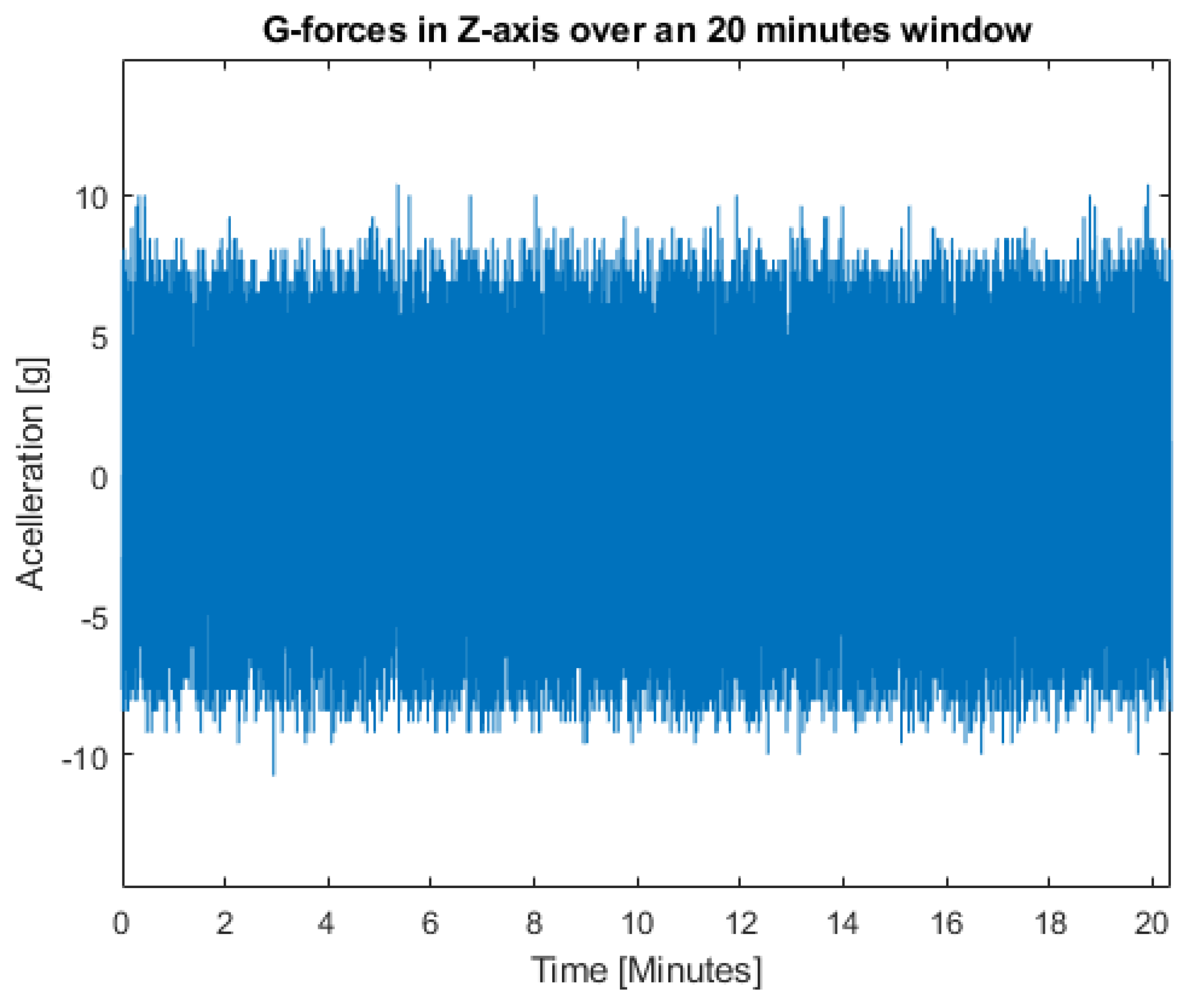
In the present study, however, a simplified verification approach was adopted. The adhesive bond strength was evaluated during a 300-min sinusoidal excitation test at a frequency of 1 Hz. While this loading condition does not fully replicate realistic automotive vibration spectra—typically characterized by broadband random excitation and higher frequencies—it provides a controlled and repeatable baseline assessment of bond integrity under cyclic loading.
The excitation was applied along the Z-axis of the test specimen, and acceleration was recorded using an ADXL377 accelerometer. A representative 20-min time window of the recorded measurement data is presented in
Figure 4.
No visible cracks, delamination, or adhesive separation were observed in the bonded busbars following the acceleration and vibration tests (see
Figure 5). This observation is limited to macroscopic inspection and does not include microscopic or interfacial characterization.
3.3. Electrical Resistance
Losses in a battery system are largely determined by electrical resistance. An increase in Equivalent Series Resistance (ESR) leads to higher losses and may degrade the performance or lifetime of the battery cells. Therefore, ESR was measured before and after assembling the test samples. The measurement was conducted in the axial direction (Z) directly on the top of the busbar after bonding to the cell on both sides. The diameters of the cell tabs are 15 mm and 13 mm, corresponding to calculated resistances of 4.838 × 10⁻⁸ Ω and 6.442 × 10⁻⁸ Ω respectively, which can be considered negligible.
Table 1 and
Table 2 summarize the ESR data before and after bonding. Minimal variation was observed, with differences remaining within the measurement uncertainty (±4 mΩ). Therefore, the measurement system may be insufficient to resolve small changes in contact resistance at the interface level, and no definitive conclusion regarding the electrical impact of the adhesive interface can be drawn from the present data.
3.4. Visual Analysis
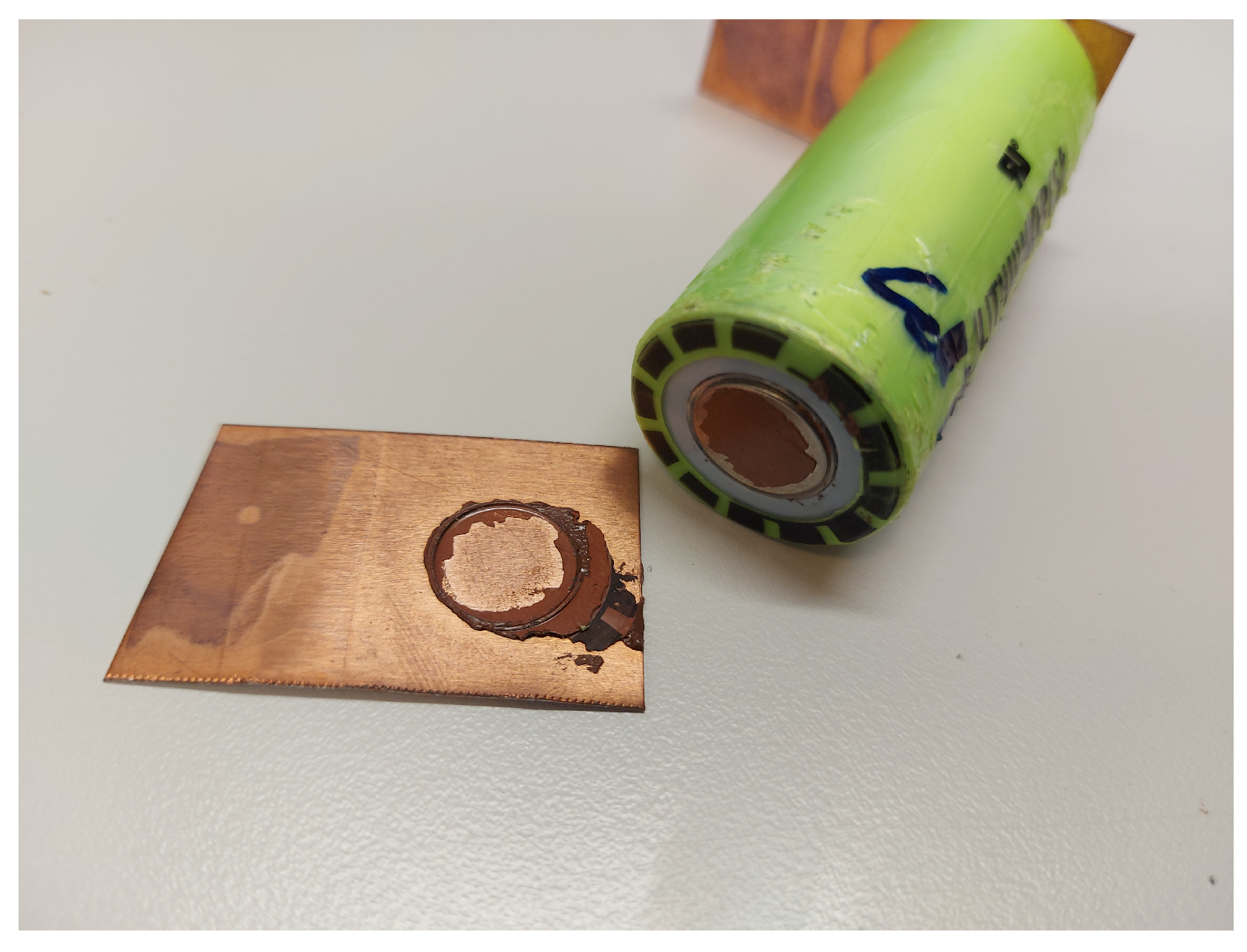
Post-test images show minimal adhesive degradation, with smooth detachment surfaces.
Figure 5 depicts a sample after delamination. The adhesive remained on both surfaces, suggesting cohesive rather than adhesive failure, which is desirable for recycling and/or reparability.
Figure 5.
Sample after the adhesive connection has been separated.
Figure 5.
Sample after the adhesive connection has been separated.
3.5. Recyclability and Cell-Level Separation
A critical advantage of the proposed Battery cell joining method lies in its design for recyclability. In traditional battery packs, welded interconnects and thermally bonded joints pose significant barriers to disassembly. The inability to isolate and remove individual cells leads to inefficient recycling processes, often resulting in the destruction of functional components and loss of valuable materials.
By contrast, the use of electrically conductive adhesives in this design suggests the potential for non-destructive separation of individual cells and facilitating controlled removal under appropriate conditions. This cell-level access suggests that damaged or degraded cells could be replaced without discarding entire modules, which significantly reduces electronic waste and conserves high-cost materials such as copper, lithium, and cobalt. The adhesive bonds used in this study demonstrate cohesive separation behavior, as observed in post-test visual analysis, suggesting the possibility of clean removal without requiring high temperatures or specialized tools.
This design philosophy supports the principles of a circular economy, where materials are maintained at their highest utility across multiple life cycles. Furthermore, the design concept may support future robotic disassembly using peel forces rather than cutting or burning, which enhances safety and cost-efficiency in end-of-life battery processing. When scaled to industrial levels, this feature could dramatically improve the economics and sustainability of battery recycling operations.
A total of five specimens (n = 5) were evaluated for mechanical testing, and three cells were used for electrical characterization. Due to the limited sample size, no statistical analysis was performed.
4. Discussion
The present study represents an initial proof-of-concept validation of adhesive-based battery interconnections. The experimental scope is limited in terms of sample size, measurement resolution, and test conditions. Therefore, the results should be interpreted as indicative of feasibility rather than as a complete engineering validation. While these results are promising, they should be interpreted within the limitations described above.
The test results suggest that electrically conductive adhesives may represent a promising alternative joining concept to traditional welding in modular battery systems, subject to further validation. While cylindrical 26650 cells were used in this evaluation, the proposed adhesive bonding method is not restricted to this specific cell format. Prismatic and pouch cells, which are widely used in EVs and stationary applications, present larger bonding surfaces and may benefit more from adhesive-based interconnects. As shown in [
36] increasing the adhesive bonding area in cell tab-to-tab joints reduces electrical resistance and improves mechanical robustness. Ref. [
11] highlights the overlap area as a key determinant of joint performance, while the review of joining techniques conducted in [
13] for prismatic and pouch cell geometries, presents alternative joint designs such as tab-to-busbar, that better exploit adhesive and hybrid bonding solutions.
The results presented above show that even under severe transient loading conditions exceeding the measurement range of the sensor (±200 g), the adhesive bonds remained intact under the tested conditions, with no sign of delamination or fatigue after impact or vibration tests. This suggests the adhesive-cell-busbar assembly demonstrates the ability to withstand severe simplified mechanical loading conditions, although further validation under standardized conditions is required, such as electric vehicles or industrial systems, including crashes and transport-related vibrations. Also, from the electrical perspective the results are encouraging. The electrical results are encouraging; however, the observed ESR differences remained within the measurement uncertainty of the test system, preventing definitive conclusions regarding small changes in contact resistance.
The experiment presented in this paper is conducted using the 26650-format cells, with a relatively high internal resistance. Because the internal resistance of the cells is on the order of 10–20 mΩ, small resistance contributions from the adhesive interface are masked by both the cell resistance and the ±4 mOhms measurement accuracy system. However, for large prismatic cells or pouch cells, with internal resistance below 1 mΩ, the contribution of the bonding interface could become more significant. Adhesive contact resistance is typically in the range of tens of micro-ohms, depending on overlap area, adhesive thickness, and interface properties. Ref. [
25] reported planar conductive adhesive joints with contact resistances between 10 µΩ and 40 µΩ, which when scaled to large-format cells, may contribute noticeably to the overall equivalent series resistance (ESR). Future work will therefore include testing of larger cell formats and optimized adhesive geometries to validate scalability of the proposed method. This limitation is particularly relevant when comparing interconnection technologies with resistance contributions in the micro-ohm range.
Compared to welded joints, which are often permanent, heat-intensive, and hard to undo, adhesive bonding offers a low temperature, reversible alternative that supports disassembly and reuse. While welding methods like ultrasonic or laser welding can provide very strong connections, they often have more stress and create permanent bonds that make repairing and automated disassembly challenging. On the other hand, adhesives can make it easier to replace individual cells and promote direct recycling encouraging circular economy. A direct experimental comparison with welded joints was not performed in this study and remains an important area for future validation.
From a practical perspective, the additional weight introduced by the adhesive layer is negligible. Each bonded cell end contains approximately 0.0755 ± 0.0085 g of conductive epoxy, The 26650 cell weight is 76 ± 1 g. So for each cell this would add 0.113% ± 0.011%-units weight. Thus, the adhesive adds a negligible mass penalty while offering potential advantages in serviceability, recyclability, and modular scalability.
Based on the measured acceleration reaching the sensor limit (±200 g), the corresponding inertial loads on a single cell tested, weighing approximately 70 g, would be in the range of 100–140 N. Epo-Tek 430 adhesive has a lap shear strength of about 13 MPa [
30], suggesting a favorable theoretical safety margin for the bond under severe impact conditions. Furthermore, since the adhesive layers provide a more uniform stress distribution and accommodate small elastic deformations, which can mitigate localized stress concentrations that would lead to brittle failure in welded or soldered joints [
8,
9,
11,
12,
13].
The combination of mechanical performance, consistent electrical behavior, and the appealing ease of disassembly makes adhesive bonding a promising approach for future battery system development. These results support the necessary shift toward battery designs that not only are high-performing but also offer real and environmentally friendly end-of-life solutions.
While the proposed adhesive bonding concept offers clear production advantages by eliminating localized heating associated with welding processes, a potential drawback is the curing time of the adhesive system. For epoxy systems such as EPO-TEK 430, the curing time may range from several hours at room temperature to shorter durations under elevated temperatures, depending on the selected curing profile. This introduces a possible bottleneck in high-volume production environments, particularly if batch curing or staged assembly is required. From a manufacturing perspective, curing time directly affects takt time, fixture utilization, and overall process flow. Although elevated-temperature curing can significantly reduce processing time, it may introduce additional equipment requirements and energy consumption, partially offsetting the production advantages gained by avoiding welding. Further studies are therefore recommended to systematically evaluate optimized curing profiles, including elevated-temperature and accelerated curing strategies, as well as alternative adhesive formulations with shorter cure times. In addition, the integration of the adhesive process into automated production lines should be investigated to assess its impact on throughput, cost, and scalability.
5. Conclusions
The results indicate that adhesively bonded cell connections show promising mechanical and electrical behavior under the tested conditions. However, no direct comparison with welded joints was performed, and the present results should be interpreted as an initial proof-of-concept rather than a validated alternative. In addition, the proposed approach may offer advantages related to recyclability and reduced thermal exposure during manufacturing, although these aspects require further quantitative assessment. Thicker busbars can contribute to improved current-carrying capacity and thermal conduction; however, a detailed thermal optimization study was outside the scope of the present work.
The system architecture is designed to support robotic disassembly, which may facilitate pack-level recycling. Furthermore, the removable bonding of each individual cell may enables replacement of defective units without affecting neighboring components, potentially improving serviceability in grid-scale or vehicular applications.
This paper presents an initial experimental evaluation of a battery system utilizing conductive adhesives to bond cylindrical cells. The results suggest that the method can provide indicative mechanical and electrical performance under the tested conditions, while also offering compatibility with automated assembly and disassembly processes.
6. Future Work
Future work will explore thermal aging, long-term cycling, and compatibility with reconfigurable battery management systems.
Future work should include validation under standardized vibration profiles, such as those defined in ISO 16750 or application-specific OEM durability specifications, in order to more accurately assess long-term fatigue performance under realistic service conditions.
Future work intends to explore the feasibility of automating the detachment of the busbars, including the measurement of the peeling forces and design of the tools. Additionally, future studies could focus on the scalability of the process by testing multiple cells simultaneously, potentially extending the experiment to full modules. To further confirm the general applicability of the proposed bonding method, further investigations/studies will also examine prismatic and pouch cells, as their flat terminal geometries may offer even larger bonding areas and different mechanical stress profiles. Ultimately, the development of a fully automated end-to-end recycling process for the design considered in this study could represent the final/culmination step of the study.
7. Patents
Felix Mannerhagen, Modular battery system, European patent EP4553990A3, 24 February 2022.