Review

Recent Progress in Non-Precious and Carbon-Based Electrocatalysts for the Oxygen Reduction Reaction in Alkaline Media


by
Aleksandar Mijajlović
1,
Dušan Mladenović
2,
Kristina Radinović
2,
David Tomić
2,
Ana Nastasić
3,
Dalibor Stanković
1,3 and
Jadranka Milikić
1,*
1
Faculty of Chemistry, University of Belgrade, Studentski trg 12-16, 11000 Belgrade, Serbia
2
Faculty of Physical Chemistry, University of Belgrade, Studentski trg 12-16, 11158 Belgrade, Serbia
3
“VINČA” Institute of Nuclear Sciences-National Institute of the Republic of Serbia, University of Belgrade, Mike Petrovića Alasa 12-14, 11000 Belgrade, Serbia
*
Author to whom correspondence should be addressed.
Batteries 2026, 12(6), 208; https://doi.org/10.3390/batteries12060208 (registering DOI)
Submission received: 8 May 2026 / Revised: 2 June 2026 / Accepted: 4 June 2026 / Published: 7 June 2026
(This article belongs to the Section Aqueous Energy Storage Devices and Systems)

Abstract

The oxygen reduction reaction (ORR) is a key process in electrochemical energy conversion technologies such as fuel cells and metal–air batteries; however, its sluggish kinetics and reliance on precious metal catalysts limit large-scale application. This review provides a comprehensive overview of recent advances in non-precious nanoscale electrocatalysts for ORR in alkaline media. Particular emphasis is placed on reaction mechanisms, including dominant pathways, kinetics, and key intermediates, as well as the advantages of alkaline electrolytes over acidic systems. The performance of various catalyst classes is systematically discussed, including transition metal-based materials (Fe, Co, Zn, Cu, and bimetallic systems) and metal-free carbon-based electrocatalysts. Special attention is given to heteroatom-doped carbon materials, carbon nanostructures, and emerging hybrid systems such as MXene-based composites. Comparative analysis highlights the relationship between catalyst composition, structure, and electrochemical performance metrics, including half-wave potential, onset potential, Tafel slope, number of electron transfer, and operational stability. Overall, non-precious catalysts demonstrate promising activity and durability, approaching that of noble metals under alkaline conditions. The insights summarized in this review guide the rational design of efficient, cost-effective ORR electrocatalysts and support the development of sustainable energy technologies.

1. Introduction

The continuously increasing global energy demand, coupled with the depletion of fossil fuel reserves and the environmental pollution due to their extensive use, has motivated the search for sustainable energy solutions [1,2]. According to the International Energy Agency, annual carbon dioxide emissions associated with fossil fuel consumption reach tens of gigatons (~40 gigatons), further aggravating climate change [3]. In this context, the need for an energy transition toward a zero-carbon goal has placed electrochemical energy storage and conversion devices at the forefront of contemporary research [4]. Among these technologies, fuel cells and metal–air batteries have emerged as particularly promising due to their high energy density, efficiency, and environmentally benign operation [5,6]. Fuel cells operate by oxidizing fuel, such as hydrogen or small organic molecules at the anode, while oxygen is reduced at the cathode to produce electricity and water as the only by-product. Similarly, metal–air batteries during employment function through the oxidation of a metal anode and the reduction of oxygen at the cathode [7,8]. For both systems, the oxygen reduction reaction (ORR), the cathodic half-reaction, is one of two main processes of the overall reaction, directly controlling efficiency and power output [1,6,9]. In addition to energy applications, ORR is also exploited in the green electrosynthesis of hydrogen peroxide, demonstrating its industrial relevance [9].
ORR is inherently complex, as it involves multiple elementary steps, including the strong O=O bond breaking, along with diffusion, adsorption, and bond rearrangements, all contributing to a high energy barrier and sluggish reaction kinetics. As a result, the reaction requires significant overpotential and cannot proceed efficiently without the presence of an electrocatalyst to lower the activation energy and accelerate the process [10,11]. ORR in alkaline electrolytes has received increasing research attention due to its more favorable kinetics and improved catalyst stability compared to oxygen reduction in acidic media [12]. In alkaline media, ORR proceeds as a multistep reaction involving the transfer of multiple electrons and can follow two principal pathways: the two-electron pathway, leading to hydrogen peroxide formation, and the four-electron pathway, resulting in the direct reduction of oxygen to water or hydroxide ions. The two-electron route may also proceed through a sequential 2 + 2 electron mechanism via peroxide intermediates [13]. The dominant reaction pathway is largely determined by the nature of the electrocatalyst and its properties. Typically, the four-electron pathway is favored in energy conversion devices, enabling maximum chemical to electrical energy conversion efficiency, while the two-electron pathway is associated with the formation of peroxide intermediates and is more relevant for industrial applications [14]. Consequently, the design of electrocatalysts plays a crucial role in controlling both the activity and selectivity of ORR, as well as in overcoming the kinetic barrier and improving overall system performance [4,15].
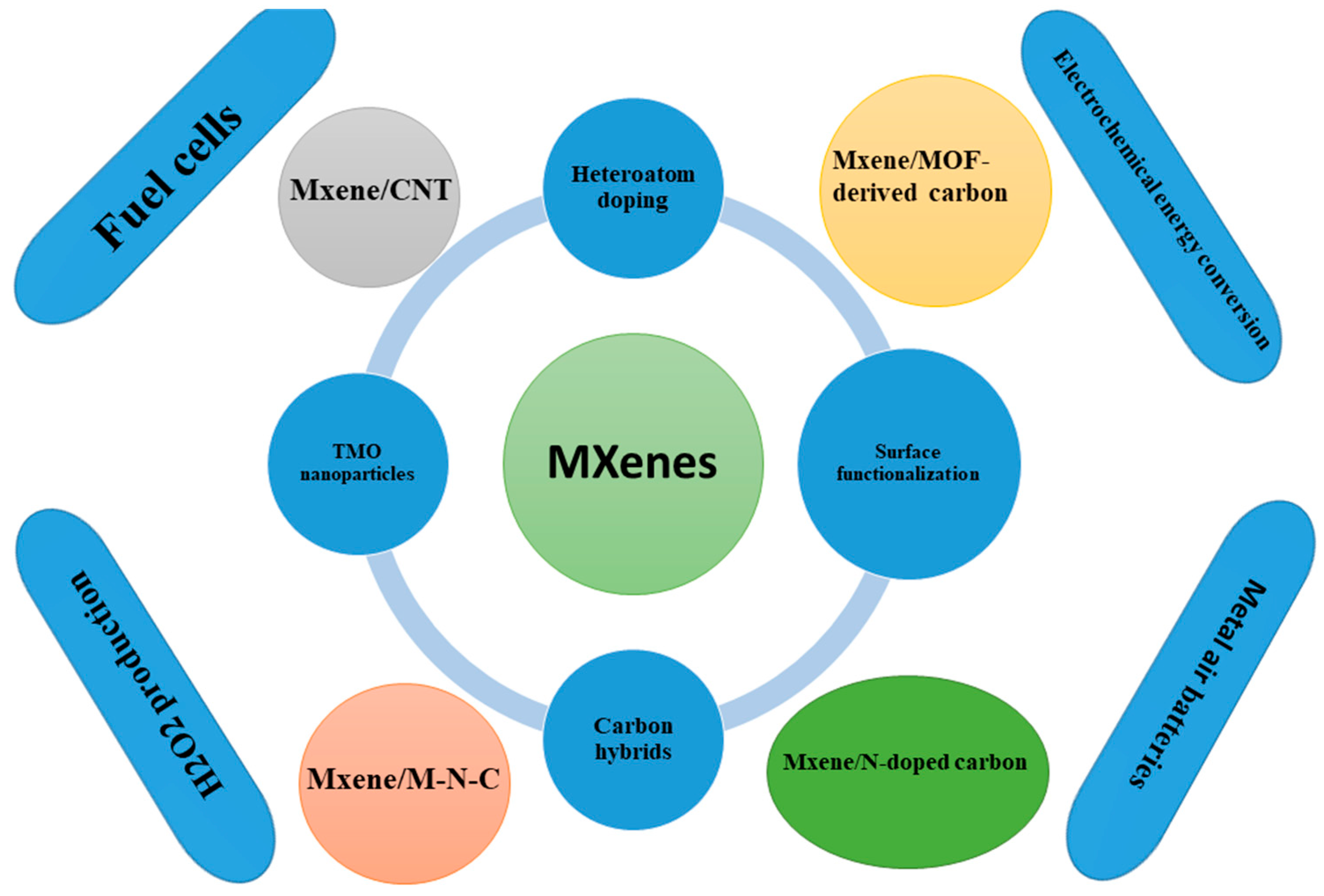
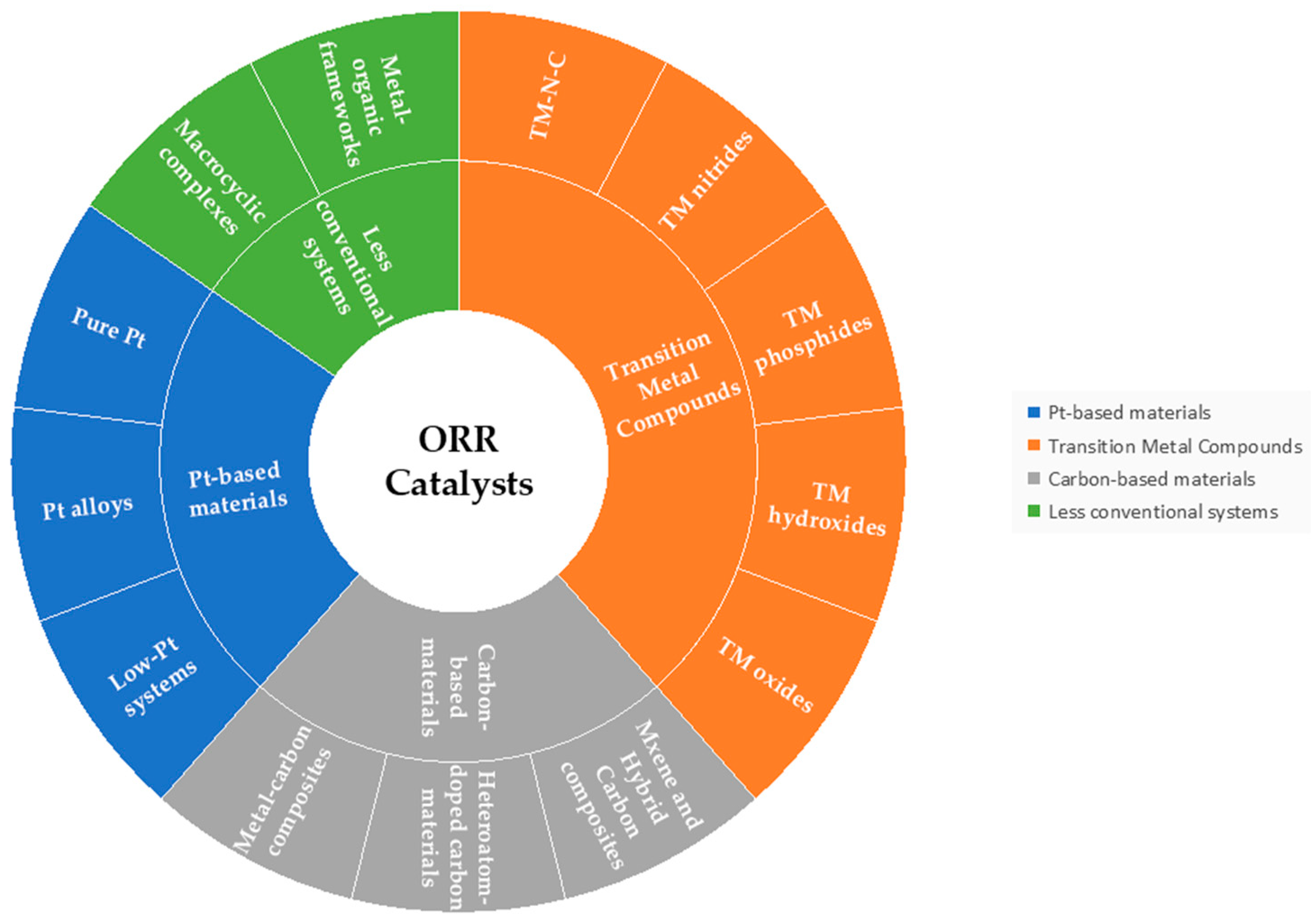
Platinum (Pt) is recognized as a benchmark electrocatalyst for the ORR due to its outstanding catalytic activity and ability to lower energy activation barriers [12,15,16]. However, its large-scale application is severely limited by high cost, scarcity, and insufficient long-term stability, which hinder the commercialization of technologies such as fuel cells and metal–air batteries [12,15,16]. The development of low-cost, sustainable, and high-performance Pt alternatives represents an important step toward the large-scale implementation of these next-generation energy technologies. In addition to pure Pt systems, alloying with transition metals has been widely explored to enhance catalytic activity and reduce cost; for instance, Pt3Ni(111) demonstrated remarkable performance [12]. Furthermore, reducing Pt content below 30 wt% in the catalyst’s composition represents one effective strategy for improving cost-efficiency while maintaining catalytic performance [5]. Nevertheless, the reliance on noble metals remains a critical bottleneck, driving the urgent need for alternative electrocatalysts [16]. In this context, extensive efforts have been devoted to the design of non-precious metal and metal-free electrocatalysts, particularly for alkaline media where a wider range of materials can achieve substantial ORR activity [11]. Among these, atomically dispersed transition metal-nitrogen-carbon (M-N-C) catalysts have emerged as one of the most studied and promising classes due to their high activity and tunable coordination environment [9,17,18,19,20]. In parallel, various transition metal-based materials, including oxides, hydroxides, phosphides, and nitrides, have been investigated, exhibiting notable activity attributed mostly to surface defects and variable oxidation states that facilitate electron transfer during ORR [1,2,6,21,22]. Carbon-based materials, including heteroatom-doped carbons and metal-carbon composites, have also attracted tremendous attention owing to their low cost, high electrical conductivity, large specific surface area, and excellent stability in alkaline electrolytes [10,16]. More advanced and less conventional systems, such as metal–organic frameworks (MOFs) and transition metal macrocyclic complexes (e.g., phthalocyanines and porphyrins), provide well-defined active sites and tunable structures, offering additional opportunities for rational catalyst design [20,23,24]. Based on the above discussion, ORR electrocatalysts can be broadly categorized into several key groups, as summarized in Scheme 1.
Despite significant progress, challenges such as limited intrinsic activity, insufficient selectivity, and long-term durability remain, underscoring the importance of continued research toward efficient and scalable ORR electrocatalysts. Therefore, this review presents recent progress in alternative ORR electrocatalysts with a focus on non-precious metal-based catalysts and metal-free carbon materials, as well as the theoretical basics of oxygen reduction in alkaline media, all to provide insight into the structure–activity correlation, offering a framework for the rational design of advanced ORR electrocatalysts.

2. ORR in Alkaline Media

2.1. ORR Pathways in Alkaline Media

ORR on the active sites of the electrocatalyst surface can take place in two ways. One reaction pathway involves the transfer of two electrons, while the other reaction pathway involves the transfer of four electrons. Although the mechanisms differ, they have in common that they include four key processes: mass transfer, adsorption, surface reaction, and desorption. The catalytic ability of the catalyst towards these adsorption and desorption processes is crucial to determining the ORR mechanism. There is no difference in the importance of these ORR mechanisms, but both are extremely important depending on the goal of their application. Specifically, the operation of electrochemical devices for energy conversion and storage, such as fuel cells and metal–air batteries, is based on the four-electron ORR mechanism. On the other hand, as a product of the two-electron ORR mechanism, hydrogen peroxide (H2O2) is formed, which is a green oxidant, a very important chemical, and is used as a reagent for the production of a large number of other important chemical products. The special advantage of the electrosynthesis of H2O2 compared to traditional chemical methods, such as the anthraquinone autoxidation (AO) process, is the high efficiency, the possibility of starting with green electricity, and environmental protection [25,26,27].
The four-electron mechanism of oxygen reduction represents the complete reduction of molecular oxygen (O2) to OH ions in an alkaline medium, and includes several elementary steps, with the participation of various types of intermediates. Namely, the reaction begins with the binding of O2 to the active site (M) on the surface of the catalyst, whereby an M-O2 intermediate is formed. This is followed by 4 elementary steps in which one-electron reduction takes place with the release of one OH ion each, and in the first step, the resulting M-O2 intermediate reacts with water and is reduced to the M-OOH. Then successive reductions of M-OOH and M-O follow, and in the last step, the M-OH intermediate is reduced with the separation of M, which confirms its participation as a catalyst [27,28,29,30]. This complex 4e ORR mechanism in an alkaline medium is shown schematically through the following reactions (Equations (1)–(5)):
M + O2 → M-O2
M-O2 + H2O + e → M-OOH + OH
M-OOH + e → M-O + OH
M-O + H2O + e → M-OH + OH
M-OH + e → M + OH
where M is the active site on the catalyst surface [25,29,30]. The total reaction of the four-electron ORR pathway in an alkaline medium is as follows (Equation (6)) [28]:
O2 + 2H2O + 4e → 4OH (0.401 V vs. SHE, pH = 14)
The two-electron ORR represents an incomplete oxygen reduction, that is, a 2e reduction of O2 in which H2O2 is formed. The mechanism of this reduction is also complex and takes place through several steps, with the participation of various types of intermediates. In the first step, molecular oxygen binds to the active site (M) on the surface of the catalyst with the formation of an M-O2 intermediate. Then, M-O2 receives a proton from water and an electron to form M-OOH with the release of OH ion. In the last step, *OOH is reduced with the formation of HO2, which is desorbed from the catalyst surface [27,30]. The complex 4e ORR mechanism in an alkaline medium is shown schematically by the equations (Equations (7)–(9)):
M + O2 → M-O2
M-O2 + H2O + e → M-OOH + OH
M-OOH + e → M + HO2
where M is the active site on the catalyst surface [25,28,30]. The total reaction of the two-electron ORR pathway in an alkaline medium is [25,31]:
O2 + H2O + 2e → HO2 + OH (−0.076 V vs. SHE, pH = 14)

2.2. Key Performance Indicators of ORR

The electrocatalytic ability of a material towards ORR can be determined by examining the key parameters of the ORR process. Some of the most frequently measured ORR parameters are: limiting current density, onset and half-wave potential, number of exchanged electrons, and Tafel slope. Below are more detailed explanations of these parameters. One of the most important parameters for evaluating the ORR activity of an electrocatalyst is the limiting current density, onset potential, and half-wave potential. The linear sweep voltammetry (LSV) method is used to determine these parameters. Testing with this method is performed using a rotating disc electrode (RDE) or rotating ring-disc electrode (RRDE), and as a result, polarization curves (RDE LSV or RRDE LSV curves) are obtained [27,32]. In order for the LSV curves to be evenly distributed, different rotation rates of the working electrode are used, and the scanning rate (potential change rate) is usually 5–20 mV s−1.
The limiting current density (jl) in the ORR refers to the maximum current density achieved when the reaction rate is no longer controlled by electrode kinetics but solely by the mass transport of O2 to the electrode surface. At this point, all available oxygen reaching the electrode is immediately reduced, so increasing the potential does not increase the current further. On polarization curves, it appears as a current plateau and marks the transition from kinetic to diffusion-controlled behavior. It depends on factors such as dissolved oxygen concentration, diffusion coefficient, diffusion layer thickness, and the number of exchanged electrons (typically 4), and is commonly expressed as [29]:
jl = n F D0 C0
where n is the number of exchanged electrons, F is the Faraday constant (about 96,485 C mol−1), D0 is the diffusion coefficient, C0 is the dissolved O2 concentration in the electrolyte, and δ is the diffusion layer thickness [29].
The onset potential (Eonset) represents the potential of the beginning of the oxygen reduction reaction, but generally, its exact value is difficult to determine. Therefore, the Eonset is defined as the potential corresponding to a current density of −0.1 mA cm−2. The half-wave potential (E1/2) is defined as the potential corresponding to half of jl [27].
The number of exchanged electrons in the ORR, which takes place on the RDE surface and is controlled by both diffusion and kinetic processes, is determined based on the Koutecky-Levich (K-L) analysis. Namely, the reciprocal value of the total current density is equal to the sum of the reciprocal values of the limiting diffusion current density and the kinetic current density [26,27,29,31]. The K-L analysis is expressed by the equation:
1/j = 1/jl + 1/jk = 1/Bω1/2 + 1/jk
B = 0.62nFC0(D0)2/3ν−1/6
where n is the number of exchanged electrons, F is the Faraday constant, C0 is the dissolved O2 concentration in the electrolyte, D0 is the diffusion coefficient of O2 in the electrolyte, ν is the viscosity of the electrolyte, and ω is the rotation rate of the RDE (rad s−1). A linear graphical dependence of 1/j on ω−1/2, known as a K-L plot, gives an intercept equal to 1/jk and a slope of 1/B. From the slope of the K-L plot, it is possible to determine the number of exchanged electrons [26,27,29,31].
The kinetics and mechanism of the ORR process are investigated by Tafel analysis. Namely, determining the decisive stage of the reaction (the slowest stage that actually determines the speed of the reaction) is done by measuring the current response with the change in overpotential. Tafel analysis is based on the Tafel equation:
η = a + b logj
where overpotential η and current density j are given as absolute values. The constants a and b are known as Tafel constants, and their values depend on the properties of the electrode material, the state of the electrode surface, the composition of the electrolyte, and the temperature [26]. The size of the Tafel slope value of the tested material indicates the speed of the electron transfer step, and is most often compared with the value for Pt/C, which is 60 mV dec−1 at low current density and 120 mV dec−1 at high current density [29,33].

2.3. Advantages of Alkaline Electrolytes over Acidic Systems

Recent fundamental research on the ORR process is focused on investigating its mechanism, precisely because of the complex kinetics. They are focused on finding and designing efficient, stable, and cheap electrocatalysts. Such research is carried out in different conditions, both basic and acidic. Alkaline electrolytes have certain advantages over acidic systems. The electron transfer process is kinetically faster, and the catalyst has improved stability, in terms of corrosion reduction, in an alkaline medium compared to an acidic environment [26,29].

3. Non-Precious Metal-Based Electrocatalysts

3.1. Iron-Based Catalysts

Iron-based materials have emerged as promising, low-cost substitutes for noble metal catalysts in the oxygen reduction reaction, a key process in fuel cells and metal–air batteries. Their catalytic performance stems from the multiple oxidation states of iron and its adaptable coordination environments, which facilitate the adsorption and activation of molecular oxygen. Depending on the catalyst structure and the operating conditions, ORR can follow a direct four-electron route to form water (or hydroxide ions), or a two-electron route that generates peroxide intermediates. The adsorption strength of oxygen-containing intermediates, particularly OOH*, serves as a critical descriptor that controls both the reaction rate and the product distribution. In addition, iron-based catalysts feature several benefits, including low cost, high natural abundance, and broad structural tunability between metallic and oxide phases. They can deliver substantial catalytic activity, especially in alkaline media, yet still suffer from drawbacks such as insufficient durability in harsh electrochemical environments and undesirable peroxide generation, which diminishes selectivity and accelerates degradation. Nevertheless, ongoing advances in structural design and defect engineering have markedly improved their overall performance.
Recent studies have shown that tailoring the phase composition of iron oxides is an effective way to adjust ORR selectivity and activity. In one work using MOF-derived iron oxides, the ORR performance of Fe3O4 and Fe2O3-dominated catalysts obtained via thermal treatment of a MIL-101 precursor was systematically examined [34]. This synthetic route allowed fine control over the iron oxidation states, yielding Fe3O4 with mixed Fe2+/Fe3+ centers and Fe2O3 with mainly Fe3+ sites. Electrochemical measurements showed that the Fe3O4-based material primarily promotes a four-electron ORR pathway, while Fe2O3 mainly proceeds via a two-electron pathway that generates peroxide. The discrepancy was linked to the adsorption strength of the OOH* intermediate, where Fe3O4 provides a more suitable binding energy that promotes O-O bond breaking, and the weaker interaction on Fe2O3 leads to incomplete reduction. The Fe3O4@NCNTs catalyst delivered an electron transfer number of 3.83–3.97, confirming that the four-electron route is dominant. It also exhibited a half-wave potential of 0.828 V vs. RHE and a limiting current density of −5.51 mA cm−2, indicative of efficient oxygen reduction. Moreover, a Tafel slope of 78.32 mV dec−1 was obtained, pointing to favorable reaction kinetics. Durability tests revealed excellent stability, with almost no loss of activity after 5000 cycles. The improved performance is mainly ascribed to the coexistence of Fe2+/Fe3+ redox-active sites that enhance electron transfer, the optimized adsorption energy of oxygen intermediates (ΔG(OOH*) = 3.36 eV), and the nanostructured architecture, which increases exposure of active sites and facilitates mass transport (Table 1).
Beyond phase-engineered iron oxides, hybrid architectures that integrate iron oxide with conductive frameworks have also shown notable ORR performance. In a recent work, an iron oxide–carbon composite (CFe-x) derived from agricultural waste was prepared by impregnating Saccharum officinarum biomass with an Fe3+ precursor, followed by high-temperature carbonization under a N2 atmosphere [35]. By tuning the iron loading, the CFe-2 sample (2 wt% Fe) delivered the best catalytic behavior, which was attributed to the well-dispersed Fe3O4/Fe3C nanoparticles embedded in a graphitized carbon matrix. Electrochemical measurements revealed that CFe-2 drives the ORR primarily via a quasi-four-electron pathway, with an electron transfer number of 3.7–3.9, indicating that water is the main product and that peroxide generation is minimal (3.1–8.6%). The catalyst showed an onset potential of 0.82 V vs. RHE and a half-wave potential of 0.65 V vs. RHE, together with a high diffusion-limited current density of −7.7 mA cm−2 at 1600 rpm. The Tafel slope of 86 mV dec−1 was obtained, signifying more favorable ORR kinetics than those of the other members of the series. The superior activity of CFe-2 is ascribed to the cooperative effect between Fe3O4/Fe3C nanoparticles and the conductive carbon framework, which enhances charge transport and promotes oxygen adsorption. This interpretation is corroborated by electrochemical impedance spectroscopy, where CFe-2 displayed the lowest charge-transfer resistance (Rct = 307 Ω) among all samples, along with the largest electrochemically active surface area (ECSA = 3.325 cm2) and double-layer capacitance (Cdl = 0.133 mF cm−2), pointing to a high density of accessible active sites. K-L analysis confirmed first-order reaction kinetics with respect to the oxygen concentration, while density functional theory calculations identified OH* desorption as the potential-determining step, associated with an overpotential of 0.39 V. Long-term stability tests further demonstrated robust durability, with the catalyst retaining a stable current over 40 h of continuous operation. Collectively, the outstanding ORR performance is derived from the interplay of optimized Fe loading, a more favorable electronic structure, and improved mass and charge transport within the hybrid configuration.
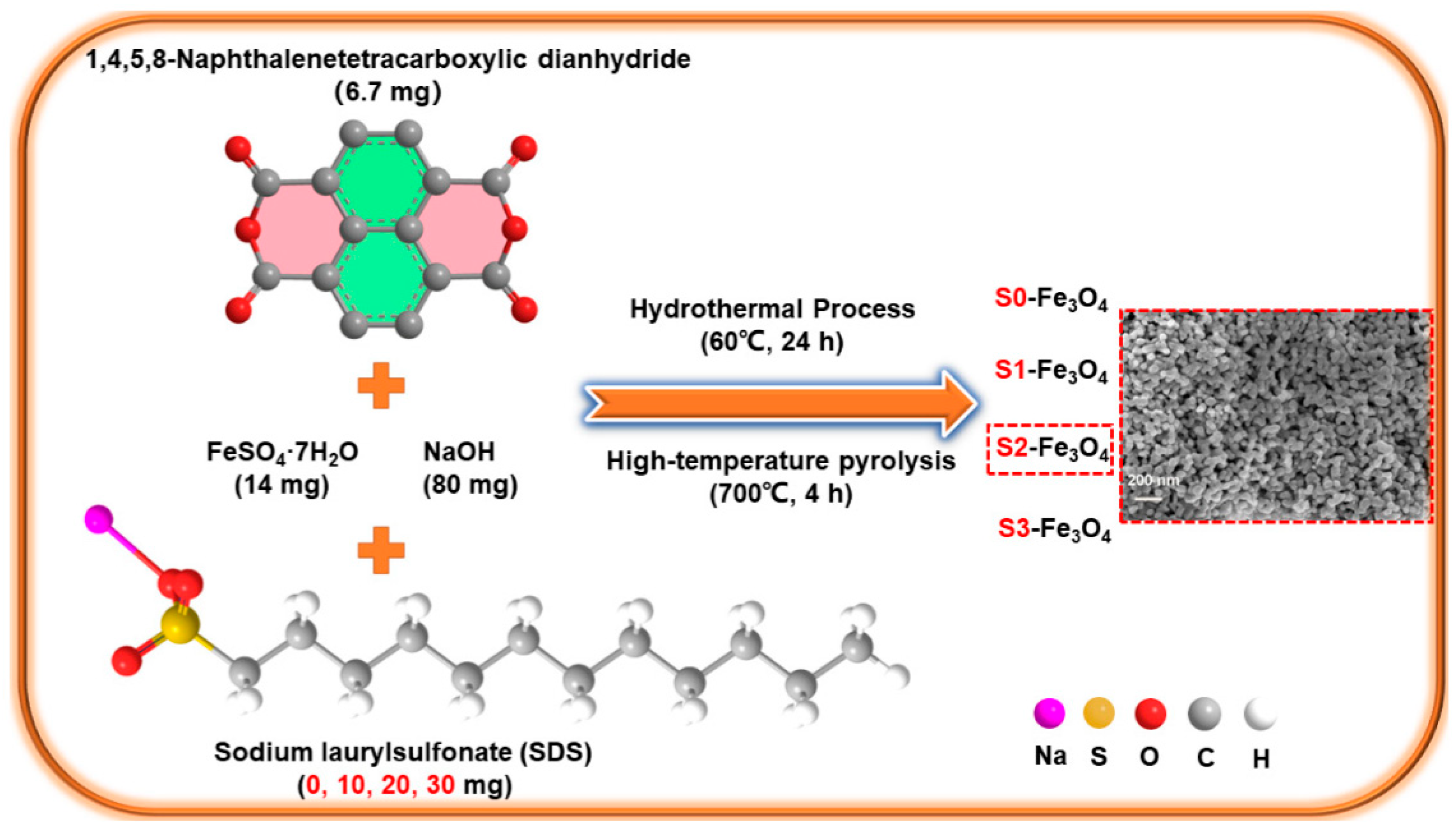
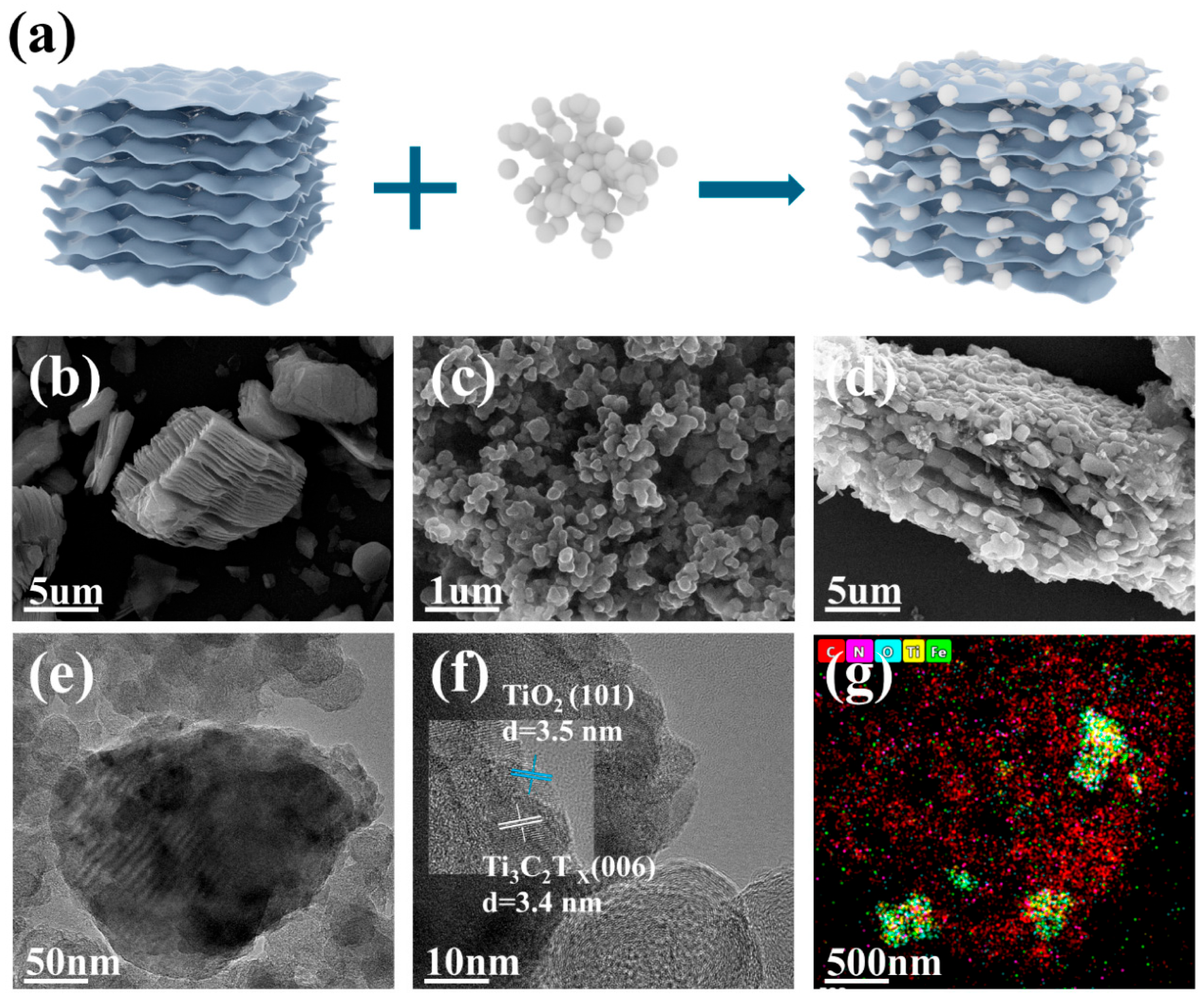
Zhang et al. used a hydrothermal approach to synthesize highly dispersed Fe3O4 nanoparticles for the ORR, in which sodium dodecyl sulfate (SDS) serves as a structure-directing agent to regulate particle size and dispersion (Figure 1) [36]. By preventing particle agglomeration, SDS enables the formation of uniform Fe3O4 nanoparticles (30–40 nm) with a greater number of exposed active Fe sites. Electrochemical tests in alkaline electrolyte reveal that the optimized catalyst (S2-Fe3O4) delivers a half-wave potential of 0.956 V vs. RHE and a limiting current density of −5.50 mA cm−2, clearly surpassing non-dispersed Fe3O4 and approaching the performance of commercial Pt/C, while the improved reaction kinetics are evidenced by a reduced Tafel slope, signifying accelerated charge transfer at the electrode/electrolyte interface. Rotating ring-disk electrode (RRDE) measurements indicate a nearly four-electron ORR process, with an electron transfer number of approximately 3.6–3.7 and a low peroxide yield (~10%), confirming efficient conversion of O2 to H2O. The superior activity is primarily ascribed to the enlarged electrochemically active surface area, enhanced accessibility of Fe2+/Fe3+ redox sites, and improved oxygen transport arising from nanoscale dispersion. Together, these features promote faster adsorption and reduction of oxygenated intermediates. Density functional theory calculations corroborate the experimental findings, revealing favorable adsorption of O*, OH*, and OOH* species on the Fe3O4 (311) facet with a relatively low reaction barrier (~0.57 eV), indicating an optimized binding strength toward ORR intermediates, supporting efficient catalysis without excessively strong adsorption that would impede turnover.
On the other hand, the ORR behavior of the Fe-Dy dual-atom catalyst (FeDy-DAC) demonstrates a more precisely tuned electronic and structural configuration than conventional Fe-based catalysts [37]. Unlike the nanoparticle Fe3O4 catalyst, whose enhanced activity primarily stems from enlarged surface area and increased exposure of Fe2+/Fe3+ sites, FeDy-DAC accelerates ORR kinetics at the atomic scale by finely regulating the electronic environment of isolated active centers. Incorporating Dy atoms adjacent to Fe sites induces strong coupling between Fe-3d and Dy-4f orbitals, which markedly reshapes the electronic structure of the Fe center. This adjustment weakens the overly strong adsorption of oxygenated intermediates, particularly *OH, thereby facilitating faster desorption, mitigating surface poisoning, and preserving an optimal binding strength for sustained catalytic turnover. Consequently, the overall free energy profile is optimized, and the rate-limiting barrier for *OOH formation is reduced to ~0.42 eV. DFT calculations corroborate this improved adsorption profile, revealing a moderate shift in the Fe d-band center (from −1.73 eV in Fe-SAC to −2.07 eV in FeDy-DAC), consistent with a weakened yet well-balanced interaction with oxygen intermediates. Free energy analysis shows that FeDy-DAC avoids the excessively strong adsorption observed in Fe-SAC and the overly weak adsorption characteristic of Dy-SAC, placing it closer to the thermodynamic optimum for ORR. Under this balanced adsorption regime, the rate-determining step remains *OOH formation but with a substantially lowered energy barrier relative to the reference catalysts. Experimentally, these electronic benefits manifest as excellent ORR performance, with a half-wave potential of 0.90 V vs. RHE, surpassing Fe-SAC (0.88 V) and Dy-SAC (0.78 V) and slightly exceeding Pt/C (0.87 V). FeDy-DAC also exhibits a high current density of 4.27 mA cm−2 at 0.90 V and a small Tafel slope of 44.6 mV dec−1 (compared to 73.2 mV dec−1 for Pt/C), indicative of accelerated ORR kinetics and enhanced charge-transfer efficiency. RRDE measurements further validate a nearly ideal four-electron pathway, with an electron transfer number of ~3.95 and a low peroxide yield, confirming efficient and selective reduction of oxygen to water. In situ characterizations reinforce these conclusions by revealing stronger adsorption signals of ORR intermediates and a slower *O2 → *OOH conversion step, in agreement with the DFT-identified rate-determining step. This demonstrates that the formation and evolution of intermediates are precisely governed by the cooperative Fe-Dy dual-site effect. Regarding durability, FeDy-DAC retains ~98% of its initial ORR current density after 50 h of continuous operation, far exceeding the stability of Pt/C (≈75% retention), underscoring its robust structural and electrochemical integrity. Overall, whereas Fe3O4 catalysts rely predominantly on morphology and surface area, FeDy-DAC achieves superior ORR activity through intrinsic electronic structure engineering, optimized adsorption of reaction intermediates, and accelerated reaction kinetics, delivering both high catalytic efficiency and long-term operational stability.
Another type of Fe-based ORR catalyst was analysed by Fu et al. [38]. The ORR performance of the H-FeCo/FeCoO catalyst was investigated in an alkaline electrolyte to correlate its structural characteristics with its electrochemical behavior. It delivers an onset potential of 1.02 V vs. RHE and a half-wave potential of 0.886 V vs. RHE, both clearly exceeding those of S-FeCo (0.854 V) and commercial Pt/C (0.840 V). A high limiting current density is also obtained, implying rapid oxygen transport and efficient exposure of active sites afforded by the hollow framework. Kinetic analysis gives a Tafel slope of 64 mV dec−1, lower than that of S-FeCo (76 mV dec−1) and close to Pt/C (60 mV dec−1), indicating enhanced charge-transfer kinetics. Stability analysis showed that the catalyst maintains 92% of its initial current after 18 h of chronoamperometry, whereas Pt/C retains only 63% under identical conditions. Furthermore, after 10,000 accelerated durability cycles, the half-wave potential shifts by only 24 mV, demonstrating outstanding long-term electrochemical stability. This performance boost is strongly associated with the FeCo/CoFe2O4 Schottky junction, which modulates interfacial charge distribution and fine-tunes the adsorption strength of oxygenated intermediates. DFT calculations indicate that the energy barrier for the rate-limiting step (*OOH formation) is markedly reduced to ~0.56 eV relative to the bare FeCo surface. This optimized adsorption/desorption scenario promotes more rapid *OH release and accelerates the overall ORR process, in agreement with the experimental observations.
Taken together, these ORR-focused studies underscore that iron-based materials are among the most promising and active non-precious catalysts, owing to their abundance, low cost, and inherent ability to facilitate oxygen reduction via partially filled 3d orbitals. However, they also exhibit a shared limitation: Fe centers often bind oxygenated intermediates either excessively strongly or in a non-ideal manner, which can retard reaction kinetics and diminish overall efficiency. The various approaches employed here, from single-atom Fe coordination, Fe-Dy dual-atom pairing, dispersed Fe3O4 nanoparticles, and Fe-based alloy/oxide heterointerfaces, are all fundamentally directed at overcoming this issue by tailoring the electronic environment of Fe. By regulating adsorption strength through charge redistribution, orbital coupling, and interfacial effects, these systems successfully optimize the crucial ORR steps, particularly *OOH generation and *OH desorption. Consequently, they deliver higher half-wave potentials, faster kinetics, enhanced four-electron selectivity, and superior durability compared with conventional Fe-based catalysts. Collectively, these studies demonstrate that the key advantage of iron-based ORR catalysts lies in the ease with which their electronic structure can be engineered, while the principal challenge remains achieving an optimal oxygen binding strength that supports both high activity and long-term stability. This limitation is closely related to the strong dependence of oxygen intermediate adsorption on the oxidation state and coordination environment of Fe active sites. Consequently, even subtle changes in the local electronic structure can significantly modulate the binding strength of key intermediates such as OOH*, O*, and OH*. This highlights the need for precise electronic and structural control to achieve optimal adsorption and desorption in Fe-based ORR catalysts.

3.2. Cobalt-Based Catalysts

Following the examination of iron-based systems, cobalt-based electrocatalysts constitute another important category of transition-metal materials that have been extensively investigated for oxygen reduction reaction catalysis. Like iron, cobalt offers high natural abundance, relatively low cost, and versatile electronic properties arising from its partially filled 3d orbitals, which facilitate strong interactions with oxygen-containing species. Notably, Co-based catalysts frequently display a more appropriate binding strength toward oxygen intermediates than Fe, which can translate into faster reaction kinetics and improved stability in alkaline media. These features make cobalt-based materials particularly appealing for long-term ORR operation in metal–air batteries and fuel cells. Nonetheless, cobalt catalysts also face certain drawbacks. Their inherent ORR activity typically falls slightly short of that of the most active Fe-based analogues, and obtaining high selectivity for the four-electron reduction pathway often demands precise control over their structure and electronic characteristics. Consequently, recent work has emphasized approaches such as engineering single-atom Co sites, introducing heteroatom dopants, creating defects, and designing Co-based alloys or heterostructures to tailor adsorption energies and facilitate effective charge transfer. These tactics are intended to refine the interaction between Co active centers and critical intermediates (*O2, *OOH, *OH), thereby boosting catalytic performance while preserving durability. The following section will discuss how these design principles impact the ORR behavior of cobalt-based materials, with emphasis on their electronic structures, reaction mechanisms, and stability under realistic operating conditions.
A typical example of an atomically dispersed cobalt catalyst is the Co single-atom catalyst anchored on nitrogen-doped carbon (Co-SAC/NC), which is prepared using a plasma-assisted method that allows a high metal loading of up to 2.5 wt% while still preserving atomic dispersion [39]. In this strategy, Co atoms produced under nitrogen plasma are trapped by defect sites on a carbonized ZIF-8-derived carbon support and coordinated with nitrogen to generate Co-N4 sites. In O2-saturated 0.1 M KOH, Co-SAC/NC delivers an onset potential of 1.006 V vs. RHE and a half-wave potential of 0.896 V vs. RHE, surpassing those of Co-NPs/NC (0.972 V and 0.812 V), NC (0.942 V and 0.758 V), and Pt/C (0.989 V and 0.858 V), respectively. The kinetic current density reaches 4.91 mA cm−2 at 0.90 V vs. RHE, higher than that of the benchmark catalysts, and the Tafel slope amounts to 79 mV dec−1. Rotating ring disk electrode analysis reveals an electron transfer number close to 4 and a peroxide yield below 16% over a 0.65–0.95 V range, indicating a predominantly four-electron ORR pathway. Furthermore, density functional theory calculations suggest that the Co-N4 centers undergo structural rearrangements during the ORR upon adsorption of intermediates (*OOH, O, OH), including out-of-plane displacement of the Co atom from the graphene lattice and elongation of Co-N bonds, with the O intermediate causing the most pronounced distortion, and the charge distribution analysis shows enhanced electron transfer from Co to neighboring atoms when intermediates are adsorbed, while the free energy profiles identify *OOH formation as the rate-limiting step. Stability tests reveal only an 8.6% loss in current density after 7 h of operation and almost no performance decay under accelerated durability testing. The superior ORR activity is attributed to the high density of atomically dispersed Co-N4 active sites afforded by the plasma-assisted synthesis, the reversible structural adaptation of these sites upon intermediate adsorption, and the low energy barrier associated with the rate-determining *OOH formation, which together underpin fast reaction kinetics and a dominant four-electron reduction pathway.
Another route to improving ORR activity is the construction of bimetallic catalytic surfaces, as illustrated by electrodeposited Co/Ag systems [40]. In this strategy, cobalt is potentiostatically deposited onto a silver substrate, generating Co/Ag interfaces with tunable Co coverage and surface morphology. Under alkaline conditions, the deposited cobalt is transformed into cobalt oxide species, which constitute the active phase during the ORR. Electrochemical studies indicate that oxygen reduction on Co/Ag surfaces follows first-order kinetics with respect to dissolved oxygen, as evidenced by linear, parallel K-L plots. The derived K-L slope (3.01 × 103 cm2 A−1 s1/2) closely matches the theoretical value expected for a four-electron pathway, implying that O2 is reduced predominantly via a direct four-electron mechanism. This conclusion is corroborated by rotating ring-disk electrode experiments, which show a very low peroxide yield of about 1.5% at optimal Co coverage. Tafel analysis reveals that the Co/Ag bimetallic catalyst exhibits slopes of 70–84 mV dec−1 at low overpotentials, reflecting relatively favorable reaction kinetics. At higher overpotentials, the Tafel slope increases (118–215 mV dec−1), suggesting changes in surface processes or in the behavior of adsorbed intermediates with rising potential. All this suggests that the ORR performance is strongly influenced by Co coverage and deposition parameters, with increasing Co loading shifting the polarization curves toward lower overpotentials. At an optimal Co coverage of roughly 83%, the Co/Ag electrode exhibits an ORR overpotential approximately 60 mV lower than bare Ag and approximately 10 mV lower than Ag-supported Co3O4 nanoparticles, demonstrating superior catalytic activity relative to these benchmarks. The enhanced ORR behavior is attributed to the specific features of the Co/Ag interface and the nature of the cobalt oxide species formed under operating conditions, highlighting that the activity is governed by the morphology and spatial distribution of cobalt on the Ag surface, as well as by the amount of exposed Co-Ag interfacial area. In particular, electrodeposited Co/Ag films outperform drop-cast Co3O4 nanoparticles on Ag at similar overall coverage, underscoring the critical role of the preparation method and the resulting surface architecture, and the improved performance is assigned to a synergistic interaction between Co and Ag, involving modification of the cobalt oxide electronic structure in the presence of Ag, facilitated charge transfer due to the highly conductive silver substrate, and the influence of Ag on the formation and dispersion of active cobalt oxide species on the surface.
A mesoporous cobalt oxide electrocatalyst (Co3O4) and a mixed cobalt oxide-tin oxide material (Co3O4/SnO2) were prepared using a template-assisted hydrothermal route, producing highly porous spherical particles, as verified by physicochemical analyses [41]. In O2-saturated 1 M KOH, both catalysts display distinct ORR activity, characterized by a pronounced reduction peak at around 0.64–0.67 V vs. RHE that disappears in N2-saturated electrolyte, confirming that the signal arises from oxygen reduction. Linear sweep voltammetry indicates that Co3O4 has an onset potential of 0.80 V vs. RHE and a half-wave potential of 0.69 V, whereas Co3O4/SnO2 shows slightly lower values of 0.77 V and 0.67 V, respectively. Consequently, Co3O4 delivers a modest but reproducible positive shift in ORR performance compared with the SnO2-containing composite. Tafel slopes of 93 mV dec−1 for Co3O4 and 97 mV dec−1 for Co3O4/SnO2 point to comparable ORR kinetics for the two systems. K-L analysis reveals electron transfer numbers of 4.0 for Co3O4 and about 3.2 for Co3O4/SnO2, signifying a predominant four-electron pathway on Co3O4 and a more incomplete oxygen reduction on the composite. The obtained results suggest strong correlations between ORR performance and the distribution of cobalt oxidation states within the catalysts, identifying Co2+/Co3+ redox couples associated with Co(OH)2, Co2O3, Co3O4, and CoOOH species under operating conditions as the primary active sites. The proposed ORR mechanism comprises the adsorption of O2, its dissociation into atomic oxygen species, and subsequent stepwise reduction via surface-bound intermediates, ultimately yielding OH. The superior electrocatalytic performance of Co3O4 relative to Co3O4/SnO2 is consistently evidenced by its higher onset and half-wave potentials, as well as by its larger electron transfer number, whereas the comparable Tafel slopes indicate that both catalysts proceed through closely related reaction pathways. Overall, the study ascribes the observed ORR activity primarily to the intrinsic properties of the cobalt oxide active centers and to the density of electrochemically accessible sites within the mesoporous framework, which collectively govern oxygen adsorption and reduction efficiency.
A series of LaCo1-xMoxO3 (x = 0, 0.05, 0.10, 0.15) perovskite oxides were prepared by self-propagating high-temperature synthesis and investigated as bifunctional electrocatalysts for the ORR in alkaline solution [42]. Among these compositions, LaCo0.95Mo0.05O3 (LCM-5) delivers the highest ORR activity. In O2-saturated 0.1 M KOH, LCM-5 displays an onset potential of 0.861 V vs. RHE (at −0.1 mA cm−2), which is more positive than that of pristine LaCoO3 (0.715 V) and also exceeds those of LCM-10 (0.829 V) and LCM-15 (0.813 V). The half-wave potentials follow the same order (LCO < LCM-15 < LCM-10 < LCM-5), corroborating that a low level of Mo substitution yields optimal activity. Kinetic evaluation indicates that LCM-5 has a Tafel slope of 74 mV dec−1, much smaller than that of LaCoO3 (159 mV dec−1), revealing that Mo incorporation markedly accelerates ORR kinetics, and K-L analysis of rotating disk electrode measurements yields linear plots of J−1 versus ω−1/2, consistent with a first-order reaction with respect to dissolved O2. From these data, the electron transfer number for LCM-5 is estimated to be ~3.63 at 0.4 V vs. RHE. Complementary RRDE measurements show an electron transfer number close to 4 with a low peroxide yield, indicating that the ORR proceeds predominantly through a four-electron pathway to water rather than a two-electron route producing peroxide, and the improved ORR performance is ascribed in the study to structural and electronic changes induced by Mo substitution at the B-site of the LaCoO3 perovskite lattice. In particular, Mo doping is reported to adjust the Co valence state and increase the concentration of oxygen vacancies, which are proposed to create additional active sites and to promote oxygen adsorption and charge transfer during ORR. Furthermore, the altered Co-O bonding environment is associated with better access to reactive intermediates and faster catalytic kinetics relative to the undoped material. Taken together, the superior ORR behavior of LCM-5, evidenced by its more positive onset potential, smaller Tafel slope, and preferred four-electron selectivity, is linked to Mo-driven tuning of the perovskite electronic structure and the enhanced density of defects (oxygen vacancies) within the LaCoO3 framework.
Layered cobalt oxide Ba2Co9O14 (BCO), a Ban+1ConO3n+3 phase with alternating Co8O8 layers and perovskite-like blocks, was synthesized by solution combustion and high-temperature calcination, then ball-milled to obtain BCO with altered morphology (AM-BCO) and higher surface exposure [43]. This structural modification markedly enhances ORR activity in alkaline media. In O2-saturated 0.1 M KOH, AM-BCO shows more positive onset and half-wave potentials than pristine BCO, indicating faster ORR kinetics. Rotating disk measurements reveal rotation-dependent limiting currents, confirming diffusion-controlled behavior, while linear K-L plots give an electron transfer number of ≈3.8–3.9, consistent with a predominant four-electron pathway to OH. Tafel slopes remain similar, indicating an unchanged intrinsic mechanism, but the lower slope of AM-BCO and its reduced charge-transfer resistance from electrochemical impedance spectroscopy (EIS) demonstrate accelerated interfacial kinetics. The improved ORR performance is attributed to increased surface area, enlarged pores, and better electrolyte and O2 access, which expose more cobalt active sites and enhance mass transport, rather than to compositional changes. This is supported by higher double-layer capacitance, reflecting a larger electrochemically active surface area. Both I-BCO and AM-BCO show good stability with only minor half-wave potential shifts during prolonged cycling, with AM-BCO retaining its enhanced activity more effectively. Thus, ball-milling is an effective mechanical activation strategy to boost ORR activity of layered cobalt oxides by improving surface accessibility, charge transfer, and utilization of cobalt redox sites without changing the fundamental four-electron mechanism (Table 1).
Collectively, cobalt-based studies identify Co oxides as versatile, tunable, non-precious oxygen electrocatalysts, enabled by cobalt’s rich redox chemistry (Co2+/Co3+/Co4+), flexible coordination, and strong sensitivity of activity to structural, compositional, and morphological changes. Across systems, from mesoporous Co3O4 and Co3O4/SnO2, Mo-doped LaCoO3 perovskites, layered Ba2Co9O14, to atomically dispersed Co-N4 sites and Co/Ag interfaces, a common principle emerges that performance depends not only on intrinsic Co-O bonding, but also on how effectively electronic structure and active site accessibility are engineered. A shared limitation is the high sensitivity of oxygenated intermediate adsorption at Co sites, which can deviate from optimal with changes in oxidation state, coordination, or local electronic structure. In bulk oxides (Co3O4, layered Co phases), activity mainly reflects the availability and balance of Co2+/Co3+ redox pairs and the density of accessible surface sites. Mixed systems (Co3O4/SnO2 and Co/Ag) use interfacial electronic modulation and improved charge transport to enhance kinetics. In perovskites, B-site substitution (e.g., Mo in LaCoO3) tunes Co valence and increases oxygen vacancies, improving the adsorption/desorption balance and accelerating key steps. Structural engineering (ball-milling, templated synthesis) largely increases surface area and mass transport, exposing more Co sites without fundamentally changing their electronic nature, while atomically dispersed Co-N4 centers show that isolating Co in a defined coordination can precisely regulate intermediate binding via local electronic confinement and dynamic structural adaptation. Overall, cobalt-based electrocatalysts benefit from diverse design strategies like heteroatom doping, interface construction, defect engineering, and atomic dispersion, which all target optimal binding energies of oxygenated intermediates on Co sites. The persistent challenge is maintaining a consistently optimal balance between adsorption strength and charge-transfer efficiency across different Co environments, ensuring both high intrinsic activity and structural stability under operating conditions. This behavior is closely related to the pronounced dependence of oxygen intermediate adsorption strength on the oxidation state, coordination environment, and local electronic structure of Co active sites, which collectively govern the d-band position and metal oxygen bonding interactions. As a result, even subtle modifications in Co-O bonding characteristics can significantly influence the binding strength of key oxygen intermediates.
The Fe- and Co-based studies demonstrate that ORR performance is strongly influenced by electronic structure regulation and intermediate adsorption energetics. These insights have motivated the development of bimetallic and diatomic catalysts, where synergistic interactions between neighboring metal centers offer additional opportunities for performance enhancement, as exemplified by the Zn-Cu systems discussed in the next section.

3.3. Zinc- and Copper-Based Catalysts

Extensive electronic and structural engineering of Fe- and Co-based ORR catalysts has substantially improved their performance, but achieving an optimal balance between oxygen adsorption and desorption remains a persistent challenge. Consequently, increasing attention has been directed toward alternative non-precious metals that offer complementary electronic characteristics and new opportunities for catalyst design. In this context, copper is particularly attractive due to its accessible Cu+/Cu2+ redox chemistry, which can facilitate oxygen adsorption and intermediate stabilization, whereas zinc primarily functions as a structural and electronic promoter that regulates porosity, metal dispersion, and charge distribution within carbon-based frameworks rather than serving as a direct catalytic site. These distinct yet complementary roles provide the rationale for discussing Cu- and Zn-based catalysts within a single section and have stimulated the development of multifunctional Zn-Cu architectures, including dual-site and diatomic systems, where synergistic interactions between the two metals can be exploited to optimize ORR activity, selectivity, and durability. As a result, Cu- and Zn-based electrocatalysts have emerged as promising and cost-effective candidates for alkaline ORR applications and are increasingly investigated as components of advanced multifunctional catalytic systems. The ORR is intrinsically sluggish due to its complex multi-electron pathways, requiring both high activity and selectivity toward the four-electron reduction route. Consequently, performance enhancement relies on precise engineering of the local electronic structure and active-site environment. In Cu-based systems, variable oxidation states enable interaction with oxygenated intermediates, whereas Zn is typically incorporated as a structural and electronic modulator that influences porosity, conductivity, and overall catalyst stability.
In a recent study [44], a Cu-based dual-site catalyst was synthesized via pyrolysis of a Zn/Cu MOF precursor, yielding a series of materials with different compositions (CuNP-CuN4/NC-1, -5, -10, -20), along with reference samples (NC, CuNP/NC and CuN4/NC-5). The optimized sample, CuNP-CuN4/NC-5, exhibited superior ORR performance, highlighting the importance of precisely tuning the Zn/Cu ratio [44]. The improved activity is closely related to its structural features. Characterization confirmed the coexistence of Cu nanoparticles and Cu-N4 sites, forming a dual-site architecture with synergistic interactions. This configuration enables modulation of oxygen adsorption and intermediate desorption, while Zn removal during pyrolysis generates a porous structure with increased electrochemically active surface area. In addition, a higher degree of graphitization and increased graphitic N content enhance electrical conductivity, which is reflected in lower charge-transfer resistance [44]. Electrochemical measurements in alkaline media revealed that CuNP-CuN4/NC-5 outperforms all other samples, with an onset potential of 1.02 V and a half-wave potential (E1/2) of 0.88 V, exceeding that of the benchmark Pt/C catalyst (0.85 V) [44]. It also shows a higher limiting current density (6.0 mA cm−2) and a lower Tafel slope (113.7 mV dec−1), indicating faster ORR kinetics. Importantly, removal of Cu nanoparticles results in a ~70 mV negative shift in E1/2, confirming that the superior activity originates from the synergistic coupling between CuNPs and Cu-N4 sites rather than from isolated active centers. The catalyst follows a dominant four-electron pathway (n ≈ 4) with negligible H2O2 yield, while also exhibiting excellent durability (93.2% current retention after 24 h) and superior methanol tolerance compared to the Pt/C catalyst. After 10.,cyclic voltammetry (CV) cycles, the half-wave potential (E1/2) shows only a minor negative shift of 15 mV, indicating remarkable long-term stability under continuous redox conditions [44]. Overall, CuNP-CuN4/NC-5 represents the best-performing catalyst in this study, primarily due to the optimized dual-site interaction, enhanced conductivity, and increased density of accessible active sites. This work clearly demonstrates that controlled coupling between metal nanoparticles and single-atom sites is more effective than single-site systems for boosting ORR activity.
Building on the previously discussed Zn-Cu systems, Sang et al. [45] designed a Zn-Cu diatomic site catalyst (ZnCuN6/C) using a rational molecular-level approach combined with π-π confinement and a ZIF-8-derived carbon framework. The synthesis involved anchoring a BIM-Cu complex onto ZIF-8, followed by high-temperature pyrolysis and a subsequent CVD process to form atomically dispersed Zn-Cu pairs embedded in N-doped carbon. Reference samples, including ZnN4CuAC/C and Zn-NC, were also prepared to elucidate the role of diatomic site configuration [45]. The enhanced ORR performance is closely related to the unique atomic structure and electronic interactions within the catalyst. Advanced characterization confirmed the formation of atomically dispersed Zn and Cu sites with a well-defined Zn-Cu distance of ~2.6 Å, indicating the successful construction of diatomic active centers [45]. X-ray adsorption spectroscopy (XAS) analysis revealed electron transfer from Cu to Zn, leading to modulation of the electronic structure and optimized adsorption behavior of oxygen intermediates. The high specific surface area (1759.1 m2 g−1) and porous N-doped carbon matrix facilitate efficient mass transport and exposure of active sites. The synergistic interaction between adjacent Zn and Cu atoms enhances O2 adsorption and weakens the O-O bond, thereby promoting reaction kinetics [45]. Electrochemical measurements demonstrated outstanding ORR activity of ZnCuN6/C in alkaline media, with an onset potential (Eonset) of 1.10 V and a half-wave potential (E1/2) of 0.89 V, significantly surpassing Zn-NC (0.83 V) and even commercial Pt/C (0.84 V) [45]. The catalyst also exhibited a remarkably low Tafel slope of ~51 mV dec−1, indicating rapid reaction kinetics. Furthermore, it delivered an exceptionally high mass activity of 2.8 A mg−1, nearly 200 times higher than Pt/C. Rotating disk and ring-disk electrode measurements confirmed a dominant four-electron transfer pathway (n ≈ 3.97–4.00) with minimal H2O2 yield (<2%), demonstrating high selectivity toward efficient ORR [45]. In terms of stability, ZnCuN6/C showed significantly improved durability compared to its counterpart ZnN4CuAC/C, with only minor losses in half-wave potential (Δ E1/2 ≈ 24 mV after 24 h and ~5 mV after 5000 cycles). This enhanced stability is attributed to the strong coordination of both Zn and Cu atoms within the carbon matrix, which prevents metal aggregation and maintains active site integrity. The catalyst exhibited excellent methanol tolerance, with negligible current decay upon methanol addition, outperforming Pt/C [45]. Overall, the superior performance of ZnCuN6/C originates from the synergistic coupling of Zn and Cu at the atomic level, which enables a unique two OH*-involved ORR mechanism that bypasses the conventional O* intermediate. This work highlights that precisely engineered diatomic active sites can outperform single-atom catalysts and even noble metal benchmarks, offering an effective strategy for designing next-generation ORR electrocatalysts.
By analyzing MOF-based catalysts, a series of multi-metal/MOF-derived N-doped carbon electrocatalysts was synthesized via a controlled pyrolysis strategy using CuCo2O4 and ZIF-8 as precursors [46]. The prepared materials include Zn-NC (derived from pristine ZIF-8), CuCo-R (pyrolyzed CuCo2O4), and a series of CuCoZn-NC-x composites (x = 50, 75, and 100), where the numerical value represents the loading amount of CuCo2O4. Among these, CuCo@Zn-NC-75 was identified as the optimized catalyst due to its superior ORR performance and was selected for detailed electrochemical and mechanistic investigation [46]. In contrast, Zn-NC and CuCo-R were employed as control samples to evaluate the contributions of the carbon matrix and metal species, respectively, while commercial Pt/C was used as a benchmark catalyst for performance comparison. The enhanced ORR performance of CuCo@Zn-NC-75 is closely related to its unique structural and electronic features [46]. Structural characterization confirms the formation of a hierarchical porous Zn-N-doped carbon framework with uniformly dispersed Cu and Co species. The presence of abundant oxygen vacancies, mixed-valence Cu+/Cu2+ and Co2+/Co3+ centers, and multiple nitrogen configurations (pyridinic N, graphitic N, and M-Nx sites) collectively modulates the electronic structure of the carbon matrix [46]. These features facilitate oxygen adsorption, accelerate electron transfer, and promote efficient charge redistribution during the ORR process. Compared with Zn-NC and CuCo-R, the optimized CuCo@Zn-NC-75 exhibits a more favorable balance between porosity, active site density, and conductivity, which is crucial for its superior catalytic behavior. Electrochemical measurements demonstrate that CuCo@Zn-NC-75 exhibits the best ORR performance among all samples. The catalyst achieves a limiting current density of jd = 10.985 mA cm−2, along with a favorable Eonset of 0.854 V (vs. RHE) and an E1/2 of 0.550 V (vs. RHE), which are significantly better than those of Zn-NC and CuCo-R. Kinetic analysis reveals a low Tafel slope of 13.74 mV dec−1, indicating fast reaction kinetics and efficient charge transfer. RRDE results confirm a dominant four-electron pathway (n ≈ 3.97–4.00) with a very low H2O2 yield (<2%), indicating high selectivity toward water formation [46]. In comparison, Zn-NC shows lower activity due to the absence of metal active centers, while CuCo-R exhibits limited performance due to poor dispersion and weaker electronic interaction with the carbon matrix. Pt/C displays a comparable E1/2, but inferior stability and lower methanol tolerance. Stability tests further confirm that CuCo@Zn-NC-75 maintains nearly constant current response during long-term operation and exhibits excellent resistance to methanol crossover [46], making it the most balanced catalyst in the series.
A Cu-substituted ZnAl layered double hydroxide (LDH) composite with carbon nanotubes (ZAC/CNT) was synthesized via hydrothermal synthesis, along with reference samples (ZA-LDH, ZA/CNT, and ZAC-LDH) [47]. The incorporation of Cu and CNTs led to the formation of a cross-linked conductive network, in which CNTs serve as electron pathways that connect LDH nanosheets, preventing their aggregation and improving electrical conductivity [47]. The improved ORR performance of ZAC/CNT is closely related to its physicochemical properties. Structural analysis confirmed uniform distribution of Zn, Al, and Cu, while partial substitution of Zn2+ by Cu2+ induced lattice distortion, increasing the specific surface area (50.5 m2 g−1) and exposing more active sites. Additionally, CNT doping enhances electron transport and reduces charge-transfer resistance, as confirmed by EIS measurements. The interconnected nanosheet/CNT architecture also facilitates mass transport and electrolyte accessibility [47]. Electrochemical measurements revealed a clear trend in ORR activity (ZAC/CNT > ZAC-LDH > ZA/CNT > ZA-LDH). ZAC/CNT exhibited the highest limiting current density (−2.47 mA cm−2) and a more positive onset potential (0.133 V) compared to other samples, while ZA-LDH showed inferior performance with a lower onset potential (0.143 V) and limiting current density (−1.4 mA cm−2) [47]. Although the overall activity remains modest compared to state-of-the-art catalysts, Tafel analysis and exchange current density values further indicate enhanced kinetics upon Cu incorporation and CNT addition, with ZAC/CNT showing the highest exchange current density (13.534 × 10⁻⁴), suggesting faster charge-transfer processes. Importantly, RDE and RRDE results confirmed a dominant four-electron pathway (n ≈ 3.9–4.0) with very low H2O2 yield (<0.3%), indicating good selectivity [47]. In terms of durability, ZAC/CNT showed superior stability and methanol tolerance compared to the benchmark Pt/C catalyst, with negligible current loss upon methanol addition, highlighting its potential for microbial fuel cell applications [47]. However, despite these improvements, the ORR activity of ZAC/CNT is still limited, particularly in terms of onset potential and current density, which remain inferior to advanced Cu-based or M-N-C catalysts. Therefore, while the synergistic effect of Cu substitution and CNT incorporation improves conductivity and active site exposure, the intrinsic catalytic activity of LDH-based systems appears to be a limiting factor.
Verma et al. [48] synthesized a multielement high-entropy alloy (HEA) electrocatalyst, Cu-Fe-Zn-Ni-Co (CFZNC-HEA), supported on nitrogen-doped activated carbon (N-ACP). The synthesis was carried out through multiple steps: polymerization of a phenol-formaldehyde resin with impregnation of metal salts, followed by ball milling, carbonization, steam activation, H2 reduction, nitrogen doping using urea, and a final thermal treatment at 900 °C. For comparison, reference samples (metal-free N-ACP and a physical metal mixture CFZNC) were also prepared, enabling a clear evaluation of the effect of the HEA structure [48]. CFZNC-HEA/N-ACP shows significantly enhanced ORR activity in alkaline medium. The onset potential is 1.12 V vs. RHE, indicating an early initiation of oxygen reduction, while the half-wave potential (E1/2) is 0.82 V, confirming high catalytic efficiency compared to the reference samples. The electron transfer number from Koutecky-Levich analysis is n ≈ 4.1, indicating that the reaction predominantly follows a four-electron pathway, i.e., direct reduction of O2 to H2O without forming H2O2 [48]. This is crucial for microbial fuel cell (MFC) cathodes, as it improves both efficiency and operational stability. Finally, system stability is also improved: in MFC tests, the highest open-circuit voltage (0.85 V) is achieved, along with better overall performance compared to CFZNC and N-ACP, indicating a more stable and active cathodic process during operation [48]. This electrochemical performance is explained by a combination of several factors. SEM/TEM analyses show homogeneously distributed HEA nanoparticles (10–70 nm) on a porous carbon network. XRD confirms the formation of the HEA phase with lattice distortion, while XPS demonstrates the presence of zero-valent metals and nitrogen-doped active sites (pyridinic and graphitic N). BET analysis reveals a hierarchical porosity (micro- and mesopores), which enhances O2 diffusion and electrolyte transport. Together, these features lead to lower charge-transfer resistance (Rct = 64 Ω) and higher electrochemically active surface area, which directly explains the improved ORR performance (Table 1) [48].
The reported Zn- and Cu-based electrocatalysts demonstrate that ORR performance is governed by the synergistic interplay between Cu active centers, Zn-induced electronic modulation, and conductive N-doped carbon frameworks. Across the various catalyst architectures, including dual-site CuNP-CuN4 systems, atomically dispersed Zn-Cu pairs, multimetallic composites, layered double hydroxide hybrids, and high-entropy alloys, a common principle emerges: catalytic activity strongly depends on precise control of the local electronic structure, coordination environment, and accessibility of active sites. Structural features such as heteroatom coordination, defect generation, interfacial interactions, and hierarchical porosity collectively regulate oxygen adsorption, charge-transfer kinetics, and the stabilization of key reaction intermediates, leading to enhanced four-electron selectivity, improved activity, and excellent durability under alkaline conditions. However, a persistent challenge remains the incomplete understanding of the specific role of Zn species, which frequently act as structural and electronic promoters rather than clearly identifiable active centers. Moreover, the strong dependence of catalytic performance on local atomic configuration and metal-support interactions suggests that even subtle structural variations can significantly influence ORR activity. These findings highlight the importance of advanced mechanistic studies and precise atomic-level catalyst design to further elucidate structure–activity relationships and guide the development of next-generation Zn- and Cu-based ORR electrocatalysts.

3.4. Other Transition Metal and Bimetallic Catalysts

Building on the previously discussed Cu-, Zn-, Co-, and Fe-based electrocatalysts, this section presents selected recent examples of transition metal and bimetallic systems, with a particular focus on Mn-based catalysts. The aim is to highlight how compositional and structural engineering influence ORR performance across different material classes.
Ce/Co co-doped LaMnO3 perovskites were synthesized via a sol–gel method using citric acid as a complexing agent, followed by calcination, yielding A- and B-site substituted materials (LaMnO3, La0.9Ce0.1MnO3, LaCo0.1Mn0.9O3, and La0.9Ce0.1CoxMn1-xO3; optimized: La0.9Ce0.1Co0.1Mn0.1O3) [49]. The introduction of Ce and Co induces lattice contraction and transforms the morphology from a porous loofah-like structure into a more developed dendritic architecture with pronounced porosity, favoring reactant transport and exposure of active sites [49]. The co-doped La0.9Ce0.1Co0.1Mn0.1O3 exhibits enhanced ORR activity in alkaline media, with a half-wave potential of 0.701 V vs. RHE compared to 0.660 V for pristine LaMnO3, along with a higher diffusion-limited current density (7.19 mA cm−2), indicating improved kinetics and mass transport. RRDE analysis confirms a dominant four-electron oxygen reduction pathway (n > 3.99) with very low H2O2 yield (<1.23%), reflecting high reaction selectivity. The linear K-L plots further indicate first-order reaction kinetics with respect to dissolved oxygen, while the Tafel slope of the reference LaMnO3 (135 mV dec−1) suggests slower kinetics compared to the improved co-doped sample (129 mV dec−1). The catalyst also demonstrates satisfactory stability, retaining approximately 76.5% of its initial current after 10,000 s of operation [49]. The enhanced performance can be attributed to structural and electronic effects induced by co-doping, as evidenced by comprehensive characterization. XRD analysis confirms successful incorporation of Ce and Co into the perovskite lattice and a reduction in lattice parameters, while SEM/TEM observations reveal a porous dendritic morphology that facilitates reactant diffusion. XPS results indicate the presence of mixed oxidation states (Mn3+/Mn4+, Co2+/Co3+, and predominantly Ce4+), along with an increased concentration of oxygen vacancies, which play a crucial role in oxygen adsorption and activation. BET analysis further confirms a mesoporous structure with an enhanced specific surface area (~20 m2 g−1), while DFT calculations reveal modulation of the electronic structure and a reduced energy barrier for the reaction, collectively contributing to accelerated ORR kinetics [49].
Mn-N-C catalyst with atomically dispersed Mn active sites was synthesized via a three-step strategy involving the incorporation of Mn into ZIF-8 precursors, mechanochemical ball milling with an additional Mn source, and a subsequent acid-washing (pickling) step combined with further Mn and N addition [50]. This approach leads to a progressive increase in the density of MnNx active centers, with the optimized Mn-N-C-4.5 sample (3.42 wt% Mn) showing the highest Mn loading. The structural integrity of the carbon framework is maintained after high-temperature pyrolysis, resulting in a highly porous, partially graphitized nitrogen-doped carbon matrix. The combined processing steps promote the development of a rich mesoporous structure, improving mass transport and increasing the accessibility of active sites. The mechanochemical treatment together with repeated Mn incorporation significantly enhances the number of atomically dispersed Mn species, including the formation of unique duo-MnN4 configurations [50]. From the electrochemical activity point of view, the catalyst exhibits excellent ORR activity, with a half-wave potential of 0.89 V vs. RHE in alkaline media and 0.81 V in acidic media, outperforming commercial Pt/C under alkaline conditions. RRDE analysis confirms the dominant four-electron oxygen reduction pathway with very low H2O2 yield and high selectivity towards water formation. The Tafel slope in alkaline media is 78 mV dec−1, indicating favorable charge transfer kinetics compared to most transition metal-based ORR catalysts. The catalyst also exhibits exceptional stability, with an activity loss of only 18.4% after 30,000 cycles, representing one of the best durability performances reported for Mn-based ORR catalysts [50]. In addition, fuel cell testing reveals high performance in both PEMFC and AEMFC systems, achieving peak power densities of 649 and 770 mW cm−2, respectively. Structure-function analysis shows that the improved activity and stability result from the increased density of MnNx active sites, a high degree of graphitization, and a well-developed mesoporous structure. XPS confirms the presence of Mn-N coordination centers, while HAADF-STEM reveals atomically dispersed Mn without aggregation. Raman and BET analyses further indicate improved conductivity and porous architecture, while nitrogen speciation confirms the transformation towards graphitic and pyridine nitrogen associated with MnNx active sites [50]. DFT and mechanistic calculations further show that duo-MnN4 sites possess the lowest energy barrier for the rate-determining step and improved stability compared to mononuclear MnN4/MnN5 centers [50], which explains the superior ORR activity and long-term durability under realistic operating conditions.
Jithul et al. [51] report the synthesis of a γ-Mn2O3/A-CC catalyst, with a focus on its ORR performance in alkaline media. The catalyst is prepared via a simple hydrothermal deposition of a manganese precursor onto pre-activated carbon cloth (A-CC), followed by annealing at 350 °C, leading to the formation of uniformly distributed γ-Mn2O3 nanoparticles on a conductive carbon network. The optimized sample (0.2 M, 350 °C) exhibits the best balance between Mn-oxide dispersion and structural stability [51]. In terms of ORR activity, this sample shows a half-wave potential (E1/2) of 0.708 V vs. RHE, indicating moderate but improved catalytic performance for a Mn-oxide-based system, although still slightly lower than commercial Pt/C (0.76 V). Within the studied series, the 0.2 M (350) sample clearly demonstrates the highest ORR activity, which is attributed to the optimal particle size distribution and homogeneous dispersion of γ-Mn2O3 nanoparticles, as well as the increased accessibility of active sites on the carbon cloth surface [51]. Structural characterization explains this behavior. XRD confirms the formation of pure γ-Mn2O3 phase without secondary manganese oxides, while SEM and TEM images reveal uniformly distributed nanoparticles (~143 nm), increasing the number of catalytically active sites. XPS analysis indicates the presence of Mn3+/Mn4+ redox couples and Mn-O bonding [51], which are crucial for oxygen adsorption and activation as well as intermediate formation during the ORR pathway. Raman and FTIR analyses further confirm the presence of defects and Mn-O bonds, contributing to enhanced catalytic reactivity [51]. Transport properties also play an important role in the ORR performance. The increased porosity and hydrophilicity of A-CC improve electrolyte contact and facilitate oxygen diffusion to active sites, while the improved conductivity of the carbon network enhances electron transfer during the reaction. EIS analysis confirms low charge-transfer resistance and faster ORR kinetics for the optimized sample, while the Cdl value of 20.9 mF cm−2 indicates a higher electrochemically active surface area, directly contributing to increased active site density [51]. In conclusion, the best ORR performance is observed for the 0.2 M (350) sample compared to catalysts with lower or higher Mn content and different annealing temperatures, demonstrating that an optimal balance between nanoparticle dispersion, γ-Mn2O3 structure, and carbon support properties is crucial for efficient ORR catalysis (Table 1).
Table 1. Electrocatalytic activity of the reported transition metal-based materials for ORR.
ElectrocatalystsElectrolyteCatalyst Loading/mg cm−2Scan Rate/mV s−1 and Rotation Speed/rpmE1/2/Vb/mV dec−1nOperational Stability (h/Cycles)Ref.
Fe3O4@NCNTs0.1 M KOH0.410/20250.82878.323.977 mV shift of E1/2 after 5000 cycles[34]
CFe-20.1 M KOH/5/-0.65863.940 h[35]
S2-Fe3O40.1 M KOH/10/25000.956-3.6721 mV shift of E1/2 after 10,000 cycles[36]
FeDy-DAC0.1 M KOH0.08110/25000.9044.6≈3.952% current loss after 50 h of CA[37]
H-FeCo/FeCoO 0.1 M KOH0.810/16000.88664/24 mV shift of E1/2 after 10,000 cycles[38]
Co-SAC/NC0.1 M KOH0.185/16000.89679≈48.6% current loss after 7 h of CA[39]
Co/Ag0.1 M LiOH/10/-≈0.770–84 low η
118–215 high η
3.97/[40]
Co3O41 M KOH0.3620/16000.699346 h[41]
Co3O4/SnO21 M KOH0.3620/16000.67973.26 h[41]
LCM-50.1 M KOH0.195/1600≈0.6743.6368 mV shift of E1/2 after 1000 cycles[42]
I-BCO0.1 M KOH0.3610/16000.694186≈3.7/[43]
AM-BCO0.1 M KOH0.3610/16000.7141883.90/[43]
CuNP-CuN4/NC-10.1 M KOH/5/16000.82115.3//[44]
CuNP-CuN4/NC-50.1 M KOH/5/16000.88113.74.024 h, 93.2%[44]
CuNP-CuN4/NC-100.1 M KOH/5/16000.84158.1//[44]
CuNP-CuN4/NC-200.1 M KOH/5/16000.85126.5//[44]
NC0.1 M KOH/5/16000.84158.1//[44]
Pt/C0.1 M KOH/5/16000.85182.3//[44]
ZA-LDHPBS0.51/////[45]
ZA-CNTPBS0.51/////[45]
ZAC-LDHPBS0.51/////[45]
ZAC-CNTPBS0.51///4.0/[45]
Zn-NC0.1 M KOH/10/16000.8366.0//[46]
ZnCuN6/C0.1 M KOH/10/16000.8951.0~4.05000.00 (~5 mV)[46]
ZnN4CuAC/C0.1 M KOH/10/16000.8950.0~4.0/[46]
CuCo@Zn-NC-75PBS/10/16000.5513.743.75–3.98/[47]
Zn-NCPBS/10/1600/18.60//[47]
CuCo-RPBS/10/1600/32.53//[47]
CFZNC-HEA/N-ACP0.1 M KOH/10/16000.82/~4.1/[48]
CFZNC0.1 M KOH/10/16000.79///[48]
La0.9Ce0.1Co0.1Mn0.1O30.1 M KOH0.38410/16000.70129<3.9910,000 s (76.5%)[49]
LaMnO30.1 M KOH0.38410/16000.66135//[49]
γ-Mn2O30.1 M KOH/5/-0.708///[51]
NCNTs—N-doped carbon nanotubes; DAC—dual-atom catalyst; LCM-5—LaCo1−xMoxO3 with x = 0.05; I-BCO—Pristine Ba2Co9O14; AM-BCO—as-milled Ba2Co9O14.

4. Carbon-Based Electrocatalysts

4.1. Heteroatom-Doped Carbon Materials

Carbon-based metal-free electrocatalysts, especially heteroatom-doped carbons, are promising sustainable alternatives to noble- and transition-metal catalysts for oxygen electrocatalysis. Their activity arises from tuning the electronic structure of sp2 carbon networks rather than metal centers. Heteroatom incorporation disrupts charge neutrality, redistributes electron density, and creates localized sites that adsorb and activate O2. Nitrogen-doped carbons are the most studied because nitrogen and carbon have similar size but different electronegativity, producing pyridinic-, pyrrolic-, and graphitic-N species that modulate charge and spin and contribute differently to activity. Phosphorus doping, with lower electronegativity and larger atomic radius, generates electron-rich sites and lattice distortion, while sulfur doping alters spin density and enhances charge transfer, both of which improve O2 adsorption and reaction kinetics. Beyond single-atom doping, dual- (e.g., N-S, N-P, N-B) and triple-doped carbons use synergistic electronic effects to intensify charge redistribution, increase defect density, and optimize adsorption of oxygenated intermediates. Coupling heteroatom doping with defect engineering and porosity control further increases active-site accessibility and mass transport. Thus, heteroatom-doped carbons offer a highly tunable, metal-free platform whose catalytic performance can be systematically engineered via single, dual, or multiple dopants, enabling efficient, low-cost, structurally stable electrocatalysts with adjustable electronic structure.
A phosphorus-doped boron carbon nitride (P-BCN) electrocatalyst was synthesized via a one-step calcination protocol employing NaH2PO2, urea, PEG-2000, and boric acid as precursors, followed by pyrolysis at 900 °C under a nitrogen atmosphere [52]. Phosphorus incorporation into the BCN framework induces lattice distortion, increases porosity, and modifies the electronic structure relative to undoped BCN prepared under identical conditions, resulting that among all samples examined P-BCN exhibiting the highest ORR activity, outperforming pristine BCN and undoped carbon, although still slightly underperforming commercial Pt/C. In alkaline electrolyte, P-BCN delivers a half-wave potential of 0.823 V vs. RHE, higher than that of BCN (0.764 V vs. RHE), and a smaller Tafel slope (68 mV dec−1 vs. 70 mV dec−1, respectively), indicative of accelerated reaction kinetics, while its larger double-layer capacitance (13.6 mF cm−2 vs. 10.0 mF cm−2) points to an increased density of electrochemically accessible active sites. Koutecký–Levich analysis and RRDE measurements yield an electron transfer number of 3.7–3.8 with a low peroxide yield (≤13.6%), demonstrating that ORR proceeds predominantly via a four-electron pathway. Electrochemical impedance spectroscopy further reveals reduced charge-transfer resistance, signifying enhanced electrical conductivity, while durability assessments show excellent operational stability, with only a 3 mV loss in half-wave potential after 5000 potential cycles, significantly superior to that of BCN. Density functional theory calculations indicate that pristine BCN exhibits weak *OOH adsorption, rendering *OOH formation the rate-determining step, while phosphorus doping modulates the local electronic environment, shifts the primary active centers to carbon sites, increases the density of states near the Fermi level, and facilitates charge transfer. As a consequence, *OOH binding is strengthened, and the energy barriers associated with ORR intermediates are reduced. The superior ORR performance of P-BCN is ascribed to P-induced electronic modulation and defect generation, which collectively strengthen *OOH adsorption, increase active-site density, improve conductivity, and suppress peroxide formation, thereby enabling faster kinetics, a predominantly four-electron pathway, and high durability.
Heteroatom-doped, nitrogen-containing hollow mesoporous carbon spheres were fabricated via a silica-templated route followed by carbonization and post-synthesis heteroatom doping [53]. Specifically, N-doped hollow mesoporous carbon spheres (N-HMCS) were obtained by pyrolysis of dopamine-coated SiO2 spheres, followed by removal of the silica template. At the same time, secondary heteroatom incorporation via phosphorization with NaH2PO2 or sulfurization yielded N,P-HMCS and N,S-HMCS, respectively. This synthetic strategy enables fine control over the electronic structure, nitrogen functionalities, and surface chemistry while preserving the hollow mesoporous architecture. Among these materials, N,S-HMCS displays the highest ORR activity, whereas N,P-HMCS shows a pronounced selectivity for the two-electron reduction pathway. Electrochemical measurements in alkaline media demonstrate that heteroatom co-doping enhances ORR performance, with onset and half-wave potentials following the trend N,P-HMCS (Eonset and E1/2 of 0.90 V and 0.77 V vs. RHE) > N,S-HMCS (Eonset and E1/2 of 0.89 and 0.75 V vs. RHE) > N-HMCS (Eonset and E1/2 of 0.87 and 0.72 V vs. RHE), and the Tafel slopes of N,P-HMCS (50.7 mV dec−1) and N,S-HMCS (55.4 mV dec−1) are substantially lower than that of N-HMCS (76.8 mV dec−1), indicating accelerated reaction kinetics upon secondary heteroatom doping. However, the ORR pathway is strongly governed by the nature of the secondary dopant, where N,S-HMCS exhibits an electron transfer number of 3.7–3.9, characteristic of a predominantly four-electron process, and N,P-HMCS shows n ≈ 2.2 with considerable H2O2 formation, consistent with a selective two-electron mechanism. RRDE analyses corroborate this behavior, indicating that P doping leads to elevated peroxide yields, while S doping suppresses peroxide formation. The mechanistic origin of the tunable ORR selectivity is also investigated via DFT evaluation of adsorption energetics, and the calculations suggest that graphitic and pyridinic nitrogen species facilitate O2 adsorption, while the secondary heteroatom dictates the *OOH binding strength. In N,P-HMCS, electron-rich C-P domains weaken *OOH adsorption, promoting *OOH desorption and favoring the two-electron pathway. On the other hand, electron-deficient C-S domains strengthen *OOH binding, facilitate O-O bond cleavage, and thus drive the four-electron reduction route. Optimized structural models further indicate that graphitic N/C-P motifs are associated with weak *OOH adsorption, whereas pyridinic N/C-S configurations yield strong *OOH binding, consistent with the experimentally observed selectivity. Both catalysts exhibit excellent stability, retaining more than 95% of their initial current over 5 h with negligible changes in electron transfer number and peroxide selectivity. The superior ORR behavior is governed by cooperative effects between nitrogen configurations and co-dopants in which graphitic N, in combination with C-P bonds, promotes a two-electron pathway via weakened *OOH adsorption, whereas pyridinic N, together with C-S bonds, favors a four-electron pathway through stronger intermediate binding, highlighting that precise electronic-structure engineering enables simultaneous optimization of ORR activity and selectivity in metal-free carbon electrocatalysts.
A series of heteroatom-doped carbon catalysts was further synthesized using a rapid “cook-off” combustion method, with activated carbon serving as the support and sulfur, urea, and boric acid as dopant precursors, thereby yielding single-doped (CS), dual-doped (NCS), and triple-doped (NBCS) materials, allowing concurrent heteroatom incorporation and partial graphitization, producing defect-rich architectures with enhanced conductivity and increased densities of active sites [54]. Among the obtained catalysts, the N,B,S co-doped sample (NBCS) exhibits the most favorable ORR performance, surpassing both NCS and CS and matching or exceeding commercial Pt/C. Electrochemical characterization shows that NBCS delivers the highest current density (−4.98 mA cm−2), and K-L plots indicate an electron transfer number of ~3.82–3.96, confirming a predominantly four-electron oxygen reduction pathway, consistent with RRDE data (n ≈ 3.89 with H2O2 yield of approximately 4.65%). In contrast, CS exhibits a mixed two- and four-electron process (n of 3.2–3.3), whereas NCS follows a four-electron route but with a higher peroxide yield than NBCS. The Tafel slope of NBCS amounts to 86.7 mV dec−1, which is smaller than those of NCS and CS and slightly lower than that of Pt/C, signifying favorable reaction kinetics. Long-term stability tests show that NBCS retains approximately 93.9% of its initial current after 10,000 s of operation, marginally outperforming Pt/C. The enhanced ORR performance of NBCS is attributed to the synergistic effects of ternary heteroatom doping, where co-doping with N, B, and S adjusts the electronic structure of the carbon matrix, increases the population of catalytically active sites (particularly pyridinic N), and improves electrical conductivity, thereby facilitating rapid electron transfer and reaction kinetics. Moreover, the porous, defect-abundant structure improves mass transport and facilitates efficient diffusion of reactants to the active sites, further reinforcing the remarkable ORR performance of NBCS. This performance stems from the combined effects of enhanced conductivity, a higher density of active centers, and modulation of the electronic structure induced by multi-heteroatom doping, which together realize an efficient four-electron oxygen reduction pathway, faster reaction kinetics, and excellent electrochemical stability.
These carbon-based, metal-free catalysts show that ORR performance can be tuned via precise heteroatom engineering, with activity, selectivity, and kinetics governed by electronic structure rather than metal centers. From P-doped boron carbon nitride (P-BCN) and N,P- or N,S- co-doped hollow mesoporous carbon spheres to N,B,S-doped activated carbons, a common principle emerges that the catalytic behavior depends on heteroatom-induced charge redistribution, active site configuration, and the adsorption strength of oxygenated intermediates, especially *OOH, and heteroatom type and configuration control the ORR pathway. In P-BCN, phosphorus improves conductivity and optimizes *OOH binding, enabling efficient, stable four-electron ORR. In dual-doped N,P-HMCS and N,S-HMCS, selectivity is deliberately tuned, electron-rich C-P sites weaken *OOH adsorption and favor the two-electron H2O2 route, while electron-deficient C-S sites strengthen *OOH binding and promote O-O bond cleavage via a four-electron pathway, and in NBCS, ternary N,B,S doping enhances conductivity and active site density, delivering fast, durable four-electron reduction. Across all systems, graphitic and pyridinic N act as primary active sites, while other heteroatoms fine-tune their electronic environment. A recurring constraint is balancing *OOH adsorption, where too weak favors peroxide and too strong impedes desorption and slows kinetics, suggesting that optimal performance requires intermediate binding energies, efficient charge transfer, and favorable transport. Furthermore, porosity, defect density, and surface area increase active site accessibility and mass transport, while multi-heteroatom doping often boosts conductivity and electron transfer, indicating that synergistic heteroatom doping that co-optimizes electronic structure, active site distribution, and transport properties is key, with the main remaining challenge being precise control of intermediate binding and conductivity to achieve high activity, targeted selectivity (two- vs. four-electron), and long-term stability.

4.2. Carbon Nanostructures and Composites

Carbon nanostructures such as graphene, reduced graphene oxide (rGO), carbon nanotubes (CNTs), carbon nanofibers, and porous carbon have emerged as highly attractive platforms for the development of platinum-free electrocatalysts for the ORR, particularly in alkaline media (Figure 2). Their growing popularity arises from several intrinsic properties, including a high specific surface area, excellent electrical conductivity, tunable defect chemistry, and remarkable structural versatility [55,56,57].
It has been demonstrated that heteroatom-doped carbon materials (e.g., N, P, S) as well as composite systems incorporating transition metals can achieve catalytic activities comparable to those of commercial Pt/C catalysts, and in some cases even surpass them in certain performance aspects, particularly by exhibiting superior long-term stability [57,58].
Despite significant progress in this field, the literature indicates that truly metal-free carbon electrocatalysts without heteroatom doping remain relatively rare and considerably less explored. The primary reason lies in the inherently low catalytic activity of pristine carbon surfaces toward the ORR [59,60]. Carbon nanostructures such as graphene, carbon nanotubes, and porous carbons in their pristine form generally exhibit limited ORR activity, as the basal planes of graphitic structures are largely electrochemically inert. Consequently, the catalytic activity observed in many carbon-based systems is most often attributed to structural defects, edge sites, vacancies, or residual impurities formed during synthesis or subsequent material treatments [60,61,62].
To overcome these limitations, carbon nanostructures without heteroatom doping are frequently combined with catalytically active transition metal oxides or metallic nanoparticles. In such composite systems, the carbon phase performs several important functions. It provides a highly conductive matrix that facilitates rapid electron transport, offers a large accessible surface area for the dispersion of active phases, and contributes to the formation of a porous structure that improves the transport of oxygen and reaction intermediates [63]. In addition, the structural characteristics of the carbon support, such as morphology, defect density, and edge structure, can significantly influence ORR activity even in the absence of heteroatom doping.
The transition metal oxide component or metallic nanoparticles typically represent the primary catalytic phase responsible for oxygen reduction. Transition metal oxides such as Mn, Fe, Co, and Ni, as well as perovskite oxides, have been extensively investigated due to their favorable redox properties and high catalytic activity in alkaline media [64,65,66]. When integrated with conductive carbon supports, these materials form strong interfacial interactions that enhance both the catalytic activity and stability of the catalyst. The interface between carbon and the metal oxide plays a crucial role in facilitating charge transfer between the active sites and the conductive matrix, as well as in modifying the electronic structure of the catalytic centers [67,68]. Additionally, the carbon framework stabilizes the metal oxide nanoparticles by preventing their aggregation and sintering, thereby maintaining a high density of accessible active sites during prolonged operation [59].
Overall, hybrid systems that combine undoped carbon nanostructures with transition metal oxides represent a highly promising class of electrocatalysts for the ORR in alkaline electrolytes, as they provide a favorable balance between catalytic activity, durability, and economic feasibility. Representative studies employing various carbon allotropes for ORR applications, together with their key electrochemical performance parameters–such as E1/2, n, Tafel slope, and long-term stability-are summarized in Table 2.
Among the aforementioned carbon nanostructures, MWCNTs stand out as particularly attractive supports. As demonstrated by Kazakova et al. [69], this material exhibits exceptionally high electrical conductivity and serves as an effective support for the synthesis of Fe0.3Ni0.3Co0.4/MWCNT electrocatalyst. The composite was synthesized using the incipient wet impregnation method, where oxidized MWCNTs were impregnated with aqueous solutions of Fe3+, Ni2+, and Co2+ nitrates, followed by drying at 110 °C for 4 h and calcination at 350 °C for 4 h under an Ar atmosphere. The ORR performance was evaluated in O2-saturated 0.1 M KOH electrolyte using a rotating disk electrode. The catalyst exhibited high activity with a potential of approximately 0.80 V vs. RHE and good long-term stability over 14 h of operation with a predominantly four-electron ORR pathway. The enhanced activity compared to pristine carbon originates from the synergistic interaction between the transition metal oxides and the conductive MWCNT matrix, where the carbon support ensures efficient electron transport and a large surface area, while the metal oxides provide the active sites for oxygen reduction.
A similar approach was adopted by Morales et al. in [70], the synthesis of the Mn0.5(Fe0.3Ni0.7)0.5Ox/MWCNT catalyst. The composite was prepared by using oxidized MWCNTs with aqueous solutions of Mn, Fe, and Ni nitrates, followed by drying and calcination at 350 °C under an Ar atmosphere. The ORR performance was evaluated in O2-saturated 0.1 M KOH electrolyte, where the catalyst exhibited an E1/2 of approximately 0.80 V vs. RHE, a Tafel slope of about 80 mV dec−1, an electron transfer number of n ≈ 4, and high long-term stability.
On the other hand, Dai et al. [71] demonstrated that GO can serve as an effective support for catalytically active centers, and accordingly synthesized a Co3O4–Mn3O4/GO composite catalyst. The enhanced activity compared to pristine carbon originates from the synergistic interaction between Co3O4, Mn3O4, and graphene, where the interfacial (C–O–Co) bonds facilitate electron transfer and enable the ORR to proceed. The catalyst was prepared by integrating Co3O4 nanoparticles onto the surface of graphene oxide, while Mn3O4 nanocrystals were distributed on Co3O4, forming a hierarchical oxide/oxide/carbon structure. The ORR performance was evaluated in an O2-saturated 0.1 M KOH electrolyte, where the catalyst exhibited a E1/2 close to that of Pt/C, an electron transfer number of n ≈ 3.90, and high durability.
Overall, the discussed studies demonstrate that although pristine carbon nanostructures exhibit limited intrinsic ORR activity, their integration with transition metal oxides or metallic nanoparticles can significantly enhance catalytic performance. Additionally, the presence of hidden metallic impurities in the carbon matrix and long-term carbon corrosion in real fuel cell environments are important issues that need to be carefully addressed. Finally, in order to advance these structures from lab-scale concepts to commercially viable electrocatalysts, stability testing under harsh operating conditions and computational modeling will be essential.

4.3. Metal-Nitrogen-Carbon (M-N-C) Electrocatalysts for the Oxygen Reduction Reaction

Transition metal-nitrogen-carbon (M-N-C) catalysts represent one of the most extensively investigated classes of non-precious metal electrocatalysts for the ORR, combining atomically dispersed metal centers with a conductive nitrogen-doped carbon scaffold to deliver performance that approaches or, in some cases, exceeds that of commercial Pt/C [72,73]. In these materials, transition metal atoms, most commonly Fe, Co, or dual-metal combinations, are coordinated by nitrogen atoms embedded within a graphitic carbon matrix, forming well-defined MN4 moieties in which the metal center serves as the primary site for O2 adsorption and activation. Catalytic activity is governed by the electronic interaction between metal d-orbitals and adsorbed oxygenated intermediates, with the binding energies of *OOH, *O, and *OH at the active site critically dictating both ORR kinetics and selectivity [72,73]. Accordingly, precise engineering of the metal coordination environment, local electronic structure, and carbon scaffold architecture constitutes the central design strategy for optimizing M-N-C performance.
A persistent limitation of conventional single-metal Fe-N-C catalysts is that the symmetric charge distribution around the canonical Fe-N4 moiety leads to suboptimal intermediate adsorption energetics and insufficient durability. One effective strategy for overcoming this constraint is to introduce a second metal atom in the immediate vicinity of the Fe-N4 center. A FeZr-NC dual-atom catalyst was prepared by a one-step solid-state synthesis involving thermal reaction of diethyl imidazole and metal salts at 170 °C, followed by carbonization under argon at 950 °C, which yields a hierarchically porous carbon matrix with micropores, mesopores, and macropores accommodating both atomically dispersed Fe-N4 centers and adjacent Zr-N units [74]. Extended X-ray absorption fine structure (EXAFS) spectroscopy confirms a Fe-Zr interatomic distance of approximately 3.30 Å, closely matching the theoretically predicted optimum of 3.39 Å. The introduction of Zr-N moieties modulates the local electronic environment of iron by altering the distribution of Fe and N species and creating interconnected Fe-N/Zr-N structures bridged by nitrogen, thereby optimizing O2 and intermediate binding at the Fe active site. DFT calculations demonstrate that the Fe-Zr synergy positions the catalyst near the apex of the ORR activity volcano by specifically weakening *OH adsorption, identified as the rate-determining step in this system. Electrochemical characterization reveals a half-wave potential of 0.891 V vs. RHE in alkaline electrolyte, with negligible activity loss over 5000 potential cycles, outperforming commercial Pt/C in both activity and stability. In the Zn-air battery configuration, FeZr-NC delivers a peak power density of 185.7 mW cm−2 and maintains stable operation for over 453 h, establishing dual-atom coordination engineering as a highly effective strategy for simultaneously optimizing activity and durability.
An alternative approach to engineering M-N-C active-site geometry involves deliberately coupling Fe dual-atom sites with iron carbide (Fe3C) nanoclusters, leveraging interfacial electronic interactions to regulate charge asymmetry at the atomic active centers. A catalyst consisting of N,S-coordinated Fe dual-atom sites modified by Fe3C nanoclusters (Fe3C/Fe2NxS) was synthesized by pyrolyzing ZIF-8-encapsulated iron dimers combined with sulfur-doped C3N4 [74]. Aberration-corrected scanning transmission electron microscopy and synchrotron X-ray absorption spectroscopy jointly confirm that the Fe dual atoms are coordinated by five nitrogen atoms and one sulfur atom, while Fe3C nanoclusters coexist within the carbon matrix. DFT calculations reveal that electron transfer from Fe3C to neighboring Fe2NxS dual-atom sites induces local charge asymmetry, shifting the d-band center closer to the Fermi level. This enhances O2 activation and reduces the *OOH formation energy barrier to 0.52 eV, thereby accelerating overall ORR kinetics. In an alkaline electrolyte, Fe3C/Fe2NxS achieves a half-wave potential of 0.894 V vs. RHE with near-complete four-electron selectivity (n = 3.92) and retains 86.8% of initial activity after 20,000 s of continuous operation, surpassing commercial Pt/C in durability. In a Zn-air battery, the catalyst delivers a peak power density of 163 mW cm−2 with stable cycling over 200 h, demonstrating that nanocluster-mediated electronic redistribution is an effective lever for tailoring charge asymmetry and intermediate binding energetics without sacrificing stability.
Achieving high Fe-N-C performance in acidic media, a prerequisite for proton exchange membrane fuel cells (PEMFCs), further demands hierarchically porous architectures that ensure both a high density of atomically dispersed Fe-Nx sites and efficient mass transport under demanding operating conditions. A high-performance Fe-N-C catalyst (Fe-ZIF-8-PVP-1000) was synthesized via a polyvinylpyrrolidone (PVP)-assisted metal–organic framework strategy, in which PVP simultaneously acts as a morphology stabilizer, nitrogen dopant, and metal dispersant during ZIF-8 growth, suppressing iron aggregation during high-temperature pyrolysis and promoting the formation of a nitrogen-rich, hierarchically porous carbon matrix with abundant atomically dispersed Fe-Nx active sites [74]. The resulting material possesses a BET surface area of 1579.8 m2 g−1 and a micropore volume of 0.54 cm3 g−1, providing a high density of accessible active sites. In 0.5 M H2SO4, Fe-ZIF-8-PVP-1000 achieves a half-wave potential of 0.865 V vs. RHE, surpassing commercial 28.6 wt% Pt/C (E1/2 ≈ 0.855 V) and placing it among the most active Fe-N-C catalysts reported in acidic media. The hierarchical pore architecture, combining micropores for maximizing Fe-Nx site density and mesopores for facilitating O2 and proton diffusion, is identified as a critical structural feature, underscoring that site density and site utilization must be simultaneously optimized in catalyst design for acidic ORR.
Across these M-N-C systems, a coherent set of design principles emerges that parallels the electronic structure engineering described for metal-free heteroatom-doped carbons. Catalytic activity is ultimately governed by the tuning of the metal center’s electronic environment, whether through dual-atom coordination that weakens *OH adsorption, nanocluster-mediated charge asymmetry that lowers *OOH formation barriers, or hierarchical porosity engineering that maximizes site utilization in acidic media, such that intermediate binding energies approach their thermodynamic optima. The Fe-N4 motif remains the dominant active configuration, but its intrinsic reactivity is critically modulated by the second coordination shell, neighboring metal species, and scaffold textural properties. A recurring challenge is balancing high intrinsic activity with long-term durability, particularly in acidic environments where Fe dissolution and carbon corrosion remain limiting factors, indicating that integrated design strategies co-optimizing atomic-scale coordination, mesoscale architecture, and chemical stability, guided by DFT calculations and operando characterization, are essential for the further advancement of M-N-C electrocatalysts [75,76].

4.4. MXene-Based Materials

4.4.1. Pristine MXenes as ORR Electrocatalysts

MXenes are a class of two-dimensional layered transition-metal carbides, nitrides, or carbonitrides obtained by the selective removal of the A-layer from the corresponding MAX phases, leaving behind an Mn+1Xn core structure whose outer metal layers become spontaneously terminated with surface functional groups denoted as Tx [77]. In the literature, these materials are generally represented by the formula Mn+1XnTx, where M denotes a transition metal (e.g., Ti, V, Nb, Mo, Cr), X represents carbon and/or nitrogen, and Tx refers to surface terminations, most commonly –O, –OH, and –F. Under specific synthesis conditions, additional terminations such as –Cl, –Br, –I, or other anionic species may also be introduced. The parameter n [78] typically ranges from 1 to 4, reflecting the number of metal layers within the MXene core structure (n = 1: M2X; n = 2: M3X2; n = 3: M4X3; n = 4: M5X4). Importantly, Tx does not represent a single functional group, but rather a mixture of surface terminations (e.g., O/OH/F), and the degree of surface coverage depends strongly on the etching chemistry, post-treatment procedures, and possible aging or oxidation processes [79].
MXenes are typically synthesized through the selective etching of the A-layer from MAX phases, yielding layered materials with high electrical conductivity and hydrophilic surfaces. This process is most commonly carried out in fluoride-containing media, such as concentrated HF, NH4HF2, or via in situ HF generation from LiF and HCl. The etching step produces a multilayered MXene structure with a characteristic accordion-like morphology, predominantly terminated by –O, –OH, and –F surface groups. These surface terminations arise from the reaction of the newly exposed metal layers with water, fluoride ions, and oxygen-containing species present in the etching environment, which strongly influences the surface chemistry and physicochemical properties of the resulting MXene material [78].
Owing to these characteristics, the electrochemical properties of MXenes can be effectively tuned and controlled according to the desired application. In this context, intercalation and delamination represent key processes for obtaining few-layer or single-layer MXene sheets with improved physicochemical properties. Intercalation involves the insertion of molecules or ions between adjacent MXene layers, which increases the interlayer spacing and weakens the van der Waals interactions that hold the layers together, thereby facilitating their separation [80]. Commonly used intercalants include organic molecules such as dimethyl sulfoxide (DMSO), hydrazine, and various alcohols, as well as inorganic bases such as NaOH. These species not only expand the interlayer spacing but may also modify the surface terminations, which can improve the electrochemical stability and charge storage capability of the material [81]. Following intercalation, delamination is typically achieved through ultrasonication, resulting in stable colloidal suspensions of single-layer or few-layer MXene nanosheets suitable for further processing into films, coatings, or composite materials. Alternatively, mechanical approaches such as high-pressure homogenization or shear-induced delamination can effectively separate MXene layers without the use of chemical intercalants, thereby reducing toxicity and chemical waste [82]. By carefully controlling the synthesis conditions, type of intercalant, and delamination method, it is possible to tailor the structure and surface chemistry of MXenes [83]. These modifications directly influence their electrical conductivity, ion storage capacity, and overall performance in electrochemical energy storage devices, including batteries and supercapacitors [84].
Pristine MXenes, without the incorporation of additional composite components, have demonstrated considerable potential as electrocatalysts for reactions such as the ORR and other catalytic processes. This potential arises from their intrinsic properties, including high electrical conductivity, large specific surface area, and tunable surface chemistry. The presence of surface functional groups such as –O, –OH, and –F can significantly influence the adsorption of reactants and the interfacial reaction pathways, thereby affecting catalytic performance. Key advantages of pristine MXenes [85,86] include their efficient electron transport capability, the possibility of surface modification without substantial loss of conductivity, and their relatively straightforward synthesis from MAX phases [87].
According to the Scopus database, the number of research articles with peer review containing the keywords “MXene + HER,” “MXene + ORR,” and “MXene + OER” has increased significantly since 2019. and continues to rise up to the time of writing this review. This pronounced growth highlights the rapidly expanding interest in MXene-based materials for electrocatalytic applications. Figure 3 presents the annual distribution of publications, clearly illustrating the upward trend in research activity. Moreover, the analysis indicates that MXene materials have been more extensively investigated for the ORR compared to the OER and HER.
Despite these promising features, several limitations remain. Pristine MXenes often suffer from restacking of nanosheets during operation, which reduces the accessible surface area and restricts the diffusion of reactants and intermediates. In addition, long-term electrochemical stability can be compromised due to oxidation or structural degradation under operating conditions [85]. Another challenge is that the intrinsic catalytic active sites of pristine MXenes are not always sufficiently active for ORR when compared with doped or composite-based catalysts, which often exhibit enhanced catalytic performance. Consequently, further improvements are frequently pursued through defect engineering or surface modification strategies [86].
Although both theoretical predictions and experimental studies have demonstrated promising catalytic activity of pristine MXenes toward ORR as well as other electrochemical reactions, such as the HER and OER, issues related to structural stability and controlled surface chemistry remain key challenges limiting their broader practical application [85,87,88]. In summary, pristine MXenes represent an attractive class of electrocatalysts due to their high conductivity and adaptable surface chemistry, but their limited long-term stability and sometimes insufficient catalytic activity necessitate further modification.
As illustrated in Figure 4, current research efforts are primarily directed toward overcoming these limitations through precise control of nanosheet architecture and surface functional groups, with the aim of enhancing both durability and catalytic efficiency. To facilitate a systematic comparison of the catalytic performance of previously reported catalysts, the key electrochemical parameters are summarized in Table 2.
The application of pristine MXenes, particularly Ti3C2Tx and Nb2CTx, has been investigated as electrocatalysts for the ORR in alkaline media, where they have demonstrated promising catalytic performance. For example, Lin et al. reported that ultrathin Ti3C2 MXene nanosheets exhibit promising ORR performance in alkaline media without additional composite modification [89]. Electrochemical measurements conducted in 0.1 M KOH using an RDE revealed an E1/2 of approximately 0.80–0.82 V vs. RHE and a Tafel slope of 64 mV dec−1, values comparable to those of commercial Pt/C catalysts. The ORR process proceeded predominantly via a near four-electron pathway (n ≈ 3.7). Furthermore, the catalyst demonstrated good durability, showing only a 9 mV negative shift in E1/2 after 1000 potential cycles and retaining approximately 87% of its initial current during a 10,000 s chronoamperometric test. These results highlight the potential of pristine Ti3C2 MXene as an efficient ORR electrocatalyst.
Gandara et al. synthesized Nb-MXene via MAX phase preparation followed by MILD etching (LiF/HCl) to obtain multilayer Nb4C3Tx/Nb2CTx. The catalyst showed ORR activity in 1 M KOH with an onset potential of ~0.85 V vs. RHE and a Tafel slope of 114 mV dec−1, proceeding mainly through a two-electron pathway toward H2O2 formation. Chronoamperometric measurements indicated stable current density for ~6.5 h, demonstrating good stability in alkaline media [90].
It is shown by Kiran et al. that V2C MXene, obtained by selective HF etching of the V2AlC MAX phase (50% HF, 40 °C, 72 h), can effectively catalyze the ORR in alkaline media. The catalyst exhibited an onset potential of 0.87 V vs. RHE and an E1/2 of 0.76 V in 0.1 M KOH, together with a Tafel slope of 72mV dec−1, indicating favorable ORR kinetics. Chronoamperometric measurements showed ~25% current decay after 10,000 s, confirming good electrochemical stability [91].
Finally, Delgado et al. showed that Mo2TiC2 MXenes can also be used as an electrocatalyst for ORR. Mo2TiC2 was synthesized by selective chemical etching of the Mo2TiAlC2 using 50 wt% HF at 55 °C for 48 h, followed by ultrasonic dispersion in ultrapure water to obtain layered MXene structures. The ORR activity was evaluated in both acidic (0.5 M H2SO4) and alkaline (0.1 M NaOH) electrolytes. In acidic medium, the catalyst exhibited an ORR onset potential of ~0.40 V vs. RHE, while significantly improved activity was observed in alkaline conditions with an onset potential around 0.72 V vs. RHE. RRDE analysis indicated an electron transfer number of ~2.9–3.1, suggesting a mixed 2e/4e ORR pathway with partial formation of H2O2. Stability tests performed under constant bias for 10 h showed no significant loss of catalytic activity, confirming the good electrochemical stability of the Mo2TiC2 MXene catalyst [92].
To address the inherent limitations of pristine MXenes, various strategies involving the formation of composite materials have been widely employed. In particular, MXenes are frequently combined with carbon-based materials, TMOs, layered double hydroxides (LDHs), and other functional components to enhance their catalytic performance. These hybrid architectures can effectively improve electrical conductivity, increase the number of active sites, and optimize the adsorption of oxygen-containing intermediates during the reaction. Therefore, the following section focuses on MXene-based composites with different carbon materials and discusses the different modification strategies used to enhance their electrocatalytic activity.

4.4.2. MXene–Carbon Hybrid Electrocatalysts

MXenes are frequently combined with carbon-based materials to exploit synergistic effects that enhance electrical conductivity, structural stability, and the density of catalytically active sites in electrocatalytic systems. MXenes possess metallic conductivity and abundant surface functional groups, which facilitate strong interfacial interactions with carbon frameworks. In contrast, carbon materials such as N-doped graphene, carbon nanotubes, and graphitic carbon nitride provide high specific surface area and porous architectures that promote efficient mass transport of reactants and intermediates [93]. The formation of MXene–carbon composites, therefore, represents one of the most widely employed strategies to improve the catalytic performance of pristine MXenes, often by using MXenes as conductive substrates for the integration of carbonaceous phases. The intimate electronic coupling between MXene sheets and carbon layers facilitates rapid charge transfer and can modulate the electronic structure of the active surface, thereby lowering kinetic barriers in electrochemical reactions such as the ORR and HER. Consequently, MXene–carbon hybrid composites have emerged as promising electrocatalysts for various energy conversion and storage applications [94].
Moreover, the integration of carbonaceous materials effectively prevents the restacking of MXene nanosheets, leading to an increased interlayer spacing and improved exposure of electrochemically active sites. Such structural modification also enhances the surface hydrophilicity, facilitating electrolyte penetration and improving mass transport kinetics during electrochemical reactions [95]. In addition, surface engineering and heterostructure design enable the tuning of adsorption properties at the catalytic interface, thereby optimizing the binding strength of reaction intermediates and enhancing both catalytic selectivity and efficiency. Owing to these synergistic structural and electronic effects, MXene–carbon composites have emerged as promising candidates for high-performance electrocatalysts in a variety of electrochemical energy conversion reactions.
In this context, Sun et al. reported the synthesis of an MXene/CD composite via a simple electrostatic self-assembly strategy, in which carbon dots (CDs) were intercalated between Ti3C2Tx MXene nanosheets to enlarge the interlayer spacing and suppress restacking of the layers. The Ti3C2Tx was obtained by HF etching of the MAX phase, while the CDs were synthesized through a microwave-assisted method using citric acid and urea as precursors. The ORR performance of the catalysts was evaluated in 0.1 M KOH electrolyte using an RDE. Among the prepared materials, the MXene/CD-10 catalyst exhibited the best electrocatalytic activity, with an E1/2 of 0.78 V vs. RHE and a Tafel slope of 71.1 mV dec−1, values approaching those of commercial Pt/C catalysts. Furthermore, durability tests demonstrated excellent electrochemical stability, with the catalyst retaining approximately 96.2% of its initial current after 50,000 s of continuous operation, while the voltammetric response remained nearly unchanged after 5000 potential cycles, confirming the high stability of the MXene/CD composite [96].
Another highly effective strategy for enhancing the electrocatalytic performance of MXene materials involves the formation of composites with N-doped carbonaceous structures. Such hybrid systems typically exhibit low overpotentials and efficient charge transfer, which contribute to enhanced catalytic activity and improved ORR performance in alkaline media [93].
Following this approach, Zhang et al. reported the synthesis of a Co/N-CNTs@Ti3C2Tx composite via an in situ pyrolysis strategy. In this method, Ti3C2Tx was first prepared by selective removal of the Al layer from the Ti3AlC2 using an HCl/LiF etching solution. Subsequently, a mixture of Co(NO3)2·6H2O, dicyandiamide (DCD), and Ti3C2Tx was subjected to pyrolysis at 900 °C under a N2 atmosphere, resulting in the formation of Co nanoparticles encapsulated within N-doped carbon nanotubes (N-CNTs) that grow directly on the MXene surface. The ORR electrocatalytic activity of the resulting materials was evaluated in a 0.1 M KOH electrolyte. The optimized Co/N-CNTs@Ti3C2Tx catalyst exhibited an E1/2 of 0.815 V vs. RHE, which is only 16 mV lower than that of commercial Pt/C catalysts. Kinetic analysis indicated an efficient ORR pathway with an electron transfer number of n ≈ 3.8, suggesting a near four-electron reduction mechanism. Furthermore, the catalyst demonstrated excellent durability, showing only an ~11 mV negative shift in E1/2 after 5000 CV cycles, while chronoamperometric testing over 20,000 s revealed a current loss of merely 7.6%, confirming the high electrochemical stability of the composite in alkaline media [97].
Faraji et al. performed the same method for MXene synthesis and made a composite with N-doped graphene aerogel (NGA) via a hydrothermal strategy. NGA was synthesized by mixing GO and melamine. MXene dispersion was combined with the GO/melamine mixture in the presence of ascorbic acid as a reducing agent, after which the suspension underwent a hydrothermal treatment at 140 °C for 5 h, followed by freeze-drying to yield a porous three-dimensional MXene/NGA aerogel. The ORR electrocatalytic activity of the prepared materials was evaluated in a 0.1 M KOH electrolyte. The optimized MXene/NGA composite (30:70 w/w) exhibited excellent catalytic performance, with an E1/2 of 0.923 V vs. RHE and a Tafel slope of 58 mV dec−1, indicating rapid electron-transfer kinetics. Furthermore, durability tests demonstrated outstanding stability, with the catalyst retaining more than 90% of its initial current after 40,000 s of continuous operation, while long-term cycling tests showed only minimal activity loss, confirming the high electrochemical stability of the MXene/NGA composite in alkaline media [98].
Polypyrrole (PPy) can serve as a source of carbon and nitrogen for synthesizing N-rich carbon/MXene composites. Lei et al. synthesized the composite by in situ oxidative polymerization of pyrrole on the MXene surface, which was previously obtained from the MAX phase using the LiF/HCl etching method. The resulting composite was then pyrolyzed at 800 °C under an Ar atmosphere, producing a porous N-doped carbon/MXene composite (MXene@PPy-800) with a large specific surface area and a high concentration of graphitic nitrogen sites that act as active centers for the ORR. The ORR electrocatalytic performance was evaluated in 0.1 M KOH solution. The optimized MXene@PPy-800 catalyst exhibited an E1/2 of 0.71 V vs. RHE and an onset potential of 0.85 V, with kinetic analysis indicating a dominant four-electron ORR pathway (n ≈ 3.85–3.9). Furthermore, chronoamperometric measurements showed good durability, with only ~13.8% current loss after 8000 s of continuous operation, confirming the favorable long-term stability of this metal-free electrocatalyst [99].
Doping with different heteroatoms (N,P,S) can also be a superior way to boost the electrocatalytic activity of carbon materials [100]. Mohideen et al. synthesized the N,S-MXC-1:2 electrocatalyst by hybridizing Ti3C2Tx with N- and S-doped chitosan-derived carbon spheres through a pyrolysis process. Chitosan, thiourea, KOH, and Ti3C2Tx were mixed and pyrolyzed at 800 °C under an Ar atmosphere, producing a porous N,S-doped carbon/MXene composite with abundant active sites. The ORR activity was evaluated in a 0.1 M KOH electrolyte using a rotating disk electrode. The optimized catalyst exhibited an E1/2 of 0.77 V vs. RHE and a limiting current density of approximately −4.2 mA cm−2. The catalyst also demonstrated favorable kinetics with a Tafel slope of 111 mV dec−1, indicating efficient electron transfer during ORR. Durability tests revealed excellent stability, with only 2.3 mV loss in E1/2 after 5000 CV cycles, while chronoamperometric measurements showed 87.47% current retention after 10 h of continuous operation, confirming the high electrochemical stability of the catalyst in alkaline media [101].
Fe-N-C materials represent an important class of electrocatalysts that have attracted considerable attention for ORR. These catalysts are extensively investigated as promising non-precious metal alternatives to platinum, particularly for applications in fuel cells and metal–air batteries. Their high catalytic activity originates from abundant Fe–Nx active sites embedded within a conductive carbon matrix, where iron atoms coordinated with nitrogen facilitate the adsorption and transformation of oxygen intermediates. This coordination environment effectively lowers the activation energy of the ORR process, resulting in improved reaction kinetics and enhanced catalytic performance [102,103].
In this context, Zheng et al. reported the synthesis of a FeNC/MXene composite catalyst obtained by integrating Fe-N-C active sites with Ti3C2Tx MXene nanosheets. The catalyst was prepared by pyrolysis of iron and nitrogen precursors within a carbon matrix, followed by hybridization with MXene, with the optimal material formed at 800 °C. The authors investigated the morphology of the MAX phase, FeNC, and FeNC/MXene composites using SEM and TEM analyses, as shown in Figure 5. They showed that FeNC particles were uniformly distributed on the MXene surface, preserving its layered structure while enhancing porosity and preventing restacking, which improved mass transport. Additionally, elemental mapping confirmed the successful hybridization of the components and the formation of uniformly dispersed Fe–Nx active sites responsible for enhanced ORR performance. ORR performance was evaluated in O2-saturated 0.1 M KOH using a rotating disk electrode. The optimized FeNC/MXene catalyst exhibited an E1/2 of 0.857 V vs. RHE and a Tafel slope of 67 mV dec−1, indicating favorable ORR kinetics. In addition, durability tests demonstrated excellent electrochemical stability in alkaline media, highlighting the potential of the FeNC/MXene system as an efficient non-precious metal ORR catalyst [104].
In addition, Jiang et al. reported a 2D/2D Fe-N-C/MXene superlattice-like heterostructure that was fabricated via a metal-cluster-directed assembly approach. Positively charged Fe-N-C nanosheets, obtained from Fe nanoparticle-modified carbon nitride after acid etching, were electrostatically assembled with negatively charged Ti3C2 MXene nanosheets produced by HF etching of Ti3AlC2 MAX phase. The ORR performance was evaluated in O2-saturated 0.1 M KOH using an RDE. The catalyst exhibited an onset potential of 0.92 V and a half-wave potential E1/2 of 0.84 V vs. RHE, following a near four-electron reduction pathway. The material demonstrated excellent durability, maintaining stable current for 20 h in alkaline electrolyte [105].
A comparative evaluation of these catalysts reveals that the electrocatalytic performance is strictly governed by the dimensionality and chemical composition of the carbon phase. While 0D and 1D carbon modifiers primarily serve to prevent the restacking of MXene sheets, transitioning to 3D porous networks dramatically enhances mass transport kinetics, resulting in superior half-wave potentials and lower Tafel slopes. This demonstrates that while the structural arrangement of the carbon phase dictates mass transport, the intrinsic reaction kinetics are fundamentally driven by the electronic coupling and specific coordination chemistry at the Mxene–carbon interface. Overall, the research articles discussed above demonstrate that MXene-based materials represent a versatile and promising platform for the development of efficient ORR electrocatalysts. As a result, these composite systems exhibit improved reaction kinetics and durability, making them strong candidates for next-generation energy conversion technologies such as fuel cells and metal–air batteries.
Table 2. Electrocatalytic activity of the reported carbon-based materials for ORR.
ElectrocatalystsElectrolyteCatalyst Loading/mg cm−2Scan Rate/mV s−1 and Rotation Speed/rpmE1/2/Vb/mV dec−1nOperational Stability (h/Cycles)Ref.
BCN0.1 M KOH15/16000.764703.5312 mV shift of E1/2 after 5000 cycles[52]
P-BCN0.1 M KOH15/16000.823683.763 mV shift of E1/2 after 5000 cycles[52]
N,S-HMCS 0.1 M KOH0.405/16000.7555.43.7283.8% current loss after 5 h of CA[53]
N,P-HMCS 0.1 M KOH0.405/16000.7750.72.221.1% current loss after 5 h of CA[53]
NBCS0.1 M KOH0.1510/16000.58486.743.966.11% current loss after 10,000 s[54]
Fe0.3Ni0.3Co0.4/MWCNT0.1 M KOH0.215/16000.80/414 h[69]
Mn0.5(Fe0.3Ni0.7)0.5Ox/MWCNT0.1 M KOH0.215/16000.80/4/[70]
Co3O4-Mn3O4/GO0.1 M KOH 0.415/16000.78/3.902 h[71]
SL-Ti3C20.1 M KOH0.215/16000.81 V643.72.78 h[89]
Nb-MXene1 M KOH0.3210/1600/11426.5 h[90]
V2C0.1 M KOH 0.7910/16000.767242.78 h[91]
Mo2TiC20.1 M NaOH0.202/1600//2.9–3.110 h[92]
MXene/CD-100.1 M KOH0.265/16000.7871.13.814 h[96]
Co/N-CNTs@Ti3C2Tx0.1 M KOH 0.415/16000.81579.13.85.55 h[97]
MXene/NGA0.1 M KOH0.1910/16000.923584.0211.11 h[98]
MXene@PPy-8000.1 M KOH0.2not mentioned/16000.71/3.92.22 h[99]
N,S-MXC-1:20.1 M KOH0.210/16000.77111410 h[101]
FeNC/MXene0.1 M KOH0.410/16000.8664/5.55 h[104]
2D/2D Fe-N-C/MXene0.1 M KOH0.15/16000.84/420 h[105]

5. Outlook and Future Research Directions

Overall, the studies discussed throughout this review demonstrate that the future development of non-precious and carbon-based ORR electrocatalysts will largely depend on achieving more precise control over the electronic structure of active sites and the adsorption behavior of oxygenated intermediates. Although significant progress has been achieved through heteroatom doping, defect engineering, interface construction, atomic dispersion, and heterostructure design, maintaining an optimal balance between adsorption strength, charge-transfer efficiency, catalytic activity, and long-term stability remains a central challenge across Fe-, Co-, Cu-, Mn-, carbon-, and MXene-based systems. Future research should therefore focus on the rational design of catalysts with well-defined active centers and controllable local coordination environments. In particular, advanced strategies involving single-atom catalysts, dual-atom configurations, vacancy engineering, and interfacial electronic modulation are expected to provide improved control over *OOH formation, O-O bond cleavage, and *OH desorption steps during ORR. In MXene-based and carbon-supported systems, further optimization of interfacial charge transfer, conductivity, porosity, and resistance to structural degradation will also be essential for improving catalytic durability under practical operating conditions. In addition, combining experimental studies with density functional theory calculations, machine learning approaches, and advanced in situ/operando characterization techniques will be increasingly important for understanding dynamic structural and electronic transformations during electrocatalysis. Such approaches may accelerate the identification of structure–activity relationships and guide the development of next-generation electrocatalysts with tailored adsorption energies and enhanced reaction kinetics. Finally, future studies should place greater emphasis on scalable and environmentally sustainable synthesis routes, as well as standardized electrochemical evaluation protocols and testing under realistic device conditions, in order to bridge the gap between laboratory-scale performance and practical energy-conversion applications.

6. Conclusions

This review highlights the significant progress achieved in the development of non-precious electrocatalysts for the oxygen reduction reaction in alkaline media. A detailed analysis of ORR mechanisms, including reaction pathways, kinetics, and intermediate species, confirms that alkaline environments provide favorable conditions for improving catalytic performance and stability compared to acidic systems. Transition metal-based catalysts, particularly Fe- and Co-centered materials, exhibit high intrinsic activity due to the formation of well-defined active sites, while Zn, Cu, and bimetallic systems offer additional tunability and synergistic effects. In parallel, carbon-based electrocatalysts, especially heteroatom-doped carbons and advanced nanostructured materials, have emerged as efficient and durable metal-free alternatives. The incorporation of hierarchical porosity, optimized electronic structure, and hybridization with emerging materials such as MXenes further enhances ORR activity.
Despite these advances, challenges remain in achieving long-term stability, precise identification of active sites, and scalable synthesis. Future research should focus on the rational design of catalysts through combined experimental and theoretical approaches, as well as the development of standardized evaluation protocols. Overall, non-precious electrocatalysts represent a pathway toward cost-effective electrochemical energy technologies.

Author Contributions

Conceptualization, J.M.; writing—original draft preparation, A.N., A.M., K.R., D.M., D.T. and J.M.; writing—review and editing, J.M. and D.S.; visualization, A.N., A.M., K.R., D.M., D.T. and J.M.; supervision, D.S. and J.M. All authors have read and agreed to the published version of the manuscript.

Funding

This research was funded by the Science Fund of the Republic of Serbia, grant number 250, High-performance NANosize Oxygen Electrodes: transition metals deposited ON reduced graphene oxide vs. high-entropy alloy alternatives-NANO-E-ON (Diaspora: Support for Visits of Diaspora Scientists programme). The authors acknowledge the financial support from the Ministry of Science, Technological Development, and Innovation of the Republic of Serbia (contract no. 451-03-34/2026-03/200146, 451-03-33/2026-03/200168). A.N. acknowledges support provided by the Vinča Institute of Nuclear Sciences, through Contract No. 451-03-33/2026-03/200017 with the Ministry of Science, Technological Development, and Innovation of the Republic of Serbia.

Data Availability Statement

The data presented in this study are available on request from the corresponding author.

Conflicts of Interest

The authors declare no conflicts of interest.

References

  1. Milikić, J.; Knežević, S.; Stojadinović, S.; Alsaiari, M.; Harraz, F.A.; Santos, D.M.F.; Šljukić, B.; Knežević, S.; Stojadinović, S.; Alsaiari, M.; et al. Facile Synthesis of Low-Cost Copper-Silver and Cobalt-Silver Alloy Nanoparticles on Reduced Graphene Oxide as Efficient Electrocatalysts for Oxygen Reduction Reaction in Alkaline Media. Nanomaterials 2022, 12, 2657. [Google Scholar] [CrossRef]
  2. Milikić, J.; Nastasić, A.; Rakočević, L.; Radinović, K.; Stojadinović, S.; Stanković, D.; Šljukić, B. FeM/rGO (M = Ni and Cu) as Bifunctional Oxygen Electrode. Fuel 2024, 368, 131654. [Google Scholar] [CrossRef]
  3. Sahoo, L.; Kaur, K.; Garg, R.; Gautam, U.K. Advances and Prospects in Palladium-Based Electrocatalysts for Oxygen Reduction Reaction in Alkaline Environments. ChemCatChem 2025, 17, e00401. [Google Scholar] [CrossRef]
  4. Moradbeigi, N.; Bahari, A.; Ghasemi, S. Colloids and Surfaces A: Physicochemical and Engineering Aspects Enhanced Catalytic Performance of M-Doped SnS2 (M: Ni, Cu, Fe, and Co) and Graphene Nanocomposite for Oxygen Reduction Reaction in Alkaline Media. Colloids Surf. A Physicochem. Eng. Asp. 2024, 698, 134536. [Google Scholar] [CrossRef]
  5. Wang, F.; Wang, Z.; Yan, H.; Liu, Z.; Wang, K.; Zhou, M.; Shi, H.; Tong, Z.; Lu, S.; Ni, Z.; et al. Advanced Medium-Entropy FeCoCuNiSe2/N-Doped Carbon Nanotube Supported Pt Catalyst for Enhanced Oxygen Reduction and High-Power Alkaline Hydrogen Fuel Cells. J. Power Sources 2026, 676, 239918. [Google Scholar] [CrossRef]
  6. Milikić, J.; Nastasić, A.; Knezevic, S.; Rakočević, L.; Stojadinović, S.; Stanković, D.; Šljukić, B.; Knežević, S.; Rakočević, L.; Stojadinović, S.; et al. Efficient Nano-Size ZnM/rGO (M = Ni, Cu, and Fe) Electrocatalysts for Oxygen Electrode Reactions in Alkaline Media. Int. J. Hydrogen Energy 2025, 97, 247–258. [Google Scholar] [CrossRef]
  7. Milikić, J.; Nastasić, A.; Martins, M.; Sequeira, C.A.C.; Šljukić, B. Air Cathodes and Bifunctional Oxygen Electrocatalysts for Aqueous Metal–Air Batteries. Batteries 2023, 9, 394. [Google Scholar] [CrossRef]
  8. Simamora, R.M.A.; Damisih; Lukiero, E.A.; Arjasa, O.P.; Pravitasari, R.D.; Rahayu, S.; Triwibowo, B.; Indayaningsih, N.; Deni, Y.; Raharjo, J.; et al. Influence of Electrode Architecture and Carbon Interlayer on the Oxygen Reduction Reaction of Pt Nanowire Cathodes in Acidic and Alkaline Media. Electrochim. Acta 2026, 550, 148111. [Google Scholar] [CrossRef]
  9. Alnoush, W.; Noor, N.; Abdellah, A.; Tan, S.; Angizi, S.; Higgins, D. Applied Catalysis B: Environment and Energy Mitigating Cobalt Nanoparticles in Pyrolyzed Co-ZIF-Derived Oxygen Reduction Reaction Electrocatalysts in Alkaline Media. Appl. Catal. B Environ. Energy 2026, 384, 126121. [Google Scholar] [CrossRef]
  10. Yu, Y.; Wang, Y.; Yang, F.; Feng, D.; Yang, M.; Xie, P.; Zhu, Y.; Shao, M.; Mei, Y.; Li, J. Meso/Microporous Single-Atom Catalysts Featuring Curved Fe−N 4 Sites Boost the Oxygen Reduction Reaction Activity. Angew. Chem. 2025, 137, e202415691. [Google Scholar] [CrossRef]
  11. Rampf, A.; Braig, M.; Passerini, S.; Zeis, R. A Comparative Study of the Oxygen Reduction Reaction on Pt and Ag in Alkaline Media. ChemElectroChem 2025, 12, e202400563. [Google Scholar] [CrossRef]
  12. Li, C.; Chen, X.; Pan, J.; Bharathan, P.; Zhang, L.; Yan, S.; Wang, H.; Zhou, G.; Abruña, H.D.; Fang, J. Surface Manipulation on Pt 2.2 Ni(111) Nanocatalysts for Boosting Their ORR Performance in Alkaline Media. Chem. Mater. 2025, 37, 776–785. [Google Scholar] [CrossRef]
  13. Mijajlović, A.; Milikić, J.; Jovanović, A.; Lisnichuk, M.; Fabian, M.; Šljukić, B.; Stanković, D. La-MOF/MXene Catalyst for Efficient Two-Electron Oxygen Reduction to H2O2. J. Electroanal. Chem. 2026, 1011, 120105. [Google Scholar] [CrossRef]
  14. Nastasić, A.; Radinović, K.; Bogdanović, D.B.; Jovanović, A.; Rakočević, L.; Stanković, D.; Šljukić, B.; Milikić, J. Nanosized Cobalt-Metal Composites on Reduced Graphene Oxide (Fe, Mn, Mo, and Ni) as Efficient Catalysts for Oxygen Reduction. Mater. Chem. Phys. 2026, 360, 132585. [Google Scholar] [CrossRef]
  15. Dong, X.; Wei, J.; Zhou, S.; Wu, M.; Lou, J.; Wei, X.; Yamauchi, Y.; Zaman, M.; Song, X. Pore-Openness Engineering in a 2D P,S,N-Tridoped Carbon Honeycomb for Efficient Oxygen Reduction Reaction. ACS Appl. Mater. Interfaces 2026, 18, 18130–18141. [Google Scholar] [CrossRef]
  16. Liu, M.; Zhang, X.; Humayun, M.; Xue, X.; Wang, C. Selective Oxygen Reduction Reaction Pathway for Carbon-Based Catalysts. Coord. Chem. Rev. 2026, 549, 217272. [Google Scholar] [CrossRef]
  17. Wang, Z.; Yan, P.; Deng, D.; Xu, L.; Li, H. Recent Progress and Prospects of Manganese–Nitrogen–Carbon Electrocatalysts for Oxygen Reduction Reaction. Energy Fuels 2024, 38, 10589–10612. [Google Scholar] [CrossRef]
  18. Li, P.; Jiao, Y.; Ruan, Y.; Fei, H.; Men, Y.; Guo, C.; Wu, Y.; Chen, S. Revealing the Role of Double-Layer Microenvironments in PH-Dependent Oxygen Reduction Activity over Metal-Nitrogen-Carbon Catalysts. Nat. Commun. 2023, 14, 6936. [Google Scholar] [CrossRef] [PubMed]
  19. Gong, M.; Mehmood, A.; Ali, B.; Nam, K.; Kucernak, A. Oxygen Reduction Reaction Activity in Non-Precious Single-Atom (M–N/C) Catalysts─Contribution of Metal and Carbon/Nitrogen Framework-Based Sites. ACS Catal. 2023, 13, 6661–6674. [Google Scholar] [CrossRef] [PubMed]
  20. Xu, Y.; Zhao, W.; Chen, R.; Li, H.; Liu, X.; Wu, P.; Yu, H.; Wang, J.; Shen, L.; Zhang, G.; et al. Unlocking the Potential of ZIF-67 as an Efficient Electrocatalyst for the Oxygen Reduction Reaction. Adv. Funct. Mater. 2026, 36, e12498. [Google Scholar] [CrossRef]
  21. Pant, H.; Chennamsetty, D.K.; Sravani, B.; Loka, S.S.; Vadali, V.S.S.S. Noble-Metal-Free Electrocatalysts for Oxygen Reduction Reaction in Alkaline Media: Efficient Oxygen Reduction Reaction by NiO/Reduced Graphene Oxide Composite Synthesized Using Molecular Level Mixing. ACS Appl. Energy Mater. 2025, 8, 1629–1635. [Google Scholar] [CrossRef]
  22. Wang, Z.; Yan, H.; Liu, Z.; Wang, K.; Zhou, M.; Tong, Z.; Shi, H.; Wang, F.; Lu, S.; Ni, Z.; et al. International Journal of Hydrogen Energy Platinum-Free Medium-Entropy FeCoNiCu Selenide / N-CNT Electrocatalyst with Superior ORR Activity and Long-Term Stability in Alkaline Medium. Int. J. Hydrogen Energy 2025, 184, 151899. [Google Scholar] [CrossRef]
  23. Dubey, S.; Pandey, S.; Ganesan, V. Materials Science & Engineering B Engineering Conductive Clay Supports: Metal (Fe, Ni, Zn) Phthalocyanine—Gold Nanoparticles-Bentonite Hybrids as Robust Electrocatalysts for Oxygen Reduction. Mater. Sci. Eng. B 2026, 329, 119398. [Google Scholar] [CrossRef]
  24. Kumar, A.; Singh, M.; Bakhodir, K.; Hazzazi, F.; Ahmad, A.; Malik, I. International Journal of Hydrogen Energy Synergistic Nitrogen, Boron Co-Doping in Graphene Support to Optimize FeN4 Active Site in Iron Phthalocyanine for Oxygen Reduction Reaction: A DFT Study. Int. J. Hydrogen Energy 2026, 227, 154521. [Google Scholar] [CrossRef]
  25. Araújo, H.; Šljukić, B.; Gago, S.; Santos, D.M.F. The Current State of Transition Metal-Based Electrocatalysts (Oxides, Alloys, POMs, and MOFs) for Oxygen Reduction, Oxygen Evolution, and Hydrogen Evolution Reactions. Front. Energy Res. 2024, 12, 1373522. [Google Scholar] [CrossRef]
  26. Siddika, M.; Hosen, N.; Althomali, R.H.; Al-Humaidi, J.Y.; Rahman, M.M.; Hasnat, M.A. Kinetics of Electrocatalytic Oxygen Reduction Reaction over an Activated Glassy Carbon Electrode in an Alkaline Medium. Catalysts 2024, 14, 164. [Google Scholar] [CrossRef]
  27. Li, S.; Shi, L.; Guo, Y.; Wang, J.; Liu, D.; Zhao, S. Selective Oxygen Reduction Reaction: Mechanism Understanding, Catalyst Design and Practical Application. Chem. Sci. 2024, 15, 11188–11228. [Google Scholar] [CrossRef]
  28. Ignaczak, A.; Nazmutdinov, R.; Goduljan, A.; Pinto, L.M.d.C.; Juarez, F.; Quaino, P.; Santos, E.; Schmickler, W. A Scenario for Oxygen Reduction in Alkaline Media. Nano Energy 2016, 26, 558–564. [Google Scholar] [CrossRef]
  29. Ge, X.; Sumboja, A.; Wuu, D.; An, T.; Li, B.; Goh, F.W.T.T.; Hor, T.S.A.A.; Zong, Y.; Liu, Z. Oxygen Reduction in Alkaline Media: From Mechanisms to Recent Advances of Catalysts. ACS Catal. 2015, 5, 4643–4667. [Google Scholar] [CrossRef]
  30. Šljukić, B.; Banks, C.E.; Compton, R.G. An Overview of the Electrochemical Reduction of Oxygen at Carbon-Based Modified Electrodes. J. Iran. Chem. Soc. 2005, 2, 1–25. [Google Scholar] [CrossRef]
  31. Molina-García, M.A.; Rees, N.V. Effect of Catalyst Carbon Supports on the Oxygen Reduction Reaction in Alkaline Media: A Comparative Study. RSC Adv. 2016, 6, 94669–94681. [Google Scholar] [CrossRef]
  32. Mayrhofer, K.J.J.; Strmcnik, D.; Blizanac, B.B.; Stamenkovic, V.; Arenz, M.; Markovic, N.M. Measurement of Oxygen Reduction Activities via the Rotating Disc Electrode Method: From Pt Model Surfaces to Carbon-Supported High Surface Area Catalysts. Electrochim. Acta 2008, 53, 3181–3188. [Google Scholar] [CrossRef]
  33. Perez, J.; Gonzalez, E.R.; Ticianelli, E.A. Oxygen Electrocatalysis on Thin Porous Coating Rotating Platinum Electrodes. Electrochim. Acta 1998, 44, 1329–1339. [Google Scholar] [CrossRef]
  34. Shi, Y.; Hu, S.; Xu, X.; Chen, J. Structure Adjustment on Fe-Based Electrocatalyst to Regulate Oxygen Reduction Reaction Selectivity for Zn-Air Battery and H2O2 Production. Inorg. Chem. Commun. 2024, 168, 112914. [Google Scholar] [CrossRef]
  35. Jagdale, P.B.; Manippady, S.R.; Anand, R.; Lee, G.; Samal, A.K.; Khan, Z.; Saxena, M. Agri-Waste Derived Electroactive Carbon–Iron Oxide Nanocomposite for Oxygen Reduction Reaction: An Experimental and Theoretical Study. RSC Adv. 2024, 14, 12171–12178. [Google Scholar] [CrossRef]
  36. Zhang, J.; Wang, J.; Fu, Y.; Peng, X.; Xia, M.; Peng, W.; Liang, Y.; Wei, W. Nanoscale Fe3O4 Electrocatalysts for Oxygen Reduction Reaction. Molecules 2025, 30, 1753. [Google Scholar] [CrossRef] [PubMed]
  37. Qiao, J.; You, Y.; Feng, W.; Kong, L.; Chen, Y.; He, W.; Sun, Z. Atomically Tailored Fe-Dy Dual-Atom Sites with 3d-4f Orbital Coupling for Enhanced Bifunctional Oxygen Electrocatalysis. Adv. Mater. 2026, 38, e20359. [Google Scholar] [CrossRef]
  38. Fu, Y.; Han, Y.; Zhong, J.; Fan, Y.; Yu, H.; Wang, S.; Shi, Q.; Liu, Q.; Užarević, K.; Czulak, A.; et al. Hollow Schottky Heterostructures for Highly Efficient Bifunctional Oxygen Electrocatalysis in Zinc-Air Batteries. ACS Sustain. Chem. Eng. 2025, 13, 19416–19427. [Google Scholar] [CrossRef]
  39. Rao, P.; Wu, D.; Wang, T.-J.; Li, J.; Deng, P.; Chen, Q.; Shen, Y.; Chen, Y.; Tian, X. Single Atomic Cobalt Electrocatalyst for Efficient Oxygen Reduction Reaction. eScience 2022, 2, 399–404. [Google Scholar] [CrossRef]
  40. Zan, L.; Amin, H.M.A.; Mostafa, E.; Abd-El-Latif, A.A.; Iqbal, S.; Baltruschat, H. Electrodeposited Cobalt Nanosheets on Smooth Silver as a Bifunctional Catalyst for OER and ORR: In Situ Structural and Catalytic Characterization. ACS Appl. Mater. Interfaces 2022, 14, 55458–55470. [Google Scholar] [CrossRef] [PubMed]
  41. Milikić, J.; Knežević, S.; Ognjanović, M.; Stanković, D.; Rakočević, L.; Šljukić, B.; Knezevic, S.; Ognjanović, M.; Stanković, D.; Rakočević, L.; et al. Template-Based Synthesis of Co3O4 and Co3O4/SnO2 Bifunctional Catalysts with Enhanced Electrocatalytic Properties for Reversible Oxygen Evolution and Reduction Reaction. Int. J. Hydrogen Energy 2023, 48, 27568–27581. [Google Scholar] [CrossRef]
  42. Zhou, H.; Zhao, W.; Yan, J.; Zheng, Y. Bifunctional Catalytic Activity of LaCoO3 Perovskite Air Electrode for Rechargeable Zn–Air Batteries Boosted by Molybdenum Doping. J. Power Sources 2024, 597, 234104. [Google Scholar] [CrossRef]
  43. Huang, D.; Liu, T.; Xu, A.; Zhou, J.; Wang, Y.; Hu, X. A Novel Layered Cobalt Oxide Ba2Co9O14 as an Efficient and Durable Bifunctional Oxygen Electrocatalyst for Rechargeable Zinc-Air Batteries. Electrochim. Acta 2024, 494, 144450. [Google Scholar] [CrossRef]
  44. Liu, Y.; Yuan, J.; Xu, Q.; Hu, J. Engineering Dual-Site Coupling between Cu Single Atoms and Cu Nanoparticles to Boost Oxygen Reduction Catalysis. Appl. Surf. Sci. 2026, 731, 166456. [Google Scholar] [CrossRef]
  45. Sang, W.; Liu, K.; Wang, T.; Lyu, J.; Nie, Z.; Zhang, L.; Xiong, M.; Li, X.; Zheng, L.; Chen, C.; et al. Nature-Inspired Diatomic Zn-Cu Pairs Trigger Active Two OH*-Involved Oxygen Reduction Reaction. Nano Energy 2025, 138, 110861. [Google Scholar] [CrossRef]
  46. Yang, X.; Li, C.; Li, C.; Lu, J.; Wang, C.; Liu, H. Multi-Metal/MOF-Derived N-Doped Carbon Electrocatalysts: Synergistic Enhancement for Practical Oxygen Reduction. J. Environ. Chem. Eng. 2026, 14, 121707. [Google Scholar] [CrossRef]
  47. Li, C.C.; Li, C.C.; Lu, J.; Ren, L.; Yang, X.; Zhang, X.; Liu, J.; Liu, H.; Song, Z. Application of a Cu Substituted ZnAl Hydroxide Composite Carbon Nanotube Efficient Oxygen Reduction Catalyst in Microbial Fuel Cell. Inorg. Chem. Commun. 2025, 173, 113825. [Google Scholar] [CrossRef]
  48. Verma, N.K.; Sundararaju, B.; Verma, N. N-Doped Activated Carbon-Supported Cu-Fe-Zn-Ni-Co High-Entropy Alloy Electrocatalyst: Improved ORR in Microbial Fuel Cells. Res. Sq. 2026. [Google Scholar] [CrossRef]
  49. Huang, J.; Gou, H.; Pan, J.; Liu, Y.; Nie, M.; Shang, B.; Yu, D.; Huang, G.; Zhang, D.; Pan, F. Ce, Co Co-Doped LaMnO3 perovskite Activating Oxygen Reduction Reaction in Zn-Air and Mg-Air Batteries. J. Power Sources 2025, 659, 238328. [Google Scholar] [CrossRef]
  50. Chen, G.; Qiu, X.; Liu, S.; Cui, Y.; Sun, Y.; Zhang, Y.; Liu, Y.; Liu, G.; Kim, Y.; Xing, W.; et al. Mn–N–C with High-Density Atomically Dispersed Mn Active Sites for the Oxygen Reduction Reaction. Angew. Chem. Int. Ed. 2025, 64, e202503934. [Google Scholar] [CrossRef]
  51. Jithul, K.P.P.; Tamilarasi, B.; Pandey, J. In-Situ Growth of γ-Mn2O3 on Activated Carbon Cloth for Enhanced Bifunctional Electrocatalysis of ORR and OER. Mater. Chem. Phys. 2025, 341, 130955. [Google Scholar] [CrossRef]
  52. Liu, F.; Zhang, S.; Ma, S.; Cao, Z.; Li, Y.; Ma, Y.; Xu, X.; Zhang, J.; Xue, Y.; Tang, C. Enhanced Oxygen Reduction Reaction Performance in Boron Carbon Nitride through P Doping for Zinc-Air Batteries. Appl. Surf. Sci. 2025, 710, 163913. [Google Scholar] [CrossRef]
  53. Cheng, J.; Lyu, C.; Li, H.; Wu, J.; Hu, Y.; Han, B.; Wu, K.; Hojamberdiev, M.; Geng, D. Steering the Oxygen Reduction Reaction Pathways of N-Carbon Hollow Spheres by Heteroatom Doping. Appl. Catal. B Environ. 2023, 327, 122470. [Google Scholar] [CrossRef]
  54. Zhang, R.; Liu, Q.; Wan, M.; Yao, Z.; Hu, M. Heteroatom-Doped Carbon-Based Catalysts Synthesized through a “Cook-Off” Process for Oxygen Reduction Reaction. Processes 2024, 12, 264. [Google Scholar] [CrossRef]
  55. Li, J.; Hou, P.; Liu, C. Heteroatom-Doped Carbon Nanotube and Graphene-Based Electrocatalysts for Oxygen Reduction Reaction. Small 2017, 13, 1702002. [Google Scholar] [CrossRef]
  56. Shui, J.; Wang, M.; Du, F.; Dai, L. N-Doped Carbon Nanomaterials Are Durable Catalysts for Oxygen Reduction Reaction in Acidic Fuel Cells. Sci. Adv. 2015, 1, e1400129. [Google Scholar] [CrossRef]
  57. Chung, H.T.; Won, J.H.; Zelenay, P. Active and Stable Carbon Nanotube/Nanoparticle Composite Electrocatalyst for Oxygen Reduction. Nat. Commun. 2013, 4, 1922. [Google Scholar] [CrossRef] [PubMed]
  58. Ratso, S.; Kruusenberg, I.; Vikkisk, M.; Joost, U.; Shulga, E.; Kink, I.; Kallio, T.; Tammeveski, K. Highly Active Nitrogen-Doped Few-Layer Graphene/Carbon Nanotube Composite Electrocatalyst for Oxygen Reduction Reaction in Alkaline Media. Carbon N. Y. 2014, 73, 361–370. [Google Scholar] [CrossRef]
  59. Quílez-Bermejo, J.; Morallón, E.; Cazorla-Amorós, D. Metal-Free Heteroatom-Doped Carbon-Based Catalysts for ORR. A Critical Assessment about the Role of Heteroatoms. Carbon N. Y. 2020, 165, 434–454. [Google Scholar] [CrossRef]
  60. Zhang, J.; Zhang, J.; He, F.; Chen, Y.; Zhu, J.; Wang, D.; Mu, S.; Yang, H.Y. Defect and Doping Co-Engineered Non-Metal Nanocarbon ORR Electrocatalyst. Nano-Micro Lett. 2021, 13, 65. [Google Scholar] [CrossRef]
  61. Chen, M.; Wang, L.; Yang, H.; Zhao, S.; Xu, H.; Wu, G. Nanocarbon/Oxide Composite Catalysts for Bifunctional Oxygen Reduction and Evolution in Reversible Alkaline Fuel Cells: A Mini Review. J. Power Sources 2018, 375, 277–290. [Google Scholar] [CrossRef]
  62. Girimonte, A.; Stefani, A.; Mucci, C.; Giovanardi, R.; Marchetti, A.; Innocenti, M.; Fontanesi, C. Electrochemical Performance of Metal-Free Carbon-Based Catalysts from Different Hydrothermal Carbonization Treatments for Oxygen Reduction Reaction. Nanomaterials 2024, 14, 173. [Google Scholar] [CrossRef]
  63. Tang, H.; Chen, W.; Wang, J.; Dugger, T.; Cruz, L.; Kisailus, D. Electrocatalytic N-Doped Graphitic Nanofiber—Metal/Metal Oxide Nanoparticle Composites. Small 2018, 14, 1703459. [Google Scholar] [CrossRef]
  64. Osgood, H.; Devaguptapu, S.V.; Xu, H.; Cho, J.; Wu, G. Transition Metal (Fe, Co, Ni, and Mn) Oxides for Oxygen Reduction and Evolution Bifunctional Catalysts in Alkaline Media. Nano Today 2016, 11, 601–625. [Google Scholar] [CrossRef]
  65. Mladenović, D.; Mladenović, A.; Santos, D.M.F.; Yurtcan, A.B.; Miljanić, Š.; Mentus, S.; Šljukić, B. Transition Metal Oxides for Bifunctional ORR/OER Electrocatalysis in Unitized Regenerative Fuel Cells. J. Electroanal. Chem. 2023, 946, 117709. [Google Scholar] [CrossRef]
  66. Wu, G.; Santandreu, A.; Kellogg, W.; Gupta, S.; Ogoke, O.; Zhang, H.; Wang, H.L.; Dai, L. Carbon Nanocomposite Catalysts for Oxygen Reduction and Evolution Reactions: From Nitrogen Doping to Transition-Metal Addition. Nano Energy 2016, 29, 83–110. [Google Scholar] [CrossRef]
  67. Li, Q.; Cao, R.; Cho, J.; Wu, G. Nanocarbon Electrocatalysts for Oxygen Reduction in Alkaline Media for Advanced Energy Conversion and Storage. Adv. Energy Mater. 2014, 4, 1301415. [Google Scholar] [CrossRef]
  68. Zhu, Y.; Zhou, W.; Shao, Z. Perovskite/Carbon Composites: Applications in Oxygen Electrocatalysis. Small 2017, 13, 1603793. [Google Scholar] [CrossRef] [PubMed]
  69. Kazakova, M.A.; Morales, D.M.; Andronescu, C.; Elumeeva, K.; Selyutin, A.G.; Ishchenko, A.V.; Golubtsov, G.V.; Dieckhöfer, S.; Schuhmann, W.; Masa, J. Fe/Co/Ni Mixed Oxide Nanoparticles Supported on Oxidized Multi-Walled Carbon Nanotubes as Electrocatalysts for the Oxygen Reduction and the Oxygen Evolution Reactions in Alkaline Media. Catal. Today 2020, 357, 259–268. [Google Scholar] [CrossRef]
  70. Morales, D.M.; Kazakova, M.A.; Dieckhöfer, S.; Selyutin, A.G.; Golubtsov, G.V.; Schuhmann, W.; Masa, J. Trimetallic Mn-Fe-Ni Oxide Nanoparticles Supported on Multi-Walled Carbon Nanotubes as High-Performance Bifunctional ORR/OER Electrocatalyst in Alkaline Media. Adv. Funct. Mater. 2020, 30, 1905992. [Google Scholar] [CrossRef]
  71. Dai, L.; Liu, M.; Song, Y.; Liu, J.; Wang, F. Mn3O4-Decorated Co3O4 Nanoparticles Supported on Graphene Oxide: Dual Electrocatalyst System for Oxygen Reduction Reaction in Alkaline Medium. Nano Energy 2016, 27, 185–195. [Google Scholar] [CrossRef]
  72. Xie, X.; Peng, H.; Ma, G.; Lei, Z.; Xu, Y. Recent Progress in Heteroatom Doping to Modulate the Coordination Environment of M-N-C Catalysts for the Oxygen Reduction Reaction. Mater. Chem. Front. 2023, 7, 2595–2619. [Google Scholar] [CrossRef]
  73. Zhang, D.; Zhang, X.; Li, X.; Feng, C.; Chu, Y.; Chen, C.; Kou, Z. Modulating Single-Atom M-N-C Electrocatalysts for the Oxygen Reduction: The Insights beyond the First Coordination Shell. Energy Mater. 2025, 5, 500014. [Google Scholar] [CrossRef]
  74. Qiu, S.; Wan, H.; Yao, Y.; Xu, X.; Li, Z.; Mu, Y.; Peng, B.; Wu, H.; Zou, J.; Zeng, L. Atomically Dispersed Zr-N Moieties Modulate Fe Coordination for Robust Oxygen Reduction Electrocatalysis. Adv. Sci. 2025, 12, e12381. [Google Scholar] [CrossRef]
  75. Kumar, K.; Dubau, L.; Jaouen, F.; Maillard, F. Review on the Degradation Mechanisms of Metal-N-C Catalysts for the Oxygen Reduction Reaction in Acid Electrolyte: Current Understanding and Mitigation Approaches. Chem. Rev. 2023, 123, 9265–9326. [Google Scholar] [CrossRef]
  76. Pedersen, A.; Kumar, K.; Ku, Y.-P.; Martin, V.; Dubau, L.; Santos, K.T.; Barrio, J.; Saveleva, V.A.; Glatzel, P.; Paidi, V.K.; et al. Operando Fe Dissolution in Fe-N-C Electrocatalysts during Acidic Oxygen Reduction: Impact of Local PH Change. Energy Environ. Sci. 2024, 17, 6323–6337. [Google Scholar] [CrossRef] [PubMed]
  77. Gao, L.; Bao, W.; Kuklin, A.V.; Mei, S.; Zhang, H.; Ågren, H. Hetero-MXenes: Theory, Synthesis, and Emerging Applications. Adv. Mater. 2021, 33, 2004129. [Google Scholar] [CrossRef]
  78. Lim, K.R.G.; Shekhirev, M.; Wyatt, B.C.; Anasori, B.; Gogotsi, Y.; Seh, Z.W. Fundamentals of MXene Synthesis. Nat. Synth. 2022, 1, 601–614. [Google Scholar] [CrossRef]
  79. Naguib, M.; Barsoum, M.W.; Gogotsi, Y. Ten Years of Progress in the Synthesis and Development of MXenes. Adv. Mater. 2021, 33, 2103393. [Google Scholar] [CrossRef] [PubMed]
  80. Mashtalir, O.; Naguib, M.; Mochalin, V.N.; Dall’Agnese, Y.; Heon, M.; Barsoum, M.W.; Gogotsi, Y. Intercalation and Delamination of Layered Carbides and Carbonitrides. Nat. Commun. 2013, 4, 1716. [Google Scholar] [CrossRef]
  81. Montazeri, K.; Badr, H.; Ngo, K.; Sudhakar, K.; Elmelegy, T.; Uzarski, J.; Natu, V.; Barsoum, M.W. Delamination of MXene Flakes Using Simple Inorganic Bases. J. Phys. Chem. C 2023, 127, 10391–10397. [Google Scholar] [CrossRef]
  82. Zhang, T.; Pan, L.; Tang, H.; Du, F.; Guo, Y.; Qiu, T.; Yang, J. Synthesis of Two-Dimensional Ti3C2TxMXene Using HCl+LiF Etchant: Enhanced Exfoliation and Delamination. J. Alloys Compd. 2017, 695, 818–826. [Google Scholar] [CrossRef]
  83. Inman, A.; Shevchuk, K.; Anayee, M.; Hammill, W.; Lee, J.; Saraf, M.; Shuck, C.E.; Armstrong, C.M.; He, Y.; Jin, T.; et al. High-Yield and High-Throughput Delamination of Multilayer MXene via High-Pressure Homogenization. Chem. Eng. J. 2023, 475, 146089. [Google Scholar] [CrossRef]
  84. Liu, L.; Orbay, M.; Luo, S.; Duluard, S.; Shao, H.; Harmel, J.; Rozier, P.; Taberna, P.L.; Simon, P. Exfoliation and Delamination of Ti3C2TxMXene Prepared via Molten Salt Etching Route. ACS Nano 2022, 16, 111–118. [Google Scholar] [CrossRef]
  85. He, L.; Zhuang, H.; Fan, Q.; Yu, P.; Wang, S.; Pang, Y.; Chen, K.; Liang, K. Advances and Challenges in MXene-Based Electrocatalysts: Unlocking the Potential for Sustainable Energy Conversion. Mater. Horiz. 2024, 11, 4239–4255. [Google Scholar] [CrossRef]
  86. Wang, Q.; Han, N.; Bokhari, A.; Li, X.; Cao, Y.; Asif, S.; Shen, Z.; Si, W.; Wang, F.; Klemeš, J.J.; et al. Insights into MXenes-Based Electrocatalysts for Oxygen Reduction. Energy 2022, 255, 124465. [Google Scholar] [CrossRef]
  87. Qiao, J.; Kong, L.; Xu, S.; Lin, K.; He, W.; Ni, M.; Ruan, Q.; Zhang, P.; Liu, Y.; Zhang, W.; et al. Research Progress of MXene-Based Catalysts for Electrochemical Water-Splitting and Metal-Air Batteries. Energy Storage Mater. 2021, 43, 509–530. [Google Scholar] [CrossRef]
  88. Yoo, R.; Pranada, E.; Johnson, D.; Qiao, Z.; Djire, A. Review—The Oxygen Reduction Reaction on MXene-Based Catalysts: Progress and Prospects. J. Electrochem. Soc. 2022, 169, 063513. [Google Scholar] [CrossRef]
  89. Lin, H.; Chen, L.; Lu, X.; Yao, H.; Chen, Y.; Shi, J. Two-Dimensional Titanium Carbide MXenes as Efficient Non-Noble Metal Electrocatalysts for Oxygen Reduction Reaction. Sci. China Mater. 2019, 62, 662–670. [Google Scholar] [CrossRef]
  90. Gandara, M.; de Arruda, M.N.; Assis, J.M.K.; Martins, M.d.J.O.; Rakočević, L.; Mladenović, D.; Šljukić, B.; Gonçalves, E.S. Nb-MXene as Promising Material for Electrocatalysis in Energy Conversion (OER/ORR) and Storage. Appl. Mater. Today 2024, 40, 102356. [Google Scholar] [CrossRef]
  91. Kiran, G.K.; Sreekanth, T.V.M.; Yoo, K.; Kim, J. Bifunctional Electrocatalytic Activity of Two-Dimensional Multilayered Vanadium Carbide (MXene) for ORR and OER. Mater. Chem. Phys. 2023, 296, 127272. [Google Scholar] [CrossRef]
  92. Delgado, S.; Remedios-Díaz, Y.; Calderón, J.C.; Díaz-Coello, S.; Arévalo, M.C.; García, G.; Pastor, E. Catalytic Activity of 2D MXenes toward Electroreduction Processes: Oxygen Reduction and Hydrogen Evolution Reactions. Int. J. Hydrogen Energy 2024, 55, 1050–1061. [Google Scholar] [CrossRef]
  93. Zhou, S.; Yang, X.; Pei, W.; Liu, N.; Zhao, J. Heterostructures of MXenes and N-Doped Graphene as Highly Active Bifunctional Electrocatalysts. Nanoscale 2018, 10, 10876–10883. [Google Scholar] [CrossRef] [PubMed]
  94. Wang, Q.; Xian, Y.; Shen, Z. Research Progress on the Preparation of MXenes and Their Composites for Oxygen Reduction Reaction. Mater. Res. Bull. 2026, 196, 113893. [Google Scholar] [CrossRef]
  95. Wu, X.; Wang, Y.; Wu, Z.S. Recent Advancement and Key Opportunities of MXenes for Electrocatalysis. iScience 2024, 27, 108906. [Google Scholar] [CrossRef]
  96. Sun, M.; Chu, S.; Li, J.; Jiao, X.; Sun, Z.; Li, B.; Wang, L.; Li, Z. Carbon Dot Intercalated MXene with an Excellent Oxygen Reduction Reaction Electrocatalytic Performance. J. Mater. Sci. 2024, 59, 15617–15626. [Google Scholar] [CrossRef]
  97. Zhang, Y.; Jiang, H.; Lin, Y.; Liu, H.; He, Q.; Wu, C.; Duan, T.; Song, L. In Situ Growth of Cobalt Nanoparticles Encapsulated Nitrogen-Doped Carbon Nanotubes among Ti3C2Tx (MXene) Matrix for Oxygen Reduction and Evolution. Adv. Mater. Interfaces 2018, 5, 1800392. [Google Scholar] [CrossRef]
  98. Faraji, M.; Parsaee, F.; Kheirmand, M. Facile Fabrication of N-Doped Graphene/Ti3C2Tx (Mxene) Aerogel with Excellent Electrocatalytic Activity toward Oxygen Reduction Reaction in Fuel Cells and Metal-Air Batteries. J. Solid State Chem. 2021, 303, 122529. [Google Scholar] [CrossRef]
  99. Lei, Y.; Tan, N.; Zhu, Y.; Huo, D.; Sun, S.; Zhang, Y.; Gao, G. Synthesis of Porous N-Rich Carbon/MXene from MXene@Polypyrrole Hybrid Nanosheets as Oxygen Reduction Reaction Electrocatalysts. J. Electrochem. Soc. 2020, 167, 116503. [Google Scholar] [CrossRef]
  100. Zhang, P.; Wei, J.S.; Chen, X.B.; Xiong, H.M. Heteroatom-Doped Carbon Dots Based Catalysts for Oxygen Reduction Reactions. J. Colloid Interface Sci. 2019, 537, 716–724. [Google Scholar] [CrossRef]
  101. Mohideen, M.M.; Qadir, A.; Subramanian, B.; Ramakrishna, S.; Liu, Y. Nitrogen and Sulfur Incorporated Chitosan-Derived Carbon Sphere Hybrid MXene as Highly Efficient Electrocatalyst for Oxygen Reduction Reaction. Mater. Today Phys. 2024, 46, 101528. [Google Scholar] [CrossRef]
  102. Wang, Y.; Wang, L.; Fu, H. Research Progress of Fe-N-C Catalysts for the Electrocatalytic Oxygen Reduction Reaction. Sci. China Mater. 2022, 65, 1701–1722. [Google Scholar] [CrossRef]
  103. Shen, H.; Thomas, T.; Rasaki, S.A.; Saad, A.; Hu, C.; Wang, J.; Yang, M. Oxygen Reduction Reactions of Fe-N-C Catalysts: Current Status and the Way Forward. Electrochem. Energy Rev. 2019, 2, 252–276. [Google Scholar] [CrossRef]
  104. Yu, X.; Yin, W.; Wang, T.; Zhang, Y. Decorating G-C3N4Nanosheets with Ti3C2 MXene Nanoparticles for Efficient Oxygen Reduction Reaction. Langmuir 2019, 35, 2909–2916. [Google Scholar] [CrossRef]
  105. Jiang, L.; Duan, J.; Zhu, J.; Chen, S.; Antonietti, M. Iron-Cluster-Directed Synthesis of 2D/2D Fe-N-C/MXene Superlattice-like Heterostructure with Enhanced Oxygen Reduction Electrocatalysis. ACS Nano 2020, 14, 2436–2444. [Google Scholar] [CrossRef]
Scheme 1. Key groups of ORR electrocatalysts include Pt-based materials, transition metal compounds, carbon-based materials, and less conventional systems.
Batteries 12 00208 sch001
Figure 1. Schematic illustration of the S0–Fe3O4 to S3–Fe3O4 catalyst synthesis [36].
Batteries 12 00208 g001
Figure 2. Schematic illustration of various carbon nanostructures and their role as electrocatalytic materials in water splitting processes. SWCNT-Single-walled carbon nanotubes; MWCNT- multi-walled carbon nanotubes; Fullerene; Graphene oxide; Reduced graphene oxide.
Batteries 12 00208 g002
Figure 3. Annual number of publications indexed in the Scopus database containing the keywords “MXene + HER,” “MXene + OER,” and “MXene + ORR” from 2019 to 2026.
Batteries 12 00208 g003
Figure 4. Schematic illustration of MXene-based catalyst design strategies and their applications in electrochemical energy systems (fuel cells, electrochemical energy conversion, H2O2 production, and metal–air batteries).
Batteries 12 00208 g004
Figure 5. (a) Schematic representation of the formation and interfacial integration within the FeNC/MXene hybrid structure; (b) SEM micrograph of pristine MXene; (c) SEM image of the Fe-N-C material; (d) SEM micrograph of the FeNC/MXene composite; (e,f) TEM images providing detailed morphological insight into the FeNC/MXene hybrid; (g) superimposed elemental distribution map derived from energy-dispersive X-ray spectroscopy (EDS) analysis of FeNC/MXene. Reproduced from [104], under the terms of the Creative Commons Attribution (CC BY 4.0) license.
Batteries 12 00208 g005
Disclaimer/Publisher’s Note: The statements, opinions and data contained in all publications are solely those of the individual author(s) and contributor(s) and not of MDPI and/or the editor(s). MDPI and/or the editor(s) disclaim responsibility for any injury to people or property resulting from any ideas, methods, instructions or products referred to in the content.