


Abstract
Accurate battery state-of-charge (SOC) estimation is a core function of battery management systems (BMSs) for electric vehicles (EVs), as it directly affects energy management, safety, and reliability. However, battery aging significantly degrades the accuracy of conventional SOC estimation methods by causing capacity loss, increased internal resistance, and changes in voltage response characteristics. To address these issues, this study proposes an aging-aware SOC estimation method that combines an equivalent-circuit model (ECM) with an extended Kalman filter (EKF). In the proposed framework, aging effects are explicitly incorporated by using offline-identified SOH-dependent model parameters, including effective capacity, RC parameters, and SOC–OCV characteristics, and scheduling these parameters within the EKF prediction and correction process according to the available SOH information. Furthermore, the performance of the proposed method is experimentally validated under an Urban Dynamometer Driving Schedule (UDDS) using cylindrical lithium-ion cells with large current fluctuations. The experimental results demonstrate that the proposed aging-aware EKF maintains stable SOC estimation performance not only in the initial battery state but also throughout the gradual aging process and up to the end of battery life. These results demonstrate the potential of SOH-scheduled, aging-aware EKF-based SOC estimation to improve SOC accuracy in aged batteries under the investigated laboratory and dynamic load conditions.
1. Introduction
As part of international efforts to mitigate global warming and reduce carbon emissions, the adoption of electric vehicles (EVs) is rapidly expanding worldwide. According to the International Energy Agency (IEA), EVs are expected to account for approximately 20% of global vehicle sales in 2024, reaching 17 million units, and this figure is projected to exceed 25%, reaching approximately 25 million units, by 2025 [1]. Furthermore, the growing demand for renewable energy and the need for grid stabilization are driving rapid growth in the energy storage system (ESS) market [2,3]. The widespread adoption of EVs and ESS not only directly reduces greenhouse gas emissions generated during vehicle operation and energy storage but also significantly increases demand for lithium-ion batteries, a key energy storage medium in these fields [4]. However, significant amounts of carbon dioxide are emitted during the manufacturing of lithium-ion battery cells and the refining of raw materials. Previous studies have reported that greenhouse gas emissions during lithium-ion battery manufacturing amount to approximately 69–100 kg CO2 per kWh of battery capacity, indicating that the battery production process accounts for a significant portion of the environmental burden of the entire Life Cycle Assessment (LCA). In particular, energy-intensive steps such as the manufacturing of positive and negative active materials, metal refining, and cell assembly processes account for a significant portion of total carbon emissions [5,6].
To alleviate the environmental burden associated with battery production and disposal, active research is being conducted on second-life reuse and recycling of used lithium-ion batteries [7,8,9]. Beyond direct recycling, second-life deployment has been investigated as a strategy for extending the service value of retired electric-vehicle batteries before final material recovery [10,11,12]. Stationary and low-load applications, such as ESS, are considered suitable candidates for second-life use because they can utilize the remaining battery value under less demanding operating conditions than traction applications [10,13]. Several studies have shown that reusing retired batteries in such applications can reduce environmental burdens from a life-cycle perspective by replacing or delaying new battery production [6,7,8,13]. However, the practical benefit of second-life use depends on whether the remaining capacity, safety, and operating stability of retired batteries can be reliably evaluated before redeployment [10,12].
Accurate assessment of the remaining capacity and state of charge (SOC) is therefore essential for the stable operation of used batteries. Compared with fresh cells, retired batteries exhibit complex aging characteristics, including reduced effective capacity, increased internal resistance, altered open-circuit-voltage (OCV)–SOC behavior, and changes in dynamic voltage response [7,8,9,14,15]. These aging-induced changes can degrade the reliability of SOC estimation if battery models and parameters identified at the beginning of life are used without modification. Therefore, SOC estimation methods for aged or second-life batteries should account for aging-dependent battery characteristics while remaining applicable under dynamic operating conditions.
Battery SOC is an internal state variable that cannot be directly measured and must be estimated from measurable signals such as current, voltage, and temperature [7,16]. Coulomb counting is widely used because of its simple structure and low computational burden, but its accuracy can deteriorate due to initial SOC uncertainty and accumulated current-sensor errors [16,17]. Electrochemical impedance spectroscopy can provide detailed information about the internal state of batteries, but it requires specialized equipment and is sensitive to operating conditions, limiting its direct application in practical battery management system (BMS) environments [18,19,20]. OCV-based methods can provide useful SOC information, but they require sufficient relaxation time and are affected by aging-induced changes in the OCV–SOC relationship [14,15]. For this reason, real-time SOC estimation under dynamic load conditions commonly relies on model-based observers such as extended Kalman filter (EKF)-based methods.
To improve real-time SOC estimation accuracy under practical operating conditions, numerous studies have combined equivalent circuit models (ECMs) with EKF-based SOC estimators. EKF-based SOC estimation frameworks using RC Thevenin models have been widely investigated, and various efforts have been made to improve estimation performance by refining the state-space model and tuning the covariance update strategy. For example, Xie et al. [21] validated an EKF-based SOC estimator using a second-order RC model, while Li et al. [22] improved SOC estimation accuracy by optimizing the EKF correction and noise covariance adaptation scheme. Nevertheless, most conventional EKF-based SOC estimators still rely on fixed model parameters and do not fully account for aging-induced variations in capacity, internal resistance, and OCV–SOC characteristics, which can limit their long-term accuracy when applied to aged or second-life batteries [14,15,17]. To address this limitation, this study proposes an SOH-scheduled aging-aware EKF-based SOC estimation framework. The novelty of this study does not lie in the EKF algorithm itself, the use of an ECM, the third-order RC topology, or the basic pulse-response-based parameter identification procedure. Instead, the main contribution is the integration of multiple SOH-dependent battery characteristics into the EKF-based SOC estimator. In the proposed framework, the effective capacity, SOC–OCV relationship, and ECM RC parameters are identified offline at different aging stages and organized as SOH-indexed parameter sets. During SOC estimation, the parameter set corresponding to the available SOH information is selected and applied to the EKF model, allowing capacity fade, resistance increase, and altered voltage response behavior to be explicitly reflected in the prediction and correction processes.
Therefore, the term “aging-aware” in this study refers to the explicit use of SOH-dependent battery characteristics in the EKF, rather than online adaptive parameter identification or joint SOC–SOH estimation. By replacing fixed beginning-of-life parameters with SOH-scheduled parameter sets identified at different aging stages, the proposed method mitigates SOC estimation bias caused by capacity fade, increased internal resistance, and altered voltage response behavior. As a result, the proposed SOH-scheduled aging-aware EKF improves SOC estimation stability for aged batteries under the investigated dynamic load conditions and provides a controlled validation framework for incorporating aging-dependent battery characteristics into model-based SOC estimation.
The main contributions of this study are summarized as follows. First, an SOH-scheduled aging-aware EKF framework is developed by incorporating offline-identified SOH-dependent effective capacity, SOC–OCV characteristics, and RC parameter sets into the EKF prediction and voltage correction processes. Second, unlike conventional EKF-based SOC estimators that commonly rely on fixed beginning-of-life model parameters, the proposed approach explicitly accounts for aging-induced changes in capacity, internal resistance, and voltage response characteristics. Third, the proposed framework is experimentally validated using a commercial cylindrical lithium-ion cell over multiple SOH levels from the fresh state to approximately 80% SOH. Fourth, SOC estimation performance is quantitatively evaluated under UDDS-based dynamic load conditions using RMSE, MAE, and maximum absolute error, and the proposed aging-aware EKF is compared with a fixed-parameter EKF baseline under the same test conditions.
The remainder of this paper is organized as follows. Section 2 describes the ECM and the identification of aging-dependent model parameters, including effective capacity, RC parameters, and SOC–OCV characteristics. Section 3 presents the EKF-based SOC estimation formulation and details how SOH-indexed parameter sets are incorporated into the prediction and correction processes. Section 4 describes the experimental procedures, including capacity measurement, UDDS-based dynamic load testing, SOC–OCV characterization, and aging cycling. Section 5 presents the SOC and voltage estimation results, quantitative error analysis, and comparison with fixed-parameter EKF baselines. Finally, Section 6 summarizes the main findings and discusses future research directions.
2. EKF-Based Battery Modeling
2.1. Model Identification
SOC estimation using the EKF requires an appropriate modeling framework capable of mathematically representing the electrical behavior of lithium-ion batteries. Lithium-ion batteries exhibit complex dynamic characteristics due to the interplay of electrochemical reactions and electrical phenomena, which are difficult to describe using first-principle electrochemical models in real-time applications [23,24,25]. Therefore, ECM, which approximates battery behavior using electrical components such as resistors and capacitors, is widely employed in BMS for EVs.
The ECM represents the battery terminal voltage response by substituting internal resistance, polarization effects, and transient dynamics with lumped electrical elements. Owing to its simple structure, physical interpretability, and computational efficiency, the ECM is well-suited for real-time SOC estimation algorithms. Common ECM structures include first-order (1-RC), second-order (2-RC), and higher-order RC models, each providing a trade-off between model complexity and voltage prediction accuracy [7,8,26].
For model-order selection and parameter identification, the RC parameters were estimated using a MATLAB R2024b-based RC parameter estimation tool based on the measured partial-discharge current–voltage response. The voltage and current data used for ECM parameter identification were recorded at a sampling interval of 0.2 s, corresponding to a sampling. The measured current profile was used as the input to the ECM, and the terminal voltage calculated from the ECM was compared with the experimentally measured terminal voltage over the selected identification interval. The model parameters were adjusted to minimize the difference between the measured and simulated terminal-voltage responses. The instantaneous voltage response at the current transition was used to identify the ohmic resistance , while the RC branch parameters were estimated through voltage-response fitting. Second-order and third-order RC models were compared using the same measured current–voltage dataset. The comparison showed that the model-order difference had a limited influence on the overall SOC estimation trend under the tested condition; however, the third-order RC model provided a better representation of the transient voltage response. Based on this comparison, the third-order RC structure was selected for the ECM used in the EKF implementation.
The adopted model consists of an ohmic resistance R0 connected in series with three parallel resistor–capacitor (RC) networks, each characterized by a resistance Ri and capacitance Ci with distinct time constants. The ohmic resistance represents the instantaneous voltage drop caused by electrolyte resistance, electronic conduction resistance, and contact resistance. The RC networks account for various polarization phenomena occurring within the battery, including charge-transfer resistance, double-layer capacitance effects, and ionic diffusion processes in the electrodes and electrolyte. Compared with lower-order ECMs, the third-order RC model provides a more flexible representation of voltage-delay and transient polarization behavior under dynamic current conditions. However, the use of a third-order RC structure is not claimed as the main novelty of this study. Rather, it serves as a modeling backbone for evaluating the effect of SOH-dependent parameter scheduling within the EKF framework. The terminal voltage of the battery can be expressed in Equation (1) [7]:
where OCV(SOCk) denotes the OCV as a nonlinear function of SOC; Ik is the applied current; R0 is the ohmic resistance; and V(RC,i,k) represents the polarization voltage across the i-th RC network.
The dynamic behavior of each RC polarization voltage is governed by a first-order differential, which can be expressed in continuous time in Equation (2):
Equation (2) describes the gradual buildup and relaxation of polarization voltage in response to current excitation, with each RC pair representing electrochemical processes with different time constants [7,27].
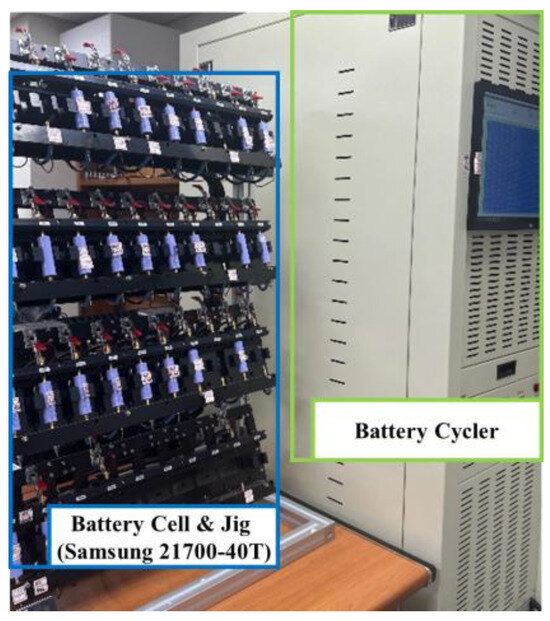
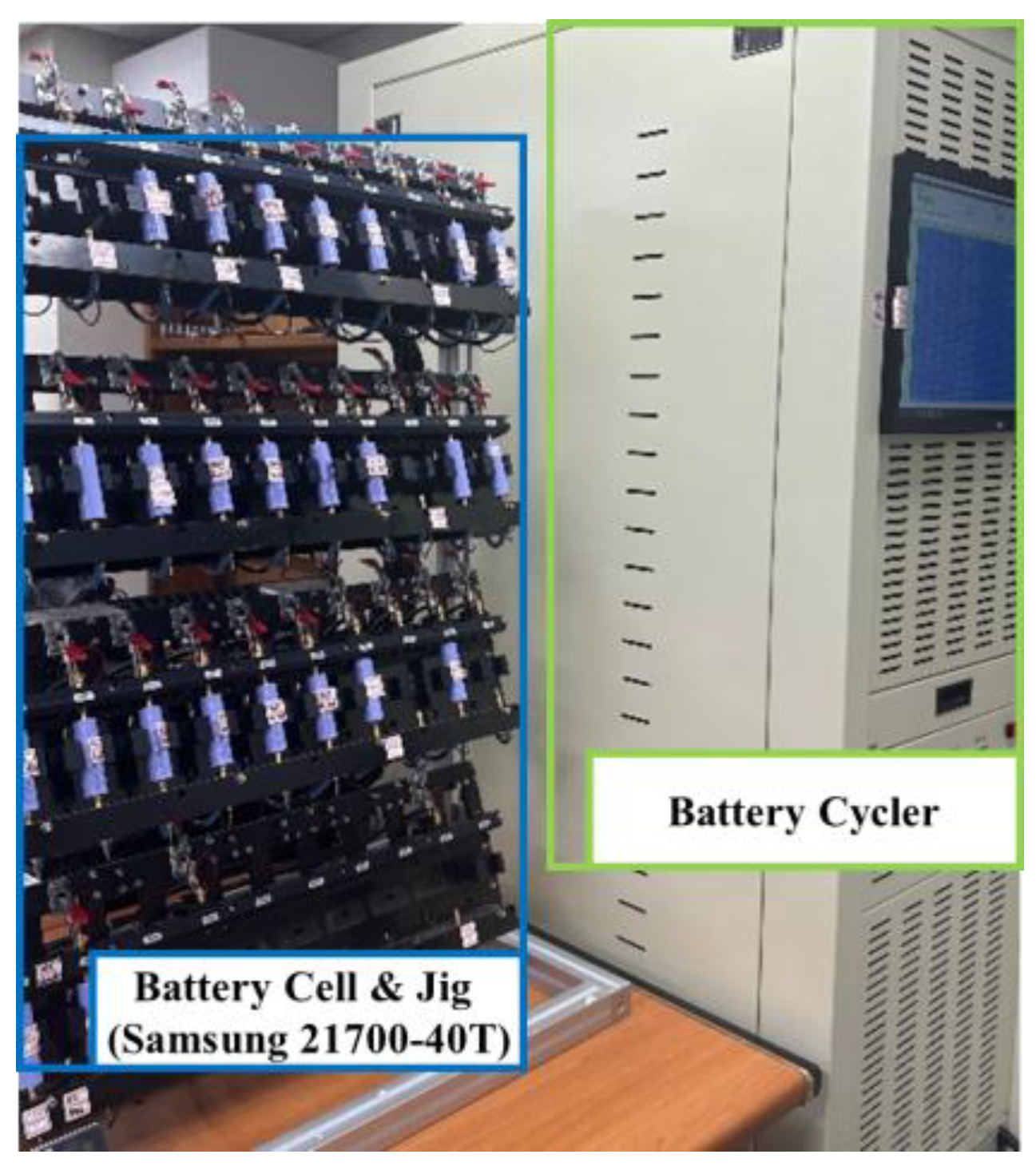
Figure 1 shows the experimental setup (APRO Co. Ltd., Anyang, Republic of Korea) used to perform partial discharge tests for ECM parameter identification. Partial discharge tests were designed to separate the instantaneous ohmic voltage drop from the slower polarization voltage dynamics, enabling reliable identification of the ohmic resistance and RC parameters. The ECM developed in this study is based on a commercial cylindrical lithium-ion battery cell, Samsung SDI INR21700-40T (Samsung SDI Co. Ltd., Yongin, Republic of Korea). The key specifications of the battery cell are summarized in Table 1 [28].
Figure 1.
Experimental setup.
Table 1.
Specifications of Samsung SDI INR21700-40T lithium-ion battery.
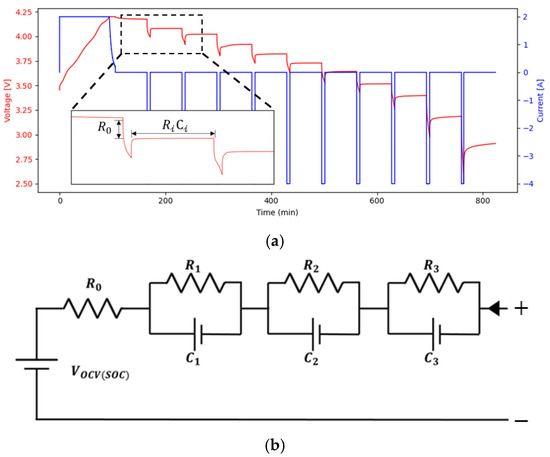
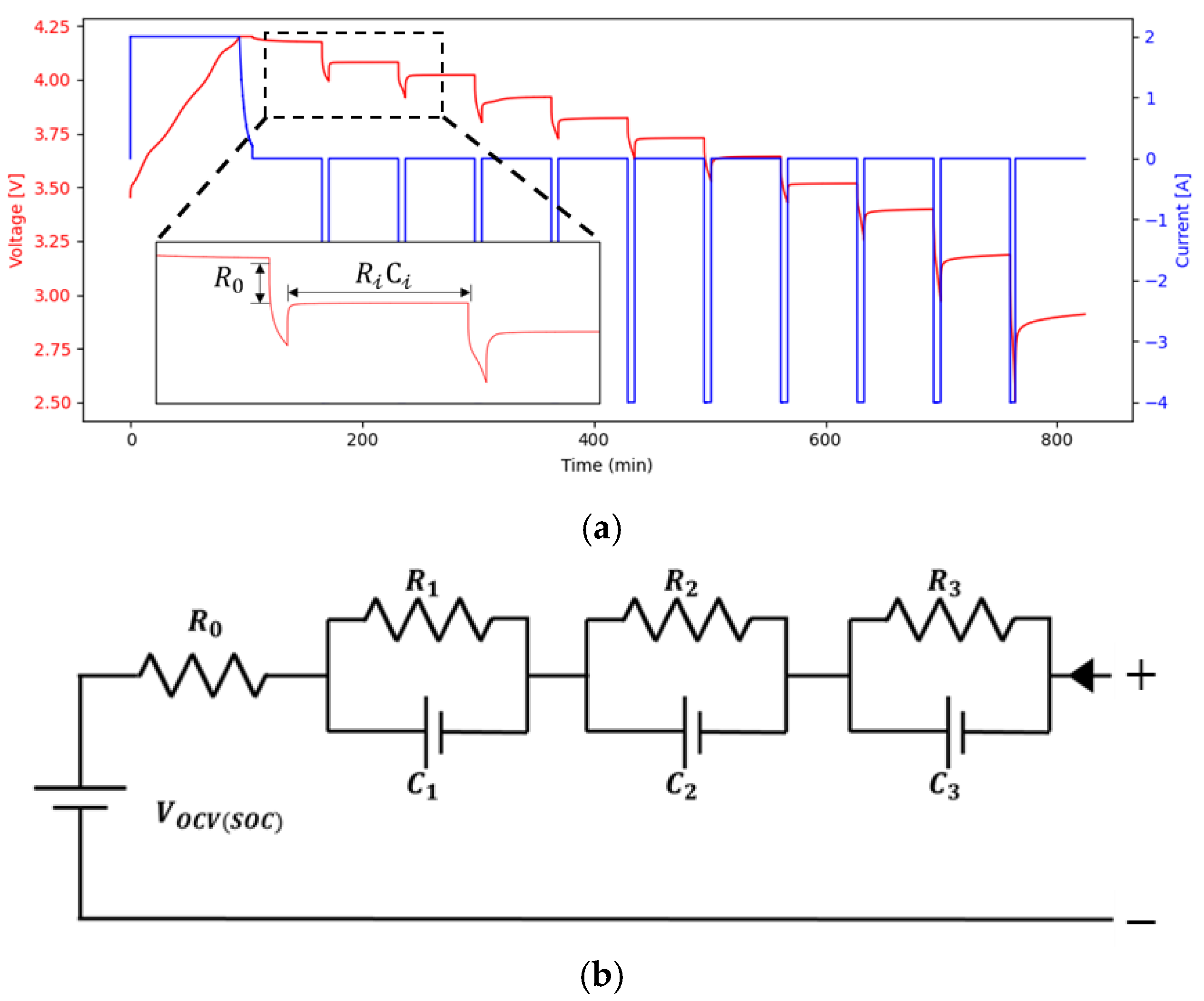
Figure 2 presents the pulse-discharge response and the ECM used for ECM parameter identification. Figure 2a shows the measured terminal voltage and applied current responses obtained from pulse-discharge experiments conducted on the Samsung SDI INR21700-40T cell. When a current pulse is applied, the terminal voltage exhibits an instantaneous drop followed by a gradual relaxation behavior. The immediate voltage drop at the onset of the current pulse corresponds to the ohmic resistance R0. Subsequently, the terminal voltage continues to decrease gradually during the current pulse and recovers slowly during the rest period, reflecting electrochemical polarization effects represented by the RC networks. As highlighted in the enlarged region of Figure 2a, the separation between the instantaneous ohmic voltage drop and the slower polarization-related voltage relaxation enables clear physical interpretation and reliable identification of the ECM parameters. Figure 2b illustrates the third-order RC ECM adopted in this study. The model consists of an SOC-dependent OCV source, an ohmic resistance R0, and three parallel RC branches connected in series. The ohmic resistance represents the instantaneous voltage response, whereas the RC branches describe the transient polarization dynamics with different time constants. Therefore, the pulse-response characteristics shown in Figure 2a provide the experimental basis for identifying the model parameters of the ECM shown in Figure 2b [7,24].
Figure 2.
Pulse current response of terminal voltage for ECM parameter identification. (a) RC parameter extraction and (b) third-order RC model diagram.
Accurate identification of both the ohmic resistance and RC parameters is critical for model-based SOC estimation. In Kalman filter–based algorithms, the terminal voltage is used as a measurement to correct the predicted SOC. Therefore, inaccuracies in R0 or RC parameters can lead to voltage prediction errors that may be incorrectly interpreted as SOC estimation errors, particularly under dynamic operating conditions with frequent current variations [29].
2.2. Aging Dependent Model Identification
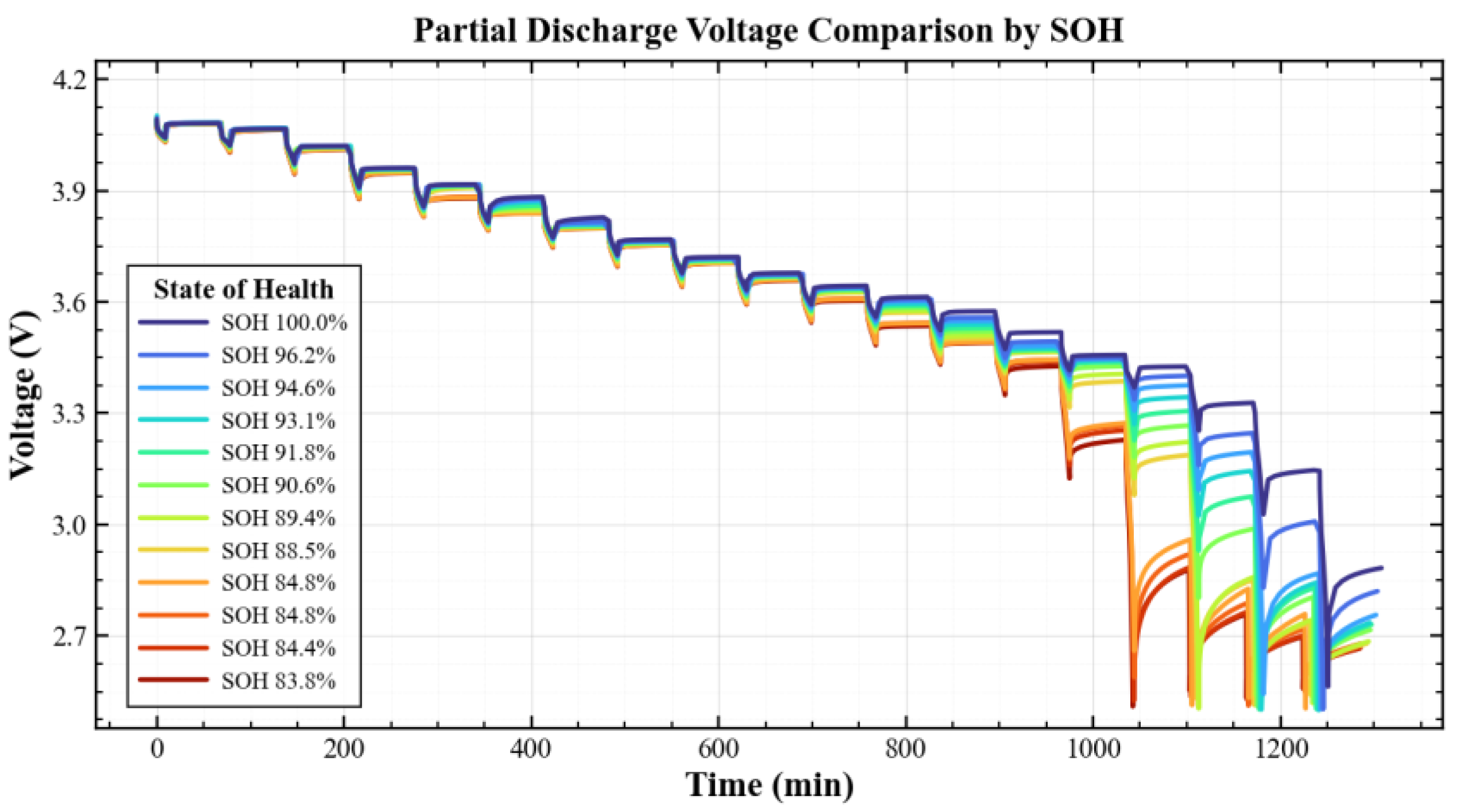
As the battery ages, the voltage response to identical current excitation conditions exhibits distinct changes in both the instantaneous voltage drop and subsequent recovery behavior.
Figure 3 compares the terminal voltage responses obtained from partial discharge experiments conducted at different SOH. Specifically, as SOH decreases, the voltage drop increases and the voltage recovery rate slows, indicating increased ohmic resistance and enhanced polarization effects.
Figure 3.
Partial discharge voltage comparison at each SOH level under 1 C-rate, 3 min discharge cycles.
These SOH-dependent voltage characteristics directly reflect variations in the ECM parameters. Based on the partial discharge voltage responses shown in Figure 3, the ECM parameters were systematically identified and updated for each SOH level. By explicitly incorporating SOH-dependent variations in ECM parameters, the proposed model is able to reflect aging-induced changes in battery electrical behavior more accurately [30].
This SOH-dependent ECM formulation provides an important foundation for the advanced approach for SOC estimation in consideration of battery aging developed in this study. Without reflecting such aging effects, fixed-parameter models may lead to voltage prediction errors that accumulate into SOC estimation errors over long-term operation.
3. Extended Kalman Filter-Based SOC Estimation
The SOC of a lithium-ion battery is an internal state that cannot be directly measured and must therefore be estimated using measurable electrical signals such as current and terminal voltage. In this study, an EKF-based estimation algorithm is employed to accurately estimate the SOC by combining a physics-based battery model with real-time measurement information. The proposed approach accounts for the nonlinear voltage characteristics and dynamic behavior of the battery, enabling robust SOC estimation under practical operating conditions [23,24].
3.1. State Vector Definition and Nonlinear System Model
The EKF formulation is based on the ECM introduced in the previous section. The system state vector is defined to include the SOC and the internal voltage states associated with the polarization effects of the battery, and is expressed as Equation (3):
where SOCk denotes the SOC at time step k, V1,k, V2,k, and V3,k represent the polarization voltages of the RC branches, and Vh,k denotes the hysteresis voltage introduced to model the asymmetric voltage behavior during charge and discharge.
In this study, discharge current was defined as positive, and charge current was defined as negative. Under this convention, a positive current decreases SOC in the Coulomb-counting and EKF prediction equations, while the current sign determines the direction of hysteresis-state evolution. The time evolution of the SOC is governed by the CC principle and is expressed as Equation (4):
where ∆t is the sampling interval, and Q is the effective battery capacity. The dynamic behavior of the polarization voltage is described using a first-order discrete-time equation, as in Equation (5) derived from the ECM [7,9]:
where τi = RiCi denotes the time constant of the i-th RC branch. To account for the asymmetric voltage response during charge and discharge, a hysteresis state is incorporated. The hysteresis dynamics are modeled as Equations (6) and (7):
With
where Qh denotes the hysteresis capacity parameter controlling the rate at which the hysteresis state converges [30]. In this study, the hysteresis term was introduced as an auxiliary voltage state to represent the charge/discharge path-dependent voltage offset in a simplified manner. The hysteresis-related parameters were not included in the SOH-dependent parameter scheduling. Instead, they were selected as fixed tuning parameters based on preliminary voltage-response checks and kept constant for all SOH stages. Therefore, the aging-dependent parameter scheduling in this work was limited to the effective capacity, SOC–OCV relationship, and RC parameters. Although the hysteresis state evolves according to the current direction during EKF calculation, separate hysteresis parameter sets for charge and discharge paths were not identified in this study.
3.2. Measurement Model and EKF Update
In the proposed EKF SOC estimation, the terminal voltage of the battery is utilized as the measurement for state estimation. The terminal voltage is expressed as a nonlinear function of the state variables, including the SOC, polarization voltages, and the hysteresis voltage component, as shown in Equation (8):
where OCV(SOCk) denotes the OCV obtained from the experimentally identified SOC–OCV relationship; R0 is the ohmic resistance; and Vi,k (i = 1, 2, 3) represent the polarization voltages of the RC branches. The term Vh,k corresponds to the hysteresis voltage component introduced to capture the asymmetric voltage behavior during charge and discharge processes.
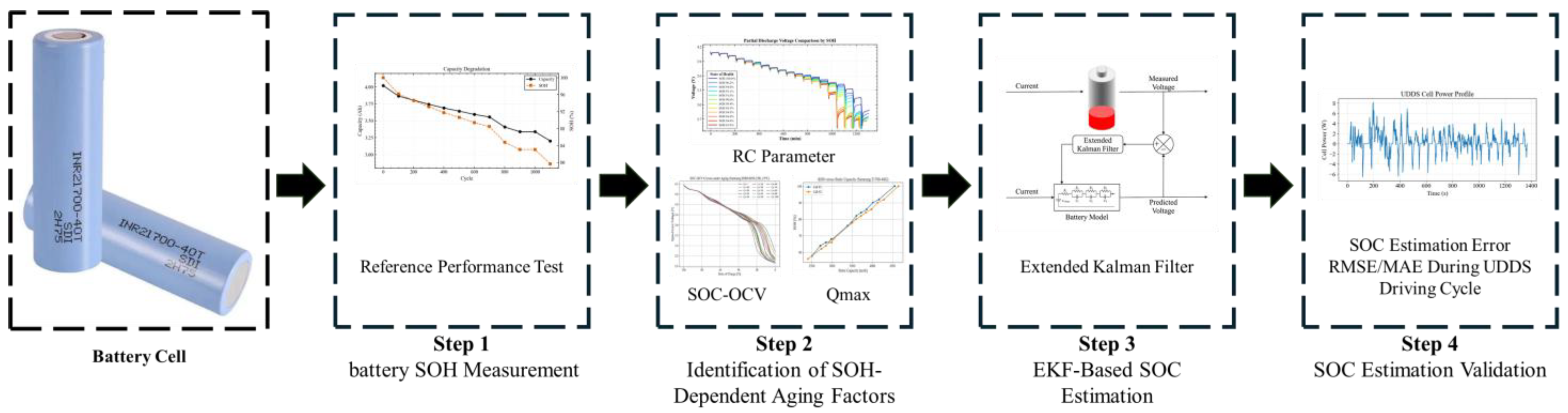
Equation (8) is nonlinear with respect to the state variables because the OCV depends nonlinearly on the SOC. Therefore, the EKF is used to estimate the system state. In the EKF framework, the predicted terminal voltage is compared with the measured voltage to generate an innovation term, which is used to update the state estimate and error covariance. This recursive correction process enables robust SOC estimation under dynamic operating conditions and measurement noise. The overall framework in which this EKF-based SOC estimation structure and the static capacity identified according to the SOH of the battery cell, RC parameters, and SOC–OCV characteristics are reflected in the EKF model is schematically illustrated in Figure 4. In the present implementation, aging-dependent parameters are implemented using SOH-indexed lookup tables rather than fitted empirical functions. For each measured SOH stage, the effective capacity was directly assigned from the measured discharge capacity. The SOC–OCV relationship was stored as a lookup table and linearly interpolated with respect to the estimated SOC. The RC parameters were also stored as SOC-dependent lookup tables for each SOH stage and linearly interpolated during EKF operation. Thus, within a given SOH stage, the parameter set corresponding to the measured SOH was selected, while the SOC-dependent OCV and RC parameter values were updated at each sampling step according to the estimated SOC. It should be noted that the proposed framework does not perform online parameter identification or joint SOC–SOH estimation. The term “aging-aware” refers to the use of offline-identified SOH-indexed parameter sets within the EKF-based SOC estimator. Thus, the present implementation is more precisely described as SOH-scheduled EKF-based SOC estimation rather than an online adaptive parameter-estimation framework. In each sampling step, the EKF first predicts the SOC, RC polarization voltages, and hysteresis voltage using the selected SOH-indexed parameter set and then predicts the terminal voltage from the nonlinear measurement equation. The voltage residual between the measured and predicted terminal voltages is subsequently used to calculate the Kalman gain and update the state vector and covariance matrix. In the present EKF implementation, the initial SOC was prescribed as the starting value for each cycle-specific dataset, while the RC polarization voltages and hysteresis voltage state were initialized to zero. The EKF algorithm and post-processing analysis were implemented in Python 3.9.6.
Figure 4.
Framework of the advanced approach for SOC estimation in consideration of battery aging.
4. Experiments for Validation
To validate the proposed approach, a series of experiments was designed to obtain all datasets required for the proposed methodology, including effective capacity, dynamic voltage response, SOC–OCV characteristics, and aging-dependent voltage behavior. All experiments were conducted using a commercial cylindrical lithium-ion cell, Samsung SDI INR21700-40T, under controlled laboratory conditions. Two Samsung SDI INR21700-40T cylindrical cells were used in this study. Before the aging and validation experiments, the cells were checked using the same initial charge–rest–discharge capacity measurement procedure to confirm a normal voltage response and capacity consistency. Because the sample size was limited, the present results should be interpreted as a controlled experimental validation of the proposed aging-aware EKF framework rather than a statistical cell-to-cell variability study.
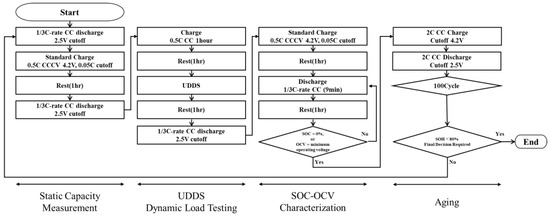
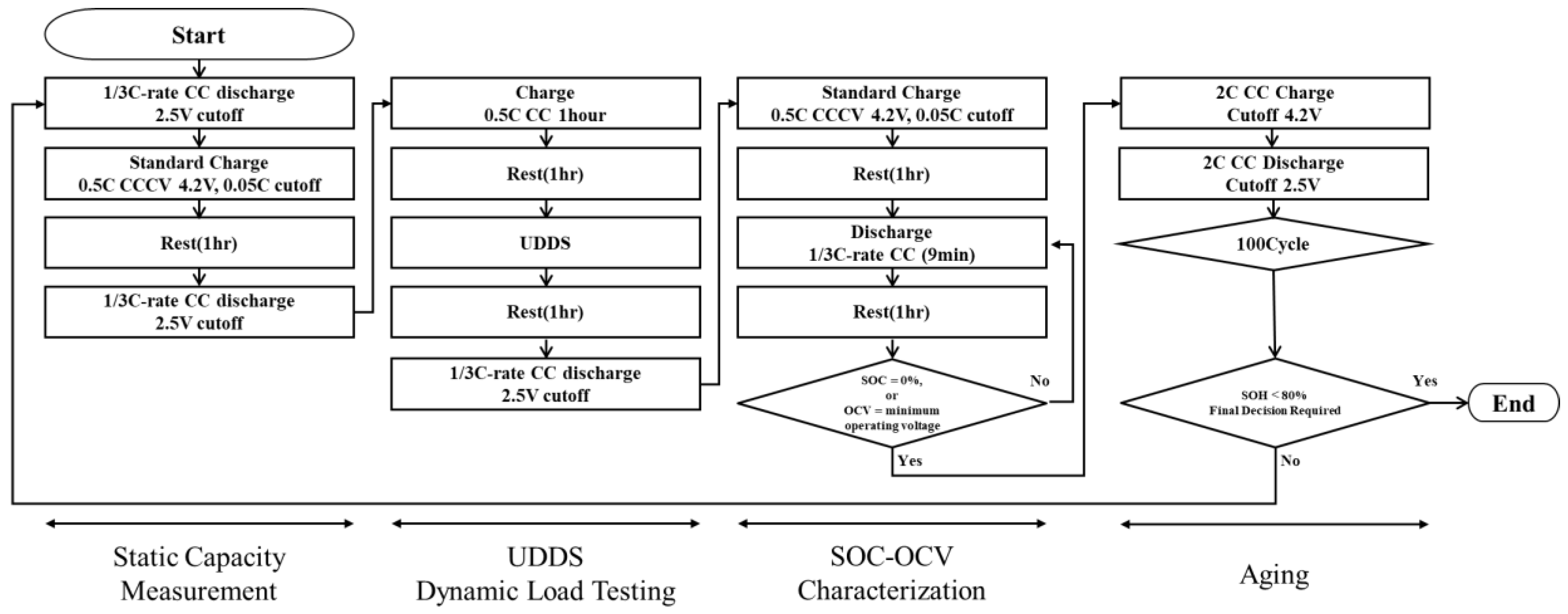
All tests were performed at an ambient temperature of 25 ± 3 °C to minimize thermal effects on battery behavior. This controlled condition was selected to isolate the effect of aging-dependent parameter updating on SOC estimation performance, rather than to evaluate the sensitivity of the proposed method to all possible operating conditions. The overall experimental schedule consists of four main stages: SOH evaluation through rated capacity measurement, UDDS-based dynamic load testing, SOC–OCV characterization, and aging cycling, as summarized in Figure 5.
Figure 5.
Overall experimental schedule.
4.1. Static Capacity Measurement
To evaluate the initial performance of the cell and to quantify SOH at each aging stage, rated capacity measurements were conducted in accordance with the international standard IEC 62660-3 [31]. This standard defines the test conditions required to obtain reproducible and reliable capacity values for lithium-ion cells.
Prior to capacity measurement, the cell was fully charged using a 0.5 C constant-current and constant-voltage (CC–CV) protocol. The charging current was set to 0.5 C until the terminal voltage reached 4.2 V, followed by CV charging until the current decreased below 0.05 C. After charging, the cell was rested for 1 h to ensure electrochemical stabilization.
Discharge was then performed under a 1/3 C CC condition with a cutoff voltage of 2.5 V. The discharged capacity was calculated by integrating the measured current over time and was defined as the rated capacity. The capacity measured in the initial, fresh state was defined as Qmax, and the discharge capacity measured after each aging interval was denoted as Qmeasured. The SOH at each aging stage was then calculated using Equation (9):
The measured discharge capacity was used to calculate the reference SOH at each aging stage. In this study, SOH was not estimated online; instead, it was obtained from laboratory-based low-current full-discharge capacity measurements to provide a reliable reference aging index. This reference SOH was then used to select the corresponding effective capacity, SOC–OCV table, and RC parameter set applied in the EKF framework.
4.2. UDDS Dynamic Load Testing
To evaluate the SOC estimation performance of the proposed approach with a real-world driving condition, we conducted dynamic current-load experiments at the cell level based on the Urban Dynamometer Driving Schedule (UDDS).
The UDDS driving cycle was scaled to the single-cell level, considering the typical EV battery pack architecture, which is widely known to utilize cylindrical lithium-ion cells. Based on these assumptions, the pack-level power demand of the UDDS cycle was converted to an equivalent current profile for a single Samsung SDI INR21700-40T cell. This scaling process enabled realistic and practical cell-level SOC estimation under dynamic driving conditions while maintaining consistency with actual EV operation.
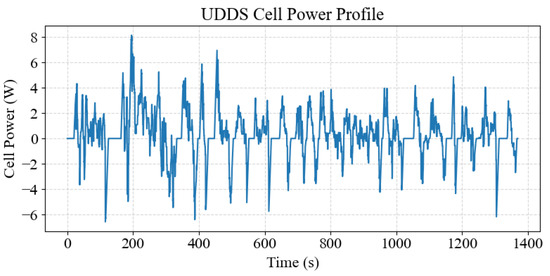
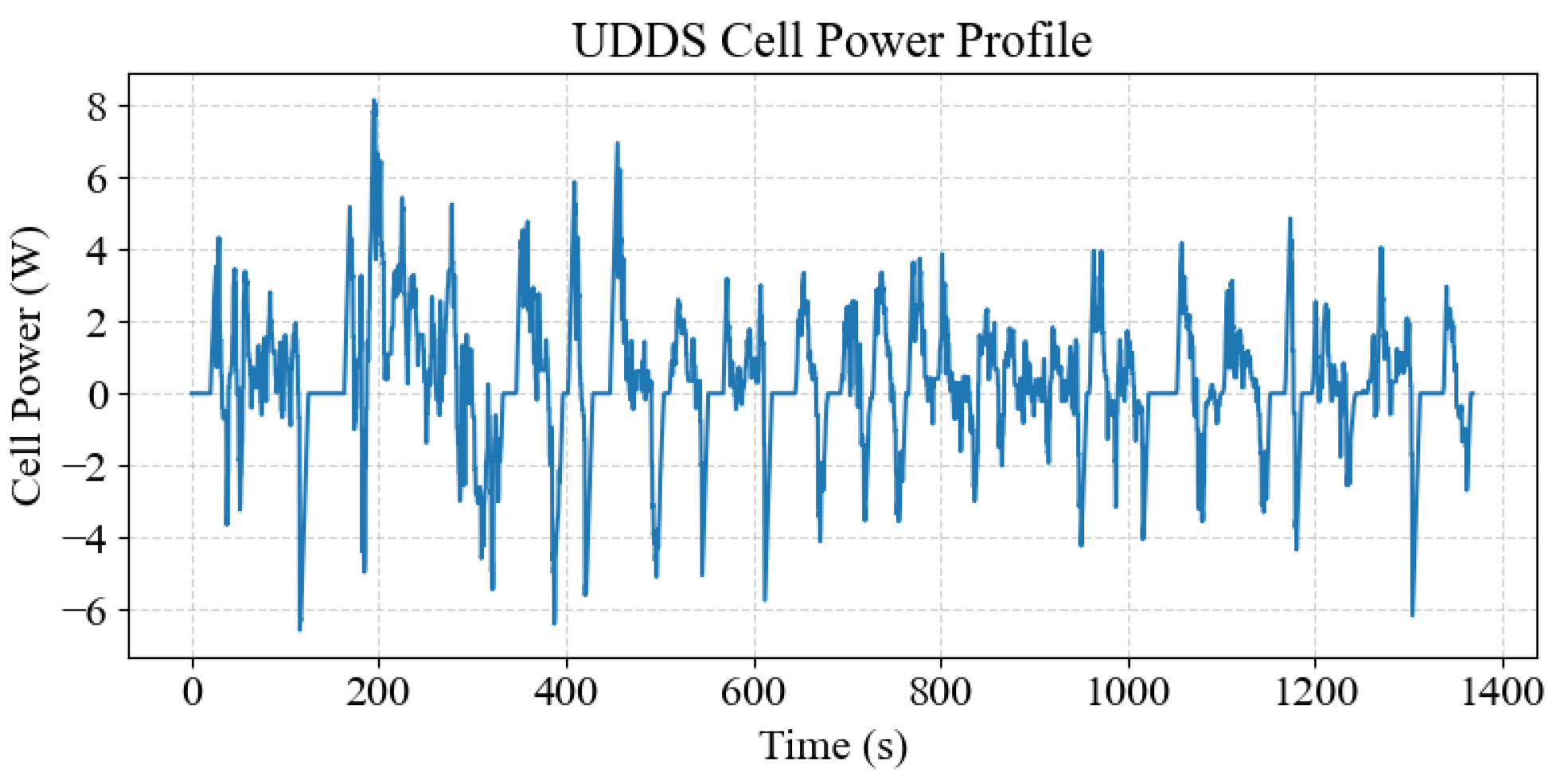
During the UDDS experiment, the scaled current profile was applied to the cells, and the resulting terminal voltage and current responses were measured in real time. The instantaneous cell power was calculated using the measured voltage and current, as shown in Figure 6. The resulting power profiles exhibit frequent charge–discharge transitions, regenerative braking, and rapid load fluctuations, which closely resemble real-world urban driving conditions.
Figure 6.
Cell power under the UDDS driving cycle.
This UDDS-based dynamic load dataset was used to validate the robustness and accuracy of the proposed EKF-based SOC estimation algorithm under highly dynamic operating conditions. Specifically, these experiments demonstrate that the proposed SOC estimator maintains stable convergence and high accuracy despite rapid current fluctuations, voltage transients, and nonlinear battery behavior.
All UDDS experiments were conducted within the cell’s allowable operating voltage range (2.5–4.2 V), ensuring consistency with the battery specifications and preventing further performance degradation during testing. For all validation experiments, including UDDS dynamic load testing and aging-stage measurements, voltage and current data were collected at a sampling interval of 0.2 s.
4.3. SOC–OCV Characterization
Accurate SOC–OCV characteristics are essential for EKF-based SOC estimation, as the OCV explicitly appears in the voltage measurement equation given in Equation (8). To obtain reliable SOC–OCV data under electrochemical equilibrium conditions, partial discharge experiments were conducted. The cell was first fully charged to 4.2 V using a 0.5 C constant-current/constant-voltage (CV) protocol and rested until the terminal voltage stabilized. Partial discharge was then performed under a 1/3 C-rate constant-current condition. At every 5% SOC decrement, the discharge current was interrupted, and the cell was rested for approximately 1 h to eliminate transient polarization effects. The stabilized terminal voltage after each rest period was recorded as the OCV.
This stepwise partial-discharge procedure was repeated sequentially from SOC 100% down to SOC 0%, resulting in OCV measurements at 21 discrete SOC points (0%, 5%, …, 100%). To account for aging effects, SOC–OCV measurements were repeated at different SOH levels, since battery aging alters the OCV–SOC relationship. During SOC estimation, the measured SOC–OCV data were stored as lookup tables, and the interpolated OCV value corresponding to the estimated SOC was directly applied to the OCV(SOCk) term in the voltage measurement equation given in Equation (8). By applying the SOC–OCV table corresponding to the current SOH, aging-induced variations in voltage characteristics are explicitly reflected in the EKF measurement model. The same table-based implementation was also used for the RC parameters. For each SOH stage, the identified RC parameters were arranged as SOC-dependent tables and linearly interpolated using the estimated SOC during EKF calculation. Therefore, both SOC–OCV characteristics and RC parameters were updated through lookup-table selection according to SOH and linear interpolation according to SOC. In the present implementation, interpolation between adjacent SOH levels was not performed; instead, the SOC–OCV table corresponding to the measured SOH stage was selected, and the OCV value within that table was linearly interpolated with respect to the estimated SOC during EKF operation. The SOC–OCV characterization data and controlled current–voltage response data were used for ECM parameter identification and lookup-table construction at each aging stage. The UDDS dynamic-load data were used only for independent validation of the SOC and voltage estimation performance. The UDDS validation interval was not used as a fitting interval for ECM parameter identification or for post hoc tuning of the EKF parameters. Thus, the validation results evaluate the predictive performance of the identified aging-aware ECM and EKF under a dynamic load profile that was not used during parameter identification.
4.4. Cycle Test for Aging
Aging experiments were conducted to obtain voltage and current responses under progressive battery degradation and to validate the robustness of the EKF-based SOC estimator under aging conditions. The aging protocol consisted of repeated high-rate charge and discharge cycles. Charging was performed at 2 C under a constant-current condition to 4.2 V, and discharging was performed at 2 C under a constant-current condition to 2.5 V. One charge–discharge cycle was defined as one aging cycle. Cell condition was monitored at intervals of 100 cycles. At the end of each 100-cycle interval, rated capacity measurements were repeated following the IEC 62660-3 procedure to update SOH values. The aging test range was defined from SOH 100% to SOH 80%. The voltage and current data collected at each aging stage were combined with previously identified ECM parameters and SOC–OCV data to evaluate the robustness of the proposed EKF-based SOC estimation algorithm to aging. In the present experimental implementation, the aging-dependent parameter set was updated on a stage-wise basis according to the measured SOH obtained at each 100-cycle interval. Therefore, the effective capacity, SOC–OCV table, and RC parameter set used in the EKF were fixed within each aging stage. During EKF calculation, however, the SOC-dependent OCV and RC parameter values were updated at every sampling step through linear interpolation based on the estimated SOC.
5. Results and Analysis
5.1. Evaluation of SOC Estimation Performance
The SOC estimation performance of the proposed EKF was evaluated by comparison with CC, which is widely used as a baseline SOC estimation method in practical BMS. In this study, CC was used as a reference rather than a ground-truth SOC, and the difference between the SOC estimated by the EKF and CC was used to quantitatively evaluate the effectiveness of voltage-based correction. To assess the SOC estimation accuracy, two error indices were employed. The first is the Root Mean Square Error (RMSE), defined as Equation (10):
RMSE is sensitive to large estimation errors and is suitable for evaluating the stability of the EKF under dynamic operating conditions, such as the UDDS driving cycle. The second is the Mean Absolute Error (MAE), defined as Equation (11):
MAE provides an intuitive measure of the average SOC deviation between the EKF and CC over the entire operating period. Both RMSE and MAE were used together to evaluate the overall accuracy and robustness of the proposed EKF-based SOC estimation method. In addition to SOC-based error metrics, voltage prediction accuracy was also evaluated to further assess the performance of the EKF. Since the EKF estimates SOC by correcting the predicted state using terminal voltage measurements, accurate reproduction of the terminal voltage is a critical prerequisite for reliable SOC estimation. Therefore, the difference between the measured terminal voltage and the voltage predicted by the EKF-based model was analyzed as a supplementary validation metric. The voltage estimation error reflects the consistency between the ECM, the identified aging-dependent parameters, and the EKF state estimation process. To quantitatively evaluate the voltage prediction accuracy, the RMSE of the terminal voltage was defined as Equation (12):
where VEKF (k) and VTerminal (k) denote the estimated and measured terminal voltages at time step k, respectively, and N represents the total number of samples. The voltage RMSE is sensitive to large prediction errors and is particularly effective for evaluating model fidelity under highly dynamic operating conditions such as the UDDS driving cycle. In addition, the MAE of the terminal voltage was employed to assess the average magnitude of voltage deviation and is defined as Equation (13):
Under dynamic operating conditions such as the UDDS driving cycle, mismatches in model parameters or SOC–OCV characteristics can lead to voltage prediction errors, which may subsequently propagate into SOC estimation errors through the Kalman correction step. By comparing the measured and estimated terminal voltages using the above error metrics, the adequacy of the model parameters, including their consideration of aging and their impacts on EKF performance, can be indirectly evaluated. This voltage-based evaluation complements the SOC error analysis by providing insight into whether SOC estimation errors originate from current-integration drift, voltage-model mismatch, or insufficient correction gain. Consequently, the combined use of SOC-based error indices (RMSE and MAE) and voltage prediction accuracy enables a more comprehensive assessment of the robustness and physical consistency of the proposed EKF-based SOC estimation framework. The SOC errors in Table 2 do not show a monotonic increase with aging. This is because the EKF error is governed not only by the SOH level, but also by the agreement between the measured voltage response and the SOH-scheduled model parameters at each aging stage. Factors such as the SOC operating range, the local SOC–OCV slope, voltage residual, and Kalman correction behavior can affect the final SOC error. Therefore, the lower errors observed at some intermediate SOH levels should not be interpreted as an improvement in the intrinsic battery condition. Instead, they indicate that the model–measurement mismatch was smaller under those specific evaluation conditions. The voltage RMSE values in Table 2 show a similar tendency, supporting this interpretation.
Table 2.
SOC and voltage estimation errors of the advanced approach for SOC estimation in consideration of battery aging under different conditions.
5.2. Performance of the Advanced Approach for SOC Estimation in Consideration of Battery Aging at SOH 80%
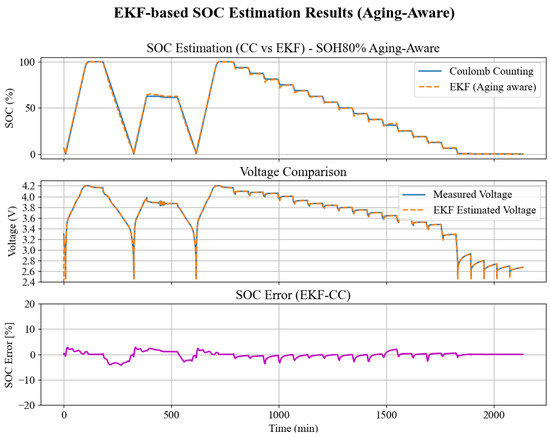
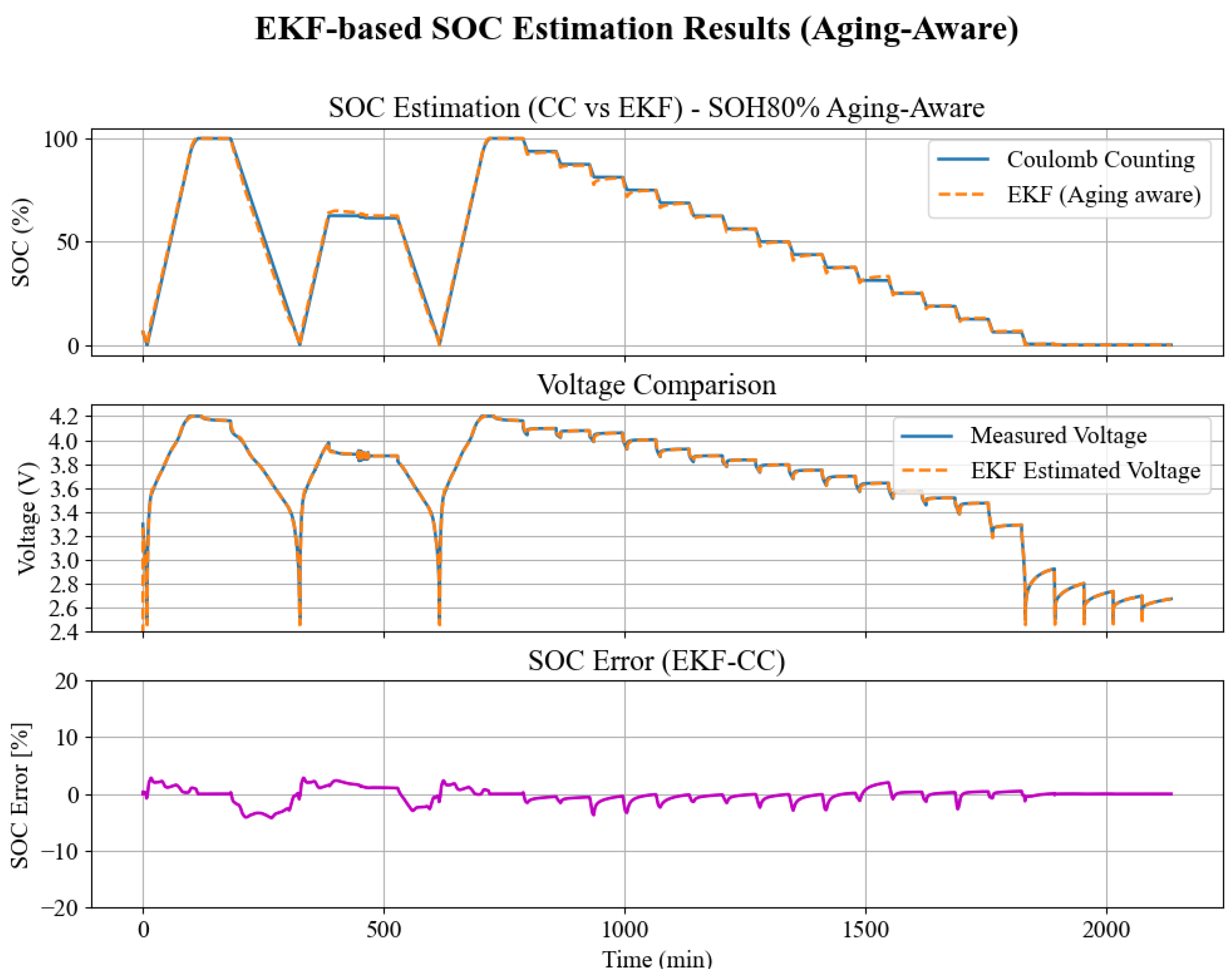
Figure 7 illustrates the SOC estimation results for an aged battery at SOH 80%, where aging-dependent parameters were explicitly applied in the proposed EKF. The EKF-based SOC closely follows the CC reference throughout the entire operating range, including dynamic charge–discharge transitions and long-duration discharge phases. This result confirms that the proposed EKF maintains stable SOC tracking performance even under severe aging conditions.
Figure 7.
SOC estimation performance at SOH 80% using EKF compared with Coulomb counting.
As summarized in Table 2, at SOH 80%, the advanced approach achieves an SOC RMSE of 1.27% and an MAE of 0.85%. Despite significant capacity reduction and increased internal resistance associated with battery aging, the SOC estimation error remains within a narrow range, demonstrating the effectiveness of incorporating aging-dependent capacity, RC parameters, and SOC–OCV characteristics into the EKF framework.
The corresponding voltage estimation errors at SOH 80% are also notably small, with an RMSE of 9.14 mV and an MAE of 3.89 mV, indicating accurate voltage prediction by the aging-adaptive ECM. This accurate voltage modeling directly contributes to effective voltage-based correction in the EKF, preventing long-term SOC drift that commonly occurs in current-integration-based methods. These results clearly demonstrate that the proposed EKF, when applied to an aged battery at SOH 80%, can effectively compensate for degradation-induced modeling errors and maintain reliable SOC estimation accuracy under practical operating conditions.
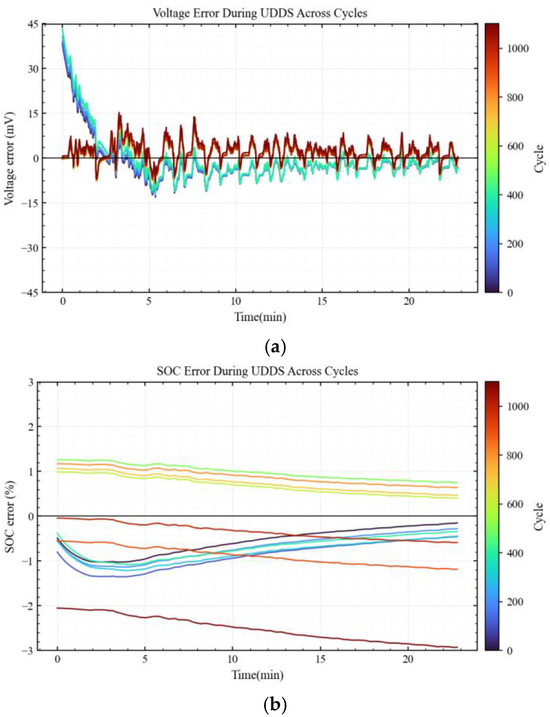
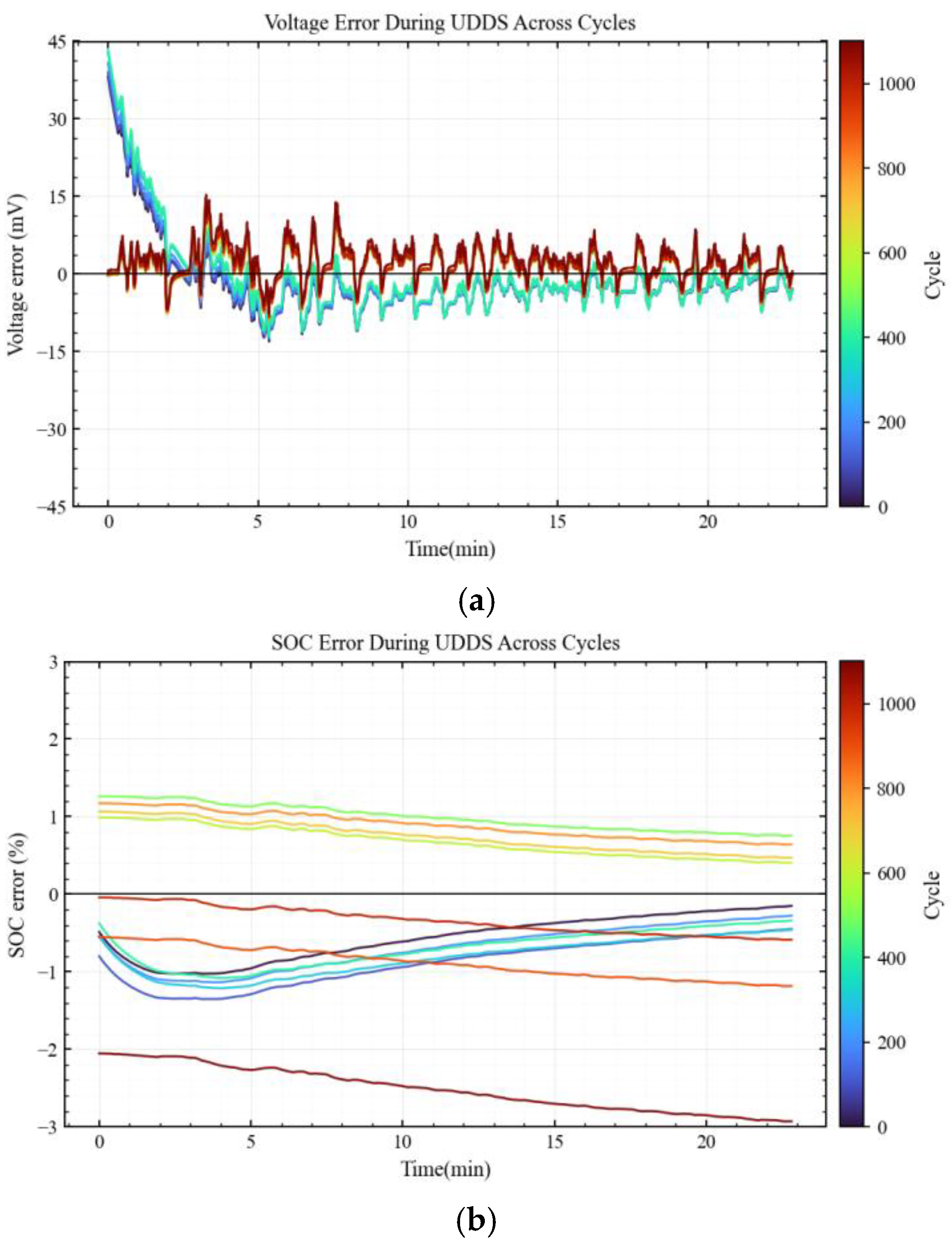
To further complement the quantitative results summarized in Table 2, Figure 8 presents the time-resolved voltage and SOC estimation errors during the UDDS-based validation across aging cycles. The voltage error was calculated as the difference between the EKF-estimated terminal voltage and the measured terminal voltage, whereas the SOC error was calculated as the difference between the EKF-estimated SOC and the Coulomb-counting reference SOC. The color scale represents the aging cycle number. As shown in Figure 8a, the voltage error remains generally bounded over the UDDS interval, although relatively larger deviations appear near the initial transient and rapid current-transition regions. Figure 8b shows that the SOC estimation error also remains within a limited range across the investigated aging cycles. These results support the quantitative error metrics in Table 2 and provide additional insight into when the main estimation deviations occur during the UDDS-based dynamic load condition.
Figure 8.
UDDS-based voltage and SOC estimation errors across aging cycles. Panel (a) shows the voltage estimation error during UDDS validation. Panel (b) shows the SOC estimation error during UDDS validation.
The relatively large voltage error observed in Figure 8a during the initial phase of the UDDS profile, especially for t < 2 min, is mainly attributed to a short transient mismatch between the actual cell state and the initialized EKF internal states. Before the UDDS profile was applied, the cell was adjusted to the target SOC region through controlled-current operation; therefore, residual polarization and relaxation effects from the preceding step may have remained at the beginning of the UDDS segment. Because the EKF polarization and hysteresis-related states were initialized in the model, the sudden transition to the dynamic UDDS current profile temporarily increased the voltage residual, but this error rapidly decreased as the EKF updated the internal states through voltage feedback. In Figure 8b, the SOC error curves may visually appear to form several groups; however, these trends should be interpreted as bounded cycle-dependent variations rather than distinct degradation regimes or persistent estimation failures. The small differences among cycles are associated with initial-state alignment, SOC operating region, local SOC–OCV slope, voltage residual behavior, RC parameter-fitting quality, and Kalman correction characteristics. Overall, the SOC errors remained within a comparable range across the investigated aging cycles, supporting the robustness of the proposed SOH-scheduled EKF framework under the tested UDDS condition.
5.3. Effect of Aging-Dependent Parameter Updating on EKF-Based SOC Estimation Under UDDS Driving Conditions
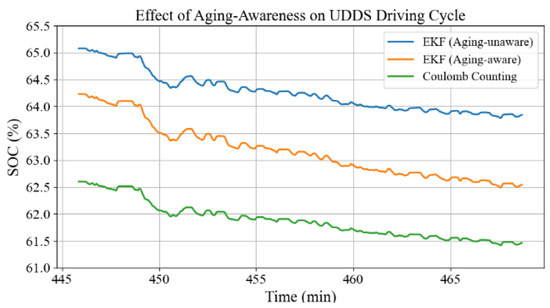
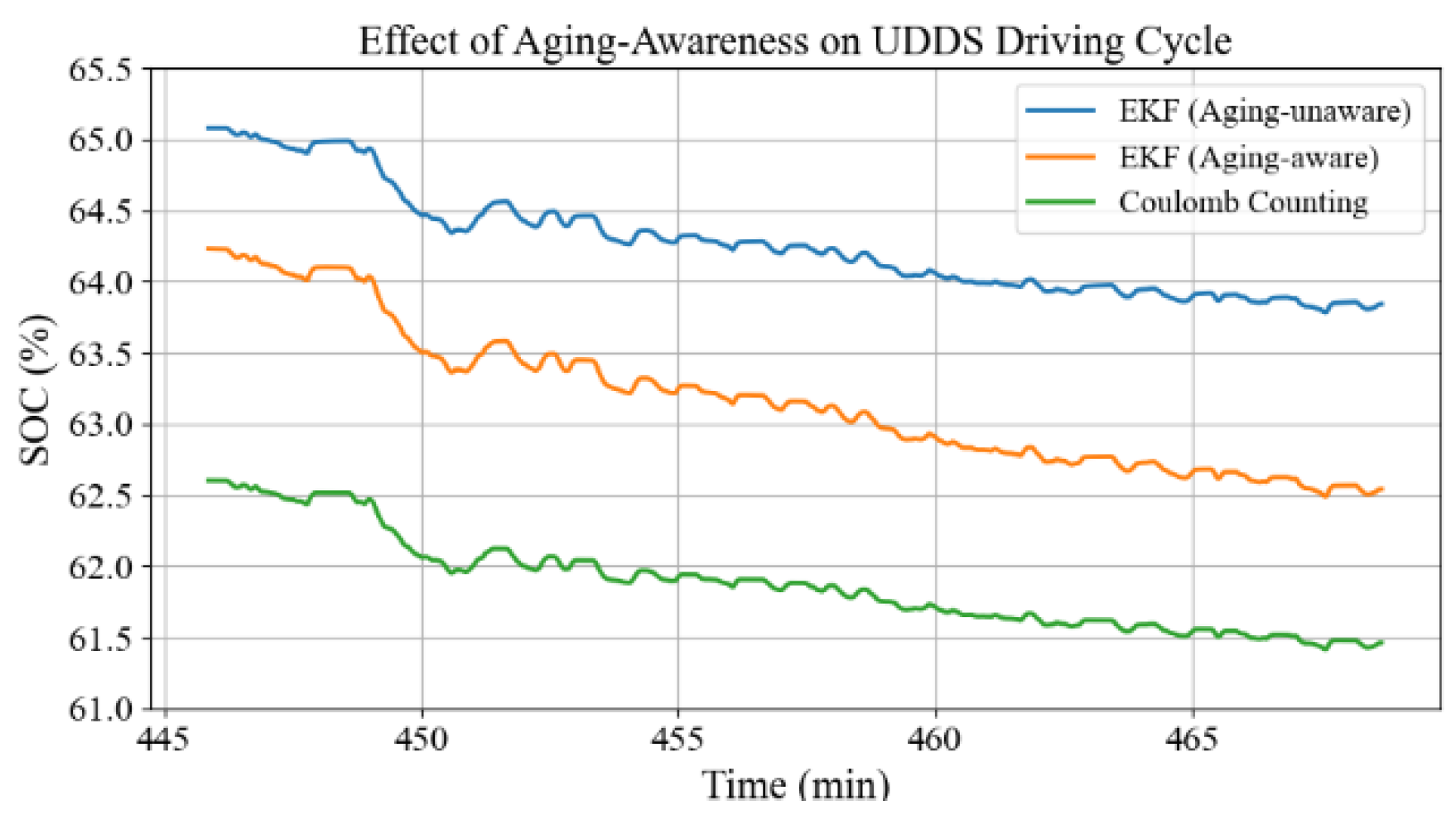
Figure 9 illustrates an enlarged comparison of SOC estimation results under the UDDS driving condition to evaluate the effect of aging-aware parameter application in EKF-based SOC estimation. In this comparison, CC was implemented using the capacity corresponding to the aged cell, while EKF results were obtained with and without aging-aware parameter updates.
Figure 9.
EKF-based SOC estimation under the UDDS driving cycle at SOH 80% with aging awareness.
As shown in Figure 9, noticeable SOC divergence appears after the completion of the UDDS cycle. When aging effects are incorporated into the EKF, the SOC estimated by the EKF remains closely aligned with the CC result, exhibiting an SOC deviation of approximately 1% at the end of the UDDS segment. In contrast, the EKF without aging awareness shows a significantly larger deviation of approximately 3%, despite using the same current profile and voltage measurements.
The quantitative error analysis over the UDDS interval further confirms this trend. The aging-unaware EKF exhibited an SOC estimation error of RMSE 2.3907% and MAE 2.3903%, whereas the proposed aging-aware EKF achieved substantially reduced errors of RMSE 1.3173% and MAE 1.3063%.
These results demonstrate that neglecting aging-induced changes in static capacity and model parameters leads to a systematic bias in SOC estimation under dynamic driving conditions. By contrast, the proposed aging-aware EKF successfully compensates for such effects, maintaining accurate and stable SOC estimation even after aggressive UDDS operation. This comparison highlights the critical importance of incorporating aging information into model-based SOC estimation algorithms for practical EV applications.
5.4. Ablation Analysis of Aging-Related Parameters in EKF-Based SOC Estimation
In contrast to Section V-C, where the complete aging-aware EKF is compared with the aging-unaware EKF under the UDDS driving interval, this section examines the role of each aging-related factor at SOH 80%. To this end, the effective capacity, RC parameters, and SOC–OCV characteristics are selectively replaced with their beginning-of-life values, and the resulting SOC estimation errors are compared. We evaluate the performance of the EKF-based SOC estimation under various aging-aware settings using a lithium-ion battery with an 80% SOH to investigate the relative impact of individual aging factors on SOC estimation accuracy. The aging factors considered include the static capacity (Qmax), ECM RC parameters, and SOC–OCV characteristics. To ensure a fair comparison, the CC method, which uses aged battery capacity, was used as the baseline, and the analysis focused on the UDDS driving section, which represents realistic and highly dynamic operating conditions.
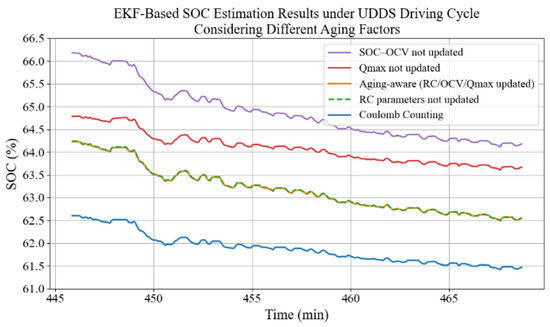
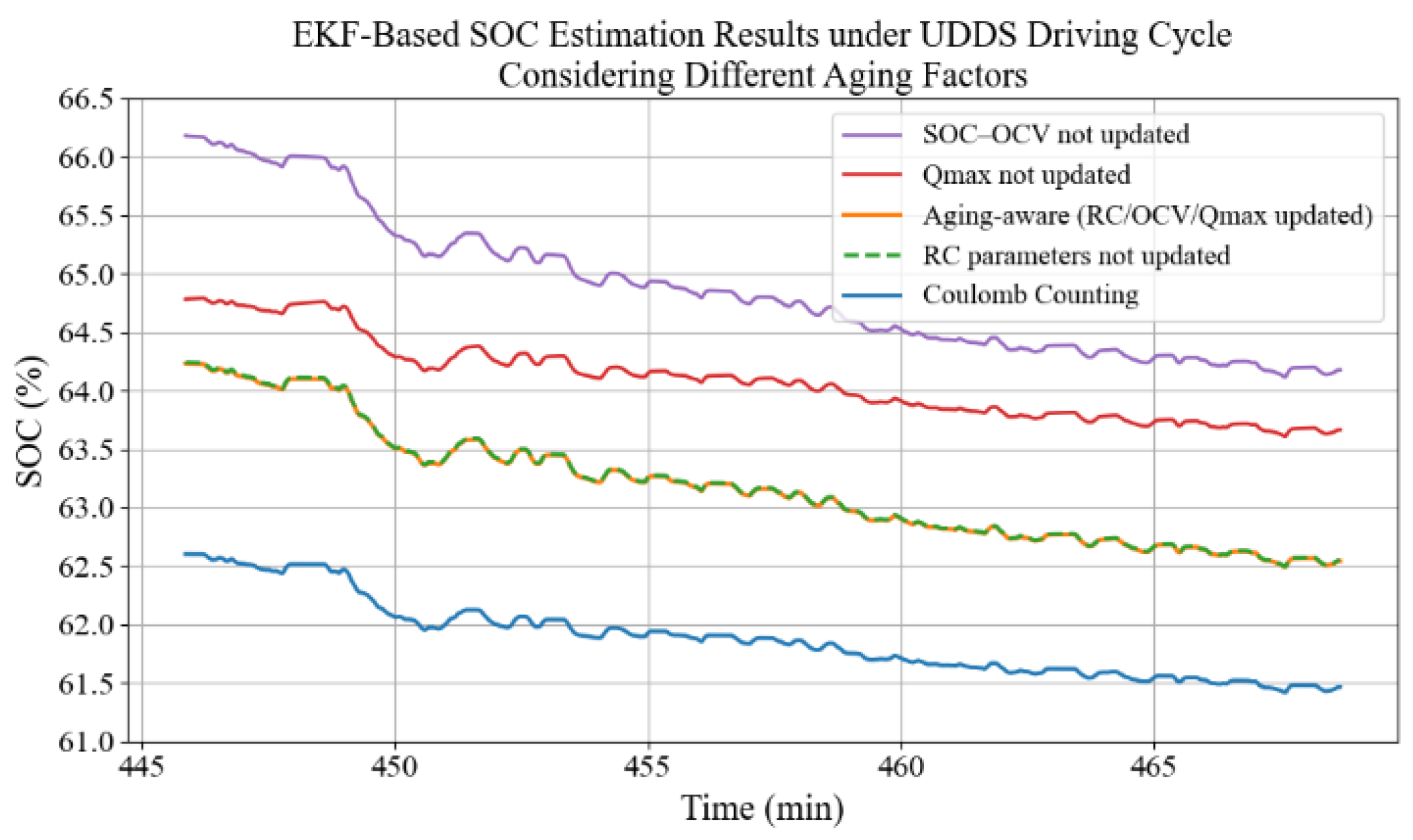
Figure 10 compares SOC estimation results obtained under various aging factor settings during the UDDS driving cycle. The EKF, which fully accounts for aging factors, yields results very similar to the CC baseline, but significant differences occur when certain aging factors are excluded. This qualitative comparison demonstrates how the omission of individual aging-related parameters impacts SOC estimation behavior under dynamic load conditions.
Figure 10.
Effect of individual aging factors on EKF-based SOC estimation under UDDS at SOH 80%.
The quantitative evaluation results are summarized in Table 3, including RMSE and MAE. When the RC parameters were not updated to reflect the aging effect, the SOC estimation error increased slightly to approximately 1.31% RMSE, indicating that aging-induced RC parameter changes had a relatively small impact on SOC accuracy under test conditions. Similarly, when the static capacity Qmax was not updated, the RMSE increased to 2.21%. While still small, this error suggests that ignoring capacity degradation can lead to systematic scaling errors in SOC estimation, especially during long-term operation.
Table 3.
Quantitative comparison of EKF-based SOC estimation errors according to aging factors under UDDS.
On the other hand, when the SOC–OCV characteristic, which takes aging into account, was omitted, the SOC estimation performance degraded the most, with an RMSE of approximately 3.01%. This significant error increase confirms that the SOC–OCV relationship plays a crucial role in voltage-based SOC compensation within the EKF framework. Inaccurate SOC–OCV mapping directly distorts the voltage residual used for state compensation, resulting in significant SOC estimation bias under dynamic driving conditions.
Overall, these results demonstrate that SOC estimation accuracy is not determined by a single aging factor, but rather by the complex interaction of multiple aging-related parameters. While RC parameters primarily influence transient voltage dynamics, and Qmax influences SOC scaling, SOC–OCV characteristics are crucial for determining the effectiveness of voltage-based state compensation. Therefore, reliable SOC estimation in aged batteries requires an approach with comprehensive modeling in consideration of aging that simultaneously considers capacity degradation, parameter changes, and SOC–OCV variations, rather than partial or piecemeal parameter updates. These comparative results can also be interpreted as an indirect sensitivity analysis of SOH estimation error or delayed parameter updating. In practical implementation, if the estimated SOH is inaccurate or parameter updating is delayed, the EKF may use a parameter set that does not correspond to the actual aging state of the battery. Such a mismatch propagates into SOC estimation through different pathways. A mismatch in effective capacity directly affects the SOC prediction step through the Coulomb-counting term. A mismatch in the SOC–OCV table biases the predicted terminal voltage and can distort the voltage residual used for EKF correction. A mismatch in RC parameters mainly affects transient voltage prediction under dynamic current conditions. As shown in Table 3, the SOC–OCV mismatch produced the largest increase in SOC RMSE, followed by the effective-capacity mismatch, whereas the RC-parameter mismatch had a relatively smaller effect under the tested UDDS condition. These results suggest that accurate and timely updates of effective capacity and SOC–OCV characteristics are particularly important when the proposed framework is integrated with an online SOH estimator.
6. Conclusions
In this study, we proposed an advanced approach for SOC estimation that considers battery aging and reflects the aging characteristics of lithium-ion batteries, and we verified its effectiveness and practicality using experimental data. After static capacity measurement, Static capacity, SOC–OCV characteristics, RC parameters, UDDS-based dynamic load responses, and repeated aging-cycle data were systematically obtained at different SOH stages. The core of this study was to verify a structure that explicitly integrates static capacity, SOC–OCV characteristics, and RC parameters corresponding to SOH, as calculated from static capacity measurements, into the SOC estimator. This ensured that the battery’s electrical characteristics in each SOH state were consistently reflected in the SOC state equation and voltage measurement equation.
According to the experimental results, the proposed approach showed excellent performance, maintaining a stable SOC prediction error at an RMSE level of approximately 1% across the entire SOH range. In particular, even at 80% SOH, which corresponds to the end of battery life (EOL), RMSE of 1.27% and MAE of 0.85% were achieved, showing high SOC prediction accuracy even in situations of severe battery aging. This demonstrates that the model effectively mitigates the accumulated SOC error that may occur if it does not account for aging effects, such as effective capacity reduction, changes in the SOC–OCV characteristics, and increased internal resistance.
Furthermore, even under highly dynamic operating conditions with frequent current fluctuations, such as UDDS driving cycles, the EKF with SOH-dependent parameter updates actively utilizes voltage-based correction information to maintain stable SOC prediction performance. Specifically, compared to the EKF without considering aging, the EKF without considering aging increased the SOC error to about 3% at the end of UDDS, while the EKF with SOH-dependent parameter updates controlled the error to about 1%. This experimentally demonstrates that SOH-based model updating plays an important role in improving SOC estimation accuracy in an environment similar to actual EV driving conditions.
In this study, SOH was not estimated online but was calculated from laboratory-based low-current full-discharge capacity measurements. This approach was adopted to provide a reliable reference aging index and to explicitly validate the effect of SOH-dependent parameter updating on the proposed aging-aware SOC estimation architecture. In real EV operation, direct SOH calculation based on complete charge–discharge capacity measurements is difficult because of operational constraints. Therefore, practical implementation of the proposed framework would require the SOH input to be supplied by an external online or rapid SOH estimation module. For example, recent machine-learning-based SOH estimation approaches using short-duration partial charging or discharging data can estimate SOH from limited voltage, current, temperature, and capacity-related features without requiring a complete capacity test [32].
The present study did not benchmark the computation time per EKF update or the memory footprint required for storing SOH-dependent parameter sets on commercial BMS hardware. Since such values depend strongly on the target microcontroller, sampling rate, numerical precision, and software implementation, they should be evaluated in a dedicated embedded implementation study. In addition, temperature-dependent parameter maps were not constructed in this work because the experiments were intentionally conducted at 25 ± 3 °C to isolate the effect of aging-dependent parameter updating. Since battery resistance, polarization behavior, and SOC–OCV characteristics are strongly affected by temperature, future studies should extend the proposed framework by incorporating temperature-dependent parameterization and by validating the algorithm under practical BMS sampling and hardware constraints. In addition, the present validation was conducted at the single-cell level, whereas practical battery modules and packs consist of tens to hundreds of cells connected in series and/or parallel. In such systems, interconnect resistance, contact resistance, busbar resistance, current-distribution nonuniformity, cell-to-cell capacity and resistance variation, and spatial temperature gradients may affect the measured voltage response and estimation accuracy. If the EKF is applied independently to many cells or cell groups, the computational burden would increase with the number of monitored units. Therefore, pack-level implementation may require representative-cell strategies, module-level parameter grouping, reduced-order implementation, lookup-table compression, and optimized embedded scheduling.
In summary, the proposed aging-aware SOC estimation framework demonstrates algorithm-level feasibility and stable estimation performance under the investigated single-cell laboratory conditions, not only in the initial state but also under progressive battery degradation. However, the present validation was conducted under controlled laboratory conditions at 25 ± 3 °C using a single cylindrical cell type. Therefore, the results should be interpreted as a baseline validation of the proposed aging-aware parameter-updating structure rather than as a comprehensive demonstration of applicability under all operating scenarios.
Recent studies have increasingly emphasized online and adaptive ECM-based approaches for addressing aging- and operating-condition-dependent battery behavior. Adaptive piecewise ECM-based SOC/SOH estimation has been proposed to update model parameters in real time using voltage, current, and temperature measurements under different chemistries, duty cycles, temperatures, and aged states [33]. In addition, recent multi-time-scale SOC/SOH estimation research has shown that real-time capacity updating can reduce SOC estimation errors under aging and complex operating conditions [34]. Compared with these approaches, the present study focuses on experimental validation of the SOH-scheduled EKF structure under controlled cell-level conditions. Rather than performing online parameter identification or joint SOC–SOH estimation, this work demonstrates that SOH-dependent effective capacity, SOC–OCV characteristics, and RC parameter sets should be incorporated into the EKF framework to reduce aging-induced SOC estimation errors under UDDS-based dynamic loading.
Future studies should further evaluate the proposed framework under low- and high-temperature conditions, across multiple C-rate profiles, with different rest durations, with initial SOC offset conditions, and across additional cell types. In addition, it would be beneficial to integrate this approach with online SOH estimation techniques to develop an integrated SOC estimation framework that can reliably estimate SOC and SOH simultaneously throughout the battery life cycle.
Author Contributions
Conceptualization, W.C. and J.K.; methodology, W.C. and J.K.; software, J.K.; validation, W.C. and J.K.; formal analysis, W.C., Y.S. and J.K.; investigation, W.C.; resources, W.C.; data curation, J.K. and Y.S.; writing—original draft preparation, J.K.; writing—review and editing, Y.S. and W.C.; visualization, Y.S. and J.K.; supervision, W.C.; project administration, W.C.; funding acquisition, W.C. All authors have read and agreed to the published version of the manuscript.
Funding
This work was supported by the BK21 Four Program (2120240815267) of the National Research Foundation of Korea (NRF), funded by the Ministry of Education, Korea.
Data Availability Statement
The data presented in this study are available upon reasonable request from the corresponding author.
Conflicts of Interest
The authors declare no conflicts of interest. The funders had no role in the design of the study; in the collection, analyses, or interpretation of data; in the writing of the manuscript; or in the decision to publish the results.
Abbreviations
The following abbreviations are used in this manuscript:
| SOC | State of Charge |
| SOH | State of Health |
| BMS | Battery Management System |
| ECM | Equivalent-Circuit Model |
| EKF | Extended Kalman Filter |
| OCV | Open-Circuit Voltage |
| RC | Resistor–Capacitor |
| UDDS | Urban Dynamometer Driving Schedule |
| RMSE | Root Mean Square Error |
| MAE | Mean Absolute Error |
References
- International Energy Agency. Global EV Outlook 2025; IEA: Paris, France, 2025. [Google Scholar]
- International Energy Agency. World Energy Outlook 2024. 16 October 2024. Available online: https://www.iea.org/reports/world-energy-outlook-2024 (accessed on 12 January 2026).
- International Energy Agency. Global Installed Energy Storage Capacity by Scenario; IEA: Paris, France, 2024; Available online: https://www.iea.org/data-and-statistics/charts/global-installed-energy-storage-capacity-by-scenario-2023-and-2030 (accessed on 12 January 2026).
- International Energy Agency. The Battery Industry Has Entered a New Phase; IEA: Paris, France, 2025; Available online: https://www.iea.org/commentaries/the-battery-industry-has-entered-a-new-phase (accessed on 14 January 2026).
- Peiseler, L.; Schenker, V.; Schatzmann, K.; Pfister, S.; Wood, V.; Schmidt, T. Carbon footprint distributions of lithium-ion batteries and their materials. Nat. Commun. 2024, 15, 10301. [Google Scholar] [CrossRef] [Scilit] [PubMed]
- Hao, H.; Mu, Z.; Jiang, S.; Liu, Z.; Zhao, F. GHG emissions from the production of lithium-ion batteries for electric vehicles in China. Sustainability 2017, 9, 504. [Google Scholar] [CrossRef] [Scilit]
- Plett, G.L. Battery Management Systems, Volume I: Battery Modeling; Artech House: Boston, MA, USA, 2015. [Google Scholar]
- Vetter, J.; Novák, P.; Wagner, M.R.; Veit, C.; Möller, K.-C.; Besenhard, J.O.; Winter, M.; Wohlfahrt-Mehrens, M.; Vogler, C.; Hammouche, A. Ageing mechanisms in lithium-ion batteries. J. Power Sources 2005, 147, 269–281. [Google Scholar] [CrossRef] [Scilit]
- Hu, X.; Li, S.; Peng, H. A comparative study of equivalent circuit models for Li-ion batteries. J. Power Sources 2012, 198, 359–367. [Google Scholar] [CrossRef] [Scilit]
- Bobba, S.; Mathieux, F.; Ardente, F.; Blengini, G.A.; Cusenza, M.A.; Podias, A.; Pfrang, A. Life Cycle Assessment of repurposed electric vehicle batteries: An adapted method based on modelling energy flows. J. Energy Storage 2018, 19, 213–225. [Google Scholar] [CrossRef] [Scilit]
- Pagliaro, M.; Meneguzzo, F. Lithium battery reusing and recycling: A circular economy insight. Heliyon 2019, 5, e01866. [Google Scholar] [CrossRef] [Scilit]
- Zhu, J.; Mathews, I.; Ren, D.; Li, W.; Cogswell, D.; Xing, B.; Sedlatschek, T.; Kantareddy, S.N.R.; Yi, M.; Gao, T.; et al. End-of-life or second-life options for retired electric vehicle batteries. Cell Rep. Phys. Sci. 2021, 2, 100537. [Google Scholar] [CrossRef] [Scilit]
- Fan, T.; Liang, W.; Guo, W.; Feng, T.; Li, W. Life cycle assessment of electric vehicles’ lithium-ion batteries reused for energy storage. J. Energy Storage 2023, 71, 108126. [Google Scholar] [CrossRef] [Scilit]
- Weng, C.; Sun, J.; Peng, H. A unified open-circuit-voltage model of lithium-ion batteries for state-of-charge estimation and state-of-health monitoring. J. Power Sources 2014, 258, 228–237. [Google Scholar] [CrossRef] [Scilit]
- Lavigne, L.; Sabatier, J.; Francisco, J.M.; Guillemard, F.; Noury, A. Lithium-ion Open Circuit Voltage (OCV) curve modelling and its ageing adjustment. J. Power Sources 2016, 324, 694–703. [Google Scholar] [CrossRef] [Scilit]
- Li, Z.; Huang, J.; Liaw, B.Y.; Zhang, J. On state-of-charge determination for lithium-ion batteries. J. Power Sources 2017, 348, 281–301. [Google Scholar] [CrossRef] [Scilit]
- Shrivastava, P.; Soon, T.K.; Idris, M.Y.I.B.; Mekhilef, S. Overview of model-based online state-of-charge estimation using Kalman filter family for lithium-ion batteries. Renew. Sustain. Energy Rev. 2019, 113, 109233. [Google Scholar] [CrossRef] [Scilit]
- Verbrugge, M.W.; Conell, R.S. Electrochemical and thermal characterization of battery modules commensurate with electric vehicle integration. J. Electrochem. Soc. 2002, 149, A45–A53. [Google Scholar] [CrossRef] [Scilit]
- Barsoukov, E.; Macdonald, J.R. Impedance Spectroscopy: Theory, Experiment, and Applications, 2nd ed.; Wiley: Hoboken, NJ, USA, 2005. [Google Scholar]
- Aurbach, D.; Markovsky, B.; Salitra, G.; Markevich, E.; Talyossef, Y.; Koltypin, M.; Nazar, L.; Ellis, B.; Kovacheva, D. Review on electrode–electrolyte solution interactions, related to cathode materials for Li-ion batteries. J. Power Sources 2007, 165, 491–499. [Google Scholar] [CrossRef] [Scilit]
- Xie, J.; Wei, X.; Bo, X.; Zhang, P.; Chen, P.; Hao, W.; Yuan, M. State of charge estimation of lithium-ion battery based on extended Kalman filter algorithm. Front. Energy Res. 2023, 11, 1180881. [Google Scholar] [CrossRef] [Scilit]
- Li, G.; Mao, Q.; Yang, F. Extended Kalman Filter Algorithm for Accurate State-of-Charge Estimation in Lithium Batteries. Processes 2024, 12, 1560. [Google Scholar] [CrossRef] [Scilit]
- Plett, G.L. Extended Kalman filtering for battery management systems of LiPB-based HEV battery packs: Part 1. Background. J. Power Sources 2004, 134, 252–261. [Google Scholar] [CrossRef] [Scilit]
- Plett, G.L. Extended Kalman filtering for battery management systems of LiPB-based HEV battery packs: Part 2. Modeling and identification. J. Power Sources 2004, 134, 262–276. [Google Scholar] [CrossRef] [Scilit]
- Plett, G.L. Extended Kalman filtering for battery management systems of LiPB-based HEV battery packs: Part 3. State and parameter estimation. J. Power Sources 2004, 134, 277–292. [Google Scholar] [CrossRef] [Scilit]
- Elmahallawy, M.; Elfouly, T.M.; Alouani, A.; Massoud, A.M. A comprehensive review of lithium-ion batteries modeling, and state of health and remaining useful lifetime prediction. IEEE Access 2022, 10, 119040–119070. [Google Scholar] [CrossRef] [Scilit]
- Barré, A.; Deguilhem, B.; Grolleau, S.; Gérard, M.; Suard, F.; Riu, D. A review on lithium-ion battery ageing mechanisms and estimations for automotive applications. J. Power Sources 2013, 241, 680–689. [Google Scholar] [CrossRef] [Scilit]
- Samsung SDI Co., Ltd. INR21700-40T Lithium-Ion Battery Datasheet. 2021. Available online: https://www.dnkpower.com/wp-content/uploads/2019/02/SAMSUNG-INR21700-40T-Datasheet.pdf (accessed on 3 January 2026).
- He, H.; Xiong, R.; Fan, J. Evaluation of lithium-ion battery equivalent circuit models for state of charge estimation by an experimental approach. Energies 2011, 4, 582–598. [Google Scholar] [CrossRef] [Scilit]
- Feng, T.; Yang, L.; Zhao, X.; Zhang, H.; Qiang, J. Online identification of lithium-ion battery parameters based on an improved equivalent-circuit model and its implementation on battery state-of-power prediction. J. Power Sources 2015, 281, 192–203. [Google Scholar] [CrossRef] [Scilit]
- IEC 62660-3:2022; Secondary Lithium-Ion Cells for the Propulsion of Electric Road Vehicles—Part 3: Safety Requirements. International Electrotechnical Commission: Geneva, Switzerland, 2022.
- Son, Y.; Choi, W. Enabling Practicality of Sustainable EV Battery Reuse. Int. J. Energy Res. 2026, 2026, 5685597. [Google Scholar] [CrossRef] [Scilit]
- Huang, Z.; Best, M.; Knowles, J.; Fly, A. Adaptive piecewise equivalent circuit model with SOC/SOH estimation based on extended Kalman filter. IEEE Trans. Energy Convers. 2023, 38, 959–970. [Google Scholar] [CrossRef] [Scilit]
- Wei, J.; Wan, Y.; Zhang, C.; Hua, P.; Tang, J. Enhanced SOC and SOH estimation for Li-ion batteries based on combining adaptive central difference Kalman filter and discrete-time sliding mode observer. J. Energy Storage 2025, 114, 115671. [Google Scholar] [CrossRef] [Scilit]

Disclaimer/Publisher’s Note: The statements, opinions and data contained in all publications are solely those of the individual author(s) and contributor(s) and not of MDPI and/or the editor(s). MDPI and/or the editor(s) disclaim responsibility for any injury to people or property resulting from any ideas, methods, instructions or products referred to in the content. |
© 2026 by the authors. Licensee MDPI, Basel, Switzerland. This article is an open access article distributed under the terms and conditions of the Creative Commons Attribution (CC BY) license.