Article

Multi-Objective Optimization Design of Wavey-Channel Cold Plates for Li-Ion Batteries by Deep Neural Network


Naval University of Engineering, Wuhan 430033, China
*
Author to whom correspondence should be addressed.
Batteries 2026, 12(5), 164; https://doi.org/10.3390/batteries12050164
Submission received: 8 April 2026 / Revised: 6 May 2026 / Accepted: 7 May 2026 / Published: 9 May 2026
(This article belongs to the Special Issue Thermal Management System for Lithium-Ion Batteries: 3rd Edition)

Abstract

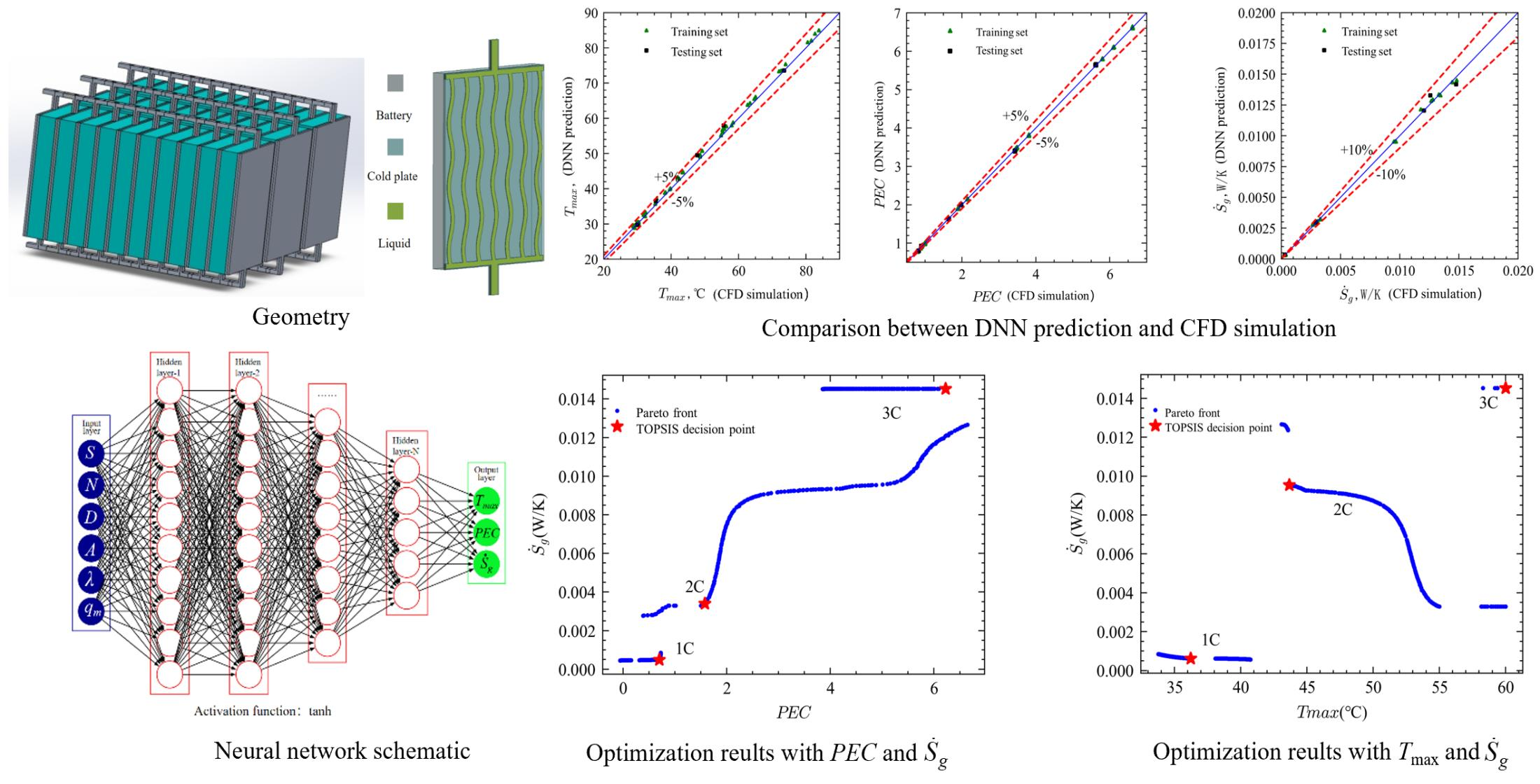
The continuously improving power density of Li-ion batteries and the widespread application of fast charging and discharging have rendered thermal management an increasingly critical task. Cold plates are among the most important means for such a task, and their channel structure significantly affects battery performance. Aiming to further improve the thermohydraulic performance of cold plate, this study proposes a cold plate with sinusoidal wave-shaped channel. Using channel quantity, amplitude, wavelength, diameter, and coolant mass flow rate as variables, the orthogonal experimental scheme is employed to design combinations of different variables for numerical simulation. The numerical simulation results are used to train a deep neural network for cold plate performance prediction. The trained neural network can accurately predict the maximum temperature, comprehensive performance indicators, and entropy generation rate with errors below 5.0%, 5.0%, and 10.0%, respectively. Multi-objective optimization design (MOOD) is implemented by combining a deep neural network with the NSGA-II genetic optimization, yielding two sets of Pareto fronts as follows: one for maximizing comprehensive performance indicator and minimizing entropy generation rate, and the other for minimizing maximum temperature and entropy generation rate, and TOPSIS decision points are provided. This study provides a new method and valuable MOOD results for the thermal management of Li-ion batteries and cold plate engineering while offering theoretical guidance for practical applications.

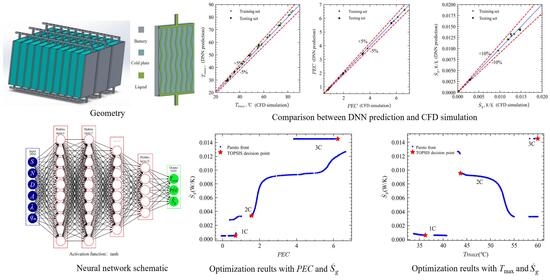
Graphical Abstract

1. Introduction

With high specific energy, long-term cyclability, excellent charge retention, and no obvious memory effect, Li-ion batteries offer advantageous performance, and their constantly decreasing manufacturing costs have allowed their broad applications in automobiles [1,2], ships [3,4,5], aircraft [6,7], unmanned equipment [8,9], and energy storage [10,11,12]. Producing no CO2 during operation, Li-ion batteries support the achievement of the “dual carbon” targets and serve as an important enabler of green new energy. Li-ion battery performance, safety, and cycle life are closely related to temperature and sensitive to its changes [13,14,15]. During charging and discharging, due to their internal electrochemical reactions, Li-ion batteries generally generate heat. With the continuously growing energy density of Li-ion batteries, the surging adoption of fast charging and discharging [16,17], and increasingly complex application scenarios, excessive heat accumulation without timely dissipation can easily trigger thermal runaway and even combustion [18,19]. Thermal management challenges are becoming progressively daunting. Thus, effective thermal management is required to constrain the temperature of Li-ion batteries within the proper range [2,20,21].
Battery thermal management systems (BTMSs) can achieve heat dissipation through various cooling technologies, involving air cooling [22,23,24], liquid cooling [25,26], phase change material cooling [27,28,29], thermoelectric refrigeration [30,31,32,33], and heat pipe cooling [34,35]. Among them, liquid cooling systems offer high heat dissipation performance (HDP) and compact structures by using coolants with high specific heat capacity and density, making liquid cooling a topic of sustained research interest.
Cold plates are key components to facilitate non-contact heat dissipation through liquid cooling, and the channel structure is a crucial factor that determines the HDP, which has attracted significant research attention. Ran et al. [36] developed a novel low-flow-resistance cold plate featuring tree-shaped channels and studied how cooling water temperature and battery discharge rate affect the HDP. Their results indicated that the HDP of the new cold plate was slightly enhanced, and the pressure dropped by only 1/3. Decreasing the cooling water temperature can cool down the battery module to a large extent, but with a large difference among temperatures. Salimi et al. [37] innovated a novel wave-shaped microchannel cold plate design for implementing thermal management in soft-packed Li-ion batteries, with variable wave amplitude of the microchannels. According to their findings, the newly designed cold plate improved the temperature uniformity, and the counter-flow pattern resulted in better temperature uniformity compared to the co-flow pattern. Rabiei et al. [38] studied six microchannels with straight walls, wavy walls, and metal foam embedment, concluding that wavy-wall microchannels lowered the peak temperature by 4 °C to 6 °C, relying on their amplitude. Zhang et al. [39] designed three diamond-type channel cold plates and carried out experimental and numerical simulation studies, revealing that the one with inner arc diamond-type channels achieved better HDP. Hekmat et al. [40] constructed a compact BTMS combining phase change materials, microchannels, and fins, and the findings indicated that the shell with wavy fins achieved optimal cooling. Tian et al. [41] constructed and tested wavy microchannel cold plates for marine high-capacity batteries. The HDP of cold plates with straight microchannels, single-periodic wave microchannels, and double-periodic wave microchannels was studied via experiments. The results showed that the newly designed nonlinear wave microchannel cold plate achieved better HDP and temperature uniformity. Zhan et al. [42] innovated a cold plate with tree-shaped flow channels. Using the orthogonal experimental method, the influence of intake mass flow rate, intake channel count, channel width, and stratification ratio on the peak temperature, temperature standard deviation, and pressure drop was studied. Kausthubharam et al. [43] proposed a BTMS for 20 Ah pouch cell batteries based on diagonal minichannels, and performed numerical simulations to study the HDP with various structures and operating parameters, thereby identifying an optimal thermal strategy. Mubashir et al. [44] devised a cold plate featuring double serpentine channels with better HDP than that of single serpentine channels. Under various operating conditions, the double serpentine channel configuration has been shown to achieve lower peak temperatures and smaller temperature differences, while also delivering a higher heat transfer rate at the same flow rate. Li et al. [45] innovated a cold plate featuring pin fins for square batteries, demonstrating that introducing the fins contributed to HDP enhancement, thereby curbing the peak temperature rise and temperature difference. Imran et al. [46] studied the effects of channel width, embedded obstacles, and channel waviness on streamlined cold plates and proposed four cold plate configurations for temperature uniformity. Inspired by the leaf vein structure, Chen et al. [47] developed a double-layer cold plate. The upper channels of the cold plate contacted and exchanged heat with the battery module, whereas the lower channels contacted the uncovered area to enhance heat dissipation uniformity.
Optimization design can ensure further improvement to the HDP of cold plates. Zhan et al. [48] performed topology optimization for channels like bionic leaf vein structure based on a density field that is initially uniformly distributed. With objective functions configured to maximize heat transfer and minimize dissipation power, a bionic topology-optimized cold plate was obtained. Wu et al. [49] used temperature variance as a constraint to enhance the temperature uniformity while reducing the temperature and flow energy consumption, thereby developing a cold plate structure through topology optimization. Using minimizing pressure drop and average temperature (or temperature difference) as the optimization objective, Wei et al. [50] devised a new heat exchanger suitable for 18650 cylindrical Li-ion batteries through topology optimization. Through topology optimization, Zhan et al. [51] built 3D numerical models by expanding 2D models with different inlets, outlets, and layouts. Chen et al. [52] engineered a novel cold plate for cylindrical batteries based on topology optimization. They proposed three designs with different inlet and outlet structures via a bi-objective function. After designing a cold plate with mixed manifold channels, Sui et al. [53] clarified the functional relationship between the design parameters and the responses by applying the response surface method. MOOD has been conducted on the design parameters with the assistance of NSGA-II, thus locating the Pareto front for maximizing the HDP while minimizing flow pressure drop. Zhou et al. [54] built a model based on multiple physical fields and implemented a surrogate model based on Gaussian processes. Subsequently, they performed a quantitative analysis of the uncertainty to verify whether the optimization design is robust under random variations. In addition, MOOD was conducted, resulting in a 126% increase in energy efficiency, battery temperatures below 28.4 °C, and coolant pressure drops below 3.6 kPa. Monika et al. [55] proposed an optimized workflow incorporating surrogate models, Latin hypercube sampling, and MOOD and validated it on hexagonal microchannel cold plates.
In recent years, neural networks have achieved great success in the field of data science and have been widely adopted to study flow and heat transfer problems [56,57,58,59]. In battery research and development, artificial intelligence has been applied to discovering new battery materials, manufacturing batteries, estimating battery state, and battery design and development, manifesting as new research trends [60]. Deep neural networks can identify deep nonlinear relationships between multidimensional data while avoiding complex modeling calculations. Neural networks exhibit a strong flexibility and accuracy in predicting battery characteristic parameters [61].
The sinusoidal wavy-channel configuration can generate Dean vortices as the coolant flows through curved passages, enhancing local flow disturbance and disrupting the thermal boundary layer, thereby improving heat transfer compared with straight channels. The corrugated walls also increase the heat transfer surface area. However, this flow disturbance inevitably incurs a higher pressure drop penalty, which increases pumping power and the entropy generation rate. Although previous studies have investigated wavy/microchannel cold plates and multi-objective optimization, there is still a lack of systematic surrogate-assisted optimization for the thermohydraulic trade-off in sinusoidal wavy-channel cold plates under coupled design variables. In addition, relatively few studies have simultaneously treated comprehensive performance indicator (PEC) and entropy generation rate as core evaluation metrics. Therefore, this study develops a parametric three-dimensional model and combines orthogonal design, numerical simulation, a deep neural network (DNN) surrogate, and non-dominated sorting genetic algorithm II (NSGA-II) to perform multi-objective optimization of a sinusoidal wavy-channel cold plate. The main contributions are threefold, as follows: a parametric modeling and surrogate-assisted MOOD workflow is established for a sinusoidal wavy-channel cold plate; the coupling relationships among the maximum battery temperature, PEC, and entropy generation rate are analyzed; the Pareto fronts and TOPSIS decision points under different discharge rates are provided, offering guidance for engineering design selection.

2. Mathematical Model

2.1. Simulation Model and Verification

2.1.1. Parametric Geometric Model

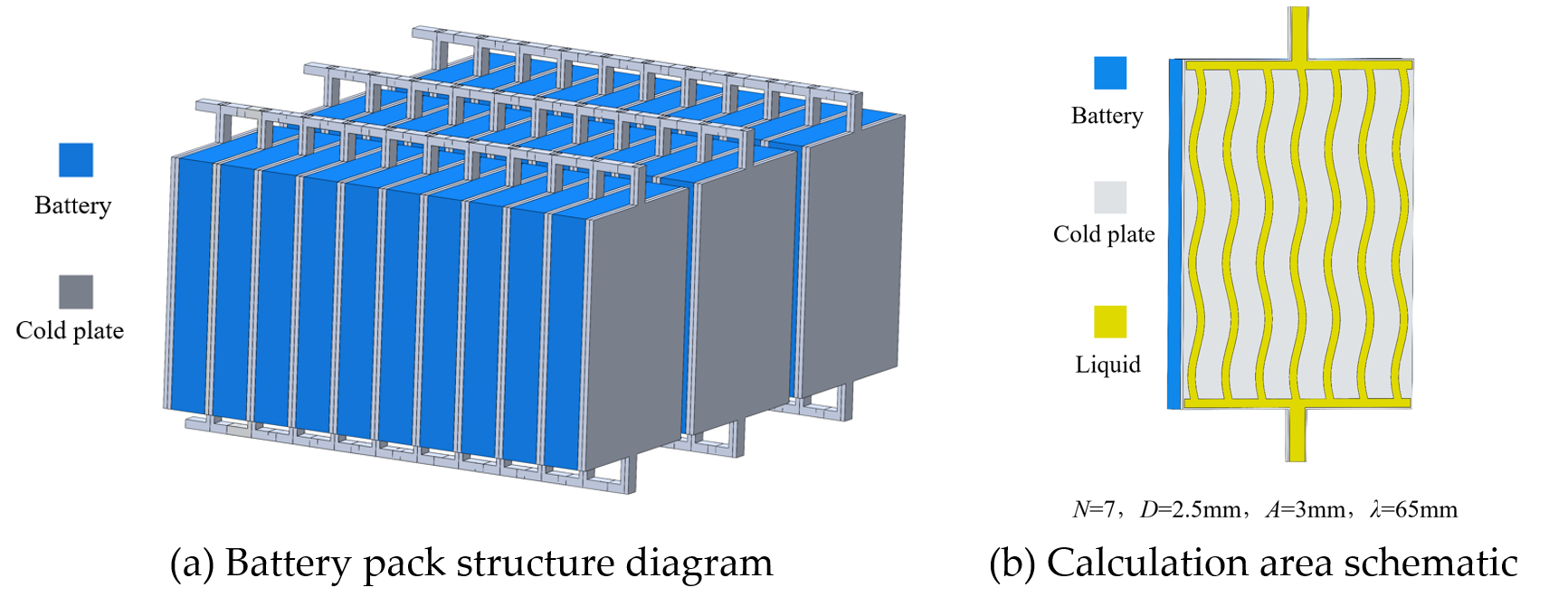
The Li-ion battery pack structure is depicted in Figure 1a, which consists of square Li-ion batteries, cold plates, and liquid inlet and outlet pipelines, with the cold plates arranged on the sides of the batteries. The battery pack has a symmetrical structure. To reduce the resource consumption of simulation calculations, the inlets and outlets are simplified, and the half-battery-thickness half-cold plate-thickness structure shown in Figure 1b is selected for parametric modeling. The batteries are square lithium iron phosphate models measuring 200 mm in height, 150 mm in width, and 30 mm in thickness. The cold plates have the same width (150 mm) and height (200 mm) as the batteries but a thickness of 3.5 mm. In each cold plate, N flow channels are designed, whose cross-section is a circle with a radius of D. The channel shape is based on a sinusoidal function, with the amplitude of A and the wavelength of λ. All channels connect to the top and bottom cavities. The inlet and outlet channels are rectangular, and their cross-sections are 12 mm × 2 mm, with a height of 30 mm.

2.1.2. Control Equations and Definite Solution Conditions

In order to establish control equations for the heat dissipation process within the wavy-channel cold plate, the following simplifications are adopted:
Despite its complex internal structure, heat transfer within the battery is dominated by thermal conduction and exhibits pronounced anisotropic behavior. Thus, the battery is simplified into a solid with anisotropic thermal conductivity coefficient and isotropic other physical parameters.
The coolant flow is forced, and the influence of gravity on its flow and heat transfer process in the cold plate is not considered.
The coolant flow is laminar, and the heat generated by viscous dissipation is neglected.
Within the operation temperature range of the battery, temperature changes have little effect on the physical properties of the coolant and the cold plate metal material. Thus, the physical properties of the coolant and the cold plate metal material are assumed to be constant.
The battery generates heat during charging and discharging, and the heat transfer is primarily through conduction. The temperature field satisfies the 3D heat conduction differential equation with an internal heat source, that is:
ρ b c p , b T t = k b T + Q ˙ g e n
where subscript b signifies the battery, and Q ˙ g e n (W/m3) indicates the heat generating rate per unit volume. The heat production rate covers reversible heat and irreversible Joule heat, which can be expressed as:
Q ˙ g e n = Q ˙ i r + Q ˙ r e = I ( E V ) I T d E d T = I 2 R I T d E d T
where I (A) represents the charging or discharging current, R (Ω) is the internal resistance, E (V) denotes the open circuit voltage, V (V) signifies the battery potential, and dE/dT (V/K) denotes the temperature coefficient depending on the state of charge (SOC) of the battery. Each of the above parameters changes over time. For a specific battery, each parameter can be measured experimentally at a given charge and discharge rate. Li et al. [62] established the empirical expression according to experimental measurements and substituted it into Equation (2) to derive the variation of the heat production rate with time, as expressed in Equation (3). The values of A1 to A7 can be found in the literature [62].
Q ˙ g e n = A 1 t 6 + A 2 t 5 + A 3 t 4 + A 4 t 3 + A 5 t 2 + A 6 t + A 7
Within the cold plate substrate, the heat transfer relies on heat conduction, and no heat is generated. The temperature field satisfies the 3D heat conduction differential equation without internal heat sources, that is,
ρ w c p w T t = k w T
where ρw (kg/m3) represents the density of the aluminum plate, cpw (J/(kg·K)) is its specific heat, and kw (W/(m·K)) represents its thermal conductivity coefficient.
The coolant flow and heat transfer processes in the channels satisfy the conservation of mass, momentum, and energy, as expressed in Equations (5)–(7).
ρ f t + ρ f v f = 0
ρ f v f t + v f v f = p + μ f 2 v f
ρ f c p , f T t + ρ f c p , f v f T = k f T
where ρ (kg/m3) represents density, μ (kg/(m·s)) is the dynamic viscosity, cp (J/(kg·K)) indicates the specific heat capacity, and k (W/(m·K)) is the thermal conductivity coefficient. Meanwhile, v (m/s) represents the coolant’s velocity vector, T (°C) is the temperature, p (Pa) denotes the pressure, t (s) signifies time, and subscript f indicates the fluid.
The battery is equivalent to a solid body with uniform composition and anisotropic thermal conductivity coefficients. The aluminum cold plate contains the coolant, which is a 40% ethylene glycol aqueous solution. The main physical properties are included in Table 1.
The initial temperatures of the battery and cold plate are both 25 °C. The inlet mass flow rate and temperature of the coolant are set manually, and the cold plate outlet is set as the pressure outlet. Both sides of the cold plate are set to symmetrical boundaries. The finite volume method is employed to numerically solve the heat dissipation problem. The adopted iterative method is the SIMPLE algorithm, the energy equation is configured with a convergence residual of 10−8, and the other equations are configured with a convergence residual of 10−6.

2.1.3. Grid and Time Step Irrelevance Verification

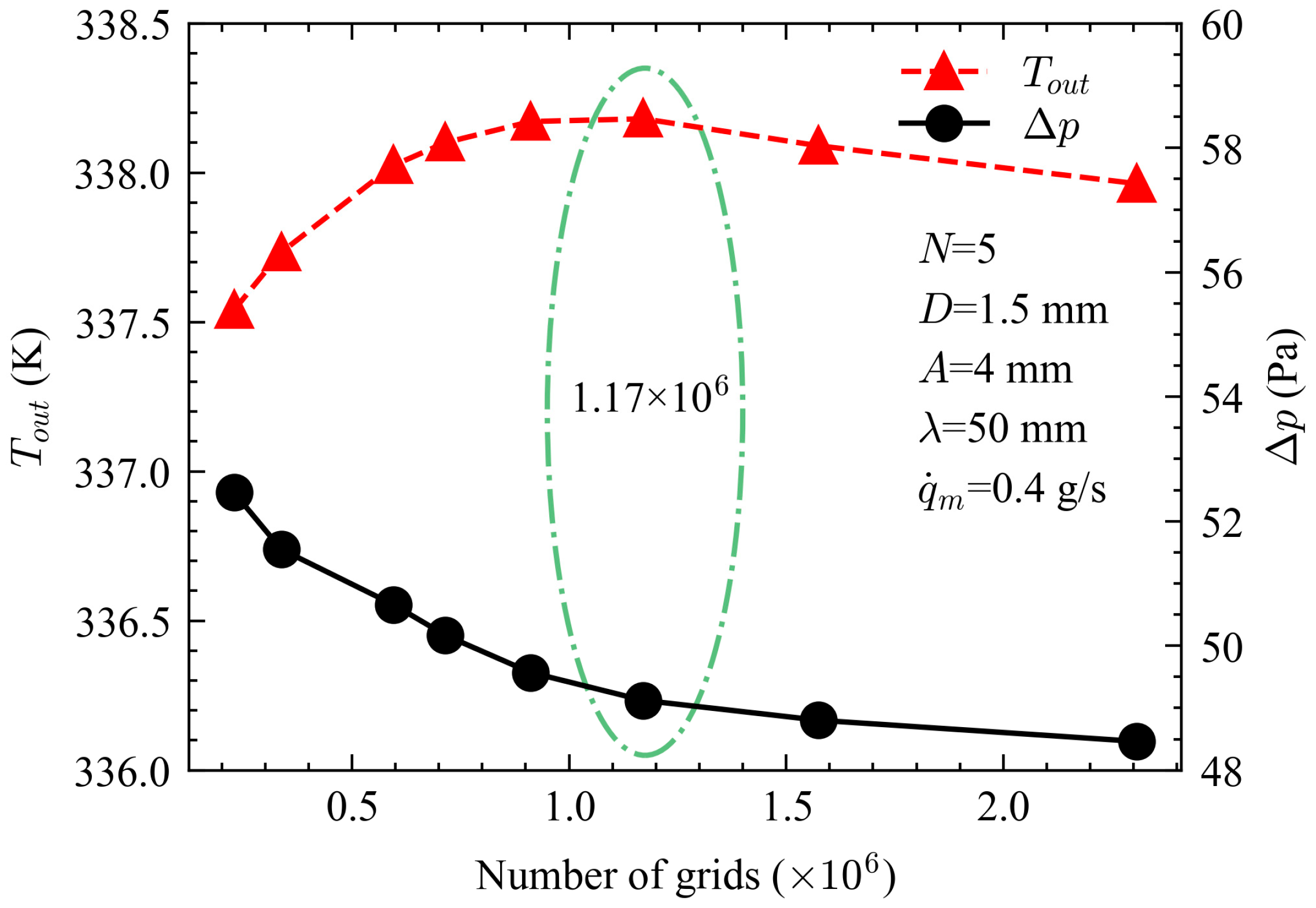
The combination with wavy channel quantity N = 4, D = 1.5 mm, A = 4 mm, λ = 50 mm, and q ˙ m = 0.4 g/s was selected for grid and time step irrelevance verification. The established geometric model was divided into polyhedral meshes. Boundary layer meshes were set at the fluid–solid contact surfaces, whereas the fluid area was subjected to mesh densification. Figure 2 shows the inlet–outlet pressure difference and fluid outlet temperature changes with different numbers of grids. As the grids reach 1.17 × 10⁶, the results exhibit smaller changes. Beyond 2.31 × 10⁶, the change in the inlet-outlet pressure difference is 1.4%, and the change in the fluid outlet temperature is 0.1%. In order to balance calculation accuracy and computational resource consumption, 1.17 × 10⁶ grids were used for subsequent calculations, and other calculations were conducted with the same grid division parameters.
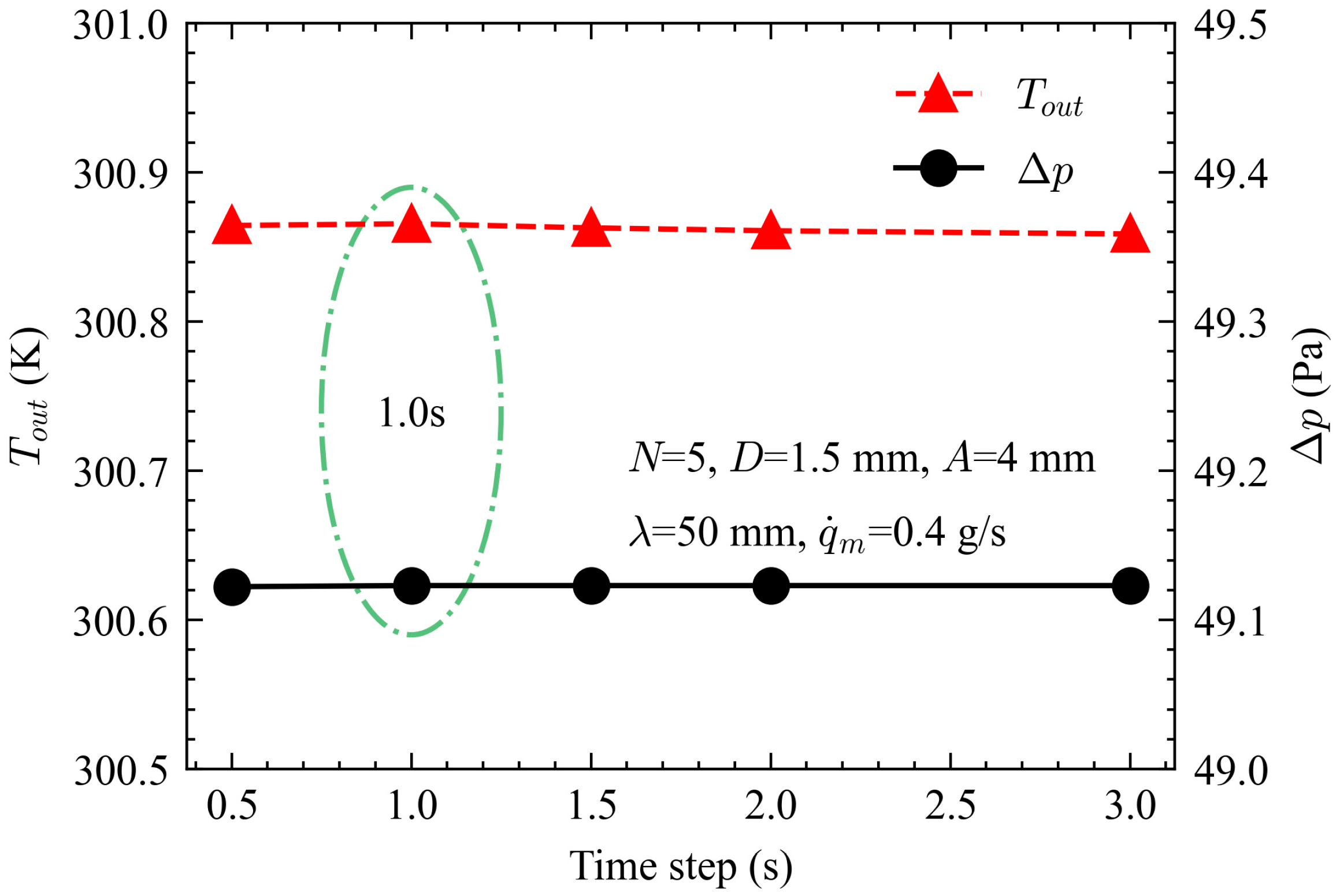
Figure 3 shows the change in inlet–outlet pressure difference and fluid outlet temperature under different time steps. As the time step decreases continuously from 1.0 s, the inlet–outlet pressure difference and fluid outlet temperature almost remain unchanged. Therefore, the time step in the simulation was selected to be 1.0 s.

2.1.4. Verification of Accuracy

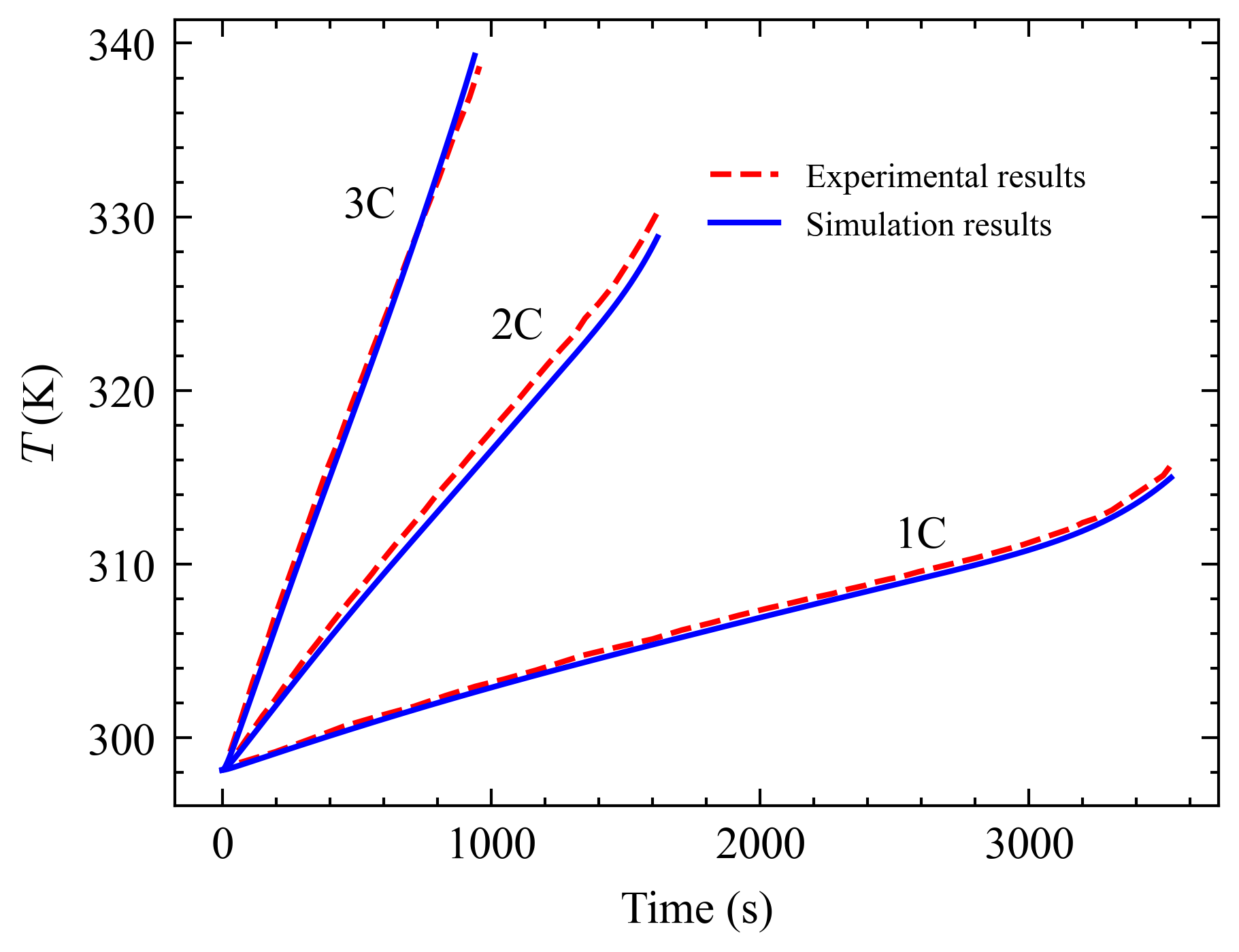
To validate the established numerical model, the same geometric model as in the literature [62] was established, and numerical simulations were performed. Figure 4 compares the battery surface temperature simulation results at various discharge rates against the measured results in the literature. The results agreed well with the maximum deviation of 0.45%, thus verifying the reliability of the numerical calculation method.

2.2. Orthogonal Experimental Design

The wavy channel cold plate contains N channels, with the amplitude A, the wavelength λ, and the diameter D, totaling 5 factors, along with the inlet mass flow rate q ˙ m . For each parameter, 4 levels were designed. With the orthogonal experimental design, a representative combination can be reasonably selected to reduce the cost of multi-factor analytical research. Considering the research questions of this study, the L16(45) orthogonal table was selected for the experimental design, with a total of 16 combinations (Table 2).

2.3. Data Processing

The coolant flows through the channels in the cold plate and carries away the heat, thereby cooling down the batteries. The thermohydraulic behavior can be quantitatively evaluated using the comprehensive performance indicator (PEC), as expressed in Equations (8)–(11).
P E C = N u / N u 0 ( f / f 0 ) 1 / 3
N u = h D λ
h = Q ˙ t w 1 2 ( t f , i n + t f , o u t )
f = Δ p 1 2 ρ v 2 D L
Entropy generation rate S ˙ g is an important indicator of process irreversibility analysis, as expressed in Equations (12)–(14),
S ˙ g = S ˙ g , Δ T + S ˙ g , Δ p
S ˙ g , Δ T = λ T 2 [ ( T x ) 2 + ( T y ) 2 + ( T z ) 2 ]
S ˙ g , Δ p = μ T { 2 [ ( u x x ) 2 + ( u y y ) 2 + ( u z z ) 2 ] + ( u x y + u y x ) 2 + ( u x z + u z x ) 2 + ( u y z + u z y ) 2 }

3. Results

3.1. Prediction with the Deep Neural Network

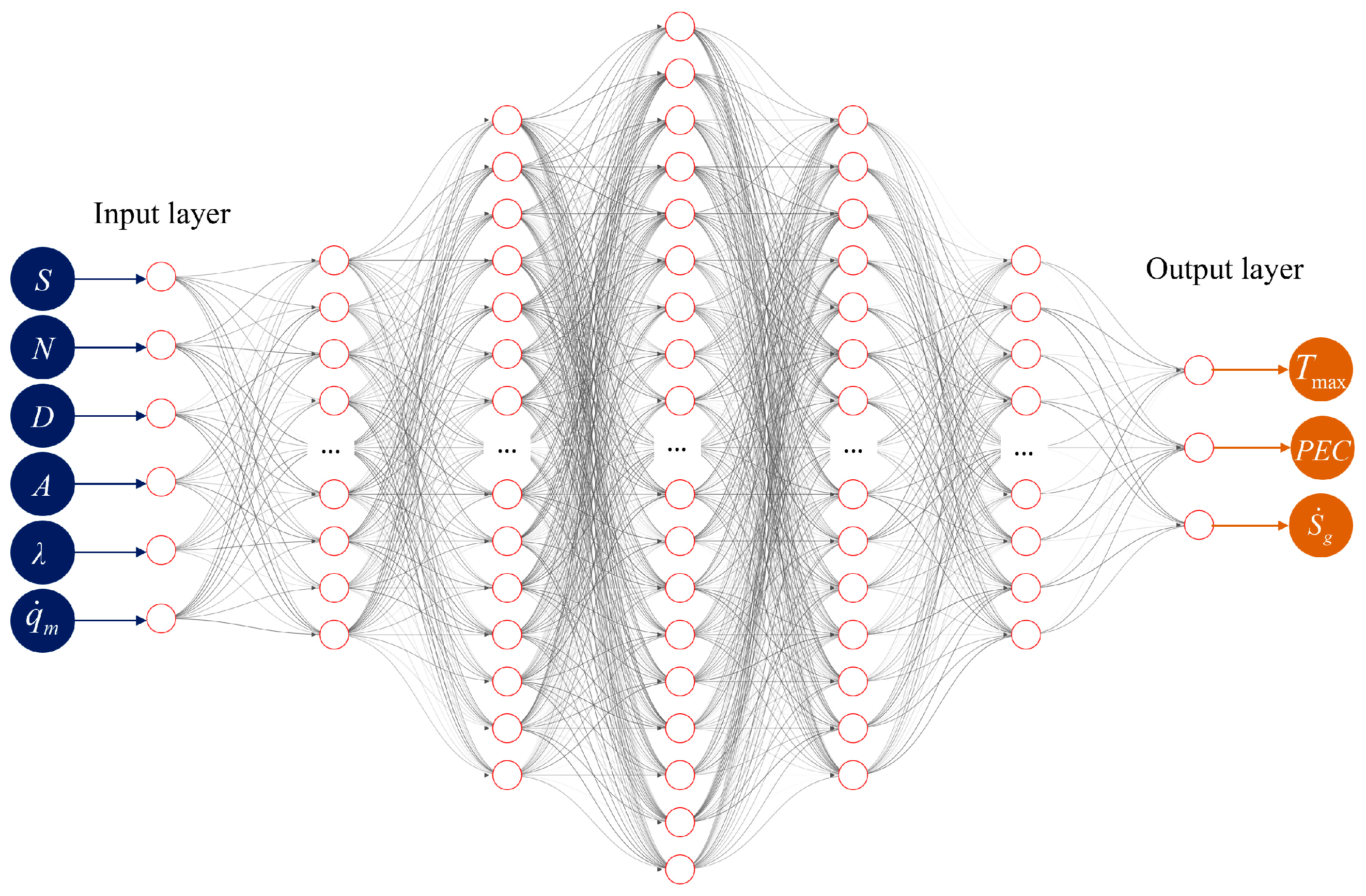
Based on the Keras framework, a fully connected DNN was established, as shown in Figure 5. The network takes six characteristic parameters as the input layer, namely discharge rate, number of channels, pipe diameter, amplitude, wavelength, and mass flow rate, while the output layer corresponds to three performance indicators including Tmax, PEC, and S ˙ g . The hidden layers are sequentially configured with 10, 60, 100, 60, and 30 neurons, in which the second and third hidden layers adopt the tanh activation function to enhance nonlinear mapping ability, and the other hidden layers as well as the output layer employ linear activation without additional nonlinear transformation. During the model training process, mean squared error (MSE) was adopted as the loss function, and the Adam optimizer was utilized for weight iteration and updating of neural network nodes. The network was trained with 1000 epochs and a batch size of 30, and the reserved test set was finally applied to validate the generalization performance of the trained DNN model.
The orthogonal experimental design method was adopted to design representative parameter combinations, as listed in Table 2. Considering three discharge rates of 1C, 2C, and 3C, a total of 48 sets of numerical simulations were carried out. A dataset containing 48 sets of variable-characteristic parameters was obtained from the simulation results. The dataset was then randomly split into 90% for training and 10% for testing.
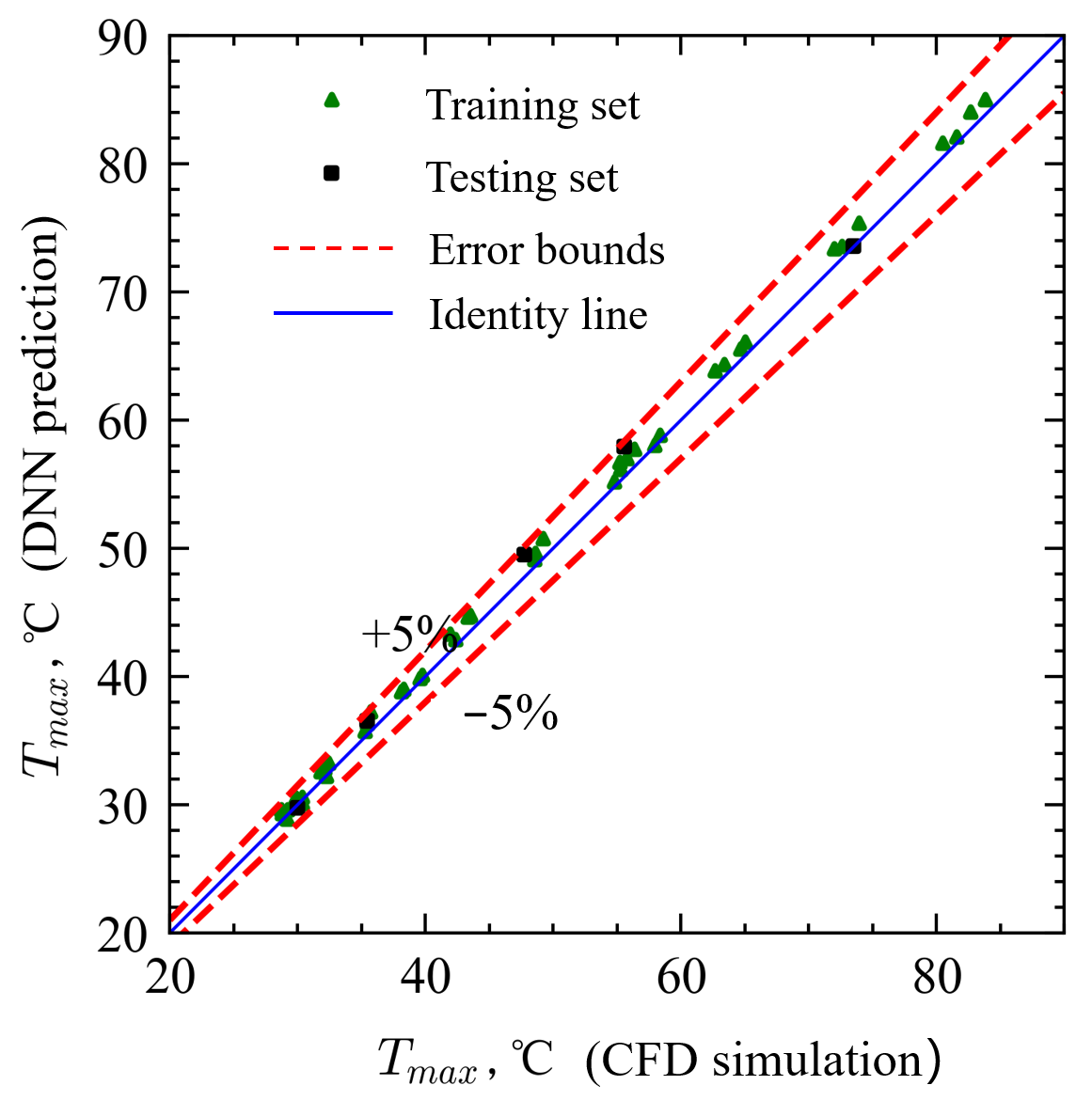
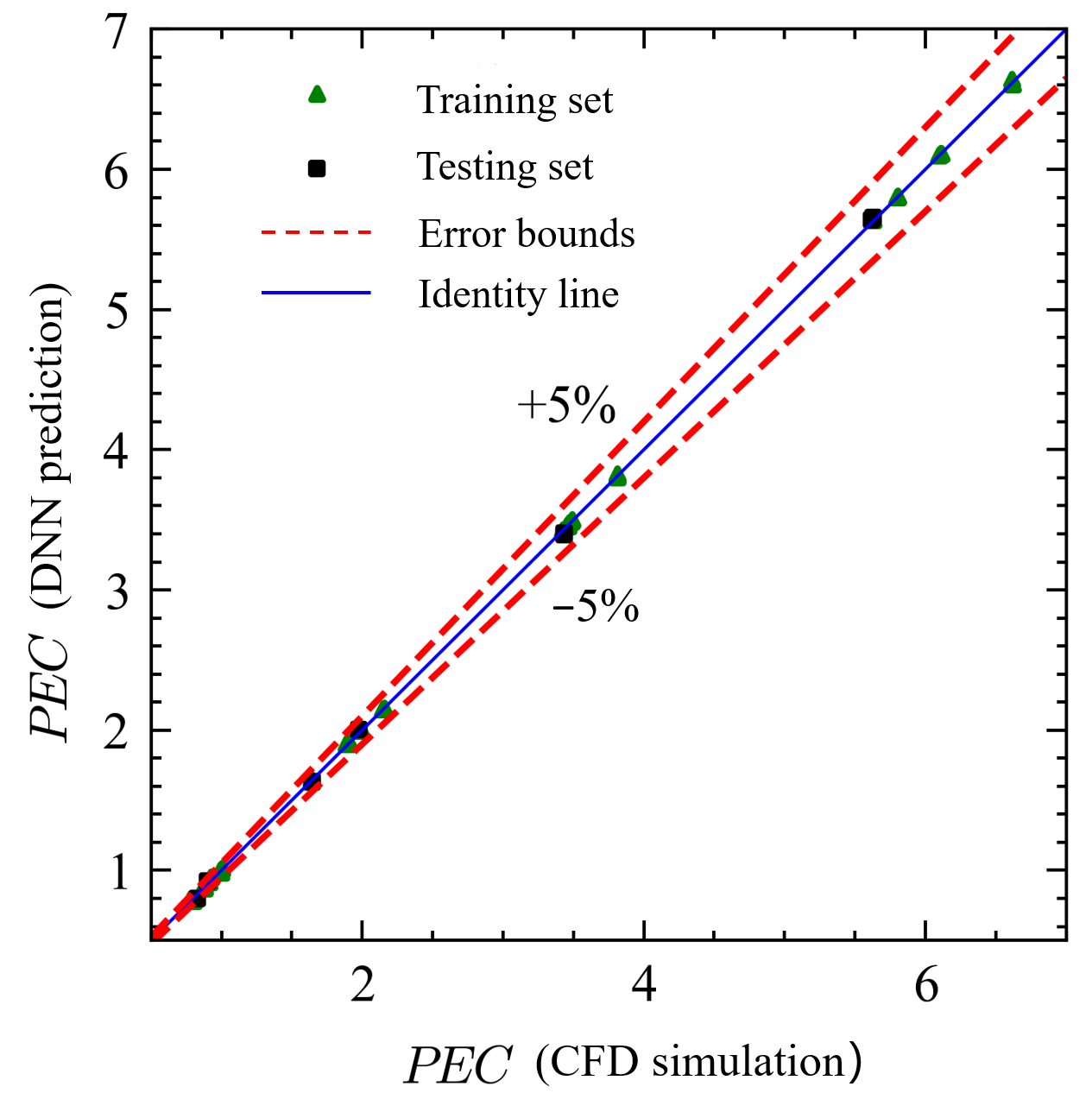
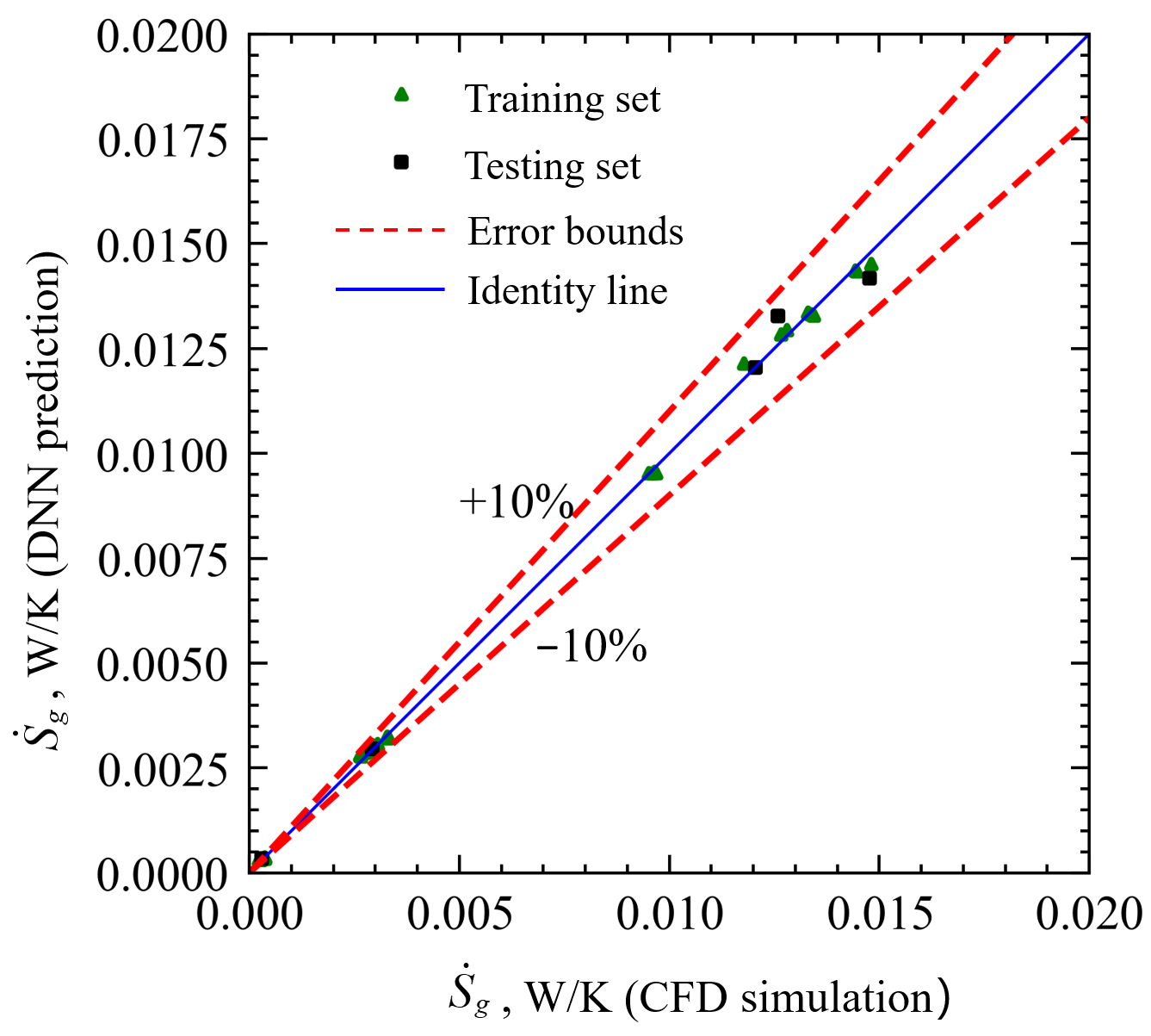
The trained neural network was used to predict the results. Figure 6, Figure 7 and Figure 8 compare the predicted and simulated values of Tmax, PEC, and S ˙ g , respectively. On the datasets for training and testing, the deviations between the Tmax and PEC predictions and simulation calculations are within 5%, and the deviations between the S ˙ g predictions and simulation calculations are within 10%. Therefore, the trained neural network has relatively good prediction performance for Tmax, PEC, and S ˙ g .

3.2. Multi-Objective Optimization Design

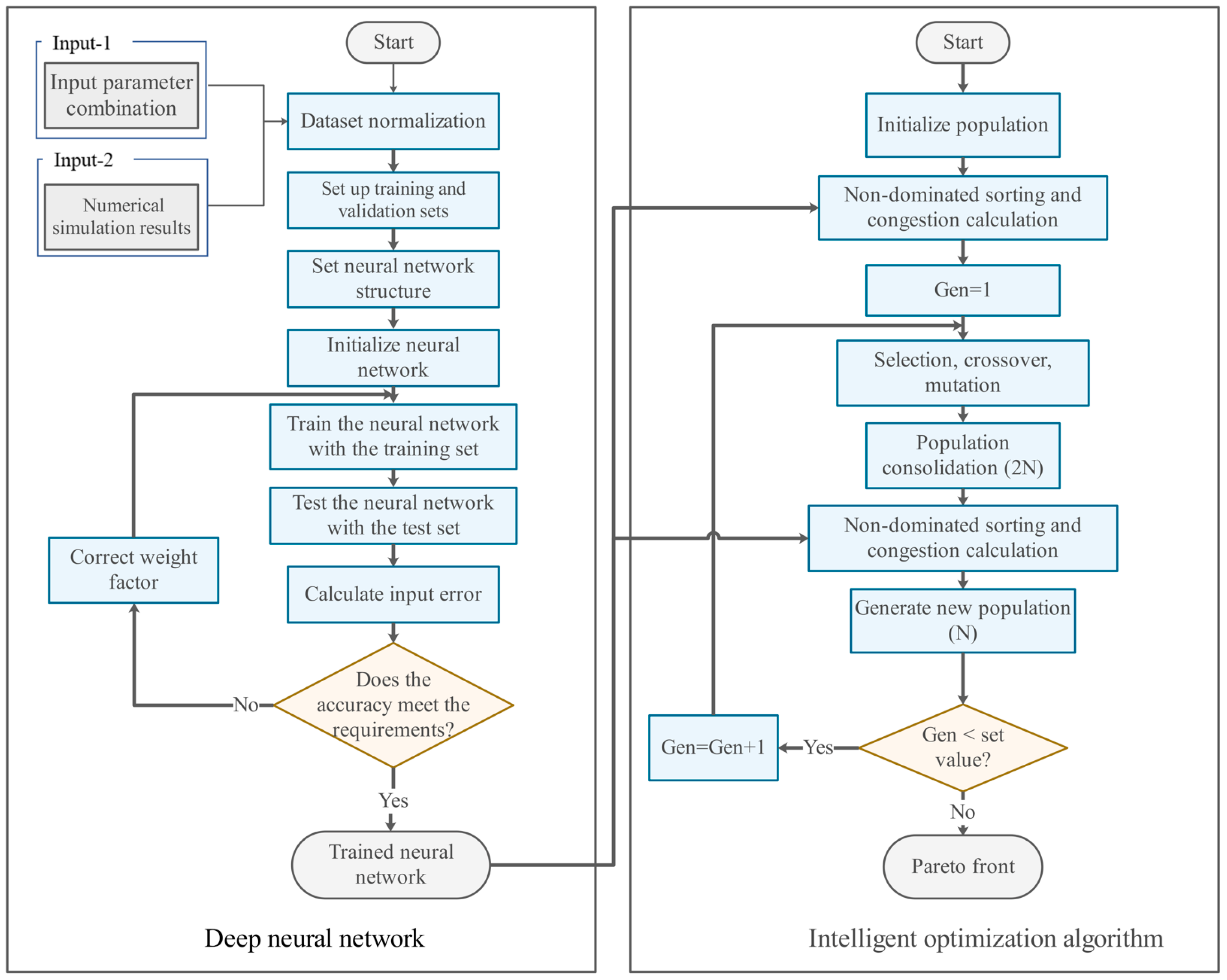
Numerous factors affect the transient thermal conduction in the solid part and the transient fluid flow and heat transfer process in the fluid part. The numerical simulation has high computational complexity and is time-consuming. To render the optimization more efficient, the trained neural network is used to predict the key parameters during optimization iterations. Genetic optimization algorithms simulate the mechanism of biological evolution to realize global stochastic search. Compared with conventional optimization methods, they possess superiority in global searching ability and multi-objective processing performance, and have been widely applied in the optimal design of flow and heat transfer structures [57,59]. As a typical representative, the NSGA-II selects superior individuals by means of crowding distance calculation and elite reservation strategy. It reduces the computational complexity of the algorithm and effectively prevents premature convergence to local optima during the optimization process, thus being extensively employed to solve various multi-objective optimization problems. This study used the genetic optimization algorithm and the deep neural network to perform MOOD for the geometry of the wavy-channel cold plate. The optimization process is presented in Figure 9. Finally, the Pareto front solution set was obtained.
This study used the NSGA-II optimization algorithm to carry out MOOD based on the Geatpy toolbox [63]. The constraint was set as the maximum battery temperature to ensure battery safety. The main settings of the NSGA-II algorithm are as follows. A real-integer mixed encoding scheme was adopted. The population size was set to 200, and the maximum number of generations was 1000. To avoid unnecessary computations, an early-stopping criterion based on convergence stagnation was introduced as follows: if the change in the objective space falls below 10−6 for 10 consecutive generations, the algorithm is considered trapped and the run is terminated. In addition, parallel computing was utilized to accelerate the iterative optimization process. Eventually, the Pareto front was obtained. The TOPSIS method was adopted to identify the optimal compromise solution, where the objective weights are derived objectively using the entropy weight method based on the information entropy of each objective calculated from the distribution of the Pareto solutions.
The heat dissipation process of lithium-ion batteries with liquid cold plates involves complex fluid flow and coupled heat transfer mechanisms, and the thermal dissipation characteristics can be quantitatively evaluated from multiple dimensions. Based on the first law of thermodynamics, PEC was employed to characterize the comprehensive thermal-hydraulic performance of the cold plate. In accordance with the second law of thermodynamics, S ˙ g was introduced to quantify the irreversibility inherent in the flow and heat transfer process. Considering the thermal safety constraints of lithium-ion batteries, the maximum battery temperature was adopted to assess the thermal safety performance. The variation trends of the above three evaluation indicators were not fully coordinated and generally exhibit mutual restriction and conflicting characteristics. Accordingly, two groups of multi-objective optimization designs were carried out in this study. One takes the maximization of PEC and the minimization of S ˙ g as the optimization objectives, while the other aims to minimize both the Tmax and S ˙ g . The detailed research results are presented as follows.
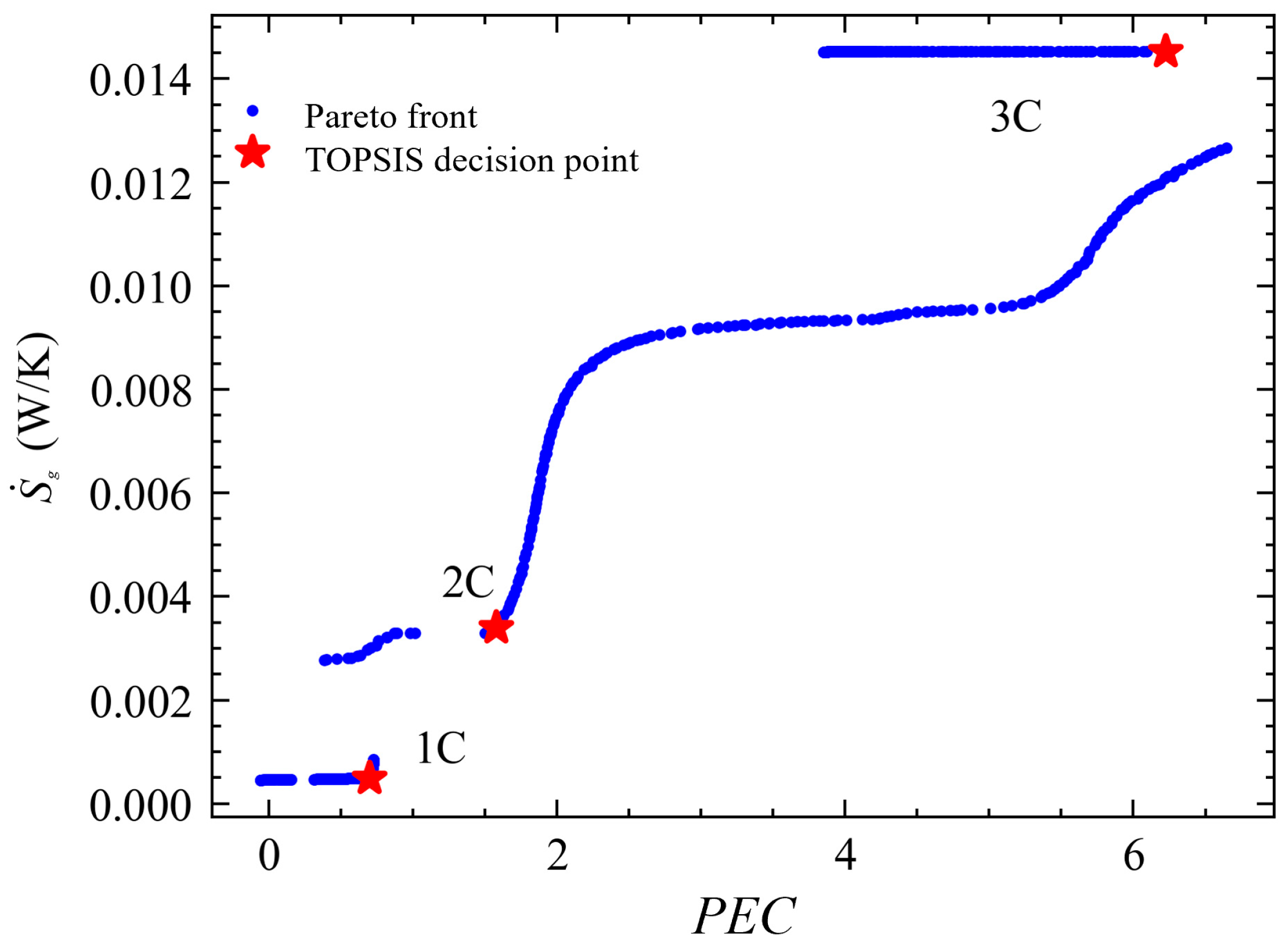
Figure 10 presents the optimization results with maximizing PEC and minimizing S ˙ g as the objectives. Owing to the discrete type of channel number, the Pareto front exhibits a clear stepwise distribution. A comparison of the Pareto fronts at various discharge rates indicated that, with the increase in the discharge rate, the Pareto front moved in the direction of S ˙ g increment. This was mainly because the increased discharge rate elevated the temperature of the battery, and the non-equilibrium temperature difference during heat transfer increased, thereby enhancing S ˙ g . At the 1C discharge rate, the Pareto front mainly distributes within the region with a small PEC value. At the 3C discharge rate, the Pareto front is mainly distributed in the area with a large PEC value. At the 2C discharge rate of, the range of the PEC value is relatively wide. This can be explained as follows. Under the constraint that the maximum battery temperature must remain below 60 °C, a large coolant mass flow rate is required at the 3C discharge rate. According to the previous analysis, PEC increases with the mass flow rate. At the 1C discharge rate, a small mass flow rate can ensure that the maximum temperature of the battery is below 60 °C. Therefore, the Pareto front at 1C mainly corresponds to a small mass flow rate, with small PEC values. To select a practical compromise solution from the Pareto front, the TOPSIS decision-making method was employed to determine the optimal trade-off solution, with the corresponding geometric and operating parameters detailed in Table 3. Taking Test1 in Table 2 as the baseline, at 1C, the TOPSIS decision point shows little variation from the baseline; at 2C, the TOPSIS decision point reduces Tmax by 1.98 °C and improves PEC by 58.00%, at the cost of a 14.81% increase in the S ˙ g ; at 3C, Tmax is reduced by 24.46 °C, PEC is increased by a factor of 5.29, and the S ˙ g increases by 50.26%. Under medium and high discharge rates, the multi-objective optimization design aiming at maximizing PEC and minimizing the S ˙ g can effectively improve the comprehensive flow and heat transfer performance.
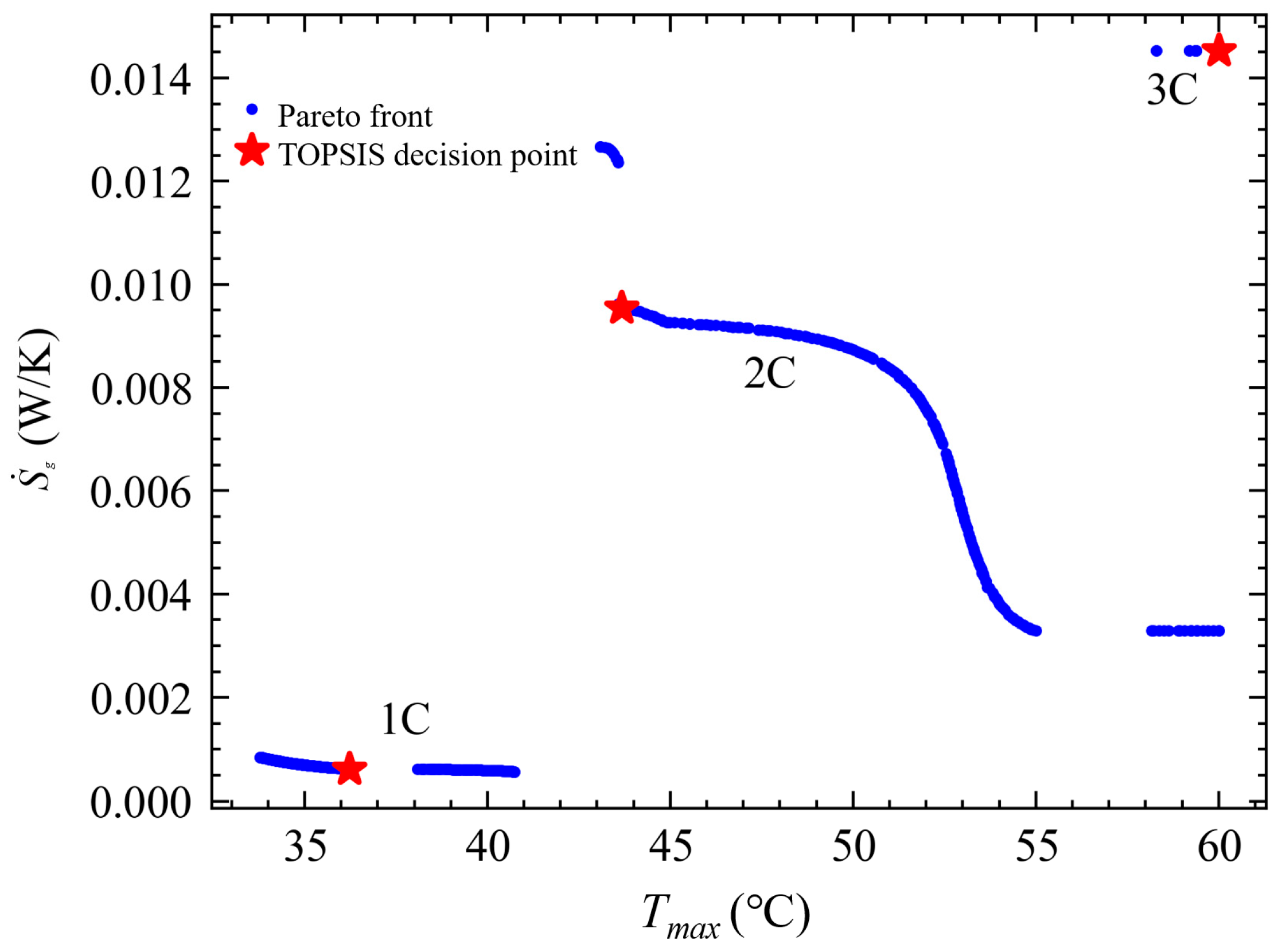
Figure 11 shows the optimization results with the minimization of Tmax and S ˙ g as objectives. Consistent with the results above, owing to the discrete type of channel number, the Pareto front exhibits a clear stepwise distribution. Similarly, the increased discharge rate elevated the battery temperature, and the non-equilibrium heat transfer temperature difference increases, thus increasing the S ˙ g of the Pareto front. As a result, the Pareto front at high discharge rates is concentrated in the area where the Tmax and S ˙ g values are large, and the Pareto front at low discharge rates is concentrated in the area where the Tmax and S ˙ g values are small. The parameters corresponding to the TOPSIS decision points are listed in Table 3. Taking Test1 in Table 2 as the baseline, at 1C, the TOPSIS decision point shows little variation from the baseline; at 2C, the TOPSIS decision point reduces Tmax by 12.68 °C and improves PEC by a factor of 4.49, at the cost of a 2.21-fold increase in the S ˙ g ; at 3C, Tmax is reduced by 23.80 °C, PEC is increased by a factor of 5.15, and S ˙ g increases by 50.26%. Under medium and high discharge rates, the multi-objective optimization design aiming at minimizing both Tmax and S ˙ g can effectively improve the temperature control capability of the thermal management system.

4. Discussion

4.1. Trade-Off Between Performance Indicators

For the multi-objective optimization aiming to maximize PEC and minimize S ˙ g . S ˙ g is significantly influenced by the mass flow rate. At low discharge rates, a small mass flow rate is sufficient to keep the battery temperature within the safety threshold; at high discharge rates, a large mass flow rate is necessary to satisfy the thermal constraint. Consequently, at both low and high discharge rates, the variation in S ˙ g is relatively small, whereas PEC exhibits more noticeable changes. From an engineering perspective, PEC can be enhanced through rational structural design to achieve overall performance optimization. At moderate discharge rates, the objectives of maximizing PEC and minimizing S ˙ g present a strong trade-off: a larger flow rate is required to enhance heat transfer and thus increase PEC, but this inevitably leads to greater irreversible losses. A balance must therefore be struck between the benefits of heat transfer augmentation and the associated energy dissipation.
For the multi-objective optimization aiming to minimize both Tmax and S ˙ g . Consistent with the previously discussed trends, S ˙ g varies only modestly at both low and high discharge rates due to the restricted range of the required mass flow rate. In these cases, structural design optimization can be effectively employed to reduce Tmax and achieve superior temperature control. At moderate discharge rates, however, a strong trade-off emerges between minimizing S ˙ g and minimizing Tmax, lowering Tmax demands a higher coolant mass flow rate, which in turn sharply increases flow friction losses and raises S ˙ g . A balance must therefore be struck between temperature control performance and irreversible energy dissipation.

4.2. Engineering Implications of the TOPSIS Points

The TOPSIS decision points offer practical guidance for design selection under different operating conditions. At the 1C discharge rate, where the thermal load is relatively low, the design can prioritize a lower coolant flow rate and reduced pumping power, thereby favoring energy-efficient operation. At the 3C discharge rate, the stringent thermal constraint (Tmax < 60 °C) necessitates a higher flow rate, and consequently greater irreversible losses must be accepted to ensure thermal safety. The 2C discharge rate represents an intermediate regime that offers the broadest scope for compromise between conflicting objectives, providing the greatest design flexibility. These distinct characteristics across discharge rates can inform condition-specific selection of cold plate designs from the Pareto front.

4.3. Future Work

This study integrates orthogonal experimental design, numerical simulation, DNN surrogate modeling, and NSGA-II to achieve multi-objective optimization of a sinusoidal wavy-channel cold plate. Based on the present work, further research can be carried out in the following aspects. First, the DNN surrogate model was trained on numerical simulation data and experimental verification for the TOPSIS-selected solutions is still pending. Future work incorporating experimental data would further strengthen the calibration and validation of both the surrogate model and the multi-objective decision points. Second, temperature-dependent coolant property models would improve simulation fidelity under high heat loads. Third, the laminar-flow assumption and the simplified uniform battery heat generation may limit the applicability of the results; future work could develop more refined battery heat generation models and consider a broader range of flow parameters to enhance generality. Finally, the experimental testing under realistic dynamic operating conditions is necessary to confirm their practical feasibility and thermal performance.

5. Conclusions

This study established the 3D model of a sinusoidal wave channel cold plate for the heat dissipation of Li-ion batteries and performed numerical simulations to explore its flow and heat transfer processes. A surrogate model was built based on a deep neural network, and NSGA-II was employed to conduct MOOD. The main conclusions are as follows:
(1)
The trained deep neural network can quickly and accurately predict Tmax, PEC, and S ˙ g according to the input parameters, and the errors are within 5.0%, 5.0%, and 10.0%, respectively, compared to the simulation results. Thus, the surrogate model established based on the neural network can facilitate thermohydraulic performance prediction with good accuracy.
(2)
With maximizing PEC and minimizing S ˙ g as the optimization objectives, compared to the baseline, at 2C, Tmax is reduced by 1.98 °C and PEC is improved by 58.00%, at the cost of a 14.81% increase in S ˙ g ; at 3C, Tmax is reduced by 24.46 °C, PEC is increased by a factor of 5.29, and S ˙ g increases by 50.26%. This indicates that the multi-objective optimization effectively enhances the comprehensive flow and heat transfer performance under medium and high discharge rates.
(3)
With minimizing Tmax and S ˙ g as the optimization objectives, compared to the baseline, at 2C, Tmax is reduced by 12.68 °C, PEC is improved by a factor of 4.49, at the cost of a 2.21-fold increase in S ˙ g ; at 3C, Tmax is reduced by 23.80 °C, PEC is increased by a factor of 5.15, and S ˙ g increases by 50.26%. This indicates that the multi-objective optimization significantly strengthens the temperature control capability of the thermal management system under medium and high discharge rates.
(4)
Combining orthogonal experimental design, numerical simulation, a deep neural network surrogate model, and NSGA-II reduce the computational burden while improving the efficiency of cold plate optimization. The obtained Pareto fronts and the specific parameters corresponding to the TOPSIS decision points provide theoretical guidance for practical cold plate design.

Author Contributions

Conceptualization, K.X. and Z.X.; methodology, K.X., Z.X. and X.C.; software, K.X. and M.Z.; validation, K.X., X.N. and M.Z.; formal analysis, K.X. and X.C.; investigation, K.X. and X.N.; resources, Z.X.; data curation, K.X., M.Z. and X.N.; writing—original draft preparation, K.X.; writing—review and editing, Z.X.; visualization, K.X.; supervision, Z.X.; project administration, Z.X.; funding acquisition, Z.X. All authors have read and agreed to the published version of the manuscript.

Funding

This work was supported by the Key Research and Development Program of Hubei Province (NO. 2023BIB017) and National Natural Science Foundation of China (NO. 52371341).

Data Availability Statement

The original contributions presented in this study are included in the article. Further inquiries can be directed to the corresponding authors.

Acknowledgments

The authors wish to thank the reviewers and the editors for their careful, unbiased and constructive suggestions, which led to this revised manuscript.

Conflicts of Interest

The authors declare no conflicts of interest.

Abbreviations

The following abbreviations are used in this manuscript:
BTMSBattery Thermal Management System
HDPHeat Dissipation Performance
MOODMulti-objective Optimization Design
NSGA-IINon-dominated Sorting Genetic Algorithm II
TOPSISTechnique for Order Preference by Similarity to Ideal Solution

References

  1. Wen, J.; Zhao, D.; Zhang, C. An overview of electricity powered vehicles: Lithium-ion battery energy storage density and energy conversion efficiency. Renew. Energy 2020, 162, 1629–1648. [Google Scholar] [CrossRef]
  2. Hwang, F.S.; Confrey, T.; Reidy, C.; Picovici, D.; Callaghan, D.; Culliton, D.; Nolan, C. Review of battery thermal management systems in electric vehicles. Renew. Sustain. Energy Rev. 2024, 192, 114171. [Google Scholar] [CrossRef]
  3. Rasul, M.J.M.A.; Kim, J. Comprehensive review and comparison on battery technologies as electric-powered source in marine applications. J. Energy Storage 2024, 88, 111509. [Google Scholar] [CrossRef]
  4. Moon, H.S.; Park, W.Y.; Hendrickson, T.; Phadke, A.; Popovich, N. Exploring the cost and emissions impacts, feasibility and scalability of battery electric ships. Nat. Energy 2024, 10, 41–54. [Google Scholar] [CrossRef]
  5. Tang, R.; Li, Z.; Zhang, S.; Li, X.; Zhang, Y.; Lai, J. Parameter identification method for power lithium-ion battery of electric ship. J. Energy Storage 2026, 141, 119467. [Google Scholar] [CrossRef]
  6. Viswanathan, V.; Epstein, A.H.; Chiang, Y.M.; Takeuchi, E.; Bradley, M.; Langford, J.; Winter, M. The challenges and opportunities of battery-powered flight. Nature 2022, 601, 519–525. [Google Scholar] [CrossRef]
  7. Schäfer, A.W.; Barrett, S.R.H.; Doyme, K.; Doyme, K.; Dray, L.M.; Gnadt, A.R.; Self, R.; O’Sullivan, A.; Synodinos, A.P.; Torija, A.J. Technological, economic and environmental prospects of all-electric aircraft. Nat. Energy 2018, 4, 160–166. [Google Scholar] [CrossRef]
  8. Li, B.; Mao, Z.; Song, B.; Wang, Y.F.; Tian, W.; Lu, C.; Li, M. Performance evaluation and heat transfer mechanism for battery thermal management of autonomous underwater vehicles based on phase change material cooling. Appl. Therm. Eng. 2023, 219, 119655. [Google Scholar] [CrossRef]
  9. Lim, J.Y.; Lim, J.H.; Kim, D.H.; Kim, D.H.; Ko, J.S.; Lee, J.; Lee, B.K. Rest-free state-of-charge algorithm for lithium-ion batteries under wide C-rate conditions for unmanned underwater vehicles. J. Electr. Eng. Technol. 2026, 21, 1–14. [Google Scholar] [CrossRef]
  10. Zhang, C.; Wei, Y.L.; Cao, P.F.; Li, M.C. Energy storage system: Current studies on batteries and power condition system. Renew. Sustain. Energy Rev. 2018, 82, 3091–3106. [Google Scholar] [CrossRef]
  11. Çinici, O.K.; Acır, A. Effects of the thermal-structural optimization and fin-assisted cooling on the heat dissipation performance of a prismatic lithium iron phosphate battery pack for photovoltaic energy storage. J. Energy Storage 2026, 144, 119725. [Google Scholar] [CrossRef]
  12. Lin, X.W.; Shi, M.Y.; Zhou, Z.F.; Chen, B.; Lu, Y.J.; Jing, D.W. Multi-objective topology optimization design of liquid-based cooling plate for 280 ah prismatic energy storage battery thermal management. Energy Convers. Manag. 2025, 325, 119440. [Google Scholar] [CrossRef]
  13. Hou, J.; Yang, M.; Wang, D.; Zhang, J. Fundamentals and challenges of lithium ion batteries at temperatures between −40 and 60 °C. Adv. Energy Mater. 2020, 10, 1904152. [Google Scholar] [CrossRef]
  14. Ma, S.; Jiang, M.; Tao, P.; Song, C.; Wu, J.; Wang, J.; Deng, T.; Shang, W. Temperature effect and thermal impact in lithium-ion batteries: A review. Prog. Nat. Sci. Mater. Int. 2018, 28, 653–666. [Google Scholar] [CrossRef]
  15. Belt, J.R.; Ho, C.D.; Miller, T.J.; Habib, M.A.; Duong, T.Q. The effect of temperature on capacity and power in cycled lithium ion batteries. J. Power Sources 2005, 142, 354–360. [Google Scholar] [CrossRef]
  16. Park, S.J.; Song, Y.W.; Kang, B.; Kang, M.J.; Kim, M.Y.; Choi, Y.J.; Lim, J.; Kim, H.S.; Hong, Y. Effect of high-temperature thermal management on degradation of li-ion battery for fast charging. IEEE Trans. Transp. Electrif. 2023, 10, 2912–2922. [Google Scholar] [CrossRef]
  17. Thakur, A.K.; Sathyamurthy, R.; Velraj, R.; Saidur, R.; Pandey , A.K.; Ma, Z.; Singh, P.; Hazra, S.K.; Sharshir, S.W.; Prabakaran, R.; et al. A state-of-the art review on advancing battery thermal management systems for fast-charging. Appl. Therm. Eng. 2023, 226, 120303. [Google Scholar] [CrossRef]
  18. Zhou, L.; Jin, X.; Chun, E.; Wang, Z.; Liu, J. Thermal behavior and failure mechanisms of lithium-ion battery under high discharging rate. Appl. Therm. Eng. 2025, 278, 127043. [Google Scholar] [CrossRef]
  19. Liu, J.; Jin, X.; Zhang, H.; Zhao, K.; Wang, Z. Thermal runaway and combustion of LiFeO4 lithium-ion battery induced by electric-thermal coupling abuse. J. Energy Storage 2026, 141, 119271. [Google Scholar] [CrossRef]
  20. Shahjalal, M.; Shams, T.; Islam, M.E.; Alam, W.; Modak, M.; Hossain, S.B.; Ramadesigan, V.; Ahmed, M.R.; Ahmed, H.; Iqbal, A. A review of thermal management for li-ion batteries: Prospects, challenges, and issues. J. Energy Storage 2021, 39, 102518. [Google Scholar] [CrossRef]
  21. Lin, J.; Liu, X.; Li, S.; Zhang, C.; Yang, S. A review on recent progress, challenges and perspective of battery thermal management system. Int. J. Heat Mass Transf. 2021, 167, 120834. [Google Scholar] [CrossRef]
  22. Zhang, Y.; Zhang, W.; Kong, W. Numerical and experimental study on thermal behavior of prismatic lithium-ion battery for large-capacity energy storage. J. Energy Storage 2024, 83, 110620. [Google Scholar] [CrossRef]
  23. Khan, S.A.; Ahmad, S.; Lau, K.T.; Dong, K.; He, S.; Liu, H.; Zhao, J. A novel strategy of thermal management system for battery energy storage system based on supercritical CO2. Energy Convers. Manag. 2023, 277, 116676. [Google Scholar] [CrossRef]
  24. Zhao, G.; Wang, X.; Negnevitsky, M.; Zhang, H. A review of air-cooling battery thermal management systems for electric and hybrid electric vehicles. J. Power Sources 2021, 501, 230001. [Google Scholar] [CrossRef]
  25. Wu, C.; Sun, Y.; Tang, H.; Zhang, S.; Yuan, W.; Zhu, L.; Tang, Y. A review on the liquid cooling thermal management system of lithium-ion batteries. Appl. Energy 2024, 375, 124173. [Google Scholar] [CrossRef]
  26. Xu, J.; Guo, Z.; Xu, Z.; Zhou, X.; Mei, X. A systematic review and comparison of liquid-based cooling system for lithium-ion batteries. ETransportation 2023, 17, 100242. [Google Scholar] [CrossRef]
  27. Shen, X.; Zhang, X.; Pan, H.; Chen, M. Thermal management of li-ion battery based on honeycomb-structured fins-modified phase change material. Int. J. Heat Mass Transf. 2024, 232, 125962. [Google Scholar] [CrossRef]
  28. Shaikh, U.I.; Kamble, D.; Kore, S. Thermal performance analysis of lithium-ion battery pack by integrating phase change material with convective surface cooling technique. Heat Transf. Res. 2024, 55, 79–96. [Google Scholar] [CrossRef]
  29. Yang, J.; Yu, Y.; Chen, S.; Luo, M.; Wu, Y.; Zhou, Z. Optimizing PCM-fin structure li-ion battery thermal management system under mechanical vibrational condition: A comparative study. Int. J. Heat Mass Transf. 2023, 217, 124669. [Google Scholar] [CrossRef]
  30. Xi, Y.A.M.; Li, Y.Z.; Chang, K.F.; Xu, J.L. Temperature uniformity analysis and transient performance of space li-ion battery pack under different thermoelectric coolers arrangement. J. Energy Storage 2024, 92, 112213. [Google Scholar] [CrossRef]
  31. Zhou, X.; MAbed, A.; Chaturvedi, R.; Abdullaeva, B.S.; Shawabkeh, A.; Fouad, Y.; Riaz, F. A novel thermal management system for a cylindrical battery based on tubular thermoelectric generator. Case Stud. Therm. Eng. 2024, 59, 104585. [Google Scholar] [CrossRef]
  32. Luo, D.; Zhao, Y.; Cao, J.; Chen, W.H.; Zhao, Y.; Cao, B. Performance analysis of a novel thermoelectric-based battery thermal management system. Renew. Energy 2024, 224, 120193. [Google Scholar] [CrossRef]
  33. Cui, X.; Jiang, S. A novel temperature distribution modeling method for thermoelectric cooler with application to battery thermal management system. Energy 2024, 306, 132426. [Google Scholar] [CrossRef]
  34. Zhang, W.; Qiu, J.; Yin, X.; Wang, D. A novel heat pipe assisted separation type battery thermal management system based on phase change material. Appl. Therm. Eng. 2020, 165, 114571. [Google Scholar] [CrossRef]
  35. Nie, C.; Chen, Z.; Li, H.; Lyu, P.; Liu, X.; Liu, J.; Rao, Z. Experimental study on battery thermal management using low temperature solid-solid metal phase change material. Int. J. Heat Mass Transf. 2026, 256, 127959. [Google Scholar] [CrossRef]
  36. Ran, Y.; Su, Y.; Chen, L.; Yan, K.; Yang, C.; Zhao, Y. Investigation on thermal performance of water-cooled li-ion cell and module with tree-shaped channel cold plate. J. Energy Storage 2022, 50, 104040. [Google Scholar] [CrossRef]
  37. Salimi, A.; Khoshvaght-Aliabadi, M.; Rashidi, S. On thermal management of pouch type lithium-ion batteries by novel designs of wavy minichannel cold plates: Comparison of co-flow with counter-flow. J. Energy Storage 2022, 52, 104819. [Google Scholar] [CrossRef]
  38. Rabiei, M.; Gharehghani, A.; Andwari, A.M. Enhancement of battery thermal management system using a novel structure of hybrid liquid cold plate. Appl. Therm. Eng. 2023, 232, 121051. [Google Scholar] [CrossRef]
  39. Zhang, F.; He, Y.; Lao, Y.; Zhai, L.; Liang, B. Optimization design and numerical study on thermal performance of a novel diamond-type channel cold plate. Int. J. Therm. Sci. 2023, 188, 108254. [Google Scholar] [CrossRef]
  40. Hekmat, S.; Tavana, P.; Molaeimanesh, G.R. A novel compact battery thermal management system comprising phase change material, mini-channels, and fins suitable for EV battery packs. J. Energy Storage 2024, 82, 110392. [Google Scholar] [CrossRef]
  41. Tian, Z.; Huang, Z.; Zhou, Y.; Cao, Z.; Gao, W. Design and experimental study on wave-type microchannel cooling plates for marine large-capacity battery thermal management. Appl. Therm. Eng. 2024, 236, 121571. [Google Scholar] [CrossRef]
  42. Zhan, S.; Que, Y.; Yin, Y.; Li, Z.; Yu, C. A novel tree -like bionic structure for liquid-cooled lithium-ion battery plates. Int. J. Therm. Sci. 2024, 203, 109098. [Google Scholar] [CrossRef]
  43. Kausthubharam; Koorata, P.K.; Panchal, S.; Fraser, R.; Fowler, M. Investigation of the thermal performance of biomimetic minichannel-based liquid-cooled large format pouch battery pack. J. Energy Storage 2024, 84, 110928. [Google Scholar] [CrossRef]
  44. Mubashir, M.; Xu, J.; Guo, Z.; Wang, X.; Shi, C.; Mei, X. Experimental and numerical investigation of single and double serpentine channel cold plates on the thermal performance of lithium-ion pouch battery. J. Energy Storage 2024, 92, 112200. [Google Scholar] [CrossRef]
  45. Li, H.; Chen, L.; Zuo, H.; Zhang, B.; Jia, G. Performance enhancement of a battery thermal management system using novel liquid cold plates with micro-channel featuring pin fins. Energy 2024, 301, 131731. [Google Scholar] [CrossRef]
  46. Imran, A.A.; Mahmoud, N.S.; Jaffal, H.M. Analysis of channel configuration effects on heat transfer enhancement in streamline-shaped cold plates used in battery cooling system: A comparative study. Int. Commun. Heat Mass Transf. 2024, 155, 107570. [Google Scholar] [CrossRef]
  47. Chen, Z.; Hong, X.; Huo, Z.; Ruan, D. Enhancing lithium-ion battery cooling efficiency through leaf vein-inspired double-layer liquid cooling plate design. J. Energy Storage 2024, 88, 111584. [Google Scholar] [CrossRef]
  48. Zhan, S.; Liang, L.; Li, Z.; Yu, C.; Wang, F. Topology optimization of liquid cooling plate for lithium battery heat dissipation based on a bionic leaf-vein structure. Int. J. Heat Mass Transf. 2024, 231, 125898. [Google Scholar] [CrossRef]
  49. Wu, Y.; Li, Z.; Zhi, C.; Li, Z.; Shi, C.; Tan, G.; Ming, T. Pseudo three-dimensional topology optimization of cold plates for electric vehicle power packs. Int. J. Heat Mass Transf. 2024, 232, 125966. [Google Scholar] [CrossRef]
  50. Wei, L.S.; Liu, H.L.; Tang, C.G.; Tang, X.P.; Shao, X.D.; Xie, G. Investigation of novel type of cylindrical lithium-ion battery heat exchangers based on topology optimization. Energy 2024, 304, 131886. [Google Scholar] [CrossRef]
  51. Zhan, S.; Chen, Y.; Yin, Y.; Li, Z.; Yu, C. Examining the influence of number of inlets and outlets on the topology optimization design of battery liquid cooling plate. Appl. Therm. Eng. 2024, 252, 123691. [Google Scholar] [CrossRef]
  52. Chen, P.; Gao, L.; Li, W.; Zhao, J.; Garg, A.; Panda, B. A topology optimization-based-novel design and comprehensive thermal analysis of a cylindrical battery liquid cooling plate. Appl. Therm. Eng. 2024, 252, 123747. [Google Scholar] [CrossRef]
  53. Sui, Z.; Lin, H.; Sun, Q.; Dong, K.; Wu, W. Multi-objective optimization of efficient liquid cooling-based battery thermal management system using hybrid manifold channels. Appl. Energy 2024, 371, 123766. [Google Scholar] [CrossRef]
  54. Zhou, X.; Guo, W.; Shi, X.; She, C.; Zheng, Z.; Zhou, J.; Zhu, Y. Machine learning assisted multi-objective design optimization for battery thermal management system. Appl. Therm. Eng. 2024, 253, 123826. [Google Scholar] [CrossRef]
  55. Monika, K.; Punnoose, E.M.; Datta, S.P. Multi-objective optimization of cooling plate with hexagonal channel design for thermal management of li-ion battery module. Appl. Energy 2024, 368, 123423. [Google Scholar] [CrossRef]
  56. Lu, Z.; Xie, Z.; Xi, K.; Lin, D.; Liu, H.; Ge, Y.; Wu, F. Constructal evolutionary design of liquid cooling heat sink embedded in 3D-IC based on deep neural network prediction. Int. Commun. Heat Mass Transf. 2024, 152, 107273. [Google Scholar] [CrossRef]
  57. Xi, K.; Xie, Z.; Wang, C.; Meng, F.; Lu, Z.; Chen, X. Stepwise iterative multi-objective optimization design of airfoil fin channel printed circuit regenerators based on deep neural network and NSGA-II. Int. Commun. Heat Mass Transf. 2025, 169, 109685. [Google Scholar] [CrossRef]
  58. Hu, C.; Chen, B.; Jiao, K.; Wang, Q.; Zhao, C. Modeling natural convection by solving conservative transport equations with physics-informed neural networks. AI Therm. Fluids 2025, 4, 100018. [Google Scholar] [CrossRef]
  59. Ou, G.; Du, Q.; Liu, Z.; Liu, W. Constructal bifurcation design and multi-objective optimization on longitudinal swirl generators in a trough collector. Int. J. Therm. Sci. 2026, 221, 110476. [Google Scholar] [CrossRef]
  60. Lombardo, T.; Duquesnoy, M.; El-Bouysidy, H.; Årén, F.; Gallo-Bueno, A.; Jørgensen, P.B.; Bhowmik, A.; Demortière, A.; Ayerbe, E.; Alcaide, F.; et al. Artificial intelligence applied to battery research: Hype or reality? Chem. Rev. 2022, 122, 10899–10969. [Google Scholar] [CrossRef]
  61. Zheng, Y.; Che, Y.; Hu, X.; Sui, X.; Stroe, D.I.; Teodorescu, R. Thermal state monitoring of lithium-ion batteries: Progress, challenges, and opportunities. Prog. Energy Combust. Sci. 2024, 100, 101120. [Google Scholar] [CrossRef]
  62. Li, T. Study on Thermal Effects of Lithium-ion Battery in Electric Vehicle and Battery Package Dissipation Structural Optimization. Master’s Thesis, Chongqing University, Chongqing, China, 2013. [Google Scholar]
  63. Jazzbin, J. Geatpy: The Genetic and Evolutionary Algorithm Toolbox with High Performance in Python. Available online: https://github.com/geatpy-dev/geatpy/ (accessed on 20 October 2023).
Figure 1. Geometric model schematic.
Batteries 12 00164 g001
Figure 2. Grid independence verification results.
Batteries 12 00164 g002
Figure 3. Time step irrelevance verification results.
Batteries 12 00164 g003
Figure 4. Comparison of the simulation results with the experimental results in [62].
Batteries 12 00164 g004
Figure 5. Neural network schematic.
Batteries 12 00164 g005
Figure 6. Comparison between DNN predicted and simulated Tmax values.
Batteries 12 00164 g006
Figure 7. Comparison between DNN predicted and simulated PEC values.
Batteries 12 00164 g007
Figure 8. Comparison between DNN predicted and simulated S ˙ g values.
Batteries 12 00164 g008
Figure 9. Optimization design flowchart.
Batteries 12 00164 g009
Figure 10. Optimization results with PEC and S ˙ g as objectives.
Batteries 12 00164 g010
Figure 11. Optimization results with Tmax and S ˙ g as objectives.
Batteries 12 00164 g011
Table 1. Main physical parameters.
ParametersUnitBatteryAluminum40% Ethylene Glycol Aqueous Solution
Densitykg/m3209027191055.39
Specific heat capacityJ/(kg·K)1014.48713502
Dynamic viscositykg/(m·s)//0.00226
Thermal conductivity coefficientW/(m·K)1.696(x),
29.94(y, z)
202.40.412
Table 2. The orthogonal experiment design.
No.N
/
A
mm
λ
mm
D
mm
q ˙ m
g/s
Test 173501.50.25 
Test 276652.00.50 
Test 379752.51.00 
Test 4712903.02.00 
Test 593652.52.00 
Test 696503.01.00 
Test 799901.50.50 
Test 8912752.00.25 
Test 9113753.00.50 
Test 10116902.50.25 
Test 11119502.02.00 
Test 121112651.51.00 
Test 13133902.01.00 
Test 14136751.52.00 
Test 15139653.00.25 
Test 161312502.50.50 
Table 3. TOPSIS decision point parameters.
VariableBaseline DesignPEC Maximization
S ˙ g Minimization
Tmax Minimization
S ˙ g Minimization
C rate1C2C3C1C2C3C1C2C3C
N7771177777
A (mm)3.003.003.0012.008.503.707.973.003.56
λ (mm)50.0050.0050.0077.8150.0079.1950.0090.0082.50
D (mm)1.501.501.503.003.002.453.001.502.41
q ˙ m (g/s)0.250.250.250.250.421.930.251.471.85
PEC1.001.000.990.701.586.230.955.496.09
Tmax (°C)35.6956.3583.8037.4354.3759.3436.2243.6760.00
S ˙ g (W/K)6.69 × 10−42.97 × 10−39.65 × 10−34.91 × 10−43.41 × 10−31.45 × 10−26.26 × 10−49.54 × 10−31.45 × 10⁻²
Disclaimer/Publisher’s Note: The statements, opinions and data contained in all publications are solely those of the individual author(s) and contributor(s) and not of MDPI and/or the editor(s). MDPI and/or the editor(s) disclaim responsibility for any injury to people or property resulting from any ideas, methods, instructions or products referred to in the content.