
Review

Progress in Flexible and Wearable Power Sources

by
Mervat Ibrahim
1,2,* and
Hani Nasser Abdelhamid
3,*
1
Zhejiang International Cooperation Base for Science and Technology on Carbon Emission Reduction and Monitoring & Zhejiang Carbon Neutral Innovation Institute & College of Materials Science and Engineering, Zhejiang University of Technology, Hangzhou 310014, China
2
Department of Chemistry, Faculty of Science, New Valley University, El-Kharja 72511, Egypt
3
Department of Chemistry, College of Science, Imam Mohammad Ibn Saud Islamic University (IMSIU), Riyadh 11623, Saudi Arabia
*
Authors to whom correspondence should be addressed.
Batteries 2026, 12(5), 152; https://doi.org/10.3390/batteries12050152
Submission received: 7 March 2026 / Revised: 11 April 2026 / Accepted: 15 April 2026 / Published: 24 April 2026

Abstract

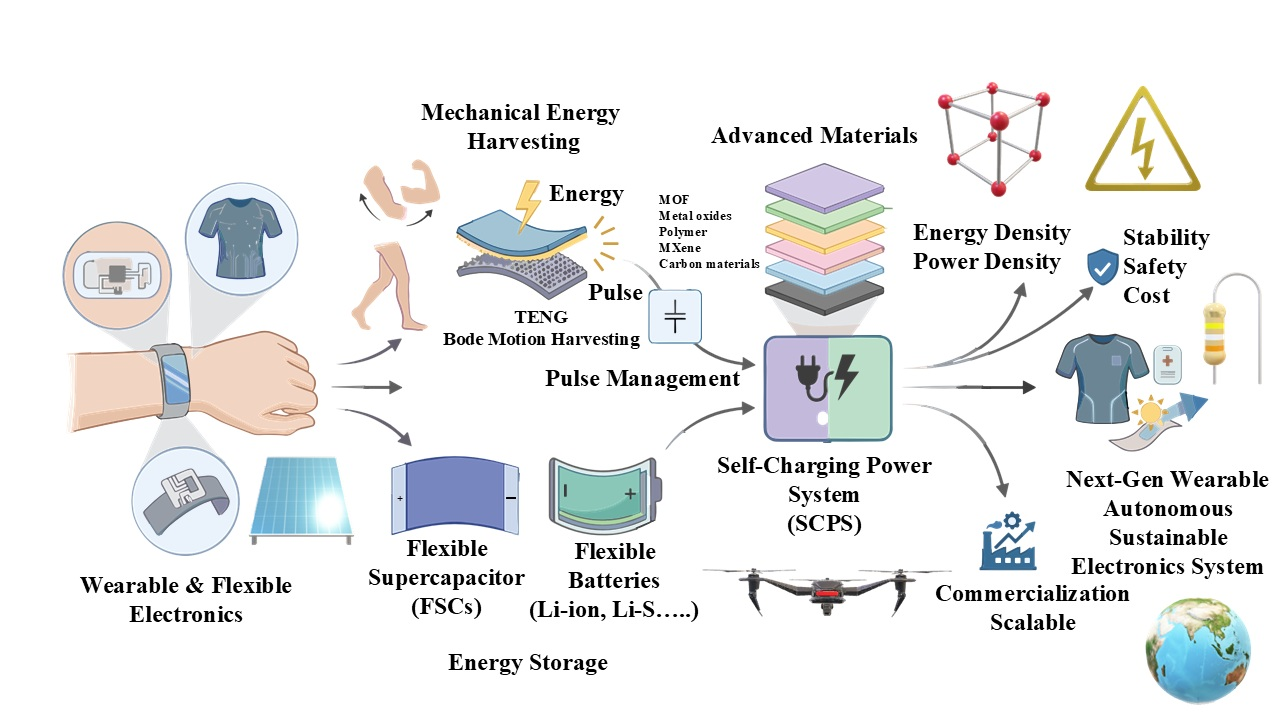
The demand for flexible and wearable electronics has intensified the need for conformable, high-performance, and self-sustaining power sources. Flexible supercapacitors (FSCs) and flexible batteries (e.g., lithium-ion and lithium–sulfur) are promising owing to their high-power density, long cycle life, and mechanical flexibility. A transformative solution lies in integrating these storage devices with mechanical energy harvesters, particularly triboelectric nanogenerators (TENGs), to create autonomous self-charging power systems (SCPSs). TENGs exhibit high output, versatile operational modes, material flexibility, and efficient energy harvesting from body movements. This review provides an overview of the recent advances in flexible energy storage technologies, encompassing carbon-based materials, MXenes, polymers, metal oxides, metal–organic frameworks (MOFs), and their hybrid architectures. It discusses the synergistic integration of these storage devices with TENGs to realize multifunctional SCPSs. It also highlights the fundamental design principles of flexible devices, the critical interplay of materials and architecture, and the journey towards monolithic system integration. The review also underscores the importance of managing harvesters’ pulsed output for efficient storage. Finally, a critical analysis of the challenges, including the energy density–flexibility compromise, environmental stability, and safety, is presented, alongside a forward-looking perspective on commercialization pathways for these technologies to power the next generation of autonomous wearable and sustainable electronic systems.

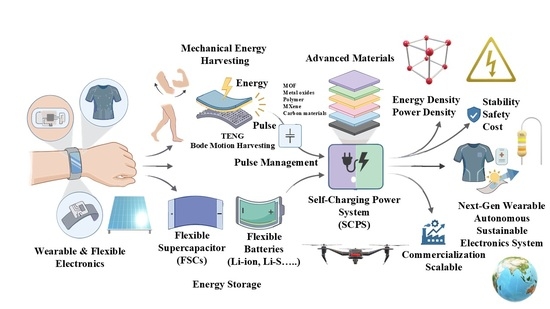
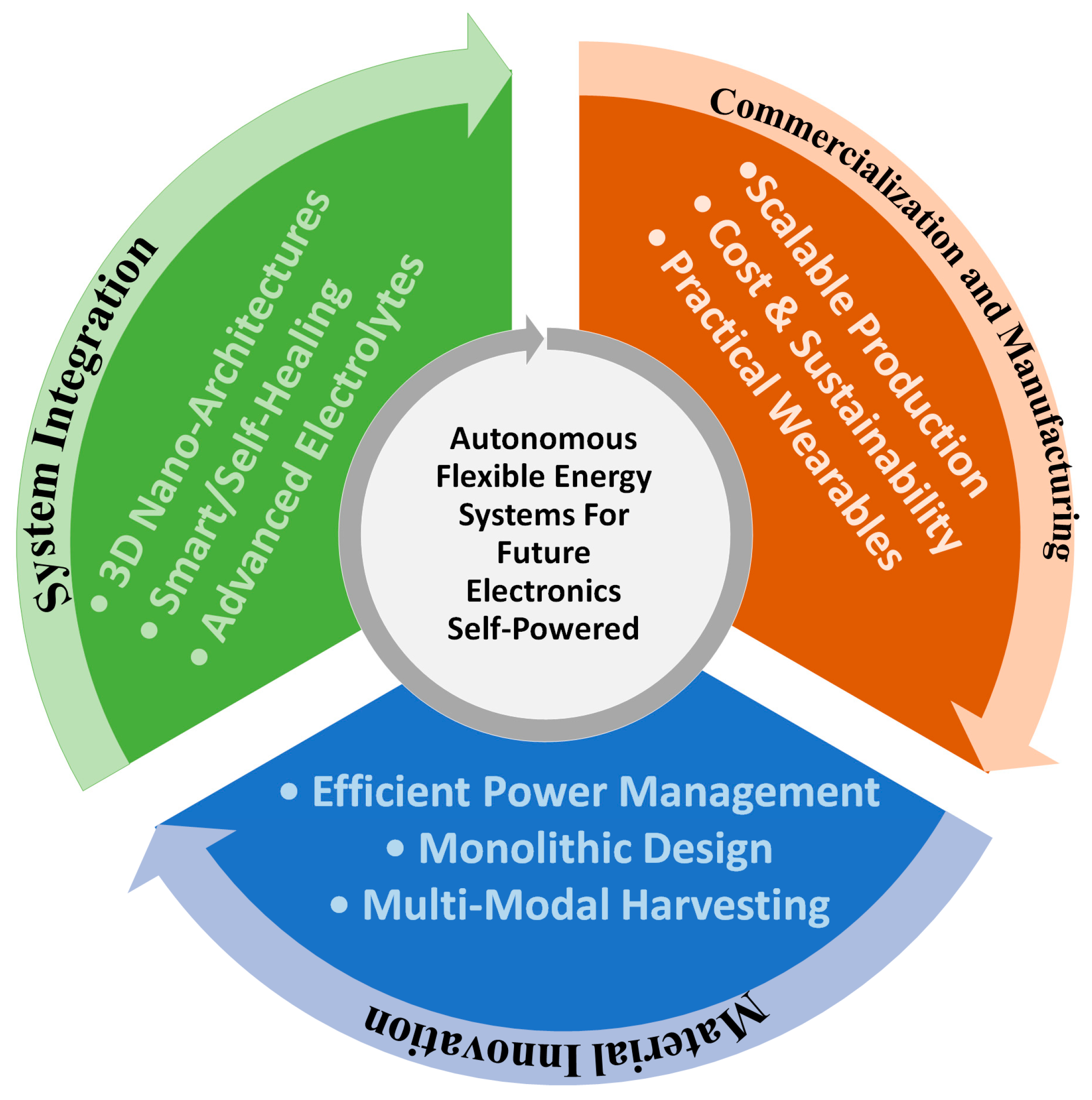
Graphical Abstract

1. Introduction

The global energy sector is undergoing a major transition driven by the depletion of fossil fuels and growing environmental concerns [1]. Although petroleum and natural gas have supported significant industrial and technological progress, they have also contributed to energy insecurity, pollution, and greenhouse gas emissions [2,3]. As a result, renewable and sustainable energy technologies are now considered essential for mitigating climate change and supporting long-term economic development [4,5,6,7,8,9]. In this context, electrochemical energy storage (EES) systems, including batteries (e.g., lithium-ion batteries (LIBs), Zn-batteries, etc.) and supercapacitors (SCs), play a vital role in stabilizing renewable energy and powering modern electronic devices [10,11,12,13,14,15,16,17,18,19,20]. However, conventional EES devices are generally rigid and bulky, making them unsuitable for emerging flexible and wearable technologies [21,22,23,24,25,26,27,28]. The rapid growth of wearable and flexible electronics, driven by advancements in the industrial revolution, has created strong demand for lightweight, deformable, and reliable power sources [29,30,31,32,33]. Applications such as electronic textiles, implantable medical devices, electronic skins, and Internet of Everything (IoE) platforms require energy storage systems that can withstand bending, stretching, and twisting without compromising performance. Traditional batteries, which rely on rigid electrodes and liquid electrolytes, are not well-adapted to such conditions [34,35]. To address these limitations, researchers have developed flexible electrodes, solid or gel polymer electrolytes, and innovative designs, such as fiber-shaped and planar architectures, that can be integrated directly into wearable systems [36,37,38,39]. Despite considerable progress, several key challenges remain. Flexible energy storage devices often face trade-offs between energy density and mechanical durability, as well as issues related to long-term stability, environmental resistance, and safety [40,41,42,43]. Several reviews have been reported on many materials or device components [44,45,46,47,48].
This review provides an overview of the recent advances in flexible supercapacitors (FSCs), flexible batteries (including lithium-ion and lithium–sulfur systems), and emerging hybrid devices using several materials, including, but not limited to MXene [49,50,51] and metal–organic frameworks (MOFs). It also highlights the integration of energy storage devices with triboelectric nanogenerators (TENGs) to develop self-charging power systems and discusses the challenges in practical, sustainable applications.

2. Flexible Supercapacitors

The rapid expansion of wearable electronics, implantable biomedical devices, and portable consumer technologies has created a high demand for lightweight, flexible, and mechanically durable energy storage systems [52]. Despite their widespread use, conventional lithium-ion batteries suffer from several limitations, including limited flexibility, safety risks, and reduced stability under repeated deformation. These challenges have motivated significant efforts to develop alternative storage devices that maintain strong electrochemical performance under mechanical stress [53,54,55,56,57].
One of the most promising options for flexible energy storage systems is the SC [58]. Their unique attributes, high power density, ultrafast charge/discharge capability, long cycle life, and intrinsic safety set them apart from traditional batteries [59,60]. Unlike batteries that rely on slow, diffusion-limited faradaic processes, SCs store energy through electrostatic ion adsorption in electrical double-layer capacitors (EDLCs) or via rapid surface redox reactions in pseudocapacitors [61,62]. These mechanisms enable efficient energy delivery across multiple charge–discharge cycles, making SCs especially attractive for next-generation flexible and wearable electronics [63,64,65,66].
To function effectively in deformable systems, flexible supercapacitors (FSCs) must not only deliver strong electrochemical properties, such as wide potential windows, high energy and power density, and long-term cycling stability, but also retain their performance under bending, twisting, folding, and stretching. This requirement imposes strict standards on all device components, including electrodes, electrolytes, separators, and encapsulation layers. Over the past two decades, researchers have developed diverse FSC designs, with significant milestones ranging from early planar devices to fiber-shaped, stretchable, and biodegradable systems.
Among all components, the electrode material plays the most critical role, as it dictates capacitance, charge-storage mechanisms, mechanical durability, and overall device efficiency [67,68]. To achieve high performance, electrodes must integrate excellent conductivity and electrochemical activity with strong resistance to repeated mechanical deformation [69]. In this context, graphene and carbon nanotubes (CNTs) have received considerable attention due to their high electrical conductivity, large specific surface area, and outstanding electrochemical performance [70,71,72,73,74]. However, graphene nanosheets tend to stack and agglomerate during fabrication, significantly reducing the practical capacitance relative to the theoretical 550 F/g [75,76].
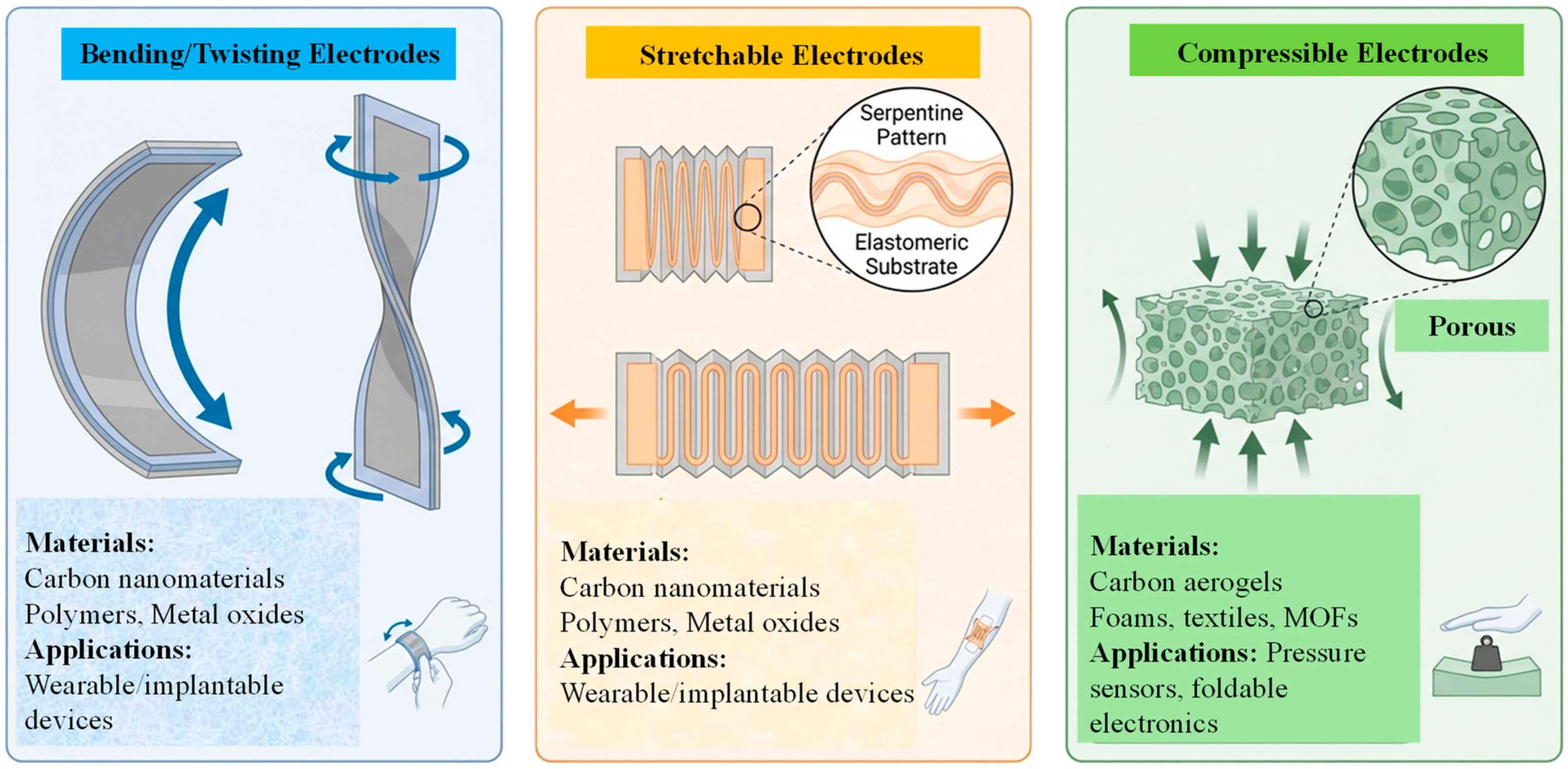
Three-dimensional (3D) printing has been reported for ultraflexible TENGs featuring unique nanosheet-shaped electrodes [47]. These electrodes can be directly integrated into solid-state SCs without current collectors, avoiding graphene restacking and maximizing capacitance. The resultant SC has an energy density of 12.2 Wh/kg and a high areal capacitance of 894 mF/cm2, while maintaining 97% of its performance after 500 bending cycles. Similarly, the hydrothermal activation technique has been used to fabricate graphene fiber textiles with a high areal capacitance of 1060 mF/cm2 [77]. The EDLC-storage mechanism at the surface of these carbon-based materials limits their specific capacitance, despite their exceptional mechanical flexibility. To enhance performance, pseudocapacitive materials have been introduced. For example, α-FeOOH deposited directly on carbon fibers exhibited high volumetric capacitance and excellent cycling stability [78]. Similarly, MoS2-decorated carbon fiber yarns demonstrated promising performance in fiber-shaped FSCs [79]. Electrospun Dy-WO3/carbon nanofibers (CNFs) also achieved high energy density (29.8 Wh/kg) and capacitance (557.28 F/g) [80]. These studies highlight the importance of integrating pseudocapacitive materials with flexible conductive frameworks. Overall, integrating carbon-based materials with pseudocapacitive compounds or functional modifications offers a powerful strategy for balancing electrochemical performance with mechanical flexibility. Unlike conventional SCs, all FSC components, electrodes, electrolytes, separators, and current collectors must be mechanically compliant. Designing structurally optimized electrodes that combine high conductivity with elasticity and compressibility remains central to advancing wearable and portable SCs. For practical applications, mechanical adaptability is equally important as electrochemical efficiency. Depending on materials and design, FSCs can be engineered to bend, stretch, twist, or compress, greatly broadening their potential uses in flexible displays, electronic skin, robotics, and other wearable systems (Figure 1).
One of the main challenges in FSCs is the trade-off between energy density and mechanical flexibility. High energy density usually requires high active-material loading. These materials, such as metal oxides and conducting polymers, are often rigid. They can also degrade under repeated bending or stretching. In contrast, carbon-based materials like graphene and CNTs are highly flexible. However, they provide relatively low capacitance due to their EDLC mechanism. To overcome this limitation, recent studies focus on multi-scale structural design and hybrid material strategies [81]. Hierarchical porous structures with micro-, meso-, and macropores enhance ion transport and increase the accessible surface area while maintaining structural stability under mechanical stress. In addition, hybrid electrodes combining carbon materials with pseudocapacitive components improve capacitance while preserving flexibility through synergistic effects [82,83]. Another effective strategy is the use of freestanding and binder-free electrodes. These designs remove rigid current collectors and inactive materials. As a result, both energy density and flexibility are improved. Moreover, 3D conductive networks, such as graphene aerogels and CNT scaffolds, provide excellent mechanical resilience. They help distribute stress during deformation and maintain efficient charge transport [41]. The development of stretchable and self-healing gel electrolytes is also important. These materials can sustain ionic conductivity under large deformation. They enhance the durability and reliability of flexible devices [84]. Furthermore, advanced structural designs, such as fiber-shaped, coiled, buckled, and kirigami-inspired systems, allow better strain accommodation. These designs reduce the impact of mechanical stress on electrochemical performance [85]. Overall, these strategies demonstrate that the trade-off between energy density and flexibility can be effectively reduced. This can be achieved through careful material selection and smart electrode design. Such approaches pave the way for high-performance, flexible, and wearable energy storage devices.

2.1. Flexible Electrode

2.1.1. Compressible Electrodes

Freestanding 3D carbon-based materials, such as carbon foams and aerogels, show great promise for use in compressible SCs. Their porous architecture and rough surfaces contribute to excellent hydrophilicity and low density. At the same time, their regular honeycomb-like construction facilitates effective stress distribution in both vertical and lateral directions, thereby minimizing structural fracture and promoting elastic energy storage [86].
The development of high-performance flexible electrodes is crucial because they are a frequent source of mechanical deformation in FSCs. Therefore, it is essential to carefully design and fabricate structurally optimal electrodes. For many applications, flexible carbon-based materials that combine compressibility with excellent conductivity offer distinct benefits [87]. The goal of recent developments in compressible carbon-based materials has been to improve their electrochemical performance and mechanical durability.
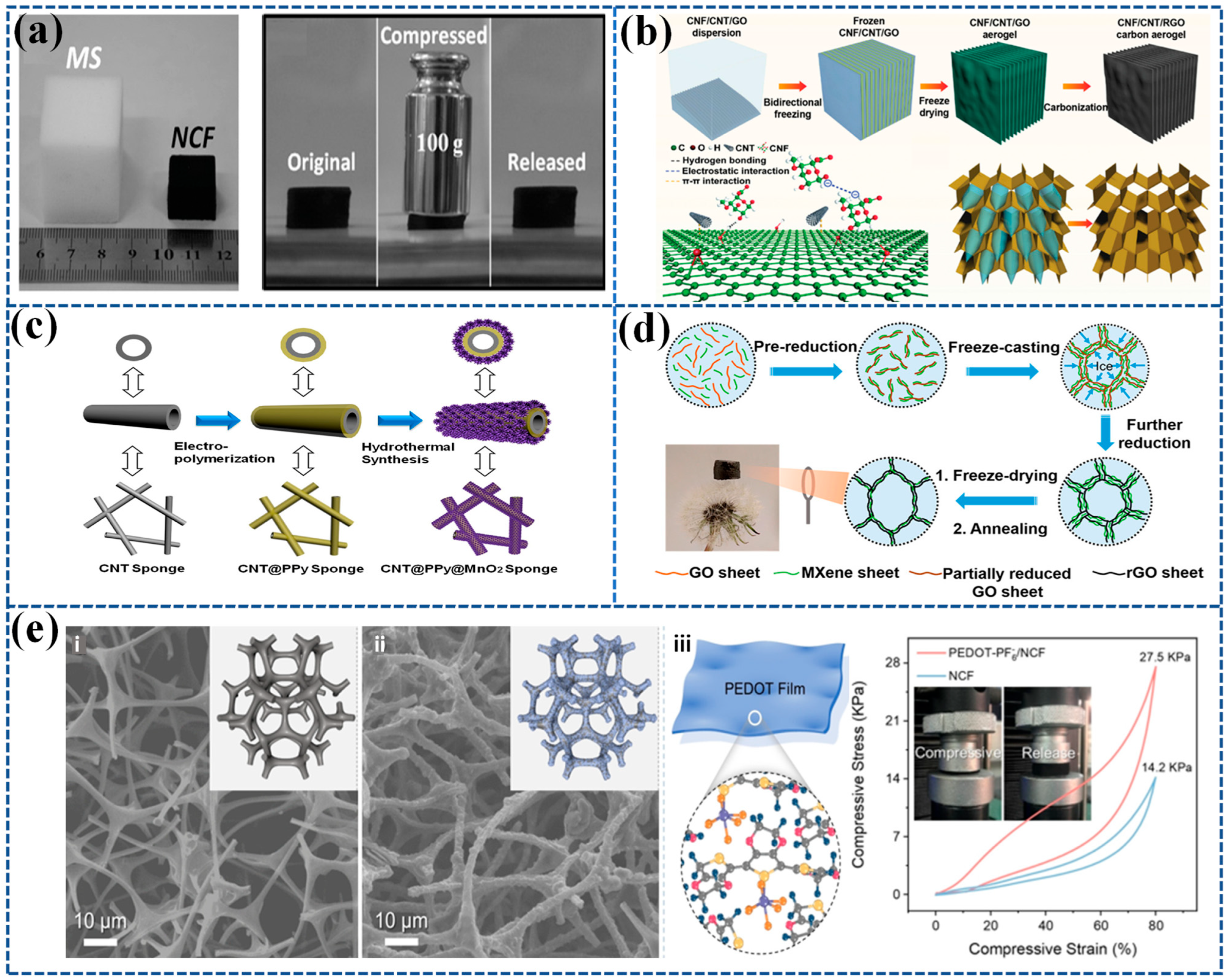
High-performance freestanding electrodes and hydrophilic N-doped carbon foams have been reported as promising compressible electrodes [68]. After 100 cycles at 55% strain, their symmetrical SC showed no appreciable volume loss and demonstrated exceptional structural flexibility, withstanding compressive loads of up to 80% (Figure 2a). In another study, a composite aerogel comprising CNTs, reduced graphene oxide (rGO), and cellulose nanofibrils (CNF/CNTs/rGO) was reported [69]. Their bidirectional freezing-and-annealing synthesis process produced a regular, layered, porous structure that inhibited the stacking of graphene sheets. At 50% strain, this material withstood 10,000 compression cycles, demonstrating exceptional mechanical resilience. After 5000 cycles, it retained 88% of its initial high areal capacitance of 109.4 mF/cm2, demonstrating electrochemical stability. Its characteristics also make it appropriate for use as a strain sensor to track biological signals in humans (Figure 2b).
Nitrogen-doped carbon aerogels have attracted significant attention as compressible electrodes due to their lightweight frameworks and mechanical resilience. For instance, Liu et al. reported graphene-based aerogels prepared via a template method that maintained stable electrochemical performance under repeated compression while delivering relatively high energy density [88]. Similarly, nitrogen-doped carbon aerogels were synthesized using a biomass-derived route with glucose and dicyandiamide, achieving a wave-like layered structure capable of withstanding up to 95% compressive strain and delivering a capacitance of 220.2 F/g at 0.5 A/g [89]. Despite these advances, the energy storage capacity of 3D carbon aerogels remains limited, motivating the integration of pseudocapacitive components such as metal oxides, conducting polymers, and transition-metal dichalcogenides.
To overcome the limited capacitance of pristine carbon aerogels, recent efforts have focused on integrating redox-active materials into compressible carbon scaffolds. Hybrid systems, including NiCo2S4/carbon sponges, polyaniline (PANI)/single-wall carbon nanotubes (SWCNTs) sponges, and CNT/polypyrrole (PPy)/MnO2 composites, have demonstrated enhanced electrochemical performance and mechanical flexibility (Figure 2c) [90]. In parallel, the choice of electrolytes is also critical. Conventional aqueous electrolytes are generally unsuitable under high compression, whereas ion-conducting gels, with their high conductivity, flexibility, and semi-solid nature, are emerging as more favorable electrolyte systems for compressible SCs [90,91,92,93].
Nowadays, ionic conducting gels, such as polyvinyl alcohol (PVA)-based hydrogels and polymer–ion liquid gels made by covalently polymerizing vinyl polymers or by simply combining vinyl polymers, are usually brittle and have low mechanical strength. To address this limitation, a self-triggered UV polymerization combined with continuous water addition was reported to create a gel electrolyte based on EMIMCl (1-ethyl-3-methylimidazolium chloride)/water (wt.%) [94]. This electrolyte’s non-covalent cross-linking gives it self-recovery and compressive toughness. This gel was used to create symmetrical SCs that withstood 90% compression and even demonstrated increased capacitance due to pressure-induced increases in ionic conductivity resulting from changes in viscosity. These tunable conducting gels are essential for balancing electrochemical performance and mechanical stress, enabling the fabrication and packaging of advanced FSCs when combined with flexible electrode materials.
Advanced electrode designs have been investigated concurrently to enhance mechanical and electrochemical characteristics. An aerogel, super-elastic MXene/rGO composite was prepared via reduction, freeze-drying, and annealing to create a highly loaded compound [95]. A strong cellular scaffold was created by integrating the MXene into the graphene framework (Figure 2d). A high specific capacitance of 397 F/g at 0.5 A/g and outstanding mechanical stability (60% strain over 1000 cycles) were demonstrated by the aerogel due to the synergistic effect of MXene and graphene. Another notable strategy involved a “polymer chainmail” method in which anion-doped poly(3,4-ethylenedioxythiophene) (PEDOT) that had been electrochemically stabilized was polymerized in situ on a 3D carbon foam skeleton doped with nitrogen (Figure 2e) [96]. A high specific capacitance of 604.6 F/g at 3 mA/cm3 and improved mechanical characteristics (1000 cycles at 80% strain) were the outcomes of PEDOT’s film-forming behavior and intrinsic electrochemical performance. Overall, these studies highlight the importance of integrating mechanically robust pseudocapacitive materials with flexible conductive gels and porous elastic frameworks to achieve high-performance compressible supercapacitors.
Figure 2. (a) The transformation from a melamine foam precursor to a nitrogen-doped carbon foam (NCF) is shown in digital images, which also highlights the NCF’s compressible nature. Reproduced with permission from ref. [68]. Copyright 2016, Wiley-VCH. (b) Schematic of the preparation process and potential applications of the CNF/CNT/rGO hybrid carbon aerogel. Reproduced from open access ref. [69], CC BY-NC 4.0. The Authors. Advanced Functional Materials published by Wiley-VCH © 2022. (c) Schematic of the preparation process from CNT sponge to CNT@PPy@MnO2 core-double-shell sponge. Reproduced with permission from ref. [90]. Copyright 2014, American Chemical Society. (d) Schematic diagram of the fabrication process for the MXene/rGO hybrid aerogel. Reproduced with permission from ref. [95]. Copyright 2021, American Chemical Society. (e) Schematic illustrating the in situ electrochemical polymerization and doping process of PEDOT-PF6− on a flexible substrate, along with SEM images showing the three-dimensional structures of (i) NCF and (ii) PEDOT-PF6−, and (iii) the chemical structure of PEDOT-PF6−. Reproduced with permission from ref. [96]. Copyright 2023, Wiley-VCH.
Batteries 12 00152 g002

2.1.2. Stretchable Electrodes

Recent studies have focused on developing flexible devices based on yarns or fibers, as stretchability is a crucial prerequisite for wearable SCs [97,98]. The electrodes and electrolytes mostly determine the electrochemical performance and mechanical elasticity of the devices in these systems. Stretchable electrodes can be broadly divided into two structural types: micro-scale topologies, such as networks of micro-buckled or helically wrapped carbon nanotubes, and macro-scale structures, including coiled, bent, or spring-like fibers [99,100,101,102,103].
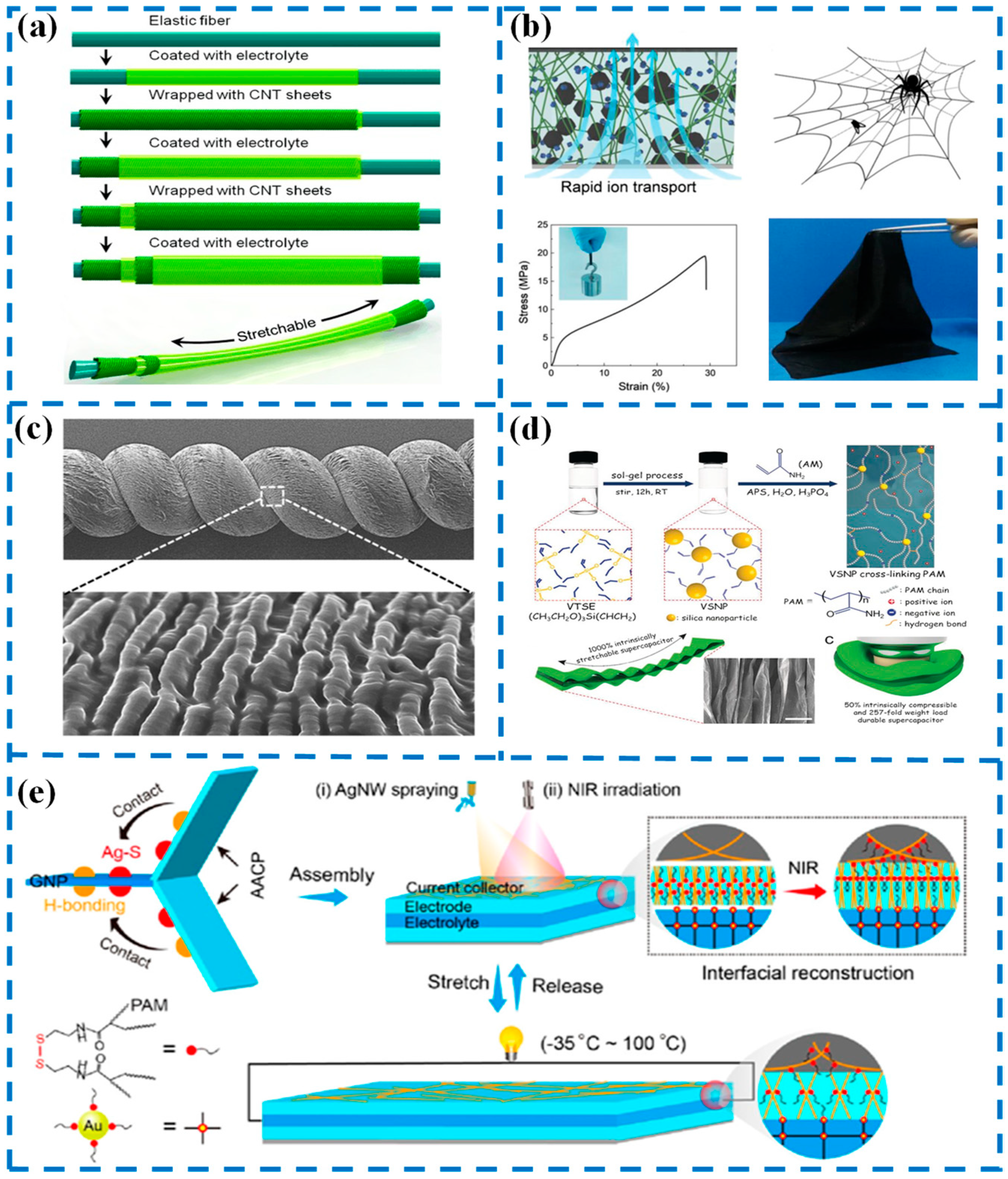
A gel electrolyte was reported using PVA and corresponding acids, bases, or salts, such as PVA/H2SO4. The operating voltage also depends on the type of electrode material [104]. A stretchy fibrous SC was reported by covering elastic fibers with a PVA gel electrolyte and then with a CNT sheet electrode (Figure 3a) [105]. Even after 100 cycles of 75% stretching, the device’s capacitance remained at 18 F/g. A flexible electrode was reported using the structure of a spider’s web as a guide [106]. They applied it to the electroactive material to create stretchy electrodes by attaching it to the bacterial cellulose 3D web structure, which is interconnected and entangled (Figure 3b). The electrode tolerated a high tensile strength of 19.5 MPa (tensile strain of 29%). Furthermore, owing to the spiderweb-type 3D binder, the electrode material exhibits a high specific capacitance of 225.8 F/g at 0.5 A/g, driven by its high mass loading. A synergistic construction was reported using the fiber electrodes, which are macroscopically coiled and microscopically buckled to create MnO2/CNT-based ultra-stretchable SCs (Figure 3c). Super-elastic fiber SCs may bend up to 800%. Additionally, the capacitance retained about 90.3% of its initial value when the fiber SCs were stretched by 600%. It is inherently compressible and stretchable; the choice of electrolytes is crucial [107]. Unfortunately, widely used acidic PVA-based electrolytes are neither stretchable nor healable, resulting in subpar performance (lower than 100% strain and reduced performance at super-high strains) [68,69]. Therefore, to achieve intrinsic self-healing, high stretchability, and high compression, a multifunctional polyelectrolyte must be developed [108].
Polymeric hydrogels have significantly advanced the development of flexible, multifunctional SCs due to their favorable properties in mass transport and mechanical elasticity [109,110]. To fully exploit their potential, these materials require efficient ionic conduction, hydrogen-bond formation activated by crack propagation, and reversible cross-linking interactions among polymer chains. Hydrogels are hydrophilic polymer networks swollen with a controllable amount of water, exhibiting both stretchability and compressibility. The water confined within these networks facilitates ion dissolution, thereby rendering hydrogels highly effective ionic conductors [111].
By dual-crosslinking polyacrylic acid with vinyl-modified silica nanoparticles and hydrogen bonding, an electrolyte hydrogel (PAA-VSNPs hydrogel) was created [108]. This material could sustain strains of more than 3700%, demonstrating remarkable stretchability. When used in SCs, the hydrogel enabled the devices to sustain over 100% capacitance at 80% compressive strain and 350% capacitance at 600% stretching.
Vinyl-modified silica nanoparticles were added to the backbone of polyacrylamide hydrogels to create a polyacrylamide–vinyl silica nanoparticle (PAM-VSNP) hydrogel electrolyte [112]. By improving the polymer network’s dynamic cross-linking, this alteration enables the cross-linkers to act as stress buffers, releasing energy in response to applied strain. This method thereby overcomes the inherent drawbacks of conventional SCs, which typically exhibit poor compressibility and stretchability. With a 260% increase in performance, the resultant SC showed a remarkable strain tolerance of 1000%. It sustained compression up to 50% strain while retaining a high capacitance of 99.4% (Figure 3d).
By directly polymerizing polyacrylamide (PAM) on the silver nanowire (AgNW)/Ag–CNT network, a composite hydrogel (AACP) was reported via combining PAM, AgNW, and Ag–CNT [113]. Even with a thin PAM layer added, this technique-maintained connectivity between the Ag–CNT and AgNW networks. The resultant hydrogel demonstrated high electrical conductivity (965 S/cm) and effective fracture energy dissipation through honeycomb deformation, crack-bridging generation in the interwoven network, and crack-sharing via Ag–SR connections. Additionally, a very high tensile strain of 2430% was shown. These hydrogels enabled devices with broad temperature tolerance (−35 to 80 °C) and exceptional cycling performance when used in SCs with multifunctional GNP electrolytes. After 10,000 cycles at −35 °C, the devices maintained over 97% of their capacity (Figure 3e).
Building on these advances, flexible solid-state electrolytes should meet several requirements simultaneously, including high ionic conductivity, robust electrode/electrolyte interfacial stability, mechanical flexibility, and intrinsic safety over a wide temperature range, which remains a critical challenge. At low temperatures, polymer motion is limited, whereas at high temperatures, interfacial degradation and mechanical instability may occur. To address these limitations, several have proposed effective strategies. Polymer and gel electrolytes featuring dynamic cross-linked networks and hydrogen-bonding interactions can enhance segmental mobility and sustain ionic conductivity under mechanical deformation [114,115]. Meanwhile, the incorporation of ionic liquids or plasticizers has been shown to improve ion transport at sub-ambient temperatures while enhancing thermal stability and non-flammability [116]. In addition, interface engineering approaches, such as in situ polymerization and artificial interlayers, can effectively reduce interfacial resistance and improve electrode/electrolyte compatibility [117]. Furthermore, composite electrolytes incorporating inorganic fillers (e.g., ceramic nanoparticles or MXene) provide enhanced mechanical strength, suppress dendrite growth, and maintain stable interfaces over a broad temperature range [118,119]. These combined strategies are crucial for enabling safe, flexible, and high-performance solid-state energy storage devices for next-generation wearable applications.
Figure 3. (a) Manufacturing process for a fiber-based stretchable supercapacitor. Reproduced with permission from ref. [105]. Copyright 2013, Wiley-VCH. (b) Spider-web-inspired 3D adhesives for advanced electrodes. Reproduced with permission from ref. [106]. Copyright 2021, Wiley-VCH. (c) SEM images of (d) the BCF electrode (scale bar = 500 µm and 20 µm). Reproduced with permission from ref. [107]. Copyright 2017, Wiley-VCH. (d) Synthesizing process for a novel nanoparticle-reinforced gel electrolyte (VSNPs–PAM). Reproduced with permission from ref. [112]. Copyright 2017, Wiley-VCH. (e) Fabrication strategy for an adhesive AACP hydrogel electrode. Reproduced with permission from ref. [113]. Copyright 2022, American Chemical Society.
Batteries 12 00152 g003

2.1.3. Bending/Twisting Electrodes

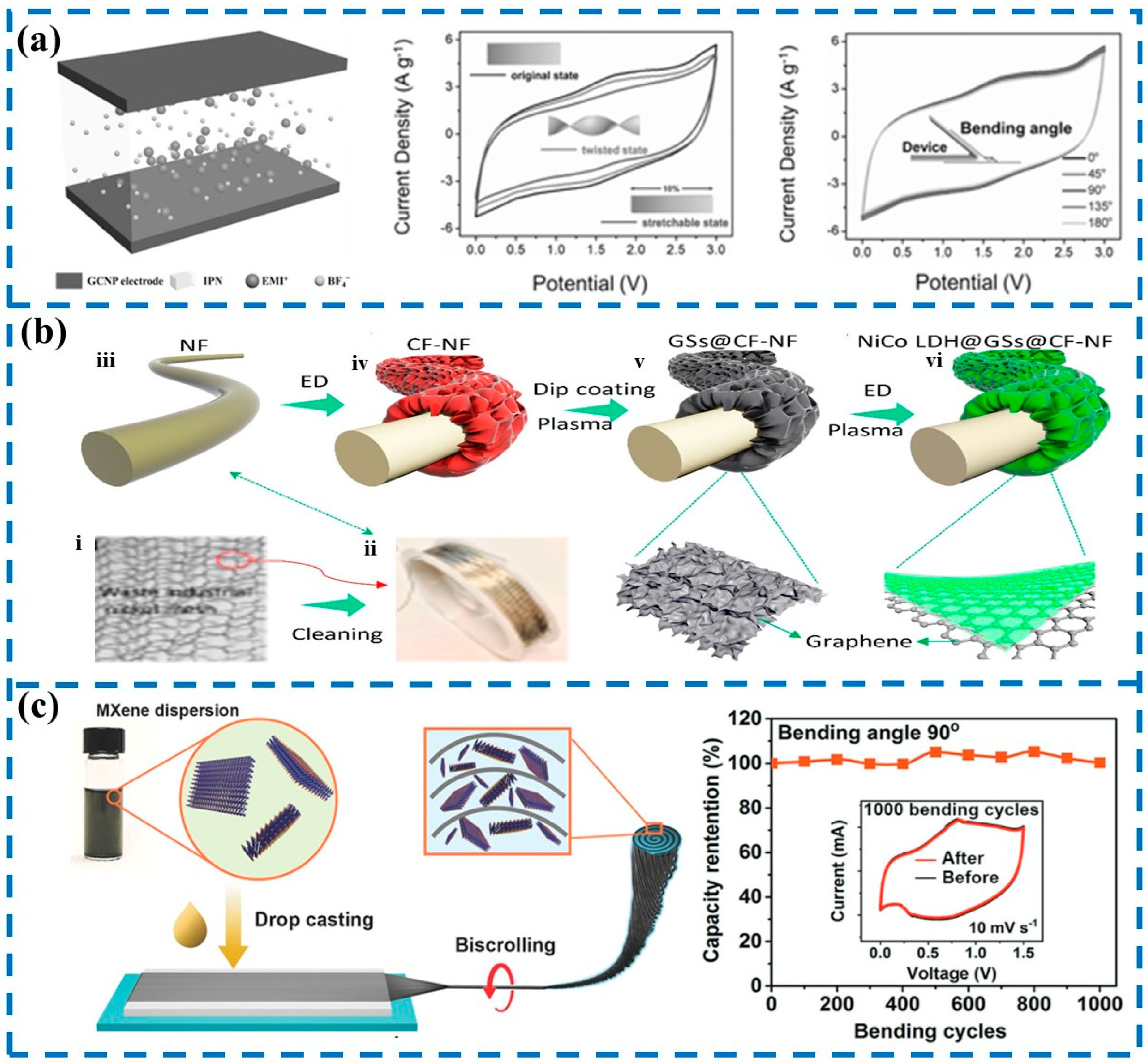
By growing an MOF in situ on CNTs, a flexible electrode was prepared, which synergizes the high surface area of the MOF with the mechanical flexibility of the CNTs [120]. The device exhibited remarkable resilience, showing no performance loss under significant stress, including twisting, 10% tensile strain, and bending up to 180° (Figure 4a). Previously, composites of carbon and pseudocapacitive materials yielded low gravimetric/volumetric performance, limiting their use in wearables [121,122]. New strategies now enable the efficient combination of their components. The volumetric performance of carbon fibers can be enhanced by adding pseudocapacitive materials, including conducting polymers, metal oxides, transition-metal dichalcogenides, and MXenes [80,81,82,83,84]. To enhance electrical connectivity and specific surface area, a 3D copper foam-graphene sheet interface was reported between the active material and a nickel fiber current collector [123]. This architecture significantly reduced interfacial resistance. Compared to active material grown directly on nickel fiber, the resulting asymmetric SC achieved a higher areal capacity of 350.9 mF/cm2 and retained 95% of its capacitance even when bent to 180° (Figure 4b).
An asymmetric SC with high mechanical resilience was reported by incorporating MoS2 and rGO nanosheets into a neatly aligned multi-walled CNT (MWCNT) sheet, followed by a twisting process [124]. The fabricated MoS2-RGO/MWCNT fiber//rGO/MWCNT fiber device operated within a 1.4 V potential window. It demonstrated exceptional robustness, showing unchanged cyclic voltammetry (CV) performance under 180° bending. Both CV characteristics and Coulombic efficiency remained steady throughout 7000 cycles, regardless of applied bending, confirming the device’s outstanding stability. Spinning technology is key to developing deformable electrodes, as evidenced by work with MXene [125,126]. They overcame a major limitation of pseudocapacitive materials, with the trade-off between high loading and conductivity, by spinning MXene nanosheets into fibers. In one approach, MXene loadings of ≈88 wt.% increased conductivity by a factor of 2.5, yielding strong, knittable fibers with a volumetric capacitance of 256 F/cm3 [127]. Pushing the limit further, a bi-scrolling technique achieved an unprecedented ≈98 wt.% MXene loading within CNT scrolls. The resulting SC delivered impressive metrics, namely 203 F/cm3 capacitance, 100% retention after 1000 bends, and a high energy density of 61.6 mWh/cm3, demonstrating the viability of spun MXene composites for demanding wearable applications (Figure 4c) [126].
Figure 4. (a) Electrochemical behavior and mechanical flexibility of SCs with continuous-phase MOF porous carbon electrodes. Reproduced with permission from ref. [120]. Copyright 2017, Wiley–VCH. (b) Stepwise fabrication schematic of NiCo LDH@GSs@CF-NF using industrial nickel mesh: (i–iii) NF, (iv) CF-NF, (v) GSs@CF-NF, and (vi) NiCo LDH@GSs@CF-NF. Reproduced with permission from ref. [123]. Copyright 2018, American Chemical Society. (c) Braiding process of conductive MXene yarns. Reproduced with permission from ref. [126]. Copyright 2018, Wiley–VCH.
Batteries 12 00152 g004

3. Flexible Batteries

Modern flexible electronics, such as smartwatches, folding phones, and stretchable sensors, are in high demand due to advancements in science and technology. Flexible energy storage devices are recognized as essential components of these systems and are attracting significant research interest. Their comfortable, wearable design, which enables a more seamless interaction between users and technology, is their main advantage over traditional rigid batteries. As a result, significant progress has been made in flexible lithium-based batteries, driven by improvements in performance and stability, as well as by growing market demand. Flexible lithium-ion batteries (FLIBs) are examples of this advancement, promising systems such as flexible lithium–sulfur (FLSBs) and other topologies that use lithium-containing cathodes. Flexible batteries form the backbone of wearable power systems, owing to their relatively high energy density, long cycle life, and adaptability to diverse device requirements. Conventional rigid LIBs cannot withstand the bending, twisting, or stretching associated with wearables, which has spurred research into flexible electrodes, substrates, electrolytes, and packaging. The information below provides a breakdown of their progress and the challenges they face.

3.1. Flexible Metal-Ion Batteries

LIBs have become the dominant power source due to their high energy density and stable voltage. They operate on the principle of Li+ ions moving between a carbon-based anode and a lithium–metal oxide cathode, facilitated by an organic liquid electrolyte and a polymer separator, all contained within protective packaging. The standard method for manufacturing these electrodes is slurry-casting. This process involves mixing active materials with binders and conductive additives like carbon black to form a slurry, which is then applied to a metal foil current collector, typically copper for the anode and aluminum for the cathode. While essential for providing electrical contact and structural integrity, these inactive components (binders and additives) present significant drawbacks. They reduce electrical conductivity, hinder ion access, increase polarization, and can trigger side reactions with the electrolyte, all of which impair cycling stability and lower the electrode’s overall energy density.
The traditional current collectors used for EES introduce further limitations. Their significant weight (10–15% of the total cell weight) reduces energy density, and their inherent rigidity and brittleness cause the active material to detach when bent. The lack of flexibility, combined with heavy packaging, makes conventional LIBs unsuitable for next-generation applications. They cannot be used to develop FLIB, a transformative advancement that moves beyond rigid forms. Thus, innovative materials, such as CNTs and polymer electrolytes, have been reported to enable devices that can withstand bending and stretching, thereby enabling integration into wearable electronics and conformable medical devices. For this market, components must meet additional requirements for durability, flexibility, and lightweight [128]. A critical need is to replace traditional metal collectors with lightweight, flexible, and highly conductive alternatives. However, the path to commercializing flexible LIBs requires overcoming significant challenges. These include ensuring the safety of organic electrolytes, maintaining mechanical and electrochemical integrity during repeated deformation, achieving high energy density, and developing scalable manufacturing processes. Despite these challenges, FLIBs remain a cornerstone for the future of electronic devices [129,130,131].

3.1.1. Design Architectures for Flexibility

Wearable technology is increasingly used across fields such as portable entertainment, sports, fitness tracking, and medical health monitoring. These systems require power sources that can sustain steady performance under repeated bending, twisting, and stretching, while remaining compact and lightweight. In this regard, LIBs remain appealing due to their high energy density, long cycle life, and well-established manufacturing processes. However, the rigidity of standard LIBs makes them difficult to integrate into soft, flexible platforms. Thus, several efforts have focused on developing LIBs with flexible components and architectures to address these issues. Developments include the use of metallic nanowires and conductive polymers as deformable current collectors, as well as carbon-based nanostructures like graphene and CNTs to create electrodes that are both conductive and mechanically robust. Traditional liquid systems are being replaced with solid-state electrolytes and gel polymers, which offer greater flexibility and safety. New device designs that offer multifunctionality beyond energy storage, such as fiber-shaped, textile-integrated, and origami-inspired configurations, further facilitate seamless integration into apparel or accessories.
The significant potential of flexible LIBs for next-generation wearable electronics has been highlighted in numerous studies that were reported prototypes with stable capacities, high energy densities, and reliable cycle performance even after repetitive mechanical deformation [94]. As with conventional batteries, the active electrode materials in LIBs are generally used in powder form and must be processed to ensure strong adhesion to the current collector. However, for flexible and stretchable devices, the tolerance for detachment or delamination is far lower than in rigid systems, requiring much stricter design considerations [132,133]. LIBs are still regarded as the benchmark technology for portable energy storage, largely due to their superior energy and power densities and excellent cycling stability. The conventional electrode configurations used in standard LIBs are not designed to withstand repeated bending (i.e., rigid), leading to significant performance degradation. By employing tailored structural engineering strategies, researchers have developed flexible LIBs that maintain reliable operation under high mechanical deformation [21,134].
Flexible Electrodes Based on Carbon Materials
The current collector is an essential battery component that provides mechanical support for the active materials and conducts electrons. Traditionally, metal foils such as nickel, aluminum, and copper are used; however, they present challenges for flexible batteries. Their rigidity leads to poor adhesion to electrode materials, resulting in delamination and capacity loss during repeated bending. Furthermore, their substantial weight contributes to reducing overall energy density. To overcome these limitations, carbon-based materials are being used to create self-supporting electrodes. These materials eliminate the need for metal collectors by integrating support and conduction into a single, lightweight, and flexible structure [135]. Owing to their excellent electrical conductivity, outstanding mechanical flexibility, and strong adhesion, carbon-based electrodes effectively suppress delamination, enhance rate performance, and improve durability under mechanical deformation. Among them, freestanding CNT-based materials are promising candidates for flexible electrodes due to their high conductivity, excellent flexibility, chemical stability, and low density. CNTs can be assembled into interconnected membranes that serve as flexible substrates, facilitating electron transport within the electrode.
Because of its natural flexibility and compatibility with common materials, textile-based energy storage has become a viable area for powering flexible and wearable devices. In flexible LIBs, carbon cloth (CC), which is made from CNFs, has also been widely used. SnS2 nanoflake arrays anchored on graphene supported by CC were used to create a freestanding, binder-free electrode [136]. SnS2/graphene/CC composite exhibited a 3D network structure with a large specific surface area, enabling high active-material loading. Serving as both a flexible current collector and a conductive scaffold, CC significantly increased the electrode’s electrical conductivity. Owing to CC’s excellent mechanical properties, the composite electrode was flexible and could even be rolled. Electrochemically, it delivered an initial discharge capacity of 1987.4 mAh/g and maintained 638.1 mAh/g after 150 cycles, with nearly 100% coulombic efficiency. CC and other 2D carbon materials can be used to make excellent flexible substrates for improved battery electrodes. These carbon substrates significantly improve electron transport and lithium-ion diffusion when used with high-capacity transition-metal compound anodes. This enhancement directly increases rate capability and long-term cycling stability.
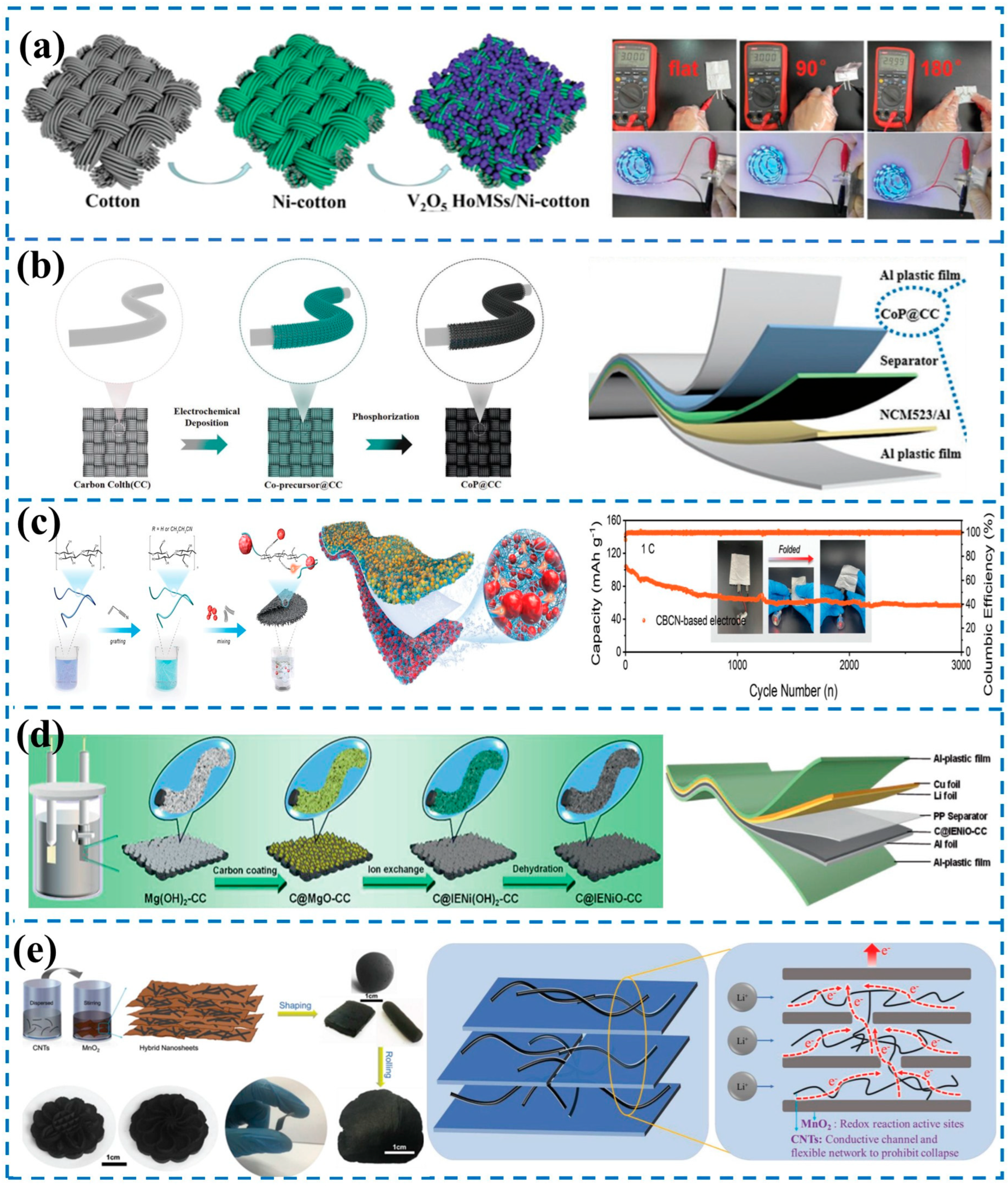
Several methods have been reported for preparing flexible electrodes using carbon materials. A multi-step procedure was reported to convert ordinary carbon fabric into a high-performance, self-supporting electrode for flexible batteries [137]. The procedure began by using thermal etching to grow iron oxyhydroxide (FeOOH) nanorods on the carbon fibers of the cloth. Following thermal reduction in a nitrogen atmosphere, these nanorods were transformed into iron oxide (Fe3O4) nanoparticles, thereby adding nitrogen doping to the carbon structure. An acid wash was used to remove these iron oxide nanoparticles and create a highly porous carbon fabric skeleton doped with nitrogen. The resulting 3D structure provided significant benefits: nitrogen doping improved carbon’s electrical conductivity, and the porosity provided a large surface area for lithium-ion storage. The combined effects of increased surface area and improved conductivity greatly enhanced the material’s electrochemical performance. With an outstanding volumetric energy density of 43 Wh/cm3 and a high-power density of 800 W/cm3, the constructed battery proved its advantages by storing a significant quantity of energy and delivering it quickly. A solution-treated method was reported that used the polymer-assisted metal deposition technique to first deposit a layer of nickel onto a cotton substrate, then create an advanced composite electrode [138]. This procedure produced a flexible and conductive Ni-cotton structure. Vanadium pentoxide (V2O5), which had been developed into a hollow multishelled structure (HoMSs), was then applied to this framework. The electrode’s performance is largely dependent on the complex structure of these V2O5 shells. The large volume expansion and contraction that occur during lithium insertion and extraction (charging and discharging) are efficiently buffered by the vast void space provided by the hollow, multi-layered architecture. By doing this, the electrode’s mechanical stress and strain are successfully reduced, halting deterioration. Consequently, the electrode exhibits remarkable resilience, retaining its 222.4 mAh/g capacity after 500 cycles and maintaining structural integrity through hundreds of bending cycles, rendering it ideal for flexible applications (Figure 5a) [138].
The large volume expansion and contraction of lithium–metal oxide cathodes during charging and discharging are major challenges. Mechanical stress from frequent swelling and contraction causes cracking, structural deterioration, and loss of electrical contact within the electrode. These problems are the main causes of lithium-ion battery capacity deterioration and shorter cycle life. To address this issue and enhance performance, metal oxides have been proposed as LIB cathodes. A technique was reported for producing a high-performance, self-supporting anode [139]. It began by treating the carbon fabric with acid to create nucleation sites that would facilitate the controlled hydrothermal growth of titanium dioxide (TiO2) nanowires on its surface, offering TiO2@carbon fiber fabric (CFC). The material was heated to 800 °C under an argon atmosphere to create a lithium titanate (Li4Ti5O12 or LTO)@CFC electrode. This crucial process transformed the TiO2 nanowires into a cube array of spinel LTO, which was then directly affixed to the CFC.
A straightforward one-step electrodeposition and phosphorylation process was reported to directly create cobalt phosphide (CoP) nanosheet arrays on CC [140]. To maximize the exposure of electrochemically active areas and limit particle aggregation, this produced a binder-free anode in which the CoP nanosheets were firmly bound to the carbon fibers. The critical void space required to accommodate volume variations during charging and discharging was provided by the nanosheets’ open 3D lattice structure. A high discharge capacity of 1866.9 mAh/g (3.8 mAh/cm2) was attained by this developed material. Additionally, under external short-circuit conditions, the full-cell battery with this anode exhibited a modest rate of warming, suggesting a significantly enhanced safety profile (Figure 5b).
A powerful strategy for enhancing battery performance was reported by integrating highly conductive carbon frameworks with specially engineered active materials. For example, a flexible, self-supporting aqueous LIB was reported by combining CNTs with uniquely structured cyanoethyl-modified bacterial cellulose nanofibers (CBCN) [141]. This design enabled an electrode with a high active mass loading of 45.5 mg/cm2 to achieve a remarkable cycle life exceeding 1000 cycles while maintaining a specific capacity of 120 mA h/g (Figure 5c) [141]. In a separate study, a synergistic approach combining particle control and carbon coating was reported to yield a high-performance cathode [142]. They synthesized micro-spherical LiMn0.6Fe0.4PO4/C via hydrothermal and spray-drying methods, producing well-dispersed microspheres composed of nanorods and coated with a uniform 3 nm carbon layer. This structure provided a high tap density and excellent electrochemical properties, delivering an initial capacity of 155 mAh/g at 0.1 C. A carbon-cladding technique was used to create a carbon-coated NiO-based composite on a CC substrate. It is an indirect method that suppresses the reduction in transition-metal oxides to metallic phases at high temperatures while allowing the formation of a well-graphitized carbon shell [143]. The resultant anode composite demonstrated exceptional mechanical flexibility and a high areal capacity of 3.08 mAh/cm2 at 0.25 mA/cm2 (Figure 5d).
A CNT-based current collector was investigated using ultra-large CNT microfilms (HUCNMs) oriented horizontally, which exhibited good electrolyte wettability and low electrical resistance [144]. The exceptional mechanical stability of LIBs using these CNT current collectors under folding conditions highlighted their potential as dependable power sources for wearable electronics. The ability of CNTs to form a self-supporting conductive framework enables the direct integration of CNT networks with active materials, yielding flexible electrodes with minimal use of conductive additives and binders. The influence of active material ratios on electrochemical behavior was systematically studied using a tape-casting method to fabricate flexible, foldable, and freestanding multi-walled CNT–Fe2O3 (MWCNT–Fe2O3) electrodes [145]. They found that electrodes with a high Fe2O3 content had a high energy density, while those with a lower Fe2O3 content showed a higher power density, demonstrating the electrodes’ adaptability for various applications. Furthermore, a putty-like MnO2/CNT nanocomposite was reported by mechanically combining MnO2 colloidal nanosheets with CNTs. While CNTs served as conductive bridges, improved electron pathways, and enhanced structural stability against deformation during cycling, the layered MnO2 structure provided interlayer voids for rapid and reversible lithium-ion insertion/extraction. Crucially, the use of CNT provided flexibility, enabling the electrodes to be shaped into various forms. The MnO2/CNT anodes maintained 236 mAh/g at a high current density of 10 A/g and attained a high specific capacity of 796 mAh/g at 500 mA/g (Figure 5e) [146].
Owing to their inherent properties, carbon materials are well-suited for the fabrication of high-performance, flexible electrodes. Strong adhesion ensures stable cycling and high-rate performance, while the porous network of carbon materials helps buffer the volume changes in the active materials during charge/discharge cycles. Irreversible capacity loss, low initial coulombic efficiency, and decreased conductivity remain issues, even when large quantities of insulating active materials are loaded. Stable connections between the flexible carbon network and high-loading active materials are necessary to achieve high-performance flexible electrodes. Furthermore, creating lighter, more flexible carbon materials and creating chemical connections are efficient ways to increase structural stability and energy density. In this context, carbon-based flexible current collectors, such as CC and CNT films, offer excellent flexibility and low weight; however, maintaining high electronic conductivity and structural stability under high active material loading remains a significant challenge. At high mass loading, electron transport pathways may become disrupted, and insufficient interfacial adhesion can lead to mechanical degradation during repeated cycling. To address these issues, several strategies have been developed. Constructing highly interconnected conductive networks (e.g., CNT frameworks or graphene/CNT hybrids) help preserve continuous electron pathways even at high loading. In addition, surface and interface engineering, including functionalization or coating, can enhance the adhesion between active materials and the current collector, thereby improving structural integrity. Furthermore, designing hierarchical porous structures enables the uniform distribution of active materials, facilitates efficient electron/ion transport, and accommodates volume changes during cycling. These approaches collectively ensure stable electrochemical performance in high-loading flexible lithium-ion batteries.
Figure 5. (a) V2O5 hollow multi-shelled structure fabrication and performance on Ni-cotton fabric. Reproduced with permission from ref. [138]. Copyright 2020, Wiley-VCH. (b) Fabrication process of the flexible CoP@CC anode and assembly of the pouch cell device. Reproduced with permission from ref. [140]. Copyright 2022, Wiley-VCH. (c) CBCN-based electrode preparation and its ion transport architecture. Reproduced with permission from ref. [141]. Copyright 2024, Wiley-VCH. (d) Fabrication of freestanding C@IENiO-CC electrode. Reproduced with permission from ref. [143]. Copyright 2021, Wiley-VCH. (e) MnO2-CNT composite: synthesis and flexibility. Reproduced with permission from ref. [146]. Copyright 2018, Wiley-VCH.
Batteries 12 00152 g005
MXene Materials
MXene-based materials, as 2D structures, are widely used in LIBs due to their excellent mechanical flexibility and high electronic conductivity [147]. Their layered structure and hydrophilic surface enable efficient ion transport and strong interactions with strong electrolytes. When engineered with loose, porous architectures, these materials can accommodate volume changes during repeated lithiation and delithiation cycles, thereby enhancing the battery’s cycling stability. However, the intrinsic structures, fabrication processes, and metal current collectors of conventional LIBs result in significant weight and rigidity. Additionally, the active electrode materials coated on these collectors tend to delaminate under mechanical deformation, leading to performance degradation. In contrast, MXene-based flexible electrodes have been developed for high-energy-density and rapid-charge–discharge batteries and exhibit superior mechanical compliance [148,149].
Ti3C2Tx materials were investigated as anodes for LIBs. Theoretically, calculations using density functional theory (DFT) suggest a lithium storage capacity of 320 mAh/g through intercalation within interlayer spaces [150]. Then, by filtering MXene dispersion, a stable MXene paper was created for the first time. The flexible paper that resulted demonstrated a 410 mAh/g capacity at a 1 C cycle rate and maintained 110 mAh/g at 36 C, opening the door to the application of MXene-based flexible materials in battery electrodes [151]. Despite these promising results, interlayer restacking and structural collapse remain major challenges. These effects reduce electrolyte accessibility and slow ion diffusion, resulting in lower reversible capacities of 100–200 mAh/g compared to the theoretical values.
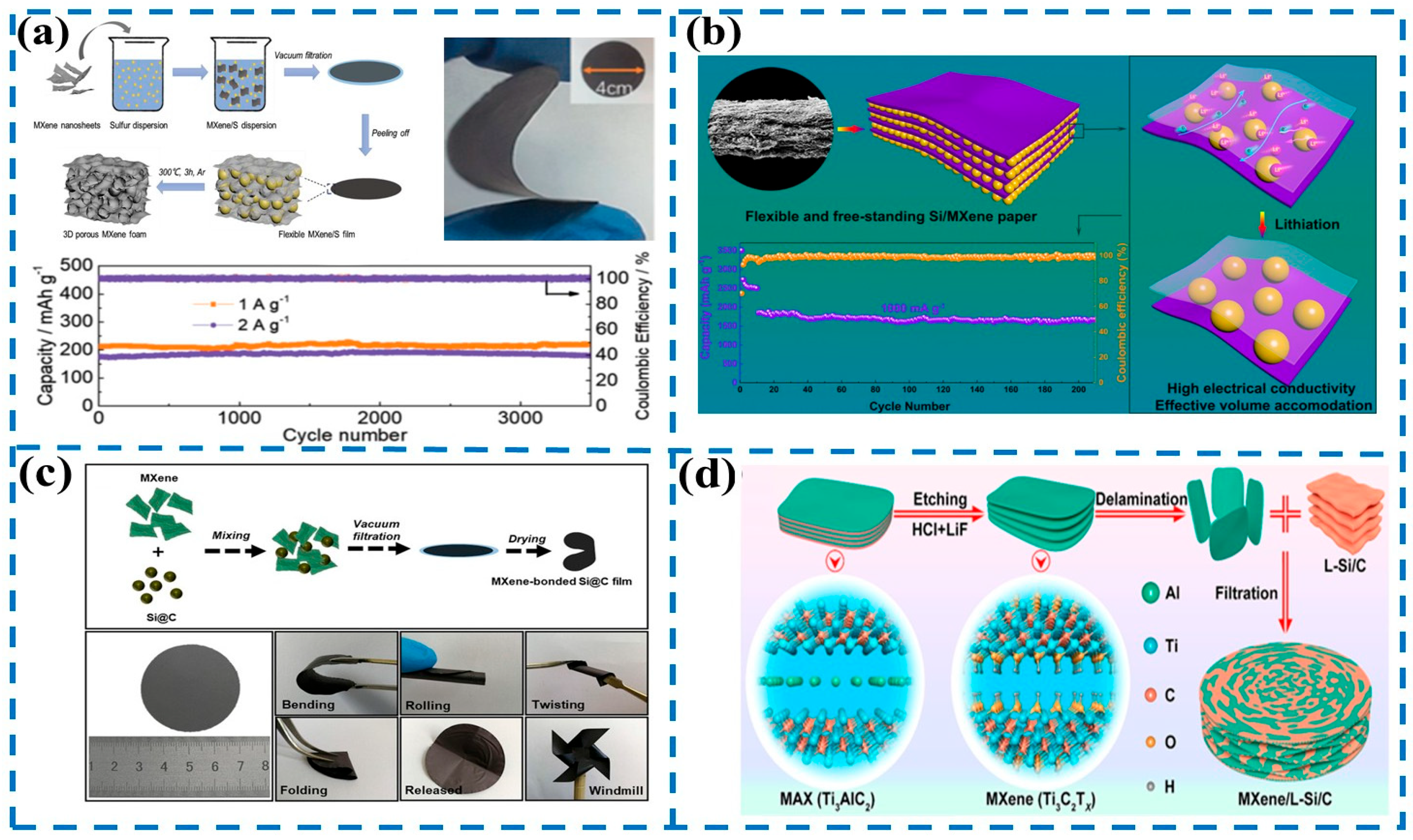
To address these limitations, MXene can be combined with active electrode materials to create freestanding electrodes. For instance, liquid metal (GalnSnZn) was conjugated into the MXene paper matrix to create a lightweight, flexible, freestanding MXene/liquid metal paper [152]. Although the open structure of flexible MXene sheets improves their electrochemical performance, self-stacking and interlayer collapse inevitably reduce conductivity and limit electrolyte accessibility [153,154]. A straightforward sulfur-template technique has been developed to construct a 3D porous MXene foam to solve these problems (Figure 6a) [155]. The 3D porous architecture enabled rapid electrolyte penetration, facilitating lithium-ion transport and providing numerous active sites for improved lithium storage.
Further improvements have been achieved through hybrid structures. MXene nanoflakes and cellulose nanofibers composites exhibited enhanced mechanical flexibility and structural stability, enabling ultrathin, deformable electrodes [156]. Layer-by-layer self-assembly yielded subsequent MXene@cellulose nanofiber microspheres that demonstrated exceptional mechanical endurance, enduring repeated bending, twisting, rolling, folding, and even reshaping into intricate structures such as windmills. Similarly, combining flexible MXenes with other anode materials in a synergistic manner is one of the most effective ways to fully exploit their potential in high-performance LIBs [157]. Silicon (Si) is an ideal anode material due to its low operating potential, natural abundance, and exceptionally high specific capacity (3579 mAh/g at moderate temperatures) [158,159]. However, its practical application is limited by poor electrical conductivity and significant volume expansion during cycling [160,161]. When combined with flexible MXenes, these materials can effectively improve the composite anode’s overall performance [162] (Figure 6b). MXene-supported Si@C films formed conductive 3D networks that accommodate volume expansion while providing efficient ion transport pathways, delivering 1040.7 mAh/g after 150 cycles [163] (Figure 6c). However, compared to CMC-bonded Si@C electrodes (80.2%) and PVDF-bonded Si@C electrodes (73.9%), their coulombic efficiency (73.0%) was lower. Layer-by-layer MXene/Si/C structures further improved cycling stability, retaining 82.85% capacity after 3200 cycles (Figure 6d) [164].
A critical limitation of MXene materials is their intrinsic lithophobicity, arising from their surface chemistry and weak interactions with Li atoms. To overcome this challenge, significant efforts have focused on systematically regulating the lithiophilicity of MXene through interface engineering, surface chemistry, and composite design to control Li nucleation behavior. One effective strategy is structural confinement. Ti3C2Tx/Li composite films confine lithium within nano-scale interlayers, suppressing dendrite growth and improving cycling stability [165]. In this arrangement, electroplated lithium was confined within the nanoscale interlayer gaps of Ti3C2Tx, leveraging the lithophobic property of MXene to inhibit lithium dendrite nucleation and growth. Another important strategy is surface modification using lithiophilic metals. Coating MXene with metals such as Au significantly reduces the lithium nucleation barrier and promotes uniform lithium deposition through alloy formation. Compared to pristine MXene, Au-modified MXene exhibits a dramatically reduced nucleation overpotential and enables dense and flat lithium growth [166]. Similarly, indium decoration enhances lithiophilicity through the formation of LixIny alloys, leading to nearly zero nucleation overpotential and highly stable lithium deposition [167]. In addition, composite engineering with functional materials such as covalent organic frameworks or cobalt–nickel sulfides introduces abundant lithiophilic sites, regulates lithium-ion flux, and minimizes local current hotspots [168,169,170]. Overall, these strategies demonstrate that interface engineering, surface modification, and composite design are essential for improving the lithiophilicity of MXene materials. By enabling uniform lithium nucleation and stable deposition, these approaches significantly enhance the electrochemical performance and safety of MXene-based flexible lithium–metal batteries.
Figure 6. (a) Digital image, fabrication process, and long-term cycling stability of the freestanding, flexible 3D porous MXene foam (p-MXene-71). Reproduced with permission from ref. [155]. Copyright 2019, Wiley-VCH. (b) Fabrication of the Si/MXene composite paper and its long-term cycling performance as an anode at 1000 mAh/g. Reproduced with permission from ref. [162]. Copyright 2019, American Chemical Society. (c) Fabrication and mechanical demonstration of MXene-bonded Si@C film. Reproduced with permission from ref. [163]. Copyright 2020, Wiley-VCH. (d) Synthesis of the MXene/L-Si/C composite. Reproduced with permission from ref. [164]. Copyright 2020, American Chemical Society.
Batteries 12 00152 g006

3.2. Flexible Metal Batteries

LIBs suffer from safety concerns under mechanical deformation, including flammability and unstable electrochemical behavior, which limit their application in flexible electronics [171]. In contrast, lithium–sulfur batteries (LSBs) have attracted significant attention due to their low cost, environmental friendliness, and the natural abundance of sulfur as a cathode material [172,173]. Due to the two-electron transfer involved in the electrochemical reaction in LSBs, the sulfur cathode has a high theoretical capacity of 1672 mAh/g, which is roughly twice as much as that of traditional LIB electrode materials [174].
Notwithstanding these benefits, several critical challenges hinder the practical application of flexible LSBs. First, structural deterioration and a constant loss of capacity result from the sulfur cathode’s considerable volume expansion and contraction during cycling [175]. Second, sluggish redox kinetics arise from the intrinsically low electrical conductivity of sulfur and its discharge products [176]. Lastly, the polysulfide shuttle effect, caused by the dissolution and migration of lithium polysulfides (Li2Sx, 4 ≤ x ≤ 8), leads to active material loss, low coulombic efficiency, and rapid capacity decay [177]. To address these challenges, physical confinement using porous carbon matrices that mechanically trap polysulfides while providing void space for volume expansion and chemical adsorption via polar materials (such as metal oxides, sulfides, and MXene-based materials) has been widely explored. In addition, catalytic materials can accelerate polysulfide conversion, thereby reducing their accumulation and diffusion.

3.2.1. Flexible Sulfur Cathode (Carbon-Based Cathode)

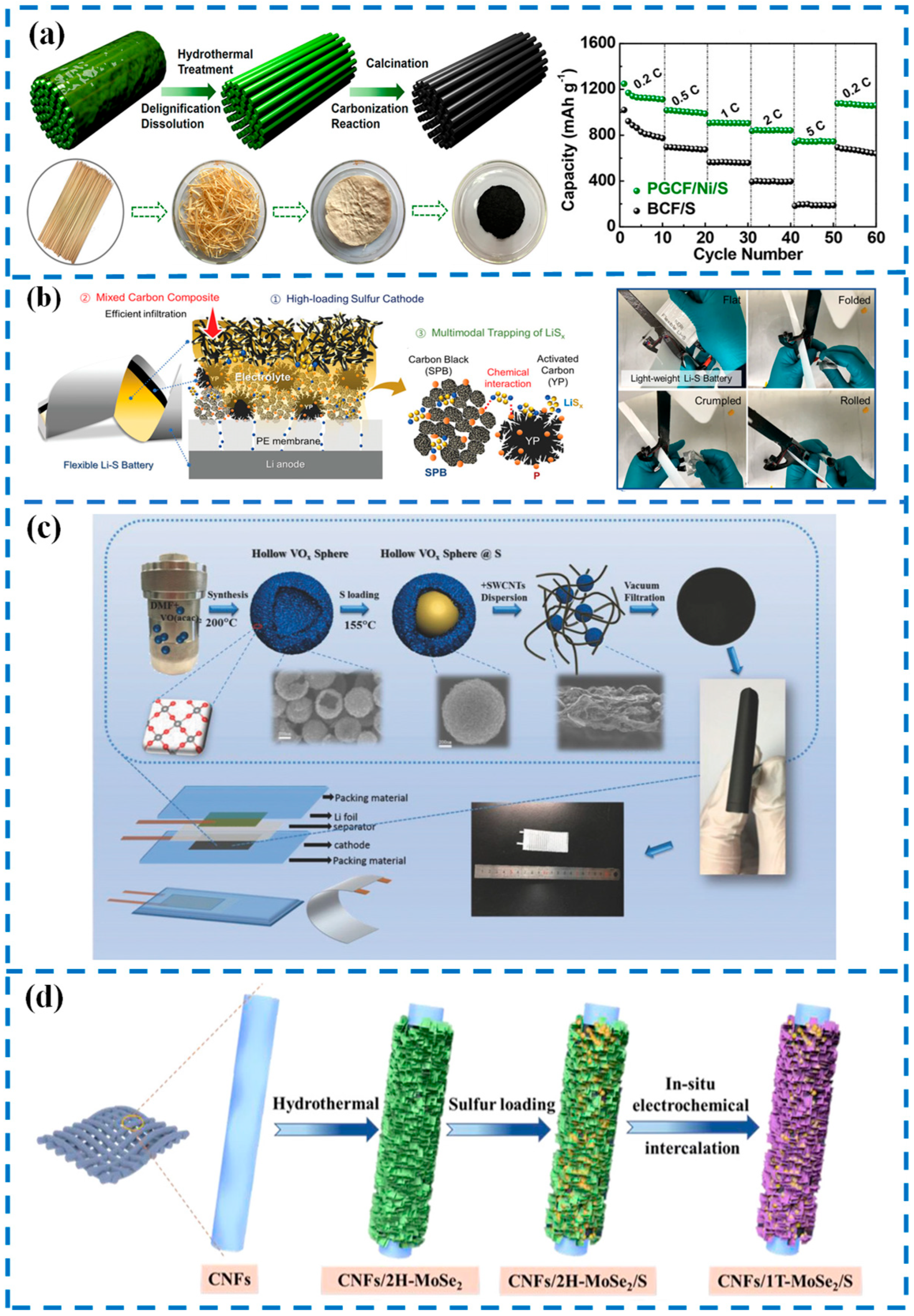
As next-generation batteries, flexible LSBs present several technical challenges. A key research focus is modifying cathode materials to overcome these challenges. Highly conductive, graded porous carbon materials are ideal for ion transport channels that capture polysulfide. Thus, sulfur cathodes can be modified using a variety of carbon-based materials [178,179]. Hierarchically porous carbon frameworks provide efficient ion/electron transport pathways while physically trapping soluble polysulfides. For example, bamboo was used as a raw material, heat-treated to produce bamboo carbon fibers (BCFs) after lignin removal [180]. Through etching the bamboo carbon fibers with NiCl2 to embed nickel nanoparticles, it yields a porous graphitic carbon/nickel composite (PGCF/Ni). The high degree of graphitization achieved in this material improved electrical conductivity, while the porous structure increased active sulfur loading and enhanced sulfur utilization, reaction reversibility, and reduced polarization during charge–discharge cycles. The metal-embedded porous graphitic carbon fibers demonstrated excellent polysulfide-trapping capability, effectively suppressing the shuttle effect through both physical confinement and chemical adsorption at nickel nanoparticle sites (Figure 7a) [180]. A freestanding CNT cathode with high sulfur loading was reported by modifying commercial separators with a phosphorus-doped carbon interlayer. This configuration enabled a dual polysulfide-trapping mechanism at both the cathode and separator, significantly improving redox kinetics and cycling stability. The assembled flexible battery delivered a stable capacity of 850 mAh/g over 100 cycles, while maintaining excellent mechanical integrity under repeated deformation (Figure 7b) [181]. Heteroatom-doped carbon structures have also demonstrated enhanced performance. Nitrogen- and phosphorus-co-doped carbon submicron ribbons with a 3D cross-linked structure (CSR) were reported using trichomorpha filaments and their derivatives as raw materials. The addition of ruthenium quantum dots (Ru@PCSR) to the porous CSR created a composite that demonstrated exceptional catalytic activity and strong lithium polysulfide adsorption, owing to its large specific surface area and excellent electronic and ionic conductivity [182]. The ruthenium quantum dots acted as catalytic centers that accelerated the conversion of soluble long-chain polysulfides to insoluble short-chain products, effectively eliminating the shuttle effect at its source. Consequently, the produced cathode showed a high discharge capacity of 960 mAh/g at a current density of 0.5 A/g, demonstrating the power of combining catalytic nanoparticles with porous carbon hosts.
Vapor-grown CNFs have also been employed to address the polysulfide shuttle effect and polarization during charge and discharge. These nanofibers offer high penetration of sulfur crystals, creating an intimate contact between the conductive carbon network and the insulating sulfur. This intimate contact decreased polysulfide dissolution and migration, increased the conductivity of the sulfur electrode, and improved sulfur utilization by ensuring that most sulfur particles were electrically connected to the current collector [183]. In addition, the in-situ formation of solid electrolytes within sulfur–carbon composites has emerged as an effective strategy. For example, introducing P2S5 precursors enabled the formation of a lithium phosphorus sulfide solid electrolyte during cycling, creating a 3D ion transport network and delivering a high capacity of 1340 mAh/g at a sulfur loading of 4 mg/cm2 [184].
Hybrid architecture combining carbon materials with polar components has also shown remarkable performance. A flexible CNT/activated carbon nanofiber@MnO2 (CNT/ACNF@MnO2) hybrid paper electrode demonstrated strong polysulfide adsorption and stable cycling performance, retaining 927 mAh/g after 100 cycles and 618 mAh/g after 300 cycles [185]. Similarly, flexible films composed of hollow VOx nanospheres and SWCNTs exhibited excellent rate capability and long-term stability, delivering 1069 mAh/g at 1 C after 300 cycles, even under mechanical deformation [186]. Furthermore, despite mechanical deformation, such as 90° bending or 180° folding, Li–S flexible cells employing this electrode demonstrated consistent electrochemical performance, underscoring its promise for high-energy flexible batteries (Figure 7c).
A flexible electrode can be prepared via electrospinning. A Co-embedded porous carbon nanofiber (Co-PCNF) membrane with a sandwich configuration effectively suppressed polysulfide migration and enhanced electrochemical performance by providing abundant active sites and improved electrolyte accessibility [187]. Furthermore, Co-PCNF had more active sites due to its rich mesoporous structure, increased pore volume, and bigger surface area. This construction improved the flexible battery’s conductivity and electrochemical performance by facilitating electrolyte adsorption and penetration. Furthermore, phase-engineered CNFs/1T-MoSe2 composites exhibited strong catalytic activity and high polysulfide affinity, achieving excellent cycling stability even at high sulfur loadings (8.47 mg/cm2), with a capacity retention of 875.3 mAh/g after 500 cycles [188] (Figure 7d).
Figure 7. (a) The fabrication process of BCF (schematically and optically) and evaluation of the performance rate of the PGCF/Ni/S and BCF/S electrodes. Reproduced with permission from ref. [180]. Copyright 2018, American Chemical Society. (b) The diagram illustrates the structure of flexible lithium–sulfur batteries and how the liquid electrolyte permeates the polyethylene (PE) membrane. Reproduced with permission from ref. [181]. Copyright 2022, Wiley-VCH. (c) Schematic and photographic illustrations of the flexible, binder-free VHS@S/SWCNT battery, showing its structure, fabrication process, and mechanical flexibility under bending and folding. Reproduced with permission from ref. [186]. Copyright 2018, Wiley-VCH. (d) Schematics of the fabrication process for the CNFs/2H-MoSe2 and CNFs/1T-MoSe2 hybrids. Reproduced from Open Access ref. [188], CC BY-NC 4.0. The authors. Carbon energy published by Wiley-VCH GmbH, © 2023.
Batteries 12 00152 g007

3.2.2. Polymer Materials

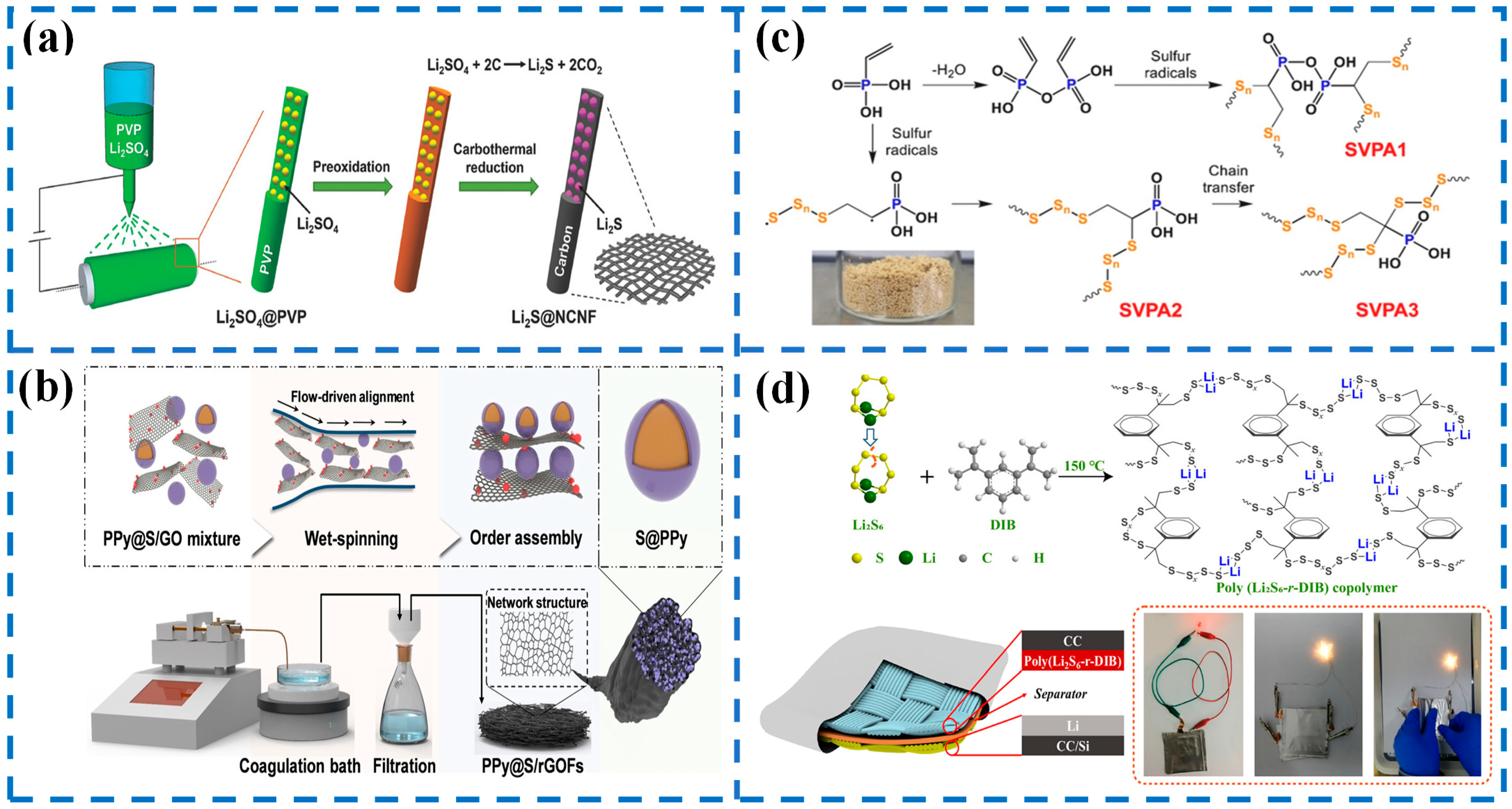
Due to their superior mechanical properties and ease of functionalization, polymers are among the most widely used soft materials. Since polymers are well known to be made of carbon-rich organic monomers, they can be easily carbonized to produce conductive carbon. The mechanical characteristics and cycling stability of LSB cathodes are greatly enhanced by the presence of carbon compounds in the cathode. Conductive polymers, including PPy, PANI, and PEDOT, are employed. Their conjugated structures and polar groups have a strong affinity for sulfur and increase electrical conductivity. Sulfur or sulfides can also be formed in situ by the chemical alteration of polymer precursors. A flexible Li2S paper electrode was reported [189] (Figure 8a). Li2SO4@PVP paper was first prepared using PVP and Li2SO4 as precursors. In situ thermal reduction was then utilized to transform the paper into Li2S@NCNF. By using a layer-by-layer stacking technique, this special Li2S@NCNF electrode enhances reaction kinetics and offers improved physical and chemical confinement of polysulfides, enabling high sulfur loading and outstanding performance.
As a result, the range of conductive polymers has proven effective as functional coatings on sulfur cathodes. An in situ self-assembly was used to create an ultrathin, extremely flexible layer of polyaniline integrated with modified MnO2 nanoparticles [190]. This procedure produced a 3D porous network that improved redox reaction kinetics by reducing volume expansion and enabling the rapid transport of reactive species, electrons, and ions. The electrode maintained a steady reversible capacity of 1195 mAh/g after 100 cycles at 0.5 C, with an initial discharge capacity of 1275 mAh/g. After 500 cycles, a capacity of 640 mAh/g was maintained, even at a high current density of 2 C. As a sacrificial template, inorganic nanoparticles were used to create functional porous carbon fibers (PCFs). Nitrogen-doped porous carbon fibers with ultra-fine TiO2 nanoparticles were created by Wang’s group [191]. This novel structure maintains flexibility while achieving the perfect balance between a polar adsorbent and a conductive agent. The flexible S/TiO2/G/NPCF cathode delivered an initial discharge capacity of 1501 mAh/g at 0.1 C. An exceptional 668 mAh/g capacity was still possible even with the current density raised to 5 C.
A strategy was reported that synergistically reinforces interfacial bonding to improve cathode mechanical properties [192]. This was achieved by uniformly implanting PPy@S nanoparticles into the embedded cavities of reduced graphene oxide fibers (rGOFs) via a straightforward microfluidic assembly (Figure 8b). Because of the synergistic reinforcement of chemical bonding between the carbon interface and the polymer interface, the PPy@S/rGOF composites demonstrated exceptional mechanical flexibility, quick reaction kinetics, and great adsorption capacity. Additionally, these composites demonstrated exceptional performance at high rates, with a specific capacity of 523 mAh/g at 5 A/g, and great cycling stability, with 81.9% capacity retention after 200 cycles at 0.1 A/g. Microspheres of sulfur and vinyl phosphonic acid (VPA), denoted as SVPA, were reported to contain different sulfur species via a rapid one-pot reaction for 30 min, combining elemental sulfur and phosphonyl anhydride to increase specific capacity and accelerate charge/discharge rates [193]. The well-organized sulfur domains within these microspheres increase surface area, thereby enhancing lithium diffusion and accelerating polysulfide conversion kinetics in lithium–sulfur batteries. Furthermore, the abundant phosphonate molecules on the microsphere surfaces and interfaces act as strong chemical anchors for lithium polysulfides. This dual functionality mitigates the shuttle effect and extends cycle life across a range of current rates. When assembled into a complete cell, this architecture achieved a high discharge capacity of 1529 mAh/g at 0.05 C (Figure 8c). A copolymer based on pre-lithiated polysulfide and poly (Li2S6-r-1,3-diisopropenylbenzene) was created by a straightforward reaction between Li2S6 and 1,3-diisopropenylbenzene (Figure 8d) [194]. This polymer served as an LSB cathode material. To prevent the dissolution of polysulfides, the researchers found that Li2S6 formed strong chemical interactions with the polymer’s conjugated aromatic structure. Furthermore, by adding more Li+ ions, the pre-lithiation polymerization improved the redox kinetics of lithium ions (Li+), producing batteries with superb coulombic efficiency, high durability, and steady cycle performance. A remarkable 934 mAh/g capacity was thus attained, even at a current density of 2 A/g.
Figure 8. (a) Fabrication diagram showing the production of freestanding Li2S@NCNF electrodes by carbothermal treatment of Li2SO4@PVP fabrics. Reproduced with permission from ref. [189]. Copyright 2017, Wiley-VCH. (b) Fabrication of PPy@S/rGOFs via a microfluidic approach. Reproduced with permission from ref. [192]. Copyright 2022, Wiley-VCH. (c) Surface structure and performance of the SVPA cathode. Reproduced from open access ref. [193]. CC BY-NC-ND 4.0, © 2021 the author(s). Published by Elsevier Ltd. (d) Flexible Li–S pouch cell employing a Li-rich sulfur-based polymer cathode, with schematics and photographs showing the cell under flat and bent conditions. Reproduced with permission from ref. [194]. Copyright 2021, American Chemical Society.
Batteries 12 00152 g008

4. Wearable Energy Harvesting Technologies

The next generation of portable devices will be powered by wearable energy harvesting technologies that convert ambient energy from the environment and the human body directly into electricity. These systems utilize piezoelectric, triboelectric, or electromagnetic generators to harvest mechanical energy from motion and vibrations; thermoelectric generators to capture body heat; photovoltaics to capture solar energy; and even chemical energy from biological fluids. The primary objective is to develop self-sufficient, maintenance-free devices that eliminate or reduce the need for conventional batteries, enabling wearables to operate continuously and independently. Because of their high efficiency at low frequencies, material flexibility, and ability to capture everyday behaviors such as typing or walking, triboelectric nanogenerators (TENGs) have become one of the most promising technologies [195].
The limited power output of these energy harvesters is affected by ambient conditions and variations in human motion, which are major obstacles. The harvested energy must be well-controlled and stored to ensure a steady, dependable power source for devices with increased demand. Therefore, the most efficient approach is to integrate adaptable energy-harvesting devices with appropriate energy-storage devices, such as SCs or advanced batteries, into a unified, streamlined system. Additionally, the development of self-healing materials that can autonomously repair mechanical damage is being actively investigated to reduce electronic waste and increase long-term reliability, thereby enhancing the robustness and lifespan of these wearable systems. For wearable electronics to be self-sustaining, energy harvesting and storage devices must be integrated. The need for external charging can be reduced or eliminated by integrating TENGs with FSCs, which can absorb ambient energy and store it for steady, continuous power.

4.1. SCPSs: Integrated TENGs and SCs

4.1.1. The Operating Principle of TENGs

Wang’s group invented the TENG in 2012, which converts mechanical energy into electricity via the combined effects of triboelectrification and electrostatic induction [196]. The operating principle begins with the interaction of two materials with opposing triboelectric polarities. Upon touch and separation, their surfaces become electrostatically charged, with equal but opposing charges [197]. Since these materials are often insulators, the surface charges produced do not dissipate quickly but persist for an extended period [198]. Electrodes are attached to the non-contact surfaces of these materials to facilitate charge transfer.
The spatial separation of the opposite triboelectric charges results in an electrical potential difference between the electrodes. To balance the induced charge distribution, this potential difference drives electron flow through an external circuit, producing an alternating electrical current output [199]. TENGs have advanced rapidly, with contemporary designs generally classified into four fundamental operating modes: vertical contact separation, sliding, single-electrode, and freestanding-layer modes [200]. These operational modes enable TENGs to efficiently harvest mechanical energy from a wide range of sources, including human motion and environmental sources such as wind and water flow [11,201,202,203,204,205]. Their utility is twofold. First, their ability to generate electrical signals in response to mechanical engagement makes them excellent candidates for self-powered sensing applications [206]. Second, the compatibility of triboelectric materials (mainly polymers) with flexible production approaches establishes TENGs as a foundation for wearable electronics. A critical constraint remains: the irregular, pulsed nature of their AC output, caused by unreliable mechanical inputs, prevents them from directly powering most electronic devices. This requires an energy storage component to maintain a consistent, regulated power output in practical applications.
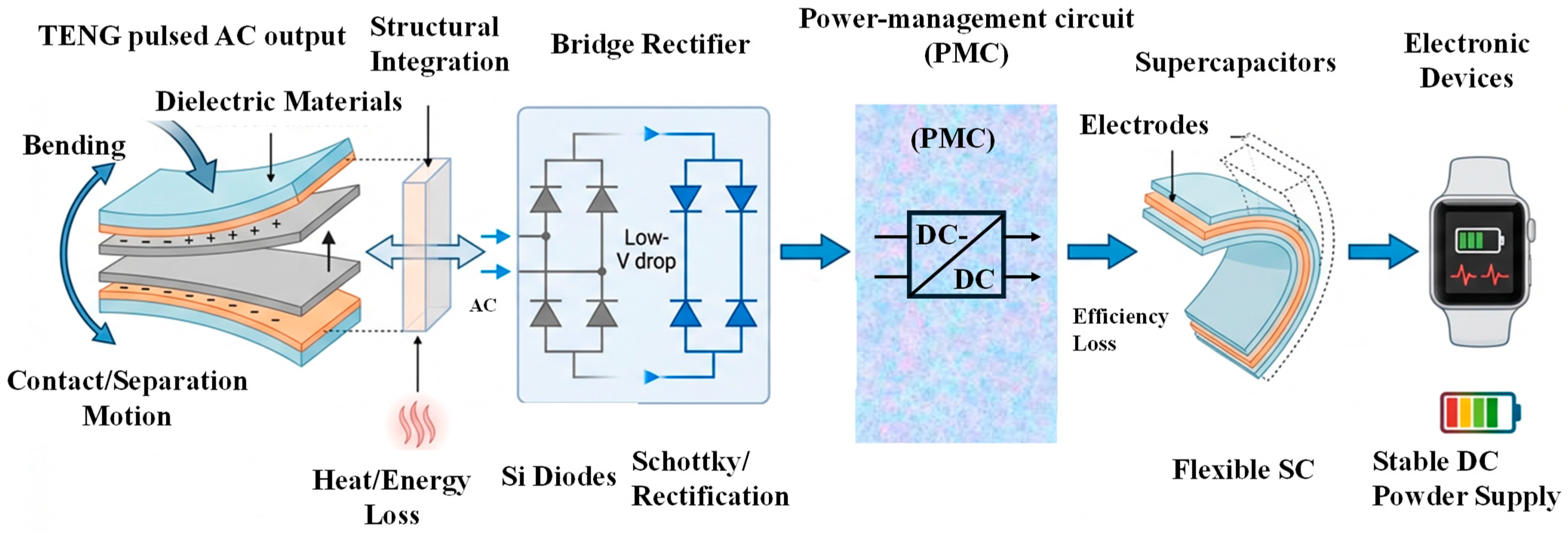
SCs offer a promising energy storage alternative that outperforms traditional batteries in both power density and long-term cycling stability [207,208,209]. The advent of flexible solid-state SCs addresses the needs of portable and wearable electronics by improving portability, safety, and performance under mechanical deformation, such as bending or folding [210,211,212]. In a sustainable self-charging power system (SCPS), the TENG’s pulsed alternating current (AC) output is typically converted to direct current (DC) by a bridge rectifier before being used to efficiently charge an SC. This integration connects the TENG and SC using rectifying circuits. While direct electrode sharing between the TENG and SC components is problematic, structural integration is possible. For example, the TENG’s triboelectric layer can serve as the substrate or packaging for the SC, or the two devices can be co-designed to share a package or substrate [213]. Due to the inherently pulsed AC output of TENG, a suitable power management circuit (PMC) is necessary to convert it into a stable direct-current output suitable for real electronic devices (Figure 9). This method often entails rectification via a bridge rectifier, subsequent energy storage, and, if required, voltage regulation using a DC–DC converter. Nevertheless, these stages introduce supplementary losses that affect the total system efficiency. The rectification efficiency is primarily influenced by the forward voltage drop of the diodes and the internal impedance of the TENG. Traditional silicon diode bridge rectifiers may exhibit efficiency losses due to their relatively high forward voltage (~0.6–0.7 V per diode). To solve this issue, low-loss Schottky diodes or synchronous rectification circuits are frequently utilized, which can markedly decrease conduction losses. Reported rectification efficiencies in TENG systems generally depend on circuit layout and load conditions. Post-rectification, DC–DC converters are commonly used to adjust or modify voltage levels for powering electronic devices or charging storage components such as capacitors or batteries. The efficiency of these converters typically ranges from 80% to 95% under optimal settings, but it may decrease when operating with the high-impedance and sporadic characteristics of TENG outputs. Consequently, the design of impedance-matching circuits and energy management algorithms is essential for optimizing captured energy. The overall efficiency of the rectification and voltage control stages can substantially affect the power delivered to the load. Future optimization of TENG-based systems should thus incorporate integrated power management circuits specifically engineered for high-voltage, low-current, and high-impedance energy sources.

4.1.2. SCPSs: Integrating Flexible TENGs with SCs

The development of advanced materials for both SC and TENG is of paramount importance and interesting for the realization of high-performance self-charging systems. A wearable electronic system can be integrated with a fiber-based TENG, and a fiber-based SC has been reported [213]. As symmetric electrodes in the SC, RuO2·xH2O-coated carbon fibers demonstrated a significant volumetric capacitance of 83.5 F/cm3. Carbon wire electrodes coated with PDMS were used to fabricate the TENG. To capture the mechanical energy produced during jogging, both devices were incorporated into a wearable coat. The SC showed an average charging current of 1.28 µA over 10 s, indicating the integrated SCPS’s effective energy-conversion capability.
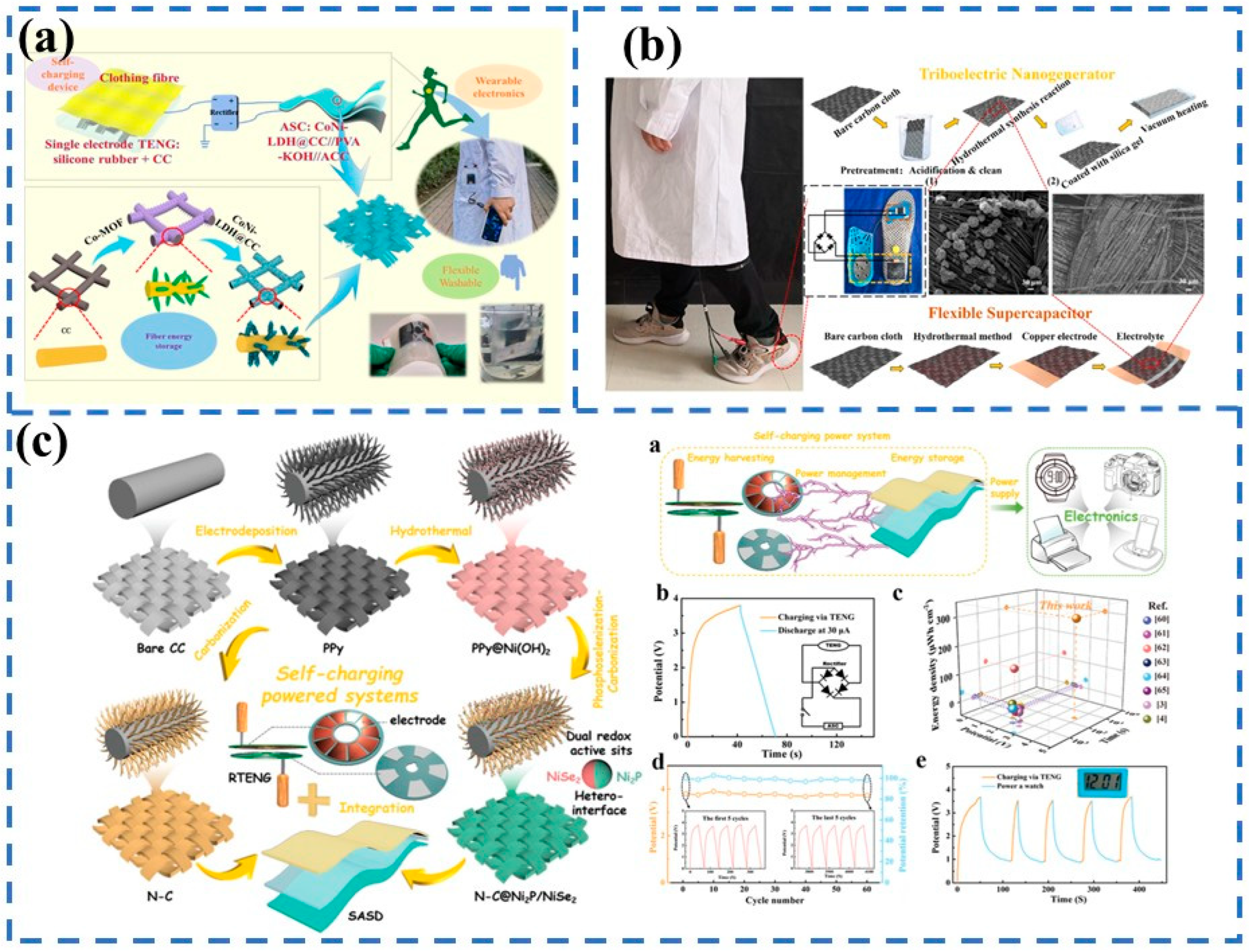
The stability, sustainability, and energy storage capabilities of existing self-charging systems have significantly improved; however, issues such as low wear resistance and unstable performance in real-world conditions. Furthermore, enhancing device performance in challenging environments is still crucial. To address these problems, Huang et al. used smart textiles to develop a washable SCPS [214]. Using a hydrolysis-exchange process between Co-MOF and CoNi layered double hydroxide (CoNi-LDH) nanoarrays grown on CC, which were used to fabricate one electrode of the system’s asymmetric supercapacitor (ASC), while slurry-coated activated carbon was used to fabricate the second electrode. A flexible ASC device was fabricated using a PVA–KOH gel electrolyte to separate the two electrodes. As shown in Figure 10a, the TENG component was created by applying silicone rubber to CC, electrically connecting it to an ASC, and encasing the entire apparatus in silicone rubber. The TENG generated a maximum output of approximately 4 μA and a voltage of approximately 380 V at a frequency of 1.6 Hz. Its performance held steady even after being submerged in water for 30 min, demonstrating its great resilience under humid conditions. With an energy density of 94.7 μWh/cm2 and a power density of 700.4 μW/cm2, the ASC demonstrated good flexibility and consistent cycling performance, achieving an areal capacitance of 348 mF/cm2 at 1 mA/cm2. In addition, it showed high bending resilience and good cyclic reliability exceeding 5000 cycles. The SCPS charging profile also highlights reliable energy-harvesting and storage capabilities, enabling charging of a cell phone once it reaches 4 V, even after washing.
A flexible, long-lasting self-charging system was reported to offer outstanding bending, wear, and washing [215]. The FSC system was constructed via hydrothermal growth of MnO2/LiMn2O4 on a CC substrate with a PVA-KOH gel electrolyte. The TENG component was created with a ZnO/ZnS-decorated CC uniformly coated with silicone rubber, serving as the positive triboelectric layer, while a polyvinylidene fluoride (PVD)-treated polyurethane sponge with high conductivity served as the negative layer. Both devices were placed in shoe insoles to harvest the mechanical energy generated by human motion, such as running and walking (Figure 10b). The TENG demonstrated exceptional mechanical robustness, maintaining stable output under challenging conditions, including folding, rotation, twisting up to 720°, 10% stretching, and one hour of washing. It produced an open-circuit voltage (VOC) of 175 V at 50 N, and a short-circuit current (ISC) of 12 μA at 1.6 Hz. The corresponding SC demonstrated an areal capacitance of 27.8 mF/cm2 at 2 mA/cm2, retaining 80% of its capacitance after 3000 cycles, with an energy density of 5.6 μWh/cm2, and remarkable bending durability. When the integrated system was tested, the TENG charged the SC to 180 mV in 350 s, demonstrating the insole’s effective ability to harvest and store energy from everyday human motion.
The SCPS system was reported by combining an ASC with a hybrid nanogenerator and an electromagnetic generator [216]. The SC was created by hydrothermally depositing MnO2/LiMn2O4 onto a CC substrate with a PVA-KOH gel electrolyte. The device had an areal capacitance of 27.8 mF/cm2 and retained 80% of its capacity over 3000 cycles. The complementary TENG was composed of a ZnO/ZnS-covered CC layer and a conductive PVD-treated PU sponge, both uniformly coated with silicone rubber for protection. The system’s extraordinary robustness was a significant achievement. The TENG’s electrical output remained steady under extreme stress, including folding, bending up to 720°, stretching, and even extended washing. The TENG produced a maximum open-circuit voltage of 175 V and a short-circuit current of 12 μA. When fully integrated, the self-charging unit demonstrated practical feasibility by charging the supercapacitor to 180 mV in about 350 s using mechanical energy from walking and jogging, thereby demonstrating its potential for powering wearable electronic devices.
Another SCPS was developed using a complex Ni2P/NiSe2 heterostructure and delivered an energy density of 60.4 Wh/kg [217]. A notable feature was its efficient charging via a rotational TENG; a simple handheld rotation for 50 s could charge the gadget to 4 V. This power was adequate to run a watch for more than a minute before being promptly recharged in 25 s, demonstrating a realistic and consistent power cycle for consumer devices (Figure 10c). A flexible zinc-ion hybrid SC was reported using an AC/CNT cathode and a Zn nanosheet anode, achieving a volumetric capacitance of 128.06 F/cm3 [218]. It was combined with a TENG, a heater, and sensors to form a smart textile-based SCPS. This system powered a heater and a temperature sensor, demonstrating that SCPSs can be used not only to charge wearables but also to monitor physiological parameters in real time. In another study, a multifunctional SCPS was reported using a triple-network organohydrogel (PVA/SA/cellulose) [219]. To improve its conductivity, MXene nanosheets functionalized with graphene oxide (MX-GO) were incorporated into the hydrogel. This addition not only created conductive channels but also enabled the hydrogel to identify direction, sense tensile strain, and detect sensitive pressure and temperature, demonstrating a highly adaptable and flexible SCPS. A separate method was reported for producing TENGs from edible ingredients [220]. Their design used a bilayer film with an ethylcellulose insulating layer atop a conductive activated carbon electrode. The same AC/EC composite was used to fabricate an SC electrode. This method paves the way for edible electronics with applications, including monitoring the release of intra-body medication. A SCPS was reported to rely on an internal “tribo-electrochemical mechanism” rather than external power management or rectifier circuits [221]. A MOF-derived Co-NPC/LIG electrode and a P(VDF-HFP) separator filled with ionic liquid electrolyte were used. The contact layers in the adjacent TENGs consisted of Nylon 66 and a Co-NPC/LIG/P (VDF-HFP) composite [221]. During compression, the TENGs generated an electric field that drove ions in the SPC electrolyte toward the electrodes, forming an electrical double layer and charging the SC. This circuit-free prototype had an energy density of 0.0278 mWh/cm2 and a power density of 0.089 mW/cm2. The combined TENGs generated 2.5 mW of electricity, which was enough to charge the SC, and the complete system functioned as a smart switch for intelligent appliances. This study describes a substantially simpler and more effective method for direct energy conversion and storage in a single device. Finally, SCPS was reported using wrinkled polystyrene and electrospun components [222]. The triboelectric layer comprised a Cu-coated, wrinkled PS substrate overlaid with PAN/Nylon 66. The SC employed a PANI-coated PAN/PS positive electrode paired with a CC negative electrode. With an integrated rectifying circuit, the system powered a commercial thermohydrometer [222].
TENGs are increasingly being utilized to charge SCs, which power portable devices and wearable sensors. This method is now applied to implantable bioelectronics, which require fully integrated, in vivo self-charging systems comprising biodegradable SCs and TENGs. The creation of such biodegradable energy units depends on the use of fully biocompatible and biodegradable materials to replace toxic or non-degradable components. SCs must also exhibit strong electrochemical performance, biocompatibility with human tissues, and surgical implantability. Several implanted SC devices have been reported in recent research, demonstrating progress in this field [223,224,225,226]. However, creating a fully implantable, self-sustaining power system remains a significant challenge, primarily due to the difficulty of efficiently harvesting and storing energy in vivo. A step toward this challenge was reported by creating an integrated self-charging system with an in vivo SC and a TENG [227]. The system comprised two components. First, SC was fabricated with PPy/GO electrodes on Ni foam and an MXene-based hydrogel soaked in PBS as the electrolyte. Second, a flexible TENG single electrode used the same hydrogel as the electrode and Si rubber as the triboelectric layer. The TENG achieved a (VOC) of ~95.04 V, ISC of ~1.38 μA, and transmitted a charge of ~30.84 nC. The implanted SC demonstrated 91.5 F/g at 0.3 A/g, with 71.97% capacity retention after 1000 cycles, and was charged to 3 V in 291 min by the TENG operating at 1 Hz. Following surgical implantation in a rat’s thoracic subcutaneous tissue, the CV curves of SC remained stable. Critically, the system’s self-charging capability was not demonstrated during vivo TENG operation. Creating a fully integrated, functional implantable SCPS remains an unsolved problem. Table 1 summarizes the performance parameters of different material-based self-charging systems that include TENGs.
Figure 10. (a) Synthesis of CoNi-LDH and its integration into a self-powered device. Reproduced with permission from ref. [214]. Copyright 2023, American Chemical Society. (b) Fabrication of an integrated TENG and supercapacitor insole. Reproduced with permission from ref. [215]. Copyright 2023, American Chemical Society. (c) Schematic diagrams detailing the synthesis of the N-C@Ni2P/NiSe2 and N-C electrodes, and the assembly process for the single-axis sensor device (SASD), rotational TENG (RTENG), and the complete SCPS with charge–discharge cycling of the SCPS, References mentioned in the figure can be found in [228,229,230,231,232,233,234,235]. Reproduced with permission from ref. [217]. Copyright 2022. Wiley-VCH.
Batteries 12 00152 g010
Table 1. The performance parameters of different material-based self-charging systems, including TENGs.
SC Current CollectorSC Active MaterialSC PerformanceTENG MaterialTENG PerformanceSCPS PerformanceRefs.
Carbon fiberCo3O4 nanosheets @CF9.18 mF/cmsilicone rubber (FOTS)/leadVOC = 60 V
ISC = 2.3 μA
2 V within 28 s (2 Hz)[236]
Carbon paper PAN paper150 F/g
48 J/g
electrospun paper VOC = 98.6 V
ISC = 11.3 μA
QSC = 31.1 nC
2 V within 2150 s (8 Hz) [237]
Tantalum foilCarbon 1.11 mF/cm2
75.2 μWh/cm2
100,000 cycles
PTFE/Cu/KaptonISC = 44.60 μA
QSC = 9.06 μC/S
1.5 V within 54.5 s (5 Hz)[238]
Carbon (PANI)/MXene (V2C) composites 337.5 F/g
12.25 Wh/kg
10,000 cycles
Cu/Nylon/PTFE-500 V at 3.5 Hz[239]
Woven carbon fiber WCF and P@Cu–Mn selenide nanowire47.3 F/g
97.21 W h/kg 3500 cycles
P@Cu0.5Mn0.5Se2 nanowires/WCF/polyesterVOC = 443.2 V
ISC = 132.5 μA
19.2 V within 70 s[240]
Carbon fiberHydrous ruthenium oxide83.5 F/cm3, 3.2 mF/cm, 146 mF/cm2 at 1.14 mA/cm PDMS@carbon fiber, Cu@PTFE VOC ~ 18 V
ISC ~ 7 µA (at 20 Hz)
2.5 V within 873 s[241]
Ruthenium (IV) oxide80% (5000 cycles) Cotton, carbon, PTFE VOC ~ 118 V
QSC ~ 48 nC
ISC ~ 1.5 µA
1.5 V at 1.5 Hz[242]
α-ferric oxide/rGO 4 F/cm3 at 0.15 A/cm3, 8 × 10⁻⁴ Wh/cm3, 98.5% (3000 cycles) trimethoxy(1H,1H,2H,2H-heptadecafluorodecy)
silane/(Al)/PTFE
VOC ~ 100 V
ISC ~ 200 µA
4 V within 55.7–190.3 s[243]
Co3O4 nanosheets, activated carbon 9.18 mF at 0.1 mA,
81% (5000 cycles)
Trichlorosilane, NaCl@Cu VOC ~ 60 V
ISC ~ 2.3 μA
2 V within 28 s[236]
Carbon fiber57 μF/cm at
0.05 mA/cm2
(PVDF-TrFE-CTFE) 300 mV within 30 min at 10 Hz[244]
RuO2⋅xH2O1.9 mF/cm at
1000 mA, 1.37 mJ/cm, 5000 cycles
PDMS@Cu-coated ethyl vinyl acetate (EVA) tubingVOC ~ 12.6 V
QSC ~ 20.8 nC (at 5 Hz)
ISC ~ 0.91 µA (at 5 Hz)
QSC and ISC (5 × 5 nets)
1.8 V within 69 s [245]
PEDOT: PSS 87.5% (3000)Silver (Ag)-coated polyamide (PA) yarn/PA yarnVOC ~ 4500 V
QSC ~ 4.47 µC
ISC ~ 40 µA
-[246]
Carbon clothCNFs 41 mF (@50 mV/s)
19.2 J/g
10,000 cycles
PDMS-Indium tin oxide (ITO)-coated PETVOC ~ 1000 V, ISC ~ 3 mA2.4 V within 2500 s[230]
Carbon fiber PDMS layer and Ag electrode13.42 mF/cmPDMS layer supported by a metallic spring at 5 Hz, ISC = 0.4 μA, VOC = 1.6 V, and QSC = 3.2 nC2.5 V within 25 s[247]
Cu spongePPy@Cu sponge 117.3 F/g (@100 mV/s), 0.129 Wh/g 96.3% (5000 cycles)Cu@PPy + PDMS VOC ~ 50 V, ISC ~ 400 nA, QSC ~ 20 nC2.4 V within 15 min (3 Hz)[248]
Tantalum (Ta) foilCarbon1.11 mF/cm2 (@0.1 mA/cm2)
75.2 μW h/cm
100,000 cycles
PTFE/Cu/Kapton ISC ~ 44.60 µA
QSC ~ 9.06 μC/s
1.5 V within 54.5 s (5 Hz)[238]
Carbon clothCNFs41 mF (@50 mV/s)
19.2 J/g
10,000 cycles
PDMS-Indium tin oxide (ITO)-coated PETVOC ~ 1000 V, ISC ~ 3 mA2.4 V within 2500 s[230]
Ni foam (NF)ZnO nanorod/carbon black 448 mF/cm2 (@2 mA/cm2)
0.12 mW h/cm2
88% (5000 cycles)
ZnO nanorods@carbon black/NF
PTFE/Al
VOC ~ 28 V,
ISC ~ 4.5 µA
1.4 V within 490 s[234]
Ti sheeth-PPy 63 F/g at 1 A/g 5.12 Wh/kg 99.3% (6000 cycles)Kapton/Cu/FEP films VOC ~ 584 V,
ISC ~ 147 µA,
QSC ~ 1.42 μC
1.72 V within 150 s[249]
Filter paperCNT 18.3 mF/cm2 at 10 mV/s
134% (4000 cycles)
PDMS@ITO-PETVOC ~ 200 V, ISC ~ 100 µA (at 10 Hz)900 mV within 3 h at 8 Hz [250]
Polyester yarns coated with Ni and Cu films rGO/CNT 82.7% after 5000 cycles. PDMS layer with (heptadecafluoro-1,1,2,2-tetrahydrodecyl) trichlorosilaneVOC ≈ 40 V and QSC ≈ 14 nC, ISC ≈ 4 µA at 4 Hz370 min at 1 Hz and 161 min at 2 Hz [228]
Ni-coated textilerGO50.6 mF/cm2 at 0.01 V/s
1.3 μWh/cm2, 85.3% (5000
cycles)
PDMS @Ni-coated textile, PolyesterVOC ~ 49 V QSC ~ 28 nC ISC ~ 1.8 µA (at 4 Hz)2.0 V within 34 min at 4 Hz [251]
Au/PET PPy/rGO//Zn 92.5 mF/cm2, 25.2 mW h/cm2, 92% (10,000 cycles)PDMS/BTO film, Cu-Ni fabricVOC ~ 195.1 V
ISC ~ 1.1 mA/cm2
1.8 V[252]
Ti/Au RuO2 3 mF/cm2 PTFE/Magnet/PETG tube/CuVOC ~ 1.9 V
ISC ~ 15 mA
2.5 V within 5 s [253]

5. Conclusions and Outlook

This review highlights the significant strides made in flexible and wearable energy storage and harvesting systems, underscoring their crucial role in powering the future of electronic devices. We have examined the evolution of key technologies, for FSCs and flexible batteries (LIBs, LSBs), to the integration of energy harvesters, such as TENGs, into SCPSs. The transition from rigid to compliant energy solutions is primarily driven by advancements in materials, such as graphene, CNTs, MXenes, and conductive polymers, as well as innovative device architectures, including fiber-based, textile-integrated, and compressible designs. Substantial research has focused on SCPSs for self-powered applications. These developments have successfully demonstrated the feasibility of creating energy sources that are not only electrochemically competent but also mechanically compliant, safe, and lightweight, thereby meeting the critical demands of next-generation wearable and portable electronics.
However, the path to widespread commercialization remains difficult with the current challenges. The most significant among these is the inherent trade-off between energy density and mechanical flexibility, where achieving high storage capacity often compromises deformability and durability. Furthermore, issues of environmental stability (e.g., performance degradation under varying humidity, temperature, and mechanical stress), safety concerns (particularly regarding flammable electrolytes and dendrite formation in flexible batteries), and low energy transfer efficiency between harvesters (e.g., TENGs) and storage units continue to hinder practical applications. The lack of standardized evaluation protocols for mechanical flexibility and energy density further complicates direct comparison and progress assessment. The journey toward autonomous, high-performance, and commercially viable wearable power systems requires a strategic, multi-pronged research agenda. Based on the literature analysis, we propose the following detailed roadmap for future endeavors, categorized into critical frontiers (Figure 11).

5.1. Material Innovation

Material innovation that embraces multifunctionality, intelligence, and bio-inspiration, in addition to incremental gains, will be the primary driver of the next paradigm shift in flexible power sources. The main objective is to overcome the long-standing trade-offs that have afflicted the sector, especially the negative correlation between mechanical robustness and high energy density. Future materials must be designed from the molecular to the macroscopic level to fulfill multiple functions simultaneously, such as effectively storing energy, withstanding intricate and dynamic mechanical pressures, and even controlling their own well-being and interactions with the environment.
The rational design of multifunctional 3D nano-architected materials is an important step forward. Instead of merely making standard materials thinner or combining them with polymers, we must create sophisticated scaffolds with hierarchical porosity. Consider graphene aerogels, MXene foams, or CNT sponges with covalent connections. These structures are more than just conductive frameworks; they are designed to include a range of pore sizes, including macropores for rapid electrolyte infiltration, mesopores for high ionic accessibility, and micropores for high charge storage. This open, linked architecture functions as a mechanical spring, absorbing and releasing energy from repetitive compression, bending, or twisting without permanent deformation, effectively divorcing mechanical compliance from electrochemical function.
Furthermore, future efforts should focus on creating “smart” and responsive material systems that provide unprecedented levels of resilience and autonomy. The incorporation of intrinsic self-healing systems is no longer a luxury but rather a must for long-term durability. It can be solved by introducing dynamic covalent bonds (e.g., Diels–Alder, disulfide metathesis) or supramolecular interactions (e.g., hydrogen bonding, metal–ligand coordination) into polymers employed as electrolytes, binders, or electrodes. When a crack occurs, these reversible bonds can re-associate, self-heal the damage restorering electrical and mechanical integrity. Beyond mending, materials could be made stimuli-responsive, meaning they change their properties in response to their surroundings. For example, a polymer electrolyte may become highly resistant after sensing an over-temperature event (preventing thermal runaway). Finally, a concerted effort to improve electrolyte engineering is required, as the electrolyte remains a crucial bottleneck for safety and performance. The advancement of high-performance solid-state and quasi-solid electrolytes must accelerate. The ideal solid electrolyte would combine the high ionic conductivity of organic liquids with the non-flammability and mechanical robustness of solids and establish a stable interface with electrodes to prevent dendrite formation in metal-based batteries. Parallel studies should focus on ionogels (ionic liquids encapsulated in a solid matrix) and tough, conductive hydrogels, which offer an unrivaled combination of high ionic conductivity, broad electrochemical stability windows, and outstanding stretchability or self-healing.

5.2. System-Level Integration Is the Path to True Autonomy

While improved materials provide the foundation, energy autonomy for wearable electronics requires sophisticated system-level integration. The challenge of connecting an energy harvester to a storage device via external wires is fundamentally limited and fails to meet the demands of seamless, long-lasting, and user-friendly wearable technology. The future rests in transitioning from a collection of discrete components to a cohesive, monolithic system in which energy harvesting, storage, management, and consumption are all co-designed and intricately interconnected. This necessitates a comprehensive approach that considers not only individual performance measures but also the crucial interactions among all subsystems.
A major problem in this integration is the substantial efficiency loss at the harvester–storage interface. The inherently pulsed, high-voltage, low-current output TENGs are an inadequate match for the low-impedance inputs of supercapacitors and batteries, resulting in energy transfer efficiencies below 1%. As a result, a dedicated research effort must focus on innovating PMCs. The next generation of power management controllers must be more than just rectifiers; they must be intelligent, efficient, and physically compatible with flexible systems. This requires the creation of tiny, flexible, and even stretchable PMCs using printed electronics and soft lithography, rather than stiff, off-the-shelf components. Advanced circuit topologies, such as synchronous electric charge extraction (SECE) and adaptive reconfigurable switching circuits, should be investigated for their ability to actively impedance-match the TENG to the storage device in real time, thereby maximizing power extraction and transfer. The goal is to create a universal, self-contained PMC module that can be smoothly embedded into a textile or flexible patch and operate efficiently without external intervention.
Aside from effective power transfer, the entire system’s physical and functional architecture must be redesigned. The emphasis should shift to monolithic integration and shared material platforms. Instead of building a TENG and a supercapacitor separately and then connecting them, future designs should use shared components. For example, a single carbon-nanotube-coated textile might serve as a TENG electrode, a supercapacitor current collector, and a strain sensor simultaneously. This “three-in-one” design eliminates superfluous components, reduces interfacial losses, and enhances mechanical integrity. Furthermore, to maintain dependability in the unpredictable real world, systems must progress to multi-modal energy harvesting. Integrated TENGs, thermoelectric generators, and flexible photovoltaics should enable a single device to harvest energy from a variety of ambient sources, including mechanical motion, temperature gradients, and light. This diversification ensures a consistent, if fluctuating, power supply, reducing the intermittency of any single source and greatly increasing system reliability.
Finally, to close the gap between laboratory prototypes and real-world applications, the field must quickly implement standardized testing methodologies and realistic performance indicators. Testing must go beyond basic bending cycles and incorporate complicated, dynamic deformations such as twisting, crumpling, and stretching at realistic strain rates. Devices should be tested not only in a controlled setting but also under simulated environmental stressors, including fluctuating humidity, temperature changes, and exposure to sweat. Crucially, performance reporting must evolve away from measurements based purely on active materials (e.g., an electrode’s gravimetric capacitance) and toward volumetric and whole-device performance metrics. This will provide a true assessment of a device’s practical utility and enable fair comparisons across technologies, ultimately guiding the industry toward solutions that are not only technically amazing but also financially viable and truly autonomous.

5.3. Commercialization and Manufacturing

Perhaps the biggest obstacle facing these technologies is translating flexible power solutions from impressive laboratory demonstrations into commercially viable products. The future depends on developing scalable, affordable, and reliable production techniques capable of producing millions of units with consistent performance. This necessitates a paradigm shift from an approach focused solely on materials science to one that also incorporates concepts from supply chain management, industrial engineering, and market analysis.
The interface between the energy harvester and the energy storage unit is crucial in monolithic energy systems for overall device performance and stability. The integration of components such as a TENG and an SC on a common substrate poses numerous fabrication challenges due to the substantial differences in materials and processing requirements between the two devices. A primary problem stems from the mismatch between the triboelectric layers employed in TENGs and the electrolytes utilized in SCs. Triboelectric materials, often polymers, must have distinct surface microstructures and robust charge-trapping properties to achieve optimal output performance. Contact with liquid or gel electrolytes during SC manufacture may result in swelling, chemical deterioration, or the contamination of triboelectric surfaces, hence decreasing charge density and mechanical durability. Consequently, suitable encapsulation or spatial separation techniques are generally necessary to safeguard the triboelectric interface. A further problem pertains to the compatibility of the fabrication method. SC electrodes often require high-temperature annealing, chemical deposition, or electrolyte infiltration, which can compromise polymer-based TENG layers or flexible substrates. To mitigate this issue, low-temperature fabrication procedures, layer-by-layer assembly, printing techniques, or sequential fabrication strategies can be used to ensure that the TENG component is produced after processes that could compromise its integrity. The design of mechanical and electrical interfaces is equally significant. In monolithic systems, the substrate must concurrently accommodate the mechanical deformation necessary for TENG functionality, and the structural integrity required for the SC. Furthermore, electrical isolation between triboelectric contact and the electrolyte is essential to prevent leakage currents and enable effective energy transfer. Effective integration necessitates the suitable selection of materials, process compatibility, and structural design to preserve the functional integrity of both the TENG and the SC, while facilitating efficient energy harvesting and storage within a compact monolithic framework.
To unlock the full potential of FSCs, several crucial issues must be addressed. FSCs are a key technology for powering wearable electronics of the future. In addition to creating nanostructured materials to optimize electrochemically active sites, future research should focus on creating modified carbon-based composite electrodes to increase specific capacitance while preserving flexibility. Focused research on fiber-based and planar micro-supercapacitors with tailored gel electrolytes that exhibit enhanced ionic conductivity and broader potential windows is required to address the downsizing trend. Overcoming length-dependent resistance in fiber devices, striking the ideal balance between mechanical flexibility and electrochemical performance, and ensuring biological safety through non-toxic materials and sophisticated packaging are among the major challenges. Notably, recent developments in continuous-fiber electrodes and washable energy storage textiles indicate promising avenues for real-world applications.
FLIBs have significant potential, but numerous obstacles to their commercialization include low energy densities, short cycle life under deformation, and high production costs. Seven crucial areas should be the focus of future development: (1) The development of flexible carbon-based electrodes with optimized structure for high-load active materials; (2) the creation of high-performance polymer electrolytes with improved ionic conductivity; (3) the innovation of battery architectures through fibrous and pre-tensioned designs; (4) the investigation of next-generation electrochemical systems such as lithium–metal and lithium–air chemistry; (5) the engineering of thinner, more compliant packaging materials; (6) the establishment of automated manufacturing processes utilizing 3D printing and film technologies; and (7) the expansion of application scenarios with multipurpose features like biocompatibility and extreme temperatures. In the end, achieving fully wearable energy solutions would require interdisciplinary efforts to develop safe, affordable materials that seamlessly integrate into everyday clothing and accessories, potentially revolutionizing our daily interactions with technology. Many of the current prototypes rely on labor-intensive, batch-processing techniques that are not appropriate for mass production, such as drop-casting, manual stacking, or small-scale hydrothermal synthesis. Future efforts should focus on improving continuous processes, such as advanced electrospinning, slot-die coating, and printing. These methods are key to the continuous deposition of separators, electrolytes, and active materials onto flexible substrates, significantly boosting production consistency and speed while cutting costs. The integration of textile-based systems must be compatible with current industrial textile manufacturing processes, such as high-speed knitting, weaving, and embroidery, so that energy storage and harvesting features can be directly integrated into fabric during production rather than added after the fact.
At the same time, commercialization requires an unwavering focus on sustainability and cost-effectiveness. This entails two main approaches: the first is the investigation and verification of inexpensive, readily available substitute materials. Although high-performance materials such as pristine graphene or certain MXenes are being investigated in laboratories, most consumer applications cannot afford their high cost and complex synthesis. Therefore, more research is needed on the use of recyclable materials, naturally occurring minerals, and carbon derived from biomass. Second, we need to pursue hybrid material solutions, in which more affordable substitutes are used elsewhere in the device while high-performance, expensive materials are reserved for crucial, performance-defining components. To ensure that these “green” technologies do not generate a new waste problem, a lifecycle study must become a normal component of device development to evaluate the true environmental impact, from material sourcing to final recycling.

Author Contributions

M.I., visualization, validation, supervision, software, resources, project administration, methodology, funding acquisition, investigation, formal analysis, data curation, conceptualization, writing—review and editing, writing—original draft.; H.N.A.: visualization, validation, supervision, software, resources, project administration, methodology, funding acquisition, investigation, formal analysis, data curation, conceptualization, writing—review and editing, writing—original draft. All authors have read and agreed to the published version of the manuscript.

Funding

This work was supported and funded by the Deanship of Scientific Research at Imam Mohammad Ibn Saud Islamic University (IMSIU) (grant number IMSIU-DDRSP2603).

Data Availability Statement

No new data were created or analyzed in this study. Data sharing is not applicable to this article.

Conflicts of Interest

The authors declare no competing interests.

References

  1. Onajah, S.; Sarkar, R.; Islam, M.S.; Lalley, M.; Khan, K.; Demir, M.; Abdelhamid, H.N.; Farghaly, A.A. Silica-Derived Nanostructured Electrode Materials for ORR, OER, HER, CO2RR Electrocatalysis, and Energy Storage Applications: A Review. Chem. Rec. 2024, 24, e202300234. [Google Scholar] [CrossRef] [Scilit]
  2. Hu, X.; Zuo, D.; Cheng, S.; Chen, S.; Liu, Y.; Bao, W.; Deng, S.; Harris, S.J.; Wan, J. Ultrafast Materials Synthesis and Manufacturing Techniques for Emerging Energy and Environmental Applications. Chem. Soc. Rev. 2023, 52, 1103–1128. [Google Scholar] [CrossRef] [Scilit]
  3. Xiang, H.; Li, Z.; Liu, H.; Chen, T.; Zhou, H.; Huang, W. Green Flexible Electronics Based on Starch. npj Flex. Electron. 2022, 6, 15. [Google Scholar] [CrossRef] [Scilit]
  4. Xu, T.; Ding, X.; Cheng, H.; Han, G.; Qu, L. Moisture-Enabled Electricity from Hygroscopic Materials: A New Type of Clean Energy. Adv. Mater. 2024, 36, 2209661. [Google Scholar] [CrossRef] [Scilit] [PubMed]
  5. Chen, H.; Zheng, Y.; Li, J.; Li, L.; Wang, X. AI for Nanomaterials Development in Clean Energy and Carbon Capture, Utilization and Storage (CCUS). ACS Nano 2023, 17, 9763–9792. [Google Scholar] [CrossRef] [Scilit]
  6. Li, H.; Zhou, X.; Zhai, W.; Lu, S.; Liang, J.; He, Z.; Long, H.; Xiong, T.; Sun, H.; He, Q.; et al. Phase Engineering of Nanomaterials for Clean Energy and Catalytic Applications. Adv. Energy Mater. 2020, 10, 2002019. [Google Scholar] [CrossRef] [Scilit]
  7. Dai, S.; Cao, H.; Sharmoukh, W.; Qiang, Y.; Zhao, L.; Chen, Y.; Li, Y.; Nasser Abdelhamid, H.; Taghavinia, N.; Yu, Z. Pure-Phase Two-Dimensional Perovskite Capping Layer Enables High-Performance and Durable Carbon-Based Photovoltaics. Chem. Eng. J. 2024, 497, 154611. [Google Scholar] [CrossRef] [Scilit]
  8. Ibrahim, M.; Wen, Z.; Sun, X.; Abdelhamid, H.N. In Situ Polymerization of a Melamine-Based Microsphere into 3D Nickel Foam for Supercapacitors. RSC Adv. 2024, 14, 5566–5576. [Google Scholar] [CrossRef] [Scilit]
  9. Hashem, Z.H.; Abdel-Rahman, L.H.; Gómez-Ruiz, S.; Abdelhamid, H.N. A Multifunctional Nickel-Based Metal–Organic Framework (MOF) for Hydrogen Production, Supercapacitors, and Electrocatalysis. Catalysts 2026, 16, 283. [Google Scholar] [CrossRef] [Scilit]
  10. Hassan, Z.M.; Elantabli, F.M.; Mohamed, S.G.; Abdelhamid, H.N. Metal-Organic Frameworks (MOFs)-Derived Zinc Selenide and Cobalt Selenide for Asymmetric Supercapacitors. J. Energy Storage 2026, 141, 119311. [Google Scholar] [CrossRef] [Scilit]
  11. Ibrahim, M.; Jiang, J.; Wen, Z.; Sun, X. Surface Engineering for Enhanced Triboelectric Nanogenerator. Nanoenergy Adv. 2021, 1, 58–80. [Google Scholar] [CrossRef] [Scilit]
  12. An, Y.; Xu, B.; Tian, Y.; Shen, H.; Man, Q.; Liu, X.; Yang, Y.; Li, M. Reversible Zn Electrodeposition Enabled by Interfacial Chemistry Manipulation for High-Energy Anode-Free Zn Batteries. Mater. Today 2023, 70, 93–103. [Google Scholar] [CrossRef] [Scilit]
  13. Ibrahim, M.; Abdelhamid, H.N.; Abuelftooh, A.M.; Mohamed, S.G.; Wen, Z.; Sun, X. Covalent Organic Frameworks (COFs)-Derived Nitrogen-Doped Carbon/Reduced Graphene Oxide Nanocomposite as Electrodes Materials for Supercapacitors. J. Energy Storage 2022, 55, 105375. [Google Scholar] [CrossRef] [Scilit]
  14. Gomaa, I.; Al-Namshah, K.S.; Abdelhamid, H.N. Hybrid Mesoporous Mn2O3/Carbon as Electrode Materials for Supercapacitors. J. Clust. Sci. 2025, 37, 5. [Google Scholar] [CrossRef] [Scilit]
  15. Abdelhamid, H.N.; Ibrahim, M.; Yahia, M. Supercapacitor Performance Using ZIF-L@PIM-1-Derived ZnO@N-Doped Carbon Electrodes. J. Appl. Polym. Sci. 2025, 142, e57702. [Google Scholar] [CrossRef] [Scilit]
  16. Abdelhamid, H.N. Ni/Cu Metal-Organic Frameworks (MOFs)-Derived NiO/CuO@C for Supercapacitors and Oxygen Evolution Reaction. Surf. Interfaces 2025, 76, 107923. [Google Scholar] [CrossRef] [Scilit]
  17. Ali, A.I.; Maghawry, M.M.; Abdelhamid, H.N.; Wassel, A.R.; Choi, D.; Arif, M.; Ramzy, G.H.; Abdelwahab, S.A. Structural and Functional Tailoring of Ba0.9Ca0.1Ti0.9Zr0.1O3 Ceramics with Reduced Graphene Oxide (RGO) for Energy Storage Applications. J. Mater. Sci. Mater. Electron. 2025, 36, 1960. [Google Scholar] [CrossRef] [Scilit]
  18. Algethami, F.K.; Al Kiey, S.A.; Abdelhamid, H.N. CuO Nanoparticles on Carbon from Copper-Based Metal–Organic Frameworks (MOF) for Energy Storage. J. Inorg. Organomet. Polym. Mater. 2026, 36, 2393–2405. [Google Scholar] [CrossRef] [Scilit]
  19. Al Kiey, S.A.; Algethami, F.K.; Abdelhamid, H.N. Ferric Oxide@Carbon-Derived from Fe-MOF for Supercapacitor. Arab. J. Sci. Eng. 2025. [Google Scholar] [CrossRef] [Scilit]
  20. Alsaiari, R.A.; Gomaa, I.; Abdelhamid, H.N. Eco-Engineered Co3O4/CoO/C Nanohybrid for Supercapacitors and Efficient Water Splitting. Arab. J. Sci. Eng. 2025. [Google Scholar] [CrossRef] [Scilit]
  21. Goodenough, J.B.; Park, K.-S. The Li-Ion Rechargeable Battery: A Perspective. J. Am. Chem. Soc. 2013, 135, 1167–1176. [Google Scholar] [CrossRef] [Scilit] [PubMed]
  22. Son, D.; Lee, J.; Qiao, S.; Ghaffari, R.; Kim, J.; Lee, J.E.; Song, C.; Kim, S.J.; Lee, D.J.; Jun, S.W.; et al. Multifunctional Wearable Devices for Diagnosis and Therapy of Movement Disorders. Nat. Nanotechnol. 2014, 9, 397–404. [Google Scholar] [CrossRef] [Scilit] [PubMed]
  23. Abdelhamid, H.N.; Salim, S.A. Ferric Metal-Organic Frameworks (MOFs)-Based Electrospinning Fibers for Supercapacitors. React. Funct. Polym. 2025, 217, 106466. [Google Scholar] [CrossRef] [Scilit]
  24. Abdelhamid, H.; Saddik, A. Tetraphenylethene-Based Polymers for Supercapacitors. U.S. Patent US12391800B1, 19 August 2025. [Google Scholar]
  25. Abdelhamid, H.N. Bimetallic Metal–Organic Framework (MOF)–Derived NiO/CuO-Embedded Carbon for Supercapacitor. Appl. Organomet. Chem. 2025, 39, e70193. [Google Scholar] [CrossRef] [Scilit]
  26. Saddik, A.A.; Abdelhamid, H.N. Conjugated Tetraphenylethene-Based Polymers for Supercapacitor. Polymer 2024, 315, 127778. [Google Scholar] [CrossRef] [Scilit]
  27. Aly, K.I.; Mostafa Ebrahium, S.; Abdelhamid, H.N.; El-Bery, H.M.; Mohammed, A.A.K.; Huang, C.-W.; Gamal Mohamed, M. Efficient Synthesis of Main Chain Thermosetting Polybenzoxazine Resin Containing Tert-Butylcyclohexanone and Diphenylmethane Units for Supercapacitor Energy Storage. Eur. Polym. J. 2024, 221, 113519. [Google Scholar] [CrossRef] [Scilit]
  28. Sharmoukh, W.; Hassan, Z.M.; Mohamed, S.G.; Abdelhamid, H.N. Metal-Organic Frameworks (UiO66-NH2)/PEDOT-Derived ZrO2/N, S-Doped Carbon for Supercapacitors. J. Energy Storage 2024, 102, 114071. [Google Scholar] [CrossRef] [Scilit]
  29. Wang, X.; Lu, X.; Liu, B.; Chen, D.; Tong, Y.; Shen, G. Flexible Energy-Storage Devices: Design Consideration and Recent Progress. Adv. Mater. 2014, 26, 4763–4782. [Google Scholar] [CrossRef] [Scilit]
  30. Zhou, G.; Li, F.; Cheng, H.M. Progress in Flexible Lithium Batteries and Future Prospects. Energy Environ. Sci. 2014, 7, 1307–1338. [Google Scholar] [CrossRef] [Scilit]
  31. Gelinck, G.H.; Huitema, H.E.A.; van Veenendaal, E.; Cantatore, E.; Schrijnemakers, L.; van der Putten, J.B.P.H.; Geuns, T.C.T.; Beenhakkers, M.; Giesbers, J.B.; Huisman, B.-H.; et al. Flexible Active-Matrix Displays and Shift Registers Based on Solution-Processed Organic Transistors. Nat. Mater. 2004, 3, 106–110. [Google Scholar] [CrossRef] [Scilit]
  32. Nathan, A.; Ahnood, A.; Cole, M.T.; Lee, S.; Suzuki, Y.; Hiralal, P.; Bonaccorso, F.; Hasan, T.; Garcia-Gancedo, L.; Dyadyusha, A.; et al. Flexible Electronics: The Next Ubiquitous Platform. Proc. IEEE 2012, 100, 1486–1517. [Google Scholar] [CrossRef] [Scilit]
  33. Ko, H.; Kapadia, R.; Takei, K.; Takahashi, T.; Zhang, X.; Javey, A. Multifunctional, Flexible Electronic Systems Based on Engineered Nanostructured Materials. Nanotechnology 2012, 23, 344001. [Google Scholar] [CrossRef] [Scilit]
  34. Lei, S.; Liu, Y.; Fei, L.; Song, R.; Lu, W.; Shu, L.; Mak, C.L.; Wang, Y.; Huang, H. Commercial Dacron Cloth Supported Cu(OH)2 Nanobelt Arrays for Wearable Supercapacitors. J. Mater. Chem. A 2016, 4, 14781–14788. [Google Scholar] [CrossRef] [Scilit]
  35. Liu, A.; Kovacik, P.; Peard, N.; Tian, W.; Goktas, H.; Lau, J.; Dunn, B.; Gleason, K.K. Monolithic Flexible Supercapacitors Integrated into Single Sheets of Paper and Membrane via Vapor Printing. Adv. Mater. 2017, 29, 1606091. [Google Scholar] [CrossRef] [Scilit]
  36. Son, D.; Kang, J.; Vardoulis, O.; Kim, Y.; Matsuhisa, N.; Oh, J.Y.; To, J.W.; Mun, J.; Katsumata, T.; Liu, Y.; et al. An Integrated Self-Healable Electronic Skin System Fabricated via Dynamic Reconstruction of a Nanostructured Conducting Network. Nat. Nanotechnol. 2018, 13, 1057–1065. [Google Scholar] [CrossRef] [Scilit]
  37. Boto, E.; Holmes, N.; Leggett, J.; Roberts, G.; Shah, V.; Meyer, S.S.; Muñoz, L.D.; Mullinger, K.J.; Tierney, T.M.; Bestmann, S.; et al. Moving Magnetoencephalography towards Real-World Applications with a Wearable System. Nature 2018, 555, 657–661. [Google Scholar] [CrossRef] [Scilit]
  38. Kim, J.; Kim, M.; Lee, M.S.; Kim, K.; Ji, S.; Kim, Y.T.; Park, J.; Na, K.; Bae, K.H.; Kim, H.K.; et al. Wearable Smart Sensor Systems Integrated on Soft Contact Lenses for Wireless Ocular Diagnostics. Nat. Commun. 2017, 8, 14997. [Google Scholar] [CrossRef] [Scilit] [PubMed]
  39. Cai, S.; Xu, X.; Yang, W.; Chen, J.; Fang, X. Materials and Designs for Wearable Photodetectors. Adv. Mater. 2019, 31, 1808138. [Google Scholar] [CrossRef] [Scilit] [PubMed]
  40. Yarar, G.; Akyüz, E.S.; Aydin, Ö.; Telli, E.; Farsak, M. Flexible and Wearable Energy Technologies: A Lithium-Ion Battery Perspective. J. Alloys Compd. 2025, 1025, 180103. [Google Scholar] [CrossRef] [Scilit]
  41. Zhang, Q.; Gao, X.; Liu, X.; Mu, J.; Gu, Q.; Liu, Z.; Luo, W. Flexible Wearable Energy Storage Devices: Materials, Structures, and Applications. Battery Energy 2024, 3, 20230061. [Google Scholar] [CrossRef] [Scilit]
  42. Atta, M.M.; Fahim, R.A. Flexible and Wearable Supercapacitors: A Short Review. J. Energy Storage 2021, 44, 103475. [Google Scholar] [CrossRef] [Scilit]
  43. Xiao, B.-H.; Xiao, K.; Li, J.-X.; Xiao, C.-F.; Cao, S.; Liu, Z.-Q. Flexible Electrochemical Energy Storage Devices and Related Applications: Recent Progress and Challenges. Chem. Sci. 2024, 15, 11229–11266. [Google Scholar] [CrossRef] [Scilit]
  44. Li, Y.; Fu, J.; Zhong, C.; Wu, T.; Chen, Z.; Hu, W.; Amine, K.; Lu, J. Recent Advances in Flexible Zinc-Based Rechargeable Batteries. Adv. Energy Mater. 2019, 9, 1802605. [Google Scholar] [CrossRef] [Scilit]
  45. Zhong, C.; Deng, Y.; Hu, W.; Qiao, J.; Zhang, L.; Zhang, J. A Review of Electrolyte Materials and Compositions for Electrochemical Supercapacitors. Chem. Soc. Rev. 2015, 44, 7484–7539. [Google Scholar] [CrossRef] [Scilit] [PubMed]
  46. Salama, M.; Rosy; Attias, R.; Yemini, R.; Gofer, Y.; Aurbach, D.; Noked, M. Metal-Sulfur Batteries: Overview and Research Methods. ACS Energy Lett. 2019, 4, 436–446. [Google Scholar] [CrossRef] [Scilit]
  47. Chen, B.; Tang, W.; Jiang, T.; Zhu, L.; Chen, X.; He, C.; Xu, L.; Guo, H.; Lin, P.; Li, D.; et al. Three-Dimensional Ultraflexible Triboelectric Nanogenerator Made by 3D Printing. Nano Energy 2018, 45, 380–389. [Google Scholar] [CrossRef] [Scilit]
  48. Hussain, A.M.; Hussain, M.M. CMOS-Technology-Enabled Flexible and Stretchable Electronics for Internet of Everything Applications. Adv. Mater. 2016, 28, 4219–4249. [Google Scholar] [CrossRef] [Scilit]
  49. An, Y.; Tian, Y.; Shen, H.; Man, Q.; Xiong, S.; Feng, J. Two-Dimensional MXenes for Flexible Energy Storage Devices. Energy Environ. Sci. 2023, 16, 4191–4250. [Google Scholar] [CrossRef] [Scilit]
  50. Tian, Y.; Pei, Z.; Luan, D.; Lou, X.W. In Situ Anchoring 2D Hexagonal Zn-MOF on MXene toward Robust Anode-Less 5 V–Class Li Metal Batteries. Sci. Adv. 2026, 12, eaeb1378. [Google Scholar] [CrossRef] [Scilit]
  51. Fan, J.; Lou, C.; Cui, P.; Xia, Q.; Wang, L.; Chang, Y.; Zhou, A. A Wearable Self-Charging Power System Integrating Micro-Supercapacitors and Triboelectric Nanogenerators with MXene-Coated Fabric as Conductive Layer. Adv. Powder Mater. 2025, 4, 100341. [Google Scholar] [CrossRef] [Scilit]
  52. Yin, L.; Wang, J. Wearable Energy Systems: What Are the Limits and Limitations? Natl. Sci. Rev. 2023, 10, 1. [Google Scholar] [CrossRef] [Scilit] [PubMed]
  53. Zhou, M.; Han, D.; Cui, X.; Wang, J.; Chen, X.; Wang, J.; Sun, S.; Yan, W. Recent Progress on Advanced Flexible Lithium Battery Materials and Fabrication Process. Nanomaterials 2024, 14, 1856. [Google Scholar] [CrossRef] [Scilit] [PubMed]
  54. Huang, T.; Yang, X.; Xiao, J.; Gao, H.; Wang, Y.; Liu, H.; Wang, G. Advancing Low-Dimensional Flexible Energy Devices for Wearable Technology. J. Mater. Chem. A 2024, 12, 13672–13681. [Google Scholar] [CrossRef] [Scilit]
  55. Abdelhamid, H.N.; Daoush, W.M. Carbon Nanomaterials Enhance Copper Electrochemical Performance as Supercapacitors. Synth. Met. 2026, 319, 118148. [Google Scholar] [CrossRef] [Scilit]
  56. Abdelhamid, H.N.; Daoush, W.M. Copper-Loaded Carbon Fiber for Supercapacitors and Oxygen Evolution Reaction. Diam. Relat. Mater. 2026, 165, 113546. [Google Scholar] [CrossRef] [Scilit]
  57. Abdelhamid, H.N. Metal-Organic Framework (UiO-66-NH2) as a Dual-Functional Material for Photo-Assisted Nitroarene Reduction and Supercapacitor Applications. Catalysts 2026, 16, 172. [Google Scholar] [CrossRef] [Scilit]
  58. Kumar, P.; Sephra, P.; Gupta, M.; Jeoti, V.; Tharini, C.; Stojanović, G.M. Flexible and Sustainable Energy Storage: Recent Progress and Prospects in Wearable Supercapacitors. J. Energy Storage 2026, 141, 119173. [Google Scholar] [CrossRef] [Scilit]
  59. Dissanayake, K.; Kularatna-Abeywardana, D. A Review of Supercapacitors: Materials, Technology, Challenges, and Renewable Energy Applications. J. Energy Storage 2024, 96, 112563. [Google Scholar] [CrossRef] [Scilit]
  60. Singh, N.; Singh, V.; Bisht, N.; Negi, P.; Dhyani, A.; Sharma, R.K.; Tewari, B.S. A Comprehensive Review on Supercapacitors: Basics to Recent Advancements. J. Energy Storage 2025, 121, 116498. [Google Scholar] [CrossRef] [Scilit]
  61. Al Kiey, S.A.; Ramadan, R.; El-Masry, M.M. Synthesis and Characterization of Mixed Ternary Transition Metal Ferrite Nanoparticles Comprising Cobalt, Copper and Binary Cobalt–Copper for High-Performance Supercapacitor Applications. Appl. Phys. A 2022, 128, 473. [Google Scholar] [CrossRef] [Scilit]
  62. Abdelhamid, H.N.; Al Kiey, S.A.; Sharmoukh, W. A High-performance Hybrid Supercapacitor Electrode Based on ZnO/Nitrogen-doped Carbon Nanohybrid. Appl. Organomet. Chem. 2021, 36, e6486. [Google Scholar] [CrossRef] [Scilit]
  63. Pacchioni, G. Sustainable Flexible Supercapacitors. Nat. Rev. Mater. 2022, 7, 844. [Google Scholar] [CrossRef] [Scilit]
  64. Wang, K.; Huang, L.; Eedugurala, N.; Zhang, S.; Sabuj, M.A.; Rai, N.; Gu, X.; Azoulay, J.D.; Ng, T.N. Wide Potential Window Supercapacitors Using Open-Shell Donor–Acceptor Conjugated Polymers with Stable N-Doped States. Adv. Energy Mater. 2019, 9, 1902806. [Google Scholar] [CrossRef] [Scilit]
  65. Ibrahim, M.; Fayed, M.G.; Mohamed, S.G.; Wen, Z.; Sun, X.; Abdelhamid, H.N. High-Performance Lithium-Ion Battery and Supercapacitors Using Covalent Organic Frameworks (COFs)/Graphitic Carbon Nitride (g-C3N4)-Derived Hierarchical N-Doped Carbon. ACS Appl. Energy Mater. 2022, 5, 12828–12836. [Google Scholar] [CrossRef] [Scilit]
  66. Abdelhamid, H.N.; Salim, S.A. Melamine-Based Polymer Nanofibers for Supercapacitors. Polymer 2025, 340, 129253. [Google Scholar] [CrossRef] [Scilit]
  67. Yang, Y.; Liu, Y.X.; Li, Y.; Deng, B.W.; Yin, B.; Yang, M.B. Design of Compressible and Elastic N-Doped Porous Carbon Nanofiber Aerogels as Binder-Free Supercapacitor Electrodes. J. Mater. Chem. A 2020, 8, 17257–17265. [Google Scholar] [CrossRef] [Scilit]
  68. Xiao, K.; Ding, L.X.; Liu, G.; Chen, H.; Wang, S.; Wang, H. Freestanding, Hydrophilic Nitrogen-Doped Carbon Foams for Highly Compressible All Solid-State Supercapacitors. Adv. Mater. 2016, 28, 5997–6002. [Google Scholar] [CrossRef] [Scilit] [PubMed]
  69. Liu, H.; Xu, T.; Cai, C.; Liu, K.; Liu, W.; Zhang, M.; Du, H.; Si, C.; Zhang, K. Multifunctional Superelastic, Superhydrophilic, and Ultralight Nanocellulose-Based Composite Carbon Aerogels for Compressive Supercapacitor and Strain Sensor. Adv. Funct. Mater. 2022, 32, 2113082. [Google Scholar] [CrossRef] [Scilit]
  70. Khadem, A.H.; Hasan, T.U.; Rahman, A.N.M.M.; Smriti, S.A.; Alimuzzaman, S. Fabrication, Properties, and Performance of Graphene-Based Textile Fabrics for Supercapacitor Applications: A Review. J. Energy Storage 2022, 56, 105988. [Google Scholar] [CrossRef] [Scilit]
  71. Liu, L.; Yu, Y.; Yan, C.; Li, K.; Zheng, Z. Wearable Energy-Dense and Power-Dense Supercapacitor Yarns Enabled by Scalable Graphene-Metallic Textile Composite Electrodes. Nat. Commun. 2015, 6, 7260. [Google Scholar] [CrossRef] [Scilit]
  72. Wang, W.; Liu, W.; Zeng, Y.; Han, Y.; Yu, M.; Lu, X.; Tong, Y. A Novel Exfoliation Strategy to Significantly Boost the Energy Storage Capability of Commercial Carbon Cloth. Adv. Mater. 2015, 27, 3572–3578. [Google Scholar] [CrossRef] [Scilit]
  73. Shi, K.; Yang, X.; Cranston, E.D.; Zhitomirsky, I. Efficient Lightweight Supercapacitor with Compression Stability. Adv. Funct. Mater. 2016, 26, 6437–6445. [Google Scholar] [CrossRef] [Scilit]
  74. Zhao, H.; Zhou, M.; Wen, L.; Lei, Y. Template-Directed Construction of Nanostructure Arrays for Highly-Efficient Energy Storage and Conversion. Nano Energy 2015, 13, 790–813. [Google Scholar] [CrossRef] [Scilit]
  75. Askari, M.B.; Salarizadeh, P. State-of-the-Art Review on Reduced Graphene Oxide for Supercapacitor Electrode Applications. Results Eng. 2025, 28, 107429. [Google Scholar] [CrossRef] [Scilit]
  76. Malavekar, D.; Pawar, D.; Bagde, A.; Khot, S.; Sankapal, S.; Bachankar, S.; Patil, S.; Lokhande, C.D.; Hyeok Kim, J. Advancements in Graphene and Its Derivatives Based Composite Materials: A Comprehensive Review on Synthesis, Characterization, and Supercapacitive Charge Storage. Chem. Eng. J. 2024, 501, 157533. [Google Scholar] [CrossRef] [Scilit]
  77. Li, Z.; Huang, T.; Gao, W.; Xu, Z.; Chang, D.; Zhang, C.; Gao, C. Hydrothermally Activated Graphene Fiber Fabrics for Textile Electrodes of Supercapacitors. ACS Nano 2017, 11, 11056–11065. [Google Scholar] [CrossRef] [Scilit]
  78. Zhong, X.; Yao, Q.; Tang, S.; Kong, Z.; Yang, C.; Zang, L.; Qiu, J. A Flexible All-Solid-State Symmetric Supercapacitor with 1.6 V High Voltage Window Was Designed by in Situ Growth of α-FeOOH Based on Carbon Fiber Yarn. Ionics 2023, 29, 1187–1197. [Google Scholar] [CrossRef] [Scilit]
  79. Carvalho, J.T.; Correia, A.; Cordeiro, N.J.A.; Coelho, J.; Lourenço, S.A.; Fortunato, E.; Martins, R.; Pereira, L. MoS2 Decorated Carbon Fiber Yarn Hybrids for the Development of Freestanding Flexible Supercapacitors. npj 2D Mater. Appl. 2024, 8, 20. [Google Scholar] [CrossRef] [Scilit]
  80. Shi, K.; Chen, Z.; Sun, W. Controlling of Crystal Facets by Dysprosium-Modified WO3/Carbon Nanofibers Enhance the Flexible Supercapacitor Performance. Small 2024, 20, 2405769. [Google Scholar] [CrossRef] [Scilit]
  81. Yan, Z.; Luo, S.; Li, Q.; Wu, Z.; Liu, S. Recent Advances in Flexible Wearable Supercapacitors: Properties, Fabrication, and Applications. Adv. Sci. 2024, 11, 2302172. [Google Scholar] [CrossRef] [Scilit]
  82. Liu, S.; Yang, J.; Chen, P.; Wang, M.; He, S.; Wang, L.; Qiu, J. Flexible Electrodes for Aqueous Hybrid Supercapacitors: Recent Advances and Future Prospects. Electrochem. Energy Rev. 2024, 7, 25. [Google Scholar] [CrossRef] [Scilit]
  83. Gopi, C.V.V.M.; Alzahmi, S.; Al-Haik, M.Y.; Kumar, Y.A.; Hamed, F.; Haik, Y.; Obaidat, I.M. Recent Advances in Pseudocapacitive Electrode Materials for High Energy Density Aqueous Supercapacitors: Combining Transition Metal Oxides with Carbon Nanomaterials. Mater. Today Sustain. 2024, 28, 100981. [Google Scholar] [CrossRef] [Scilit]
  84. Li, X.; Yin, L.; Li, P.; Wang, J. Phase-Shift Engineered Triboelectric Nanogenerators for Constant-Voltage Output and Efficient Energy Harvesting. Commun. Mater. 2026, 7, 37. [Google Scholar] [CrossRef] [Scilit]
  85. Zhang, Q.; Jin, Y.; Qi, S.; Ma, Q.; Wang, Z.; Lv, P.; Shi, F.; Wei, W. Overview of Fiber-Shaped Energy Storage Devices: From Fabrication to Application. Nano Energy 2024, 128, 109896. [Google Scholar] [CrossRef] [Scilit]
  86. Yin, J.; Wei, K.; Zhang, J.; Liu, S.; Wang, X.; Wang, X.; Zhang, Q.; Qin, Z.; Jiao, T. MXene-Based Film Electrode and All-Round Hydrogel Electrolyte for Flexible All-Solid Supercapacitor with Extremely Low Working Temperature. Cell Rep. Phys. Sci. 2022, 3, 100893. [Google Scholar] [CrossRef] [Scilit]
  87. Chen, M.; Zhou, W.; Wang, A.; Huang, A.; Chen, J.; Xu, J.; Wong, C.P. Anti-Freezing Flexible Aqueous Zn-MnO2 Batteries Working at −35 °C Enabled by a Borax-Crosslinked Polyvinyl Alcohol/Glycerol Gel Electrolyte. J. Mater. Chem. A 2020, 8, 6828–6841. [Google Scholar] [CrossRef] [Scilit]
  88. Jiang, D.; Li, C.; Yang, W.; Zhang, J.; Liu, J. Fabrication of an Arbitrary-Shaped and Nitrogen-Doped Graphene Aerogel for Highly Compressible All Solid-State Supercapacitors. J. Mater. Chem. A 2017, 5, 18684–18690. [Google Scholar] [CrossRef] [Scilit]
  89. Long, S.; Feng, Y.; He, F.; Zhao, J.; Bai, T.; Lin, H.; Cai, W.; Mao, C.; Chen, Y.; Gan, L.; et al. Biomass-Derived, Multifunctional and Wave-Layered Carbon Aerogels toward Wearable Pressure Sensors, Supercapacitors and Triboelectric Nanogenerators. Nano Energy 2021, 85, 105973. [Google Scholar] [CrossRef] [Scilit]
  90. Li, P.; Yang, Y.; Shi, E.; Shen, Q.; Shang, Y.; Wu, S.; Wei, J.; Wang, K.; Zhu, H.; Yuan, Q.; et al. Core-Double-Shell, Carbon Nanotube@polypyrrole@MnO2 Sponge as Freestanding, Compressible Supercapacitor Electrode. ACS Appl. Mater. Interfaces 2014, 6, 5228–5234. [Google Scholar] [CrossRef] [Scilit]
  91. Niu, Z.; Zhou, W.; Chen, X.; Chen, J.; Xie, S. Highly Compressible and All-Solid-State Supercapacitors Based on Nanostructured Composite Sponge. Adv. Mater. 2015, 27, 6002–6008. [Google Scholar] [CrossRef] [Scilit]
  92. Gu, Y.; Zhang, S.; Martinetti, L.; Lee, K.H.; McIntosh, L.D.; Frisbie, C.D.; Lodge, T.P. High Toughness, High Conductivity Ion Gels by Sequential Triblock Copolymer Self-Assembly and Chemical Cross-Linking. J. Am. Chem. Soc. 2013, 135, 9652–9655. [Google Scholar] [CrossRef] [Scilit] [PubMed]
  93. Le Bideau, J.; Viau, L.; Vioux, A. Ionogels, Ionic Liquid Based Hybrid Materials. Chem. Soc. Rev. 2011, 40, 907–925. [Google Scholar] [CrossRef] [Scilit] [PubMed]
  94. Liu, X.; Wu, D.; Wang, H.; Wang, Q. Self-Recovering Tough Gel Electrolyte with Adjustable Supercapacitor Performance. Adv. Mater. 2014, 26, 4370–4375. [Google Scholar] [CrossRef] [Scilit]
  95. Jiang, D.; Zhang, J.; Qin, S.; Wang, Z.; Usman, K.A.S.; Hegh, D.; Liu, J.; Lei, W.; Razal, J.M. Superelastic Ti3C2TxMXene-Based Hybrid Aerogels for Compression-Resilient Devices. ACS Nano 2021, 15, 5000–5010. [Google Scholar] [CrossRef] [Scilit]
  96. Xiao, B.H.; Li, J.X.; Xu, H.Y.; Huang, J.L.; Luo, Y.L.; Xiao, K.; Liu, Z.Q. Polymer Chainmail: Steric Hindrance and Charge Compensation of Anion-Doped PEDOT to Boost Stress Deformation of Compressible Supercapacitor. Angew. Chem. 2023, 135, e202309614. [Google Scholar] [CrossRef] [Scilit]
  97. Han, L.; Huang, H.; Fu, X.; Li, J.; Yang, Z.; Liu, X.; Pan, L.; Xu, M. A Flexible, High-Voltage and Safe Zwitterionic Natural Polymer Hydrogel Electrolyte for High-Energy-Density Zinc-Ion Hybrid Supercapacitor. Chem. Eng. J. 2020, 392, 123733. [Google Scholar] [CrossRef] [Scilit]
  98. Wang, M.; Fan, L.; Qin, G.; Hu, X.; Wang, Y.; Wang, C.; Yang, J.; Chen, Q. Flexible and Low Temperature Resistant Semi-IPN Network Gel Polymer Electrolyte Membrane and Its Application in Supercapacitor. J. Memb. Sci. 2020, 597, 117740. [Google Scholar] [CrossRef] [Scilit]
  99. Choi, C.; Jun Sim, H.; Spinks, G.M.; Lepró, X.; Baughman, R.H.; Jun, H. Elastomeric and dynamic MnO2/CNT core–shell structure coiled yarn supercapacitor. Adv. Energy Mater. 2016, 6, 1502119. [Google Scholar] [CrossRef] [Scilit]
  100. Meng, Y.; Zhao, Y.; Hu, C.; Cheng, H.; Hu, Y.; Zhang, Z.; Shi, G.; Qu, L. All-Graphene Core-Sheath Microfibers for All-Solid-State, Stretchable Fibriform Supercapacitors and Wearable Electronic Textiles. Adv. Mater. 2013, 25, 2326–2331. [Google Scholar] [CrossRef] [Scilit]
  101. Xu, P.; Wei, B.; Cao, Z.; Zheng, J.; Gong, K.; Li, F.; Yu, J.; Li, Q.; Lu, W.; Byun, J.H.; et al. Stretchable Wire-Shaped Asymmetric Supercapacitors Based on Pristine and MnO2 Coated Carbon Nanotube Fibers. ACS Nano 2015, 9, 6088–6096. [Google Scholar] [CrossRef] [Scilit]
  102. Jeong, H.T. Electrochemical Performances of Semi-Transparent and Stretchable Supercapacitor Composed of Nanocarbon Materials. Carbon Lett. 2020, 30, 55–61. [Google Scholar] [CrossRef] [Scilit]
  103. Zhang, Z.; Deng, J.; Li, X.; Yang, Z.; He, S.; Chen, X.; Guan, G.; Ren, J.; Peng, H. Superelastic Supercapacitors with High Performances during Stretching. Adv. Mater. 2015, 27, 356–362. [Google Scholar] [CrossRef] [Scilit]
  104. Wang, G.; Zhang, L.; Zhang, J. A Review of Electrode Materials for Electrochemical Supercapacitors. Chem. Soc. Rev. 2012, 41, 797–828. [Google Scholar] [CrossRef] [Scilit]
  105. Yang, Z.; Deng, J.; Chen, X.; Ren, J.; Peng, H. A Highly Stretchable, Fiber-Shaped Supercapacitor. Angew. Chem.—Int. Ed. 2013, 52, 13453–13457. [Google Scholar] [CrossRef] [Scilit]
  106. Guan, Q.F.; Ling, Z.C.; Han, Z.M.; Luo, T.T.; Yang, H.B.; Yang, K.P.; Yin, C.H.; Yu, S.H. Sustainable 3D Structural Binder for High-Performance Supercapacitor by Biosynthesis Process. Adv. Funct. Mater. 2021, 31, 2105070. [Google Scholar] [CrossRef] [Scilit]
  107. Choi, C.; Kim, J.H.; Sim, H.J.; Di, J.; Baughman, R.H.; Kim, S.J. Supercapacitors: Microscopically Buckled and Macroscopically Coiled Fibers for Ultra-Stretchable Supercapacitors (Adv. Energy Mater. 6/2017). Adv. Energy Mater. 2017, 7. [Google Scholar] [CrossRef] [Scilit]
  108. Zhu, B.; Chan, E.W.C.; Li, S.Y.; Sun, X.; Travas-Sejdic, J. Soft, Flexible and Self-Healable Supramolecular Conducting Polymer-Based Hydrogel Electrodes for Flexible Supercapacitors. J. Mater. Chem. C 2022, 10, 14882–14891. [Google Scholar] [CrossRef] [Scilit]
  109. Mackanic, D.G.; Chang, T.H.; Huang, Z.; Cui, Y.; Bao, Z. Stretchable Electrochemical Energy Storage Devices. Chem. Soc. Rev. 2020, 49, 4466–4495. [Google Scholar] [CrossRef] [Scilit] [PubMed]
  110. Keum, K.; Kim, J.W.; Hong, S.Y.; Son, J.G.; Lee, S.S.; Ha, J.S. Flexible/Stretchable Supercapacitors with Novel Functionality for Wearable Electronics. Adv. Mater. 2020, 32, 2002180. [Google Scholar] [CrossRef] [Scilit]
  111. Sun, J.Y.; Keplinger, C.; Whitesides, G.M.; Suo, Z. Ionic Skin. Adv. Mater. 2014, 26, 7608–7614. [Google Scholar] [CrossRef] [Scilit]
  112. Huang, Y.; Zhong, M.; Shi, F.; Liu, X.; Tang, Z.; Wang, Y.; Huang, Y.; Hou, H.; Xie, X.; Zhi, C. An Intrinsically Stretchable and Compressible Supercapacitor Containing a Polyacrylamide Hydrogel Electrolyte. Angew. Chem. 2017, 129, 9269–9273. [Google Scholar] [CrossRef] [Scilit]
  113. Dai, J.; Qin, H.; Dong, W.X.; Cong, H.P.; Yu, S.H. Autonomous Self-Healing of Highly Stretchable Supercapacitors at All Climates. Nano Lett. 2022, 22, 6444–6453. [Google Scholar] [CrossRef] [Scilit] [PubMed]
  114. Jamil, R.; Silvester, D.S. Ionic Liquid Gel Polymer Electrolytes for Flexible Supercapacitors: Challenges and Prospects. Curr. Opin. Electrochem. 2022, 35, 101046. [Google Scholar] [CrossRef] [Scilit]
  115. Hu, Q.; Lai, Z.; Sa, R.; Rong, J.; Li, C.; Tang, W.; Wang, A.; Li, J.; Luo, Y.; Shi, Z. Polyacrylamide-Incorporated Double-Network Gel with Highly Stretchable, Soft, and Self-Healing Properties for Wide-Temperature Flexible Supercapacitor. J. Energy Storage 2026, 141, 119424. [Google Scholar] [CrossRef] [Scilit]
  116. Karuppasamy, K.; Theerthagiri, J.; Vikraman, D.; Yim, C.-J.; Hussain, S.; Sharma, R.; Maiyalagan, T.; Qin, J.; Kim, H.-S. Ionic Liquid-Based Electrolytes for Energy Storage Devices: A Brief Review on Their Limits and Applications. Polymers 2020, 12, 918. [Google Scholar] [CrossRef] [Scilit] [PubMed]
  117. Fu, Y.; Shao, G.; Lei, Y. Interface Engineering in Solid-State Sodium Batteries: Advances in Materials Design, Interfacial Strategies, and Multiscale Characterization. Interdiscip. Mater. 2026, 5, 5–84. [Google Scholar] [CrossRef] [Scilit]
  118. Siwach, P.; Gaba, L.; Dahiya, S.; Punia, R.; Maan, A.S.; Singh, K.; Shkir, M.; Ohlan, A. Advances in MXene-Based Composites for next-Generation Flexible Supercapacitors: From Design and Development to Applications. Adv. Colloid Interface Sci. 2025, 342, 103526. [Google Scholar] [CrossRef] [Scilit]
  119. Zhang, Z.; Wang, X.; Li, X.; Zhao, J.; Liu, G.; Yu, W.; Dong, X.; Wang, J. Review on Composite Solid Electrolytes for Solid-State Lithium-Ion Batteries. Mater. Today Sustain. 2023, 21, 100316. [Google Scholar] [CrossRef] [Scilit]
  120. Lu, C.; Wang, D.; Zhao, J.; Han, S.; Chen, W. A Continuous Carbon Nitride Polyhedron Assembly for High-Performance Flexible Supercapacitors. Adv. Funct. Mater. 2017, 27, 1606219. [Google Scholar] [CrossRef] [Scilit]
  121. Wu, M.; Zhang, L.; Wang, D.; Xiao, C.; Zhang, S. Cathodic Deposition and Characterization of Tin Oxide Coatings on Graphite for Electrochemical Supercapacitors. J. Power Sources 2008, 175, 669–674. [Google Scholar] [CrossRef] [Scilit]
  122. Huang, C.; Young, N.P.; Grant, P.S. Spray Processing of TiO2 Nanoparticle/Ionomer Coatings on Carbon Nanotube Scaffolds for Solid-State Supercapacitors. J. Mater. Chem. A 2014, 2, 11022–11028. [Google Scholar] [CrossRef] [Scilit]
  123. Gao, L.; Song, J.; Surjadi, J.U.; Cao, K.; Han, Y.; Sun, D.; Tao, X.; Lu, Y. Graphene-Bridged Multifunctional Flexible Fiber Supercapacitor with High Energy Density. ACS Appl. Mater. Interfaces 2018, 10, 28597–28607. [Google Scholar] [CrossRef] [Scilit]
  124. Sun, G.; Zhang, X.; Lin, R.; Yang, J.; Zhang, H.; Chen, P. Hybrid Fibers Made of Molybdenum Disulfide, Reduced Graphene Oxide, and Multi-Walled Carbon Nanotubes for Solid-State, Flexible, Asymmetric Supercapacitors. Angew. Chem. 2015, 127, 4734–4739. [Google Scholar] [CrossRef] [Scilit]
  125. Carvalho, J.T.; Cunha, I.; Coelho, J.; Fortunato, E.; Martins, R.; Pereira, L. Carbon-Yarn-Based Supercapacitors with in Situ Regenerated Cellulose Hydrogel for Sustainable Wearable Electronics. ACS Appl. Energy Mater. 2022, 5, 11987–11996. [Google Scholar] [CrossRef] [Scilit] [PubMed]
  126. Wang, Z.; Qin, S.; Seyedin, S.; Zhang, J.; Wang, J.; Levitt, A.; Li, N.; Haines, C.; Ovalle-Robles, R.; Lei, W.; et al. High-Performance Biscrolled MXene/Carbon Nanotube Yarn Supercapacitors. Small 2018, 14, 1802225. [Google Scholar] [CrossRef] [Scilit]
  127. Seyedin, S.; Yanza, E.R.S.; Razal, J.M. Knittable Energy Storing Fiber with High Volumetric Performance Made from Predominantly MXene Nanosheets. J. Mater. Chem. A 2017, 5, 24076–24082. [Google Scholar] [CrossRef] [Scilit]
  128. Foreman, E.; Zakri, W.; Hossein Sanatimoghaddam, M.; Modjtahedi, A.; Pathak, S.; Kashkooli, A.G.; Garafolo, N.G.; Farhad, S. A Review of Inactive Materials and Components of Flexible Lithium-Ion Batteries. Adv. Sustain. Syst. 2017, 1, 1700061. [Google Scholar] [CrossRef] [Scilit]
  129. Fang, Z.; Duan, S.; Liu, H.; Hong, Z.; Wu, H.; Zhao, F.; Li, Q.; Fan, S.; Duan, W.; Wang, J. Lithium Storage Mechanism and Application of Micron-Sized Lattice-Reversible Binary Intermetallic Compounds as High-Performance Flexible Lithium-Ion Battery Anodes. Small 2022, 18, 2105172. [Google Scholar] [CrossRef] [Scilit] [PubMed]
  130. Shen, W.; Li, K.; Lv, Y.; Xu, T.; Wei, D.; Liu, Z. Highly-Safe and Ultra-Stable All-Flexible Gel Polymer Lithium Ion Batteries Aiming for Scalable Applications. Adv. Energy Mater. 2020, 10, 1904281. [Google Scholar] [CrossRef] [Scilit]
  131. Kuwabara, A.; Enomoto, M.; Hosono, E.; Hamaguchi, K.; Onuma, T.; Kajiyama, S.; Kato, T. Nanostructured Liquid-Crystalline Li-Ion Conductors with High Oxidation Resistance: Molecular Design Strategy towards Safe and High-Voltage-Operation Li-Ion Batteries. Chem. Sci. 2020, 11, 10631–10637. [Google Scholar] [CrossRef] [Scilit]
  132. Cha, H.; Lee, Y.; Kim, J.; Park, M.; Cho, J. Flexible 3D Interlocking Lithium-Ion Batteries. Adv. Energy Mater. 2018, 8, 1801917. [Google Scholar] [CrossRef] [Scilit]
  133. Wang, S.; Chen, Z.; Yang, B.; Chen, H.; Ruckenstein, E. Mechanical Deformation: A Feasible Route for Reconfiguration of Inner Interfaces to Modulate the High Performance of Three-Dimensional Porous Carbon Material Anodes in Stretchable Lithium-Ion Batteries. J. Colloid Interface Sci. 2019, 555, 431–437. [Google Scholar] [CrossRef] [Scilit]
  134. de Biasi, L.; Schwarz, B.; Brezesinski, T.; Hartmann, P.; Janek, J.; Ehrenberg, H. Chemical, Structural, and Electronic Aspects of Formation and Degradation Behavior on Different Length Scales of Ni-Rich NCM and Li-Rich HE-NCM Cathode Materials in Li-Ion Batteries. Adv. Mater. 2019, 31, 1900985. [Google Scholar] [CrossRef] [Scilit]
  135. He, Y.; Chen, W.; Gao, C.; Zhou, J.; Li, X.; Xie, E. An Overview of Carbon Materials for Flexible Electrochemical Capacitors. Nanoscale 2013, 5, 8799–8820. [Google Scholar] [CrossRef] [Scilit]
  136. Wang, M.; Huang, Y.; Zhu, Y.; Wu, X.; Zhang, N.; Zhang, H. Binder-Free Flower-like SnS2 Nanoplates Decorated on the Graphene as a Flexible Anode for High-Performance Lithium-Ion Batteries. J. Alloys Compd. 2019, 774, 601–609. [Google Scholar] [CrossRef] [Scilit]
  137. Balogun, M.S.; Qiu, W.; Lyu, F.; Luo, Y.; Meng, H.; Li, J.; Mai, W.; Mai, L.; Tong, Y. All-Flexible Lithium Ion Battery Based on Thermally-Etched Porous Carbon Cloth Anode and Cathode. Nano Energy 2016, 26, 446–455. [Google Scholar] [CrossRef] [Scilit]
  138. Zhu, Y.; Yang, M.; Huang, Q.; Wang, D.; Yu, R.; Wang, J.; Zheng, Z.; Wang, D. V2O5 Textile Cathodes with High Capacity and Stability for Flexible Lithium-Ion Batteries. Adv. Mater. 2020, 32, 1906205. [Google Scholar] [CrossRef] [Scilit]
  139. Wang, C.; Wang, X.; Lin, C.; Zhao, X.S. Lithium Titanate Cuboid Arrays Grown on Carbon Fiber Cloth for High-Rate Flexible Lithium-Ion Batteries. Small 2019, 15, 1902183. [Google Scholar] [CrossRef] [Scilit]
  140. Yang, Y.; Xia, J.; Guan, X.; Wei, Z.; Yu, J.; Zhang, S.; Xing, Y.; Yang, P. In Situ Growth of CoP Nanosheet Arrays on Carbon Cloth as Binder-Free Electrode for High-Performance Flexible Lithium-Ion Batteries. Small 2022, 18, 2204970. [Google Scholar] [CrossRef] [Scilit] [PubMed]
  141. Zhang, L.; Ma, T.; Zhou, P.H.; Yang, Y.W.; Lu, L.; Hu, B.C.; Yu, S.H. A Flexible Multifunctional Cyanoethyl-Modified Bacterial Cellulose Nanofiber Framework for High-Energy and High-Power Density Aqueous Li-Ion Batteries. Small 2024, 20, 2404452. [Google Scholar] [CrossRef] [Scilit]
  142. Xie, L.; Cui, J.; Ma, Y.; Hua, W.; Wang, Z.; Wu, H.; Yang, T.; Tang, Z.; Gao, X.; Wang, X.; et al. Microsphere LiMn0.6Fe0.4PO4/C Cathode with Unique Rod-like Secondary Architecture for High Energy Lithium Ion Batteries. Chem. Eng. J. 2024, 499, 156513. [Google Scholar] [CrossRef] [Scilit]
  143. Chen, S.; Tao, R.; Tu, J.; Guo, P.; Yang, G.; Wang, W.; Liang, J.; Lu, S.Y. High Performance Flexible Lithium-Ion Battery Electrodes: Ion Exchange Assisted Fabrication of Carbon Coated Nickel Oxide Nanosheet Arrays on Carbon Cloth. Adv. Funct. Mater. 2021, 31, 2101199. [Google Scholar] [CrossRef] [Scilit]
  144. Liu, T.; Zhang, M.; Wang, Y.L.; Wang, Q.Y.; Lv, C.; Liu, K.X.; Suresh, S.; Yin, Y.H.; Hu, Y.Y.; Li, Y.S.; et al. Engineering the Surface/Interface of Horizontally Oriented Carbon Nanotube Macrofilm for Foldable Lithium-Ion Battery Withstanding Variable Weather. Adv. Energy Mater. 2018, 8, 1802349. [Google Scholar] [CrossRef] [Scilit]
  145. Karam, Z.; Susantyoko, R.A.; Alhammadi, A.; Mustafa, I.; Wu, C.H.; Almheiri, S. Development of Surface-Engineered Tape-Casting Method for Fabricating Freestanding Carbon Nanotube Sheets Containing Fe2O3 Nanoparticles for Flexible Batteries. Adv. Eng. Mater. 2018, 20, 1701019. [Google Scholar] [CrossRef] [Scilit]
  146. Shen, L.; Dong, Q.; Zhu, G.; Dai, Z.; Zhang, Y.; Wang, W.; Dong, X. Versatile MnO2/CNT Putty-Like Composites for High-Rate Lithium-Ion Batteries. Adv. Mater. Interfaces 2018, 5, 1800362. [Google Scholar] [CrossRef] [Scilit]
  147. Ghidiu, M.; Lukatskaya, M.R.; Zhao, M.Q.; Gogotsi, Y.; Barsoum, M.W. Conductive Two-Dimensional Titanium Carbide “clay” with High Volumetric Capacitance. Nature 2015, 516, 78–81. [Google Scholar] [CrossRef] [Scilit] [PubMed]
  148. Scrosati, B. Technology: Charging towards the Superbattery. Nature 2011, 473, 448–449. [Google Scholar] [CrossRef] [Scilit]
  149. Shabangoli, Y.; El-Kady, M.F.; Nazari, M.; Dadashpour, E.; Noori, A.; Rahmanifar, M.S.; Lv, X.; Zhang, C.; Kaner, R.B.; Mousavi, M.F. Exploration of Advanced Electrode Materials for Approaching High-Performance Nickel-Based Superbatteries. Small 2020, 16, 2001340. [Google Scholar] [CrossRef] [Scilit]
  150. Naguib, M.; Kurtoglu, M.; Presser, V.; Lu, J.; Niu, J.; Heon, M.; Hultman, L.; Gogotsi, Y.; Barsoum, M.W. Two-Dimensional Nanocrystals Produced by Exfoliation of Ti3AlC2. Adv. Mater. 2011, 23, 4248–4253. [Google Scholar] [CrossRef] [Scilit]
  151. Mashtalir, O.; Naguib, M.; Mochalin, V.N.; Dall’Agnese, Y.; Heon, M.; Barsoum, M.W.; Gogotsi, Y. Intercalation and Delamination of Layered Carbides and Carbonitrides. Nat. Commun. 2013, 4, 1716. [Google Scholar] [CrossRef] [Scilit]
  152. Wei, C.; Fei, H.; Tian, Y.; An, Y.; Zeng, G.; Feng, J.; Qian, Y. Room-Temperature Liquid Metal Confined in MXene Paper as a Flexible, Freestanding, and Binder-Free Anode for Next-Generation Lithium-Ion Batteries. Small 2019, 15, 1903214. [Google Scholar] [CrossRef] [Scilit]
  153. Ren, C.E.; Zhao, M.; Makaryan, T.; Halim, J.; Boota, M.; Kota, S.; Anasori, B.; Barsoum, M.W.; Gogotsi, Y. Porous Two-Dimensional Transition Metal Carbide (MXene) Flakes for High-Performance Li-Ion Storage. ChemElectroChem 2016, 3, 689–693. [Google Scholar] [CrossRef] [Scilit]
  154. Zhang, H.; Xin, X.; Liu, H.; Huang, H.; Chen, N.; Xie, Y.; Deng, W.; Guo, C.; Yang, W. Enhancing Lithium Adsorption and Diffusion toward Extraordinary Lithium Storage Capability of Freestanding Ti3C2Tx MXene. J. Phys. Chem. C 2019, 123, 2792–2800. [Google Scholar] [CrossRef] [Scilit]
  155. Zhao, Q.; Zhu, Q.; Miao, J.; Zhang, P.; Wan, P.; He, L.; Xu, B. Flexible 3D Porous MXene Foam for High-Performance Lithium-Ion Batteries. Small 2019, 15, 1904293. [Google Scholar] [CrossRef] [Scilit]
  156. Wang, C.Y.; Zheng, Z.J.; Feng, Y.Q.; Ye, H.; Cao, F.F.; Guo, Z.P. Topological Design of Ultrastrong MXene Paper Hosted Li Enables Ultrathin and Fully Flexible Lithium Metal Batteries. Nano Energy 2020, 74, 104817. [Google Scholar] [CrossRef] [Scilit]
  157. Wang, F.; Wang, Z.; Zhu, J.; Yang, H.; Chen, X.; Wang, L.; Yang, C. Facile Synthesis SnO2 Nanoparticle-Modified Ti3C2 MXene Nanocomposites for Enhanced Lithium Storage Application. J. Mater. Sci. 2017, 52, 3556–3565. [Google Scholar] [CrossRef] [Scilit]
  158. McDowell, M.T.; Lee, S.W.; Nix, W.D.; Cui, Y. 25th Anniversary Article: Understanding the Lithiation of Silicon and Other Alloying Anodes for Lithium-Ion Batteries. Adv. Mater. 2013, 25, 4966–4985. [Google Scholar] [CrossRef] [Scilit]
  159. Cui, Y. Silicon Anodes. Nat. Energy 2021, 6, 995–996. [Google Scholar] [CrossRef] [Scilit]
  160. Kim, W.J.; Kang, J.G.; Kim, D.W. Blood Clot-Inspired Viscoelastic Fibrin Gel: New Aqueous Binder for Silicon Anodes in Lithium Ion Batteries. Energy Storage Mater. 2022, 45, 730–740. [Google Scholar] [CrossRef] [Scilit]
  161. Feng, K.; Li, M.; Liu, W.; Kashkooli, A.G.; Xiao, X.; Cai, M.; Chen, Z. Silicon-Based Anodes for Lithium-Ion Batteries: From Fundamentals to Practical Applications. Small 2018, 14, 1702737. [Google Scholar] [CrossRef] [Scilit]
  162. Tian, Y.; An, Y.; Feng, J. Flexible and Freestanding Silicon/MXene Composite Papers for High-Performance Lithium-Ion Batteries. ACS Appl. Mater. Interfaces 2019, 11, 10004–10011. [Google Scholar] [CrossRef] [Scilit] [PubMed]
  163. Zhang, P.; Zhu, Q.; Guan, Z.; Zhao, Q.; Sun, N.; Xu, B. A Flexible Si@C Electrode with Excellent Stability Employing an MXene as a Multifunctional Binder for Lithium-Ion Batteries. ChemSusChem 2020, 13, 1621–1628. [Google Scholar] [CrossRef] [Scilit]
  164. An, Y.; Tian, Y.; Zhang, Y.; Wei, C.; Tan, L.; Zhang, C.; Cui, N.; Xiong, S.; Feng, J.; Qian, Y. Two-Dimensional Silicon/Carbon from Commercial Alloy and CO2 for Lithium Storage and Flexible Ti3C2TxMXene-Based Lithium-Metal Batteries. ACS Nano 2020, 14, 17574–17588. [Google Scholar] [CrossRef] [Scilit]
  165. Li, B.; Zhang, D.; Liu, Y.; Yu, Y.; Li, S.; Yang, S. Flexible Ti3C2 MXene-Lithium Film with Lamellar Structure for Ultrastable Metallic Lithium Anodes. Nano Energy 2017, 39, 654–661. [Google Scholar] [CrossRef] [Scilit]
  166. Qian, Y.; Wei, C.; Tian, Y.; Xi, B.; Xiong, S.; Feng, J.; Qian, Y. Constructing Ultrafine Lithiophilic Layer on MXene Paper by Sputtering for Stable and Flexible 3D Lithium Metal Anode. Chem. Eng. J. 2021, 421, 129685. [Google Scholar] [CrossRef] [Scilit]
  167. Qian, Y.; An, Y.; Zhang, Y.; Wei, C.; Xi, B.; Xiong, S.; Feng, J. Flexible, Freestanding and Lithiophilic Indium/MXene Heterostructure Enabling Dendrite-Free Lithium Metal Anode in Commercial Carbonate-Based Electrolyte with High Voltage Cobalt-Free LiNi0.5Mn1.5O4 Cathode. J. Power Sources 2022, 520, 230901. [Google Scholar] [CrossRef] [Scilit]
  168. Zou, Z.; Wang, Q.; Yan, J.; Zhu, K.; Ye, K.; Wang, G.; Cao, D. Versatile Interfacial Self-Assembly of Ti3C2TxMXene Based Composites with Enhanced Kinetics for Superior Lithium and Sodium Storage. ACS Nano 2021, 15, 12140–12150. [Google Scholar] [CrossRef] [Scilit]
  169. Wei, C.; Wang, Y.; Zhang, Y.; Tan, L.; Qian, Y.; Tao, Y.; Xiong, S.; Feng, J. Flexible and Stable 3D Lithium Metal Anodes Based on Self-Standing MXene/COF Frameworks for High-Performance Lithium-Sulfur Batteries. Nano Res. 2021, 14, 3576–3584. [Google Scholar] [CrossRef] [Scilit]
  170. Guo, D.; Ming, F.W.; Shinde, D.B.; Cao, L.; Huang, G.; Li, C.; Li, Z.; Yuan, Y.; Hedhili, M.N.; Alshareef, H.N.; et al. Covalent Assembly of Two-Dimensional COF-on-MXene Heterostructures Enables Fast Charging Lithium Hosts. Adv. Funct. Mater. 2021, 31, 2101194. [Google Scholar] [CrossRef] [Scilit]
  171. Yang, T.; Xia, J.; Piao, Z.; Yang, L.; Zhang, S.; Xing, Y.; Zhou, G. Graphene-Based Materials for Flexible Lithium-Sulfur Batteries. ACS Nano 2021, 15, 13901–13923. [Google Scholar] [CrossRef] [Scilit]
  172. Yuan, H.; Liu, T.; Liu, Y.; Nai, J.; Wang, Y.; Zhang, W.; Tao, X. A Review of Biomass Materials for Advanced Lithium-Sulfur Batteries. Chem. Sci. 2019, 10, 7484–7495. [Google Scholar] [CrossRef] [Scilit]
  173. Xia, J.; Gao, R.; Yang, Y.; Tao, Z.; Han, Z.; Zhang, S.; Xing, Y.; Yang, P.; Lu, X.; Zhou, G. TinO2n−1/MXene Hierarchical Bifunctional Catalyst Anchored on Graphene Aerogel toward Flexible and High-Energy Li-S Batteries. ACS Nano 2022, 16, 19133–19144. [Google Scholar] [CrossRef] [Scilit]
  174. Dong, H.; Qi, S.; Wang, L.; Chen, X.; Xiao, Y.; Wang, Y.; Sun, B.; Wang, G.; Chen, S. Conductive Polymer Coated Layered Double Hydroxide as a Novel Sulfur Reservoir for Flexible Lithium-Sulfur Batteries. Small 2023, 19, 2300843. [Google Scholar] [CrossRef] [Scilit]
  175. Zhong, X.; Wang, D.; Sheng, J.; Han, Z.; Sun, C.; Tan, J.; Gao, R.; Lv, W.; Xu, X.; Wei, G.; et al. Freestanding and Sandwich MXene-Based Cathode with Suppressed Lithium Polysulfides Shuttle for Flexible Lithium-Sulfur Batteries. Nano Lett. 2022, 22, 1207–1216. [Google Scholar] [CrossRef] [Scilit] [PubMed]
  176. Niu, L.; Wu, T.; Zhou, D.; Qi, J.; Xiao, Z. Polaron Hopping-Mediated Dynamic Interactive Sites Boost Sulfur Chemistry for Flexible Lithium-Sulfur Batteries. Energy Storage Mater. 2022, 45, 840–850. [Google Scholar] [CrossRef] [Scilit]
  177. Chen, L.; Yuan, Y.; Orenstein, R.; Yanilmaz, M.; He, J.; Liu, J.; Liu, Y.; Zhang, X. Carbon Materials Dedicate to Bendable Supports for Flexible Lithium-Sulfur Batteries. Energy Storage Mater. 2023, 60, 102817. [Google Scholar] [CrossRef] [Scilit]
  178. Luo, Y.; Wang, L.; Wei, Z.; Huang, Q.; Deng, Y.; Zheng, Z. Cracking-Controlled Slurry Coating of Mosaic Electrode for Flexible and High-Performance Lithium–Sulfur Battery. Adv. Energy Mater. 2023, 13, 2203621. [Google Scholar] [CrossRef] [Scilit]
  179. An, Y.; Luo, C.; Yao, D.; Wen, S.; Zheng, P.; Chi, S.; Yang, Y.; Chang, J.; Deng, Y.; Wang, C. Natural Cocoons Enabling Flexible and Stable Fabric Lithium–Sulfur Full Batteries. Nano-Micro Lett. 2021, 13, 84. [Google Scholar] [CrossRef] [Scilit]
  180. Zhang, X.; Zhong, Y.; Xia, X.; Xia, Y.; Wang, D.; Zhou, C.; Tang, W.; Wang, X.; Wu, J.B.; Tu, J. Metal-Embedded Porous Graphitic Carbon Fibers Fabricated from Bamboo Sticks as a Novel Cathode for Lithium-Sulfur Batteries. ACS Appl. Mater. Interfaces 2018, 10, 13598–13605. [Google Scholar] [CrossRef] [Scilit]
  181. Jo, S.C.; Hong, J.W.; Choi, I.H.; Kim, M.J.; Kim, B.G.; Lee, Y.J.; Choi, H.Y.; Kim, D.; Kim, T.Y.; Baeg, K.J.; et al. Multimodal Capturing of Polysulfides by Phosphorus-Doped Carbon Composites for Flexible High-Energy-Density Lithium–Sulfur Batteries. Small 2022, 18, 2200326. [Google Scholar] [CrossRef] [Scilit]
  182. Liang, S.; Feng, G.; Ding, X.; Hu, K.; Liang, X.; Zhou, N.; Hu, L.; Liu, L.; Wang, L.; Pan, H.; et al. Ru Quantum Dots Modified Mucor-Derived Carbon Submicroribbons for Advanced Lithium-Sulfur Batteries. Adv. Funct. Mater. 2025, 35, 2420162. [Google Scholar] [CrossRef] [Scilit]
  183. Shih, H.J.; Chang, J.Y.; Cho, C.S.; Li, C.C. Nano-Carbon-Fiber-Penetrated Sulfur Crystals as Potential Cathode Active Material for High-Performance Lithium–Sulfur Batteries. Carbon 2020, 159, 401–411. [Google Scholar] [CrossRef] [Scilit]
  184. Su, Y.; Ren, S.; Lin, Q.; Su, Y.; Lin, Y.; Jiang, W.; Zhang, Y. In Situ Solid Electrolyte Ionic Pathway Formation in High Sulfur Loading Cathodes for High-Performance All-Solid-State Lithium–Sulfur Batteries. Adv. Energy Mater. 2025, 15, 2500363. [Google Scholar] [CrossRef] [Scilit]
  185. Xu, H.; Qie, L.; Manthiram, A. An Integrally-Designed, Flexible Polysulfide Host for High-Performance Lithium-Sulfur Batteries with Stabilized Lithium-Metal Anode. Nano Energy 2016, 26, 224–232. [Google Scholar] [CrossRef] [Scilit]
  186. Zhang, M.; Yang, Y.; Zhang, X.; Cheng, M.; Yuan, H.; Amin, K.; Ahmad, A.; Mao, L.; Yan, W.; Wei, Z. Flexible VOx Nanosphere@SWCNT Hybrid Films with Dual-Confinement Function of Polysulfides for High-Performance Lithium–Sulfur Batteries. Adv. Mater. Interfaces 2018, 5, 1800766. [Google Scholar] [CrossRef] [Scilit]
  187. Chen, Y.; Xu, P.; Liu, Q.; Yuan, D.; Long, X.; Zhu, S. Cobalt Embedded in Porous Carbon Fiber Membranes for High-Performance Lithium-Sulfur Batteries. Carbon 2022, 187, 187–195. [Google Scholar] [CrossRef] [Scilit]
  188. Wang, Y.; Zhao, Y.; Liu, K.; Wang, S.; Li, N.; Shao, G.; Wang, F.; Zhang, P. Li Intercalation in an MoSe2 Electrocatalyst: In Situ Observation and Modulation of Its Precisely Controllable Phase Engineering for a High-Performance Flexible Li-S Battery. Carbon Energy 2023, 5, e255. [Google Scholar] [CrossRef] [Scilit]
  189. Yu, M.; Wang, Z.; Wang, Y.; Dong, Y.; Qiu, J. Freestanding Flexible Li2S Paper Electrode with High Mass and Capacity Loading for High-Energy Li–S Batteries. Adv. Energy Mater. 2017, 7, 1700018. [Google Scholar] [CrossRef] [Scilit]
  190. Zhang, Y.; Liu, X.; Wu, L.; Dong, W.; Xia, F.; Chen, L.; Zhou, N.; Xia, L.; Hu, Z.Y.; Liu, J.; et al. A Flexible, Hierarchically Porous PANI/MnO2 Network with Fast Channels and an Extraordinary Chemical Process for Stable Fast-Charging Lithium-Sulfur Batteries. J. Mater. Chem. A 2020, 8, 2741–2751. [Google Scholar] [CrossRef] [Scilit]
  191. Song, X.; Gao, T.; Wang, S.; Bao, Y.; Chen, G.; Ding, L.X.; Wang, H. Free-Standing Sulfur Host Based on Titanium-Dioxide-Modified Porous-Carbon Nanofibers for Lithium-Sulfur Batteries. J. Power Sources 2017, 356, 172–180. [Google Scholar] [CrossRef] [Scilit]
  192. Huang, L.; Guan, T.; Su, H.; Zhong, Y.; Cao, F.; Zhang, Y.; Xia, X.; Wang, X.; Bao, N.; Tu, J. Synergistic Interfacial Bonding in Reduced Graphene Oxide Fiber Cathodes Containing Polypyrrole@sulfur Nanospheres for Flexible Energy Storage. Angew. Chem.—Int. Ed. 2022, 61, e202212151. [Google Scholar] [CrossRef] [Scilit]
  193. Kang, H.; Park, M.J. Thirty-Minute Synthesis of Hierarchically Ordered Sulfur Particles Enables High-Energy, Flexible Lithium-Sulfur Batteries. Nano Energy 2021, 89, 106459. [Google Scholar] [CrossRef] [Scilit]
  194. Dong, F.; Peng, C.; Xu, H.; Zheng, Y.; Yao, H.; Yang, J.; Zheng, S. Lithiated Sulfur-Incorporated, Polymeric Cathode for Durable Lithium-Sulfur Batteries with Promoted Redox Kinetics. ACS Nano 2021, 15, 20287–20299. [Google Scholar] [CrossRef] [Scilit]
  195. Gao, Z.; Wu, S.; Wei, Y.; Ibrahim, M.; Abdelhamid, H.N.; Jiang, G.; Cao, J.; Sun, X.; Wen, Z. Holistic and Localized Preparation Methods for Triboelectric Sensors: Principles, Applications and Perspectives. Int. J. Extrem. Manuf. 2024, 6, 052002. [Google Scholar] [CrossRef] [Scilit]
  196. Zhu, G.; Pan, C.; Guo, W.; Chen, C.Y.; Zhou, Y.; Yu, R.; Wang, Z.L. Triboelectric-Generator-Driven Pulse Electrodeposition for Micropatterning. Nano Lett. 2012, 12, 4960–4965. [Google Scholar] [CrossRef] [Scilit]
  197. Liu, Y.; Mo, J.; Fu, Q.; Lu, Y.; Zhang, N.; Wang, S.; Nie, S. Enhancement of Triboelectric Charge Density by Chemical Functionalization. Adv. Funct. Mater. 2020, 30, 2004714. [Google Scholar] [CrossRef] [Scilit]
  198. Seol, M.; Kim, S.; Cho, Y.; Byun, K.E.; Kim, H.; Kim, J.; Kim, S.K.; Kim, S.W.; Shin, H.J.; Park, S. Triboelectric Series of 2D Layered Materials. Adv. Mater. 2018, 30, 1801210. [Google Scholar] [CrossRef] [Scilit] [PubMed]
  199. Fan, F.-R.; Lin, L.; Zhu, G.; Wu, W.; Zhang, R.; Wang, Z.L. Transparent Triboelectric Nanogenerators and Self-Powered Pressure Sensors Based on Micropatterned Plastic Films. Nano Lett. 2012, 12, 3109–3114. [Google Scholar] [CrossRef] [Scilit] [PubMed]
  200. Zhu, G.; Peng, B.; Chen, J.; Jing, Q.; Lin Wang, Z. Triboelectric Nanogenerators as a New Energy Technology: From Fundamentals, Devices, to Applications. Nano Energy 2015, 14, 126–138. [Google Scholar] [CrossRef] [Scilit]
  201. Li, W.; Pei, Y.; Zhang, C.; Kottapalli, A.G.P. Bioinspired Designs and Biomimetic Applications of Triboelectric Nanogenerators. Nano Energy 2021, 84, 105865. [Google Scholar] [CrossRef] [Scilit]
  202. He, L.; Zhang, C.; Zhang, B.; Yang, O.; Yuan, W.; Zhou, L.; Zhao, Z.; Wu, Z.; Wang, J.; Wang, Z.L. A Dual-Mode Triboelectric Nanogenerator for Wind Energy Harvesting and Self-Powered Wind Speed Monitoring. ACS Nano 2022, 16, 6244–6254. [Google Scholar] [CrossRef] [Scilit]
  203. Zhao, H.; Xu, M.; Shu, M.; An, J.; Ding, W.; Liu, X.; Wang, S.; Zhao, C.; Yu, H.; Wang, H.; et al. Underwater Wireless Communication via TENG-Generated Maxwell’s Displacement Current. Nat. Commun. 2022, 13, 3325. [Google Scholar] [CrossRef] [Scilit]
  204. Zhu, Q.; Cao, X.; Wang, N. Triboelectric Nanogenerators in Sustainable Chemical Sensors. Chemosensors 2022, 10, 484. [Google Scholar] [CrossRef] [Scilit]
  205. Ma, M.; Kang, Z.; Liao, Q.; Zhang, Q.; Gao, F.; Zhao, X.; Zhang, Z.; Zhang, Y. Development, Applications, and Future Directions of Triboelectric Nanogenerators. Nano Res. 2018, 11, 2951–2969. [Google Scholar] [CrossRef] [Scilit]
  206. Lu, Y.; Mi, Y.; Wu, T.; Cao, X.; Wang, N. From Triboelectric Nanogenerator to Polymer-Based Biosensor: A Review. Biosensors 2022, 12, 323. [Google Scholar] [CrossRef] [Scilit]
  207. Lee, J.-H.; Lee, S.-Y.; Park, S.-J. Highly Porous Carbon Aerogels for High-Performance Supercapacitor Electrodes. Nanomaterials 2023, 13, 817. [Google Scholar] [CrossRef] [Scilit]
  208. Manikandan, M.; Subramani, K.; Sathish, M.; Dhanuskodi, S. NiTe Nanorods as Electrode Material for High Performance Supercapacitor Applications. ChemistrySelect 2018, 3, 9034–9040. [Google Scholar] [CrossRef] [Scilit]
  209. Salehan, P.; Ensafi, A.A.; Andikaey, Z.; Rezaei, B. H-CoNiSe2/NC Dodecahedral Hollow Structures for High-Performance Supercapacitors. Sci. Rep. 2023, 13, 2070. [Google Scholar] [CrossRef] [Scilit] [PubMed]
  210. Peng, Y.; Yuan, W.; Liu, X.; Xie, P.; Yang, F.; Zhao, H.; Lu, D.; Yin, Y.; Wu, Z. All-in-One Integration of Polyaniline-Polyvinyl Alcohol Electrode/Electrolyte Interface for Tailorable Solid-State Supercapacitors. J. Energy Storage 2023, 61, 106701. [Google Scholar] [CrossRef] [Scilit]
  211. Huang, Z.; Ji, Z.; Feng, Y.; Wang, P.; Huang, Y. Flexible and Stretchable Polyaniline Supercapacitor with a High Rate Capability. Polym. Int. 2021, 70, 437–442. [Google Scholar] [CrossRef] [Scilit]
  212. Liang, J.; Jiang, C.; Wu, W. Toward Fiber-, Paper-, and Foam-Based Flexible Solid-State Supercapacitors: Electrode Materials and Device Designs. Nanoscale 2019, 11, 7041–7061. [Google Scholar] [CrossRef] [Scilit]
  213. Pu, X.; Hu, W.; Wang, Z.L. Toward Wearable Self-Charging Power Systems: The Integration of Energy-Harvesting and Storage Devices. Small 2018, 14, 1702817. [Google Scholar] [CrossRef] [Scilit]
  214. Huang, Y.; Wang, L.; Li, X.; Yang, X.; Lü, W. Washable All-in-One Self-Charging Power Unit Based on a Triboelectric Nanogenerator and Supercapacitor for Smart Textiles. Langmuir 2023, 39, 8855–8864. [Google Scholar] [CrossRef] [Scilit]
  215. Wei, Y.; Zu, G.; Sun, C.; Yang, X. Flexible, Wash-Resistant Human Mechanical Energy Harvesting and Storage System for Monitoring Human Movement. Langmuir 2023, 39, 4060–4070. [Google Scholar] [CrossRef] [Scilit]
  216. Zhang, Y.; Gao, X.; Zhang, Y.; Gui, J.; Sun, C.; Zheng, H.; Guo, S. High-Efficiency Self-Charging Power Systems Based on Performance-Enhanced Hybrid Nanogenerators and Asymmetric Supercapacitors for Outdoor Search and Rescue. Nano Energy 2022, 92, 106788. [Google Scholar] [CrossRef] [Scilit]
  217. Gao, X.; Zhang, Y.; Yin, S.; Mao, Y.; Gui, J.; Li, J.; Zhao, Y.; Sun, C.; Guo, S. Dual Redox Active Sites N-C@Ni2P/NiSe2 Heterostructure Supercapacitor Integrated with Triboelectric Nanogenerator toward Efficient Energy Harvesting and Storage. Adv. Funct. Mater. 2022, 32, 2204833. [Google Scholar] [CrossRef] [Scilit]
  218. Zhao, J.; Cong, Z.; Hu, J.; Lu, H.; Wang, L.; Wang, H.; Malyi, O.I.; Pu, X.; Zhang, Y.; Shao, H.; et al. Regulating Zinc Electroplating Chemistry to Achieve High Energy Coaxial Fiber Zn Ion Supercapacitor for Self-Powered Textile-Based Monitoring System. Nano Energy 2022, 93, 106893. [Google Scholar] [CrossRef] [Scilit]
  219. Hu, K.; Zhao, Z.; Wang, Y.; Yu, L.; Liu, K.; Wu, H.; Huang, L.; Chen, L.; Ni, Y. A Tough Organohydrogel-Based Multiresponsive Sensor for a Triboelectric Nanogenerator and Supercapacitor toward Wearable Intelligent Devices. J. Mater. Chem. A 2022, 10, 12092–12103. [Google Scholar] [CrossRef] [Scilit]
  220. Lamanna, L.; Pace, G.; Ilic, I.K.; Cataldi, P.; Viola, F.; Friuli, M.; Galli, V.; Demitri, C.; Caironi, M. Edible Cellulose-Based Conductive Composites for Triboelectric Nanogenerators and Supercapacitors. Nano Energy 2023, 108, 108168. [Google Scholar] [CrossRef] [Scilit]
  221. Shrestha, K.; Sharma, S.; Pradhan, G.B.; Bhatta, T.; Rana, S.S.; Lee, S.; Seonu, S.; Shin, Y.; Park, J.Y. A Triboelectric Driven Rectification Free Self-Charging Supercapacitor for Smart IoT Applications. Nano Energy 2022, 102, 107713. [Google Scholar] [CrossRef] [Scilit]
  222. Park, J.; Jo, S.; Kim, Y.; Zaman, S.; Kim, D. Electrospun Nanofiber Covered Polystyrene Micro-Nano Hybrid Structures for Triboelectric Nanogenerator and Supercapacitor. Micromachines 2022, 13, 380. [Google Scholar] [CrossRef] [Scilit]
  223. Liu, Y.; Zhou, H.; Zhou, W.; Meng, S.; Qi, C.; Liu, Z.; Kong, T. Biocompatible, High-Performance, Wet-Adhesive, Stretchable All-Hydrogel Supercapacitor Implant Based on PANI@rGO/Mxenes Electrode and Hydrogel Electrolyte. Adv. Energy Mater. 2021, 11, 2101329. [Google Scholar] [CrossRef] [Scilit]
  224. Chae, J.S.; Lee, H.; Kim, S.-H.; Chodankar, N.R.; Kang, S.-M.; Lee, S.; Lee, J.H.; Han, Y.-K.; Cho, W.-S.; Huh, Y.S.; et al. A Durable High-Energy Implantable Energy Storage System with Binder-Free Electrodes Useable in Body Fluids. J. Mater. Chem. A 2022, 10, 4611–4620. [Google Scholar] [CrossRef] [Scilit]
  225. Qian, Z.; Yang, Y.; Wang, L.; Wang, J.; Guo, Y.; Liu, Z.; Li, J.; Zhang, H.; Sun, X.; Peng, H. An Implantable Fiber Biosupercapacitor with High Power Density by Multi-Strand Twisting Functionalized Fibers. Angew. Chem. Int. Ed. 2023, 62, e202303268. [Google Scholar] [CrossRef] [Scilit] [PubMed]
  226. Tian, W.; Li, Y.; Zhou, J.; Wang, T.; Zhang, R.; Cao, J.; Luo, M.; Li, N.; Zhang, N.; Gong, H.; et al. Implantable and Biodegradable Micro-Supercapacitor Based on a Superassembled Three-Dimensional Network Zn@PPy Hybrid Electrode. ACS Appl. Mater. Interfaces 2021, 13, 8285–8293. [Google Scholar] [CrossRef] [Scilit]
  227. Wang, Z.; Yao, S.; Wang, S.; Liu, Z.; Wan, X.; Hu, Q.; Zhao, Y.; Xiong, C.; Li, L. Self-Powered Energy Harvesting and Implantable Storage System Based on Hydrogel-Enabled All-Solid-State Supercapacitor and Triboelectric Nanogenerator. Chem. Eng. J. 2023, 463, 142427. [Google Scholar] [CrossRef] [Scilit]
  228. Liu, M.; Cong, Z.; Pu, X.; Guo, W.; Liu, T.; Li, M.; Zhang, Y.; Hu, W.; Wang, Z.L. High-Energy Asymmetric Supercapacitor Yarns for Self-Charging Power Textiles. Adv. Funct. Mater. 2019, 29, 1806298. [Google Scholar] [CrossRef] [Scilit]
  229. Guo, W.; Cong, Z.; Guo, Z.H.; Zhang, P.; Chen, Y.; Hu, W.; Wang, Z.L.; Pu, X. Multifunctional Self-Charging Electrochromic Supercapacitors Driven by Direct-Current Triboelectric Nanogenerators. Adv. Funct. Mater. 2021, 31, 2104348. [Google Scholar] [CrossRef] [Scilit]
  230. Han, Y.; Wang, W.; Zou, J.; Li, Z.; Cao, X.; Xu, S. Self-Powered Energy Conversion and Energy Storage System Based on Triboelectric Nanogenerator. Nano Energy 2020, 76, 105008. [Google Scholar] [CrossRef] [Scilit]
  231. Pu, X.; Li, L.; Liu, M.; Jiang, C.; Du, C.; Zhao, Z.; Hu, W.; Wang, Z.L. Wearable Self-Charging Power Textile Based on Flexible Yarn Supercapacitors and Fabric Nanogenerators. Adv. Mater. 2016, 28, 98–105. [Google Scholar] [CrossRef] [Scilit] [PubMed]
  232. Cong, Z.; Guo, W.; Guo, Z.; Chen, Y.; Liu, M.; Hou, T.; Pu, X.; Hu, W.; Wang, Z.L. Stretchable Coplanar Self-Charging Power Textile with Resist-Dyeing Triboelectric Nanogenerators and Microsupercapacitors. ACS Nano 2020, 14, 5590–5599. [Google Scholar] [CrossRef] [Scilit]
  233. Yang, H.J.; Lee, J.-W.; Seo, S.H.; Jeong, B.; Lee, B.; Do, W.J.; Kim, J.H.; Cho, J.Y.; Jo, A.; Jeong, H.J.; et al. Fully Stretchable Self-Charging Power Unit with Micro-Supercapacitor and Triboelectric Nanogenerator Based on Oxidized Single-Walled Carbon Nanotube/Polymer Electrodes. Nano Energy 2021, 86, 106083. [Google Scholar] [CrossRef] [Scilit]
  234. Jayababu, N.; Kim, D. ZnO Nanorods@conductive Carbon Black Nanocomposite Based Flexible Integrated System for Energy Conversion and Storage through Triboelectric Nanogenerator and Supercapacitor. Nano Energy 2021, 82, 105726. [Google Scholar] [CrossRef] [Scilit]
  235. Zhao, J.; Li, H.; Li, C.; Zhang, Q.; Sun, J.; Wang, X.; Guo, J.; Xie, L.; Xie, J.; He, B.; et al. MOF for Template-Directed Growth of Well-Oriented Nanowire Hybrid Arrays on Carbon Nanotube Fibers for Wearable Electronics Integrated with Triboelectric Nanogenerators. Nano Energy 2018, 45, 420–431. [Google Scholar] [CrossRef] [Scilit]
  236. Ren, X.; Xiang, X.; Yin, H.; Tang, Y.; Yuan, H. All-Yarn Triboelectric Nanogenerator and Supercapacitor Based Self-Charging Power Cloth for Wearable Applications. Nanotechnology 2021, 32, 315404. [Google Scholar] [CrossRef] [Scilit]
  237. Sun, N.; Wen, Z.; Zhao, F.; Yang, Y.; Shao, H.; Zhou, C.; Shen, Q.; Feng, K.; Peng, M.; Li, Y.; et al. All Flexible Electrospun Papers Based Self-Charging Power System. Nano Energy 2017, 38, 210–217. [Google Scholar] [CrossRef] [Scilit]
  238. Li, X.; Yin, X.; Wang, W.; Zhao, H.; Liu, D.; Zhou, L.; Zhang, C.; Wang, J. Carbon Captured from Vehicle Exhaust by Triboelectric Particular Filter as Materials for Energy Storage. Nano Energy 2019, 56, 792–798. [Google Scholar] [CrossRef] [Scilit]
  239. Wang, X.; Zhang, D.; Zhang, H.; Gong, L.; Yang, Y.; Zhao, W.; Yu, S.; Yin, Y.; Sun, D. In Situ Polymerized Polyaniline/MXene (V2C) as Building Blocks of Supercapacitor and Ammonia Sensor Self-Powered by Electromagnetic-Triboelectric Hybrid Generator. Nano Energy 2021, 88, 106242. [Google Scholar] [CrossRef] [Scilit]
  240. Deka, B.K.; Hazarika, A.; Lee, S.; Kim, D.Y.; Park, Y.-B.; Park, H.W. Triboelectric-Nanogenerator-Integrated Structural Supercapacitor Based on Highly Active P-Doped Branched Cu–Mn Selenide Nanowires for Efficient Energy Harvesting and Storage. Nano Energy 2020, 73, 104754. [Google Scholar] [CrossRef] [Scilit]
  241. Chen, J.; Guo, H.; Pu, X.; Wang, X.; Xi, Y.; Hu, C. Traditional Weaving Craft for One-Piece Self-Charging Power Textile for Wearable Electronics. Nano Energy 2018, 50, 536–543. [Google Scholar] [CrossRef] [Scilit]
  242. Wang, J.; Li, X.; Zi, Y.; Wang, S.; Li, Z.; Zheng, L.; Yi, F.; Li, S.; Wang, Z.L. A Flexible Fiber-Based Supercapacitor–Triboelectric-Nanogenerator Power System for Wearable Electronics. Adv. Mater. 2015, 27, 4830–4836. [Google Scholar] [CrossRef] [Scilit]
  243. Gao, F.; Zhao, X.; Zhang, Z.; An, L.; Xu, L.; Xun, X.; Zhao, B.; Ouyang, T.; Zhang, Y.; Liao, Q.; et al. A Stretching-Insensitive, Self-Powered and Wearable Pressure Sensor. Nano Energy 2022, 91, 106695. [Google Scholar] [CrossRef] [Scilit]
  244. Cho, Y.; Pak, S.; Lee, Y.; Hwang, J.S.; Giraud, P.; An, G.; Cha, S. Hybrid Smart Fiber with Spontaneous Self-Charging Mechanism for Sustainable Wearable Electronics. Adv. Funct. Mater. 2020, 30, 1908479. [Google Scholar] [CrossRef] [Scilit]
  245. Wen, Z.; Yeh, M.; Guo, H.; Wang, J.; Zi, Y.; Xu, W.; Deng, J.; Zhu, L.; Wang, X.; Hu, C.; et al. Self-Powered Textile for Wearable Electronics by Hybridizing Fiber-Shaped Nanogenerators, Solar Cells, and Supercapacitors. Sci. Adv. 2016, 2, e1600097. [Google Scholar] [CrossRef] [Scilit]
  246. Chen, C.; Guo, H.; Chen, L.; Wang, Y.-C.; Pu, X.; Yu, W.; Wang, F.; Du, Z.; Wang, Z.L. Direct Current Fabric Triboelectric Nanogenerator for Biomotion Energy Harvesting. ACS Nano 2020, 14, 4585–4594. [Google Scholar] [CrossRef] [Scilit]
  247. Han, J.; Xu, C.; Zhang, J.; Xu, N.; Xiong, Y.; Cao, X.; Liang, Y.; Zheng, L.; Sun, J.; Zhai, J.; et al. Multifunctional Coaxial Energy Fiber toward Energy Harvesting, Storage, and Utilization. ACS Nano 2021, 15, 1597–1607. [Google Scholar] [CrossRef] [Scilit]
  248. Li, Z.; Hu, K.; Yang, M.; Zou, Y.; Yang, J.; Yu, M.; Wang, H.; Qu, X.; Tan, P.; Wang, C.; et al. Elastic Cu@PPy Sponge for Hybrid Device with Energy Conversion and Storage. Nano Energy 2019, 58, 852–861. [Google Scholar] [CrossRef] [Scilit]
  249. Zhang, B.; Zhang, C.; Yuan, W.; Yang, O.; Liu, Y.; He, L.; Hu, Y.; Zhou, L.; Wang, J.; Wang, Z.L. Highly Stable and Eco-Friendly Marine Self-Charging Power Systems Composed of Conductive Polymer Supercapacitors with Seawater as an Electrolyte. ACS Appl. Mater. Interfaces 2022, 14, 9046–9056. [Google Scholar] [CrossRef] [Scilit]
  250. Song, Y.; Cheng, X.; Chen, H.; Huang, J.; Chen, X.; Han, M.; Su, Z.; Meng, B.; Song, Z.; Zhang, H. Integrated Self-Charging Power Unit with Flexible Supercapacitor and Triboelectric Nanogenerator. J. Mater. Chem. A 2016, 4, 14298–14306. [Google Scholar] [CrossRef] [Scilit]
  251. Shuai, L.; Guo, Z.H.; Zhang, P.; Wan, J.; Pu, X.; Wang, Z.L. Stretchable, Self-Healing, Conductive Hydrogel Fibers for Strain Sensing and Triboelectric Energy-Harvesting Smart Textiles. Nano Energy 2020, 78, 105389. [Google Scholar] [CrossRef] [Scilit]
  252. Tian, X.; Ma, H.; Gao, Y.; Xu, B. Flexible In-Plane Zinc-Ion Hybrid Capacitors with Synergistic Electrochemical Behaviors for Self-Powered Energy Systems. J. Mater. Chem. A 2022, 10, 14011–14019. [Google Scholar] [CrossRef] [Scilit]
  253. Zhang, S.L.; Jiang, Q.; Wu, Z.; Ding, W.; Zhang, L.; Alshareef, H.N.; Wang, Z.L. Energy Harvesting-Storage Bracelet Incorporating Electrochemical Microsupercapacitors Self-Charged from a Single Hand Gesture. Adv. Energy Mater. 2019, 9, 1900152. [Google Scholar] [CrossRef] [Scilit]
Figure 1. Classification of flexible supercapacitor electrodes.
Batteries 12 00152 g001
Figure 9. Design of an integrated TENG-SC system for wearable electronic applications.
Batteries 12 00152 g009
Figure 11. Overview and outlook of flexible energy systems.
Batteries 12 00152 g011
Disclaimer/Publisher’s Note: The statements, opinions and data contained in all publications are solely those of the individual author(s) and contributor(s) and not of MDPI and/or the editor(s). MDPI and/or the editor(s) disclaim responsibility for any injury to people or property resulting from any ideas, methods, instructions or products referred to in the content.