Article

Advanced Lithium-Ion Battery Enhanced by Silver-Cooperated LiFe0.6Mn0.4PO4 Cathode

School of Materials Science and Engineering, University of Science and Technology Beijing, Beijing 100083, China
*
Author to whom correspondence should be addressed.
Batteries 2026, 12(4), 129; https://doi.org/10.3390/batteries12040129
Submission received: 11 March 2026 / Revised: 3 April 2026 / Accepted: 7 April 2026 / Published: 8 April 2026
(This article belongs to the Special Issue Surface Coating Technology for Electrode Materials)

Abstract

To address the inherent low voltage and poor energy density of LiFePO4, LiFe0.6Mn0.4PO4 (LFMP) has emerged as a promising cathode for next-generation lithium-ion batteries. However, its practical application is severely hindered by intrinsic limitations such as low electronic conductivity and sluggish Li+ diffusion. To address these challenges, this study investigates the effects of silver (Ag) doping on the structural and electrochemical performance of LFMP. Through a facile high-temperature solid-state approach, Ag+ ions are successfully incorporated into the LFMP matrix, and the resulting material (LFMP-Ag) is systematically characterized. The results reveal that partial Ag is doped into the LFMP lattice while an Ag-rich secondary phase within LFMP particles is detected, significantly enhancing the charge transfer kinetics. The Ag-doped LFMP cathodes exhibit superior discharge capacity of 142.1 mAh g−1 at 0.1 C, enhanced rate capability, better cyclic stability (92.3% retention after 300 cycles) and enhanced thermal stability, surpassing the undoped LFMP counterparts. These findings demonstrate that Ag doping is an effective strategy for optimizing the electrochemical performance of LFMP cathodes, offering a viable pathway toward advanced battery technologies.

Graphical Abstract

1. Introduction

In recent years, lithium-ion batteries (LIBs) have emerged as a pivotal energy storage solution, driving advancements in electric mobility and sustainable power systems [1,2]. Among various commercial cathode materials, lithium iron phosphate (LiFePO4, LFP) has gained increasing attention owing to its exceptional thermal stability, cost-effectiveness and prolonged cycle life, making it especially suitable for large-scale energy storage applications [3,4]. However, the inherent low voltage plateau of ~3.4 V vs. Li+/Li fundamentally limits its energy density, imposing heavier battery configurations that compromise mass efficiency—a particularly critical drawback for electric vehicle applications [5].
Lithium iron manganese phosphate (LiFe1−xMnxPO4 (0 ≤ x ≤1), LFMP), a solid solution of LiFePO4 and LiMnPO4 (LMP), achieves synergistic electrochemical performance by integrating the merits of LFP and LMP and addressing their intrinsic drawbacks through atomic-level design [6,7]. LFMP exhibits an elevated voltage platform and enhanced energy density compared to LFP, and also simultaneously overcomes sluggish kinetics of LMP [8,9,10]. Although LFMP is gradually replacing LFP in power battery applications, the industrial feasibility of LFMP with high manganese ratios (x ˃ 0.3) requires further validation.
Despite the excellent performance of LFMP in many aspects, it is crucial to note that the inherent semiconductor nature of LFMP fundamentally governs its poor electronic conductivity [11]. Furthermore, as the Mn content in LFMP materials increases, the Jahn–Teller distortion of Mn3+—particularly at the electrode/electrolyte interface during deep delithiation (e.g., at high states of charge)—may significantly exacerbate transition metal (TM) dissolution and compromise structural integrity during electrochemical cycling, ultimately impairing capacity retention and cycle life [12,13]. Among various modification strategies, element doping serves as a viable approach to modulate the crystallographic structure, electronic environment and ionic transport properties by the strategic introduction of heteroatoms. For instance, isovalent Ca [14], Zn [15], and Mg [16,17], and aliovalent Cr [18], Y [19], Ti [20,21], and Nb [22,23] have been introduced into the LFMP matrix with different Fe/Mn ratios, acting as nucleation enhancers and/or structural stabilizers to improve electrochemical properties. Based on the charge compensation mechanism, substituting Mn2+ with lower-valence elements can effectively enhance hole carrier density, eventually optimizing the electronic conductivity of LFMP. In particular, previous studies emphasized that the incorporation of silver (Ag) significantly tailors the electronic structure, leading to enhanced electrochemical properties [24,25].
In this investigation, monovalent Ag+ is introduced into LFMP (LiFe0.6Mn0.4PO4) via a facile high-temperature solid-state approach. The trace amount of Ag is incorporated into the LFMP lattice, while an Ag-rich secondary phase is also observed, which is likely attributable to metallic Ag domains, serving as a charge transfer mediator within LFMP particles. As a result, the Ag-doped LFMP cathode exhibits a high specific capacity of 142.1 mAh g−1 at 0.1 C, enhanced rate capability, better cyclic stability and enhanced thermal stability, outperforming the undoped LFMP counterparts. The study of Ag-doped LFMP offers new insight into the electrochemical behavior of LFMP with low-valence-element doping, and paves the way for improvement of the Mn-based olivine cathode materials.

2. Materials and Methods

2.1. Materials

The LFMP-Ag composite material was synthesized via a high-temperature solid-state reaction method. The precursor materials included Li2CO3 (AR, Macklin), FeC2O4·2H2O (AR, Boer), MnCO3 (AR, Macklin), and NH4H2PO4 (AR, Inno-chem), with CH3COOAg (AR, Inno-chem) serving as the Ag source and saccharose as the carbon source. The precursors were weighed according to stoichiometric ratios and placed in a ball-milling jar. Approximately 40 mL of anhydrous ethanol was added, sufficient to fully immerse the powder, as a grinding agent during mixing. The mixture was ball-milled at 300 rpm for 4 h to ensure homogeneous dispersion of all components, and then dried under vacuum at 80 °C to remove the solvent and volatile impurities, yielding a uniformly mixed powder.
The obtained mixed powder was subjected to a pre-treatment at 350 °C for 3 h under an Ar atmosphere to enhance the thermal stability of the material and facilitate the preliminary carbonization of the carbon source. Subsequently, the pre-treated precursor powder was reground to improve particle homogeneity and further pressed into dense pellets to minimize particle agglomeration during subsequent calcination and enhance the densification. Then, the material was transferred to a tube furnace under an Ar atmosphere and heated to 700 °C at a ramp rate of 5 °C min−1, followed by isothermal calcination at this temperature for 10 h, then allowed to cool naturally in the furnace to room temperature. The as-prepared LFMP samples were named as LFMP, LFMP-0.5Ag, LFMP-1Ag, LFMP-2Ag and LFMP-3Ag, respectively, referring to the nominal Ag addition amounts based on the stoichiometric quantity of CH3COOAg introduced during synthesis.

2.2. Material Characterization

The crystalline structure of the materials was characterized using an X-ray diffractometer (Rigaku SmartLab SE, Rigaku Corporation, Tokyo, Japan). The surface elemental composition and valence states were analyzed by X-ray photoelectron spectroscopy (Thermo Scientific K-Alpha, Thermo Fisher Scientific, Waltham, MA, USA). The morphology study of the material was examined employing a scanning electron microscope (TESCAN MIRA LMS, TESCAN, Brno, Czech Republic) and a transmission electron microscope (JEOL JEM-F200, JEOL Ltd., Tokyo, Japan). The content of Mn on the surface of the lithium anode after battery cycling was determined by inductively coupled plasma optical emission spectroscopy (Agilent 720ES, Agilent Technologies, Inc., Santa Clara, CA, USA).

2.3. Electrochemical Measurements

The electrochemical performance of the cathode material was evaluated in CR2025 coin-type half-cells. The slurry was prepared by uniformly mixing the active material, conducting agent (Super P) and binder material polyvinylidene fluoride (PVDF) in an 8:1:1 ratio, with an appropriate amount of N-methyl-2-pyrrolidone (NMP) solvent. The slurry was then coated onto an aluminum foil current collector and dried at 120 °C in a vacuum oven for 12 h. The mass loading of active material is about 1.2–2.0 mg cm−2.
The electrolyte consisted of 1 M LiPF6 dissolved in a mixture of dimethyl carbonate (DMC), ethylene carbonate (EC), and ethyl methyl carbonate (EMC) (1:1:1 by volume). The CR2025 coin cells were assembled in an argon-filled glove box. The electrochemical evaluation was based on an electrochemical workstation (Ivium-n-Stat) and a battery testing system (Neware CT-3008). Cyclic voltammetry (CV) measurements were performed at a scan rate of 0.1 mV s−1. Electrochemical impedance spectroscopy (EIS) was carried out with a 5 mV amplitude over a frequency range of 100 kHz to 0.1 Hz. The Galvanostatic Intermittent Titration Technique (GITT) was conducted with a 20 min pulse at 0.1 C, followed by a 60 min relaxation period (where 1 C = 170 mAh g−1). For each composition, five parallel coin cells were assembled and tested under identical conditions. The electrochemical curves shown in this work are representative results, and good reproducibility was confirmed from repeated measurements.

3. Results

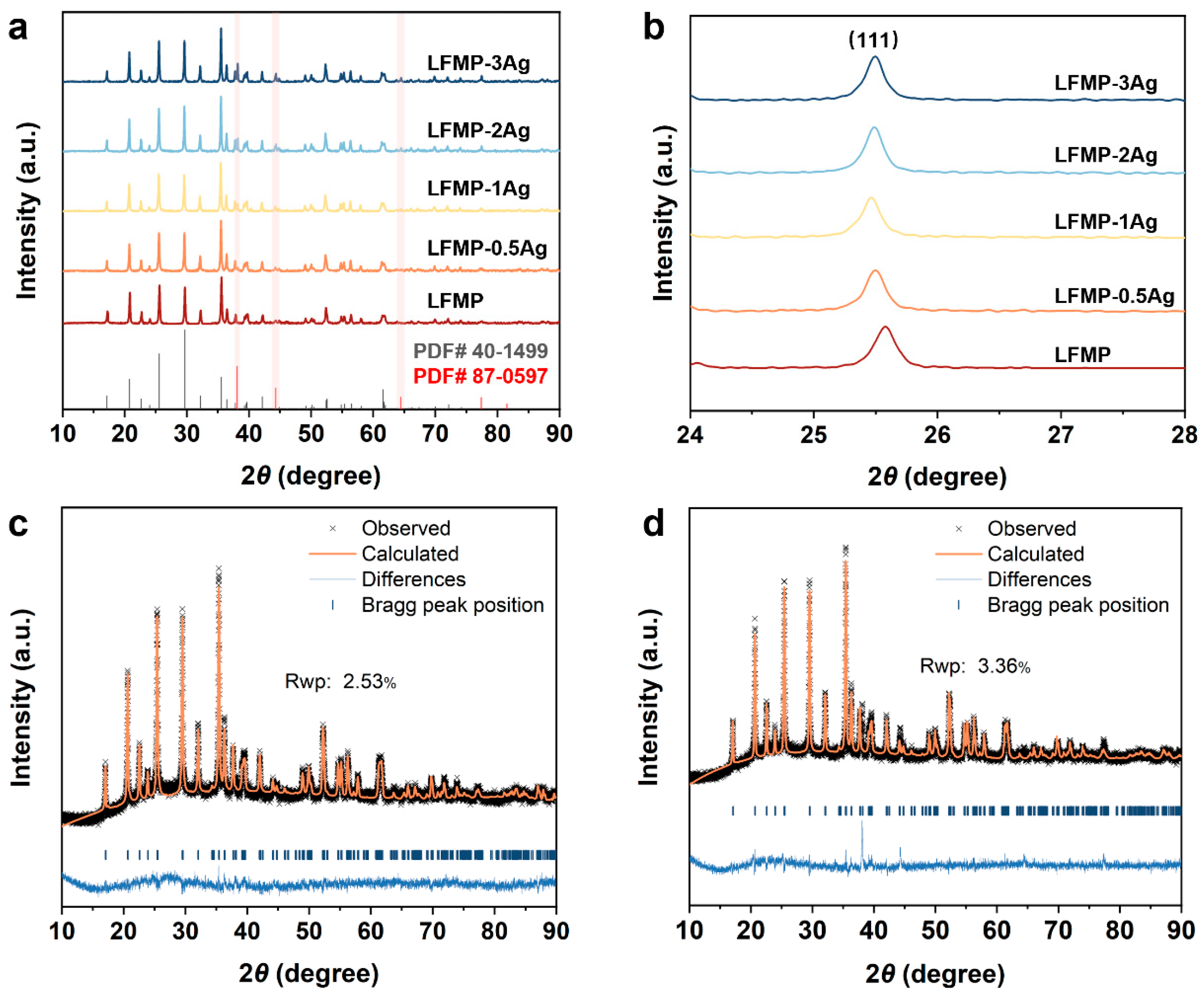
The crystalline structure of as-synthesized materials was determined by X-ray diffraction (XRD), as shown in Figure 1a. The diffraction peaks of all samples correspond to the standard card (PDF#40-1499, LFMP), confirming the successful synthesis of olivine-type LFMP. Moreover, the well-maintained olivine structures in all samples with varying Ag contents indicate that the doping of Ag did not disrupt the pristine crystalline structure of LFMP. Notably, there are extra diffraction peaks appearing when Ag doping content reaches more than 1%, related to Ag metal (PDF#87-0597). An enlarged XRD pattern in the 62–66° region about Ag(220) peak has been shown in Figure S1 in the Supporting Information. As Ag doping content increases, the intensity of the diffraction peaks attributed to Ag metal also increases. This phenomenon suggests that excess Ag does not incorporate into the LFMP lattice structure. Instead, during calcination, it undergoes reduction to form a distinct Ag-rich secondary phase within the composite material, likely existing as metallic domains. The resulting dual-phase architecture provides multiple functional advantages: metallic Ag domains (~6.3 × 10⁷ S m−1) create percolation networks that significantly reduce charge transfer resistance and accelerate the electrochemical kinetics at the electrode/electrolyte interface, as validated by further research. Furthermore, the blue shift of the (111) peak of LFMP can be observed with increasing Ag content of 0.5% to 1%, while eventually stabilizing at ~25.5° with no further significant displacement when Ag content progressively increases to 3% (Figure 1b). The diffraction peak shift can be ascribed to LFMP crystal lattice change due to a larger ionic radius of Ag doping (1.26 Å), much larger than Fe2+ (0.74 Å) and Mn2+ (0.80 Å) [26]. At low concentrations, Ag incorporation enlarges the unit cell and interplanar spacing, enhancing Li+ transport within the solid phase. Beyond the solubility limit (≥1%), an Ag-rich secondary phase is detected, leaving the lattice parameters unchanged and thus halting further peak shifts. However, the actual Ag contents in the doped materials require subsequent quantitative characterization.
Further Rietveld refinement was carried out on the XRD patterns of all samples, and the corresponding results are shown in Figure 1c,d and Figure S2a–c. The calculated Bragg reflection positions match well with the observed diffraction peaks, confirming the reliability of the refinement results. The refined lattice parameters and Mn–O bond lengths are summarized in Table 1 and Table 2. A slight expansion in the unit cell volume was observed for the Ag-doped samples compared to the undoped counterpart, providing additional evidence for the successful incorporation of Ag+ into the LFMP lattice. Furthermore, based on the calculation of Mn–O bond lengths, the distortion index (DI) of the MnO6 octahedron in Table 2 showed a minor reduction upon Ag+ doping, indicating the partial suppression of Jahn–Teller distortion. Typically, the elongated Mn–O bonds with low distortion of MnO6 are highly beneficial for structural stability; thus, the enhanced electrochemical characteristics upon cycling can be expected.
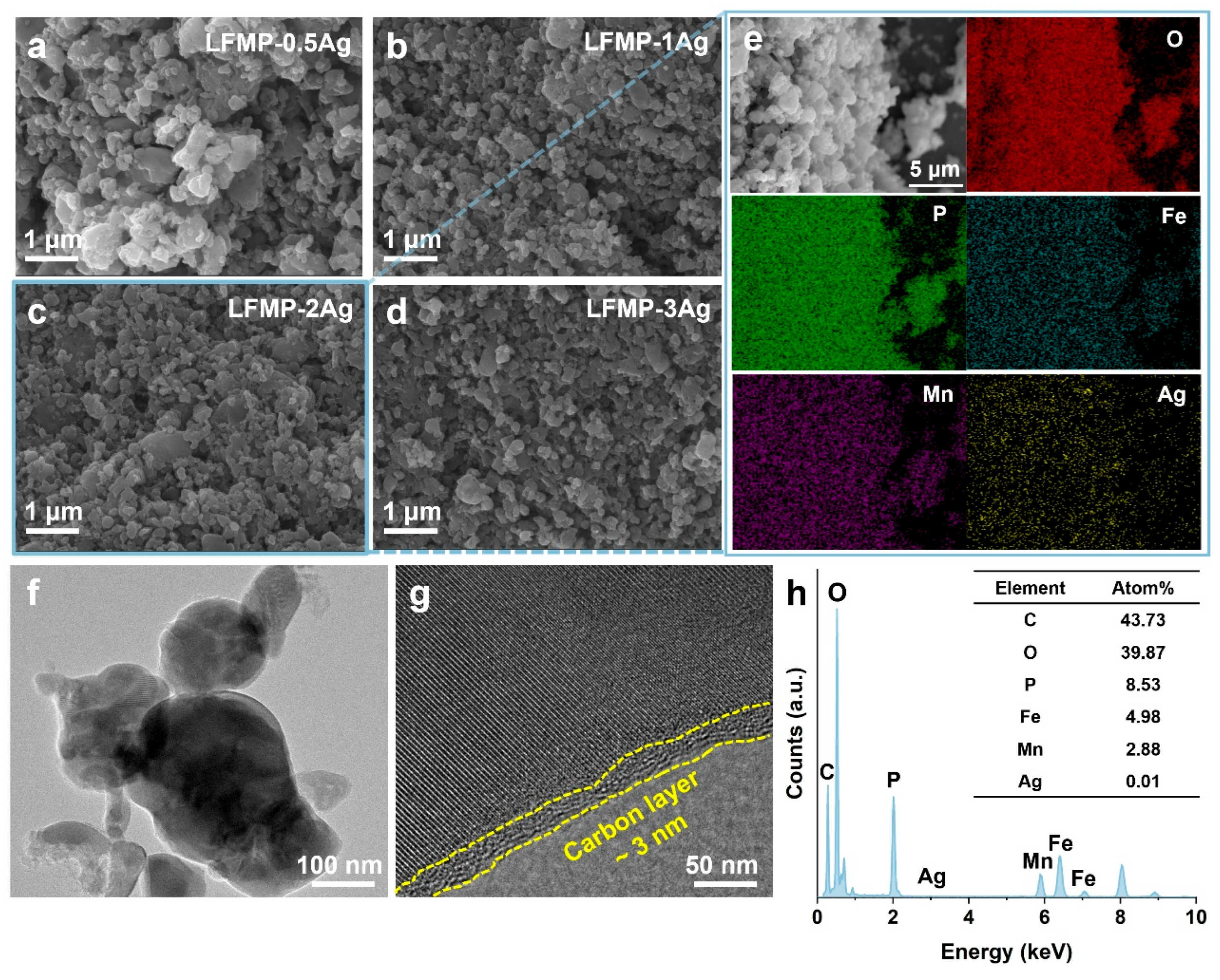
The influence of Ag doping on the size and shape of pristine LFMP particles was investigated through SEM analysis, as shown in Figure 2a–d. SEM of pristine LFMP is included in Figure S3. The particles maintained a spherical morphology, with no significant change induced by low Ag doping levels. As Ag content increased, the particle size of the LFMP-Ag material gradually decreased. Ag doping within the range of 1–3% demonstrated favorable modification effects, resulting in smaller particle sizes with uniform distribution and no noticeable agglomeration. This observation aligns with the XRD results that Ag ions were no longer incorporated into the crystal lattice but instead formed an Ag-rich secondary phase, effectively suppressing grain growth. Furthermore, energy-dispersive X-ray spectroscopy (EDS) analysis was performed on the LFMP-2Ag sample, as shown in Figure 2e. The results confirmed the homogeneous distribution of all elements within the material, certifying the successful synthesis of LFMP-Ag materials.
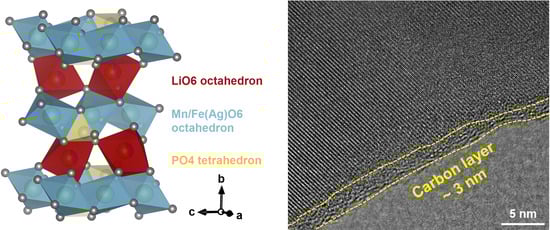
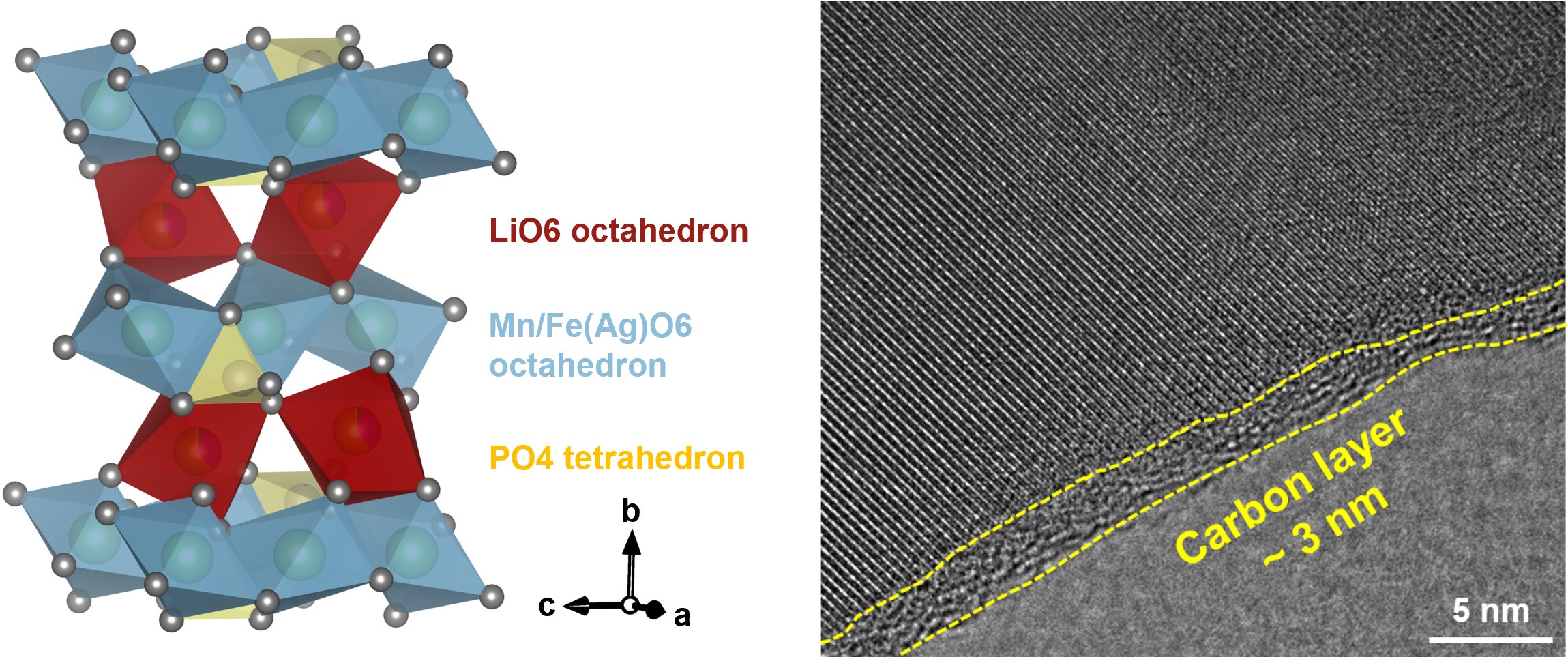
The TEM image and related EDS data of the LFMP-2Ag sample are presented in Figure 2f–h. The particles exhibit an irregular spherical shape with an average diameter of approximately 150 nm (Figure 2f). A thin carbon coating layer (~3 nm) is clearly observed on the particle surfaces (Figure 2g). Furthermore, the lattice fringes of LFMP-2Ag were analyzed, revealing an interplanar spacing of 0.17 nm, corresponding to the (222) crystal plane. Compared with undoped LFMP, a slight expansion of lattice spacing can be found, attributed to the incorporation of larger Ag ions into the lattice. This observation is consistent with the minor leftward shift observed in the XRD patterns, providing further evidence for the successful doping of Ag into the LFMP crystal structure. Additionally, the EDS results (Figure 2h) indicate an Ag molar ratio of 0.01. Although EDS confirms the presence of Ag in the sample, it is semi-quantitative and surface-sensitive, and the actual bulk Ag content cannot be quantified accurately. Therefore, the stated Ag contents are nominal values, and possible Ag loss or redistribution during calcination cannot be fully excluded.
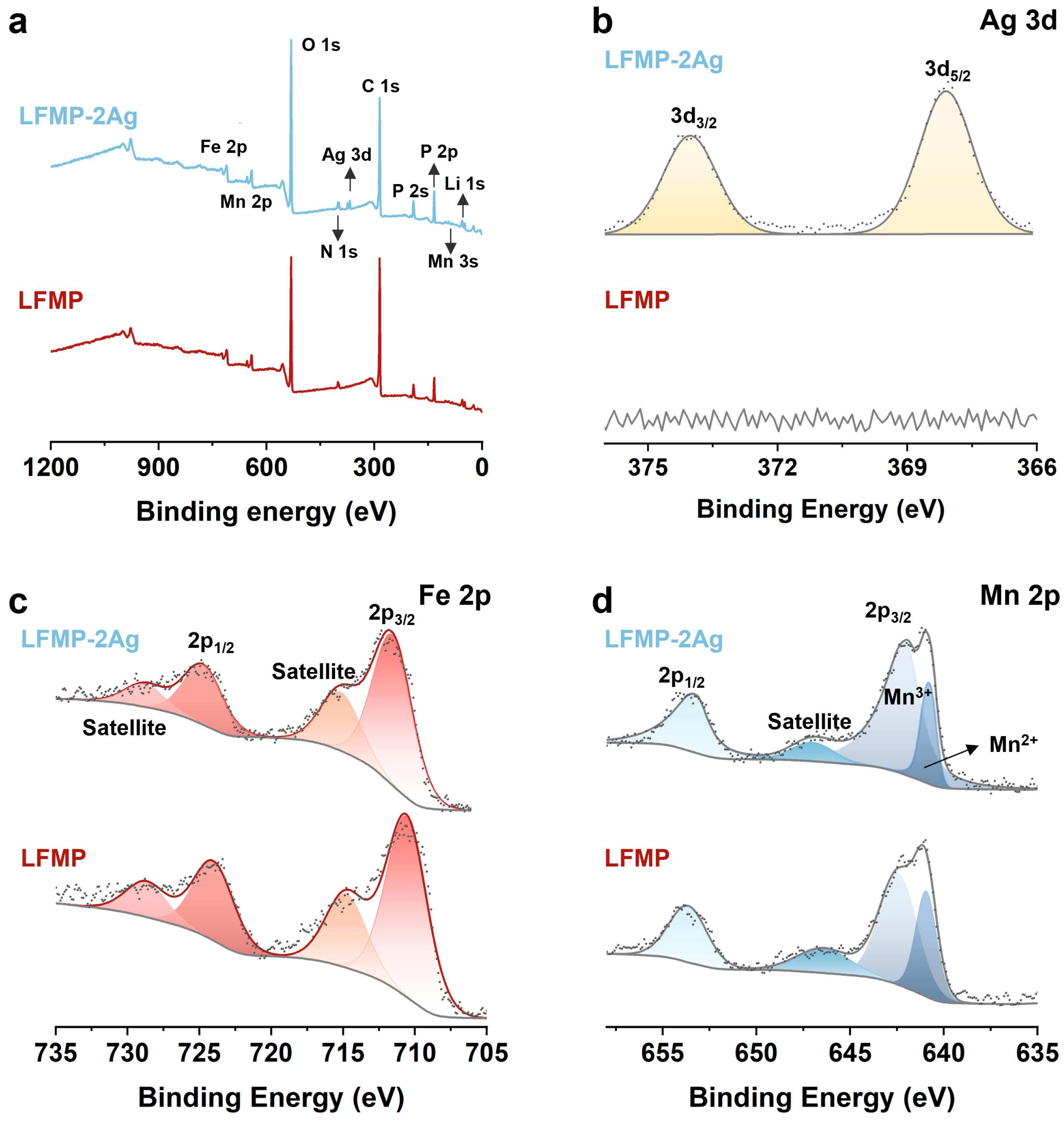
X-ray photoelectron spectroscopy (XPS) was employed to investigate the elemental valence states and chemical compositions of the LFMP and LFMP-2Ag samples. The full spectra unambiguously demonstrate the existence of Fe, Mn, O, N, Ag, C, P and Li elements in both samples, while the absence of Ag in LFMP material is visible in Figure 3a,b. In the Ag 3d spectra in Figure 3b, there are two well-resolved peaks located at 373.98 and 368.08 eV, related to Ag 3d3/2 and 3d5/2, respectively, indicating that Ag predominantly exists as Ag+. The absence of a discernible Ag0 signal in XPS is inconsistent with the previous XRD results. The discrepancy may arise from the extremely low quantity of Ag0, or its localization in the interior of the sample, which could prevent detection by the XPS technique. The doping of Ag+ with a lower valence state than Fe2+ and Mn2+ results in p-type doping in pristine LFMP, implying an increase in hole carrier concentration and enhancement of electronic conductivity. The Fe 2p peaks in Figure 3c show two splitting peaks at 710.78 and 724.58 eV, accompanied by the characteristic satellite peaks at 714.69 and 728.49 eV, respectively, corresponding to Fe 2p3/2 and Fe 2p1/2. These findings provide definitive evidence for the presence of Fe2+ species. Deconvolution of the Mn 2p spectrum unequivocally identifies that the Mn2+ (640.78 eV) and Mn3+ (642.18 eV) both exist (Figure 3d). The Mn 3s multiplet splitting decreases from 6.41 eV for pristine LFMP to 6.12 eV after Ag doping (Figures S4 and S5 Supporting Information). As the Mn 3s splitting energy generally decreases with increasing Mn oxidation state, this result suggests that Mn remains predominantly in the +2 state, while the average Mn valence slightly increases after Ag doping, indicating a higher contribution of oxidized Mn species and a modified local electronic environment. While with Ag doping into LFMP, a reduction in Mn2+ peak intensity in Mn 2p3/2 is clearly observed in LFMP-2Ag sample. It can be inferred that the incorporation of Ag+ results in a local charge compensation by oxidizing Mn2+ into Mn3+ species to keep the electroneutrality of the material. The observed attenuation in Mn2+ signal intensity conclusively demonstrates the successful incorporation of Ag+ ions into LFMP lattice.
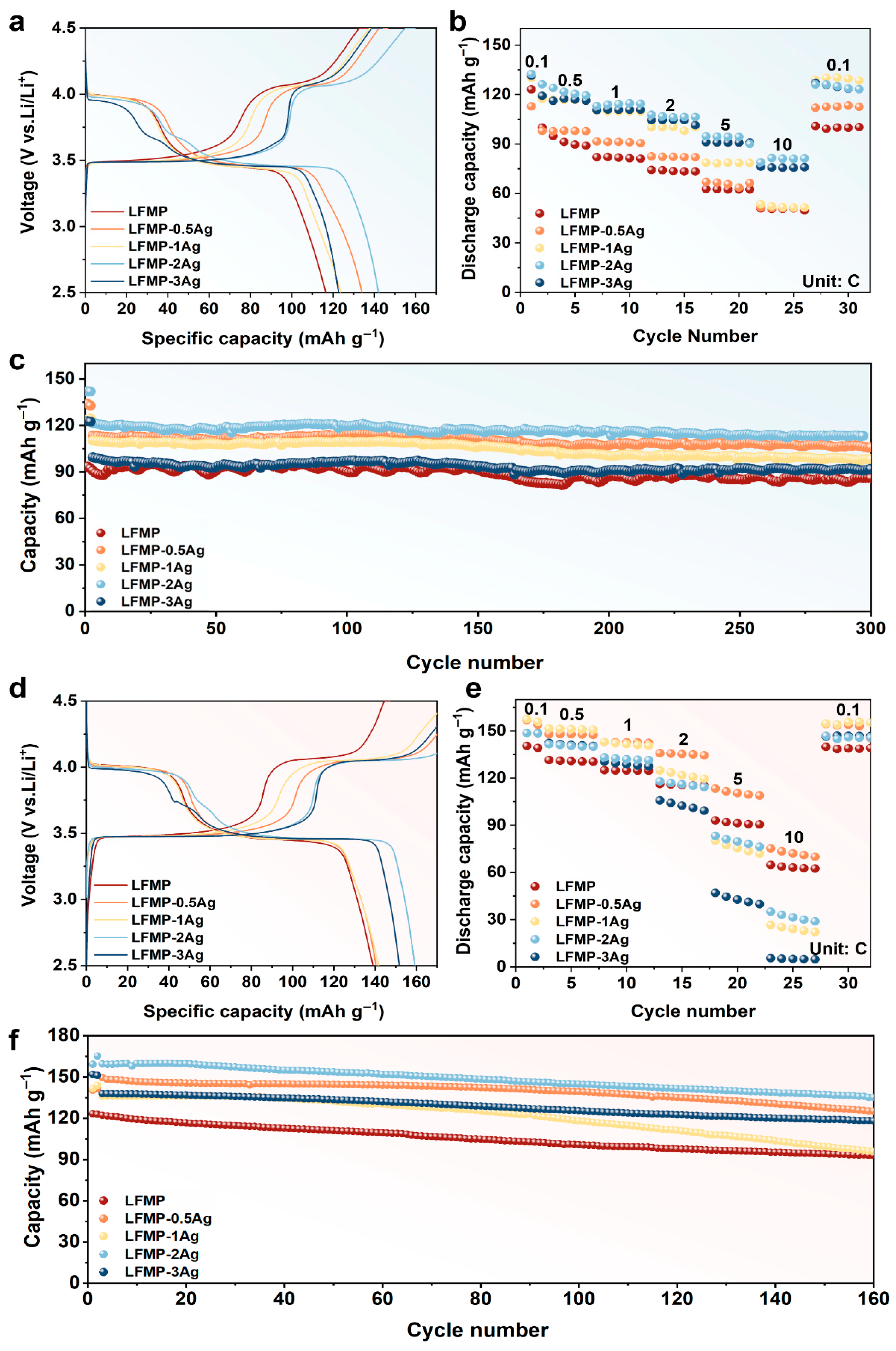
The electrochemical evaluation of LFMP-Ag materials was performed in coin cells, assembled with LFMP-Ag cathodes and Li metal anodes. The initial charge/discharge profiles of all samples between 2.5 and 4.5 V at 0.1 C under room temperature are presented in Figure 4a. There are two distinct charge/discharge plateaus at approximately 3.5 V and 4.1 V observed in all samples, corresponding to the redox reactions of Fe2+/Fe3+ and Mn2+/Mn3+, respectively. The well-preserved voltage plateaus indicate that Ag doping does not alter the inherent charge/discharge characteristics of the LFMP materials. Notably, no additional charge/discharge plateaus emerge after Ag doping, suggesting that the incorporated Ag remains electrochemically inert during cycling without participating in redox reactions or undergoing valence changes. The discharge specific capacities at 0.1 C for initial cycles were found to be 116.4, 133.9, 123.7, 142.1, and 122.7 mAh g−1, for LFMP, LFMP-0.5Ag, LFMP-1Ag, LFMP-2Ag, and LFMP-3Ag, respectively. The capacity evolution follows a volcano-type trend with increasing Ag doping content—initially enhancing before declining—where the LFMP-2Ag cathode demonstrates the optimal initial discharge capacity among all investigated compositions.
The rate capability is crucial for cathode materials, as it directly determines the power delivery performance in practical applications. As shown in Figure 4b, the rate performance was systematically evaluated at various current densities ranging from 0.1 to 10 C. The enhanced rate capability was achieved by Ag doping, and the LFMP-2Ag cathode maintained superior capacity among all samples. As high as 81.1 mAh g−1 discharge capacity was acquired at a 10 C high rate, outperforming undoped LFMP cells. Interestingly, the LFMP-3Ag sample with a relatively high Ag doping level did not exhibit a drastic drop in discharge capacity at high current densities, deviating from the conventional rate performance characteristics observed in most element-doped materials. Typically, excessive ion doping tends to deteriorate rate capability due to either: (i) lattice distortion hindering Li+ diffusion when dopants occupy interstitial sites, or (ii) electronic conductivity degradation when dopants form insulating secondary phases. However, the Ag-doped LFMP materials exhibit fundamentally different behavior because of their unique dual-phase architecture. While the lattice-incorporated Ag optimizes intrinsic conductivity, the excess metallic Ag nanoparticles create percolation networks that remarkably enhance charge transfer kinetics without blocking ionic pathways. This distinctive mechanism explains the excellent capacity retention at high rates of LFMP-2Ag and LFMP-3Ag cathode materials. Figure 4c presents the cycling performance of samples at 1 C under room temperature for 300 cycles. Notably, all samples demonstrate excellent cycling stability without significant capacity decay, indicating that Ag doping enhances the electrochemical performance effectively. Among them, LFMP-2Ag delivers the highest discharge capacity while maintaining good cycling stability, with an enhanced capacity retention of 92.3% after 300 cycles.
The high-temperature electrochemical characteristics of the materials were systematically investigated at 45 °C to evaluate the thermal stability and practical applicability of Ag-doped LFMP cathodes. The first-cycle discharge capacities were measured as 139.1, 140.5, 141.6, 159.3, and 151.8 mAh g−1 for pure LFMP and LFMP with Ag doping levels of 0.5%, 1%, 2% and 3%, respectively (Figure 4d). A volcano-shaped trend of as-acquired capacity with increasing Ag doping content—initially enhancing before decreasing—mirrored the behavior observed at room temperature. Notably, the LFMP-2Ag sample demonstrates the highest initial discharge capacity, suggesting that the 2% Ag doping level provides the most favorable modification effect for high-temperature operation. The optimal rate performance was achieved by the LFMP-0.5Ag sample, demonstrating 156.9 mAh g−1 at 0.1 C, and 73.3 mAh g−1 at 10 C (46.7% retention) (Figure 4e). In a long-term cycling stability test, the significant capacity degradation (74.7% capacity retention, 160 cycles, 1 C), ascribed to dissolution of TMs at elevated temperatures, was observed for LFMP material. Notably, LFMP-2Ag retained 84.9% capacity after 160 cycles at 1 C (Figure 4f). The improved cycling stability and higher capacity retention were found for Ag-doped LFMP samples, indicating the effective enhancement of the electrochemical performance of Ag doping even under high-temperature conditions. Future studies will focus on pairing this cathode with practical anodes to evaluate the performance under more application-relevant conditions.
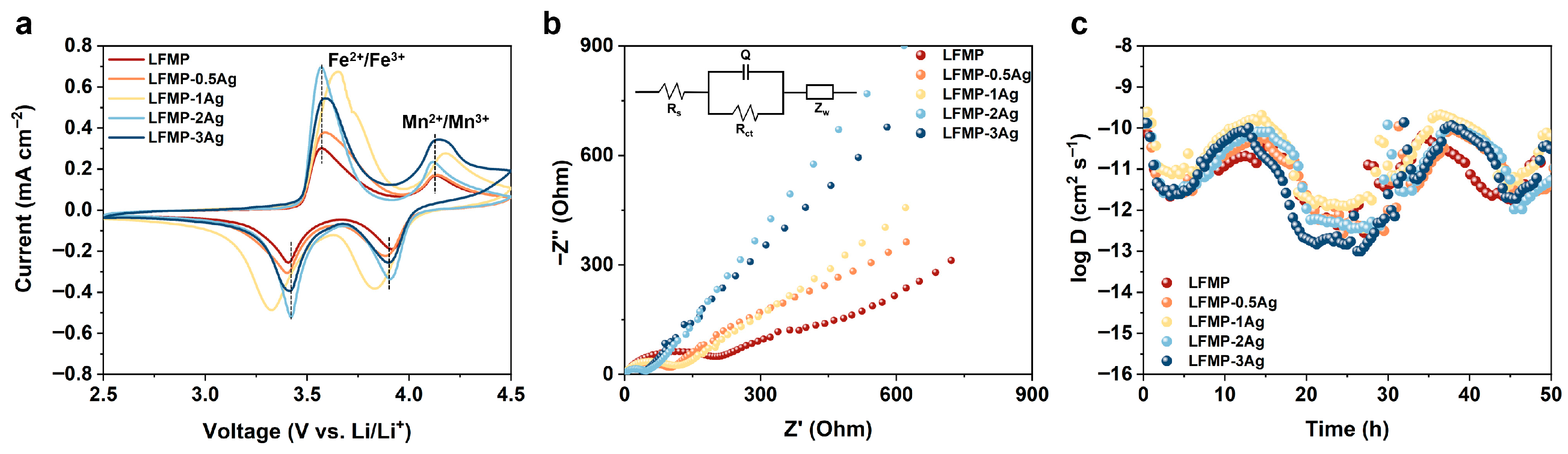
The cyclic voltammetry (CV) test results were profiled in Figure 5a. There are two pairs of redox peaks at around 3.5 V and 4.1 V, corresponding to the Fe2+/Fe3+ and Mn2+/Mn3+ redox couples, respectively [27]. This is consistent with the charge/discharge plateau voltages observed in the charge/discharge curves. Moreover, the LFMP-2Ag sample exhibits the smallest voltage gap between oxidation and reduction peaks, indicating that 2% Ag doping effectively reduces polarization within the LFMP material, thereby enhancing its electrochemical reversibility. The electrochemical impedance spectroscopy (EIS) in Figure 5b shows a decreasing charge transfer resistance (Rct) with increasing Ag doping level. Of particular note, a significant reduction in Rct can be observed for LFMP-2Ag (42.1 Ω) and LFMP-3Ag (40.9 Ω), much lower than the Rct of LFMP without Ag doping (177.7 Ω). In these samples, an Ag-rich secondary phase is formed, creating conductive pathways between LFMP particles. These findings are consistent with the previous XRD analysis, confirming the role of excess Ag in improving charge transfer kinetics. The Li+ diffusion coefficients (DLi+) of Ag-doped LFMP materials were determined by the GITT test. As shown in Figure 5c, DLi+ for Ag-doped LFMP samples were found to be 10−10~10−13 cm2 s−1, comparable to those reported in studies [7,15,28,29,30], suggesting that Ag primarily enhances electronic conductivity as well as Li+ diffusion kinetics. A comparative summary of the proposed Ag-doped LFMP material and previously reported LMFP cathodes is provided in Table S1, indicating that Ag doping is a feasible strategy for improving the electrochemical performance of LFMP.
The preceding XRD refinement results confirm that Ag doping in the LFMP-2Ag sample effectively mitigates Jahn–Teller distortion in MnO6 octahedra, thereby enhancing the electrochemical performance of the LFMP cathode material. To provide direct evidence of the suppression of Jahn–Teller distortion and reduction in Mn dissolution during cycling by Ag doping, the ICP-OES analysis was conducted on lithium metal anodes after 200 cycles at a 1C rate. Shown in Table 3 below, a dramatic 68.4% reduction in Mn content on the Li anode was achieved by 2% Ag doping, demonstrating that Ag doping effectively suppresses Mn dissolution during electrochemical cycling, leading to a remarkable enhancement in the overall electrochemical performance.

4. Conclusions

In summary, the modification effect of Ag doping on LFMP cathode materials is investigated. LFMP materials with different Ag doping contents were prepared via a facile high-temperature solid-state approach, and the influence of Ag doping on the LFMP’s structure, conductivity and electrochemical behavior was systematically analyzed. The doped Ag exists as Ag+ in the LFMP lattice, while excess Ag presents as an Ag-rich secondary phase within the LFMP particles when the doping content is more than 1%. The optimized LFMP-2Ag sample exhibited enhanced electrochemical performance, including high specific capacity, better rate capability and increased cycling stability, which can be primarily attributed to the synergistic effects of facilitated charge transfer kinetics and reinforced structural integrity. This work demonstrates a practical and scalable Ag doping strategy for the enhancement of LFMP cathode materials, offering a critical theoretical framework for guiding the rational design of next-generation high-performance lithium-ion batteries.

Supplementary Materials

The following supporting information can be downloaded at https://www.mdpi.com/article/10.3390/batteries12040129/s1: Figure S1: Enlarged XRD pattern of Ag (220) peak. Figure S2: Rietveld refinement result of (a) LMFP-0.5Ag, (b) LMFP-1Ag and (c) LMFP-3Ag. Figure S3: SEM image of pristine LFMP. Figure S4. XPS spectra of Mn 3s of LFMP sample. Figure S5. XPS spectra of Mn 3s of LFMP-2Ag sample. Table S1: Comparative study with reported LMFP cathodes. References [31,32,33] are cited in the supplementary materials.

Author Contributions

Conceptualization, W.Z. and R.X.; methodology, W.Z.; validation, W.Z. and G.J.; formal analysis, W.Z.; investigation, W.Z.; data curation, W.L. and W.Z.; writing—original draft preparation, W.L.; writing—review and editing, W.L. and R.X.; supervision, R.X.; project administration, R.X.; funding acquisition, W.L. and R.X. All authors have read and agreed to the published version of the manuscript.

Funding

This work was supported by the Fundamental Research Funds for the Central Universities (FRF-TP-24-001A).

Data Availability Statement

The original contributions presented in the study are included in the article/Supplementary Materials, further inquiries can be directed to the corresponding author.

Acknowledgments

The authors extend their gratitude to Zhang (from Scientific Compass www.shiyanjia.com) for the assistance with XPS analysis.

Conflicts of Interest

There are no conflicts to declare.

References

  1. Wan, G.; Pollard, T.P.; Ma, L.; Schroeder, M.A.; Chen, C.C.; Zhu, Z.; Zhang, Z.; Sun, C.J.; Cai, J.; Thaman, H.L.; et al. Solvent-Mediated Oxide Hydrogenation in Layered Cathodes. Science 2024, 385, 1230–1236. [Google Scholar] [CrossRef] [PubMed]
  2. Zhao, C.; Wang, C.; Liu, X.; Hwang, I.; Li, T.; Zhou, X.; Diao, J.; Deng, J.; Qin, Y.; Yang, Z.; et al. Suppressing Strain Propagation in Ultrahigh-Ni Cathodes during Fast Charging via Epitaxial Entropy-Assisted Coating. Nat. Energy 2024, 9, 345–356. [Google Scholar] [CrossRef]
  3. Guo, M.; Cao, Z.; Liu, Y.; Ni, Y.; Chen, X.; Terrones, M.; Wang, Y. Preparation of Tough, Binder-Free, and Self-Supporting LiFePO4 Cathode by Using Mono-Dispersed Ultra-Long Single-Walled Carbon Nanotubes for High-Rate Performance Li-Ion Battery. Adv. Sci. 2023, 10, 2207355. [Google Scholar] [CrossRef]
  4. Song, Y.; Zhang, H.; Guo, S.; Lin, C.; Wang, Z.; Hu, X.; Cao, M.; Qie, L.; Li, D.; Ji, X.; et al. Kinetically Tunable O Vacancies in LiFePO4 for Improved Li+/e Conduction and High-Rate Cycling. Nano Res. 2025, 18, 94907598. [Google Scholar] [CrossRef]
  5. Wang, Z.; Huang, S.; Wang, X.; Salla, M.; Wang, H.; Wang, Q. Scalable Direct Recovery of Spent LiFePO4 with a Redox-Mediated Flow Cell. ACS Energy Lett. 2025, 10, 3064–3073. [Google Scholar] [CrossRef]
  6. Liu, X.; Ouyang, B.; Hao, R.; Liu, P.; Fan, X.; Zhang, M.; Pan, M.; Liu, W.; Liu, K. Li2SiO3 Modification of C/LiFe0.5Mn0.5PO4 for High Performance Lithium-Ion Batteries. ChemElectroChem 2022, 9, 5–11. [Google Scholar] [CrossRef]
  7. Song, Y.; Zhong, H.; Hu, T.; Chen, Q.; Shi, L.; Du, J.; Tao, C.; Zhang, Q. Dually Encapsulated LiMn0.6Fe0.4PO4 Architecture with MXenes and Amorphous Carbon to Achieve High-Performance and Ultra-Stable Lithium Batteries. J. Mater. Chem. A 2024, 13, 2590–2599. [Google Scholar] [CrossRef]
  8. Wi, S.; Park, J.; Lee, S.; Kim, J.; Gil, B.; Yun, A.J.; Sung, Y.E.; Park, B.; Kim, C. Insights on the Delithiation/Lithiation Reactions of LixMn0.8Fe0.2PO4 Mesocrystals in Li+ Batteries by in Situ Techniques. Nano Energy 2017, 39, 371–379. [Google Scholar] [CrossRef]
  9. He, K.; Ding, K.; Xiong, H.; Liu, X.; Wu, Y.; Chen, Y.; Wang, Y.; Gao, J.; Zhang, J.; Wang, B. Ethylenediamine Tetraacetic Acid-Assisted Hydrothermal Synthesis of LiMn0.5Fe0.5PO4 with Exposed (010) Crystal Plane for Enhanced High-Rate Performance. J. Power Sources 2025, 630, 236082. [Google Scholar] [CrossRef]
  10. Li, Z.; You, Y.; Zhu, Z.; Wang, L.; Ou, S.; Xu, J.; Yuan, M. Surface Iron Concentration Gradient: A Strategy to Suppress Mn3+ Jahn-Teller Effect in Lithium Manganese Iron Phosphate. Appl. Surf. Sci. 2025, 682, 161689. [Google Scholar] [CrossRef]
  11. Huang, J.; Tang, X.; Zhou, Y.; Wang, T.; Zhao, F.; Wang, W.; Meng, Y.; Cen, W.; Zhang, Y. Enhanced Cycling Stability and Suppressed Voltage Decay of LiMn0.8Fe0.2PO4/C by Zn-Gradient Doping. J. Mater. Chem. A 2025, 13, 10550–10560. [Google Scholar] [CrossRef]
  12. Jin, J.; Wang, Y.; Zhao, X.; Hu, Y.; Li, T.; Liu, H.; Zhong, Y.; Jiao, L.; Liu, Y.; Chen, J. Intrinsic Distortion against Jahn-Teller Distortion: A New Paradigm for High-Stability Na-Ion Layered Mn-Rich Oxide Cathodes. Angew. Chem. 2025, 137, e202423728. [Google Scholar] [CrossRef]
  13. Bao, W.; Yao, W.; Li, Y.; Sayahpour, B.; Han, B.; Raghavendran, G.; Shimizu, R.; Cronk, A.; Zhang, M.; Li, W.; et al. Insights into Lithium Inventory Quantification of LiNi0.5Mn1.5O4-Graphite Full Cells. Energy Environ. Sci. 2024, 17, 4263–4272. [Google Scholar] [CrossRef]
  14. Liu, W.; Liu, X.; Hao, R.; Yang, Z.; Ouyang, B.; Zhang, M.; Pan, M.; Liu, K. Contribution of Calcium Ion Doping to the Rate Property for LiFe0.5Mn0.5PO4/C. J. Electroanal. Chem. 2023, 929, 117117. [Google Scholar] [CrossRef]
  15. Jeong, B.J.; Sung, J.Y.; Jiang, F.; Jung, S.P.; Lee, C.W. Providing High Stability to Suppress Metal Dissolution in LiMn0.5Fe0.5PO4 Cathode Materials by Zn Doping. J. Energy Storage 2024, 96, 112552. [Google Scholar] [CrossRef]
  16. Liu, Y.; Chang, C.; Zheng, J. Revealing the Role of Mg Doping in LiFe0.39Mg0.01Mn0.6PO4/C Cathode: Enhanced Electrochemical Performance from Improved Electrical Conductivity and Promoted Lithium Diffusion Kinetics. J. Energy Storage 2024, 91, 112108. [Google Scholar] [CrossRef]
  17. Hu, H.; Li, H.; Lei, Y.; Liu, J.; Liu, X.; Wang, R.; Peng, J.; Wang, X. Mg-Doped LiMn0.8Fe0.2PO4/C Nano-Plate as a High-Performance Cathode Material for Lithium-Ion Batteries. J. Energy Storage 2023, 73, 109006. [Google Scholar] [CrossRef]
  18. Zhang, Q.; Liu, Y.; Chang, C.; Zheng, J. Modulating the Lattice Structure via Cr3+ Doping in LiFe0.4Mn0.6PO4 Cathode for Improved Rate Behavior and Promoted Cyclic Performance. J. Energy Storage 2024, 101, 113799. [Google Scholar] [CrossRef]
  19. Zheng, J.; Yang, J.; Wu, J.; Li, S.; Wang, M.; Huang, B.; Li, Y.; Xiao, S.; Zhu, Q. Y3+ Doping and Electrochemical Properties of LiFe0.5Mn0.5PO4@C Cathode Material for Lithium-Ion Batteries. J. Alloys Compd. 2023, 960, 170610. [Google Scholar] [CrossRef]
  20. Peng, J.; Li, Z.; You, Y.; Liu, J.; Wang, L.; Xu, J.; Ou, S.; Yuan, M. Contribution of Ti-Doping to the Cyclic Stability of LiFe0.6Mn0.4PO4/C. Ind. Eng. Chem. Res. 2024, 63, 8228–8238. [Google Scholar] [CrossRef]
  21. Zhao, M.; Zhou, Y.; Chen, Y.; Liang, X.; Zeng, J.; Bai, K.; Xu, X.; Wang, H.; Jiang, X.; He, H. Synergistic Optimization of LiMn0.6Fe0.4PO4 Cathode Material Structure and Electron/Ion Transport via Trace V-Ti Co-Doping to Achieve Electrochemical Performance Enhancement. Adv. Funct. Mater. 2025, 35, 2509461. [Google Scholar] [CrossRef]
  22. Kong, D.; Chen, H.; Wu, F.; Zhang, R.; Li, J.; Mai, Y.; Wei, Y.; Wang, J.; Dai, X. The High-Rate Cycling Stability of the LiFe0.6Mn0.4PO4/C Cathode Material Is Enhanced through in-Situ Nb-Doping. Electrochim. Acta 2024, 506, 145060. [Google Scholar] [CrossRef]
  23. Vanaphuti, P.; Manthiram, A. Enhancing the Mn Redox Kinetics of LiMn0.5Fe0.5PO4 Cathodes Through a Synergistic Co-Doping with Niobium and Magnesium for Lithium-Ion Batteries. Small 2024, 20, 2404878. [Google Scholar] [CrossRef]
  24. Jia, S.; Cheng, H.; Zhu, Q.; Chen, X.; Xue, C.; Deng, T.; Dong, M.; Xia, Z.; Jiao, J.; Chen, C.; et al. Tuning Multi-Active Sites in Cu Catalyst via Ag/Ni Doping for Enhanced CO2 Electroreduction to C2+ Products. Angew. Chem. 2025, 64, e202501833. [Google Scholar] [CrossRef] [PubMed]
  25. Wang, X.; Bourgès, C.; Crivello, J.-C.; Mori, T. Steric Confinement for Suppressing Ion Migration and Boosting Thermoelectric Performance in Cu–S System via Ag and Se Co-Doping. Acta Mater. 2025, 299, 121424. [Google Scholar] [CrossRef]
  26. Seery, M.K.; George, R.; Floris, P.; Pillai, S.C. Silver Doped Titanium Dioxide Nanomaterials for Enhanced Visible Light Photocatalysis. J. Photochem. Photobiol. A Chem. 2007, 189, 258–263. [Google Scholar] [CrossRef]
  27. Hu, Q.; Wang, W.; Lu, J.; Zhu, H.; Liu, Q.; Ren, Y.; Wang, H.; Hui, J. High-Throughput Screening of High Energy Density LiMn1-XFexPO4 via Active Learning. Chin. Chem. Lett. 2025, 36, 110344. [Google Scholar] [CrossRef]
  28. Luo, T.; Zeng, T.T.; Chen, S.L.; Li, R.; Fan, R.Z.; Chen, H.; Han, S.C.; Fan, C. ling Structure, Performance, Morphology and Component Transformation Mechanism of LiMn0.8Fe0.2PO4/C Nanocrystal with Excellent Stability. J. Alloys Compd. 2020, 834, 155143. [Google Scholar] [CrossRef]
  29. Kisu, K.; Iwama, E.; Onishi, W.; Nakashima, S.; Naoi, W.; Naoi, K. Ultrafast Nano-Spherical Single-Crystalline LiMn0.792Fe0.198Mg0.010PO4 Solid-Solution Confined among Unbundled Interstices of SGCNTs. J. Mater. Chem. A 2014, 2, 20789–20798. [Google Scholar] [CrossRef]
  30. Yao, M.; Wang, Y.T.; Chen, J.A.; Dong, H.; Li, M.; Zhang, X.; Wang, C.; Huang, G.; Xu, S. Mn-Rich Induced Alteration on Band Gap and Cycling Stability Properties of LiMnxFe1−XPO4 Cathode Materials. ACS Appl. Mater. Interfaces 2024, 16, 66077–66088. [Google Scholar] [CrossRef]
  31. Han, J.; Zhu, J.; He, X.; Yang, M.; Yan, C.; Ma, D.; Zhang, L.; Zhang, P. Trifunctional Copper-Substitution in LiMn0.6Fe0.4PO4 Nanocrystal for Enhanced Lithium Storage. ACS Appl. Mater. Interfaces 2025, 17, 32381–32391. [Google Scholar] [CrossRef] [PubMed]
  32. Dai, Z.; Wang, L.; He, X.; Ye, F.; Huang, C.; Li, J.; Gao, J.; Wang, J.; Tian, G.; Ouyang, M. Morphology Regulation of Nano LiMn0.9Fe0.1PO4 by Solvothermal Synthesis for Lithium Ion Batteries. Electrochim. Acta 2013, 112, 144–148. [Google Scholar] [CrossRef]
  33. Zhang, Z.; Hu, G.; Cao, Y.; Duan, J.; Du, K.; Peng, Z. Novel Synergistic 0.9LiMn0.9Fe0.1PO4·0.1Na3V2(PO4)2F3/C Nano-Hybrid Cathode with Enhanced Electrochemical Performance for Lithium-Ion Batteries. J. Power Sources 2016, 303, 29–34. [Google Scholar] [CrossRef]
Figure 1. (a) XRD patterns of as-synthesized materials. (b) Enlarged XRD pattern of (111) peak. (c,d) Rietveld refinement result of (c) LMFP and (d) LMFP-2Ag.
Batteries 12 00129 g001
Figure 2. (ad) SEM images of (a) LFMP-0.5Ag, (b) LFMP-1Ag, (c) LFMP-2Ag and (d) LFMP-3Ag. (e) EDS mapping of (c). (fh) TEM images at (f) low and (g) high magnifications. (h) EDS spectrum of LFMP-2Ag.
Batteries 12 00129 g002
Figure 3. XPS spectra of LFMP and LFMP-2Ag samples. (a) Full spectrum. (b) Ag 3d. (c) Fe 2p and (d) Mn 2p spectra.
Batteries 12 00129 g003
Figure 4. Electrochemical performance of as-synthesized materials. (a,d) Charge–discharge curves of initial cycle. (b,e) Rate capability. (c,f) Cyclic stability test at (ac) room temperature and (df) 45 °C.
Batteries 12 00129 g004
Figure 5. (a) CV, (b) EIS and (c) GITT tests of as-synthesized materials.
Batteries 12 00129 g005
Table 1. Comparison of the lattice parameters of LFMP and Ag-doped LMFP.
Samplea (Å)b (Å)c (Å)V (Å3)
LFMP10.37616.04494.7153295.755
LFMP-0.5Ag10.37706.04754.7162295.962
LFMP-1Ag10.38136.04624.7177296.116
LFMP-2Ag10.38976.05724.7177297.120
LFMP-3Ag10.38206.04624.7175296.121
Table 2. Comparison of the bond lengths of LFMP and Ag-doped LMFP (bond length unit: Å).
SampleMn-O1Mn-O2Mn-O3Mn-O4Mn-O5Mn-O6AverageDI (MnO6)
LFMP2.2222.1212.1392.2322.1392.2322.1810.0483
LFMP-0.5Ag2.2222.1402.2832.1842.2832.1352.2160.0465
LFMP-1Ag2.2272.1562.2732.1762.2732.1762.2130.0439
LFMP-2Ag2.1802.1542.1802.2642.2932.2642.2200.0423
LFMP-3Ag2.2242.1502.3022.2122.3022.2122.2330.0425
Table 3. Mn content on the anodes of LFMP and LFMP-2Ag.
SampleMn Content (ppm)
LFMP18.34
LFMP-2Ag5.18
Disclaimer/Publisher’s Note: The statements, opinions and data contained in all publications are solely those of the individual author(s) and contributor(s) and not of MDPI and/or the editor(s). MDPI and/or the editor(s) disclaim responsibility for any injury to people or property resulting from any ideas, methods, instructions or products referred to in the content.