
Article

Interfacial Engineering of Fe2VO4 Nanoparticles on MXene Nanosheets for Ultra-Stable and Efficient Sodium Storage
1
Qinghai Provincial Key Laboratory of Nanomaterials and Technology, College of Chemistry and Materials Science, Qinghai Minzu University, Xining 810007, China
2
Key Laboratory of Resource Chemistry and Eco-Environmental Protection on Tibetan Plateau, State Ethnic Affairs Commission, Xining 810007, China
*
Author to whom correspondence should be addressed.
Batteries 2026, 12(4), 117; https://doi.org/10.3390/batteries12040117
Submission received: 16 February 2026 / Revised: 4 March 2026 / Accepted: 24 March 2026 / Published: 27 March 2026
(This article belongs to the Special Issue Multiscale Co-Design of Electrode Architectures and Electrolytes)

Abstract

Owing to its high theoretical sodium-storage capacity of approximately 1000 mAh g−1 and cost-efficient characteristics, Fe2VO4 has emerged as a highly attractive anode material for sodium-ion batteries (SIBs). In this work, MXene-incorporated Fe2VO4 composites were successfully synthesized. Comprehensive electrochemical characterization demonstrates that MXene incorporation significantly enhances the electronic conductivity and sodium-ion diffusion kinetics of Fe2VO4, while effectively mitigating volume expansion during cycling. The synthetic substantially improves its cycling stability and rate capability. When the MXene loading ratio is optimized at 5 wt%, the composite exhibits outstanding cyclic durability, with a remarkable reversible specific capacity of 323.3 mAh g−1 maintained after 200 cycles at a current density of 0.1 A g−1. Furthermore, the composite demonstrates outstanding rate performance, with a specific capacity of 164.5 mAh g−1 achieved at a current density of 2 A g−1. The synergistic integration of Fe2VO4 and MXene not only constructs a three-dimensional electrically conductive framework for efficient charge transport but also reinforces strong structural stability against cycling-induced degradation. This work proposes a versatile engineering strategy that can be adapted for other conversion-type electrode materials in the context of advanced energy storage technologies.

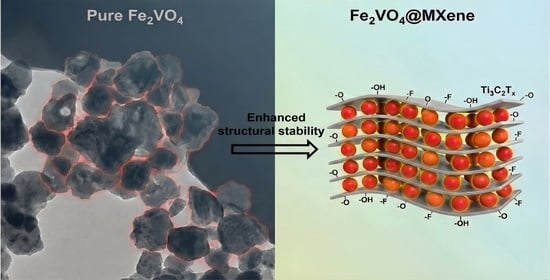
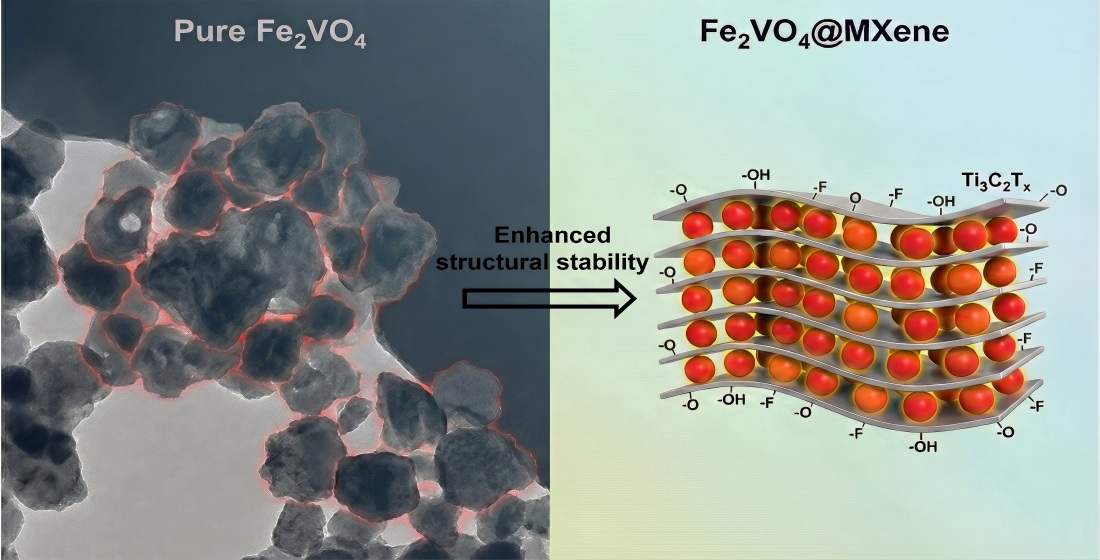
Graphical Abstract

1. Introduction

Sodium-ion batteries (SIBs) demonstrate distinct advantages in energy storage and low-power mobility applications due to their abundant resource availability and cost-effectiveness [1,2,3,4]. While lithium-ion batteries (LIBs) currently dominate markets demanding high energy density, SIBs must address the remaining technical challenges and cost limitations. Overcoming these barriers is essential for SIBs to play a significant role in the global energy transition [5,6,7]. The development of advanced anode materials for SIBs still faces critical challenges. Although conventional carbon-based anodes are widely adopted, their limited specific capacity (approximately 300 mAh g−1) restricts their suitability for high-performance systems [8,9]. Transition metal oxides (TMOs) exhibit high specific capacity along with abundant natural reserves, making them promising alternatives to commercial graphite anodes [10,11,12]. Among various TMOs, iron-based oxides stand out as highly attractive candidates for SIBs, thanks to the ready availability of their raw feedstocks [13,14,15]. Ferrous vanadate (Fe2VO4), a spinel-type bimetallic oxide, demonstrates exceptional potential as an anode material for SIBs. Its advantageous properties include three-dimensional sodium-ion diffusion channels and dual redox activity involving both Fe3+/Fe2+ and V3+/V4+ redox couples, boasting a theoretical capacity of roughly 1000 mAh g−1 [16]. Nevertheless, the practical deployment of this material still encounters significant challenges, such as intrinsically poor electrical conductivity (≈10−6 S·cm−1), sluggish Na+ diffusion dynamics (diffusion coefficient < 10−12 cm2·s−1), and gradual structural deterioration during cycling. To address these issues, strategic material modifications must be implemented to enhance electrochemical performance.
MXene represents a major research trend for electrode material matrices in the field of energy storage, on account of its remarkable electrical conductivity [17,18,19]. For example, Ti3C2Tₓ/FeS2 heterostructures exhibited a reversible capacity of 474.9 mAh g−1 following 600 consecutive cycles at a current density of 5 A g−1 for SIBs, with interfacial electronic coupling boosting electronic conductivity, providing important design insights for MXene-Fe2VO4 composites [20]. Furthermore, the chemically diverse surface termination groups of MXenes can provide abundant active sites. When composited with TMOs, this characteristic not only anchors active species uniformly but also suppresses particle agglomeration and excessive grain growth, effectively alleviating volume fluctuations and structural instability during cycling [21,22]. Previous studies have demonstrated that MXene-based composites with TMOs (e.g., Ti3C2/NiCoP·V4C3Tx) significantly enhance specific capacity and cycling stability through interfacial coupling effects [23,24]. Therefore, combining MXene with Fe2VO4 can leverage their complementary advantages.
This work explores the influence of MXene integration on the electrochemical behavior of Fe2VO4-based anodes. A series of Fe2VO4-based anode materials were fabricated via a sol–gel approach coupled with thermal annealing, with precise regulation of the MXene content (5 wt% and 10 wt%) and its spatial distribution. The synergistic effects of MXene compositing on phase transition suppression, electronic conductivity enhancement, and sodium-ion diffusion kinetics in Fe2VO4 are elucidated. The designed composites demonstrate superior electrochemical properties, featuring a high reversible capacity (323.3 mAh g−1 at 0.1 A g−1) and exceptional cycling stability (92% capacity maintained after 200 consecutive cycles), providing fundamental insights into interfacial engineering strategies for conversion-type anode materials. These findings present a comprehensive materials design approach addressing multiple performance limitations in sodium-ion battery systems by leveraging rationally controlled MXene-Fe2VO4 interfaces with optimized electronic and ionic transport channels.

2. Materials and Methods

2.1. Preparation of Fe2VO4@M Composites

To prepare the Fe2VO4@MXene (Fe2VO4@M) composite, ammonium metavanadate (NH4VO3, purity ≥ 99.99%), iron(III) nitrate nonahydrate (Fe(NO3)3·9H2O, purity ≥ 99.99%), citric acid monohydrate (CAM, purity ≥ 99.99%), and MXene powder (Ti3C2Tx, Battery-grade) were employed. All chemical reagents were utilized as-received, with no supplementary purification procedures implemented.
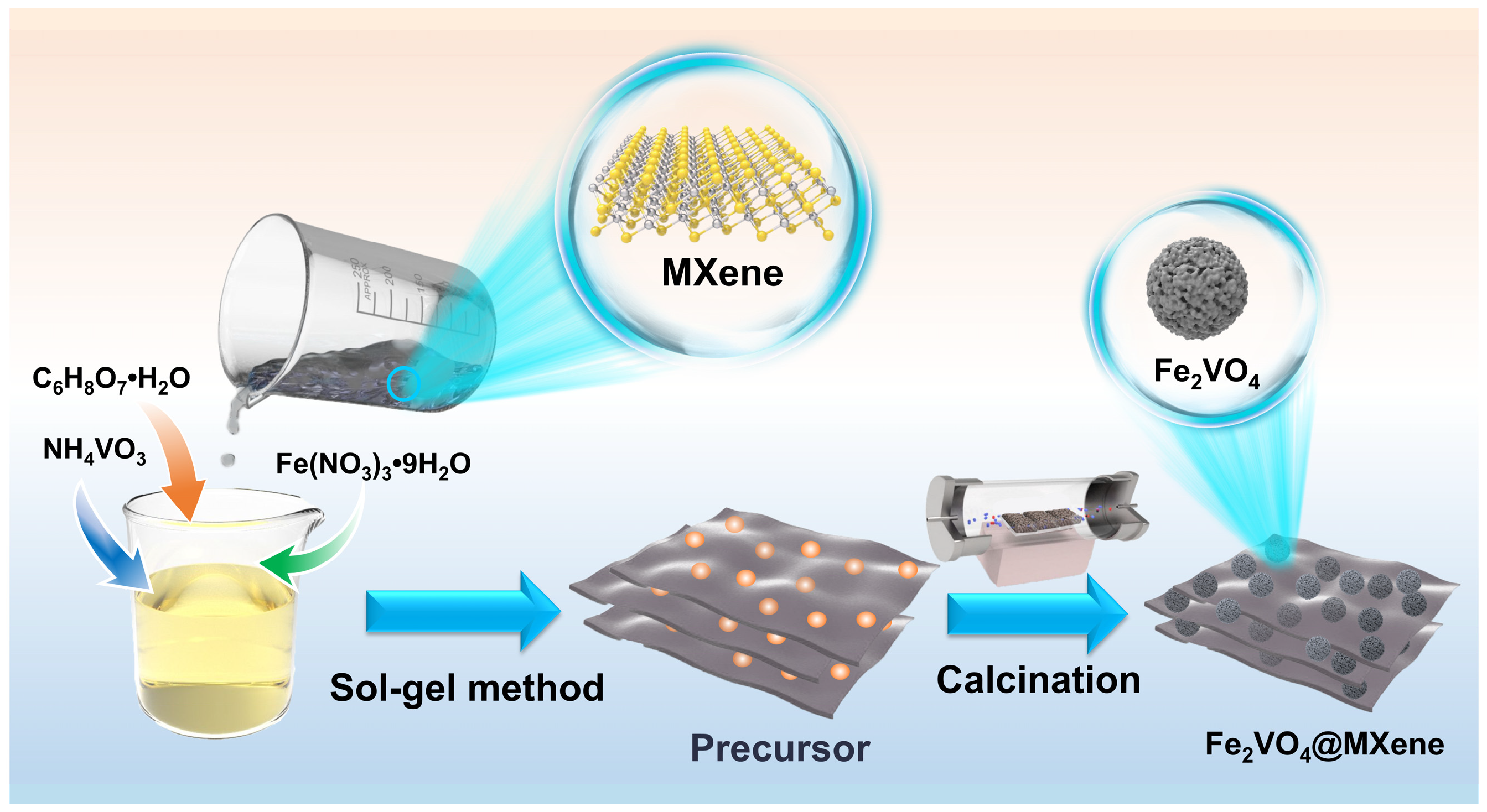
The Fe2VO4@MXene (Fe2VO4@M) composite was synthesized through a sol–gel approach combined with thermal calcination. Initially, 0.005 mol NH4VO3 was dispersed and fully solubilized in 20 mL of deionized water with the aid of magnetic agitation at a temperature of 80 °C. Separately, Fe(NO3)3·9H2O (0.005 mol) was fully dissolved in 10 mL of deionized water at ambient temperature. The two resulting solutions were subsequently combined under continuous stirring. Citric acid monohydrate was added at a 1.5:1 molar ratio relative to NH4VO3. MXene powder (5 wt% or 10 wt%) was introduced into the reaction mixture, after which the blend was subjected to constant agitation at 60 °C until gelation formation occurred. The resulting sol was placed in a forced-air drying oven and heated at 60 °C to produce a xerogel. The xerogel was subsequently ground in an agate mortar and subjected to planetary ball milling at 800 rpm for 4 h to produce ultrafine precursor powder. Finally, the powder was subjected to calcination within a tube furnace under N2 atmosphere. A 5 °C min−1 ramp was used to reach 500 °C, followed by a 5 h isothermal hold and subsequent natural cooling to ambient temperature. The preparation schematic is illustrated in Figure 1. Three samples were prepared under identical conditions with different MXene loading, including pure Fe2VO4 as the control sample, Fe2VO4 containing 5 wt% MXene (denoted as Fe2VO4@M5), and Fe2VO4 with 10 wt% MXene (designated as Fe2VO4@M10).

2.2. Structural and Morphological Characterization

The crystalline structure of Fe2VO4-based composites with varying MXene contents was characterized by X-ray diffraction (XRD). (PANalytical B.V., Almelo, The Netherlands) The diffraction patterns were recorded at a scanning rate of 5°/min. The surface topography of Fe2VO4@M5 was examined by means of scanning electron microscopy (SEM) (Sigma 300, Carl Zeiss AG, Oberkochen, Germany). Elemental composition analysis was quantitatively assessed via X-ray spectroscopy (EDS) (Tecnai G20, Thermo Fisher Scientific, Hillsboro, OR, USA). X-ray photoelectron spectroscopy (XPS) (Escalab 250Xi+, Shanghai Felicia Industrial Co., Ltd., China) was utilized to evaluate the states and oxidation behavior of elements before and after MXene integration. The Brunauer–Emmett–Teller (BET) (ASAP 2460, Micromeritics Instrument Corporation, Norcross, GA, USA) technique was used to measure the specific surface area of the materials, and the Barrett–Joyner–Halenda (BJH) (Autosorb–iQ, Quantachrome Instruments, Boynton Beach, FL, USA) model was applied to calculate the pore size distribution from nitrogen adsorption isotherms obtained at 77 K. Transmission electron microscopy (TEM) (Tecnai G20, Thermo Fisher Scientific, Hillsboro, OR, USA) was utilized to analyze nanoscale morphology and particle size distribution.

2.3. Electrode Fabrication and Electrochemical Measurements

Active materials, conductive carbon black, and polyvinylidene fluoride (PVDF) binder with a mass ratio of 70:20:10 were homogeneously dispersed in N-methyl-2-pyrrolidone (NMP) to form the electrode slurry. Copper foil coated with the as-prepared slurry was dried in a vacuum oven at 80 °C for 12 h to remove residual solvent. CR2032 coin cells were fabricated inside an argon-filled glove box, where both the oxygen and moisture levels were maintained below 0.1 ppm. Working electrodes with a diameter of 12 mm were assembled with sodium metal as the counter-electrode and glass fiber as the separator. The electrolyte was prepared by dissolving 1 M NaCF3SO3 in a 1:1 (v/v) mixture of diglyme (DEG) and dimethoxyethane (DME), with 5 vol% fluoroethylene carbonate (FEC) as an additive.
Cyclic voltammetry (CV) tests were conducted on an electrochemical workstation (CHI 660 E, Shanghai CH Instruments Co., Ltd., Shanghai, China) over a potential range of 0.01–3.00 V. Electrochemical impedance spectroscopy (EIS) was also performed with the same instrument (CHI 660 E, Shanghai CH Instruments Co., Ltd., Shanghai, China) at a frequency range from 10 mHz to 100 kHz under an AC amplitude of 5 mV. Galvanostatic charge–discharge measurements and galvanostatic intermittent titration technique (GITT) tests were conducted using a battery test system. The GITT measurements were performed at a constant current density of 0.02 A g−1 with a pulse time of 10 min and a rest time of 2 h for voltage relaxation until the steady state was reached.

3. Results and Discussion

3.1. Structural, Morphological, and Compositional Analysis of Fe2VO4@M Materials

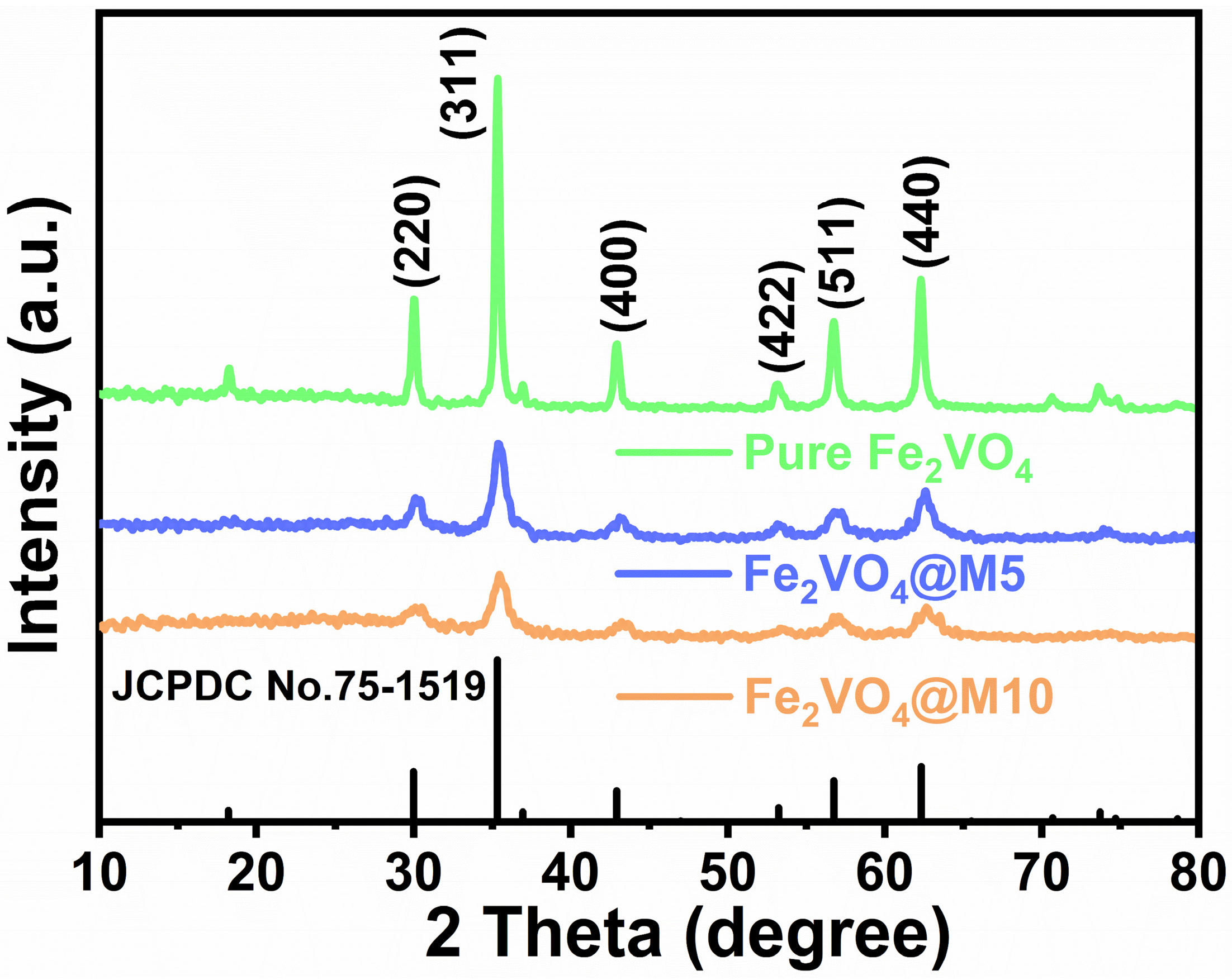
The X-ray diffraction (XRD) patterns of Fe2VO4 composites with varying MXene loadings and pristine Fe2VO4 are presented in Figure 2. All diffraction peaks are in good agreement with the standard spinel Fe2VO4 pattern (JCPDS No. 75-1519). The characteristic diffraction peaks observed at 30.1°, 35.3°, 42.9°, 53.3°, 56.8° and 62.3° can be assigned to the (220), (311), (400), (422), (511), and (440) crystal planes, respectively. No impurity-related diffraction peaks are observed, verifying the phase-pure synthesis of Fe2VO4. Notably, the XRD patterns of Fe2VO4 materials composited with different MXene contents retain unchanged peak positions, suggesting that MXene incorporation does not disrupt the crystalline structure of Fe2VO4, which excludes the interference of crystal form variation, laying the groundwork for subsequent research into how MXene loading impacts electrochemical performance. The sharp diffraction peaks further confirm the high crystallinity of all samples. The diffraction peaks of Fe2VO4@M10 are consistent with the pure phase without impurity peaks, indicating that excessive MXene does not damage the crystal structure of Fe2VO4 but only causes a slight reduction in peak intensity.
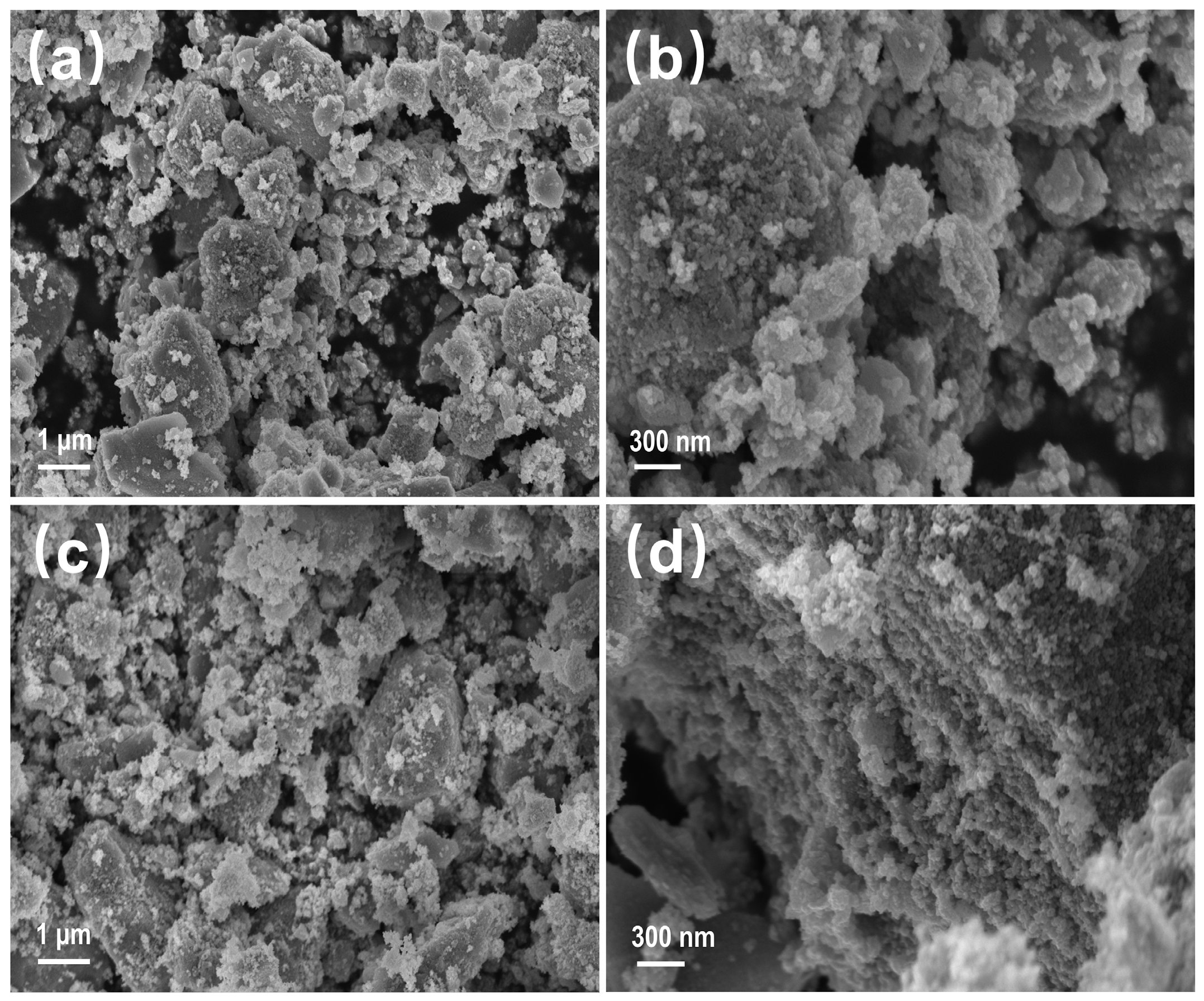
SEM analysis reveals the morphology evolution induced by MXene integration (Figure 3). Pure Fe2VO4 material exhibits nanoparticle agglomerates with irregular shapes (Figure 3a,b), while Fe2VO4@M5 (Figure 3c,d) demonstrates refined nanostructuring due to MXene incorporation. The MXene-modified composite maintains a nanoblock morphology but exhibits significantly reduced particle aggregation compared to the pristine material. This nanosized architecture shortens ion/electron diffusion pathways while mitigating volume expansion effects during cycling. Moreover, the high-conductivity MXene backbone enhances interfacial adhesion between the active material and electrolyte, facilitating rapid charge transport. Such structural merits are anticipated to boost the Na+ storage kinetics and cycling durability, as corroborated by the subsequent electrochemical evaluations.
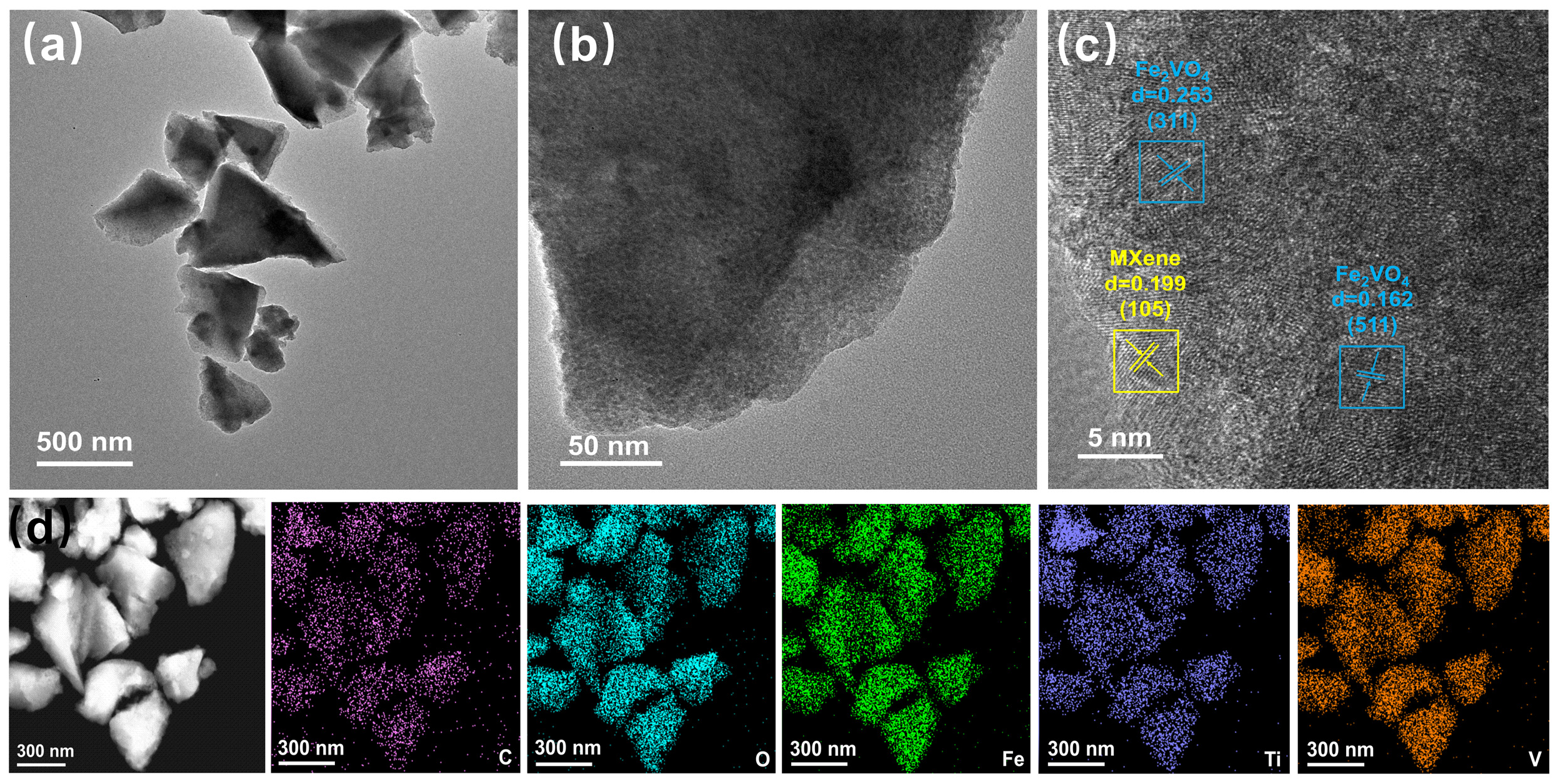
TEM imaging provides further structural verification (Figure 4a–c). From the low-magnification TEM micrographs (Figure 4a,b), it can be seen that Fe2VO4 nanoparticles with sizes of 15–20 nm are homogeneously immobilized on the MXene nanosheets. HRTEM analysis (Figure 4c) reveals distinct lattice fringes with interplanar distances of 0.162 and 0.253 nm, which can be assigned to the (511) and (311) crystal planes of Fe2VO4. Additionally, the nanoparticles are coated with an amorphous carbon layer (derived from CAM pyrolysis). Notably, we attribute the lattice fringes with an interplanar distance of 0.199 nm to the (105) crystal plane belonging to MXene, confirming successful introduction of MXene [25]. Thus, the tight interfacial anchoring of Fe2VO4 nanoparticles on conductive MXene nanosheets, coupled with the surface carbon coating, facilitates rapid electron transport and buffers volume fluctuations, contributing to the enhanced cycling stability.
EDS analysis (Figure 4d) verifies that V, O, Fe, Ti, and C are homogeneously dispersed across the Fe2VO4@M5 composite. The spatial overlap of the carbon signal with the MXene sheets indicates that MXene serves as a conductive scaffold, effectively maintaining the structural stability of the active component. This “nanoparticle-2D substrate” heterostructure not only accelerates charge transport via the high conductivity of MXene but also spatially confines Fe2VO4 to mitigate volume expansion and particle agglomeration during charge/discharge processes, thereby providing a structural basis for improving the cycling stability of SIB anodes.
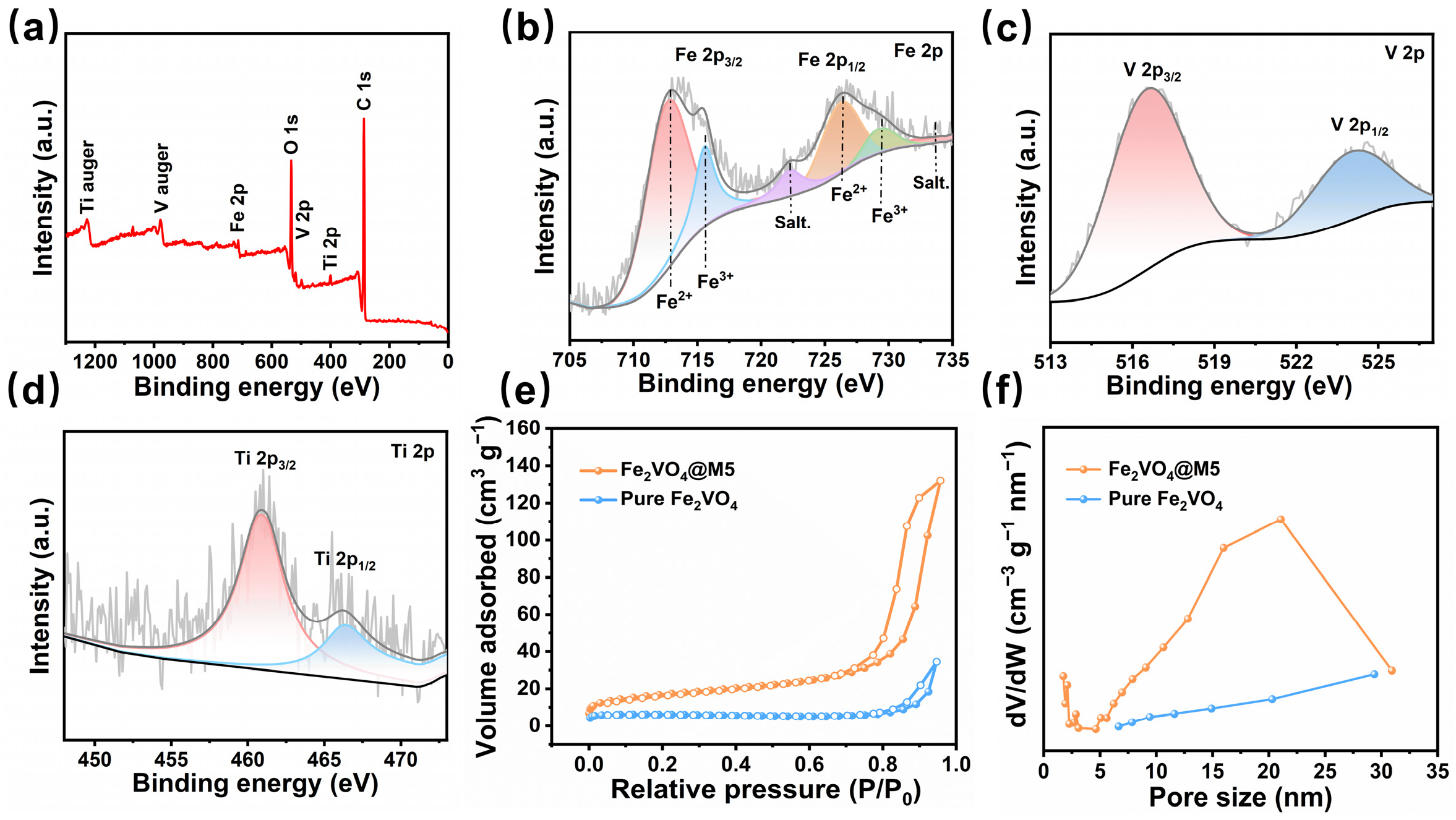
The full survey spectrum of Fe2VO4@M5 (Figure 5a) demonstrates the existence of Fe, O, Ti, V, and C, which confirms the composite structure. The Fe 2p spectrum (Figure 5b) was fitted into six distinct peaks. The characteristic peaks at 726.4 eV and 729.5 eV correspond to Fe 2p1/2, and the peaks at 715.6 eV and 712.9 eV are assigned to Fe 2p3/2. Satellite peaks observed at 722.4 eV and 733.7 eV further confirm the coexistence of Fe3+ and Fe2+ oxidation states [26]. The V 2p spectrum (Figure 5c) presents characteristic spin–orbit split peaks at 516.5 eV and 524.2 eV, which can be assigned to V 2p1/2 and V 2p3/2,respectively, indicating a dominant V4+ oxidation state [27]. The Ti 2p spectrum (Figure 5d) revealed prominent peaks at 460.9 eV (Ti 2p3/2) and 466.4 eV (Ti 2p1/2), thereby validating that MXene was successfully integrated into the Fe2VO4 composite [28].
The pore structure of Fe2VO4@M5 and pure Fe2VO4 was investigated using N2 adsorption–desorption analysis. As shown in Figure 5e, both samples display type IV isotherms accompanied by H3-type hysteresis loops, which verifies their mesoporous characteristics. The BET specific surface area of Fe2VO4@M5 reaches 57.87 m2 g−1, a value that is notably larger than the 17.79 m2 g−1 measured for pristine Fe2VO4. This enhancement is attributed to the nanoscale interlayer spacing introduced by the 2D MXene architecture. According to the pore size distribution curve (Figure 5f), Fe2VO4@M5 presents a pore volume of 0.0067 cm3 g−1, which is larger than the value of 0.0011 cm3 g−1 obtained for pristine Fe2VO4. Additionally, Fe2VO4@M5 was found to possess a mean particle size of 21.05 nm, consistent with the physisorption isotherm characteristics. The enhanced porosity and elevated surface area played a key role in facilitating electrolyte diffusion and boosting the electrode–electrolyte interfacial interaction for Fe2VO4@M5. Consequently, faster sodium-ion transport and improved electron transport kinetics were achieved, which is critical for optimizing the electrochemical performance of SIB anodes.

3.2. Electrochemical Performance of Fe2VO4 Composites

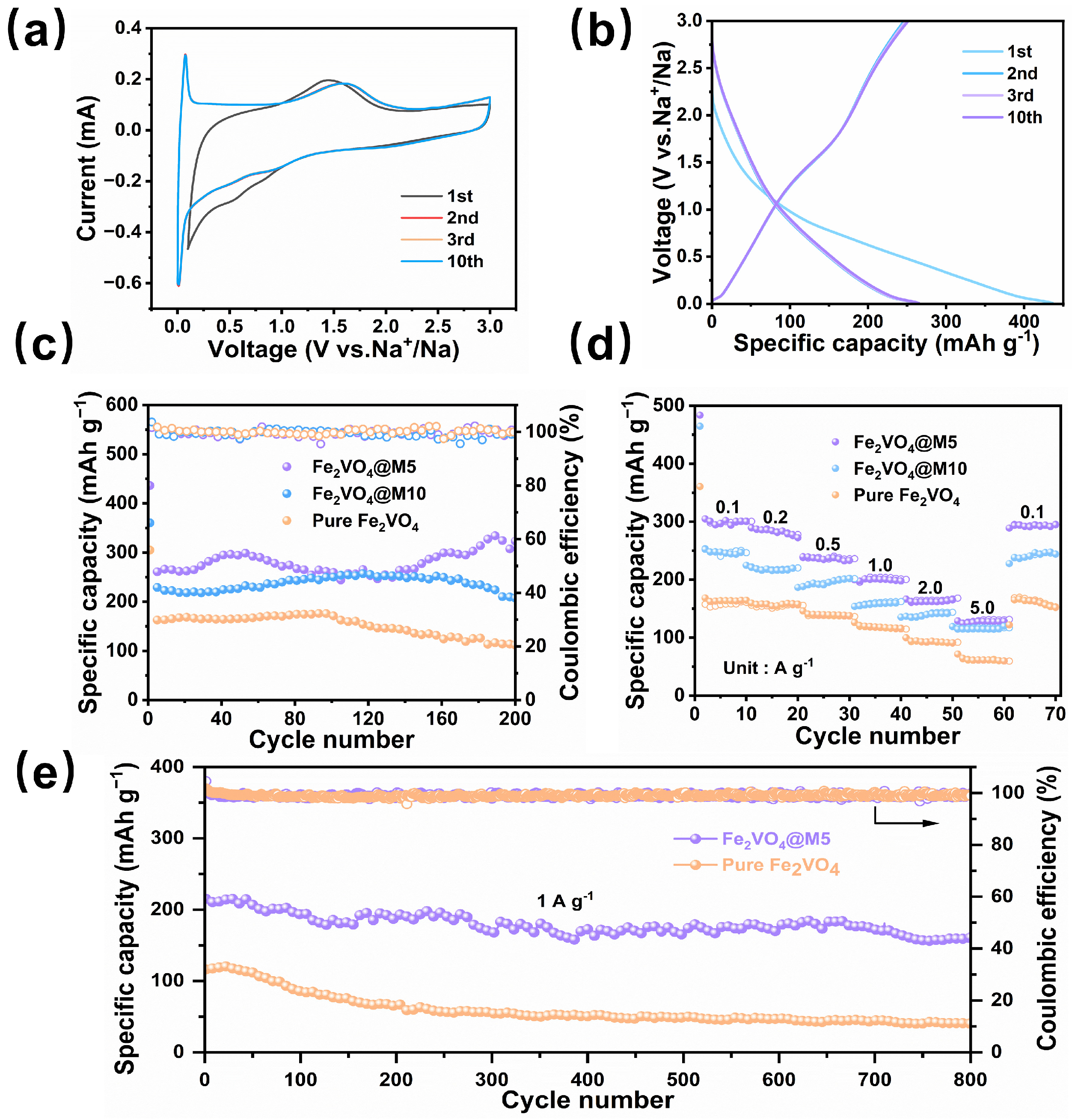
The sodiation/desodiation mechanisms of pure Fe2VO4 and Fe2VO4@M5 electrodes were systematically evaluated via CV (at 1 mV s−1). Distinct redox behaviors were observed between the two materials during initial cycling (Figure S1a and Figure 6a). Several sodiation peaks appear in the voltage range of 1.0–2.0 V, some of which are irreversible. Notably, the redox peaks at 0.49/1.55 V exhibit excellent position retention in subsequent cycles, indicating highly reversible electrochemical processes [29,30]. Studies have shown that the introduction of MXene significantly reduces the electrochemical polarization of Fe2VO4, suppresses structural distortion during cycling, renders the Na+ intercalation/deintercalation process highly reversible, and avoids kinetic decay caused by structural collapse.
The Fe2VO4 electrode retains the shape consistency of its charge–discharge plots across the first three cycles (Figure S1b), corresponding well with the CV findings. The Fe2VO4 delivers initial discharge/charge capacities of 269 mAh g−1 and 152 mAh g−1, giving an ICE of 56.5%. The first-cycle irreversibility arises from SEI layer formation at the electrode–electrolyte boundary [31]. Meanwhile, the sloping regions in the charge/discharge curves of Fe2VO4@M5 are characteristic of a pseudocapacitance-dominated process, attributed to the abundant porous architecture and high specific surface area introduced by MXene compositing (Figure 6b). After the initial cycle, the Fe2VO4@M5 electrode delivers a reversible discharge capacity of 436.26 mAh g−1 alongside a charge capacity of 266.67 mAh g−1, corresponding to an ICE of 61.12%, demonstrating superior specific capacity compared to pure Fe2VO4.
Figure 6c presents the cycling performance of Fe2VO4 composites with varying MXene loading at 0.1 A g−1. After the second cycle, the discharge capacity of Fe2VO4@M5 decreases to 258.8 mAh g−1, primarily due to irreversible Na+ loss induced by SEI formation and deleterious parasitic reactions [32]. Overall, the capacity of Fe2VO4@M5 exhibits an initial decline followed by a gradual recovery, a feature that is commonly encountered in TMO anodes. After 200 cycles, the reversible capacity stabilizes at 323.33 mAh g−1, with a slight increase attributed to active material activation and nanoparticle refinement during cycling [33,34]. The activation effect enhances electrolyte wettability within the active material, while nanoparticle refinement provides additional reaction sites for electron transport and ion diffusion, thereby shortening migration pathways. Additionally, optimization of the electrolyte-derived surface layer may further contribute to capacity retention [35].
Three synergistic effects confer superior electrochemical properties to the Fe2VO4@MXene heterostructure: (1) enhanced electrochemical kinetics via reduced electron transfer and ion diffusion distances; (2) mechanical accommodation of active Fe2VO4 material expansion, ensuring structural stability; and (3) improved electrolyte penetration, exposing active sites and stabilizing the SEI film to mitigate capacity fading. Rate capability evaluations (Figure 6d) demonstrate the impact of MXene content on performance. Superior rate capability was demonstrated by Fe2VO4@M5, delivering specific capacities of 297.93, 286.73, 238.29, 201.27, 164.53, and 126.85 mAh g−1 at 0.1, 0.2, 0.5, 1.0, 2.0, and 5.0 A g−1. When resetting the current density to 0.1 A g−1 after 50 cycles, a capacity of 295.25 mAh g−1 is recovered (retention: 99.1%), indicating high structural reversibility. In contrast, pure Fe2VO4 delivers significantly lower capacities of 157.69, 153, 138.13, 119.01, 93.27, 62.7, and 167.64 mAh g−1 under the same conditions. The long-term cycling measurement (Figure 6e) further validated the superior electrochemical performance of Fe2VO4@M5 at 1.0 A g−1. The electrode demonstrates an initial capacity of 215.33 mAh g−1, which stabilizes at 161.04 mAh g−1 after 800 cycles (74.8% capacity retention). In contrast, an initial capacity of 116.3 mAh g−1 is achieved for the pure Fe2VO4 electrode, and this value drops to 40.1 mAh g−1 after 800 cycles, with a mere capacity retention of 34.5%.
In summary, the enhanced sodium-ion storage capability of Fe2VO4@M5 can be ascribed to three factors: (1) the MXene-5 integration improves active material utilization; (2) the reduced activation energy barrier for Na+ insertion/extraction; and (3) improved electron/ion transport kinetics. Furthermore, the heterostructure effectively mitigates Fe2VO4 volume changes during cycling, resulting in improved structural integrity while simultaneously enhancing cycling stability and rate capability.

3.3. Kinetic Analysis

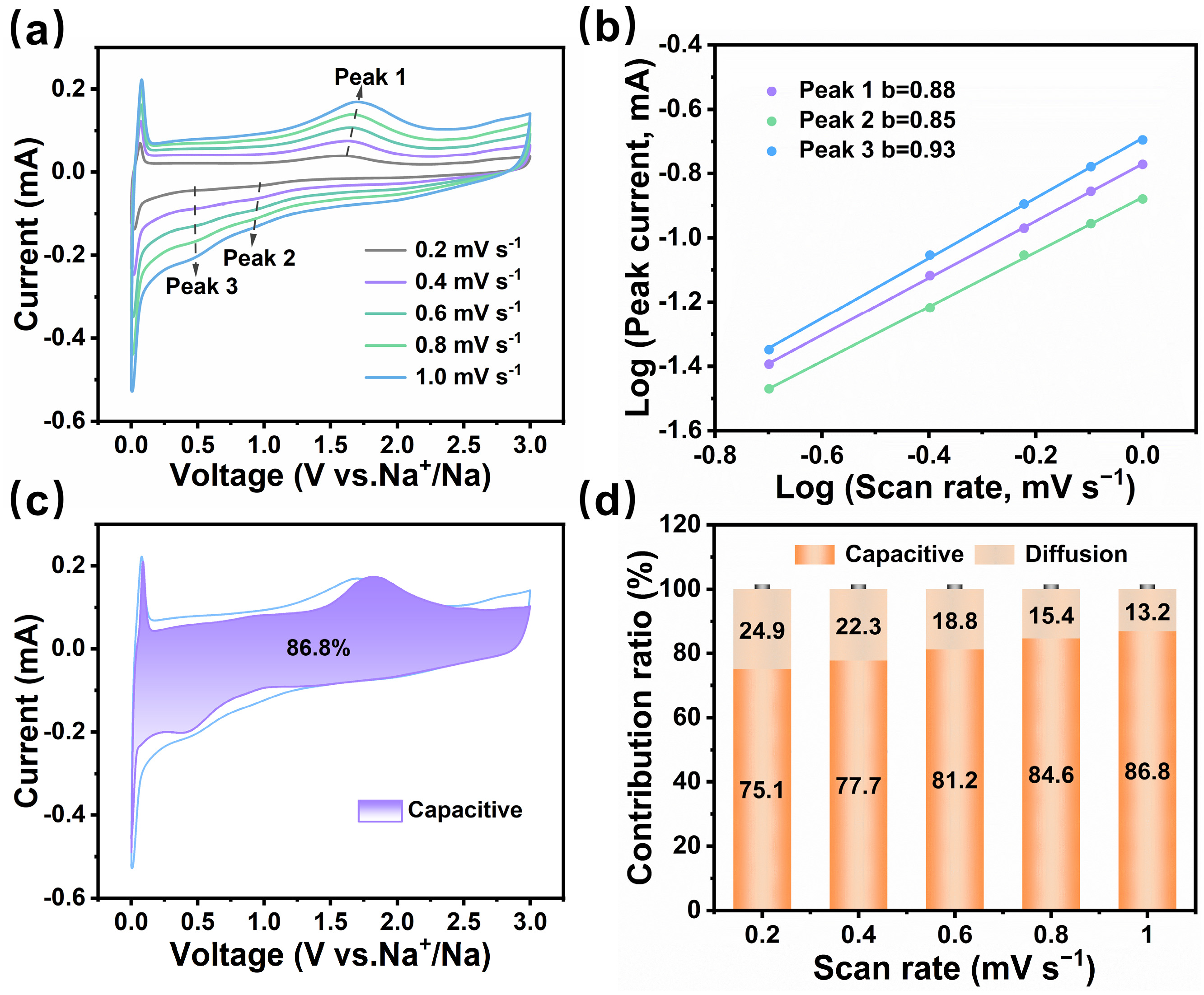
To further elucidate the charge storage mechanisms of the Fe2VO4@M5 electrode, multi-scan-rate CV measurements were executed on a CHI 660E electrochemical workstation (Shanghai CH Instruments Co., Ltd., Shanghai, China) from 0.2 to 1.0 mV s−1. According to electrochemical kinetic theory, the energy storage behavior of materials is typically governed by two mechanisms, which are diffusion-controlled Faradaic processes from intercalation reactions and pseudocapacitive effects from quasi-surface ion adsorption/desorption. These mechanisms are quantitatively described by the following equations (Equations (1) and (2)):
i = avb
log(i) = b × log(v) + log(a)
In electrochemical systems, the interdependence of peak current (i) and scan rate (v) can be qualitatively evaluated through Equation (1). Here, i corresponds to the peak current, v corresponds to the scan rate [36], and the b-value functions as a pivotal metric to discriminate between diffusion-governed and capacitance-dominated reaction pathways. A b-value of 0.5 points to diffusion-limited kinetics, whereas a b-value of 1.0 points to a capacitance-dominated storage mechanism [37]. Through linear fitting of log(i) vs. log(v) (Figure 7b), the slope of the curve (Equation (2)) yields b-values of 0.88, 0.85, and 0.93 at the oxidation and reduction peaks, respectively. These results demonstrate that pseudocapacitive processes govern the sodium storage mechanism in Fe2VO4@M5.
As shown in Figure 7a, the CV curves retain their shape with increasing scan rates, indicating high electrochemical reversibility and structural stability. Furthermore, the contributions of pseudocapacitive and diffusion-controlled processes during charge transfer can be quantified using Equations (3) and (4):
i = k1v + k2v1/2
i/v1/2 = k1v1/2 + k2
By deconvoluting the contributions of k1v and k2v1/2, the pseudocapacitive contribution ratio at each scan rate can be determined [38]. At 1.0 mV s−1, the surface capacitive process contributes 86.8% to the overall charge storage (Figure 7c), representing a significant enhancement compared to pure Fe2VO4. With an increase in scan rate, the proportion of capacitive contribution gradually elevates, which constitutes the primary factor underlying the superior rate capability of Fe2VO4@M5 at elevated current densities (Figure 7d). This enhancement can be traced to the synergistic integration of composite constituents, which provides abundant active sites for Na+ insertion/extraction [39].
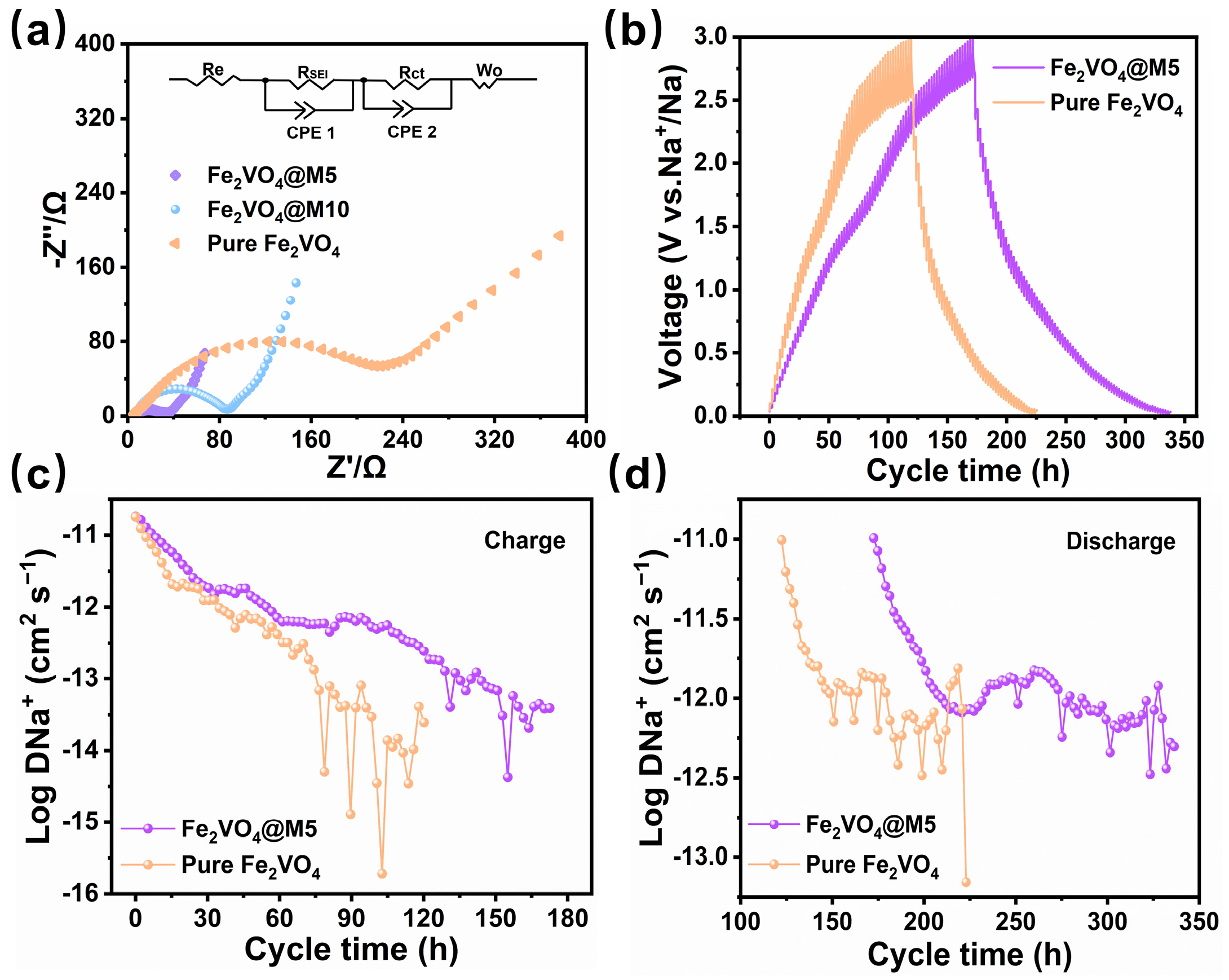
Figure 8a presents the Nyquist plots of Fe2VO4 composites with different MXene loadings and pure Fe2VO4 prior to cycling, along with the fitted equivalent circuit model for Fe2VO4@M5. In the model, Re, Rs, Rct, and W stand for the bulk resistance, SEI film resistance, interfacial charge transfer resistance, and Warburg impedance, respectively. Meanwhile, the CPE is used to represent the constant phase element, which is associated with double-layer capacitance. The specific fitted values of charge transfer resistance (Rct) from the Nyquist plots via the reported equivalent circuit are obtained, with the Rct values of pure Fe2VO4, Fe2VO4@M10 and Fe2VO4@M5 being 186.1 Ω, 67.3 Ω and 19.5 Ω, respectively. As illustrated in the figure, the Fe2VO4@M5 electrode displays the minimal semicircular arc within the high-frequency range, which signifies the minimal interfacial charge transfer resistance. This is attributed to the formation of additional conductive pathways through optimal MXene doping (5 wt%), which significantly enhances charge transport efficiency. In contrast, excessive MXene loading (10 wt%) disrupts the homogeneous conductive network, resulting in inferior charge transport kinetics and a notable increase in Rct.
Z′ = Re + Rct + σω−1/2
To quantitatively assess the impact of MXene content on sodium-ion migration kinetics, we utilized the galvanostatic intermittent titration technique (GITT) to characterize Fe2VO4@M5 and pure Fe2VO4 under a current density of 0.02 A g−1. According to the diffusion coefficient model (Equation (6)),
D Na + = 4 π τ ( nF E S E t ) 2 ( A 4 V m ) 2
where τ denotes the pulse duration, n is the number of electrons transferred, F is Faraday’s constant, ΔEs represents the steady-state voltage change, ΔEt is the voltage change after a single current pulse (excluding IR drop), A is the electrode contact area, R is the gas constant, T is the absolute temperature, and Vm is the molar volume.
Based on GITT measurements (Figure 8b–d), the average Na+ diffusion coefficient (DNa+) of Fe2VO4@M5 is consistently higher than that of pure Fe2VO4 across the entire charge/discharge process, demonstrating enhanced Na+ migration kinetics. This result confirms that MXene integration significantly accelerates surface pseudocapacitive charge storage, thereby improving electrode kinetics and providing a robust foundation for high-rate capability and long-cycle stability in SIB applications.

4. Conclusions

This study presents a systematic structural and electrochemical investigation of Fe2VO4 anode materials via MXene compositing with varying loadings. The results demonstrate that an optimal doping content of 5 wt% MXene promotes crystal growth and enhances structural integrity, leading to improved reaction reversibility and electrochemical stability. Specifically, the Fe2VO4@M5 composite exhibits a notable reversible capacity of 258.8 mAh g−1 at a current density of 0.1 A g−1. Following 200 consecutive cycles, the reversible capacity is sustained at 323.33 mAh g−1, showcasing exceptional cycling stability. Even at an elevated current density of 1 A g−1, the as-synthesized Fe2VO4@MXene electrode retains a capacity of 215.33 mAh g−1. Following 800 long-term cycles, a specific capacity of 161.04 mAh g−1 is still maintained, marking a pronounced improvement over the pristine Fe2VO4 counterparts. When the MXene loading is increased to 10 wt%, the electrochemical performance of Fe2VO4@M10 deteriorates significantly, with its cycling stability, rate capability and ion diffusion kinetics all inferior to those of Fe2VO4@M5. This study clarifies the regulatory effect of MXene on the electrochemical performance of Fe2VO4: an appropriate amount of MXene (5 wt%) achieves an optimal balance between structural stability and electrical conductivity, while excessive MXene exerts a negative effect, which provides a key reference for the composition design of MXene-based transition metal oxide composites. These enhancements can be traced to the cooperative contributions from the composite architecture, which shortens electron/ion diffusion pathways, enhances charge transport efficiency, increases the specific surface area of the electrode, and improves active material utilization. The MXene-compositing strategy effectively addresses the inherent limitations of Fe2VO4, such as poor conductivity and structural instability, by constructing a robust conductive network and stabilizing the electrode structure during sodiation/desodiation. This work not only provides an innovative approach for optimizing Fe2VO4-based anodes but also establishes a theoretical and technical foundation for MXene functionalization in SIBs. Such advancements hold significant potential for accelerating the practical application of high-cost-performance energy storage systems.

Supplementary Materials

The following supporting information can be downloaded at https://www.mdpi.com/article/10.3390/batteries12040117/s1. Figure S1: (a) Cyclic voltammetry curve of Fe2VO4 material; (b) charge–discharge curves of Fe2VO4 materials.

Author Contributions

Conceptualization, Y.D. and S.Q.; methodology, Y.D.; software, S.Q.; validation, Y.Z. and L.Z.; formal analysis, Y.D.; investigation, Y.W.; resources, Q.W.; data curation, Y.D.; writing—original draft preparation, Y.D. and S.Q.; writing—review and editing, L.M.; visualization, S.C.; supervision, Y.C.; project administration, L.M.; funding acquisition, L.M. All authors have read and agreed to the published version of the manuscript.

Funding

This work was financially supported by the Qinghai Provincial Applied Fundamental Research Project (No.2023-ZJ-744).

Data Availability Statement

The original contributions presented in this study are included in the article/Supplementary Material. Further inquiries can be directed to the corresponding author.

Conflicts of Interest

The authors declare no conflicts of interest.

References

  1. Guo, Z.; Qian, G.; Wang, C.; Zhang, G.; Yin, R.; Liu, W.-D.; Liu, R.; Chen, Y. Progress in electrode materials for the industrialization of sodium-ion batteries. Prog. Nat. Sci. Mater. Int. 2023, 33, 1–7. [Google Scholar] [CrossRef]
  2. Yu, T.; Li, G.; Duan, Y.; Wu, Y.; Zhang, T.; Zhao, X.; Luo, M.; Liu, Y. The research and industrialization progress and prospects of sodium ion battery. J. Alloys Compd. 2023, 958, 170486. [Google Scholar] [CrossRef]
  3. Zhang, W.; Zhang, F.; Ming, F.; Alshareef, H.N. Sodium-ion battery anodes: Status and future trends. EnergyChem 2019, 1, 100012. [Google Scholar] [CrossRef]
  4. Mukherjee, S.; Bin Mujib, S.; Soares, D.; Singh, G. Electrode Materials for High-Performance Sodium-Ion Batteries. Materials 2019, 12, 1952. [Google Scholar] [CrossRef] [PubMed]
  5. Abdolrasol, M.G.M.; Ansari, S.; Sarker, I.A.; Tiong, S.K.; Hannan, M.A. Lithium-ion to sodium-ion batteries transitioning: Trends, analysis and innovative technologies prospects in EV application. Prog. Energy 2025, 7, 022007. [Google Scholar] [CrossRef]
  6. Yao, A.; Benson, S.M.; Chueh, W.C. Critically assessing sodium-ion technology roadmaps and scenarios for techno-economic competitiveness against lithium-ion batteries. Nat. Energy 2025, 10, 404–416. [Google Scholar] [CrossRef]
  7. Cai, X.; Yue, Y.; Yi, Z.; Liu, J.; Sheng, Y.; Lu, Y. Challenges and industrial perspectives on the development of sodium ion batteries. Nano Energy 2024, 129, 110052. [Google Scholar] [CrossRef]
  8. Li, G.; Ma, H.; Tong, Y.; Wang, H.; Luo, Y.; Ang, E.H.; Bohm, S.; Ibrahim, A.A.; Umar, A. Research progress on carbon-based anode materials for sodium-ion batteries. J. Energy Storage 2025, 107, 114977. [Google Scholar] [CrossRef]
  9. Song, A.; Li, Y.; Yuan, D.; Wu, J.; Gu, H.; Zhang, G.; Wu, A.; Xu, J. Recent progress in carbon-based composite materials for advanced sodium ion batteries: From storage mechanism to structural design to applications as flexible electrodes. Green Energy Environ. 2025, 10, 1437–1460. [Google Scholar] [CrossRef]
  10. Choi, Y.S.; Choi, W.; Yoon, W.-S.; Kim, J.M. Unveiling the Genesis and Effectiveness of Negative Fading in Nanostructured Iron Oxide Anode Materials for Lithium-Ion Batteries. ACS Nano 2022, 16, 631–642. [Google Scholar] [CrossRef]
  11. Kim, W.; Shin, D.; Seo, B.; Chae, S.; Jo, E.; Choi, W. Precisely Tunable Synthesis of Binder-Free Cobalt Oxide-Based Li-Ion Battery Anode Using Scalable Electrothermal Waves. ACS Nano 2022, 16, 17313–17325. [Google Scholar] [CrossRef] [PubMed]
  12. Zhu, C.; Liu, Z.; Wang, J.; Pu, J.; Wu, W.; Zhou, Q.; Zhang, H. Novel Co2VO4 Anodes Using Ultralight 3D Metallic Current Collector and Carbon Sandwiched Structures for High-Performance Li-Ion Batteries. Small 2017, 13, 1701260. [Google Scholar] [CrossRef] [PubMed]
  13. Kanwade, A.; Gupta, S.; Kankane, A.; Tiwari, M.K.; Srivastava, A.; Kumar Satrughna, J.A.; Chand Yadav, S.; Shirage, P.M. Transition metal oxides as a cathode for indispensable Na-ion batteries. RSC Adv. 2022, 12, 23284–23310. [Google Scholar] [CrossRef] [PubMed]
  14. Wang, X.; Roy, S.; Shi, Q.; Li, Y.; Zhao, Y.; Zhang, J. Progress in and application prospects of advanced and cost-effective iron (Fe)-based cathode materials for sodium-ion batteries. J. Mater. Chem. A 2021, 9, 1938–1969. [Google Scholar] [CrossRef]
  15. Chen, M.; Liu, Q.; Wang, S.W.; Wang, E.; Guo, X.; Chou, S.L. High-Abundance and Low-Cost Metal-Based Cathode Materials for Sodium-Ion Batteries: Problems, Progress, and Key Technologies. Adv. Energy Mater. 2019, 9, 1803609. [Google Scholar] [CrossRef]
  16. Zhao, D.; Zhang, Z.; Ren, J.; Xu, Y.; Xu, X.; Zhou, J.; Gao, F.; Tang, H.; Liu, S.; Wang, Z.; et al. Fe2VO4 nanoparticles on rGO as anode material for high-rate and durable lithium and sodium ion batteries. Chem. Eng. J. 2023, 451, 138882. [Google Scholar] [CrossRef]
  17. VahidMohammadi, A.; Rosen, J.; Gogotsi, Y. The world of two-dimensional carbides and nitrides (MXenes). Science 2021, 372, eabf1581. [Google Scholar] [CrossRef]
  18. Bashir, T.; Li, X.; Yang, S.; Song, Y.; Zhou, S.; Wang, J.; Zhu, W.; Yang, J.; Zhao, J.; Gao, L. Enhancing role of structurally integrated V2C MXene nanosheets on silicon anode for lithium storage. J. Alloys Compd. 2022, 922, 166213. [Google Scholar] [CrossRef]
  19. Ming, F.; Liang, H.; Huang, G.; Bayhan, Z.; Alshareef, H.N. MXenes for Rechargeable Batteries Beyond the Lithium-Ion. Adv. Mater. 2021, 33, e2004039. [Google Scholar] [CrossRef]
  20. Huang, P.; Ying, H.; Zhang, S.; Zhang, Z.; Han, W.-Q. Molten Salts Etching Route Driven Universal Construction of MXene/Transition Metal Sulfides Heterostructures with Interfacial Electronic Coupling for Superior Sodium Storage. Adv. Energy Mater. 2022, 12, 2202052. [Google Scholar] [CrossRef]
  21. Javed, M.S.; Mateen, A.; Hussain, I.; Ahmad, A.; Mubashir, M.; Khan, S.; Assiri, M.A.; Eldin, S.M.; Shah, S.S.A.; Han, W. Recent progress in the design of advanced MXene/metal oxides-hybrid materials for energy storage devices. Energy Storage Mater. 2022, 53, 827–872. [Google Scholar] [CrossRef]
  22. Hui, X.; Zhao, R.; Zhang, P.; Li, C.; Wang, C.; Yin, L. Low-Temperature Reduction Strategy Synthesized Si/Ti3C2 MXene Composite Anodes for High-Performance Li-Ion Batteries. Adv. Energy Mater. 2019, 9, 1901065. [Google Scholar] [CrossRef]
  23. Zhu, M.; Yang, Y.; Zhang, K.; Li, S. Vertically oriented NiCoMo sulfide nanosheet arrays on Ti3C2Tx MXene for high-performance supercapacitors. Inorg. Chem. Front. 2025, 12, 6101–6112. [Google Scholar] [CrossRef]
  24. Abraham, D.S.; Vinoba, M.; Bhagiyalakshmi, M. Enhanced charge storage using in-situ grown NiGa-layered double hydroxide on V4C3Tx MXene for supercapacitor applications. J. Power Sources 2025, 639, 236688. [Google Scholar] [CrossRef]
  25. Eom, W.; Shin, H.; Ambade, R.B.; Lee, S.H.; Lee, K.H.; Kang, D.J.; Han, T.H. Large-scale wet-spinning of highly electroconductive MXene fibers. Nat. Commun. 2020, 11, 2825. [Google Scholar] [CrossRef]
  26. Yao, J.; Yang, Y.; Li, Y.; Jiang, J.; Xiao, S.; Yang, J. Interconnected α-Fe2O3 nanoparticles prepared from leaching liquor of tin ore tailings as anode materials for lithium-ion batteries. J. Alloys Compd. 2021, 855, 157288. [Google Scholar] [CrossRef]
  27. Mao, F.; Li, Y.; Zou, Z.; Huang, B.; Zhu, Q.; Yao, J. 2D V10O24·nH2O sheets as a high-performance cathode material for aqueous zinc-ion batteries. Electrochim. Acta 2023, 442, 141882. [Google Scholar] [CrossRef]
  28. Yuan, Z.; Guo, H.; Huang, Y.; Li, W.; Liu, Y.; Chen, K.; Yue, M.; Wang, Y. Composites of NiSe2@C hollow nanospheres wrapped with Ti3C2Tx MXene for synergistic enhanced sodium storage. Chem. Eng. J. 2022, 429, 132394. [Google Scholar] [CrossRef]
  29. Luo, Y.; Huang, D.; Liang, C.; Wang, P.; Han, K.; Wu, B.; Cao, F.; Mai, L.; Chen, H. Fe2VO4 Hierarchical Porous Microparticles Prepared via a Facile Surface Solvation Treatment for High-Performance Lithium and Sodium Storage. Small 2019, 15, 1804706. [Google Scholar] [CrossRef]
  30. Yang, C.; Lv, F.; Zhang, Y.; Wen, J.; Dong, K.; Su, H.; Lai, F.; Qian, G.; Wang, W.; Hilger, A.; et al. Confined Fe2VO4⊂Nitrogen-Doped Carbon Nanowires with Internal Void Space for High-Rate and Ultrastable Potassium-Ion Storage. Adv. Energy Mater. 2019, 9, 1902674. [Google Scholar] [CrossRef]
  31. Jia, B.; Yu, Q.; Zhao, Y.; Qin, M.; Wang, W.; Liu, Z.; Lao, C.Y.; Liu, Y.; Wu, H.; Zhang, Z. Bamboo-Like Hollow Tubes with MoS_2/N-Doped-C Interfaces Boost Potassium-Ion Storage. Adv. Funct. Mater. 2018, 28, 1803409. [Google Scholar] [CrossRef]
  32. Deng, L.; Niu, X.; Ma, G.; Yang, Z.; Zeng, L.; Zhu, Y.; Guo, L. Layered Potassium Vanadate K0.5V2O5 as a Cathode Material for Nonaqueous Potassium Ion Batteries. Adv. Funct. Mater. 2018, 28, 1800670. [Google Scholar] [CrossRef]
  33. Xiao, J.; Li, Q.; Bi, Y.; Cai, M.; Dunn, B.; Glossmann, T.; Liu, J.; Osaka, T.; Sugiura, R.; Wu, B.; et al. Understanding and applying coulombic efficiency in lithium metal batteries. Nat. Energy 2020, 5, 561–568. [Google Scholar] [CrossRef]
  34. Li, Y.; Huang, Y.; Zheng, Y.; Huang, R.; Yao, J. Facile and efficient synthesis of α-Fe2O3 nanocrystals by glucose-assisted thermal decomposition method and its application in lithium ion batteries. J. Power Sources 2019, 416, 62–71. [Google Scholar] [CrossRef]
  35. Kim, H.; Choi, W.; Yoon, J.; Um, J.H.; Lee, W.; Kim, J.; Cabana, J.; Yoon, W.-S. Exploring Anomalous Charge Storage in Anode Materials for Next-Generation Li Rechargeable Batteries. Chem. Rev. 2020, 120, 6934–6976. [Google Scholar] [CrossRef]
  36. Jin, Q.; Li, W.; Wang, K.; Li, H.; Feng, P.; Zhang, Z.; Wang, W.; Jiang, K. Tailoring 2D Heteroatom-Doped Carbon Nanosheets with Dominated Pseudocapacitive Behaviors Enabling Fast and High-Performance Sodium Storage. Adv. Funct. Mater. 2020, 30, 1909907. [Google Scholar] [CrossRef]
  37. Fu, S.; Yu, Q.; Liu, Z.; Hu, P.; Chen, Q.; Feng, S.; Mai, L.; Zhou, L. Yolk–shell Nb2O5 microspheres as intercalation pseudocapacitive anode materials for high-energy Li-ion capacitors. J. Mater. Chem. A 2019, 7, 11234–11240. [Google Scholar] [CrossRef]
  38. Xia, X.; Chao, D.; Zhang, Y.; Zhan, J.; Zhong, Y.; Wang, X.; Wang, Y.; Shen, Z.X.; Tu, J.; Fan, H.J. Generic Synthesis of Carbon Nanotube Branches on Metal Oxide Arrays Exhibiting Stable High-Rate and Long-Cycle Sodium-Ion Storage. Small 2016, 12, 3048–3058. [Google Scholar] [CrossRef]
  39. Yao, L.; Gu, Q.; Yu, X. Three-Dimensional MOFs@MXene Aerogel Composite Derived MXene Threaded Hollow Carbon Confined CoS Nanoparticles toward Advanced Alkali-Ion Batteries. ACS Nano 2021, 15, 3228–3240. [Google Scholar] [CrossRef]
Figure 1. Schematic diagram of the Fe2VO4 composite preparation process.
Batteries 12 00117 g001
Figure 2. XRD patterns of Fe2VO4, Fe2VO4@M5 and Fe2VO4@M10.
Batteries 12 00117 g002
Figure 3. (a,b) SEM images of Fe2VO4; (c,d) SEM images of Fe2VO4@5.
Batteries 12 00117 g003
Figure 4. (ac) TEM and HRTEM images and (d) EDS images of Fe2VO4@5.
Batteries 12 00117 g004
Figure 5. (a) XPS survey spectrum; (b) Fe 2p, (c) V 2p, and (d) Ti 2p; (e) adsorption–desorption isotherms of N2 and (f) pore size distribution of Fe2VO4@M5 and Fe2VO4.
Batteries 12 00117 g005
Figure 6. (a) Cyclic voltammetry curves and (b) capacitance–voltage curve of Fe2VO4@M5; (c) cyclic stability at 0.1 A g−1 and (d) the rate capability of Fe2VO4 with different MXene contents; (e) long-term cycling performance of Fe2VO4@M5 at 1 A g−1.
Batteries 12 00117 g006
Figure 7. The curves correspond to the 2nd cycle test results, excluding the influence of SEI/CEI formation in the first cycle; (a) CV curves from 0.2 to 1.0 mV s−1; (b) scanning rate and peak current fitting line of Fe2VO4@M5; (c) the contribution of the pseudocapacitance shown in the CV curve (1.0 mV s−1) to the total capacity (purple area); (d) the ratio of pseudocapacitance contribution to total capacity at different scanning rates.
Batteries 12 00117 g007
Figure 8. (a) EIS curves; (b) GITT curves at different voltages during cycling; (c,d) Na+ diffusion coefficients of Fe2VO4 composites.
Batteries 12 00117 g008
Disclaimer/Publisher’s Note: The statements, opinions and data contained in all publications are solely those of the individual author(s) and contributor(s) and not of MDPI and/or the editor(s). MDPI and/or the editor(s) disclaim responsibility for any injury to people or property resulting from any ideas, methods, instructions or products referred to in the content.