Article

Advancing Measurement Capabilities in Lithium-Ion Batteries: Exploring the Potential of Fiber Optic Sensors for Thermal Monitoring of Battery Cells


1
Chair for Electrochemical Energy Conversion and Storage Systems, Institute for Power Electronics and Electrical Drives (ISEA), RWTH Aachen University, Campus-Boulevard 89, 52074 Aachen, Germany
2
Center for Ageing, Reliability and Lifetime Prediction of Electrochemical and Power Electronic Systems (CARL), RWTH Aachen University, Campus-Boulevard 89, 52074 Aachen, Germany
3
Juelich Aachen Research Alliance, JARA-Energy, Templergraben 55, 52056 Aachen, Germany
4
Fraunhofer Institute for Silicon Technology (ISIT), Fraunhoferstraße 1, 25524 Itzehoe, Germany
5
Helmholtz Institute Münster (HI MS), Forschungszentrum Juelich, Wilhelm-Johnen-Straße, 52428 Jülich, Germany
*
Author to whom correspondence should be addressed.
Batteries 2026, 12(3), 95; https://doi.org/10.3390/batteries12030095
Submission received: 28 October 2025 / Revised: 2 March 2026 / Accepted: 5 March 2026 / Published: 10 March 2026

Abstract

This work demonstrates the potential of fiber optic sensors for measuring thermal effects in lithium-ion batteries, using a fiber optic measurement method of Optical Frequency Domain Reflectometry (OFDR). The innovative application of fiber sensors allows for spatially resolved temperature measurement, particularly emphasizing the importance of monitoring not just the exterior but also the internal conditions within battery cells. Utilizing inert glass fibers as sensors, which exhibit minimal sensitivity to electric fields, opens up new pathways for their implementation in a wide range of applications, such as battery monitoring. The sensors used in this work provide real-time information along the entire length of the fiber. It is shown that using the herein presented novel sensors in a temperature range of 0– 80 ° C reveals a linear, high-sensitivity thermal measurement characteristic with a local resolution of a few centimeters. Furthermore, this study presents preliminary findings on the potential application of fiber optic sensors in lithium-ion battery (LIB) cells, demonstrating that the steps required for battery integration do not impose any restrictive effects on thermal measurements.

Graphical Abstract

1. Introduction

In recent years, battery storage systems have taken on an exceptional role in energy storage technology. As a result, lithium-ion batteries have become indispensable in the field due to their high energy and power density [1,2,3]. With increasing energy contents of battery systems, enabling higher performance and longevity, safety requirements become an increasingly important aspect [4,5]. However, present condition monitoring of LIB s is limited to current, voltage and temperature measurements on the outside of the cell [6]. The optimum operating temperature of lithium-ion cells is usually specified as 15 ° C to 35 ° C , but can also vary depending on the cell chemistry [7,8]. Both above and below this temperature range, temperature-dependent effects appear which significantly affect performance, capacity and aging of the battery [9,10,11]. Due to the impact of temperature on LIB performance, many studies have focused on the temperature distribution and its influence within the cell [12,13], as well as between the cells of a battery pack [14,15,16]. Rahn et al. concluded that exceeding a 3– 5 ° C temperature difference between two cells connected in parallel can lead to a reduced cycle lifetime [17]. Therefore, understanding the extent of internal heat activity within the cell is crucial for overcoming these challenges [18,19,20], as factors such as increased charge and discharge rates can significantly impact this internal heat generation and complicate effective thermal management [21]. Good temperature management is therefore essential for optimal performance and cell longevity. Previous studies have often assumed constant temperature distributions on cell level, although this is typically not the case [13]. Variations in temperature distribution within the cell can lead to uneven reactions and localized aging, underscoring the importance of both accurate modeling and improved information about the actual thermal state of the cell. Furthermore, it has been shown that not only the absolute temperature, but also temperature gradients within the cell can influence degradation processes, internal resistance and overall cell performance [7,12,22]. For instance, significant temperature differences within the cell may accelerate aging in certain regions, leading to reduced capacity and efficiency over time. Given these critical temperature dependencies, the direct measurement of internal temperature provides valuable insights into the cell’s thermal behavior under operating conditions. This is particularly crucial for automotive applications, where cells are becoming larger and temperature gradients between the cell surface and core can impact performance and safety [23]. In this context, newly introduced cell designs, such as CATL’s cell-to-pack approach and BYD’s blade battery, increase energy density by utilizing large-format cell structures [24,25]. However, due to their inherently larger cell format, these designs also intensify challenges in managing temperature gradients within the cell. This makes advanced temperature monitoring even more critical to ensure safe and efficient operation. To address this need, the integration of electronics and sensor technologies directly within the cell enables precise and unaltered measurements, extending battery monitoring to a new scale.
These challenges underline the importance of advanced techniques that go beyond surface-level measurements to achieve a comprehensive understanding of internal cell temperatures. Such methods are essential to address the limitations of surface-based models and enable a more accurate prediction of thermal behavior within LIBs. In previous works, methods and models were investigated to derive the internal temperature of a cell from its surface temperature [26]. For this purpose, a point surface temperature and impedance were measured for each cell. In order to obtain sufficient information about the temperature distribution within the entire cell, a large number of sensors would be required. Moreover, the external measurement of temperature is not sufficient. The heat distribution on the surface of cells might not be homogeneous during operation and the external environment can influence the results [27]. For example, the temperature at the cathode is generally higher than at the anode due to the lower electrical conductivity of the cathode material [18,28]. Therefore, even when using a thermal model, a point measurement of the surface temperature is not sufficient to reliably estimate the internal temperature distribution [26].
Fiber optic measurement techniques offer decisive advantages in this context [29,30]. They provide precise, spatially resolved data on temperature and pressure along the entire fiber, enabling a detailed understanding of thermal dynamics. Accurate knowledge of the temperature profile at the cell surface allows for better estimates of the temperature distribution inside the cell. Fiber optic sensors can be integrated with minimal impact due to their small diameter usually less than 250 μ m . This is particularly beneficial because measuring the temperature of clamped cells with conventional thermocouples can be challenging. The geometry of thermocouples often results in localized pressure maxima when pressed against the cell surface, which can induce defects and accelerate aging processes [31]. Building on these practical advantages, the unique characteristics of optical fibers further enhance their potential as versatile sensors. Commonly used for data transmission, optical fibers rely on their optical conductivity to transmit signals via induced light. However, external disturbances, such as variations in temperature or pressure, can also alter the signal, providing valuable additional information about the external environment. With a suitable measurement technology, this behavior enables distributed sensing along the entire fiber. Glass fibers, in particular, are practically unaffected by electromagnetic fields [32]. This makes them an ideal choice for use as sensors in batteries, as they are not influenced by external electromagnetic interference. Furthermore, the chemical inertness of the glass fiber coating allows seamless integration into the chemically aggressive environments found within battery cells. Because of these advantageous properties, various studies have explored the integration of fiber optic sensors into battery cells to measure internal states, such as changes in electrolyte mass composition, electrode expansion and temperature variations [33]. Similar to the approach presented in this work, Yu et al. demonstrated distributed fiber optic measurements to capture internal in-plane temperature differences in lithium-ion cells for both pouch and cylindrical configurations [34,35]. Latest reviews highlight the wide range of possibilities to use the sensors for the application in lithium ion batteries [32]. However, none of this work were able to sufficiently fulfill spatially resolved measurements of temperatures for use in lithium-ion battery cells.
Fiber optic sensors have gained attention due to their high sensitivity, material resistance and ability to provide spatially resolved measurements [32]. A typical fiber consists of a core, cladding and coating, which guide light and allow the detection of external stimuli such as temperature.
These sensors can operate at discrete points, for example using Fiber Bragg Grating (FBG) or quasi-continuously along the fiber via backscattering effects such as Rayleigh scattering. Quasi-continuous systems enable high-resolution, spatially distributed measurements, which is particularly valuable in lithium-ion batteries, where internal temperature gradients and mechanical changes can occur. In this study, Rayleigh backscattering is analyzed with an Optical Frequency Domain Reflectometry (OFDR) setup. The method captures local temperature-induced effects along the fiber, enabling distributed sensing without altering the fiber structure, as would be necessary in FBG-based approaches. The fiber itself acts as a sensor along its entire length.
A detailed explanation of backscattering effects, the differences between fiber sensor types and the measurement principles is provided in Appendix A. There, the derivation of key equations, OTDR/OFDR principles, and illustrations of Rayleigh patterns, FBG and quasi-segments are presented for readers interested in the technical background.
The methodology and results presented in this study provide an essential technical foundation for the successful use of this technique in battery modules, as recently demonstrated in [36]. Building upon these findings, this work focuses on experimentally validating and characterizing the performance and potential of distributed fiber optic temperature sensing, addressing practical integration challenges and measurement accuracy. Specifically, we investigate the spatial resolution capabilities of these fibers, assessing their performance across different scenarios. Our methodology exploits general backscatter effects in glass fibers, enabling the detection of both thermal and mechanical influences, although this work focuses exclusively on the thermal aspects. Furthermore, we examine the influence of adhesive points and sealing seams, which are essential steps for the possible integration of fiber optic sensors into batteries.To demonstrate the practical feasibility, we fabricated a prototype pouch cell with an embedded singlemode fiber, providing a proof-of-concept for in situ, spatially resolved temperature monitoring under realistic electrochemical conditions.

2. Experimental Set-Ups and Thermal-Characterization of Fiber Sensors

To investigate the influence of temperature on fiber optic sensors, we conducted a series of experiments using various setups under defined conditions to comprehensively analyze and describe their thermal behavior. Additionally, the influence of specific steps of fiber integration in LIBs on the functionality and performance of these fiber optic sensors is analyzed.
In the following, a Rayleigh OFDR measurement technique, as previously described, using an ODiSI 6104 (Luna Innovations, Roanoke, VA, USA) instrument was performed [37]. The details of the device are outlined in its data sheet, as summarized in Table A1 [37]. The device is capable to measure a wide range of fiber types, which will be further specified. The ODiSI 6104 has the ability to measure fiber optic sensors on four different channels, which allows us to measure a maximum of four fiber optic sensors at the same time. The maximum sensor length of the measurement device is 20   m and can be possibly increased up to 100   m with an extended range remote module. Moreover, it offers a maximum spatial resolution of 0.65 mm and sampling rate of 250 Hz [37].
The device does not directly convert the measured changes into temperatures; therefore, only the relative change in length of the fiber under test is considered. The ratio between the original elongation of the glass fiber and the elongation caused by the mechanical and thermal load is referred to as strain. Although strain generally describes a dimensionless quantity, ϵ is usually used as the unit, also described in the previous Appendix A.4. In the subsequent sections of this work, we will further elaborate on the correlation between temperature and the length change of the used fibers.
For thermal characterization of our fibers, we used a LabEvent L T/64/40/3 temperature chamber from Weiss Technik GmbH (Reiskirchen, Germany), as detailed in Table A2 [38]. This chamber regulates the set temperature using an integrated sensor with a maximum deviation of ± 2 ° C . Two different temperature sensors were used to record reference temperature values. We used a calibrated PT1000 (Adafruit Industries LLC, New York, NY, USA) with a measurement range of 50 ° C to 280 ° C and an accuracy of ± 2 ° C [39]. Additionally, verification was conducted using a calibrated AD590 from Analog Devices (Wilmington, MA, USA). This sensor has a temperature range of 55 ° C to 150 ° C with a resolution of ± 0.5 ° C and a maximum deviation of ± 0.8 ° C [40].
As previous mentioned glass fibers are typically coated with materials such as polyimide or acrylate to provide mechanical protection without affecting the underlying temperature sensing mechanism. Polyimide-based tapes are commonly used in lithium-ion battery manufacturing and are therefore well known to withstand chemically demanding environments. In preliminary studies, the chemical stability of polyimide-coated fibers was additionally evaluated in contact with standard lithium-ion battery electrolytes and commonly used additives, confirming their suitability. When selecting suitable singlemode glass fibers for the fabrication of fiber optic sensors, one can chose from a wide range of fibers featuring a wavelength in C-band. In the following section, seven types of glass fibers are investigated and characterized based on their temperature sensitivity. All used fibers have a core diameter of 9 μ m and a cladding diameter of 125 μ m , the total diameter including the coating, however, differs between around 155 μ m to 245 μ m . To manufacture sensors from these fibers, they must first be prepared with a connector for the measuring device and a termination at the other end. The termination is achieved by splicing a coreless, acrylic-coated fiber (approximately 2 cm long), which prevents reflected light from interfering with measurements and causing backscatter effects. On the device side, an LC/APC connector is used, typically available as a commercially sold pigtail and is also attached via a splicing process. The device used for this is the OFS-95 from ShinewayTech (Dallas, TX, USA) [41]. In addition to preparing and manufacturing our own sensors, a comparison with commercially available High-Defintion Fiper Optic Strain Sensors from Luna Innovations, hereinafter referred to as Fiber A, was also carried out [37]. Besides the thickness or type of coating, the composition of the glass can also have an impact. We therefore tested six different fibers, which are listed with their properties in Table 1.
Fiber A is a high-definition optical fiber sensor with polyimide coating, specifically designed for high-precision strain and temperature measurements. It offers a wide temperature range of −40 to +220 °C, making it suitable for a variety of applications in harsh environments. Fiber B has identical composition and properties to Fiber A, however, its length can be customized. Fiber C, D, E and F differ in their materials and composition and therefore also in their thickness and temperature range. Optical sensors were fabricated from all these fibers.
When connecting a sensor to the ODiSI 6104 for the first time, it is necessary to create a so-called custom key. This stores an individual Rayleigh backscatter information for the respective sensor. When generating the key, care must be taken that the thermal as well as mechanical conditions are the same. It is necessary to establish a well-defined reference point for each measurement by taring it with known environmental influences and interpreting the relative variations of the measurement signal with respect to this point. In this case, the fibers were tared in a non-stressed state at 20 ° C .
As mentioned earlier, different spatial resolutions are possible. With decreasing spatial resolution, a higher sampling rate can be achieved. When observing measurements at rest, we noticed a high standard deviation σ . Subsequently, we conducted a comparison of different spatial resolutions ( 0.65 mm , 1.3 mm , 2.6 mm ) at a frequency of 1 Hz using Fiber A as an example. External influences such as temperature and strain were kept homogeneous throughout the measurements. To evaluate the potential of achieving high spatial resolution (e.g., 2.6 mm ) for thermal events using optical fibers, three independent cooling events were performed. A FREEZE 75 cooling spray from Kontakt Chemie (Iffezheim, Germany), capable of reaching temperatures as low as 45 ° C , was used. The ambient temperature during the measurement was set to 25 ° C . For the experiments, a Fiber C was employed to capture the temperature changes with spatial precision. A zero-point calibration was performed at 25 ° C .
To rule out the possibility that relaxation effects might influence the measurements, the thermal relaxation behavior of the Fiber C was assessed in a separate experiment. For this purpose, the fiber was placed in a temperature-controlled environment, as described previously. The temperature chamber was set to 40 ° C and allowed to homogenize before the fiber was introduced. After the chamber reached thermal equilibrium, a zero-point calibration was performed. The experiment was conducted over a duration of 48   h , with continuous logging of sensor data.
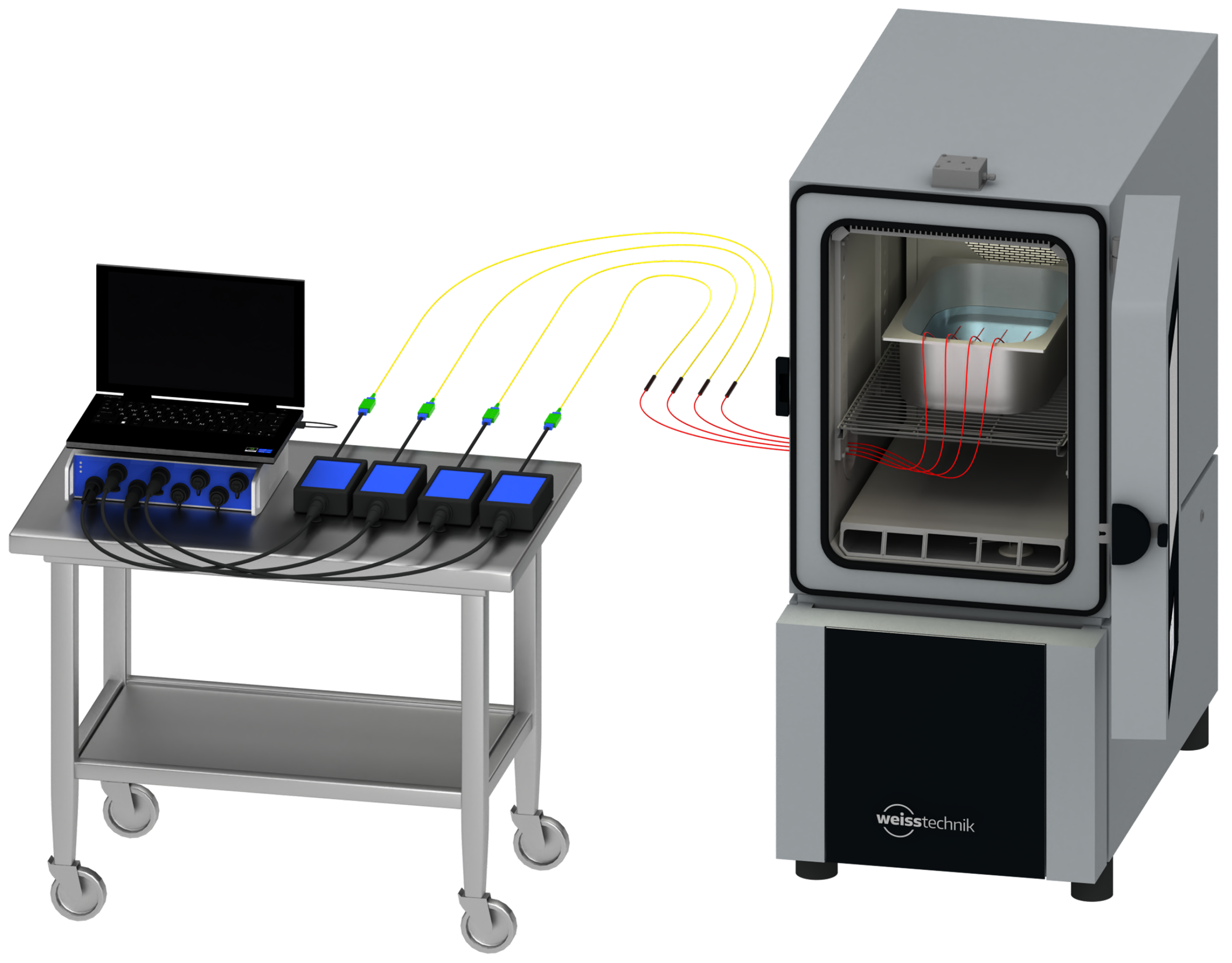
Due to the high sensitivity of our fiber sensors, further experiments were conducted to determine the temperature sensitivity of the fibers across a defined range of temperatures. It was observed that the measurement signal could be influenced by the active ventilation of the chamber. To eliminate this effect and ensure consistent characterization, the sensors were placed in a water container, which acted as both a thermal buffer and stabilizing medium, as shown in Figure 1.
A stepwise temperature profile was applied, gradually increasing the temperature in 10 ° C (or 5 ° C ) increments from 5 ° C to 80 ° C . At each step, the temperature was held constant for approximately 6   h to allow for the establishment of thermal equilibrium. A zero-point calibration was performed at 5 ° C to ensure accurate baseline alignment for subsequent measurements. The water temperature was continuously monitored using reference sensors (PT1000 & AD590), providing a precise baseline for comparison with the fiber optic sensor measurements. Since the fiber optic sensors are intended for use in or on batteries, the operational temperature range was chosen to reflect typical conditions encountered in practical lithium-ion battery systems. The lower limit of 0 ° C avoids extreme low-temperature effects, such as increased electrolyte viscosity, reduced ion mobility and lithium plating, which can impair electrochemical efficiency and potentially cause irreversible damage [43,44,45]. Testing below 0 ° C would also require alternative thermal setups, as the water bath used here freezes, introducing additional mechanical factors beyond purely thermal effects. From a physical perspective, however, the fiber optic sensors are capable of measuring temperatures below 0 ° C , see Table 1.
The upper limit of 80 ° C was chosen to avoid safety-critical conditions in the battery, although the fiber optic sensor itself can operate safely at higher temperatures. Dominant degradation processes begin around 45 ° C , with exothermic reactions accelerating further temperature rise [9]. Decomposition processes of the electrolyte and solid electrolyte interface begin at elevated temperatures and accelerate with further heating. At temperatures exceeding 80 ° C , this decomposition can lead to rapid aging, gas generation and potentially safety-critical effects [9,10]. This range therefore allows evaluation of sensor performance under normal operating conditions without entering the regime of thermal runaway, which will be subject to future studies. In operational systems, active cooling would also generally prevent cell temperatures from exceeding this range.
To ensure accurate measurements and minimize potential interference from external factors, it is important to control other conditions that may impact the fiber optic sensor readings. One such dominant effect is the bending of optical fibers, which can significantly alter the measurement results. Increased bending can cause light to be gradually extracted from the fiber, influencing signal transmission and reducing measurement precision. As bending increases, it also affects the fiber’s numerical aperture, which in turn changes the light propagation within the fiber. Beyond a certain threshold, excessive bending can render the fiber’s signal transmission ineffective, making accurate measurements difficult or even impossible. Therefore, it is essential to carefully account for and minimize the effects of fiber bending during experiments.
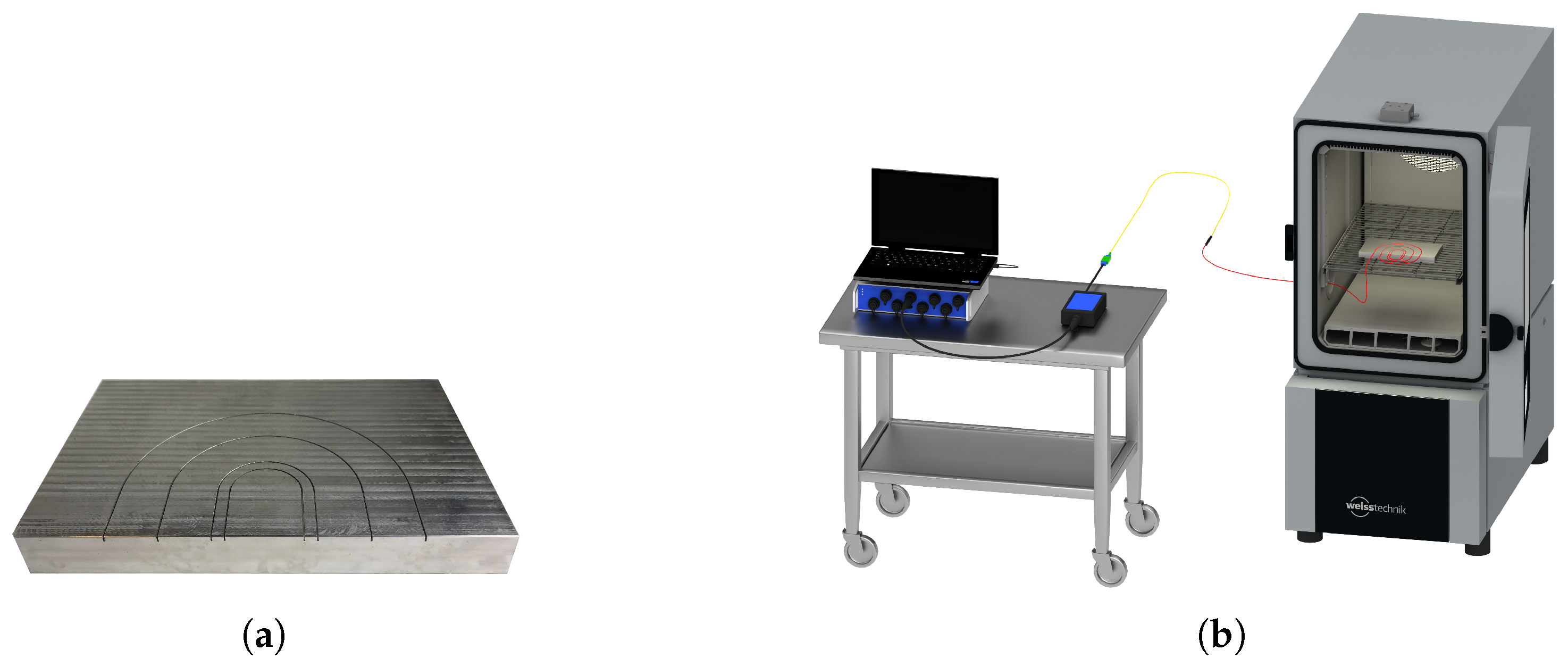
In order to analyse these effects, several tests were conducted in the range of possible bending radii. According to the manufacturer Luna Innovations, minimal bending radii up to 10 mm are possible without distorting the measurement. However, tests have shown that a fiber fracture occurred at a radius of approximately 1 mm . It should be noted that although a fracture occurred only at a radius of 1 mm , micro-cracks in the fiber occur when the minimum bending radius specified by the manufacturer is exceeded [46]. Therefore, we have allowed for a safety margin for future installations and testing and set the minimum radius to 15 mm . To test the fiber in a homogeneous bend, a model (Figure 2a) was designed and milled into an aluminum block. Due to its high thermal conductivity of 235 W m · K , aluminum enables more efficient heat distribution compared to alternative materials. Other examples of poor materials are thermoplastics used in 3D printing, such as PP, PE, PLA or PA (thermal conductivity < 1 W m · K ) [47,48,49]. These materials exhibited poor temperature distribution and yielded inhomogeneous measurement results in experiments, as well as deformations at elevated temperatures. Furthermore, due to the mass of aluminum and its associated heat storage capacity, an appropriate time constant for complete temperature equilibration was taken into account during the experiments.
A milling depth and width of 0.5 mm were selected for creating the grooves, ensuring that the fiber would not be crushed during installation while remaining almost entirely encased by aluminum to achieve optimal thermal contact. Radii of 15, 20, 40 and 60 mm were incorporated into the aluminum model. Unlike the previous setup, this experiment did not employ a water basin. Instead, the model was placed inside the temperature chamber, as shown in Figure 2b.
A Fiber A was threaded through all the grooves, allowing simultaneous monitoring of all radii in a single measurement. This setup ensured that the chamber’s fan did not influence the results, as the fiber was shielded by the aluminum. The temperature steps ranged from 5 to 80 ° C with a zero-point calibration at 5 ° C , consistent with the earlier experiments. All the previously described experiments were conducted using a sampling rate of 1 Hz .
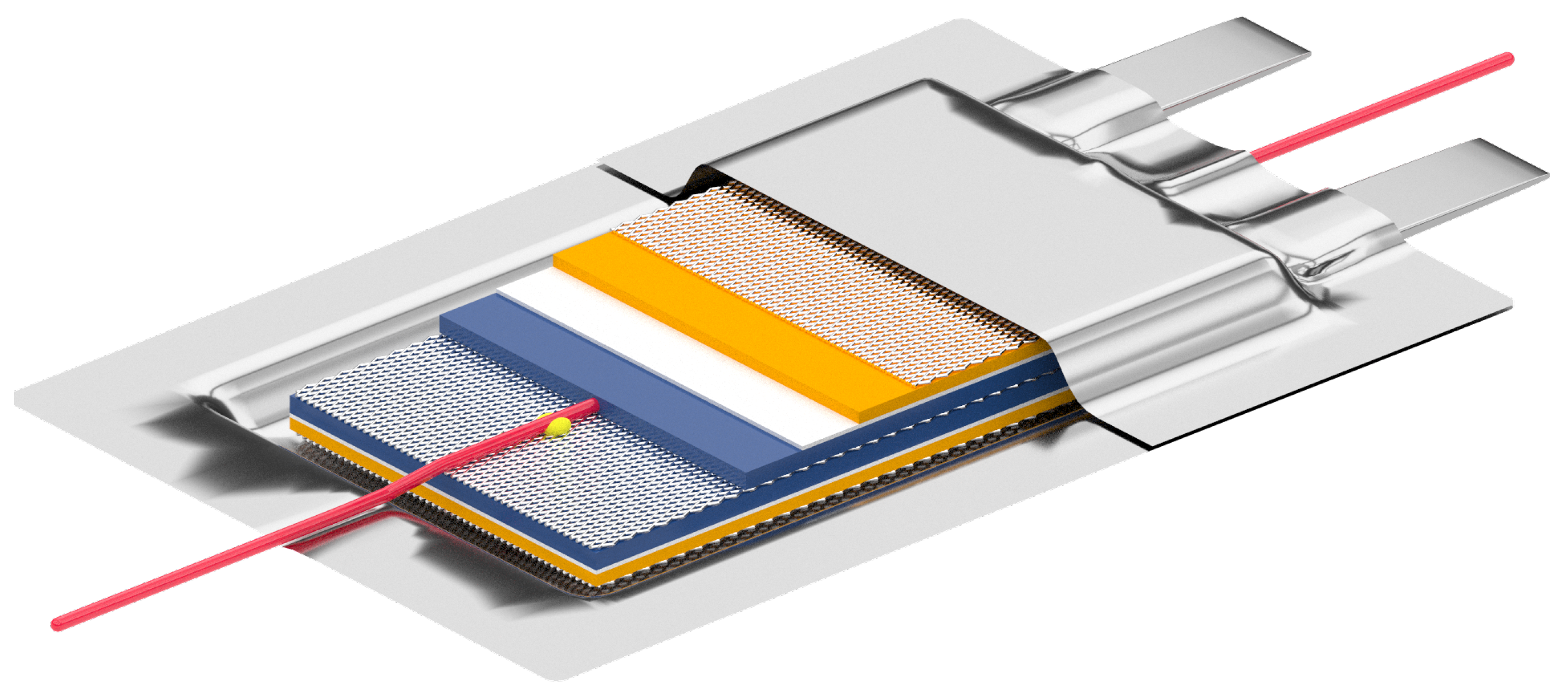
To finally demonstrate the practical feasibility of integrating a fiber optic sensor into a lithium-ion cell, a pouch cell with NMC622 cathodes and graphite anode was fabricated. The electrolyte consisted of a standard LP57 mixture with 2 % VC additive. The anode dimensions were 31 × 56 mm , with a thickness of 230 μ m , providing sufficient space to embed a singlemode optical fiber. The cell was designed as a single bi-cell structure, comprising one anode layer sandwiched between two cathode layers (Figure 3). The resulting cell had an initial theoretical capacity of 120 mAh . Within the anode, the fiber was carefully positioned, attached to the current collector and fully encapsulated with anode material. This setup allowed the collection of a substantial dataset under standard charge-discharge conditions, serving as a proof-of-concept for future studies on spatially resolved temperature measurements in operational lithium-ion cells.
For this purpose, a MCT 10-06-12 ME battery tester (Digatron Power Electronics GmbH, Aachen, Germany) was additionally used [50]. The cell was charged using a constant current-constant voltage (CCCV) protocol and discharged with constant current (CC), including a 1-h rest period after discharge. The temperature insde the climate chamber was set to 25 ° C . During the entire cycle, the fiber data were continuously logged and subsequently evaluated with the cell’s electrical measurements.
In a separate experiment, the influence of temperature on the embedded fiber was investigated at 100 % State-of-Charge. During this measurement, the cell was not electrically tested to isolate the thermal effects. The temperature was increased stepwise: starting from an initial temperature of 5 ° C , a zero-point calibration was performed after cell homogenization. Subsequently, the temperature was raised in 5 ° C increments every 30   min , with a 2-h rest period after each step to allow the system to reach thermal equilibrium. Although the sensor itself is capable of measuring higher temperatures, for safety reasons and to avoid damaging this prototype cell, the experiment was limited to a maximum temperature of 50 ° C .

3. Temperature Sensitivity of Fiber Sensors

3.1. Spatial Resolution and Measurement Precision

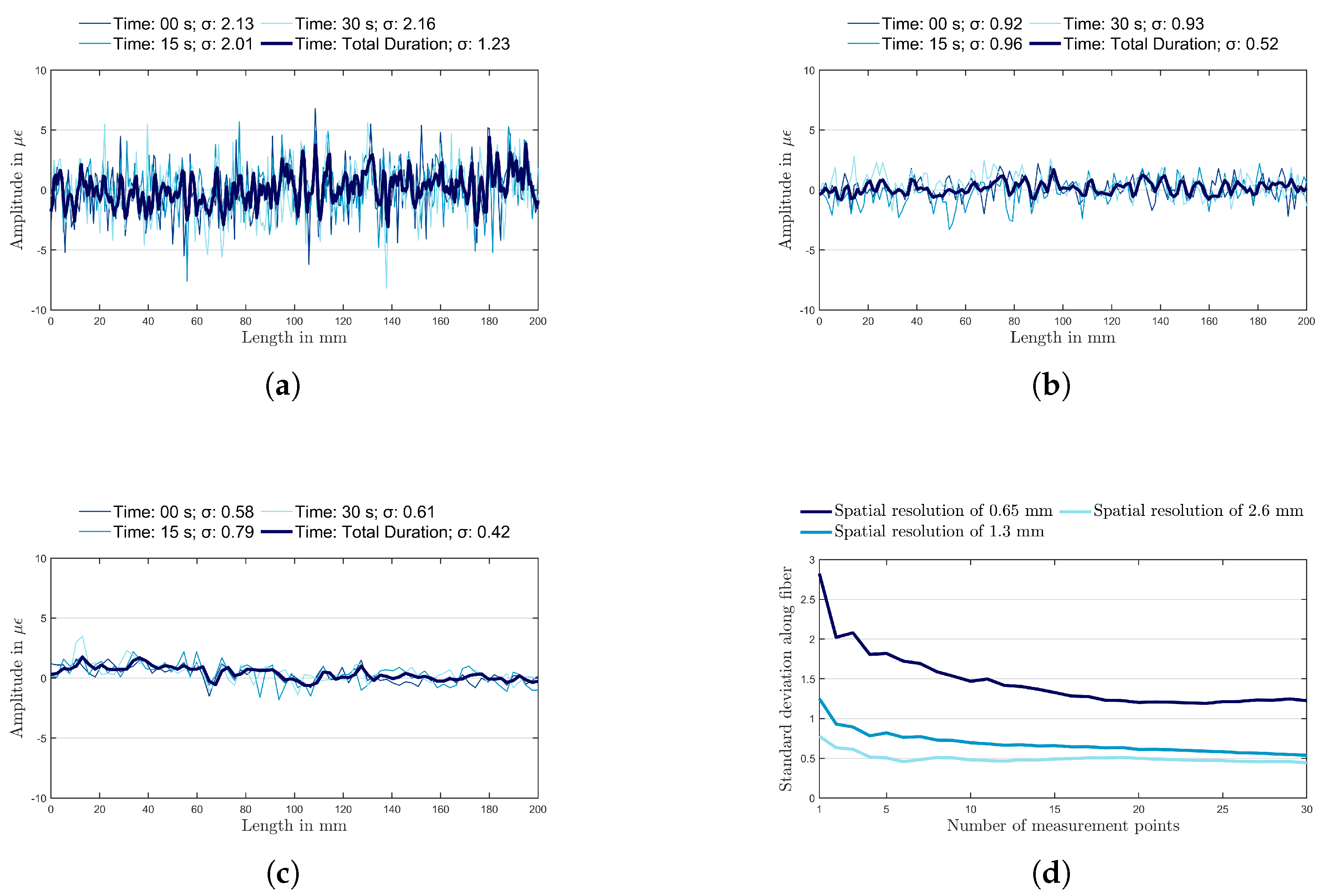
The measurement accuracy of fiber optic sensors is influenced by spatial resolution, with higher resolutions often producing noisier signals. As shown in Figure 4a, measurements at 0.65 mm resolution have standard deviations ranging from 2.01 μ ϵ to 2.16 μ ϵ , whereas resolutions of 1.3 mm and 2.6 mm yield reduced noise and lower standard deviations (Figure 4b,c). Furthermore, a correlation was observed between increased spatial resolution and greater measurement variability, with higher spatial accuracy being associated with a more erratic signal. For instance, at 0.65 mm resolution, peak-to-peak fluctuations were recorded at 8.2 μ ϵ to + 6.8 μ ϵ , while at 1.3 mm and 2.6 mm , the fluctuations decreased to 5.9 μ ϵ and 5.3 μ ϵ , respectively.
To reduce these fluctuations and improve precision, the data was averaged over 30 consecutive measurements, effectively halving the standard deviation, see Figure 4d. Based on this analysis, the same averaging procedure was applied to all subsequent results in the following. The sensor’s combined accuracy is specified by the manufacturer at ± 30 μ ϵ (Table A1) [51]. As the standard deviation is within the expected range for the resolution and based on the test results a spatial resolution of 2.6 mm was selected for subsequent investigations. This comparatively low resolution was considered sufficient to enhance the sensor’s sensitivity to external influences and thereby enable precise measurement of temperature changes.
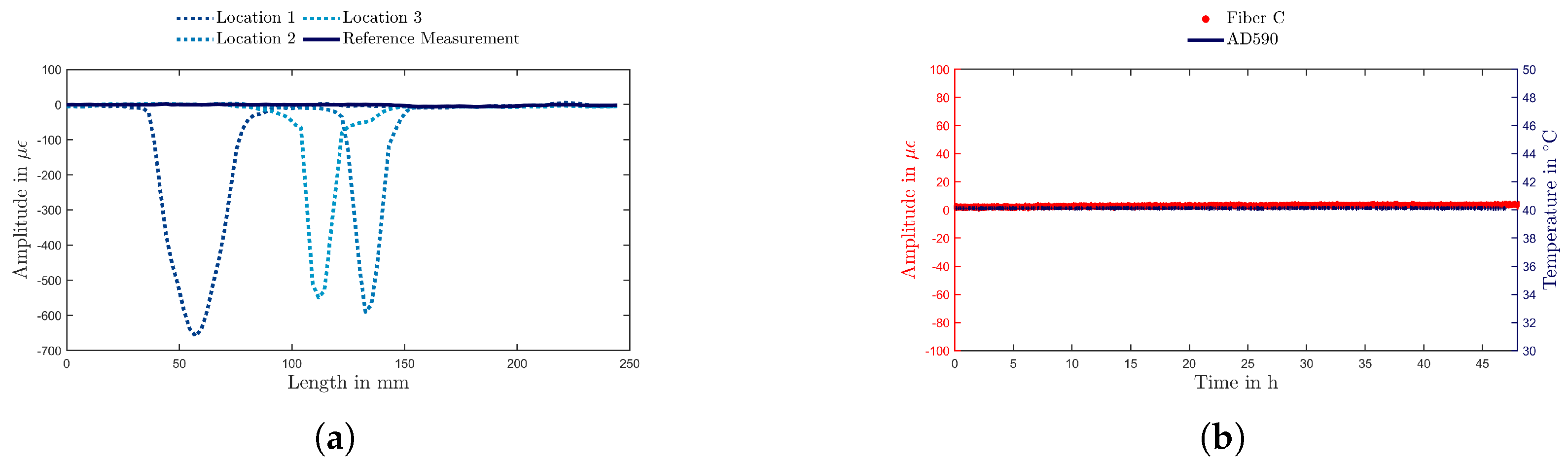
As shown in Figure 4a, the three deliberately induced cooling events at different positions along an optical fiber of type C can be identified as distinct peaks. This experiment was designed to demonstrate the spatial resolution of the sensors rather than to detect real anomalies or hotspots within a battery cell. The width of the peaks illustrates the limited spatial resolution but still allows the events to be assigned to their known locations. Although the exact extent of the thermal events cannot be precisely determined due to the experimental setup, the results nonetheless demonstrate that the method is fundamentally capable of spatially resolving different temperature events. Repeated measurements under the same conditions showed consistent results, providing a proof-of-concept for potential future applications in detecting localized thermal anomalies in operational cells.
The results indicate that a strain of 7– 10 μ ϵ corresponds to a temperature change of approximately 1 ° C , consistent with findings in the literature [52,53]. This experiment highlights the sensor’s functionality in detecting temperature decreases. However, the principle operates in both directions, meaning the fiber sensor can similarly detect heating events analogously. These strain-temperature relationships might vary depending on the fiber material, coating and other design factors.
The fiber optic sensor’s response accurately matches the amplitude of the cooling event, highlighting its ability to measure temperature variations with high spatial precision. The subsequent experiments, based on the previously defined parameters, explore different fiber types under various configurations, with temperature and positioning being examples of the factors varied to assess their performance under different conditions. In the following, we focus on a specific section of the fiber and examine a series of tests to quantify the temperature dependency of the individual fiber types presented.

3.2. Thermal Relaxation

During the 48-h measurement period described in the earlier experimental setup, the thermal relaxation behavior of the fiber sensor was investigated. The sensor exhibited a maximum deviation of 5 μ ϵ , as shown in Figure 5b. A comparison of the sensor’s output at the start and end of the measurement revealed a drift of approximately 1 μ ϵ . However, this minor sensitivity cannot conclusively be attributed to thermal drift. The observed change remains within the specified accuracy limits of both the measuring device and the sensor. Since the observed deviations remained within the spatial and temporal accuracy limits of the reference sensors and the homogeneity of the test chamber, no evidence of thermal relaxation was observed. This consistency persisted throughout the entire duration of all experiments, underscoring the stability of the used fiber sensors for extended periods.

3.3. Temperature Dependence

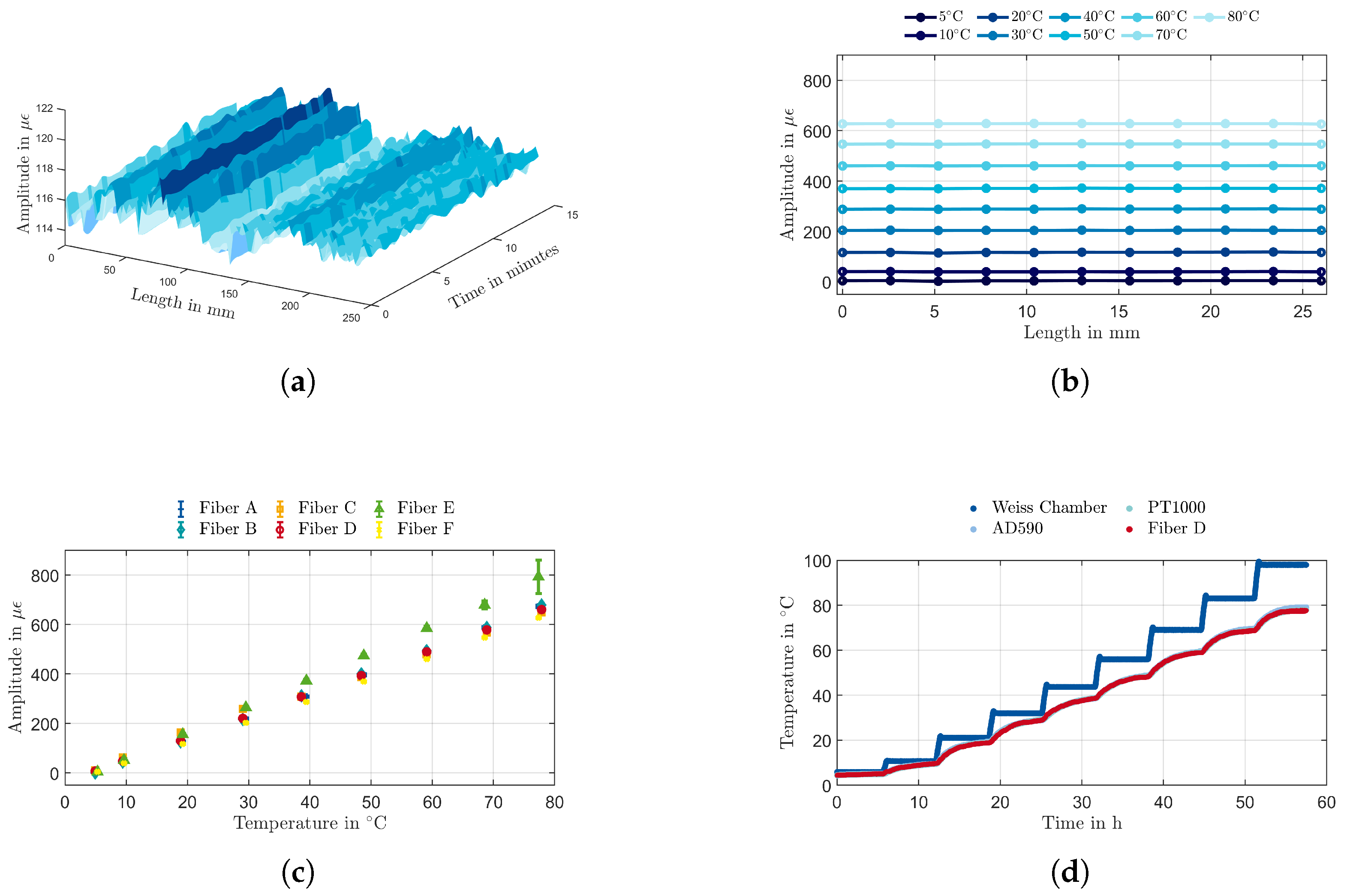
In Figure 6a, an example of the three-dimensional resolution of a measurement over a 15-min duration at 20 ° C is shown. The thermal stress profile along the 250 mm length of the fiber displays a similar pattern, with a maximum delta between the minimum and maximum of about 5 μ ϵ . This figure is intended to illustrate the baseline behavior and inherent fluctuations of the sensor signal, rather than a controlled thermal ramp or environmental change. For subsequent analyses, one spatial or temporal dimension is averaged to simplify the interpretation and to focus on relevant trends. In Figure 6b, the same trend is depicted across other temperature levels, where a time-averaged mean was taken over the 15-min measurement period. These results along the fiber are consistent, with no noticeable outliers or significant variation. This observation confirms the uniformity of the spatial resolution along the fiber, as initially assumed, considering the defined constraints in the previous section.
Figure 6c, illustrates the temperature dependencies of the individual fiber types. In this case, the measured data, as shown in Figure 6b, was additionally averaged over the length and represented according to their variance. For Fiber E, an increase in the variance of the measurements with rising temperature was observed, which was noticeable compared to the other fiber types. The deviation here was in the range of ± 50 μ ϵ , while for the others, it was at most ± 7 μ ϵ . Presumably, the fiber was no longer fully submerged in the water upon reaching 80 ° C , leading to a higher measuring deviation compared to the other measurements. This, however, could not be definitively confirmed. The measurement enables the determination of the coefficients K T , as presented in Table 2. As shown, the fibers demonstrate a quasi-linear behavior across the tested temperature range. These coefficients can be used to derive the temperature, as illustrated in Figure 6d. With a maximum deviation of ± 2 ° C , this falls within the range of possible accuracy for both the reference measurements and the fiber data. Despite differences in core doping and coating, the temperature-induced length change behavior of the fibers is similar to literature values in the range reported earlier.
In Figure 6d, the data from the two reference sensors, the chamber’s temperature and the fitted measurement for Fiber D, derived using the calculated coefficient, are presented. The chamber’s temperature shows a brief transient process before reaching the set value. The water basin’s temperature, as it attempts to follow the chamber’s temperature, is temporally delayed due to its thermal mass and associated inertia until a homogeneous state is achieved. As evident in Figure 6d, the ambient temperature of the chamber differs with rising temperature from the measured one in the water basin. This difference can partly be attributed to the evaporation of water and its associated cooling effect. Furthermore, it appears that the water basin reaches a steady state at each temperature plateau, which deviates from the chamber’s temperature. This deviation is likely due to the water’s thermal inertia and insufficient heat transfer. However, given the use of reference sensors for temperature measurement, this deviation is not considered critical.
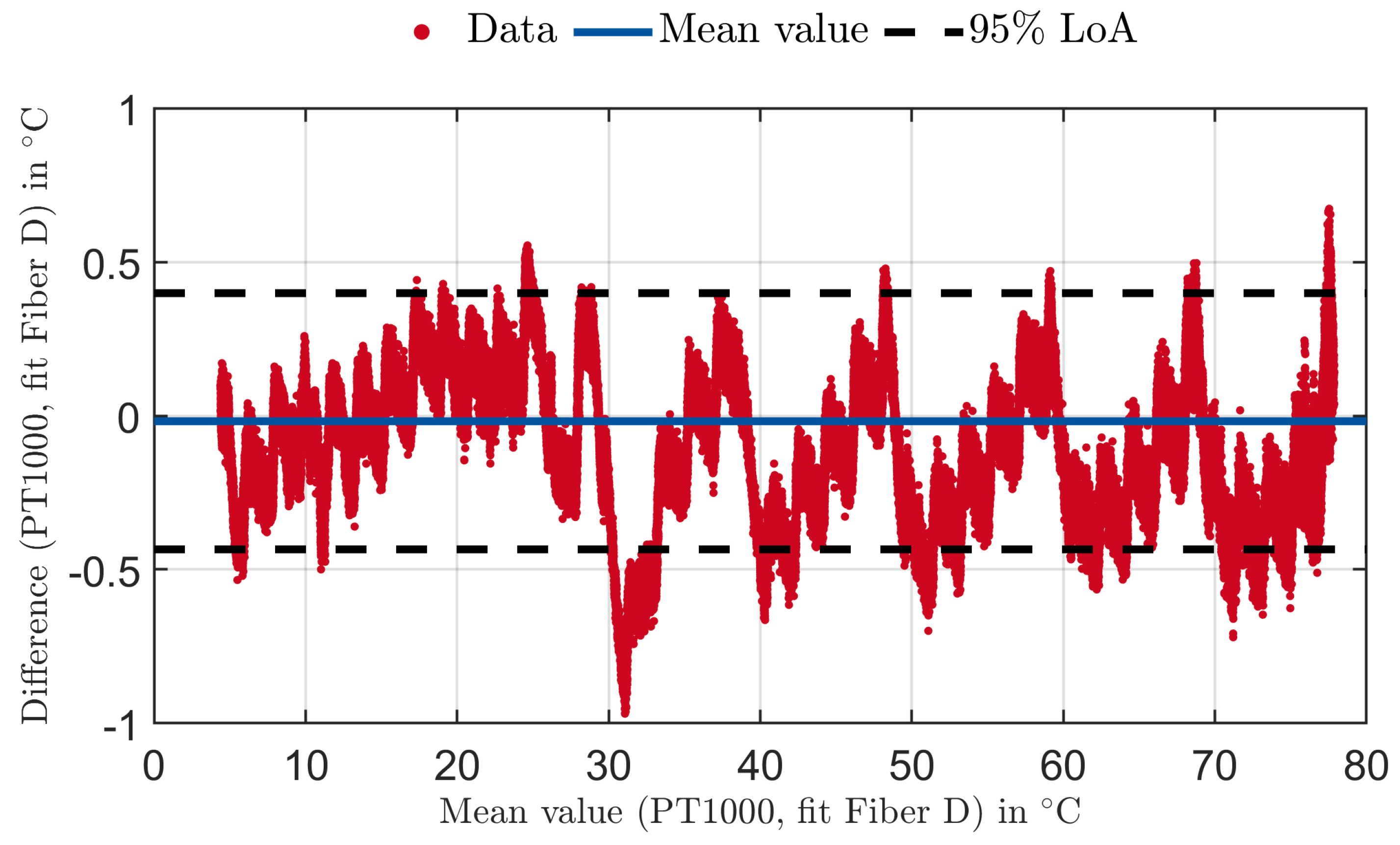
To assess the accuracy of the determined coefficients and the resulting fits, see Figure 7. A Bland–Altman plot is used to assess the agreement between two measurement methods by plotting the differences against their averages. It allows visualization of systematic bias and the range of variation, helping to determine whether the methods can be used interchangeably [54]. In the present case, the fit of Fiber D is based on the data from the PT1000 sensor. Accordingly, Figure 6d presents the measurement results from both sensors. There is a high level of agreement between the two measurement methods, with a mean value close to zero. The confidence interval (Limits of Agreement (LoA)) is less than ± 0.5 , indicating that neither dominant systematic deviations nor significant random fluctuations are present. However, an outlier at approximately 25– 30 ° C is observed. This is likely related to the ambient temperature of the room in which the chamber is located and the resulting transitions between cooling and heating phases. Furthermore, the clearly regular pattern suggests that the temperature control of the chamber is being observed. The chamber’s temperature regulation operates in pulsatile cycles, followed by a passive relaxation phase to reach the target temperature, which is observable in the measurements. Overall, the measurement shows a deviation between maximum and minimum of less than 2 ° C , remaining within the tolerance range of both the reference measurements and the fiber sensing technique.

3.4. Temperature Dependence in Bending Radii

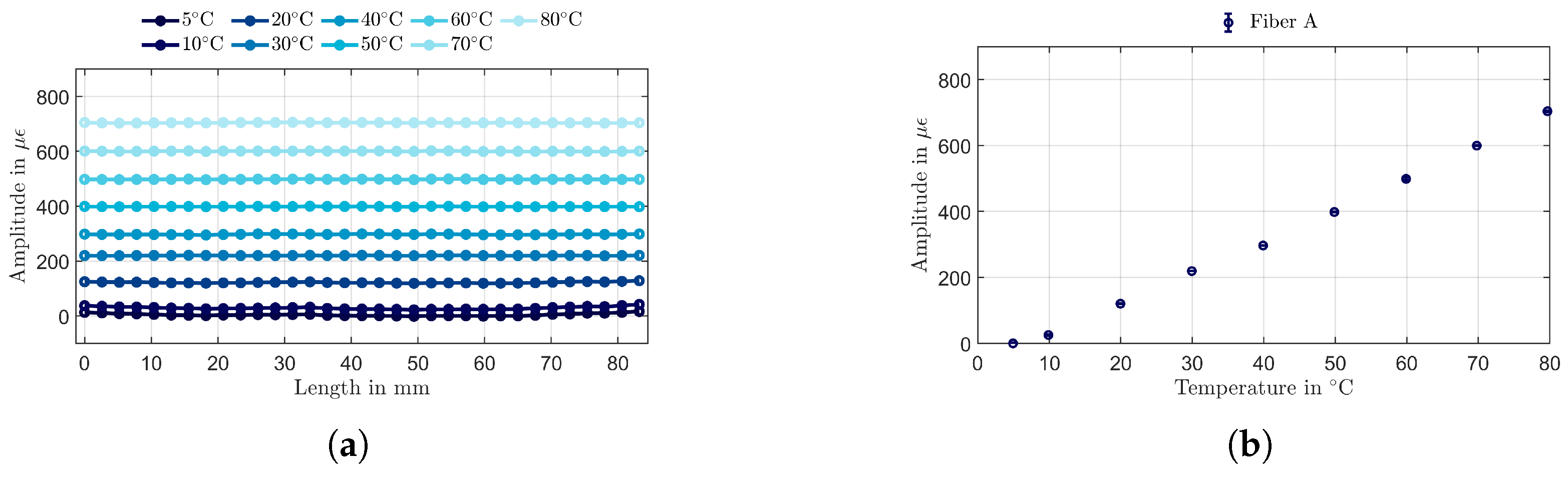
Examining the effect of varying radii on the fiber’s response across different temperature levels, it can be observed that the measurements remain consistent over the entire length of the fiber, particularly within the smallest radius, as shown in Figure 8a. Both the beginning and end of the fiber, which include short straight sections, are also part of the measurement, indicating that the radii do not significantly affect the results. To determine a valid coefficient for the fiber used in this setup, the spatial average of the measured values at the different radii across the temperature levels was calculated. Figure 8b illustrates the relationship between temperature and amplitude, with error bars, while also factoring in the variations in radii. As clearly shown, the variance is close to zero.
No significant difference in the measurement values between different radii in the range of 15 to 60 mm was detected, as the maximum deviation observed was only 2.16 μ ϵ . Additionally, it was demonstrated that the sensor’s position, whether along a radius or on a straight path, had negligible impact on temperature sensitivity. The difference between the radius and straight path measurements was only a maximum of 0.273 μ ϵ at a 20 mm radius and 20 ° C . A coefficient of K T = 9.017 μ ϵ ° C was determined for this case using linear regression, incorporating the AD590 sensor data. This value deviates by less than 3 % from the reference measurements described in the previous section and is therefore within a similar range.
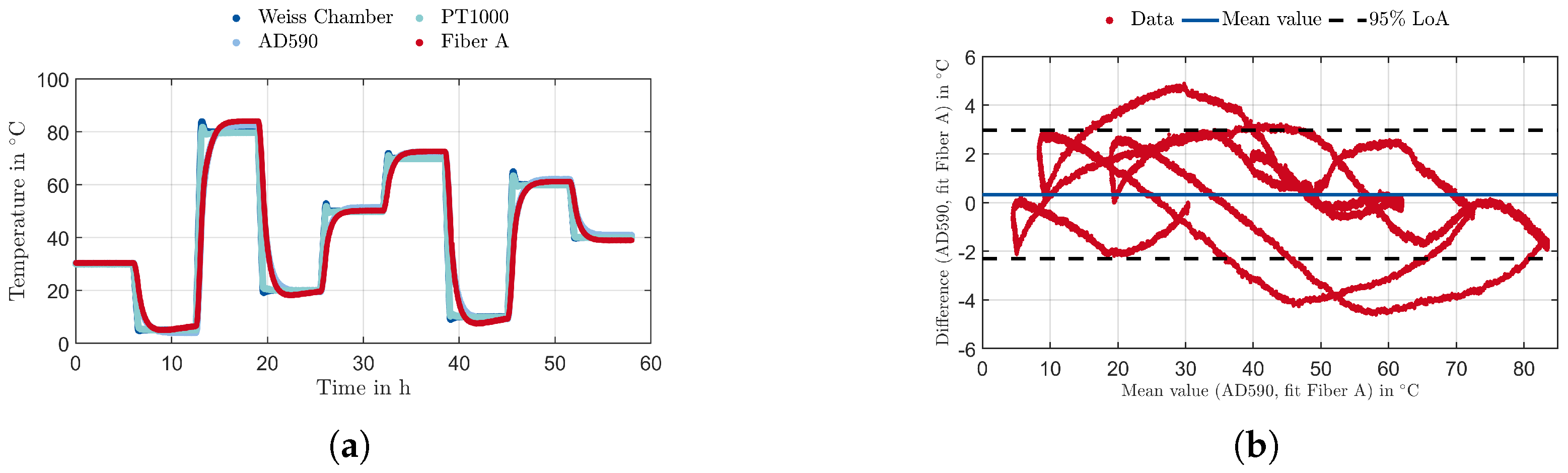
Figure 9a shows the time course of the experiment, with the recorded temperature data of the chamber, the two reference sensors (PT1000 and AD590) and the results of the fibre sensor based on the fit. In this case, a fit with the PT1000 data was not possible as it could not represent the inertia of the system due to its positioning and follows the temperature of the chamber. Similar to the previous measurement, a systematic deviation between the sensors can be seen. To quantitatively evaluate these differences, a Bland-Altman analysis of the sensors is performed again.
As shown in Figure 9b, the fit using the AD590 sensor data exhibits slightly lower accuracy compared to the previous temperature measurement. However, no systematic deviation is evident. The mean of the differences remains close to 0 °C and most data points lie within the 95 % LoA of ± 2 ° C . This indicates low overall scatter and good agreement between the sensors. Notably, the spread of differences is not uniform across the temperature range, with a slight increase in variance above 40 °C, suggesting temperature-dependent effects. Since the temperature steps were randomized in their order, these effects cannot be attributed to hysteresis or time-dependent drift. Overall, the observed deviations are likely due to the fit accuracy and experimental uncertainties rather than the fiber sensor performance being affected by additional bending radii.

4. Impact of Specific Steps During Battery Production on the Functionality of the Sensor

Inserting a fiber into a pouch cell requires certain steps that could influence the measurement signal, such as precise alignment, ensuring minimal stress on the fiber and avoiding any potential interference from the surrounding materials or manufacturing processes. In the following, we focus on the effects of sealing seams of a pouchbag and immobilisation of the fiber on the measured signal.
As previously mentioned, several attempts to integrate fiber optic sensors into cells have been described in the literature, but most of these were limited to insertion into round cells. The integration of the fiber into the cell is a non-trivial process, requiring careful handling to ensure proper placement. While the procedure allows for flexibility in positioning, it involves certain challenges in terms of precision and alignment. One approach is to insert the fiber after the production of the cell, which can be achieved by simply opening the pouch bag and carefully placing the fiber inside. However, this approach restricts the insertion of the sensor to the outer ends of the cell stack, limiting the ability to monitor the temperature across the entire stack effectively For more accurate measurement of internal cell temperature, it may be more beneficial to integrate the fiber directly into the cell stack during the production process. To achieve this without compromising the mechanical integrity of the stack, the choice of the host layer is critical. Consequently, in our study, the fiber was placed within the electrode stack rather than on the separator. Among the electrodes, the anode proved to be the more practical choice due to its sufficient layer thickness to accommodate the sensor, whereas placement on the cathode would require significantly increasing the anode thickness to match the areal capacity, which is not feasible. This approach demonstrates the feasibility of electrode-integrated sensors while maintaining realistic cell geometry and operational conditions. While other configurations, such as cylindrical or prismatic cells, may require adapted integration strategies, the current work focuses on pouch cells as a representative example. Detailed investigations of electrode placement, variations in layer thickness, areal capacity and cell formats are part of ongoing follow-up work.
To increase the measurement area, it is also advantageous to place the fiber not only in a straight line, but also in bends, thus covering a larger area within the battery cell. When integrating fiber optic sensors into pouch cells, it is crucial to guarantee complete sealing of the cell for both functionality and safety of the cells. A poor sealing of the cell can very quickly lead to unwanted leakage and damage.
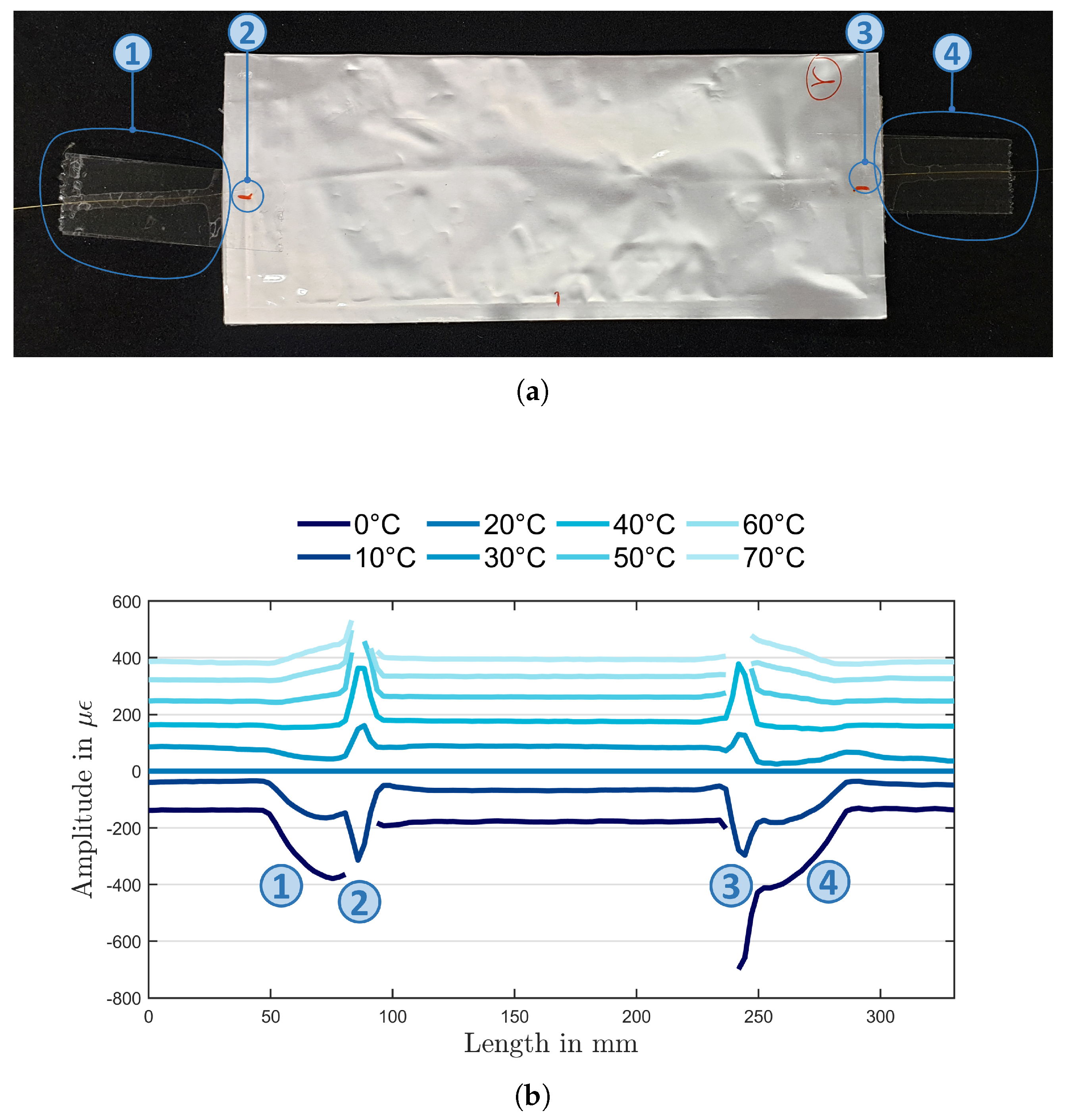
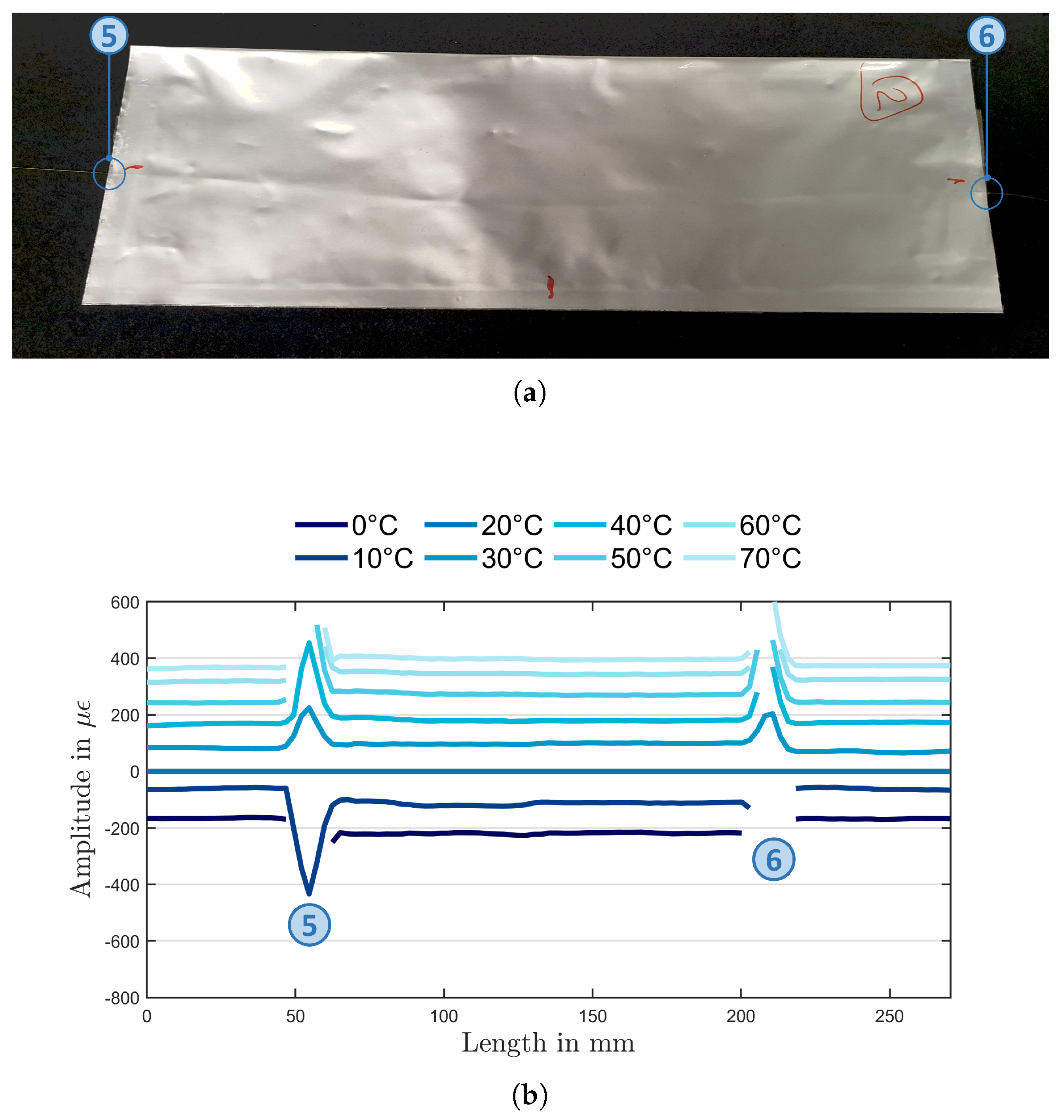
On various samples a fiber was inserted into a pouch bag, sealed and then processed into a sensor. Figure 10a and Figure 11a show two pouch bag samples, as used for lithium-ion pouch cells, containing an inserted fiber sensor of type Fiber B with the external dimension of 165 × 70 mm (L × W).
To better protect the fiber optic sensor, an adhesive strip was applied to the outer surface of the pouch bag in the setup shown in Figure 10a. This was done to prevent the sensor from potential damage due to movement or mechanical stress, especially near the seal seam. However, to assess the effect of this external protection, a second experiment was conducted without the adhesive strip, as shown in Figure 11a, to observe how much the adhesive actually influences the sensor’s performance. In this experiment, samples were subjected to identical conditions, with temperatures ranging from 0 ° C up to 70 ° C in a temperature chamber, as previously described.
The measurement results in Figure 10b show the entire fiber routing inside the pouch bag, as well as some part of the adjacent sections of the outer fiber visible in the Figure 10a. The maxima and minima along the fiber measurements indicate the areas of the sealing (② and ③) and additional adhesive (① and ④) strip of the sensor, respectively. The fiber sensors were tared at 20 ° C .
As can be seen, the measured signal can no longer be displayed in areas of the sealing ② and ③ as the temperature increases or decreases. This is clearly visible in Figure 10b, as well as in Figure 11b, particularly in the areas marked by ⑤ and ⑥. This effect is due to the internal algorithm of the interrogator and the exceeding of the measuring range, due to high, locally superimposed pressure. This is also clearly visible in the measurement gaps. After the experiment, the seal seam was intentionally opened, but subsequent optical inspection revealed no damage to the coatings or fibers. As expected, the graphical evaluations of the measurements demonstrate that separate measurements conducted on the prepared samples yield nearly identical results. These demonstrate uniform behavior along the non-stressed part of the fiber, with a maximum deviation of ± 6 μ ϵ , which is in the range of the already reported average standard deviation for temperature measurements. Despite the presence of local artifacts at the seal seams, similar temperature dependencies with an average of K T = 8.17 μ ϵ ° C can be observed across the entire measured temperature range. This leads to the conclusion that despite the obvious influence of the sealing and tape on the measurement signal, a valid temperature measurement along the fiber is possible.
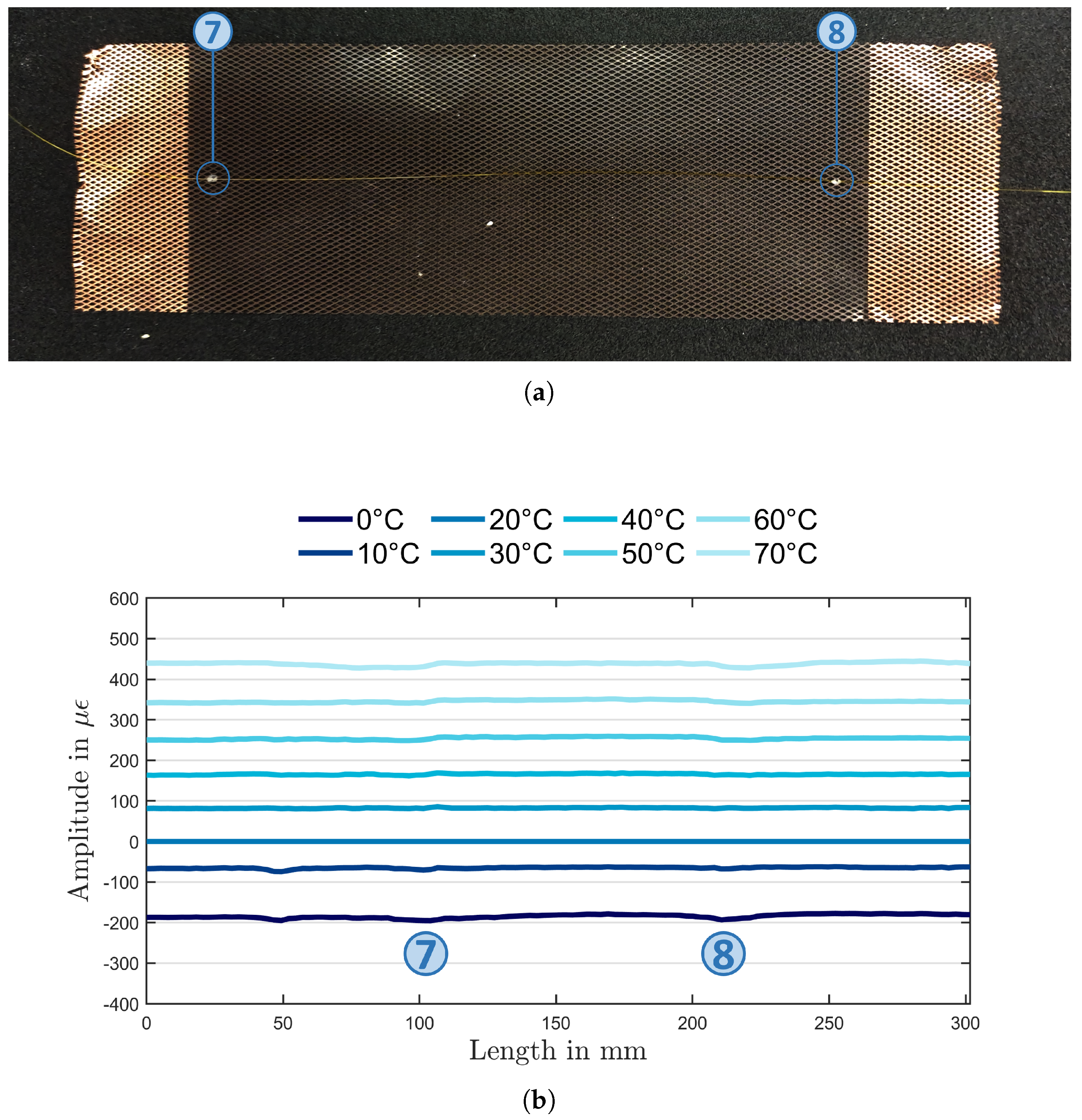
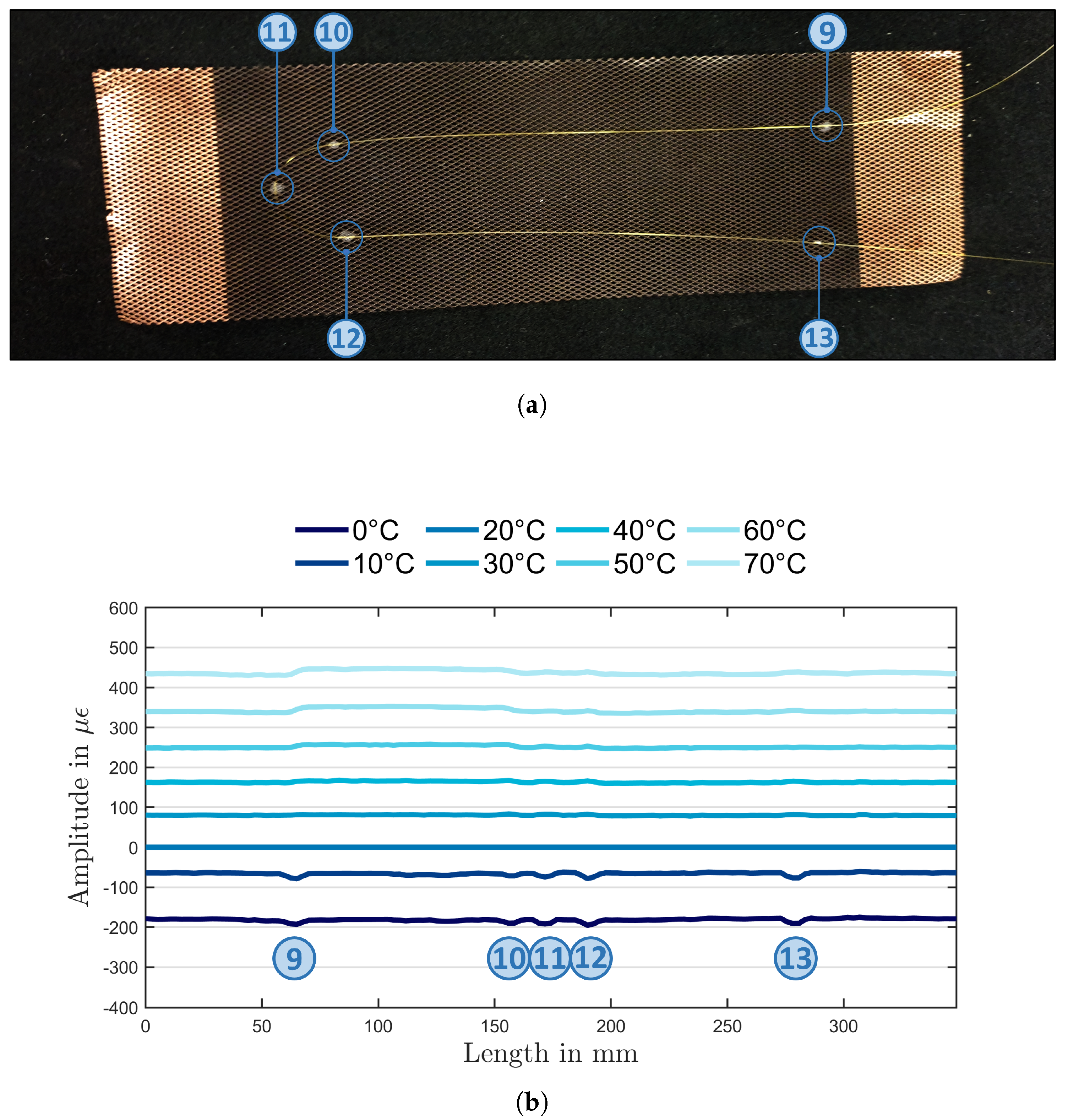
Instead of simply inserting the fiber between the outer pouch layer and the cell stack, the fibers can be immobilised on cell components, in order to prevent undesired motion. Introducing adhesive spots to attach the fiber to the electrode might not only impact the battery cell properties, but also the measurement results of the fiber sensor. Here, too, the focus is set on examining how these adhesive points might impact the sensor signal. We prepared various samples of fibers immobilised on expanded copper foil measuring 160 × 60 mm (L × W), as depicted in Figure 12a and Figure 13a, to analyze the possible effects of the adhesive points on the measurement properties of the fiber.
In the following the temperature-dependent measurement results of the sensors on the samples are shown over the length of the fiber, with taring at 20 ° C . Figure 12 shows a sample with a straight fiber geometry and two adhesive points (⑦ and ⑧). An u-shaped fiber routing with a radius of 15 mm and five adhesive points (⑨, ⑩, ⑪, ⑫ & ⑬) is seen in Figure 13.
The temperature measurement results shown in Figure 12b, specifically for the straight geometry and fixation of the fiber at ⑦ and ⑧, confirm the assumption that these particular adhesive points slightly influence the measurement outcomes. However, this influence is confined to the bonded areas and does not significantly impact the overall behavior of the fiber. The results exhibit a quasi-constant trend along the fiber length, with deviations arising from the mechanical effects of the adhesive. With increasing temperature, we observe a rise in signal scattering and standard deviation up to 10.4 μ ϵ at 70 ° C . This is primarily attributed to negative influences of the temperature chamber, as reported earlier. Due to the chamber’s heating and the activation of air circulation, the fiber moves repeatedly, distorting the measurement results. However, the standard deviation for the remaining temperature ranges is only 2.58 μ ϵ . Furthermore, the average temperature dependence of K T = 8.02 μ ϵ ° C falls within an acceptable range.
The results of the temperature measurement for the u-shaped geometry of the fiber show similar results, see Figure 13b. The relatively small increase in the area of the adhesive spots ⑨ and ⑬ in particular visible at 70 ° C are due to the fact that the bonding spot ⑨ detached and the fiber had started to move slightly due to the ventilation of the climatic chamber. This scattering of the results is also evident in the standard deviation, which is 10.9 μ ϵ between 50 70 ° C , i.e., with increased chamber activity, compared to the otherwise average of 3.46 μ ϵ . Although the measurements of the sensors were influenced, temperature measurement results increases nevertheless are proportionally along the fiber. The average temperature dependence results in K T = 8.04 μ ϵ ° C . Also noticeable here is the absence of any tendency toward measurement inaccuracies in the existing bend between points ⑩, ⑪ and ⑫. Hence, a valid temperature measurement can be performed.

5. Demonstration of a Fiber-Integrated Lithium-Ion Cell

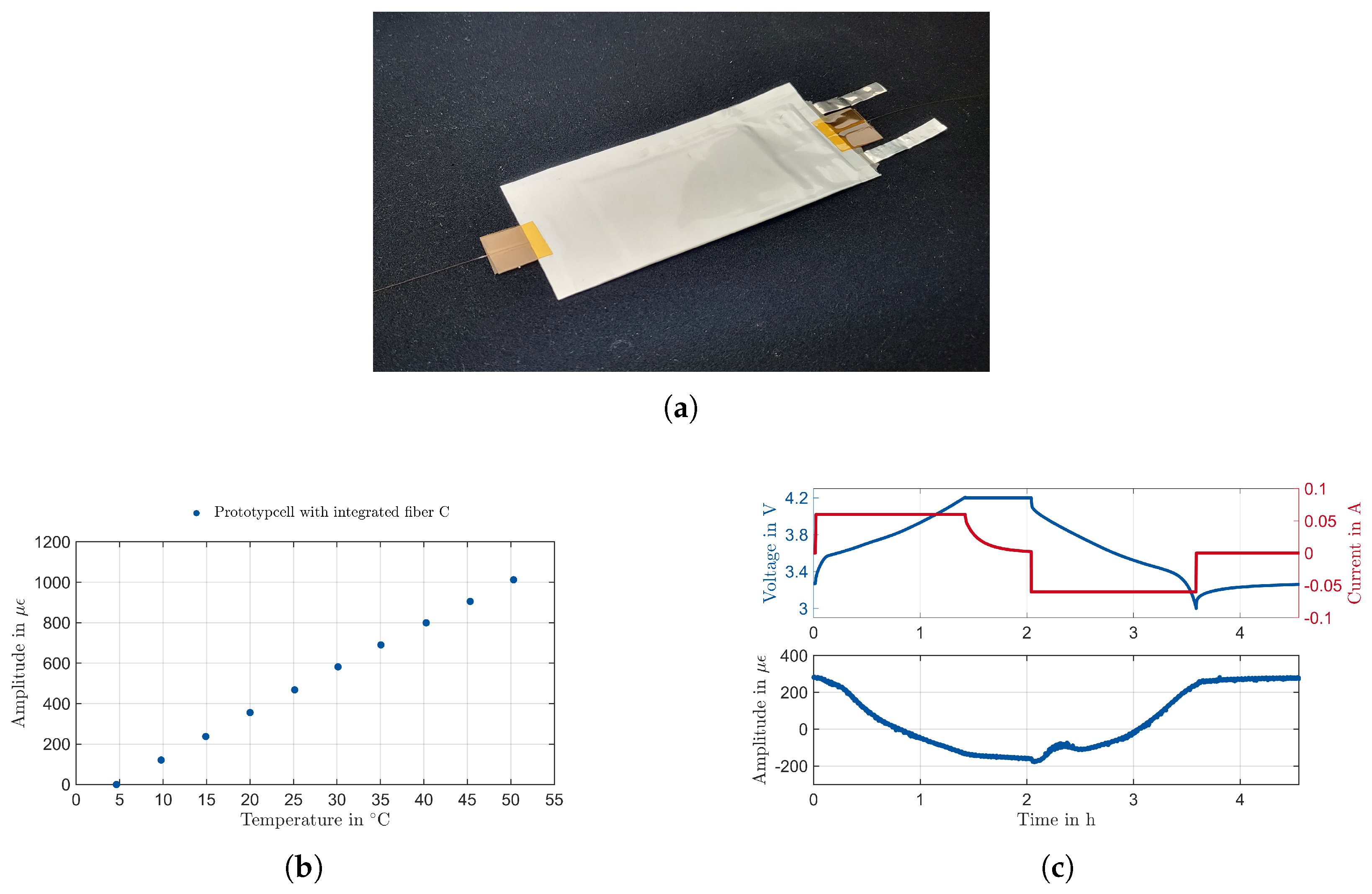
To validate the practical applicability of the developed integration method, we demonstrate the functional performance of a sensor within a fully assembled pouch cell under controlled thermal conditions, see Figure 14a. Following the investigation of various cross-sensitivities and validating a practical applicability of the developed integration method, the sensor’s performance is evaluated within the operational environment of the cell. Figure 14b illustrates the sensor response of the integrated fibers over a temperature range from 5 ° C to 50 ° C . The evaluation of the relaxed sensor signal at the conclusion of each temperature step reveals a robust linear dependence. This linearity facilitates the determination of cell-specific temperature coefficients K T via linear regression, yielding a value of approximately 22 μ ϵ ° C . for the investigated cell. Utilizing these coefficients, the internal temperature can be measured with a variance of less than 1 % and a maximum deviation of ± 1 ° C . Notably, the temperature coefficient of the embedded fiber is more than twice as large as that of a non-integrated fiber. This discrepancy indicates that the sensor response is driven by a secondary effect: the mechanical coupling between the fiber and the surrounding material. As the cell electrodes undergo thermal expansion and contraction, they exert mechanical strain on the fixed fiber. This coupling ensures that the fiber signal is highly sensitive to the internal state of the stack, effectively acting as a transducer for both thermal and induced mechanical changes.
The established temperature coefficient provides the basis for interpreting the sensor data under dynamic conditions. To evaluate the information content of a cell-embedded fiber during operation, measurement data from a full charge-discharge cycle of the previously described prototype cell (Figure 3) were analyzed. In order to decouple the mechanical strain response from thermal effects, the cycle was performed with a low current. This approach minimizes internal heat generation, allowing for a focused observation of the sensor’s sensitivity to the structural changes and volume expansion of the electrode materials during lithiation and delithiation.
Figure 14c illustrates the cell’s voltage and current profile during the cycle, alongside the synchronized response of a centrally located fiber data point. The fiber signal exhibits a distinct State-of-Charge dependent behavior, indicating that the embedded sensor responds not only to temperature fluctuations but also to electrochemically induced changes within the cell. Interestingly, while the anode undergoes lithiation and overall volume expansion during charging, the fiber signal shows an inverse trend, suggesting a local relaxation of stresses at the sensor location. This behavior was highly reproducible over multiple cycles, confirming the stable integration of the fiber in an electrochemically functional cell. While the present study focuses on temperature sensing as a proof of concept, the signal also reflects additional coupled effects, which will be systematically analyzed in a dedicated follow-up study.

6. Conclusions

This work systematically investigated the application of fiber-optic sensors for thermal monitoring in various scenarios, with a primary focus on lithium-ion battery cells. Employing the OFDR method, the study demonstrated that these sensors can accurately detect and measure spatially resolved temperature changes across a range of conditions, proving their potential for localized thermal anomaly detection. Experiments across multiple setups and fiber types consistently revealed temperature sensitivities within the range K T = 8 11 μ ϵ ° C , closely matching values reported in the literature.

Key Findings

1.
Temperature Measurement: Fiber optic sensors showed consistent linear behavior across the tested range (0 to 80 ° C ) with a resolution of 2.6 mm and a sampling rate of 1 Hz . These sensors were effective for real-time, spatially resolved temperature monitoring, crucial for preventing thermal runaways and optimizing battery performance and aging behavior.
2.
Fiber Integration: The minimal diameter of the fibers (155– 250 μ m ) enabled close placement to or within cells without creating significant stress points, making them highly suitable for integration. Practical tests showed that bending fibers to radii as small as 15 mm did not compromise measurement accuracy or structural integrity. However, tighter bends or deviations from manufacturer specifications could still affect light propagation and need further evaluation.
3.
Impact of Fixation: The integration of fibers into pouch cells, which required careful consideration of sealing seams, did not compromise internal sensitivity of the fiber optic sensor. However, adhesive fixation points and sealing seams caused localized mechanical stress, impacting measurement results only in the immediate vicinity of the attachments. Beyond these localized areas, measurements remained reliable and unaffected, emphasizing the potential for embedding fibers into battery systems.
4.
Limitations: Mechanical influences, though avoided in this study, can affect fibers during real-world applications. These influences, including internal battery expansion or external mechanical stress, should be explicitly addressed in future research. The study was limited to thermally induced effects and further investigations are needed to understand and mitigate non-thermal factors affecting sensor performance.
5.
Technical Feasibility: A singlemode fiber optic sensor was successfully embedded in the anode of a prototype NMC622/graphite pouch cell. The sensor demonstrated stable operation under standard charge–discharge conditions, reliably capturing temperature variations while also responding to electrochemically induced mechanical effects. These results establish a proof-of-concept for in-situ monitoring in operational lithium-ion cells.
Fiber optic sensors exhibit strong potential for improving thermal monitoring of battery systems, offering precise, spatially resolved data critical for safety and performance optimization. Their ability to withstand aggressive chemical environments, small form factor and high sensitivity position them as a versatile tool for battery monitoring, both on the surface and internally.
Future research should explore the long-term reliability of these sensors under mechanical and environmental stresses typical of battery operation. By addressing these challenges, fiber optic sensors could play a transformative role in advancing safer, more efficient and sustainable battery technologies. This work lays the groundwork for integrating these sensors into cells and their monitoring devices, paving the way for broader applications in energy storage systems.

Author Contributions

F.K.: Conceptualization, Methodology, Investigation, Writing—Original Draft, Writing—Review & Editing, Visualization. F.S.: Methodology, Investigation, Visualization. A.B.: Conceptualization, Methodology, Investigation, Resources, Writing–Review & Editing, Visualization. F.L.: Conceptualization, Writing—Review & Editing. M.K.: Conceptualization, Writing—Review & Editing. K.Q.: Supervision, Writing—Review & Editing. A.W.: Supervision, Funding acquisition. D.U.S.: Supervision, Funding acquisition, Writing—Review & Editing. All authors have read and agreed to the published version of the manuscript.

Funding

This work was supported by the Federal Ministry of Education and Research from Germany (BMBF) through the project NUBase under grant number 03XP0322C.

Data Availability Statement

Data will be made available on request.

Acknowledgments

We express gratitude to Marian Walter for his comments and inspiring scientific discussions. During the preparation of the manuscript the authors used GPT5/OpenAI in order to improve readability and language. After using this tool, the authors reviewed and edited the content as needed and take full responsibility for the content of the publication.

Conflicts of Interest

The authors declare that they have no known competing financial interests or personal relationships that could have appeared to influence the work reported in this paper.

Abbreviations

The following abbreviations are used in this manuscript:
BMSbattery management system
FBGFiber Bragg Grating
LIBlithium-ion battery
LoALimits of Agreement
NANumerical Aperture
OFDROptical Frequency Domain Reflectometry
OTDROptical Time Domain Reflectrometry

Appendix A. Technical Background on Fiber Optic Sensors

Appendix A.1. Principle of Fiber Optic Sensors
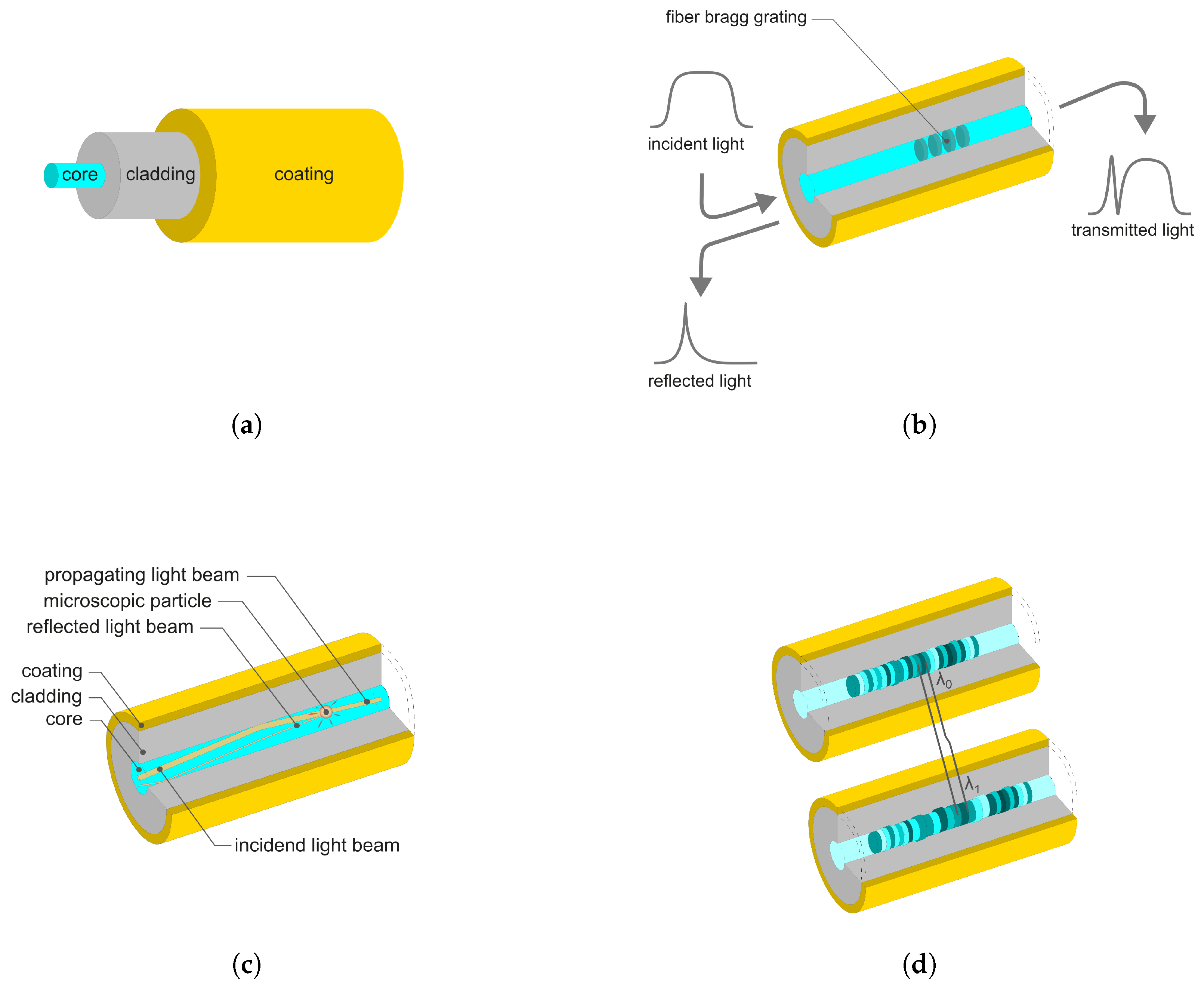
The sensitive properties and advantages of the material resistance of optical fibers have led to fiber optic sensors becoming increasingly established in the field of measurement sensor technology in recent years [32]. Essentially, a fiber is a relatively simple structure consisting of a core, cladding and coating, as illustrated in Figure A1a.
Figure A1. Schematic representation of optical fibers and light propagation or refraction properties: (a) Structure of an optical fiber, showing the core, cladding and coating. (b) Reflection principle of an injected light signal into a fiber with an imprinted FBG. (c) Rayleigh backscatter effect from microscopic particles. (d) Division of the fiber into material-characteristic quasi-segments and corresponding refractive index variations without ( λ 0 ) and with ( λ 1 ) external influence on the fiber.
Batteries 12 00095 g0a1
A key feature of fiber optic sensors is the number and distribution of measuring points. These systems can be categorized into discrete, distributed and quasi-continuous measurement systems [55]. For discrete measurement, there are a number of options that will not further be discussed in detail. Instead, the focus is shifted to the underlying principles of distributed and quasi-continuous sensors, which are mostly based on the superimposed comparison of two coherent light beams. These beams must have the same wavelength or a wavelength shifted by 2 π to ensure maximum constructive interference between them. Additionally, they have traveled the same path through one or two identical optical fibers. If an external event such as strain or temperature change affects the optical fiber, this results in a phase shift of the imprinted wavelength. Interferometric measurement devices are capable of detecting a phase shift ϕ due to changes in refraction index n, wavelength λ and path length L [56,57]:
Δ ϕ = 2 π λ · n · L
Common examples of interferometric systems include the Fabry–Pérot interferometer and the Michelson interferometer [58,59,60,61].
In recent years, the advancement in optical measurement technology has led to the development of Fiber Bragg Grating (FBG) distributed sensor technologies, offering an efficient and precise alternative to traditional measurement methods that utilize interferometers. These sensors have found applications in ultra-high temperature sensing in harsh environments, as well as in monitoring strain and temperature in battery applications [62,63,64,65]. While interferometers rely on the phenomenon of light wave interference and often require complex setups, Fiber Bragg Sensors offer another solution for measuring various physical parameters. FBG are periodic optical gratings imprinted into fiber cores through complex techniques [66,67]. These gratings create a modulation in the refractive index along the fiber, enabling selective reflection of light near the Bragg wavelength. When a light pulse with a broad frequency spectrum passes through the fiber, only rays close to the Bragg wavelength are reflected by the FBG, as illustrated in Figure A1b. This selective reflection allows for precise temperature and strain measurements while keeping attenuation losses low [57]. Previous studies have integrated FBG sensors in lithium-ion battery cells for applications such as internal temperature and strain monitoring [65], as well as electrolyte composition analysis [33,68]. For instance, Peng et al. demonstrated high-precision strain measurements in pouch cells using FBG sensors [64].
Nevertheless, FBG sensors have a disadvantage compared to other techniques outlined: The width of the gratings is not arbitrarily adjustable and accordingly focuses only on individual sections along the fiber. It is thus not possible to measure along the entire fiber. This is when general backscattering effects become relevant.

Appendix A.2. Backscattering Effects

Some optical measurement methods rely on general backscattering effects, which enable quasi-continuous measurements along the entire length of the sensor fiber. These techniques fundamentally differ from Fiber Bragg Gratings (FBGs) in their physical mechanism. Backscatter-based systems derive their functionality from the intrinsic scattering phenomena within the fiber material, such as Rayleigh, Raman, or Brillouin scattering, rather than relying on periodic refractive index modulations as in FBGs. When light propagates through an optical fiber, imperfections and microscopic irregularities within the material scatter portions of the light back toward its source. This backscattered light inherently carries information about local changes in temperature and strain along the fiber. Despite the difference in physical origin, the functional principle of extracting spatially resolved temperature and strain data is conceptually similar to that of FBGs. The continuous nature of the backscattering measurement enables high spatial resolution over long distances, offering a complementary approach to the discrete sensing points provided by FBGs.
The ability of backscattering systems to extract temperature and strain information stems from distinct physical interactions between light and the fiber. Rayleigh, Raman and Brillouin scattering are key mechanisms underlying these interactions, each contributing unique characteristics to the backscattered signal. These scattering processes occur randomly and in all directions, but sensing systems utilize only the backward-propagating fraction. While Raman and Brillouin scattering are an inelastic process, which utilize specific vibrational phenomena (molecular vibrations and acoustic phonons, respectively) to provide localized and highly sensitive environmental information, Rayleigh scattering operates through refractive index variations caused by structural imperfections and represents continuous signal propagation along the optical fiber. Latter is an elastic process where the incoming and outgoing wavelengths are identical, preserving photon energy but altering direction. This elasticity results in high scattering intensity, enhancing the signal-to-noise ratio in measurements [52,56,69,70]. Among these backscatter effects, Rayleigh scattering dominates light propagation losses in optical fibers due to interactions with particles much smaller than the light’s wavelength. Figure A1c illustrates this mechanism, showcasing how light interacts with these particles to produce the backscattered signal.
Upon using a commercially available glass fiber sensor, variations in the intensity profile of Rayleigh scattering are observed along the fiber [37]. This profile remains highly stable when the measurement is repeated under unchanged external conditions, thus representing a distinctive pattern for a specific fiber segment. The stability is attributed to the nature of Rayleigh scattering, which arises from the elastic scattering process at local defects, distortions in waveguide geometry distortions or refractive index variations, for instance, caused by the solidification of the glass during the production process, see Figure A1d [71]. This results in a division of the fiber into quasi-segments in which the scattering varies from one segment to another but remains stable under constant conditions [72]. Introducing changes in temperature or strain of the fiber leads to spatial stretching or compression of the pattern. This phenomenon forms the basis of Rayleigh sensor technology, wherein alterations in the local Rayleigh pattern can be converted into local temperature or strain values by analyzing the wavelength shift of λ 0 to λ 1 according Figure A1d [73,74]. However, this is similar to Fiber Bragg gratings, yet it provides the additional benefit of not necessitating expensive additional fiber preparation and the measurement is not spatially limited. This is due to the quasi-segments along the glass fiber mimicking a continuous grating structure, containing information along the entire length of the fiber. For an understanding of the measurement system, a brief overview of the methodology will be presented below.

Appendix A.3. Optical Time Domain Reflectometry (OTDR)

Optical Time Domain Reflectrometry (OTDR) is a fiber optic measurement technique based on backscattering effects. In this method, a short, high-power light pulse is transmitted through the optical fiber. The backscattering is then detected at the fiber’s entry point using a photodiode coupled with a circulator or splitter and the time taken for the signal to return is recorded. The resulting waveform is digitized and subjected to analysis using a data acquisition system. To achieve precise calculations of the propagation time of backscattered signals and accurately locate backscattering events along the fiber, it is synchronized with the optical pulse source. The position x within the fiber corresponding to the backscattering event is determined using the following formula [75]:
x = v 2 n · t
The time t taken for the backscattered signal with the refractive index n of the glass fiber to be detected after the pulse is transmitted. During this process, the light travels twice the distance, with respective velocities of light v in the fiber. This OTDR technique is widely used for gaining valuable insights into the characteristics and integrity of optical fibers, making it a crucial tool for various fiber optic applications. The pulse duration or width is a critical characteristic of OTDR and significantly influences the measurement resolution [75]. The performance of OTDR is evaluated based on three key parameters: the dynamic range (maximum detectable fiber loss), spatial resolution (location accuracy of resolving adjacent events) and dead-zone [76]. The extent of the dead-zone is influenced by factors like the width of the incoming optical pulses and the bandwidth of the photodetector [77]. To overcome this limitation, alternative methods such as Optical Frequency Domain Reflectometry (OFDR) have been introduced.

Appendix A.4. Optical Frequency Domain Reflectometry (OFDR)

In contrast to the OTDR method, Optical Frequency Domain Reflectometry (OFDR) employs a tunable laser as the light source, rather than using short light pulses. The tunable laser emits highly coherent light with a broad wavelength range. With the help of a linear optical frequency sweep, the entire length of the glass fiber can be used as a sensor, making it a valuable tool for various fiber optic applications. The OFDR setup involves splitting the laser beam into a test arm, directed towards the optical fiber sensor and a reference arm, which form a Mach-Zehnder interferometer [61,78].
Backscattered signals from the test arm are then combined with the reference arm signal, leading to the formation of interference patterns based on the phase differences of the backscattered light. The following used OFDR method relies on Rayleigh scattering, as previously described. For the temperature range relevant in this work, the refractive index of the fiber sensors can be assumed to be constant for a given wavelength of the incident light in the C-band (1530– 1565 nm ) [79]. Induced length changes (e.g., due to punctual increased temperature) in the fiber affect the backscattered light’s travel time, which is detected with an optical detector. Typically, the reference arm signal is much stronger, necessitating the use of balanced photodetectors to equalize the power difference [52]. The combined signal at the detector is then subjected to a Fast Fourier Transformation (FFT), breaking it down into its individual wavelength components. The wavelength difference corresponds to the reflection position, while the amplitude represents the intensity of the backscattering [72]. Although this makes the measurement system quite complex, it significantly enhances its sensitivity.
The temperature change Δ T and/or strain ϵ acting on the fiber and its effect on the reflected wavelength can be described by the following formula [52,57]:
Δ λ λ 0 = K ϵ · ϵ + K T · Δ T , K T = α Λ + α n
Δ λ describes the wavelength change μ m m in μ ϵ , λ 0 the initial irradiated wavelength, K e the material-specific strain dependency and K T the temperature coefficient. The latter includes both the thermo-optical coefficient α n , i.e., the change of the material-specific refractive index due to the temperature change and the thermal-expansion coefficient α Λ , which describes the temperature dependence due to the expansion of the fiber [57,80,81]. As shown in Formula (A3), strain and temperature both influence the wavelength, which complicates distinguishing between the two effects. This intrinsic weakness is shared by most fiber optic measurement methods that record the length change of the sensor during the measurement.
With known environmental conditions, however, a calibration curve and thus reference values for K ϵ and K T can be determined. As a result, using Formula (A3), the external influence on the fiber can be inferred. With the OFDR method, the wavelength change can be measured, enabling the determination of the location and magnitude of the sensor’s change. However, this measurement method does not provide conclusive information about the specific physical nature of the induced load, such as pressure or tension. Due to the proposed high spatial resolution required when using fiber optic sensors for state monitoring in and on batteries, the OFDR measurement method, utilizing Rayleigh backscattering, is well-suited.

Appendix B

Table A1. Measurement accuracy and resolution of ODiSI 6104 with set spatial resolution of 2.6 mm specified by the manufacturer [37].
ParameterValue in μ ϵ
Resolution 0.1
Instrument accuracy1
System (instrument and sensor) accuracy ± 30
Measurement uncertainty at zero strain ± 2
Measurement uncertainty across full strain range ± 2
Measurement uncertainty ± 0.6
Table A2. Technical details of used temperature chamber LabEvent L T/64/40/3 of Weiss Technik GmbH [38].
ParameterValue in °C
Temperature range 40 to 180
Temperature deviation, temporal ± 0.3 to ± 1
Temperature deviation, spatial 0.5 to 2

References

  1. Wegmann, R.; Döge, V.; Sauer, D.U. Assessing the Potential of a Hybrid Battery System to Reduce Battery Aging in an Electric Vehicle by Studying the Cycle Life of a Graphite NCA High Energy and a LTO Metal Oxide High Power Battery Cell Considering Realistic Test Profiles. Appl. Energy 2018, 226, 197–212. [Google Scholar] [CrossRef]
  2. Figgener, J.; Hecht, C.; Bors, J.; Spreuer, K.; Kairies, K.P.; Stenzel, P.; Sauer, D.U. The Development of Battery Storage Systems in Germany: A Market Review (Status 2023). arXiv 2023, arXiv:2203.06762. [Google Scholar] [CrossRef]
  3. Rothgang, S.; Rogge, M.; Becker, J.; Sauer, D. Battery Design for Successful Electrification in Public Transport. Energies 2015, 8, 6715–6737. [Google Scholar] [CrossRef]
  4. Bausch, B.; Frankl, S.; Becher, D.; Menz, F.; Baier, T.; Bauer, M.; Böse, O.; Hölzle, M. Naturally-Derived Thermal Barrier Based on Fiber-Reinforced Hydrogel for the Prevention of Thermal Runaway Propagation in High-Energetic Lithium-Ion Battery Packs. J. Energy Storage 2023, 61, 106841. [Google Scholar] [CrossRef]
  5. Li, M.; Lu, J.; Chen, Z.; Amine, K. 30 Years of Lithium-Ion Batteries. Adv. Mater. 2018, 30, 1800561. [Google Scholar] [CrossRef]
  6. Lelie, M.; Braun, T.; Knips, M.; Nordmann, H.; Ringbeck, F.; Zappen, H.; Sauer, D.U. Battery Management System Hardware Concepts: An Overview. Appl. Sci. 2018, 8, 534. [Google Scholar] [CrossRef]
  7. Cloos, L.; Langer, J.; Schiffler, M.; Weber, A.; Wetzel, T. Challenges of Predicting Temperature Dependent Capacity Loss Using the Example of NMC-LMO Lithium-Ion Battery Cells. J. Electrochem. Soc. 2024, 171, 040538. [Google Scholar] [CrossRef]
  8. Ma, S.; Jiang, M.; Tao, P.; Song, C.; Wu, J.; Wang, J.; Deng, T.; Shang, W. Temperature Effect and Thermal Impact in Lithium-Ion Batteries: A Review. Prog. Nat. Sci. Mater. Int. 2018, 28, 653–666. [Google Scholar] [CrossRef]
  9. Waldmann, T.; Wilka, M.; Kasper, M.; Fleischhammer, M.; Wohlfahrt-Mehrens, M. Temperature Dependent Ageing Mechanisms in Lithium-ion Batteries – A Post-Mortem Study. J. Power Sources 2014, 262, 129–135. [Google Scholar] [CrossRef]
  10. Bandhauer, T.M.; Garimella, S.; Fuller, T.F. A Critical Review of Thermal Issues in Lithium-Ion Batteries. J. Electrochem. Soc. 2011, 158, R1. [Google Scholar] [CrossRef]
  11. Paarmann, S.; Cloos, L.; Technau, J.; Wetzel, T. Measurement of the Temperature Influence on the Current Distribution in Lithium-Ion Batteries. Energy Technol. 2021, 9, 2000862. [Google Scholar] [CrossRef]
  12. Cloos, L.; Queisser, O.; Chahbaz, A.; Paarmann, S.; Sauer, D.U.; Wetzel, T. Thermal Transients to Accelerate Cyclic Aging of Lithium-Ion Batteries. Batter. Supercaps 2024, 7, e202300445. [Google Scholar] [CrossRef]
  13. Werner, D.; Paarmann, S.; Wiebelt, A.; Wetzel, T. Inhomogeneous Temperature Distribution Affecting the Cyclic Aging of Li-Ion Cells. Part II: Analysis and Correlation. Batteries 2020, 6, 12. [Google Scholar] [CrossRef]
  14. Docimo, D.J.; Fathy, H.K. Analysis and Control of Charge and Temperature Imbalance within a Lithium-Ion Battery Pack. IEEE Trans. Control Syst. Technol. 2019, 27, 1622–1635. [Google Scholar] [CrossRef]
  15. Altaf, F.; Johannesson, L.; Egardt, B. Simultaneous Thermal and State-of-Charge Balancing of Batteries: A Review. In Proceedings of the 2014 IEEE Vehicle Power and Propulsion Conference (VPPC), Coimbra, Portugal, 27–30 October 2014; pp. 1–7. [Google Scholar] [CrossRef]
  16. Pesaran, A.; Vlahinos, A.; Burch, S. Thermal Performance of EV and HEV Battery Modules and Packs. In Proceedings of the Fourteenth International Electric Vehicle Symposium, Orlando, FL, USA, 11–17 December 1997. [Google Scholar]
  17. Rahn, C.D. Battery Systems Engineering; John Wiley & Sons Ltd., Publication: Chichester, UK, 2013. [Google Scholar]
  18. Kim, U.S.; Yi, J.; Shin, C.B.; Han, T.; Park, S. Modelling the Thermal Behaviour of a Lithium-Ion Battery during Charge. J. Power Sources 2011, 196, 5115–5121. [Google Scholar] [CrossRef]
  19. Yang, G.; Leitão, C.; Li, Y.; Pinto, J.; Jiang, X. Real-Time Temperature Measurement with Fiber Bragg Sensors in Lithium Batteries for Safety Usage. Measurement 2013, 46, 3166–3172. [Google Scholar] [CrossRef]
  20. Sethuraman, V.; Van Winkle, N.; Abraham, D.; Bower, A.; Guduru, P. Real-Time Stress Measurements in Lithium-Ion Battery Negative-Electrodes. J. Power Sources 2012, 206, 334–342. [Google Scholar] [CrossRef]
  21. Lamb, J.J.; Pollet, B.G. (Eds.) Micro-Optics and Energy: Sensors for Energy Devices; Springer International Publishing: Cham, Switzerland, 2020. [Google Scholar] [CrossRef]
  22. Fleckenstein, M.; Bohlen, O.; Bäker, B. Aging Effect of Temperature Gradients in Li-ion Cells Experimental and Simulative Investigations and the Consequences on Thermal Battery Management. World Electr. Veh. J. 2012, 5, 322–333. [Google Scholar] [CrossRef]
  23. Löbberding, H.; Wessel, S.; Offermanns, C.; Kehrer, M.; Rother, J.; Heimes, H.; Kampker, A. From Cell to Battery System in BEVs: Analysis of System Packing Efficiency and Cell Types. World Electr. Veh. J. 2020, 11, 77. [Google Scholar] [CrossRef]
  24. BYD. BYD’s New Blade Battery Set to Redefine EV Safety Standards. 2022. Available online: https://en.byd.com/news/byds-new-blade-battery-set-to-redefine-ev-safety-standards/ (accessed on 24 November 2022).
  25. CATL. Innovative Technology—High Energy Density Technology Exceeding Limitations. 2022. Available online: https://www.catl.com/en/research/technology/ (accessed on 24 November 2022).
  26. Richardson, R.R.; Ireland, P.T.; Howey, D.A. Battery Internal Temperature Estimation by Combined Impedance and Surface Temperature Measurement. J. Power Sources 2014, 265, 254–261. [Google Scholar] [CrossRef]
  27. Veneri, O. (Ed.) Technologies and Applications for Smart Charging of Electric and Plug-in Hybrid Vehicles; Springer International Publishing: Cham, Switzerland, 2017. [Google Scholar] [CrossRef]
  28. Spitthoff, L.; Gunnarshaug, A.F.; Bedeaux, D.; Burheim, O.; Kjelstrup, S. Peltier Effects in Lithium-Ion Battery Modeling. J. Chem. Phys. 2021, 154, 114705. [Google Scholar] [CrossRef]
  29. Wahl, M.S.; Spitthoff, L.; Muri, H.I.; Jinasena, A.; Burheim, O.S.; Lamb, J.J. The Importance of Optical Fibres for Internal Temperature Sensing in Lithium-Ion Batteries during Operation. Energies 2021, 14, 3617. [Google Scholar] [CrossRef]
  30. Raijmakers, L.; Danilov, D.; Eichel, R.A.; Notten, P. A Review on Various Temperature-Indication Methods for Li-ion Batteries. Appl. Energy 2019, 240, 918–945. [Google Scholar] [CrossRef]
  31. Willenberg, L.; Dechent, P.; Fuchs, G.; Teuber, M.; Eckert, M.; Graff, M.; Kürten, N.; Sauer, D.U.; Figgemeier, E. The Development of Jelly Roll Deformation in 18650 Lithium-Ion Batteries at Low State of Charge. J. Electrochem. Soc. 2020, 167, 120502. [Google Scholar] [CrossRef]
  32. Han, G.; Yan, J.; Guo, Z.; Greenwood, D.; Marco, J.; Yu, Y. A Review on Various Optical Fibre Sensing Methods for Batteries. Renew. Sustain. Energy Rev. 2021, 150, 111514. [Google Scholar] [CrossRef]
  33. Nedjalkov, A.; Meyer, J.; Gräfenstein, A.; Schramm, B.; Angelmahr, M.; Schwenzel, J.; Schade, W. Refractive Index Measurement of Lithium Ion Battery Electrolyte with Etched Surface Cladding Waveguide Bragg Gratings and Cell Electrode State Monitoring by Optical Strain Sensors. Batteries 2019, 5, 30. [Google Scholar] [CrossRef]
  34. Yu, Y.; Vincent, T.; Sansom, J.; Greenwood, D.; Marco, J. Distributed Internal Thermal Monitoring of Lithium Ion Batteries with Fibre Sensors. J. Energy Storage 2022, 50, 104291. [Google Scholar] [CrossRef]
  35. Yu, Y.; Vergori, E.; Worwood, D.; Tripathy, Y.; Guo, Y.; Somá, A.; Greenwood, D.; Marco, J. Distributed Thermal Monitoring of Lithium Ion Batteries with Optical Fibre Sensors. J. Energy Storage 2021, 39, 102560. [Google Scholar] [CrossRef]
  36. Krause, F.; Schütte, M.; Nguyen, D.M.; Schweizer, F.; Junker, M.; Sauer, D.U. Novel Optical Fiber-Based Method for Spatially Resolved Temperature Measurement and Thermal Anomaly Detection in Battery Modules. J. Energy Storage 2025, 131, 117347. [Google Scholar] [CrossRef]
  37. LUNA. High-Definition Fiber Optic Strain Sensors; Technical Report; Luna Inc.: Roanoke, VA, USA, 2022. [Google Scholar]
  38. WeissTechnik. Technical Description LabEvent L T/64/40/3; WeissTechnik: Reiskirchen-Lindenstruth, Germany, 2021. [Google Scholar]
  39. Adafruit Industries. Platinum RTD Sensor—PT1000. 2023. Available online: https://adafruit.com/product/3984 (accessed on 4 September 2023).
  40. Analog Devices, Inc. Data Sheet 2-Terminal IC Temperature Transducer AD590; Analog Devices, Inc.: Wilmington, MA, USA, 2013; Available online: https://analog.com/media/en/technical-documentation/data-sheets/AD590.pdf (accessed on 4 September 2023).
  41. ShinewayTech. OFS-95S Datasheet and Product Information; ShinewayTech: Dallas, TX, USA, 2020. [Google Scholar]
  42. Fibercore. Fibercore Product Brochure; Fibercore: Las Vegas, NV, USA, 2022. [Google Scholar]
  43. Bihn, S.; Rinner, J.; Witzenhausen, H.; Krause, F.; Ringbeck, F.; Sauer, D.U. Physics-Based Equivalent Circuit Model Motivated by the Doyle–Fuller–Newman Model. Batteries 2024, 10, 314. [Google Scholar] [CrossRef]
  44. Singer, J.P.; Birke, K.P. Kinetic Study of Low Temperature Capacity Fading in Li-ion Cells. J. Energy Storage 2017, 13, 129–136. [Google Scholar] [CrossRef]
  45. Vetter, J.; Novák, P.; Wagner, M.R.; Veit, C.; Möller, K.C.; Besenhard, J.O.; Winter, M.; Wohlfahrt-Mehrens, M.; Vogler, C.; Hammouche, A. Ageing Mechanisms in Lithium-Ion Batteries. J. Power Sources 2005, 147, 269–281. [Google Scholar] [CrossRef]
  46. Chen, Y.; Cui, Y.; Gong, W. Crack Propagation Calculations for Optical Fibers under Static Bending and Tensile Loads Using Continuum Damage Mechanics. Sensors 2017, 17, 2633. [Google Scholar] [CrossRef]
  47. Ostermann, F. Anwendungstechnologie Aluminium; Springer: Berlin/Heidelberg, Germany, 2014. [Google Scholar] [CrossRef]
  48. Moldflow Plastics Labs. Material Testing Report MAT2238 NatureWorks PLA; Moldflow Plastics Labs: Kilsyth, Australia, 2007. [Google Scholar]
  49. EOS GmbH—Electro Optical Systems. PA2200 Product Information; EOS GmbH: Krailling, Germany, 2024. [Google Scholar]
  50. Digatron. Data Sheet MCT 10-06-12 ME; Digatron: Aachen, Germany, 2011. [Google Scholar]
  51. Luna Innovations. ODiSI 6000 Series Optical Distributed Sensor Interrogators; Luna: Roanoke, VA, USA, 2022. [Google Scholar]
  52. Kreger, S.; Gifford, D.; Froggatt, M.; Soller, B.; Wolfe, M. High Resolution Distributed Strain or Temperature Measurements in Single- and Multi-Mode Fiber Using Swept-Wavelength Interferometry. Opt. Fiber Sens. 2006, 2006, ThE42. [Google Scholar] [CrossRef]
  53. Korganbayev, S.; De Landro, M.; Morra, F.; Cigada, A.; Saccomandi, P. Fiber Optic Sensors for Distributed and Quasi-distributed Temperature Measurement. In Proceedings of the 2020 IEEE Sensors, Rotterdam, The Netherlands, 25–28 October 2020; pp. 1–4. [Google Scholar] [CrossRef]
  54. Bland, J.M.; Altman, D.G. Statistical methods for assessing agreement between two methods of clinical measurement. Measurement 1986, 327, 307–310. [Google Scholar] [CrossRef]
  55. Glisic, B.; Inaudi, D. Fibre Optic Methods for Structural Health Monitoring, 1st ed.; John Wiley & Sons, Ltd.: Hoboken, NJ, USA, 2007. [Google Scholar]
  56. Peters, K.; Inaudi, D. Fiber Optic Sensors for Assessing and Monitoring Civil Infrastructures. In Sensor Technologies for Civil Infrastructures; Elsevier: Amsterdam, The Netherlands, 2014; pp. 121–158. [Google Scholar] [CrossRef]
  57. Mikolajek, M.; Martinek, R.; Koziorek, J.; Hejduk, S.; Vitasek, J.; Vanderka, A.; Poboril, R.; Vasinek, V.; Hercik, R. Temperature Measurement Using Optical Fiber Methods: Overview and Evaluation. J. Sens. 2020, 2020, 8831332. [Google Scholar] [CrossRef]
  58. Corke, M.; Kersey, A.; Jackson, D.; Jones, J. All-Fibre ‘Michelson’ Thermometer. Electron. Lett. 1983, 19, 471. [Google Scholar] [CrossRef]
  59. Wu, D.; Zhu, T.; Liu, M. A High Temperature Sensor Based on a Peanut-Shape Structure Michelson Interferometer. Opt. Commun. 2012, 285, 5085–5088. [Google Scholar] [CrossRef]
  60. Yuan, L.; Wei, T.; Han, Q.; Wang, H.; Huang, J.; Jiang, L.; Xiao, H. Fiber Inline Michelson Interferometer Fabricated by a Femtosecond Laser. Opt. Lett. 2012, 37, 4489. [Google Scholar] [CrossRef]
  61. Lee, B.H.; Kim, Y.H.; Park, K.S.; Eom, J.B.; Kim, M.J.; Rho, B.S.; Choi, H.Y. Interferometric Fiber Optic Sensors. Sensors 2012, 12, 2467–2486. [Google Scholar] [CrossRef]
  62. Azhari, A.; Liang, R.; Toyserkani, E. A Novel Fibre Bragg Grating Sensor Packaging Design for Ultra-High Temperature Sensing in Harsh Environments. Meas. Sci. Technol. 2014, 12, 075104. [Google Scholar] [CrossRef]
  63. Fleming, J.; Amietszajew, T.; McTurk, E.; Towers, D.P.; Greenwood, D.; Bhagat, R. Development and Evaluation of In-Situ Instrumentation for Cylindrical Li-Ion Cells Using Fibre Optic Sensors. HardwareX 2018, 3, 100–109. [Google Scholar] [CrossRef]
  64. Peng, J.; Zhou, X.; Jia, S.; Jin, Y.; Xu, S.; Chen, J. High Precision Strain Monitoring for Lithium Ion Batteries Based on Fiber Bragg Grating Sensors. J. Power Sources 2019, 433, 226692. [Google Scholar] [CrossRef]
  65. Novais, S.; Nascimento, M.; Grande, L.; Domingues, M.; Antunes, P.; Alberto, N.; Leitão, C.; Oliveira, R.; Koch, S.; Kim, G.; et al. Internal and External Temperature Monitoring of a Li-Ion Battery with Fiber Bragg Grating Sensors. Sensors 2016, 16, 1394. [Google Scholar] [CrossRef] [PubMed]
  66. Elsmann, T. Faser-Bragg-Gitter für die Hochtemperaturanwendung. Ph.D. Thesis, Friedrich-Schiller-Universität Jena, Physikalisch-Astronomische Fakultät, Jena, Germany, 2017. [Google Scholar]
  67. Fang, Z.; Chin, K.K.; Qu, R.; Cai, H. Fundamentals of Optical Fiber Sensors, 1st ed.; Wiley: Hoboken, NJ, USA, 2012. [Google Scholar] [CrossRef]
  68. Su, Y.D.; Preger, Y.; Burroughs, H.; Sun, C.; Ohodnicki, P. Fiber Optic Sensing Technologies for Battery Management Systems and Energy Storage Applications. Sensors 2021, 21, 1397. [Google Scholar] [CrossRef] [PubMed]
  69. Muanenda, Y.; Oton, C.J.; Di Pasquale, F. Application of Raman and Brillouin Scattering Phenomena in Distributed Optical Fiber Sensing. Front. Phys. 2019, 7, 155. [Google Scholar] [CrossRef]
  70. Liehr, S. Fibre Optic Sensing Techniques Based on Incoherent Optical Frequency Domain Reflectometry. Ph.D. Thesis, Federal Institute for Materials Research and Testing, Berlin, Germany, 2015; p. 144. [Google Scholar]
  71. Hartog, A. An Introduction to Distributed Optical Fibre Sensors; CRC Press (Taylor and Francis): Abingdon, UK, 2017. [Google Scholar] [CrossRef]
  72. Soller, B.J.; Gifford, D.K.; Wolfe, M.S.; Froggatt, M.E. High Resolution Optical Frequency Domain Reflectometry for Characterization of Components and Assemblies. Opt. Express 2005, 13, 666. [Google Scholar] [CrossRef]
  73. Beckers, M.; Weise, B.; Kalapis, S.; Gries, T.; Seide, G.; Bunge, C.A. Basics of Light Guidance. In Polymer Optical Fibres; Elsevier: Amsterdam, The Netherlands, 2017; pp. 9–46. [Google Scholar] [CrossRef]
  74. Samiec, D. Verteilte faseroptische Temperatur- und Dehnungsmessung mit sehr hoher Ortsauflösung. Photonik 2011, 4, 38–41. Available online: https://www.polytec.com (accessed on 29 December 2021).
  75. Lu, P.; Lalam, N.; Badar, M.; Liu, B.; Chorpening, B.T.; Buric, M.P.; Ohodnicki, P.R. Distributed Optical Fiber Sensing: Review and Perspective. Appl. Phys. Rev. 2019, 6, 041302. [Google Scholar] [CrossRef]
  76. Bao, X.; Zhou, D.P.; Baker, C.; Chen, L. Recent Development in the Distributed Fiber Optic Acoustic and Ultrasonic Detection. J. Light. Technol. 2017, 35, 3256–3267. [Google Scholar] [CrossRef]
  77. Mao, Y.; Ashry, I.; Wang, B.; Hveding, F.; Bukhamseen, A.Y.; Ng, K.T.; Ooi, B.S. Sensing within the OTDR Dead-Zone Using a Two-Mode Fiber. Opt. Lett. 2020, 45, 2969. [Google Scholar] [CrossRef] [PubMed]
  78. Yuksel, K.; Wuilpart, M.; Mégret, P. Analysis and Suppression of Nonlinear Frequency Modulation in an Optical Frequency-Domain Reflectometer. Opt. Express 2009, 17, 5845. [Google Scholar] [CrossRef] [PubMed]
  79. Tan, C.; Arndt, J. Temperature Dependence of Refractive Index of Glassy SiO 2 in the Infrared Wavelength Range. J. Phys. Chem. Solids 2000, 61, 1315–1320. [Google Scholar] [CrossRef]
  80. Sirkis, J.S. Unified Approach to Phase-Strain-Temperature Models for Smart Structure Interferometric Optical Fiber Sensors: Part 2, Applications. Opt. Eng. 1993, 32, 762. [Google Scholar] [CrossRef]
  81. O’Dwyer, M.J.; Ye, C.C.; James, S.W.; Tatam, R.P. Thermal Dependence of the Strain Response of Optical Fibre Bragg Gratings. Meas. Sci. Technol. 2004, 15, 1607–1613. [Google Scholar] [CrossRef]
Figure 1. Exemplary test setups with a Weiss temperature chamber, a water basin for temperature measurement and an ODiSI 6104 interrogator for various experiments to determine the thermal dependency of different fibers.
Batteries 12 00095 g001
Figure 2. (a) Aluminum model with milled radii ( 15 , 20 , 40 and 60 mm ) for measuring thermal dependence of fibers in bends. (b) Exemplary test setup with a Weiss temperature chamber, an aluminum plate with four milled bending radii and an ODiSI 6104 interrogator to determine the thermal dependence of bent fibers.
Batteries 12 00095 g002
Figure 3. Schematic structure of the prototype cell, consisting of an anode (blue) sandwiched between two separators (white) and two cathodes (orange). A fiber (red) is embedded in the anode and secured at adhesive points (yellow).
Batteries 12 00095 g003
Figure 4. Amplitude of the measurement at different times under homogeneous environmental influences with 1 Hz at different spatial resolutions: 0.65 mm (a), 1.3 mm (b) and 2.6 mm (c). (d) Change in standard deviation under constant test conditions over time at 1 Hz with continuous averaged values at different spatial resolutions is shown.
Batteries 12 00095 g004
Figure 5. (a) Exemplary measurement of three spatially resolved, time-independent cooling events at 25 ° C ambient temperature. (b) Relaxation measurement of Fiber C at a constant temperature of 45 ° C with no pressure applied to the fiber.
Batteries 12 00095 g005
Figure 6. (a) Example of a 3D spatial resolution of measurement signal over measurement duration and length of the sensor (Fiber F) at 20 ° C , where the different shades of blue correlate with the signal amplitude. (b) Example of a time-averaged measurement of a sensor section (Fiber F) across different temperatures. (c) Temperature dependency of various fiber types. (d) Stepwise temperature increase in the chamber with reference sensor and a fitted measurement of Fiber D with the calculated coefficient from (c).
Batteries 12 00095 g006
Figure 7. Bland–Altman representation of the fit of a Fiber D sensor compared to the reference measurement with the PT1000, to illustrate the agreement and systematic deviations between the two measurement methods.
Batteries 12 00095 g007
Figure 8. (a) Time-averaged measurements of sensor segments in bends with varying radii of Fiber A across a temperature range from 5 to 80 ° C . (b) Temperature dependence along the length of Fiber A within the tightest bend (radius of 15 mm ).
Batteries 12 00095 g008
Figure 9. (a) Representation of the random temperature steps in the climate chamber with reference sensors and a fit of the measurement from Fiber A using the calculated coefficient within the minimum bending radius ( 15 mm ). (b) Bland-Altman plot of the fit from Fiber A within the minimum bending radius ( 15 mm ) compared to the reference measurement using the AD590, illustrating the agreement and systematic deviations between the two measurement methods.
Batteries 12 00095 g009
Figure 10. (a) Sealed pouch bag with integrated Fiber B sensor with adhesive tape attachments; the circled numbers indicate the locations of adhesive strips (①, ④) and the sealing areas (②, ③). (b) Corresponding measurement results of the thermal changes of the sample from 0 to 70 ° C (zero-point calibration at 20 ° C ).
Batteries 12 00095 g010
Figure 11. (a) Sealed pouch bag with integrated Fiber B sensor without adhesive tape attachments. (b) Corresponding measurement results of the thermal changes of the sample from 0 to 70 ° C (zero-point calibration at 20 ° C ); the circled numbers (⑤, ⑥) indicate the sealing areas.
Batteries 12 00095 g011
Figure 12. (a) Fiber B sensor attached to a current collector with two adhesive points (⑦, ⑧), arranged in a straight form. (b) Corresponding measurement results of the thermal changes of the sample from 0 to 70 ° C (zero-point calibration at 20 ° C ).
Batteries 12 00095 g012
Figure 13. (a) Fiber B sensor attached to a current collector with five adhesive points (⑨–⑬), arranged in a U-shape. (b) Corresponding measurement results of the thermal changes of the sample from 0 to 70 ° C (zero-point calibration at 20 ° C ).
Batteries 12 00095 g013
Figure 14. (a) Prototyp-Pouchcell with integrated glass fiber sensoren (b) Representation of the amplitude of the relaxed temperature stages from the cell-integrated fiber measurement as a function of the respective temperature in the cell center. (c) Current and voltage profile during charge/discharge cycle of cell (top) and the corresponding measurement data of the optical fiber in the center of the cell (bottom).
Batteries 12 00095 g014
Table 1. List of examined optical fibers with a core thickness of 9 μ m , a cladding thickness of 125 μ m [37,42].
IDMaterialFiber Thickness in μ m Temperature Range in °CProduct Specification
Fiber APolyimide coating155−40 to +220Luna HD6S
Fiber BPolyimide coating155−40 to +220n.a.
Fiber CDual acrylate coating & Ge-doped core245 ± 7−55 to +85SM1500(9/125)
Fiber DPolyimide coating & Ge-doped core155 ± 5−55 to +300SM1500(9/125)P
Fiber EDual acrylate coating & pure silica core245 ± 15−55 to +85SM1500SC(9/125)
Fiber FPolyimide coating & pure silica core155 ± 5−55 to +300SM1500SC(9/125)P
Table 2. The temperature coefficients K T of the fibers used in this paper were determined as follows.
IDCoefficient K T in μ ϵ ° C
Fiber A9.278
Fiber B8.31
Fiber C8.46
Fiber D8.94
Fiber E10.83
Fiber F8.64
Disclaimer/Publisher’s Note: The statements, opinions and data contained in all publications are solely those of the individual author(s) and contributor(s) and not of MDPI and/or the editor(s). MDPI and/or the editor(s) disclaim responsibility for any injury to people or property resulting from any ideas, methods, instructions or products referred to in the content.