Article

Novel Anodic Material Sourced from Biomass Based on Amorphous Carbon Doped with Aluminum as an Efficient Alternative for Next-Generation Lithium-Ion Batteries


1
Departamento de Química, Facultad de Ciencias, Universidad de Católica del Norte, Sede Casa Central, Avenida Angamos 0610, Antofagasta 1270709, Chile
2
Centro Lithium I+D+i, Universidad Católica del Norte, Avenida Angamos 0610, Antofagasta 1270709, Chile
3
Instituto de Ciencias Aplicadas, Facultad de Ingeniería Universidad Autónoma de Chile, Avda. El Llano Subercaseaux 2801, Santiago 8910060, Chile
*
Authors to whom correspondence should be addressed.
Batteries 2026, 12(2), 75; https://doi.org/10.3390/batteries12020075
Submission received: 16 December 2025 / Revised: 10 February 2026 / Accepted: 13 February 2026 / Published: 18 February 2026

Abstract

This article focuses on the synthesis and characterization of an amorphous carbon derived from spent coffee grounds converted into a porous amorphous carbon (Cp1) by carbonization up to 900 °C and subsequently combined with aluminum via mechanochemical treatment to obtain the composite Al@Cp1. Powder X-Ray diffraction, Raman spectroscopy, and X-Ray photoelectron spectroscopy indicate turbostratic carbon domains (ID/IG ≈ 1.04) and an Al–O/Al–OH surface layer (Al2O3/Al(OH)3) with a minor metallic Al contribution. Electrochemical performance in Li half-cells was evaluated by cyclic voltammetry, galvanostatic cycling, rate capability tests, and electrochemical impedance spectroscopy. At 0.02 A g−1, Al@Cp1 delivers 212.1 mAh g−1, compared with 83.0 mAh g−1 for Cp1, with an initial coulombic efficiency of ~44%. Across increasing current densities, Al@Cp1 retains higher reversible capacities than Cp1 and shows stable cycling over extended tests (>160 cycles). Impedance analysis indicates a reduced interfacial/charge transfer resistance after electrode conditioning, consistent with interfacial stabilization by the Al-containing surface layer. These results demonstrate a simple, scalable route to upgrade coffee waste carbon into a higher-performance lithium-ion battery anode through mechanochemical interfacial engineering.

Graphical Abstract

1. Introduction

Coffee belongs to the Rubiaceae family, subfamily Cinchonoideae, and tribe Coffeae [1]. It is one of the most widely consumed beverages globally and the second most traded commodity after oil. Coffee processing generates substantial amounts of by-products, such as pulp or husks, which have limited applications, including their use as fertilizers or livestock feed [2]. Nearly 50% of the coffee produced worldwide is used for the manufacture of instant coffee, resulting in the generation of approximately 650 kg of spent coffee grounds per ton of green coffee. Given the high projected coffee production in the coming years, there is an urgent need to balance production with the proper utilization of these by-products [2,3,4].
To achieve this issue, pre-treatments followed by recovery processes are employed to obtain value-added products, which are of great importance to the industry [2]. From spent coffee grounds, the extraction of high-value product may arise from lignocellulosic materials, such as cellulose (63.0%), lignin (17.5%), and hemicellulose (2.3%) [2,5]. Lignocellulosic compounds can degrade at different temperatures through carbonization in a limited oxygen environment to produce rich biochar carbon from vegetable sources [5,6,7]. Hemicellulose decomposition begins at 220–315 °C, and cellulose at 315–400 °C, due to the presence of polysaccharides [8,9,10].
Additionally, lignin, a natural polyphenolic macromolecule, is highly resistant to degradation due to its amorphous three-dimensional structure, undergoing structural decomposition at temperatures around 900 °C. Lignin-based materials are the main precursors of high-value porous carbons via direct carbonization, without requiring additional activation processes. Given the proportion of these compounds in spent coffee fiber, along with their chemical composition and degradation behavior, coffee waste can serve as a promising precursor for producing porous, renewable, and cost-effective carbon materials suitable for various applications, including energy conversion and storage devices [10].
Many renewable energy-powered electronic devices currently use graphite as the active anodic material [11,12,13], which is composed of stacked layers whose structural arrangement provides high electrical conductivity and high chemical and thermal stability [14].
Graphite is used as the anode in LIBs due to its electrochemical potential close to that of metallic lithium (0.25 V Li/Li+) and a theoretical capacity of 372 mAh g−1 [15]. The layered structure of graphite allows lithium-ion (Li+) intercalation [16,17], enabling several galvanostatic charge/discharge cycles. However, graphite also exhibits some disadvantages, such as layer expansion during the intercalation process, which increases the bulk volume that leads to material degradation, thereby reducing cyclability and cell capacity retention [18]. Additionally, graphite is obtained through non-renewable carbon precursors at high temperatures ranging from 2000 to 3500 °C. This transformation from amorphous carbon to crystalline graphite is energy-intensive and can take several weeks, raising concerns about the sustainability and long-term availability of graphite for large-scale energy transition applications [10]. Given these challenges, improving the performance of next-generation anode materials is of critical importance. One of the most promising and sustainable approaches involves the use of chemical [15] and mechanochemical synthesis methods, which provide lower economic and energy costs [17].
Efficient and sustainable alternatives to graphite anodes include porous carbons-based materials with high surface area and amorphous nanometric carbons. Owing to their high surface area and good conductivity, these materials can achieve charge storage capacities comparable to those of graphite-based anodes in lithium-ion batteries (LIBs) [19,20]. Improvements in capacity retention and extended charge/discharge cycles are key to developing more efficient batteries. It is well known that extended charge/discharge cycles depend on the ability of lithium ions to intercalate into the material structure; an area where porous carbons still face significant limitations [21,22]. Their amorphous nature characterized by disordered graphene layers and a low degree of graphitization hinders lithium ions intercalation/de-intercalation within the material structure, leading to increased cell volume and reduced memory effects. As a result, charge storage in these materials often occurs via surface charge transfer or electric double-layer capacitance (EDLC) mechanisms [23]. Moreover, carbon-based materials are still limited in terms of energy density due to their low theoretical capacities and narrow potential windows compared to other alternative anode materials used in LIBs, such as oxides or transition metal alloys [24,25]. For instance, ZnCl2-assisted processing of spent coffee grounds has been used to produce carbon/ZnO hybrid architectures, reaching a charge capacity of 692 mAh g−1 after 100 cycles with 86% retention [26]. In parallel, catalytic graphitization routes can convert waste coffee grounds into “bio-graphite”, markedly improving first-cycle efficiency; a representative bio-graphite anode delivers 286 mAh g−1 with an initial coulombic efficiency (ICE) of 85.5%, compared with 156 mAh g−1 and 73.9% ICE for a carbonization-only counterpart [27]. Beyond lithium-ion intercalation anodes, the same sustainability-driven design logic using biomass-derived carbon frameworks as functional hosts/interphases has recently enabled advanced alkali-metal anodes, including triple-gradient carbon frameworks that regulate sodium deposition [28] and waste-derived nanocarbon interphases produced from rapeseed meal precursors [29]. Collectively, these advances highlight that combining sustainable feedstocks with targeted structural/interfacial engineering is key to closing the gap between low-cost biomass carbons and high-performance battery-grade anodes.
Table 1 summarizes the electrochemical performances of biomass-derived anodic materials compared with commercial graphite.
On the other hand, since the early development of lithium-ion batteries, anode materials such as WO3, MnS o CoSX, Li4Ti5O12 [31,32,33], or Si/Sn-based nanoparticles have been widely explored, as they are able to mitigate the volume expansion that occurs during lithiation/delithiation far more effectively than conventional graphite anodes [18,34]. Silicon and tin undergo a reversible alloying process with Li, forming Li44Si and Li44Sn, which provide capacities of 4200 mAh·g−1 and 991 mAh·g−1, respectively. This results in high-energy capacity batteries with superior performance compared to those employing graphite anodes [18,30,34]. However, the electrochemical performance of such cells is often hindered by the mechanical degradation of the active material, including cracking and pulverization of the electrode film. These structural instabilities, induced by lithium alloying/dealloying, lead to cracking, prevent the formation of a stable solid electrolyte interface (SEI) and cause rapid cell failure [15]. A strategy to address this issue is the inclusion of nanoparticulate metals such as Si or Sn within carbon structures that mitigate the volume changes while enhancing electrode conductivity [15]. Nonetheless, their charge and discharge cycles typically do not exceed 200 cycles, partly due to the complex and costly synthesis procedures, which require multiple experimental steps and control challenging variables [15]. Recent studies have also demonstrated the potential of aluminum (Al) to produce efficient anode materials for LIBs. According to the Al-Li phase diagram, aluminum forms three Li-rich intermetallic phases: AlLi (993 mAh·g−1), Al2Li3 (1490 mAh·g−1), and Al4Li9 (2235 mAh·g−1). Of these, AlLi has the same theoretical capacity (993 mAh·g−1) as the most lithium-rich Sn-Li phase (Li22Sn5) [35,36,37]. Furthermore, Al-doped Li4Ti5O12 has also been investigated, showing good electrical conductivity, improved capacity retention and specific capacity and reduced cell impedance [38].
Similar to metallic Al, Al2O3 has also been used to improve the electrochemical performance of LIB materials. Several studies have focused on aluminum-containing cathode materials, which show high specific capacities such as LiNi0.8Co0.15Al0.05O2, [39,40]. In Al2O3-coated materials, the Al2O3 coating prevents direct contact between the active electrode material and the electrolyte, thus reducing material dissolution, and promoting the formation of a Li-Al-O interface that provides fast ionic transport channels. This enhances both the electronic and ionic conductivity of the active material, leading to prolonged electrochemical cell performance [41]. Remarkably, cathodic electrodes based on LiNi0.8Co0.15Al0.05O2 coated with 1.5%Al2O3 have shown significant improvements in both capacity and coulombic efficiency [40,41].
Al2O3 has also proven to be an efficient material in LIB anodes for improving their electrochemical performance. In particular, Si anodes coated with Al2O3 exhibit lower charge transfer resistance, improved coulombic efficiency and better capacity retention over repeated charge/discharge cycles. The coating also provides mechanical protection to the electrode film and prevents the formation of Si-H, which arise from electrolyte decomposition. This protective effect is attributed to the reaction of hydrofluoric acid (HF) with Al2O3 during cycling, yielding aluminum fluoride (AlF3). The resulting AlF3 acts as a protective barrier that stabilizes the native surface film, thereby prolonging the operational lifetime of the cell [42].
In the present work, we report a novel anodic material for lithium-ion battery, synthetized using amorphous carbon obtained from coffee waste and mixed with Al. The resulting porous carbon, with high surface area and micrometer size, was synthetized through a straightforward two-step process: 1) carbonization using a temperature ramp reaching up to 900 °C, and 2) mechanochemical treatment, which enables reduced energy consumption and cost-effective processing. Our developed anode material enhances electronic transport within the cell, delivering a reversible capacity of 212.06 mAh·g−1 at a current density of 0.02 A·g−1, with a capacity fade of 30% after 160 cycles. Our results contribute to narrowing the gap between high performance and sustainable battery materials, by using abundant materials such as aluminum and biomass-derived waste.

2. Materials and Methods

2.1. Materials and General Procedure

All reagents were handled without further purification; reactions were performed under normal conditions using standard techniques.

2.2. Synthesis of the Cp1 and Al@Cp1 Materials

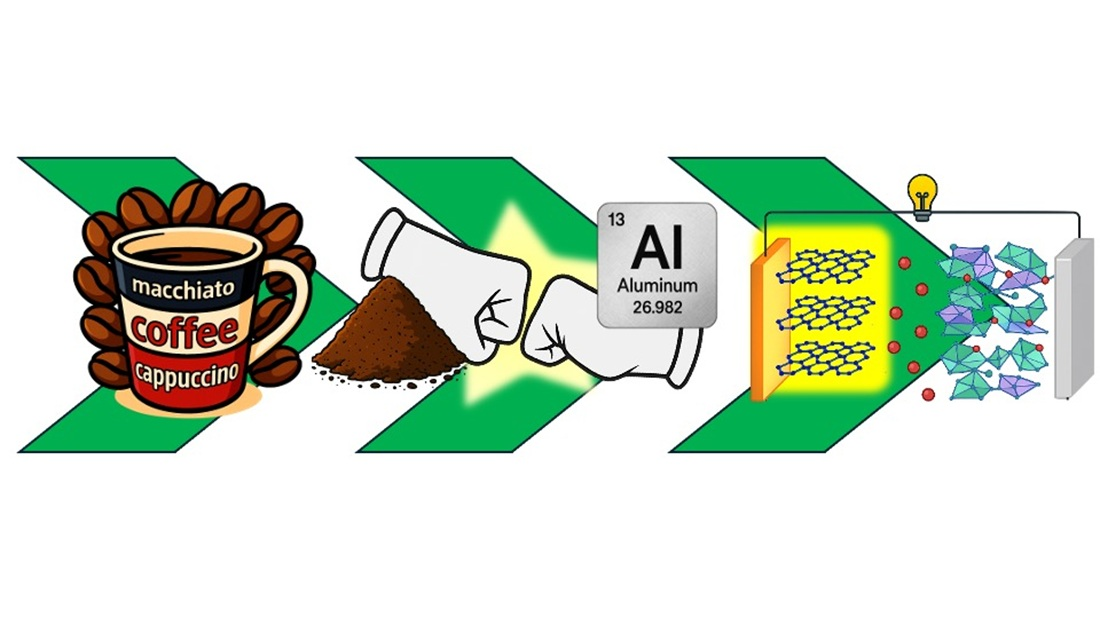
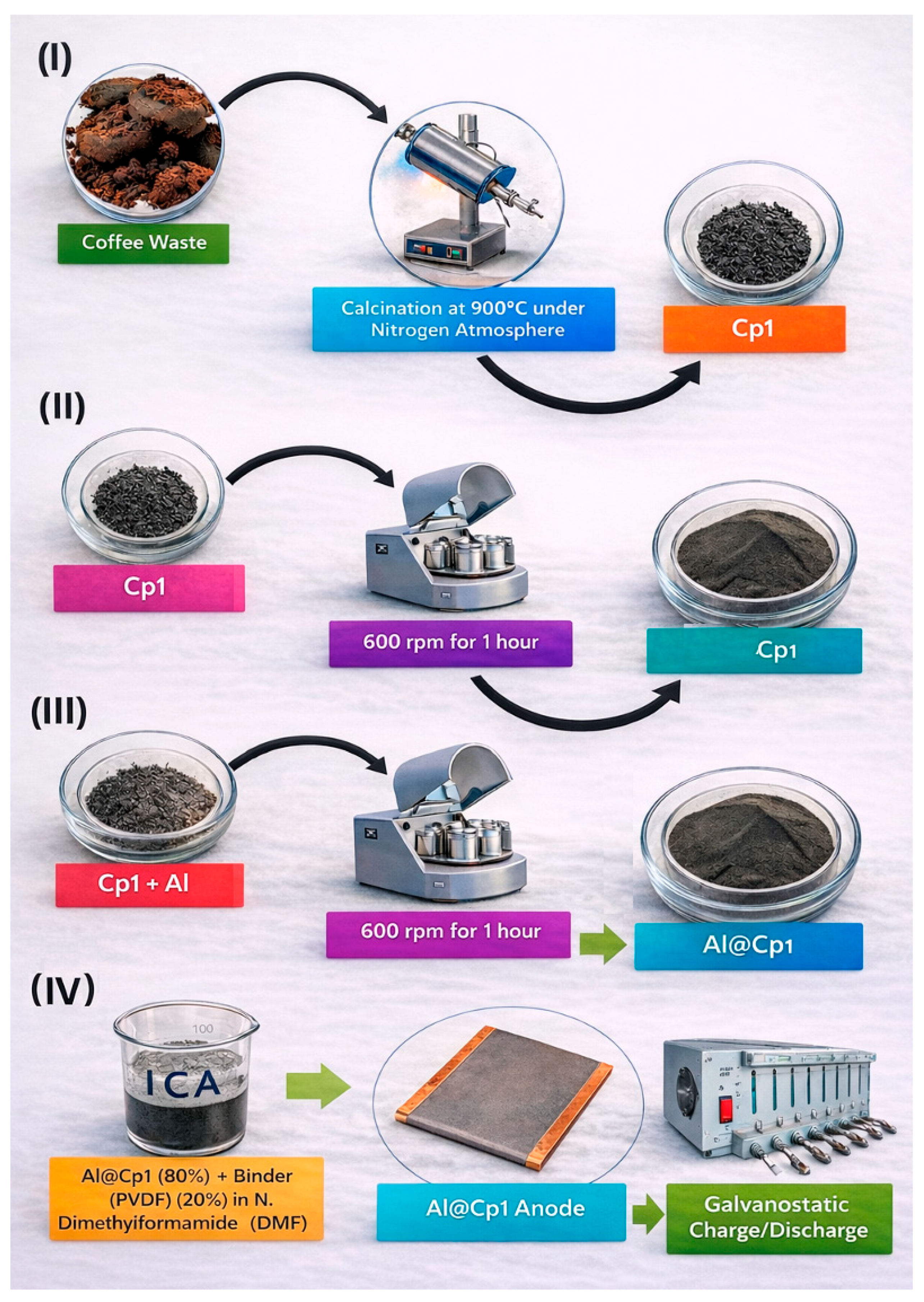
The anodic materials were synthesized through a straightforward two-step process, based on previously reported methodologies with some modifications [43,44]. In the first step, spent ground coffee obtained from conventional coffee machines was used as the carbon precursor and subjected to carbonization in a tubular furnace under a nitrogen-controlled atmosphere. The untreated precursor was placed directly into an alumina crucible. The thermal treatment consisted of heating from room temperature to 900 °C over a period of 2 h, with a ramp rate of 10 °C/min. Throughout the process, a continuous nitrogen flow was maintained through the quartz tube to ensure complete removal of water vapor and carbon dioxide (CO2). After cooling to room temperature, the resulting material, referred to as carbon Cp1, was subjected to a mechanochemical treatment. The milling process was performed with a mass ratio of 1:30 between the active material and 5 mm stainless steel balls, at a rotation speed of 600 rpm for 1 h (see Scheme 1, part I and II). In the case of the Al@Cp1 composite, the molar ratio between carbon Cp1 and Al (derived from the oxidation of metallic aluminum, 99%, Sigma-Aldrich) was 9:1, using the same mechanochemical treatment.

2.3. Structural, Morphological, and Thermal Characterization

Structural, morphological, and thermal characterizations of the Cp1 and Al@Cp1 electrodes were carried out using Raman spectroscopy, recorded using Raman RNS-4500 spectrometer (JASCO Co.; Kyoto, Japan). Powder X-Ray diffraction (PXRD) data were collected using a Bruker D8 Advance diffractometer (Bruker Co.; Billerica, MA, USA) fitted with a graphite monochromator using CuKα (λ = 1.54057 Å) radiation in the range 10° ≤ 2θ ≤ 70°, operated at 40 kV and 30 mA. Surface chemical composition was analyzed using X-Ray photoelectron spectroscopy (XPS) (STAIB Instruments, Langenbach, FS, Germany)with Al Kα radiation on a Staib Surface Analysis Station 1. High-resolution scans were used to determine the binding energies and oxidation states of the elements present. The energy scale was calibrated by referencing the C 1s peak of adventitious carbon to 284.8 eV. Field Emission Scanning Electron Microscopy (FESEM) and Energy-Dispersive X-Ray Spectroscopy (EDS) with a Thermo Fisher (FEI) FEG250 instrument (Thermo Scientific, Waltman, MA, United States) equipped with an EDS detector.

2.4. Electrode Preparation and Electrochemical Characterization

Anode electrodes incorporating the active materials Cp1 and Al@Cp1 were prepared using the doctor blade technique, with a copper current collector (TMAXCN, 99%) of 60 µm thickness. The electrode slurry was prepared by mixing 80% active material and 20% polyvinylidene fluoride (PVDF), using N,N-dimethylformamide (DMF) as the solvent, in a ratio of 0.8 g of active material to 2 g of solvent. The resulting electrodes were subsequently vacuum-dried at 100 °C for 12 h.
For electrochemical testing, CR2032-type coin cells with an active area of 2.01 cm2 and a mass loading of 1.70 mg cm−2 were assembled. A lithium chip (TMAX, 99.9%) was used as both the reference and counter electrode, in combination with a 3 μm porous polypropylene separator and a 1 M LiPF6 electrolyte in a 1:1 (v/v) mixture of ethylene carbonate (EC) and dimethyl carbonate (DMC) to construct the lithium-ion batteries (see Scheme 1, part III). All specific capacities are normalized to the mass of the active composite (Cp1 or Al@Cp1) in the electrode coating (excluding inactive components and the current collector, unless otherwise stated) [45,46].
Cyclic voltammetry (CV) measurements were carried out within a potential window ranging from 10 mV to 2.5 V vs. Li/Li+ using an Origalys OFG+O5A potentiostat/galvanostat. Scan rates of 0.1, 0.3, 0.5, 0.8, and 1 mV·s−1 were employed. Electrochemical impedance spectroscopy (EIS) was performed at open circuit potential over a frequency range of 0.1 Hz to 500 Hz, with an AC amplitude of 5 mV at room temperature, also using the Origalys OFG+O5A potentiostat/galvanostat. Galvanostatic charge–discharge (GCD) tests were conducted at 25 °C using a Neware Battery Tester system with specific current densities of 0.020, 0.025, 0.037, 0.074, and 0.37 A·g−1 (see Scheme 1, part III).

3. Results and Discussion

3.1. Structural and Morphological Characterization

3.1.1. Raman Spectroscopy Analysis

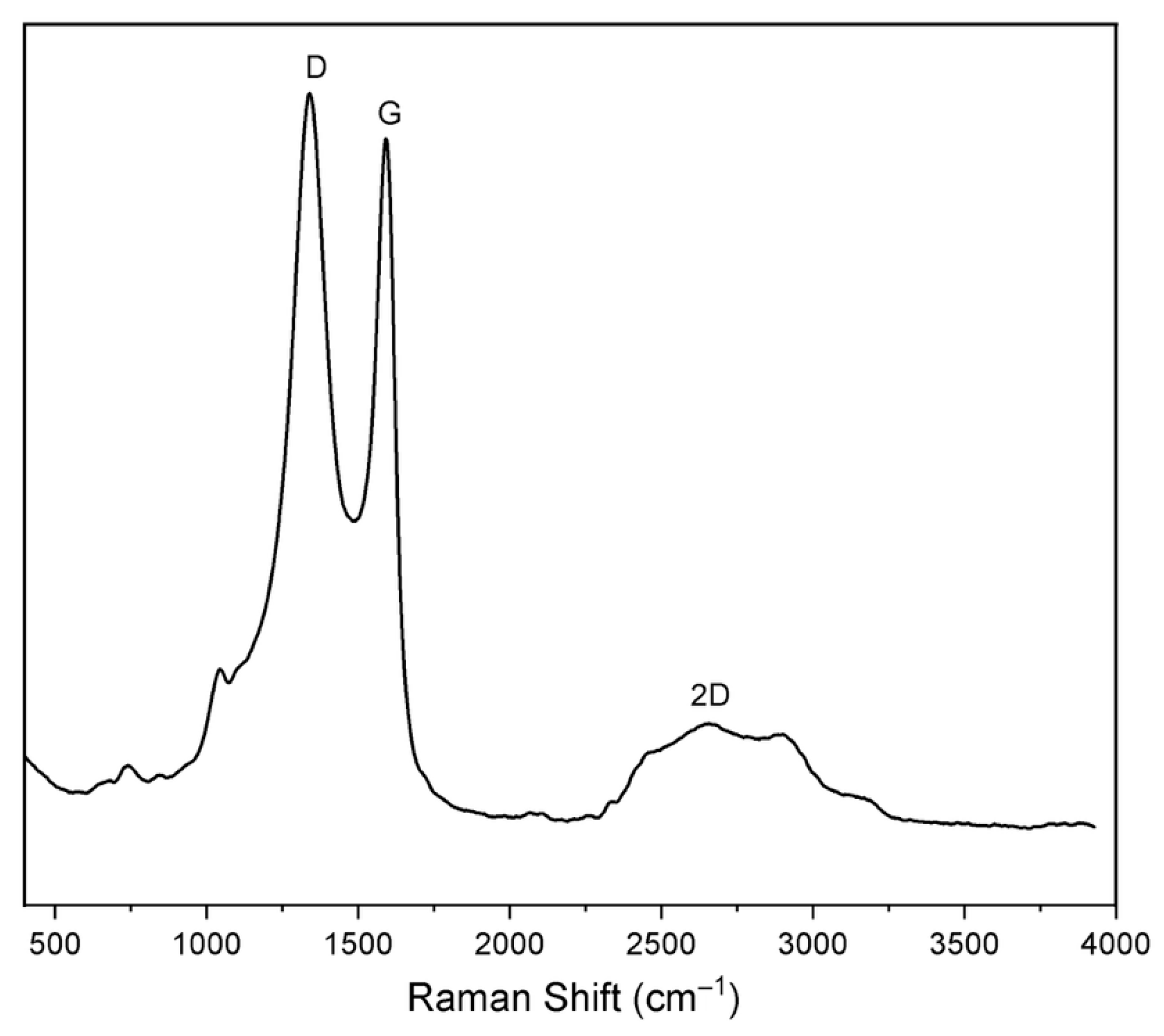
The Raman spectrum of Cp1 and Al@Cp1, is depicted in Figure 1 and Figure S1, respectively, revealing the characteristic D and G bands centered at 1346 cm−1 and 1591 cm−1, respectively. The D band is associated with structural defects, disordered carbon domains, and edge sites, while the G band corresponds to the E2g mode of sp2-hybridized carbon atoms in graphitic layers. The intensity ratio ID/IG = 1.04 indicates a moderately disordered structure, suggesting that the material consists of amorphous carbon with embedded nanocrystalline graphitic domains (See Figure 1). This ratio reflects a favorable level of carbonization and structural heterogeneity, which is consistent with previous studies of biomass-derived carbon material [10,47]. An ID/IG ratio close to 1 is often associated with a balance between conductivity and the presence of defect sites, which can facilitate lithium-ion intercalation in battery applications [48].
The full width at half maximum (FWHM) values for the D and G bands were 317.47 cm−1 and 168.47 cm−1, respectively. The broad D band confirms the presence of a high density of structural defects, while the relatively narrower G band indicates partial ordering in the carbon network. This combination of amorphous and graphitic features provides a dual advantage; it enhances lithium-ion diffusion through the disordered regions while maintaining electronic conductivity within the sp2-rich domains. From a structure–function standpoint, the combination of ID/IG ≈ 1 and the large D-band broadening indicates a high density of defect/edge sites and relatively small sp2 clusters embedded in an amorphous matrix. In disordered carbons, Raman D/G features primarily track the configuration and clustering of sp2 domains, so an increase in disorder/defects typically increases the population of electrochemically active adsorption sites while preserving percolating conductive pathways when graphitic nanodomains remain present [49]. Such defect-rich surfaces can boost the sloping-capacity contribution via Li+ adsorption at edges/defects and near-surface insertion, but they also raise surface reactivity toward electrolyte reduction and SEI growth, which is a known origin of low first-cycle efficiency in porous/disordered carbons [33,50,51]. Therefore, the Raman-derived defect signature is consistent with a trade-off: more active sites and improved kinetics at moderate rates, but a larger irreversible Li consumption during early SEI formation.
A broad and low-intensity 2D band is observed in the 2700–2800 cm−1 region. The weak intensity and broad profile rule out the presence of well-ordered graphite or monolayer graphene, suggesting the presence of turbostratic few-layer graphene structures or disordered graphitic stacking. This interpretation supports a hybrid structural model composed of amorphous carbon, nanocrystalline graphitic domains, and possibly partially delaminated graphene-like sheets. Such structural complexity is commonly reported in carbon materials obtained from biomass precursors subjected to pyrolysis under mild or non-equilibrium conditions [48].
The Raman spectrum of Al@Cp1 resulted in significant broadening of the D (~1346 cm−1) and G (~1591 cm−1) bands, accompanied by the complete disappearance of the 2D band (~2700 cm−1; See Figure S1 for more details). These spectral changes are indicative of increased structural disorder and the formation of poorly crystalline graphitic layers or turbostratic carbon. During the mechanochemical process, aluminum acts as an exfoliating or abrasive agent, disrupting the regular stacking of carbon layers and promoting the development of disordered graphitic domains [52,53]. This behavior is consistent with previous reports on the effects of mechanical and chemical treatments on carbon-based materials, which lead to increased defects and disorder, as evidenced by the broadening of Raman bands and the disappearance of the 2D band [54].
The observed Raman features not only confirm the structural modifications induced by aluminum but also provide evidence for the successful formation of a carbon–aluminum composite. The increased disorder and turbostratic character suggest a strong interaction between aluminum and the carbon matrix, pointing out that aluminum is effectively incorporated into the carbon structure. This integration likely results in the formation of a composite material with potentially enhanced functional properties for LIBs.

3.1.2. Powder XRD

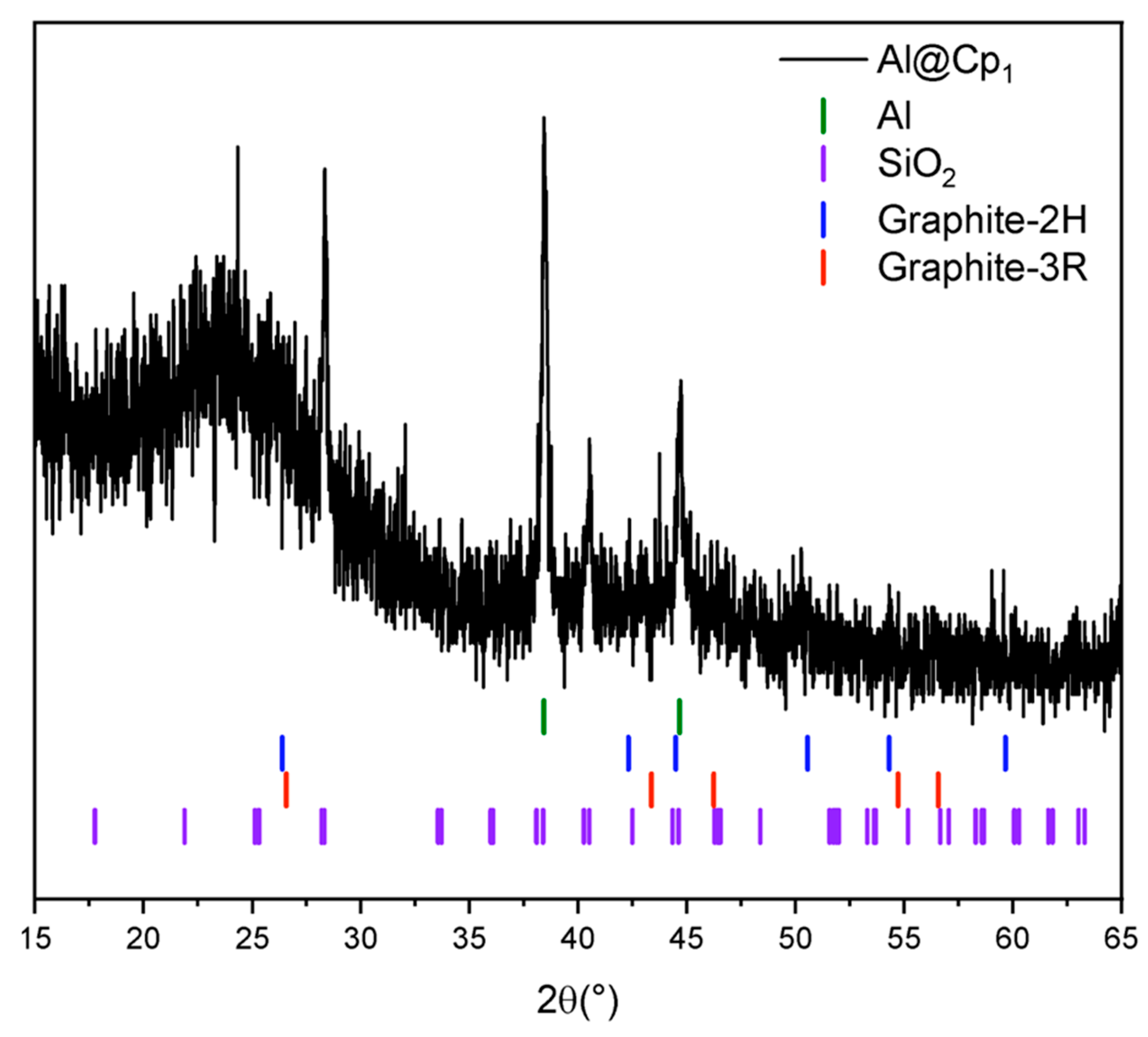
The powder X-Ray diffraction patterns of Cp1 and Al@Cp1 are depicted in Figures S2 and 2. Both exhibit broad and diffuse profiles, characteristic of a predominantly amorphous structure [55]. The main feature appears around 2θ ≈ 26°, corresponding to the convolution of the (002) plane of 2H graphite and the (003) plane of 3R graphite. This broad signal indicates a low degree of graphitic stacking order and suggests the presence of turbostratic carbon with poorly defined interlayer spacing [56]. Additional low-intensity and broad features are distinguished around 2θ ≈ 42.5°, 44.5°, and 54.5°, which are consistent with the expected positions of the (100) and (101) planes of the 2H polytype and the (101) and (012) planes of the 3R polytype. A final broad signal near 2θ ≈ 55–57° can be attributed to the overlapping (004)H + (006)R reflections. Although these features are extremely broadened and poorly resolved, they support the partial presence of both graphite polytypes embedded within an overall amorphous carbon matrix.
Quantitative analysis of the relative proportions of the 2H and 3R phases is not feasible due to the high degree of disorder, peak overlap, and low crystallinity of the sample. This behavior is typical of carbonaceous materials derived from biomass, in which the pyrolytic transformation is limited by the random distribution of precursor aromatic units and the absence of a well-defined templating mechanism [57]. The coexistence of 2H and 3R stacking sequences in such disordered graphitic materials is common, but often non-quantifiable in poorly crystalline systems [58].
The XRD diffractogram of the sample (Figure 2) reveals the formation of a multiphase composite consisting of disordered carbon, metallic aluminum, and graphitic domains. A broad diffraction band centered near 2θ ≈ 24.95° is assigned to the (002) plane of 2H graphite and the (003) plane of 3R graphite, which is indicative again of a turbostratic carbon matrix with a high degree of disorder and poor crystallinity. In comparison, the corresponding peak in the undoped carbon sample (Cp1) appears at 2θ ≈ 24.84°. This slight shift toward higher angles in Al@Cp1 suggests subtle but significant structural changes in the graphitic domains, likely attributed to the intercalation of aluminum or other impurities into the graphitic interlayers during mechanochemical processing.
Using Bragg’s law, the calculated d-spacing for d002 increases from 7.158 Å in Cp1 to 7.510 Å in Al@Cp1, an increase of ~12.15% compared to the standard graphite c-axis lattice parameter (c = 6.70 Å) [59]. The broad (002)/(003) feature and the expanded interlayer spacing further indicate turbostratic, poorly stacked graphitic domains rather than well-ordered graphite. In graphitic hosts, turbostratic disorder can ‘block’ galleries and disrupt staging transitions, thereby limiting the fraction of perfectly intercalation-accessible layers, while simultaneously promoting heterogeneous storage pathways [60,61]. In practical disordered carbons, lithium storage is therefore better described as a combination of (i) limited interlayer insertion within locally ordered domains and (ii) adsorption/insertion in defective regions and nanoporous environments, mechanisms that naturally align with the mixed amorphous/graphitic picture inferred from Raman and XRD [62]. This framework helps rationalize why increasing turbostratic disorder and defect density can improve apparent kinetics and rate response (shorter diffusion lengths, easier wetting), even if it does not maximize the theoretical graphite-like intercalation capacity. This c-axis expansion supports the hypothesis that aluminum acts not only as an abrasive or exfoliating agent, but also facilitates the intercalation of foreign species, leading to an increase in the interlayer distance.
These structural modifications are accompanied by the broadening and attenuation of graphite-related peaks and the appearance of reflections corresponding to metallic Al, confirming the formation of a composite material. These findings are consistent with Raman spectroscopy results, which show suppression of the 2D band and broadening of the D and G bands, further supporting the development of turbostratic and defective carbon structures induced by mechanochemical activation.

3.1.3. XPS Analyses

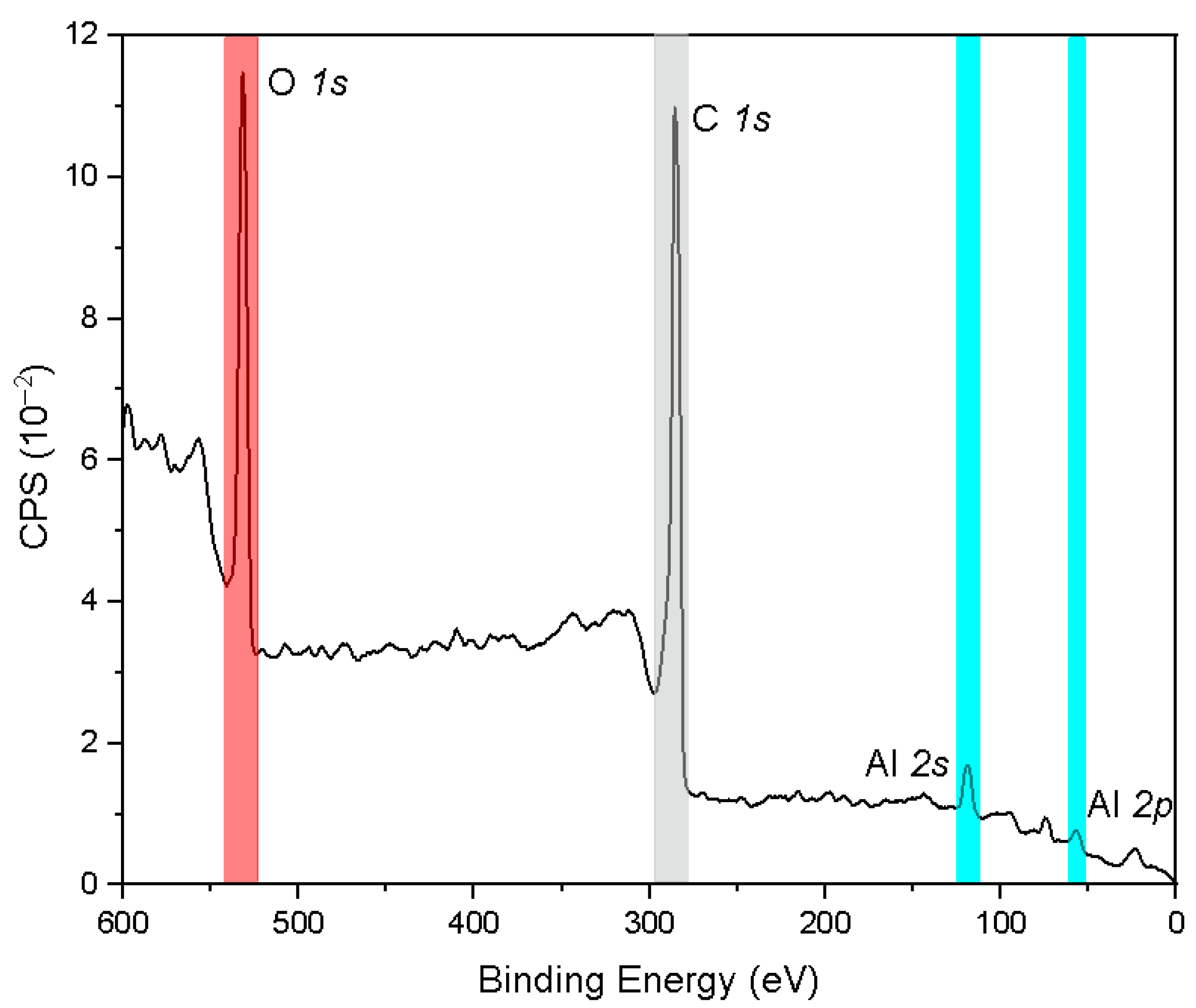
The XPS survey spectrum of the Al@Cp1 sample in Figure 3, confirms the presence of the main elements involved in the composite: carbon (C 1s), oxygen (O 1s), and aluminum (Al 2s and Al 2p). The sample exhibits a high atomic percentage of carbon relative to aluminum, consistent with the carbonaceous matrix being the dominant phase at the surface.
The high-resolution C 1s spectrum of the Al@Cp1 sample (see Figure S3 for more details) reveals multiple chemically distinct carbon environments through peak deconvolution. No signal attributable to C–Al bonding is detected in the high-resolution C 1s spectrum. According to the literature, a C–Al bond would typically appear at lower binding energies, around ~283 eV, slightly below the C–C sp2 peak [63]. Its absence suggests that aluminum is not covalently bonded to the carbon matrix but rather dispersed as oxide or hydroxide phases on or within the carbonaceous structure. The dominant contribution, centered at ~284.6 eV, corresponds to C–C/C=C bonds, indicative of sp2-hybridized graphitic carbon. This confirms the presence of a carbon matrix largely composed of aromatic, conjugated structures derived from biomass pyrolysis [64]. Additionally, other components are observed at higher binding energies. For instance, C–O species such as hydroxyl and ether groups are observed at ~285.5 eV; C=O groups (carbonyl derivatives) resulting from oxidized organic species or surface oxidation appear at ~286.6 eV; [65] O–C=O environments (e.g., carboxylic acids or esters), which may result from residual oxygenated organics in the precursor or post-treatment air exposure, are observed between 288.0 and 288.6 eV, and a minor feature above 289 eV may correspond to π → π * shake-up satellites, typical of highly conjugated systems [66]. The presence of multiple oxygenated carbon species supports the hypothesis of a partially oxidized surface, likely due to both the original functional groups from biomass and the mechanochemical incorporation of aluminum oxides/hydroxides. These oxygen-rich sites may contribute to enhanced interfacial interactions within the composite and potentially affect its electrochemical behavior.
The O 1s spectrum reveals two distinct contributions: a lower binding energy component (<531 eV), corresponding to Al2O3, and a second peak near 532 eV, which can be attributed to hydroxyl groups (Al–OH). This latter component may also include overlapping contributions from C=O functional groups, which typically appear in the same energy range, suggesting partial surface oxidation of the carbon framework (see Figure S4 for more details).
The Al 2p spectrum displays a broad signal that reflects the presence of multiple aluminum environments. Deconvolution analysis of this region confirms the presence of Al2O3, Al(OH)3, and a minor Al metal fraction (see Figure S5 for more details). The small Al(0) contribution is consistent with rapid spontaneous passivation of metallic aluminum upon air exposure, where a thin Al2O3 overlayer forms and yields an Al/Al2O3 core–shell configuration that attenuates the metallic Al signal in this surface-sensitive technique [67].
In addition, mechanochemical impacts during milling can locally disrupt the native oxide and expose fresh Al surfaces that rapidly re-passivate, further enriching Al–O species at the outermost surface detected by XPS [68].
Importantly, the presence of Al–O species at the surface does not necessarily imply an ion-blocking interphase. Prior studies indicate that Al2O3 coatings can lithiate and enable Li transport in their lithiated/amorphous states, supporting their frequent use as functional protective layers in Li-ion systems [69,70].
Moreover, in LiPF6-based electrolytes, trace moisture and salt/solvent decomposition can generate HF, which can react with Al2O3 to form AlF3; hence, mixed Al–O/Al–F surface chemistries may develop during electrochemical operation and contribute to interphase evolution and stability [71,72].

3.1.4. FE-SEM/EDS Analysis

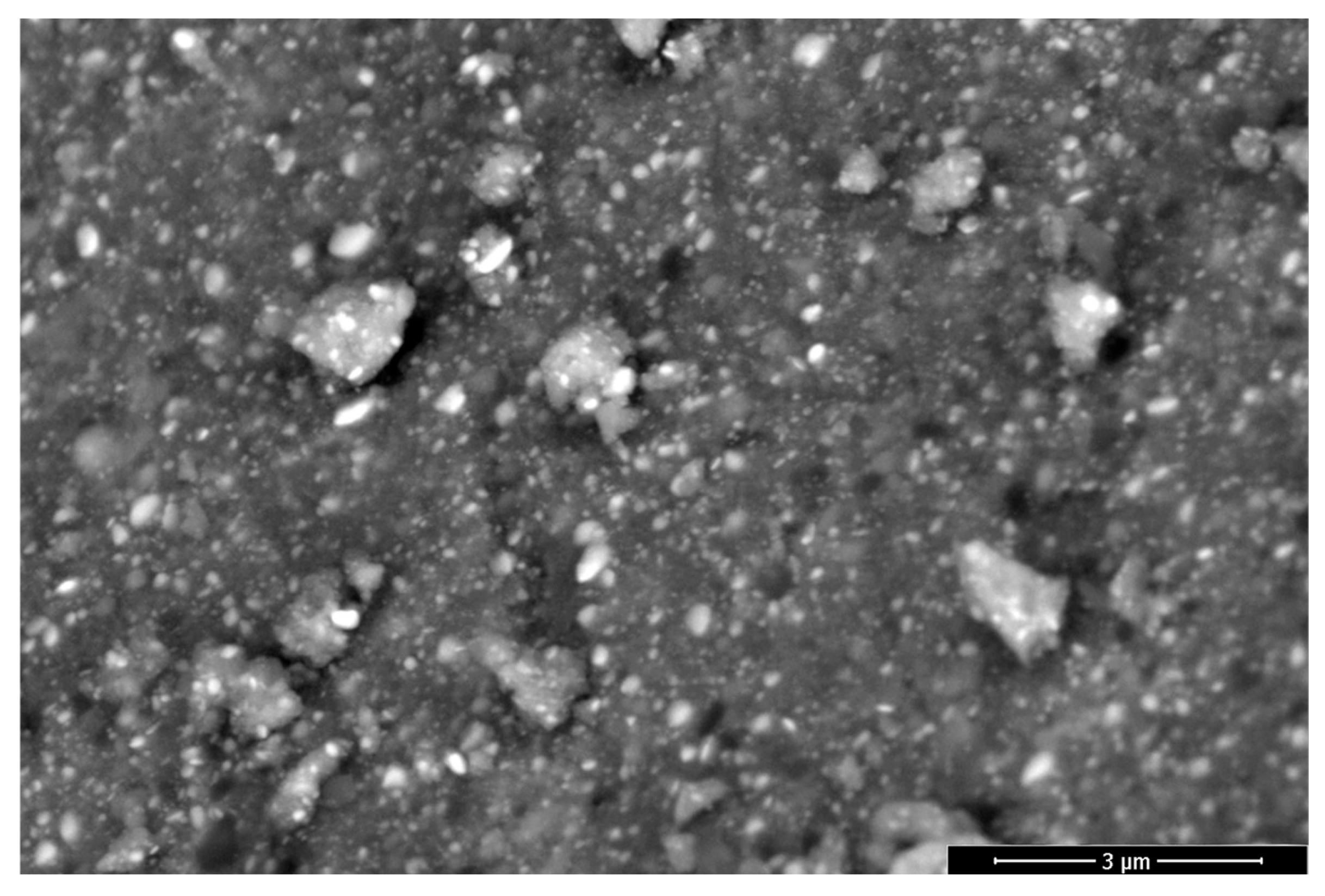
The FE-SEM micrographs reveal a heterogeneous surface morphology composed of dense carbonaceous regions interspersed with bright agglomerates, attributed to metallic and oxide inclusions. These features are consistent with the mechanochemical incorporation of aluminum into the carbon matrix (See Figure 4).
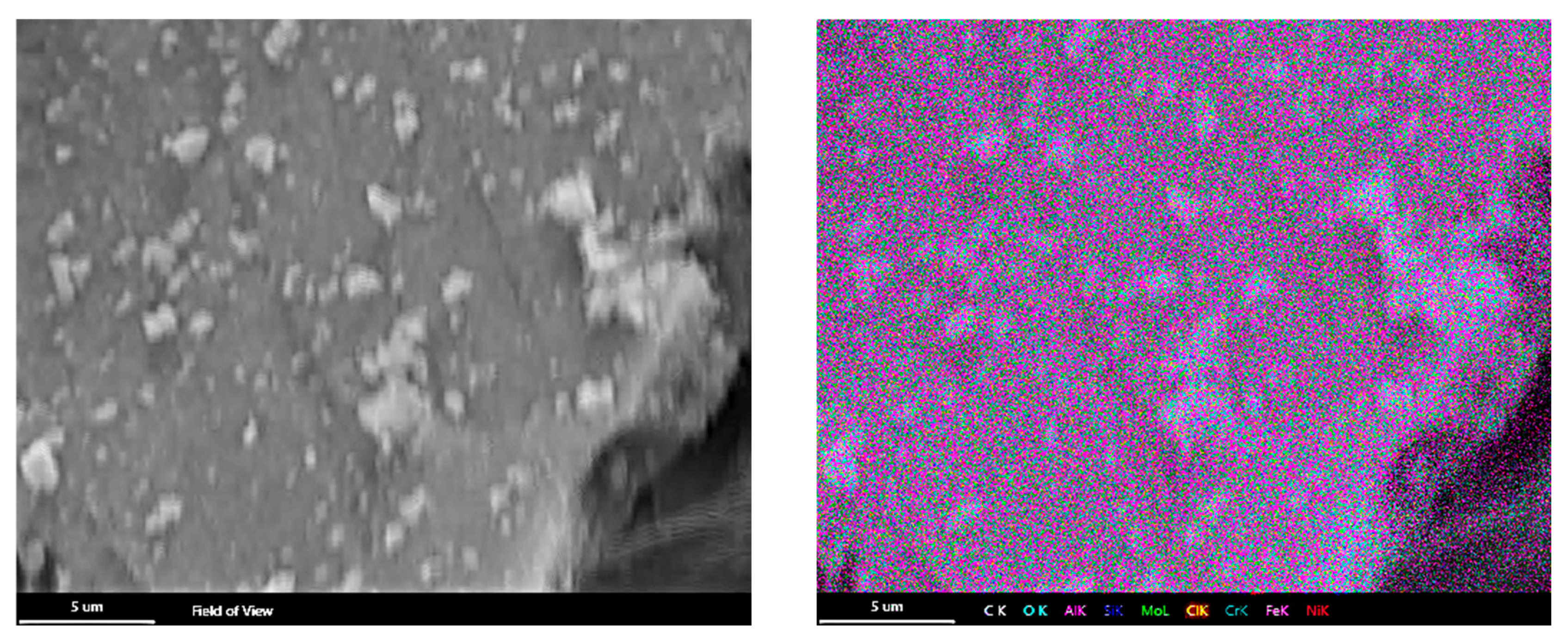
EDS analysis confirms the presence of carbon (C), oxygen (O), aluminum (Al), iron (Fe), and traces of chromium (Cr), nickel (Ni), molybdenum (Mo), chlorine (Cl), and silicon (Si). Three distinct areas were analyzed, all showing consistent results with the predominant elements being carbon, oxygen, aluminum, and iron (See Figure 5).
In all areas, carbon exhibits the highest atomic percentage, confirming the dominance of the pyrolyzed carbonaceous matrix. The detection of aluminum and oxygen supports the formation of aluminum oxide and hydroxide phases (Al2O3/Al(OH)3), as suggested by the XPS analysis. No Al-C bonding was detected, reinforcing the hypothesis that aluminum is physically embedded or deposited on the carbon surface as oxide/hydroxide particles, rather than chemically bonded. The elemental mapping shows a co-distribution of C, Al, and O, which indicates interfacial contact between the carbon and alumina phases at the submicron scale, further supporting the formation of a composite material.
On the other hand, the iron (Fe) content, which ranges from 26 to 67 wt%, indicates the possible incorporation of steel-derived contamination from grinding media during the mechanochemical process, a common occurrence in planetary milling [73]. In this sense Fe will not be an interferent in the electrochemical performance, because it is well-known that the redox couple Fe2+/Fe3+ or Fe3+/Fe4+ in cathodic materials are above 2.5 V vs. Li+/Li [74,75]. Trace levels of Cr, Ni, Mo, and Cl are likely residuals from the biomass precursor or milling vessel contamination (see Figures S6 and S7 for more details).
Finally, the FE-SEM/EDS results confirm that the resulting material exhibits a microstructure typical of mechanochemically synthesized composites, with a heterogeneous surface, abundant carbon domains, and well-dispersed oxide inclusions. These features may favor ion diffusion and electronic transport in electrochemical applications such as lithium-ion batteries, which agree with the observed electrochemical response discussed in the subsequent section.

3.2. Electrochemical Characterization

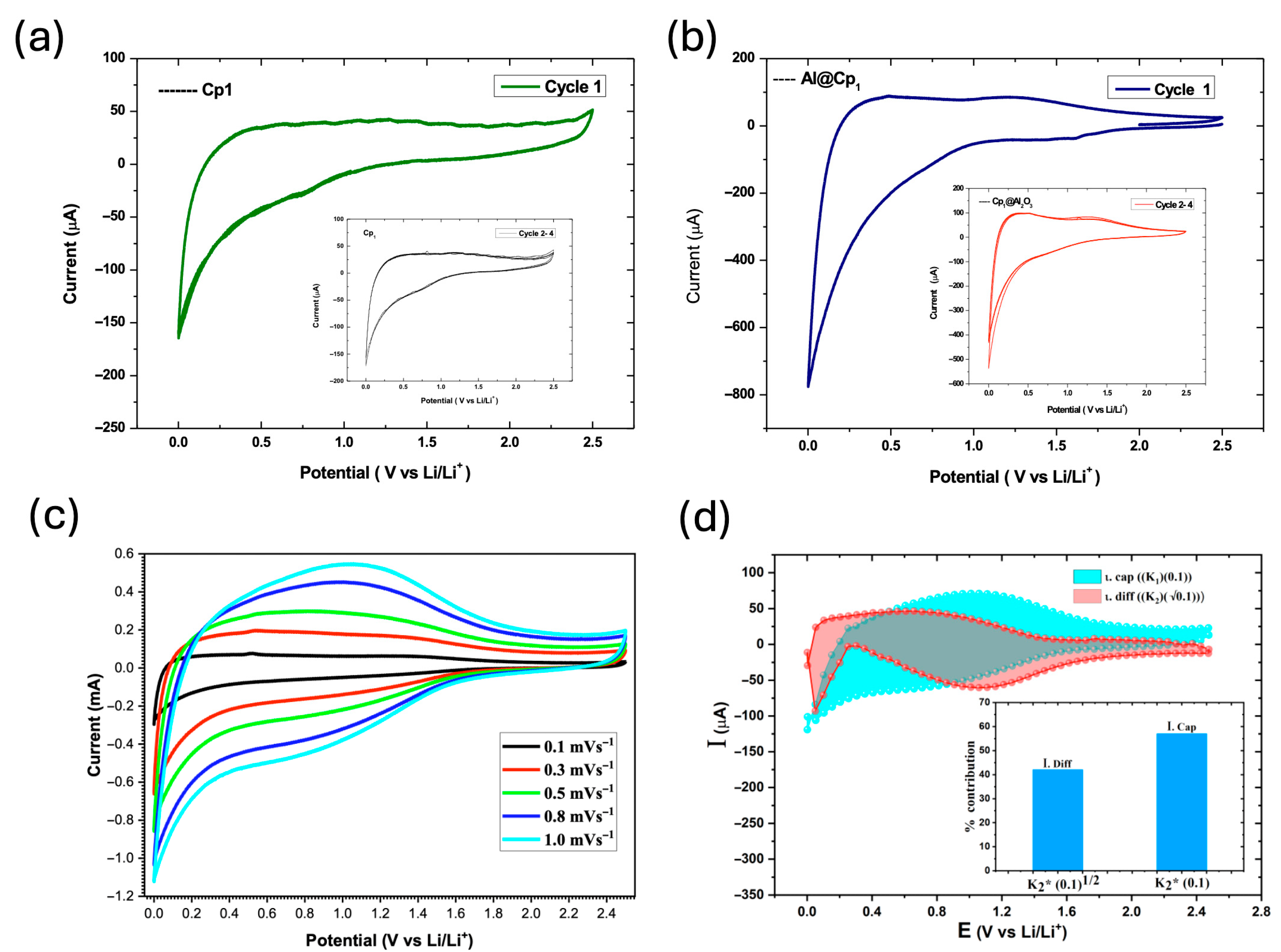
Figure 6 shows the respective voltammetric responses for Cp1 and Al@Cp1 electrodes at a scan rate of 0.1 mVs−1 in a lithium half-cell, using a potential window from 0.01 V to 2.5 V vs. Li/Li+. During the first cathodic scan, the Al@Cp1 electrode exhibits a markedly different voltammetry profile compared to subsequent cycles. In contrast, the Cp1 electrode shows consistent voltammetric responses without significant changes between cycles, although its response is not uniform. This highlights that the mechanochemical treatment significantly improves mass transport and ionic diffusion in the Al@Cp1 electrode, by an increase in the active surface area.
The Al@Cp1 electrode exhibits higher electrical conductivity with an approximately 100% increase in current (50 µA), highlighting the role of carbon mixed with Al2O3 generated during synthetical treatment, which enhances the current density responses. This enhancement can be attributed to the Li-Al alloy generation during discharge reactions [37]. Additionally, both ionic and electronic conductivity increase due to the formation of Li-Al-O channels during lithiation [41]. As previously reported [15,76,77], the electrode surface is likely dominated by the carbon/LixAlOy and Li1+xAl phases, irrespective of the degree of lithiation. Below 0.4 V, a pronounced increase in current is observed, which could be attributed to the phase transitions of α-Al and β-LiAl [76,77].
In cyclic voltammetry measurements for the Cp1 and Al@Cp1 electrodes, two minor peaks are observed at 1.6 V and 0.75 V versus Li/Li+ during the first cycle. The first signal is associated with the partially irreversible reduction in the electrolyte, leading to the formation of a thin protective solid electrolyte interface (SEI) layer on the electrode surface. The second signal correspond to lithium-ion intercalation on the material surface formed by carbon SEI [15]. Unlike the Cp1 electrode, the Al@Cp1 electrode shows an oxidation current signal at 0.43 V, which can be attributed to the presence of β-LiAl. A reduction process occurring at 0.31 V is also observed [77,78,79], but due to redox reactions involving the formation of LixAlO and Li1+xAl that predominate in the potential window from 1.0 V to 0.01 V vs. Li/Li+; this cathodic peak is superimposed [77]. The voltammetric responses of both materials show no significant changes in the overall shape of the voltammograms, while Al2O3 does not induce notable alterations in the current peak patterns, variations in current intensity are observed. This suggests that the incorporation of Al2O3 into the material promotes a complete reaction with the HF generated from the LiPF6 electrolyte, thereby inhibiting electrode corrosion and capacity loss [80]. The beneficial effect of Al2O3 addition can be related to (i) the enhancement of ionic conductivity through the formation of Li–Al–O phases, and (ii) its ability to absorb trace amounts of HF during charge–discharge processes, promoting the formation of a thin protective AlF3 film [80].
An analysis recorded at various scan rates (0.1, 0.3, 0.5, 0.8, and 1 mV·s−1) of Al@Cp1, reveals that the material retains high currents, in the range between 0.1 and 0.6 mA, even at fast scan rates (see Figure 6c). These results also indicate a notable shift in the charge storage mechanism, characterized by a predominant hybrid behavior involving both the carbon matrix and the Al2O3 component. The enhanced charge storage capacity and current response suggest that this system could deliver superior performance under high-rate conditions, thereby improving the power density of the battery and positioning it as a promising candidate for hybrid supercapacitor applications [81].
The charge storage mechanism, along with the diffusive/faradaic and capacitive contributions, is further analyzed using Dunn’s method (see Figure 6d) [82]. The contributions of capacitive and diffusional currents are 60 and 40% respectively, which agree with the profile shown in the cyclic voltammogram (Figure 6c) measured at different scan-rates and also with the impedance studies for each material (Figure 7).

3.2.1. EIS Analysis

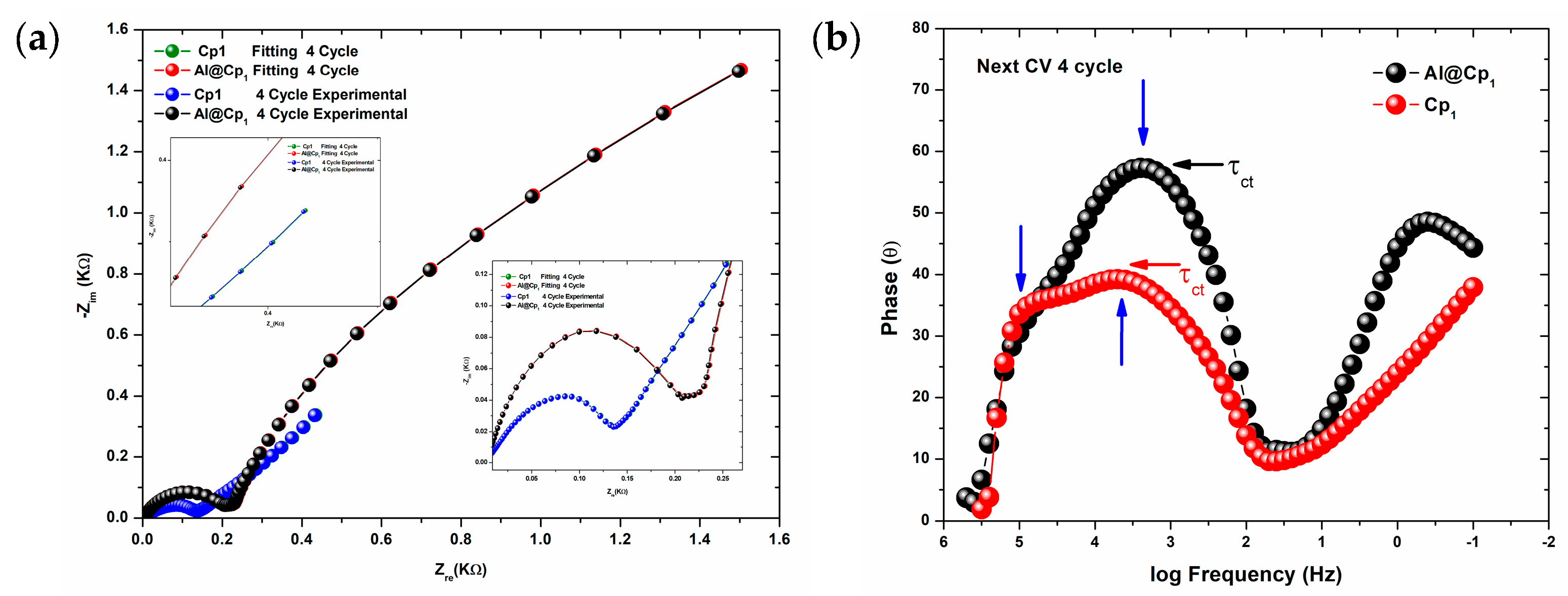
Electrode/electrolyte interfacial properties were analyzed by electrochemical impedance spectroscopy (EIS) at open circuit potential (OCP) in a lithium cell, for evaluating the Rs, R2, R3, CPEs 1-2, and W0, as well as other parameters such as the electrolyte resistance (Rs), the Warburg resistance (W0), the charge transfer time constant ( τ c t ), the diffusion-related time constants (WT), as well as the charge transfer resistance and the constant phase element (R2 (CPE1)) are now clearly defined. In addition, the resistance associated with faradaic charge transfer mechanisms of the material and the intercalation of Li+ ions (R3) have been specified, using the equations reported in Refs. [81,83,84]. Cp1 and Al@Cp1 electrodes were evaluated both before and after four cyclic voltammetry cycles. The Nyquist plot and the corresponding equivalent circuit (see Figure 7 and Scheme S1) reveal minor yet significant differences between the pristine electrodes and those analyzed after the fifth cycle, measured at a scan rate of 0.1 mV·s−1. In particular, the Nyquist plot shows the electrolyte resistance (Rs) in the high-frequency range, where the Al@Cp1 cell exhibits a lower Rs (3.447 Ω) than the Cp1 cell (5.365 Ω), indicating better wetting at the electrode/electrolyte interface and a reduced dependence on mass transport (see Scheme S1). The straight line with a slope close to 45°, probably related to semi-infinite diffusion, yields a Warburg resistance (Wo) of 10.66 Ω and a constant time of 34.88 s for the Al@Cp1 cell, while the Cp1 cell shows values of 17.02 Ω and 285.51 s, respectively. These data suggest that ions diffuse more efficiently at the double electric layer boundaries in the Al@Cp1 electrode, which is consistent with the shorter WT time constants pointing out a greater porous area, as previously confirmed by SEM images (see Section 3.1.4 for more details). Additionally, the Nyquist plot shows a semicircle in the medium-high frequency region, corresponding to the charge transfer resistance, which is represented as a constant phase element in the equivalent circuit (R2 (CPE1)). This resistance reflects the contributions of the electrode–electrolyte interface (SEI), indicating that electrodes without the presence of Al2O3 coating show a lower charge transfer during lithiation (See Table 2 for more details). This discrepancy can be partly explained by differences in SEI film and charge transfer process (with distinct time constants at the electrode/electrolyte interface), and electrode morphology. In the carbon-based Cp1 cell, the rigid material promotes an electric double layer mechanism and thus faster charge transfer. Additionally, the semicircle depicted in the medium-high frequency region (Figure 7a), is generated due to several interfacial processes involving the adjacent components in a lithium-ion battery [85,86]. These processes are modeled by the equivalent circuit shown in Scheme S1 [87], where the semicircle reflects two overlapping phenomena: one associated with interfacial effects and the other with charge transfer. This overlap is supported by the Bode plot, which clearly distinguishes the two processes in the logarithmic high-frequency region (Figure 7b).
The interfacial effects, associated with the SEI generation, are also represented in the R2 (CPE1) parallel section. The SEI originates from the decomposition of the electrolyte during the initial charge/discharge cycles, where the RSEI value is 129.20 Ω and 222.70 Ω for the Cp1 and Al@Cp1 electrodes, respectively. This difference is also observed in Bode’s plot, where Cp1 exhibits a slightly higher phase angle of 35°, indicated by the first blue arrow in Figure 7b. The lower resistance in the Cp1 electrode is attributed to the formation of a conventional SEI layer at the electrode–electrolyte interface; in contrast, the Al@Cp1 electrode forms not only the SEI but also an additional Li–Al–O layer. However, given the similar phase angle observed (33°), it is inferred that the total interfacial resistance (RSEI + RLi-Al-O) is influenced by this second layer, thereby modifying the typical charge/discharge mechanism during SEI formation in the early cycles [79,88,89,90].
The third component (R3 (CPE2)) in Scheme S1 corresponds to the charge transfer (Rct) resistance. The electrodes with Al2O3 enables the formation of new Li-Al-O-based pathways, exhibiting lower resistance to charge transfer processes during lithium-ion insertion, with values reported in Table S1 of 61.15 Ω and 12.08 Ω for Cp1 and Al@Cp1, respectively. The significant difference with Al2O3 can be attributed to the formation of a SEI/Li-Al-O composite film on the electrode, which improves the charge transfer processes, resulting in a remarkable different time constants at the electrode/electrolyte interface. This is also supported by the phase angle of 57°, which is higher than the 39° observed for the pristine Cp1 material. Thus, the low diffusion dependence may exert a synergistic effect on charge transfer processes, enhancing the high-rate performance of the Al@Cp1 electrode, which is supported by the response time (τ) reported in Table S1.
It is worth noting, in the CPEs impedance (CPE1 and CPE2), that the electrolyte resistance (Rs) (see Table S1) in the Al@Cp1 cell decreases during cyclic voltammetry. The Al@Cp1 cell were tested at a scan rate of 0.1 mV s−1 (Figure S10) under three different conditions: (i) before cyclic voltammetry cycles at OCP, (ii) after four cyclic voltammetry cycles, and (iii) over prolonged galvanostatic cycling periods at a high current density of 2 Ag−1 up to 500 cycles to evaluate the structural degradation. The reduction in Rs is even lower than that observed for the Cp1 cell (see inset in Figure S10), suggesting that the Li-O-Al channels formed during the charge and discharge cycles may improve ionic transport and wettability at the electrode–electrolyte interface. Subsequently, after the cyclic voltammetry cycles, the cell undergoes 500 cycles of charge and discharge, during which a decrease in electrolyte resistance is observed. This could indicate a structural and homogeneous rearrangement on the electrode surface, resulting in more uniform channels that enable better diffusion of Li+ ions. The charge transfer resistance (R2) of the Al@Cp1 cell also decreases after voltammetry, demonstrating that the presence of Al2O3 can improve both fast charge transfer processes and overall cell performance (See Table S1 for more details). After 500 galvanostatic charge/discharge cycles, other processes related to faradaic charge transfer mechanisms and Li+ ions intercalation (R3) decreases the resistance, suggesting the formation of well-ordered Li-O-Al channels in the Al@Cp1. These results highlight the significant impact of battery operation on the material properties. Notably, the Al@Cp1 electrode exhibits a substantial increase in charge transfer resistance compared to the pristine electrode (Figure S11), whereas the Cp1 electrode shows no appreciable change in this parameter.

3.2.2. Galvanostatic Charging and Discharging

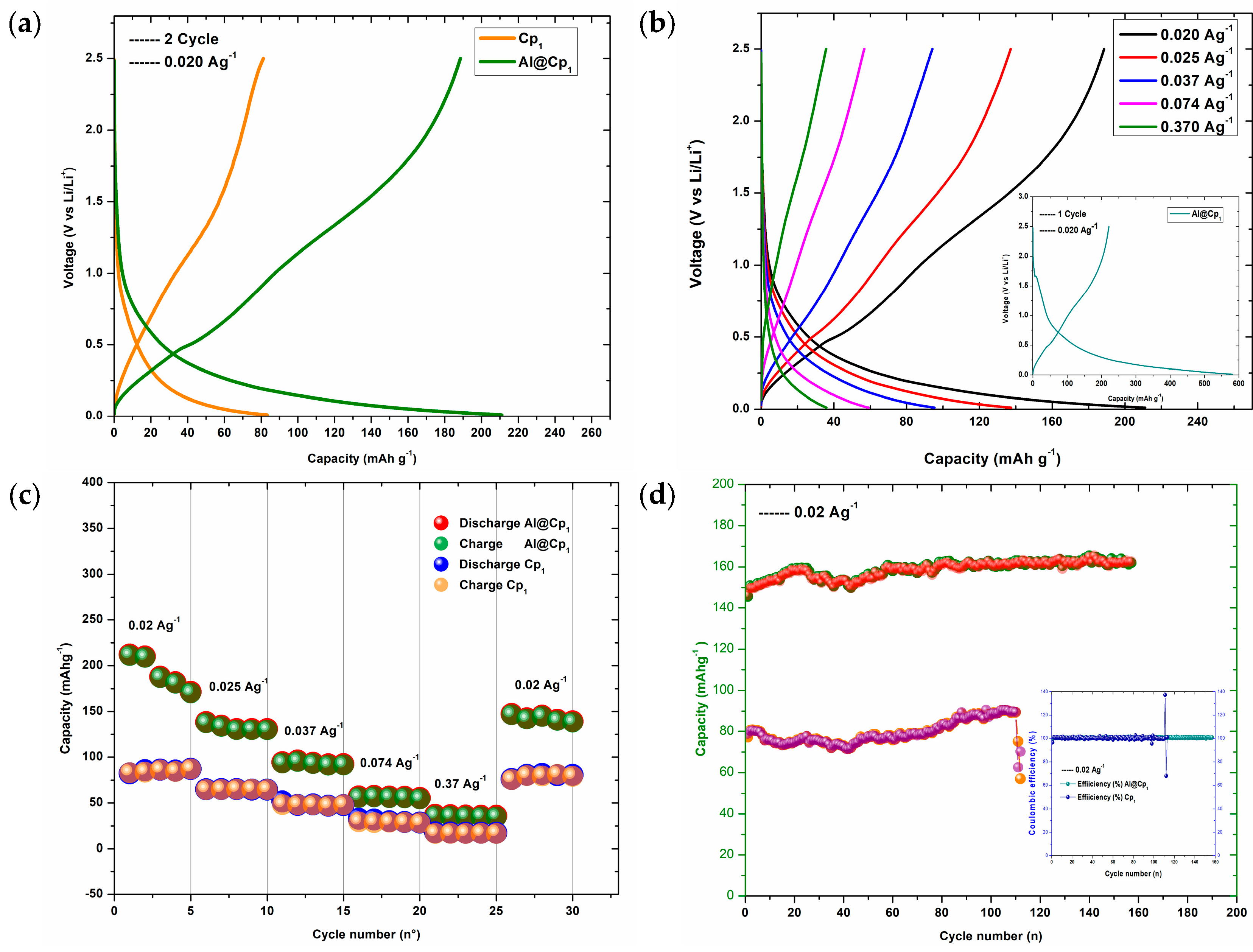
The specific capacities and the lithiation/delithiation processes of the Cp1 and Al@Cp1 electrodes were evaluated using the galvanostatic charge/discharge (GCD) technique, initially at a current density of 0.020 A·g−1 (Figure S11). The Al@Cp1 electrode exhibited a specific capacity of 212.06 mAh·g−1 with a 175% increase compared to the Cp1 electrode, which delivered a value of 82.99 mAh·g−1. However, the formation of Al2O3 during the mechanochemical procedure did not significantly affect the coulombic efficiency during the first discharge, which remained at 44% (see Figure S12), still within the typical range reported for amorphous porous carbons (~45%) [91]. The relatively low first-cycle coulombic efficiency is expected for porous, defect-rich amorphous carbons, because their large accessible surface area accelerates electrolyte reduction and consumes Li inventory to form (and thicken) the SEI, especially during the first lithiation [33,50,51]. Beyond surface reactions, pore networks can also be partially occupied by SEI products, reducing the effective electrochemically accessible porosity and thereby amplifying irreversible capacity losses; modeling and experimental analyses explicitly relate higher porosity to lower initial coulombic efficiency in porous carbon LIB anodes [92]. Consequently, the ~44% initial CE observed here is consistent with the expected penalty of high surface reactivity in exchange for improved wetting/transport, while the subsequent stabilization of capacity and impedance suggests progressive passivation toward a more stable interphase. After several galvanostatic charge/discharge cycles, the sustained higher capacity of the Al@Cp1 electrode suggests that the Al-containing surface layer evolves toward a more stable and functionally ion-permeable interphase. In LiPF6-based carbonate electrolytes, HF can be generated via trace water hydrolysis of PF6 and can promote surface fluorination/corrosion processes and continuous interphase reconstruction [71,93]. In this context, Al2O3/Al–OH surface species may progressively react with HF to yield Al–F-rich components (e.g., AlF3 and Al–O–F species), and fluoride-rich interphases/coatings have been shown to suppress parasitic reactions and stabilize interfaces, improving cycling efficiency [72,94]. Importantly, prior studies also indicate that Al2O3 coatings can lithiate and that Li transport through lithiated/amorphous Al2O3 is feasible, meaning that an Al2O3-derived interphase does not necessarily behave as an ion-blocking layer [69,70,95]. Consistent with this framework, an initial polarization penalty associated with surface oxide/hydroxide formation can be followed by reduced impedance once the interphase chemistry equilibrates, enabling improved lithiation/delithiation kinetics at longer cycle numbers
The performance of the Cp1 and Al@Cp1 electrodes under different charge rates was evaluated through galvanostatic charge/discharge tests, applying current densities of 0.020, 0.025, 0.037, 0.074, and 0.37 mA g−1 (Figure S12). At a gravimetric current of 0.020 mA g−1, specific capacities of 212.06 mAh g−1 and 82.99 mAh g−1 were obtained for the Al@Cp1 and Cp1 electrodes, respectively. As the current increased to 0.025 mAg−1, the specific capacity of the Cp1 electrode decreased more gradually, reaching 64.60 mAhg−1, which corresponds to a 22% loss relative to its initial capacity. This is typical behavior of carbon-based materials, which store charge primarily through double-layer capacitance [96,97,98]. In contrast, the Al@Cp1 electrode exhibited a sharper drop in specific capacity, decreasing to 138.44 mAhg−1 (a 34.71% reduction), suggesting that during the initial charge/discharge cycles, an incomplete reaction with HF from the electrolyte occurred, leading to only partial neutralization on the electrode surface despite the high capacities [91]. As the current density further increases, the specific capacity of the Al@Cp1 electrode tends to stabilize. This phenomenon is characteristic of coffee-based anode materials [55].
The rate capability recovery observed during the rate performance study indicates that the Al@Cp1 electrode exhibits a reversible capacity of 147.54 mAhg−1 at a gravimetric current density of 0.02 Ag−1, with a specific capacity retention of 69.57%. This value is lower than that of the carbon-based Cp1 material, which shows a specific capacity of 75.32 mAhg−1 and a capacity retention of 90.75%. These retention results are comparable to those reported for other coffee waste-derived anodes used in rechargeable energy storage systems, in which the Cp1 material maintains its structure during the first 30 charge/discharge cycles [47]. This behavior is attributed to its predominantly electrostatic charge storage mechanism. In contrast, the Al@Cp1 electrode shows more pronounced capacity fading during the initial 30 cycles, likely due to incomplete reactions with HF originating from the electrolyte [94]. However, when subjected to extended galvanostatic charge/discharge cycling at 0.02 A g−1, both electrode materials undergo an activation process after approximately 40 cycles (Figure 8b). The capacity recovery (“activation”) after ~40 cycles is consistent with cycling-induced capacity enhancement reported for porous/disordered carbon anodes, where progressive electrolyte infiltration and gradual access to previously inactive (“blind”/closed) pore volume increase the fraction of electrochemically accessible surfaces over time [99]. In parallel, the SEI evolves from a highly reactive, continuously growing interphase during the first tens of cycles to a more passivating and stable layer, which can lower polarization and unlock additional reversible storage once the electrode/interphase reaches a more equilibrated state [50,51].
Despite the subsequent increase in specific capacity, the Cp1 electrode begins to show capacity attenuation after 110 cycles, likely due to its inability to mitigate volume expansion effects or HF formation during deep cycling [91,94,100,101]. In contrast, the Al@Cp1 electrode displays markedly different response. After the activation process around cycle 40 prolonged galvanostatic cycles allows the Al2O3 layer to enhance the electronic conductivity and structural stability, and to effectively prevent the formation of HF in the electrolyte. The formation of Al2O3 contributes to reducing volume changes and corrosion effects induced by HF [101], ultimately achieving 100% capacity retention after 162 galvanostatic charge/discharge cycles, thus demonstrating superior electrochemical performance compared to the uncoated Cp1 electrode. It is worth noting that the electrode was also cycled at high currents for 500 cycles, exhibiting a capacity retention of 89.46% and a coulombic efficiency of 99.08% (see Figure S13).
The cyclic voltammetry responses shown in Figure S12a display typical electrochemical behavior and electrical conductivity similar to those of electrodes subjected to 1 h mechanochemical treatment. Furthermore, cyclic voltammetry analysis at different scan rates reveals a behavior consistent with that of the Al@Cp1 electrode, indicating increased electrical conductivity and current responses (see Figure S12b). Notably, the most significant improvements resulting from the mechanochemical treatment are reflected in the charge storage capacity. The Al@Cp1 electrode treated for 24h achieves reversible discharge capacities of 1430 mAhg−1 at a current density of 0.02 A g−1 (see Figure S12c,d), a value remarkably superior for carbon-based materials, reaching up to 666 mAhg−1 at 0.1 A g−1.
These ultrahigh capacities suggest that the mechanochemical treatment effectively increases the surface area, reduces particle size, and facilitates Li+ ion transport through Li-Al-O channels. Additional electrochemical improvements observed under varying current densities in Figure S13d, further demonstrate that a 24 h mechanochemical treatment leads to a capacity retention of 90.35% and significantly enhances cycling stability.

4. Conclusions

The incorporation of an Al2O3 layer into the Cp1 carbon-based electrode significantly enhances its electrochemical performance in lithium half-cell configurations. Electrochemical impedance spectroscopy (EIS) and galvanostatic charge/discharge analyses indicate that Al@Cp1 exhibits reduced electrolyte resistance (Rₛ) and charge transfer resistance (R2) after prolonged cycling, reflecting improved ionic conductivity and interfacial stability. These improvements are attributed to the formation of Li–O–Al channels at the electrode/electrolyte interface, which promote enhanced wettability and facilitate lithium-ion transport. This is consistent with the high and stable specific capacities retained over 500 charge/discharge cycles.
Although initial capacity losses were observed due to incomplete reactions with HF during early cycles, the Al@Cp1 electrode underwent a clear activation process after 40 cycles, enabling full utilization of the active material and significantly improving capacity retention and cycling stability. In contrast, the pristine Cp1 electrode, which primarily relies on electric double-layer charge storage, exhibited limited structural adaptability and experienced pronounced capacity fading under prolonged cycling due to its inability to effectively mitigate HF-induced degradation.
Rate performance tests further confirmed the superior behavior of Cp1@Al2O3, which maintained higher specific capacities across a range of current densities and showed excellent recovery upon returning to lower current rates. Remarkably, after 162 deep galvanostatic cycles, the Al@Cp1 retained 100% of its capacity, highlighting the dual role of the Al2O3 coating as both a protective barrier and an ionic conductor.
Despite the presence of inorganic impurities detected by FE-SEM, our findings underscore the effectiveness of Al2O3 surface modification in improving the structural integrity and long-term cycling stability of carbon-based electrodes, positioning Al@Cp1 as a promising candidate for next-generation lithium-ion battery electrodes with improved durability and electrochemical performance. Future work will focus more on systematically evaluating the impact of these impurities on electrochemical behavior and developing effective methods for their removal.

Supplementary Materials

The following supporting information can be downloaded at: https://www.mdpi.com/article/10.3390/batteries12020075/s1, Scheme S1. Equivalent circuit model for the Cp1 and Al@Cp1 electrodes studied by Electrochemical Impedance Spectroscopy (EIS). Table S1. Values obtained from the electrochemical impedance spectra of Cp1 and Al@Cp1 at open circuit potential (OCP) in the pristine state, after 4 cyclic voltammetry cycles at 1 mV·s−1, and after 500 charge–discharge cycles. Figure S1. Vibrational Raman spectrum of Al@Cp1. Figure S2. Powder diffractogram pattern of Cp1 compound and Bragg positions for 2H and 3R graphite polytypes. Figure S3. High-resolution C1s XPS spectrum of Al@Cp1. Figure S4. High-resolution O1s XPS spectrum of Al@Cp1. Figure S5. High-resolution Al 2p XPS spectrum of Al@Cp1. Figure S6. EDS spectrum of Al@Cp1 composite. Figure S7. Mapping of the Al@Cp1 composite: (a) carbon, (b) oxygen, (c) aluminum, (d) iron, and its traces: (e) chromium, (f) nickel, (g) molybdenum, (h) chlorine, and (i) silicon. Figure S8. Capacitive–diffusive contribution elucidated using Dunn’s method. Figure S9. Electrochemical analysis of the Al@Cp1 material at various scan rates, using CR2032 coin cells with metallic lithium as both counter and reference electrode, and 1 M LiPF6 as the electrolyte. Figure S10. Nyquist plot obtained by electrochemical impedance spectroscopy (EIS) at open circuit potential (OCP) for the Al@Cp1 electrode, measured before and after 4 cycles of cyclic voltammetry (CV), and after 500 cycles of charge/discharge at a current of 2 A g−1. Figure S11. Nyquist plot obtained by electrochemical impedance spectroscopy (EIS) at open circuit potential (OCP) for the Cp1 and Al@Cp1 electrode. Figure S12. Electrochemical characterization of the Al@Cp1 electrode treated for 24 h. (a) Cyclic voltammetry (CV) at a scan rate of 0.1 mV·s−1. (b) Cyclic voltammetry at different scan rates. (c) Galvanostatic charge/discharge profiles at various current densities. (d) Rate capability analysis of the electrode at different current densities during charge/discharge cycling. Figure S13. Cycling study of the Al@Cp1 electrodes via charge–discharge at 0.025 A·g−1, with the coulombic efficiency shown in blue.

Author Contributions

A.M.: Supervision, conceptualization, methodology, validation, writing—original draft preparation. S.C. (Silvio Ceballos): methodology, experiment, validation. Writing—reviewing and editing. S.C. (Sergio Conejeros): conceptualization, methodology, software, validation, writing—reviewing and editing. J.L.: draft preparation, reviewing and editing. K.G.: methodology, experiments, validation, writing—reviewing and editing. J.C.: supervision, conceptualization, methodology, software, validation, writing—original draft preparation. All authors have read and agreed to the published version of the manuscript.

Funding

This research was funded by Agencia Nacional de Investigación y Desarrollo, grant number 3240727 and Núcleo de materiales funcionales No. 8, grant number UCN-VRIDT 076/2020.

Data Availability Statement

The original contributions presented in this study are included in the article/Supplementary Materials. Further inquiries can be directed to the corresponding authors.

Acknowledgments

Authors thank Agencia Nacional de Investigación y Desarrollo (ANID-Chile) for the financial support for this research (Grant No. 3240727). Authors would also like to thank the support from Unidad de Equipamiento Científico MAINI-UCN through Powder X-Ray Diffraction data (DRX—FIC Regional EQU 25 Conicyt 2010). “Centro Lithium I+D+i” “Núcleo de materiales funcionales” No. 8 UCN-VRIDT 076/2020, Vicerrectoría de Investigación y Desarrollo Tecnológico (VRIDT-UCN) and Dirección de Investigación y Análisis de la Producción Científica (DIAPC-UCN) of the Universidad Católica del Norte for scientific support.

Conflicts of Interest

The authors declare no conflicts of interest.

References

  1. Clifford, M.; Williams, T.; Bridson, D. Chlorogenic acids and caffeine as possible taxonomic criteria in Coffea and Psilanthus. Phytochemistry 1989, 28, 829–838. [Google Scholar] [CrossRef]
  2. Murthy, P.S.; Naidu, M.M. Sustainable management of coffee industry by-products and value addition—A review. Resour. Conserv. Recycl. 2012, 66, 45–58. [Google Scholar] [CrossRef]
  3. Mukurala, N.; Bin Jo, H.; Kim, H.M.; Lee, H.J.; Lee, G.; Jin, S.H. Coffee Ground Matrix Frame-Based Transient Battery for Environmentally Sustainable Sensor Applications. Adv. Mater. Technol. 2025, 10, 2500066. [Google Scholar] [CrossRef]
  4. Bairwan, R.D.; Khalil HPS, A.; Nuryawan, A.; Ahmad, M.I.; Kassim, M.H.M.; Ahmad, A. Enhancing biopolymer materials with coffee waste-derived reinforcements. Polym. Eng. Sci 2025, 65, 455–477. [Google Scholar] [CrossRef]
  5. Mussatto, S.I.; Machado, E.M.; Martins, S.; Teixeira, J.A. Production, composition, and application of coffee and its industrial residues. Food Bioprocess Technol. 2011, 4, 661–672. [Google Scholar] [CrossRef]
  6. Franca, A.S.; Oliveira, L.S.; Ferreira, M.E. Kinetics and equilibrium studies of methylene blue adsorption by spent coffee grounds. Desalination 2009, 249, 267–272. [Google Scholar] [CrossRef]
  7. Balat, M. Mechanisms of thermochemical biomass conversion processes. Part 1: Reactions of pyrolysis. Energy Sources A Recovery Util. Environ. Eff. 2008, 30, 620–635. [Google Scholar] [CrossRef]
  8. Yang, H.; Yan, R.; Chen, H.; Lee, D.H.; Zheng, C. Characteristics of hemicellulose, cellulose and lignin pyrolysis. Fuel 2007, 86, 1781–1788. [Google Scholar] [CrossRef]
  9. Muensri, P.; Kunanopparat, T.; Menut, P.; Siriwattanayotin, S. Effect of lignin removal on the properties of coconut coir fiber/wheat gluten biocomposite. Compos. Part A Appl. Sci. 2011, 42, 173–179. [Google Scholar] [CrossRef]
  10. Destyorini, F.; Irmawati, Y.; Hardiansyah, A.; Widodo, H.; Yahya, I.N.D.; Indayaningsih, N.; Yudianti, R.; Hsu, Y.-I.; Uyama, H. Formation of nanostructured graphitic carbon from coconut waste via low-temperature catalytic graphitisation. Eng. Sci. Technol. Int. J. 2021, 24, 514–523. [Google Scholar] [CrossRef]
  11. Destyorini, F.; Yudianti, R.; Irmawati, Y.; Hardiansyah, A.; Hsu, Y.-I.; Uyama, H. Temperature driven structural transition in the nickel-based catalytic graphitization of coconut coir. Diam. Relat. Mater. 2021, 117, 108443. [Google Scholar] [CrossRef]
  12. An, J.; Wang, F.; Yang, J.-Y.; Li, G.; Li, Y. An ion-pumping interphase on graphdiyne/graphite heterojunction for fast-charging lithium-ion batteries. CCS Chem. 2024, 6, 110–124. [Google Scholar] [CrossRef]
  13. Mei, W.; Zhang, Y.; Li, Y.; Zhuo, P.; Chu, Y.; Chen, Y.; Jiang, L.; Zhou, H.; Sun, J.; Wang, Q. Unveiling voltage evolution during Li plating-relaxation-Li stripping cycling of lithium-ion batteries. Energy Storage Mater. 2024, 66, 103193. [Google Scholar] [CrossRef]
  14. Pierson, H.O. Graphite structure and properties. Handb. Carbon Graph. Diam. Fuller. 1993, 43–69. [Google Scholar]
  15. Barcaro, E.; Marangon, V.; Mutarelli, M.; Hassoun, J. A lithium-ion battery with cycling stability promoted by the progressive activation of a silicon oxide anode in graphene-amorphous carbon matrix. J. Power Sources 2024, 595, 234059. [Google Scholar] [CrossRef]
  16. Yang, J.-L.; Zhao, X.-X.; Li, W.-H.; Liang, H.-J.; Gu, Z.-Y.; Liu, Y.; Du, M.; Wu, X.-L. Advanced cathode for dual-ion batteries: Waste-to-wealth reuse of spent graphite from lithium-ion batteries. EScience 2022, 2, 95–101. [Google Scholar] [CrossRef]
  17. Liu, J.; Shi, H.; Hu, X.; Geng, Y.; Yang, L.; Shao, P.; Luo, X. Critical strategies for recycling process of graphite from spent lithium-ion batteries: A review. Sci. Total Environ. 2022, 816, 151621. [Google Scholar] [CrossRef]
  18. Liu, L.; Xie, F.; Lyu, J.; Zhao, T.; Li, T.; Choi, B.G. Tin-based anode materials with well-designed architectures for next-generation lithium-ion batteries. J. Power Sources 2016, 321, 11–35. [Google Scholar] [CrossRef]
  19. Yang, X.; Wei, C.; Zhang, G. Activated carbon aerogels with developed mesoporosity as high-rate anodes in lithium-ion batteries. J. Mater. Sci. 2016, 51, 5565–5571. [Google Scholar] [CrossRef]
  20. Hernández-Rentero, C.; Marangon, V.; Olivares-Marín, M.; Gómez-Serrano, V.; Caballero, Á.; Morales, J.; Hassoun, J. Alternative lithium-ion battery using biomass-derived carbons as environmentally sustainable anode. J. Colloid Interface Sci. 2020, 573, 396–408. [Google Scholar] [CrossRef] [PubMed]
  21. Gaber, S.; Mohammed, A.K.; Javaregowda, B.H.; Martínez, J.I.; Sánchez, P.P.; Gándara, F.; Krishnamoorthy, K.; Shetty, D. MOFite: A High-Density Lithiophilic and Scalable Metal–Organic Framework Anode for Rechargeable Lithium-Ion Battery. Angew. Chem. Int. Ed. 2024, 63, e202409256. [Google Scholar] [CrossRef] [PubMed]
  22. Tian, W.; Zhang, H.; Duan, X.; Sun, H.; Shao, G.; Wang, S. Porous carbons: Structure-oriented design and versatile applications. Adv. Funct. Mater. 2020, 30, 1909265. [Google Scholar] [CrossRef]
  23. Ni, W.; Shi, L. Layer-structured carbonaceous materials for advanced Li-ion and Na-ion batteries: Beyond graphene. J. Vac. Sci. Technol. A 2019, 37, 040803. [Google Scholar] [CrossRef]
  24. Zheng, T.; Boles, S.T. Lithium aluminum alloy anodes in Li-ion rechargeable batteries: Past developments, recent progress, and future prospects. Prog. Energy 2023, 5, 032001. [Google Scholar] [CrossRef]
  25. Nazhipkyzy, M.; Maltay, A.B.; Askaruly, K.; Assylkhanova, D.D.; Seitkazinova, A.R.; Mansurov, Z.A. Biomass-derived porous carbon materials for Li-ion battery. Nanomaterials 2022, 12, 3710. [Google Scholar] [CrossRef]
  26. Vo, T.N.; Dang, N.K.; Le, M.L.P.; Nguyen, V.H.; Tran, V.M.; Nguyen, M.T.; Tran, N.H.T.; Nguyen, T.L.; Kim, I.T. ZnCl2-based activation for converting spent coffee grounds into a robust anode for Li-ion batteries. Biomass Bioenergy 2024, 181, 107058. [Google Scholar] [CrossRef]
  27. Kim, J.; Yu, D.; Kim, D.; Kim, J.; Yang, J. Development of bio-graphite from waste coffee grounds via catalytic graphitization for sustainable Lithium ion batteries anodes. FlatChem 2025, 51, 100867. [Google Scholar] [CrossRef]
  28. Cao, W.; Liu, M.; Song, W.; Li, Z.; Li, B.; Wang, P.; Fisher, A.; Niu, J.; Wang, F. Regulating Sodium Deposition Behavior by a Triple-Gradient Framework for High-Performance Sodium Metal Batteries. Adv. Sci. 2024, 11, 2402321. [Google Scholar] [CrossRef]
  29. Lu, Z.; Xiao, J.; Xie, H.; Song, W.; Fujishige, M.; Takeuchi, K.; Endo, M.; Li, Z.; Niu, J.; Wang, F. From waste to wealth: Cd-adsorbed rapeseed meal towards CdS-decorated nanocarbons for high-performance sodium metal batteries. Energy Storage Mater. 2025, 80, 104393. [Google Scholar] [CrossRef]
  30. Winter, M.; Besenhard, J.O. Electrochemical lithiation of tin and tin-based intermetallics and composites. Electrochim. Acta 1999, 45, 31–50. [Google Scholar] [CrossRef]
  31. Pathak, R.; Gurung, A.; Elbohy, H.; Chen, K.; Reza, K.M.; Bahrami, B.; Mabrouk, S.; Ghimire, R.; Hummel, M.; Gu, Z. Self-recovery in Li-metal hybrid lithium-ion batteries via WO3 reduction. Nanoscale 2018, 10, 15956–15966. [Google Scholar] [CrossRef] [PubMed]
  32. Geng, P.; Zheng, S.; Tang, H.; Zhu, R.; Zhang, L.; Cao, S.; Xue, H.; Pang, H. Transition metal sulfides based on graphene for electrochemical energy storage. Adv. Energy Mater. 2018, 8, 1703259. [Google Scholar] [CrossRef]
  33. Etacheri, V.; Marom, R.; Elazari, R.; Salitra, G.; Aurbach, D. Challenges in the development of advanced Li-ion batteries: A review. Energy Environ. Sci. 2011, 4, 3243–3262. [Google Scholar] [CrossRef]
  34. Ge, M.; Cao, C.; Biesold, G.M.; Sewell, C.D.; Hao, S.M.; Huang, J.; Zhang, W.; Lai, Y.; Lin, Z. Recent advances in silicon-based electrodes: From fundamental research toward practical applications. Adv. Mater. 2021, 33, 2004577. [Google Scholar] [CrossRef]
  35. Baker, H.; Okamoto, H. ASM Handbook. Vol. 3. Alloy Phase Diagrams; ASM International: Materials Park, OH, USA, 1992; Vol. 3, 501p. [Google Scholar]
  36. Trifonova, A.V.; Momchilov, A.A.; Puresheva, B.L.; Abrahams, I. Electrochemical lithium intercalation in lead–tin–aluminium solder. Solid State Ion. 2001, 143, 319–328. [Google Scholar] [CrossRef]
  37. Lindsay, M.; Wang, G.; Liu, H. Al-based anode materials for Li-ion batteries. J. Power Sources 2003, 119, 84–87. [Google Scholar] [CrossRef]
  38. Zou, S.; Wang, G.; Zhang, Y.; Xue, C.; Chen, H.; Yang, G.; Nan, H.; Wei, H.; Lin, H. Nano-structure and characterization of carbon composite with Al3+ and Mn4+ co-doped Li4Ti5O12 as anodes for Li-ion batteries. J. Alloys Compd. 2020, 816, 152609. [Google Scholar] [CrossRef]
  39. Wang, Y.; Ma, L.; Xi, X.; Nie, Z.; Zhang, Y.; Wen, X.; Lyu, Z. Regeneration and characterization of LiNi0.8Co0.15Al0.05O2 cathode material from spent power lithium-ion batteries. Waste Manag. 2019, 95, 192–200. [Google Scholar] [CrossRef]
  40. Ma, L.; Liu, G.; Wang, Y.; Xi, X. Preparation and performance of regenerated Al2O3-coated cathode material LiNi0.8Co0.15Al0.05O2 from spent power lithium-ion batteries. Molecules 2023, 28, 5165. [Google Scholar] [CrossRef]
  41. Wang, H.; Lai, F.; Zhang, X.; Li, Q.; Huang, Y.; Wu, Q. Electrochemical Performance of 2D Nano Al2O3-coated LiMn2O4 Cathode Materials for Lithium-ion Batteries. MME 2015, 35, 123–126. [Google Scholar] [CrossRef]
  42. Shin, J.; Cho, E. Agglomeration mechanism and a protective role of Al2O3 for prolonged cycle life of Si anode in lithium-ion batteries. Chem. Mater. 2018, 30, 3233–3243. [Google Scholar] [CrossRef]
  43. Dai, L.; Li, B.; Li, J.; Xu, Z. One-step mechanochemical method in preparing graphene materials from spent lithium-ion battery anode graphite for electrochemical application. Carbon Neutrality 2025, 4, 12. [Google Scholar] [CrossRef]
  44. Paramitha, T.; Fatimah, R.R.; Tachtiar, A.H.A. Extraction of Silica (SiO2) from corn leaves waste as anode in Lithium-Ion Batteries. J. Phys. Conf. Ser. 2025, 2945, 012020. [Google Scholar] [CrossRef]
  45. Stephan, A.K. Standardized battery reporting guidelines. Joule 2021, 5, 1–2. [Google Scholar] [CrossRef]
  46. Lin, Z.; Liu, T.; Ai, X.; Liang, C. Aligning academia and industry for unified battery performance metrics. Nat. Commun. 2018, 9, 5262. [Google Scholar] [CrossRef]
  47. Chiang, P.-H.; Liu, S.-F.; Hung, Y.-H.; Tseng, H.; Guo, C.-H.; Chen, H.-Y. Coffee-ground-derived nanoporous carbon anodes for sodium-ion batteries with high rate performance and cyclic stability. Energy Fuels 2020, 34, 7666–7675. [Google Scholar] [CrossRef]
  48. Liu, P.; Si, Z.; Lv, W.; Wu, X.; Ran, R.; Weng, D.; Kang, F. Synthesizing multilayer graphene from amorphous activated carbon via ammonia-assisted hydrothermal method. Carbon 2019, 152, 24–32. [Google Scholar] [CrossRef]
  49. Ferrari, A.C.; Robertson, J. Interpretation of Raman spectra of disordered and amorphous carbon. Phys. Rev. B 2000, 61, 14095. [Google Scholar] [CrossRef]
  50. Peled, E. The electrochemical behavior of alkali and alkaline earth metals in nonaqueous battery systems—The solid electrolyte interphase model. J. Electrochem. Soc. 1979, 126, 2047. [Google Scholar] [CrossRef]
  51. Heiskanen, S.K.; Kim, J.; Lucht, B.L. Generation and evolution of the solid electrolyte interphase of lithium-ion batteries. Joule 2019, 3, 2322–2333. [Google Scholar] [CrossRef]
  52. Gharib, D.H.; Gietman, S.; Malherbe, F.; Moulton, S.E. High yield, solid exfoliation and liquid dispersion of graphite driven by a donor-acceptor interaction. Carbon 2017, 123, 695–707. [Google Scholar] [CrossRef]
  53. Backes, C.; Abdelkader, A.M.; Alonso, C.; Andrieux-Ledier, A.; Arenal, R.; Azpeitia, J.; Balakrishnan, N.; Banszerus, L.; Barjon, J.; Bartali, R. Production and processing of graphene and related materials. 2D Mater. 2020, 7, 022001. [Google Scholar] [CrossRef]
  54. Li, Z.; Deng, L.; Kinloch, I.A.; Young, R.J. Raman spectroscopy of carbon materials and their composites: Graphene, nanotubes and fibres. Prog. Mater Sci. 2023, 135, 101089. [Google Scholar] [CrossRef]
  55. Gao, G.; Cheong, L.-Z.; Wang, D.; Shen, C. Pyrolytic carbon derived from spent coffee grounds as anode for sodium-ion batteries. Carbon Resour. Convers. 2018, 1, 104–108. [Google Scholar] [CrossRef]
  56. Venkatachalam, S.; Zeranska-Chudek, K.; Zdrojek, M.; Hourlier, D. Carbon-based terahertz absorbers: Materials, applications, and perspectives. Nano Sel. 2020, 1, 471–490. [Google Scholar] [CrossRef]
  57. Amalina, F.; Abd Razak, A.S.; Krishnan, S.; Sulaiman, H.; Zularisam, A.; Nasrullah, M. Biochar production techniques utilizing biomass waste-derived materials and environmental applications–A review. J. Hazard. Mater. Adv. 2022, 7, 100134. [Google Scholar] [CrossRef]
  58. Wu, H.; Song, J.; Wang, S.; Wen, J.; Gu, A.; Dai, Y.; Li, W.; Zhang, H.; Boi, F.S. Coexistence of crystalline rhombohedral stacking and hexagonal moiré superlattices in exfoliated highly oriented pyrolytic graphite. Mater. Today Commun. 2022, 32, 104152. [Google Scholar] [CrossRef]
  59. Howe, J.Y.; Rawn, C.J.; Jones, L.; Ow, H. Improved crystallographic data for graphite. Powder Diffr. 2003, 18, 150–154. [Google Scholar] [CrossRef]
  60. Zheng, T.; Reimers, J.; Dahn, J. Effect of turbostratic disorder in graphitic carbon hosts on the intercalation of lithium. Phys. Rev. B 1995, 51, 734. [Google Scholar] [CrossRef] [PubMed]
  61. Zheng, T.; Dahn, J. Effect of turbostratic disorder on the staging phase diagram of lithium-intercalated graphitic carbon hosts. Phys. Rev. B 1996, 53, 3061. [Google Scholar] [CrossRef] [PubMed]
  62. Stevens, D.; Dahn, J. The mechanisms of lithium and sodium insertion in carbon materials. J. Electrochem. Soc. 2001, 148, A803. [Google Scholar] [CrossRef]
  63. Morais, A.; Alves, J.P.C.; Lima, F.A.S.; Lira-Cantu, M.; Nogueira, A.F. Enhanced photovoltaic performance of inverted hybrid bulk-heterojunction solar cells using TiO2/reduced graphene oxide films as electron transport layers. J. Photonics Energy 2015, 5, 057408. [Google Scholar] [CrossRef]
  64. Mennani, M.; Ait Benhamou, A.; Xiu, H.; Scheu, C.; Kassab, Z. Production of Bioderived Graphitizable Materials by Alternative Catalytic Processing: Technoeconomic Assessment and Upscaling Insights. ACS Sustain. Chem. Eng. 2025, 13, 6946–6961. [Google Scholar] [CrossRef]
  65. Johansson, E.; Nyborg, L. XPS study of carboxylic acid layers on oxidized metals with reference to particulate materials. Surf. Interface Anal. 2003, 35, 375–381. [Google Scholar] [CrossRef]
  66. Ejsmont, A.; Kadela, K.; Grzybek, G.; Darvishzad, T.; Słowik, G.; Lofek, M.; Goscianska, J.; Kotarba, A.; Stelmachowski, P. Speciation of oxygen functional groups on the carbon support controls the electrocatalytic activity of cobalt oxide nanoparticles in the oxygen evolution reaction. ACS Appl. Mater. Interfaces 2023, 15, 5148–5160. [Google Scholar] [CrossRef]
  67. Banerjee, S.; Das, M.K. A review of Al2O3 as surface passivation material with relevant process technologies on c-Si solar cell. Opt. Quantum Electron. 2021, 53, 60. [Google Scholar] [CrossRef]
  68. Razavi-Tousi, S.; Szpunar, J. Role of ball milling of aluminum powders in promotion of aluminum-water reaction to generate hydrogen. Metall. Mater. Trans. E 2014, 1, 247–256. [Google Scholar] [CrossRef]
  69. Jung, S.C.; Han, Y.-K. How do Li atoms pass through the Al2O3 coating layer during lithiation in Li-ion batteries? J. Phys. Chem. Lett. 2013, 4, 2681–2685. [Google Scholar] [CrossRef]
  70. Hao, S.; Wolverton, C. Lithium transport in amorphous Al2O3 and AlF3 for discovery of battery coatings. J. Phys. Chem. C 2013, 117, 8009–8013. [Google Scholar] [CrossRef]
  71. Shi, X.; Zhang, H.; Zhang, Y.; Liu, J.; Zhang, J.; Li, L. Corrosion and protection of aluminum current collector in lithium-ion batteries. Innov. Mater. 2023, 1, 100030. [Google Scholar] [CrossRef]
  72. Adhitama, E.; Van Wickeren, S.; Neuhaus, K.; Frankenstein, L.; Demelash, F.; Javed, A.; Haneke, L.; Nowak, S.; Winter, M.; Gomez-Martin, A. Revealing the role, mechanism, and impact of AlF3 coatings on the interphase of silicon thin film anodes. Adv. Energy Mater. 2022, 12, 2201859. [Google Scholar] [CrossRef]
  73. Ali, W.A.; Richards, S.E.; Alzard, R.H. Unlocking the potential of ball milling for nanomaterial Synthesis: An overview. J. Ind. Eng. Chem. 2025, 149, 63–93. [Google Scholar] [CrossRef]
  74. Zhang, H.; Carrasco, J.; Armand, M. Lithium Iron Phosphate at the Conquest of the Battery World. J. Chem. Educ. 2025, 102, 4738–4746. [Google Scholar] [CrossRef]
  75. Li, H.; Xu, M.; Zhang, Z.; Lai, Y.; Ma, J. Engineering of polyanion type cathode materials for sodium-ion batteries: Toward higher energy/power density. Adv. Funct. Mater. 2020, 30, 2000473. [Google Scholar] [CrossRef]
  76. Liu, Y.; Hudak, N.S.; Huber, D.L.; Limmer, S.J.; Sullivan, J.P.; Huang, J.Y. In situ transmission electron microscopy observation of pulverization of aluminum nanowires and evolution of the thin surface Al2O3 layers during lithiation–delithiation cycles. Nano Lett. 2011, 11, 4188–4194. [Google Scholar] [CrossRef]
  77. Qin, B.; Diemant, T.; Zhang, H.; Hoefling, A.; Behm, R.J.; Tübke, J.; Varzi, A.; Passerini, S. Revisiting the electrochemical lithiation mechanism of aluminum and the role of Li-rich phases (Li1+xAl) on capacity fading. ChemSusChem 2019, 12, 2609–2619. [Google Scholar] [CrossRef] [PubMed]
  78. Chen, S.; Yang, X.; Zhang, J.; Ma, J.; Meng, Y.; Tao, K.; Li, F.; Geng, J. Aluminum− lithium alloy as a stable and reversible anode for lithium batteries. Electrochim. Acta 2021, 368, 137626. [Google Scholar] [CrossRef]
  79. Friesen, A.; Hildebrand, S.; Horsthemke, F.; Börner, M.; Klöpsch, R.; Niehoff, P.; Schappacher, F.M.; Winter, M. Al2O3 coating on anode surface in lithium ion batteries: Impact on low temperature cycling and safety behavior. J. Power Sources 2017, 363, 70–77. [Google Scholar] [CrossRef]
  80. Hou, C.; Yue, Z.; Zhai, L.; Sun, H.; Xie, H.; Lu, H.; Wu, J.; Wang, X.; Hou, J. Fabrication of SiO@Graphite@C@Al2O3 as Anode Material for Lithium-Ion Batteries. J. Electron. Mater. 2024, 53, 4261–4271. [Google Scholar] [CrossRef]
  81. del Pino, A.P.; Lebière, P.G.; Mestra, A.; György, E.; López, C.G.; Bacsa, W.; Logofatu, C. Functional enhancement of laser deposited carbon-based supercapacitor electrodes upon post-annealing treatment. Ceram. Int. 2023, 49, 33469–33479. [Google Scholar] [CrossRef]
  82. Del Pino, Á.P.; López, M.R.; Ramadan, M.A.; Lebière, P.G.; Logofatu, C.; Martínez-Rovira, I.; Yousef, I.; György, E. Enhancement of the supercapacitive properties of laser deposited graphene-based electrodes through carbon nanotube loading and nitrogen doping. PCCP 2019, 21, 25175–25186. [Google Scholar] [CrossRef] [PubMed]
  83. Espinoza, D.; Nelson, R.; Vargas, F.; Mestra, A.; Sánchez-Muñoz, L.; Alemany, P.; Olivares, D.; Conde, L.; Llanos, J. Luminescent down-shifting layers based on an isoquinoline-Eu (iii) complex for enhanced efficiency of c-Si solar cells under extreme UV radiation conditions. RSC Adv. 2025, 15, 10257–10264. [Google Scholar] [CrossRef] [PubMed]
  84. Dong, D.; Zhang, Y.; Xiao, Y.; Wang, T.; Wang, J.; Romero, C.E.; Pan, W.-p. High performance aqueous supercapacitor based on nitrogen-doped coal-based activated carbon electrode materials. J. Colloid Interface Sci. 2020, 580, 77–87. [Google Scholar] [CrossRef]
  85. Lazanas, A.C.; Prodromidis, M.I. Electrochemical impedance spectroscopy─A tutorial. ACS Meas. Sci. Au 2023, 3, 162–193. [Google Scholar] [CrossRef] [PubMed]
  86. Ranque, P.; Gonzalo, E.; Armand, M.; Shanmukaraj, D. Performance-based materials evaluation for Li batteries through impedance spectroscopy: A critical review. Mater. Today Energy 2023, 34, 101283. [Google Scholar] [CrossRef]
  87. 2012 ZView Software. Available online: https://www.scribner.com/software/68-general-electrochemistr376-zview-for-windows/ (accessed on 23 April 2024).
  88. Liu, D.; Liu, Y.; Candelaria, S.L.; Cao, G.; Liu, J.; Jeong, Y.-H. Atomic layer deposition of Al2O3 on V2O5 xerogel film for enhanced lithium-ion intercalation stability. J. Vac. Sci. Technol. A 2012, 30, 01A123. [Google Scholar] [CrossRef]
  89. Salimi, P.; Gottardi, G.; Morais, W.G.; Bartali, R.; Laidani, N.; Macchi, E.G. Improving Lithium-Ion Battery Performance: Nano Al2O3 Coatings on High-Mass Loading LiFePO4 Cathodes via Atomic Layer Deposition. Batteries 2024, 10, 304. [Google Scholar] [CrossRef]
  90. Østli, E.R.; Tesfamhret, Y.; Wenner, S.; Lacey, M.J.; Brandell, D.; Svensson, A.M.; Selbach, S.M.; Wagner, N.P. Limitations of ultrathin Al2O3 coatings on LNMO cathodes. ACS Omega 2021, 6, 30644–30655. [Google Scholar] [CrossRef]
  91. Lu, P.; Sun, Y.; Xiang, H.; Liang, X.; Yu, Y. 3D amorphous carbon with controlled porous and disordered structures as a high-rate anode material for sodium-ion batteries. Adv. Energy Mater. 2018, 8, 1702434. [Google Scholar] [CrossRef]
  92. Shaker, M.; Sadeghi Ghazvini, A.A.; Riahifar, R.; Mumtaz, A. On the relationship between the porosity and initial coulombic efficiency of porous carbon materials for the anode in lithium-ion batteries. Electron. Mater. Lett. 2022, 18, 400–406. [Google Scholar] [CrossRef]
  93. Liu, M.; Vatamanu, J.; Chen, X.; Xing, L.; Xu, K.; Li, W. Hydrolysis of LiPF6-containing electrolyte at high voltage. ACS Energy Lett. 2021, 6, 2096–2102. [Google Scholar] [CrossRef]
  94. Xu, T.; Zhou, C.; Zhou, H.; Wang, Z.; Ren, J. Synthesis of Alumina-Coated Natural Graphite for Highly Cycling Stability and Safety of Li-Ion Batteries. Chin. J. Chem. 2019, 37, 342–346. [Google Scholar] [CrossRef]
  95. Nolan, A.M.; Wickramaratne, D.; Bernstein, N.; Mo, Y.; Johannes, M.D. Li+ diffusion in amorphous and crystalline Al2O3 for battery electrode coatings. Chem. Mater. 2021, 33, 7795–7804. [Google Scholar] [CrossRef]
  96. Zhang, L.; Zhang, Y.; Jiao, S.; Zhang, J.; Zhao, X.; Chen, H.; Jiang, J. Biomass-Derived Carbon Electrodes for High-Performance Supercapacitors. ChemSusChem 2023, 16, e202202393. [Google Scholar] [CrossRef] [PubMed]
  97. Yang, H.; Ye, S.; Zhou, J.; Liang, T. Biomass-derived porous carbon materials for supercapacitor. Front. Chem. 2019, 7, 274. [Google Scholar] [CrossRef]
  98. Wang, X.; Li, Y.; Lou, F.; Buan, M.E.M.; Sheridan, E.; Chen, D. Enhancing capacitance of supercapacitor with both organic electrolyte and ionic liquid electrolyte on a biomass-derived carbon. RSC Adv. 2017, 7, 23859–23865. [Google Scholar] [CrossRef]
  99. Chen, Y.; Shi, L.; Li, A.; Zhang, S.; Guo, M.; Chen, X.; Zhou, J.; Song, H. Capacity enhancement of porous carbon electrodes during long-term cycling in lithium-ion batteries. J. Electrochem. Soc. 2017, 164, A2000. [Google Scholar] [CrossRef]
  100. Bhatt, M.D.; O’Dwyer, C. Solid electrolyte interphases at Li-ion battery graphitic anodes in propylene carbonate (PC)-based electrolytes containing FEC, LiBOB, and LiDFOB as additives. Chem. Phys. Lett. 2015, 618, 208–213. [Google Scholar] [CrossRef]
  101. Higgins, T.M.; Park, S.-H.; King, P.J.; Zhang, C.; McEvoy, N.; Berner, N.C.; Daly, D.; Shmeliov, A.; Khan, U.; Duesberg, G. A commercial conducting polymer as both binder and conductive additive for silicon nanoparticle-based lithium-ion battery negative electrodes. Acs Nano 2016, 10, 3702–3713. [Google Scholar] [CrossRef]
Scheme 1. Experimental procedure for the synthesis of (I) Cp1 and (II) Al@Cp1 materials; (III) Fabrication of electrodes and assembly of CR2032 coin cells, along with the electrochemical characterization of lithium-ion batteries. (IV) Electrode preparations: slurry recipe, laboratory-made electrode, and GCD measurements.
Batteries 12 00075 sch001
Figure 1. Raman spectrum of Cp1 showing the D (~1345 cm−1) and G (~1600 cm−1) bands, and the 2D band (~2700 cm−1).
Batteries 12 00075 g001
Figure 2. Powder diffraction pattern of Al@Cp1 composite and Bragg positions for Al, SiO2, 2H, and 3R graphite polytypes.
Batteries 12 00075 g002
Figure 3. Survey XPS spectrum of Al@Cp1 composite.
Batteries 12 00075 g003
Figure 4. Field Emission Scanning Electron Microscopy (FE-SEM) image of the Al@Cp1 composite.
Batteries 12 00075 g004
Figure 5. FE-SEM micrograph (left), elemental mapping (right), and EDS spectrum (bottom) of the Al@Cp1 composite.
Batteries 12 00075 g005
Figure 6. Cyclic voltammetry (CV) profiles recorded using lithium as both counter and reference electrode, at a scan rate of 0.1 mV s−1 within a potential window of 0.01–2.5 V vs. Li/Li+. (a) CP1 electrode; the inset shows the voltammetric response over cycles 2–4 (black). (b) Al@CP1 electrode; the inset shows the voltammetric response over cycles 2–4 (red). (c) Electrochemical analysis of the Al@Cp1 material at various scan rates, (d) capacitive (I. Cap) and diffusive (I. Diff) contribution elucidated using Dunn’s method.
Batteries 12 00075 g006
Figure 7. (a) Experimental and fitted Nyquist plots recorded at open circuit potential (OCP) for the Cp1 and Al@Cp1 electrodes, obtained after four cycles of cyclic voltammetry (CV) in a CR2032-type cell configured as a half-cell. The inset shows a magnified view of the high-frequency region of the Nyquist plot. (b) Phase angle plots as a function of frequency, corresponding to the open circuit potential (OCP) of the Cp1 and Al@Cp1 electrodes, recorded after four cycles of cyclic voltammetry (CV) under the same CR2032 half-cell configuration.
Batteries 12 00075 g007
Figure 8. (a) Galvanostatic charge–discharge profiles at 0.02 A·g−1. (b) Galvanostatic charge–discharge profiles at different current densities. (c) Rate performance of the Cp1 and Al@Cp1 materials at various current densities, evaluated by galvanostatic charge–discharge cycling. (d) Cycling performance of the Cp1 and Al@Cp1 electrodes at 0.020 A·g−1, with the coulombic efficiency indicated in blue.
Batteries 12 00075 g008
Table 1. Comparative electrochemical performance of biomass-derived anodes and commercial graphite.
Material/EstrategyReported MetricsReference
SCG carbon/ZnO (ZnCl2-assisted)692 mAh g−1 (100 cycles); 86% retention[26]
Bio-graphite (coffee grounds, catalytic graphitization)286 mAh g−1; ICE 85.5%[27]
Carbonization-only156 mAh g−1; ICE 73.9%[27]
Graphite (reference)Theoretical Capacity ≈ 372 mAh g−1[30]
Table 2. Values of obtained from the electrochemical impedance spectra of Cp1 and Al@Cp1 at potential (OCP) after 4 cyclic voltammetry cycles at a scan rate of 0.1 mVs−1.
BatteryCp1 (4 Cycle)Al@Cp1 (4 Cycle)
RS(Ω)5.3653.447
CPE1 Ss α1 10−54.4241.198
α10.650.833
R2(Ω)129.2222.7
CPE2 Ss α2 10−530.2365.56
α20.53510.5586
R3 (Ω)61.1512.08
WO (Ω)17.0210.66
WT (10−5)285.5134.88
Wp0.69120.6047
τ c t ( s ) (10−5)1848.56791.96
Disclaimer/Publisher’s Note: The statements, opinions and data contained in all publications are solely those of the individual author(s) and contributor(s) and not of MDPI and/or the editor(s). MDPI and/or the editor(s) disclaim responsibility for any injury to people or property resulting from any ideas, methods, instructions or products referred to in the content.