Article

Strategies for Enhancing Battery Life Under Fast Charging: Insights from NMC-Based Cell Cycling

Energy Storage and Electric Transportation Department, Idaho National Laboratory, Idaho Falls, ID 83415, USA
*
Author to whom correspondence should be addressed.
Batteries 2026, 12(2), 73; https://doi.org/10.3390/batteries12020073
Submission received: 22 January 2026 / Revised: 4 February 2026 / Accepted: 9 February 2026 / Published: 17 February 2026
(This article belongs to the Section Energy Storage System Aging, Diagnosis and Safety)

Abstract

Fast charging improves the usability of consumer electronics and electric vehicles (EVs) by reducing range anxiety and downtime but accelerates battery degradation and raises safety concerns. Optimizing operational conditions during fast-charging is critical to mitigating aging and ensuring safety. This study evaluated multilayer Gr/NMC811 cells under various conditions, including depths of discharge (DODs of 68%, 84%, and 100%), upper charge cutoff voltages (4.1–4.2 V), and post-charge rest periods (2–30 min), using a 20 min fast charging protocol for up to 500 cycles (up to 150,000 miles of EV use assuming 3.3 mi/kWh vehicle level energy efficiency). Surprisingly, higher DODs under fast charging improved battery life and performance compared to lower DODs. Reducing the upper charge cut-off voltage helped mitigate degradation. A brief 2 min rest period after charging further reduced aging effects. The primary aging modes were loss of lithium inventory and cathode active material. Although minor lithium plating was observed within 500 cycles, it did not affect performance significantly. These findings suggest that, with optimized conditions, cells can sustain hundreds of fast charge cycles—equivalent to over 100,000 miles of EV use—without significant adverse effects on performance or longevity.

1. Introduction

Lithium-ion batteries (LiBs) have become the cornerstone of modern energy storage systems. Their ability to support fast charging significantly enhances their utility by reducing application downtime and alleviating runtime anxiety [1,2,3]. However, fast charging leads to excessive formation of the solid electrolyte interphase (SEI), lithium (Li) plating, and cathode degradation [4,5,6,7,8]. Previous studies, often in single-layer pouch cells (SLPCs), have identified Li plating at the anode as a major limitation for fast charging (FC) [7,8,9,10,11,12,13]. Persistent irreversible Li plating not only causes accelerated capacity loss but also creates favorable conditions for dendrite formation, which can result in short circuits [14,15]. Moreover, the loss of active materials (LAM) in the cathode during fast charge and discharge cycles results in mechanical stress/strain that causes cracking and delamination and commensurate degradation [6,16].
Enabling fast charging in LiBs demands innovation across multiple domains—from material development to electrode architecture and overall cell design. Achieving this often requires a combination of complementary solutions and relevant diagnostic and prognostic strategies. This was demonstrated in SLPCs by Tanim et al., where the integration of several advanced solutions—including LiNxMyCzO2 (NMC) cathode materials with radially oriented grains, an improved electrolyte formulation, a dual-layer anode, laser-ablated cathode, and the incorporation of single-wall carbon nanotubes (SWCNTs) into NMC811—resulted in significantly enhanced fast-charging capability and an extended cycle life of up to 800 cycles [6,16,17]. On the operational front, innovative charging protocols, temperature modulation and the use of lower charge cutoff voltages have also been shown to improve LiB lifespan [7,15,18,19,20,21].
Earlier studies have demonstrated that higher depths of discharge (DODs) are generally correlated with accelerated degradation in graphite (Gr)/NMC lithium-ion cells [22,23,24]. However, these investigations have largely been conducted under standard or moderate charging conditions, with limited relevance to fast-charging scenarios. To date, there is a notable absence of open literature exploring how varying DOD levels influence battery aging under exclusive fast-charging conditions. This gap is particularly significant given the growing prevalence of use cases where fast charging is the primary or only charging method—such as for EV users without access to home charging infrastructure or in commercial and autonomous applications where minimizing downtime is critical. Understanding battery degradation under these realistic, high-demand operating conditions is essential for optimizing both performance and longevity. Beyond the stated operation conditions, the influence of charge cutoff voltage in such conditions could also yield valuable insights for optimizing both performance and cycle life. Another notable limitation in current research is the widespread use of extended rest periods—typically 30 to 60 min—following charging events in laboratory test protocols [25,26,27]. This practice does not accurately reflect real-world fast-charging behavior, where vehicles are often driven immediately after charging. As such, the impact of such rest periods on battery life and performance remains unclear. Comparing conventional lab protocols with more realistic, minimal-rest scenarios could also provide a more accurate assessment of battery state of health (SOH) under practical usage conditions.
Recognizing the aforementioned gaps, this study investigates the performance and aging behavior of multilayer Gr/NMC811 cells under exclusive 20 min fast-charging conditions. Specifically, we evaluate the effects of DOD, upper charge cutoff voltage, and post-charge rest time on cell performance and cycle life, with the objective of assessing whether established relationships between DOD and degradation during normal charging remain valid under exclusive fast-charging operations. In addition, we quantify the extent to which lowering the upper charge cutoff voltage improves cycle life under these conditions. Finally, we examine the impact of post-charge rest time by comparing conventional laboratory protocols employing extended rest periods with more realistic, minimal-rest scenarios representative of real-world fast-charging use.
Cells were cycled using a 3.2 C (20 min) fast-charging protocol with DODs ranging from 100% to 68%, charge cutoff voltages of 4.2 V and 4.1 V, and post-charge rest periods of either 30 min or 2 min following charge completion. Cycle life was evaluated for up to 500 cycles. Through detailed cycle-by-cycle (CBC) analysis and reference performance tests (RPTs), complemented by post-mortem characterization, this work identifies the dominant aging modes, elucidates the underlying degradation mechanisms, and quantifies their relative contributions across the investigated operating conditions. The findings provide actionable insights for optimizing lithium-ion battery operation under realistic, exclusive fast-charging scenarios.

2. Experimental Section

2.1. Cell Design, Fixturing and Initial Testing

For this study, multilayer dry pouch cells (MLPCs) were procured from UMCPRED Materials (Tanvir: Lyndhurst, NJ 07071, USA) [28]. These cells advertised a nominal capacity of ~1 Ah and feature an NMC811 cathode with a loading of 3–4 mAh/cm2, paired with an artificial graphite anode. The 1 Ah multilayer pouch cells (MLPCs) used in this study were intentionally selected to bridge the gap between single-layer pouch cells (SLPCs), which are commonly employed in laboratory fast-charging studies, and higher-capacity commercial automotive cells. Unlike SLPCs, which are often limited in their ability to capture realistic through-thickness transport limitations, thermal gradients, and interlayer mechanical interactions, the multilayer architecture of the selected cells more closely reflects the internal design and impedance characteristics of commercial automotive cells. As such, these MLPCs provide a more representative platform for studying fast-charging-induced aging mechanisms, including lithium plating, SEI growth, and cathode degradation, under laboratory-controlled conditions. While original equipment manufacturers (OEMs) typically deploy larger-format cells with advanced thermal management systems, the fundamental electrochemical and mechanical aging modes observed in multilayer architectures are expected to remain qualitatively consistent across cell sizes. Therefore, the findings of this work are intended to be qualitatively transferable in terms of dominant aging mechanisms and their relative sensitivities to depth of discharge, charge cutoff voltage, and rest time following fast charging.
A subset of cells was disassembled to better understand cell design parameters through coin cell studies and is presented in Table S1. The double-sided coated anode and cathode are shown in Figure S1a. The dimensions of the multilayer pouch cell are depicted in Figure S1b, with detailed information also provided in Table S1. Gen2 + 2% FEC electrolyte, i.e., 1.2 M LiPF6 in a 7:3 weight ratio of ethyl methyl carbonate (EMC) to ethylene carbonate (EC) with 2% by weight fluoroethylene carbonate (FEC), was used to fill the cells. Each cell was filled with 4.45 mL (5 g/Ah) of electrolyte.
Fifteen cells were used for the evaluations reported in this study with triplicate cells per test condition. The cells were fixtured to apply 15–30 kPa pressure [16]. The fixtured assembly was then placed in a thermal chamber (TestEquity 1007C from TestEquity LLC, USA) (Tanvir: TestEquity, North Richland Hills, TX 76180)at 30 ± 1 °C. A MACCOR Series 4000 automated test system was used for all charge–discharge tests. A Solartron 1287 potentiostat and analyzer, Model 1260 from AMETEK USA, were used for electrochemical impedance spectroscopy (EIS) measurements. Thermocouples from DwyerOmega, USA (Omega 5SC-TT-T-30-36, Type T) were used to measure the cell and chamber temperatures during cycling. Thermocouples (TCs) were placed near the negative terminal of the cell, with one TC used for each condition.
Upon filling the electrolyte, all cells were formed using three consecutive C/10 cycles between 3 and 4.2 V. Before formation, a tap charge was performed at C/3 to 1.5 V after which the voltage was held at 1.5 V for 15 min. The cells were rested at 1.5 V for 12 h at 30 °C. Then the cells were charged to 4.2 V at C/10 and the voltage was held at 4.2 V for 1 h. A four-hour rest period followed this charge step. Then these cells were discharged to 3.0 V at C/10 and rested for 4 h. This charge–discharge protocol was repeated three times. After formation the cells were degassed. Following degassing, the cells underwent a beginning of life (BOL) static capacity test (SCT) at C/3, a differential capacity test at C/20 and EV hybrid pulse power characterization (HPPC) [13]. At the completion of the HPPC test, the cells were discharged to 4.02 V (80% SOC) at C/3 followed by a 30 min constant voltage (CV) hold and underwent EIS with an AC voltage amplitude of 10 mV over a frequency range of 500 kHz to 0.01 Hz.
Reference performance tests (RPTs) were performed at specific cycling intervals that included the differential capacity, EV HPPC and EIS tests. Namely, RPT0, RPT1, RPT2, RPT3 and RPT4 were conducted at cycle 0 and then after 100 cycles, 200 cycles, 375 cycles and 500 cycles respectively. The CE, the ratio of discharge, and charge capacity were calculated for each cycle. The cycle-by-cycle (CBC) charge/discharge capacity, average voltage, and dV/dt were investigated for aging mode diagnosis purposes. Incremental capacity (dQ/dV) analysis based on constant current (CC) C/20 charge/discharge test further aid in the aging mode diagnosis further [16]. Following 500 cycles and the completion of RPT4, cells were discharged to 3.0 V at C/3 followed by a 2 h CV hold, removed from their fixtures and opened in an argon-filled glovebox for targeted post-test analysis. During the BOL test, the average discharge capacity of all 15 cells was 1.15 ± 0.02 Ah (with 1σ sd%, 0.63%) at C/3 and 1.21 ± 0.01 Ah (with 1σ sd%, 0.42%) at C/20. The C/3 capacity was used as the nominal capacity for all C-rate calculations, i.e., 1C = 1.15 A.

2.2. Charging Protocol Development

The 15 MLPCs were evaluated using five distinct test protocols, as outlined in Table 1, to assess the impact of various operational parameters. Three cells were tested for each condition. The 3.2 C-20 min charging process includes both the CC and CV steps similar to USABC charge protocol [29].
The cells were able to recharge to approximately 80% of their nominal capacity (0.93 Ah) using the 3.2 C-20 min fast charge protocol with a 4.2 V upper charge cutoff; thus, this capacity was used to scale different depth of discharge (DOD) profiles as identified in Table 1 and illustrated in Figure S2.
After the fast charge at 3.2 C, a 100% DOD was achieved by discharging a capacity of 0.93 Ah at a C/3 rate. This is referred to as the 4.2 V-0.9 Ah (100% DOD) condition in Table 1. Two partial DODs were reached by discharging capacities of 0.74 Ah and 0.55 Ah, referred to as the 4.2 V-0.7 Ah (84% DOD) and 4.2 V-0.5 Ah (68% DOD) conditions in Table 1, respectively. Discharging to 0.74 Ah leaves 0.19 Ah (0.93 Ah-0.74 Ah) remaining in the cell, equivalent to 84% DOD (or 16% State of Charge, SOC) based on the nominal Ah capacity. Similarly, discharging to 0.55 Ah corresponds to 68% DOD (32% SOC). For the fourth condition in Table 1, the upper charge cutoff voltage was limited to 4.1 V, while maintaining a discharge capacity of 0.74 Ah, equating to 100% DOD, similarly to condition 2 in Table 1. Similarly to the 4.2 V-0.7 Ah (84% DOD) condition, the 4.1 V-0.7 Ah (100% DOD) profile also records a charge capacity of 0.74 Ah when charged to 4.1 V at a rate of 3.2 C. Here, a discharge capacity of 0.74 Ah corresponds to 100% DOD.
The final condition assesses the combined effects of a higher DOD (100% DOD) and lower charge cutoff voltage (4.1 V) and rest time. Longer rest times after charging, often implemented in laboratory settings [5], may be impractical in real-life scenarios. Therefore, a 2 min rest time after charging was selected to better align with real-world conditions.

2.3. Targeted Post Testing

Some target cells were disassembled at the end of cycling inside an argon-filled glove box to perform postmortem analysis and confirm failure modes and mechanisms. These cells were fully discharged to the minimum voltage, 3.0 V, before opening.
Optical imaging was performed with a Dino-light Digital Microscope. Scanning electron microscopy (SEM) was performed using a JSM-6610LV, JEOL.
We note that this study was conducted using small-format cells of a single capacity class under controlled laboratory conditions at a fixed ambient temperature of 30 °C. While this experimental design enables systematic and reproducible comparison of aging trends under different fast-charging protocols, it does not capture the full variability encountered in real-world battery operation, including broader thermal environments, usage patterns, and cell-to-cell manufacturing variability.
In addition, each test condition was evaluated using a limited sample size of three cells. Although this sample size is sufficient to identify consistent comparative trends and has been widely used in exploratory aging studies, it inherently limits the statistical power of the analysis and the ability to draw definitive quantitative lifetime predictions. Accordingly, the results and conclusions presented in this work should be interpreted as comparative and qualitative in nature, emphasizing relative degradation behavior between charging protocols rather than absolute performance or lifetime estimates.

3. Results

3.1. Post-Formation First Cycle Performance

As mentioned earlier in Section 2.3, the nominal discharge capacity of the cells was 1.15 Ah at C/3. The cells were able to charge up to 80% (0.93 Ah) of the nominal capacity at a charging rate of 3.2 C, which was consistent across all conditions evaluated in this study. To assess the effects on performance and lifespan, the cells were then discharged to the DOD as stated in Table 1.
First cycle analysis revealed the following charge acceptance at 3.2 C from different DODs:
  • The 4.2 V-0.9 Ah (100% DOD) case achieved 0.93 ± 0.01 Ah (1%).
  • The 4.2 V-0.7 Ah (84% DOD) case achieved 0.74 ± 0.02 Ah (2%).
  • The 4.2 V-0.5 Ah (68% DOD) case achieved 0.55 ± 0.01 Ah (1%).
  • The 4.1 V-0.7 Ah (100% DOD) case achieved 0.74 ± 0.02 Ah (2%).
  • The 4.1 V-2 min-0.7 Ah (100% DOD) case achieved 0.74 ± 0.02 Ah (2%).
All the conditions demonstrated comparable discharge capacities with up to 2% standard deviation (1σ).

3.2. Impact of Fast Charging and DODs

3.2.1. Cycle-by-Cycle Data Analysis

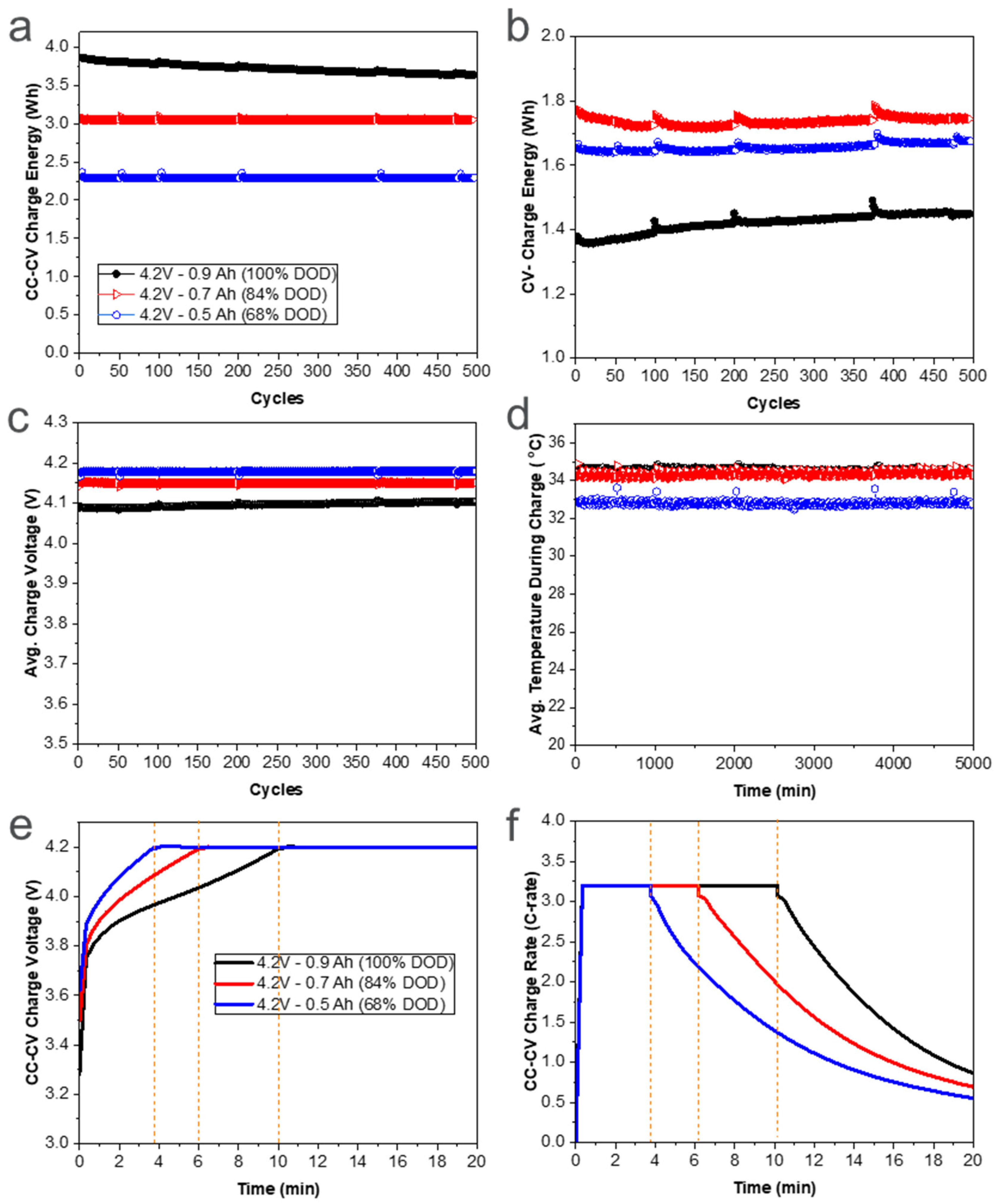
Cycle-by-cycle (CBC) data analysis can provide crucial and early information about cell aging modes and mechanisms [30]. Figure 1a demonstrates that the CBC CC + CV Wh charge acceptance remains consistent with the charge protocol. However, as illustrated in Figure 1b, the CBC CV charge acceptance varies depending on the initial DOD from which charging is initiated. This variation is further influenced by the fixed total charge duration of 20 min applied uniformly across all conditions. Specifically, the 4.2 V-0.9 Ah (100% DOD) condition exhibits the least CV charge acceptance, while the 4.2 V-0.7 Ah (84% DOD) condition shows the highest charge acceptance in CV mode. The average CBC CC + CV charge voltage remains close but elevated for 4.2 V-0.7 Ah (84% DOD) and 4.2 V-0.5 Ah (68% DOD) conditions as compared to 4.2 V-0.9 Ah (100% DOD) (Figure 1c). The average charge cell skin temperature remained within a narrow band of 2 °C, likely indicating a less dominant effect (Figure 1d). Figure 1e–f show the charge step of the initial cycle. As mentioned earlier, although the total charge time was constant, the 4.2 V-0.7 Ah (84% DOD) and 4.2 V-0.5 Ah (68% DOD) conditions spent most of their time in the CV charging step (Figure 1e). It is also evident that these two conditions display a similar current profile during the CV mode (Figure 1f). However, the 4.2 V-0.5 Ah (68% DOD) condition exhibits slightly lower CV charge acceptance and skin temperature (due to its shorter CC phase and longer CV step) compared to the 4.2 V-0.7 Ah (84% DOD) condition as shown in Figure 1b,d. On the discharge side, Figure S3 shows that the average discharge voltage and end-of-discharge rest voltage (EODV) for the 4.2 V-0.7 Ah (84% DOD) and 4.2 V-0.5 Ah (68% DOD) conditions are higher compared to the 4.2 V-0.9 Ah (100% DOD) condition.
Previous research indicates that for NMC-based Li-ion cells, factors like total charging time, its distribution between CC and CV steps, and average discharge voltage can significantly impact cell aging [31]. Specifically, increased SEI growth and the lithium plating, which can coexist, have been attributed to higher voltage during CC and longer CV hold [18,32]. Under the 4.2 V-0.7 Ah (84% DOD) and 4.2 V-0.5 Ah (68% DOD) conditions, the cells remained in CV charging mode at an elevated voltage for the longest duration. This extended period led to increased SEI growth and loss of Li inventory (LLI), resulting in capacity fade. These factors likely contributed to heightened surface/interphase reactions at the anode or cathode, which accelerated aging [6,17]. The anode potential likely approached the lithium plating potential of 0 V, increasing the likelihood of lithium plating-related LLI [18,32]. Higher voltage during discharge and rest has also been linked to increased aging [19]. The 4.2 V-0.7 Ah (84% DOD) and 4.2 V-0.5 Ah (68% DOD) conditions experienced higher average discharge voltages compared to 4.2 V-0.9 Ah (100% DOD). Although not dominant during charge, this may have led to more SEI growth-related LLI. Additionally, the higher end-of-discharge voltage in these scenarios suggests greater calendar aging during the 30 min rest period before the next charge step.
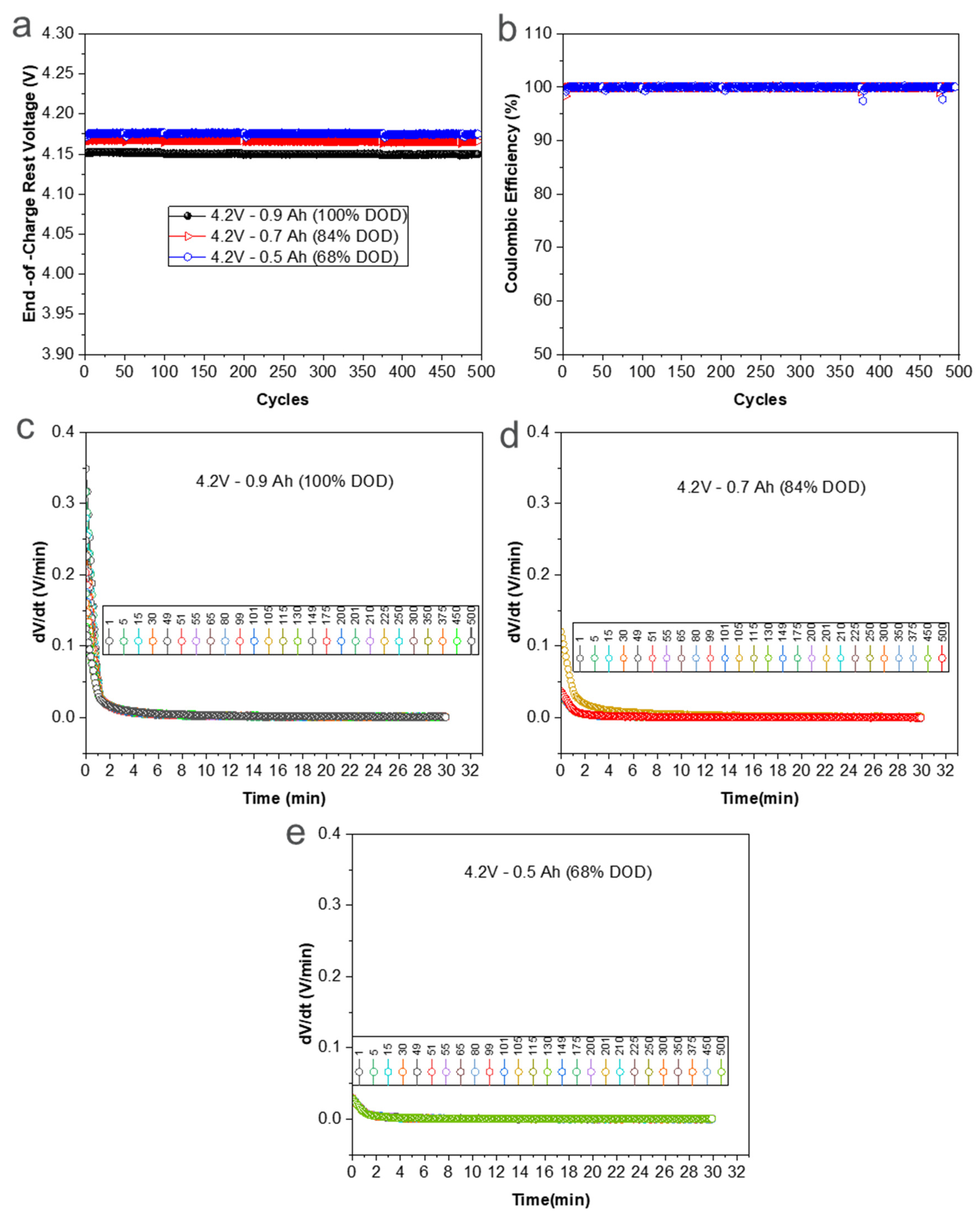
CBC data such as coulombic efficiency (CE), end-of-charge rest voltage (EOCV) and dV/dt can indicate lithium plating (Figure 2). Typically, an increasing EOCV, decreased CE, and a hump or shoulder in dV/dt suggest lithium plating [33]. These markers are particularly effective in identifying lithium plating under aggressive fast-charging conditions.
We examined these electrochemical markers for signs of lithium plating as shown in Figure 2. However, no definitive determination could be made. This may be due to the absence of lithium plating or the presence of only minor/localized plating, which could have chemically intercalated back into the graphite matrix immediately upon plating, leaving an insignificant amount of dead lithium without clear signs [34].

3.2.2. Analyzing RPT Data

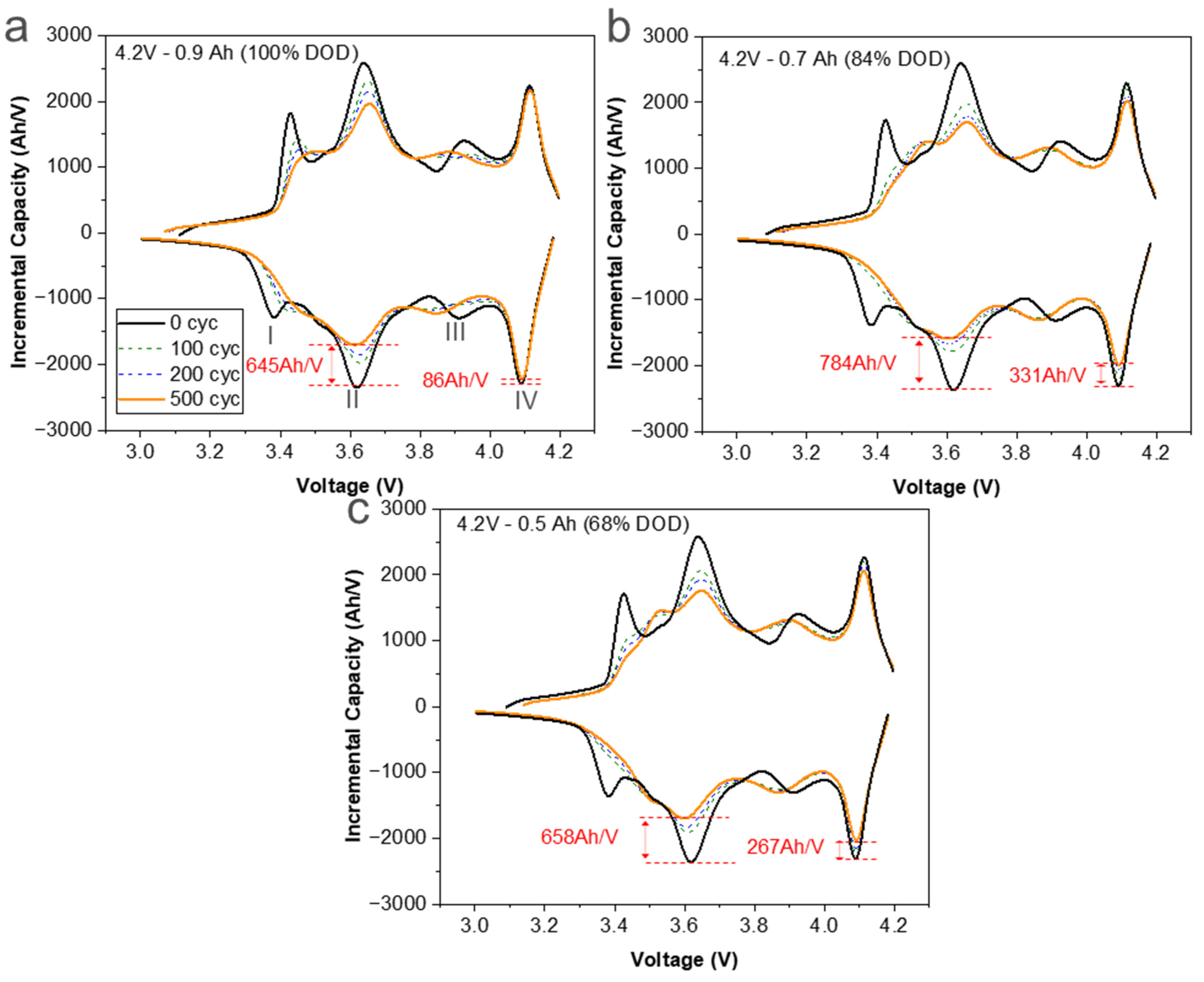
We performed incremental capacity (IC) or dQ/dV analysis on the C/20 charge–discharge data that was part of each RPT. Previous research identifies two main aging modes in Gr/NMC811 cells: LLI and the loss of active materials (LAM) [6,16,30,35,36,37]. To analyze the aging modes of the cells, the average of voltage versus dQ/dV data was taken from three cells for each group. The IC or dQ/dV against voltage was plotted for all conditions at various RPTs in Figure 3. At zero cycles, four distinct redox peaks were observed at approximately 3.38 V, 3.61 V, 3.9 V, and 4.10 V and identified in Figure 3a as peak I, II, III, and IV. These peaks in Figure 3a were contributed by the convolution of the graphite and NMC within the same voltage range [16,18,38,39]. Redox peak I, located around 3.40 V, is linked to the lithiation and de-lithiation processes in graphite during charging and discharging [30,31,32,33,34,35,36,37,38,39,40]. Peaks II, III, and IV, found at approximately 3.6 V, 3.9 V, and 4.10 V, respectively, are related to the phase transformation of NMC811 [39,40].
LLI is a primary mode of aging that contributes to capacity fade in Gr/NMC cells. Figure 3a shows that under the 4.2 V-0.9 Ah (100% DOD) condition, peak I shifts from 3.38 V to 3.47 V after 500 cycles (orange curve). Additionally, peaks II and IV decline, while peak III broadens and shifts left. These changes indicate lithium loss during cycling, confirming LLI in the 4.2 V-0.9 Ah (100% DOD) condition [37,40]. Figure 3b,c show that the 4.2 V-0.7 Ah (84% DOD) and 4.2 V-0.5 Ah (68% DOD) conditions also experience LLI. Unlike the 4.2 V-0.9 Ah (100% DOD) condition, peak I shifts to 3.50 V for both 4.2 V-0.7 Ah (84% DOD) and 4.2 V-0.5 Ah (68% DOD), suggesting higher LLI in these cases. The underlying mechanisms contributing to LLI are complex and may include a combination of processes such as surface film formation (e.g., standard SEI growth or plating-induced SEI formation), irreversible lithium plating, SEI decomposition, electrolyte degradation, and binder decomposition [41,42,43,44,45,46,47].
A decrease in cell capacity can also result from LAM at either the negative or positive electrode [37]. Figure 3 shows a notable decrease in peaks II and IV under all conditions. These peaks are associated with the phase transformation of NMC materials [40], indicating LAM in the cathode. Interestingly, the decrease in intensity of peaks II and IV is more distinct in the 4.2 V-0.7 Ah (84% DOD) and 4.2 V-0.5 Ah (68% DOD) conditions, with the 4.2 V-0.7 Ah (84% DOD) condition showing the most significant change.
The phase transformation of NMC, related to primary volume contraction/expansion, is indicated by changes in peak IV [40]. A large decrease in peak IV intensity occurred under the 4.2 V-0.7 Ah (84% DOD) and 4.2 V-0.5 Ah (68% DOD) conditions, which could lead to more capacity fade at the cell level. SEM results also showed that the average particle size of 4.2 V-0.7 Ah (84% DOD) and 4.2 V-0.5 Ah (68% DOD) grew larger compared to the 4.2 V-0.9 Ah (100% DOD) condition, indicating irreversible volume expansion (Figure S5e). This expansion may have caused cracking and structural instability of the NMC cathode, reducing active sites for Li storage. Consequently, this may lead to higher capacity fade in the 4.2 V-0.7 Ah (84% DOD) and 4.2 V-0.5 Ah (68% DOD) conditions compared to the 4.2 V-0.9 Ah (100% DOD) condition [40,48].
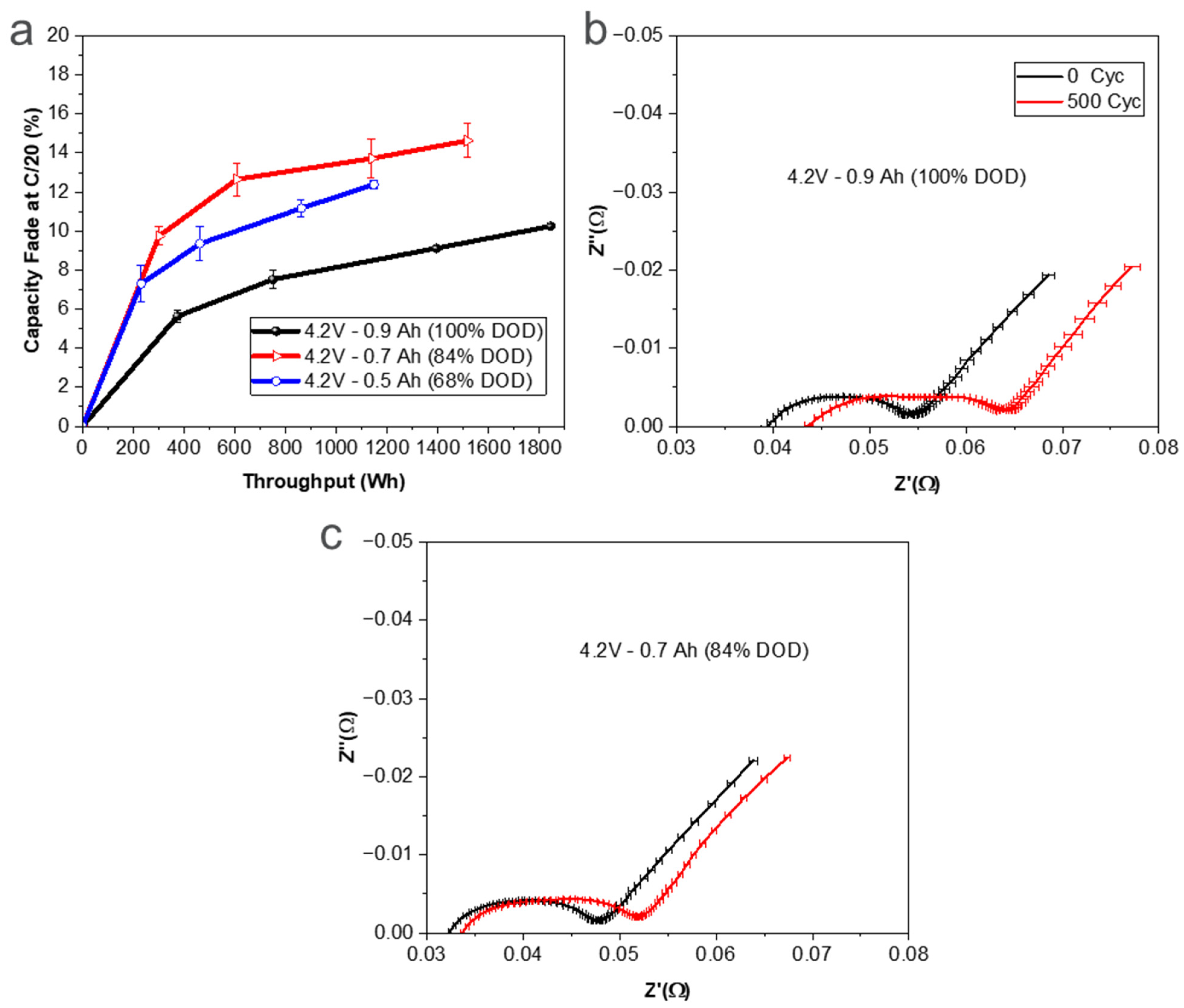
Figure 4 shows the C/20 capacity fades for the first three conditions. After 500 cycles, there is a 4% variation in capacity fading among the three conditions. However, the 4.2 V-0.7 Ah and 4.2 V-0.5 Ah (68% DOD) conditions show an elevated capacity fade of about 2–4% compared to the 4.2 V-0.9 Ah (100% DOD) condition. This result aligns with the CBC data and dQ/dV analysis presented earlier. The lower DOD condition cells spent more time in the CV step and accepted more charge at a relatively higher voltage as compared to the higher DOD conditions, leading to more SEI/Cathode Electrolyte Interphase (CEI) growth-related LLI. The slightly lower capacity fade (~1% at 500 cycles) observed for the 4.2 V-0.5 Ah (68% DOD) condition compared to the 4.2 V-0.7 Ah (84% DOD) condition can likely be attributed to its lower CV charge acceptance (despite a slightly longer CV time) and reduced operating temperature during cycling.
Additionally, the elevated average voltage during discharge and EODV contributed to more SEI/CEI growth-related LLI. Higher levels of LAM were also confirmed through dQ/dV analysis for cycling in the higher voltage region under partial DOD conditions (Figure 3).
EIS was conducted to monitor impedance growth, and Nyquist plots are shown in Figure 4b,c for the most aged (4.2 V-0.7 Ah (84% DOD)) and least aged (4.2 V-0.9 Ah (100% DOD)) cases, respectively. At RPT0 (cycle 0), the EIS plots display well-developed depressed semicircles associated with anode and cathode interphase kinetics, along with diffusion tails for both conditions [49]. The semicircles for both conditions appear comparable, except for a variation in the ohmic intercept (approximately 0.0075Ω), likely due to the contact resistance of the tab connections.
After 500 cycles, the Nyquist EIS spectra shift to the right, and the semicircles grow and evolve. The rightward shift and growth in the semicircle for the 4.2 V-0.9 Ah (100% DOD) case appear slightly more pronounced than for the 4.2 V-0.7 Ah (84% DOD) case. This behavior could be attributed to a combination of Li plating and cathode particle cracking, which influence the interfacial kinetics, as reported earlier [3,50]. In both cases, a second semicircle emerges just before the diffusion tail, indicating more distinct degradation of cathode interfacial kinetics due to aging. This observation aligns with the dQ/dV analysis indicating a loss of active material (LAM) in the cathode. The 4.2 V-0.7 Ah (84% DOD) case shows slightly less widening of the semicircle, likely due to increased particle cracking at the cathode, which caused an increased electrochemically active surface area, potentially improving impedance performance [50].

3.2.3. Postmortem Analysis

Selected cells were disassembled after cycling to confirm the presence of Li plating after undergoing 500 cycles. Figure S4 illustrates the optical images of the cells upon opening. Under the 4.2 V-0.9 Ah (100% DOD) condition, isolated Li plating was observed along with salt residues, as depicted in Figure S4a. In contrast, cells subjected to the 4.2 V-0.7 Ah (84% DOD) cycling condition exhibited uneven Li plating, with one side of the anode showing minimal lithium plating while the opposite side displayed a significant amount, as seen in Figure S4b. Similar patterns of Li plating were observed in cells under the 4.2 V-0.5 Ah (68% DOD) condition, as shown Figure S4c. Visual observation of the electrode samples indicate a higher amount of Li plating in the 4.2 V-0.7 Ah (84% DOD) condition, compared to 4.2 V-0.5 Ah (68% DOD) and 4.2 V-0.9 Ah (100% DOD), which aligns with the aging data presented in Figure 4 and suggests that the observed fading is related to the LLI due to irreversible plating.
On the cathode side, scanning electron microscopy (SEM) was conducted to observe changes in the particle size of NMC811 materials after cycling under different conditions (Figure S5a–d). As shown in Figure S5a, the fresh NMC811 materials are composed of spherical particles with an average size of approximately 8.03 µm. Figure S5b–d reveals that the shape of the NMC811 particles remains unchanged after cycling. However, the average particle size increases to 8.83 µm, 10.3 µm, and 10.7 µm after 500 cycles for the 4.2 V-0.9 Ah (100% DOD), 4.2 V-0.7 Ah (84% DOD), and 4.2 V-0.5 Ah (68% DOD) conditions, respectively (Figure S5e). This indicates that a significant increase in particle size occurred after cycling in the cell, particularly in cells cycled with a higher upper cutoff voltage. These results are supported by the dQ/dV analysis, suggesting that the reversibility of Li+ in the NMC811 cathode decreased after 500 cycles [40,49,51]. As shown in the Figure S5e, the volume expansion of NMC811 cycled at 4.2 V-0.7 Ah (84% DOD) and 4.2 V-0.5 Ah (68% DOD) was higher and could result in higher capacity fade compared to the 4.2 V-0.9 Ah (100% DOD) condition, which is consistent with the dQ/dV analysis.

3.3. Impact of the Maximum Voltage

The previous section demonstrates that Gr/NMC cells experience higher capacity fading when partially cycled during fast charging with a Vmax of 4.2 V. Prior research has indicated that lowering the Vmax could mitigate aging [6,16,32,50]. Although this reduction in operational voltage would decrease the usable specific energy of the cells and impact the overall energy capacity of the battery pack, it could be justified if the cycle life improves significantly with a lowered Vmax. To quantify the beneficial effects of a lower Vmax on cell aging, we cycled the most aggressive condition tested above, i.e., 4.2 V-0.7 Ah (84% DOD), with a lower voltage window, specifically between 4.1 V and 3 V. This condition, identified as 4.1 V-0.7 Ah (100% DOD), would reduce the cell-specific energy by 16%. As shown in Table 1, the 4.2 V-0.7 Ah (84% DOD) condition discharged the cells to 84%, whereas the 4.1 V-0.7 Ah (100% DOD) condition allowed for complete discharge of the cells during cycling.

3.3.1. CBC Data Analysis

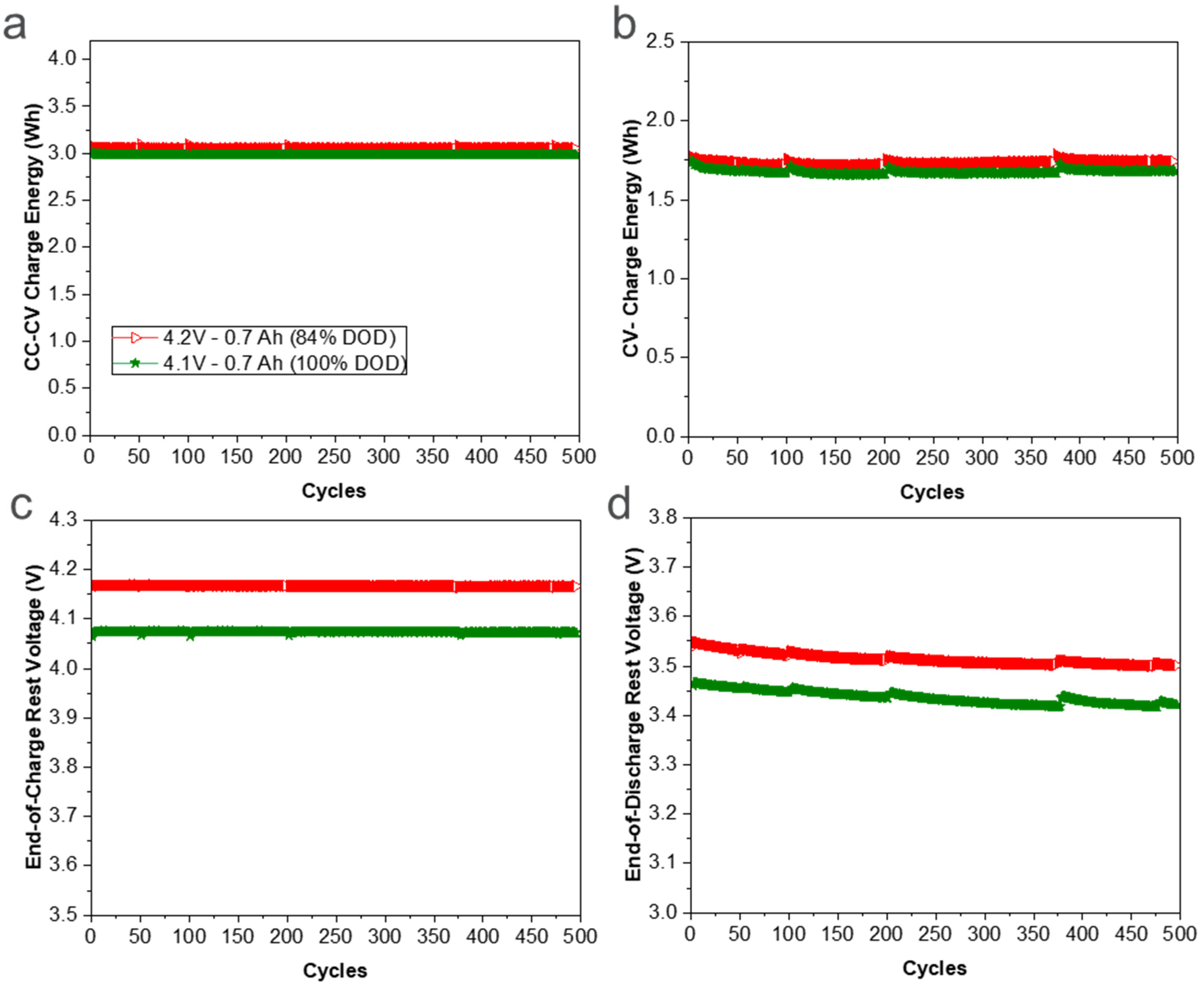
Figure S6 illustrates the voltage versus time curve for both the 4.2 V-0.7 Ah (84% DOD) and 4.1 V-0.7 Ah (100% DOD) conditions. It is evident that the 4.1 V-0.7 Ah condition spends less time in CC mode and slightly more time in CV mode, albeit at 4.1 V-0.7 Ah (84% DOD). A comparison between the 4.2 V-0.7 Ah (84% DOD) and 4.1 V-0.7 Ah (100% DOD) conditions shows that both achieved comparable charge energies, as illustrated in Figure 5a,b. However, the EOCV and EODV for the 4.1 V-0.7 Ah (100% DOD) condition were lower than those for the 4.2 V-0.7 Ah (84% DOD) condition, which is to be expected (Figure 5c,d). This means that the 4.1 V-0.7 Ah (100% DOD) condition enters the 30 min rest step at a lower voltage during both charge and discharge. Furthermore, data from Figures S7 and S8 reveal that the 4.2 V-0.7 Ah (84% DOD) cells ran slightly hotter (~2 °C) during charging cycles compared to the 4.1 V-0.7 Ah (100% DOD) cells, without showing any distinct temperature difference during discharge cycles. All these operational differences for the 4.1 V-0.7 Ah (100% DOD) condition could be favorable in reducing cell aging triggered by LLI due to normal and/or plating-related SEI growth [32].

3.3.2. RPT Data Analysis

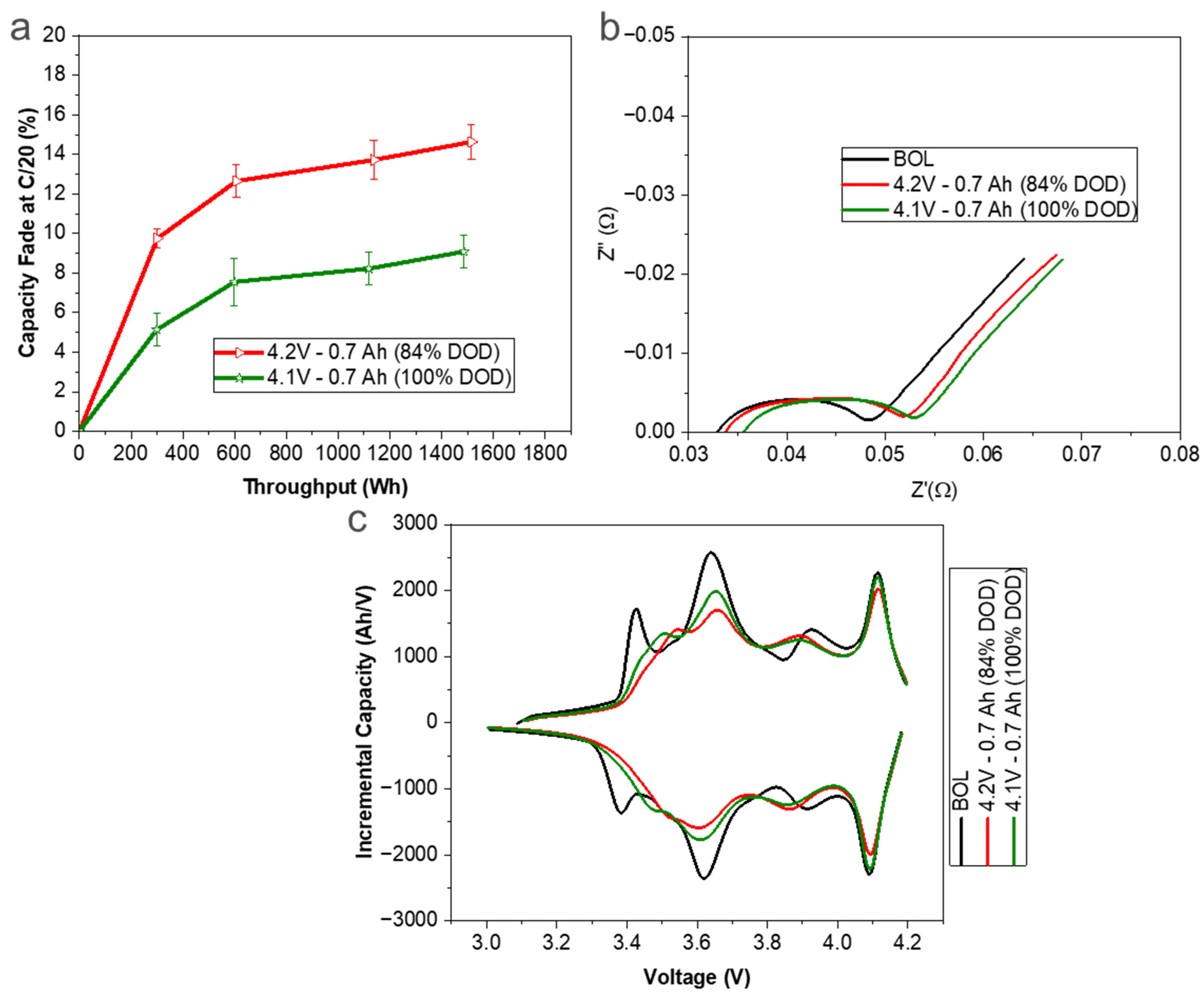
Figure 6a illustrates the discharge capacity fade at C/20 (3–4.2 V) for the two conditions studied: 4.2 V-0.7 Ah (84% DOD) and 4.1 V-0.7 Ah (100% DOD). After 500 cycles, the 4.1 V condition exhibited significantly less capacity fade, at 9%, compared to the 14.6% fade observed in the 4.2 V condition, a difference of 5.6%.
The EIS data presented in Figure 6b indicate that both conditions show slightly higher impedance, with the 4.2 V condition exhibiting marginally higher average impedance growth. The growth of EIS happened after 500 cycles for both the 4.2 V-0.7 Ah (84% DOD) and 4.1 V-0.7 Ah (100% DOD) conditions (Figure 7b). The broadening of the semicircle indicates the growth of the impedance. The smaller depressed semicircle for 4.1 V-0.7 Ah (100% DOD) indicates that it exhibits lower resistance compared to 4.2 V-0.7 Ah (84% DOD). However, this growth remains within the 1σ error bars when compared to the BOL conditions. This may be attributed to slightly higher Li plating-related SEI growth, which previous research has indicated to be less resistive compared to normal SEI-related impedance growth [52].
Figure 6c provides additional insights into the different aging modes occurring within the cell through IC analysis. Consistent with previous findings, the IC analysis suggests that LLI and LAM are the two dominant aging modes. At the end of cycling, peak I of the 4.1 V-0.7 Ah (100% DOD) condition reduced and shifted to 3.47 V, compared to 3.50 V for the 4.2 V-0.7 Ah (84% DOD) condition, indicating a lower extent of LLI in the 4.1 V-0.7 Ah (100% DOD) condition, which aligns with earlier research [37,38]. The postmortem optical image distinctly shows that lithium plating on the graphite was significantly improved under the 4.1 V-0.7 Ah (100% DOD) condition, as illustrated in Figure S9, in line with the IC analysis, causing less LLI in the 4.1 V-0.7 Ah (100% DOD) condition as compared to 4.2 V-0.7 Ah (84% DOD).
Other notable differences are observed in peaks II and IV between the two conditions, signifying LAM in the cathode. The 4.2 V-0.7 Ah (84% DOD) condition shows a distinct reduction in peaks II and IV compared to the 4.1 V-0.7 Ah (100% DOD) condition, indicating that the 4.1 V-0.7 Ah (100% DOD) cell experienced a lesser extent of LAM in the cathode. This improvement associated with operating Gr/NMC cells at a lower voltage could be attributed to less distinct crystal volume contraction/expansion that predominantly occurs at 4.1 V (peak IV). This contraction/expansion results in cracking, which reduces capacity fading and increases resistance to mechanisms of LAM [3,19].

3.4. Impact of Rest Period After Fast Charge

The CBC metrics for the two test conditions remain largely comparable, as shown in Figure S10. Both conditions exhibit similar CC–CV charge energy profiles (Figure S10a). However, Figure S10b shows a slightly higher CV charge energy for the 4.1 V-0.7 Ah (100% DOD) condition compared with the 4.1 V-2 min-0.7 Ah (100% DOD) condition. This difference reflects a longer residence time at elevated voltage for the former, which may increase susceptibility to aging.
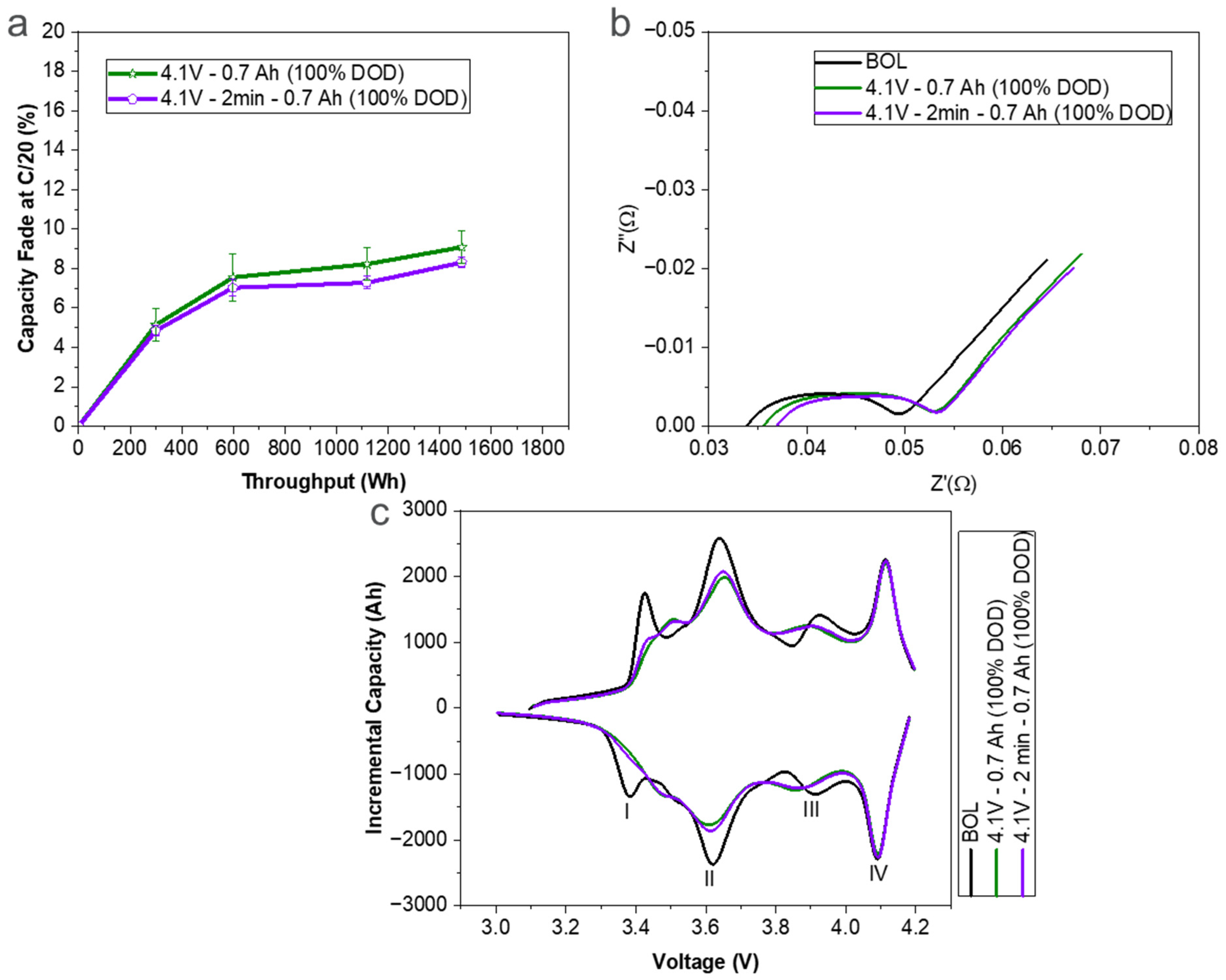
Figure 7a compares the C/20 capacity fade for the two conditions after 500 cycles. The 4.1 V condition with a 30 min rest period exhibits an average capacity fade of 9.08 ± 0.80%, whereas the condition with a 2 min rest period shows a lower average fade of 8.30 ± 0.27% within the five months of cycle life evaluation. A statistical significance assessment using Welch’s t-test [53], accounting for the sample size and the aging trends shown in Figure 7a, indicates that this difference is not statistically significant up to 500 cycles or five months of cycling. Nonetheless, the 2 min rest condition consistently demonstrates slightly lower average capacity fade and reduced cell-to-cell variability as compared to the 30 min rest condition.
Consistent with the capacity fade results, EIS measurements indicate a modest improvement in impedance for the 2 min rest condition (Figure 7b), while incremental capacity (IC) analysis reveals a marginal reduction in aging (Figure 7c). Together, these trends suggest a slight performance benefit. In contrast, the 4.1 V-0.7 Ah (100% DOD) condition experiences an additional ~28 min of rest per cycle at an elevated voltage following charge, which likely contributes to calendar-aging-related LLI and results in approximately 1% higher capacity fade [37,54]. Overall, these observations indicate that cells subjected to more realistic charging scenarios—where post-charge rest following fast charging is minimal—may exhibit slightly lower aging, although the difference relative to conventional cycling protocols could be statistically insignificant in early cycling windows.

4. Discussion

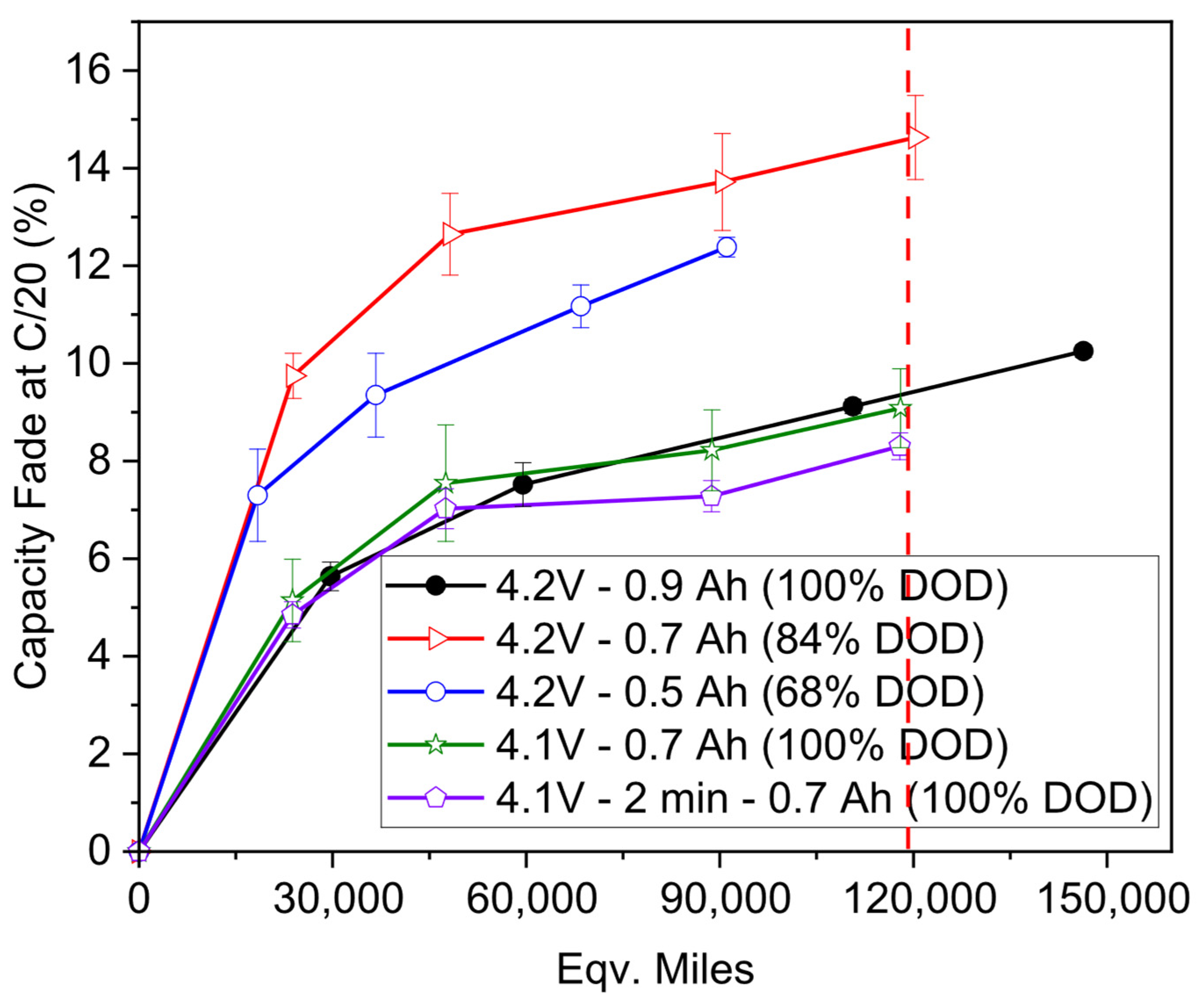
Earlier studies conducted without fast charging [22,53] have generally reported increased cell degradation at higher depths of discharge (DODs). In contrast, the present study demonstrates that this trend does not necessarily hold under exclusive fast-charging conditions. Figure 8 summarizes the degradation behavior of the tested conditions up to 500 cycles, expressed in terms of equivalent miles driven using a representative EV sedan as a reference [32,54]. In addition, Figure S11 shows the extrapolated capacity fade and equivalent mile up to 1000 cycles, assuming that the experimentally observed aging trends persist beyond the measured cycling window. Together, these representations provide a more practical and application-relevant perspective on how battery degradation under different cycling conditions may translate into total achievable driving range.
Our results indicate that Gr/NMC811 cells cycled under partial DOD conditions (68% and 84%) experienced greater degradation than those cycled at full DOD (100%) when subjected to exclusive fast charging at 3.2 C for 20 min to a 4.2 V cutoff. After 500 cycles, the 4.2 V-0.9 Ah (100% DOD) condition delivered a total discharge throughput of 1844 Wh—corresponding to approximately 150,000 equivalent miles—while exhibiting only ~10% capacity loss. In comparison, the 4.2 V-0.5 Ah (68% DOD) and 4.2 V-0.7 Ah (84% DOD) conditions delivered 1148 Wh (~91,700 miles) and 1516 Wh (~120,300 miles), respectively, after 500 cycles, as shown in Figure 8. When evaluated regarding comparable mileage, the capacity fade under the 68% and 84% DOD conditions was approximately 4–5% higher than that observed under the 100% DOD condition. This difference is non-trivial, given that EV battery packs are commonly considered end-of-life at ~20% capacity loss. As shown in Figure S11, extrapolation of these trends to 1000 cycles suggests that the relative aging advantage of full DOD cycling persists, resulting in approximately 50,000 and 110,000 fewer equivalent miles for the 84% and 68% DOD conditions, respectively.
The study further demonstrates that reducing the upper charge cutoff voltage from 4.2 V to 4.1 V during cycling—while maintaining the same ΔDOD (e.g., 0.7 Ah)—substantially mitigates cell aging. Although lowering the cutoff voltage results in an approximately 16% reduction in cell-specific energy, it yields a 5.6% decrease in capacity fade relative to the 4.2 V condition after 500 cycles, corresponding to ~118,000 miles of equivalent operation. Extrapolation to 1000 cycles suggests that the 4.1 V condition maintains a sustained aging advantage, reaching only ~11.7% capacity fade compared to ~17.6% under the 4.2 V condition and enabling approximately 240,000 equivalent miles, as shown in Figure S11b. In addition, shortening the post-charge rest period from 30 min to 2 min—more representative of real-world operation—further reduces capacity fade by ~1% at 500 cycles (or after five months) and an estimated ~1.4% at 1000 cycles, thereby potentially contributing to additional gains in achievable driving range.
Overall, these results emphasize the importance of charge–discharge protocol optimization for extending Gr/NMC811 cell life. The 4.2 V-0.9 Ah (100% DOD) condition minimized CV charging time and average charge voltage, which likely suppressed SEI growth and lithium plating, as supported by IC analysis and postmortem anode imaging. The lower end-of-discharge voltage under full DOD cycling may also reduce calendar aging during post-discharge rest. In contrast, partial DOD cycling at 4.2 V led to more pronounced cathode loss of active material, likely due to particle-level cracking, whereas lowering the upper cutoff voltage to 4.1 V at a constant ΔDOD (0.7 Ah) significantly mitigated this degradation, consistent with prior reports [19].
Independent of charge cutoff voltage (4.2 V or 4.1 V) and DOD, postmortem analysis revealed minor visual evidence of lithium plating under all tested conditions after 500 cycles. Notably, this plating occurred without detectable electrochemical signatures or observable safety concerns within the investigated cycling window. Across all conditions, capacity fade ranged from 8% to 14.6% at 500 cycles, corresponding to approximately 90,000 to 150,000 miles of equivalent driving. Importantly, the extent of lithium plating was markedly reduced when the upper cutoff voltage was lowered to 4.1 V. Within the scope of 500-cycle testing, these results suggest that limited, electrochemically undetectable lithium plating can coexist with conventional aging mechanisms without measurably compromising cell performance or lifetime.

5. Conclusions

This study provides comprehensive evidence that careful optimization of charge and discharge parameters is crucial for maximizing the lifespan of Gr/NMC811 cells, particularly under exclusive fast-charging conditions. Our detailed investigation has revealed that cells subjected to cycling at a full DOD of 100%, with a charge cutoff voltage set at 4.2 V and utilizing a 3.2 C-20 min fast charge protocol, experienced less aging compared to those cycled at partial DODs of 84% and 68%. Cells with lower DODs exhibited a higher average charge voltage and longer constant voltage hold times, which drives more degradation of the battery. In addition, IC analysis demonstrated that more LLI and LAM occurred in the case of lower DODs. Cells cycled with a higher DOD (100%) showed up to 5% less capacity fade as compared to the lower DOD conditions (e.g., 84% DOD and 68% DOD), indicating that maintaining a full DOD during cycling is beneficial for the longevity of the cells.
Furthermore, our findings indicate that lowering the upper charge cutoff voltage from 4.2 V to 4.1 V plays a substantial role in mitigating aging-related degradation of the cells. By reducing the cutoff voltage from 4.2 V to 4.1 V, the cells were able to minimize lithium plating and improve battery life by up to 5% after 500 cycles. Although this adjustment results in a 16% reduction in cell-specific energy, the trade-off may be advantageous as it considerably prolongs the operational life of the cells.
Additionally, we find that reduced rest period following charging has the potential to further enhance cell longevity. Cells subjected to a 2 min post-charge rest exhibit a modest improvement of approximately 1% in capacity retention over 30 min post-charge rest condition after 500 cycles (five months of cumulative cycling). This is associated with reduced impedance growth and lower LAM. Based on the observed aging trends, this improvement is estimated to increase to approximately 1.4% by 1000 cycles using similar cycling protocols within proportionate timeframe. This behavior is attributed to prolonged rest at elevated post-charge voltage in longer rest conditions, which promotes continued SEI layer growth and associated degradation mechanisms [55]. Consequently, reducing rest time after charging limits exposure to high-voltage conditions, thereby mitigating this degradation and contributing to improved overall cell life.
These findings highlight a practical pathway for enhancing battery performance and durability. In the context of electric vehicles, implementing optimized charging protocols with minimal post-charge rest may enable extended driving range and prolonged operational life.

Supplementary Materials

The following supporting information can be downloaded at: https://www.mdpi.com/article/10.3390/batteries12020073/s1, Table S1: Cell design parameters; Figure S1: (a) Optical images of the graphite anode and NMC811 cathode; (b) dimensions of the multilayer Gr/NMC811 cell; Figure S2: Depth of discharge (DOD) as a function of state of charge (SOC); Figure S3: (a) Average discharge voltage and (b) end-of-discharge voltage as a function of cycle number for 4.2 V-0.9 Ah (100% DOD), 4.2 V-0.7 Ah (84% DOD), and 4.2 V-0.5 Ah (68% DOD); Figure S4: Optical images of torn cells after cycling under different conditions: (a) 4.2 V-0.9 Ah (100% DOD), (b) 4.2 V-0.7 Ah (84% DOD), and (c) 4.2 V-0.5 Ah (68% DOD); Figure S5: SEM images of NMC811 electrodes in the lithiated state: (a) fresh electrode and electrodes after 500 cycles under (b) 4.2 V-0.9 Ah (100% DOD), (c) 4.2 V-0.7 Ah (84% DOD), and (d) 4.2 V-0.5 Ah (68% DOD) conditions; (e) particle size evolution of NMC811 after cycling under different conditions; (f) fresh NMC811 electrode showing particle size determination; Figure S6: CC–CV charging profiles showing (a) voltage versus time and (b) charge rate versus time for 4.2 V-0.7 Ah (84% DOD) and 4.1 V-0.7 Ah (100% DOD); Figure S7: Cell temperature as a function of time during cycling (four cycles) for 4.2 V-0.7 Ah (84% DOD) and 4.1 V-0.7 Ah (100% DOD); Figure S8: (a) Cell temperature during cycling and average temperature during (b) charge and (c) discharge; Figure S9: Optical images of torn cells after cycling at (a) 4.2 V-0.7 Ah (84% DOD) and (b) 4.1 V-0.7 Ah (100% DOD); Figure S10: (a) CC–CV charge energy at 3.2 C and (b) CV charge energy as a function of cycle number for 4.1 V-0.7 Ah (100% DOD) and 4.1 V–2 min—0.7 Ah (100% DOD); Figure S11: Capacity-based cycle life measured up to 500 cycles (solid lines) and extrapolated to 1000 cycles (dotted lines), assuming continued aging trends. Projections were generated using a power-law relationship, where capacity fade is expressed as a function of cycle number. The fitted coefficients a and b were determined independently for each cycling condition.

Author Contributions

Conceptualization, T.R.T. and E.J.D.; Methodology, S.I. and T.R.T.; Validation, S.I. and P.B.; Formal analysis, S.I., P.B. and B.P.; Resources, M.C.E., B.Y.W.M. and B.P.; Writing—original draft, S.I. and T.R.T.; Writing—review and editing, T.R.T.; Funding acquisition, T.R.T. and E.J.D. All authors have read and agreed to the published version of the manuscript.

Funding

Funding was provided by the DOE Office of Energy Efficiency and Renewable Energy’s Vehicle Technologies Office, under the eXtreme Fast Charge Cell Evaluation of Lithium-Ion Batteries (XCEL) Program.

Data Availability Statement

The original contributions presented in this study are included in the article/Supplementary Materials. Further inquiries can be directed to the corresponding author.

Acknowledgments

Funding was provided by the DOE Office of Energy Efficiency and Renewable Energy’s Vehicle Technologies Office, under the Advanced Battery Cell Research XCEL Program led by Simon Thomson and Brian Cunningham. This manuscript was prepared by Idaho National Laboratory, operated by Battelle Energy Alliance, LLC, under Contract No. DE-AC07-05ID14517. The authors thank Kevin Gering for participating in discussions related to understanding the failure modes.

Conflicts of Interest

The authors declare no conflicts of interest.

References

  1. Niu, C.J.; Lee, H.; Chen, S.R.; Li, Q.Y.; Du, J.; Xu, W.; Zhang, J.G.; Whittingham, M.S.; Xiao, J.; Liu, J. High-energy lithium metal pouch cells with limited anode swelling and long stable cycles. Nat. Energy 2019, 4, 551–559. [Google Scholar] [CrossRef]
  2. Yeganehdoust, F.; Madikere Raghunatha Reddy, A.K.; Zaghib, K. Cell Architecture Design for Fast-Charging Lithium-Ion Batteries in Electric Vehicles. Batteries 2025, 11, 20. [Google Scholar] [CrossRef]
  3. Aghili Mehrizi, A.; Yeganehdoust, F.; Madikere Raghunatha Reddy, A.K.; Zaghib, K. Challenges and Issues Facing Ultrafast-Charging Lithium-Ion Batteries. Batteries 2025, 11, 209. [Google Scholar] [CrossRef]
  4. Weiss, M.; Ruess, R.; Kasnatscheew, J.; Levartovsky, Y.; Levy, N.R.; Minnmann, P.; Stolz, L.; Waldmann, T.; Wohlfahrt-Mehrens, M.; Aurbach, D.; et al. Fast Charging of Lithium-Ion Batteries: A Review of Materials Aspects. Adv. Energy Mater. 2021, 11, 2101126. [Google Scholar] [CrossRef]
  5. Cai, W.L.; Yao, Y.X.; Zhu, G.L.; Yan, C.; Jiang, L.L.; He, C.X.; Huang, J.Q.; Zhang, Q. A review on energy chemistry of fast-charging anodes. Chem. Soc. Rev. 2020, 49, 3806–3833. [Google Scholar] [CrossRef]
  6. Tanim, T.R.; Yang, Z.Z.; Colclasure, A.M.; Chinnam, P.R.; Gasper, P.; Lin, Y.L.; Yu, L.; Weddle, P.J.; Wen, J.G.; Dufek, E.J.; et al. Extended cycle life implications of fast charging for lithium-ion battery cathode. Energy Storage Mater. 2021, 41, 656–666. [Google Scholar] [CrossRef]
  7. Dufek, E.J.; Abraham, D.P.; Bloom, I.; Chen, B.R.; Chinnam, P.R.; Colclasure, A.M.; Gering, K.L.; Keyser, M.; Kim, S.; Mai, W.J.; et al. Developing extreme fast charge battery protocols—A review spanning materials to systems. J. Power Sources 2022, 526, 231129. [Google Scholar] [CrossRef]
  8. Paul, P.P.; Thampy, V.; Cao, C.T.; Steinruck, H.G.; Tanim, T.R.; Dunlop, A.R.; Dufek, E.J.; Trask, S.E.; Jansen, A.N.; Toney, M.F.; et al. Quantification of heterogeneous, irreversible lithium plating in extreme fast charging of lithium-ion batteries. Energy Environ. Sci. 2021, 14, 4979–4988. [Google Scholar] [PubMed]
  9. Dufek, E.J.; Smith, K. Electrode scale and electrolyte transport effects on extreme fast charging of lithium-ion cells. Electrochim. Acta 2020, 337, 135854. [Google Scholar] [CrossRef]
  10. Gallagher, K.; Trask, S.; Bauer, C.; Woehrle, T.; Lux, S.; Tschech, M.; Lamp, P.; Polzin, B.; Ha, S.; Long, B.; et al. Optimizing Areal Capacities through Understanding the Limitations of Lithium-Ion Electrodes. J. Electrochem. Soc. 2016, 163, A138–A149. [Google Scholar] [CrossRef]
  11. Chandrasekaran, R. Quantification of bottlenecks to fast charging of lithium-ion-insertion cells for electric vehicles. J. Power Sources 2014, 271, 622–632. [Google Scholar] [CrossRef]
  12. Agubra, V.; Fergus, J. Lithium Ion Battery Anode Aging Mechanisms. Materials 2013, 6, 1310–1325. [Google Scholar] [CrossRef]
  13. Lin, X.K.; Khosravinia, K.; Hu, X.S.; Li, J.; Lu, W. Lithium Plating Mechanism, Detection, and Mitigation in Lithium-Ion Batteries. Prog. Energy Combust. Sci. 2021, 87, 100953. [Google Scholar] [CrossRef]
  14. Mokkath, J.H. Predictive Framework for Lithium Plating Risk in Fast-Charging Lithium-Ion Batteries: Linking Kinetics, Thermal Activation, and Energy Loss. Batteries 2025, 11, 281. [Google Scholar] [CrossRef]
  15. Liu, Y.; Li, Y.; Fu, X.; Xue, Z.-A.; Wang, J. Lithium dendrite growth, evolution, and inhibition in lithium-ion batteries. J. Energy Storage 2025, 138, 118559. [Google Scholar] [CrossRef]
  16. Tanim, T.R.; Dufek, E.J.; Evans, M.; Dickerson, C.; Jansen, A.N.; Polzin, B.J.; Dunlop, A.R.; Trask, S.E.; Jackman, R.; Bloom, I.; et al. Extreme Fast Charge Challenges for Lithium-Ion Battery: Variability and Positive Electrode Issues. J. Electrochem. Soc. 2019, 166, A1926–A1938. [Google Scholar] [CrossRef]
  17. Tanim, T.R.; Yang, Z.Z.; Finegan, D.P.; Chinnam, P.R.; Lin, Y.L.; Weddle, P.J.; Bloom, I.; Colclasure, A.M.; Dufek, E.J.; Wen, J.G.; et al. A Comprehensive Understanding of the Aging Effects of Extreme Fast Charging on High Ni NMC Cathode. Adv. Energy Mater. 2022, 12, 2103712. [Google Scholar] [CrossRef]
  18. Vennam, G.; Singh, A.; Dunlop, A.R.; Islam, S.; Weddle, P.J.; Mak, B.Y.W.; Tancin, R.; Evans, M.C.; Trask, S.E.; Dufek, E.J.; et al. Fast-charging lithium-ion batteries: Synergy of carbon nanotubes and laser ablation. J. Power Sources 2025, 636, 236566. [Google Scholar] [CrossRef]
  19. Eldesoky, A.; Kowalski, N.; Dahn, J.R. Highlighting the Advantages of Operating NMC811 Cells to Voltages below 4.20 V Compared to NMC Grades with Lower Ni Content. J. Electrochem. Soc. 2023, 170, 080515. [Google Scholar] [CrossRef]
  20. Waldmann, T.; Hogg, B.; Kasper, M.; Grolleau, S.; Couceiro, C.; Trad, K.; Matadi, B.P.; Wohlfahrt-Mehrens, M. Interplay of operational parameters on lithium deposition in lithium-ion cells: Systematic measurements with reconstructed three-electrode pouch full cells. J. Electrochem. Soc. 2016, 163, A1232. [Google Scholar] [CrossRef]
  21. Mussa, A.S.; Klett, M.; Behm, M.; Lindbergh, G.; Lindström, R.W. Fast-charging to a partial state of charge in lithium-ion batteries: A comparative ageing study. J. Energy Storage 2017, 13, 325. [Google Scholar] [CrossRef]
  22. Simolka, M.; Heger, J.F.; Traub, N.; Kaess, H.; Friedrich, K.A. Influence of Cycling Profile, Depth of Discharge and Temperature on Commercial LFP/C Cell Ageing: Cell Level Analysis with ICA, DVA and OCV Measurements. J. Electrochem. Soc. 2020, 167, 110502. [Google Scholar] [CrossRef]
  23. de Vries, H.; Nguyen, T.T.; Veld, B.O.H. Increasing the cycle life of lithium ion cells by partial state of charge cycling. Microelectron. Reliab. 2015, 55, 2247–2253. [Google Scholar] [CrossRef]
  24. Dressler, R.A.; Ingham, H.; Dahn, J.R. Investigation of the Effect of Depth of Discharge/State of Charge Limitations, C-Rate, and Temperature on the Lifetime of Nmc/Silicon-Graphite Pouch Cells. J. Electrochem. Soc. 2025, 172, 050517. [Google Scholar] [CrossRef]
  25. Bewley, R.; Dufek, E.J.; Egan, S.E.; Jamison, D.K.; Ashton, C.; Ho, C.D.; Evans, M.C.; Bennett, T.L. Perspective—Safety Aspects of Energy Storage Testing. J. Electrochem. Soc. 2019, 166, E263–E265. [Google Scholar] [CrossRef]
  26. Potoglou, D.; Song, R.Q.; Santos, G. Public charging choices of electric vehicle users: A review and conceptual framework. Transp. Res. Part D Transp. Environ. 2023, 121, 103824. [Google Scholar] [CrossRef]
  27. Liao, Y.; Tozluoglu, Ç.; Sprei, F.; Yeh, S.; Dhamal, S. Impacts of charging behavior on BEV charging infrastructure needs and energy use. Transp. Res. Part D Transp. Environ. 2023, 116, 103645. [Google Scholar] [CrossRef]
  28. Braun, J. Pred Materials. Available online: https://predmaterials.com (accessed on 4 February 2026).
  29. USABC. Battery Test Manual for Electric Vehicles, Revision 3; USABC: Southfield, MI, USA, 2015. [Google Scholar]
  30. Vennam, G.; Chen, B.R.; Kim, S.; Tanim, T.R. The importance of cycle-by-cycle data in performing rapid battery technology development and validation. J. Energy Storage 2024, 95, 112579. [Google Scholar] [CrossRef]
  31. Zhang, S.S. The effect of the charging protocol on the cycle life of a Li-ion battery. J. Power Sources 2006, 161, 1385–1391. [Google Scholar] [CrossRef]
  32. Tanim, T.R.; Kim, S.; Colclasure, A.M.; Yang, Z.Z.; Gering, K.; Weddle, P.J.; Evans, M.; Dufek, E.J.; Lin, Y.L.; Wen, J.G.; et al. Rational designs to enable 10-min fast charging and long cycle life in lithium-ion batteries. J. Power Sources 2023, 582, 233519. [Google Scholar] [CrossRef]
  33. Vennam, G.; Tanim, T.R.; Todd, J.T.; Walker, L.K. Advancing Li-plating detection: Motivating a multi-signal correlation approach. J. Energy Storage 2024, 98, 112869. [Google Scholar] [CrossRef]
  34. Chinnam, P.R.; Tanim, T.R.; Dufek, E.J.; Dickerson, C.C.; Li, M. Sensitivity and reliability of key electrochemical markers for detecting lithium plating during extreme fast charging. J. Energy Storage 2022, 46, 103782. [Google Scholar] [CrossRef]
  35. Chen, B.R.; Walker, C.M.; Kim, S.; Kunz, M.R.; Tanim, T.R.; Dufek, E.J. Battery aging mode identification across NMC compositions and designs using machine learning. Joule 2022, 6, 2776–2793. [Google Scholar] [CrossRef]
  36. Kim, S.; Yi, Z.G.; Kunz, M.R.; Dufek, E.J.; Tanim, T.R.; Chen, B.R.; Gering, K.L. Accelerated battery life predictions through synergistic combination of physics-based models and machine learning. Cell Rep. Phys. Sci. 2022, 3, 101023. [Google Scholar] [CrossRef]
  37. Dubarry, M.; Truchot, C.; Liaw, B.Y. Synthesize battery degradation modes via a diagnostic and prognostic model. J. Power Sources 2012, 219, 204–216. [Google Scholar] [CrossRef]
  38. Dubarry, M.; Devie, A.; McKenzie, K. Durability and reliability of electric vehicle batteries under electric utility grid operations: Bidirectional charging impact analysis. J. Power Sources 2017, 358, 39–49. [Google Scholar] [CrossRef]
  39. Dubarry, M.; Anseán, D. Best practices for incremental capacity analysis. Front. Energy Res. 2022, 10, 1023555, Corrigendum in Front. Energy Res. 2023, 11, 1203569. [Google Scholar] [CrossRef]
  40. Busà, C.; Belekoukia, M.; Loveridge, M.J. The effects of ambient storage conditions on the structural and electrochemical properties of NMC-811 cathodes for Li-ion batteries. Electrochim. Acta 2021, 366, 137358. [Google Scholar] [CrossRef]
  41. Jung, R.; Metzger, M.; Maglia, F.; Stinner, C.; Gasteiger, H.A. Oxygen Release and Its Effect on the Cycling Stability of LiNixMnyCozO2(NMC) Cathode Materials for Li-Ion Batteries. J. Electrochem. Soc. 2017, 164, A1361–A1377. [Google Scholar] [CrossRef]
  42. Spitthoff, L.; Vie, P.J.S.; Wahl, M.S.; Wind, J.; Burheim, O.S. Incremental capacity analysis (dQ/dV) as a tool for analysing the effect of ambient temperature and mechanical clamping on degradation. J. Electroanal. Chem. 2023, 944, 117627. [Google Scholar] [CrossRef]
  43. Birkl, C.R.; Roberts, M.R.; McTurk, E.; Bruce, P.G.; Howey, D.A. Degradation diagnostics for lithium ion cells. J. Power Sources 2017, 341, 373–386. [Google Scholar] [CrossRef]
  44. McShane, E.J.; Paul, P.P.; Tanim, T.R.; Cao, C.; Steinrück, H.-G.; Thampy, V.; Trask, S.E.; Dunlop, A.R.; Jansen, A.N.; Dufek, E.J.; et al. Multimodal quantification of degradation pathways during extreme fast charging of lithium-ion batteries. J. Mater. Chem. A 2022, 10, 23927–23939. [Google Scholar] [CrossRef]
  45. Wu, Z.; Wang, H.; Zhang, Y. Mechanism-traced diagnosis of lithium inventory loss for lithium-ion batteries using physics-driven machine learning. Energy 2025, 338, 138936. [Google Scholar] [CrossRef]
  46. Köbbing, L.; Latz, A.; Horstmann, B. Growth of the solid-electrolyte interphase: Electron diffusion versus solvent diffusion. J. Power Sources 2023, 561, 232651. [Google Scholar] [CrossRef]
  47. Kolzenberg, L.; Latz, A.; Horstmann, B. Solid–Electrolyte Interphase During Battery Cycling: Theory of Growth Regimes. ChemSusChem 2020, 13, 3901–3910. [Google Scholar] [CrossRef] [PubMed]
  48. Chen, J.; Yang, H.P.; Li, N.H.; Liu, C.Y.; Tong, H.; Chen, J.X.; Liu, Z.S.; Xia, L.F.; Chen, Z.Y.; Duan, J.F.; et al. The Effects of Reversibility of H2-H3 Phase Transition on Ni-Rich Layered Oxide Cathode for High-Energy Lithium-Ion Batteries. Front. Chem. 2019, 7, 500. [Google Scholar] [CrossRef] [PubMed]
  49. Osaka, T.; Mukoyama, D.; Nara, H. Review—Development of Diagnostic Process for Commercially Available Batteries, Especially Lithium Ion Battery, by Electrochemical Impedance Spectroscopy. J. Electrochem. Soc. 2015, 162, A2529–A2537. [Google Scholar] [CrossRef]
  50. Tanim, T.R.; Weddle, P.J.; Yang, Z.Z.; Colclasure, A.M.; Charalambous, H.; Finegan, D.P.; Lu, Y.Y.; Preefer, M.; Kim, S.; Allen, J.M.; et al. Enabling Extreme Fast-Charging: Challenges at the Cathode and Mitigation Strategies. Adv. Energy Mater. 2022, 12, 2202795. [Google Scholar] [CrossRef]
  51. Ruess, R.; Schweidler, S.; Hemmelmann, H.; Conforto, G.; Bielefeld, A.; Weber, D.A.; Sann, J.; Elm, M.T.; Janek, J. Influence of NCM Particle Cracking on Kinetics of Lithium-Ion Batteries with Liquid or Solid Electrolyte. J. Electrochem. Soc. 2020, 167, 100532. [Google Scholar] [CrossRef]
  52. Azzam, M.; Aydin, A.; Endisch, C.; Sauer, D.U.; Lewerenz, M. Float Current Analysis for Lithium-Ion Battery Aging: Insights into SEI Growth and Cathode Lithiation with EIS and ICP OES. J. Electrochem. Soc. 2025, 172, 070529. [Google Scholar] [CrossRef]
  53. Welch, B.L. The generalization of “Student’s” problem when several different population variances are involved. Biometrika 1947, 34, 28–35. [Google Scholar] [CrossRef] [PubMed]
  54. Weng, A.D.; Olide, E.; Kovalchuk, I.; Siegel, J.B.; Stefanopoulou, A. Modeling Battery Formation: Boosted SEI Growth, Multi-Species Reactions, and Irreversible Expansion. J. Electrochem. Soc. 2023, 170, 090523. [Google Scholar] [CrossRef]
  55. Eldesoky, A.; Bauer, M.; Bond, T.; Kowalski, N.; Corsten, J.; Rathore, D.; Dressler, R.; Dahn, J.R. Long-Term Study on the Impact of Depth of Discharge, C-Rate, Voltage, and Temperature on the Lifetime of Single-Crystal NMC811/Artificial Graphite Pouch Cells. J. Electrochem. Soc. 2022, 169, 100531. [Google Scholar] [CrossRef]
Figure 1. (a) CC–CV charge energy at 3.2 C; (b) CC charge energy; (c) average charge voltage a; (d) average cell temperature during charge; (e) first-cycle charge voltage; (f) first-cycle charge current.
Batteries 12 00073 g001
Figure 2. (a) End-of-charge rest voltage; (b) coulombic efficiency; (ce) dV/dt curves for 4.2 V-0.9 Ah (100% DOD), 4.2 V-0.7 Ah (84% DOD), and 4.2 V-0.5 Ah (68% DOD).
Batteries 12 00073 g002
Figure 3. Incremental capacity curves for (a) 4.2 V-0.9 Ah (100% DOD), (b) 4.2 V-0.7 Ah (84% DOD), and (c) 4.2 V-0.5 Ah (68% DOD) conditions.
Batteries 12 00073 g003
Figure 4. (a) Capacity fade measured at C/20 as a function of energy throughput; (b,c) EIS at different cycle numbers for 4.2 V-0.9 Ah (100% DOD) and 4.2 V-0.7 Ah (84% DOD).
Batteries 12 00073 g004
Figure 5. (a) CC–CV charge energy at 3.2 C; (b) CV charge energy; (c) end-of-charge rest voltage; and (d) end-of-discharge rest voltage for 4.2 V-0.7 Ah (84% DOD) and 4.1 V-0.7 Ah (100% DOD).
Batteries 12 00073 g005
Figure 6. (a) Capacity fade measured at C/20 as a function of energy throughput; (b) EIS at BOL and after 500 cycles for 4.2 V-0.7 Ah (84% DOD) and 4.1 V-0.7 Ah (100% DOD); (c) incremental capacity curves.
Batteries 12 00073 g006
Figure 7. (a) Capacity fade measured at C/20 as a function of energy throughput; (b) EIS at BOL and after 500 cycles; (c) incremental capacity curves.
Batteries 12 00073 g007
Figure 8. Capacity fade expressed in terms of equivalent driving range (miles) for all test conditions, calculated assuming a representative 100 kWh battery pack and an energy efficiency of 3.3 mile/kWh as an illustrative example. For context, mid- to large-size EV battery packs typically range from approximately 75 to 130 kWh, with vehicle efficiencies spanning ~2.17 to 4.17 mile/kWh [54]. The detailed equivalent-miles conversion methodology is provided in the Supporting Information and can be readily applied to any EV given its nominal pack capacity and efficiency. Accordingly, these results should be interpreted on a relative basis to compare trends across test conditions rather than as absolute performance predictions for a specific EV platform.
Batteries 12 00073 g008
Table 1. Testing protocol.
Test ConditionsProfileAh Dis.Detailed Cycle Protocol
14.2 V-0.9 Ah (100% DOD)0.93Charge to 4.2 V at 3.2 C, rest for 30 min, discharge to 3.0 V at C/3 (0.93 Ah or 100% DOD), and rest for 30 min.
24.2 V-0.7 Ah (84% DOD)0.74Charge to 4.2 V at 3.2 C, rest for 30 min, discharge to 84% DOD (0.74 Ah) at C/3, and rest for 30 min.
34.2 V-0.5 Ah (68% DOD)0.55Charge to 4.2 V at 3.2 C, rest for 30 min, discharge to 68% DOD (0.55 Ah) at C/3, and rest for 30 min.
44.1 V-0.7 Ah (100% DOD)0.74Charge to 4.1 V at 3.2 C, rest for 30 min, discharge to 100% DOD (0.74 Ah) at C/3, and rest for 30 min.
54.1 V-2 min-0.7 Ah (100% DOD)0.74Charge to 4.1 V at 3.2 C, rest for 2 min, discharge to 100% DOD (0.74 Ah) at C/3, and rest for 30 min.
The charging process consists of both the CC and CV phases.
Disclaimer/Publisher’s Note: The statements, opinions and data contained in all publications are solely those of the individual author(s) and contributor(s) and not of MDPI and/or the editor(s). MDPI and/or the editor(s) disclaim responsibility for any injury to people or property resulting from any ideas, methods, instructions or products referred to in the content.