
Comparative Evaluation of Power Management Strategies in Multi-Stack Fuel Cell-Battery Hybrid Truck via TOPSIS

Abstract
1. Introduction
1.1. Research Background
1.2. Research Survey
2. System Configuration
- (1)
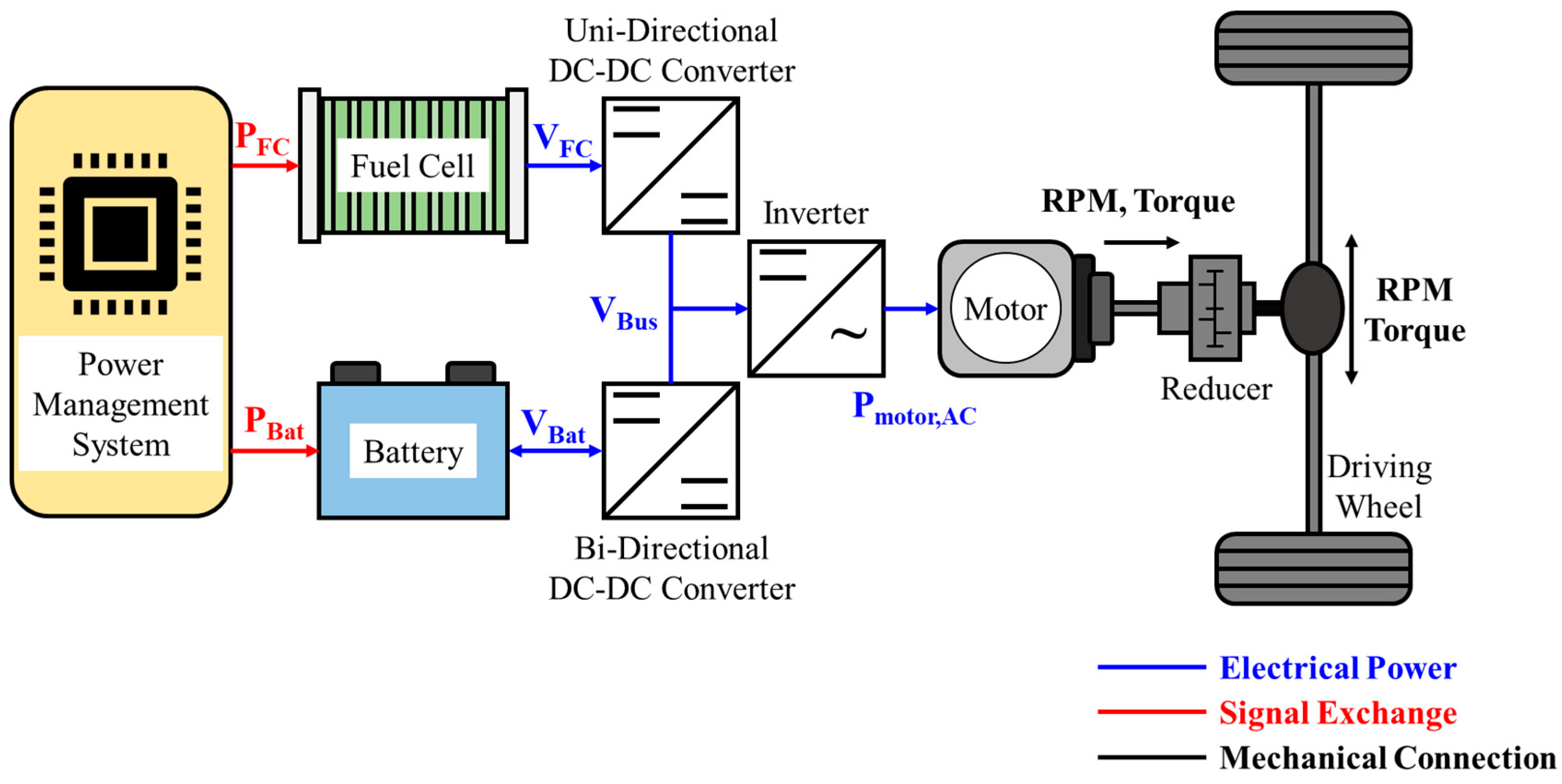
- Power Source Module: comprising dual PEM fuel cell stacks and high-voltage battery pack, which jointly supply the electrical energy required for propulsion
- (2)
- Power Conversion Module: including DC-DC converter and inverter that regulate voltage levels and enable efficient energy transfer to the traction motor
- (3)
- Drivetrain Module: consisting of an electric traction motor coupled with a reduction gear to convert electrical energy into mechanical motion and deliver the required torque to the wheels
2.1. Fuel Cell System
- -
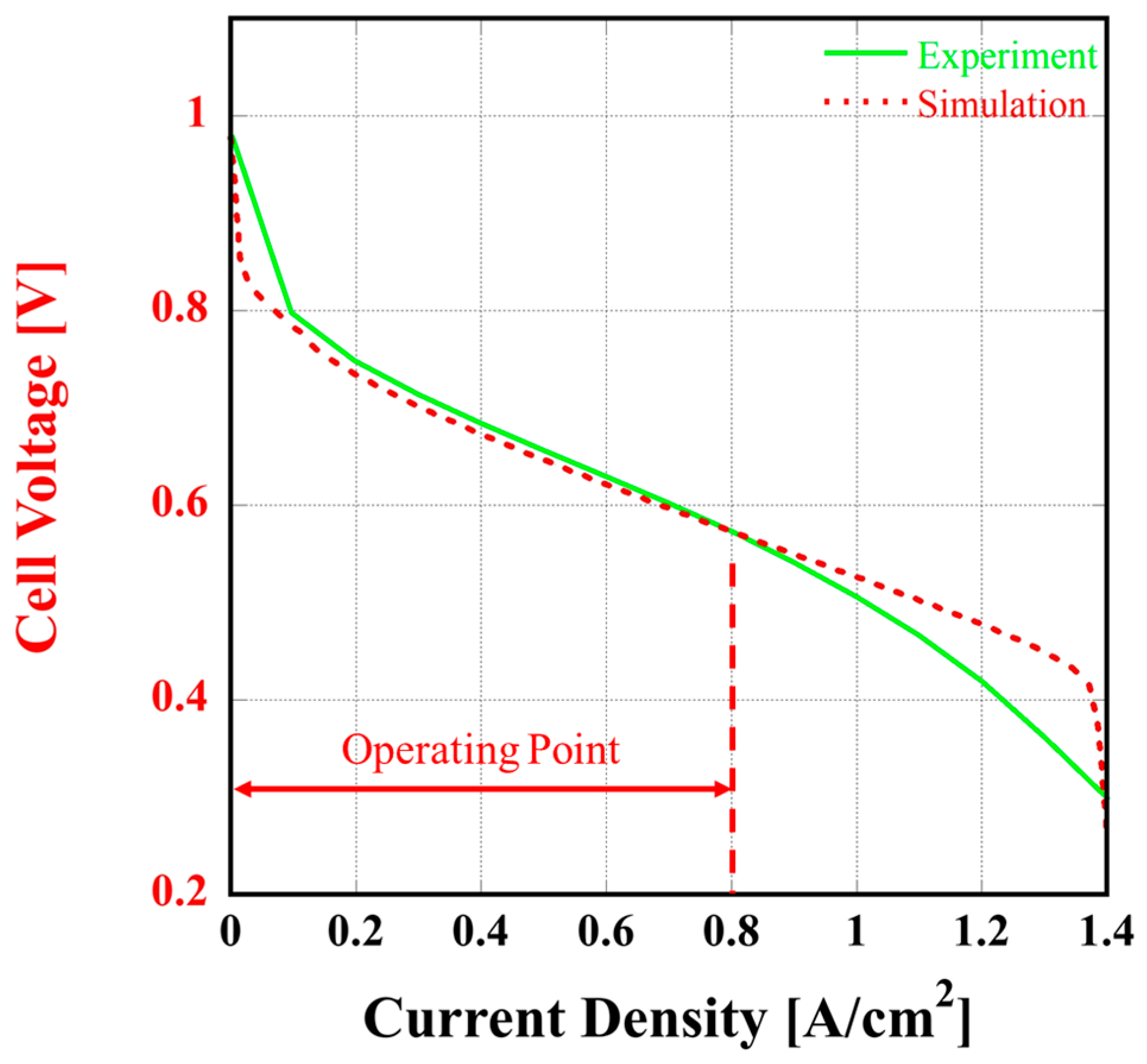
- Hydrogen and air flows are modeled as ideal gases with fixed stoichiometric ratios and constant relative humidity.
- -
- The electrochemical reaction is considered spatially uniform, and concentration gradients within the electrodes are neglected.
- -
- The temperature field inside the stack is represented using a lumped parameter approach, assuming homogeneous temperature distribution throughout the cell layers.
2.1.1. Fuel Processing System
2.1.2. Air Processing System
2.1.3. Stack
2.1.4. Thermal Management System
2.2. Battery
2.3. DC-DC Converter
2.4. Powertrain System
2.5. Power Management System
2.5.1. Rule-Based Control PMS
- (1)
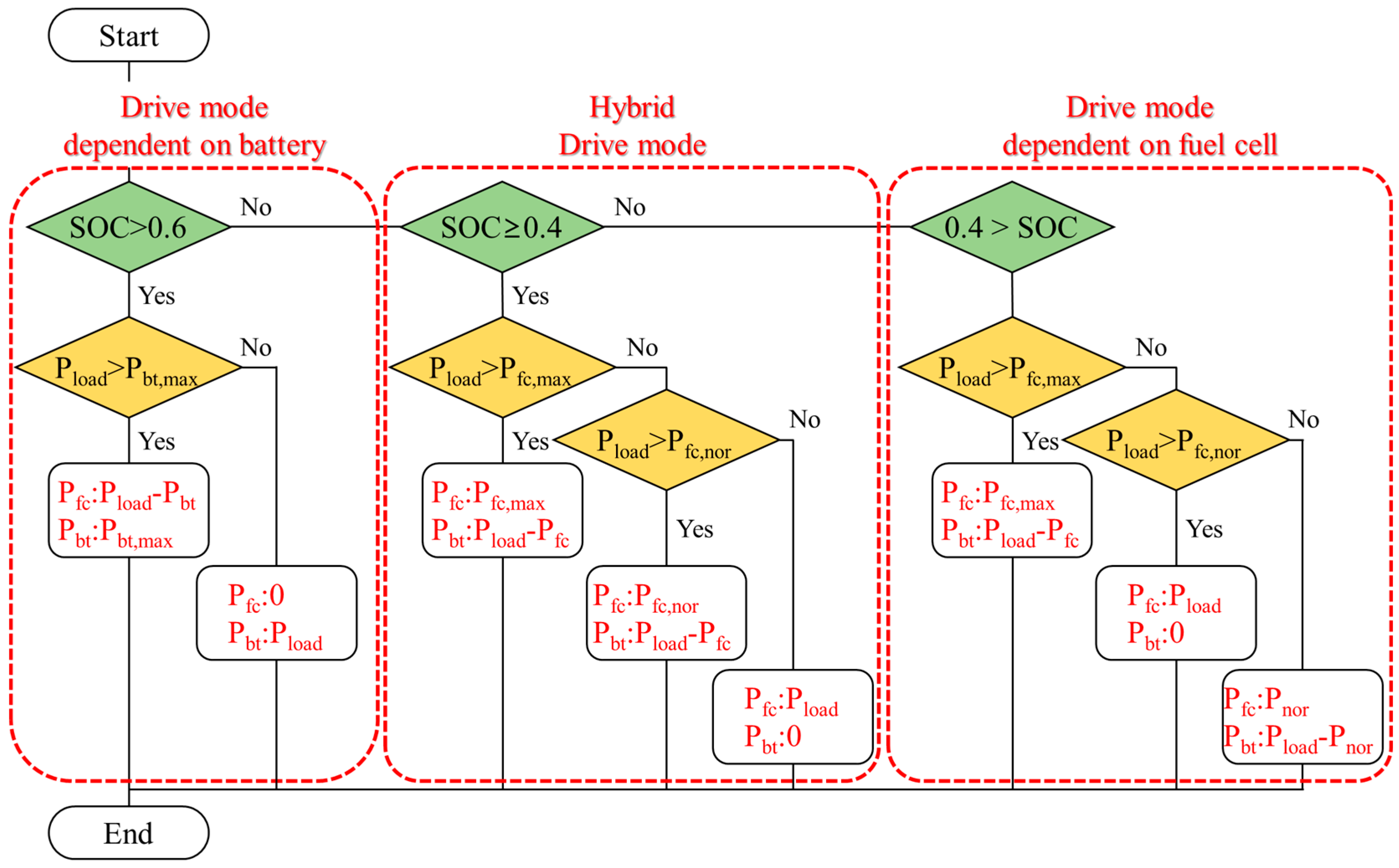
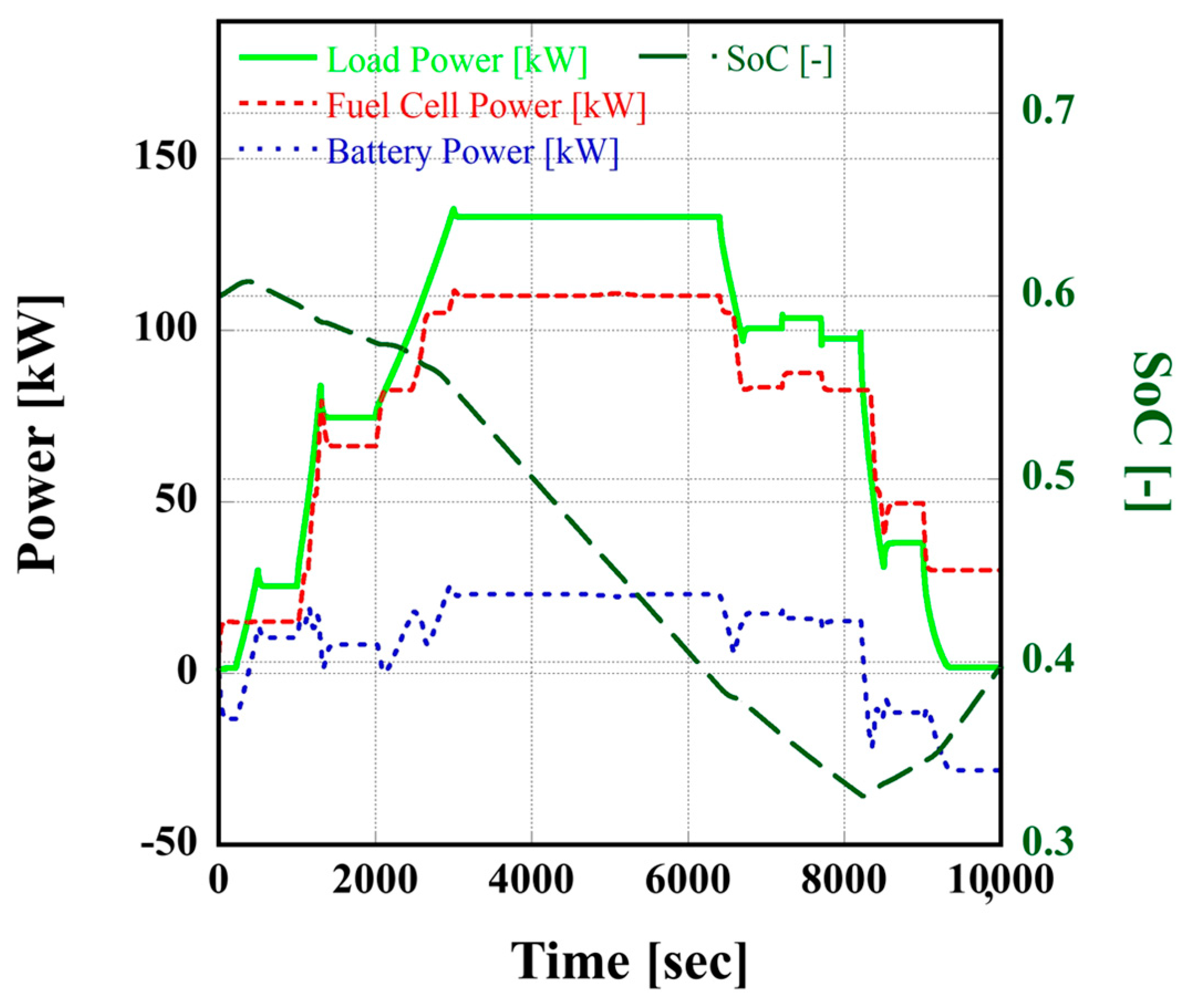
- When the battery SoC exceeds 0.6, the fuel cell output power is restricted to its minimum operating level, and the traction power demand is mainly supplied by the battery.
- (2)
- For intermediate SoC values (0.4 ≤ SoC ≤ 0.6), the fuel cell operates at a predefined base power level to cover the nominal load, while additional power demand is supplemented by the battery, resulting in hybrid operation.
- (3)
- When the SoC falls below 0.4, battery discharge is limited and the fuel cell is assigned as the primary power source to meet the traction demand; under low-load conditions, surplus fuel cell power is utilized to recharge the battery.
2.5.2. State Machine Control PMS
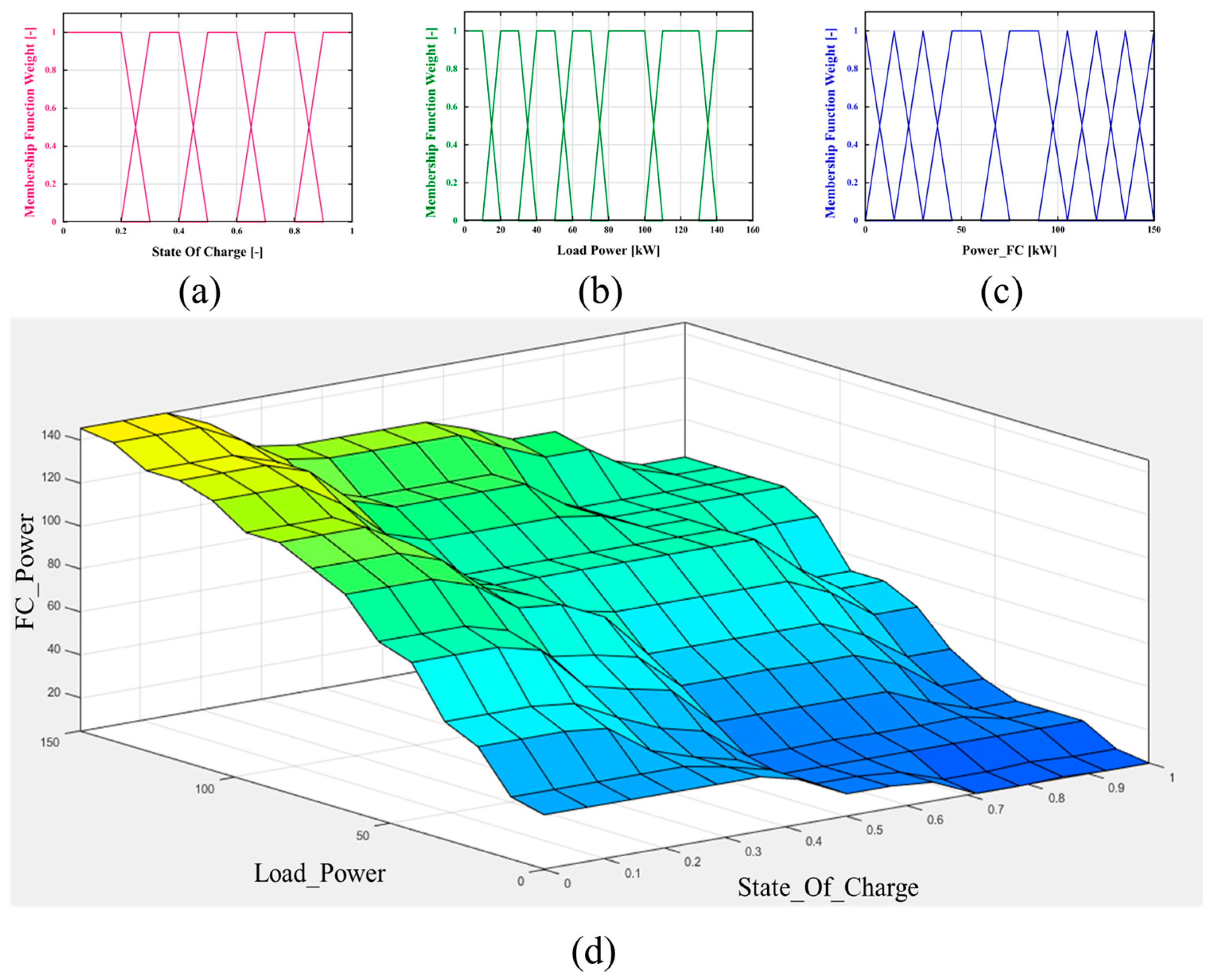
2.5.3. Fuzzy Logic Control PMS
3. Results and Discussion
3.1. Simulation Scenario
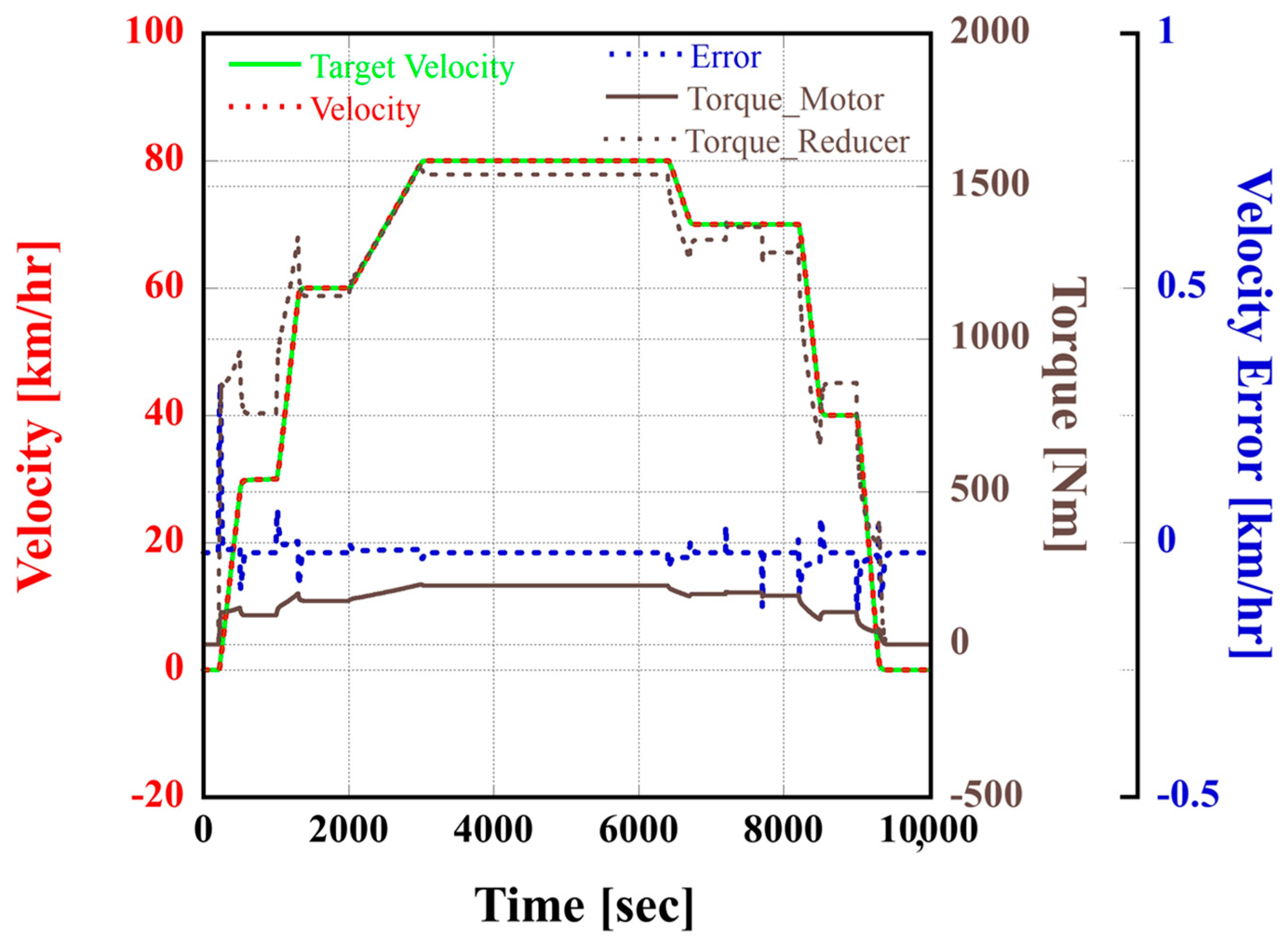
3.2. Vehicle Performance
3.3. Power Management System Comparison
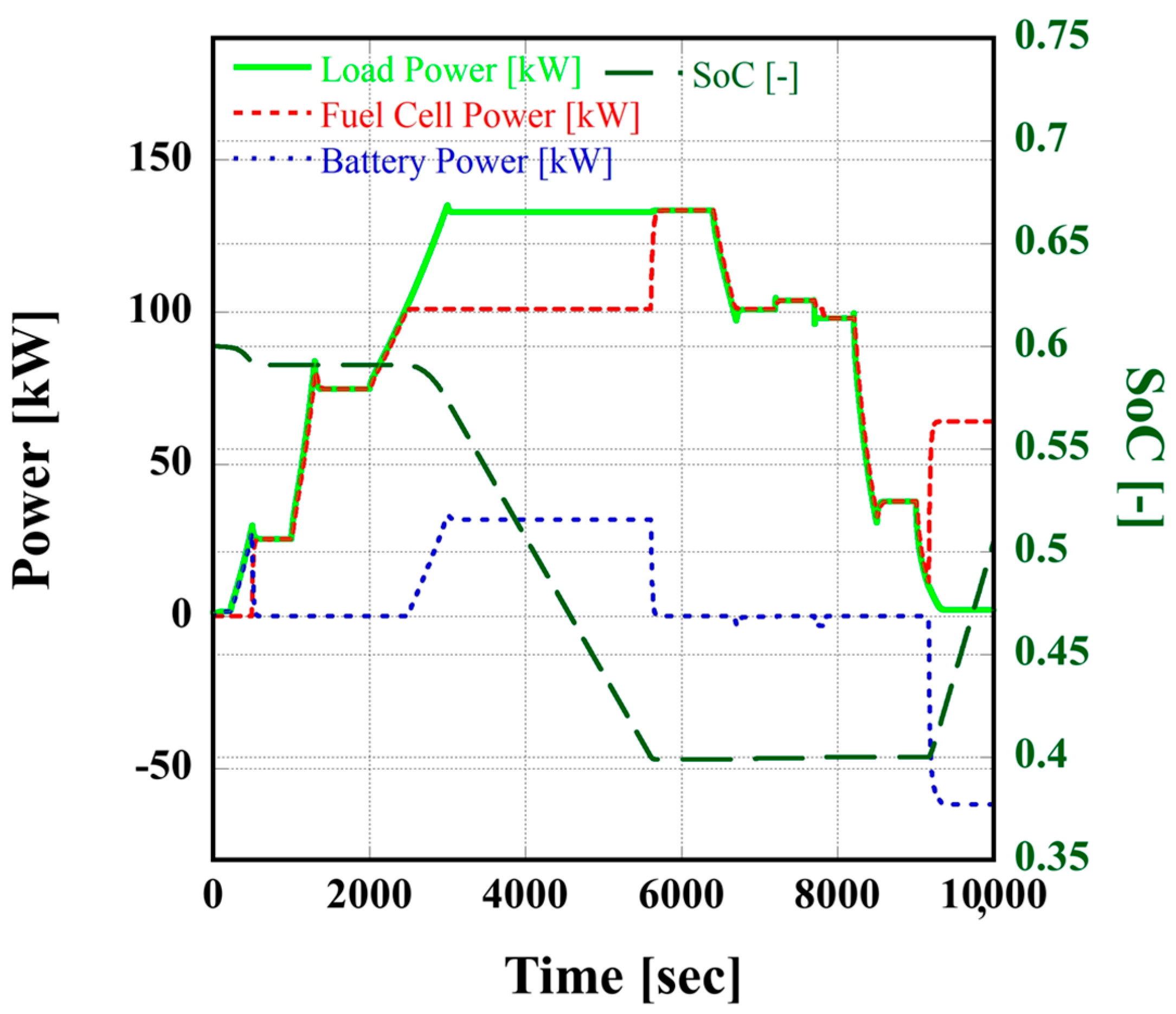
3.3.1. Result of Rule-Based Control PMS
3.3.2. Result of State Machine Control PMS
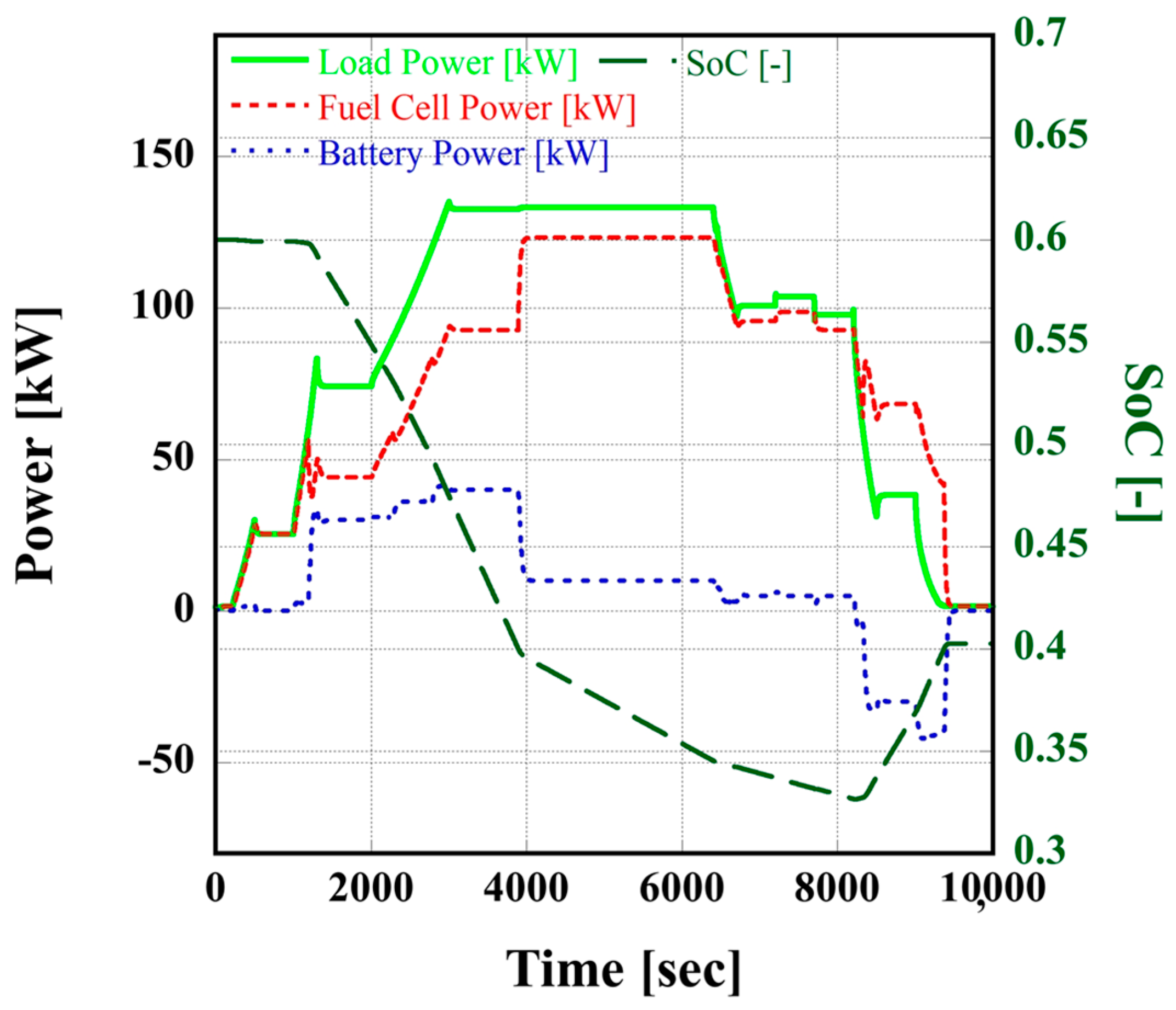
3.3.3. Result of Fuzzy Logic Control PMS
3.4. Thermal Management System Comparison
3.5. Hydrogen Consumption
3.6. Parasitic Power
3.7. Discussion
- (1)
- Decision Matrix Construction: A decision matrix is formulated by compiling performance data for each power management strategy based on the selected evaluation criteria.
- (2)
- Normalization: Each element of the matrix is normalized by dividing it by the vector norm of its respective column to eliminate the influence of units and ensure comparability across criteria.
- (3)
- Weight Assignment: The weights of the evaluation criteria were objectively determined using a standard deviation–based weighting method, assuming that criteria with larger variability among PMS strategies have greater influence on the decision-making process.
- (4)
- PIS/NIS Determination: For each performance indicator, the Positive Ideal Solution (PIS) and Negative Ideal Solution (NIS) are identified, corresponding to the best and worst attainable values, respectively.
- (5)
- Distance and Closeness Coefficient Calculation: The Euclidean distances between each alternative and the PIS/NIS are computed, and the closeness coefficient is derived to rank the alternatives based on their overall performance.
4. Conclusions
- (1)
- A dual 90 kW fuel cell configuration was implemented alongside essential BoP subsystems, including hydrogen and air supply units, a thermal management circuit, and auxiliary components such as a high-voltage battery, DC/DC converter, and drive motor model.
- (2)
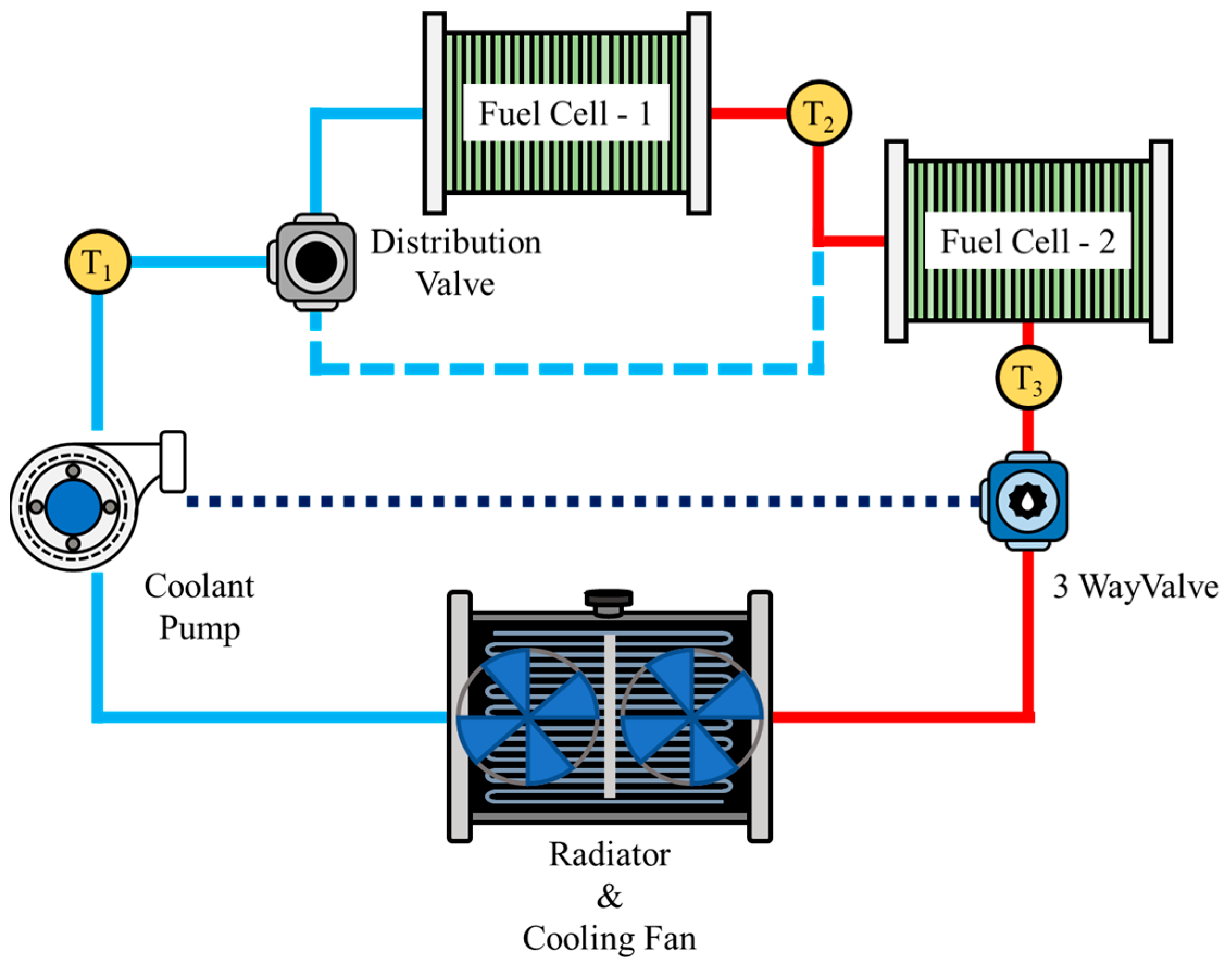
- For thermal regulation, a series-parallel cooling architecture integrating a distribution valve, coolant pump, three-way valve, radiator, and cooling fan was designed. PI controllers were applied to maintain target temperatures at each critical location.
- (3)
- To manage power flow in the hybrid fuel cell–battery system, three PMS strategies were implemented: a rule-based method based on load demand and SoC, a state machine controller with discretized operational modes, and a fuzzy logic controller capable of adaptive load distribution via membership functions.
- (4)
- The fuzzy logic PMS demonstrated the most effective load balancing by utilizing the battery as an auxiliary source during high-power demand periods, thereby alleviating sudden load transients on the fuel cell. As a result, hydrogen consumption decreased by 3.08% and 0.89% compared to rule-based and state machine control, respectively. Parasitic power consumption was reduced by 7.12% and 3.32%, and temperature overshoot was minimized by up to 61.20%.
- (5)
- Finally, multi-criteria decision analysis using the TOPSIS method confirmed that the fuzzy logic strategy achieved the highest closeness coefficient (0.9112), demonstrating superior overall performance in terms of energy efficiency, thermal stability, and hydrogen utilization. The proposed PMS comparison and TOPSIS-based decision methodology provides a system-level evaluation method that may be extended to other PEMFC architectures, such as air-cooled systems, in future work, subject to dedicated modeling and experimental validation.
- (6)
- In addition to improving instantaneous thermal performance, the enhanced temperature stability achieved by the fuzzy-logic-based PMS is expected to contribute positively to the long-term durability of PEMFC stacks by mitigating thermally induced degradation mechanisms, highlighting the importance of durability-aware thermal and power management strategies for next-generation hydrogen power systems.
Author Contributions
Funding
Data Availability Statement
Conflicts of Interest
Nomenclature
| A | Active area [cm2] |
| F | Faraday constant [C/mol] |
| F | Force [N] |
| Gear Ratio [-] | |
| I | Current [A] |
| m | Mass [kg] |
| Number of cells [ea] | |
| P | Power [kW] |
| p | Pressure [Pa] |
| Q | Heat Transfer [kW] |
| R | Ideal Gas Constant [J/K∙mol] |
| r | Radius [m] |
| T | Temperature [K] |
| V | Voltage [V] |
| Subscripts and superscripts | |
| act | Activation |
| con | Concentration |
| FC | Fuel cell |
| H2 | Hydrogen |
| H2O | Water |
| O2 | Oxygen |
| ohmic | Ohmic |
References
- Available online: https://www.visualcapitalist.com/combustion-vehicle-sales-peak/ (accessed on 31 January 2026).
- Available online: https://www.spglobal.com/mobility/en/research-analysis/2024-ev-forecast-the-supply-chain-charging-network-and-battery.html (accessed on 31 January 2026).
- Available online: https://www.mckinsey.com/industries/automotive-and-assembly/our-insights/hydrogen-the-next-wave-for-electric-vehicles (accessed on 31 January 2026).
- Yang, Q.; Zeng, T.; Zhang, C.; Zhou, W.; Xu, L.; Zhou, J.; Jiang, P.; Jiang, S. Modeling and simulation of vehicle integrated thermal management system for a fuel cell hybrid vehicle. Energy Convers. Manag. 2023, 278, 116745. [Google Scholar] [CrossRef]
- de las Nieves Camacho, M.; Jurburg, D.; Tanco, M. Hydrogen fuel cell heavy-duty trucks: Review of main research topics. Int. J. Hydrogen Energy 2022, 47, 29505–29525. [Google Scholar] [CrossRef]
- Bethoux, O. Hydrogen fuel cell road vehicles: State of the art and perspectives. Energies 2020, 13, 5843. [Google Scholar] [CrossRef]
- Simmons, K.; Guezennec, Y.; Onori, S. Modeling and energy management control design for a fuel cell hybrid passenger bus. J. Power Sources 2014, 246, 736–746. [Google Scholar] [CrossRef]
- Morrison, G.; Stevens, J.; Joseck, F. Relative economic competitiveness of light-duty battery electric and fuel cell electric vehicles. Transp. Res. Part C Emerg. Technol. 2018, 87, 183–196. [Google Scholar] [CrossRef]
- Yun, S.; Yun, J.; Han, J. Development of a 470-Horsepower Fuel Cell–Battery Hybrid Xcient Dynamic Model Using SimscapeTM. Energies 2023, 16, 8092. [Google Scholar] [CrossRef]
- Xu, J.; Zhang, C.; Wan, Z.; Chen, X.; Chan, S.H.; Tu, Z. Progress and perspectives of integrated thermal management systems in PEM fuel cell vehicles: A review. Renew. Sustain. Energy Rev. 2022, 155, 111908. [Google Scholar] [CrossRef]
- Meng, X.; Mei, J.; Tang, X.; Jiang, J.; Sun, C.; Song, K. The degradation prediction of proton exchange membrane fuel cell performance based on a transformer model. Energies 2024, 17, 3050. [Google Scholar] [CrossRef]
- Wang, Y.; Chen, W.; Li, Q.; Han, Y.; Guo, A.; Wang, T. Coordinated optimal power distribution strategy based on maximum efficiency range of multi-stack fuel cell system for high altitude. Int. J. Hydrogen Energy 2024, 50, 374–387. [Google Scholar] [CrossRef]
- Zhou, S.; Fan, L.; Zhang, G.; Gao, J.; Lu, Y.; Zhao, P.; Wen, C.; Shi, L.; Hu, Z. A review on proton exchange membrane multi-stack fuel cell systems: Architecture, performance, and power management. Appl. Energy 2022, 310, 118555. [Google Scholar] [CrossRef]
- Ren, P.; Pei, P.; Fu, X.; Li, Y.; Chen, D.; Meng, Y.; Zhu, Z.; Song, X.; Zhang, L.; Wang, M. Diagnosis and mechanism analysis of startup-shutdown-induced fuel cell degradation in stack-level. Energy Convers. Manag. 2022, 269, 116140. [Google Scholar] [CrossRef]
- Wu, P.; Partridge, J.; Bucknall, R. Cost-effective reinforcement learning energy management for plug-in hybrid fuel cell and battery ships. Appl. Energy 2020, 275, 115258. [Google Scholar] [CrossRef]
- De-Troya, J.J.; Álvarez, C.; Fernández-Garrido, C.; Carral, L. Analysing the possibilities of using fuel cells in ships. Int. J. Hydrogen Energy 2016, 41, 2853–2866. [Google Scholar] [CrossRef]
- Zhang, G.; Zhou, S.; Gao, J.; Fan, L.; Lu, Y. Stacks multi-objective allocation optimization for multi-stack fuel cell systems. Appl. Energy 2023, 331, 120370. [Google Scholar] [CrossRef]
- Zhang, C.; Zeng, T.; Wu, Q.; Deng, C.; Chan, S.H.; Liu, Z. Improved efficiency maximization strategy for vehicular dual-stack fuel cell system considering load state of sub-stacks through predictive soft-loading. Renew. Energy 2021, 179, 929–944. [Google Scholar] [CrossRef]
- Abuzant, S.; Jemei, S.; Hissel, D.; Boulon, L.; Agbossou, K.; Gustin, F. A review of multi-stack PEM fuel cell systems: Advantages, challenges and on-going applications in the industrial market. In Proceedings of the 2017 IEEE Vehicle Power and Propulsion Conference (VPPC), Belfort, France, 11–14 December 2017; IEEE: New York, NY, USA, 2017; pp. 1–6. [Google Scholar]
- Han, X.; Li, F.; Zhang, T.; Zhang, T.; Song, K. Economic energy management strategy design and simulation for a dual-stack fuel cell electric vehicle. Int. J. Hydrogen Energy 2017, 42, 11584–11595. [Google Scholar] [CrossRef]
- Dépature, C.; Boulon, L.; Sicard, P.; Fournier, M. Simulation model of a multi-stack fuel cell system. In Proceedings of the 2013 15th European Conference on Power Electronics and Applications (EPE), Lille, France, 2–6 September 2013; IEEE: New York, NY, USA, 2013; pp. 1–10. [Google Scholar]
- Zhou, S.; Zhang, G.; Fan, L.; Gao, J.; Pei, F. Scenario-oriented stacks allocation optimization for multi-stack fuel cell systems. Appl. Energy 2022, 308, 118328. [Google Scholar] [CrossRef]
- Marx, N.; Hissel, D.; Gustin, F.; Boulon, L.; Agbossou, K. On the sizing and energy management of an hybrid multistack fuel cell–Battery system for automotive applications. Int. J. Hydrogen Energy 2017, 42, 1518–1526. [Google Scholar] [CrossRef]
- Plett, G.L. Extended Kalman filtering for battery management systems of LiPB-based HEV battery packs: Part 3. State and parameter estimation. J. Power Sources 2004, 134, 277–292. [Google Scholar] [CrossRef]
- Hu, X.; Li, S.; Peng, H. A comparative study of equivalent circuit models for Li-ion batteries. J. Power Sources 2012, 198, 359–367. [Google Scholar] [CrossRef]
- Hu, X.; Zou, C.; Zhang, C.; Li, Y. Technological developments in batteries: A survey of principal roles, types, and management needs. IEEE Power Energy Mag. 2017, 15, 20–31. [Google Scholar] [CrossRef]
- Burke, A. Ultracapacitors: Why, how, and where is the technology. J. Power Sources 2000, 91, 37–50. [Google Scholar] [CrossRef]
- Zhang, S.; Xiong, R.; Sun, F. Model predictive control for power management in a plug-in hybrid electric vehicle with a hybrid energy storage system. Appl. Energy 2017, 185, 1654–1662. [Google Scholar] [CrossRef]
- Qiu, Y.; Zeng, T.; Zhang, C.; Wang, G.; Wang, Y.; Hu, Z.; Yan, M.; Wei, Z. Progress and challenges in multi-stack fuel cell system for high power applications: Architecture and energy management. Green Energy Intell. Transp. 2023, 2, 100068. [Google Scholar] [CrossRef]
- Shen, W.; Fan, L.; Pan, Z.; Chen, C.; Wang, N.; Zhou, S. Comparison of different topologies of thermal management subsystems in multi-stack fuel cell systems. Energies 2022, 15, 5030. [Google Scholar] [CrossRef]
- Gao, J.; Jiang, Y.; Zhou, S. Fault Diagnosis of Sensors for Multi-stack Fuel Cell Thermal Management Subsystem Based on UKF. J. Electrotechnol. Electr. Eng. Manag. 2024, 7, 33–41. [Google Scholar] [CrossRef]
- Saygili, Y.; Eroglu, I.; Kincal, S. Model based temperature controller development for water cooled PEM fuel cell systems. Int. J. Hydrogen Energy 2015, 40, 615–622. [Google Scholar] [CrossRef]
- Hu, P.; Cao, G.Y.; Zhu, X.J.; Hu, M. Coolant circuit modeling and temperature fuzzy control of proton exchange membrane fuel cells. Int. J. Hydrogen Energy 2010, 35, 9110–9123. [Google Scholar] [CrossRef]
- Farhadi Gharibeh, H.; Farrokhifar, M. Online multi-level energy management strategy based on rule-based and optimization-based approaches for fuel cell hybrid electric vehicles. Appl. Sci. 2021, 11, 3849. [Google Scholar] [CrossRef]
- Peng, H.; Li, J.; Thul, A.; Deng, K.; Ünlübayir, C.; Löwenstein, L.; Hameyer, K. A scalable, causal, adaptive rule-based energy management for fuel cell hybrid railway vehicles learned from results of dynamic programming. Etransportation 2020, 4, 100057. [Google Scholar] [CrossRef]
- Yuan, H.B.; Zou, W.J.; Jung, S.; Kim, Y.B. A real-time rule-based energy management strategy with multi-objective optimization for a fuel cell hybrid electric vehicle. IEEE Access 2022, 10, 102618–102628. [Google Scholar] [CrossRef]
- Wang, Y.; Sun, Z.; Chen, Z. Energy management strategy for battery/supercapacitor/fuel cell hybrid source vehicles based on finite state machine. Appl. Energy 2019, 254, 113707. [Google Scholar]
- Li, Q.; Yang, H.; Han, Y.; Li, M.; Chen, W. A state machine strategy based on droop control for an energy management system of PEMFC-battery-supercapacitor hybrid tramway. Int. J. Hydrogen Energy 2016, 41, 16148–16159. [Google Scholar]
- Nivolianiti, E.; Karnavas, Y.L.; Charpentier, J.F. Fuzzy logic-based energy management strategy for hybrid fuel cell electric ship power and propulsion system. J. Mar. Sci. Eng. 2024, 12, 1813. [Google Scholar] [CrossRef]
- Zhang, D.; Zhou, Y.; Liu, K.P.; Chen, Q.Q. A study on fuzzy control of energy management system in hybrid electric vehicle. In Proceedings of the 2009 Asia-Pacific Power and Energy Engineering Conference, Wuhan, China, 28–31 March 2009; pp. 1–4. [Google Scholar]
- Sciarretta, A.; Back, M.; Guzzella, L. Optimal control of parallel hybrid electric vehicles. IEEE Trans. Control. Syst. Technol. 2004, 12, 352–363. [Google Scholar] [CrossRef]
- Kirschbaum, F.; Back, M.; Hart, M. Determination of the fuel-optimal trajectory for a vehicle along a known route. IFAC Proc. 2002, 35, 235–239. [Google Scholar] [CrossRef]
- Available online: https://ecv.hyundai.com/global/en/products/xcient-fuel-cell-truck-fcev (accessed on 31 May 2024).
- Chen, F.Q.; Ren, X.D.; Hu, B.; Li, X.S.; Gu, C.W.; Jin, Z.J. Parametric analysis on multi-stage high pressure reducing valve for hydrogen decompression. Int. J. Hydrogen Energy 2019, 44, 31263–31274. [Google Scholar] [CrossRef]
- Ye, X.; Zhang, T.; Chen, H.; Cao, J.; Chen, J. Fuzzy control of hydrogen pressure in fuel cell system. Int. J. Hydrogen Energy 2019, 44, 8460–8466. [Google Scholar] [CrossRef]
- Yu, S.P.; Lai, M.W.; Chu, C.Y.; Huang, C.L.; Lin, C.Y.; Borzenko, V.I.; Dunikov, D.O.; Kazakov, A.N. Integration of low-pressure hydrogen storage cylinder and automatic controller for carbon deposit removal in car engine. Int. J. Hydrogen Energy 2016, 41, 21795–21801. [Google Scholar] [CrossRef]
- Chen, F.Q.; Zhang, M.; Qian, J.Y.; Fei, Y.; Chen, L.L.; Jin, Z.J. Thermo-mechanical stress and fatigue damage analysis on multi-stage high pressure reducing valve. Ann. Nucl. Energy 2017, 110, 753–767. [Google Scholar]
- Chen, F.Q.; Qian, J.Y.; Chen, M.R.; Zhang, M.; Chen, L.L.; Jin, Z.J. Turbulent compressible flow analysis on multi-stage high pressure reducing valve. Flow Meas. Instrum. 2018, 61, 26–37. [Google Scholar] [CrossRef]
- Lee, Y.B.; Kim, C.H.; Ahn, S.Y.; Choi, Y.M.; Ahn, B.K.; Oh, J. Turbo Blower for 80 kW Proton Exchange Membrane Fuel Cell Vehicle. In Proceedings of the 5th WSEAS International Conference on Power Systems and Electromagnetic Compatibility, Corfu, Greece, 23–25 August 2005; p. 498-271. [Google Scholar]
- Han, J.; Yu, S.; Sun, Y. Oxygen excess ratio control for proton exchange membrane fuel cell using model reference adaptive control. Int. J. Hydrogen Energy 2019, 44, 18425–18437. [Google Scholar] [CrossRef]
- Gelfi, S.; Stefanopoulou, A.G.; Pukrushpan, J.T.; Peng, H. Dynamics of low-pressure and high-pressure fuel cell air supply systems. In Proceedings of the 2003 American Control Conference, Denver, CO, USA, 4–6 June 2003; IEEE: New York, NY, USA, 2003; Volume 3, pp. 2049–2054. [Google Scholar]
- Han, J.; Han, J.; Yu, S. Investigation of FCVs durability under driving cycles using a model-based approach. J. Energy Storage 2020, 27, 101169. [Google Scholar] [CrossRef]
- Fletcher, T.; Thring, R.; Watkinson, M. An Energy Management Strategy to concurrently optimise fuel consumption & PEM fuel cell lifetime in a hybrid vehicle. Int. J. Hydrogen Energy 2016, 41, 21503–21515. [Google Scholar] [CrossRef]
- Bezmalinovic, D.; Simic, B.; Frano Barbir, F. Characterization of PEM fuel cell degradation by polarization change curves. J. Power Sources 2015, 294, 82–87. [Google Scholar] [CrossRef]
- Chang, Y.; Liu, J.; Li, R.; Zhao, J.; Qin, Y.; Zhang, J.; Yin, Y.; Li, X. Effect of humidity and thermal cycling on the catalyst layer structural changes in polymer electrolyte membrane fuel cells. Energy Convers. Manag. 2019, 189, 24–32. [Google Scholar] [CrossRef]
- Petrone, R.; Yeetsorn, R.; Harel, F.; Hissel, D.; Pera, M.C.; Breaz, E.; Giurgea, S. Accelerated stress tests oriented load profile for PEM Fuel Cells durability in automotive applications. In Proceedings of the 2017 IEEE Vehicle Power and Propulsion Conference (VPPC), Belfort, France, 11–14 December 2017; IEEE: New York, NY, USA, 2017; pp. 1–5. [Google Scholar]
- Chen, H.; Song, Z.; Zhao, X.; Zhang, T.; Pei, P.; Liang, C. A review of durability test protocols of the proton exchange membrane fuel cells for vehicle. Appl. Energy 2018, 224, 289–299. [Google Scholar] [CrossRef]
- Thiele, P.; Yang, Y.; Dirkes, S.; Wick, M.; Pischinger, S. Realistic accelerated stress tests for PEM fuel cells: Test procedure development based on standardized automotive driving cycles. Int. J. Hydrogen Energy 2024, 52, 1065–1080. [Google Scholar] [CrossRef]
- Han, J.; Yu, S. Ram air compensation analysis of fuel cell vehicle cooling system under driving modes. Appl. Therm. Eng. 2018, 142, 530–542. [Google Scholar] [CrossRef]
- Riascos, L.A.M.; Pereira, D.D. Controlling operating temperature in PEM fuel cells. In Proceedings of the ABCM Symposium Series in Mechatronics, Gramado, RS, Brazil, 15–20 November 2009; ABCM: Rio de Janeiro, Brazil; Volume 4, pp. 137–146.
- Tawalbeh, M.; Alarab, S.; Al-Othman, A.; Javed, R.M.N. The operating parameters, structural composition, and fuel sustainability aspects of PEM fuel cells: A mini review. Fuels 2022, 3, 449–474. [Google Scholar] [CrossRef]
- Soupremanien, U.; Le Person, S.; Favre-Marinet, M.; Bultel, Y. Tools for designing the cooling system of a proton exchange membrane fuel cell. Appl. Therm. Eng. 2012, 40, 161–173. [Google Scholar] [CrossRef]
- Sun, Z.; Chen, Z.; Wang, Y.; Yuan, H. PEM fuel cell thermal management strategy based on multi-model predictive control. In Proceedings of the 2022 IEEE/IAS Industrial and Commercial Power System Asia (I&CPS Asia), Shanghai, China, 8–11 July 2022; IEEE: New York, NY, USA, 2022; pp. 625–630. [Google Scholar]
- Deng, B.; Zhang, X.; Yin, C.; Luo, Y.; Tang, H. Improving a fuel cell system’s thermal management by optimizing thermal control with the particle swarm optimization algorithm and an artificial neural network. Appl. Sci. 2023, 13, 12895. [Google Scholar] [CrossRef]
- Zhao, R.; Qin, D.; Chen, B.; Wang, T.; Wu, H. Thermal management of fuel cells based on diploid genetic algorithm and fuzzy PID. Appl. Sci. 2022, 13, 520. [Google Scholar] [CrossRef]
- Sulaiman, N.; Hannan, M.A.; Mohamed, A.; Majlan, E.H.; Daud, W.W. A review on energy management system for fuel cell hybrid electric vehicle: Issues and challenges. Renew. Sustain. Energy Rev. 2015, 52, 802–814. [Google Scholar] [CrossRef]
- Li, X.; Xu, L.; Hua, J.; Lin, X.; Li, J.; Ouyang, M. Power management strategy for vehicular-applied hybrid fuel cell/battery power system. J. Power Sources 2009, 191, 542–549. [Google Scholar] [CrossRef]
- Li, C.-Y.; Liu, G.-P. Optimal fuzzy power control and management of fuel cell/battery hybrid vehicles. J. Power Sources 2009, 192, 525–533. [Google Scholar] [CrossRef]
- Cai, J.; Zhong, Q.C.; Stone, D. A compact power converter for hybrid energy systems. In Proceedings of the IECON 2014-40th Annual Conference of the IEEE Industrial Electronics Society, Dallas, TX, USA, 29 October–1 November 2014; IEEE: New York, NY, USA, 2014; pp. 995–1000. [Google Scholar]
- Reddy, K.J.; Natarajan, S. Energy sources and multi-input DC-DC converters used in hybrid electric vehicle applications–A review. Int. J. Hydrogen Energy 2018, 43, 17387–17408. [Google Scholar] [CrossRef]
- Spanoudakis, P.; Moschopoulos, G.; Stefanoulis, T.; Sarantinoudis, N.; Papadokokolakis, E.; Ioannou, I.; Piperidis, S.; Doitsidis, L.; Tsourveloudis, N.C. Efficient gear ratio selection of a single-speed drivetrain for improved electric vehicle energy consumption. Sustainability 2020, 12, 9254. [Google Scholar] [CrossRef]
- Peng, M.; Lin, J.; Liu, X. Optimizing design of powertrain transmission ratio of heavy duty truck. IFAC-PapersOnLine 2018, 51, 892–897. [Google Scholar] [CrossRef]
- Fayaz, H.; Saidur, R.; Razali, N.; Anuar, F.S.; Saleman, A.R.; Islam, M.R. An overview of hydrogen as a vehicle fuel. Renew. Sustain. Energy Rev. 2012, 16, 5511–5528. [Google Scholar] [CrossRef]
- Teng, T.; Zhang, X.; Dong, H.; Xue, Q. A comprehensive review of energy management optimization strategies for fuel cell passenger vehicle. Int. J. Hydrogen Energy 2020, 45, 20293–20303. [Google Scholar] [CrossRef]
- Yue, M.; Jemei, S.; Gouriveau, R.; Zerhouni, N. Review on health-conscious energy management strategies for fuel cell hybrid electric vehicles: Degradation models and strategies. Int. J. Hydrogen Energy 2019, 44, 6844–6861. [Google Scholar] [CrossRef]
- Lei, T.; Wang, Y.; Jin, X.; Min, Z.; Zhang, X.; Zhang, X. An optimal fuzzy logic-based energy management strategy for a fuel cell/battery hybrid power unmanned aerial vehicle. Aerospace 2022, 9, 115. [Google Scholar] [CrossRef]
- Du, J.; Zhao, X.; Liu, X.; Liu, G.; Xiong, Y. A Fuzzy Logic Control-Based Approach for Real-Time Energy Management of the Fuel Cell Electrical Bus Considering the Durability of the Fuel Cell System. World Electr. Veh. J. 2024, 15, 92. [Google Scholar] [CrossRef]
- Vivas, F.J.; Segura, F.; Andújar, J.M.; Palacio, A.; Saenz, J.L.; Isorna, F.; López, E. Multi-objective fuzzy logic-based energy management system for microgrids with battery and hydrogen energy storage system. Electronics 2020, 9, 1074. [Google Scholar]
- Gao, D.; Jin, Z.; Lu, Q. Energy management strategy based on fuzzy logic for a fuel cell hybrid bus. J. Power Sources 2008, 185, 311–317. [Google Scholar] [CrossRef]
- Liu, X.; Guo, H.; Du, J.; Zhao, X. A modified model-free-adaptive-control-based real-time energy management strategy for plug-in hybrid electric vehicle. Energy Sci. Eng. 2022, 10, 4007–4024. [Google Scholar] [CrossRef]
- Wirasingha, S.G.; Emadi, A. Classification and review of control strategies for plug-in hybrid electric vehicles. IEEE Trans. Veh. Technol. 2010, 60, 111–122. [Google Scholar] [CrossRef]
- Du, C.; Huang, S.; Jiang, Y.; Wu, D.; Li, Y. Optimization of energy management strategy for fuel cell hybrid electric vehicles based on dynamic programming. Energies 2022, 15, 4325. [Google Scholar] [CrossRef]
- Lee, C.-C. Fuzzy logic in control systems: Fuzzy logic controller. I. IEEE Trans. Syst. Man Cybern. 1990, 20, 404–418. [Google Scholar]
- Cordón, O. A historical review of evolutionary learning methods for Mamdani-type fuzzy rule-based systems: Designing interpretable genetic fuzzy systems. Int. J. Approx. Reason. 2011, 52, 894–913. [Google Scholar]
- Sugeno, M.; Yasukawa, T. A fuzzy-logic-based approach to qualitative modeling. IEEE Trans. Fuzzy Syst. 1993, 1, 7. [Google Scholar] [CrossRef]
- Ragab, A.; Marei, M.I.; Mokhtar, M. Comprehensive Study of Fuel Cell Hybrid Electric Vehicles: Classification, Topologies, and Control System Comparisons. Appl. Sci. 2023, 13, 13057. [Google Scholar] [CrossRef]
- An, Y.; Lee, N.; Park, J.; Lee, J.; Kim, W.; Woo, N. Comparative analysis of road gradient measurement method. In Proceedings of the Korea Automotive Engineering Society Spring Conference, Gunsan, Republic of Korea, 12–14 August 2016. [Google Scholar]
- Kim, M.; Lee, J.; Lee, H. Development of Model Predictive Controller for Electrified Vehicles through System Identification Considering Road Slope. In Proceedings of the Korea Automotive Engineering Society Spring Conference, Busan, Republic of Korea, 2–4 June 2022. [Google Scholar]
- Huang, Y.; Xiao, X.; Kang, H.; Lv, J.; Zeng, R.; Shen, J. Thermal management of polymer electrolyte membrane fuel cells: A critical review of heat transfer mechanisms, cooling approaches, and advanced cooling techniques analysis. Energy Convers. Manag. 2022, 254, 115221. [Google Scholar] [CrossRef]
- Zhang, G.; Jiao, K. Multi-phase models for water and thermal management of proton exchange membrane fuel cell: A review. J. Power Sources 2018, 391, 120–133. [Google Scholar] [CrossRef]
- Yan, Q.; Toghiani, H.; Causey, H. Steady state and dynamic performance of proton exchange membrane fuel cells (PEMFCs) under various operating conditions and load changes. J. Power Sources 2006, 161, 492–502. [Google Scholar] [CrossRef]
- Bvumbe, T.J.; Bujlo, P.; Tolj, I.; Mouton, K.; Swart, G.; Pasupathi, S.; Pollet, B.G. Review on management, mechanisms and modelling of thermal processes in PEMFC. Hydrog. Fuel Cells 2016, 1, 1–20. [Google Scholar]
- Song, K.; Hou, T.; Jiang, J.; Grigoriev, S.A.; Fan, F.; Qin, J.; Sun, C. Thermal management of liquid-cooled proton exchange membrane fuel cell: A review. J. Power Sources 2025, 648, 237227. [Google Scholar] [CrossRef]
- Tang, X.; Yang, M.; Shi, L.; Hou, Z.; Xu, S.; Sun, C. Adaptive state-of-health temperature sensitivity characteristics for durability improvement of PEM fuel cells. Chem. Eng. J. 2024, 491, 151951. [Google Scholar] [CrossRef]





| System | Components | Parameters | Unit |
|---|---|---|---|
| Power Supply System | Number of Stack | 2 | - |
| Power of Stack | 90 | kW | |
| Number of Battery | 3 | ea | |
| Power of Battery | 24 | kWh | |
| Driving System | Power of Motor | 350 | kW |
| Torque of Motor | 2237 | Nm |
| System | components | parameters | Unit |
|---|---|---|---|
| Vehicle Specification | Vehicle Mass | 28,000 | kg |
| Tire Rolling Radius | 0.286 | m | |
| Tire Rolling Coefficient | 0.008 | - | |
| Air Drag Coefficient | 1.15 | - | |
| Vehicle Front Area | 2.54 × 3.73 | m2 | |
| Reduction Gear Ratio | 8 | - | |
| Gravitational Acceleration | 9.81 | m/s2 |
| State | SoC [-] | Load Power [kW] | Fuel Cell Power [kW] |
|---|---|---|---|
| 1 | Low | Pload > P Load,1 | Pload + P8 |
| 2 | Low | Pload > P Load,2 | Pload + P6 |
| 3 | Low | Pload > P Load,3 | Pload |
| 4 | Low | Pload > P Load,4 | Pload − P1 |
| 5 | Low | Pload > P Load,5 | Pload − P2 |
| 6 | Medium | Pload > P Load,1 | Pload |
| 7 | Medium | Pload > P Load,2 | Pload |
| 8 | Medium | Pload > P Load,3 | Pload − P6 |
| 9 | Medium | Pload > P Load,4 | Pload − P7 |
| 10 | Medium | Pload > P Load,5 | Pload − P8 |
| 11 | High | Pload > PLoad,1 | Pload |
| 12 | High | Pload > P Load,2 | Pload |
| 13 | High | Pload > P Load,3 | Pload − P8 |
| 14 | High | Pload > P Load,4 | Pload − P9 |
| 15 | High | Pload > P Load,5 | Pload − P10 |
| Rule-Based Control PMS | State Machine Control PMS | Fuzzy Logic Control PMS | |
|---|---|---|---|
| Hydrogen Consumption [kg] | 17.1689 | 16.7903 | 16.6408 |
| Time [sec] | Rule-Based Control PMS | State Machine Control PMS | Fuzzy Logic Control PMS | ||||||
|---|---|---|---|---|---|---|---|---|---|
| Cooling Fan [kJ] | Coolant Pump [kJ] | Compressor [kJ] | Cooling Fan [kJ] | Coolant Pump [kJ] | Compressor [kJ] | Cooling Fan [kJ] | Coolant Pump [kJ] | Compressor [kJ] | |
| 2000 | 3.12 | 5.35 | 1333.50 | 2.79 | 5.45 | 949.83 | 2.79 | 5.43 | 1179.37 |
| 4000 | 7.61 | 11.17 | 4402.93 | 5.53 | 11.08 | 3464.57 | 7.46 | 15.27 | 4358.94 |
| 6000 | 12.96 | 19.00 | 7809.13 | 13.65 | 47.56 | 7473.48 | 14.24 | 34.89 | 7876.31 |
| 8000 | 20.84 | 51.39 | 11,337.96 | 102.36 | 86.68 | 10,757.89 | 19.20 | 47.18 | 10,754.21 |
| 10,000 | 25.26 | 59.10 | 13,042.95 | 106.86 | 94.16 | 12,409.59 | 23.17 | 52.53 | 12,116.30 |
| Rule-Based Control PMS | State Machine Control PMS | Fuzzy Logic Control PMS | |
|---|---|---|---|
| Distance to Ideal Solution () | 0.2578 | 0.1393 | 0.0253 |
| Distance to Negative Ideal Solution () | 0.0303 | 0.1256 | 0.2599 |
| Closeness Coefficient () | 0.1051 | 0.4741 | 0.9112 |
Disclaimer/Publisher’s Note: The statements, opinions and data contained in all publications are solely those of the individual author(s) and contributor(s) and not of MDPI and/or the editor(s). MDPI and/or the editor(s) disclaim responsibility for any injury to people or property resulting from any ideas, methods, instructions or products referred to in the content. |
© 2026 by the authors. Licensee MDPI, Basel, Switzerland. This article is an open access article distributed under the terms and conditions of the Creative Commons Attribution (CC BY) license.
Share and Cite
Yun, S.; Han, J. Comparative Evaluation of Power Management Strategies in Multi-Stack Fuel Cell-Battery Hybrid Truck via TOPSIS. Batteries 2026, 12, 65. https://doi.org/10.3390/batteries12020065
Yun S, Han J. Comparative Evaluation of Power Management Strategies in Multi-Stack Fuel Cell-Battery Hybrid Truck via TOPSIS. Batteries. 2026; 12(2):65. https://doi.org/10.3390/batteries12020065
Chicago/Turabian StyleYun, Sanghyun, and Jaeyoung Han. 2026. "Comparative Evaluation of Power Management Strategies in Multi-Stack Fuel Cell-Battery Hybrid Truck via TOPSIS" Batteries 12, no. 2: 65. https://doi.org/10.3390/batteries12020065
APA StyleYun, S., & Han, J. (2026). Comparative Evaluation of Power Management Strategies in Multi-Stack Fuel Cell-Battery Hybrid Truck via TOPSIS. Batteries, 12(2), 65. https://doi.org/10.3390/batteries12020065