Abstract
The increasing adoption of lithium-ion (Li-ion) batteries in electric vehicles (EVs) and renewable energy systems has heightened the demand for efficient Battery Thermal Management Systems (BTMS). Effective thermal regulation is critical to prevent performance degradation, extend battery lifespan, and mitigate safety risks such as thermal runaway. Liquid cooling has become the dominant strategy in commercial EVs due to its superior thermal performance over air cooling. However, optimizing liquid cooling systems remains challenging due to the trade-off between heat transfer efficiency and pressure drop. Recent studies have explored various coolant selection, nanofluid enhancements, and complex channel geometries, an ideal balance remains difficult to achieve. While advanced methods such as topology optimization offer promising performance gains, they often introduce significant modeling and manufacturing complexity. In this study, we propose a practical alternative: an interconnected straight-channel cooling plate that introduces lateral passages to disrupt the thermal boundary layer and enhance mixing. Comparative analysis shows that the design improves temperature uniformity and reduces peak battery temperature, all while maintaining a moderate pressure drop. The proposed configuration offers a scalable and effective solution for next-generation BTMS, particularly in EV applications where thermal performance and manufacturability are both critical.
1. Introduction
The urgency to mitigate global warming and reduce greenhouse gas emissions has driven extensive research into renewable energy generation and storage technologies [1]. Among these, batteries play a central role in improving the reliability of renewable systems, especially in off-grid applications with intermittent energy supply. In addition to stationary applications, batteries are also essential components in modern transportation systems [2,3,4]. Electric vehicles (EVs) are increasingly recognized as a cleaner transportation option capable of lowering emissions in urban environments [4,5]. However, the broader deployment of EVs still relies on ongoing improvements in battery performance, including reductions in cost and enhancements in safety, efficiency, and durability [4]. Lithium-ion (Li-ion) batteries have become the preferred technology due to their high energy density, long cycle life, and suitability for both mobile and stationary applications [5,6]. Despite these strengths, Li-ion batteries still face critical challenges, especially in thermal management [7,8,9]. Performance degrades at low temperatures, while high temperatures accelerate aging and, in severe cases, may lead to thermal runaway and fire hazards [7,10,11,12].
Over the past decade, extensive research on Battery Thermal Management Systems (BTMS) has explored a wide range of cooling strategies for lithium-ion batteries [13,14,15,16,17]. Commonly reported approaches include air cooling [13,14], liquid cooling using various coolants such as water, ethylene glycol, mineral oils, and dielectric fluids [15,16,17], phase change material (PCM)-based cooling [18], and heat pipe-assisted systems [19]. Among these, air- and water-based liquid cooling have been most widely adopted in commercial electric vehicles (EVs) due to their favorable trade-off between performance, complexity, and cost [14,20]. In contrast, PCM and heat pipe cooling remain largely limited to experimental or niche applications. Several recent studies have also proposed hybrid strategies—such as combining direct liquid cooling with forced air [21] or integrating PCM with liquid cooling and pulsed operation [22]—to overcome the limitations of single-mode systems. Other passive enhancements like PCM-metal foam-fin composites have also been explored to reduce hotspots and improve energy buffering [23]. While these hybrid or passive designs show promise, they often involve added complexity or limited scalability. Comparative studies such as Akbarzadeh et al. [24] have confirmed that liquid cooling—particularly direct-contact or immersion types—offers superior thermal performance and uniformity over air cooling, which is critical for improving cell balancing, extending battery lifespan, and reducing safety risks like thermal runaway.
Despite the demonstrated superiority of liquid cooling compared to other methods, optimization through various approaches is still being actively reported. These efforts can be broadly categorized into two directions: coolant-based improvements and geometry-based modifications. On the coolant side, several studies explore the use of different liquids to enhance thermal performance. Liu et al. [15] evaluated various cooling media including water, ethylene glycol, engine oil, and their mixtures with 5% alumina nanofluids. Water was found to outperform ethylene glycol and engine oil in cooling efficiency, and the addition of nanoparticles further reduced the maximum temperature rise by 1.2 °C. However, this enhancement came with nearly a 50% increase in pressure drop. Similarly, Trimbake et al. [25] reported that using mineral oil in a submerged jet and jet impingement configuration resulted in a highly uniform surface temperature distribution, with deviations kept under 1 °C. Chen et al. [26] compared direct and indirect liquid cooling using water, mineral oil, and water-glycol mixtures, confirming water’s superior thermal performance but also noting limitations in specific configurations.
On the geometry side, researchers have proposed numerous flow channel layouts to improve thermal distribution and reduce hot spots. Tao Deng et al. [9] investigated various serpentine-shaped channel configurations and flow directions to optimize heat transfer across the cooling plate. Panchal et al. [27] conducted both experimental and numerical studies on mini-channel cold plates operated at different coolant temperatures and discharge rates, providing insights into real-world battery cycling scenarios. Amalesh et al. [28], using Liu et al. [15] as a baseline, introduced multiple redesigned channel geometries that achieved up to a 13 °C reduction in peak battery temperature at a 3C discharge rate. However, this thermal gain incurred a 250% increase in pressure drop. Another approach was presented by Zekung Jiang et al. [29] proposing an immersion technique which utilized gravity to increase the liquid flow, and by this the optimization of temperature difference and pressure drop were reported to be 79% and 13%, respectively. However, this attempt is still dependent on special dielectric liquid with low viscosity. Beyond the traditional approach of changing liquid and geometry, recent studies using topology optimization were also reported. Yasong Sun et al. [30] applied topology optimization using porous medium domains and compared the results to serpentine and rectangular designs. At equal pressure drop (~55 Pa), their topological design reduced the maximum temperature by approximately 10 °C when compared to serpentine and by 8 °C when compared to rectangular layouts. Sen Zhan et al. [31] introduced a bionic leaf-vein cooling structure via NSGA-II and density-based topology optimization, reporting substantial reductions in temperature standard deviation (40.79%) and pressure drop (71.25%) over baseline designs. Chaofeng Pan et al. [32] also proposed a dual-outlet, topology-optimized plate, showing a 0.5% reduction in temperature and a 24% lower pressure drop compared to traditional straight channel. This suggests that despite the complexity, the topology optimizations show a promising potential for resolving thermal efficiency and pressure drop.
While topology optimization has demonstrated its potential to push the limits of structural performance, as emphasized in the review by Jihong [33], its practical application still demands advanced modeling, multi-axis manufacturing capabilities, and careful handling of thermal-process effects. Therefore, a more straightforward and practical approach is needed to achieve an efficient balance between thermal management and hydraulic performance in battery cooling systems. In this study the authors propose an interconnected straight-channel design, introducing a mixing zone that disrupts the thermal boundary layer, thereby enhancing heat transfer. The proposed interconnected channel differs fundamentally from the porous-fin and bionic flow-path concepts reported by Zhan et al. [31] and Sun et al. [13]. While those designs rely on complex porous or biomimetic structures that distribute coolant through tortuous micro-paths or fractal branches, the present design preserves a conventional mini-channel layout but introduces periodic open bridges that enable controlled lateral coolant exchange between adjacent channels. This approach generates beneficial secondary flow and mixing similar to bionic designs but maintains lower pressure drop, simpler geometry, and straightforward manufacturability using standard milling or stamping methods. This approach not only improves temperature uniformity and lowers the maximum battery temperature but does so with a pressure drop increase significantly lower than that reported in some earlier studies. By leveraging a simpler yet highly effective modification, our design provides a practical and scalable solution for battery thermal management.
2. Numerical Method
2.1. Governing Equations
The fluid flow and heat transfer within the cooling system are numerically analyzed using the Eulerian approach, where it is analyzed within a fixed control volume. A set of governing equations—conservation of mass, momentum, and energy equations—are solved at each control volume to accurately capture the heat transfer and fluid flow behavior within the cooling system. These equations, expressed in Cartesian tensor form, are presented in Equation (1), Equation (2), and Equation (3), respectively.
Momentum equation of laminar flow,
and for energy equation,
In the solid domain of the cooling plate, conduction serves as the primary mode of heat transfer. The governing energy equation for heat conduction in the cooling plate is given by Equation (4):
To establish thermal continuity between the solid and fluid domains, boundary conditions ensuring temperature continuity and heat flux balance at the solid–fluid interface will be applied, which will be explained in the coming section. Additionally, to replicate the heat generation process within the battery, a heat source term is incorporated into the solid volume, representing internal losses from electrochemical reactions and ohmic heating. This modifies the energy equation in the battery domain to Equation (5).
All governing equations for solid and liquid are solved using commercial CFD software ANSYS Fluent 2025 R1 [34], which employs finite volume as the method for discretization. Assumptions are applied for more simplified computation such as incompressible flow and isotropic material properties. Contact resistance is considered negligible, allowing direct heat transfer between the batteries and cooling plate. This simplification was also considered by two previous studies, by Liu et al. [15] and Amalesh et al. [28]. Besides that, Lai et al. [35] and Wang et al. [36] also considered the same simplification for different battery geometry. Finally, adiabatic conditions are imposed on remaining external walls, assuming no heat loss to the surroundings.
The internal heat generation of the battery per unit volume is represented by the source term . The amount of heat generated not only depends on the rate of discharge (1C, 2C, or 3C) but also on the state of discharge (SOD). Therefore, a transient calorimetric measurements of Li-ion battery heat reported by Liu et al. [15] will be used in this model. The equation is approximated using a polynomial function of time t as follows:
where A1 through A7 are the polynomial coefficients [13] corresponding to the three distinct discharge rates (1C–3C) shown in Table 1. This polynomial formulation is later implemented into the solver software using a User-Defined Function (UDF), allowing the heat generation term to be dynamically computed at each time step for 1C, 2C, and 3C discharge rates during the simulation.
Table 1.
Polynomial coefficients of heat generation at different battery discharging rates.
2.2. Boundary Conditions
The following boundary conditions are applied to represent battery heat generation and cooling plate operating conditions. At initial time (t = 0), the entire domain including fluid, cooling plate, and battery are assumed to be at uniform initial temperature of 25 °C.
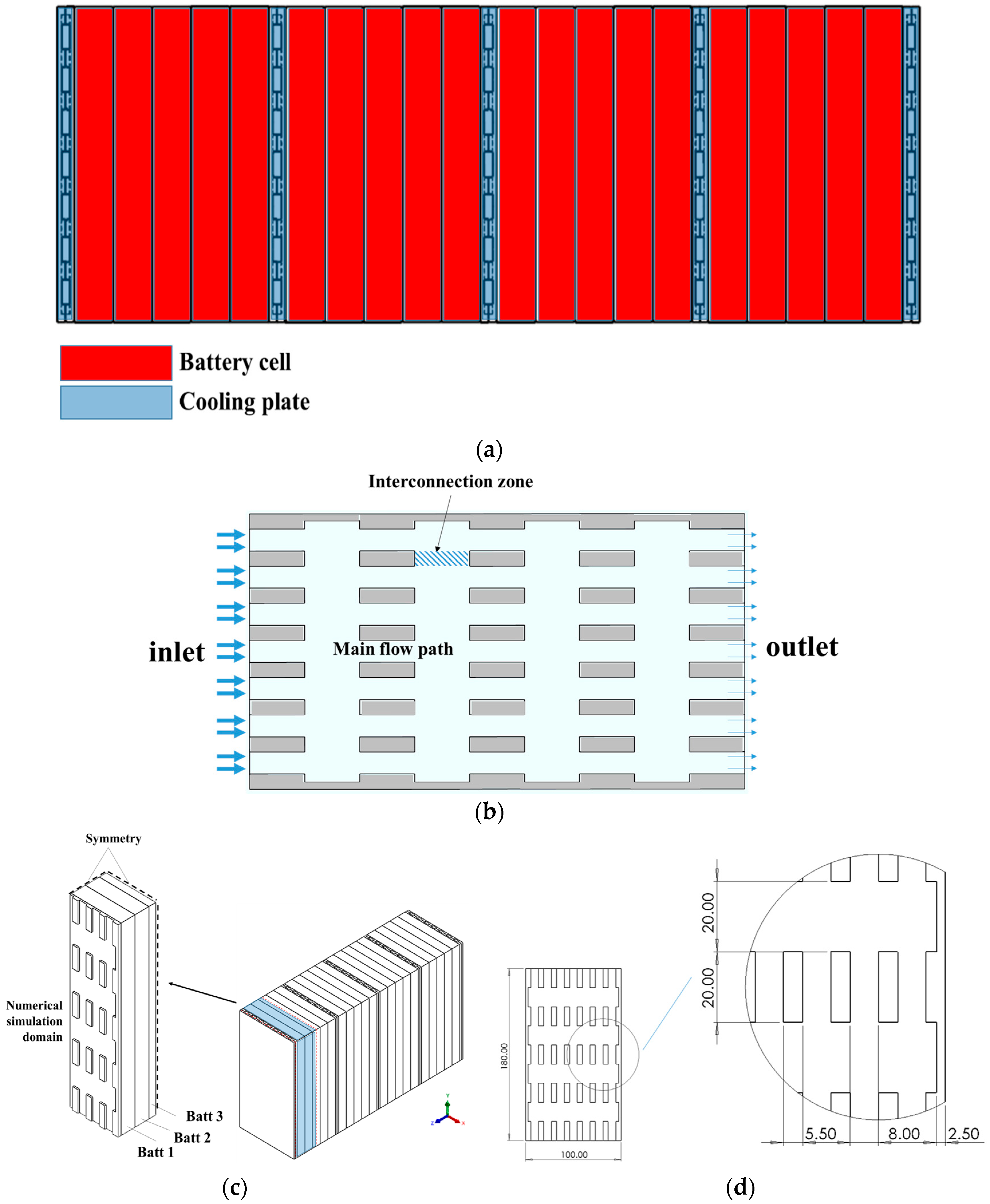
At the inlet of the cooling plate, a uniform velocity profile is imposed along the y-axis (see Figure 1) and is expressed by Equation (7). At the outlet, the pressure condition is applied as expressed in Equation (8).
Figure 1.
(a) Schematic of the battery module. (b) Flow arrangement of interconnected design. (c) Symmetrical assumption. (d) Interconnected design.
A no-slip boundary condition was applied at the inner walls of the fluid domain, which is expressed in the following equation.
Thermal boundary conditions are given as follows: At the inlet of the liquid flow channel, fluid temperature is set at a constant value, Tin = 25 °C. At the interface between the battery (solid) and the liquid coolant (fluid), a coupled boundary condition is applied to allow heat transfer between the two domains, ensuring continuity of temperature and heat flux across the interface. The coupling is expressed by the following equation.
Subscript b and f refer to battery and fluid, respectively, while n refers to the normal direction to the interface between solid and fluid domains.
To reduce computational cost, a symmetry boundary condition is applied at the center of the half cooling plate and battery 3 (see Figure 1b). Under this assumption, no heat or mass flux occurs across the symmetry boundary ().
At the remaining surfaces of battery domain, adiabatic boundary conditions are applied, which is expressed by this following equation.
The simulation conditions used in this study are summarized in Table 2.
Table 2.
Summary for computational settings.
2.3. Cooling Plate and Benchmark Design
A typical Li-ion battery pack consists of multiple battery modules arranged in a particular pattern. Each module has several batteries connected in series/parallel combinations depending on the design requirements. The number of batteries in an EV ranges from a few hundred to several thousand as per the size/weight of the batteries and their overall capacity to match the vehicle’s power requirements.
Figure 1a illustrates the rectangular Li-ion battery pack and module analyzed in this study. The battery pack consists of several prismatic Li-ion battery modules, with each module containing five Li-ion batteries (180 mm × 100 mm × 14 mm, 45 Ah capacity), cooled by two aluminum cooling plates on either side. The coolant employed is water entering at a constant temperature of 25 °C.
The straight-channel cooling plate design consists of seven rectangular channels, each 8 mm wide, 3 mm high, with a 5.5 mm spacing between channels. The module design and geometry, as shown in Figure 1a, is identical to the study by Liu et al. [15] and serves as the baseline for validating the present model and comparing the seven proposed designs. The interconnected modification being proposed in this study is explained diagrammatically and shown in Figure 1d.
Figure 1b shows the flow arrangement of cooling fluid inside the plate. Fluid flows entering the inlet of the cooling plate and passing through the main flow path. Between two main flow paths, an additional interconnection zone were introduced to increase the surface area and periodically disrupt the thermal boundary layer.
Figure 1c illustrates the concept of symmetrical analysis, applied due to the geometric arrangement of the battery module. This approach significantly reduces computational time while preserving accuracy.
The important parameters both for benchmarking and evaluating the results are temperature rise (∆Tmax) temperature difference within the battery (∆Tdiff). These parameters are calculated from the numerical solution using these following equations.
2.4. Mesh Generation and Grid Sensitivity
In this study, the accuracy of the numerical model is influenced by the quality of generated mesh and time-step size. To ensure that the solution is independent of these factors, seven trials with different mesh and time-step parameters were conducted.
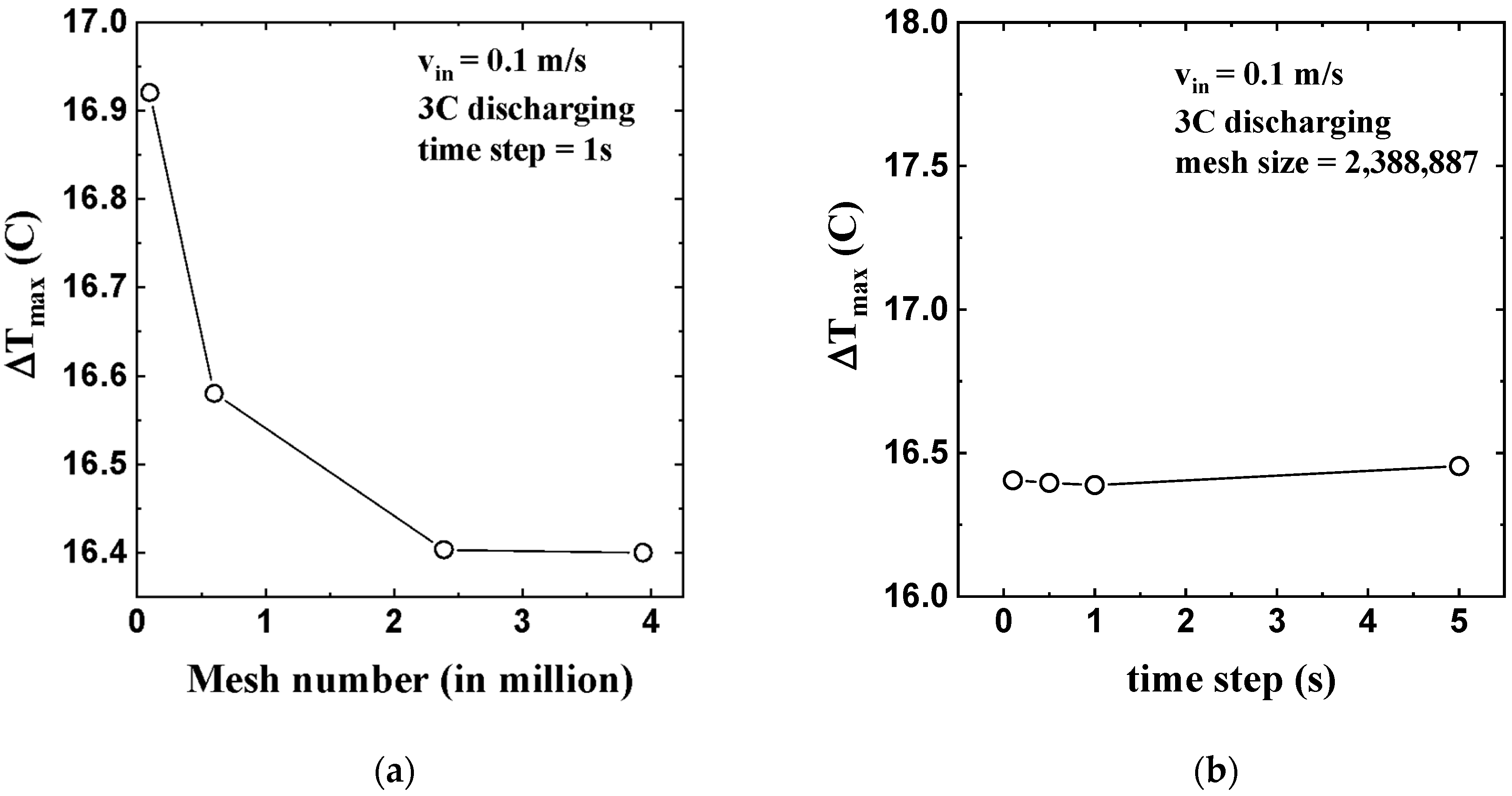
Figure 2 presents the grid independence test for the interconnected channel cold plate design with a constant inlet velocity of . The number of mesh elements varies between 800,000 and 4,000,000 with equal time step of 1 s. Figure 2a shows that the predicted maximum battery temperature rise (∆Tmax) remains nearly unchanged beyond the mesh size of 2,000,000. Similarly, in Figure 2b the effect of time-step sizes was studied, varying between 0.1 s and 5 s. Four cases have been conducted at time steps of 0.1 s, 0.5 s, 1 s, and 5 s. In this trial, the predicted (∆Tmax) is not significantly influenced for the time step of 1 s and above. Hence, in this study, the total number of mesh elements for the interconnected design was set to 2,000,000, with a time step of 1 s.
Figure 2.
Grid independence study of the interconnected cooling plate design, showing the maximum temperature rise as a function of mesh number (a) and time step (b).
3. Results and Discussion
3.1. Numerical Model Validation
In this study, the validity of the numerical solutions is verified by numerical grid convergence study as described in Section 2.4, and further verified against the baseline reported by Liu et al. [15] and Amalesh et al. [28]. These studies were selected due to their alignment with the current research objective. This comparison provides a benchmark for evaluating the accuracy and reliability of the proposed numerical model, ensuring that the predicted thermal and hydraulic performance aligns with established findings.
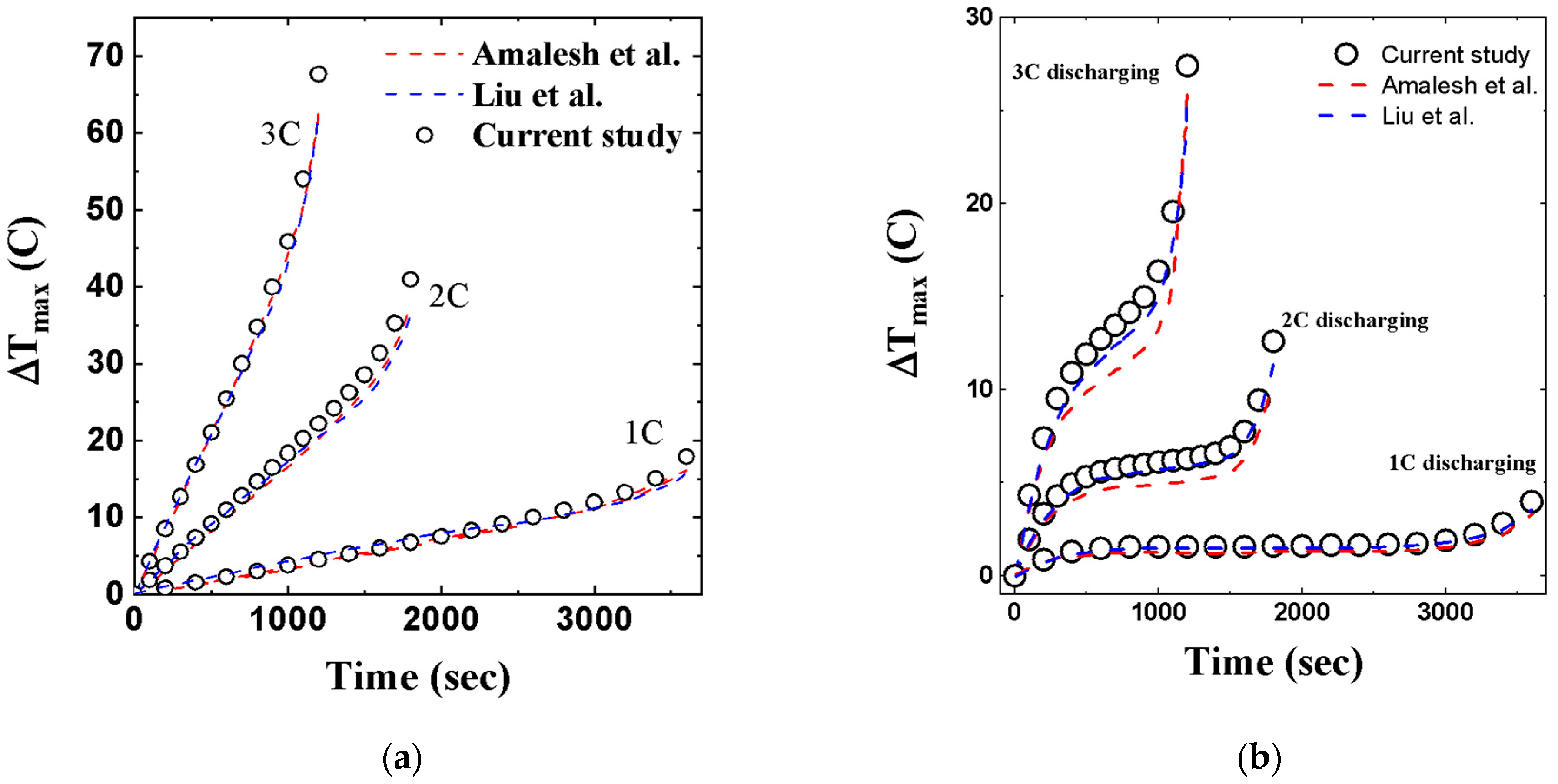
In this study, a 45 Ah Li-ion battery discharging at 1C, 2C, and 3C rates was simulated and compared with the reported results of Liu et al. [15] and Amalesh et al. [28]. Figure 3a shows the temperature trend of the battery running at different discharging rates under adiabatic conditions (no cooling plate installed). It can be seen that the present model closely agrees with the benchmark studies of Liu et al. [15] and Amalesh et al. [28] Similarly, Figure 3b compares the cooling performance of the cooling plate for the battery module using a straight rectangular channel. The performance of the cooling plate predicted by the proposed model agrees with the results of Liu et al. [15] and Amalesh et al. [28] under all three discharge rates. These results provide evidence that the numerical model applied in this study is reliable. As the next step, an optimization approach was carried out by applying an interconnected path along the straight channel.
Figure 3.
Maximum temperature rises ∆Tmax under: (a) adiabatic condition; and (b) after installing cooling plate at 0.1 m/s inlet velocity [15,28].
Under the proposed design, several parameters, including temperature rise (∆Tmax), temperature difference within the battery (∆Tdiff), pressure drop of the coolant, and velocity contour, were analyzed. The results will be discussed in detail in the following sections.
3.2. Thermal Performance
Figure 3a shows the transient maximum temperature rise in the battery module at different discharge rates (1C, 2C, and 3C) under adiabatic conditions. Consistent with the findings of Liu et al. [15], the results indicate that temperature increases with the increase in discharge rate. At a discharge rate of 3C, the maximum temperature rise is around 62 °C, whereas for 1C and 2C discharge rates, the observed maximum temperature rise was 36 °C and 16 °C, respectively. At a 3C discharge rate, the temperature increases linearly for the first 1000 s and then rises sharply afterward. A similar trend is also observed at discharge rates of 2C and 1C, where the temperature rise remains linear up to 1500 s and 3200 s, respectively. Figure 3a shows a sharp turning point when the battery is near the stage of EOD (end of discharge) as the internal resistance of the battery increases.
Figure 3b shows how the presence of the cooling plate can limit the temperature rise in the battery. Under the baseline design, featuring a straight rectangular channel, the results indicate that the temperature remains below 27 °C for the 3C discharge rate. For 2C and 1C discharge rates, the temperature rise is 12.6 °C and 3.9 °C, respectively.
The temperature difference within the battery (∆Tdiff) indicates its temperature uniformity. Figure 3b shows the battery temperature difference in the baseline design at an inlet velocity of 0.1 m/s under 1C, 2C, and 3C discharging rates. At a 3C discharge rate, the maximum temperature difference is 15.9 °C, while under 2C and 1C discharge rates, the maximum temperature difference is 7.4 °C and 2.4 °C, respectively. This result is in good agreement with the results of Liu et al. [15]. Hence, the temperature difference in the current model is successfully validated.
3.3. Effect of Additional Inter-Connected Passage
An interconnecting passage is hypothesized to enhance heat transfer by increasing the heat transfer area and disrupting the thermal boundary layer. The interaction of thermal and hydraulic boundary layers through secondary flow can enhance heat transfer. In this study, the effect of an interconnecting passage is investigated to evaluate its impact on battery temperature regulation, thermal uniformity, and flow characteristics.
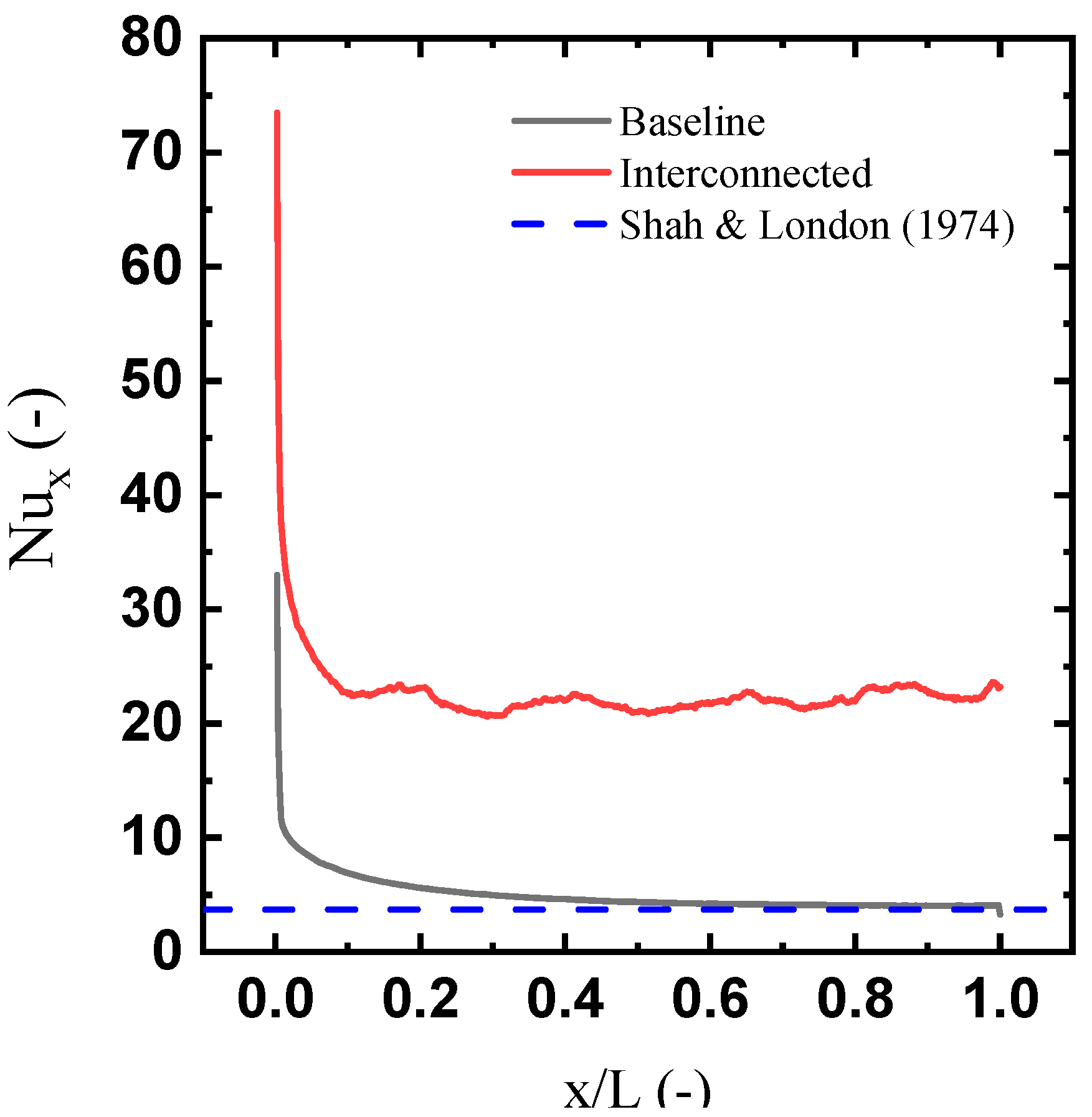
Figure 4 presents the streamwise variation in the local Nusselt number (Nuₓ) for the baseline straight-channel and interconnected (ID) designs, along with the analytical correlation of Shah and London [37] for fully developed laminar flow in rectangular ducts. The baseline profile shows excellent agreement with the Shah and London prediction, validating the numerical accuracy of the present model. Both designs display a sharp Nuₓ peak near the inlet due to strong entrance effects, followed by a decline as the thermal boundary layer develops downstream. The ID design maintains substantially higher Nuₓ values—approximately 2–2.5 times greater than the baseline in the fully developed region (x/L > 0.3)—confirming that the interconnections effectively disturb and re-energize the boundary layer. Minor oscillations in the ID curve correspond to local recirculation and mixing near each interconnection bridge, while the baseline trend converges smoothly toward the theoretical fully developed value predicted by Shah and London.
Figure 4.
Streamwise variation in local Nusselt number for both baseline design and interconnected design compared with Shah and London [37].
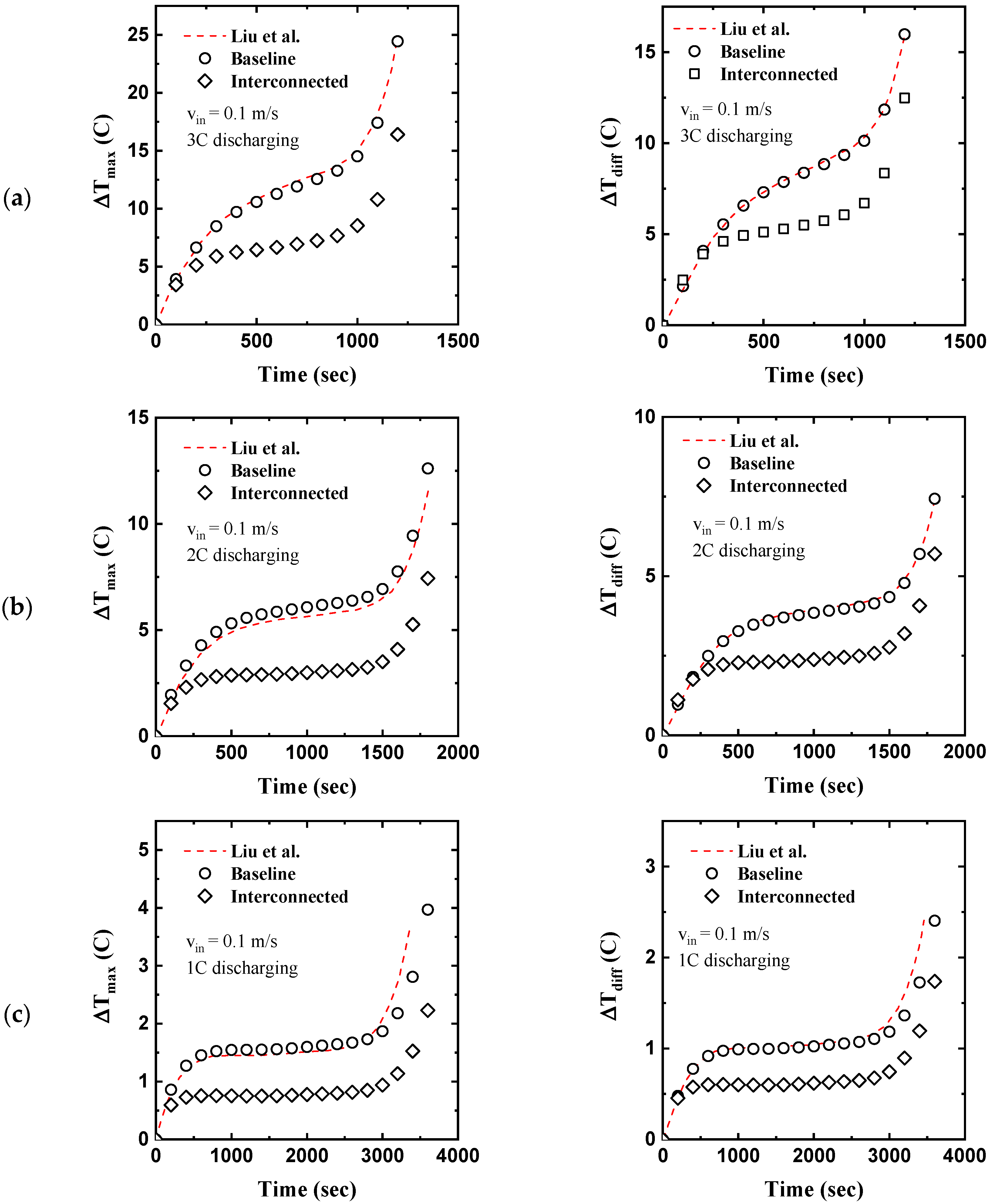
The thermal performance of the baseline and interconnected designs was evaluated by analyzing maximum temperature rise and temperature difference using Equation (12) and Equation (13), respectively. The evaluation results are shown in Figure 5. For maximum temperature rise (Figure 5a-left), the baseline and interconnected designs start to show a noticeable difference at 100 s. At this point, the interconnected design is preferable, with a temperature 0.5 °C lower than the baseline. At the end of discharge, the interconnected design achieved a maximum temperature 8 °C lower than the baseline design. This achievement is important, considering that the aging rate of Li-ion batteries increases when operating at higher temperatures [26]. For temperature uniformity (Figure 5a-right), the difference between the two designs starts to appear beyond 200 s. The effect of the optimized interconnected design becomes stronger as discharge time exceeds 200 s. By the end of the 3C discharge cycle, the interconnected design improves temperature uniformity by approximately 3.5 °C.
Figure 5.
Maximum temperature rises ∆Tmax (left) and temperature difference ΔTdiff (right) of both baseline and proposed design under different discharge rate and 0.1 m/s inlet velocity (a) 3C, (b) 2C, (c) 1C [15].
A similar trend can be observed in the performance evaluation at 2C, as shown in Figure 5b. In the case of 2C, the maximum temperature rise starts to differ by 0.5 °C at around 100 s. By the end of discharge, the Interconnected design shows a 5.2 °C lower maximum temperature rise (Figure 5b-left). Regarding temperature uniformity, a noticeable difference of 0.5 °C appears only after 300 s. This is longer than 3C; this is because it is more affected by heat generation of the battery rather than the cooling plate heat transfer coefficient. By the end of the discharge cycle, the interconnected design improves temperature uniformity by 1.7 °C.
Figure 5c shows the thermal evaluation at the 1C discharge rate. Due to the lower heat generated by the battery, the temperature difference is not as significant as in the 2C and 3C cases.
However, the trend illustrates that the interconnected design is still preferable in terms of cooling performance. For maximum temperature rise, the interconnected design shows a 0.1 °C lower temperature at 100 s. By the end of discharge, the interconnected design shows a maximum temperature that is 1.7 °C lower than that of the baseline design (Figure 5c-left). For temperature uniformity, Figure 5c-right shows that the interconnected design achieves slightly better uniformity than the baseline design, with a 0.6 °C improvement by the end of discharge.
3.4. Effect of Inlet Velocity
The inlet velocity of the coolant plays a crucial role in determining the overall thermal performance of the cooling plate. Higher inlet velocities enhance convective heat transfer by increasing the heat transfer coefficient. This section describes how the effect of velocity changes the maximum temperature at both baseline design and interconnected design.
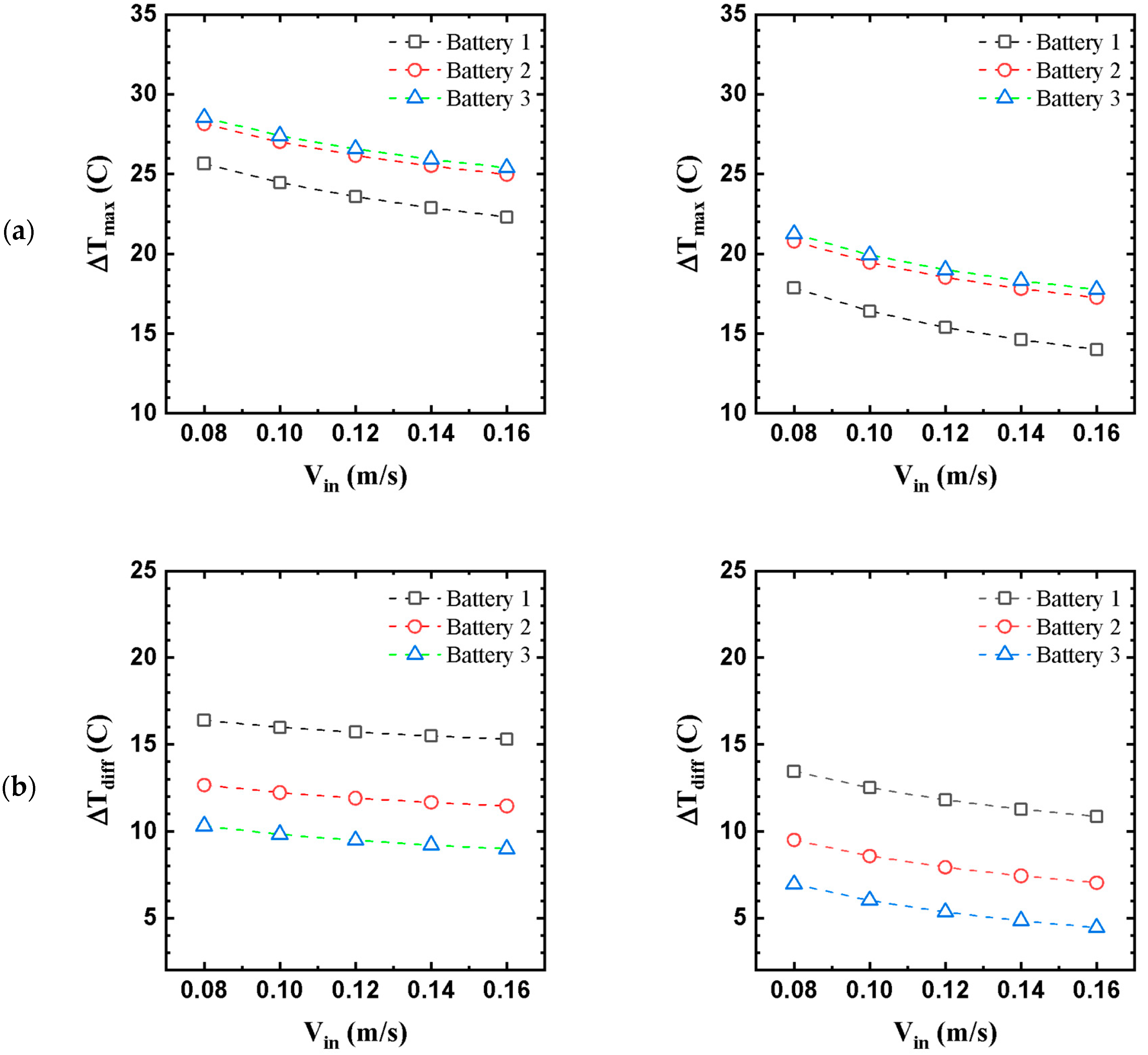
Figure 6a-left presents the maximum temperature of an individual battery at a 3C discharge rate under different coolant inlet velocities for the Baseline design. Different flow velocities ranging from 0.08 m/s to 0.16 m/s are investigated, with Battery 1 positioned closest to the cooling plate. The velocity 0.08 m/s to 0.16 m/s corresponds to Reynolds number Re = 347–Re = 695. This value corresponds to 1.5 L/min–4.6 L/min for each module which is a typical EV coolant loop range, which is around 1–5 L/min per module. Besides that, this is also to be consistent with Liu [15] and Amalesh [28] who studied a similar coolant velocity value. The graph indicates that ΔTmax decreases with increasing inlet velocity, aligning with the principles of convective heat transfer. Figure 6a-right presents the maximum temperature of an individual battery at a 3C discharge rate under different coolant inlet velocities for the interconnected design. The temperature trends in the interconnected design follow a similar pattern to the baseline design, where the maximum temperature decreases as the inlet velocity increases. This also confirms the superior thermal performance of the Interconnected design. Both graphs also show that the highest ΔTmax occurs at Battery 3, which is the farthest from the cooling plate. This is due to the thermal resistance of the battery material.
Figure 6.
Variation in the effect of velocities on the maximum temperature (a) and temperature difference (b) comparing the case for baseline (left) and interconnected (right).
In addition to the maximum temperature rise (∆Tmax), variations in ∆Tdiff for each battery under different velocities are evaluated and shown in Figure 6b. The evaluation of temperature uniformity of different batteries is also important to evaluate since it affects efficiency and lifespan [25]. Consistent with previous findings, Figure 6b-right shows the ∆Tdiff of interconnected design has lower ∆Tdiff compared to baseline design in Figure 6b-left. This implies that proposed design also improves the uniformity of the battery to the level of each individual battery.
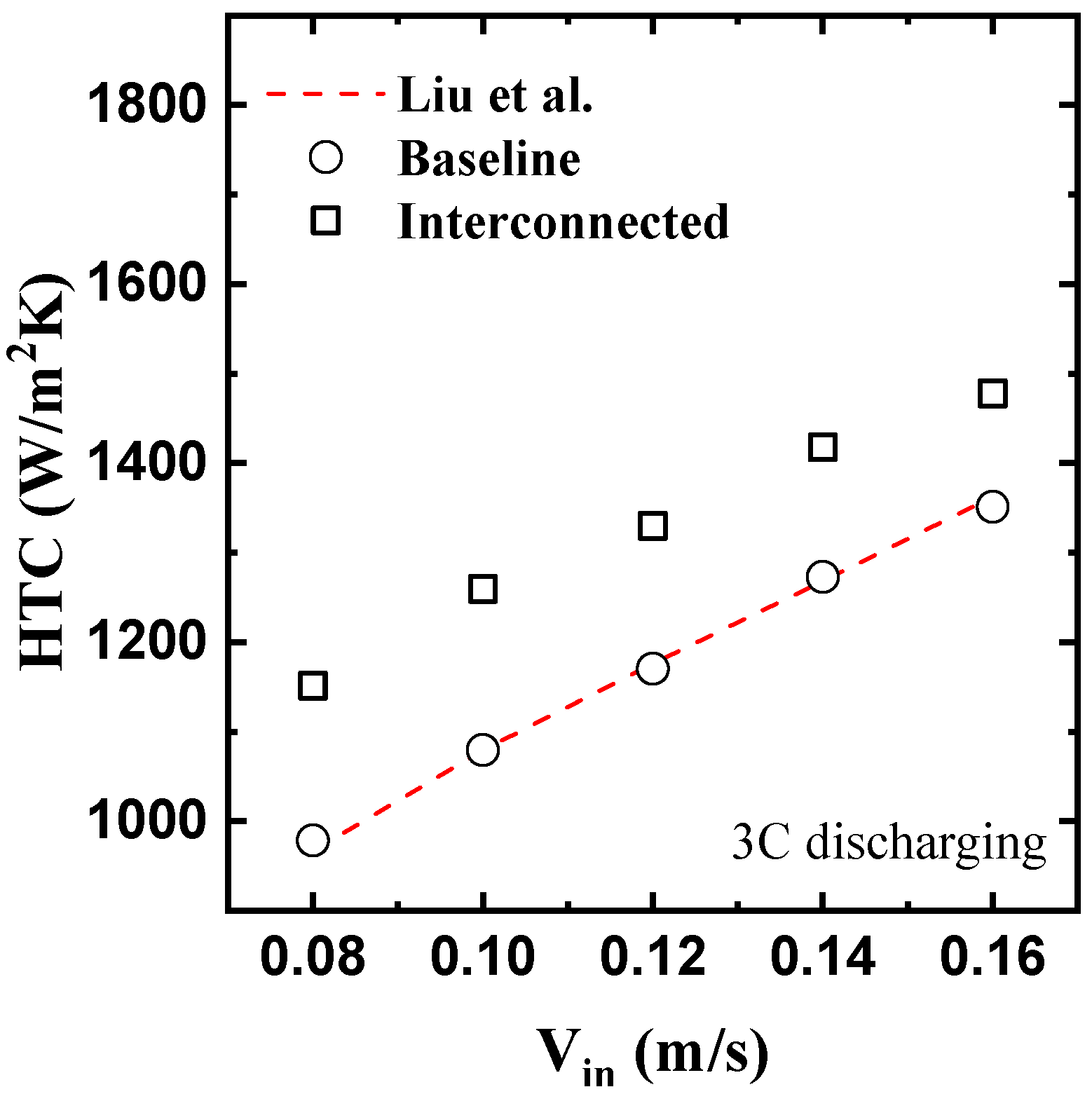
Figure 7 shows the variation in the average heat-transfer coefficient (HTC) with coolant velocity for the proposed interconnected (ID) plate and the baseline design of Liu et al. [15]. As the inlet velocity increases from 0.08 to 0.16 m·s−1, both designs exhibit a monotonic rise in HTC, reflecting the expected convective enhancement with thinner boundary layers at higher flow rates. The ID plate achieves an overall ≈ 17% higher HTC than the baseline, confirming that the introduced interconnections promote additional lateral mixing and local turbulence. However, the relative improvement becomes slightly smaller at higher velocities, suggesting that the advantage of the interconnection structure is more pronounced under low-flow conditions, where it effectively compensates for weaker natural convection and limited axial mixing.
Figure 7.
Comprehensive comparison on baseline and interconnected design, depicted through heat transfer coefficient [15].
However, while a higher inlet velocity enhances HTC by strengthening forced convection, it is crucial to consider the associated trade-offs. Increased velocity leads to a higher pressure drop, which in turn raises the pumping power requirements. Excessive pressure drop can reduce overall energy efficiency and limit the practical application of the cooling system in battery thermal management. Therefore, achieving an optimal balance between heat transfer enhancement and hydraulic efficiency is essential. The impact of pressure drop will be discussed in detail in the following section.
3.5. Pressure Drop Consideration
Pressure drop is a critical factor in cooling plate design, as it directly influences system efficiency, energy consumption, and operational cost. A higher pressure drop indicates greater resistance to coolant flow, requiring more pumping power to maintain circulation. This increased power demand raises energy consumption, reducing system cost-effectiveness. However, minimizing the pressure drop comes with the risk of poor thermal performance, potentially causing the battery to operate at elevated temperatures, which increases the likelihood of thermal runaway or, at the very least, shortens its lifecycle. An optimal cooling plate design must balance heat dissipation and hydraulic resistance, maintaining effective thermal regulation without excessive energy consumption or inefficiencies.
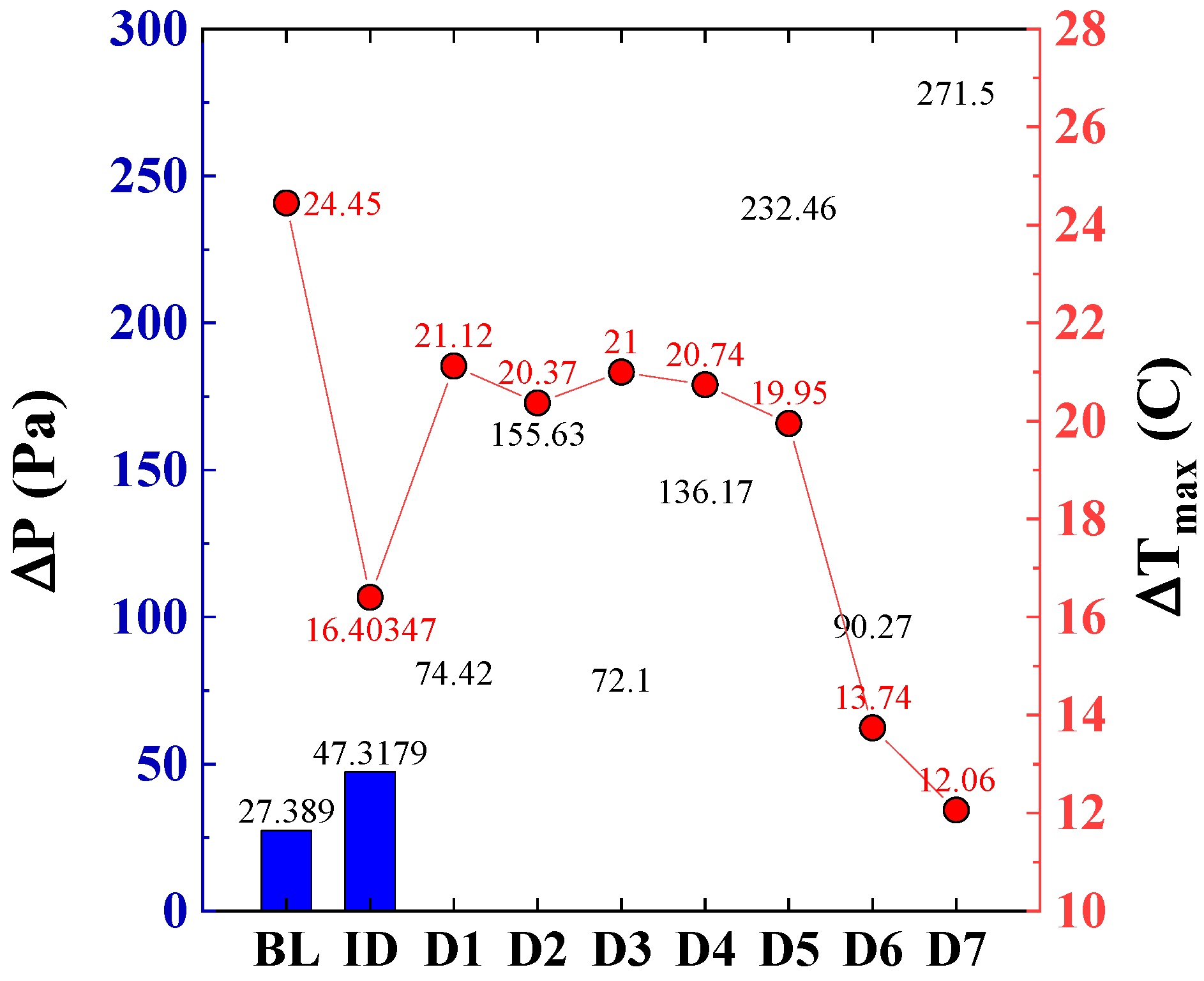
Figure 8 compares the maximum temperature (∆Tmax) and pressure drop (ΔP) of the proposed interconnected (ID) plate with seven benchmark configurations (D1–D7) from Amalesh et al. [28] and the baseline design of Liu et al. [15]. The D-series represents major liquid-cooling concepts: D1—straight parallel channels, D2—serpentine path, D3—pin-fin structure, D4—wavy/sinusoidal channel, D5—triangular manifold, D6—hybrid manifold-pin design, and D7—cross-linked multi-branch layout.
Figure 8.
Comprehensive comparison on baseline, interconnected design, and several benchmark studies depicted through pressure drop to ΔTmax Relation.
From the figure, an improvement in thermal efficiency is shown by the maximum temperature drop of 8 °C with a considerable increase in pressure drop. Despite showing an increase in pressure drop of almost 75%, the design improvement is still necessary due to that at 3C charging rate, the baseline condition shows a temperature rise approaching 25 °C. Such temperature is far beyond the optimal working temperature of lithium-ion batteries, which is in the range of 15–35 °C [38]. At such high temperature, prioritizing hydraulic performance over thermal performance will risk the safety of the battery’s lifespan.
The graph demonstrates that compared to previously proposed model, the interconnected design shows a relatively low maximum temperature rise, indicating enhanced thermal performance, while maintaining a moderate pressure drop. Compared to the D1–D7 series, it generally provides better heat dissipation, except for D4 and D6, which achieve lower temperatures but at the cost of higher pressure drops. Conversely, the D1 and D7 designs exhibit lower pressure drops but at the cost of a higher temperature rise, suggesting that their flow distribution is less effective in dissipating heat efficiently. These findings highlight the importance of optimizing cooling plate design to achieve effective heat dissipation while maintaining a balanced pressure drop, ensuring efficient battery thermal management with minimal energy consumption and performance trade-offs.
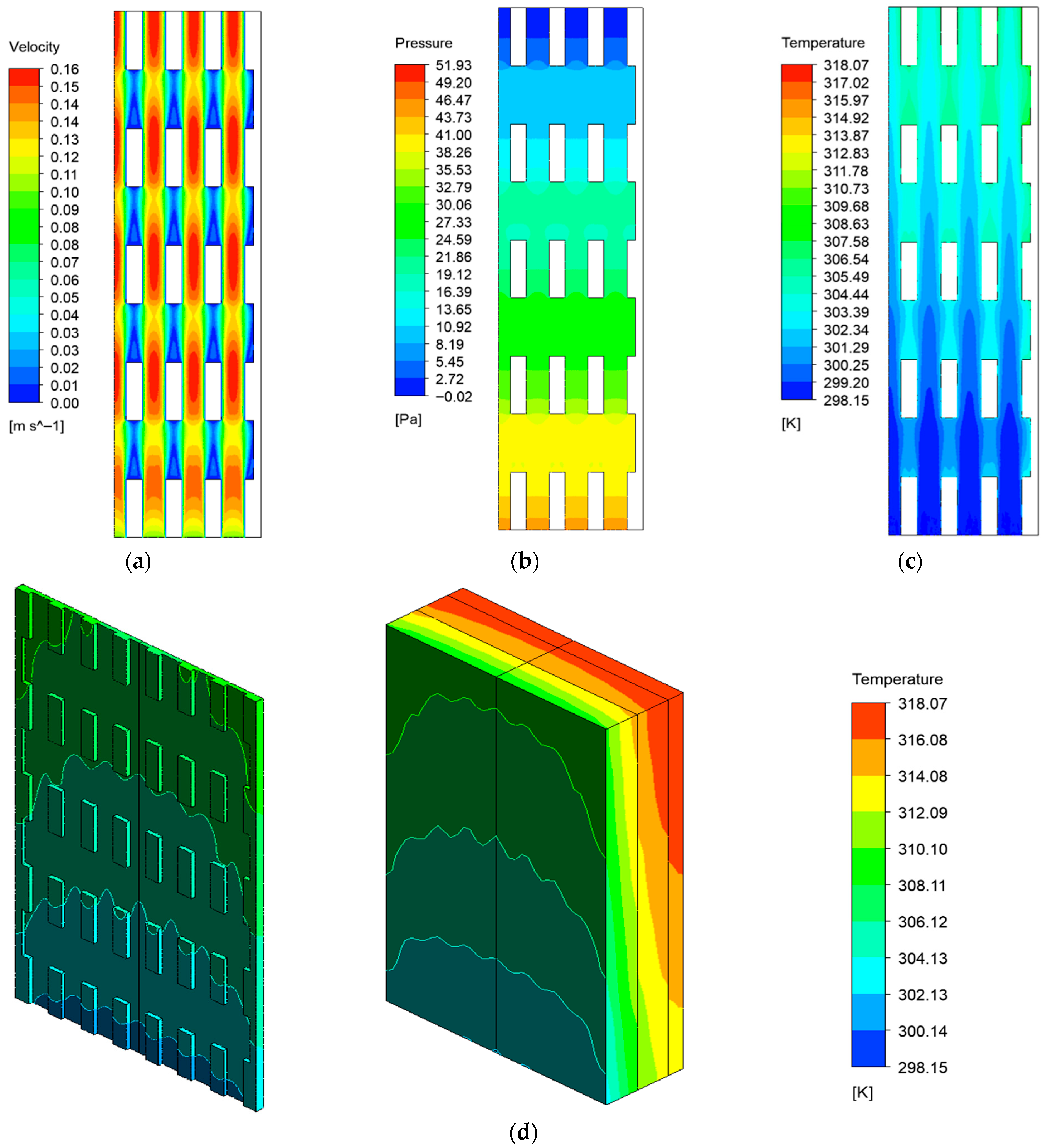
Figure 9a presents the velocity contour for the interconnected design, illustrating the flow behavior within the interconnecting zone. In the straight-channel configuration, where no interconnecting zone is present, the coolant flows independently along separate channels. This limits fluid mixing and prevents the formation of secondary flows. In contrast, in the cooling plate with an interconnection zone, the low-pressure region across the interconnection area induces stationary circulation zones, leading to the formation of secondary flows as shown in Figure 9b. This additional flow pathway increases the heat transfer area between the heating surface and the coolant, thereby enhancing convective heat transfer. Additionally, this geometry enhances turbulence by inducing fluid mixing and disrupting the thermal boundary layer. As a result, the boundary layer thickness is reduced, leading to a higher heat transfer coefficient (HTC) and improved convective cooling performance. In terms of temperature distribution, the thermal boundary condition is continuously developing from inlet to downstream. The higher temperature appears at the channel downstream due to the higher thermal boundary layer. Due to the presence of the interconnection area, a small transverse flow through the interconnection zone occurs. It raises the temperature at the area compared to the main stream path as shown in Figure 9c.
Figure 9.
Velocity (a), pressure (b) and temperature contour along channel (c) and temperature contour on the battery body (d) under interconnected design.
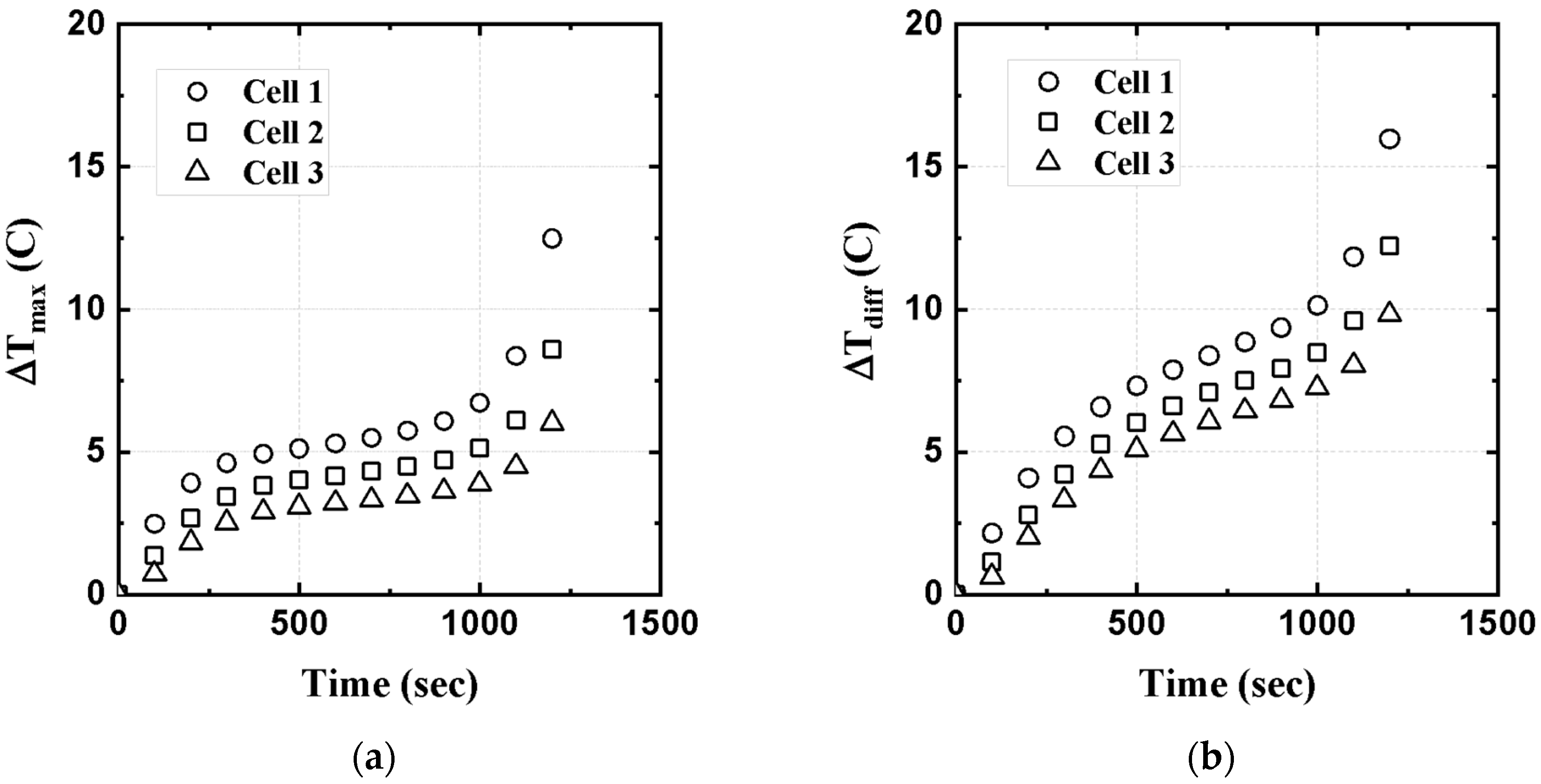
Figure 9d illustrates the temperature contour along the flow channel in the interconnected cooling plate design (left), along with the temperature contour on the battery solid body (right). The visualization reveals that temperature is lower near the inlet, where the coolant enters the system at a lower temperature and absorbs heat through convective heat transfer. As the coolant moves downstream, it carries the absorbed heat, resulting in an elevated temperature at the outlet due to sensible heat transfer. Additionally, the figure highlights temperature variations across the battery arrangement. Batteries positioned farther from the cooling plate experience less effective cooling, leading to higher localized temperatures. Figure 10 presents how this value changes overtime, for 3C discharge rate at 0.1 m/s for interconnected design. As time progresses, all three cells exhibit a controlled temperature rise, with the interconnected design ensuring that thermal gradients remain minimal. This highlights the success of the proposed cooling strategy in maintaining temperature uniformity and preventing excessive heating, even under high discharge conditions.
Figure 10.
Maximum temperature rise (a) and temperature difference ΔTdiff (b) of proposed design under 3C discharge rate and 0.1 m/s inlet velocity on specified single battery cell.
4. Conclusions
This study provides an in-depth analysis of cooling plate design and its impact on battery thermal performance, specifically focusing on maximum temperature rise and pressure drop. The comparative assessment of the baseline (BL), interconnected (ID), and D-series (D1–D7) cooling plate designs has yielded significant insights into the trade-offs between cooling efficiency and hydraulic resistance. The key conclusions drawn from this study are as follows:
- The interconnected (ID) design effectively reduces maximum temperature rise, demonstrating superior thermal performance compared to the baseline (BL) design and achieving comparable cooling efficiency to the best-performing D-series designs.
- The ID design improves temperature uniformity, enhancing thermal safety by reducing the risk of thermal runaway, minimizing localized hotspots, and contributing to a longer battery lifespan through more uniform heat dissipation.
- While certain D-series designs (D4 and D6) demonstrate excellent cooling performance, they experience high pressure drops, resulting in greater energy consumption and increased pumping power requirements.
- The interconnected design achieves a well-balanced compromise, providing enhanced cooling performance while maintaining moderate flow resistance, making it a practical and efficient solution for battery thermal management systems.
Author Contributions
Conceptualization, A.P.S. and J.B.; methodology, A.P.S. and J.B.; software, A.P.S.; validation, A.P.S.; formal analysis, A.P.S.; investigation, A.P.S.; resources, J.B. and J.Y.L.; data curation, A.P.S. and B.F.S.; writing—original draft preparation, A.P.S. and B.F.S.; writing—review and editing, A.P.S. and B.F.S.; visualization, A.P.S.; supervision, J.Y.L.; project administration, J.B.; funding acquisition, J.Y.L. All authors have read and agreed to the published version of the manuscript.
Funding
The authors would like to acknowledge The Korea Institute of Energy Technology Evaluation and Planning (KETEP) and the Ministry of Climate, Energy & Environment (MCEE) of the Republic of Korea (No. RS-2024-00398425) and partially was supported by Korea Hydro & Nuclear Power Co and Local Government (Pohang) (2025).
Data Availability Statement
The data presented in this study are available on request from the corresponding author.
Conflicts of Interest
The authors declare no conflicts of interest.
Nomenclature
| v | Velocity (m/s) | Greek symbol | |
| T | Temperature (°C) | ρ | Density kg/m3 |
| P | Pressure (Pa) | μ | Viscosity (Pa.s) |
| k | Thermal conductivity (W/mK) | ||
| Q | Power (W) | Subscript | |
| q | Heatflux () | f | Fluid |
| u | Velocity component in the x-dir. (m/s) | b | Battery-body |
| v | Velocity component in the y-dir. (m/s) | max | Maximum temperature at time |
| w | Velocity component in the z-dir. (m/s) | diff | Maximum-minimum temperature |
| Cp | Sensible heat capacity () | w | wall |
| t | Time (s) | ||
References
- Peng, J.; Meng, J.; Chen, D.; Liu, H.; Hao, S.; Sui, X.; Du, X. A review of lithium-ion battery capacity estimation methods for onboard battery management systems: Recent progress and perspectives. Batteries 2022, 8, 229. [Google Scholar] [CrossRef]
- Cao, K.L.A.; Ogi, T. Advanced carbon sphere-based hybrid materials produced by innovative aerosol process for high-efficiency rechargeable batteries. Energy Storage Mater. 2025, 74, 103901. [Google Scholar] [CrossRef]
- Hannan, M.A.; Wali, S.; Ker, P.; Rahman, M.A.; Mansor, M.; Ramachandaramurthy, V.; Muttaqi, K.; Mahlia, T.; Dong, Z. Battery energy-storage system: A review of technologies, optimization objectives, constraints, approaches, and outstanding issues. J. Energy Storage 2021, 42, 103023. [Google Scholar] [CrossRef]
- Wolfram, P.; Lutsey, N. Electric Vehicles: Literature Review of Technology Costs and Carbon Emissions; ICCT: Washington, DC, USA, 2016. [Google Scholar]
- Ahmad, F.; Khalid, M.; Panigrahi, B.K. Development in energy storage system for electric transportation: A comprehensive review. J. Energy Storage 2021, 43, 103153. [Google Scholar] [CrossRef]
- Broussely, M.; Nazri, G.; Pistoia, G. Lithium-Ion batteries for EV, HEV and other applications. In Lithium Batteries; Kluwer Publishers: New York, NY, USA, 2004; Chapter 21. [Google Scholar]
- Bandhauer, T.M.; Garimella, S.; Fuller, T.F. A critical review of thermal issues in lithium-ion batteries. J. Electrochem. Soc. 2011, 158, R1. [Google Scholar] [CrossRef]
- Liu, H.; Wei, Z.; He, W.; Zhao, J. Thermal issues about Li-ion batteries and recent progress in battery thermal management systems: A review. Energy Convers. Manag. 2017, 150, 304–330. [Google Scholar] [CrossRef]
- Deng, T.; Zhang, G.; Ran, Y.; Liu, P. Thermal performance of lithium ion battery pack by using cold plate. Appl. Therm. Eng. 2019, 160, 114088. [Google Scholar] [CrossRef]
- Zhang, T.; Gao, C.; Gao, Q.; Wang, G.; Liu, M.; Guo, Y.; Xiao, C.; Yan, Y. Status and development of electric vehicle integrated thermal management from BTM to HVAC. Appl. Therm. Eng. 2015, 88, 398–409. [Google Scholar] [CrossRef]
- Leng, F.; Tan, C.M.; Pecht, M. Effect of temperature on the aging rate of Li ion battery operating above room temperature. Sci. Rep. 2015, 5, 12967. [Google Scholar] [CrossRef] [PubMed]
- Song, W.; Chen, M.; Bai, F.; Lin, S.; Chen, Y.; Feng, Z. Non-uniform effect on the thermal/aging performance of Lithium-ion pouch battery. Appl. Therm. Eng. 2018, 128, 1165–1174. [Google Scholar] [CrossRef]
- Sun, H.; Dixon, R. Development of cooling strategy for an air cooled lithium-ion battery pack. J. Power Sources 2014, 272, 404–414. [Google Scholar] [CrossRef]
- Zhao, G.; Wang, X.; Negnevitsky, M.; Zhang, H. A review of air-cooling battery thermal management systems for electric and hybrid electric vehicles. J. Power Sources 2021, 501, 230001. [Google Scholar] [CrossRef]
- Liu, H.; Chika, E.; Zhao, J. Investigation into the effectiveness of nanofluids on the mini-channel thermal management for high power lithium ion battery. Appl. Therm. Eng. 2018, 142, 511–523. [Google Scholar] [CrossRef]
- Mondal, B.; Lopez, C.F.; Mukherjee, P.P. Exploring the efficacy of nanofluids for lithium-ion battery thermal management. Int. J. Heat Mass Transf. 2017, 112, 779–794. [Google Scholar] [CrossRef]
- Adhikari, N.; Bhandari, R.; Joshi, P. Thermal analysis of lithium-ion battery of electric vehicle using different cooling medium. Appl. Energy 2024, 360, 122781. [Google Scholar] [CrossRef]
- Farzaneh, F.; Zhang, Q.; Jung, S. Enhancing electric vehicle battery safety and performance: Aluminum tubes filled with PCM. J. Energy Storage 2024, 97, 112922. [Google Scholar] [CrossRef]
- Abdelkareem, M.A.; Maghrabie, H.M.; Abo-Khalil, A.G.; Adhari, O.H.K.; Sayed, E.T.; Radwan, A.; Rezk, H.; Jouhara, H.; Olabi, A. Thermal management systems based on heat pipes for batteries in EVs/HEVs. J. Energy Storage 2022, 51, 104384. [Google Scholar] [CrossRef]
- Wang, Y.; Gao, Q.; Wang, G.; Lu, P.; Zhao, M.; Bao, W. A review on research status and key technologies of battery thermal management and its enhanced safety. Int. J. Energy Res. 2018, 42, 4008–4033. [Google Scholar] [CrossRef]
- Zhao, L.; Li, W.; Wang, G.; Cheng, W.; Chen, M. A novel thermal management system for lithium-ion battery modules combining direct liquid-cooling with forced air-cooling. Appl. Therm. Eng. 2023, 232, 120992. [Google Scholar] [CrossRef]
- Wu, T.; Zhang, Z.; Xie, Y.; Wang, C.; Hu, Y.; Liu, J.; Cai, S. Integrated pulsed cooling with non-uniform channel liquid plate and phase change material for high-energy-density battery thermal management. Int. J. Heat Mass Transf. 2025, 247, 127191. [Google Scholar] [CrossRef]
- Khaboshan, H.N.; Jaliliantabar, F.; Abdullah, A.A.; Panchal, S. Improving the cooling performance of cylindrical lithium-ion battery using three passive methods in a battery thermal management system. Appl. Therm. Eng. 2023, 227, 120320. [Google Scholar] [CrossRef]
- Akbarzadeh, M.; Kalogiannis, T.; Jaguemont, J.; Jin, L.; Karimi, D.; Beheshti, H.; Van Mierlo, J.; Berecibar, M. A comparative study between air cooling and liquid cooling thermal management systems for a high-energy lithium-ion battery module. Appl. Therm. Eng. 2021, 198, 117503. [Google Scholar] [CrossRef]
- Trimbake, A.; Singh, C.P.; Krishnan, S. Mineral oil immersion cooling of lithium-ion batteries: An experimental investigation. J. Electrochem. Energy Convers. Storage 2022, 19, 021007. [Google Scholar] [CrossRef]
- Chen, D.; Jiang, J.; Kim, G.-H.; Yang, C.; Pesaran, A. Comparison of different cooling methods for lithium ion battery cells. Appl. Therm. Eng. 2016, 94, 846–854. [Google Scholar] [CrossRef]
- Panchal, S.; Khasow, R.; Dincer, I.; Agelin-Chaab, M.; Fraser, R.; Fowler, M. Thermal design and simulation of mini-channel cold plate for water cooled large sized prismatic lithium-ion battery. Appl. Therm. Eng. 2017, 122, 80–90. [Google Scholar] [CrossRef]
- Amalesh, T.; Narasimhan, N.L. Introducing new designs of minichannel cold plates for the cooling of Lithium-ion batteries. J. Power Sources 2020, 479, 228775. [Google Scholar] [CrossRef]
- Jiang, Z.; Xuan, W.; Ma, R.; Xu, C.; Yu, B.; Wang, D.; Shi, J.; Chen, J. A high-efficiency immersion cooling system with integrated flow distribution plates for vehicle-scale high-energy-density battery modules. Energy 2025, 330, 136885. [Google Scholar] [CrossRef]
- Sun, Y.; Bai, R.; Ma, J. Design and thermal analysis of a new topological cooling plate for prismatic lithium battery thermal management. Appl. Therm. Eng. 2023, 219, 119547. [Google Scholar] [CrossRef]
- Zhan, S.; Liang, L.; Li, Z.; Yu, C.; Wang, F. Topology optimization of liquid cooling plate for lithium battery heat dissipation based on a bionic leaf-vein structure. Int. J. Heat Mass Transf. 2024, 231, 125898. [Google Scholar] [CrossRef]
- Pan, C.; Wu, J.; Wang, J.; Wang, L.; Liu, L. Topology optimization-based design and performance analysis of liquid cooling plates for lithium-ion batteries. J. Energy Storage 2025, 124, 116842. [Google Scholar] [CrossRef]
- Zhu, J.; Zhou, H.; Wang, C.; Zhou, L.; Yuan, S.; Zhang, W. A review of topology optimization for additive manufacturing: Status and challenges. Chin. J. Aeronaut. 2021, 34, 91–110. [Google Scholar] [CrossRef]
- ANSYS. ANSYS Fluent 18.1 Theory Guide; Ansys Inc.: Canonsburg, PA, USA, 2017. [Google Scholar]
- Lai, Y.; Ding, J.; Liu, L. Numerical investigation on the cooling performance of lithium-ion battery using liquid cooled-plate with integrated grooves and secondary microchannel structures. Int. J. Therm. Sci. 2025, 217, 110094. [Google Scholar] [CrossRef]
- Wang, T.; Wang, Y.; Hu, H. Topological approach for optimization of liquid cooled plate with different inlet/outlet parameters. Case Stud. Therm. Eng. 2025, 71, 106201. [Google Scholar] [CrossRef]
- Shah, R.K.; London, A.L. Thermal boundary conditions and some solutions for laminar duct flow forced convection. J. Heat Transf. 1974, 96, 159–165. [Google Scholar] [CrossRef]
- Ma, S.; Jiang, M.; Tao, P.; Song, C.; Wu, J.; Wang, J.; Deng, T.; Shang, W. Temperature effect and thermal impact in lithium-ion batteries: A review. Prog. Nat. Sci. Mater. Int. 2018, 28, 653–666. [Google Scholar] [CrossRef]
Disclaimer/Publisher’s Note: The statements, opinions and data contained in all publications are solely those of the individual author(s) and contributor(s) and not of MDPI and/or the editor(s). MDPI and/or the editor(s) disclaim responsibility for any injury to people or property resulting from any ideas, methods, instructions or products referred to in the content. |
© 2025 by the authors. Licensee MDPI, Basel, Switzerland. This article is an open access article distributed under the terms and conditions of the Creative Commons Attribution (CC BY) license (https://creativecommons.org/licenses/by/4.0/).