Article

Dynamic Estimation of Load-Side Virtual Inertia with High Power Density Support of EDLC Supercapacitors


by
Adrián Criollo
1,
Dario Benavides
2,3,*,
Danny Ochoa-Correa
1,
Paul Arévalo-Cordero
1,3,
Luis I. Minchala-Avila
1 and
Daniel Jerez
2
1
Department of Electrical Engineering, Electronics, and Telecommunications (DEET), Universidad de Cuenca, Cuenca 010101, Ecuador
2
Faculty of Systems, Electronics and Industrial Engineering, Universidad Técnica de Ambato, Ambato 180206, Ecuador
3
Department of Electrical Engineering, University of Jaén, 23700 Linares, Spain
*
Author to whom correspondence should be addressed.
Batteries 2026, 12(2), 42; https://doi.org/10.3390/batteries12020042
Submission received: 30 December 2025 / Revised: 21 January 2026 / Accepted: 22 January 2026 / Published: 23 January 2026

Abstract

The increasing penetration of renewable energy has led to a decrease in system inertia, challenging grid stability and frequency regulation. This paper presents a dynamic estimation framework for load-side virtual inertia, supported with high-power-density electrical double-layer supercapacitors (EDLCs). By leveraging the fast response and high power density of EDLCs, the proposed method enables the real-time emulation of demand-side inertial behavior, enhancing frequency support capabilities. A hybrid estimation algorithm has been developed that combines demand forecasting and adaptive filtering to track virtual inertia parameters under varying load conditions. Simulation results, based on a 150 kVA distributed system with 27% renewable penetration and 33% demand variability, demonstrate the effectiveness of the approach in improving transient stability and mitigating frequency deviations within ±0.1 Hz. The integration of ESS-based support offers a scalable and energy-efficient solution for future smart grids, ensuring operational reliability under real-world variability.

1. Introduction

Power systems with high shares of renewable energy sources (RESs) and inverter-based resources (IBRs) are increasingly operating with fewer synchronous generators online, which reduces the inertial and governor-driven frequency support that historically helped buffer power imbalances [1,2]. Under these conditions, frequency trajectories can evolve more rapidly after disturbances, with higher rates of change of frequency (RoCoF) and lower nadirs, narrowing the time window for corrective actions in both interconnected grids and isolated systems [3,4]. Beyond the disturbance response, attention has also turned to frequency quality metrics—such as deviation and restoration behavior—as evidenced via analyses based on real operational data from large-scale low-inertia systems with high non-synchronous penetration [5].
The operational exposure of low-inertia grids spans multiple mechanisms. During grid faults, the interaction between synchronization dynamics and power-balance constraints can become decisive for frequency stability in renewable-rich systems; synchronization-based frequency modeling has been used to explain how fault severity can drive the system toward instability when no feasible power-balance equilibrium exists within the stable synchronization region [6]. In isolated areas, the contribution of primary frequency support from IBRs depends strongly on operating conditions, and practical implementations may involve tradeoffs (e.g., renewable curtailment under high loading when resources participate in primary support) [4]. These issues connect frequency stability to planning, operational security, and resilience objectives, including maintaining acceptable performance under disruptive events in converter-dominated grids [3].
To address faster frequency excursions, system-level measures increasingly rely on fast frequency response (FFR) services and monitoring-and-control schemes that act on sub-second time scales [7,8]. Wide-area monitoring concepts have been proposed to estimate, at a zonal level, the required rate and volume of fast response and to trigger this response shortly after a disturbance [8]. Determining appropriate reserve sizing remains a practical question for frequency security, and data-driven sizing methods that combine dynamic security assessment with predictive models have been evaluated across large sets of historical operating scenarios in low-inertia systems [9]. In parallel, support through power-electronics-interfaced transmission links (e.g., HVDC) has been examined as a means of improving frequency responses in low-inertia networks with high wind and photovoltaic penetration [10], consistent with broader discussions of frequency control resources and operation under RES integration [1].
At the device level, grid-forming (GFM) energy storage systems and related inverter controls are being used to shape transient frequency response by rapidly adjusting active power injection during disturbances [11]. Mode-based rapid power support strategies for GFM inverters have also been proposed to improve frequency response by modifying power references within a droop-control framework [12]. Complementary approaches introduce virtual synchronous machine concepts into converter-based interfaces to reduce frequency offset peaks and RoCoF during grid-connection and regulation processes in low-inertia scenarios [13]. These developments align with broader assessments indicating that frequency stability in low-inertia systems depends jointly on available energy sources (at the system level) and the implemented control strategies (at the device level) [14].
A recurring theme across these studies is that low-inertia operation couples fast electromechanical dynamics with changing operating conditions, resource availability, and control constraints [1,14]. Fixed parameterization of fast support can, therefore, be mismatched to time-varying operating points, while operators need actionable quantities—such as the required rate and magnitude of fast response—that reflect prevailing conditions [8,9]. This motivates approaches that can infer, in real time, an inertia-like requirement from measurements and then coordinate a high-bandwidth support resource to manage RoCoF and nadir behavior.
A complementary line of work treats controllable demand as a frequency-control resource by using flexible consumption as a fast actuator. In this context, heterogeneous demand-side flexible resources (DSFRs)—including EV charging and thermostatic loads—are modeled as distributed actuators whose power can be rapidly modulated, motivating reduced-order representations and scalable coordination schemes [15,16]. To cope with resource diversity and the need to account for regulation costs, recent multi-agent learning formulations introduce unified dynamic characterizations (e.g., delay/inertia-like response features) and cost-aware reward structures for frequency regulation with EVs and air conditioners [15], while other contributions develop demand-side frequency-control models for low-inertia settings using controllable thermal loads and explicit frequency-control constraints in islanded microgrids [16]. Because demand flexibility is tied to service quality, comfort, and rebound (callback) behavior, several works explicitly incorporate intermittent participation, recovery/withdrawal dynamics, and time delays through robust control (e.g., H LFC with intermittent demand-side resources) and coordinated generation–demand strategies that account for callback characteristics [17,18,19]. Distributed coordination is also addressed via switched load-side controllers that alternate between frequency-regulation and load-recovery modes in cooperation with AGC, as well as multi-agent deep reinforcement learning (e.g., MADDPG) cast as a Markov game with centralized training and decentralized execution [20,21]. Experimental and system-level studies further indicate that demand-side participation can improve frequency response, but the achievable response rates and penetration levels must be tuned—validated via simulation complemented with hardware/PHiL experiments—to avoid unacceptable oscillatory behavior, and related studies explore DSM/DR impacts in ALFC with wind generation and two-layer flexibility/frequency-control structures for load-side wind turbine output under client demand response [22,23,24]. This shift toward demand-side mechanisms complements generator- and converter-side services and motivates load-side frameworks that quantify an inertia-like requirement from measurements while respecting actuator limits.
In this context, the present study develops a dynamic estimation framework for load-side virtual inertia, supported with high-power-density EDLC supercapacitors. The most significant contributions are outlined below. This study proposes a comprehensive approach that integrates demand forecasting based on wide neural networks to characterize operating conditions in virtual inertia support. An online adaptive estimation of inertia-related magnitudes is incorporated, derived from frequency and power measurements. The methodology includes power injection and absorption through EDLCs, aimed at mitigating frequency deviations in the electrical system. Finally, the impact of renewable penetration, expressed in different percentage levels, is assessed against a reference system.

1.1. Literature Review

Frequency stability studies in low-inertia systems can be grouped by (i) system-level coordination and learning-based regulation, (ii) converter-side inertia emulation and parameter scheduling, (iii) fast support from storage and converter-interfaced links, and (iv) demand-side flexibility under consumer-centric constraints. Across these streams, three recurring gaps emerge: first, many approaches improve frequency metrics through adaptive coordination or gain scheduling but do not produce an explicit, time-varying inertia-equivalent requirement that can be interpreted and audited at the load side; second, forecasting and optimization are often used for scheduling and ancillary-service decisions without a direct mechanism that converts short-horizon net-load dynamics into event-focused inertia requests; third, actuator studies emphasize BESSs, HVDC energy buffers, or aggregated loads, while high-power-density EDLC support is less often integrated with an online estimator that respects bandwidth and energy limits in a unified workflow. The following paragraphs summarize representative works in each category and use these gaps to position the need for a load-side estimation-and-actuation pipeline.

1.1.1. System-Level Coordination and Learning-Based Frequency Regulation

Coordination and learning-based methods commonly target frequency deviation, nadir, and recovery by adapting dispatch or droop-like parameters under variability. Zhang et al. couple system-frequency modeling with an enhanced DSCS tuned online via deep reinforcement learning, where the reward reflects frequency-dynamics indicators and the evaluation is reported on a 36-bus setting [25]. Feng et al. embed recurrent learning into droop control (DDRNN) to update droop coefficients from temporal dependencies in frequency trajectories [26]. Liu et al. formulate a dual-mode Laguerre MPC that separates fast inertial response from subsequent support and reduces optimization dimensionality via Laguerre parameterization [27]. While these strategies adapt control actions based on frequency behavior, they typically remain expressed as controller updates or scheduling decisions, leaving open how to derive an explicit load-side inertia-equivalent demand from measurable net-load dynamics and how to map that demand to a bandwidth-matched actuator.

1.1.2. Distributed Secondary Control Under Communication Constraints

Communication-aware secondary control studies strengthen coordination feasibility but are not designed to estimate inertia requirements from net-load evolution. He et al. address distributed secondary frequency control of VSGs under asynchronous communication using a heterogeneous multi-agent tracking controller and an integral-type event-triggering mechanism, with stability supported via Lyapunov analysis [28]. This line of work clarifies how frequency regulation can be maintained with reduced communication, yet it does not provide an estimator that quantifies time-varying inertia-equivalent support at the load side or specify how short-horizon demand dynamics should shape the requested inertial response.

1.1.3. Converter-Side Frequency Support and Parameter Adaptation

Converter-layer methods improve transient behavior by shaping active-power injection as a function of measured frequency dynamics and by scheduling inertia and damping parameters online. Zhang et al. propose a rapid power support strategy for grid-forming inverters using mode switching and point out that inertia and damping are often kept fixed in practice [12]. Li et al. introduce a collaborative adaptive law that schedules VSG inertia via an arctan mapping of frequency-change rate and updates damping in coordination [29], while Liu et al. use synergetic control to couple virtual inertia and damping with Lyapunov-based convergence arguments under sudden command changes [30]. Gao et al. analyze wind and PV inertia-response mechanisms alongside storage participation commanded by fuzzy logic [31]; Sony et al. combine inertia emulation with fractional-order controllers and include PEV clusters with parameters tuned and assessed in Typhoon HIL [32]; Li et al. propose an active-support control for a multi-winding PET emulating a synchronous-generator model [33]. These contributions advance converter-side realizability and online scheduling, but they generally treat inertia and damping as control parameters, rather than as an estimated load-side requirement linked to net-load derivatives, which limits interpretability when the objective is to quantify and allocate inertia-like support at the load boundary.

1.1.4. Resource-Side Fast Support from Storage, Converter-Interfaced Links, CSP, Demand Response, and PV–Storage Coordination

Another research stream focuses on which resources can deliver fast active-power support and how their energy and bandwidth constraints shape frequency response. Hasan et al. use BESSs to provide inertial and primary frequency response in PV-dominated low-inertia benchmark systems [34]. Jiang et al. study inertia support through an MMC-HVDC link for offshore wind and mitigate secondary frequency drops during turbine-speed recovery using adaptive recovery and capacitor-energy-margin mechanisms [35]. Fang et al. integrate CSP frequency response into a unit-commitment formulation that co-optimizes energy and reserve decisions [36]. On the demand side, Udoy et al. apply direct load control of refrigerated TCLs to reduce RoCoF while discussing short-duration service trade-offs [37]. For PV plus storage, Jiang et al. propose multi-timescale frequency support with parameter adaptation based on regulation margin and storage SOC [38], and Zhang and Peng propose a source–load frequency-response strategy that couples a load-side converter to grid frequency to reduce required storage capacity [39]. These studies establish a broad menu of fast-support actuators, but they typically start from predefined control structures and then evaluate frequency outcomes; the open issue remains how to compute, online and from measurements, the inertia-equivalent support request that should be assigned to a specific high-bandwidth device such as EDLCs.

1.1.5. Fault-Driven Frequency Dynamics and Experimental Platforms

Fault-oriented analyses and experimental platforms clarify frequency mechanisms and provide evaluation infrastructure, yet they do not close the loop from demand dynamics to inertia requests. He and Geng connect fault-time frequency evolution to synchronization dynamics and power balance [6]. Bosaletsi et al. present a stand-alone microgrid platform with real-time digital inertia adjustment implemented via electromechanical coupling and drive control [40]. These contributions support mechanism understanding and experimental assessment, but they do not specify an estimator that translates short-horizon net-load changes into a quantitative, time-varying inertia-equivalent requirement suitable for allocation to a high-bandwidth actuator.

1.1.6. Demand-Side Frequency Control with Flexible Loads and Consumer-Centric Constraints

Demand-side flexibility studies treat consumption as a fast actuator while emphasizing comfort, intermittency, rebound, and coordination limits. Learning-based approaches include multi-agent reinforcement learning for heterogeneous demand-side flexible resources [15] and Markov-game formulations with centralized training and decentralized execution [21]. Control-theoretic formulations address intermittency and delays via intermittent controllers [17] and H controllers coordinating load-side and resource-side actions [18]; callback behavior is explicitly considered in coordinated generation–demand strategies [19]. System-operation perspectives include switched consensus controllers for multi-area networks [20], and experimental evidence indicates that aggressive participation can induce oscillations if not properly tuned [22]. DR is also integrated into ALFC studies for wind-connected systems [23] and into two-layer flexible optimization frameworks [24]. This literature shows that fast frequency support from consumption is feasible, yet it leaves unresolved how to quantify an inertia-like requirement at the load side from measurable net-load dynamics and how to assign that requirement to a dedicated electrical actuator when comfort-driven intermittency constrains load participation.

1.1.7. Gap Statement and Positioning

Existing studies either adapt frequency control through coordination, learning, or MPC without producing an explicit inertia-equivalent requirement at the load boundary, schedule converter-side inertia as control parameters, rather than as an estimated load-side demand, or evaluate fast-support actuators without an estimator-driven mechanism that maps short-horizon demand dynamics to actuator-specific inertia requests. These gaps motivate a workflow in which demand forecasting and measurement-derived net-load dynamics are used to anticipate events and compute a time-varying load-side inertia-equivalent requirement, and in which that requirement is assigned to an EDLC-based actuation layer consistent with its high power density and limited energy buffer.
Table 1 synthesizes the consulted works by grouping them according to the layer where frequency support is addressed: system scheduling and learning-based coordination, distributed secondary control, converter-side strategies, resource-side actuators, such as storage and converter-interfaced links, and demand-side mechanisms including flexible load control and coordinated demand response.

1.2. Research Problem

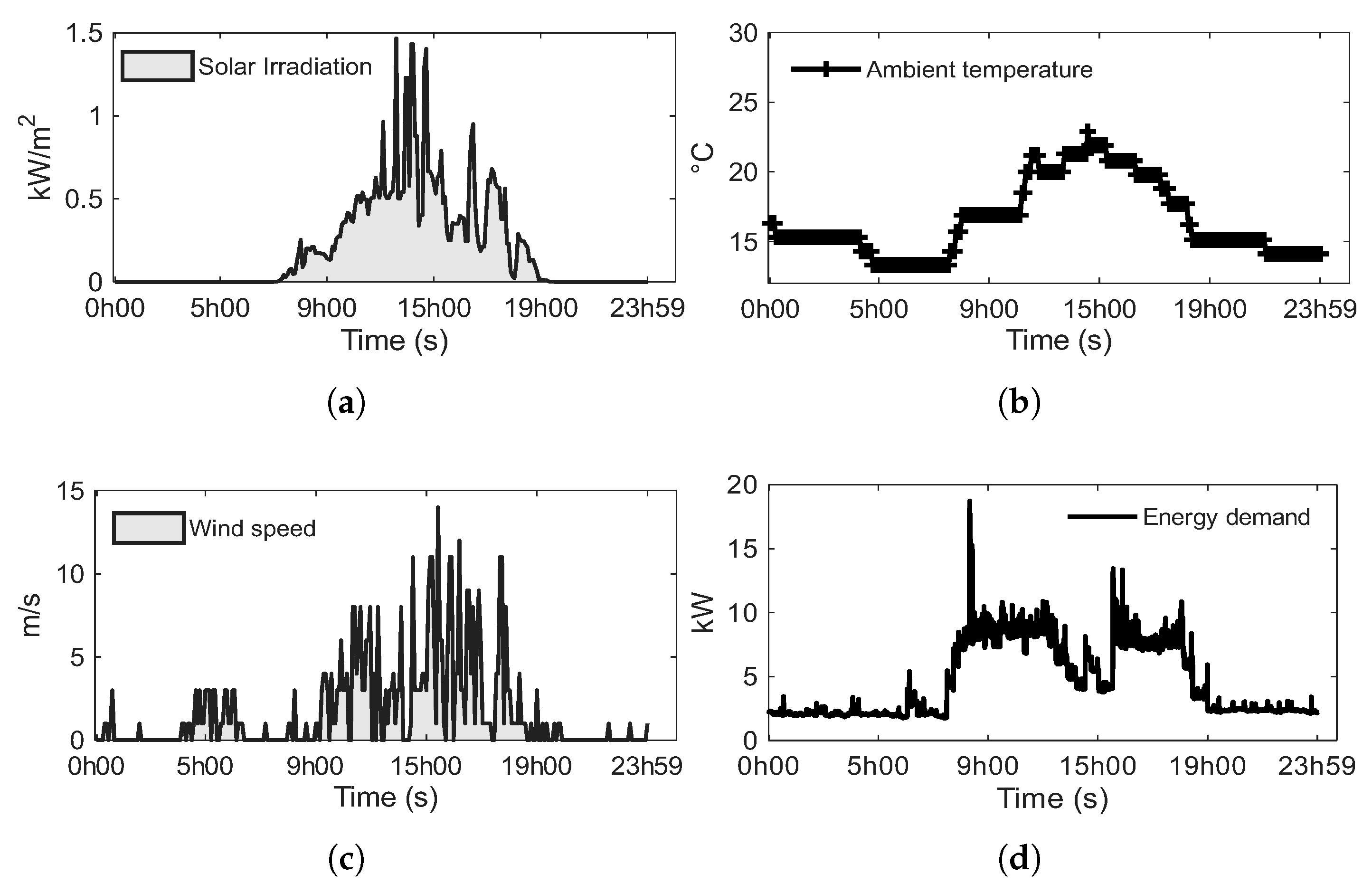
Due to their high variability, renewable resources can generate instability in the electrical grid, particularly in operating conditions where inverter-based resources displace synchronous generation and reduce the natural buffering that traditionally slowed frequency excursions. This motivates control support strategies that preserve adequate frequency regulation under rapid and frequent power imbalances. Figure 1 shows the renewable generation and electricity demand profiles used in this work. Solar energy production is modeled using hourly data on solar irradiance and ambient temperature, while wind generation is based on wind speed profiles. Additionally, a variable electricity demand profile is incorporated to evaluate system performance under realistic operating conditions.
Furthermore, high non-synchronous generation penetration can increase the rate of change of frequency (RoCoF, Hz/s) because power–electronics interfaces reshape the short-term frequency dynamics and reduce the effective inertia seen by the grid [41,42,43]. As a result, frequency deviations can evolve on time scales that challenge conventional primary control, which motivates fast-acting support mechanisms with explicit limits on power and energy delivery. The objective of this research is to develop a dynamic estimation model of load-side virtual inertia supported by high-power-density EDLC supercapacitors, so that the required inertial-like response can be inferred from measurements and supplied with bounded fast power injection/absorption.
In this context, the solar and wind potential enables a distribution of energy generation tailored to the needs of electricity consumption. However, the problem lies in the high variability of these renewable energy sources and electricity demand, which can fluctuate drastically in short periods of time, generating high consumption peaks. This situation can create instability in the electrical grid with high renewable energy penetration and significantly reduces the inertia of the electrical system, affecting the stability and regulation of the electrical frequency. Therefore, it is necessary to implement control and support strategies that allow for adequate regulation of electrical frequency in the presence of these disturbances.

2. Framework for Research Analysis

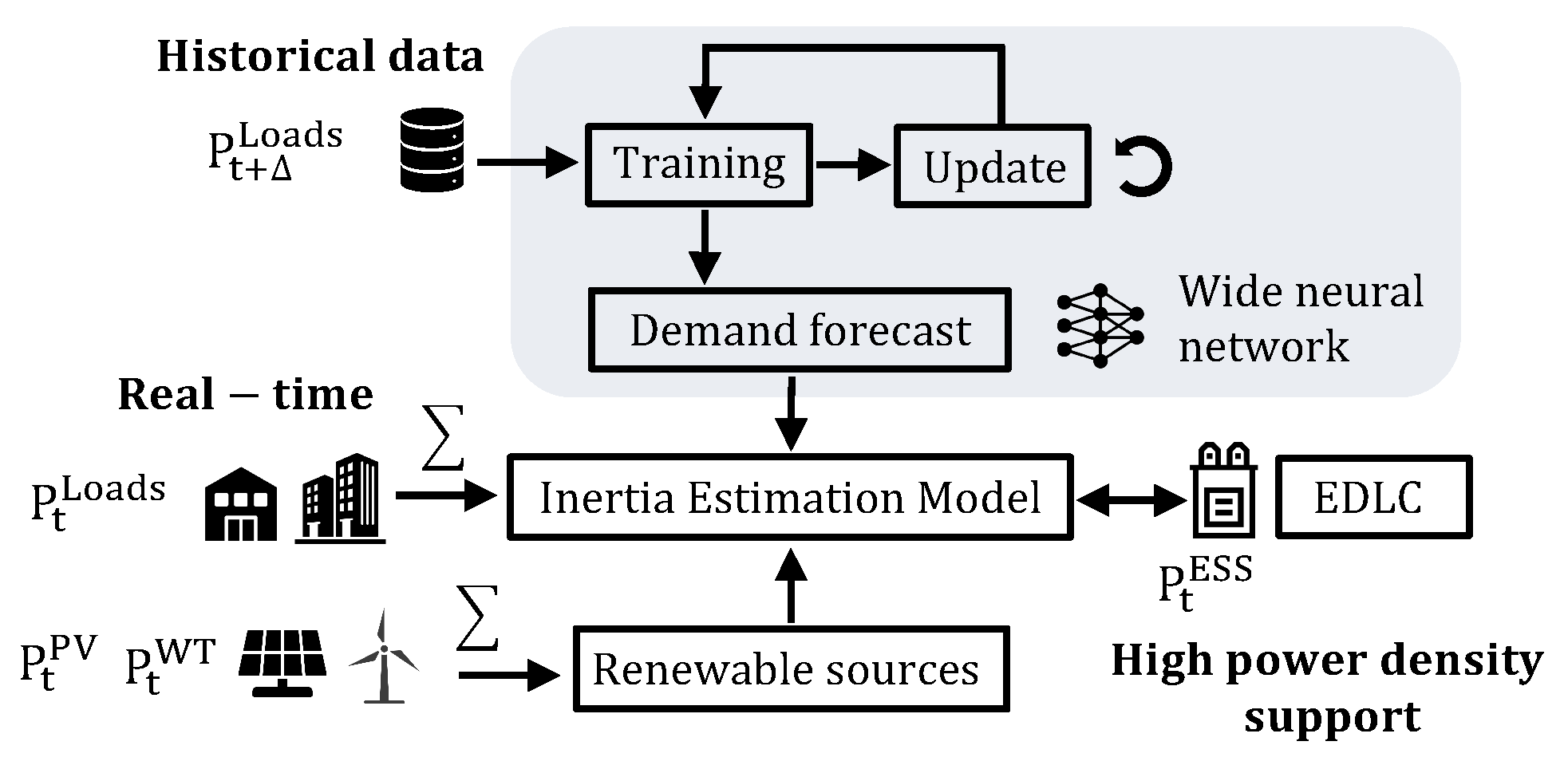
The proposed model integrates a hybrid architecture that combines demand forecasting based on the training of wide neural networks with the real-time monitoring of photovoltaic (PV), wind turbine (WT), and electrical demand profiles. These elements are incorporated into an inertia estimation model that includes support from Electric Double Layer Capacitors (EDLCs), capable of delivering high power density and a rapid response to the distribution system. Figure 2 presents this schematic representation. This integration enables intelligent energy management in modern power systems, enhances operational resilience, and facilitates the optimal incorporation of intermittent renewable energy sources. In this configuration, the process begins with the recording and analysis of historical demand data, from which a forecasting model is built and dynamically adjusted with each new day of recorded data [44]. Consequently, inertia estimation is based on calculating the storage requirements of EDLCs, aiming to anticipate the optimal energy needed according to the rate of change in both power demand and renewable generation. This strategy enables active frequency control in electrical distribution networks, enhancing the operational stability of the system.

3. Materials and Methods

3.1. Demand Forecast Based on Wide Neural Networks

Demand forecasting is essential for estimating virtual inertia because it allows for the establishment of energy consumption patterns from historical data. This enables the anticipation of energy requirements to avoid consumption peaks that could affect the stability of the electrical system. This strengthens the response capacity of the electrical system supported with virtual inertia. In this context, a forecasting model based on wide neural networks (WNNs) is proposed, which allows for the capture of complex patterns in energy consumption data. The architecture governing the model is based on WNNs. The fundamental equations are detailed below Equations (1) and (2):
z ( l ) = W ( l ) · a ( l 1 ) + b ( l )
where z ( l ) is linear transformation based on forward propagation, W ( l ) represents the weight matrix of the layer, a ( l 1 ) is the output (activations) of the previous layer, b ( l ) is the bias vector of layer, and l is shifting the activation function.
The non-linear activation function (ReLU) can be calculated as:
a ( l ) = f ( z ( l ) ) = y ^ i
where a ( l ) is the output (activations) of the current layer after the activation function f ( z ( l ) ) is applied. Consequently, y ^ i is designated as the prediction values of the model.
The cross-entropy cost function for classification can be expressed as shown in the following Equation (3):
J ( θ ) = 1 m i = 1 m y i · log ( y ^ i )
where J ( θ ) is the loss function measuring the difference between predicted and true outputs, θ is the set of all parameters (weights and biases) in the network, y i is the true label of sample i, y ^ i is the predicted output of the network for sample i, and m is the number of training samples.
Finally, the backpropagation function of the gradients of the cost function can be defined as follows in Equations (4) and (5):
J W ( l ) = δ ( l ) · a ( l 1 ) T
J b ( l ) = δ ( l )
where δ ( l ) is the error term at layer l, J W ( l ) is the gradient of the loss with respect to weights in layer l, and J b ( l ) is the gradient of the loss with respect to biases in layer l.
The main configuration of the neural network in this study is applied specifically to demand forecasting. The input vector consists of a record of the previous five days of demand variability, which are processed via the WNN. The architecture includes a hidden layer with 100 neurons and the ReLU activation function, followed by an output layer that estimates the next day’s demand. Training is carried out using the Huber loss function, which combines the robustness of MAE against outliers with the sensitivity of MSE, together with the Adam optimizer. In addition, early stopping is implemented to halt training when no improvements are observed, thereby preventing overfitting. Table 2 presents, in detail, the steps for this procedure from the database.

3.2. Conceptualization of the Virtual Inertia Model

The calculation of virtual inertia in an inverter or grid-forming unit uses the model swing equation equivalent to that of a synchronous generator. The inertia constant H is defined as base kinetic energy times base apparent power:
H = E k S base , E k = 1 2 J ω 0 2
where E k is the kinetic energy stored in the rotating mass at synchronous speed ω 0 , J is the moment of inertia of the rotating mass, and S base is the base apparent power.
The behavior in response to power imbalances is given as follows:
d ω d t = ω 0 2 H Δ P pu
Therefore, the rate of change of frequency (RoCoF) is defined as follows:
RoCoF = d f d t = f 0 2 H Δ P pu
The design of H from a desired RoCoF can be calculated according to the following Equation (9):
H = f 0 2 · RoCoF Δ P pu
The dynamic behavior of the system can be modeled, including both the inertia constant, H, and the damping coefficient, D, as follows:
Δ P pu = f 0 2 H · d f d t + D · Δ f
where the following applies: H is the inertia constant (s), D is the damping coefficient (pu/Hz), f 0 is the nominal frequency (Hz), d f d t is the rate of change of frequency (RoCoF), and Δ f is the frequency deviation.

3.3. Dynamic Model with Virtual Inertia and Demand Prediction

The proposed virtual inertia estimation model is based on the combination of two algorithms: demand prediction and adaptive inertia estimation. The former uses wide neural networks to anticipate energy consumption patterns, while the latter employs a hybrid approach that combines recursive least squares and adaptive filtering to adjust inertia parameters in real time. This methodology allows for a rapid and accurate response to variations in demand and renewable generation, improving the stability of the electrical system. The dynamic behavior of frequency in an electrical system can be described in swing Equation (11):
2 H · d f d t = P t R E S P t L d s f n
where H denotes the physical inertia constant of the system (s), f denotes the instantaneous frequency (Hz), f n denotes the nominal frequency (Hz), P t R E S denotes the generated power (kW), and P t L d s denotes the demanded power (kW).

3.3.1. Incorporating Demand Prediction

Let P ^ t L d s be the predicted demand and P t L d s the actual demand. The prediction error is defined as follows:
Δ P e r r = P t L d s P ^ t L d s
The dynamic equation is then adjusted to the following:
2 ( H + H v ) · d f d t = P t R E S P ^ t L d s + Δ P e r r f n
where H v represents the virtual inertia provided via electronic converters.

3.3.2. Estimation of Virtual Inertia

By rearranging Equation (13), the required value of H v to maintain frequency stability based on EDLCs can be estimated as follows:
H v = 1 2 · P t R E S P ^ t L d s Δ P e r r f n · d f d t H
This value directly depends on the following: the demand prediction error Δ P e r r , the frequency variation d f d t , and the difference between generation and predicted demand.

3.3.3. Interpretation

If Δ P e r r is large, the system requires greater H v to dampen frequency variations. Conversely, if the frequency remains stable ( d f d t 0 ), the contribution of virtual inertia is minimal.
To illustrate the application of the equations, Table 3 summarizes the parameters, the predicted demand, the real demand, and the resulting estimation of virtual inertia.

3.4. EDLC Supercapacitor Support Power

The reference power to be delivered via the energy storage system supported with ELDC supercapacitors is calculated as Equation (15):
P t E S S = 2 H v · f n · d f d t
This equation reflects the ELDC supercapacitors behaving like a virtual synchronous generator, injecting or absorbing power proportional to the rate of frequency variation.
If the prediction error Δ P e r r is considered, the reference is adjusted to compensate for the difference between actual and predicted demand:
P t E S S = 2 H v · f n · d f d t + Δ P e r r
where the first term stabilizes the frequency, while the second term compensates for the imbalance caused by imperfect forecasting.
Finally, the control signal sent to the ELDC supercapacitors system is defined as Equation (17):
P t r e f = sat P t E S S , P S C m a x
where sat ( · ) denotes the saturation function that limits the power within the ELDC supercapacitors maximum capacity. P t r e f : the reference power calculated from virtual inertia and prediction error. P S C m a x : the maximum available power of the storage system. This control ensures that the ELDC supercapacitors’ response remains within safe operating limits while supporting frequency regulation.
The energy to be delivered via the EDLC is obtained from the following:
E E D L C = t 1 t 2 P t r e f ( t ) d t
where E E D L C is the energy delivered via the EDLC system, P t r e f ( t ) is the reference power calculated from virtual inertia and demand prediction, and t 1 , t 2 are the initial and final times of the support interval.
Likewise, the energy stored in an EDLC is expressed according to the following Equation (19):
E E D L C = 1 2 C V 2 E r e q
where C is the capacitance of the supercapacitor bank, V is the operating voltage of the EDLC, and E r e q is the required energy.
As part of the practical procedure, the following steps are considered:
  • Determine P t r e f ( t ) for the worst-case scenario of frequency variation.
  • Multiply by the required support time ( t 1 , t 2 ).
  • Calculate the necessary capacitance:
    C 2 E r e q V 2
  • Select the number of cells in series/parallel to achieve the desired voltage and energy.

3.5. Case Study

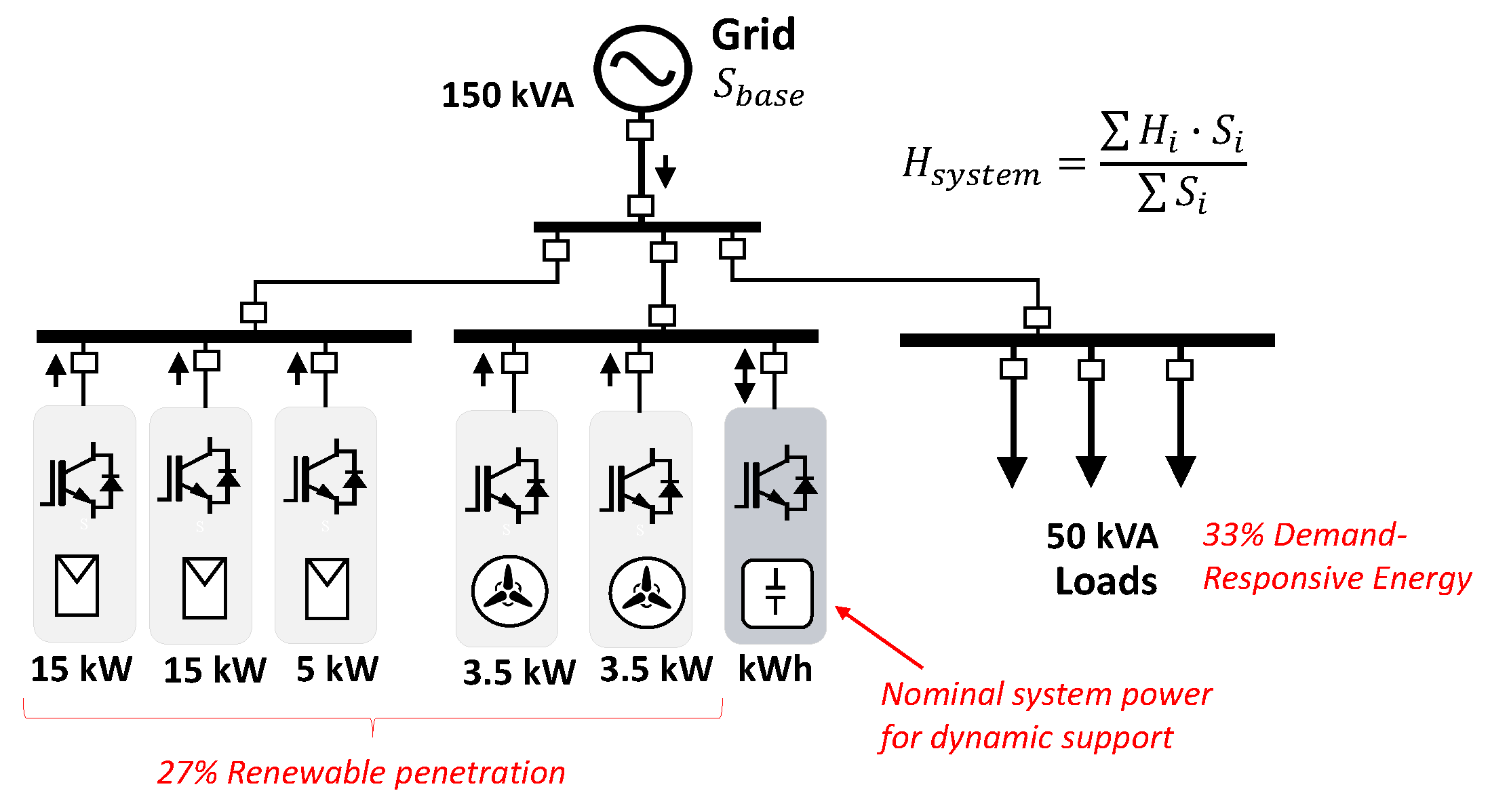
The system configuration is based on real operational data from the Energy Laboratory at the University of Cuenca. In this study, data from equipment belonging to the laboratory’s microgrid were used, which includes photovoltaic (PV) modules and wind turbines (WTs) operating according to the nominal values and rated power shown in Figure 3 where presents a case study of a microgrid with renewable energy penetration and virtual inertia support [45]. The 150 kVA system includes photovoltaic (PV) and wind (WT) sources, along with a variable load that simulates real-world consumption. The virtual inertia is implemented using an EDLC supercapacitor bank, which provides a fast response to load and generation fluctuations. The microgrid contributes 27% renewable generation, highlighting the importance of virtual inertia support for maintaining system stability. The analysis focuses on the system’s ability to mitigate frequency deviations during transient events, demonstrating the effectiveness of the proposed approach in high-renewable-energy-penetration environments. Furthermore, the variable load represents 33% of the system’s nominal power, emphasizing the need for dynamic control strategies to ensure operational stability.
In the analysis of the 150 kVA system at 60 Hz, a disturbance equivalent to 10% of the base power was considered, which corresponds to Δ P p u = 0.1 . The nominal frequency is f 0 = 60 Hz . To ensure dynamic stability, an RoCoF limit of 0.5 Hz / s was established, and based on these parameters, the virtual inertia constant was calculated using the expression
H = 60 × 0.1 2 × 0.5 = 6 s .
This value of H falls within the typical range of generators with medium-high inertia, providing reasonable damping against sudden 10% load variations in 60 Hz electrical systems and contributing to the stability and resilience of the grid under transient operating conditions.
The calculation of the virtual inertia H must be carefully adjusted according to the expected operating conditions of the microgrid. First, when considering a major disturbance, such as a 20% load step relative to the base power, the value of H is doubled to maintain the same RoCoF limit, which implies greater damping capacity against unforeseen variations. Similarly, a stricter RoCoF requires a proportional increase in H, reinforcing stability, but this can result in a slower response. Furthermore, it is essential that the reference apparent power corresponds to the actual kVA value of the system, since any difference from the considered 150 kVA directly alters the calculation of the base S, which is crucial in distributed generation systems.

3.6. Energy Storage System Sizing Criteria

The sizing of an energy storage system to provide inertia support to a distributed system is a critical process that must balance technical capacity, economic efficiency, and system stability. The criteria include defining the required power, the useful energy to be supplied, the duration of the charge-discharge cycles, integration with renewable sources, and system reliability under different operating conditions. Table 4 presents some criteria focused on the case study that allow providing inertia support to the system based on energy demand and renewable penetration.

4. Results and Discussion

4.1. Training and Validation of Demand Forecasting

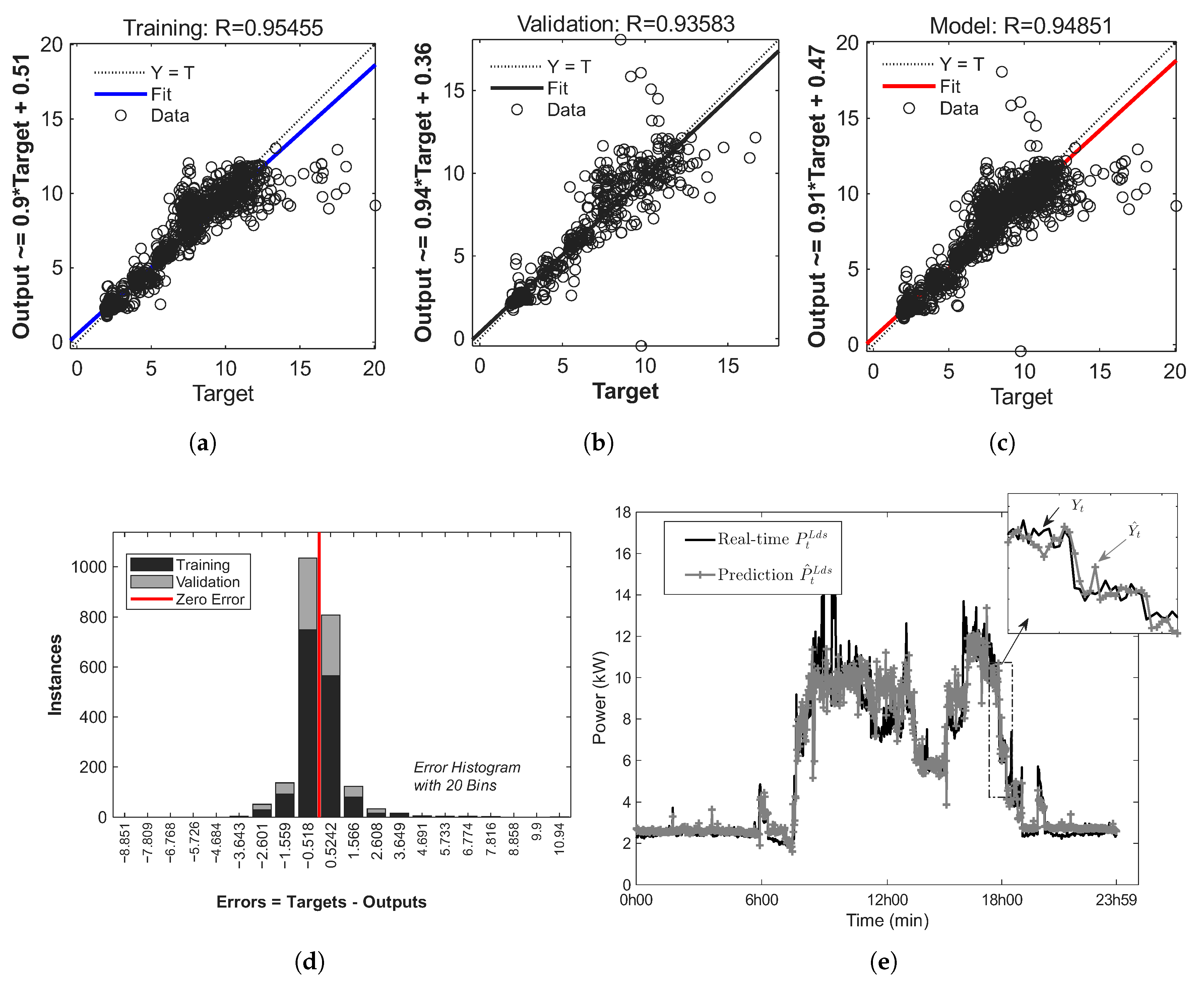
This section analyzes the demand database derived from a five-day record, with updates performed following each prediction cycle. The training and validation of the results were performed using 70% and 30% of the dataset, respectively. In Figure 4a, a correlation coefficient close to 0.954 illustrates the relationship between actual and predicted values, expressed in kW. The resulting model equation tends to underestimate the true values due to its slope being ≤1 while introducing a positive bias. The fit line represents the linear regression adjusted to the data, reflecting the model’s behavior around average values. Similarly, Figure 4b presents the model validation using the remaining 30% of the data, yielding a correlation coefficient of 0.94 during this phase (see Figure 4c), where the predicted values show improved alignment with the actual ones. The final model outputs result in an overall correlation of 0.949, demonstrating its high predictive capability for the analyzed demand data. Figure 4d presents the error histogram corresponding to the distribution of differences between the actual values (targets) and the predictions generated via the model (outputs), which allows for the evaluation of its accuracy. It can be observed that most errors cluster around zero, specifically between −0.5175 and 0.5242, which demonstrates the high precision of the model’s predictions. This graphical representation is useful for identifying potential biases, dispersion, and deviations in the performance of the proposed model. Lastly, the model evaluation results are presented in Figure 4e. The behavior of the model can be observed throughout the day. During the hours between 00h00 and 06h00, as well as between 20h00 and 23h53, the demand power remains constant due to common loads. Conversely, between 06h00 and 20h00, energy consumption begins, exhibiting a high adaptability to the predicted values.
The results obtained from the application of the WNN network have demonstrated its superiority over other neural networks in previous demand forecasting studies [44,46].
Finally, the results were compared with several neural networks applied to demand forecasting, such as LSTM, NNNs, BNNs, and WNNs. The superiority of the WNN model is evident, achieving the lowest RMSE of 1.0310 among all evaluated models. In addition, it reaches an R2 value of 0.96, an MSE of 1.0630, and a MAPE of 6.3%. The second-closest model is LSTM, which shows similar results, but with a lower R2 adjustment value of 0.89. The other networks also achieve an approximate fit; however, none surpass the performance of the WNN proposed in this study. The details of these values are presented in Table 5. Based on these findings, the following section presents an analysis aimed at estimating network frequency events, grounded in the derivative of both actual and predicted power. This approach focuses on the examination of critical points for the detection and anticipation of frequency events that may cause instability in the electrical system.

4.2. Analysis of Real-Time Frequency Deviation Estimation

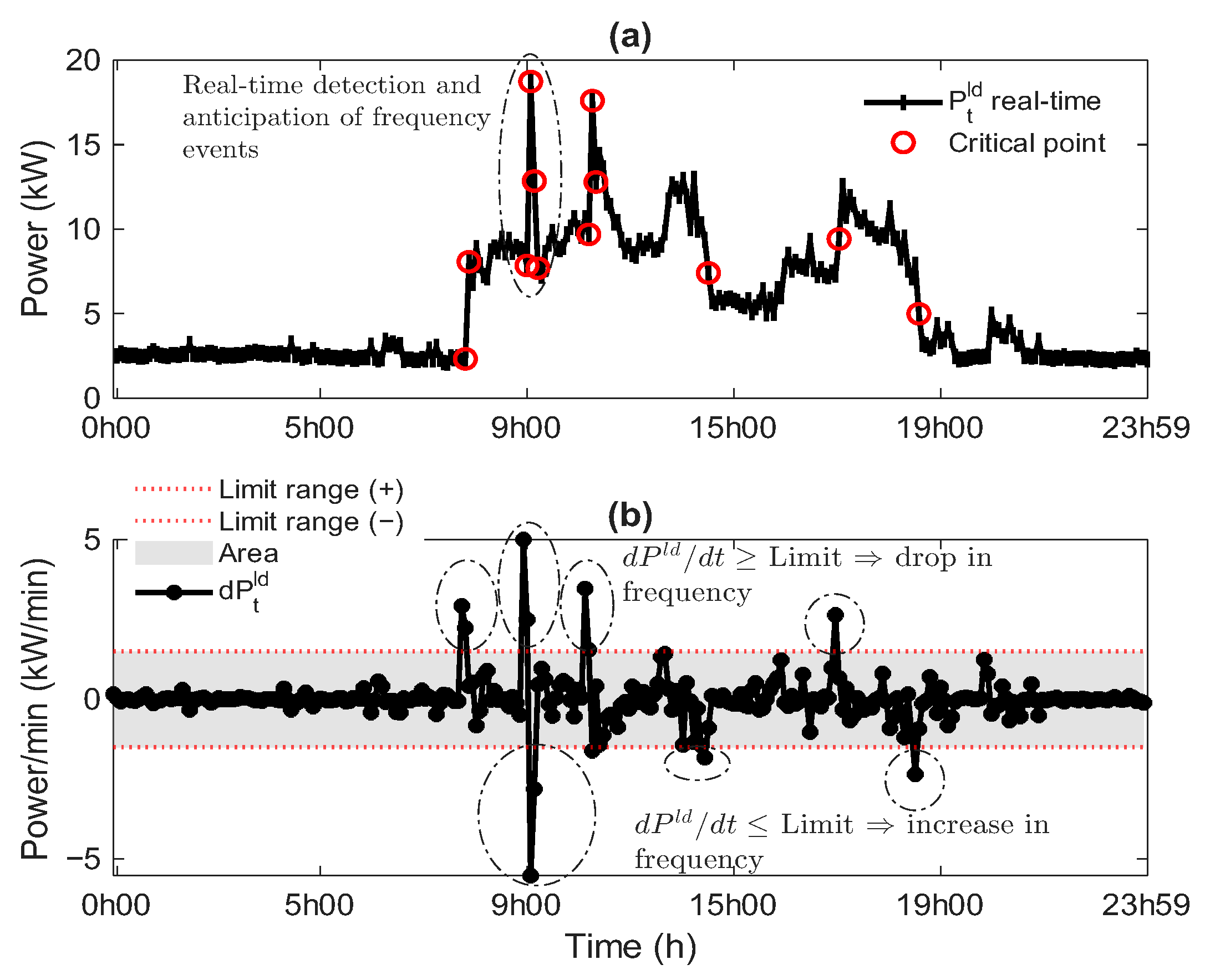
The estimation of frequency deviation is carried out based on the demand prediction model. For this purpose, the inflection points in the rate of change of demand d P l d / d t are identified. Subsequently, ramp limit values for power are set in both positive and negative directions. Values exceeding this range produce direct disturbances in frequency stability. In Figure 5a, the demand power profile P t l d is presented throughout the day. Critical points are highlighted; the proportionality of the rate of change is compromised, potentially leading to instabilities in the frequency of the electrical grid. Significant peaks can be observed around 9h00 and 13h00, which coincide with periods of high activity, such as the start of the working day and lunchtime. These critical points represent relevant transitions that help identify stress conditions in the grid, which is useful for implementing energy management strategies.
On the other hand, Figure 5b shows the rate of change of the electrical demand d P t l d d t , together with the positive and negative limit ranges, ± 1.5 kW/min, that define acceptable dynamic variations. The shaded gray area covers the values within this range, which do not generate significant impacts on the stability of the distribution system. Variations outside of this range are directly correlated with the peaks observed in the previous figure, highlighting the importance of focusing the analysis on critical points to anticipate events that may compromise the operational balance of the grid.
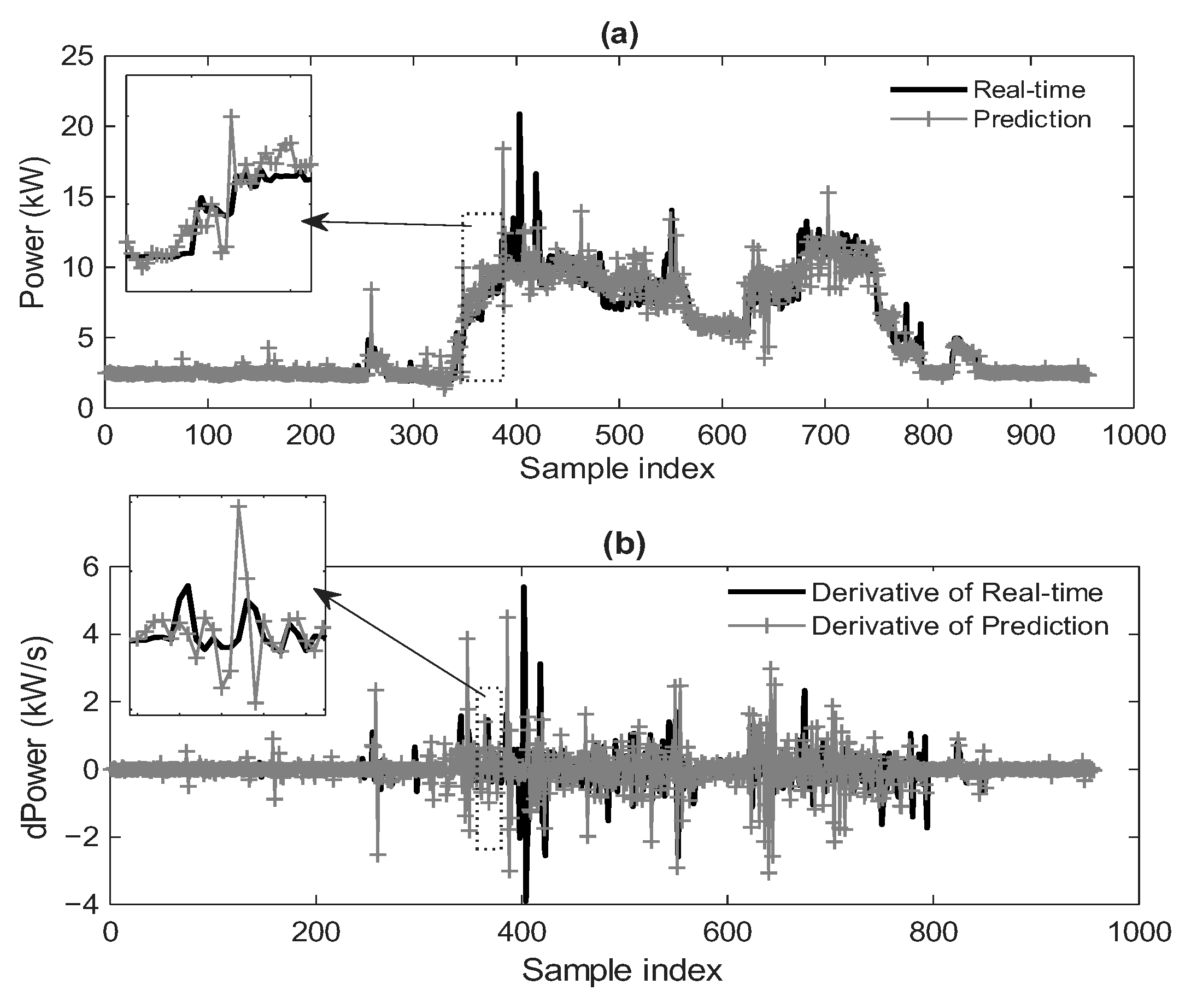
In parallel, the demand forecasting results are analyzed, showing the similarity between the model and the actual values. Figure 6a illustrates this comparison. Likewise, the rate of change or derivative of these values is examined, comparing the prediction results with the real data. Figure 6b presents the perspective of the derivative values, where a high degree of similarity is observed in the context of anticipating frequency events. Consequently, the use of an EDLC-based storage system is proposed to mitigate these effects. The reference power evaluates the critical points and establishes an operating range to counteract the impact on the frequency of the electrical network.

4.3. Comparison Between Scenarios with and Without Virtual Inertia Support

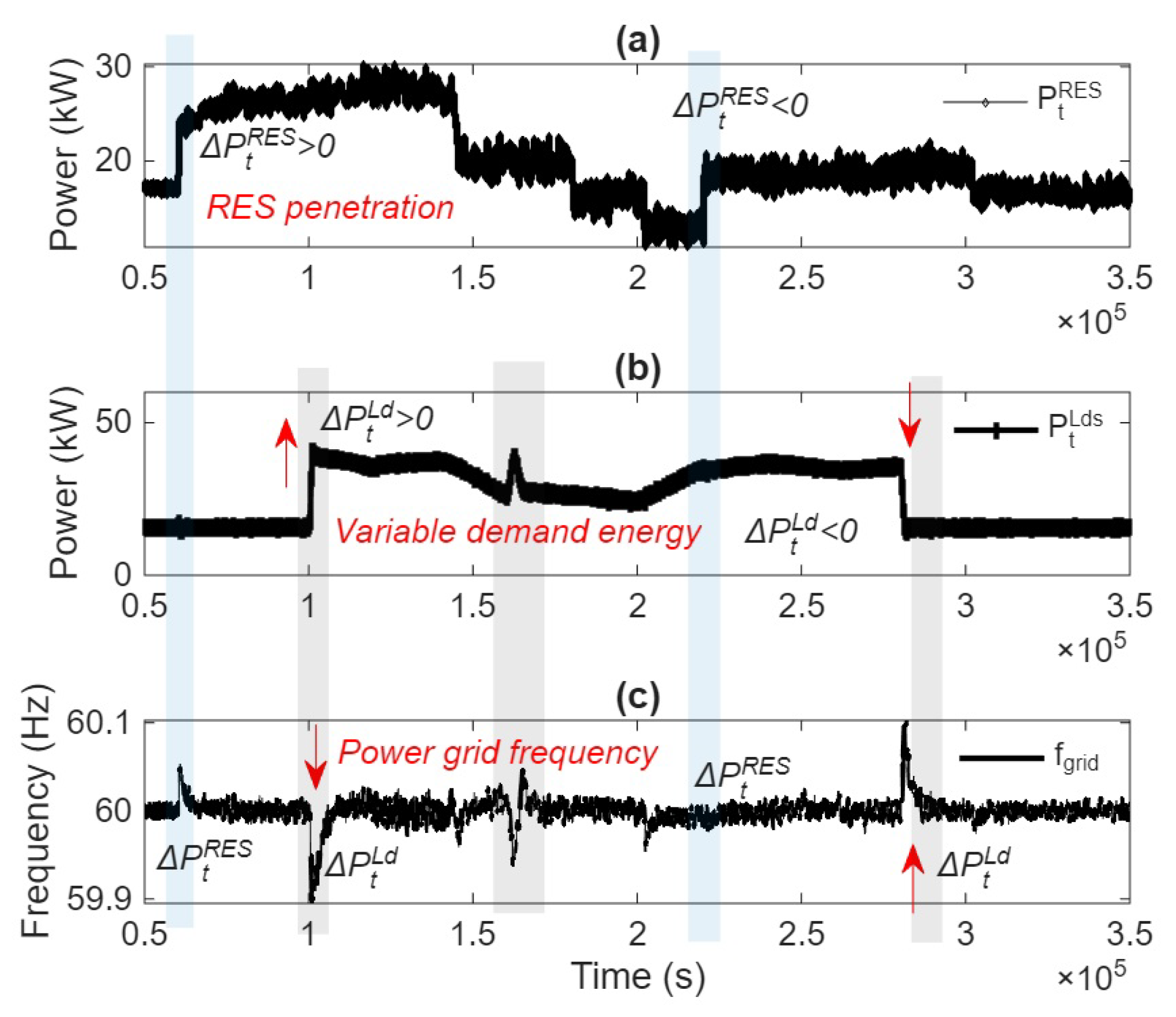
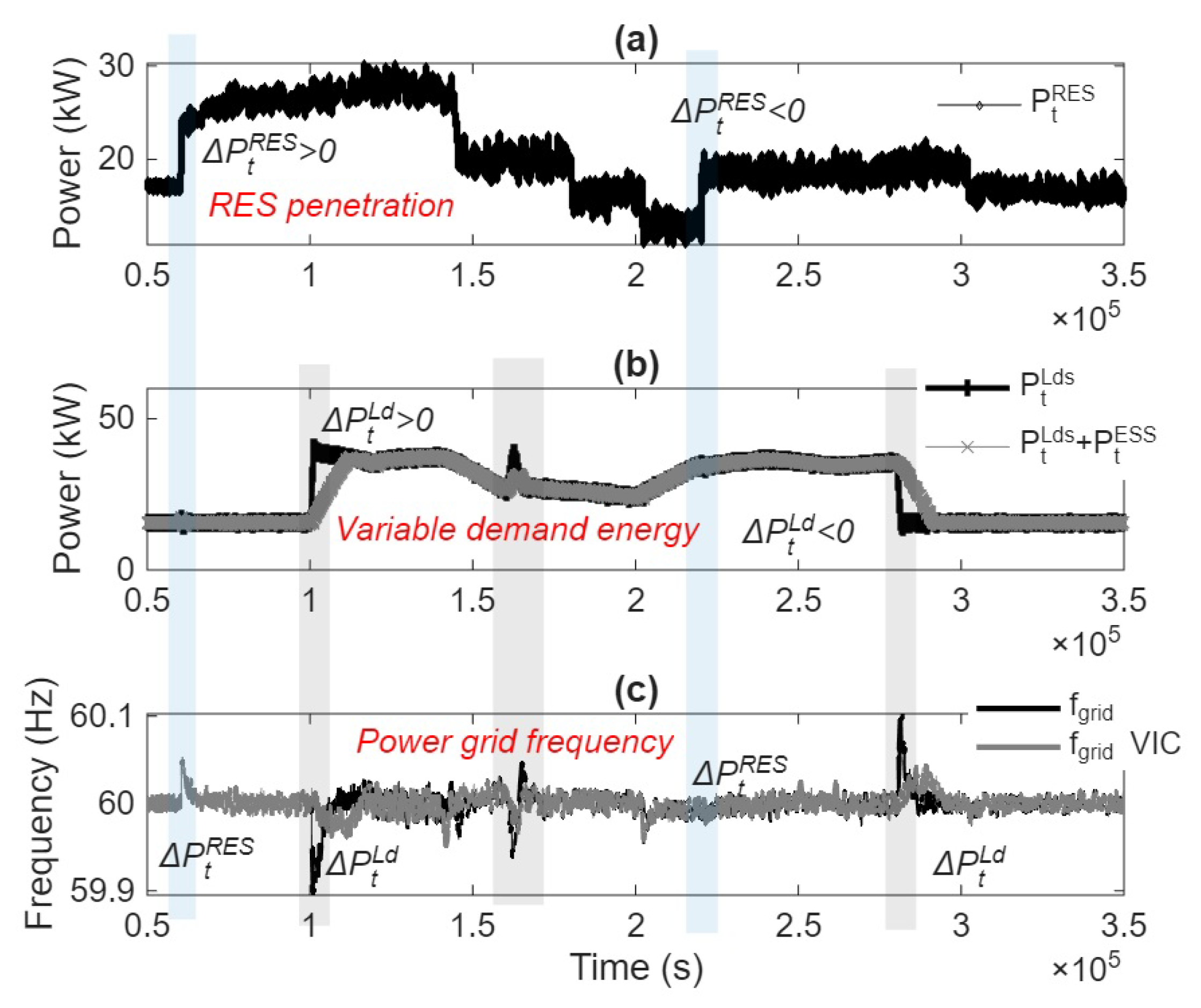
In this section, two scenarios are analyzed: one based on electrical systems without inertia support, which directly impacts the system frequency, and another with inertia support provided via an EDLC-based storage system, used to mitigate the effects of demand variations. In this context, Figure 7a shows the renewable energy power profiles ( P t R E S ) in kilowatts (kW) over time. Fluctuations can be observed, representing variations in generation, which indicate increases ( Δ P t R E S > 0 ) and decreases ( Δ P t R E S < 0 ) in renewable power. In this case, the power variations correspond to values with a 27% penetration of renewable sources in the system. On the other hand, Figure 7b presents the variation in energy demand ( P t L d s ). This profile demonstrates how electricity consumption changes dynamically at certain points, with increases ( Δ P t L d > 0 ) and sharp reductions in load ( Δ P t L d < 0 ), emphasizing the non-constant nature of the demand profile during specific hours of the day. Finally, Figure 7c illustrates the frequency response of the electrical grid ( f g r i d ) in a 60 Hz system, showing how the system reacts to disturbances caused by changes in generation and demand. The areas of Δ P t R E S and Δ P t L d allow correlating power events with frequency oscillations, highlighting the system’s sensitivity in the absence of virtual inertia support.
In contrast, the results of the model with EDLC support applied to demand power are presented. Figure 8 highlights the comparison of frequency effects on the electrical grid after implementing inertia support against demand disturbances at critical points of positive and negative ramps ( Δ P t L d > 0 and Δ P t L d < 0 ). It can be observed that, within the shaded area corresponding to Δ P t L d , frequency deviations of around 59.90 Hz are reduced to approximately one-third, reaching values close to 59.97 Hz, which demonstrates the effectiveness of inertia support under these conditions. Similarly, the forced disconnection of the demand load produces a damping effect on the system frequency, helping to stabilize its response under disturbances. Furthermore, the early incorporation of demand prediction, combined with system support power, significantly enhances grid stability.
It should be noted that the results are directly linked to load variations, and the analysis focuses on determining the tolerable percentage of renewable penetration for the case study with a base power of 150 kVA. These values are particularly significant in distributed electrical systems, where the base power is relatively low compared to the national grid, making them more sensitive to fluctuations in generation and demand.
Furthermore, the reduction in frequency variation impacts is mainly absorbed via the storage system capacity and its response to dynamic changes. In this context, the storage support acts as a damping mechanism that helps maintain system stability, even under conditions of high renewable penetration and load variability.

4.4. Energy Storage System Sizing

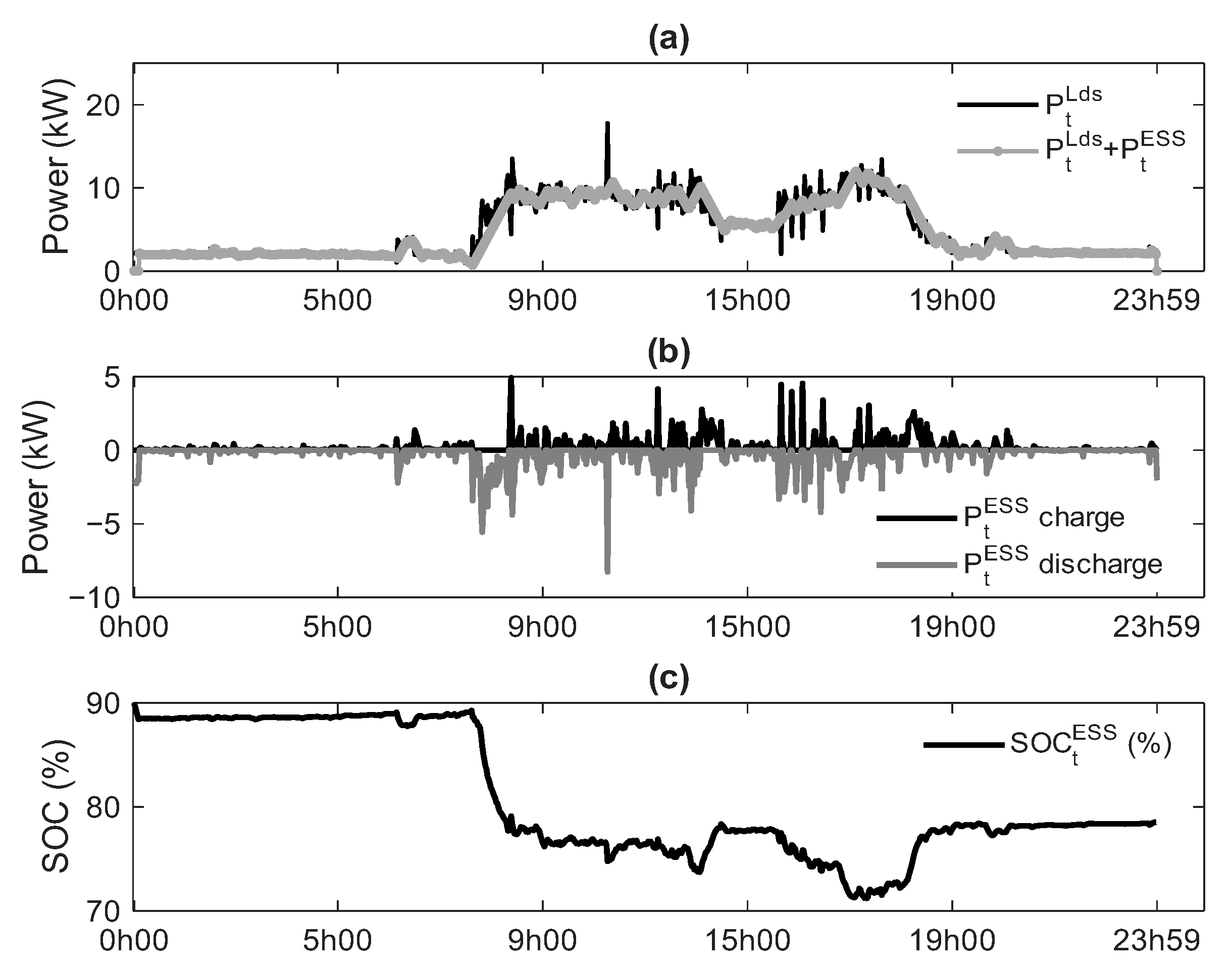
The optimal sizing of an energy storage system is based on several factors associated with the context of virtual inertia, which are detailed in Table 4. Within this framework, demand disturbances are analyzed, as illustrated in Figure 9a. It can be observed that EDLCs contribute to smoothing the demand power, thereby maintaining stability from the load side and mitigating the effects of sudden variations. Figure 9b presents the reference values received by the storage system at each instant of time. Positive values correspond to rates of change that exceed the established upward limits, while negative values reflect variations that surpass the downward limits. This behavior demonstrates the system’s ability to dynamically respond to demand fluctuations and ensure adequate inertia support. Meanwhile, Figure 9c shows the evolution of the state of charge (SOC) of the storage system. The operation corresponds to 30% of the capacity, starting from an initial charge state of 90%. At the end of the daily work cycle, the system concludes with a charge level close to 80%, which demonstrates its ability to maintain sufficient energy reserves to guarantee stability and reliability in operation.
In 60 Hz electrical systems, the nominal frequency must remain very close to this value. Generally, the permitted operating ranges are between 59.8 Hz and 60.2 Hz under normal conditions, although wider deviations are tolerated in contingency scenarios. In this study, conducted on a 150 kVA base system, the results depend on several criteria but focus on the rate of change of demand profiles and fluctuations of RESs. Table 6 summarizes the values considered to prevent disturbances in the electrical grid, both without virtual inertia support through storage systems and with the support provided via ESS systems.

4.5. Comparison to Other Storage Technologies

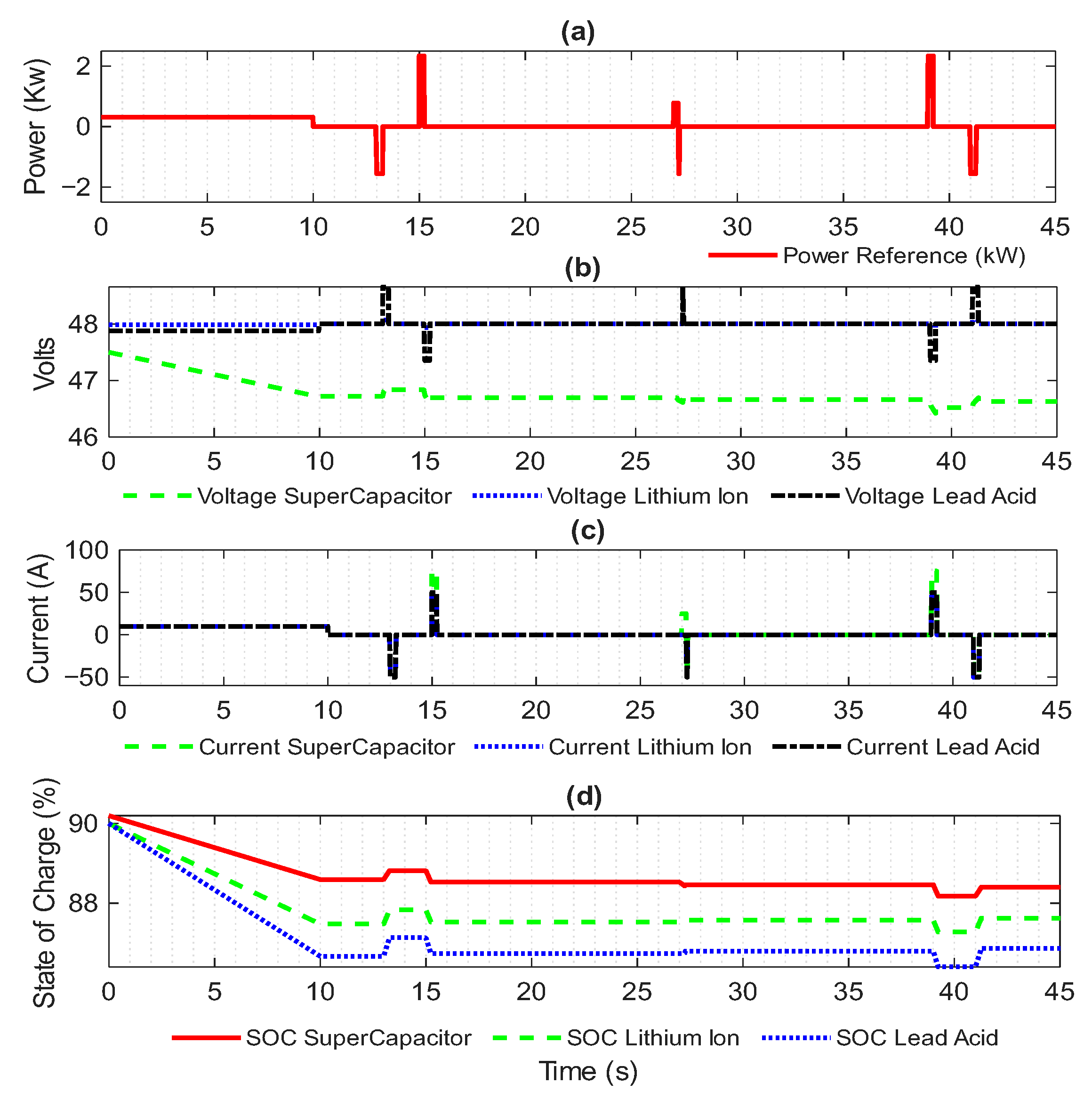
This section presents a comparative analysis of three different types of energy storage technologies: ELDCs (supercapacitors), lithium ion batteries, and lead acid batteries, highlighting the advantages of each. Figure 10a shows the reference power employed as a common input signal for the three storage systems analyzed: a supercapacitor, a lithium ion battery, and a lead-acid battery. The demand profile is constructed using two pulse generators. The first is configured with an amplitude of 50 A, a period of 14 s, a pulse width of 280 ms, and a delay of 13 s. The second generator has an amplitude of 75 A, a period of 12 s, a pulse width of 240 ms, and a delay of 15 s. This scheme allows the evaluation of dynamic response under fast and short-duration load events. Figure 10b presents the terminal voltage of the three storage systems. All start from an initial value of 48 V. It is observed that the supercapacitor and the lithium ion battery exhibit moderate voltage drops, on the order of 2 V, while the lead-acid battery shows more abrupt variations and pronounced peaks during load transients, evidencing a lower capability to handle rapid power changes. Figure 10c illustrates the current response. At second 15, the supercapacitor reaches the highest current level among the three technologies, with values close to 75 A. A relevant aspect occurs around second 26, where a very fast load pulse is not adequately tracked through the battery based systems; in this case, only the supercapacitor responds effectively, supplying approximately 30 A. This result confirms its superior performance under high slope transients. Finally, Figure 10d shows the evolution of the state of charge (SOC). All three systems start from the same initial value and exhibit a decreasing trend. The supercapacitor records a fall time of 8.266 s and a slew rate of 160.256 , while the lithium ion battery presents 7.776 s and 252.525 , and the lead acid battery 7.776 s and 333.335 , respectively. These values indicate that the supercapacitor offers a smoother SOC variation, consistent with its ability to absorb and deliver energy over short intervals without abrupt degradations.

4.6. Sensitivity Analysis

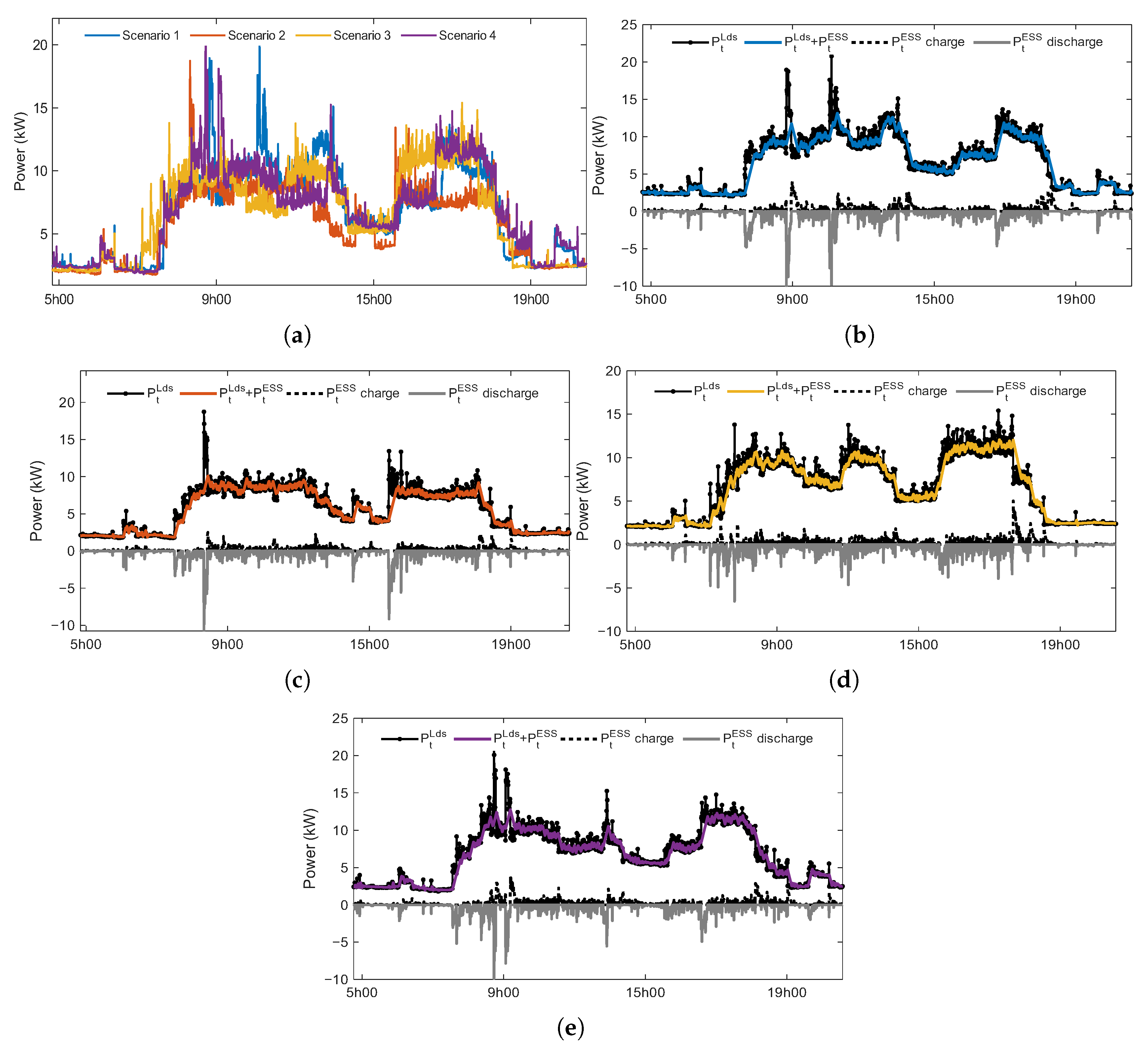
Finally, Figure 11a–e illustrate a sensitivity analysis of different scenarios, evaluating the behavior of the EDLC in response to demand variations in a distributed microgrid. The first graph details the different demand scenarios. Figure 11b–e show how the ESS interacts with the original load, p t L d s , compensating its fluctuations by means of a dynamic reference power. This reference power, represented with the dashed line, enables the ESS to anticipate load ramps, which is essential for providing virtual inertia support. In this context, virtual inertia denotes the EDLC ability to emulate the stabilizing effect of traditional mechanical inertia, responding quickly to abrupt changes in demand. Across all four scenarios, the EDLC smooths the total power profile, p t L d s + p t E S S , mitigating the rate of change and preventing frequency deviations that could compromise system stability. The EDLC charge and discharge curves, shown in light and dark gray, highlight its real-time adaptability, operating on minute-scale windows to mitigate disturbances. This behavior is particularly relevant in systems with high renewable energy penetration and variable demand, as exemplified by the 150 kVA base case analyzed. The EDLC rapid response, combined with a control strategy based on the rate of change of power, allows the frequency to remain within safe ranges ( ± 0.1 Hz), even without traditional mechanical support. Overall, the results demonstrate that a properly sized and strategically controlled storage system can provide effective virtual inertia support, ensuring the operational stability of modern microgrids under real-world power conditions.

5. Conclusions

This work has presented a dynamic framework for load-side virtual inertia estimation in microgrid environments, based on the anticipation of frequency events through short-horizon demand forecasting and fast power support provided via EDLC-based energy storage systems. The proposed approach enables the identification of operating conditions that are critical for frequency stability and links measurement-driven inertia requirements with a high-bandwidth actuation mechanism. The methodology was evaluated on a representative 150 kVA distributed system, allowing the combined effects of renewable penetration and demand variability to be analyzed in a controlled yet realistic setting.
The results confirm that demand forecasting plays a central role in anticipating frequency-relevant events in low-inertia microgrids. For the studied case, a renewable penetration level of 27%, combined with a fluctuating demand representing 33% of the base power, led to frequency deviations of approximately ± 0.1 Hz when no dedicated inertia support was applied. These deviations were directly associated with high rates of change in demand, highlighting that load dynamics—rather than renewable variability alone—can be a dominant driver of short-term frequency excursions in distribution-level systems with limited synchronous inertia.
By introducing EDLC-based support on the load side, the proposed strategy effectively reduced the rate of change of power during critical demand ramps. The results show that smoothing these ramps translates into a measurable improvement in frequency behavior, constraining deviations within the same ± 0.1 Hz band under conditions that would otherwise produce more pronounced excursions. This demonstrates that virtual inertia provision through fast storage does not rely on long-duration energy delivery but, rather, on rapid and accurately targeted power exchange synchronized with the detected demand dynamics.
The fast response capability of the EDLC, combined with a reference-power-based control strategy informed by demand prediction, proved effective in maintaining operational stability throughout the analyzed scenarios. The state-of-charge trajectories indicate that the storage system operates within moderate energy utilization ranges, reinforcing the suitability of EDLC technology for inertia-oriented applications where power density and response speed are more critical than energy capacity. In this context, the storage system acts primarily as a damping mechanism, absorbing and injecting power over short time scales to counteract frequency-sensitive disturbances.
From a system-level perspective, the findings suggest that properly sized and strategically controlled fast storage can function as an effective substitute for traditional mechanical inertia in distributed microgrids. Rather than emulating inertia through fixed parameters, the proposed estimation-based approach adapts the support to prevailing operating conditions, offering a flexible alternative that aligns with the variable nature of modern distribution systems. While the analysis focused on a single 150 kVA case study, the framework is general and can be extended to other low-inertia systems where demand variability and renewable integration challenge conventional frequency control mechanisms.
Future work will address the experimental validation of the proposed strategy and its extension to coordinated operation with other frequency-support resources, as well as the assessment of scalability and robustness under higher penetration levels and more diverse load compositions.

Author Contributions

A.C.: methodology, investigation, funding acquisition, formal analysis, data curation, conceptualization, and visualization., D.B.: visualization, supervision, software, resources, writing—original draft, methodology, project administration, and funding acquisition. D.O.-C.: methodology, investigation, funding acquisition, formal analysis, data curation, conceptualization, and visualization. P.A.-C.: visualization, supervision, software, resources, writing—original draft, writing—review and editing, and methodology. L.I.M.-A.: resources, writing—original draft, methodology, investigation, formal analysis, data curation, and writing—review and editing. D.J.: resources, writing—original draft, methodology, investigation, formal analysis, data curation, and writing—review and editing. All authors have read and agreed to the published version of the manuscript.

Funding

This research received no external funding.

Data Availability Statement

The original contributions presented in the study are included in the article; further inquiries can be directed to the corresponding author.

Acknowledgments

This manuscript is an outcome of the Doctoral Program in Renewable Natural Resources offered by Universidad de Cuenca and Universidad del Azuay. Adrian Criollo gratefully acknowledges Universidad de Cuenca for funding his Ph.D. scholarship. Dario Benavides thanks the Dirección de Investigación y Desarrollo (DIDE) of the Universidad Técnica de Ambato for supporting this work through the research project PFISEI36, “Development of Computational Tools for the Management and Optimization of Smart Microgrids.” The authors thank the Faculty of Engineering, Universidad de Cuenca, Ecuador, for easing access to the Micro-Grid Laboratory’s facilities, allowing the use of its equipment, and authorizing its staff to provide technical support necessary to carry out the experiments described in this article. The icons used in this document were developed by Freepik, monkik, Smashicons, and Pixel perfect, from www.flaticon.com (access 20 October 2025).

Conflicts of Interest

The authors declare no conflicts of interest.

Abbreviations

The following abbreviations are used in this manuscript:
RESsRenewable energy sources
FFRFast frequency response
DSFRsDemand-side flexible resources
EVElectrical vehicle
VSGsVirtual synchronous generators
RPSRapid power support
BESSsBattery energy storage systems
LFCLoad frequency control
EDLCsElectrical double layer supercapacitors
PVPhotovoltaic
WTWind turbine
ESSEnergy storage system
RoCoFRate of change of frequency
VICVirtual inertia controller
WNNsWide neural networks
ReLURectified linear unit
SOCState of charge

References

  1. Yan, K.; Li, G.; Zhang, R.; Xu, Y.; Jiang, T.; Li, X. Frequency Control and Optimal Operation of Low-Inertia Power Systems with HVDC and Renewable Energy: A Review. IEEE Trans. Power Syst. 2024, 39, 4279–4295. [Google Scholar] [CrossRef]
  2. Shazon, M.N.H.; Jawad, A. Frequency control challenges and potential countermeasures in future low-inertia power systems: A review. Energy Rep. 2022, 8, 6191–6219. [Google Scholar] [CrossRef]
  3. Colak, A.; Abouyehia, M.; Ahmed, K.H. Resilience and Frequency Control in Low-Inertia Power Systems: Challenges and Solutions. In Proceedings of the 2024 IEEE 13th International Conference on Renewable Energy Research and Applications (ICRERA), Nagasaki, Japan, 9–13 November 2024; pp. 1277–1284. [Google Scholar] [CrossRef]
  4. Therapontos, P.; Tapakis, R.; Aristidou, P. Assessing the Impact of Primary Frequency Support from IBRs in Low Inertia Isolated Power Systems. In Proceedings of the 2023 IEEE Power & Energy Society General Meeting (PESGM), Orlando, FL, USA, 16–20 July 2023. [Google Scholar] [CrossRef]
  5. Kerci, T.; Hurtado, M.; Gjergji, M.; Tweed, S.; Kennedy, E.P.; Milano, F. Frequency Quality in Low-Inertia Power Systems. In Proceedings of the 2023 IEEE Power & Energy Society General Meeting (PESGM), Orlando, FL, USA, 16–20 July 2023. [Google Scholar] [CrossRef]
  6. He, C.; Geng, H. Frequency Stability of Renewable Energy Integrated Low-Inertia Power Systems During Grid Faults. In Proceedings of the 2023 IEEE International Symposium on Power Electronics for Distributed Generation Systems (PEDG), Shanghai, China, 9–12 June 2023; pp. 620–627. [Google Scholar] [CrossRef]
  7. Ochoa, D.; Martinez, S. Fast-Frequency Response Provided by DFIG-Wind Turbines and Its Impact on the Grid. IEEE Trans. Power Syst. 2017, 32, 4002–4011. [Google Scholar] [CrossRef]
  8. Azizipanah-Abarghooee, R.; Malekpour, M.; Sun, M.; Marshal, B.; Karimi, M.; Terzija, V.V. Enhanced Fast Frequency Control Scheme and Wide-Area Monitoring for Low Inertia Power Systems. In Proceedings of the 2023 IEEE PES Innovative Smart Grid Technologies Europe (ISGT-Europe), Grenoble, France, 23–26 October 2023. [Google Scholar] [CrossRef]
  9. Panagi, S.; Aristidou, P. Sizing of Fast Frequency Response Reserves for improving frequency security in low-inertia power systems. Sustain. Energy Grids Netw. 2025, 42, 101699. [Google Scholar] [CrossRef]
  10. Lan, H.; Masood, N.A.; Saha, T.K. Investigation of Frequency Response in a Low Inertia Power System and its Improvement. In Proceedings of the 2021 IEEE International Conference on Industrial Electronics and Applications (ICIEA/IAEAC), Chongqing, China, 12–14 March 2021; pp. 1771–1776. [Google Scholar] [CrossRef]
  11. Zhang, H.; Yu, S.; Zhang, X.; Gao, Z. Fast power correction based transient frequency response strategy for energy storage system in low-inertia power systems. J. Energy Storage 2024, 97, 112955. [Google Scholar] [CrossRef]
  12. Zhang, H.; Yu, S.; Meng, F. Rapid Power Support-based Frequency Response Strategy for Grid Forming Inverter in Low-Inertia Power Systems. In Proceedings of the 2023 International Conference on Power Engineering Technology (ICPET), Tianjin, China, 27–30 July 2023; pp. 300–305. [Google Scholar] [CrossRef]
  13. Ji, S.; Liu, J.; Liu, Y.; Haokun, L.; Miao, M.; Guo, C. A New Grid Connection Mode of Low Inertia Power System. In Proceedings of the 2022 International Conference on Power Electronics and Smart Applications (ICoPESA), Singapore, 25–27 February 2022; pp. 237–246. [Google Scholar] [CrossRef]
  14. He, C.; Geng, H.; Rajashekara, K.S.; Chandra, A. Analysis and Control of Frequency Stability in Low-Inertia Power Systems: A Review. IEEE/CAA J. Autom. Sin. 2024, 11, 2363–2383. [Google Scholar] [CrossRef]
  15. Yu, G.; Li, X.; Chen, T.; Liu, J. Load Frequency Control via Multi-Agent Reinforcement Learning and Consistency Model for Diverse Demand-Side Flexible Resources. Processes 2025, 13, 1752. [Google Scholar] [CrossRef]
  16. Bosaletsi, O.E.T.; Cronjé, W.A.; Masisi, L.M. Demand Side Frequency Control in Low Inertia Power System. In Proceedings of the ICPEE 2023, Bhubaneswar, India, 3–5 January 2023. [Google Scholar] [CrossRef]
  17. Yuan, K.; Ding, Z.; Li, Y.; Huang, M.; Zhang, K. Robust H load frequency control of power systems considering intermittent characteristics of demand-side resources. Electronics 2020, 9, 593. [Google Scholar] [CrossRef]
  18. Ming, G.; Geng, J.; Liu, J.; Chen, Y.; Yuan, K.; Zhang, K. Load Frequency Robust Control Considering Intermittent Characteristics of Demand-Side Resources. Energies 2022, 15, 4370. [Google Scholar] [CrossRef]
  19. Li, Z.; Shan, X.; Wang, Z.; Yuan, K.; Wang, Y.; Zhang, K. Coordinated Frequency Control of Generation and Demand Side Considering Demand Side Resource Callback Characteristic. In Proceedings of the AUTEEE 2020, Shenyang, China, 20–22 November 2020; pp. 248–252. [Google Scholar] [CrossRef]
  20. Zhang, C.; Liu, T.; Hill, D.J. Switched distributed load-side frequency control of power systems. Int. J. Electr. Power Energy Syst. 2019, 105, 709–716. [Google Scholar] [CrossRef]
  21. Liu, X.; Liu, Z.; Chi, M.; Zhang, Y. Demand-Side Frequency Control in Power Network Based on Multi-Agent Deep Reinforcement Learning. In Proceedings of the IAI 2023, Shenyang, China, 21–24 August 2023. [Google Scholar] [CrossRef]
  22. Casasola-Aignesberger, L.; Wiegel, F.; Waczowicz, S.; Hagenmeyer, V.; Martinez, S. Experimental validation of demand side response rates for frequency control. In Proceedings of the eGrid 2023, Karlsruhe, Germany, 16–18 October 2023. [Google Scholar] [CrossRef]
  23. Bhuyan, S.; Nee Dey, S.H.; Paul, S. Role of Demand Side Management in Automatic Load Frequency control. In Proceedings of the ICEFEET 2020, Patna, India, 10–11 July 2020. [Google Scholar] [CrossRef]
  24. Huang, H.; Liu, J.; Gao, L.; Ning, L. The output flexibility optimization control of load-side wind turbine considering client demand response. J. Phys. Conf. Ser. 2024, 2876, 012036. [Google Scholar] [CrossRef]
  25. Zhang, T.; Shi, R.; Jia, L.; Lee, K. An innovative coordinated control strategy for frequency regulation in power systems with high renewable penetration. Appl. Energy 2025, 401, 126700. [Google Scholar] [CrossRef]
  26. Feng, R.; Wajid, K.; Aziz, A.; Yousaf, M.Z.; Zhang, W.; Cai, Z.; Khan, B.; Ali, A.A.Y.; Mabunda, N.E.; Rajkumar, S. A deep recurrent neural network-based droop control strategy for frequency stabilization in low-inertia power systems with high renewable energy penetration. Results Eng. 2025, 28, 107443. [Google Scholar] [CrossRef]
  27. Liu, W.; Zheng, Y.; Zhang, Z.; Li, Z.; Li, J.; Wang, J.; Li, G.; He, J. Dual-Mode Laguerre MPC and Its Application in Inertia-Frequency Regulation of Power Systems. Energies 2025, 18, 4311. [Google Scholar] [CrossRef]
  28. He, P.; Yongliang, Z.H.; Yukun, T.A.; Xinyan, L.I.; Jingjing, S.H. Frequency control strategy of microgrid distributed virtual synchronous generator based on asynchronous event triggered communication protocol. Int. J. Electr. Power Energy Syst. 2025, 168, 110666. [Google Scholar] [CrossRef]
  29. Li, Z.; Wang, W.; Wang, X.; Tan, Y.; Xie, Y. Collaborative adaptive inertia and damping control for virtual synchronous generator in low-inertia systems. Energy 2025, 287, 129186. [Google Scholar] [CrossRef]
  30. Liu, Y.; Li, F.; Gao, L.; Zhang, Y.; Liu, Y. A Synergetic Control-Based Dynamic Frequency Control Strategy for VSG in Microgrid. In Proceedings of the International Conference on Electrical Engineering and Control Science (IC2ECS), Hangzhou, China, 29–31 December 2023; pp. 594–597. [Google Scholar] [CrossRef]
  31. Gao, Z.; Cao, Y.; Zhang, H.; Qin, H.; Zhang, X.; Li, C. Cooperative Control Strategy for Virtual Inertia Based on Fuzzy Control. In Proceedings of the International Conference on Control Science and Systems Engineering (ICCSSE), Guangzhou, China, 14–16 July 2022; pp. 29–34. [Google Scholar] [CrossRef]
  32. Sony, M.G.; Deepak, M.V.; Mathew, A.T. A Coordinated Frequency Control Strategy for Low Inertia Power System Incorporating Fractional-Order Controllers, Inertia Emulation and Plug-in Electric Vehicle. IET Energy Syst. Integr. 2025, 7, e70021. [Google Scholar] [CrossRef]
  33. Li, X.; Zhang, Y.; Zhao, R.; Liu, P.; Sun, J. Active support control of multi-winding power electronic transformer for inertia emulation in renewable systems. Appl. Energy 2025, 357, 122101. [Google Scholar] [CrossRef]
  34. Hasan, A.K.; Haque, M.H.; Mahfuzul Aziz, S. Enhancing Frequency Response Characteristics of Low Inertia Power Systems Using Battery Energy Storage. IEEE Access 2024, 12, 116861–116874. [Google Scholar] [CrossRef]
  35. Jiang, S.; Ren, W.; Li, C.; Dong, H.; Cao, H.; Li, P.; Wang, Z. Coordinated Control Strategy of Inertia Support for MMC-HVDC Connecting Offshore Wind Farms Considering Frequency Secondary Drop. In Proceedings of the IEEE Conference on Energy Internet and Energy System Integration (EI2), Shenyang, China, 29 November–2 December 2024; pp. 3924–3929. [Google Scholar] [CrossRef]
  36. Fang, Y.; Du, E.; Wang, H.; Wang, P.; Chen, Y.; Zhang, N. Dynamic frequency control strategy for the CSP plant in power systems with low inertia. IET Renew. Power Gener. 2023, 17, 3063–3074. [Google Scholar] [CrossRef]
  37. Udoy, N.I.; Mortuza, M.G.; Hossain, M.I.; Mohammad, N. Rate of Change of Frequency (RoCoF) Improvement of Low Inertia Power System by Using Refrigerated Warehouse. In Proceedings of the IEEE International Conference on Power System (ICPS), Cox’s Bazar, Bangladesh, 13–15 December 2023. [Google Scholar] [CrossRef]
  38. Jiang, S.; Zhang, H.; Fu, G.; Xin, Y.; Wang, L. Coordinated Control Strategies for Enhancing Frequency Stability of Photovoltaic and Storage Networking Systems. Dianli Jianshe/Electr. Power Constr. 2025, 46, 138–149. [Google Scholar] [CrossRef]
  39. Zhang, Y.; Peng, P. Research on source-load frequency response control strategy of distributed generation system. Int. J. Low-Carbon Technol. 2021, 16, 1435–1443. [Google Scholar] [CrossRef]
  40. Bosaletsi, O.E.; Cronjé, W.A.; Masisi, L.M. Design and Implementation of a Low-Inertia Microgrid Platform with Real-Time Inertia Adjustment for Frequency Stability Analysis. In Proceedings of the 2025 33rd Southern African Universities Power Engineering Conference (SAUPEC), Pretoria, South Africa, 29–30 January 2025. [Google Scholar] [CrossRef]
  41. High Penetration of Power Electronic Interfaced Power Sources and the Potential Contribution of Grid Forming Converters; Technical Report; ENTSO-E Technical Group on High Penetration of Power Electronic Interfaced Power Sources: Brussels, Belgium, 2020.
  42. Tielens, P.; Van Hertem, D. The relevance of inertia in power systems. Renew. Sustain. Energy Rev. 2016, 55, 999–1009. [Google Scholar] [CrossRef]
  43. Criollo, A.; Minchala-Avila, L.I.; Benavides, D.; Arévalo, P.; Tostado-Véliz, M.; Sánchez-Lozano, D.; Jurado, F. Enhancing Virtual Inertia Control in Microgrids: A Novel Frequency Response Model Based on Storage Systems. Batteries 2024, 10, 18. [Google Scholar] [CrossRef]
  44. Benavides, D.; Arévalo-Cordero, P.; Ochoa-Correa, D.; Torres, D.; Ríos, A. Predictive Energy Storage Management with Redox Flow Batteries in Demand-Driven Microgrids. Sustainability 2025, 17, 8915. [Google Scholar] [CrossRef]
  45. Espinoza, J.L.; González, L.G.; Sempértegui, R. Micro grid laboratory as a tool for research on non-conventional energy sources in Ecuador. In Proceedings of the 2017 IEEE International Autumn Meeting on Power, Electronics and Computing (ROPEC), Ixtapa, Mexico, 8–10 November 2017; pp. 1–7. [Google Scholar] [CrossRef]
  46. Benavides, D.; Arévalo-Cordero, P.; Espinosa Domínguez, J.; Ochoa-Correa, D.; Torres, D.; Ríos, A. Smart meter-based demand forecasting for energy management using supercapacitors. Front. Energy Res. 2025, 13, 1681139. [Google Scholar] [CrossRef]
Figure 1. Input data: (a) solar irradiance, (b) ambient temperature, (c) wind speed, and (d) demand power profile.
Batteries 12 00042 g001
Figure 2. Schematic representation of the inertia estimation model.
Batteries 12 00042 g002
Figure 3. Case study of the microgrid with renewable penetration and virtual inertia support.
Batteries 12 00042 g003
Figure 4. (a) Training results (70%), (b) validation results (30%), (c) model results, (d) error histogram, and (e) real-time validation.
Batteries 12 00042 g004
Figure 5. Real-time data: (a) Demand power profiles and (b) demand power change rate.
Batteries 12 00042 g005
Figure 6. Comparative prediction: (a) Demand power profiles and (b) demand power change rate.
Batteries 12 00042 g006
Figure 7. Model without virtual inertia support on demand: (a) renewable energy power profiles, (b) demand power variation, and (c) the frequency response of the electrical system.
Batteries 12 00042 g007
Figure 8. Model with virtual inertia support on demand: (a) renewable energy power profiles, (b) demand power variation, and (c) frequency response of the electrical system.
Batteries 12 00042 g008
Figure 9. EDLC-based virtual inertia control: (a) demand power variation, (b) reference power to the storage system, and (c) state of charge of the ESS.
Batteries 12 00042 g009
Figure 10. Comparative analysis of storage technologies: (a) reference power to the storage system, (b) DC voltage, (c) DC current, and (d) SOC (%).
Batteries 12 00042 g010
Figure 11. Sensitivity analysis: (a) alternative scenarios, (b) Scenario 1, (c) Scenario 2, (d) Scenario 3, and (e) Scenario 4.
Batteries 12 00042 g011
Table 1. Summary of the consulted literature: main contributions, improvement opportunities, and relation to the proposed load-side virtual inertia estimation with EDLC support.
ThemeReferenceMain ContributionImprovement OpportunityRelation to This Work
System-level adaptive controlZhang et al., 2025 [25]DRL-based DSCS for coordinated frequency regulation in high-RES systems.No inertia estimation or EDLC modeling.System-level view; this work focuses on inertia estimation and EDLC actuation.
Learning-based droop adaptationFeng et al., 2025 [26]DDRNN-based adaptive droop control using temporal frequency features.No inertia-equivalent (H) or EDLC constraints.Prediction motivates adaptation; this work applies physics-based estimation with EDLCs.
Predictive control for inertia–frequency regulationLiu et al., 2025 [27]Laguerre MPC separating inertia support and frequency regulation.No online inertia identification or EDLC dispatch.Aligned in objectives; this work avoids full MPC via online estimation.
Distributed secondary control/communicationsHe et al., 2025 [28]Event-triggered distributed secondary frequency control for VSGs.No inertia estimation or fast EDLC coordination.Complementary layer; this work targets estimation + fast actuation.
GFM inverter transient power supportZhang et al., 2023 [12]Mode-switching RPS for GFM inverter transient frequency support.Fixed inertia/damping; no estimation or EDLC focus.Related at actuator level; this work adds estimation and EDLC viewpoint.
Adaptive inertia and damping scheduling (VSG)Li et al., 2025 [29]Rule-based adaptive inertia and damping tuning for VSGs.No identification of inertia-equivalent needs or EDLC constraints.Shares adaptation goal; this work estimates H online and dispatches EDLCs.
Dynamic frequency support under dispatch variations (VSG)Liu et al., 2023 [30]Synergetic control of VSG inertia and damping under dispatch changes.No demand prediction or EDLC-based fast actuation.Motivates dynamic support; this work adds estimation and EDLC dispatch.
Coordination of PV–wind–storage inertia responseGao et al., 2022 [31]Fuzzy coordination of RESs and storage for virtual inertia support.No quantified inertia requirement or estimation layer.This work provides estimated inertia needs for EDLC-based coordination.
PEV-based inertia emulation and real-time testingSony et al., 2025 [32]PEV-based inertia emulation validated on HIL platform.Different bandwidth/constraints than EDLCs; no inertia estimation.Supports fast support relevance; this work targets EDLCs with estimation.
Power-electronics transformer as inertia-emulation interfaceLi et al., 2025 [33]PET-based inertial and voltage support via SG-based control.No demand prediction, inertia estimation, or EDLC usage.Alternative actuator; this work selects EDLCs with an estimation layer.
BESS contribution to frequency response (PV-dominated grids)Hasan et al., 2024 [34]BESS-based inertia and PFR enhancement in PV-dominated systems.Lower bandwidth than EDLCs; no inertia estimation.Confirms storage benefits; this work targets ultra-fast EDLC support.
Converter-interfaced inertia support and recoveryJiang et al., 2024 [35]MMC-HVDC inertia support with recovery-aware control.Specific to HVDC/MMC dynamics; no load-side estimation.Analogous energy limits; this work manages EDLCs via estimation.
CSP scheduling for frequency responseFang et al., 2023 [36]Frequency-response-aware unit commitment for CSP systems.Planning-level only; no fast control or estimation.Complementary at planning layer; this work targets fast device-level support.
Demand-side fast support (TCLs/cold storage)Udoy et al., 2023 [37]RoCoF mitigation via direct load control of TCLs.Comfort constraints; no inertia estimation or EDLCs.Shares load-side view; EDLC avoids comfort trade-offs.
PV–storage multi-timescale coordinationJiang et al., 2025 [38]Multi-timescale PV-storage frequency coordination with SOC awareness.No explicit inertia identification or EDLC focus.Aligned in SOC-aware control; this work adds estimation and EDLCs.
Source–load frequency response couplingZhang and Peng, 2021 [39]Load-side converter-based auxiliary inertia provision.No online inertia inference or EDLC constraints.Closest conceptually; this work adds estimation and EDLC dispatch.
Fault-driven frequency dynamicsHe and Geng, 2023 [6]Fault-time frequency stability modeling in low-inertia systems.No actuator design or inertia estimation.Provides disturbance insight; this work targets post-disturbance support.
Experimental platform for programmable inertiaBosaletsi et al., 2025 [40]Programmable inertia testbed for controlled experiments.No EDLC support or measurement-based estimation.Suitable for experimental validation of this work.
Demand-side control with reinforcement learningYu et al., 2025 [15]MARL-based demand-side frequency control using inertia-like models.No physical inertia estimation or EDLC actuation.Supports demand-side vision; this work adds estimation + EDLCs.
Demand-side control as Markov gameLiu et al., 2023 [21]MADDPG-based decentralized demand-side frequency control.No inertia-equivalent estimation or fast actuator.Decentralization aligned; this work provides physical estimation layer.
Intermittent control under time delaysYuan et al., 2020 [17]Intermittent LFC with delay-aware stability guarantees.No inertia estimation or EDLC coordination.Informs intermittency; this work adds continuous estimation + EDLCs.
H∞ control for intermittent demand responseMing et al., 2022 [18]Robust H LFC with intermittent DR.No real-time inertia estimation or EDLC stage.Complementary robust layer; this work focuses on estimation + fast support.
Callback effects in DR-based regulationLi et al., 2020 [19]Modeling and mitigation of rebound effects in DR.No inertia-like estimation or fast storage coupling.Addresses rebound; this work moderates EDLCs via estimation.
Distributed load-side frequency controlZhang et al., 2019 [20]Switched consensus-based load-side frequency control.Threshold-based; no continuous inertia estimation.Architecture aligned; this work adds inertia estimation + EDLCs.
DR-induced oscillations in islanded systemsCasasola-Aignesberger et al., 2023 [22]Experimental evidence of DR-induced frequency oscillations.No adaptive tuning or inertia estimation.Motivates estimation-driven moderation of EDLC support.
ALFC with DR in wind-integrated systemsBhuyan and Pati, 2020 [23]DR-enhanced ALFC in wind-integrated multi-area systems.No RoCoF-focused inertia estimation or EDLCs.Supports DR relevance; this work targets fast transient shaping.
Two-layer optimization with demand-side constraintsHuang et al., 2024 [24]Hierarchical optimization with demand-side constraints.No measurement-driven inertia mapping or EDLC actuation.Motivates constraint-aware control; this work adds estimation + EDLCs.
DR-based frequency response with TCLsUdoy et al., 2023 [16]Demand-side fast frequency response using TCLs.No inertia estimation or coordination with EDLCs.Shares motivation; this work complements with EDLC-based support.
Table 2. Demand forecasting model algorithm.
Pseudocode
1: Load database
1.1:     data = [ d 1 , d 2 , d 3 , d 4 , d 5 ]
2: Input and output configuration
2.1:       X = data(:, 1:4)
2.2:       Y = data(:, 5)
3: Split data into training (70%) and validation (30%)
3.1:        cv = cvpartition(size(X,1), ‘HoldOut’, 0.3)
3.2:        X t r a i n = [X( t r a i n i n g (cv), :)]
3.3:        Y t r a i n = [Y( t r a i n i n g (cv), :)]
3.4:        X v a l = [X( t e s t (cv), :)]
3.5:        Y v a l = [Y( t e s t (cv), :)]
4: Execution of Wide Neural Network
4.1:        net = feedforwardnet(100)
4.2:        net.trainFcn = ‘trainlm’
4.3:        net.divideParam.trainRatio = 0.7
4.4:        net.divideParam.valRatio = 0.3
4.5:        net.divideParam.testRatio = 0
5: Network training
5.1:        [ n e t , t r ] = t r a i n ( n e t , [ X t r a i n ] , [ Y t r a i n ] )
6: Network validation
6.1:        Y p r e d = n e t ( [ X v a l ] )
7: Select data from day 5
7.1:        [ d 5 ] = data(5, 1:4)
8: Demand forecasting model
8.1:        y ^ i = p r e d i c t i o n d 5 = n e t ( [ d 5 ] )
Table 3. Virtual inertia estimation model based on demand forecasting.
Pseudocode
1: Dynamic frequency model formulation
1.1: Define swing equation:
1.2:       2 H · d f d t = P t R E S P t L d s f n
1.3: Extend with virtual inertia:
1.4:       2 ( H + H v ) · d f d t = P t R E S P t L d s f n
2: Incorporation of demand forecasting
2.1: Predicted demand:
2.2:       P ^ t L d s = [ y ^ i ] (demand forecasting data from Table 2)
2.3: Real demand:
2.4:       P t L d s
2.5: Prediction error:
2.6:       Δ P e r r = P t L d s P ^ t L d s
2.7: Adjusted equation:
2.8:       2 ( H + H v ) · d f d t = P t R E S ( P ^ t L d s + Δ P e r r ) f n
3: Estimation of virtual inertia
3.1: Rearrange for H v :
3.2:            H v = 1 2 · P g e n P d e m p r e d Δ P e r r f n o m · d f d t H
4: Interpretation and application
4.1:       If Δ P e r r is large ⇒ increase H v to dampen frequency variations.
4.2:       If d f d t 0 ⇒ minimal H v contribution required.
Table 4. Criteria for sizing the energy storage system.
FactorDescriptionExample/ApplicationDiscussion
Power and Energy CapacityThe system must supply sufficient active power to stabilize frequency. Stored energy must cover critical periods of load and generation variation.Example: covering load ramps in 150 kVA systems.Assess whether the installed capacity is sufficient for high variability scenarios.
Renewable Energy PenetrationThe higher the percentage of renewables, the greater the need for virtual inertia support.Case: 27% renewable penetration in the system.Analyze the tolerable penetration limit without compromising stability.
Dynamic Response of StorageTechnologies such as supercapacitors (EDLCs) or lithium batteries have different response times.EDLC: milliseconds; batteries: seconds.Compare technologies in terms of reaction speed and cost.
Load and Demand ProfileDemand variability (positive and negative ramps) is analyzed.Dampen disconnections or sudden load increases.Identify critical hours with higher variability.
Duration of Virtual Inertia SupportDefines how long frequency must remain within acceptable limits.Example: maintain a frequency close to the established limits.Determine minimum energy required for different scenarios.
Location in the GridIn distributed systems with low base power, storage must be strategically installed.Example: microgrid of 150 kVA.Evaluate the impact of location on overall stability.
Selected Storage TechnologyEDLC: high power, low energy, ideal for immediate frequency support. Batteries: higher energy, slower response.Use of EDLCs.Analyze the advantages of the systems applied to the case study.
Table 5. Comparison with different network models.
ItemModelAbbr.RMSER2MSEMAPE (%)
1 n i = 1 n ( y i y ^ i ) 2 1 i = 1 n ( y i y ^ i ) 2 i = 1 n ( y i y ¯ ) 2 1 n i = 1 n ( y i y ^ i ) 2 100 n i = 1 n y i y ^ i y i
1Long Short-Term MemoryLSTM1.15460.891.333011.08
2Narrow Neural NetworkNNN1.60420.902.573412.40
3Bilayered Neural NetworkBNN1.29790.941.68448.30
4Wide Neural NetworkWNN1.03100.961.06306.30
This table has been adapted from a study in [46].
Table 6. Impact of renewable energy penetration and demand variation.
System ConditionPercentage (%)Frequency Variation (Hz)
RES penetration27% ± 0.07 Hz
Variable demand energy33% ± 0.1 Hz
Variable demand energy + EDLC33% ± 0.05 Hz
Disclaimer/Publisher’s Note: The statements, opinions and data contained in all publications are solely those of the individual author(s) and contributor(s) and not of MDPI and/or the editor(s). MDPI and/or the editor(s) disclaim responsibility for any injury to people or property resulting from any ideas, methods, instructions or products referred to in the content.