Article

State-of-Charge Estimation of Lithium-Ion Batteries Based on GMMCC-AEKF in Non-Gaussian Noise Environment

1
School of Transportation Engineering, Qinghai Vocational Technical University, Xining 810016, China
2
Qinghai Provincial Key Laboratory of Plateau Vehicle Electrification and Intelligent Technology, Xining 810016, China
3
Shaanxi Key Laboratory of New Transportation Energy and Automotive Energy Saving, School of Energy and Electrical Engineering, Chang’an University, Xi’an 710018, China
*
Author to whom correspondence should be addressed.
Batteries 2026, 12(1), 29; https://doi.org/10.3390/batteries12010029
Submission received: 24 October 2025 / Revised: 1 January 2026 / Accepted: 13 January 2026 / Published: 14 January 2026

Abstract

To improve the accuracy and robustness of lithium-ion battery state of charge (SOC) estimation, this paper proposes a generalized mixture maximum correlation-entropy criterion-based adaptive extended Kalman filter (GMMCC-AEKF) algorithm, addressing the performance degradation of the traditional extended Kalman filter (EKF) under non-Gaussian noise and inaccurate initial conditions. Based on the GMMCC theory, the proposed algorithm introduces an adaptive mechanism and employs two generalized Gaussian kernels to construct a mixed kernel function, thereby formulating the generalized mixture correlation-entropy criterion. This enhances the algorithm’s adaptability to complex non-Gaussian noise. Simultaneously, by incorporating adaptive filtering concepts, the state and measurement covariance matrices are dynamically adjusted to improve stability under varying noise intensities and environmental conditions. Furthermore, the use of statistical linearization and fixed-point iteration techniques effectively improves both the convergence behavior and the accuracy of nonlinear system estimation. To investigate the effectiveness of the suggested method, experiments for SOC estimation were implemented using two lithium-ion cells featuring distinct rated capacities. These tests employed both dynamic stress test (DST) and federal test procedure (FTP) profiles under three representative temperature settings: 40 °C, 25 °C, and 10 °C. The experimental findings prove that when exposed to non-Gaussian noise, the GMMCC-AEKF algorithm consistently outperforms both the traditional EKF and the generalized mixture maximum correlation-entropy-based extended Kalman filter (GMMCC-EKF) under various test conditions. Specifically, under the 25 °C DST profile, GMMCC-AEKF improves estimation accuracy by 86.54% and 10.47% over EKF and GMMCC-EKF, respectively, for the No. 1 battery. Under the FTP profile for the No. 2 battery, it achieves improvements of 55.89% and 28.61%, respectively. Even under extreme temperatures (10 °C, 40 °C), GMMCC-AEKF maintains high accuracy and stable convergence, and the algorithm demonstrates rapid convergence to the true SOC value. In summary, the GMMCC-AEKF confirms excellent estimation accuracy under various temperatures and non-Gaussian noise conditions, contributing a practical approach for accurate SOC estimation in power battery systems.

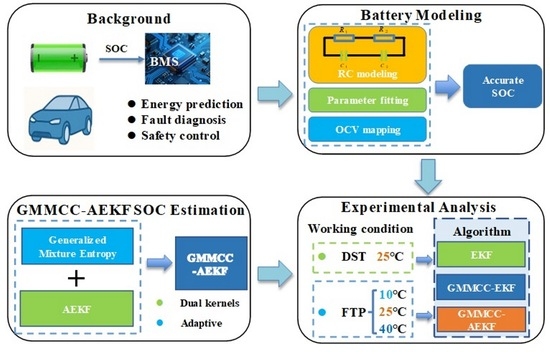
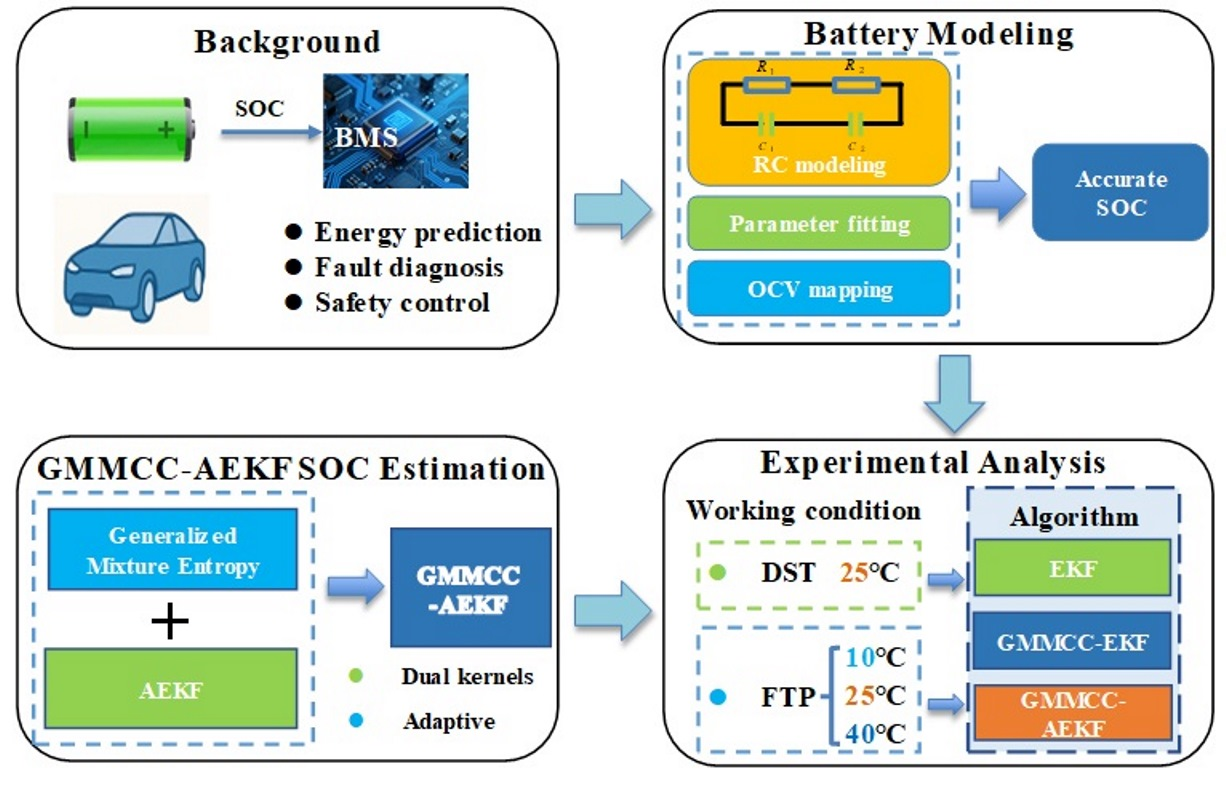
Graphical Abstract

1. Introduction

As new energy vehicles and renewable power systems continue to advance [1], lithium-ion batteries have emerged as essential components within today’s energy infrastructures thanks to features like high energy density and extended lifespan [2,3]. Battery management systems (BMS) are crucial for maintaining operational safety, extending battery longevity, and enhancing the system’s overall efficiency [4]. Among the key state indicators in BMS, state of charge (SOC) denotes the proportion of available charge relative to the battery’s full rated capacity [5]. Accurate estimation of SOC is essential for energy prediction, fault diagnosis, and control strategy formulation. However, due to the influence of uncertainties such as temperature variations, load fluctuations, aging effects, and external noise during operation, SOC is not directly measurable and typically needs to be indirectly estimated through modeling techniques and estimation methods [6,7,8].
Currently, common approaches for estimating SOC are generally grouped into electrochemical model-oriented techniques [9], data-driven methods [10,11], and model-based algorithms [12,13]. Electrochemical models offer a solid theoretical foundation and can characterize internal battery states from physical and chemical perspectives, delivering high estimation accuracy. However, these models often involve multiple coupled electrochemical processes, making parameter identification difficult and the computational process complex and resource-intensive [14]. Data-driven methods, such as artificial neural networks [15,16] and support vector machines [17,18]. Learn nonlinear relationships from historical data and exhibit strong adaptability. Despite their growing popularity, these approaches heavily depend on large and representative training datasets and may suffer from overfitting or degraded performance when data quality is insufficient.
In contrast, model-based approaches, such as the extended Kalman filter (EKF), are widely used for nonlinear system state estimation. EKF linearizes the nonlinear system by performing a first-order Taylor expansion of the system and observation functions [19,20]. To enhance the adaptability of EKF under complex operating conditions, the adaptive extended Kalman filter (AEKF) was proposed [21]. By dynamically adjusting the process and measurement noise covariances, AEKF improves robustness and stability against model uncertainties and external disturbances. However, traditional Kalman filter-based methods typically assume Gaussian-distributed noise. During rapid acceleration, regenerative braking, and switching operations of power electronic devices in electric vehicles, substantial transient current variations occur. Current sensors and acquisition systems are often susceptible to interference from electromagnetic pulses and relay switching transients, resulting in spike voltage/current noise. Such disturbances typically exhibit non-Gaussian characteristics [22,23]. Extended vehicle inactivity, low-temperature storage, battery capacity degradation, battery replacement, or deviations in cell balancing strategies can all lead to an initial State of Charge (SOC) deviation when relying on Open Circuit Voltage (OCV) inference during initialization [24,25]. When faced with non-Gaussian noise or significant initial estimation bias, their performance degrades substantially, leading to poor estimation accuracy and convergence issues [26,27].
To improve EKF performance under such complex scenarios, correlation entropy theory has been introduced to enhance noise robustness. The maximum correlation-entropy criterion (MCC), as a new measure of high-order statistical correlation between random variables, has proven particularly effective in suppressing non-Gaussian impulsive noise. In recent years, MCC has been integrated with EKF, resulting in algorithms such as MCC-EKF and MCC-AEKF [28,29], which have outperformed traditional EKF in lithium-ion battery SOC estimation. MCC-based filters employ kernel functions to control error sensitivity and maintain estimation stability. Ref. [30] introduces an adaptive covariance updating mechanism based on the MCC to improve SOC estimation accuracy and reduce estimation errors. Ref. [31] proposes a strong tracking adaptive square-root unscented Kalman filter algorithm based on the generalized MCC, which enhances noise resistance and convergence speed to achieve high-accuracy SOC estimation. Ref. [32] proposes an adaptive strong tracking extended Kalman filter algorithm based on the MCC, which achieves highly robust and accurate vehicle state estimation under non-ideal conditions through noise adaptation and dynamic covariance adjustment. However, conventional MCC methods often suffer from limitations due to fixed and rigid kernel structures, reducing their adaptability to complex noise distributions. To address this issue, the generalized mixture maximum correlation-entropy criterion (GMMCC) has been developed. By extending kernel function forms and introducing a mixture kernel framework, GMMCC enhances algorithmic flexibility and robustness to diverse non-Gaussian noise patterns.
This study introduces an innovative algorithm named GMMCC-AEKF. By embedding the GMMCC-based loss function within the AEKF structure, the approach improves the state update mechanism by leveraging generalized kernel-based techniques to reflect the statistical behavior of measurement disturbances more effectively. This enhances filter robustness under non-Gaussian, time-varying, and complex operating conditions. Additionally, an adaptive mechanism is introduced to update kernel parameters and estimation gain in real time, further improving the dynamic responsiveness of the algorithm across varying conditions. GMMCC-AEKF outperforms traditional methods in handling complex noise. It effectively limits error accumulation and divergence, offering theoretical and practical value for reliable online SOC estimation. The main innovations of this paper are as follows:
  • GMMCC-AEKF Framework: Proposes GMMCC-AEKF, the first integration of GMMCC with adaptive extended Kalman filtering, significantly enhancing SOC estimation under non-Gaussian noise.
  • Dual-Kernel Design: Introduces a novel mixed-kernel structure based on two generalized Gaussian functions, replacing traditional single-kernel MCC. This design improves adaptability to complex and unknown noise distributions.
  • Adaptive Covariance Mechanism: Dynamically updates state and measurement covariance matrices based on real-time residuals, maintaining estimation stability across varying temperatures and load conditions.

2. Battery Modeling and Parameter Identification

2.1. Second-Order Electrical Equivalent Battery Model

To precisely capture the voltage behavior of lithium-ion cells during dynamic usage scenarios, this work employs a second-order RC-based equivalent model to represent battery dynamics. This model achieved a trade-off between structural simplicity and accurately characterizing the battery’s dynamic and stable response patterns, making it widely used in state estimation and BMS design [33].
In Figure 1, U O C is the Open Circuit Voltage (OCV), R 0 represents the ohmic internal resistance, R 1 and C 1 . represent the electrochemical polarization resistances and capacitances, respectively. R 2 and C 2 represent the concentration polarization resistances and capacitances, respectively. U t is the terminal voltage. U 1 and U 2 represent the electrochemical polarization voltage and the concentration polarization voltage, respectively.
Referring to Figure 1 and applying Kirchhoff’s laws, the model’s equivalent circuit is derived as follows:
U t = U O C I R 0 U 1 U 2 d U 1   d t = U 1 R 1 C 1 + I C 1 d U 1   d t = U 2 R 2 C 2 + I C 2
The state space expression of the battery is as follows:
U 1 , k + 1 U 2 , k + 1 ξ S O C , k + 1 = e Δ t / ( R 1 C 1 ) 0 0 0 e Δ t / ( R 2 C 2 ) 0 0 0 1 U 1 , k U 2 , k ξ S O C , k + ( 1 e Δ t / ( R 1 C 1 ) ) R 1 ( 1 e Δ t / ( R 2 C 2 ) ) R 2 Δ t / ζ I k + w k
U t , k = U OC , k U 1 , k U 2 , k I k R 0 + v k
In the equation, S O C k represents the estimated SOC value at time step k; Δ t is the sampling time; ξ denotes the battery capacity; k is the discrete time index; U OC S O C k is the OCV; w k represents the system process noise; and v k denotes the measurement noise.

2.2. Identification of Model Parameters

In this study, two types of lithium-ion batteries were selected as experimental subjects: a LiMn2O4 battery with a nominal capacity/voltage of 35 Ah/3.7 V (referred to as Battery 1), and an ICR18650 cell with a nominal capacity/voltage of 1.5 Ah/3.6 V (referred to as Battery 2). Battery 1 data were obtained through the support of the Advanced Energy Storage Science and Application Group at Beijing Institute of Technology. Battery 1 has a discharge cutoff voltage of 3.0 V and a charge cutoff voltage of 4.2 V, while Battery 2 has a discharge cutoff voltage of 2.5 V and a charge cutoff voltage of 4.2 V. The data for Battery 1 were obtained using an Arbin BT2000 battery testing system (Arbin Instruments, College Station, TX, USA). The data for Battery 2 were acquired using a LAND CT6001A battery testing system (Wuhan LAND Electronics Co., Ltd., Wuhan, China). All tests for Battery 1 and battery 2 were conducted inside a programmable precision thermal chamber, and the reported test temperatures (e.g., −10 °C, 25 °C, 45 °C) correspond to the set points of the chamber. The charge–discharge current was measured with an accuracy at the milliampere (mA) level, and the voltage with an accuracy at the millivolt (mV) level. The sampling interval was fixed at 1 s.
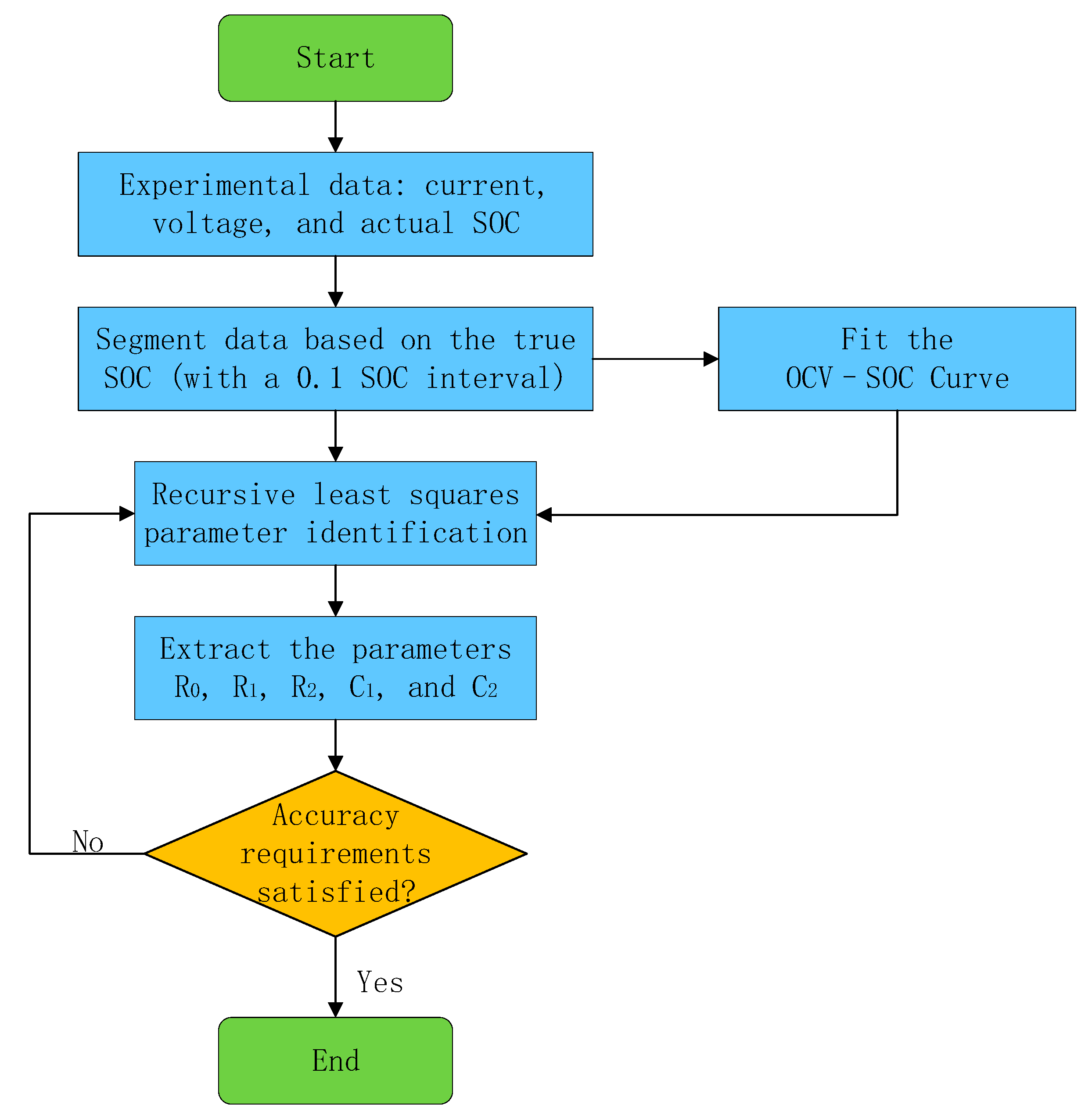
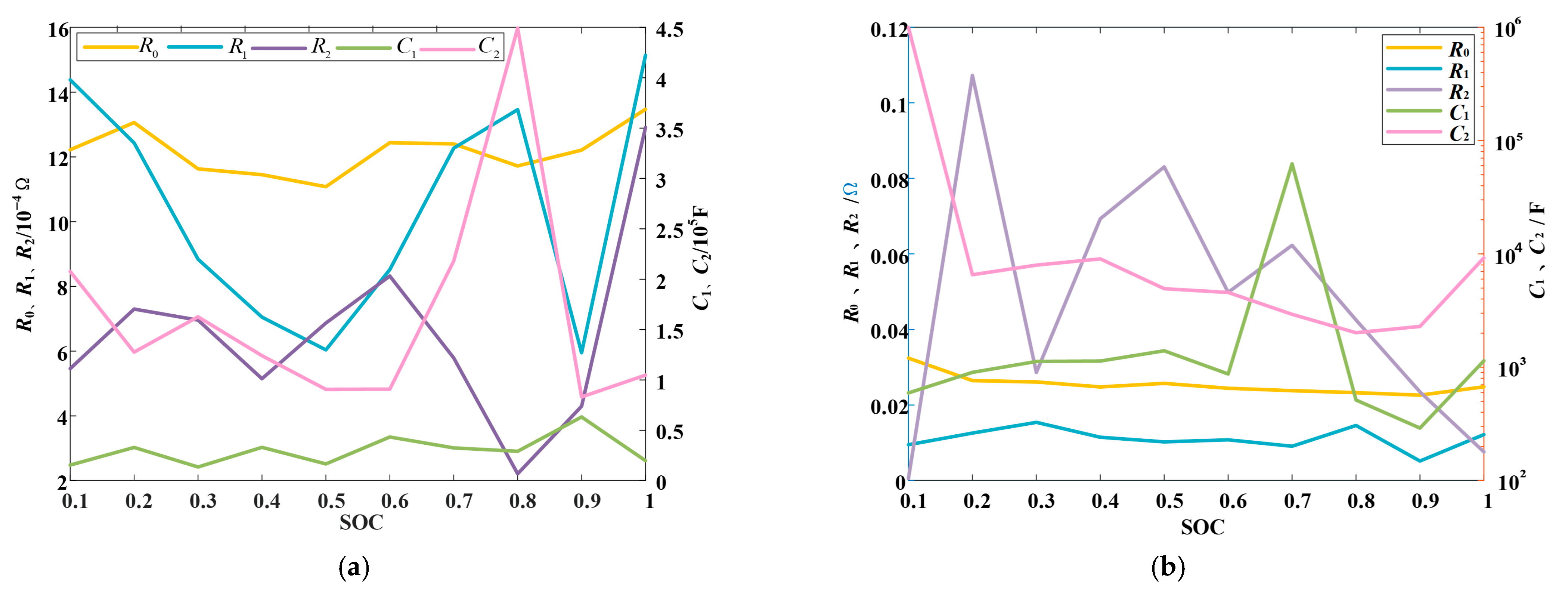
Accurate battery parameters are crucial for state estimation and performance prediction in BMS. This paper employs the Recursive Least Squares (RLS) method to identify the parameters of the battery model. The experimental data was obtained from Hybrid Pulse Power Characterization (HPPC) tests with a sampling frequency of 1 s. The parameter identification procedure is illustrated in Figure 2. Figure 3 illustrate the parameter variation trends of Battery 1 and Battery 2 under different SOC levels, respectively.
The variations in internal battery parameters as the SOC varies illustrate the dynamic behavior of the internal electrochemical processes under different SOC conditions. A solid foundation for efficient and reliable battery management is laid by these parameters, which also serve as a crucial basis for accurate SOC estimation.

3. SOC–OCV Relationship Curve

SOC estimates are closely tied to the established relationship of OCV. In this study, polynomial fitting models were constructed by analyzing the SOC–OCV characteristics of two different battery cells. Equations (4) and (5) present the fitted relationships between SOC and OCV for Battery 1 and Battery 2, respectively, both using sixth-order polynomials.
The SOC–OCV mapping relationship for Battery 1 is as follows:
U OC = 3.557 + 0.855 ξ SOC + 3.79 ξ SOC 2 24.65 ξ SOC 3 + 54.45 ξ SOC 4 52.48 ξ SOC 5 + 18.64 ξ SOC 6
The SOC–OCV mapping relationship for Battery 2 is as follows:
U OC = 2.978 + 8.7 ξ SOC 49.11 ξ SOC 2 + 138.6 ξ SOC 3 197 ξ SOC 4 + 137.3 ξ SOC 5 37.37 ξ SOC 6
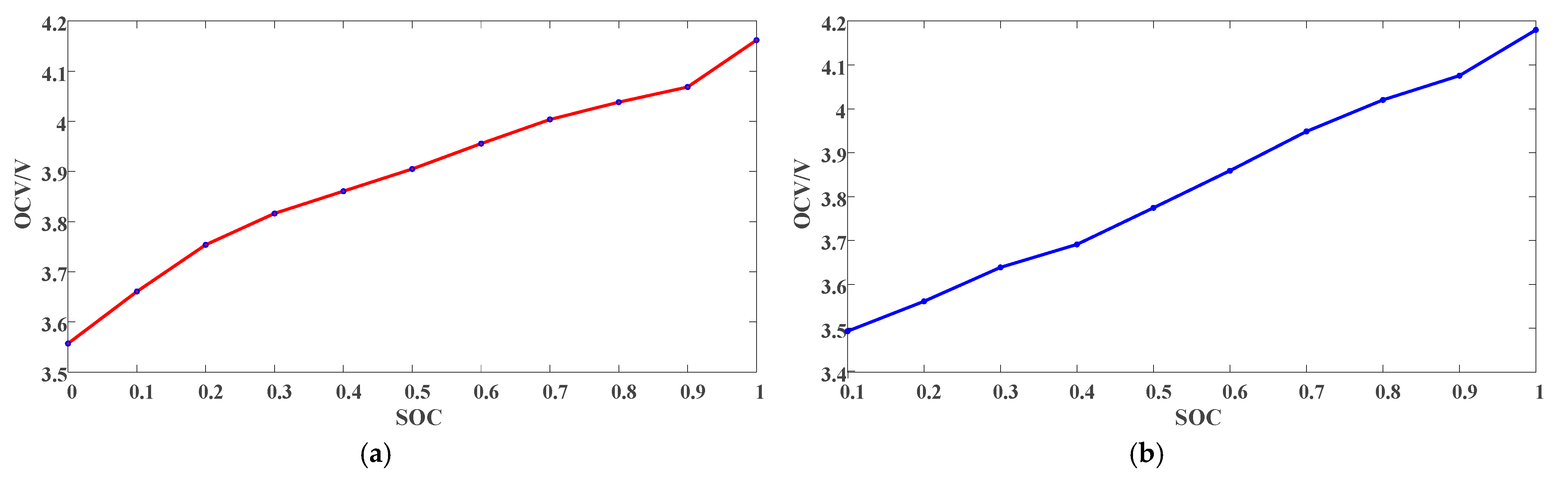
The fitting analysis of the SOC–OCV relationships for Battery 1 and Battery 2 reveals significant differences in OCV response characteristics between different types of batteries, both exhibiting pronounced nonlinear behavior. Polynomial function fitting effectively captures this complex relationship and provides a fundamental basis for the development of SOC estimation algorithms.
As shown in Figure 4, the OCV–SOC curve of Battery 1 exhibits relatively flat and nonlinear characteristics in certain SOC intervals, which reduces the voltage sensitivity to SOC variations and makes SOC estimation more challenging, especially in the presence of measurement noise and model uncertainties. In contrast, Battery 2 presents a smoother and more monotonic OCV–SOC relationship with a larger overall slope, particularly in the medium-to-high SOC range, providing better observability for SOC estimation.

4. SOC Estimation Based on the Generalized Mixture Maximum Correntropy Criterion Adaptive Extended Kalman Filter Algorithm

To capture the battery’s dynamic behavior under diverse operating conditions, it is essential to develop a nonlinear mathematical model that accurately characterizes the relationship between internal states and observable outputs. This facilitates reliable SOC estimation across various working scenarios. Accordingly, the following dynamic nonlinear equations are formulated to describe how state variables evolve and how they relate to system measurements:
x k = f x k 1 + w k 1 y k = h x k + v k
In the equations, x k represents the state variable at time step k, and x k = U 1 , k , U 2 , k , S O C k T ; y k denotes the measurement. w k 1 and v k represent the process noise and the measurement noise, respectively. E w k 1 w k 1 T = Q k 1 and E v k v k T = R k 1 are assumed to be uncorrelated. f · and h · denote the system’s process function and measurement function, respectively.

4.1. Generalized Mixture Entropy

Given two random variables X and Y , the entropy can be defined as:
V X , Y = E κ X , Y = κ x , y p x , y d x d y
In the equation, E [ · ] denotes the expectation operator, κ ( · ) represents the Mercer kernel function, and p(x, y) denotes the joint probability density function of x and y.
Based on correntropy, the mixture correntropy is defined as:
M X , Y = E θ 1 κ 1 X , Y + θ 2 κ 2 X , Y
Here, 0 < θ 1 , θ 2 < 1 ,   θ 1 + θ 2 = 1 and κ 1 ( · )   κ 2 ( · ) are two different kernel functions. The joint probability density function of X and Y is usually unknown and can be estimated using Equation (7) [34].
M X , Y = 1 N i = 1 N θ 1 κ 1 x i , y i + θ 2 κ 2 x i , y i
In this equation, N denotes the number of samples, and x i   y i are the ith elements of X and Y, respectively. Flexible generalized Gaussian kernel is employed, which enables shape adaptability through adjustable parameters, enhancing modeling flexibility. The specific formulation of this kernel is provided in Equation (9).
κ x i , y i = τ exp x i y i β α
Here, 0 < β is the kernel width parameter, 0 < α is the shape parameter, and τ = α / 2 β Γ 1 / α is the normalization constant. Γ ( · ) denotes the Gamma function. When α = 2, the kernel reduces to the Gaussian kernel; when α = 1, it becomes the Laplacian kernel. In Equation (8), both κ 1 ( · ) and κ 2 ( · ) are modeled using generalized Gaussian kernels. For simplicity, let the error be defined as e i = x i y i ; this allows Equation (8) to be simplified as follows:
M X , Y = 1 N i = 1 N θ 1 τ 1 exp e i α 1 β 1 α 1 + θ 2 τ 2 exp e i α 2 β 2 α 2
Since Equation (11) reaches its maximum at zero error, it is referred to as GMMCC to facilitate the optimization analysis of this problem.

4.2. AEKF Algorithm Based on the GMMCC

By dynamically adjusting the covariance matrices, the AEKF effectively mitigates the decline in filtering accuracy caused by inaccurate noise statistics in the traditional EKF. The derivation process of the AEKF formulas is shown in Supplementary File S1 (AEKF Algorithm). In practical applications involving non-Gaussian noise, uncertain environments, or significant model deviations, AEKF demonstrates enhanced robustness and adaptability.
This method integrates the GMMCC with an adaptive filtering strategy to achieve high-precision SOC estimation under non-Gaussian noise conditions. The specific steps of the algorithm are as follows.
Step 1 Initialization
Determine the state vector x 0 , and the initial value of the error covariance matrix P 0 .
Step 2 One-step prediction of state variables and error covariance
x ^ k | k 1 = A k x ^ k 1 | k 1 + B k u k 1 + w k
P k | k 1 = A k P k 1 | k 1 A k T + Q k 1
By reformulating Equations (12) and (13) into an augmented state expression, we obtain:
x ^ k k 1 y k = I C k x k + ω k
In the equations, I is a 3 × 3 identity matrix, ω k = x ^ k | k 1 x k y k C k x k .
Step 3 Perform Cholesky decomposition
E ω k ω k T = P k | k 1 0 0 R k = F P , k | k 1 0 0 F R , k F P , k | k 1 0 0 F R , k T = F k F k T
D k = F k 1 x ^ k | k 1 y k = d 1 , k , , d n + m , k T R n + m × 1
Z k = F k 1 I C k = z 1 , k T , , z n + m , k T T R n + m × n
Step 4 Compute the cost function
J GMMCC x k = 1 N j = 1 2 i = 1 N θ j τ j exp | e i , k | α j β j α j
In the equation, e i , k = d i , k z i , k x k , D k represents the predicted output, whereas Z k x k denotes the actual measurement. These quantities correspond to e i , X and Y , respectively, in Equation (11).
Λ i , k = j = 1 2 ( θ j τ j α j β j α j exp | e i , k | α j β j α j | e i , k | α j 2 )
Λ P , k = diag Λ 1 , k e 1 , k , , Λ n , k e n , k
Λ R , k = diag Λ n + 1 , k e n + 1 , k , , Λ n + m , k e n + m , k
P k | k 1 = F P , k | k 1 Λ P , k 1 F P , k | k 1 T
R k = F R , k | k 1 Λ R , k 1 F R , k | k 1 T
Step 5 Gain matrix calculation
K k = P k | k 1 C k T C k P k | k 1 C k T + R k - 1
Step 6 State estimation and error covariance matrix update
x ^ k | k = x ^ k | k 1 + K k y k C k x ^ k | k 1 D k u k
P ^ k | k = I K k C k P k | k 1 I K k C k T + K k R k K k T
Step 7 Adaptive covariance matrix
E k = y k C k x ^ k | k 1 D k u k
H k = k M + 1 k E k E k T M
Step 8 Update of measurement and process noise variance
R ^ k = C k P ^ k | k C k T + R k C k P ^ k | k C k T + R k 1 R k
Q ^ k = K k H K K k T
Step 9: Repeat steps (2) to (8).
In the actual implementation of GMMCC-AEKF, the numerical positive definiteness of the covariance matrices is ensured through multiple mechanisms. First, both the state error covariance matrix and the measurement noise covariance matrix are processed using Cholesky decomposition during updates, which inherently requires the matrices to be symmetric positive definite, thereby validating the validity of the covariance matrices at the numerical implementation level. Second, the correntropy weighting acts on the Cholesky factor of the covariance in the form of a diagonal matrix. Through the reconstruction form P k | k 1 = F P , k | k 1 Λ P , k 1 F P , k | k 1 T , R k = F R , k | k 1 Λ R , k 1 F R , k | k 1 T , the symmetric positive definite structure of the covariance matrix is preserved provided that the weights are positive. Additionally, the error covariance is finally updated using the Joseph form to further enhance numerical stability. Simulation results indicate that, in the presence of strong outliers, the above measures can effectively prevent covariance matrix degeneration and numerical instability.
In terms of parameter settings, the generalized Gaussian kernel function adopted in this paper employs a carefully selected set of initial values to achieve effective modeling of mixed noise environments. Specifically, the shape parameters are set to α 1 = α 2 = 1.7 This value lies between that of the Laplacian kernel ( α = 1 ) and the Gaussian kernel ( α = 2 ), aiming to capture both the Gaussian components and the non-Gaussian heavy-tailed characteristics within the errors. This allows the model to maintain its ability to model regular noise while enhancing robustness to outliers. The width parameters are uniformly set to β 1 = β 2 = 3 , based on the statistical median of the absolute errors observed in preliminary experiments, ensuring that the scale of the kernel function aligns with the actual magnitude of the errors. The weights of the two kernels are initialized as θ 1 = θ 2 = 0.5 , reflecting an unbiased assumption regarding their respective contributions and providing a fair starting point for potential subsequent optimization. This set of parameters collectively strives to achieve a balance among shape adaptability, scale rationality, and weight neutrality during the initial phase, and they can be further fine-tuned during the training process based on the objective function to enhance performance on specific tasks.

5. Simulation Experiments and Analysis

The effectiveness of the proposed SOC estimation method based on GMMCC-AEKF is evaluated using metrics such as the Mean Absolute Error (MAE) and the Root Mean Square Error (RMSE), with the expressions for these error metrics given as follows:
MAE = 1 N k = 1 N ξ SOC , k ξ ^ SOC , k
RMSE = 1 N k = 1 N ξ SOC , k ξ ^ SOC , k 2
In the equations: ξ SOC , k denotes the true value; ξ ^ SOC , k denotes the estimated value; N represents the total number of sampling points.

5.1. Experimental Validation Based on Battery 1

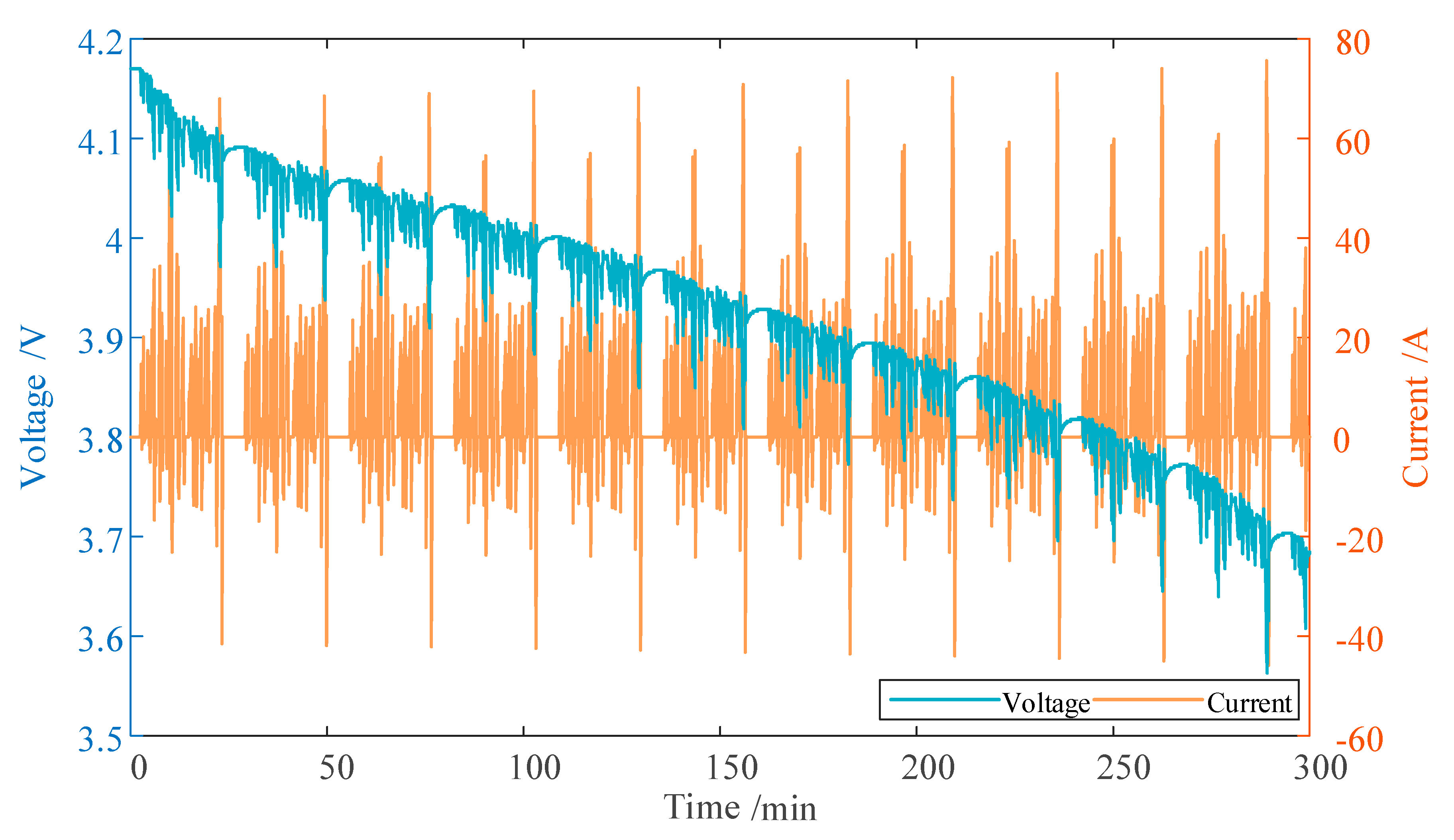
The experiment validates the SOC estimation method proposed in Section 3 using data from two different lithium-ion batteries operating under two distinct conditions. One working condition is the DST conducted at 25 °C; the other is the FTP cycle, with tests performed at 10 °C, 25 °C, and 40 °C. The current and voltage profiles under the DST working conditions are shown in Figure 5.

5.1.1. Estimating Battery SOC Amidst Non-Gaussian Noise

Validation Based on Battery 1 Under the DST Working Condition (25 °C)
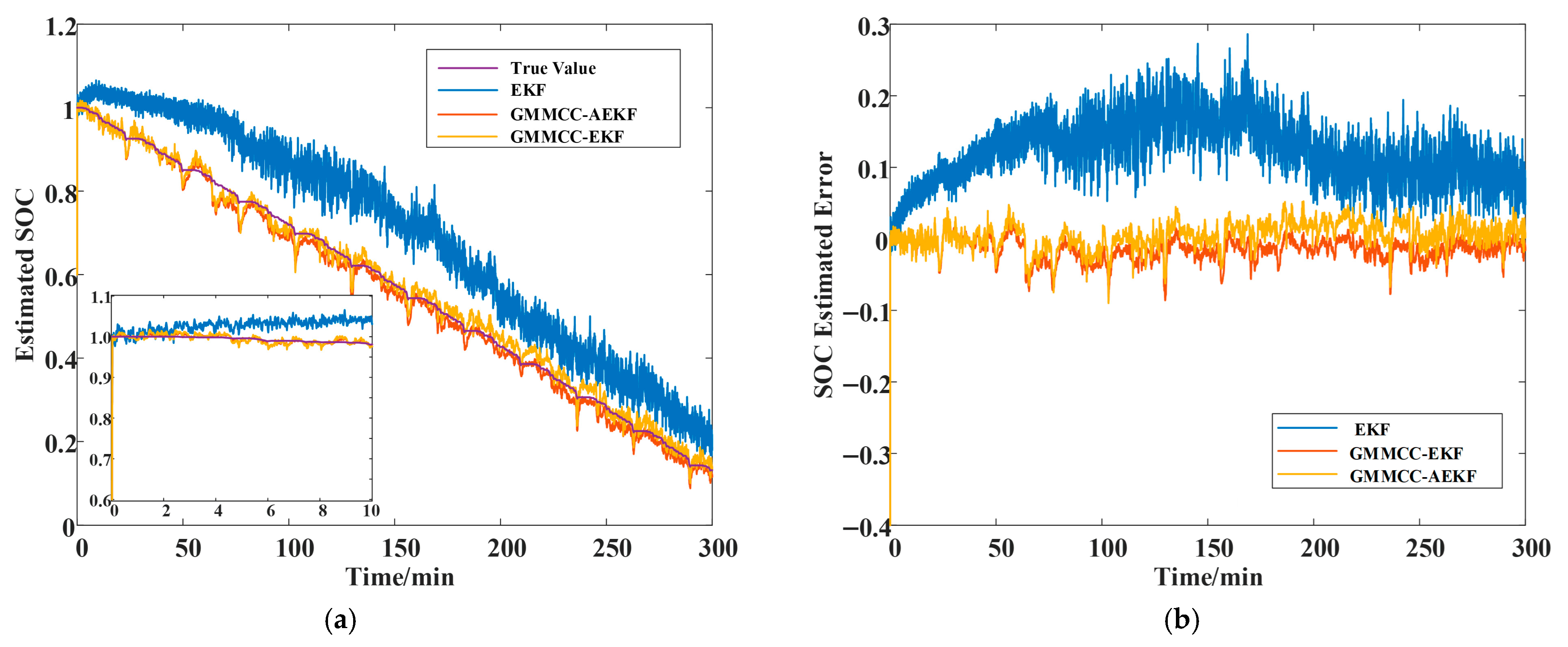
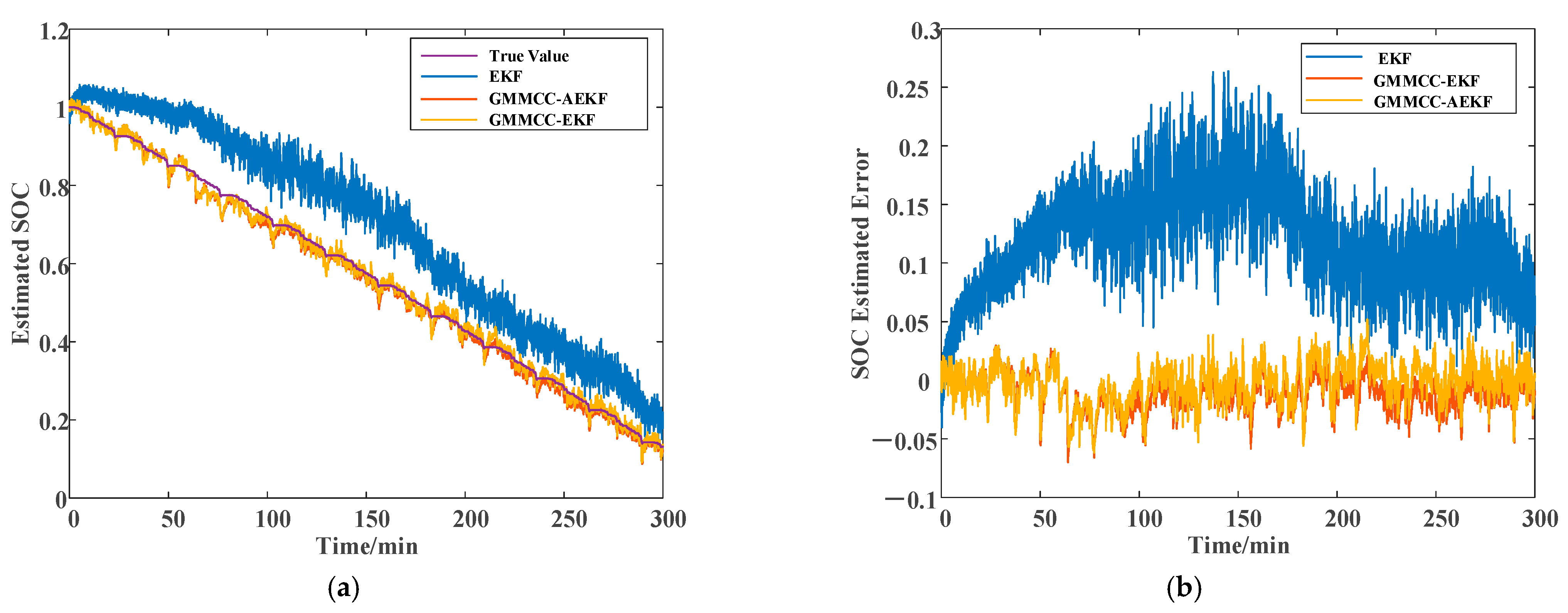
To evaluate SOC estimation performance of the proposed algorithm under a non-Gaussian noise environment, Battery 1 was tested under the DST working condition at 25 °C. Figure 6 illustrates the SOC estimates from various algorithms and the associated estimation errors.
As shown in Figure 6a, the traditional EKF algorithm exhibits a noticeable deviation from the actual values, especially during the subsequent phase of battery discharge, where the error accumulates gradually and the estimated curve lies consistently above the true SOC. In contrast, both the GMMCC-EKF and GMMCC-AEKF algorithms provide a better fit to the actual SOC curve. Furthermore, Figure 6b illustrates that the EKF algorithm exhibits significant fluctuations in estimation error, while the GMMCC-EKF algorithm demonstrates better robustness. In comparison, the GMMCC-AEKF algorithm achieves a more stable and further reduced error, indicating its superior adaptability and estimation accuracy under non-Gaussian noise conditions.
Table 1 illustrates the error metrics—MAE, RMSE, and computation time—of the EKF, GMMCC-EKF, and GMMCC-AEKF under the DST working condition for Battery 1.
According to Table 1, the GMMCC-AEKF outperforms both the EKF and GMMCC-EKF in terms of MAE and RMSE. Specifically, GMMCC-AEKF improves the MAE by approximately 88.96% compared to EKF and by about 13.73% compared to GMMCC-EKF. In terms of RMSE, it achieves an improvement of approximately 86.54% over EKF and 10.47% over GMMCC-EKF. These results clearly demonstrate that the GMMCC-AEKF algorithm achieves more accurate estimations in addition to exhibiting greater stability and noise resistance.

5.1.2. Investigation of How Initial SOC Values Affect Estimation Accuracy

To test the stability of each approach when faced with uncertain initialization, scenarios with incorrectly set initial SOC values were introduced. An evaluation of the three algorithms was conducted under the specified conditions. Figure 7 illustrates the estimation results and corresponding error variations in the different algorithms at 25 °C when the initial SOC value is incorrectly specified.
As shown in Figure 7a, although all three algorithms exhibit deviations during the initial phase, the estimated SOC values from the GMMCC-EKF and GMMCC-AEKF gradually converge to the true values over time, demonstrating good convergence performance. In contrast, the EKF algorithm maintains a relatively large estimation error throughout the entire discharge process. Figure 7b further illustrates the dynamic variation in estimation errors. The EKF method shows significant error fluctuations, indicating lower estimation accuracy under incorrect initial conditions. In comparison, the errors of the GMMCC-EKF and GMMCC-AEKF algorithms steadily decrease, reflecting superior robustness and accuracy. In summary, the GMMCC-AEKF algorithm exhibits stronger estimation stability and convergence under initial value deviations, significantly outperforming the traditional EKF algorithm.
Table 2 presents the comparison of SOC estimation performance of different algorithms when the initial values are set incorrectly. In terms of MAE, GMMCC-AEKF improves accuracy by 86.65% compared with EKF and by 13.79% compared with GMMCC-EKF. In terms of RMSE, GMMCC-AEKF achieves improvements of 85.21% and 14.67% over EKF and GMMCC-EKF, respectively. These results indicate that GMMCC-AEKF also demonstrates stronger adaptability and higher estimation accuracy when the initial conditions are biased.

5.2. Experimental Validation Based on Battery 2

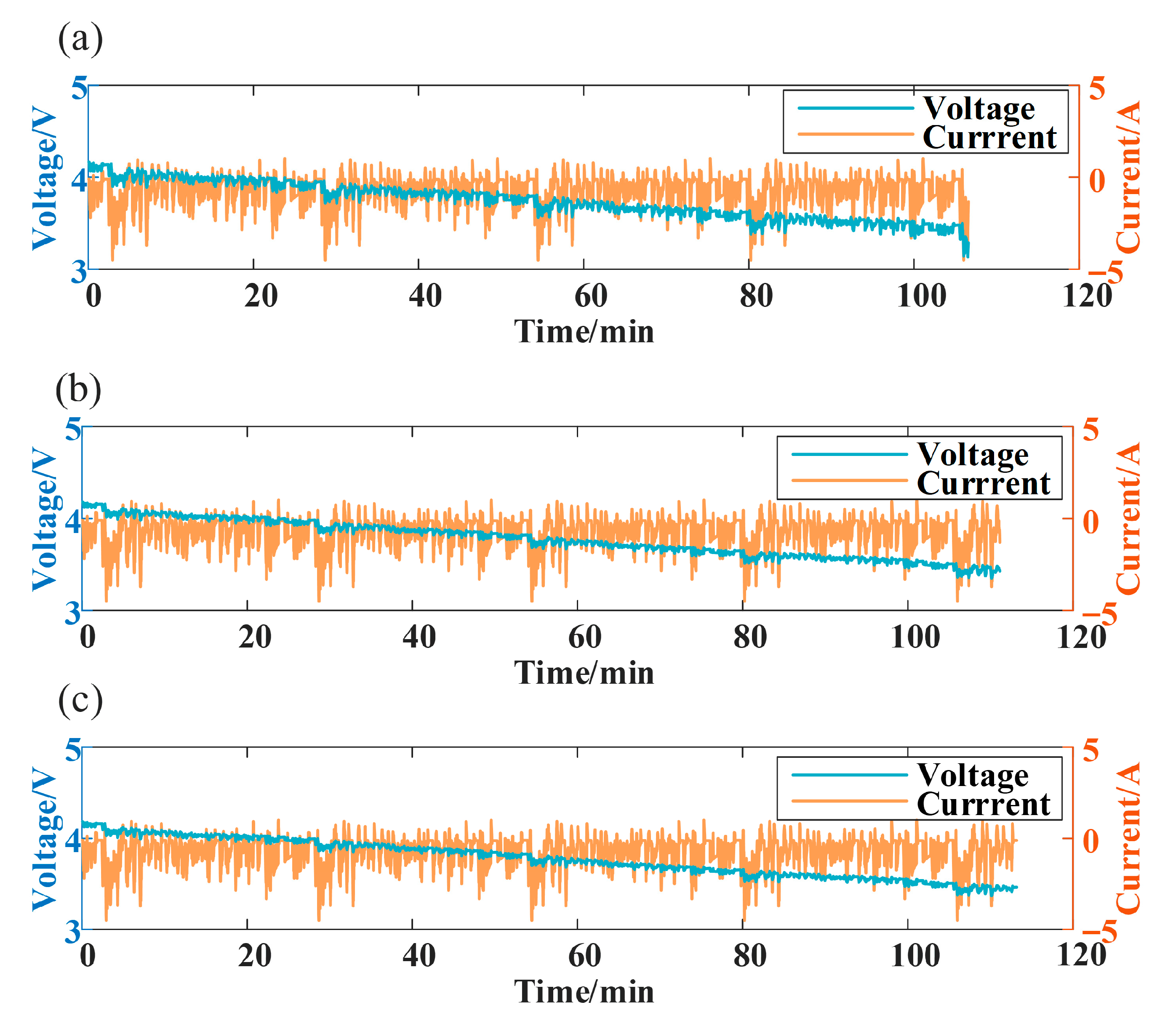
The FTP working conditions at 10 °C, 25 °C, and 40 °C are shown in Figure 8.

5.2.1. Estimating Battery SOC Amidst Non-Gaussian Noise

Validation Based on Battery 2 Under FTP Working Condition (10 °C)
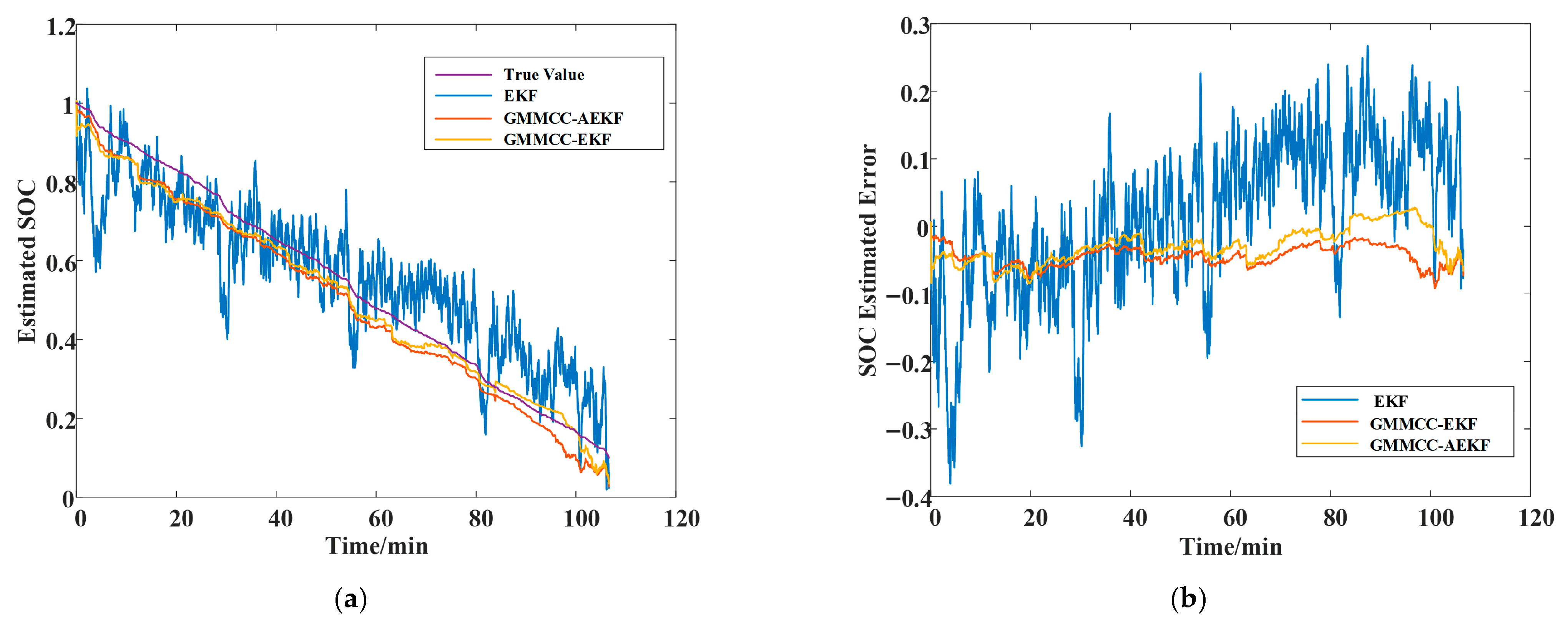
The SOC estimation results of several algorithms at 10 °C under non-Gaussian noise in the FTP experiment on Battery 2 are presented in Figure 9.
As shown in Figure 9a, the traditional EKF algorithm exhibits significant deviations and poor stability. In contrast, both the GMMCC-EKF and GMMCC-AEKF achieve higher estimation precision and greater stability compared with the EKF, with their estimated SOC curves more closely matching the true values. Figure 9b illustrates that the EKF algorithm has a wider range of estimation errors, whereas the error curves of the GMMCC-EKF and GMMCC-AEKF algorithms are generally more stable, demonstrating stronger robustness against non-Gaussian noise interference.
A comparison of SOC estimation performance of Battery 2 under various algorithms is given in Table 3.
As shown in Table 3, in terms of MAE, the GMMCC-AEKF algorithm improves accuracy by approximately 63.43% compared to the EKF and by about 23.64% compared to the GMMCC-EKF. Regarding RMSE, GMMCC-AEKF achieves an accuracy improvement of approximately 67.21% over EKF and about 20.69% over GMMCC-EKF. These results indicate that the GMMCC-AEKF algorithm demonstrates higher accuracy and stability in SOC estimation for Battery 2, exhibiting stronger robustness and greater application potential.
Validation Based on Battery 2 Under FTP Working Condition (25 °C)
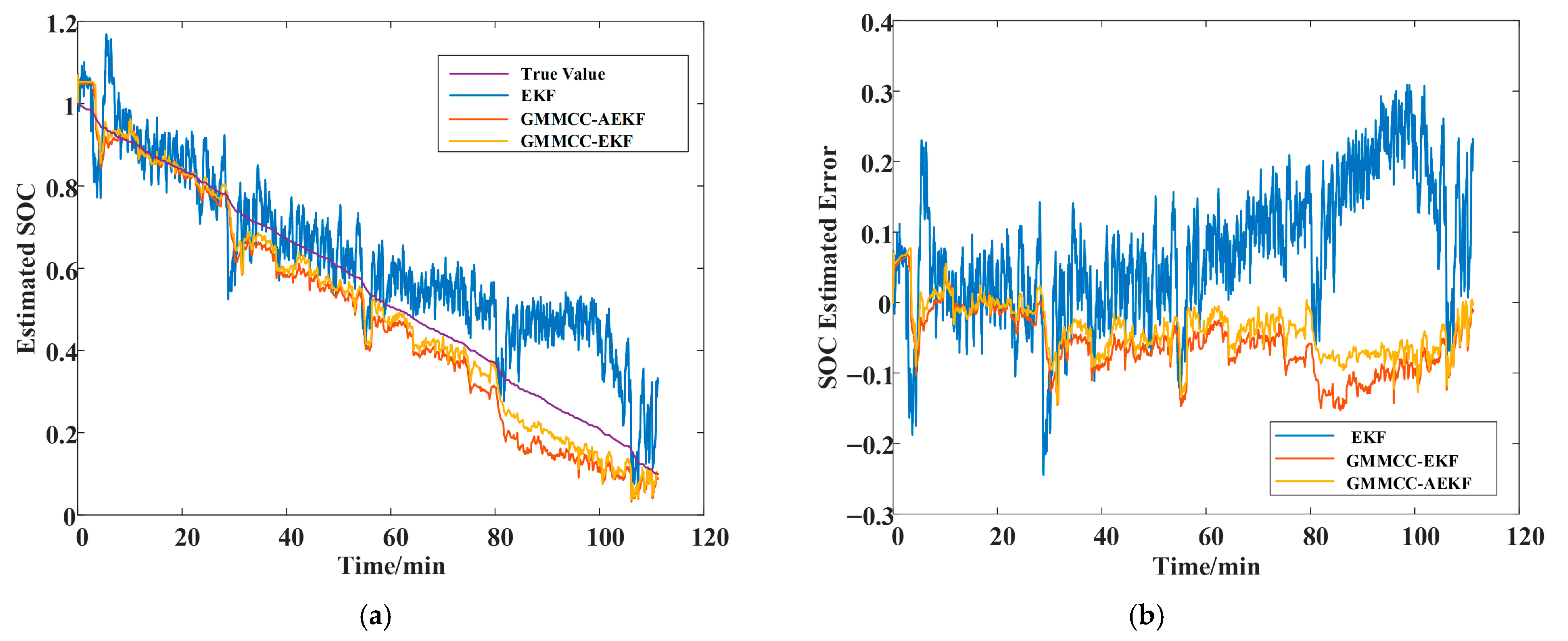
Figure 10 presents SOC estimation results of Battery 2 under the FTP working condition at room temperature (25 °C) with non-Gaussian noise disturbances.
As observed in Figure 10a, the EKF algorithm’s estimation trajectory exhibits significant fluctuations and considerable accuracy deviations. In contrast, the estimation values of the GMMCC-EKF and GMMCC-AEKF are smoother, indicating better fitting capability under complex noise environments. Figure 10b shows that the EKF algorithm experiences notable error fluctuations throughout the estimation process, with a tendency for error accumulation over time. In addition, the errors of the GMMCC-EKF and GMMCC-AEKF remain confined within a smaller range, with the GMMCC-AEKF demonstrating the strongest error stability and the smallest fluctuation amplitude, further validating its superior robustness and high estimation accuracy.
Table 4 presents the comparison of SOC estimation performance of different algorithms based on Battery 2 at 25 °C. In terms of MAE, the GMMCC-AEKF algorithm improves accuracy by approximately 52.99% compared to EKF and by about 30.59% compared to GMMCC-EKF. Regarding RMSE, the GMMCC-AEKF achieves an accuracy improvement of approximately 55.89% over EKF and about 28.61% over GMMCC-EKF. The improvement magnitude is smaller compared to that under low-temperature conditions. This is because 25 °C represents a relatively ideal operating temperature, where battery parameters vary smoothly, dynamics are approximately linear, and the measurement chain noise is minimal, making the overall noise more Gaussian-like. As a result, the performance gap between different algorithms naturally narrows. Nevertheless, the GMMCC-AEKF algorithm still achieves higher estimation accuracy at 25 °C, while maintaining excellent stability and strong robustness.
Validation Based on Battery 2 Under FTP Working Condition (40 °C)
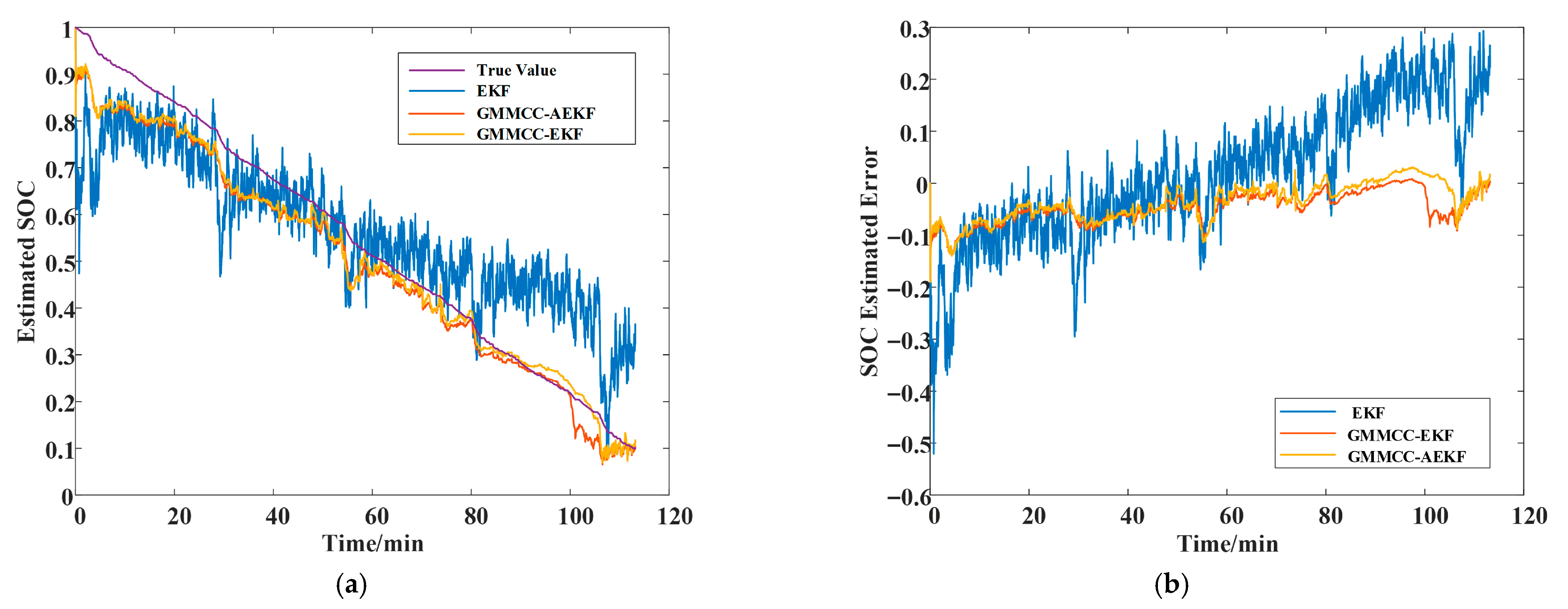
The SOC estimation performances of the EKF, GMMCC-EKF, and GMMCC-AEKF algorithms were compared at 40 °C ambient temperature. SOC estimation results and the corresponding errors for the three algorithms at 40 °C are displayed in Figure 11.
Figure 11a presents the initial SOC estimates of all three algorithms, which are close to the true values, but the differences gradually increase during the discharge process. The EKF exhibits larger errors, especially noticeably increasing in the later stages. Both GMMCC-EKF and GMMCC-AEKF produce estimates closer to the true SOC, demonstrating higher overall accuracy. Figure 11b illustrates that the EKF’s error fluctuates significantly during discharge, indicating poor stability. In contrast, the GMMCC-EKF and GMMCC-AEKF algorithms maintain smaller and more stable error fluctuations, exhibiting higher estimation stability. Among them, the error of GMMCC-AEKF is slightly lower than GMMCC-EKF, indicating superior estimation accuracy at this temperature.
Table 5 presents a comparative analysis of the GMMCC-AEKF, GMMCC-EKF, and traditional EKF algorithms under this condition. As shown in the table, the GMMCC-AEKF outperforms the other two algorithms in all error metrics, demonstrating higher estimation accuracy. Specifically, in terms of MAE, the GMMCC-AEKF improves accuracy by approximately 60.91% compared to EKF and by about 14.17% compared to GMMCC-EKF; regarding RMSE, it achieves an improvement of approximately 60.78% over EKF and about 9.24% over GMMCC-EKF. These results fully demonstrate that the GMMCC-AEKF exhibits higher accuracy and strong adaptability in SOC estimation for Battery 2.

5.2.2. Investigation of How Initial SOC Values Affect Estimation Accuracy

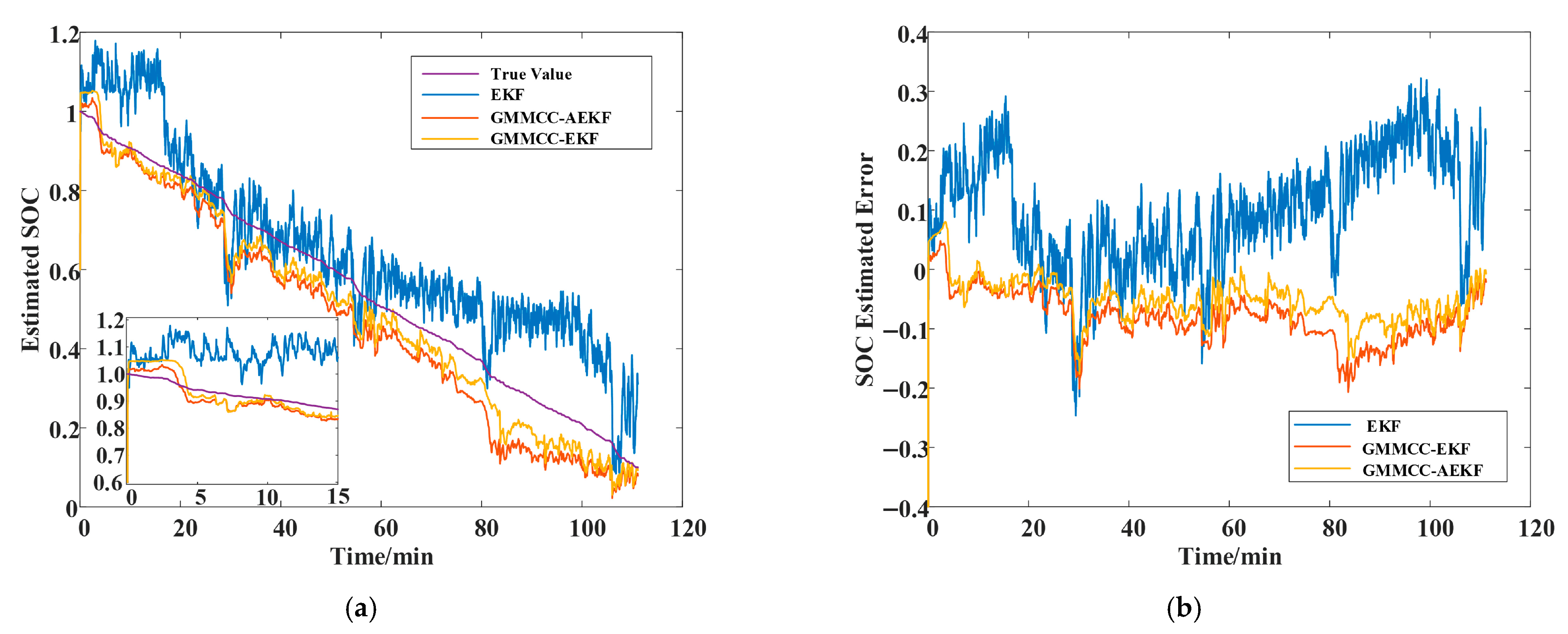
To evaluate the robustness of different algorithms under two critical scenarios—non-Gaussian noise and incorrect initial SOC values—this study compares SOC estimation performance of the proposed GMMCC-AEKF with two other algorithms. In this analysis, the initial SOC deviation is intentionally set to 0.4 to simulate practical situations such as long-term storage, battery replacement, or inaccurate capacity estimation. As shown in Figure 12, even under this large erroneous initial SOC at 25 °C, GMMCC-AEKF achieves consistently higher accuracy, with smaller estimation errors and variations, demonstrating its superior robustness and fully supporting the objectives of this work.
This experiment is specifically designed to validate the robustness of the proposed algorithm under the condition of incorrect initial state settings. The results in Figure 12a show that the EKF exhibits large initial estimation deviations, with significant overall fluctuations and poor convergence. Compared to EKF, the GMMCC-EKF demonstrates some improvement, with estimation results gradually approaching the true values but still showing certain errors. In contrast, the GMMCC-AEKF has smaller initial estimation errors, exhibiting superior robustness and accuracy. As shown in Figure 12b, the EKF errors fluctuate drastically over time, while the GMMCC-EKF errors are initially higher but significantly decrease afterward. The GMMCC-AEKF shows stronger adaptability to initial errors and achieves higher estimation accuracy. The above results indicate that, when faced with incorrect initial conditions, GMMCC-AEKF significantly outperforms the comparative algorithms in terms of convergence speed, estimation accuracy, and robustness.
Table 6 presents a comparison of estimation performance based on Battery 2. It can be seen that the GMMCC-AEKF algorithm outperforms the other two algorithms in both MAE and RMSE metrics. Specifically, in terms of MAE, the GMMCC-AEKF improves accuracy by approximately 50.40% compared to EKF and by about 31.8% compared to GMMCC-EKF; in terms of RMSE, the GMMCC-AEKF improves accuracy by approximately 53.20% compared to EKF and by about 29.88% compared to GMMCC-EKF. Integrating the experimental results from Section 5.2.1 and this section, it is evident that GMMCC-AEKF demonstrates stable and superior performance under both predefined challenges: non-Gaussian noise and incorrect initialization. These results indicate that the GMMCC-AEKF algorithm can maintain high estimation accuracy and good robustness even in the presence of initial value errors, making it suitable for more complex and uncertain application scenarios. This fully validates the algorithm’s precision and effectiveness.

6. Conclusions

This research focuses on the problem of lithium-ion battery SOC estimation and introduces a GMMCC-AEKF algorithm, designed to improve estimation accuracy under non-Gaussian noise and uncertain initial conditions. Experimental findings indicate that the proposed method surpasses existing approaches regarding accuracy, convergence speed, and robustness. The main findings can be outlined as follows:
(1)
Under conditions with non-Gaussian noise disturbance and initial estimation errors, the GMMCC-AEKF achieves better performance in MAE and RMSE metrics compared to the traditional EKF and GMMCC-EKF algorithms. It can more effectively suppress random disturbances during the estimation process, exhibiting stronger adaptability and higher estimation accuracy.
(2)
Based on tests conducted on various types of batteries across various operating conditions, the GMMCC-AEKF maintains stable performance across all test scenarios, with small estimation errors and limited fluctuation amplitudes, fully demonstrating its good adaptability to the battery’s nonlinear dynamic characteristics and complex working condition variations.
In summary, the GMMCC-AEKF algorithm demonstrates promising SOC estimation performance under the conditions investigated in this study. These findings provide a theoretical and practical foundation for future research aimed at extending the algorithm to scenarios involving battery aging, multiple battery modules, and complex dynamic operating conditions. Integrating GMMCC-AEKF with techniques such as deep learning or adaptive noise modeling may further enhance its generalization and real-time performance, thereby supporting the development of high-performance intelligent battery management systems.

Supplementary Materials

The following supporting information can be downloaded at: https://www.mdpi.com/article/10.3390/batteries12010029/s1, File S1: AEKF Algorithm.

Author Contributions

Project administration, validation, writing—original draft, F.L.; Conceptualization, Methodology, Software, Validation, Writing—original draft, H.W.; Writing—review and editing, Supervision, H.C.; Data curation, Investigation, L.G.; Supervision, Writing—review and editing, C.W. All authors have read and agreed to the published version of the manuscript.

Funding

This work was supported by the Open Fund of Qinghai Provincial Key Laboratory of Plateau Vehicle Electrification and Intelligent Technology (Qinghai Vocational and Technical University) (No: QZDSZ03-202501), the Key Project of Shaanxi Provincial Natural Science Foundation-Key Project of Laboratory (2025SYS-SYSZD-117).

Data Availability Statement

The data presented in this study are available on request from the corresponding author.

Conflicts of Interest

The authors declare no conflicts of interest.

References

  1. Sanguesa, J.A.; Torres-Sanz, V.; Garrido, P.; Martinez, F.J.; Marquez-Barja, J.M. A review on electric vehicles: Technologies and challenges. Smart Cities 2021, 4, 372–404. [Google Scholar] [CrossRef]
  2. Zhang, Z.; Guo, T.; Gao, M.; He, Z.; Dong, Z. Review of SoC estimation methods for electric vehicle Li-ion batteries. J. Electron. Inf. Technol. 2021, 43, 1803–1815. [Google Scholar]
  3. Su, L.; Zhou, G.; Hu, D.; Liu, Y.; Zhu, Y. Research on the state of charge of lithium-ion battery based on the fractional order model. Energies 2021, 14, 6307. [Google Scholar] [CrossRef]
  4. Wang, J.; Yu, W.; Cheng, G.; Chen, L. Identification of fractional-order equivalent circuit model of lithium-ion battery for improving estimation of state of charge. J. Energy Storage 2023, 70, 108043. [Google Scholar] [CrossRef]
  5. Wu, J.; Fang, C.; Xing, J. A multi-scale fractional-order dual unscented Kalman filter based parameter and state of charge joint estimation method of lithium-ion battery. J. Energy Storage 2022, 50, 104666. [Google Scholar] [CrossRef]
  6. Fahmy, H.M.; Swief, R.A.; Hasanien, H.M.; Alharbi, M.; Maldonado, J.L.; Jurado, F. Hybrid state of charge estimation of lithium-ion battery using the coulomb counting method and an adaptive unscented Kalman filter. Energies 2023, 16, 5558. [Google Scholar] [CrossRef]
  7. Zhou, W.; Zheng, Y.; Pan, Z.; Liu, Q. Review on the battery model and SOC estimation method. Processes 2021, 9, 1685. [Google Scholar] [CrossRef]
  8. Jiang, L.; Deng, Z.; Tang, X.; Hu, L.; Lin, X.; Hu, X. Data-driven fault diagnosis and thermal runaway warning for battery packs using real-world vehicle data. Energy 2021, 234, 121266. [Google Scholar] [CrossRef]
  9. Kong, L.; Fang, S.; Niu, T.; Chen, G.; Yang, L.; Liao, R. Fast state of charge estimation for lithium-ion battery based on electrochemical impedance spectroscopy frequency feature extraction. IEEE Trans. Ind. Appl. 2023, 60, 1369–1379. [Google Scholar] [CrossRef]
  10. Li, X.; Wang, Z.; Zhang, L. Co-estimation of capacity and state-of-charge for lithium-ion batteries in electric vehicles. Energy 2019, 174, 33–44. [Google Scholar] [CrossRef]
  11. Peng, S.; Sun, Y.; Liu, D.; Yu, Q.; Kan, J.; Pecht, M. State of health estimation of lithium-ion batteries based on multi-health features extraction and improved long short-term memory neural network. Energy 2023, 282, 128956. [Google Scholar] [CrossRef]
  12. Liu, X.; Gao, Y.; Marma, K.; Miao, Y.; Liu, L. Advances in the study of techniques to determine the lithium-ion battery’s state of charge. Energies 2024, 17, 1643. [Google Scholar] [CrossRef]
  13. Sorouri, H.; Oshnoei, A.; Che, Y.; Teodorescu, R. A comprehensive review of hybrid battery state of charge estimation: Exploring physics-aware AI-based approaches. J. Energy Storage 2024, 100, 113604. [Google Scholar] [CrossRef]
  14. Wu, L.; Liu, K.; Pang, H.; Jin, J. Online SOC estimation based on simplified electrochemical model for lithium-ion batteries considering current bias. Energies 2021, 14, 5265. [Google Scholar] [CrossRef]
  15. Narayan, N.; Saha, S.; Das, M. Machine Learning-driven Battery SOC Estimation for Electric Vehicle Application. In Proceedings of the2024 IEEE International Communications Energy Conference (INTELEC), Bengaluru, India, 4–7 August 2024; pp. 1–6. [Google Scholar]
  16. Divya, R.; Karunanithi, K.; Ramesh, S. Measurement of State of Charge of Lithium-Nickel Manganese Cobalt Battery using Artificial Neural Network and NARX Algorithm. Int. J. Electr. Comput. Eng. Syst. 2024, 15, 305–311. [Google Scholar] [CrossRef]
  17. Yan, Q. SOC prediction of power battery based on SVM. In Proceedings of the 2020 Chinese Control And Decision Conference (CCDC), Hefei, China, 22–24 August 2020; pp. 2425–2429. [Google Scholar]
  18. Li, R.; Li, W.; Zhang, H.; Zhou, Y.; Tian, W. On-line estimation method of lithium-ion battery health status based on PSO-SVM. Front. Energy Res. 2021, 9, 693249. [Google Scholar] [CrossRef]
  19. Khemiri, K.; Najari, M.; Ferhi, M.; Djebali, R.; Bjaoui, M. Enhancing State of Charge Estimation for Lithium-Ion Batteries in Noisy Environments Using a Hybrid LSTM-EKF Mode. In Proceedings of the 2025 15th International Renewable Energy Congress (IREC), Hammamet, Tunisia, 2–4 February 2025; pp. 1–4. [Google Scholar]
  20. Zhang, Z.; Chen, S.; Lu, L.; Han, X.; Li, Y.; Chen, S.; Wang, H.; Lian, Y.; Ouyang, M.G. High-precision and robust SOC estimation of LiFePO4 blade batteries based on the BPNN-EKF algorithm. Batteries 2023, 9, 333. [Google Scholar] [CrossRef]
  21. Gao, H.; Shen, H.; Yang, Y.; Cai, W.; Wang, Y.; Liu, W. State of charge estimation of lithium batteries in wide temperature range based on MSIABC-AEKF algorithm. Alex. Eng. J. 2024, 109, 274–284. [Google Scholar] [CrossRef]
  22. Chen, Q.; Zhang, F.; Su, L.; Lin, B.; Chen, S.; Zhang, Y. State parameter fusion estimation for intelligent vehicles based on IMM-MCCKF. Appl. Sci. 2024, 14, 4495. [Google Scholar] [CrossRef]
  23. Qi, D.; Feng, J.; Wan, W.; Song, B. Maximum correntropy extended Kalman filter for vehicle state observation. Int. J. Automot. Technol. 2023, 24, 377–388. [Google Scholar] [CrossRef]
  24. Xia, B.; Chen, C.; Tian, Y.; Sun, W.; Xu, Z.; Zheng, W. A novel method for state of charge estimation of lithium-ion batteries using a nonlinear observer. J. Power Sources 2014, 270, 359–366. [Google Scholar] [CrossRef]
  25. Zuo, H.; Zhang, B.; Huang, Z.; Wei, K.; Zhu, H.; Tan, J.Q. Effect analysis on SOC values of the power lithium manganate battery during discharging process and its intelligent estimation. Energy 2022, 238, 121854. [Google Scholar] [CrossRef]
  26. Song, W.; Liu, R.; Jin, X.; Guo, W. SOC Estimation for Lithium-Ion Batteries Based on Weighted Multi-Innovation Sage–Husa Adaptive EKF. Energies 2025, 18, 4364. [Google Scholar] [CrossRef]
  27. Wu, M.; Qin, L.; Wu, G. State of charge estimation of power lithium-ion battery based on an adaptive time scale dual extend Kalman filtering. J. Energy Storage 2021, 39, 102535. [Google Scholar] [CrossRef]
  28. Wu, C.; Zhao, Y.; Ma, Y.; Zhang, Y. Estimation of lithium-ion battery state of charge using an innovation maximum correlation-entropy criterion adaptive iterative cubature Kalman filter algorithm. J. Xi’an Jiaotong Univ. 2024, 58, 52–64. [Google Scholar]
  29. Wu, C.; Hu, W.; Meng, J.; Xu, X.; Huang, X.; Cai, L. State-of-charge estimation of lithium-ion batteries based on MCC-AEKF in non-Gaussian noise environment. Energy 2023, 274, 127316. [Google Scholar] [CrossRef]
  30. Wu, C.; Hu, W.; Meng, J.; Liu, Z.; Cheng, Y. State of charge estimation of lithium-ion batteries based on maximum correlation-entropy criterion extended Kalman filtering algorithm. Trans. China Electrotech. Soc. 2021, 36, 5165–5175. [Google Scholar]
  31. Xie, H.; Lin, J.; Huang, Z.; Kuang, R.; Hao, Y. State of charge estimation of Li-ion batteries based on strong tracking adaptive square root unscented Kalman filter with generalized maximum correntropy criterion. J. Energy Storage 2025, 111, 115401. [Google Scholar] [CrossRef]
  32. Bai, S.; Hu, J.; Yan, Y.; Shen, L.; He, Z.; Yin, G. An integrated approach for vehicle state estimation under non-ideal conditions using adaptive strong tracking maximum correntropy criterion EKF. IEEE Trans. Veh. Technol. 2024, 73, 14604–14616. [Google Scholar] [CrossRef]
  33. Zhong, Z.; Zhai, J. Model-based battery soc estimation based on ga-ukf algorithm. In Proceedings of the 2020 Chinese Intelligent Systems Conference, Shenzhen, China, 24–25 October 2020; Springer: Singapore, 2020; Volume 706, pp. 298–306. [Google Scholar]
  34. Zhao, H.; Tian, B. Robust power system forecasting-aided state estimation with generalized maximum mixture correntropy unscented Kalman filter. IEEE Trans. Instrum. Meas. 2022, 71, 9002610. [Google Scholar] [CrossRef]
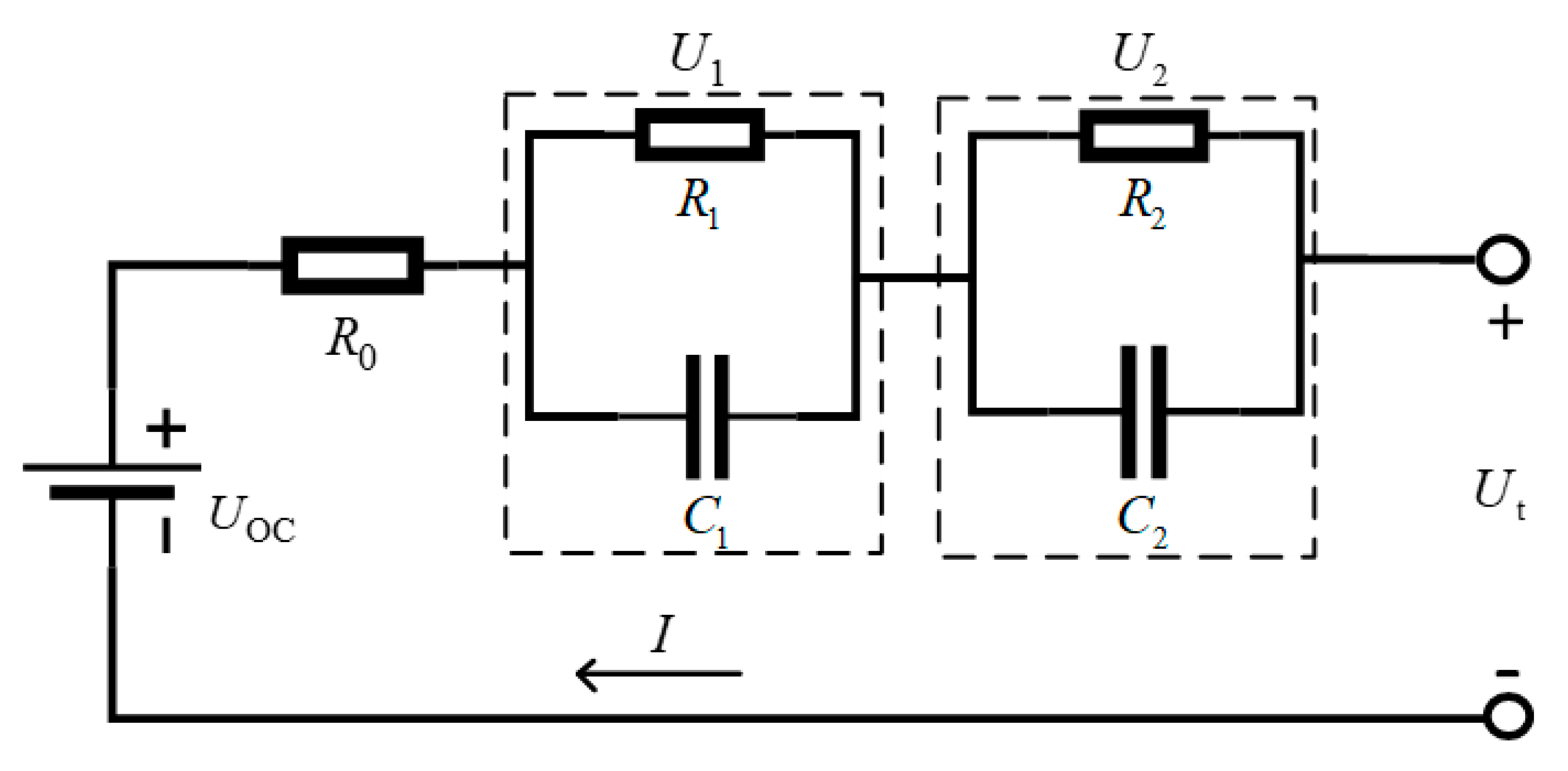
Figure 1. Second-order RC equivalent circuit model.
Batteries 12 00029 g001
Figure 2. Flowchart of Parameter Identification.
Batteries 12 00029 g002
Figure 3. Fitting curves of battery parameters and SOC: (a) Battery 1; (b) Battery 2.
Batteries 12 00029 g003
Figure 4. OCV-SOC curves: (a) Battery 1; (b) Battery 2.
Batteries 12 00029 g004
Figure 5. Data from the DST working condition.
Batteries 12 00029 g005
Figure 6. SOC estimation of GMMCC-AEKF compared with EKF and GMMCC-EKF at 25 °C: (a) Estimation value; (b) Estimation error.
Batteries 12 00029 g006
Figure 7. SOC estimation results with different initial values at 25 °C: (a) Estimation value; (b) Estimation error.
Batteries 12 00029 g007
Figure 8. FTP working condition data at different temperatures: (a) 10 °C; (b) 25 °C; (c) 40 °C.
Batteries 12 00029 g008
Figure 9. SOC estimation of GMMCC-EKF compared with EKF and GMMCC-EKF at 10 °C: (a) Estimation value; (b) Estimation error.
Batteries 12 00029 g009
Figure 10. SOC estimation of GMMCC-AEKF compared with EKF and GMMCC-EKF at 25 °C: (a) Estimation value; (b) Estimation error.
Batteries 12 00029 g010
Figure 11. SOC estimation of GMMCC-AEKF compared with EKF and GMMCC-EKF at 40 °C: (a) Estimation value; (b) Estimation error.
Batteries 12 00029 g011
Figure 12. SOC estimation results with different initial values at 25 °C: (a) Estimation value; (b) Estimation error.
Batteries 12 00029 g012
Table 1. The estimation performance comparison based on No. 1 battery using the GMMCC-AEKF algorithm.
Algorithm MAE RMSE
EKF0.11960.1270
GMMCC-EKF0.01530.0191
GMMCC-AEKF0.01320.0171
Table 2. Performance comparison of estimates based on No. 1 Battery under incorrect initial values.
Algorithm MAE RMSE
EKF0.11240.1298
GMMCC-EKF0.01740.0225
GMMCC-AEKF0.01500.0192
Table 3. Performance comparison of SOC estimation using GMMCC-AEKF for Battery 2 at 10 °C.
Algorithm MAE RMSE
EKF0.09190.1122
GMMCC-EKF0.04400.0464
GMMCC-AEKF0.03360.0368
Table 4. Performance comparison of SOC estimation using GMMCC-AEKF for Battery 2 at 25 °C.
Algorithm MAE RMSE
EKF0.09360.1188
GMMCC-EKF0.06340.0734
GMMCC-AEKF0.04400.0524
Table 5. Performance comparison of SOC estimation using GMMCC-AEKF for Battery 2 at 40 °C.
Algorithm MAE RMSE
EKF0.10540.1303
GMMCC-EKF0.04800.0563
GMMCC-AEKF0.04120.0511
Table 6. Performance comparison of estimates based on No. 2 Battery under incorrect initial values.
Algorithm MAE RMSE
EKF0.11230.1359
GMMCC-EKF0.08170.0907
GMMCC-AEKF0.05570.0636
Disclaimer/Publisher’s Note: The statements, opinions and data contained in all publications are solely those of the individual author(s) and contributor(s) and not of MDPI and/or the editor(s). MDPI and/or the editor(s) disclaim responsibility for any injury to people or property resulting from any ideas, methods, instructions or products referred to in the content.