Review

Carbon-Based Anode Materials for Metal-Ion Batteries: Current Status, Challenges, and Future Directions


School of Physical Sciences, University of Arkansas at Little Rock, Little Rock, AR 72204, USA
*
Author to whom correspondence should be addressed.
Batteries 2025, 11(12), 444; https://doi.org/10.3390/batteries11120444
Submission received: 8 October 2025 / Revised: 20 November 2025 / Accepted: 26 November 2025 / Published: 3 December 2025

Abstract

The demand for effective, economical, and sustainable anode materials for metal-ion batteries (MIBs) has increased significantly due to the rapid growth of energy storage technologies. Among various candidates, carbon-based materials have emerged as highly promising due to their abundance, structural versatility, and favorable electrochemical properties. This review highlights the current status and future directions of carbon-based anode materials in MIBs, with a particular focus on graphite, hard carbon, carbon nanotubes, heteroatom-doped carbons, carbon-based composites, and other related structures. Various synthesis strategies for these materials are presented, along with discussions on their physicochemical characteristics, including structural features that influence electrochemical performance. Furthermore, we provided an overview on the performance of newly developed carbon-based anode materials in lithium-, sodium-, potassium-, and other emerging metal-ion battery systems to assess the impact of different synthesis approaches. Special attention is given to surface engineering, heteroatom doping, and composite design that can address intrinsic challenges such as limited ion diffusion, low reversible capacity, and poor cycling stability in MIBs. This review does not cover any carbon materials which have been used as an additive. In addition, the review explores emerging opportunities enabled by advanced characterization techniques, computational modeling, and artificial intelligence for optimizing the design of next-generation carbon anode. Finally, this article provides future perspectives and insights into the design principles of novel carbon-based anode materials that can accelerate the development of high-performance, durable, and sustainable MIB technologies.

1. Introduction

Today, energy production and energy storage strategies are widely discussed worldwide as the global population is projected to reach 9.8 billion by 2050 [1]. This unprecedented growth is expected to significantly increase energy consumption, placing immense pressure on global resources. To meet this rising demand, non-renewable fossil fuels, including coal, natural gas, and oil, continue to be exploited at unsustainable rates. However, these energy reserves are finite and are expected to be exhausted in the near future [2]. In addition to resource depletion, fossil fuels are a major source of environmental pollution, responsible for nearly 65% of global CO2 emissions since 2010 [3]. The transport sector alone has experienced a 2% annual increase in emissions, while urban contributions rose from 62% to 70% of the global share between 2010 and 2020 [4]. These alarming figures highlight the urgent need for a transformation of the current energy model in order to mitigate climate change, ensure environmental sustainability, and support future societal development. To achieve this, the promotion of clean fuels and renewable energy technologies must be accompanied by the development of advanced energy storage systems capable of stabilizing power supplies and meeting diverse energy demands [5].

2. Batteries

Among renewable energy technologies, electrochemical energy storage systems such as batteries, fuel cells, and supercapacitors are among the most promising technologies because of their high efficiency, scalability, and environmental compatibility [6]. Unlike conventional energy storage solutions such as pumped hydro or compressed air storage, electrochemical devices can be easily miniaturized or scaled up, making them adaptable for both portable electronics and large-scale grid applications. Among these technologies, metal-ion batteries (MIBs), including lithium-ion (LIBs), sodium-ion (SIBs), potassium-ion (KIBs), etc., have attracted particular attention because of their high energy density, relatively low cost, and increasingly mature industrial infrastructure [7]. LIBs already dominate the commercial market, powering consumer electronics and electric vehicles, while alternative batteries such as SIBs and KIBs are being investigated for large-scale storage due to the abundance and low cost of sodium and potassium resources.
A typical MIB consists of three main components: anode, cathode, and electrolyte. During charge and discharge processes, metal ions shuttle reversibly between the electrodes through the electrolyte, while electrons are transported through the external circuit, thereby delivering usable electrical energy. MIBs exhibit several advantageous features, including fast charging capability, negligible self-discharge, wireless charging compatibility, high round-trip efficiency, and long operational life. These attributes enable their use across a wide range of applications, from portable consumer electronics (mobile phones, laptops, cameras) and renewable energy integration (solar and wind storage) to electric vehicles as well as advanced technologies such as robotics, aerospace satellites, submarines, and military systems [8,9,10]. Nevertheless, the performance of MIBs depends strongly on the nature of their electrode materials, especially the anode, which directly affects the energy density, power delivery, cycling stability, and safety of the system.

3. Anode in MIBS

Over the years, various classes of anode materials have been explored, including transition-metal oxides, alloy-type anode, silicon-based materials, and carbonaceous anode. Each material class offers distinct advantages but also faces inherent challenges. For instance, silicon (Si) has garnered considerable attention due to its exceptionally high theoretical specific capacity (~4200 mAh/g for Li+ storage), nearly 11 times higher than that of graphite. However, its practical deployment is severely limited by drastic volume expansion (>300%) during lithiation/delithiation, which leads to mechanical pulverization, unstable solid–electrolyte interphase (SEI) formation, and rapid capacity fading [11]. Similarly, alloy-type anode such as tin (Sn), antimony (Sb), and bismuth (Bi) undergo large volumetric changes during ion insertion/extraction, causing poor cycling stability and limited lifespan [12]. Transition-metal oxides offer relatively high capacity and stability but suffer from intrinsically low conductivity, sluggish ion diffusion kinetics, and poor coulombic efficiency [13].

4. Carbon-Based Anode Materials

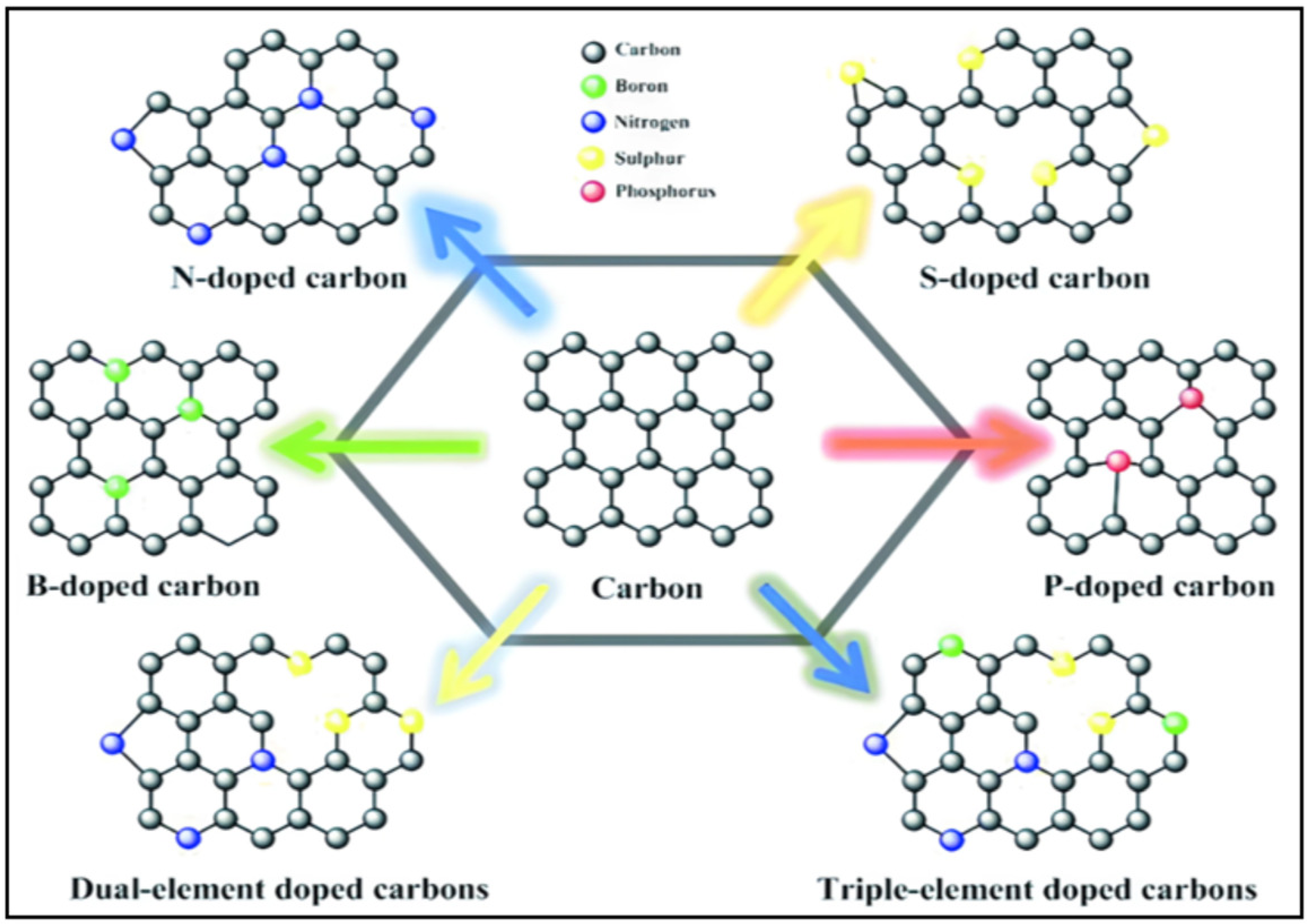
Carbon-based anode have emerged as highly attractive alternatives owing to their unique combination of favorable properties. Carbon is one of the most abundant and cost-effective elements on earth, making it economically sustainable for large-scale production. Carbon materials can be fabricated into various dimensionalities, including 0D nanodots, 1D nanotubes and nanofibers, 2D graphene nanosheets, and 3D porous frameworks, since each form offers distinct advantages for ion storage and transport [14]. For instance, low-dimensional carbons such as graphene and carbon nanotubes (CNT) provide high surface areas and fast electronic conductivity, while 3D porous carbons can facilitate rapid ion diffusion and accommodate structural strain during cycling [15,16]. Typically, carbon-based anode materials deliver specific capacities in the range of 200–600 mAh/g, depending on their morphology, crystallinity, and chemical modification strategies [17]. More importantly, they exhibit high structural reversibility, long cycle life, and relatively stable SEI formation, ensuring reliable performance across extended charge–discharge cycles. Their outstanding electrical conductivity supports rapid electron transport, while their mechanical resilience helps withstand repeated ion intercalation/extraction processes. Moreover, carbon surfaces can be engineered via heteroatom doping (e.g., N, B, P, S) to enhance electronic conductivity, create additional active sites, and improve electrolyte wettability. Hybridization with metals, oxides, or polymers further expands their potential by combining the strengths of multiple components [18,19].
Another key advantage of carbon-based anode lies in their broad compatibility with different types of MIBs. While graphite remains the commercial anode for LIBs, expanded or modified carbons have shown promise for hosting larger ions such as Na+ and K+, which face difficulties intercalating into the small interlayer spacing of graphite. A schematic illustrating the different types of carbon-based anode employed across various MIBs is presented in Figure 1. Thus, carbon materials are not only vital to current LIB technology, but central to the development of next-generation sodium and potassium-based batteries [20,21,22].
Considering the effective tactics used by carbonaceous anode in batteries, several researchers have tried to identify carbons with elevated storage capacities by reducing particle size. The small particle sizes or porous structures invariably result in an increased specific surface area of the carbons, which leads to low Initial Coulombic Efficiency (ICE), thereby significantly decreasing the energy density of the battery and causing suboptimal cycling performance in full cell configurations [23]. Consequently, converting materials to nanoscale dimensions is not a comprehensive answer to attain high-performance carbonaceous anode in batteries. Conversely, the metal ion storage process using carbonaceous hosts, referred to as the “house of cards” paradigm by Dahn and colleagues [24], resembles that of Li+ ion storage [25]. To enable the insertion and extraction of massive metal ions in comparison to Li+ ions, a substantial interlayer gap is required. Qie et al. [26] concluded from experimental data and theoretical calculations that carbon materials with interlayer distances above 0.37 nm might function as anode for Na+ ion insertion. An extended graphite with an increased interlayer lattice distance of 4.3 Å was synthesized by Wen et al. [27] using a two-step oxidation-reduction method, demonstrating exceptional cycle stability, thereby qualifying it as an effective anode material for SIBs. Consequently, the interlayer lattice spacing for other MIBs must be considerably larger as discussed earlier.
Taken together, carbon-based anode offer an unparalleled balance of cost-effectiveness, conductivity, structural adaptability, and electrochemical stability, making them ideal candidates for high-performance MIBs. Their versatility, coupled with the vast library of modification strategies, positions them at the forefront of research in sustainable energy storage. Therefore, this review aims to provide a comprehensive overview of the design, synthesis, and application of carbon-based anode across different MIB chemistries, emphasizing recent progress, structure–performance relationships, and future challenges for large-scale commercialization.

5. Graphite-Based Materials as Anode for MIBS

Graphite became the first commercially viable anode material for LIBs, thanks to the pioneering work of Akira Yoshino and Sony in 1991 [28]. Although graphite’s ability to intercalate lithium was known since 1970s, its practical use was limited by instability issues with organic electrolytes. This problem was solved in the late 1980s with the development of a stable carbon material and a compatible electrolyte system, establishing graphite as the standard anode material. A breakthrough occurred in 1993 with the introduction of a mixed electrolyte of ethyl carbonate and dimethyl carbonate for graphite anode, which enabled the stable and reliable use of graphite in LIBs. Since then, graphite has remained the primary choice for commercial anode, with ongoing improvements after 2000 focused on increasing capacity, enabling fast charging, and enhancing overall safety [29,30].
The success of graphite is attributed to its unique structural and electrochemical properties. Its well-ordered layered structure of sp2-hybridized carbon atoms enables efficient intercalation and deintercalation of Li+ ions between adjacent graphene layers [31,32]. This interlayer-insertion mechanism is highly favorable compared to pore-filling storage, which is effective only at low potentials, and conversion-type storage, which is often accompanied by large volume expansion during cycling. As a result, graphite delivers stable and reversible lithium storage and ensures long cycle life. Moreover, its natural abundance, low operating potential, high electrical conductivity, and environmental friendliness further enhance its suitability as an electrode material for electrochemical energy storage devices [33,34].
The relatively small interlayer spacing of graphite (~3.35 Å) limits its ability to host larger ions like Na+ and K+, leading to slow charge/discharge kinetics and low storage capacity [35]. To overcome this issue, extensive research has focused on structural engineering strategies to develop graphite-based advanced materials, including expanded graphite (EG), graphite intercalation compounds (GICs), and porous graphite, all aiming to improve energy storage performance in MIBs [35,36,37].

5.1. Synthesis of Graphitic Materials

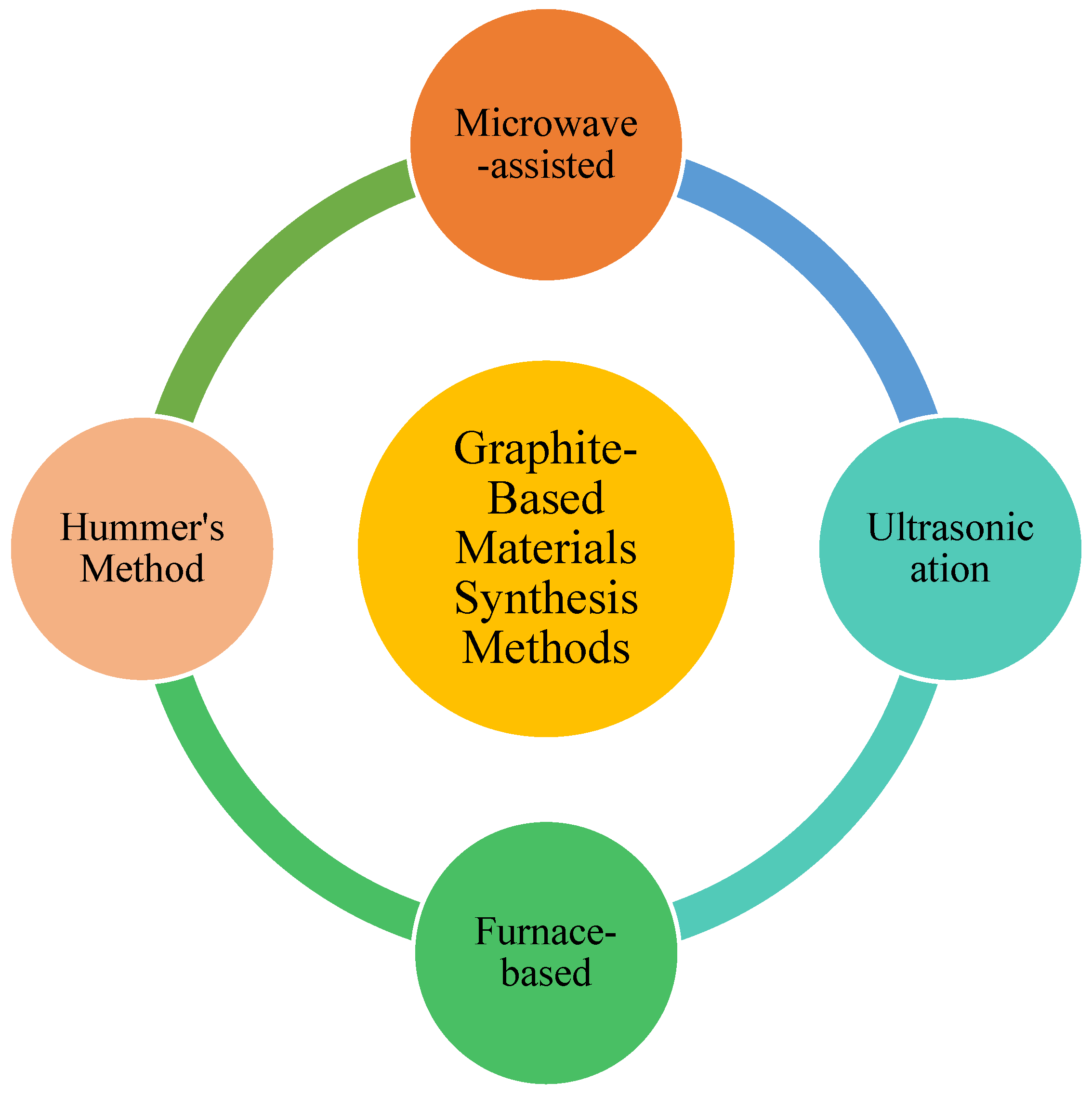
Graphite-based material can be prepared using several synthesis methods, including (i) microwave-assisted, (ii) ultrasonication, (iii) furnace-based, (iv) Hummer’s method, and (v) wet chemical oxidation, as illustrated in the schematic below (Figure 2).

5.1.1. Microwave-Assisted Method

Microwave-assisted methods for the synthesis of graphite-based materials such as expanded graphite (EG), graphite intercalation compound (GIC) using microwave irradiation with frequencies ranging from 0.3 to 300 GHz to rapidly heat the reaction mixture, enabling uniform energy distribution and fast reaction rates [38]. This technique promotes efficient exfoliation or reduction of graphite oxide into graphene or other graphite-based materials. Compared to conventional heating, it offers shorter synthesis time, lower energy consumption, and better control over material morphology and structure [39].
Thanks to the layered structure property of graphite, various guest species can be inserted between its layers through a process called intercalation forming GICs [40]. The physiochemical properties of GICs depend on both the quality of the graphite and the type of the intercalant used (e.g., alkali metals, metal chlorides, oxides). GIC containing easily vaporized intercalants show excellent expandability and are often used as precursors for EG, while metal chloride-based GICs offer high electrical conductivity, making them useful for energy storage devices [41].
The microwave-assisted method offers several advantages for synthesizing graphite-based materials. It enables rapid and energy-efficient reactions due to uniform volumetric heating, which significantly shortens synthesis time compared to conventional thermal or chemical methods. The process also promotes enhanced intercalation and exfoliation, as microwave-induced plasma or localized heating accelerates ion diffusion between graphite layers. Moreover, it typically requires fewer oxidizing agents and acids, making it a more environmentally friendly and cost-effective approach. The resulting materials often exhibit high purity, uniform morphology, and controlled structural features, which are desirable for energy storage and catalytic applications [42,43].
However, the method also presents certain limitations. Scaling up remains a challenge because uniform microwave penetration is difficult to achieve in larger batches, leading to non-uniform heating or hot spots that can cause localized overheating and incomplete reactions. Additionally, specialized microwave reactors are relatively expensive and may involve complex operation and maintenance. Controlling reaction parameters such as temperature, plasma formation, and exposure time can also be difficult, which affects reproducibility. Furthermore, excessive microwave irradiation may introduce structural defects or partial decomposition of graphite layers. Despite these drawbacks, the microwave-assisted method remains a promising and efficient route for the rapid synthesis and modification of graphite-based materials [44].
Overall, the microwave-assisted method represents a highly promising approach for the efficient and sustainable synthesis of graphite-based materials, particularly GICs and EG. This technique combines the advantages of rapid reaction rates, reduced chemical consumption, and improved energy efficiency while maintaining excellent structural and chemical control. The microwave-induced plasma effect significantly enhances the intercalation and exfoliation kinetics, leading to the formation of high-quality GICs and EG with superior electrochemical and physical properties. Moreover, when utilizing spent graphite, this method not only minimizes environmental impact but also supports the recycling and valorization of graphite waste, making it both economically and ecologically beneficial. Despite challenges in scaling up and ensuring uniform heating, continuous advancements in microwave reactor design and process optimization are expected to overcome these limitations. Overall, the microwave-assisted synthesis route provides an efficient, eco-friendly, and scalable strategy for developing advanced graphite-based materials for energy storage, catalysis, and other functional applications.

5.1.2. Ultrasonication Method

The ultrasonication (mechanical agitation) method for synthesizing graphite-based materials involves dispersing graphite in a suitable liquid medium and applying high-frequency ultrasonic waves to induce acoustic cavitation [45]. The collapse of cavitation bubbles generates intense micro-jets and shock waves, which provide sufficient mechanical energy to exfoliate graphite layers into graphene or graphene oxide (GO)sheets. The choice of liquid medium such as an organic solvent, surfactant solution, or aqueous system plays a crucial role in stabilizing the exfoliated layers and controlling the structural and chemical characteristics of the final product [46]. Viculis and co-workers [47] developed graphite nanoplatelets (GNPs) using mechanical agitation applied to EG, which effectively broke down the material into thinner platelets. GNPs are more cost-effective than CNTs but remain more expensive than carbon black. Xu et al. [48] proposed a novel ultrasonic-assisted wheat straw pulping method was demonstrated at room temperature and atmospheric pressure. Interestingly, graphite material was unexpectedly detected in the ultrasonic-assisted pulp (UP). The ash from the UP contained both inorganic and organic components, with a total inorganic content of 81.9%, primarily composed of SiO2 (71.9%). The graphitization mechanism is attributed to the ultrasonic cavitation effect, where collapsing cavitation bubbles create localized extreme conditions temperatures around 4000 K and pressures near 100 MPa. The process primarily involves three stages: lignin degradation, graphene formation, and subsequent graphitization.
The ultrasonication-assisted method offers several advantages for synthesizing graphite-based materials. It is a simple, efficient, and environmentally friendly technique that operates under ambient temperature and pressure, eliminating the need for harsh chemicals or high-temperature treatments. The localized high-energy cavitation provides strong mechanical forces capable of exfoliating graphite into thin layers, resulting in high-quality graphene or GO sheets with minimal structural damage. Moreover, the method allows for scalable and controllable exfoliation, as parameters such as ultrasonic power, duration, and solvent type can be tuned to tailor the morphology and thickness of the products. Additionally, this technique is compatible with a wide range of liquid media, making it adaptable for various precursor materials including natural graphite, EG, and even biomass-derived carbon sources [49,50].
Despite its advantages, the ultrasonication-assisted method also has some limitations. The low exfoliation yield and long processing times can restrict its large-scale industrial application. Continuous exposure to strong ultrasonic energy may lead to structural defects or partial oxidation of the exfoliated graphene sheets, which can affect their electrical and mechanical properties. Furthermore, energy consumption associated with prolonged ultrasonication is relatively high. Another limitation is the difficulty in achieving uniform dispersion, as re-aggregation of exfoliated layers may occur after the cessation of sonication, especially in the absence of stabilizing agents or surfactants [51].
In summary, the ultrasonication-assisted method is a promising and green approach for producing graphite-based materials such as GNPs, GICs, and EG. It combines simplicity and versatility, enabling the conversion of graphite or waste carbon sources into high-value materials with desirable structural and functional properties. Although improvements are still needed in terms of yield, scalability, and energy efficiency, ongoing advancements in ultrasonic system design and process optimization continue to enhance its potential for sustainable and large-scale production of graphite-based materials for applications in energy storage, catalysis, and composite development.

5.1.3. Furnace-Based Method

Furnace-based methods for graphite synthesis rely on heating carbon-based precursors at elevated temperatures using induction or resistance heating under controlled atmospheric conditions [52]. These techniques enable the transformation of disordered carbon materials into highly crystalline graphite or carbon nanostructures. Among them, induction graphitization is a widely used process in which carbon parts are heated to temperatures between 1000 °C and 2800 °C through induction heating. This method enhances the crystallinity and purity of the resulting graphite, making it suitable for applications such as brake components, clutch facings, and mechanical seals [53]. In contrast, high-frequency furnaces employ inductive heating of a graphite body, or susceptor, to synthesize advanced carbon nanomaterials, including fullerenes, CNTs, and single-walled carbon nanotubes (SWCNTs) [54,55,56]. These furnaces typically consist of a graphite susceptor, a carbon shield, and a high-frequency power supply, enabling localized high-temperature zones for nanostructure formation. Another notable technique is resistance heating (Joule heating), in which a graphite crucible is directly heated by passing a large electric current through it. This method allows for extremely rapid heating and cooling cycles, achieving temperatures up to 3200 °C, and is particularly effective for producing graphite films and other materials requiring precise thermal control [57]. Collectively, furnace-based synthesis methods offer high-temperature capability, process flexibility, and tunable structural outcomes, making them integral to the production of both bulk and nanostructured graphite materials.
Liu et al. [58] investigated the effect of heat treatment temperature on the degree of graphitization using biomass-derived activated carbon (AC) as a carbon precursor. The AC was first acid-washed with HCl, dried, and subsequently impregnated overnight with a 1 M acetone solution of Ni(NO3)2 to introduce a catalytic effect. After vacuum filtration, the treated samples were heat-treated in a tube furnace under nitrogen flow at temperatures up to 1000 °C. XRD analysis revealed that no distinct graphite peak appeared at lower temperatures, while a noticeable (002) diffraction peak near 2θ = 26° emerged at 950 °C. At 1000 °C, this peak became significantly sharper, indicating a higher degree of graphitization. The results demonstrated that the combination of chemical pretreatment and elevated thermal processing effectively converted the activated carbon into a highly porous, ultrathin graphitic carbon material.
Furnace-based synthesis methods offer several advantages that make them highly effective for producing graphite and related carbon materials. One of the key benefits is their ability to achieve extremely high operating temperatures, often reaching up to 3000 °C, which is essential for promoting graphitization and attaining the desired crystalline structure. These furnaces also provide precise temperature control, enabling researchers and manufacturers to tailor material properties and ensure consistent, reproducible results. Furthermore, induction-heating graphitization furnaces are specifically designed to produce high-purity graphite, minimizing contamination during synthesis. The use of graphite-based hot zones creates near-ideal blackbody conditions, resulting in highly uniform heating throughout the chamber. In addition, furnace systems are highly versatile, supporting a wide range of processes such as sintering, graphitization, and pyrolysis [59].
Despite these advantages, furnace-based methods also present several limitations. They are often energy-intensive, particularly in large-scale setups such as Acheson furnaces, leading to high operational costs. Long cycle times are another drawback, as the cooling stages for some furnaces can extend over several days, reducing throughput. Moreover, graphite is susceptible to oxidation at elevated temperatures in the presence of oxygen, necessitating the use of inert or vacuum atmospheres to preserve material integrity. In certain high-temperature environments, especially those involving metal alloys such as nickel and chromium, there is a risk of carbon pickup, where carbon diffuses from the graphite into the metallic components. Additionally, maintenance challenges arise due to the brittleness and limited durability of graphite parts, which may require frequent replacement or careful handling to maintain furnace performance [60].

5.1.4. Hummer’s Method

Hummer’s method is a well-established chemical process for synthesizing GO/graphite oxide from graphite, which can subsequently be reduced to form reduced graphene oxide (rGO) [61]. This method involves the oxidation of graphite using strong acids typically concentrated sulfuric acid and oxidizing agents such as potassium permanganate and sodium nitrate [62]. In the oxidation step, graphite is dispersed in concentrated sulfuric acid with sodium nitrate, followed by the slow addition of potassium permanganate under controlled low-temperature conditions to prevent overheating. The mixture forms a thick paste that is later heated and diluted with water, initiating vigorous effervescence as the oxidation reaction completes. To remove residual oxidants, hydrogen peroxide (H2O2) is added, reducing any remaining permanganate and manganese dioxide, typically producing a brown-colored suspension. The purification process then involves repeated washing and filtration, often using hydrochloric acid and deionized water, to eliminate metal ions and excess acid. Subsequently, exfoliation is achieved through ultrasonication in a polar solvent such as water, yielding single or few-layer GO sheets. The final step, reduction, restores electrical conductivity by removing oxygen-containing functional groups through thermal, chemical, or electrochemical reduction, producing rGO. Hummer’s method and its modified variants are widely employed due to their reliability, scalability, and cost-effectiveness, making them one of the most common “top-down” approaches for producing high-quality GO and rGO from bulk graphite [63].
For example, Bannov et al. [64]. investigated the sequential stages of GO formation during the modified Hummers’ method by employing a stepwise sampling approach. The modification involved adding the reaction mixture into ice and using excess H2O2, which enhanced the hydrolysis of GICs and increased oxygen release. High-purity nipple graphite was used as the precursor to ensure accurate observation of the oxidation process. As reported by Inagaki et al. [65], oxidation of graphite in concentrated sulfuric acid with potassium permanganate and nitric acid first forms unstable GICs, which convert to graphite oxide upon contact with water. In this study, samples were collected after the hydrolysis stage following water washing, allowing precise examination of the transformation from GICs to graphite oxide under the modified synthesis conditions.
Hummers’ method is a widely used and efficient technique for synthesizing graphite oxide, valued for its speed, safety, and high yield, making it suitable for large-scale production [66]. The process avoids hazardous reagents such as fuming nitric acid and chlorates, significantly reducing explosion risks, while achieving a high degree of oxidation that enhances the functional properties of the product. The required materials are inexpensive and readily available, further contributing to the method’s practicality and scalability [67].
However, the method also presents notable limitations. It produces toxic gases such as NO2 and N2O4, necessitating strict safety and environmental controls. The purification process to remove residual metal and nitrate ions is laborious, and the oxidation step can introduce structural defects that degrade the electrical and mechanical performance of GO. In some cases, incomplete oxidation leads to mixtures of graphite and graphite oxide. Despite these drawbacks, Hummers’ method remains a cornerstone for graphite oxide synthesis due to its balance of efficiency and reliability [68].

5.2. Graphite-Based Anode for LIBs

Although graphite has already been widely employed in commercial LIBs, efforts are ongoing to enhance its lithium storage capability. One effective strategy involves preparing EG with enlarged, long-range-ordered interlayer spacing. For example, Bai et al. [69] synthesized EG with an interlayer distance of 0.359 nm by rapidly heating graphite oxide in a preheated muffle furnace at 1050 °C under air. The resulting EG exhibited a capacity of 413 mAh/g at a current density of 0.2 mA cm−2 and retained 99% of its capacity after 30 cycles, significantly higher than the 322 mAh/g obtained for natural graphite under the same conditions of 1 M LiPF6/EC-DMC electrolyte in LIBs.
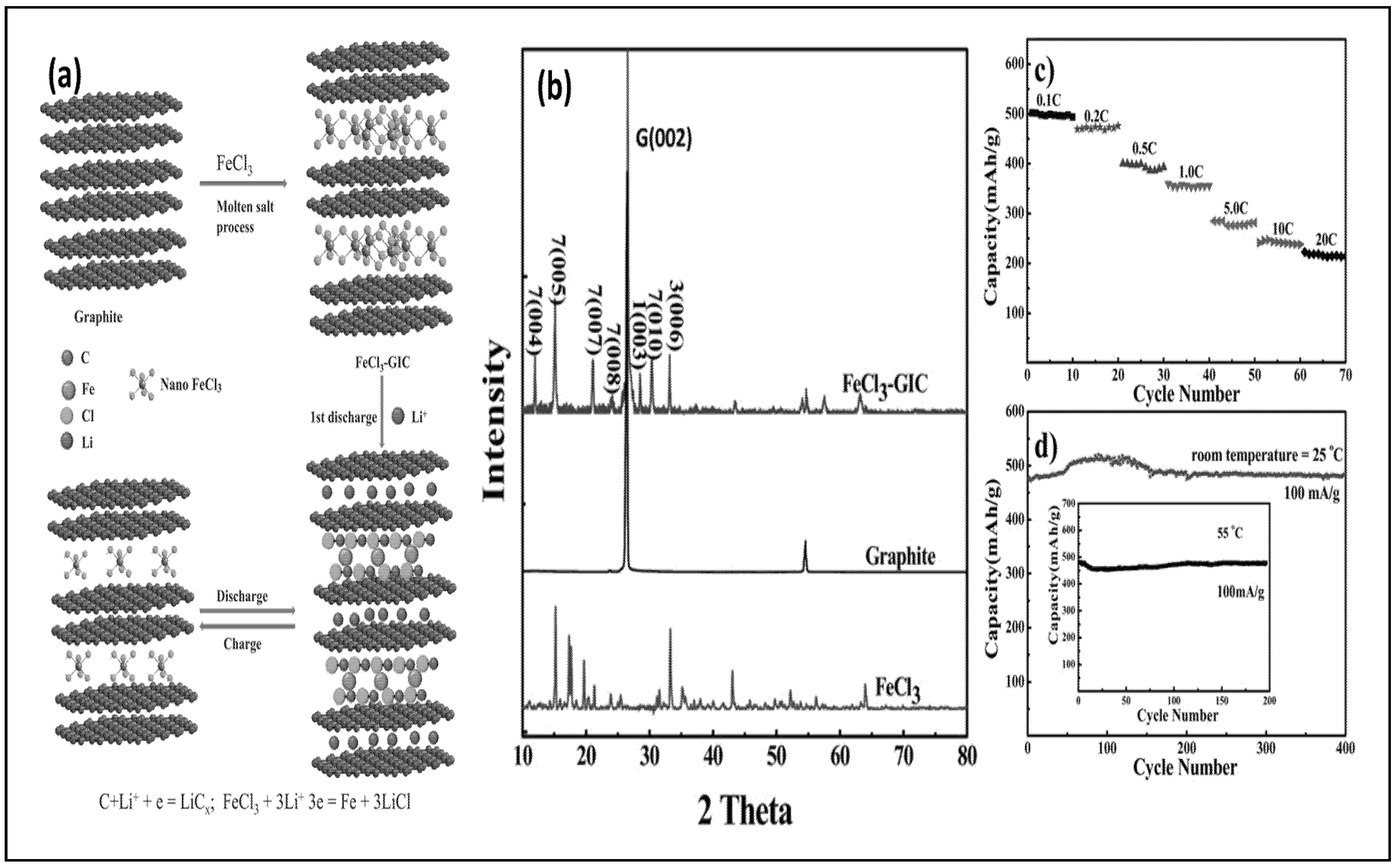
Wang et al. [70] explored FeCl3-graphite intercalation compounds (FeCl3-GICs) prepared by a melt-salt method at 600 °C for 3 h. As shown in Figure 3a, FeCl3 was pre-intercalated within the graphite layers, forming a mixed-stage structure dominated by stage 7 along with stages 3 and 5 (Figure 3b). Upon discharge, Li+ intercalated into the graphite interlayers to form LixC, while FeCl3 reacted with Li+ to generate LiCl and Fe according to Equation (1):
FeCl3 + 3Li+ + 3e → Fe + 3LiCl
FeCl3-GICs delivered a high reversible capacity of 506 mAh/g at 0.1 C, well above the theoretical capacity of pristine graphite (372 mAh/g) in LIBs. Remarkable rate performance was also demonstrated, with discharge capacities of 300 and 220 mAh/g at 5 C and 20 C, respectively (Figure 3c). The total capacity could be deconvoluted into three contributions: ~200 mAh/g from conventional Li+ intercalation into graphite, ~91 mAh/g from reactions involving FeCl3, and the remainder from Li+ adsorption/desorption on graphene sheet surfaces flanking the FeCl3 intercalation layer. Moreover, the material showed excellent cycling stability, retaining 480 mAh/g after 400 cycles at 100 mA/g (Figure 3d).
In addition to interlayer engineering, pore creation in graphite-based electrodes has been proposed as another effective strategy to enhance electrochemical performance. Porous structures can shorten Li+ diffusion paths, provide abundant active sites, and mitigate volume changes during the cycling process [71]. First-principles calculations by Yang et al. [72] predicted that porous graphene with a hole density of 35% could achieve a theoretical Li+ storage capacity of 1516 mAh/g about four times higher than that of pristine graphite. The Li+ diffusion barrier through the extraplanar channels created by the pores was estimated to be only one-fifth that of conventional graphite, suggesting the potential for much faster charge/discharge kinetics.
Recently, porous graphite has attracted considerable attention as an electrode material for multivalent-ion batteries. Various synthetic strategies have been employed, including siliconization, MoOx-catalyzed gasification, KOH etching and air treatment [73,74,75]. For instance, Shim et al. [76] demonstrated that KOH-etched porous graphite, treated for 24 h at 80 °C, delivered significantly improved rate capability as an anode for LIBs. This anode material exhibited ~160 mAh/g at 2.5 C with 96.7% capacity retention after 100 cycles in 1.15 M LiPF6/EC-DMC-EMC, compared to ~75 mAh/g for natural graphite in LIBs. Although the BET surface area increased modestly (6.7 → 7.6 m2/g), but SEM analysis revealed numerous nanoscale pores formed during etching, which facilitated Li+ access into graphite layers and accounted for the enhanced kinetics.

5.3. Graphite-Based Anode for SIBs

Na-based batteries have served as a cornerstone of “beyond-lithium” energy storage technology since 1985, following the successful development of high-temperature Na/NiCl2 and Na/S batteries utilizing a Na+-β-alumina ceramic electrolyte [77,78]. Analogous to LIBs, SIBs comprise a cathode made of sodium intercalation materials and an anode, separated by an electrolyte that facilitates sodium-ion transport between the electrodes during charge–discharge cycles.
Anode materials play a crucial role in determining the overall performance of SIBs, with carbon-based materials being widely employed due to their excellent electrical conductivity, structural stability, and tunable electrochemical properties [79]. Among them, graphite stands out as an abundant and low-cost resource, making it a highly promising candidate for large-scale applications in SIB technology. In this regard, Wen and co-workers [27] synthesized EG that has emerged as a highly promising anode material for SIBs. Derived from graphite through a two-step oxidation–reduction process, EG retains the long-range layered structure of graphite while exhibiting an enlarged and tunable interlayer spacing (~0.43 nm), which facilitates efficient Na+ intercalation and deintercalation. In situ high resolution transmission electron microscopy (HRTEM) has confirmed the reversible sodiation and desodiation behavior of EG, accompanied by stable structural evolution during cycling. Electrochemical measurements demonstrated a high reversible capacity of 284 mAh/g at 20 mA/g, 184 mAh/g at 100 mA/g, and excellent cycling stability with 73.9% capacity retention after 2000 cycles. Owing to its low-cost synthesis, structural tunability, and superior electrochemical performance, EG represents a strong candidate for next-generation, large-scale SIB anode applications.

5.4. Graphite-Based Anode for KIBs

SIBs have gained attention for their chemical similarity to LIBs. However, their relatively high standard reduction potential (Na/Na+ = −2.71 V vs. SHE) limits energy density [80]. To overcome this, KIBs have been proposed, offering a lower reduction potential (K/K+ = −2.93 V vs. SHE), closer to that of Li/Li+ (−3.04 V vs. SHE) [81]. Additionally, the smaller Stokes radius of K+ (3.6 Å) compared to Na+ (4.6 Å) and Li+ (4.8 Å) in propylene carbonate leads to higher ion mobility and conductivity, making KIBs a promising alternative for high-energy-density storage systems. However, the larger ionic radius of K+ (1.38 Å) compared to Li+ (0.76 Å) and Na+ (0.97 Å) often causes significant structural strain and damage to anode materials during the potassiation–depotassiation process, leading to rapid capacity fading over repeated cycles [82]. Consequently, developing robust, high-performance anode materials is crucial for advancing KIB technology.
A wide range of anode materials, including metals, oxides, sulfides, and phosphides, have been explored for KIBs, demonstrating promising potassium storage capabilities [83,84,85,86]. However, challenges such as limited cycling stability and relatively high voltage plateaus continue to constrain the overall energy density of KIB full cells. Considering factors such as cost, stability, and operating voltage, carbon-based materials have emerged as preferred anode for KIBs [87]. Among them, graphite, a classical carbon material extensively used in LIBs, stands out due to its abundance, conductivity, and structural reversibility [88]. Interestingly, while graphite exhibits poor Na+-ion storage capability in SIBs because of its low reactivity toward Na+ intercalation [89], it shows a distinct K+-ion intercalation behavior in KIBs, highlighting its potential as an efficient and stable anode material for next-generation potassium-based energy storage systems.

5.5. Graphite-Based Anode for Calcium-Ion Batteries (CIBs)

CIBs have emerged as a promising divalent-ion system due to their relatively high standard reduction potential (−2.87 V for Ca/Ca2+) and faster charge-transfer kinetics associated with the high charge density of Ca2+ (0.49 e Å−3) [90]. Despite these advantages, CIB development is hindered by the irreversible plating/stripping of calcium metal at room temperature. Although partial dissolution of Ca2+ from metallic calcium is possible [91], calcium deposition whether on Ca metal or noble-metal substrates is severely restricted by the rapid formation of a passivating surface layer [92]. Increasing the operating temperature to approximately 100 °C and reducing ion-pairing in the electrolyte can partially facilitate Ca2+ migration through this surface film [93]; however, substantial overpotentials (0.5–0.9 V) persist, indicating limited practicality for CIBs. Recent studies suggest that the in situ formation of CaH2 in Ca(BH4)2/THF electrolytes can mitigate surface passivation, but its slow formation kinetics and the limited anodic stability of the electrolyte (≈3 V) remain significant barriers [94]. These challenges collectively underscore the difficulty of realizing efficient reversible calcium storage in graphite-based anode systems and highlight the need for alternative carbon structures or electrolyte innovations to enable practical CIB performance. Recent progress has demonstrated that graphite can serve as a viable anode material for CIBs through solvent-assisted co-intercalation mechanisms. Richard Prabakar et al. [95] reported the reversible co-intercalation of Ca2+ with tetraglyme (G4) into graphite, a behavior distinctly different from the irreversible reactions typically observed in conventional carbonate- or ether-based electrolytes. In the presence of G4, graphite exhibits highly stable cycling, maintaining excellent reversibility for up to 2000 charge–discharge cycles at a rate of 1 A/g without noticeable degradation. Using a combination of analytical characterization and computational modeling, the study elucidates the stepwise intercalation process of Ca2+–G4 complexes within graphite layers. Furthermore, the feasibility of graphite as an anode in a Ca2+-shuttling full-cell configuration was demonstrated, underscoring the potential of solvent-cointercalation strategies to overcome the intrinsic challenges of calcium storage in layered carbon materials.

6. CNT-Based Materials as an Anode for MIBs

The increasing global demand for sustainable and high-performance energy storage systems has stimulated extensive research into advanced electrode materials for rechargeable MIBs. Among various candidates, CNTs have emerged as a promising class of nanostructured carbon materials. CNT was first reported by the Japanese scientist Sumio Iijima in 1991 [96,97]. As novel members of the carbonaceous material family, CNTs exhibit remarkable physicochemical properties, including a large aspect ratio, high electrical conductivity, extensive specific surface area, and low density. Reported electrical conductivity of up to 106 S m−1 for single-walled CNTs (SWCNTs) and 105 S m−1 for multi-walled CNTs (MWCNTs). Furthermore, CNTs possess exceptional mechanical strength, with tensile strength values as high as 60 GPa [98,99]. In the context of anode development, CNTs offer significant advantages, including efficient electron transport pathways, large specific surface area for ion adsorption, and the ability to buffer mechanical stress induced by ion insertion/extraction processes. These properties make CNTs highly attractive for a broad range of MIB chemistries, including lithium-ion, sodium-ion, and potassium-ion systems [100,101,102,103].

6.1. Synthesis of CNT-Based Materials

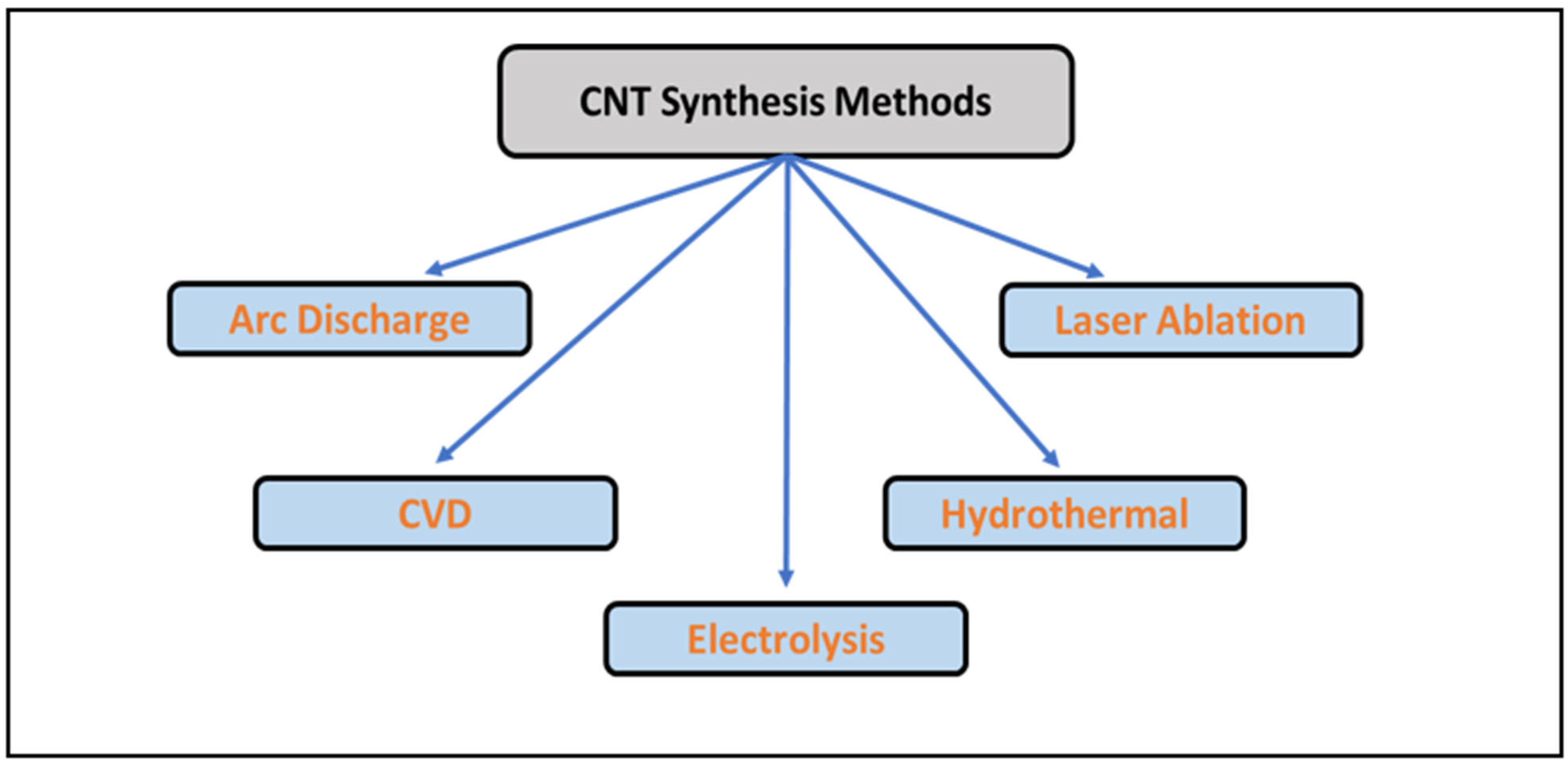
CNTs can be synthesized through a variety of techniques; the most commonly employed approaches are shown in Figure 4.

6.1.1. Arc Discharge Method

The arc discharge method, first employed by Iijima in 1991 for the synthesis of highly crystalline MWCNTs, remains one of the earliest and most established techniques for CNT production [96]. This high-temperature process, also widely used for fullerene synthesis, involves striking an arc between graphite electrodes in an inert gas atmosphere (typically He or Ar), generating plasma temperatures exceeding 3000 °C, sufficient to vaporize carbon. Carbon subsequently deposits on the cathode, leading to nanotube formation. The parameters, such as arc stability, current density, inert gas pressure, and electrode cooling, strongly influence CNT yield, crystallinity, and morphology.
MWCNTs are generally synthesized without catalysts, while transition metals (e.g., Fe, Co, Ni, Mo, Y) are essential for SWCNT growth. Early studies demonstrated successful large-scale synthesis of MWCNTs in helium due to its high ionization potential, while variations such as pulsed arc discharge and liquid-phase arc discharge (e.g., in water, liquid N2, or salt solutions) expanded synthesis possibilities. Notably, boron- and nitrogen-doped MWCNTs have been produced by arc discharge, and the method has also been adapted to fabricate double-walled CNTs (DWCNTs) [104].
For SWCNTs, catalyst-embedded graphite electrodes have been widely explored, with mixtures such as Ni-Y-graphite and Fe-Co-Ni-graphite proving particularly effective in producing uniform tubes with diameters around 1–2 nm. Process optimization, such as hydrogen-assisted DC arc discharge or pulsed arc discharge, has been shown to improve yield and purity. Key parameters affecting synthesis include chamber temperature, pressure, catalyst type and its composition, carbon precursor, and electrode design.
The primary advantage of arc discharge lies in its ability to produce CNTs with high crystallinity and structural quality. However, the method offers limited control over chirality, requires expensive high-purity graphite and catalysts, and often necessitates additional purification steps, especially for SWCNTs. Despite these limitations, arc discharge remains a benchmark for CNT synthesis due to its ability to produce high-quality nanotubes in substantial quantities [105].

6.1.2. Laser Ablation Method

The laser ablation technique emerged as an alternative to overcome the limitations of the arc discharge method, particularly in achieving uniform and high-purity SWCNTs. First introduced by Guo et al. [106], laser ablation demonstrated remarkable efficiency, producing nearly 500 mg of SWCNTs within five minutes with up to 90% purity [107]. Unlike arc discharge, laser ablation employs a high-energy pulsed light source, typically a Nd: YAG (neodymium-doped yttrium aluminum garnet) laser, to ablate a graphite target.
The process is relatively simple: a quartz tube reactor (25 mm diameter, 1–1.5 m length) placed in a tube furnace at ~1200 °C houses the graphite target, which can be either pure graphite (for MWCNTs) or graphite doped with transition metals such as Fe, Co, or Ni (for SWCNTs). Carrier gases such as Ar, He, or their mixtures are introduced at controlled pressures and flow rates. The Nd: YAG laser beam, operating at 1064 or 532 nm wavelength, ~300 mJ pulse energy, 10 Hz repetition rate, and pulse width <10 ns, is focused on the target surface with a beam diameter of 3–8 mm. The intense irradiation vaporizes the target, forming a plume of carbon species that are swept by the gas stream and condensed on a downstream water-cooled collector [106].
This method not only enables the synthesis of high-purity CNTs but also provides improved structural control compared to arc discharge. However, optimization of experimental parameters such as laser energy, target composition, and gas environment remains essential for maximizing yield and ensuring consistent CNT quality.

6.1.3. CVD Method

CVD is another promising alternative to arc discharge, suitable for controlled nanotube growth, offering scalability and tunability in nanotube structure [108]. The method is based on the catalytic decomposition of hydrocarbon or carbon monoxide gases over transition metal catalysts, a concept long known for filament formation, but first demonstrated for CNT synthesis by Yacamàn et al. [109] Today, catalytic CVD (CCVD) is considered the most economically viable route for large-scale CNT production and for their integration into functional devices [110].
In a typical setup, the process is performed in a flow furnace under atmospheric pressure, with horizontal and vertical configurations. The horizontal design, most widely used, employs a quartz or ceramic boat containing the catalyst, exposed to a hydrocarbon/inert gas mixture at 500–1100 °C. In contrast, vertical furnaces are better suited for continuous CNT or carbon fiber production, where catalysts and feed gases are injected from the top, and CNTs are collected at the bottom. A modified version, the fluidized bed reactor, extends catalyst residence time by using an upward gas flow, enhancing growth efficiency [110].
The general CNT growth mechanism involves hydrocarbon dissociation on the catalyst surface, carbon atom dissolution into the metal nanoparticle, and subsequent precipitation to form sp2-bonded tubular structures. The resulting CNT characteristics, including diameter, length, crystallinity, and yield, depend strongly on parameters such as reaction temperature, pressure, gas composition, catalyst type, size, support material, and pretreatment. The diameter of CNT can be controlled by tuning the catalyst particle size, while tube length is primarily governed by reaction time [111].

6.1.4. Hydrothermal Method

Hydrothermal techniques have proven effective for preparing a wide variety of carbon-based nanostructures, including nano-onions, nanorods, nanowires, nanobelts, and MWCNTs [112,113]. These approaches offer several advantages over conventional synthesis routes: (i) they rely on easily accessible and stable precursors under ambient conditions, (ii) they operate at relatively low temperatures (150–180 °C), and (iii) they eliminate the need for hydrocarbons or carrier gases. “Hydrothermal” does not always mean very low absolute temperatures. A study reports synthesis at 700–800 °C under high pressure (60–100 MPa) in water + polyethylene mixtures [114]. This resulted in products having both open- and closed-end nanotubes, with wall thicknesses spanning several to over 100 carbon layers, and inner core diameters ranging from 20 to 800 nm [114,115]. Compared to other high-energy processes (arc discharge, some CVD methods), the hydrothermal approach can potentially reduce the total energy costs because of the use of a liquid-phase environment and lower relative thermal gradients [116,117].
Similarly, graphitic CNTs were obtained by employing ethylene glycol as the carbon source under comparable temperature and pressure conditions, also in the presence of Ni catalysts. Transmission Electron Microscopy (TEM) analysis confirmed that these CNTs possessed wide internal channels and Ni inclusions at the tube tips. Typically, hydrothermal nanotubes exhibit wall thicknesses of 7–25 nm and outer diameters of 50–150 nm, while thin-walled tubes with internal diameters from 10 to 1000 nm have also been reported [115]. The growth process often involves infiltration of a supercritical fluid mixture (CO, CO2, H2O, H2, and CH4) into the developing nanotube cavity.
Using a combined sonochemical/hydrothermal route, Manafi et al. [118] successfully produced CNTs at 150–160 °C for 24 h, starting from a 5 mol/L NaOH aqueous solution containing dichloromethane, metallic lithium, and cobalt chloride. The resulting nanotubes had diameters of ~60 nm and lengths of 2–5 µm. Scanning Electron Microscopy (SEM) revealed uniformly dispersed catalyst nanoparticles, attributed to the ultrasonic pre-treatment of the precursor solution.
Interestingly, MWCNTs and nanocells have also been synthesized in hydrothermal fluids from amorphous carbon without metal catalysts, at temperatures below 800 °C. In these conditions, carbon nanocells formed through the interconnection of multi-walled graphitic layers at ~600 °C, appearing macroscopically as disordered bulk carbon. These nanocells typically exhibit diameters below 100 nm, with internal cavities of 10–80 nm. Additionally, nanotubes produced in such systems usually display diameters of several tens of nanometers and lengths extending to hundreds of nanometers [119].
Notably, the spontaneous growth of short nanotubes and nano-onions has been observed from nanoporous carbon in the presence of elemental cesium at temperatures as low as 50 °C. Microscopic studies demonstrated that the degree of structural ordering and abundance of carbon nanoparticles increased significantly upon heating to 350–500 °C. Remarkably, even at 50 °C, the formation of carbon nanopolyhedra, nanotubes, and onions was observed [120].

6.1.5. Electrolysis Method

Electrolysis is a relatively uncommon approach for synthesizing CNTs, first reported by Hsu et al. [121] in 1995. This process is based on the electrowinning of alkali metals (Li, Na, K) or alkaline-earth metals (Mg, Ca) from their molten chloride salts at a graphite cathode. The deposited metals react with the cathode to form CNTs. Each electrolyte composition requires an optimal operating temperature for CNT formation, with product purity decreasing sharply when deviating from this temperature. For example, in NaCl and LiCl electrolytes, the best results were obtained at temperatures slightly above the melting point of the salts. Following electrolysis, the carbonaceous products are isolated by dissolving the salts in distilled water and filtering the suspension. During this process, the graphite cathode undergoes erosion, producing a mixture that typically contains CNTs, amorphous carbon, carbon-encapsulated metal nanoparticles, spherical carbon particles, and filaments. MWCNTs are the dominant product, though Bai et al. [122] successfully synthesized SWCNTs via electrolytic conversion of graphite in molten NaCl at 810 °C under argon, yielding tubes with diameters of 1.3–1.6 nm comparable to SWCNTs obtained by other methods. Small additions (<1 wt%) of metals or low-melting-point salts such as SnCl2, PbCl2, Bi, or Pb promote the formation of metal nanowires and filled CNTs. They produced MWCNTs typically have diameters of 10–20 nm, lengths exceeding 500 nm, and consist of 10–15 graphitic walls, often aggregated into entangled bundles with amorphous carbon and encapsulated particles.
A distinct advantage of electrolysis is its operation in the condensed phase that directly utilizes graphite as a carbon source at relatively low temperatures. This approach offers several benefits, namely: (i) simple apparatus design; (ii) controllable synthesis through electrolysis parameters; (iii) use of inexpensive raw materials; (iv) relatively low energy requirements; and (v) tunability of CNT morphology, structural features, and heteroatom doping through optimization of both composition and electrolysis conditions [123,124].
Recent progress has expanded the electrochemical route. Novoselova et al. [125] developed a new electrolytic synthesis based on cathodic reduction of CO2 dissolved in molten salts, leading to in situ carbon deposition on metallic electrodes. Predominantly curved and bundled MWCNTs were obtained by using a ternary chloride melt (NaCl–KCl–CsCl) as an electrolyte, with outer diameters ranging from 5 to 250 nm and inner diameters from 2 to 140 nm, sometimes partially filled with salts. A higher current density favored smaller-diameter CNTs, improved carbon yield, and increased CNT fraction in the product. In another study, nanotube growth was achieved at temperatures as low as –40 °C in liquid ammonia using acetylene as the carbon source, notably without a metal catalyst. Acetylene, generated by CaC2 hydrolysis and purified through sequential treatments, was dissolved in liquid NH3 for electrolysis. The resulting deposits formed a porous layer (1–2 µm thick) on the cathode surface, primarily consisting of amorphous, graphitic, and turbostratic carbon, along with MWCNTs. These nanotubes, with an average diameter of ~15 nm, exhibited irregular curvature, bundled morphologies, and exceptionally high aspect ratios (length-to-diameter ratio > 1000).

6.2. CNT-Based Anode for LIBs

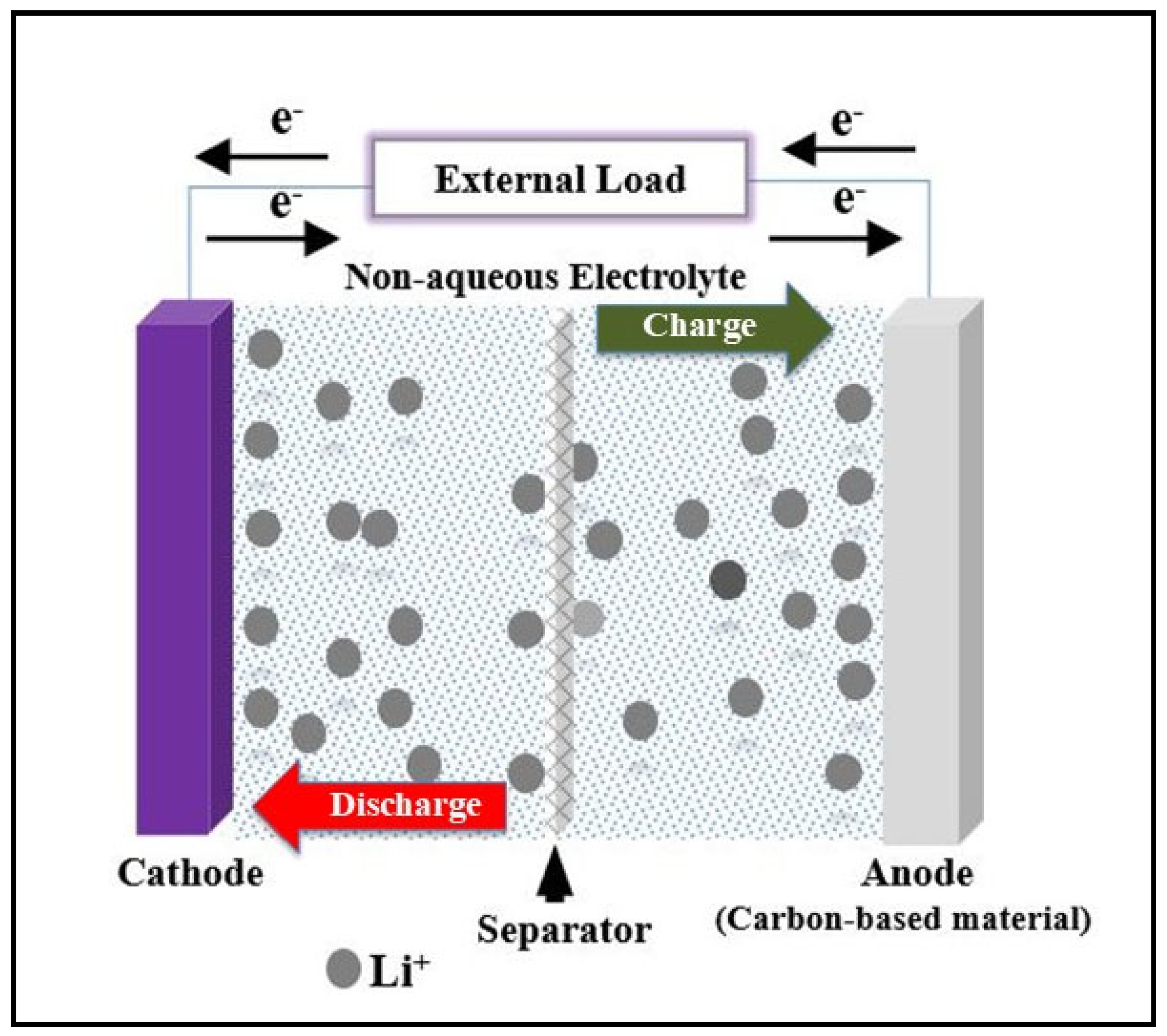
LIBs have attracted much attention over the years due to their high theoretical gravimetric capacity, light weight, and long lifespan. Lithium has a high theoretical specific capacity of 3862 mAh/g and a highly negative standard electrode potential (−3.040 V vs. SHE), making it an ideal anode material for LIBs, with an effective ionic radius of 0.76 Å, which promotes fast ion transfer kinetics. While graphite remains the most commonly used anode material for commercial LIBs due to its low cost, its application potential is limited by low energy density (less than 250 Wh kg−1) and a low theoretical specific capacity of 372 mAh/g [97]. Other concerns are the slow diffusion rate of Li+ ions in graphite, dendrite formation at low voltages, and safety concerns from the non-aqueous electrolyte system (Figure 5) [98].
Recent studies have focused on the use of nanomaterials to overcome these issues, since these materials have large surface areas, which ensure an improved Li-ion diffusion coefficient. These materials include fullerenes (0D), CNT (1D), graphene (2D), and their composites (3D) [1]. Among the various nanocarbon materials, CNTs have become one of the most promising candidates for next-generation LIB anode. Their 1D tubular shape provides continuous electron transport pathways, high electrical conductivity, and many active sites for Li+ intercalation and adsorption [99]. Additionally, their high mechanical strength and flexibility help accommodate the significant volume changes that often happen during lithiation and delithiation, reducing pulverization and improving cycling stability [126]. Recent research indicates that pristine CNTs can deliver higher reversible capacities than graphite, with improved rate performance resulting from faster Li+ diffusion along the nanotube channels [127,128,129]. However, pristine CNTs alone still show relatively low specific capacities (~300–400 mAh/g), which limits their competitiveness with high-capacity alloying materials like Silicon.
To address these challenges, various modification strategies, such as heteroatom doping, have been employed to enhance the electrochemical performance of the anode [97]. Heteroatom doping, where nitrogen, boron, or phosphorus atoms are introduced into the CNT lattice, can create defects and additional Li+ adsorption sites. This method has been shown to improve conductivity and storage capacity [126]. Another widely studied direction is the development of CNT–silicon composites. In these systems, CNT networks serve as highly conductive scaffolds that buffer the extreme volume expansion of Silicon during lithiation. CNT-Silicon anode have reported superior performance with a high specific capacity of 3250 mAh/g at 0.2 C, a capacity retention of 99.8%, and a coulombic efficiency of 100% after more than 700 cycles [129].
Furthermore, CNT–graphene hybrids are being designed to exploit the complementary advantages of both materials. The combination produces 3D conductive frameworks with high surface areas and rapid electron/ion transport, while also suppressing agglomeration of the carbon nanostructures. Such hybrids have been reported to achieve both high capacity and excellent rate performance [130,131]. Beyond compositing, surface functionalization and defect engineering are also employed to enhance performance. Mild oxidation or plasma treatments can introduce oxygen-containing functional groups that improve electrolyte wettability and facilitate stable solid–electrolyte interphase (SEI) formation. In parallel, controlled defect engineering has been shown to increase Li+ storage capacity without severely compromising conductivity [132]. Another promising trend is the fabrication of binder-free CNT anode. Direct growth of CNTs onto current collectors, such as copper foils, eliminates the need for polymer binders and conductive additives. This process reduces inactive mass and increases the gravimetric energy density of the electrode. Moreover, this architecture improves structural robustness during cycling, enabling long-term stability at high current densities [133,134,135].
In summary, CNT-based anode are positioned at the forefront of advanced LIB research. Although their intrinsic capacity is lower than that of Silicon, their superior conductivity, structural flexibility, and chemical tunability make them attractive, either as standalone high-rate anode or as conductive scaffolds in composite systems. Future directions will likely focus on scalable synthesis methods, optimized doping strategies, and hybridization with high-capacity active materials to bridge the gap between laboratory-scale demonstrations and industrial-scale applications [136,137].

6.3. CNT-Based Anode for SIBs

SIBs are considered promising battery systems and viable alternatives to LIBs due to their low costs and the wide distribution of sodium in the Earth’s crust, as well as their similar electrochemical mechanisms to LIBs. However, SIBs still face some challenges that have hampered their commercial applications. One challenge is the low operating voltage (∼0.3 V lower than Li) of SIBs. When comparing the metal ions in Group I, the larger effective ionic radii of Na+ ions (1.02 Å) compared to Li+ ions can lead to sluggish ion diffusion and reaction kinetics and structural stress in electrodes in SIBs. However, the lower Lewis acidity of Na+ ions results in their solvated ions being smaller compared to those of Li+ ions [97]. Therefore, finding appropriate electrode materials with internal spaces large enough to host Na+ ions should be thoroughly considered.
Recent research efforts have focused on developing better anode materials to enhance the overall performance of SIBs. CNTs have emerged as promising anode materials for SIBs due to their excellent electrical conductivity, mechanical strength, and ability to accommodate volume changes during cycling. CNTs have been integrated into various SIB anode architectures to mitigate the intrinsic challenges of sluggish Na+ diffusion and substantial volume expansion during cycling. Pristine CNTs have been explored as standalone anode materials for SIBs. However, their limited Na+ storage capacity, typically below 100 mAh/g, is attributed to weak van der Waals interactions and the absence of active sites for Na+ intercalation. Therefore, recent studies have focused on modifying pristine CNTs to enhance their electrochemical performance. It has been reported that pristine carbon materials, including CNTs, suffer from low Na+ intercalation unless doped or hybridized [138]. While pristine CNTs may be structurally robust, the need for surface engineering or doping to achieve practical capacities for SIBs has been emphasized [139]. The foregoing highlights the role of defect engineering and heteroatom doping in improving Na+ intercalation and affinity. When comparing pristine CNTs with biochar-based hard carbons, it is noted that CNTs offer superior conductivity but lag in Na+ storage unless functionalized [140]. The limitations of pristine carbon materials were also identified, and advanced nanomaterial tailoring, such as creating oxygen-rich or nitrogen-doped CNTs, was proposed to overcome the low capacity and poor cycling stability [141].
CNTs are increasingly exploited to construct 3D conductive frameworks that simultaneously support efficient electron transport and mechanical stability in SIB electrodes. This process seeks to address the sluggish Na+ diffusion kinetics and large ionic radius of sodium, which impose significant structural stress on conventional anode. In the 3D CNT frameworks, interconnected conductive networks provide continuous electron pathways, while also accommodating volumetric changes during cycling. The electrochemical advantages of 3D CNT-based anode are increasingly evident in recent studies. Liu et al. [142] demonstrated that CNT/Fe2O3 hollow nanostructures anchored on a 3D CNT framework achieved a reversible capacity of 410 mAh/g after 500 cycles, benefitting from both conversion reaction activity and mechanical buffering of CNTs [143]. Similarly, nitrogen-doped CNT aerogels exhibited superior rate capability and mechanical flexibility, maintaining stable sodium storage at high current densities [144]. Other approaches exploit CNT/graphene hybrid aerogels with hierarchical porosity, which delivered improved ion transport and long cycle life compared to single-component carbons [144]. Moreover, CNT–SnS2 composites achieved high-rate performance due to conductive scaffolding that suppressed pulverization of the active material [145]. Together, these studies highlight the critical role of CNT-based architecture in enabling robust, high-performance electrodes for next-generation MIBs.
Despite promising progress, challenges remain in translating 3D CNT frameworks into practical SIB anode. Large-scale, cost-effective synthesis of CNT networks with controlled porosity and heteroatom doping remains non-trivial. Binder-free electrode designs, while advantageous to attain high energy density, may face limitations in mechanical integrity under industrial processing. Moreover, the intrinsic low-redox activity of pure CNT frameworks necessitates hybridization with other materials to achieve competitive capacities. Future directions include rational defect engineering, hierarchical structure control, and the integration of CNT scaffolds with high-capacity alloying materials such as Sn, Sb, or P to balance kinetics and storage capacity. Given the rapid advances in CNT chemistry and scalable aerogel synthesis, 3D CNT frameworks are poised to play a significant role in advancing SIBs toward commercial applications [144].

6.4. CNT-Based Anode for KIBs

Compared to LIBs and SIBs, the low standard electrode potential of the K/K redox couple results in lower cutoff potential for the most available negative electrode materials, which helps avoid metallic potassium deposition during cycling. Thus, KIBs have the potential for higher-voltage operation and can function over a wider electrochemical window compared to LIBs and SIBs. Moreover, KIBs have high-power densities based on the fast diffusion rate of K+ ions, due to the weak coulombic interactions of K+ ions with surrounding anions. These unique advantages of K+ ions make KIBs a possible alternative to LIBs. However, the large ionic radius of K+ (1.38 Å) compared to that of Na+ ions creates even more serious issues with transport kinetics and cycling stability for KIBs [146]. Whereas, the high chemical activity of potassium hindered the KIB use in commercial applications [147].
Comparative analyses across Li-, Na-, and K-ion systems further highlight the unique challenges of KIBs. Hard carbon, while widely used in lithium and sodium storage, shows lower ICE and capacity in potassium systems, underscoring the need for new structural designs for high-performance electrodes that deliver high specific capacity and excellent cycle performance [103,148]. Recent reviews have emphasized that the design of carbon frameworks, including CNTs, plays a crucial role in mitigating volume expansion and enabling stable cycling [149,150]. The effect of the conductivity of a graphene-based anode material on the diffusion kinetics of K+ ions has also been reported [139]. Several other optimization strategies for CNT anode have also been identified. For instance, heteroatom doping (e.g., N, P, S) can modulate electronic states and create active sites for enhanced K+ adsorption, while hierarchical CNT architectures facilitate rapid ion transport and shorten diffusion pathways [151]. In addition, coupling CNTs with amorphous or graphitic hard carbon domains can synergistically improve both reversible capacity and cycling life [152]. Binder-free CNT films and sponges have also been explored as flexible anode, offering lightweight electrodes with reduced inactive mass, though mechanical robustness under industrial processing remains a challenge [153]. Future directions include rational defect engineering, scalable aerogel synthesis, and integration of CNT scaffolds with high-capacity alloying materials such as Sn, Sb, or P to balance kinetics and storage capacity [149].

7. Hard Carbon Material as an Anode for MIBs

Hard carbon, also called nongraphitizable carbon, is a type of disordered carbon that cannot be transformed into perfect graphite even at high temperatures [154]. By pyrolyzing organic precursors at temperatures below 2000 °C, hard carbon can be produced while maintaining its turbostratic graphitic domains and amorphous areas. Hard carbon is one of the most appealing anode materials for rechargeable batteries because of these characteristics as well as intrinsic nanopores and flaws. It is useful not only for LIBs but also for sodium-ion systems, potassium-ion systems, calcium-ion systems, magnesium-ion systems, and zinc-ion systems due to its capacity to store a large number of ions reversibly, function at low potentials, and accept ions of different sizes.
Hard carbon’s porous structure and increased interlayer spacing facilitate the effective insertion and extraction of bigger ions like Na+ and K+, increasing capacity and rate capability [154,155]. Additionally, hard carbon has received more interest recently for large-scale energy storage applications due to its adaptability, cost-effectiveness, and abundance of precursors.

7.1. Synthesis of Hard Carbon Materials

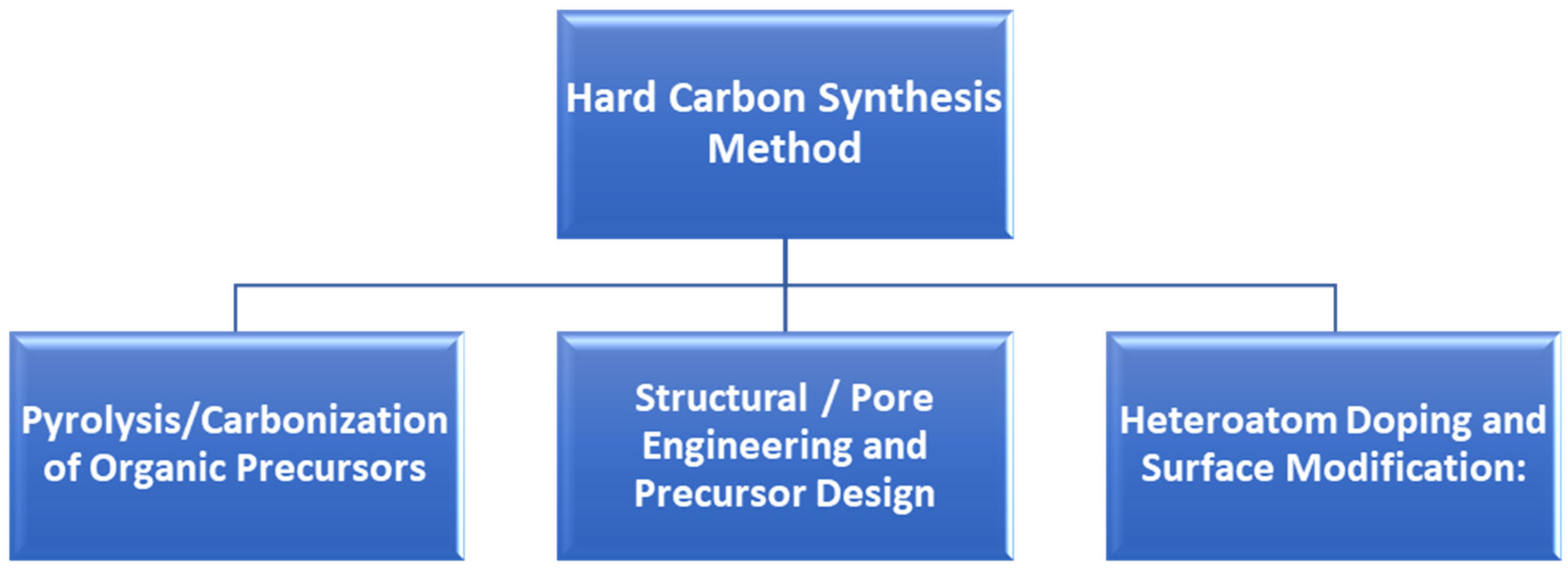
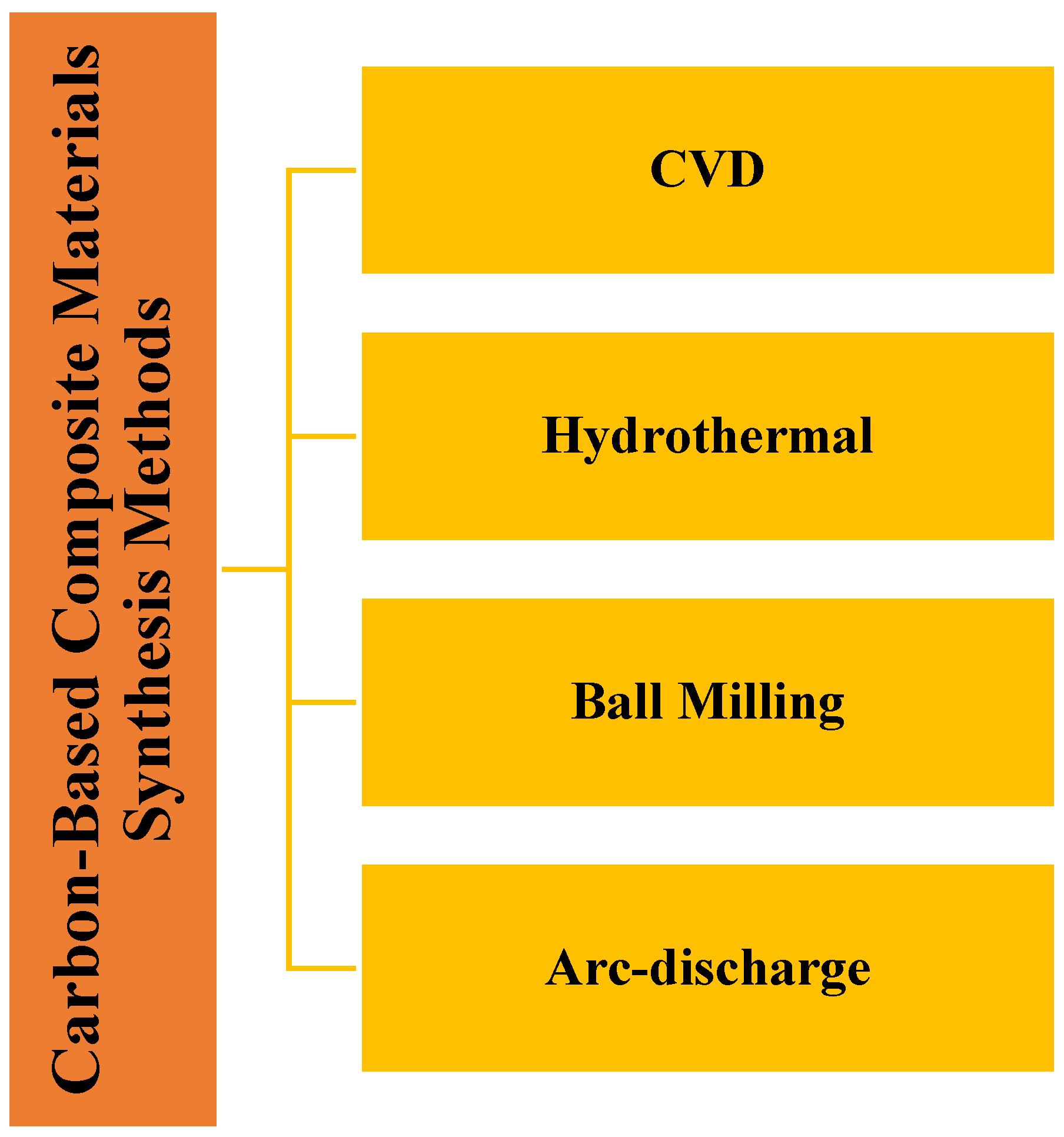
A schematic is presented in Figure 6, showing different methods that have been used to prepare hard carbon.

7.1.1. Pyrolysis/Carbonization of Organic Precursors

Thermal carbonization of organic precursors in inert or oxygen-deficient environments is the most frequent method of producing hard carbon, which cannot be graphitized even at high temperatures. For instance, heating biomass, polymers, or tiny organic molecules to high temperatures (such as 900–1500 °C) produces hard carbon with a disordered carbon framework that has flaws and closed pores that improve ion-storage capacity. Hard carbon is one of the most attractive anode materials for SIB because of its plentiful supplies and advantageous low-voltage performance, as Tan et al. noted [156]. Hard carbon materials are superior to other anode electrode materials for SIB due to their high capacity, low cost, and low operating voltage [156,157].
Hard carbon is a carbon-based substance that can be made from a variety of precursors, including asphalt, biomass, and resin. At temperatures between 250 and 500 °C , the precursor’s carbon atoms are catalyzed, cracked, and reorganized, first establishing the carbon layer structure and then progressively ordered in the heat treatment process that follows, ultimately forming hard carbon [158,159]. Hard carbon’s structure and characteristics are directly impacted by the carbonization process’s parameters. Two significant factors that influence the structure and characteristics of hard carbon are the temperature and heating rate of the carbonization process. In order to produce bioderived hard carbon, Dahbi et al. [160] carbonized argan shells at various temperatures (800, 1000, 1200, and 1300 °C).
The findings demonstrated that the carbon layer spacing inside hard carbon decreased as the carbonization temperature increased (from 0.4 nm at 800 °C to 0.388 nm at 1300 °C). Both the material’s specific surface area (from 99 m2/g at 800 °C to 2.6 m2/g at 1300 °C) and the integrated intensity ratio (ID/IG) of the D band to the G band in the Raman spectrum (from 2.66 at 1300 °C to 2.06 at 800 °C) continue to decline, indicating a decrease in defect content. According to the electrochemical test, hard carbon produced by carbonization at 1300 °C performs the best, with an ICE of 83.9% at 25 mA/g and a specific capacity of 300 mAh/g. In order to create sucrose-based hard carbon microspheres, Xiao et al. [161] used a hydrothermally treated sucrose precursor and heated it to 1300 °C at various speeds (0.5, 1, 2, and 5 °C/min). It was discovered that the ICE of hard carbon could be improved by lowering the heating rate, which also had a slight increase in capacity.
The conventional carbonization process uses a lot of energy and takes a long time. Zhen et al. [162] used a novel and effective approach. The pre-carbonized carbon matrix was carbonized at a high temperature using a multifield controlled spark plasma sintering (SPS) technique. SPS uses an extremely quick heating rate (100–500 °C/min) to finish plasma sintering in less than a minute. Compared to conventional carbonization techniques, SPS-prepared hard carbon contains fewer flaws, less porosity, and less oxygen. In another study Guo et al. [163] prepared a bio mass hard carbon anode using the carbonization method with relatively lower heating rate. The synthesized anode displays a high ICE of 82.8% and exhibited decreased initial irreversible capacity loss. The initial charge capacity of 324.6 mAh/g and promising cycle stability with 90.0% capacity retention after 200 cycles at 50 mA/g was achieved.
This technique makes it possible to fine-tune pore structure, defect density, and interlayer spacing all of which are crucial for affecting Na+ or K+ insertion behavior. In reality, customized micropore/mesopore volumes, closed-pore architecture, and graphitic domain size can result from controlling the heating rate, final temperature, precursor type, and environment. For instance, Qin et al. report that after 200 cycles at 0.05 A/g, N, P co-doped hard carbons made from maize stover delivered discharge capacities close to ~300 mAh/g [164,165]. These findings highlight the need for ideal pyrolysis and carbonization conditions in order to produce hard carbon with a high reversible capacity.

7.1.2. Structural/Pore Engineering and Precursor Design

To maximize hard carbon performance, structural engineering and meticulous precursor design are frequently used in addition to straightforward carbonization. Hierarchical structures with better storage properties can be created by selecting a precursor (biomass vs. synthetic polymer), using templates or activation, and controlling the distribution of pore sizes and interlayer spacing. Tan et al., for example, point out that essential strategies to improve hard carbon performance include enhancing pore shape, heteroatom doping, and electrolyte design [156].
The precursor is carbonized to create hard carbon, which further reflects performance while retaining some of the precursor’s structural features. As a result, the performance can be managed through the design or screening of appropriate antecedents. Biomass-based precursors, polymer-based precursors, asphalt-based precursors, and coal-based precursors are the four primary groups of hard carbon precursors. Phenolic resin is a typical and highly pure precursor for polymers. By controlling the precursor’s functional group and degree of crosslinking, it can control the structure and dope with elements [166,167].
Maleic anhydride was used to cure epoxy phenolic resin, which was used as a precursor by Fan et al. [168]. The epoxy rings completely reacted with maleic anhydride, producing a large number of hydroxyl and ester functional groups, according to analysis using Fourier transform infrared (FTIR) spectroscopy.
Although polymer precursors have some advantages, their expensive cost limits their widespread application. Asphalt-based precursors, on the other hand, come from plentiful and reliable sources. Additionally, they yield more carbon than precursors made of biomass or resin. However, the hard carbon created by direct carbonization frequently performs less than ideal since asphalt tends to graphitize at high temperatures. Therefore, pretreatment procedures are frequently used prior to carbonization. Lu et al. [169], for instance, employed asphalt as the precursor and added a pre-oxidation step before carbonization. During this low-temperature pre-oxidation, adding functional groups containing oxygen improves the precursor’s crosslinking and prevents the asphalt from melting or undergoing ordered structural rearrangement during high-temperature carbonization.
It has been demonstrated that the capacity of the plateau region is significantly influenced by the pore structure of hard carbon [170]. When assessing ICE and total capacity of hard carbon materials, increasing the number of micropores in the material improves the plateau capacity [171]. Zhang et al. [172] found molecular sieve carbon as an anode material with superior sodium-storage performance for the first time by comparing the microporous architectures and sodium-storage behaviors of commercial activated carbon, molecular sieve carbon, and graphite.
They found that activated carbon with extremely high porosity behaved poorly when storing sodium. Its low ICE (22.1%) was caused by its wide pore apertures, which produced an unduly high specific surface area [172].
By thermally heating a freeze-dried combination of magnesium gluconate and glucose, Kamiyama et al. [173] improved the MgO templating technique to create porous hard carbon. Nanoscale MgO particles were consistently produced within the carbon matrix by a preliminary heat treatment at 600 °C. Reversible capacity was maximized by further acid leaching and high-temperature carbonization at 1500 °C, which further enhanced structural ordering while maintaining a high density of nanoscale micropores. In the first cycle at 25 mA/g, the resultant material showed an ICE of 88% and a reversible capacity of 478 mAh/g.
Yin et al. [174] used phenolic resin as the precursor and added nanoscale ZnO during the precursor synthesis stage, resulting in a one-step carbonization method that produced porous hard carbon. ZnO and carbon combine at high temperatures to produce gaseous zinc and carbon monoxide. Using glucose as the carbon precursor and bis(cyclopentadienyl)nickel as the coating carbon source, Cheng et al. [175] combined surface-coating and templating techniques. They also incorporated a silica template by hydrothermal pretreatment and liquid-phase processes. Following carbonization, the resultant porous carbon spheres coated with an ultrathin carbon layer exhibited high ICE.
Increasing the volume of closed pores and maximizing the mesopore-to-micropore ratio can improve sodium-ion storage’s low-voltage plateau capacity. To further improve electrochemical performance, pore engineering is often combined with heteroatom doping and surface functionalization. Ion migration can be accelerated by microstructural changes, as demonstrated by Yin et al. [176], and these effects can be efficiently adjusted by adding dopants to the carbon framework. When taken as a whole, these design approaches provide a thorough road map for creating hard carbons of the future.

7.1.3. Heteroatom Doping and Surface Modification

Hard carbon’s electrical structure, conductivity, and interlayer spacing can all be altered by heteroatom doping, which includes N, S, B, P, and other elements. These heteroatoms can typically be added during the carbonization process with the aid of precursors that contain specific elements, and occasionally even through post-synthetic processes including chemical vapor deposition, gas-phase doping, and solution immersion. For instance, Yin et al. showed that doping carbon materials with heteroatoms like N, S, and B effectively modifies microstructures and increases ionic migration rates [176].
According to Wang et al., P-doping hard carbon with phosphoric acid as a precursor boosted reversible capacity from 240.3 mAh/g to 359.9 mAh/g, increased interlayer gap, and promoted Na+ transport. In comparison to hard carbon without doping, the charge–discharge rate was discovered to be 0.05 C [177]. These findings suggest that the electrochemical performance and structural stability of hard carbon anode are directly impacted by careful dopant selection and doping concentration management. In order to improve rate performance in LIBs, SIBs, and KIBs, sulfur and boron dopants have also been investigated. Sulfur increases surface polarity, while boron increases electronic conductivity.

7.2. Hard Carbon-Based Anode for LIBs

Carbon-based materials are still among the most popular and dependable anode for LIBs, because they provide a good mix between stability, affordability, and electrochemical performance. This material has demonstrated exceptional cycling stability, improved low-temperature performance, and fast-charging capabilities [178,179]. Hard carbon is one of the most attractive candidates for high-energy LIB applications. Both intercalation and adsorption-based storage methods are supported by its unique microcrystalline structure, which has disordered graphene layers, nanopores, and a large number of defect sites. These structural benefits directly result in increased high-energy performance and better lithium storage capacity.
Hard carbon nevertheless confronts significant obstacles in its practical application, despite these advantages. Its commercial potential is still constrained by its high voltage hysteresis, significant irreversible capacity loss during the first cycle, and low ICE. Structural engineering, surface changes, improved precursors, and novel synthesis techniques have all been the focus of substantial research efforts over the last ten years to address these problems.
Hard carbon as an anode material for LIBs is thoroughly and currently examined. Xie et al. explained all the principles of lithium storage, classified various hard carbon kinds according to their microstructure and synthesis pathways, and identified the main obstacles that still need to be overcome. In order to provide insight into how hard carbons might develop to satisfy the requirements of next-generation, high-energy battery systems, possible solutions and new research avenues are also examined [178].

7.3. Hard Carbon-Based Anode for SIBs

According to Liu et al. [180], hard carbon stands out among the several anode possibilities for SIBs due to its great compatibility with current industrial manufacturing and economic advantages. Hard carbon’s unique microstructure is essential for improving its electrochemical behavior during Na+ storage [154,181]. Subsequent research has demonstrated that this intricate structural configuration enables hard carbon to attain a sodium-storage capacity considerably greater than that of graphite [182]. As a result, hard carbon has gained more attention as a potential anode material for SIBs [183]. A significant advancement in SIB creation was made when Dahn and his team showed that glucose-derived hard carbon could provide a reversible Na+ storage capacity of about 300 mAh/g [24]. Hard carbon has emerged as a top contender for upcoming commercial SIB anode in recent years [184].
When cycling at moderate current densities, the hard carbon anode in SIBs typically exhibit reversible capacities in the range of around 250–350 mAh/g. For example, He et al. claimed a capacity gain from 232 mAh/g to 307 mAh/g [185], although one performance benchmark reports ~305 mAh/g. Despite these successes, there are still issues, primarily related to the huge interior surface area and irreversible ion loss during SEI formation, which lead to low ICE and poor rate capability. However, the performance gap for commercial SIB deployment for hard carbon anode has gradually decreased with appropriate pore design, interface tuning, and structural control [186]. Current industrial-scale demonstrations are increasingly validating these improvements, highlighting the commercial readiness of hard carbon for SIBs.

7.4. Hard Carbon-Based Anode for KIBs

Hard carbon’s disordered structure and larger interlayer spacing make it suitable for accommodating larger ions such as K+ (~1.38 Å). Qiu et al., in their recent work, outline that hard carbon materials exhibit excellent rate performance and cycling stability in KIBs when appropriately modified [187].
Larger ions like K+ (~1.38°) can be accommodated by hard carbon due to its disordered structure and wider interlayer gap. When properly adapted, hard carbon materials show outstanding rate performance and cycling stability in KIBs, according to a recent study by Qiu et al. [187].
Since K+ shares similar physical and chemical characteristics with Li+ and Na+, hard carbon has also emerged as a promising candidate for potassium-ion storage. Early research on carbon-based anode for K+ was limited, largely due to concerns that the larger ionic radius of K+ would hinder effective accommodation within carbon structures [184]. This view shifted after a pivotal 2016 study by Jian et al., which demonstrated successful electrochemical intercalation of K+ in hard carbon, achieving a reversible capacity of 262 mAh/g along with impressive rate performance [184].
The structural engineering of hard carbon and the underlying mechanisms of K+ storage have been extensively studied as a result of this significant finding [188,189,190]. Current research continues to concentrate on creating better hard carbon materials for KIBs, as the complex microstructure of hard carbon offers new opportunities for accommodating K+ ions.
Although direct application of hard carbon in zinc-ion, magnesium-ion, or CIB systems is less developed, hard carbon’s architectural advantages make it an obvious choice for these new multivalent systems. When all of these factors are taken into account, hard carbon’s adaptability stems from its broad precursor selection, tunable microstructure, and tunability across various ion chemistries. As a result, it becomes one of the primary anode platforms for batteries of the future.

8. Heteroatom-Doped Carbon Materials as an Anode

As mentioned earlier, a variety of carbonaceous materials have been investigated for use as anode, including hard carbon, soft carbon, graphene, EG, etc. Among the various anode materials, hard carbon has garnered significant attention owing to its plentiful availability, stability, and non-toxic nature. Nevertheless, there is an agreement that hard carbon exhibits relatively subpar performance regarding its rate capability, reversible capacity, and ICE. To address these deficiencies, numerous investigations have concentrated on the development of distinctive architectures, such as micro-spherules, nanowires, nanofibers, and porous structures, or the incorporation of heteroatoms to enhance their electrochemical characteristics [191]. The concept of surface functional modification involves the introduction of functional groups through heteroatom doping, which enhances the electronic structure, micro-chemical environment, and surface characteristics of carbon materials [192,193]. Recent reports have focused on doped heteroatoms in carbon, primarily highlighting nitrogen, phosphorus, sulfur and boron as shown in Figure 7 [193].

8.1. Synthesis of Heteroatom-Doped Carbon-Based Materials

8.1.1. Pyrolysis Method

The heat-treatment (pyrolysis) process is a prevalent method utilized for the preparation of various N-containing carbon materials. It involves introducing nitrogen into carbonaceous structures such as graphite and graphene. One of the procedures for preparing nitrogen-doped carbon (NC) anode involves the pyrolysis of precursors containing both nitrogen and carbon. For instance, C10H14N2Na2O8·2H2O (ethylenediaminetetraacetic acid disodium salt dihydrate) [194] or C9H17NO5 (Vitamin B5) [10,195] is pyrolyzed under an argon atmosphere, with the final temperature ranging from 500 to 1000 °C for a duration of two hours. After pyrolysis, the resulting products are washed with 37% HCl to eliminate inorganic impurities and dried in a vacuum oven at 80 °C. Though the procedure is straightforward, it yields highly efficient NC materials suitable for use as anode.
Similarly, boron-containing precursors, such as B2O3 or H3BO3, can be directly incorporated into carbon precursors, followed by pyrolysis, to yield boron-doped carbonaceous materials [193]. Pitch coke and boron oxide powders are combined in the most straightforward method, which is then baked and heated in an argon environment before being ground up and sieved to produce boron-doped graphite [196].
The pyrolysis method also applies to the direct carbonization of sulfur-containing precursors, such as dodecylbenzene sulfonic acid or poly(3,4-ethylene dioxythiophene) (PEDOT), at high temperatures (700–850 °C), producing sulfur-doped carbon with varying sulfur contents (2–15 wt%) [26].
For phosphorus doping, a related pyrolysis approach can be applied using red phosphorus (RP) or phosphorus-organic compounds as precursors. P-doped GO can be prepared by mixing with triphenyl phosphate (TPP) in alcoholic solvent, drying in the vacuum condition and afterwards annealing in pure argon environment [197].

8.1.2. Carbonization of Mixed Precursors

This method involves combining carbon and heteroatom precursors prior to thermal treatment. For nitrogen-doped porous carbon (NPC), a mixture of sodium citrate and urea is calcined to form a porous structure with uniformly distributed nitrogen atoms.
For sulfur-doped carbon (SC), this approach is widely used due to its ability to achieve high sulfur contents (exceeding 20%). Jiang et al. [16] synthesized sulfur-doped disordered carbon (DC-S) by combining the small molecule 1,4,5,8-naphthalene tetramethylene anhydride (NTCDA) with sulfur powder at 500 °C, resulting in 26.91 wt% sulfur. Solid sulfur sources such as sodium dodecyl sulfate, thiourea, and phenyl disulfide have also been employed [198], although in solid-state mixing, if the interfacial contact is not enough it can cause non-uniform doping.
The choice of carbon precursor significantly affects the resulting structure and morphology. Precursors can include small organic molecules, polymers, and biomass sources such as scallion peel, garlic peel, elm samara, lotus leaf, and bagasse. Uniform doping depends upon more multiple factors such as, the interplay between precursor type, heteroatom source, mixture ratio, and carbonization conditions.

8.1.3. CVD Method

CVD is one of the most used methods for synthesizing heteroatom-doped carbon anode. It is extensively employed for the incorporation of nitrogen and boron into carbon materials. Its significance lies in the fact that it provides highly controlled incorporation of dopants in the carbon lattice and results in homogeneously distributed active sites and tunable electronic properties. CVD with optimized porosity enhance charge transport, cycling stability, and overall electrochemical performance.
N-doped graphene sheets and high-concentration nitrogen-doped carbon nanotubes (HN-CNTs) have been synthesized via ammonia-assisted or CVD-based methods [199,200]. Boron doping in atomic form is also commonly achieved via CVD using boron-containing alkanes or diborane (B2H6) diluted in Ar gas. The plasma arc torch variant employs acetylene and diborane (1% B2H6 in Ar) as precursors, allowing in situ doping during growth.

8.1.4. Electrospinning Method

Electrospinning represents one of the effective methods to prepare heteroatom-doped carbon materials as it enables precise fabrication of flexible nanofibers with homogenous distribution of dopants. This method leads to controlled diameter, composition, and morphology. After stabilization and carbonization, these dopants are integrated into the carbon framework, generating highly conductive and structurally stable carbon nanofibers. Electrospinning in polymer matrix is particularly used for phosphorus incorporation into carbon nanostructures. H3PO4 serves as a phosphorus source and is mixed into a polymer solution (e.g., polyacrylonitrile in N,N-dimethylformamide) to form a spinning solution. Electrospinning produces P-doped 1D macroporous nanofibers, which are subsequently stabilized through thermal treatment in an Ar atmosphere [191].
The high P–C binding energy, POx species generation, and oxygen sensitivity of phosphorus can restrict the doping efficiency in this approach by reducing the number of active sites accessible for ion storage [201,202].

8.1.5. Post-Doping Method

Post-doping techniques are used for heteroatom modification of pre-formed carbon structures, particularly for sulfur. This method generally modifies the surface or near-surface regions, causing small changes to the pore structure or morphology [198,203]. In practice, the process often starts with polymerization of thiophene or PEDOT, followed by incorporation of oxidants, dopants, or catalysts, and subsequent heat treatment to achieve stable heteroatom incorporation.
For phosphorus, a novel oxygen-free post-doping approach uses phosphorus trichloride (PCl3) and cyclohexane (C6H12) as phosphorus and carbon sources, respectively. By introducing these liquids as mixed gases through N2 bubbling, carbonization and in situ phosphorus doping are made possible at high temperatures, reaching ultrahigh phosphorus doping values of up to 30 wt% [201].

8.2. NC as Anode

A highly promising approach to enhance the utilization of non-graphitic carbonaceous materials as anode involves the incorporation of N heteroatoms within their structure. N is the most extensively studied heteroatom dopants [204] because N possesses certain advantages compared to other dopants [205]. The introduction of N into carbon materials is straightforward and manageable. Consequently, N can modify the characteristics of the carbon host material while preserving its fundamental structure [206]. Furthermore, N atoms modify the electron count within the structure. Simultaneously, the comparable size of C and N atoms means that the introduction of N does not cause a significant lattice mismatch in the host carbon material. Numerous studies have indicated that N incorporation into the structure of carbonaceous anode active materials improves the electrochemical performance of these anode, especially in terms of their specific capacity [207,208].
The synthesized NC materials were evaluated for their electrochemical behavior in LIBs and KIBs. For LIBs, the C-700 anode synthesized from C10H14N2Na2O8·2H2O at 700 °C demonstrated an initial discharge capacity of 936.9 mAh/g (at 0.5 C, within 0.02–2.5 V range) over 600 cycles. After 500 cycles, the C-700 electrode maintained a capacity of 246.4 mAh/g, corresponding to a retention of 26.3% [194].
In a similar test, the CN-700 electrode synthesized from Vitamin B5 (C9H17NO5) exhibited a reversible capacity of 1528 mAh/g after 50 cycles in a Li+ half-cell at a current density of 100 mA/g. Its rate performance showed 1300 mAh/g at 0.2 A/g and still retained 200 mAh/g at 30 A/g, indicating superior high-rate capability [195].
For KIBs, the NPC electrode derived from sodium citrate and urea achieved a capacity retention of 342.8 mAh/g after 500 cycles, corresponding to 90.9% of the capacity observed at the 21st cycle. It also delivered 419.7 mAh/g at 0.05 A/g and 185.0 mAh/g at 10.0 A/g, demonstrating excellent rate performance [209].
Moreover, N-doped graphene sheets used as LIB anode exhibited a specific lithium storage capacity of 608 mAh/g at 0.5 A/g, surpassing the 445 mAh/g capacity of pristine graphene [210]. In a separate investigation, HN-CNTs demonstrated a reversible specific capacity of 494 mAh/g, nearly double that of non-doped CNTs [199,200].
These studies show that nitrogen doping significantly increases the electrochemical performance of carbon-based anode in MIBs.

8.3. SC as Anode

Heteroatom doping is a prevalent method for modifying the physicochemical characteristics of carbon materials. Nitrogen doping is acknowledged as an excellent method to enhance the ion storage capabilities of carbon. In comparison to NC, SC seems to be more appropriate as an anode for SIBs due to greater covalent radius of sulfur (102 pm) relative to carbon (77 pm) and nitrogen (75 pm). The incorporation of sulfur atoms may substantially increase the interlayer spacing in carbon, hence enhancing the insertion and extraction of Na+ ions and other larger metal ions [26].
To evaluate the electrochemical properties of the synthesized SC, the working electrode was prepared by coating a slurry composed of the SC mixture, polyvinylidene fluoride (PVDF) as a binder, and super P or conductive carbon. The cast electrode was dried in a vacuum oven at 70–80 °C [211].
SC anode have been investigated mainly in SIBs and KIBs as alternatives to LIBs to mitigate the challenges associated with lithium scarcity. Since Na+ and K+ ions are larger than Li+ ions, SC anode are particularly advantageous because the larger sulfur atoms help expand the interlayer distance, facilitating ion transport.
The long-term cycling performance of SC was evaluated at a current density of 0.5 A/g in SIBs. The reversible capacity reached 384.5 mAh/g in the initial cycle and stabilized at 322.0 mAh/g by the 10th cycle. Even after 700 cycles, a capacity of 303.2 mAh/g was maintained, corresponding to a capacity retention of 94.2%. These results confirm that the increased interlayer spacing in SC ensures structural stability during repeated Na+ adsorption/desorption processes [26]. Table 1 shows the performance of SIBs with different precursors when utilized for the fabrication of SC as anode.

8.4. Boron-Doped Carbon (BC) as an Anode

The incorporation of Boron into carbonaceous materials is garnering interest for various MIBs such as K, Na, and Ca, including Li as well. Boron doping has been explored to mitigate the restricted specific capacity of 372 mAh/g and subpar rate performance of graphite [212,213].
In addition to graphite, reduced GO and amorphous carbon exhibit inadequate cycling stability and constrained specific capacity, primarily due to the significant volume change induced by substantial metal-ion intercalation. To address this issue, loosely packed nanosheets with increased interlayer spacing are designed to effectively manage significant volume changes and mitigate the structural instability faced by bulk materials [214] as discussed earlier. Furthermore, the introduction of point defects, edges, grain boundaries, and doping is essential for improving the electrochemical performance of graphene. Controllable doping of graphene has been accomplished with atomic precision, demonstrating favorable thermodynamic properties [215]. Owing to the comparable atomic sizes of boron and carbon along with the electron-deficiency characteristics of boron doping, both 3D BC structures [216,217,218] and B-doped graphene [215,219,220] have been extensively investigated as anode materials for LIBs and SIBs, demonstrating significant capacity and excellent cycling stability. The utilization of the potential of B-doped graphene as an anode material for KIBs is currently under investigation [212].
For LIBs, the galvanostatic charge and discharge profiles of the plasma carbon and BC electrodes during the first and second cycles, within a voltage range of 0.0–2.0 V (vs. Li/Li+) at a current density of 100 mA/g, were studied to evaluate the effect of boron doping.
In the initial discharge process of the plasma carbon electrode, two distinct voltage plateaus were observed at approximately 0.8 V and 0.2 V. The initial plateau signifies the breakdown of the electrolyte at the anode surface, resulting in the formation of a SEI layer [221,222]. The second plateau, noted at approximately 0.2 V, is ascribed to the intercalation of lithium within the plasma carbon.
Whereas the BC electrodes exhibit an additional plateau near ~1.6 V, likely resulting from the formation of boron–carbon bonds induced by the boron doping process. Furthermore, the increase in charge capacity was observed using BC electrodes, which is attributed to the improved Li-ion intercalation within the graphitic layer due to the presence of boron [212].

8.5. PC as an Anode

As stated before, N doping and S doping are the most extensively studied heteroatoms to develop doped carbon as anode, since they facilitate the adsorption of metal ion and provide many active sites for salt storage, resulting in improved capacity [201,223]. However, the elevated discharge voltage associated with the high average oxidation voltage of nitrogen-related functional groups or reactive sulfur dopants is concerning [224,225]. To address this limitation of N and S doping, P doping has been investigated. P doping enhanced adsorption capacity, and it aids to achieve low discharge voltage (<1.0 V) [226,227,228]. The stated average potential of P in LIBs is quite high (≈0.8 V against Li/Li+), and its substantial specific capacity (2590 mA h/g) may offset this deficiency. In SIBs, phosphorus has the greatest theoretical specific capacity (2590 mA h/g) for all anode materials and a very low working potential (≈0.3 V against Na/Na+), highlighting its superiority [229,230]. Moreover, P has abundant reserves, which makes it economical, with minor pollution potential [231,232]. Consequently, P-based anode materials have significant promise in AIBs and have garnered considerable interest from researchers [229].
Phosphorus doping has been employed to enhance interlayer spacing and active site density. The electrochemical performance of graphene-based phosphorus-doped carbon (GPC) was evaluated as an anode for SIBs as presented in Figure 8 [197].
In contrast, the ultrahigh phosphorus-doped carbon (UPC) anode, tested for SIBs, demonstrated superior electrochemical characteristics as presented in Figure 9 [201]. The introduction of high phosphorus content and the formation of P–(C3) bonds significantly increased the interlayer spacing of the carbon lattice. This structural modification enhanced Na+ and K+ adsorption energy, created more active sites for ion storage, and improved both capacity and rate capability. Consequently, the UPC anode provided an exceptionally high reversible capacity, excellent long-cycle performance, and remarkable rate potential, outperforming GPC and P-doped CNF electrodes [197,201]. These findings make UPC one of the most promising phosphorus-based anode materials for multivalent ion batteries since they demonstrate the critical role that substantial phosphorus doping plays in enhancing ion intercalation kinetics and electrode stability.

9. Carbon-Based Composite Materials as an Anode for MIBs

Carbon-based composite materials have gained significant attention as anode candidates for MIBs owing to their ability to integrate the structural advantages of carbon with the functional properties of secondary components such as metals, metal oxides, sulfides, and, phosphides [233,234,235,236]. By combining carbon’s high electrical conductivity, mechanical resilience, and flexible architectures with the high theoretical capacities of active guest materials, these composites effectively address limitations such as sluggish ion diffusion, poor cycling stability, and large volume expansion commonly observed in MIB anode [237,238]. Moreover, carbon matrices including graphene, CNTs, amorphous carbon, and porous carbon frameworks serve as conductive networks that enhance charge transport and buffer structural strain during repeated cycling. Tailoring the composition, morphology, and interfacial chemistry of these composites enables improved ion accessibility, faster charge-transfer kinetics, and enhanced electrode integrity across various MIB (e.g., Li, Na, and Ca-ion batteries). As a result, carbon-based composites represent a versatile and highly tunable class of anode materials with strong potential for advancing high-performance next-generation MIB technologies.

9.1. Synthesis of Carbon-Based Composite Materials

Carbon-based composite materials can be synthesized through a range of established methods, including (i) CVD, (ii) hydrothermal techniques, (iii) ball milling, and (iv) arc-discharge approaches, as shown in the schematic below (Figure 10). These diverse methods enable precise control over composition, morphology, and interfacial structures, allowing the resulting composites to be tailored for high-performance MIB applications.

9.1.1. CVD Method

Researchers have extensively explored CVD synthesis for carbon-based composite materials such as silicon-carbon. In CVD process, gaseous precursors are introduced into a tube furnace, where they thermally decompose to generate reactive atomic or molecular species that subsequently deposit onto a substrate surface. This technique is widely used to synthesize graphite-like carbon coatings, carbon-coated silicon, and carbon nanotubes, owing to its precise control over film thickness, uniformity, and composition. CVD can also be employed to deposit silicon using precursors such as SiH4 or SiHCl3, enabling the fabrication of composite structures tailored for high-performance MIB anode [239]. Jin et al. [240] prepared core–shell structure of Si/C composite via CVD, and showed outstanding electrochemical performance; the composition delivers a high initial capacity (1971 mAh/g), good coulombic efficiency (67.1%), and retains 1441 mAh/g after 100 cycles. The Si/C composite provides a flexible, conductive network that buffers silicon’s volume changes and reduces side reactions, resulting in improved cycling stability and rate capability. Ko and co-workers [241] produced silicon–graphite–carbon (SGC) hybrid anode are engineered with ultrathin Si nanolayers uniformly deposited within the carbon matrix using CVD process, enabling controlled lithiation despite the large volume expansion of Si. In situ TEM studies reveal that these nanolayers lithiate with linear kinetics both in open voids and between graphite sheets, where the lower compressive strength of graphite allows Si to expand with minimal mechanical constraint. This structural synergy maintains electrical integrity, suppresses cracking, and ensures efficient Li transport. As a result, CVD-derived SGC hybrids achieve high volumetric energy density (~1043 Wh/L), rapid stabilization of Coulombic efficiency, and excellent cycling stability highlighting their strong potential for next-generation high-energy LIBs.

9.1.2. Hydrothermal Method

Hydrothermal synthesis has been widely employed to fabricate diverse carbon-based composite materials, including carbon–metal oxide, carbon–metalloid, silicon–carbon, etc. This method has emerged as a highly effective route for producing carbon-based composite materials due to its simplicity, scalability, and ability to precisely tailor structural and chemical features by controlling temperature, pressure, and reaction duration. Using water as a high-temperature, high-pressure solvent, this technique enables the formation of diverse composites for applications in energy storage. It has been successfully applied to fabricate nanostructures such as carbon nanotube/iron oxide hybrids, highlighting its versatility in engineering advanced carbon-based composites [242].
Huyan et al. [243] synthesized carboxyl modification tubular carbon nanofibers and MnO2 composites (CMTCFs@MNS) through acidification and hydrothermal methods, showed excellent LIB anode performance. Vertically grown δ-MnO2 nanosheets enhanced ion transport and accommodated volume changes, while CMTCFs ensured electron conductivity and structural stability. Irregular λ-MnO2 nanoparticles further improved electron transport and lithium storage, making CMTCFs@MNS a promising high-performance electrode material. Similarly, Cao et al. [244] reported dually coated C@SnO2@C hollow nanospheres, featuring a double carbon shell that effectively buffers SnO2 volume expansion and enhances conductivity. As an LIB anode, they exhibit excellent cycling stability (78.7% retention over 300 cycles) and high-rate performance, with >400 mAh g−1 after 10,000 cycles, highlighting this design as a promising strategy for electrodes prone to large volume changes.

9.1.3. Ball Milling Method

Ball milling is a versatile top-down technique for producing nanomaterials, including metallic, alloyed, multi-metallic, and ceramic composites. It provides a simple, cost-effective, and high-throughput approach, making it efficient for large-scale nanocomposite fabrication. Various types of ball mills exist, including those classified by mechanical energy, operating mode, or wettability, as well as advanced techniques such as plasma-assisted milling (P-milling), microwave-assisted ball milling, electrical discharge milling, magnetic field-induced ball milling, and ultrasonic milling [245,246,247,248,249,250,251]. Zhang et al. [252] developed SnSe/C nanocomposites using a simple, low-cost high-energy ball milling method using Sn powder, Se powder, and carbon black as precursors. The process successfully produced SnSe uniformly mixed with carbon black at the nanoscale (50–80 nm), with amorphous carbon serving as a buffering matrix. When employed as anode materials for LIBs and SIBs, the SnSe/C nanocomposite exhibited enhanced electrochemical performance, including high capacity, long-term cycling stability, and good rate capability. In SIBs, an initial capacity of 748.5 mAh/g was obtained, with 324.9 mAh/g maintained at a high current density of 500 mA/g after 200 cycles, corresponding to 72.5% retention of the second-cycle capacity (447.7 mAh/g). In LIBs, the nanocomposite delivered a high initial capacity of ~1097.6 mAh/g, which decreased to 633.1 mAh/g after 100 cycles at 500 mA/g. The improved performance is attributed to the uniform dispersion of active SnSe nanoparticles within the carbon matrix, which buffers volume changes and enhances electron/ion transport, highlighting the potential of SnSe/C composites as high-performance anode for both sodium and lithium storage.

9.1.4. Arc-Discharge Method

The arc discharge method enables the synthesis of carbon-based nanocomposites by generating a high-temperature electric arc between graphite electrodes in an inert or vacuum environment. This vaporizes the electrodes, forming nanostructures such as carbon nanotubes with embedded metal nanoparticles. While the method produces high-quality composites, it often generates mixed carbon forms that require post-synthesis purification. Charinpanitkul et al. [253] reported a single-step arc discharge synthesis of copper–carbon nanocomposites in liquid nitrogen, producing multi-shelled carbon nanocapsules (70–150 nm) with uniformly embedded copper nanoparticles. TEM and spectroscopic analyses confirmed the nanostructure, and partial oxidation resulted in cuprite formation. BET measurements indicated high specific surface areas, highlighting the effectiveness of this approach for metal–carbon nanocomposite fabrication. Similarly, Rivani et al. [254] synthesized Fe3O4/C and TiO2/Fe3O4/C nanocomposites via arc discharge in 50% ethanol. Vibrating Sample Magnetometer (VSM) analysis showed that TiO2/Fe3O4/C exhibited higher saturation magnetization than Fe3O4/C, likely due to stronger interactions of carbon with the TiO2 lattice, while both composites retained superparamagnetic behavior.

9.2. Carbon-Based Composite Anode for LIBs

Graphite, despite its widespread use and stable cycling performance, offers a limited theoretical capacity of 372 mAh/g, which is insufficient to meet the growing demand for high-energy-density LIBs. In contrast, high-capacity anode materials such as metal oxides, metals/metalloids, and metal phosphides/sulfides/nitrides (P, S, N) provide significantly greater lithium storage, which are 2–5 times larger than the graphite anode but suffer from severe volume expansion during cycling, leading to rapid capacity fading and structural degradation [234]. To overcome these limitations, extensive research has focused on integrating these high-capacity materials with carbon. Carbon-based composites effectively buffer volume changes, enhance electrical conductivity, and improve structural stability. As a result, these hybrid anode exhibit improved cycling stability, higher reversible capacity, and better rate capability, making them strong candidates for next-generation LIB anode [255,256,257]. Among different composite designs, embedding Si within conductive and mechanically robust matrices has proven particularly effective. Carbon materials are especially attractive in this regard, owing to their excellent electrical conductivity, mechanical strength, and minimal volume change during cycling [256]. A wide range of carbon forms, including graphite [258], expanded graphite [259], graphene [260], CNTs [261], and amorphous carbon [262], have been employed to create Si/carbon (Si/C) composites with diverse architectures such as core–shell, yolk–shell, honeycomb, sandwich structures, as well as morphologies like spheres, fibers, films, and 3D frameworks [263,264,265,266]. Notably, natural graphite is frequently utilized as a matrix in graphite/Si composites due to its superior conductivity, high ICE, and limited volume expansion. These elements improve the electrochemical and mechanical performance of Si anode. To date, common fabrication methods for graphite/Si composites include high-energy mechanical milling, liquid solidification, spray drying, and CVD [267,268]. Li et al. [269] developed a mesoporous Si@amorphous carbon/graphite (Si@C/G) composite through a combination of chemical etching, ball milling, and subsequent annealing process. The mesoporous Si obtained from acid-etched Al–Si alloy buffered volume expansion and promoted Li+ transport, while the combination with graphite and amorphous carbon improved electronic conductivity. The resulting anode delivered 907.9 mAh/g capacity with a coulombic efficiency of 78.4% and stable cycling over 150 cycles. Although mechanical milling is scalable and low-cost, it often damages particle surfaces, leading to side reactions. Furthermore, carbon-encapsulated structures have emerged as highly effective anode materials because the carbon shell provides a robust barrier against particle aggregation, while the inner nanostructure often created through acid etching accommodates volume changes during cycling. For example, SnO2/C composites demonstrate excellent lithium-storage capability, delivering a discharge capacity of 745.7 mAh/g at 0.1 A/g after 150 cycles, along with strong cycling stability. These results highlight the suitability of carbon-coated metal oxides and sulfides as high-performance LIB anode [270].
Similarly, encapsulating Fe3O4 within tubular mesoporous carbon produces a composite with enhanced conductivity and cycling durability. The carbon matrix not only buffers volume expansion elastically but also provides continuous, short pathways for rapid electron and ion transport while maintaining intimate contact with Fe3O4 nanoparticles. This optimized structure leads to outstanding electrochemical performance, including a reversible capacity of about 800 mAh/g at 2 A/g after 1000 cycles. Together, these examples underscore the effectiveness of nanostructured, carbon-coated metal oxide composites for next-generation LIB anode [271].

9.3. Carbon-Based Composite Anode for SIBs

Efforts to advance carbon-based anode for SIBs have increasingly centered on developing carbon-based composites, where carbon is combined with other functional materials to overcome the inherent limits of single-component electrodes [272,273]. This approach capitalizes on carbon’s excellent electrical conductivity, mechanical durability, thermal stability, and low cost, while addressing challenges such as limited theoretical capacity and sluggish ion transport [274]. By integrating materials with higher sodium-storage capability, these composites improve ion diffusion, enhance electronic pathways, and maintain structural integrity during cycling, resulting in higher capacity and better long-term stability [275].
Because of their low cost, ease of fabrication, and strong electrochemical performance, carbon-based composites have emerged as a key direction for developing practical SIB anode, especially for large-scale energy storage. Tailoring their composition, porosity, and nanoscale architecture can significantly boost energy density, extend cycle life, and improve safety [276,277]. As a result, the most effective SIB anode today are typically built on composite systems such as carbon–carbon, carbon–alloy, and carbon conversion types (including carbon–metal oxides and carbon–metal sulfides) which collectively offer promising routes toward high-performance SIBs [278]. Among them carbon-alloying is one of the important class of carbon-based composite which integrate with group IV or V elements with carbon matrices [279]. While alloy-type anode generally suffer from severe volume expansion upon Na+ insertion in SIBs, leading to electrode pulverization and poor cycling stability, coupling them with carbon significantly mitigates this issue [280]. For example, Zhu et al. [281] fabricated a carbon-alloy composites by electrodepositing a tin (Sn) thin film on a conductive wood fiber (Sn@WF), where the Sn@WF electrode maintained structural integrity after cycling. The soft wood fibers accommodate volume expansion during sodiation, while their mesoporous network acts as an electrolyte reservoir, enabling efficient ion transport along both inner and outer surfaces. These advantages are supported by experimental and computational results. The Sn@WF anode delivers stable cycling for 400 cycles with an initial capacity of 339 mAh/g, outperforming many reported Sn nanostructures. This demonstrates that low-cost wood fibers provide a promising platform for advanced SIB anode. Similarly, Nithya and Gopukumar [282] developed Sb–rGO nanosheet composites using GO (prepared via a modified Hummers method) and SbCl3 precursors, with NaBH4 as the reducing agent. Compared to pure Sb and rGO electrodes, the Sb–rGO composite exhibited enhanced electrochemical performance, achieving an ICE of 88% and a reversible capacity of 598 mAh/g at 131 mA/g after 50 cycles. The improved stability was attributed to the rGO matrix, which effectively buffered the volume changes of Sb nanoparticles during cycling. These results highlight the potential of carbon matrices as robust hosts to alleviate volume expansion in metal–carbon alloy composites, thereby improving their electrochemical performance.

9.4. Carbon-Based Composite Anode for KIBs

While carbon remains the most widely used anode material, theoretical studies indicate that several Group IVA and VA elements and their compounds could store significantly larger amounts of K+-ion storage. Their elevated specific capacities highlight their potential as next-generation anode materials for KIBs [283,284,285,286,287,288]. Although elements such as P and Si offer very high theoretical storage capacities, their inherently low electrical conductivity severely restricts their practical performance in KIBs [289,290]. As a result, bringing alloy-type anode into real-world KIBs remains challenging. One of the most persistent issues is their rapid loss of capacity during cycling. This degradation is largely driven by slow reaction kinetics caused by the disappearance of short diffusion pathways and by structural pulverization of the active material due to dramatic volume changes [291]. Because K+- is considerably larger than Li+ or Na+, the mechanical strain generated during repeated potassiation and depotassiation is much more intense. This makes it difficult for the electrode to maintain structural integrity and electrical continuity, leading to accelerated capacity decay and poor long-term stability. During cycling, fresh alloy surfaces continuously emerge and react with the electrolyte, leading to repeated SEI formation. This ongoing SEI regeneration restricts charge transfer and consumes active ions, ultimately accelerating performance degradation. As a result, the inherently low ICE caused by the instability and constant reconstruction of the SEI remains a major challenge for KIB alloy anode. To overcome these fundamental limitations, substantial research efforts have focused on redesigning alloy-based electrodes, and notable improvements have been realized. A widely adopted approach involves integrating alloy materials into highly conductive carbon scaffolds such as graphite, porous carbons, or hard carbon. These carbon hosts provide mechanical cushioning for large volume changes, shorten ion-diffusion paths, and improve electronic conductivity, collectively mitigating rapid capacity loss. By coupling high-capacity alloy materials with resilient carbon matrices, researchers have developed carbon–alloy composite anode that show significantly enhanced structural stability and electrochemical performance in KIBs. For example, Sultana and colleagues [291] were the first to develop a Sn–C composite anode via ball milling 70 wt% Sn powder with 30 wt% graphite. The resulting material features Sn nanoparticles uniformly dispersed within an amorphous carbon matrix. Electrochemical evaluation demonstrated that the Sn–C composite functions efficiently as a negative electrode for KIBs, operating within a voltage range of 2.00–0.01 V vs. K/K+ and achieving a reversible capacity of around 150 mAh/g. XRD measurements showed that crystalline phases form during potassiation and partially disappear during depotassiation, indicating that alloying and dealloying reactions occur within the Sn component. These results broaden the scope of materials suitable for KIB anode and suggest that further investigation of potassium-alloying electrode materials is warranted. Similar to Sn, antimony (Sb) is well known for its alloying behavior with Li and Na, and it can form K3Sb when alloyed with potassium in KIBs. However, Sb undergoes a large volume expansion of approximately 407%, leading to rapid capacity decay. To address these issues, Han et al. [292] developed Sb nanoparticles confined within a honeycomb-like 3D carbon framework (3D SbNPs@C) using a straightforward freeze-drying method followed by carbothermic reduction, representing its first use as a KIB anode. The robust confinement of Sb nanoparticles within the carbon network stabilizes the electrode during repeated potassiation and depotassiation cycles. Moreover, the conductive carbon matrix improves electron transport and accommodates volume expansion, maintaining the structural integrity of the electrode. In comparison to commercial Sb, the 3D SbNPs@C anode delivers a high reversible capacity of approximately 478 mAh/g at 200 mA/g and excellent rate performance of ~288 mAh/g at 1000 mA/g. Mechanistic investigations show a two-step alloying process, forming an intermediate KxSb phase before converting to the final K3Sb phase during cycling. This strategy demonstrates an effective approach for designing alloy-carbon composite anode, offering potential for high-performance KIBs.

10. Summary and Future Prospects

Carbon-based materials have emerged as versatile and high-performance anode for MIBs, offering an exceptional balance of electrical conductivity, structural tunability, cost-effectiveness, and electrochemical stability. Their diverse allotropes, ranging from graphite and graphene to nanotubes, nanofibers, and porous frameworks, allow tailored ion storage and transport properties that address the limitations of other anode materials, such as Si, alloy-type, and transition-metal oxide electrodes.
Furthermore, chemical modifications, including heteroatom doping and hybridization, expand the functionality of carbon materials, enabling enhanced capacity, faster ion diffusion, and broader compatibility with various metal-ion chemistries, including Li, Na, K, and Ca. Despite these advantages, challenges remain in achieving higher specific capacities, optimizing ion transport in complex carbon structures, and developing scalable, cost-effective synthesis routes. Looking forward, the integration of artificial intelligence (AI), machine learning (ML), and advanced computational simulations with experimental strategies promises to accelerate the rational design of carbon anode (Figure 11).
These approaches can predict optimal structures, guide targeted doping, and improve understanding of ion–carbon interactions at multiple scales. Combined with sustainable synthesis techniques, such as biomass-derived carbons and 3D printing, these strategies will enable the production of environmentally friendly, high-performance anode tailored for next-generation energy storage applications.
In summary, carbon-based anode are poised to remain at the forefront of MIB research and development. Their inherent versatility, coupled with advances in computational design and green fabrication, offers a promising path toward high-capacity, long-lasting, and commercially viable batteries, paving the way for sustainable energy storage solutions that can meet the growing global demand.
Despite substantial progress in developing carbon-based anode for MIBs, several challenges remain, such as limited specific capacities compared to alloy or conversion-type materials, sluggish ion diffusion in certain carbon structures, and issues with large-scale, cost-effective synthesis. To overcome these limitations, future research should focus on rational design strategies, advanced fabrication techniques, and predictive modeling approaches.
One of the most promising directions lies in the integration of AI and ML with computational simulations. Traditional trial-and-error experimental methods are time-consuming and resource-intensive. By contrast, AI-driven algorithms can screen vast chemical and structural spaces to identify optimal carbon architectures (e.g., biomass-derived, hard carbon, or heteroatom-doped frameworks) with desirable electrochemical properties. For instance, ML models trained on large datasets can rapidly predict parameters such as ion adsorption energies, diffusion barriers, and electronic conductivity, enabling accelerated material discovery.
Additionally, first-principles simulations (e.g., density functional theory) and molecular dynamics (MD) studies provide atomistic insights into ion–carbon interactions, charge transfer processes, and structural stability during cycling. Coupling these simulations with AI-based optimization can help design carbon matrices that minimize volume expansion, enhance ion mobility, and improve long-term durability. Emerging methods like high-throughput computational screening and automated materials informatics will likely guide the synthesis of novel doped or hybridized carbon systems tailored for specific metal ions (Li+, Na+, K+, and Ca2+).
Moreover, multi-scale modeling approaches bridging atomic, mesoscopic, and device levels will play a critical role in linking fundamental material properties with practical battery performance metrics such as energy density, rate capability, and cycle life. Integration of such computational insights with experimental validation will accelerate the development of carbon-based anode optimized for diverse applications, from portable electronics to large-scale grid storage.
In parallel, scalable and sustainable synthesis routes, such as biomass-derived carbons, 3D printing, and plasma-assisted methods, are expected to gain momentum. Combining these eco-friendly fabrication methods with computationally guided design will pave the way toward low-cost, high-performance, and environmentally benign anode.
In conclusion, the future of carbon-based anode for MIBs lies in a synergistic approach: leveraging advances in AI, computational modeling, and green synthesis to design next-generation anode with superior capacity, stability, and scalability. Such efforts will be pivotal in addressing the growing global energy demand and advancing the commercialization of sustainable energy storage technologies.

Funding

Author acknowledge the funding by ASGC NASA grant (Award No.: 80NSSC20M0106).

Data Availability Statement

No new data were created or analyzed in this study.

Conflicts of Interest

The authors declare no conflict of interest.

References

  1. Amiri, N.; Yacoubi, M.; Messouli, M. Population projections, food consumption, and agricultural production are used to optimize agriculture under climatic constraints. In Intelligent Solutions for Optimizing Agriculture and Tackling Climate Change: Current and Future Dimensions; IGI Global: Hershey, PA, USA, 2023; pp. 169–192. [Google Scholar]
  2. Shafiee, S.; Topal, E. When will fossil fuel reserves be diminished? Energy Policy 2009, 37, 181–189. [Google Scholar] [CrossRef]
  3. Archer, D.; Eby, M.; Brovkin, V.; Ridgwell, A.; Cao, L.; Mikolajewicz, U.; Caldeira, K.; Matsumoto, K.; Munhoven, G.; Montenegro, A.; et al. Atmospheric Lifetime of Fossil Fuel Carbon Dioxide. Annu. Rev. Earth Planet. Sci. 2009, 37, 117–134. [Google Scholar] [CrossRef]
  4. Lamb, W.F.; Wiedmann, T.; Pongratz, J.; Andrew, R.; Crippa, M.; Olivier, J.G.J.; Wiedenhofer, D.; Mattioli, G.; Al Khourdajie, A.; House, J.; et al. A review of trends and drivers of greenhouse gas emissions by sector from 1990 to 2018. Environ. Res. Lett. 2021, 16, 073005. [Google Scholar] [CrossRef]
  5. Hu, C.G.; Xiao, Y.; Zou, Y.Q.; Dai, L.M. Carbon-Based Metal-Free Electrocatalysis for Energy Conversion, Energy Storage, and Environmental Protection. Electrochem. Energy Rev. 2018, 1, 84–112, Correction in Electrochem. Energy Rev. 2018, 1, 238. [Google Scholar] [CrossRef]
  6. Ellabban, O.; Abu-Rub, H.; Blaabjerg, F. Renewable energy resources: Current status, future prospects and their enabling technology. Renew. Sustain. Energy Rev. 2014, 39, 748–764. [Google Scholar] [CrossRef]
  7. Winter, M.; Brodd, R.J. What are batteries, fuel cells, and supercapacitors? Chem. Rev. 2004, 104, 4245–4270. [Google Scholar] [CrossRef]
  8. Zhao, G.W.; Li, W.C.; Ju, M.H.; Liu, Y.; Rao, Q.Q.; Zhou, K.; Ai, F.R. Nitrogen-Rich Multilayered Porous Carbon for an Efficient and Stable Anode. J. Electron. Mater. 2021, 50, 1002–1009. [Google Scholar] [CrossRef]
  9. Yang, L.; Xi, G. Preparation and electrochemical performance of LiNi1/3Co1/3Mn1/3O2 cathode materials for lithium-ion batteries from spent mixed alkaline batteries. J. Electron. Mater. 2016, 45, 301–306. [Google Scholar] [CrossRef]
  10. Zhang, J.; Zheng, C.; Li, L.; Xia, Y.; Huang, H.; Gan, Y.; Liang, C.; He, X.; Tao, X.; Zhang, W. Unraveling the intra and intercycle interfacial evolution of Li6PS5Cl-based all-solid-state lithium batteries. Adv. Energy Mater. 2020, 10, 1903311. [Google Scholar] [CrossRef]
  11. Jin, Y.; Zhu, B.; Lu, Z.; Liu, N.; Zhu, J. Challenges and recent progress in the development of Si anode for lithium-ion battery. Adv. Energy Mater. 2017, 7, 1700715. [Google Scholar] [CrossRef]
  12. Gopinadh, S.V.; Phanendra, P.V.R.L.; Anoopkumar, V.; John, B.; Mercy, T.D. Progress, challenges, and perspectives on alloy-based anode materials for lithium ion battery: A mini-review. Energy Fuels 2024, 38, 17253–17277. [Google Scholar] [CrossRef]
  13. Zhao, Y.; Li, X.; Yan, B.; Xiong, D.; Li, D.; Lawes, S.; Sun, X. Recent developments and understanding of novel mixed transition-metal oxides as anode in lithium ion batteries. Adv. Energy Mater. 2016, 6, 1502175. [Google Scholar] [CrossRef]
  14. Xiao, J.; Han, J.; Zhang, C.; Ling, G.; Kang, F.; Yang, Q.H. Dimensionality, function and performance of carbon materials in energy storage devices. Adv. Energy Mater. 2022, 12, 2100775. [Google Scholar] [CrossRef]
  15. Huang, H.; Shi, H.; Das, P.; Qin, J.; Li, Y.; Wang, X.; Su, F.; Wen, P.; Li, S.; Lu, P. The chemistry and promising applications of graphene and porous graphene materials. Adv. Funct. Mater. 2020, 30, 1909035. [Google Scholar] [CrossRef]
  16. Sun, Z.; Fang, S.; Hu, Y.H. 3D graphene materials: From understanding to design and synthesis control. Chem. Rev. 2020, 120, 10336–10453. [Google Scholar] [CrossRef] [PubMed]
  17. Sarkar, S.; Roy, S.; Hou, Y.; Sun, S.; Zhang, J.; Zhao, Y. Recent progress in amorphous carbon-based materials for anode of sodium-ion batteries: Synthesis strategies, mechanisms, and performance. ChemSusChem 2021, 14, 3693–3723. [Google Scholar] [CrossRef] [PubMed]
  18. Wang, H.; Shao, Y.; Mei, S.; Lu, Y.; Zhang, M.; Sun, J.-k.; Matyjaszewski, K.; Antonietti, M.; Yuan, J. Polymer-derived heteroatom-doped porous carbon materials. Chem. Rev. 2020, 120, 9363–9419. [Google Scholar] [CrossRef] [PubMed]
  19. Hu, C.; Dai, L. Doping of carbon materials for metal-free electrocatalysis. Adv. Mater. 2019, 31, 1804672. [Google Scholar] [CrossRef]
  20. Zhu, Y.Y.; Wang, Y.H.; Wang, Y.T.; Xu, T.J.; Chang, P. Research progress on carbon materials as negative electrodes in sodium-and potassium-ion batteries. Carbon Energy 2022, 4, 1182–1213. [Google Scholar] [CrossRef]
  21. Abramova, E.N.; Bobyleva, Z.V.; Drozhzhin, O.A.; Abakumov, A.M.; Antipov, E.V. Hard carbon as anode material for metal-ion batteries. Russ. Chem. Rev. 2024, 93, RCR5100. [Google Scholar] [CrossRef]
  22. Gong, Y.; Xue, Y.-H. Carbon nanomaterials for stabilizing zinc anode in zinc-ion batteries. New Carbon Mater. 2023, 38, 438–454. [Google Scholar] [CrossRef]
  23. Zou, G.; Hou, H.; Foster, C.W.; Banks, C.E.; Guo, T.; Jiang, Y.; Zhang, Y.; Ji, X. Advanced Hierarchical Vesicular Carbon Co-Doped with S, P, N for High-Rate Sodium Storage. Adv. Sci. 2018, 5, 1800241. [Google Scholar] [CrossRef]
  24. Stevens, D.; Dahn, J. High capacity anode materials for rechargeable sodium-ion batteries. J. Electrochem. Soc. 2000, 147, 1271. [Google Scholar] [CrossRef]
  25. Wang, G.; Yu, M.; Feng, X. Carbon materials for ion-intercalation involved rechargeable battery technologies. Chem. Soc. Rev. 2021, 50, 2388–2443. [Google Scholar] [CrossRef]
  26. Qie, L.; Chen, W.; Xiong, X.; Hu, C.; Zou, F.; Hu, P.; Huang, Y. Sulfur-doped carbon with enlarged interlayer distance as a high-performance anode material for sodium-ion batteries. Adv. Sci. 2015, 2, 1500195. [Google Scholar] [CrossRef]
  27. Wen, Y.; He, K.; Zhu, Y.; Han, F.; Xu, Y.; Matsuda, I.; Ishii, Y.; Cumings, J.; Wang, C. Expanded graphite as superior anode for sodium-ion batteries. Nat. Commun. 2014, 5, 4033. [Google Scholar] [CrossRef]
  28. Yoshino, A.; Sanechika, K.; Nakajima, T. Secondary Battery. U.S. Patent 4,668,595, 26 May 1987. [Google Scholar]
  29. Li, Y.; Lu, Y.; Adelhelm, P.; Titirici, M.-M.; Hu, Y.-S. Intercalation chemistry of graphite: Alkali metal ions and beyond. Chem. Soc. Rev. 2019, 48, 4655–4687. [Google Scholar] [CrossRef] [PubMed]
  30. Aurbach, D.; Markovsky, B.; Shechter, A.; Ein-Eli, Y.; Cohen, H. A comparative study of synthetic graphite and Li electrodes in electrolyte solutions based on ethylene carbonate-dimethyl carbonate mixtures. J. Electrochem. Soc. 1996, 143, 3809. [Google Scholar] [CrossRef]
  31. Bhattacharyya, S.; Subramanyam, S. Properties, and Applications. In Electrical and Optical Polymer Systems: Fundamentals: Methods, and Application; CRC Press: Boca Raton, FL, USA, 1998; p. 201. [Google Scholar]
  32. Tian, L.; Zhuang, Q.; Li, J.; Shi, Y.; Chen, J.; Lu, F.; Sun, S. Mechanism of intercalation and deintercalation of lithium ions in graphene nanosheets. Chin. Sci. Bull. 2011, 56, 3204–3212. [Google Scholar] [CrossRef]
  33. Chen, S.; Qiu, L.; Cheng, H.-M. Carbon-based fibers for advanced electrochemical energy storage devices. Chem. Rev. 2020, 120, 2811–2878. [Google Scholar] [CrossRef]
  34. Kothandam, G.; Singh, G.; Guan, X.; Lee, J.M.; Ramadass, K.; Joseph, S.; Benzigar, M.; Karakoti, A.; Yi, J.; Kumar, P. Recent advances in carbon-based electrodes for energy storage and conversion. Adv. Sci. 2023, 10, 2301045. [Google Scholar] [CrossRef]
  35. Xu, J.; Dou, Y.; Wei, Z.; Ma, J.; Deng, Y.; Li, Y.; Liu, H.; Dou, S. Recent progress in graphite intercalation compounds for rechargeable metal (Li, Na, K, Al)-ion batteries. Adv. Sci. 2017, 4, 1700146. [Google Scholar] [CrossRef] [PubMed]
  36. Luo, P.; Zheng, C.; He, J.; Tu, X.; Sun, W.; Pan, H.; Zhou, Y.; Rui, X.; Zhang, B.; Huang, K. Structural engineering in graphite-based metal-ion batteries. Adv. Funct. Mater. 2022, 32, 2107277. [Google Scholar] [CrossRef]
  37. Deng, T.; Zhou, X. The preparation of porous graphite and its application in lithium ion batteries as anode material. J. Solid State Electrochem. 2016, 20, 2613–2618. [Google Scholar] [CrossRef]
  38. Li, Z.; Peng, K.; Ji, N.; Zhang, W.; Tian, W.; Gao, Z. Advanced mechanisms and applications of microwave-assisted synthesis of carbon-based materials: A brief review. Nanoscale Adv. 2025, 7, 419–432. [Google Scholar] [CrossRef] [PubMed]
  39. Amini, A.; Latifi, M.; Chaouki, J. Electrification of materials processing via microwave irradiation: A review of mechanism and applications. Appl. Therm. Eng. 2021, 193, 117003. [Google Scholar] [CrossRef]
  40. Krawczyk, P.; Gurzęda, B.; Bachar, A.; Buchwald, T. Formation of a N2O5—Graphite intercalation compound by ozone treatment of natural graphite. Green Chem. 2020, 22, 5463–5469. [Google Scholar] [CrossRef]
  41. Gopalakrishnan, V.; Sundararajan, A.; Omprakash, P.; Panemangalore, D.B. Energy Storage through Graphite Intercalation Compounds. J. Electrochem. Soc. 2021, 168, 040541. [Google Scholar] [CrossRef]
  42. Kumar, R.; Sahoo, S.; Joanni, E.; Singh, R.K.; Kar, K.K. Microwave as a tool for synthesis of carbon-based electrodes for energy storage. ACS Appl. Mater. Interfaces 2021, 14, 20306–20325. [Google Scholar] [CrossRef]
  43. Wang, Z.; Yu, C.; Huang, H.; Guo, W.; Zhao, C.; Ren, W.; Xie, Y.; Qiu, J. Energy accumulation enabling fast synthesis of intercalated graphite and operando decoupling for lithium storage. Adv. Funct. Mater. 2021, 31, 2009801. [Google Scholar] [CrossRef]
  44. Priecel, P.; Lopez-Sanchez, J.A. Advantages and limitations of microwave reactors: From chemical synthesis to the catalytic valorization of biobased chemicals. ACS Sustain. Chem. Eng. 2018, 7, 3–21. [Google Scholar] [CrossRef]
  45. Sumdani, M.; Islam, M.; Yahaya, A.; Safie, S. Recent advances of the graphite exfoliation processes and structural modification of graphene: A review. J. Nanopart. Res. 2021, 23, 253. [Google Scholar] [CrossRef]
  46. Sengupta, R.; Bhattacharya, M.; Bandyopadhyay, S.; Bhowmick, A.K. A review on the mechanical and electrical properties of graphite and modified graphite reinforced polymer composites. Prog. Polym. Sci. 2011, 36, 638–670. [Google Scholar] [CrossRef]
  47. Viculis, L.M.; Mack, J.J.; Mayer, O.M.; Hahn, H.T.; Kaner, R.B. Intercalation and exfoliation routes to graphite nanoplatelets. J. Mater. Chem. 2005, 15, 974–978. [Google Scholar] [CrossRef]
  48. Xu, M.; Xing, L.; Zhang, Q.; Pu, J. Ultrasonic-assisted method of graphite preparation from wheat straw. Bioresources 2017, 12, 6405–6417. [Google Scholar] [CrossRef]
  49. Mendoza-Duarte, J.; Robles-Hernández, F.C.; Gomez-Esparza, C.D.; Miranda-Hernández, J.G.; Garay-Reyes, C.G.; Estrada-Guel, I.; Martínez-Sánchez, R. Exfoliated graphite preparation based on an eco-friendly mechanochemical route. J. Environ. Chem. Eng. 2020, 8, 104370. [Google Scholar] [CrossRef]
  50. Ahmed, M.; Ahmed, H.; Adebayo, P.; Carter, R.; Khanal, L. Mechanical properties and application of graphite and graphite-based nanocomposite: A review. Chem. Mater. Res. 2023, 15, 10–32. [Google Scholar]
  51. Cravotto, G.; Cintas, P. Sonication-assisted fabrication and post-synthetic modifications of graphene-like materials. Chem. A Eur. J. 2010, 16, 5246–5259. [Google Scholar] [CrossRef]
  52. Zhao, N.; Wang, J.; Ding, Y.; Li, Y. Energy consumption calculation and energy-saving measures of substation based on Multi-objective artificial bee colony algorithm. Int. J. Emerg. Electr. Power Syst. 2024, 25, 25–34. [Google Scholar] [CrossRef]
  53. Perevalov, Y.; Kozulina, T.; Yermekova, M.; Demidovich, V. Digital Shadow Induction Furnace for Heating Carbon Fibers. In Proceedings of the 2021 IEEE Conference of Russian Young Researchers in Electrical and Electronic Engineering (ElConRus), St. Petersburg, Russia, 26–29 January 2021; pp. 1027–1031. [Google Scholar]
  54. Shen, H.; Yao, Z.; Shi, Y.; Hu, J. Study on temperature field induced in high frequency induction heating. Acta Metall. Sin. (Engl. Lett.) 2006, 19, 190–196. [Google Scholar] [CrossRef]
  55. Mueller, A.; Ziegler, K.; Amsharov, K.Y.; Jansen, M. In Situ Synthesis of Chlorinated Fullerenes by the High-Frequency Furnace Method; Wiley Online Library: Hoboken, NJ, USA, 2011. [Google Scholar]
  56. Li, Z.; Zhao, B.; Liu, P.; Zhao, B.; Chen, D.; Zhang, Y. Synthesis of high-quality single-walled carbon nanotubes by high-frequency-induction heating. Phys. E Low-Dimens. Syst. Nanostruct. 2008, 40, 452–456. [Google Scholar] [CrossRef]
  57. Zahid, M.; Abuzairi, T. Sustainable graphene production: Flash joule heating utilizing pencil graphite precursors. Nanomaterials 2024, 14, 1289. [Google Scholar] [CrossRef]
  58. Liu, Y.; Liu, Q.; Gu, J.; Kang, D.; Zhou, F.; Zhang, W.; Wu, Y.; Zhang, D. Highly porous graphitic materials prepared by catalytic graphitization. Carbon 2013, 64, 132–140. [Google Scholar] [CrossRef]
  59. Li, R.; Zhang, Y.; Chu, X.; Gan, L.; Li, J.; Li, B.; Du, H. Design and Numerical Study of Induction-Heating Graphitization Furnace Based on Graphene Coils. Appl. Sci. 2024, 14, 2528. [Google Scholar] [CrossRef]
  60. Adham, K.; Bowes, G. Natural graphite purification through chlorination in fluidized bed reactor. In Proceedings of the Extraction 2018: First Global Conference on Extractive Metallurgy, Ottawa, ON, Canada, 26–29 August 2018; Springer: Berlin/Heidelberg, Germany, 2018. [Google Scholar]
  61. Chen, D.; Feng, H.; Li, J. Graphene oxide: Preparation, functionalization, and electrochemical applications. Chem. Rev. 2012, 112, 6027–6053. [Google Scholar] [CrossRef] [PubMed]
  62. Chen, X.; Qu, Z.; Liu, Z.; Ren, G. Mechanism of oxidization of graphite to graphene oxide by the hummers method. ACS Omega 2022, 7, 23503–23510. [Google Scholar] [CrossRef] [PubMed]
  63. Silva, W.C.H.; Zafar, M.A.; Allende, S.; Jacob, M.V.; Tuladhar, R. Sustainable synthesis of graphene oxide from waste sources: A comprehensive review of methods and applications. Mater. Circ. Econ. 2024, 6, 23. [Google Scholar] [CrossRef]
  64. Bannov, A.; Manakhov, A.; Shibaev, A.; Ukhina, A.; Polčák, J.; Maksimovskii, E. Synthesis dynamics of graphite oxide. Thermochim. Acta 2018, 663, 165–175. [Google Scholar] [CrossRef]
  65. Inagaki, M.; Iwashita, N.; Kouno, E. Potential change with intercalation of sulfuric acid into graphite by chemical oxidation. Carbon 1990, 28, 49–55. [Google Scholar] [CrossRef]
  66. Lavin-Lopez, M.d.P.; Romero, A.; Garrido, J.; Sanchez-Silva, L.; Valverde, J.L. Influence of different improved hummers method modifications on the characteristics of graphite oxide in order to make a more easily scalable method. Ind. Eng. Chem. Res. 2016, 55, 12836–12847. [Google Scholar] [CrossRef]
  67. Kuanyshbekov, T.; Akatan, K.; Kabdrakhmanova, S.; Nemkaeva, R.; Aitzhanov, M.; Imasheva, A.; Kairatuly, E. Synthesis of Graphene Oxide from Graphite by the Hummers Method. Oxid. Commun. 2021, 44, 356. [Google Scholar]
  68. Yadav, N.; Lochab, B. A comparative study of graphene oxide: Hummers, intermediate and improved method. FlatChem 2019, 13, 40–49. [Google Scholar] [CrossRef]
  69. Bai, L.-Z.; Zhao, D.-L.; Zhang, T.-M.; Xie, W.-G.; Zhang, J.-M.; Shen, Z.-M. A comparative study of electrochemical performance of graphene sheets, expanded graphite and natural graphite as anode materials for lithium-ion batteries. Electrochim. Acta 2013, 107, 555–561. [Google Scholar] [CrossRef]
  70. Wang, F.; Yi, J.; Wang, Y.; Wang, C.; Wang, J.; Xia, Y. Graphite Intercalation Compounds (GICs): A New Type of Promising Anode Material for Lithium-Ion Batteries. Adv. Energy Mater. 2014, 4, 1300600. [Google Scholar] [CrossRef]
  71. Liu, Y.; Shi, H.; Wu, Z.-S. Recent status, key strategies and challenging perspectives of fast-charging graphite anode for lithium-ion batteries. Energy Environ. Sci. 2023, 16, 4834–4871. [Google Scholar] [CrossRef]
  72. Yang, C.; Zhang, X.; Li, J.; Ma, J.; Xu, L.; Yang, J.; Liu, S.; Fang, S.; Li, Y.; Sun, X. Holey graphite: A promising anode material with ultrahigh storage for lithium-ion battery. Electrochim. Acta 2020, 346, 136244. [Google Scholar] [CrossRef]
  73. Wang, Z.; Li, Y.; Zhou, Q.; Li, Q.; Zhao, R.; Qiu, Z.; Zhang, R.; Sun, Y.; Wu, F.; Wu, C. Multi-ion strategies toward advanced rechargeable batteries: Materials, properties, and prospects. Energy Mater. Adv. 2024, 5, 0109. [Google Scholar] [CrossRef]
  74. Yuan, F.; Wu, Z.; Li, Z.; Sun, Q.; Wang, Q.; Li, R.; Wang, W.; Zhang, D.; Wang, B. Decoupling KOH Activation Path to Construct Graphitic Porous Carbon Anode for Enhanced Potassium Ion Storage. Small 2025, 21, 2505910. [Google Scholar] [CrossRef]
  75. Tai, Z.; Zhang, Q.; Liu, Y.; Liu, H.; Dou, S. Activated carbon from the graphite with increased rate capability for the potassium ion battery. Carbon 2017, 123, 54–61. [Google Scholar] [CrossRef]
  76. Shim, J.-H.; Lee, S. Characterization of graphite etched with potassium hydroxide and its application in fast-rechargeable lithium ion batteries. J. Power Sources 2016, 324, 475–483. [Google Scholar] [CrossRef]
  77. Mendiboure, A.; Delmas, C.; Hagenmuller, P. Electrochemical intercalation and deintercalation of NaxMnO2 bronzes. J. Solid State Chem. 1985, 57, 323–331. [Google Scholar] [CrossRef]
  78. Ellis, B.L.; Nazar, L.F. Sodium and sodium-ion energy storage batteries. Curr. Opin. Solid State Mater. Sci. 2012, 16, 168–177. [Google Scholar] [CrossRef]
  79. Sun, Y.; Wu, Q.; Liang, X.; Xiang, H. Recent developments in carbon-based materials as high-rate anode for sodium ion batteries. Mater. Chem. Front. 2021, 5, 4089–4106. [Google Scholar] [CrossRef]
  80. Chayambuka, K.; Mulder, G.; Danilov, D.L.; Notten, P.H. From li-ion batteries toward Na-ion chemistries: Challenges and opportunities. Adv. Energy Mater. 2020, 10, 2001310. [Google Scholar] [CrossRef]
  81. Chen, J.; Chua, D.H.; Lee, P.S. The advances of metal sulfides and in situ characterization methods beyond Li ion batteries: Sodium, potassium, and aluminum ion batteries. Small Methods 2020, 4, 1900648. [Google Scholar] [CrossRef]
  82. Olsson, E.; Yu, J.; Zhang, H.; Cheng, H.M.; Cai, Q. Atomic-scale design of anode materials for alkali metal (Li/Na/K)-ion batteries: Progress and perspectives. Adv. Energy Mater. 2022, 12, 2200662. [Google Scholar] [CrossRef]
  83. Xu, J.; Dou, S.; Wang, Y.; Yuan, Q.; Deng, Y.; Chen, Y. Development of metal and metal-based composites anode materials for potassium-ion batteries. Trans. Tianjin Univ. 2021, 27, 248–268. [Google Scholar] [CrossRef]
  84. Nason, C.A.; Vijaya Kumar Saroja, A.P.; Lu, Y.; Wei, R.; Han, Y.; Xu, Y. Layered potassium titanium niobate/reduced graphene oxide nanocomposite as a potassium-ion battery anode. Nano-Micro Lett. 2024, 16, 1. [Google Scholar] [CrossRef]
  85. Zhou, J.; Liu, Y.; Zhang, S.; Zhou, T.; Guo, Z. Metal chalcogenides for potassium storage. InfoMat 2020, 2, 437–465. [Google Scholar] [CrossRef]
  86. Jin, J.; Schwingenschlögl, U. Exploration of the two-dimensional transition metal phosphide MoP2 as anode for Na/K ion batteries. npj 2D Mater. Appl. 2024, 8, 31. [Google Scholar] [CrossRef]
  87. Wu, X.; Chen, Y.; Xing, Z.; Lam, C.W.K.; Pang, S.S.; Zhang, W.; Ju, Z. Advanced carbon-based anode for potassium-ion batteries. Adv. Energy Mater. 2019, 9, 1900343. [Google Scholar] [CrossRef]
  88. Yu, J.; Jiang, M.; Zhang, W.; Li, G.; Soomro, R.A.; Sun, N.; Xu, B. Advancements and prospects of graphite anode for potassium-ion batteries. Small Methods 2023, 7, 2300708. [Google Scholar] [CrossRef]
  89. Zhang, L.; Wang, W.; Lu, S.; Xiang, Y. Carbon anode materials: A detailed comparison between Na-ion and K-ion batteries. Adv. Energy Mater. 2021, 11, 2003640. [Google Scholar] [CrossRef]
  90. Raghavan, P.; Das, A.; Jabeen Fatima, M.J. Advanced Technologies for Rechargeable Batteries: Metal Ion, Hybrid, and Metal-Air Batteries; CRC Press: Boca Raton, FL, USA, 2024. [Google Scholar]
  91. Cerrato, J.M.; Barrows, C.J.; Blue, L.Y.; Lezama-Pacheco, J.S.; Bargar, J.R.; Giammar, D.E. Effect of Ca2+ and Zn2+ on UO2 dissolution rates. Environ. Sci. Technol. 2012, 46, 2731–2737. [Google Scholar] [CrossRef]
  92. Aurbach, D.; Skaletsky, R.; Gofer, Y. The electrochemical behavior of calcium electrodes in a few organic electrolytes. J. Electrochem. Soc. 1991, 138, 3536. [Google Scholar] [CrossRef]
  93. Ponrouch, A.; Frontera, C.; Bardé, F.; Palacín, M.R. Towards a calcium-based rechargeable battery. Nat. Mater. 2016, 15, 169–172. [Google Scholar] [CrossRef] [PubMed]
  94. Wang, D.; Gao, X.; Chen, Y.; Jin, L.; Kuss, C.; Bruce, P.G. Plating and stripping calcium in an organic electrolyte. Nat. Mater. 2018, 17, 16–20. [Google Scholar] [CrossRef] [PubMed]
  95. Richard Prabakar, S.; Ikhe, A.B.; Park, W.B.; Chung, K.C.; Park, H.; Kim, K.J.; Ahn, D.; Kwak, J.S.; Sohn, K.S.; Pyo, M. Graphite as a long-life Ca2+-intercalation anode and its implementation for rocking-chair type calcium-ion batteries. Adv. Sci. 2019, 6, 1902129. [Google Scholar] [CrossRef]
  96. Iijima, S. Helical microtubules of graphitic carbon. Nature 1991, 354, 56–58. [Google Scholar] [CrossRef]
  97. Qiu, Z.; Cao, F.; Pan, G.X.; Lid, C.; Chen, M.H.; Zhang, Y.Q.; He, X.P.; Xia, Y.; Xia, X.H.; Zhang, W.K. Carbon materials for metal-ion batteries. Chemphysmater 2023, 2, 267–281. [Google Scholar] [CrossRef]
  98. Chen, Y.Q.; Kang, Y.Q.; Zhao, Y.; Wang, L.; Liu, J.L.; Li, Y.X.; Liang, Z.; He, X.M.; Li, X.; Tavajohi, N.; et al. A review of lithium-ion battery safety concerns: The issues, strategies, and testing standards. J. Energy Chem. 2021, 59, 83–99. [Google Scholar] [CrossRef]
  99. Tong, Z.; Lv, C.; Bai, G.D.; Yin, Z.W.; Zhou, Y.; Li, J.T. A review on applications and challenges of carbon nanotubes in lithium-ion battery. Carbon Energy 2025, 7, e643. [Google Scholar] [CrossRef]
  100. Landi, B.J.; Ganter, M.J.; Cress, C.D.; DiLeo, R.A.; Raffaelle, R.P. Carbon nanotubes for lithium ion batteries. Energy Environ. Sci. 2009, 2, 638–654. [Google Scholar] [CrossRef]
  101. Xie, X.; Kretschmer, K.; Zhang, J.; Sun, B.; Su, D.; Wang, G. Sn@ CNT nanopillars grown perpendicularly on carbon paper: A novel free-standing anode for sodium ion batteries. Nano Energy 2015, 13, 208–217. [Google Scholar] [CrossRef]
  102. Zeng, Y.; Zhang, X.; Qin, R.; Liu, X.; Fang, P.; Zheng, D.; Tong, Y.; Lu, X. Dendrite-free zinc deposition induced by multifunctional CNT frameworks for stable flexible Zn-ion batteries. Adv. Mater. 2019, 31, 1903675. [Google Scholar] [CrossRef] [PubMed]
  103. Khan, N.; Han, G.; Mazari, S.A. Carbon nanotubes-based anode materials for potassium ion batteries: A review. J. Electroanal. Chem. 2022, 907, 116051. [Google Scholar] [CrossRef]
  104. Szabó, A.; Perri, C.; Csató, A.; Giordano, G.; Vuono, D.; Nagy, J.B. Synthesis methods of carbon nanotubes and related materials. Materials 2010, 3, 3092–3140. [Google Scholar] [CrossRef]
  105. Journet, C.; Maser, W.K.; Bernier, P.; Loiseau, A.; de La Chapelle, M.L.; Lefrant, D.S.; Deniard, P.; Lee, R.; Fischer, J.E. Large-scale production of single-walled carbon nanotubes by the electric-arc technique. Nature 1997, 388, 756–758. [Google Scholar] [CrossRef]
  106. Guo, T.; Nikolaev, P.; Rinzler, A.G.; Tomanek, D.; Colbert, D.T.; Smalley, R.E. Self-assembly of tubular fullerenes. J. Phys. Chem. 1995, 99, 10694–10697. [Google Scholar] [CrossRef]
  107. Hafner, J.H.; Bronikowski, M.J.; Azamian, B.R.; Nikolaev, P.; Rinzler, A.G.; Colbert, D.T.; Smith, K.A.; Smalley, R.E. Catalytic growth of single-wall carbon nanotubes from metal particles. Chem. Phys. Lett. 1998, 296, 195–202. [Google Scholar] [CrossRef]
  108. Sinnott, S.B.; Andrews, R. Carbon nanotubes: Synthesis, properties, and applications. Crit. Rev. Solid State Mater. Sci. 2001, 26, 145–249. [Google Scholar] [CrossRef]
  109. José-Yacamán, M.; Miki-Yoshida, M.; Rendón, L.; Santiesteban, J.G. Catalytic growth of carbon microtubules with fullerene structure. Appl. Phys. Lett. 1993, 62, 657–659. [Google Scholar] [CrossRef]
  110. Teo, K.B.; Singh, C.; Chhowalla, M.; Milne, W.I. Catalytic synthesis of carbon nanotubes and nanofibers. Encycl. Nanosci. Nanotechnol. 2003, 10, 1–22. [Google Scholar]
  111. Journet, C.; Bernier, P. Production of carbon nanotubes. Appl. Phys. A Mater. Sci. Process. 1998, 67, 1–9. [Google Scholar] [CrossRef]
  112. Breczko, J.; Wysocka-Żołopa, M.; Grądzka, E.; Winkler, K. Zero-Dimensional carbon nanomaterials for electrochemical energy storage. ChemElectroChem 2024, 11, e202300752. [Google Scholar] [CrossRef]
  113. Brun, N.; Sakaushi, K.; Yu, L.; Giebeler, L.; Eckert, J.; Titirici, M.M. Hydrothermal carbon-based nanostructured hollow spheres as electrode materials for high-power lithium–sulfur batteries. Phys. Chem. Chem. Phys. 2013, 15, 6080–6087. [Google Scholar] [CrossRef] [PubMed]
  114. Gogotsi, Y.; Libera, J.A.; Yoshimura, M. Hydrothermal synthesis of multiwall carbon nanotubes. J. Mater. Res. 2000, 15, 2591–2594. [Google Scholar] [CrossRef]
  115. Gogotsi, Y.; Naguib, N.; Libera, J. In situ chemical experiments in carbon nanotubes. Chem. Phys. Lett. 2002, 365, 354–360. [Google Scholar] [CrossRef]
  116. Yahyazadeh, A.; Nanda, S.; Dalai, A.K. Carbon nanotubes: A review of synthesis methods and applications. Reactions 2024, 5, 429–451. [Google Scholar] [CrossRef]
  117. Baig, N.; Kammakakam, I.; Falath, W. Nanomaterials: A review of synthesis methods, properties, recent progress, and challenges. Mater. Adv. 2021, 2, 1821–1871. [Google Scholar] [CrossRef]
  118. Manafi, S.; Nadali, H.; Irani, H. Low temperature synthesis of multi-walled carbon nanotubes via a sonochemical/hydrothermal method. Mater. Lett. 2008, 62, 4175–4176. [Google Scholar] [CrossRef]
  119. Moreno, J.M.C.; Swamy, S.S.; Fujino, T.; Yoshimura, M. Carbon nanocells and nanotubes grown in hydrothermal fluids. Chem. Phys. Lett. 2000, 329, 317–322. [Google Scholar] [CrossRef]
  120. Stevens, M.G.; Subramoney, S.; Foley, H.C. Spontaneous formation of carbon nanotubes and polyhedra from cesium and amorphous carbon. Chem. Phys. Lett. 1998, 292, 352. [Google Scholar] [CrossRef]
  121. Hsu, W.; Hare, J.; Terrones, M.; Kroto, H.; Walton, D.; Harris, P. Condensed-phase nanotubes. Nature 1995, 377, 687. [Google Scholar] [CrossRef]
  122. Bai, J.; Hamon, A.-L.; Marraud, A.; Jouffrey, B.; Zymla, V. Synthesis of SWNTs and MWNTs by a molten salt (NaCl) method. Chem. Phys. Lett. 2002, 365, 184–188. [Google Scholar] [CrossRef]
  123. Zeng, Q.; Li, Z.; Zhou, Y. Synthesis and application of carbon nanotubes. J. Nat. Gas Chem. 2006, 15, 235–246. [Google Scholar] [CrossRef]
  124. Grobert, N. Carbon nanotubes–becoming clean. Mater. Today 2007, 10, 28–35. [Google Scholar] [CrossRef]
  125. Novoselova, I.; Oliinyk, N.; Volkov, S.; Konchits, A.; Yanchuk, I.; Yefanov, V.; Kolesnik, S.; Karpets, M. Electrolytic synthesis of carbon nanotubes from carbon dioxide in molten salts and their characterization. Phys. E Low-Dimens. Syst. Nanostruct. 2008, 40, 2231–2237. [Google Scholar] [CrossRef]
  126. Rusman, E.; Nulu, A.; Sohn, K.Y. N-doped CNT assisted GeO-Ge nanoparticles as a high-capacity and durable anode material for lithium-ion batteries. RSC Adv. 2025, 15, 28841–28852. [Google Scholar] [CrossRef]
  127. Liu, B.; Sun, X.L.; Liao, Z.Q.; Lu, X.Y.; Zhang, L.; Hao, G.P. Nitrogen and boron doped carbon layer coated multiwall carbon nanotubes as high performance anode materials for lithium ion batteries. Sci. Rep. 2021, 11, 5633. [Google Scholar] [CrossRef]
  128. Al-Samet, M.A.M.M.; Burgaz, E. Improving the lithium-ion diffusion and electrical conductivity of LiFePO4 cathode material by doping magnesium and multi-walled carbon nanotubes. J. Alloy Compd. 2023, 947, 169680. [Google Scholar] [CrossRef]
  129. Hoseini, S.A.; Mohajerzadeh, S.; Sanaee, Z. Flaky sputtered silicon MWCNTs core-shell structure as a freestanding binder-free electrode for lithium-ion battery. Sci. Rep. 2025, 15, 3733. [Google Scholar] [CrossRef]
  130. Zhong, Y.; Deng, K.; Zheng, J.; Zhang, T.T.; Liu, P.; Lv, X.B.; Tian, W.; Ji, J.Y. One-step growth of the interconnected carbon nanotubes/graphene hybrids from cuttlebone-derived bi-functional catalyst for lithium-ion batteries. J. Mater. Sci. Technol. 2023, 149, 205–213. [Google Scholar] [CrossRef]
  131. Doñoro, A.; Muñoz-Mauricio, A.; Etacheri, V. High-Performance Lithium Sulfur Batteries Based on Multidimensional Graphene-CNT-Nanosulfur Hybrid Cathodes. Batteries 2021, 7, 26. [Google Scholar] [CrossRef]
  132. Wang, C.; Wu, Y.; Gao, J.; Sun, X.L.; Zhao, Q.; Si, W.Y.; Zhang, Y.; Wang, K.; Zhao, F.H.; Ohsaka, T.; et al. Synergistic Defect Engineering and Interface Stability of Activated Carbon Nanotubes Enabling Ultralong Lifespan All-Solid-State Lithium-Sulfur Batteries. ACS Appl. Mater. Interfaces 2023, 15, 40496–40507. [Google Scholar] [CrossRef]
  133. Cai, Y.Z.; Chen, M.X.; Cheng, L.F.; Hu, Z.Y.; Guo, S.Y.; Yuan, Y.B.; Ren, S.X.; Yu, Z.X.; Chai, Y.L.; Huang, X. Multidimensional, Superflexible, and Binder-free CNT-rGO/Si Buckypaper as Anode for Lithium-Ion Batteries and Electrochemical Performance. ACS Appl. Energy Mater. 2024, 7, 9194–9206. [Google Scholar] [CrossRef]
  134. Chen, H.; Wang, C.; Fan, Z.; Hao, L.; Pan, L.J. Facile fabrication of binder-free carbon nanotube-carbon nanocoil hybrid films for anode of lithium-ion batteries. J. Solid State Electrochem. 2024, 28, 3325–3335. [Google Scholar] [CrossRef]
  135. Kim, J.S.; Baek, I.G.; Nyamaa, O.; Goo, K.M.; Uyanga, N.; Kim, K.S.; Nam, T.H.; Yang, J.H.; Noh, J.P. Flexible, binder-free, freestanding silicon/oxidized carbon nanotubes composite anode for lithium-ion batteries with enhanced electrochemical performance through chemical reduction. Mater. Sci. Eng. B 2025, 313, 117971. [Google Scholar] [CrossRef]
  136. Kim, J.H.; Kim, S.; Han, J.H.; Seo, S.B.; Choi, Y.R.; Lim, J.; Kim, Y.A. Perspective on carbon nanotubes as conducting agent in lithium-ion batteries: The status and future challenges. Carbon Lett. 2023, 33, 325–333. [Google Scholar] [CrossRef]
  137. Zhu, S.; Sheng, J.; Chen, Y.; Ni, J.F.; Li, Y. Carbon nanotubes for flexible batteries: Recent progress and future perspective. Natl. Sci. Rev. 2021, 8, nwaa261. [Google Scholar] [CrossRef]
  138. Bai, X.; Wu, N.N.; Yu, G.C.; Li, T. Recent Advances in Anode Materials for Sodium-Ion Batteries. Inorganics 2023, 11, 289. [Google Scholar] [CrossRef]
  139. Fan, H.; Huang, Z.; Zhang, S.Y.; Li, Z.Y.; Zhang, D.D.; Jiang, G.D.; Xiong, J.; Yuan, S.D. Co-oxidation GN/CNT 3D network enhances the cathode performance of NVPF@O-GN/CNT sodium-ion battery. Ionics 2025, 31, 10449–10460. [Google Scholar] [CrossRef]
  140. He, Y.; Chen, T.R.; Zettsu, N. Conductive 3D SW-/MW-CNTs hybrid frameworks for ultra-high-content Prussian white cathodes in sodium-ion batteries. Mater. Adv. 2025, 6, 6931–6943. [Google Scholar] [CrossRef]
  141. Huang, J.R.; Zhang, Z.H.; Chen, D.Q.; Yu, H.S.; Wu, Y.; Chen, Y.F. Spray-Drying Synthesis of Na4Fe3(PO4)2P2O7@CNT Cathode for Ultra-Stable and High-Rate Sodium-Ion Batteries. Molecules 2025, 30, 753. [Google Scholar] [CrossRef] [PubMed]
  142. Li, L.; Li, H.; Liu, L.X.; Yan, X.C.; Long, Y.Z.; Han, W.P. Amorphous FeO Anchored on N-Doped Graphene with Internal Micro-Channels as an Active and Durable Anode for Sodium-Ion Batteries. Nanomaterials 2024, 14, 937. [Google Scholar] [CrossRef]
  143. Liu, Z.G.; Lu, Z.Y.; Guo, S.H.; Yang, Q.H.; Zhou, H.S. Toward High Performance Anode for Sodium-Ion Batteries: From Hard Carbons to Anode-Free Systems. ACS Cent. Sci. 2023, 9, 1076–1087. [Google Scholar] [CrossRef]
  144. Jia, Q.X.; Li, Z.Y.; Ruan, H.L.; Luo, D.W.; Wang, J.J.; Ding, Z.Y.; Chen, L.N. A Review of Carbon Anode Materials for Sodium-Ion Batteries: Key Materials, Sodium-Storage Mechanisms, Applications, and Large-Scale Design Principles. Molecules 2024, 29, 4331. [Google Scholar] [CrossRef]
  145. Rehman, A.U.; Saleem, S.; Ali, S.; Abbas, S.M.; Choi, M.; Choi, W. Recent advances in alloying anode materials for sodium-ion batteries: Material design and prospects. Energy Mater. 2024, 4, 400068. [Google Scholar] [CrossRef]
  146. Jia, X.X.; Liu, C.F.; Neale, Z.G.; Yang, J.H.; Cao, G.Z. Active Materials for Aqueous Zinc Ion Batteries: Synthesis, Crystal Structure, Morphology, and Electrochemistry. Chem. Rev. 2020, 120, 7795–7866. [Google Scholar] [CrossRef] [PubMed]
  147. Wei, C.; Tao, Y.; Fei, H.; An, Y.; Tian, Y.; Feng, J.; Qian, Y. Recent advances and perspectives in stable and dendrite-free potassium metal anode. Energy Storage Mater. 2020, 30, 206–227. [Google Scholar] [CrossRef]
  148. Chen, D.M.; Huang, Z.Q.; Sun, S.Q.; Zhang, H.Y.; Wang, W.J.; Yu, G.X.; Chen, J. A Flexible Multi-Channel Hollow CNT/Carbon Nanofiber Composites with S/N Co-Doping for Sodium/Potassium Ion Energy Storage. ACS Appl. Mater. Interfaces 2021, 13, 44369–44378. [Google Scholar] [CrossRef]
  149. Yao, Y.; Qi, E.; Sun, M.Z.; Wei, Z.X.; Jiang, H.; Du, F. Unlocking the potential of potassium-ion batteries: Anode material mechanisms, challenges, and future directions. Nanoscale 2025, 17, 19021–19054. [Google Scholar] [CrossRef] [PubMed]
  150. Zhang, C.L.; Zhao, H.P.; Lei, Y. Recent Research Progress of Anode Materials for Potassium-ion Batteries. Energy Environ. Mater. 2020, 3, 105–120. [Google Scholar] [CrossRef]
  151. Yuan, F.; Li, Y.A.; Zhang, D.; Li, Z.J.; Wang, H.; Wang, B.; Wu, Y.S.; Wu, Y.M.A. A comprehensive review of carbon anode materials for potassium-ion batteries based on specific optimization strategies. Inorg. Chem. Front. 2023, 10, 2547–2573. [Google Scholar] [CrossRef]
  152. Wang, J.L.; Wang, H.W.; Zang, X.B.; Zhai, D.Y.; Kang, F.Y. Recent Advances in Stability of Carbon-Based Anode for Potassium-Ion Batteries. Batter. Supercaps 2021, 4, 554–570. [Google Scholar] [CrossRef]
  153. Thakur, A.K.; Ahmed, M.S.; Park, J.; Prabakaran, R.; Sidney, S.; Sathyamurthy, R.; Kim, S.C.; Periasamy, S.; Kim, J.; Hwang, J.Y. A review on carbon nanomaterials for K-ion battery anode: Progress and perspectives. Int. J. Energy Res. 2022, 46, 4033–4070. [Google Scholar] [CrossRef]
  154. Tang, Z.; Zhou, S.; Huang, Y.; Wang, H.; Zhang, R.; Wang, Q.; Sun, D.; Tang, Y.; Wang, H. Improving the initial coulombic efficiency of carbonaceous materials for Li/Na-ion batteries: Origins, solutions, and perspectives. Electrochem. Energy Rev. 2023, 6, 8. [Google Scholar] [CrossRef]
  155. Ma, X.; Ji, C.; Li, X.; Liu, Y.; Xiong, X. Red@ Black phosphorus core–shell heterostructure with superior air stability for high-rate and durable sodium-ion battery. Mater. Today 2022, 59, 36–45. [Google Scholar] [CrossRef]
  156. Tan, S.; Yang, H.; Zhang, Z.; Xu, X.; Xu, Y.; Zhou, J.; Zhou, X.; Pan, Z.; Rao, X.; Gu, Y. The progress of hard carbon as an anode material in sodium-ion batteries. Molecules 2023, 28, 3134. [Google Scholar] [CrossRef]
  157. Wang, K.; Jin, Y.; Sun, S.; Huang, Y.; Peng, J.; Luo, J.; Zhang, Q.; Qiu, Y.; Fang, C.; Han, J. Low-cost and high-performance hard carbon anode materials for sodium-ion batteries. ACS Omega 2017, 2, 1687–1695. [Google Scholar] [CrossRef]
  158. Wang, S.; Dai, G.; Yang, H.; Luo, Z. Lignocellulosic biomass pyrolysis mechanism: A state-of-the-art review. Progress Energy Combust. Sci. 2017, 62, 33–86. [Google Scholar] [CrossRef]
  159. Hu, B.; Zhang, B.; Xie, W.-l.; Jiang, X.-y.; Liu, J.; Lu, Q. Recent progress in quantum chemistry modeling on the pyrolysis mechanisms of lignocellulosic biomass. Energy Fuels 2020, 34, 10384–10440. [Google Scholar] [CrossRef]
  160. Dahbi, M.; Kiso, M.; Kubota, K.; Horiba, T.; Chafik, T.; Hida, K.; Matsuyama, T.; Komaba, S. Synthesis of hard carbon from argan shells for Na-ion batteries. J. Mater. Chem. A 2017, 5, 9917–9928. [Google Scholar] [CrossRef]
  161. Xiao, L.; Lu, H.; Fang, Y.; Sushko, M.L.; Cao, Y.; Ai, X.; Yang, H.; Liu, J. Low-defect and low-porosity hard carbon with high coulombic efficiency and high capacity for practical sodium ion battery anode. Adv. Energy Mater. 2018, 8, 1703238. [Google Scholar] [CrossRef]
  162. Zhen, Y.; Chen, Y.; Li, F.; Guo, Z.; Hong, Z.; Titirici, M.-M. Ultrafast synthesis of hard carbon anode for sodium-ion batteries. Proc. Natl. Acad. Sci. USA 2021, 118, e2111119118. [Google Scholar] [CrossRef] [PubMed]
  163. Guo, S.; Chen, Y.; Tong, L.; Cao, Y.; Jiao, H.; Qiu, X. Biomass hard carbon of high initial coulombic efficiency for sodium-ion batteries: Preparation and application. Electrochim. Acta 2022, 410, 140017. [Google Scholar] [CrossRef]
  164. Kitchamsetti, N.; Kim, K.-H.; Han, H.; Mhin, S. Biomass-Derived Hard Carbon Anode for Sodium-Ion Batteries: Recent Advances in Synthesis Strategies. Nanomaterials 2025, 15, 1554. [Google Scholar] [CrossRef] [PubMed]
  165. Qin, D.; Liu, Z.; Zhao, Y.; Xu, G.; Zhang, F.; Zhang, X. A sustainable route from corn stalks to N, P-dual doping carbon sheets toward high performance sodium-ion batteries anode. Carbon 2018, 130, 664–671. [Google Scholar] [CrossRef]
  166. Zhang, B.; Ghimbeu, C.M.; Laberty, C.; Vix-Guterl, C.; Tarascon, J.M. Correlation between microstructure and Na storage behavior in hard carbon. Adv. Energy Mater. 2016, 6, 1501588. [Google Scholar] [CrossRef]
  167. Zhang, X.; Dong, X.; Qiu, X.; Cao, Y.; Wang, C.; Wang, Y.; Xia, Y. Extended low-voltage plateau capacity of hard carbon spheres anode for sodium ion batteries. J. Power Sources 2020, 476, 228550. [Google Scholar] [CrossRef]
  168. Fan, C.; Zhang, R.; Luo, X.; Hu, Z.; Zhou, W.; Zhang, W.; Liu, J.; Liu, J. Epoxy phenol novolac resin: A novel precursor to construct high performance hard carbon anode toward enhanced sodium-ion batteries. Carbon 2023, 205, 353–364. [Google Scholar] [CrossRef]
  169. Lu, Y.; Zhao, C.; Qi, X.; Qi, Y.; Li, H.; Huang, X.; Chen, L.; Hu, Y.S. Pre-oxidation-tuned microstructures of carbon anode derived from pitch for enhancing Na storage performance. Adv. Energy Mater. 2018, 8, 1800108. [Google Scholar] [CrossRef]
  170. Chen, X.; Tian, J.; Li, P.; Fang, Y.; Fang, Y.; Liang, X.; Feng, J.; Dong, J.; Ai, X.; Yang, H. An overall understanding of sodium storage behaviors in hard carbons by an “adsorption-intercalation/filling” hybrid mechanism. Adv. Energy Mater. 2022, 12, 2200886. [Google Scholar] [CrossRef]
  171. Sun, H.; Zhang, Q.; Ma, Y.; Li, Z.; Zhang, D.; Sun, Q.; Wang, Q.; Liu, D.; Wang, B. Unraveling the mechanism of sodium storage in low potential region of hard carbons with different microstructures. Energy Storage Mater. 2024, 67, 103269. [Google Scholar] [CrossRef]
  172. Zhang, S.-W.; Lv, W.; Luo, C.; You, C.-H.; Zhang, J.; Pan, Z.-Z.; Kang, F.-Y.; Yang, Q.-H. Commercial carbon molecular sieves as a high performance anode for sodium-ion batteries. Energy Storage Mater. 2016, 3, 18–23. [Google Scholar] [CrossRef]
  173. Kamiyama, A.; Kubota, K.; Igarashi, D.; Youn, Y.; Tateyama, Y.; Ando, H.; Gotoh, K.; Komaba, S. MgO-template synthesis of extremely high capacity hard carbon for Na-ion battery. Angew. Chem. Int. Ed. 2021, 60, 5114–5120. [Google Scholar] [CrossRef]
  174. Yin, X.; Lu, Z.; Wang, J.; Feng, X.; Roy, S.; Liu, X.; Yang, Y.; Zhao, Y.; Zhang, J. Enabling fast Na+ transfer kinetics in the whole-voltage-region of hard-carbon anode for ultrahigh-rate sodium storage. Adv. Mater. 2022, 34, 2109282. [Google Scholar] [CrossRef] [PubMed]
  175. Cheng, D.; Li, Z.; Zhang, M.; Duan, Z.; Wang, J.; Wang, C. Engineering ultrathin carbon layer on porous hard carbon boosts sodium storage with high initial coulombic efficiency. ACS Nano 2023, 17, 19063–19075. [Google Scholar] [CrossRef]
  176. Yin, T.; Guo, Y.; Huang, X.; Yang, X.; Qin, L.; Ning, T.; Tan, L.; Li, L.; Zou, K. Heteroatom doping strategy of advanced carbon for alkali Metal-Ion capacitors. Batteries 2025, 11, 69. [Google Scholar] [CrossRef]
  177. Wang, H.; Liu, S.; Lei, C.; Qiu, H.; Jiang, W.; Sun, X.; Zhang, Y.; He, W. P-doped hard carbon material for anode of sodium ion battery was prepared by using polyphosphoric acid modified petroleum asphalt as precursor. Electrochim. Acta 2024, 477, 143812. [Google Scholar] [CrossRef]
  178. Xie, L.; Tang, C.; Bi, Z.; Song, M.; Fan, Y.; Yan, C.; Li, X.; Su, F.; Zhang, Q.; Chen, C. Hard carbon anode for next-generation Li-ion batteries: Review and perspective. Adv. Energy Mater. 2021, 11, 2101650. [Google Scholar] [CrossRef]
  179. Cao, W.; Zheng, J.; Adams, D.; Zheng, J.P. Comparative study of the power performance for advanced Li-ion capacitors with various carbon anode. ECS Trans. 2014, 61, 37. [Google Scholar] [CrossRef]
  180. Liu, L.; Tian, Y.; Abdussalam, A.; Gilani, M.R.H.S.; Zhang, W.; Xu, G. Hard carbons as anode in sodium-ion batteries: Sodium storage mechanism and optimization strategies. Molecules 2022, 27, 6516. [Google Scholar] [CrossRef] [PubMed]
  181. Bashir, T.; Zhou, S.; Yang, S.; Ismail, S.A.; Ali, T.; Wang, H.; Zhao, J.; Gao, L. Progress in 3D-MXene electrodes for lithium/sodium/potassium/magnesium/zinc/aluminum-ion batteries. Electrochem. Energy Rev. 2023, 6, 5. [Google Scholar] [CrossRef]
  182. Ge, P.; Fouletier, M. Electrochemical intercalation of sodium in graphite. Solid State Ion. 1988, 28, 1172–1175. [Google Scholar] [CrossRef]
  183. Vaalma, C.; Buchholz, D.; Weil, M.; Passerini, S. A cost and resource analysis of sodium-ion batteries. Nat. Rev. Mater. 2018, 3, 18013. [Google Scholar] [CrossRef]
  184. Chen, D.; Zhang, W.; Luo, K.; Song, Y.; Zhong, Y.; Liu, Y.; Wang, G.; Zhong, B.; Wu, Z.; Guo, X. Hard carbon for sodium storage: Mechanism and optimization strategies toward commercialization. Energy Environ. Sci. 2021, 14, 2244–2262. [Google Scholar] [CrossRef]
  185. Li, W.; Li, J.; Biney, B.W.; Yan, Y.; Lu, X.; Li, H.; Liu, H.; Xia, W.; Liu, D.; Chen, K. Innovative synthesis and sodium storage enhancement of closed-pore hard carbon for sodium-ion batteries. Energy Storage Mater. 2025, 74, 103867. [Google Scholar] [CrossRef]
  186. Lin, X.; Liu, Y.; Tan, H.; Zhang, B. Advanced lignin-derived hard carbon for Na-ion batteries and a comparison with Li and K ion storage. Carbon 2020, 157, 316–323. [Google Scholar] [CrossRef]
  187. Qiu, P.; Chen, H.; Zhang, H.; Wang, H.; Wang, L.; Guo, Y.; Qi, J.; Yi, Y.; Zhang, G. Hard Carbon as Anode for Potassium-Ion Batteries: Developments and Prospects. Inorganics 2024, 12, 302. [Google Scholar] [CrossRef]
  188. Kim, H.; Hyun, J.C.; Jung, J.I.; Lee, J.B.; Choi, J.; Cho, S.Y.; Jin, H.-J.; Yun, Y.S. Potassium-ion storage behavior of microstructure-engineered hard carbons. J. Mater. Chem. A 2022, 10, 2055–2063. [Google Scholar] [CrossRef]
  189. Zhong, L.; Zhang, W.; Sun, S.; Zhao, L.; Jian, W.; He, X.; Xing, Z.; Shi, Z.; Chen, Y.; Alshareef, H.N. Engineering of the crystalline lattice of hard carbon anode toward practical potassium-ion batteries. Adv. Funct. Mater. 2023, 33, 2211872. [Google Scholar] [CrossRef]
  190. Lei, H.; Li, J.; Zhang, X.; Ma, L.; Ji, Z.; Wang, Z.; Pan, L.; Tan, S.; Mai, W. A review of hard carbon anode: Rational design and advanced characterization in potassium ion batteries. InfoMat 2022, 4, e12272. [Google Scholar] [CrossRef]
  191. Wu, F.; Dong, R.Q.; Bai, Y.; Li, Y.; Chen, G.H.; Wang, Z.H.; Wu, C. Phosphorus-Doped Hard Carbon Nanofibers Prepared by Electrospinning as an Anode in Sodium-Ion Batteries. ACS Appl. Mater. Interfaces 2018, 10, 21335–21342. [Google Scholar] [CrossRef]
  192. Li, Y.; Chen, M.H.; Liu, B.; Zhang, Y.; Liang, X.Q.; Xia, X.H. Heteroatom Doping: An Effective Way to Boost Sodium Ion Storage. Adv. Energy Mater. 2020, 10, 2000927. [Google Scholar] [CrossRef]
  193. Chen, W.M.; Wan, M.; Liu, Q.; Xiong, X.Q.; Yu, F.Q.; Huang, Y.H. Heteroatom-Doped Carbon Materials: Synthesis, Mechanism, and Application for Sodium-Ion Batteries. Small Methods 2019, 3, 1800323. [Google Scholar] [CrossRef]
  194. Guo, W.; Li, X.; Xu, J.T.; Liu, H.K.; Ma, J.M.; Dou, S.X. Growth of Highly Nitrogen-Doped Amorphous Carbon for Lithium-ion Battery Anode. Electrochim. Acta 2016, 188, 414–420. [Google Scholar] [CrossRef]
  195. Wang, L.; Yang, C.L.; Dou, S.; Wang, S.Y.; Zhang, J.T.; Gao, X.; Ma, J.M.; Yu, Y. Nitrogen-doped hierarchically porous carbon networks: Synthesis and applications in lithium-ion battery, sodium-ion battery and zinc-air battery. Electrochim. Acta 2016, 219, 592–603. [Google Scholar] [CrossRef]
  196. Tanaka, U.; Sogabe, T.; Sakagoshi, H.; Ito, M.; Tojo, T. Anode property of boron-doped graphite materials for rechargeable lithium-ion batteries. Carbon 2001, 39, 931–936. [Google Scholar] [CrossRef]
  197. Ma, G.Y.; Xiang, Z.H.; Huang, K.S.; Ju, Z.C.; Zhuang, Q.C.; Cui, Y.H. Graphene-Based Phosphorus-Doped Carbon as Anode Material for High-Performance Sodium-Ion Batteries. Part. Part. Syst. Charact. 2017, 34, 1600315. [Google Scholar] [CrossRef]
  198. Xie, J.M.; Zhuang, R.; Du, Y.X.; Pei, Y.W.; Tan, D.M.; Xu, F. Advances in sulfur-doped carbon materials for use as anode in sodium-ion batteries. New Carbon Mater. 2023, 38, 305–316. [Google Scholar] [CrossRef]
  199. Li, X.F.; Liu, J.; Zhang, Y.; Li, Y.L.; Liu, H.; Meng, X.B.; Yang, J.L.; Geng, D.S.; Wang, D.N.; Li, R.Y.; et al. High concentration nitrogen doped carbon nanotube anode with superior Li storage performance for lithium rechargeable battery application. J. Power Sources 2012, 197, 238–245. [Google Scholar] [CrossRef]
  200. Shaker, M.; Ghazvini, A.A.S.; Shahalizade, T.; Gaho, M.A.; Mumtaz, A.; Javanmardi, S.; Riahifar, R.; Meng, X.M.; Jin, Z.; Ge, Q. A review of nitrogen-doped carbon materials for lithium-ion battery anode. New Carbon Mater. 2023, 38, 247–278. [Google Scholar] [CrossRef]
  201. Yan, J.; Li, H.M.; Wang, K.L.; Jin, Q.Z.; Lai, C.L.; Wang, R.X.; Cao, S.L.; Han, J.; Zhang, Z.C.; Su, J.Z.; et al. Ultrahigh Phosphorus Doping of Carbon for High-Rate Sodium Ion Batteries Anode. Adv. Energy Mater. 2021, 11, 2003911. [Google Scholar] [CrossRef]
  202. Bommier, C.; Mitlin, D.; Ji, X.L. Internal structure—Na storage mechanisms—Electrochemical performance relations in carbons. Prog. Mater. Sci. 2018, 97, 170–203. [Google Scholar] [CrossRef]
  203. Neff, T.; Hessdörfer, J.; Bilican, A.; Kolb, L.; Reinert, F.; Krueger, A. Superior sulfur-doped carbon anode for sodium-ion batteries through incorporation of onion-like carbon. Electrochim. Acta 2025, 537, 146912. [Google Scholar] [CrossRef]
  204. Wu, J.X.; Pan, Z.Y.; Zhang, Y.; Wang, B.J.; Peng, H.S. The recent progress of nitrogen-doped carbon nanomaterials for electrochemical batteries. J. Mater. Chem. A 2018, 6, 12932–12944. [Google Scholar] [CrossRef]
  205. Jeon, I.Y.; Noh, H.J.; Baek, J.B. Nitrogen-Doped Carbon Nanomaterials: Synthesis, Characteristics and Applications. Chem-Asian J. 2020, 15, 2282–2293. [Google Scholar] [CrossRef] [PubMed]
  206. Wei, D.C.; Liu, Y.Q.; Wang, Y.; Zhang, H.L.; Huang, L.P.; Yu, G. Synthesis of N-Doped Graphene by Chemical Vapor Deposition and Its Electrical Properties. Nano Lett. 2009, 9, 1752–1758. [Google Scholar] [CrossRef] [PubMed]
  207. Sun, Y.; Huang, F.Z.; Li, S.K.; Shen, Y.H.; Xie, A.J. Novel porous starfish-like Co O @nitrogen-doped carbon as an advanced anode for lithium-ion batteries. Nano Res. 2017, 10, 3457–3467. [Google Scholar] [CrossRef]
  208. Gomez-Martin, A.; Martinez-Fernandez, J.; Ruttert, M.; Winter, M.; Placke, T.; Ramirez-Rico, J. An electrochemical evaluation of nitrogen-doped carbons as anode for lithium ion batteries. Carbon 2020, 164, 261–271. [Google Scholar] [CrossRef]
  209. Li, D.P.; Ren, X.H.; Ai, Q.; Sun, Q.; Zhu, L.; Liu, Y.; Liang, Z.; Peng, R.Q.; Si, P.C.; Lou, J.; et al. Facile Fabrication of Nitrogen-Doped Porous Carbon as Superior Anode Material for Potassium-Ion Batteries. Adv. Energy Mater. 2018, 8, 1802386. [Google Scholar] [CrossRef]
  210. Cai, D.D.; Wang, S.Q.; Lian, P.C.; Zhu, X.F.; Li, D.D.; Yang, W.S.; Wang, H.H. Superhigh capacity and rate capability of high-level nitrogen-doped graphene sheets as anode materials for lithium-ion batteries. Electrochim. Acta 2013, 90, 492–497. [Google Scholar] [CrossRef]
  211. Ding, J.; Wang, H.; Li, Z.; Kohandehghan, A.; Cui, K.; Xu, Z.; Zahiri, B.; Tan, X.; Lotfabad, E.M.; Olsen, B.C. Carbon nanosheet frameworks derived from peat moss as high performance sodium ion battery anode. ACS Nano 2013, 7, 11004–11015. [Google Scholar] [CrossRef] [PubMed]
  212. Chae, Y.J.; Kim, S.O.; Lee, J.K. Employment of boron-doped carbon materials for the anode materials of lithium ion batteries. J. Alloy Compd. 2014, 582, 420–427. [Google Scholar] [CrossRef]
  213. Yoshio, M.; Wang, H.Y.; Fukuda, K.; Hara, Y.; Adachi, Y. Effect of carbon coating on electrochemical performance of treated natural graphite as lithium-ion battery anode material. J. Electrochem. Soc. 2000, 147, 1245–1250. [Google Scholar] [CrossRef]
  214. Su, J.C.; Pei, Y.; Yang, Z.H.; Wang, X.Y. Ab initio study of graphene-like monolayer molybdenum disulfide as a promising anode material for rechargeable sodium ion batteries. RSC Adv. 2014, 4, 43183–43188. [Google Scholar] [CrossRef]
  215. Zhou, L.J.; Hou, Z.F.; Gao, B.; Frauenheim, T. Doped graphenes as anode with large capacity for lithium-ion batteries. J. Mater. Chem. A 2016, 4, 13407–13413. [Google Scholar] [CrossRef]
  216. Stadie, N.P.; Billeter, E.; Piveteau, L.; Kravchyk, K.V.; Döbeli, M.; Kovalenko, M.V. Direct Synthesis of Bulk Boron-Doped Graphitic Carbon. Chem. Mater. 2017, 29, 3211–3218. [Google Scholar] [CrossRef]
  217. Joshi, R.P.; Ozdemir, B.; Barone, V.; Peralta, J.E. Hexagonal BC: A Robust Electrode Material for Li, Na, and K Ion Batteries. J. Phys. Chem. Lett. 2015, 6, 2728–2732. [Google Scholar] [CrossRef] [PubMed]
  218. Kim, C.; Fujino, T.; Hayashi, T.; Endo, M.; Dresselhaus, M.S. Structural and electrochemical properties of pristine and B-doped materials for the anode of Li-ion secondary batteries. J. Electrochem. Soc. 2000, 147, 1265–1270. [Google Scholar] [CrossRef]
  219. Ling, C.; Mizuno, F. Boron-doped graphene as a promising anode for Na-ion batteries. Phys. Chem. Chem. Phys. 2014, 16, 10419–10424. [Google Scholar] [CrossRef] [PubMed]
  220. Wan, W.; Wang, H.D. First-Principles Investigation of Adsorption and Diffusion of Ions on Pristine, Defective and B-doped Graphene. Materials 2015, 8, 6163–6178. [Google Scholar] [CrossRef]
  221. Buqa, H.; Würsig, A.; Vetter, J.; Spahr, M.E.; Krumeich, F.; Novák, P. SEI film formation on highly crystalline graphitic materials in lithium-ion batteries. J. Power Sources 2006, 153, 385–390. [Google Scholar] [CrossRef]
  222. Ma, X.; Wang, E.G.; Tilley, R.D.; Jefferson, D.A.; Zhou, W. Size-controlled short nanobells: Growth and formation mechanism. Appl. Phys. Lett. 2000, 77, 4136–4138. [Google Scholar] [CrossRef]
  223. Saurel, D.; Orayech, B.; Xiao, B.W.; Carriazo, D.; Li, X.L.; Rojo, T. From Charge Storage Mechanism to Performance: A Roadmap toward High Specific Energy Sodium-Ion Batteries through Carbon Anode Optimization. Adv. Energy Mater. 2018, 8, 1703268. [Google Scholar] [CrossRef]
  224. Hong, Z.S.; Zhen, Y.C.; Ruan, Y.R.; Kang, M.L.; Zhou, K.Q.; Zhang, J.M.; Huang, Z.G.; Wei, M.D. Rational Design and General Synthesis of S-Doped Hard Carbon with Tunable Doping Sites toward Excellent Na-Ion Storage Performance. Adv. Mater. 2018, 30, 1802035. [Google Scholar] [CrossRef]
  225. Li, J.H.; El-Demellawi, J.K.; Sheng, G.; Bjoerk, J.; Zeng, F.S.; Zhou, J.; Liao, X.X.; Wu, J.W.; Rosen, J.; Liu, X.J.; et al. Pseudocapacitive Heteroatom-Doped Carbon Cathode for Aluminum-Ion Batteries with Ultrahigh Reversible Stability. Energy Environ. Mater. 2024, 7, e12733. [Google Scholar] [CrossRef]
  226. Li, S.N.; Zhao, J.M.; Li, L.L.; Dong, W. Sodium Adsorption and Intercalation in Bilayer Graphene Doped with B, N, Si and P: A First-Principles Study. J. Electron. Mater. 2020, 49, 6336–6347. [Google Scholar] [CrossRef]
  227. Yan, J.; Li, W.; Feng, P.Y.; Wang, R.X.; Jiang, M.; Han, J.; Cao, S.L.; Wang, K.L.; Jiang, K. Enhanced Na pseudocapacitance in a P, S co-doped carbon anode arising from the surface modification by sulfur and phosphorus with C-S-P coupling. J. Mater. Chem. A 2020, 8, 422–432. [Google Scholar] [CrossRef]
  228. Liu, Z.G.; Zhao, J.H.; Yao, H.; He, X.X.; Zhang, H.; Qiao, Y.; Wu, X.Q.; Li, L.; Chou, S.L. P-doped spherical hard carbon with high initial coulombic efficiency and enhanced capacity for sodium ion batteries. Chem. Sci. 2024, 15, 8478–8487. [Google Scholar] [CrossRef]
  229. Zhou, J.H.; Shi, Q.T.; Ullah, S.; Yang, X.Q.; Bachmatiuk, A.; Yang, R.Z.; Rummeli, M.H. Phosphorus-Based Composites as Anode Materials for Advanced Alkali Metal Ion Batteries. Adv. Funct. Mater. 2020, 30, 2004648. [Google Scholar] [CrossRef]
  230. Xia, Q.B.; Li, W.J.; Miao, Z.C.; Chou, S.L.; Liu, H.K. Phosphorus and phosphide nanomaterials for sodium-ion batteries. Nano Res. 2017, 10, 4055–4081. [Google Scholar] [CrossRef]
  231. Fu, Y.Q.; Wei, Q.L.; Zhang, G.X.; Wang, X.M.; Zhang, J.H.; Hu, Y.F.; Wang, D.N.; Zuin, L.C.; Zhou, T.; Wu, Y.C.; et al. High-Performance Reversible Aqueous Zn-Ion Battery Based on Porous MnO Nanorods Coated by MOF-Derived N-Doped Carbon. Adv. Energy Mater. 2018, 8, 1801445. [Google Scholar] [CrossRef]
  232. Qin, X.Y.; Yan, B.Y.; Yu, J.; Jin, J.; Tao, Y.; Mu, C.; Wang, S.C.; Xue, H.G.; Pang, H. Phosphorus-based materials for high-performance rechargeable batteries. Inorg. Chem. Front. 2017, 4, 1424–1444. [Google Scholar] [CrossRef]
  233. Li, M.-Y.; Wang, Y.; Liu, C.-L.; Zhang, C.; Dong, W.-S. Synthesis of carbon/tin composite anode materials for lithium-ion batteries. J. Electrochem. Soc. 2011, 159, A91. [Google Scholar] [CrossRef]
  234. Zhao, Y.; Wang, L.P.; Sougrati, M.T.; Feng, Z.; Leconte, Y.; Fisher, A.; Srinivasan, M.; Xu, Z. A review on design strategies for carbon based metal oxides and sulfides nanocomposites for high performance Li and Na ion battery anode. Adv. Energy Mater. 2017, 7, 1601424. [Google Scholar] [CrossRef]
  235. Yue, L.; Liang, J.; Wu, Z.; Zhong, B.; Luo, Y.; Liu, Q.; Li, T.; Kong, Q.; Liu, Y.; Asiri, A.M. Progress and perspective of metal phosphide/carbon heterostructure anode for rechargeable ion batteries. J. Mater. Chem. A 2021, 9, 11879–11907. [Google Scholar] [CrossRef]
  236. Shi, H.; Zhang, W.; Wang, J.; Wang, D.; Wang, C.; Xiong, Z.; Wu, J.; Bai, Z.; Yan, X. Scalable synthesis of a porous structure silicon/carbon composite decorated with copper as an anode for lithium ion batteries. Appl. Surf. Sci. 2023, 620, 156843. [Google Scholar] [CrossRef]
  237. Wu, S.; Ge, R.; Lu, M.; Xu, R.; Zhang, Z. Graphene-based nano-materials for lithium–sulfur battery and sodium-ion battery. Nano Energy 2015, 15, 379–405. [Google Scholar] [CrossRef]
  238. Wu, S.; Xu, R.; Lu, M.; Ge, R.; Iocozzia, J.; Han, C.; Jiang, B.; Lin, Z. Graphene-containing nanomaterials for lithium-ion batteries. Adv. Energy Mater. 2015, 5, 1500400. [Google Scholar] [CrossRef]
  239. Shi, Q.; Zhou, J.; Ullah, S.; Yang, X.; Tokarska, K.; Trzebicka, B.; Ta, H.Q.; Ruemmeli, M.H. A review of recent developments in Si/C composite materials for Li-ion batteries. Energy Storage Mater. 2021, 34, 735–754. [Google Scholar] [CrossRef]
  240. Jin, H.-c.; Sun, Q.; Wang, J.-t.; Ma, C.; Ling, L.-c.; Qiao, W.-m. Preparation and electrochemical properties of novel silicon-carbon composite anode materials with a core-shell structure. New Carbon Mater. 2021, 36, 390–400. [Google Scholar] [CrossRef]
  241. Ko, M.; Chae, S.; Ma, J.; Kim, N.; Lee, H.-W.; Cui, Y.; Cho, J. Scalable synthesis of silicon-nanolayer-embedded graphite for high-energy lithium-ion batteries. Nat. Energy 2016, 1, 16113. [Google Scholar] [CrossRef]
  242. Hsiao, C.; Lee, C.; Tai, N. High retention supercapacitors using carbon nanomaterials/iron oxide/nickel-iron layered double hydroxides as electrodes. J. Energy Storage 2022, 46, 103805. [Google Scholar] [CrossRef]
  243. Huyan, Y.; Chen, J.; Yang, K.; Zhang, Q.; Zhang, B. Tailoring carboxyl tubular carbon nanofibers/MnO2 composites for high-performance lithium-ion battery anode. J. Am. Ceram. Soc. 2021, 104, 1402–1414. [Google Scholar] [CrossRef]
  244. Cao, B.; Liu, Z.; Xu, C.; Huang, J.; Fang, H.; Chen, Y. High-rate-induced capacity evolution of mesoporous C@SnO2@C hollow nanospheres for ultra-long cycle lithium-ion batteries. J. Power Sources 2019, 414, 233–241. [Google Scholar] [CrossRef]
  245. Mordyuk, B.; Prokopenko, G. Mechanical alloying of powder materials by ultrasonic milling. Ultrasonics 2004, 42, 43–46. [Google Scholar] [CrossRef]
  246. Dapeng, W.; Xiaodong, L.; Minggang, Z.; Wei, L.; Min, Q. Anisotropic Sm2Co17 nano-flakes produced by surfactant and magnetic field assisted high energy ball milling. J. Rare Earths 2013, 31, 366–369. [Google Scholar]
  247. Gorrasi, G.; Sorrentino, A. Mechanical milling as a technology to produce structural and functional bio-nanocomposites. Green Chem. 2015, 17, 2610–2625. [Google Scholar] [CrossRef]
  248. Zhao, Z. Microwave-assisted synthesis of vanadium and chromium carbides nanocomposite and its effect on properties of WC-8Co cemented carbides. Scr. Mater. 2016, 120, 103–106. [Google Scholar] [CrossRef]
  249. Wei, X.; Wang, X.; Gao, B.; Zou, W.; Dong, L. Facile ball-milling synthesis of CuO/biochar nanocomposites for efficient removal of reactive red 120. ACS Omega 2020, 5, 5748–5755. [Google Scholar] [CrossRef] [PubMed]
  250. Bor, A.; Jargalsaikhan, B.; Lee, J.; Choi, H. Effect of different milling media for surface coating on the copper powder using two kinds of ball mills with discrete element method simulation. Coatings 2020, 10, 898. [Google Scholar] [CrossRef]
  251. Joy, J.; Krishnamoorthy, A.; Tanna, A.; Kamathe, V.; Nagar, R.; Srinivasan, S. Recent developments on the synthesis of nanocomposite materials via ball milling approach for energy storage applications. Appl. Sci. 2022, 12, 9312. [Google Scholar] [CrossRef]
  252. Zhang, Z.; Zhao, X.; Li, J. SnSe/carbon nanocomposite synthesized by high energy ball milling as an anode material for sodium-ion and lithium-ion batteries. Electrochim. Acta 2015, 176, 1296–1301. [Google Scholar] [CrossRef]
  253. Charinpanitkul, T.; Soottitantawat, A.; Tonanon, N.; Tanthapanichakoon, W. Single-step synthesis of nanocomposite of copper and carbon nanoparticles using arc discharge in liquid nitrogen. Mater. Chem. Phys. 2009, 116, 125–128. [Google Scholar] [CrossRef]
  254. Rivani, D.A.; Retnosari, I.; Saraswati, T.E. Influence of TiO2 addition on the magnetic properties of carbon-based iron oxide nanocomposites synthesized using submerged arc-discharge. In IOP Conference Series: Materials Science and Engineering; IOP Publishing: Bristol, UK, 2019. [Google Scholar]
  255. Zhang, J.; Yu, A. Nanostructured transition metal oxides as advanced anode for lithium-ion batteries. Sci. Bull. 2015, 60, 823–838. [Google Scholar] [CrossRef]
  256. Dou, F.; Shi, L.; Chen, G.; Zhang, D. Silicon/carbon composite anode materials for lithium-ion batteries. Electrochem. Energy Rev. 2019, 2, 149–198. [Google Scholar] [CrossRef]
  257. Liang, S.; Cheng, Y.J.; Zhu, J.; Xia, Y.; Müller-Buschbaum, P. A chronicle review of nonsilicon (Sn, Sb, Ge)-based lithium/sodium-ion battery alloying anode. Small Methods 2020, 4, 2000218. [Google Scholar] [CrossRef]
  258. Fuchsbichler, B.; Stangl, C.; Kren, H.; Uhlig, F.; Koller, S. High capacity graphite–silicon composite anode material for lithium-ion batteries. J. Power Sources 2011, 196, 2889–2892. [Google Scholar] [CrossRef]
  259. Xu, L.; Quan, Z.; Wang, F.; Lu, A.; Zhao, Q.; Zhang, W.; Tang, Z.; Dang, D.; Liu, Q.; Zhang, C. Scalable synthesis of nano silicon-embedded graphite for high-energy and low-expansion lithium-ion batteries. J. Power Sources 2025, 656, 238022. [Google Scholar] [CrossRef]
  260. Ren, J.G.; Wu, Q.H.; Hong, G.; Zhang, W.J.; Wu, H.; Amine, K.; Yang, J.; Lee, S.T. Silicon–Graphene Composite Anode for High-Energy Lithium Batteries. Energy Technol. 2013, 1, 77–84. [Google Scholar]
  261. Zhang, H.; Zhang, X.; Jin, H.; Zong, P.; Bai, Y.; Lian, K.; Xu, H.; Ma, F. A robust hierarchical 3D Si/CNTs composite with void and carbon shell as Li-ion battery anode. Chem. Eng. J. 2019, 360, 974–981. [Google Scholar]
  262. Datta, M.K.; Maranchi, J.; Chung, S.J.; Epur, R.; Kadakia, K.; Jampani, P.; Kumta, P.N. Amorphous silicon–carbon based nano-scale thin film anode materials for lithium ion batteries. Electrochim. Acta 2011, 56, 4717–4723. [Google Scholar]
  263. Demirkan, M.T.; Yurukcu, M.; Dursun, B.; Demir-Cakan, R.; Karabacak, T. Evaluation of double-layer density modulated Si thin films as Li-ion battery anode. Mater. Res. Express 2017, 4, 106405. [Google Scholar]
  264. Li, X.; Zhang, M.; Yuan, S.; Lu, C. Research progress of silicon/carbon anode materials for lithium-ion batteries: Structure design and synthesis method. ChemElectroChem 2020, 7, 4289–4302. [Google Scholar]
  265. You, S.; Tan, H.; Wei, L.; Tan, W.; Chao Li, C. Design strategies of Si/C composite anode for lithium-ion batteries. Chem.-A Eur. J. 2021, 27, 12237–12256. [Google Scholar] [CrossRef]
  266. Cong, R.; Choi, J.-Y.; Song, J.-B.; Jo, M.; Lee, H.; Lee, C.-S. Characteristics and electrochemical performances of silicon/carbon nanofiber/graphene composite films as anode materials for binder-free lithium-ion batteries. Sci. Rep. 2021, 11, 1283. [Google Scholar] [CrossRef]
  267. Nzabahimana, J.; Liu, Z.; Guo, S.; Wang, L.; Hu, X. Top-down synthesis of silicon/carbon composite anode materials for lithium-ion batteries: Mechanical milling and etching. ChemSusChem 2020, 13, 1923–1946. [Google Scholar] [CrossRef]
  268. Park, I.; Lee, H.; Chae, O.B. Synthesis Methods of Si/C Composite Materials for Lithium-Ion Batteries. Batteries 2024, 10, 381. [Google Scholar] [CrossRef]
  269. Li, X.; Yang, D.; Hou, X.; Shi, J.; Peng, Y.; Yang, H. Scalable preparation of mesoporous Silicon@ C/graphite hybrid as stable anode for lithium-ion batteries. J. Alloy Compd. 2017, 728, 1–9. [Google Scholar] [CrossRef]
  270. Zhang, Y.; Wang, C. Environment-friendly synthesis of carbon-encapsulated SnO2 core-shell nanocubes as high-performance anode materials for lithium ion batteries. Mater. Today Energy 2020, 16, 100406. [Google Scholar] [CrossRef]
  271. Cao, Z.; Ma, X. Encapsulated Fe3O4 into tubular mesoporous carbon as a superior performance anode material for lithium-ion batteries. J. Alloy Compd. 2020, 815, 152542. [Google Scholar] [CrossRef]
  272. Bommier, C.; Luo, W.; Gao, W.-Y.; Greaney, A.; Ma, S.; Ji, X. Predicting capacity of hard carbon anode in sodium-ion batteries using porosity measurements. Carbon 2014, 76, 165–174. [Google Scholar] [CrossRef]
  273. Luo, W.; Jian, Z.; Xing, Z.; Wang, W.; Bommier, C.; Lerner, M.M.; Ji, X. Electrochemically expandable soft carbon as anode for Na-ion batteries. ACS Cent. Sci. 2015, 1, 516–522. [Google Scholar] [CrossRef]
  274. Qiu, S.; Xiao, L.; Sushko, M.L.; Han, K.S.; Shao, Y.; Yan, M.; Liang, X.; Mai, L.; Feng, J.; Cao, Y. Manipulating adsorption–insertion mechanisms in nanostructured carbon materials for high-efficiency sodium ion storage. Adv. Energy Mater. 2017, 7, 1700403. [Google Scholar] [CrossRef]
  275. Song, M.; Song, Q.; Zhang, T.; Huo, X.; Lin, Z.; Hu, Z.; Dong, L.; Jin, T.; Shen, C.; Xie, K. Growing curly graphene layer boosts hard carbon with superior sodium-ion storage. Nano Res. 2023, 16, 9299–9309. [Google Scholar] [CrossRef]
  276. Wang, K.; Sun, F.; Wang, H.; Wu, D.; Chao, Y.; Gao, J.; Zhao, G. Altering thermal transformation pathway to create closed pores in coal-derived hard carbon and boosting of Na+ plateau storage for high-performance sodium-ion battery and sodium-ion capacitor. Adv. Funct. Mater. 2022, 32, 2203725. [Google Scholar] [CrossRef]
  277. Xu, W.; Li, H.; Zhang, X.; Chen, T.Y.; Yang, H.; Min, H.; Shen, X.; Chen, H.Y.; Wang, J. Regulating Graphitic Microcrystalline and Single-Atom Chemistry in Hard Carbon Enables High-Performance Potassium Storage. Adv. Funct. Mater. 2024, 34, 2309509. [Google Scholar] [CrossRef]
  278. David, L.; Singh, G. Reduced graphene oxide paper electrode: Opposing effect of thermal annealing on Li and Na cyclability. J. Phys. Chem. C 2014, 118, 28401–28408. [Google Scholar] [CrossRef]
  279. Yang, G.; Ilango, P.R.; Wang, S.; Nasir, M.S.; Li, L.; Ji, D.; Hu, Y.; Ramakrishna, S.; Yan, W.; Peng, S. Carbon-based alloy-type composite anode materials toward sodium-ion batteries. Small 2019, 15, 1900628. [Google Scholar] [CrossRef] [PubMed]
  280. Zhang, H.; Hasa, I.; Passerini, S. Beyond insertion for Na-ion batteries: Nanostructured alloying and conversion anode materials. Adv. Energy Mater. 2018, 8, 1702582. [Google Scholar] [CrossRef]
  281. Zhu, H.; Jia, Z.; Chen, Y.; Weadock, N.; Wan, J.; Vaaland, O.; Han, X.; Li, T.; Hu, L. Tin anode for sodium-ion batteries using natural wood fiber as a mechanical buffer and electrolyte reservoir. Nano Lett. 2013, 13, 3093–3100. [Google Scholar] [CrossRef]
  282. Nithya, C.; Gopukumar, S. rGO/nano Sb composite: A high performance anode material for Na+ ion batteries and evidence for the formation of nanoribbons from the nano rGO sheet during galvanostatic cycling. J. Mater. Chem. A 2014, 2, 10516–10525. [Google Scholar] [CrossRef]
  283. Tran, T.T.; Obrovac, M. Alloy negative electrodes for high energy density metal-ion cells. J. Electrochem. Soc. 2011, 158, A1411. [Google Scholar] [CrossRef]
  284. Liu, Y.; Fan, F.; Wang, J.; Liu, Y.; Chen, H.; Jungjohann, K.L.; Xu, Y.; Zhu, Y.; Bigio, D.; Zhu, T. In situ transmission electron microscopy study of electrochemical sodiation and potassiation of carbon nanofibers. Nano Lett. 2014, 14, 3445–3452. [Google Scholar] [CrossRef]
  285. Wang, Q.; Zhao, X.; Ni, C.; Tian, H.; Li, J.; Zhang, Z.; Mao, S.X.; Wang, J.; Xu, Y. Reaction and capacity-fading mechanisms of tin nanoparticles in potassium-ion batteries. J. Phys. Chem. C 2017, 121, 12652–12657. [Google Scholar] [CrossRef]
  286. Zhang, W.; Mao, J.; Li, S.; Chen, Z.; Guo, Z. Phosphorus-based alloy materials for advanced potassium-ion battery anode. J. Am. Chem. Soc. 2017, 139, 3316–3319. [Google Scholar] [CrossRef]
  287. Huang, J.; Lin, X.; Tan, H.; Zhang, B. Bismuth microparticles as advanced anode for potassium-ion battery. Adv. Energy Mater. 2018, 8, 1703496. [Google Scholar] [CrossRef]
  288. Zhang, Q.; Mao, J.; Pang, W.K.; Zheng, T.; Sencadas, V.; Chen, Y.; Liu, Y.; Guo, Z. Boosting the potassium storage performance of alloy-based anode materials via electrolyte salt chemistry. Adv. Energy Mater. 2018, 8, 1703288. [Google Scholar] [CrossRef]
  289. Wu, Y.; Huang, H.B.; Feng, Y.; Wu, Z.S.; Yu, Y. The promise and challenge of phosphorus-based composites as anode materials for potassium-ion batteries. Adv. Mater. 2019, 31, 1901414. [Google Scholar] [CrossRef] [PubMed]
  290. Loaiza, L.C.; Monconduit, L.; Seznec, V. Si and Ge-based anode materials for Li-, Na-, and K-ion batteries: A perspective from structure to electrochemical mechanism. Small 2020, 16, 1905260. [Google Scholar] [CrossRef] [PubMed]
  291. Sultana, I.; Ramireddy, T.; Rahman, M.M.; Chen, Y.; Glushenkov, A.M. Tin-based composite anode for potassium-ion batteries. Chem. Commun. 2016, 52, 9279–9282. [Google Scholar] [CrossRef] [PubMed]
  292. Han, C.; Han, K.; Wang, X.; Wang, C.; Li, Q.; Meng, J.; Xu, X.; He, Q.; Luo, W.; Wu, L. Three-dimensional carbon network confined antimony nanoparticle anode for high-capacity K-ion batteries. Nanoscale 2018, 10, 6820–6826. [Google Scholar] [CrossRef]
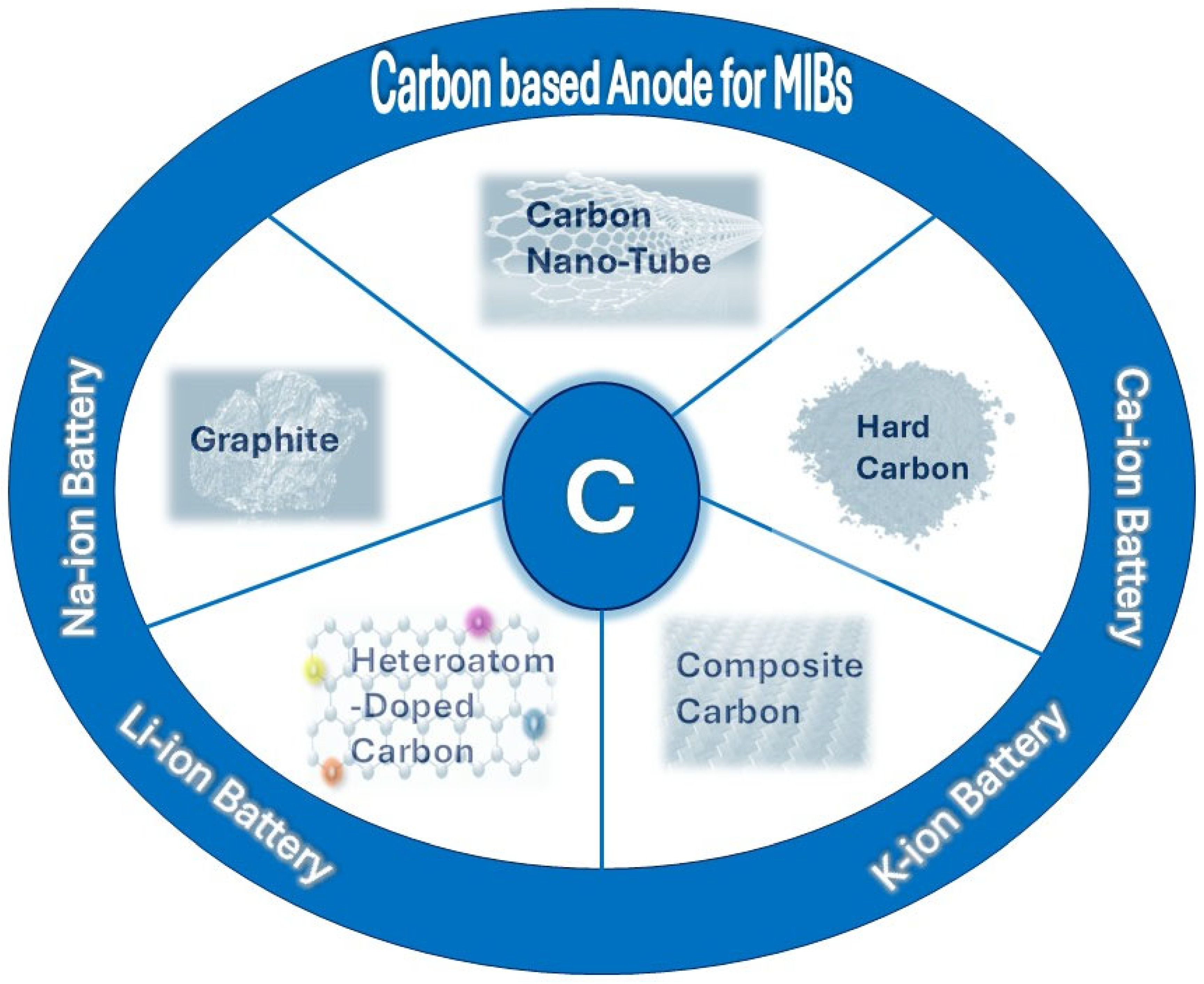
Figure 1. Illustration of carbon-based anode materials for MIB application.
Batteries 11 00444 g001
Figure 2. Schematic representation of the primary synthesis approaches used for graphite-based materials.
Batteries 11 00444 g002
Figure 3. (a) Schematic representation of the structure and lithium storage mechanism of FeCl3-GICs. (b) Powder XRD pattern of FeCl3-GICs. (c) Discharge capacity as a function of cycle number and (d) long-term cycling stability of FeCl3-GICs [70].
Batteries 11 00444 g003
Figure 4. Schematic representation of the major synthesis techniques for carbon nanotubes (CNTs), including arc discharge, laser ablation, CVD, hydrothermal synthesis, and electrolysis.
Batteries 11 00444 g004
Figure 5. Schematic diagram for LIBs.
Batteries 11 00444 g005
Figure 6. Hard carbon synthesis methods.
Batteries 11 00444 g006
Figure 7. Schematic representation illustrating the architecture of different heteroatom-doped carbon materials [193].
Batteries 11 00444 g007
Figure 8. (a) CV of GPC electrode between 0.01 and 3.0 V at a scan rate of 0.2 mVs−1 for first five cycles. (b) The 1st, 2nd, 25th and 50th discharge–charge curves of GPC electrode at a current density of 50 mAg−1. (c) Cycle performance of GPC electrode at a current density of 50 mAg−1. (d) The rate capability of the GPC electrode. (e) Cycle performance of GPC electrodes at a high current density of 500 mAg−1 [197].
Batteries 11 00444 g008
Figure 9. Electrochemical performance of UPCs electrodes (active material mass loading of 1.1–1.4 mg cm−2) in ether electrolyte. (a) CV curves of UPC-6 at a scan rate of 0.1 mVs−1, (b) charge–discharge curves of UPC-6 at 100 mAg−1 for the first five cycles, (c) rate capability and (d) the corresponding voltage curves of UPC-6, and (e) long cycle performance of UPCs at 500 mAg−1 [201].
Batteries 11 00444 g009
Figure 10. Schematic illustration of the major synthesis methods employed for carbon-based composite materials.
Batteries 11 00444 g010
Figure 11. Roadmap for advancing carbon-based anode in MIBs through AI-driven design, computational modeling and green synthesis strategies.
Batteries 11 00444 g011
Table 1. Results obtained from using different precursors for SC.
Precursor for SCDischarge CapacityCharge CapacityCyclic Efficiency (%)Columbic Efficiency (%)References
PEDOT655.0 mAh/g at 0.1 A/g482.1 mAh/g at 0.1 A/g73.6100.0 after 700 cycles[26]
Polythiophene714.0 mAh/g at 0.05 A/g491.0 mAh/g at 0.05 A/g69.0100.0 after 500 cycles[203]
Disclaimer/Publisher’s Note: The statements, opinions and data contained in all publications are solely those of the individual author(s) and contributor(s) and not of MDPI and/or the editor(s). MDPI and/or the editor(s) disclaim responsibility for any injury to people or property resulting from any ideas, methods, instructions or products referred to in the content.