1. Introduction
Mixed-valence rare earth oxides have emerged as a pivotal class of functional materials owing to their unique 4f electronic configurations, reversible valence transition behavior, and defect-dependent physical and chemical performances [
1,
2,
3,
4]. They exhibit broad application prospects in magnetic functional devices and catalytic fields. As a typical non-stoichiometric praseodymium oxide, Pr
6O
11 features a stable fluorite-derived cubic structure with intrinsically coexisting Pr
3+ and Pr
4+ ions, accompanied by abundant lattice oxygen vacancies. This endows it with distinct temperature-sensitive catalytic and electronic characteristics that are absent in single-valence lanthanide oxides [
4,
5]. Different from conventional magnetic rare earth oxides, pure Pr
6O
11 bulk materials present para-magnetism, while nano-sized Pr
6O
11 powders display anomalous physical responses and temperature-dependent spin evolution behaviors. This makes them a research hotspot in the field of condensed matter magnetism in recent years [
5,
6,
7,
8]. The microstructural morphology, grain size distribution and defect concentration of Pr
6O
11 powders are the core factors determining their variable-temperature physical properties [
9,
10]. Precise structural modulation is the key to unlocking their excellent magnetic functional performance. A series of temperature-dependent physical and chemical phenomena of Pr
6O
11, including spin glass-like anomalies near 5 K and improved catalytic behavior, have been gradually revealed [
11,
12,
13].
At present, research on Pr
6O
11 mainly focuses on pristine powders prepared by sol-gel, high-temperature calcination and self-propagating methods [
14,
15]. Wet ball-milling, as an important post-treatment refinement method, can introduce unique structural modulation effects different from in situ synthesis: high-energy mechanical force induces grain refinement and lattice distortion, while the liquid-phase medium regulates the surface defect uniformity of powders. Relevant mechanical modification studies on rare earth magnetic materials have proven that wet milling can effectively adjust the critical temperature of magnetic phase transition, optimize magnetic entropy change, and improve the stability of magnetic response of powders [
10,
16,
17,
18]. Benefiting from the liquid-phase dispersion environment, wet ball-milling can uniformly refine Pr
6O
11 coarse particles into finer powders and further modulate the valence state ratio and surface spin disorder state.
Although previous studies have demonstrated that mechanical milling or nanostructuring can significantly influence the electrical conductivity [
19], photocatalytic degradation performance [
20], and nonlinear varistor properties [
21] of Pr
6O
11-based materials, none of these works have systematically addressed the quantitative correlation between wet ball-milling parameters and the intrinsic temperature-dependent magnetic behavior of Pr
6O
11 powders. Nevertheless, most current studies focus on the modification effect of Pr
6O
11 on composite materials and its catalytic properties, while systematic investigations on the intrinsic temperature-dependent magnetic properties of refined Pr
6O
11 powders are still insufficient. Furthermore, a quantitative correlation between wet ball-milling parameters (milling time et al.) and the variable-temperature magnetic properties of Pr
6O
11 remains unclear. Aiming at existing research gaps, including the unclear structure–magnetism relationship and unsystematic variable-temperature magnetic evolution of wet ball-milled Pr
6O
11 powders, this paper systematically investigates the temperature-dependent magnetic behaviors of Pr
6O
11 oxides refined via wet ball-milling.
3. Results and Discussions
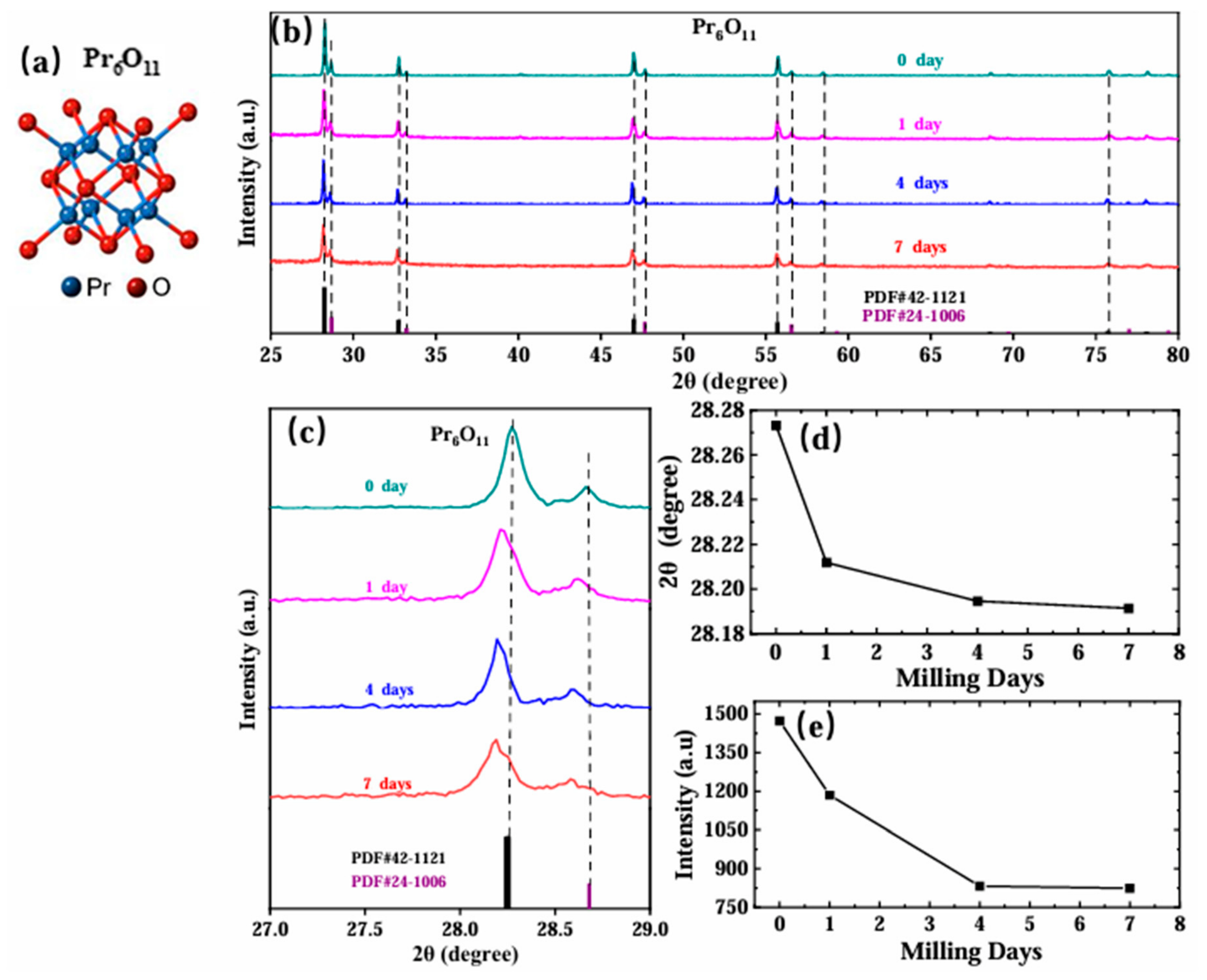
Figure 1 exhibits the crystal structure and X-ray diffraction (XRD) characterization results of wet ball-milled Pr
6O
11 powders with different milling times.
Figure 1a presents a schematic diagram of cubic fluorite-type Pr
6O
11.
Figure 1b displays the full-range XRD patterns of samples milled for 0, 1, 4, and 7 days. All diffraction peaks of four groups of powders perfectly match the standard PDF cards of Pr
6O
11, and no miscellaneous diffraction signals are detected, which confirms that wet ball-milling only induces microstructural modulation without introducing impurity phases or altering the intrinsic cubic fluorite crystal structure of Pr
6O
11 [
4,
10].
Figure 1c is the enlarged local diffraction pattern at from 27–29°, intuitively reflecting the regular shift and attenuation of the characteristic diffraction peak with prolonged milling. The corresponding quantitative evolution curves are summarized in
Figure 1d,e. With the extension of ball-milling time, the 2-theta value of the main diffraction peak around 28.2° gradually shifts to a lower angle, and the peak intensity decreases monotonically. The peak position and intensity both reach a stable saturated state after 4 days of milling. This phenomenon may originate from the combined effect of grain refinement and milling-induced lattice microstrain. Mechanical collision and friction break large particles into fine grains, while lattice distortion and defects may be generated inside the crystal lattice, resulting in lattice expansion. This accounts for the left shift of diffraction peaks. Meanwhile, grain refinement reduces the crystallinity of powders, leading to continuous attenuation of diffraction peak intensity [
6,
14].
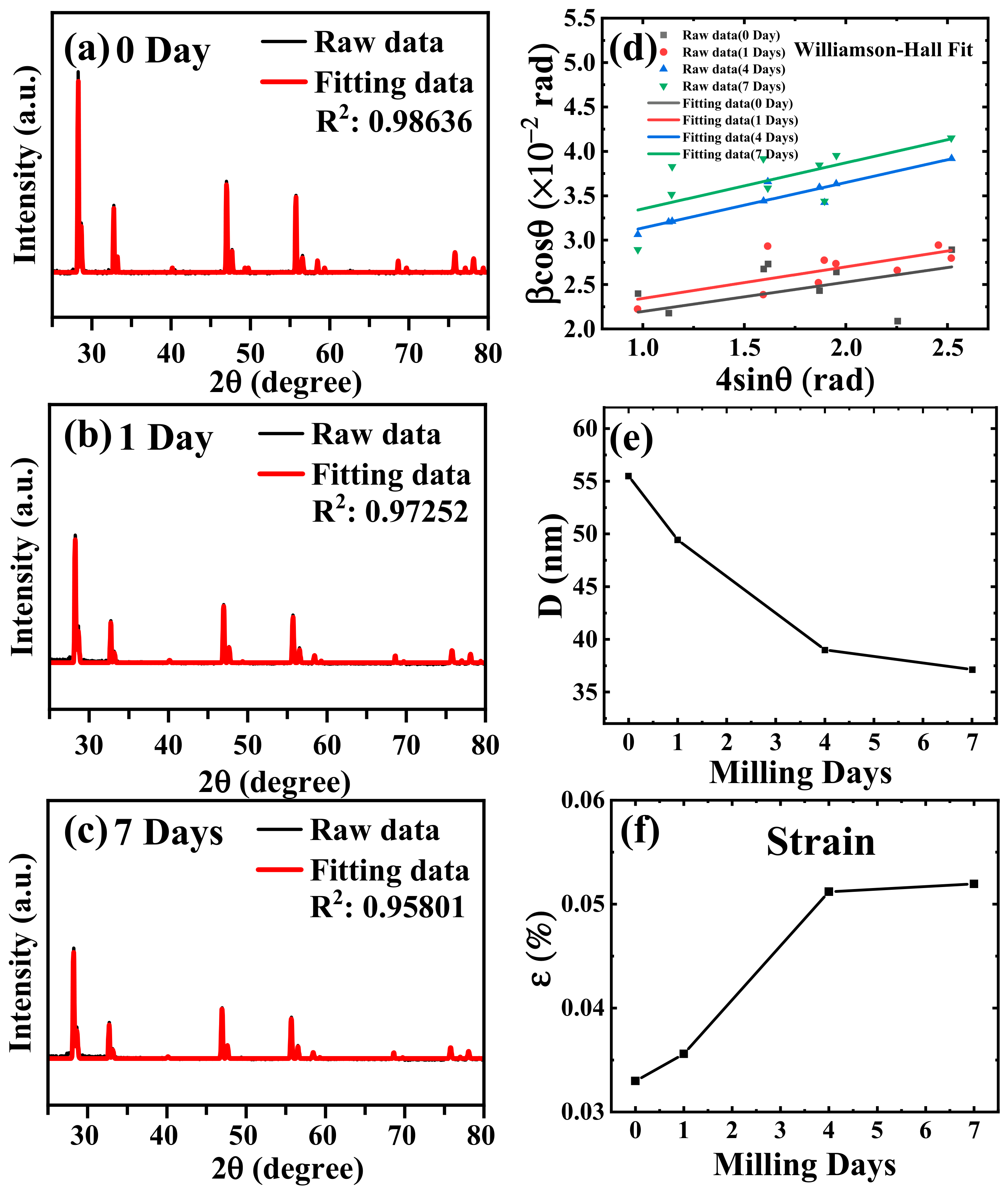
Figure 2 presents the fitting results of XRD patterns and Williamson-Hall (W-H) strain analysis for powders milled for 0, 1, and 7 days.
Figure 2a–c compares the original experimental XRD curves (black lines) and full-profile fitting profiles (red lines). The peaks were fitted with a Gaussian function. The high fitting coefficient R
2 values (0.98636, 0.97252, and 0.95801) indicate good agreement between the experimental data and the fitted model.
To distinguish the individual contributions of crystallite size and microstrain to the X-ray diffraction (XRD) peak broadening, the Williamson-Hall (W-H) method was employed. The W-H equation is expressed as follows [
21,
22,
23,
24]:
where
β is the full width at half maximum (FWHM),
θ is the Bragg angle,
K is the shape factor,
λ is the X-ray wavelength,
D is the average crystallite size, and
ε represents the microstrain. By plotting
βcos
θ against 4sin
θ, the average crystallite size can be determined from the
y-intercept, while the micro-strain is derived from the slope of the linear fit.
The Williamson-Hall linear fitting plots for all samples are displayed in
Figure 2d, where the slope of each fitted straight line corresponds to the average lattice microstrain, and the intercept correlates with the average crystallite size. With the extension of wet ball-milling duration, the fitted straight line shifts upward evidently, revealing a possible increase in internal lattice distortion inside grains.
Figure 2e quantitatively summarizes the evolution of average grain size
D extracted from W-H fitting. The pristine unmilled powder possesses the largest average crystallite size of 58 nm. After 1 day of milling, the grain size drops sharply to 53 nm, followed by a continuous gradual reduction to 40 nm for the 7-day milled sample. The persistent grain refinement originates from repeated collision and shear force of agate balls, which fractures large crystallites into smaller nanoscale grains. The quantitative evolution of lattice strain ε is summarized in
Figure 2f. The pristine 0-day sample possesses the minimum strain value of 0.02%. After 1 day of mechanical milling, the strain rises sharply to 0.033%, followed by a slow continuous growth up to 0.051% for the 7-day milled powder. This trend originates from severe plastic deformation induced by high-speed ball collision, which may introduce massive lattice defects and atomic displacement inside grains.
The dislocation density (
) of the synthesized samples was estimated using the Williamson-Smallman equation, which relates the microstructural parameters derived from XRD peak broadening. The relationship is expressed as follows:
where
and
represent the average strain and crystallite size obtained from the Williamson-Hall plot, and
is a crystal structure-related constant taken as the same for all milling conditions.
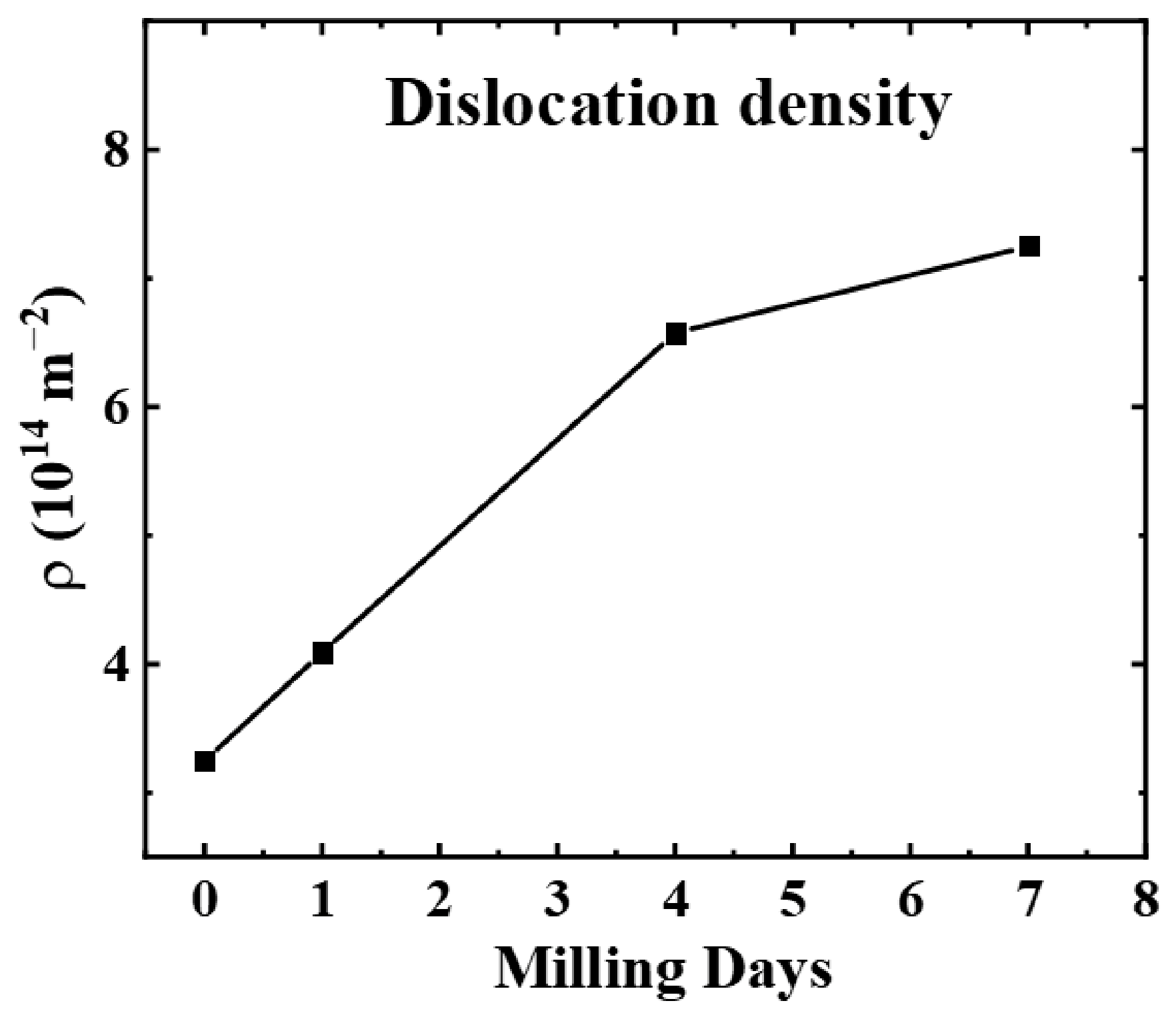
Based on the Williamson-Smallman equation, dislocation density
is further calculated and plotted in
Figure 3. Dislocation density shows a similar increasing tendency to lattice strain: the raw sample exhibits the lowest dislocation density, while an obvious increase occurs after 1-day milling, and the value grows moderately with prolonged milling time after 4 days. Combined with the XRD peak shift results in
Figure 1, the W-H analysis quantitatively confirms that wet ball-milling effectively introduces controllable lattice strain and dislocation defects in without changing its intrinsic crystal phase.
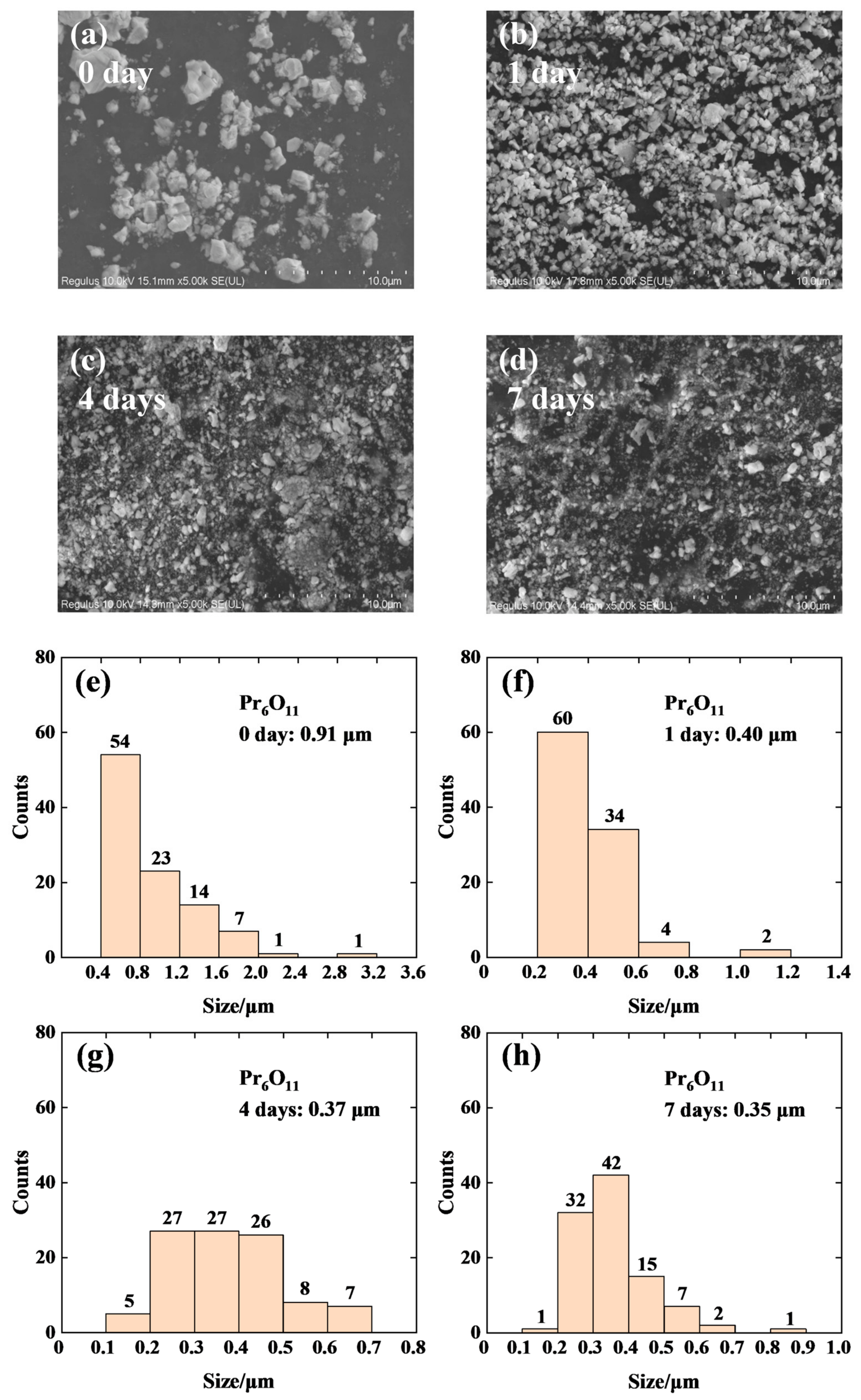
Figure 4 presents the SEM micrographs of Pr
6O
11 powders with different wet ball-milling durations (0 day, 1 day, 4 days, and 7 days). For the pristine Pr
6O
11 powder without ball-milling (
Figure 4a,e), the particles exhibit irregular blocky morphology with large overall particle size and obvious particle agglomeration. The original powder shows a wide particle size distribution, and a large number of coarse particles with uneven sizes dominate the microstructure, which is caused by the high surface energy and spontaneous agglomeration tendency of rare earth oxide nanoparticles during preparation and storage. The average particle size (0.91 μm) of the raw powder is much larger than the XRD fitting results in
Figure 2e, and the particle boundary is rough. This can be attributed to the agglomeration of nano-sized grains that cannot be well differentiated in the SEM images.
After 1 day of wet ball-milling (
Figure 4b,f), the high-energy mechanical collision and shear action effectively break the large agglomerated clusters and coarse particles of Pr
6O
11. The overall particle size of the powder is reduced (0.40 μm), the particle agglomeration phenomenon is partially alleviated, and the particle size distribution becomes more concentrated compared with the pristine sample. With the milling time extended to 4 days (
Figure 4c,g), the refinement effect is further improved (0.37 μm). The coarse particles in the powder are basically eliminated, and the particle morphology tends to be uniform and regular. The particle size distribution range is further narrowed. The liquid-phase environment of wet ball-milling effectively inhibits the secondary agglomeration of newly generated fine particles, enabling the Pr
6O
11 powder to obtain a homogeneous microscopic morphology and stable particle size distribution. When the wet ball-milling duration reaches 7 days (
Figure 4d,h), the particle size of Pr
6O
11 powder is further refined (0.35 μm). However, compared with the 4-day milled sample, the refinement amplitude of particle size decreases significantly and tends to be stable. After long-term milling, the particle crushing rate and cold welding rate of Pr
6O
11 reach dynamic equilibrium, and the particle size no longer decreases sharply.
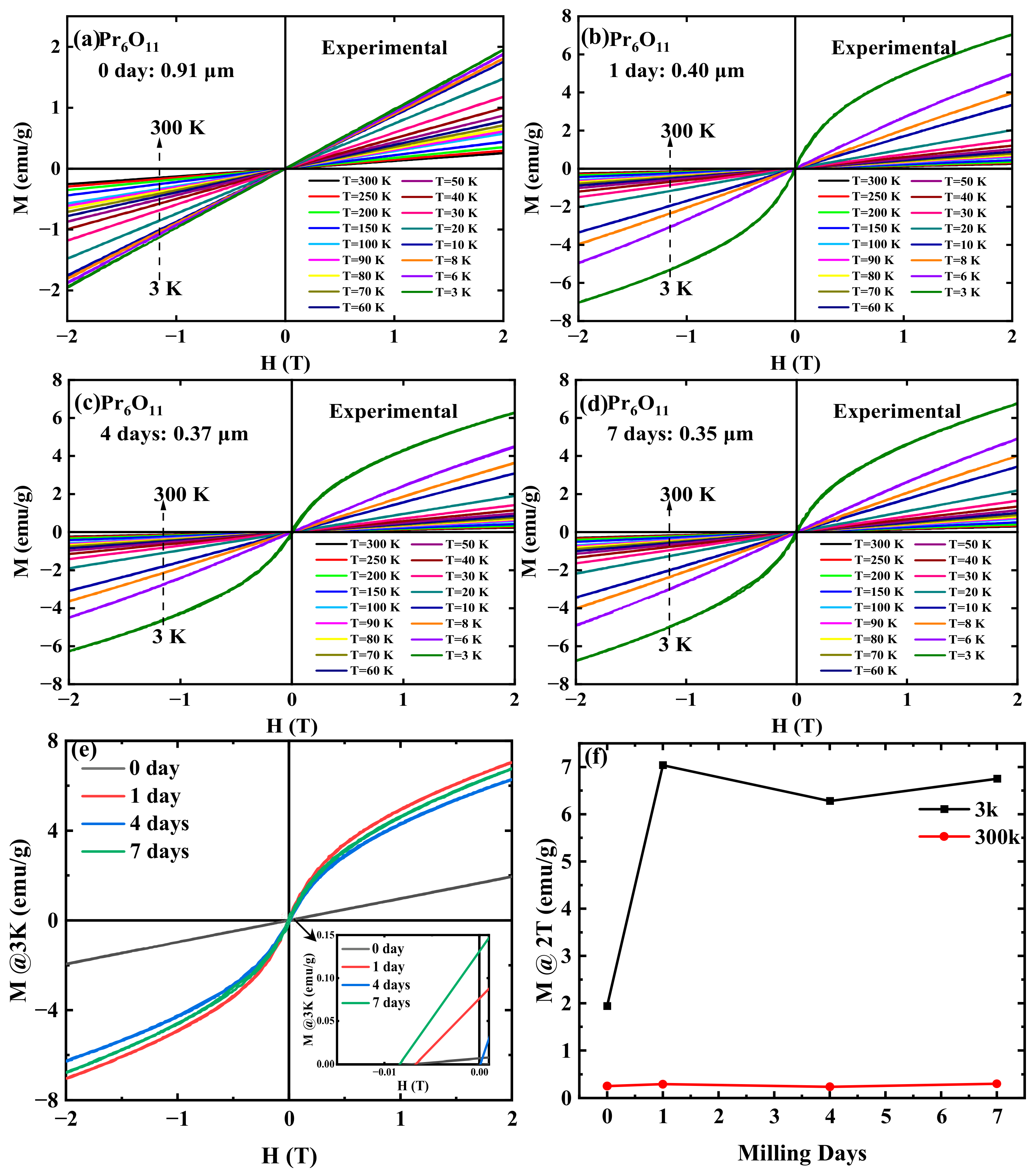
Figure 5 illustrates the temperature-dependent magnetic hysteresis (M-H) loops of Pr
6O
11 powders at measuring temperatures ranging from 3 K to 300 K. For all four groups of powders, a consistent thermally induced magnetic attenuation trend is observed upon heating from 3 K to 300 K. The continuous increase in thermal excitation energy during heating fundamentally changes the spin arrangement and exchange coupling state of Pr ions, forming typical thermally induced magnetic attenuation behavior.
At the initial ultra-low temperature of 3 K, all Pr6O11 samples exhibit the strongest magnetic hysteresis performance. With the continuous heating process from 3 K to room temperature, the thermal excitation energy acting on Pr electrons increases gradually, which induces systematic attenuation of magnetic properties and gradual degeneration of hysteresis loops for all Pr6O11 samples. When the temperature rises to 300 K, the thermal disturbance completely dominates the magnetic behavior of Pr6O11 powders, and all samples achieve consistent paramagnetic characteristics. At this stage, the structural advantages brought about by ball-milling refinement, including large specific surface area and lattice defects, cannot offset the destructive effect of high-temperature thermal fluctuation on spin alignment. It can be confirmed that the magnetic behavior of Pr6O11 is also strongly dependent on the ball-milling time. The unmilled 0-day sample with coarse powder always maintains paramagnetic signals during the whole heating stage. In contrast, the refined 1-day milling sample exhibits a strong magnetic regulation ability with strong low-temperature magnetic moments. The excessively refined 7-day milling sample does not show further enhanced thermal magnetic performance, presenting a saturated magnetic attenuation trend during heating, which is consistent with the structural saturation phenomenon of long-term wet ball-milling.
Figure 5e compares the 3 K hysteresis curves of all samples, with an enlarged inset near zero field to compare subtle magnetic differences. The details of the extracted magnetic parameters are shown
Table 1. Although the coercivity and remanence of the hysteresis loops are observable in milled samples, they are too small and close to the experimental error (magnetic field increasing step is 0.005 T during measurements); thus, they cannot serve as rigorous criteria for ferromagnetic materials. Therefore, the strong magnetism observed at 3 K is more appropriately attributed to superparamagnetic behavior.
Figure 5f quantitatively summarizes the maximum magnetization at 2 T magnetic field measured at 3 K and 300 K as a function of milling time. The unmilled powder (0 day) delivers the lowest magnetization at 3 K. After 1 day of milling, magnetization rises sharply. Further extending milling to 7 days only leads to a slight magnetization changes, showing saturated magnetic regulation consistent with the saturated microstructure evolution from XRD and SEM characterizations.
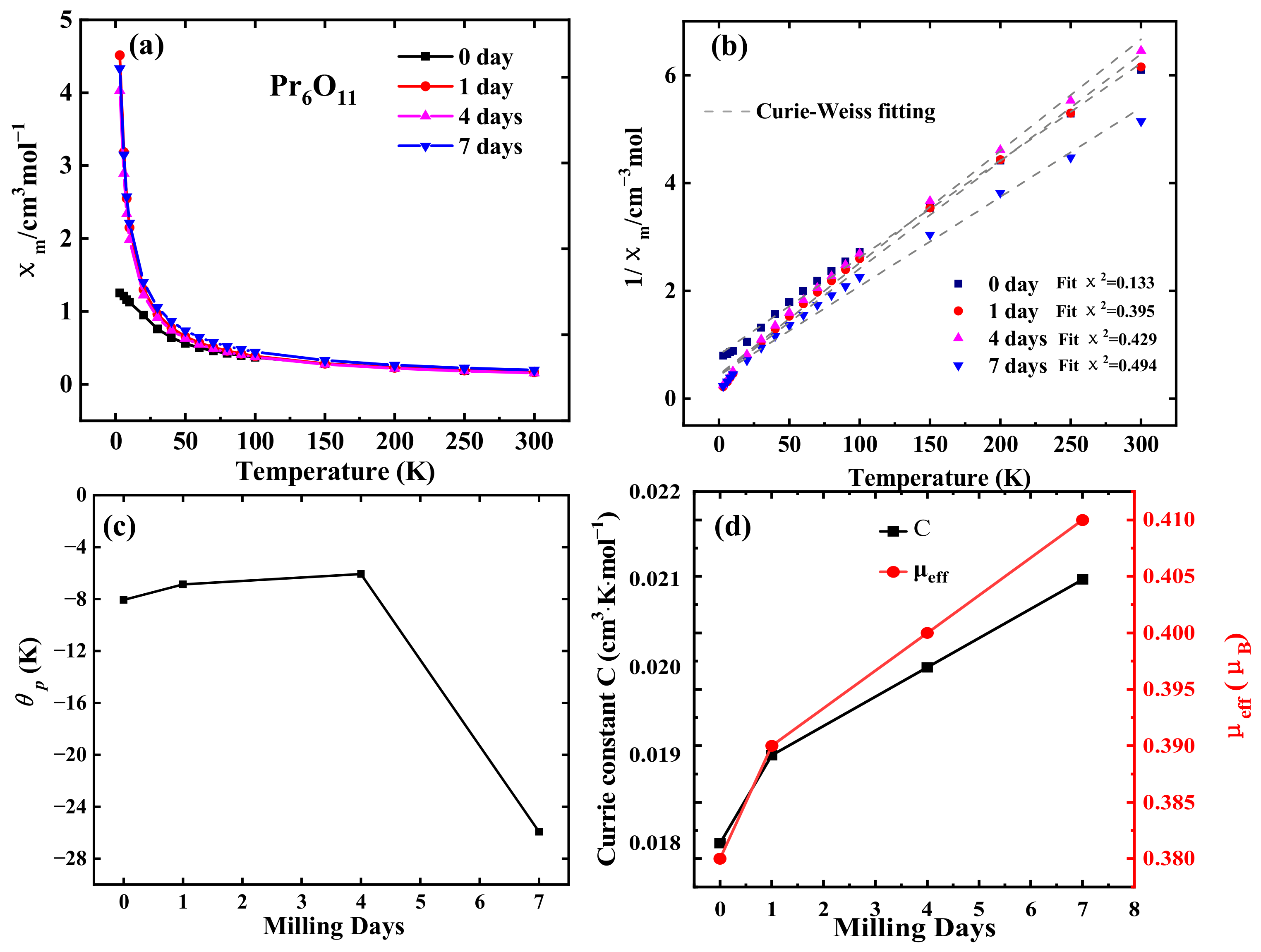
Figure 6 is the temperature dependence of magnetic susceptibility (
) of Pr
6O
11 powders with different milling days ranging from 3 K to 300 K.
Figure 6a shows that all samples exhibit typical paramagnetic behavior, characterized by a sharp increase in
as the temperature decreases. The unmilled raw powder (0 day) possesses the lowest susceptibility over the full temperature range. The milled samples (1, 4, and 7 days) display significantly higher susceptibility values at low temperatures compared to the unmilled sample (0 day), indicating an enhancement in magnetic response induced by mechanical milling.
To further investigate the magnetic interactions, the inverse susceptibility (1/
) was plotted against temperature and fitted using the Curie-Weiss law [
25]:
where
is the Curie temperature, T is the temperature, and C is a constant. The fitting results are shown in
Figure 6b. The deviation from the linear temperature dependence of inverse susceptibility 1/
on
T can clearly be seen in the milled samples (1, 4 and 7 days). For this reason, all linear fitting was taken in the temperature region from 10 K to 300 K.
Figure 6b shows that for all the fittings, the fitting error
is smaller than 0.5. For the 0-day sample, the fitting has a lowest error
, suggesting typical paramagnetic behavior. For the samples with more than 1-day milling, the fitting error increases, suggesting a slight deviation from typical paramagnetic behavior.
Figure 6c shows the evolution of
as a function of the milling duration. The
values remain relatively stable between −8 K and −6 K for milling times up to 4 days. However, a dramatic decrease in
is observed for the sample milled for 7 days, dropping to approximately −26 K.
serves as an indicator of the exchange interactions between magnetic moments. This significant negative shift may be caused by the enhancement of magnetic interactions within the Pr
6O
11 lattice after prolonged milling. However, the increased fitting error for the 7-day sample may also contribute to this abnormal
. This phenomenon may possibly be attributed to milling-induced microstructural modifications, such as lattice distortion and grain refinement, which alter the magnetic property of Pr ions, as suggested by the XRD results [
3,
4]. The reduction of particle size may increase the specific surface area and surface defect density, which modulates the average spin correlation strength of Pr ions and further changes the paramagnetic Curie temperature.
Figure 6d illustrates the evolution of Curie constant
C and effective moments
for Pr
6O
11 powders with different milling days derived from linear fitting. The Curie constant exhibits the highest relative increase between 0 and 1 day; after that, it keeps rising at days 4 and 7, yet the increases from 1 to 4 and from 4 to 7 are comparatively smaller. The
C is proportional to the square of the effective magnetic moment per Pr ion with equation
. The growing
C value suggests that milling-induced lattice defects increase the average effective magnetic moment of Pr ions, as shown in
Figure 6d. This further explains the improved low-temperature magnetization observed in hysteresis loops in
Figure 5.