1. Introduction
Soft magnetic composites (SMCs) are fabricated by compacting surface-insulated magnetic powders [
1,
2,
3]. Their three-dimensional magnetic isotropy, favourable frequency stability and near-net-shape formability have driven widespread adoption in photovoltaic inverters, on-board power supplies, variable-frequency drives and moulded inductors [
4,
5]. Iron powder cores are particularly important for cost-sensitive low- to medium-frequency applications because of their low raw-material cost and high saturation magnetisation. However, the intrinsically low electrical resistivity of iron promotes continuous conductive pathways between adjacent particles under alternating magnetic fields, generating substantial interparticle eddy-current loss and localised heat accumulation that degrade magnetic stability and device reliability [
6,
7]. Suppressing high-frequency loss and improving thermal diffusion without sacrificing low cost or scalable processing is therefore the central challenge in advancing iron powder cores.
Engineering interparticle insulating coatings is the most effective strategy for regulating electrical transport and high-frequency loss in SMCs. An ideal coating should combine high electrical resistivity, stable interfacial bonding, thermal stability and limited magnetic dilution [
8]. Current coating systems fall into three categories. Organic resin coatings (e.g., epoxy, silicone and phenolic resins) offer simple processing and good film-forming ability, but their limited thermal stability (<300 °C) leads to structural degradation during annealing and hinders stress relief [
9]. Inorganic coatings based on metal oxides, phosphates or ferrites provide higher resistivity and better thermal stability [
10,
11], yet they often suffer from insufficient interfacial bonding, cracking during high-pressure compaction (>800 MPa), and permeability reduction from nonmagnetic-phase dilution [
11,
12]. Hybrid organic–inorganic architectures can partially mitigate these limitations, but their multi-step processing increases complexity and cost [
12].
Two-dimensional (2D) hexagonal boron nitride (h-BN) has emerged as a particularly promising multifunctional coating material for SMCs. Its wide bandgap (≈5.9 eV) provides excellent electrical insulation for suppressing interparticle eddy currents, while its high in-plane thermal conductivity (theoretically up to ≈400 W·m
−1·K
−1) enables heat spreading along particle surfaces—a capability absent in conventional oxide or phosphate coatings. Its platelet morphology favours conformal coverage over irregular particle surfaces, and its decomposition temperature exceeds 1000 °C in inert atmosphere, ensuring compatibility with the annealing step (400–600 °C) required for SMC fabrication [
13]. Compared with alternative ceramics such as AlN (hydrolysis-sensitive) and Si
3N
4 (lower thermal conductivity), h-BN offers a uniquely balanced profile of insulation, thermal conduction and chemical stability for this application.
Despite these advantages, the chemical inertness of pristine h-BN poses a fundamental obstacle to practical implementation. The basal planes are terminated by saturated B–N bonds with negligible reactivity, and only sparse hydroxyl groups exist at edge sites and defects. Consequently, h-BN nanosheets aggregate through van der Waals interactions and resist forming uniform, adherent coatings on iron powder surfaces by simple physical mixing [
14]. Mechanical mixing routes (e.g., ball milling) can distribute h-BN among iron particles, but the coatings are typically discontinuous and rely on weak physisorption, leading to delamination during compaction. In situ growth by chemical vapour deposition produces conformal coatings with stronger adhesion, but requires high temperatures (>800 °C) and specialised equipment, conflicting with the low-cost, scalable processing paradigm of iron powder cores [
13]. Wang et al. recently showed that silane-functionalised BN coatings on FeSi and FeSiCr powders could simultaneously improve core loss and thermal conductivity, establishing the principle of coupling-agent-mediated BN deposition for SMCs [
13,
14]. However, these studies employed amino-silanes and did not examine the role of the terminal functional group in mediating BN–iron interfacial interactions, nor the quantitative relationships among coating continuity, interfacial bonding, electrical resistivity, core loss components and thermal transport.
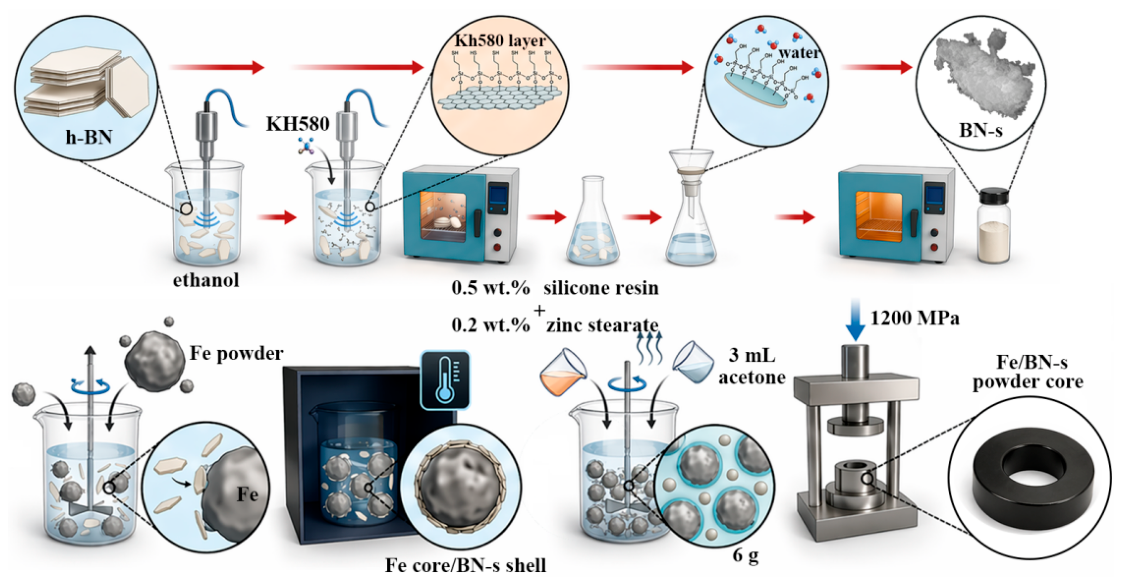
To address these gaps, we propose a thiol-functionalised boron nitride (BN-s) coating that integrates electrical insulation and thermal conduction within a single interfacial layer. The strategy rests on three design elements. First, ultrasonic exfoliation of h-BN followed by γ-mercaptopropyltriethoxysilane (KH580) grafting introduces B–O–Si covalent linkages on the h-BN surface, simultaneously improving dispersibility and providing reactive terminal –SH groups. The mercaptosilane is preferred over conventional amino-silanes because the thiol group exhibits stronger soft-acid–soft-base affinity for metallic iron surfaces according to the HSAB principle, favouring coordination-type S–Fe interfacial interactions. Second, the mercaptopropyl segment of KH580 undergoes carbonisation rather than complete volatilisation during annealing at 500 °C under argon, leaving a residual carbonaceous interlayer at the BN-s/Fe interface that may further modulate the interfacial electrical resistance and contribute to coating thermal stability. Third, KH580 is hydrolytically processable in water/ethanol media, making it compatible with the aqueous-phase stirring-deposition route adopted in this work without requiring toxic organic solvents. Second, BN-s nanosheets are deposited onto water-atomised iron powders through a mild liquid-phase stirring process (room temperature, aqueous medium, ambient pressure). During deposition, nitrogen-containing moieties and sulfur-containing mercaptopropyl groups on BN-s establish N–Fe and S–Fe coordination-type interactions with the iron surface, anchoring the coating without the high-energy milling or high-temperature vapour deposition required by prior methods. Third, the 2D BN-s framework simultaneously acts as an interparticle electrical barrier and a thermally conductive network, coupling loss suppression with enhanced heat dissipation—a multifunctional integration difficult to achieve with conventional single-function coatings.
In this study, we systematically investigate how BN-s content (1–9 wt.%) governs the coating microstructure, interfacial chemical state, electrical resistivity, core loss components, saturation magnetisation, effective permeability and thermal transport behaviour of Fe@BN magnetic powder cores. The relationships among interparticle insulation, magnetic-property retention and thermal management are elucidated through correlated structural, spectroscopic, electromagnetic and thermal characterisation.
3. Results and Discussion
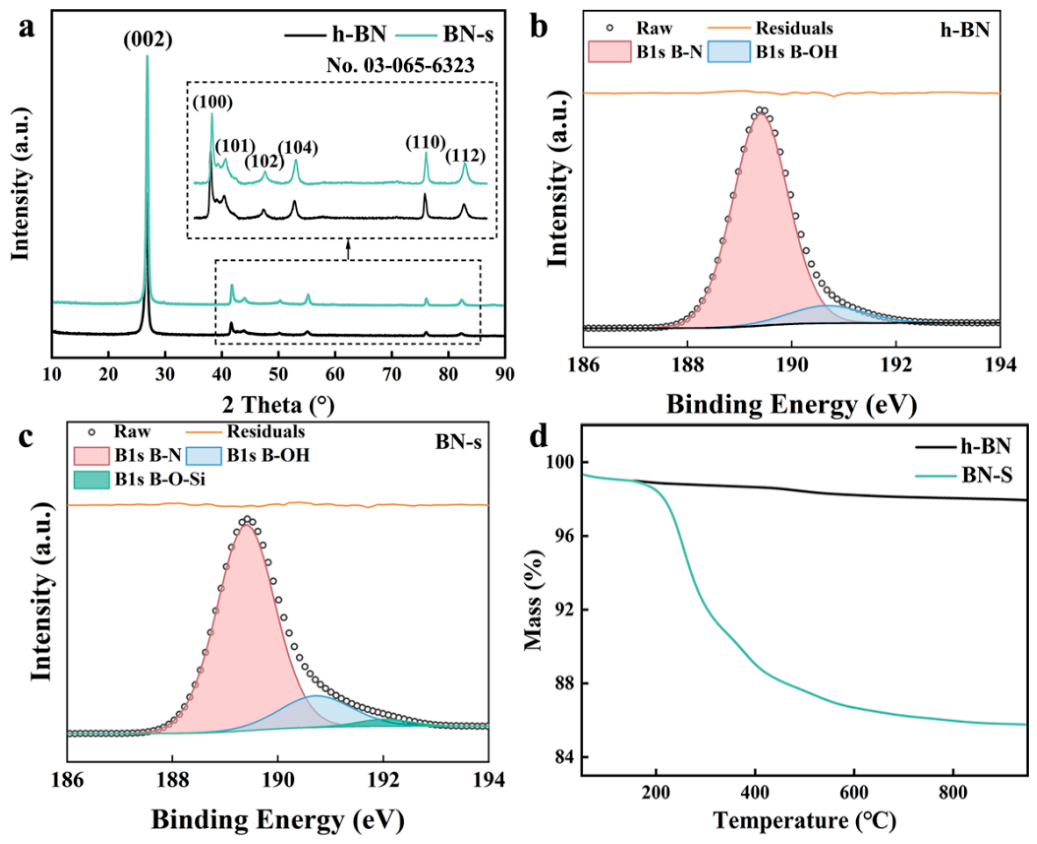
Figure 2a presents the XRD patterns of the two powders. Pristine h-BN exhibits characteristic diffraction peaks at 2θ = 26.6°, 41.5°, 43.8°, 50.1°, 55.0°, 75.9° and 82.1°, corresponding to the (002), (100), (101), (102), (004), (110) and (112) planes of the hexagonal layered BN phase, respectively, in agreement with standard reference card No. 03-065-6323. After ultrasonic treatment and KH580 grafting, BN-s retains the main diffraction features of h-BN, with no additional crystalline impurity phases detected, indicating that the modification process does not disrupt the primary crystal structure of h-BN. The relative diffraction intensities of the (100), (004), (110) and (112) planes are increased in the BN-s pattern, suggesting that ultrasonic activation and silane grafting may alter the stacking state of h-BN nanosheets and the exposure of specific crystallographic planes, thereby facilitating subsequent contact and deposition on iron powder surfaces. XPS was further used to analyse the surface chemical-bonding changes before and after modification, as shown in
Figure 2b,c. All spectra were calibrated using the C1s peak at 284.8 eV as the binding-energy reference. The B1s spectrum of pristine h-BN can be deconvoluted into two components: the dominant peak at 189.4 eV corresponds to B-N bonds in the h-BN lattice, whereas the weak peak at 191.1 eV is assigned to B-OH bonds associated with surface hydroxyl groups [
15]. For BN-s, the B-N peak remains dominant, confirming that the basic lattice framework of h-BN is retained after modification. Meanwhile, the relative intensity of the B-OH component decreases, accompanied by the emergence of a new B-O-Si component at 191.9 eV [
16]. This change indicates that silanol groups generated by KH580 hydrolysis undergo condensation with hydroxyl groups on the h-BN surface, forming B-O-Si covalent linkages and enabling the chemical grafting of silane molecules onto h-BN.
Figure 2d further compares the thermogravimetric behaviour of h-BN and BN-s in air. Pristine h-BN shows only slight mass loss from 100 to 950 °C and retains a residual mass of 98.4% at 950 °C, reflecting its high intrinsic thermal stability. In contrast, BN-s exhibits an evident mass decrease starting at 158.2 °C, mainly associated with the decomposition of grafted mercaptopropyl segments and the progressive degradation of silane components. After heating to 950 °C, BN-s retains a residual mass of 86.2%, approximately 12.2% lower than that of pristine h-BN. This mass-loss difference approximately reflects the amount of KH580-derived organosilane species introduced onto the h-BN surface and further supports the formation of B-O-Si linkages indicated by XPS. Overall, the XRD results show that KH580 modification preserves the hexagonal layered crystal structure of h-BN, XPS supports the formation of B-O-Si covalent linkages, and TGA confirms the presence of thermally decomposable grafted organosilane species on the BN-s surface. These results confirm the successful grafting of KH580 onto h-BN, yielding thiol-functionalised BN-s powders. It should be noted that the apparent mass loss of 12.2% from TGA includes the contribution of SiO
2 residue from silane decomposition in air. Furthermore, the apparent discrepancy between the relatively modest B-O-Si signal in XPS and the substantial TGA mass loss suggests that the silane may exist as a multilayer or oligomeric structure on the h-BN surface rather than a strict monolayer. This interpretation is consistent with the well-known tendency of organosilanes to undergo self-condensation during grafting. Based on the Si content of KH580 (~11.8 wt.%) and assuming complete conversion of Si to SiO
2 during TGA in air (theoretical SiO
2 residue ~25.2% of the grafted silane mass), the effective organic content removed during TGA is estimated to be approximately 9.2% of the total BN-s mass, confirming a substantial degree of surface functionalisation.
After confirming the effective grafting of KH580 onto h-BN, the deposition behaviour of BN-s on water-atomised iron powders and its influence on the iron matrix were further investigated.
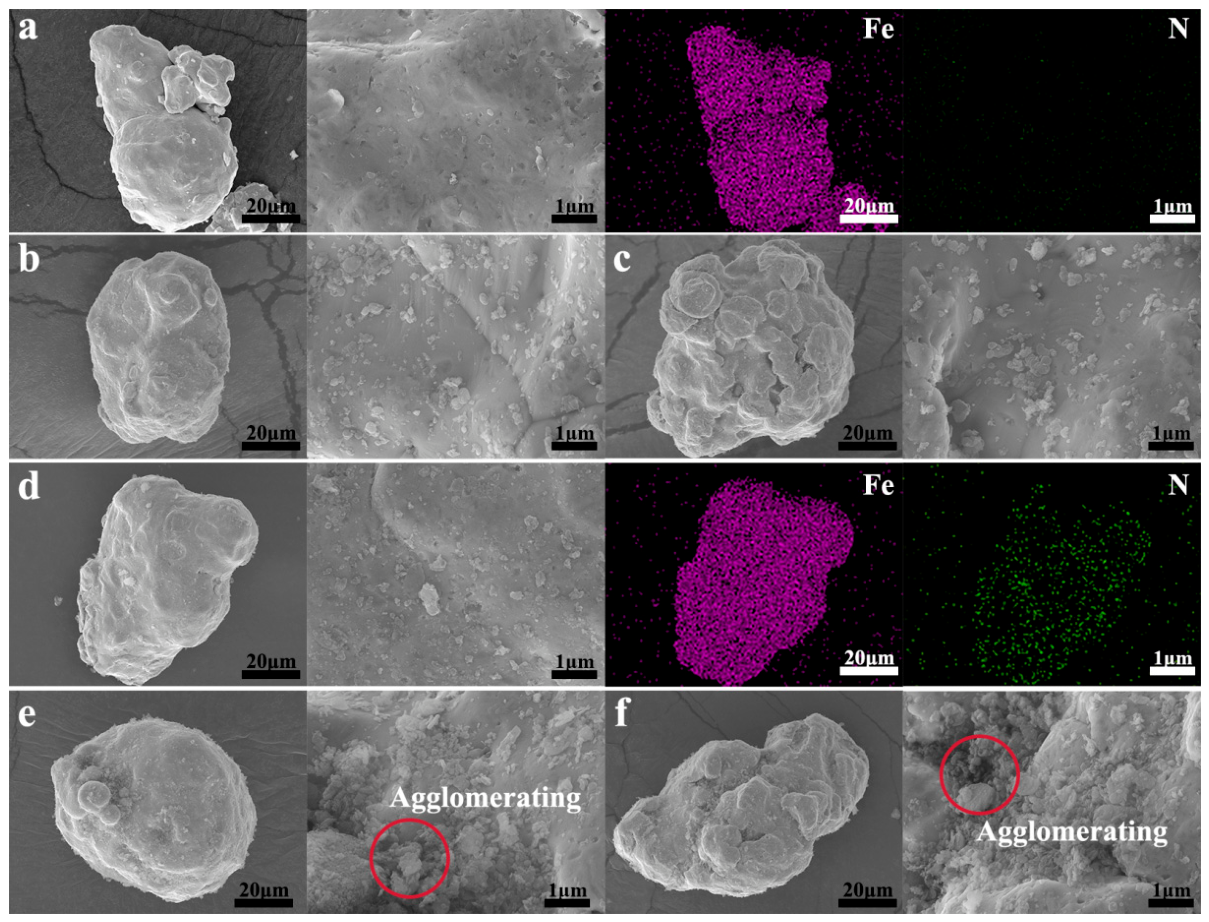
Figure 3 shows the SEM morphologies and elemental distributions of pristine iron powders and Fe/BN-s composite powders with different BN-s contents. The pristine water-atomised iron powders display irregular morphologies, with particle sizes mainly distributed within approximately 100 μm. Their surfaces are relatively smooth overall, with only a few micro-pits and protrusions introduced during water atomisation. EDS mapping shows that the Fe signal closely follows the particle contours, whereas the N signal is extremely weak, indicating that no obvious nitrogen-containing components are present on the pristine iron powder surface. This provides a reference for evaluating the subsequent BN-s coating effect. After BN-s introduction, the composite powders retain the original morphology of the iron powders, without obvious particle fracture or severe plastic deformation, indicating that the stirring-deposition process has a limited influence on the iron powder matrix. As the BN-s content increases from 1 wt.% to 9 wt.%, the surface coating evolves from discrete attachment to discontinuous coverage, then to relatively continuous coating, and finally to localised agglomeration. In the 1 wt.% BN-s sample, only a small amount of BN-s is sparsely distributed on the iron powder surface, leaving large areas of the metallic matrix exposed. When the BN-s content increases to 3 wt.%, the surface coverage expands and the surface roughness increases, although the coating remains insufficiently continuous. At 5 wt.% BN-s, the iron powder surface is covered by a relatively uniform BN-s layer, the original smooth metallic surface is largely shielded, and no obvious large-scale agglomeration is observed. The corresponding EDS results further show that the N signal is relatively uniformly distributed along the Fe particle surface, confirming that BN-s can deposit onto iron powders and form a relatively complete coating structure. Further increasing the BN-s content to 7 wt.% and 9 wt.% results in greater surface roughness and different degrees of BN-s aggregation. In particular, pronounced micron-scale aggregates appear in the 9 wt.% sample, leading to reduced coating uniformity. These results indicate that BN-s content strongly affects the continuity and uniformity of the insulating layer, with 5 wt.% BN-s being more favourable for forming a relatively complete coating with limited agglomeration on the iron powder surface.
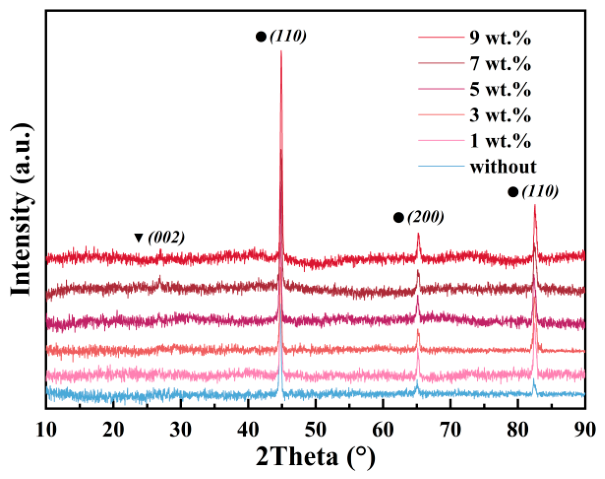
To further confirm the phase composition of the Fe/BN-s composite powders and determine whether the coating process alters the crystal structure of the iron matrix, XRD analysis was performed on pristine iron powders and composite powders with different BN-s contents, as shown in
Figure 4. Pristine water-atomised iron powders exhibit three sharp diffraction peaks at 2θ = 44.8°, 65.3° and 82.7°, corresponding to the (110), (200) and (211) planes of bcc α-Fe, respectively, in agreement with ICDD standard card No. 01-071-8390. All Fe/BN-s composite powders retain the main characteristic peaks of α-Fe, with no obvious changes in peak position or peak shape, indicating that the coating treatment does not disturb the primary crystal structure of the iron matrix [
17]. In addition, no detectable diffraction peaks of iron oxides or other crystalline impurity phases are observed, suggesting that the water-mediated stirring-deposition process does not induce measurable oxidation of the iron matrix. With increasing BN-s content, a weak diffraction peak gradually emerges and intensifies near 2θ ≈ 26.6°, which can be assigned to the (002) plane of h-BN according to ICDD standard card No. 01-076-9893. At low BN-s contents, this peak is weak or difficult to resolve, mainly because of the low BN-s fraction and the detection limit of XRD. As the BN-s content increases, the amount of crystalline BN-s phase increases, resulting in a corresponding increase in the intensity of the (002) peak. Together with the surface-coverage evolution observed in
Figure 3, the XRD results further confirm the successful incorporation of BN-s into the Fe/BN-s composite powder system while maintaining the bcc structure of the iron matrix.
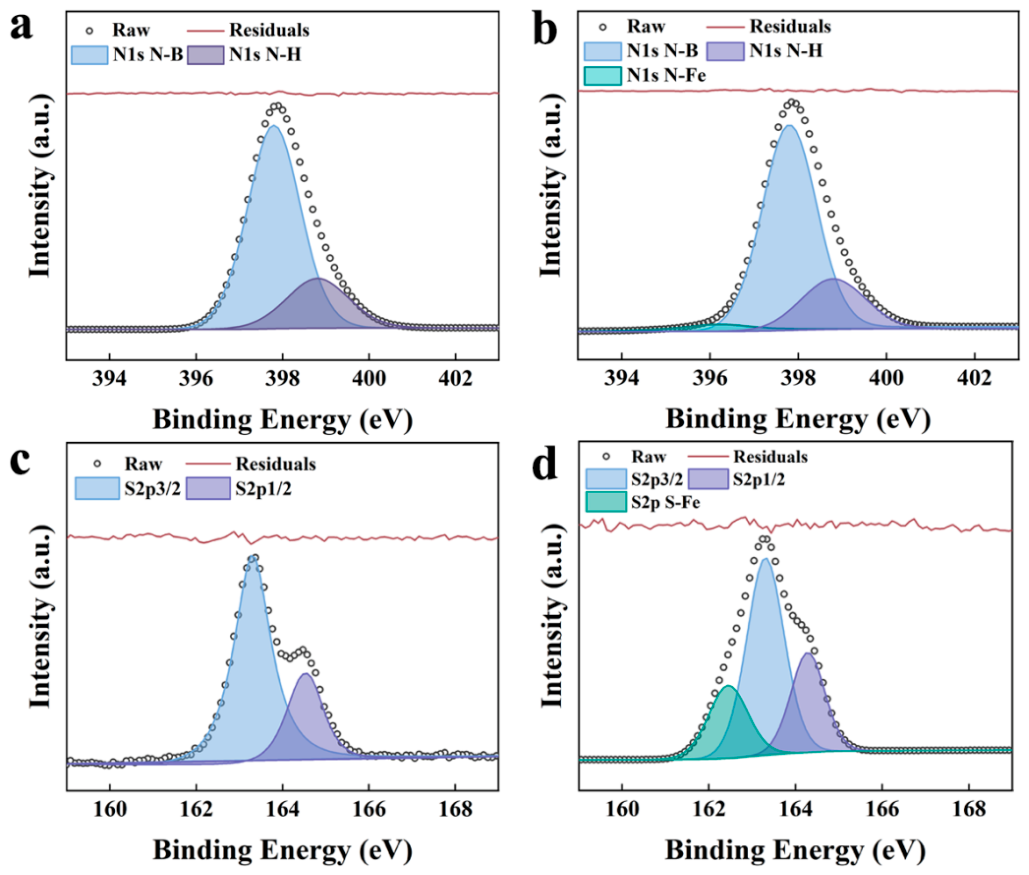
Although the SEM and XRD results demonstrate that BN-s can be deposited on iron powder surfaces to form composite powders, the interfacial interactions between the coating layer and the iron matrix require further clarification. Therefore, high-resolution N 1s and S2p XPS analyses were performed on BN-s powders and the 5 wt.% Fe/BN-s composite powders, which showed relatively good coating uniformity. The results are presented in
Figure 5. For BN-s (
Figure 5a), the N 1s spectrum can be deconvoluted into two components. The dominant peak at 397.8 eV corresponds to N-B bonds in the h-BN lattice, whereas the weak peak at 398.7 eV is assigned to residual surface N-H species. Compared with BN-s, the N 1s spectrum of the Fe/BN-s composite powders retains the N-B and N-H components (
Figure 5b), while a new low-binding-energy component appears at 397.2 eV, which can be attributed to N-Fe coordination interactions formed at the interface [
18]. This result suggests that nitrogen-containing structures in BN-s participate in interfacial interactions with the iron powder surface. The S2p spectra further reveal the role of thiol functional groups in interfacial bonding. The S2p spectrum of BN-s (
Figure 5c) exhibits typical spin-orbit splitting, with two peaks located at approximately 163.3 and 164.4 eV, corresponding to the S2p
3/2 and S2p
1/2 components, respectively [
19]. These peaks are assigned to C-S bonds associated with the mercaptopropyl segments in KH580. For the Fe/BN-s composite powders (
Figure 5d), in addition to the C-S component, a new S-Fe-related peak appears at approximately 161.5 eV, suggesting chemical interaction between the sulphur-containing functional groups grafted on the BN-s surface and Fe atoms on the iron powder surface [
20]. The shift of the S2p component towards lower binding energy also indicates a change in the electronic environment around S atoms, consistent with the formation of S-Fe bonding interactions. Taken together, these results indicate that BN-s deposition on iron powders is not merely mechanical mixing or physical adsorption. KH580 modification introduces reactive sulphur-containing functional groups onto h-BN while retaining nitrogen-containing structures capable of participating in interfacial interactions, thereby enabling N-Fe and S-Fe interfacial interactions between BN-s and iron powders.
Regarding the nature of the N-Fe and S-Fe interactions, the XPS binding-energy shifts observed here—N 1s shifting from ~398.7 eV to 397.2 eV and the appearance of an S 2p component at ~161.5 eV—are consistent with coordination-type interfacial interactions. A plausible formation mechanism involves coordination through lone-pair electron donation from nitrogen atoms at edge sites or surface amino groups of h-BN and from sulfur atoms of the mercaptopropyl groups of KH580 to vacant d-orbitals of surface Fe atoms, constituting Lewis acid-base adducts. This interpretation is consistent with the hard-soft acid-base principle: the thiol group (-SH, a soft base) exhibits favourable affinity for the metallic Fe surface (a soft acid). The coordination-type nature of these interactions, intermediate between weak physisorption and full covalent bonding, is consistent with the mild processing conditions (room temperature, aqueous medium) under which the composite powders were prepared. These interfacial interactions distinguish the BN-s coating from simple physically adsorbed layers and may contribute to the improved coating stability during compaction and annealing.
Building on the preceding structural and interfacial analyses, 5 wt.% BN-s was shown to form a relatively continuous and uniform coating on the iron powder surface, while N-Fe and S-Fe interfacial interactions contributed to the stability of the coating layer. On this basis, the effects of BN-s content on the volume resistivity, core loss, static magnetic properties, high-frequency permeability and thermal-transport behaviour of Fe@BN magnetic powder cores were further evaluated, as shown in
Figure 6,
Figure 7 and
Figure 8.
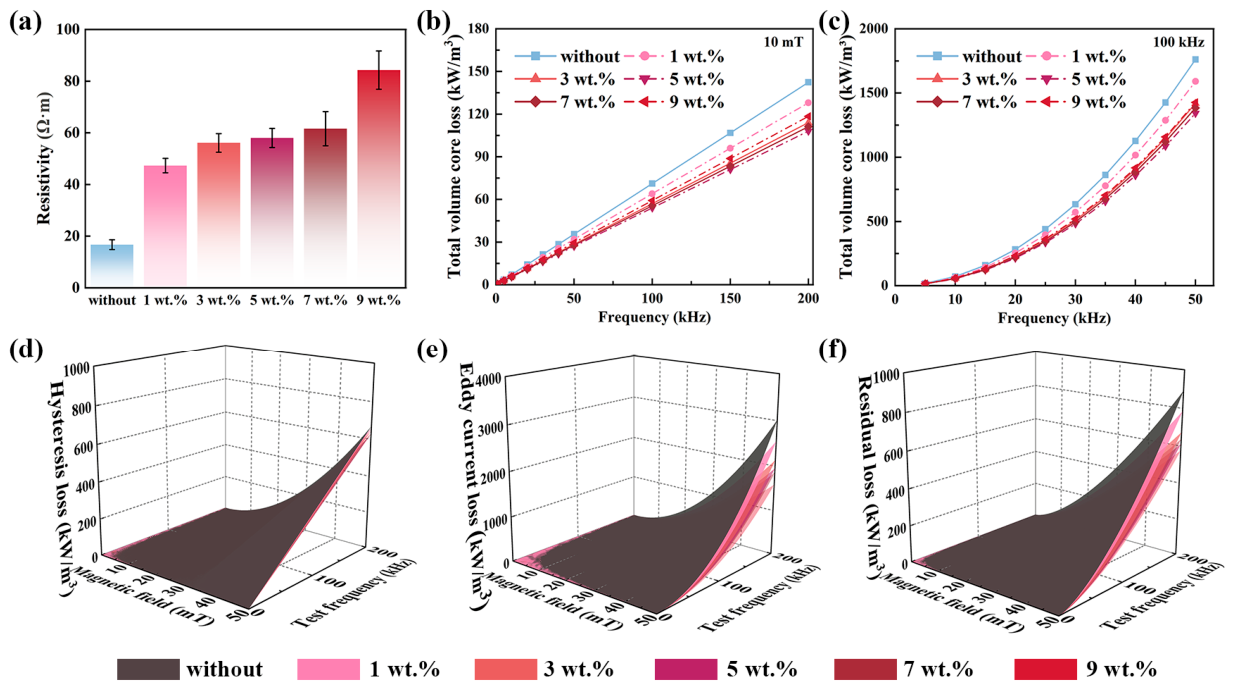
Figure 6a presents the volume resistivity of pure Fe magnetic powder cores and Fe@BN magnetic powder cores with different BN-s contents. As the BN-s content increases from 0 to 9 wt.%, the volume resistivity increases monotonically from 15.3 to 84.7 Ω·m. This increase mainly arises from the BN-s insulating layer interrupting interparticle conductive pathways. When the BN-s content increases from 1 to 5 wt.%, the coating on the iron powder surface evolves from discrete attachment to relatively continuous coverage, weakening direct metallic contact between particles and increasing the resistivity [
21]. When the BN-s content exceeds 5 wt.%, the resistivity continues to increase, but the increment becomes smaller, suggesting that the conductive pathways have already been largely blocked. Further BN-s addition mainly leads to coating thickening and local accumulation. This resistivity evolution is consistent with the SEM-observed changes in coating continuity discussed above.
Figure 6b,c show the frequency dependence of total core loss at 10 mT and the magnetic-flux-density dependence of total core loss at 100 kHz, respectively. For all samples, the total loss increases with increasing frequency and flux density, consistent with the typical loss behaviour of soft magnetic composites [
22]. Compared with pure Fe magnetic powder cores, the BN-s-coated samples show lower total loss, with a larger difference at higher frequencies and higher magnetic flux densities. With increasing BN-s content, the total core loss first decreases and then increases, reaching its minimum in the 5 wt.% sample. Specifically, at 10 mT/100 kHz, the 5 wt.% Fe@BN magnetic powder core exhibits a total loss of 81.2 kW·m
−3, representing a 20.8% reduction compared with the value of 102.5 kW·m
−3 for the pure Fe magnetic powder core. At 100 kHz/50 mT, the total loss decreases from 1786 to 1423 kW·m
−3, corresponding to a reduction of 20.3%. These results indicate that an appropriate BN-s coating reduces high-frequency core loss, whereas aggregation and increased nonmagnetic-phase content caused by excessive BN-s weaken this effect. To further elucidate the origin of the loss variation, the total loss was separated into hysteresis loss
Ph, eddy-current loss
Pe and excess loss
Pexc using a Bertotti-type loss-separation model [
23]:
where
Ch,
Ce and
Cexc are the coefficients associated with hysteresis loss, eddy-current loss and excess loss, respectively;
f is the frequency;
Bm is the maximum magnetic flux density; and
α is the fitting exponent. For particulate soft magnetic composites,
Ce is closely related to particle size and volume resistivity and generally decreases with increasing resistivity.
Table 1 summarises the fitted parameters for the pure Fe magnetic powder cores and Fe@BN magnetic powder cores with different BN-s contents, while
Figure 6d–f present the loss-separation results. With increasing frequency and magnetic flux density,
Pe increases most evidently and becomes the dominant contributor to
Pcv in the high-frequency region. After BN-s incorporation,
Pe decreases overall, consistent with the continuous increase in volume resistivity shown in
Figure 6a. This confirms that the continuous insulating layer restricts interparticle induced-current pathways and suppresses high-frequency eddy-current loss. In contrast,
Ph first decreases and then increases with increasing BN-s content. An appropriate BN-s coating reduces direct interparticle contact and local conductive bridging, while stabilising the interface and lowering the defect sensitivity associated with coating rupture during compaction [
24]. The increase in hysteresis loss at high BN-s contents (7–9 wt.%) originates from the spatial inhomogeneity of the coating. At 5 wt.%, the BN-s coating is relatively continuous and uniform (
Figure 3d), introducing a nearly homogeneous distribution of demagnetising fields and moderate, uniform domain-wall pinning. At 7–9 wt.%, local BN-s agglomeration creates a highly heterogeneous distribution of the nonmagnetic phase, where some regions bear only a thin coating while others accumulate thick BN-s aggregates. This inhomogeneity produces two synergistic effects that increase hysteresis loss: (1) a broadened distribution of local demagnetising fields, with the non-uniform pinning landscape generating greater total hysteresis than a uniform moderate pinning field; and (2) magnetic flux crowding, where flux lines bypass thick nonmagnetic barriers and concentrate through narrow ferromagnetic channels, causing local flux densities to exceed the macroscopic average and increasing local dissipation. Thus the 5 wt.% sample achieves a favourable balance between Pe reduction and Ph control, whereas higher BN-s contents incur penalties from magnetic dilution and non-uniform pinning that cause the total loss to rebound despite continued eddy-current suppression.
However, excessive BN-s introduces local aggregation, increased nonmagnetic-phase content and interfacial nonuniformity, which intensify local demagnetising fields and domain-wall pinning, leading to a rebound in Ph. The variation in Pexc is relatively small and is mainly associated with the nonuniform dynamic motion of domain walls. Accordingly, the 5 wt.% BN-s sample achieves a favourable balance between Pe reduction and Ph control, resulting in the lowest Pcv.
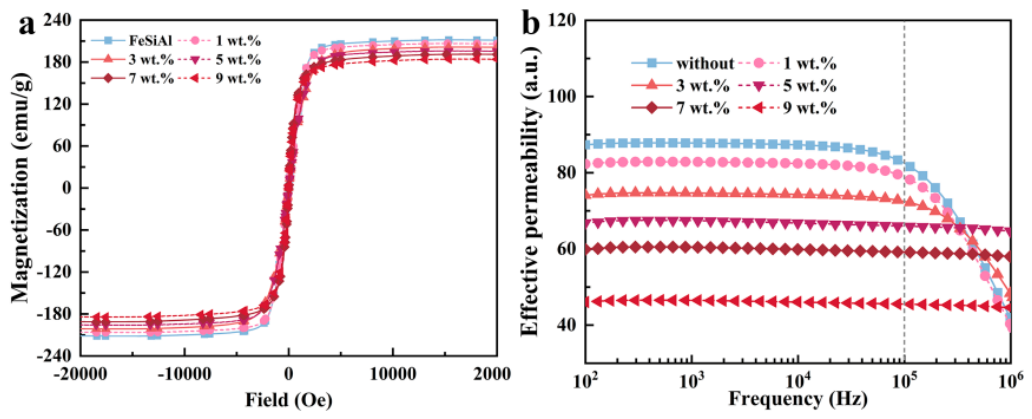
Figure 7a shows the room-temperature hysteresis loops of pure Fe magnetic powder cores and Fe@BN magnetic powder cores with different BN-s contents. All samples exhibit narrow hysteresis loops and high magnetisation, indicating that BN-s coating does not alter the intrinsic soft magnetic characteristics of the iron matrix. With increasing BN-s content, the mass-normalised saturation magnetisation
Ms gradually decreases from 218.7 emu·g
−1 for the pure Fe magnetic powder core to 189.3 emu·g
−1 for the 9 wt.% sample. This decrease is mainly attributed to the introduction of nonmagnetic BN-s, which reduces the mass fraction of the ferromagnetic phase in the composite [
25]. The 5 wt.% Fe@BN magnetic powder core still retains an
Ms of 201.4 emu·g
−1, only 7.9% lower than that of the pure Fe magnetic powder core. This indicates that an appropriate BN-s coating can reduce loss while largely preserving high magnetisation. For the 5 wt.% sample, the measured Ms of 201.4 emu·g
−1 is approximately 3.1% lower than the value of 207.8 emu·g
−1 predicted by a simple rule of mixtures (Ms
pure × 0.95 = 218.7 × 0.95 ≈ 207.8 emu·g
−1). This deviation may originate from a slight reduction in the magnetic moment of Fe atoms participating in N–Fe and S–Fe coordination interactions at the BN-s/Fe interface—a magnetic dead-layer effect—as well as from a subtle influence of the BN-s coating on the packing density of the iron powder. Ms data across the full series of samples (1–9 wt.%) show that the decline in Ms is broadly proportional to the mass fraction of the nonmagnetic BN-s phase, consistent with a predominantly dilution-controlled mechanism supplemented by minor interfacial contributions.
Figure 7b displays the frequency dependence of effective permeability for different samples. All samples show relatively stable permeability over the range of 10
2–10
5 Hz, indicating good frequency stability of the magnetic powder cores in the low- to medium-frequency region. With increasing BN-s content, the effective permeability decreases overall, from 92.3 for the pure Fe magnetic powder core to 45.7 for the 9 wt.% sample. This decrease mainly originates from the increased interparticle magnetic reluctance introduced by the nonmagnetic BN-s coating and the enhanced local demagnetising effect [
26]. Nevertheless, the 5 wt.% Fe@BN magnetic powder core maintains an effective permeability of 67.5 at 100 kHz, with only minor fluctuation below 10
5 Hz. Together with its minimum core loss, these results indicate that 5 wt.% BN-s provides a balanced combination of permeability retention, saturation magnetisation and loss suppression.
Beyond electromagnetic performance, thermal-transport capability is also critical for the long-term stable operation of high-frequency soft magnetic composites.
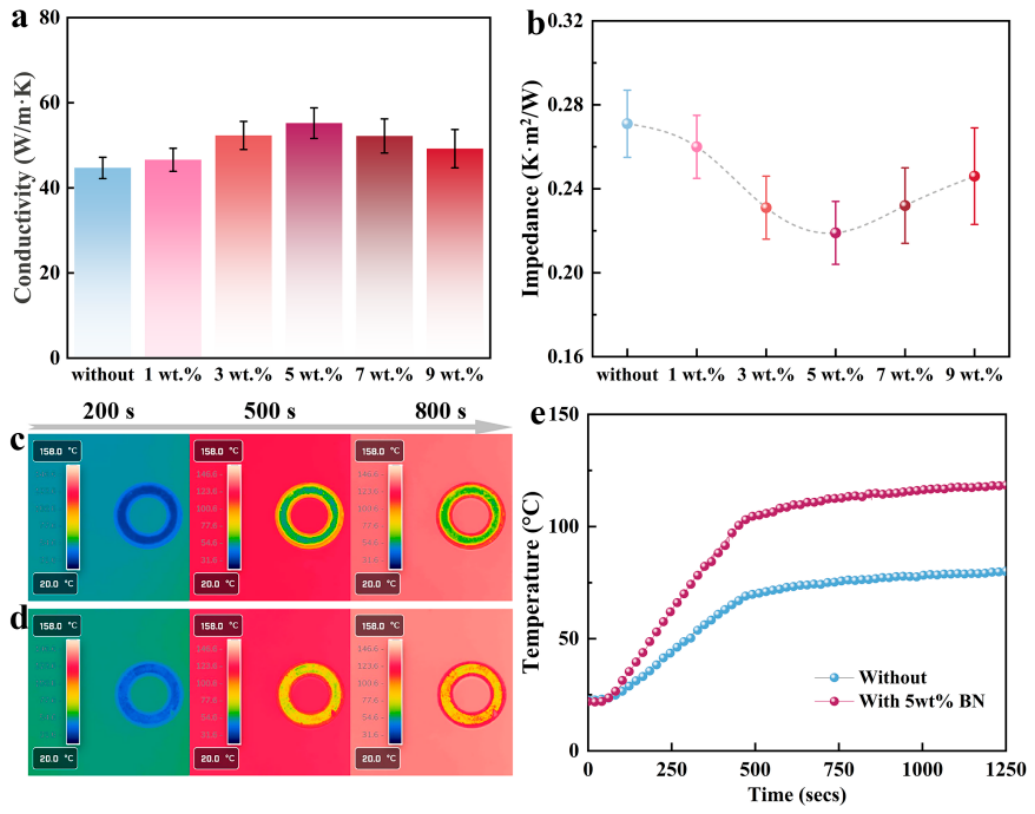
Figure 8a,b present the thermal conductivity and thermal impedance of the magnetic powder cores with different BN-s contents, respectively. As the BN-s content increases, the thermal conductivity first increases and then decreases, reaching a maximum of 55.2 W·m
−1·K
−1 for the 5 wt.% sample, which is 23.5% higher than that of the pure Fe magnetic powder core, 44.7 W·m
−1·K
−1. Correspondingly, the thermal impedance reaches its minimum value of 0.215 K·m
2·W
−1 for the 5 wt.% sample, representing a 24.6% reduction compared with the pure Fe magnetic powder core. These results show that an appropriate BN-s content not only provides electrical insulation but also improves interparticle thermal-conduction pathways by using the intrinsically high thermal conductivity of h-BN [
27]. For the 5 wt.% sample, the relatively continuous BN-s coating with limited agglomeration helps reduce interfacial thermal resistance between particles. In contrast, further increasing the BN-s content leads to local BN-s aggregation and a larger number of interfaces, introducing additional phonon scattering and pore defects and thereby reducing the overall thermal conductivity [
28].
Figure 8c–e further compare the infrared thermal responses of the pure Fe magnetic powder core and the 5 wt.% Fe@BN magnetic powder core under identical heating conditions. Compared with the pure Fe magnetic powder core, the surface temperature of the 5 wt.% sample increases more rapidly, reaching 118.3 °C after 1250 s, whereas that of the pure Fe magnetic powder core reaches 82.7 °C. It should be emphasised that the surface temperature rise observed in infrared thermal images cannot alone be used to determine the heat-generation level of the material. Its physical meaning must be interpreted together with the heat-source configuration, thermal conductivity and temperature-field uniformity [
29]. In terms of temperature distribution, the 5 wt.% Fe@BN magnetic powder core exhibits a more uniform surface temperature field at 200, 500 and 800 s, whereas the pure Fe magnetic powder core shows a more pronounced local temperature gradient. Combined with the higher thermal conductivity and lower thermal impedance shown in
Figure 8a,b, these results suggest that the 5 wt.% BN-s coating promotes rapid heat diffusion through the interior and across the surface of the magnetic powder core, thereby reducing the risk of localised heat accumulation.
Overall, the performance results in
Figure 6,
Figure 7 and
Figure 8 demonstrate that a BN-s content of 5 wt.% enables a balanced combination of enhanced resistivity, reduced core loss, retained magnetic properties and improved thermal transport in Fe@BN magnetic powder cores. The flatter effective permeability-versus-frequency profile observed for the 7 and 9 wt.% samples at frequencies above 10
5 Hz (
Figure 7b) warrants careful interpretation. Given that the eddy-current coefficient Ce does not decrease for these compositions (
Table 1), the improved frequency stability cannot be attributed to enhanced eddy-current suppression. Instead, it arises primarily from the substantial reduction in effective permeability at these compositions (u
eff = 55.3 and 45.7 for 7 and 9 wt.%, respectively): at these diluted permeability levels, the magnetisation reversal is dominated by the intrinsic high-frequency dynamics of individual iron particles, including natural ferromagnetic resonance and the Snoek limit, while long-range interparticle dipolar coupling is weakened by the thick nonmagnetic interlayers. The apparent flatness is therefore a consequence of operating at a low permeability baseline rather than active eddy-current shielding. For applications requiring both low loss and moderate-to-high permeability, the 5 wt.% composition offers a more balanced compromise; for scenarios where frequency stability is prioritised over absolute permeability, higher BN-s contents may also serve as a reference.
The degradation of thermal conductivity at 9 wt.% BN-s to approximately 45 W/(m·K), a value comparable to that of the pure Fe core, and the corresponding increase in thermal impedance (
Figure 8a,b) provide an independent cross-validation of the coating microstructure evolution. At 5 wt.%, the relatively continuous coating with limited agglomeration maximises the contribution of the thermally conductive BN-s platelets to interparticle heat transport while minimising additional phonon-scattering interfaces. At 9 wt.%, excessive local aggregation introduces abundant BN-s/BN-s and BN-s/Fe interfaces that act as phonon-scattering centres, increasing the effective Kapitza interfacial thermal resistance and potentially creating micro-voids that further impede heat conduction. This convergence of the electromagnetic and thermal transport data around the same optimal composition (5 wt.%) reinforces the conclusion that the relatively continuous, low-agglomeration coating morphology is the most favourable microstructural configuration for multifunctional performance, which demonstrates superior comprehensive performance compared to the reports in the literature [
30,
31,
32,
33,
34,
35]. The 5 wt.% sample exhibits a volume resistivity of 58.7 Ω·m, a total core loss of 81.2 kW·m
−3 at 10 mT/100 kHz, a retained saturation magnetisation of 201.4 emu·g
−1 and an effective permeability of 67.5 at 100 kHz. Meanwhile, its thermal conductivity increases to 55.2 W·m
−1·K
−1, while its thermal impedance decreases to 0.215 K·m
2·W
−1. These results indicate that the BN-s-based synergistic insulation/thermal-conduction coating strategy can suppress high-frequency eddy-current loss while improving thermal-diffusion behaviour, showing its potential for high-frequency power-electronic magnetic components.