


Abstract
Long-range hopping plays a crucial regulatory role in non-Hermitian topological systems. This paper systematically studies a non-Hermitian Su–Schrieffer–Heeger (SSH) model that incorporates both long-range hopping and spin–orbit coupling (SOC) within the framework of the generalized Brillouin zone (GBZ). We reveal that long-range hopping can not only actively suppress the non-Hermitian skin effect, but can also cooperate with SOC to jointly modulate the stability regions of topological phases. SOC controls topological transitions through real or imaginary coupling properties and enhances the robustness of edge states. By constructing the GBZ and establishing the non-Bloch bulk–boundary correspondence, we demonstrate that the topological zero modes are entirely determined by the non-Bloch winding number. This study clarifies the key role of long-range hopping as a core regulatory parameter and provides a new paradigm for achieving the synergistic control of topological states and localized properties in non-Hermitian systems through designed couplings.
1. Introduction
Topological insulators in Hermitian systems have established a paradigm of bulk–boundary correspondence, wherein topological invariants defined in the Brillouin zone predict boundary states [1,2,3,4,5,6,7,8,9]. However, non-Hermitian systems—describing open quantum systems with gain and loss and providing a platform for simulating novel topological states [10]—exhibit a breakdown of this conventional bulk–boundary correspondence [11] due to the non-Hermitian skin effect (NHSE) [12,13,14,15,16,17,18,19,20,21,22,23]. Recent studies have further explored exotic dynamic and localization phenomena induced by non-Hermiticity in higher-dimensional or many-body contexts, such as anisotropic scaling localization and non-reciprocal quench dynamics [24,25]. The proposal of the GBZ theory has provided a theoretical foundation for restoring the bulk–boundary correspondence in one-dimensional non-Hermitian lattices [26,27,28,29,30,31,32,33].
At the same time, SOC as a key mechanism for inducing rich topological phases in Hermitian systems [34,35,36,37], has gradually attracted attention in combination with non-Hermitian topology. Previous studies have explored the synergistic effects of SOC and non-Hermiticity in nearest-neighbor hopping models and predicted new phenomena such as SOC-stabilized non-Hermitian skin modes [38,39,40]. Experimentally, the realization of non-Hermitian Hamiltonians and the observation of the non-Hermitian skin effect (NHSE) have been verified in platforms such as optical cavities [15,41], ultracold atoms [42], and superconducting circuits [43], providing an experimental basis for related theoretical predictions.
Although previous studies have explored the role of SOC in non-Hermitian SSH models with nearest-neighbor hopping [44,45], there is still a lack of a systematic theoretical framework for non-Hermitian topological systems that include long-range hopping. Previous studies have largely relied on numerical methods [46,47] or have been limited to nearest-neighbor models [39], failing to thoroughly reveal the interaction mechanisms among long-range hopping, SOC, and non-Hermiticity. In particular, analytical descriptions within the framework of GBZ theory remain lacking.
This article aims to fill this gap by studying a non-Hermitian SSH model that incorporates both SOC and long-range hopping, systematically exploring the role of long-range hopping in regulating non-Hermitian topological phases and the skin effect. We construct a GBZ, analytically derive the non-Bloch Hamiltonian, restore the bulk–boundary correspondence, and demonstrate that the topological zero modes are determined by the non-Bloch winding number. Our study finds that long-range hopping not only effectively suppresses the non-Hermitian skin effect, but can also synergize with SOC to significantly broaden the stable parameter region of the topological phase. By reconstructing the geometry of the GBZ, long-range hopping becomes a key parameter for regulating topological phase transitions.
The organizational structure of this article is as follows. In Section 2, a one-dimensional SSH model incorporating non-Hermiticity, SOC, and long-range hopping is defined. Section 3 illustrates the breakdown of bulk–boundary correspondence during topological phase transitions via energy spectrum analysis, and quantitatively characterizes the skin effect through wave function distribution and localization length. Section 4 constructs the GBZ and analyzes the geometric modulation of the GBZ by long-range hopping. Section 5 restores the bulk–boundary correspondence by calculating the non-Bloch topological winding number. Finally, a summary and outlook are given in Section 6.
2. Model and Hamiltonian
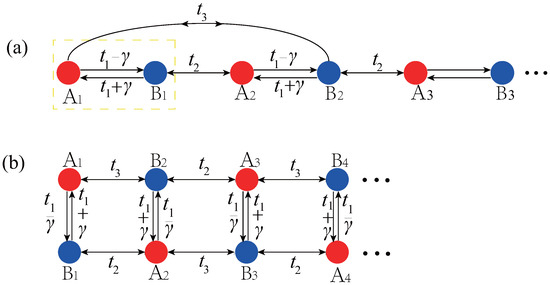
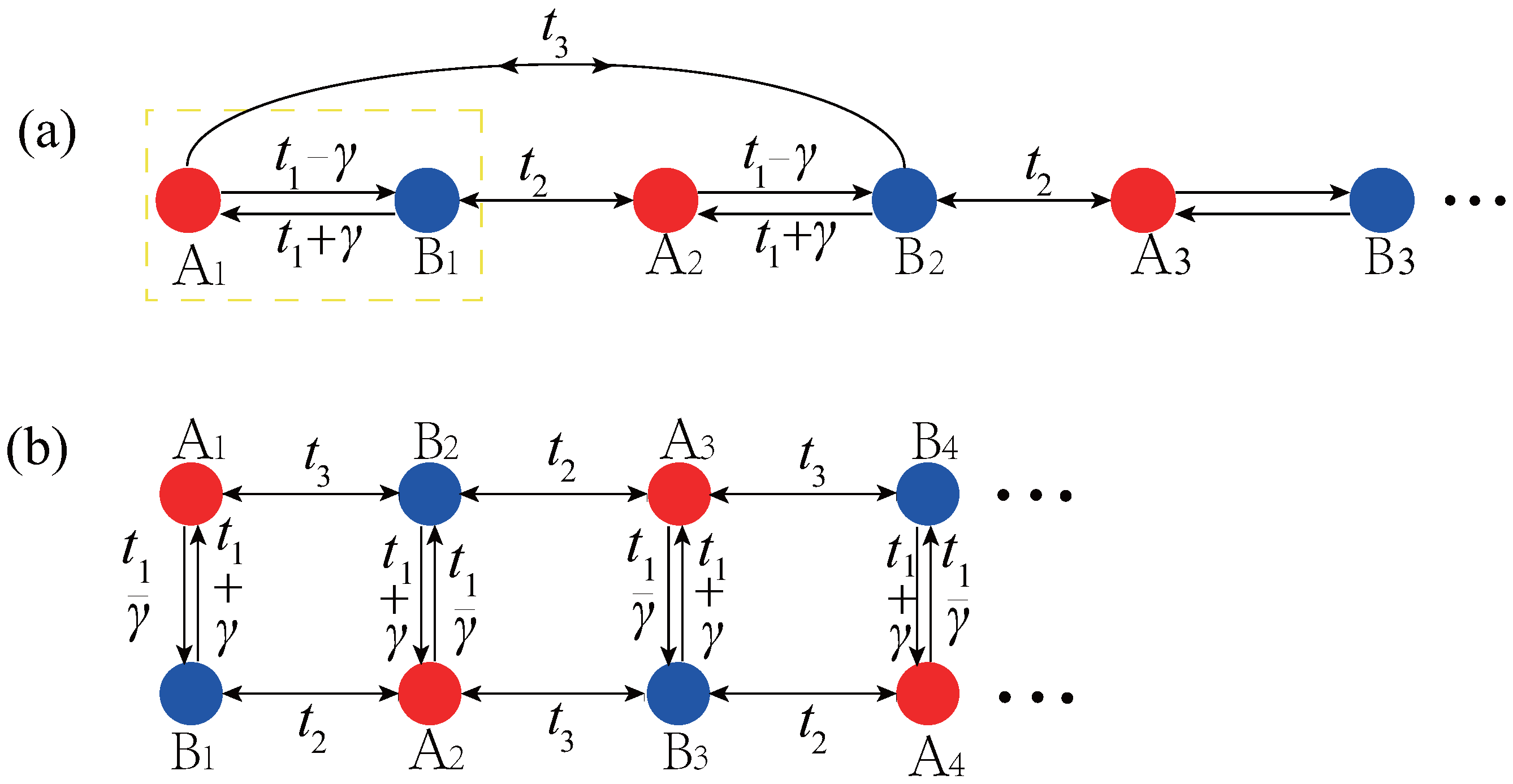
We consider a non-Hermitian SSH model with long-range hopping and SOC as shown in Figure 1a, and the model can be mapped to a two-leg ladder model, as shown in Figure 1b. Different from previous studies, the sub-nearest neighbor transition term () introduced by us is not only a perturbation, but also a key element connecting different unit cells and introducing spatial non-local associations. When the system enters the strong long-range hopping interval, its energy band and intrinsic state properties are expected to be qualitatively different from the nearest neighbor model. Using Fourier transform under periodic boundary conditions, the Hamiltonian can be easily written as , where , and
where and are the Pauli matrix. ( and ( are the electron creation (annihilation) operators with on the sublattices A and B of the n-th unit cell, respectively. represents the non-Hermiticity. , and characterize the intracell and intercell hoppings. Spin or , and denote the SOC amplitudes in the unit cell and between two adjacent unit cells, respectively. When the SOC is of the Dresselhaus-type, the coupling amplitude and are real numbers. Otherwise, when the SOC is Rashba-type, the coupling amplitude is imaginary.
Figure 1.
(a) Non-Hermitian SSH model. The yellow box dashed line represents one unit cell, with alternating hopping and within the unit cell, and the hopping between unit cells of . (b) The two-leg ladder model mapped from (a).
In order to obtain the topological properties of the model and the conditions for topological phase transitions, we conducted the following analysis. We performed two unitary transformations using and [44,45],
then
After unitary transformation, the non-Hermitian SSH model with SOC can be divided into two subspaces and . It is worth noting that each subspace can be regarded as a regular non-Hermitian SSH model. The above model can be divided into the first subspace and the second subspace for discussion, which can be expressed as
Among them , and , , , .
3. Topological Phases Modulated by Long-Range Hopping and SOC
3.1. Energy Spectra and Topological Phase Transitions
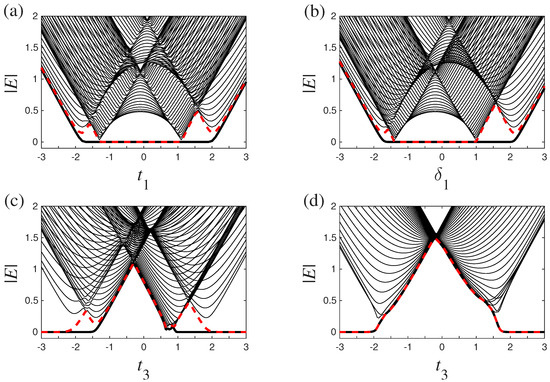
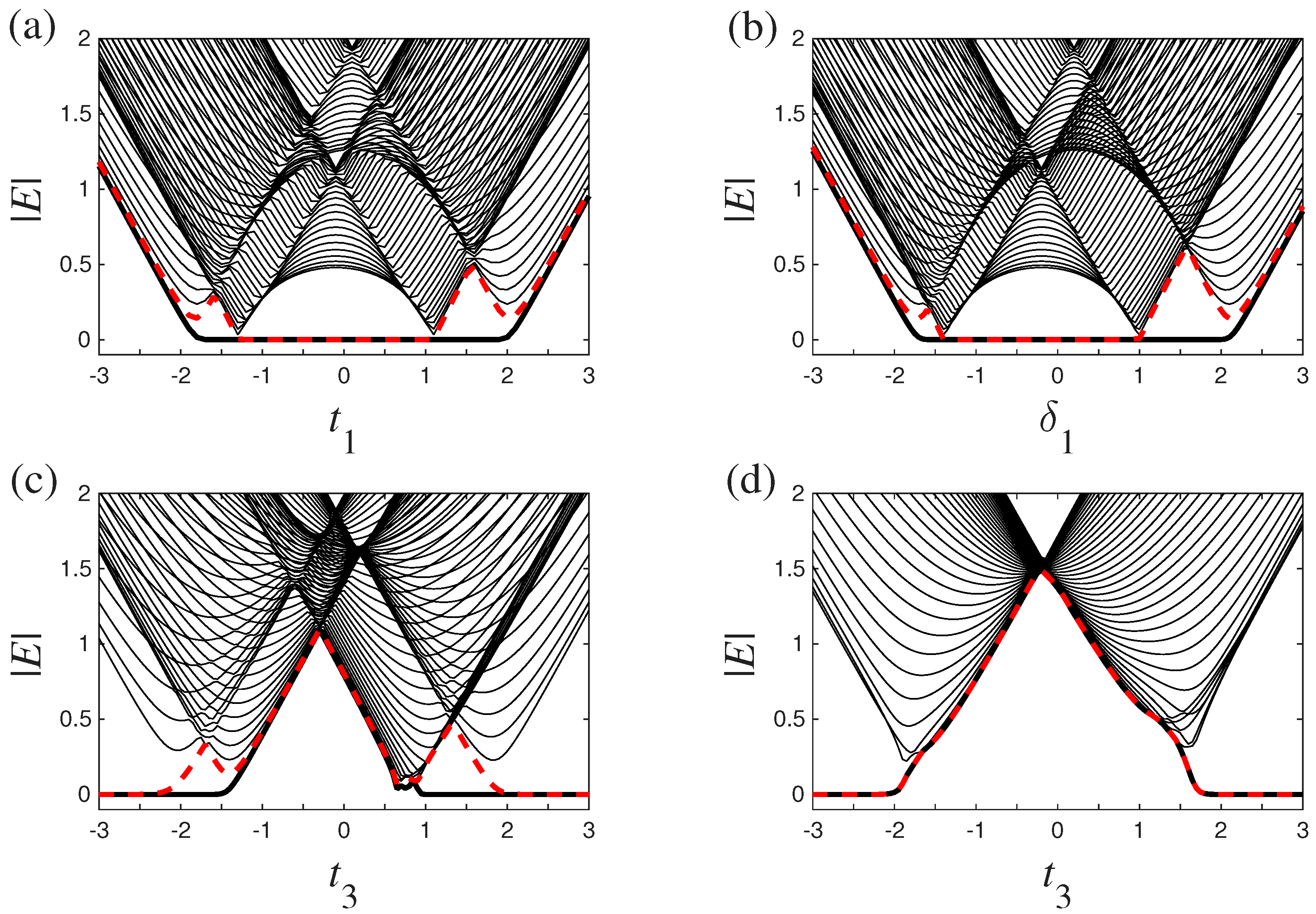
When the SOC is Dresselhaus-type, the energy spectrum of the system can be obtained by diagonalizing the Hamiltonian in Equation (1) under OBC, as shown in Figure 2a. A distinct gap closure phenomenon appears at and , accompanied by the emergence of zero-energy modes (represented by black bold lines in the figure). The separation between sub-gap states (red dashed lines) and zero-energy modes clearly reveals the system’s nontrivial topological properties. When , the energy bands show continuous distribution characteristics, fully consistent with the expected behavior of topologically trivial phases. The variation of SOC strength as shown in Figure 2b: robust zero-energy modes persist within . When approaches the critical value, the bulk gap gradually decreases until it closes. These findings strongly support the existence of Majorana edge states.
Figure 2.
The energy spectrum of with long−range hopping and SOC for 40 unit cells in Equation (1) under open boundary conditions. (a) Change in the energy spectrum with parameter when . (b) Effect of Non-Hermitian term on the energy spectrum when . The other parameters are , , , for (a,b). (c) Regulation of the energy spectrum by in Dresselhaus-type SOC with , . (d) Regulation of the energy spectrum by in Rashba-type SOC with , . The other parameters are , , for (c,d). The black thin line represents the bulk energy band, the black solid line represents the lowest two eigenvalues, and the red dotted line represents the second lowest two eigenvalues.
The evolution of energy spectrum of the non-Hermitian SSH model with long-range hopping and Dresselhaus-type SOC is shown in Figure 2c. The 3rd–4th eigenvalue represented by the red dotted line and the energy band of the body state maintain a clear separation at the , showing the characteristics of edge state. These eigenstates maintain relatively stable energy values in the whole parameter range, indicating that the system may have topology protected boundary states. However, with non-Hermitian systems with Rashba-type SOC, as shown in Figure 2d, the topological zero modes (thick black lines, corresponding to the two lowest energy levels) changed from non-zero to zero, coinciding with the red dashed line. It is noteworthy that even in the strong long−range hopping regime (), the gap between the zero modes and the bulk bands (thin black lines) remains clearly visible, with no topological phase transition occurring. Although this phenomenon has been reported in nearest-neighbor models () [44,45], the presence of long-range hopping significantly enlarges the parameter region where the topological phase is stable. Compared with the Dresselhaus-type SOC, the Rashba coupling introduces an equivalent gauge field due to its imaginary properties, which adjusts the phase configuration of the eigenstate in the complex plane. The long-range hopping does not merely act as a simple perturbation on the system; rather, it cooperates with Rashba-type SOC to reconstruct the effective mass and the dispersion relations at the band edges of the system.
3.2. Non-Hermitian Skin Effect and Localization Properties
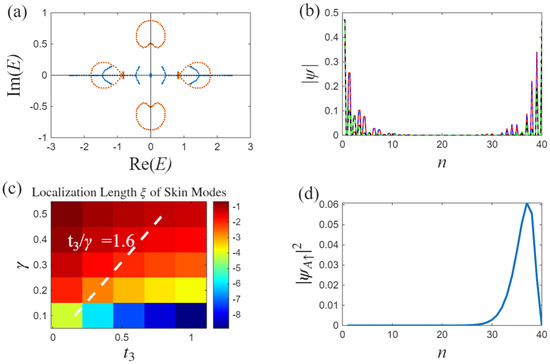
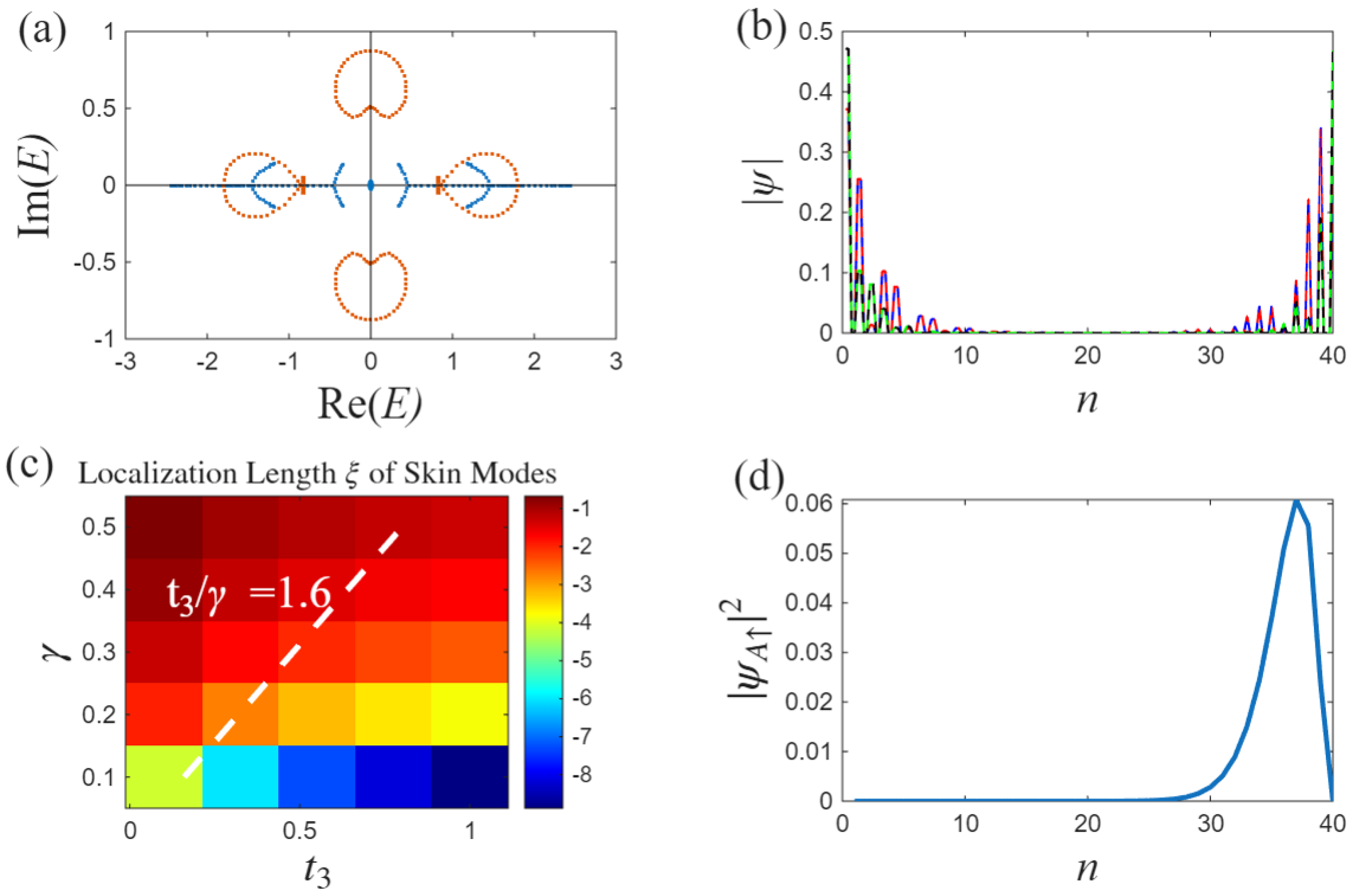
The bulk–boundary correspondence and localization properties in a non-Hermitian SOC system are shown in Figure 3. The central isolated mode (blue circle) is a PT-symmetry-protected skin mode () in Figure 3a. The pronounced disparity between the energy spectra under open boundary conditions (blue dots) and periodic boundary conditions (purple dots) reveals the breakdown of non-Bloch bulk–boundary correspondence. The wavefunction distributions of characteristic eigenstates (Figure 3b) demonstrate distinct localization patterns. The localization properties were characterized by the localization length in Figure 3c, defined as [48,49]:
Figure 3.
(a) The energy spectra in open boundary condition (the blue dots) and in periodic boundary condition (the orange dots). (b) Profile of four zero modes, and , , , , , . (c) The localization length of skin modes across parameter space (, ). (d) Wavefunction distribution with , .
The heatmap clearly demonstrates the system’s transition from strongly localized skin modes (blue regions) to delocalized states (red regions), which occurs when the long-range hopping surpasses the dominant effect of the non-Hermitian parameter . We found that when increasing the long-range transition , it effectively increased the local length of the skin mold (i.e., the transition from the blue area to the red region). When exceeds the critical value (e.g., ), the exponential local area of the skin model is significantly inhibited, and the system shows a quasi-expanded state. This reveals the novel ability of long-range interactions to counteract non-Hermitian skin effect, providing new ideas for experimental manipulation of skin effects. Figure 3d displays the wavefunction distribution at the representative parameter point, where the skin mode profile unambiguously confirms exponential localization. Crucially, the sustained localization observed under strong long-range hopping () challenges conventional theoretical frameworks and suggests the emergence of a new stabilization mechanism for non-Hermitian skin effects.
4. Regulation and Geometric Reconstruction Effects of Long-Range Couplings on GBZ
4.1. The Geometric Reconstruction of GBZ by Long-Range Hopping
The bulk eigenvalue equation is derived from the Schrödinger equation , where the wavefunction represents the particle amplitudes on sublattices A and B across all unit cells. The eigen equation of each subspace will be written as:
The characteristic equations of the subspace of the non-Hermitian SSH model can be obtained:
When the long-range hopping , the equation reduces to the standard quartic characteristic equation, whose solutions satisfy the ordering condition , where the GBZ is formed by the trajectory of satisfying . At this time, due to the presence of the non-Hermitian parameter , the GBZ curve deviates significantly from the unit circle, reflecting a strong non-Hermitian skin effect—all bulk states are localized at the boundaries of the system. When a non-zero is introduced, the structure of Equation (7) undergoes a fundamental change: appears in both the constant term and the quadratic term, directly altering the modulus distribution of the solutions. Theoretical analysis shows that as increases, the trajectory of the solutions that satisfy in the complex plane changes systematically, manifesting as the GBZ closed curve gradually shrinking towards the unit circle.
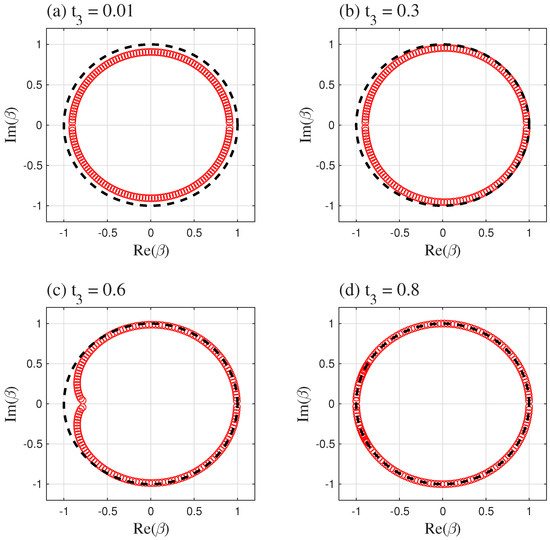
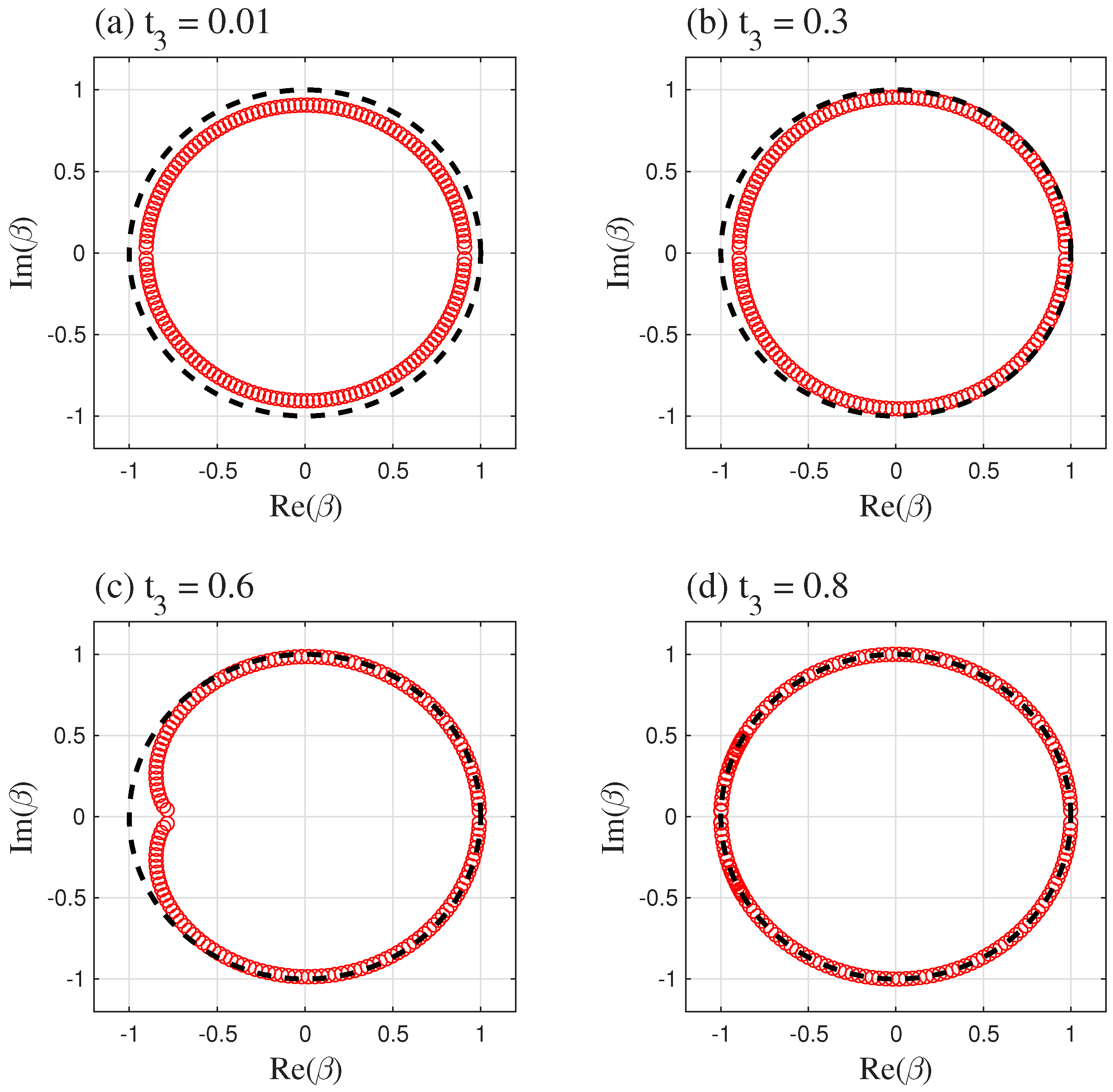
We intuitively demonstrated the regulatory effect of on the geometry of the GBZ through numerical calculations, and the calculated GBZ trajectory is shown in Figure 4. As increases from 0.01 to 0.8, the GBZ curve undergoes a continuous transition from being significantly deviated from the unit circle to almost coinciding with it. This geometric change directly reflects the transformation in the localization properties of the system’s eigenstates: when , the strongly deviated GBZ corresponds to exponentially localized skin states; when , the GBZ close to the unit circle indicates that the system nearly recovers Bloch-like behavior, and the skin effect is effectively suppressed.
Figure 4.
The effect of long−range hopping on the geometry of GBZ. Scatter plot representing the geometric shape of GBZ, and the black dashed line represents the unit circle. (a) : the GBZ deviates significantly from the unit circle, indicating a strong non-Hermitian skin effect. (b) : the GBZ begins to shrink toward the unit circle, and the skin effect weakens. (c) : the GBZ further approaches the unit circle, indicating a significant reduction in wave function localization. (d) : the GBZ almost coincides with the unit circle, and the system recovers approximate extended-state characteristics. Other parameters are , , .
By analyzing the coefficient structure of Equation (7), we find that the non-Hermitian parameter tends to disperse the distribution of the modulus of the solutions (), causing the GBZ to deviate from the unit circle. In contrast, the long-range hopping , by introducing additional coupling terms, tends to rebalance the distribution of the solution moduli. Under conditions of large , the physical essence of the GBZ approaching the unit circle is that the long-range coupling partially restores the translational symmetry characteristics of the system, counteracting the non-reciprocal propagation induced by non-Hermiticity. This finding indicates that the long-range hopping is not only a model parameter but also an active physical control switch, capable of continuously tuning the strength of the non-Hermitian skin effect by reconstructing the geometric shape of the GBZ.
4.2. GBZ Loop Evolution and Topological Phase Separation
The non-Bloch Hamiltonian of each subspace can be expressed as [40]
where
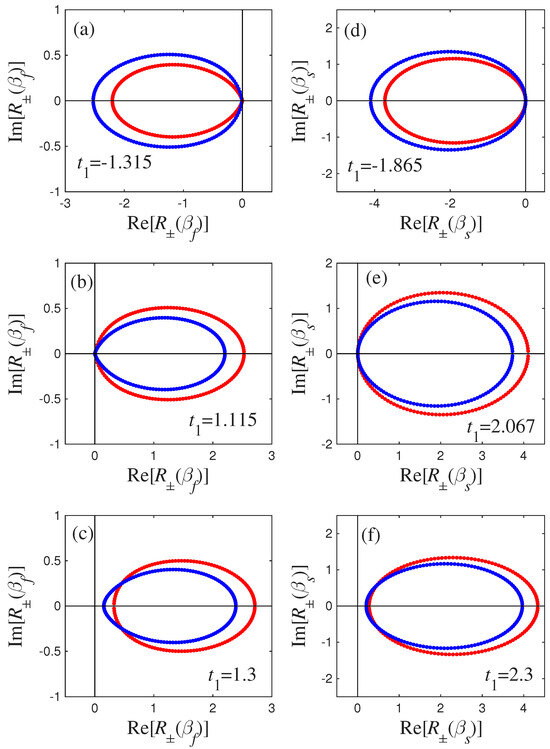
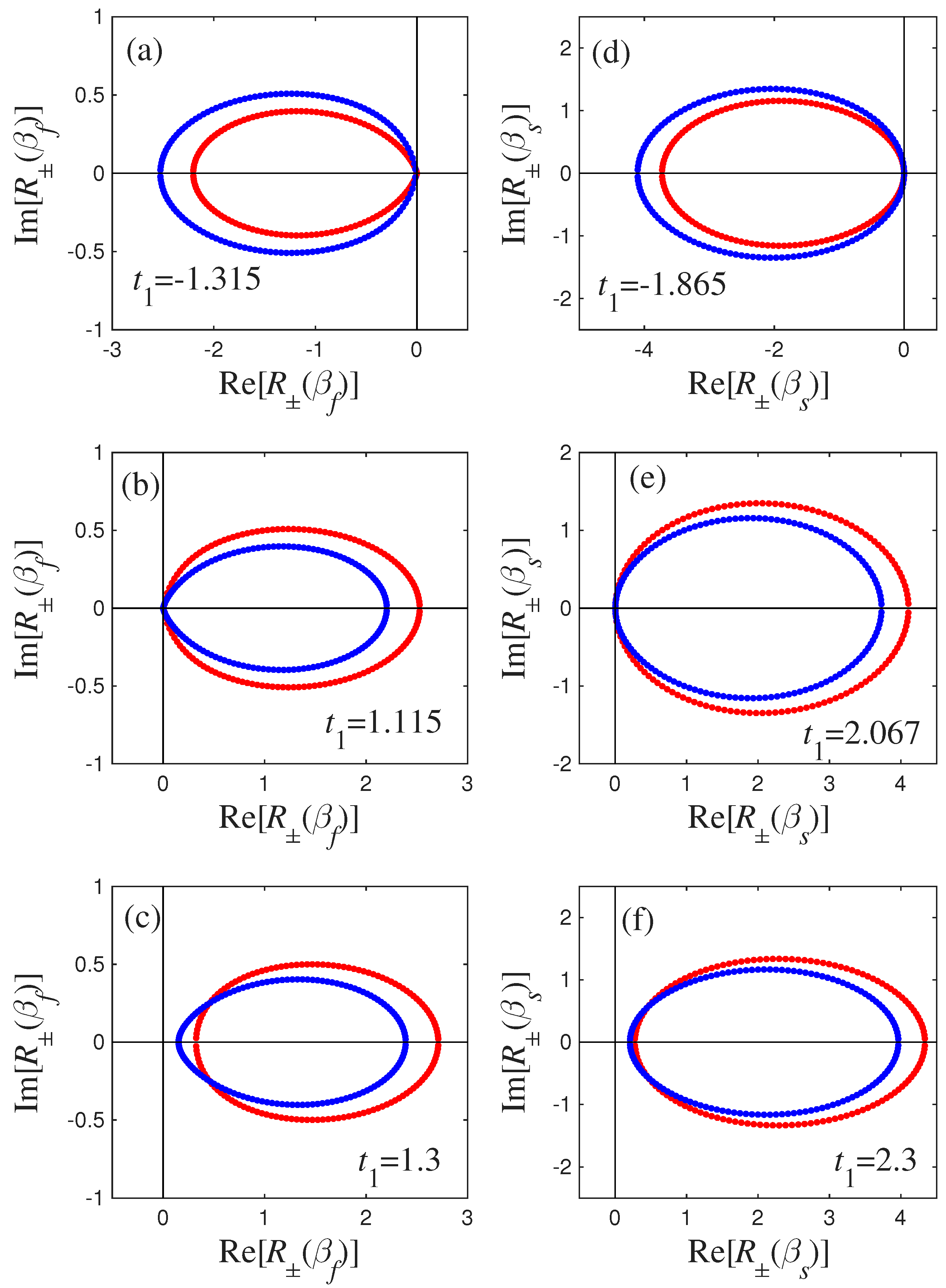
As shown in Figure 5a, in the first subspace, the closed loops (red) and (blue) are tangent to the origin on the right side, indicating that a topological phase transition occurs when . As gradually increases, gradually moves to the right of the origin, and in this interval, the first subspace is in a nontrivial topological state. When , the left side of the closed loops are tangent to the origin as shown in Figure 5b, and a topological phase transition occurs again. When , moves away from the origin in Figure 5c, and the first subspace is in a trivial topological state. As shown in Figure 5d,e, in the second subspace, the closed loops are tangent to the origin, indicating a topological phase transition occurs at and 2.067. The analysis process above can also be confirmed by the zero mode in the open boundary energy spectrum shown in Figure 2a. It is worth noting that under the long-range interaction, the topological phase transition point ( 2.067) of subspace in Figure 5d–f is more separated from the phase transition point ( 1.115) of subspace in Figure 5a–c. This means that by adjusting , the system may experience an intermediate phase in which only one subspace is in the topological state so as to realize the selective boundary state excitation regulated by the spin degree of freedom, which is difficult to achieve by the nearest neighbor model.
Figure 5.
Left side (a–c) and right side (d–f) show the loops of (the red curve) and (the blue curve) on the complex plane under different conditions. Other parameters are same as the Figure 2a.
5. Non-Bloch Topological Invariants and Bulk–Boundary Correspondence
The non-Bloch number of each subspace in the GBZ can be defined as [31,40]:
the total winding number is . It should be noted that counting the total number of robust zero-modes at the left and right ends in the subspace requires 2.
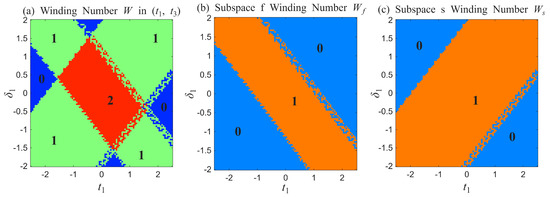
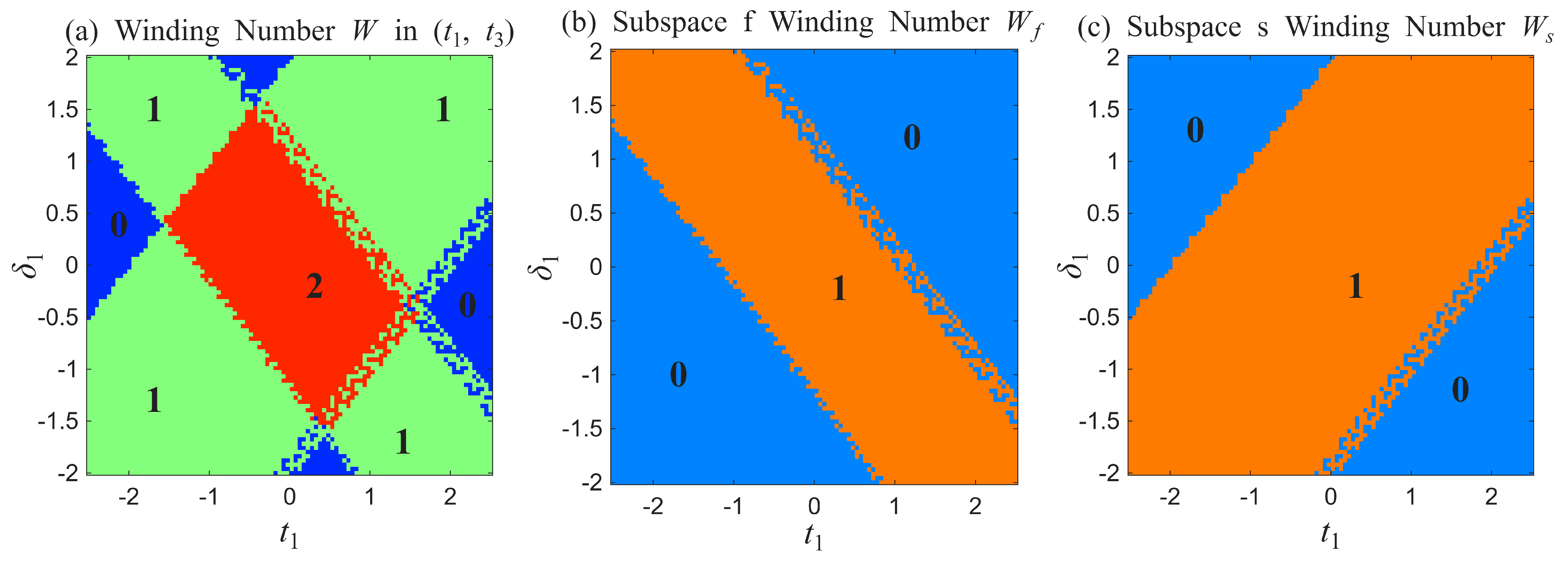
The topological phase diagram of the non-Hermitian SSH model with Dresselhaus-type SOC is shown in Figure 6, expressed in terms of the non-Bloch winding number W as a function of intracell hopping amplitude and SOC strength . The phase diagram exhibits several distinct topological phases separated by sharp phase boundaries. As shown in Figure 6a, a topologically nontrivial phase with occupies the central region bounded by and , consistent with the protection mechanism induced by SOC. The introduction of finite long-range hopping () adjusts the regional range of nontrivial topological phases () compared to the topological phase diagram of the nearest neighbor model (corresponding to ) (compare the phase diagram of the red region in Figure 6a with Ref. [44]). This indicates that the long-range transition and spin–orbit coupling form a synergistic protection mechanism, which enhances the robustness of topological zero-mode to parameter perturbations. Topologically trivial phases with emerge outside these critical boundaries, where strong SOC or specific hopping amplitudes destroy topological protection. The decomposition into subspaces reveals asymmetric behavior in Figure 6b,c. The f-subspace () and s-subspace () contribute unequally to the total winding number due to the opposite SOC contributions in their effective parameters and .
Figure 6.
(a) Total non-Bloch winding number W of non-Hermitian systems with Dresselhaus-type SOC in the parameter space (,). (b) Contributions from f−subspace () and (c) s−subspace () showing asymmetric behavior due to SOC. The other parameters are , , , .
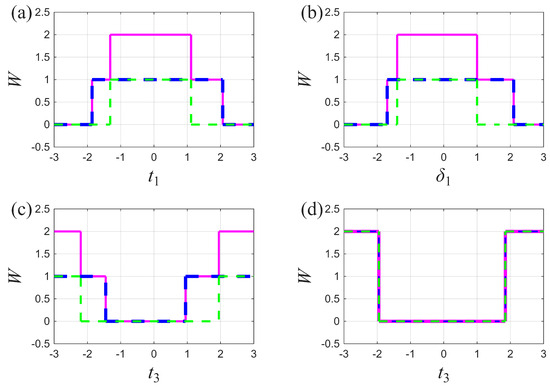
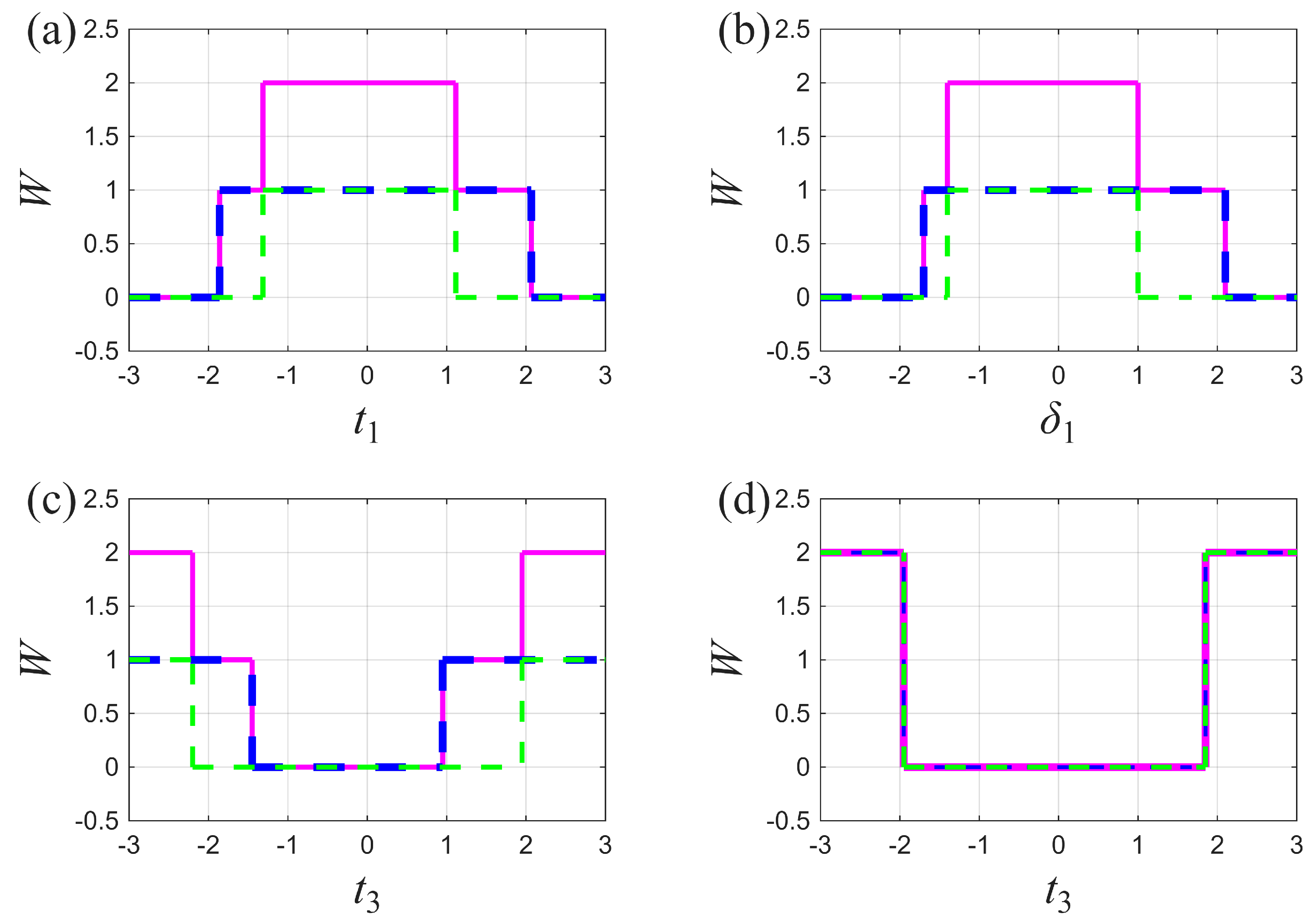
Figure 7 shows the evolution of the winding number with the key system parameters in the non-Hermitian SSH model with long-range hopping. The total topological number W (Magenta line) is formed by the superposition of the contributions of two subspaces, i.e., . The results show that the topological phase transition of the system is determined by the non-Bloch winding number rather than the traditional Bloch Hamiltonian, and the synergistic effect of long-range hopping and SOC significantly enhances the robustness of the topological phase. As shown in Figure 7a, W changes with under Dresselhaus-type SOC, and the total topological number W undergoes quantized transitions at and . Within the interval , the system is in a topologically nontrivial phase. It is noteworthy that the topological transition points of the two subspaces are clearly separated (the transition positions of and are different), indicating that in the intermediate parameter region, a state can appear where only one subspace is in a topologically nontrivial phase, providing the possibility for spin-selective edge state excitations. The SOC dependence exhibits a topological resilience threshold at and in Figure 7b, with the phase maintaining stability below this critical coupling strength, consistent with the predicted protection mechanism in non-Hermitian systems with Dresselhaus-type SOC.
Figure 7.
Winding number W as a function of system parameters. The parameters in panels (a–d) correspond one−to−one with those in Figure 2. Magenta represents the total winding number W of the system, green represents the of the first subspace, and blue represents the topology number of the second subspace.
Under Dresselhaus-type SOC, the total winding number W shows a continuous change trend as increases, as seen in Figure 7c. As gradually increases from zero, the system transitions from a topologically trivial phase () through a critical point into a topologically nontrivial phase (), and the parameter window for the topologically nontrivial phase significantly widens. This is because Dresselhaus-type SOC acts as a real coupling term, which cooperates with the long-range hopping to jointly modulate the geometry of the GBZ (in Figure 4). The enhancement of causes the GBZ curve to contract toward the unit circle, effectively suppressing bulk state localization induced by the non-Hermitian skin effect, thereby maintaining extended state characteristics and topological protection over a wider range of . In Figure 7d, the total winding number W exhibits sharp quantized transitions as varies under Rashba-type SOC, with abrupt changes between and occurring at specific critical values of . This abrupt behavior originates from the effective imaginary gauge field introduced by Rashba-type SOC, which significantly alters the phase structure of the eigenstates in the complex energy bands, making the system’s topological phase transition highly sensitive to . The long-range hopping not only broadens the region of the topological phase but also works together with the imaginary SOC to reconstruct the effective mass and dispersion relation at the band edges, resulting in discontinuous jumps in the topological invariant.
6. Summary
This work breaks through the traditional framework of non-Hermitian topological systems that only consider nearest-neighbor interactions and, for the first time, systematically investigates the combined effects of SOC and long-range hopping within a unified theoretical framework. We reveal the threefold core roles of long-range interactions: (1) serving as an effective regulator of GBZ geometry and topological winding numbers; (2) acting as a potential suppressor of the non-Hermitian skin effect; (3) cooperating with SOC to function as an enhancer of topological stability. By introducing the GBZ and non-Bloch topological invariants, we successfully restored the bulk–boundary correspondence broken by the non-Hermitian skin effect. Our results demonstrate that topological zero modes are dictated by non-Bloch winding numbers rather than traditional Bloch Hamiltonians, with phase transitions occurring precisely when the GBZ contour becomes tangent to the origin. The exceptional robustness of the topological phase across parameter space, particularly the sustained localization under strong long-range hopping, reveals novel stabilization mechanisms beyond conventional theories. SOC constitutes a key element of spin-polarized boundary states and cooperates with long-range hopping to modulate the topological phase space. This work not only advances the fundamental understanding of non-Hermitian topology but also provides practical guidance for designing robust topological devices utilizing SOC and non-Hermitian effects. Our models can be implemented directly in coupled toroidal optical waveguide arrays or superconducting quantum circuits with sub-nearest neighbor coupling. Proposed experimental validation includes measuring changes in the local length of boundary states under regulation and observing additional topological phase transition characteristic signals induced by long ranges.
Author Contributions
Y.H.: Methodology, funding acquisition, project administration, and writing—original draft. S.C.: data curation and writing—review and editing. J.D.: methodology, project administration. X.L.: conceptualization, writing—original draft, and writing—review and editing. H.G.: data curation, writing—review and editing. R.W.: conceptualization, formal analysis, validation. M.H.: investigation, validation. All authors have read and agreed to the published version of the manuscript.
Funding
This work is funded by Science Research Project of Hebei Education Department (Grant No. QN2023056) and Scientific Research Project of Hengshui University (Grant No. 2025ZRPY02).
Data Availability Statement
Data is contained within the article.
Conflicts of Interest
The authors declare no conflicts of interest.
References
- Qi, X.L.; Zhang, S.C. Topological insulators and superconductors. Rev. Mod. Phys. 2011, 83, 1057–1110. [Google Scholar] [CrossRef] [Scilit]
- Kane, C.L.; Mele, E.J. Z2 Topological Order and the Quantum Spin Hall Effect. Phys. Rev. Lett. 2005, 95, 146802. [Google Scholar] [CrossRef] [Scilit]
- Fu, L.; Kane, C.L.; Mele, E.J. Topological Insulators in Three Dimensions. Phys. Rev. Lett. 2007, 98, 106803. [Google Scholar] [CrossRef] [Scilit]
- Schnyder, A.P.; Ryu, S.; Furusaki, A.; Ludwig, A.W.W. Classification of topological insulators and superconductors in three spatial dimensions. Phys. Rev. B 2008, 78, 195125. [Google Scholar] [CrossRef] [Scilit]
- Chiu, C.-K.; Teo, J.; Schnyder, A.; Ryu, S. Classification of topological quantum matter with symmetries. Rev. Mod. Phys. 2016, 88, 035005. [Google Scholar] [CrossRef] [Scilit]
- Moore, J.E.; Balents, L. Topological invariants of time-reversal-invariant band structures. Phys. Rev. B 2007, 75, 121306. [Google Scholar] [CrossRef] [Scilit]
- Hasan, M.Z.; Kane, C.L. Colloquium: Topological insulators. Rev. Mod. Phys. 2010, 82, 3045–3067. [Google Scholar] [CrossRef] [Scilit]
- Bansil, A.; Lin, H.; Das, T. Colloquium: Topological band theory. Rev. Mod. Phys. 2016, 88, 021004. [Google Scholar] [CrossRef] [Scilit]
- Armitage, N.P.; Mele, E.J.; Vishwanath, A. Weyl and dirac semimetals in three-dimensional solids. Rev. Mod. Phys. 2018, 90, 015001. [Google Scholar] [CrossRef] [Scilit]
- Diehl, S.; Rico, E.; Baranov, M.A.; Zoller, P. Topology by dissipation in atomic quantum wires. Nat. Phys. 2011, 7, 971–977. [Google Scholar] [CrossRef] [Scilit]
- Lee, T.E. Anomalous edge state in a non-Hermitian lattice. Phys. Rev. Lett. 2016, 116, 133903. [Google Scholar] [CrossRef] [Scilit] [PubMed]
- Xu, Y.; Wang, S.-T.; Duan, L.-M. Weyl Exceptional Rings in a Three-Dimensional Dissipative Cold Atomic Gas. Phys. Rev. Lett. 2017, 118, 045701. [Google Scholar] [CrossRef] [Scilit] [PubMed]
- Zhu, B.; Lü, R.; Chen, S. PT symmetry in the non-Hermitian Su-Schrieffer-Heeger model with complex boundary potentials. Phys. Rev. A 2014, 89, 062102. [Google Scholar] [CrossRef] [Scilit]
- Zhen, B.; Hsu, C.W.; Igarashi, Y.; Lu, L.; Kaminer, I.; Pick, A.; Chua, S.L.; Joannopoulos, J.D.; Soljačić, M. Spawning rings of exceptional points out of Dirac cones. Nature 2015, 525, 354–358. [Google Scholar] [CrossRef] [Scilit]
- Choi, Y.; Kang, S.; Lim, S.; Kim, W.; Kim, J.-R.; Lee, J.-H.; An, K. Quasieigenstate Coalescence in an Atom-Cavity Quantum Composite. Phys. Rev. Lett. 2010, 104, 153601. [Google Scholar] [CrossRef] [Scilit]
- Gong, Z.; Ashida, Y.; Kawabata, K.; Takasan, K.; Higashikawa, S.; Ueda, M. Topological Phases of Non-Hermitian Systems. Phys. Rev. X 2018, 8, 031079. [Google Scholar] [CrossRef] [Scilit]
- Cao, H.; Wiersig, J. Dielectric microcavities: Model systems for wave chaos and non-Hermitian physics. Rev. Mod. Phys. 2015, 87, 61–111. [Google Scholar] [CrossRef] [Scilit]
- Malzard, S.; Poli, C.; Schomerus, H. Topologically Protected Defect States in Open Photonic Systems with Non-Hermitian Charge-Conjugation and Parity-Time Symmetry. Phys. Rev. Lett. 2015, 115, 200402. [Google Scholar] [CrossRef] [Scilit]
- Bender, C.M.; Boettcher, S. Real Spectra in Non-Hermitian Hamiltonians Having PT Symmetry. Phys. Rev. Lett. 1998, 80, 5243–5246. [Google Scholar] [CrossRef] [Scilit]
- Cerjan, A.; Xiao, M.; Yuan, L.; Fan, S. Effects of non-Hermitian perturbations on Weyl Hamiltonians with arbitrary topological charges. Phys. Rev. B 2018, 97, 075128. [Google Scholar] [CrossRef] [Scilit]
- Lee, C.H.; Li, L.; Thomale, R.; Gong, J. Unraveling non-Hermitian pumping: Emergent spectral singularities and anomalous responses. Phys. Rev. B 2020, 102, 085151. [Google Scholar] [CrossRef] [Scilit]
- Qin, Y.; Li, L. Occupation-Dependent Particle Separation in One-Dimensional Non-Hermitian Lattices. Phys. Rev. Lett. 2024, 132, 096501. [Google Scholar] [CrossRef] [Scilit] [PubMed]
- Lee, T.E.; Chan, C.-K. Heralded Magnetism in Non-Hermitian Atomic Systems. Phys. Rev. X 2014, 4, 041001. [Google Scholar] [CrossRef] [Scilit]
- Ou, Z.; Liang, H.-Q.; Xu, G.-H.; Li, L. Anisotropic scaling localization in higher-dimensional non-Hermitian systems. Phys. Rev. B 2025, 112, L161109. [Google Scholar] [CrossRef] [Scilit]
- Guo, S.; Yin, S.; Zhang, S.-X.; Li, Z.-X. Skin effect induced anomalous dynamics from charge-fluctuating initial states. Phys. Rev. B 2025, 112, 155419. [Google Scholar] [CrossRef] [Scilit]
- Song, F.; Yao, S.Y.; Wang, Z. Non-Hermitian skin effect and chiral damping in open quantum systems. Phys. Rev. Lett. 2019, 123, 170401. [Google Scholar] [CrossRef] [Scilit]
- Zhang, K.; Yang, Z.S.; Fang, C. Correspondence between winding numbers and skin modes in non-Hermitian systems. Phys. Rev. Lett. 2020, 125, 126402. [Google Scholar] [CrossRef] [Scilit] [PubMed]
- Yao, Y.S.; Wang, Z. Edge states and topological invariants of non-Hermitian systems. Phys. Rev. Lett. 2018, 121, 086803. [Google Scholar] [CrossRef] [Scilit]
- Yao, S.Y.; Song, F.; Wang, Z. Non-Hermitian chern bands. Phys. Rev. Lett. 2018, 121, 136802. [Google Scholar] [CrossRef] [Scilit]
- Song, F.; Yao, S.Y.; Wang, Z. Non-Hermitian topological invariants in real space. Phys. Rev. Lett. 2019, 123, 246801. [Google Scholar] [CrossRef] [Scilit]
- Kazuki, Y.; Shuichi, M. Non-Bloch band theory of non-Hermitian systems. Phys. Rev. Lett. 2019, 123, 066404. [Google Scholar]
- Yang, Z.S.; Zhang, K.; Fang, C.; Hu, J. Non-hermitian bulk-boundary correspondence and auxiliary generalized brillouin zone theory. Phys. Rev. Lett. 2020, 125, 226402. [Google Scholar] [CrossRef] [Scilit]
- Xiao, L.; Deng, T.; Wang, K.; Zhu, G.; Wang, Z.; Yi, W.; Xue, P. Non-Hermitian bulk–boundary correspondence in quantum dynamics. Nat. Phys. 2020, 16, 761–766. [Google Scholar] [CrossRef] [Scilit]
- Xu, X.-T.; Yi, C.-R.; Wang, B.-Z.; Sun, W.; Deng, Y.-J.; Liu, X.-J.; Chen, S.; Pan, J.-W. Precision mapping the topological bands of 2D spin-orbit coupling with microwave spin-injection spectroscopy. Sci. Bull. 2018, 63, 1464–1469. [Google Scholar] [CrossRef] [Scilit]
- Wu, Z.; Zhang, L.; Sun, W.; Xu, X.-T.; Wang, B.-Z.; Ji, S.-C.; Deng, Y.; Chen, S.; Liu, X.-J.; Pan, J.-W. Realization of two-dimensional spin-orbit coupling for Bose-Einstein condensates. Science 2016, 354, 83–88. [Google Scholar] [CrossRef] [Scilit]
- Sun, W.; Wang, B.-Z.; Xu, X.-T.; Yi, C.-R.; Zhang, L.; Wu, Z.; Deng, Y.; Liu, X.-J.; Chen, S.; Pan, J.-W. Highly Controllable and Robust 2D Spin-Orbit Coupling for Quantum Gases. Phys. Rev. Lett. 2018, 121, 150401. [Google Scholar] [CrossRef] [Scilit]
- Wang, B.-Z.; Lu, Y.-H.; Sun, W.; Chen, S.; Deng, Y.; Liu, X.-J. Dirac-, Rashba-, and Weyl-type spin-orbit couplings: Toward experimental realization in ultracold atoms. Phys. Rev. A 2018, 97, 011605. [Google Scholar] [CrossRef] [Scilit]
- Zheng, M.; Qiao, Y.; Wang, Y.; Cao, J.; Chen, S. Exact Solution of the Bose-Hubbard Model with Unidirectional Hopping. Phys. Rev. Lett. 2024, 132, 086502. [Google Scholar] [CrossRef] [Scilit] [PubMed]
- Mu, S.; Lee, C.H.; Li, L.; Gong, J. Emergent Fermi surface in a many-body non-Hermitian fermionic chain. Phys. Rev. B 2020, 102, 081115. [Google Scholar] [CrossRef] [Scilit]
- Guo, G.-F.; Bao, X.-X.; Tan, L. Non-hermitian bulk-boundary correspondence and singular behaviors of generalized brillouin zone. New J. Phys. 2021, 23, 123007. [Google Scholar] [CrossRef] [Scilit]
- Parto, M.; Wittek, S.; Hodaei, H.; Harari, G.; Bandres, M.A.; Ren, J.; Rechtsman, M.C.; Segev, M.; Christodoulides, D.N. Edge-Mode Lasing in 1D Topological Active Arrays. Phys. Rev. Lett. 2018, 120, 113901. [Google Scholar] [CrossRef] [Scilit] [PubMed]
- Zhao, E.; Wang, Z.; He, C.; Poon, T.F.J.; Pak, K.K.; Liu, Y.-J.; Ren, P.; Liu, X.-J.; Jo, G.-B. Two-dimensional non-Hermitian skin effect in an ultracold Fermi gas. Nature 2025, 637, 565–573. [Google Scholar] [CrossRef] [Scilit]
- Liu, T.; Zhang, Y.-R.; Ai, Q.; Gong, Z.; Kawabata, K.; Ueda, M.; Nori, F. Second-Order Topological Phases in Non-Hermitian Systems. Phys. Rev. Lett. 2019, 122, 076801. [Google Scholar] [CrossRef] [Scilit]
- Liu, Y.; Han, Y.Z.; Liu, C.S. Topological phases of non-Hermitian SSH model with spin-orbit coupling. Optik 2022, 255, 168727. [Google Scholar] [CrossRef] [Scilit]
- Han, Y.Z.; Jiang, H.; Chen, S.; Liu, C.S. The nontrivial topological phases of a one-dimensional non-Hermitian dimerized lattice with spin-orbit coupling and Zeeman field. Phys. E Low-Dimens. Syst. Nanostruct. 2019, 110, 68–73. [Google Scholar] [CrossRef] [Scilit]
- Lee, C.H.; Ronny, T. Anatomy of skin modes and topology in non-Hermitian systems. Phys. Rev. B 2019, 99, 201103. [Google Scholar] [CrossRef] [Scilit]
- Martinez Alvarez, V.M.; Barrios Vargas, J.E.; Foa Torres, L.E.F. Non-Hermitian robust edge states in one dimension: Anomalous localization and eigenspace condensation at exceptional points. Phys. Rev. B 2018, 97, 121401. [Google Scholar] [CrossRef] [Scilit]
- Evers, F.; Mirlins, A.D. Anderson transitions. Rev. Mod. Phys. 2008, 80, 1355. [Google Scholar] [CrossRef] [Scilit]
- Balents, L.; Fisher, M.P.A. Delocalization transition via supersymmetry in one dimension. Phys. Rev. B 1997, 56, 12970. [Google Scholar] [CrossRef] [Scilit]
Disclaimer/Publisher’s Note: The statements, opinions and data contained in all publications are solely those of the individual author(s) and contributor(s) and not of MDPI and/or the editor(s). MDPI and/or the editor(s) disclaim responsibility for any injury to people or property resulting from any ideas, methods, instructions or products referred to in the content. |
© 2026 by the authors. Licensee MDPI, Basel, Switzerland. This article is an open access article distributed under the terms and conditions of the Creative Commons Attribution (CC BY) license.