Article

A Comparative Assessment of Several Deconvolution Methods Used for Fourier Transform Nuclear Magnetic Resonance Spectroscopy


1
Nexus Scitech Centre of Canada, Richmond Hill, ON L4B 3R7, Canada
2
Fujian Superimposegraph Co., Ltd., Fuzhou 350013, China
3
Department of Civil Engineering, Camosun College, Victoria, BC V9E 2C1, Canada
*
Author to whom correspondence should be addressed.
Magnetochemistry 2026, 12(1), 15; https://doi.org/10.3390/magnetochemistry12010015
Submission received: 6 December 2025 / Revised: 15 January 2026 / Accepted: 19 January 2026 / Published: 22 January 2026
(This article belongs to the Section Magnetic Resonances)

Abstract

Based on our deconvolution result of the Tetraphenyl porphyrin nuclear magnetic resonance (NMR) spectrum, we initiated a goodness-of-fitting evaluation by overlaying the third-order derivatives of the native NMR spectrum and the entire reconstructed spectrum to appraise the accuracy of the reverse curve fitting method. Then, the same NMR overlapping band was deconvoluted by even-order derivatives and Fourier self-deconvolution, respectively. The reverse curve fitting demonstrated its superior achievements to the other two methods in the comparative assessment. Meanwhile, three traditional window functions (Bessel, Hamming, and 3-term Blackman–Harris) were examined for their apodization effects which will benefit reverse curve fitting performance.

1. Introduction

When performance of a spectroscopic instrument reaches its resolution limit, deconvolution algorithms provide a shortcut to enhance the resolution qualitatively or quantitatively. In principle, since time-domain signals are yielded from harmonic oscillations in FT spectroscopy, their fundamental peak profiles should be symmetric in the frequency domain via digital Fourier transform (FT). We recently developed two new deconvolution methods using odd-order derivatives for FT nuclear magnetic resonance (NMR) spectroscopy for a signal-to-noise ratio (SNR) as low as 20:1 with a dynamic intensity range up to 10:1 (largest and smallest peak height ratio) [1,2]. If the NMR peaks do not overlap closely, primary maxima ratios of their odd-order derivatives proportionally vary with the overlap [1]. Individual peak intensities in the overlapping band can be evaluated from their apparent peak heights and the primary maxima ratios. When the peaks overlap closely (overlapping degrees between 0.5 and 1.0), we implement a reverse curve fitting procedure to iteratively match the primary maximum of their third-order derivative D(3) and isolate individual overlapped peaks [2]. Advantages of the odd-order derivatives are as follows: (I) Their zero-crossing points accurately determine the peak positions. (II) Their derivative satellites are smaller than their neighboring even-order derivatives. Particularly, D(3) has minimum derivative satellites. And (III) their separate primary maxima show the overlap differently.
There are various deconvolution methods available in Fourier transform (FT) spectroscopy. The conventional linear prediction method extrapolates a signal’s future values based on its present information at hand to sharpen the peak shape, and the maximum entropy method matches the original time-domain signal by a simulated spectrum via inverse FT to avoid Gibbs sidelobes [3]. It must be noted that these two methods rely on prior knowledge and are significantly influenced by close overlapping. Monta Carlo algorithms and Bayesian deconvolutions are commonly used for noise reduction and NMR analyses of metabolites and mixtures [4,5,6,7]. Researchers need to implement or develop suitable deconvolution methods according to practical requirements. We already compared the pros and cons of reverse curve fitting with conventional curve fitting [2]. In this work, our study was conducted to compare our reverse curve fitting with even-order derivative deconvolutions and Fourier self-deconvolution, also including a brief study regarding optimal apodizations in the deconvolutions.
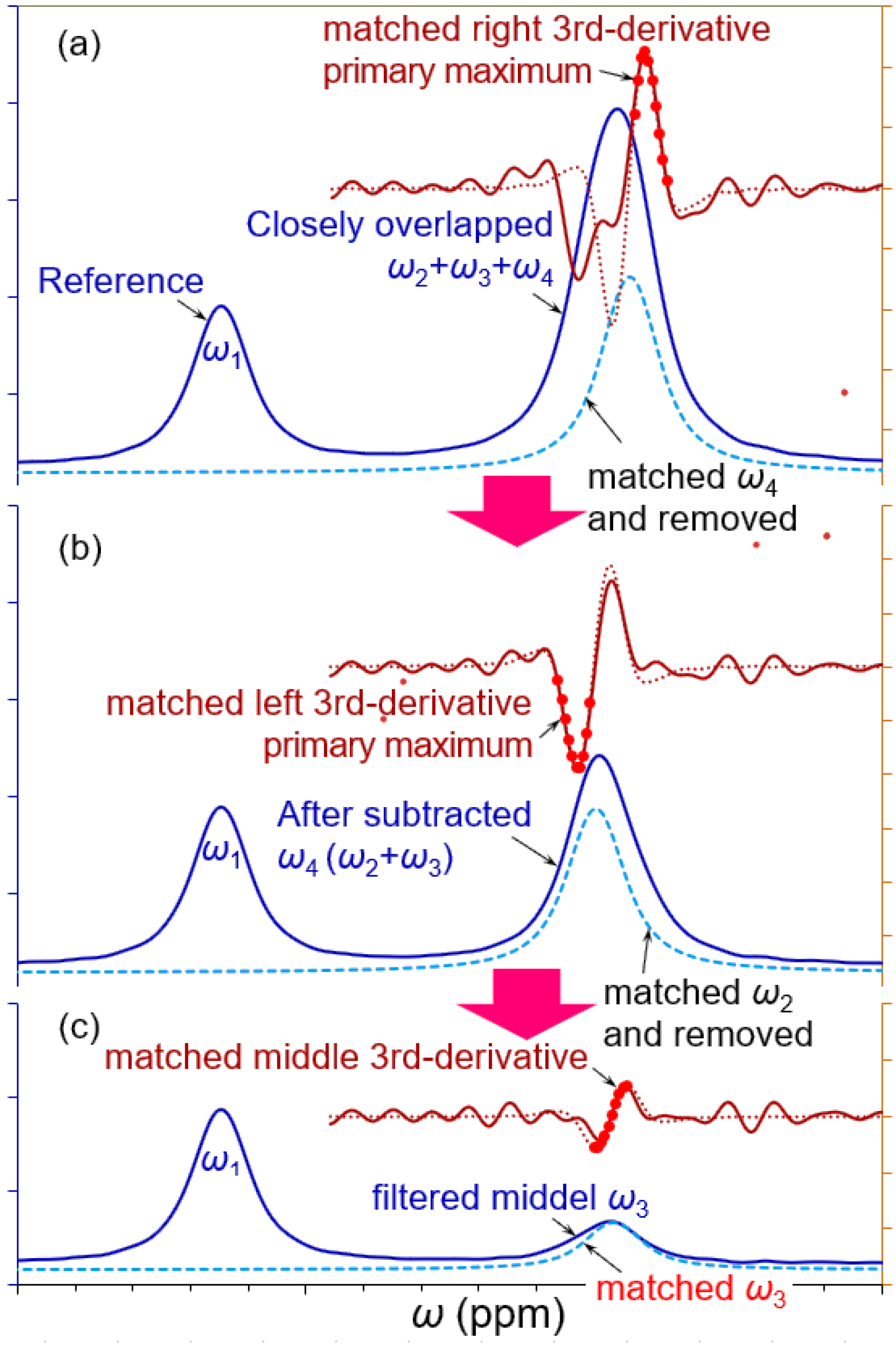
A highlight of the reverse curve fitting procedure is outlined in Figure 1. An NMR spectrum shown here contains a separate peak ω1 and a closely overlapping triplet ω2 + ω3 + ω4. The right D(3) primary maximum (red spots) is matched at first to simultaneously reckon peak ω4 via FT and then removed from the triplet. The left D(3) primary maximum is matched next to estimate peak ω2 and removed further from the remaining ω2 + ω3. The middle peak ω3 is filtered out as stepwise motions indicated by the pink arrows. The filtered ω3 is matched with a portion of the D(3) to obtain an initial value of peak ω3. The procedure was repeated to refine the dismembering deconvolution results until the reverse curve fitting was convergent. The readers can refer to the Section 3 for further details.

2. Materials and Methods

2.1. Materials and NMR Apparatus

5,10,15,20-Tetraphenyl porphyrin (Sigma-Aldrich HPLC grade, >99.0%, Burlington, MA, USA) was dissolved in Chloroform-d (CDCl3, 99.8%–D, Nanjing Chemical Reagent, Nanjing, China) and analyzed on a Bruker Avance III 400 MHz NMR spectrometer (Billerica, MA, USA). The main acquisition parameters were a dwell time of 139 μs, a scanning bandwidth of 7200 Hz, an offset frequency of 3600 Hz, and a sampling time of 2.272 s with 16k data points.

2.2. Overlapping Degree, Derivatives, and Reverse Curve Fitting

In order to appraise deconvolutions of the overlapping NMR peaks, the overlapping degree γ between two adjacent FT peaks ωj and ωj+1 (ωj+1 > ωj) with an identical full width at half maximum (FWHM) W is defined to be [1].
γ = (ωj+1ωj)/(W/2) = 2(ωj+1ωj)/W
As per the derivative formula of a discrete spectrum with a sampling interval ∆ω [1], the second-order derivative D(2), third-order derivative D(3), and forth-order derivative D(4) are
D ω ( 2 ) = A ω + ω 2 A ω + A ω ω ( ω ) 2 ;
D ω + ω / 2 ( 3 ) = A ω + 2 ω 3 A ω + ω + 3 A ω A ω ω ( ω ) 3 ;
D ω ( 4 ) = A ω + 2 ω 4 A ω + ω + 6 A ω 4 A ω ω A ω 2 ω ( ω ) 4 ,
where A is the intensity at each sampling point around the individual center frequency ω; and the discrete odd-order derivative is calculated at point ω + ∆ω/2.
A spectral measurement and its deconvolution require accurate peak positions. However, the digital peak profiles may need a sampling rate of more than 20 times the Nyquist frequency to capture their FT spectral positions [3] (p. 75). It is better to use the zero-crossing point of odd-order derivatives for the peak position because it instinctively coincides with the peak vertex [2].
As highlighted in Figure 1, the reverse curve fitting uses the curve partially fitting the primary maximum of 3rd-order derivative D(3) to find the position and intensity of an overlapping peak in an NMR spectrum. The spectrum will be denoised appropriately in advance if the SNR is low. A well-separated reference peak in the spectrum can help to precisely measure the peak width. We dismembered each fitted peak from the overlapping band to weaken the overlapping until an independent peak was filtered out. Every filtered peak was evaluated further by the partial curve fitting algorithm for its peak position and intensity until the deconvolution was convergent as a preset criterion (for example, ±2% deviated from its previous value). The filtered peak is fitted to its independent shape, rather than fitting the full spectral envelope with the proposed independent peaks. Therefore, it reverses the conventional curve fitting approach [2].

3. Results

Based on the 400 MHz NMR spectrum of 5,10,15,20-Tetraphenyl porphyrin [2], the deconvolution results obtained from the reverse curve fitting using 3rd-order derivative are compared with even-order derivatives and Fourier self-deconvolution, the two deconvolution methods often used in FT spectroscopy.

3.1. Deconvolution with Reverse Curve Fitting and Goodness-of-Fit

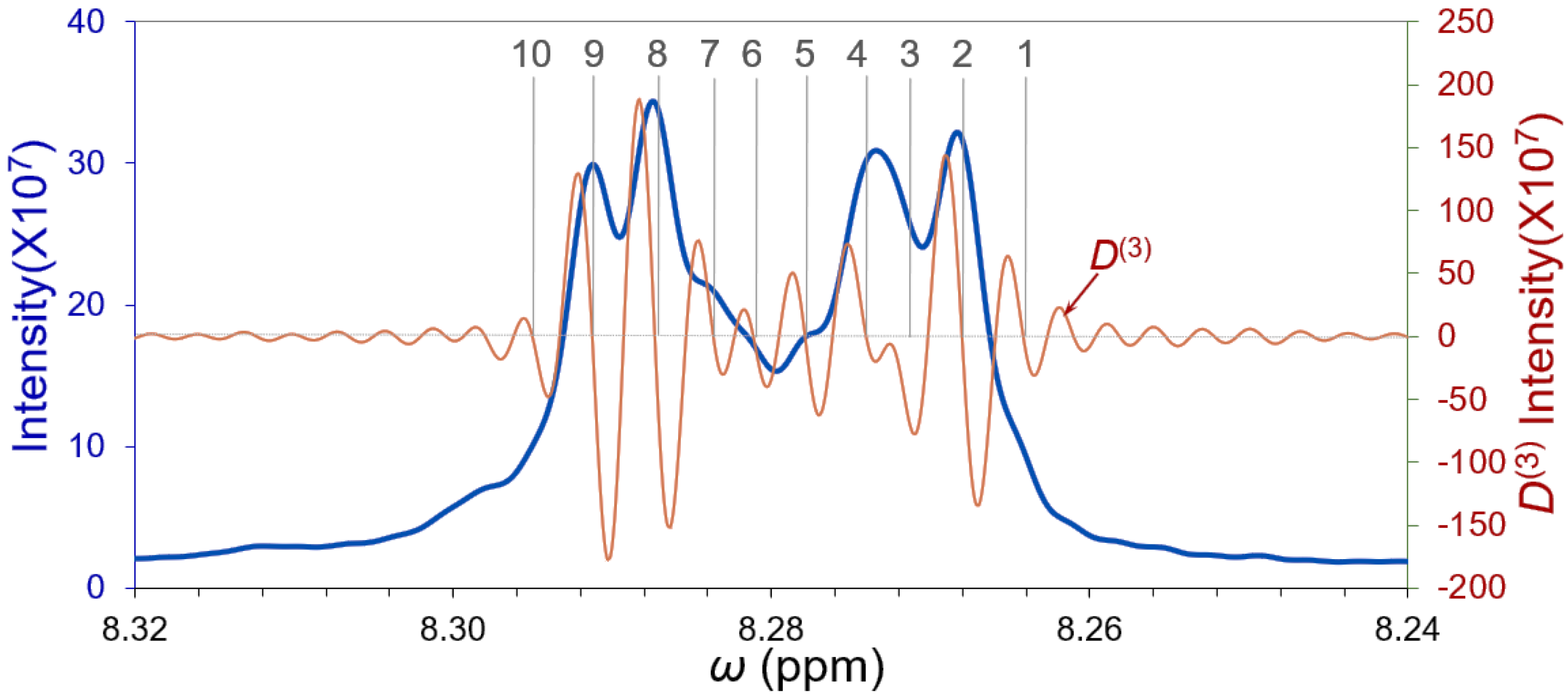
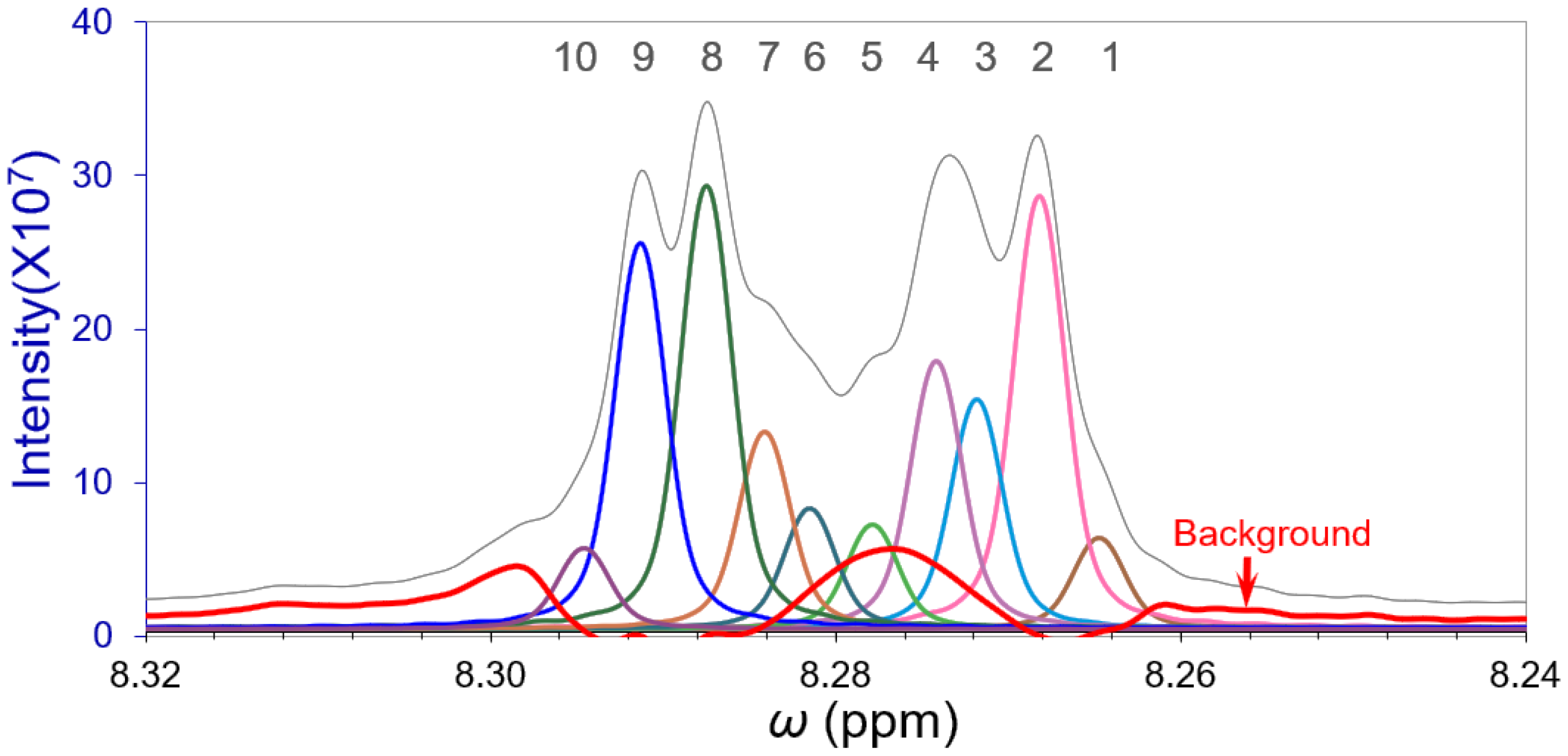
An overlapping NMR spectral band (blue spectrum) originated from ortho-phenyl protons of Tetraphenyl Porphyrin, and its odd-order derivative (brown line) laid out 10 overlapped peaks from their distinctive zero-crossing points, as shown in Figure 2. We accomplished a full deconvolution of these overlapping peaks by the reverse curve fitting with a 3rd-order derivative [2] and reproduced the results in Figure 3. Specifically, a broad background peak (red spectrum in Figure 3) blended together with peaks #4, #5, and #6. Their overlapping degrees were calculated to be 0.484, 0.232, and 0.930, respectively.
Since the NMR spectrum in Figure 3 originated from symmetric ortho-phenyl protons of Tetraphenyl Porphyrin, all of the peaks should have the same peak width. The background underneath peaks #4, #5, and #6 was a rational interference. Otherwise, their peak width will have to be inconsistently adjusted wider in the curve fitting operations.
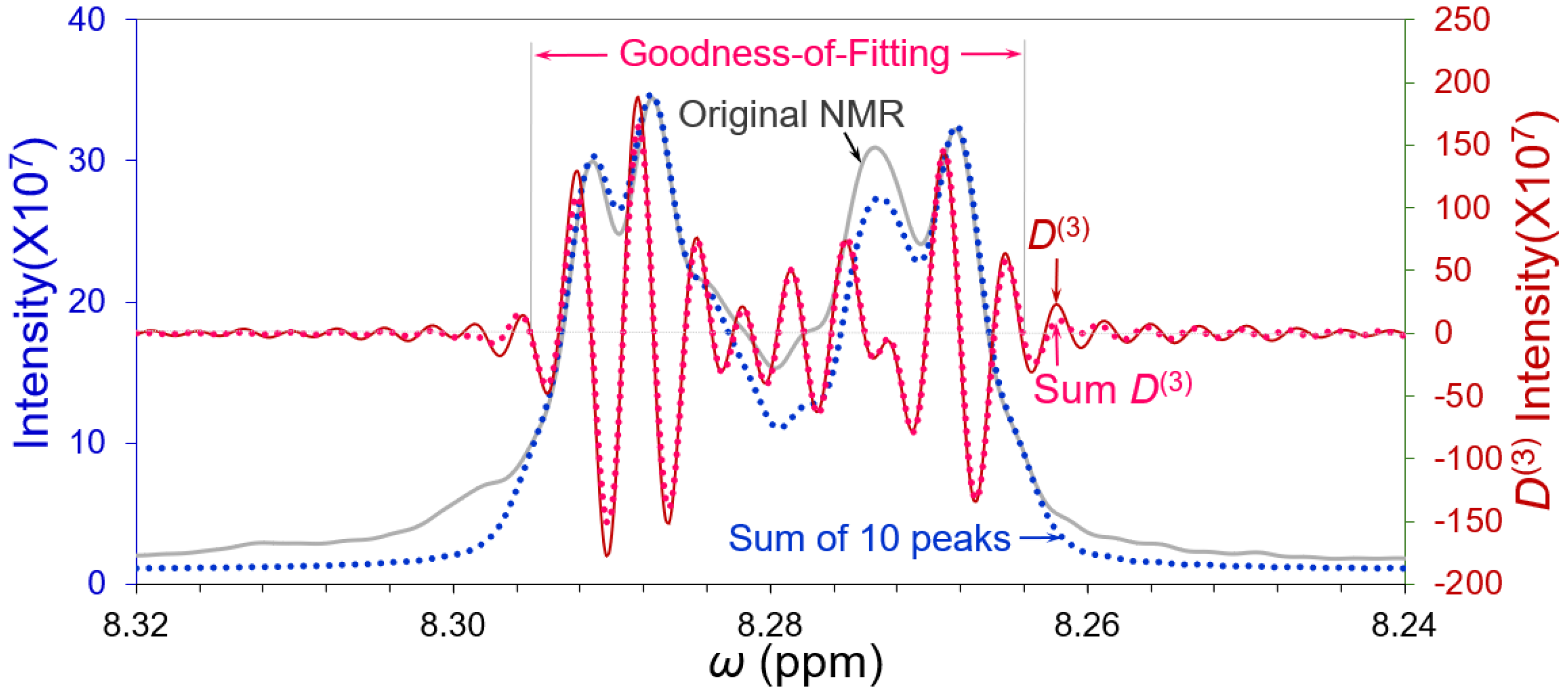
Because of the background in Figure 3, it will be interesting to evaluate how well fitting the D(3) profiles between the original overlapping spectrum and the entire reconstructed band of the ten deconvoluted peaks are. We overlaid their D(3) derivatives in Figure 4 for an overall goodness-of-fit justification. The two D(3) derivatives coincided well. The 18 zero-crossing points of the two D(3) derivatives related to the 10 overlapping peaks in Figure 4 perfectly coincided. The chi-square goodness-of-fitting is defined as
χ 2 = i = 1 n S i O i 2 O i
where Oi is the ith D(3) point of the original NMR and Si is the ith D(3) point of the sum of 10 deconvoluted peaks. We took the absolute value of Oi in the denominator of Equation (5) for the negative D(3) values. The goodness-of-fit was taken for 162 data points within a range indicated by a pink double-sided arrow. When an Oi value is very close to 0, it can be excluded from the chi-square calculation because its chi value may become unusually large. The zero-crossing points must be evaluated separately. Fortunately, only one Oi was near zero among the 162 data points and should be excluded. The final chi-square of the D(3) derivatives in Figure 4: χ2 = 113.322 from the remaining 161 data points. As the degree of freedom 161 − 1 = 160, its critical chi-square = 117.679 at p-value = 0.995 [8]. Therefore, our deconvolution results of the reverse curve fitting are highly accurate [2] and confirmed by the goodness-of-fit assessment (99.5% confidence).
When the goodness-of-fit was assessed conventionally on the original overlapping spectrum with the reconstructed band in Figure 4, the chi-square χ2 = 50.586, which was even better than the evaluation from the above D(3) profile comparison at the level of 99.5% confidence. It accounts for the occurrence that the intensity of the background peak in the overlapping spectrum is smaller than that of the deconvoluted peaks (refers to Figure 3). If the major background peak at 8.277 ppm was excluded from the original overlapping spectrum, the chi-square χ2 can be further reduced to single digits. Nevertheless, the background peaks were distinguished by the reverse curve fitting with derivative D(3). The goodness-of-fit for the derivative profiles provides a rigorous assessment to evaluate the deconvolution quality.

3.2. Deconvolutions with Even-Order Derivatives

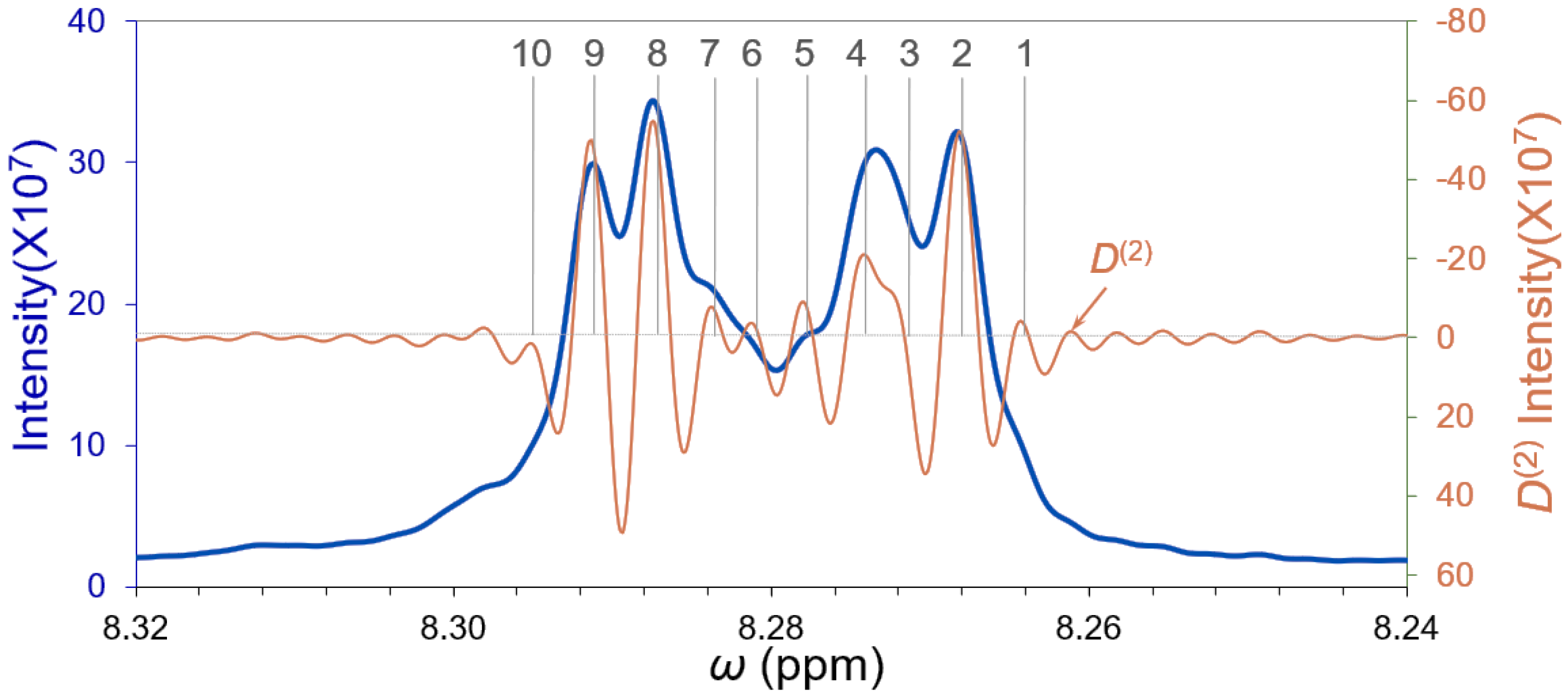
Even-order derivatives are commonly used in spectroscopic deconvolutions. Their zero-crossing points cannot be directly associated with the peak centers. They eventually need a high sampling rate to catch the peak vertices. Figure 5 is a second-order derivative D(2) of the ortho-phenyl proton overlapping band. The ten peaks were able to be discriminated by the D(2), but not as notably as by the 3rd-order derivative in Figure 2. Since the 10 peaks cannot be resolved well by the D(2), could we possibly implement reverse curve fitting with even-order derivatives? The major problem is that the digital peak position is not as exact as the zero-crossing point of the D(3), and the precision of the curve fitting on the central D(2) peak profile could be virtually affected by the overlapping. Deconvolution results of Tetraphenyl porphyrin from the derivative D(2) using the reverse curve fitting method and comparison with the results from the derivative D(3) are specified in Table 1. As the peak positions had to rely on the D(2) maxima, the deconvoluted peak positions may slightly shift from the original D(2) maxima in Figure 5. For example, peak #3 was sandwiched between two big adjacent peaks (#3 and #5). Its deconvoluted peak maximum was shifted to the right side (lower ppm) after the other overlapped peaks in Figure 5 were dismembered.
We managed a reverse curve fitting deconvolution with the D(2) by directly fitting the peak vertices and heights regardless of least square fitting errors. The deconvolution achieved convergence in five consecutive cycles and the final results are listed in Table 1, and their detailed determinations are in “Support Information”. Among the 10 deconvoluted peaks, the predominant peaks #5, #6, #7, and #10 were compatible with those from D(3). As the overlapping degrees became smaller (γ < 1.5), their deconvolution deviations ΔA0 > 4.0% (up to 11.2%). Nevertheless, the underlying background peak was not blurred, with peaks #4, #5, and #6 in the D(2) deconvolution.
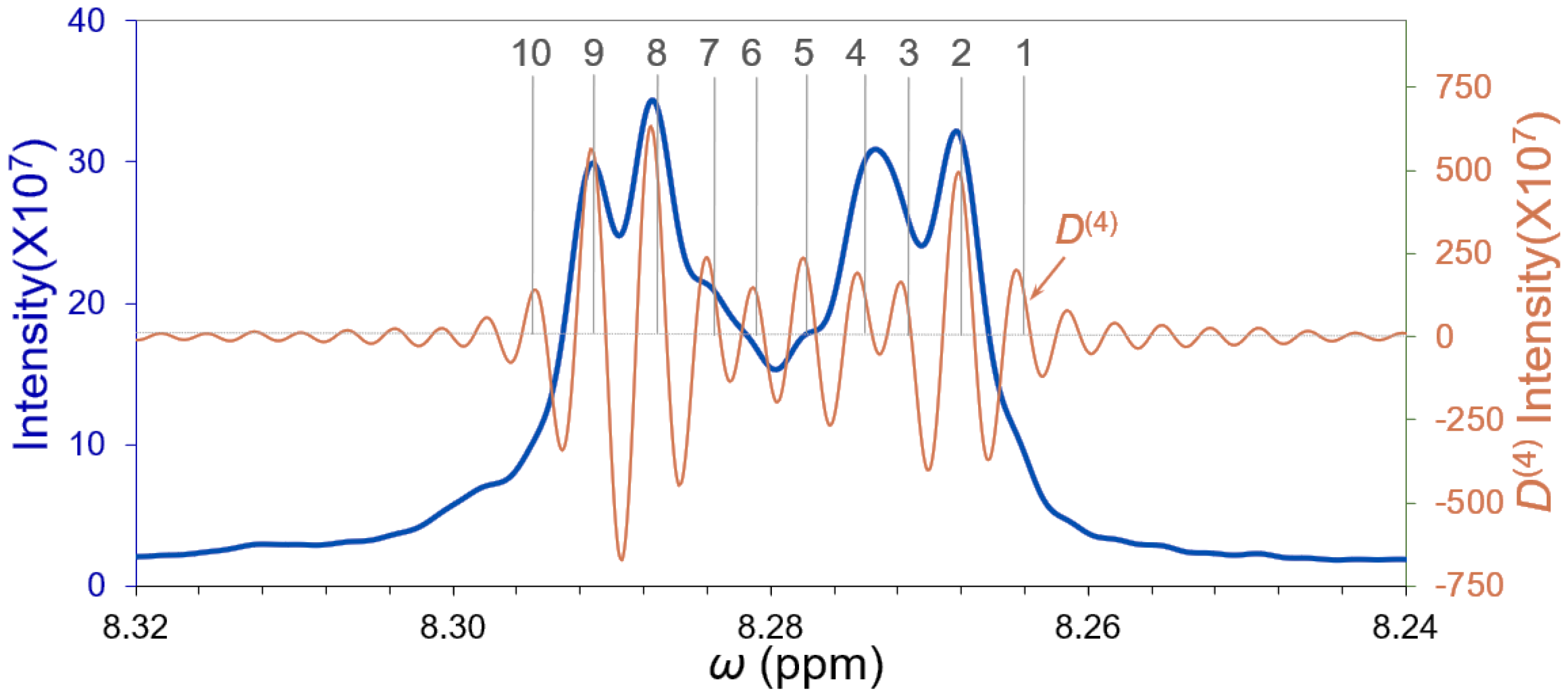
The overlapping band was studied next by the fourth-order derivative D(4) in Figure 6. The higher even-order derivative improved the resolutions of the 10 proton peaks. The D(4) peak amplitudes in Figure 6 were obviously not proportional to their apparent NMR peak intensities. Nevertheless, the overlapping peaks could contribute strong D(4) satellites to each other [9] (pp. 178–179). We followed the same tactics in the above D(2) deconvolution to implement the reverse curve fitting method with the D(4). The achievements from the D(4) deconvolution are similar to those obtained by the D(2). The interested readers can refer to “Support Information” for their deconvolution results and processes.

3.3. Fourier Self-Deconvolution

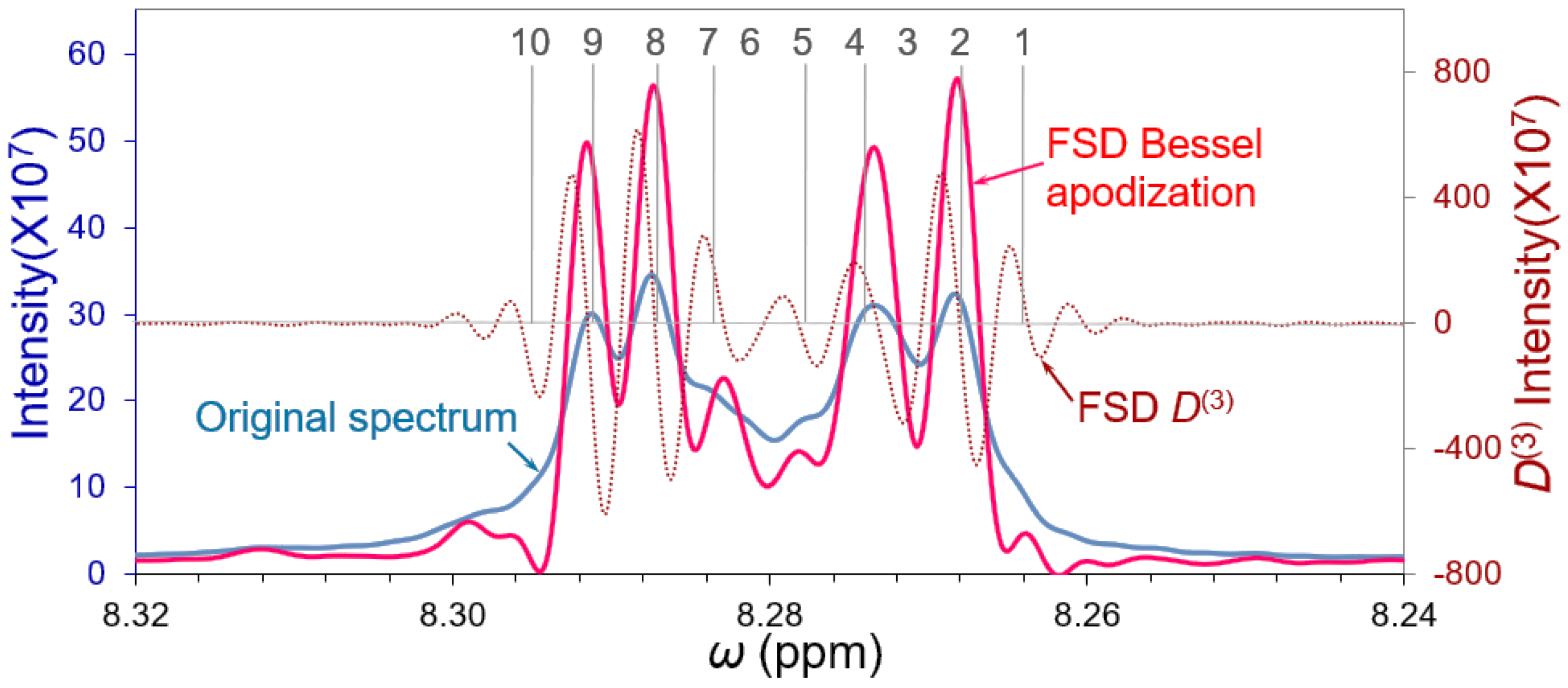
Fourier self-deconvolution (FSD) is a mathematical algorithm to narrow the peak width of FT spectroscopy [10] (Chapter 12). Since FSD was often compared with curve fitting effectiveness [10,11,12,13], it is inevitable to study FSD in this work. After the exponential decay of the time-domain signal was appropriately removed from the ortho-phenyl proton NMR in Figure 2, we routinely multiplied a Bessel window and performed FT. Although the resulting FSD peaks (pink spectrum) in Figure 7 were sharper and enhanced, only eight peaks were discriminated, even with the aid of derivative D(3) (dotted brown line).
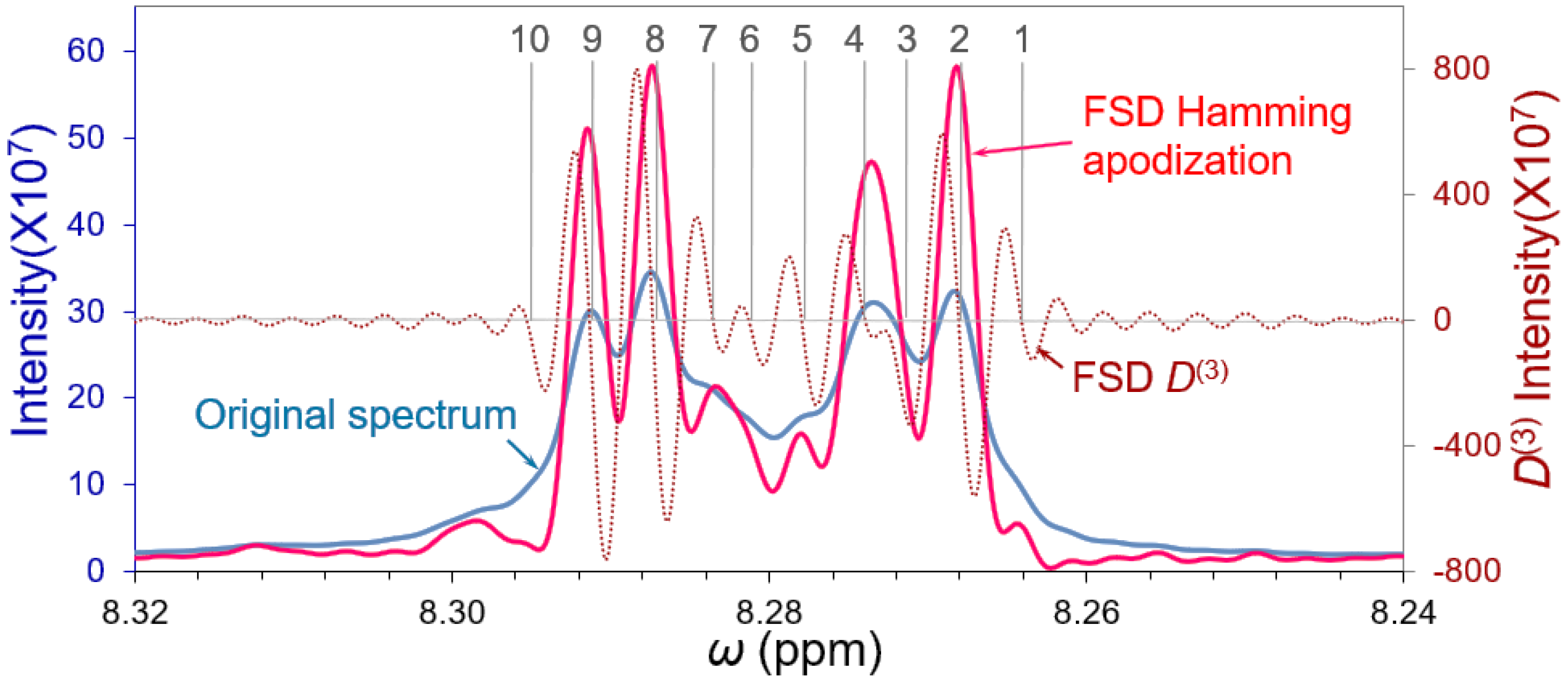
When the apodization was replaced with a Hamming window in Figure 8, the 10 peaks became immediately perceptible. Although the FSD algorithm did not completely resolve the 10 overlapping peaks, the deconvolution of the ortho-phenyl proton NMR spectrum manifested exquisite performances of the window functions in FT spectroscopy. We must know why these two apodizations behaved differently in the deconvolution.
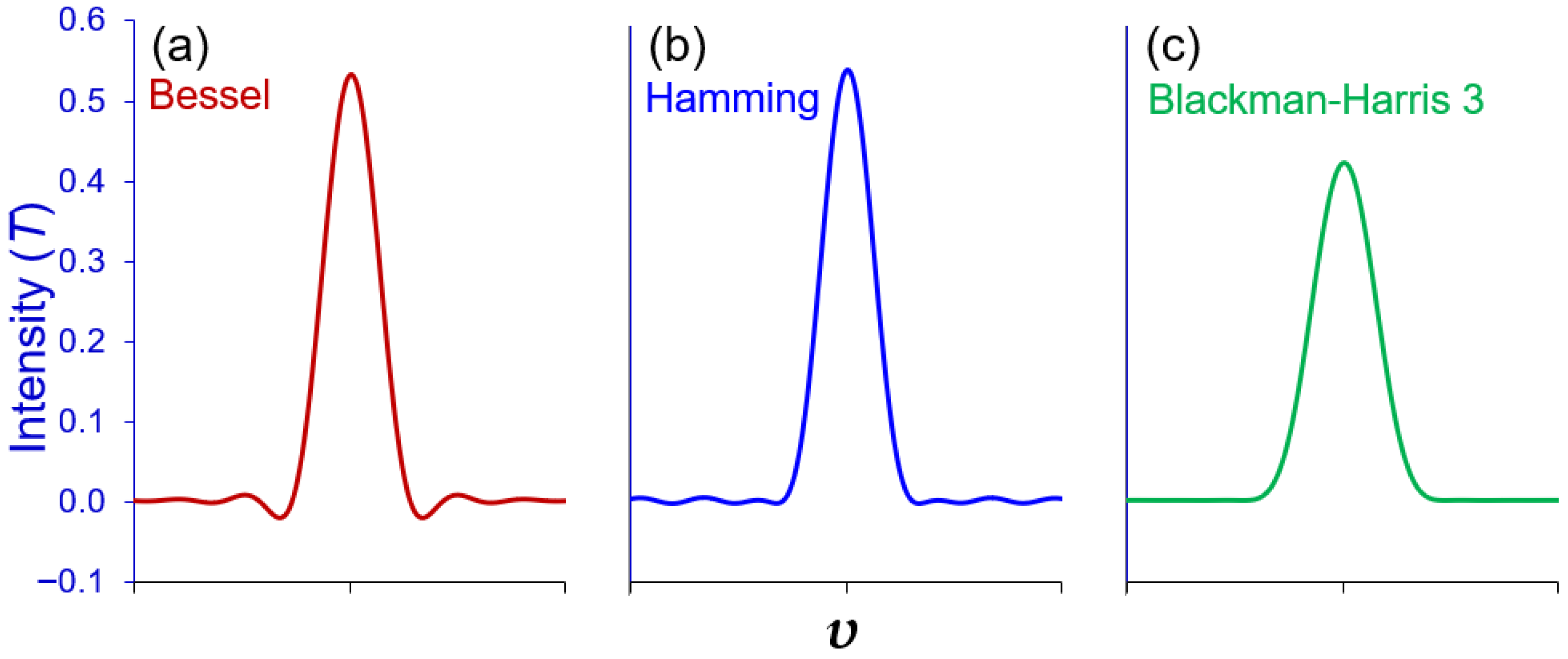
Marshall and Verdun expounded the conventional window functions of FT spectroscopy [3] (pp. 47–51). We performed a systematic examination of three traditional window functions: Bessel, Hamming, and 3-term Blackman–Harris regarding their fundamental rectangle window in Table 2 (some minor typos in Marshall and Verdun’s monograph have been corrected) for readers’ convenience. The apodizing effects of these three traditional windows via cosine FT (acquisition time period 0 ≤ tT) are displayed in Figure 9. When a time signal is truncated within a time period 0 ≤ tT, the truncation naturally applies a rectangular window. This fundamental window gives rise to the highest amplitude (=T), the narrowest peak width (=0.60/T), and the strongest sidelobes (the largest sidelobe compared to the peak amplitude SL = −21.7%) in frequency-domain υ. The strongest sidelobes should be smoothed by the other window functions to optimize spectral analyses and related deconvolutions.
Bessel windows can yield a sharper peak as calculated in Table 2 (peak height = 0.533T and peak width = 0.95/T) but bring big negative sidelobes (SL = −4.1%). The Hamming window not only improves the peak height (=0.54T) and width (=0.91/T) but also greatly reduces the sidelobe ratio SL (=+0.7%). These improvements make it clear why the Hamming window exhibits better FSD resolution in Figure 8. The three-term Blackman–Harris window can suppress the sidelobes to nearly zero (SL = −0.03%) at the cost of a much lower peak height (=0.42323T) and wider width (=1.14/T). FT spectroscopists need to choose or develop a suitable apodization window according to practical requirements in the deconvolution. If you strongly wish to suppress the sidelobes in your spectroscopic analyses, a three-term Blackman–Harris window may be the best candidate. Meanwhile, you must acknowledge that it will considerably reduce peak height and increase peak width. The Hamming window exhibits a pretty peak shape with minor sidelobes (+0.7% only) in Table 2, which are favorable in the deconvolutions of FT spectroscopy, either for FSD or the reverse curve fitting. When we aspire to the deviation of final deconvolution results within ≤±2.0%, the minor apodized sidelobes < 1.0% are generally acceptable in the deconvolutions.

4. Discussion

This work conducted a comparative study of the reverse curve fitting with the deconvolution results of the even-order derivatives and FSD. We initiated a goodness-of-fitting evaluation for a third-order derivative between the original ortho-phenyl proton NMR spectrum and the entire reconstructed band composed of 10 deconvoluted NMR peaks [2] to ensure the analytical quality of the reverse curve fitting strategy. To our knowledge, it is the first time to examine the goodness-of-fitting for the deconvolution using an odd-order derivative envelope. We perceived several background peaks underneath the deconvoluted peaks. The broader background peak underneath peaks #4, #5, and #6 in Figure 3 was rid of its overlapping impact spontaneously in our goodness evaluation. On the other hand, it is sensitive to the narrower background peaks underneath. As deconvoluted intensity of an overlapped peak cannot be more than its apparent peak height plus coincidences of the 18 zero-crossing points of the two D(3) derivatives (refers to Figure 4), they convinced us of the reverse curve fitting deconvolution results, and the background peaks appeared in the NMR spectrum.
The even-order derivative deconvolutions have been used with the reverse curve fitting procedure. Since no suitable index is available to gradually approach the real peak position, it is hard to optimize the fitting and may cause significant deviation based on the apparent vertex of the even-order derivative. Another problem is that the principal portion of the even-order derivatives is a sharper peak with low curvature. The sharp peak shape bothers us, as there is a proper portion to implement the partial curve matching. A main drawback of the even-order derivatives is that they merely rely on the derivative vertices and apparent amplitudes in the curve fitting procedure, such that the D(2) and D(4) results were not as accurate as the D(3) results in the deconvolution of the same ortho-phenyl proton NMR spectrum. In addition, we also evaluated the goodness-of-fits for the above D(2) and D(4) derivative deconvolutions. The chi-square χ2 = 131.718 for the D(2) derivative envelopes (down to 95% confidence). The conventional χ2 = 75.301 between the original overlapping spectrum and the reconstructed band from the 10 peaks deconvoluted by the D(2), increased by about 50% comparing to the goodness-of-fit for the above D(3) deconvolution results (χ2 = 50.586, see Section 3.1). It was no wonder to have worse fitting data for the D(4) derivative envelopes: the chi-square χ2 = 1057.68 for the D(4) derivative profiles, and χ2 = 103.968 assessed conventionally on the original overlapping spectrum with the reconstructed band from the 10 peaks deconvoluted by the D(4). However, their achievements manifested the power of the reverse curve fitting.
The last comparative study exposed the limitations of the conventional FSD method in deconvolutions of complicated overlapping scenarios. It is always worth examining systematically traditional apodization windows to achieve a successful deconvolution according to the FT peak heights, widths, and sidelobe ratios of individual windows. We examined three typical windows and showed that the Hamming window gave a much better spectral resolution than the traditional Bessel window in spite of the fact that both of them were far from achieving complete deconvolution of the same overlapping band composed of 10 peaks. FSD may be useful in quantitative analyses of some special binary mixtures [14,15,16,17]. Its deconvolution is an unstable numerical process [18], possible over-deconvolution (can generate extra false peaks), or under-deconvolution (misses some peaks as in this work) for multiplet-overlapping FT spectral bands.
The reverse curve fitting uses higher-order derivatives, and its deconvolution process is blind to how many peaks are in an overlapping band until a final independent peak is filtered out. Accordingly, high SNR is necessary in the deconvolutions of NMR spectroscopy. If the spectral SNR is poor, Kauppinen’s boxcar procedure is the most convenient denoising technique, by diminishing the noise tail of a time-domain signal to zero. We manifested its denoising achievements when the SNR of an NMR spectrum was as low as 20 [1,2]. Xue et al. studied the impact of magnetic fields on SNRs for methyl-protonated microcrystalline proteins and obtained a mean SNR = 35 from a 500 MHz NMR and a mean SNR = 76 from a 1 GHz NMR in their experiments [19]. For ultra-high magnetic field NMR spectrometers (900 MHz, 950 MHz, and 1.2 GHz) measured with 0.1% Ethylbenzene in CDCl3, their reference SNRs can be more than a few thousand, and the SNRs using 5 mm NMR tubes were generally better than those measured in 3 mm tubes [20]. It is very inspiring to learn that Peter et al. recently conducted an intensive study on SNR behaviors with NMR receiver gains [21]. They deliberated various magnetic strengths and showed that the SNRs can be optimized to over several hundred in common NMR spectrometers by properly setting up the receiver gain [21]. These comprehensive studies clarified the noise levels of normal NMR spectrometers. The reverse curve fitting procedure is feasible to perform accurate deconvolutions after being properly denoised.
The overlapping of NMR spectroscopy can be very complex, as multiple peaks (more than four peaks) crowd into a cluster (overlapping degrees < 0.5). Their overlapping phenomena are infinite in variety. Of particular interest are their deconvolution results that could be affected by the resolving order of each peak early or late in the deconvoluting process. More advanced techniques, such as machine deep learning, will greatly enhance the deconvolution qualities of reverse curve fitting.

5. Conclusions

The goodness-of-fitting algorithm for the derivative envelopes leveraged the reverse curve fitting procedure to be a reliable tool for complicated deconvolution works of NMR spectroscopy. The fitting evaluation from the derivative envelopes provides sound judgment for the deconvolution results and is better than that from the spectral profiles. In the deconvolution of the same overlapping NMR spectrum of Tetraphenyl porphyrin, the reverse curve fitting demonstrated its superior achievements compared with the even-order derivatives and FSD.

Supplementary Materials

The following supporting information can be downloaded at: https://www.mdpi.com/article/10.3390/magnetochemistry12010015/s1, Table S1. Deconvolution process and results of Tetraphenyl porphyrin in Figure 4 using the reverse curve fitting with derivative D(2); Table S2. Deconvolution results of Tetraphenyl porphyrin in Figure 5 using the reverse curve fitting with derivative D(4). A comparison between the results from the derivatives D(4) and D(3).

Author Contributions

Conceptualization, S.-P.C. and S.M.T.; methodology, S.-P.C.; software, S.H.; validation, S.-P.C., S.M.T. and B.Z.; resources, S.-P.C.; writing—original draft preparation, S.-P.C.; writing—review and editing, S.M.T. All authors have read and agreed to the published version of the manuscript.

Funding

This research received no external funding.

Institutional Review Board Statement

Not applicable.

Informed Consent Statement

Not applicable.

Data Availability Statement

The original contributions presented in this study are included in the article/Supplementary Material. Further inquiries can be directed to the corresponding author.

Acknowledgments

We appreciate Melvin, B. Comisarow, University of British Columbia, for his encouragement of this work. The authors are particularly indebted to John Strong for fruitful discussions with him during this study. His interest and encouragement are gratefully acknowledged. William S. Benedict has generously contributed his comments and suggestions.

Conflicts of Interest

Shu-Ping Chen, Sai Huang, and Baoling Zhen are employed by “Fujian Superimposegraph Co., Ltd”. The remaining authors declare that the research was conducted in the absence of any commercial or financial relationships that could be construed as a potential conflict of interest.

Abbreviations

The following abbreviations are used in this manuscript:
FSDFourier self-deconvolution
FTFourier transform
FT-NMRFourier transform nuclear magnetic resonance
FWHMFull width at half maximum
NMRNuclear magnetic resonance
SNRSignal-to-noise ratio

References

  1. Chen, S.-P.; Taylor, S.M.; Huang, S.; Zheng, B. Application of odd-order derivatives in Fourier transform nuclear magnetic resonance spectroscopy toward quantitative deconvolution. ACS Omega 2024, 9, 36518–36530. [Google Scholar] [CrossRef] [PubMed]
  2. Chen, S.-P.; Taylor, S.M.; Huang, S.; Zheng, B. Reverse curve fitting approach for quantitative deconvolution of closely overlapping triplets in Fourier transform nuclear magnetic resonance spectroscopy using odd-order derivatives. Magnetochemistry 2025, 11, 50. [Google Scholar] [CrossRef]
  3. Marshall, A.G.; Verdun, F.R. Fourier Transforms in NMR, Optical and Mass Spectrometry: A User’s Handbook; Elsevier: Amsterdam, The Netherlands, 1990. [Google Scholar]
  4. Wu, Y.; Sanati, O.; Uchimiya, M.; Krishnamurthy, K.; Wedell, J.; Hoch, J.C.; Edison, A.S.; Delaglio, F. SAND: Automated time-domain modeling of NMR spectra applied to metabolite quantification. Anal. Chem. 2024, 96, 1843−1851. [Google Scholar] [CrossRef]
  5. Venetos, M.C.; Elkin, M.; Delaney, C.; Hartwig, J.F.; Persson, K.A. Deconvolution and analysis of the 1H NMR spectra of crude reaction mixtures. J. Chem. Inf. Model. 2024, 64, 3008−3020. [Google Scholar] [CrossRef] [PubMed]
  6. De Lorenzi, F.; Weinmann, T.; Bruderer, S.; Heitmann, B.; Henrici, A.; Stingelin, S. Bayesian analysis of 1D 1H-NMR spectra. J. Magn. Reson. 2024, 364, 107723. [Google Scholar] [CrossRef] [PubMed]
  7. Buchanan, C.; Karunanithy, G.; Tkachenko, O.; Barber, M.; Marty, M.T.; Nott, T.J.; Redfield, C.; Baldwin, A.J. UnidecNMR: Automatic peak detection for NMR spectra in 1–4 dimensions. Nat. Commun. 2025, 16, 449. [Google Scholar] [CrossRef] [PubMed]
  8. MedCalc. Values of the Chi-squared Distribution. Available online: https://www.medcalc.org/en/manual/chi-square-table.php (accessed on 14 August 2025).
  9. Dubrovkin, J. Derivative Spectroscopy; Cambridge Scholars: Newcastle upon Tyne, UK, 2021; pp. 178–179. [Google Scholar]
  10. Kauppinen, J.; Partanen, J. Fourier Transforms in Spectroscopy; Wiley-VCH: Berlin, Germany, 2001; pp. 143–168+205–224. [Google Scholar]
  11. Griffiths, P.R.; Pierce, J.A.; Gao, H. Curve Fitting and Fourier Self-Deconvolution for the Quantitative Representation of Complex Spectra. In Computer-Enhanced Analytical Spectroscopy; Meuzelaar, H.L.C., Isenhour, T.L., Eds.; Plenum Press: New York, NY, USA, 1987; pp. 29–54. [Google Scholar]
  12. Griffiths, P.R. IR spectroscopic Data Processing. In Encyclopedia of Spectroscopy and Spectrometry, 3rd ed.; Lindon, J.C., Tranter, G.E., Koppenaal, D., Eds.; Academic Press: Oxford, UK, 2017; Volume 1, pp. 433–434. [Google Scholar]
  13. O’Haver, T. Handbook of Scientific Signal Processing; August 2025 Edition; Available online: https://terpconnect.umd.edu/~toh/spectrum/IntroToSignalProcessing.pdf (accessed on 14 August 2025).
  14. Attala, K.; Elsonbaty, A. Smart UV spectrophotometric methods based on simple mathematical filtration for the simultaneous determination of celecoxib and ramipril in their pharmaceutical mixtures with amlodipine: A comparative statistical study. Spectrochim. Acta Mol. Biomol. Spectrosc. 2021, 244, 118853. [Google Scholar] [CrossRef] [PubMed]
  15. Attala, K.; Elsonbaty, A. Advanced eco-friendly UV spectrophotometric approach for resolving overlapped spectral signals of antihypertensive agents in their binary and tertiary pharmaceutical dosage form. Spectrochim. Acta Mol. Biomol. Spectrosc. 2021, 258, 119855. [Google Scholar] [CrossRef] [PubMed]
  16. Elsonbaty, A.; Attala, K. An eco-friendly modified methodology for the resolution of binary pharmaceutical mixtures based on self-deconvolution of the UV spectrophotometric spectra in the Fourier domain: Application of Fourier self-deconvolution in UV spectroscopy. Spectrochim. Acta Mol. Biomol. Spectrosc. 2022, 264, 120262. [Google Scholar] [CrossRef] [PubMed]
  17. Mansour, F.R.; Elagamy, S.H.; Elserwi, O.M.; Kamal, A.H. Sustainable spectrophotometric determination of dextromethorphan and bupropion: A Fourier self-deconvolution approach. Green Anal. Chem. 2025, 13, 100274. [Google Scholar] [CrossRef]
  18. Sadat, A.; Joye, I.J. Peak fitting applied to Fourier transform infrared and Raman spectroscopic analysis of proteins. Appl. Sci. 2020, 10, 5918. [Google Scholar] [CrossRef]
  19. Xue, K.; Sarkar, R.; Lalli, D.; Koch, B.; Pintacuda, G.; Tosner, Z.; Reif, B. Impact of magnetic field strength on resolution and sensitivity of proton resonances in biological solids. J. Phys. Chem. C 2020, 124, 22631–22637. [Google Scholar] [CrossRef]
  20. Luchinat, E.; Barbieri, L.; Cremonini, M.; Banci, L. Protein in-cell NMR spectroscopy at 1.2 GHz. J. Biomol. NMR 2021, 75, 97–107. [Google Scholar] [CrossRef]
  21. Peters, J.P.; Sönnichsen, F.D.; Hövener, J.B.; Pravdivtsev, A.N. Maximizing NMR sensitivity: A guide to receiver gain adjustment. NMR Biomed. 2025, 38, e70046. [Google Scholar] [CrossRef] [PubMed]
Figure 1. A highlight of the reverse curve fitting procedure for the deconvolution of a triplet (solid blue line). The reverse curve fitting procedure employed third-order derivative D(3) (solid brown line) to determine peak positions and independent intensities [2]. (a) The backedge peak ω4 exhibted an apparent D(3) maximum. We matched this maximum (red points and brown dotted line) by the curve fitting. The matched peak ω4 (blue dash line) was removed from the original spectrum. (b) D(3) maxima of the front-edge peak ω2 become visible after the subtraction of ω4. The same procedure was applied to remove ω2. (c) The middle peak ω3 emerged and was matched. The curve fitting procedure can be reversed to filter out the backedge peak ω4 and repeated for the other two peaks ω2 and ω3 until their fitting results are convergent. A well-separated peak (ω1) was used as a reference peak to evaluate the authentic peak width of the overlapping NMR triplet.
Magnetochemistry 12 00015 g001
Figure 2. An absorption-mode 400 MHz NMR spectrum of Tetraphenyl porphyrin. The spin–spin coupling of its ortho-phenyl protons exhibited a broad overlapping band (blue spectrum). The zero-crossing points of the D(3) derivative (brown spectrum) indicated by gray lines are very clearly observed. There were at least 10 overlapping peaks in this band.
Magnetochemistry 12 00015 g002
Figure 3. The gray profile is the original overlapping band. The deconvoluted independent peaks of the 10 overlapping peaks (depicted in various colors other than gray and red) with their background (red spectrum). Peaks #4, 5, and 6 closely overlap with the major background peak appearing at 8.277 ppm.
Magnetochemistry 12 00015 g003
Figure 4. A goodness-of-fit assessment of the D(3) derivatives (162 data points each D(3)). The native D(3) (brown spectrum) of the original NMR spectrum (gray profile) is compared to the deconvolution sum D(3) (dotted pink spectrum) yielded from a sum of the 10 deconvoluted peaks (dotted blue profile). Their 18 zero-crossing points perfectly coincide.
Magnetochemistry 12 00015 g004
Figure 5. The ortho-phenyl proton NMR overlapping band (blue spectrum, and also refer to Figure 2) with second-order derivative D(2) (brown spectrum) is displayed in the reverse vertical axis. Their filtered out peak maxima were shifted slightly after dismembering the other peaks.
Magnetochemistry 12 00015 g005
Figure 6. The ortho-phenyl proton NMR overlapping band (blue spectrum and also refer to Figure 2) with forth-order derivative D(4) (brown spectrum).
Magnetochemistry 12 00015 g006
Figure 7. The FSD spectrum (pink spectrum) apodized by a Bessel window. Only 8 peaks were observed, although their intensities were enhanced, and peak shapes contrast sharply with the original overlapping band (blue spectrum). Even with the aid of the D(3) derivative (dotted brown line), peaks #3 and 6 were not visible in the FSD spectrum either.
Magnetochemistry 12 00015 g007
Figure 8. The FSD spectrum (pink spectrum) with a Hamming window. The 10 peaks were all perceptible with enhanced peak intensities, and narrower peak shapes contrast sharply with the original overlapping band (blue spectrum). Its D(3) derivative spectrum (dotted brown line) also distinguished the 10 peaks.
Magnetochemistry 12 00015 g008
Figure 9. Apodizing effects of three windows. (a) Bessel window yields a sharper peak with big sidelobes. (b) Hamming window smooth the sidelobes with a similar peak shape as the Bessel apodization and slightly higher amplitude. (c) Three-term Blackman–Harris window provides the best suppression of apodization sidelobes at some sacrifices of the peak amplitude (lower) and FWHM (wider).
Magnetochemistry 12 00015 g009
Table 1. Deconvolution results of Tetraphenyl porphyrin in Figure 5 using reverse curve fitting with derivative D(2). A comparison between the results from the derivatives D(2) and D(3).
DerivativePeaks12345678910
γ––1.9502.0061.3372.0612.0061.4481.8942.1171.838
D(2)ppm8.26488.26828.27178.27418.27798.28148.28408.28768.29138.2945
A0 (×107)5.85627.82914.38317.5487.0917.50711.34028.92524.8614.816
D(3) *ppm8.26478.26828.27188.27428.27798.28158.28418.28758.29138.2946
A0 (×107)5.95227.93214.80317.3276.8137.81812.76628.58224.9065.260
ΔA0 (%)−1.6%−0.4%−2.8%+1.3%+4.1%−4.0%−11.2%+1.2%−0.2%−8.4%
* The D(3) results refer to [2]. Overlapping degree γ regarding its adjacent front peak only.
Table 2. Apodizations of the three traditional windows with a rectangular uniform window.
Window (0 < t < T)Cosine FTHeightFWHMSL *
Rectangle
1
T sinc(2πυT)T0.60/T−21.7%
Bessel
[1 − (t/T)2]2
Tπ1/2 (πυT)−5/2 J5/2(2πυT)0.533T0.95/T−4.1%
Hamming
0.54 + 0.46cos(πt/T)
[0.54/2πυ + 0.92υΤ2/π(1–4υ2T2)] sin(2πυT)0.54T0.91/T+0.7%
3-term Blackman–Harris
0.42323 + 0.49755cos(πt/T) + 0.07922cos(2πt/T)
{0.42323/2πυ + υΤ2 [0.9951/π(1 − 4υ2T2)
− 0.15844/4π(1– υ2T2)]} sin(2πυT)
0.42323T1.14/T−0.03%
* SL = % of the largest sidelobe divided by its peak height.
Disclaimer/Publisher’s Note: The statements, opinions and data contained in all publications are solely those of the individual author(s) and contributor(s) and not of MDPI and/or the editor(s). MDPI and/or the editor(s) disclaim responsibility for any injury to people or property resulting from any ideas, methods, instructions or products referred to in the content.