Article

Comprehensive Evaluation of Ornamental Traits and Elite Germplasm Screening in Red-Flowered Strawberry (Fragaria spp.) Accessions via the Analytic Hierarchy Process


1
College of Horticulture, Fujian Agriculture and Forestry University, Fuzhou 350002, China
2
Hongdian Township Comprehensive Support and Technical Service Center, Wenshan Zhuang and Miao Autonomous Prefecture 663004, China
3
College of Life Science, Taizhou University, Linhai 317000, China
*
Authors to whom correspondence should be addressed.
Horticulturae 2026, 12(8), 944; https://doi.org/10.3390/horticulturae12080944
Submission received: 24 June 2026 / Revised: 26 July 2026 / Accepted: 29 July 2026 / Published: 1 August 2026

Abstract

Red-flowered strawberries possess both floral and foliage ornamental characteristics, making them highly promising as landscape groundcovers and potted ornamental plants. To establish a standardized ornamental evaluation system and screen for superior germplasm, this study used 18 strawberry accessions from China and abroad as experimental materials. Twelve core ornamental indicators were selected across three dimensions: flowering period, morphological traits, and disease resistance. The Analytic Hierarchy Process (AHP) was employed to construct a multi-level ornamental value evaluation model. The results indicate the following weight rankings across the constraint layers: morphological traits (60.66%) > flowering period (27.71%) > disease resistance (11.63%). Among these, flower color (21.96%), plant flowering period (16.41%), corolla diameter (15.69%), and single-flower flowering duration (11.30%) were the core indicators determining ornamental value. The comprehensive score rankings showed that the accessions ‘140’, ‘Pink Panda’, ‘Summer Breeze-Cherry’, and ‘Summer Breeze-Rose’ exhibited the best overall ornamental performance. These accessions feature vibrant flower colors, a prolonged flowering period, abundant blooms, and good disease resistance. ‘Frisan’ and ‘246’ had the lowest composite scores, exhibiting significant shortcomings in ornamental traits. The AHP-based evaluation system established in this study provides a quantitative tool for ornamental trait assessment in red-flowered strawberries. The four elite accessions identifed using this system—‘140’, ‘Pink Panda’, ‘Summer Breeze-Cherry’, and ‘Summer Breeze-Rose’—can serve as priority candidates for protected landscape applications and container gardening in subtropical southern China.

1. Introduction

Red-flowered strawberries are a new type of ornamental germplasm created through distant hybridization between strawberries and Potentilla [1]. Distinct from traditional white-flowered strawberries, they possess multiple landscape values, including serving as ornamental flowers or foliage and producing fruit. They also feature a long flowering period, vibrant flower colors, and dense inflorescences. Additionally, they can be widely used in modern urban horticulture as potted plants, in flower borders, under forest canopies, and as roadside groundcover [2]. In recent years, the Netherlands, the United Kingdom, and Japan have released commercial red-flowered strawberry varieties in the ‘Pink Panda’ and ‘Summer Breeze’ series on a large scale. However, significant differences exist among different germplasm accessions in terms of floral phenotype, leaf gloss, and resistance to fungal diseases under high-temperature, high-humidity subtropical greenhouse conditions. This poses a constraint on the large-scale introduction and promotion of these varieties in subtropical southern China’s landscaping sector [3]. The objective quantification and selection of germplasm differences rely on the support of a scientific evaluation system. Quantitative evaluation of ornamental traits is a core technical approach for ornamental plant germplasm screening, directed breeding, and site adaptation. External phenotypes such as flowers, leaves, and disease resistance are direct manifestations of the combined effects of genotype and the cultivation microenvironment. Establishing a standardized evaluation system covering multidimensional traits enables the objective quantification of germplasm quality and helps define improvement goals for new variety development [4].
The esthetic value of ornamental plants can be divided into three levels: the beauty of individual form and color, the beauty of seasonal dynamics and phenology, and the beauty of group plantings. Evaluation indicators must be selected differentially based on the ornamental positioning of each species [5]. According to their ornamental functions, horticultural plants can be classified into flower-viewing, foliage-viewing, fruit-viewing, and form-viewing categories. The weighting of indicators for each category is species-specific and cannot be directly derived from a generic model [6]. For flowering plants, core evaluation indicators include flower color, corolla diameter, number of petals, number of flowers per inflorescence, flowering periods of individual flowers and of the entire plant, and flowering visibility. Visual color and flowering duration directly determine landscape appeal [7]. For foliage plants, key considerations include uniformity of leaf color, leaf gloss, and integrity of leaf shape [8]. For fruiting varieties, emphasis is placed on fruit color, fruit shape, and fruiting period [9]. For plants grown for their form, the overall plant shape and silhouette are the primary esthetic features, and plant habit [10], canopy structure [11,12], and posture of branches and stems [13] serve as the core evaluation criteria. In addition to these morphological considerations, environmental conditions also play a decisive role in plant ornamental performance. Furthermore, high-temperature and high-humidity environments are highly conducive to common strawberry diseases such as powdery mildew, anthracnose, and gray mold. Once leaves and flowers become infected, the plant’s overall ornamental form is directly compromised. Therefore, disease resistance must be incorporated into the ornamental value evaluation framework. A composite evaluation index system that balances visual traits with environmental adaptability must be established [14,15].
Methods for evaluating the ornamental value of ornamental plants can be divided into two categories: qualitative and quantitative evaluation. Qualitative evaluation methods primarily include visual assessment, expert judgment, public voting, and esthetic analysis. These methods are highly subjective, and differences among evaluators and emotional interference can easily lead to inconsistent standards. Their lack of precision makes quantitative comparisons difficult. Additionally, since information gathering relies on sensory experience, qualitative evaluation methods are inefficient, involve cumbersome processes, yield unstable results, and are difficult to replicate and verify [16]. Quantitative mathematical models can convert fuzzy ornamental characteristics into standardized numerical values and have become the mainstream tools for horticultural germplasm screening in recent years. Commonly used models include the Fuzzy Comprehensive Evaluation Method, Principal Component Analysis, Gray Correlation Analysis, and the Analytic Hierarchy Process (AHP) [17]. Each of these four quantitative models has its own applicable scenarios. Among them, AHP is best suited for distinguishing the breeding weights of different traits and for targeted screening of highly ornamental germplasm [18].
The Analytic Hierarchy Process (AHP) establishes a three-tiered framework comprising the objective level, the criterion level, and the indicator level. By assigning values through pairwise comparisons by experts and performing matrix consistency tests, AHP calculates the objective weights of each indicator, allowing qualitative descriptions of ornamental traits to be quantified. With a simple calculation process that yields stable, reliable results, it is currently the most widely used multi-criteria decision-making method for evaluating ornamental flowers. In recent years, a large body of research has confirmed that AHP demonstrates consistent performance in the evaluation of ornamental herbaceous and woody plants, including peonies [4,19], herbaceous peonies [20], daylilies [21], azaleas [6], clematis [22,23], and impatiens [7]. Flower color, flowering period, and flower diameter are typically assigned the highest weights, aligning with the general public’s esthetic preferences in landscaping [24]. Fuzzy comprehensive evaluation relies on membership functions to address the issue of fuzzy boundaries in ornamental classification. It is suitable for populations with unclear trait gradients [25]. Principal component analysis compresses multidimensional phenotypic data through dimensionality reduction and is commonly used for germplasm classification and variation analysis [26]. Gray correlation analysis is suitable for germplasm populations with limited sample sizes and incomplete trait information [27].
Current research on red-flowered strawberries primarily focuses on genetic diversity, the molecular mechanisms of petal coloration, or individual agronomic traits. A comprehensive ornamental evaluation system that simultaneously integrates floral, foliar, and disease resistance traits under subtropical protected cultivation conditions has yet to be systematically established [28,29]. Furthermore, while existing studies have documented flower diameter, petal traits, and disease resistance in various red-flowered strawberry varieties, these are mostly independent descriptions of single indicators. A systematic, multi-indicator comprehensive evaluation system has not yet been established, making it difficult to directly apply research findings to cross-comparisons and quantitative decision-making in variety selection [30]. To address these research gaps, this study collected 18 red-flowered strawberry accessions introduced from China, the United Kingdom, the Netherlands, and Japan. These accessions were selected based on their commercial availability, representativeness of diverse ornamental traits (including flower color, petal type, and plant habit), and reported performance in subtropical cultivation conditions from previous studies and nursery records. By integrating the domestic and international literature on ornamental plant evaluation with the results of a questionnaire survey of 15 horticultural breeding experts, this study excluded indicators such as leaf number and reproductive capacity—which have low landscape contribution and high redundancy. Ultimately, we identified 12 core evaluation indicators covering flowering period characteristics, floral morphology, leaf appearance, and resistance to three types of fungal diseases. A three-level AHP model for evaluating ornamental value was then constructed. Three core research objectives were set for this study: (1) to establish a standardized quantitative evaluation system for ornamental traits of red-flowered strawberries suitable for subtropical protected cultivation; (2) to quantify the weighting contribution of each indicator to overall ornamental value and identify core traits for breeding improvement; and (3) to screen for superior germplasm with balanced ornamental traits based on comprehensive scores under the experimental conditions of this study. This study provides a standardized evaluation method and data support for germplasm selection. The results can facilitate the genetic improvement of ornamental red-flowered strawberry varieties and the large-scale promotion of their use in groundcover and potted horticulture.

2. Materials and Methods

2.1. Experimental Materials

A germplasm collection of 18 strawberry accessions was assembled for this study (Table 1). This included 17 red-flowered cultivars/lines and a white-flowered reference variety (‘Tokun’). The genetic materials were obtained from four countries: eight from China, eight from the Netherlands, one from the United Kingdom, and one from Japan. On 8 October 2023, strawberry runners from each genotype were individually potted in plastic containers measuring 15 cm in upper diameter, 11 cm in lower diameter, and 15 cm in height, with 30 replicates per accession. The potting substrate consisted of peat moss, perlite, and coconut coir in a 3:1:1 (v/v/v) ratio. All plants were grown in a temperature-controlled greenhouse at Fujian Agriculture and Forestry University. Fertilizer was applied as a controlled-release compound fertilizer (N:P:K = 15:15:15) at a rate of 3 g per pot every two weeks. The plants were irrigated to field capacity using tap water as needed, and pest management followed an integrated pest management (IPM) protocol with chemical applications only when the thresholds were exceeded. During the experimental period, the greenhouse temperature was maintained at 22–28 °C during the day and 15–20 °C at night, with the relative humidity maintained in the range of 60% to 85% depending on weather conditions. Temperature and humidity were monitored daily using a hygrothermograph.

2.2. Overview of the Trial Site

The introduction trial site is located within the horticultural greenhouses at the Jinshan Campus of Fujian Agriculture and Forestry University in Fujian Province. It is situated in the lower reaches of the Min River in eastern Fujian Province on China’s southeastern coast. The terrain slopes from west to east, with an average elevation of approximately 50 m. The site is located at 26°5′22″ N, 119°13′40″ E and has a subtropical monsoon climate characterized by short winters and long summers. It is warm and humid, with evergreen vegetation year-round, abundant sunshine, and plentiful rainfall [31]. The annual average temperature is approximately 20 °C, with relatively mild winters and relatively hot summers. The coldest month of the year is January, with an average temperature of around 10 °C. Extreme maximum temperatures can reach over 39 °C, while extreme minimum temperatures generally hover around 0 °C. The annual average relative humidity is approximately 77–80%, and the annual precipitation ranges from 1500 to 2000 mm.

2.3. Test Instruments and Equipment

The test instruments consisted of a DL91200 Digital Caliper (Deli Group Co., Ltd., Ninghai, China), a BS214 Electronic Balance (Beijing Sartorius Instrument Systems Co., Ltd., Beijing, China), and a Constant-Temperature Incubator (Thermo Fisher Scientific, Waltham, MA, USA).

2.4. Test Methods

2.4.1. Determination of Parameters

In accordance with the ‘Specifications for the Description of Strawberry Germplasm Resources and Data Standards’ by Zhao et al. [32], the following parameters were measured: individual flower’s flowering period, plant flowering period, flower color, corolla diameter, number of inflorescences, number of petals, number of flowers per inflorescence, flowering status, leaf color, anthracnose resistance, powdery mildew resistance, and gray mold resistance.

2.4.2. Selection of Evaluation Indicators

Through a review of the literature and references for hybrid tea roses [33], ornamental peach [34,35], clematis [36], crabapple [37], wood sorrel [38], and other ornamental plants, and considering the species characteristics of red-flowered strawberries, the following 14 evaluation indicators were selected: individual flower duration, plant flowering duration, flower color, corolla diameter, number of petals, number of inflorescences, flower abundance, flowering performance, leaf color, number of leaves, reproductive capacity, resistance to anthracnose, resistance to gray mold, and resistance to powdery mildew. An expert questionnaire was designed based on these 14 indicators affecting the ornamental value of red-flowered strawberries. Experts in ornamental plant resources and applications, as well as those with in-depth knowledge of strawberries, were invited to screen and supplement the identified indicators. Based on expert feedback, ‘number of leaves’ and ‘propagation ability’ were excluded, and 12 indicators were ultimately selected to form the evaluation system. These included individual flower duration, plant flowering period, flower color, corolla diameter, number of petals, number of inflorescences, flower abundance, flowering visibility, leaf color, resistance to anthracnose, resistance to gray mold, and resistance to powdery mildew. Based on the results of the literature review and expert opinions, comprehensive evaluation criteria for assessing the ornamental value of red-flowered strawberries were established (Table 2). The scoring thresholds for quantitative traits in Table 2 (e.g., single-flower flowering period ≥ 5 d = 5 points; corolla diameter ≥ 3.0 cm = 5 points; number of petals ≥ 10 = 5 points) were established based on the distribution of the measured data from the 18 accessions. Specifically, thresholds were set at approximately X ± 0.5 SD for each trait, with higher scores assigned to values exceeding the mean plus half a standard deviation. For qualitative traits (flower color, flowering visibility, leaf color), thresholds were defined based on expert consensus following the literature review. Disease resistance was assessed based on natural infection that occurred in the greenhouse during the growing season, without artificial inoculation. The greenhouse environment naturally favors fungal disease development due to the high-temperature and high-humidity conditions typical of subtropical summer months. Disease severity was recorded as the percentage of leaflet area covered by fungal colonies for each of the three diseases (powdery mildew, anthracnose, and gray mold), following the scoring criteria in Table 2.

2.4.3. Construction of the Analytic Hierarchy Process Model

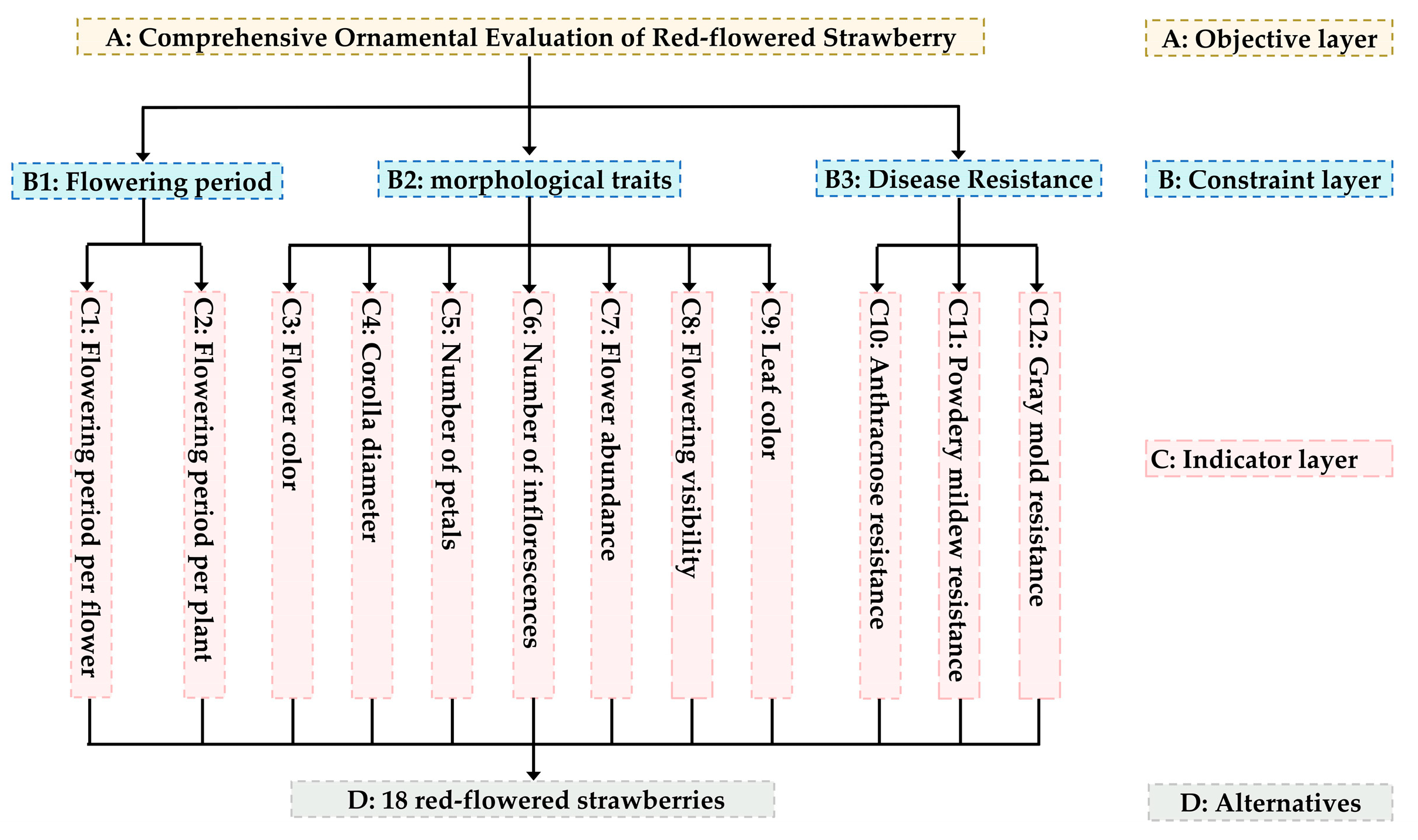
Based on the mutual membership relationships among the evaluation indicators, a comprehensive evaluation model for assessing the ornamental value of red-flowered strawberries was established [39]. The rating model consists of three levels. The first level is the objective layer (A), representing the comprehensive evaluation of the ornamental value of red-flowered strawberries. The second level is the constraint layer (B), comprising the primary influencing factors of the evaluation system, including flowering period, morphological traits, and disease resistance. The third level is the indicator layer (C), comprising 12 indicators of individual flower’s flowering period, plant flowering period, flower color, corolla diameter, number of petals, number of inflorescences, flower abundance, flowering visibility, leaf color, anthracnose resistance, powdery mildew resistance, and gray mold resistance. This bottom-level layer consists of the 18 strawberry accessions to be evaluated (Figure 1).

2.4.4. Construction of the Judgment Matrix

Basedon the established evaluation system, 15 experts were invited to conduct pairwise comparisons and assign scores for the relative importance of each factor in the constraint layer and indicator layer of the comprehensive evaluation model for red-flowered strawberry varieties, using Saaty’s scale for relative importance between factors [40] (Table 3). The 15 experts invited to construct the pairwise comparison matrices comprised five professors and ten senior researchers from horticultural research institutions and universities in China. Their areas of expertise encompass ornamental plant germplasm evaluation (n = 6), strawberry breeding and cultivation (n = 5), and landscape application of ornamental plants (n = 4), with an average of 12.5 years (range: 7–25 years) of professional experience in their respective fields. This procedure determined the relative importance of each factor and established the decision matrix A (Equation (1)).
A n × n = a 11 a 12 a 1 . . a 1 n a 21 a 21 a 2 . . a 2 n a . . a . . a . . a . . a n 1 a n 2 a n . . a nn

2.4.5. Combining Expert Matrices

Using the geometric mean method [41], the decision matrices constructed by 15 experts (m = 1, 2, …, 15) were multiplied element-wise and then raised to the power of m to obtain a unique ensemble decision matrix A (Equation (2)), as follows:
A _ = ( k = 1 m a i j k ) 1 m

2.4.6. Calculation of Relative Weight Values for Decision Matrices and Consistency Testing

The geometric mean method (square root method) was used [42] to calculate the weights of the unique ensemble matrix. The weight Wi for the i-th indicator is calculated as follows:
W i = ( j = 1 n a ij ) 1 n i = 1 n ( j = 1 n a ij ) 1 n   i = 1 , 2 , 3 , , n
where aij represents the element in the i-th row and j-th column of the judgment matrix, n is the number of indicators in the matrix, and Wi is the weight of the i-th indicator.
In practice, experts may reach inconsistent conclusions when comparing indicators in pairs. Therefore, it is necessary to perform a consistency test on the resulting judgment matrix to ensure the reasonableness of the indicator weights. The consistency index (CI) is used as a measure of deviation from consistency in the judgment matrix. A matrix is considered to have satisfactory consistency when its largest eigenvalue λmax is slightly greater than n and the remaining eigenvalues approach 0 [43]. CI is calculated as follows:
CI = λ max n n 1
where λmax is the largest eigenvalue of the judgment matrix, and n is the order of the matrix.
The consistency of the matrix is tested using the ratio of CI to RI (CR) [43]. The consistency ratio (CR) is calculated as follows:
CR = CI RI
where RI is the average random consistency index, the values of which are provided in Table 4 for matrix orders 1 through 14 [43].
When the order is greater than 2, if CR < 0.1, the judgment matrix is considered to meet the consistency requirements. Otherwise, experts are invited to make appropriate revisions to the judgment matrix until it meets the consistency requirements [43].

2.4.7. Calculation of Overall Hierarchical Ranking

The overall hierarchical ranking is composed of the importance ranking values of all indicators within each level relative to the highest level. Through the overall hierarchical ranking, it is possible to clearly identify which indicators are relatively more important. After calculating the specific evaluation scores for the indicator layer (C) by applying weights to the indicators in its immediate upper layer (B), and then further weighting and aggregating these results with the weights of the constraint layer (B), the weight of the indicator layer (C) relative to the top-level layer (A) can be derived.

2.4.8. Calculation of the Overall Evaluation Score

Based on the established scoring criteria, each indicator of the 18 strawberry germplasm samples under test was scored. The comprehensive score for each variety was then calculated according to the comprehensive weighting values of the individual indicators.

2.4.9. Methods of Statistical Data Analysis

WPS 2019 was used to calculate the weights of the evaluation indicators and the comprehensive evaluation scores for each variety. GraphPad Prism 9.5.0 was used for graphing, and Adobe Photoshop 2023 was used to format the result figures.

3. Results

3.1. Single-Level Ranking of Evaluation Indicators

Using a nine-point scale, pairwise comparisons were conducted between indicators. Judgment matrices were constructed for the evaluation indicators at different levels within the evaluation model for assessing the ornamental value of red-flowered strawberries. Consistency tests were performed. A total of four judgment matrices were created: A-B, B1-C, B2-C, and B3-C. The weight values for the indicators at each level were calculated. These calculations showed that the CR values for all four judgment matrices were less than 0.1, meeting the consistency requirements.
Based on the calculations from the A-B matrix, the weight values of each indicator factor (B) in the constraint layer relative to the target layer (A) were determined (Table 5). Among the constraint-layer indicators, morphological traits had the highest weight value at 0.6066, followed by flowering period (0.2771), while stress tolerance (0.1163) had the lowest. This indicates that morphological traits contribute most significantly to ornamental value. Stress tolerance makes a relatively smaller contribution but remains an indispensable component of the evaluation system. Red-flowered strawberries are primarily used in landscape design and pot cultivation; their morphological traits—such as flower color and corolla diameter—directly determine their visual appeal, serving as a direct reflection of their ornamental value, which explains why morphological traits were assigned the highest weight. The A-B judgment matrix showed CR = 0.0009 < 0.1. This indicates that the experts’ judgments on pairwise comparisons of flowering period, morphological traits, and stress tolerance are logically consistent. The weight allocation is reasonable and reliable.
Based on the B1-C matrix, the weight values for pairwise comparisons of the two indicator factors (C) in the indicator layer (C) under the constraint layer (B1) were calculated (Table 6). Regarding flowering period, the weight values for the flowering period of a single flower and the flowering period of the entire plant for red-flowered strawberries were 0.4078 and 0.5922, respectively. The weight value for the flowering period of the entire plant was higher than that for the flowering period of a single flower. This indicates that the flowering period of the entire plant has a more significant impact on the ornamental evaluation of red-flowered strawberries.
The relative importance of the criteria in the indicator layer (C) under the constraint layer (B2) was calculated using the judgment matrix B2-C (Table 7). For morphological traits, the criterion weights, in descending order, were flower color > corolla diameter > number of petals > flower abundance > flowering status > number of inflorescences > leaf color. The weight values were 0.3621, 0.2586, 0.1465, 0.1156, 0.0618, 0.0381, and 0.0173, respectively. Within the morphological trait evaluation system, flower color had the highest weight, while leaf color had the lowest. This indicates that flower color has the most significant impact on the overall ornamental evaluation of red-flowered strawberries. Leaf color has a relatively minor influence on their ornamental value compared to flower color, corolla diameter, and number of petals. The CR value of judgment matrix B2-C is 0.0703 < 0.1. Although this value is close to the critical value, it remains within an acceptable range, indicating that the importance assessment of this set of indicators is generally reasonable.
The relative importance of the criteria in the indicator layer (C) under the constraint layer (B3) was calculated using the decision matrix B3-C (Table 8). In terms of disease resistance, powdery mildew resistance had the highest weight value at 0.6656, followed by anthracnose resistance with a weight value of 0.2021; gray mold resistance had the lowest weight value at 0.1323. This indicates that powdery mildew has the greatest impact on the ornamental value of red-flowered strawberries. The CR value of judgment matrix B3-C is 0.0066; this value is less than 0.1, indicating that the matrix meets the consistency requirements.

3.2. Overall Ranking of Evaluation Indicator Levels

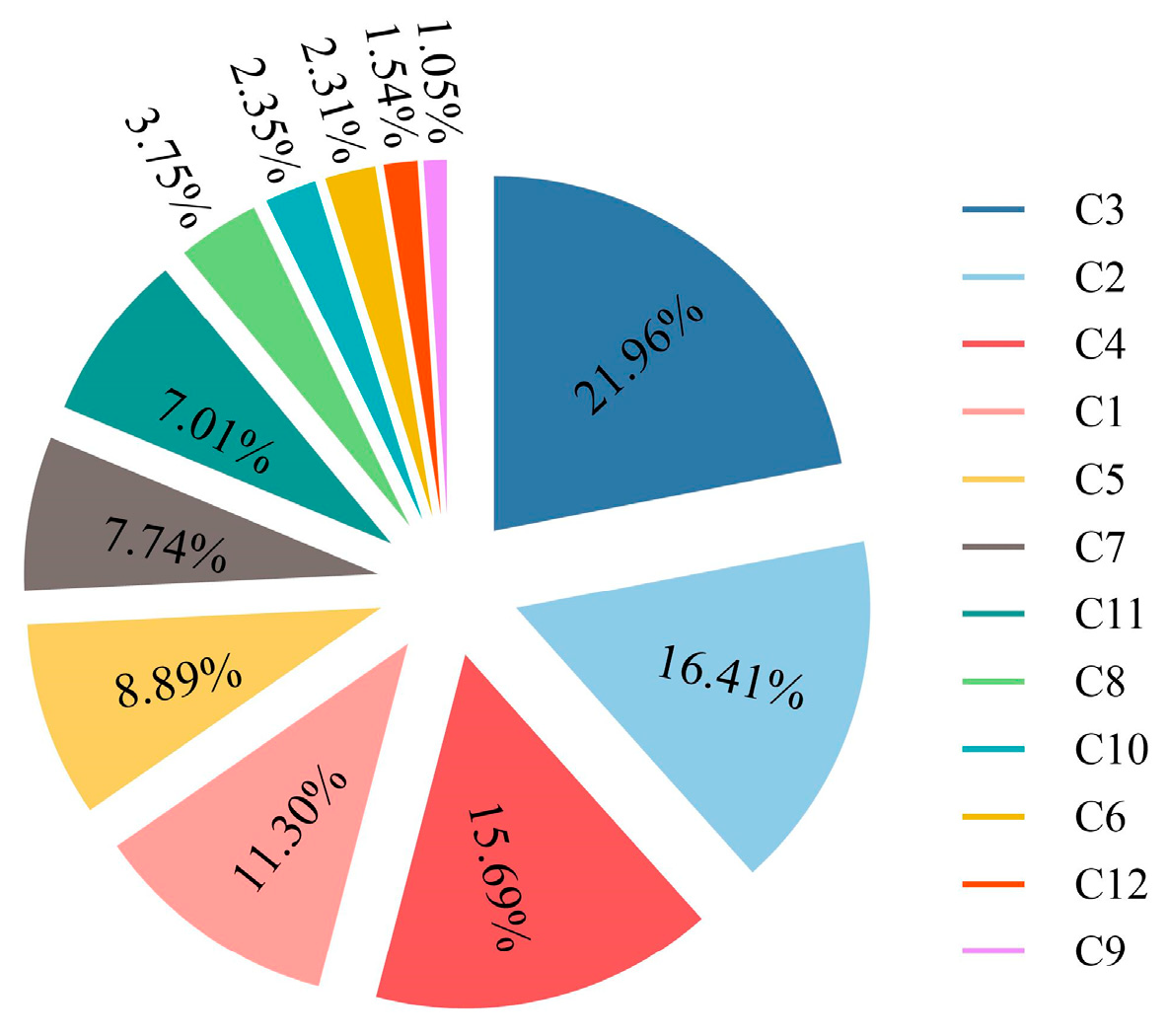
The overall ranking by level reflects the relative importance of each evaluation indicator in the standard layer (C) to the target layer (A). By calculating the weights of specific evaluation indicators in layer C relative to the top-level layer (A), the overall ranking of the indicator weights is obtained. As shown in Figure 2, within the proposed comprehensive evaluation index system, the four evaluation indicators—flower color, plant flowering period, corolla diameter, and individual flower’s flowering period—accounted for a significant portion of the total weight. Among these, flower color had the highest weight at 21.96%, while plant flowering period accounted for 16.41%, corolla diameter for 15.69%, and individual flower’s flowering period for 11.30%. The combined weight of these four evaluation indicators was 65.36%. Based on the weight of each individual indicator, the evaluation criteria can be divided into three tiers: indicators with a weight > 10% (flower color, plant flowering period, corolla diameter, and individual flower duration) are decisive factors; indicators with a weight between 3% and 10% (number of petals, powdery mildew resistance, flower yield, and flowering performance) are important influencing factors; and indicators with a weight < 3% (anthracnose resistance, number of inflorescences, gray mold resistance, and leaf color) are general influencing factors. Among these indicators, the weights for number of petals, powdery mildew resistance (calculated by multiplying the weight of 0.6656 from the B3-C decision matrix by the constraint-layer disease resistance weight of 0.1163), flower quantity, and flower display were 8.89%, 7.74%, 7.01%, and 3.75%, respectively—totaling 27.39%—indicating that they are the most significant factors influencing the ornamental value of red-flowered strawberries. In contrast, anthracnose resistance, number of inflorescences, gray mold resistance, and leaf color had lower weights, at 2.35%, 2.31%, 1.54%, and 1.05%, respectively. These indicators are therefore considered general factors that influence the evaluation of the ornamental value of red-flowered strawberries.

3.3. Comprehensive Evaluation Scores

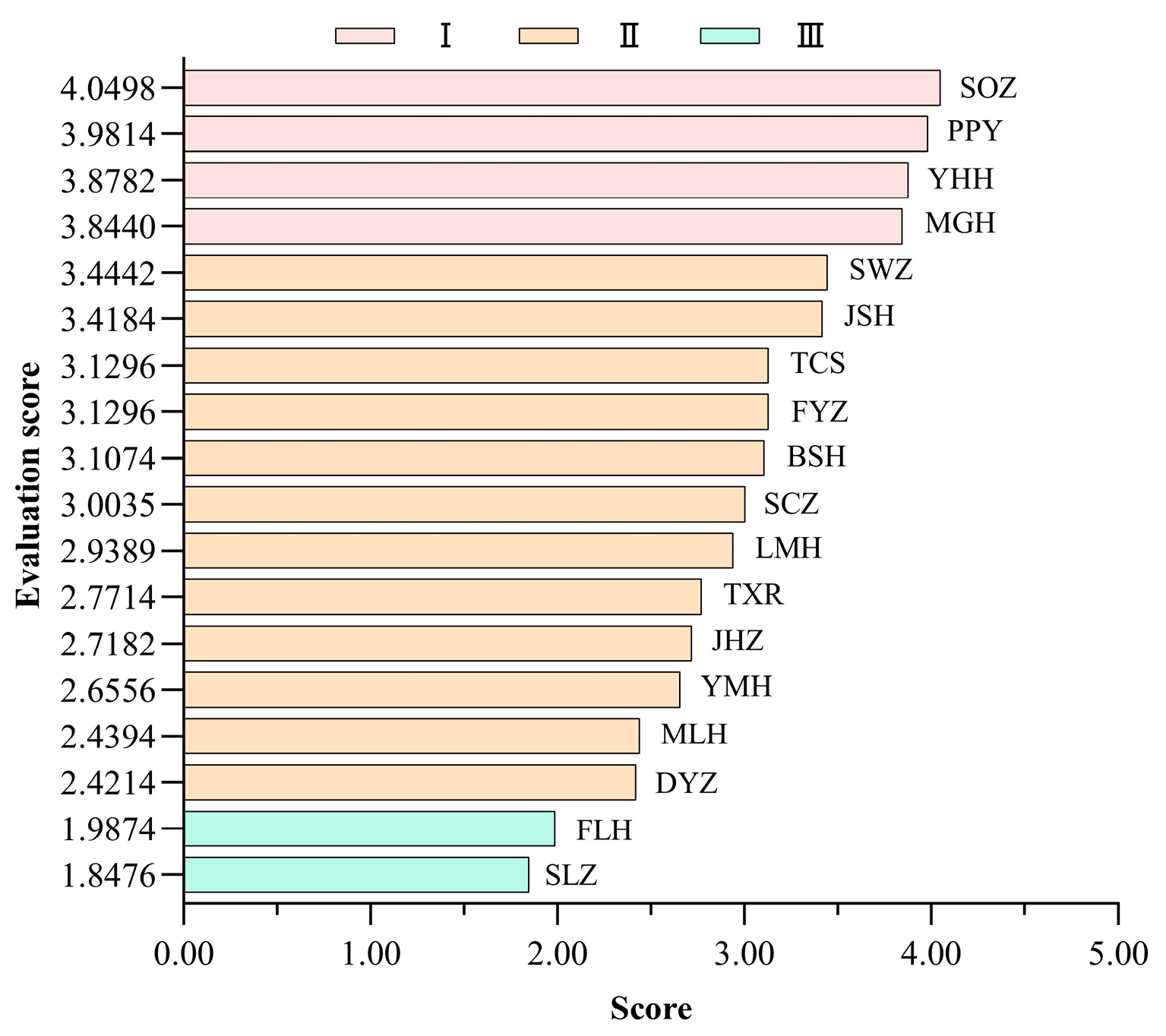
Based on the established scoring criteria (Table 2), the 18 red-flowered strawberry accessions were scored item by item. The comprehensive score for each accession was calculated according to the weighting values of each indicator (Figure 2, Figure 3).
As shown in Figure 3, the 18 strawberry accessions were categorized into three ornamental value classes based on their comprehensive scores: Class I (high), Class II (moderate), and Class III (low), accounting for 22.2%, 66.7%, and 11.1% of the total accessions, respectively. Representative varieties from each class are presented in Figure 4.
The top four germplasm accessions by comprehensive score were ‘140’, ‘Pink Panda’, ‘Summer Breeze-Cherry’, and ‘Summer Breeze-Rose’. These germplasm accessions are characterized by abundant blooms, vibrant flower colors, and a long flowering period. They also exhibited strong disease resistance under the experimental conditions. Therefore, these accessions show high potential for application in landscaping and home gardening. Among them, ‘Summer Breeze-Cherry’ and ‘Summer Breeze-Rose’ have a large number of petals and outstanding ornamental value.
The remaining germplasm accessions had average or below-average composite scores, each with its own strengths and weaknesses in terms of traits. The germplasm accessions ‘245’, ‘Gasana’, ‘Toscana’, ‘Fen Yun’, ‘Bubby Ann’, ‘243’, ‘Roman’, ‘Tokun’, ‘Zi Jin Hong’, ‘Tarpan’, ‘Merlan’, and ‘Zi Jin Daiyu’ exhibit ornamental traits characterized by high scores on certain indicators and low scores on others. The accessions ‘245’ and ‘Bubby Ann’ have vibrant flower colors and moderate flower production, but their disease resistance is relatively weak. ‘Roman’ has a large corolla diameter and long inflorescences and flower pedicels, but a large number of spent flowers remain after blooming. As its flowers wither without falling off, the petals remain attached to the calyx, affecting the plant’s ornamental value. ‘Toscana’ and ‘Pink Melody’ have moderate flower production but received low scores on flowering visibility (flowers are often below the foliage, making them difficult to observe). The accessions ‘243’ and ‘Tarpan’ have large corolla diameters and abundant blooms, but their flower and leaf colors are dull, and they have poor disease resistance. ‘Purple Gold Red’ has strong disease resistance, but its overall ornamental value is average. ‘Tokun’ and ‘Purple Gold Daiyu’ have bright flower colors but poor disease resistance. They are particularly susceptible to powdery mildew, which affects their ornamental value. Meanwhile, ‘Frisan’ and ‘246’ received the lowest overall scores. These accessions exhibit issues such as a small corolla diameter, a low flower yield, a short flowering period, and poor disease resistance. However, ‘246’ exhibits vigorous growth, extensive coverage, and vibrant foliage. In certain specific application scenarios—such as areas requiring high plant coverage but with lower demands on flowering period and flower yield—it can still play a unique role. The comprehensive evaluation results show that the evaluation factors selected in this study generally reflect the ornamental characteristics of red-flowered strawberry varieties. Therefore, these factors should be prioritized in future evaluations of ornamental strawberry applications.
Figure 4. Representative accessions of the three ornamental value classes. (A) ‘Pink Panda’ (Class I), (B) ‘245’ (Class II), (C) ‘246’ (Class III).
Horticulturae 12 00944 g004

4. Discussion

Germplasm resources are the key and foundation for variety innovation, improvement, and breeding of new varieties. Evaluating plants’ ornamental value should be approached from a multidisciplinary perspective, and representative evaluation factors should be selected for systematic assessment. In existing AHP evaluation studies of ornamental plants, floral traits generally carry high weights.
The high weights assigned to flower color, flowering period, and corolla diameter in our study are consistent with findings from previous AHP evaluations of ornamental plants, including herbaceous peony [4], Rhododendron [6], and potted chrysanthemum [44]. This convergence suggests that these three traits represent universally prioritized ornamental characteristics across diverse flowering species. Our top-performing accessions—‘140’, ‘Pink Panda’, ‘Summer Breeze-Cherry’, and ‘Summer Breeze-Rose’—all scored highly on these core traits. Notably, ‘Pink Panda’ and the two ‘Summer Breeze’ cultivars also exhibit strong disease resistance, which aligns with the high weight (7.74%) assigned to powdery mildew resistance in our model. This underscores the importance of integrating both esthetic and health-related traits in ornamental strawberry breeding programs.
In addition to the abovementioned studies, Wang et al. [4] found that ornamental value criteria contributed most significantly to AHP evaluation results in herbaceous peony. Liang et al. [6] identified flower color and flower abundance as the most critical indicators in Rhododendron. Tao et al. [7] reported that pedicel length, flower color, single-flower lifespan, and flowering period per plant were primary factors in wild impatiens. Similar findings have also been reported for daylily [21], ornamental peach [35], potted chrysanthemum [44], and pansy [45]. These consistent results across diverse species further support the conclusion that these traits are universally prioritized ornamental traits.
It should be noted that in AHP-based evaluation systems, the comprehensive score for each accession is a single integrated value derived from the weighted aggregation of multiple indicators, rather than a value with repeated measurements. Therefore, traditional ANOVA based on replicated composite scores is not directly applicable to the final scores. Nevertheless, the four top-ranked accessions (‘140’, ‘Pink Panda’, ‘Summer Breeze-Cherry’, and ‘Summer Breeze-Rose’) consistently outperformed the other accessions across the three highest-weighted core indicators—flower color (21.96%), corolla diameter (15.69%), and plant flowering period (16.41%)—which together account for 54.06% of the total weight. Their superior performance is thus supported not by a single statistical test but by convergence across multiple independently weighted criteria, which is the inherent logic of the AHP methodology. This consistency across high-weight indicators provides strong empirical support for their classification as superior germplasm.
Regarding the retention of both ‘Number of inflorescences’ (C6) and ‘Flower abundance’ (flowers per inflorescence, C7), although both are flower-related indicators, they were both retained in our model because they capture distinct aspects of ornamental display. Number of inflorescences reflects the overall reproductive capacity and vigor of the plant—a genotype producing more inflorescences tends to have stronger vegetative growth and branching, which contributes to a fuller plant habit. In contrast, flower abundance (flowers per inflorescence) determines the visual density of each inflorescence, directly affecting the perceived ‘fullness’ of the floral display at close range. In our AHP results, these two indicators received weights of 2.31% and 7.01%, respectively, indicating that while both contribute to ornamental value, flower abundance plays a more substantial role in visual quality than inflorescence number. Their distinct weights in the final model further justify their independent inclusion.
The red-flowered strawberry varieties with high ornamental values, selected using the comprehensive evaluation model developed in this study, hold broad application prospects. In landscape design, the varieties ‘140’, ‘Pink Panda’, ‘Summer Breeze-Cherry’, and ‘Summer Breeze-Rose’ exhibit excellent ornamental traits and should be given priority consideration. Among them, ‘Pink Panda’ not only features abundant blooms, a vibrant flower color, a long flowering period, and strong disease resistance under the experimental conditions, but was also noted informally during cultivation to have appeared to set fewer fruits than other varieties—a characteristic that would require dedicated quantification to confirm. If verified, this trait could allow it to maintain consistent ornamental appeal when used as a landscape groundcover or in flower beds by potentially reducing issues associated with excessive fruiting. Meanwhile, ‘140’, ‘Summer Breeze-Cherry’, and ‘Summer Breeze-Rose’ produce abundant flowers and have a relatively strong fruit-setting ability. In home container gardening, they can satisfy ornamental needs while also yielding a certain amount of fruit. At strawberry farms, these varieties can attract visitors with their vibrant flowers while also achieving a certain level of yield, thus offering dual value.
It should be noted that fruit set rate is a key factor affecting the sustainability of ornamental red-flowered strawberry landscapes and maintenance costs. However, this study did not include this factor in the evaluation index system. The observations regarding fruit set rate mentioned above are merely preliminary qualitative records from the field cultivation process and require further quantitative verification. When selecting varieties for practical applications, it is still necessary to comprehensively weigh factors such as ornamental characteristics and fruit set performance in view of specific application scenarios. Furthermore, the evaluation model developed in this study is based on 18 germplasm accessions grown under protected cultivation conditions. Its applicability in different growing environments (such as open-field, partial-shade, or full-sun conditions) requires further validation. Future research could expand the germplasm sources and sample size and incorporate more environmental adaptability indicators to enhance the universality of the evaluation system.

5. Conclusions

This study established a 12-indicator AHP ornamental value evaluation system for red-flowered strawberries. It identified flower color (21.96%), plant flowering period (16.41%), corolla diameter (15.69%), and individual flower duration (11.30%) as the core indicators determining ornamental value. This clarifies the breeding direction for the genetic improvement of ornamental red-flowered strawberry varieties. Using this model to conduct a comprehensive evaluation of 18 germplasm accessions, four accessions—‘140’, ‘Pink Panda’, ‘Summer Breeze-Cherry’, and ‘Summer Breeze-Rose’—were selected for their balanced ornamental traits and excellent performance under the experimental conditions. These four accessions consistently ranked highest not only in overall score but also in the three highest-weighted indicators (flower color, corolla diameter, and plant flowering period), supporting their classification as superior germplasm. These accessions can serve as priority choices for protected landscape applications and container gardening in subtropical southern China and for home potted plants. The evaluation method established in this study can serve as a reference for the quantitative assessment of ornamental traits in other flowering herbaceous plants. The selected superior germplasm can provide a genetic foundation for the promotion and genetic improvement of ornamental red-flowered strawberry varieties.

Author Contributions

Conceptualization, L.M., Q.C. and Y.H.; methodology, C.N. and Z.F.; software, L.M. and Y.M.; validation, C.N. and J.Q.; formal analysis, C.N. and J.Q.; investigation, C.N., J.Q., R.R. and Z.F.; resources, L.M., Q.C., L.Y., Y.M., R.R. and Z.F.; data curation, M.J., C.N. and J.Q.; writing—original draft preparation, L.M., C.N. and Y.H.; writing—review and editing, L.M., Y.H. and M.J.; visualization, M.J., L.Y. and Y.M.; supervision, L.M. and Q.C.; project administration, L.M., Q.C. and Y.H.; funding acquisition, L.M. and Y.H. All authors have read and agreed to the published version of the manuscript.

Funding

This research was funded by the Natural Science Foundation of Fujian Province (2023J01450, 2024J01392).

Data Availability Statement

The data presented in this study are available in the article.

Acknowledgments

During the preparation of this paper the authors used DeepSeek-V4 in order to improve the language. After using this tool, the authors reviewed and edited the content as needed and take full responsibility for the content of the publication.

Conflicts of Interest

The authors declare no conflicts of interest.

References

  1. Ding, Y.; Xue, L.; Guo, R.; Luo, G.; Song, Y.; Lei, J. De novo assembled transcriptome analysis and identification of genic SSR markers in red-flowered strawberry. Biochem. Genet. 2019, 57, 607–622. [Google Scholar] [CrossRef] [Scilit] [PubMed]
  2. Guan, L.; Wilson, Z.A.; Zhao, M.; Qiao, Y.; Wu, E.; Wang, Q.; Yuan, H.; Xu, L.; Pang, F.; Cai, W.; et al. New germplasm for breeding: Pink-flowered and white-fruited strawberry. HortScience 2023, 58, 1005–1009. [Google Scholar] [CrossRef] [Scilit]
  3. Nong, C.; Hou, J.; He, J.; Zheng, Y.; Yang, S.; Jiang, L.; Xie, Q.; Wang, W.; Wu, J.; Chen, Q.; et al. Phenotypic and genetic diversity analysis of 18 ornamental strawberries. Horticulturae 2024, 10, 1364. [Google Scholar] [CrossRef] [Scilit]
  4. Wang, X.; Zhang, R.; Zhang, K.; Shao, L.; Xu, T.; Shi, X.; Li, D.; Zhang, J.; Xia, Y. Development of a multi-criteria decision-making approach for evaluating the comprehensive application of Herbaceous Peony at low latitudes. Int. J. Mol. Sci. 2022, 23, 14342. [Google Scholar] [CrossRef] [Scilit] [PubMed]
  5. Cheng, X.; Feng, Y.; Chen, D.; Luo, C.; Yu, X.; Huang, C. Evaluation of Rosa germplasm resources and analysis of floral fragrance components in R. rugosa. Front. Plant Sci. 2022, 13, 1026763. [Google Scholar] [CrossRef] [Scilit] [PubMed]
  6. Liang, J.; Chen, Y.; Tang, X.; Lu, Y.; Yu, J.; Wang, Z.; Zhang, Z.; Ji, H.; Li, Y.; Wu, P.; et al. Comprehensive evaluation of appreciation of rhododendron based on analytic hierarchy process. Plants 2024, 13, 558. [Google Scholar] [CrossRef] [Scilit] [PubMed]
  7. Tao, J.; Yang, Y.; Wang, Q. Two growing-season warming partly promoted growth but decreased reproduction and ornamental value of impatiens oxyanthera. Plants 2024, 13, 511. [Google Scholar] [CrossRef] [Scilit] [PubMed]
  8. Hao, M.; Tang, H.; Wang, M.; Liu, B.; Chen, Y. Evaluation and screening of Ornamental Illicium difengpi germplasm in terms of leaf morphology using analytic hierarchy process method. For. Grass Resour. Res. 2022, 5, 136–144. [Google Scholar] [CrossRef]
  9. Weber, R.W.S.; Petridis, A. Fungicide resistance in botrytis spp. and regional strategies for its management in northern european strawberry production. BioTech 2023, 12, 64. [Google Scholar] [CrossRef] [Scilit] [PubMed]
  10. Xue, Y.; Li, J.; Nan, X.; Xu, C.; Ma, B. Effects of tall buildings on visually morphological traits of urban trees. Forests 2024, 15, 2053. [Google Scholar] [CrossRef] [Scilit]
  11. Ning, K.; Li, B.; Nie, H.; Liao, S.; Chen, X.; Yang, X.; Zhang, W.; El-Kassaby, Y.A.; Zhou, T. Phenotypic diversity and ornamental evaluation between introduced and domestically bred crabapple germplasm. Horticulturae 2025, 11, 1527. [Google Scholar] [CrossRef] [Scilit]
  12. Cai, Y.; Feng, J.; Song, X.; Li, Q.; Feng, X. Evaluation of the ornamental characteristics of Camellia hainanica single plant based on tree morphological characteristics. J. Southwest For. Univ. 2025, 45, 185–192. [Google Scholar] [CrossRef]
  13. Kokhanovskyi, V.M.; Barna, M.M.; Barna, L.S.; Melnyk, T.I. Methodological aspects of evaluation of ornamental woody plants of the Magnoliophyta division according the complex of morphological signs and signs of vitality. Sci. Bull. UNFU 2021, 31, 54–59. [Google Scholar]
  14. Aldrighetti, A.; Zott, D.; Pertot, I. Sanitation practices targeting overwintering inoculum improve management of strawberry powdery mildew in high-tunnel production. Front. Agron. 2026, 8, 1729740. [Google Scholar] [CrossRef] [Scilit]
  15. Aljawasim, B.D.; Samtani, J.B.; Rahman, M. New insights in the detection and management of anthracnose diseases in strawberries. Plants 2023, 12, 3704. [Google Scholar] [CrossRef] [Scilit] [PubMed]
  16. Luo, X.; Su, C.; Lu, Y.; Han, M.; Qin, M.; Gong, Y. Comprehensive evaluation of the ornamental value of 35 species of Gesneriaceae plants based on analytic hierarchy process. J. Trop. Biol. 2026, 17, 117. [Google Scholar] [CrossRef]
  17. Kang, R.; Huang, J.; Zhou, X.; Ren, N.; Sun, S. Toward real scenery: A lightweight tomato growth inspection algorithm for leaf disease detection and fruit counting. Plant Phenomics 2024, 6, 0174. [Google Scholar] [CrossRef] [Scilit] [PubMed]
  18. Li, J.; Deng, K. Commonly used comprehensive evaluation method of crop germplasm resources. Jiangsu Agric. Sci. 2024, 52, 40–46. [Google Scholar]
  19. Zhang, Z.; Wang, Y. Investigation and comprehensive evaluation on cultivars of Paeonia suffruticosa in Changshu city of jiangsu province. J. Zhejiang For. Sci. Technol. 2021, 41, 57–61. [Google Scholar] [CrossRef]
  20. Liu, Y.; Guo, L.; Chen, F.; Zhao, F.; Wang, B.; Han, R.; Zhang, R. Market-oriented screening and evaluation of cut peony (Paeonia lactiflora) cultivars using AHP and K-means clustering. Ornam. Plant Res. 2026, 6, e009. [Google Scholar] [CrossRef] [Scilit]
  21. Zhou, Y.; Yang, W.; Zhu, S.; Wei, J.; Zhou, X.; Wang, M.; Lu, H. Evaluation of aromatic characteristics and potential applications of Hemerocallis L. based on the analytic hierarchy process. Molecules 2024, 29, 2712. [Google Scholar] [CrossRef] [Scilit] [PubMed]
  22. Zhang, J.; Wang, Y.; Li, Z.; Huang, R.; Wu, Y.; Tian, Q. Distribution characteristics and ornamental evaluation of wild clematis in gansu province. Chin. Wild Plant Resour. 2022, 41, 71–79. [Google Scholar] [CrossRef]
  23. Sun, Y.; Yu, W.; Zhang, H.; Zhang, J.; Luo, Z. Application of analytic hierarchy process in the evaluation and selection of Clematis species introduction. Shandong For. Sci. Technol. 2020, 50, 18–21. [Google Scholar]
  24. Wang, J.; Chu, Y.; Chen, G.; Zhao, M.; Wu, J.; Qu, R.; Wang, Z. Characterization and Identification of NPK Stress in Rice Using Terrestrial Hyperspectral Images. Plant Phenomics 2024, 6, 0197. [Google Scholar] [CrossRef] [Scilit] [PubMed]
  25. Liang, Z.; Pei, K.; Zhang, H.; Lai, X.; Meng, Y.; Jia, M.; Cao, D.; Zhang, C.; Song, Z.; Duan, J. A comprehensive evaluation of drought resistance in Hemerocallis fulva L. using membership function and principal component analysis. Sci. Rep. 2025, 15, 34812. [Google Scholar] [CrossRef] [Scilit] [PubMed]
  26. Qu, L.; Yuan, B.; Wen, X.; Guo, J.; Luo, J.; Shi, X. Analysis of phenotypic diversity and comprehensive evaluation of 51 Helleborus L. hybrid individuals. Plants 2025, 14, 3226. [Google Scholar] [CrossRef] [Scilit] [PubMed]
  27. Zhang, M.; Huang, H.; Wang, Q.; Dai, S. Cross breeding new cultivars of early-flowering multiflora Chrysanthemum based on mathematical analysis. HortScience 2018, 53, 421–426. [Google Scholar] [CrossRef] [Scilit]
  28. Wang, F.; Li, Y.; Pang, Y.; Hu, J.; Kang, X.; Qian, C. Thidiazuron enhances strawberry shoot multiplication by regulating hormone signal transduction pathways. Int. J. Mol. Sci. 2025, 26, 4060. [Google Scholar] [CrossRef] [Scilit] [PubMed]
  29. Iqbal, M.; Flöhr, A.; Andreasson, E.; Stenberg, J.A. Breeding for Integrated Pest Management (B-IPM): A new concept simultaneously optimising plant resistance and biocontrol. Front. Plant Sci. 2025, 16, 1659069. [Google Scholar] [CrossRef] [Scilit] [PubMed]
  30. Rehman, A.u.; Iso-Touru, T.; Junkers, J.; Rantanen, M.; Karhu, S.; Fischer, D.; Alsheikh, M.; Hjeltnes, S.H.; Mezzetti, B.; Davik, J.; et al. Multi-model GWAS reveals key loci for horticultural traits in reconstructed garden strawberry. Physiol. Plant. 2024, 176, e14440. [Google Scholar] [CrossRef] [Scilit] [PubMed]
  31. Cai, X.; Gao, J.; Wu, B. Impact of east Asian summer monsoon and subtropical anticyclone over western pacific on droughts/floods in Fujian. J. Appl. Meteorol. Sci. 2003, 14, 322–330. [Google Scholar]
  32. Zhao, M.Z.; Wang, G.X.; Qian, Y.M. Descriptors and Data Standard for Strawberry (Fragaria spp.); China Agriculture Press: Beijing, China, 2016. (In Chinese) [Google Scholar]
  33. Wu, R.; Liu, Y.; Bu, Y.; Zhao, S.; Feng, H. Comprehensive evaluation of 138 rose varieties in summer and autumn in Beijing. LA Plant 2021, 37, 118–122. (In Chinese) [Google Scholar] [CrossRef]
  34. Yan, S.; Feng, S.; Liu, Y.; Dai, S.; Chen, L.; Fan, Y.; Chang, X.; Li, W.; Huang, Y. Comprehensive evaluation on ornamental characters of Amygdalus persica L. of woody-flowering-plants in Shijiazhuang. J. Hebei For. Sci. Technol. 2023, 21–26. [Google Scholar] [CrossRef]
  35. Qiao, Y.; Shen, X.; Jiao, X.; Zhou, X.; Yue, C.; Shi, X. Comprehensive evaluation of the ornamental value of 46 peach varieties in the central Henan. J. Fruit Sci. 2024, 41, 216–228. [Google Scholar] [CrossRef]
  36. Shao, W.; Liao, D.; Liu, Z.; Shen, Y.; Dong, B.; Yang, L. Establishment and application of comprehensive evaluation system for ornamental quality of Clematis cultivars. J. Zhejiang AF Univ. 2022, 39, 1229–1237. [Google Scholar]
  37. Man, L.; Zhang, H.; Liu, G. Establishment and application of ornamental evaluation system for Malus spp. varieties based on analytic hierarchy process. North. Hortic. 2022, 61–67. [Google Scholar]
  38. Dong, N.; Li, C.; Chen, L.; Zhao, Y.; Zhuang, Q.; Zhai, J.; Wu, S. Establishment and application of ornamental evaluation system for Oxalis. Chin. J. Trop. Crops 2020, 41, 1770–1778. [Google Scholar]
  39. Saaty, R.W. The analytic hierarchy process—What it is and how it is used. Math. Model. 1987, 9, 161–176. [Google Scholar] [CrossRef] [Scilit]
  40. Genedi, M.; Gouhar, N.; El-Qady, G.; Gaafar, I.; Mahmoudi, A.E. Integrating conventional and remote sensing with DC resistivity datasets to map groundwater potential areas using the analytical hierarchy process method, North Wadi Diit, Egypt. Sci. Rep. 2025, 15, 12786. [Google Scholar] [CrossRef] [Scilit] [PubMed]
  41. Liu, W.; Liu, S. Construction of the judgement matrix of group decision-making in AHP. Syst. Eng. Electron. 2005, 27, 93–94+99. [Google Scholar]
  42. Deng, X.; Li, J.; Zeng, H.; Chen, J.; Zhao, J. Research on computation methods of AHP wight vector and its applications. Math. Pract. Theory 2012, 42, 93–100. [Google Scholar]
  43. Saaty, T.L. How to make a decision: The analytic hierarchy process. Eur. J. Oper. Res. 1990, 48, 9–26. [Google Scholar] [CrossRef] [Scilit]
  44. Shen, Y.; Wang, H.; Hou, H.; Wu, Z.; Zhou, H. Comprehensive evaluation on ornamental value and landscape application of introduced potted chrysanthemum cultivars. Guihaia 2021, 41, 1363–1371. [Google Scholar] [CrossRef]
  45. Zhang, F. Analytic hierarchy process on pansy ornamental evaluation. Agric. Food Sci. 2012, 43, 166–171. [Google Scholar]
Figure 1. Comprehensive Evaluation Model.
Horticulturae 12 00944 g001
Figure 2. Overall ranking of the weighting levels for each evaluation indicator in the standard layer. C1: Flowering period per flower; C2: Flowering period per plant; C3: Flower color; C4: Corolla diameter; C5: Number of petals; C6: Number of inflorescences; C7: Flower abundance; C8: Flowering visibility; C9: Leaf color; C10: Anthracnose resistance; C11: Powdery mildew resistance; C12: Gray mold resistance.
Horticulturae 12 00944 g002
Figure 3. Comprehensive ornamental evaluation scores for 18 strawberry accessions.
Horticulturae 12 00944 g003
Table 1. Test materials and their sources.
NameCodeSourceNameCodeSource
FenyunFYZChinaSummerBreeze-RoseMGHHolland
140SOZChinaSummerBreeze-CherryYHHHolland
243SCZChinaGasanaJSHHolland
245SWZChinaTarpanYMHHolland
246SLZChinaRomanLMHHolland
ZijinhongJHZChinaFrisanFLHHolland
ZijindaiyuDYZChinaBubbyAnnBSHHolland
ToscanaTCSChinaMerlanMLHHolland
Pink PandaPPYEnglandTokunTXRJapan
Table 2. Description of Evaluation Indicators and Scoring Criteria.
IndicatorDescriptionScoring CriteriaScore
Flowering Period of a Single Flower (C1)From full bloom until the
petals have completely fallen off or withered
Single-flower flowering period ≥ 5 d5
4 d ≤ flowering period of a single flower < 5 d3
Flowering duration per flower < 4 days1
Plant flowering period (C2)From the opening of the first flower to the withering of the last flower on the plant Plant flowering period ≥ 35 d5
25 d ≤ flowering period < 35 d3
Flowering period < 25 d1
Flower Color (C3)Petal color and luster of flowers at peak bloom Vibrant flower color, evenly distributed or with distinctive mottling; excellent luster; high ornamental value5
Flower color is relatively vivid, distribution is relatively even, and ornamental value is moderate3
Dull flower color, poor luster, and low ornamental value1
Corolla diameter (C4)Flower diameter at peak bloomCorolla diameter ≥ 3.0 cm5
2.5 cm ≤ corolla diameter < 3.0 cm3
Corolla diameter < 2.5 cm1
Number of petals (C5)Number of petals per flowerNumber of petals ≥ 105
6 ≤ number of petals < 103
Number of petals < 61
Number of inflorescences (C6)Number of inflorescences produced by a plant during one growth cycleNumber of inflorescences ≥ 55
3 ≤ Number of inflorescences < 53
Number of inflorescences < 31
Flower Abundance (C7)Number of flowers per inflorescenceNumber of flowers ≥ 85
6 ≤ number of flowers per inflorescence < 83
Number of flowers < 61
Flowering Condition (C8)Visibility of Flowers During Full BloomAll flowers are fully exposed and easy to view5
1/2 of the flower is visible, relatively easy to view3
Less than half of the flower is visible; somewhat difficult to view1
Leaf Color (C9)Color and gloss of the leaf’s upper surfaceLeaf color is a true green with excellent luster5
Leaf color is somewhat dull, with average gloss3
Leaf color is dull, and luster is poor1
Anthracnose resistance (C10)Area of infection by anthracnoseFungal coverage of leaflets < 20%5
20% ≤ Fungal coverage of leaflets < 60%3
60% ≤ Fungal coverage of leaflets1
Powdery mildew resistance (C11)Area of infection by powdery mildewFungal coverage of leaflet area < 20%5
20% ≤ fungal coverage of leaflets < 60%3
60% or more of the leaflet area covered by fungal colonies1
Gray Mold Resistance (C12)Area of infection by gray moldFungal coverage of leaflet area < 20%5
20% ≤ fungal coverage of leaflets < 60%3
60% ≤ fungal coverage of leaflets1
Table 3. Saaty’s scale for the Analytical Hierarchy Process (AHP) method [40].
Intensity of ImportanceDefinitionExplanation
1Equal importanceTwo activities contribute equally to the objective
2Weak or slight importanceWhen a compromise is needed
3Moderate importanceExperience and judgment slightly favor one activity over another
4Moderate plusWhen a compromise is needed
5Strong importanceExperience and judgment strongly favor one activity over another
6Strong plusWhen a compromise is needed
7Very strong importanceOne activity is strongly preferred over another; its dominance is evident in practice
8Very, very strongWhen a compromise is needed
9Extreme importanceThe evidence supporting one activity over another is of the highest possible level of certainty
Table 4. Average Random Consistency Index (RI) Values for Judgment Matrices.
Order1234567891011121314
RI000.520.891.121.261.361.411.461.491.521.541.561.58
Table 5. A-B Judgment Matrix and Consistency Test.
Judgment MatrixWeightsConsistency Test
AB1B2B3
B110.44240.25960.2771λmax = 3.001
CR = 0.0009
B20.260615.04860.6066
B30.40660.198110.1163
Note: CR < 0.1 indicates that the matrix is consistent; the same applies below.
Table 6. B1-C Judgment Matrix and Consistency Test.
Judgment MatrixWeightsConsistency Test
B1C1C2
C110.68870.4078λmax = 2
CR = 0
C21.452010.5922
Table 7. B2-C Judgment Matrix and One-Step Test.
Judgment MatrixWeightsConsistency Test
B2C3C4C5C6C7C8C9
C312.11113.53477.29854.41166.15318.57680.3621λmax = 7.5085
CR = 0.0623
C40.473712.37906.96163.42285.33908.38590.2586
C50.28290.420415.53291.34623.21127.92140.1465
C60.13700.14360.180710.23740.47744.46420.0381
C70.22670.29220.74284.212412.59817.93880.1156
C80.16250.18730.31142.09460.384917.01250.0618
C90.11660.11920.12620.22400.12600.142610.0173
Table 8. B3-C Judgment Matrix and One-Time Test.
Judgment MatrixSingle-Level Weight ValuesConsistency Test
B3C10C11C12
C1010.27951.65980.2021λmax = 3.0069
CR = 0.0066
C113.577914.62900.6656
C120.60250.216010.1323
Disclaimer/Publisher’s Note: The statements, opinions and data contained in all publications are solely those of the individual author(s) and contributor(s) and not of MDPI and/or the editor(s). MDPI and/or the editor(s) disclaim responsibility for any injury to people or property resulting from any ideas, methods, instructions or products referred to in the content.